Next Article in Journal
Current concepts of Stroke Units in Germany and Europe
Previous Article in Journal
Konzept der atypischen Depression und deutsche Übersetzung der «Atypical Depression Diagnostic Scale (ADDS)»
 
 
Swiss Archives of Neurology, Psychiatry and Psychotherapy is published by MDPI from Volume 176 Issue 1 (2026). Previous articles were published by another publisher in Open Access under a CC-BY (or CC-BY-NC-ND) licence, and they are hosted by MDPI on mdpi.com as a courtesy and upon agreement with EMH Editores Medicorum Helveticorum.
Review

A brief review of neurobiological principles of insomnia

by
Bastian T. Wollweber
1,* and
Thomas C. Wetter
1,2
1
Max Planck Institute of Psychiatry, Munich, Germany
2
University Hospital of Psychiatry, Zurich, Switzerland
*
Author to whom correspondence should be addressed.
Swiss Arch. Neurol. Psychiatry Psychother. 2011, 162(4), 139-147; https://doi.org/10.4414/sanp.2011.02274
Published: 1 January 2011

Summary

This review will provide knowledge of current concepts on neurobiological mechanisms underlying insomnia. Short discussions are included of clinical key features, diagnostic criteria and therapeutic aspects alleviating the symptoms of insomnia, such as non-refreshing sleep or excessive daytime sleepiness. Importantly, chronic insomnia has been identified as an important risk factor for the development or exacerbation of psychiatric disorders such as depression. Insomnia is a common and complex 24-hour disorder that derives from a multi-factorial interaction of biological and psychological factors affecting both sleep and wakefulness. These include genetics, biological and cultural factors, personality characteristics, personal history and assorted habits. Although several models of insomnia have been elaborated, no single underlying pathophysiological process has been shown to represent a causal factor. However, distinct alterations of neuroendocrine, quantitative sleep electroencephalography, and functional as well as structural neuro-imaging measures have been used to give further insights into possible pathophysiological mechanisms. In addition, dysfunctional cognitions or beliefs, as well as maladaptive habits or safety behaviours, contribute to the development and maintenance of insomnia. Beside these findings, indications of a cerebral hyper-arousal have been obtained from neuro-imaging studies which are in accordance with the cognitive-behavioural or psychophysiological model of insomnia. The hyper-arousal model of insomnia is also in line with a possible common underlying pathophysiology of insomnia and major depressive disorder.

Introduction

In a general sense, insomnia suggests inadequate sleep quality or quantity when one has an adequate opportunity to sleep. When defined as a sleep disorder, insomnia is characterised by a difficulty in falling asleep or remaining asleep, which may represent problems with sleep maintenance or early morning awakening despite attempts to sleep. Sleep disorder nosologies also may include a complaint of non-refreshing sleep as an insomnia complaint. For a diagnosis of an insomnia disorder to be made, daytime consequences or functional impairment should also be present. These may include fatigue, an inability to concentrate, or irritability. Insomnia affects approximately 30% of the general population at least occasionally and is a severe or chronic problem for about 10% of the population [1]. Patients with co-occurring conditions have a significantly increased risk for insomnia. People suffering from insomnia have increased healthcare costs and utilise health resources to a greater extent. They also have worse scores on quality-of-life measures. Persistent insomnia has been identified as a risk factor for the development or exacerbation of psychiatric and medical conditions, such as depression, hypertension or type 2 diabetes [2,3,4]. Overall, insomnia represents a significant socioeconomic burden both for individuals and for society.

Diagnostic criteria and subtypes of insomnia

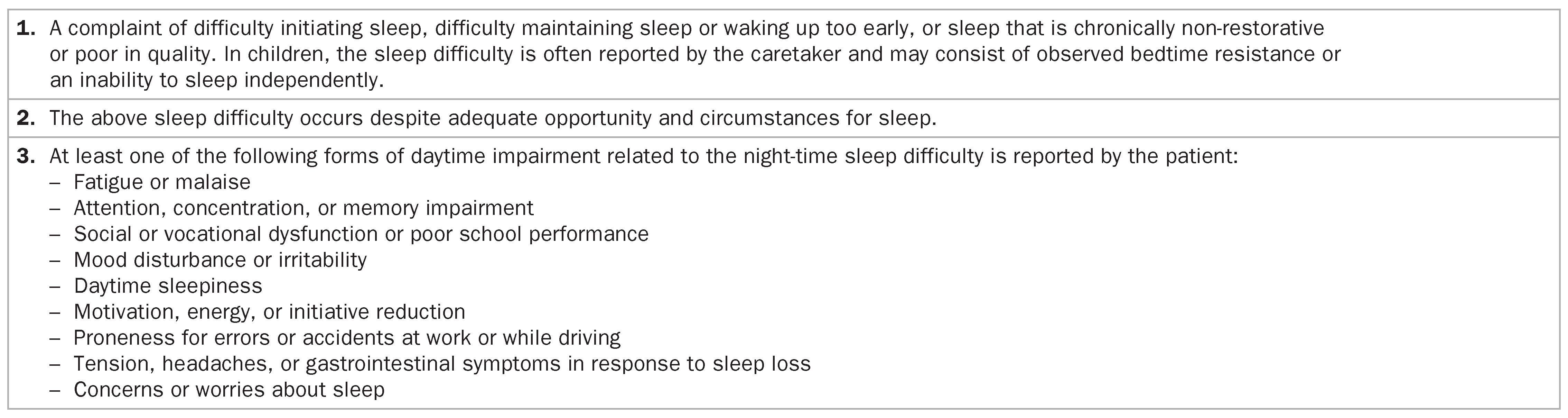
To diagnose primary insomnia, the respective criteria, as defined in the International Classification of Sleep Disorders, second edition, (ICSD-2, American Academy of Sleep Medicine) [5], must be met, as stated in Table 1.
In addition to insomnia as an independent disorder (primary insomnia), co-morbid (secondary) insomnia is a common symptom in many psychiatric and somatic diseases [6,7] (see Table 2).
Furthermore, insomnia may also occur as a side effect of different medications, as shown in Table 3.
In addition to differentiating between the cause (primary or co-morbid) and manifestation (difficulty initiating or maintaining sleep, early awakening, or non-restorative sleep) of insomnia, a differentiation can further be made by considering the duration of insomnia as acute or chronic. To consider similarities and differences of insomnia with regard to different causes, manifestations and durations, the ICSD-2 [5] specifies eleven subtypes of insomnia (Table 4) which all meet the general criteria of insomnia.

Co-morbid insomnia and major depressive disorder

Previous research supports the hypothesis that depression and insomnia could be co-morbid conditions showing a different clinical course and requiring a specific treatment procedure. It is suggested that insomnia and depression are not randomly associated and that they are either causally related or that common mechanisms underlie the two disorders [8,9]. Chronic sleep disturbances experienced by insomniac patients could play an important role in the occurrence of depressive symptoms but studies examining the benefits of insomnia treatment in preventing depression have not been performed. With regard to pathophysiological issues, insights into the mechanisms of disorders that go along with co-morbid insomnia may lead to a better understanding of the pathophysiologic mechanisms underlying primary insomnia. This is especially true for major depressive disorder (MDD), which shares objective findings (e.g., alterations of the neuroendocrine system) with primary insomnia.

Pathophysiological concepts

Although primary insomnia is diagnosed by clinical criteria, distinct alterations of objective measures can be found that might help to make a diagnosis and to choose the right treatment. In addition, new treatment strategies are expected to develop by giving further insights into possible pathophysiological mechanisms.

Neuroendocrine measures

As mentioned above, it is not only that co-morbid insomnia is a common symptom in MDD often preceding fullblown MDD, but primary insomnia may also go along with changes in neuroendocrine systems mirroring those alterations in MDD, especially with respect to the hypothalamicpituitary-adrenal (HPA) axis [10]. Hyperactivity of the HPA axis is a well-known phenomenon in MDD [11], typically reflected by elevated cortisol levels [12], and abnormal HPA axis regulation as indicated by the dexamethasone test or the dexamethasone-corticotropin-releasing-hormon (CRH) test [13]. As in MDD, the HPA axis seems to be overactive in many patients with primary insomnia, as concluded from elevated urinary cortisol levels [14,15]. However, conflicting results showing no increased cortisol secretion in patients with insomnia have also been reported [16]. Furthermore, peer-reviewed results from dexamethasone tests or dexamethasone-CRH tests in primary insomnia are still lacking. It is assumed that HPA axis hyperactivity in MDD is caused by increased CRH activity [17]. CRH hyperactivity has also been considered to play a major role in primary insomnia [10,18,19]. It has been hypothesised that CRH hyperactivity results from genetic predispositions in combination with environmental factors such as early stress experiences, leading to excessive CRH responses to stress, which in turn directly activate the locus coeruleus (LC) and, over time, indirectly affect the hippocampus (HC) by sustained elevated glucocorticoid (GC) levels [18,19]. Moreover, the use of glucocorticoid receptor or CRH receptor antagonists and mineralocorticoid receptor agonists has been considered for treating insomnia [10]. Comprehensive reviews on the shared pathophysiology regarding neuroendocrine measures of insomnia and depression have been recently published [20,21].

Insights from polysomnography, actigraphy, electroencephalography, and multiple sleep latency test

In accordance with the ICSD-2 classification, polysomnographic parameters are no criteria for diagnosing insomnia. Instead, polysomnography (PSG) has even been regarded to be of little use for objectifying the presence of insomnia [22,23], and former, as well as current, recommendations are that polysomnography is not indicated in routine evaluation of insomnia except for excluding a suspected specific sleep disorder, such as sleep-related breathing disorders, periodic limb movement disorder (PLMD), or for other certain indications [24,25,26,27]. However, polysomnography in insomnia plays a role in clinical trials, especially in treatment efficacy studies [28,29,30]. Here, objective polysomnography measures of interest are wake after sleep onset (WASO), latency to persistent sleep (i.e., sleep onset latency, SOL), sleep efficiency (SE, calculated by dividing total sleep time [TST] by the total time in bed [TIB]), number of awakenings (NAW), wake time during sleep (WTDS) and the relative and absolute amount of different sleep stages, especially slow-wave sleep (SWS). Typical findings in primary insomnia are prolonged sleep onset latency, increased wake time after sleep onset, reduced SE [31], and reduced SWS [32]. As insomnia is a heterogeneous disorder, the quantity and extent of altered PSG measures are subject to variation between individuals. Furthermore, drug-induced changes of PSG measures are also seen in healthy subjects and are therefore not an appropriate biomarker of treatment response in insomnia.
Actigraphy is a technique to assess data on day- and night-time activity and to obtain sleep-related objective measures. Although some reports exist about the use of actigraphy in insomnia, its role in the diagnosis of insomnia is discussed controversially [33,34,35,36,37,38,39,40]. Beside the controversy regarding whether actigraphy is a valuable diagnostic tool in insomnia, results from studies using actigraphy have not contributed to a better understanding of the underlying pathology of insomnia, nor have they helped distinguish subtypes of patients with insomnia so far.
However, evidence of pathophysiological mechanisms has been obtained from sleep electroencephalography (EEG) recordings in the form of spectral analysis. Sleep EEG spectral analysis differs from conventional sleep EEG scoring, in that the EEG frequency analysis is independent from the Rechtschaffen and Kales criteria of visual sleep stage classification [41]. A common finding in the sleep EEG of patients with insomnia is an increased amount of beta activity during the sleep onset period [42] and during non rapid eye movement (NREM) sleep [43]. Interestingly, these findings correlate with sleep complaints in patients with subjective insomnia (relatively long total sleep time and relative underestimation of sleep time compared to PSG) and are absent in subjects with objective insomnia (relatively short total sleep time measured by PSG) [44]. The increased amount of beta EEG activity in insomniac patients has been conceptually linked to the hyper-arousal model of insomnia, e.g., [45]. CRH actions at the locus coeruleus (LC), possibly resulting from an increased CRH activity (see above), have been considered as an explanation for increases in high-frequency EEG activity in insomniacs [19]. Results from the multiple sleep latency test (MSLT) in patients with insomnia have provided further support for the hyper-arousal hypothesis of primary insomnia. Contrary to what might be expected, patients with insomnia do not fall immediately asleep at daytime when they get the opportunity to take a nap, but show normal or even prolonged daytime sleep latencies [46,47,48].

Results from neuro-imaging studies

Although only few structural and functional neuro-imaging studies involving small sample sizes of insomniac patients have been reported, the promising results support, at least in part, the hypothesis of hyper-arousal in primary insomnia. In a positron emission tomography (PET) study [49], (1.) a reduction of relative metabolism from waking to nonREM sleep was found in the bilateral frontal cortex, anterior cingulate cortex, medial prefrontal cortex, left occipitoparietal cortex, posterior cingulate cortex, temporoparietal cortex and thalamus in healthy subjects; (2.) however, in patients with insomnia a decrease in relative metabolism from waking to non-REM sleep was observed only in the bilateral frontal cortex, right occipitoparietal cortex and left temporoparietal cortex, but not in the thalamus, anterior cingulate cortex and medial prefrontal cortex; (3.) furthermore, compared to healthy subjects, patients with insomnia showed a smaller decline in relative metabolism from waking to non-REM sleep in the ascending reticular activating system (ARAS), hypothalamus, thalamus, insular cortex, amygdala, hippocampus, and in the anterior cingulate and medial prefrontal cortices; (4.) compared to healthy subjects, patients with insomnia showed a hypometabolism in the bilateral frontal cortex, the left hemisphere superior, temporal, parietal, and occipital cortices, and in the thalamus, hypothalamus, and brainstem reticular formation during wakefulness; (5.) beyond these findings, insomniacs did not differ from healthy subjects in PSG in this study. This study demonstrated that subjectively disturbed sleep in insomnia patients is associated with increased brain metabolism. Their inability to fall asleep may be related to a failure of arousal mechanisms to decline in activity from waking to sleep. Furthermore, their daytime fatigue may reflect decreased activity in the prefrontal cortex that results from inefficient sleep. These findings suggest interacting neural networks in the neurobiology of insomnia including a general arousal system and an emotion regulating and a cognitive system.
The report by Nofzinger et al. [49] has often been invoked as the first direct evidence of hyper-arousal in insomnia [31,50] and has been considered as one of the key references in neuro-imaging research related to insomnia and the hyper-arousal hypothesis of primary insomnia. However, the presented PET results from seven insomniacs, aged 34 years old, have not been replicated or scrutinised in a bigger sample so far. Furthermore, the observed hypometabolism during wakefulness appears to be contradictory to the MSLT results reported above and hence to the concept of a generalised and maintained hyper-arousal.
In sharp contrast to the findings from the PET studies [49,51], a single photon emission computed tomography (SPECT) study showed (1.) a decreased regional cerebral blood flow in patients with primary insomnia compared to good sleepers in all of the eight observed regions of interest in the first non-REM sleep cycle including frontal medial cortex, thalamus, occipital cortex, basal ganglia, parietal cortex, frontal lateral cortex, temporal cortex, and pons [52]. Secondly (2.), compared to good sleepers, the reduced regional cerebral blood flow was significant in the frontal medial, occipital and parietal cortices, and basal ganglia. In addition (3.), within the group of patients with primary insomnia, a significantly decreased activity was found in the basal ganglia compared to the frontal lateral cortex, frontal medial cortex, thalamus, and occipital and parietal cortices. Therefore, the authors concluded that primary insomnia may be associated with an abnormal central nervous system activity during non-REM sleep which may be linked to basal ganglia dysfunction. Interestingly, as pointed out by Desseilles et al. [53], a decreased activity in the previously mentioned regions when compared to good sleepers was also found in the study performed by Nofzinger et al. [49], however this was during wakefulness rather than during non-REM sleep. However, because of methodological limitations such as sampling the blood flow only during the first non-REM cycle, these preliminary results cannot rule out the hyper-arousal hypothesis of primary insomnia.
Cortical hypoactivation during wakefulness, namely of the medial and inferior prefrontal cortical areas, was also discovered in the first and so far only functional magnetic resonance imaging (fMRI) study performed in patients with insomnia [54]. Compared to controls, insomniacs showed less activation in the left medial prefrontal cortex and left inferior frontal gyrus regarding both letter fluency and category fluency as assessed by a letter and category fluency task. In contrast to the PET and SPECT studies, the authors also examined the effect of non-pharmacological treatment. Letter fluency was restored in two regions of the left inferior frontal gyrus, but not in the left medial prefrontal cortex, whereas category fluency activation was partly restored in the left medial prefrontal cortex, but not in the left inferior frontal gyrus. The results demonstrated that fMRI can reveal prefrontal hypoactivation in a group of carefully selected patients suffering from primary chronic insomnia. In addition, recovery of this regional hypoactivation was achieved after non-pharmacological sleep therapy.
A different, neurochemical approach was followed in a recently published magnetic resonance spectroscopy (1H-MRS) study [50]. In patients with primary insomnia, reduced daytime overall average brain GABA (gammaaminobutyric acid) levels, averaged from basal ganglia, thalamus, and parietal, occipital, and temporal white matter and cortical regions, were observed. Remarkably, GABA levels correlated with both subjective and objective sleep measures. In particular, longer wake time after sleep onset (WASO) in outpatient and inpatient polysomnography was associated with lower GABA levels. As GABA, which is the most important and ubiquitous inhibitory neurotransmitter in the central nervous system, is not only involved in sleepwake regulation, but also in the regulation of other processes that are disturbed in insomnia and support the hypothesis of central nervous system hyper-arousal (e.g., EEG, see above), the finding of reduced GABA levels in patients with primary insomnia is in line with the hyper-arousal model of primary insomnia. Moreover, reduced GABA levels have also been observed in major depressive disorder [55], even in recovered subjects [56,57], which, in addition to the mutual clinical and neuroendocrine disturbances mentioned above, suggests a common underlying pathophysiology in primary insomnia and major depressive disorder.
In addition to alterations in neurotransmitter levels, a morphometric magnetic resonance imaging (MRI) study revealed abnormalities in the structure of the brain in patients with chronic primary insomnia [58,59]. As cognitive and also affective disturbances can occur in primary insomnia, the study included the dorsolateral prefrontal cortex, the orbitofrontal cortex, the anterior cingulate cortex, amygdala, and hippocampus as regions of interest (ROI), since these regions play a central role in the regulation of cognition and mood. The eight subjects with primary insomnia had smaller hippocampal volumes bilaterally compared to the eight normal sleepers, while none of the other regions showed differences in volume between the two groups. The authors concluded that sleep restriction might have a negative influence on neurogenesis in the hippocampus. Alternatively, increased cortisol levels which are found in some patients with primary insomnia (see above) might explain the reduced hippocampal volumes [18,19]. The latter explanation would again be consistent with the hyper-arousal model of primary insomnia as increased cortisol levels can be ascribed to increased CRH activity. As reduced hippocampal volumes are also observed in major depressive disorder [for a current review see [60]], the results once more suggest a common underlying pathophysiology of MDD and primary insomnia.

The cognitive-behavioural model and cognitive-behavioural therapy of insomnia

Beside alterations in brain functions that can be assessed by means of objective measurements as presented above, insomnia, especially when chronic, is accompanied by dysfunctional beliefs and attitudes [61] as well as maladaptive habits which can be addressed by cognitive-behavioural therapy [62,63]. Dysfunctional cognitions or beliefs, as well as maladaptive habits or safety behaviours, contribute to the development and maintenance of insomnia, for example insomniacs might worry over sleep loss or ruminate over the expected consequences such as daytime residual effects. The relationship between insomnia, dysfunctional cognitions, maladaptive habits, consequences and arousal has been summarised in the microanalytical model, also termed the vicious circle of persistent insomnia [64,65]. Beside cognitive models of the maintenance of insomnia [66], a behavioural model that also addresses underlying neurocognitive processes and emphasises the role of hyper-arousal [67] has been developed.
As proposed by Spielman et al. [68], predisposing factors, precipitating events, and perpetuating attitudes and practices (3p-model) account for the onset and course of insomnia. The contribution of predisposing factors remains constant in the development of insomnia. However, over time the influence of precipitating events will decrease, while the influence of perpetuating habits and behaviour increases, thus maintaining insomnia without any marked reduction of sleep disturbance intensity. Therefore, cognitive-behavioural therapy of insomnia, which is focused on perpetuating factors, is not only expected to be an effective treatment but has indeed proven to be effective in a number of studies [69,70,71].

Sleep-wake regulation with regard to insomnia and pharmacological treatment

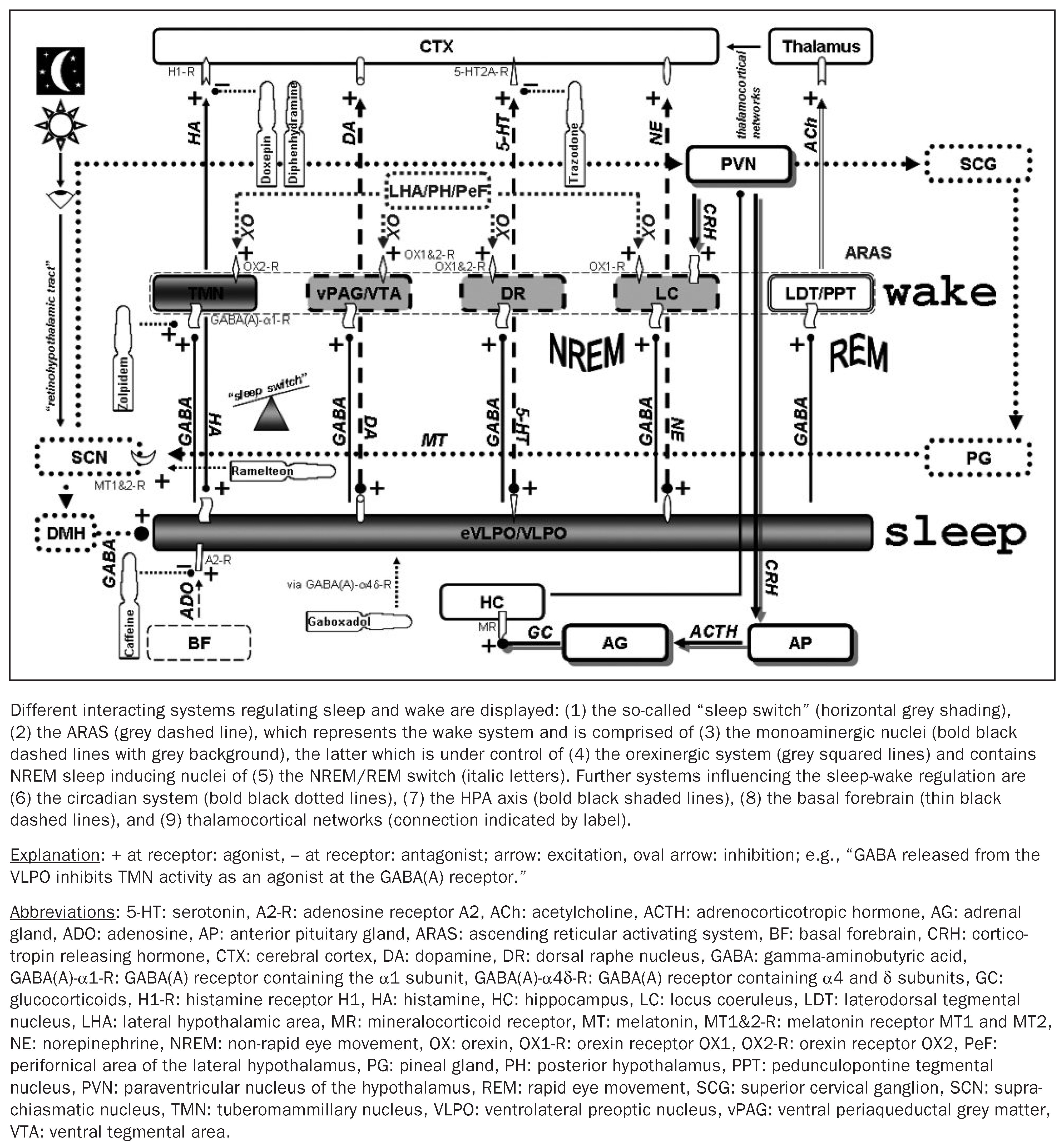
Sleep and wake are regulated by a number of different brain structures which are interconnected directly or indirectly and form neural networks that are driven by various neurotransmitters, hormones, internal and even external stimuli. While specific brain regions, neural networks, and regulatory feedback systems are each responsible for certain aspects of sleep-wake regulation such as circadian control of sleep or the generation of REM and non-REM sleep, the components of sleep-wake regulation do not act independently from each other, but are interlinked at several sites. The different sites of action, their neurotransmitters or hormones, receptors, and connections are illustrated in Figure 1.
In 1949, Moruzzi and Magoun described the ascending reticular activating system (ARAS) as the wake-promoting system of the brain [72]. Over the years, as the components of the ARAS have been identified and some of them have been found to be placed outside the reticular formation (RF), the term ARAS has become less common (cf. [73]). In Figure 1, the histaminergic tuberomammillary nucleus (TMN), the dopaminergic ventral periaqueductal gray matter (vPAG) and ventral tegmental area (VTA), the serotonergic dorsal raphe nucleus (DR), the noradrenergic locus coeruleus (LC), and the cholinergic laterodorsal tegmental nuclei (LDT) and pedunculopontine tegmental nuclei (PPT) are depicted as parts of what was referred to as the ARAS in the past and is now commonly named the ascending arousal system (AAS) [74,75] or the ascending activating system [74]. From this view, the AAS consists of five different functional units with five different neurotransmitters. The various parts of the AAS promote wakefulness by their projections to the thalamus and to the cerebral cortex. Beyond that, they are also linked among themselves. For instance, LC and DR send inhibitory projections to themselves (negative feedback) and to LDT and PPT, while LDT and PPT send excitatory projections to themselves (positive feedback) and to LC and DR (connections not shown in Figure 1). In this way, a neural network is constituted that generates REM sleep when activity of LDT/PPT neurons predominates, while non-REM sleep is induced by the dominance of the REM-off neurons’ activity (LC/DR) in the so-called reciprocal-interaction model of REM/non-REM oscillation [76,77]. The ascending wakepromoting system is also the target of pharmacological treatment of insomnia. Histamine H1-receptor antagonists such as doxepin or diphenhydramine counteract histamine from the TMN, and serotonin 5-HT2A-receptor antagonists such as trazodone block serotonin action from the DR.
The ascending wake-promoting system is opposed by the ventrolateral preoptic nucleus (VLPO) and the extended part of the ventrolateral preoptic nucleus (eVLPO), respectively, which can be regarded as the sleep-promoting system of the brain. GABAergic projections from the eVLPO/VLPO to the ascending wake-promoting system, especially to the TMN, the LC, and the DR promote sleep by inhibition of the wake-promoting system in a switch-like manner, for which reason the areas involved and their interaction are referred to as the hypothalamic sleep switch [74,75]. GABA is in the centre of hypothalamic sleep regulation, or rather of sleep promotion. Therefore, beside the pharmacological strategy of counteracting the action of the wake-promoting system by means of histamine receptor antagonists or serotonin receptor antagonists, another approach is to inhibit the activity of the wake-promoting system by (1.) enhancing the effect of GABA (use of positive allosteric modulators (PAMs) at GABAA receptors; barbiturates, benzodiazepines, and so-called “Z” drugs (zolpidem, zaleplon, eszopiclone) [78]), or (2.) by activating the eVLPO/VLPO.
Both wake- and sleep-promoting systems are influenced by the suprachiasmatic nucleus (SCN). The SCN has an intrinsic circadian rhythmicity with a phase duration of about 24 hours and 11 minutes, which is also maintained constant lighting conditions [79]. Beyond that, the intrinsic circadian rhythm of the SCN is adapted to extrinsic rhythms such as day (light) and night (darkness). This process is termed “entrainment” and is mediated by the retinohypothalamic tract (RHT) [80]. In bright daylight, cells in the SCN activate the dorsomedial nucleus of the hypothalamus (DMH), which inhibits VLPO activity by GABAergic projections [75]. The SCN also plays a crucial role in the production and release of melatonin, which is released at night or in the dark from the pineal gland. Melatonin from the pineal gland in turn is an agonist at melatonin MT1 and MT2 receptors of the SCN, thus resetting the SCN. As some subtypes of insomnia might at least partly be caused by a shifted circadian rhythm of arousal, a recent pharmacological treatment approach of insomnia stimulates the melatonin receptors of the SCN to reset the SCN by means of the selective melatonin MT1 and MT2 receptor agonist ramelteon [81].
Beside the influence of the SCN, the hypothalamic sleep switch is modulated by orexinergic neurons from the lateral hypothalamic area (LHA), the posterior hypothalamus (PH), and the perifornical area of the lateral hypothalamus (PeF) [82]. Orexin directly activates the above mentioned wake-promoting centres and also the cerebral cortex. Loss of orexinergic neurons is observed in narcolepsy, a disease that is associated with excessive daytime sleepiness and sleep attacks [83]. Inducing sleep by antagonising orexin at the orexin OX1 and OX2 receptors with the competitive OX1 and OX2 receptor antagonists ACT-078573 (almorexant) or SB-649868 is another upcoming pharmacological treatment approach for primary insomnia [84].
As stated above, the hypothalamic-pituitary-adrenal (HPA) axis appears to be disturbed in insomnia. Referring again to the hyper-arousal model of insomnia, increased activity of the paraventricular nucleus (PVN) might lead to an increased CRH release, which (1.) results in an increased activity of the wake-promoting LC and (2.) leads to an enhanced release of adrenocorticotropic hormone (ACTH) from the pituitary gland and cortisol from the adrenal gland. Thus, overactivity and dysregulation of the HPA axis might contribute to the cause of some types of insomnia. Accordingly, the usefulness of CRH receptor antagonists [19] and also glucocorticoid (GR) and mineralocorticoid (MR) receptor antagonists [10], has been discussed. However, to the best of our knowledge, CRH, GR, or MR receptor antagonists are currently of less importance in the field of emerging insomnia treatments.

Conclusions

Insomnia is a clinically heterogeneous disease. In a theoretical review, Roth [45] summarised evidence of sympathetic nervous system hyper-arousal in insomnia including (1.) elevated levels of circulating catecholamines, (2.) increased basal metabolic rate, (3.) increased body temperature, (4.) altered heart rate variability and reduced respiratory sinus arrhythmia, as well as (5.) elevated beta EEG frequency and cortical activation in the EEG. Beside these findings, indications of a cerebral hyper-arousal are obtained from neuroimaging studies, as shown above, and are also compatible with the cognitive-behavioural or psychophysiological model of insomnia. As outlined above, the hyper-arousal model of insomnia is also in line with a possible common underlying pathophysiology of insomnia and major depressive disorder. Both pharmacological and non-pharmacological therapies are effective in the treatment of primary insomnia. The pharmacological first-line treatment consists of the use of benzodiazepines and the so-called Z drugs to induce sleep onset and sleep maintenance. Current and emerging pharmacological approaches are mainly based on H1 histamine receptor antagonism, 5-HT2 serotonin receptor antagonism, GABAA receptor agonism, MT1 and MT2 melatonin receptor agonism, and OX1 and OX2 orexin receptor antagonism (for a comprehensive review of current and investigational approaches in treating insomnia see [84], for emerging anti-insomnia drugs see [85]). Beside the development of more selective drugs, future research is needed to identify subtypes and biomarkers of insomnia in order to choose a personalised treatment with the best possible efficacy and the lowest risk of side effects.

References

  1. Ohayon, MM. Epidemiology of insomnia: what we know and what we still need to learn. Sleep Med Rev. 2002, 6, 97–111. [Google Scholar] [CrossRef] [PubMed]
  2. Jansson-Frömark, M; Lindblom, K. A bidirectional relationship between anxiety and depression, and insomnia? A prospective study in the general population. J Psychosom Res. 2008, 64, 443–9. [Google Scholar] [CrossRef]
  3. Vgontzas, AN; Liao, D; Bixler, EO; Chrousos, GB; Vela-Bueno, A. Insomnia with objective short sleepduration is associated with a high risk for hypertension. Sleep. 2009, 32, 491–7. [Google Scholar] [CrossRef] [PubMed]
  4. Vgontzas, AN; Liao, D; Pejovic, S; Calhoun, S; Karataraki, M; Bixler, EO. Insomnia with objective short sleep duration is associated with type 2 diabetes: A population-based study. Diabetes Care 2009, 32, 1980–5. [Google Scholar] [CrossRef] [PubMed]
  5. American Associtaion of Sleep Disorders (Ed.) The International Classification of Sleep Disorders: diagnostic and coding manual, 2nd ed.; American Association of Sleep Medicine: Westchester, Illinois, 2005. [Google Scholar]
  6. Buysse, DJ (Ed.) Sleep disorders and psychiatry; American Psychiatric Publishing: Arlington, VA, 2005. [Google Scholar]
  7. Buysse, DJ. Chronic insomnia. Am J Psychiatry 2008, 165, 678–86. [Google Scholar] [CrossRef]
  8. Jindal, RD. Insomnia in patients with depression: some pathophysiological and treatment considerations. CNS Drugs 2009, 23, 309–29. [Google Scholar] [CrossRef]
  9. Staner, L. Comorbidity of insomnia and depression. Sleep Med Rev. 2010, 14, 35–46. [Google Scholar] [CrossRef]
  10. Buckley, TM; Schatzberg, AF. On the interactions of the hypothalamicpituitary-adrenal (HPA) axis and sleep: normal HPA axis activity and circadian rhythm, exemplary sleep disorders. J Clin Endocrinol Metab. 2005, 90, 3106–14. [Google Scholar] [CrossRef]
  11. Pariante, CM; Lightman, SL. The HPA axis in major depression: classical theories and new developments. Trends Neurosci. 2008, 31, 464–8. [Google Scholar] [CrossRef]
  12. Nemeroff, CB; Vale, WW. The neurobiology of depression: inroads to treatment and new drug discovery. J Clin Psychiatry 2005, 66 (Suppl 7), 5–13. [Google Scholar]
  13. Holsboer, F; Barden, N. Antidepressants and hypothalamic-pituitaryadrenocortical regulation. Endocr Rev. 1996, 17, 187–205. [Google Scholar] [CrossRef]
  14. Vgontzas, AN; Tsigos, C; Bixler, EO; Stratakis, CA; Zachman, K; Kales, A; Vela-Bueno, A; Chrousos, GP. Chronic insomnia and activity of the stress system: a preliminary study. J Psychosom Res. 1998, 45, 21–31. [Google Scholar] [CrossRef]
  15. Vgontzas, AN; Bixler, EO; Lin, HM; Prolo, P; Mastorakos, G; Vela-Bueno, A; et al. Chronic insomnia is associated with nyctohemeral activation of the hypothalamic-pituitary-adrenal axis: clinical implications. J Clin Endocrinol Metab. 2001, 86, 3787–94. [Google Scholar] [CrossRef]
  16. Riemann, D; Klein, T; Rodenbeck, A; Feige, B; Horny, A; Hummel, R; et al. Nocturnal cortisol and melatonin secretion in primary insomnia. Psychiatry Res. 2002, 113, 17–27. [Google Scholar] [CrossRef]
  17. Nemeroff, CB; Widerlov, E; Bissette, G; Walleus, H; Karlsson, I; Eklund, K; et al. Elevated concentrations of CSF corticotropin-releasing factor-like immunoreactivity in depressed patients. Science 1984, 226, 1342–4. [Google Scholar] [CrossRef] [PubMed]
  18. Richardson, GS; Roth, T. Future directions in the management of insomnia. J Clin Psychiatry 2001, 62 (Suppl 10), 39–45. [Google Scholar]
  19. Richardson, GS. Human physiological models of insomnia. Sleep Med. 2007, 8 (Suppl 4), S9–14. [Google Scholar] [CrossRef] [PubMed]
  20. Steiger, A. Neurochemical regulation of sleep. J Psychiatr Res. 2007, 41, 537–52. [Google Scholar] [CrossRef] [PubMed]
  21. Steiger, A; Kimura, M. Wake and sleep EEG provide biomarkers in depression. J Psychiatr Res. 2010, 44, 242–52. [Google Scholar] [CrossRef]
  22. Vgontzas, AN; Bixler, EO; Kales, A; Manfredi, RL; Tyson, K. Validity and clinical utility of sleep laboratory criteria for insomnia. Int J Neurosci. 1994, 77, 11–21. [Google Scholar] [CrossRef]
  23. Vgontzas, AN; Kales, A; Bixler, EO; Manfredi, RL; Vela-Bueno, A. Usefulness of polysomnographic studies in the differential diagnosis of insomnia. Int J Neurosci. 1995, 82, 47–60. [Google Scholar] [CrossRef]
  24. Reite, M; Buysse, D; Reynolds, C; Mendelson, W. The use of polysomnography in the evaluation of insomnia. Sleep. 1995, 18, 58–70. [Google Scholar] [CrossRef]
  25. Thorpy, M; Chesson, A; Kader, G; Millman, R; Potolicchio, S; Reite, M; et al. ASDA Standards of Practice Committee. Practice parameters for the use of polysomnography in the evaluation of insomnia. Sleep. 1995, 18, 55–7. [Google Scholar]
  26. Chesson, A; Hartse, K; Anderson, WM; Davila, D; Johnson, S; Littner, M; Wise, M; Rafecas, J. Practice parameters for the evaluation of chronic insomnia. An American Academy of Sleep Medicine report. Standards of Practice Committee of the American Academy of Sleep Medicine. Sleep 2000, 23, 237–41. [Google Scholar]
  27. Littner, M; Hirshkowitz, M; Kramer, M; Kapen, S; Anderson, WM; et al. Practice parameters for using polysomnography to evaluate insomnia: an update. Sleep. 2003, 26, 754–60. [Google Scholar] [CrossRef]
  28. McCall, WV; Erman, M; Krystal, AD; Rosenberg, R; Scharf, M; Zammit, GK; Wessel, T. A polysomnography study of eszopiclone in elderly patients with insomnia. Curr Med Res Opin. 2006, 22, 1633–42. [Google Scholar] [PubMed]
  29. Erman, MK; Zammit, G; Rubens, R; Schaefer, K; Wessel, T; Amato, D; et al. A polysomnographic placebo-controlled evaluation of the efficacy and safety of eszopiclone relative to placebo and zolpidem in the treatment of primary insomnia. J Clin Sleep Med. 2008, 4, 229–34. [Google Scholar] [CrossRef] [PubMed]
  30. Lankford, DA; Corser, BC; Zheng, YP; Li, Z; Snavely, DB; Lines, CR; Deacon, S. Effect of gaboxadol on sleep in adult and elderly patients with primary insomnia: results from two randomized, placebo-controlled, 30-night polysomnography studies. Sleep. 2008, 31, 1359–70. [Google Scholar] [PubMed]
  31. Riemann, D; Spiegelhalder, K; Feige, B; Voderholzer, U; Berger, M; Perlis, M; Nissen, C. The hyperarousal model of insomnia: A review of the concept and its evidence. Sleep Med Rev. 2010, 14, 19–31. [Google Scholar] [CrossRef]
  32. Terzano, MG; Parrino, L; Spaggiari, MC; Palomba, V; Rossi, M; Smerieri, A. CAP variables and arousals as sleep electroencephalogram markers for primary insomnia. Clin Neurophysiol. 2003, 114, 1715–23. [Google Scholar] [CrossRef]
  33. Hauri, PJ; Wisbey, J. Wrist actigraphy in insomnia. Sleep. 1992, 15, 293–301. [Google Scholar] [CrossRef]
  34. Brooks, JO, III; Friedman, L; Bliwise, DL; Yesavage, JA. Use of the wrist actigraph to study insomnia in older adults. Sleep. 1993, 16, 151–5. [Google Scholar] [CrossRef] [PubMed]
  35. Chambers, MJ. Actigraphy and insomnia: a closer look. Part 1. Sleep 1994, 17, 405–8. [Google Scholar] [CrossRef][Green Version]
  36. Hauri, PJ; Wisbey, J. Actigraphy and insomnia: a closer look. Part 2. Sleep 1994, 17, 408–10. [Google Scholar] [CrossRef]
  37. Vallieres, A; Morin, CM. Actigraphy in the assessment of insomnia. Sleep. 2003, 26, 902–6. [Google Scholar] [CrossRef]
  38. Lichstein, KL; Stone, KC; Donaldson, J; Nau, SD; Soeffing, JP; Murray, D; et al. Actigraphy validation with insomnia. Sleep. 2006, 29, 232–9. [Google Scholar]
  39. Sivertsen, B; Omvik, S; Havik, OE; Pallesen, S; Bjorvatn, B; Nielsen, GH; et al. A comparison of actigraphy and polysomnography in older adults treated for chronic primary insomnia. Sleep. 2006, 29, 1353–8. [Google Scholar]
  40. Natale, V; Plazzi, G; Martoni, M. Actigraphy in the assessment of insomnia: a quantitative approach. Sleep. 2009, 32, 767–71. [Google Scholar] [CrossRef]
  41. Rechtschaffen, A; Kales, A (Eds.) A manual of standardized terminology, techniques and scoring system for sleep stages of human subjects; Neurological Information Network: Bethesda, MD, 1968. [Google Scholar]
  42. Lamarche, CH; Ogilvie, RD. Electrophysiological changes during the sleep onset period of psychophysiological insomniacs, psychiatric insomniacs, and normal sleepers. Sleep. 1997, 20, 724–33. [Google Scholar] [CrossRef] [PubMed]
  43. Perlis, ML; Smith, MT; Andrews, PJ; Orff, H; Giles, DE. Beta/Gamma EEG activity in patients with primary and secondary insomnia and good sleeper controls. Sleep. 2001, 24, 110–7. [Google Scholar] [CrossRef] [PubMed]
  44. Krystal, AD; Edinger, JD; Wohlgemuth, WK; Marsh, GR. NREM sleep EEG frequency spectral correlates of sleep complaints in primary insomnia subtypes. Sleep. 2002, 25, 630–40. [Google Scholar]
  45. Roth, T; Roehrs, T; Pies, R. Insomnia: pathophysiology and implications for treatment. Sleep Med Rev. 2007, 11, 71–9. [Google Scholar]
  46. Seidel, WF; Ball, S; Cohen, S; Patterson, N; Yost, D; Dement, WC. Daytime alertness in relation to mood, performance, and nocturnal sleep in chronic insomniacs and noncomplaining sleepers. Sleep 1984, 7, 230–8. [Google Scholar] [CrossRef][Green Version]
  47. Stepanski, E; Zorick, F; Roehrs, T; Young, D; Roth, T. Daytime alertness in patients with chronic insomnia compared with asymptomatic control subjects. Sleep. 1988, 11, 54–60. [Google Scholar] [CrossRef]
  48. Bonnet, MH; Arand, DL. Activity, arousal, and the MSLT in patients with insomnia. Sleep. 2000, 23, 205–12. [Google Scholar] [CrossRef] [PubMed]
  49. Nofzinger, EA; Buysse, DJ; Germain, A; Price, JC; Miewald, JM; Kupfer, DJ. Functional neuroimaging evidence for hyperarousal in insomnia. Am J Psychiatry 2004, 161, 2126–8. [Google Scholar] [CrossRef]
  50. Winkelman, JW; Buxton, OM; Jensen, JE; Benson, KL; O’Connor, SP; Wang, W; Renshaw, PF. Reduced brain GABA in primary insomnia: preliminary data from 4T proton magnetic resonance spectroscopy (1H-MRS). Sleep. 2008, 31, 1499–506. [Google Scholar] [CrossRef] [PubMed]
  51. Nofzinger, EA; Nissen, C; Germain, A; Moul, D; Hall, M; Price, JC; et al. Regional cerebral metabolic correlates of WASO during NREM sleep in insomnia. J Clin Sleep Med. 2006, 2, 316–22. [Google Scholar] [CrossRef]
  52. Smith, MT; Perlis, ML; Chengazi, VU; Pennington, J; Soeffing, J; Ryan, JM; Giles, DE. Neuroimaging of NREM sleep in primary insomnia: a Tc-99-HMPAO single photon emission computed tomography study. Sleep. 2002, 25, 325–35. [Google Scholar]
  53. Desseilles, M; Dang-Vu, T; Schabus, M; Sterpenich, V; Maquet, P; Schwartz, S. Neuroimaging insights into the pathophysiology of sleep disorders. Sleep. 2008, 31, 777–94. [Google Scholar] [CrossRef] [PubMed]
  54. Altena, E; Van Der Werf, YD; Sanz-Arigita, EJ; Voorn, TA; Rombouts, SA; Kuijer, JP; Van Someren, EJ. Prefrontal hypoactivation and recovery in insomnia. Sleep 2008, 31, 1271–6. [Google Scholar] [CrossRef]
  55. Hasler, G; van der Veen, JW; Tumonis, T; Meyers, N; Shen, J; Drevets, WC. Reduced prefrontal glutamate/glutamine and gamma-aminobutyric acid levels in major depression determined using proton magnetic resonance spectroscopy. Arch Gen Psychiatry 2007, 64, 193–200. [Google Scholar] [CrossRef]
  56. Bhagwagar, Z; Wylezinska, M; Jezzard, P; Evans, J; Ashworth, F; Sule, A; et al. Reduction in occipital cortex gamma-aminobutyric acid concentrations in medication-free recovered unipolar depressed and bipolar subjects. Biol Psychiatry 2007, 61, 806–12. [Google Scholar] [CrossRef]
  57. Bhagwagar, Z; Wylezinska, M; Jezzard, P; Evans, J; Boorman, E; Matthews, M; Cowen, J. Low GABA concentrations in occipital cortex and anterior cingulate cortex in medication-free, recovered depressed patients. Int J Neuropsychopharmacol. 2008, 11, 255–60. [Google Scholar] [CrossRef] [PubMed]
  58. Riemann, D; Voderholzer, U; Spiegelhalder, K; Hornyak, M; Buysse, DJ; Nissen, C; et al. Chronic insomnia and MRI-measured hippocampal volumes: a pilot study. Sleep. 2007, 30, 955–8. [Google Scholar] [CrossRef]
  59. Riemann, D; Kloepfer, C; Berger, M. Functional and structural brain alterations in insomnia: implications for pathophysiology. Eur J Neurosci. 2009, 29, 1754–60. [Google Scholar]
  60. McKinnon, MC; Yucel, K; Nazarov, A; MacQueen, GM. A meta-analysis examining clinical predictors of hippocampal volume in patients with major depressive disorder. J Psychiatry Neurosci. 2009, 34, 41–54. [Google Scholar] [CrossRef] [PubMed]
  61. Morin, CM; Stone, J; Trinkle, D; Mercer, J; Remsberg, S. Dysfunctional beliefs and attitudes about sleep among older adults with and without insomnia complaints. Psychol Aging 1993, 8, 463–7. [Google Scholar] [CrossRef] [PubMed]
  62. Morin, CM; Kowatch, RA; Barry, T; Walton, E. Cognitive-behavior therapy for late-life insomnia. J Consult Clin Psychol. 1993, 61, 137–46. [Google Scholar] [CrossRef]
  63. Morin, CM; Mimeault, V; Gagne, A. Nonpharmacological treatment of latelife insomnia. J Psychosom Res. 1999, 46, 103–16. [Google Scholar] [CrossRef]
  64. Morin, CM. Insomnia psychological assessment and management; The Guildford Press: New York, 1993. [Google Scholar]
  65. Morin, CM; Espie, CA. Insomnia. A clinical guide to assessment and treatment; Kluwer Academic/Plenum Publishers: New York, 2003. [Google Scholar]
  66. Harvey, AG. A cognitive model of insomnia. Behav Res Ther. 2002, 40, 869–93. [Google Scholar]
  67. Perlis, ML; Giles, DE; Mendelson, WB; Bootzin, RR; Wyatt, JK. Psychophysiological insomnia: the behavioural model and a neurocognitive perspective. J Sleep Res. 1997, 6, 179–88. [Google Scholar] [CrossRef]
  68. Spielman, AJ; Caruso, LS; Glovinsky, PB. A behavioral perspective on insomnia treatment. Psychiatr Clin North Am. 1987, 10, 541–53. [Google Scholar] [PubMed]
  69. Jacobs, GD; Pace-Schott, EF; Stickgold, R; Otto, MW. Cognitive behavior therapy and pharmacotherapy for insomnia: a randomized controlled trial and direct comparison. Arch Intern Med. 2004, 164, 1888–96. [Google Scholar] [PubMed]
  70. Sivertsen, B; Omvik, S; Pallesen, S; Bjorvatn, B; Havik, OE; Kvale, G; et al. Cognitive behavioral therapy vs zopiclone for treatment of chronic primary insomnia in older adults: a randomized controlled trial. JAMA 2006, 295, 2851–8. [Google Scholar] [PubMed]
  71. Morin, CM; Vallieres, A; Guay, B; Ivers, H; Savard, J; Merette, C; et al. Cognitive behavioral therapy, singly and combined with medication, for persistent insomnia: a randomized controlled trial. JAMA 2009, 301, 2005–15. [Google Scholar]
  72. Moruzzi, G; Magoun, HW. Brain stem reticular formation and activation of the EEG. Electroencephalogr Clin Neurophysiol. 1949, 1, 455–73. [Google Scholar]
  73. McCarley, RW; Sinton, CM. Neurobiology of sleep and wakefulness. Scholarpedia 2008, 3, 3313. [Google Scholar] [CrossRef]
  74. Saper, CB; Chou, TC; Scammell, TE. The sleep switch: hypothalamic control of sleep and wakefulness. Trends Neurosci. 2001, 24, 726–31. [Google Scholar] [CrossRef]
  75. Saper, CB; Scammell, TE; Lu, J. Hypothalamic regulation of sleep and circadian rhythms. Nature 2005, 437, 1257–63. [Google Scholar] [CrossRef]
  76. McCarley, RW; Hobson, JA. Neuronal excitability modulation over the sleep cycle: a structural and mathematical model. Science 1975, 189, 58–60. [Google Scholar] [CrossRef]
  77. Pace-Schott, EF; Hobson, JA. The neurobiology of sleep: genetics, cellular physiology and subcortical networks. Nat Rev Neurosci. 2002, 3, 591–605. [Google Scholar] [CrossRef]
  78. Stahl, SM. Stahl’s Essential Psychopharmacology. Neuroscientific Basis and Practical Applications, 3rd ed; Cambridge University Press: New York, NY, 2008. [Google Scholar]
  79. Czeisler, CA; Duffy, JF; Shanahan, TL; Brown, EN; Mitchell, JF; Rimmer, DW; et al. Stability, precision, and near-24-hour period of the human circadian pacemaker. Science 1999, 284, 2177–81. [Google Scholar] [CrossRef]
  80. Rusak, B. Neural mechanisms for entrainment and generation of mammalian circadian rhythms. Fed Proc. 1979, 38, 2589–95. [Google Scholar]
  81. Mayer, G; Wang-Weigand, S; Roth-Schechter, R; Staner, C; Partinen, M. Efficacy and safety of 6-month nightly ramelteon administration in adults with chronic primary insomnia. Sleep. 2009, 32, 351–60. [Google Scholar]
  82. Sakurai, T. The neural circuit of orexin (hypocretin): maintaining sleep and wakefulness. Nat Rev Neurosci. 2007, 8, 171–8. [Google Scholar] [CrossRef]
  83. Thannickal, TC; Moore, RY; Nienhuis, R; Ramanathan, L; Gulyani, S; Aldrich, M; et al. Reduced number of hypocretin neurons in human narcolepsy. Neuron 2000, 27, 469–74. [Google Scholar] [CrossRef]
  84. Ebert, B; Wafford, KA; Deacon, S. Treating insomnia: Current and investigational pharmacological approaches. Pharmacol Ther. 2006, 112, 612–29. [Google Scholar] [CrossRef] [PubMed]
  85. Wafford, KA; Ebert, B. Emerging anti-insomnia drugs: tackling sleeplessness and the quality of wake time. Nat Rev Drug Discov. 2008, 7, 530–40. [Google Scholar] [CrossRef] [PubMed]
  86. Wu, Y; Mills, D; Bala, M. Psoriasis: cardiovascular risk factors and other disease comorbidities. J Drugs Dermatol 2008, 7, 373–7. [Google Scholar] [PubMed]
  87. Sivertsen, B; Krokstad, S; Overland, S; Mykletun, A. The epidemiology of insomnia: associations with physical and mental health. The HUNT-2 study. J Psychosom Res. 2009, 67, 109–16. [Google Scholar]
  88. Roth, T. Hypnotic use for insomnia management in chronic obstructive pulmonary disease. Sleep Med. 2009, 10, 19–25. [Google Scholar] [CrossRef] [PubMed]
  89. Jansson, C; Nordenstedt, H; Wallander, MA; Johansson, S; Johnsen, R; Hveem, K; Lagergren, J. A population-based study showing an association between gastroesophageal reflux disease and sleep problems. Clin Gastroenterol Hepatol. 2009, 7, 960–5. [Google Scholar] [CrossRef]
  90. Tishler, M; Barak, Y; Paran, D; Yaron, M. Sleep disturbances, fibromyalgia and primary Sjogren’s syndrome. Clin Exp Rheumatol. 1997, 15, 71–4. [Google Scholar]
  91. Allen, KD; Renner, JB; Devellis, B; Helmick, CG; Jordan, JM. Osteoarthritis and sleep: the Johnston County Osteoarthritis Project. J Rheumatol. 2008, 35, 1102–7. [Google Scholar]
  92. Belt, NK; Kronholm, E; Kauppi, MJ. Sleep problems in fibromyalgia and rheumatoid arthritis compared with the general population. Clin Exp Rheumatol. 2009, 27, 35–41. [Google Scholar] [PubMed]
  93. Violani, C; Lucidi, F; Devoto, A; Lombardo, C; De Santo, RM. Insomnia and its comorbidities in chronic kidney disease. Semin Nephrol. 2006, 26, 61–3. [Google Scholar]
  94. De Santo, RM; Bartiromo, M; Cesare, CM; Cirillo, M. Sleep disorders occur very early in chronic kidney disease. J Nephrol. 2008, 21 (Suppl 13), S59–5. [Google Scholar] [PubMed]
  95. Bankier, B; Januzzi, JL; Littman, AB. The high prevalence of multiple psychiatric disorders in stable outpatients with coronary heart disease. Psychosom Med. 2004, 66, 645–50. [Google Scholar] [CrossRef]
  96. Ottolini, F; Modena, MG; Rigatelli, M. Prodromal symptoms in myocardial infarction. Psychother Psychosom. 2005, 74, 323–7. [Google Scholar] [CrossRef]
  97. Prejbisz, A; Kabat, M; Januszewicz, A; Szelenberger, W; Piotrowska, AJ; Piotrowski, W; et al. Characterization of insomnia in patients with essential hypertension. Blood Press 2006, 15, 213–9. [Google Scholar]
  98. Taylor, DJ; Mallory, LJ; Lichstein, KL; Durrence, HH; Riedel, BW; Bush, AJ. Comorbidity of chronic insomnia with medical problems. Sleep. 2007, 30, 213–8. [Google Scholar] [CrossRef]
  99. Parish, JM. Sleep-related problems in common medical conditions. Chest 2009, 135, 563–72. [Google Scholar] [CrossRef]
  100. Wilson, S; Argyropoulos, S. Antidepressants and sleep: a qualitative review of the literature. Drugs 2005, 65, 927–47. [Google Scholar] [CrossRef]
  101. Bonnet, U. Moclobemide: therapeutic use and clinical studies. CNS Drug Rev. 2003, 9, 97–140. [Google Scholar] [CrossRef]
  102. Caley, CF; Weber, SS. Paroxetine: a selective serotonin reuptake inhibiting antidepressant. Ann Pharmacother. 1993, 27, 1212–22. [Google Scholar] [PubMed]
  103. Salín-Pascual, RJ; Galicia-Polo, L; Drucker-Colín, R. Sleep changes after 4 consecutive days of venlafaxine administration in normal volunteers. J Clin Psychiatry 1997, 58, 348–50. [Google Scholar] [PubMed]
  104. Stahl, SM; Mendels, J; Schwartz, GE. Effects of reboxetine on anxiety, agitation, and insomnia: results of a pooled evaluation of randomized clinical trials. J Clin Psychopharmacol. 2002, 22, 388–92. [Google Scholar] [PubMed]
  105. Chouinard, G. Bupropion and amitriptyline in the treatment of depressed patients. J Clin Psychiatry 1983, 44, 121–9. [Google Scholar]
  106. Sadler, M. Lamotrigine associated with insomnia. Epilepsia 1999, 40, 322–5. [Google Scholar] [CrossRef]
  107. Palmer, KJ; McTavish, D. Felbamate. A review of its pharmacodynamic and pharmacokinetic properties, and therapeutic efficacy in epilepsy. Drugs 1993, 45, 1041–65. [Google Scholar]
  108. El-Mallakh, RS; Penagaluri, P; Kantamneni, A; Gao, Y; Roberts, RJ. Long-term use of pramipexole in bipolar depression: a naturalistic retrospective chart review. Psychiatr Q. 2010, 81, 207–13. [Google Scholar]
  109. Golinko, BE. Side effects of dextroamphetamine and methylphenidate in hyperactive children – a brief review. Prog Neuropsychopharmacol Biol Psychiatry 1984, 8, 1–8. [Google Scholar] [CrossRef]
  110. Gross, NJ; Nelson, HS; Lapidus, RJ; Dunn, L; Lynn, L; Rinehart, M; Denis-Mize, K. Formoterol Study Group. Efficacy and safety of formoterol fumarate delivered by nebulization to COPD patients. Respir Med. 2008, 102, 189–97. [Google Scholar] [PubMed]
  111. Roehrs, T; Merlotti, L; Halpin, D; Rosenthal, L; Roth, T. Effects of theophylline on nocturnal sleep and daytime sleepiness/alertness. Chest 1995, 108, 382–7. [Google Scholar] [CrossRef] [PubMed]
  112. Henningsen, NC; Mattiasson, I. Long-term clinical experience with atenolol – a new selective beta-1-blocker with few side-effects from the central nervous system. Acta Med Scand. 1979, 205, 61–6. [Google Scholar]
  113. Lewis, RV; Jackson, PR; Ramsay, LE. Side-effects of beta-adrenoceptor blocking drugs assessed by visual analogue scales. Br J Clin Pharmacol. 1985, 19, 255–7. [Google Scholar][Green Version]
  114. Gonasun, LM; Langrall, H. Adverse reactions to pindolol administration. Am Heart J. 1982, 104, 482–6. [Google Scholar] [PubMed]
  115. Moser, M. Propranolol and newer antihypertensive drugs in the management of hypertension. Adv Cardiol. 1979, 26, 38–43. [Google Scholar] [PubMed]
  116. Golomb, BA; Criqui, MH; White, HL; Dimsdale, JE. The UCSD Statin Study: a randomized controlled trial assessing the impact of statins on selected noncardiac outcomes. Control Clin Trials 2004, 25, 178–202. [Google Scholar] [CrossRef]
  117. Lozada, F; Silverman, S, Jr.; Migliorati, C. Adverse side effects associated with prednisone in the treatment of patients with oral inflammatory ulcerative diseases. J Am Dent Assoc. 1984, 109, 269–70. [Google Scholar] [CrossRef] [PubMed]
  118. Campbell, ML; Mathys, ML. Pharmacologic options for the treatment of obesity. Am J Health Syst Pharm. 2001, 58, 1301–8. [Google Scholar] [CrossRef] [PubMed]
  119. Bye, C; Hill, HM; Hughes, DT; Peck, AW. A comparison of plasma levels of L(+) pseudoephedrine following different formulations, and their relation to cardiovascular and subjective effects in man. Eur J Clin Pharmacol. 1975, 8, 47–53. [Google Scholar] [CrossRef] [PubMed]
Figure 1. Scheme of sleep-wake regulation with regard to insomnia and pharmacological treatment.
Sanpp 162 00139 g001
Table 1. General criteria of insomnia [5].
Sanpp 162 00139 i001
Table 2. Comorbid insomnia.
Sanpp 162 00139 i002
Table 3. Selected medications associated with insomnia.
Sanpp 162 00139 i003
Table 4. Subtypes of insomnia [5].
Sanpp 162 00139 i004
Disclaimer/Publisher’s Note: The statements, opinions and data contained in all publications are solely those of the individual author(s) and contributor(s) and not of MDPI and/or the editor(s). MDPI and/or the editor(s) disclaim responsibility for any injury to people or property resulting from any ideas, methods, instructions or products referred to in the content.