Next Article in Journal
Geschichte der Schweizerischen Neurologischen Gesellschaft im Kontext der Nationalen und Internationalen Entwicklung der Neurologie
Previous Article in Journal
Swiss Neurological Eponyms
 
 
Swiss Archives of Neurology, Psychiatry and Psychotherapy is published by MDPI from Volume 176 Issue 1 (2026). Previous articles were published by another publisher in Open Access under a CC-BY (or CC-BY-NC-ND) licence, and they are hosted by MDPI on mdpi.com as a courtesy and upon agreement with Editores Medicorum Helveticorum (EMH).
Article

Neurologist-in-Training

Department of Neurology, University Hospital Zurich, Frauenklinikstrasse 26, CH-8091 Zurich
Swiss Arch. Neurol. Psychiatry Psychother. 2008, 159(4), 267-270; https://doi.org/10.4414/sanp.2008.01949

Published: 1 January 2008
The aim of this section is to prepare the neurologist-in-training for the FMH examination, to confront her or him with specific problems of everyday neurological practice and to give him or her updates on recent controversies in clinical neurology.

Case Vignette

The 62-year-old right-handed woman presented at our department because of increasing vertigo and disabling walking difficulties. Six years ago, she was suffering from attacks of vertigo, vomiting and walking difficulties, which lasted about two weeks. At this time, the patient was diagnosed with Menière’s disease. One and a half years ago, she had again attacks with similar symptoms. Thereafter, walking difficulties gradually increased, in particular in darkness. In addition, she noticed that she could not visually fix upon objects while moving her head.Nobody else in her family had ever had similar problems. The neurological examination revealed a cerebellar syndrome with cerebellar ocular motor signs, severe gait ataxia, evidence for a right vestibular neuropathy and a slight sensory polyneuropathy. The resident of the ward diagnosed a right peripheral vestibulopathy and suspected an additional progressive spinocerebellar ataxia.
Sanpp 159 00267 i001Sanpp 159 00267 i002

Answer 1

–
Gaze-evoked nystagmus with rebound nystagmus
–
Deficient smooth pursuit eye movements
–
Incomplete visual suppression of the vestibuloocular reflex
–
Dysmetric saccades
–
Downbeat nystagmus (not in this patient!)

Answer 2

The head impulse test, first described by Halmagyi and Curthoys, is the most appropriate test for the detection of a one-sided or bilateral peripheral vestibulopathy. For this test the examinator sits in front of the subject, who visually fixes the nose of the examinator. The examinator quickly turns the subject’s head 5–15° to either side. If the peripheral vestibular function is normal, the subject’s eyes will remain fixed upon the examinator’s nose. In a peripheral vestibular deficit gaze cannot be stabilised when the head is quickly rotated in the direction of the affected ear. Consequently, after the head impulse the patient makes a correcting saccade to re-direct the gaze back to the nose of the examinator.

Answer 3

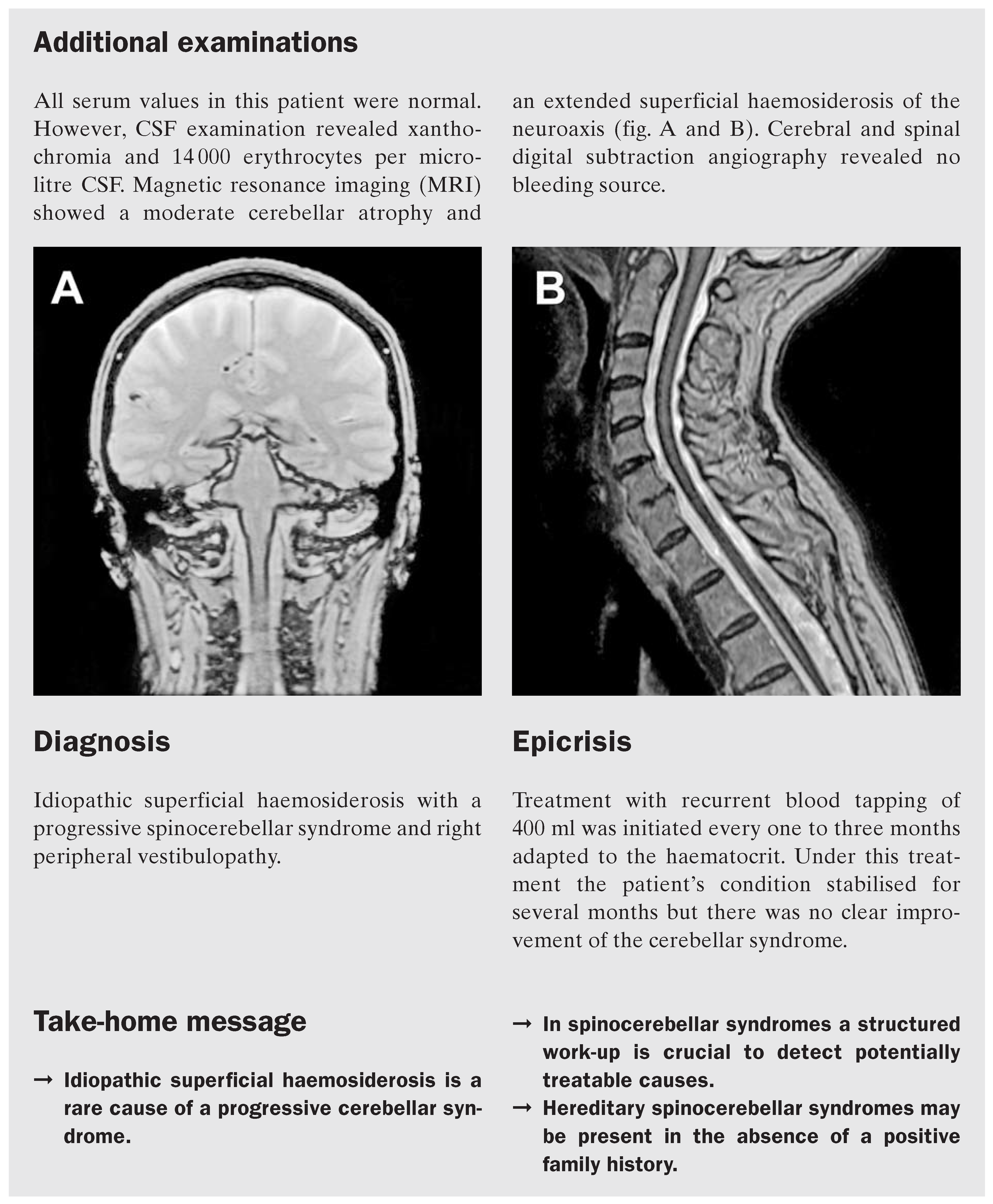
The distinction between sporadic and hereditary causes of a spinocerebellar syndrome is crucial to detect potentially treatable causes, as indicated in the flow chart. Laboratory examinations to be ordered include white and red blood count, thyroid stimulating hormone (TSH), cholesterol, lipoprotein electrophoresis, creatin kinase (CK), vitamin B12 and E as well as antibodies directed against GAD, gliadin and Purkinje cells (ANNA, Hu,Yo, Ri). Examination of the cerebrospinal fluid (CSF) may reveal infectious causes. In cases with suspected Wilson’s disease excretion of copper in the urine over 24 hours should be measured. In addition, a magnetic resonance imaging should be performed to detect structural alterations. The course of the disease over more than one and a half years is suspicious for a hereditary cause. Even in the absence of a positive family history, a hereditary spinocerebellar syndrome might be present. An autosomal recessive Friedreich’s ataxia may have a late onset; in these cases frequently retained tendon reflexes are seen. In addition, autosomal dominant spinocerebellar ataxias (SCA) may be present without positive family history due to neomutations, reduced penetrance in the ancestors or incorrect paternity.

Acknowledgments

Many thanks to the colleagues who contributed to the diagnosis and care of the patient, namely to Ch. Baumann, M. Bischof, S. Hyrenbach, S. Marti, B. Schuknecht, D. Straumann, A. Valavanis and V. Zumsteg.

Suggested Reading

  1. Fogel, L.; Perlman, S. Clinical features and molecular genetics of autosomal recessive cerebellar ataxias. Lancet Neurol. 2007, 6, 245–257. [Google Scholar] [CrossRef] [Scilit] [PubMed]
  2. Halmagyi, G.M.; Curthoys, I.S. A clinical sign of canal paresis. Arch. Neurol. 1988, 45, 737–739. [Google Scholar] [CrossRef] [Scilit] [PubMed]
  3. Jen, J.C.; Graves, T.D.; Hess, E.J.; Hanna, M.G.; Griggs, R.C.; Baloh, R.W. Primary episodic ataxias: Diagnosis, pathogenesis and treatment. Brain 2007, 130, 2484–2493. [Google Scholar] [CrossRef] [Scilit] [PubMed]
  4. Jorns-Häderli, M.; Straumann, D.; Palla, A. Accuracy of the bedside head impulse test in detecting vestibular hypofunction. J. Neurol. Neurosurg. Psychiatry 2007, 78, 1113–1118. [Google Scholar] [CrossRef] [Scilit] [PubMed]
  5. Jung, H.H.; Vuadens, P.; Hess, K. Ataxie-Syndrome. In Neurologie-Kompendium; Hess, K., Steck, A., Eds.; Hans Huber: Bern, Switzerland, 2002; pp. 80–96. [Google Scholar]
  6. Kumar, N. Superficial siderosis: Associations and therapeutic implications. Arch. Neurol. 2007, 64, 491–496. [Google Scholar] [CrossRef] [Scilit] [PubMed]
  7. Soong, B.W.; Paulson, H.L. Spinocerebellar ataxias: An update. Curr. Opin. Neurol. 2007, 20, 438–446. [Google Scholar] [CrossRef] [Scilit] [PubMed]