Next Article in Journal
REM sleep behavior disorder—past, present, and future
Previous Article in Journal
Restless legs syndrome: pathophysiology and clinical aspects
 
 
Swiss Archives of Neurology, Psychiatry and Psychotherapy is published by MDPI from Volume 176 Issue 1 (2026). Previous articles were published by another publisher in Open Access under a CC-BY (or CC-BY-NC-ND) licence, and they are hosted by MDPI on mdpi.com as a courtesy and upon agreement with Editores Medicorum Helveticorum (EMH).
Opinion

NREM parasomnias

Hephata Klinik, Schwalmstadt-Treysa (D), Germany
Swiss Arch. Neurol. Psychiatry Psychother. 2003, 154(7), 358-362; https://doi.org/10.4414/sanp.2003.01414
Published: 1 January 2003

Summary

NREM parasomnias are frequent in children up to age 15. They may prevail in some adults. Pathophysiologically the disorders are caused by immaturity of the central nervous centres of motor control in children, genetics, increased arousal disturbing slow wave sleep and dysbalance of motor control by external factors. Frequent nocturnal motor activity may cause self-injury or impairment of everyday functioning in some disorders. In these patients a complete polysomnographic work-up is required. Furthermore, these patients need medical treatment that goes beyond the mandatory recommendations for prevention and protection.

Introduction

The International Classification of Sleep Disorders Revised [1] defines parasomnias “as abnormalities of the processes responsible for sleep and awake states per se but, rather, are undesireable physical phenomena that occur predominantly during sleep”. They are grouped into four categories: (a) disorders of arousal, (b) disorders of sleep-wake transitions, (c) REM-sleep associated parasomnias and (d) other parasomnias (Table 1).
This article will focus on the first two disorders which are considered to be NREM parasomnias.

Pathophysiology

With the beginning of the early foetal states up to 3 months after birth endogeneously generated general movements of head, limbs and trunk occur without special pattern or sequence [2]. These foetal movements strongly remind of electrophysiological characteristics of some parasomnias and suggest that inhibitory mechanisms of the central nervous regulation of motoneurons may not be fully developed. The very high prevalence of parasomnias during childhood [3], especially in the disorders of arousal support this hypothesis. NREM parasomnias can persist in adults in the frequent familiar forms [4,5]. When newly occurring in adults they may be caused by disorders of the central nervous system.
There seems to be a close relationship to other sleep disorders, either by high comorbidities, common pathological pathways or genetic factors.

Genetics

Epidemiological investigation, twin and cohort studies imply a strong hereditary component in juvenile and adult somnambulism [1,3,6], sleep paralysis and somniloquy. Children of sleepwalking parents have an increased risk of 14% to be affected, compared to 2% in children whose parents do not sleepwalk [7]. Familiar sleepwalking is transmitted by HLA DQB1*05 [8]. As parasomnias are strongly linked to HLA DQB, this gene seems to be involved in the genetics of motor disorder in humans [5].

Predisposing factors

Almost all parasomnias can be triggered by sleep deprivation, alcohol consumption, fever, sleep apnoea [9,10], any mechanism leading to increased arousal, toxic substances and some medication.

Diagnosis

Parasomnias need medical investigation when (1) there is evidence for self-injury or injury of others caused by nocturnal behaviour or if (2) nocturnal behaviour causes daytime sleepiness or impairment of performance.
Medical history must exclude psychiatric disorders, ingestion of medication and/or toxic substances, or other causes of arousal. Polysomnography should include a 16-channel EEG and continuous video-monitoring for exclusion of epilepsies. Monitoring of sleep-related breathing is important to detect this major cause for increased arousal. Since sleepwalking is rarely registered in the sleep laboratory, additional diagnostic procedures like sleep deprivation, verbal stimulation during slow-wave sleep or putting the (young) patient in an upright position may be necessary.

Disorders of arousal

They have several symptoms in common: (1) confusion and disorientation,(2) automatic behaviour, (3) impaired reagibility towards external stimuli, (4) difficulty in awakening the patient, (5) amnesia for most of the nocturnal behaviour, (6) appearance during the first third of the night. Prevalence for children under 12 years of age is up to 12.5%, in adults 1–4%.
Sleep drunkenness is the impaired and prolonged waking up in the morning, characterised by automatic behaviour and partial amnesia. It is unspecific and may be due to sleep deprivation. The symptom may be of importance in diagnosing idiopathic hypersomnia.
Sleep terrors and sleepwalking may occur together or alternatively in any night. Sleep terrors start by sitting up in bed with a scream, accompanied by activation of the autonomous system (tachycardia, tachypnoea, increased skin perfusion), intensive fright, vocalisation or limb movements. Rarely the person abruptly jumps out of bed and runs away and returns to bed shortly after. The behaviour may last several minutes and is followed by sleep continuation.
In full-blown sleepwalking the person leaves bed after an arousal from slow-wave sleep. Behaviour is intentional and complex, elaborate movements are impaired, reaction towards external stimuli may be inadequate (i.e., aggressive, hostile). Amnesia is one of the most important symptoms for differential diagnosis, but many patients are able to recall some of the events and 2⁄3 recall intensive, often frightful dreaming prior to the events [11].
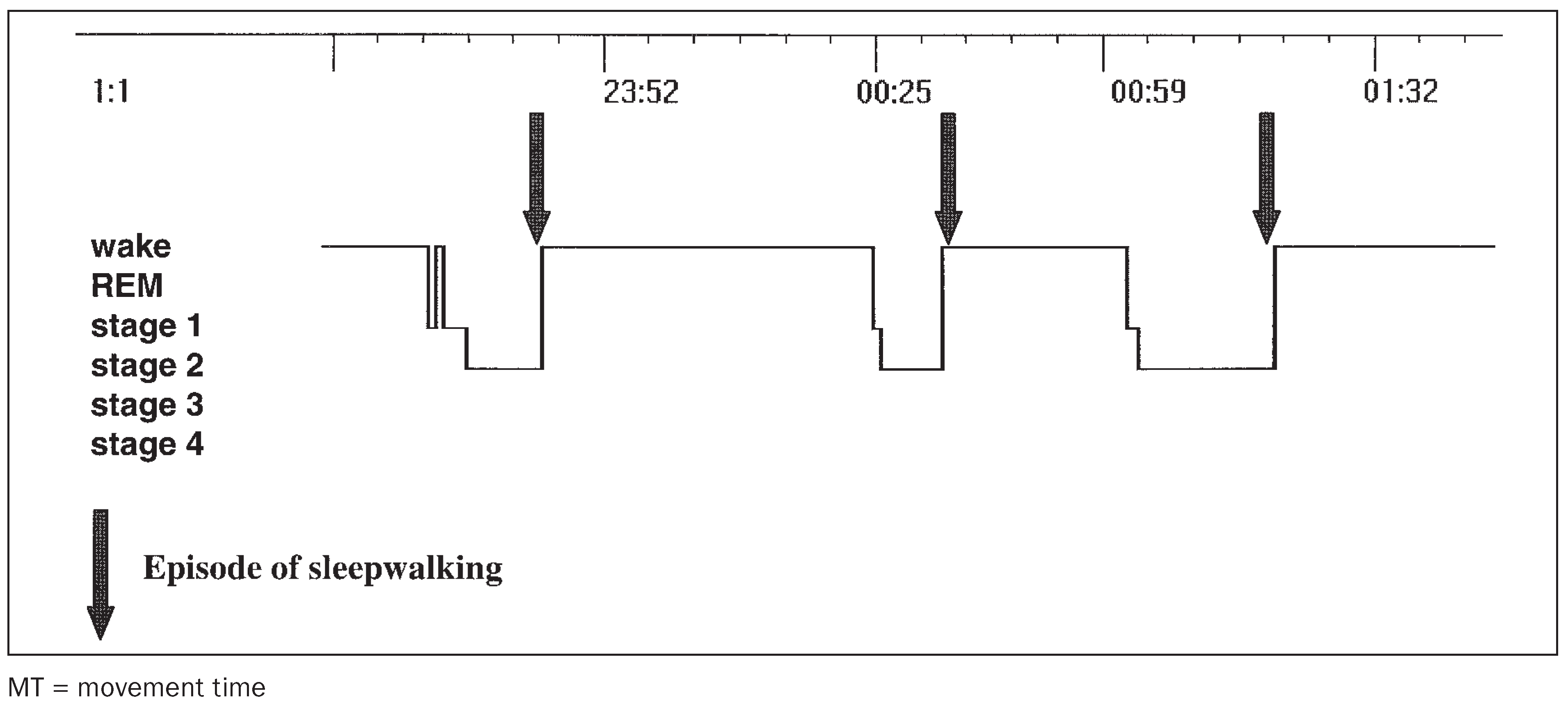
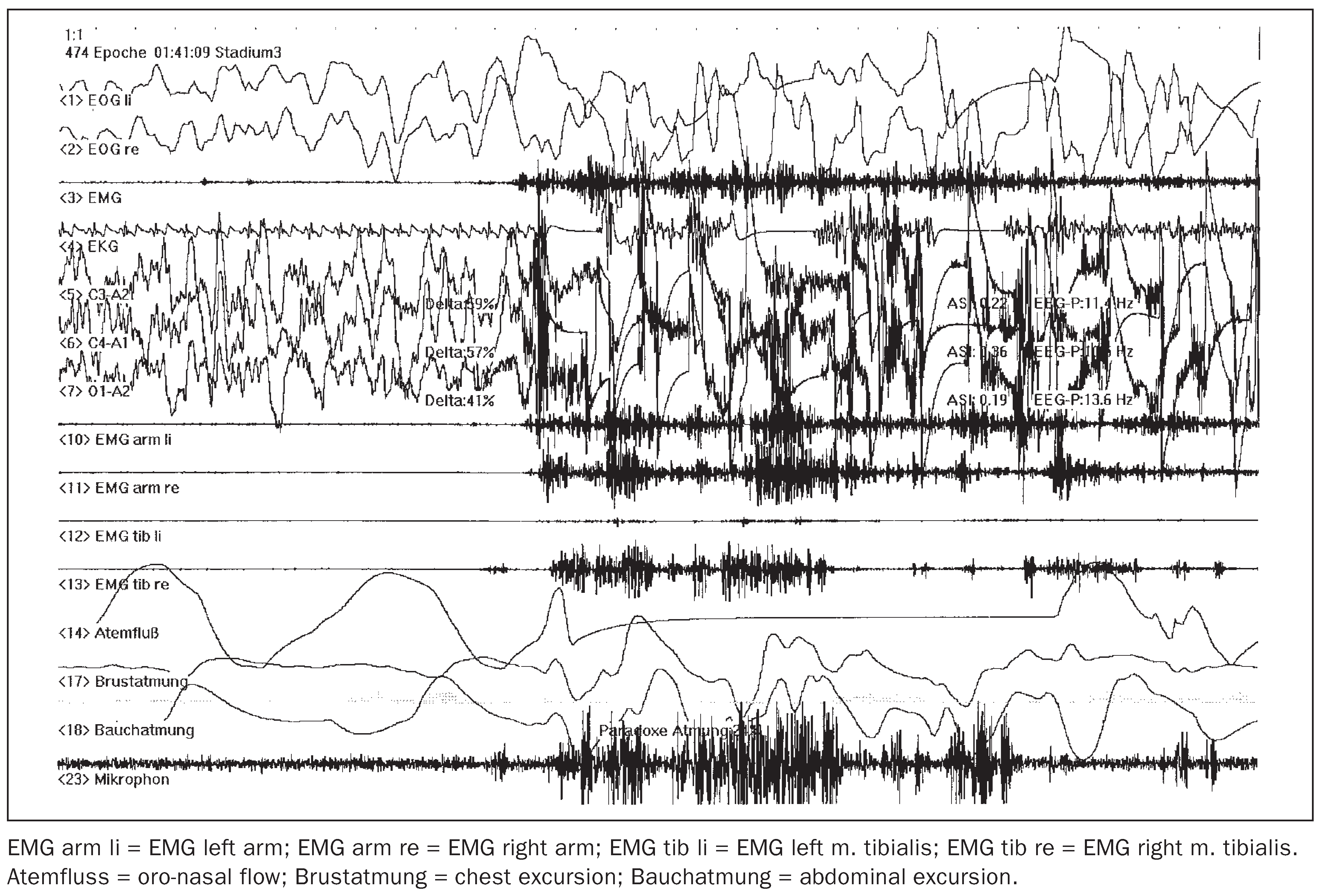
Self-injury is reported in about 20%, headaches and fatigue in about 30% and excessive daytime sleepiness in about 50%. Sleepwalking is frequently accompanied by other parasomnias like somniloquy, bruxism and nocturnal enuresis. Especially in young individuals polysomnographic arousal is frequently preceded by high amplitude delta activity (Figure 1, Figure 2) [12].
Compared to healthy persons sleepwalkers have more slow-wave sleep in the second half of the first sleep cycle which is interrupted by frequent arousal [9,10,13]. The arousals cause increased slow-wave sleep pressure which rises tremendously prior to an episode which explains incomplete awakening and amnesia for the episode. The triggers for the disorder are sustained throughout the night. SPECT in sleepwalkers [14] revealed a reduction of regional blood-flow in frontoparietal association-cortices, and increase in cingulum and anterior cerebellum. These findings can be interpreted as a dissociation of motor, vegetative and emotional stimulation in the cingulum and a reduction of self-awareness caused by the inhibition in the frontal cortex.
Differential diagnosis always must rule out complex partial seizures.
Therapy is only required if there is a hazard of self-injury or if everyday performance is impaired by sleepiness. However, every patient should have counselling on how to prevent sleepwalking or sleep terror, and what to do for safety in the surrounding (locking doors and windows, etc.). Especially in children non-pharmacological therapies like anticipatory awakening 1–2.5 hours after falling asleep [15], and self-hypnosis and relaxation methods [16] are recommended.
Pharmacological treatment comprises (1) clonazepam 0.5 mg 30 minutes prior to falling asleep, (2) tricyclic antidepressants like imipramine 25–50 mg, paroxetine, trazodone (no good evidence, case reports only, antidepressants may cause sleepwalking), (3) antiepileptic medication (i.e., carbamazepine).

Disorders of sleep-wake transition

As implicated by the name, they occur at the transition from wake to sleep and vice versa. Although epidemiological data is not available, it is known that they are very prevalent in the healthy population.
Therapeutical interventions should only be done in case of self-injury. Self-hypnosis is very successful. Benzodiazepines and tricyclic antidepressants are efficacious, whereas antiepileptics are not.
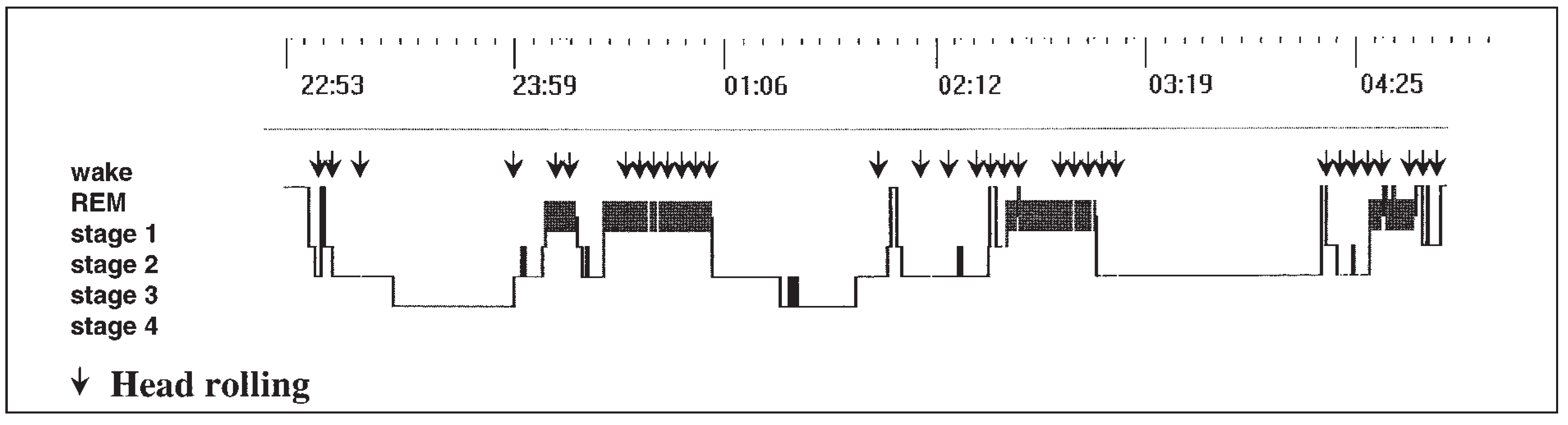
Rhythmic movements in sleep generally involve muscles of head and neck [17]. They mainly occur during sleep stages NREM 1 and 2, are rare during slow-wave sleep and wakefulness. Several types prevail: (1) headbanging in an anterior-posterior direction (jactatio capitis), (2) lateral headrolling in supine position, (3) body-rocking on hands and knees, (4) lateral bodyrolling in supine position (body-rocking). The movements last seconds to minutes and frequently appear every night. They can start at the age of 9 months, often end around age 10, but may persist unto adulthood. In contrast to the literature they occur from all sleep stages (Figure 3).
Polysomnography shows rhythmic muscle activity that impresses as high voltage delta-like, monomorphic artifacts in all EEG channels. The video clarifies this finding.
Non-pharmacological therapy includes training of motor behaviour which is competing with the rhythmic movements [18].
Sleep myoclonus: These are experienced by 60–70% of the general population as sudden, brief contractions of the legs, sometimes arms. Therapy is not necessary.
Somniloquy: Sleeptalking is reported by up to 80% of the general population and can occur during any sleep stage. It has to be considered as a complaint rather than a disorder.
Nocturnal leg cramps: These are experienced as painful sensations in the legs associated with muscle hardness leading to awakening from sleep. The pathophysiology is not well understood. Fluid and electrolyte disturbances should be ruled out as well as endocrine, neuromuscular disorders, Parkinson’s disease and arthritis. Movement, local application of heat or calcium are helpful.

Literature

  1. American Sleep Disorders Association. International Classification of Sleep Disorders, Diagnostic and Coding Manual. Revised: Rochester, Minnesota. American Sleep Disorders Association. 1997.
  2. Hadders-Algra, M; Nakae, Y; Van Eykern, LA; Klip-Van den Nieuwendijk, AWJ; Prechtl, HFR. The effect of behavioural state on general movements in healthy full-term newborns. A polymyographic study. Early Hum Dev 1993, 35, 63–79. [Google Scholar] [CrossRef] [PubMed]
  3. Hublin, C; Kaprio, J; Partinen, M; Heikkilä, K; Koskenvuo, M. Prevalence and genetics fo sleepwalking: a populationbased twin study. J Sleep Res 1996, 5, 96. [Google Scholar]
  4. Broughton, RH. Sleep disorders: disorders of arousal? Science 1968, 159, 1070–8. [Google Scholar] [CrossRef] [PubMed]
  5. Mahowald, MW; Schenck, CH. Dissociated states of wakefulness and sleep. Neurology 1992, 42, 44–52. [Google Scholar] [PubMed]
  6. Bawkin, H. Sleep walking in twins. Lancet 1970, 2, 466–7. [Google Scholar]
  7. Abe, K; Amatoni, M; Oda, N. Sleepwalking and recurrent sleeptalking in the children of childhood sleepwalkers. Am J Psychiatry 1984, 141, 800–1. [Google Scholar] [PubMed]
  8. Lecendreux, M; Mayer, G; Bassetti, C; Dauvilliers, Y; Neidhart, E; Mouren-Siméoni, MC; et al. HLA association in sleepwalking. Mol Psychiatry 2003, 8, 114–7. [Google Scholar] [CrossRef] [PubMed]
  9. Espa, F; Dauvilliers, Y; Ondze, B; Billiard, M; Besset, A. Arousal reactions in sleepwalking and night terrors in adults: the role of respiratory events. Sleep 2002, 25, 871–5. [Google Scholar] [CrossRef] [PubMed]
  10. Guilleminault, C; Poyares, D; Abat, F; Palombini, L. Sleep and wakefulness in somnambulism. A spectral analysis study. J Psychosom Res 2001, 51, 411–6. [Google Scholar] [CrossRef] [PubMed]
  11. Mayer, G; Neissner, V; Schwarzmayr, P; Meier-Ewert, K. Schlafentzug bei Somnambulismus: Auswirkung auf Arousals, Tiefschlaf und Schlafstadienwechsel. Nervenarzt 1998, 6, 495–501. [Google Scholar] [CrossRef] [PubMed]
  12. Blatt, I; Peled, R; Gadoth, N; Lavie, P. The value of sleep recording in evaluating somnambulism in young adults. Electroencephal Clin Neurophysiol 1991, 78, 497–512. [Google Scholar] [CrossRef] [PubMed]
  13. Espa, F; Ondze, B; Deglise, P; Billiard, M; Besset, A. Sleep architecture, slow wave activity, and sleep spindles in adult patients with sleepwalking and sleep terrors. Clin Neurophysiol 2000, 3, 929–39. [Google Scholar] [CrossRef] [PubMed]
  14. Bassetti, C; Vella, S; Donati, F; Wielepp, P; Weder, B. SPECT during sleepwalking. Lancet 2000, 356, 484–5. [Google Scholar] [CrossRef] [PubMed]
  15. Frank, NC; Spirito, A; Stark, L; Owens-Stively, J. The use of scheduled awakenings to eliminate childhood sleepwalking. J Pediatr Psychol 1997, 22, 345–53. [Google Scholar] [CrossRef] [PubMed]
  16. Hurwitz, TD; Mahowald, MW; Schenck, CH; Schluter, JL; Bundlie, SR. A retrospective outcome study and review of hypnosis as treatment of adults with sleepwalking and sleep terror. J Nerv Ment Dis 1991, 179, 228–33. [Google Scholar] [CrossRef] [PubMed]
  17. Baldy-Moulinier, M; Levy, M; Passouant, P. A study of jactatio capitis during night sleep. Electroencephalogr Clin Neurophysiol 1970, 28, 85. [Google Scholar]
  18. Chisholm, T; Morehouse, RL. Adult headbanging: sleep studies and treatment. Sleep 1996, 19, 343–6. [Google Scholar] [CrossRef] [PubMed]
Figure 1. Hypnogram of a 22-year-old sleepwalker having three episodes in one night. Sleepwalking since age 5. Screaming and fighting behaviour at night, sometimes dream recall. Monthly frequency of 10 episodes. Several times he woke up at night standing in front of his garage holding the car keys in his hands.
Sanpp 154 00358 g001
Figure 2. High amplitude delta activity prior to a sleepwalking episode.
Sanpp 154 00358 g002
Figure 3. Hypnogram of a 26-year-old patient with head rolling in all sleep stages since childhood.
Sanpp 154 00358 g003
Table 1. ICSD-classification of parasomnias.
Sanpp 154 00358 i001