Next Article in Journal
Acute management of mild traumatic brain injury
Previous Article in Journal
Editorial: Mild traumatic brain injury Leichte traumatische Hirnverletzung
 
 
Swiss Archives of Neurology, Psychiatry and Psychotherapy is published by MDPI from Volume 176 Issue 1 (2026). Previous articles were published by another publisher in Open Access under a CC-BY (or CC-BY-NC-ND) licence, and they are hosted by MDPI on mdpi.com as a courtesy and upon agreement with EMH Editores Medicorum Helveticorum.
Case Report

Whiplash injuries

by
Randolph W. Evans
1200 Binz, Suite 1370, Houston, Texas 77004, USA
Swiss Arch. Neurol. Psychiatry Psychother. 1998, 149(2), 60-67; https://doi.org/10.4414/sanp.1998.01025

Published: 1 January 1998

Historical note and nomenclature

Whiplash is an acceleration-deceleration mechanism of energy transfer to the neck that may result from rear-end or side-impact motor vehicle collisions. Common whiplash is a trauma causing cervical musculoligamental sprain or strain due to hyperextension-flexion and excludes fractures or dislocations of the cervical spine, head injury, or alteration of consciousness.
Chronic or late whiplash syndrome refers to persistent symptoms present more than 6 months after the accident. Other terms that some clinicians prefer include “cervical sprain”, “cervical myofascial pain syndrome”, “acceleration-deceleration injury”, and “hyperextension injury”. Terms for this type of injury in other languages include “le coup du lapin” in French and “Schleudertrauma” in German [24].
Controversy about late whiplash syndrome is paralleled by similar controversy about the sequelae of usually mild head and neck injuries often occurring in railway accidents in the second half of the 19th century: “railway spine” [23]. In publications from 1866 to 1882, Erichsen proposed that these injuries were due to “molecular disarrangement”or anemia of the spinal cord. In 1879,Rigler proposed compensation neurosis as the cause of an epidemic of compensation claims for railway accidents in Prussia. Oppenheim, in 1888,disagreed with this explanation and popularized the term “traumatic neurosis”. Charcot felt that posttraumatic symptoms were actually due to hysteria and neurasthenia. Throughout the 19th century in the United States, as today, there were misgivings about physicians becoming involved in medicolegal cases. A common concern was that physicians were available as hired guns with any opinion for a price.
The whiplash mechanism of injury may have first been recognized in United States Navy pilots who developed neck injuries from accelerationdeceleration forces when their planes were launched by catapults following World War I. Although the pilots were shortly thereafter provided with headrests and shoulder harnesses, automakers in the civilian sector took some 50 more years to provide the same safety equipment. An orthopedist, Crowe, is often cited as coining the term “whiplash” in a lecture in 1928 [15a]. However, the first use I have found in the medical literature appeared in an article by another orthopedist, Davis, in 1945 [16].
The term “whiplash” became widely used in the 1950s. In an influential paper in 1953, Gay and Abbott provided a good clinical review but incorrectly attributed the injury to flexion followed by hyperextension of the neck in rear-end collisions [29]. In 1955, Severy and coworkers reported a pioneering series of staged rear-end collisions using humans and anthropomorphic dummies and correctly identified the sequence of hyperextension followed by flexion of the neck [65]. Human volunteers were used in the front car at collision speeds up to 10 mph; dummies were used for higher-velocity collisions. However, volunteers were used in the rear car even in 20 mph collisions without injury: the flexion-extension injury is simply not nearly as harmful. This observation should be remembered when critics of whiplash injuries wonder why they rarely if ever see the drivers of the rear car as patients.
Many clinicians believe that whiplash primarily results in myofascial injuries. In 1938, Kellgren described distinctive patterns of referred pain from injection of different muscles with a 6% solution of sodium chloride [32]. An American orthopedist, Steindler, used the terms “trigger point” and “myofascial pain” for the first time in 1939 [68].

Clinical manifestations

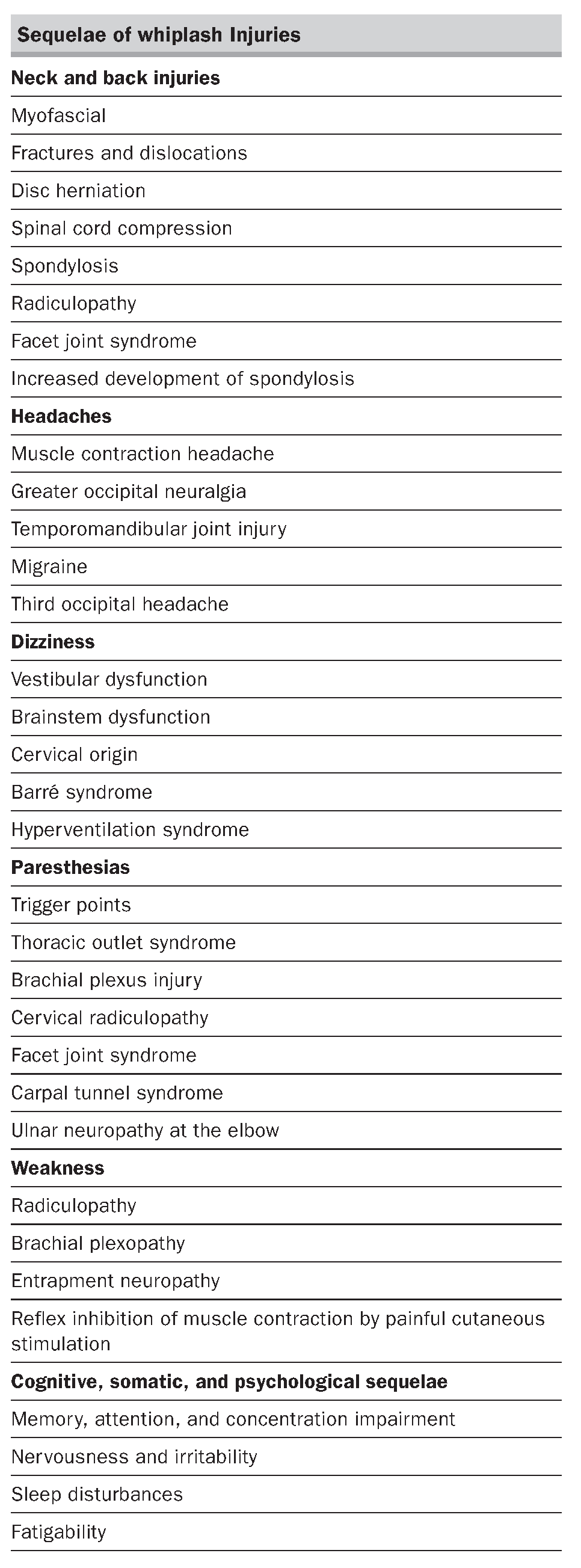
Table 1 lists the sequelae of whiplash injuries which include neck and back injuries; headaches; dizziness; paresthesias; weakness; cognitive, somatic, and psychological sequelae; visual symptoms; and rare sequelae [24].
Table 1.
Sanpp 149 00060 i001
Sanpp 149 00060 i002
Sixty-two percent of patients presenting to the emergency room after a motor vehicle accident complain of neck pain [17]. The onset of neck pain occurs within 6 hours in 65%, within 24 hours in an additional 28%, and within 72 hours in the remaining 7% [18]. Most neck pain is due to cervical sprain, a myofascial injury. Cervical disc herniations, cervical spine fractures, and dislocations are uncommon. Facet (zygapophyseal) joint injury at different levels can produce characteristic patterns of referred pain over various parts of the occipital, posterior cervical, shoulder girdle, and scapular regions [20]. Neck pain may arise from at least one facet joint in 54% of patients with chronic pain from whiplash injuries [5].
In a prospective study of 180 patients seen within 4 weeks of the whiplash injury, 82% complained of headaches, which were occipitally located in 46%, generalized in 34%, and in other locations in 20% [4]. The pain was present more than half the time in 50% of the patients. Headaches following whiplash injuries are usually of the muscle contraction type and are often associatedwith greater occipitalneuralgia[41].Greater occipital neuralgia or referred pain from trigger points from suboccipital muscles can produce a pattern of radiating pain variably over the occipital, temporal, frontal, and retro-orbital distribution. Whiplash trauma can also injure the temporomandibular joint and cause jaw pain often associated with headache [11]. Headache may be referred from the C2–3 facet joint that is innervated by the third occipital nerve, so-called “third occipital headache” [10]. C2–3 facet joint injury can result in pain complaints in the upper cervical region and extending at least onto the occiput and at times toward the ear, vertex, forehead, or eye. Using third occipital nerve blocks to diagnose the condition, the prevalence of this type of headache among patients with persistent headaches after whiplash injury has been reported as 38% to 50% [36]. Occasionally, whiplash injuries can precipitate recurring common, classic, and basilar migraines de novo [75].
In one study of 262 patients with persistent neck pain and headaches for 4 months or longer after the injury, symptoms were reported as follows: vertige, 50%; floating sensations, 35%; tinnitus, 14%; and hearing impairment, 5% [52]. Posttraumatic vertebral insufficiency and dysfunction of the vestibular apparatus, brainstem, cervical sympathetics (Barré syndrome), and cervical proprioceptive system have all been postulated as causing dizziness. Hyperventilation syndrome can also occur in patients who are in pain and anxious, producing dizziness and paresthesias periorally and/or of the extremities either bilaterally or unilaterally.
In one study, 33% of patients with symptoms but no objective findings complained of paresthesias acutely, and 37% reported paresthesias after a mean follow-up of 19.7 months [48]. Paresthesias can be referred from trigger points, brachial plexopathy, facet joint syndrome, entrapment neuropathies, cervical radiculopathy, and spinal cord compression. Thoracic outlet syndrome is commonly caused by whiplash injuries, occurring four times more often in women than in men [15]. Thoracic outlet syndrome has been controversial, since at least 85% of cases are of the nonspecific neurogenic or so-called “disputed type” that is a diagnosis of exclusion. This nonspecific type may actually be a myofascial pain syndrome with referred pain from the anterior neck muscles such as the anterior scalene or from the shoulder area from the pectoralis minor and not due to neural or vascular compression. Entrapment neuropathies can occur from several mechanisms. Carpal tunnel syndrome can be caused by acute hyperextension of the wrist on the steering wheel [34]. If the patient has a cervical radiculopathy or neurogenic thoracic outlet syndrome from the injury, a double crush syndrome resulting in carpal tunnel syndrome or cubital tunnel syndrome may ensue.
Complaints of upper extremity weakness, heaviness, or fatigue are common after whiplash injuries even when there is no evidence of cervical radiculopathy, myelopathy, brachial plexopathy, or entrapment neuropathy. The nonspecific type of thoracic outlet syndrome can produce these complaints. Alternatively, patients may have a sensation of weakness or heaviness because of reflex inhibition of muscle due to pain that can be overcome by more central effort [1].
In a study of patients with chronic symptoms after a whiplash injury, cognitive, psychological, and somatic symptoms occurred in the following percentages: nervousness and irritability, 67%; cognitive disturbances, 50%; sleep disturbances, 44%;fatigability,40%;disturbances of vision,38%; symptoms of depression, 37%; headache, 85%; neck pain, 100%; vertigo, 72%; and brachialgia, 60% [33]. These symptoms are nonspecific and are also common in patients with postconcussion syndrome, chronic pain syndrome, depression, and anxiety neurosis. Psychological factors such as premorbid neurosis are commonly cited as the cause of persistent complaints. However, psychosocial factors, negative affectivity, and personality traits are not significant in predicting the duration of symptoms [59]. Instead, cognitive and psychological symptoms may be due to somatic symptoms [61],although a 2-year prospective study find that symptomatic subjects were impaired on tasks of divided attention but not on memory tests [19]. It is controversial whether persistent neuropsychological deficits following whiplash injury are evidence for mild traumatic brain injury [69].
A variety of other problems may follow whiplash injuries. About a third of patients complain of interscapular and low back pain after whiplash injuries. Patients often report visual symptoms, especially blurred vision, usually due to convergence insufficiency, although oculomotor palsies can occasionally occur [12]. Rare sequelae are listed in Table 1.

Etiology

Physicians generally attribute symptoms of common whiplash within the first 3 months to soft tissue injuries. However, when symptoms persist, the etiology of the chronic or late whiplash syndrome is controversial [21]. Nonorganic explanations advanced for persistent complaints include emotional problems, a culturally conditioned and legally sanctioned illness [44],social and peer copying [35], secondary gain and malingering, and demands for an explanation outside the realm of organic psychiatry and neurology [55].
A recent study that retrospectively examined the incidence of chronic symptoms after rear-end motor vehicle accidents in Lithuania, where few people are covered by insurance, also challenged the organicity of chronic complaints [64]. Chronic pain and headaches were no more common in 202 accident victims than controls. The authors conclude that expectation of disability, a family history, and attribution of preexisting symptoms to the trauma may be important determinants for those who develop chronic symptoms. Although the results are intriguing, the study is probably not valid because of significant sampling bias [8].
Although the nonorganic explanations are appropriate for a minority of patients, my own view is that most patients with persistent complaints actually experience the symptoms, which have a poorly understood biological basis. What I believe to be the most common cause of symptoms, myofascial pain syndrome, is also a target of criticism since the diagnosis is based on subjective complaints and findings [9].

Biological basis

Both animal and human studies have demonstrated structural damage from whiplash type injuries. In different species of monkeys, experimentally caused acceleration/extension injuries have revealed a variety of lesions: muscle tears, avulsions, and hemorrhages; rupture of the anterior longitudinal and other ligaments, especially between C4 and C7;avulsions of disc from vertebral bodies and disc herniations; retropharyngeal hematoma; intralaryngeal and esophageal hemorrhage; cervical sympathetic nerve damage associated with damage to the longus colli; nerve root injury; cervical spinal cord contusions and hemorrhages; cerebral concussion; and gross hemorrhages and contusions over the surface of the cerebral hemispheres, brainstem, and cerebellum [40,50].
Human studies have similarly revealed damage of multiple structures. An MRI study of selected patients done within 4 months of the whiplash type injury revealed ruptures of the anterior longitudinal ligament, horizontal avulsion of the vertebral end plates, separation of the disc from the vertebral end plate, occult fractures of the anterior vertebral end plate, acute posterolateral cervical disc herniations, focal muscular injury of the longus colli muscle, posterior interspinous ligament injury, and prevertebral fluid collections. Autopsy series have shown injuries similar to those in the animal studies, including injuries to intervertebral discs and soft tissue injuries of facet joints [70,71].

Epidemiology

In 1995, there were 10,700,000 motor vehicle accidents, including 2,800,000 rear-end collisions, in the United States [46]. Based on rough estimates, as many as 1 million people sustain whiplash type injuries per year in the United States [51].Although neck injuries can commonly occur after side- or front-impact collisions, rear-end collisions are responsible for about 85% of all whiplash injuries [17].In a low-velocity rear-end collision, occupants of the vehicle struck are more likely to develop neck pain than the occupants of the striking or rear vehicle, who sustain a flexion type injury [40,65]. In rear-end collisions, the incidence of whiplash injuries decreases as crash severity increases [31]. Neurologists frequently evaluate and treat patients with whiplash injuries. According to one survey, neurologists see an average of 10.3 patients per month with whiplash injuries [21]. Women have persistent neck pain more often than men, especially in the 20- to 40-year age group, by a ratio of 7:3 [3]. The greater susceptibility of women to whiplash injuries might be due to a narrower neck with less muscle mass supporting a head of roughly the same volume or a narrower spinal canal compared with men [57].

Prevention

General measures directed at driving safety such as reducing the number of drunk drivers or improving the driving habits of young men would reduce the number of whiplash injuries. Vehicle safety measures have been implemented. Proper use of head restraints can reduce the incidence of neck pain in rear-end collisions by 24% [45]. However, in one study, only 10% of drivers had headrests adjusted to the most favorable position to prevent neck extension [73]. Proper placement of adjustable headrests could result in a 28.3% reduction in whiplash injury risk [73]. Center high-mounted stop lamps have reduced the number of rear-end collisions. Even though seat belt use should be encouraged, 73% of occupants wearing a seat belt develop neck pain as compared to 53% not wearing seat belts [18].

Differential diagnosis

Although most whiplash injuries result in myofascial or facet joint injuries, less common consequences include fractures, cervical disc herniations, spondylitic radiculopathy and myelopathy. Table 1 lists the differential diagnosis for other symptoms after whiplash injuries.

Diagnostic workup

Cervical spine series are often obtained to exclude the occasional fracture. In patients with abnormal neurologic examinations or persistent complaints suggesting the possibility of radiculopathy or myelopathy, a cervical spine MRI study may be indicated. In patients without radicular complaints, cervical MRI studies have a low yield [74]. A cervical myelogram followed by CT scan may be helpful if the MRI study cannot be done or if the study demonstrates equivocal findings. In some cases, especially for spondylitic disease, CT scan/ myelography may be more sensitive for nerve root compression than MRI. Because asymptomatic radiographic findings are common, frequently it is difficult to determine what findings are new and what findings are preexisting. Cervical spondylosis and degenerative disc disease occur with increasing frequency with older age and are often asymptomatic [26]. Cervical disc protrusions are also common in the general population and are often asymptomatic. Protrusions occur in 20% of patients who are 45 to 54 years of age and in 57% of patients who are older then 64 years [72].
EMG and nerve conduction studies may be helpful to demonstrate evidence of radiculopathy, brachial plexopathy, or entrapment neuropathies. Somatosensory and dermatomal evoked potential studies are not adequately sensitive or specific to justify use for the evaluation of possible radiculopathy. Although HmPAO and ECD brain SPECT studies in patients with late whiplash syndrome and cognitive complaints have demonstrated parietooccipital hypoperfusion [53], similar findings have also been seen in patients with nontraumatic chronic cervical pain [54]. One possible explanation is stimulation of pain-sensitive afferents in the cervicotrigeminal system, which could have widespread effects on local vasoactive peptides and the cranial vascular system [53].

Prognosis and complications

Studies on the prognosis of whiplash injuries are difficult to compare because of multiple methodological differences, including selection criteria of patients, prospective and retrospective designs, patient attrition rates, duration of follow-up, and treatments used [6,24]. Although most patients may have only soft tissue injuries, imaging studies other than plain spine films have not been routinely performed.
Multiple studies have documented that neck pain and headaches can persist in significant numbers of patients. A well-designed prospective study reported the following percentages of patients with complaints of neck pain and headaches, respectively, at various times after the injury: 92% and 57% – 1 week, 38% and 35% – 3 months, 25% and 26% – 6 months, 19% and 21% – 1 year, and 16% and 15% – 2 years [62,63]. Symptoms present two years after injury are still present ten years after the injury [27].
The following risk factors have been reported for persistent symptoms [57,63]:
Table 2.
Sanpp 149 00060 i003
Although psychological factors such as neurosis are commonly cited as the cause of persistent symptoms, a prospective study of 78 consecutive patients with whiplash injuries demonstrated that psychosocial factors, negative affectivity, and personality traits were not significant in predicting the duration of symptoms [59].An additional study found that psychosocial factors and vocation were not predictive of persistent symptoms during a 1year follow-up [62].
Radanov and coworkers performed a prospective study to assess psychological risk factors for disability [60].At 6 months,7% of the patients had partial or complete disability. The disabled and nondisabled patients still symptomatic at 6 months did not differ with respect to psychosocial stress, negative affectivity, and personality traits as initially assessed at baseline. Nygren reported that permanent medical disability occurred in 9.6% of patients involved in rear-end collisions and 3.8% involved in front- or side-impact accidents [49].
Many clinicians and certainly the insurance industry and defense attorneys believe that pending litigation is a major cause of persistent symptoms that promptly resolve once the litigation is completed [35]. However, the literature does not support this position. Litigants and nonlitigants have similar recovery rates [56] and similar response rates to treatment for facet joint pain [39]. The majority of plaintiffs who have persistent symptoms at the time of settlement of their litigation are not cured by a verdict [25,66]. Certainly, there are some patients who exaggerate or lie about persisting complaints to help or make their legal case. Neurotic, histrionic, or sociopathic patients may thrive on the attention and endless treatments recommended by some physicians and encouraged by some plaintiff attorneys. The clinician should evaluate the merits of each case individually. The available evidence does not support bias against patients just because they have pending litigation.

Management

There are very few prospective controlled studies of treatment [58]. According to one such study, early mobilization of the neck using the Maitland technique followed by local heat and neck exercises produces more rapid improvement after acute injuries than the use of a cervical collar and rest [43] and is as effective as physical therapy performed during the first 8 weeks after the injury [42]. Cervical traction may be no more effective than exercises alone [56].According to uncontrolled studies, trigger point injections can be beneficial for acute and chronic myofascial injuries [28]. One group reports benefit from injection of sterile water in or subcutaneous to trigger points caused by whiplash injuries [13,14].A single case report describes cervicogenic headache relief for 3 months at a time with injections of botulinum toxin in a trapezius muscle tender area [30]. TENS units may also be beneficial.
Treatment of pain arising from facet joint injury is being increasingly studied. A controlled prospective study showed a lack of effect on intraarticular corticosteroids injections in the cervical facet joints for chronic pain after whiplash injuries [6]. Percutaneous radiofrequency neurotomy, a lower cervical medial branch neurotomy, should be used cautiously for the treatment of chronic facet joint pain documented by anesthetic blocks [37]. In a small study of patients with chronic facet joint pain confirmed with double-blind placebo-controlled local anesthesia, percutaneous radiofrequency neurotomy with multiple lesions of target nerves provided at least 50% relief for a median duration of 263 days compared to similar relief for 8 days in the control group [39].
Routine treatment for acute injuries often consists of pain medications, nonsteroidal antiinflammatory medications, muscle relaxants, and the use of a cervical collar for 2 to 3 weeks. Neurologists frequently prescribe range-of-motion exercises, physical therapy with a variety of modalities, and TENS units. Standard treatments are provided for posttraumatic headache. For example, some patients with greater occipital neuralgia benefit from nerve blocks [2,67].
For persistent complaints, tricyclic antidepressants are often prescribed. The chronic frequent use of narcotics, benzodiazepines, barbiturates, and carisprosodol should be sparingly recommended because of the potential of habituation. Medication abuse headaches can also develop. Patients with chronic complaints seek out a multitude of unproven treatments such as chiropractic adjustments (occasionally under general anesthesia), acupuncture, prolotherapy, and pain clinics. Well-meaning practitioners often uncritically provide treatments without allowing for the importance of placebo effects, while others are more economically motivated. Some plaintiffs and their attorneys encourage excessive treatment in an attempt to magnify an alleged injury.
Clearly, adequately controlled prospective studies of current treatments and more effective treatments for chronic pain are greatly needed [47,58]. Until then, a compassionate, sympathetic approach by the neurologist might result in greater patient satisfaction and reduce unnecessary expenditures from patients’ therapeutic quests.

References

  1. Aniss AM, Gandevia SC, Milne RJ. Changes in perceived heaviness and motor commands produced by cutaneous reflexes in man. J Physiol 1988;397:113–26.
  2. Anthony M. Headache and the greater occipital nerve. Clin Neurol Neurosurg 1992;94:297–301.
  3. Balla JI. The late whiplash syndrome. Aust N Z J Surg 1980;50:610–4.
  4. Balla J, Karnaghan J. Whiplash headache. Clin Exp Neurol 1987;23:179–82.
  5. Barnsley L, Lord SM, Wallis Bj, Bogduk N. Chronic cervical zygapophyseal joint pain: a prospective prevalence study. Br J Rheumatol 1993;32(Suppl 2):52.
  6. Barnsley L, Lord SM, Wallis BJ, Bogduk N. Lack of effect of intraarticular corticosteroids for chronic pain in the cervical zygapophyseal joints. N Engl J Med 1994;330:1047–50.
  7. Barnsley L, Lord S, Bogduk N. Whiplash injury. Pain 1994;58:283–307.
  8. Bjorgen IV. Late whiplash syndrome. Lancet 1996;348:124.
  9. Bohr T. Problems with myofascial pain syndrome and fibromyalgia syndrome. Neurology 1996;46:593–7.
  10. Bogduk N, Marsland A. On the concept of third occipital headache. J Neurol Neurosurg Psychiatry 1986;49:775–80.
  11. Brooke RI, LaPointe HJ. Temporomandibular joint disorders following whiplash. Spine State Art Rev 1993;7:443–54.
  12. Burke JP, Orton HP, West J, et al. Whiplash and its effect on the visual system. Graefes Arch Clin Exp Ophthalmol 1992;230:335–9.
  13. Byrn C, Bornstein P, Linder L, et al. Treatment of neck and shoulder pain in whiplash syndrome patients with intracutaneous sterile water injections. Acta Anaesthesiol Scand 1991;35:52–3.
  14. Byrn C, Olsson I, Falkheden L, et al. Subcutaneous sterile water injections for chronic neck and shoulder pain following whiplash injuries. Lancet 1993;341:449–52.
  15. Capistrant TD. Thoracic outlet syndrome in cervical strain injury. Minn Med 1986;69:13–7.
  16. Crowe H. A new diagnostic sign in neck injuries. Calif Med 1964;100:12–3.
  17. Davis AG. Injuries of the cervical spine. JAMA 1945;127:149–56.
  18. Deans GT, McGalliard JN, Rutherford WH. Incidence and duration of neck pain among patients injured in car accidents. Br Med J 1986; 292:94–5.
  19. Deans GT, McGalliard JN, Kerr M, Rutherford WH. Neck sprain – a major cause of disability following car accidents. Injury 1987;18:10–2.
  20. Di Stefano G, Radanov BP. Course of attention and memory after common whiplash: a two-year prospective study with age, education and gender pair-matched patients. Acta Neurol Scand 1995;91:346–52.
  21. Dwyer A, Aprill C, Bogduk N. Cervical zygapophyseal joint pain patterns. 1: a study in normal volunteers. Spine 1990;15:453–7.
  22. Evans RW, Evcans RI, Sharp MJ. The physician survey on the post-concussion and whiplash syndromes. Headache 1994;34:268–74.
  23. Evans RW. The post-concussion syndrome: 130 years of controversy. Semin Neurol 1994;14(1):32–9.
  24. Evans RW. Whiplash around the world. Headache 1995;35:262–3.
  25. Evans RW. Whiplash injuries. In: Evans RW, editor. Neurology and trauma. Philadelphia: WB Saunders, 1996;439–57.
  26. Evans RW. Whiplash injuries. In: Macfarlane R, Hardy DG, editors. Outcome after head, neck and spinal trauma. A medicolegal guide. Oxford: Butterworth-Heinemann, 1997;359–72.
  27. Friedenberg ZB, Miller WT. Degenerative disc disease of the cervical spine: a comparative study of asymptomatic and symptomatic patients. J Bone Joint Surg 1963;45A:1171–8.
  28. Gargan MF, Bannister GC. Long-term prognosis of soft tissue injuries of the neck. J Bone Joint Surg 1990;72B:901–3.
  29. Garvey TA, Marks MR, Wiesel SW. A prospective, randomized double-blind evaluation of trigger-point injection therapy for low-back pain. Spine 1989;14:962–4.
  30. Gay JR, Abbott KH. Common whiplash injuries of the neck. JAMA 1953;152:1698–704.
  31. Hobson DE, Gladish DF. Botulinum toxin injection for cervicogenic headache. Headache 1997;37:253–6.
  32. Kahane CJ. An evaluation of head restraints. U.S. Department of Transportation, National Highway Traffic Safety Administration Technical Report DOT HS-806-108. Springfield (VA): National Technical Information Service, February 1982.
  33. Kellgren JH. A preliminary account of referred pain arising from muscle. Br Med J 1938;1:325–7.
  34. Kischka U, Ettlin TH, Heim S. Cerebral symptoms following whiplash injury. Eur Neurol 1991;31:136–40.
  35. Label LS. Carpal tunnel syndrome resulting from steering wheel impact. Muscle Nerve 1991;14:904.
  36. Livingston M. Whiplash injury and peer copying. J R Soc Med 1993;86:535–6.
  37. Lord SM, Barnsley L, Wallis BJ, Bogduk N. Third occipital headache: a prevalence study. J Neurol Neurosurg Psychiatry 1994;57:1187–90.
  38. Lord SM, Barnsley L, Bogduk N. Percutaneous radiofrequency neurotomy in the treatment of cervical zygapophysial joint pain: a caution. Neurosurgery 1995;36:732–9.
  39. Lord SM, Barnsley L, Wallis BJ, Bogduk N. Chronic cervical zygapophysial joint pain after whiplash. A placebocontrolled prevalence study. Spine 1996a;21:1737–45.
  40. Lord SM, Barnsley L, Wallis BJ, et al. Percutaneous radio-frequency neurotomy for chronic cervical zygapophyseal joint pain. N Engl J Med 1996b;335:1721–6.
  41. MacNab I. Acceleration injuries of the cervical spine. J Bone Joint Surg 1964;46A:1797–9.
  42. Magnusson T. Extracervical symptoms after whiplash trauma. Cephalalgia 1994;14:223–7.
  43. McKinney LA, Dornan JO, Ryan M. The role of physiotherapy in the management of acute neck sprains following road-traffic accidents. Arch Emerg Med 1989;6:27–33.
  44. Mealy K, Brennan H, Fenelon GCC. Early mobilization of acute whiplash injuries. Br Med J 1986;292:656–7.
  45. Mills H, Horne G. Whiplash – man-made disease? N Z Med J 1986;99:373–4.
  46. Morris F. Do head-restraints protect the neck from whiplash injuries? Arch Emerg Med 1989;6:17–21.
  47. National Safety Council. Accident facts. Itasca (IL): National Safety Council; 1996.
  48. Newman PK. Whiplash injury. Long-term prospective studies are needed and, meanwhile, pragmatic treatment. Br Med J 1990;301:2–3.
  49. Norris SH,Watt I. The prognosis of neck injuries resulting from rear-end vehicle collision. J Bone Joint Surg 1983;65B:608–11.
  50. Nygren A. Injuries to car occupants: some aspects of the interior safety of cars. Acta Otolaryngol (Stockh) 1984;395(Supp.):1–164.
  51. Ommaya AK, Faas F, Yarnell P. Whiplash injury and brain damage – an experimental study. JAMA 1968;204:285–9.
  52. O’Neill B, Haddon W, Kelley AB, et al. Automobile head restraints – frequency of neck claims in relation to the presence of head restraints. Am J Public Health 1972;62:403.
  53. Oosterveld WJ, Kortschot HW, Kingma GG, et al. Electronystagmographic findings following cervical whiplash injuries. Acta Otolaryngol (Stockh) 1991;111:201–5.
  54. Otte A, Mueller-Brand J, Fierz L. Brain SPECT findings in late whiplash syndrome. Lancet 1995;345:1513–4.
  55. Otte A, Ettlin T, Fierz L, Mueller-Brand J. Parieto-occipital hypoperfusion in late whiplash syndrome: first quantitative SPET study using technetium-99m bicisate (ECD). Eur J Nucl Med 1996;23:72–4.
  56. Pearce JMS. The polemics of chronic whiplash injury. Neurology 1994;44:1993–7.
  57. Pennie BH, Agambar LJ. Whiplash injuries: a trial of early management. J Bone Joint Surg 1990;72B:277–9.
  58. Pettersson K, Karrholm J, Toolanen G, Hildingsson C. Decreased width of the spinal canal in patients with chronic symptoms after whiplash injury. Spine 1995;20:1664–7.
  59. Quebec Task Force on Whiplash-associated Disorders. Scientific monograph of the Quebec Task Force on Whiplash-associated Disorders. Spine 1995;20(8s):1S–73S.
  60. Radanov BP, Stefano GD, Schnidrig A, Ballinari P. Role of psychosocial stress in recovery from common whiplash. Lancet 1991;338:712–5.
  61. Radanov BP, Di Stefano G, Schnidrig A, Sturzenegger M. Psychosocial stress, cognitive performance and disability after common whiplash. J Psychosom Res 1993;37:1–10.
  62. Radanov BP, Di Stefano G, Schnidrig A, Sturzenegger M. Common whiplash: psychosomatic or somatopsychic? J Neurol Neurosurg Psychiatry 1994a;57:486–90.
  63. Radanov BP, Sturzenegger M, Di Stefano G, Schnidrig A. Relationship between early somatic, radiological, cognitive and psychosocial findings and outcome during a oneyear follow-up in 117 patients suffering from common whiplash. Br J Rheumatol 1994b;33:442–8.
  64. Radanov BP, Sturzenegger M, Di Stefano G. Long-term outcome after whiplash injury. A 2-year follow-up considering features of injury mechanism and somatic, radiologic, and psychosocial findings. Medicine 1995;74:281–97.
  65. Schrader H, Obelieniene D, Bovim G. Natural evolution of late whiplash syndrome outside the medicolegal context. Lancet 1996;347:1207–11.
  66. Severy DM, Mathewson JH, Bechtol CO. Controlled automobile rear-end collisions, an investigation of related engineering medical phenomena. Can Services Med J 1955;11:727–59.
  67. Shapiro AP, Roth RS. The effect of litigation on recovery from whiplash. Spine State Art Rev 1993;7:531–56.
  68. Sjaasad O. The headache of challenge in our time: cervicogenic headache. Funct Neurol 1990;5:155–8.
  69. Steindler A. The interpretation of sciatic radiation and the syndrome of low-back pain. J Bone Joint Surg 1939;22:28–34.
  70. Taylor AE, Cox CA, Mailis A. Persistent neuropsychological deficits following whiplash: evidence for chronic mild traumatic brain injury? Arch Phys Med Rehabil 1996;77:529–35.
  71. Taylor JR, Kakulas BA. Neck injuries. Lancet 1991;338:1343.
  72. Taylor JR, Twomey LT. Acute injuries to cer vical joints. An autopsy study of neck sprain. Spine 1993;18:1115–22.
  73. Teresi LM, Lufkin RB, Reicher MA, et al. Asymptomatic degenerative disk disease and spondylosis of the cervical spine. MR imaging. Radiology 1987;164:83–8.
  74. Viano DC, Gargan MF. Headrest position during normal driving: implications to neck injury risk in rear crashes. Accid Anal Prev 1996;8:665–774.
  75. Voyvodic F, Dolinis J, Moore VM, et al. MRI of car occupants with whiplash injury. Neuroradiology 1997;39:35–40.
  76. Weiss HD, Stern BJ, Goldberg J. Post-traumatic migraine: chronic migraine precipitated by minor head or neck trauma. Headache 1991;31:451–6.