
Mapping the Network Structure of Non-Suicidal Self-Injury: The Role of Emotional and Interpersonal Vulnerability and Attachment in Spanish Adolescents

 , and
, and
Abstract
1. Introduction
2. Method
2.1. Participants
2.2. Instruments
2.3. Procedure
2.4. Statistical Analyses
3. Results
3.1. Clinical Characteristics of the Sample
3.2. Correlations
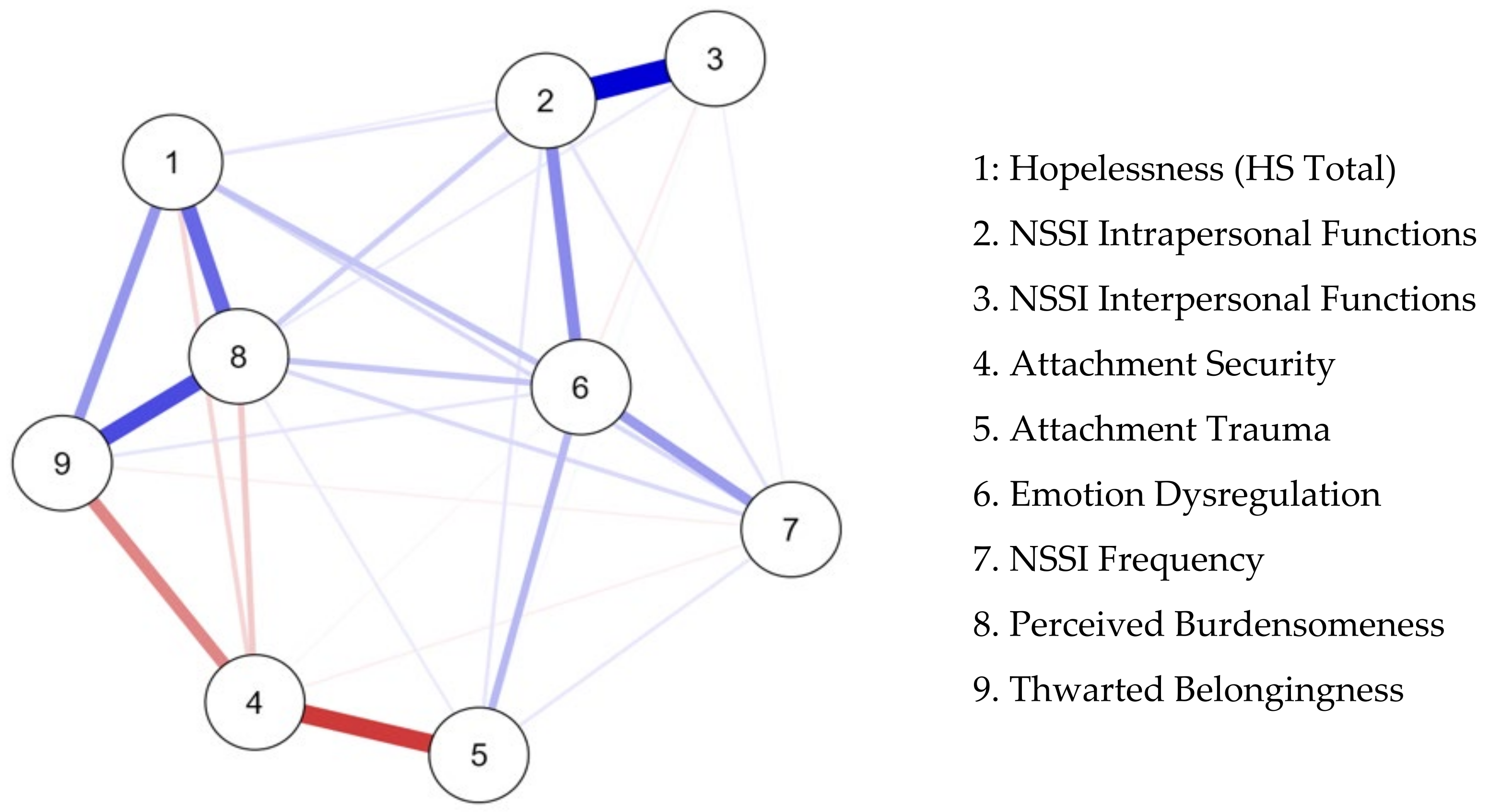
3.3. Network Analysis
4. Discussion
Supplementary Materials
Author Contributions
Funding
Institutional Review Board Statement
Informed Consent Statement
Data Availability Statement
Acknowledgments
Conflicts of Interest
References
- Aguilar, E., Hidalgo, M., Cano, R., López, J., Campillo, M., & Hernández, J. (1995). Estudio prospectivo de la desesperanza en pacientes psicóticos de inicio: Características psicométricas de la escala de desesperanza de Beck en este grupo. Anales de Psiquiatría, 11(4), 121–125. [Google Scholar]
- Ainsworth, M. D. S., Blehar, M. C., Waters, E., & Wall, S. (1978). Patterns of attachment: A psychological study of the strange situation. In Patterns of attachment: A psychological study of the strange situation. Lawrence Erlbaum. [Google Scholar]
- American Psychiatric Association. (2022). Other conditions that may be a focus of clinical attention. In Diagnostic and statistical manual of mental disorders. American Psychiatric Association Publishing. [Google Scholar] [CrossRef]
- Andover, M. S., Morris, B. W., Wren, A., & Bruzzese, M. E. (2012). The co-occurrence of non-suicidal self-injury and attempted suicide among adolescents: Distinguishing risk factors and psychosocial correlates. Child and Adolescent Psychiatry and Mental Health, 6(1), 11. [Google Scholar] [CrossRef] [PubMed]
- Assavedo, B. L., & Anestis, M. D. (2016). The relationship between non-suicidal self-injury and both perceived burdensomeness and thwarted belongingness. Journal of Psychopathology and Behavioral Assessment, 38(2), 251–257. [Google Scholar] [CrossRef]
- Balluerka, N., Lacasa, F., Gorostiaga, A., Muela, A., & Pierrehumbert, B. (2011). Versión reducida del cuestionario CaMir (CaMir-R) para la evaluación del apego. Psicothema, 23(3), 486–494. [Google Scholar] [PubMed]
- Barrat, A., Barthélemy, M., Pastor-Satorras, R., & Vespignani, A. (2004). The architecture of complex weighted networks. Proceedings of the National Academy of Sciences of the United States of America, 101(11), 3747–3752. [Google Scholar] [CrossRef] [PubMed]
- Beck, A. T., & Steer, R. A. (1988). Manual for the beck hopelessness scale. Psychological Corporation. [Google Scholar]
- Beck, A. T., Weissman, A., Lester, D., & Trexler, L. (1974). The measurement of pessimism: The hopelessness scale. Journal of Consulting and Clinical Psychology, 42(6), 861–865. [Google Scholar] [CrossRef] [PubMed]
- Borsboom, D. (2017). A network theory of mental disorders. World Psychiatry, 16(1), 5–13. [Google Scholar] [CrossRef] [PubMed]
- Borsboom, D., & Cramer, A. O. J. (2013). Network analysis: An integrative approach to the structure of psychopathology. Annual Review of Clinical Psychology, 9(1), 91–121. [Google Scholar] [CrossRef] [PubMed]
- Boschloo, L., van Borkulo, C. D., Rhemtulla, M., Keyes, K. M., Borsboom, D., & Schoevers, R. A. (2015). The network structure of symptoms of the diagnostic and statistical manual of mental disorders. PLoS ONE, 10(9), e0137621. [Google Scholar] [CrossRef] [PubMed]
- Bowlby, J. (1973). Attachment and loss, volume II: Separation: Anxiety and anger. Basic Books. [Google Scholar]
- Brausch, A. M., & Gutierrez, P. M. (2010). Differences in non-suicidal self-injury and suicide attempts in adolescents. Journal of Youth and Adolescence, 39(3), 233–242. [Google Scholar] [CrossRef] [PubMed]
- Bretherton, I., & Munholland, K. A. (2008). Internal working models in attachment relationships: Elaborating a central construct in attachment theory. In J. Cassidy, & P. R. Shaver (Eds.), Handbook of attachment: Theory, research, and clinical applications (2nd ed., pp. 102–127). The Guilford Press. [Google Scholar]
- Bringmann, L. F., Elmer, T., Epskamp, S., Krause, R. W., Schoch, D., Wichers, M., Wigman, J. T. W., & Snippe, E. (2019). What do centrality measures measure in psychological networks? Journal of Abnormal Psychology, 128(8), 892–903. [Google Scholar] [CrossRef] [PubMed]
- Cassidy, J., Stern, J. A., Mikulincer, M., Martin, D. R., & Shaver, P. R. (2018). Influences on care for others: Attachment security, personal suffering, and similarity between helper and care recipient. Personality and Social Psychology Bulletin, 44(4), 574–588. [Google Scholar] [CrossRef] [PubMed]
- Chen, D., Ying, J., Liu, S., Xu, Z., Wu, H., Zhou, X., & You, J. (2023). The protective effects of meaning in life on the relationships between attachment anxiety, rumination, and nonsuicidal self-injury: A moderated mediation model. Children and Youth Services Review, 155, 107277. [Google Scholar] [CrossRef]
- De Luca, L., Pastore, M., Palladino, B. E., Reime, B., Warth, P., & Menesini, E. (2023). The development of Non-Suicidal Self-Injury (NSSI) during adolescence: A systematic review and Bayesian meta-analysis. Journal of Affective Disorders, 339, 648–659. [Google Scholar] [CrossRef] [PubMed]
- Dhingra, K., Boduszek, D., & Klonsky, E. D. (2016). Empirically derived subgroups of self-injurious thoughts and behavior: Application of latent class analysis. Suicide & Life-Threatening Behavior, 46(4), 486–499. [Google Scholar] [CrossRef] [PubMed]
- Dierickx, S., Claes, L., Buelens, T., Smits, D., & Kiekens, G. (2023). DSM-5 non-suicidal self-injury disorder in a community sample: Comparing NSSI engagement, recency and severity among emerging adults. Frontiers in Psychiatry, 14, 1251514. [Google Scholar] [CrossRef] [PubMed]
- Epskamp, S., Borsboom, D., & Fried, E. I. (2018). Estimating psychological networks and their accuracy: A tutorial paper. Behavior Research Methods, 50(1), 195–212. [Google Scholar] [CrossRef] [PubMed]
- Esposito, C., Dragone, M., Affuso, G., Amodeo, A. L., & Bacchini, D. (2023). Prevalence of engagement and frequency of non-suicidal self-injury behaviors in adolescence: An investigation of the longitudinal course and the role of temperamental effortful control. European Child and Adolescent Psychiatry, 32(12), 2399–2414. [Google Scholar] [CrossRef] [PubMed]
- Farkas, B. F., Takacs, Z. K., Kollárovics, N., & Balázs, J. (2024). The prevalence of self-injury in adolescence: A systematic review and meta-analysis. European Child & Adolescent Psychiatry, 33(10), 3439–3458. [Google Scholar] [CrossRef] [PubMed]
- Faura-Garcia, J., Calvete, E., & Orue, I. (2024). Longitudinal associations between nonsuicidal self-injury, depressive symptoms, hopelessness, and emotional dysregulation in adolescents. Archives of Suicide Research, 28(3), 800–814. [Google Scholar] [CrossRef] [PubMed]
- Fox, K. R., Franklin, J. C., Ribeiro, J. D., Kleiman, E. M., Bentley, K. H., & Nock, M. K. (2015). Meta-analysis of risk factors for nonsuicidal self-injury. Clinical Psychology Review, 42, 156–167. [Google Scholar] [CrossRef] [PubMed]
- Fried, E. I., van Borkulo, C. D., Cramer, A. O. J., Boschloo, L., Schoevers, R. A., & Borsboom, D. (2017). Mental disorders as networks of problems: A review of recent insights. Social Psychiatry and Psychiatric Epidemiology, 52(1), 1–10. [Google Scholar] [CrossRef] [PubMed]
- Gallego-Hernández de Tejada, B. (2019). Factores de riesgo y de protección de las autolesiones no suicidas en población adolescente española. Universidad Católica de Valencia. [Google Scholar]
- Gander, M., Fuchs, M., Franz, N., Jahnke-Majorkovits, A. C., Buchheim, A., Bock, A., & Sevecke, K. (2021). Non-suicidal self-injury and attachment trauma in adolescent inpatients with psychiatric disorders. Comprehensive Psychiatry, 111, 152273. [Google Scholar] [CrossRef] [PubMed]
- Glazebrook, K., Townsend, E., & Sayal, K. (2015). The role of attachment style in predicting repetition of adolescent self-harm: A longitudinal study. Suicide and Life-Threatening Behavior, 45(6), 664–678. [Google Scholar] [CrossRef] [PubMed]
- Gómez-Simón, I., Penelo, E., & De la Osa, N. (2014). Factor structure and measurement invariance of the Difficulties Emotion Regulation Scale (DERS) in Spanish adolescents. Psicothema, 3(26), 401–408. [Google Scholar] [CrossRef] [PubMed]
- Gratz, K. L., & Roemer, L. (2004). Multidimensional assessment of emotion regulation and dysregulation: Development, factor structure, and initial validation of the difficulties in emotion regulation scale 1. Journal of Psychopathology and Behavioral Assessment, 26, 41–54. [Google Scholar] [CrossRef]
- Gross, J. J., Feldman Barrett, L., John, O., Lane, R., Larsen, R., & Pennebaker, J. (1998). The emerging field of emotion regulation: An integrative review. Review of General Psychology, 2, 271–299. [Google Scholar] [CrossRef]
- Hasking, P., Whitlock, J., Voon, D., & Rose, A. (2017). A cognitive-emotional model of NSSI: Using emotion regulation and cognitive processes to explain why people self-injure. Cognition and Emotion, 31(8), 1543–1556. [Google Scholar] [CrossRef] [PubMed]
- He, S., Li, C., Zhang, S., Hu, Y., Wen, J., Liu, L., Gao, J., Wu, J., & Huang, G. (2025). The complexity of associations between emotion regulation, interpersonal sensitivity, cognitive insight, and non-suicidal self-injury: A study based on network analysis. BMC Psychiatry, 25(1), 846. [Google Scholar] [CrossRef] [PubMed]
- Hepp, J., Carpenter, R. W., Störkel, L. M., Schmitz, S. E., Schmahl, C., & Niedtfeld, I. (2020). A systematic review of daily life studies on non-suicidal self-injury based on the four-function model. Clinical Psychology Review, 82, 101888. [Google Scholar] [CrossRef] [PubMed]
- Hervás, G., & Jódar, R. (2008). Adaptación al Castellano de la escala de dificultades en la regulación emocional [The Spanish version of the difficulties in emotion regulation scale]. Clínica y Salud, 19(2), 139–156. [Google Scholar]
- International Society for the Study of Self-Injury. (2018). About self-injury. Available online: https://www.itriples.org/aboutnssi (accessed on 23 June 2025).
- Joiner, T. (2005). Why people die by suicide. Harvard University Press. [Google Scholar]
- Kiekens, G., & Claes, L. (2020). Non-suicidal self-injury and eating disordered behaviors: An update on what we do and do not know. Current Psychiatry Reports, 22(12), 68. [Google Scholar] [CrossRef] [PubMed]
- Klonsky, E. D. (2007). The functions of deliberate self-injury: A review of the evidence. Clinical Psychology Review, 27(2), 226–239. [Google Scholar] [CrossRef] [PubMed]
- Klonsky, E. D., & Glenn, C. R. (2009). Assessing the functions of non-suicidal self-injury: Psychometric properties of the Inventory of Statements About Self-injury (ISAS). Journal of Psychopathology and Behavioral Assessment, 31(3), 215. [Google Scholar] [CrossRef] [PubMed]
- Klonsky, E. D., May, A. M., & Glenn, C. R. (2013). The relationship between nonsuicidal self-injury and attempted suicide: Converging evidence from four samples. Journal of abnormal psychology, 122(1), 231–237. [Google Scholar] [CrossRef] [PubMed]
- Lacasa, F., & Muela, A. (2014). Guía para la aplicación e interpretación del cuestionario de apego CaMir-R. Revista de Psicopatología y Salud Mental del Niño y del Adolescente, 24, 83–93. [Google Scholar]
- Lev-Ari, L., & Levi-Belz, Y. (2019). Interpersonal theory dimensions facilitate posttraumatic growth among suicide-loss survivors: An attachment perspective. Death Studies, 43(9), 582–590. [Google Scholar] [CrossRef] [PubMed]
- Lim, K. S., Wong, C. H., McIntyre, R. S., Wang, J., Zhang, Z., Tran, B. X., Tan, W., Ho, C. S., & Ho, R. C. (2019). Global lifetime and 12-month prevalence of suicidal behavior, deliberate self-harm and non-suicidal self-injury in children and adolescents between 1989 and 2018: A meta-analysis. International Journal of Environmental Research and Public Health, 16(22), 4581. [Google Scholar] [CrossRef] [PubMed]
- Linehan, M. M. (1993). Cognitive-behavioral treatment of borderline personality disorder. Guilford Press. [Google Scholar]
- Linehan, M. M., Comtois, K. A., Brown, M. Z., Heard, H. L., & Wagner, A. (2006). Suicide Attempt Self-Injury Interview (SASII): Development, reliability, and validity of a scale to assess suicide attempts and intentional self-injury. Psychological Assessment, 18(3), 303–312. [Google Scholar] [CrossRef] [PubMed]
- Main, M., & Solomon, J. (1986). Discovery of an insecure-disorganized/disoriented attachment pattern. In T. B. Brazelton, & M. W. Yogman (Eds.), Affective development in infancy (pp. 95–124). Ablex Publishing. [Google Scholar]
- Marco, J. H., Gallego-Hernández de Tejada, B., Guillén, V., Baños, R. M., & Perez, S. (2021). Meaning in life buffers the association between perceived burdensomeness, thwarted belongingness, and frequency of non-suicidal self-injuries in Spanish adolescents. Journal of Clinical Medicine, 10(21), 4867. [Google Scholar] [CrossRef] [PubMed]
- Mikulincer, M., & Shaver, P. (2016). Attachment in adulthood. Guilford Press. [Google Scholar]
- Muehlenkamp, J. J., & Tillotson, V. (2023). Overview and epidemiology of NSSI in clinical samples. In The Oxford handbook of nonsuicidal self-injury (pp. 127–148). Oxford University Press. [Google Scholar] [CrossRef]
- Nock, M. (2009). Understanding nonsuicidal self-injury: Origins, assessment, and treatment. American Psychological Association. [Google Scholar]
- Nock, M. K. (2010). Self-Injury. Annual Review of Clinical Psychology, 6(1), 339–363. [Google Scholar] [CrossRef] [PubMed]
- Onnela, J.-P., Saramäki, J., Kertész, J., & Kaski, K. (2005). Intensity and coherence of motifs in weighted complex networks. Physical Review E, 71(6), 065103. [Google Scholar] [CrossRef] [PubMed]
- Ozeren, G. S. (2022). The correlation between emotion regulation and attachment styles in undergraduates. Perspectives in Psychiatric Care, 58(2), 482–490. [Google Scholar] [CrossRef] [PubMed]
- Pallini, S., Terrinoni, A., Iannello, S., Cerutti, R., Ferrara, M., Fantini, F., & Laghi, F. (2020). Attachment-related representations and suicidal ideations in nonsuicidal self-injury adolescents with and without suicide attempts: A pilot study. Suicide and Life-Threatening Behavior, 50(4), 909–920. [Google Scholar] [CrossRef] [PubMed]
- Perez, S., García-Alandete, J., Cañabate, M., & Marco, J. H. (2020). Confirmatory factor analysis of the inventory of statements about self-injury in a Spanish clinical sample. Journal of Clinical Psychology, 76(1), 102–117. [Google Scholar] [CrossRef] [PubMed]
- Perez, S., García-Alandete, J., Gallego, B., & Marco, J. H. (2021). Characteristics and unidimensionality of non-suicidal self-injury in a community sample of Spanish adolescents. Psicothema, 33(2), 251–258. [Google Scholar] [CrossRef] [PubMed]
- Perez Rodríguez, S., García-Alandete, J., Gallego Hernández de Tejada, B., Guillén, V., & Marco, J. H. (2022). Psychometric properties of the interpersonal needs questionnaire-15 in Spanish adolescents. Frontiers in Psychiatry, 13, 833400. [Google Scholar] [CrossRef] [PubMed]
- Perez Rodríguez, S., Mora-Ascó, J. J., Marco salvador, J. H., Guillen Botella, V., & Gallego-Hernández de Tejada, B. (2025). Mediating effect of hopelessness between thwarted belongingness, perceived burdensomeness, and non-suicidal self-injury in Spanish adolescents. Ansiedad y Estrés, 31(1), 23–29. [Google Scholar] [CrossRef]
- Pierrehumbert, B., Karmaniola, A., Sieye, A., Meister, C., Miljkovitch, R., & Halfon, O. (1996). Les modèles de relations: Développement d’un auto-questionnaire d’attachement pour adultes. Psychiatrie de L’enfant, 1, 161–206. [Google Scholar]
- Poudel, A., Lamichhane, A., Magar, K. R., & Khanal, G. P. (2022). Non suicidal self injury and suicidal behavior among adolescents: Co-occurrence and associated risk factors. BMC Psychiatry, 22(1), 96. [Google Scholar] [CrossRef] [PubMed]
- Preston, C. C., & Colman, A. M. (2000). Optimal number of response categories in rating scales: Reliability, validity, discriminating power, and respondent preferences. Acta Psychologica, 104(1), 1–15. [Google Scholar] [CrossRef] [PubMed]
- Ribeiro, J. D., Franklin, J. C., Fox, K. R., Bentley, K. H., Kleiman, E. M., Chang, B. P., & Nock, M. K. (2016). Self-injurious thoughts and behaviors as risk factors for future suicide ideation, attempts, and death: A meta-analysis of longitudinal studies. Psychological Medicine, 46(2), 225–236. [Google Scholar] [CrossRef] [PubMed]
- Ringer, J. M., Buchanan, E. E., Olesek, K., & Lysaker, P. H. (2014). Anxious and avoidant attachment styles and indicators of recovery in schizophrenia: Associations with self-esteem and hope. Psychology and Psychotherapy: Theory, Research and Practice, 87(2), 209–221. [Google Scholar] [CrossRef] [PubMed]
- Robinaugh, D. J., Millner, A. J., & McNally, R. J. (2016). Identifying highly influential nodes in the complicated grief network. Journal of Abnormal Psychology, 125(6), 747–757. [Google Scholar] [CrossRef] [PubMed]
- Sanz-Sendra, X., Mora-Ascó, J., Gallego-Hernández de Tejada, B., Marco, J. H., & Perez Rodríguez, S. (2024). A comparative study of nonsuicidal self-injury, hopelessness and meaning in life before and after COVID-19 in adolescents. Clinical Psychology & Psychotherapy, 31(6), e70003. [Google Scholar] [CrossRef] [PubMed]
- Shaver, P. R., & Mikulincer, M. (2007). Adult attachment strategies and the regulation of emotion. In J. J. Gross (Ed.), Handbook of emotion regulation (pp. 446–465). Guilford Press. [Google Scholar]
- Sukma, Y. N., & Puspitasari, D. N. (2023). How is the relationship between hopelessness and suicidal ideation in adolescents? Psychology Research on Education and Social Sciences, 4(1), 21–27. [Google Scholar]
- Swannell, S. V., Martin, G. E., Page, A., Hasking, P., & St John, N. J. (2014). Prevalence of nonsuicidal self-injury in nonclinical samples: Systematic review, meta-analysis and meta-regression. Suicide and Life-Threatening Behavior, 44(3), 273–303. [Google Scholar] [CrossRef] [PubMed]
- Tatnell, R., Hasking, P., & Newman, L. (2018). Multiple mediation modelling exploring relationships between specific aspects of attachment, emotion regulation, and non-suicidal self-injury. Australian Journal of Psychology, 70(1), 48–56. [Google Scholar] [CrossRef]
- Taylor, P. J., Jomar, K., Dhingra, K., Forrester, R., Shahmalak, U., & Dickson, J. M. (2018). A meta-analysis of the prevalence of different functions of non-suicidal self-injury. Journal of Affective Disorders, 227, 759–769. [Google Scholar] [CrossRef] [PubMed]
- Thomas, D., & Bonnaire, C. (2025). Relationship between non-suicidal self-injury and emotion dysregulation among male and female young adults. Psychological Reports, 128(4), 2377–2400. [Google Scholar] [CrossRef] [PubMed]
- Tonta, K., Greene, D., Hasking, P., & Boyes, M. (2023). An integrated cognitive-emotional perspective of NSSI. In The Oxford handbook of nonsuicidal self-injury (pp. 702–718). Oxford University Press. [Google Scholar] [CrossRef]
- Turner, B. J., Kleiman, E. M., & Nock, M. K. (2019). Non-suicidal self-injury prevalence, course, and association with suicidal thoughts and behaviors in two large, representative samples of US Army soldiers. Psychological Medicine, 49(9), 1470–1480. [Google Scholar] [CrossRef] [PubMed]
- Turner, B. J., Layden, B. K., Butler, S. M., & Chapman, A. L. (2013). How often, or how many ways: Clarifying the relationship between non-suicidal self-injury and suicidality. Archives of Suicide Research, 17(4), 397–415. [Google Scholar] [CrossRef] [PubMed]
- Van Orden, K. A., Witte, T. K., Cukrowicz, K. C., Braithwaite, S. R., Selby, E. A., & Joiner, T. E. (2010). The interpersonal theory of suicide. Psychological Review, 117(2), 575–600. [Google Scholar] [CrossRef] [PubMed]
- Van Orden, K. A., Witte, T. K., Gordon, K. H., Bender, T. W., & Joiner, T. E. (2008). Suicidal desire and the capability for suicide: Tests of the interpersonal-psychological theory of suicidal behavior among adults. Journal of Consulting and Clinical Psychology, 76(1), 72–83. [Google Scholar] [CrossRef] [PubMed]
- Venta, A., Mellick, W., Schatte, D., & Sharp, C. (2014). Preliminary evidence that thoughts of thwarted belongingness mediate the relations between level of attachment insecurity and depression and suicide-related thoughts in inpatient adolescents. Journal of Social and Clinical Psychology, 33(5), 428–447. [Google Scholar] [CrossRef]
- Victor, S. E., & Klonsky, E. D. (2014). Correlates of suicide attempts among self-injurers: A meta-analysis. Clinical Psychology Review, 34(4), 282–297. [Google Scholar] [CrossRef] [PubMed]
- Viñas Poch, F., Villar, E., Caparros, B., Cornella, M., Perez, I., & Juan, J. (2004). Feelings of hopelessness in a Spanish university population. Social Psychiatry and Psychiatric Epidemiology, 39(4), 326–334. [Google Scholar] [CrossRef] [PubMed]
- Wang, Y., Wang, T., Wang, J., Zeng, L., Li, G., Li, J., Zhou, Y., & Wang, Y. (2024). The school bullying victimization in adolescents with non-suicidal self-injury: The role of coping strategies and emotion regulation. Stress and Health, 40(6), e3506. [Google Scholar] [CrossRef] [PubMed]
- Watts, D. J., & Strogatz, S. H. (1998). Collective dynamics of ‘small-world’ networks. Nature, 393(6684), 440–442. [Google Scholar] [CrossRef] [PubMed]
- Wolff, J. C., Thompson, E., Thomas, S. A., Nesi, J., Bettis, A. H., Ransford, B., Scopelliti, K., Frazier, E. A., & Liu, R. T. (2019). Emotion dysregulation and non-suicidal self-injury: A systematic review and meta-analysis. European Psychiatry, 59, 25–36. [Google Scholar] [CrossRef] [PubMed]
- Woo, J., Wrath, A. J., & Adams, G. C. (2022). The relationship between attachment and self-injurious behaviors in the child and adolescent population: A systematic review of the literature. Archives of Suicide Research, 26(2), 406–427. [Google Scholar] [CrossRef] [PubMed]
- Xiao, Q., Song, X., Huang, L., Hou, D., & Huang, X. (2022). Global prevalence and characteristics of non-suicidal self-injury between 2010 and 2021 among a non-clinical sample of adolescents: A meta-analysis. Frontiers in Psychiatry, 3, 912441. [Google Scholar] [CrossRef] [PubMed]
- Zhang, B., & Horvath, S. (2005). A general framework for weighted gene co-expression network analysis. Statistical Applications in Genetics and Molecular Biology, 4(1), 17. [Google Scholar] [CrossRef] [PubMed]



| Variable | Category | n | % |
|---|---|---|---|
| NSSI | 401 | 19.4 | |
| Frequency (lifetime episodes) | 0–4 | 6 | 0.3 |
| 5–50 | 81 | 3.9 | |
| 51–100 | 42 | 2.0 | |
| ≥101 | 272 | 13.2 | |
| Age (years) | 12 | 60 | 15.0 |
| 13 | 75 | 18.8 | |
| 14 | 66 | 16.5 | |
| 15 | 79 | 19.7 | |
| 16 | 56 | 14.0 | |
| 17 | 48 | 12.0 | |
| 18 | 16 | 4.0 | |
| Methods | Hitting or banging oneself | 301 | 75.1 |
| Severe scratching | 300 | 74.8 | |
| Biting | 283 | 70.6 | |
| Pinching | 277 | 69.1 | |
| Wound picking | 24 | 62.1 | |
| Hair pulling | 218 | 54.4 | |
| Rubbing against rough surfaces | 169 | 39.9 | |
| Cutting | 146 | 36.4 | |
| Needle sticking | 71 | 17.7 | |
| Ingesting chemicals | 58 | 14.5 | |
| Functions | Affect regulation | 372 | 92.8 |
| Anti-dissociation | 335 | 83.5 | |
| Self-punishment | 335 | 83.5 | |
| Marking distress | 305 | 76.1 | |
| Self-care | 304 | 75.8 | |
| Toughness | 284 | 70.8 | |
| Anti-suicide | 252 | 62.8 | |
| Interpersonal boundaries | 248 | 61.8 | |
| Interpersonal influence | 170 | 42.4 | |
| Peer bonding | 106 | 26.4 |
| Number of Nodes = 9 | Number of Non-Zero Edges = 30/36 | Sparsity = 0.167 | ||
|---|---|---|---|---|
| Variable | Betweenness | Closeness | Strength | Expected Influence |
| Hopelessness (HS Total) | −1.047 | −0.156 | 0.225 | 0.490 |
| NSSI Intrapersonal Functions | 1.014 | −0.087 | 0.909 | 0.981 |
| NSSI Interpersonal Functions | −1.047 | −1.206 | −1.016 | 0.272 |
| Attachment Security | −0.164 | −0.094 | 0.152 | −2.201 |
| Attachment Trauma | 0.131 | 0.158 | −0.889 | −0.917 |
| Emotion Dysregulation | 1.898 | 1.795 | 0.390 | 0.659 |
| NSSI Frequency | −1.047 | −1.523 | −1.689 | −0.001 |
| Perceived Burdensomeness | 0.131 | 0.955 | 1.423 | 0.776 |
| Thwarted Belongingness | 0.131 | 0.158 | 0.496 | −0.059 |
Disclaimer/Publisher’s Note: The statements, opinions and data contained in all publications are solely those of the individual author(s) and contributor(s) and not of MDPI and/or the editor(s). MDPI and/or the editor(s) disclaim responsibility for any injury to people or property resulting from any ideas, methods, instructions or products referred to in the content. |
© 2026 by the authors. Published by MDPI on behalf of the University Association of Education and Psychology. Licensee MDPI, Basel, Switzerland. This article is an open access article distributed under the terms and conditions of the Creative Commons Attribution (CC BY) license.
Share and Cite
Pérez-Rodríguez, S.; Gallego-Hernández de Tejada, B.; Beneyto-Arrojo, M.J.; Sanz-Sendra, X. Mapping the Network Structure of Non-Suicidal Self-Injury: The Role of Emotional and Interpersonal Vulnerability and Attachment in Spanish Adolescents. Eur. J. Investig. Health Psychol. Educ. 2026, 16, 88. https://doi.org/10.3390/ejihpe16070088
Pérez-Rodríguez S, Gallego-Hernández de Tejada B, Beneyto-Arrojo MJ, Sanz-Sendra X. Mapping the Network Structure of Non-Suicidal Self-Injury: The Role of Emotional and Interpersonal Vulnerability and Attachment in Spanish Adolescents. European Journal of Investigation in Health, Psychology and Education. 2026; 16(7):88. https://doi.org/10.3390/ejihpe16070088
Chicago/Turabian StylePérez-Rodríguez, Sandra, Blanca Gallego-Hernández de Tejada, María José Beneyto-Arrojo, and Xavier Sanz-Sendra. 2026. "Mapping the Network Structure of Non-Suicidal Self-Injury: The Role of Emotional and Interpersonal Vulnerability and Attachment in Spanish Adolescents" European Journal of Investigation in Health, Psychology and Education 16, no. 7: 88. https://doi.org/10.3390/ejihpe16070088
APA StylePérez-Rodríguez, S., Gallego-Hernández de Tejada, B., Beneyto-Arrojo, M. J., & Sanz-Sendra, X. (2026). Mapping the Network Structure of Non-Suicidal Self-Injury: The Role of Emotional and Interpersonal Vulnerability and Attachment in Spanish Adolescents. European Journal of Investigation in Health, Psychology and Education, 16(7), 88. https://doi.org/10.3390/ejihpe16070088