

Positive Affect and Academic Skill Development Through ChatGPT in Higher Education




Abstract
1. Introduction
- RQ1: How is positive affect during ChatGPT use associated with perceived academic skill development among higher education students?
- RQ2: Does attitude toward ChatGPT mediate the relationship between positive affect and academic skill development?
- RQ3: Does learning orientation moderate the affective and evaluative pathways through which ChatGPT use supports academic skill development?
1.1. Novelty of the Proposed Work
1.2. Research Contributions
- Theoretical contribution: an affective–evaluative framework that integrates Broaden-and-Build Theory, the Technology Acceptance Model, and desirable difficulty theory to explain how emotional, evaluative, and motivational mechanisms jointly shape ChatGPT-mediated academic skill development;
- Empirical contribution: evidence that positive affect predicts perceived academic skill development both directly and indirectly, with attitude toward ChatGPT identified as the key mediating mechanism and the strongest direct predictor of the outcome;
- Boundary condition contribution: identification of learning orientation as a negative moderator of both the affective and evaluative pathways, interpreted as a desirable difficulty effect in which highly learning-oriented students require less affective and evaluative scaffolding;
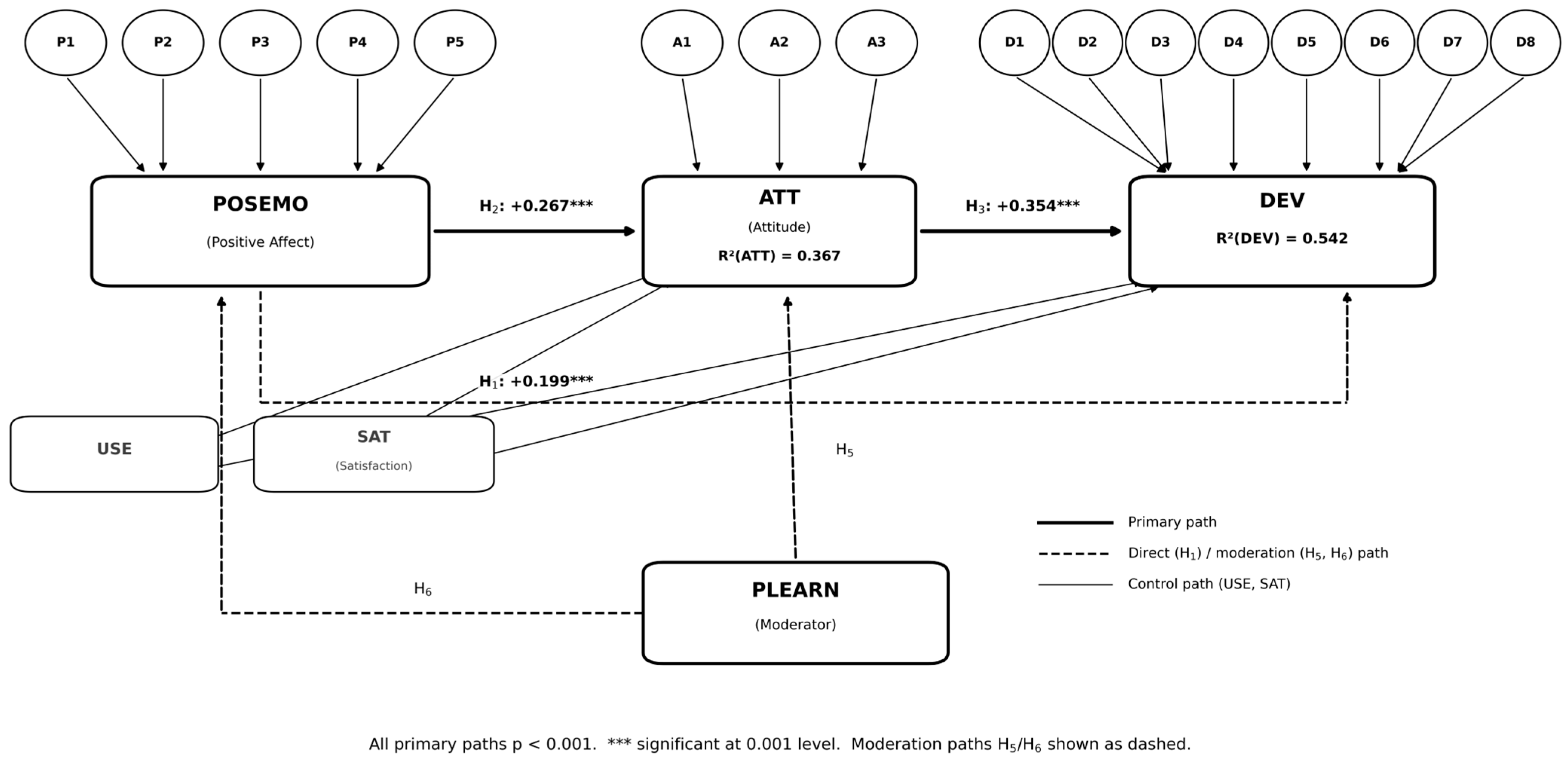
- Methodological contribution: application of PLS-SEM to a large international sample of 12,035 active ChatGPT-using higher education students from 135 countries, with the model explaining a substantial proportion of variance in academic skill development (R2 = 0.542);
- Practical contribution: guidance for higher education institutions indicating that effective AI implementation should cultivate positive affective experiences, favourable attitudes, and learning-oriented engagement rather than focusing only on technical access to ChatGPT.
2. Theoretical Background and Hypothesis Development
2.1. Broaden-and-Build Theory Applied to ChatGPT-Enhanced Skill Development
2.2. Technology Acceptance Model and Attitudes Toward ChatGPT
2.3. Positive Affect and Academic Skill Development
2.4. Positive Affect and Attitudes Toward ChatGPT
2.5. Attitudes Toward ChatGPT and Academic Skill Development
2.6. The Mediating Role of Attitude
2.7. Learning Orientation and Desirable Difficulty in AI-Supported Learning
2.8. State of the Art in Positive Affect, ChatGPT Use, and Academic Skill Development
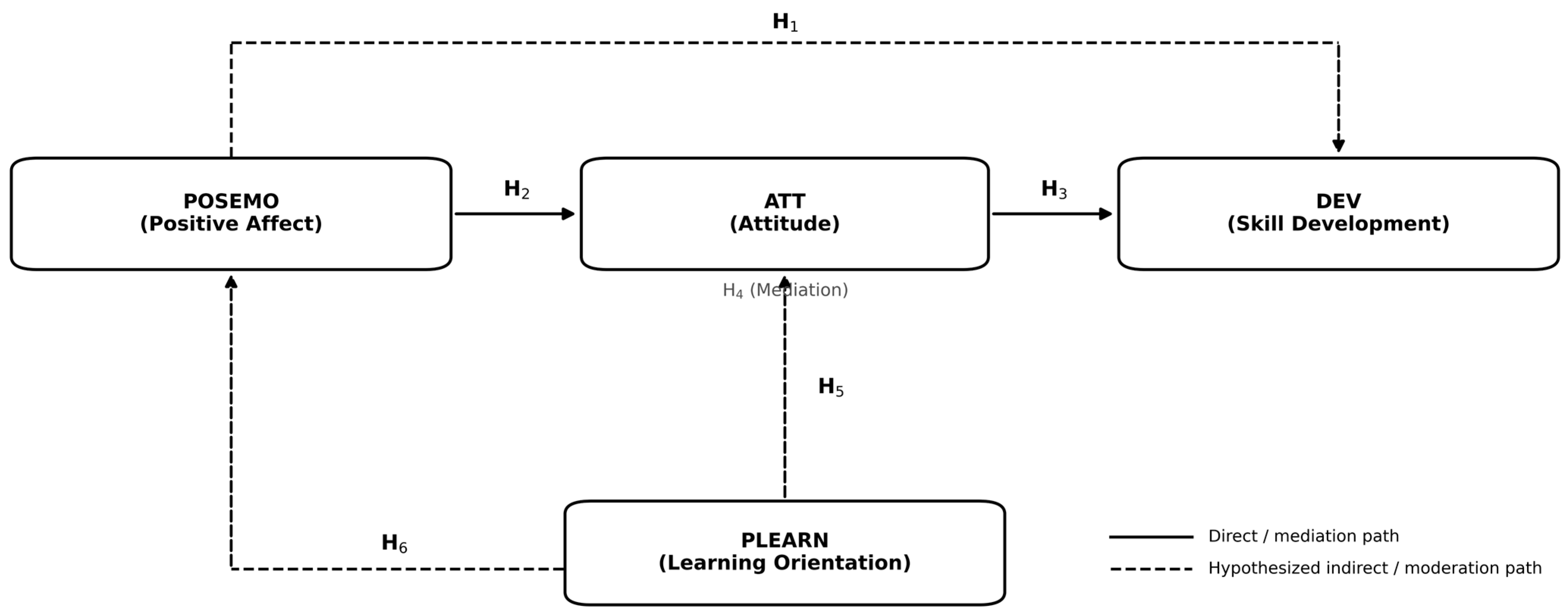
2.9. Conceptual Framework
3. Materials and Methods
3.1. Research Design
3.2. Data Source and Data Collection
3.3. Population and Sample
3.4. Construct Operationalisation
3.5. Data Screening and Inclusion Criteria
3.6. Analytical Approach
3.7. Measurement Model Assessment
3.8. Ethical Considerations
4. Results
4.1. Survey Response Details
4.2. Descriptive Statistics
4.3. Reliability and Convergent Validity
4.4. Discriminant Validity
4.5. Indicator Loadings
4.6. Model Fit
4.7. Regression Analysis
4.8. Structural Model
5. Hypothesis Testing
5.1. Direct Path Coefficients
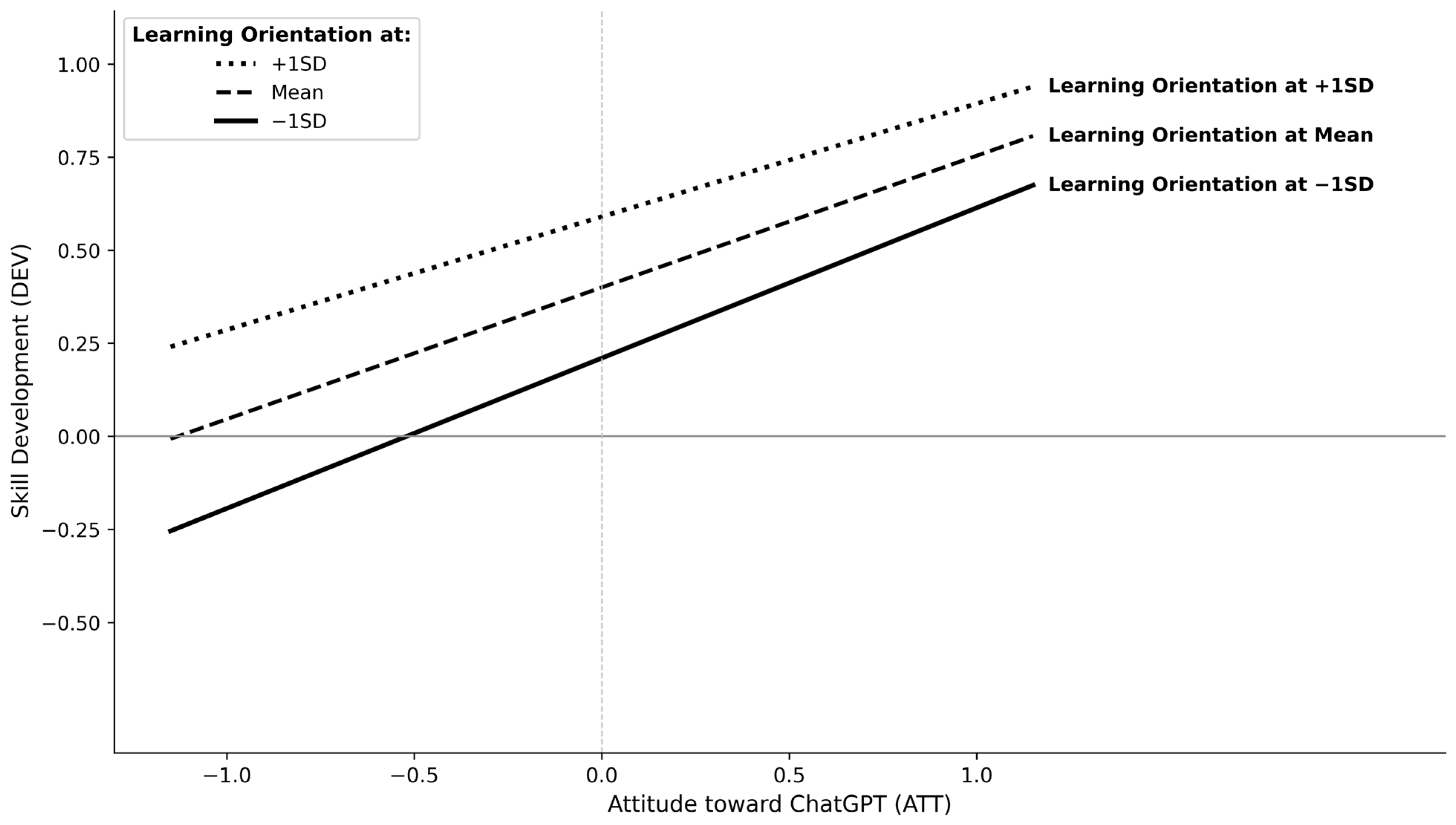
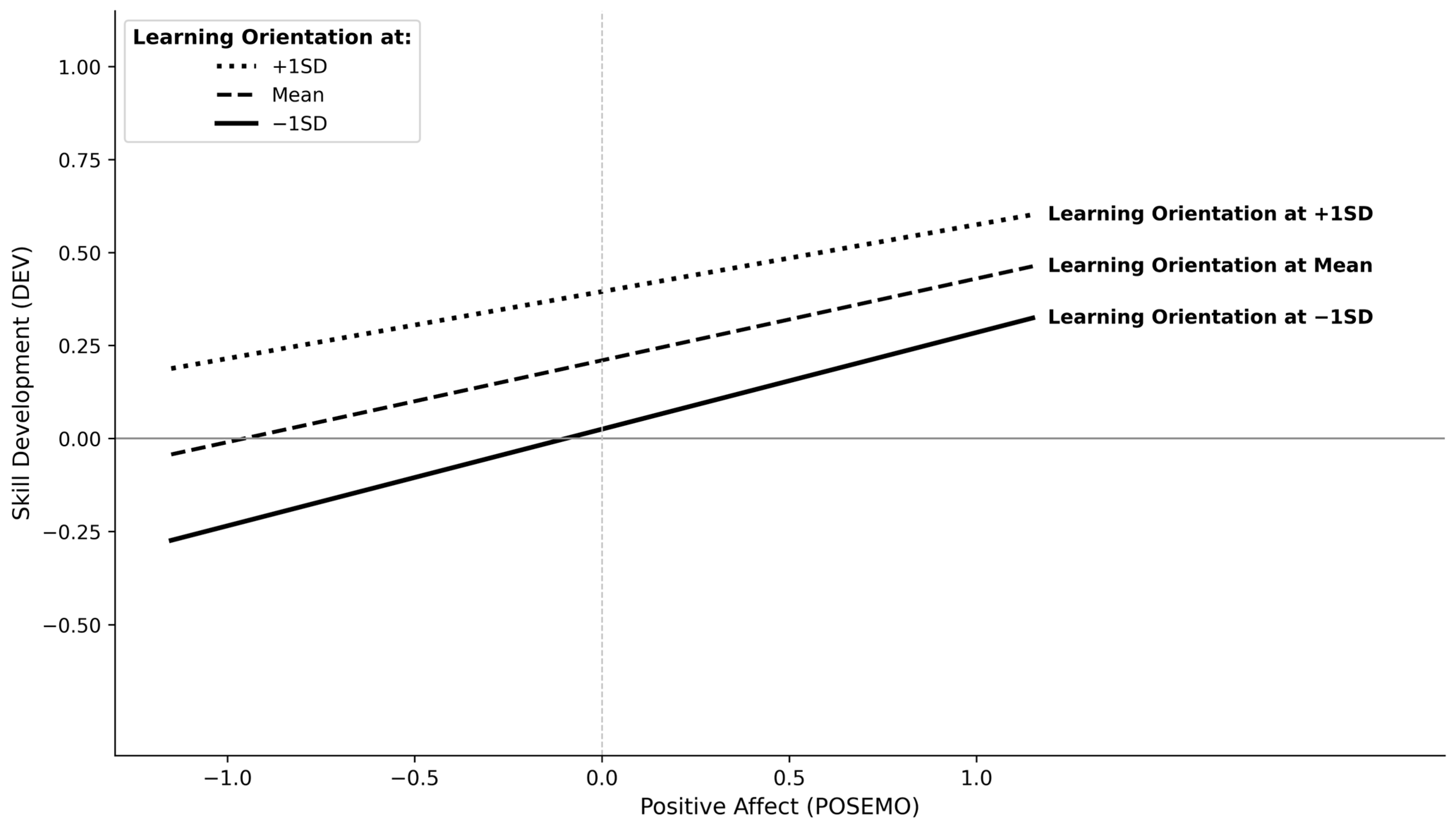
5.2. Mediating and Moderating Effects
5.3. Interpretation of the Moderation Plots
5.4. Summary of Hypothesis Testing
6. Discussion
7. Conclusions
Limitations and Future Research Directions
Author Contributions
Funding
Institutional Review Board Statement
Informed Consent Statement
Data Availability Statement
Acknowledgments
Conflicts of Interest
Abbreviations
| Academic GPA | Respondents’ reported academic grade point average category |
| Academic Skill Development | Main dependent variable measuring perceived development of research, writing, analytical, critical thinking, and field-specific competencies |
| AGFI | Adjusted goodness-of-fit index |
| AI | Artificial intelligence |
| AI Familiarity | Respondents’ self-reported level of familiarity with artificial intelligence |
| Applied Sciences | Field of study category in the demographic profile |
| Arts and Humanities | Field of study category in the demographic profile |
| ATT | Attitude toward ChatGPT |
| ATT 1 | First indicator measuring attitude toward ChatGPT |
| ATT 2 | Second indicator measuring attitude toward ChatGPT |
| ATT 3 | Third indicator measuring attitude toward ChatGPT |
| Attitude toward ChatGPT | Mediating construct capturing students’ evaluative orientation toward ChatGPT as useful, effective, and beneficial for academic purposes |
| AVE | Average variance extracted |
| β | Standardised path coefficient |
| Basic understanding | AI familiarity category indicating basic knowledge of artificial intelligence |
| CFA | Confirmatory factor analysis |
| CFI | Comparative fit index |
| ChatGPT | Conversational generative artificial intelligence tool examined in the study |
| ChatGPT Use Intensity | Construct measuring the extent or frequency of students’ ChatGPT use |
| Chi-square/df | Chi-square divided by degrees of freedom |
| CI | Confidence interval |
| Composite reliability rho_a | Reliability coefficient used to assess construct internal consistency |
| Composite reliability rho_c | Composite reliability coefficient used to assess construct internal consistency |
| Country Income | Demographic classification distinguishing high-income and lower-to-middle-income country contexts |
| Countries | Number of country contexts represented in the sample |
| CovidSocLab | Research unit at the University of Ljubljana associated with the Global ChatGPT Student Survey |
| CR | Composite reliability |
| Cronbach’s alpha | Internal consistency reliability coefficient |
| DEV | Academic skill development |
| DEV 1 | First indicator measuring academic skill development |
| DEV 2 | Second indicator measuring academic skill development |
| DEV 3 | Third indicator measuring academic skill development |
| DEV 4 | Fourth indicator measuring academic skill development |
| DEV 5 | Fifth indicator measuring academic skill development |
| DEV 6 | Sixth indicator measuring academic skill development |
| DEV 7 | Seventh indicator measuring academic skill development |
| DEV 8 | Eighth indicator measuring academic skill development |
| Doctoral | Educational background category |
| DV | Dependent variable |
| Educational Background | Demographic variable indicating undergraduate, postgraduate, or doctoral study level |
| Expert level | AI familiarity category indicating advanced self-reported knowledge of artificial intelligence |
| Female | Gender category |
| Field of Study | Demographic variable indicating respondents’ disciplinary area |
| Fornell-Larcker Criterion | Discriminant validity assessment comparing the square root of AVE with inter-construct correlations |
| F Change | Change in F statistic in the regression model |
| GFI | Goodness-of-fit index |
| GN | High-income country group |
| GS | Lower-to-middle-income country group |
| H1 | Hypothesis that positive affect positively influences academic skill development |
| H2 | Hypothesis that positive affect positively influences attitude toward ChatGPT |
| H3 | Hypothesis that attitude toward chatgpt positively influences academic skill development |
| H4 | Hypothesis that attitude toward chatgpt mediates the relationship between positive affect and academic skill development |
| H5 | Hypothesis that learning orientation moderates the relationship between attitude toward chatgpt and academic skill development |
| H6 | Hypothesis that learning orientation moderates the relationship between positive affect and academic skill development |
| High-income countries | Country income category representing respondents from high-income contexts |
| HTMT | Heterotrait–monotrait ratio |
| Independent Variable | Predictor variable in the model |
| IV | Independent variable |
| Learning Orientation | Moderating construct capturing mastery motivation, deep learning orientation, and orientation toward academic skill development |
| Lower-to-middle-income countries | Country income category representing respondents from lower-to-middle-income contexts |
| Male | Gender category |
| Max | Maximum observed value |
| Mean | Arithmetic average |
| Min | Minimum observed value |
| Moderately familiar | AI familiarity category indicating moderate knowledge of artificial intelligence |
| N | Number of observations |
| Natural Sciences | Field of study category in the demographic profile |
| NFI | Normed fit index |
| Not familiar at all | AI familiarity category indicating no self-reported familiarity with artificial intelligence |
| Original sample | Path coefficient estimate obtained from the original sample |
| p-value | Probability value used to assess statistical significance |
| PLEARN | Learning orientation |
| PLEARN 1 | First indicator measuring learning orientation |
| PLEARN 2 | Second indicator measuring learning orientation |
| PLEARN 3 | Third indicator measuring learning orientation |
| PLS-SEM | Partial least squares structural equation modelling |
| POSEMO | Positive affect |
| POSEMO 1 | First indicator measuring positive affect |
| POSEMO 2 | Second indicator measuring positive affect |
| POSEMO 3 | Third indicator measuring positive affect |
| POSEMO 4 | Fourth indicator measuring positive affect |
| POSEMO 5 | Fifth indicator measuring positive affect |
| Positive Affect | Independent variable capturing favourable emotional experiences during ChatGPT use, including enthusiasm, curiosity, excitement, engagement, and positive valence |
| Postgraduate | Educational background category |
| R | Correlation coefficient in the regression model |
| R2 | Coefficient of determination |
| R2 change | Change in explained variance in the regression model |
| RMSEA | Root mean square error of approximation |
| RQ1 | Research question examining how positive affect during ChatGPT use influences academic skill development |
| RQ2 | Research question examining whether attitude toward ChatGPT mediates the relationship between positive affect and academic skill development |
| RQ3 | Research question examining whether learning orientation moderates the affective and evaluative pathways to academic skill development |
| Sample Mean | Mean estimate obtained through bootstrapping |
| SAT | Satisfaction |
| SAT 1 | First indicator measuring satisfaction |
| SAT 2 | Second indicator measuring satisfaction |
| SAT 3 | Third indicator measuring satisfaction |
| Satisfaction | Construct measuring students’ satisfaction with ChatGPT and its outputs |
| SD | Standard deviation |
| SE | Standard error |
| SEM | Structural equation modelling |
| Sig. | Statistical significance value |
| Social Sciences | Field of study category in the demographic profile |
| SRMR | Standardised root mean square residual |
| STDEV | Bootstrapped standard error |
| t-statistic | Test statistic used to assess path significance |
| Technology Acceptance Model | Theoretical model explaining technology acceptance through perceived usefulness, ease of use, attitude, and related outcomes |
| TLI | Tucker–Lewis index |
| Undergraduate | Educational background category |
| USE | ChatGPT use intensity |
| USE 1 | First indicator measuring ChatGPT use intensity |
| USE 2 | Second indicator measuring ChatGPT use intensity |
| USE 3 | Third indicator measuring ChatGPT use intensity |
| USE 4 | Fourth indicator measuring ChatGPT use intensity |
| USE 5 | Fifth indicator measuring ChatGPT use intensity |
| Very familiar | AI familiarity category indicating high self-reported familiarity with artificial intelligence |
References
- Ali, I., Warraich, N. F., & Butt, K. (2026). Is generative artificial intelligence (GenAI) trustable among LIS students? a study of ChatGPT using the stimuli organism response framework. The Electronic Library, 44(2), 459–477. [Google Scholar] [CrossRef] [Scilit]
- Alotaibi, N. B. (2026). Adoption of AI tools in education: Examining influencing factors and their impact on students’ critical thinking skills. Computers in Human Behavior Reports, 21, 100990. [Google Scholar] [CrossRef] [Scilit]
- Alyasin, A., & Shah, M. A. (2026). Human AI collaboration in academic writing: Exploring university students’ agency through a sociocultural lens. Ampersand, 16, 100256. [Google Scholar] [CrossRef] [Scilit]
- Ayanwale, M. A., & Omeh, C. B. (2026). AI supported problem based learning for enhancing computational thinking skills in STEM education. Computers in Human Behavior: Artificial Humans, 7, 100263. [Google Scholar] [CrossRef] [Scilit]
- Bauer, N., Fütterer, T., Brucker, B., & Gerjets, P. (2026). Leveraging ChatGPT in academic writing: ChatGPT enhances students’ writing quality, writing experience, and ownership. Computers and Education Open, 10, 100351. [Google Scholar] [CrossRef] [Scilit]
- Begmatova, K., & Saydazimova, I. (2026). Enhancing learners’ academic writing skills: A comparative analysis of traditional and AI assisted instruction approaches. Applied Corpus Linguistics, 6(1), 100176. [Google Scholar] [CrossRef] [Scilit]
- Bencsik, A., Módosné Szalai, S., & Jenei, S. (2026). Generative AI and knowledge management in higher education: The impact of human development on student perceptions. Journal of Knowledge Management, 30(11), 293–318. [Google Scholar] [CrossRef] [Scilit]
- Bjork, E. L., & Bjork, R. A. (2011). Making things hard on yourself, but in a good way: Creating desirable difficulties to enhance learning. In M. A. Gernsbacher, R. W. Pew, L. M. Hough, & J. R. Pomerantz (Eds.), Psychology and the real world (pp. 56–64). Worth Publishers. [Google Scholar]
- Castro-Lopez, A., El Abed, M., Cervero, A., & Iglesias, V. (2026). The role of generative artificial intelligence in enhancing creativity and its impact on university adaptation and academic performance. Education + Training, 68(5), 777–799. [Google Scholar] [CrossRef] [Scilit]
- Chen, Q. Q., Lin, L. M., & Liu, M. (2026a). Enhancing knowledge sharing in generative AI integration: The impact of AI self efficacy and skill threat perceptions. Journal of Knowledge Management, 30(3), 1077–1100. [Google Scholar] [CrossRef] [Scilit]
- Chen, Z., Zhu, J., McGrane, J., Hopfenbeck, T. N., Wang, Y., & Ji, Y. (2026b). More inspiration and attention: How generative AI tools impact graduate students’ affective engagement in L2 source based academic writing. Computers & Education, 242, 105495. [Google Scholar] [CrossRef] [Scilit]
- Connell Pensky, A. E., Eckstein, L. E., Melville, M. C., Pottmeyer, L. O., Mineroff, Z., Chawla, A., Brooks, J., Hershock, C., & Lovett, M. C. (2026). Can asynchronous learning modules about generative AI increase students’ knowledge, skills, and self-efficacy for GenAI? Computers & Education, 250, 105640. [Google Scholar] [CrossRef] [Scilit]
- Davis, F. D. (1989). Perceived usefulness, perceived ease of use, and user acceptance of information technology. MIS Quarterly, 13(3), 319–340. [Google Scholar] [CrossRef] [Scilit]
- Ding, K., Yang, Y., Zhao, D., Sun, X., & Wang, L. (2026). Voices of the crowd: Exploring user evaluations of ChatGPT using structural topic modeling. Acta Psychologica, 266, 106827. [Google Scholar] [CrossRef] [Scilit] [PubMed]
- Dumlao, J. (2024). Global student perceptions of ChatGPT: Insights from a worldwide survey on ChatGPT use in academia [Data set]. Kaggle. Available online: https://www.kaggle.com/datasets/jocelyndumlao/global-student-perceptions-of-chatgpt (accessed on 30 April 2026).
- El-Sobkey, S. B., ElKholy, M., Abdallah, M., Mohamed, D. A., & Abdeldayem, T. (2026). Use of ChatGPT in physical therapy education: Comparative study of usefulness to students and ease of use perceptions, and descriptions of usage patterns. Journal of Taibah University Medical Sciences, 21(1), 178–189. [Google Scholar] [CrossRef] [Scilit] [PubMed]
- Fredrickson, B. L. (2001). The role of positive emotions in positive psychology: The broaden-and-build theory of positive emotions. American Psychologist, 56(3), 218–226. [Google Scholar] [CrossRef] [Scilit] [PubMed]
- Gençel, N., Karaoğlan Yılmaz, F. G., & Yılmaz, R. (2026). Examining academicians’ views on using generative artificial intelligence applications: Case for using ChatGPT from a perspective of opportunities and threats. Computers in Human Behavior: Artificial Humans, 7, 100252. [Google Scholar] [CrossRef] [Scilit]
- Hajam, W. A., & Jan, S. (2026). Turning prompts into ventures: Exploring the role of generative artificial intelligence (ChatGPT) adoption in developing students’ digital entrepreneurial intention. The International Journal of Management Education, 24(3), 101473. [Google Scholar] [CrossRef] [Scilit]
- Kailin, Z., & Saeed, M. A. (2026). Chinese EFL learners’ engagement with ChatGPT feedback on academic writing: A case study in Malaysia. Computers and Composition, 79, 102976. [Google Scholar] [CrossRef] [Scilit]
- Meishar Tal, H., & Amzalag, M. (2026). Mind the gap: Perceived academic self efficacy, creativity, and critical thinking with and without ChatGPT. Thinking Skills and Creativity, 62, 102246. [Google Scholar] [CrossRef] [Scilit]
- Moeiniasl, H. (2026). Investigating the impact of ChatGPT-assisted self-assessment on college students’ writing development: Insights from diverse linguistic backgrounds. Assessing Writing, 69, 101061. [Google Scholar] [CrossRef] [Scilit]
- Nahiyan, S., & Rahman, A. G. (2026). Academic integrity and generative AI: Disciplinary teachers’ perspectives on ethical dilemmas in assessing writing in EMI universities. Social Sciences & Humanities Open, 13, 102729. [Google Scholar] [CrossRef] [Scilit]
- Papanastasiou, E. C., Pittas, E., Rodosthenous-Balafa, M., & Lampropoulos, G. (2026). AI assisted writing and the impact of ChatGPT on greek speaking students with and without learning disabilities. outcomes from a repeated measures design. Computers and Education: Artificial Intelligence, 10, 100603. [Google Scholar] [CrossRef] [Scilit]
- Pretorius, M., & Thewissen, J. (2026). Mediating L2 writing revision: The impact of teacher-moderated ChatGPT feedback on L2 accuracy and lexical diversity. Journal of Second Language Writing, 71, 101286. [Google Scholar] [CrossRef] [Scilit]
- Ravšelj, D., Keržič, D., Tomaževič, N., Umek, L., Brezovar, N., AIahad, N., Abdulla, A. A., Akopyan, A., Aldana Segura, M. W., AlHumaid, J., Allam, M. F., Alló, M., Andoh, R. P. K., Andronic, O., Arthur, Y. D., Aydın, F., Badran, A., Balbontín-Alvarado, R., Ben Saad, H., … Zlatkin-Troitschanskaia, O. (2025). Higher education students’ early perceptions of ChatGPT: Global survey data [data set]. Mendeley Data. [Google Scholar] [CrossRef]
- Rizun, N., Bordean, O. N., Nikiforova, A., Beleiu, I. N., & Revina, A. (2026). Generative AI in higher education: Ethical and behavioral factors influencing students’ intentions to use ChatGPT. Computers and Education Open, 10, 100336. [Google Scholar] [CrossRef] [Scilit]
- Ronaghi, M. H., & Ronaghi, M. (2026). A contextualized study of the usage of ChatGPT among university faculty members. Journal of Applied Research in Higher Education, 18(8), 32–46. [Google Scholar] [CrossRef] [Scilit]
- Sajidin. (2026). Fostering critical thinking skills among EFL learners in higher education: A systematic review. Thinking Skills and Creativity, 59, 101943. [Google Scholar] [CrossRef] [Scilit]
- Urhahne, D., Kehle, L., Dietrich, L., & Kremer, K. (2026). The role of epistemic beliefs in predicting ChatGPT adoption and avoidance in higher education. Acta Psychologica, 263, 106334. [Google Scholar] [CrossRef] [Scilit] [PubMed]
- Verma, S., Kashive, N., & Gupta, A. (2026). Examining predictors of generative-AI acceptance and usage in academic research: A sequential mixed-methods approach. Benchmarking: An International Journal, 33(6), 1821–1849. [Google Scholar] [CrossRef] [Scilit]
- Webb, R., Yuksel, D., & Dikilitas, K. (2026). Generative AI in English medium instruction: Perceptions, usage, and impact on academic performance and language proficiency. System, 138, 103973. [Google Scholar] [CrossRef] [Scilit]
- Xu, A. Y., Speakman, S., Piranio, V. S., Medina, R., Liu, M., Lamprecht, C., Abchee, N., & Brennan, M. (2026). Medical student experiences with ChatGPT: National cross sectional study. JMIR Formative Research, 10, e76838. [Google Scholar] [CrossRef] [Scilit] [PubMed]
- Yao, G., & Liu, Z. (2026). ChatGPT feedback and emotional engagement in L2 writing: A control-value theory perspective using Q-methodology. Assessing Writing, 68, 101045. [Google Scholar] [CrossRef] [Scilit]
- Zhang, R., & Chen, J. (2026). The effects of ChatGPT on EFL students’ writing skills: A meta analysis. System, 140, 104043. [Google Scholar] [CrossRef] [Scilit]
- Zhao, X., & Wang, D. (2026). The impact of ChatGPT’s feedback on L2 Chinese learners’ writing outcome, confidence, and emotions: A mixed method quasi experimental study. Assessing Writing, 68, 101027. [Google Scholar] [CrossRef] [Scilit]
- Zheng, F., Wang, H., Gu, X., & Wang, G. (2026). The impact of generative artificial intelligence literacy on higher order thinking skills in Chinese higher vocational college students: Integrating variable centered and person centered approaches. Acta Psychologica, 268, 107190. [Google Scholar] [CrossRef] [Scilit] [PubMed]



| Category | Ref. | Focus | Strengths | Limitations |
|---|---|---|---|---|
| AI adoption, ethics, and technology acceptance | Rizun et al. (2026); Alotaibi (2026); El-Sobkey et al. (2026); Ali et al. (2026) | Student adoption of ChatGPT, perceived usefulness, ease of use, attitudes, behavioural intentions, ethical concerns, and critical thinking engagement | Establishes attitude as a central evaluative mechanism in AI adoption and educational use | Gives limited attention to positive affect as an upstream emotional predictor of academic skill development |
| Affective engagement and emotional responses to ChatGPT | Z. Chen et al. (2026b); Zhao and Wang (2026); Kailin and Saeed (2026) | Emotions, affective engagement, confidence, feedback experiences, and learner responses during AI-supported writing | Demonstrates that AI interactions can shape positive affect, confidence, curiosity, doubt, frustration, and engagement | Rarely tests whether positive affect predicts broader academic skill development through attitude |
| AI-supported writing and academic skill development | Begmatova and Saydazimova (2026); Bauer et al. (2026); Z. Chen et al. (2026b); Papanastasiou et al. (2026) | ChatGPT and AI-assisted academic writing, writing quality, writing confidence, self-efficacy, and skill development | Provides direct evidence that AI can improve writing-related skills and learning experiences | Often focuses on writing outcomes rather than a general academic skill development construct |
| Higher-order thinking, computational thinking, and critical engagement | Ayanwale and Omeh (2026); Zheng et al. (2026); Sajidin (2026) | Computational thinking, higher-order thinking, critical thinking, engagement, and AI literacy | Shows that AI-supported learning can contribute to complex cognitive skills when students engage actively | Does not fully explain how emotional and evaluative pathways jointly influence skill development |
| Human–AI collaboration, learner agency, and growth orientation | Alyasin and Shah (2026); Castro-Lopez et al. (2026); Z. Chen et al. (2026b); Urhahne et al. (2026) | Learner agency, metacognition, practical creativity, growth mindset, epistemic beliefs, and engagement with generative AI | Highlights that AI learning benefits depend on learner agency, mindset, epistemic beliefs, and critical engagement | Does not directly test learning orientation as a moderator of affective and evaluative pathways |
| Present study | Current study | Positive affect as a predictor of academic skill development, attitude as a mediator, and learning orientation as a moderator | Develops an affective–evaluative moderated mediation framework using a large international sample of active ChatGPT users | Cross-sectional design limits causal inference, and self-reported skill development should be complemented by objective measures |
| Characteristics | Category | Frequency | % |
|---|---|---|---|
| Age | 18–24 | 1841 | 15.3 |
| 25–34 | 2210 | 18.4 | |
| 35–44 | 3003 | 25.0 | |
| 45–54 | 2978 | 24.7 | |
| 55 and above | 2003 | 16.6 | |
| Gender | Male | 5760 | 47.9 |
| Female | 6275 | 52.1 | |
| Educational background | Undergraduate | 9847 | 81.8 |
| Postgraduate | 1472 | 12.2 | |
| Doctoral | 716 | 6.0 | |
| Academic GPA | Below 3.0 | 1688 | 14.0 |
| 3.0 | 5005 | 41.6 | |
| Above 3.0 | 5342 | 44.4 | |
| Field of study | Social Sciences | 4739 | 39.4 |
| Applied Sciences | 4276 | 35.5 | |
| Natural Sciences | 1291 | 10.7 | |
| Arts and Humanities | 1729 | 14.4 | |
| AI familiarity | Not familiar at all | 1860 | 15.5 |
| Basic understanding | 2881 | 23.9 | |
| Moderately familiar | 1969 | 16.4 | |
| Very familiar | 2326 | 19.3 | |
| Expert level | 2999 | 24.9 | |
| Country income | High-income countries | 4086 | 34.0 |
| Lower-to-middle-income countries | 7949 | 66.0 | |
| Countries | 135 countries | ||
| Total | 12,035 | 100 |
| Construct | Abbreviation | Role in Model | Indicators | Conceptual Meaning |
|---|---|---|---|---|
| Positive affect | POSEMO | Independent variable | Five emotion items | Favourable emotional experiences during ChatGPT use, including enthusiasm, curiosity, excitement, engagement, and positive valence |
| Attitude toward ChatGPT | ATT | Mediator | Three evaluative items | Students’ evaluative orientation toward ChatGPT as useful, effective, and beneficial for academic purposes |
| Learning orientation | PLEARN | Moderator | Three learning-orientation items | Students’ mastery motivation, deep learning approach, and orientation toward academic skill development |
| Academic skill development | DEV | Dependent variable | Eight skill-development items | Perceived development of research, writing, analytical, critical thinking, and field-specific academic competencies |
| Variable | Min | Max | Mean | Std. Dev. | n | Skewness | Kurtosis |
|---|---|---|---|---|---|---|---|
| Positive affect | 1 | 5 | 3.018 | 0.939 | 12,035 | −0.184 | −0.438 |
| Attitude toward ChatGPT | 1 | 5 | 3.582 | 0.792 | 12,035 | −0.367 | 0.239 |
| Satisfaction | 1 | 5 | 3.343 | 0.828 | 12,035 | −0.391 | 0.246 |
| ChatGPT use intensity | 1 | 5 | 2.323 | 0.855 | 12,035 | 0.595 | −0.109 |
| Learning orientation | 1 | 5 | 3.443 | 0.844 | 12,035 | −0.461 | 0.471 |
| Academic skill development | 1 | 5 | 3.400 | 0.801 | 12,035 | −0.425 | 0.498 |
| Construct | Cronbach’s Alpha | Composite Reliability rho_a | Composite Reliability rho_c | AVE |
|---|---|---|---|---|
| Positive affect | 0.830 | 0.881 | 0.881 | 0.601 |
| Attitude toward ChatGPT | 0.749 | 0.857 | 0.857 | 0.667 |
| Satisfaction | 0.857 | 0.913 | 0.913 | 0.778 |
| ChatGPT use intensity | 0.778 | 0.848 | 0.848 | 0.528 |
| Learning orientation | 0.856 | 0.914 | 0.914 | 0.779 |
| Academic skill development | 0.922 | 0.937 | 0.937 | 0.650 |
| Construct | POSEMO | ATT | SAT | USE | PLEARN | DEV |
|---|---|---|---|---|---|---|
| POSEMO | ||||||
| ATT | 0.605 | |||||
| SAT | 0.469 | 0.603 | ||||
| USE | 0.503 | 0.513 | 0.340 | |||
| PLEARN | 0.412 | 0.544 | 0.454 | 0.370 | ||
| DEV | 0.592 | 0.762 | 0.580 | 0.482 | 0.591 |
| Construct | (1) | (2) | (3) | (4) | (5) | (6) |
|---|---|---|---|---|---|---|
| (1) POSEMO | 0.775 | |||||
| (2) ATT | 0.479 | 0.817 | ||||
| (3) SAT | 0.397 | 0.487 | 0.882 | |||
| (4) USE | 0.411 | 0.405 | 0.285 | 0.727 | ||
| (5) PLEARN | 0.347 | 0.437 | 0.390 | 0.308 | 0.883 | |
| (6) DEV | 0.519 | 0.636 | 0.518 | 0.417 | 0.526 | 0.806 |
| Construct | Item | Outer Loading |
|---|---|---|
| Positive affect | POSEMO 1 | 0.614 |
| POSEMO 2 | 0.838 | |
| POSEMO 3 | 0.757 | |
| POSEMO 4 | 0.855 | |
| POSEMO 5 | 0.786 | |
| Attitude toward ChatGPT | ATT 1 | 0.792 |
| ATT 2 | 0.853 | |
| ATT 3 | 0.803 | |
| Satisfaction | SAT 1 | 0.862 |
| SAT 2 | 0.919 | |
| SAT 3 | 0.863 | |
| ChatGPT use intensity | USE 1 | 0.741 |
| USE 2 | 0.754 | |
| USE 3 | 0.696 | |
| USE 4 | 0.731 | |
| USE 5 | 0.710 | |
| Learning orientation | PLEARN 1 | 0.839 |
| PLEARN 2 | 0.900 | |
| PLEARN 3 | 0.908 | |
| Academic skill development | DEV 1 | 0.777 |
| DEV 2 | 0.775 | |
| DEV 3 | 0.740 | |
| DEV 4 | 0.838 | |
| DEV 5 | 0.826 | |
| DEV 6 | 0.794 | |
| DEV 7 | 0.860 | |
| DEV 8 | 0.832 |
| Index | Recommended Value | Estimated Model |
|---|---|---|
| Chi-square/df | <3 | 2.893 |
| RMSEA | <0.08 | 0.071 |
| GFI | >0.90 | 0.918 |
| AGFI | >0.80 | 0.844 |
| SRMR | <0.10 | 0.062 |
| NFI | >0.90 | 0.921 |
| TLI | >0.90 | 0.986 |
| CFI | >0.90 | 0.919 |
| Model | R | R2 | Adjusted R2 | SE Estimate | R2 Change | F Change | df1 | df2 | Sig. F Change |
|---|---|---|---|---|---|---|---|---|---|
| 1 | 0.519 | 0.269 | 0.269 | 0.8550 | 0.269 | 4428.750 | 1 | 12,033 | 0.000 |
| Model | Sum of Squares | df | Mean Square | F | Sig. |
|---|---|---|---|---|---|
| Regression | 3237.809 | 1 | 3237.809 | 4428.750 | 0.000 |
| Residual | 8797.191 | 12,033 | 0.731 | ||
| Total | 12,035.000 | 12,034 |
| Hypothesis | Path | Original Sample (O) | Sample Mean (M) | STDEV | t-Statistics | p-Values | Decision |
|---|---|---|---|---|---|---|---|
| H1 | Positive affect → Academic skill development | 0.199 | 0.201 | 0.007 | 27.455 | 0.000 | Supported |
| H2 | Positive affect → Attitude toward ChatGPT | 0.267 | 0.269 | 0.008 | 31.763 | 0.000 | Supported |
| H3 | Attitude toward ChatGPT → Academic skill development | 0.354 | 0.352 | 0.008 | 45.314 | 0.000 | Supported |
| Hypothesis | Path | Original Sample (O) | Sample Mean (M) | STDEV | t-Statistics | p-Values | Decision |
|---|---|---|---|---|---|---|---|
| H4 | Positive affect → Attitude toward ChatGPT → Academic skill development | 0.095 | 0.096 | 0.004 | 24.923 | 0.000 | Supported |
| H5 | Learning orientation × Attitude toward ChatGPT → Academic skill development | −0.021 | −0.020 | 0.005 | 3.831 | 0.000 | Supported |
| H6 | Learning orientation × Positive affect → Academic skill development | −0.045 | −0.044 | 0.007 | 6.861 | 0.000 | Supported |
Disclaimer/Publisher’s Note: The statements, opinions and data contained in all publications are solely those of the individual author(s) and contributor(s) and not of MDPI and/or the editor(s). MDPI and/or the editor(s) disclaim responsibility for any injury to people or property resulting from any ideas, methods, instructions or products referred to in the content. |
© 2026 by the authors. Published by MDPI on behalf of the University Association of Education and Psychology. Licensee MDPI, Basel, Switzerland. This article is an open access article distributed under the terms and conditions of the Creative Commons Attribution (CC BY) license.
Share and Cite
Thango, B.A.; Matshaka, L.; Azazz, A.M.S.; Elshaer, I.A. Positive Affect and Academic Skill Development Through ChatGPT in Higher Education. Eur. J. Investig. Health Psychol. Educ. 2026, 16, 100. https://doi.org/10.3390/ejihpe16070100
Thango BA, Matshaka L, Azazz AMS, Elshaer IA. Positive Affect and Academic Skill Development Through ChatGPT in Higher Education. European Journal of Investigation in Health, Psychology and Education. 2026; 16(7):100. https://doi.org/10.3390/ejihpe16070100
Chicago/Turabian StyleThango, Bonginkosi A., Lerato Matshaka, Alaa M. S. Azazz, and Ibrahim A. Elshaer. 2026. "Positive Affect and Academic Skill Development Through ChatGPT in Higher Education" European Journal of Investigation in Health, Psychology and Education 16, no. 7: 100. https://doi.org/10.3390/ejihpe16070100
APA StyleThango, B. A., Matshaka, L., Azazz, A. M. S., & Elshaer, I. A. (2026). Positive Affect and Academic Skill Development Through ChatGPT in Higher Education. European Journal of Investigation in Health, Psychology and Education, 16(7), 100. https://doi.org/10.3390/ejihpe16070100