
Effects of a Digital Parent–Child Single-Session Growth Mindset Intervention on Adolescent Depression and Anxiety Symptoms: A Three-Arm Waitlist Randomized Controlled Trial

 ,
,  , , and
Abstract
1. Introduction
1.1. Objectives
1.2. Hypotheses
2. Materials and Methods
2.1. Ethical Considerations
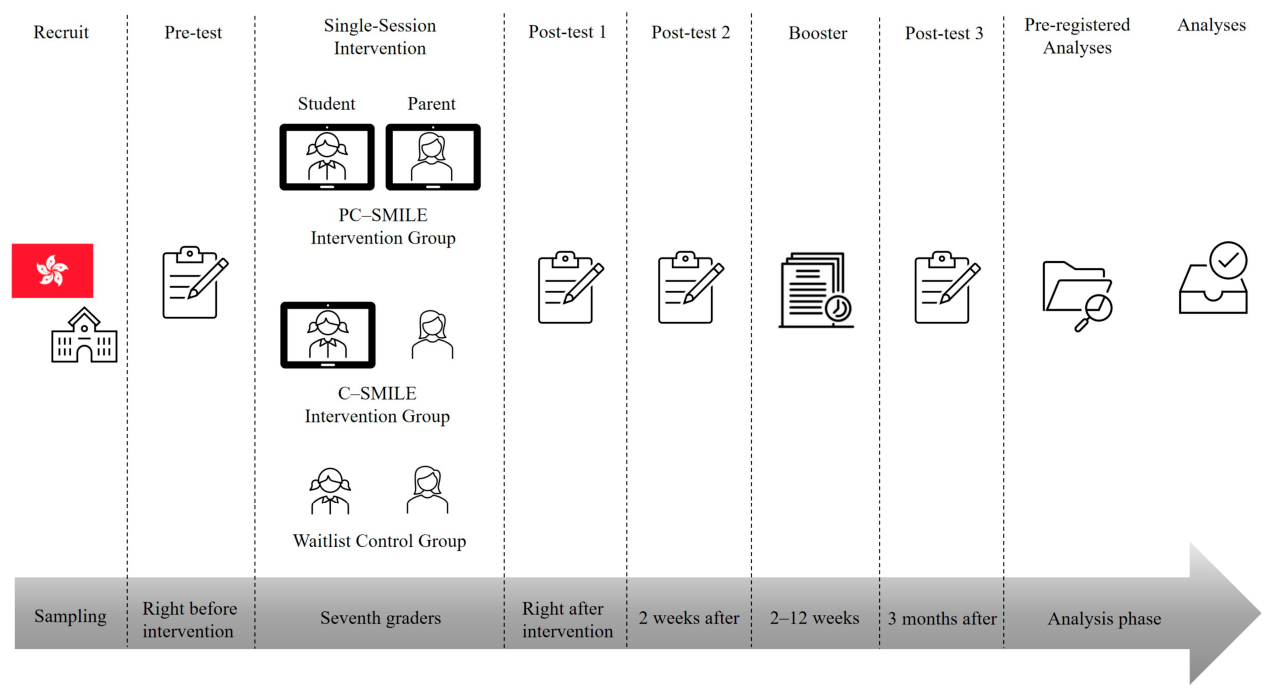
2.2. Study Design
2.3. Participants
2.4. Procedure
2.5. Trial Power and Sample Size
2.6. Measures
2.6.1. Content Fidelity Checking for Both Parent and Student Participants
2.6.2. Primary Outcome
2.6.3. Secondary Outcomes
2.7. Data Analysis
3. Results
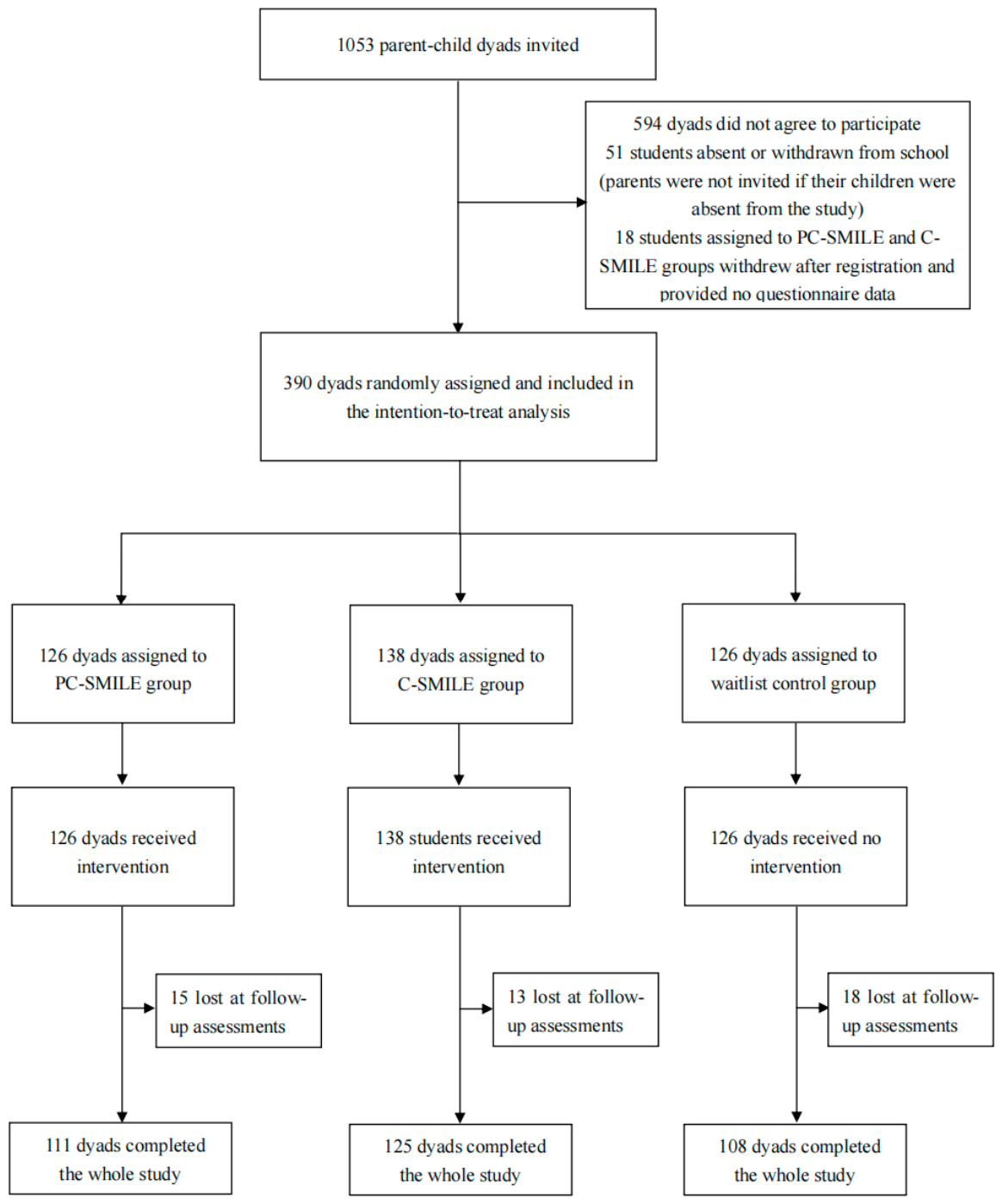
3.1. Recruitment and Randomization
3.2. Participant Characteristics at Baseline
3.3. Fidelity Checking of Mindsets
3.4. Changes in Primary and Secondary Outcomes of Children
3.5. Changes in Parental Outcomes
3.6. Moderation Analysis
3.7. Intervention Feedback
4. Discussion
4.1. Potential of Integrated Mindset Intervention
4.2. Discussion on Parent–Child Intervention-Related Findings
4.3. Discussion on Moderations
4.4. Limitations and Suggestions for Future Studies
4.5. Suggestions for Improvement of Brief Digital Intervention Design and Implementation
5. Conclusions
Supplementary Materials
Author Contributions
Funding
Institutional Review Board Statement
Informed Consent Statement
Data Availability Statement
Acknowledgments
Conflicts of Interest
Abbreviations
| CONSORT | Consolidated Standards of Reporting Trials |
| C-SMILE | Child single-session intervention on mindsets of intelligence, failure, and emotion |
| DMHI | Digital mental health interventions |
| GEE | Generalized estimating equations |
| MDASS | Mindset of Depression, Anxiety and Stress Scale |
| PC-SMILE | Parent and child single-session intervention on mindsets of intelligence, failure, and emotion |
| PPI | Patient and public involvement |
| QICC | Corrected Quasi Likelihood under Independence Model Criterion |
| RCT | Randomized controlled trial |
| RCADS-25 | 25-item Revised Children’s Anxiety and Depression Scale |
| We-SMILE | Web-based single-session intervention of mindsets on intelligence, failure, and emotion |
References
- Bauhinia Foundation Research Centre. (2017). Mental health care services for Hong Kong youth. Medicine and Healthcare. Available online: http://www.bauhinia.org/index.php/english/analyses/615 (accessed on 7 July 2024).
- Biswas, T., Scott, J. G., Munir, K., Renzaho, A. M. N., Rawal, L. B., Baxter, J., & Mamun, A. A. (2020). Global variation in the prevalence of suicidal ideation, anxiety and their correlates among adolescents: A population based study of 82 countries. eClinicalMedicine, 24, e100395. [Google Scholar] [CrossRef] [Scilit] [PubMed]
- Bolzern, J., Mnyama, N., Bosanquet, K., & Torgerson, D. J. (2018). A review of cluster randomized trials found statistical evidence of selection bias. Journal of Clinical Epidemiology, 99, 106–112. [Google Scholar] [CrossRef] [Scilit] [PubMed]
- Cairns, K. E., Yap, M. B. H., Pilkington, P. D., & Jorm, A. F. (2014). Risk and protective factors for depression that adolescents can modify: A systematic review and meta-analysis of longitudinal studies. Journal of Affective Disorders, 169, 61–75. [Google Scholar] [CrossRef] [Scilit] [PubMed]
- De Los Reyes, A., Goodman, K. L., Kliewer, W., & Reid-Quiñones, K. (2008). Whose depression relates to discrepancies? Testing relations between informant characteristics and informant discrepancies from both informants’ perspectives. Psychological Assessment, 20(2), 139–149. [Google Scholar] [CrossRef] [Scilit] [PubMed]
- Dweck, C. S. (2006). Mindset: The new psychology of success. Random House Publishing Group. [Google Scholar]
- Dweck, C. S., Chiu, C. Y., & Hong, Y. Y. (1995). Implicit theories and their role in judgments and reactions: A word from two perspectives. Psychological Inquiry, 6(4), 267–285. [Google Scholar] [CrossRef] [Scilit] [PubMed]
- Dweck, C. S., & Yeager, D. S. (2019). Mindsets: A view from two eras. Perspectives on Psychological Science, 14(3), 481–496. [Google Scholar] [CrossRef] [Scilit] [PubMed]
- Easter, C., Thompson, J. A., Eldridge, S., Taljaard, M., & Hemming, K. (2021). Cluster randomized trials of individual-level interventions were at high risk of bias. Journal of Clinical Epidemiology, 138, 49–59. [Google Scholar] [CrossRef] [Scilit] [PubMed]
- Ebesutani, C., Korathu-Larson, P., Nakamura, B. J., Higa-McMillan, C., & Chorpita, B. (2017). The revised child anxiety and depression scale 25–parent version: Scale development and validation in a school-based and clinical sample. Assessment, 24(6), 712–728. [Google Scholar] [CrossRef] [Scilit] [PubMed]
- Ebesutani, C., Reise, S. P., Chorpita, B. F., Ale, C., Regan, J., Young, J., Higa-McMillan, C., & Weisz, J. R. (2012). The revised child anxiety and depression scale-short version: Scale reduction via exploratory bifactor modeling of the broad anxiety factor. Psychological Assessment, 24(4), 833–845. [Google Scholar] [CrossRef] [Scilit] [PubMed]
- Fong, V. L. (2007). Parent-child communication problems and the perceived inadequacies of Chinese only children. Ethos, 35(1), 85–127. [Google Scholar] [CrossRef] [Scilit]
- Friedel, J. M., Cortina, K. S., Turner, J. C., & Midgley, C. (2007). Achievement goals, efficacy beliefs and coping strategies in mathematics: The roles of perceived parent and teacher goal emphases. Contemporary Educational Psychology, 32(3), 434–458. [Google Scholar] [CrossRef] [Scilit]
- Fuengfoo, A., Poonsawat, R., Leelathanaporn, S., & Mekrungcharas, T. (2024). Effects of parental-group intervention on parents’ growth mindset and behaviors of children with attention deficit hyperactivity disorder. Journal of Child Science, 14(01), e47–e54. [Google Scholar] [CrossRef] [Scilit]
- Garibaldi, P. M., Abel, M. R., Snow, R. L., & Schleider, J. L. (2020). Does failure help or harm? Linking parents’ treatment histories, views of failure, and expectancies for child psychotherapy. Child Youth Care Forum, 49(1), 151–169. [Google Scholar] [CrossRef] [Scilit]
- Goolsby, J., Rich, B. A., Hinnant, B., Habayeb, S., Berghorst, L., De Los Reyes, A., & Alvord, M. K. (2018). Parent–child informant discrepancy is associated with poorer treatment outcome. Journal of Child and Family Studies, 27(4), 1228–1241. [Google Scholar] [CrossRef] [Scilit]
- Grajdan, M. M., Etel, E., Farrell, L. J., & Donovan, C. L. (2025). A systematic review of parental involvement in digital cognitive behavioural therapy interventions for child anxiety. Clinical Child and Family Psychology Review, 28(1), 22–70. [Google Scholar] [CrossRef] [Scilit] [PubMed]
- Haimovitz, K., & Dweck, C. S. (2016). Parents’ views of failure predict children’s fixed and growth intelligence mindsets. Psychological Science, 27(6), 859–869. [Google Scholar] [CrossRef] [Scilit] [PubMed]
- Hong, Y. Y., Chiu, C. Y., Dweck, C. S., Lin, D. M. S., & Wan, W. (1999). Implicit theories, attributions, and coping: A meaning system approach. Journal of Personality and Social Psychology, 77(3), 588–599. [Google Scholar] [CrossRef]
- Jo, B., Asparouhov, T., & Muthén, B. O. (2008). Intention-to-treat analysis in cluster randomized trials with noncompliance. Statistics in Medicine, 27(27), 5565–5577. [Google Scholar] [CrossRef] [Scilit] [PubMed]
- Kissane, D. W., Wein, S., Love, A., Lee, X. Q., Kee, P. L., & Clarke, D. M. (2004). The demoralization scale: A report of its development and preliminary validation. Journal of Palliative Care, 20(4), 269–276. [Google Scholar] [CrossRef] [Scilit]
- Kneeland, E. T., Dovidio, J. F., Joormann, J., & Clark, M. S. (2016). Emotion malleability beliefs, emotion regulation, and psychopathology: Integrating affective and clinical science. Clinical Psychological Review, 45, 81–88. [Google Scholar] [CrossRef] [Scilit] [PubMed]
- Leung, P. W., Hung, S. F., Ho, T. P., Lee, C. C., Liu, W. D., Tang, C. P., & Kwong, S. L. (2008). Prevalence of DSM-IV disorders in Chinese adolescents and the effects of an impairment criterion: A pilot community study in Hong Kong. European Child & Adolescent Psychiatry, 17(7), 452–461. [Google Scholar] [CrossRef] [Scilit] [PubMed]
- Liang, K.-Y., & Zeger, S. L. (1986). Longitudinal data analysis using generalized linear models. Biometrika, 73(1), 13–22. [Google Scholar] [CrossRef]
- Löchner, J., Carlbring, P., Schuller, B., Torous, J., & Sander, L. B. (2025). Digital interventions in mental health: An overview and future perspectives. Internet Interventions, 40, 100824. [Google Scholar] [CrossRef] [Scilit] [PubMed]
- Mak, Y. W. (2013). Study sheds light on association between adolescents’ anxiety and depressive symptoms. Available online: http://sn.polyu.edu.hk/en/news_events/features/study_sheds_light_on_association_between_adolescents_anxiety_and_depressive_symptoms/index_t.html (accessed on 24 July 2025).
- Morris, A. S., Hays-Grudo, J., Zapata, M. I., Treat, A., & Kerr, K. L. (2021). Adverse and protective childhood experiences and parenting attitudes: The role of cumulative protection in understanding resilience. Adversity and Resilience Science, 2(3), 181–192. [Google Scholar] [CrossRef] [Scilit] [PubMed]
- Mueller, C., Rowe, M. L., & Zuckerman, B. (2017). Mindset matters for parents and adolescents. JAMA Pediatrics, 171(5), 415–416. [Google Scholar] [CrossRef] [Scilit] [PubMed]
- Mullarkey, M. C., & Schleider, J. L. (2020). Contributions of fixed mindsets and hopelessness to anxiety and depressive symptoms: A commonality analysis approach. Journal of Affective Disorder, 261, 245–252. [Google Scholar] [CrossRef] [Scilit] [PubMed]
- Ng, S. S. W., Lo, A. W. Y., Leung, T. K. S., Chan, F. S. M., Wong, A. T. Y., Lam, R. W. T., & Tsang, D. K. Y. (2014). Translation and validation of the Chinese version of the short Warwick-Edinburgh mental well-being scale for patients with mental Illness in Hong Kong. East Asian Archives of Psychiatry, 24(1), 3–9. [Google Scholar] [PubMed]
- RCADS-25 Manual Scoring. (n.d.). Child FIRST. Available online: https://rcads.ucla.edu/manualscoring (accessed on 15 May 2026).
- Rowe, M. L., & Leech, K. A. (2019). A parent intervention with a growth mindset approach improves children’s early gesture and vocabulary development. Developmental Science, 22(4), e12792. [Google Scholar] [CrossRef] [Scilit] [PubMed]
- Salk, R. H., Hyde, J. S., & Abramson, L. Y. (2017). Gender differences in depression in representative national samples: Meta-analyses of diagnoses and symptoms. Psychological Bulletin, 143(8), 783. [Google Scholar] [CrossRef] [Scilit] [PubMed]
- Schleider, J. L., Dobias, M., Fassler, J., Shroff, A., & Pati, S. (2020). Promoting treatment access following pediatric primary care depression screening: Randomized trial of web-based, single-session interventions for parents and youths. American Academy of Child and Adolescent Psychiatry, 59(6), 770–773. [Google Scholar] [CrossRef] [Scilit] [PubMed]
- Schleider, J. L., Schroder, H. S., Lo, S. L., Fisher, M., Danovitch, J. H., Weisz, J. R., & Moser, J. S. (2016). Parents’ intelligence mindsets relate to child internalizing problems: Moderation through child gender. Journal of Child and Family Studies, 25(12), 3627–3636. [Google Scholar] [CrossRef] [Scilit]
- Schleider, J. L., & Weisz, J. R. (2016). Reducing risk for anxiety and depression in adolescents: Effects of a single-session intervention teaching that personality can change. Behaviour Research and Therapy, 87, 170–181. [Google Scholar] [CrossRef] [Scilit] [PubMed]
- Schleider, J. L., & Weisz, J. R. (2017). Little treatments, promising effects? Meta-analysis of single-session interventions for youth psychiatric problems. American Academy of Child and Adolescent Psychiatry, 56(2), 107–115. [Google Scholar] [CrossRef] [Scilit] [PubMed]
- Schleider, J. L., & Weisz, J. R. (2018a). A single-session growth mindset intervention for adolescent anxiety and depression: 9-month outcomes of a randomized trial. Journal of Child Psychology and Psychiatry, 59(2), 160–170. [Google Scholar] [CrossRef] [Scilit]
- Schleider, J. L., & Weisz, J. R. (2018b). Parent expectancies and preferences for mental health treatment: The roles of emotion mind-sets and views of failure. Journal of Clinical Child & Adolescent Psychology, 47, S480–S496. [Google Scholar] [CrossRef] [Scilit] [PubMed]
- Schroder, H. S., Callahan, C. P., Gornik, A. E., & Moser, J. S. (2019). The fixed mindset of anxiety predicts future distress: A longitudinal study. Behaviour Therapy, 50(4), 710–717. [Google Scholar] [CrossRef] [Scilit] [PubMed]
- Shorey, S., Ng, E. D., & Wong, C. H. J. (2022). Global prevalence of depression and elevated depressive symptoms among adolescents: A systematic review and meta-analysis. The British Journal of Clinical Psychology, 61(2), 287–305. [Google Scholar] [CrossRef] [Scilit] [PubMed]
- Stewart-Brown, S., & Janmohamed, K. (2008). Warwick-Edinburgh mental well-being scale. User Guide Version, 1(10.1037), 2. [Google Scholar]
- United Nations Children’s Fund & World Health Organization. (2022). UNICEF annual report 2022. Available online: https://www.unicef.org/reports/unicef-annual-report-2022 (accessed on 30 July 2025).
- Wang, M. (2014). Generalized estimating equations in longitudinal data analysis: A review and recent developments. Advances in Statistics, 2014, 1–11. [Google Scholar] [CrossRef] [Scilit]
- Wang, Y., Xi, A., Wong, S. S. K., Leung, J. T. Y., Chow, E., Yam, K., & Zhu, S. (2025). A web-based single-session intervention of growth mindsets for reducing practicum-related anxiety among social work and counseling trainees: A pilot randomized controlled trial. Journal of Evidence-Based Social Work, 1–19. [Google Scholar] [CrossRef] [Scilit] [PubMed]
- World Health Organization. (2020). Adolescent mental health. Available online: https://www.who.int/news-room/fact-sheets/detail/adolescent-mental-health (accessed on 28 September 2024).
- Xinhua Net. (2018). Chinese parents anxious about children’s education: Survey. Available online: http://www.xinhuanet.com/english/2018-09/20/c_137482228.htm (accessed on 28 May 2025).
- Yap, M. B. H., Mahtani, S., Rapee, R. M., Nicolas, C., Lawrence, K. A., MacKinnon, A., & Jorm, A. F. (2018). A tailored web-based intervention to improve parenting risk and protective factors for adolescent depression and anxiety problems: Postintervention findings from a randomized controlled trial. Journal of Medical Internet Research, 20(1), e17. [Google Scholar] [CrossRef] [Scilit] [PubMed]
- Yap, M. B. H., Morgan, A. J., Cairns, K., Jorm, A. F., Hetrick, S. E., & Merry, S. (2016). Parents in prevention: A meta-analysis of randomized controlled trials of parenting interventions to prevent internalizing problems in children from birth to age 18. Clinical Psychological Review, 50, 138–158. [Google Scholar] [CrossRef] [Scilit] [PubMed]
- Yeager, D. S., Bryan, C. J., Gross, J. J., Murray, J. S., Krettek Cobb, D., H. F. Santos, P., Gravelding, H., Johnson, M., & Jamieson, J. P. (2022). A synergistic mindsets intervention protects adolescents from stress. Nature, 607(7919), 512–520. [Google Scholar] [CrossRef] [Scilit] [PubMed]
- Yeager, D. S., & Dweck, C. S. (2020). What can be learned from growth mindset controversies? American Psychologist, 75(9), 1269. [Google Scholar] [CrossRef] [Scilit] [PubMed]
- Yeager, D. S., Hanselman, P., Walton, G. M., Murray, J. S., Crosnoe, R., Muller, C., Tipton, E., Schneider, B., Hulleman, C. S., Hinojosa, C. P., Paunesku, D., Romero, C., Flint, K., Roberts, A., Trott, J., Iachan, R., Buontempo, J., Yang, S. M., Carvalho, C. M., … Dweck, C. S. (2019). A national experiment reveals where a growth mindset improves achievement. Nature, 573(7774), 364–369. [Google Scholar] [CrossRef] [Scilit] [PubMed]
- Yeager, D. S., Johnson, R., Spitzer, B. J., Trzesniewski, K. H., Powers, J., & Dweck, C. S. (2014). The far-reaching effects of believing people can change: Implicit theories of personality shape stress, health, and achievement during adolescence. Journal of Personality and Social Psychology, 106(6), 867–884. [Google Scholar] [CrossRef] [Scilit] [PubMed]
- Yuen, W. W., Liu, L. L., & Tse, S. (2019). Adolescent mental health problems in Hong Kong: A critical review on prevalence, psychosocial correlates, and prevention. Journal of Adolescent Health, 64(6), S73–S85. [Google Scholar] [CrossRef] [Scilit] [PubMed]
- Zhu, S., Hu, Y., Qi, D., Tse, S., Chan, K. L., Sun, J., & Lee, P. (2025a). Effects of web-based single-session growth mindset interventions for reducing adolescent anxiety: Four-armed randomized controlled trial. JMIR Pediatrics and Parenting, 8(1), e63500. [Google Scholar] [CrossRef] [Scilit] [PubMed]
- Zhu, S., Hu, Y., Wang, R., Qi, D., Lee, P., Ngai, S. W., Cheng, Q., & Wong, P. W. C. (2024). Effects of a parent-child single-session growth mindset intervention on adolescent depression and anxiety symptoms: Protocol of a 3-arm waitlist randomized controlled trial. JMIR Research Protocols, 13(1), e63220. [Google Scholar] [CrossRef] [Scilit] [PubMed]
- Zhu, S., Wang, Y., & Hu, Y. (2025b). Facilitators and barriers to digital mental health interventions for depression, anxiety, and stress in adolescents and young adults: Scoping review. Journal of Medical Internet Research, 27, e62870. [Google Scholar] [CrossRef] [Scilit] [PubMed]
- Zhu, S., Zhuang, Y., & Cheung, S.-H. (2020). Domain specificity or generality: Assessing the Chinese implicit theories scale of six fundamental psychological attributes. Frontiers in Psychology, 11, 142. [Google Scholar] [CrossRef] [Scilit] [PubMed]
- Zhu, S., Zhuang, Y., & Lee, P. (2022). Psychometric properties of the Mindsets of Depression, Anxiety, and Stress Scale (MDASS) in Chinese young adults and adolescents. Early Intervention in Psychiatry, 16(4), 380–392. [Google Scholar] [CrossRef] [Scilit] [PubMed]



| Variables/Child | PC-SMILE (n = 126) | C-SMILE (n = 138) | Control (n = 126) | Overall (n = 390) | p Value |
|---|---|---|---|---|---|
| Age | 0.022 | ||||
| Mean (SD) | 12.3 (0.5) | 12.3 (0.6) | 12.5 (0.8) | 12.4 (0.6) | |
| Range | 12.0 to 14.0 | 12.0 to 15.0 | 12.0 to 15.0 | 12.0 to 15.0 | |
| Gender, n (%) | 0.28 | ||||
| Male | 49 (38.9%) | 57 (41.3%) | 61 (48.4%) | 167 (42.8%) | |
| Female | 77 (61.1%) | 81 (58.7%) | 65 (51.6%) | 223 (57.2%) | |
| Ethnicity, n (%) | 0.46 | ||||
| Chinese | 123 (97.6%) | 134 (97.1%) | 125 (99.2%) | 382 (97.9%) | |
| Other | 3 (2.4%) | 4 (2.9%) | 1 (0.8%) | 8 (2.1%) | |
| If an only child, n (%) | 0.46 | ||||
| Yes | 40 (31.7%) | 35 (25.4%) | 39 (31.0%) | 114 (29.2%) | |
| No | 86 (68.3%) | 103 (74.6%) | 87 (69.0%) | 276 (70.8%) | |
| If living with parents, n (%) | 0.91 | ||||
| Living with both parents | 106 (84.1%) | 119 (86.2%) | 112 (88.9%) | 337 (86.4%) | |
| Living with mother | 13 (10.3%) | 11 (8.0%) | 10 (7.9%) | 34 (8.7%) | |
| Living with father | 3 (2.4%) | 3 (2.2%) | 1 (0.8%) | 7 (1.8%) | |
| Living with neither parent | 4 (3.2%) | 5 (3.6%) | 3 (2.4%) | 12 (3.1%) | |
| Mindset about intelligence (1–6), mean (SD) | 3.3 (1.2) | 3.6 (1.3) | 3.6 (1.2) | 3.5 (1.2) | 0.056 |
| Mindset about failure (1–6), mean (SD) | 3.0 (0.8) | 3.0 (0.9) | 3.0 (0.9) | 3.0 (0.9) | 0.85 |
| Mindset about emotions (1–6), mean (SD) | 3.1 (1.1) | 3.2 (1.3) | 3.2 (1.4) | 3.2 (1.3) | 0.86 |
| RCADS-25: child version-overall (0–75), mean (SD) | 18.8 (13.6) | 19.2 (13.3) | 19.9 (14.9) | 19.3 (13.9) | 0.81 |
| RCADS-25: child version-anxiety (0–45), mean (SD) | 11.8 (8.8) | 11.8 (8.2) | 12.1 (8.9) | 11.9 (8.6) | 0.95 |
| RCADS-25: child version-depression (0–30), mean (SD) | 7.0 (5.5) | 7.4 (5.8) | 7.8 (6.7) | 7.4 (6.0) | 0.57 |
| Hopelessness (1–5), mean (SD) | 2.3 (1.0) | 2.2 (1.0) | 2.1 (1.1) | 2.2 (1.0) | 0.47 |
| Mental well-being (7–35), mean (SD) | 23.9 (5.5) | 24.3 (5.5) | 23.6 (6.2) | 23.9 (5.7) | 0.53 |
| Parent–child interactions (0–7), mean (SD) | 3.4 (1.9) | 3.3 (1.9) | 3.6 (2.1) | 3.4 (2.0) | 0.49 |
| Parent–child relationships (1–4), mean (SD) | 2.9 (0.8) | 2.9 (0.8) | 3.0 (0.8) | 2.9 (0.8) | 0.54 |
| Academic self-efficacy (1–6), mean (SD) | 4.2 (1.0) | 4.1 (1.0) | 4.2 (1.2) | 4.2 (1.1) | 0.55 |
| Perceived parent performance (vs. learning) orientation (1–6), mean (SD) | 3.3 (0.7) | 3.4 (0.7) | 3.5 (0.6) | 3.4 (0.7) | 0.28 |
| Variables/parent | PC-SMILE (n = 126) | C-SMILE (n = 123) | Control (n = 121) | Overall (n = 370) | |
| Relation with child, n (%) | 0.79 | ||||
| Mother | 100 (79.4%) | 101 (82.1%) | 101 (83.5%) | 302 (81.6%) | |
| Father | 24 (19.0%) | 19 (15.4%) | 19 (15.7%) | 62 (16.8%) | |
| Other caregivers | 2 (1.6%) | 3 (2.4%) | 1 (0.8%) | 6 (1.6%) | |
| Ethnicity, n (%) | 0.14 | ||||
| Chinese | 124 (98.4%) | 123 (100.0%) | 121 (100.0%) | 368 (99.5%) | |
| Other | 2 (1.6%) | 0 (0%) | 0 (0%) | 2 (0.5%) | |
| Age range, n (%) | 0.16 | ||||
| <30 | 1 (0.8%) | 0 (0%) | 2 (1.7%) | 3 (0.8%) | |
| 30–40 | 41 (32.5%) | 27 (22.0%) | 27 (22.3%) | 95 (25.7%) | |
| 41–50 | 74 (58.7%) | 79 (64.2%) | 73 (60.3%) | 226 (61.1%) | |
| 51–60 | 10 (7.9%) | 17 (13.8%) | 16 (13.2%) | 43 (11.6%) | |
| 61–70 | 0 (0%) | 0 (0%) | 2 (1.7%) | 2 (0.5%) | |
| >70 | 0 (0%) | 0 (0%) | 1 (0.8%) | 1 (0.3%) | |
| Marital status, n (%) | 0.71 | ||||
| Single | 5 (4.0%) | 2 (1.6%) | 1 (0.8%) | 8 (2.2%) | |
| Divorced | 7 (5.6%) | 9 (7.3%) | 7 (5.8%) | 23 (6.2%) | |
| Married/Cohabiting | 106 (84.1%) | 106 (86.2%) | 107 (88.4%) | 319 (86.2%) | |
| Widowed | 0 (0%) | 1 (0.8%) | 1 (0.8%) | 2 (0.5%) | |
| Declined to disclose | 8 (6.3%) | 5 (4.1%) | 5 (4.1%) | 18 (4.9%) | |
| Education level, n (%) | 0.49 | ||||
| Primary and below | 1 (0.8%) | 3 (2.4%) | 5 (4.1%) | 9 (2.4%) | |
| Middle School | 75 (59.5%) | 69 (56.1%) | 72 (59.5%) | 216 (58.4%) | |
| College/University and above | 50 (39.7%) | 51 (41.5%) | 44 (36.4%) | 145 (39.2%) | |
| Employment Status, n (%) | 0.43 | ||||
| Full-time job | 60 (47.6%) | 61 (49.6%) | 55 (45.5%) | 176 (47.6%) | |
| Part-time job | 30 (23.8%) | 22 (17.9%) | 20 (16.5%) | 72 (19.5%) | |
| Unemployed/At home | 36 (28.6%) | 40 (32.5%) | 46 (38.0%) | 122 (33.0%) | |
| Household Monthly Income (HKD), n (%) | 0.92 | ||||
| <3000 | 1 (0.8%) | 3 (2.4%) | 2 (1.7%) | 6 (1.6%) | |
| 3000–12,000 | 13 (10.3%) | 15 (12.2%) | 13 (10.7%) | 41 (11.1%) | |
| 12,001–20,000 | 27 (21.4%) | 23 (18.7%) | 28 (23.1%) | 78 (21.1%) | |
| 20,001–35,000 | 34 (27.0%) | 30 (24.4%) | 37 (30.6%) | 101 (27.3%) | |
| 35,001–50,000 | 21 (16.7%) | 23 (18.7%) | 20 (16.5%) | 64 (17.3%) | |
| 50,001–90,000 | 22 (17.5%) | 18 (14.6%) | 12 (9.9%) | 52 (14.1%) | |
| >90,000 | 8 (6.3%) | 11 (8.9%) | 9 (7.4%) | 28 (7.6%) | |
| Mindset about intelligence (1–6), mean (SD) | 3.2 (1.0) | 3.3 (1.2) | 3.3 (1.2) | 3.2 (1.1) | 0.69 |
| Mindset about failure (1–6), mean (SD) | 2.7 (0.6) | 2.6 (0.7) | 2.7 (0.8) | 2.6 (0.7) | 0.57 |
| Mindset about emotions (1–6), mean (SD) | 2.4 (0.7) | 2.4 (0.7) | 2.4 (0.7) | 2.4 (0.7) | 0.66 |
| RCADS-25: parent version-overall (0–75), mean (SD) | 11.1 (7.5) | 12.0 (7.1) | 11.7 (7.5) | 11.6 (7.4) | 0.68 |
| RCADS-25: parent version-anxiety (0–45), mean (SD) | 5.7 (4.4) | 6.0 (4.2) | 6.1 (4.3) | 5.9 (4.3) | 0.76 |
| RCADS-25: parent version-depression (0–30), mean (SD) | 5.4 (3.7) | 5.9 (3.7) | 5.6 (4.1) | 5.6 (3.8) | 0.57 |
| Mental well-being (7–35), mean (SD) | 25.2 (4.8) | 25.4 (3.6) | 25.8 (4.8) | 25.5 (4.4) | 0.55 |
| Parent–child relationships (1–4), mean (SD) | 3.1 (0.5) | 3.0 (0.5) | 3.2 (0.6) | 3.1 (0.6) | 0.27 |
| Outcome Variables | Baseline | 2-Week Follow-Up | 3-Month Follow-Up | p-Value (Baseline vs. 2-Week Follow-Up) | p-Value (Baseline vs. 3-Month Follow-Up) | p-Value (2-Week vs. 3-Month Follow-Up) |
|---|---|---|---|---|---|---|
| RCADS-25: child version-overall | ||||||
| PC-SMILE | 18.2 (1.5) | 14.9 (1.4) | 16.9 (1.6) | <0.001 | 0.23 | 0.12 |
| C-SMILE | 16.8 (1.5) | 15.7 (1.6) | 16.4 (1.6) | 0.38 | 0.72 | 0.49 |
| Control | 19.8 (1.7) | 17.5 (1.6) | 18.3 (1.6) | 0.06 | 0.15 | 0.52 |
| PPC-SMILE vs. C-SMILE | 0.42 | 0.66 | 0.81 | p-value (interaction) | 0.72 | |
| PPC-SMILE vs. Control | 0.38 | 0.11 | 0.46 | |||
| PC-SMILE vs. Control | 0.11 | 0.33 | 0.32 | |||
| RCADS-25: child version-anxiety | ||||||
| PC-SMILE | 11.4 (1.0) | 8.9 (0.9) | 10.4 (1.0) | <0.001 | 0.11 | 0.08 |
| C-SMILE | 10.4 (1.0) | 9.5 (1.0) | 10.1 (1.0) | 0.22 | 0.63 | 0.35 |
| Control | 11.9 (1.0) | 10.6 (1.0) | 10.9 (1.0) | 0.07 | 0.13 | 0.68 |
| PPC-SMILE vs. C-SMILE | 0.36 | 0.58 | 0.83 | p-value (interaction) | 0.53 | |
| PPC-SMILE vs. Control | 0.66 | 0.08 | 0.63 | |||
| PC-SMILE vs. Control | 0.19 | 0.33 | 0.48 | |||
| RCADS-25: child version-depression | ||||||
| PC-SMILE | 7.5 (0.2) | 6.7 (0.2) | 7.2 (0.3) | 0.014 | 0.54 | 0.21 |
| C-SMILE | 4.9 (0.3) | 4.7 (0.3) | 4.9 (0.3) | 0.72 | 0.99 | 0.49 |
| Control | 9.8 (0.3) | 8.9 (0.3) | 9.6 (0.2) | 0.14 | 0.62 | 0.050 |
| PPC-SMILE vs. C-SMILE | <0.001 | <0.001 | <0.001 | p-value (interaction) | <0.001 | |
| PPC-SMILE vs. Control | <0.001 | <0.001 | <0.001 | |||
| PC-SMILE vs. Control | <0.001 | <0.001 | <0.001 | |||
| Hopelessness | ||||||
| PC-SMILE | 2.3 (0.1) | 2.1 (0.1) | 2.2 (0.1) | 0.031 | 0.31 | 0.18 |
| C-SMILE | 2.1 (0.1) | 2.1 (0.1) | 2.1 (0.1) | 0.94 | 0.95 | 0.89 |
| Control | 2.2 (0.1) | 2.2 (0.1) | 2.2 (0.1) | 0.43 | 0.83 | 0.56 |
| PPC-SMILE vs. C-SMILE | 0.11 | 0.91 | 0.40 | p-value (interaction) | 0.31 | |
| PPC-SMILE vs. Control | 0.31 | 0.29 | 0.83 | |||
| PC-SMILE vs. Control | 0.59 | 0.28 | 0.53 | |||
| Mental well-being | ||||||
| PC-SMILE | 24.1 (0.3) | 25.0 (0.4) | 24.6 (0.2) | 0.14 | 0.13 | 0.47 |
| C-SMILE | 25.4 (0.3) | 25.3 (0.1) | 24.8 (0.4) | 0.74 | 0.35 | 0.29 |
| Control | 21.2 (0.4) | 21.8 (0.4) | 21.2 (0.3) | 0.37 | 0.92 | 0.26 |
| PPC-SMILE vs. C-SMILE | <0.001 | 0.40 | 0.41 | p-value (interaction) | 0.06 | |
| PPC-SMILE vs. Control | <0.001 | <0.001 | <0.001 | |||
| PC-SMILE vs. Control | <0.001 | <0.001 | <0.001 | |||
| Parent–child interactions | ||||||
| PC-SMILE | 3.38 (0.07) | 3.43 (0.10) | 3.54 (0.10) | 0.71 | 0.25 | 0.55 |
| C-SMILE | 3.33 (0.07) | 3.37 (0.05) | 3.17 (0.06) | 0.78 | 0.17 | 0.012 |
| Control | 2.90 (0.13) | 2.87 (0.08) | 2.82 (0.10) | 0.87 | 0.70 | 0.50 |
| PPC-SMILE vs. C-SMILE | 0.74 | 0.59 | 0.008 | p-value (interaction) | 0.50 | |
| PPC-SMILE vs. Control | 0.009 | <0.001 | <0.001 | |||
| PC-SMILE vs. Control | <0.001 | <0.001 | <0.001 | |||
| Parent–child relationships | ||||||
| PC-SMILE | 2.8 (0.08) | 2.9 (0.08) | 2.9 (0.08) | 0.005 | 0.002 | 0.83 |
| C-SMILE | 2.8 (0.09) | 2.8 0.09) | 2.8 (0.09) | 0.52 | 0.92 | 0.58 |
| Control | 2.8 (0.09) | 2.9 (0.09) | 2.8 (0.09) | 0.22 | 0.70 | 0.14 |
| PPC-SMILE vs. C-SMILE | 0.92 | 0.29 | 0.20 | p-value (interaction) | 0.20 | |
| PPC-SMILE vs. Control | 0.56 | 0.83 | 0.28 | |||
| PC-SMILE vs. Control | 0.65 | 0.43 | 0.88 | |||
| Academic self-efficacy | ||||||
| PC-SMILE | 3.9 (0.06) | 3.9 (0.06) | 3.9 (0.03) | 0.95 | 0.95 | 0.97 |
| C-SMILE | 4.3 (0.06) | 4.4 (0.05) | 4.3 (0.06) | 0.68 | 0.58 | 0.21 |
| Control | 3.9 (0.07) | 3.8 (0.08) | 3.9 (0.05) | 0.74 | 0.79 | 0.51 |
| PPC-SMILE vs. C-SMILE | <0.001 | <0.001 | <0.001 | p-value (interaction) | 0.49 | |
| PPC-SMILE vs. Control | 0.06 | 0.17 | 00.44 | |||
| PC-SMILE vs. Control | <0.001 | <0.001 | <0.001 | |||
| Perceived parent performance (vs. learning) orientation | ||||||
| PC-SMILE | 3.4 (0.07) | 3.4 (0.07) | 3.3 (0.07) | 0.45 | 0.33 | 0.87 |
| C-SMILE | 3.5 (0.07) | 3.3 (0.07) | 3.4 (0.07) | 0.012 | 0.06 | 0.50 |
| Control | 3.5 (0.07) | 3.4 (0.07) | 3.4 (0.07) | 0.11 | 0.006 | 0.35 |
| PPC-SMILE vs. C-SMILE | 0.32 | 0.69 | 0.84 | p-value (interaction) | 0.58 | |
| PPC-SMILE vs. Control | 0.12 | 0.31 | 0.66 | |||
| PC-SMILE vs. Control | 0.56 | 0.15 | 0.81 |
| Outcome Variables | 2-Week Follow-Up, Cohen’s d (SE) | 3-Month Follow-Up, Cohen’s d (SE) |
|---|---|---|
| RCADS-25: child version-overall | ||
| PC-SMILE vs. C-SMILE | −0.16 (0.15) | −0.07 (0.15) |
| PC-SMILE vs. Control | −0.07 (0.14) | 0.01 (0.15) |
| C-SMILE vs. Control | 0.08 (0.18) | 0.08 (0.18) |
| RCADS-25: child version-anxiety | ||
| PC-SMILE vs. C-SMILE | −0.19 (0.15) | −0.09 (0.16) |
| PC-SMILE vs. Control | −0.15 (0.15) | −0.01 (0.15) |
| C-SMILE vs. Control | 0.04 (0.18) | 0.08 (0.19) |
| RCADS-25: child version-depression | ||
| PC-SMILE vs. C-SMILE | −0.10 (0.09) | −0.05 (0.11) |
| PC-SMILE vs. Control | 0.02 (0.08) | −0.01 (0.10) |
| C-SMILE vs. Control | 0.12 (0.09) | 0.04 (0.10) |
| Hopelessness | ||
| PC-SMILE vs. C-SMILE | −0.19 (0.16) | −0.09 (0.15) |
| PC-SMILE vs. Control | −0.26 (0.15) | −0.10 (0.15) |
| C-SMILE vs. Control | −0.07 (0.18) | −0.01 (0.18) |
| Mental well-being | ||
| PC-SMILE vs. C-SMILE | 0.17 (0.12) | 0.18 (0.10) |
| PC-SMILE vs. Control | 0.05 (0.14) | 0.07 (0.06) |
| C-SMILE vs. Control | −0.12 (0.10) | −0.11 (0.09) |
| Parent–child interactions | ||
| PC-SMILE vs. C-SMILE | 0.01 (0.08) | 0.16 (0.08) |
| PC-SMILE vs. Control | 0.04 (0.09) | 0.13 (0.08) |
| C-SMILE vs. Control | 0.03 (0.05) | −0.04 (0.05) |
| Parent–child relationships | ||
| PC-SMILE vs. C-SMILE | 0.14 (0.14) | 0.17 (0.14) |
| PC-SMILE vs. Control | 0.10 (0.14) | 0.21 (0.11) |
| C-SMILE vs. Control | −0.04 (0.18) | 0.04 (0.16) |
| Academic self-efficacy | ||
| PC-SMILE vs. C-SMILE | −0.04 (0.13) | 0.06 (0.11) |
| PC-SMILE vs. Control | 0.04 (0.15) | −0.03 (0.11) |
| C-SMILE vs. Control | 0.08 (0.13) | −0.08 (0.12) |
| Perceived parent performance (vs. learning) orientation | ||
| PC-SMILE vs. C-SMILE | 0.18 (0.16) | 0.10 (0.16) |
| PC-SMILE vs. Control | 0.07 (0.16) | 0.14 (0.16) |
| C-SMILE vs. Control | −0.10 (0.18) | 0.04 (0.19) |
| Variables/Child | PC-SMILE (n = 125), n (%) | C-SMILE (n = 138), n (%) | Overall (n = 263), n (%) |
|---|---|---|---|
| Like this course | 66 (52.8%) | 74 (53.6%) | 140 (53.2%) |
| Understand this course | 86 (68.8%) | 84 (60.9%) | 170 (64.6%) |
| This course is useful | 86 (68.8%) | 87 (63.0%) | 173 (65.8%) |
| Attitude towards adversity improved after this course | 72 (57.6%) | 83 (60.1%) | 155 (58.9%) |
| Complete this course very seriously | 87 (69.6%) | 98 (71.0%) | 185 (70.3%) |
| Recommend this course to others | 73 (58.4%) | 86 (62.3%) | 159 (60.5%) |
| This course is interesting | 72 (57.6%) | 71 (51.4%) | 143 (54.4%) |
| Agree with this course | 86 (68.8%) | 87 (63.0%) | 173 (65.8%) |
| More confident towards challenges in life after this course | 73 (58.4%) | 79 (57.2%) | 152 (57.8%) |
| Burden in joining this course | 7 (5.6%) | 13 (9.4%) | 20 (7.6%) |
| Affect other arrangement due to joining this course | 8 (6.4%) | 15 (10.9%) | 23 (8.7%) |
| General acceptance of this course | 85 (68.0%) | 98 (71.0%) | 183 (69.6%) |
| Variables/parent | PC-SMILE (n = 124), n (%) | ||
| Like this course | 95 (76.6%) | ||
| Understand this course | 109 (87.9%) | ||
| This course is useful | 109 (87.9%) | ||
| This course provides some references to help me communicate with my child in daily life | 113 (91.1%) | ||
| Complete this course very seriously | 117 (94.4%) | ||
| Recommend this course to other parents | 100 (80.6%) | ||
| This course is interesting | 87 (70.2%) | ||
| Agree with this course | 112 (90.3%) | ||
| More confident in helping my child face the challenges in life after this course | 92 (74.2%) | ||
| Burden in joining this course | 7 (5.6%) | ||
| Affect other arrangement due to joining this course | 10 (8.1%) | ||
| General acceptance of this course | 105 (84.7%) |
Disclaimer/Publisher’s Note: The statements, opinions and data contained in all publications are solely those of the individual author(s) and contributor(s) and not of MDPI and/or the editor(s). MDPI and/or the editor(s) disclaim responsibility for any injury to people or property resulting from any ideas, methods, instructions or products referred to in the content. |
© 2026 by the authors. Published by MDPI on behalf of the University Association of Education and Psychology. Licensee MDPI, Basel, Switzerland. This article is an open access article distributed under the terms and conditions of the Creative Commons Attribution (CC BY) license.
Share and Cite
Zhu, S.; Hu, Y.; Qi, D.; Xi, A.; Chen, S.; Wang, R.; Lee, P.; Wong, P.W.C. Effects of a Digital Parent–Child Single-Session Growth Mindset Intervention on Adolescent Depression and Anxiety Symptoms: A Three-Arm Waitlist Randomized Controlled Trial. Eur. J. Investig. Health Psychol. Educ. 2026, 16, 84. https://doi.org/10.3390/ejihpe16060084
Zhu S, Hu Y, Qi D, Xi A, Chen S, Wang R, Lee P, Wong PWC. Effects of a Digital Parent–Child Single-Session Growth Mindset Intervention on Adolescent Depression and Anxiety Symptoms: A Three-Arm Waitlist Randomized Controlled Trial. European Journal of Investigation in Health, Psychology and Education. 2026; 16(6):84. https://doi.org/10.3390/ejihpe16060084
Chicago/Turabian StyleZhu, Shimin, Yuxi Hu, Di Qi, An Xi, Shiyun Chen, Ruobing Wang, Paul Lee, and Paul Wai Ching Wong. 2026. "Effects of a Digital Parent–Child Single-Session Growth Mindset Intervention on Adolescent Depression and Anxiety Symptoms: A Three-Arm Waitlist Randomized Controlled Trial" European Journal of Investigation in Health, Psychology and Education 16, no. 6: 84. https://doi.org/10.3390/ejihpe16060084
APA StyleZhu, S., Hu, Y., Qi, D., Xi, A., Chen, S., Wang, R., Lee, P., & Wong, P. W. C. (2026). Effects of a Digital Parent–Child Single-Session Growth Mindset Intervention on Adolescent Depression and Anxiety Symptoms: A Three-Arm Waitlist Randomized Controlled Trial. European Journal of Investigation in Health, Psychology and Education, 16(6), 84. https://doi.org/10.3390/ejihpe16060084