From Simulation to Sustainability: The Mediating Role of Clinical Self-Efficacy Among Undergraduate Healthcare Students

Abstract
1. Introduction
2. Materials and Methods
2.1. Study Design
2.2. Participants
2.3. Measures
2.4. Translation Procedure
2.5. Statistical Analysis
3. Results
3.1. Descriptive Statistics
3.2. Bivariate Correlations
3.3. Mediation Analysis
3.4. Decomposition of Effects
4. Discussion
5. Conclusions
Author Contributions
Funding
Institutional Review Board Statement
Informed Consent Statement
Data Availability Statement
Acknowledgments
Conflicts of Interest
Abbreviations
| CHEST | Comprehensive Healthcare Education Simulation Tool |
| SECP | Self-Efficacy in Clinical Performance |
| SANS | Sustainability Attitudes in Nursing Survey |
| SCT | Social Cognitive Theory |
| CFA | Confirmatory Factor Analysis |
| RMSEA | Root Mean Square Error of Approximation |
| CFI | Comparative Fit Index |
| GFI | Goodness of Fit Index |
| CI | Confidence Interval |
| LLCI | Lower Limit Confidence Interval |
| ULCI | Upper Limit Confidence Interval |
| SD | Standard Deviation |
| SE | Standard Error |
| SPSS | Statistical Package for the Social Sciences |
| AMOS | Analysis of Moment Structures |
| SDGs | Sustainable Development Goals |
| SBL | Simulation-Based Learning |
| β* | Standardized Coefficient |
| R2 | Coefficient of Determination |
References
- Albaqawi, H., Alamri, M., Al-Dossary, R., Hosis, K. A., Alharbi, J., Aljohani, M., Aljohani, K., Almadani, N., Alrasheadi, B., & Falatah, R. (2025). Exploring the impact of self-efficacy social support and learning environment on clinical performance anxiety in student nurses. Scientific Reports, 15, 8663. [Google Scholar] [CrossRef] [Scilit]
- Albooghobeish, M., Saidkhani, V., Angali, K. A., & Farzaneh, M. (2023). Clinical decision-making and self-efficacy skills in anesthesiology nursing students: A cross-sectional study. Shiraz E-Medical Journal, 24, e134178. [Google Scholar] [CrossRef] [Scilit]
- Alharbi, A., Nurfianti, A., Mullen, R. F., McClure, J. D., & Miller, W. H. (2024). The effectiveness of simulation-based learning (SBL) on students’ knowledge and skills in nursing programs: A systematic review. BMC Medical Education, 24, 1099. [Google Scholar] [CrossRef] [Scilit]
- Al-Hassan, M., Al-Omari, E., Dorri, R., Al Badawi, A. K., Khraim, F., & Nashwan, A. J. (2025). The Comprehensive Healthcare Education Simulation Tool (CHEST): A validity and reliability study in nursing education. Teaching and Learning in Nursing, 20, e836–e845. [Google Scholar] [CrossRef] [Scilit]
- Alrashidi, N., An, E. P., Alrashedi, M. S., Alqarni, A. S., Gonzales, F., Bassuni, E. M., Pangket, P., Estadilla, L., Benjamin, L. S., & Ahmed, K. E. (2023). Effects of simulation in improving the self-confidence of student nurses in clinical practice: A systematic review. BMC Medical Education, 23, 815. [Google Scholar] [CrossRef] [Scilit] [PubMed]
- Alsadi, M., Alosta, M. R., Othman, E. H., Obiedallah, H., & Nashwan, A. J. (2025). Optimising educational practices in simulation-based nursing education: Results of a national survey. Nursing Open, 12, e70172. [Google Scholar] [CrossRef] [Scilit] [PubMed]
- Anbari, H., & Kerari, A. (2025). Self-confidence and satisfaction in simulation-based learning and clinical competence among undergraduate nursing students: A mixed-methods sequential explanatory study. Behavioral Sciences, 15, 984. [Google Scholar] [CrossRef] [Scilit]
- Attia, N. M., Hamed, A. E. M., Elbakry, M. A. A. E., Barakat, A. M., & Mohamed, H. S. (2025). Navigating sustainable practice: Environmental awareness and climate change as mediators of green competence of nurses. BMC Nursing, 24, 658. [Google Scholar] [CrossRef] [Scilit]
- Álvarez-Nieto, C., Álvarez-García, C., Parra-Anguita, L., Sanz-Martos, S., & López-Medina, I. M. (2022). Effectiveness of scenario-based learning and augmented reality for nursing students’ attitudes and awareness toward climate change and sustainability. BMC Nursing, 21, 245. [Google Scholar] [CrossRef] [Scilit]
- Álvarez-Nieto, C., Richardson, J., Navarro-Perán, M. Á., Tutticci, N., Huss, N., Elf, M., Anåker, A., Aronsson, J., Baid, H., & López-Medina, I. M. (2021). Nursing students’ attitudes towards climate change and sustainability: A cross-sectional multisite study. Nurse Education Today, 108, 105185. [Google Scholar] [CrossRef] [Scilit]
- Bandura, A. (1986). Social foundations of thought and action: A social cognitive theory. Prentice-Hall. [Google Scholar]
- Barkhordari-Sharifabad, M., Alipour, Z., & Jahantab, R. (2025). The role of reflective capacity in clinical self-efficacy of nursing students: A cross-sectional study. BMC Medical Education, 25, 614. [Google Scholar] [CrossRef] [Scilit] [PubMed]
- Boakye, D. S., Kwashie, A. A., Adjorlolo, S., & Korsah, K. A. (2024). Nursing education for sustainable development: A concept analysis. Nursing Open, 11, e70058. [Google Scholar] [CrossRef] [Scilit]
- Cheraghi, F., Hassani, P., Yaghmaei, F., & Alavi-Majed, H. (2009). Developing a valid and reliable self-efficacy in clinical performance scale. International Nursing Review, 56(2), 214–221. [Google Scholar] [CrossRef] [Scilit] [PubMed]
- Chow, K. M., Ahmat, R., Leung, A. W., & Chan, C. W. (2023). Is high-fidelity simulation-based training in emergency nursing effective in enhancing clinical decision-making skills? A mixed methods study. Nurse Education in Practice, 69, 103610. [Google Scholar] [CrossRef] [Scilit]
- Curran, P. J., West, S. G., & Finch, J. F. (1996). The robustness of test statistics to nonnormality and specification error in confirmatory factor analysis. Psychological Methods, 1(1), 16–29. [Google Scholar] [CrossRef]
- Daneshfar, M., & Moonaghi, H. K. (2025). The impact of clinical simulation on bridging the theory–practice gap in nursing education: A systematic review. BMC Medical Education, 25, 1216. [Google Scholar] [CrossRef] [Scilit]
- Erfanian, S., Maleknia, R., & Halalisan, A. F. (2024). Application of social cognitive theory to determine shaping factors of environmental intention and behaviors of ecotourist in forest areas. Frontiers in Forests and Global Change, 7, 1489170. [Google Scholar] [CrossRef] [Scilit]
- Eweida, R. S., O’Connell, M. A., Zoromba, M., Mahmoud, M. F., Altheeb, M. K., Selim, A., & Atta, M. H. R. (2025). Video-based climate change program boosts eco-cognizance, emotional response and self-efficacy in rural nursing students: Randomised controlled trial. Journal of Advanced Nursing, 81, 8371–8383. [Google Scholar] [CrossRef] [Scilit] [PubMed]
- Farzaneh, M., Saidkhani, V., Angali, K. A., & Albooghobeish, M. (2023). Effectiveness of the SBAR-based training program in self-efficacy and clinical decision-making of undergraduate anesthesiology nursing students: A quasi-experimental study. BMC Nursing, 22, 145. [Google Scholar] [CrossRef] [Scilit]
- Gheisari, F., Farzi, S., Tarrahi, M. J., Momeni-Ghaleghasemi, T., Farzi, S., Nazari, F., & Riahi, R. T. (2025). The effect of an ISBAR-based clinical supervision model during handover on clinical decision-making and self-efficacy of nursing internship students: A quasi-experimental study. BMC Medical Education, 25, 815. [Google Scholar] [CrossRef] [Scilit]
- Guerrero, J. G., Attallah, D. M., Gomaa, N. H., & Ali, S. A. (2024). Improvements in practising nurses’ knowledge, skills, self-efficacy, confidence, and satisfaction after a simulated clinical experience of caring for a patient undergoing chemotherapy: A quasi-experimental study. BMC Nursing, 23, 66. [Google Scholar] [CrossRef] [Scilit] [PubMed]
- Hamann, K. R. S., Wullenkord, M. C., Reese, G., & Van Zomeren, M. (2023). Believing that we can change our world for the better: A Triple-A (Agent-Action-Aim) framework of self-efficacy beliefs in the context of collective social and ecological aims. Personality and Social Psychology Review, 28, 11–53. [Google Scholar] [CrossRef] [Scilit] [PubMed]
- Hamid, I. Z., & Ibrahim, R. H. (2025). Promoting sustainability healthcare practices: A quasi-experimental study on nursing education in governmental hospitals. Malaysian Journal of Nursing, 16(4), 218–228. [Google Scholar] [CrossRef] [Scilit]
- Hendry, M., Helfer, T., Eissler, C., & Burr, C. (2025). The relevance of sustainability and the climate crisis to the nursing profession and nursing education: A literature review. Journal of Nursing Scholarship, 57, 967–980. [Google Scholar] [CrossRef] [Scilit] [PubMed]
- Hussain, I., Nazir, M., Hashmi, S. B., Shaheen, I., Akram, S., Waseem, M. A., & Arshad, A. (2021). Linking green and sustainable entrepreneurial intentions and social networking sites: The mediating role of self-efficacy and risk propensity. Sustainability, 13(13), 7050. [Google Scholar] [CrossRef] [Scilit]
- Jawabreh, N., Hamdan-Mansour, A., Harazne, L., & Ayed, A. (2025). Effectiveness of high-fidelity simulation on practice, satisfaction, and self-confidence among nursing students in mental health nursing class. BMC Nursing, 24, 622. [Google Scholar] [CrossRef] [Scilit]
- Jun, W. H., & Lee, G. (2016). The mediating role of spirituality on professional values and self-efficacy: A study of senior nursing students. Journal of Advanced Nursing, 72(12), 3060–3067. [Google Scholar] [CrossRef] [Scilit]
- Kaldheim, H. K. A., Fossum, M., Munday, J., Creutzfeldt, J., & Slettebø, Å. (2021). Use of interprofessional simulation-based learning to develop perioperative nursing students’ self-efficacy in responding to acute situations. International Journal of Educational Research, 109, 101801. [Google Scholar] [CrossRef] [Scilit]
- Kaldheim, H. K. A., Fossum, M., Munday, J., Creutzfeldt, J., & Slettebø, Å. (2022). Professional competence development through interprofessional simulation-based learning assists perioperative nurses in postgraduation acute clinical practice situations: A qualitative study. Journal of Clinical Nursing, 32, 2757–2772. [Google Scholar] [CrossRef] [Scilit]
- Kassabry, M. F. (2023). The effect of simulation-based advanced cardiac life support training on nursing students’ self-efficacy, attitudes, and anxiety in Palestine: A quasi-experimental study. BMC Nursing, 22, 420. [Google Scholar] [CrossRef] [Scilit]
- Kim, J., Park, J., & Shin, S. (2016). Effectiveness of simulation-based nursing education depending on fidelity: A meta-analysis. BMC Medical Education, 16, 152. [Google Scholar] [CrossRef] [Scilit] [PubMed]
- Kingston, L., Markey, K., Doody, O., Murphy, L., Meskell, P., Hennessy, T., & Moloney, M. (2025). Key informants’ perspectives on simulation-based learning experiences: A qualitative study. BMC Nursing, 24, 1076. [Google Scholar] [CrossRef] [Scilit] [PubMed]
- La Cerra, C., Dante, A., Caponnetto, V., Franconi, I., Gaxhja, E., Petrucci, C., Alfes, C. M., & Lancia, L. (2019). Effects of high-fidelity simulation based on life-threatening clinical condition scenarios on learning outcomes of undergraduate and postgraduate nursing students: A systematic review and meta-analysis. BMJ Open, 9, e025306. [Google Scholar] [CrossRef] [Scilit]
- Lavoie, P., Michaud, C., Bélisle, M., Boyer, L., Gosselin, É., Grondin, M., Larue, C., Lavoie, S., & Pepin, J. (2017). Learning theories and tools for the assessment of core nursing competencies in simulation: A theoretical review. Journal of Advanced Nursing, 74(2), 239–250. [Google Scholar] [CrossRef] [Scilit]
- Levett-Jones, T., Bonnamy, J., Fields, L., Maguire, J., Oam, T. M., Pich, J., Sheridan, L., & Lokmic-Tomkins, Z. (2024). Promoting sustainability in nursing and midwifery clinical laboratories: Strategies for resource reduction, reuse, and recycling. Nurse Education Today, 134, 106105. [Google Scholar] [CrossRef] [Scilit]
- Ma, L., Yan, R., Wang, X., Gao, X., Fan, N., Liu, L., & Kang, H. (2024). Enhancing surgical nursing student performance: Comparative study of simulation-based learning and problem-based learning. Journal of Multidisciplinary Healthcare, 17, 991–1005. [Google Scholar] [CrossRef] [Scilit]
- Miller, A. (2023). The use of simulation-based learning as an educational tool in nursing. Nursing in Critical Care, 28(5), 338–340. [Google Scholar] [CrossRef] [Scilit] [PubMed]
- Mishra, R., & Trivedi, D. (2023). Simulation-based learning in nursing curriculum—Time to prepare quality nurses: A systematic review and meta-analysis. Heliyon, 9, e16014. [Google Scholar] [CrossRef] [Scilit]
- Mitchell, K., Canham, R., Hughes, K., & Tallentire, V. R. (2025). Simulation-based education and sustainability: Creating a bridge to action. Advances in Simulation, 10, 27. [Google Scholar] [CrossRef] [Scilit]
- Momeni, M., Asadi, M., Shadin, H., Noorian, S., & Senmar, M. (2025). Self-efficacy of clinical performance in nursing students and its relationship with the motivation of field choice and clinical education status. BMC Medical Education, 25, 767. [Google Scholar] [CrossRef] [Scilit]
- Offiah, G., Ekpotu, L. P., Murphy, S., Kane, D., Gordon, A., O’Sullivan, M., Sharifuddin, S. F., Hill, A. D. K., & Condron, C. M. (2019). Evaluation of medical student retention of clinical skills following simulation training. BMC Medical Education, 19, 263. [Google Scholar] [CrossRef] [Scilit]
- Olaussen, C., Stojiljkovic, M., Zlamal, J., Flølo, T. N., & Nes, A. A. G. (2025). The Norwegian version of the Self-Efficacy in Clinical Performance Scale (SECP): Psychometric validation study. JMIR Formative Research, 9, e68173. [Google Scholar] [CrossRef] [Scilit]
- Ozata, K., & Dinc, L. (2025). Effects of high-fidelity simulation and e-learning methods on nursing students’ self-efficacy in patient safety: A quasi-experimental study. BMC Nursing, 24, 904. [Google Scholar] [CrossRef] [Scilit] [PubMed]
- Ozsaker, E., Aykut, Z., Doruker, N. C., Koze, B. S., & Gecit, S. (2025). The relationship between the academic self-efficacy and perceived stressors among nursing students in clinical settings: A cross-sectional study. BMC Nursing, 24, 216. [Google Scholar] [CrossRef] [Scilit]
- Panahi, A., Haghighi, S., Sayadi, N., & Seyyedtabib, M. (2025). Exploring the impact of meaning in life on the professional commitment of nursing students on the basis of general self-efficacy: A structural equation modelling approach. BMC Medical Education, 25, 908. [Google Scholar] [CrossRef] [Scilit]
- Podsakoff, P. M., MacKenzie, S. B., Lee, J.-Y., & Podsakoff, N. P. (2003). Common method biases in behavioral research: A critical review of the literature and recommended remedies. Journal of Applied Psychology, 88(5), 879–903. [Google Scholar] [CrossRef] [Scilit] [PubMed]
- Richardson, J., & Grose, J. (2017). Developing awareness of sustainability in nursing and midwifery using a scenario-based approach: Evidence from a pre and post educational intervention study. Nurse Education Today, 54, 51–55. [Google Scholar] [CrossRef] [Scilit] [PubMed]
- Richardson, J., Heidenreich, T., Alvarez-Nieto, C., Fasseur, F., Grose, J., Huss, N., Huynen, M., Lopez-Medina, I. M., & Schweizer, A. (2016). Including sustainability issues in nurse education: A comparative study of first year student nurses’ attitudes in four European countries. Nurse Education Today, 37, 15–20. [Google Scholar] [CrossRef] [Scilit]
- Sahebi, Z., & Barkhordari-Sharifabad, M. (2023). Spiritual care competency and its relationship with clinical self-efficacy in nursing students. BMC Medical Education, 23, 937. [Google Scholar] [CrossRef] [Scilit]
- Takashiki, R., Komatsu, J., Nowicki, M., Moritoki, Y., Okazaki, M., Ohshima, S., Hasegawa, H., Nomura, K., Ouchi, G., & Berg, B. W. (2022). Improving performance and self-efficacy of novice nurses using hybrid simulation-based mastery learning. Japanese Journal of Nursing Science, 20, e12519. [Google Scholar] [CrossRef] [Scilit]
- Tejedor, G., Segalàs, J., Barrón, Á., Fernández-Morilla, M., Fuertes, M. T., Ruiz-Morales, J., Gutiérrez, I., García-González, E., Aramburuzabala, P., & Hernández, À. (2019). Didactic strategies to promote competencies in sustainability. Sustainability, 11(7), 2086. [Google Scholar] [CrossRef] [Scilit]
- Ton, D., Duong, T., Tran, H., Nguyen, T., Mai, H., Nguyen, P., Ho, B., & Ho, T. (2024). Effects of standardized patient simulation and mobile applications on nursing students’ clinical competence, self-efficacy, and cultural competence: A quasi-experimental study. International Journal of Environmental Research and Public Health, 21(4), 515. [Google Scholar] [CrossRef] [Scilit]
- Tong, L. K., Li, Y. Y., Au, M. L., Ng, W. I., Wang, S. C., Liu, Y., Shen, Y., Zhong, L., & Qiu, X. (2024). The effects of simulation-based education on undergraduate nursing students’ competences: A multicenter randomized controlled trial. BMC Nursing, 23, 400. [Google Scholar] [CrossRef] [Scilit]
- Walpole, S. C., Barna, S., Richardson, J., & Rother, H. (2019). Sustainable healthcare education: Integrating planetary health into clinical education. The Lancet Planetary Health, 3(1), e6–e7. [Google Scholar] [CrossRef] [Scilit]
- Wang, B., Sheehy, L., Frotjold, A., Power, T., & Saravanos, G. (2025). Sustainability in undergraduate nursing clinical simulation: A mixed methods study exploring attitudes, knowledge and practices. Nurse Education Today, 153, 106805. [Google Scholar] [CrossRef] [Scilit]
- West, S. G., Finch, J. F., & Curran, P. J. (1995). Structural equation models with nonnormal variables: Problems and remedies. In R. H. Hoyle (Ed.), Structural equation modeling: Concepts, issues, and applications (pp. 56–75). Sage Publications. [Google Scholar]
- Wille, E., Opheim, H. M. S., Princeton, D. M., Kisa, S., & Hjerpaasen, K. J. (2025). Building resilience and competence in bachelor nursing students: A narrative review based on social cognitive theory. Nursing Reports, 15, 253. [Google Scholar] [CrossRef] [Scilit]
- Xu, T., Zhu, P., Ji, Q., Wang, W., Qian, M., & Shi, G. (2023). Psychological distress and academic self-efficacy of nursing undergraduates under the normalization of COVID-19: Multiple mediating roles of social support and mindfulness. BMC Medical Education, 23, 348. [Google Scholar] [CrossRef] [Scilit]
- Yurt, E., & Hayli, Ç. M. (2025). Mediating role of self-efficacy and cognitive flexibility in the relationship between critical thinking and positive mental health in Turkish nursing students: A cross-sectional study. BMJ Open, 15, e097631. [Google Scholar] [CrossRef] [Scilit]
- Zeyrek, A. Ş., & Fidan, Ö. (2025). Perceived self-efficacy in physical examination skills, clinical practice experiences, and utilization of findings in care plans among senior nursing students: A cross-sectional study. BMC Nursing, 24, 339. [Google Scholar] [CrossRef] [Scilit]
- Zhang, X., Chao, C., & Chen, H. (2025). Fostering sustainable food consumption: A theoretical framework for upcycled foods. Frontiers in Psychology, 16, 1682850. [Google Scholar] [CrossRef] [Scilit]
- Zhao, Z., Guo, J., Zhou, J., Qiao, J., Yue, S., Ouyang, Y., Redding, S. R., Wang, R., & Cai, Z. (2023). Perceived social support and professional identity in nursing students during the COVID-19 pandemic era: The mediating effects of self-efficacy and the moderating role of anxiety. BMC Medical Education, 23, 117. [Google Scholar] [CrossRef] [Scilit]
- Zhu, P., Xu, T., Xu, H., Ji, Q., Wang, W., Qian, M., & Shi, G. (2023). Relationship between anxiety, depression and learning burnout of nursing undergraduates after the COVID-19 epidemic: The mediating role of academic self-efficacy. International Journal of Environmental Research and Public Health, 20(5), 4194. [Google Scholar] [CrossRef] [Scilit]

| Variable | Category | Psychometric Sample (N = 645) | Main Sample (N = 679) | ||
|---|---|---|---|---|---|
| N | % | N | % | ||
| Gender | Male | 272 | 42.2 | 221 | 32.5 |
| Female | 373 | 57.8 | 458 | 67.5 | |
| Age | 18 | 55 | 8.5 | 65 | 9.6 |
| 19 | 112 | 17.4 | 85 | 12.5 | |
| 20 | 152 | 23.6 | 191 | 28.1 | |
| 21 | 174 | 27.0 | 141 | 20.8 | |
| 22 | 152 | 23.6 | 197 | 29.0 | |
| Academic Year | First | 185 | 28.7 | 177 | 26.1 |
| Second | 160 | 24.8 | 158 | 23.3 | |
| Third | 158 | 24.5 | 163 | 24.0 | |
| Fourth | 142 | 22.0 | 181 | 26.7 | |
| Scale/Subscale | Min | Max | M | SD | Skewness | Kurtosis |
|---|---|---|---|---|---|---|
| Environment and Resources | 14.00 | 25.00 | 20.64 | 2.41 | 0.117 | −0.278 |
| Reflect and Support | 13.00 | 25.00 | 20.98 | 2.49 | −0.138 | −0.266 |
| Cultural Relevance | 13.00 | 25.00 | 20.06 | 2.55 | 0.268 | −0.217 |
| Skills and Confidence | 12.00 | 25.00 | 19.73 | 2.63 | 0.339 | −0.129 |
| Engagement | 28.00 | 50.00 | 40.27 | 4.92 | 0.303 | −0.179 |
| Motivation | 24.00 | 50.00 | 41.27 | 4.72 | 0.070 | −0.019 |
| CHEST Total | 109.00 | 200.00 | 163.42 | 18.87 | 0.284 | −0.110 |
| Assessment | 358.00 | 1200.00 | 804.80 | 151.30 | −0.044 | −0.216 |
| Diagnosis & Planning | 200.00 | 900.00 | 581.72 | 113.13 | 0.044 | −0.032 |
| Implementation | 342.00 | 1000.00 | 698.94 | 138.50 | −0.042 | −0.753 |
| Evaluation | 188.00 | 600.00 | 378.00 | 72.46 | 0.121 | 0.130 |
| SECP Total | 1113.00 | 3700.00 | 2463.46 | 464.14 | −0.002 | −0.323 |
| SANS Total | 16.00 | 35.00 | 28.12 | 4.79 | −0.155 | −0.864 |
| Variable | 1 | 2 | 3 | 4 | 5 | 6 | 7 | 8 | 9 | 10 | 11 | 12 | 13 |
|---|---|---|---|---|---|---|---|---|---|---|---|---|---|
| 1. Environment and Resources | 1 | ||||||||||||
| 2. Reflect and Support | 0.836 ** | 1 | |||||||||||
| 3. Cultural Relevance | 0.827 ** | 0.824 ** | 1 | ||||||||||
| 4. Skills and Confidence | 0.825 ** | 0.829 ** | 0.840 ** | 1 | |||||||||
| 5. Engagement | 0.837 ** | 0.848 ** | 0.860 ** | 0.860 ** | 1 | ||||||||
| 6. Motivation | 0.849 ** | 0.871 ** | 0.866 ** | 0.868 ** | 0.890 ** | 1 | |||||||
| 7. CHEST Total | 0.886 ** | 0.898 ** | 0.894 ** | 0.899 ** | 0.928 ** | 0.935 ** | 1 | ||||||
| 8. Assessment | 0.676 ** | 0.725 ** | 0.674 ** | 0.686 ** | 0.697 ** | 0.714 ** | 0.721 ** | 1 | |||||
| 9. Diagnosis & Planning | 0.716 ** | 0.754 ** | 0.714 ** | 0.730 ** | 0.741 ** | 0.755 ** | 0.767 ** | 0.944 ** | 1 | ||||
| 10. Implementation | 0.741 ** | 0.774 ** | 0.740 ** | 0.759 ** | 0.759 ** | 0.771 ** | 0.788 ** | 0.946 ** | 0.945 ** | 1 | |||
| 11. Evaluation | 0.685 ** | 0.723 ** | 0.678 ** | 0.698 ** | 0.709 ** | 0.720 ** | 0.737 ** | 0.928 ** | 0.910 ** | 0.919 ** | 1 | ||
| 12. SECP Total | 0.723 ** | 0.764 ** | 0.721 ** | 0.737 ** | 0.745 ** | 0.759 ** | 0.772 ** | 0.983 ** | 0.976 ** | 0.981 ** | 0.955 ** | 1 | |
| 13. SANS Total | 0.548 ** | 0.567 ** | 0.549 ** | 0.576 ** | 0.565 ** | 0.571 ** | 0.613 ** | 0.660 ** | 0.685 ** | 0.701 ** | 0.646 ** | 0.692 ** | 1 |
| Outcome | Predictor | β* | β | SE | t | p | LLCI | ULCI |
|---|---|---|---|---|---|---|---|---|
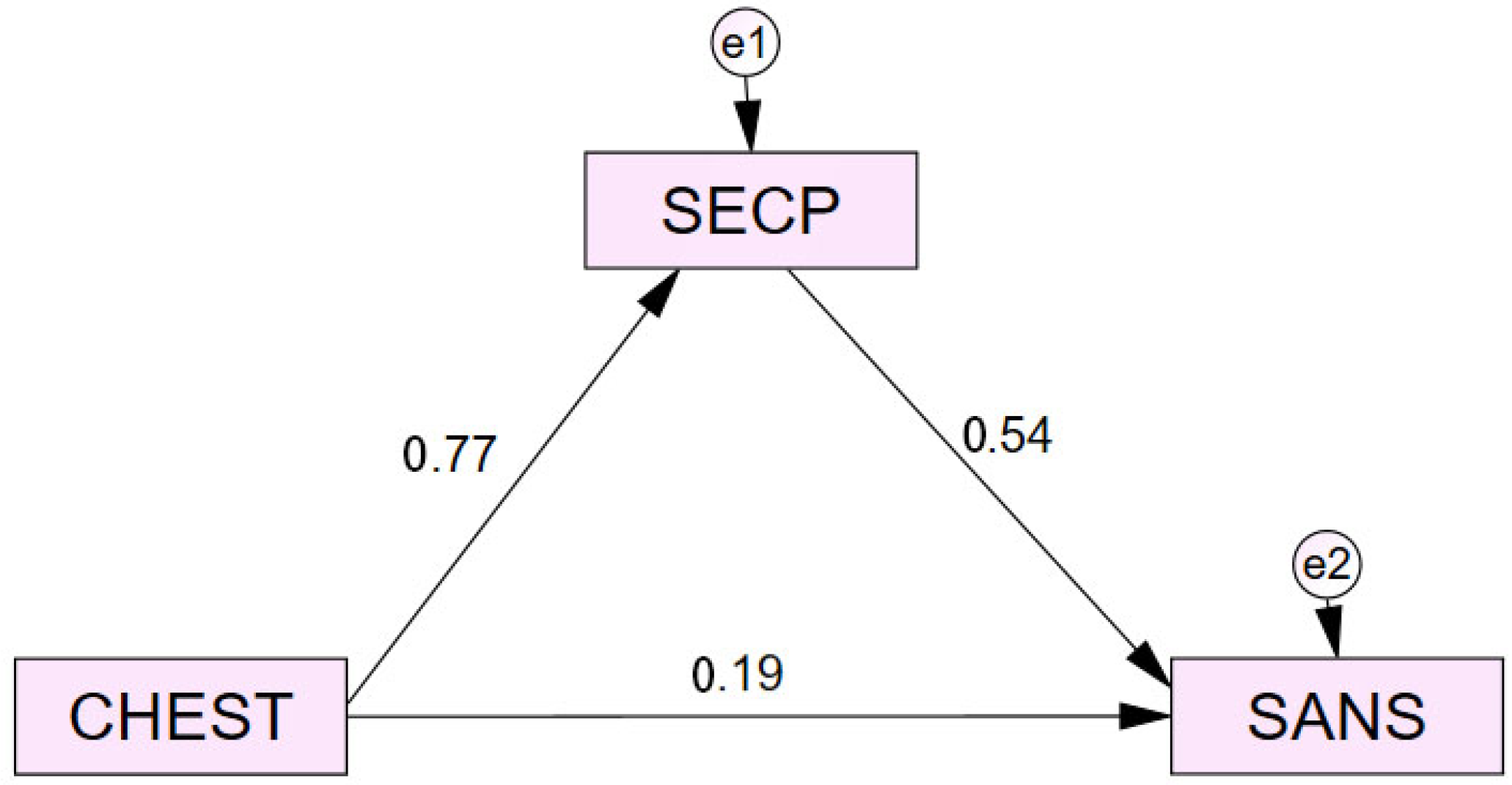
| SANS (Y) | CHEST (X) | 0.1943 | 0.0493 | 0.010 | 4.5129 | <0.001 | 0.0278 | 0.0707 |
| SANS (Y) | SECP (M) | 0.5420 | 0.0056 | 0.004 | 12.5858 | <0.001 | 0.0047 | 0.0065 |
| SECP (M) | CHEST (X) | 0.7723 | 18.9925 | 0.600 | 31.6351 | <0.001 | 17.8137 | 20.1713 |
| Effect Type | b | β* | SE | Boot 95% CI | % of Total |
|---|---|---|---|---|---|
| Total effect (X → Y) | 0.1554 | 0.6129 | 0.007 | [0.1403, 0.1706] | 100.00% |
| Direct effect (X → Y) | 0.0493 | 0.1943 | 0.109 | [0.0278, 0.0707] | 31.73% |
| Indirect effect via SECP (X → M → Y) | 0.1062 | 0.4186 | 0.010 | [0.0858, 0.1270] | 68.34% |
Disclaimer/Publisher’s Note: The statements, opinions and data contained in all publications are solely those of the individual author(s) and contributor(s) and not of MDPI and/or the editor(s). MDPI and/or the editor(s) disclaim responsibility for any injury to people or property resulting from any ideas, methods, instructions or products referred to in the content. |
© 2026 by the authors. Published by MDPI on behalf of the University Association of Education and Psychology. Licensee MDPI, Basel, Switzerland. This article is an open access article distributed under the terms and conditions of the Creative Commons Attribution (CC BY) license.
Share and Cite
Hemaida, W.E.-S.M.; Geenedy, E.M.G.; Abdellatif, M.S.; Nemt-allah, M.A. From Simulation to Sustainability: The Mediating Role of Clinical Self-Efficacy Among Undergraduate Healthcare Students. Eur. J. Investig. Health Psychol. Educ. 2026, 16, 75. https://doi.org/10.3390/ejihpe16060075
Hemaida WE-SM, Geenedy EMG, Abdellatif MS, Nemt-allah MA. From Simulation to Sustainability: The Mediating Role of Clinical Self-Efficacy Among Undergraduate Healthcare Students. European Journal of Investigation in Health, Psychology and Education. 2026; 16(6):75. https://doi.org/10.3390/ejihpe16060075
Chicago/Turabian StyleHemaida, Waleed El-Sayed Mohammed, Ekram Mohammed Gomaa Geenedy, Mohamed Sayed Abdellatif, and Mohamed Ali Nemt-allah. 2026. "From Simulation to Sustainability: The Mediating Role of Clinical Self-Efficacy Among Undergraduate Healthcare Students" European Journal of Investigation in Health, Psychology and Education 16, no. 6: 75. https://doi.org/10.3390/ejihpe16060075
APA StyleHemaida, W. E.-S. M., Geenedy, E. M. G., Abdellatif, M. S., & Nemt-allah, M. A. (2026). From Simulation to Sustainability: The Mediating Role of Clinical Self-Efficacy Among Undergraduate Healthcare Students. European Journal of Investigation in Health, Psychology and Education, 16(6), 75. https://doi.org/10.3390/ejihpe16060075