
Identity Reconstruction as a Coping Mechanism in Addiction Recovery: A Pilot Stratified Randomized Controlled Trial of Narrative Therapy Group Intervention

 ,
,
Abstract
1. Introduction
2. Materials and Methods
2.1. Participants
2.2. Measures
2.3. Research Design
2.4. Intervention Protocols
2.4.1. Evidence-Based Practice Framework
2.4.2. Narrative Therapy Group Intervention
2.4.3. Treatment-as-Usual Group
2.5. Statistical Analysis
3. Results
3.1. Baseline Comparisons
3.2. Repeated-Measure Analysis of Primary Outcomes
3.3. Simple-Effect Analyses
3.4. Process Evaluation: Self-Concept Clarity
4. Discussion
4.1. Identity Reconstruction as a Cognitive Coping Scaffold
4.2. The Group as Transformative Social Context
4.3. Limitations and Future Directions
5. Conclusions
Author Contributions
Funding
Institutional Review Board Statement
Informed Consent Statement
Data Availability Statement
Acknowledgments
Conflicts of Interest
Appendix A

| Outcome | Time Point | Comparison (I vs. J) | Mean Diff (I − J) | Tukey 95% CI | Tukey p | Bonferroni p |
|---|---|---|---|---|---|---|
| Self-Identity | Post-test | NT vs. TAU | +11.07 | [8.27, 13.86] | <0.001 | <0.001 |
| Self-Identity | Post-test | NT vs. WLC | +11.07 | [8.27, 13.86] | <0.001 | <0.001 |
| Self-Identity | Post-test | TAU vs. WLC | 0.00 | [−2.80, 2.80] | 1.000 | 1.000 |
| Self-Identity | Follow-up | NT vs. TAU | +10.67 | [7.40, 13.94] | <0.001 | <0.001 |
| Self-Identity | Follow-up | NT vs. WLC | +10.13 | [6.86, 13.40] | <0.001 | <0.001 |
| Self-Identity | Follow-up | TAU vs. WLC | −0.53 | [−3.80, 2.74] | 0.917 | 1.000 |
| Relapse-Risk | Post-test | NT vs. TAU | −2.40 | [−4.24, −0.56] | 0.008 | 0.009 |
| Relapse-Risk | Post-test | NT vs. WLC | −7.13 | [−8.98, −5.29] | <0.001 | <0.001 |
| Relapse-Risk | Post-test | TAU vs. WLC | −4.73 | [−6.58, −2.89] | <0.001 | <0.001 |
| Relapse-Risk | Follow-up | NT vs. TAU | −7.93 | [−9.97, −5.89] | <0.001 | <0.001 |
| Relapse-Risk | Follow-up | NT vs. WLC | −8.13 | [−10.17, −6.09] | <0.001 | <0.001 |
| Relapse-Risk | Follow-up | TAU vs. WLC | −0.20 | [−2.24, 1.84] | 0.969 | 1.000 |
References
- American Psychological Association Presidential Task Force on Evidence-Based Practice. (2006). Evidence-based practice in psychology. American Psychologist, 61(4), 271–285. [Google Scholar] [CrossRef]
- Best, D., Beckwith, M., Haslam, C., Alexander Haslam, S., Jetten, J., Mawson, E., & Lubman, D. I. (2016). Overcoming alcohol and other drug addiction as a process of social identity transition: The social identity model of recovery (SIMOR). Addiction Research & Theory, 24(2), 111–123. [Google Scholar]
- Boateng, G. O., Neilands, T. B., Frongillo, E. A., Melgar-Quiñonez, H. R., & Young, S. L. (2018). Best practices for developing and validating scales for health, social, and behavioral research: A primer. Frontiers in Public Health, 6, 149. [Google Scholar] [CrossRef] [PubMed]
- Campbell, J. D., Trapnell, P. D., Heine, S. J., Katz, I. M., Lavallee, L. F., & Lehman, D. R. (1996). Self-concept clarity: Measurement, personality correlates, and cultural boundaries. Journal of Personality and Social Psychology, 70(1), 141. [Google Scholar] [CrossRef]
- Chen, G. (2024). Identity construction in recovery from substance use disorders. Journal of Psychoactive Drugs, 56(1), 109–116. [Google Scholar] [CrossRef]
- Di Giovanni, P., Di Martino, G., Zecca, I. A. L., Porfilio, I., Romano, F., & Staniscia, T. (2020). The revolving door phenomenon: Psychiatric hospitalization and risk of readmission among drug-addicted patients. La Clinica terapeutica, 171(5), e421–e424. [Google Scholar]
- Farhoudian, A., Razaghi, E., Hooshyari, Z., Noroozi, A., Pilevari, A., Mokri, A., Mohammadi, M. R., & Malekinejad, M. (2022). Barriers and facilitators to substance use disorder treatment: An overview of systematic reviews. Substance Abuse: Research and Treatment, 16, 11782218221118462. [Google Scholar] [CrossRef]
- Frings, D., & Albery, I. P. (2015). The social identity model of cessation maintenance: Formulation and initial evidence. Addictive Behaviors, 44, 35–42. [Google Scholar] [CrossRef]
- Geng, L., Qian, B., & Shen, H. (2010). Preliminary revision of the high-risk relapse scale for drug use [毒品复吸高危量表的初步修订]. Chinese Journal of Clinical Psychology, 18(3), 301–303. [Google Scholar]
- Gligorov, N., & Cowan, E. (2025). The role of identity crises in addiction and recovery. Journal of Applied Philosophy, 42(3), 1059–1075. [Google Scholar] [CrossRef]
- Goffman, E. (1963). Stigma: Notes on the management of spoiled identity. Prentice-Hall. [Google Scholar]
- Kazdin, A. E. (2017). Addressing the treatment gap: A key challenge for extending evidence-based psychosocial interventions. Behaviour Research and Therapy, 88, 7–18. [Google Scholar] [CrossRef]
- Mak, W. W. S., Ho, C. Y. Y., Wong, V. U. T., Law, R. W., & Chan, R. C. H. (2015). Cultural model of self-stigma among Chinese with substance use problems. Drug and Alcohol Dependence, 155, 83–89. [Google Scholar] [CrossRef] [PubMed]
- Maruna, S. (2001). Making good: How ex-convicts reform and rebuild their lives. American Psychological Association. [Google Scholar]
- McAdams, D. P. (2001). The psychology of life stories. Review of General Psychology, 5(2), 100–122. [Google Scholar] [CrossRef]
- McAdams, D. P., & McLean, K. C. (2013). Narrative identity. Current Directions in Psychological Science, 22(3), 233–238. [Google Scholar] [CrossRef]
- McIntosh, J., & McKeganey, N. (2000). Addicts’ narratives of recovery from drug use: Constructing a non-addict identity. Social Science & Medicine, 50(10), 1501–1510. [Google Scholar] [CrossRef]
- Murengera, E. M., Niyonsenga, J., Rutembesa, E., Sezibera, V., & Nshimiyimana, A. (2025). Contribution of narrative therapy in reduction of anxiety, depression and PTSD among survivors of the genocide against the Tutsi in 1994 in Rwanda. PLoS Mental Health, 2(4), e0000287. [Google Scholar] [CrossRef]
- Ochse, R., & Plug, C. (1986). Cross-cultural investigation of the validity of Erikson’s theory of personality development. Journal of Personality and Social Psychology, 50(6), 1240. [Google Scholar] [CrossRef]
- Ogai, Y., Haraguchi, A., Kondo, A., Ishibashi, Y., Umeno, M., Kikumoto, H., Hori, T., Komiyama, T., Kato, R., Aso, K., Asukai, N., Senoo, E., & Ikeda, K. (2007). Development and validation of the Stimulant Relapse Risk Scale for drug abusers in Japan. Drug and Alcohol Dependence, 88(2), 174–181. [Google Scholar] [CrossRef]
- Oudejans, S., de Winter, L., van Weeghel, J., Sanches, S., & Hasson-Ohayon, I. (2022). Feasibility and outcomes of narrative enhancement and cognitive therapy (NECT) for reducing self-stigma among people with severe mental illness in the Netherlands: A pilot study. Psychiatric Rehabilitation Journal, 45(3), 255–265. [Google Scholar] [CrossRef] [PubMed]
- Paris, R., & Bradley, C. L. (2001). The challenge of adversity: Three narratives of alcohol dependence, recovery, and adult development. Qualitative Health Research, 11(5), 647–667. [Google Scholar] [CrossRef] [PubMed]
- Polit, D. F., & Beck, C. T. (2006). The content validity index: Are you sure you know what’s being reported? Critique and recommendations. Research in Nursing & Health, 29(5), 489–497. [Google Scholar]
- Song, A., Dertadian, G. C., & He, J. (2026). Recovery capital in Chinese drug rehabilitation: Exploring person-centred and community-based perspectives. Drug and Alcohol Review, 45(1), e70088. [Google Scholar] [CrossRef] [PubMed]
- Stewart, R. E., Cardamone, N. C., Schachter, A., Becker, C., McKay, J. R., & Becker-Haimes, E. M. (2023). A systematic review of brief, freely accessible, and valid self-report measures for substance use disorders and treatment. Drug and Alcohol Dependence, 243, 109729. [Google Scholar] [CrossRef]
- Sun, L., Liu, X., Weng, X., Deng, H., Li, Q., Liu, J., & Luan, X. (2022). Narrative therapy to relieve stigma in oral cancer patients: A randomized controlled trial. International Journal of Nursing Practice, 28(4), e12926. [Google Scholar] [CrossRef]
- Tavakol, M., & Dennick, R. (2011). Making sense of Cronbach’s alpha. International Journal of Medical Education, 2, 53–55. [Google Scholar] [CrossRef]
- Volkow, N. D. (2020). Stigma and the toll of addiction. New England Journal of Medicine, 382(14), 1289–1290. [Google Scholar] [CrossRef]
- Volkow, N. D., & Collins, F. S. (2017). The role of science in addressing the opioid crisis. New England Journal of Medicine, 377(4), 391–394. [Google Scholar] [CrossRef] [PubMed]
- White, M. (2007). Maps of narrative practice. WW Norton & Company. [Google Scholar]
- White, M., & Epston, D. (1990). Narrative means to therapeutic ends (1st ed.). Norton. [Google Scholar]
- Witkiewitz, K., & Tucker, J. A. (2020). Abstinence not required: Expanding the definition of recovery from alcohol use disorder. Alcoholism: Clinical and Experimental Research, 44(1), 36–40. [Google Scholar] [CrossRef]
- Yalom, I. D. (2005). The theory and practice of group psychotherapy (5th ed.). Basic Books/Hachette Book Group. [Google Scholar]
- Yanos, P. T., Roe, D., & Lysaker, P. H. (2011). Narrative enhancement and cognitive therapy: A new group-based treatment for internalized stigma among persons with severe mental illness. International Journal of Group Psychotherapy, 61(4), 576–595. [Google Scholar] [CrossRef] [PubMed]

| Week | Theme | Therapeutic Objectives | Activities |
|---|---|---|---|
| 1—Building Connection | Opening the Narrative Journey | Establish group trust; construct life timeline | “Story behind your name” sharing exercise to honor personal uniqueness; life timeline mapping (peak and valley experiences); collaborative development of group covenant |
| 2—Who Am I? | Externalizing Conversations | Separate person from problem; deconstruct pathologizing labels | Metaphor exercise: “What is addiction like? How did it enter your life?”; label-tearing ritual: writing and destroying the “addict” label; deconstructive questioning |
| 3—Finding Exceptions | Identifying Unique Outcomes | Excavate positive exceptions within recovery journey | Journal sharing: “Three moments in the past month when I overcame craving”; collaborative “I am a hero” story-building based on exceptional experiences |
| 4—Re-Authoring My Life | Re-Storying | Reconstruct self-narrative | Cross-temporal dialog: letter to future self; role-play: enacting re-authored story segments |
| 5—Re-Membering and Values | Re-Membering Conversations | Engage significant others as witnesses; clarify core values; mobilize social support | Identify five most important people; explore how they perceive the self; examine one’s influence on their lives; “Tree of Life” drawing to visualize values and relational connections |
| 6—Meaning-Making | Integration and Reconciliation | Transform painful experiences into growth resources | Autobiographical writing: composing a letter of understanding to one’s past self, acknowledging persistence and change, achieving reconciliation; small-group sharing in triads |
| 7—Identity Construction | Definitional Ceremony | Consolidate identity transition; establish long-term support network | “New Identity Launch”: public declaration of transformed self, with facility staff and willing family members invited as witnesses; presentation of “New Identity Certificate” with commemorative photograph |
| 8—Closure and Continuation | From Author to Narrator | Review therapeutic journey; transform personal growth into transmissible resources | Exhibition of artifacts created during intervention (life timelines, future self-portraits); participant narration of key turning points (small-group discussion followed by selected public sharing); presentation of “Narrative Practitioner Certificate,” authorizing recipients to share their experiences with other individuals in recovery |
| Variable | NT Group | 95% CI | TAU Group | 95% CI | WLC Group | 95% CI | F | p |
|---|---|---|---|---|---|---|---|---|
| Self-Identity | 41.80 ± 3.51 | [40.0, 43.6] | 40.13 ± 3.38 | [38.4, 41.8] | 41.27 ± 4.03 | [39.2, 43.3] | 0.816 | 0.449 |
| Relapse Risk | 11.93 ± 2.28 | [10.8, 13.1] | 11.13 ± 1.96 | [10.1, 12.1] | 11.07 ± 2.02 | [10.1, 12.1] | 0.798 | 0.457 |
| Variable | Time F (p, η2p) | Group F (p, η2p) | Time × Group F (p, η2p) |
|---|---|---|---|
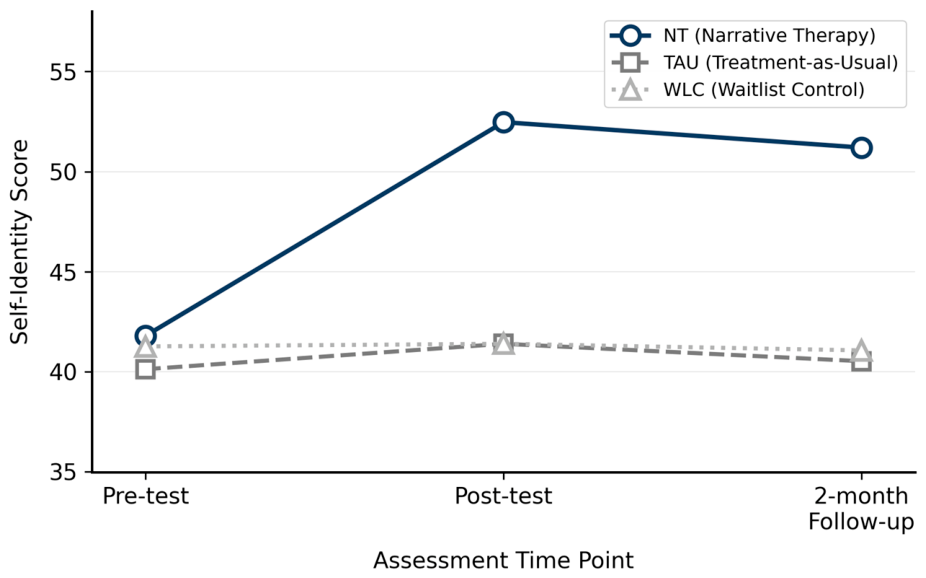
| Self-Identity | 93.222 (<0.001, 0.689) | 19.266 (<0.001, 0.478) | 64.215 (<0.001, 0.754) |
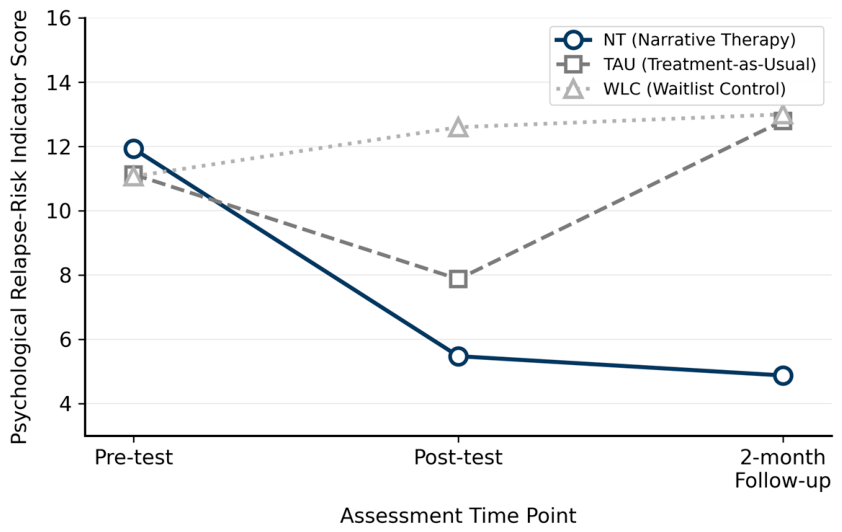
| Relapse Risk | 85.891 (<0.001, 0.672) | 11.823 (<0.001, 0.360) | 62.131 (<0.001, 0.747) |
| Group | Pre (M ± SD) | Pre 95% CI | Post 1 (M ± SD) | Post 1 95% CI | Post 2 FU (M ± SD) | Post 2 FU 95% CI | Within-Group F (p, η2p) |
|---|---|---|---|---|---|---|---|
| WLC | 41.27 ± 4.03 | [39.04, 43.50] | 41.40 ± 3.38 | [39.53, 43.27] | 41.07 ± 3.79 | [38.97, 43.16] | 3.500 (0.082, 0.200) |
| TAU | 40.13 ± 3.38 | [38.26, 42.00] | 41.40 ± 2.64 | [39.94, 42.86] | 40.53 ± 3.85 | [38.40, 42.67] | 0.651 (0.433, 0.044) |
| NT | 41.80 ± 3.51 | [39.86, 43.74] | 52.47 ± 3.38 | [50.60, 54.34] | 51.20 ± 3.41 | [49.31, 53.09] | 131.042 (<0.001, 0.903) |
| Group | Pre (M ± SD) | Pre 95% CI | Post 1 (M ± SD) | Post 1 95% CI | Post 2 FU (M ± SD) | Post 2 FU 95% CI | Within-Group F (p, η2p) |
|---|---|---|---|---|---|---|---|
| WLC | 11.07 ± 2.02 | [9.95, 12.18] | 12.60 ± 2.97 | [10.95, 14.25] | 13.00 ± 2.83 | [11.43, 14.57] | 11.387 (0.005, 0.449) |
| TAU | 11.13 ± 1.96 | [10.05, 12.22] | 7.87 ± 1.64 | [6.96, 8.78] | 12.80 ± 2.70 | [11.30, 14.30] | 12.324 (0.003, 0.468) |
| NT | 11.93 ± 2.28 | [10.67, 13.20] | 5.47 ± 1.19 | [4.81, 6.12] | 4.87 ± 0.74 | [4.46, 5.28] | 184.197 (<0.001, 0.929) |
| Variable | Timepoint | NT Group | 95% CI | TAU Group | 95% CI |
|---|---|---|---|---|---|
| Self-Concept Clarity | Pre | 35.87 ± 3.52 | [34.1, 37.7] | 36.33 ± 2.77 | [34.9, 37.7] |
| Post | 38.73 ± 2.22 | [37.6, 39.9] | 37.73 ± 4.65 | [35.4, 40.1] | |
| t | −2.368 * | −1.131 |
Disclaimer/Publisher’s Note: The statements, opinions and data contained in all publications are solely those of the individual author(s) and contributor(s) and not of MDPI and/or the editor(s). MDPI and/or the editor(s) disclaim responsibility for any injury to people or property resulting from any ideas, methods, instructions or products referred to in the content. |
© 2026 by the authors. Published by MDPI on behalf of the University Association of Education and Psychology. Licensee MDPI, Basel, Switzerland. This article is an open access article distributed under the terms and conditions of the Creative Commons Attribution (CC BY) license.
Share and Cite
Wang, P.; Li, Y.; Cheng, X.; Xie, H.; Huang, H.; Yang, J.; Chen, Y.; Kwok, A.P.K.; Chen, J. Identity Reconstruction as a Coping Mechanism in Addiction Recovery: A Pilot Stratified Randomized Controlled Trial of Narrative Therapy Group Intervention. Eur. J. Investig. Health Psychol. Educ. 2026, 16, 68. https://doi.org/10.3390/ejihpe16050068
Wang P, Li Y, Cheng X, Xie H, Huang H, Yang J, Chen Y, Kwok APK, Chen J. Identity Reconstruction as a Coping Mechanism in Addiction Recovery: A Pilot Stratified Randomized Controlled Trial of Narrative Therapy Group Intervention. European Journal of Investigation in Health, Psychology and Education. 2026; 16(5):68. https://doi.org/10.3390/ejihpe16050068
Chicago/Turabian StyleWang, Peipei, Yanan Li, Xu Cheng, Hong Xie, Huanxian Huang, Jun Yang, Yangwei Chen, Alex Pak Ki Kwok, and Jiacheng Chen. 2026. "Identity Reconstruction as a Coping Mechanism in Addiction Recovery: A Pilot Stratified Randomized Controlled Trial of Narrative Therapy Group Intervention" European Journal of Investigation in Health, Psychology and Education 16, no. 5: 68. https://doi.org/10.3390/ejihpe16050068
APA StyleWang, P., Li, Y., Cheng, X., Xie, H., Huang, H., Yang, J., Chen, Y., Kwok, A. P. K., & Chen, J. (2026). Identity Reconstruction as a Coping Mechanism in Addiction Recovery: A Pilot Stratified Randomized Controlled Trial of Narrative Therapy Group Intervention. European Journal of Investigation in Health, Psychology and Education, 16(5), 68. https://doi.org/10.3390/ejihpe16050068