
The Impact of Green Exercise on Cardiovascular and Musculoskeletal Health in Middle-Aged and Older Adults: A Scoping Review

 ,
,  ,
,  and
and 
Abstract
1. Introduction
2. Materials and Methods
2.1. Study Design and Search Strategy
2.2. Inclusion and Exclusion Criteria
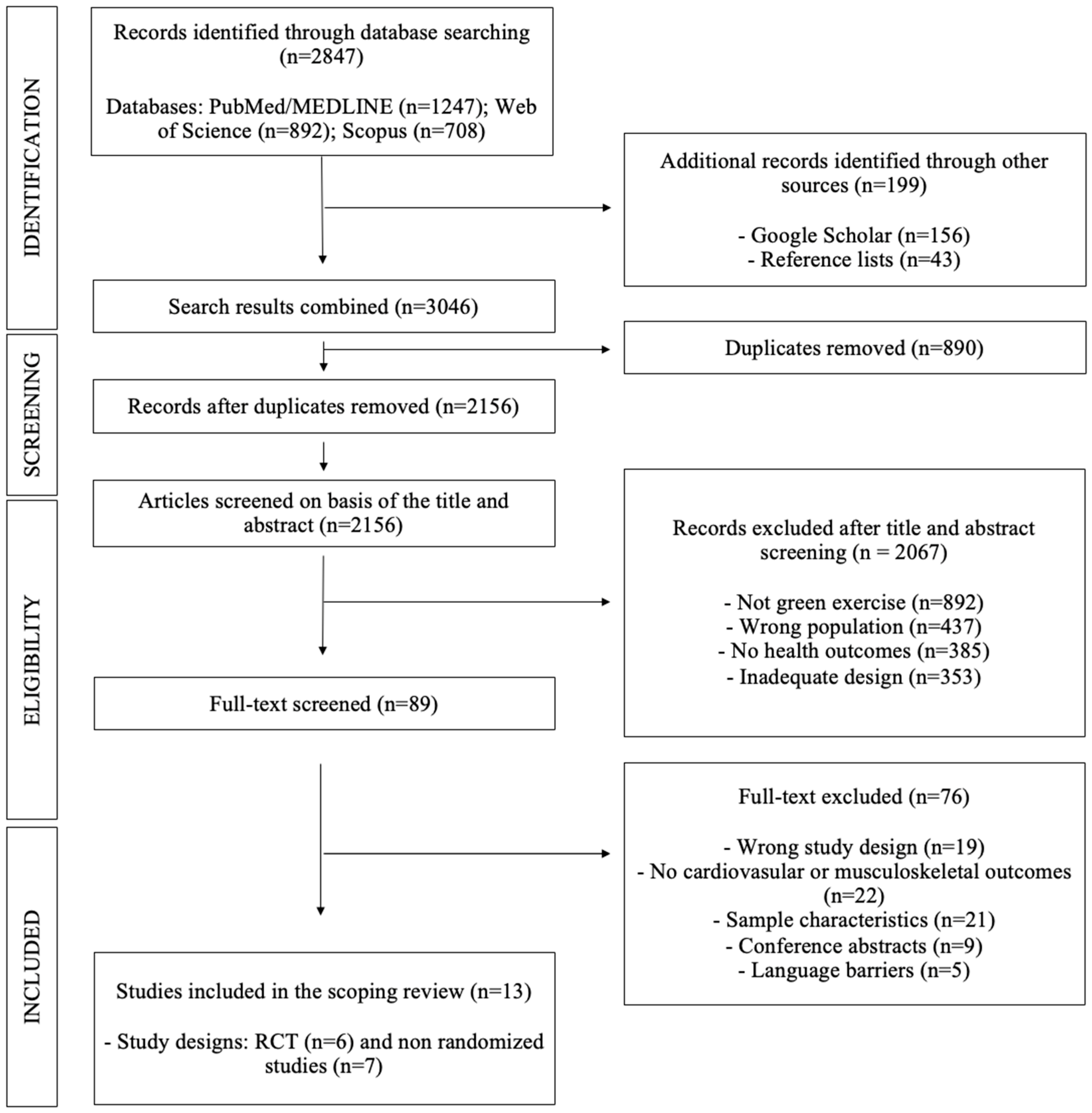
2.3. Study Selection Process
2.4. Data Extraction and Quality Assessment
2.5. Data Synthesis and Analysis
3. Results
3.1. Study and Participant Characteristics
3.2. Characteristics of Green Exercise Interventions
3.3. Cardiovascular Health Outcomes
3.3.1. Blood Pressure, Hemodynamic and Autonomic Response
3.3.2. Cardiorespiratory Fitness and Functional Capacity
3.4. Musculoskeletal and Body Composition Outcomes
3.4.1. Strength and Balance
3.4.2. Body Composition
3.5. Dose–Response and Intervention Characteristics
3.6. Comparison of Effectiveness Between Green Exercise, Urban Outdoor and Indoor Exercise
3.7. Variability and Inconsistencies Across Studies
4. Discussion
4.1. Cardiovascular Findings
4.2. Musculoskeletal and Body Composition Findings
4.3. Dose–Response Findings
4.4. Comparison of Effectiveness Between Green Exercise, Urban Outdoor and Indoor Exercise
4.5. Clinical and Public Health Implications
4.6. Limitations and Future Research
5. Conclusions
Supplementary Materials
Author Contributions
Funding
Institutional Review Board Statement
Informed Consent Statement
Data Availability Statement
Conflicts of Interest
References
- Aïdoud, A., Gana, W., Poitau, F., Debacq, C., Leroy, V., Nkodo, J., Poupin, P., Angoulvant, D., & Fougère, B. (2023). High prevalence of geriatric conditions among older adults with cardiovascular disease. Journal of the American Heart Association, 12(2), e026850. [Google Scholar] [CrossRef] [PubMed]
- Arksey, H., & O’Malley, L. (2005). Scoping studies: Towards a methodological framework. International Journal of Social Research Methodology, 8(1), 19–32. [Google Scholar] [CrossRef]
- Asavamongkolkul, A., Adulkasem, N., Chotiyarnwong, P., Vanitcharoenkul, E., Chandhanayingyong, C., Laohaprasitiporn, P., Soparat, K., & Unnanuntana, A. (2024). Prevalence of osteoporosis, sarcopenia, and high falls risk in healthy community-dwelling Thai older adults: A nationwide cross-sectional study. JBMR Plus, 8(2), ziad020. [Google Scholar] [CrossRef] [PubMed]
- Barton, J., & Pretty, J. (2010). What is the best dose of nature and green exercise for improving mental health? A multi-study analysis. Environmental Science & Technology, 44, 3947–3955. [Google Scholar] [CrossRef]
- Bowler, D. E., Buyung-Ali, L. M., Knight, T. M., & Pullin, A. S. (2010). A systematic review of evidence for the added benefits to health of exposure to natural environments. BMC Public Health, 10(1), 456. [Google Scholar] [CrossRef]
- Bull, F. C., Al-Ansari, S. S., Biddle, S., Borodulin, K., Buman, M. P., Cardon, G., Carty, C., Chaput, J. P., Chastin, S., Chou, R., Dempsey, P. C., Dipietro, L., Ekelund, U., Firth, J., Friedenreich, C. M., Garcia, L., Gichu, M., Jago, R., Katzmarzyk, P. T., … Willumsen, J. F. (2020). World Health Organization 2020 guidelines on physical activity and sedentary behaviour. British Journal of Sports Medicine, 54(24), 1451–1462. [Google Scholar] [CrossRef]
- Calogiuri, G., & Chroni, S. (2014). The impact of the natural environment on the promotion of active living: An integrative systematic review. BMC Public Health, 14(1), 873. [Google Scholar] [CrossRef]
- Calogiuri, G., Evensen, K., Weydahl, A., Andersson, K., Patil, G., Ihlebæk, C., & Raanaas, R. K. (2015a). Green exercise as a workplace intervention to reduce job stress. Results from a pilot study. Work, 53(1), 99–111. [Google Scholar] [CrossRef]
- Calogiuri, G., Nordtug, H., & Weydahl, A. (2015b). The potential of using exercise in nature as an intervention to enhance exercise behavior: Results from a pilot study. Perceptual and Motor Skills, 121(2), 350–370. [Google Scholar] [CrossRef]
- Campbell, E., Petermann-Rocha, F., Welsh, P., Celis-Morales, C., Pell, J. P., Ho, F. K., & Gray, S. R. (2021). The effect of exercise on quality of life and activities of daily life in frail older adults: A systematic review of randomised control trials. Experimental Gerontology, 147, 111287. [Google Scholar] [CrossRef] [PubMed]
- Casanova-Lizón, A., Manresa-Rocamora, A., Flatt, A. A., Sarabia, J. M., & Moya-Ramón, M. (2022). Does exercise training improve cardiac-parasympathetic nervous system activity in sedentary people? A systematic review with meta-analysis. International Journal of Environmental Research and Public Health, 19(21), 13899. [Google Scholar] [CrossRef]
- Cruz-Jentoft, A. J., Bahat, G., Bauer, J., Boirie, Y., Bruyère, O., Cederholm, T., Cooper, C., Landi, F., Rolland, Y., Sayer, A. A., Schneider, S. M., Sieber, C. C., Topinkova, E., Vandewoude, M., Visser, M., & Zamboni, M. (2019). Sarcopenia: Revised European consensus on definition and diagnosis. Age and Ageing, 48(1), 16–31. [Google Scholar] [CrossRef]
- DaSilva, M. M., Chandran, V. D., Dixon, P. C., Loh, J. M., Dennerlein, J. T., Schiffman, J. M., & Pal, S. (2021). Muscle co-contractions are greater in older adults during walking at self-selected speeds over uneven compared to even surfaces. Journal of Biomechanics, 128, 110718. [Google Scholar] [CrossRef]
- de Brito, J. N., Pope, Z. C., Mitchell, N. R., Schneider, I. E., Larson, J. M., Horton, T. H., & Pereira, M. A. (2020). The effect of green walking on heart rate variability: A pilot crossover study. Environmental Research, 185, 109408. [Google Scholar] [CrossRef] [PubMed]
- Franssen, T., Stijnen, M., Hamers, F., & Schneider, F. (2020). Age differences in demographic, social and health-related factors associated with loneliness across the adult life span (19–65 years): A cross-sectional study in the Netherlands. BMC Public Health, 20, 1118. [Google Scholar] [CrossRef]
- García-Llorente, A. M., Lopes Machado, D. R., Casimiro-Andújar, A. J., & Marcos-Pardo, P. J. (2025). Impact of a multidomain outdoor exercise intervention on cardiovascular health and functional capacity for healthy aging: A randomized controlled trial (ACTIVA-senior study). Healthcare, 13(16), 1975. [Google Scholar] [CrossRef]
- Giles-Corti, B., Broomhall, M. H., Knuiman, M., Collins, C., Douglas, K., Ng, K., Lange, A., & Donovan, R. J. (2005). Increasing walking: How important is distance to, attractiveness, and size of public open space? American Journal of Preventive Medicine, 28(2), 169–176. [Google Scholar] [CrossRef] [PubMed]
- Girgis, C. M., Clifton-Bligh, R. J., Hamrick, M. W., Holick, M. F., & Gunton, J. E. (2013). The roles of vitamin D in skeletal muscle: Form, function, and metabolism. Endocrine Reviews, 34(1), 33–83. [Google Scholar] [CrossRef] [PubMed]
- Gladwell, V. F., Brown, D. K., Wood, C., Sandercock, G. R., & Barton, J. L. (2013). The great outdoors: How a green exercise environment can benefit all. Extreme Physiology & Medicine, 2(1), 3. [Google Scholar] [CrossRef]
- Green, D. J., Hopman, M. T. E., Padilla, J., Laughlin, M. H., & Thijssen, D. H. J. (2017). Vascular adaptation to exercise in humans: Role of hemodynamic stimuli. Physiological Reviews, 97(2), 495–528. [Google Scholar] [CrossRef]
- Hartig, T., Mitchell, R., de Vries, S., & Frumkin, H. (2014). Nature and health. Annual Review of Public Health, 35(1), 207–228. [Google Scholar] [CrossRef]
- Hautala, A. J., Mäkikallio, T. H., Kiviniemi, A., Laukkanen, R. T., Nissilä, S., Huikuri, H. V., & Tulppo, M. P. (2003). Cardiovascular autonomic function correlates with the response to aerobic training in healthy sedentary subjects. American Journal of Physiology-Heart and Circulatory Physiology, 285(4), H1747–H1752. [Google Scholar] [CrossRef] [PubMed]
- Hellsten, Y., & Gliemann, L. (2024). Peripheral limitations for performance: Muscle capillarization. Scandinavian Journal of Medicine & Science in Sports, 34(1), e14442. [Google Scholar] [CrossRef]
- Herrod, P. J. J., Lund, J. N., & Phillips, B. E. (2021). Time-efficient physical activity interventions to reduce blood pressure in older adults: A randomised controlled trial. Age and Ageing, 50(3), 980–984. [Google Scholar] [CrossRef] [PubMed]
- Higgins, J. P. T., Altman, D. G., Gotzsche, P. C., Juni, P., Moher, D., Oxman, A. D., Savovic, J., Schulz, K. F., Weeks, L., & Sterne, J. A. C. (2011). The Cochrane collaboration’s tool for assessing risk of bias in randomised trials. BMJ, 343, d5928. [Google Scholar] [CrossRef]
- Higgins, J. P. T., Morgan, R. L., Rooney, A. A., Taylor, K. W., Thayer, K. A., Silva, R. A., Lemeris, C., Akl, E. A., Bateson, T. F., Berkman, N. D., Glenn, B. S., Hróbjartsson, A., LaKind, J. S., McAleenan, A., Meerpohl, J. J., Nachman, R. M., Obbagy, J. E., O’Connor, A., Radke, E. G., … Sterne, J. A. C. (2024). A tool to assess risk of bias in non-randomized follow-up studies of exposure effects (ROBINS-E). Environment International, 186, 108602. [Google Scholar] [CrossRef]
- Holick, M. F. (2007). Vitamin D deficiency. New England Journal of Medicine, 357(3), 266–281. [Google Scholar] [CrossRef]
- Jan, B., Dar, M. I., Choudhary, B., Basist, P., Khan, R., & Alhalmi, A. (2024). Cardiovascular diseases among Indian older adults: A comprehensive review. Cardiovascular Therapeutics, 2024(1), 6894693. [Google Scholar] [CrossRef]
- Jansson, A., Lubans, D., Smith, J., Duncan, M., Haslam, R., & Plotnikoff, R. (2019). A systematic review of outdoor gym use: Current evidence and future directions. Journal of Science and Medicine in Sport, 22, 1335–1343. [Google Scholar] [CrossRef]
- Kaplan, S. (1995). The restorative benefits of nature: Toward an integrative framework. Journal of Environmental Psychology, 15(3), 169–182. [Google Scholar] [CrossRef]
- Kondo, M., Fluehr, J., McKeon, T., & Branas, C. (2018). Urban green space and its impact on human health. International Journal of Environmental Research and Public Health, 15(3), 445. [Google Scholar] [CrossRef]
- Kono, A., Kai, I., Sakato, C., & Rubenstein, L. Z. (2004). Frequency of going outdoors: A predictor of functional and psychosocial change among ambulatory frail elders living at home. The Journals of Gerontology Series A: Biological Sciences and Medical Sciences, 59(3), M275–M280. [Google Scholar] [CrossRef]
- Lachman, M. (2004). Development in midlife. Annual Review of Psychology, 55, 305–310. [Google Scholar] [CrossRef]
- Leale, I., Giustino, V., Brusa, J., Barcellona, M., Barbagallo, M., Palma, A., Messina, G., Dominguez, L. J., & Battaglia, G. (2024). Effectiveness of a sustainable training program combining supervised outdoor exercise with telecoaching on physical performance in elderly people. Sustainability, 16(8), 3254. [Google Scholar] [CrossRef]
- Li, Q. (2010). Effect of forest bathing trips on human immune function. Environmental Health and Preventive Medicine, 15(1), 9–17. [Google Scholar] [CrossRef] [PubMed]
- Li, Q., Kobayashi, M., Kumeda, S., Ochiai, T., Miura, T., Kagawa, T., Imai, M., Wang, Z., Otsuka, T., & Kawada, T. (2016). Effects of forest bathing on cardiovascular and metabolic parameters in middle-aged males. Evidence-Based Complementary and Alternative Medicine, 2016(1), 2587381. [Google Scholar] [CrossRef]
- Li, Q., Morimoto, K., Kobayashi, M., Inagaki, H., Katsumata, M., Hirata, Y., Hirata, K., Suzuki, H., Li, Y. J., Wakayama, Y., Kawada, T., Park, B. J., Ohira, T., Matsui, N., Kagawa, T., Miyazaki, Y., & Krensky, A. M. (2008). Visiting a forest, but not a city, increases human natural killer activity and expression of anti-cancer proteins. International Journal of Immunopathology and Pharmacology, 21(1), 117–127. [Google Scholar] [CrossRef]
- Li, Q., Otsuka, T., Kobayashi, M., Wakayama, Y., Inagaki, H., Katsumata, M., Hirata, Y., Li, Y., Hirata, K., Shimizu, T., Suzuki, H., Kawada, T., & Kagawa, T. (2011). Acute effects of walking in forest environments on cardiovascular and metabolic parameters. European Journal of Applied Physiology, 111(11), 2845–2853. [Google Scholar] [CrossRef] [PubMed]
- Li, T., Higgins, J. P. T., & Deeks, J. J. (2021). Cochrane Handbook for Systematic Reviews of Interventions|Cochrane. In J. P. T. Higgins, J. Thomas, J. Chandler, M. Cumpston, T. Li, M. J. Page, & V. A. Welch (Eds.), Cochrane handbook for systematic reviews of interventions (Version 6.2). Cochrane. Available online: https://www.cochrane.org/authors/handbooks-and-manuals/handbook (accessed on 5 March 2026).
- Maller, C., Townsend, M., Pryor, A., Brown, P., & St Leger, L. (2006). Healthy nature healthy people: ‘contact with nature’ as an upstream health promotion intervention for populations. Health Promotion International, 21(1), 45–54. [Google Scholar] [CrossRef]
- Marcos-Pardo, P. J., Espeso-García, A., Vaquero-Cristóbal, R., Abelleira-Lamela, T., & González-Gálvez, N. (2024). The effect of resistance training with outdoor fitness equipment on the body composition, physical fitness, and physical health of middle-aged and older adults: A randomized controlled trial. Healthcare, 12(7), 726. [Google Scholar] [CrossRef] [PubMed]
- Marselle, M., Irvine, K., Lorenzo-Arribas, A., & Warber, S. (2015). Moving beyond Green: Exploring the relationship of environment type and indicators of perceived environmental quality on emotional well-being following group walks. International Journal of Environmental Research and Public Health, 12(1), 106–130. [Google Scholar] [CrossRef]
- Marselle, M., Irvine, K., & Warber, S. (2014). Examining group walks in nature and multiple aspects of well-being: A large-scale study. Ecopsychology, 6(3), 134–147. [Google Scholar] [CrossRef]
- Mitchell, R. (2013). Is physical activity in natural environments better for mental health than physical activity in other environments? Social Science & Medicine, 91, 130–134. [Google Scholar] [CrossRef]
- Niedermeier, M., Grafetstätter, C., Hartl, A., & Kopp, M. (2017). A Randomized crossover trial on acute stress-related physiological responses to mountain hiking. International Journal of Environmental Research and Public Health, 14(8), 905. [Google Scholar] [CrossRef]
- Page, M. J., McKenzie, J. E., Bossuyt, P. M., Boutron, I., Hoffmann, T. C., Mulrow, C. D., Shamseer, L., Tetzlaff, J. M., Akl, E. A., Brennan, S. E., Chou, R., Glanville, J., Grimshaw, J. M., Hróbjartsson, A., Lalu, M. M., Li, T., Loder, E. W., Mayo-Wilson, E., McDonald, S., … Moher, D. (2021). The PRISMA 2020 statement: An updated guideline for reporting systematic reviews. BMJ, 372, n71. [Google Scholar] [CrossRef]
- Panzarino, M., Gravina, A., Carosi, V., Crobeddu, P., Tiroli, A., Lombardi, R., D’Ottavio, S., Galante, A., & Legramante, J. M. (2017). Cardiovascular and hemodynamic responses to adapted physical exercises in very old adults. Aging Clinical and Experimental Research, 29(3), 419–426. [Google Scholar] [CrossRef]
- Parra-Rizo, M. A., & Sanchis-Soler, G. (2020). Satisfaction with life, subjective well-being and functional skills in active older adults based on their level of physical activity practice. International Journal of Environmental Research and Public Health, 17(4), 1299. [Google Scholar] [CrossRef] [PubMed]
- Peters, M. D. J., Marnie, C., Tricco, A. C., Pollock, D., Munn, Z., Alexander, L., McInerney, P., Godfrey, C. M., & Khalil, H. (2020). Updated methodological guidance for the conduct of scoping reviews. JBI Evidence Synthesis, 18(10), 2119–2126. [Google Scholar] [CrossRef]
- Popay, J., Roberts, H., Sowden, A., Petticrew, M., Arai, L., Rodgers, M., Britten, N., Roen, K., & Duffy, S. (2006). Guidance on the conduct of narrative synthesis in systematic reviews: A product from the ESRC methods programme. ESRC Methods Programme, 1, b92. [Google Scholar] [CrossRef]
- Pretty, J., Peacock, J., Sellens, M., & Griffin, M. (2005). The mental and physical health outcomes of green exercise. International Journal of Environmental Health Research, 15(5), 319–337. [Google Scholar] [CrossRef]
- Reitlo, L. S., Sandbakk, S. B., Viken, H., Aspvik, N. P., Ingebrigtsen, J. E., Tan, X., Wisløff, U., & Stensvold, D. (2018). Exercise patterns in older adults instructed to follow moderate- or high-intensity exercise protocol—The generation 100 study. BMC Geriatrics, 18(1), 208. [Google Scholar] [CrossRef]
- Roberts, C. E., Phillips, L. H., Cooper, C. L., Gray, S., & Allan, J. L. (2017). Effect of different types of physical activity on activities of daily living in older adults: Systematic review and meta-analysis. Journal of Aging and Physical Activity, 25(4), 653–670. [Google Scholar] [CrossRef]
- Seals, D. R., Justice, J. N., & LaRocca, T. J. (2016). Physiological geroscience: Targeting function to increase healthspan and achieve optimal longevity. The Journal of Physiology, 594(8), 2001–2024. [Google Scholar] [CrossRef]
- Simpkins, C., & Yang, F. (2022). Muscle power is more important than strength in preventing falls in community-dwelling older adults. Journal of Biomechanics, 134, 111018. [Google Scholar] [CrossRef] [PubMed]
- Thompson Coon, J., Boddy, K., Stein, K., Whear, R., Barton, J., & Depledge, M. H. (2011). Does participating in physical activity in outdoor natural environments have a greater effect on physical and mental wellbeing than physical activity indoors? A systematic review. Environmental Science & Technology, 45(5), 1761–1772. [Google Scholar] [CrossRef] [PubMed]
- Tricco, A. C., Lillie, E., Zarin, W., O’Brien, K. K., Colquhoun, H., Levac, D., Moher, D., Peters, M. D. J., Horsley, T., Weeks, L., & Straus, S. E. (2018). PRISMA extension for scoping reviews (PRISMA-ScR): Checklist and explanation. Annals of Internal Medicine, 169, 467–473. [Google Scholar] [CrossRef]
- Ulrich, R. S., Simons, R. F., Losito, B. D., Fiorito, E., Miles, M. A., & Zelson, M. (1991). Stress recovery during exposure to natural and urban environments. Journal of Environmental Psychology, 11(3), 201–230. [Google Scholar] [CrossRef]
- Valenzuela, P. L., Saco-Ledo, G., Morales, J. S., Gallardo-Gómez, D., Morales-Palomo, F., López-Ortiz, S., Rivas-Baeza, B., Castillo-García, A., Jiménez-Pavón, D., Santos-Lozano, A., del Pozo Cruz, B., & Lucia, A. (2023). Effects of physical exercise on physical function in older adults in residential care: A systematic review and network meta-analysis of randomised controlled trials. The Lancet Healthy Longevity, 4(6), e247–e256. [Google Scholar] [CrossRef]
- Wells, G., Shea, B., O’Connell, D., Peterson, J., Welch, V., Losos, M., & Tugwell, P. (2000). The Newcastle–Ottawa Scale (NOS) for assessing the quality of non-randomized studies in meta-analysis. Ottawa Hospital Research Institute. [Google Scholar]
- World Health Organization. (2022). Global health estimates 2019: Deaths by cause, age, sex, by country and by region, 2000–2019. World Health Organization. Available online: https://www.who.int/data/gho/data/themes/mortality-and-global-health-estimates/ghe-leading-causes-of-death (accessed on 22 March 2026).
- Yao, L., Fang, H., Leng, W., Li, J., & Chang, J. (2021). Effect of aerobic exercise on mental health in older adults: A meta-analysis of randomized controlled trials. Frontiers in Psychiatry, 12, 748257. [Google Scholar] [CrossRef]
- Yıldırım Ayaz, E., Dincer, B., Mete, E., Kaygusuz Benli, R., Cinbaz, G., Karacan, E., Cankül, A., & Mesci, B. (2024). Evaluating the impact of aerobic and resistance green exercises on the fitness, aerobic and intrinsic capacity of older individuals. Archives of Gerontology and Geriatrics, 118, 105281. [Google Scholar] [CrossRef] [PubMed]
- Zhang, X., Gu, X., Xu, Y., Wang, X., Weng, F., Wen, Y., Huang, J., & Li, K. (2025). Prevalence and clustering of modifiable cardiovascular disease risk factors among elderly adults in Yuexiu district, Guangzhou City, China: A cross sectional study. BMC Cardiovascular Disorders, 25(1), 237. [Google Scholar] [CrossRef]
- Zhou, T.-Y., Yuan, X.-M., & Ma, X.-J. (2020). Canan outdoor multisurface terrain enhance the effects of fall prevention exercise in older adults? A randomized controlled trial. International Journal of Environmental Research and Public Health, 17(19), 7023. [Google Scholar] [CrossRef]


| Nº | Authors | Study Design | Sample | Population | Intervention | Setting | Main Results |
|---|---|---|---|---|---|---|---|
| SECTION A—Randomized Controlled Trials (n = 6) | |||||||
| 1 | Yıldırım Ayaz et al. (2024) | Multicenter RCT | n = 90 Age: 74.0 ± 6.4 yr | Older adults, Turkey | Aerobic (AE), aerobic + resistance (AE + RE) green exercise and control. 12 wk; 1×/wk; 50 min/session. | Outdoor park/green space | Both groups improved (AE and AE + RE): chair stand, arm curl, two-minutes step, chair sit and reach, back scratch, 8-foot-up and go, VO2 max., TUG and handgrip muscle strength (p < 0.05). |
| 2 | García-Llorente et al. (2025) | Randomized Controlled Trial (ACTIVA-Senior Study) | n = 46 Age: 66.0 ± 5.1 yr | Community-dwelling older adults, Spain | Combined aerobic + resistance outdoor exercise. 18 wk; 2×/wk; 60 min/session. | Local parks and outdoor fitness areas (outdoor) | Systolic blood pressure (−17.4 mmHg, p < 0.001), diastolic blood pressure (−9.2 mmHg, p < 0.001), 6MWT (+64.7 m, p < 0.001), percent body fat (−1.3%; p = 0.007), visceral fat level (−0.9; p = 0.002) |
| 3 | Zhou et al. (2020) | Randomized Controlled Trial | n = 22 Age: 80.2 ± 3.7 yr | Local nursing home, China | Outdoor multisurface terrain (OMTG) vs. indoor solid ground (ISGG). 3 wk; 5×/wk; 30 min/session. | Outdoor multisurface terrain vs. indoor solid ground | Both groups improved functional capacity (p < 0.05). However, OMTG showed greater improvement in 10 mWT (p = 0.049), MTWT (p = 0.020) and 2 MWT (p < 0.001) |
| 4 | Calogiuri et al. (2015a) | Pilot RCT (workplace intervention) | n = 14 Age: 49.0 ± 8.0 yr | Office workers, Norway | Green exercise vs. indoor exercise 2 wk; 2×/wk; 45 min (25 min of biking session and 20 min of strength session using elastic rubber bands). | Forest area vs. indoor setting (gym-hall) | Nature group reduced diastolic blood pressure (p = 0.05) and cortisol (p = 0.04). |
| 5 | Reitlo et al. (2018) | Randomized Controlled Trial (Generation 100) | n = 618 Age: 72.4 ± 2.0 yr | Community-dwelling older adults, Norway | Participants completed exercise logs after each exercise session they performed for one year. They were randomly assigned to MCT or HIIT. | Outdoor and indoor exercise settings, Norway | Outdoor was the most common exercise location in both training groups. Walking was the most common type in both groups, but MCT had a higher proportion of sessions than HIIT (p < 0.001). |
| 6 | Marcos-Pardo et al. (2024) | Randomized Controlled Trial | n = 128 Age: 59.0 ± 7.1 yr | Middle-aged and older adults, Spain | 8 wk; 2×/wk; 45–60 min. Resistance training using outdoor fitness equipment. | Outdoor fitness equipment vs. control group (regular daily activities) | Outdoor group increased lean mass index (p = 0.002), maximal isometric contraction in both legs (p < 0.001) and arms (p < 0.001). In addition, a greater decrease in fat mass (p < 0.001) and TUG time (p < 0.001) were found in the outdoor group compared to control. |
| SECTION B—Non-Randomized Intervention and Observational Studies (n = 7) | |||||||
| 7 | Leale et al. (2024) | Supervised outdoor exercise combined with tele coaching (Quasi experimental design) | n = 60 Age: 71.2 ± 6.0 yr | Older adults, Italy | Supervised outdoor exercise + tele coaching vs. untrained group 8 wk; 5×/wk (2 involved supervised outdoor exercise (90 min) and 3 involved tele coaching (40 min)). | Outdoor urban park | Handgrip strength (p < 0.001), TUG (p < 0.001), SPPB (p = 0.012), and Tinetti scale (p = 0.002). |
| 8 | Calogiuri et al. (2015b) | Non-Randomized trial | n = 14 Age: 48.5 ± 7.3 yr | Healthy adults, Norway | Outdoor vs. indoor exercise Two sessions (25 min biking and 50 min strength using elastic resistance rubber bands). | Natural area vs. indoor (gym-hall) | Similar HR and RPE in both environments. Nature group reported higher enjoyment (p = 0.02) and intention to exercise in the future (p < 0.001). |
| 9 | de Brito et al. (2020) | Non-Randomized Crossover Study | n = 23 Age: 49.7 ± 6.5 yr | Middle aged adults, USA | Green walking intervention followed by suburban walking 3 wk per intervention with 2 wk washout period between them. Weekly 50 min walking sessions for each intervention. | Urban park vs. urban street | Higher mean HRV and less HRV reduction during green walking compared to suburban walking (p < 0.001). Systolic and diastolic blood pressure decreased for both green and suburban walking (p < 0.003). |
| 10 | Q. Li et al. (2008) | Non-Randomized Crossover Study | n = 12 Age: 45.1 ± 6.7 yr | Healthy middle-aged male adults, Japan | Forest bathing trip (walking in a forest for 3 days and stayed for 2 nights at a nearby hotel within the forest) vs. city tourist visit (walking in a tourist route for 3 days and stayed for 2 nights at a hotel in the city center). | Forest vs. urban city environment | The forest trip increased human NK cell activity (p < 0.001) and decreased adrenaline concentration (p < 0.001). |
| 11 | Q. Li et al. (2011) | Controlled Experimental Study | n = 16 Age: 57.4 ± 11.6 yr | Healthy middle-aged male adults, Japan | Acute forest walking vs. urban walking. Single session; 4 h; moderate intensity. One week between sessions. | Forest environment and urban environment | Systolic and diastolic blood pressure levels were lower in the forest (p < 0.01). No significant differences were found on lipid metabolism nor sleep duration. |
| 12 | Q. Li et al. (2016) | Controlled Experimental Study | n = 19 Age: 51.2 ± 8.8 yr | Middle-aged males, Japan | Walk in urban area (1 session, 80 min) and walk in forest area (1 session, 80 min). One week between sessions. | Forest environment and urban environment | Forest trip significantly reduced the subjects’ HR (p < 0.01). No significant difference in blood pressure between forest and urban areas. No effects on metabolic parameters. |
| 13 | Kono et al. (2004) | Prospective Cohort study | n = 112 Age: 82.3 ± 7.1 yr | Frail older adults living at home, Japan | Frequency of going outdoors over 9 months. | Community outdoor settings | Older adults going outdoors more often being more highly functional (IADL: p = 0.002; functional capacity: p = 0.006; and instrumental self-maintenance: p = 0.007) |
Disclaimer/Publisher’s Note: The statements, opinions and data contained in all publications are solely those of the individual author(s) and contributor(s) and not of MDPI and/or the editor(s). MDPI and/or the editor(s) disclaim responsibility for any injury to people or property resulting from any ideas, methods, instructions or products referred to in the content. |
© 2026 by the authors. Published by MDPI on behalf of the University Association of Education and Psychology. Licensee MDPI, Basel, Switzerland. This article is an open access article distributed under the terms and conditions of the Creative Commons Attribution (CC BY) license.
Share and Cite
Marcos-Pardo, P.J.; Mateo-Orcajada, A.; Vale, R.G.d.S.; Vaquero-Cristóbal, R. The Impact of Green Exercise on Cardiovascular and Musculoskeletal Health in Middle-Aged and Older Adults: A Scoping Review. Eur. J. Investig. Health Psychol. Educ. 2026, 16, 66. https://doi.org/10.3390/ejihpe16050066
Marcos-Pardo PJ, Mateo-Orcajada A, Vale RGdS, Vaquero-Cristóbal R. The Impact of Green Exercise on Cardiovascular and Musculoskeletal Health in Middle-Aged and Older Adults: A Scoping Review. European Journal of Investigation in Health, Psychology and Education. 2026; 16(5):66. https://doi.org/10.3390/ejihpe16050066
Chicago/Turabian StyleMarcos-Pardo, Pablo J., Adrián Mateo-Orcajada, Rodrigo Gomes de Souza Vale, and Raquel Vaquero-Cristóbal. 2026. "The Impact of Green Exercise on Cardiovascular and Musculoskeletal Health in Middle-Aged and Older Adults: A Scoping Review" European Journal of Investigation in Health, Psychology and Education 16, no. 5: 66. https://doi.org/10.3390/ejihpe16050066
APA StyleMarcos-Pardo, P. J., Mateo-Orcajada, A., Vale, R. G. d. S., & Vaquero-Cristóbal, R. (2026). The Impact of Green Exercise on Cardiovascular and Musculoskeletal Health in Middle-Aged and Older Adults: A Scoping Review. European Journal of Investigation in Health, Psychology and Education, 16(5), 66. https://doi.org/10.3390/ejihpe16050066