



Integrating Emotional Contagion into Leadership Theorizing: Development and Validation of the Leader Awareness of Holistic Contagion Scale


Abstract
1. Introduction
2. Emotions and Leadership
2.1. Overview of Leadership Models and Emotion Management
2.2. Integrating Emotional Contagion into Leadership Theorizing
2.3. Measuring Leaders’ Management of Emotions Within an Emotional Contagion Framework: The Leader Awareness of Holistic Contagion Scale
2.4. The Relevance of Emotions for Leadership and Its Outcomes
3. Study 1: Construct, Convergent, and Discriminant Validity
3.1. Method
3.1.1. Sample and Procedure
3.1.2. Transparency and Openness
3.2. Measures
3.3. Analytical Strategy
3.4. Results
4. Study 2: Nomological, Incremental, and Cross-Cultural Validity
4.1. Method
4.1.1. Sample and Procedure
4.1.2. Transparency and Openness
4.2. Measures
4.3. Analytical Strategy
4.4. Results
4.4.1. Measurement Invariance Across Two Countries
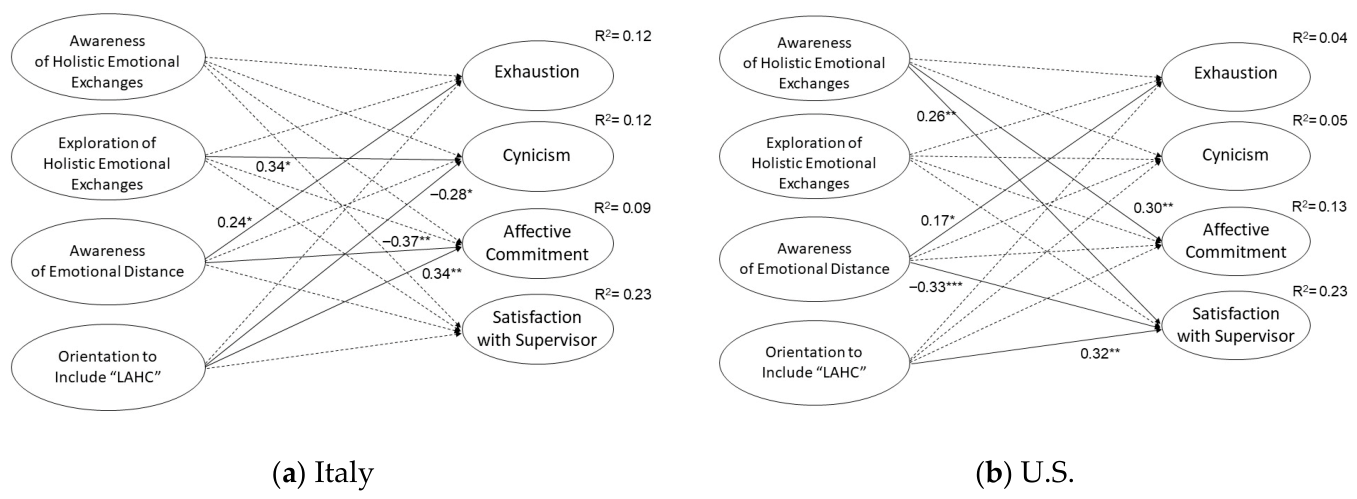
4.4.2. Structural Model for Hypothesis Testing
4.4.3. Incremental Validity
5. Discussion
5.1. Theoretical Implications
5.2. Implications for Practice
5.3. Strengths, Limitations and Future Directions
6. Conclusions
Supplementary Materials
Author Contributions
Funding
Institutional Review Board Statement
Informed Consent Statement
Data Availability Statement
Conflicts of Interest
Appendix A
| Italian Version | English Version |
| Leader Awareness of Holistic Contagion Scale | |
|
|
|
|
|
|
|
|
|
|
|
|
|
|
|
|
|
|
|
|
|
|
|
|
|
|
References
- Allen, N. J., & Meyer, J. P. (1990). The measurement and antecedents of affective, continuance and normative commitment to the organization. Journal of Occupational Psychology, 63(1), 1–18. [Google Scholar] [CrossRef]
- American Psychological Association. (2018). Awareness. APA dictionary of psychology. American Psychological Association. Available online: https://dictionary.apa.org/awareness (accessed on 12 August 2025).
- Antonopoulou, H. (2024). The value of emotional intelligence: Self-awareness, self-regulation, motivation, and empathy as key components. Technium Education and Humanities, 8, 78–92. [Google Scholar] [CrossRef]
- Arizmendi, T. G. (2011). Linking mechanisms: Emotional contagion, empathy, and imagery. Psychoanalytic Psychology, 28(3), 405–419. [Google Scholar] [CrossRef][Green Version]
- Augusty, P., & Jain, M. (2019). A meta analytic review of the relationship between emotional intelligence and leadership effectiveness. Restaurant Business, 118(9), 118–126. [Google Scholar] [CrossRef]
- Bachmann, T. (2022). Functional group positions and contact behavior in problem-solving groups. Gruppe. Interaktion. Organisation, 53, 131–144. [Google Scholar] [CrossRef]
- Bandura, A. (1986). Social foundations of thought and action: A social cognitive theory. Prentice-Hall, Inc. [Google Scholar]
- Barbuto, E. J., & Wheeler, D. W. (2006). Scale development and construct clarification of servant leadership. Group & Organization Management, 31(3), 300–326. [Google Scholar] [CrossRef]
- Barsade, S. G. (2002). The ripple effect: Emotional contagion and its influence on group behavior. Administrative Science Quarterly, 47(4), 644–675. [Google Scholar] [CrossRef]
- Bass, B. M., & Avolio, B. J. (Eds.). (1994). Improving organizational effectiveness through transformational leadership. Sage Publications, Inc. [Google Scholar]
- Belkin, L. Y. (2008). Emotional contagion in the electronic communication context in organizations. Dissertation Abstracts International Section A: Humanities and Social Sciences, 68(9–A), 3940. [Google Scholar]
- Blaszczak-Boxe, A. (2017). Too much emotional intelligence is a bad thing. Available online: https://www.scientificamerican.com/article/too-much-emotional-intelligence-is-a-bad-thing/ (accessed on 12 August 2025).
- Bono, J. E., & Ilies, R. (2006). Charisma, positive emotions and mood contagion. The Leadership Quarterly, 17(4), 317–334. [Google Scholar] [CrossRef]
- Brislin, R. (1980). Translation and content analysis of oral and written material. In H. C. Triandis, & J. W. Berry (Eds.), Handbook of cross-cultural psychology (Vol. 2, pp. 389–444). Allyn & Bacon. [Google Scholar]
- Browne, M. W., & Cudeck, R. (1993). Alternative ways of assessing model fit. In K. A. Bollen, & J. S. Long (Eds.), Testing structural equation models (pp. 136–162). Sage. [Google Scholar]
- Buhrmester, M., Kwang, T., & Gosling, S. D. (2011). Amazon’s Mechanical Turk: A new source of inexpensive, yet high-quality, data? Perspectives on Psychological Science, 6(1), 3–5. [Google Scholar] [CrossRef]
- Burleson, D. (2022). Does familiarity breed contempt? Available online: http://www.dba-oracle.com/t_familiarity_breeds_contempt.htm (accessed on 12 August 2025).
- Carmeli, A. (2003). The relationship between emotional intelligence and work attitudes, behavior and outcomes: An examination among senior managers. Journal of Managerial Psychology, 18(8), 788–813. [Google Scholar] [CrossRef]
- Chand, S. (2019). Getting too familiar. Why you set the tone of your organization’s relationships. Available online: https://medium.com/practical-leadership/getting-too-familiar-e92de31d107a (accessed on 12 August 2025).
- Cheung, G. W., & Rensvold, R. B. (2002). Evaluating goodness-of-fit indexes for testing measurement invariance. Structural Equation Modeling: A Multidisciplinary Journal, 9(2), 233–255. [Google Scholar] [CrossRef]
- Cicero, L., Pierro, A., & Knippenberg, D. L. (2010). Leadership and uncertainty: How role ambiguity affects the relationship between leader group prototypicality and leadership effectiveness. British Journal of Management, 21, 411–421. [Google Scholar] [CrossRef]
- Cicero, L., Pierro, A., & van Knippenberg, D. (2007). Leader group prototypicality and job satisfaction: The moderating role of job stress and team identification. Group Dynamics: Theory, Research, and Practice, 11(3), 165–175. [Google Scholar] [CrossRef]
- Colquitt, J. A., Sabey, T. B., Rodell, J. B., & Hill, E. T. (2019). Content validation guidelines: Evaluation criteria for definitional correspondence and definitional distinctiveness. Journal of Applied Psychology, 104(10), 1243–1265. [Google Scholar] [CrossRef]
- Cortina, J. M., Sheng, Z., Keener, S. K., Keeler, K. R., Grubb, L. K., Schmitt, N., Tonidandel, S., Summerville, K. M., Heggestad, E. D., & Banks, G. C. (2020). From alpha to omega and beyond! A look at the past, present, and (possible) future of psychometric soundness in the Journal of Applied Psychology. Journal of Applied Psychology, 105(12), 1351–1381. [Google Scholar] [CrossRef]
- Cronbach, L. J. (1946). Response sets and test validity. Educational and Psychological Measurement, 6, 475–494. [Google Scholar] [CrossRef]
- Dasborough, M. T., Ashkanasy, N. M., Tee, E. Y. J., & Tse, H. H. M. (2009). What goes around comes around: How meso-level negative emotional contagion can ultimately determine organizational attitudes toward leaders. The Leadership Quarterly, 20(4), 571–585. [Google Scholar] [CrossRef]
- Deffner, D., Rohrer, J. M., & McElreath, R. (2022). A causal framework for cross-cultural generalizability. Advances in Methods and Practices in Psychological Science, 5(3), 25152459221106366. [Google Scholar] [CrossRef]
- Dienesch, R. M., & Liden, R. C. (1986). Leader-Member Exchange model of leadership: A Critique and further development. Academy of Management Review, 11(3), 618–634. [Google Scholar] [CrossRef]
- Dinh, J. E., Lord, R. G., Gardner, W. L., Meuser, J. D., Liden, R. C., & Hu, J. (2014). Leadership theory and research in the new millennium: Current theoretical trends and changing perspectives. The Leadership Quarterly, 25(1), 36–62. [Google Scholar] [CrossRef]
- Dong, Q., & Howard, T. (2006). Emotional intelligence, trust, and job satisfaction. Competition Forum, 4, 381–388. [Google Scholar]
- Edmondson, A. C., & Mortensen, M. (2021). What psychological safety looks like in a hybrid workplace. Harvard Business Review, 3, 1–8. Available online: https://hbr.org/2021/04/what-psychological-safety-looks-like-in-a-hybrid-workplace (accessed on 12 August 2025).
- Eisinga, R., te Grotenhuis, M., & Pelzer, B. (2013). The reliability of a two-item scale: Pearson, Cronbach, or Spearman-Brown? International Journal of Public Health, 58(4), 637–642. [Google Scholar]
- Eller, A., Koschate, M., & Gilson, K.-M. (2011). Embarrassment: The ingroup–outgroup audience effect in faux pas situations. European Journal of Social Psychology, 41, 489–500. [Google Scholar] [CrossRef]
- Fisk, G. M., & Friesen, J. P. (2012). Perceptions of leader emotion regulation and LMX as predictors of followers’ job satisfaction and organizational citizenship behaviors. The Leadership Quarterly, 23(1), 1–12. [Google Scholar] [CrossRef]
- Flaxington, B. (2013). When employees get too friendly with clients. Available online: https://www.advisorperspectives.com/articles/2013/03/26/when-employees-get-too-friendly-with-clients (accessed on 12 August 2025).
- Furtner, M. R., Rauthmann, J. F., & Sachse, P. (2010). The socioemotionally intelligent self-leader: Examining relations between self-leadership and socioemotional intelligence. Social Behavior & Personality: An International Journal, 38(9), 1191–1196. [Google Scholar]
- Gardner, W. L., & Avolio, B. J. (1998). The charismatic relationship: A dramaturgical perspective. The Academy of Management Review, 23(1), 32–58. [Google Scholar] [CrossRef]
- Gardner, W. L., Avolio, B. J., Luthans, F., May, D. R., & Walumbwa, F. (2005). “Can you see the real me?” A self-based model of authentic leader and follower development. The Leadership Quarterly, 16(3), 343–372. [Google Scholar] [CrossRef]
- George, J. M. (2000). Emotions and leadership: The role of emotional intelligence. Human Relations, 53(8), 1027–1055. [Google Scholar] [CrossRef]
- Goleman, D. (1995). Emotional intelligence. Bantam Books, Inc. [Google Scholar]
- Goleman, D., Boyatzis, R., & McKee, A. (2002). Primal leadership: Realizing the power of emotional intelligence. Harvard Business School Press. [Google Scholar]
- Graen, G. B., & Uhl-Bien, M. (1995). Relationship-Based Approach to Leadership: Development of Leader-Member-Exchange (LMX) Theory of leadership over 25 Years: Appling a Multi-Level Multi-Domain Perspective. The Leadership Quarterly, 6(2), 219–247. [Google Scholar] [CrossRef]
- Grant, A. (2014). The dark side of emotional intelligence. Available online: https://www.theatlantic.com/health/archive/2014/01/the-dark-side-of-emotional-intelligence/282720/ (accessed on 12 August 2025).
- Greenleaf, R. K. (1998). The power of servant leadership. San Berrett-Koehler Publishers, Inc. [Google Scholar]
- Halimah, M. Y., Hamdan, A. K., & Mastura, M. (2014). The role of emotions in leadership. Asian Social Science, 10(10), 41–49. [Google Scholar] [CrossRef]
- Hancock, A. J., Gellatly, I. R., Walsh, M. M., Arnold, K. A., & Connelly, C. E. (2023). Good, bad, and ugly leadership patterns: Implications for followers’ work-related and context-free outcomes. Journal of Management, 49(2), 640–676. [Google Scholar] [CrossRef]
- Harms, P., Crede, M., Tynan, M., Leon, M., & Jeung, W. (2016). Leadership and stress: A meta-analytic review. The Leadership Quarterly, 28(1), 178–194. [Google Scholar] [CrossRef]
- Hatfield, E., Cacioppo, J. T., & Rapson, R. L. (1993). Emotional contagion. Current Directions in Psychological Science, 2(3), 96–99. [Google Scholar] [CrossRef]
- Hatfield, E., Cacioppo, J. T., & Rapson, R. L. (1994). Emotional contagion. Cambridge University Press. [Google Scholar]
- Hinkin, T. R. (1998). A brief tutorial on the development of measures for use in survey questionnaires. Organizational Research Methods, 1, 104–121. [Google Scholar] [CrossRef]
- Hogg, M. A. (2001). A social identity theory of leadership. Personality and Social Psychology Review, 5, 184–200. [Google Scholar] [CrossRef]
- Hu, L., & Bentler, P. M. (1998). Fit indices in covariance structure modeling: Sensitivity to underparameterized model misspecification. Psychological Methods, 3(4), 424–453. [Google Scholar] [CrossRef]
- Hu, L., & Bentler, P. M. (1999). Cutoff criteria for fit indexes in covariance structure analysis: Conventional criteria versus new alternatives. Structural Equation Modeling, 6(1), 1–55. [Google Scholar] [CrossRef]
- Hubbart, J. A. (2024). Understanding and mitigating leadership fear-based behaviors on employee and organizational success. Administrative Sciences, 14(9), 225. [Google Scholar] [CrossRef]
- Inness, M., Leblanc, M. M., & Barling, J. (2008). Psychosocial predictors of supervisor, peer, subordinate, and service provider targeted aggression. Journal of Applied Psychology, 93, 1401–1411. [Google Scholar] [CrossRef] [PubMed]
- Ismail, A., Shaik, A. R., Som, H. M., Saludin, M. N., Mohamed, H. A. B., Nordin, R., & Zainudin, N. F. A. (2010, June 8–10). Relationship between leaders and followers as a predictor of organizational commitment job satisfaction. 5th National Human Resource Management Conference, Kuala Terengganu, Malaysia. [Google Scholar]
- Jex, S. M., & Britt, T. W. (2008). Organizational Psychology: A scientist-practitioner approach (2nd ed.). John Wiley & Sons. [Google Scholar]
- Kaiser, R. B., Hogan, R., & Craig, S. B. (2008). Leadership and the fate of organizations. American Psychologist, 63(2), 96–110. [Google Scholar] [CrossRef]
- Kelley, R. (1988). In praise of followers. Harvard Business Review, 66, 142–148. [Google Scholar]
- Kelman, H. (1958). Compliance, identification, and internalization: Three processes of attitude change. Journal of Conflict Resolution, 2(1), 51–60. [Google Scholar] [CrossRef]
- Kerr, R., Garvin, J., Heaton, N., & Boyle, E. (2006). Emotional intelligence and leadership effectiveness. Leadership and Organization Development Journal, 27(4), 265–279. [Google Scholar] [CrossRef]
- Kerrissey, M. J., Hayirli, T. C., Bhanja, A., Stark, N., Hardy, J., & Peabody, C. R. (2022). How psychological safety and feeling heard relate to burnout and adaptation amid uncertainty. Health Care Management Review, 47(4), 308–316. [Google Scholar] [CrossRef]
- Kock, F., Berbekova, A., Assaf, A. G., & Josiassen, A. (2024). Developing a scale is not enough: On the importance of nomological validity. International Journal of Contemporary Hospitality Management, 36(10), 3233–3244. [Google Scholar] [CrossRef]
- Kock, N., Mayfield, M., Mayfield, J., Sexton, S., & De La Garza, L. M. (2019). Empathetic leadership: How leader emotional support and understanding influences follower performance. Journal of Leadership & Organizational Studies, 26(2), 217–236. [Google Scholar]
- Konting, M. M., Kamaruddin, N., & Man, N. A. (2009). Quality assurance in higher education institutions: Exist survey among Universiti Putra Malaysia graduating students. International Education Studies, 2(1), 25–31. [Google Scholar] [CrossRef]
- Koole, S. L., Jostmann, N. B., & Baumann, N. (2023). From intentions to action: An integrative review of action control theory and research. In B. Gawronski (Ed.), Advances in experimental social psychology (Advances in Experimental Social Psychology, Vol. 68, pp. 291–375). Elsevier. [Google Scholar]
- Kunnanatt, J. T. (2004). Emotional intelligence: The new science of interpersonal effectiveness. Human Resource Development Quarterly, 15, 489–496. [Google Scholar] [CrossRef]
- LeDoux, J. (2002). Synaptic self: How our brains become who we are. Viking. [Google Scholar]
- Little, T. D., Cunningham, W. A., Shahar, G., & Widaman, K. F. (2002). To parcel or not to parcel: Exploring the question, weighing the merits. Structural Equation Modeling: A Multidisciplinary Journal, 9(2), 151–173. [Google Scholar] [CrossRef]
- Locke, E. A. (1976). The nature and causes of job satisfaction. In M. D. Dunnette (Ed.), Handbook of industrial and organizational psychology (pp. 1297–1343). Rand McNally. [Google Scholar]
- Lubbadeh, T. (2020). Emotional intelligence and leadership—The dark and bright sides. Modern Management Review, 25, 39–50. [Google Scholar] [CrossRef]
- Madanchian, M., Hussein, N., Noordin, F., & Taherdoost, H. (2017). Leadership effectiveness measurement and its effect on organization outcomes. Procedia Engineering, 181, 1043–1048. [Google Scholar] [CrossRef]
- Maleka, J. M. (2024). Leadership styles: A reverse approach to driving business performance. In C. Radu (Ed.), Contemporary perspectives on organizational behaviour. IntechOpen. [Google Scholar] [CrossRef]
- Marsh, H. W., Hau, K.-T., Balla, J. R., & Grayson, D. (1998). Is more ever too much? The number of indicators per factor in confirmatory factor analysis. Multivariate Behavioral Research, 33(2), 181–220. [Google Scholar] [CrossRef]
- Maslach, C. (2003). Job burnout: New directions in research and intervention. Current Directions in Psychological Science, 12(5), 189–192. [Google Scholar] [CrossRef]
- Maslach, C., & Leiter, M. P. (2008). Early predictors of job burnout and engagement. Journal of Applied Psychology, 93(3), 498–512. [Google Scholar] [CrossRef]
- Mayer, J. D., Salovey, P., & Caruso, D. (2000). Models of emotional intelligence. In R. J. Sternberg (Ed.), Handbook of intelligence (pp. 396–420). Cambridge University Press. [Google Scholar]
- McGrath, M. (2025). Stop employee burnout: The role of emotional intelligence. Available online: https://hiringandempowering.com/stop-employee-burnout-the-role-of-emotional-intelligence/ (accessed on 12 August 2025).
- Meredith, W. (1993). Measurement invariance, factor analysis and factorial invariance. Psychometrika, 58(4), 525–543. [Google Scholar] [CrossRef]
- Murphy, K. R., & Davidshofer, C. O. (1988). Psychological testing. Prentice-Hall Inc. [Google Scholar]
- Muss, C., Tüxen, D., & Fürstenau, B. (2025). Empathy in leadership: A systematic literature review on the effects of empathetic leaders in organizations. Management Review Quarterly, 76(1), 333–369. [Google Scholar] [CrossRef]
- Muthén, L. K., & Muthén, B. O. (2015). Mplus user’s guide: Statistical analysis with latent variables (7th ed.). Muthén & Muthén. (Original work published 1998). [Google Scholar]
- Nesler, M., Quigley, B., Lee, S., & Tedeschi, J. (1999). The development and validation of a scale measuring global social power based on French and raven’s power taxonomy1. Journal of Applied Social Psychology, 29, 750–769. [Google Scholar] [CrossRef]
- Nyklíček, I., & Denollet, J. (2009). Development and evaluation of the balanced index of psychological mindedness (BIPM). Psychological Assessment, 21(1), 32–44. [Google Scholar] [CrossRef]
- Pellegrini, E. K., Scandura, T. A., & Jayaraman, V. (2010). Cross-cultural generalizability of paternalistic leadership: An expansion of leader-member exchange theory. Group and Organization Management, 35(4), 391–420. [Google Scholar] [CrossRef]
- Petitta, L., & Borgogni, L. (2011). Differential correlates of group and organizational collective efficacy. European Psychologist, 16(3), 187–197. [Google Scholar] [CrossRef]
- Petitta, L., Lo Castro, I., & Guerriero, A. (2023). Familiarity at work: Awesome or contempt? Assessing the interplay among familiarity, leadership and team identification. Behavioral Sciences, 13(12), 974. [Google Scholar] [CrossRef]
- Petitta, L., & Naughton, S. (2015). Mapping the association of emotional contagion to leaders, colleagues, and clients: Implications for leadership. Organization Management Journal, 12(3), 178–192. [Google Scholar] [CrossRef]
- Petitta, L., Probst, T., Ghezzi, V., & Barbaranelli, C. (2021). Emotional contagion as a trigger for moral disengagement: Their effects on workplace injuries. Safety Science, 140(9), 105317. [Google Scholar] [CrossRef]
- Podsakoff, P. M., MacKenzie, S. B., Lee, J.-Y., & Podsakoff, N. P. (2003). Common method biases in behavioral research: A critical review of the literature and recommended remedies. Journal of Applied Psychology, 88(5), 879–903. [Google Scholar] [CrossRef]
- Podsakoff, P. M., MacKenzie, S. B., & Podsakoff, N. P. (2016). Recommendations for creating better concept definitions in the organizational, behavioral, and social sciences. Organizational Research Methods, 19(2), 159–203. [Google Scholar] [CrossRef]
- Podsakoff, P. M., McKenzie, S. B., Moorman, R. H., & Fetter, R. (1990). Trasformational leader behaviors and their effects on followers’ trust in leader, satisfaction, and organizational, citizenship behaviors. The Leadership Quarterly, 1(2), 107–142. [Google Scholar] [CrossRef]
- Pugh, S. D. (2001). Service with a smile: Emotional contagion in the service encounter. Academy of Management Journal, 44(5), 1018–1027. [Google Scholar] [CrossRef]
- Reid, A. M., Garner, L. E., Van Kirk, N., Gironda, C., Krompinger, J. W., Brennan, B. P., Mathes, B. M., Monaghan, S. C., Tifft, E. D., André, M. C., Cattie, J., Crosby, J. M., & Elias, J. A. (2017). How willing are you? Willingness as a predictor of change during treatment of adults with obsessive-compulsive disorder. Depression and Anxiety, 34(11), 1057–1064. [Google Scholar] [CrossRef]
- Sayre, G. M., Chi, N.-W., & Grandey, A. A. (2025). Surface acting loss spirals: Getting unstuck with recovery activities. Journal of Organizational Behavior, 46(5), 685–700. [Google Scholar] [CrossRef]
- Schaufeli, W. B., Leiter, M. P., Maslach, C., & Jackson, S. E. (1996). MBI-general survey. In C. Maslach, S. E. Jackson, & M. P. Leiter (Eds.), Maslach burnout inventory (3rd ed.). Consulting Psychologist Press. [Google Scholar]
- Schriesheim, C. A., Powers, K. J., Scandura, T. A., Gardiner, C. C., & Lankau, M. J. (1993). Improving construct measurement in management research: Comments and a quantitative approach for assessing the theoretical content adequacy of paper-and-pencil survey-type instruments. Journal of Management, 79, 385–417. [Google Scholar] [CrossRef]
- Sin, H. P., Nahrgang, J. D., & Morgeson, F. P. (2009). Understanding why don’t see eye to eye: An examination of leader-member exange (LMX) agreement. Journal of Applied Psychology, 94(4), 1048–1057. [Google Scholar] [CrossRef]
- Smith, P. C., Kendall, L. M., & Hulin, C. L. (1969). Measurement of satisfaction in work and retirement. Rand-McNally. [Google Scholar]
- Sowden, S., Khemka, D., & Catmur, C. (2022). Regulating mirroring of emotions: A social-specific mechanism? Quarterly Journal of Experimental Psychology (2006), 75(7), 1302–1313. [Google Scholar] [CrossRef]
- Spector, P. E. (2006). Method variance in organizational research: Truth or urban legend? Organizational Research Methods, 9(2), 221–232. [Google Scholar] [CrossRef]
- Steffens, N. K., Munt, K. A., van Knippenberg, D., Platow, M. J., & Haslam, S. A. (2021). Advancing the social identity theory of leadership: A meta-analytic review of leader group prototypicality. Organizational Psychology Review, 11(1), 35–72. [Google Scholar] [CrossRef]
- Stone, M. (1974). Cross-validatory choice and assessment of statistical predictions. Journal of the Royal Statistical Society Series B: Statistical Methodology, 36(2), 111–133. [Google Scholar] [CrossRef]
- Sy, T., Tram, S., & O’Hara, L. (2006). Relation of employee and manager emotional intelligence to job satisfaction and performance. Journal of Vocational Behavior, 68, 461–473. [Google Scholar] [CrossRef]
- Tabachnick, B. G., & Fidell, L. S. (1996). Using multivariate statistics (3rd ed.). Harper Collins. [Google Scholar]
- Tajfel, H., & Turner, J. C. (1979). An integrative theory of intergroup conflict. In S. Worchel, & W. G. Austin (Eds.), The social psychology of intergroup relations (pp. 33–47). Brooks/Cole. [Google Scholar]
- Thomas, M. (2018). Emotional intelligence of leaders and its effect on burnout in police leaders. Emerging Leadership Journeys, 11(1), 142–159. [Google Scholar]
- Thurstone, L. L. (1947). Multiple-factor analysis. University of Chicago Press. [Google Scholar]
- van Knippenberg, D., & Hogg, M. A. (2003). A social identity model of leadership effectiveness in organizations. In B. M. Staw, & R. M. Kramer (Eds.), Research in organizational behavior (Vol. 25, pp. 245–297). Elsevier. [Google Scholar]
- Walumbwa, F. O., Avolio, B. J., Gardner, W. L., Wernsing, T. S., & Peterson, S. J. (2008). Authentic leadership development and validation of a theory-based measure. Journal of Management, 34(1), 89–126. [Google Scholar] [CrossRef]
- Wong, C. S., & Law, K. S. (2002). The effects of leader and follower emotional intelligence on performance and attitude: An exploratory study. The Leadership Quarterly, 13(3), 243–274. [Google Scholar] [CrossRef]
- Yin, J., Qu, M., Liao, G., Jia, M., & Li, M. (2022). Exploring the relationships between team leader’s conflict management styles and team passion: From the emotional perspective. Frontiers in Psychology, 13, 921300. [Google Scholar] [CrossRef] [PubMed]
- York, J. (2022). EQ: Why leaders are looking for ‘emotional intelligence’. Available online: https://www.bbc.com/worklife/article/20221005-eq-why-leaders-are-looking-for-emotional-intelligence (accessed on 12 August 2025).
- Yukl, G. (2010). Leadership in Organizations (7th ed.). Pearson. [Google Scholar]
- Yukl, G. (2012). Effective leadership behavior: What we know and what questions need more attention. Academy of Management Perspectives, 26, 66–85. [Google Scholar] [CrossRef]
- Yukl, G., & van Fleet, D. D. (1992). Theory and research on leadership in organisations. In M. D. Dunnette, & L. M. Hough (Eds.), Handbook of industrial and organizational psychology (Vol. 3, pp. 147–197). Consulting Psychologists Press. [Google Scholar]

| Emotional Contagion | Empathy | Emotional Intelligence | |
|---|---|---|---|
| Conceptual Core | Transfer of emotions among individuals | Sensing and understanding others’ emotions | Managing (using) of emotions (owns and others’) |
| Focus | Involuntary absorptions of others’ emotions | Voluntary understanding | Voluntary using |
| Mechanisms |
|
|
|
| Type of Construct | Pre-reflective (automatic) resonance | Skill/disposition | Skill/disposition |
| Perspective | Relation-centered | Person-centered | Person-centered |
| Level | INTER-personal | INTRA-Individual | INTRA-Individual |
| Key Conceptual Features | Precursor of empathy | Builds on contagion | Includes empathy |
| Questions answered | Whom did I get this emotion from? | Am I understanding how the other is feeling? | How can I use this emotion? |
| LAHC | LMX | Servant Leadership | Transformational Leadership | |
|---|---|---|---|---|
| Stakeholders | Leader Followers Clients/Externals | Leader Followers | Leader Followers | Leader Followers |
| Conceptual Core | Leaders’ awareness of and willingness to manage holistic emotional exchanges among different roles in their own context (i.e., multiple stakeholders such as leaders, colleagues and clients) | Leader providing support, autonomy, affection, and responsibility to collaborators in exchange for their commitment | Leader at the service of his/her followers by emotionally supporting them and prioritizing their emotional well-being | Leader passionately inspires followers towards a common goal and motivates them to achieve it |
| Focus | Contextual dynamics of emotional exchanges beyond the leader–follower dyad | Leader–follower relationship | Followers’ needs/emotions | Follower’s motivation |
| Key features | Quality of emotional exchanges (all stakeholders) | Quality of relations (leader–follower) | Emotional support | Motivational support |
| Emotion Embeddedness | Emotion-related mechanisms (i.e., emotional contagion) intrinsically embedded in the leadership model | Emotion-related mechanisms not intrinsically embedded in the leadership model | Emotion-related mechanisms (e.g., empathy) partially considered in the leadership model | Emotion-related mechanisms not intrinsically embedded in the leadership model |
| Perspective | Relation-centered | Relation-centered | Person-centered | Person-centered |
| Level | INTER-personal | INTER-personal | INTRA-Individual | INTRA-Individual |
| Questions Answered | Whom did the followers get this emotion from? Me? Clients? Teammates? Where did this emotional ambience come from? | How is the quality of my relationship with the followers? | Am I emotionally supporting the followers? | Am I motivating and supporting followers toward common goals? |
| N | df | χ2 | χ2/df | CFI | TLI | RMSEA | SRMR | |
|---|---|---|---|---|---|---|---|---|
| Exploratory Factor Analyses (EFA) | ||||||||
| 1-factorEFA LAHCS | 746 | 65 | 1489.08 | 22.91 | 0.57 | 0.49 | 0.17 | 0.13 |
| 2-factor EFA LAHCS | 746 | 53 | 981.04 | 18.51 | 0.72 | 0.59 | 0.15 | 0.09 |
| 3-factorEFA LAHCS | 746 | 42 | 679.43 | 16.18 | 0.81 | 0.64 | 0.14 | 0.05 |
| 4-factor EFA LAHCS | 746 | 32 | 170.47 | 5.33 | 0.96 | 0.90 | 0.08 | 0.02 |
| Confirmatory Factor Analysis (CFA) | ||||||||
| CFA of LAHCS | 692 | 59 | 264.91 | 4.49 | 0.93 | 0.91 | 0.07 | 0.05 |
| CFA of other leadership scales | 1442 | 2238 | 8193.61 | 3.66 | 0.91 | 0.90 | 0.04 | 0.05 |
| Benchmark model(5-factor) | 1444 | 125 | 903.20 | 7.23 | 0.91 | 0.89 | 0.07 | 0.05 |
| Model 1 (4-factor) | 1444 | 129 | 2599.84 | 20.15 | 0.72 | 0.66 | 0.12 | 0.11 |
| Model 2 (4-factor) | 1444 | 129 | 2666.78 | 20.67 | 0.71 | 0.65 | 0.12 | 0.12 |
| Model 3 (4-factor) | 1444 | 129 | 2793.05 | 21.65 | 0.69 | 0.64 | 0.12 | 0.13 |
| Model 4 (4-factor) | 1444 | 129 | 2504.38 | 19.41 | 0.73 | 0.68 | 0.11 | 0.11 |
| Model 5 (1-factor) | 1444 | 135 | 4648.17 | 34.43 | 0.48 | 0.41 | 0.15 | 0.14 |
| M | SD | α | 1 | 2 | 3 | 4 | |
|---|---|---|---|---|---|---|---|
| 1. Exploration | 1.74 (1.77) | 0.75 (0.75) | 0.87 (0.86) | 0.46 ** | 0.55 ** | 0.09 * | |
| 2. Behavioral Change | 2.37 (2.42) | 1.13 (1.09) | 0.90 (0.86) | 0.45 ** | 0.52 | −0.14 ** | |
| 3. Emotional Exchange Awareness | 2.10 (2.14) | 0.96 (0.98) | 0.86 (0.85) | 0.54 ** | 0.59 ** | 0.04 | |
| 4. Distance Awareness | 2.72 (2.72) | 1.27 (1.28) | 0.85 (0.81) | 0.18 ** | −0.01 | 0.04 |
| Variable | LAHCS | |||
|---|---|---|---|---|
| Awareness of Holistic Emotional Exchanges | Exploration of Holistic Emotional Exchanges | Awareness of Distance | Includes LAHCS | |
| 1. Group Member Prototypicality | 0.21 ** | 0.12 ** | 0.02 | 0.26 ** |
| 2. Leader Group Prototypicality | 0.30 ** | 0.28 ** | −0.27 | 0.49 ** |
| 3. Transformational Leadership | 0.48 ** | 0.35 ** | −0.24 ** | 0.57 ** |
| 4. Transactional Leadership | 0.46 ** | 0.35 ** | −0.31 ** | 0.55 ** |
| 5. Leader–Member Exchange | 0.45 ** | 0.34 ** | −0.32 ** | 0.56 ** |
| 6. Authentic Leader | 0.46 ** | 0.37 ** | −0.21 ** | 0.56 ** |
| 7. Servant Leadership | 0.46 ** | 0.39 ** | −0.30 ** | 0.52 ** |
| M | SD | α | 1 | 2 | 3 | 4 | 5 | 6 | 7 | 8 | |
|---|---|---|---|---|---|---|---|---|---|---|---|
| 1. Exploration | 2.33 (1.78) | 0.82 (0.94) | 0.84 (0.92) | 0.57 ** | 0.59 ** | 0.36 ** | −0.03 | −0.04 | 0.09 | 0.21 ** | |
| 2. Behavioral Change | 2.71 (2.45) | 0.89 (1.10) | 0.79 (0.88) | 0.43 ** | 0.62 ** | 0.28 ** | −0.10 | −0.11 * | 0.29 ** | 0.28 ** | |
| 3. Emotional Exchange Awareness | 2.57 (2.43) | 1.00 (1.07) | 0.86 (0.90) | 0.57 ** | 0.53 ** | 0.31 ** | −0.09 | −0.11 * | 0.24 ** | 0.32 ** | |
| 4. Distance Awareness | 2.89 (2.58) | 1.07 (1.23) | 0.75 (0.76) | 0.24 ** | 0.00 | −0.02 | 0.09 | 0.02 | −0.15 ** | 0.08 | |
| 5. Emotional Exhaustion | 2.02 (3.58) | 1.26 (1.73) | 0.86 (0.95) | 0.28 ** | −0.02 | 0.20 * | 0.22 * | 0.72 ** | −0.36 ** | −0.40 ** | |
| 6. Cynicism | 1.68 (3.29) | 1.32 (1.74) | 0.86 (0.92) | 0.19 | −0.10 | 0.07 | 0.25 * | 0.61 ** | −0.38 ** | −0.61 ** | |
| 7. Supervisor Satisfaction | 2.37 (2.14) | 0.67 (0.87) | 0.75 (0.84) | 0.00 | 0.26 ** | 0.13 | −0.42 ** | −0.31 ** | −0.50 ** | 0.36 ** | |
| 8. Affective Commitment | 4.81 (4.25) | 1.02 (1.34) | 0.77 (0.88) | −0.19 | 0.22 * | 0.04 | −0.30 ** | −0.17 | −0.40 ** | 0.51 ** |
| Models (M) | Model Fit | Model Difference | |||||||
|---|---|---|---|---|---|---|---|---|---|
| χ2 | df | RMSEA | CFI | SRMR | ΔM | ΔCFI | Δdf | Δχ2 | |
| ModelItaly | 71.59 | 59 | 0.045 | 0.97 | 0.059 | ||||
| ModelUSA | 146.69 | 59 | 0.064 | 0.96 | 0.041 | ||||
| M1: Configural | 226.07 | 118 | 0.062 | 0.96 | 0.045 | ||||
| M2: Metric | 242.49 | 127 | 0.062 | 0.96 | 0.055 | M2-M1 | 0.00 | 9 | 16.42 |
| M3: Scalar | 250.66 | 136 | 0.060 | 0.96 | 0.055 | M3-M2 | 0.00 | 9 | 8.17 |
| M4: Residual | 297.10 | 149 | 0.065 | 0.95 | 0.065 | M4-M3 | 0.01 | 13 | 46.44 ** |
| Italian Sample | ||||||||
| Model | R | R2 | Adjusted R2 | Change Statistics | ||||
| R2 Change | F Change | df1 | df2 | Sig. F Change | ||||
| Job Burnout | ||||||||
| Step 1 | 0.259 (a) | 0.067 | 0.036 | 0.067 | 2.129 | 6 | 177 | 0.052 |
| Step 2 | 0.375 (b) | 0.140 | 0.106 | 0.073 | 14.934 | 1 | 176 | 0.000 |
| Affective Commitment | ||||||||
| Step 1 | 0.517 (a) | 0.267 | 0.243 | 0.267 | 10.997 | 6 | 181 | 0.000 |
| Step 2 | 0.585 (b) | 0.342 | 0.316 | 0.075 | 20.395 | 1 | 180 | 0.000 |
| Satisfaction with Supervisor | ||||||||
| Step 1 | 0.496 (a) | 0.246 | 0.221 | 0.246 | 9.684 | 6 | 178 | 0.000 |
| Step 2 | 0.533 (b) | 0.256 | 0.256 | 0.038 | 9.354 | 1 | 177 | 0.003 |
| U.S. Sample | ||||||||
| Model | R | R2 | Adjusted R2 | Change Statistics | ||||
| R2 Change | F Change | df1 | df2 | Sig. F Change | ||||
| Job Burnout | ||||||||
| Step 1 | 0.451 (a) | 0.203 | 0.189 | 0.203 | 14.591 | 6 | 343 | 0.000 |
| Step 2 | 0.465 (b) | 0.216 | 0.200 | 0.013 | 5.532 | 1 | 342 | 0.019 |
| Affective Commitment | ||||||||
| Step 1 | 0.571 (a) | 0.326 | 0.314 | 0.326 | 27.669 | 6 | 344 | 0.000 |
| Step 2 | 0.572 (b) | 0.328 | 0.314 | 0.002 | 1.023 | 1 | 343 | 0.313 |
| Satisfaction with Supervisor | ||||||||
| Step 1 | 0.694 (a) | 0.482 | 0.473 | 0.482 | 54.635 | 6 | 352 | 0.000 |
| Step 2 | 0.706 (b) | 0.499 | 0.489 | 0.017 | 11.594 | 1 | 351 | 0.001 |
Disclaimer/Publisher’s Note: The statements, opinions and data contained in all publications are solely those of the individual author(s) and contributor(s) and not of MDPI and/or the editor(s). MDPI and/or the editor(s) disclaim responsibility for any injury to people or property resulting from any ideas, methods, instructions or products referred to in the content. |
© 2026 by the authors. Published by MDPI on behalf of the University Association of Education and Psychology. Licensee MDPI, Basel, Switzerland. This article is an open access article distributed under the terms and conditions of the Creative Commons Attribution (CC BY) license.
Share and Cite
Petitta, L.; Jiang, L. Integrating Emotional Contagion into Leadership Theorizing: Development and Validation of the Leader Awareness of Holistic Contagion Scale. Eur. J. Investig. Health Psychol. Educ. 2026, 16, 61. https://doi.org/10.3390/ejihpe16050061
Petitta L, Jiang L. Integrating Emotional Contagion into Leadership Theorizing: Development and Validation of the Leader Awareness of Holistic Contagion Scale. European Journal of Investigation in Health, Psychology and Education. 2026; 16(5):61. https://doi.org/10.3390/ejihpe16050061
Chicago/Turabian StylePetitta, Laura, and Lixin Jiang. 2026. "Integrating Emotional Contagion into Leadership Theorizing: Development and Validation of the Leader Awareness of Holistic Contagion Scale" European Journal of Investigation in Health, Psychology and Education 16, no. 5: 61. https://doi.org/10.3390/ejihpe16050061
APA StylePetitta, L., & Jiang, L. (2026). Integrating Emotional Contagion into Leadership Theorizing: Development and Validation of the Leader Awareness of Holistic Contagion Scale. European Journal of Investigation in Health, Psychology and Education, 16(5), 61. https://doi.org/10.3390/ejihpe16050061

