Systematic Review

Experiential Avoidance and Psychoactive Substance Use: Systematic Review

by
Gabriela Sequeda
1,*,
Sandra Durán-Rondón
1,
Johan E. Acosta-López
2,
Eduardo-Andrés Torres-Santos
1 and
Diego Rivera-Porras
3,*
1
Universidad Simón Bolívar, Facultad de Ciencias Jurídicas y Sociales, Grupo de Investigación en Modelamiento Científico e Innovación Empresarial, Cúcuta 540001, Colombia
2
Universidad Simón Bolívar, Facultad de Ciencias Jurídicas y Sociales, Centro de Investigaciones en Ciencias de la Vida, Barranquilla 080005, Colombia
3
Universidad de la Costa, Departamento de Productividad e Innovación, Barranquilla 080001, Colombia
*
Authors to whom correspondence should be addressed.
Eur. J. Investig. Health Psychol. Educ. 2026, 16(2), 22; https://doi.org/10.3390/ejihpe16020022

Submission received: 20 November 2025 / Revised: 28 January 2026 / Accepted: 4 February 2026 / Published: 11 February 2026

Abstract

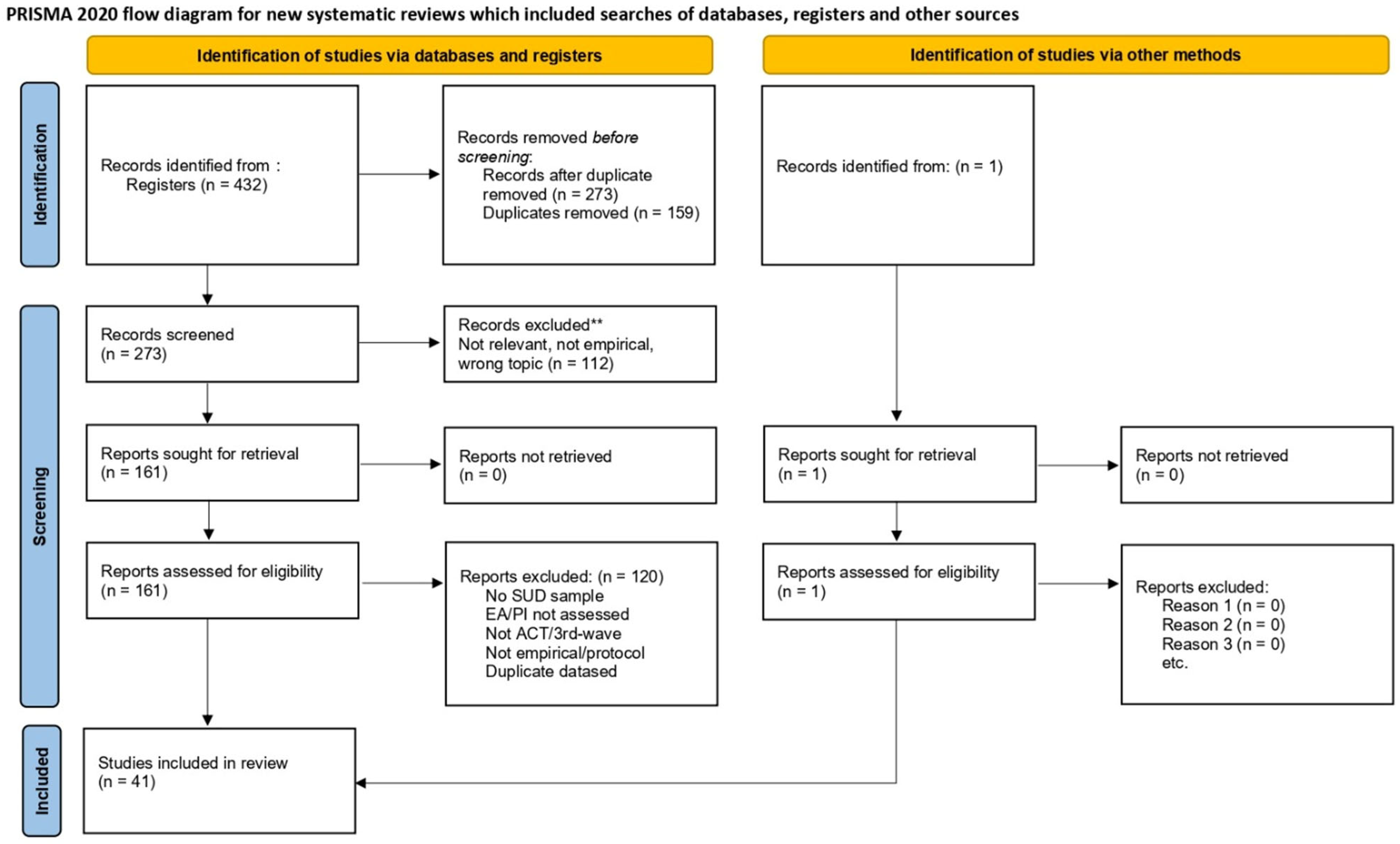
Background: Experiential avoidance (EA) refers to the tendency to evade or suppress unpleasant internal experiences, such as distressing thoughts, emotions, or bodily sensations. Increasing evidence indicates that EA plays a central role in the onset and maintenance of addictive behaviours. Objective: To synthesise quantitative evidence on the association between experiential avoidance (EA), operationalised as psychological inflexibility, and psychoactive substance use (PSU) outcomes, including substance use frequency/quantity, craving, dependence severity, relapse/abstinence, and treatment response, and to characterise putative pathways (EA as predictor/mediator) and correlates (e.g., affect regulation and trauma-related factors). Methods: A systematic search was conducted in SCOPUS, Web of Science, PubMed, and APA PsycNet, following PRISMA 2020 guidelines. Eligible studies included experimental and observational designs, clinical and non-clinical populations, and publications from January 2000 to January 2026 in English or Spanish. Primary outcomes were PSU behaviour and severity (frequency/quantity, craving, dependence symptoms, relapse/abstinence) and treatment outcomes; secondary outcomes included emotional and behavioural correlates linked to EA. Results: Across studies, higher levels of EA were consistently associated with greater substance use—particularly alcohol, tobacco, cannabis, and other illicit drugs. EA frequently mediated the relationships between emotional dysregulation, trauma exposure, and addictive behaviour. Elevated EA was also linked to impulsivity, psychiatric comorbidity, and poorer treatment adherence and outcomes. Interventions explicitly targeting EA—most notably Acceptance and Commitment Therapy (ACT)—showed promising effects in reducing avoidance and substance use. Conclusions: Experiential avoidance emerges as a transdiagnostic process underlying vulnerability to, and persistence of, substance use disorders. Integrating third-wave behavioural interventions that promote psychological flexibility may enhance the efficacy of addiction treatment. Future research should explore these mechanisms in culturally diverse and under-represented contexts.
Keywords: experiential avoidance; substance use; addiction; emotion regulation; Acceptance and Commitment Therapy (ACT) experiential avoidance; substance use; addiction; emotion regulation; Acceptance and Commitment Therapy (ACT)