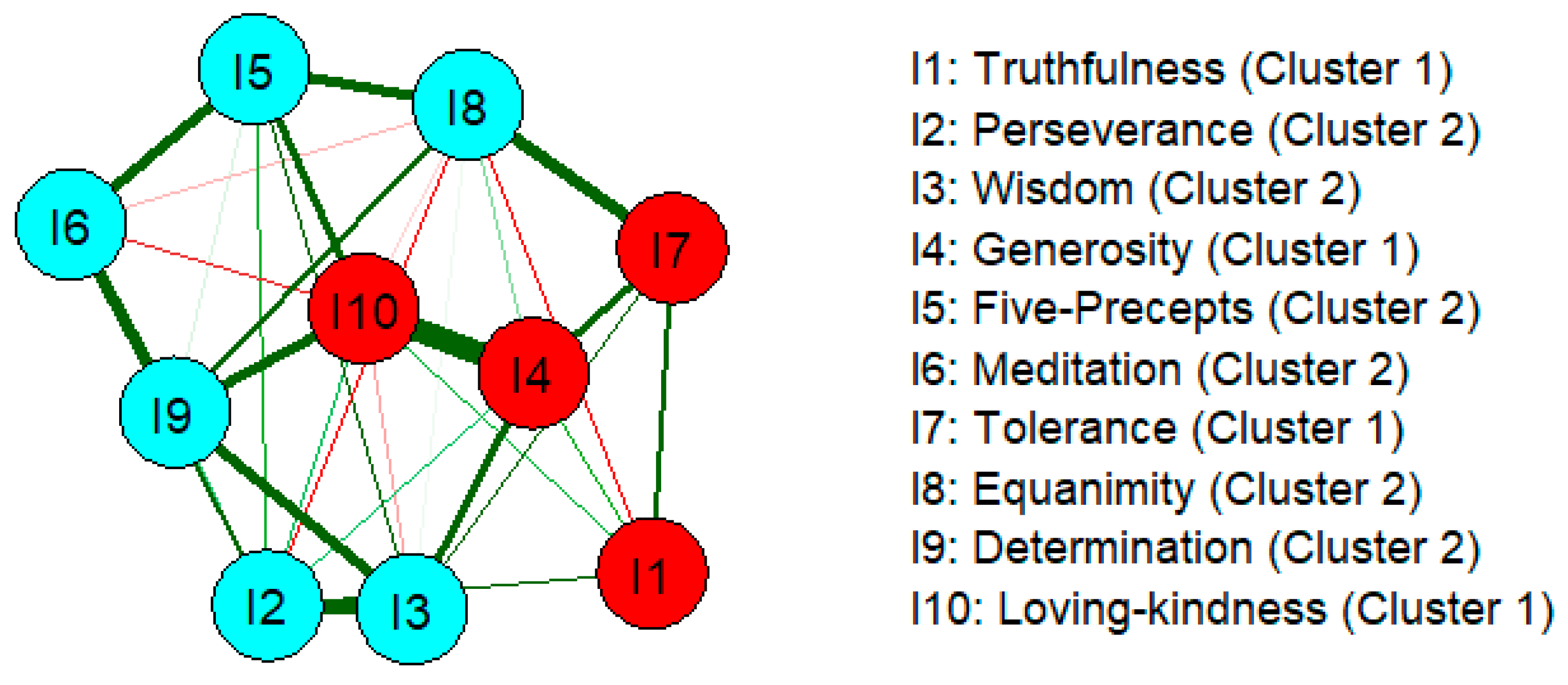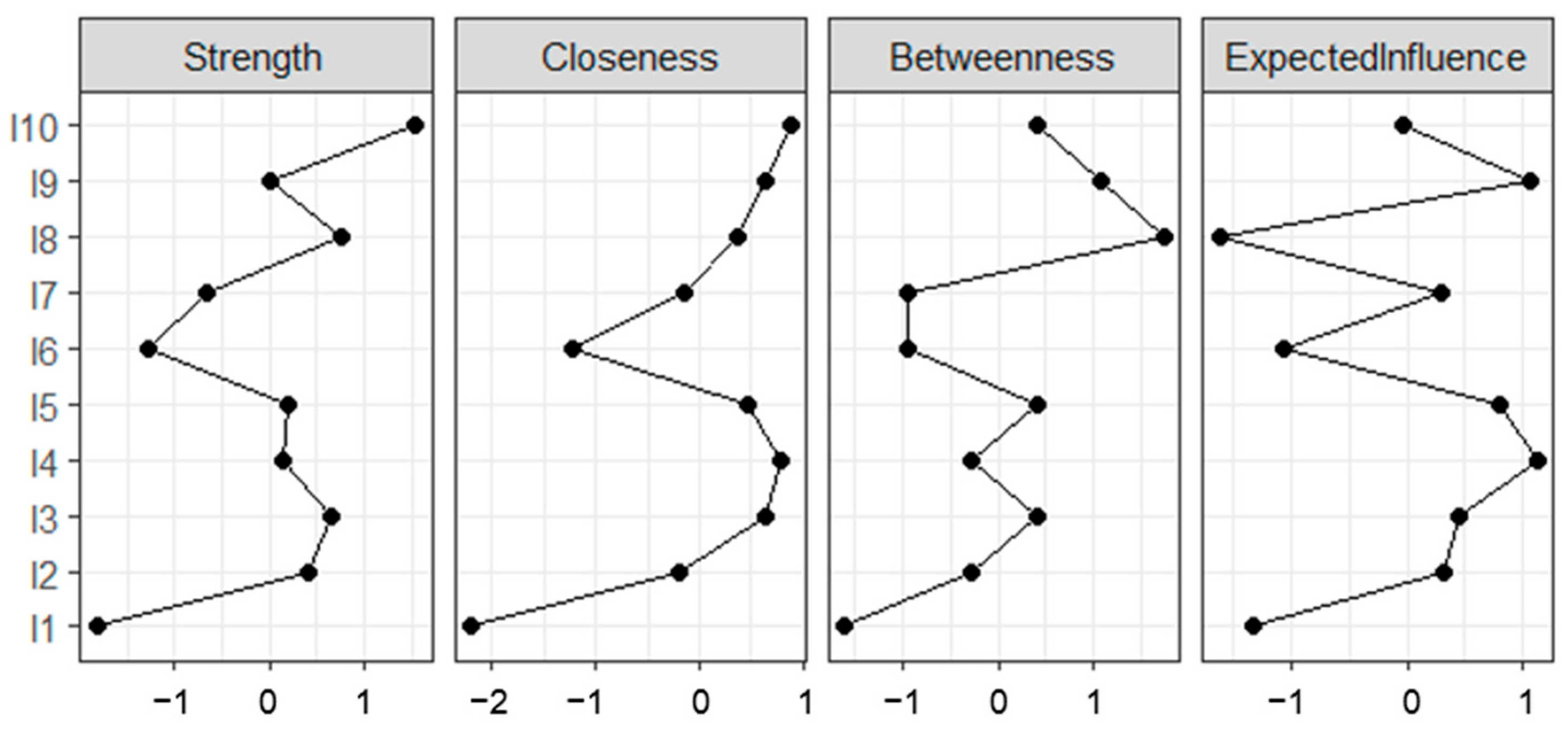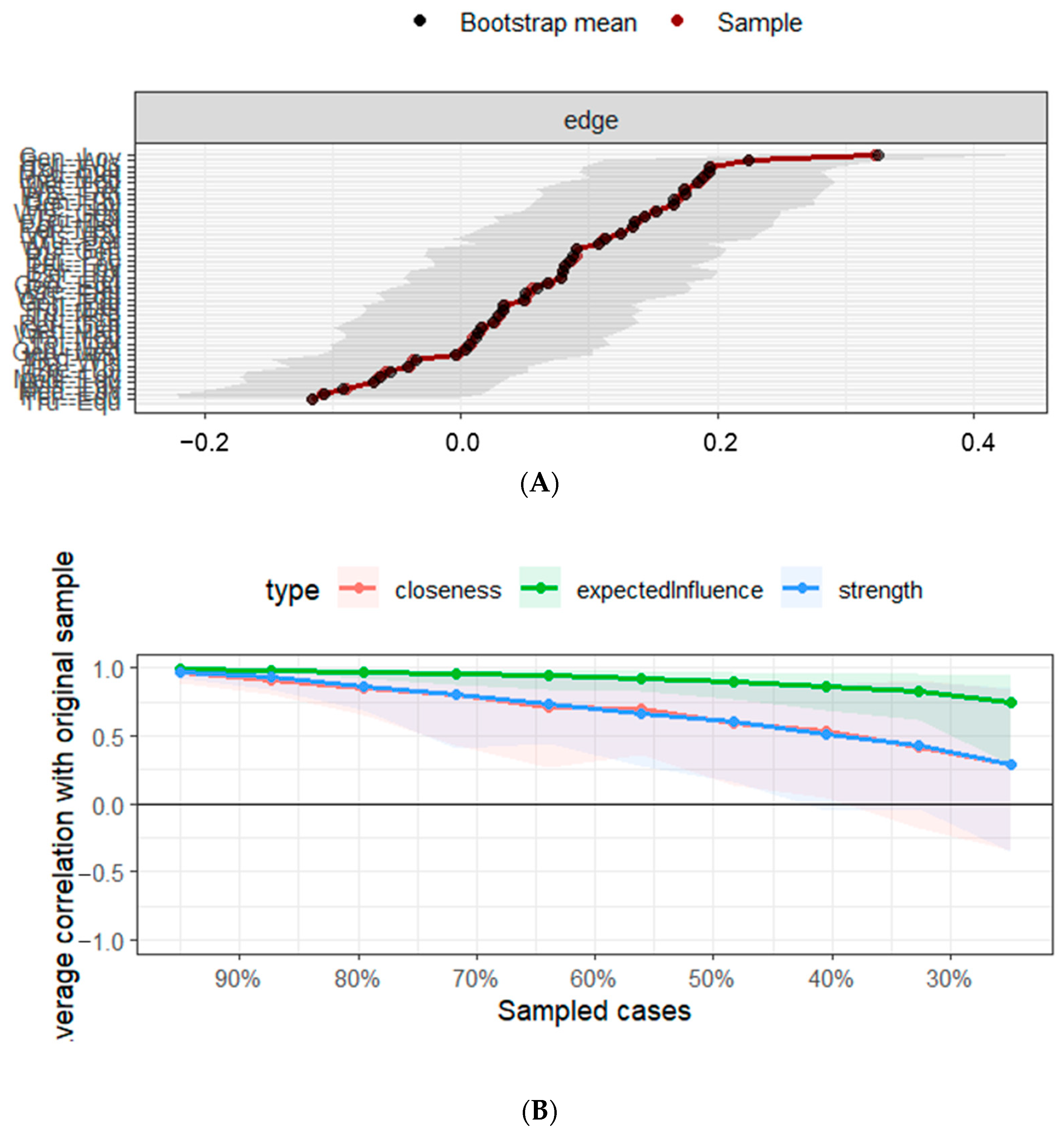

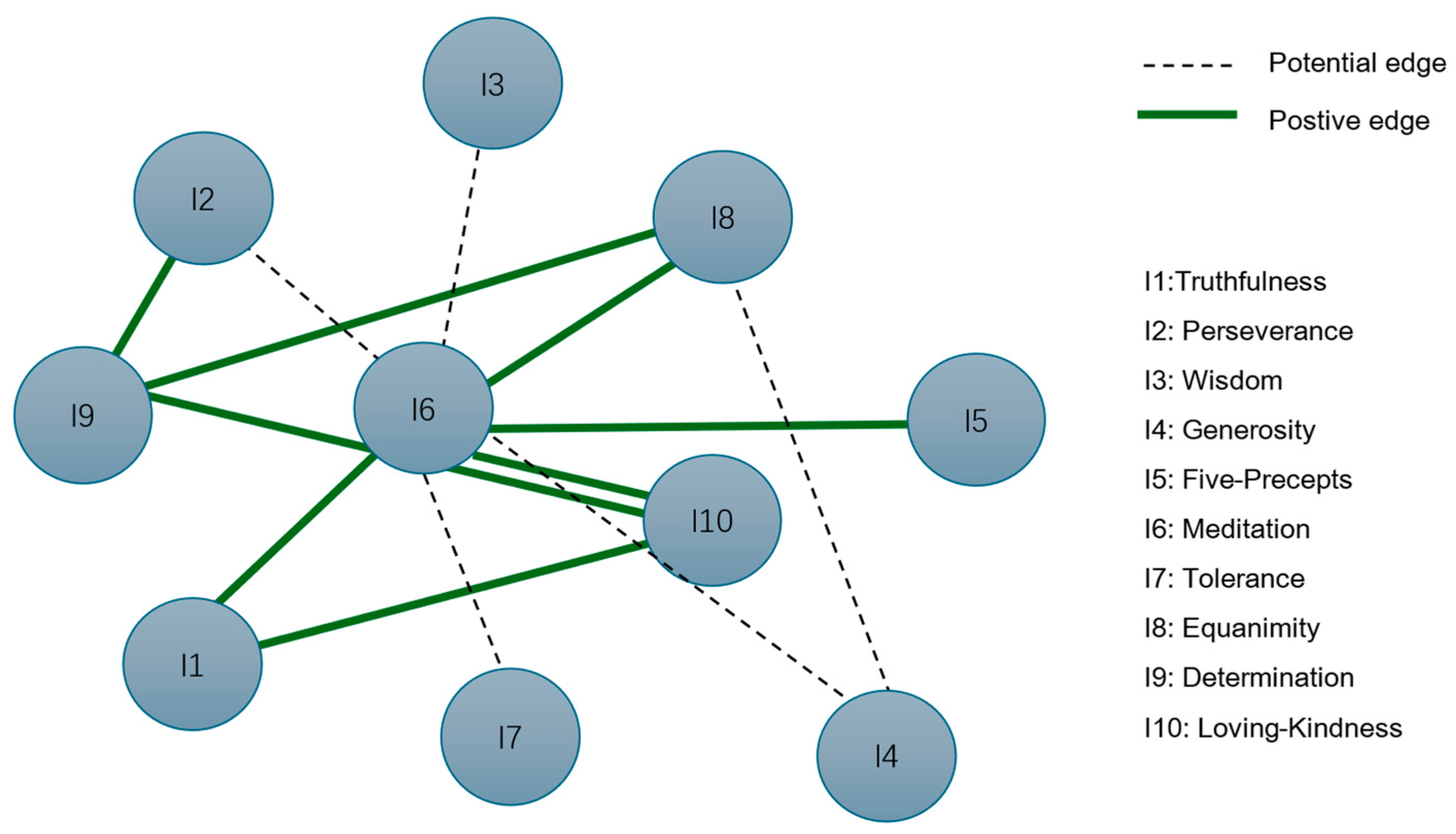
A Network Analysis of Inner Strength Among University Students with Borderline Personality Disorder Symptoms

 ,
,  ,
,  and
and 
Abstract
1. Introduction
2. Materials and Methods
2.1. Participants and Data Collection
2.2. Instruments
2.2.1. Screening Instrument for Borderline Personality Disorder (SI-Bord)
2.2.2. Inner-Strength-Based Inventory (I-SBI)
2.3. Statistical Analyses
2.3.1. Descriptive Statistical Analysis
2.3.2. Network Analysis Overview
2.3.3. Network Estimation and Visualization
2.3.4. Community Structure Detection
2.3.5. Centrality Analysis
2.3.6. Network Stability and Accuracy
3. Results
3.1. Descriptive Statistics
3.2. Network Analysis
3.3. Exploratory Network and Centrality Analyses by Sex
3.4. Network Structure and Key Associations
3.5. Centrality and Influence of Strengths
4. Discussion
4.1. Implications of the Study
4.2. Limitations and Future Study
5. Conclusions
Supplementary Materials
Author Contributions
Funding
Institutional Review Board Statement
Informed Consent Statement
Data Availability Statement
Conflicts of Interest
References
- Ariyabuddhiphongs, V. (2016). Buddhist generosity: Its conceptual model and empirical tests. Archive for the Psychology of Religion, 38(3), 316–344. [Google Scholar] [CrossRef]
- Arnett, J. J. (2000). Emerging adulthood: A theory of development from the late teens through the twenties. American Psychologist, 55(5), 469–480. [Google Scholar] [CrossRef]
- Bateman, A., & Fonagy, P. (2006). Mentalization-based treatment for borderline personality disorder: A practical guide. Oxford University Press. [Google Scholar]
- Biskin, R. S. (2015). The lifetime course of borderline personality disorder. The Canadian Journal of Psychiatry, 60(7), 303–308. [Google Scholar] [CrossRef]
- Borsboom, D., & Cramer, A. O. (2013). Network analysis: An integrative approach to the structure of psychopathology. Annual Review of Clinical Psychology, 9(1), 91–121. [Google Scholar] [CrossRef]
- Borsboom, D., Deserno, M. K., Rhemtulla, M., Epskamp, S., Fried, E. I., McNally, R. J., Robinaugh, D. J., Perugini, M., Dalege, J., Costantini, G., Isvoranu, A., Wysocki, A. C., van Borkulo, C. D., van Bork, R., & Waldorp, L. J. (2021). Network analysis of multivariate data in psychological science. Nature Reviews Methods Primers, 1(1), 58. [Google Scholar] [CrossRef]
- Breiger, R. L., Boorman, S. A., & Arabie, P. (1975). An algorithm for clustering relational data with applications to social network analysis and comparison with multidimensional scaling. Journal of Mathematical Psychology, 12(3), 328–383. [Google Scholar] [CrossRef]
- Buddhaghosa, B. (2020). The path of purification: Visuddhimagga. Pariyatti. [Google Scholar]
- Cano, K., Sumlin, E., & Sharp, C. (2022). Screening for borderline personality pathology on college campuses. Personality and Mental Health, 16(3), 235–243. [Google Scholar] [CrossRef]
- Castro, D., Ferreira, F., de Castro, I., Rodrigues, A. R., Correia, M., Ribeiro, J., & Ferreira, T. B. (2019). The differential role of central and bridge symptoms in deactivating psychopathological networks. Frontiers in Psychology, 10, 2448. [Google Scholar] [CrossRef]
- Csikszentmihalyi, M., & Seligman, M. (2000). Positive psychology. American Psychologist, 55(1), 5–14. [Google Scholar] [CrossRef]
- Deng, Y., Du, T., Zeng, X., & Wang, W. (2025). Kindness is lesser preferable than happiness: Investigating interest in different effects of the loving-kindness and compassion meditations. BMC Psychology, 13(1), 443. [Google Scholar] [CrossRef]
- Dorjey, T. (2018). An aspect of Mahāyāna Buddhist ethics: The culture of generosity (dāna). SOSHUM: Jurnal Sosial Dan Humaniora, 8(2), 176–184. [Google Scholar] [CrossRef]
- Eaton, N. R., & Greene, A. L. (2018). Personality disorders: Community prevalence and socio-demographic correlates. Current Opinion in Psychology, 21, 28–32. [Google Scholar] [CrossRef]
- Epskamp, S., Borsboom, D., & Fried, E. I. (2018). Estimating psychological networks and their accuracy: A tutorial paper. Behavior Research Methods, 50(1), 195–212. [Google Scholar] [CrossRef]
- Esmailian, P., & Jalili, M. (2015). Community detection in signed networks: The role of negative ties in different scales. Scientific Reports, 5(1), 14339. [Google Scholar] [CrossRef]
- Fernandes, B., Newton, J., & Essau, C. A. (2022). The mediating effects of self-esteem on anxiety and emotion regulation. Psychological Reports, 125(2), 787–803. [Google Scholar] [CrossRef]
- Fried, E. I., & Cramer, A. O. (2017). Moving forward: Challenges and directions for psychopathological network theory and methodology. Perspectives on Psychological Science, 12(6), 999–1020. [Google Scholar] [CrossRef]
- Glass, I. V., Frankenburg, F. R., Fitzmaurice, G. M., & Zanarini, M. C. (2024). Levels of grit in patients with borderline personality disorder: Description and prediction. Personality and Mental Health, 18(4), 414–423. [Google Scholar] [CrossRef]
- Graves, M., Penner, F., & Sharp, C. (2021). Interpersonal trust in adolescents with psychiatric disorders and borderline pathology. Scandinavian Journal of Child and Adolescent Psychiatry and Psychology, 9, 176–186. [Google Scholar] [CrossRef]
- Hevey, D. (2018). Network analysis: A brief overview and tutorial. Health Psychology and Behavioral Medicine, 6(1), 301–328. [Google Scholar] [CrossRef]
- Jia, N., Sakulsriprasert, C., Wongpakaran, N., Suradom, C., & O’ Donnell, R. (2022). Borderline personality disorder symptoms and its clinical correlates among Chinese university students: A cross-sectional study. Healthcare, 10(9), 1751. [Google Scholar] [CrossRef]
- Jijina, P., & Biswas, U. N. (2022). Various pathways for cultivation of equanimity: An exploratory study. Psychological Studies, 67(1), 28–42. [Google Scholar] [CrossRef]
- Keng, S. L., & Tan, H. H. (2018). Effects of brief mindfulness and loving-kindness meditation inductions on emotional and behavioral responses to social rejection among individuals with high borderline personality traits. Behaviour Research and Therapy, 100, 44–53. [Google Scholar] [CrossRef] [PubMed]
- Khattiya, K., Wongpakaran, T., & Wongpakaran, N. (2026). Association between pet ownership and mental health in university students with borderline personality disorder symptoms. BMC Psychiatry. [Google Scholar] [CrossRef]
- Kouklidou, A., Kouklidis, G., Dafoulis, V., & Kouklidou, A. (2025). A systematic review of risk and protective factors of borderline personality disorder. Cureus, 17(5), e85070. [Google Scholar] [CrossRef]
- Lam, K., & Seiden, D. (2020). Effects of a brief mindfulness curriculum on self-reported executive functioning and emotion regulation in Hong Kong adolescents. Mindfulness, 11(3), 627–642. [Google Scholar] [CrossRef]
- La Rosa, V. L., Ching, B. H.-H., & Commodari, E. (2025). The impact of helicopter parenting on emerging adults in higher education: A scoping review of psychological adjustment in university students. The Journal of Genetic Psychology, 186(2), 162–189. [Google Scholar] [CrossRef]
- Leichsenring, F., Heim, N., Leweke, F., Spitzer, C., Steinert, C., & Kernberg, O. F. (2023). Borderline personality disorder: A review. JAMA, 329(8), 670–679. [Google Scholar] [CrossRef]
- Leichsenring, F., Leibing, E., Kruse, J., New, A. S., & Leweke, F. (2011). Borderline personality disorder. The Lancet, 377(9759), 74–84. [Google Scholar] [CrossRef]
- Linehan, M. M. (1993). Skills training manual for treating borderline personality disorder. The Guilford Press. [Google Scholar]
- Lohanan, T., Leesawat, T., Wongpakaran, T., Wongpakaran, N., Karawekpanyawong, N., Oon-Arom, A., & Kuntawong, P. (2020). Development and validation of a screening instrument for borderline personality disorder (SI-Bord) for use among university students. BMC Psychiatry, 20(1), 479. [Google Scholar] [CrossRef]
- Lundman, B., Alex, L., Jonsen, E., Norberg, A., Nygren, B., Fischer, R. S., & Strandberg, G. (2010). Inner strength—A theoretical analysis of salutogenic concepts. International Journal of Nursing Studies, 47(2), 251–260. [Google Scholar] [CrossRef]
- Luyten, P., & Fonagy, P. (2015). The neurobiology of mentalizing. Personality Disorders: Theory, Research, and Treatment, 6(4), 366–379. [Google Scholar] [CrossRef]
- Lynch, T. R., Chapman, A. L., Rosenthal, M. Z., Kuo, J. R., & Linehan, M. M. (2006). Mechanisms of change in dialectical behavior therapy: Theoretical and empirical observations. Journal of Clinical Psychology, 62(4), 459–480. [Google Scholar] [CrossRef] [PubMed]
- Masten, A. S. (2001). Ordinary magic: Resilience processes in development. American Psychologist, 56(3), 227–238. [Google Scholar] [CrossRef] [PubMed]
- McNally, R. J. (2021). Network analysis of psychopathology: Controversies and challenges. Annual Review of Clinical Psychology, 17(1), 31–53. [Google Scholar] [CrossRef]
- Meaney, R., Hasking, P., & Reupert, A. (2016). Prevalence of borderline personality disorder in university samples: Systematic review, meta-analysis and meta-regression. PLoS ONE, 11(5), e0155439. [Google Scholar] [CrossRef]
- Meyers, L. S., Gamst, G. C., & Guarino, A. (2013). Performing data analysis using IBM SPSS. John Wiley & Sons. [Google Scholar]
- Morey, L. C., & Zanarini, M. C. (2000). Borderline personality: Traits and disorder. Journal of Abnormal Psychology, 109(4), 733–737. [Google Scholar] [CrossRef]
- Mueller, T. (2023). Development and testing of the university student resilience scale. Journal of American College Health, 71(3), 967–972. [Google Scholar] [CrossRef]
- Pigott, T. D. (2001). A review of methods for missing data. Educational Research and Evaluation, 7(4), 353–383. [Google Scholar] [CrossRef]
- Richetin, J., Preti, E., Costantini, G., & De Panfilis, C. (2017). The centrality of affective instability and identity in Borderline Personality Disorder: Evidence from network analysis. PLoS ONE, 12(10), e0186695. [Google Scholar] [CrossRef] [PubMed]
- Robinaugh, D. J., Millner, A. J., & McNally, R. J. (2016). Identifying highly influential nodes in the complicated grief network. Journal of Abnormal Psychology, 125(6), 747–757. [Google Scholar] [CrossRef]
- Southward, M. W., Howard, K. P., Christensen Pacella, K. A., & Cheavens, J. S. (2023). Protective factors in borderline personality disorder: A multi-study analysis of conscientiousness, distress tolerance, and self-compassion. Journal of Affective Disorders, 338, 589–598. [Google Scholar] [CrossRef]
- Sripunya, P., Wongpakaran, T., & Wongpakaran, N. (2024). The relationship between feelings of emptiness and self-harm among Thai patients exhibiting borderline personality disorder symptoms: The mediating role of the inner strengths. Medicina, 60(11), 1776. [Google Scholar] [CrossRef] [PubMed]
- Thavaro, V. (1982). Handbook of meditation practice (2nd ed.). Chuanpim. [Google Scholar]
- Tsai, J., & Morissette, S. B. (2022). Introduction to the special issue: Resilience and perseverance for human flourishing. Psychological Trauma: Theory, Research, Practice, and Policy, 14(S1), S1–S3. [Google Scholar] [CrossRef] [PubMed]
- Videler, A. C., Hutsebaut, J., Schulkens, J. E. M., Sobczak, S., & van Alphen, S. P. J. (2019). A life span perspective on borderline personality disorder. Current Psychiatry Reports, 21(7), 51. [Google Scholar] [CrossRef] [PubMed]
- Wongpakaran, N., Oon-Arom, A., Karawekpanyawong, N., Lohanan, T., Leesawat, T., & Wongpakaran, T. (2021). Borderline personality symptoms: What not to be overlooked when approaching suicidal ideation among university students. Healthcare, 9(10), 1399. [Google Scholar] [CrossRef]
- Wongpakaran, N., Wongpakaran, T., & Kuntawong, P. (2020). Development and validation of the (inner) strength-based inventory. Mental Health, Religion & Culture, 23(3–4), 263–273. [Google Scholar] [CrossRef]



| Characteristic | Category | Value |
|---|---|---|
| Age, M ± SD | - | 21.60 ± 2.24 |
| Gender, n (%) | Male | 88 (25.4%) |
| Female | 258 (74.6%) | |
| Year of Study, n (%) | 1st year | 33 (9.5%) |
| 2nd year | 85 (24.6%) | |
| 3rd year | 95 (27.5%) | |
| 4th year | 75 (21.7%) | |
| Above 4th year | 58 (16.8%) |
| Variables | Mean (SD) | Min | Max | Skewness | Kurtosis |
|---|---|---|---|---|---|
| Truthfulness | 3.20 ± 1.27 | 1 | 5 | 0.18 | −1.37 |
| Perseverance | 2.41 ± 1.03 | 1 | 5 | 0.61 | −0.05 |
| Wisdom | 2.95 ± 1.19 | 1 | 5 | −0.11 | −0.80 |
| Generosity | 3.48 ± 1.27 | 1 | 5 | −0.49 | −1.08 |
| Five Precepts | 2.82 ± 1.22 | 1 | 5 | 0.03 | −0.91 |
| Meditation | 1.49 ± 0.78 | 1 | 5 | 1.98 | 4.58 |
| Tolerance | 3.17 ± 1.13 | 1 | 5 | −0.07 | −1.05 |
| Equanimity | 2.95 ± 1.01 | 1 | 5 | 0.03 | −0.64 |
| Determination | 3.02 ± 1.11 | 1 | 5 | 0.18 | −0.96 |
| Loving-Kindness | 3.23 ± 1.23 | 1 | 5 | −0.45 | −1.03 |
| Sum | 28.72 ± 5.73 | 10 | 41 | −0.60 | 0.08 |
| Variables | 1 | 2 | 3 | 4 | 5 | 6 | 7 | 8 | 9 | 10 | 11 | 12 | 13 |
|---|---|---|---|---|---|---|---|---|---|---|---|---|---|
| 1. Gender | - | ||||||||||||
| 2. Age | 0.00 | - | |||||||||||
| 3. Year of Study | 0.10 | 0.65 *** | - | ||||||||||
| 4. Truthfulness | 0.08 | 0.07 | −0.07 | - | |||||||||
| 5. Perseverance | −0.01 | −0.00 | −0.03 | 0.19 *** | - | ||||||||
| 6. Wisdom | 0.11 | 0.01 | 0.03 | 0.07 ** | 0.32 *** | - | |||||||
| 7. Generosity | 0.20 *** | −0.06 | 0.06 | 0.19 *** | 0.19 *** | 0.27 *** | - | ||||||
| 8. Five Precepts | 0.13 * | −0.01 | −0.05 | 0.09 | 0.22 *** | 0.23 *** | 0.21 *** | - | |||||
| 9. Meditation | −0.03 | −0.07 | −0.05 | 0.08 | 0.21 *** | 0.15 ** | 0.07 | 0.25 *** | - | ||||
| 10. Tolerance | 0.08 | 0.06 | 0.10 | 0.18 *** | 0.18 *** | 0.24 *** | 0.28 *** | 0.10 | 0.06 | - | |||
| 11. Equanimity | −0.10 | 0.02 | 0.09 | −0.07 | −0.02 | 0.15 ** | 0.13 ** | 0.20 *** | 0.00 | 0.22 *** | - | ||
| 12. Determination | −0.00 | −0.03 | 0.08 | 0.09 | 0.23 *** | 0.30 *** | 0.21 *** | 0.24 *** | 0.25 *** | 0.17 ** | 0.18 *** | - | |
| 13. Loving-kindness | 0.27 *** | −0.03 | 0.02 | 0.18 *** | 0.20 *** | 0.12 * | 0.40 *** | 0.03 *** | 0.04 | 0.14 ** | 0.04 | 0.27 *** | - |
Disclaimer/Publisher’s Note: The statements, opinions and data contained in all publications are solely those of the individual author(s) and contributor(s) and not of MDPI and/or the editor(s). MDPI and/or the editor(s) disclaim responsibility for any injury to people or property resulting from any ideas, methods, instructions or products referred to in the content. |
© 2026 by the authors. Published by MDPI on behalf of the University Association of Education and Psychology. Licensee MDPI, Basel, Switzerland. This article is an open access article distributed under the terms and conditions of the Creative Commons Attribution (CC BY) license.
Share and Cite
Song, Y.; DeMaranville, J.; Khattiya, K.; Leung, K.C.Y.; Wongpakaran, N.; Wongpakaran, T. A Network Analysis of Inner Strength Among University Students with Borderline Personality Disorder Symptoms. Eur. J. Investig. Health Psychol. Educ. 2026, 16, 19. https://doi.org/10.3390/ejihpe16020019
Song Y, DeMaranville J, Khattiya K, Leung KCY, Wongpakaran N, Wongpakaran T. A Network Analysis of Inner Strength Among University Students with Borderline Personality Disorder Symptoms. European Journal of Investigation in Health, Psychology and Education. 2026; 16(2):19. https://doi.org/10.3390/ejihpe16020019
Chicago/Turabian StyleSong, Yuting, Justin DeMaranville, Kanyarat Khattiya, Kelvin C. Y. Leung, Nahathai Wongpakaran, and Tinakon Wongpakaran. 2026. "A Network Analysis of Inner Strength Among University Students with Borderline Personality Disorder Symptoms" European Journal of Investigation in Health, Psychology and Education 16, no. 2: 19. https://doi.org/10.3390/ejihpe16020019
APA StyleSong, Y., DeMaranville, J., Khattiya, K., Leung, K. C. Y., Wongpakaran, N., & Wongpakaran, T. (2026). A Network Analysis of Inner Strength Among University Students with Borderline Personality Disorder Symptoms. European Journal of Investigation in Health, Psychology and Education, 16(2), 19. https://doi.org/10.3390/ejihpe16020019