



Understanding the Detachment–Strain Relationship: A Two-Wave Mediational Model


Abstract
1. Introduction
- -
- To explore whether psychological detachment reduces exhaustion over time by limiting negative work–home spillover
- -
- To examine whether exhaustion and negative spillover, in turn, prospectively impair psychological detachment
1.1. The Recovery Process from Psychological Detachment to Reduced Exhaustion: The Role of Spillover
1.2. The Loss Process from Exhaustion to Psychological Detachment: A Recovery Paradox
2. Materials and Methods
2.1. Sample and Procedure
2.2. Measures
2.2.1. Psychological Detachment
2.2.2. Spillover
2.2.3. Exhaustion
2.3. Modeling Strategies
2.4. Statistical Analyses
3. Results
3.1. Zero-Order Correlations
3.2. Structural Equation Analyses
3.2.1. Measurement Models
3.2.2. Structural Models and Mediation Analyses
4. Discussion
4.1. Theoretical and Practical Implications
4.2. Limitations and Future Research
5. Conclusions
Author Contributions
Funding
Institutional Review Board Statement
Informed Consent Statement
Data Availability Statement
Conflicts of Interest
References
- Agolli, A., & Holtz, B. C. (2023). Facilitating detachment from work: A systematic review, evidence-based recommendations, and guide for future research. Journal of Occupational Health Psychology, 28(3), 129–159. [Google Scholar] [CrossRef]
- Alarcón, G. M. (2011). A meta-analysis of burnout with job demands, resources, and attitudes. Journal of Vocational Behavior, 79(2), 549–562. [Google Scholar] [CrossRef]
- Ashforth, B. E., Kreiner, G. E., & Fugate, M. (2000). All in a day’s work: Boundaries and micro role transitions. Academy of Management Review, 25(3), 472–491. [Google Scholar] [CrossRef]
- Bakker, A. B., Demerouti, E., & Sanz-Vergel, A. I. (2014). Burnout and work engagement: The JD–R approach. Annual Review of Organizational Psychology and Organizational Behavior, 1(2014), 389–411. [Google Scholar] [CrossRef]
- Balducci, C., Vignoli, M., Dalla Rosa, G., & Consiglio, C. (2020). High strain and low social support at work as risk factors for being the target of third-party workplace violence among healthcare sector workers. La Medicina del Lavoro, 111(5), 388.ws. [Google Scholar] [CrossRef]
- Bernstrøm, V. H., Ingelsrud, M. H., & Nilsen, W. (2025). The consequences of after-hours work: A fixed-effect study of burnout, pain, detachment, and work–home conflict among Norwegian workers. Scandinavian Journal of Work, Environment & Health, 51(1), 38–47. [Google Scholar] [CrossRef]
- Bianchi, R., & Laurent, E. (2015). Emotional information processing in depression and burnout: An eye-tracking study. European Archives of Psychiatry and Clinical Neuroscience, 265, 27–34. [Google Scholar] [CrossRef]
- Bianchi, R., Laurent, E., Schonfeld, I. S., Bietti, L. M., & Mayor, E. (2020). Memory bias toward emotional information in burnout and depression. Journal of Health Psychology, 25(10–11), 1567–1575. [Google Scholar]
- Bianchi, R., & Schonfeld, I. S. (2016). Burnout is associated with a depressive cognitive style. Personality and Individual Differences, 100, 1–5. [Google Scholar] [CrossRef]
- Borgogni, L., Galati, D., Petitta, L., & Schweitzer, C. F. A. (2005). Questionario di Check-up organizzativo: Manuale dell’adattamento italiano. Organizzazioni speciali. [Google Scholar]
- Bourdeanu, L., Zhou, Q. P., DeSamper, M., Pericak, K. A., & Pericak, A. (2020). Burnout, workplace factors, and intent to leave among hematology/oncology nurse practitioners. Journal of the Advanced Practitioner in Oncology, 11(2), 141–148. [Google Scholar] [CrossRef]
- Bridgeman, P. J., Bridgeman, M. B., & Barone, J. (2018). Burnout syndrome among healthcare professionals. The Bulletin of the American Society of Hospital Pharmacists, 75(3), 147–152. [Google Scholar] [CrossRef]
- Browne, M. W., & Cudeck, R. (1992). Alternative ways of assessing model fit. Sociological Methods & Research, 21(2), 230–258. [Google Scholar] [CrossRef]
- Byrne, B. M. (2013). Structural equation modeling with Mplus: Basic concepts, applications, and programming. Routledge. [Google Scholar]
- Cho, H., Steege, L., & Pavek, K. U. (2024). Psychological detachment from work during nonwork time as a moderator and mediator of the relationship of workload with fatigue and sleep in hospital nurses. Sleep Health: Journal of the National Sleep Foundation, 10(5), 558–566. [Google Scholar] [CrossRef]
- Cohen, C., Pignata, S., Bezak, E., Tie, M., & Childs, J. (2023). Workplace interventions to improve well-being and reduce burnout for nurses, physicians, and allied healthcare professionals: A systematic review. BMJ Open, 13(6), e071203. [Google Scholar] [CrossRef] [PubMed]
- Cole, D. A., & Maxwell, S. E. (2003). Testing mediational models with longitudinal data: Questions and tips in the use of structural equation modeling. Journal of Abnormal Psychology, 112(4), 558–577. [Google Scholar] [CrossRef]
- Conway, J. M., & Lance, C. E. (2010). What reviewers should expect from authors regarding common method bias in organizational research. Journal of Business and Psychology, 25, 325–334. [Google Scholar] [CrossRef]
- Cropley, M., Dijk, D. J., & Stanley, N. (2006). Job strain, work rumination, and sleep in school teachers. European Journal of Work and Organizational Psychology, 15(2), 181–196. [Google Scholar] [CrossRef]
- Cropley, M., & Zijlstra, F. R. (2011). Work and rumination. Handbook of Stress in the Occupations, 487(503), 10–4337. [Google Scholar]
- Dall’Ora, C., Griffiths, P., Ball, J., Simon, M., & Aiken, L. H. (2015). Association of 12 h shifts and nurses’ job satisfaction, burnout, and intention to leave: Findings from a cross-sectional study of 12 European countries. BMJ Open, 5(9), e008331. [Google Scholar] [CrossRef] [PubMed]
- Davidson, O. B., Eden, D., Westman, M., Cohen-Charash, Y., Hammer, L. B., Kluger, A. N., Krausz, M., Maslach, C., O’Driscoll, M., Perrewé, P. L., Quick, J. C., Rosenblatt, Z., & Spector, P. E. (2010). Sabbatical leave: Who gains and how much? Journal of Applied Psychology, 95(5), 953–964. [Google Scholar] [CrossRef]
- Derks, D., & Bakker, A. B. (2014). Smartphone use, work–home interference, and burnout: A diary study on the role of recovery. Applied Psychology, 63(3), 411–440. [Google Scholar] [CrossRef]
- Edwards, J. R., & Rothbard, N. P. (2000). Mechanisms linking work and family: Clarifying the relationship between work and family constructs. Academy of Management Review, 25(1), 178–199. [Google Scholar] [CrossRef]
- Etzion, D., Eden, D., & Lapidot, Y. (1998). Relief from job stressors and burnout: Reserve service as a respite. Journal of Applied Psychology, 83(4), 577–585. [Google Scholar] [CrossRef] [PubMed]
- Firoozabadi, A., Uitdewilligen, S., & Zijlstra, F. R. (2018). Should you switch off or stay engaged? The consequences of thinking about work on the trajectory of psychological well-being over time. Journal of Occupational Health Psychology, 23(2), 278–288. [Google Scholar] [CrossRef] [PubMed]
- Ford, M. T., Heinen, B. A., & Langkamer, K. L. (2007). Work and family satisfaction and conflict: A meta-analysis of cross-domain relations. Journal of Applied Psychology, 92(1), 57–80. [Google Scholar] [CrossRef]
- Gandi, J. C., Wai, P. S., Karick, H., & Dagona, Z. K. (2011). The role of stress and burnout level in job performance among nurses. Mental Health in Family Medicine, 8(3), 181–194. [Google Scholar] [PubMed]
- Gilin Oore, D. E. B. R. A., Leblanc, D., Day, A., Leiter, M. P., Laschinger, S. H. K., Price, S. L., & Latimer, M. (2010). When respect deteriorates: Incivility as a moderator of the stressor–strain relationship among hospital workers. Journal of Nursing Management, 18(8), 878–888. [Google Scholar] [CrossRef]
- Gombert, L., Rivkin, W., & Kleinsorge, T. (2018). A diary-study on work-related smartphone use and employees’ well-being: The moderating role of basic need satisfaction. Zeitschrift für Arbeitswissenschaft, 72(2), 111–119. [Google Scholar] [CrossRef]
- Hahn, V. C., Binnewies, C., Sonnentag, S., & Mojza, E. J. (2011). Learning how to recover from job stress: Effects of a recovery training program on recovery, recovery-related self-efficacy, and well-being. Journal of Occupational Health Psychology, 16, 202–216. [Google Scholar] [CrossRef]
- Hall, G. B., Dollard, M. F., Tuckey, M. R., Winefield, A. H., & Thompson, B. M. (2010). Job demands, work-family conflict, and emotional exhaustion in police officers: A longitudinal test of competing theories. Journal of Occupational and Organizational Psychology, 83(1), 237–250. [Google Scholar] [CrossRef]
- Headrick, L., Newman, D. A., Park, Y. A., & Liang, Y. (2023). Recovery Experiences for Work and Health Outcomes: A Meta-Analysis and Recovery-Engagement-Exhaustion Model. Journal of Business and Psychology, 38(4), 821–864. [Google Scholar] [CrossRef]
- Hobfoll, S. E. (1989). Conservation of resources: A new attempt at conceptualizing stress. American Psychologist, 44(3), 513–524. [Google Scholar] [CrossRef]
- Hobfoll, S. E. (1991). Traumatic stress: A theory based on rapid loss of resources. Anxiety Research, 4(3), 187–197. [Google Scholar] [CrossRef]
- Hobfoll, S. E., & Freedy, J. (2017). Conservation of resources: A general stress theory applied to burnout. In W. B. Schaufeli, C. Maslach, & T. Marek (Eds.), Professional burnout: Recent developments in theory and research (pp. 115–129). Taylor & Francis. [Google Scholar]
- Hobfoll, S. E., Halbesleben, J., Neveu, J. P., & Westman, M. (2018). Conservation of resources in the organizational context: The reality of resources and their consequences. Annual Review of Organizational Psychology and Organizational Behavior, 5(1), 103–128. [Google Scholar] [CrossRef]
- Hu, L. T., & Bentler, P. M. (1999). Cutoff criteria for fit indexes in covariance structure analysis: Conventional criteria versus new alternatives. Structural Equation Modeling: A Multidisciplinary Journal, 6(1), 1–55. [Google Scholar] [CrossRef]
- Kinnunen, U., Feldt, T., Sianoja, M., de Bloom, J., Korpela, K., & Geurts, S. (2017). Identifying long-term patterns of work-related rumination: Associations with job demands and well-being outcomes. European Journal of Work and Organizational Psychology, 26(4), 514–526. [Google Scholar] [CrossRef]
- Laschinger, H. K. S., & Grau, A. L. (2012). The influence of personal dispositional factors and organizational resources on workplace violence, burnout, and health outcomes in new graduate nurses: A cross-sectional study. International journal of nursing studies, 49(3), 282–291. [Google Scholar] [CrossRef]
- Laschinger, H. K. S., Grau, A. L., Finegan, J., & Wilk, P. (2010). New graduate nurses’ experiences of bullying and burnout in hospital settings. Journal of Advanced Nursing, 66(12), 2732–2742. [Google Scholar] [CrossRef] [PubMed]
- Lee, S. E., MacPhee, M., & Dahinten, V. S. (2020). Factors related to perioperative nurses’ job satisfaction and intention to leave. Japan Journal of Nursing Science, 17(1), e12263. [Google Scholar] [CrossRef] [PubMed]
- Locke, E., & Latham, G. (2015). Goal-setting theory. In Organizational behavior 1 (pp. 159–183). Routledge. [Google Scholar]
- MacKinnon, D. (2012). Introduction to statistical mediation analysis. Routledge. [Google Scholar]
- MacKinnon, D. P., Lockwood, C. M., Hoffman, J. M., West, S. G., & Sheets, V. (2002). A comparison of methods to test mediation and other intervening variable effects. Psychological Methods, 7(1), 83–104. [Google Scholar] [CrossRef]
- Martinez-Corts, I., Demerouti, E., Bakker, A. B., & Boz, M. (2015). Spillover of interpersonal conflicts from work into nonwork: A daily diary study. Journal of Occupational Health Psychology, 20(3), 326–337. [Google Scholar] [CrossRef]
- Maslach, C. (2003). Burnout: The cost of caring. Ishk. [Google Scholar]
- Maslach, C., & Jackson, S. E. (1981). The measurement of experienced burnout. Journal of Organizational Behavior, 2(2), 99–113. [Google Scholar] [CrossRef]
- Maslach, C., & Leiter, M. P. (2000). The truth about burnout: How organizations cause personal stress and what to do about it. John Wiley & Sons. [Google Scholar]
- Maslach, C., Schaufeli, W. B., & Leiter, M. P. (2001). Job burnout. Annual Review of Psychology, 52(2001), 397–422. [Google Scholar] [CrossRef] [PubMed]
- Maxwell, S. E., & Cole, D. A. (2007). Bias in cross-sectional analyses of longitudinal mediation. Psychological methods, 12(1), 23. [Google Scholar] [CrossRef] [PubMed]
- McCarrick, D., Prestwich, A., & O’Connor, D. B. (2024). The role of perseverative cognition in the job strain-health outcome relationship. Psychology & Health, 39(10), 1388–1410. [Google Scholar]
- Meredith, L. S., Bouskill, K., Chang, J., Larkin, J., Motala, A., & Hempel, S. (2022). Predictors of burnout among US healthcare providers: A systematic review. BMJ Open, 12(8), e054243. [Google Scholar] [CrossRef]
- Meurs, J. A., & Perrewé, P. L. (2011). Cognitive activation theory of stress: An integrative theoretical approach to work stress. Journal of Management, 37(4), 1043–1068. [Google Scholar] [CrossRef]
- Michel, J. S., Kotrba, L. M., Mitchelson, J. K., Clark, M. A., & Baltes, B. B. (2011). Antecedents of work–family conflict: A meta-analytic review. Journal of Organizational Behavior, 32(5), 689–725. [Google Scholar] [CrossRef]
- Moreno-Jiménez, B., Mayo, M., Sanz-Vergel, A. I., Geurts, S., Rodríguez-Muñoz, A., & Garrosa, E. (2009). Effects of work–family conflict on employees’ well-being: The moderating role of recovery strategies. Journal of Occupational Health Psychology, 14(4), 427–440. [Google Scholar] [CrossRef]
- Muhamad Nasharudin, N. A., Idris, M. A., Loh, M. Y., & Tuckey, M. (2020). The role of psychological detachment in burnout and depression: A longitudinal study of Malaysian workers. Scandinavian Journal of Psychology, 61(3), 423–435. [Google Scholar] [CrossRef]
- Muthén, B., & Muthén, L. (2017). Mplus. In W. J. van der Linden (Ed.), Handbook of item response theory (pp. 507–518). Chapman and Hall/CRC. [Google Scholar]
- Ottaviani, C., Thayer, J. F., Verkuil, B., Lonigro, A., Medea, B., Couyoumdjian, A., & Brosschot, J. F. (2016). Physiological concomitants of perseverative cognition: A systematic review and meta-analysis. Psychological Bulletin, 142(3), 231–259. [Google Scholar] [CrossRef]
- Podsakoff, P. M., MacKenzie, S. B., & Podsakoff, N. P. (2012). Sources of method bias in social science research and recommendations on how to control it. Annual Review of Psychology, 63(1), 539–569. [Google Scholar] [CrossRef]
- Purvanova, R. K., & Muros, J. P. (2010). Gender differences in burnout: A meta-analysis. Journal of Vocational Behavior, 77(2), 168–185. [Google Scholar] [CrossRef]
- Putnick, D. L., & Bornstein, M. H. (2016). Measurement invariance conventions and reporting: The state of the art and future directions for psychological research. Developmental Review, 41, 71–90. [Google Scholar] [CrossRef]
- Querstret, D., & Cropley, M. (2012). Exploring the relationship between work-related rumination, sleep quality, and work-related fatigue. Journal of Occupational Health Psychology, 17(3), 341–353. [Google Scholar] [CrossRef] [PubMed]
- Rushton, C. H., Batcheller, J., Schroeder, K., & Donohue, P. (2015). Burnout and resilience among nurses practicing in high-intensity settings. American Journal of Critical Care, 24(5), 412–420. [Google Scholar] [CrossRef] [PubMed]
- Safstrom, M., & Hartig, T. (2013). Psychological detachment in the relationship between job stressors and strain. Behavioral Sciences, 3(3), 418–433. [Google Scholar] [CrossRef]
- Schaufeli, W. B., Leiter, M. P., Maslach, C., & Jackson, S. E. (1996). Maslach burnout inventory–general survey (MBI-GS). In C. Maslach, S. E. Jackson, & M. P. Leiter (Eds.), Maslach burnout inventory manual (3rd ed., pp. 19–25). Consulting Psychologists Press. [Google Scholar]
- Schulz, A. D., Schöllgen, I., Wendsche, J., Fay, D., & Wegge, J. (2021). The dynamics of social stressors and detachment: Long-term mechanisms impacting well-being. International Journal of Stress Management, 28(3), 207–219. [Google Scholar] [CrossRef]
- Shirom, A., & Melamed, S. (2005). Does burnout affect physical health? A review of the evidence. Research Companion to Organizational Health Psychology, 39, 599–622. [Google Scholar]
- Sianoja, M., Kinnunen, U., Mäkikangas, A., & Tolvanen, A. (2018). Testing the direct and moderator effects of the stressor–detachment model over one year: A latent change perspective. Work & Stress, 32(4), 357–378. [Google Scholar] [CrossRef]
- Sonnentag, S. (2018). The recovery paradox: Portraying the complex interplay between job stressors, lack of recovery, and poor well-being. Research in Organizational Behavior, 38, 169–185. [Google Scholar] [CrossRef]
- Sonnentag, S., Arbeus, H., Mahn, C., & Fritz, C. (2014). Exhaustion and lack of psychological detachment from work during off-job time: Moderator effects of time pressure and leisure experiences. Journal of Occupational Health Psychology, 19(2), 206–216. [Google Scholar] [CrossRef]
- Sonnentag, S., & Bayer, U. V. (2005). Switching off mentally: Predictors and consequences of psychological detachment from work during off-job time. Journal of Occupational Health Psychology, 10(4), 393–414. [Google Scholar] [CrossRef] [PubMed]
- Sonnentag, S., & Binnewies, C. (2013). Daily affect spillover from work to home: Detachment from work and sleep as moderators. Journal of Vocational Behavior, 83(2), 198–208. [Google Scholar] [CrossRef]
- Sonnentag, S., Binnewies, C., & Mojza, E. J. (2010). Staying well and engaged when demands are high: The role of psychological detachment. Journal of Applied Psychology, 95(5), 965–976. [Google Scholar] [CrossRef] [PubMed]
- Sonnentag, S., Cheng, B. H., & Parker, S. L. (2022). Recovery from work: Advancing the field toward the future. Annual Review of Organizational Psychology and Organizational Behavior, 9(1), 33–60. [Google Scholar] [CrossRef]
- Sonnentag, S., & Fritz, C. (2007). The Recovery Experience Questionnaire: Development and validation of a measure for assessing recuperation and unwinding from work. Journal of Occupational Health Psychology, 12(3), 204–221. [Google Scholar] [CrossRef]
- Sonnentag, S., & Fritz, C. (2015). Recovery from job stress: The stressor-detachment model as an integrative framework. Journal of Organizational Behavior, 36(S1), S72–S103. [Google Scholar] [CrossRef]
- Sonnentag, S., Mojza, E. J., Binnewies, C., & Scholl, A. (2008). Being engaged at work and detached at home: A week-level study on work engagement, psychological detachment, and affect. Work and Stress, 22, 257–276. [Google Scholar] [CrossRef]
- Sonnentag, S., Venz, L., & Casper, A. (2017). Advances in recovery research: What have we learned? What should be done next? Journal of Occupational Health Psychology, 22(3), 365–380. [Google Scholar] [CrossRef]
- Sousa, T., & Neves, P. (2021). Two tales of rumination and burnout: Examining the effects of boredom and overload. Applied Psychology, 70(3), 1018–1044. [Google Scholar] [CrossRef]
- Ursin, H., & Eriksen, H. R. (2010). Cognitive activation theory of stress (CATS). Neuroscience & Biobehavioral Reviews, 34(6), 877–881. [Google Scholar] [CrossRef]
- van Der Doef, M., & Maes, S. (1999). The Leiden quality of work questionnaire: Its construction, factor structure, and psychometric qualities. Psychological Reports, 85, 954–962. [Google Scholar] [CrossRef]
- Vandevala, T., Pavey, L., Chelidoni, O., Chang, N. F., Creagh-Brown, B., & Cox, A. (2017). Psychological rumination and recovery from work in intensive care professionals: Associations with stress, burnout, depression, and health. Journal of Intensive Care, 5, 1–8. [Google Scholar] [CrossRef] [PubMed]
- Van Mol, M. M., Kompanje, E. J., Benoit, D. D., Bakker, J., & Nijkamp, M. D. (2015). The prevalence of compassion fatigue and burnout among healthcare professionals in intensive care units: A systematic review. PLoS ONE, 10(8), e0136955. [Google Scholar] [CrossRef]
- Wang, H., Xu, G., Liang, C., & Li, Z. (2022). Coping with job stress for hospital nurses during the COVID-19 crisis: The joint roles of micro-breaks and psychological detachment. Journal of Nursing Management, 30(7), 2116–2125. [Google Scholar] [CrossRef]
- Zender, R., & Olshansky, E. (2009). Women’s mental health: Depression and anxiety. Nursing Clinics, 44(3), 355–364. [Google Scholar] [CrossRef] [PubMed]
- Zhang, F., Lin, C., Li, X., Li, M., Jia, R., Guo, X., & Bai, H. (2023). The relationships between burnout, general well-being, and psychological detachment with turnover intention in Chinese nurses: A cross-sectional study. Front Public Health, 11, 1216810. [Google Scholar] [CrossRef]
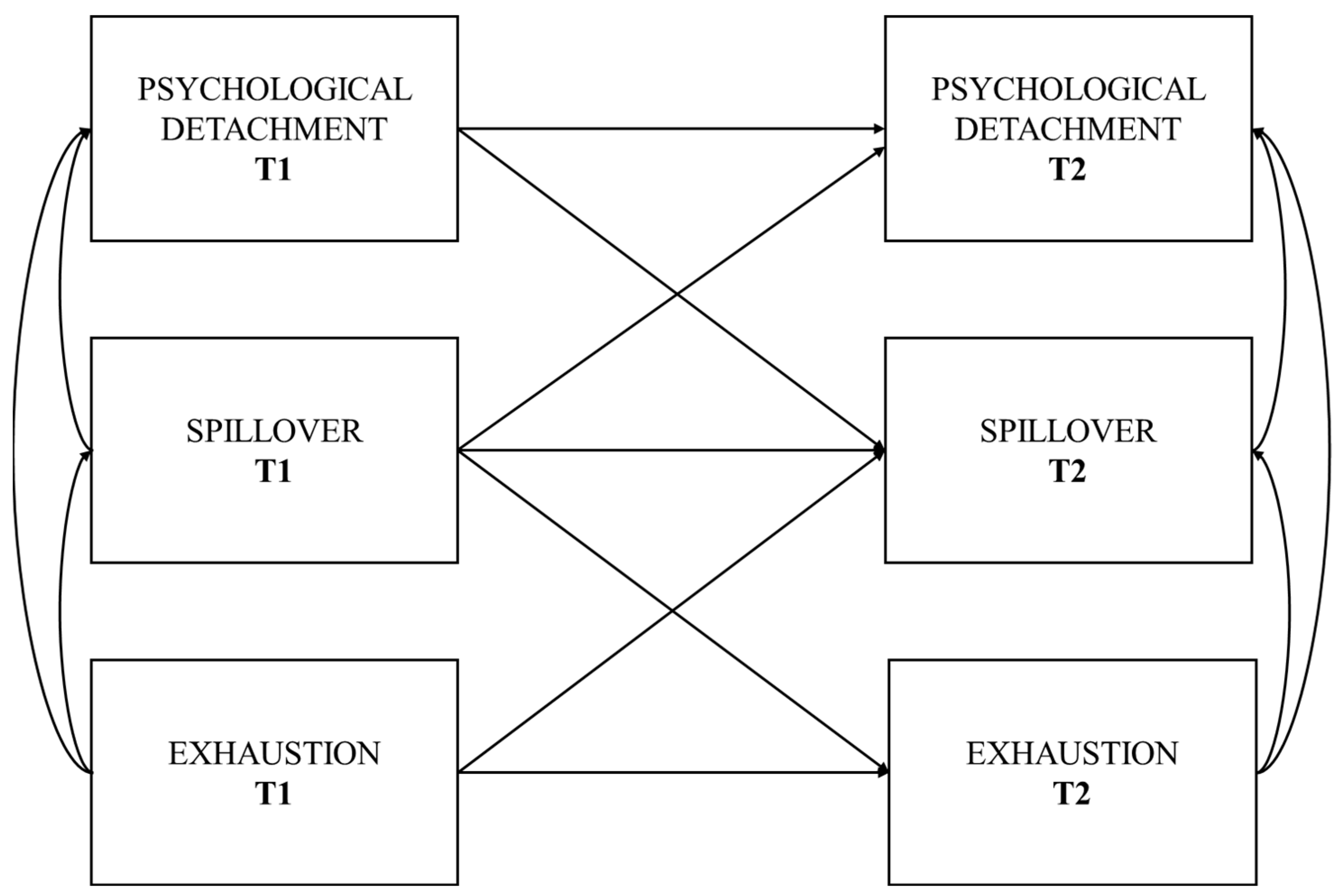
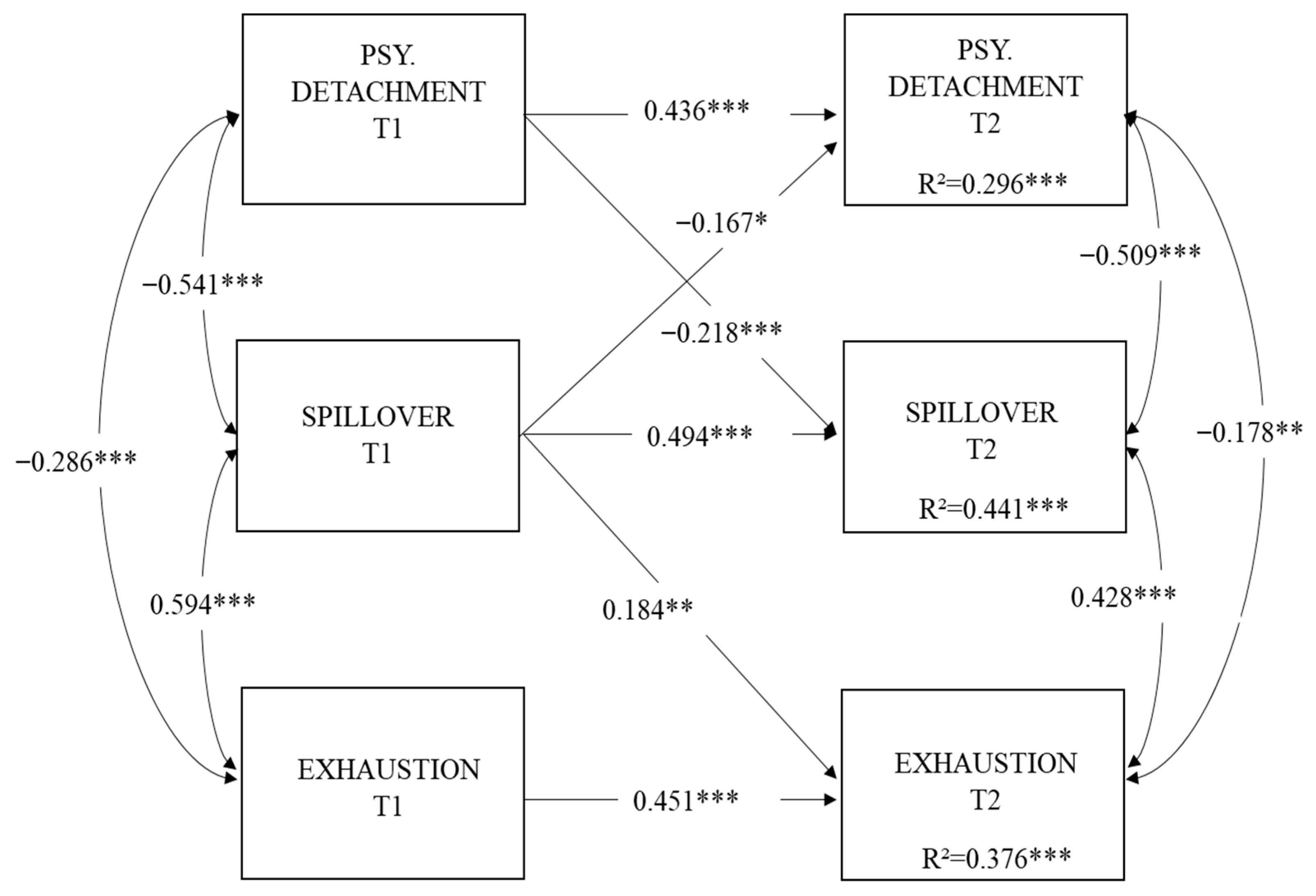

| M | SD | (1) | (2) | (3) | (4) | (5) | (6) | |
|---|---|---|---|---|---|---|---|---|
| (1) Psychological Detachment T1 | 3.99 | 1.56 | (0.91) | |||||
| (2) Spillover T1 | 2.68 | 0.65 | −0.54 | (0.79) | ||||
| (3) Exhaustion T1 | 4.03 | 1.66 | −0.28 | 0.59 | (0.92) | |||
| (4) Psychological Detachment T2 | 3.92 | 1.59 | 0.54 | −0.40 | −0.25 | (0.94) | ||
| (5) Spillover T2 | 2.64 | 0.82 | −0.49 | 0.62 | 0.42 | −0.64 | (0.85) | |
| (6) Exhaustion T2 | 4.12 | 1.64 | −0.27 | 0.46 | 0.59 | −0.31 | 0.58 | (0.91) |
| Model | χ2 | df | RMSEA [CI 95%] | CFI | SRMR | ΔM | Δχ2 (Δdf) | ΔCFI | ΔRMSEA | ΔSRMR |
|---|---|---|---|---|---|---|---|---|---|---|
| M1 | 408.160 *** | 225 | 0.056 [0.047 0.065] | 0.959 | 0.058 | − | − | − | − | − |
| M2 | 428.630 *** | 234 | 0.057 [0.048 0.65] | 0.957 | 0.061 | M1–M2 | 20.468 (9) ** | −0.002 | 0.001 | 0.003 |
| M3 | 451.430 *** | 245 | 0.057 [0.049 0.065] | 0.954 | 0.062 | M2–M3 | 22.805 (11) ** | −0.003 | 0.000 | 0.001 |
| M4 | 500.490 *** | 257 | 0.060 [0.053 0.068] | 0.946 | 0.067 | M2–M3 | 49.060 (12) *** | −0.008 | 0.003 | 0.005 |
Disclaimer/Publisher’s Note: The statements, opinions and data contained in all publications are solely those of the individual author(s) and contributor(s) and not of MDPI and/or the editor(s). MDPI and/or the editor(s) disclaim responsibility for any injury to people or property resulting from any ideas, methods, instructions or products referred to in the content. |
© 2025 by the authors. Published by MDPI on behalf of the University Association of Education and Psychology. Licensee MDPI, Basel, Switzerland. This article is an open access article distributed under the terms and conditions of the Creative Commons Attribution (CC BY) license (https://creativecommons.org/licenses/by/4.0/).
Share and Cite
Consiglio, C.; Massa, N.; Santarpia, F.P.; Violani, C. Understanding the Detachment–Strain Relationship: A Two-Wave Mediational Model. Eur. J. Investig. Health Psychol. Educ. 2025, 15, 246. https://doi.org/10.3390/ejihpe15120246
Consiglio C, Massa N, Santarpia FP, Violani C. Understanding the Detachment–Strain Relationship: A Two-Wave Mediational Model. European Journal of Investigation in Health, Psychology and Education. 2025; 15(12):246. https://doi.org/10.3390/ejihpe15120246
Chicago/Turabian StyleConsiglio, Chiara, Nicoletta Massa, Ferdinando Paolo Santarpia, and Cristiano Violani. 2025. "Understanding the Detachment–Strain Relationship: A Two-Wave Mediational Model" European Journal of Investigation in Health, Psychology and Education 15, no. 12: 246. https://doi.org/10.3390/ejihpe15120246
APA StyleConsiglio, C., Massa, N., Santarpia, F. P., & Violani, C. (2025). Understanding the Detachment–Strain Relationship: A Two-Wave Mediational Model. European Journal of Investigation in Health, Psychology and Education, 15(12), 246. https://doi.org/10.3390/ejihpe15120246

