Introduction
Human pathogens can be transferred to hands from contaminated surfaces with which they come into contact in daily life. Hands can easily transmit infectious diseases either to oneself or to others. Hand washing with soap is the most effective and inexpensive method for minimizing infectious diseases transmission in the community [
1], as recognized by the World Health Organization (WHO) [
2]. As reported by the WHO, hand contamination is a leading cause of nosocomial infections and the spread of multidrug resistant bacteria leads to a significant contribution to outbreaks of infectious diseases [
2].
The mobile phones industry revolution has increased sharply in the last decade enabling users of all ages to use phones for more than the standard voice function. Obviously, mobile phones have recently become the most touchable and serviceable object in the daily life when users can send text messages, emails and access the internet, along with many other services [
3]. However, these achievements and benefits of the mobile phone place people at higher risk of overlooking health risks associated with its use due to contamination with different types of bacteria and other microbes.
Using and handling mobile phones in all places most of the day makes the mobile phone an ideal media for transmitting microorganisms. The moist climate and optimum temperature of human bodies, especially that of the palms and pockets, could enhance this situation [
4].
Staphylococcus aureus is one of the most significant etiological agents of many nosocomial infections as wells as infections in the community [
5].
Staphylococcus aureus has been isolated from mobile phones in several studies. Previous studies of hands and mobile phones contamination conducted in several settings and countries showed a high degree of bacterial contamination [
6,
7,
8].
The current study aimed to detect and identify the bacterial species that contaminate mobile phones and the dominant hand of students as well as to determine the antimicrobial susceptibility profile of these isolates among university students from different colleges.
Methods
Participants
Sterile cotton swabs were used to collect the samples from the volunteer students. A station to collect hand and mobile swabs as per standard aseptic procedures was established. Enrollment in the study took place between October and December 2017 among university students. Students were divided into four groups: group 1 (n=35): veterinary students, group 2 (n=25): biology students, group 3 (n=25): engineering students and group 4 (n=25): chemistry students. Overall, 110 dominant hands of the students were swabbed using a single sterile cotton swab per hand, beginning from the flexor aspect of the wrist, across the palm and up all the five fingers (beginning with thumb) including the creases and nail beds, ending in the dorsal aspect. Another 110 single sterile cotton swabs were used to collect the mobile samples; the swabs were moistened in sterile water and were rotated over the front screen and the back of the cell phones. The hands of the selected students were intact without any injuries or scratches and hadn’t been exposed to any type of disinfectants before collection of samples. All hand and mobile samples were collected in the afternoon during the students’ break time. The sample population was from four separate schools belonging to the same university and attending different classes and laboratories.
Bacterial isolation
The swabs were collected in Stuart’s transport medium and transported to the laboratory within one hour to be inoculated on nutrient agar, MacConkey agar and blood agar and mannitol salt agar (Bio lab, Budapest, Hungary), then incubated aerobically at 37°C for 24 hours. All culture media were prepared following the manufacturer’s instruction and sterilized by autoclaving at 121°C for 20 minutes.
Identification of bacterial isolates
The bacterial isolates were identified by studying their cultural, morphological and biochemical characteristics according to previously published protocols [
9,
10]. Biochemical tests were used to confirm the identity of each isolate. The identification tests varied according to the Gram reactivity exhibited by the isolate; if upon Gram stain the isolate was confirmed as Gram positive, then catalase and coagulase tests were performed then followed by the ability of the organism to grow on bile esculin agar, and then its tolerance to novobiocin was established.
Micrococcus spp. was differentiated from
Staphylococcus spp. by using the bacitracin susceptibility test. For Gram negative bacteria the reaction pattern on triple sugar iron slant was performed then followed by testing the isolate for motility, triple sugar iron agar, indole, methyl red, Voges-Proskauer and citrate tests to confirm the diagnosis.
Storage of isolates
A single colony from actively growing culture was picked up using a sterile straight wire. The wire with the bacteria was deeply plunged into a nutrient agar slant in a McCartney bottle, followed by incubation at 37°C for 8-12 hours. The bottle was then tightly sealed and stored at 4°C in a refrigerator until tested.
Antibiotic susceptibility tests
Antibiotic susceptibility tests were performed on each of the isolates by using disc diffusion method on Muller-Hinton agar as recommended by Clinical Laboratory Standards Institute (CLSI) [
11] using the following antibiotic disks: ciprofloxacin (5 µg), ampicillin (10 µg), norfloxacin (10 µg), erythromycin (15 µg), chloramphenicol (30 µg), gentamicin (10 µg), tetracycline (30 µg), vancomycin (30 µg), amoxicillin/clavulanic acid (20/10 µg), cefepime (30 µg), penicillin (10 µg), clindamycin (2 µg), trimethoprim-sulfamethoxazole (1.25/23.75 µg) and oxacillin (1 µg). Briefly, microorganisms were suspended in saline to a turbidity of 0.5 McFarland standards. A swab of the cell suspension was subsequently spread in three directions on the entire surface of a Mueller Hinton agar plate (MHA), and left for 15 minutes to air dry at room temperature before antibiotic disks were applied onto the agar. Plates were then incubated at 35°C for 18-24 hours.
S. aureus (ATCC #25923) was bought as lyophilized from a local supplier and used as a control. Results were interpreted according to CLSI guidelines [
11].
Ethical approval
This study was ethically approved by the Institutional Review Board committee at King Abdullah University Hospital, Irbid-Jordan, ethical approval no. 50/111/2017.
Statistical analysis
The Statistical Package for Social Sciences software, SPSS version 23 (SPSS Inc., IBM Corp, Armonk, NY, USA) was used to analyze the data. Descriptive statistics were used to describe study variables. Univariate analysis using cross tabulation was performed to assess the number of isolates from hands as dependent variable and the association with faculty type as independent variable. A p value of ≤0.05 was considered statistically significant in all cases.
Results
In this study, 220 hand and mobile phones samples (110 hand and 110 mobile swabs) from the university students were tested. Eight bacterial species were isolated and identified in the current study namely:
Staphylococcus epidermidis, Streptococcus pneumoniae, Streptococcus pyogenes, Staphylococcus aureus, Enterococcus faecalis, Bacillus cereus, Micrococcus spp., and
Escherichia coli. The students’ hands showed higher bacterial contamination than the mobile phones. Overall, 41% of the tested hands were contaminated with one or more of the bacterial species with the range of one to 12 isolates, while only 18% of the tested mobile phones revealed a bacterial growth with a range of 1 to 6 isolates. The frequency of Gram positive bacteria isolated from the hand and mobile phone swabs studied are shown in
Table 1.
S. epidermidis (33.7%) was the most frequently isolated bacteria followed by
S. pneumoniae (18.2%),
S. pyogenes (18.2%),
S. aureus (12.7%),
E. faecalis (10.9%), and
Bacillus cereus (4.5%) while the least isolated organisms was
Micrococcus spp. (0.9%). A single Gram negative bacterium was isolated in this study and was identified as
E. coli (0.9%).
Univariate analysis using cross tabulation was performed to assess the association between factors associated with hand and mobile contamination as well as the number of isolates from hands as dependent variable and the association with faculty type as independent variable.
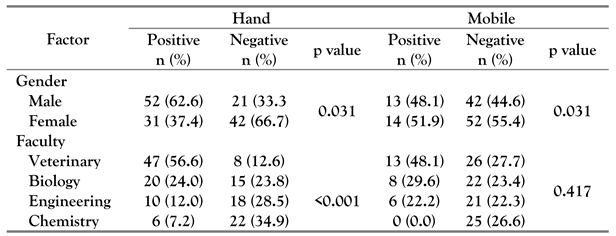
A significant difference was detected between the students of the four faculties and the number of isolates detected in their hands with a p value of <0.001, while this difference in the case of mobile phones was not statistically significant (p=0.417) as shown in
Table 2. The majority of isolates (56.6%) was recovered from group 1 (veterinary students) followed by 24% isolates recovered from group 2 (biology students). Furthermore, 12% and 7.2% of the isolates were recovered from group 3 (engineering students) and group 4 (chemistry students), respectively.
It was evident that the dominant hand of most participants was associated with more contamination with bacterial species than the mobile in all studied groups. In group 1 (vet students), 78% of isolates were from the dominant hand and 22% from the mobile phone. In group 2, 71.5% of isolates were from the hand and 28.5% from the mobile phone. In group 3, 62.5% of isolates were from the hand and 37.5% from the mobile phone, and in group 4, 100% of the isolates were recovered from the hand.
The antibiotic profile of the isolated bacteria showed a big variation. Although some bacterial species were susceptible to all antibiotics, other isolates were resistant to 6 antibiotics as shown in
Table 3. The resistance rates of the
S. aureus isolates to the tested antimicrobials were as follows: clindamycin (35.7%), penicillin (28.6%), trimethoprim/sulfamethoxazole (14.2%), cefepime (14.2%) and only one of the fourteen
S. aureus isolates was resistant to the other antibiotics used in this study. An intermediate susceptibility to erythromycin and oxacillin was shown by one
S. aureus isolate.
The resistance rates of S. epidermidis isolates to the tested antimicrobials were as follows: penicillin (43.2%), erythromycin (16.2%), clindamycin (13.5%), trimethoprim/sulfamethoxazole (13.5%), and norfloxacin (8.1%). Two isolates were resistant to ampicillin, tetracycline and cefepime while only one isolate was resistant to ciprofloxacin, chloramphenicol and amoxicillin/clavulanic acid. Intermediate susceptibility to ciprofloxacin, cefepime and trimethoprim/sulfamethoxazole was shown by one of the 37 S. epidermidis isolates. S. pyogenes was susceptible to most of the antibiotics used. Two S. pyogenes isolates were resistant to clindamycin, cefepime and penicillin and only one isolate was resistant to erythromycin, chloramphenicol and vancomycin. An intermediate susceptibility to erythromycin was shown by one S. pyogenes isolate only.
Overall, 25% of the twenty S. pneumoniae isolates recovered from the hands and mobile phones of the studied sample showed considerable resistance to erythromycin. Four antibiotics, namely trimethoprim/sulfamethoxazole, clindamycin, cefepime and penicillin showed no activity against two isolates of S. pneumoniae. Only one isolate was resistant to chloramphenicol, tetracycline, and oxacillin. An intermediate susceptibility to erythromycin and penicillin was shown by one S. pyogenes isolate only. Three isolates of E. faecalis were resistant to penicillin with a percentage of 25%, while two of the twelve isolates were resistant to ciprofloxacin, vancomycin and norfloxacin. One E. faecalis isolate showed no susceptibility to chloramphenicol and erythromycin. The susceptibility to norfloxacin, erythromycin and vancomycin was intermediate in one isolate of the twelve E. faecalis isolates. In this study one Escherichia coli isolate was detected and it was resistant to cefepime and trimethoprim/sulfamethoxazole, while amoxicillin/clavulanic acid showed intermediate activity against this isolate.
It is apparent from the antibiotic resistance profile presented in
Table 3 that isolates belonging to
S. epidermidis were the most resistant bacteria to the studied antibiotics, and showed resistance to multiple antibiotics used in this study. We have found that the most effective antibiotics against the isolated bacteria were gentamicin, amoxicillin/clavulanic acid, oxacillin, ciprofloxacin, ampicillin and vancomycin.
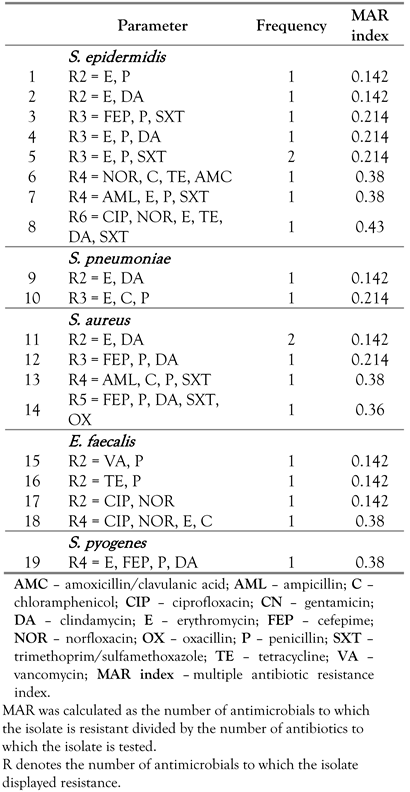
The multiple antibiotic resistance (MAR) indexes of the isolated resistant bacteria were determined with reference to fourteen different antibiotics used in this study. The values of MAR indexes are shown in
Table 4. Analysis of the MAR index of isolates showed that twelve of the total nineteen resistant bacteria studied presented ratios above 0.2, indicating high resistance.
Discussion
In the current study eight different bacterial species were isolated from the dominant hand and mobile phone of the university students. Many of these bacterial species are considered human pathogens, such as S. pneumoniae, S. aureus, S. pyogenes and E. faecalis. These bacterial species can cause serious diseases including pneumonia, skin infections, urinary tract infections and other diseases.
Most of the isolated bacteria (54.5%, n=60) were from group one (the veterinary students) with 47 isolates from the dominant hand and 13 from the mobile phone. Seven bacterial species isolated from this group, namely S. epidermidis, S. pneumoniae, S. aureus, S. pyogenes, E. faecalis, B. cereus and E. coli are considered as human pathogens and many of these could be of animal origin. This might suggest that such bacteria from the veterinary students may have been transferred from the working environment with regular exposure to animals.
The second group was that of biology students; 25.5% (n=28) of the 110 isolates were identified from their samples, namely: S. pneumoniae, S. aureus, S. pyogenes and S. epidermidis. Twenty isolates were from the hand and eight isolates from the mobile phone. This result could be due to the nature of this specialty where students are exposed to many laboratories during their study course, including practical microbiology, which may lead to exposure to different types of infectious material.
Sixteen isolates (14.5%) were recovered from the biomedical engineering group with ten from the dominant hand and six from the mobile phone. S. epidermidis, S. pyogenes, S. pneumoniae and Micrococcus spp. were identified from their swabs. These results could be attributed to the few courses this group of students are studying in their major, such as the microbiology course, which may expose the students to infectious microorganisms leading to potential contamination of the hands and mobile phones.
The group of chemistry students reflects the minimal exposure to infectious material through their study and showed only 5.5% of the 110 isolated bacteria, namely
S. epidermidis, S. pyogenes and
S. pneumoniae. It is clear from
Table 1 that Gram positive and Gram negative bacteria constituted >99% and <1% of the total microbial population recovered during the course of this study, respectively. An overview of the results obtained from the current study tells us that
S. epidermidis was isolated from all samples except the mobile phones of the chemistry students. Although this finding is expected due to the fact that this organism is part of the normal flora found on the human skin, our concern is the alarming multidrug resistance profile exhibited by this organism against many of the antibiotics usually used to inhibit the growth of such bacterial species. Unsurprisingly, most of the isolated bacteria were from the hands and mobiles of the veterinary students who are in close contact with animals during many courses, especially the practical ones in the veterinary clinic. Biology and biomedical students were almost equally exposed to infectious material during limited courses such as the microbiology course, which may lead to contamination of their hands and mobiles. The lowest number of bacterial isolates was from the chemistry students who do not have any course of microbiology or other similar courses dealing with infectious materials in their study plan.
An important finding in this study is the isolation of S. pneumoniae and S. pyogenes from all studied groups. These organisms are considered as major respiratory tract pathogens causing pneumonia and tonsillitis in the lower and upper respiratory tract, respectively, during the flu season when the study was conducted. The hand could be easily contaminated with these organisms through covering the mouth with the hands during coughing or sneezing.
In the current study, 66 of the total 220 tested swabs (29%) showed bacterial contamination while 154 swabs (71%) did not show bacterial growth. This result indicates that the rate of bacterial contamination in our sample was much lower than that reported in other studies. A previous study reported that 96.2% of Saudi medical students’ mobile phones were contaminated with bacteria [
12]. Similar results were reported from Egypt revealing a contamination rate of 96.5% and microorganisms isolated from mobile phones and hands were similar [
13]. Moreover, mobile phones of college students in India showed a high degree of bacterial contamination [
14]. In Mauritius, mobile phones of volunteers in the general community revealed a bacterial contamination rate of 91.7% [
15]. However, in Iraq, this rate of mobile phones bacterial contamination varied between the general community (82.5%) [
8], and college students (100%) [
6]. The lower degree of contamination could be attributed to the good hand hygiene among university students and the fact that they may disinfect their mobile phones frequently.
In our study, all Gram positive isolates were found to be sensitive to vancomycin except for one (
S. pyogenes) and two isolates of
E. faecalis and this was contrary to the 15.5% resistance reported by Ashour and El-Sharif [
16], but comparable to the rates reported by Saeed et al [
17].
High resistance in our study may suggest that isolates originated from highly resistant sources where antibiotics are often sold over the counter in Jordan and without physician prescription. The pattern of antimicrobial resistance varies based on geographic criteria and socioeconomic strata, and also differs between studies [
18]. The differences in bacterial resistance may be affected by the time span, location, study design, and the type of population involved in each study.
Many factors lead to antibiotic resistance, including antibiotic up-use from prescription-dispensing-to patient use [
19]. In Jordan, antibiotics are purchased without prescription as part of common practice, which leads to misuse of antibiotics by the public [
20]. Another major factor could be the healthcare professionals who misuse antibiotics by following non-standardized practices [
19].