Binderless Hardwood Tree Bark-Based Insulation Panels for Green Building Applications

Abstract
1. Introduction
1.1. Global Context
1.2. Conventional vs. Natural-Based Insulation Materials
1.3. Potential of Tree Bark in Thermal Insulation
1.4. Research Rationale and Objectives
2. Materials and Methods
2.1. Material Preparation and Board Formation
2.2. Testing Methods
2.2.1. Hygroscopic Sorption
2.2.2. Thickness Swelling and Water Absorption Measuring
2.2.3. Compressive Properties
2.2.4. Thermal Conductivity
2.3. Statistical Analysis
3. Results and Discussion
3.1. Hygroscopic Sorption Behavior
3.2. Thickness Swelling and Water Absorption
3.3. Compressive Strengths
3.4. Comparison with Other Insulation Materials

| Property | LIP | BIP | EPS (Expanded Polystyrene) | Mineral Wool | Wood Fiber Boards |
|---|---|---|---|---|---|
| Thermal conductivity (λ) (W/(m·K)) | 0.055 [36] | 0.057 [36] | 0.031–0.046 [78] | 0.032–0.045 [79,80] | 0.038–0.055 [81,82] |
| Density (kg/m3) | 218 [36] | 231 [36] | 8–64 [78,83] | 26–150 [80,84] | 40–250 [81,82] |
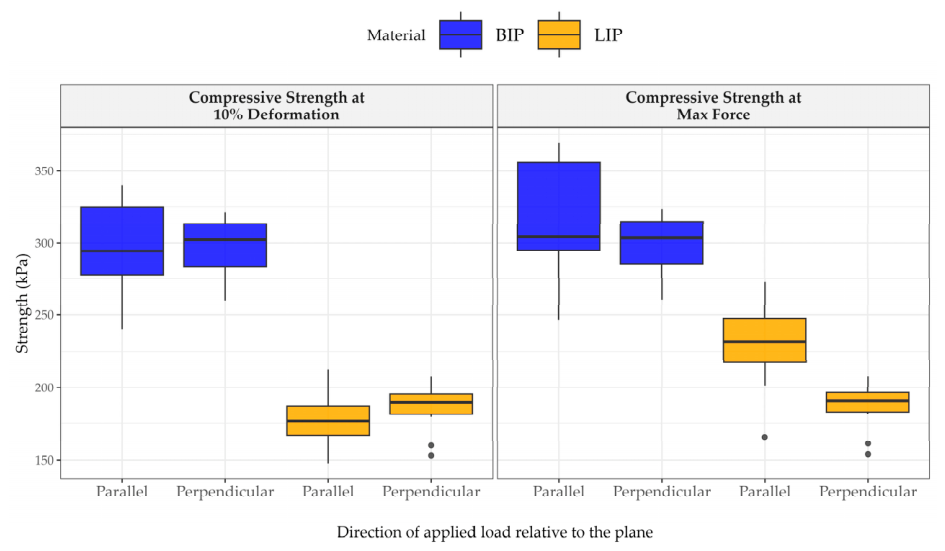
| Compressive strength at 10% deformation (kPa) | 186.40 * | 294.85 * | 52–250 [83,85] | 50.9–142.4 [86] | 120–230 [72] |
| Water absorption after 24h full immersion (%) | 57.11 * | 320.61 * | <5 [78] | >150 [87] | 15–122 [88] |
4. Conclusions
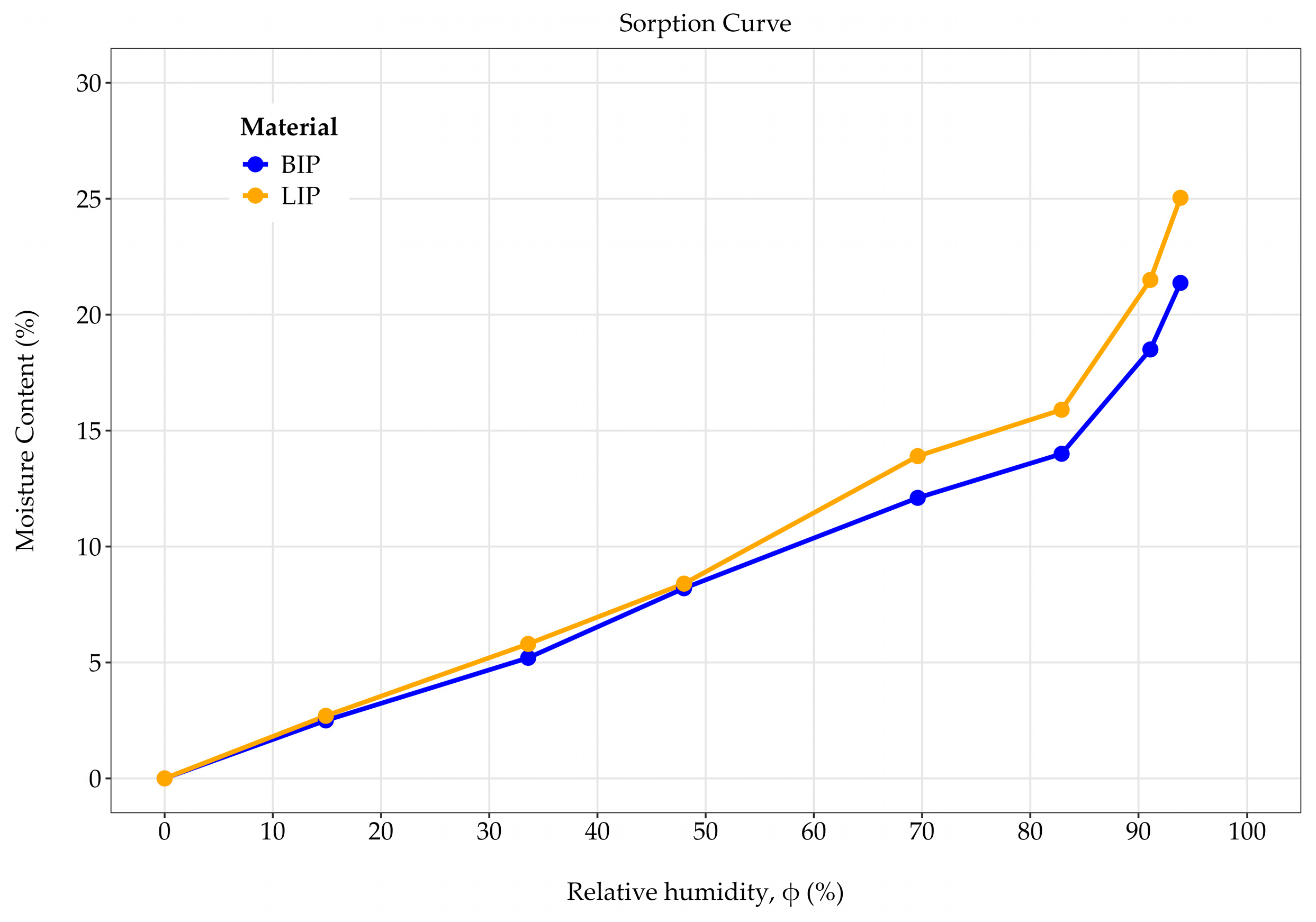
- Both materials (LIP and BIP) showed similar sorption behavior, reaching approximately 25 and 21.4% moisture content for LIP and BIP accordingly at 93.8% relative humidity.
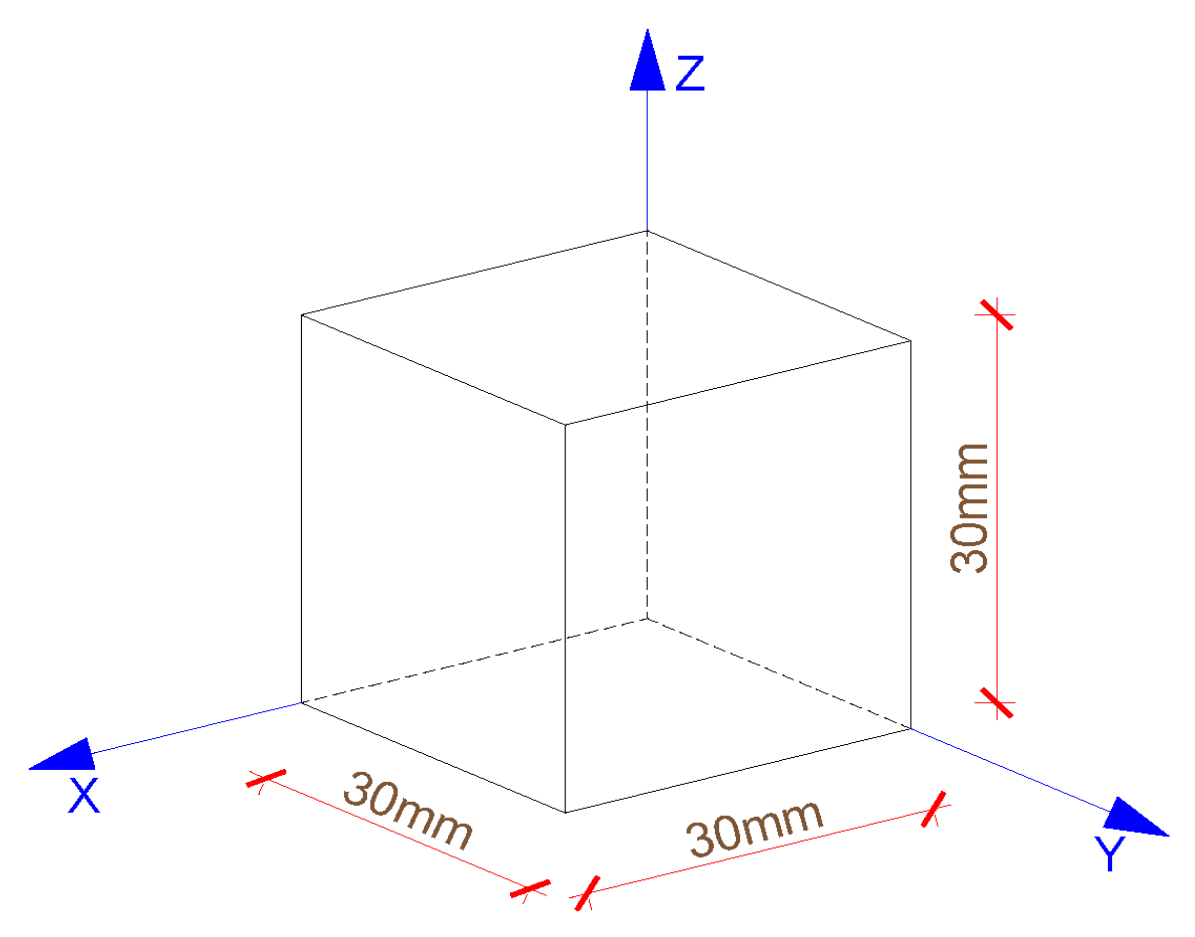
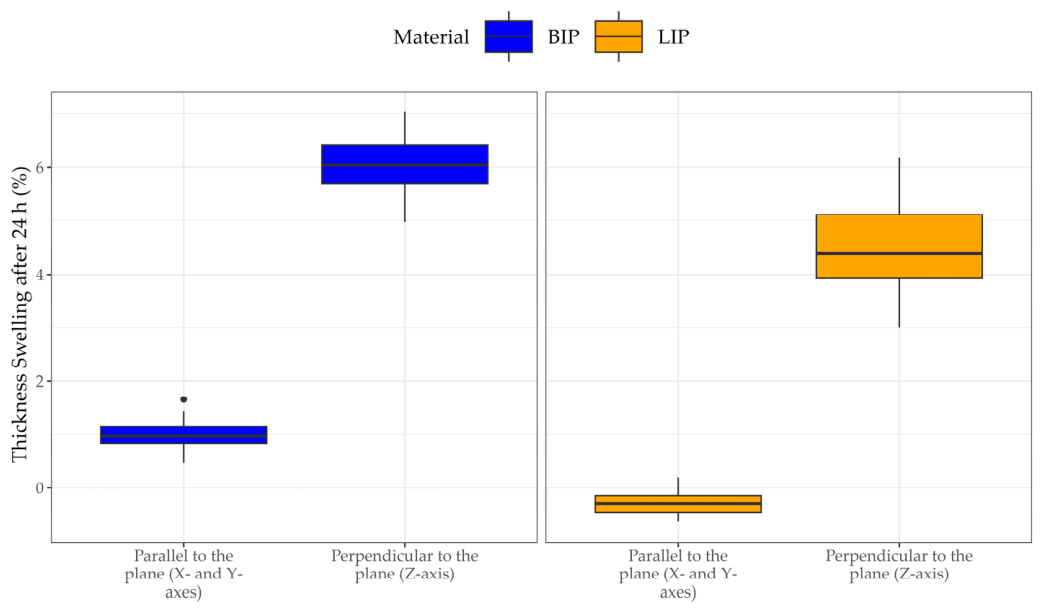
- Thickness swelling after 24 h of immersion was 4.5% for LIP and 6.0% for BIP. For both materials, the swelling in the perpendicular direction (Z axis) was higher (p < 0.001) than in the parallel-to-plane direction (X, Y axes), which indicates the anisotropy of the materials.
- Significant differences between materials in water absorption were observed. After 24 h of immersion, the BIP specimens absorbed significantly more water (320.61%) than LIP (57.11%).
Supplementary Materials
Author Contributions
Funding
Data Availability Statement
Conflicts of Interest
Abbreviations
| BIP | Black locust insulation panel |
| CV | Coefficient of variation |
| EPS | Expanded polystyrene |
| GHG | Greenhouse gas |
| IB | Internal bond |
| LIP | Lime bark insulation panel |
| LCA | Life-cycle assessment |
| MBV | Moisture buffer value |
| MC | Moisture content |
| MOE | Modulus of elasticity |
| MOR | Modulus of rupture |
| MUF | Melamine–urea–formaldehyde |
| pH | Potential of hydrogen |
| pMDI | Polymeric diphenylmethane diisocyanate |
| RH | Relative humidity |
| TS | Thickness swelling |
| UF | Urea–formaldehyde |
| WA | Water absorption |
References
- Mirzabaev, A.; Bezner Kerr, R.; Hasegawa, T.; Pradhan, P.; Wreford, A.; Cristina Tirado von der Pahlen, M.; Gurney-Smith, H. Severe Climate Change Risks to Food Security and Nutrition. Clim. Risk Manag. 2023, 39, 100473. [Google Scholar] [CrossRef] [Scilit]
- United Nations Environment Programme. Yale Center for Ecosystems + Architecture Building Materials and the Climate: Constructing a New Future. Available online: https://wedocs.unep.org/xmlui/handle/20.500.11822/43293 (accessed on 23 April 2025).
- United Nations Environment Programme. Global Alliance for Buildings and Construction Not Just Another Brick in the Wall: The Solutions Exist—Scaling Them Will Build on Progress and Cut Emissions Fast. Global Status Report for Buildings and Construction 2024/2025. Available online: https://www.unep.org/resources/report/global-status-report-buildings-and-construction-20242025 (accessed on 9 July 2025).
- Adamczyk, J.; Dylewski, R. The Impact of Thermal Insulation Investments on Sustainability in the Construction Sector. Renew. Sustain. Energy Rev. 2017, 80, 421–429. [Google Scholar] [CrossRef] [Scilit]
- Eickhoff, H. The Appeal of the Circular Economy Revisited: On Track for Transformative Change or Enabler of Moral Licensing? Humanit. Soc. Sci. Commun. 2024, 11, 301. [Google Scholar] [CrossRef] [Scilit]
- Morandini, M.; Barbu, M.C.; Váňová, R.; Kain, S.; Tippner, J.; Petutschnigg, A.; Kristak, L.; Kain, G.; Sepperer, T.; Schnabel, T. Valorization of Extracted Bark for Particleboard Production: A Life-Cycle Impact Assessment. Polymers 2025, 17, 925. [Google Scholar] [CrossRef] [Scilit] [PubMed]
- Razi, N.; Ansari, R. A Prediction-Based Model to Optimize Construction Programs: Considering Time, Cost, Energy Consumption, and CO2 Emissions Trade-Off. J. Clean. Prod. 2024, 445, 141164. [Google Scholar] [CrossRef] [Scilit]
- Ali, A.; Issa, A.; Elshaer, A. A Comprehensive Review and Recent Trends in Thermal Insulation Materials for Energy Conservation in Buildings. Sustainability 2024, 16, 8782. [Google Scholar] [CrossRef] [Scilit]
- Ye, F.; Wei, H.; Xiao, Y.; Berardi, U.; Quaranta, G.; Demartino, C. Bio-Based Insulation Materials in Sustainable Constructions: A Review of Environmental, Thermal and Acoustic Insulation, Durability, and Mechanical Performances. Renew. Sustain. Energy Rev. 2025, 223, 115872. [Google Scholar] [CrossRef] [Scilit]
- Schulte, M.; Lewandowski, I.; Pude, R.; Wagner, M. Comparative Life Cycle Assessment of Bio-Based Insulation Materials: Environmental and Economic Performances. GCB Bioenergy 2021, 13, 979–998. [Google Scholar] [CrossRef] [Scilit]
- Asfaw, N.T.; Absi, R.; Labouda, B.A.; EL Abbassi, I. Assessment of the Thermal and Mechanical Properties of Bio-Based Composite Materials for Thermal Insulation: A Review. J. Build. Eng. 2024, 97, 110605. [Google Scholar] [CrossRef] [Scilit]
- Pawłosik, D.; Cebrat, K.; Brzezicki, M. Exploring Advancements in Bio-Based Composites for Thermal Insulation: A Systematic Review. Sustainability 2025, 17, 1143. [Google Scholar] [CrossRef] [Scilit]
- Carcassi, O.B.; Habert, G.; Malighetti, L.E.; Pittau, F. Material Diets for Climate-Neutral Construction. Environ. Sci. Technol. 2022, 56, 5213–5223. [Google Scholar] [CrossRef] [Scilit]
- Fischer, H.; Korjenic, A. Hygrothermal Performance of Bio-Based Exterior Wall Constructions and Their Resilience under Air Leakage and Moisture Load. Buildings 2023, 13, 2650. [Google Scholar] [CrossRef] [Scilit]
- Cosentino, L.; Fernandes, J.; Mateus, R. A Review of Natural Bio-Based Insulation Materials. Energies 2023, 16, 4676. [Google Scholar] [CrossRef] [Scilit]
- Cintura, E.; Nunes, L.; Molari, L.; Bettuzzi, M.; Morigi, M.P.; Brancaccio, R.; Faria, P. Hygroscopicity and Morphology of Bio-Based Boards—The Influence of the Formulation. Appl. Sci. 2024, 14, 873. [Google Scholar] [CrossRef] [Scilit]
- Palumbo, M.; Lacasta, A.M.; Holcroft, N.; Shea, A.; Walker, P. Determination of Hygrothermal Parameters of Experimental and Commercial Bio-Based Insulation Materials. Constr. Build. Mater. 2016, 124, 269–275. [Google Scholar] [CrossRef] [Scilit]
- Boro, D.; Kieno, P.F.; Ouedraogo, E. Experimental Study of the Thermal and Mechanical Properties of Compressed Earth Blocks Stabilized with Sawdust According to the Rates for the Thermal Insulation of a Building. Int. J. Constr. Eng. Manag. 2017, 6, 103–109. [Google Scholar] [CrossRef]
- Mlhem, A.; Teklebrhan, T.; Bokuretsion, E.; Abu-Jdayil, B. Development of Sustainable Thermal Insulation Based on Bio-Polyester Filled with Date Pits. J. Bioresour. Bioprod. 2024, 9, 74–89. [Google Scholar] [CrossRef] [Scilit]
- Wu, Y.; Chen, X.; Liao, Q.; Xiao, N.; Li, Y.; Huang, Z.; Xie, S. Development of Binderless Fiberboard from Poplar Wood Residue with Trametes hirsuta. Chemosphere 2024, 362, 142638. [Google Scholar] [CrossRef] [Scilit]
- Supriyadi, D.; Damayanti, D.; Veigel, S.; Hansmann, C.; Gindl-Altmutter, W. Unlocking the Potential of Tree Bark: Review of Approaches from Extractives to Materials for Higher-Added Value Products. Mater. Today Sustain. 2025, 29, 101074. [Google Scholar] [CrossRef] [Scilit]
- Pásztory, Z.; Mohácsiné, I.R.; Gorbacheva, G.; Börcsök, Z. The Utilization of Tree Bark. Bioresources 2016, 11, 7859–7888. [Google Scholar] [CrossRef] [Scilit]
- Kress, O. The Use of Bark for Paper Specialties. Ind. Eng. Chem. 1916, 8, 883–886. [Google Scholar] [CrossRef] [Scilit]
- Muszynski, Z.; Dobbin Mcnatt, J. Investigations on the Use of Spruce Bark in the Manufacture of Particleboard in Poland. For. Prod. J. 1984, 34, 28–35. [Google Scholar]
- Gupta, G.; Yan, N.; Feng, M.W. Effects of Pressing Temperature and Particle Size on Bark Board Properties Made from Beetle-Infested Lodgepole Pine (Pinus contorta) Barks. For. Prod. J. 2011, 61, 478–488. [Google Scholar] [CrossRef] [Scilit]
- Kain, G.; Barbu, M.C.; Hinterreiter, S.; Richter, K.; Petutschnigg, A. Using Bark as a Heat Insulation Material. Bioresources 2013, 8, 3718–3731. [Google Scholar] [CrossRef] [Scilit]
- Oktoberyani Christy, E.; Hadi Sumarlan, S.; Soehardjono, A. Gelam Wood Particleboards. Bioresources 2020, 15, 7390–7403. [Google Scholar] [CrossRef] [Scilit]
- Medved, S.; Tudor, E.M.; Barbu, M.C.; Young, T.M. Thermal Conductivity of Different Bio-Based Insulation Materials. Les/Wood 2021, 70, 73–82. [Google Scholar] [CrossRef] [Scilit]
- Gößwald, J.; Barbu, M.C.; Petutschnigg, A.; Tudor, E.M. Binderless Thermal Insulation Panels Made of Spruce Bark Fibres. Polymers 2021, 13, 1799. [Google Scholar] [CrossRef] [Scilit] [PubMed]
- Bakatovich, A.; Bakatovich, N.; Silva, A.; Gaspar, F. Thermal Insulation Materials Based on Eucalyptus Bark Fibres. Constr. Build. Mater. 2024, 449, 138559. [Google Scholar] [CrossRef] [Scilit]
- Kain, G.; Lienbacher, B.; Barbu, M.C.; Richter, K.; Petutschnigg, A. Larch (Larix decidua) Bark Insulation Board: Interactions of Particle Orientation, Physical-Mechanical and Thermal Properties. Eur. J. Wood Wood Prod. 2018, 76, 489–498. [Google Scholar] [CrossRef] [Scilit]
- Kain, G.; Güttler, V.; Barbu, M.C.; Petutschnigg, A.; Richter, K.; Tondi, G. Density Related Properties of Bark Insulation Boards Bonded with Tannin Hexamine Resin. Eur. J. Wood Wood Prod. 2014, 72, 417–424. [Google Scholar] [CrossRef] [Scilit]
- Christy, E.O.; Soemarno; Sumarlan, S.H.; Soehardjono, A. Binderless Bark Particleboard Made from Gelam (Melaleuca viridiflora Sol. Ex Gaertn.) Bark Waste: The Effect of the Pressing Temperature on Its Mechanical and Physical Properties. Bioresources 2021, 16, 4171–4199. [Google Scholar] [CrossRef] [Scilit]
- Kain, G.; Tudor, E.M.; Barbu, M.C. Bark Thermal Insulation Panels: An Explorative Study on the Effects of Bark Species. Polymers 2020, 12, 2140. [Google Scholar] [CrossRef] [Scilit] [PubMed]
- Bossu, J.; Moreau, J.; Delisée, C.; Le Moigne, N.; Corn, S.; Sonnier, R.; Viretto, A.; Beauchêne, J.; Clair, B. Revealing the Potential of Waste Fibers from Timber Production and Clearings for the Development of Local Bio-Based Insulation Fiberboards in French Guiana. Waste Biomass Valorization 2023, 14, 4281–4295. [Google Scholar] [CrossRef] [Scilit]
- Mialeshka, V.; Kowaluk, G.; Pásztory, Z. Sustainable Insulation Panels Made of Tree Bark Fibers: Thermal and Fire Performance. Forests 2025, 17, 26. [Google Scholar] [CrossRef] [Scilit]
- ISO 12571; Hygrothermal Performance of Building Materials and Products—Determination of Hygroscopic Sorption Properties. International Organization for Standardization: Geneva, Switzerland, 2021.
- EN 317; Particleboards Thickness Swelling Test Method Guide. European Standard: Brussels, Belgium, 1993.
- ASTM C1763-20; Standard Test Method for Water Absorption by Immersion of Thermal Insulation Materials. ASTM International: West Conshohocken, PA, USA, 2020. [CrossRef] [Scilit]
- EN 826; Thermal Insulating Products for Building Applications. European Standard: Brussels, Belgium, 2013.
- Keaton, J.R. Young’s Modulus. In Encyclopedia of Engineering Geology; Springer: Berlin/Heidelberg, Germany, 2018; pp. 955–956. [Google Scholar] [CrossRef] [Scilit]
- ISO 8301; Thermal Insulation, Determination of Steady-State Thermal Resistance and Related Properties, Heat Flow Meter Apparatus. International Organization for Standardization: Geneva, Switzerland, 1991.
- EN 12667:2002; Thermal Performance of Building Materials and Products—Determination of Thermal Resistance by Means of Guarded Hot Plate and Heat Flow Meter Methods—Products of High and Medium Thermal Resistance. European Committee for Standardization: Brussels, Belgium, 2002.
- Pazireh, S.; Mirazimzadeh, S.E.; Urbanic, J. Application of Linear Mixed-Effects Model, Principal Component Analysis, and Clustering to Direct Energy Deposition Fabricated Parts Using FEM Simulation Data. Materials 2024, 17, 5127. [Google Scholar] [CrossRef] [Scilit]
- Kielsgaard, K. General Rights Sorption Isotherms A Catalogue; Technical University of Denmark: Lyngby, Denmark, 1986. [Google Scholar]
- Petcu, C.; Hegyi, A.; Stoian, V.; Dragomir, C.S.; Ciobanu, A.A.; Lăzărescu, A.V.; Florean, C. Research on Thermal Insulation Performance and Impact on Indoor Air Quality of Cellulose-Based Thermal Insulation Materials. Materials 2023, 16, 5458. [Google Scholar] [CrossRef] [Scilit]
- Palumbo, M.; Lacasta, A.M.; Giraldo, M.P.; Haurie, L.; Correal, E. Bio-Based Insulation Materials and Their Hygrothermal Performance in a Building Envelope System (ETICS). Energy Build. 2018, 174, 147–155. [Google Scholar] [CrossRef] [Scilit]
- Ranefjärd, O.; Strandberg-de Bruijn, P.B.; Wadsö, L. Hygrothermal Properties and Performance of Bio-Based Insulation Materials Locally Sourced in Sweden. Materials 2024, 17, 2021. [Google Scholar] [CrossRef] [Scilit] [PubMed]
- O’Hegarty, R.; Amedeo, G.; Kinnane, O. The Impact of Compromised Insulation on Building Energy Performance. Energy Build. 2024, 316, 114337. [Google Scholar] [CrossRef] [Scilit]
- Rode, C.; Peuhkuri, R.; Time, B.; Svennberg, K.; Ojanen, T. Moisture Buffer Value of Building Materials. J. ASTM Int. 2007, 4, 100369. [Google Scholar] [CrossRef] [Scilit]
- Wildman, J.; Shea, A.; Cascione, V.; Henk, D. Mould Susceptibility of Bio-Based Insulation Materials in Modern Construction. Npj Mater. Degrad. 2026, 10, 29. [Google Scholar] [CrossRef] [Scilit]
- Tupciauskas, R.; Orlovskis, Z.; Blums, K.T.; Liepins, J.; Berzins, A.; Pavlovics, G.; Andzs, M. Mold Fungal Resistance of Loose-Fill Thermal Insulation Materials Based on Processed Wheat Straw, Corn Stalk and Reed. Polymers 2024, 16, 562. [Google Scholar] [CrossRef] [Scilit] [PubMed]
- Zhang, H.; Wang, H.; Liu, Y.; Tao, L.; Qu, J.; Liang, C. Experimental Study on Particle Settling in Fiber-Containing Non-Newtonian Fluids. Processes 2025, 13, 2542. [Google Scholar] [CrossRef] [Scilit]
- Khatmullina, L.; Chubarenko, I. Thin Synthetic Fibers Sinking in Still and Convectively Mixing Water: Laboratory Experiments and Projection to Oceanic Environment. Environ. Pollut. 2021, 288, 117714. [Google Scholar] [CrossRef] [Scilit] [PubMed]
- Vainio, A.K.; Paulapuro, H. Interfiber Bonding and Fiber Segment Activation in Paper. Bioresources 2007, 2, 442–458. [Google Scholar] [CrossRef] [Scilit]
- EN 622-4; Fibreboards—Specifications—Part 4: Requirements. European Standard: Brussels, Belgium, 2019.
- Nociar, M.; Pipíška, T.; Bekhta, P.; Král, P. Effect of Wood Species, Bark Particle Size, and Adhesive Type on the Properties of Bark-Based Boards. BioResources 2025, 20, 4044–4067. [Google Scholar] [CrossRef] [Scilit]
- Alsubari, S.; Zuhri, M.Y.M.; Sapuan, S.M.; Ishak, M.R.; Ilyas, R.A.; Asyraf, M.R.M. Potential of Natural Fiber Reinforced Polymer Composites in Sandwich Structures: A Review on Its Mechanical Properties. Polymers 2021, 13, 423. [Google Scholar] [CrossRef] [Scilit]
- Affan, H.; El Haddaji, B.; Ajouguim, S.; Khadraoui, F. Comparative Analysis of Bio-Based Insulation Materials with Low-Carbon Binders: Mechanical, Hygrothermal, and Durability Performance. Case Stud. Constr. Mater. 2025, 22, e04915. [Google Scholar] [CrossRef] [Scilit]
- Brinker, S.; Ahrens, C.; Gurnik, M.; Mayer, A.K.; Mai, C. Influence of Screened Fibre Fractions on the Properties of Insulation Panels Made of Different Wood Species. Wood Mater. Sci. Eng. 2025, 21, 751–761. [Google Scholar] [CrossRef] [Scilit]
- Cárdenas-Oscanoa, A.J.; Tayo, L.T.; Nayaka, D.S.; Euring, M. Low-Density Wood-Fiber Insulation Boards Produced with Canola Isolated-Protein Based as a Binder. J. Nat. Fibers 2025, 22, 2578609. [Google Scholar] [CrossRef] [Scilit]
- Wu, M.; Xu, Z.; Gao, Y. Compression Behaviour of Porous Mof/Ti-12Nb-18Zr Composite with Short Mo Fibers. J. Alloys Compd. 2024, 980, 173577. [Google Scholar] [CrossRef] [Scilit]
- Touil, M.; Rahmoun, O.; El Harti, K.; Saadani, R.; Rahmoune, M. Bio-Based Construction Composites for Improved Thermal Efficiency: Properties, Methods, and Performance. Clean. Waste Syst. 2026, 14, 100499. [Google Scholar] [CrossRef] [Scilit]
- Prasanthi, P.P.; Ramacharyulu, D.A.; Babu, K.S.; Madhav, V.V.V.; Chaitanya, C.S.; Saxena, K.K.; Revathi, V.; Abduvalieva, D.; Bandhu, D. Role of Fiber Orientation and Design on Thermal and Mechanical Properties of Natural Composite. Int. J. Interact. Des. Manuf. IJIDeM 2024, 19, 1383–1393. [Google Scholar] [CrossRef] [Scilit]
- Yun, H.; Chen, R.; Wu, Y.; Xu, J.; Li, X.; Li, T.; Li, X. The Effect of Loading Orientation on the Compressive Bearing Behavior of Bamboo Engineering Composites. Ind. Crops Prod. 2025, 237, 122207. [Google Scholar] [CrossRef] [Scilit]
- Sliseris, J.; Andrä, H.; Kabel, M.; Wirjadi, O.; Dix, B.; Plinke, B. Estimation of Fiber Orientation and Fiber Bundles of MDF. Mater. Struct. 2015, 49, 4003–4012. [Google Scholar] [CrossRef] [Scilit]
- Göβwald, J.; Barbu, M.C.; Nemec, M.; Igaz, R.; Adamcik, L.; Kristak, L.; Tudor, E.M. Innovative Porous Panels Made from Alpine Tree Bark-Fibre Bundles for Enhanced Acoustic and Thermal Insulation. Wood Mater. Sci. Eng. 2025, 21, 778–789. [Google Scholar] [CrossRef] [Scilit]
- Elfordy, S.; Lucas, F.; Tancret, F.; Scudeller, Y.; Goudet, L. Mechanical and Thermal Properties of Lime and Hemp Concrete (“Hempcrete”) Manufactured by a Projection Process. Constr. Build. Mater. 2008, 22, 2116–2123. [Google Scholar] [CrossRef] [Scilit]
- Mati-Baouche, N.; De Baynast, H.; Lebert, A.; Sun, S.; Lopez-Mingo, C.J.S.; Leclaire, P.; Michaud, P. Mechanical, Thermal and Acoustical Characterizations of an Insulating Bio-Based Composite Made from Sunflower Stalks Particles and Chitosan. Ind. Crops Prod. 2014, 58, 244–250. [Google Scholar] [CrossRef] [Scilit]
- Trobiani Di Canto, J.A.; Malfait, W.J.; Wernery, J. Turning Waste into Insulation—A New Sustainable Thermal Insulation Board Based on Wheat Bran and Banana Peels. Build. Environ. 2023, 244, 110740. [Google Scholar] [CrossRef] [Scilit]
- Imken, A.A.P.; Kraft, R.; Mai, C. Production and Characterisation of Wood-Fibre Insulation Boards (WFIB) from Hardwood Fibres and Fibre Blends. Wood Mater. Sci. Eng. 2022, 17, 802–808. [Google Scholar] [CrossRef] [Scilit]
- Euring, M.; Kirsch, A.; Kharazipour, A. Hot-Air/Hot-Steam Process for the Production of Laccase-Mediator-System Bound Wood Fiber Insulation Boards. Bioresources 2015, 10, 3541–3552. [Google Scholar] [CrossRef] [Scilit]
- Zhang, D.; Zhang, A.; Xue, L. A Review of Preparation of Binderless Fiberboards and Its Self-Bonding Mechanism. Wood Sci. Technol. 2015, 49, 661–679. [Google Scholar] [CrossRef] [Scilit]
- Al-Homoud, M.S. Performance Characteristics and Practical Applications of Common Building Thermal Insulation Materials. Build. Environ. 2005, 40, 353–366. [Google Scholar] [CrossRef] [Scilit]
- Mokhothu, T.H.; John, M.J. Bio-Based Coatings for Reducing Water Sorption in Natural Fibre Reinforced Composites. Sci. Rep. 2017, 7, 13335. [Google Scholar] [CrossRef] [Scilit]
- Prome, F.S.; Hossain, M.F.; Rana, M.S.; Islam, M.M.; Ferdous, M.S. Different Chemical Treatments of Natural Fiber Composites and Their Impact on Water Absorption Behavior and Mechanical Strength. Hybrid Adv. 2025, 8, 100379. [Google Scholar] [CrossRef] [Scilit]
- Ducoulombier, L.; Lafhaj, Z. Comparative Study of Hygrothermal Properties of Five Thermal Insulation Materials. Case Stud. Therm. Eng. 2017, 10, 628–640. [Google Scholar] [CrossRef] [Scilit]
- Gnip, I.; Vejelis, S.; Vaitkus, S. Thermal Conductivity of Expanded Polystyrene (EPS) at 10 °C and Its Conversion to Temperatures within Interval from 0 to 50 °C. Energy Build. 2012, 52, 107–111. [Google Scholar] [CrossRef] [Scilit]
- Lu, G. Study on the Properties of Rock Wool for External Thermal Insulation of Buildings under the Soaking and Hot & Humid Conditions. J. Phys. Conf. Ser. 2020, 1622, 012006. [Google Scholar] [CrossRef] [Scilit]
- Loboda, B.; Szurman, F. Thermal Conductivity Coefficient Research on Mineral Wool After Partial Immersion in Water and Drying to Constant Mass. IOP Conf. Ser. Mater. Sci. Eng. 2019, 471, 022022. [Google Scholar] [CrossRef] [Scilit]
- Troppová, E.; Švehlík, M.; Tippner, J.; Wimmer, R. Influence of Temperature and Moisture Content on the Thermal Conductivity of Wood-Based Fibreboards. Mater. Struct. 2014, 48, 4077–4083. [Google Scholar] [CrossRef] [Scilit]
- O’Brien, L.; Li, L.; Friess, W.; Snow, J.; Herzog, B.; O’Neill, S. Review of Bio-Based Wood Fiber Insulation for Building Envelopes: Characteristics and Performance Assessment. Energy Build. 2025, 328, 115114. [Google Scholar] [CrossRef] [Scilit]
- Veiseh, S.; Yousefi, A.A. Compressive Behavior and Thermal Conductivity-Density Correlation of Expanded Polystyrene Thermal Insulators. Iran. Polym. J. 2021, 30, 849–854. [Google Scholar] [CrossRef] [Scilit]
- Ablaoui, E.M.; Malendowski, M.; Szymkuc, W.; Pozorski, Z. Determination of Thermal Properties of Mineral Wool Required for the Safety Analysis of Sandwich Panels Subjected to Fire Loads. Materials 2023, 16, 5852. [Google Scholar] [CrossRef] [Scilit]
- Ramli Sulong, N.H.; Mustapa, S.A.S.; Abdul Rashid, M.K. Application of Expanded Polystyrene (EPS) in Buildings and Constructions: A Review. J. Appl. Polym. Sci. 2019, 136, 47529. [Google Scholar] [CrossRef] [Scilit]
- Buska, A.; Mačiulaitis, R. The Compressive Strength Properties of Mineral Wool Slabs: Influence of Structure Anisotropy and Methodical Factors. J. Civ. Eng. Manag. 2007, 13, 97–106. [Google Scholar] [CrossRef] [Scilit]
- Akkuş, M. Hybrid Composite Board Produced from Wood and Mineral Stone Wool Fibers. Bioresources 2022, 17, 6245–6261. [Google Scholar] [CrossRef] [Scilit]
- Snow, J.; Herzog, B.; O’brien, L.; Li, L. Characterization of Wood Fiber Insulation for the Development of Wood Fiber-Insulated Panels (WIPs) for Use in Building Envelope. Bioresources 2024, 19, 6142–6159. [Google Scholar] [CrossRef] [Scilit]
- Ćehić, M.; Talić, H.; Omer, S.E. Eco-Friendly Adhesives for Wood-Based Composite Production. IOP Conf. Ser. Mater. Sci. Eng. 2023, 1298, 012013. [Google Scholar] [CrossRef] [Scilit]
- Kicińska-Jakubowska, A.; Broda, J.; Zimniewska, M.; Bączek, M.; Mańkowski, J. Effect of Blend Composition on Barrier Properties of Insulating Mats Produced from Local Wool and Waste Bast Fibres. Materials 2023, 16, 459. [Google Scholar] [CrossRef] [Scilit] [PubMed]
- Grenon, V.; Maref, W.; Ouellet-Plamondon, C.M. Multi-Property Characterization of an Experimental Material Composed of Pleurotus Ostreatus Mycelium and Ash Wood Chips Compared with Glass Wool and Hemp Wool. Constr. Build. Mater. 2023, 409, 133941. [Google Scholar] [CrossRef] [Scilit]
- Dias, P.P.; Jayasinghe, L.B.; Waldmann, D. Investigation of Mycelium-Miscanthus Composites as Building Insulation Material. Results Mater. 2021, 10, 100189. [Google Scholar] [CrossRef] [Scilit]
- Kuştaş, S.; Gezer, E.D. Physical and Mechanical Properties of Mycelium-Based Insulation Materials Produced from Desilicated Wheat Straws—Part A. Bioresources 2024, 19, 1330–1347. [Google Scholar] [CrossRef] [Scilit]
- Wimmers, G.; Klick, J.; Tackaberry, L.; Zwiesigk, C.; Egger, K.; Massicotte, H. Fundamental Studies for Designing Insulation Panels from Wood Shavings and Filamentous Fungi. BioResources 2019, 14, 5506–5520. [Google Scholar] [CrossRef] [Scilit]
- Ferrandez-Garcia, A.; Ferrandez-Garcia, M.T.; Ortuño, T.G.; Mata-Cabrera, F.; Ferrandez-Villena, M. Analysis of the Manufacturing Variables of Binderless Panels Made of Leaves of Olive Tree (Olea europaea L.) Pruning Waste. Agronomy 2021, 12, 93. [Google Scholar] [CrossRef] [Scilit]



| Insulation Panel | Direction of Applied Force Relative to the Plane | Young’s Modulus (kPa) | Compressive Strength at Maximum Force (kPa) | Compressive Strength at 10% (kPa) | Displacement at Maximum Force (mm) |
|---|---|---|---|---|---|
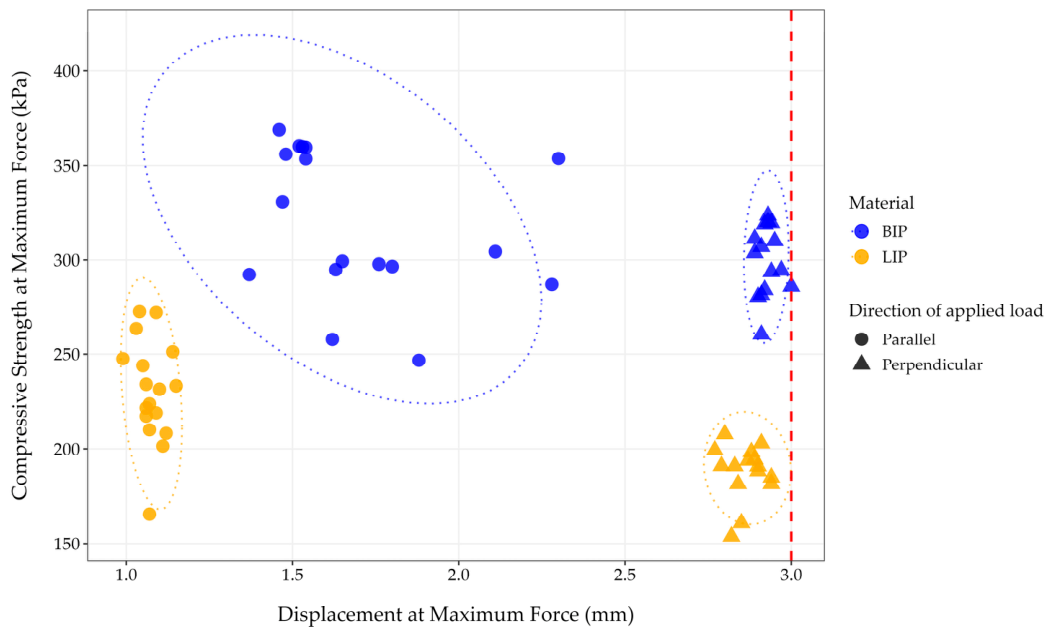
| BIP | Parallel | 12.9 × 10³ (±2.53) | 319.0 (±38.9) | 295.0 (±31.3) | 1.70 (±0.29) |
| Perpendicular | 8.94 × 10³ (±1.29) | 300.0 (±18.4) | 298.0 (±18.1) | 2.93 (±0.03) | |
| LIP | Parallel | 8.52 × 10³ (±1.31) | 230.0 (±27.3) | 178.0 (±17.2) | 1.08 (±0.04) |
| Perpendicular | 4.32 × 10³ (±0.49) | 188.0 (±14.5) | 187.8 (±14.6) | 2.86 (±0.05) |
Disclaimer/Publisher’s Note: The statements, opinions and data contained in all publications are solely those of the individual author(s) and contributor(s) and not of MDPI and/or the editor(s). MDPI and/or the editor(s) disclaim responsibility for any injury to people or property resulting from any ideas, methods, instructions or products referred to in the content. |
© 2026 by the authors. Licensee MDPI, Basel, Switzerland. This article is an open access article distributed under the terms and conditions of the Creative Commons Attribution (CC BY) license.
Share and Cite
Mialeshka, V.; Pásztory, Z. Binderless Hardwood Tree Bark-Based Insulation Panels for Green Building Applications. Processes 2026, 14, 1450. https://doi.org/10.3390/pr14091450
Mialeshka V, Pásztory Z. Binderless Hardwood Tree Bark-Based Insulation Panels for Green Building Applications. Processes. 2026; 14(9):1450. https://doi.org/10.3390/pr14091450
Chicago/Turabian StyleMialeshka, Volha, and Zoltán Pásztory. 2026. "Binderless Hardwood Tree Bark-Based Insulation Panels for Green Building Applications" Processes 14, no. 9: 1450. https://doi.org/10.3390/pr14091450
APA StyleMialeshka, V., & Pásztory, Z. (2026). Binderless Hardwood Tree Bark-Based Insulation Panels for Green Building Applications. Processes, 14(9), 1450. https://doi.org/10.3390/pr14091450