Article

Study on the Migration Laws of Overlying Strata in Backfill Mining of Close-Distance Coal Seams

1
College of Energy and Mining Engineering, Shandong University of Science and Technology, Qingdao 266590, China
2
Zaozhuang Mining (Group) Chaili Coal Mine, Zaozhuang 277519, China
3
North West Electric Power Design Institute Co., Ltd., China Power Engineering Consulting Group, Xi’an 710075, China
*
Author to whom correspondence should be addressed.
Processes 2026, 14(9), 1448; https://doi.org/10.3390/pr14091448
Submission received: 30 March 2026 / Revised: 24 April 2026 / Accepted: 25 April 2026 / Published: 30 April 2026
(This article belongs to the Section Energy Systems)

Abstract

To clarify the migration characteristics of overlying strata during backfill mining of close-distance coal seams, the 3306 working face of Chaili Coal Mine was taken as the engineering background, and similar-material simulation, fracture-fractal analysis, and FLAC3D numerical simulation were carried out under an 85% backfill ratio. The study reveals the coordinated inherited and reactivated evolution of fractures, displacement, and stress in the overlying strata during successive extraction of the upper and lower seams. The results indicate that the movement of the overlying strata shows pronounced stage dependence and inheritance. After extraction of the upper No. 3 coal seam, the response of the overlying strata evolves from local disturbance to overall structural readjustment, with continuous bending subsidence and progressive fracture propagation, and ultimately forms a two-belt structure. During extraction of the lower No. 3 coal seam, the response develops on the basis of the structural state formed after upper-seam mining and is manifested mainly by the reactivation and readjustment of the pre-existing fracture network and displacement field. The fractures undergo a dynamic process of generation, development, closure, redevelopment, and reclosure. Compared with upper-seam mining, lower-seam mining produces a larger vertical displacement and a weaker stress response. The maximum vertical displacement in-creases from 478.85 mm to 1019.76 mm, whereas the stress concentration coefficient of the immediate roof decreases from 2.01–2.03 to 1.93–1.99. Under the geological and mining conditions considered in this study, the 85% backfill ratio maintains overall bending subsidence of the overlying strata and alleviates strata pressure manifestations during lower-seam extraction. These findings provide a reference for strata control under similar backfill mining conditions.

1. Introduction

Backfill mining is one of the key technologies for achieving green and low-loss coal extraction. It enables the recovery of coal resources beneath buildings, railways, and water bodies, restrains overlying strata failure and surface subsidence, and promotes the under-ground utilization of coal-based solid wastes [1,2,3,4,5]. Under backfill mining conditions, the disturbance and failure range of the overlying strata above the working face is markedly smaller than that under caving mining, and both the load-transfer path and structural evolution pattern of the strata are fundamentally altered [6]. Therefore, clarifying the movement characteristics of overlying strata during backfill mining is of great significance for safe resource recovery and for effective control of strata and surface movement.
Extensive studies have been conducted worldwide on the movement characteristics of overlying strata and the corresponding control theory in backfill mining. Zhang Qiang et al. [7] analyzed the engineering objectives of backfill mining from the perspective of coal–rock movement and control and proposed critical backfill ratios for different control requirements. Chen Yang et al. [8], through field monitoring of a longwall paste backfill face, found that overburden microseismicity was characterized by asymmetry, low energy, and limited vertical development height, and reported that roof movement was dominated by bending subsidence, which effectively prevented large-scale failure of a hard roof. Yang Ke et al. [9] combined similar-material simulation with theoretical analysis to investigate the spatiotemporal coordinated evolution of the stress, displacement, and fracture fields of the overlying strata under in situ backfilling conditions, and proposed corresponding roof control strategies. Li Meng et al. [10] using field monitoring, laboratory testing, and theoretical analysis, examined the strata-movement characteristics of a backfill face with a hard roof and thick top coal, revealed the interaction mechanism between the support system and the surrounding rock, and optimized the support parameters of the backfill face. Wang Zhaohui et al. [11], through theoretical analysis, laboratory experiments, and field measurements, investigated the distribution law of mining-induced stress in a deep backfill working face and revealed the feedback mechanism of advance abutment stress on the backfill ratio. Yang Shifan et al. [12], by integrating theoretical analysis, numerical simulation, and field measurements, examined the spatial interaction between the roof and the backfill body, analyzed the effects of different factors on roof subsidence, and identified mining height as the key factor controlling roof subsidence.
Although these studies have laid an important foundation for understanding strata movement during backfill mining, existing research has mainly focused on single-seam backfill extraction. In China, close-distance coal seams are widely distributed under complex geological conditions [13]. During backfill mining of such seam groups, mutual interference between the upper and lower seams is common. In particular, the lower seam is extracted in an overlying-strata system that has already experienced unloading, fracture development, displacement accumulation, and interburden damage induced by upper-seam mining. Accordingly, the lower-seam response cannot be interpreted directly by the conventional single-seam backfill framework. The key issue concerns how the pre-disturbed overlying-strata structure controls the subsequent evolution of fractures, displacement, and stress during repeated mining. Recent studies have further shown that, under close-distance and longwall mining conditions, the structural response of the strata is closely related to weighting behavior, support–coal wall interaction, and stress redistribution around coal pillars and adjacent roadways, which reflects the complexity of strata response under repeated disturbance in close-distance seam groups [14,15,16,17]. However, under backfill mining conditions, the coordinated evolution of fractures, displacement, and stress, together with the interlayer inheritance mechanism during repeated extraction of close-distance coal seams, remains insufficiently understood. Taking the 3306 working face of Chaili Coal Mine as the engineering background, this study combines similar-material simulation and numerical simulation to investigate the movement characteristics of overlying strata during backfill mining of close-distance coal seams. The main contribution of this study is to reveal the inherited and reactivated evolution of overlying-strata fractures, displacement, and stress during successive extraction of the upper and lower seams, and to clarify how lower-seam mining develops within a pre-disturbed strata structure under backfill support.

2. Engineering Background

At Chaili Coal Mine, the coal resources remaining beneath surface structures are mainly distributed in the industrial square area. The 3306 working face is located in the southern part of the shaft protection pillar. Because buildings and industrial facilities are distributed above the working face, backfill mining was adopted to recover the coal resources while controlling surface subsidence.
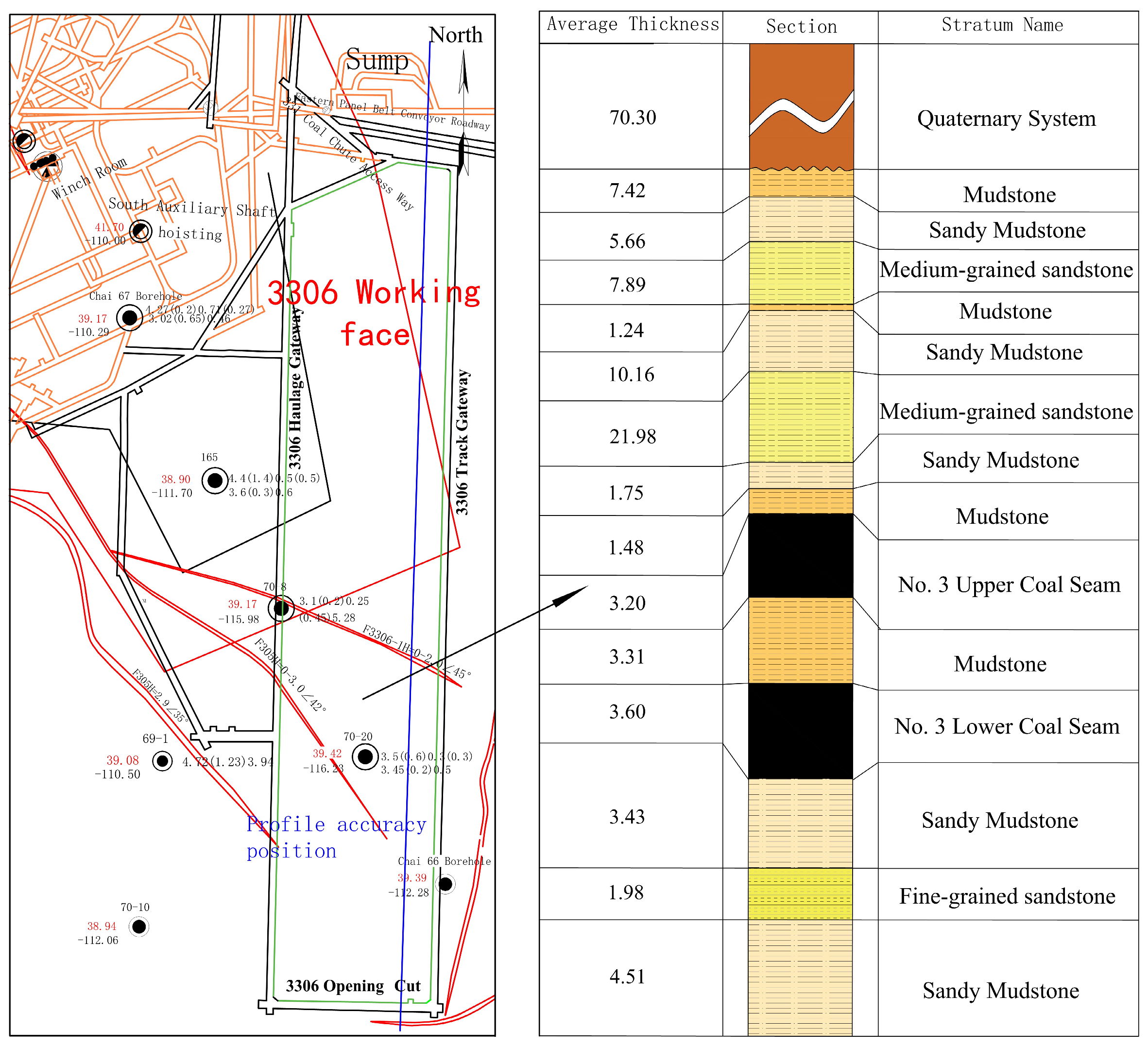
The 3306 working face involves the sequential extraction of two close-distance coal seams. Working face 3306 ① extracts the upper No. 3 coal seam, whereas working face 3306 ② extracts the lower No. 3 coal seam. The burial depth of the seams ranges from 142 to 150 m. The mining heights of the upper and lower No. 3 coal seams are 3.2 m and 3.6 m, respectively, and the average interburden thickness between the two seams is 3.31 m. The roadway layout of the working face and the comprehensive stratigraphic column of the roof and floor strata are shown in Figure 1.

3. Physical Similarity Simulation Model

3.1. Similar-Material Simulation Scheme

Similar-material simulation tests were conducted using the 3306 ① and 3306 ② working faces of Chaili Coal Mine as the engineering background. The dimensions of the physical simulation apparatus were 1330 mm × 200 mm × 800 mm (length × width × height). The model was constructed with a geometric similarity ratio of C L = 1 : 200 , a bulk density similarity ratio of C P = 1 : 1.5 , a time similarity ratio of C t = 1 : 14.14 , and a stress similarity ratio of C σ = 1 : 300 . The mix proportions of the similar materials used for each stratum are listed in Table 1.
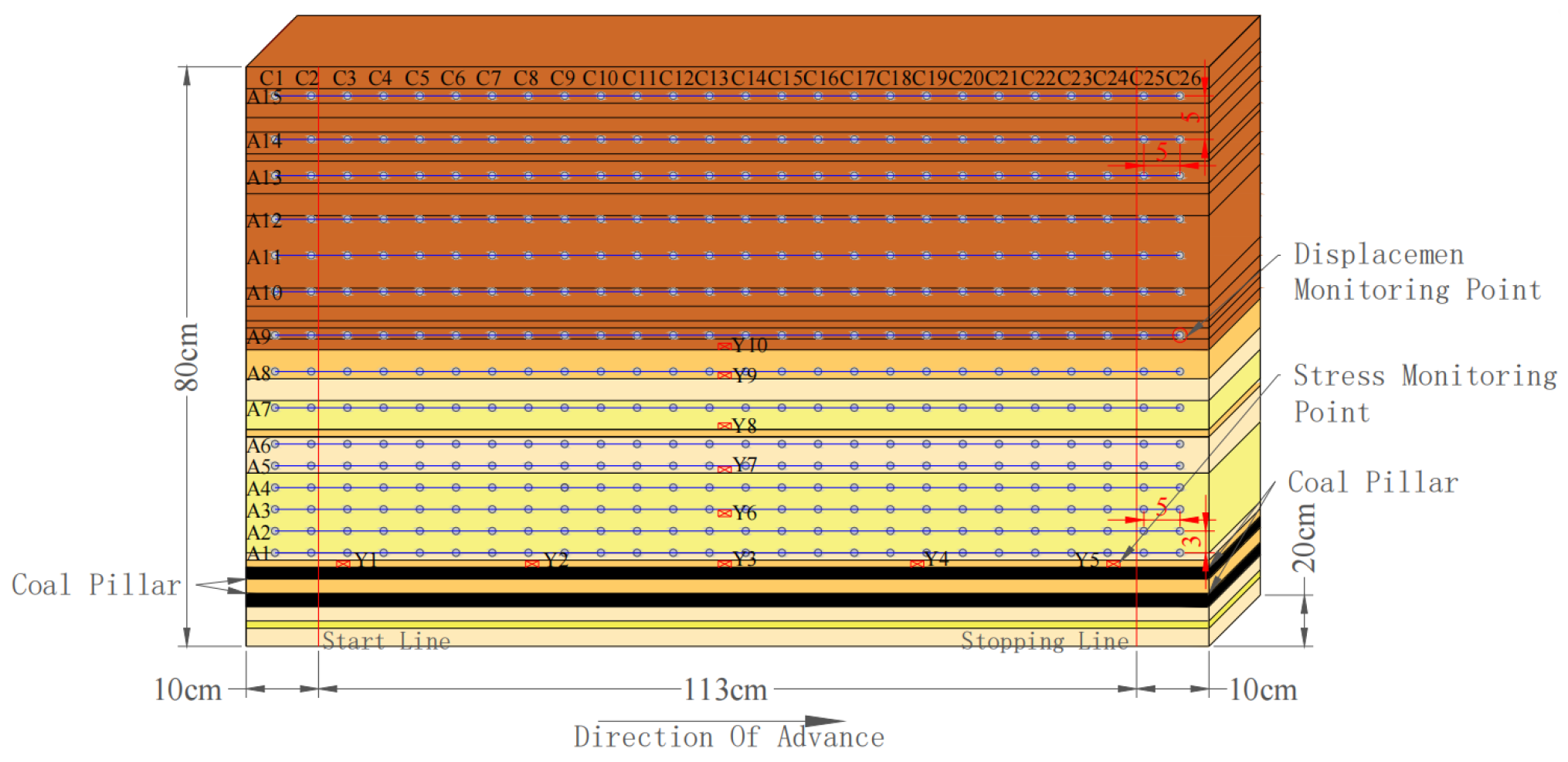
(1) Stress monitoring arrangement. A total of 10 stress sensors (Nanjing Dan Mo Electronic Technology Co., Ltd., Nanjing, China) were installed in the model to monitor stress variations in the overlying strata. Sensors Y1–Y5 were positioned above the upper No. 3 coal seam. Sensors Y6–Y10 were arranged vertically above Y3, with vertical offsets of 7, 13, 18, 23, and 30 cm, respectively.
(2) Displacement monitoring arrangement. Fifteen horizontal measuring lines, denoted A1–A15, were arranged along the vertical direction of the model, and each line contained 26 monitoring points (C1–C26). Lines A1–A6 were located near the immediate roof and main roof, where strata movement was most active, and their vertical spacing was therefore reduced to 3 cm. The vertical spacing of lines A7–A15 was 5 cm. On each measuring line, points C1 and C26 were located 4 cm from the left and right model boundaries, respectively, and adjacent monitoring points were spaced 5 cm apart. These measuring lines were used to monitor the displacement of the overlying strata above the working face during backfill mining.

3.2. Mining Scheme

To minimize boundary effects, 10 cm coal pillars were reserved on both sides of the model, leaving a 113 cm wide central zone for excavation and backfilling. The mining start line was defined at the right boundary of the left coal pillar, and the stop line was defined at the left boundary of the right coal pillar. The extraction direction was from left to right, with the upper No. 3 coal seam mined first, followed by the lower No. 3 coal seam. The backfill ratio for both seams was set at 85%. This value was selected as the representative working condition according to the engineering design of the 3306 working face and the control requirement for maintaining the stability of the roof and interburden during backfill mining of close-distance coal seams. Under the geometric similarity ratio of 1:200, the mining heights of 3.2 m and 3.6 m in the upper and lower No. 3 coal seams correspond to model seam thicknesses of 1.60 cm and 1.80 cm, respectively. Accordingly, the compacted backfill heights corresponding to an 85% backfill ratio are 1.36 cm for the upper seam and 1.53 cm for the lower seam. Wooden blocks of these heights were therefore used to simulate the compacted backfill bodies in the two seams. The mining process was simulated in discrete steps, with an excavation advance of 2.4 cm every 1.3 h, followed by sequential backfilling. A schematic diagram of the similar-material model and the monitoring-point arrangement is shown in Figure 2.

4. Analysis of Results from Similar-Material Simulation Tests

4.1. Analysis of Overlying Strata Movement Characteristics

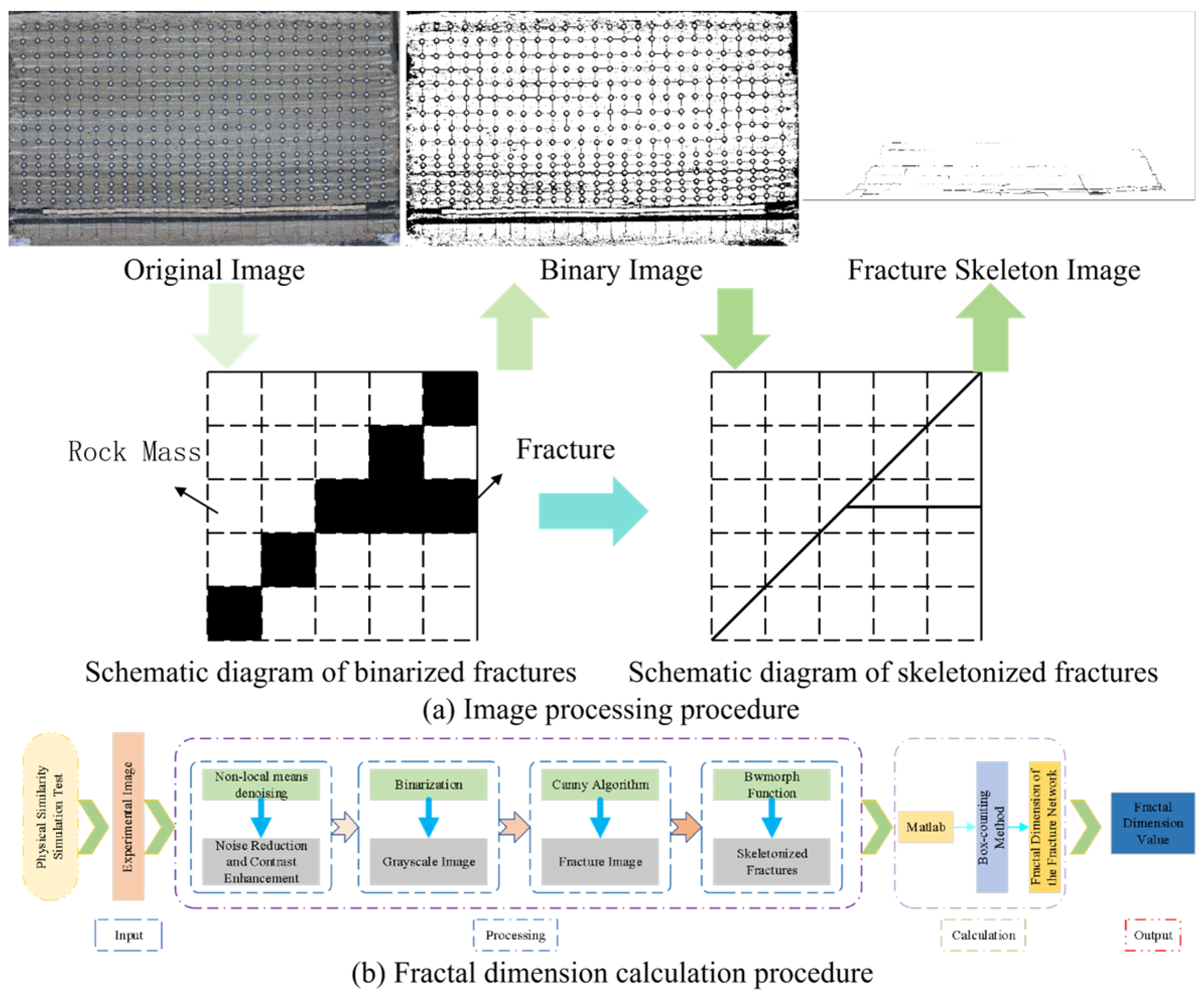
Based on the fracture distribution and displacement-field results of the overlying strata, the evolution of fractures and the morphological changes in the displacement field were analyzed. To quantitatively evaluate the effect of backfill mining on damage to the overlying strata during extraction of close-distance coal seams, the images were processed in MATLAB R2024b through binarization, fracture-skeleton extraction, and fractal-dimension calculation. The equation used to calculate the fractal dimension is given in Equation (1) [18], and the corresponding workflow is shown in Figure 3.
D b o x = lim ε 0 lg N ( ε ) lg ( ε )
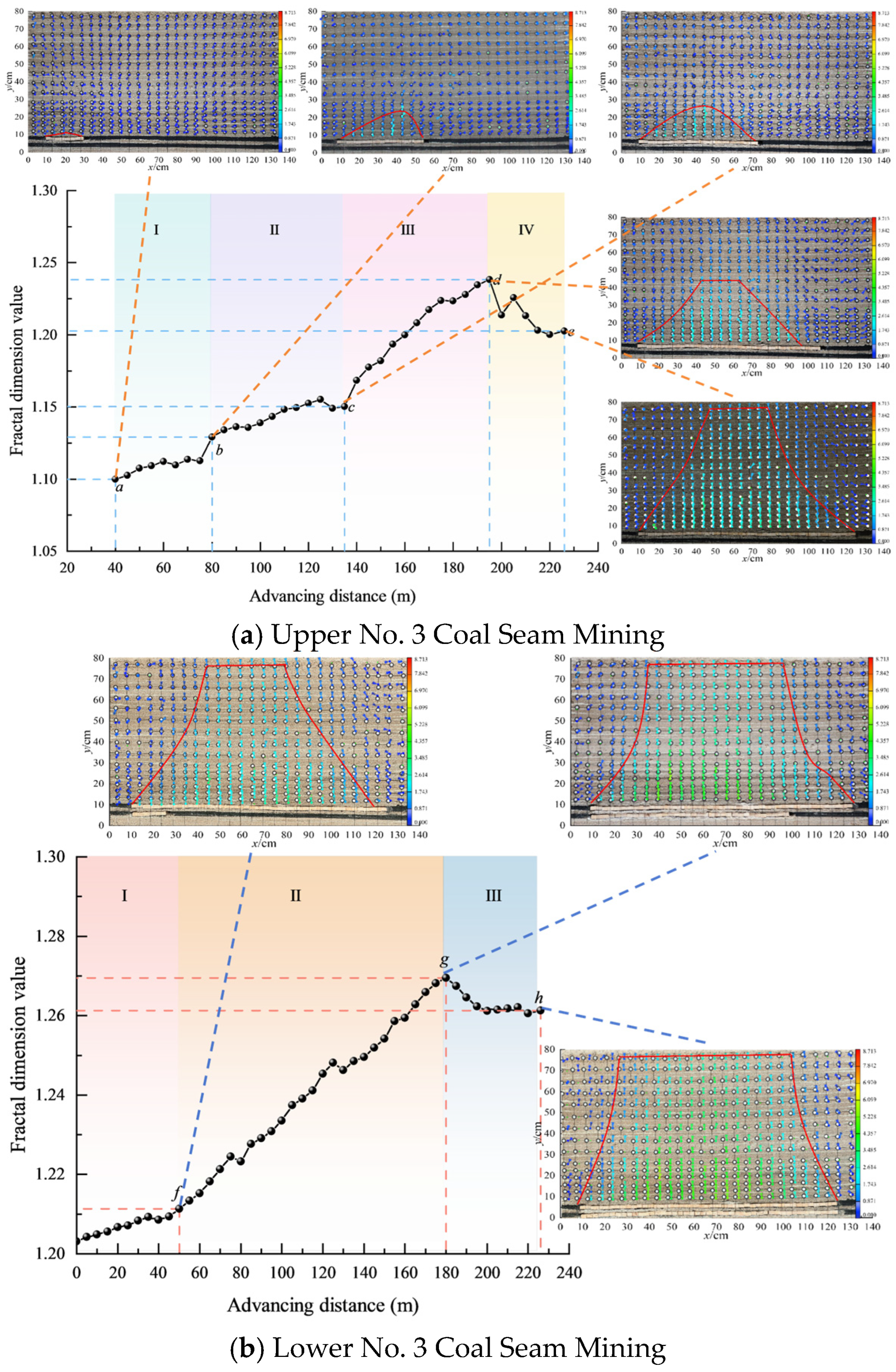
Figure 4 illustrates the fractal dimension of the fracture network in close-distance coal seams and the morphological evolution of the displacement field during backfill mining of both Upper No. 3 and Lower No. 3 coal seams. The corresponding displacement images, captured at key stages of the process, are provided by the XJTUDP measurement system. The photographs corresponding to the key stages are displacement images exported from the XJTUDP measurement system. During backfill mining of the upper No. 3 coal seam, the evolution of fractal dimension can be divided into four stages according to the growth rate: Stage I, low-rate growth; Stage II, medium-rate growth; Stage III, high-rate growth; and Stage IV, stable equilibrium. By contrast, during backfill mining of the close-distance coal seams after extraction of the upper No. 3 coal seam, the evolution of fractal dimension can be divided into three stages: Stage I, low-rate growth; Stage II, high-rate growth; and Stage III, stable equilibrium.
In Stage I (segment ef), the displacement–deformation zone expands slightly leftward relative to the trapezoidal zone formed at the end of upper No. 3 coal seam extraction. The fractal dimension increases from the final stable value of 1.2027 after upper-seam mining to 1.2113, with an average growth rate of 0.00017, which is slightly lower than the low-rate growth value of 0.00036 observed during mining of the upper No. 3 coal seam. This is mainly because most fractures redevelop along pre-existing paths, whereas the formation of new fractures remains limited. Under the combined action of self-weight and overburden load, the interburden bends and subsides, thereby reactivating the transverse fractures formed at the interface between the immediate roof and the main roof during extraction of the upper No. 3 coal seam.
In Stage II (segment fg), the displacement–deformation zone advances forward in a trapezoidal form, while the fractal dimension rises markedly to 1.2695. The average growth rate of fractal dimension reaches 0.00044, which is 158.8% higher than that in the previous stage, indicating a pronounced acceleration in fracture development. At this stage, bed separation becomes evident at multiple stratigraphic levels, suggesting that the evolution of fractures and the displacement field has entered a stage of rapid fracture propagation and large-scale outward expansion. Compared with mining of the upper No. 3 coal seam, strata failure at this stage is strongly affected by the superposition of repeated mining disturbances. After extraction of the upper No. 3 coal seam, the overlying strata had already developed a macroscopic fracture network and accumulated mining-induced damage, which reduced rock-mass strength and integrity. Under the secondary disturbance induced by close-distance seam extraction, deformation is preferentially reactivated along pre-existing fractures, which promotes fracture extension and leads to pronounced fracture redevelopment. In addition, because the spacing between the two seams is small, the mining influence zones of the upper and lower seams overlap, promoting upward fracture propagation into higher strata. Meanwhile, some fractures are compacted and closed by subsidence of the overlying strata. Even so, the rate of fracture initiation and extension remains greater than the rate of fracture closure, so the fractal dimension continues to increase overall. At this stage, the displacement field continues to expand, while fracture connectivity and structural complexity also increase.
Stage III (segment gh) corresponds to the stable-equilibrium stage. During this stage, the fractal dimension first decreases and then gradually stabilizes at 1.2613, which remains higher than the value of 1.2027 obtained after mining of the upper No. 3 coal seam, indicating that fracture complexity in the overlying strata is more pronounced during backfill mining of the close-distance coal seams. The displacement–deformation zone continues to enlarge and gradually evolves into an approximately symmetrical trapezoid [9], with both sides extending farther outward than those observed after mining of the upper No. 3 coal seam. Most fractures continue to propagate along pre-existing paths, but the rate of fracture initiation and extension gradually approaches the rate of compaction-induced closure, leading to a balanced and orderly structural state characterized by fracture redevelopment and reclosure [19]. Although extraction of the lower No. 3 coal seam significantly enhances fracture reactivation and enlarges the displacement field, the overlying strata still exhibit overall continuous bending under backfill support, and no caving occurs.
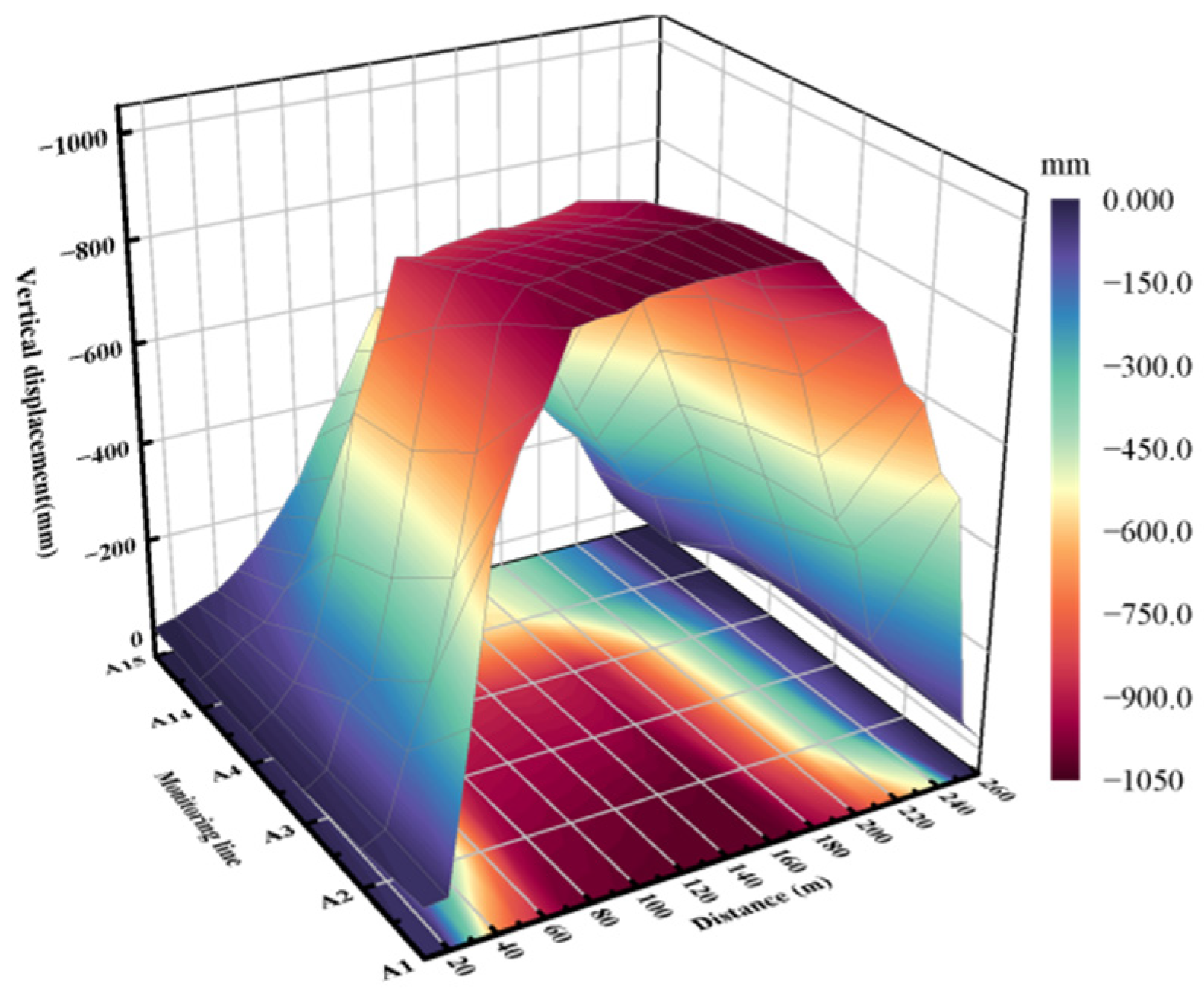
After completion of mining at the working face, data from the immediate roof (A1 and A2), main roof (A3 and A4), and near-surface strata (A14 and A15) were used to generate the subsidence surface of the overlying strata above the close-distance coal seam working face, as shown in Figure 5.
As shown in Figure 5, the projection of the subsidence surface of the overlying strata in the X and Y directions is generally consistent with the displacement contour at point h. The maximum subsidence reaches 1019.76 mm and occurs at monitoring point C12 on measuring line A1 in the immediate roof, which is markedly greater than the maximum vertical displacement of 478.85 mm recorded at monitoring point C13 on the same measuring line during backfill mining of the upper No. 3 coal seam alone. Compared with the single-seam case, mining of the close-distance coal seams leads to a clear increase in both the vertical displacement magnitude along each measuring line and the lateral extent of the affected zone. Some displacement curves also show a flattened base. These results indicate that close-distance seam extraction intensifies the mining-induced response, although the overall displacement pattern remains similar: deformation is strongest in the central part of the panel and gradually weakens toward both ends, while vertical displacement decreases upward away from the seam. Accordingly, strata closer to the coal seam undergo larger displacement. This pattern is related to bulking during strata movement [20], which compresses the available deformation space of the higher strata and leads to a stronger displacement response in the near-seam strata but a weaker response near the surface.
Compared with backfill mining of a single coal seam, backfill mining of close-distance coal seams shows both common features and clear differences in overlying-strata movement. In both cases, the fracture fractal dimension increases continuously with face advance, and the displacement field expands progressively. The backfill body effectively constrains strata movement, so deformation remains dominated by bending subsidence, and the load-bearing structure evolves into a continuous curved beam with good integrity [21]. As a result, the overlying strata ultimately develop a characteristic two-belt structure composed of the fracture zone and the bending-subsidence zone, indicating effective control of mining-induced disturbance and strata subsidence. The differences are mainly reflected in the evolution of fractal dimension, displacement response, and load-bearing structure. During mining of the upper No. 3 coal seam, the overlying strata are initially relatively intact, and fracture development therefore proceeds through four relatively independent stages: low-speed growth, medium-speed growth, high-speed growth, and stabilization. During mining of the lower No. 3 coal seam after extraction of the upper seam, only three stages are observed: low-speed growth, high-speed growth, and stabilization. The reduction in stage number is fundamentally attributable to the fact that mining of the lower seam occurs in an overlying-strata system in which a fracture network and interburden damage have already developed during extraction of the upper seam. Under these conditions, early-stage fracture initiation no longer starts from a relatively intact structure, and the initial initiation process is rapidly connected to the subsequent rapid propagation process. Consequently, the intermediate transition stage identifiable during mining of the upper seam is compressed during mining of the lower seam, and the overall evolution is expressed as a three-stage pattern. The response of the lower seam therefore includes both the initiation and propagation of new fractures and the redevelopment and reclosure of pre-existing fractures, indicating a much stronger reactivation effect [22]. The maximum vertical displacement and the spatial extent of displacement during mining of the lower No. 3 coal seam are both significantly greater than those during mining of the upper No. 3 coal seam, suggesting that the increased effective mining height in close-distance seam extraction amplifies the displacement field through a superposition effect. At the same time, the backfill body effectively constrains movement of the interburden strata and prevents the immediate caving behavior typically observed in caving mining [23], thereby maintaining a continuous deformation mode dominated by overall bending subsidence.

4.2. Analysis of Stress Characteristics of the Overlying Strata

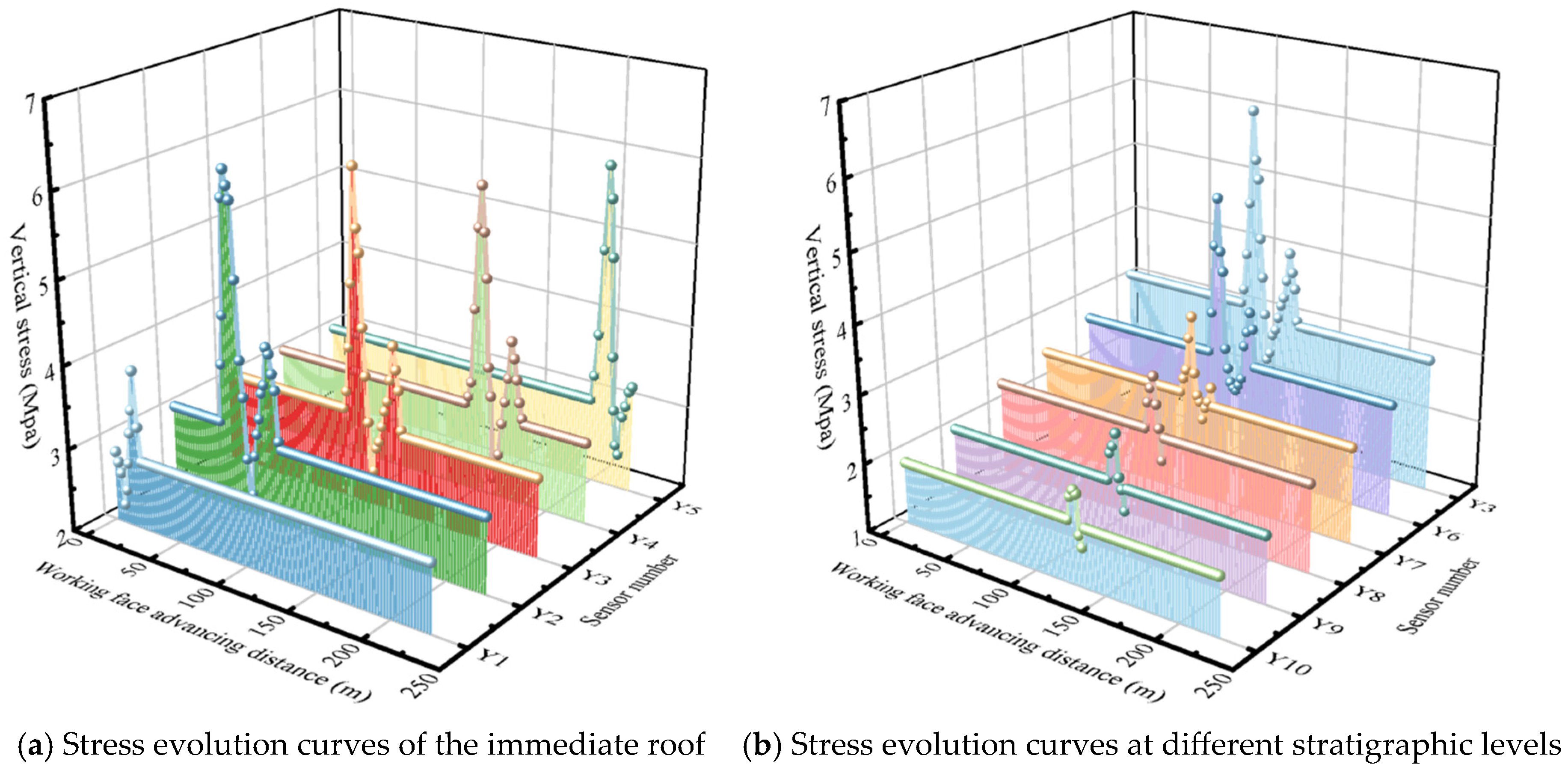
The stress monitoring data were processed to obtain the stress-evolution curves of the overlying strata during mining of the close-distance coal seams after backfill mining of the upper No. 3 coal seam, as shown in Figure 6.
As shown in Figure 6a, except for Y1 and Y5, the stress variation at the immediate-roof monitoring points during backfill mining of the lower No. 3 coal seam in the close-distance seam system follows a broadly similar pattern. Specifically, Y2–Y4 all exhibit a four-stage stress-evolution process, namely advance stress concentration, unloading-induced reduction, backfill load-bearing adjustment, and final stable equilibrium. As the working face advances, the stress peak gradually shifts forward in the mining direction. Once the face passes beneath a monitoring point, the stress decreases because of unloading induced by coal extraction. Thereafter, as the backfill body gradually assumes the load of the overlying strata, the stress recovers and eventually reaches a stable state, although it remains lower than the in situ stress. This evolution is generally consistent with that observed during backfill mining of the upper No. 3 coal seam. For points Y2–Y4, the stress concentration coefficient ranges from 1.93 to 1.99, the stress fluctuation range from 38 to 42 m, and the stress fluctuation amplitude from 3.52 to 3.85 MPa. All of these values are lower than those recorded during mining of the upper No. 3 coal seam, for which the corresponding ranges are 2.01–2.03, 44–46 m, and 3.82–4.01 MPa, respectively. These results indicate that bending deformation and prior fracture development induced by extraction of the upper No. 3 coal seam had already dissipated part of the energy accumulated in the overlying strata, producing a clear pre-damage and redistribution effect on subsequent mining of the lower No. 3 coal seam. As a result, during advance of the lower seam, the strata can no longer accumulate energy in relatively intact rock masses to the same extent as during upper-seam mining, and stress is released more readily along pre-damaged zones.
As shown in Figure 6b, Y3–Y10 are stress monitoring points located at the same horizontal position but at different stratigraphic levels. Points Y3, Y6, and Y7 still undergo the four-stage stress evolution described above, whereas points Y8–Y10 exhibit only three stages, namely advance stress concentration, unloading-induced reduction, and final stable equilibrium, without an obvious backfill load-bearing adjustment stage. This indicates that the backfill body mainly supports adjacent strata and helps preserve their integrity, so its influence on stress evolution gradually weakens with increasing stratigraphic height. This pattern is consistent with the stress evolution observed during backfill mining of the upper No. 3 coal seam. With increasing stratigraphic elevation, the stress fluctuation range during backfill mining of the lower No. 3 coal seam after extraction of the upper seam decreases from 40 m at Y3 to 10 m at Y10, indicating that strata movement continuously dissipates stress and naturally narrows the affected range upward. Over the same interval, the stress concentration coefficient declines from 1.94 to 1.23, suggesting that, under backfill support, mining-induced local energy accumulation is progressively dissipated through bending subsidence of the strata. The stress fluctuation amplitude decreases from 3.59 MPa to 0.77 MPa, further indicating that upward stress transmission is weakened under backfill support. Compared with the corresponding values during backfill mining of the upper No. 3 coal seam, namely a stress fluctuation range of 42–10 m, a stress concentration coefficient of 2.01–1.27, and a stress fluctuation amplitude of 3.85–0.78 MPa, the stress response at all stratigraphic levels is attenuated to some extent. However, compared with the immediate roof, the reduction in the higher strata is relatively limited.
Compared with backfill mining of a single coal seam, stress evolution during backfill mining of close-distance coal seams exhibits a pronounced weakening effect. The stress field no longer undergoes a one-time reconstruction as in the single-seam case; instead, it evolves through a multistage reconstruction process characterized by inheritance and readjustment. In both seams, the overall stress-evolution trend remains similar: monitoring points in the immediate roof display a four-stage response, whereas those in higher strata are mainly characterized by a three-stage response, and the general stress path still follows that of single-seam backfill mining. Even so, the stress concentration coefficient, fluctuation range, and fluctuation amplitude of the lower No. 3 coal seam are all significantly reduced. This indicates that mining of the upper No. 3 coal seam exerts a pressure-relief effect on subsequent extraction of the lower No. 3 coal seam in the close-distance seam system [24], thereby weakening the upward transmission of mining-induced disturbance.

5. Numerical Simulation Study of Backfill Mining in Close-Distance Coal Seams

5.1. Numerical Model Construction

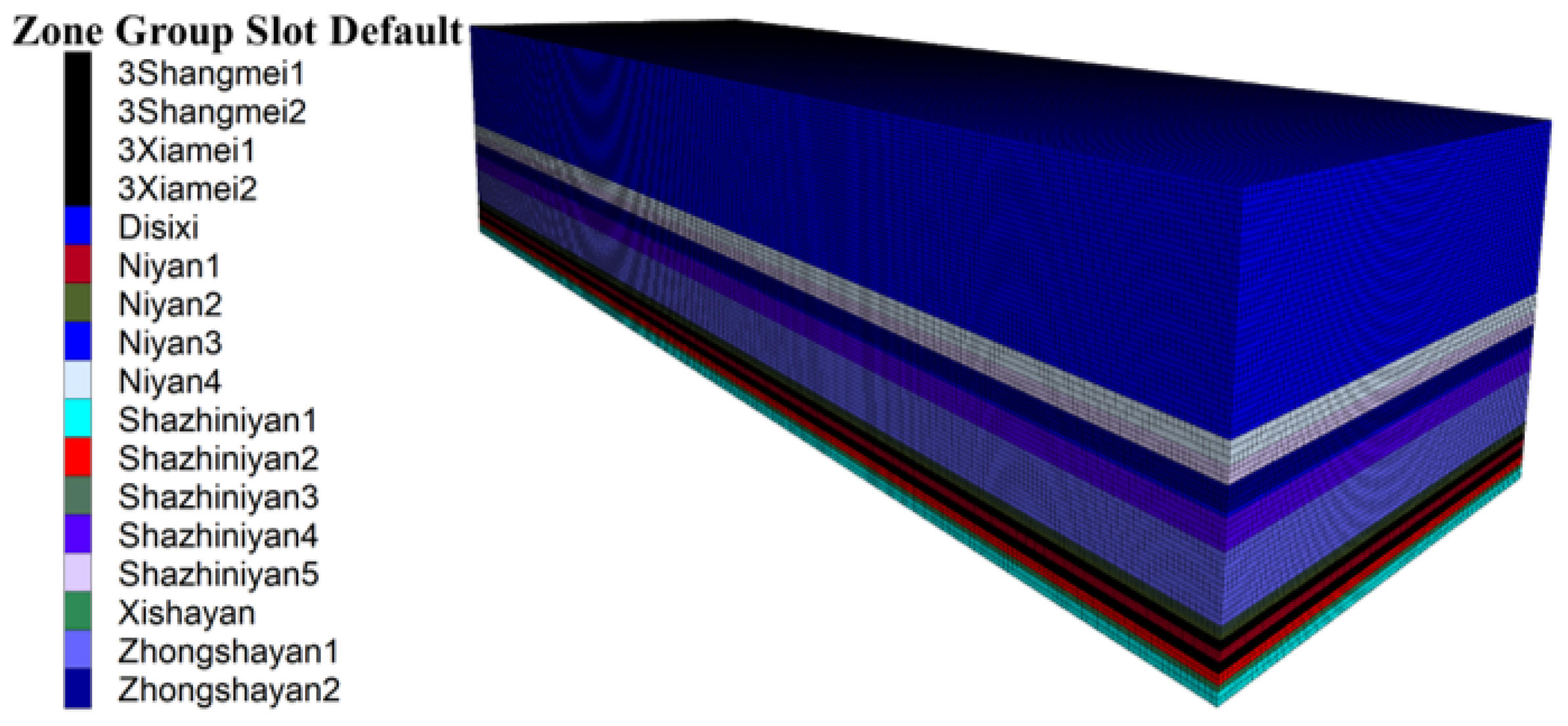
The backfill mining process of the close-distance coal seam working face was numerically simulated using FLAC3D. Based on the actual geological conditions, a three-dimensional numerical model was established with dimensions of 900 m, 300 m, and 150 m along the strike, dip, and vertical directions, corresponding to the X-, Y-, and Z-axes, respectively. The Mohr–Coulomb constitutive model was adopted, and the physical and mechanical parameters of the rock strata were derived from rock mechanics tests. The top boundary of the model was defined as a free surface. Normal displacement constraints were applied along the lateral boundaries in the X and Y directions, whereas full displacement constraints were imposed at the model bottom. Because the model extended to the ground surface, no additional horizontal load was applied to the top boundary. The numerical model is shown in Figure 7, and the main physical and mechanical parameters of the rock strata are listed in Table 2. In addition, coal pillars of 175 m were retained on both sides in the X direction and 100 m on both sides in the Y direction. The extraction dimensions of the working face were 550 m × 100 m, and excavation was conducted along the strike direction.

5.2. Analysis of Overlying Strata Displacement Evolution

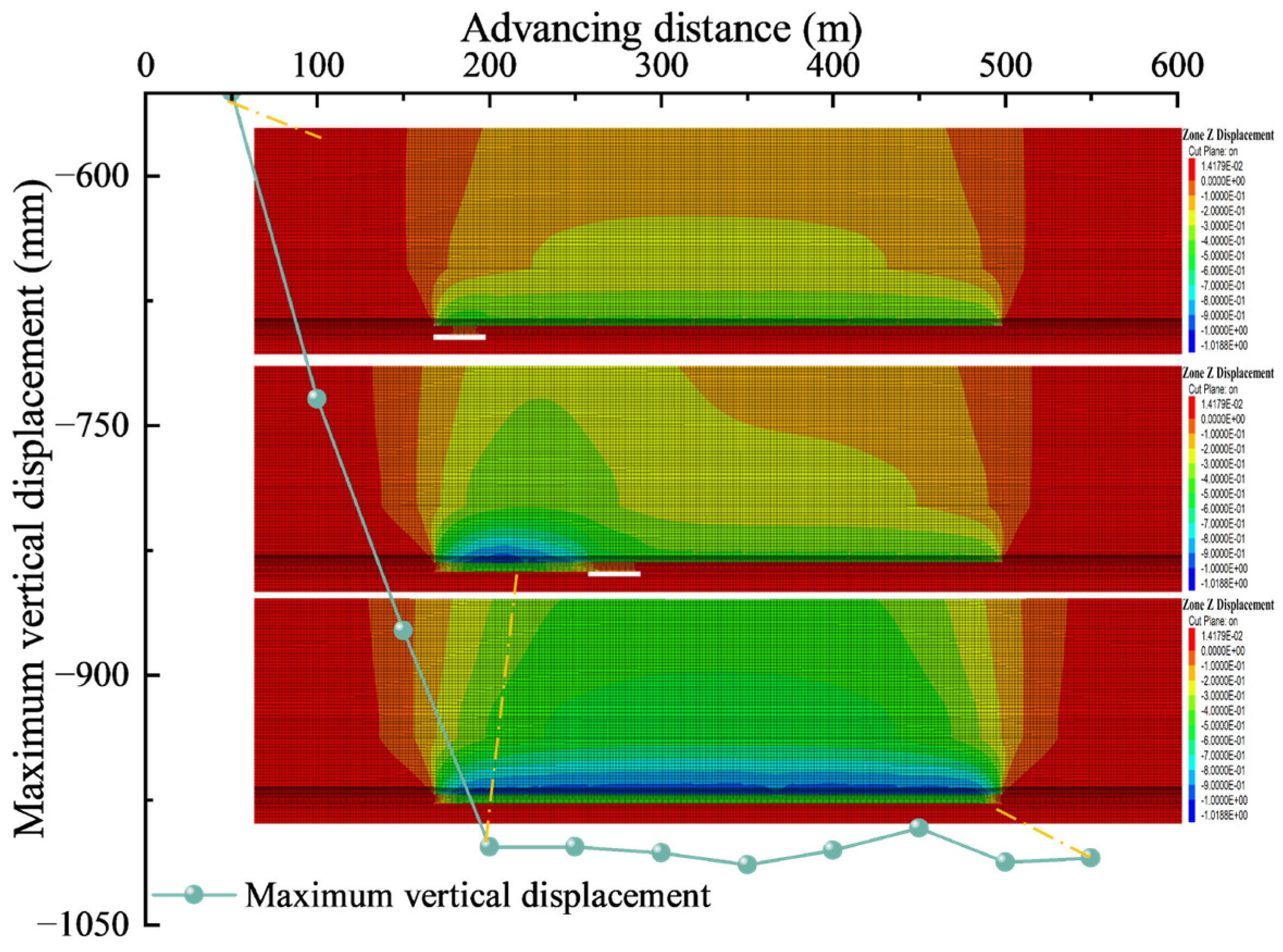
The maximum displacement data obtained from the numerical simulation were processed, and contour plots of representative sections were extracted. On this basis, the maximum vertical displacement curve during backfill mining of the lower No. 3 coal seam after extraction of the upper No. 3 coal seam was plotted, as shown in Figure 8.
During backfill mining of the lower No. 3 coal seam in the close-distance seam system, the displacement field evolves through three stages: inherited initiation, rapid peak development, and fluctuating stabilization. By comparison, mining of the upper No. 3 coal seam is characterized by local disturbance, rapid expansion, and gradual stabilization. Figure 8 shows that when the working face had advanced 50 m, the maximum vertical displacement reached 549.41 mm, only 71.02 mm greater than that recorded during mining of the upper No. 3 coal seam, equivalent to 22.1% of the displacement increment at the same stage of upper-seam extraction. The main displacement-affected zone still retained a trapezoidal shape, indicating that the initial response of the lower seam developed from the pre-existing displacement field formed after extraction of the upper No. 3 coal seam. Support from the upper-seam backfill body, together with the interburden mudstone, also restrained further displacement of the overlying strata. When the face advanced to 200 m, the maximum vertical displacement increased rapidly to 1003.34 mm, which is 453.93 mm higher than that at 50 m, indicating pronounced subsidence of the interburden mudstone, the upper-seam backfill body, and the overlying strata during the 50–200 m advance stage. At an advance distance of 550 m, the maximum vertical displacement remained at about 1010 mm, only 6.66 mm higher than that at 200 m, indicating little further change. The main displacement zone of the strata still showed a trapezoidal pattern, but the affected area was larger than that observed during mining of the upper No. 3 coal seam. These results indicate that the maximum vertical displacement had essentially stabilized by the time the face advanced to 200 m. Relative to the upper No. 3 coal seam, stabilization occurred slightly later and was more complete.
In both close-distance coal seam backfill mining and single-seam backfill mining, the displacement field of the overlying strata increases with face advance and then tends to stabilize, while overall deformation remains dominated by bending subsidence. The main difference lies in the development mode of the displacement field. Extraction of the upper No. 3 coal seam represents the first mining disturbance under initially intact strata conditions, so displacement expands progressively from a local response to an overall response. The elastic energy released after mining is dissipated mainly through load bearing by the backfill body and bending deformation of the overlying strata, resulting in a sustained but gradual increase in displacement. Extraction of the lower No. 3 coal seam takes place on the basis of an already established displacement field. The initial displacement level is therefore higher, the final vertical displacement is larger, and only slight fluctuations remain after stabilization. Mining of the upper No. 3 coal seam had already caused damage and degradation in the interburden strata. Subsequent extraction of the lower No. 3 coal seam released the energy stored in the interburden and overlying strata, allowing the damaged interburden mudstone, the upper-seam backfill body, and the overlying strata to participate in subsidence deformation and reactivate the pre-existing displacement field. This explains the rapid increase in vertical displacement during the 50–200 m advance stage. Under the sustained support of the two backfill bodies, the displacement field of the lower No. 3 coal seam showed only minor fluctuations after reaching its maximum value, rather than the prolonged slow growth observed in single-seam mining.

5.3. Analysis of Overlying Strata Stress Evolution

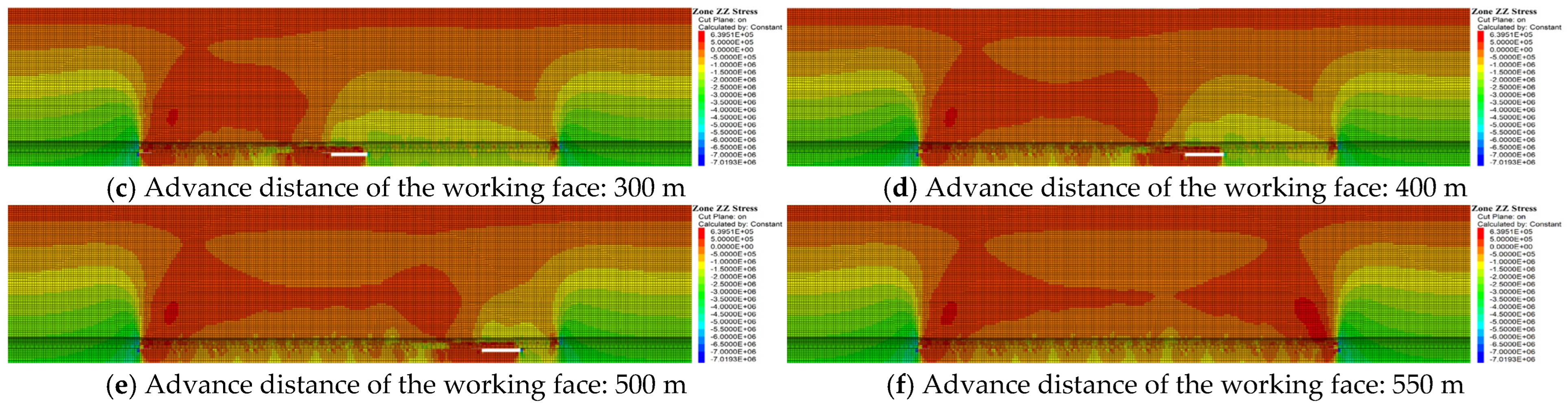
To investigate the evolution of strata stress, vertical-stress contours were extracted at advance distances of 100, 200, 300, 400, 500, and 550 m during backfill mining of the lower No. 3 coal seam after extraction of the upper No. 3 coal seam, as shown in Figure 9.
Figure 10 shows that during backfill mining of the lower No. 3 coal seam after extraction of the upper No. 3 coal seam, the strata stress field evolves from initial disturbance to redistribution and then to gradual stabilization as the working face advances. Stress above the goaf is progressively relieved, while concentration zones develop ahead of the face and in the coal–rock mass on both sides. After backfilling, the stress field is characterized by relative pressure relief in the central part and enhanced load bearing on both sides. This overall pattern is similar to that observed during backfill mining of the upper No. 3 coal seam. However, the response of the lower No. 3 coal seam is no longer an independent response under single-seam conditions; it is a secondary evolution superimposed on the stress field left by upper-seam mining. At the initial stage of lower-seam extraction, distinct stress-anomalous zones already exist in the interburden and in the strata on both sides under the influence of previous mining in the upper No. 3 coal seam. With continued advance, stress concentration shifts farther toward the coal pillars, whereas a continuous pressure-relief zone gradually forms above the goaf. The stress field therefore evolves into a pattern of concentration on both sides and relative unloading in the middle. Compared with single-seam backfill mining, stress redistribution during close-distance coal seam extraction extends over a wider range, and the concentration effect near the coal pillars is more pronounced.
The vertical-stress evolution of the overlying strata during backfill mining of the upper and lower No. 3 coal seams follows the general stress path of backfill mining, although the two stages differ clearly because the mining sequence and initial stress conditions are different. During extraction of the lower No. 3 coal seam, the stress field in the immediate roof still follows the four-stage evolution identified earlier, and the backfill body continues to promote relatively uniform transfer of mining-induced stress and gradual energy dissipation. Even so, stress evolution in the lower seam develops on the basis of the pressure-relief field produced by upper-seam mining, interburden damage, and the support already provided by the backfill body in the upper No. 3 coal seam. In this sense, mining of the lower No. 3 coal seam takes place under repeated disturbance in a pre-damaged stress environment, making the response more complex than that of the upper No. 3 coal seam, for which the main concern is the load-bearing behavior of the backfill body within the mined seam. The energy-dissipation path also changes significantly. During backfill mining of the upper No. 3 coal seam, load transfer is relatively clear, and energy is dissipated mainly through backfill support and bending subsidence of the overlying strata. During extraction of the lower No. 3 coal seam, mining-induced energy is dissipated through these processes and through progressive damage and renewed bending deformation of the interburden and overlying strata. Because the dissipation channels are more diverse, the overall stress-concentration effect is weaker.

5.4. Normalized Comparative Analysis of Overlying Strata Movement

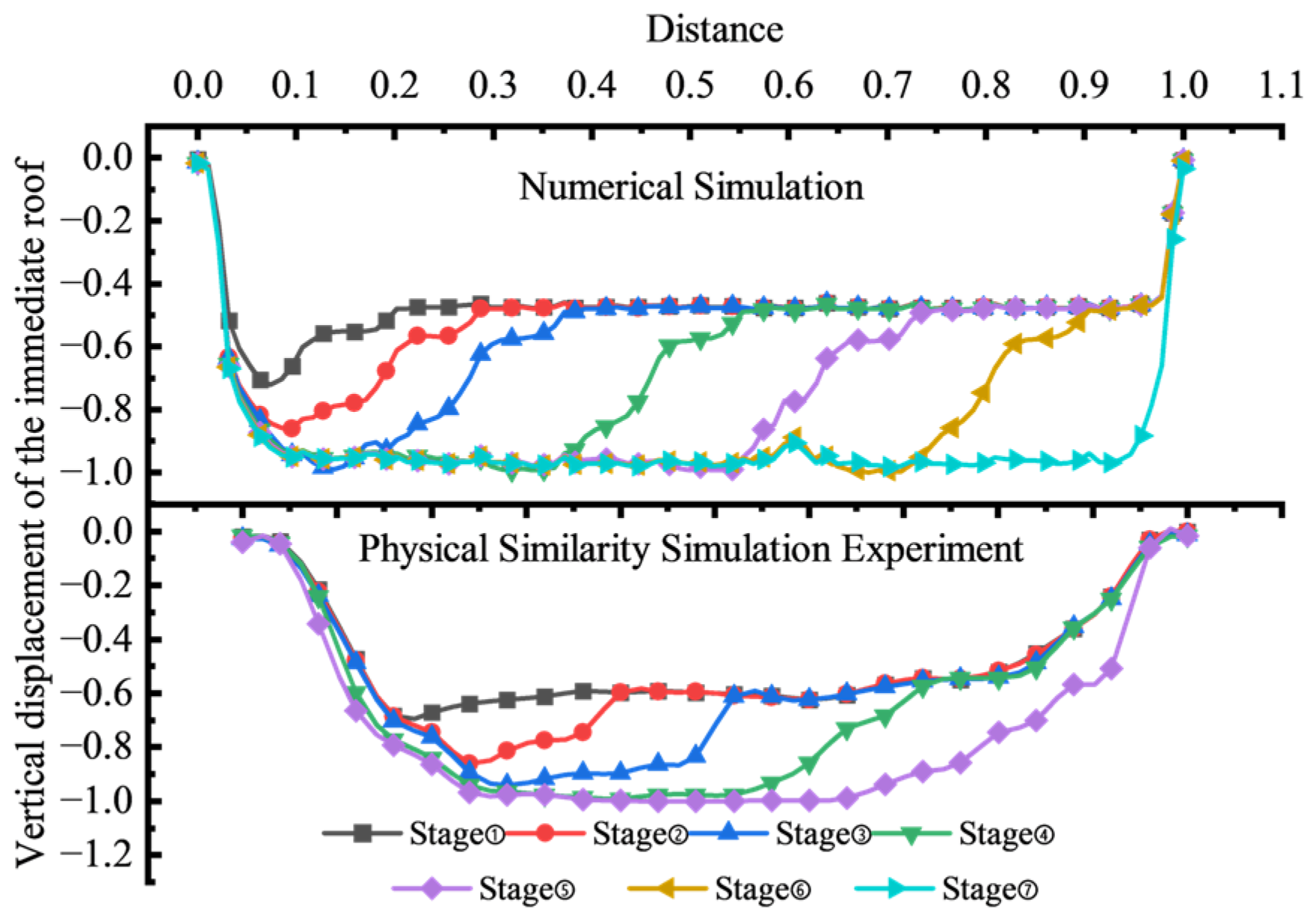
To eliminate differences in scale and dimension, the immediate-roof displacement data obtained from the similar-material simulation tests and the numerical simulation for the lower No. 3 coal seam in the close-distance seam system were normalized. The resulting curves of immediate-roof vertical displacement versus face advance are shown in Figure 10. The upper part of the figure shows the normalized curves from the numerical simulation, and the lower part shows those from the similar-material simulation tests.
As shown in Figure 10, the normalized curves derived from the numerical simulation and the similar-material simulation tests exhibit slight differences in morphology, mainly because the two methods differ in both the principles used to represent the rock mass and the arrangement of monitoring points. Even so, the displacement magnitudes remain of the same order, and the evolution of immediate-roof subsidence with face advance shows a consistent overall trend in both methods, indicating that the two sets of results can mutually verify one another.
During advance stage ①, the lower No. 3 coal seam was extracted after completion of mining in the upper No. 3 coal seam. At this stage, the immediate roof had already undergone a certain amount of post-mining subsidence induced by extraction of the upper seam, so the displacement response exhibited a clear inherited character.
During advance stages ②–③, the vertical displacement of the immediate roof increased rapidly, and the affected range continued to expand. The deformation pattern of the immediate roof gradually changed from localized subsidence to more extensive and coordinated subsidence over a larger area. This indicates that mining of the lower No. 3 coal seam further activated strata movement on the basis of the pre-existing deformation field.
During advance stage ④, the growth rate of the maximum vertical displacement began to decrease. As the working face continued to advance, multiple monitoring points successively reached their respective maximum vertical displacements, indicating that the main process of vertical displacement development had been largely completed by this stage.
During advance stages ⑤–⑦, the maximum vertical displacement remained essentially stable, and no obvious further increase was observed. The principal change at this stage was the gradual forward migration of the location of maximum vertical displacement with continued face advance, suggesting that the immediate roof had entered a relatively stable deformation stage.

6. Discussion

Previous studies have shown that backfill mining can effectively restrain failure of the overlying strata, reduce strata movement, and maintain a deformation mode dominated by bending subsidence [8,9,10,11,12,21]. The response of the upper No. 3 coal seam in the present study is consistent with this general understanding. After extraction of the upper seam, movement of the overlying strata remained controlled mainly by continuous bending subsidence and progressive fracture development, and no large-scale caving occurred. However, the response of the lower No. 3 coal seam cannot be interpreted within the conventional single-seam framework. By the time the lower seam was mined, the overlying strata had already undergone unloading, fracture development, displacement accumulation, and interburden damage induced by extraction of the upper seam. The lower-seam response therefore developed from an already adjusted strata system rather than from an intact one. A similar increase in system complexity has also been noted in fractured dual-porosity media, where the coexistence of fractures and matrix pores, as well as fracture geometry, can significantly modify the overall response of the rock mass. In this sense, the overlying strata above the lower seam in the present study should also be understood as a re-disturbed fractured system with inherited structural heterogeneity rather than as a newly disturbed intact medium [25,26,27].
The most important finding is that extraction of the lower No. 3 coal seam does not simply reproduce the response of the overlying strata observed during mining of the upper seam. Instead, it triggers a new stage of evolution within a pre-disturbed strata system, characterized by reactivation and readjustment of the pre-existing fracture network and displacement field, together with the generation and propagation of new fractures. This interpretation is supported by the change in fractal-dimension evolution from four stages in the upper seam to three stages in the lower seam, the larger but more rapidly stabilized displacement response of the lower seam, and the weakening of stress concentration during repeated mining. To make these differences more explicit, the main upper- and lower-seam contrasts are summarized in Table 3. In this respect, the present results agree with earlier studies on close-distance and multi-seam mining, which emphasized the role of repeated mining disturbance, interlayer interaction, and pre-existing damage in controlling subsequent strata behavior [13,14,23,24]. Under backfill mining conditions, however, this inherited disturbance does not develop into caving-type failure. The backfill body in the upper seam, together with the interburden strata, continues to provide support during lower-seam extraction, so the overlying strata still deform mainly by bending subsidence. This is the key feature that distinguishes backfill mining of close-distance coal seams from both conventional caving mining and single-seam backfill mining.
The stress results further clarify the mechanical meaning of this inherited response. In single-seam backfill mining, stress redistribution is generally characterized by advance concentration, unloading above the goaf, and gradual recovery under backfill support [8,9,11]. A similar stress path was still observed here, but the lower No. 3 coal seam showed a smaller stress concentration coefficient, a narrower fluctuation range, and a lower fluctuation amplitude than the upper seam. At the same time, the lower seam exhibited a larger displacement response. These two features are not contradictory, because they reflect different aspects of the repeated-mining response. The larger displacement of the lower No. 3 coal seam is inherited from the displacement field that had already formed after extraction of the upper seam, and is further amplified by renewed subsidence of the damaged interburden, the upper-seam backfill body, and the overlying strata during lower-seam extraction. By contrast, the weaker stress concentration indicates that part of the mining-induced energy had already been dissipated during extraction of the upper seam through bending deformation, fracture development, and early load sharing by the backfill body. The lower seam was therefore mined in a pre-relieved and pre-damaged stress environment. In addition, pre-existing fractures, interlayer interfaces, and damaged zones provided more channels for stress release and redistribution, so mining-induced stress was less likely to accumulate locally in relatively intact strata. Seen from this perspective, the coexistence of a larger displacement response and a weaker stress concentration effect reflects a shift in the dominant overburden response from primary stress accumulation in relatively intact strata to renewed deformation and energy release within an already adjusted structure. This interpretation is also consistent with the observed change in the energy-dissipation path, from progressive release through bending subsidence and new fracture development to transmission and dissipation along pre-existing fractures, interlayer interfaces, and damaged zones. Similar numerical studies of stratified rock masses have likewise indicated that accumulated damage may be accompanied by a progressive transition toward near-failure conditions [28].
These findings have direct engineering implications for coal extraction beneath buildings, railways, and water bodies. The effectiveness of backfill mining in close-distance coal seams lies in reducing the magnitude of movement of the overlying strata and in maintaining a controllable response mode during repeated mining. Under the geological conditions of the 3306 working face, the 85% backfill ratio allowed the overlying strata to remain in an overall bending-subsidence state and weakened strata pressure manifestations during extraction of the lower seam. This suggests that the key advantage of backfill mining in such settings lies in converting potentially unstable repeated disturbance into a coordinated and progressively adjustable deformation process. At the same time, the present study is based on one seam spacing and one backfill ratio. Although the normalized comparison between similar-material simulation and numerical simulation supports the reliability of the identified response pattern, the extent to which the same inheritance effect and stress weakening occur under different interburden lithologies, burial depths, and backfill stiffnesses still requires further verification. Future work should therefore focus on how these factors jointly control fracture reactivation, stress redistribution, and coordinated strata stability during repeated backfill mining.

7. Conclusions

(1) Overlying-strata movement during backfill mining of close-distance coal seams exhibits pronounced stage dependence and inheritance. During mining of the upper No. 3 coal seam, the evolution of fracture fractal dimension follows a four-stage pattern, whereas during mining of the lower No. 3 coal seam after extraction of the upper seam, it changes to a three-stage pattern. The lower-seam response develops on the basis of the structural state formed after upper-seam mining and is characterized mainly by the reactivation and readjustment of the pre-existing fracture network and displacement field. Under backfill support, the overlying strata maintain an overall deformation mode dominated by bending subsidence and ultimately develop a characteristic two-belt structure.
(2) Compared with single-seam backfill mining, stress evolution during extraction of the lower No. 3 coal seam in backfill mining of close-distance coal seams is distinctly weakened. After extraction of the upper No. 3 coal seam, part of the overlying-strata load has already been borne by the upper backfill body, and the interburden strata have undergone damage and adjustment. As a result, mining of the lower No. 3 coal seam proceeds in a pre-relieved and pre-damaged stress environment, and the overall stress fluctuation range, stress concentration coefficient, and stress fluctuation amplitude of the strata are all reduced relative to those under single-seam backfill mining.
(3) Compared with single-seam backfill mining, the mining-induced energy-dissipation path changes significantly during backfill mining of close-distance coal seams. Under single-seam mining conditions, mining-induced energy is released mainly through bending subsidence of the overlying strata, fracture initiation and propagation, and compressive load bearing of the backfill body. Under repeated mining conditions, energy is transmitted preferentially along pre-existing fractures, interlayer interfaces, and damaged zones, and is dissipated through fracture redevelopment and reclosure, coordinated subsidence of the interburden strata, and compaction of the two backfill bodies. Under the geological and mining conditions considered in this study, the 85% backfill ratio was sufficient to maintain coordinated deformation of the overlying strata and mitigate strata pressure manifestations during extraction of the close-distance coal seams.

Author Contributions

Conceptualization, P.Z. and Z.X.; Formal analysis, X.D. and Y.Z.; Funding acquisition, X.H.; Methodology, P.Z. and X.H.; Visualization, Z.X.; Writing—original draft, P.Z. and Z.X.; Writing—review and editing, P.Z. and X.H. All authors have read and agreed to the published version of the manuscript.

Funding

The research described in this paper was financially supported by the National Key Research and Development Program of China (No. 2018YFC0604702), the National Natural Science Foundation of China (No. 51379119), and the Shandong Provincial Natural Science Foundation (No. ZR2021ME086).

Data Availability Statement

The original contributions presented in this study are included in the article. Further inquiries can be directed to the corresponding author.

Conflicts of Interest

Authors Xingang Deng and Yong Zhang were employed by the company Zaozhuang Mining (Group) Chaili Coal Mine. Author Xin Hu was employed by the company North West Electric Power Design Institute Co., Ltd. The remaining authors declare that the research was conducted in the absence of any commercial or financial relationship that could be construed as a potential conflict of interest.

References

  1. Liu, J.G.; Zhang, D.Y.; Xie, G.Q.; Lu, X.; Liu, Y.; Yang, J.; Zhao, J. Research on the construction technology of three-dimensional ecological mines in coal mines. China Coal 2025, 51, 2–11. [Google Scholar] [CrossRef]
  2. Yang, F.L. Research on development pathways for comprehensive resource utilization in the coal industry during 15th Five-Year Plan period. China Coal 2025, 51, 13–25. [Google Scholar] [CrossRef]
  3. Zhang, Q.; Zhang, J.X.; Yang, K.; Jiu, F.; Huang, P.; Wang, Y.; Lv, H. Research on technical conception and theoretical framework of fully mechanized top-coal caving backfill mining. J. China Univ. Min. Technol. 2024, 53, 469–482. [Google Scholar] [CrossRef]
  4. Zhang, P.S.; Ju, Z.Q.; Hu, X.; Xu, D.; Xiao, P.; Xu, Z.; Fang, J. Experimental Study on Proportion Optimization of High-Concentration Paste Filling Materials Based on RSM. Min. Res. Dev. 2025, 45, 57–65. [Google Scholar] [CrossRef]
  5. Zhang, P.S.; Xiao, P.; Deng, X.G.; Hu, X.; Wang, H. The concept of non-destructive mining technology based on filling mining. Min. Saf. Environ. Prot. 2025, 52, 111–120. [Google Scholar] [CrossRef]
  6. Tian, B.; Deng, Y.C.; Yang, S.Z.; Zhang, T.; Zhang, P. Study on morphological characteristics of water-conducting fracture zones in overlying strata of medium-thick gently inclined coal seams. J. Shandong Univ. Sci. Technol. (Nat. Sci.) 2025, 44, 13–23. [Google Scholar] [CrossRef]
  7. Zhang, Q.; Zhang, J.X.; Wang, J.Q.; Huang, P.; Li, M.; Yan, H. Theoretical research and its engineering practice on critical backfill ratio in backfillmining. J. China Coal Soc. 2017, 42, 3081–3088. [Google Scholar] [CrossRef]
  8. Chen, Y.; Li, C.Q.; Zhang, Y.; Zhang, L.; Su, M.; Lu, B. Study on overlying strata movement characteristics and strata behavior law in long wall paste filling mining. J. Min. Sci. Technol. 2024, 9, 737–746. [Google Scholar] [CrossRef]
  9. Yang, K.; Zhao, X.Y.; He, X.; Zhou, G.; Wei, Z.; Zhang, J.; Ji, J. Study on the spatiotemporal evolution law and mechanical mechanism of the three-field of overlying strata in-situ backfill mining. J. Min. Saf. Eng. 2023, 40, 643–655. [Google Scholar] [CrossRef]
  10. Li, M.; Wang, Z.H.; Sun, W.C.; Wu, C.; Sun, S.; Cao, P.; Sun, C. Support-rock interaction and supporting parameter optimization in deep backfilling longwall faces with hard roof. Chin. J. Rock Mech. Eng. 2024, 43, 753–2765. [Google Scholar] [CrossRef]
  11. Wang, Z.H.; Chen, M.Z.; Li, Q.; Wang, W.; Li, Z.; Xu, D.; Zheng, X.; Sun, S.; Wu, C.; Guo, X.; et al. Feedback mechanism of front abutment stress on filling rate of backfilling body in coal burst mine. J. China Coal Soc. 2024, 49, 1804–1818. [Google Scholar] [CrossRef]
  12. Yang, S.F.; Cheng, Z.R.; Tian, Y.; Wang, P.F.; Zhang, J.G.; Zhang, X.J.; Wang, C. Roof deformation patterns and key influencing factors in fully mechanized mining faces with paste filling. Coal Eng. 2025, 57, 1–9. [Google Scholar]
  13. Huang, P.; Li, B.Y.; Xiao, M.; Chen, Z.W.; Pei, Y.L. The design of critical filling ratio in close distance coal seams by upward backfill mining technology. J. Min. Saf. Eng. 2016, 33, 597–603. [Google Scholar] [CrossRef]
  14. Zhang, S.; Zhang, J.X.; Yan, H.; Liu, H.; Wang, J. Overlying strata movement coordinated with the compression rati-o of backfilling solid in ultra-close coal seams. J. Min. Saf. Eng. 2019, 36, 712–718. [Google Scholar] [CrossRef]
  15. Yang, K.; Feng, X.W.; He, X.; Han, L.; Ma, G.; Zhao, X.; Zhang, J.; Yu, X.; Liu, Z. Spatial dynamic evolution process of overburden rock mining and coal-based solid waste grouting and filling practice. Coal Sci. Technol. 2026, 54, 84–99. [Google Scholar] [CrossRef]
  16. Le, T.D.; Nguyen, C.K.; Tran, M.T. Longwall mining-induced weighting mechanism and its interactions with shield support and coal wall. Min. Miner. Depos. 2025, 19, 1–13. [Google Scholar] [CrossRef]
  17. Le, Q.P.; Vu, T.T. Numerical modeling analysis of floor stress distribution under coal pillars and roadway stability in close-distance coal seams. Min. Miner. Depos. 2025, 19, 1–11. [Google Scholar] [CrossRef]
  18. Wang, B.F.; Lyu, Y.H.; Zhang, J. Zone feature and control technology of overlying strata mining-induced fracture in shallow buried compound goaf. Coal Sci. Technol. 2025, 53, 41–52. [Google Scholar] [CrossRef]
  19. Chen, K.; Ge, Y.; Zhang, Q.; Chen, L.; Liu, Z. Discrete element simulation for crack fractlal colution laws asocialed with slicing mining in super thick coal stralum. J. Eng. Geol. 2021, 29, 1113–1120. [Google Scholar] [CrossRef]
  20. Liu, J.X.; Zhang, S.C.; Shen, B.T.; Xiao, Y.; Li, Y.; Zhang, Y. Study on fractal characteristics of fracture network in overlying strata mining under different breaking distances. J. Shandong Univ. Sci. Technol. (Nat. Sci.) 2024, 43, 11–21. [Google Scholar] [CrossRef]
  21. Zuo, J.P.; Zhou, Y.B.; Liu, G.W.; Shao, G.Y.; Shi, Y. Continuous deformation law and curvature model of rock strata in coal backfill mining. Rock Soil Mech. 2019, 40, 1097–1104+1220. [Google Scholar] [CrossRef]
  22. Zhang, D.Y.; Zhang, X.; Li, P. Influence of overlying rock structure in goaf of shallow-buried contiguous coal seams on working face hypoxia. Coal Eng. 2022, 54, 84–89. [Google Scholar]
  23. Sun, Y.N.; Zhang, P.S.; Yan, W.; Zhao, Y.P.; Yan, F.Q.; Wu, J.D. Experimental Study on Overburden Movement and StressVariation of Coal Seam Mining with Associated Step Faults. Saf. Coal Mines 2020, 51, 48–54. [Google Scholar] [CrossRef]
  24. Wu, Q.; Hu, J.; Liu, K.; Li, Y.; Xie, X.; Zhang, D. Research and practice on key technologies for coordinated green mining of shallowly buried multi-coal seam groups. Coal Sci. Technol. 2024, 52, 19–30. [Google Scholar] [CrossRef]
  25. Qin, Z.; Wang, C.; Wu, J.B.; Luo, S.; Yang, H.; Su, K.; Luo, Y.; Liu, L.; Zhu, Y.; Wei, K.; et al. A novel calculation model, characteristics and applications of Archie’s cementation exponent in dual porosity reservoirs with intersecting dual fractures. Geoenergy Sci. Eng. 2023, 231, 212390. [Google Scholar] [CrossRef]
  26. Qin, Z.; Luo, S.; Huang, K.; Wang, C.; Li, Z.; Su, K.; Wang, G.; Deng, C.; Liu, W.; Liu, L.; et al. An improved response equation of dual laterolog in dual porosity reservoirs and its solution scheme and applications in fractured reservoirs. J. Pet. Sci. Eng. 2022, 214, 110549. [Google Scholar] [CrossRef]
  27. Qin, Z.; Wu, D.; Luo, S.; Ma, X.; Huang, K.; Tian, F.; Xiao, K.; Chen, X.; Hou, M.; Pan, H. A novel method to obtain permeability in a dual-pore system using geophysical logs: A case study of an Upper Triassic Formation, southwest Ordos Basin, China. Nat. Resour. Res. 2020, 29, 2619–2634. [Google Scholar] [CrossRef]
  28. Petlovanyi, M.; Sai, K. Numerical modelling of critical conditions for the onset of a limit state in the rock mass surrounding unfilled underground voids in iron ore deposits. Eng. J. Satbayev Univ. 2026, 148, 38–47. [Google Scholar] [CrossRef]
Figure 1. Comprehensive stratigraphic column of the roof and floor strata at the 3306 working face.
Processes 14 01448 g001
Figure 2. Schematic diagram of the similar-material model and monitoring-point arrangement.
Processes 14 01448 g002
Figure 3. Workflow for fractal-dimension calculation.
Processes 14 01448 g003
Figure 4. Fractal-dimension and displacement variation curves for close-distance coal seams.
Processes 14 01448 g004
Figure 5. Subsidence surface of the overlying strata above the close-distance coal seam working face.
Processes 14 01448 g005
Figure 6. Stress evolution curves of the overlying strata during backfill mining of close-distance coal seams.
Processes 14 01448 g006
Figure 7. Numerical model.
Processes 14 01448 g007
Figure 8. Maximum vertical displacement curve of the overlying strata during backfill mining of close-distance coal seams.
Processes 14 01448 g008
Figure 9. Vertical stress evolution of the overlying strata during backfill mining of close-distance coal seams.
Processes 14 01448 g009aProcesses 14 01448 g009b
Figure 10. Variation curves of immediate-roof vertical displacement with face advance.
Processes 14 01448 g010
Table 1. Mix Proportions of Similar Materials for Different Rock Strata.
Rock StratumModel Thickness (cm)Mix Proportion No.Material Consumption (kg)
Fine SandCalcium CarbonateGypsumWater
Quaternary System39.00/139.589.486.0215.51
Mudstone4.0086416.311.220.821.84
Sandy Mudstone3.0085513.050.820.821.47
Medium-grained sandstone4.0077317.131.710.731.96
Mudstone1.008644.080.310.20.46
Sandy Mudstone5.0085521.751.361.362.45
Medium-grained sandstone11.0077347.154.712.025.38
Sandy Mudstone1.008554.350.270.270.49
Mudstone1.008644.080.310.20.46
No. 3 Upper Coal Seam1.608645.870.440.290.66
Mudstone2.008648.160.610.410.92
No. 3 Lower Coal Seam1.808646.610.50.330.4
Sandy Mudstone2.008558.70.540.540.98
Fine-grained sandstone1.007824.280.490.120.49
Sandy Mudstone2.5085510.880.680.681.22
Table 2. Physical and mechanical parameters of the rock strata in the numerical model.
Rock StratumDensity
(kg/m3)
Poisson’s RatioBulk Modulus
(GPa)
Shear Modulus
(GPa)
Internal Friction Angle
(°)
Cohesion
(MPa)
Tensile Strength
(MPa)
Quaternary System20000.270.50.2270.050.05
Medium-grained sandstone25300.213.21.736.85.13.59
Fine-grained sandstone25700.123.21.735.76.65
No. 3 Coal Seam13700.281.420.73373.40.71
Mudstone23400.20.920.69393.21.82
Sandy Mudstone24000.270.920.69391.821.82
Table 3. Comparison of the main overlying-strata responses in backfill mining of the upper and lower No. 3 coal seams.
AspectUpper No. 3 Coal SeamLower No. 3 Coal SeamMain Implication
Initial structural conditionInitially intact overlying-strata system before first extraction.Pre-disturbed strata system with inherited fractures, accumulated displacement, and interburden damage from upper-seam mining.The lower seam responds within an already adjusted structure rather than intact strata.
Fracture-fractal evolutionFour-stage evolution: low-rate growth, medium-rate growth, high-rate growth, and stable equilibrium.Three-stage evolution: low-rate growth, high-rate growth, and stable equilibrium.The transition stage is compressed because fracture redevelopment follows pre-existing paths.
Fracture behaviorNew fractures initiate and propagate progressively as mining advances.Pre-existing fractures are reactivated and readjusted, while some new fractures form; the fracture system undergoes generation, development, closure, redevelopment, and reclosure.Lower-seam mining shows stronger inheritance and reactivation.
Displacement-field evolutionDisplacement expands from local disturbance to overall structural readjustment and then stabilizes gradually.Displacement develops from the pre-existing field, rises rapidly, and then stabilizes with slight fluctuations.The lower seam shows a clearer inherited response and stronger superposition effect.
Maximum vertical displacement478.85 mm1019.76 mmLower-seam mining produces markedly larger vertical displacement.
Immediate-roof stress concentration coefficient2.01–2.031.93–1.99Stress concentration is weaker during lower-seam mining.
Overall mechanical responseStrata movement is dominated by continuous bending subsidence, with progressive fracture development and stress redistribution under backfill support.Strata movement remains dominated by bending subsidence, but the stress field shows inheritance, readjustment, and weaker local energy accumulation in a pre-relieved environment.Lower-seam mining exhibits inheritance and reactivation, reduced stress concentration, but increased displacement.
Disclaimer/Publisher’s Note: The statements, opinions and data contained in all publications are solely those of the individual author(s) and contributor(s) and not of MDPI and/or the editor(s). MDPI and/or the editor(s) disclaim responsibility for any injury to people or property resulting from any ideas, methods, instructions or products referred to in the content.