1. Introduction
Underground coal mining inevitably disrupts the original stress balance of rock strata, leading to surface subsidence and movement, posing serious threats to the ecological environment and infrastructure in mining areas [
1,
2,
3]. In flat terrain areas, surface movement patterns have been well described by the classical Probability Integral Method (PIM) [
4,
5]. However, major coal energy bases in China (such as Shanxi, Shaanxi, Guizhou, etc.) are mostly located in mountainous areas with gullies and fragmented terrain. In these regions, topographic undulation not only alters the propagation path of rock mass movement but also induces significant additional sliding deformation on slopes due to self-weight, rendering traditional monitoring and prediction theories based on flat ground assumptions ineffective.
Interferometric Synthetic Aperture Radar (InSAR) technology, with its advantages of all-weather, all-time, and high-precision capabilities, has become the mainstream method for subsidence monitoring in mining areas [
6,
7,
8,
9]. However, the inherent side-looking imaging geometry of InSAR determines that it can only obtain one-dimensional deformation in the Radar Line-of-Sight (LOS) direction. Although 3D displacement can theoretically be calculated by integrating ascending and descending multi-geometry data, single-track data has become the norm in practical applications due to satellite acquisition limitations. This makes the inversion of 3D displacement from one-dimensional observations a typical ill-posed problem [
10,
11].
To address these issues, an effective strategy is to introduce prior physical models as constraints. In recent years, some scholars have attempted to combine InSAR observations with the traditional PIM [
12,
13,
14,
15], indirectly obtaining 3D displacement through parameter inversion. However, most existing studies have not considered the unique topographic sliding effects in mountainous areas, resulting in horizontal movement directions in slope regions that deviate from the actual gravity direction, with unclear physical meaning. Regarding surface movement mechanisms in mountainous areas, some studies have applied the sliding influence function model to mountainous subsidence research [
16]. This function significantly improves the fitting capability for complex slope sliding morphology by introducing nonlinear parameters, but the model is currently mainly applied based on sparse leveling point data and has not yet been deeply integrated with high-resolution InSAR technology.
In view of this, this paper proposes a new framework for 3D displacement calculation from single-track InSAR data in mountainous areas. The main contributions of this study are: (1) A topographic correction model integrating a nonlinear sliding influence function with the PIM is proposed for the first time for single-track InSAR 3D displacement reconstruction in mountainous mining areas; (2) A joint inversion framework combining DS-InSAR high-density observations with physically constrained PIM parameters is developed, enabling reliable 3D displacement calculation from single-track data.
This study utilizes DS-InSAR technology to overcome vegetation decorrelation limitations in mountainous areas; it combines the PIM improved with the sliding influence function, and solves the high-dimensional nonlinear parameter inversion problem through the Adaptive Genetic Algorithm (AGA). The specific objectives of this study are: (1) To develop a topographic-corrected PIM model incorporating a nonlinear sliding influence function that quantitatively describes surface movement patterns under coupled mining-topography effects; (2) To establish a model parameter-driven single-track InSAR observation equation and implement AGA-based joint inversion of mining and sliding parameters; (3) To reconstruct full-basin 3D displacement fields and validate the method against leveling measurements at a typical mountainous coal mine; (4) To quantify the accuracy improvements over traditional methods and analyze the sensitivity and applicability of topographic sliding parameters.
2. Study Area and Data
2.1. Study Area
The study area is located on the eastern flank of the Lvliang Mountains, with complex terrain. The elevation is higher in the southwest and lower in the northeast, with a maximum elevation of 1521.2 m and a minimum elevation of 1065.5 m in the Tunlan River valley, resulting in a maximum relative height difference of 455.7 m, classified as a mid-mountain area. Two observation lines (strike and dip) were established for the working face in the study area. The ground elevation in the observation station area ranges from approximately 1280 m to 1400 m, with a maximum relative height difference of 120 m and an average slope of approximately 21%. The mining method for this working face is longwall retreating fully mechanized mining with full seam extraction. The ground elevation of the working face ranges from 1297 to 1411 m, the working face elevation ranges from 882.1 to 943.2 m, and the overburden thickness ranges from 402 to 511 m, with an average of 463 m. The strike length is 1709 m, the dip length is 176 m, and the total width of the belt and rail entries is 9 m. The coal seam dip angle ranges from 1° to 8°, with an average of 2°. The coal seam thickness ranges from 1.66 to 2.69 m, with an average of 2.25 m.
2.2. SAR Data and Auxiliary Data
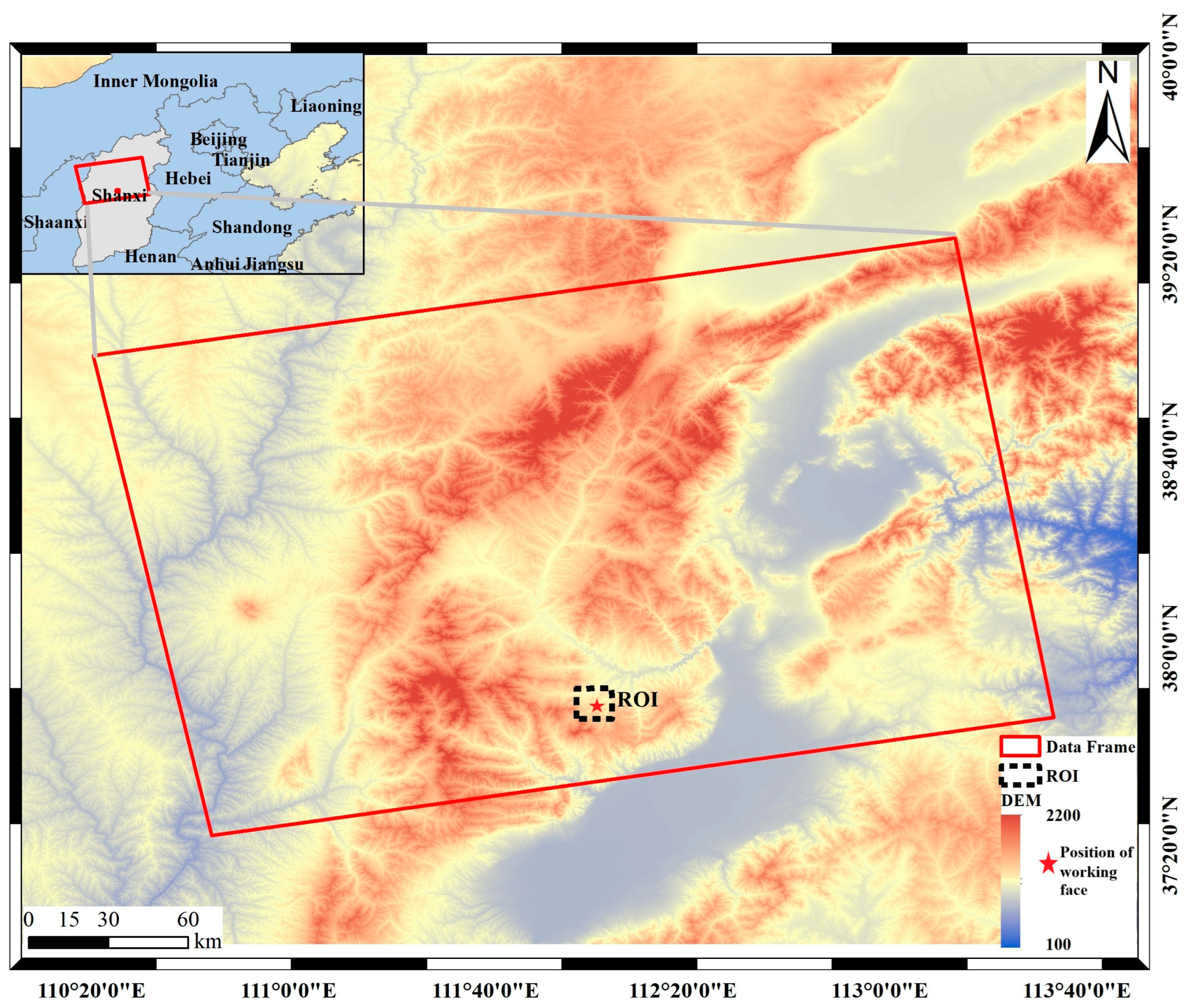
This study uses Sentinel-1A satellite SAR imagery data provided by the European Space Agency (ESA), spanning from November 2021 to June 2023, with a total of 46 ascending track datasets. The satellite data coverage and study area location are shown in
Figure 1. A measured 10 m resolution Digital Elevation Model (DEM) was used to remove the topographic phase.
3. Methodology
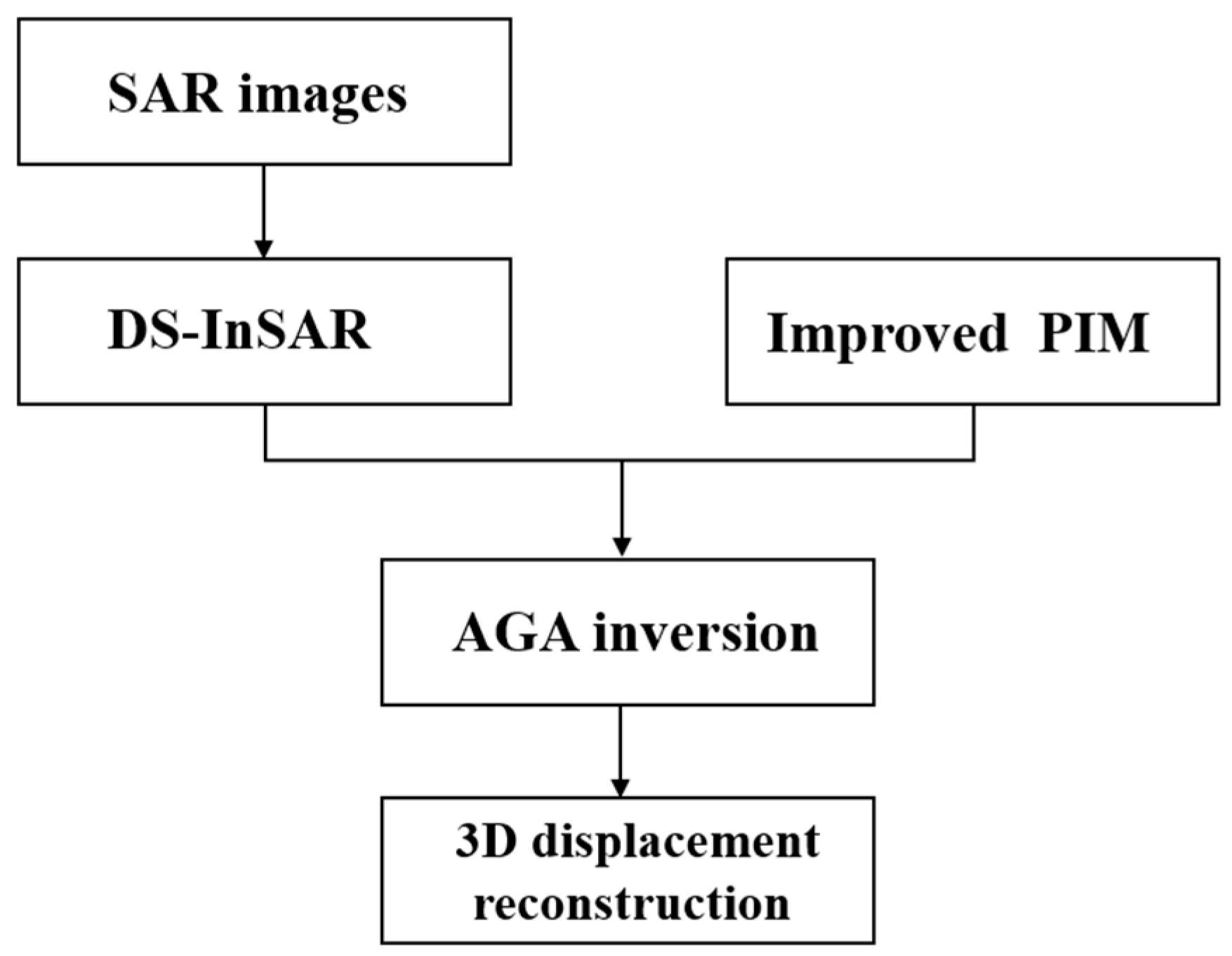
To address the topographic sliding, decorrelation, and ill-posed characteristics of single-track InSAR 3D calculation in mountainous mining displacement under complex terrain, this paper proposes a parameter inversion strategy that integrates Distributed Scatterer InSAR (DS-InSAR) technology with an improved Probability Integral Method considering topographic sliding effects. The technical approach mainly includes three parts: high-density deformation field acquisition based on DS-InSAR, construction of an improved PIM considering topographic sliding factors, and model parameter inversion and 3D displacement field reconstruction based on the AGA. DS-InSAR is particularly advantageous for mountainous mining areas for three reasons: First, vegetated mountain slopes lack stable man-made structures, resulting in an insufficient number of Persistent Scatterers (PS) for PS-InSAR. DS-InSAR exploits distributed scatterers from natural ground surfaces, significantly increasing coherent point density. Second, DS-InSAR’s statistical homogeneous pixel selection effectively filters out decorrelated pixels in heterogeneous mountainous terrain, improving phase reliability. Third, DS-InSAR provides spatially continuous coverage essential for capturing the full extent of mining subsidence basins in gully-fragmented terrain where point-based measurements cannot adequately represent surface deformation patterns.
3.1. Surface Deformation Acquisition in Mountainous Areas Based on DS-InSAR
Mountainous areas are densely vegetated, and the sparse point targets of traditional Persistent Scatterer InSAR (PS-InSAR) make it difficult to fully reflect the characteristics of subsidence basins. This paper adopts Distributed Scatterer (DS) interferometry technology to improve coherent point density in mountainous areas through statistically homogeneous pixel filtering and phase optimization algorithms.
3.1.1. Signal Model and Statistically Homogeneous Pixel Selection
Assume there is a set of
co-registered SAR images. The time-series complex observation vector of each DS pixel can be expressed as
,
representing the complex observation vector of the n-th image. The Maximum Likelihood Estimation (MLE) of the covariance matrix of the observation vector for each DS pixel
can be expressed as [
17,
18,
19]:
In the above equation,
is the standard deviation vector of the observation data for
periods,
is the standardized observation vector, and
.
contains
observations, containing coherence and interferometric phase information for all interferometric pairs, and the modulus
of
is the coherence coefficient matrix of the target pixel.
To identify neighborhood pixels with statistical homogeneity (Statistically Homogeneous Pixels, SHP), the two-sample Kolmogorov–Smirnov (KS) test or Anderson-Darling (AD) test [
20,
21,
22] is used. For pixels
and
, their cumulative distribution functions are
and
, respectively, and the KS test statistic
is defined as:
If is less than the threshold at a given confidence level, then is determined to be a statistically homogeneous pixel of .
3.1.2. Phase Optimization and Deformation Calculation
Using the selected SHP set, the Maximum Likelihood Estimation (MLE) is performed on the covariance matrix of the center pixel. To recover the optimal phase sequence
from noisy interferometric phases, the Phase Linking and eigenvalue decomposition algorithms are used for solution [
19,
21]:
3.2. Improved Probability Integral Model Considering Topographic Sliding Factors
The traditional PIM is mostly applicable to mining subsidence prediction under horizontal surface conditions, with significant deviations when applied in mountainous areas. According to the modified theory of surface movement in mountainous areas, surface movement in mountainous areas is the vector superposition of movement under theoretical horizontal conditions caused by mining and sliding caused by topography.
3.2.1. Traditional Probability Integral Method
Assuming a small coal seam dip angle, according to the traditional PIM, the subsidence
and horizontal movement
of the surface points under flat ground conditions are calculated as follows:
where
is the main influence radius,
is the horizontal movement coefficient;
and
are the equivalent mining lengths in the strike and dip directions, respectively, determined by the actual mining length, offset distance
, mining influence propagation angle
, and coal seam dip angle.
3.2.2. Modified PIM for Mountainous Areas
Under the topographic slope
and aspect
at any point, the sliding influence function is introduced to correct horizontal movement and subsidence. The corrected 3D displacement field is expressed as:
where
and
are the sliding increments caused by topography:
where
is the surface characteristic coefficient (negative for concave slopes, positive for convex slopes);
is the sliding influence function value, and
is the direction of horizontal movement to be predicted.
In the above equation,
are the parameters of the sliding influence function, and
can be used instead of
to obtain the
in the calculation
.
3.3. Parameter Inversion and 3D Calculation Based on Genetic Algorithm
Since single-track InSAR cannot directly decompose 3D displacement, this paper constructs an objective function to achieve 3D field reconstruction of mountainous surface by inverting the above model parameters.
3.3.1. Single-Track Projection Observation Equation
Establish the mapping relationship between the model parameter set
to be inverted and the InSAR observation value
:
3.3.2. Fitness Function Construction
To find the optimal parameters
, a fitness function based on the
norm is constructed, with the objective of minimizing the residuals between simulated LOS deformation and DS-InSAR observation values:
The inversion process is as follows:
(1) Initialization: Randomly generate the initial population within the parameter space.
(2) Forward calculation: For each individual, substitute into Equation (6) to calculate 3D displacement, then project to the LOS direction.
(3) Genetic operations: Calculate fitness, perform selection, adaptive crossover, and mutation operations.
(4) Convergence output: Obtain the global optimal parameters .
(5) 3D displacement reconstruction: Substitute into Equation (6) to directly calculate surface subsidence and displacement, thereby solving the problem of 3D calculation from single-track data.
The overall flowchart is shown in
Figure 2.
4. Results and Analysis
4.1. DS-InSAR LOS Deformation Acquisition
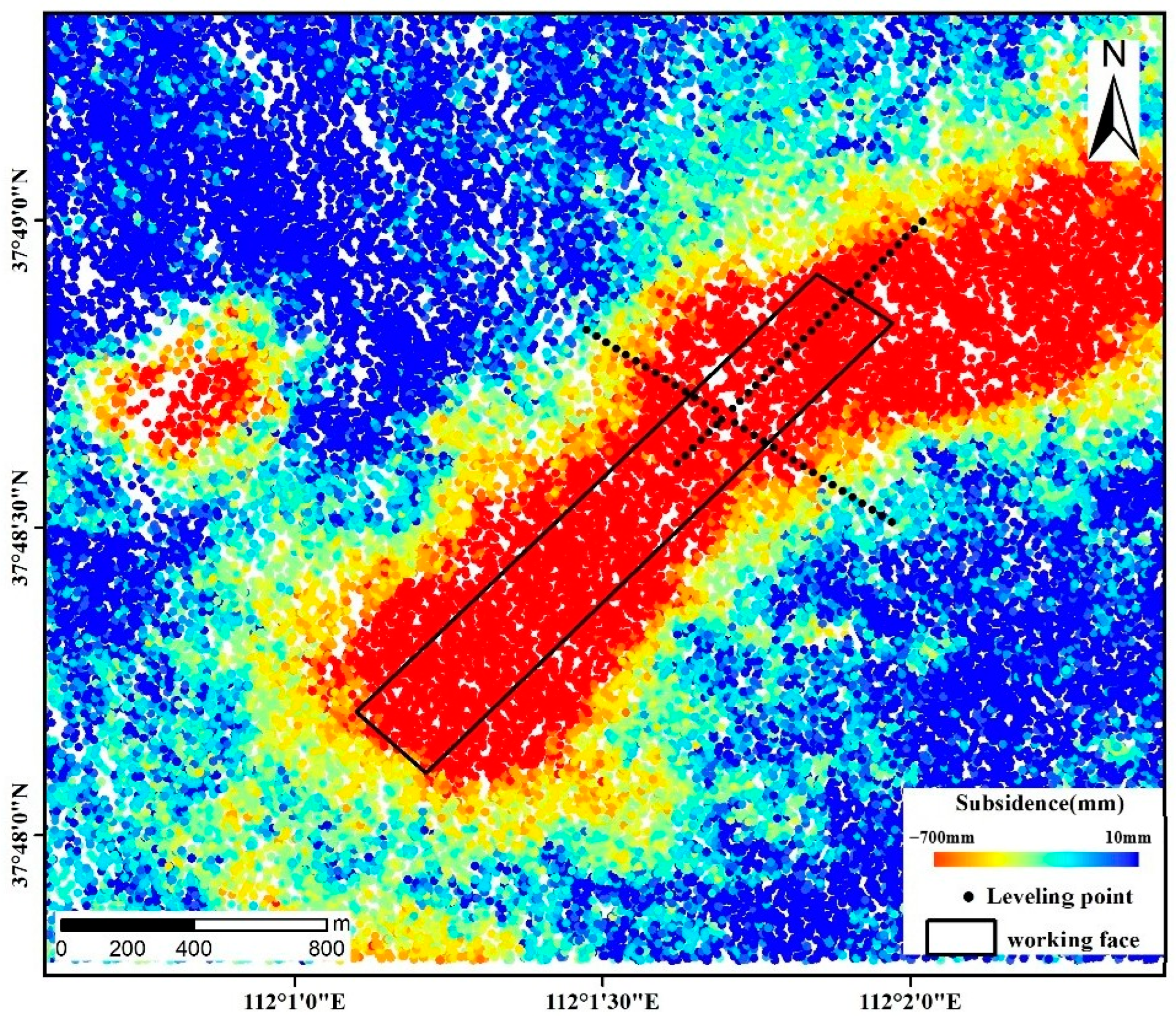
Compared with traditional PS-InSAR technology, DS-InSAR significantly improves point density in mountainous areas through statistically homogeneous pixel filtering. In the study area, a total of 75,212 effective coherent points were extracted, and monitoring points were successfully obtained in vegetated hillside and valley areas. The cumulative LOS subsidence map calculated by InSAR shows that the maximum subsidence center is located in the middle of the working face, with a maximum LOS displacement exceeding 900 mm. It should be noted that the deformation on the northeast side connected to the working face in
Figure 3 is caused by mining from another working face, not the working face of interest. Therefore, only displacements within the influence range of this working face are calculated in subsequent parameter inversion.
4.2. Parameter Inversion
The ranges for the 11 parameters are set as follows:
(subsidence coefficient),
(horizontal movement coefficient),
(main influence angle tangent),
(inflection point offset distance),
(mining influence propagation angle),
,
,
. The adaptive genetic algorithm is used to invert the PIM parameters for mountainous areas. The algorithm parameters are set as follows: population size 150, maximum iterations 150, convergence threshold set to continuous 20 generations with fitness change less than
, crossover probability 0.9, mutation probability 0.01. The main parameters obtained from inversion are shown in the
Table 1 below.
The AGA converged consistently within 120–135 generations across all independent runs. The final fitness value (RMSE) stabilized at approximately 50.3 mm for LOS residuals, indicating good agreement between model predictions and DS-InSAR observations.
The inverted parameters show good consistency with empirical values from mining engineering. The subsidence coefficient = 0.78 indicates medium-hard overburden conditions, which agrees with the geological profile of the study area. = 1.81 falls within the typical range for Chinese coal mines. The mining influence propagation angle ( = 89.2°) is consistent with the shallow mining depth-to-thickness ratio (H/m ≈ 206).
4.3. 3D Displacement Calculation Results
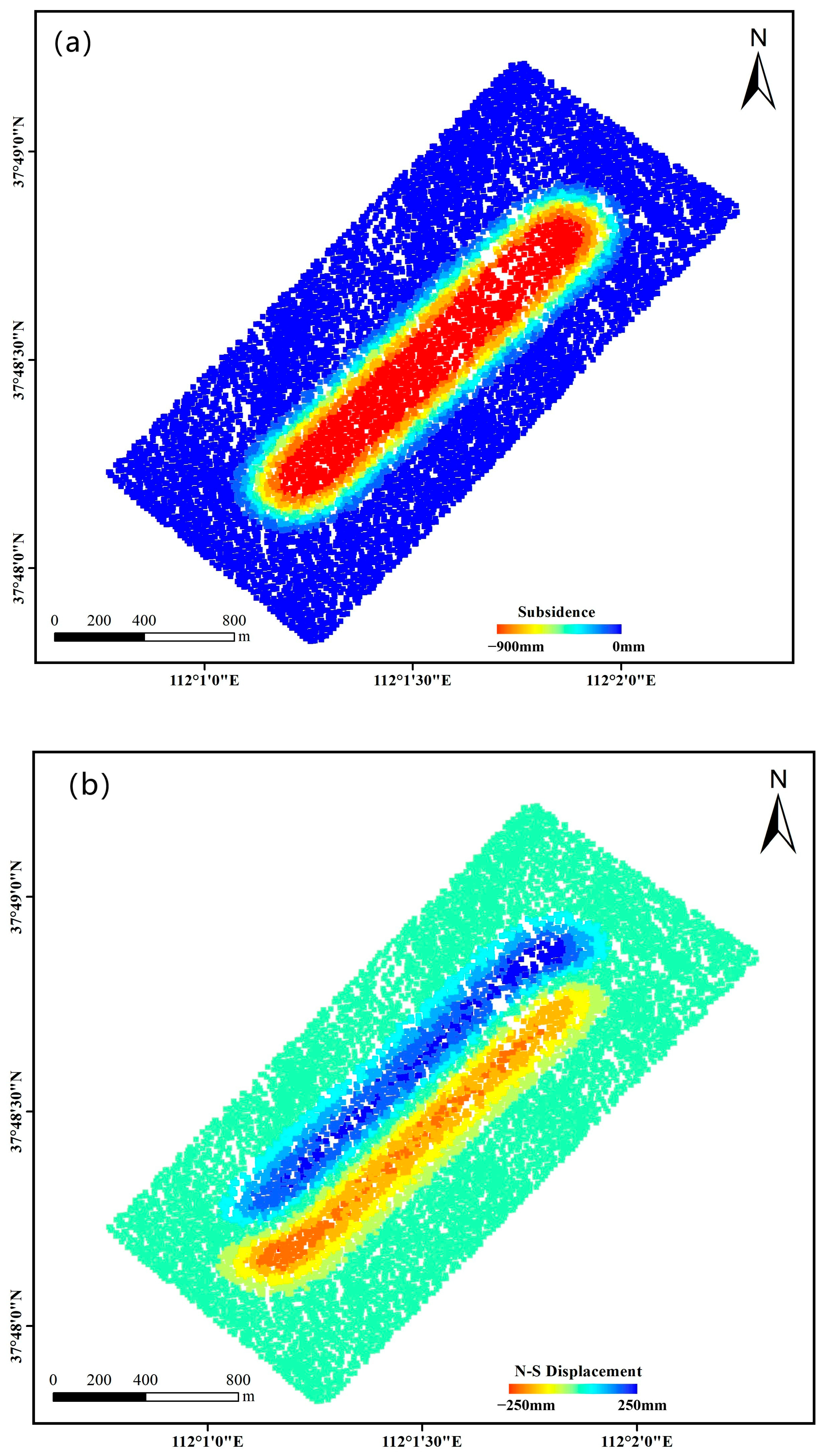
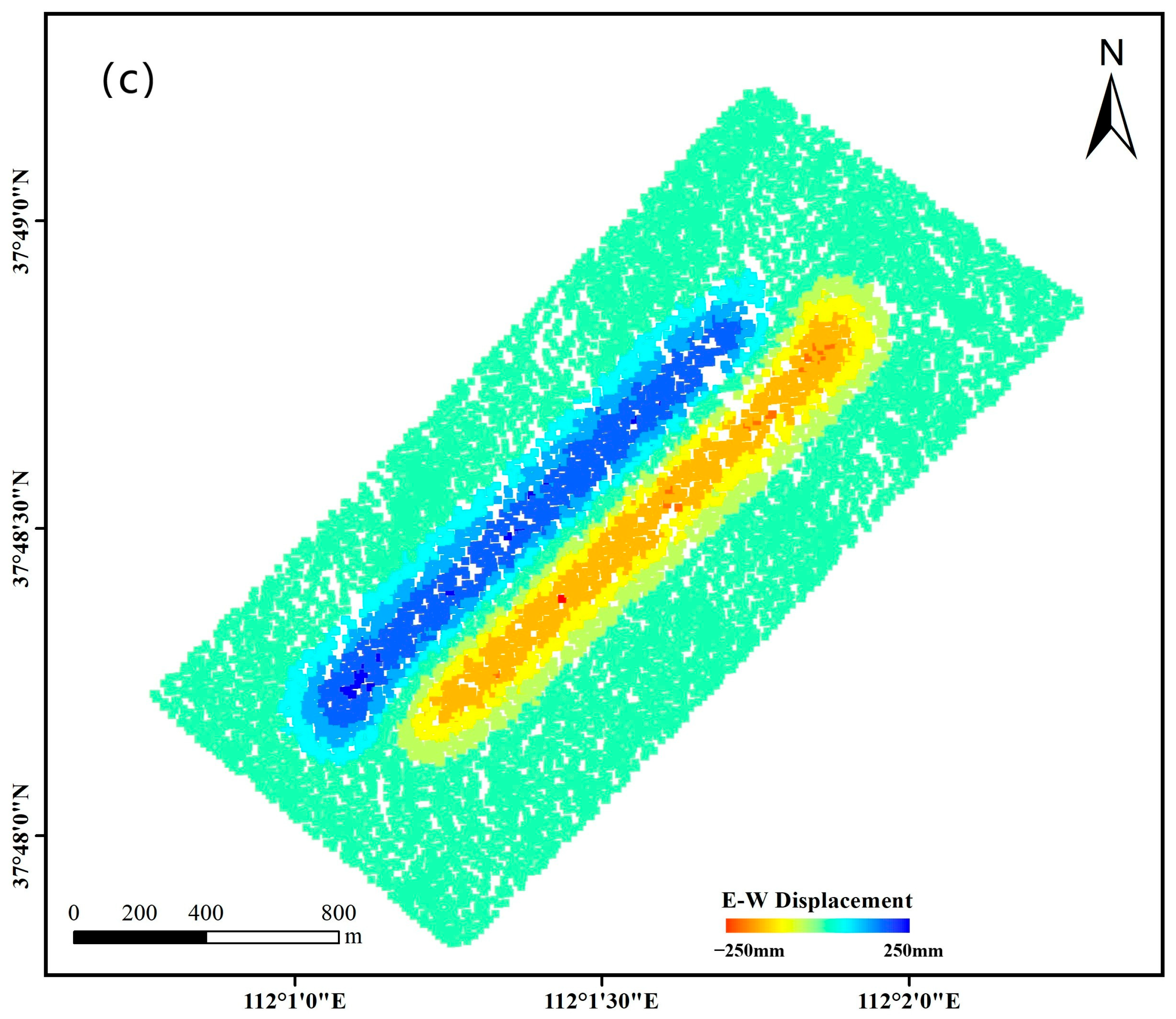
Based on the inverted parameters, the 3D displacement field of the study area was calculated, as shown in
Figure 4. The results show that the maximum vertical subsidence is 1050 mm, located above the center of the working face; the maximum horizontal displacement is 370 mm, directed toward the center of the subsidence basin. To verify the physical reasonableness of these values, we compare them with theoretical predictions. For full-seam extraction (average thickness m = 2.25 m) with subsidence coefficient q = 0.78, the predicted maximum subsidence is 1755 mm. However, due to the large width-to-depth ratio of this working face, the subsidence factor is reduced according to the incomplete extraction correction, yielding an expected maximum subsidence of approximately 950–1050 mm. The measured maximum subsidence of 1050 mm is therefore within the expected range. The maximum horizontal displacement of 370 mm gives a horizontal movement coefficient b ≈0.35, consistent with the typical range of 0.20–0.35 for Chinese coal mines. The horizontal movement coefficient tends to be higher due to topographic effects in mountainous areas. Horizontal movement vectors on slopes deviate from the theoretical direction (toward the basin center) by rotating toward the downslope direction. The sliding displacement component ΔU_slip reaches maximum values of 85–120 mm on slopes exceeding 25°, constituting 40–55% of the total horizontal displacement. This confirms that ignoring topographic sliding would result in significant misinterpretation of horizontal movement directions, particularly in steep terrain.
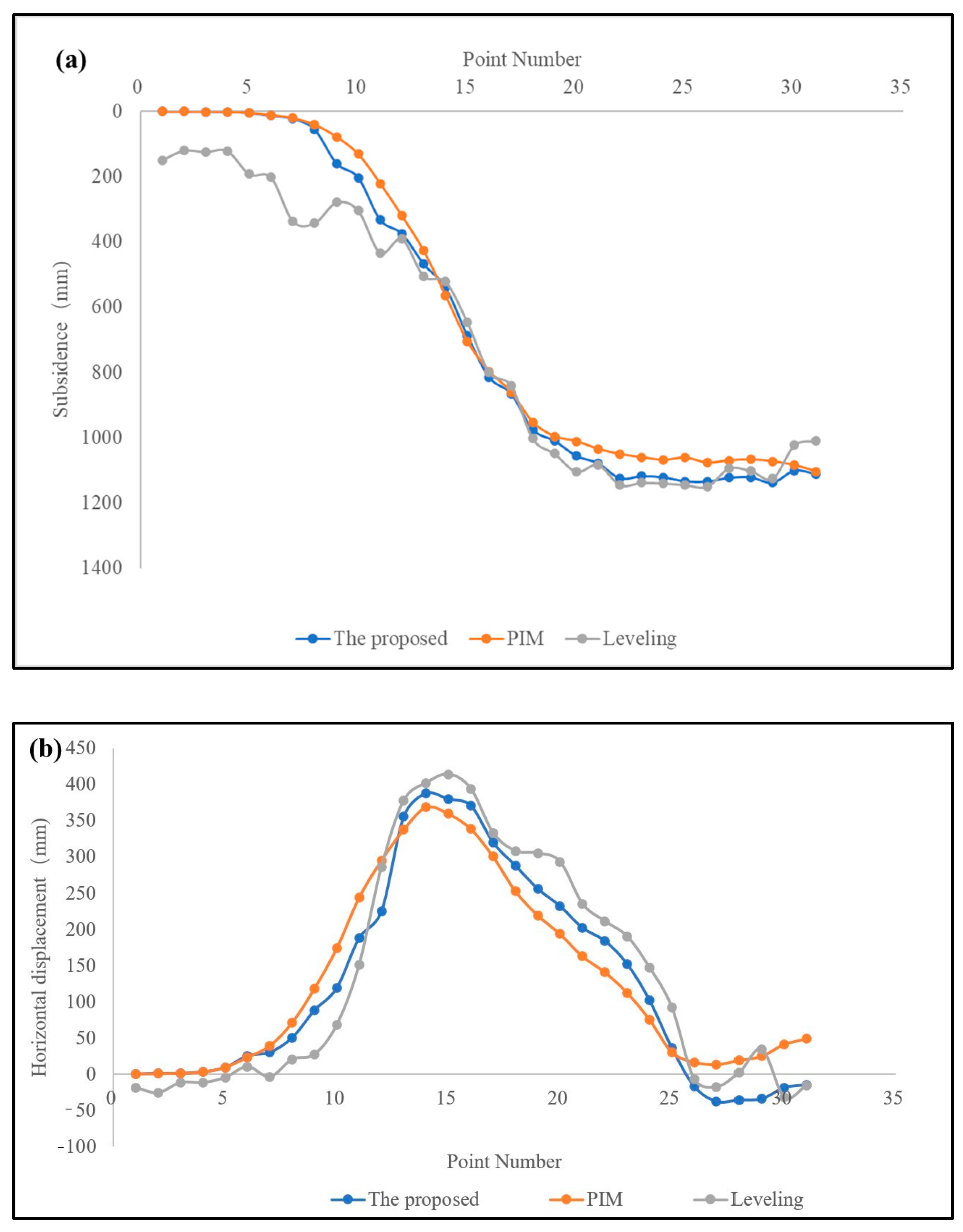
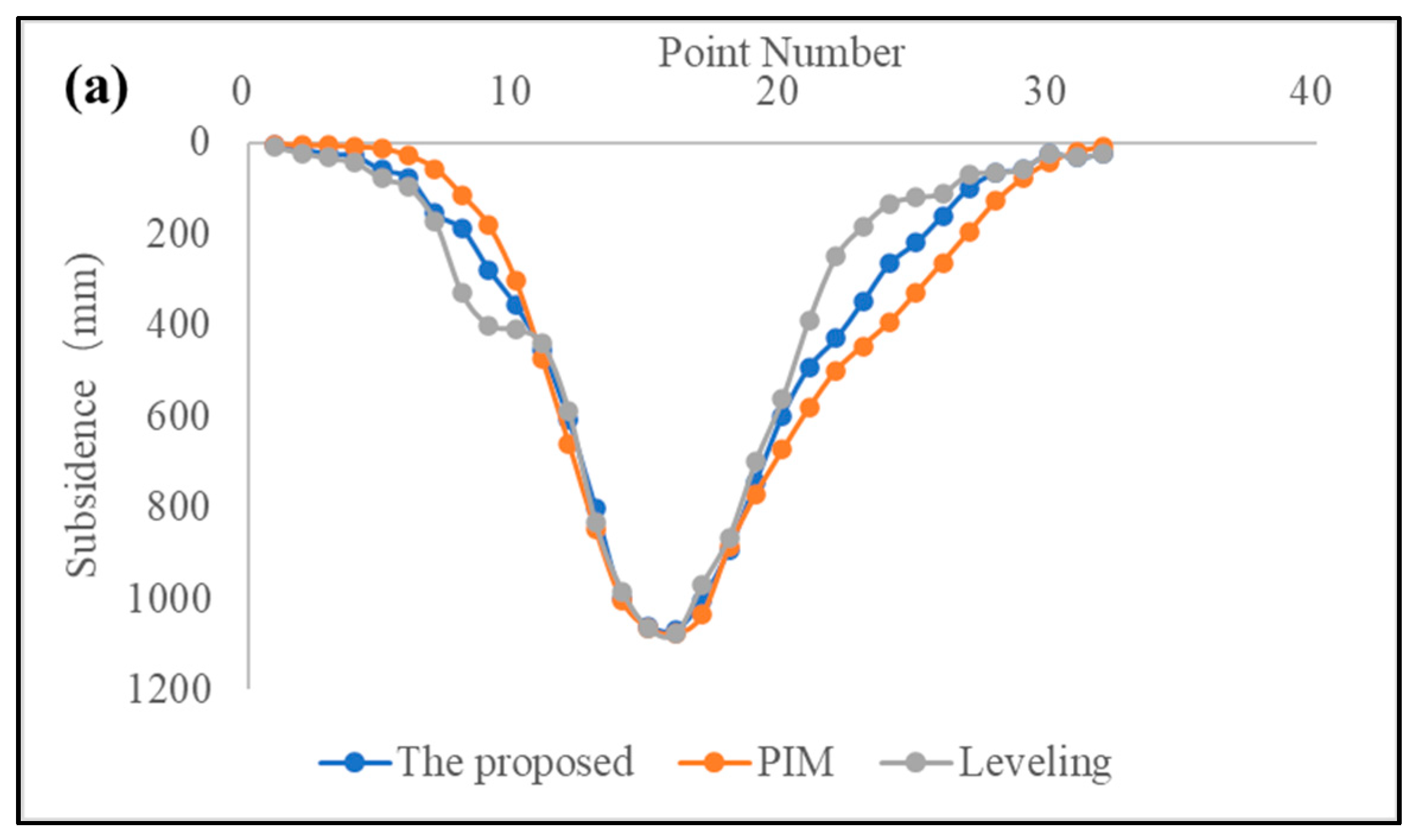
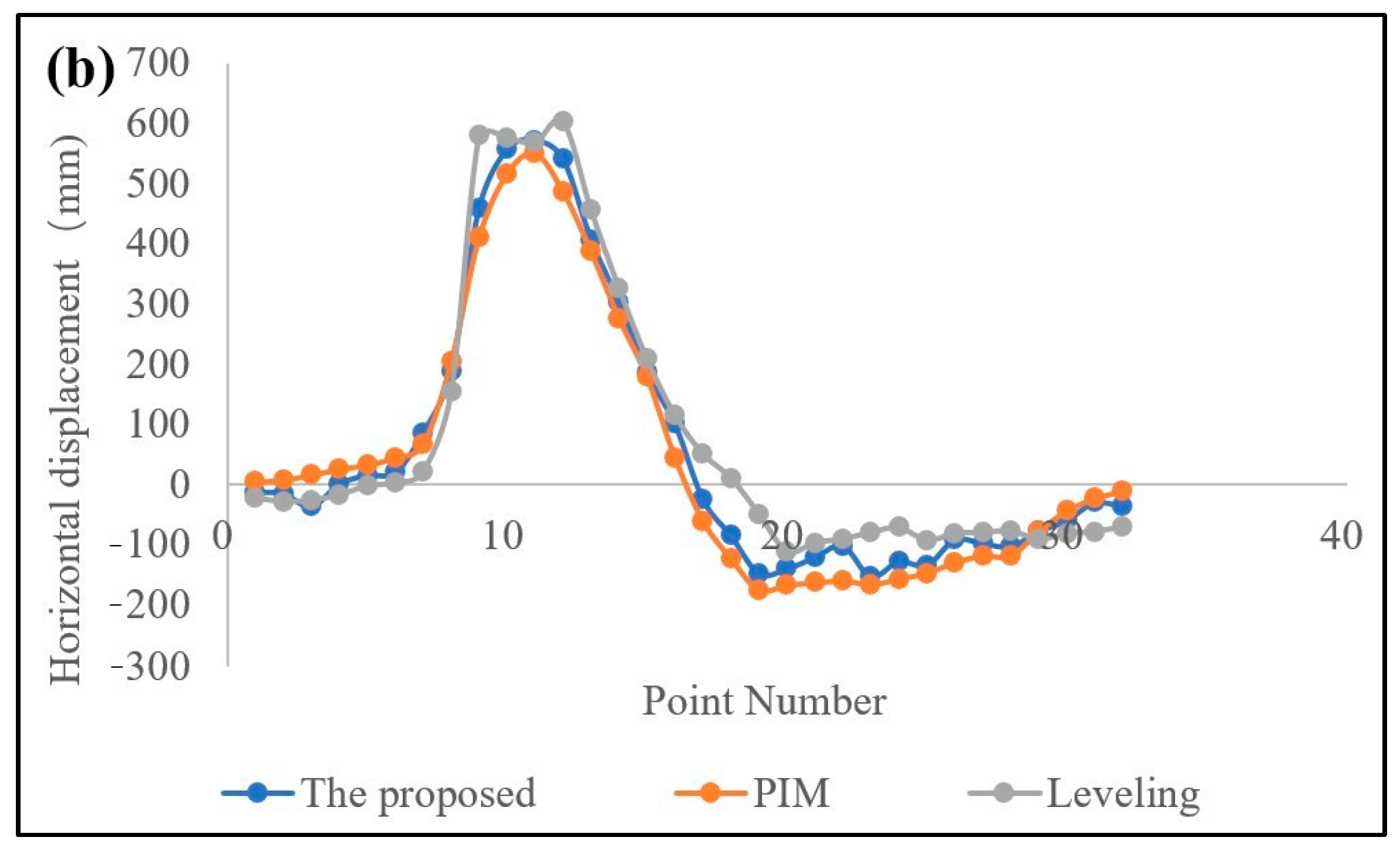
To verify the accuracy of the proposed method, 62 leveling measurement points were selected as validation data. Meanwhile, the method proposed in this paper was compared with traditional methods without topographic correction, and the results are shown in the
Figure 5 and
Figure 6 below. The results show that the method used in this paper is in good agreement with leveling values, while the traditional PIM has obvious errors. This indicates that the sliding calculation method proposed in this study can obtain reliable surface sliding observation values for the study area. The vertical displacement RMSE of the proposed method is 75.1 mm, which is 36% lower than the traditional method; the horizontal displacement RMSE is 27.2 mm, which is 34% lower than the traditional method. The specific accuracy comparison is shown in
Table 2.
The vertical displacement RMSE of 75.1 mm represents approximately 7.1% of the maximum subsidence (1050 mm), which is acceptable for medium-deep mining (H = 463 m), given the complex mountainous terrain. The horizontal displacement RMSE of 27.2 mm corresponds to about 7.3% of the maximum horizontal movement (370 mm), demonstrating satisfactory accuracy for engineering applications.
5. Discussion
5.1. Sensitivity Analysis of Topographic Sliding Parameters
The sliding parameter introduced in this study has a significant regulatory effect on inversion results. The analysis shows that the sliding intensity coefficient is positively correlated with the average surface slope. When the slope is less than 10°, the inverted value of approaches 1, and the sliding effect can be ignored at this time; when the average slope exceeds 30°, if the traditional model is forced to be used, i.e., , the subsidence coefficient inverted from InSAR will be erroneously overestimated in an attempt to compensate for the observed large LOS deformation by increasing subsidence. The method proposed in this paper restores the real physical process by decoupling mining subsidence from topographic sliding.
5.2. Advantages of the Sliding Influence Function
Compared with simple linear slope correction, the nonlinear sliding function can accurately describe the misalignment phenomenon of the sliding peak relative to the goaf boundary by introducing the position offset parameter . The residual distribution of experimental data shows that the linear correction model still has large residuals at the goaf boundary, while the nonlinear sliding function adopted in this paper reduces the fitting residuals at the boundary by approximately 40%, demonstrating the superiority of this mathematical model.
5.3. Uniqueness and Stability Analysis of Inversion Results
The uniqueness and stability of the inversion results are critical concerns in nonlinear parameter estimation. To ensure reliable and unique solutions, this study adopts the following strategies:
(1) The parameter search space is strictly bounded by physically meaningful ranges derived from mining engineering experience (
Table 1). The subsidence coefficient q is constrained within [0.4, 0.9] based on overburden lithology; the tangent of main influence angle tanβ within [1.5, 3.0] according to rock mass properties; and the horizontal movement coefficient b within [0.1, 0.4] following empirical relationships with mining depth.
(2) DS-InSAR provides 75,212 coherent measurement points, offering a highly overdetermined system, which significantly reduces the possibility of multiple equivalent solutions.
(3) The Adaptive Genetic Algorithm (AGA) employs adaptive crossover and mutation probabilities, enabling efficient exploration of the entire parameter space and reducing the risk of convergence to local optima.
5.4. Error Source Analysis
The residual errors in the proposed method originate from several sources: (1) Atmospheric phase residuals in InSAR data, estimated to contribute 10–20 mm to RMSE; (2) DEM errors causing topographic phase removal inaccuracies, particularly in steep slopes; (3) Simplifications in the sliding influence function, which may not fully capture complex three-dimensional slope mechanics.
6. Conclusions
To address the limitations of single-track InSAR monitoring in mountainous areas, this paper proposes a 3D displacement calculation method based on DS-InSAR and an improved sliding influence function model. By introducing the topographic sliding mechanism, this method successfully solves the ill-posed problem of separating 3D deformation from single-track data.
A forward model considering topographic factors was constructed using the sliding influence function, and the joint inversion of sliding parameters and Probability Integral parameters was achieved through the Adaptive Genetic Algorithm. The results show that topographic sliding significantly changes the distribution pattern of the surface movement field, with the maximum sliding position shifting downward along the slope.
Validation at a typical mountainous mine shows that the accuracy of the 3D displacement field reconstructed by this method is significantly better than traditional methods, especially in high and steep slope areas, where the calculation error of 3D displacement is reduced by approximately 35%. This study provides a scientific, economical, and high-precision technical approach for mining subsidence monitoring in mountainous mines lacking multi-track SAR data.
While this study demonstrates the efficacy of the proposed approach, several limitations warrant consideration. The slope-parallel sliding assumption embedded in the influence function, though simplifying computational complexity, may oversimplify the intricate three-dimensional failure mechanisms governing highly unstable slopes. Furthermore, the current static framework does not explicitly capture the temporal evolution of deformation, potentially overlooking transient deformation phases critical for early warning applications. Additionally, the validation remains constrained to a single working face with relatively shallow mining depths, limiting the generalizability of the findings to deep mining scenarios or heterogeneous geological settings.
Future efforts will focus on incorporating time-dependent rheological parameters to model the kinematic evolution of mining-induced deformation, thereby enabling dynamic hazard assessment rather than static analysis.
Author Contributions
P.L.: Conceptualization, Software, Validation, Formal analysis, Writing—original draft, Funding acquisition; Writing—review and editing; S.W.: Conceptualization, Resources, Writing—review and editing; X.X.: Data curation, Supervision; Y.F.: Conceptualization, Writing—review and editing, Supervision, Project administration. All authors have read and agreed to the published version of the manuscript.
Funding
This work was supported by Scientific and Technological Innovation Programs of Higher Education Institutions in Shanxi (Grant No. 2025L160), Science and Technology Innovation Fund of CCTEG Coal Mining Research Institute Co., Ltd. (KCYJY-2026-MS-08), and Research Initiation Fund Programs of Shanxi College of Technology.
Data Availability Statement
The Sentinel-1A SAR data used in this study are openly available in the Sentinel-1 Scientific Data Hub, provided by the European Space Agency (ESA), at
https://dataspace.copernicus.eu/ (accessed on 26 April 2026).
Conflicts of Interest
Authors Shaojun Wei and Xiaoming Xia were employed by the Qingdao Metro Planning & Design Institute Co., Ltd. Author Yaokun Fu was employed by the CCTEG Coal Mining Research Institute and Tiandi Science and Technology Co., Ltd. The remaining authors declare that the research was conducted in the absence of any commercial or financial relationships that could be construed as a potential conflict of interest.
References
- Fan, H.; Li, T.; Gao, Y.; Deng, K.; Wu, H. Characteristics inversion of underground goaf based on insar techniques and pim. Int. J. Appl. Earth Obs. Geoinf. 2021, 103, 102526. [Google Scholar] [CrossRef]
- Chen, B.; Li, Z.; Yu, C.; Fairbairn, D.; Kang, J.; Hu, J.; Liang, L. Three-dimensional time-varying large surface displacements in coal exploiting areas revealed through integration of SAR pixel offset measurements and mining subsidence model. Remote Sens. Environ. 2020, 240, 111663. [Google Scholar] [CrossRef]
- Yang, Z.; Xu, B.; Li, Z.; Wu, L.; Zhu, J. Prediction of Mining-Induced Kinematic 3-D Displacements from InSAR Using a Weibull Model and a Kalman Filter. IEEE Trans. Geosci. Remote Sens. 2022, 60, 1–12. [Google Scholar] [CrossRef]
- Chen, H.; Zhao, C.; Tomás, R.; Chen, L.; Yang, C.; Zhang, Y. Retrieving the kinematic process of repeated-mining-induced model, and probability integral method. Remote Sens. 2023, 12, 3145. [Google Scholar] [CrossRef]
- Wang, Z.; Dai, H.; Yan, Y.; Liu, J.; Ren, J. Combination of InSAR with a Depression Angle Model for 3D Deformation Monitoring in Mining Areas. Remote Sens. 2023, 15, 1834. [Google Scholar] [CrossRef]
- Perski, Z. Applicability of ERS-1 and ERS-2 InSAR for land subsidence monitoring in the Silesian coal mining region, Poland. Int. Arch. Photogramm. Remote Sens. 1998, 32, 555–558. [Google Scholar]
- Ge, L.; Rizos, C.; Han, S.; Zebker, H. Mining subsidence monitoring using the combined InSAR and GPS approach. In Proceedings of FIG International Symposium on Deformation Measurements; International Federation of Surveyors (FIG): Copenhagen, Denmark, 2001; pp. 1–10. [Google Scholar]
- Ng, A.H.; Ge, L.; Yan, Y.; Li, X.; Chang, H.-C.; Zhang, K.; Rizos, C. Mapping accumulated mine subsidence using small stack of SAR differential interferograms in the Southern coalfield of New South Wales, Australia. Eng. Geol. 2010, 115, 1–15. [Google Scholar] [CrossRef]
- Strozzi, T.; Wegmuller, U.; Werner, C.L.; Wiesmann, A.; Spreckels, V. JERS SAR interferometry for land subsidence monitoring. IEEE Trans. Geosci. Remote Sens. 2003, 41, 1702–1707. [Google Scholar] [CrossRef]
- Li, Z.W.; Yang, Z.F.; Zhu, J.J.; Hu, J.; Wang, Y.J.; Li, P.X.; Chen, G.L. Retrieving three-dimensional displacement fields of mining areas from a single InSAR pair. J. Geod. 2015, 89, 17–32. [Google Scholar] [CrossRef]
- Fan, H.D.; Cheng, D.; Deng, K.Z.; Chen, B.Q.; Zhu, C.G. Subsidence monitoring using D-InSAR and probability integral prediction modelling in deep mining areas. Surv. Rev.–Dir. Overseas Surv. 2015, 47, 438–445. [Google Scholar] [CrossRef]
- Yang, Z.F.; Li, Z.W.; Zhu, J.J.; Preusse, A.; Yi, H.W.; Wang, Y.J.; Papst, M. An extension of the insar-based probability integral method and its application for predicting 3-d mining-induced displacements under different extraction conditions. IEEE Trans. Geosci. Remote Sens. 2017, 55, 3835–3845. [Google Scholar] [CrossRef]
- Chen, Y.; Li, J.; Li, H.; Gao, Y.; Li, S.; Chen, S.; Guo, G.; Wang, F.; Zhao, D.; Zhang, K.; et al. Revealing land surface deformation over the yineng backfilling mining area, china, by integrating distributed scatterer sar interferometry and a mining subsidence model. IEEE J. Sel. Top. Appl. Earth Obs. Remote Sens. 2023, 16, 3611–3634. [Google Scholar] [CrossRef]
- Diao, X.; Wu, K.; Hu, D.; Li, L.; Zhou, D. Combining differential SAR interferometry and the probability integral method for three-dimensional deformation monitoring of mining areas. Int. J. Remote Sens. 2016, 37, 5196–5212. [Google Scholar] [CrossRef]
- Yang, Z.; Li, Z.; Zhu, J.; Yi, H.; Feng, G.; Hu, J.; Wu, L.; Preusse, A.; Wang, Y.; Papst, M. Locating and defining underground goaf caused by coal mining from space-borne SAR interferometry. ISPRS J. Photogramm. Remote Sens. 2018, 135, 112–126. [Google Scholar] [CrossRef]
- Cai, Y.F.; Verdel, T.; Olivier, D.; Li, X.J. Improving the influence function method to take topography into the calculation of mining subsidence. J. China Coal Soc. 2016, 41, 271–276. [Google Scholar] [CrossRef]
- Ferretti, A.; Fumagalli, A.; Novali, F.; Prati, C.; Rocca, F.; Rucci, A. A New Algorithm for Processing Interferometric Data-Stacks: SqueeSAR. IEEE Trans. Geosci. Remote Sens. 2011, 49, 3460–3470. [Google Scholar] [CrossRef]
- Shen, P.; Wang, C.; Hu, J.; Fu, H.; Zhu, J. Interferometric Phase Optimization Based on PolInSAR Total Power Coherency Matrix Construction and Joint Polarization-Space Nonlocal Estimation. IEEE Trans. Geosci. Remote Sens. 2022, 60, 1–14. [Google Scholar] [CrossRef]
- Gao, Z.; He, X.; Ma, Z.; Wei, S.; Xiong, J.; Aoki, Y. Distributed Scatterer Interferometry for Fast Decorrelation Scenarios Based on Sparsity Regularization. IEEE Trans. Geosci. Remote Sens. 2024, 62, 1–14. [Google Scholar] [CrossRef]
- Chen, B.; Yang, J.; Li, Z.; Yu, C.; Yu, Y.; Qin, L.; Yang, Y.; Yu, H. A new sequential homogeneous pixel selection algorithm for distributed scatterer InSAR. GISci. Remote Sens. 2023, 60, 2218261. [Google Scholar] [CrossRef]
- Zhang, B.; Wang, R.; Deng, Y.; Ma, P.; Lin, H.; Wang, J. Mapping the Yellow River Delta land subsidence with multitemporal SAR interferometry by exploiting both persistent and distributed scatterers. ISPRS J. Photogramm. Remote Sens. 2019, 148, 157–173. [Google Scholar] [CrossRef]
- Jiang, M.; Ding, X.; Hanssen, R.F.; Malhotra, R.; Chang, L. Fast Statistically Homogeneous Pixel Selection for Covariance Matrix Estimation for Multitemporal InSAR. IEEE Trans. Geosci. Remote Sens. 2015, 53, 1213–1224. [Google Scholar] [CrossRef]
| Disclaimer/Publisher’s Note: The statements, opinions and data contained in all publications are solely those of the individual author(s) and contributor(s) and not of MDPI and/or the editor(s). MDPI and/or the editor(s) disclaim responsibility for any injury to people or property resulting from any ideas, methods, instructions or products referred to in the content. |