Article

Dynamic Boundary Condition Adjustment for Power System Balance Analysis with Progressive Change in Uncertainty


1
Power Dispatching and Control Center of China Southern Power Grid, Guangzhou 510000, China
2
School of Electrical Engineering, Shanghai Jiao Tong University, Shanghai 200240, China
*
Author to whom correspondence should be addressed.
Processes 2026, 14(9), 1398; https://doi.org/10.3390/pr14091398
Submission received: 12 March 2026 / Revised: 21 April 2026 / Accepted: 24 April 2026 / Published: 27 April 2026
(This article belongs to the Section Energy Systems)

Abstract

With the increasing development of renewable energy generation, its volatility and uncertainty pose significant challenges to the power and energy balance of modern power systems. The balance exhibits multi-timescale characteristics, necessitating the coordination of multi-timescale balancing processes. Existing coordination methods typically adopt a top-down approach with fixed boundary conditions, which fails to account for the progressive reduction in renewable energy uncertainty over time. To address this issue, this paper proposes a dynamic adjustment model for monthly–weekly balancing boundary conditions, considering the progressive change in renewable energy uncertainty. Compared with the fixed boundaries, the dynamic model reduces the total system cost and decreases the execution deviation of boundary conditions from the plan. The model analyzes the value equilibrium of boundary conditions as decision variables in both current and future contexts. A case study validates the effectiveness of the proposed method.

1. Introduction

The low-carbon transition of energy is an essential path to addressing climate change and energy security challenges [1], including the increase in renewable energy on the supply side and electrification substitution on the demand side [2]. The new power system exhibits characteristics of the high penetration of renewable energy and a high proportion of power electronic devices [3,4], posing challenges to the safe and stable operation of the system. Currently, the power and energy balance mode is transitioning from generation following load to generation–load interaction [5].
Power and energy balance exhibit multi-timescale characteristics: in terms of renewable energy, it exhibits seasonality on long timescales and volatility on short timescales [6]. Accordingly, the analysis of the balance needs to address energy balance on long timescales and power balance on short timescales [7]. Therefore, in modeling operation simulations, long-timescale models focus on energy allocation over a long optimization horizon with relatively coarse models. Short-timescale models focus more on whether operational constraints are violated on short timescales with more detailed models. Consequently, multi-timescale power and energy balance analyses require orderly coordination [8].
Existing studies have investigated multi-timescale power and energy balance from various perspectives: Reference [9] established an optimal scheduling model for hydropower stations at the annual and ten-day timescales; Reference [10] proposed a three-layer optimization model for a wind–PV–storage microgrid incorporating electric vehicle clusters at the monthly–daily–hourly timescales; Reference [11] presented a bi-level optimization framework with long-term transmission line planning and short-term electricity market operations; Reference [12] proposed a coordinated allocation method for seasonal energy storage and short-duration energy storage to ensure multi-timescale adequacy of the system; Reference [13] constructed an iterative framework that integrates a long-term planning model with a short-term power system operation model to enhance power supply reliability. However, the coordination methods proposed in these studies all follow a top-down logic, where long-timescale decisions serve as boundary conditions for short-timescale balance analyses. While the logic offers clarity and simplicity in implementation, it fails to account for the progressive change in renewable energy uncertainty.
When optimized on long timescales, renewable energy output curves are derived from statistical characteristics of historical data, resulting in significant deviations from the actual output. In contrast, short-timescale analyses benefit from forecast curves, where the uncertainty of renewable energy is substantially reduced [14].
The fundamental contradiction faced by the traditional top-down approach is that long-term models rely on highly uncertain renewable energy forecasts, while conveying fixed boundary conditions for shorter-term models. However, although shorter-term models can utilize renewable energy forecasts with significantly reduced uncertainty, there is no flexibility to dynamically adjust these pre-set boundaries. Therefore, it is necessary to consider dynamically adjusting the boundary conditions of power and energy balance by incorporating the latest forecast data.
In the field of power system optimization, existing research has emphasized leveraging updated forecast data or equipment status for improved scheduling. Reference [15] proposed using rolling-horizon optimization to assist government decision-making on the carbon quota baseline for enterprises; Reference [16] introduced a model predictive control-based energy management strategy for virtual power plants, optimizing over longer timescales but executing only the first period; Reference [17] proposed a multi-timescale optimal scheduling method for pumped storage power stations, incorporating short-term wind and solar forecasts to correct equipment operating status; Reference [18] investigated a rolling-horizon optimization strategy for wind–storage combined systems based on the latest forecast data to maximize profits in electricity market environments; Reference [19] investigated a real-time scheduling method for integrated energy systems based on rolling-horizon optimization; Reference [20] proposed an optimization strategy for residential battery energy storage charging and discharging that combined rolling-horizon optimization with recurrent neural networks. These methods mainly perform multi-step forecasting but only execute the next step. However, the forecasting methods currently used in the system generally only extend to a weekly horizon; longer forecast lead times are subject to strong uncertainty in medium-to-long-term analysis. Therefore, a dynamic boundary condition adjustment method applicable to multi-timescale power and energy balance analysis needs to be proposed.
The dynamic adjustment of balancing boundaries involved the value equilibrium of balancing boundaries as decision variables in both current and future contexts. In terms of equilibrium analysis, Reference [21] constructed an electricity market equilibrium model for futures and spot markets based on dual variables; Reference [22] transformed the market equilibrium problem of multiple entities into KKT conditions containing dual variables, converting a bi-level game model into a single-level model; Reference [23] analyzed the relationship between the shadow prices of system constraints and the locational marginal prices under quasi-steady-state sensitivity. Therefore, the dual variables associated with boundary condition constraints can be utilized for analysis.
The main contributions of this paper are as follows:
  • A static monthly–weekly power system balance analysis model is constructed, and a top-down linkage method is proposed. The limitation of this model is analyzed by incorporating the progressive change characteristic of renewable energy uncertainty;
  • A dynamic adjustment model for monthly–weekly balancing boundary conditions was proposed, utilizing the latest weekly forecast data to update the weekly boundary conditions;
  • In the dynamic model, the value equilibrium of boundary conditions as decision variables in both current and future contexts was analyzed.

2. Monthly–Weekly Static Power System Balance Analysis Model

This paper constructs a monthly–weekly static power system balance analysis model for provincial power grids. The monthly model focuses on the coordinated allocation of electricity, while the weekly model emphasizes detailed operational constraints. This forms a coordinated framework where the monthly model determines reasonable thermal power unit electricity boundaries, and the weekly model ensures the rational execution of these boundaries.
The monthly model has a long optimization horizon and adopts the typical day method [24] to reduce the number of optimization periods. The weekly model with a shorter optimization horizon adopts time-series simulation [25] for the optimization calculations. The two models share similarities in the formulation of their constraints.

2.1. Common Constraints for Power System Balance Analysis Models

This section presents the general constraints applicable to both the monthly and weekly models.
Medium-to-long-term (annual, seasonal, monthly, and weekly) power and energy balance analysis primarily evaluate the adequacy of system resources and coordinate the allocation of total energy from a macro perspective rather than determining the detailed start-up and shut-down plans of specific generation units. Regarding spatial transmission congestion that affects the overall balance of a provincial grid, it is mainly restricted by the transmission capacities of critical transmission sections rather than local grid topologies [26].
Therefore, the spatial simplification method [27] is adopted. The provincial power grid is equivalent to several subregions. Within each subregion, power resources of the same type are aggregated into a single unit. Three types of power resources are considered: thermal power, renewable energy, and energy storage (ES). And the network constraints focus on the critical transmission sections between subregions. The simplification is consistent with the objective of medium-to-long-term balance analysis and ensures computational efficiency without losing essential physical boundaries.

2.1.1. Thermal Power Unit Constraints

Constraint (1) represents the online capacity constraint for thermal power units, Constraint (2) represents the upper and lower output limit constraints, Constraint (3) represents the ramping rate constraint, and Constraint (4) represents the linearized energy cost constraint.
C t h , i , t τ = C t h , i , t 1 τ D t h , i , t τ + U t h , i , t τ
α C t h , i , t τ P t h , i , t τ C t h , i , t τ
β C t h , i , t τ P t h , i , t τ P t h , i , t 1 τ β C t h , i , t τ
F t h , i , t τ k i , j P t h , i , t τ + b i , j
0 C t h , i , t τ , D t h , i , t τ , U t h , i , t τ C t h , i
where τ denotes the model type, either weekly model w or monthly model m . C t h , i , t τ represents the online capacity of the thermal power unit in the i-th subregion during period t, D t h , i , t τ represents the start-up capacity, U t h , i , t τ represents the shut-down capacity, and P t h , i , t τ represents the scheduled output. α is the minimum output coefficient. β is the ramping rate coefficient. F t h , i , t τ is the energy cost of the thermal power unit in the i-th subregion during period t. k i , j ,   b i , j are the slope and intercept of the j-th segment of the piecewise linear cost curve for the unit i. The quadratic cost curve of thermal power units is linearized using the epigraph method [28]. C t h , i is the installed capacity.

2.1.2. Renewable Energy Constraints

Constraint (6) represents the renewable energy output limitation; Constraint (7) represents the curtailed renewable energy.
0 P r , i , t τ P a , i , t τ
Δ P r , i , t τ = P a , i , t τ P r , i , t τ
where P r , i , t τ represents the scheduled output of renewable energy in the i-th subregion during period t, P a , i , t τ represents the available output, and Δ P r , i , t τ represents the curtailed power.

2.1.3. Energy Storage Constraints

Constraints (8)–(11) are the charging and discharging power limits of ES, Constraints (12)–(13) are the energy limits, and Constraint (14) is the intraday cycle constraint.
0 P c h , i , t τ , P d i s , i , t τ P e , i
P c h , i , t τ E e , i E i , t τ / η
P d i s , i , t τ η E i , t τ
P c h , i , t τ + P d i s , i , t τ P e , i
E i , t τ = E i , t 1 τ + η P c h , i , t τ P d i s , i , t τ / η
0 E i , t τ E e , i
E i , 0 τ = E i , T d , j τ
where P ch , i , t τ is the charging power in the i-th subregion during period t, P dis , i , t τ is the discharging power, and E i , t τ is the energy state. E e , i and P e , i are the energy capacity and power capacity in the i-th subregion, respectively. η is the charging/discharging efficiency. E i , 0 τ represents the initial state of energy of the j-th day cycle, and E i , T d , j τ represents the state of energy at the end.

2.1.4. System Constraints

Constraint (15) is the system power balance constraint, Constraint (17) is the transmission line flow capacity constraint, and Constraints (19)–(22) are the reserve constraints.
i = 1 N P t h , i , t τ + P r , i , t τ + P d i s , i , t τ P c h , i , t τ P L , i , t τ + Δ P L , i , t τ = 0
P i n j , t τ = P t h , t τ + P r , t τ + P d i s , t τ P c h , t τ P L , t τ + Δ P L , t τ
PF PTDF P i n j , t τ PF
R i , t τ = γ L P L , i , t τ + γ r P a , i , t τ
R i , t τ Δ R u , i , t τ C t h , i , t τ P t h , i , t τ + P e , i P d i s , i , t τ + P c h , i , t τ
R i , t τ Δ R u , i , t τ β C t h , i , t τ + P e , i P d i s , i , t τ + P c h , i , t τ
R i , t τ Δ R d , i , t τ P t h , i , t τ α C t h , i , t τ + P e , i + P d i s , i , t τ P c h , i , t τ
R i , t τ Δ R d , i , t τ β C t h , i , t τ + P e , i + P d i s , i , t τ P c h , i , t τ
Δ P L , i , t τ , Δ R u , i , t τ , Δ R d , i , t τ 0
where P L , i , t τ is the load power in the i-th subregion during period t, Δ P L , i , t τ is the load shedding, P inj , t τ is the power injected into the grid. P th , t τ , P r , t τ , P dis , t τ , P ch , t τ , P L , t τ , P L , t τ are the vector forms of the previously defined variables. PTDF is the power transfer distribution factor matrix. PF is the vector of line flow capacities. N is the number of subregions. R i , t τ is the upward/downward reserve requirement in the i-th subregion during period t, Δ R u , i , t τ is the upward reserve shortfall, and Δ R d , i , t τ is the downward reserve shortfall. R i , t τ is set as a certain proportion of the load and renewable energy predicted output. γ L is the reserve proportional coefficients of the load, and γ r is the reserve proportional coefficients of renewable energy.

2.2. Monthly Model

2.2.1. Additional Constraints of Monthly Model

The monthly model uses the annual electricity plan of thermal power units as its boundary conditions, which are determined by factors such as fair, equitable, and transparent dispatch and primary energy supply conditions [29].
Δ Q i m t Ω m λ t m P t h , i , t m Q i m Δ Q i m , Δ Q i m 0
where Q i m and Δ Q i m are the total planned monthly electricity output and the electricity deviation for thermal power units in the i-th subregion, respectively. λ t m is the weight for period t in the typical day model, representing the number of periods it stands for. Ω m is the set of periods included in the monthly typical days.

2.2.2. Objective Function of Monthly Model

min F = t Ω m i = 1 N λ t m F t h , i , t m + c L t Ω m i = 1 N λ t m Δ P L , i , t m + c Q i = 1 N Δ Q i m       + c r t Ω m i = 1 N λ t m Δ P r , i , t m + c R t Ω m i = 1 N λ t m Δ R u , i , t m + Δ R d , i , t m
where c L ,   c r ,   c R ,   c Q are the unit penalty coefficients for load shedding, renewable energy curtailment, reserve shortfall, and planned electricity deviation, respectively. The objective function considers the energy cost of thermal power units, as well as penalties for load shedding, renewable energy curtailment, reserve shortfall, and planned electricity deviation in the month.

2.3. Weekly Model

2.3.1. Additional Constraints of Weekly Model

As the weekly model uses time-series simulation, it must consider the start-up and shut-down time constraints of thermal power units. In contrast, these constraints are not considered in the monthly model, where the typical days are temporally decoupled [30].
U t h , i , t w j C t h , i C t h , i , t 1 w j k = t T o f f + 1 t 1 D t h , i , k w j
D t h , i , t w j C t h , i , t 1 w j k = t T o n + 1 t 1 U t h , i , k w j
where T on and T off are the minimum start-up and shut-down times of the thermal power units, and w j denotes the j-th week.
The weekly model uses the monthly electricity plan of thermal power units as its boundary condition, which is obtained by decomposing the total monthly electricity Q i m from the monthly model.
Q i w j = t Ω w j λ t m P t h , i , t m
Δ Q i w j t = 1 T w P t h , i , t w j Q i w j Δ Q i w j , Δ Q i w j 0
where Ω w j is the set of periods included in the typical days of the j-th week. Q i w j and Δ Q i w j are the total planned weekly electricity output and the electricity deviation for thermal power units in the i-th subregion during the j-th week, respectively.

2.3.2. Objective Function of Weekly Model

min F = t = 1 T w i = 1 N F t h , i , t w j + t = 1 T w i = 1 N c o n , i U t h , i , t w j + c o f f , i D t h , i , t w j + c L t = 1 T w i = 1 N Δ P L , i , t w j + c r t = 1 T w i = 1 N Δ P r , i , t w j + c R t = 1 T w i = 1 N Δ R u , i , t w j + Δ R d , i , t w j + c Q i = 1 N Δ Q i w j
where c on , i and c off , i are the start-up and shut-down costs per unit capacity for thermal power units in the i-th subregion, respectively. The objective function considers the energy cost of thermal power units and the start-up and shut-down costs of thermal power units, as well as the penalties for load shedding, renewable energy curtailment, reserve shortfall, and planned electricity deviation in week j.
In the constructed static model, the monthly model and the weekly model are formulated separately and optimized independently. The linkage between the two is as follows: the monthly model is optimized first, decomposing the monthly electricity into weekly amounts. The weekly model then takes the decision results of the monthly model as boundary conditions and further decomposes the weekly electricity into hourly amounts. The optimization of the monthly model can be regarded as the planning stage, while the optimization of the weekly model can be regarded as the execution stage. This represents a top-down linkage logic, which is clear in concept and simple to implement. However, it fails to account for the progressive change in renewable energy uncertainty.

3. Dynamic Boundary Condition Adjustment Method

Considering the progressive change characteristic of renewable energy uncertainty, this paper proposes a dynamic adjustment method for the boundary conditions of monthly–weekly power and energy balance.

3.1. Progressive Change Characteristic of Renewable Energy Uncertainty

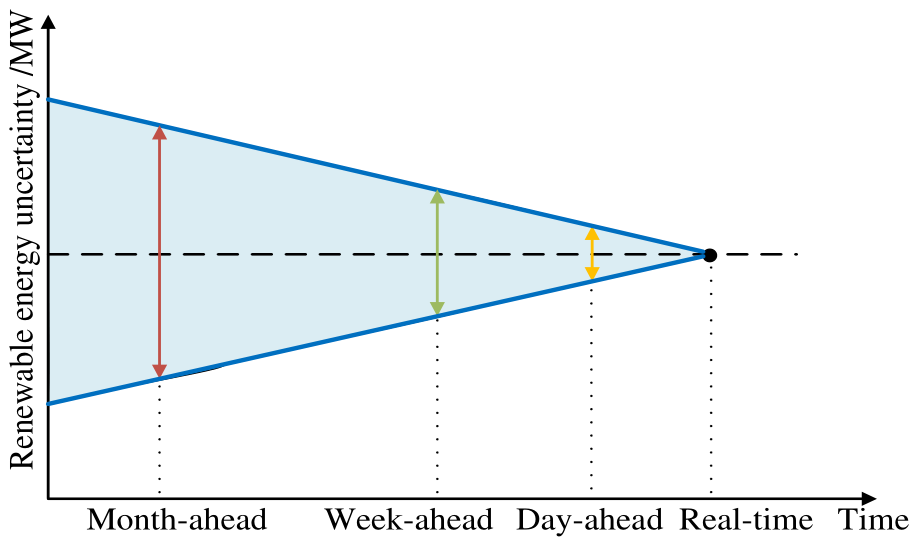
The uncertainty of renewable energy output exhibits progressive change characteristics: on the medium- to long-term timescale, the renewable energy output curve is predicted based on historical statistical characteristics, resulting in relatively large forecast errors. On the weekly timescale, more accurate short-term forecast curves can be obtained, and the uncertainty of renewable energy output is significantly reduced. This characteristic is illustrated in Figure 1 [31].
As the forecast lead time decreases, the renewable energy forecast error is significantly reduced. The progressive change characteristics of renewable energy uncertainty determine that the static boundaries issued by the monthly model cannot adapt to the accurate forecast information on the weekly scale. If the static boundaries are strictly enforced, this will lead to a reduction in renewable energy and an increase in thermal power operational costs. If the latest renewable energy forecast data can be utilized to dynamically update the boundary conditions of monthly–weekly power and energy balance, this will benefit the secure and economic operation of the system while reducing planned electricity deviations.
It is worth noting that, while the two main sources of renewable energy, wind and solar power, exhibit different output characteristics and uncertainty modeling, both of them share the same progressive change characteristic of uncertainty across medium-to-long-term timescales. Therefore, different types of renewable energy within a subregion are aggregated. The progressive change in wind/solar uncertainties is incorporated by updating the aggregated renewable energy forecast output curves from the monthly model to the weekly model.

3.2. Dynamic Adjustment Model for Monthly–Weekly Balancing Boundary Conditions

3.2.1. Model Framework

Based on the progressive change characteristic of renewable energy uncertainty, this paper proposes a dynamic balancing boundary adjustment method that integrates monthly and weekly models, breaking away from the traditional top-down static boundary mode.
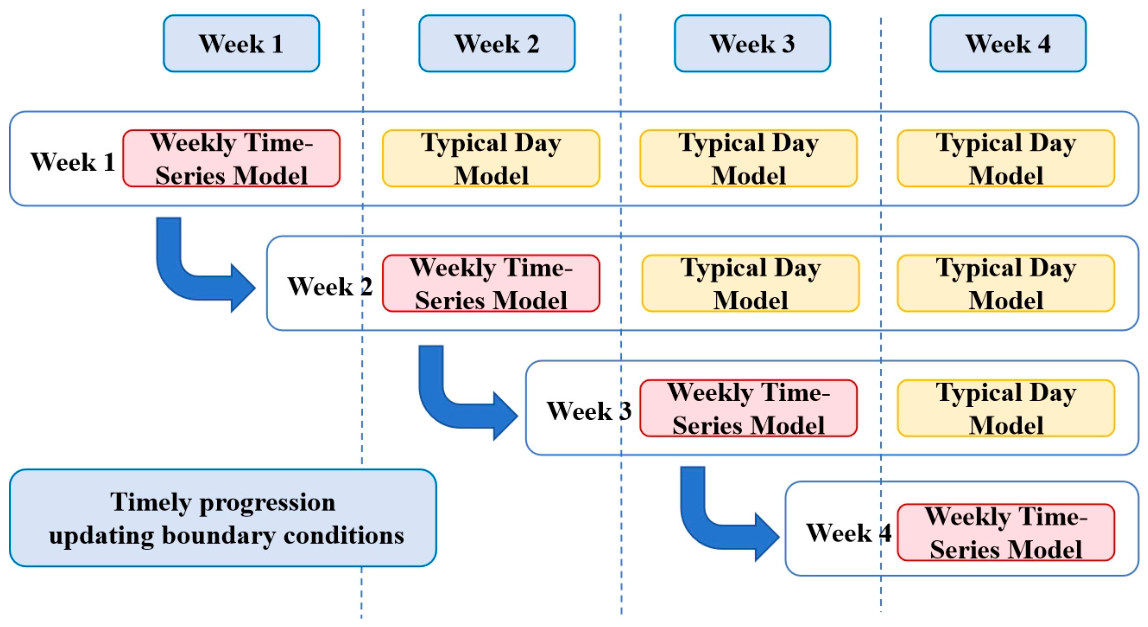
The dynamic boundary condition adjustment model embeds the weekly time-series simulation model and the typical day model for the remaining weeks within the same optimization framework, formulating a unified mathematical optimization problem. The optimization objective is to minimize the sum of operational costs and penalty costs for the current week and the remaining weeks. The weekly thermal power generation boundary for the current week is changed from a fixed value constraint to a decision variable. The overall framework of the model is shown in Figure 2.
As time progresses, the current week undergoes detailed time-series simulation, while the subsequent weeks retain the simplified typical day model. Through rolling optimization, timely updates of the boundary conditions are achieved. This ensures that the boundary conditions for each week incorporate the latest forecast data while maintaining computational efficiency.

3.2.2. Constraints of Dynamic Model

Boundary condition constraints:
t = 1 T w P t h , i , t w j = Q i w j
Δ Q i m j t Ω m j λ t m j P t h , i , t m j Q i m Q i w j Q c p , i w j Δ Q i m j
Δ Q i m j 0
where m j is the remaining weeks of the month excluding the weeks that have already been executed and the current week j. Ω m j is the set of periods included in the typical days of the remaining weeks. Q i w j in Equation (31) is a decision variable different from the given value in Equation (28). Q cp , i w j is the completed electricity of thermal units in the i-th subregion during the executed weeks when optimizing for week j.
The remaining constraints for m j are consistent with the monthly model, and the remaining constraints for w j are consistent with the weekly model. These constraints are combined to form the constraint set of the dynamic model.
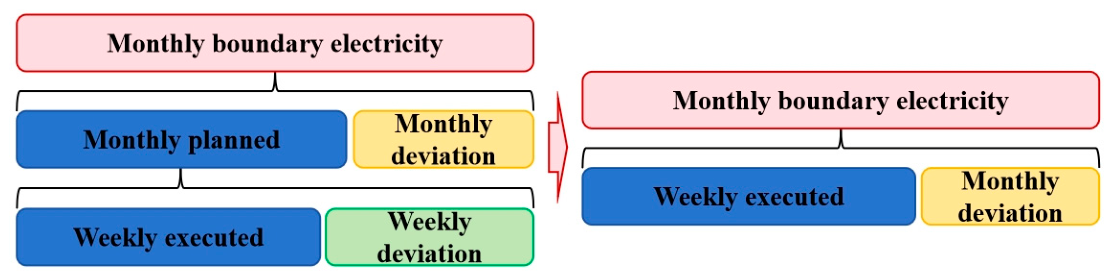
In the static model, the total planned monthly electricity deviation is the sum of the monthly and weekly electricity deviations. Here, the monthly deviation refers to the deviation electricity generated by the monthly model during the planning stage, while the weekly deviation refers to the deviation electricity generated by the weekly model during the execution stage. In contrast, in the dynamic model, each update of the boundary conditions represents that the current week can fulfill a portion of the total monthly planned electricity. Because it incorporates the weekly model, the execution is ensured at the planning stage itself, and the total deviation is simply the portion of the monthly planned electricity that remains unfulfilled after the final week. This is illustrated in Figure 3.

3.2.3. Objective Function of Dynamic Model

min F = t = 1 T w i = 1 N F t h , i , t w j + t = 1 T w i = 1 N c o n , i U t h , i , t w j + c o f f , i D t h , i , t w j + c L t = 1 T w i = 1 N Δ P L , i , t w j   + c r t = 1 T w i = 1 N Δ P r , i , t w j + c R t = 1 T w i = 1 N Δ R u , i , t w j + Δ R d , i , t w j + t Ω m j i = 1 N λ t m j F t h , i , t m j   + c L t Ω m j i = 1 N λ t m j Δ P L , i , t m j + c r t Ω m j i = 1 N λ t m j Δ P r , i , t m j   + c R t Ω m j i = 1 N λ t m j Δ R u , i , t m j + Δ R d , i , t m j + c Q i = 1 N Δ Q i m j
The objective function also comprises two parts: the weekly model w j and the remaining weeks model m j .
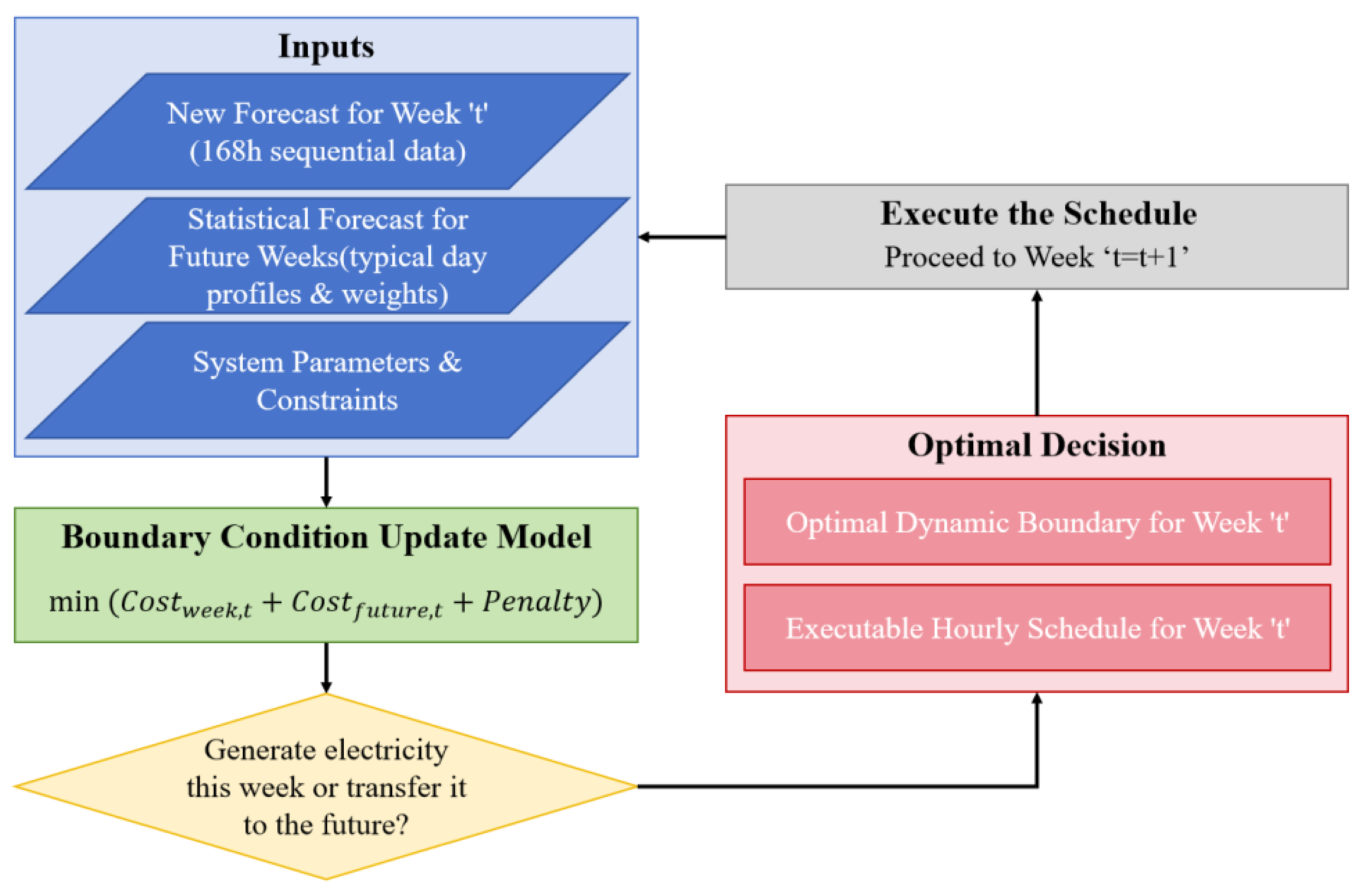
The optimization and solution process of the dynamic model is shown in Figure 4.
The comparison between rolling-horizon optimization and the proposed method is shown in Table 1.

3.2.4. Equilibrium Analysis of Dynamic Model

In electricity markets, the locational marginal price is derived from the dual variables of system constraints, reflecting the value of the resource corresponding to that constraint [32]. In this paper, the dual variables corresponding to the boundary condition constraints reflect the value of Q i w j .
The Lagrangian function of the dynamic model can be obtained from the objective function, system constraints, and their dual variables.
L = F + i = 1 N μ d y , i w j t = 1 T w P t h , i , t w j Q i w j   + i = 1 N μ d y , i , + m j t Ω m j λ t m j P t h , i , t m j Q i m Q i w j Q c p , i w j Δ Q i m j   + i = 1 N μ d y , i , m j t Ω m j λ t m j P t h , i , t m j + Q i m Q i w j Q c p , i w j Δ Q i m j   + L o t h e r
where μ dy , i w j is the dual variable corresponding to Equation (31), representing the marginal value of Q i w j for week w j . μ dy , i , + m j and μ dy , i , - m j are the dual variables corresponding to the two inequalities in Equation (32). L o t h e r is the term in the Lagrangian function corresponding to other system constraints that are independent of Q i w j .
When the dynamic model achieves the optimal solution, according to the Karush–Kuhn–Tucker (KKT) conditions, with Q i w j as the most critical decision variable in the model, the partial derivative of L with respect to Q i w j is zero.
L Q i w j = μ d y , i w j + μ d y , i , + m j μ d y , i , m j = 0
Through optimization, the dynamic model achieves a trade-off in the allocation of electricity between the current week and the remaining weeks. The condition for achieving equilibrium is μ dy , i w j = μ dy , i , + m j - μ dy , i , - m j , obtained based on Equation (36). The meaning of μ dy , i w j is the total system cost increase if the planned electricity for the current week is increased by one unit. μ dy , i , + m j is positive when the total electricity for the remaining weeks touches the upper bound, indicating an increased cost if the electricity for the remaining weeks is increased by one unit. μ dy , i , - m j is positive when the total electricity for the remaining weeks touches the lower bound, indicating an increased cost if the electricity for the remaining weeks is decreased by one unit. μ dy , i , + m j - μ dy , i , - m j represents the marginal value of Q i w j for the remaining weeks m j .
During the optimization process of the dynamic model, the solver naturally drives the system toward a state where marginal values are balanced with each other while minimizing the total cost. Therefore, Equation (36) is inherently satisfied and the value equilibrium is an intrinsic property of the optimal solution.
The dynamic model introduces soft constraints for the electricity deviation Q i m j of the remaining weeks, with an associated unit penalty cost c Q . When Q i m j is non-zero in the optimal solution, it indicates that the boundary of the soft constraint is reached and activating the electricity deviation penalty. In edge cases where the upper bound is active, μ dy , i , + m j - μ dy , i , - m j converges to c Q , Equation (36) still holds, and μ dy , i w j takes the value c Q , indicating that the system cost increases c Q if increasing the electricity allocation by 1 MWh in the current week or the remaining weeks. Conversely, in edge cases where the lower bound is active, μ dy , i , + m j - μ dy , i , - m j and μ dy , i w j converge to - c Q , indicating that the system cost reduces c Q if increasing the electricity allocation by 1 MWh in the current week or the remaining weeks.
For comparison with the dynamic model, the static model can be written in a structure similar to that of the dynamic model, i.e., comprising a weekly model and a model for the remaining weeks. The difference is that Q i w j is not a decision variable but a given boundary condition. The equivalent boundary condition constraints for the static model are:
Δ Q i w j t = 1 T w P t h , i , t w j Q i w j Δ Q i w j
Δ Q i m j t Ω m j λ t m j P t h , i , t m j Q i m Q i w 1 ~ j Δ Q i m j
where Q i w 1 ~ j is the planned total electricity output for thermal power units in the i-th subregion from week 1 to week j, as determined by the monthly model. Since the static model does not achieve equilibrium, the following holds:
μ s t , + w j μ s t , w j μ s t , + m j μ s t , m j
where μ st , + w j and μ st , - w j are the dual variables corresponding to Constraint (37); μ st , + w j indicates the increased cost if the electricity for the current week is increased by one unit, and μ st , - w j indicates the increased cost if the electricity for the current week is decreased by one unit. μ st , + w j - μ st , - w j represents the marginal value of Q i w j for the current week w j . μ st , + m j and μ st , - m j are the dual variables corresponding to Constraint (38).

4. Case Study

The proposed method is validated using a case study based on a provincial power grid consisting of three interconnected subregions.

4.1. Test System Parameters

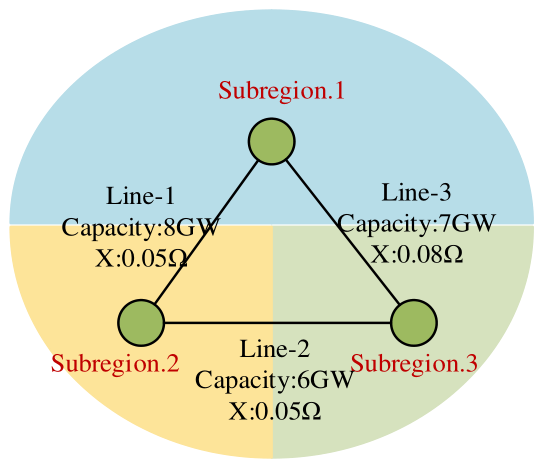
The test system topology and scale are synthesized and simplified to represent typical provincial power grids. The system topology is shown in Figure 5; there are three interconnected subregions.
The power resource capacities of each subregion are shown in Table 2.
Where TH represents thermal power units, and RE represents renewable energy. α is 0.4, β is 20%, η is 0.9, T on is 6 h, T off is 4 h, γ L is 5%, γ r is 10%, c L , c r , c R ,   and   c Q are 2000 $/MWh, 100 $/MWh, 100 $/MWh, 500 $/MWh, respectively, and c on   and   c off are 150 , 110 , 160 T $/MW and 75 , 55 , 80 T $/MW. The total monthly planned electricity issued under the annual plan is 14.8 , 9.2 , 12 T   ×   10 6 MWh. The unit parameters are set using typical values widely adopted in power system scheduling studies. The storage duration of Subregions 1 and 2 is 2 h, and the storage duration of Subregion 3 is 4 h.
c Q is an important parameter in the equilibrium analysis, which is set at 500 $/MWh. This value is significantly higher than the typical unit energy costs and serves as a strong economic restriction for deviations from the electricity plan.
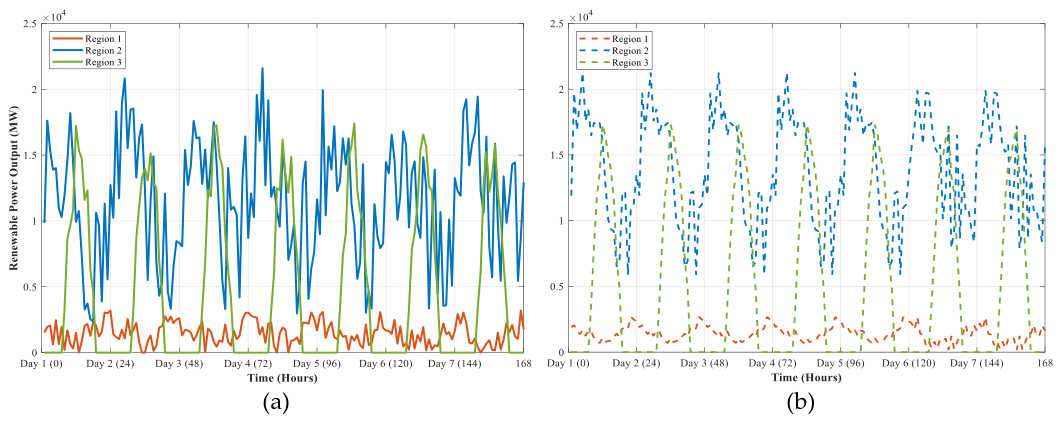
A comparison between the typical day curve and the forecast curve of renewable energy is shown in Figure 6. To simulate the progressive change characteristic in the case study, the sequential time-series curves representing the short-term forecast are generated. The average of the sequential curves of the corresponding periods for weekdays and weekends is calculated separately to obtain the base statistical profiles. A random normally distributed error is superimposed onto each base profile to reflect the forecast error. The error multiplier for renewable energy was set to one plus 0.25 times a random normal variable. In practice, the typical day method often clusters historical data to select representative days and assign weights for long-term analysis.

4.2. Calculation Results

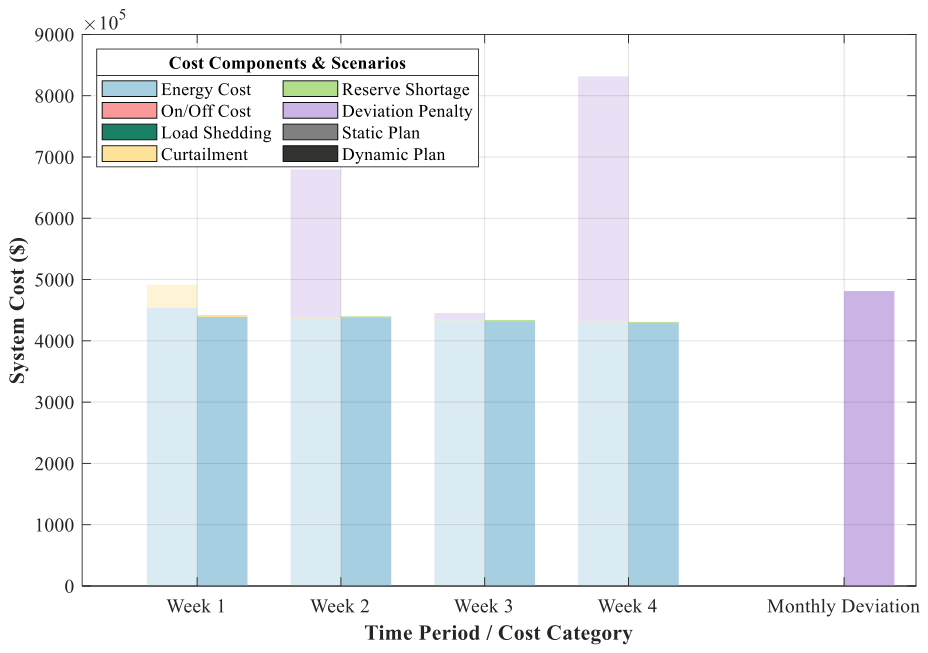
The planned electricity allocated to each subregion on the weekly level is shown in Table 3. Based on the planned electricity, the operational results of the two models are shown in Table 4 and Figure 7, where M is the model type, D is the dynamic model, and S is the static model. S.R. represents the subregion number; W represents the week number.
It can be seen from the above results that the static model is divided into two stages: planning and execution. In the planning stage of the monthly model, the planned electricity deviation is 0 MWh, meaning the monthly typical day model assumes that the total electricity can be fully completed. However, during the weekly execution stage, incorporating the latest renewable energy forecast data, electricity execution deviations occurred in weeks 2, 3, and 4, totaling 1,305,337 MWh. This indicates that the weekly model finds it more economical to accept the penalty for deviation than to fulfill the planned electricity. The total monthly cost of the static model is $2,448,369,716.
In contrast, for the dynamic model, during the planning stage, a trade-off for the unfulfilled electricity between the current week and the remaining weeks is made each week. In the trade-off of the final week, the planned deviation electricity is 962,451 MWh. In the weekly execution stage, the execution deviation is 0 MWh, meaning that the planned electricity determined by the dynamic model can be reliably executed on a weekly basis. The total monthly cost of the dynamic model is $2,227,580,846. It can be observed that, compared to the static model, the total monthly cost of the dynamic model is reduced by $220,788,870 (9.02%), and the total monthly electricity deviation is reduced by 342,886 MWh (26.27%), which verifies the effectiveness of the proposed method.
Regarding information utilization, the static method relies entirely on long-term statistical forecasts made at the beginning of the month. The dynamic method effectively incorporates the progressively updated, high-accuracy short-term forecasts into the rolling optimization. Regarding decision flexibility, the static method enforces rigid and fixed electricity boundaries. The dynamic method treats electricity boundaries as decision variables, enabling the flexible updating and value trade-offs of boundaries between the current week and the remaining weeks. Regarding resilience to uncertainty, faced with significant uncertain fluctuations in renewable energy, the static method inevitably incurs severe electricity deviation. The dynamic model uses the remaining weeks as a buffer, reallocating energy to mitigate deviation.

4.3. Equilibrium Analysis

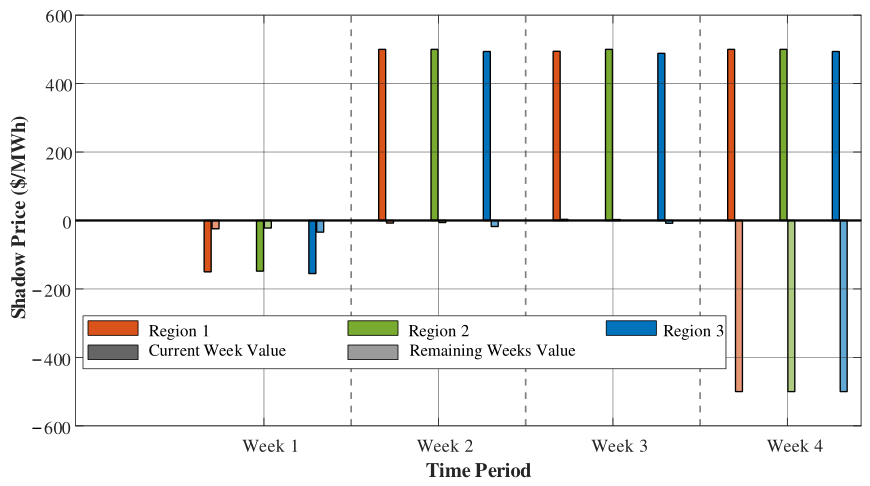
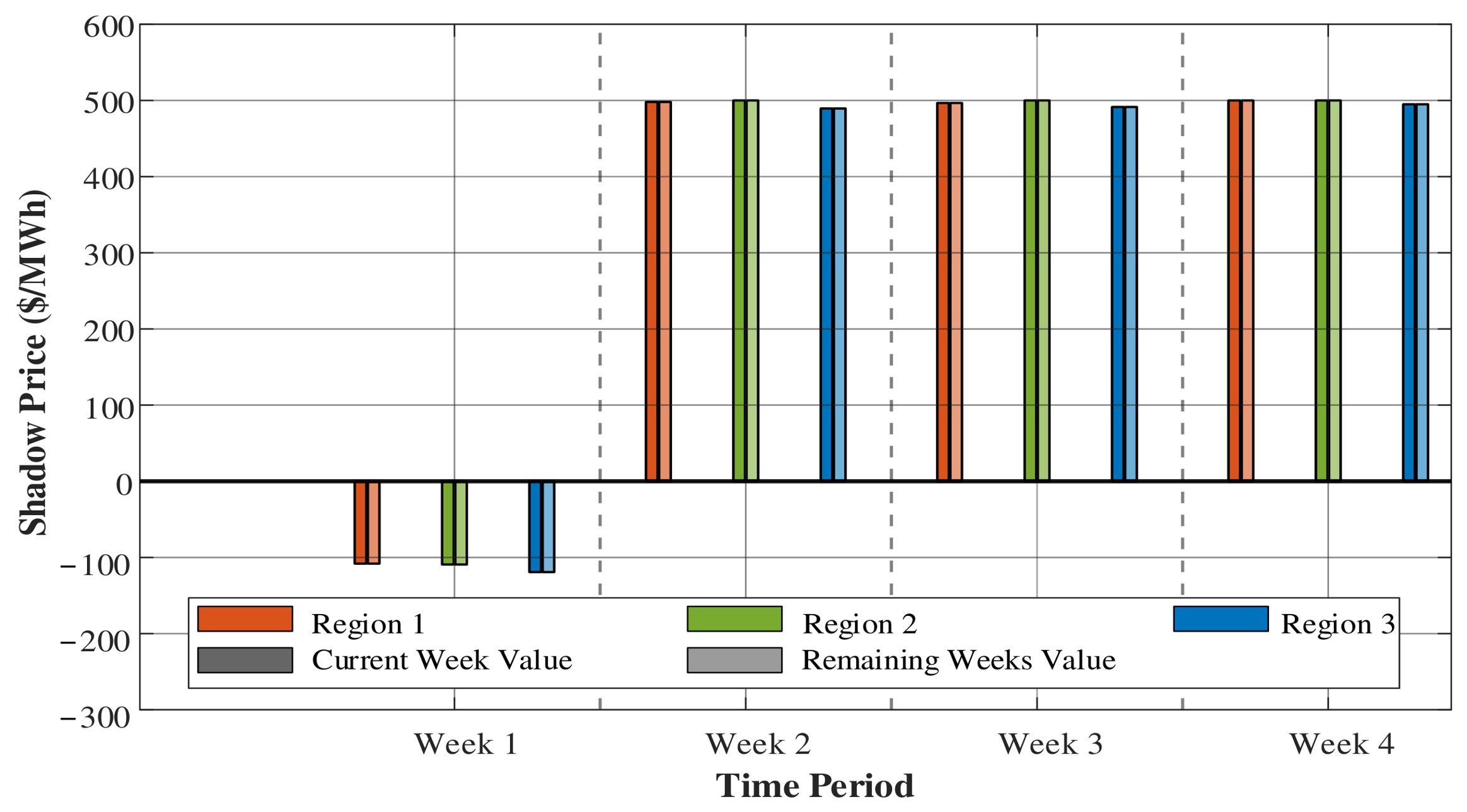
The dual variables of the boundary condition constraints for the static and dynamic models are shown in Figure 8 and Figure 9, respectively.
It can be observed that the static model fails to achieve value equilibrium between the current week and the remaining weeks regarding Q i w j , which verifies Equation (39). In the last three weeks, the value of μ st , + w j - μ st , - w j is around 500 $/MWh, which equals the unit penalty cost for planned electricity deviation, indicating that the weekly model considers the planned electricity for the current week to be too high, resulting in a generation shortfall. Meanwhile, μ dy , + m j - μ dy , - m j is approximately 0 $/MWh, indicating that the model considers the planned electricity for the remaining weeks to be fully achievable. The marginal values of Q i w j between the current week and the remaining weeks exhibit a significant deviation.
In the dynamic model, during the last three weeks, both μ st , + w j - μ st , - w j and μ dy , + m j - μ dy , - m j take the value of around 500 $/MWh, indicating that either the current week or the remaining weeks consider it infeasible to increase the planned electricity further. Value equilibrium between the current week and the remaining weeks regarding Q i w j is achieved each week, which verifies Equation (36). This also validates the effectiveness of the proposed method.
The sign of the marginal value is fundamentally determined by the actual supply–demand scenarios of the power system. The net load (load minus renewable energy) of the three subregions in week 1 accounted for [0.250, 0.625, and 0.254] of the total monthly net load, respectively. Because the net load in Subregion 2 is high, it requires lifting the thermal generation limits to avoid load shedding or reserve shortages, so the marginal value is negative. The net load proportions for Subregion 2 in the subsequent three weeks (weeks 2, 3, and 4) are [0.249, 0.099, and 0.027]. The thermal allocation should be reduced to avoid renewable energy curtailment, leading to a positive marginal value.

4.4. Computational Complexity Analysis

The dynamic model embeds a detailed time-series weekly model and simplified typical day models for the remaining weeks simultaneously. This section analyzes the computational efficiency and optimization performance of the model in larger-scale power systems, which are shown in Table 5.
The nine-node, 30-node, and 60-node systems were constructed by replicating the base three-node system as a fundamental unit, including three, 10, and 20 replications of the three-node base unit, respectively. These units are then interconnected to form a ring network, where Node 1 of each unit is connected to Node 3 of the adjacent unit. The supplementary transmission lines are randomly generated between non-adjacent units; the number of lines is half of the total number of nodes. The capacity of all inter-unit transmission lines is assumed to be 8000 MW.
In Table 6, the computation time refers to the maximum computation time of the dynamic model during the rolling process when it includes the most remaining weeks; the time ratio is the ratio of the dynamic model’s computation time to that of the time-series weekly model; and the cost reduction and deviation reduction are the reduction ratios of the total cost and electricity deviation of the dynamic model relative to the static model, respectively. Based on Table 6, although the dynamic model embeds the time-series model and the typical day model, the ratio of its solution time to that of the detailed time-series weekly model remains within two; the computational complexity of the dynamic model is acceptable. It is worth noting that each node corresponds to a subregion. The 60-node test system already offers a high resolution for a provincial power grid or can analyze up to 20 provinces by maintaining the resolution of three nodes per province, demonstrating scalability. In test systems, compared with the static model, the dynamic model reduces the total cost by at least 9.02% and the electricity deviation by at least 25.32%, verifying the effectiveness of the proposed method.

5. Conclusions

This paper investigates a dynamic balancing boundary condition adjustment method that considers the progressive change in renewable energy uncertainty. First, a monthly–weekly static power system balance analysis model is constructed, and its limitations are analyzed, combined with the progressive change characteristics of renewable energy uncertainty. Subsequently, a dynamic adjustment model for monthly–weekly balancing boundary conditions is proposed, along with an analysis of the value equilibrium between the current week and the remaining weeks regarding the planned electricity of thermal power units in the current week. Case study results demonstrate that, compared to the static model, the dynamic model reduces the total monthly cost by 9.02% and decreases the total monthly electricity deviation by 26.27%, validating the effectiveness of the proposed method. Future work will further integrate annual-scale balance planning to develop a multi-timescale dynamic adjustment method for power and energy balance boundary conditions.

Author Contributions

Conceptualization, Q.M., C.L., and Z.T.; Methodology, Q.M., C.L., and Z.T.; Validation, H.H., Q.Z., and D.J.; Formal analysis, H.H., Q.Z., T.T., and Z.T.; Investigation, C.L. and D.J.; Data curation, H.H.; Writing—original draft, D.J. and T.T.; Writing—review and editing, Q.M. and Z.T.; Visualization, D.J. and T.T. All authors have read and agreed to the published version of the manuscript.

Funding

This work was supported by the Science and Technology Project of China Southern Power Grid ‘Research and Application of Coordinated Optimization Technology for Multiple Dispatch Strategies in Response to Progressive Changes in Supply and Demand Factors (0000002025030101XT00009)’.

Data Availability Statement

The original contributions presented in this study are included in the article. Further inquiries can be directed to the corresponding author.

Conflicts of Interest

Qian Ma, Chunxiao Liu, He Huang, Qiang Zhang were employed by China Southern Power Grid. The remaining authors declare that the research was conducted in the absence of any commercial or financial relationships that could be construed as a potential conflict of interest.

References

  1. Kang, C.; Zhang, Z.; Wei, H.; Du, E.; Wang, P.; Zhang, N. Power system decarbonization pathway of China. iEnergy 2024, 3, 7–11. [Google Scholar] [CrossRef]
  2. Yang, H.; Liu, Z.; Cui, H.; Ma, N.; Wang, H.; Zhang, C.; Song, Y. An Electrified Railway Catenary Component Anomaly Detection Frame Based on Invariant Normal Region Prototype with Segment Anything Model. IEEE Trans. Transp. Electrif. 2026, 12, 1391–1402. [Google Scholar] [CrossRef]
  3. Meng, X.; Xie, D.; Lin, H.; Lin, C.; Ge, X.; Liu, Z. Dissipativity-Based Multiport Stability Root-Cause Identification and Mitigation for Solid-State Transformers. IEEE Trans. Ind. Electron. 2026. [Google Scholar] [CrossRef]
  4. Lin, H.; Chung, H.S.-H.; Lin, C.; Xie, D.; Deng, Q.; Lyu, M.; Goetz, S.M.; Chen, J.; Ge, X. Improved Fault Diagnosis Capability in CHBMCs: Counter Design for Multiple OC Switches via an E-SVM Unit. IEEE Trans. Power Electron. 2026, 41, 2358–2376. [Google Scholar] [CrossRef]
  5. Saleh, S.A.; Pijnenburg, P.; Castillo-Guerra, E. Load Aggregation from Generation-Follows-Load to Load-Follows-Generation: Residential Loads. IEEE Trans. Ind. Appl. 2017, 53, 833–842. [Google Scholar] [CrossRef]
  6. Liu, Y.; Wang, R.; Hu, J.; Lyu, Q.; Zhang, N. Empirical Analysis of Multi-Time Scale Fluctuation Characteristics of Wind and Photovoltaic Power Generation. In Proceedings of the 2025 IEEE 3rd International Conference on Power Science and Technology (ICPST); IEEE: Piscataway, NJ, USA, 2025; pp. 1413–1420. [Google Scholar] [CrossRef]
  7. Li, L.; Qin, W.; Jia, B.; Chen, C.; Chang, L.; Wang, Y. Optimal Scheduling Strategy for Power Systems Considering Multi Energy Complementarity. In Proceedings of the IEEE International Conference on Power and Renewable Energy (Online); IEEE: Piscataway, NJ, USA, 2024; pp. 1784–1789. [Google Scholar] [CrossRef]
  8. Jiang, H.; Du, E.; Zhang, N.; Zhuo, Z.; Wang, P.; Wang, Z.; Zhang, Y. Renewable Electric Energy System Planning Considering Seasonal Electricity Imbalance Risk. IEEE Trans. Power Syst. 2023, 38, 5432–5444. [Google Scholar] [CrossRef]
  9. Zhang, M.; Zhou, G.; Liu, B.; Huang, D.; Yu, H.; Mo, L. Multi-Timescale Nested Hydropower Station Optimization Scheduling Based on the Migrating Particle Whale Optimization Algorithm. Energies 2025, 18, 1780. [Google Scholar] [CrossRef]
  10. Qi, J.; Ren, Z. Multi-Time-Scale Hierarchical Optimization Scheduling of Wind-Solar-Storage Microgrids with Integrated Electric Vehicle Clusters. In Proceedings of the 2025 4th International Conference on Green Energy and Power Systems (ICGEPS); IEEE: Piscataway, NJ, USA, 2025; pp. 649–654. [Google Scholar] [CrossRef]
  11. Tang, L.; Ferris, M.C. A Hierarchical Framework for Long-Term Power Planning Models. IEEE Trans. Power Syst. 2015, 30, 46–56. [Google Scholar] [CrossRef]
  12. Zhang, Z.; Guo, Z.; Zhou, M.; Wu, Z.; Yuan, B.; Chen, Y.; Li, G. Equalizing multi-temporal scale adequacy for low carbon power systems by co-planning short-term and seasonal energy storage. J. Energy Storage 2024, 84, 111518. [Google Scholar] [CrossRef]
  13. Alimou, Y.; Maïzi, N.; Bourmaud, J.-Y.; Li, M. Assessing the security of electricity supply through multi-scale modeling: The TIMES-ANTARES linking approach. Appl. Energy 2020, 279, 115717. [Google Scholar] [CrossRef]
  14. Chen, Z.; Li, Z.; Lin, D.; Xie, C.; Wang, Z. Multi-time-scale Optimal Scheduling of Integrated Energy System with Electric-thermal-hydrogen Hybrid Energy Storage Under Wind and Solar Uncertainties. J. Mod. Power Syst. Clean Energy 2025, 13, 904–914. [Google Scholar] [CrossRef]
  15. Feng, H.; Hu, Y.-J.; Li, C.; Wang, H. Rolling horizon optimisation strategy and initial carbon allowance allocation model to reduce carbon emissions in the power industry: Case of China. Energy 2023, 277, 127659. [Google Scholar] [CrossRef]
  16. Mohy-ud-din, G.; Muttaqi, K.M.; Sutanto, D. Adaptive and Predictive Energy Management Strategy for Online Optimal Power Dispatch from VPPs with Renewable Energy and Energy Storage. In Proceedings of the Conference Record of the Industry Applications Conference; IEEE: Piscataway, NJ, USA, 2020; pp. 1–8. [Google Scholar] [CrossRef]
  17. Pan, P.; Wang, Z.; Chen, G.; Shi, H.; Zha, X. Multi-Time Scale Optimal Dispatch of Distribution Network with Pumped Storage Station Based on Model Predictive Control. Appl. Sci. 2024, 14, 11122. [Google Scholar] [CrossRef]
  18. Chen, R.; Gao, C.; Ming, H. Rolling-horizon optimization strategy for wind-storage system in electricity market. IET Renew. Power Gener. 2024, 18, 825–836. [Google Scholar] [CrossRef]
  19. Turk, A.; Wu, Q.; Zhang, M. Model predictive control based real-time scheduling for balancing multiple uncertainties in integrated energy system with power-to-x. Int. J. Electr. Power Energy Syst. 2021, 130, 107015. [Google Scholar] [CrossRef]
  20. Abedi, S.; Kwon, S. Rolling-horizon optimization integrated with recurrent neural network-driven forecasting for residential battery energy storage operations. Int. J. Electr. Power Energy Syst. 2023, 145, 108589. [Google Scholar] [CrossRef]
  21. Ruiz, C.; Kazempour, S.J.; Conejo, A.J. Equilibria in futures and spot electricity markets. Electr. Power Syst. Res. 2012, 84, 1–9. [Google Scholar] [CrossRef]
  22. Sun, Z.; Pi, R.; Yang, J.; Yang, C.; Chen, X. Equilibrium Analysis of Electricity Market with Multi-Agents Considering Uncertainty. Energies 2025, 18, 2006. [Google Scholar] [CrossRef]
  23. Tang, L.; Wang, X.; Xiao, C.; Li, J.; Sun, Y.; Wei, W.; Zhang, C.; Wang, X.; Huang, G. Analysis of Shadow Price of System Power Balance Constraint under Quasi-steady-state Sensitivity. In Proceedings of the 2022 7th Asia Conference on Power and Electrical Engineering (ACPEE); IEEE: Piscataway, NJ, USA, 2022; pp. 501–506. [Google Scholar] [CrossRef]
  24. Kotzur, L.; Markewitz, P.; Robinius, M.; Stolten, D. Time series aggregation for energy system design: Modeling seasonal storage. Appl. Energy 2018, 213, 123–135. [Google Scholar] [CrossRef]
  25. Wang, C.; Lu, Z.; Chen, W.; Zhang, C. Annual Time-Series Operation Simulation and Rapid Solution Method for Power Systems. In Proceedings of the 2024 IEEE 8th Conference on Energy Internet and Energy System Integration (EI2); IEEE: Piscataway, NJ, USA, 2024; pp. 4506–4511. [Google Scholar] [CrossRef]
  26. Ba, S.; Hao, J.; Zhou, J.; Shao, C.; Cao, J.; Liu, H.; Yang, Y. A spatial aggregation-based chronological production simulation model for the decarbonization pathway analysis of provincial power system. Energy 2026, 342, 139768. [Google Scholar] [CrossRef]
  27. Han, X.; Chen, X.; McElroy, M.B.; Liao, S.; Nielsen, C.P.; Wen, J. Modeling formulation and validation for accelerated simulation and flexibility assessment on large scale power systems under higher renewable penetrations. Appl. Energy 2019, 237, 145–154. [Google Scholar] [CrossRef]
  28. Angulo Cardenas, A.A.; Mancilla-David, F.; Palma-Behnke, R.E.; Espinoza, D.G. A Polyhedral-Based Approach Applied to Quadratic Cost Curves in the Unit Commitment Problem. IEEE Trans. Power Syst. 2016, 31, 3674–3683. [Google Scholar] [CrossRef]
  29. Yu, T.; Huang, Y.; Zhou, B.; Zhao, W.; Li, R.; Wang, S. Research On “three public” Dispatching Evaluation System Considering Energy Conservation and Emission Reduction. IOP Conf. Ser. Earth Environ. Sci. 2020, 446, 32071. [Google Scholar] [CrossRef]
  30. Hoffmann, M.; Priesmann, J.; Nolting, L.; Praktiknjo, A.; Kotzur, L.; Stolten, D. Typical periods or typical time steps? A multi-model analysis to determine the optimal temporal aggregation for energy system models. Appl. Energy 2021, 304, 117825. [Google Scholar] [CrossRef]
  31. Zhang, Y.; Zhao, H.; Qi, Z.; Li, B. A two-stage low-carbon economic coordinated dispatching model for generation-load-storage resources considering flexible supply-demand balance. Appl. Energy 2024, 373, 123981. [Google Scholar] [CrossRef]
  32. Li, J.; Lin, W.; Yang, Z.; Davidson, M. Pricing Binary Variables of System-Wide Constraints for Power System Optimization. CSEE J. Power Energy Syst. 2022, 10, 1131–1144. [Google Scholar] [CrossRef]
Figure 1. Diagram of the progressive change in renewable energy uncertainty.
Processes 14 01398 g001
Figure 2. Overall framework of the dynamic adjustment model. The red box represents the current week, and the yellow box represents the remaining weeks.
Processes 14 01398 g002
Figure 3. Composition of the total monthly electricity deviation. The blue box represents the acceptable electricity, the yellow box represents the electricity deviation at the monthly level, and the green box represents the electricity deviation at the weekly level.
Processes 14 01398 g003
Figure 4. Flowchart of the dynamic model.
Processes 14 01398 g004
Figure 5. System topology diagram.
Processes 14 01398 g005
Figure 6. Typical day curves and sequential forecast curves of renewable energy. Figure (a) presents the sequential forecast curves using solid lines, while Figure (b) presents the typical day curves using dashed lines. Red denotes Subregion 1, blue denotes Subregion 2, and green denotes Subregion 3.
Processes 14 01398 g006
Figure 7. Comparison of total optimization costs for the two models.
Processes 14 01398 g007
Figure 8. Dual variables of the boundary constraints in the static model.
Processes 14 01398 g008
Figure 9. Dual variables of the boundary constraints in the dynamic model.
Processes 14 01398 g009
Table 1. Comparison between rolling-horizon optimization and the proposed method.
DimensionRolling-Horizon OptimizationThe Proposed Method
TimescaleSingle-timescale optimizationMulti-timescale coordination
Model
Resolution
Uniform resolutionMixed resolution (e.g., time-series and typical day models)
ForecastingNeeds multi-step forecastingIntegration of short-term forecasting and statistical typical days
Table 2. System installed capacity.
TH (MW)RE (MW)ES Power Capacity
(MW)
ES Energy Capacity
(MWh)
Subregion 136,000300020004000
Subregion 222,50020,00010002000
Subregion 327,00015,000500020,000
Table 3. Weekly planned electricity.
MS.R.W1
(GWh)
W2
(GWh)
W3
(GWh)
W4
(GWh)
Total
(GWh)
Planned Deviation
(GWh)
D1372438093955394515,433633
226332256230023419530330
3303631892922285312,0000
S1386937683968319414,8000
2285320052184215892000
3301529973002298512,0000
Table 4. Comparison of model optimization results.
MIndexW1W2W3W4
DTotal Cost (M$)442.23439.73433.75430.64
Execution Deviation (MWh)0000
STotal Cost (M$)491.34679.65445.71831.67
Execution Deviation (MWh)0483,00621,852800,480
Table 5. Comparison between the static model and the dynamic model.
ModelStaticDynamic
Total Cost (M$)2448.372227.58
Electricity Deviations (GWh)1305.34962.45
Information Utilizationlong-term statistical forecastsincorporating high-accuracy short-term forecasts
Decision Flexibilityfixedrolling updating
Resilience to Uncertaintyweakstrong
Table 6. Computational complexity analysis of the dynamic model.
IndicesTest Systems
Case scale3-node9-node30-node60-node
Branch numbers3124590
Computation time (S)5.159.0031.36115.21
Time ratio1.511.511.631.33
Total cost (G$)2.2286.41324.10746.809
Cost reduction (%)9.0223.3713.4516.12
Electricity deviation (GWh)962240413,69924,401
Deviation reduction (%)26.2756.1625.3233.56
Disclaimer/Publisher’s Note: The statements, opinions and data contained in all publications are solely those of the individual author(s) and contributor(s) and not of MDPI and/or the editor(s). MDPI and/or the editor(s) disclaim responsibility for any injury to people or property resulting from any ideas, methods, instructions or products referred to in the content.