Systematic Review

Valorization of Corn Processing Waste as Adsorbents for Soil and Water Remediation: A Systematic and Comparative Review of Native Biomass, Hydrochar, and Biochar


1
Institute for Technology of Nuclear and Other Mineral Raw Materials, 11000 Belgrade, Serbia
2
LEPAMAP-PRODIS Research Group, Universitat de Girona, 17003 Girona, Spain
*
Author to whom correspondence should be addressed.
Processes 2026, 14(9), 1376; https://doi.org/10.3390/pr14091376
Submission received: 1 April 2026 / Revised: 21 April 2026 / Accepted: 23 April 2026 / Published: 24 April 2026

Abstract

Corn processing waste represents an abundant, renewable, and low-cost lignocellulosic resource with considerable potential for environmental remediation applications. Large quantities of residues generated during corn processing, including cobs, husks, bran, and other by-products, are produced annually and can be utilized directly as native biomass or converted through thermochemical processes into hydrochars and biochars. This systematic review provides a comparative analysis of native corn processing biomass, hydrochars produced via hydrothermal carbonization, and biochars obtained through pyrolysis, with a focus on their potential as adsorbents for the removal of organic and inorganic pollutants from soil and water systems. Particular attention is given to the influence of thermochemical conversion processes on the physicochemical properties of the materials, including surface chemistry, porosity, functional groups, and structural characteristics, which govern adsorption mechanisms such as ion exchange, electrostatic interactions, surface complexation, hydrogen bonding, and π–π interactions. Furthermore, the advantages and limitations of each material type are discussed, together with key environmental and techno-economic considerations related to their production and practical application, including indicative production costs (USD per kg of adsorbent) and cost–performance relationships in terms of adsorption capacity. By linking biomass conversion processes, material properties, and adsorption performance, this review aims to provide a comprehensive overview of corn processing waste valorization and to support the development of sustainable adsorbent materials for soil and water remediation. A total of 36 studies were included in the qualitative synthesis following PRISMA guidelines.

1. Introduction

The contamination of soil and water by anthropogenic pollutants represents a critical challenge for environmental sustainability. Industrial effluents, agricultural runoff, and inadequately treated wastewater introduce heavy metals, pesticides, pharmaceuticals, and other persistent contaminants into the environment [1,2,3]. These pollutants are often chemically stable, toxic, and prone to bioaccumulation, posing risks to ecosystem health, crop productivity, and human safety. Addressing these challenges requires remediation strategies that are effective, sustainable, and aligned with circular economy principles.
Adsorption is widely recognized as an efficient and versatile method for pollutant removal due to its simplicity, low energy requirements, and adaptability to various contaminants [4,5,6,7]. Conventional adsorbents, such as coal-based activated carbons or synthetic resins, exhibit good performance but are often limited by high production costs and energy-intensive manufacturing processes. Consequently, there is growing interest in exploiting agro-industrial residues as carbon-rich feedstocks for sustainable adsorbent development [8,9,10,11,12,13,14].
Corn processing waste, such as straw or stover, stalks, cobs, husks, bran, silk and other residues generated during milling and other corn processing operations, represents an abundant, renewable, and low-cost lignocellulosic resource [15,16]. This biomass is rich in cellulose, hemicellulose, lignin, and inorganic constituents, and its surface functional groups, including hydroxyl, carboxyl, and phenolic, enable pollutant sequestration through ion exchange, surface complexation, hydrogen bonding, electrostatic interactions, and π–π interactions [15,16,17]. Such residues are widely available and cost-effective, making them particularly attractive for soil and water remediation applications.
Direct application of untreated corn processing biomass is often constrained by limited surface area, poor porosity, structural instability in aqueous environments, and the leaching of soluble organics [18]. To overcome these limitations, thermochemical conversion processes—including hydrothermal carbonization (HTC) and pyrolysis—have been increasingly employed. HTC performed in subcritical water at moderate temperatures (180–260 °C), facilitates dehydration and decarboxylation while preserving oxygen-containing functional groups, whereas pyrolysis at higher temperatures (>400 °C) promotes extensive carbonization, aromaticity, and micropore formation [19,20]. These processes modify the structural and surface properties of the biomass, enhancing adsorption performance, stability, and reusability.
Although individual hydrochars and biochars derived from corn processing waste have been studied for pollutant removal, few works systematically correlate thermochemical processing conditions with material properties and adsorption mechanisms [17,21]. In this context, bibliometric and visualization tools can provide valuable insights into the development of this research field and help identify key trends and knowledge gaps.
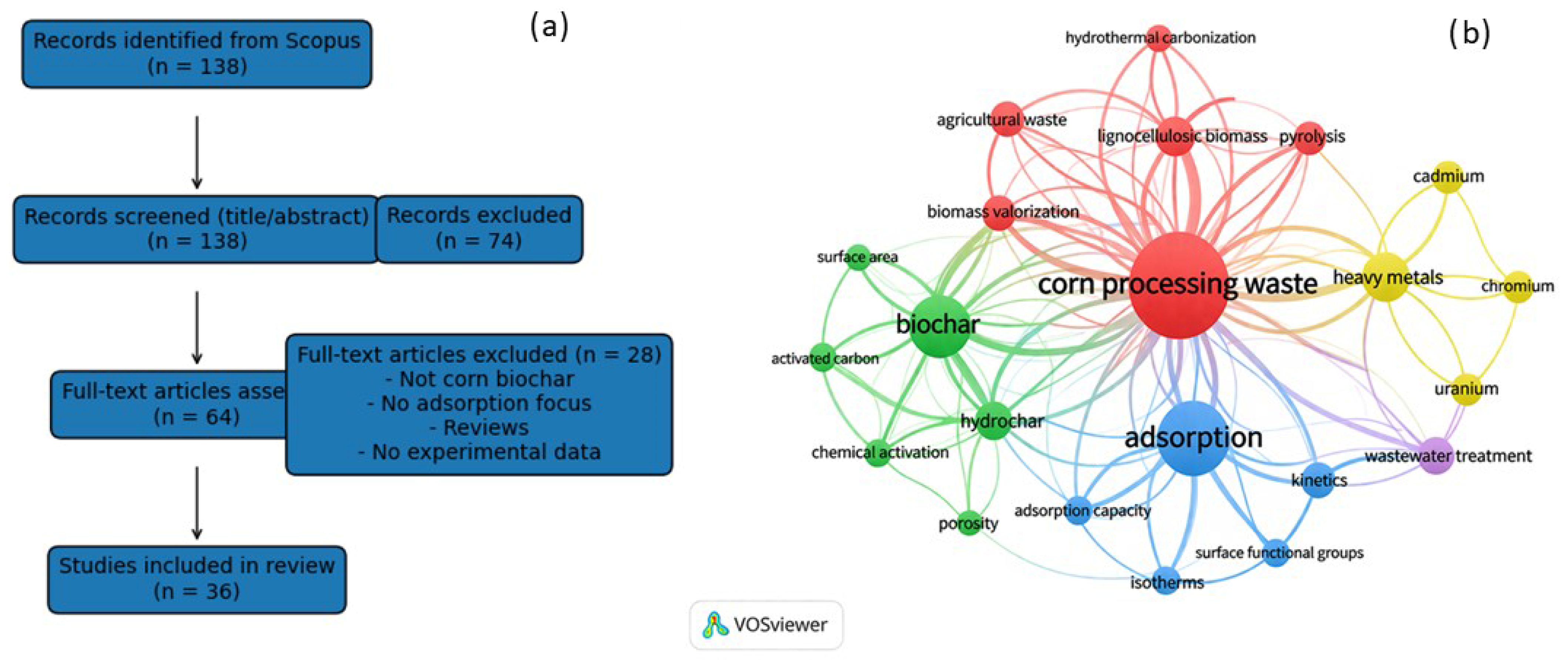
The literature selection process followed PRISMA guidelines, and the workflow is presented in Figure 1a. Additionally, keyword co-occurrence analysis using VOSviewer 1.6.20 (Figure 1b) was performed to identify research trends.
This review provides a comprehensive analysis of native corn processing biomass, hydrochars, and biochars, emphasizing the effects of thermochemical conversion on material characteristics, adsorption mechanisms, and practical applicability. Unlike previous studies, which typically focus on a single material type or isolated adsorption performance, this review provides a systematic comparative evaluation linking thermochemical processing routes with physicochemical properties and underlying adsorption mechanisms. Furthermore, a clear research gap is addressed by integrating insights across native biomass, hydrochar, and biochar systems, which are rarely discussed within a unified framework. Environmental feasibility, carbon yield, and techno-economic considerations are also discussed, highlighting the potential of corn processing waste valorization for sustainable soil and water remediation.

2. Methodology

This review was conducted in accordance with the PRISMA 2020 guidelines. A systematic literature search was performed using the Scopus database covering the period from 2021 to 2026. The search strategy included combinations of keywords such as (“corn” OR “maize”) AND (“biochar” OR “hydrochar”) AND (“adsorption” OR “pollutant removal”).
The inclusion criteria were: (i) experimental studies, (ii) use of corn-derived biomass, biochar, or hydrochar, and (iii) evaluation of adsorption performance for environmental remediation. The exclusion criteria included review articles, studies not related to adsorption processes, and studies not involving corn-based materials.
The literature selection process consisted of identification, screening, eligibility, and inclusion stages, as illustrated in Figure 1a. A total of 138 records were initially identified. After title and abstract screening, 74 records were excluded as irrelevant. The remaining 64 articles were assessed for eligibility through full-text analysis, of which 28 were excluded due to lack of experimental adsorption data or insufficient relevance. Finally, 36 studies were included in the qualitative synthesis.
Data extracted from the selected studies included adsorbent type, preparation method, physicochemical properties, type of pollutants, and adsorption performance.
A formal risk-of-bias assessment was not conducted, as this review focuses on qualitative comparison and trend analysis. The review protocol was not registered.
The completed PRISMA 2020 checklist is provided in the Supplementary Materials (Table S1) to ensure transparency and completeness of reporting [22]. The PRISMA flow diagram is presented in Figure 1a.

3. Corn Processing Waste: Origin, Composition, and Potential as a Sustainable Feedstock

Corn processing generates substantial quantities of lignocellulosic residues as by-products of agricultural harvesting and industrial processing operations, including milling, starch extraction, and bioethanol production. These residues comprise various structural components of the corn plant, such as straw (stover), stalks, cobs, husks, and other processing fractions generated during grain separation and refining [13,14].
Due to the large global production of corn, these residues represent one of the most abundant agricultural biomass resources. Traditionally, they are used for low-value applications such as animal bedding, combustion for energy, or are simply discarded in the field [23]. However, their lignocellulosic composition and inherent carbon content make them suitable precursors for the preparation of carbon-based materials through thermochemical conversion processes [24].
The physicochemical properties of corn residues depend strongly on the specific plant fraction and processing stage from which they originate. Differences in cellulose, hemicellulose, lignin, and inorganic components influence thermal behavior, carbon yield, and structural evolution during thermochemical treatments such as hydrothermal carbonization and pyrolysis [25,26]. Therefore, understanding the origin and composition of these residues is essential for selecting appropriate feedstocks and optimizing material synthesis routes.

3.1. Classification and Global Availability of Corn Processing Residue

Corn processing generates a diverse range of lignocellulosic residues, the characteristics of which depend on both the anatomical part of the plant and the specific industrial process involved. Among the most prominent are cobs, husks, bran, germ fractions, straw, and stalks [27]. Corn cobs are structurally rigid and rich in cellulose, with moderate lignin content, which confers stability and makes them well suited for the production of carbon materials. In contrast, corn husks contain relatively higher proportions of cellulose and hemicellulose but lower lignin levels, promoting thermal reactivity during thermochemical conversion and facilitating the development of porosity. Bran and germ residues, generated primarily during milling, are enriched in proteins, minerals, and minor lipid fractions, which can influence the surface chemistry and functionalization potential of the resulting carbon-based adsorbents. Straw and stalk residues are generally more fibrous and exhibit variability in their lignocellulosic composition, depending on the harvest and processing conditions [28].
These residues are produced in substantial quantities worldwide as by-products of food processing, animal feed production, and biofuel industries [13,14]. Their widespread availability and low economic value render them accessible and attractive for biomass valorization. However, differences in composition among the various residue types can significantly affect thermal degradation behavior, pore development, and mineral content in derived carbon materials. The main lignocellulosic constituents—cellulose, hemicellulose, and lignin—determine the fundamental pathways of thermal conversion and the physicochemical characteristics of the resulting adsorbents. Naturally occurring minerals, including calcium, potassium, and silica, contribute to ash formation and may impact pore structure during carbonization, highlighting the importance of residue selection in designing effective adsorbent materials.

3.2. Physico-Chemical Properties from Macromolecules to Functional Groups

The physicochemical properties of corn residues are largely dictated by their lignocellulosic composition, which governs structural integrity, surface chemistry, and reactivity [26]. Cellulose and hemicellulose constitute the carbohydrate-rich framework of the plant material, providing abundant hydroxyl and ether groups that contribute to surface polarity and offer potential binding sites for a wide range of contaminants [28]. Hemicellulose, being more thermally labile, decomposes at lower temperatures, promoting volatile formation and initiating pore development during thermochemical treatment. Lignin, on the other hand, is a highly aromatic polymer containing phenolic and methoxy groups; its thermal transformation leads to the formation of stable aromatic carbon domains, which can engage in π–π interactions and surface complexation with organic pollutants [29].
In addition to these organic components, corn residues naturally contain inorganic constituents such as calcium, potassium, and silica, which can further enhance pollutant sequestration through ion exchange or surface precipitation. The lignocellulosic composition of different corn processing residues varies considerably depending on the plant part, as summarized in Table 1. However, high ash content may obstruct pore formation and reduce the accessible surface area of the final material [15,18]. Thermal degradation of these residues occurs in distinct stages: hemicellulose typically decomposes around 200–300 °C, cellulose at 300–400 °C, and lignin over a broader temperature range due to its complex aromatic structure [30]. These sequential transformations influence char formation, porosity development, and the distribution of surface functional groups, ultimately shaping the adsorption performance and stability of the derived carbon materials.
The individual biopolymers in corn processing residues contribute differently to adsorption behavior and to their transformation during thermochemical conversion. Cellulose, as a crystalline polysaccharide rich in hydroxyl groups, primarily supports hydrogen bonding interactions and provides polar sites for the adsorption of hydrated metal ions and polar organic molecules, although accessibility of these sites is partially restricted in native biomass. Hemicellulose, due to its amorphous structure and lower thermal stability, decomposes at relatively low temperatures and facilitates the development of porosity and oxygen-containing functional groups, thereby improving adsorption accessibility after thermal treatment. Lignin, as an aromatic and highly recalcitrant polymer, serves as the main precursor for the formation of stable carbon frameworks and is primarily responsible for π–π interactions with aromatic organic pollutants. The combined and synergistic behavior of these three biopolymers governs the adsorption performance of corn-derived materials and strongly influences the evolution of hydrochars and biochars with distinct surface chemistry and pollutant affinity.

3.3. Native Biomass for Remediation: Key Advantages and Intrinsic Characteristics

Native corn processing residues can be directly applied as low-cost adsorbents due to the presence of oxygen-containing functional groups, including hydroxyl, carboxyl, and phenolic moieties [12]. These functional groups enable various interactions with pollutants, such as ion exchange, hydrogen bonding, and electrostatic attraction, allowing the removal of both organic and inorganic contaminants from environmental matrices [12,15]. In addition to organic functional groups, native corn processing residues also contain naturally occurring inorganic minerals such as calcium (Ca), potassium (K), magnesium (Mg), sodium (Na), and silicon (Si). These mineral constituents can significantly contribute to the adsorption of inorganic pollutants, particularly heavy metal ions, through mechanisms such as ion exchange, surface complexation, and precipitation. For example, calcium and magnesium sites may participate in cation exchange with toxic metal ions (e.g., Pb2+, Cd2+), while silicate and carbonate-related surface species can facilitate surface precipitation and immobilization of metals. Therefore, the inherent mineral composition of raw biomass plays an important synergistic role, alongside oxygen-containing functional groups, in governing the removal efficiency of inorganic contaminants. The direct use of untreated biomass also minimizes processing requirements and energy consumption, offering a simple and resource-efficient approach for pollutant removal. Despite these advantages, the practical application of native biomass is often limited by several intrinsic constraints. Raw corn residues typically exhibit relatively low specific surface area and poorly developed internal porosity, which restrict the number of available adsorption sites, particularly for larger organic molecules [14]. Furthermore, lignocellulosic materials may exhibit limited structural stability in aqueous environments, where swelling, microbial degradation, or gradual disintegration can occur over time. Another potential limitation involves the leaching of soluble organic compounds from untreated biomass, which may increase chemical oxygen demand in treated water and potentially lead to secondary contamination [37]. In addition, variations in surface charge and pH-dependent behavior can influence adsorption efficiency and complicate process optimization under different environmental conditions.
These limitations highlight the importance of thermochemical conversion processes, such as hydrothermal carbonization and pyrolysis, for improving the structural stability and adsorption properties of biomass-derived materials. Controlled thermal treatment promotes pore development, enhances structural integrity, and modifies surface chemistry, enabling the production of hydrochars and biochars with improved adsorption performance and greater applicability in soil and water remediation systems.

4. Hydrothermal Carbonization: Engineering Functional Hydrochars

Hydrothermal carbonization (HTC) has emerged as a promising thermochemical pathway for the valorization of corn processing residues into carbon-rich materials known as hydrochars. Compared to conventional pyrolysis, HTC operates in an aqueous environment at relatively moderate temperatures, typically between 180 and 260 °C, under autogenous pressure [16]. This processing environment eliminates the need for energy-intensive feedstock drying, making HTC particularly suitable for biomass streams with high intrinsic moisture content, such as residues generated during corn processing.
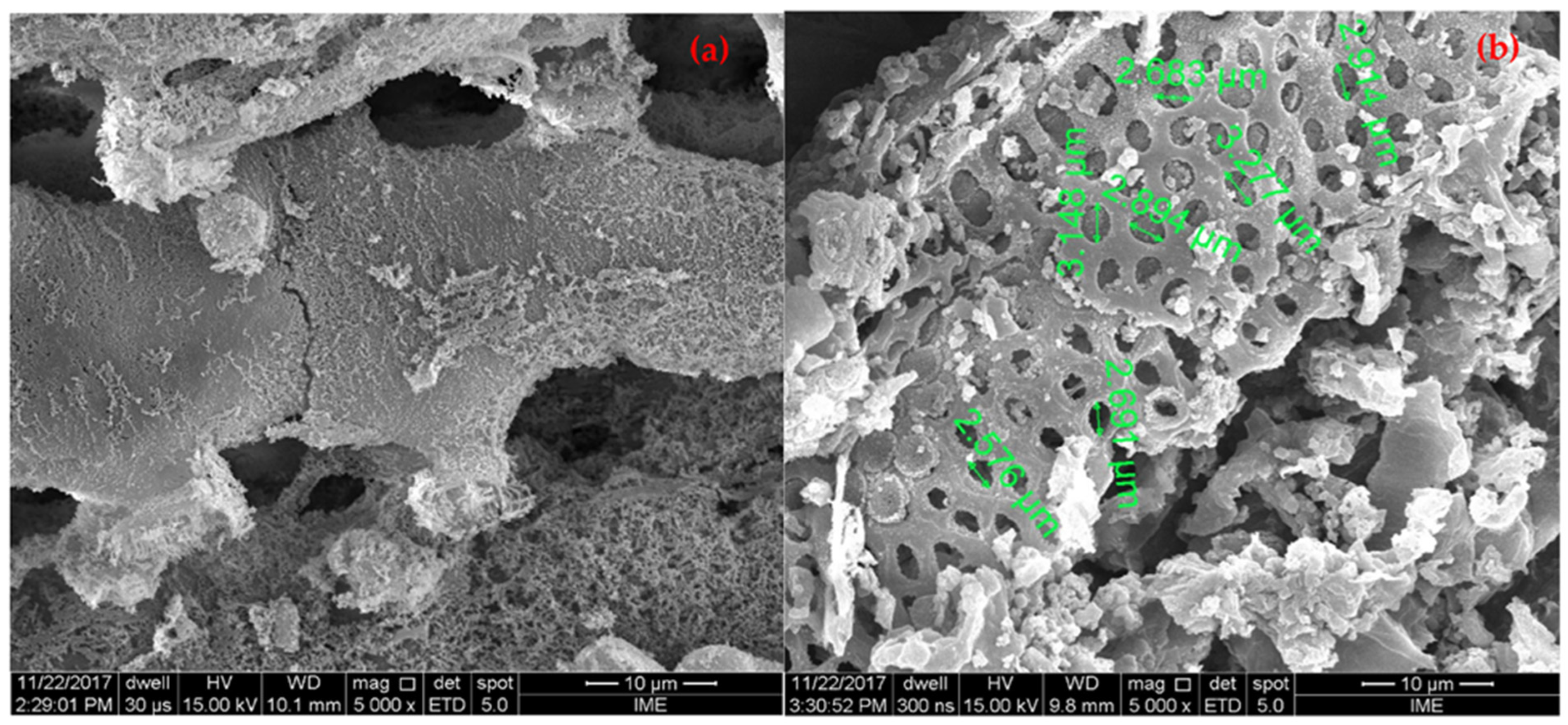
By accelerating reactions analogous to natural coalification processes, HTC converts the heterogeneous lignocellulosic structure of corn residues into a more homogeneous carbonaceous matrix enriched with functional surface groups. As shown in Figure 2, increasing HTC temperature from 175 to 200 °C promotes the transformation from a relatively compact structure to a more porous and fragmented morphology with visible microscale cavities, reflecting progressive biomass decomposition and structural reorganization [38]. The resulting hydrochars exhibit tunable physicochemical properties, which can be adjusted through careful control of process parameters such as temperature, residence time, and biomass-to-water ratio. These characteristics make hydrochars derived from corn processing waste promising candidates for adsorption-based remediation of contaminated soil and water.

4.1. Reaction Pathways and Process Dynamics

During HTC process, the conversion of corn processing biomass is governed by a sequence of hydrolysis, dehydration, decarboxylation, polymerization, and condensation reactions [39]. Initially, hemicellulose and cellulose components within corn residues undergo hydrolytic cleavage in subcritical water, producing soluble sugars and oligomeric intermediates. These intermediates subsequently undergo dehydration and fragmentation reactions, generating reactive compounds such as furfurals, hydroxymethylfurfural (HMF), and low-molecular organic acids [40].
Further polymerization and condensation of these intermediates leads to the formation of carbonaceous microspheres that gradually deposit onto the remaining solid biomass structure. This process increases the aromatic character of the material while simultaneously forming a surface enriched with oxygen-containing functional groups. The final physicochemical properties of the resulting hydrochar are highly dependent on operational conditions. Increasing reaction temperature or residence time generally promotes a higher degree of carbonization, resulting in lower atomic H/C and O/C ratios [41,42].

4.2. Structural and Surface Functionality

A surface rich in oxygen-containing functional groups, including hydroxyl, carbonyl, and carboxyl moieties, which originate primarily from the partial decomposition of cellulose and hemicellulose during HTC [41], typically characterize hydrochars produced from corn processing residues. Due to the relatively moderate processing temperatures employed in HTC, these groups remain preserved, in contrast to high-temperature pyrolysis biochars that have more condensed aromatic structures and fewer oxygenated functionalities [42]. The presence of these oxygenated groups enhances the material’s affinity for polar organic molecules and inorganic ions through mechanisms including hydrogen bonding, surface complexation, and electrostatic interactions [43,44].
Although the specific surface area (SBET) of hydrochars is typically lower than that of high-temperature biochars, their adsorption performance can remain highly effective for polar organics and heavy metal ions due to the abundance of reactive oxygen functional groups and surface sites [45]. Additionally, inorganic constituents naturally present in corn residues, such as calcium, potassium, and silica, may remain partially incorporated into the hydrochar structure and contribute to pollutant removal through ion exchange reactions or surface precipitation mechanisms, particularly in the case of heavy metal ions [12,13,40].

4.3. Adsorption Performance and Dominant Mechanisms

The adsorption performance of corn-derived hydrochars is governed by the interplay of key physicochemical properties, including specific surface area (SBET), pore morphology and distribution, surface charge (commonly expressed as pHPZC-dependent behavior), and the nature and density of surface functional groups. A higher specific surface area and well-developed pore structure enhance accessibility of active sites and facilitate mass transfer of pollutants, while surface morphology further influences diffusion pathways and adsorption efficiency. Surface charge plays a crucial role in determining electrostatic interactions with ionic species and is strongly dependent on solution pH relative to the point of zero charge (pHPZC). In addition, oxygen-containing functional groups such as hydroxyl, carboxyl, and carbonyl moieties provide active binding sites for both metal ions and organic molecules through ion exchange, complexation, and hydrogen bonding. The overall adsorption behavior results from the synergistic interaction of these structural and chemical characteristics, which can be tuned by thermochemical conversion conditions applied to corn processing residues. For inorganic pollutants, particularly heavy metal cations, adsorption is primarily driven by ion exchange and complexation with surface functional groups such as carboxyl and phenolic moieties [17]. For example, Pb2+ adsorption on hydro-pyrochars synthesized from corn cob has been shown to follow pseudo-second-order kinetics and Sips isotherms, indicating significant chemisorption contributions from surface functional groups and reactive sites [18].
In the case of organic pollutants, including dyes and other organics, adsorption may occur through hydrogen bonding, π–π interactions between aromatic structures, and electrostatic interactions depending on pollutant speciation and solution chemistry. Hydrochars derived from corn cob have been shown to efficiently remove methylene blue from aqueous solutions, with adsorption behavior well described by Langmuir isotherms and pseudo-second-order kinetics, reflecting the role of abundant oxygenated surface functional groups in binding organic molecules [46].
Environmental parameters such as pH, ionic strength, and competing ions can significantly influence adsorption performance, as changes in pH alter the protonation state of hydrochar surface functional groups, thereby modifying electrostatic attraction or repulsion toward charged pollutants. These aspects have been introduced at the beginning of Section 3.3 to provide a clearer framework for adsorption mechanisms.

4.4. Strategic Advantages and Operational Constraints

HTC proces offers several strategic advantages for the valorization corn processing waste. The carbonization of wet biomass in HTC does not require prior drying, which reduces overall energy input compared to high-temperature dry processes and makes this pathway particularly suitable for industrial residues with high moisture contents. HTC converts biomass into carbon-rich solids under moderate temperatures (180–260 °C) and water as reaction media, enabling energetic and cost-effective conversion of diverse lignocellulosic wastes into functional hydrochars [47]. Furthermore, hydrochars tend to retain abundant surface functional groups that are favorable for adsorption applications, while the aqueous, mild processing conditions limit the formation of gas emissions and reduce energy demand [44].
However, certain limitations remain. Hydrochars generally exhibit lower intrinsic porosity and specific surface area than biochars produced by high-temperature pyrolysis, which can limit their adsorption performance for certain contaminants without further activation [43]. Additionally, variations in the composition of corn processing residues—e.g., between cobs, husks, and bran—can influence the physicochemical properties of the hydrochar and thus its adsorption behavior, highlighting the importance of careful optimization of HTC process parameters (e.g., temperature, residence time, water/biomass ratio) to tailor hydrochar characteristics to particular applications [44].
When properly engineered through adjustment of reaction conditions and, if necessary, post-treatment activation, hydrochars derived from corn residues represent a viable intermediate in biomass valorization, bridging the gap between unprocessed agricultural waste and highly carbonized adsorbents such as activated biochars [48].

5. Pyrolysis: Engineered Biochars with High Aromaticity and Porosity

Pyrolysis is the most established thermochemical route for converting corn processing residues into stable, carbon-rich adsorbents known as biochars. In contrast to hydrothermal carbonization, pyrolysis is performed under oxygen-limited or inert atmospheres at significantly higher temperatures, typically ranging from 400 °C to over 900 °C [16,49]. This high-temperature, dry thermal treatment induces profound structural transformations within the lignocellulosic matrix of corn residues, leading to the evolution of bio-oil and syngas while leaving behind a solid carbon scaffold. The resulting biochars exhibit exceptional chemical recalcitrance and a highly developed pore network, which distinguishes them from both native biomass and hydrochars.

5.1. Thermal Decomposition and Pore Evolution and Surface Chemistry

The conversion of corn residues into biochar is governed by the thermal stability and decomposition behavior of their major macromolecular components. During pyrolysis (thermal treatment in the absence of oxygen), hemicellulose and cellulose decompose at relatively low temperatures (approximately 220–450 °C), while lignin degrades over a broader temperature range due to its complex aromatic structure, which ultimately forms the structural backbone of the resulting char. Devolatilisation—the release of volatile compounds—occurs sequentially, beginning with hemicellulose, followed by cellulose, and finally the slower decomposition of lignin. This staged degradation plays a crucial role in the formation of carbon-rich structures and the development of porosity within the biochar matrix [49,50].
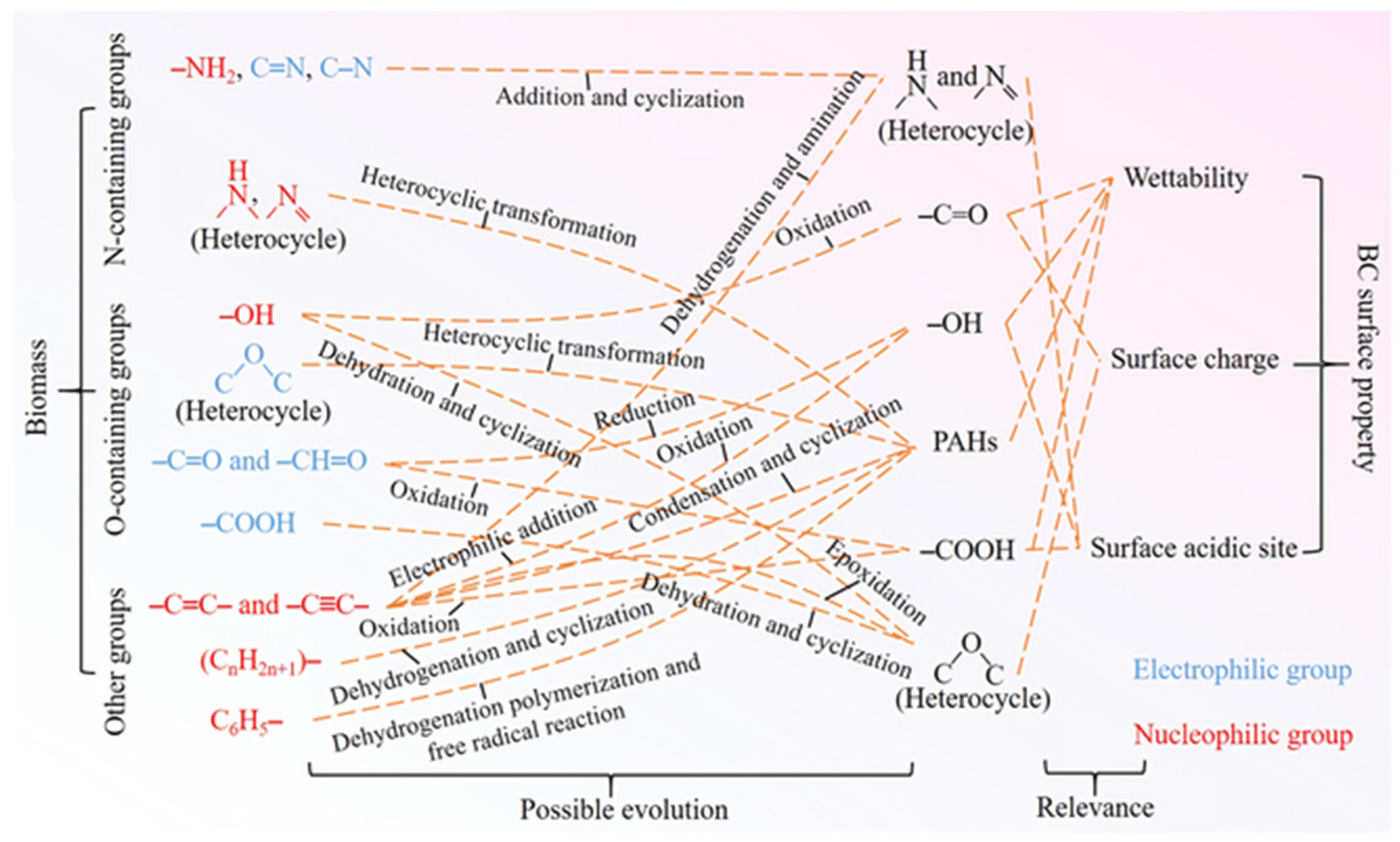
As illustrated in Figure 3, the evolution of functional groups during pyrolysis involves dehydration, oxidation, and cyclization reactions that progressively transform oxygen- and nitrogen-containing groups (e.g., –OH, –COOH, –NH2) into more stable aromatic and heterocyclic structures [50]. With increasing temperature, aliphatic carbon structures condense into polycyclic aromatic configurations, enhancing the aromaticity and structural stability of the biochar. At the same time, the release of volatile compounds and the breakdown of organic matter generate an interconnected system of micro-, meso-, and macropores, resulting in a highly developed pore network and increased specific surface area.
Higher pyrolysis temperatures are strongly associated with increased porosity and surface area due to the more extensive removal of volatile components and progressive carbonization. Consequently, the resulting biochar exhibits a predominantly microporous structure, which is particularly effective for adsorption processes [51]. Biochars derived from lignocellulosic residues such as corn can therefore achieve specific surface areas (SBET) several orders of magnitude higher than those of the original biomass, significantly enhancing adsorption capacity through pore filling and surface interactions [52,53].
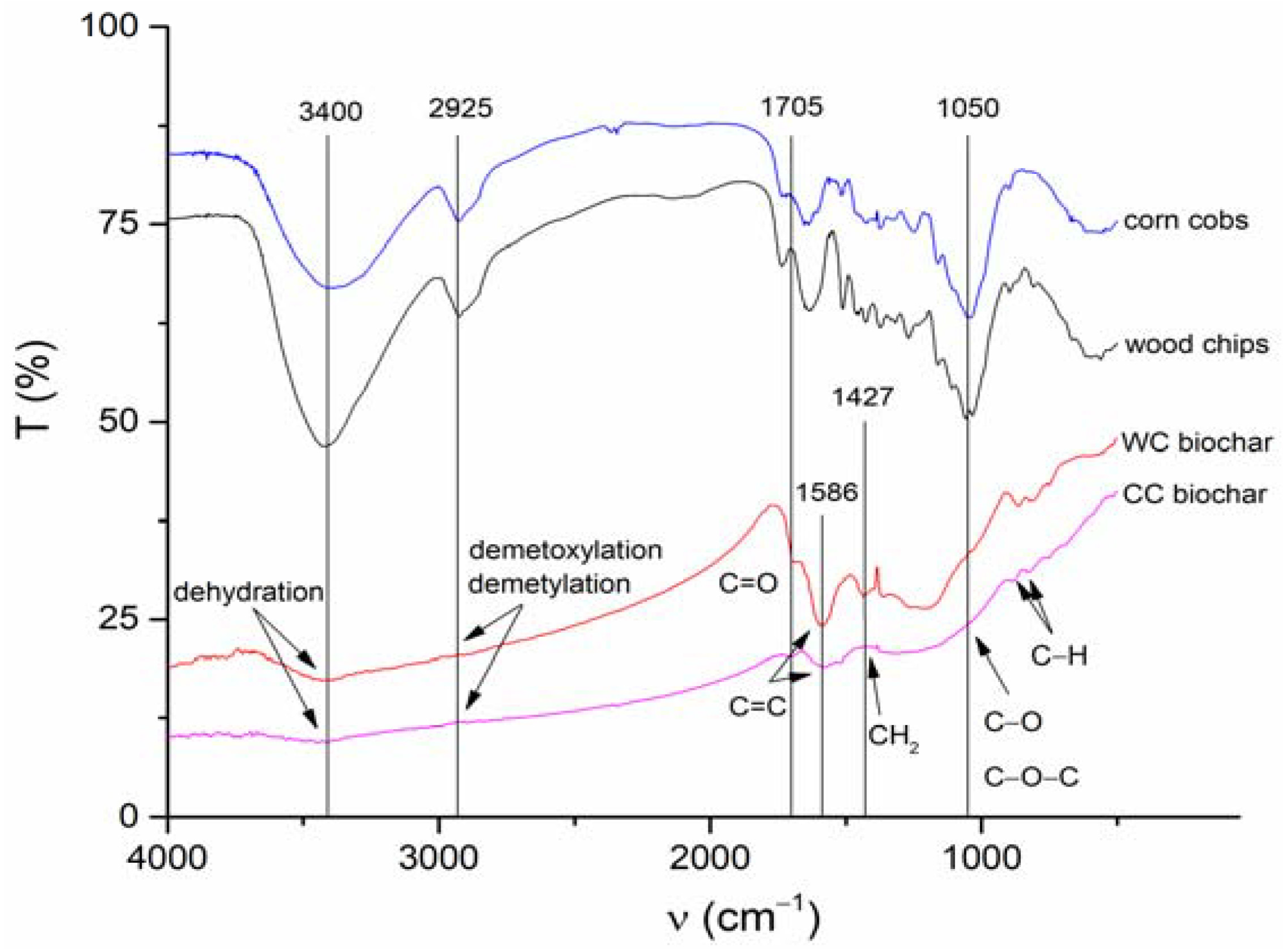
The FTIR spectra presented in Figure 4 provide direct evidence of the functional groups initially present in native corn residues and their transformation during pyrolysis. The raw corn-cob feedstock exhibits characteristic absorption bands corresponding to hydroxyl (–OH, ~3400 cm−1), aliphatic C–H (~2925 cm−1), and oxygen-containing functional groups such as carbonyl and carboxyl moieties (C=O and C–O vibrations in the range of 1705–1050 cm−1), reflecting the lignocellulosic nature of the biomass. Following pyrolysis at 500 °C, a marked reduction in the intensity of –OH and aliphatic C–H bands is observed, indicating dehydration, demethoxylation, and devolatilization processes. At the same time, the relative increase in aromatic C=C vibrations (~1586 cm−1) and out-of-plane aromatic C–H deformation bands (876 and 820 cm−1) confirms the progressive formation of condensed aromatic structures. The persistence of low-intensity bands associated with C=O and C–O groups suggests the presence of residual oxygen functionalities in partially carbonized domains [54]. These spectral changes are consistent with the transformation pathways illustrated in Figure 3, where labile oxygenated functional groups are progressively eliminated and replaced by more stable aromatic and heterocyclic carbon structures. In addition, the presence of mineral-related bands (e.g., CO32− and Si–O vibrations) highlights the role of the inorganic fraction in shaping the surface chemistry of the resulting biochar.
In parallel, these structural transformations are accompanied by changes in surface chemistry. The progressive loss of oxygen-containing functional groups and the increase in aromatic carbon content lead to greater hydrophobicity and surface alkalinity [54]. Lower-temperature biochars retain functional groups such as hydroxyl and carboxyl moieties, whereas higher-temperature treatment promotes the formation of graphene-like and turbostratic carbon structures, improving the adsorption of non-polar organic contaminants [56]. As also indicated in Figure 3, these chemical transformations directly influence key surface properties such as wettability, surface charge, and the availability of acidic functional sites [50].
Additionally, the inorganic fraction of corn residues—including silica, calcium, and potassium—becomes concentrated in the biochar as ash. These mineral components influence surface pH, provide additional binding sites, and facilitate the immobilization of heavy metals through precipitation and complexation mechanisms. Together with the developed pore structure and aromatic carbon framework, these properties make corn-derived biochar an efficient adsorbent for a wide range of organic and inorganic pollutants [57].

5.2. Mechanisms of Pollutant Sequestration

Overall, corn-derived biochars provide a versatile platform capable of simultaneously removing both hydrophobic organics and heavy metals, with performance largely dictated by pore architecture, surface chemistry, and mineral content.
The high adsorption capacity of biochars derived from corn processing residues arises from the interplay between their hierarchical pore structure, highly aromatic carbon matrix, and residual mineral content. Organic pollutants, such as dyes, pesticides, and pharmaceutical residues, are effectively captured through π–π electron donor–acceptor interactions with the graphene-like surfaces of the biochar, while the microporous network physically entraps larger molecules [56,58]. Inorganic contaminants, particularly heavy metal cations, are sequestered via surface complexation with remaining functional groups, electrostatic interactions, and coordination or precipitation with mineral residues inherited from the corn feedstock [57,59]. The efficiency of these processes is strongly modulated by environmental factors, including pH, ionic strength, and competing ions, which affect surface charge, protonation states, and accessibility of active sites.

5.3. Stability and Strategic Application

One of the key advantages of pyrolytic biochars is their exceptional chemical and biological stability. The highly aromatic and recalcitrant carbon framework resists microbial degradation, making these materials suitable for long-term environmental applications, such as in situ soil remediation and persistent pollutant stabilization [57,60,61].
However, the process requires high energy input and feedstock drying, which may increase production costs compared to hydrothermal carbonization. In practice, hydrochars derived from corn residues are optimized for polar and functional-group-driven adsorption, whereas pyrolytic biochars excel in applications requiring high surface area, aromaticity, and long-term stability, particularly for hydrophobic organics and persistent contaminants [22,62].

6. Comparative Analysis of Adsorption Performance and Mechanisms

The valorization of corn processing residues into adsorbents involves a progressive enhancement of adsorption performance from native biomass to hydrochar and biochar, reflecting structural and chemical transformations during thermochemical conversion. While native corn residues rely on the inherent reactivity of lignocellulosic components, hydrochars and biochars provide tunable properties tailored for specific classes of environmental pollutants. Understanding these differences is essential for selecting the most suitable adsorbent for soil and water remediation applications. The adsorption performance of corn-derived materials is governed by a combination of interdependent physicochemical parameters, including specific surface area (SBET), pore morphology, surface charge (commonly expressed as pHPZC), and surface functional groups. These properties collectively determine the accessibility and density of active sites and control the dominant adsorption pathways. Higher surface area and well-developed porosity enhance pore-filling mechanisms, while surface functionality (e.g., hydroxyl, carboxyl, and phenolic groups) governs hydrogen bonding, ion exchange, and surface complexation processes. In addition, surface charge plays a critical role in electrostatic interactions, particularly for ionic pollutants, and is strongly dependent on solution pH relative to the pHPZC of the adsorbent. The interplay between these parameters varies significantly among native biomass, hydrochar, and biochar, leading to distinct adsorption behaviors and pollutant selectivities across different thermochemical conversion routes.
To strengthen the mechanistic interpretation of adsorption behavior, FTIR (vibrational spectroscopy) data reported in the literature for native biomass, hydrochar, and biochar derived from corn residues provide key insights into surface functional group evolution. Native biomass typically exhibits broad bands corresponding to hydroxyl (–OH) stretching (~3200–3600 cm−1), C–H stretching (~2900 cm−1), and carbonyl/carboxyl vibrations (~1700 cm−1), confirming the abundance of oxygenated functional groups associated with cellulose, hemicellulose, and lignin. After hydrothermal carbonization, these bands are partially retained, particularly oxygen-containing groups, indicating preservation of polar functionalities responsible for hydrogen bonding and ion exchange mechanisms. In contrast, pyrolysis-derived biochars show a marked decrease in O–H and C=O bands and an increase in aromatic C=C vibrations (~1580–1620 cm−1), reflecting aromatization and carbon condensation, which supports π–π interactions and hydrophobic adsorption mechanisms. These FTIR-detected transformations directly correlate with the shift in adsorption mechanisms from functionality-driven (hydrogen bonding and complexation in hydrochar) to structure-driven processes (π–π interaction and pore filling in biochar). These spectral changes provide direct experimental evidence supporting the evolution of adsorption mechanisms across thermochemical conversion stages.
The adsorption performance of native corn biomass, hydrochar, and biochar is fundamentally governed by three key interrelated parameters: SBET, pHPZC, and surface functional group composition. Native biomass exhibits very low surface area and limited porosity, resulting in restricted access to adsorption sites despite the presence of oxygen-containing functional groups such as hydroxyl, carboxyl, and phenolic moieties. Hydrothermal carbonization significantly increases surface reactivity while maintaining moderate surface area and a relatively oxygen-rich surface, leading to lower pHPZC values and enhanced affinity for cationic species through ion exchange and surface complexation. In contrast, pyrolysis-derived biochars exhibit substantially higher surface areas and well-developed porous structures, but show reduced oxygenated functional group density and higher pHPZC values, resulting in more hydrophobic and electron-rich surfaces. These changes shift the dominant adsorption mechanisms from functionality-driven processes in hydrochars (ion exchange, hydrogen bonding, complexation) to structure-driven mechanisms in biochars (pore filling, π–π interactions, and hydrophobic partitioning). Therefore, the combined variation in BET surface area, pHPZC, and surface chemistry provides a unified explanation for the observed differences in adsorption behavior across corn-derived carbon materials.

6.1. Sequestration of Inorganic Pollutants: Heavy Metals and Metalloids

The removal of cationic heavy metals (e.g., Pb, Cd, Cu) by corn cob-derived adsorbents depends on the availability of reactive sites generated during processing, such as oxygen-containing functional groups formed during hydrothermal carbonization or pyrolysis, as well as surface charge and mineral content [18].
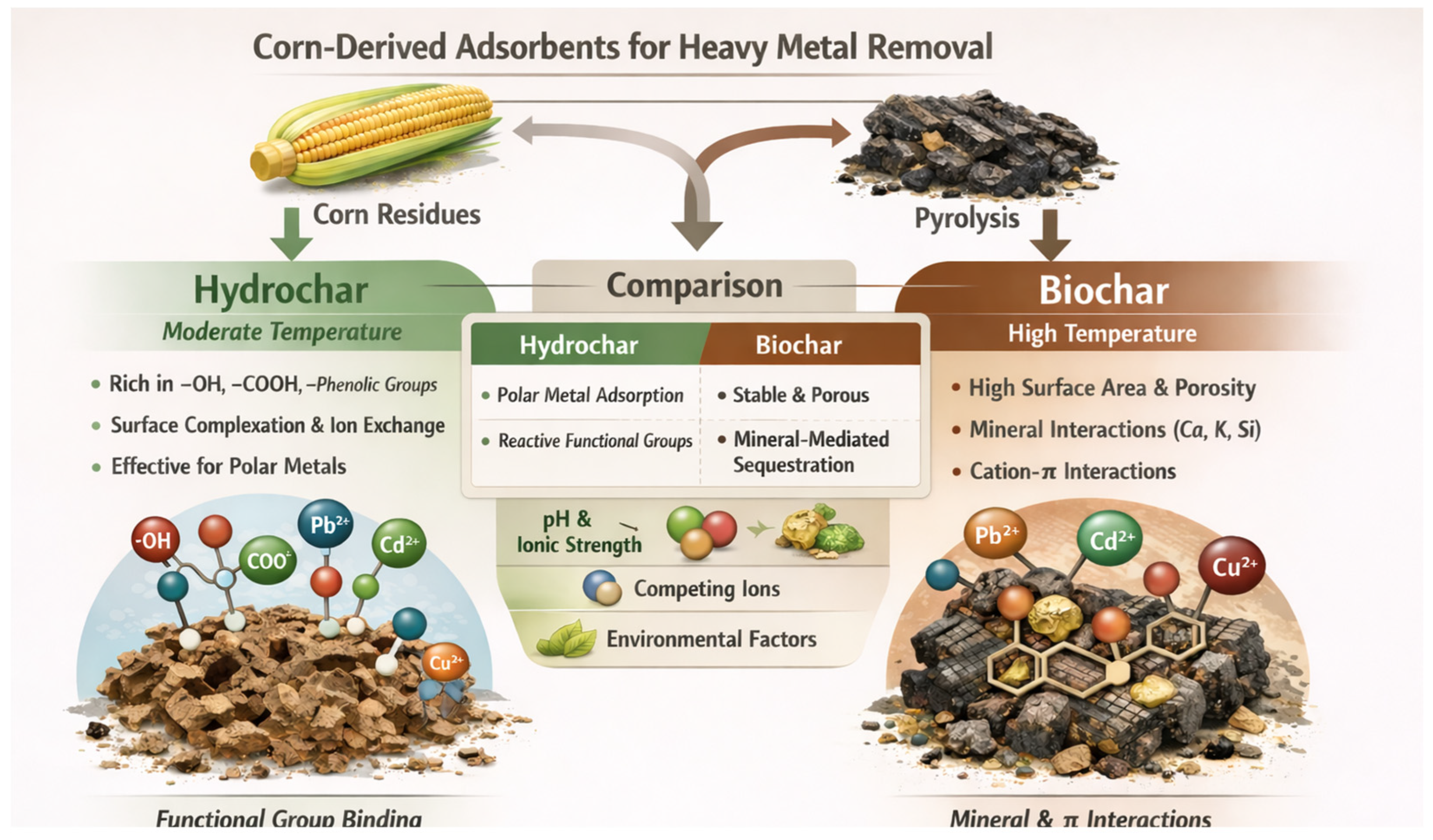
Native corn residues contain carboxylic, hydroxyl, and phenolic groups that allow moderate metal binding, but their low structural stability limits practical applications [12]. On the other hand, hydrochars derived from corn residues generally outperform both native biomass and pyrolytic biochars for inorganic cations. HTC at moderate temperatures preserves oxygen-containing functional groups, enabling surface complexation, ion exchange, and pH-dependent adsorption, making these materials particularly effective for heavy metal ions (Figure 5) [18,62,63,64]. Pyrolytic corn cob biochars exhibit higher surface area, porosity, and long-term stability but lose a significant fraction of oxygenated groups at high temperatures. Metal sequestration is largely governed by surface complexation with residual functional groups, precipitation with mineral residues (e.g., Ca, K, Si), and cation–π interactions with aromatic carbon domains. Chemical activation may be applied to further enhance cation adsorption [64,65,66].
The efficiency of these mechanisms is strongly influenced by environmental conditions, including pH, ionic strength, and competing ions, which modulate the protonation state of surface groups, surface charge, and availability of active binding sites. Overall, corn-derived hydrochars and pyrochars provide complementary strategies: hydrochars are optimal for heavy metals through functional-group-driven adsorption, while pyrochars are suited for persistent contaminants and metals in long-term applications due to their stability, porosity, and mineral-mediated sequestration. A schematic comparison of the dominant adsorption mechanisms and structural characteristics of corn-derived hydrochar and biochar is presented in Figure 5.
The removal of cationic heavy metals is primarily governed by the abundance of oxygen-containing functional groups and the ion exchange capacity of the adsorbent. Native corn residues contain carboxylic, hydroxyl, and phenolic groups that enable moderate metal uptake; however, their practical application is limited by low structural stability in aqueous systems. Hydrochars generally exhibit superior performance compared to both native biomass and pyrolytic biochars for the removal of inorganic cations. This behavior is attributed to hydrothermal carbonization at moderate temperatures, which preserves oxygenated functional groups and promotes adsorption mechanisms such as surface complexation and ion exchange. In contrast, pyrolytic biochars typically possess higher surface area and porosity but undergo a significant loss of oxygen-containing functional groups during high-temperature treatment. As a result, heavy metal removal by biochars is more often governed by mineral precipitation involving residual ash components (e.g., Ca, K, Si) and surface complexation rather than ion exchange. In some cases, additional chemical activation is required to further enhance their adsorption capacity for cationic species.

6.2. Sequestration of Organic Pollutants: Dyes, Pesticides, and Pharmaceuticals

The adsorption efficiency of organic contaminants on corn-derived materials is strongly dictated by the physicochemical properties of the adsorbent, including surface area, pore architecture, surface chemistry, and the organization of the carbon matrix, all of which collectively determine the accessibility of active sites and the extent of mass transfer from the aqueous phase to the sorbent surface. Native corn biomass exhibits limited adsorption performance due to its compact lignocellulosic structure, low specific surface area, and poorly developed porosity, which restrict intraparticle diffusion and limit the accessibility of internal sorption sites. Although some oxygen-containing functional groups are inherently present, their contribution to adsorption is limited because many remain embedded within the cellulose–hemicellulose–lignin matrix, rendering them partially inaccessible to dissolved contaminants [12,67].
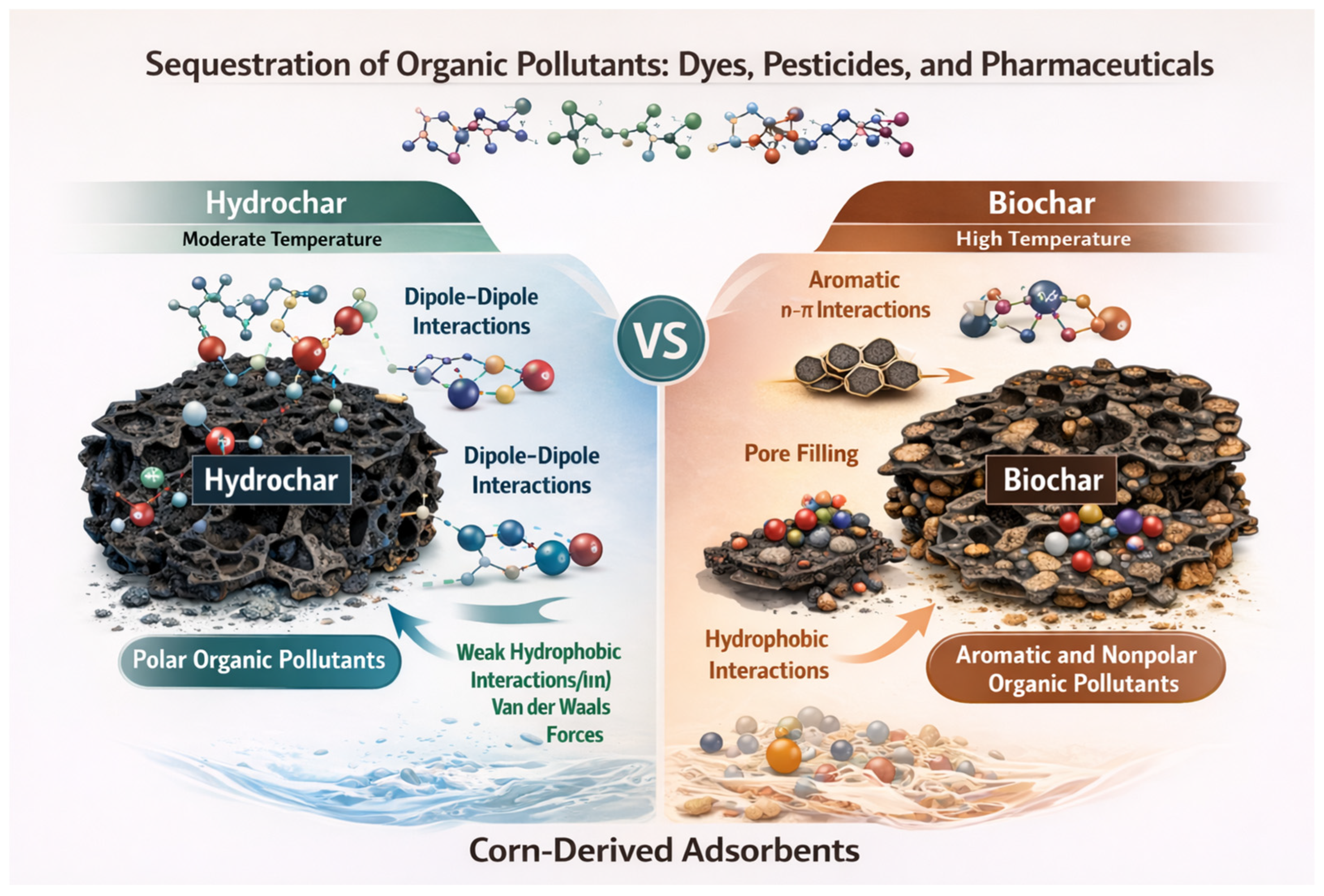
HTC converts corn cob into hydrochar while preserving a significant fraction of surface oxygenated functional groups, including hydroxyl (–OH), carbonyl (C=O), and carboxyl (–COOH) moieties [18,44]. Adsorption on hydrochar is therefore primarily governed by specific polar interactions, notably hydrogen bonding and dipole–dipole interactions. Hydrogen bonds form between proton-donating or proton-accepting groups on the hydrochar surface and complementary functional groups in organic molecules (e.g., –NH, –OH, –C=O), while dipole–dipole interactions contribute via electrostatic attraction between polar surface functionalities and polar regions of contaminants [43,45]. Residual aliphatic domains may further contribute weak hydrophobic interactions and van der Waals forces, but the moderate degree of carbonization limits extended π-conjugated structures, reducing strong π–π interactions with highly aromatic compounds. As a result, hydrochars are particularly effective for polar and moderately polar organic pollutants (Figure 6).
In contrast, high-temperature pyrolysis produces corn-derived biochar with enhanced aromatic condensation, increased carbon ordering, reduced surface polarity, and a well-developed micro- and mesoporous network. These structural features favor π–π electron donor–acceptor interactions between delocalized aromatic domains of the biochar surface and aromatic pollutants, while expanded porosity facilitates pore-filling and intraparticle diffusion, critical for larger organic molecules. Hydrophobic interactions between nonpolar domains of the biochar and hydrophobic contaminants further strengthen adsorption, enabling efficient retention of dyes, selected pesticides, and pharmaceutical residues [55,68].
Overall, the thermal conversion pathway dictates the dominant adsorption mechanisms of corn-derived materials. HTC yields a functionality-driven sorbent, where hydrogen bonding and dipolar interactions dominate, whereas high-temperature pyrolysis produces a structure-driven sorbent, in which aromaticity, π–π interactions, hydrophobic partitioning, and pore architecture collectively govern organic contaminant removal [69,70]. This mechanistic differentiation allows for the tailored application of hydrochar and biochar in the remediation of pollutants with distinct polarity and aromaticity profiles, complementing their respective strengths in targeted adsorption.

6.3. Integrated Process–Property–Performance Framework and Scope Limitations

While the previous sections discuss native biomass, hydrothermal carbonization (HTC), and pyrolysis-derived biochars separately in terms of structure, properties, and adsorption performance, a more integrated, process-oriented comparison is essential for evaluating their practical applicability. In this context, native corn residues, hydrochars, and biochars represent consecutive stages in biomass valorization, each characterized by distinct processing requirements, physicochemical properties, and adsorption behaviors.
To address this, a comparative analysis linking key process parameters (e.g., temperature, reaction medium, residence time, and energy demand) with resulting material properties, adsorption mechanisms, and application potential is presented in Table 2. This integrated approach provides a clearer framework for selecting the most appropriate material depending on pollutant type, operational conditions, and scale-up considerations.
This comparison highlights that native biomass, hydrochar, and biochar should not be viewed as competing materials, but rather as complementary stages within a unified biomass valorization framework. The selection of the optimal material depends on the balance between process intensity, desired surface functionality, structural properties, and the nature of the target pollutants, thereby enabling more rational design of sustainable remediation strategies.
It should be noted that the adsorption performance data and mechanistic interpretations discussed in this section are primarily derived from laboratory-scale batch adsorption studies, which represent the most commonly reported experimental approach in the literature [71,72]. In comparison, fewer studies have investigated more application-relevant systems such as continuous-flow (column) experiments, soil incubation tests, regeneration and reuse cycles, or real wastewater and field-scale applications. Therefore, the comparative conclusions presented herein mainly reflect model-system behavior under controlled conditions. The interpretation of hydrochar and biochar performance should thus be considered within the context of the specific experimental design, as adsorption efficiency may vary significantly depending on system complexity and operating conditions.

6.4. Influence of Environmental Factors

The adsorption performance of corn residue-derived materials is strongly governed by environmental conditions, particularly solution pH, ionic strength, and the presence of competing ions. Solution pH plays a decisive role in controlling both pollutant speciation and adsorbent surface charge through its relationship with the point of zero charge (pHPZC). When the solution pH exceeds the pHPZC, biochar and hydrochar surfaces become predominantly negatively charged, thereby enhancing the electrostatic attraction of cationic species such as heavy metal ions [18,73]. Conversely, under acidic conditions, protonation of surface functional groups may reduce cation adsorption and, at the same time, promote the removal of anionic contaminants through surface charge reversal and modified surface interactions [74].
In addition to pH effects, ionic strength significantly influences adsorption efficiency by modulating electrostatic interactions and compressing the electrical double layer at the adsorbent–solution interface. Increased ionic strength can either suppress adsorption of charged species through competition for active sites or alter surface complexation equilibria, depending on the contaminant chemistry and adsorbent structure [75]. Furthermore, coexisting ions may compete with target pollutants for binding sites, particularly in systems where adsorption is governed by ion exchange and surface complexation mechanisms [73]. These interactions highlight the necessity of tailoring corn residue-derived adsorbents to specific pollutant classes and site-specific water chemistry to ensure optimal performance under realistic environmental conditions.

6.5. Emerging Strategies: Surface Functionalization and Tailored Composites

While the intrinsic properties of native biomass, hydrochars, and biochars offer significant remediation potential, recent advancements in materials science have shifted toward the development of “designer” or engineered adsorbents. The primary objective of these modifications is to overcome the inherent limitations of raw thermochemical products, such as the low porosity of hydrochars or the diminished surface functionality of high-temperature biochars [18,70,73].
Surface activation strategies are generally categorized into physical and chemical pathways. Physical activation involves the use of oxidizing agents like steam or CO2 at elevated temperatures to etch the carbon scaffold, thereby drastically increasing the specific surface area and pore volume. Chemical activation, utilizing agents such as KOH, ZnCl2, or H3PO4, facilitates the simultaneous carbonization and development of a microporous network, often resulting in adsorbents that rival commercial activated carbons [18,72].
Beyond pore engineering, the introduction of specific chemical moieties through heteroatom doping (e.g., N, S, or P) or the fabrication of magnetic composites (e.g., impregnation with Fe3O4 nanoparticles) has emerged as a high-performance frontier. Nitrogen doping, for instance, enhances the electron density of the carbon framework, significantly boosting π–π interactions for organic micropollutants. Meanwhile, the development of magnetic carbonaceous composites addresses the critical challenge of adsorbent recovery in large-scale water treatment, allowing for efficient separation via external magnetic [18,73]. These sophisticated modification routes enable the rational design of agro-industrial-derived materials that are not only sustainable but also highly selective for recalcitrant environmental contaminants.

7. Applications in Water Treatment and Soil Remediation

The practical implementation of corn processing residue-derived adsorbents requires consideration of the complexity of natural and engineered matrices. The performance of native biomass, hydrochars, and pyrolytic biochars is influenced not only by intrinsic adsorption capacity but also by long-term stability, interaction with the environment, and regenerability, which are critical for sustainable remediation strategies. Corn residue-derived materials have shown versatility for both aquatic and terrestrial applications, with their efficacy strongly dependent on feedstock composition, thermochemical conversion method, and surface properties.

Strategic Implementation in Aquatic Systems

Corn-derived adsorbents are employed across a range of configurations for wastewater treatment and in situ soil remediation, targeting both inorganic and organic contaminants.
Hydrochars from corn cobs or husks, rich in oxygenated functional groups, are highly effective for tertiary treatment of effluents containing heavy metals and polar organic micropollutants (Table 3).
The surface chemistry allows rapid complexation and ion exchange, making them suitable for high-flow treatment conditions. Pyrolytic biochars, with a highly aromatic and porous framework, serve as a sustainable alternative to commercial activated carbons for persistent organic pollutants, such as pharmaceuticals, endocrine disruptors, and aromatic pesticides [90]. Their combination of pore-filling mechanisms and π–π electron donor–acceptor interactions ensures retention of hydrophobic compounds that may escape conventional treatments. Additionally, the recalcitrant aromatic carbon matrix of biochars provides superior mechanical integrity and structural stability under cyclic use compared to hydrochars and native biomass.
Corn residue-derived biochars are particularly valuable for in situ stabilization of soils (Table 4). Their microporous architecture and aromatic carbon framework enable long-term sequestration of hydrophobic organics and certain heavy metals/metalloids, while also providing microhabitats for indigenous microbes to facilitate coupled adsorption–biodegradation pathways. Hydrochars offer rapid immobilization of cationic pollutants through high ion-exchange capacities but are more susceptible to mineralization and gradual re-release under environmental conditions. The choice between hydrochar and biochar should consider both pollutant type and remediation timescale. Beyond pollutant removal, these materials support circular economy goals by improving soil water retention, nutrient cycling, and overall ecosystem services [91,92].
Corn-derived adsorbents with heterogeneous surface chemistry are capable of simultaneously sequestering metals and organic pollutants, making them suitable for multi-contaminant systems. Mineral ash promotes precipitation of metals, while aromatic carbon domains enable π–π interactions with organics. The balance between surface functionality and porosity, dictated by feedstock type and thermochemical conversion, determines the adsorbent’s efficacy in complex matrices, supporting the engineering of tailored, cost-effective, and sustainable remediation strategies.

8. Techno-Economic and Environmental Considerations

The large-scale implementation of adsorbents derived from corn processing residues necessitates a thorough assessment of economic viability, energy requirements, and environmental sustainability. To compete with commercial activated carbons, a comprehensive evaluation encompassing production costs, life-cycle impacts, and integration into the circular economy is essential.
To ensure transparency of the techno-economic and environmental assessment, it is important to clarify the system boundaries and underlying assumptions adopted in this analysis. The evaluation presented in this section primarily considers the core production chain, including feedstock availability and transport, thermochemical conversion (HTC or pyrolysis), and basic downstream handling of the produced adsorbents. Energy demand, production cost, and carbon footprint estimates are therefore based on these system boundaries.
However, certain process-specific aspects are not explicitly quantified in the comparative metrics, including large-scale logistics optimization, detailed reactor design variations, industrial heat integration schemes, long-term adsorbent regeneration infrastructure, and advanced treatment of HTC process water or liquid by-products. While these factors are discussed qualitatively where relevant, their full integration into life-cycle or techno-economic modeling is beyond the scope of this review. This distinction is essential for interpreting the reported cost and environmental indicators as indicative rather than absolute values, and for avoiding overgeneralization when translating laboratory and literature data to industrial scale applications.
Corn processing residues, including cobs, husks, and bran, are often available at low or even negative cost. Their utilization reduces expenses related to waste handling, transport, and disposal. This creates a strong economic incentive for their valorization into adsorbents. However, this advantage is strongly dependent on local logistics and availability of waste streams, which may limit scalability in certain regions. Moreover, the overall production cost depends on the selected thermochemical conversion pathway, as different processes exhibit varying energy demands and operational requirements. Key factors include energy input, process conditions, and the potential for co-product recovery. HTC is particularly cost-effective for high-moisture feedstocks. It processes biomass in the aqueous phase and eliminates the need for energy-intensive pre-drying. HTC operates at relatively moderate temperatures (180–260 °C) and generally requires lower thermal energy input. This simplifies process integration for wet residues [61,100,101,102]. In contrast, pyrolysis requires prior drying of the feedstock and operates at higher temperatures (>500 °C). These conditions increase energy demand and operational costs. However, part of these costs can be offset through the valorization of co-products such as syngas and bio-oil. These streams can be used for heat and power generation or upgraded into value-added chemicals [44,48,103].
The long-term economic performance is strongly influenced by adsorbent stability and reusability, as these parameters directly determine replacement frequency and overall operational costs. Biochar derived from corn residues maintain structural integrity over multiple adsorption–desorption cycles due to their highly carbonized, aromatic framework and stable pore structure formed at elevated pyrolysis temperatures. This structural robustness enables effective regeneration with minimal loss of adsorption capacity, thereby extending service life and reducing material replacement costs [104]. In contrast, hydrochars and native biomass are less carbonized and contain a higher proportion of oxygen-containing functional groups and labile carbon. While this composition can enhance initial adsorption performance, it also makes these materials more susceptible to structural degradation during regeneration. Common issues include pore collapse, surface oxidation, and mass loss, particularly under thermal or chemical treatment conditions. Consequently, these adsorbents exhibit a faster decline in adsorption efficiency and shorter operational lifetimes. This necessitates more frequent replacement, which offsets their lower initial production cost and negatively affects overall lifecycle economics [105].
Utilizing corn waste as adsorbents contributes to carbon sequestration and mitigates greenhouse gas emissions. Biochar act as long-term carbon sinks due to their highly aromatic, recalcitrant structure, potentially storing carbon in soils for decades to centuries [106]. Hydrochars also demonstrate favorable environmental profiles, efficiently converting waste to a resource with low gaseous emissions. However, their aqueous process byproducts contain organic acids and nutrients that require proper management (e.g., anaerobic digestion) to avoid secondary pollution [40,107].
Compared to coal-based activated carbons, all corn residue-derived adsorbents present substantially lower carbon footprints and eliminate the need for destructive mining and high-energy activation. Selecting between HTC and pyrolysis should consider feedstock moisture content, local energy infrastructure, and intended application, balancing both environmental and economic factors (Table 5).
Integrating corn residue-derived adsorbents into a circular economy transforms remediation from a linear “take-make-dispose” model into a closed-loop system. Spent adsorbents can be repurposed as soil amendments, particularly after recovery of heavy metals or nutrients, provided pollutant concentrations comply with safety thresholds. This approach synergistically links agro-waste management, water treatment, and soil enhancement, improving resource efficiency and supporting sustainable agriculture.
Despite the promising techno-economic and environmental advantages of corn residue-derived adsorbents, several limitations must be critically considered. While hydrochars offer lower energy requirements and cost advantages, their relatively lower thermal stability and limited structural robustness may restrict long-term performance in repeated adsorption–desorption cycles. Conversely, biochars exhibit superior stability and reusability; however, their higher production temperatures result in increased energy consumption and operational costs. Moreover, the variability of feedstock composition can significantly affect the reproducibility and consistency of adsorbent properties, which remains a challenge for large-scale implementation. Therefore, the selection of the most suitable material should be application-specific, requiring a balanced assessment of cost, performance, and environmental impact rather than relying on a single dominant criterion.

9. Conclusions and Future Perspectives

The valorization of corn processing residues into adsorbents represents a transformative approach to sustainable environmental remediation, bridging the gap between agricultural waste management and pollutant sequestration. This review demonstrates that the strategic selection of thermochemical conversion pathways—from native biomass to hydrochars and pyrolytic biochars—enables the design of materials with tailored properties suitable for specific soil and water remediation challenges.

9.1. Concluding Remarks

Native corn biomass provides a low-cost and readily available adsorbent; however, its limited surface area, low porosity, and structural instability restrict its practical application. Nevertheless, it serves as a valuable precursor for both hydrochars and biochars. Hydrothermal carbonization efficiently transforms high-moisture corn residues into hydrochars enriched with oxygenated functional groups, making them highly effective for the removal of heavy metals and polar contaminants in aqueous systems. Pyrolysis generates highly aromatic, microporous biochars that are particularly effective in sequestering persistent organic pollutants through π–π interactions and pore-filling mechanisms, while also providing long-term structural stability suitable for soil amendment applications.
The choice of adsorbent material should therefore be guided not solely by general performance metrics but by a careful alignment between the physicochemical properties of the adsorbent, the nature of the target pollutants, and the specific environmental conditions of application.

9.2. Future Research Directions

Despite the considerable progress in the development of corn-derived adsorbents, several challenges remain for their practical implementation at larger scales. One of the key issues is the long-term stability of hydrochars and biochars under realistic environmental conditions. Their aging behavior in complex soil and aqueous systems, as well as the potential release of previously adsorbed pollutants under changing pH, redox conditions, and microbial activity, requires further systematic investigation.
Another important aspect is the performance of these materials in multi-component systems. Real effluents typically contain mixtures of heavy metals, organic pollutants, and natural organic matter, which may compete for active sites and reduce adsorption efficiency. Therefore, future studies should focus on the development of tailored corn residue-based adsorbents with improved selectivity and performance in complex matrices.
The management of hydrothermal carbonization process water also represents an important research direction. This byproduct contains dissolved organic compounds and nutrients, and its proper treatment or reuse—for example, in agriculture or energy recovery—could significantly enhance the overall sustainability of the process.
In addition, variability in corn processing residues can affect the reproducibility of adsorbent properties and performance. The establishment of standardized protocols for feedstock characterization and thermochemical processing is therefore essential for ensuring consistent material quality and enabling scale-up.
Finally, the integration of these materials into circular bioeconomy concepts should be further explored. The reuse of spent adsorbents as soil amendments offers opportunities for nutrient recycling and soil improvement, contributing to more sustainable waste management strategies.

9.3. Conclusions

In conclusion, corn processing waste represents a valuable and sustainable resource for the production of low-cost adsorbent materials. Native biomass, hydrochars, and biochars exhibit significant potential for the removal of a wide range of pollutants from soil and water systems, with their performance strongly governed by physicochemical properties influenced by thermochemical conversion processes.
Although promising results have been achieved, further research is required to address challenges related to material stability, selectivity in complex systems, process optimization, and standardization. Advancing these aspects will facilitate the transition from laboratory-scale studies to practical applications and support the integration of corn residue valorization into circular bioeconomy frameworks.

Supplementary Materials

The following supporting information can be downloaded at: https://www.mdpi.com/article/10.3390/pr14091376/s1, Table S1: PRISMA 2020 checklist.

Author Contributions

Conceptualization, M.S.; methodology, M.S., J.P. and J.D.; software, M.K. and D.A.; validation, N.F. and J.P.; formal analysis, D.A., N.F. and J.D.; investigation, M.S. and J.D.; resources, M.K.; data curation, J.P.; writing—original draft preparation, M.S.; writing—review and editing, M.E. and N.F.; visualization, M.E. and D.A.; supervision, M.S.; project administration, J.P.; funding acquisition, M.K. All authors have read and agreed to the published version of the manuscript.

Funding

This research received no external funding.

Data Availability Statement

The data presented in this study are included within the article and Supplementary Materials. Additional data are available from the corresponding author upon reasonable request.

Acknowledgments

The authors are grateful to the Ministry of Science, Technological Development and Innovation of the Republic of Serbia, for the financial support (contract no. 451-03-33/2026-03/200023). The authors acknowledge the use of AI-based tools (ChatGPT 5.0 and Grammarly) solely for language editing and visualization support. All scientific content, data analysis, and interpretations are original and verified by the authors. Figure 5 and Figure 6 were generated using AI-based tools for visualization purposes, while all scientific data and interpretations are based on original research.

Conflicts of Interest

The authors declare no conflicts of interest.

Abbreviations

HTC Hydrothermal Carbonization
BC Biochar
HC Hydrochar
SBETSpecific Surface Area (Brunauer–Emmett–Teller method)
pHPZCPoint of Zero Charge
HMFHydroxymethylfurfural
π–πpi–pi interactions
–OH Hydroxyl group
–COOH Carboxyl group
C=O Carbonyl group
–NH2Amino group
Cd Cadmium
Pb Lead
Cu Copper
Cr Chromium
Zn Zinc
Ni Nickel
Hg Mercury
As Arsenic
FFluoride
KOH Potassium hydroxide
ZnCl2Zinc chloride
H3PO4Phosphoric acid
CO2Carbon dioxide
O/C Oxygen-to-carbon atomic ratio
H/C Hydrogen-to-carbon atomic ratio
qmaxMaximum adsorption capacity

References

  1. Anastopoulos, I.; Bhatnagar, A.; Hameed, B.H.; Ok, Y.S.; Omirou, M. A review on waste-derived adsorbents from sugar industry for pollutant removal in water and wastewater. J. Mol. Liq. 2017, 240, 179–188. [Google Scholar] [CrossRef]
  2. Shamsollahi, Z.; Partovinia, A. Recent advances on pollutants removal by rice husk as a bio-based adsorbent: A critical review. J. Environ. Manag. 2019, 246, 314–323. [Google Scholar] [CrossRef]
  3. Tanaskovski, B.; Petrović, M.; Kljajić, Z.; Degetto, S.; Stanković, S. Analysis of major, minor and trace elements in surface sediments by X-ray fluorescence spectrometry for assessment of possible contamination of Boka Kotorska Bay, Montenegro. Maced. J. Chem. Chem. Eng. 2014, 33, 139–150. [Google Scholar] [CrossRef]
  4. Tran, T.V.; Nguyen, D.T.C.; Nguyen, T.T.T.; Nguyen, D.H.; Alhassan, M.; Jalil, A.A.; Nabgan, W.; Lee, T. A critical review on pineapple (Ananas comosus) wastes for water treatment, challenges and future prospects towards circular economy. Sci. Total Environ. 2023, 856, 158817. [Google Scholar] [CrossRef]
  5. Milošević, D.; Tomić, N.; Đokić, V.; Vidović, M.; Veličković, Z.; Jančić-Heinemann, R.; Marinković, A. Structural and surface modification of highly ordered alumina for enhanced removal of Pb2+, Cd2+ and Ni2+ from aqueous solution. Des. Wat Treat. 2020, 178, 220–239. [Google Scholar] [CrossRef]
  6. Milojković, J.; Stojanović, M.; Mihajlović, M.; Lopičić, Z.; Petrović, M.; Šoštarić, T.; Ristić, M. Compost of Aquatic Weed Myriophyllum spicatum as Low-Cost Biosorbent for Selected Heavy Metal Ions. Water Air Soil. Pollut. 2014, 225, 1927. [Google Scholar] [CrossRef]
  7. Anastopoulos, I.; Ighalo, J.O.; Igwegbe, C.A.; Giannakoudakis, D.A.; Triantafyllidis, K.S.; Pashalidis, I.; Kalderis, D. Sunflower-biomass derived adsorbents for toxic/heavy metals removal from (waste) water. J. Mol. Liq. 2021, 342, 117540. [Google Scholar] [CrossRef]
  8. Lopičić, Z.; Milojković, J.; Šoštarić, T.; Petrović, M.; Mihajlović, M.; Lačnjevac, Č.; Stojanović, M. Influence of pH value on Cu (II) biosorption by lignocellulose peach shell waste material. Hem. Ind. 2013, 67, 1007–1015. [Google Scholar] [CrossRef]
  9. Šoštarić, T.; Simić, M.; Lopičić, Z.; Zlatanović, S.; Pastor, F.; Antanasković, A.; Gorjanović, S. Food Waste (Beetroot and Apple Pomace) as Sorbent for Lead from Aqueous Solutions-Alternative to Landfill Disposal. Processes 2023, 11, 1343. [Google Scholar] [CrossRef]
  10. Dimitrijević, J.; Jevtić, S.; Marinković, A.; Simić, M.; Koprivica, M.; Petrović, J. Ability of Deep Eutectic Solvent Modified Oat Straw for Cu(II), Zn(II), and Se(IV) Ions Removal. Processes 2023, 11, 1308. [Google Scholar] [CrossRef]
  11. Gajić, N.; Radovanović, D.; Đokić, J.; Jelić, I.; Jevtić, S.; Sokić, K.; Štulović, M. Optimization of Milling Process Parameters for Waste Plum Stones for Their Sustainable Application. Processes 2025, 13, 2759. [Google Scholar] [CrossRef]
  12. Perendija, J.; Milošević, D.; Popovoć, M.; Dželetović, Ž.; Kovač, S.; Grbović-Novaković, J.; Cvetković, S. Valorisation of energy plant Arundo donax cultivated in Serbia for biosorption of cobalt ions from an aqueous solution: Kinetic aspect. Hem. Ind. 2024, 78, 253–264. [Google Scholar] [CrossRef]
  13. Leite, M.; Freitas, A.; Silva, A.S.; Barbosa, J.; Ramos, F. Maize (Zea mays L.) and mycotoxins: A review on optimization and validation of analytical methods by liquid chromatography coupled to mass spectrometry. Trends Food Sci. Technol. 2020, 99, 542–565. [Google Scholar] [CrossRef]
  14. Tiammee, S.; Likasiri, C. Sustainability in corn production management: A multi-objective approach. J. Clean. Prod. 2020, 257, 120855. [Google Scholar] [CrossRef]
  15. Petrović, M.; Šoštarić, T.; Stojanović, M.; Milojković, J.; Mihajlović, M.; Stanojević, M.; Stanković, S. Removal of Pb2+ ions by raw corn silk (Zea mays L.) as a novel biosorbent. J. Taiwan Inst. Chem. Eng. 2016, 58, 407–416. [Google Scholar] [CrossRef]
  16. Petrović, M.; Šoštarić, T.; Stojanović, M.; Petrović, J.; Mihajlović, M.; Ćosović, A.; Stanković, S. Mechanism of adsorption of Cu2+ and Zn2+ on the corn silk (Zea mays L.). Ecol. Eng. 2017, 99, 83–90. [Google Scholar] [CrossRef]
  17. Ahmed, M.J.; Danish, M.; Anastopoulus, I.; Iwuozor, K.O. Recent progress on corn (Zea mays L.)-based materials as raw, chemically modified, carbonaceous, and composite adsorbents for aquatic pollutants: A review. J. Anal. Appl. Pyrolysis 2023, 172, 106004. [Google Scholar] [CrossRef]
  18. Simić, M.; Petrović, J.; Šoštarić, T.; Ercegović, M.; Milojković, J.; Lopičić, Z.; Kojić, M. A Mechanism Assessment and Differences of Cadmium Adsorption on Raw and Alkali-Modified Agricultural Waste. Processes 2022, 10, 1957. [Google Scholar] [CrossRef]
  19. Milenković, M.; Lazarević-Pašti, T.; Baena Moreno, F.M.; Marinović-Cincović, M.; Probić-Katnić, S.; Simić, M. Hydrothermal carbonization vs. pyrolysis in the race for sustainable solid biofuels: A comparative review. J. Fuel 2026, 420, 138967. [Google Scholar] [CrossRef]
  20. Koprivica, M.; Simić, M.; Petrović, J.; Ercegović, M.; Dimitrijević, J. Evaluation of Adsorption Efficiency on Pb(II) Ions Removal Using Alkali-Modified Hydrochar from Paulownia Leaves. Processes 2023, 11, 1327. [Google Scholar] [CrossRef]
  21. Simić, M.; Petrović, J.; Koprivica, M.; Ercegović, M.; Dimitrijević, J.; Vuković, N.S.; Fiol, N. Efficient Adsorption of Lead on Hydro-Pyrochar Synthesized by Two-Step Conversion of Corn Cob in Magnesium Chloride Medium. Toxics 2025, 13, 459. [Google Scholar] [CrossRef] [PubMed]
  22. Page, M.J.; McKenzie, J.E.; Bossuyt, P.M.; Boutron, I.; Hoffmann, T.C.; Mulrow, C.D.; Shamseer, L.; Tetzlaff, J.M.; Akl, E.A.; Brennan, S.E.; et al. The PRISMA 2020 statement: An updated guideline for reporting systematic reviews. BMJ 2021, 372, n71. [Google Scholar] [CrossRef]
  23. Zhou, P.; Wu, G.; Luo, X.; Ma, Y.; Guan, K.; Pang, H.; Tan, Z.; Zhang, S.; Wang, L. Comprehensive Evaluation of Agricultural Residues Corn Stover Silage. Agriculture 2025, 15, 1362. [Google Scholar] [CrossRef]
  24. Wang, F.; Ouyang, D.; Zhou, Z.; Page, S.J.; Liu, D.; Zhao, X. Lignocellulosic biomass as sustainable feedstock and materials for power generation and energy storage. J. Energy Chem. 2021, 57, 247–280. [Google Scholar] [CrossRef]
  25. Sevilla, M.; Fuertes, A.B. The production of carbon materials by hydrothermal carbonization of cellulose. Carbon 2009, 47, 2281–2289. [Google Scholar] [CrossRef]
  26. Libra, J.A.; Ro, K.S.; Kammann, C.; Funke, A.; Berge, N.D.; Neubauer, Y.; Titirici, M.M.; Fühner, C.; Bens, O.; Kern, J.; et al. Hydrothermal carbonization of biomass residues: A review of the chemistry, processes and applications. Biofuels 2011, 2, 71–106. [Google Scholar] [CrossRef]
  27. Ioannidou, O.; Zabaniotou, A. Agricultural residues as precursors for activated carbon production—A review. Renew. Sustain. Energy Rev. 2007, 11, 1966–2005. [Google Scholar] [CrossRef]
  28. Kaliyan, N.; Morey, R.V. Natural binders and solid bridge type binding mechanisms in briquettes and pellets made from corn stover and switchgrass. Bioresour. Technol. 2010, 101, 1082–1090. [Google Scholar] [CrossRef]
  29. Zadeh, Z.E.; Abdulkhani, A.; Aboelazayem, O.; Saha, B. Recent Insights into Lignocellulosic Biomass Pyrolysis: A Critical Review on Pretreatment, Characterization, and Products Upgrading. Processes 2020, 8, 799. [Google Scholar] [CrossRef]
  30. Hu, Z.; Wei, L. Review on Characterization of Biochar Derived from Biomass Pyrolysis via Reactive Molecular Dynamics Simulations. J. Compos. Sci. 2023, 7, 354. [Google Scholar] [CrossRef]
  31. Zhang, K.; Zhang, K.; Li, Y.; Kang, Q.; Wang, Y.; Wang, J.; Yang, K.; Mao, J. Easily Pyrolyzable Biomass Components Significantly Affect the Physicochemical Properties and Water-Holding Capacity of the Pyrolyzed Biochar. Agriculture 2023, 13, 2053. [Google Scholar] [CrossRef]
  32. Wang, Y.; Xu, Y.; Lu, X.; Liu, K.; Li, F.; Wang, B.; Wang, Q.; Zhang, X.; Yang, G.; Chen, J. Biomass-Based Hydrothermal Carbons for the Contaminants Removal of Wastewater: A Mini-Review. Int. J. Mol. Sci. 2023, 24, 1769. [Google Scholar] [CrossRef] [PubMed]
  33. Rasheed, H.A.; Adeleke, A.A.; Nzerem, P.; Olosho, A.; Ogedengbe, T.; Jesuloluwa, S. Isolation, characterization and response surface method optimization of cellulose from hybridized agricultural wastes. Sci. Rep. 2024, 14, 14310. [Google Scholar] [CrossRef]
  34. Wang, Z.; He, X.; Yan, L.; Wang, J.; Hu, X.; Sun, Q.; Zhang, H. Enhancing Enzymatic Hydrolysis of Corn stover by Twin-Screw Extrusion Pretreatment. Ind. Crop. Prod. 2020, 143, 111960. [Google Scholar] [CrossRef]
  35. Zhao, X.; Li, S.; Wu, R.; Liu, D. Organosolv Fractionating Pre-treatment of Lignocellulosic Biomass for Efficient Enzymatic Saccharification: Chemistry, Kinetics, and Substrate Structures. Biofuel Bioprod. Bior. 2017, 11, 567–590. [Google Scholar] [CrossRef]
  36. Guan, Y.; Wu, J.; Gao, Y.; Zheng, Y.; Zheng, J.; Xia, T.; Li, G.; Zhang, L.; Shi, Y.; Huo, M.; et al. Achieve Full Utilization of Lignin, Cellulose and Hemicellulose from Corn Stover with Amphiphilic Polyoxometalate Catalysts in a One-Pot Method. Int. J. Biol. Macromol. 2025, 309, 142892. [Google Scholar] [CrossRef]
  37. Amer, M.W.; Alhesan, J.S.A.; Ibrahim, S.; Qussay, G.; Marshall, M.; Al-Ayed, O.S. Potential use of corn leaf waste for biofuel production in Jordan (physio-chemical study). Energy 2021, 214, 118863. [Google Scholar] [CrossRef]
  38. Chen, Y.; Chen, Q.; Zhao, H.; Dang, J.; Jin, R.; Zhao, W.; Li, Y. Wheat Straws and corn straws as adsorbents for the removal of Cr(VI) and Cr(III) from aqueous solution: Kinetics, isotherm, and mechanism. ACS Omega 2020, 5, 6003–6009. [Google Scholar] [CrossRef]
  39. Değermenci, G.D.; Değermenci, N.; Ayvaoğlu, V.; Durmaz, E.; Çakır, D.; Akan, E. Adsorption of Reactive Dyes on Lignocellulosic Waste: Characterization, Equilibrium, Kinetic and Thermodynamic Studies. J. Clean. Prod. 2019, 225, 1220–1229. [Google Scholar] [CrossRef]
  40. Long, J.; Deng, L.; Che, D. Analysis on organic compounds in water leachate from biomass. Renew. Energy 2020, 155, 1070–1078. [Google Scholar] [CrossRef]
  41. Costa, M.E.G.; da Costa Assunção, F.P.; Teribele, T.; Pereira, L.M.; de Castro, D.A.R.; Santo, M.C.; da Costa, C.E.F.; Shultze, M.; Hofmann, T.; Machado, N.T. Characterization of Bio-Adsorbents Produced by Hydrothermal Carbonization of Corn Stover: Application on the Adsorption of Acetic Acid from Aqueous Solutions. Energies 2021, 14, 8154. [Google Scholar] [CrossRef]
  42. Wu, S.; Wang, Q.; Luk, H.M.; Wu, D.; Lu, Q.; Pan, S.; Bai, J.; Cui, D.; Zhang, X. Recent advances on hydrothermal carbonization of biomass for carbon-negative materials: From mechanistic insights to functional applications. Ind. Crops Prod. 2025, 237, 122142. [Google Scholar] [CrossRef]
  43. Petrović, J.; Perišić, N.; Dragišić Maksimović, J.; Maksimović, V.; Kragović, M.; Stojanović, M.; Laušević, M.; Mihajlović, M. Hydrothermal conversion of grape pomace: Detailed characterization of obtained hydrochar and liquid phase. J. Anal. Appl. Pyrol. 2016, 118, 267–277. [Google Scholar] [CrossRef]
  44. Zhang, L.; Wang, Q.; Wang, B.; Yang, G.; Lucia, L.A.; Chen, J. Hydrothermal Carbonization of Corncob Residues for Hydrochar Production. Energy Fuels 2015, 29, 872–876. [Google Scholar] [CrossRef]
  45. Koprivica, M.; Petrović, J.; Ercegović, M.; Simić, M.; Milojković, J.; Šoštarić, T.; Dimitrijević, J. Improvement of combustible characteristics of Paulownia leaves via hydrothermal carbonization. Biomass Convers. Biorefin. 2024, 14, 3975–3985. [Google Scholar] [CrossRef]
  46. Masoumi, S.; Borugadda, V.B.; Nanda, S.; Dalai, A.K. Hydrochar: A Review on Its Production Technologies and Applications. Catalysts 2021, 11, 939. [Google Scholar] [CrossRef]
  47. Petrović, J.; Ercegović, M.; Simić, M.; Koprivica, M.; Dimitrijević, J.; Jovanović, A.; Janković Pantić, J. Hydrothermal Carbonization of Waste Biomass: A Review of Hydrochar Preparation and Environmental Application. Processes 2024, 12, 207. [Google Scholar] [CrossRef]
  48. Román, S.; Libra, J.; Berge, N.; Sabio, E.; Ro, K.; Li, L.; Ledesma, B.; Álvarez, A.; Bae, S. Hydrothermal Carbonization: Modeling, Final Properties Design and Applications: A Review. Energies 2018, 11, 216. [Google Scholar] [CrossRef]
  49. Tran, T.H.; Le, A.H.; Pham, T.H.; Duong, L.D.; Nguyen, X.C.; Nadda, A.K.; Chang, S.W.; Chung, W.J.; Nguyen, D.D.; Nguyen, D.T. A Sustainable, Low-Cost Carbonaceous Hydrochar Adsorbent for Methylene Blue Adsorption Derived from Corncobs. Environ. Res. 2022, 212, 113178. [Google Scholar] [CrossRef]
  50. Cavali, M.; Libardi Junior, N.; Dutra de Sena, J.; Woiciechowski, A.L.; Soccol, C.R.; Belli Filho, P.; Bayard, R.; Benbelkacem, H.; Borges de Castilhos Junior, A. A review on hydrothermal carbonization of potential biomass wastes, characterization and environmental applications of hydrochar, and biorefinery perspectives of the process. Sci. Total Environ. 2023, 857, 159627. [Google Scholar] [CrossRef]
  51. Durak, H.; Yarbay, R.Z.; Atilgan Türkmen, B. Hydrothermal Carbonization of Biomass for Hydrochar Production: Mechanisms, Process Parameters, and Sustainable Valorization. Processes 2026, 14, 339. [Google Scholar] [CrossRef]
  52. Tomczyk, A.; Sokołowska, Z.; Boguta, P. Biochar Physicochemical Properties: Pyrolysis Temperature and Feedstock Kind Effects. Rev. Environ. Sci. Biotechnol. 2020, 19, 191–215. [Google Scholar] [CrossRef]
  53. Du, L.; Han, H.; Li, A.; Ren, Q.; Hu, S.; Su, S.; Wang, Y.; Jiang, L.; Xu, J.; Xu, K.; et al. Evolution of Biochar Structure and Its Impact on Volatile Adsorption and Reforming during Char-Recycled Pyrolysis. Energy Mater. Adv. 2025, 6, 0167. [Google Scholar] [CrossRef]
  54. Barszcz, W.; Łożyńska, M.; Molenda, J. Impact of Pyrolysis Process Conditions on the Structure of Biochar Obtained from Apple Waste. Sci. Rep. 2024, 14, 10501. [Google Scholar] [CrossRef]
  55. Zuo, J.; Jiang, S.; Yang, T.; Li, J.; Xia, Z.; Wang, Y.; Tan, C. Preparation of Corncob Biochar Film and Its Efficiency in Removing Cr(VI) in Wastewater. Coatings 2025, 15, 25. [Google Scholar] [CrossRef]
  56. Mutić, S.; Anojčić, J.; Đukanović, N.; Apostolović, T.; Simetić, T.; Petrović, J.; Beljin, J. Exploring Wood-Derived Biochar Potential for Electrochemical Sensing of Fungicides Mancozeb and Maneb in Environmental Water Samples. Talanta 2025, 287, 127648. [Google Scholar] [CrossRef] [PubMed]
  57. Pipíška, M.; Krajčíková, E.K.; Hvostik, M.; Frišták, V.; Ďuriška, L.; Černičková, I.; Kaňuchová, M.; Conte, P.; Soja, G. Biochar from Wood Chips and Corn Cobs for Adsorption of Thioflavin T and Erythrosine B. Materials 2022, 15, 1492. [Google Scholar] [CrossRef]
  58. Drané, M.; Zbair, M.; Hajjar-Garreau, S.; Josien, L.; Michelin, L.; Bennici, S.; Limousy, L. Unveiling the Potential of Corn Cob Biochar: Analysis of Microstructure and Composition with Emphasis on Interaction with NO2. Materials 2024, 17, 159. [Google Scholar] [CrossRef]
  59. Beljin, J.; Kragulj Isakovski, M.; Agbaba, J.; Vujić, M.; Maletić, S.; Tubić, A. Adsorptive Behavior of Corn-Cob- and Straw-Derived Biochar for Polycyclic Aromatic Hydrocarbon Removal from Aqueous Systems. Processes 2025, 13, 1521. [Google Scholar] [CrossRef]
  60. Nguyen, D.-K.; Ly-Tran, Q.-B.; Dinh, V.-P.; Duong, B.-N.; Nguyen, T.-P.-T.; Tuyen, P.N.K. Adsorption Mechanism of Aqueous Cr(VI) by Vietnamese Corncob Biochar: A Spectroscopic Study. RSC Adv. 2024, 14, 39205–39218. [Google Scholar] [CrossRef]
  61. Ahmed, S.; Hossain, D.; Dipti, S.S.; Karim, M.A.; Azad, M.A.K. Metals Incorporated Agricultural Waste Corn Cob-Based Biochar Used as an Adsorbent for CO2 Capturing. Sci. Rep. 2026, 16, 1470. [Google Scholar] [CrossRef]
  62. Ma, H.; Yang, J.; Gao, X.; Liu, Z.; Liu, X.; Xu, Z. Removal of chromium (VI) from water by porous carbon derived from corn straw: Influencing factors, regeneration and mechanism. J. Hazard. Mater. 2019, 369, 550–560. [Google Scholar] [CrossRef] [PubMed]
  63. Jawad, A.H.; Bardhan, M.; Islam, M.A.; Islam, M.; Syed-Hassan, S.; Surip, S.N.; Alothman, Z.; Khan, M.R. Insights into the modeling, characterization and adsorption performance of mesoporous activated carbon from corn cob residue via microwave-assisted H3PO4 activation. Surf. Interfaces 2020, 21, 100688. [Google Scholar] [CrossRef]
  64. Gavrilaș, S.; Chereji, B.-D.; Munteanu, F.-D. Agricultural Waste Valorization via Biochar-Based Supermaterials: Linking Process Design to Sustainability. Processes 2026, 14, 1076. [Google Scholar] [CrossRef]
  65. Ercegović, M.; Petrović, J.; Koprivica, M.; Simić, M.; Grubišić, M.; Vuković, N.; Krstić, J. Efficient Adsorption of Pollutants from Aqueous Solutions by Hydrochar-Based Hierarchical Porous Carbons. Water 2024, 16, 2177. [Google Scholar] [CrossRef]
  66. Kojić, M.; Mihajlović, M.; Marinović-Cincović, M.; Petrović, J.; Katnić, Đ.; Krstić, A.; Butulija, S.; Onjia, A. Calcium-pyro-hydrochar derived from the spent mushroom substrate as a functional sorbent of Pb2+ and Cd2+ from aqueous solutions. Waste Manag. Res. 2022, 40, 1629–1636. [Google Scholar] [CrossRef] [PubMed]
  67. Radenković, M.; Kovačević, M.; Radojičić, V.; Tošić, M.; Momčilović, M.; Živković, S. Corn Residue-Based Activated Carbon for Heavy Metal Removal: A Review of Adsorptive Performance and Properties. Processes 2025, 13, 3406. [Google Scholar] [CrossRef]
  68. Muritala, K.B.; Afolabi, F.O.; Musonge, P.; Adewoye, T.L. Enhanced Heavy Metals Adsorption Performance of Corncob and Bagasse Derived Biochars. Biomass Bioenergy 2026, 210, 109139. [Google Scholar] [CrossRef]
  69. Al-Swadi, H.; Al-Farraj, A.; Al-Wabel, M.; Ahmad, M.; Ahmad, J.; Mousa, M.A.; Rafique, M.I.; Usama, M. Kaolinite-Composited Biochar and Hydrochar as Low-Cost Adsorbents for the Removal of Cadmium, Copper, Lead, and Zinc from Aqueous Solutions. Sustainability 2023, 15, 15978. [Google Scholar] [CrossRef]
  70. Almeida-Naranjo, C.E.; Santana-Romo, F.; Gallegos-Castro, E.; Villamar-Ayala, C.A.; Debut, A. Triclosan removal from synthetic solution using corn cobs and their magnetic composites: Insights from batch adsorption and fixed-bed column studies. Ind. Crops Prod. 2025, 228, 120917. [Google Scholar] [CrossRef]
  71. Gong, R.; Li, H.; Liu, Y.; Fu, J. A recyclable magnetic biochar from corn cobs and red mud for treating complex contaminants containing dyes and heavy metals. Environ. Geochem. Health 2025, 48, 50. [Google Scholar] [CrossRef]
  72. Beljin, J.; Kragulj Isakovski, M.; Maletić, S. Engineering Multifunctional Biochars for Integrated Environmental Systems: Multi-Medium Performance, Challenges, and Research Priorities. Processes 2026, 14, 714. [Google Scholar] [CrossRef]
  73. Ercegović, M.; Petrović, J.; Koprivica, M.; Simić, M.; Dimitrijević, J.; Trifunović, S.; Krstić, J. Hierarchical microporous miscanthus-derived activated carbon enables entropy-driven high-efficiency dye removal. Green Process. Synth. 2026, 15, 20250165. [Google Scholar] [CrossRef]
  74. Gan, Y.X.; Barboza, S.; Yusuf, M.; Ibrahim, H. Physicochemical, solar thermal and mechanical properties of hydrothermally treated and carbonized corncob. Next Res. 2025, 2, 100563. [Google Scholar] [CrossRef]
  75. Petrović, J.; Koprivica, M.; Ercegović, M.; Simić, M.; Dimitrijević, J.; Bugarčić, M.; Trifunović, S. Synthesis and Application of FeMg-Modified Hydrochar for Efficient Removal of Lead Ions from Aqueous Solution. Processes 2025, 13, 2060. [Google Scholar] [CrossRef]
  76. Petrović, J.; Ercegović, M.; Simić, M.; Kalderis, D.; Koprivica, M.; Milojković, J.; Radulović, D. Novel Mg-doped pyro-hydrochars as methylene blue adsorbents: Adsorption behavior and mechanism. J. Mol. Liq. 2023, 376, 121424. [Google Scholar] [CrossRef]
  77. Zhao, X.; Hu, J.; Yang, Y.; Liu, M.; Wang, H. Enhanced Cr(VI) removal from water by Fe-modified sewage sludge biochar: Influencing factors and mechanisms. J. Environ. Chem. Eng. 2025, 13, 117501. [Google Scholar] [CrossRef]
  78. Gonçalves, R.G.L.; Lopes, P.A.; Pochapski, D.J.; de Oliveira, L.C.A.; Pinto, F.G.; Neto, J.L.; Tronto, J. Effect of pH, ionic strength, and temperature on the adsorption behavior of Acid Blue 113 onto mesoporous carbon. Environ. Sci. Pollut. Res. Int. 2022, 29, 77188–77198. [Google Scholar] [CrossRef] [PubMed]
  79. Liu, L.; Huang, Y.; Cao, J.; Hu, H.; Dong, L.; Zha, J.; Su, Y.; Ruan, R.; Tao, S. Qualitative and relative distribution of Pb2+ adsorption mechanisms by biochars produced from a fluidized bed pyrolysis system under mild air oxidization conditions. J. Mol. Liq. 2021, 323, 114600. [Google Scholar] [CrossRef]
  80. Wang, Y.; van Zwieten, L.; Wang, H.; Wang, L.; Li, R.; Qu, J.; Zhang, Y. Sorption of Pb(II) onto biochar is enhanced through co-sorption of dissolved organic matter. Sci. Total Environ. 2022, 825, 153686. [Google Scholar] [CrossRef] [PubMed]
  81. Manzoor, Q.; Sajid, A.; Hussain, T.; Iqbal, M.; Abbas, M.; Nisar, J. Efficiency of immobilized Zea mays biomass for the adsorption of chromium from simulated media and tannery wastewater. J. Mater. Res. Technol. 2019, 8, 75–86. [Google Scholar] [CrossRef]
  82. Li, N.; Zhu, F.; Wang, Z.; Wu, J.; Gao, Y.; Li, K.; Zhao, C.; Wang, X. Harnessing corn straw biochar: A breakthrough in eco-friendly Cu(II) wastewater treatment. Waste Manag. 2025, 197, 25–34. [Google Scholar] [CrossRef]
  83. Petrović, M.; Šoštarić, T.; Pezo, L.; Stanković, S.; Lačnjevac, Č.; Milojković, J.; Stojanović, M. Usefulness of ANN-based model for copper removal from aqueous solutions using agro industrial waste materials. Chem. Ind. Chem. Eng. Q. 2015, 21, 249–259. [Google Scholar] [CrossRef]
  84. Buasri, A.; Nattawut, C.; Kessarin, T.; Jaroensin, S.; Panphrom, S. Equilibrium and kinetic studies of biosorption of Zn(II) ions from wastewater using modified corn cob. APCBEE Procedia 2012, 3, 60–64. [Google Scholar] [CrossRef]
  85. Saeed, A.A.H.; Harun, N.Y.; Sufian, S.; Aznan, M.F.B. Effect of adsorption parameter on the removal of nickel (II) by low-cost adsorbent extracted from corn cob. Int. J. Adv. Res. Eng. Technol. (IJARET) 2020, 11, 981–989. [Google Scholar]
  86. Shi, Y.; Zhang, T.; Ren, H.; Kruse, A.; Cui, R. Polyethylene imine modified hydrochar adsorption for chromium (VI) and nickel (II) removal from aqueous solution. Bioresour. Technol. 2018, 247, 370–379. [Google Scholar] [CrossRef]
  87. Gao, X.; Peng, Y.; Guo, L.; Wang, Q.; Guan, C.; Yang, F.; Chen, Q. Arsenic adsorption on layered double hydroxides biochars and their amended red and calcareous soils. J. Environ. Manag. 2020, 271, 111045. [Google Scholar] [CrossRef]
  88. Lin, L.; Zhang, G.; Liu, X.; Khan, Z.H.; Qiu, W.; Song, Z. Synthesis and adsorption of FeMnLa-impregnated biochar composite as an adsorbent for As(III) removal from aqueous solutions. Environ. Pollut. 2019, 247, 128–135. [Google Scholar] [CrossRef] [PubMed]
  89. Huang, S.; Liang, Q.; Geng, J.; Luo, H.; Wei, Q. Sulfurized biochar prepared by simplified technic with superior adsorption property towards aqueous Hg(II) and adsorption mechanisms. Mater. Chem. Phys. 2019, 238, 121919. [Google Scholar] [CrossRef]
  90. Zhang, Y.; Sheng, X.; Li, N.; Ping, Q.; Lu, P.; Zhang, J. Enhanced methylene blue adsorption from aqueous solution by corn stalk/diatomite gel porous materials. J. Dispers. Sci. Technol. 2024, 45, 1075–1085. [Google Scholar] [CrossRef]
  91. Tang, Y.; Zhao, Y.; Lin, T.; Li, Y.; Zhou, R.; Peng, Y. Adsorption performance and mechanism of methylene blue by H3PO4-modified corn stalks. J. Environ. Chem. Eng. 2019, 7, 103398. [Google Scholar] [CrossRef]
  92. Islam, M.T.; Chambers, C.; Reza, M.T. Effects of process liquid recirculation on material properties of hydrochar and corresponding adsorption of cationic dye. J. Anal. Appl. Pyrolysis. 2022, 161, 105418. [Google Scholar] [CrossRef]
  93. Doczekalska, B.; Ziemińska, N.; Kuśmierek, K.; Świątkowski, A. Activated carbons prepared from stump wood of various tree species by chemical activation and their application for water purification. Eur. J. Wood Wood Prod. 2024, 82, 2121–2135. [Google Scholar] [CrossRef]
  94. Maletić, S.; Kragulj Isakovski, M.; Sigmund, G.; Hofmann, T.; Hüffer, T.; Beljin, J.; Rončević, S. Comparing biochar and hydrochar for reducing the risk of organic contaminants in polluted river sediments used for growing energy crops. Sci. Total Environ. 2022, 843, 157122. [Google Scholar] [CrossRef]
  95. Koprivica, M.; Petrović, J.; Simić, M.; Dimitrijević, J.; Ercegović, M.; Trifunović, S. Characterization and Evaluation of Biomass Waste Biochar for Turfgrass Growing Medium Enhancement in a Pot Experiment. Agriculture 2025, 15, 2206. [Google Scholar] [CrossRef]
  96. Vuong, T.X.; Stephen, J.; Nguyen, T.T.T.; Cao, V.; Pham, D.T.N. Insight into the Speciation of Heavy Metals in the Contaminated Soil Incubated with Corn Cob-Derived Biochar and Apatite. Molecules 2023, 28, 2225. [Google Scholar] [CrossRef] [PubMed]
  97. Liu, J.-J.; Ma, S.-Y.; Yang, X.-W.; Chen, W.-Y.; Rashid, A. Iron-Manganese Modified Corncob Biochar for Fluoride Removal from Groundwater: Insights into Adsorption Mechanisms. China Geol. 2025, 8, 540–549. [Google Scholar] [CrossRef]
  98. Amoakwah, E.; Frimpong, K.A.; Okae-Anti, D.; Arthur, E. Soil Water Retention, Air Flow and Pore Structure Characteristics after Corn Cob Biochar Application to a Tropical Sandy Loam. Geoderma 2017, 307, 189–197. [Google Scholar] [CrossRef]
  99. Ali, L.; Manzoor, N.; Li, X.; Naveed, M.; Nadeem, S.M.; Waqas, M.R.; Khalid, M.; Abbas, A.; Ahmed, T.; Li, B.; et al. Impact of Corn Cob-Derived Biochar in Altering Soil Quality, Biochemical Status and Improving Maize Growth under Drought Stress. Agronomy 2021, 11, 2300. [Google Scholar] [CrossRef]
  100. Vuong, T.X.; Pham, T.T.H.; Nguyen, T.T.T.; Pham, D.T.N. Effects of Biochar and Apatite on Chemical Forms of Lead and Zinc in Multi-Metal-Contaminated Soil after Incubation: A Comparison of Peanut Shell and Corn Cob Biochar. Sustainability 2023, 15, 11992. [Google Scholar] [CrossRef]
  101. Luo, M.; Lin, H.; He, Y.; Zhang, Y. The Influence of Corncob-Based Biochar on Remediation of Arsenic and Cadmium in Yellow Soil and Cinnamon Soil. Sci. Total Environ. 2020, 717, 137014. [Google Scholar] [CrossRef]
  102. Intani, K.; Latif, S.; Islam, M.S.; Müller, J. Phytotoxicity of Corncob Biochar before and after Heat Treatment and Washing. Sustainability 2019, 11, 30. [Google Scholar] [CrossRef]
  103. MacDermid-Watts, K.; Adewakun, E.; Abhi, T.D.; Pradhan, R.; Dutta, A. Hydrothermal carbonization valorization as an alternative application for corn bio-ethanol by-products. J. Environ. Chem. Eng. 2021, 9, 105431. [Google Scholar] [CrossRef]
  104. Zhang, S.; Wang, S.; Zhang, J.; Wang, B.; Wang, H.; Liu, L.; Cao, C.; Shi, M.; Liu, Y. Research on the Application of Biochar in Carbon Sequestration: A Bibliometric Analysis. Energies 2025, 18, 2745. [Google Scholar] [CrossRef]
  105. Petrović, J.; Koprivica, M.; Milenković, M.; Ercegović, M.; Lazarević-Pašti, T.; Terzić, T.; Milanković, V.; Simić, M. Sustainable Hydrochars from Winery Waste for the Efficient Removal of Organophosphorus Pesticides and Synthetic Dye. Int. J. Mol. Sci. 2026, 27, 2984. [Google Scholar] [CrossRef] [PubMed]
  106. Ighalo, J.O.; Akaeme, F.C.; Georgin, J.; de Oliveira, J.S.; Franco, D.S.P. Biomass Hydrochar: A Critical Review of Process Chemistry, Synthesis Methodology, and Applications. Sustainability 2025, 17, 1660. [Google Scholar] [CrossRef]
  107. Woolf, D.; Amonette, J.E.; Street-Perrott, F.A.; Lehmann, J.; Joseph, S. Sustainable biochar to mitigate global climate change. Nat. Commun. 2010, 1, 56. [Google Scholar] [CrossRef]
Figure 1. (a) PRISMA flow diagram of the literature selection process (AI generated); (b) Keyword co-occurrence network of research on corn processing waste valorization for environmental remediation (generated using VOSviewer).
Processes 14 01376 g001
Figure 2. SEM images of corn stover after hydrothermal carbonization at 175 °C (a) and 200 °C (b) for 240 min, with a biomass-to-water ratio of 1:10, showing the evolution from a compact structure to a more porous morphology with developed microscale cavities (magnification: 5000×) [38].
Processes 14 01376 g002
Figure 3. The possible evolution of partial functional groups during pyrolysis [50].
Processes 14 01376 g003
Figure 4. FTIR spectra corn-cob and wood-chip feedstock and their biochars [55].
Processes 14 01376 g004
Figure 5. Comparison of adsorption mechanisms for cationic heavy metals on corn-derived hydrochar and biochar. The figure was generated using AI-based tools for visualization purposes.
Processes 14 01376 g005
Figure 6. Comparison of adsorption mechanisms for organic pollutants on corn-derived hydrochar and biochar. The figure was generated using AI-based tools for visualization purposes.
Processes 14 01376 g006
Table 1. Lignocellulosic composition of corn processing residues.
FeedstockCellulose (%)Hemicellulose (%)Lignin (%)Reference
Corn cobs402812[30]
Corn husks362413[30]
Corn stalk29–3524–2613–15[31]
Corn stover30–382611–19[32]
Corn stover38.622.716.8[33]
Corn leaves402820[34]
Corn straw422921[35]
Corn silk422422[36]
Table 2. Integrated comparison of native corn biomass, hydrochar, and biochar: process parameters, properties, and application potential.
ParameterNative BiomassHydrochar (HTC)Biochar (Pyrolysis)
ProcessingNone (raw material)Hydrothermal carbonizationPyrolysis (thermal decomposition)
Reaction mediumAqueous (subcritical water)Dry, inert atmosphere
Temperature rangeAmbient180–260 °C400–900 °C
PressureAutogenousAtmospheric/inert
Feedstock conditionWet/dryWet biomass preferredDry biomass required
Energy demandVery lowModerateHigh
Residence timeHoursMinutes–hours
Solid yieldHighModerate
Surface area (SBET)Very lowLow–moderateHigh
PorosityPoorly developedLimitedHighly developed
Surface functionalityHigh (oxygen-rich)Very high (oxygen-rich)Low (aromatic carbon-rich)
Dominant mechanismsIon exchange, H-bondingComplexation, ion exchangeπ–π interactions, pore filling
pH dependenceLow (limited control)Strong influence on adsorption and surface chargeStrong influence via pHPZC and surface charge
Target pollutantsHeavy metals (limited efficiency)Heavy metals, polar organicsHydrophobic organics, persistent pollutants
Structural stabilityLowModerateVery high
Regeneration potentialLowModerateHigh
Need for activationNot applicableOften requiredSometimes required
Co-productsProcess waterBio-oil, syngas
Table 3. Corn Cob-Derived Adsorbents for Water Treatment (Metals and Organic Pollutants).
AdsorbentMetalqmax (mg/g)Reference
Corn cobPb5.95[21]
Corn silkPb84.2[15]
Corn stalk BC *Pb54.73[76]
Corn straw Pb56.91[77]
Corn stalk BC *Cu172.41[78]
Corn stower Si-Mn-modified BC *Cu167.88[79]
Corn cobCu2.62[80]
Corn silkCu14.42[16]
Corn silkZn12.56[16]
Corn cobZn1.23[80]
H3PO4 CM *** corn cobZn79.21[81]
Corn silkCd21.96[18]
KOH CM *** corn silkCd49.06[18]
Corn cob Ni7.5[82]
Polyethylene imine CM *** corn cob HC **Ni29.06[83]
Zn-Al-LDH/BC * compositeAs(V)16.1[84]
Fe-Mn-La/corn steam BC * compositeAs(III)15.34[85]
CM corn stalk BC *Hg268.45[86]
Corn stalk/diatomite gel porous material Methylene blue657.89[87]
H3PO4-modified corn stalksMethylene blue129[88]
Corn stower HC **Rhdamine B51.6[35]
Corn silkReactive red30.7[89]
* BC biochar
** HC hydrochar
*** CM chemically modified
Table 4. Corn Cob-Derived Adsorbents for Soil Remediation (Metals and Organic Pollutants).
AdsorbentPollutant TypeMatrixKey FindingsReference
Corn cob biochar (400–600 °C) + apatitePb, ZnContaminated soilSignificant reduction in exchangeable Pb and Zn fractions; transformation to stable fractions (Tessier method)[93]
Corn cob biochar (300–500 °C), Fe-Mn FGroundwater systemEnhanced fluoride adsorption via surface modification and increased reactivity[94]
Corn cob biochar (700 °C)PAHs (naphthalene, fluorene, pyrene, fluoranthene)Aqueous system (soil-relevant contaminant model)High adsorption capacity; π–π interactions and pore filling dominant[55]
Corn cob biochar (400 °C)Soil structure improvementSandy loam soilIncreased water retention and microporosity; improved soil physical properties[95]
Corn cob biochar (300–400 °C)Soil fertility under droughtAgricultural soilIncreased aggregate stability, microbial biomass C and N, improved soil quality[96]
Corn cob biochar (incubation study)Pb, ZnMulti-metal contaminated soilDecreased bioavailable fractions by up to 26–33% when combined with amendments[97]
Corn cob biocharCd, AsYellow and cinnamon soilsTransformation of labile fractions into residual fraction; reduced leaching[98]
Corn cob biochar (heat-treated/washed)Phytotoxicity assessmentSoil applicationWashing significantly reduced phytotoxic effects; improved germination[99]
Table 5. Comparative techno-economic and environmental metrics of adsorbent materials.
MaterialEnergy IntensityPre-TreatmentEstimated Cost (USD/kg)Carbon Footprint
Native Corn BiomassMinimalDrying0.02–0.1Neutral
Hydrochar (HTC 180–260 °C)ModerateNone (Wet)0.2–0.5Negative (C-sequestration)
Biochar (Pyrolysis 500–700 °C)HighDrying0.3–0.8Highly Negative (Carbon Sink)
Disclaimer/Publisher’s Note: The statements, opinions and data contained in all publications are solely those of the individual author(s) and contributor(s) and not of MDPI and/or the editor(s). MDPI and/or the editor(s) disclaim responsibility for any injury to people or property resulting from any ideas, methods, instructions or products referred to in the content.