1. Introduction
Unmanned aerial vehicles (UAVs), especially multirotor FPV (first person view) drones, are widely used today where fast maneuvers, high mobility, and the ability to carry extra equipment are required. They are used in technical inspections, monitoring, research tasks, and increasingly in the military sector. In recent years, FPV drones have gained special importance in military applications, serving as both reconnaissance platforms and precision strike tools [
1]. Their low cost, high maneuverability, and ability to operate in difficult conditions have made them a key tool on the modern battlefield. In such applications, drones not only require high flight dynamics, but also structural resistance to high loads, vibrations, and changing environmental conditions.
This is especially true for FPV drones with a propeller diameter of 7–10 inches, which are often used for long-distance flights and for carrying additional systems—such as cameras, sensors, or special payloads—weighing between 1–2 kg. Under these conditions, the propulsion systems operate at high currents, leading to increased heat generation and intense vibrations. These vibrations are transmitted through the entire drone structure, affecting both the durability of the frame and the performance of the onboard electronics and vision systems.
Currently, carbon fiber reinforced polymer (CFRP) is the dominant construction material for FPV drone frames, characterized by high specific stiffness and good fatigue resistance. Alternatively, aluminum alloys, mainly from the 6xxx and 7xxx series, are used and valued for their good machinability and mechanical strength. However, these materials have significant limitations. CFRP has very low thermal conductivity and strong anisotropy in its mechanical properties. On the other hand, aluminum alloys have low internal damping capacity, which leads to the transmission of vibrations generated by the brushless motors.
While standard CFRP remains the most popular choice for high-performance drone frames due to its high strength-to-weight ratio, modern research continues to explore even more advanced solutions. Recent studies have investigated hybrid composites, such as those combining CFRP with steel foils or other metal layers, to further enhance vibration damping and structural integrity [
2]. However, these advanced hybrid materials are currently not yet applied or extensively tested in the specific context of FPV drone frames, where standard carbon fiber and aluminum alloys dominate. This study uses a conventional CFRP frame as a reference to compare with the proposed AZ31 magnesium alloy solution.
Due to the massive increase in FPV drone production over the last three years, a significant limitation of using CFRP composites in drone structures is their low recyclability and negative environmental impact. CFRP composites contain thermosetting resins, which—unlike thermoplastics—cannot be remelted and reused. Separating carbon fibers from the resin matrix is possible, but it requires complex, expensive, and energy-intensive technological processes [
3,
4]. In practice, this means that a large portion of waste from drone production and operation is not effectively recovered. This problem is especially important in military applications, where FPV drones are produced and consumed in very large quantities. The short life cycle of such structures further increases the amount of material waste, which is a major challenge for implementing circular economy principles.
In these circumstances, magnesium alloys are attracting increasing interest as they are among the lightest structural materials used in engineering. Their density is approximately 35% lower than that of aluminum while maintaining relatively high specific strength and a moderate Young’s modulus.
Additionally, magnesium alloys show significantly better vibration-damping properties compared to aluminum alloys and CFRP laminates. This is due to their hexagonal close-packed (HCP) crystal structure and energy dissipation mechanisms related to dislocation movement and twinning [
5,
6,
7].
The superior damping capacity of magnesium alloys is not a static property but can be significantly optimized through precise microstructural engineering and advanced processing techniques. Recent studies have demonstrated that the balance between dislocation mobility and pinning—essential for internal friction—can be tuned via multi-pass friction stir processing [
8] or ultra-high-pressure treatments that modify texture and phase distribution according to the Granato–Lücke theory [
9].
Furthermore, the introduction of long-period stacking-ordered (LPSO) phases and the creation of bimodal grain structures have been shown to facilitate dual damping peaks, where dislocation slip and grain-boundary relaxation act synergistically to dissipate energy across different temperature and frequency ranges [
10,
11]. Advanced alloying with elements such as Mn and Zn further enhances this effect by modulating dislocation segment lengths and slip activity [
12]. Texture engineering through controlled rolling passes has also emerged as a key method for activating multiple slip systems, thereby increasing defect mobility and measurable damping performance [
13].
These metallurgical advancements suggest that magnesium is no longer just a lightweight substitute for aluminum but a highly ‘tunable’ structural material capable of addressing specific dynamic challenges in UAV applications.
Höche et al. [
14] conducted a comprehensive analysis of the mechanical, fatigue, and corrosion properties of modern magnesium alloys for potential use in drone structures. The authors showed that magnesium alloys, such as AZ31 and WE43, can meet the strength requirements of lightweight UAV structures, provided that appropriate surface protection is used. At the same time, they highlighted the superior dynamic properties of magnesium compared to aluminum.
However, literature reviews on materials used in UAVs show that the application of magnesium alloys is almost entirely limited to theoretical analyses or material sample testing. Anand and Mishra [
15] classified the materials used in UAV production and noted that while magnesium is seen as a promising material, there is a lack of documented implementations in full load-bearing drone structures. Similar conclusions were presented by Ibrahim et al. [
16], who pointed out the lack of experimental studies on complete UAV frames made of magnesium alloys and tested under real operational loads.
One of the key arguments for using magnesium alloys in FPV drone frames is their high vibration-damping capacity. Schaller [
17] showed experimentally that the damping coefficient of magnesium alloys can be one to two orders of magnitude higher than that of classic aluminum alloys. Hoksbergen et al. [
18] conducted a direct comparison of the vibration characteristics of magnesium and CFRP plates, showing that magnesium elements had a damping coefficient 2 to 5 times higher than composite plates of similar geometric stiffness. Studies by Gu et al. [
19] and Watanabe et al. [
20] confirmed that AZ series magnesium alloys show high damping capacity over a wide range of strain amplitudes and temperatures, making them especially attractive for structures under constant dynamic loads. At the same time, Li et al. [
21] showed that structural elements made of magnesium alloys can provide a significant reduction in UAV weight while maintaining the required stiffness.
Despite the extensive characterization of magnesium alloys at the material level, there is a notable scarcity of research documenting the end-to-end design, manufacturing, and in-flight performance of full-scale FPV drone structures. Existing literature predominantly focuses on coupon-level testing, fundamental damping mechanisms, or idealized models [
22,
23]. Consequently, there is a lack of empirical data regarding how these material benefits—specifically the high specific damping capacity and thermal conductivity—translate to the dynamic stability of a high-performance UAV assembly operating under real-world conditions.
An additional important practical aspect in FPV drone frame design is the geometric limitations from mounting requirements, such as motor mount dimensions or arm spacing. These limitations mean that in many cases, it is not possible to proportionally reduce the cross-sections of structural elements as material strength increases. This limits the full potential of high-strength aluminum or titanium alloys.
Under these conditions, not only material strength but also density and specific stiffness play a key role. The stiffness of structural elements under bending is proportional to the product of Young’s modulus and the area moment of inertia (
EI), where the moment of inertia depends only on the geometry of the cross-section [
24]. This means that increasing the cross-sectional dimensions can often compensate for a lower material modulus.
Consequently, using materials with lower density, such as magnesium alloys, allows for the design of elements with larger cross-sections while maintaining the same weight. This leads to an increase in the moment of inertia, and therefore the stiffness of the structure. This phenomenon is consistent with the principles of material selection and structural optimization, where structural properties depend on both material parameters and the distribution of material in space [
25,
26].
Based on the literature review presented above, which shows a lack of experimental studies on full-scale FPV drone frames made of magnesium alloys, this work aims to design, manufacture, and experimentally analyze the thermomechanical behavior of a 7-inch FPV drone frame made of AZ31 alloy. The experimental research includes vibration analysis based on data recorded during real flights under nominal conditions and with an increased payload (up to 2 kg), as well as temperature measurements of the propulsion systems. The tests were performed for three structural variants: an AZ31 magnesium alloy frame, a 6xxx series aluminum alloy frame, and a commercial CFRP fiber frame.
Comparing the results for these three materials allowed for a quantitative evaluation of the influence of material properties on vibration damping, heat dissipation efficiency, and structural stiffness. The results make it possible to assess the potential of magnesium alloys as a structural material for FPV drones operating under high dynamic and thermal loads.
3. Methods
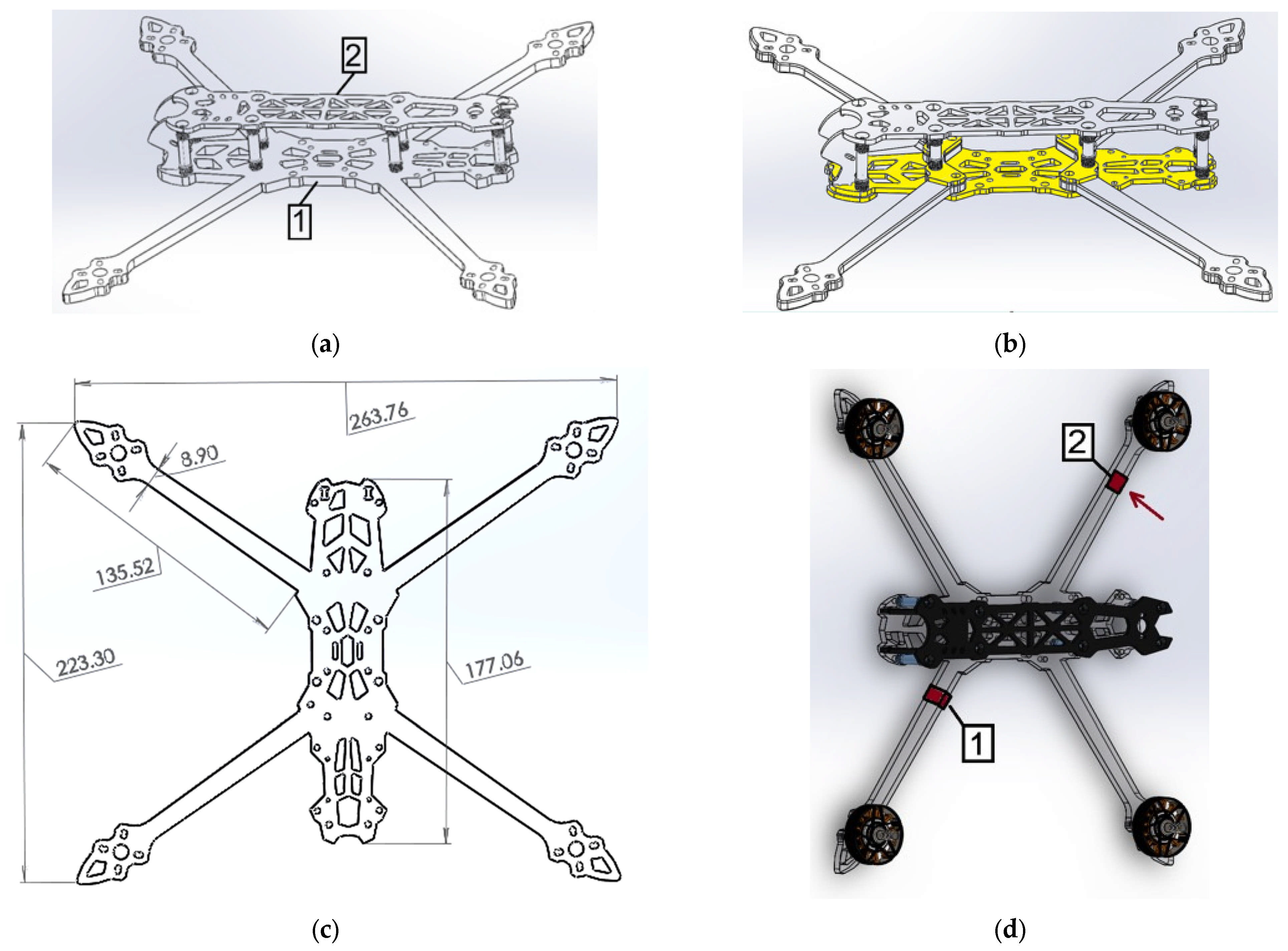
As illustrated in
Figure 1, only the lower frame section of the AL and MG drones—which is responsible for carrying all mechanical loads and dissipating heat from the motors—was made of aluminum and magnesium alloys. In contrast, the CF drone used a standard commercial Mark 4 carbon fiber frame. In all three cases, the upper frame section, used for battery mounting, was made of CFRP. Therefore, the only structural difference between the AL, MG, and CF drones was the lower frame section directly connected to the motors.
The AL and MG lower frame sections were 5 mm thick and cut from a single sheet without joints (
Figure 1a). The CF frame was assembled from bolted sections, with the motors mounted on 5 mm thick arms (
Figure 1b). In
Figure 2b, the yellow color indicates the geometric differences between the CF frame and the metal frames (AL and MG), which shared an identical geometry. From a top-view perspective, all frames had identical dimensions (
Figure 1c).
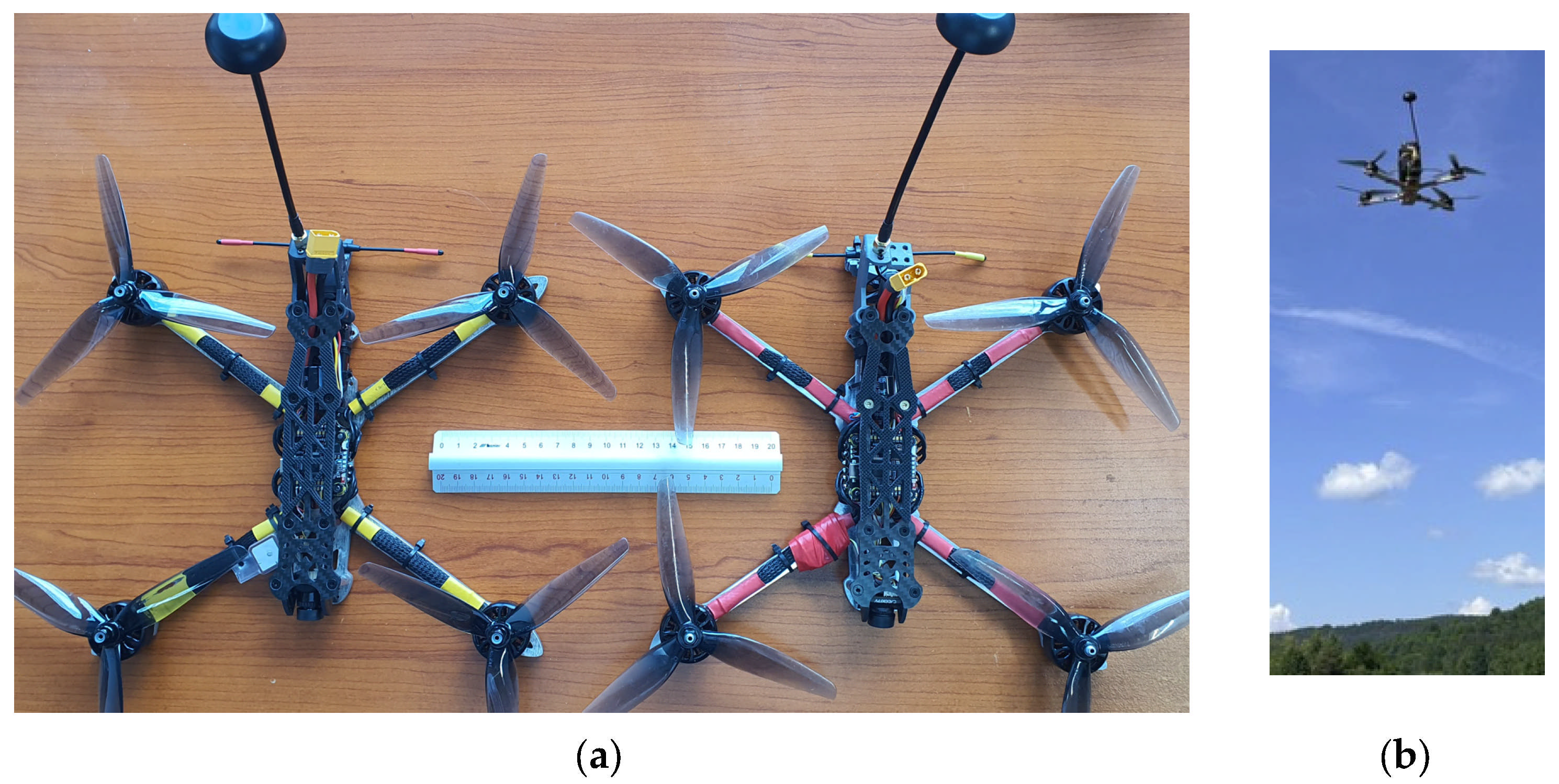
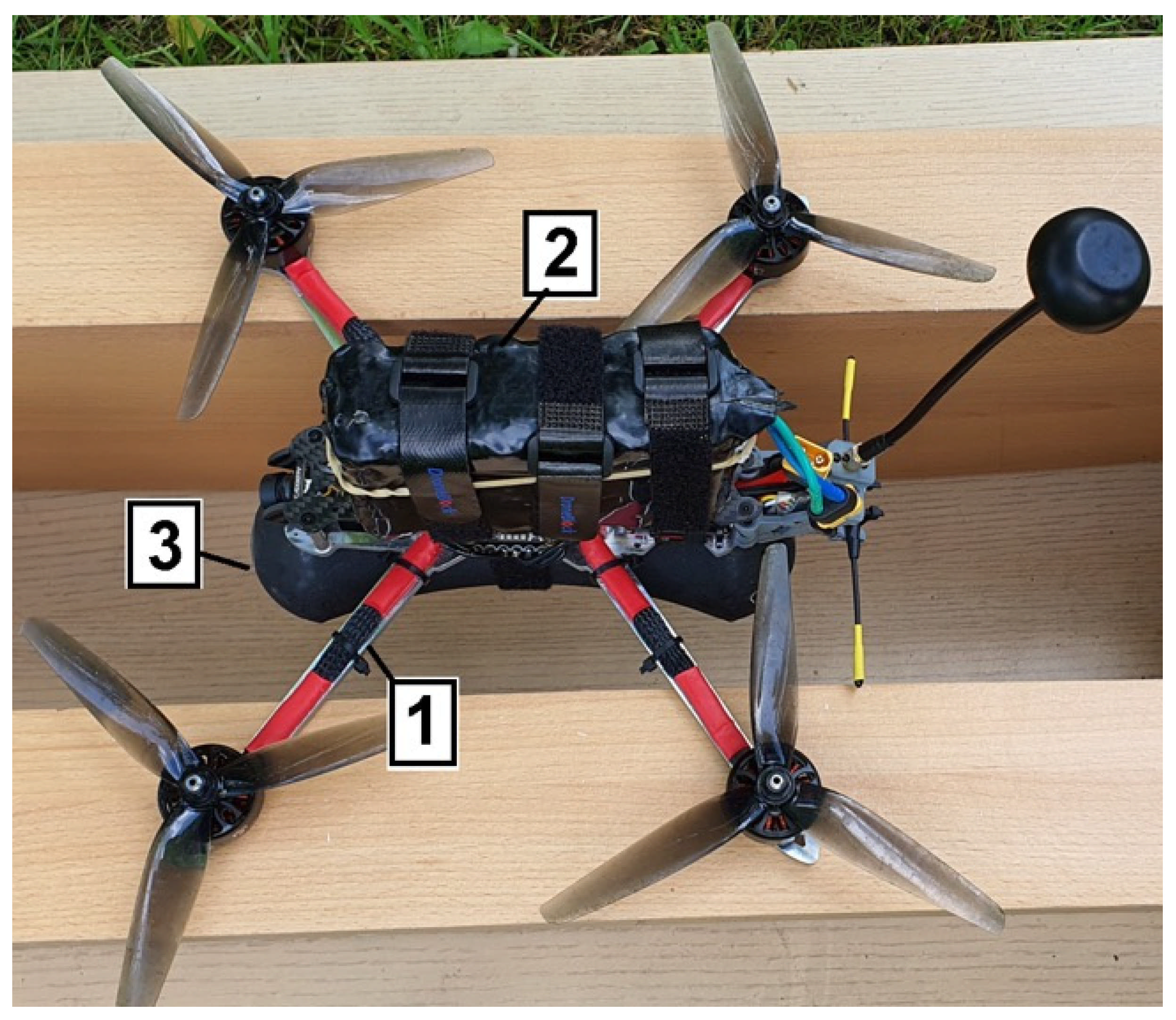
To experimentally investigate the effect of frame material on the thermal and mechanical behavior of an FPV drone, three 7-inch quadcopters were constructed. The only difference between them was the material used for the lower frame section. A photograph of the AL and MG drones is shown in
Figure 2. While the aluminum and magnesium frames featured identical monolithic geometries (
Figure 1a), the CF drone utilized a multi-part assembly with a different central section design, although the arm dimensions remained geometrically equivalent to the AL and MG specimens (
Figure 1b). The CF configuration was included in this study exclusively as a technical benchmark to represent the current state-of-the-art in the FPV industry. This allows for an evaluation of the prototype magnesium alloy frame against existing commercial standards under real-world operational conditions.
All drones were equipped with Flash Hobby 2807 1300 kV motors (Shenzhen FlashHobby Technology Co., Ltd., Shenzhen, China), HQProp 7040 tri-blade propellers (Shaanxi Huaqi Model Technology Co., Ltd., Xi’an, China), a VELOX F7 SE flight controller (FC), and a V50A SE 6S electronic speed controller (ESC) (Jiangxi Chuangyi Intelligent Technology Co., Ltd., Nanchang, China).
The systems were configured identically using Betaflight 10.10.0 software, with PID tuning parameters kept constant across all platforms to isolate the effect of frame material on flight stability. The FC and ESC stack were secured using a standard mounting procedure: four steel bolts were rigidly fixed to the central section of the frame, while the electronics were isolated via standard silicone vibration-damping grommets provided by the FC manufacturer. This setup ensures that the recorded gyroscope data reflect the structural vibrations filtered through a consistent, industry-standard mechanical interface. For full transparency and reproducibility, the complete CLI configuration file is provided in the
Supplementary Materials.
Flight tests were performed outdoors (
Figure 2b) at an ambient temperature of 25 °C. To maintain uniform electrical conditions, each flight was initiated with a battery pack charged to a precise voltage of 4.2 V per cell.
The vibration characteristics were evaluated based on raw gyroscope data recorded to the onboard Blackbox at a sampling frequency of 4000 Hz. The analysis focused on the power spectral density (PSD) distribution, which allowed for a quantitative assessment of vibration energy across the relevant frequency spectrum.
Figure 1a,b illustrates the structural differences between the platforms:
Figure 1a shows the monolithic geometry used for the AL and MG frames, whereas
Figure 1b depicts the multi-part CF frame (structural differences in the central section are highlighted in yellow).
The final masses of the experimental drones without the battery were:
mMG = 546.3 g (MG drone);
mAL = 577.2 g (AL drone);
mCF = 540.0 g (CF drone).
The mass difference resulted from the higher density of the frame materials and natural variations in the mass of individual drone components. All drones were powered by the same 6S2P Li-ion battery (mBAT = 904.2 g).
Preliminary flight tests were performed to characterize the lifting capacity of the 7-inch configuration (motors, propellers, battery, and assembled airframe). These tests showed that a 2.0 kg payload represented a practical upper limit for sustained hover and short-duration transport for this build. Therefore, two experimental conditions were selected for this study: 0 kg (no-load) and 2.0 kg (high-load). Comparing the unloaded and near-maximum load conditions allowed for a baseline vs. worst-case analysis of the thermal and dynamic behavior of the propulsion system, which was the main objective of this work. This two-point strategy (no-load vs. high-load) is commonly used in multirotor performance investigations to reveal efficiency degradation, overheating, and dynamic instabilities that may not be visible under light loads.
The drone with the payload attached is shown in
Figure 3 before take-off.
The test flight lasted 5 min in a hover at an altitude of approximately 2–3 m above ground level (AGL). Immediately after the test, the drone landed, and infrared images were captured using a thermal imaging camera. Thermal images were recorded with a Bosch Professional GTC 600 °C camera (Robert Bosch GmbH, Gerlingen, Germany), featuring a sensor resolution of 256 × 192 pixels. The time between motor shutdown and image capture was 2–3 s. The thermal data were processed using GTC Transfer Software v. 1.7.2.0.
During the flights, log files were recorded, providing raw gyroscope data GYRO_RAW_Y (Pitch) to determine the vibration frequencies of the drones along the pitch axis. The pitch (Y) axis was selected as the primary indicator for analysis because it is particularly sensitive to the structural resonance of the frame arms and the longitudinal mass distribution of the battery and payload. Vibration energy along this axis typically provides a more comprehensive representation of the frame’s dynamic response to motor-induced stress than other orientations. However, to ensure a complete characterization of the system, PSD analysis was also conducted for the roll (X) and yaw (Z) axes to confirm that the observed damping trends remained consistent across all degrees of freedom.
To ensure statistical reliability, each flight test was repeated three times under consistent conditions. Between flights, there was a break to recharge the battery to its initial level of 4.2 V per cell. The resonance frequencies were extracted from the PSD profiles of each trial, and the measurement error was determined using the standard deviation. The results showed a high degree of repeatability, with the variance in peak frequency positions remaining below 3% across all test runs. Furthermore, a Student’s t-test was performed to evaluate the statistical significance of the differences in PSD peak magnitudes and frequencies between the frame types. A p-value of less than 0.05 was considered statistically significant, ensuring that the observed spectral shifts were a result of the frame’s structural properties rather than stochastic environmental or operational factors.
The PSD of the vibrations was computed from the gyroscope data in Betaflight Blackbox Explorer 3.7.0 software. PSD analysis is widely used in UAV engineering to identify dominant vibration frequencies and assess system stability [
30].
An additional impulse test was performed for the AL and MG drones. The drone, without propellers, was fixed rigidly by one arm. For both models, the same fixing point was used. The experimental setup for the modal hammer testing is schematically illustrated in
Figure 1d. The frame was secured at the central hub (Position 1), while the excitation was applied to the arm in the vertical direction (Position 2). This configuration was used to record the vibration response and determine the PSD distribution, allowing for a direct comparison of the resonance frequencies and damping characteristics of the tested materials. Subsequently, ten single strikes with a modal hammer were applied to the opposite arm, with a 15-s interval between strikes. The vibrations were recorded using the same method as during the flight experiments.
It should be noted that modal hammer testing was performed exclusively for the MG and AL configurations. This choice was dictated by the requirement for geometric equivalence in comparative modal analysis. Because the MG and AL frames are geometrically identical, the differences in their frequency response functions can be attributed solely to the material properties of the magnesium alloy versus aluminum. The commercial CF frame was excluded from this specific test due to its different structural design and bolted assembly, which would introduce geometric variables and joint-related damping, precluding a valid one-to-one material comparison. The CF frame serves in this study only as an operational baseline during flight testing.
It is important to emphasize that the vibration data captured via the flight controller’s high-speed logger represents a system-level response. Given the complexity of the UAV assembly—including mechanical couplings between the motors, propellers, and the frame, as well as the active influence of the PID controller—it is not possible to isolate the intrinsic material damping coefficients of the AZ31 alloy from these measurements. Nevertheless, by maintaining identical hardware and software configurations across all drone versions, the observed variance in vibration energy can be reliably attributed to the damping characteristics of the frame material itself.
4. Results and Discussion
4.1. Temperature Analysis
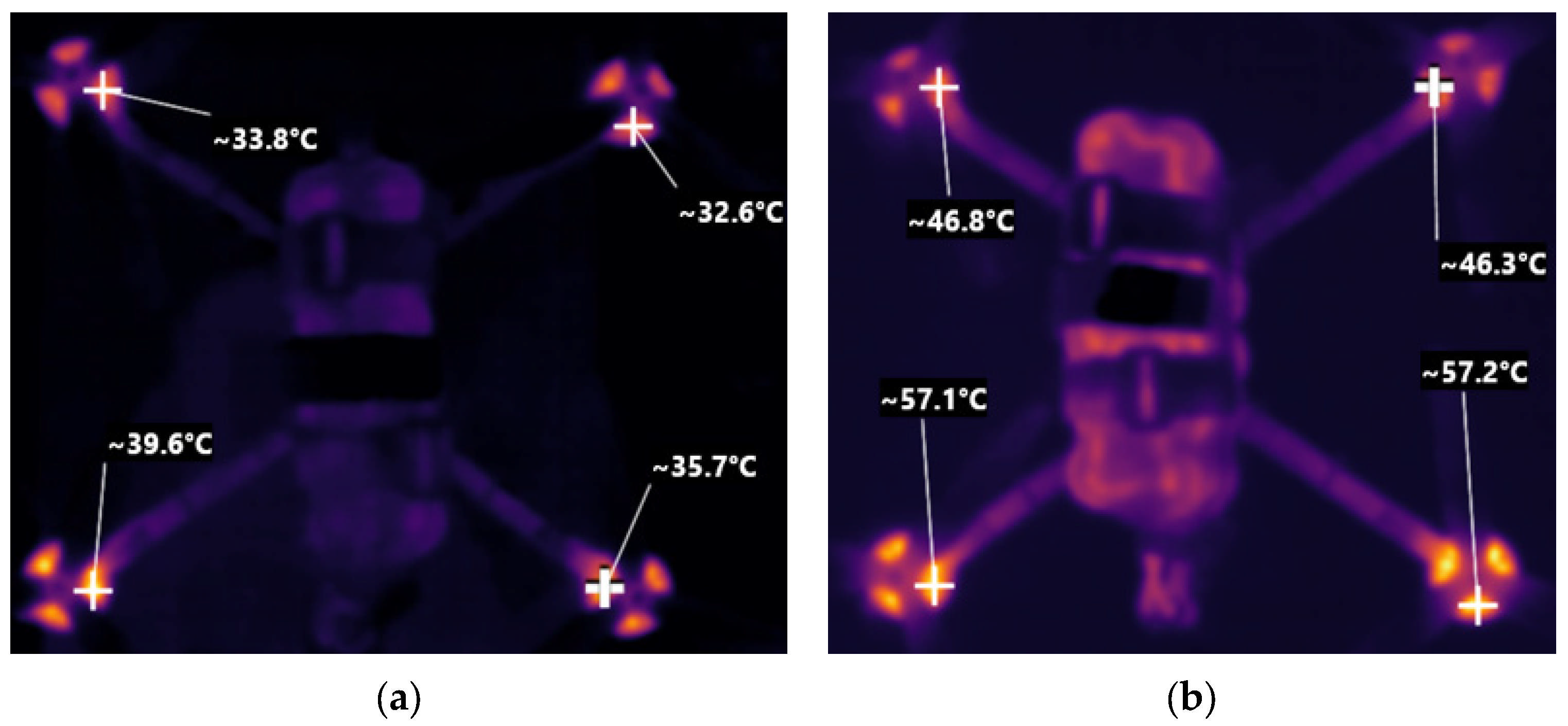
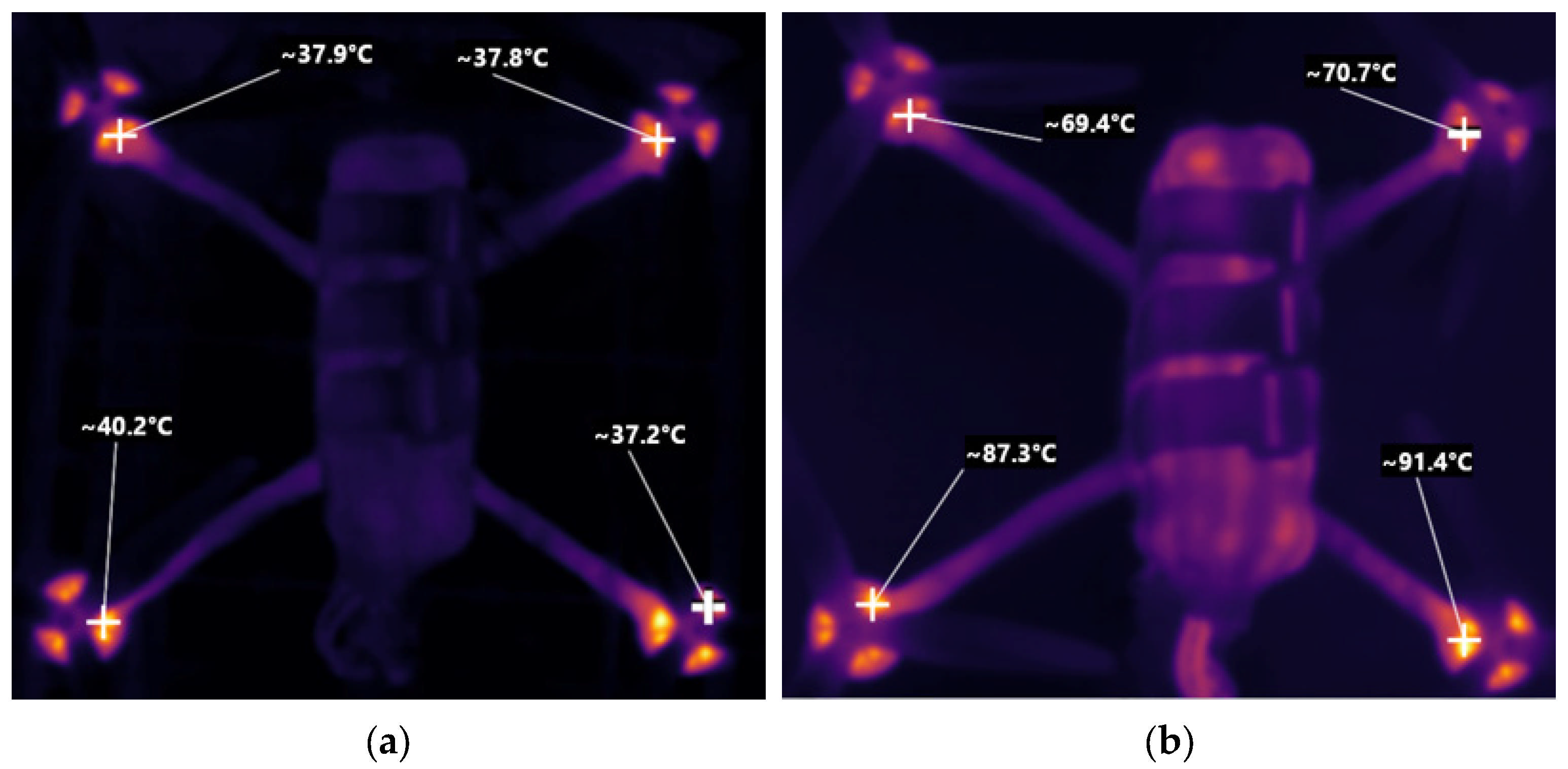
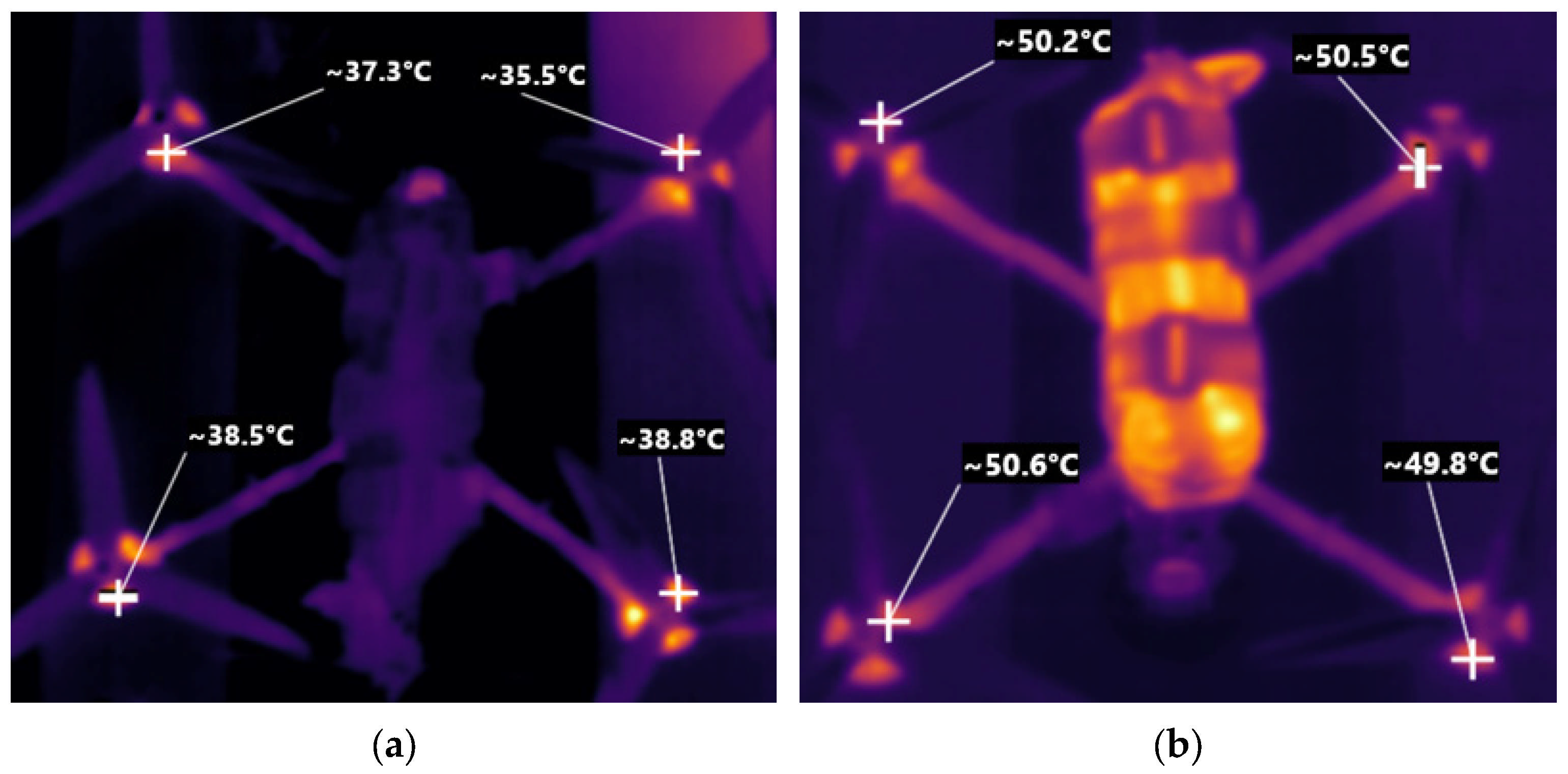
The results of the motor temperature measurements after the 5-min hover test are presented as thermal images in
Figure 4,
Figure 5 and
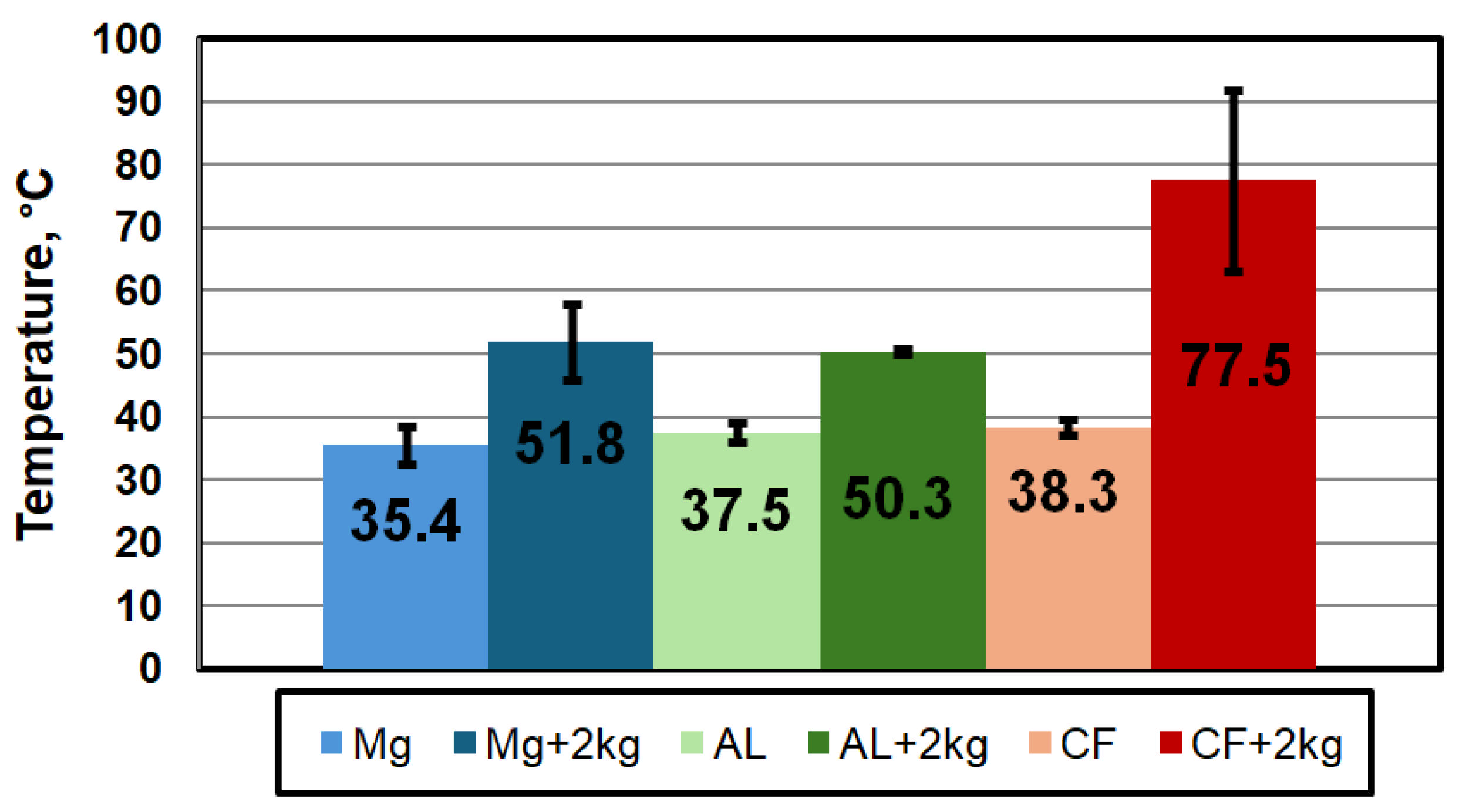
Figure 6. The measurements were taken from a top-down view at a distance of approximately 30 cm. The calculated average motor temperatures are summarized in
Figure 7.
The thermal imaging analysis (
Figure 4,
Figure 5,
Figure 6 and
Figure 7) was conducted with the emissivity set at
ε = 0.9. This value was selected to accurately capture the temperature of the motor stator windings, as it aligns with typical emissivity coefficients for electrical insulation and lacquered copper surfaces of
ε = 0.85–0.95 documented in the metrological literature [
31]. While the drone frame consists of different materials, the focus remained on the thermal load of the motors to assess cooling efficiency under payload.
To ensure the comparability of the thermal results, the same motor model was used for all tested frames. The quantitative analysis focused on the motor windings, ensuring that variations in the surface smoothness or emissivity of the frame materials (MG vs. AL vs. CF) did not influence the primary temperature data.
To ensure the repeatability of the thermal measurements and consistent initial conditions, each flight test was followed by a 60-min break. This interval, required for battery recharging, ensured that all drone components (motors, ESC, and frame) were cooled down to the ambient temperature before the next iteration. Consequently, each experiment started from the same thermal baseline.
The results show that under no-load conditions, the maximum motor temperatures for all tested drones were similar, ranging between 32 and 40 °C. The highest temperature (38.3 ± 1.3 °C) was recorded for the motors on the CF frame. The temperatures for the AL frame (37.5 ± 1.5 °C) and the MG frame (35.4 ± 3.1 °C) differed only within the range of statistical error.
With a 2 kg payload, the motor temperatures increased in all cases. However, the most significant increase was observed for the CF drone (77.5 ± 14.5 °C). The maximum temperature for the CF frame reached 91.4 °C, which exceeds the allowable thermal threshold for this class of motors (80 °C). Similar results for AL and CF frames have been reported in [
32].
In contrast, the motor temperatures on the AL and MG frames were 50.3 ± 0.4 °C and 51.8 ± 0.6 °C, respectively. The similarity between the AL and MG results is unexpected, considering that the thermal conductivity of aluminum is 1.74 times higher than that of magnesium (
Table 1). This suggests that both AL and MG frames effectively cool the motors by acting as heat sinks. Conversely, the CF frame exhibited poor heat dissipation due to the low thermal conductivity of the CFRP composite (approximately 25 times lower than that of aluminum).
The thermal stability of the motors on the MG frame directly improved the quality of the Blackbox logs. Cooler motors operate more smoothly, generating fewer harmonics that could excite the resonance frequencies of the frame.
The thermal performance analysis (
Figure 7) demonstrates that the magnesium alloy frame provided a significant advantage in motor cooling compared to the CF reference. Under a 2 kg payload, motor temperatures on the CF frame reached an average of 77.5 °C, whereas the MG frame maintained a substantially lower temperature of 51.8 °C (
p = 0.0088). Notably, the statistical comparison between the MG and AL frames yielded a
p-value of 0.64, indicating no significant difference in cooling performance. This confirms that the AZ31 alloy effectively replicates the high thermal conductivity of aluminum, preventing motor overheating under high-stress conditions while maintaining a lower structural weight.
4.2. Vibration Frequency Response
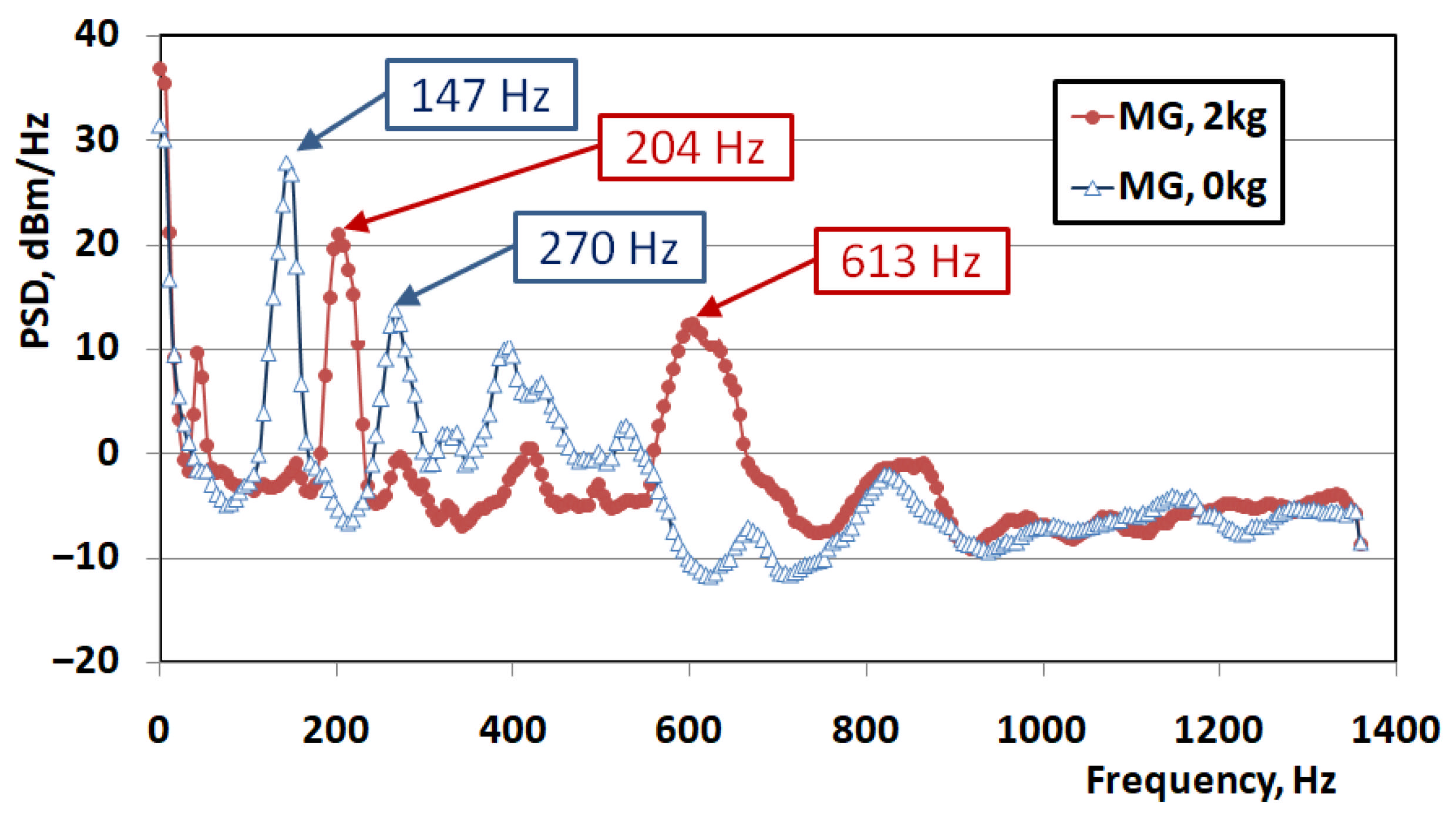
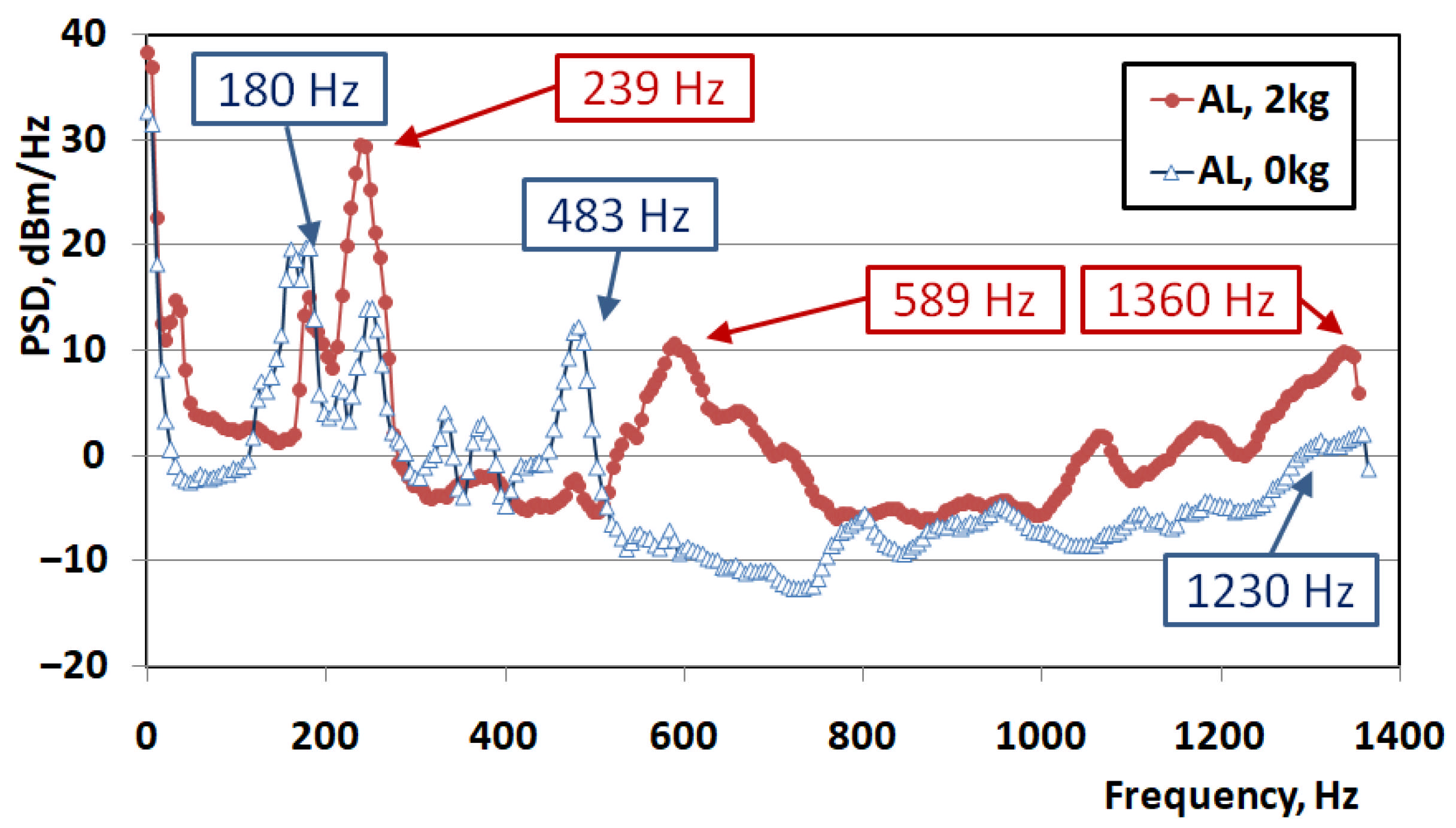
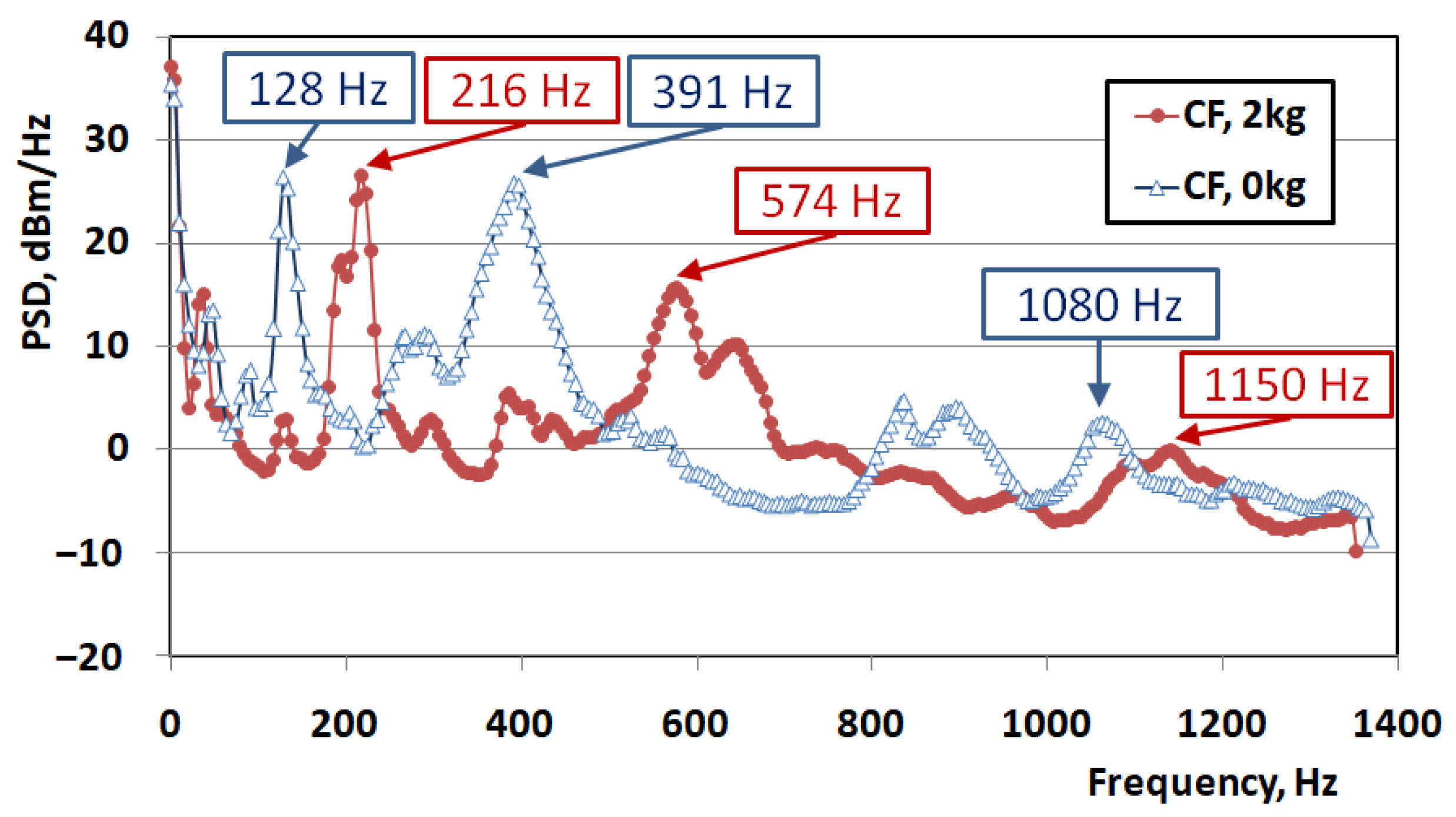
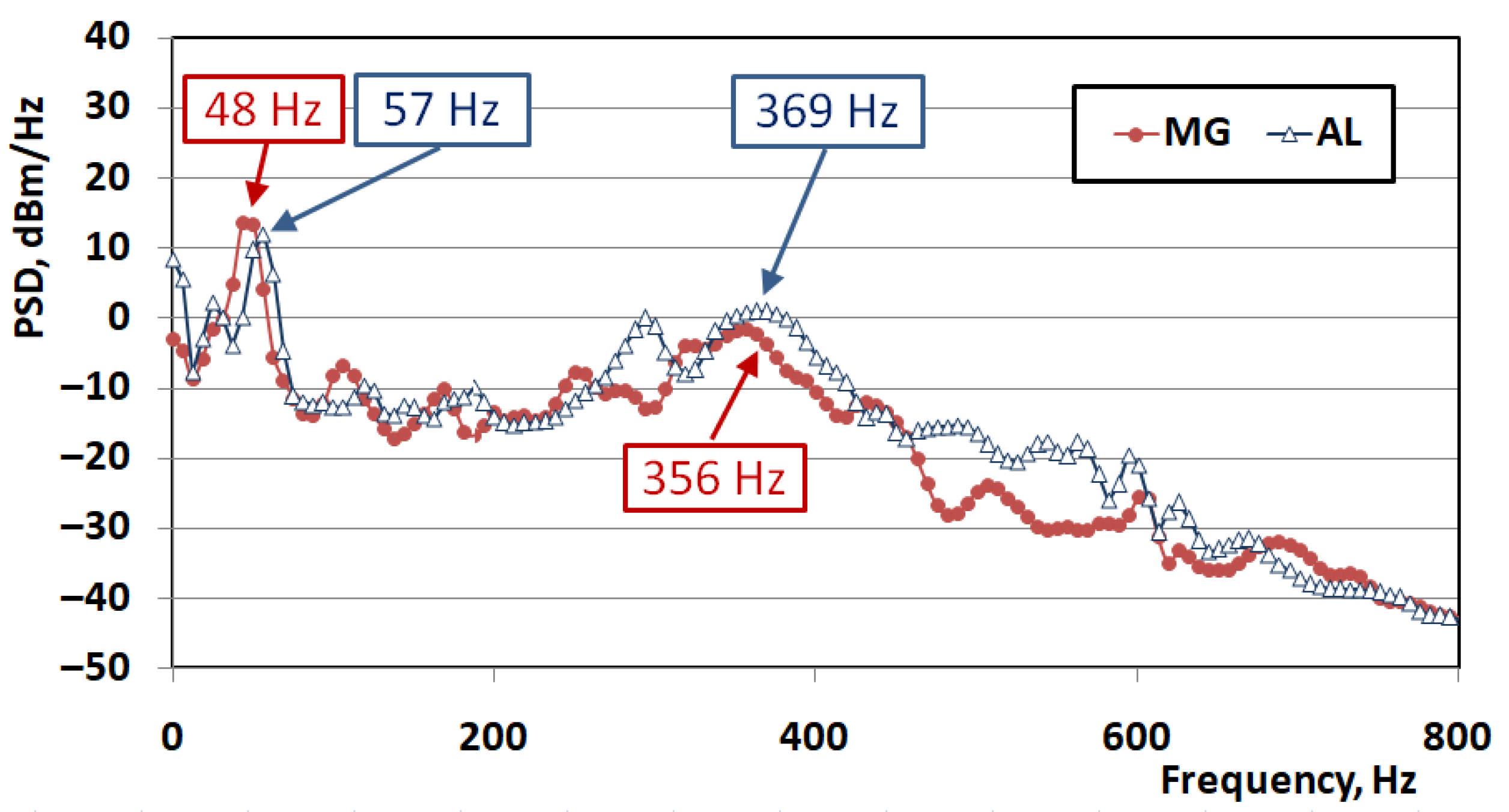
The power spectral density (PSD) for the pitch axis (Y), obtained from the log files recorded during the test flights, is shown in
Figure 8,
Figure 9 and
Figure 10.
4.2.1. Analysis of Flight Tests Without Additional Payload
The spectral analysis obtained via fast Fourier transform (FFT) for the no-load variants (0 kg) revealed fundamental differences in the dynamic behavior of the investigated structures. The vibrations recorded by the flight controller’s gyroscope were a result of the excitations originating from the propulsion system and the resonant response of the frame structure itself.
Figure 8,
Figure 9 and
Figure 10 present the PSD plots for the MG, AL, and CF drones, respectively.
The values obtained for the AL drone (
Figure 9) indicate a high system stiffness, which manifested as a relatively high fundamental frequency (180 Hz) and a distinct peak at 483 Hz. This phenomenon is consistent with the characteristics of the 6061-T6 alloy, which has a Young’s modulus of approximately 70 GPa and a density of 2700 kg/m
3 (
Table 1). The high specific stiffness of this material facilitates the propagation of high-frequency vibrations (including the 1230 Hz range) without significant material damping. This, in turn, may lead to the saturation of the digital filters in the flight controller.
In contrast to aluminum, the MG drone exhibited a significant reduction in resonance frequencies (147 Hz and 270 Hz,
Figure 8). Although the lower fundamental frequency results were partially from the lower Young’s modulus of AZ31 compared to 6061-T6, the key observation is that the higher resonance peak occurred at 270 Hz—a value considerably lower than the 483 Hz observed in the AL drone. Summarizing the above analysis, it can be concluded that the vibration characteristics of the magnesium structure are a cumulative result of both its lower material stiffness and its superior internal damping capacity. This synergy effectively shifts and dissipates vibration energy into lower frequency regions, which are easier to filter using standard Betaflight algorithms without introducing excessive phase latency.
The vibration spectrum of the CF frame under the 2 kg payload (
Figure 10) condition requires careful interpretation, particularly in light of the quantitative data in
Table 2. While the arms were geometrically equivalent to the MG and AL versions, the multi-part, bolted central section of the CF frame introduces additional degrees of freedom and joint-related resonances. Under a 2 kg payload, the CF drone exhibited the highest vibration energy across all tested platforms, with a mean linear PSD (Y) of 44.99 ± 1.65 mW/Hz, which was more than double the energy recorded for the MG frame of 20.53 ± 2.96 mW/Hz.
This significant difference suggests that the structural complexity of the Mark 4-type assembly, combined with the inherent damping properties of the composite, results in a lower system Q-factor. The broad noise bands and high PSD magnitudes indicate that the bolted joints may act as secondary vibration sources under heavy loads. From a technical application standpoint, these high-energy signals (reaching peaks at 206.3 Hz and broader bands at higher frequencies) necessitate more aggressive software filtration, which can lead to increased control latency. In contrast, the monolithic MG frame provides a significantly ‘cleaner’ baseline, demonstrating its potential as a high-performance alternative to standard commercial CF structures.
4.2.2. Analysis of Flight Tests with a 2 kg Payload
The introduction of an additional 2 kg payload dramatically altered the drone’s operating conditions, forcing the motors to run at significantly higher revolutions per minute (RPM) to counteract gravity [
33]. This phenomenon caused the motor noise band to shift upward in the frequency spectrum, which was evident in all investigated cases (
Figure 8,
Figure 9 and
Figure 10).
The underlying mechanism of this phenomenon is as follows: the increase in motor thrust tensions the drone arms, inducing a “stress stiffening” effect, analogous to tightening an instrument string.
For the aluminum frame, the frequency increases from 180 Hz to 239 Hz and from 483 Hz to 589 Hz (
Figure 9) were a direct consequence of the increased mechanical excitation. The high amplitude of the peak at 589 Hz indicates that under heavy motor load, aluminum not only transmits vibrations but also becomes a medium for resonances. These resonances may negatively affect the thermal stability of the motor bearings and windings.
In the case of the magnesium AZ31 alloy (MG drone), we observed a shift in the fundamental frequency to 204 Hz (
Figure 8) and the emergence of a peak at 613 Hz. Although 613 Hz is a high value, the absorption mechanism of the AZ31 alloy is of key importance. According to the Granato-Lücke dislocation damping theory, magnesium alloys exhibit increased internal friction as the vibration amplitude rises [
34]. This means that under the extreme load of a 2 kg payload, this material more effectively dissipates mechanical energy as heat.
The frequency increase in the MG drone to 613 Hz under a 2 kg payload, while maintaining a relatively clean signal (which is the evidentiary goal of this study), demonstrates that AZ31 provides enhanced high-frequency vibration attenuation, effectively dissipating mechanical energy and protecting control electronics from noise saturation. Unlike aluminum, which “rings” at high frequencies, magnesium tends to dampen short-wave vibrations. This translates to a reduced requirement for software-based NOTCH filters in Betaflight.
4.3. Analysis of Damping Mechanisms
The damping capacity of magnesium alloys, such as AZ31, is a parameter that places these materials at the forefront of solutions for unmanned aviation. The specific damping capacity of magnesium is up to 12 times higher than that of aluminum and several times higher than that of most structural steels [
6].
This mechanism is based on the movement of dislocations within the hexagonal close-packed (HCP) crystal lattice. In the Granato–Lücke (G-L) model, energy is dissipated through internal friction during the bowing and breakaway of dislocation lines from pinning points, which are typically solute atoms (such as Al or Zn in the AZ31 alloy) or lattice defects. The damping decrement δ is defined as:
where Δ
W is the energy dissipated in one cycle, and
W is the total strain energy. For magnesium alloys,
δ can reach values ranging from 0.01 to 0.1, qualifying them as “high-damping materials”.
Furthermore, technological processes such as twin-roll casting, hot rolling, or extrusion, to which the AZ31 alloy is subjected, modify its crystallographic texture. This allows for the optimization of damping properties in specific loading directions. In the context of a drone frame, where the arms are primarily subjected to bending and torsion, such directional damping (anisotropy) is a key advantage.
To provide a comprehensive quantitative evaluation of the frames’ dynamic behavior, a spectral power analysis was performed using power spectral density (PSD) data.
Table 2 summarizes the mean linear PSD (representing the cumulative vibration energy) and the mean peak frequency for each testing variant. This linear approach, complemented by statistical error margins (standard deviation), allows for a rigorous and objective comparison of the vibration energy distribution across the airframes.
The data in
Table 2 confirm that the MG airframe consistently demonstrate superior vibration suppression, particularly as the structural load increased. Under a 2 kg payload, the MG frame exhibited a mean linear PSD (Y) of 20.53 ± 2.96 mW/Hz, which represents an approximate 49.4% reduction in total vibration power compared to the AL baseline (40.55 ± 5.59 mW/Hz) and a 54.3% reduction compared to the CF frame (44.99 ± 1.65 mW/Hz). Also, the magnesium alloy’s high damping capacity significantly influenced the spectral signature of the drone. While all frames experienced a frequency upshift under load, the MG frame maintained the lowest resonance peaks, shifting from 147.0 Hz (0 kg) to 204.3 Hz (2 kg). In contrast, the AL frame showed much higher resonance concentrations at 239.4 Hz under the same load.
Statistical analysis confirmed the high reliability of the comparative data. The standard deviations reported in
Table 2 remained consistently low across all flight trials, with a maximum variance of less than 14% even under high-load conditions, indicating excellent repeatability of the Blackbox-based measurement method. Student’s
t-tests were conducted to evaluate the significance of the material-induced damping effects. Under a 2 kg payload, the MG frame demonstrated a statistically significant reduction in vibration energy compared to the aluminum (
p < 0.001) and CF (
p < 0.001) frames. Even in the no-load configuration, the MG frame maintained a significant advantage (
p < 0.05 vs. AL and
p < 0.001 vs. CF). These results quantitatively validate that the AZ31 alloy’s high damping capacity provides a fundamental structural advantage in mitigating FPV drone vibrations.
The observed shift of the fundamental resonance to a lower frequency (147 Hz for MG vs. 180 Hz for AL) is a direct consequence of the lower Young’s modulus of the AZ31 alloy, as the geometry (and thus the area moment of inertia, I) was kept identical in both prototypes to isolate material effects. However, this experimental baseline confirms the structural optimization potential of magnesium; the density advantage of AZ31 allows for an increase in cross-sectional dimensions in future iterations. By strategically increasing I, the global stiffness (EI) could be matched or exceeded compared to aluminum while still retaining the superior damping decrement (δ) observed in these tests. Thus, the current results represent a ‘worst-case’ stiffness scenario for magnesium, yet it already delivers superior signal-to-noise performance due to its damping properties.
It is important to distinguish between the two distinct physical mechanisms influencing the spectral results. The observed shift of the resonance peak to lower frequencies in the AZ31 frame is a stiffness-driven phenomenon, directly resulting from the lower elastic modulus of magnesium compared to aluminum and carbon fiber. According to the relation
The reduced structural stiffness k of the magnesium arms naturally lowers the natural frequency f.
Conversely, the reduction in the mean linear PSD (
Table 2) is a damping-driven phenomenon. While the stiffness determines the spectral location of the resonance, the material’s high damping capacity (logarithmic decrement δ) determines the energy dissipation at that resonance. This distinction is crucial: magnesium does not merely ‘move’ the vibration problem to a different frequency; it actively suppresses the vibration energy, providing a cleaner signal for the flight controller’s PID loops.
The experimental data presented in
Table 2 revealed a significant upward shift in peak resonance frequencies when the payload was increased from 0 kg to 2 kg. For the magnesium frame, the primary peak shifted from 147.0 ± 0.50 Hz to 204.3 ± 3.2 Hz. This phenomenon can be analytically explained by two synergistic factors:
- (1)
Stress-Stiffening Effect: In a multi-rotor system, the lift force (thrust) required to hover with a 2 kg payload acts as a continuous tensile load on the frame arms. According to structural dynamics, the total stiffness (Ktotal) of a beam-like structure under tension increases due to the addition of geometric stiffness
where
Kg is directly proportional to the thrust (
T). Similar to a string under tension, this increased stiffness leads to a higher natural frequency, partially offsetting the damping effect of the added mass;
Kelastic represents the intrinsic elastic stiffness of the airframe, determined by the material’s Young’s modulus and the frame’s structural geometry.
- (2)
Motor Excitation Frequency (fexc): To maintain flight with a 2 kg payload, the propulsion system operates at a significantly higher throttle percentage. The fundamental excitation frequency generated by the motors is defined as fexc = RPM/60. The observed frequency upshift is further driven by the motor excitation frequency, which is directly proportional to the throttle position required for hovering. Based on the propulsion system’s 1300 KV rating and 6S voltage, the estimated fundamental frequency increases from approximately 127 Hz at 31% throttle (0 kg payload) to 245 Hz at 60% throttle (2 kg payload). This shift in excitation energy correlates with the migration of resonance peaks observed in the PSD logs, validating that the higher frequency signatures under load are a function of both increased structural stiffness and elevated motor RPM.
The significant vibration attenuation observed in the AZ31 airframe is consistent with the high damping capacity typically found in cast magnesium alloys. While a direct microstructural analysis was outside the scope of this system-level study, the results align with established physical models, such as the Granato–Lücke theory. In cast AZ31 structures, the dissipation of mechanical energy is primarily attributed to the movement of dislocation segments within the metallic lattice. Because the airframe in this study was manufactured using a casting process, the resulting grain structure and dislocation density are expected to favor high internal friction, as documented in foundational research on magnesium casting [
35,
36]. These intrinsic material properties allow the frame to act as a passive filter, effectively reducing the vibration energy before it reaches the inertial sensors. The manuscript has been revised to reflect that these mechanistic explanations are an interpretation based on established material theory, which provides a consistent explanation for the recorded PSD data.
From an aerospace engineering perspective, the performance of the AZ31 frame is best characterized by its high specific damping capacity. Since the MG and AL frames were geometrically identical, the 37% mass reduction offered by magnesium, combined with a near 50% reduction in mean linear PSD magnitudes (for flight with payload 2 kg), results in a vastly superior damping-to-weight ratio compared to conventional aluminum alloys.
4.4. Modal Hammer Impact Test
The impulse test allowed for the isolation of the materials’ intrinsic properties from the interference generated by the motors. The PSD results for the AL and MG frames are presented in
Figure 11 and
Table 2. The modal hammer tests showed that even at low-energy impulses, the magnesium design maintained a lower spectral energy floor (0.22 mW/Hz) than the aluminum reference (0.24 mW/Hz). This consistent reduction in broadband energy confirms that the AZ31 alloy acts as an effective passive mechanical filter, preserving high signal integrity for the flight control system.
4.5. Influence of Frame Design on Damping: Monolithic vs. Bolted Connections
Another factor differentiating the investigated drones was the frame assembly method. The CF frame (Mark 4) is a complex structure consisting of multiple components joined by bolts, whereas the AL and MG frames shared an identical geometry and were manufactured as monolithic elements with a thickness of 5 mm.
In mechanical structures, bolted connections introduce so-called friction damping or interface damping [
37]. Each contact point between the center plate and the drone arm allows for micro-slips that dissipate vibration energy. This phenomenon, often referred to as “Type II damping”, is significantly stronger than the material damping of the carbon fiber itself. However, this comes at a cost:
- -
Parameter Instability: Over time and under continuous vibration, bolts may loosen, which drastically alters the frame’s resonance characteristics and can lead to sudden PID loop instability.
- -
Local Stress Concentration: The thinner center plate (3 mm) in the Mark 4 frame, combined with thick arms (5 mm), represents a “weak link” in terms of torsional stiffness. This explains the broad peak at 391 Hz observed in the no-load CF drone (
Figure 10).
The monolithic aluminum and magnesium frames eliminate these issues. In their case, damping relies almost exclusively on intrinsic material properties. The fact that the MG drone frame exhibited peaks at lower frequencies and lower amplitudes than the AL frame of the same geometry provides clear evidence of the superiority of magnesium’s internal damping. The absence of mechanical joints within the arm supporting structure ensures the repeatability of results and simplifies the filter tuning process in the Betaflight software.
It should be noted that while the AL and MG frames were monolithic (cut as a single piece), the CF frame is an assembled structure, which is the prevailing commercial standard for FPV drones. This reference was chosen to provide a practical baseline for performance. Thermal analysis showed that heat dissipation was localized to the arms, which were geometrically identical across all models, making the assembly method irrelevant for thermal comparisons. In terms of vibration, the monolithic nature of the metallic frames was contrasted with the assembled CF structure to evaluate the magnesium alloy’s potential as a competitive alternative to existing market solutions.
Therefore, the comparison focused on the integrated performance of the airframe as a functional unit, where the manufacturing advantages of magnesium (monolithic integration) are weighed against the current assembly-based industry standards.
4.6. Study Limitations
Despite the clear trends observed, certain limitations of this study should be acknowledged. First, the comparison between metallic frames (MG, AL) and the CFRP reference was not based on identical geometries; while the MG and AL frames were structurally equivalent, the commercial CF frame featured a multi-part, bolted design, which introduces additional variables such as joint damping. Second, modal hammer testing was limited to the MG and AL specimens to isolate material-specific damping without the interference of geometric discrepancies. Finally, although the study identified the pitch axis as the primary vibration indicator due to its high sensitivity to payload stress, the reported tri-axial data confirm that while consistency was maintained across all degrees of freedom, subtle localized resonances may vary across different frame orientations.
The study focused on hover conditions to isolate the material’s influence on vibration and heat dissipation under constant, maximum structural load. While dynamic maneuvers represent real-world operation, the selected 2 kg payload provides a worst-case scenario for thermal and vibrational stress, allowing for a reproducible baseline that avoids the transient artifacts of aggressive flight transitions.
The thermal analysis relied on near-instantaneous post-landing imaging (within 2–3 s). While this method captures the peak operational temperature, it should be acknowledged that future studies utilizing on-board thermal sensors or high-speed telemetry could provide deeper insights into the transient heating–cooling cycles during aggressive flight transitions.