Research and Application of an Intelligent Cable-Controlled Injection–Production Integration and Control System


Abstract
1. Introduction
2. System Architecture Design
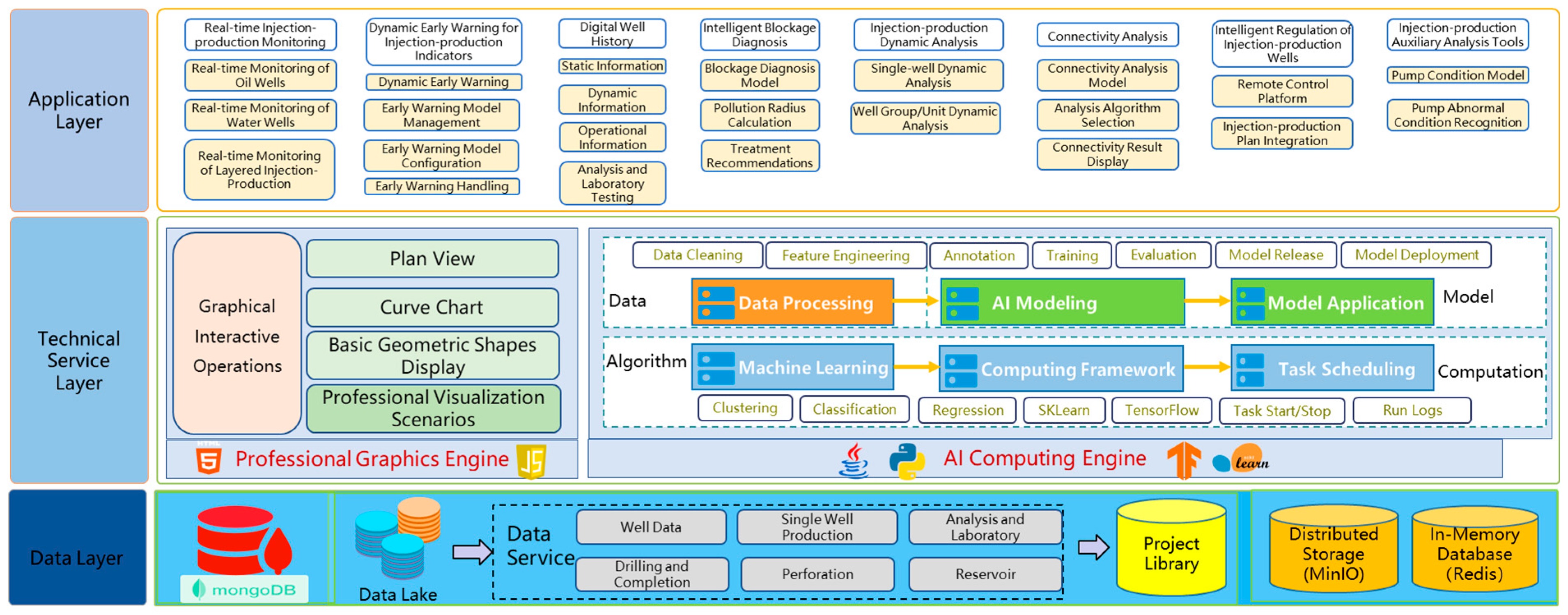
2.1. Overall Architecture Design
- Data Layer: The data engine provides storage capabilities for system-related data and offers a complete data processing workflow. It supports various data types, particularly the loading and parsing of data types relevant to the oil and gas industry, and delivers data-related services such as data collection, data querying, data preprocessing, and data loading. As the foundational support of the system, the data layer integrates multi-source heterogeneous data, including real-time monitoring data, static geological data, production dynamic data, and operational history data. This layer employs a distributed storage architecture, with structured data stored in the Kingbase database and unstructured data managed through the Minio object storage system. Specifically designed for the oil and gas industry, the data layer features a professional data processing engine that supports the parsing and processing of specialized data types such as well logging curves and well testing data, providing a complete Extract, Transform, Load (ETL) process.
- Technical Service Layer: This layer utilizes three public services from the oilfield cloud platform: user service, permission service, and log service. Serving as the intelligent core of the system, the technical service layer comprises two key components: first, the AI computing engine, which integrates various machine learning algorithms such as clustering, classification, regression, SKLearn, and TensorFlow within the algorithm model service; second, the professional graphics engine, which implements basic geometric visualization and specialized visual scenario business rules through the graphic interaction operation service.
- Application Layer: The presentation method is web-based, utilizing technologies such as JavaScript, Vue, and HTML5. The client requires Internet Explorer 10 or above, or a browser based on the Chrome kernel. This layer provides a user-friendly interface for end-users, ensuring a seamless experience across different terminal devices. The application layer implements nine functional modules: real-time injection–production monitoring, dynamic pre-alarming, digital well history, blockage diagnosis, injection–production dynamic analysis, connectivity analysis, intelligent regulation, auxiliary analysis tools, and system management. Each functional module adopts a component-based design, allowing for flexible configuration based on user requirements.
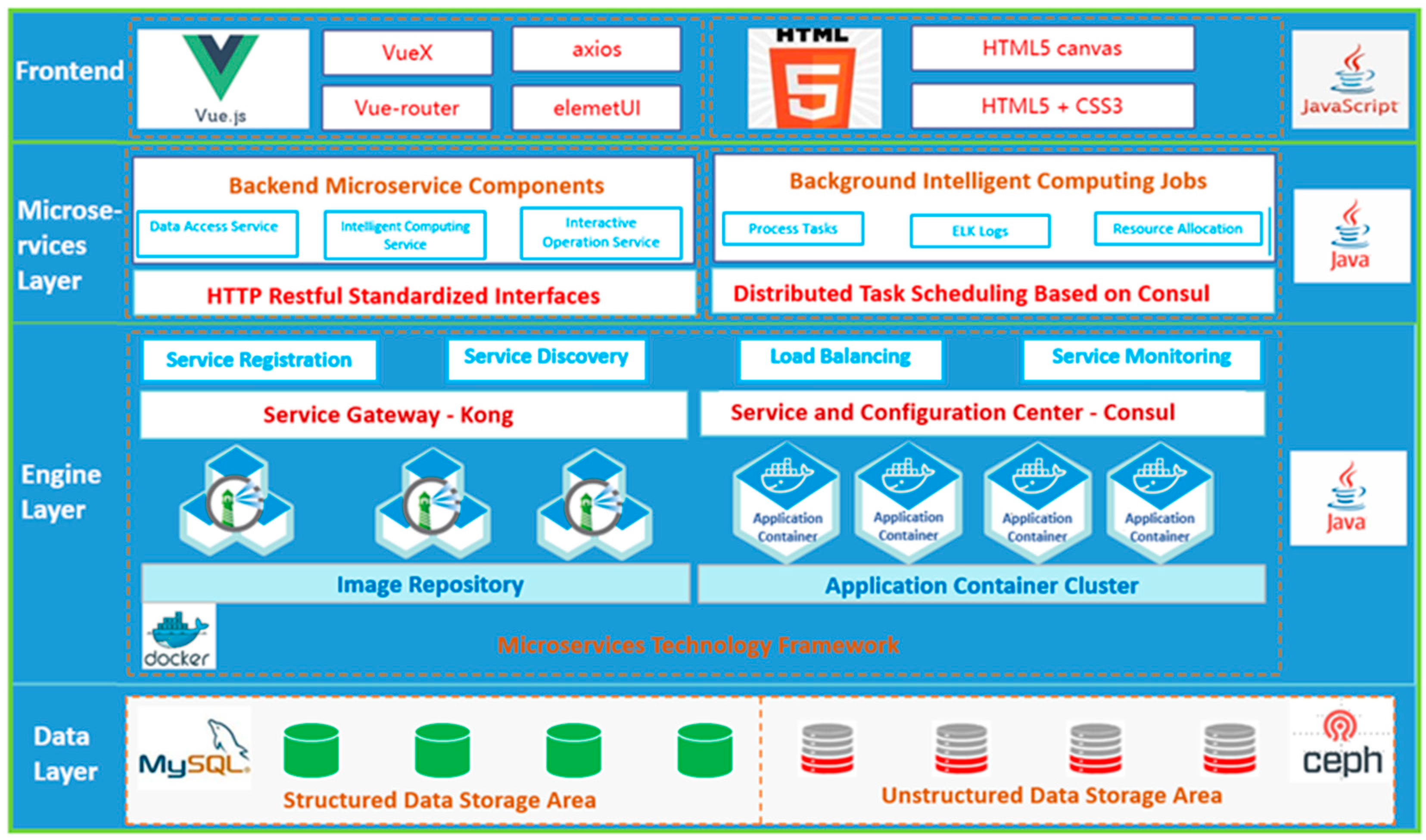
2.2. Technical Architecture Implementation
- Development Language: Java JDK 1.8 (Oracle Corporation, Austin, TX, USA).
- Platform Frontend: The frontend uses the Vue development framework, specifically Vue 2, which provides reactive data binding and a component system, making frontend development more efficient and modular.
- Frontend UI Framework: Element UI (Version 2.1, Eleme Inc., Shanghai, China), a desktop-oriented component library based on Vue 2.
- Backend: The backend uses the Spring Boot framework (Version 2.7.1, VMware, Inc., Palo Alto, CA, USA), an open-source Java-based framework designed to create standalone, production-level Spring-based applications. It simplifies Spring application development by following the principle of “convention over configuration,” allowing developers to quickly start and run Spring applications.
- Database: Renmin Jincang (Kingbase) (Version V8R6, Beijing Kingbase Data Technology Co., Ltd., Beijing, China) is a database management system that supports SQL standards, suitable for transactional processing, analytical processing, data warehousing, and other application scenarios.
3. Key Technology Research
3.1. Intelligent Blockage Diagnosis Technology
3.1.1. Algorithm Model Research
3.1.2. Feature Engineering Processing
- B Basic Features: They include directly monitored indicators such as tubing pressure, casing pressure, daily water injection volume, and daily liquid production rate. These reflect the well’s fundamental production status and are primary inputs for blockage diagnosis.
- Derived Features: Obtained through specialized calculations, including apparent water absorption index, productivity index, pressure derivative, etc. the Apparent Water Absorption Index (AWAI), is defined as:
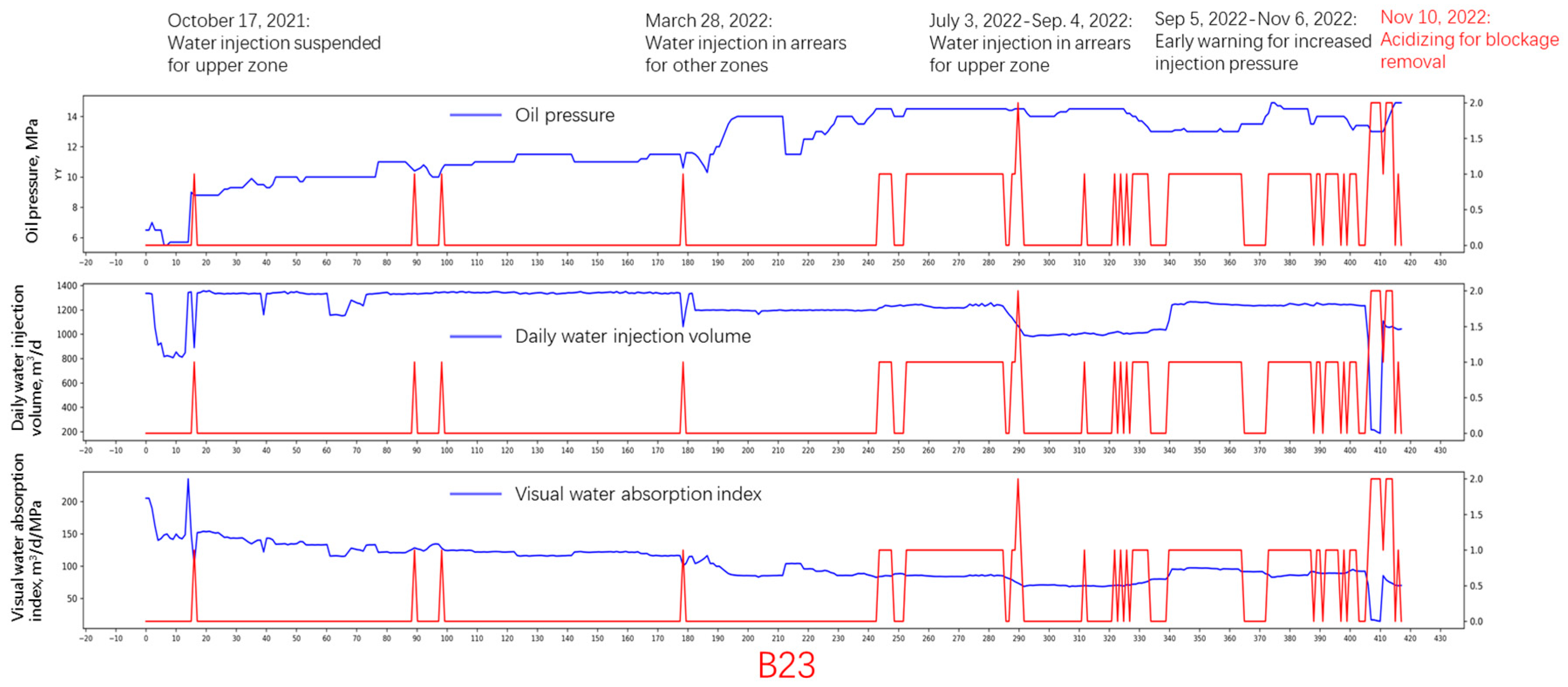
- Temporal Features: Generated via sliding window statistics, including 3-day moving averages, week-over-week change rates, etc. These capture dynamic trends in production parameters, crucial to early blockage warning.
3.1.3. Model Training and Optimization
3.1.4. Field Application Validation
3.2. Pollution Radius Calculation Model
3.2.1. Theoretical Basis
3.2.2. Numerical Simulation Validation
3.2.3. Application Case Analysis
3.3. Connectivity Analysis Technology
3.3.1. Static Connectivity Analysis
- (1)
- Sandbody Distribution Analysis: Determining sandbody connectivity between injectors and producers through depositional facies studies and sandbody correlation.
- (2)
- Fault Seal Evaluation: Analyzing fault impact on fluid flow using methods like Shale Gouge Ratio (SGR).
- (3)
- Well Trajectory Analysis: Considering the spatial positional relationships of horizontal well sections within the reservoir.
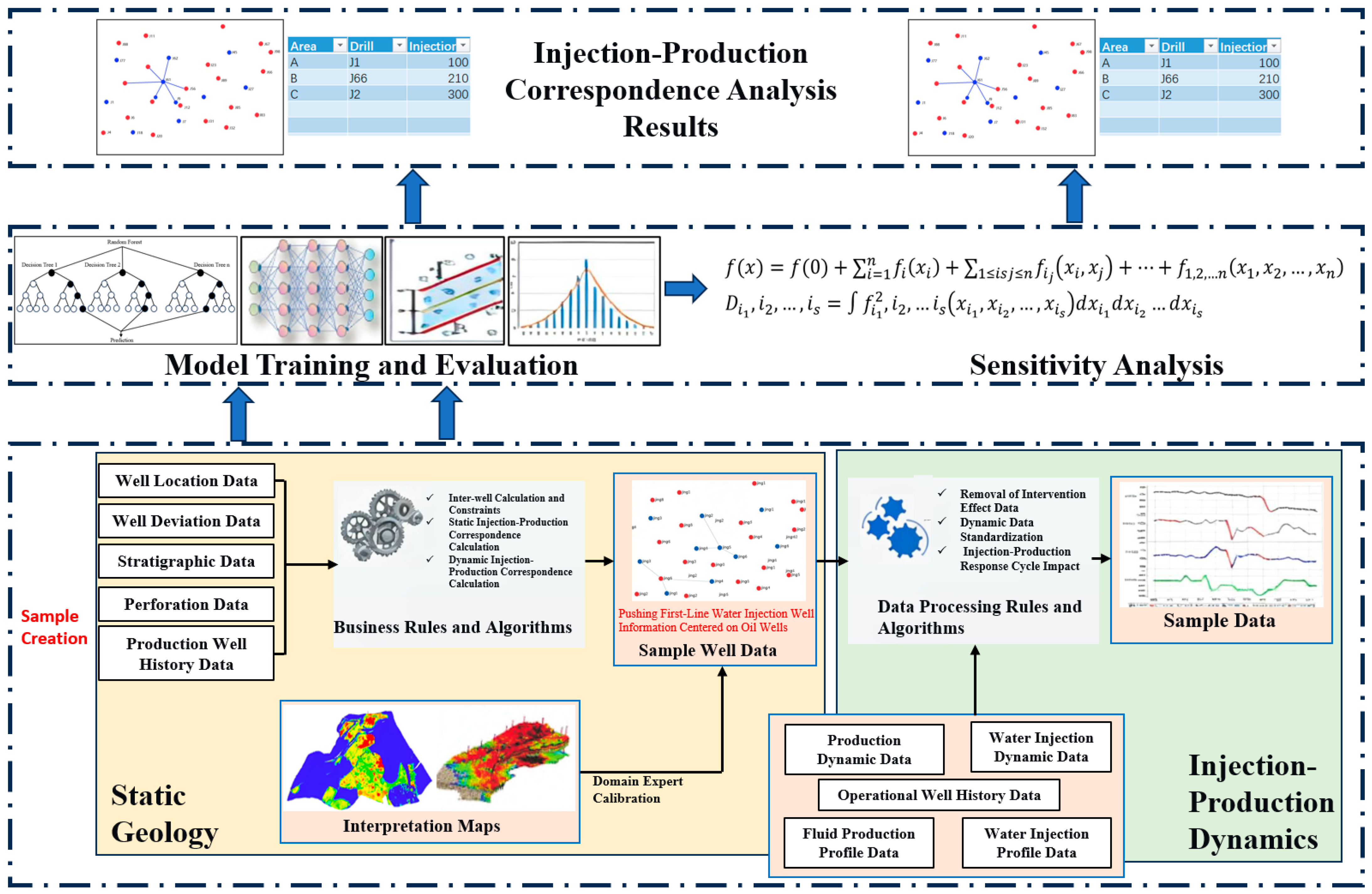
3.3.2. Dynamic Connectivity Analysis
- (1)
- Construct a Multi-Layer Perceptron (MLP) neural network model with injector rates as inputs and producer liquid rates as output;
- (2)
- Generate input samples via Monte Carlo sampling;
- (3)
- Calculate the main effect index and total effect index for each injector;
- (4)
- Obtain standardized connectivity coefficients through normalization.
3.3.3. Integrated Static–Dynamic Analysis Method
- (1)
- Static analysis provides geological constraints, excluding obviously non-connected well pairs;
- (2)
- Dynamic analysis quantifies connection strength, reflecting actual flow characteristics;
- (3)
- Results are fused using a Bayesian framework to obtain posterior connectivity probability:
- (1)
- On the Numerically Stable Quantification of
- (2)
- On the Propagation of Geological Uncertainty through the Bayesian Update
- Prior as a Distribution: The static prior is not implemented as a single scalar but as a probability distribution. High uncertainty in the geological interpretation (e.g., a fault with sparse calibration data) is represented by a prior distribution with a larger variance (e.g., a Beta distribution with appropriate parameters).
- Dominance of the Likelihood: The dynamic likelihood acts as an “uncertainty filter:”
- ○
- If the dynamic data are strong (e.g., clear interference test results), the likelihood function is sharp. This dominant evidence will override the prior uncertainty, causing the posterior distribution to converge towards the dynamic indication. Strong flow data correct geological ambiguity.
- ○
- If the dynamic data are also weak, the posterior distribution retains the wide uncertainty from the prior, effectively warning the user that the conclusion is based on weak evidence.
- Sensitivity Analysis: We conducted sensitivity tests on the most subjective prior parameters (e.g., fault seal probability). As shown in Table 4, the final identification accuracy (85%) remained robust across a reasonable range of prior values. This suggests that in our specific case study, the dynamic likelihood dominated the updating process, further mitigating concerns about prior subjectivity.
4. System Implementation and Applications
4.1. Implementation of Core Functions
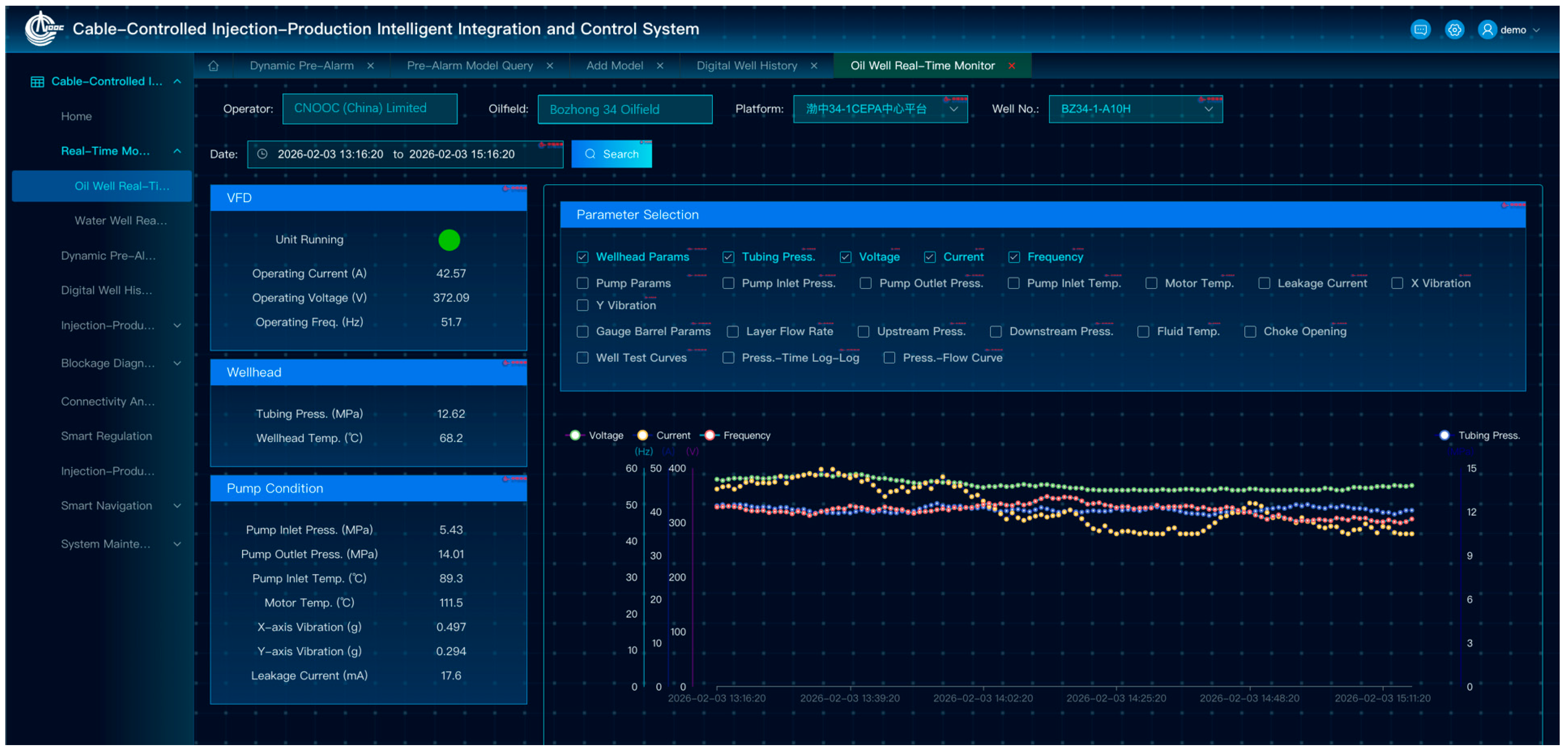
4.1.1. Real-Time Monitoring Module
- (1)
- High-Frequency Data Acquisition: Key parameters are sampled at 1 Hz to ensure capture of dynamic features.
- (2)
- Multi-Dimensional Visualization: It supports curves, dashboards, 3D wellbore views, and other formats.
- (3)
- Anomaly Detection: It implements real-time anomaly identification based on Statistical Process Control (SPC) methods.
- (1)
- Mean/Extreme Value Aggregation: Calculate the average, maximum, or minimum values per minute, hour, or day. For example, convert 3600 s level pressure points into a single hourly average.
- (2)
- Sampling Storage: Retain data points only at fixed intervals (e.g., save one point every 5 min), and discard the intermediate points.
- (3)
- Interval Statistics: In addition to the mean, store statistical features such as variance and rate of change within the time period to preserve the fluctuation characteristics of the data.
4.1.2. Dynamic Early Warning Module
- (1)
- Threshold Warning: It sets upper/lower limits for single parameters.
- (2)
- Trend Warning: It identifies abnormal trends using time-series analysis.
- (3)
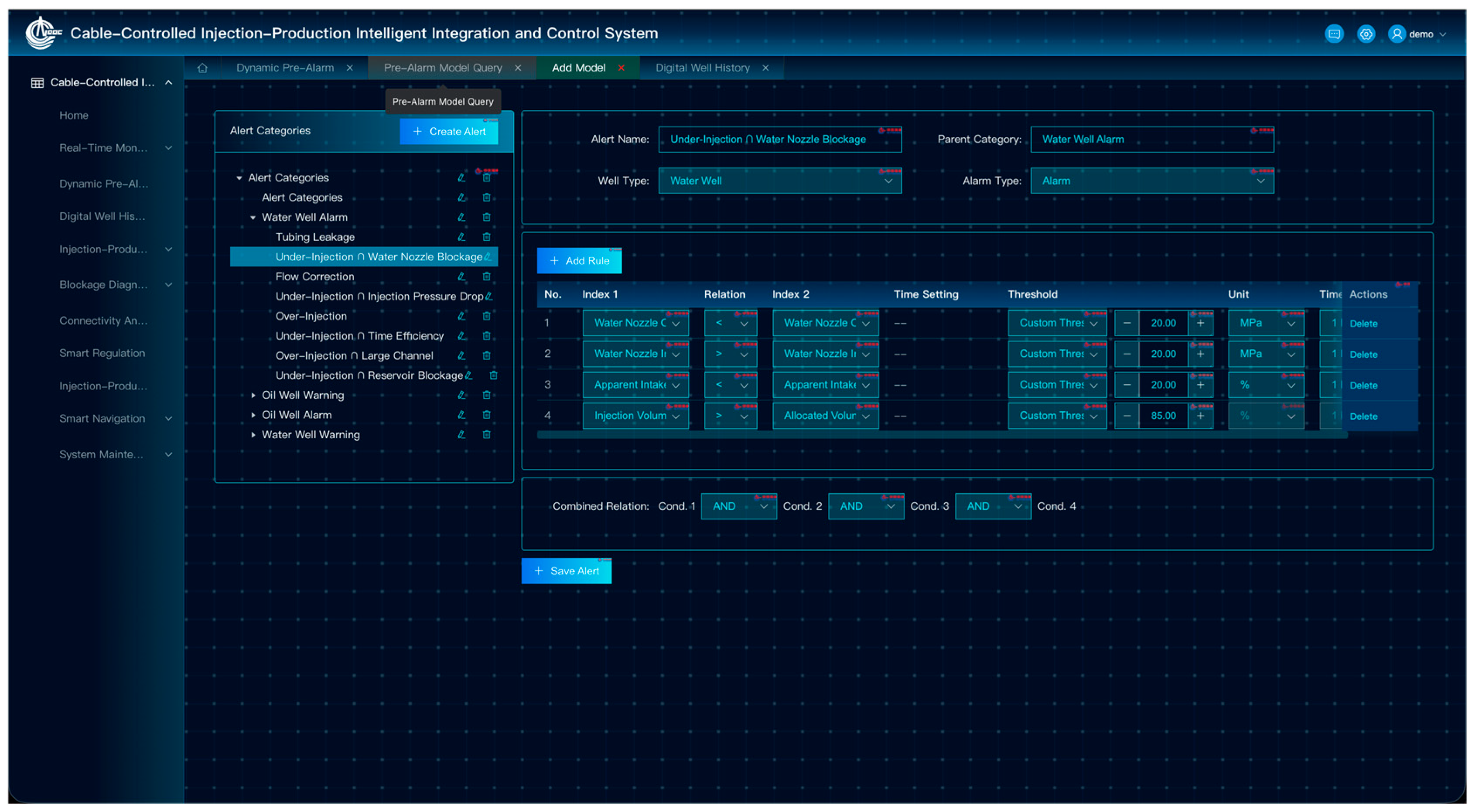
- Composite Warning: It combines multiple parameters using logical rules.
4.1.3. Digital Well History Module
- (1)
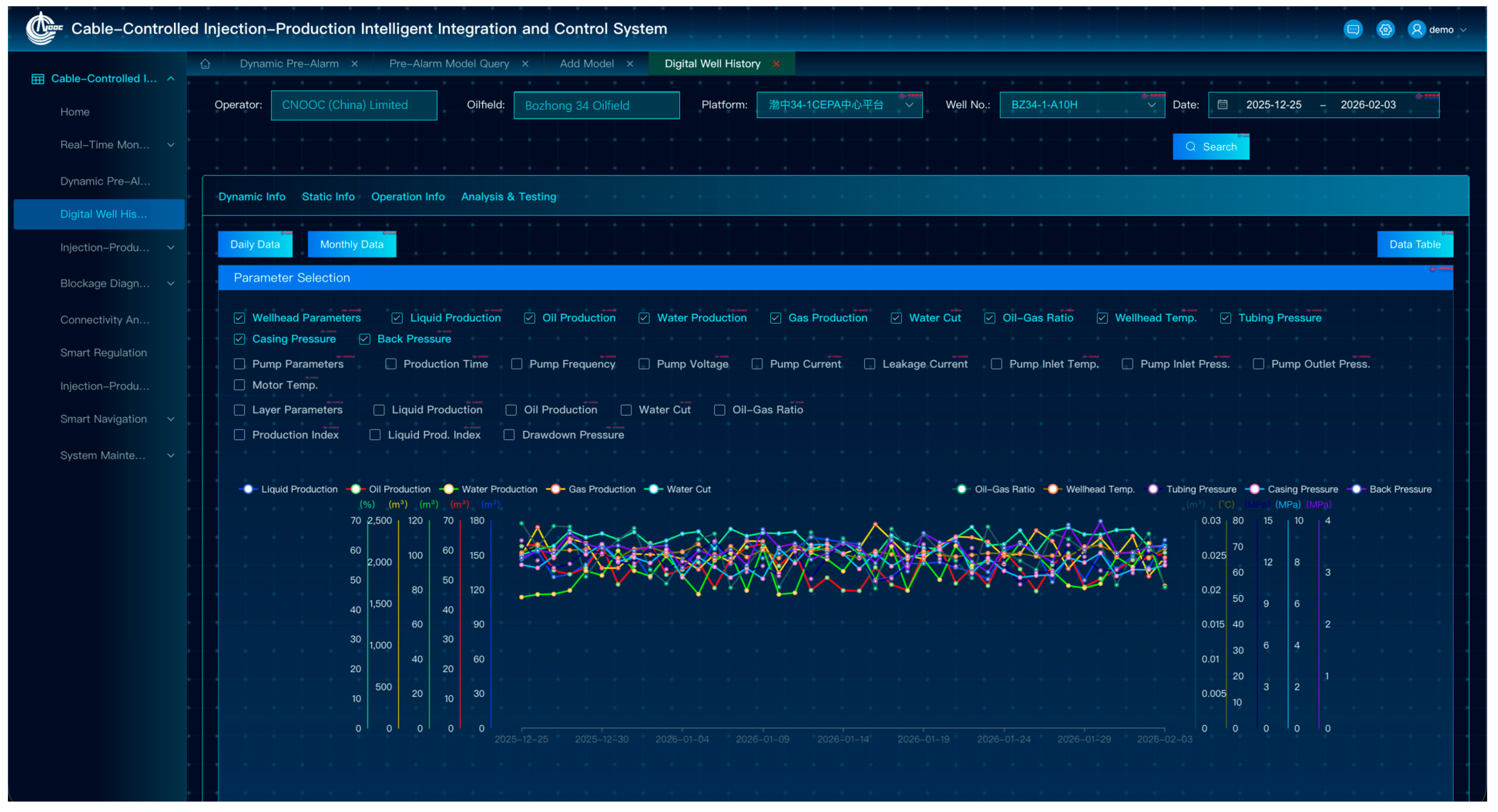
- Dynamic Information: production curves, operational history, etc.
- (2)
- Static Information: well configuration, log interpretations, etc.
- (3)
- Monitoring Data: production profiles, injection profiles, etc.
- (4)
- Laboratory Data: fluid properties, core analysis, etc.
4.2. Three-Stage Human–Machine Collaboration
4.3. Field Application Results
- (1)
- Injection–Production Efficiency Improvement: Water injection utilization increased from 68% to 78.5% through intelligent regulation.
- (2)
- Anomaly Diagnosis Timeliness: Diagnosis time reduced from an average of 3 days to 2 h.
- (3)
- Treatment Success Rate: Success rate of treatments recommended by the model increased to 92%.
- (4)
- Labor Cost Savings: Reduced field inspection frequency by over 30%.
- (5)
- Typical Application Cases:
- Case 1—L Oilfield (12 Well Patterns): After the full application of intelligent regulation in 2023, the response time for water injection well groups was shortened by approximately 42% (Table 5). Connectivity analysis was used to optimize injection–production correspondence, effectively reducing ineffective circulation. Precision de-plugging based on blockage diagnosis models significantly improved single-well oil production [10]. These improvements align with recent industry reports on digital transformation benefits in offshore operations [12].
- Case 2—Q Oilfield: The application of the Dynamic Early Warning Module enables proactive prediction of equipment failures (e.g., electric submersible pumps), while the pollution radius model optimizes treatment design. The integrated use of these technologies led to a marked improvement in overall operational efficiency: anomaly response time was reduced from an average of over 72 h to less than 2 h, a decrease of over 97%; single-well regulation frequency decreased by 72%; the injection–production time rate increased by 11.3%; and water consumption per ton of oil dropped by 27.6% (Table 6) [15]. The 97% reduction in response time parallels the 90% improvement reported in recent edge intelligence deployments for similar offshore applications.
5. Conclusions
- (1)
- Multi-source feature fusion combined with ensemble learning significantly enhances blockage diagnosis accuracy. To overcome the limitations of single algorithms in global feature extraction and boundary sample discrimination, a weighted ensemble model integrating Random Forest and Support Vector Machine was constructed. Through grid search and cross-validation, the weight coefficients were optimized (RF:SVM = 0.6:0.4), enabling effective capture of global feature interactions while maintaining precise discrimination of boundary samples. Field validation demonstrates that the ensemble model achieves a diagnostic accuracy of 92% and an F1-score of 0.92, significantly outperforming single algorithms. The model also enables quantitative evaluation of blockage severity and intelligent recommendation of treatment strategies, providing a scientific basis for precise de-plugging operations.
- (2)
- The static–dynamic integrated Bayesian framework enables probabilistic quantitative characterization of injector–producer connectivity. To address the dual challenges of subjectivity in static geological interpretation and uncertainty in dynamic production responses, a connectivity quantitative evaluation method integrating Sobol global sensitivity analysis with Bayesian inference was established. Static geological information—such as fault seal capacity and sandbody connectivity—is quantified as probabilistic prior distributions, while dynamic production responses serve as the likelihood function. Through Bayesian updating, rigorous propagation and fusion of uncertainty are achieved. Sensitivity analysis shows that when dynamic evidence is strong, the posterior probability converges toward the dynamic indication, effectively overcoming prior subjectivity; when dynamic evidence is weak, the posterior retains a wide distribution, providing users with a quantified risk warning. This method achieved an identification accuracy of 85% across 32 well pairs in Oilfield B, significantly outperforming single-method analyses.
- (3)
- The human–machine collaborative closed-loop mechanism substantially reduces anomaly response latency. To address the trust barrier and responsibility allocation challenges faced by intelligent models in industrial field applications, a three-stage human–machine collaborative decision-making framework was designed and validated. Stage 1 enables automated alerting and preliminary diagnosis, compressing data response time to within 1 min. Stage 2 introduces SHAP explainability analysis as the basis for manual review, allowing engineers to verify the model’s diagnostic logic based on physical mechanisms, thereby establishing a human–machine trust bridge. Stage 3 enables instruction issuance and operational feedback, forming a closed loop of “alert–diagnosis–operation–feedback.” This framework reduces anomaly response time from over 72 h to less than 2 h—a reduction of 97%—while ensuring field safety, significantly improving the timeliness and accuracy of anomaly management.
Author Contributions
Funding
Data Availability Statement
Conflicts of Interest
References
- Faizah, N.; Tan, C.; Tan, A.S.; Fah, G.G.K.; Kalidas, S.; Musayev, R.; Barretto, G. Real-Time Edge Intelligence and Remotely Controlled Optimization of Intelligent Completion Injectivity. In Proceedings of the SPE/IADC Asia Pacific Drilling Technology Conference and Exhibition, Bangkok, Thailand, 7–9 May 2024. SPE-219272-MS. [Google Scholar]
- CNOOC. Intelligent Oilfield Construction White Paper; CNOOC: Beijing, China, 2023. [Google Scholar]
- Zhang, W.; Liu, H.; Wang, D.; Li, Y.; Chen, S.; Zhao, L. Application of Intelligent Completion Technology in Offshore Oilfields. Pet. Explor. Dev. 2021, 48, 621–628. [Google Scholar]
- National Energy Administration. China Oil and Gas Field Intelligent Development Report; NEA: Beijing, China, 2024. [Google Scholar]
- Du, S.; Zhao, X.; Xie, C.; Zhu, J.; Wang, J.; Yang, J.; Song, H. Data-driven Production Optimization using Particle Swarm Algorithm Based on the Ensemble-learning Proxy Model. Pet Sci. 2023, 20, 2951–2966. [Google Scholar] [CrossRef]
- Gurav, S.; Kumar, P.; Ramshankar, G.; Mohapatra, P.K.; Srinivasan, B. Machine Learning Approach for Blockage Detection and Localization using Pressure Transients. In Proceedings of the 2020 IEEE International Conference on Computing, Power and Communication Technologies (GUCON), Greater Noida, India, 2–4 October 2020; pp. 189–193. [Google Scholar]
- Zhang, L.; Liao, X.; Dong, P.; Hou, S.; Li, B.; Chen, Z. An Efficient Method for Identifying Inter-Well Connectivity Using AP Clustering and Graphical Lasso: Validation with Tracer Test Results. Processes 2024, 12, 2143. [Google Scholar] [CrossRef]
- Siddiqui, H.; Khendek, F.; Toeroe, M. Microservices Based Architectures for IoT Systems—State-of-the-Art Review. Internet Things 2023, 23, 100854. [Google Scholar] [CrossRef]
- Chen, T.; Guestrin, C. XGBoost: A Scalable Tree Boosting System. In Proceedings of the 22nd ACM SIGKDD International Conference on Knowledge Discovery and Data Mining, San Francisco, CA, USA, 13–17 August 2016; pp. 785–794. [Google Scholar]
- Valestrand, R.; Khrulenko, A.; Hatzignatiou, D.G. Smart Wells for Improved Water Management in the Presence of Geological Uncertainty. In Proceedings of the SPE Bergen One Day Seminar, Bergen, Norway, 2 April 2014. SPE-169223-MS. [Google Scholar]
- Mustafa, M.H.; Aliraani, B.; Kazi, S. Fiber Optics Reservoir Monitoring System Sustainability in Extreme Gas Well Conditions. In Proceedings of the Middle East Oil, Gas and Geosciences Show (MEOS GEO), Manama, Bahrain, 16–18 September 2025. D031S121R004. [Google Scholar]
- Lang, H.; Zhang, Z.; Yang, Q.; Zhao, Q. Design and Implementation of Intelligent Oilfield Monitoring and Data Transmission System Based on Cloud-Edge Collaboration Technology. J. Comput. 2024, 35, 109–122. [Google Scholar] [CrossRef]
- Quinlan, J.R. Induction of Decision Trees. Mach. Learn. 1986, 1, 81–106. [Google Scholar] [CrossRef]
- Cortes, C.; Vapnik, V. Support-Vector Networks. Mach. Learn. 1995, 20, 273–297. [Google Scholar] [CrossRef]
- Economides, M.J.; Hill, A.D.; Ehlig-Economides, C.; Zhu, D. Petroleum Production Systems, 2nd ed.; Prentice Hall: Upper Saddle River, NJ, USA, 2013; pp. 287–291. [Google Scholar]
- Saihood, A.; Saihood, T.; Jebur, S.A.; Ehlig-Economides, C.; Alzubaidi, L.; Gu, Y. Artificial Intelligence Based-Improving Reservoir Management: An Attention-Guided Fusion Model for Predicting Injector-Producer Connectivity. Eng. Appl. Artif. Intell. 2025, 146, 110205. [Google Scholar] [CrossRef]
- Saltelli, A.; Ratto, M.; Andres, T.; Campolongo, F.; Cariboni, J.; Gatelli, D.; Saisana, M.; Tarantola, S. Global Sensitivity Analysis: The Primer; Wiley: Hoboken, NJ, USA, 2008; pp. 45–68. [Google Scholar]
- Faizah, N.; Tan, C.; Tan, A.S.; Fah, G.G.K.; Kalidas, S.; Musayev, R. Real-Time Edge Intelligence and Remote Smart Completion for Oil and Gas Producers. In Proceedings of the SPE/IADC Asia Pacific Drilling Technology Conference and Exhibition, Bangkok, Thailand, 7–8 August 2024. D021S005R008. [Google Scholar]
- Ilyushin, Y.; Nosova, V.; Krauze, A. Application of Systems Analysis Methods to Construct a Virtual Model of the Field. Energies 2025, 18, 1012. [Google Scholar] [CrossRef]
- Xin, G.; Zhang, K.; Wang, H.; Sun, Z.; Zhang, L.; Liu, P.; Wang, Y.; Yao, J. Dual-Reward Reinforcement Learning with Intrinsic Exploration Mechanisms for Real-Time Reservoir Management. SPE J. 2025, 30, 4501–4517. [Google Scholar] [CrossRef]
- Allahloh, A.S.; Sarfraz, M.; Ghaleb, A.M.; Dabwan, A.; Ahmed, A.A.; Al-Shayea, A. Integration of Industrial Internet of Things (IIoT) and Digital Twin Technology for Intelligent Multi-Loop Oil-and-Gas Process Control. Machines 2025, 13, 940. [Google Scholar] [CrossRef]
- Saputelli, L.; Nikolaou, M.; Economides, M.J. Self-Learning Reservoir Management. In Proceedings of the SPE Annual Technical Conference and Exhibition, Denver, CO, USA, 5–8 October 2003. SPE-84064-MS. [Google Scholar]
- Hao, J.; You, Q.; Peng, Z.; Ma, D.; Tian, Y. A Model-Free Toolface Control Strategy for Cross-Well Intelligent Directional Drilling. Eng. Appl. Artif. Intell. 2024, 133, 108272. [Google Scholar] [CrossRef]






| No. | Tool Name | Purpose | Version |
|---|---|---|---|
| 1 | IntelliJ IDEA | Java development tool | Ver. 2018 |
| 2 | Python | Provides the foundational environment for running machine learning algorithms | 3.6.3 |
| 3 | Renmin Jincang | Provides data storage services | 9.5.21 |
| 4 | Nginx | Load balancing, responsible for server forwarding | 1.20.1 |
| 5 | JDK | Provides the foundational runtime environment for backend applications | 1.8 |
| 6 | Minio | Used for storing large-capacity unstructured data | 2020-12-29T23-29-29Z |
| 7 | Redis | Caching database for data caching operations | 6.0.12 |
| Algorithm | Accuracy | Precision | Recall | F1-Score |
|---|---|---|---|---|
| Random Forest | 0.89 | 0.91 | 0.87 | 0.89 |
| SVM | 0.90 | 0.88 | 0.92 | 0.90 |
| Ensemble Model | 0.92 | 0.93 | 0.91 | 0.92 |
| Permeability (mD) | Damage Degree | Production Decline (%) |
|---|---|---|
| 2000 | 0.3 | 12.5 |
| 2000 | 0.5 | 20.8 |
| 2000 | 0.7 | 29.2 |
| 1000 | 0.3 | 15.6 |
| 1000 | 0.5 | 26.3 |
| 1000 | 0.7 | 37.5 |
| 500 | 0.3 | 18.9 |
| 500 | 0.5 | 31.4 |
| 500 | 0.7 | 44.8 |
| Well Pair | Static Probability | Dynamic Coefficient | Fused Probability | Actual Result | Conclusion |
|---|---|---|---|---|---|
| B01 | 0.85 | 0.92 | 0.91 | Connected | Correct |
| B02 | 0.92 | 0.15 | 0.33 | Not Connected | Correct |
| B03 | 0.78 | 0.87 | 0.85 | Connected | Correct |
| B04 | 0.95 | 0.05 | 0.22 | Not Connected | Correct |
| … | … | … | … | … | … |
| B32 | 0.95 | 0.88 | 0.93 | Connected | Correct |
| Stage | Traditional (Pre-Application) | Intelligent (Post-Application) |
|---|---|---|
| 2021 | 85 days | - |
| 2022 | 78 days | 48 days (System Pilot) |
| 2023 | 72 days | 42 days (Full Deployment) |
| Evaluation Metric | Pre-Application | Post-Application | Improvement | Calculation Method |
|---|---|---|---|---|
| Injection–Production Uptime | 83.2% | 94.5% | +11.3% | (Production Time/Calendar Time) × 100% |
| Anomaly Response Time | >72 h | <2 h | −97% | Mean Time from Detection to Action |
| Regulation Frequency per Well | 4.3 times/year | 1.2 times/year | −72% | Total Annual Regulation Commands/Well Count |
| Water Consumption per Ton of Oil | 5.8 m3/t | 4.2 m3/t | −27.6% | Annual Water Injection (m3)/Annual Oil Production (t) |
Disclaimer/Publisher’s Note: The statements, opinions and data contained in all publications are solely those of the individual author(s) and contributor(s) and not of MDPI and/or the editor(s). MDPI and/or the editor(s) disclaim responsibility for any injury to people or property resulting from any ideas, methods, instructions or products referred to in the content. |
© 2026 by the authors. Licensee MDPI, Basel, Switzerland. This article is an open access article distributed under the terms and conditions of the Creative Commons Attribution (CC BY) license.
Share and Cite
Bai, J.; Chen, Z.; Zhang, W.; Zhou, Z.; Wang, L.; Xu, Y.; Jiang, S.; Zhu, C.; Liu, Z.; Zhang, L.; et al. Research and Application of an Intelligent Cable-Controlled Injection–Production Integration and Control System. Processes 2026, 14, 1238. https://doi.org/10.3390/pr14081238
Bai J, Chen Z, Zhang W, Zhou Z, Wang L, Xu Y, Jiang S, Zhu C, Liu Z, Zhang L, et al. Research and Application of an Intelligent Cable-Controlled Injection–Production Integration and Control System. Processes. 2026; 14(8):1238. https://doi.org/10.3390/pr14081238
Chicago/Turabian StyleBai, Jianhua, Zheng Chen, Wei Zhang, Zhaochuan Zhou, Liu Wang, Yuande Xu, Shaojiu Jiang, Chengtao Zhu, Zhijun Liu, Le Zhang, and et al. 2026. "Research and Application of an Intelligent Cable-Controlled Injection–Production Integration and Control System" Processes 14, no. 8: 1238. https://doi.org/10.3390/pr14081238
APA StyleBai, J., Chen, Z., Zhang, W., Zhou, Z., Wang, L., Xu, Y., Jiang, S., Zhu, C., Liu, Z., Zhang, L., Huang, Z., Wang, Q., Zhang, Z., Zou, C., Tang, X., & Du, Y. (2026). Research and Application of an Intelligent Cable-Controlled Injection–Production Integration and Control System. Processes, 14(8), 1238. https://doi.org/10.3390/pr14081238