Article

Selective Sorption of Molybdenum (VI) from Strongly Acidic Sulfate Media Using Macroporous Weak-Base Anion-Exchange Resins


by
Bagdaulet Kenzhaliyev
,
Almagul Ultarakova
,
Nina Lokhova
,
Arailym Mukangaliyeva
*,
Azamat Yessengaziyev
and
Kaisar Kassymzhanov
The Institute of Metallurgy and Ore Beneficiation, Satbayev University, Almaty 050013, Kazakhstan
*
Author to whom correspondence should be addressed.
Processes 2026, 14(8), 1225; https://doi.org/10.3390/pr14081225
Submission received: 11 March 2026 / Revised: 31 March 2026 / Accepted: 7 April 2026 / Published: 10 April 2026

Abstract

Depletion of reserves of rich copper–porphyry ore deposits necessitates the development of highly efficient methods for Mo (VI) extraction from complex, corrosive hydro-metallurgical media. The present study undertakes a comprehensive assessment of sorptive concentration of Mo (VI) from strongly acidic sulfate solutions (120 g/L H2SO4) by employing a spectrum of commercially available strong- and weak-base anion-exchange resins. It has been established that the macroporous weak-base anion exchanger Purolite A-100 demonstrates decisive superiority over gel-type analogs (Lewatit M-800, AB-17), facilitating unimpeded intra-gel diffusion of bulky molybdenyl sulfato-complexes anions, thereby circumventing the obstructive “sieve effect.” Thermodynamic and kinetic investigations revealed that the sorption process exhibits pronounced concentration- and pH-dependent characteristics. Peak extraction efficiency (up to 95.91%) is achieved at pH ≈ 1, a finding that correlates with the region of maximal protonation of tertiary amino groups within the resin matrix. Kinetic acceleration of mass transfer upon heating to 80 °C has been experimentally confirmed, yielding 94.6% extraction within 60 min. The obtained results corroborate the prospective integration of macroporous weak-base anion exchangers into operational hydro-metallurgical schemes as an environmentally benign and efficacious alternative to conventional solvent extraction of molybdenum.

1. Introduction

Molybdenum belongs to the class of strategically significant refractory metals. Global demand for molybdenum is continuously stimulated by the needs for modern metallurgy to produce high-strength, corrosion-resistant, and heat-resistant alloys, as well as by the rapid expansion of molybdenum-containing functional materials in catalysis and renewable energy technologies [1]. Notably, molybdenum serves as a critical alloying element in wear-resistant high-chromium cast irons (e.g., grade G-X300CrMo27-1), which are employed for the fabrication of comminution equipment on mining and ore-processing facilities [2,3]. According to recent estimates from the United States Geological Survey (USGS Mineral Commodity Summaries 2025), global molybdenum extraction in 2024 reached 260 thousand tons, with total reserves estimated at approximately 15 million tons, with China, the USA, and Chile maintaining unequivocal market dominance [4]. Sustained market growth is further substantiated by data from the International Molybdenum Association (IMOA): global molybdenum consumption (including secondary scrap recovery) in 2024 attained 398 thousand tons [5].
For the Republic of Kazakhstan, the optimization of molybdenum recovery presents a matter of considerable strategic significance. The country has established itself as an important regional player, achieving production of approximately 3.9 thousand tons of molybdenum in 2024. Notably, KAZ Minerals, the industry’s flagship enterprise, reported a substantial increase in molybdenum concentrate output to 4075 tons concurrent with optimization of flotation schemes [6].
It should be noted that domestic metallurgical practice has witnessed the emergence of a critically important trend in recent years toward comprehensive processing of complex man-made ore materials for the selective recovery of strategic elements. Specifically, advanced methodologies for lithium extraction from aluminosilicate tailings via sulfatizing roasting [7], sorptive concentration of scandium from leach solutions [8], recovery of niobium pentoxide from titanium–magnesium production waste [9], and sophisticated thermodynamic modeling of hydrometallurgical systems [10] are being actively investigated.
A parallel approach to engaging non-conventional ore sources has become critically necessary for the molybdenum industry. The overarching technological challenge, characteristic of both domestic copper–porphyry deposits, is the inexorable decline in target metal grades within mined ore as reserves become progressively exhausted.
A critical technological bottleneck emerges from the formation of low-grade impurity co-products and barren leach solutions, from which molybdenum is irreversibly lost at subsequent processing stages [5].
The fundamental basis for these losses resides in the mineralogy and geochemistry of the element. In the Earth’s crust, molybdenum is classified as a scarce element (Clarke value ≈ 1.2 ppm) and does not occur in native form. Its principal industrial mineral is the sulfide molybdenite (MoS2), which in nature is genetically intimately associated with copper and accompanied by tungsten and rhenium within giant copper–porphyry deposits. The foundation of domestic mineral reserves comprises precisely such deposits within the Balkhash ore belt (Aktogay, Bozshakol), where molybdenum is recovered as a strategically important byproduct. The conventional processing scheme for primary ore encompasses flotation concentration followed by high-temperature oxidizing roasting to convert the sulfide into technical molybdenum trioxide, with subsequent acid or ammonia leaching [11,12,13]. However, the progressive depletion of rich sulfide ores has become a global challenge, with oxidized ore from the supergene weathering zones now being incorporated into processing streams [14]. Within these zones, the metal occurs as secondary minerals—powellite (CaMoO4) and ferrimolybdite (Fe2(MoO4)3·nH2O)—which are poorly amenable to conventional sulfide flotation and transition into soluble forms, thus being irreversibly lost within flotation tailings and the highly acidic barren sulfate solutions from heap leaching of copper.
For selective secondary recovery of molybdenum from such complex hydrometallurgical media, the solvent extraction method has historically been employed [15,16,17]. High-molecular-weight tertiary amines (e.g., Alamine 336, N235) and organophosphorus acids (D2EHPA, TBP, and PC88A) are widely utilized as extractants [18]. Nevertheless, extraction technologies possess serious vulnerabilities: in the aggressive sulfate matrices with elevated ionic strength, the organic phase is prone to coagulation [19], stable emulsion formation, and generation of toxic “third-phase” species [20,21,22,23]. The process is further complicated by elevated co-extraction of iron and copper impurities, while the necessity for flammable hydrocarbon diluents (kerosene) creates substantial environmental hazards. In this context, ion-exchange sorption on synthetic polymeric resins presents a considerably safer, more selective, and technologically adaptive alternative.
In global hydrometallurgical practice [24,25], as corroborated by extensive international research and patent literature, both cation-exchange and anion-exchange polymeric resins are theoretically applicable for processing molybdenum-containing solutions, yet their technological roles are fundamentally distinct. Cationic resins (specifically, strong-acid sulfonic cationic exchangers such as Amberlite IR-120 or KU-2) are employed primarily not for concentration of the target metal, but for deep purification of barren solutions from cationic impurities [26]. As demonstrated in classical patents [27] and contemporary publications, cationic exchangers effectively sorb competing ions of heavy and alkaline-earth metals while leaving anionic or neutral molybdenum complexes in the eluate [28]. Direct secondary recovery of Mo (VI) from complex sulfate media is most efficiently accomplished via anion exchangers [29]. Although extremely acidic conditions (pH < 1) render the existence of cationic species thermodynamically feasible, the enormous excess of background sulfate ions in real leach solutions inevitably shifts the equilibrium toward formation of stable anionic sulfato-complexes (such as ( M o O 2 S O 4 2 2 ) ).
This renders macroporous weak-base anion exchangers the indispensable choice for selective molybdenum concentration in aggressive media. Contemporary international research unequivocally confirms the superiority of anion-exchange sorption when operating with highly competitive polymetallic matrices. Comparative investigations demonstrate that anion exchangers, particularly those of the polyamine type or functionalized with tertiary amines, exhibit orders of magnitude higher separation factors for molybdenum relative to transition metals in comparison with cationic exchangers. In advanced integrated technological schemes, anion exchangers (e.g., resins D314 or macroporous analogs) achieve molybdenum recovery exceeding 99%, whereas cation-exchange columns are deployed only at the tail end of the scheme for tertiary recovery of residual cobalt or aluminum impurities from the raffinate [30,31,32,33,34,35,36]. Furthermore, a paramount operational advantage of weak-base anion resin deployment is the feasibility of their gentle, environmentally benign regeneration using aqueous ammonia solutions [28]. This permits, in a single stage, not only desorption of the metal but also generation of a concentrated ammonium molybdate solution, which serves as an ideal precursor for precipitation of marketable product.
Thus, while cationic exchange remains a vital auxiliary tool for solution conditioning, the foundation of economically viable direct molybdenum recovery rests exclusively on anion-exchange sorption.
The aqueous chemistry of Mo (VI) is characterized by exceptional complexity and exhibits pronounced dependence upon acidity [37]. Under neutral conditions, the simple molybdate anion (MoO42−) predominates; in weakly acidic media, polymerization occurs with formation of isopolymolybdates (Mo7O246−); in extremely acidic sulfate solutions (e.g., at H2SO4 concentrations approximating 120 g/L, pH < 0), these isopolyanions undergo depolymerization [38,39]. In the presence of elevated sulfate ion concentration, molybdenum forms stable anionic sulfato-complexes. Utilization of selective macroporous anion-exchange resins permits effective sorption of these bulky complexes via an anion-exchange mechanism [40,41].
The objective of the present investigation is to substantiate and experimentally evaluate the feasibility of molybdenum recovery from model sulfuric acid-containing molybdenum-bearing solutions via ion-exchange sorption employing anion exchangers AB-17, M-800, A-100, IRA-67, and ANKF-106, as well as to establish the influence of acidity and contact conditions upon sorptive characteristics (capacity, selectivity, and cycle reproducibility). The practical significance of this objective resides in developing a technologically implementable sorption unit that can be integrated into hydrometallurgical schemes for the production of technical molybdenum oxide from impurity-laden complex co-products and barren solutions, where extractive approaches are not invariably optimal with respect to robustness and environmental constraints.

2. Materials and Methods

2.1. Materials

Sulfuric acid (H2SO4, 95–98%, reagent grade, Almaty, Kazakhstan) was employed for the preparation of model solutions. Molybdenum oxide (MoO3, ≥99.5%, analytical grade, Almaty, Kazakhstan) served as the source of molybdenum (VI) ions following dissolution in an acidic medium. All experimental solutions were prepared using laboratory-distilled water.
The sorptive properties of a series of industrially available anion-exchange resins were investigated: Amberlite IRA-67 (DuPont, Wilmington, DE, USA), Purolite A-100 (Purolite, King of Prussia, PA, USA), Lewatit MonoPlus M-800 (Lanxess, Cologne, Germany), and the domestic anion exchangers AB-17-8 and AN-2FN (Kemerovo, Russia), manufactured in accordance with GOST 20301–74 [42]. Table 1 presents the principal physicochemical characteristics of the investigated anion-exchange resins Amberlite IRA-67, Purolite A-100, Lewatit MonoPlus M-800, AB-17-8, and AN-2FN.

2.2. Analytical Techniques

Sorption experiments were conducted utilizing an orbital shaker KS 3000 i control (IKA-WERKE, Staufen im Breisgau, Germany), mechanical stirrers ES VELP (Velp Scientifica, Usmate Velate, Italy) and IKA RW16 (IKA-WERKE, Germany), analytical balances Shimadzu (Shimadzu Corporation, Kyoto, Japan), a drying oven SNOL (AB “UMEGA”, Utena, Lithuania), a laboratory distillation apparatus AE-14–“Ya-FP” (LLC “Ferroplast Medical”, Moscow, Russia), and a software package HSC Chemistry 8.0 (Outotec, Espoo, Finland) for thermodynamic analysis and diagram construction.
Determination of molybdenum concentration in solutions was performed by inductively coupled plasma optical emission spectrometry (ICP-OES) utilizing an Optima 8300 DV spectrometer (PerkinElmer Inc., Shelton, CT, USA).

2.3. Experimental Methodology

Prior to conducting sorption experiments, anion-exchange resins were conditioned by immersion in distilled water for 5 days to ensure complete swelling of the polymeric matrix.
The initial molybdenum model solution was prepared by dissolving molybdenum oxide in concentrated sulfuric acid at 40 °C under continuous agitation until complete dissolution of the solid phase was achieved. Following cooling, the solution was diluted with distilled water to a free H2SO4 concentration of 120 g/L; the resulting molybdenum content in the prepared solution was 2.99 g/L.
Screening sorption investigations of anion-exchange resins were performed under static conditions. Prior to use, the resins were converted to their working form and pre-equilibrated in distilled water. In each experiment, 200 mL of model solution was contacted with 2 mL of resin in conical flasks at 25 °C. Agitation was accomplished using an orbital shaker at 200 rpm for 4 h, ensuring attainment of equilibrium.
To investigate the effect of initial molybdenum concentration, a series of model solutions was prepared containing Mo in the range 33–200 mg/L at constant medium acidity, which were contacted with Purolite A-100 anion exchanger at 25 °C for 6 h at an agitation rate of 170 rpm.
Kinetic experiments at temperatures of 20, 40, 60, and 80 °C were conducted with an initial molybdenum concentration fixed at 2.43 g/L, while contact duration was varied in the range 10–540 min. The influence of solution acidity was assessed at 80 °C by varying pH in the interval 1–4 with a fixed contact time of 30 min. The pH of the model solutions was adjusted by dilution of the base stock solution (120 g/L H2SO4) with distilled water and, where necessary, by careful addition of dilute NaOH solution to achieve the target pH values of 1, 2, 3, and 4. The pH was measured using a calibrated pH meter (±0.05 accuracy). Molybdenum concentration was kept constant across all pH levels by adjusting the dilution factor of the stock MoO3 solution accordingly.
All sorption experiments were executed in triplicate. The measurement uncertainty is reported as standard deviation (±SD) from triplicate experiments (n = 3). The relative standard deviation (RSD) for ICP-OES measurements did not exceed 2% across all samples. The values of equilibrium sorption capacity (qe), distribution coefficient (Kd), and molybdenum recovery degree (R) obtained in the screening investigations were determined as the mean values derived from parallel experiments. The equilibrium sorption capacity was calculated using the following expression:
q e =   C 0   C e   ·   V m
The distribution coefficient was determined using the following formula:
K d =   C 0 C e   · V C e   ·   m
The molybdenum recovery degree was calculated using the following expression:
R =   C 0 C e   C 0   · 100
where C0 = initial molybdenum concentration in solution (mg/L); Ce = equilibrium molybdenum concentration (mg/L); V = solution volume (L); m = mass of dry sorbent (g).

3. Results and Discussion

3.1. Thermodynamic Justification for Anion Exchanger Selection and Primary Resin Screening

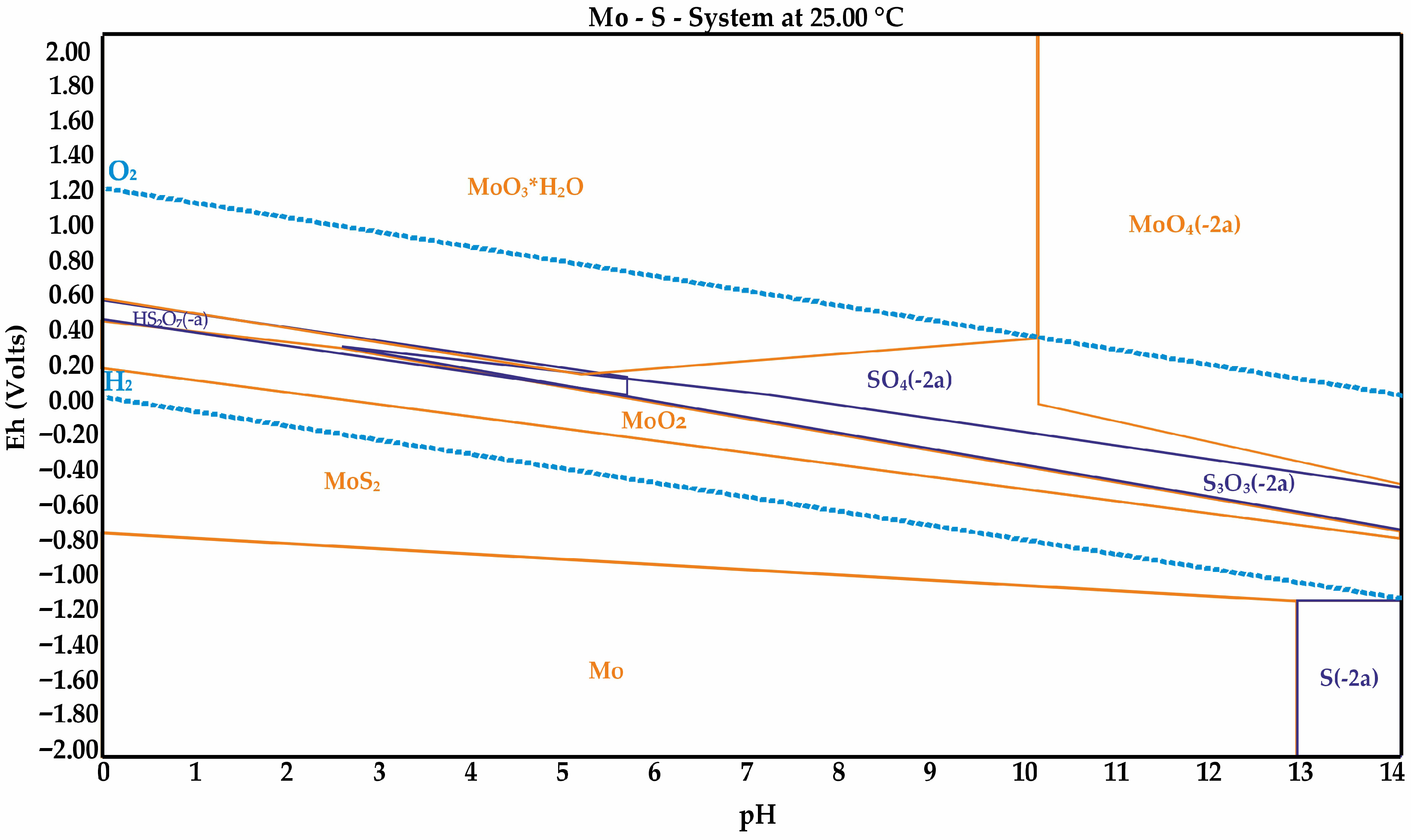
To substantiate the applicability of anion-exchange resins as sorbents for Mo(VI) recovery from sulfuric acid media, a Pourbaix diagram for the Mo-S-H2O system at 25 °C was analyzed (Figure 1). In the strongly acidic region (pH < 1), which corresponds to the conditions of the model solution (120 g/L H2SO4, pH < 0), the thermodynamically stable form of hexavalent molybdenum is the molybdenyl anion (MoO22−). However, in the presence of ultra-high concentrations of sulfate and bisulfate ions (HSO4 and SO42−), generated by the background sulfuric acid, the cationic form undergoes intensive complexation with the solution matrix. Consequently, anionic sulfato-complexes predominate in the system. Formation of these soluble oxosulfate anions constitutes the fundamental prerequisite for successful molybdenum extraction by anion-exchange polymers via an ionic exchange mechanism [43].
The sorption mechanism of Mo(VI) on Purolite A-100 proceeds in four consecutive stages. First, in strongly acidic medium (pH < 0), the tertiary amine groups (–N(CH3)2) are quantitatively protonated to form active ammonium centers ([–N(CH3)2H]+). Second, in the presence of excess sulfate and bisulfate ions, Mo(VI) forms stable anionic oxosulfate complexes, predominantly MoO2(SO4)22−. Third, these bulky anions are selectively taken up by the protonated resin via electrostatic exchange, displacing HSO4 from the active sites. Fourth, mass transport proceeds via pore diffusion within the macroporous matrix, explaining the rapid initial uptake followed by a gradual decline observed in the kinetic profiles.
Sorption of Mo(VI) under such conditions represents competitive ionic exchange between anionic molybdenum forms and sulfate ligands on the functional groups of the polymeric resin.
For gel-type strong-base anionites of the Type I variety (containing quaternary ammonium functional groups, –N(CH3)3+), such as Lewatit MonoPlus M-800 [44] and AB-17, the exchange reaction from the bisulfate form is described by the following equation:
2 [R–N(CH3)3]+HSO4 + MoO2(SO4)22− ⇌ [R–N(CH3)3]22+[MoO2(SO4)2]2− + 2 HSO4
For macroporous weak-base anionites possessing tertiary amino groups (Purolite A-100, Amberlite IRA-67) [45,46], the process proceeds in two stages–preliminary protonation of active sites by strong acid, followed by ionic exchange:
R–N(CH3)2 + H2SO4 → [R–N(CH3)2H] + HSO4
2 [R–N(CH3)2H]+HSO4 + MoO2(SO4)22− ⇌ [R–N(CH3)2H]22+[MoO2(SO4)2]2− + 2 HSO4
Thus, the efficiency of recovery is determined by competitive ionic exchange between molybdate forms and anions of the sulfuric acid medium (HSO4 and SO42−). Differences in the sorptive capacity of the resins are attributable to the nature of the functional groups, the degree of their protonation, and the structural characteristics of the polymeric matrix.

3.2. Comparative Evaluation of Sorptive Efficiency of Anion-Exchange Resins

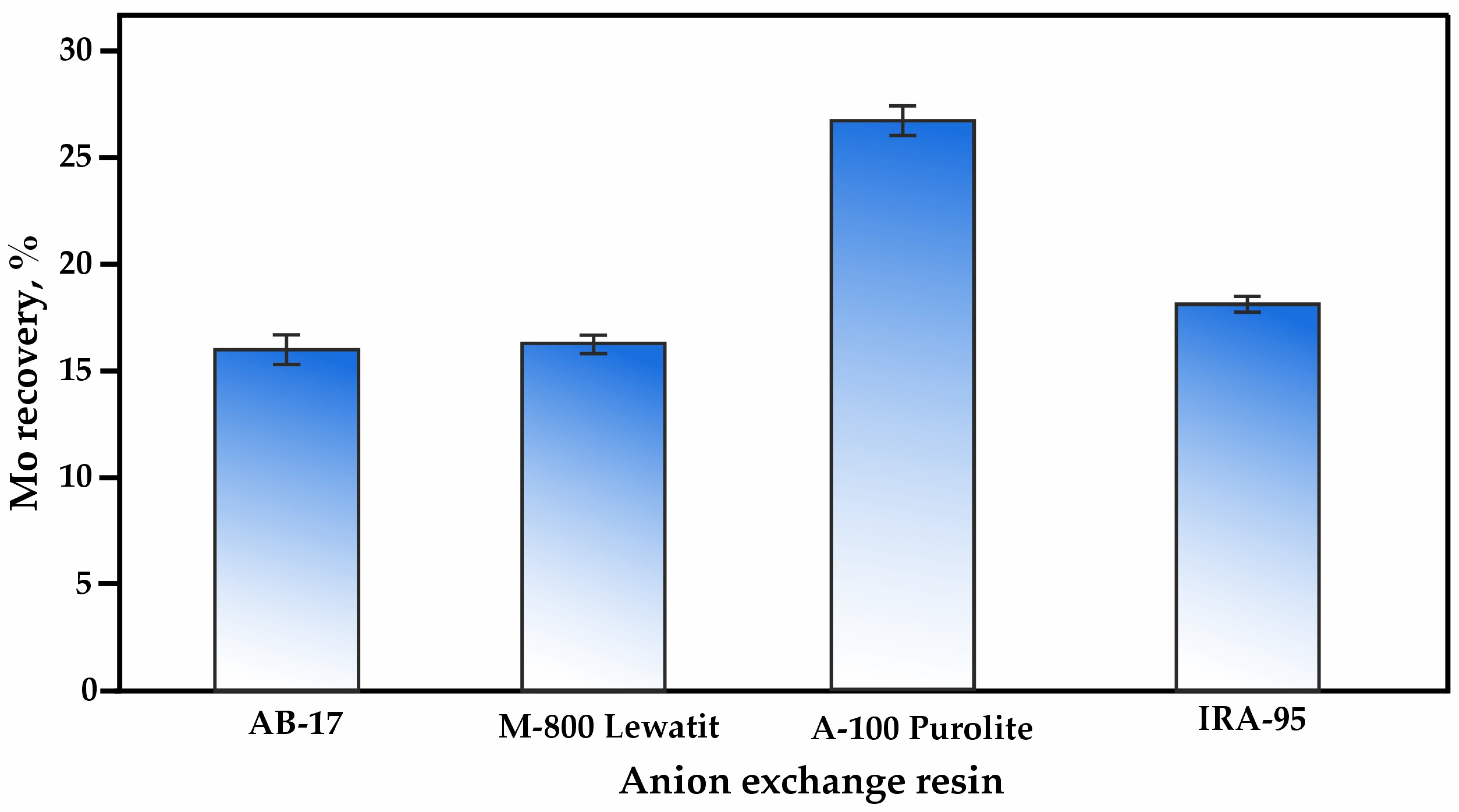
Comparative assessment of the sorptive properties of anion-exchange resins was performed under static conditions. All experiments were executed at identical temperature and hydrodynamic parameters, ensuring the validity of comparisons among the investigated materials. The results of the comparative investigation are presented in Figure 2. The highest molybdenum extraction efficiency was observed for Purolite A-100. The resins AB-17 and Lewatit M-800 demonstrated comparable sorption performance, whereas IRA-67 occupied an intermediate position. Under the conditions of the conducted test, the anion exchanger ANKF-106 did not manifest sorptive capacity, indicating either the absence of exchange in the given medium or the necessity for separate conditioning into the operational ionic form.
Based on the experimental data, equilibrium sorption capacity (qe) and distribution coefficient (Kd) were calculated. The corresponding calculated parameters are presented in Table 2.
The superiority of Purolite A-100 is attributable to the combination of tertiary amine basicity and its macroporous structure. Bulky molybdenum sulfato-complexes are subject to kinetic limitations during intra-diffusional transport through the dense polymeric matrix of gel-type resins (AB-17, Lewatit M-800), whereas the wide pore channels of macroporous Purolite A-100 ensure unimpeded access of massive anions throughout the entire volume of functional groups within the resin granule. Considering the maximal recovery values, Purolite A-100 was selected for further investigation of the effects of contact time, temperature, and acidity.

3.3. Influence of Concentration, Contact Time, Temperature, and pH on Molybdenum Recovery

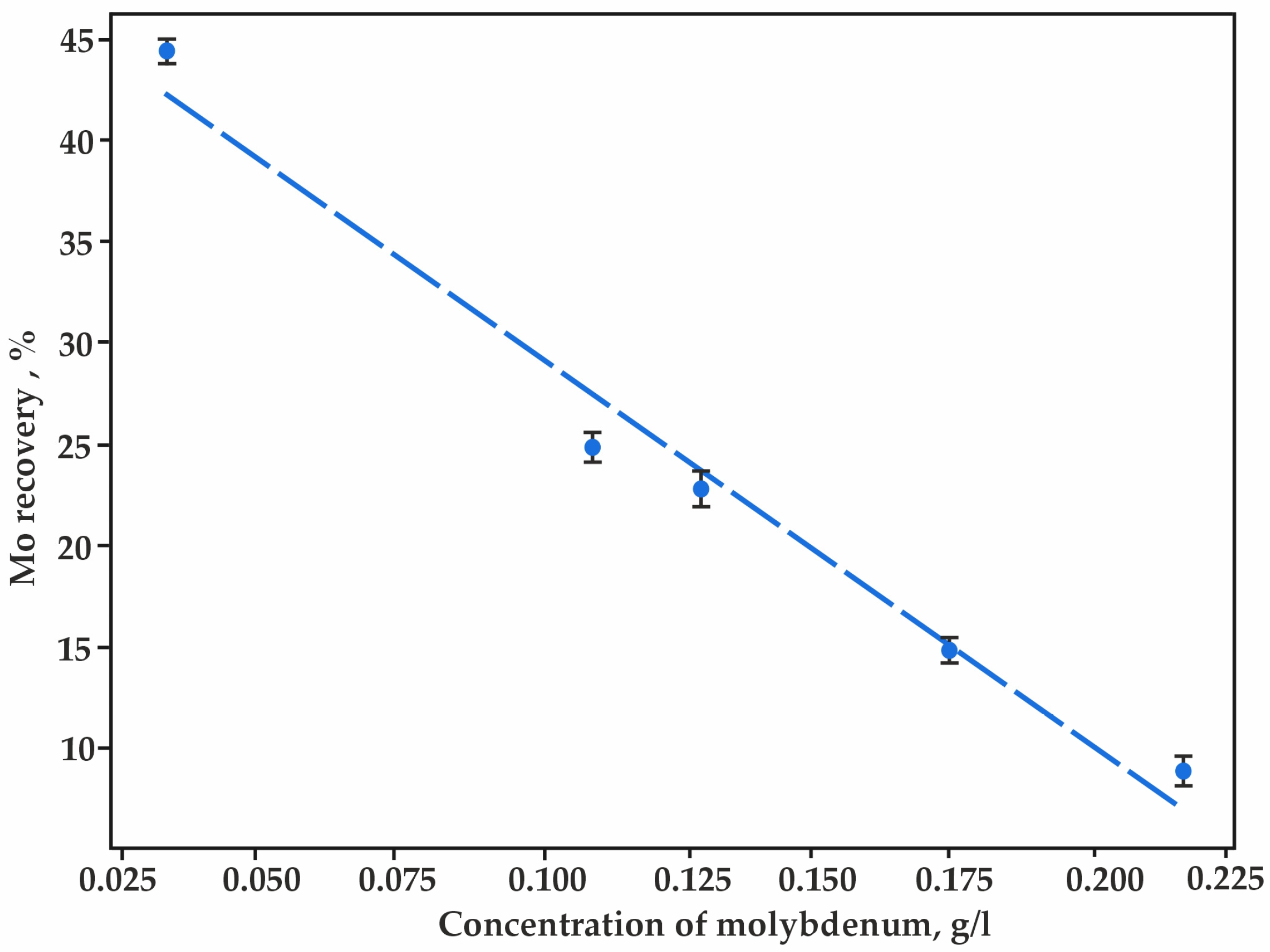
The dependence of molybdenum recovery degree on anion exchanger Purolite A-100 as a function of initial Mo concentration is presented in Figure 3. It was established that upon reduction of molybdenum concentration in solution from 0.17 to 0.033 g/L, the recovery degree increases from 6.93% to 44.3%. The observed trend strictly conforms to thermodynamic principles governing the isothermal sorption process and is attributable to the limited static exchange capacity of the anion exchanger. At elevated molybdenum concentrations, the available active sites of the resin are rapidly saturated with bulky sulfato-complexes of the metal, resulting in an expected mathematical decrease in the fraction of the recovered component expressed as a percentage. Conversely, in dilute solutions, the total number of accessible functional groups of the polymer substantially exceeds the quantity of sorbed Mo (VI) ions; consequently, the efficiency of the binding process approaches its maximum value.
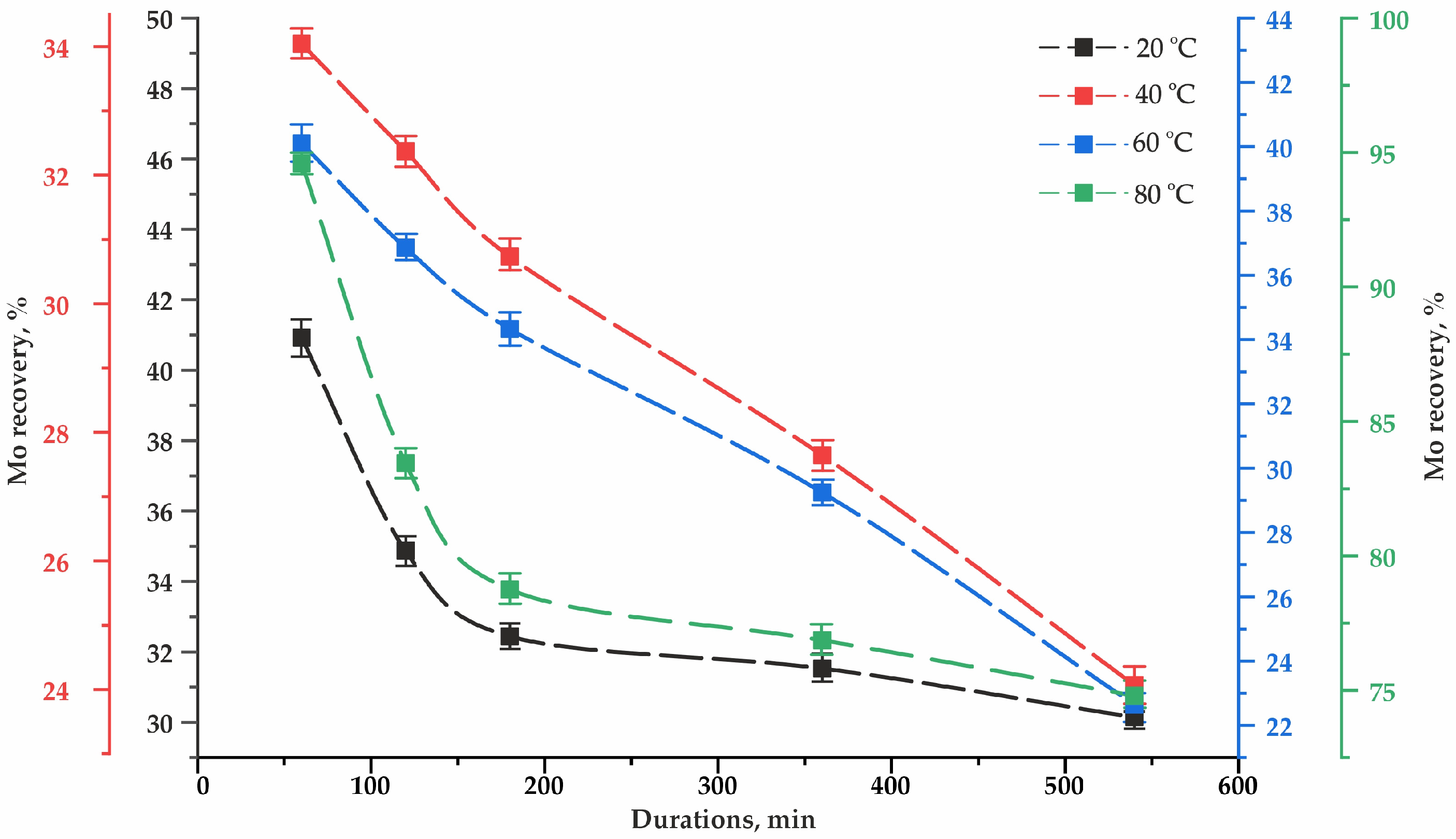
To evaluate kinetic parameters of the process, the influence of contact duration on molybdenum recovery degree was investigated over a temperature range of 20 to 80 °C (Figure 4). Analysis of the kinetic profiles reveals that across all investigated temperatures (20–80 °C), maximal recovery is attained at the initial stages of the process. Specifically, at 20 °C, maximum sorption achieved 49.53% (at 15 min), at 40 °C, it achieved 34.1% (at 60 min), and at 60 °C, it achieved 40.1% (at 60 min). A characteristic feature of these curves is the gradual decline in recovery efficiency with further increase in contact duration. This phenomenon is not associated with the attainment of true equilibrium, but rather results from competitive displacement of molybdenum complexes by background bisulfate ions present within the matrix in enormous excess, as slow intra-gel diffusion proceeds deeper into the polymeric matrix.
Prolonged exposure to a temperature of 80 °C in the presence of an aggressive sulfuric acid medium and potent oxidizing agents inevitably leads to deamination and irreversible physicochemical degradation of the polymeric framework. Thus, the optimal operational temperature range, balancing recovery rate against resin lifetime, should be considered 40–60 °C.
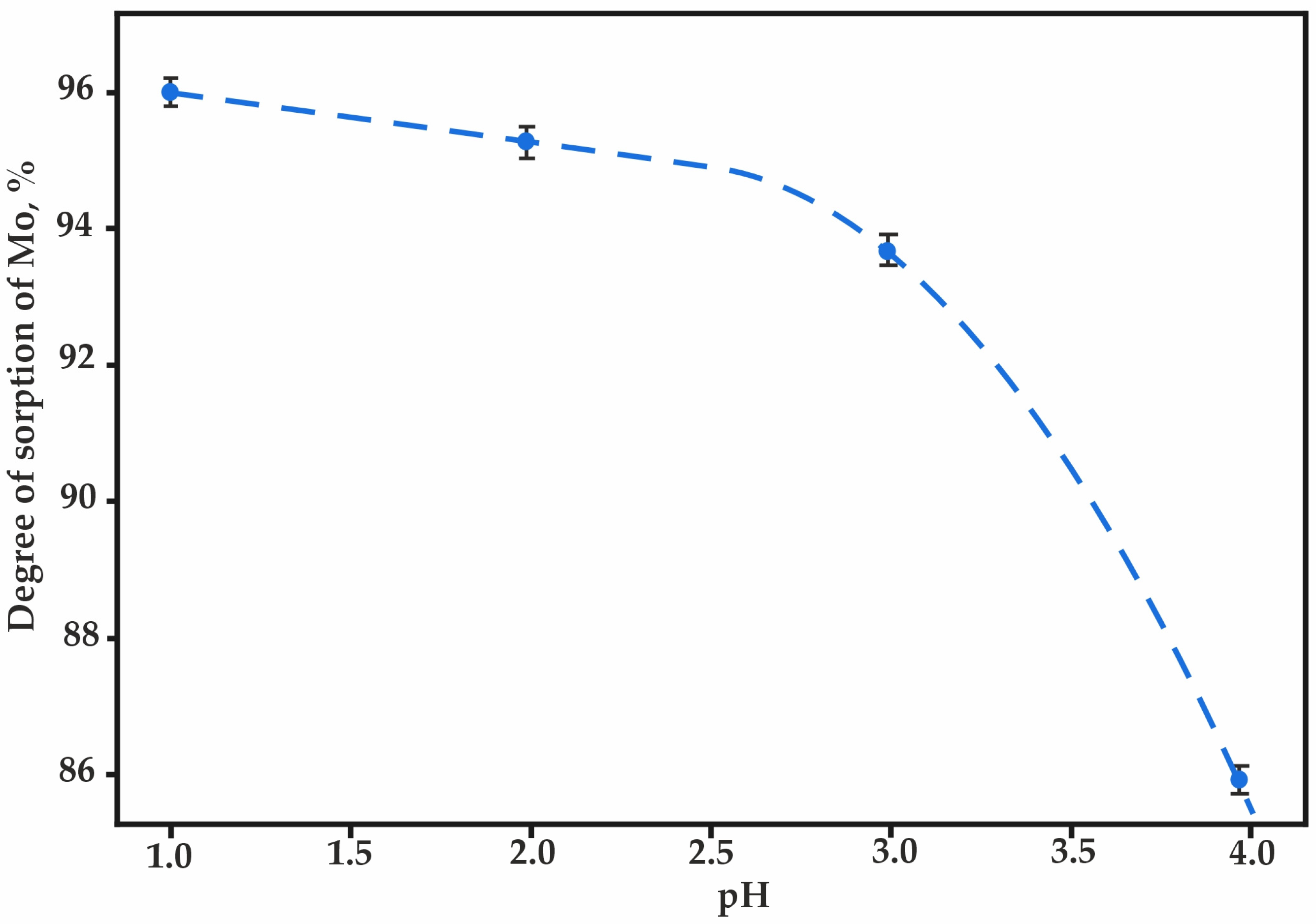
The dependence of molybdenum recovery on Purolite A-100 as a function of hydrogen ion concentration (pH) demonstrates the critical influence of solution acidity on the sorptive capacity of the system (Figure 5). Maximum recovery, attaining 95.91%, was recorded at pH 1. As the solution pH increases, a sharp and substantial decline in sorption is observed. This effect is explained by two concurrent factors. First, as solution acidity decreases (pH > 1), deprotonation of the weak-base functional groups of tertiary amines occurs (R–NH+ → R–N), resulting in loss of positive charge at the resin’s active sites and diminishment of their capacity for anionic exchange. Second, modification of acidity provokes a shift in the equilibrium governing molybdenum speciation, diminishing the proportion of thermodynamically favorable forms for sorption.
It should be noted that implementation of the optimal regime (pH 1) under conditions of actual industrial barren solutions necessitates stringent control of the ionic background, precluding sorption suppression effects arising from excessive ionic strength of neutralizing reagents. This temperature regime was selected exclusively for fundamental research purposes. The elevated temperature permits circumvention of kinetic and intra-diffusional barriers for bulky molybdenum sulfato-complexes and guarantees achievement of thermodynamic equilibrium within a brief contact time of 30 min. This enabled assessment of the influence of proton concentration on the protonation degree of the resin’s active sites in a ‘pure’ manner without distortions associated with slow kinetics. Nevertheless, for prolonged industrial operation in multi-cycle modes, solution temperature should not exceed 60 °C to prevent thermochemical degradation of the polymeric matrix of the anion exchanger.
The investigations conducted herein have enabled elucidation of the principal regularities governing sorptive molybdenum recovery and identification of the factors exerting the greatest influence on process efficiency. Comparison of the resins and analysis of the effects of solution conditions demonstrated that the outcome is determined by both the nature of the anion exchanger itself and the solution parameters. The data obtained serve as the foundation for further process optimization and practical application.

4. Conclusions

This study demonstrates that macroporous weak-base anion exchangers, and Purolite A-100 in particular, are well suited for selective molybdenum(VI) recovery from strongly acidic sulfate solutions. The key advantage of this resin lies in the combination of its macroporous structure and the protonation of tertiary amino groups at low pH, which together allow bulky molybdenyl sulfato-complexes to diffuse freely through the polymer matrix—something gel-type resins cannot achieve due to steric limitations. Under optimized conditions (pH ≈ 1, 80 °C), molybdenum recovery reached 94–95%, and the concentration-dependent behavior observed in the isotherm experiments is consistent with classical thermodynamic saturation of active sorption sites.
From a practical standpoint, the ion-exchange approach offers clear advantages over solvent extraction: it avoids the use of flammable diluents, eliminates emulsion formation problems, and allows simple resin regeneration with aqueous ammonia. These properties make it an attractive option for integration into existing hydrometallurgical flowsheets, particularly as ore grades continue to decline and the recovery of molybdenum from dilute or complex process streams becomes increasingly important.
Future work will explore the application of this approach to real industrial leach solutions containing competing ions, as well as quantum-chemical (DFT) and molecular dynamics modeling of Mo(VI) sulfato-complex binding at protonated amine sites to further elucidate the sorption mechanism at the molecular level.

Author Contributions

Conceptualization: B.K. and A.U.; methodology: A.U., A.M., and N.L.; software: K.K., A.M., and N.L.; validation: B.K., A.U., and A.Y.; formal analysis: A.U. and A.Y.; investigation: A.U., N.L., B.K., and A.Y.; resources: K.K., A.M., N.L., and A.Y.; data curation: B.K. and A.U.; writing—original draft preparation: B.K.; writing—review and editing: B.K. and A.U.; visualization: K.K. and A.M.; supervision: A.U.; project administration: B.K.; funding acquisition: B.K. All authors have read and agreed to the published version of the manuscript.

Funding

This research is funded by the Science Committee of the Ministry of Science and Higher Education of the Republic of Kazakhstan, program targeted funding BR24992757.

Data Availability Statement

The original contributions presented in this study are included in the article. Further inquiries can be directed to the corresponding author.

Conflicts of Interest

The authors declare no conflict of interest.

References

  1. Lide, D.R. (Ed.) CRC Handbook of Chemistry and Physics, 104th ed.; CRC Press: Boca Raton, FL, USA, 2023. [Google Scholar]
  2. Panichkin, A.; Wieleba, W.; Kenzhegulov, A.; Uskenbayeva, A.; Mamaeva, A.; Imbarova, A.; Kvyatkovskii, S.; Kasenova, B. Effect of thermal treatment of chromium iron melts on the structure and properties of castings. Mater. Res. Express 2023, 10, 086502. [Google Scholar] [CrossRef]
  3. Panichkin, A.; Kenzhegulov, A.; Mamaeva, A.; Uskenbayeva, A.; Kshibekova, B.; Imbarova, A.; Alibekov, Z. Effect of carbon and cooling rate on the structure of hypereutectic high chromium cast iron in the cast state and after heat treatment. J. Compos. Sci. 2023, 7, 483. [Google Scholar] [CrossRef]
  4. U.S. Geological Survey. Mineral Commodity Summaries 2025. Available online: https://pubs.usgs.gov/publication/mcs2025 (accessed on 10 February 2026).
  5. International Molybdenum Association (IMOA). IMOA Annual Review 2024/2025; IMOA: London, UK, 2025; Available online: https://www.imoa.info/download_files/annualreview/IMOA_AnnualReview_2024_2025.pdf (accessed on 10 February 2026).
  6. KAZ Minerals PLC. Q4 and FY 2024 Production Report (Molybdenum in Concentrate); KAZ Minerals: Almaty, Kazakhstan, 2025; Available online: https://www.kazminerals.com/media/23240/q4-2024-production-report_final.pdf (accessed on 10 February 2026).
  7. Yessengaziyev, A.; Karshyga, Z.; Yersaiynova, A.; Tastanova, A.; Smailov, K.; Mukangaliyeva, A.; Orynbayev, B. Optimization of Lithium Recovery from Aluminosilicate Tailings via Sulfation Roasting and Leaching: Experimental Study and RSM Modeling. Metals 2025, 15, 1133. [Google Scholar] [CrossRef]
  8. Orynbayev, B.; Toishybek, A.; Ultarakova, A.; Baigenzhenov, O.; Mukangaliyeva, A. Study of scandium sorption from a solution of leached waste from titanium production with hydrochloric acid. Acta Metall. Slovaca 2025, 31, 194–199. [Google Scholar] [CrossRef]
  9. Ultarakova, A.; Lokhova, N.; Karshyga, Z.; Toishybek, A.; Yessengaziyev, A.; Kassymzhanov, K.; Mukangaliyeva, A. Recovery of Niobium Pentaoxide and Ammonium Sulfate from Titanium-Magnesium Production Waste. J. Ecol. Eng. 2023, 24, 227–235. [Google Scholar] [CrossRef]
  10. Volodin, V.; Trebukhov, S.; Mukangaliyeva, A.; Linnik, X.; Nitsenko, A.; Burabayeva, N. Thermodynamics of Evaporation of Liquid Magnesium—Tin Alloys. Metall. Metall. Eng. 2026, 343, 5–15. [Google Scholar] [CrossRef]
  11. Chepushtanova, T.; Yulussov, S.; Baigenzhenov, O.; Khabiev, A.; Rysbekov, K.; Nosbi, N.; Barmenshinova, M.; Yusof, N.N.; Merkibaev, Y.; Hosseini-Bandegharaei, A. An innovative method for complex processing of black shale ores to produce uranium, vanadium, molybdenum, and rare earth concentrates. Chem. Methodol. 2025, 10, 75–111. [Google Scholar] [CrossRef]
  12. Liu, B.; Zhang, B.; Han, G.; Wang, M.; Huang, Y.; Su, S.; Xue, Y.; Wang, Y. Clean separation and purification for strategic metals of molybdenum and rhenium from minerals and waste alloy scraps—A review. Resour. Conserv. Recycl. 2022, 181, 106232. [Google Scholar] [CrossRef]
  13. Chen, Z.; Jiang, Z.; Hu, Q.; Li, J.; Zhao, Z.; Chen, A.; Liu, X.; Chen, X.; He, L.; Sun, F. A novel molybdenum extraction process from molybdenite via magnesia roasting for sulfur fixation. Miner. Eng. 2025, 232, 109566. [Google Scholar] [CrossRef]
  14. Zhang, L.; Peng, W.; Wang, W.; Cao, Y.; Qi, M.; Huang, Y. A green method for selective separation of molybdenite and pyrite via electrochemical oxidation pretreatment-flotation and its mechanism. Colloids Surfaces A Physicochem. Eng. Asp. 2024, 687, 133508. [Google Scholar] [CrossRef]
  15. Lin, X.; Jiao, F.; Wei, Q.; Wu, Y. Application and depression mechanism of sodium humate on flotation separation of molybdenite and pyrite. Sep. Sci. Technol. 2024, 59, 449–463. [Google Scholar] [CrossRef]
  16. Harvey, J.; Courchesne, W.; Vo, M.; Oishi, K.; Robelin, C.; Mahue, U.; Leclerc, P.; Al-Haiek, A. Greener reactants, renewable energies and environmental impact mitigation strategies in pyrometallurgical processes: A review. MRS Energy Sustain. 2022, 9, 212–247. [Google Scholar] [CrossRef] [PubMed]
  17. Du, J.; Wei, F.; Zhang, F. Preparation of molybdenum ion imprinted materials and its selective removal of molybdenum from metavanadate. ACS Sustain. Resour. Manag. 2025, 2, 1466–1475. [Google Scholar] [CrossRef]
  18. Ogata, F.; Kurazaki, M.; Nagai, N.; Uematsu, Y.; Toda, M.; Otani, M.; Saenjum, C.; Tanei, S.; Kawasaki, N. Recovery of molybdenum using adsorption/desorption by nickel–aluminum or nickel–aluminum–zirconium complex hydroxides from aqueous media. RSC Adv. 2025, 15, 24475–24482. [Google Scholar] [CrossRef]
  19. Fu, Y.; Xiao, Q.; Gao, Y.; Ning, P.; Xu, H.; Zhang, Y. Direct extraction of Mo(VI) from acidic leach solution of molybdenite ore by ion exchange resin: Batch and column adsorption studies. Trans. Nonferrous Met. Soc. China 2018, 28, 1660–1669. [Google Scholar] [CrossRef]
  20. Lasheen, T.A.; El-Ahmady, M.E.; Hassib, H.B.; Helal, A.S. Molybdenum Metallurgy Review: Hydrometallurgical Routes to Recovery of Molybdenum from Ores and Mineral Raw Materials. Miner. Process. Extr. Metall. Rev. 2015, 36, 145–173. [Google Scholar] [CrossRef]
  21. Shalchian, H.; Ferella, F.; Birloaga, I.; De Michelis, I.; Vegliò, F. Recovery of molybdenum from leach solution using polyelectrolyte extraction. Hydrometallurgy 2019, 190, 105167. [Google Scholar] [CrossRef]
  22. Behmadi, R.; Mirzaei, M.; Afshar, R.; Najafi, H. Influence of chalcopyrite removal and mechanical exfoliation on the performance of molybdenite catalysts supported on activated bauxite for alcohol synthesis by Fischer-Tropsch process. Fuel 2023, 357, 129772. [Google Scholar] [CrossRef]
  23. Paphane, B.; Nkoane, B.; Oyetunji, O. Kinetic studies on the leaching reactions in the autoclave circuit of the Tati Hydrometallurgical Demonstration Plant. J. S. Afr. Inst. Min. Metall. 2013, 113, 485–489. [Google Scholar]
  24. Abdulvaliyev, R.; Ultarakova, A.; Mukangaliyeva, A.; Lokhova, N.; Kassymzhanov, K. Comparative Analysis of Acid Leaching for the Efficient Recovery of Lanthanum and Cerium from Phosphate. Separations 2024, 11, 288. [Google Scholar] [CrossRef]
  25. Alguacil, F.J.; Alonso, M. Recovery of Tungsten from Raw and Secondary Materials Using Hydrometallurgical Processing. Metals 2025, 15, 799. [Google Scholar] [CrossRef]
  26. Ultarakova, A.; Karshyga, Z.; Lokhova, N.; Yessengaziyev, A.; Kassymzhanov, K.; Mukangaliyeva, A. Studies of Niobium Sorption from Chloride Solutions with the Use of Anion-Exchange Resins. Processes 2023, 11, 1288. [Google Scholar] [CrossRef]
  27. Zhang, J.; Guo, Y.; Lu, W.; Song, B.; Xu, M.; Guo, H. Method for Reducing and Removing Metal Impurities from Ammonium Molybdate Solution by Using Ion Exchange Resin. Chinese Patent No. CN102730758A, State Intellectual Property Office of the People’s Republic of China, 2012. Available online: https://patents.google.com/patent/CN102730758A/en (accessed on 20 February 2026).
  28. Wang, M.; Yang, X.; Wen, J.; Li, W.; Yang, H.; Liu, W. Selective anion exchange adsorption of molybdenum(VI) at low concentrations from an acid leached vanadium shale solution containing aluminium and phosphorus. Hydrometallurgy 2024, 229, 106366. [Google Scholar] [CrossRef]
  29. Ashrapov, U.T.; Khujaev, S.S.; Malikov, S.R. Obtaining molybdenum trioxide enriched with Mo-98 regenerated from spent Tc-99m generators. Mach. Technol. Mater. 2025, 19, 292–295. Available online: https://stumejournals.com/journals/mtm/2025/8/292.full.pdf (accessed on 20 February 2026).
  30. Yuldashev, A.A.; Pulatov, K.L.; Mutalov, S.A.; Igitov, F.B.; Shodmonova, S.A. Preparation Of Anion Exchangers Selective for Copper and Molybdenum Ions. Sci. Innov. Int. Sci. J. 2026, 5, 111–119. [Google Scholar] [CrossRef]
  31. Kirillov, E.; Bochkareva, Z.; Semenishchev, V.; Kirillov, S.; Bunkov, G.; Rychkov, V. Anion Exchange Recovery of Rhenium from Industrial Liquors Followed by Direct Synthesis of a Rhenium Halide Salt. Hydrometallurgy 2024, 230, 106387. [Google Scholar] [CrossRef]
  32. Cyganowski, P.; Pohl, P.; Pawlik, S.; Jermakowicz-Bartkowiak, D. Novel anion-exchange resins for the effective recovery of Re(VII) from simulated by-products of Cu-Mo ore processing. Int. J. Mol. Sci. 2025, 26, 7563. [Google Scholar] [CrossRef] [PubMed]
  33. Guo, Y.; Liu, S.; Jiang, T.; Qiu, G.; Chen, F. A process for producing synthetic rutile from Panzhihua titanium slag. Hydrometallurgy 2014, 147–148, 134–141. [Google Scholar] [CrossRef]
  34. Youssef, W.M.; Masoud, A.M.; Elmaadawy, M.M.; Khawassek, Y.M. Uranium (VI) sorption from aqueous solution using commercial anion exchange resins; kinetics, isotherm, and thermodynamic investigations. J. Radioanal. Nucl. Chem. 2024, 333, 1975–1989. [Google Scholar] [CrossRef]
  35. Ismailova, A.; Rashit, D.; Kossova, T.; Tileuberdi, Y. Selective Removal of Mo and W from Acidic Leachates Using Thiourea Modified Macroporous Anion Exchanger. Molecules 2025, 30, 3803. [Google Scholar] [CrossRef]
  36. El-Tantawy, A.; Abu Elgoud, E.M.; Sharaf El-Deen, S.E.A. Evaluation of anion exchange resin for sorption of selenium (IV) from aqueous solutions. BMC Chem. 2025, 19, 10. [Google Scholar] [CrossRef]
  37. Xu, S.; Margenot, A.J. Phosphate elution from anion-exchange membranes in soil analysis. Agric. Environ. Lett. 2025, 10, e70012. [Google Scholar] [CrossRef]
  38. Navarro, R.; Guzmán, J.; Saucedo, I.; Revilla, J.; Guibal, E. Recovery of metal ions by chitosan: Sorption mechanisms and influence of metal speciation. Macromol. Biosci. 2003, 3, 552–561. [Google Scholar] [CrossRef]
  39. Dumas, A.; De Windt, L.; Serclerat, I.; Kosson, D.S.; Huet, B.; Sanchez, F.; Tapsoba, N. Molybdenum and Antimony immobilization by iron oxalate salt in contaminated soils. Appl. Geochem. 2025, 195, 106626. [Google Scholar] [CrossRef]
  40. Lu, X.; Huo, G.; Liao, C. Separation of macro amounts of tungsten and molybdenum by ion exchange with D309 resin. Trans. Nonferrous Met. Soc. China 2014, 24, 3008–3013. [Google Scholar] [CrossRef]
  41. Tapia, J.; Quintriqueo, A.; Hernández, J. Molybdenum Recovery from the Copper Hydrometallurgical Extraction Route with High Content of Chloride Ions Using the Ion Exchange Technique. Appl. Sci. 2024, 14, 7477. [Google Scholar] [CrossRef]
  42. USSR State Committee for Standards. Anionite AB-17. Specifications (GOST 20301-74). Moscow, USSR. 1974. Available online: https://meganorm.ru/Data2/1/4294833/4294833041.pdf (accessed on 4 March 2026).
  43. Kenzhaliyev, B.; Ultarakova, A.; Lokhova, N.; Mukangaliyeva, A.; Kassymzhanov, K. Optimized Hydrometallurgical Extraction of Molybdenum via Mechanoactivation and Nitric–Sulfuric Leaching. Processes 2025, 13, 1486. [Google Scholar] [CrossRef]
  44. LANXESS. Product Information Lewatit® MonoPlus M 800 OH (Edition: 19 May 2025). 2025. Available online: https://www.atswatertechnology.com/wp-content/uploads/2025/07/Lewatit-MonoPlus-M-800-OH_Datasheet.pdf (accessed on 4 March 2026).
  45. Purolite. Purolite™ Resins Product Guide (Version 60, as of 13 October 2025). 2025. Available online: https://www.purolite.com/dam/jcr:bb4577ce-96f9-4756-a629-bc7013331367/ECL-033_Product-Summary-Guide_v60_10-13-25.pdf (accessed on 4 March 2026).
  46. DuPont. DuPont™ AmberLite™ IRA96 Ion Exchange Resin (Product Data Sheet). Available online: https://www.dupont.com/content/dam/water/amer/us/en/water/public/documents/en/IER-AmberLite-IRA96-PDS-45-D01250-en.pdf (accessed on 4 March 2026).
Figure 1. φ–pH diagram for Mo–S system at 25 °C (a(Mo-I) = 0.01, 25 °C, 1.0 bar).
Processes 14 01225 g001
Figure 2. Comparative sorption efficiency of anion-exchange resins for molybdenum recovery from model sulfuric acid solutions. Error bars represent standard deviation (±SD, n = 3).
Processes 14 01225 g002
Figure 3. Dependence of molybdenum recovery on anion exchanger Purolite A-100 as a function of molybdenum concentration in solution. Error bars represent standard deviation (±SD, n = 3).
Processes 14 01225 g003
Figure 4. Influence of contact duration on molybdenum recovery degree by anion exchanger Purolite A-100 at 20–80 °C. Error bars represent standard deviation (±SD, n = 3).
Processes 14 01225 g004
Figure 5. Dependence of molybdenum recovery on anion exchanger Purolite A-100 as a function of solution pH during sorption at 80 °C. Error bars represent standard deviation (±SD, n = 3).
Processes 14 01225 g005
Table 1. Physicochemical characteristics of the investigated anion-exchange resins.
ResinPolymer MatrixFunctional GroupBasicity TypeTotal Exchange Capacity (mol·dm−3)Ionic Form (As Supplied)
Amberlite IRA-67AcrylicTertiary aminesWeak base1.6Free base
Purolite A-100 Weak base1.3
Lewatit MonoPlus M800Styrene-DVBQuaternary ammoniumStrong base1.3Cl form
AB-17-8Styrene-DVBQuaternary ammoniumStrong base1.15Cl form
AN-2FN Secondary and tertiary aminesWeak base1.7Free base
Table 2. Equilibrium sorption characteristics of anion-exchange resins (C0 = 2.9907 g/L; V = 0.2 L; T = 25 °C; t = 4 h).
ResinCe, g/Lm, gqe, mg/gKd, mL/g
Purolite A-1002.1931.6099.6345.44
AB-172.5121.6557.9923.09
Lewatit M-8002.5031.6260.1724.04
IRA-952.4481.7063.7726.05
ANKF-106~2.991.65--
Disclaimer/Publisher’s Note: The statements, opinions and data contained in all publications are solely those of the individual author(s) and contributor(s) and not of MDPI and/or the editor(s). MDPI and/or the editor(s) disclaim responsibility for any injury to people or property resulting from any ideas, methods, instructions or products referred to in the content.