Article

Directional Presplitting Roof Cutting for Surface Subsidence Control in Extra-Thick Longwall Top-Coal Caving Under Thick Unconsolidated Overburden

1
College of Energy and Mining Engineering, Xi’an University of Science and Technology, Xi’an 710054, China
2
Institute of Rock Burst Prevention and Control, Xi’an University of Science and Technology, Xi’an 710054, China
*
Author to whom correspondence should be addressed.
Processes 2026, 14(8), 1218; https://doi.org/10.3390/pr14081218
Submission received: 6 March 2026 / Revised: 2 April 2026 / Accepted: 4 April 2026 / Published: 10 April 2026

Abstract

Large-scale surface subsidence induced by extra-thick seam longwall top-coal caving (LTCC) is strongly amplified by thick unconsolidated overburden, posing serious serviceability risks to overlying linear infrastructure. Taking the S103 Provincial Highway above Panel 6118 in Inner Mongolia, China, as the engineering background, this study integrates theoretical analysis, numerical simulation, and in situ monitoring to investigate the subsidence-control mechanism of directional presplitting roof cutting. The results show that roof cutting mitigates surface subsidence by reconstructing the overburden structural system and weakening the stress-transfer chain, thereby transforming key-stratum deformation from integral bending to segmented block movement and narrowing the subsidence-affected zone. An equivalent mining-depth model for subsidence-boundary convergence is proposed to characterize the inward migration of the subsidence-basin boundary under thick unconsolidated cover, and a segmented probability-integral model is developed to explain the kink-like high-gradient feature in the post-cut subsidence profile. Parametric simulations of roof-cutting positions (p = 0, 2, 4, …, 32 m) show that the most effective mitigation occurs in the range p = 4–12 m; using minimum–maximum highway subsidence together with profile flattening as the optimization criteria, the representative optimum is identified at p ≈ 10 m, for which the maximum highway subsidence is approximately 57 mm, about 76% lower than that in the non-cutting case. The results further indicate that, although roof cutting significantly reduces subsidence and deformation gradients, fissure localization and possible discontinuous deformation near the pre-split weak plane still require careful field monitoring.

1. Introduction

As coal extraction intensifies, controlling mining-induced surface subsidence and mitigating ecological impacts have become major challenges for the coal industry. Overburden disturbance and ground subsidence caused by underground mining can undermine ecological security and damage surface infrastructure, especially in ecologically fragile and infrastructure-intensive regions [1]. In recent years, these challenges have become particularly acute in western China, where mining under thick unconsolidated overburden is frequently accompanied by severe ground settlement, surface fissuring, and damage to roads and villages [2]. Thick unconsolidated overburden further amplifies subsidence effects, promotes the development of extensive surface fissures, and aggravates the above hazards. Under the constraints of the “dual-carbon” targets and energy-security requirements, there is an urgent need for subsidence-control technologies for extra-thick seams that balance production capacity with environmental risk.
Qian Minggao and co-workers developed the masonry-beam theory and key-strata theory, demonstrating that overburden contains primary and subordinate key strata that govern strata movement at different scales [3,4,5]. They further established the “S–R” stability criterion for the rotational and sliding instability of masonry beams, which has been widely used to interpret overburden structure and surface movement induced by underground coal mining [6]. These foundational studies have significantly advanced the understanding of overburden failure in extra-thick seam mining; however, under conditions of a large mining height and near-surface linear infrastructures, the transmission pathway of subsidence to the ground surface and, more importantly, its controllability, still lack systematic quantification.
Conventional subsidence-mitigation measures, such as backfill mining, strip mining, and protective coal pillars, can reduce subsidence magnitude but are often limited by high cost, reduced recovery ratio, and stringent applicability, making them difficult to deploy widely under high-intensity LTCC in extra-thick seams [7,8,9]. To clarify the engineering positioning of directional presplitting roof cutting relative to these conventional approaches, a concise comparison is provided in Table 1, in which representative subsidence-mitigation methods are compared in terms of subsidence-control effect, recovery ratio, economic cost, and applicability to extra-thick LTCC under thick unconsolidated overburden. In recent years, directional roof-cutting technology, developed based on the concept of a “roof-cutting short cantilever beam”, induces controlled, segmented roof caving by creating a through-going pre-split weak plane, thereby shortening the effective roof span. This technique has been validated in engineering practice for gob-side entry retaining and hard-roof control [10].
Nevertheless, extending the roof-cutting action from near the immediate roof to high-level key strata—so as to actively reconstruct the overburden structure and reroute the load-transfer path for coupled structural–mechanical control of surface subsidence—still remains insufficiently studied, particularly under thick unconsolidated cover.
Against this background, this study takes the highway-protection requirements above the 6118 LTCC panel in an Inner Mongolia mine as the engineering context. The study integrates theoretical analysis, numerical modeling, and in situ monitoring to (i) characterize key-stratum fracture behavior under directional presplitting roof cutting, (ii) establish a boundary-convergence model for mining subsidence under thick unconsolidated cover, and (iii) determine an effective roof-cutting position for highway subsidence control. The outcomes provide a technical reference for protecting surface linear infrastructures during LTCC of extra-thick coal seams under thick unconsolidated overburden.

2. Engineering Background

2.1. Overview of the 6118 Working Face

GuanziGou Coal Mine is located in the southern detailed-exploration area of the Jungar Coalfield. Panel 6118 lies in the southwestern part of the mine (northing range: 3016–4196 m), adjacent to Panel 6117 to the east and bounded to the south by the main development roadway of Seam No. 6 (Figure 1). The panel is laid out along the floor of Seam No. 6 and is mined using an inclined longwall top-coal caving (LTCC) method. The coal seam has an average thickness of 15.5 m, while the local maximum thickness reaches about 22 m. In this study, the average thickness is used to describe the field geological condition, whereas the numerical model adopts the maximum seam thickness to construct a conservative extraction scenario. The panel length along strike is approximately 2398 m and the dip width is about 220 m. The roof strata mainly comprise siltstone, sandy mudstone, and medium- to coarse-grained sandstone. Specifically, the pseudo-roof is ~1.15 m thick sandy mudstone; the immediate roof is ~4.53 m medium-grained sandstone; and the main roof is ~11.30 m coarse-grained sandstone. The floor consists of 0.4–6.5 m sandy mudstone. Partings are well developed within the seam (3–5 layers of mudstone and carbonaceous mudstone). Overall, the seam is continuous and stable, with an average burial depth of ~218.5 m, representing a typical extra-thick coal seam.
The S103 Provincial Highway (Shiyu Highway) is located to the west of Panel 6118, with a horizontal offset of approximately 50 m from the panel boundary (Figure 1). As a linear infrastructure with a limited transverse dimension, the highway is highly sensitive to non-uniform subsidence and settlement gradients. To balance resource recovery and roadway safety under the strong mining-induced disturbance associated with LTCC in an extra-thick seam, a single coal-pillar protection strategy is still insufficient to fully eliminate the risk of subgrade settlement. Therefore, it is necessary to consider the site-specific geological conditions and overburden movement characteristics, and to investigate the subsidence-control mechanism and parameter optimization of structural regulation techniques such as directional roof cutting.

2.2. Surface Subsidence Characteristics Above the 6118 Working Face

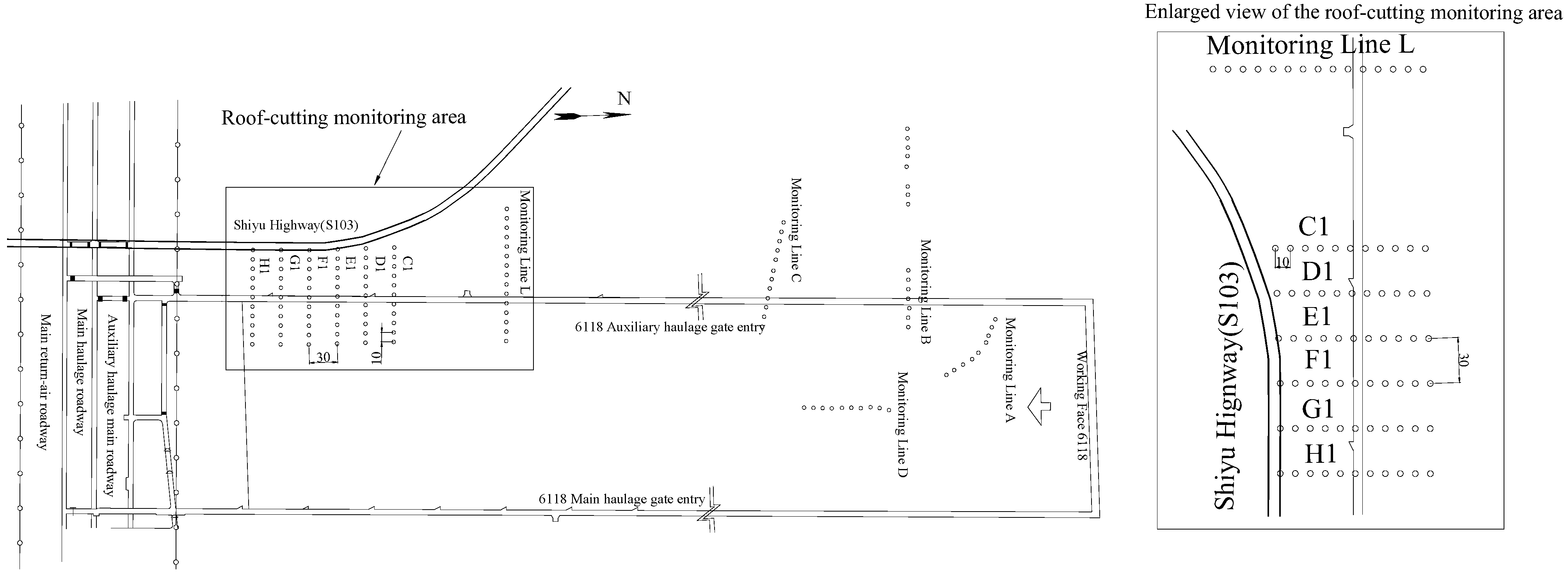
The ground surface above Panel 6118 is characterized by a typical loess gully–ravine landscape. The unconsolidated loess–laterite cover is approximately 120 m thick, and the terrain exhibits pronounced relief and strong gully incision. To account for topographic non-uniformity and the anisotropy of mining-induced ground movement, five baseline survey lines (A–E) were deployed above the panel in the early stage, including one strike line and one dip line, supplemented by densified oblique (crossing) lines, to determine the background movement parameters under conventional mining. To delineate the influence range after roof cutting and to ensure the safe operation of the Shiyu Highway, an additional seven survey lines (L, C1, D1, E1, F1, G1, and H1) were established within the roof-cutting influence zone and along the gully-edge sensitive belt, forming a multi-directional integrated monitoring network (Figure 2). Surface subsidence monitoring was conducted using real-time kinematic (RTK) GNSS techniques, with both comprehensive campaigns and routine observations implemented in accordance with the Coal Mine Surveying Regulations. The monitoring campaign was carried out from 21 February 2025 to 18 September 2025, with a measurement interval of 1 day, covering a total observation period of approximately 7 months (210 days).
Monitoring results indicate that gully–ravine topography combined with thick unconsolidated overburden exerts a pronounced amplification effect on mining-induced subsidence. Survey Lines A and D, located within the strong-influence zone and near/within gully bottoms, recorded maximum subsidence values of 12,210 mm and 16,839 mm, respectively; step-like ground fissures were observed, accompanied by benchmark failure at several monitoring points. In contrast, the maximum subsidence along Lines B and C reached 3950 mm and 3730 mm, respectively, whereas Line E was essentially outside the subsidence influence range. Peak subsidence rates generally occurred within several tens of meters after the longwall face passed the monitoring line: the A4 point exhibited a peak rate of ~746 mm/d, and the peak rate along Line D was ~798 mm/d. These field observations demonstrate that thick unconsolidated cover increases the subsidence coefficient and magnifies surface subsidence, which is consistent with previous findings. According to the subsidence coefficient defined in Equation (1),
k n = W 0 m · cos α
The subsidence coefficients along Lines A and D were 0.6105 and 0.842, respectively, indicating that subsidence intensity is high under the strong disturbance associated with extra-thick seam LTCC, with pronounced spatial variability. The difference between the subsidence coefficients of Lines A and D reflects pronounced spatial variability of mining-induced deformation under the coupled effects of thick unconsolidated overburden and gully–ravine topography. Although both lines are located within the strong-influence zone, the deformation concentration near the gully bottom is more significant along Line D, resulting in a larger maximum subsidence and a higher subsidence coefficient. It should also be emphasized that the height of a step-like fissure represents only the local differential vertical displacement across a discontinuity, rather than the total or fully developed subsidence of the ground surface. Therefore, the observed step heights should be understood as localized discontinuous deformation superimposed on the overall subsidence basin. The mining influence range was determined using the criterion of “subsidence ≥ 10 mm”. The strike-direction initiation distance was approximately 142.03 m, corresponding to a strike influence angle of 56.99°. The overall influence range in the dip direction was 86.70 m, with a dip boundary angle of 69.5°, and the lagging influence distance was 250.95 m. Surface fissures were dominated by tensile opening and were superimposed by gully-slope sliding effects. Two step-like fissures were observed along Line B (with step heights of 1100 mm and 1600 mm), one step-like fissure occurred along Line C (900 mm), and five step-like fissures developed along Line D (850–1500 mm), reflecting strong non-uniform subsidence and localized abrupt deformation. The characteristic ground-movement parameters obtained from the baseline monitoring are summarized in Table 2.
The large difference between the subsidence coefficients of Lines A and D reflects pronounced spatial variability of mining-induced deformation under the coupled effects of thick unconsolidated overburden and gully–ravine topography. Although both lines are located within the strong-influence zone, deformation concentration near the gully bottom is more significant along Line D, resulting in a larger maximum subsidence and, consequently, a higher subsidence coefficient. It should also be emphasized that the height of a step-like fissure represents only the local differential vertical displacement across a discontinuity, rather than the total or fully developed subsidence of the ground surface. Therefore, the observed step heights should be interpreted as localized discontinuous deformation superimposed on the overall subsidence basin.

3. Discontinuous Surface Deformation and Subsidence-Control Mechanisms Under Roof-Cutting Conditions

3.1. Key-Stratum Fracture Model Under Directional Presplitting

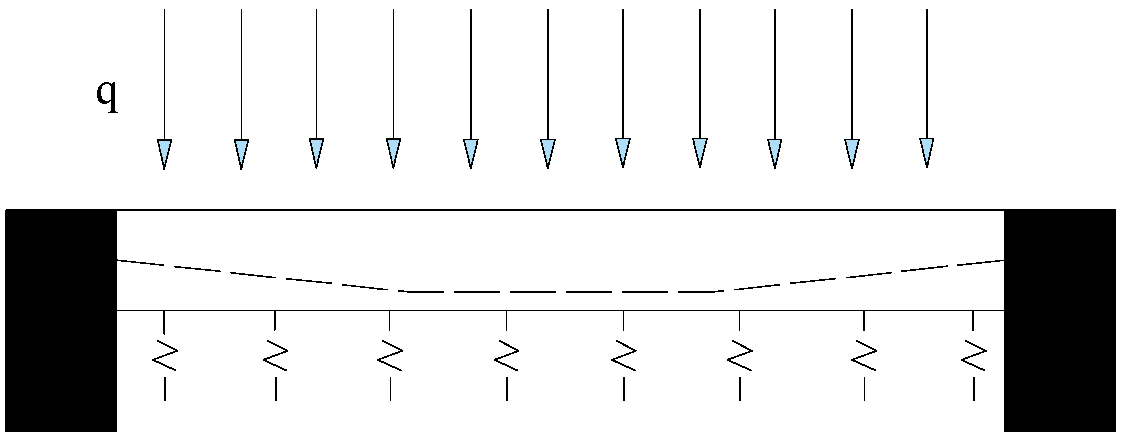
A key stratum is a controlling rock layer within the overburden sequence whose fracture can cause pronounced changes in both the movement pattern of the overlying strata and the manifestation of strata pressure. During longwall advancement, a key stratum typically undergoes a staged evolution: span formation accumulation of a bending deflection through-going fracture block articulation (voussoir/masonry-beam behavior or arching) re-fracture or instability. Throughout this process, the bearing path and force-chain network are continuously reorganized, which governs the ability of mining-induced loads to be transferred to the solid coal/abutment zones on both sides and determines the extent of far-field influences [11]. Therefore, if engineering measures are adopted to modify the continuity conditions and fracture boundaries of the key stratum (e.g., prefabricated weak planes or induced directional fractures), the movement scale of the overburden and the spatial extent of surface ground movement can be actively regulated at the structural level [12,13,14]. Directional presplitting roof cutting for subsidence mitigation is such an active regulation approach. Its basic concept is to conduct directional presplitting in the target high-level key stratum prior to mining, creating a through-going or quasi through-going weakened band to reduce the fracture-initiation threshold and to induce premature failure along a predetermined line, thereby enabling a controllable fracture location and failure mode. Under non-cutting conditions, the high-level primary key stratum generally remains continuous over a certain advanced interval, and its deformation is dominated by bending. Hence, it can be idealized as a rock beam spanning the goaf for mechanical analysis (Figure 3).
M max = q l 2 8
where l is the effective suspended span of the primary key stratum. The maximum bending-induced tensile stress at the lower fiber of the beam section satisfies the classical flexure formula:
σ max = M max y I
where I is the second moment of area of the section and y is the distance from the neutral axis to the extreme tensile fiber. Substituting Equation (2) into Equation (3) gives
σ max = q l 2 8 y I
Taking the tensile strength of the key stratum as the governing fracture criterion, tensile rupture is assumed to occur when σ max > σ t . At the critical state, σ max = σ t , Equation (4) becomes
q l c 2 y 8 I = σ t
Rearranging yields
l c 2 = 8 I σ t q y
and therefore
l c = 8 I σ t q y 1 / 2
As indicated by Equation (7), the critical suspended span of the key stratum, lc, is governed by the equivalent load level q, the section geometry, and the tensile strength σt. Under the non-cutting condition, the suspended span may continue to increase until it exceeds the critical limit, thereby inducing a through-going fracture of the key stratum. As a result, a mining-induced disturbance is more readily transmitted to the far field through the continuous load-bearing structure of the primary key stratum, ultimately forming a subsidence basin with a broad influence range. By prefabricating a through-going or quasi through-going weakened band at the target horizon, directional presplitting roof cutting alters the equivalent boundary constraints and continuity conditions of the key stratum so that the tensile-rupture criterion is satisfied earlier at a predetermined location. This process effectively converts “long-span integral bending” into “short-span segmented movement”. With the shortening of the effective suspended span, the mid-span bending moment, deflection, and tensile stress decrease simultaneously; the cross-goaf force-transfer capacity of the overall structure is weakened; and the overburden response evolves from a continuous bending-dominated mode to a coupled mechanism of segmented block rotation and sliding. This provides a mechanical basis for the convergence of the subsidence influence range and the peak-shaving of surface deformation gradients.

3.2. Equivalent Mining-Depth Model for Boundary Inward Shift Induced by Roof Cutting

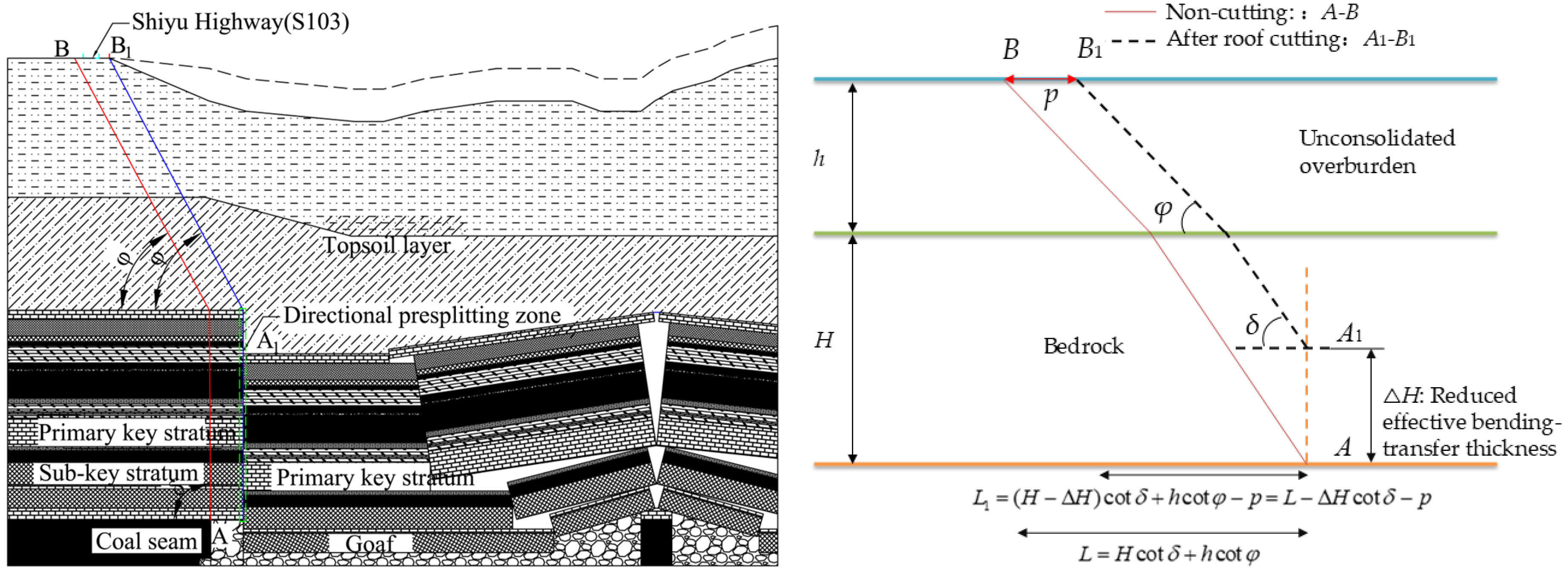
Under the protection constraints imposed by nearby linear infrastructure, determination of the mining influence boundary and the horizontal influence distance should be consistent with the adopted engineering criterion. In this study, the influence boundary is defined by the criterion of subsidence ≥ 10 mm, and the boundary of the subsidence basin is characterized geometrically as follows. Starting from characteristic point A on the goaf boundary, a control line is drawn with the bedrock movement angle δ until it intersects the bedrock–unconsolidated-overburden interface; the line is then extended upward to the ground surface using the unconsolidated-layer movement angle φ, yielding the surface boundary point B [15]. Let H denote the thickness of the bedrock and h the thickness of the unconsolidated overburden; the outward horizontal influence distance from the goaf boundary can be expressed as
L = H cot δ + h cot φ
where L is the horizontal influence distance, δ and φ are the movement (draw) angles of the bedrock and unconsolidated layer, respectively, and H and h are their corresponding thicknesses.
After directional roof cutting is applied to the key stratum, the through-going weakened band converts the original continuous long-span bending load-bearing and load-transfer structure into a segmented-block response governed by the weakened band. On the roof-cutting side, the bedrock movement transitions from a cross-goaf articulated stable structure to a mode dominated by preferential sliding within the fractured zone, accompanied by near-field caving and compaction [16]. Consequently, the reference point for defining the mining influence boundary shifts from B to B1, i.e., the location of the weakened band. Here, p is defined as the roof-cutting position parameter measured from the coal wall toward the panel interior, namely the horizontal offset distance between the coal wall and the roof-cutting (presplitting) line (with p taken as positive toward the working-face interior).
B B 1 = p , p > 0
Meanwhile, the effective thickness of the bedrock participating in far-field bending and load transfer is reduced after roof cutting. This reduction can be represented by an equivalent mining-depth decrement ΔH, i.e., the equivalent bedrock thickness decreases from H to HH. Accordingly, the horizontal influence distance after roof cutting, L1, can be expressed as
L 1 = ( H Δ H ) cot δ + h cot φ p = L Δ H cot δ p
where L1 is the horizontal influence distance under roof-cutting conditions; δ and φ are the movement (draw) angles of the bedrock and the unconsolidated layer, respectively; H and h are their thicknesses; ΔH is the equivalent reduction in the effective bedrock thickness; and p is the inward offset of the roof-cutting line measured from the coal wall toward the panel interior.
From Equations (8)–(10), the difference in horizontal influence distance before and after roof cutting can be written as
L L 1 = p + Δ H cot δ
Therefore, for the given δ and φ, if p > 0 and ΔH > 0, it follows that L1 < L, indicating that the boundary of the subsidence basin converges toward the panel (goaf) side. In other words, the surface boundary point shifts from B to B1, as illustrated in Figure 4.

3.3. Influence of the Key Stratum on Overburden Movement Before and After Roof Cutting

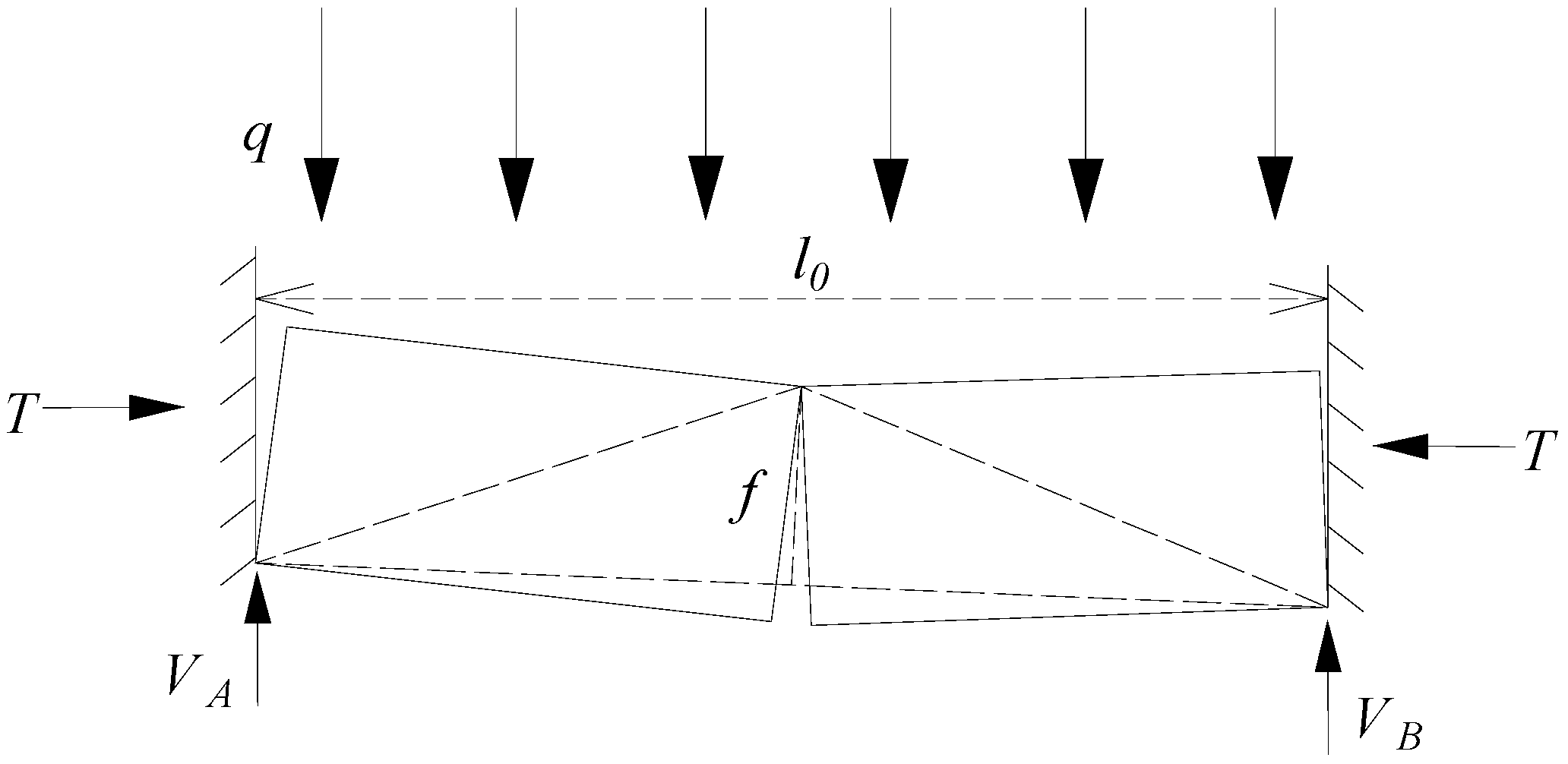
When a key stratum reaches its critical suspended span and undergoes through-going rupture, it typically does not lose its load-bearing capacity immediately. Instead, it evolves into a block–hinge structure (voussoir beam/three-hinged arch) [17,18]. In this configuration, compressed hinge zones form at the block contacts; the ability to transfer the bending moment is markedly reduced, while cross-span force transfer can still be maintained. Consequently, the key stratum continues to exert large-scale integral control on the movement of the overlying strata, and the corresponding surface subsidence basin generally exhibits a continuous and smooth profile. To characterize cross-span force transfer in a first-order analytical manner, the assemblage of key-stratum blocks is idealized as an equivalent symmetric three-hinged arch (Figure 5). This simplification is intended to capture the existence of cross-goaf force transfer in the articulated stage, rather than to reproduce the full geometric asymmetry of the in situ structure. In practice, asymmetry associated with gate-roadway and abutment conditions may lead to unequal end reactions and more complex internal-force redistribution, but it does not alter the mechanistic contrast emphasized here between integral cross-span transfer and segmented weak-plane-controlled movement.
Let the span of the (three-hinged) arch be l0, the rise (sagitta) be f, and the equivalent uniformly distributed load be q. Denote by V the vertical reaction at each springing. By symmetry, the vertical reactions at the two ends are
V A = V B = q l 2
Because the crown is an internal hinge, the bending moment at the crown is zero. Taking moments of the half-arch about the crown hinge yields the horizontal thrust
T f = q l 2 8 T = q l 2 8 f
where T is the horizontal thrust, reflecting the cross-span force-transfer capacity of the hinged key-stratum structure. Equation (14) indicates that when f is small (i.e., the overall structural stiffness is high and vertical settlement is restrained), the horizontal thrust T increases and the arching effect becomes more pronounced. In this case, the load can be transmitted over a long distance to the solid abutments on both sides through the articulated key-stratum structure, thereby driving large-scale integral bending and subsidence of the overlying strata. This response is typically manifested as a subsidence basin dominated by continuous deformation with a relatively wide influence range.
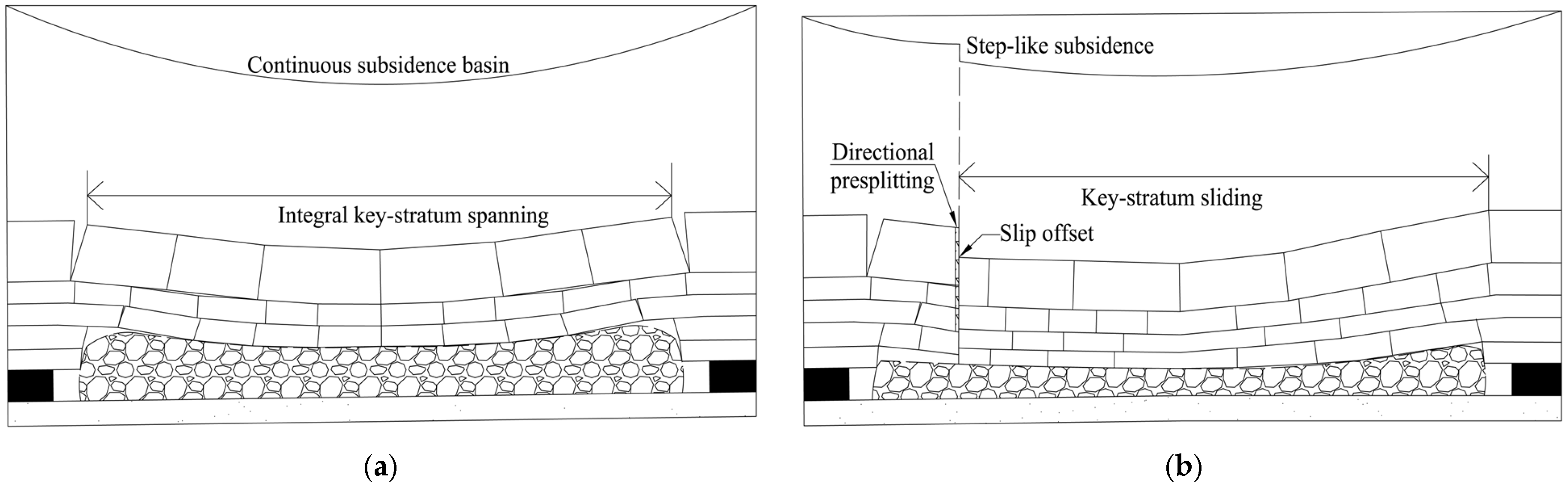
After directional roof cutting is implemented, the pre-split weakened band further transforms the key stratum from a hinged structure capable of cross-span force transfer into a segmented block system dominated by interfacial sliding and energy dissipation (Figure 6). Across the weak plane, displacement compatibility is reduced, and the blocks on either side undergo opening/closure together with a coupled mode of frictional sliding and rotation. Accordingly, the movement of the overlying strata shifts from a continuous bending-dominated response to segmented motion accompanied by localized offsets. Although discontinuous deformation or high-gradient zones (e.g., fissure and step-like scarps) may develop in the vicinity of the weak plane, far-field bending transfer is substantially weakened, and the overall influence range tends to converge [19].
The probability integral method (PIM), grounded in stochastic medium theory and the superposition of influence functions, represents the volumetric loss of the mined-out space as a distribution of “subsidence source terms” within the mining domain. Assuming translational invariance and statistical homogeneity of the medium response to a unit source, the surface subsidence field can be obtained by integrating and superposing the contributions of all elemental sources via an influence function [20]. In engineering practice, a Gaussian-type influence function is widely adopted, in which the diffusion scale is governed by the main influence radius r, commonly related to the mining depth D through the main influence angle β (e.g., r = D cot β). When the overburden consists of both bedrock and a thick unconsolidated layer, the movement (draw) angles and diffusion scales are often stratification-dependent. Accordingly, the propagation characteristics in the bedrock segment and the unconsolidated segment should be treated separately and then converted geometrically (or equivalently parameterized) to ensure consistency with engineering boundary criteria such as “subsidence ≥ 10 mm”. Under conditions of thick unconsolidated cover coupled with gully–ravine topography, surface deformation is further influenced by the compressibility of the unconsolidated layer and terrain non-uniformity, typically manifesting as slow boundary attenuation, localized concentration of deformation gradients, and a high propensity for fissure development. Therefore, parameter inversion and boundary identification require more stringent monitoring constraints.
Under roof-cutting conditions, the pre-split weakened band introduces a discontinuous change in the continuous load-bearing framework of the key stratum: on the roof-cutting side, the effective bedrock thickness participating in far-field bending transfer is reduced, leading to an abrupt change in the equivalent mining depth and the associated propagation scale at the cutting line; meanwhile, the cutting line also induces a geometric “origin-shift” effect in boundary determination. Motivated by these physical implications, the roof-cutting line can be treated as a piecewise parameter interface, where the influence-function kernel (or its governing parameters r, β, and the equivalent mining depth) is assigned in a segmented manner across the interface. This piecewise formulation is capable of capturing both the convergence of the influence range and the gradient “kink” (abrupt change) in the subsidence profile induced by roof cutting, and it is consistent with the mechanistic understanding of “structural reconfiguration–stress-transfer-chain weakening”.
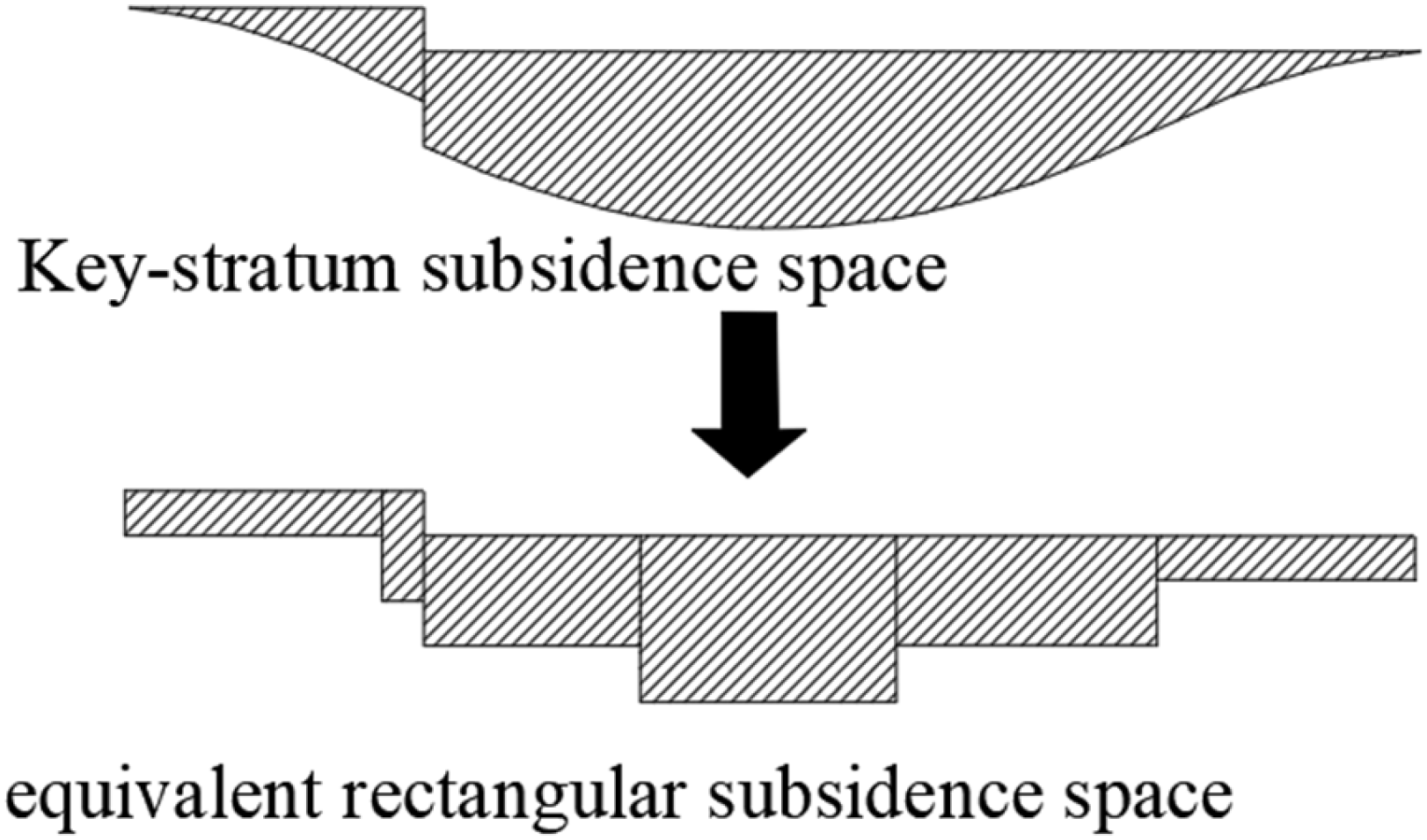
Under the assumption that the subsidence space of the key stratum is fully transferred to the ground surface, a surface-subsidence prediction model can be established using the probability integral method (PIM) based on stochastic medium theory. The PIM is founded on the superposition of influence functions: the separation void generated by sliding-induced subsidence of the key stratum under roof-cutting conditions is equivalently treated as a mining-space source term distributed within the affected domain (Figure 7). Moreover, the medium response to a unit source is assumed to satisfy translational invariance and statistical homogeneity. Accordingly, the surface subsidence distribution can be obtained by integrating and superposing the contributions from all elemental sources through an influence function.
Using a Gaussian influence function, the diffusion scale is governed by the main influence radius r, which is linked to the mining depth D through the main influence angle (r = Dcot β). In this way, the spreading scale is directly coupled with the mining depth, and the probability-integral expression of surface subsidence under roof-cutting conditions can be written as:
W ( x ) = Ω m ( ξ ) g ( x ξ ; r ) d ξ
where m(ξ) is the intensity of the equivalent mining-source term, g(x) is the influence-function kernel, and Ω denotes the mining influence domain. A Gaussian kernel is adopted as
g ( x ; r ) = 1 r π exp x r 2 , g ( x ; r ) d x = 1
The main influence radius r is related to the mining depth D via the main influence angle β as:
r = D cot β
After roof cutting, the effective bedrock thickness on the roof-cutting control side that participates in the far-field bending transfer is reduced to H Δ H . Consequently, the equivalent mining depths on the two sides of the roof-cutting line can be expressed as
D L = ( H Δ H ) + h , D R = H + h
and the corresponding main influence radii are
r L = D L cot β , r R = D R cot β , r L < r R ( Δ H > 0 )
The roof-cutting line can therefore be regarded as an interface across which the mining-depth parameter changes abruptly, resulting in a piecewise definition of the probability-integral kernel. To avoid symbol confusion, panel boundary point B is retained as the coordinate origin, with positive x pointing toward the protected infrastructure; the roof-cutting line is located at x = −p. The kernel can then be written in segmented form. Unlike the conventional boundary PIM, which uses a single influence radius and a single boundary origin, the present formulation incorporates two roof-cutting-induced effects simultaneously: (1) an origin-shift effect represented by p, and (2) a piecewise propagation-scale effect represented by the change from r_R to r_L through the equivalent depth reduction ΔH. As a result, the roof-cutting line is treated as a segmented parameter interface, allowing the model to capture both boundary convergence and the quasi-kink in the post-cut subsidence profile.
g ( x ξ ; r ) = g ( x ξ ; r L ) , x p g ( x ξ ; r R ) , x > p
Equation (19) shows that roof cutting causes the propagation scale to change from rR to rL across the roof-cutting line. This abrupt parameter change does not necessarily make W(x) strictly discontinuous, but it will significantly modify the distribution of the slope and curvature of the subsidence profile, producing a pronounced high-gradient zone in the vicinity of the cutting line and manifesting as a “quasi-kink” (near-discontinuous) feature in practice.
Considering that the protected infrastructure is located outside the panel boundary (x ≥ 0), a semi-infinite mining approximation can be adopted in the vicinity of the boundary. Under the non-cutting condition, the mining domain can be idealized as x ≤ 0. After roof cutting, the effective starting point of the subsidence source shifts inward to x ≤ −p, and the propagation scale on the outer (infrastructure) side is governed by r L . Let η m denote the fully developed (fully extracted) subsidence magnitude. Then, the outside subsidence profile without roof cutting is
W 0 ( x ) = η m 2 erfc x r R
where erfc(x) is the complementary error function. After roof cutting, the outside subsidence becomes
W c ( x ) = η m 2 erfc x + p r L
Equation (21) explicitly shows that p enters the outside curve as a translation term, whereas Δ H affects the curve through the modified diffusion scale r L ; the two effects jointly flatten the subsidence profile and promote convergence of the influence range.
Under the boundary criterion W = Wb (Wb = 10 mm), the non-cutting and roof-cutting cases satisfy, respectively,
W b = η m 2 erfc L r R = η m 2 erfc L 1 + p r L
where L and L1 are the horizontal influence distances before and after roof cutting. Eliminating η m using the same criterion yields
L r R = L 1 + p r L
Combining Equations (17) and (18)
r L r R = D L D R = ( H Δ H ) + h H + h
and substituting Equation (24) into Equation (23) leads to a closed-form PIM–depth coupled expression for the post-cut horizontal influence distance:
L 1 = L ( H Δ H ) + h H + h p
Equation (25) indicates that the boundary convergence induced by roof cutting is jointly controlled by the origin shift p and the equivalent mining-depth reduction Δ H .
Here, Δ H is not a directly measured geometric thickness, but an equivalent inversion parameter representing the reduction in the effective bedrock thickness participating in the far-field bending transfer after roof cutting. From Equation (25), it can be back-calculated as
Δ H = ( H + h ) 1 L 1 + p L
where H and h are obtained from borehole and stratigraphic data, p   is prescribed by the roof-cutting design, and L and L1 are determined from the pre-cut and post-cut field monitoring data under the same engineering boundary criterion of subsidence ≥ 10 mm. Therefore, Δ H should be interpreted as a mechanism-constrained equivalent parameter calibrated from the observed boundary convergence, rather than as a directly measurable physical thickness.

4. Parameter Optimization of Directional Roof Cutting and Verification of Subsidence Control for Linear Infrastructure

4.1. Effect of Presplitting-Plane Position on the Key-Stratum Failure Mode

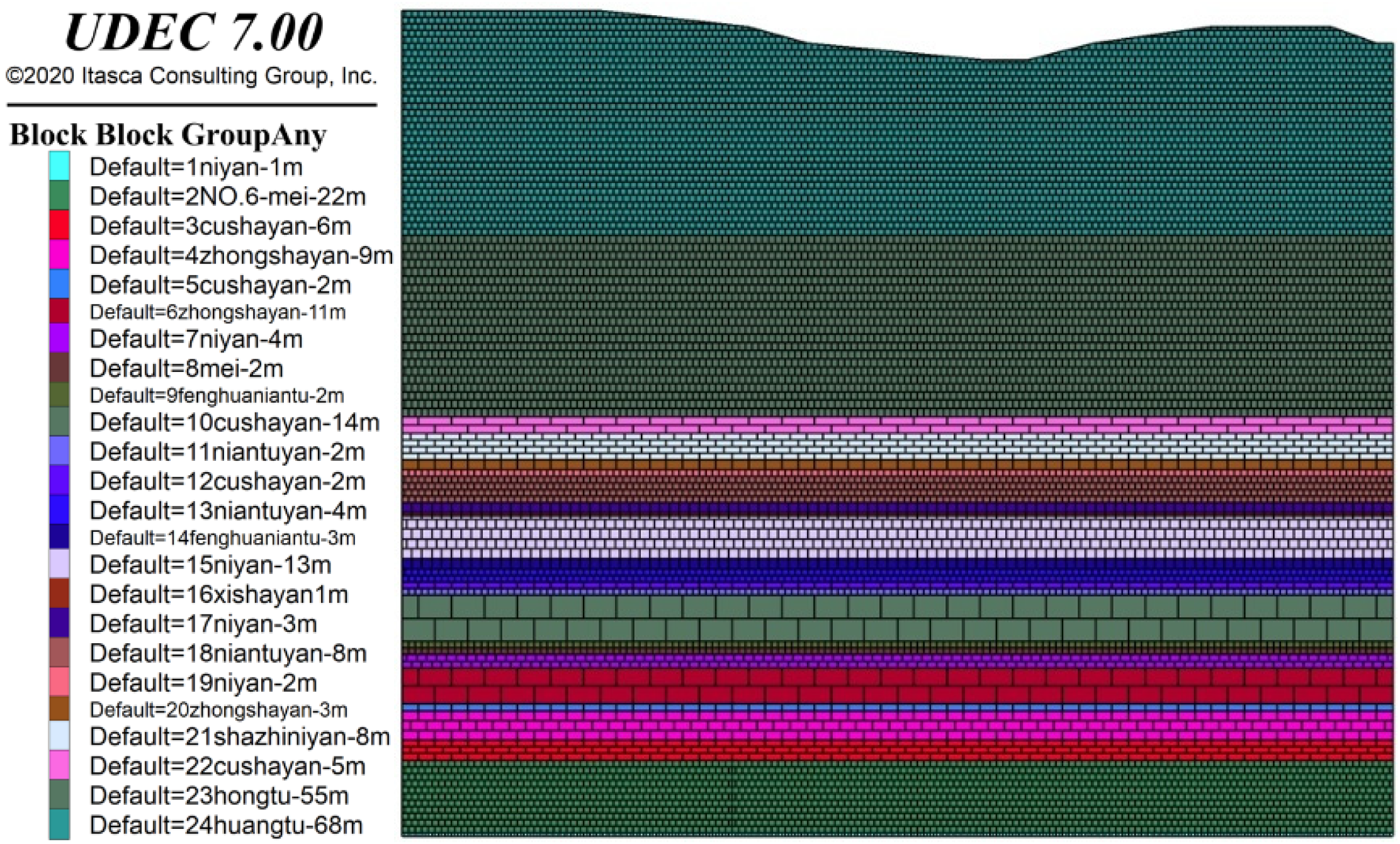
To evaluate the influence of roof-cutting position on overburden failure and surface subsidence, a two-dimensional distinct-element numerical model was developed using UDEC (Figure 8). The model represents a dip-oriented cross-section of the longwall panel and measures 400 m × 250 m (width × height). Fixed zero-displacement boundary constraints were applied along the bottom and at both lateral boundaries. Based on borehole logging data, the stratigraphic sequence was discretized into 24 layers, and the layer thicknesses and mechanical properties were assigned according to Table 3. Considering the well-developed discontinuities in the strata, joint elements were introduced to capture block separation, sliding, and progressive failure more realistically, thereby improving simulation fidelity. Because the coal seam dip in this mine is very small, all strata were assumed to be nearly horizontal in the model.
The longwall panel was excavated within Seam No. 6 (the second layer from the model bottom), and the extraction thickness was set to 22 m to represent the local maximum seam thickness. For roof-cutting scenarios, a continuous weakened band was implemented along the prescribed roof-cutting line at the target horizon. The mechanical weakening effect of directional presplitting was simulated by reducing the cohesion, tensile strength, and stiffness of the interface contacts within the weakened band, allowing it to evolve into a preferential fracture or slip surface under mining-induced disturbance. To simulate this weakened structural interface, the contact parameters within the weakened band were uniformly set to 80% of the corresponding intact values. Specifically, the normal stiffness, shear stiffness, cohesion, friction angle, and tensile strength were all assigned using a uniform reduction factor of 0.8. To ensure comparability among different cases, all parameters (material properties, boundary conditions, and face-advance step size) were kept identical except for the roof-cutting position parameter p. By comparing the displacement fields and surface subsidence profiles under different p values, the effect of roof-cutting location on the key-stratum failure mode and subsidence-mitigation performance was quantitatively assessed.
The numerical model in this study was designed primarily for comparative parametric analysis of different roof-cutting positions under identical boundary conditions, rather than for exact reconstruction of the full-scale far-field subsidence basin. Because all cases share the same model domain, boundary constraints, and face-advance scheme, the relative comparison among different p values remains valid. A larger domain may further reduce possible far-field boundary disturbance, but it would not alter the comparative conclusion regarding the effective roof-cutting interval identified in this study.
The stratigraphic sequence and layer thicknesses were determined from borehole logging and geological column data. The mechanical parameters were assigned according to the calibrated UDEC input parameter system for the representative lithologies. For presentation consistency, Young’s modulus and Poisson’s ratio were converted from the bulk and shear moduli used in the numerical model.
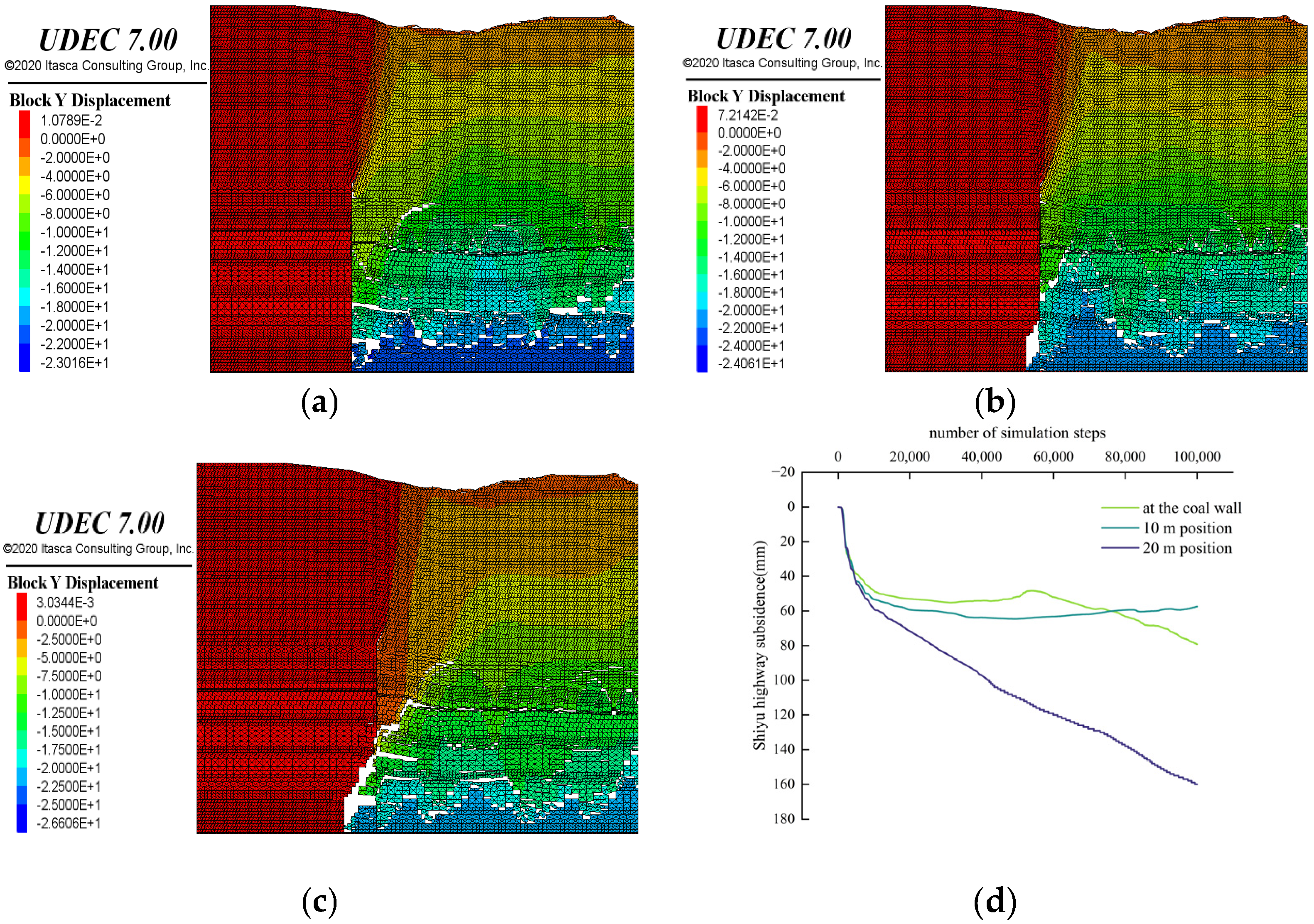
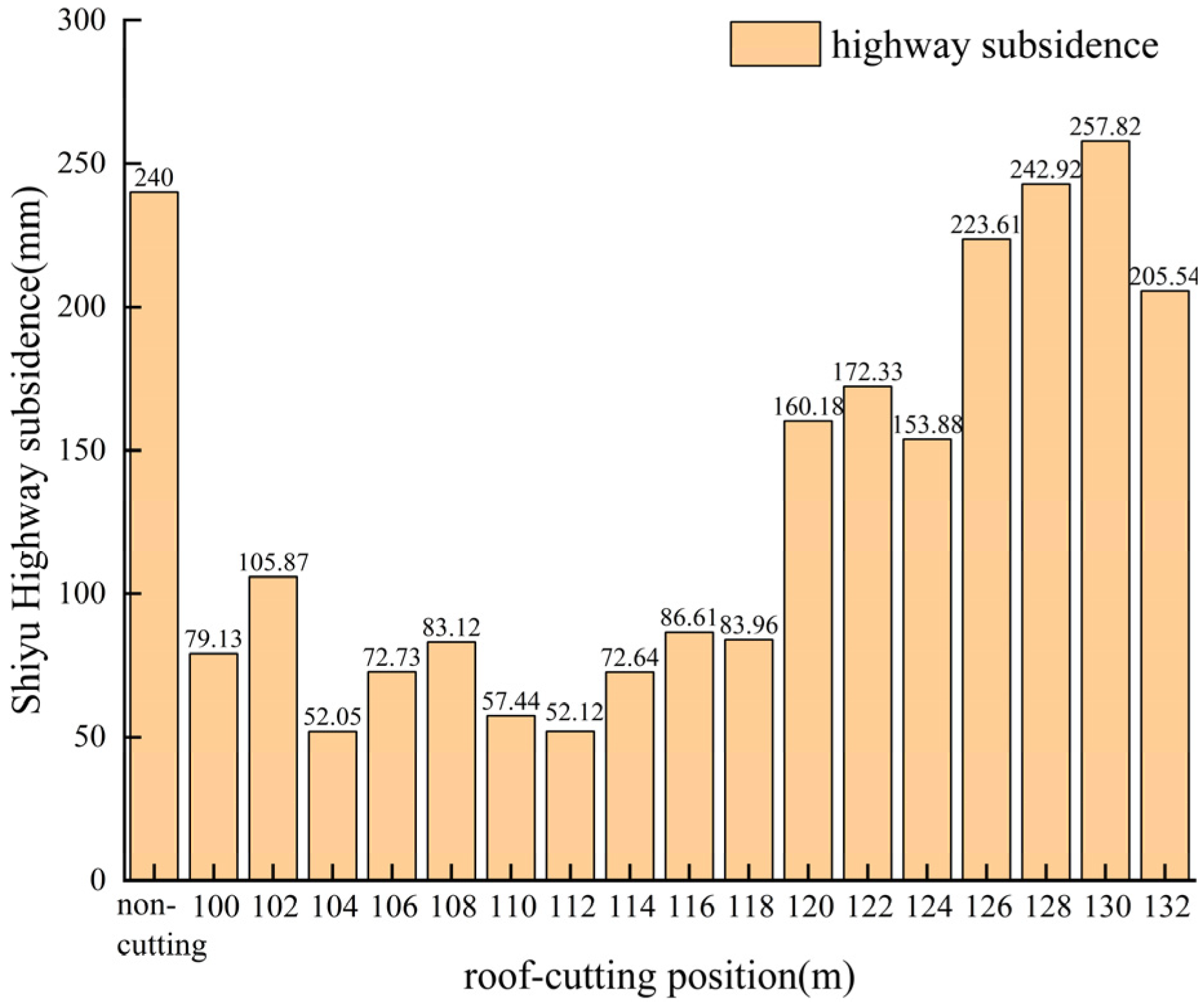
Multiple parametric cases were designed in the numerical model by varying the offset distance p between the pre-split weak plane and the coal wall of the auxiliary haulage gate entry (p = 0, 2, 4, …, 32 m). In each case, the pre-split fracture was configured to penetrate the full thickness of the target key stratum along the dip direction and to connect with the underlying caved zone, thereby providing an equivalent representation of an engineered weak plane created by deep-hole blasting or hydraulic fracturing. In the model, the weakened band was introduced only for the elements corresponding to the selected roof-cutting position; a continuous through-going pre-split fissure was simulated by reducing the strength and stiffness of contacts within the band, and it was assumed that the weakened interface could evolve into a potential new failure or slip surface under mining-induced disturbance. For clarity of comparison, three representative cases (p = 0 m, p = 10 m, and p = 20 m) are presented together with the corresponding overburden displacement contours and the subsidence curve of the Shiyu Highway (Figure 9), while the variation in maximum highway subsidence with the roof-cutting position is summarized in Figure 10.
The slight local fluctuation in maximum highway subsidence with increasing p reflects the discrete transition of key-stratum failure modes and the varying overlap between the pre-split weak plane and the bending-controlled zone of the primary key stratum, rather than a numerical anomaly. Overall, the mitigation effect is strongest in the interval p = 4–12 m and gradually deteriorates when p > 14 m.
The results indicate that the roof-cutting position (p) substantially modifies the stress state and failure mode of the key stratum [21,22], thereby enabling a pronounced regulation of surface subsidence. When (p < 14) m, the engineered weak plane exhibits strong coupling with the high-level primary key stratum, and the key-stratum failure mode shifts from integral rupture of a long cantilever beam to segmented failure of short cantilever beams. In essence, the pre-split crack introduces a new preferentially weakened segment within the key stratum with an ultra-long suspended span, partitioning it into two shorter suspended (cantilever-like) beams. As the effective span decreases, both the mid-span deflection and the peak bending moment are significantly reduced, which in turn mitigates energy accumulation and the transient energy release associated with integral rupture [12]. In particular, the subsidence-control performance is superior for (p = 4–12 m). For the representative case (p = 10) m, the maximum subsidence of the Shiyu Highway is approximately 57 mm, representing a reduction of about 76% relative to the non-cutting scenario; the subsidence profile becomes noticeably flatter. These observations suggest that, within this interval, the pre-split weak plane can effectively interrupt the stress–displacement transmission pathway of the key stratum, promoting an evolution from a large-span beam-type structure toward a multi-hinged short-beam–arch composite, thereby directionally weakening overburden movement.
As (p) increases beyond 14 m, the overlap between the weak plane and the mid-span bending-controlled zone of the primary key stratum decreases. The key stratum may still behave as a large-span suspended beam and undergo integral mid-span rupture, accompanied by enhanced block rotation and a broader range of horizontal stress transfer. Consequently, the subsidence-mitigation effect deteriorates, and the maximum highway subsidence shows an overall increasing trend. When (p > 20) m, the constraint imposed by the weak plane on the key-stratum rupture mode becomes limited; the high-level key stratum tends to revert to large-span voussoir-beam-type integral failure, and the overburden movement and subsidence-basin morphology approach those of the non-cutting condition.
In this study, the roof-cutting position was optimized using two combined criteria: (1) minimization of the maximum highway subsidence, and (2) flattening of the subsidence profile under the engineering requirement of highway protection. Based on these criteria, the interval p = 4–12 m was identified as the effective control range, and p ≈ 10 m was selected as the representative optimum.
Considering both the effectiveness of overburden-movement control and the stability requirements of the surrounding rock in the auxiliary haulage gate entry, the optimized roof-cutting position for this site is determined as an offset of approximately 10 m from the coal wall on the auxiliary haulage gate-entry side.

4.2. Surface Deformation Characteristics Before and After Roof Cutting

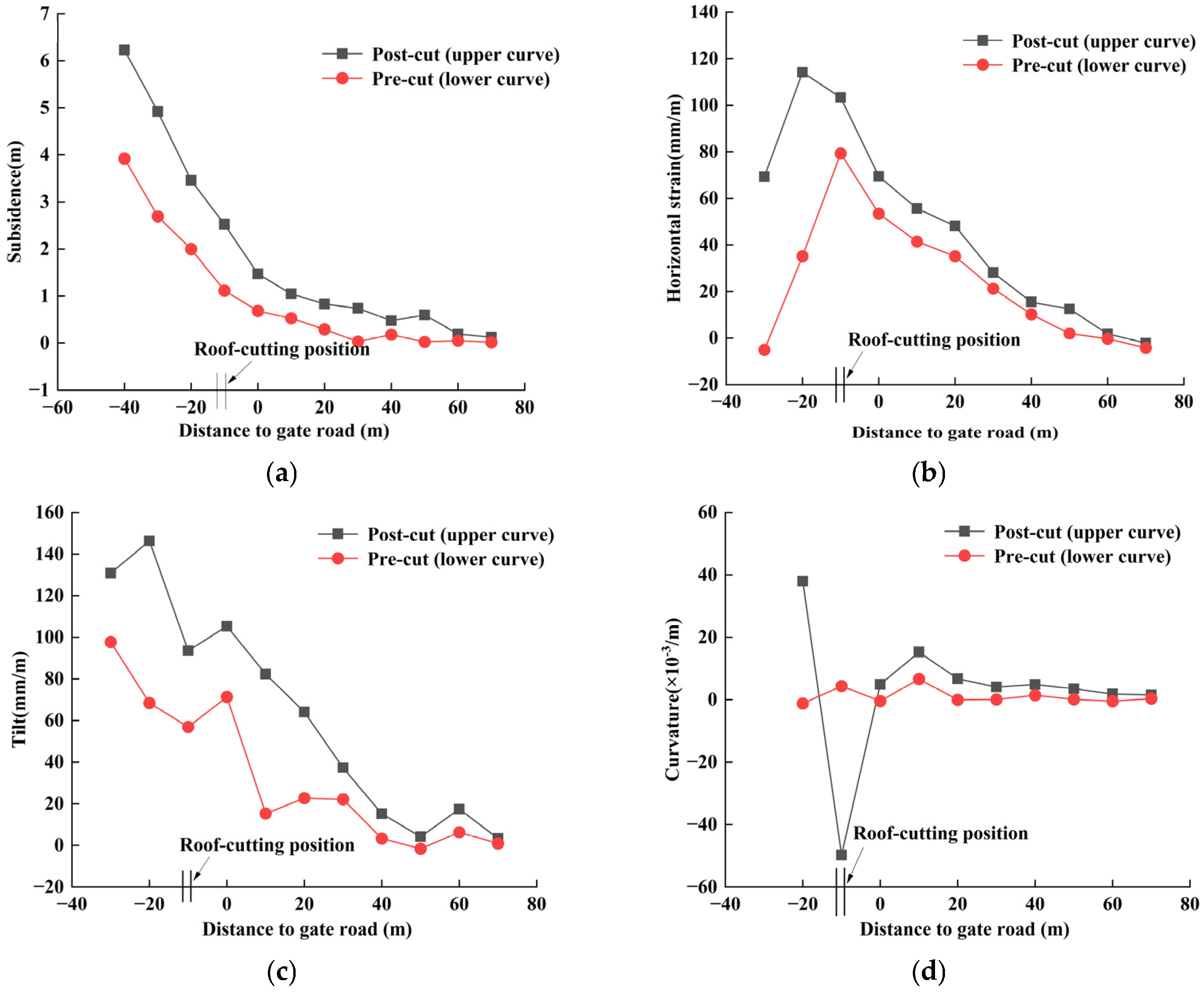
To quantitatively elucidate how directional roof cutting regulates the surface “deformation-gradient belt”, a dip-oriented profile along the gate-road direction was selected, and the surface horizontal deformation (horizontal strain), tilt, and curvature were compared before and after roof cutting (Figure 11). Taking the roof-cutting position (x ≈ 10 m) as the interface and considering the attenuation characteristics of deformation, the profile was divided into three zones: the roof-cutting control zone (x ≤ 10m), the transition zone (10 < x ≤ 40 m), and the boundary-stable zone (x > 40 m). Here, the zonation was defined using a combined physical–statistical criterion. The boundary at x ≈ 10 m corresponds to the optimized roof-cutting position, i.e., the physical location of the pre-split weakened band. The second boundary at x ≈ 40 m was identified from the monitored attenuation behavior of tilt, horizontal deformation, and curvature, beyond which all three indices decay into a low-amplitude stable regime. Therefore, the three zones represent the roof-cutting-controlled zone, the attenuation transition zone, and the boundary-stable zone, respectively.
(1) Roof-cutting control zone (x ≤ 10 m): Before roof cutting, the tilt remained at a high level (93–145 mm/m), the horizontal deformation was 72–114 mm/m, and the curvature exhibited strong positive–negative alternations, with extrema of approximately +37 × 10−3/m and −51 × 10−3/m. This reflects intense second-order deformation and gradient concentration induced by a far-field bending transfer through a continuous key stratum. After roof cutting, the tilt decreased to 55–96 mm/m (with the high-value segment markedly weakened). The horizontal deformation was reduced overall and showed localized transitions between tension and compression (2–81 mm/m). Meanwhile, curvature fluctuations converged to about ±(2–3) × 10−3/m, indicating that roof cutting significantly suppresses the high-gradient belt and curvature “kinks”.
(2) Transition zone (10 < x ≤ 40 m): Before roof cutting, the tilt attenuated from 82 mm/m to 36 mm/m, horizontal deformation was 33–58 mm/m, and curvature could still display pronounced peaks (up to +14 × 10−3/m). After roof cutting, the tilt further decreased and became more stable (13–20 mm/m). Horizontal deformation remained at a medium-to-low level (26–45 mm/m), and curvature was mostly constrained within 1.3 to + 5.1 × 10⁻³/m. These results suggest that the deformation-gradient belt contracts toward the roof-cutting side.
(3) Boundary-stable zone (x > 40 m): After roof cutting, the tilt essentially decayed to near zero (−4 to +4 mm/m), horizontal deformation was 2–16 mm/m, and curvature showed only minor fluctuations (±1 × 10⁻³/m). By contrast, before roof cutting this zone still retained a residual tilt (2–16 mm/m) and horizontal deformation (4–21 mm/m). Overall, roof cutting flattens the tilt profile and directly corresponds to a substantial reduction in curvature peaks. Mechanistically, this behavior indicates that roof cutting promotes segmented failure of the key stratum, shortens the effective suspended span, and enhances goaf compaction support, transforming surface deformation from “high-gradient concentration” to a “gentle, progressive variation”, thereby reducing the likelihood of surface fissure development and differential (step-like) displacement.
The pre-cut and post-cut curves are compared within a unified gate-road-based coordinate framework and equivalent profile orientation. Because the monitoring purpose changed after roof cutting, the comparison represents an engineering profile-level comparison rather than a strict repeated-measurement test on exactly the same physical survey line.
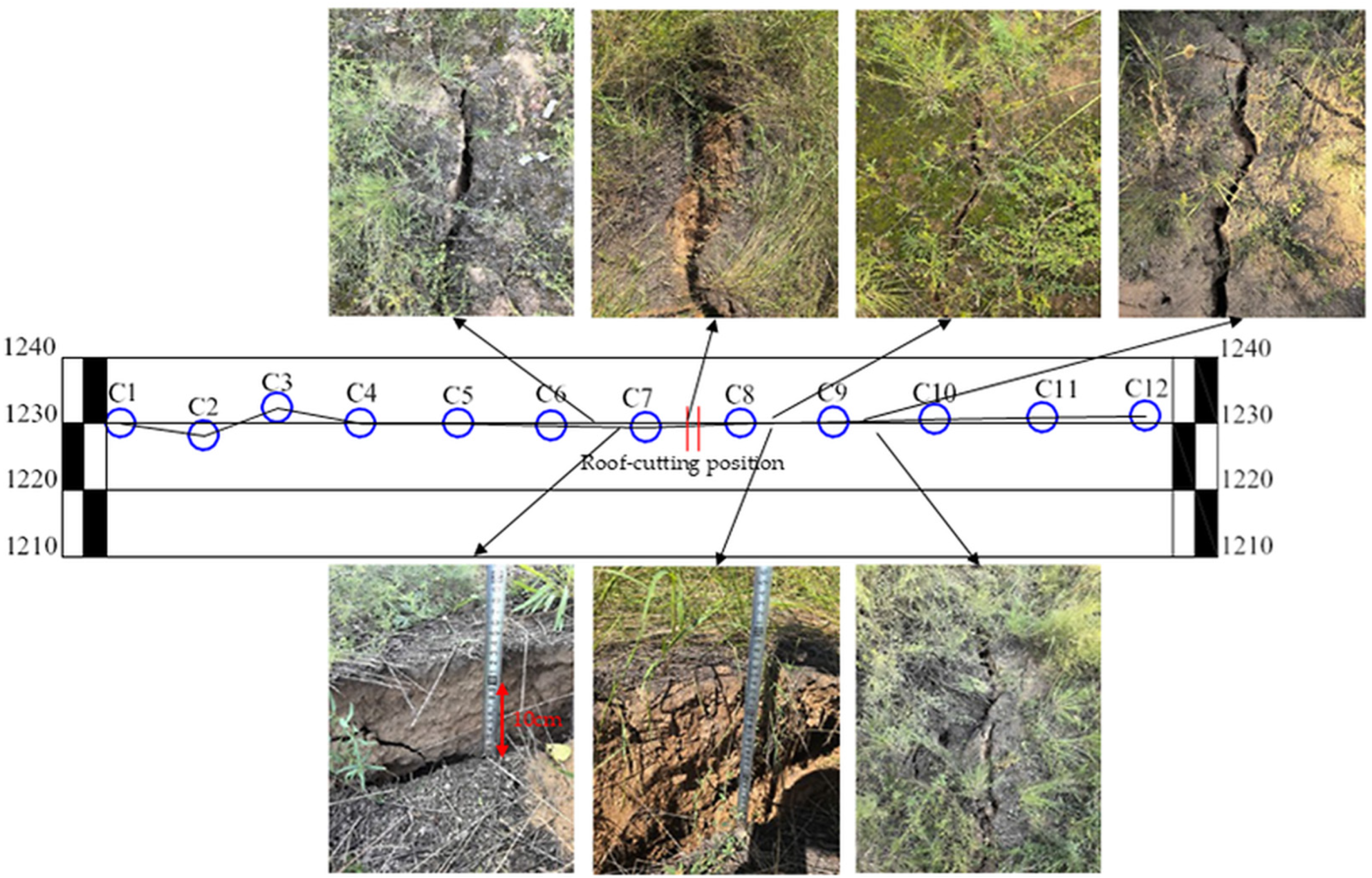
Fissures within the roof-cutting zone are predominantly tensile, with localized tension–shear composite features. They are mainly concentrated near the roof-cutting line and in the maximum deformation-gradient belt behind it [4]. Most fissures exhibit typical widths of approximately 10–40 cm, while local widening under the combined effects of V-shaped gully slope geometry and rainfall infiltration may reach up to 60 cm, and are further enlarged by the combined effects of the V-shaped gully slope and rainfall infiltration (Figure 12).
For the roof-cutting case, several parameters are expressed as ranges because they represent the min–max envelope derived from multiple survey lines within the roof-cutting influence zone, rather than uncertainty in a single measurement. Accordingly, the pre-cut and post-cut datasets were compared within a unified gate-road-based coordinate framework and equivalent profile orientation; thus, the comparison should be understood as a profile-level engineering comparison rather than a strict repeated-measurement test on identical physical survey lines.
Field observations indicate that most fissures exhibit typical widths of approximately 10–40 cm, whereas local widening may reach up to 60 cm under the combined effects of gully-slope geometry and rainfall infiltration. A scale bar has been added to Figure 12 to improve the direct readability of fissure width.
Based on these monitoring results, key ground-movement parameters—including initiation distance, advance influence angle, dip-direction influence range, and dip boundary angle—were back-calculated and compared with those under the conventional non-cutting mining condition. In addition, the lag angle of the peak subsidence rate and the lagging influence distance were evaluated statistically. The comparison results are summarized in Table 4.

5. Conclusions

(1) Directional presplitting roof cutting mitigates surface subsidence by reconstructing the overburden structure and weakening the long-range stress-transfer chain. As a result, the movement of the high-level key stratum shifts from integral bending-dominated control to segmented block motion, which provides the structural basis for the convergence of the subsidence influence range.
(2) An equivalent mining-depth model for subsidence-boundary convergence was established for thick unconsolidated cover. Roof cutting causes both an inward shift of the boundary reference point and a reduction in the effective bedrock thickness participating in the far-field bending transfer, represented by the back-calculated equivalent parameter Δ H . Together with the roof-cutting offset p, Δ H governs the decrease in horizontal influence distance. This predicted boundary-convergence trend is supported by the field measurements. After roof cutting, the monitored dip-direction influence range showed an overall contraction, from 81.56 to 113.86 m before roof cutting to 39.25–89.47 m after roof cutting, while the dip boundary angle increased from 69.5° to 74.55–76.03°. These observations indicate an inward migration and steepening of the subsidence boundary, which are consistent with Equation (25). Although the present model remains semi-empirical in parameter identification, its predicted boundary-convergence trend agrees well with the measured field response.
(3) A segmented probability-integral model (PIM) was developed to describe boundary convergence and the formation of a kink-like high-gradient belt under roof-cutting conditions. In this model, p shifts the effective boundary origin, whereas Δ H modifies the propagation scale through the main influence radius. Their combined action flattens the outer subsidence profile and narrows the influence range. The predicted localization of the deformation-gradient belt is qualitatively consistent with the monitored reduction and concentration of curvature and tilt peaks after roof cutting.
(4) Numerical and field results indicate that the roof-cutting position is a decisive parameter governing the key-stratum failure mode and subsidence-control performance, with a representative optimum near p ≈ 10 m for this site. At this position, the maximum subsidence of the Shiyu Highway is approximately 57 mm, corresponding to a reduction of 76.25% (about 76%) relative to the non-cutting case of 240 mm. After roof cutting, the dip-direction influence range, boundary angle, and deformation gradients all show clear convergence, although fissure development and possible discontinuous deformation near the roof-cutting line still require close monitoring.
Limitations. The present study has several limitations. First, the proposed boundary-convergence model remains semi-empirical in parameter identification, although it is physically constrained by the structural mechanism of roof-cutting-induced weakening. Second, the pre-cut and post-cut monitoring datasets are compared within a unified profile-based coordinate framework, but they do not constitute a strict repeated-measurement test on exactly the same physical survey line. Third, the available field observations mainly verify the short- to medium-term response after roof cutting, and longer-term stable subsidence monitoring is still needed to further validate the late-stage behavior predicted by the model.

Author Contributions

Formal analysis, W.Z.; Investigation, W.Z.; Resources, H.W.; Writing—original draft, W.Z.; Writing—review and editing, W.Z.; Supervision, H.W.; Project administration, H.W.; Funding acquisition, H.W. All authors have read and agreed to the published version of the manuscript.

Funding

This research received no external funding.

Data Availability Statement

The data presented in this study are available within the article.

Conflicts of Interest

The authors declare no conflicts of interest.

References

  1. Kang, H.; Xu, G.; Wang, B.; Wu, Y.; Jiang, P.; Pan, J.; Ren, H.; Zhang, Y.; Pang, Y. Forty years development and prospects of underground coal mining and strata control technologies in China. J. Min. Strat. Control. Eng. 2019, 1, 013501. [Google Scholar] [CrossRef]
  2. Hu, B.; Guo, W. Counter measures and technical development direction of damage prevention in coal mining subsidence area. Coal Sci. Technol. 2022, 50, 21–29. [Google Scholar] [CrossRef]
  3. Qian, M.; Xu, J. Behaviors of strata movement in coal mining. J. China Coal Soc. 2019, 44, 973–984. [Google Scholar] [CrossRef]
  4. Chen, C.; Hu, Z. Research advances in formation mechanism of ground crack due to coal mining subsidence in China. J. China Coal Soc. 2018, 43, 810–823. [Google Scholar] [CrossRef]
  5. Xu, N.; Gao, C.; Ni, X.; Liu, M. Study on surface cracks law of fully-mechanized top coal caving mining in shallow buried depth and extra thick seam. Coal Sci. Technol. 2015, 43, 124–128, 97. [Google Scholar] [CrossRef]
  6. Cui, X.; Deng, K. Research review of predicting theory and method for coal mining subsidence. Coal Sci. Technol. 2017, 45, 160–169. [Google Scholar]
  7. Guo, W.; Yang, W.; Wu, D. Current status and progress of subsidence control technology in China coal mines. J. Min. Strat. Control. Eng. 2024, 6, 5–20. [Google Scholar] [CrossRef]
  8. Xu, J.; You, Q.; Zhu, W.; Li, X.; Lai, W. Theoretical study of strip-filling to control mining subsidence. J. China Coal Soc. 2007, 32, 119–122. [Google Scholar]
  9. Wang, J.; Wang, S.; Yang, J.; Wang, Q.; Ma, L.; He, M. Roof failure mechanism of gob-side entry retaining by roof cutting and pressure releasing and its control technology. Coal Sci. Technol. 2017, 45, 80–84. [Google Scholar] [CrossRef]
  10. He, M.; Song, Z.; Wang, A.; Yang, H.; Qi, H.; Guo, Z. Theory of longwall mining by using roof cutting shortwall team and 110 method—The third mining science and technology reform. Coal Sci. Technol. Mag. 2017, 37, 1–9. [Google Scholar]
  11. Ma, J.; Li, X.; Yao, Q.; Xia, Z.; Xu, Q.; Shan, C.; Sidorenko, A.; Aparin, A. Numerical simulation on mechanisms of dense drilling for weakening roofs and its application in roof control. J. Cent. South Univ. 2023, 30, 1865–1886. [Google Scholar] [CrossRef]
  12. Meng, Y.; Jing, H.; Sun, S.; Chen, M.; Huang, K. Experimental and numerical studies on the anisotropic mechanical characteristics of rock-like material with bedding planes and voids. Rock Mech. Rock Eng. 2022, 55, 7171–7189. [Google Scholar] [CrossRef]
  13. Meng, Y.; Yu, L.; Yuan, L.; Hua, X.; Ma, Y.; Zhuang, J.; Jing, H.; Liu, X. Effects of bedding angle and confining pressure on the mechanical behavior, energy dissipation and micro damage evolution mechanism of layered rock mass under triaxial compression conditions. J. Mater. Res. Technol. 2025, 36, 1259–1272. [Google Scholar] [CrossRef]
  14. Meng, Y.; Jing, H.; Liu, X.; Yin, Q.; Wei, X. Experimental and numerical investigation on the effects of bedding plane properties on the mechanical and acoustic emission characteristics of sandy mudstone. Eng. Fract. Mech. 2021, 245, 107582. [Google Scholar] [CrossRef]
  15. Guo, W.; Bai, E.; Zhao, G. Current status and progress on overburden and surface damage and prevention technology of high-intensity mining. J. China Coal Soc. 2020, 45, 509–523. [Google Scholar] [CrossRef]
  16. Hu, J.; He, M.; Wang, J.; Ma, Z.; Wang, Y.; Zhang, X. Key Parameters of Roof Cutting of Gob-Side Entry Retaining in a Deep Inclined Thick Coal Seam with Hard Roof. Energies 2019, 12, 934. [Google Scholar] [CrossRef]
  17. Hu, C.; Wang, E.; Li, Q.; Wang, Y.; Li, Y.; Sha, X. Research on the Key Technology of Gob-Side Entry Retaining by Roof Cutting for Thick and Hard Sandstone Roofs. Sustainability 2022, 14, 9941. [Google Scholar] [CrossRef]
  18. Wang, K.; Li, J.; Jin, Z. Influence of the Primary Key Stratum on Surface Subsidence during Longwall Mining. Sustainability 2022, 14, 15027. [Google Scholar] [CrossRef]
  19. He, Y.; Zhang, J.; Yang, T.; Wu, J.; Gao, S.; Sun, J. Study on the Bearing Structure of Key Strata and the Linkage Evolution Mechanism of Surface Subsidence in Shallow Coal Seam Mining. Appl. Sci. 2024, 14, 9608. [Google Scholar] [CrossRef]
  20. Liu, D.; Deng, N.; Yao, T.; Shang, H. Study on parameters of Weibull time function model based on sited measured mining subsidence data. Coal Sci. Technol. 2021, 49, 152–158. [Google Scholar]
  21. Zhu, H.; Wang, H. Case Study on Pre-Splitting Blasting Reasonable Parameters of Goaf-Side Entry Retained by Roof Cutting for Hard Main Roof. Processes 2023, 11, 350. [Google Scholar] [CrossRef]
  22. Fan, D.; Liu, X.; Tan, Y.; Song, S.; Gu, Q.; Yan, L.; Xu, Q. Roof Cutting Parameters Design for Gob-Side Entry in Deep Coal Mine: A Case Study. Energies 2019, 12, 2032. [Google Scholar] [CrossRef]
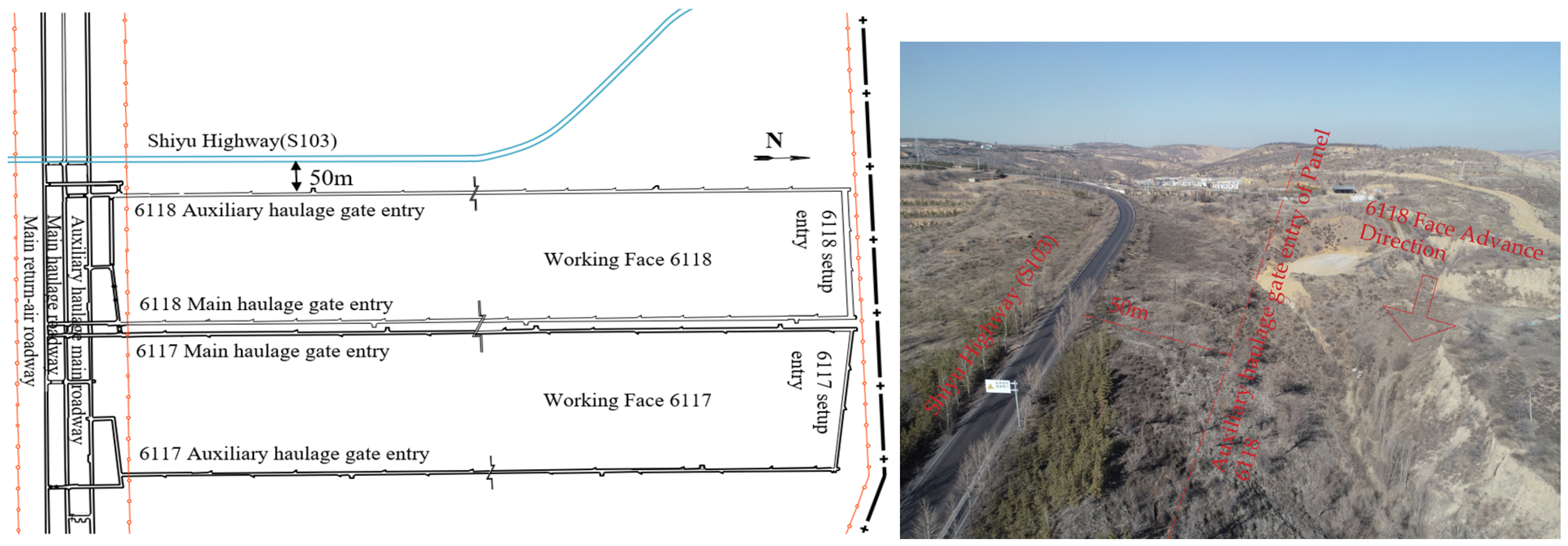
Figure 1. Relative positions of the S103 Provincial Highway and Panel 6118. The solid lines denote the panel boundaries, and the road line indicates the alignment of the S103 Provincial Highway.
Processes 14 01218 g001
Figure 2. Layout of monitoring points and survey lines. A–E denote the baseline survey lines established before roof cutting, whereas L, C1, D1, E1, F1, G1, and H1 denote the additional survey lines arranged after roof cutting within the roof-cutting influence zone.
Processes 14 01218 g002
Figure 3. Equivalent beam model of the key stratum. Here, q denotes the equivalent uniformly distributed load, lc denotes the critical suspended span, y is the distance from the neutral axis to the extreme tensile fiber, and I is the second moment of area of the section.
Processes 14 01218 g003
Figure 4. Geometric schematic of the inward migration of the subsidence-basin boundary under roof-cutting conditions. The hatched zone denotes bedrock, whereas the dotted zone denotes the unconsolidated overburden.
Processes 14 01218 g004
Figure 5. Mechanical idealization of articulated key-stratum blocks before and after roof cutting.
Processes 14 01218 g005
Figure 6. Schematic comparison of key-stratum structural response and surface movement modes before and after roof cutting. (a) Non-cutting: the key stratum forms an articulated structure (continuous movement). (b) Roof cutting: the key stratum behaves as a segmented structure (discontinuous movement).
Processes 14 01218 g006
Figure 7. Equivalent rectangular subsidence void model induced by key-stratum presplitting.
Processes 14 01218 g007
Figure 8. UDEC numerical model and boundary conditions.
Processes 14 01218 g008
Figure 9. Comparison of overburden displacement contours (m) and Shiyu Highway subsidence profiles (mm) under different roof-cutting positions. (a) Roof-cutting line at 0 m in by the coal wall (coal-wall side). (b) Roof-cutting line at 10 m in by the coal wall. (c) Roof-cutting line at 20 m in by the coal wall. (d) Subsidence profiles of the Shiyu Highway under different roof-cutting positions.
Processes 14 01218 g009
Figure 10. Variation in the maximum subsidence of the Shiyu Highway with roof-cutting position.
Processes 14 01218 g010
Figure 11. Comparison of surface-deformation metrics before and after roof cutting along the gate-road profile. (Note: In each subfigure, the upper curve corresponds to the post-cut survey line, whereas the lower curve corresponds to the pre-cut survey line; the arrow indicates the roof-cutting position; x is the distance from the monitoring point to the gate road, with positive values pointing out by the gate road and negative values in by the gate road). (a) Surface subsidence before and after roof cutting. (b) Surface horizontal deformation before and after roof cutting. (c) Surface tilt before and after roof cutting. (d) Surface curvature before and after roof cutting.
Processes 14 01218 g011
Figure 12. Field photograph of surface fissure development in the roof-cutting zone (with scale bar). The alternating black-and-white bar denotes the scale bar for direct visual estimation of fissure width.
Processes 14 01218 g012
Table 1. Concise comparison of representative subsidence-mitigation measures for extra-thick LTCC under thick unconsolidated overburden.
MethodSubsidence-Control EffectRecovery RatioEconomic CostApplicability to Extra-Thick LTCC Under Thick Unconsolidated Overburden
Backfill miningStrong overall control of subsidence and deformationLow to moderateHighConditionally applicable, but large-scale implementation is difficult under high-intensity LTCC because of the large filling demand and system complexity
Strip miningModerateLowModerateLimited applicability; difficult to reconcile with high-output LTCC and results in considerable coal loss
Protective coal pillarsModerate to strong in local protection zonesLowModerate (with high resource loss)Applicable only under specific protection requirements; difficult to achieve both high recovery and wide-range subsidence control
Directional presplitting roof cuttingModerate to strong, especially for narrowing the influence range and reducing deformation gradients near protected infrastructureHighModerateHighly suitable as an active structural-control measure for extra-thick LTCC under thick unconsolidated overburden, although parameter optimization and field verification are required
Table 2. Characteristic parameters of ground-movement deformation above Panel 6118. (Note: “N/A” indicates that the corresponding parameter is not applicable or not determinable for that survey line because the monitoring lines had different orientations and functions in the monitoring network).
Survey LineMaximum Subsidence, Wmax (mm)Subsidence Coefficient, kn (–)Initiation Distance (m)Advance Influence AngleDip-Direction Influence Range (m)Lag Distance/Post-Mining Influence Distance (m)Lag Angle of Peak Subsidence Rate (°)
A12,2100.6105N/AN/AN/AN/A73.29
B39500.1975N/AN/A113.86247.2670.28
C37300.1865N/AN/A81.56N/A69.08
D16,8390.842142.0356.99N/A252.1876.41
Table 3. Thickness and mechanical parameters of representative overburden strata for Panel 6118 (ordered from top to bottom).
No.LithologyThickness (m)E (GPa)νγ (kN·m−3)c (MPa)φ (°)T (MPa)
24Loess680.810.35418.440.085450.06
23Red clay550.810.35418.440.085450.06
22Coarse-grained sandstone59.470.18420.702.6362
21Sandy mudstone85.510.14718.742.16366
20Medium-grained sandstone311.510.15124.032.7420.52
19Mudstone26.750.12519.421300.6
18Claystone84.440.38618.542.8250.18
17Mudstone36.750.12519.421300.6
16Fine-grained sandstone112.410.24125.802.5420.12
15Mudstone136.750.12519.421300.6
14Weathered clay30.550.14717.660.2300.06
13Claystone45.510.14718.542.16360.6
12Coarse-grained sandstone29.470.18420.702.6362
11Claystone25.510.14718.542.16360.6
10Coarse-grained sandstone149.470.18420.702.6362
9Weathered clay20.550.14717.660.2300.06
8No. 8 coal seam21.820.29815.112.5392
7Mudstone46.750.12519.421300.6
6Medium-grained sandstone1111.510.15124.032.7420.52
5Coarse-grained sandstone29.470.18420.702.6362
4Medium-grained sandstone911.510.15124.032.7420.52
3Coarse-grained sandstone69.470.18420.72.6362
2No. 6 coal seam22.001.820.29815.112.5392
1Mudstone1.046.750.12519.421.0300.6
Table 4. Comparison of key ground-movement parameters before and after roof cutting. (Note: For the roof-cutting case, range values denote the min–max envelope obtained from multiple survey lines within the roof-cutting influence zone and are used to represent the spatial variability of post-cut ground response. The comparison is conducted within a unified gate-road-based coordinate framework and equivalent profile orientation.).
ParameterNon-Cutting CaseRoof-Cutting MiningTrend
Initiation distance (m)142.0366.11~66.12Significantly decreased
Advance influence angle (°)56.99~59.6673.19Markedly increased
Dip-direction influence range (m)81.56~113.8639.25~89.47Significantly converged
Dip boundary angle (°)69.574.55~76.03Increased (steeper boundary)
Lag angle of peak subsidence rate (°)72.2775.25Overall increased
Lagging influence distance (m)247~252250~280Comparable (same order of magnitude)
Disclaimer/Publisher’s Note: The statements, opinions and data contained in all publications are solely those of the individual author(s) and contributor(s) and not of MDPI and/or the editor(s). MDPI and/or the editor(s) disclaim responsibility for any injury to people or property resulting from any ideas, methods, instructions or products referred to in the content.