Review

Detoxification and Valorization of Hazardous Secondary Aluminum Dross: A Critical Review of Contaminant Transformation, Processing Technologies, and Emerging Frontiers
1
Guangdong Education Department Key Laboratory of Resources Comprehensive Utilization and Cleaner Production, School of Environmental Science and Engineering, Guangdong University of Technology, Guangzhou 510006, China
2
South China Institute of Environmental Science, Ministry of Ecology and Environment of China, Guangzhou 510530, China
3
Key Laboratory of Radioactive and Rare Scattered Minerals, Ministry of Natural Resources, Shaoguan 512026, China
4
Cooperative Extension, University of Maine, Orono, ME 04469, USA
*
Author to whom correspondence should be addressed.
Processes 2026, 14(8), 1212; https://doi.org/10.3390/pr14081212
Submission received: 14 March 2026 / Revised: 4 April 2026 / Accepted: 7 April 2026 / Published: 10 April 2026

Abstract

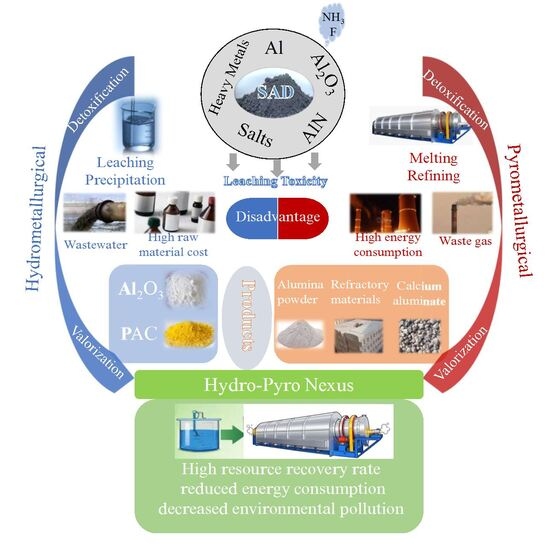
Secondary aluminum dross (SAD) is classified as hazardous waste (HW48) due to its content of toxic (e.g., heavy metals, fluorides) and highly reactive phases (e.g., aluminum nitride, AlN). This review systematically synthesizes the sources, heterogeneous composition, and environmental risks of SAD, and critically evaluates state-of-the-art hydrometallurgical and pyrometallurgical detoxification and resource-utilization technologies. Comparative, mechanism-oriented analyses are used to elucidate the respective advantages, limitations, and scalability of wet versus thermal routes. Particular emphasis is placed on the migration, transformation, and ultimate fate of key hazardous species (AlN, fluorides, chlorides, and heavy metals) during treatment and product valorization. An integrated hydro–pyro nexus is conceptualized as synergistic hybrid processing that transcends the trade-offs between efficiency, energy consumption, and product purity that currently limit standalone technologies. Emerging hybrid process concepts, advanced additives, and circular-economy-oriented product pathways are evaluated to address current technological bottlenecks. Finally, critical knowledge gaps and research priorities are identified to accelerate safe, low-carbon, and high-value utilization of SAD.

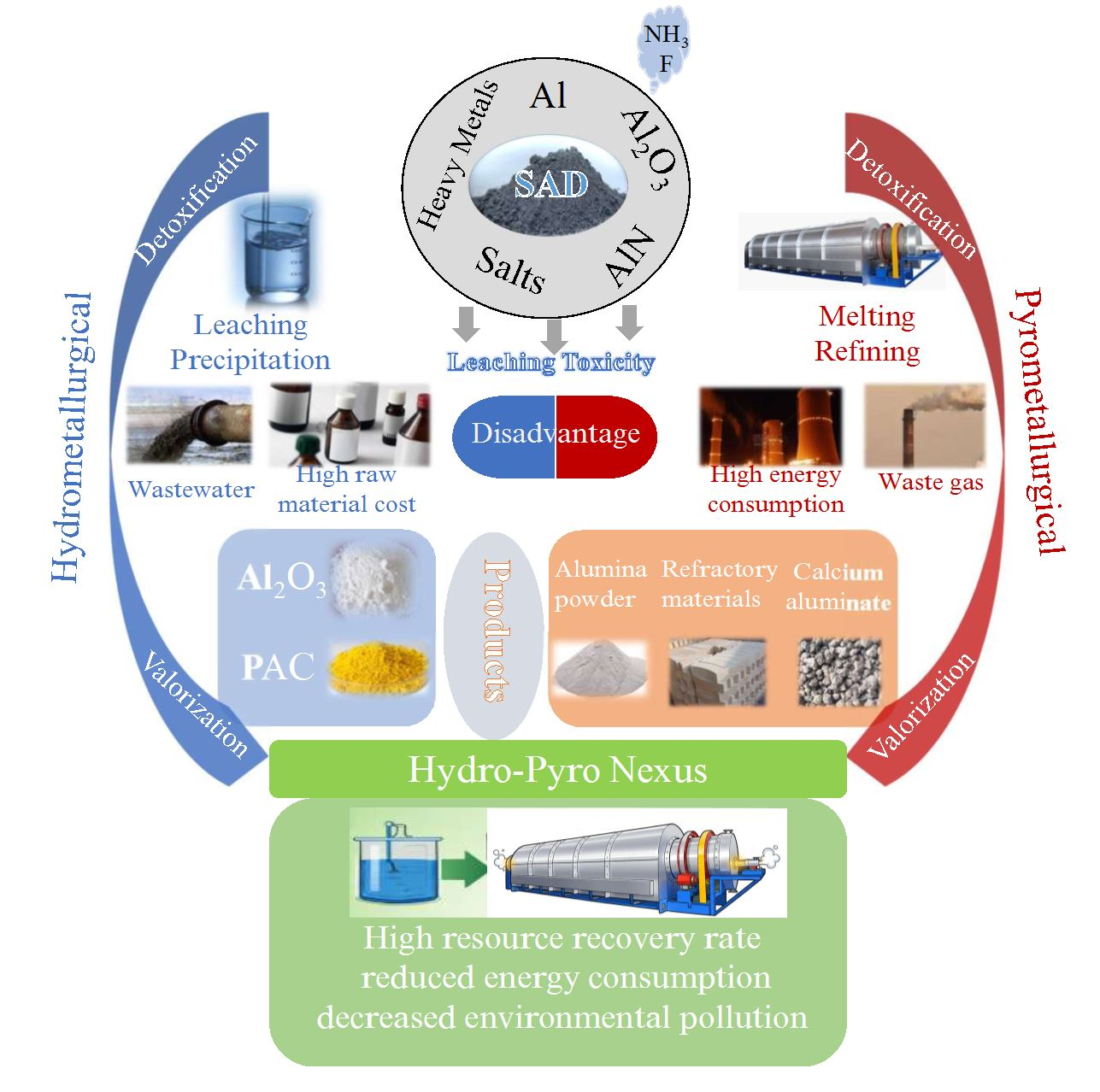
Graphical Abstract

1. Introduction

With the acceleration of global industrialization, aluminum (Al) has become a cornerstone material in construction, transportation, and electronics. However, Al production and recycling inevitably generate large quantities of Al dross [1]. Al dross is a mixture of metallic Al, alumina, aluminum nitride (AlN), fluorides, chlorides, carbides, and trace heavy metals [2]. Due to its chemical reactivity and leaching potential, secondary aluminum dross (SAD) is classified as hazardous waste (HW48) in China. SAD represents a significant industrial byproduct, constituting 8–15 wt.% of primary Al production [3]. This corresponded to a global generation of nearly 5.5 million tons in 2023, with China alone producing over 3 million tons annually [4]. Consequently, SAD not only poses a considerable environmental challenge but also represents a secondary resource rich in Al compounds if properly detoxified.

Compositional Characteristics and Hazard Assessment of Aluminum Dross

A clear distinction between primary aluminum dross (PAD) and SAD is essential for understanding their respective environmental risks and treatment requirements. PAD, commonly referred to as white dross, is generated directly from primary aluminum smelting or melting of clean scrap. It typically contains 50–85 wt.% metallic Al along with a mixture of alumina (Al2O3), AlN, and minor amounts of salts and oxides [3,5]. The high metallic Al content renders PAD a valuable resource for conventional metal recovery via rotary salt furnace or other pyrometallurgical processes.
In contrast, SAD, or black dross, is the residue remaining after the recovery of metallic Al from PAD. This processing enriches the concentration of non-metallic phases, resulting in a highly heterogeneous matrix with significantly lower residual Al (3–15 wt.%) and elevated levels of hazardous constituents [6]. A generalized compositional range for SAD is presented in Table 1. This fundamental difference in composition underpins the divergent treatment strategies: PAD is primarily processed for metallic Al recovery, whereas SAD necessitates integrated detoxification and valorization, as reviewed herein.
The compositional variability of SAD is governed by a complex interplay of upstream factors, including the composition of the original Al scrap, the type and quantity of fluxing agents used in melting, the efficiency of primary metal recovery, and the handling and storage conditions. Scrap sources range from clean manufacturing waste (e.g., extrusions, sheet) to post-consumer scrap (e.g., packaging, automotive components), with the latter introducing higher levels of organic contaminants, paints, and alloying elements (e.g., Si, Cu, Mg, Zn) [5]. Fluxing agents, typically NaCl–KCl mixtures with additions of cryolite (Na3AlF6) or fluorspar (CaF2), are employed to promote coalescence of metallic Al and to scavenge oxides. Variations in flux composition and dosage directly translate to variability in the residual salt and fluoride content of SAD [6,7]. The efficiency of the primary metal recovery process is a critical determinant of SAD composition. Inefficient recovery leaves higher residual metallic Al, which can pose explosion risks during subsequent processing, while also influencing the economic viability of recovery [3]. Subsequent storage conditions, particularly exposure to moisture, can induce partial hydrolysis of AlN and Al4C3. As detailed in Reactions (1) and (2), altering the phase composition and potentially initiating hazardous gas release [8]. In contrast, PAD has a high content of metallic Al and alumina and is routinely processed for metal recovery with lower hazard potential. Environmental risks associated with SAD and the circular economy imperative underscore the necessity of integrated detoxification–valorization strategies rather than its simple disposal. The implications of this compositional variability for technology selection are profound. As illustrated in Table 2, the optimal processing route is contingent on the specific characteristics of the SAD batch.
AlN + 3H2O = Al(OH)3 + NH3
Al4C3 + 12H2O = 4Al(OH)3 + 3CH4
This compositional dependence underscores the necessity of thorough feedstock characterization prior to process design. The development of adaptive processing strategies, potentially guided by real-time analytical techniques and machine learning, represents a critical research direction for achieving robust and economically viable SAD valorization. The hydro–pyro nexus (Section 5) addresses compositional variability, as the hydrometallurgical stage can be tuned to selectively remove the most variable and problematic contaminants (salts, AlN, fluorides), yielding a more consistent feedstock for the downstream thermal valorization stage.
Achieving economically viable and environmentally benign SAD processing requires overcoming challenges related to energy intensity, secondary pollution, and product purity variability. In recent years, research has increasingly shifted from single-objective detoxification toward multi-objective resource utilization, targeting the production of alumina, coagulants, refractories, ceramics, and construction materials [9]. Such approaches not only reduce reliance on primary bauxite but also align with circular economy and carbon-reduction goals. However, a critical gap remains: existing technologies operate within a trade-off between process efficiency and environmental impact. Hydrometallurgical routes offer precision detoxification but generate complex, high-salinity wastestreams; pyrometallurgical routes provide robustness and product stability but incur high energy consumption and air emissions. Accordingly, this review compares wet and thermal routes, synthesizes their underlying mechanisms, and argues that the most viable path forward lies in their intelligent integration, what we term the hydro–pyro nexus. The hydro–pyro nexus is essential for overcoming the fundamental trade-offs between efficiency, energy use, and product purity that currently limit standalone processes. We therefore focus on (i) mechanistic removal of hazardous constituents, (ii) comparative evaluation of wet and thermal routes, and (iii) the principles and pathways for integrated, high-value utilization of SAD.

2. Overview of SAD Treatment and Disposal Processes

Research and practice have established three main technological routes for SAD detoxification: hydrometallurgical (wet), pyrometallurgical (thermal), and hybrid processes. The overarching goal is to eliminate AlN, fluorides, and chlorides, and to recover valuable components. Emerging integrated processes that combine hydrothermal pretreatment with pyro-processing are gaining attention for improved efficiency and lower emissions. Table 3 summarizes the advantages and disadvantages of these core processes based on current literature, providing a framework for the detailed mechanistic and comparative analyses that follow in Section 3, Section 4 and Section 5.
The energy consumption estimates presented in Table 3 are derived from literature-reported process conditions and typical industrial-scale utility requirements. Hydrometallurgical routes are characterized by energy inputs primarily for heating leach solutions and mechanical agitation, typically ranging from 200 to 800 kWh/t of SAD. In contrast, pyrometallurgical routes require substantially higher energy inputs (600–2500 kWh/t) due to the endothermic nature of phase transformations and the need to maintain temperatures between 800 and 1450 °C. Hybrid processes, by partitioning contaminant removal to a lower-temperature hydro-stage, can reduce the thermal load on the subsequent pyro-stage, achieving total energy consumption between 300 and 800 kWh/t.
The selection among these routes is not merely technical but involves trade-offs in energy consumption, capital investment, feedstock tolerance, and product market value. While hydrometallurgy excels in selective contaminant removal under mild conditions, it struggles with wastewater management and sensitivity to compositional variability. Pyrometallurgy offers operational simplicity and robust detoxification but at the cost of high energy demand and potential air quality concerns. Though promising, hybrid approaches largely remain at the conceptual or pilot stage and require systematic investigation to realize their theoretical benefits. The following Section 3 and Section 4 provide detailed mechanistic analyses of standalone hydro- and pyrometallurgical processes, setting the foundation for Section 5’s critical examination of integrated hybrid systems.

2.1. Technology Readiness and Scalability Assessment

The transition from laboratory-scale research to industrial-scale implementation represents a critical gap in the SAD valorization landscape. To enhance the practical utility of this review, the technologies discussed herein are systematically categorized by their Technology Readiness Level (TRL), and documented industrial applications are identified (Table 4). Pyrometallurgical routes are emerging as a leading category, with industrial-scale implementation already taking root in select regions. Specifically, rotary kiln processing for the production of calcium aluminate (CA) and refractory-grade spinel has seen localized commercialization in China and Europe, where facilities now process tens of thousands of tons of SAD annually [19,20]. Similarly, the use of SAD as a substitute for bauxite or alumina-bearing raw materials in cement kilns has been demonstrated through industrial kiln co-processing and pilot-scale applications in China, indicating its feasibility for large-scale utilization [21].
Hydrometallurgical processes, while widely studied at laboratory and pilot scales, have seen more limited industrial deployment. The primary barriers include the high salinity of process water, ammonia management, and the economic viability of product purification. Leveraging the mature chemical kinetics of the Bayer process, alkaline leaching has demonstrated significant potential for SAD detoxification. Recent pilot installations (1000–5000 t/year) confirm that continuous alumina recovery is not only theoretically viable but also commercially promising, providing a scalable template for global SAD management [22,23]. However, these facilities have faced operational challenges related to wastewater treatment and product quality consistency, limiting widespread adoption.
Hybrid hydro–pyro processes remain predominantly at the laboratory or conceptual stage, with only a few pilot-scale studies reported. The integrated approach proposed by Zuo et al. [17] and Zhang et al. [18] has been validated at bench scale (1–10 kg/batch), demonstrating the feasibility of combining alkaline leaching with subsequent sintering for CA and spinel production. The scale-up of such hybrid systems is currently constrained by process complexity and the need for optimized integration parameters. Nevertheless, these configurations represent the most promising frontier for achieving the dual objectives of environmental detoxification and high-value product synthesis.

2.2. Quantitative Comparative Analysis of Processing Routes

To complement the qualitative assessment in Table 5, a quantitative comparison of key performance indicators across the main processing routes is presented in Table 5. These data, synthesized from recent techno-economic and life cycle assessment studies, provide a robust framework for evaluating the trade-offs inherent in technology selection [23,28,29,30].
The data in Table 3 reveal several critical insights. First, alkaline hydrometallurgical routes achieve the highest Al recovery and AlN removal efficiencies but incur higher energy and water consumption than their acidic counterparts. Second, pyrometallurgical routes exhibit robust detoxification but are characterized by substantially higher energy consumption and CO2 emissions, particularly for high-temperature sintering processes. Notably, the carbon footprint of alkaline hydrometallurgical routes can be negative when accounting for the displacement of primary Al production [23]. Third, hybrid configurations achieve a favorable balance across most indicators, combining high detoxification and recovery efficiencies with moderate energy and water consumption. The selection among these routes must therefore consider not only technical performance but also local energy mix, water availability, and market conditions for recovered products.

2.3. Comparative Synthesis of Processing Trade-Offs and the Rationale for Hybrid Integration

The quantitative metrics in Table 5 reveal a fundamental technological dichotomy. Hydrometallurgical routes, particularly alkaline leaching, achieve the highest Al recovery (75–98%) and near-complete AlN removal (80–100%) under mild thermal conditions (200–800 kWh/t). However, these advantages are offset by high water consumption (5–20 m3/t) and the generation of complex, high-salinity wastewater requiring zero-liquid-discharge (ZLD) treatment. Conversely, pyrometallurgical routes offer robust detoxification (90–99% for AlN and F) and process tolerance to feedstock variability, but at substantially higher energy costs (600–2500 kWh/t) and higher CO2 emissions (150–800 kg CO2 eq/t), with energy intensity scaling directly with sintering temperature. Also, hybrid (hydro–pyro) configurations achieve a superior Pareto frontier by combining >99% AlN removal, 88–96% Al recovery, and >95% F fixation with intermediate energy consumption (300–800 kWh/t) and near-carbon-neutral footprints (−200 to +200 kg CO2 eq/t). This performance emerges from a mechanistic division of labor: the hydro-stage selectively removes soluble salts and hydrolyzes AlN under mild conditions, eliminating the need for high-temperature volatilization; the subsequent pyro-stage operates on a purified, homogenized feedstock, enabling lower sintering temperatures and cleaner off-gas. Thus, the hybrid nexus transcends the selectivity–energy–purity trade-off inherent to standalone technologies. The following sensitivity analysis (Section Sensitivity Analysis: Energy Price and Reagent Cost as Critical Determinants of Process Viability) further contextualizes these comparative advantages under variable economic conditions.

3. Hydrometallurgical Detoxification and Valorization

The hydrometallurgical treatment of SAD is governed by a network of interdependent reactions rather than isolated processes. A unified mechanistic framework must account for the simultaneous and coupled behavior of three key contaminant classes: reactive nitrides/carbides, soluble and complex fluorides, and alkali chlorides. The central node in this network is the hydrolysis of AlN, which not only governs the release of hazardous NH3 but also modulates the solution chemistry (pH, ionic strength, and Al speciation) that dictates fluoride solubility and chloride behavior. Conversely, the presence of chloride ions can inhibit the formation of passivating Al(OH)3 films on AlN surfaces, thereby accelerating hydrolysis [32,40]. Fluoride mobilization, whether via alkaline displacement or acidic dissolution, is contingent on the prior or concurrent disruption of the Al-bearing matrix. The removal of soluble salts (NaCl and KCl) through water washing creates porosity and enhances mass transfer, facilitating subsequent AlN hydrolysis and fluoride leaching [26]. Understanding these interdependencies is critical for optimizing process parameters (e.g., pH, temperature, liquid-to-solid ratio, and reagent concentrations) as these variables simultaneously influence all three contaminant classes. The following subsections systematically examine each process while maintaining this holistic perspective, emphasizing the mechanistic linkages that underpin overall process efficiency.

3.1. Elimination Kinetics of AlN

The cornerstone of hydrometallurgical SAD detoxification is the controlled hydrolysis of reactive AlN, which otherwise poses acute environmental risks. The high reactivity of AlN dictates its hydrolysis behavior across pH regimes (Reactions (1) and (3–5)). In pure aqueous systems, achieving high denitrification efficiency is kinetically limited, requiring elevated temperatures (70–100 °C), extended retention times (>120 min), and high liquid-to-solid (L/S) ratios [41]. Mechanical activation, such as grinding and wet stirring, can enhance hydrolysis rates by ~30% by reducing the apparent activation energy by approximately 40 kJ/mol [42,43].
AlN + 3H+ = Al3+ + NH3
AlN + OH + H2O = AlO2 + NH3
2AlN + 3H2O = Al2O3 + 2NH3
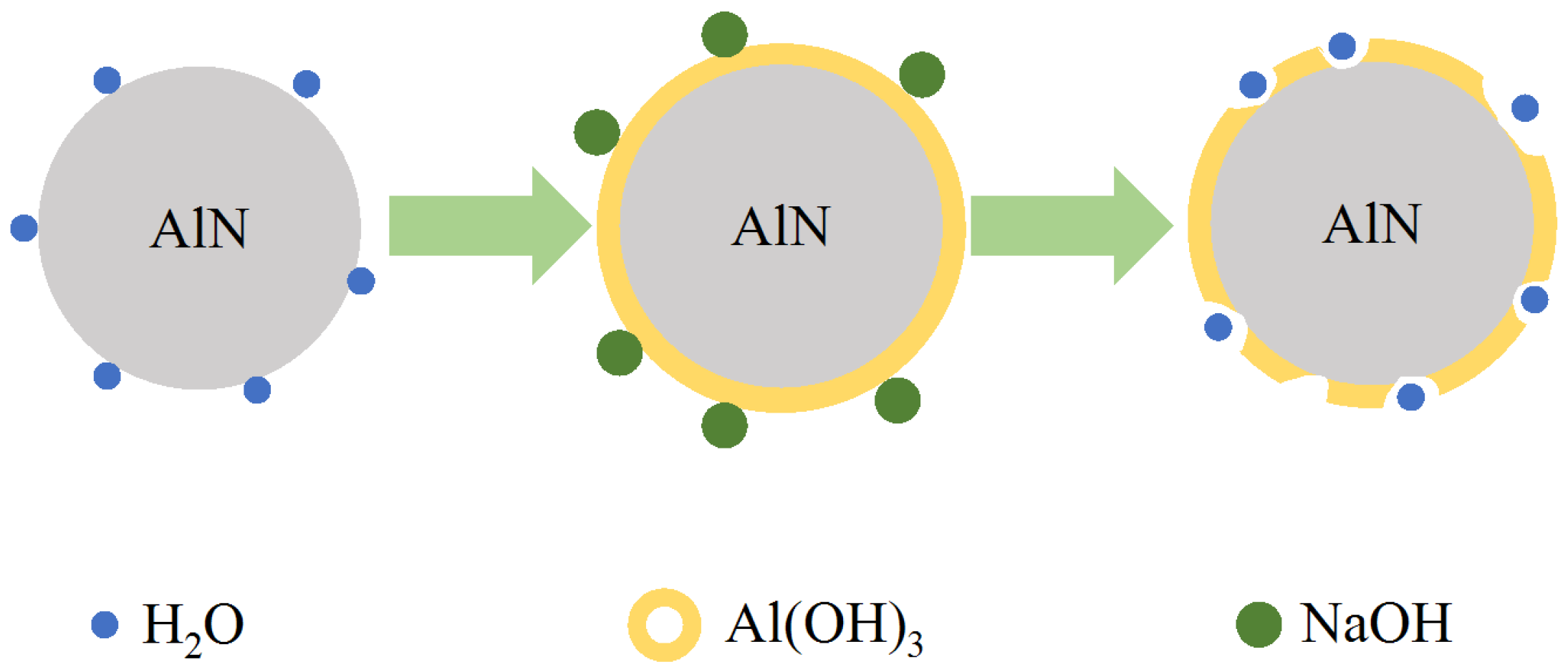
Early studies using conventional hydrolysis (e.g., 80 °C, 2 h, L/S = 6:1, a stirring speed of 400 rpm) achieved limited denitrification (~63%) [44]. This is primarily due to a critical limitation: the formation of a passivating Al(OH)3 film on the AlN particle surface at relatively low temperatures (T < 351 K), which inhibits further reaction (Figure 1) [45]. Disrupting this passivation is essential for complete detoxification of SAD and includes the following strategies: (1) high ionic strength environments (e.g., concentrated NaCl) inhibiting film formation [32]; (2) alkaline conditions (NaOH) dissolving Al(OH)3 as NaAlO2 and or soluble aluminate (Al(OH)4), thus re-exposing the fresh AlN surface (Reactions (1), (6) and (7), Figure 2) [46]; and (3) elevated temperature promoting Al(OH)4 formation and mass transfer [47].
Al(OH)3 + NaOH = NaAlO2 + 2H2O
Al(OH)3 + OH = Al(OH)4
Recent optimization studies underscore the role of alkalinity. Wang et al. [48] demonstrated that delayed NaOH addition (1.88 mol/L at 0.5 h) to SAD slurry disrupts the passivating film, achieving 99.0% denitrification. Similarly, Guo et al. [42] reported 98.3% removal via a wet-grinding pretreatment (10 min) coupled with alkaline leaching (5 wt.% NaOH at 75 °C for 120 min with a L/S ratio of 2), highlighting the synergy of mechanical and chemical activation. He et al. [33] and Feng et al. [34] achieved 100% and 95.20% hydrolysis with 1–6 mol/L NaOH, respectively. These findings collectively demonstrate that alkaline hydrolysis, particularly when combined with mechanical pretreatment or delayed base addition, can achieve near-complete AlN conversion. However, the optimization of these parameters remains highly system-specific, depending on SAD source, particle size distribution, and mineralogical composition. Furthermore, the environmental and economic burden of high NaOH consumption and subsequent neutralization/treatment of ammonia-laden alkaline streams must be considered in process design. Future research should focus on minimizing reagent use through kinetic modeling, exploring alternative bases with lower environmental footprints, and developing robust ammonia recovery systems that transform this pollutant into a valuable nitrogen resource.

3.2. Fluoride and Chloride Leaching and Fixation

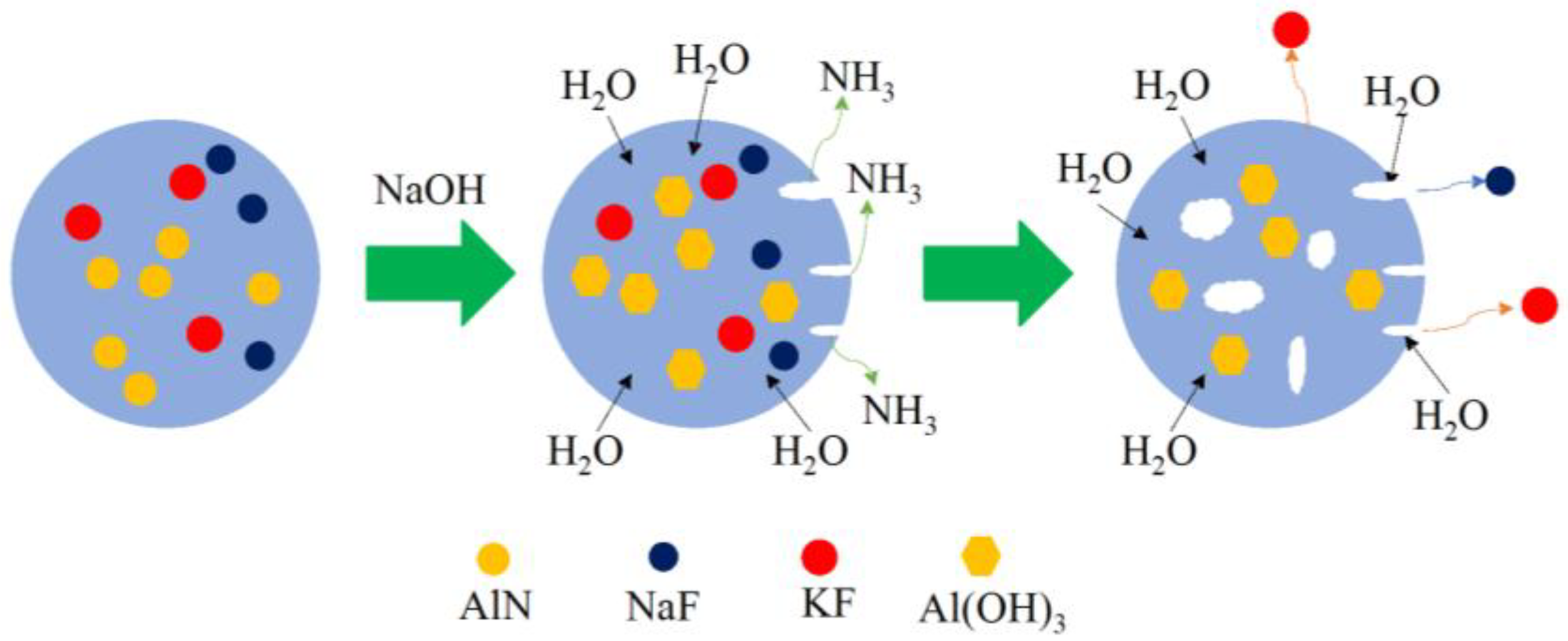
SAD contains a spectrum of fluorides, from highly soluble NaF to sparingly soluble cryolite (Na3AlF6) and refractory fluorite (CaF2). The removal or fixation of these fluorides is critical for detoxification and can be achieved via distinct mechanisms depending on the leaching medium. Under alkaline conditions, the primary mechanism for mobilizing complex fluorides like Na3AlF6 and CaF2 involves hydroxyl ion attack (Reactions (8) and (9)), where OH displaces F into the liquid phase [41,46]. This process is often enhanced by the in situ generation of NH3 during AlN hydrolysis, which creates porous structures and increases the reactive surface area (Figure 3) [46]. NaOH solutions were found to be most effective, reducing F from 304.93 to 42.72 mg/L under optimized conditions (2.72 mol/L NaOH, 80 °C, L/S = 4 for 20 min) [36]. Also, Ca2+ based additives (e.g., CaCl2) are often introduced to immobilize fluoride as stable CaF2. In total, 99.0% fluoride fixation was achieved using 10 wt.% CaCl2 and L/S of 1.5 at 80 °C for 300 min [37]. However, the resulting CaF2-rich residue and high-salinity wastewater require further management. Future research should optimize selective fluoride recovery (e.g., as high-value Na3AlF6 for electrolysis) and develop advanced adsorbents for F removal from process streams.
Na3AlF6 + 4OH = Al(OH)4 + 6F + 3Na+
CaF2 + 2OH = Ca(OH)2 + 2F
In contrast, acidic conditions facilitate fluoride removal through a fundamentally different mechanism. The high concentration of H+ can directly dissolve fluoride-bearing phases. More importantly, under strongly acidic conditions (pH < 3), a significant portion of solubilized fluoride can be volatilized as hydrogen fluoride (HF), which partitions to the gas phase [49]. This mechanism can be advantageous for achieving high defluorination efficiencies from the solid residue; however, it necessitates stringent off-gas treatment for HF capture. For instance, Bao et al. [50] reported an 87.68% fluoride removal from SAD via aqueous leaching optimized at pH 4, 60 °C, and an L/S ratio of 6 for 8 h, with a portion of the removal attributed to HF volatilization.
Following solubilization under either regime, the secondary pollution risk from fluoride-laden leachates must be managed. Post-leaching immobilization via Ca2+-based additives (e.g., CaCl2, CaO) is a common strategy, precipitating fluoride as stable CaF2 [37]. However, while alkaline leaching focuses on in situ fixation or separate precipitation, acidic leaching often requires coupling with an HF scrubbing system to prevent atmospheric release. SAD also contains significant quantities of soluble chlorides (e.g., NaCl and KCl), which contribute to soil salinization and corrosion [7]. Their high solubility makes water washing the primary removal method [26]. The presence of chloride ions can, however, be beneficial in the initial hydrolysis stage by increasing ionic strength and helping to inhibit the formation of the passivating Al(OH)3 film on AlN [32]. The major challenge lies in managing the resultant high-salinity wastewater [27], which requires robust treatment (e.g., evaporation for zero liquid discharge, ZLD, or membrane processes) to recover water and salts, adding complexity and cost to hydrometallurgical flowsheets. The dual nature of chloride (beneficial for passivation disruption yet problematic in wastewater) exemplifies the complex optimization nature of hydrometallurgical SAD processing. An integrated approach must balance AlN conversion kinetics, fluoride mobilization and recovery, and chloride management within a single process train. Current literature predominantly addresses these challenges in isolation; future work should adopt system-level optimization using multi-objective frameworks that simultaneously consider contaminant removal efficiency, reagent consumption, water recycling, and byproduct valorization.

3.3. Hydrometallurgical Resource Recovery Products

Hydrometallurgical processing of SAD enables the recovery of a wide range of value-added products, including alumina, polymeric Al coagulants, and functional adsorbents. Among these, alumina recovery is particularly attractive due to its high market demand and direct relevance to Al circularity. The following subsections detail the production routes, achievable purities, and remaining challenges for each major product category.

3.3.1. Alumina Recycling

Both acidic and alkaline leaching routes have been demonstrated to produce high-purity alumina after precipitation and calcination. SAD has also been successfully used as a raw material for producing polymerized aluminum chloride (PAC) and related water-treatment coagulants. In addition, SAD-derived materials have been explored for the synthesis of layered double hydroxides and other adsorbents for pollutant removal. Hydrometallurgical recovery yields alumina polymorphs with distinct applications: α-alumina (refractories) and γ-alumina (catalysis/adsorbents) [51]. High-purity alumina is obtained by converting Al phases into soluble salts (sulfate/chloride) or aluminates, followed by rigorous purification [22]. Li et al. [12] reported a 98.6% leaching rate via high-temperature alkaline digestion (248 g/L, L/S = 12.5 at 250 °C for 3 h), illustrating the potential for industrial scalability. Acid leaching (5 mol/L HCl, L/S = 20 at 85 °C for 120 min) yielded ~83% recovery [10]. Recent advances focus on selective leaching using organic acids (e.g., oxalic and citric) to minimize impurity co-dissolution and produce high-surface-area mesoporous alumina. Challenges remain in achieving consistent purity from variable SAD feeds and managing saline by-products [11].
Despite these promising laboratory results, the transition from bench-scale to industrial application faces significant hurdles. Depending on the source Al alloy, melting flux composition, and metal recovery efficiency, the high variability in SAD composition leads to inconsistent leaching behavior and product quality. Moreover, the co-extraction of silica, iron, and other impurities necessitates additional purification steps, increasing process complexity and cost. Future research must develop adaptive processing protocols that can accommodate feedstock variability, possibly through real-time compositional monitoring and machine-learning (ML)-based process control. Also, the integration of alumina recovery with other valorization streams (e.g., simultaneous production of coagulants from partial leachates) could improve overall process economics.

3.3.2. Preparation of Water Purifiers

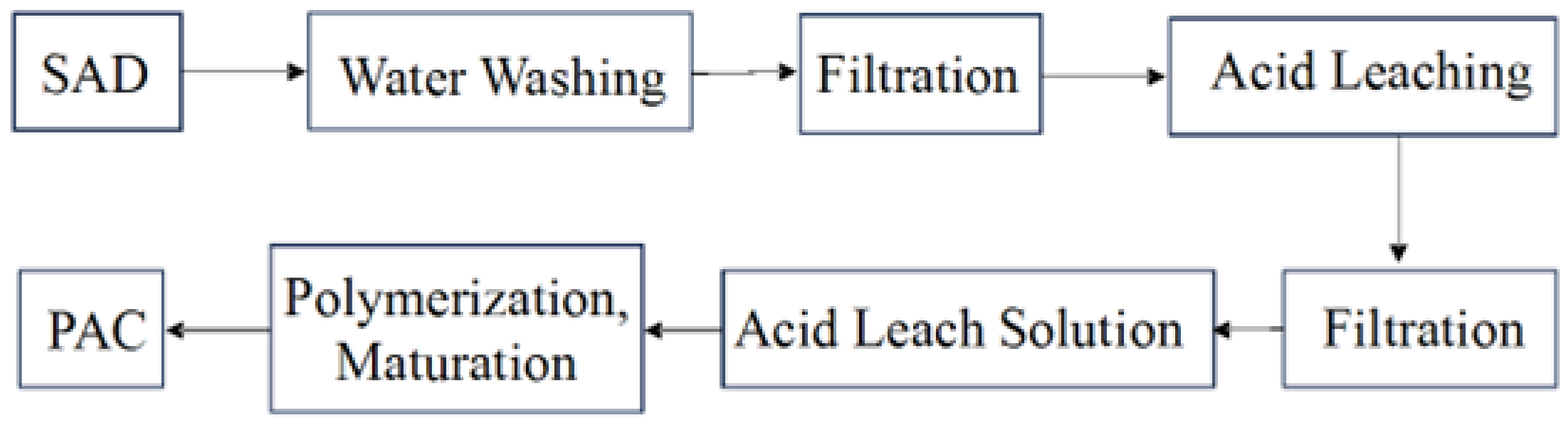
As a common coagulant, PAC can be synthesized from SAD via acid leaching and polymerization (Figure 4). Processes incorporating ultrasonication, vacuum treatment [24], or additives such as Na2CO3 (pH 3, 70 °C, 5 h) [52] and calcium aluminate (CA) (85 °C, 1.5 h) [53]) yield products with excellent performance. Li et al. [25] optimized HCl leaching (18% HCl, 90 °C, L/S = 4.5, 200 r/min, 60 min) that produced PAC outperforming commercial grades for water purification. This conversion not only valorizes the Al content but also effectively utilizes the inherent reactivity of the waste matrix. Future work should aim for in situ electrochemical polymerization and impurity control to produce tailored PAC for specific wastewater treatments.
The production of PAC from SAD represents an attractive niche application, particularly for regions with established Al recycling infrastructure and concurrent demand for water treatment chemicals. However, market acceptance remains contingent on consistent product quality and competitive pricing relative to virgin-material-based PAC. Critical quality parameters (e.g., basicity, Al/Cl ratio, and trace contaminant levels) must be rigorously controlled and certified. Moreover, the presence of heavy metals in some SAD sources may limit PAC applications in potable water treatments, though industrial wastewater applications may be less restrictive. Future research should establish clear quality–composition relationships for SAD-derived PAC and develop economically viable purification steps when necessary.

3.3.3. Preparation of Adsorbents

Mg-Al layered double hydroxides (LDHs) and silicate-aluminate adsorbents can be synthesized from SAD-derived aluminate solutions. LDHs possess a tunable anionic clay structure and superior ion-exchange properties, rendering them highly effective for applications in environmental remediation, catalysis, and pharmaceuticals. Mahinroosta et al. [54] pioneered the valorization of SAD as an Al precursor for LDH synthesis. By integrating Al extracted from silicon manganese slag (SMS) and SAD via a multi-stage hydrometallurgical route, they successfully synthesized carbonate-intercalated LDHs (Mg-Al-CO3) at pH 9–11. These waste-derived LDHs exhibited significant potential for CO2 capture. Furthermore, composite adsorbents derived from SAD and SMS have demonstrated high efficacy in wastewater treatment, achieving a dye removal efficiency of 97.00% [55], thus illustrating a “waste-treating-waste” paradigm.

3.4. Optimization of Operational Parameters

The efficiency of hydrometallurgical SAD processing depends on the judicious selection of operational parameters. Table 6 synthesizes the influence of the primary variables (e.g., pH, temperature, liquid-to-solid (L/S) ratio, and reagent concentration) on process outcomes, drawing from the literature reviewed in Section 3.1, Section 3.2 and Section 3.3.
The optimization of these parameters is inherently multi-objective. For example, while high temperature and alkaline pH maximize AlN and fluoride removal, they increase energy consumption and reagent costs. Similarly, high L/S ratios improve mass transfer but generate larger volumes of wastewater requiring treatment. The selection of optimal conditions must therefore be guided by site-specific considerations, including energy costs, water availability, and the desired product purity. Emerging approaches employing multi-response optimization (e.g., response surface methodology) and machine learning offer promising pathways for navigating this complex parameter space [42,47].
The synthesis of functional materials, such as LDHs from SAD, represents a high-value utilization pathway that merits further investigation. Unlike bulk construction materials, these specialized adsorbents can command premium prices while consuming relatively small quantities of feedstock. However, the stringent purity requirements and the need for precise stoichiometric control pose challenges when working with variable-composition SAD. Future research should explore continuous synthesis routes with inline purification, investigate the long-term stability and regenerability of SAD-derived adsorbents, and conduct comprehensive performance benchmarking against commercial products. Also, life-cycle environmental and economic assessments are needed to validate the sustainability claims of these “waste-to-value” transformations. In summary, the hydrometallurgical valorization of SAD to produce alumina, PAC, and LDHs is technically feasible and has been demonstrated at laboratory and pilot scales. However, industrial scalability is currently hindered by batch-to-batch impurity fluctuations, which compromise product standardization. Furthermore, the generation of high-salinity wastewater and ammonia emissions necessitates robust end-of-pipe controls. Future research must prioritize the optimization of denitrification kinetics and the development of zero liquid discharge (ZLD) systems to align product quality with stringent national standards.

4. Pyrometallurgical Detoxification and Valorization

Pyrometallurgy employs high temperatures (>700 °C) to melt, volatilize, or chemically transform hazardous components in SAD [3]. Compared with hydrometallurgical methods, pyrometallurgical routes are generally more robust and less sensitive to feedstock variability but are associated with higher energy consumption and potential air-pollution risks [3,56]. This section examines the fundamental thermal transformation mechanisms for key hazardous phases, followed by a comprehensive review of high-value product synthesis routes.

4.1. Oxidative Destruction of AlN

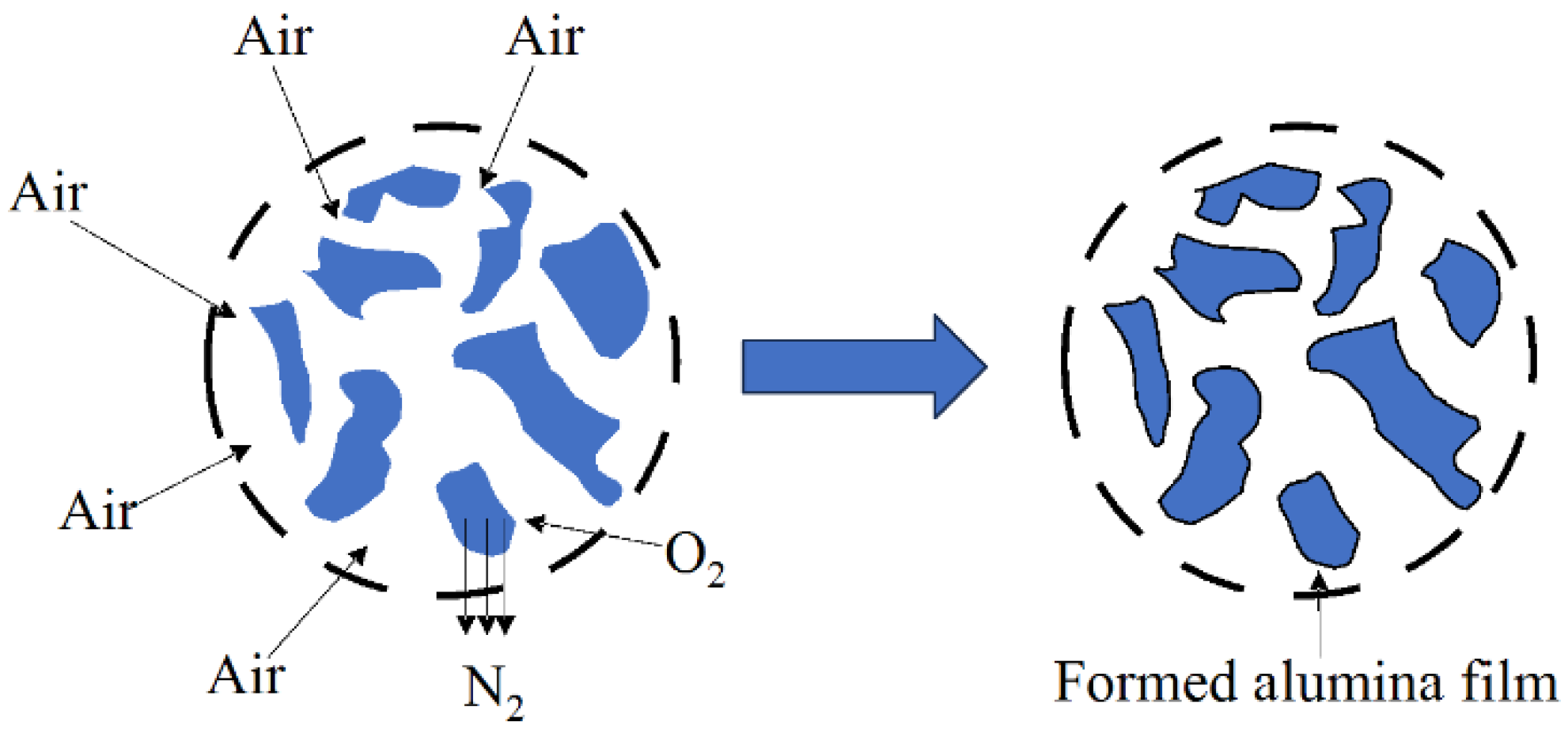
Oxidative roasting of SAD in air can convert AlN into Al2O3; however, the overall oxidation efficiency is often limited. This limitation arises from the formation of a dense Al2O3 film on the surface of AlN particles, which restricts oxygen diffusion and inhibits further oxidation (Figure 5) [57]. The principal reactions involved are shown in Equations (10)–(13).
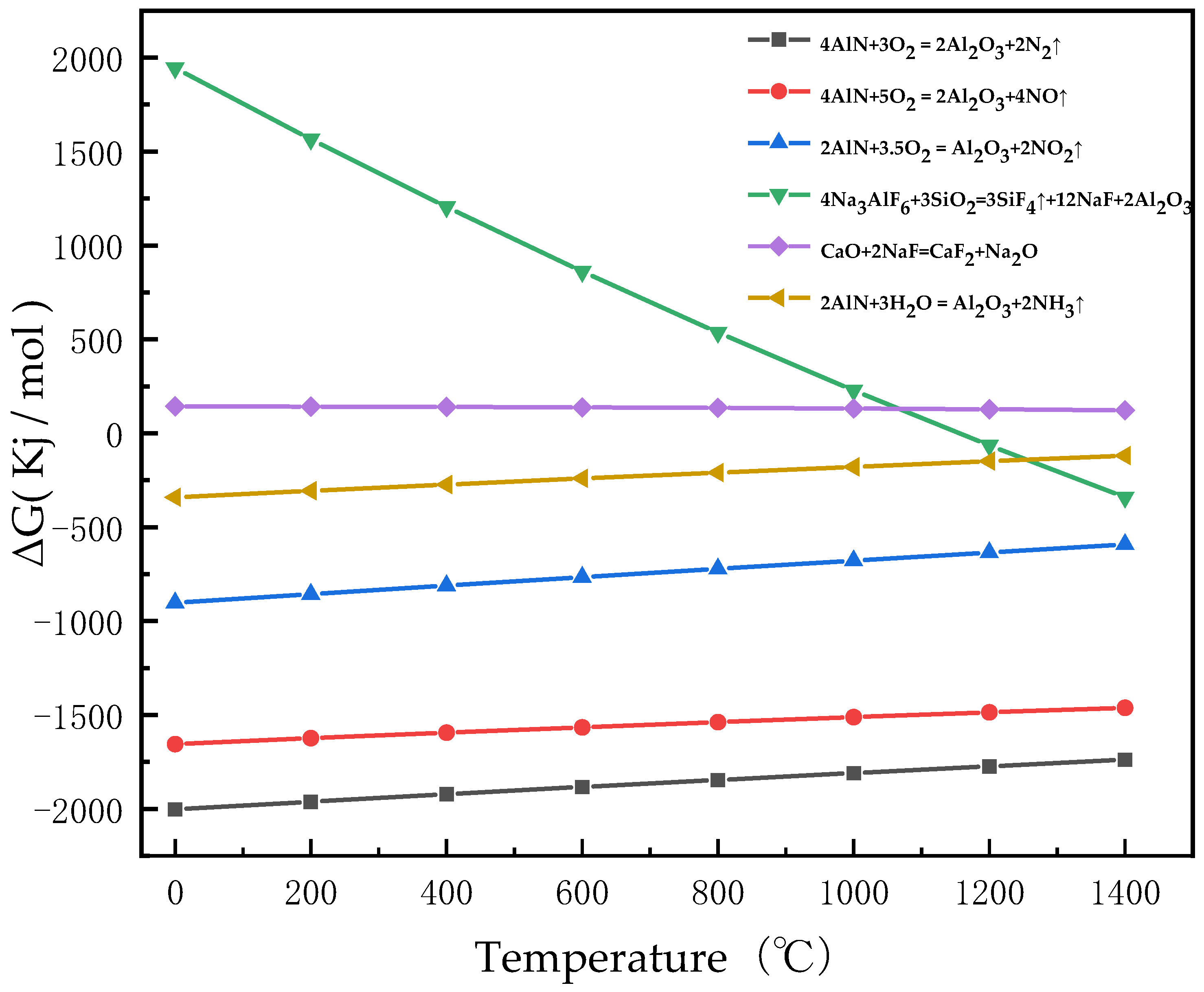
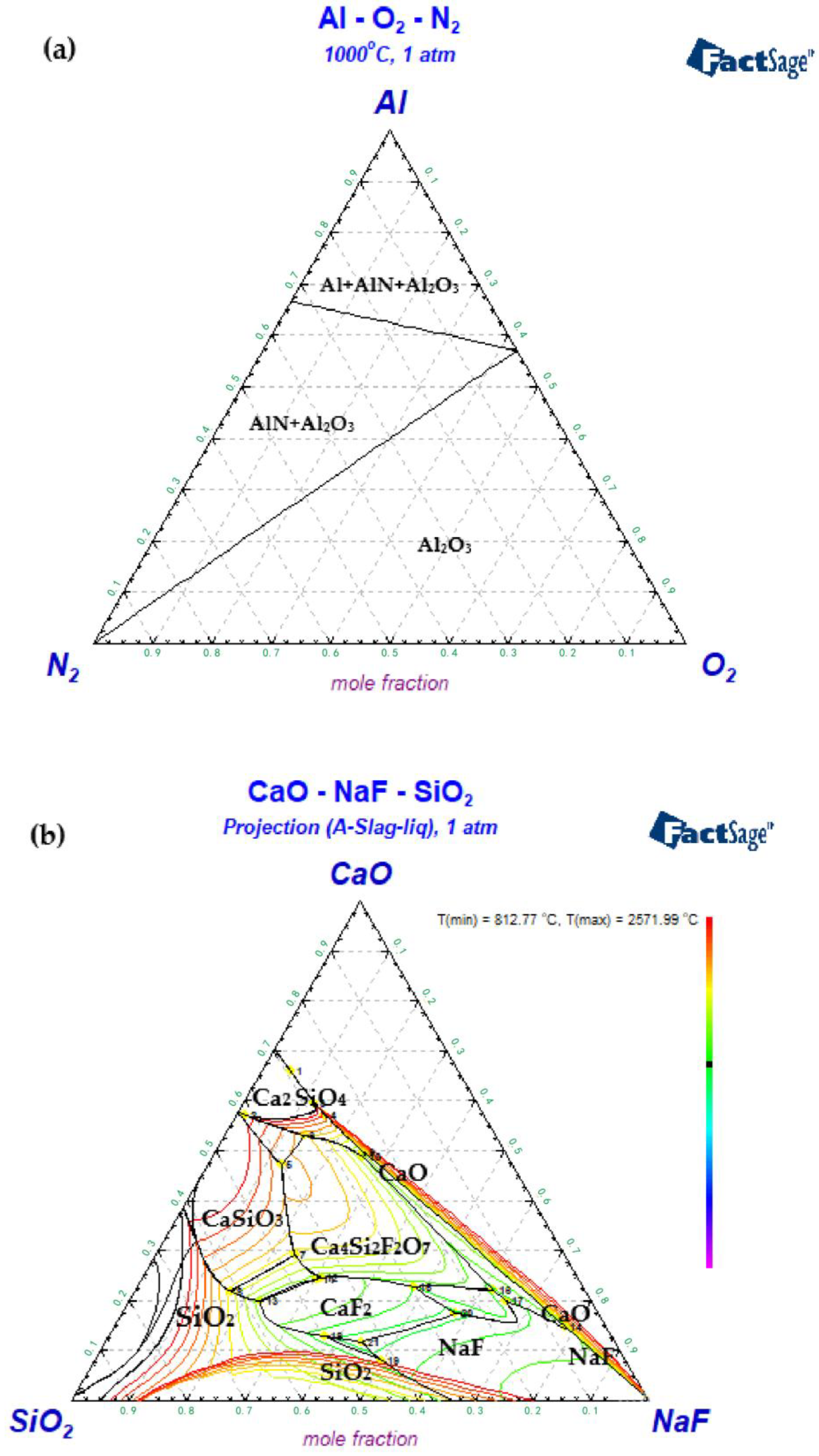
Based on Gibbs free energy estimates calculated from standard thermodynamic data (from the FactSage 8.3 thermochemical software database) for the relevant temperature range (0–1400 °C), the oxidation of AlN to form N2 (Reaction (10)) is thermodynamically favorable under typical roasting conditions, with Al2O3 as the dominant solid product [58].
4AlN + 3O2 = 2Al2O3 + 2N2
4AlN + 5O2 = 2Al2O3 + 4NO↑
2AlN + 2O2 = Al2O3 + N2O↑
2AlN + 3.5O2 = Al2O3 + 2NO2
To overcome these kinetic barriers, process intensification via additives is critical. Roasting of SAD at 1200 °C for 240 min yields a denitrification efficiency of 99.10% [13], but this is energy-intensive. The introduction of mineralizers, such as Na2CO3 and CaO, significantly accelerates the reaction. Na2CO3 disrupts the dense oxide film through the formation of intermediate aluminates, enhancing oxygen permeability, while CaO reduces the viscosity of the melt, preventing the encapsulation of unreacted AlN [59]. Lv et al. [14] achieved 98.68% denitrification at 1150 °C using this binary additive approach for 1 h. Conversely, Xie et al. [60] reported that the presence of SiO2 prevents film densification, enabling 95.80% removal at a lower temperature of 800 °C for 120 min. Na3AlF6 can act as a flux, but excess amounts reduce efficacy; for example, 17.70% Na3AlF6 under 750 °C for 194 min led to a denitrification rate of 94.71% [61]. Overall, appropriate additives can effectively suppress or disrupt surface oxide films during SAD roasting, thus enhancing oxygen diffusion and AlN oxidation. Future research must elucidate oxygen diffusion mechanisms and the kinetics of film formation/modification and screen novel catalytic additives (e.g., transition metal oxides) to lower oxidation temperatures and design energy-efficient roasting protocols.
Despite these advances, several critical questions remain unanswered. First, the fate of nitrogen during oxidative roasting, in particular the relative partitioning between benign N2 and harmful NOx, is inadequately characterized and likely depends on temperature profiles, oxygen partial pressure, and additive chemistry. Second, the energy efficiency of thermal AlN destruction has not been systematically compared to hydrolytic routes on a lifecycle basis, particularly when accounting for the energy content of the released ammonia in hydrometallurgical systems. Finally, the potential for combining partial thermal treatment with subsequent hydrolysis (a hybrid approach explored in Section 5) remains largely unexplored. These knowledge gaps must be addressed to rationally design next-generation thermal processing systems that balance conversion efficiency, energy consumption, and emission control.

4.2. Thermal Decomposition of Aluminum Carbide

The presence of aluminum carbide (Al4C3), though typically in lower concentrations than AlN, poses a distinct hazard due to its hydrolysis to methane (CH4, Reaction (2)). Its elimination during pyrometallurgical processing is governed by its lower thermal stability compared to AlN. Al4C3 undergoes thermal decomposition and oxidation according to Reaction (14) [57].
4Al4C3 + 3O2 → 8Al2O3 + 12C (solid carbon)
However, the principal mechanism for its removal at elevated temperatures is direct oxidation. Unlike AlN, which forms a dense, passivating Al2O3 layer, the oxidation of Al4C3 begins at lower temperatures (approximately 500–600 °C) and can lead to the formation of carbon and alumina. This carbon can subsequently oxidize to CO or CO2 at higher temperatures. While the oxidative destruction of Al4C3 is generally effective under typical pyrometallurgical conditions (≥800 °C), its complete conversion is critical for ensuring the stability of final products, particularly construction materials, where residual Al4C3 could cause long-term swelling and cracking. Therefore, the processing parameters (temperature, time, oxygen partial pressure) and the potential role of additives in promoting the complete conversion of Al4C3 should be considered in tandem with those for AlN to ensure the overall thermal detoxification of SAD is comprehensive.

4.3. Fluoride Fixation and Emission Control

While hydrometallurgy often struggles with the dissolution of recalcitrant complex fluorides (e.g., cryolite) [57], pyrometallurgy offers a pathway for lattice disruption. Pyrometallurgical defluorination relies on high-temperature reactions: Na3AlF6 decomposes and reacts with SiO2 to form volatile SiF4 (Reactions (15–19)). To prevent atmospheric F emissions, in situ fixation with CaO to form stable CaF2 is critical (Reaction (19)).
4Na3AlF6 + 3SiO2 = 3SiF4↑ + 12NaF + 2Al2O3
Na3AlF6 = 2NaF + NaAlF4
3NaAlF4 = Na3AlF6 + 2AlF3
4AlF3 + 3SiO2 = 3SiF4↑ + 2Al2O3
Ca2+ + 2NaF = CaF2 + 2Na+
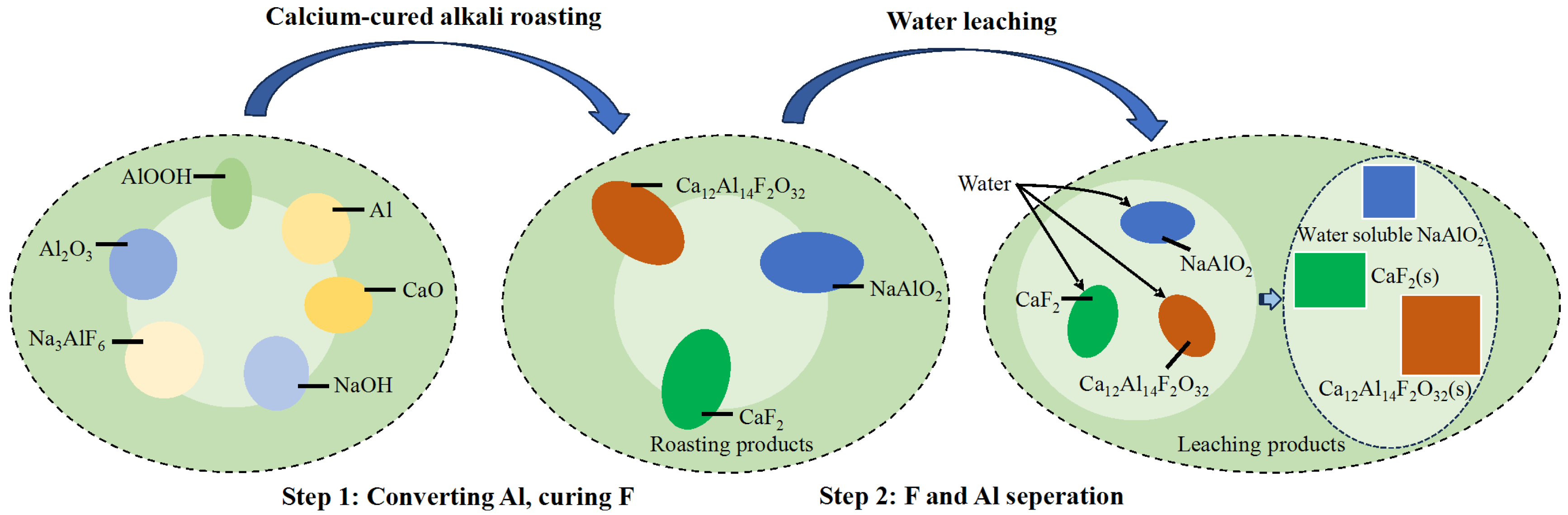
Xie et al. [38] demonstrated that roasting pre-sorted SAD at 1000 °C for 90 min converts soluble fluorides to stable fluorite (CaF2), reducing leachability to 6.16 mg/L. Further improvements were realized via oxidative sintering at 1300 °C (98.70% removal) [13] and by co-roasting with fly ash at 800 °C (98.53% fixation) [58]. A novel alkali-assisted calcination process (F:CaO molar ratio of 1:2.5, 1000 °C for 2 h) using a tailored Al:NaOH:CaO ratio of 1:0.6 achieved a near-total fixation efficiency of 99.98% (Figure 6) [39]. However, the fate and control of fugitive gaseous SiF4 and HF remain a critical challenge. Future innovations must focus on functionalized Ca-based adsorbents to ensure simultaneous solid-phase fixation and off-gas scrubbing. Moreover, the potential recovery of fluorides as commercial-grade cryolite presents an attractive economic incentive.
While the presented studies demonstrate high fixation efficiencies under optimized conditions, several practical challenges remain. First, the high CaO dosages required (often stoichiometrically excessive) increase process costs and generate large volumes of CaF2-bearing residue that must be landfilled or further processed. Second, the volatilization of fluorides, such as SiF4 or HF, even at low levels, poses occupational health and environmental risks that necessitate rigorous off-gas treatment systems. Third, the reported fixation efficiencies are typically measured under carefully controlled laboratory conditions; industrial-scale verification with real, variable-composition SAD feeds is lacking. Future research should pursue several parallel directions: (i) development of reactive calcium aluminate or calcium silicate matrices that can incorporate fluoride into stable mineral phases at lower temperatures; (ii) investigation of selective fluoride recovery routes that regenerate Na3AlF6 for reuse in aluminum smelting, thereby closing the material loop; and (iii) comprehensive emission characterization and off-gas scrubbing system design to ensure that thermal treatment does not simply transfer the fluoride problem from solid to gas phase.

4.4. Chloride Behavior and Removal

In contrast to the aqueous-phase removal of chlorides via water washing (Section 3.2), pyrometallurgical processing offers a pathway for in situ elimination through volatilization. The soluble chlorides in SAD, primarily NaCl and KCl, have relatively low melting points (801 °C and 770 °C, respectively) and high vapor pressures at elevated temperatures. During thermal treatment, these phases can undergo melting and subsequent volatilization, effectively removing them from the solid residue [62]. The volatilization rate is governed by temperature, gas-phase mass transfer, and the partial pressure of the chloride species in the furnace atmosphere. Typical processing conditions for ceramic or refractory synthesis (>1000 °C) are sufficient to drive off a significant fraction of chlorides. For instance, studies have shown that over 95% of chloride can be removed from SAD during sintering between 1000 and 1300 °C, with the volatilized chlorides condensing in cooler sections of the off-gas system [13,63].
While this volatilization reduces the chloride content of the final product—thus mitigating risks of leaching and corrosion in applications like construction materials—it effectively transfers the problem to the gas phase. Therefore, a robust off-gas treatment system is essential for the environmental integrity of any pyrometallurgical process. This typically involves quenching the hot off-gas to promote the condensation of chloride salts, which can then be collected in baghouse filters as a particulate stream. The resultant chloride-rich dust may require further management, potentially as a secondary resource for salt recovery, or disposal as hazardous waste. The strategic coupling of a pyro-stage with a preceding hydro-stage, as conceptualized in Section 5 (the hydro–pyro nexus), offers a more integrated solution: bulk chloride removal can be achieved in the hydrometallurgical pretreatment, thus minimizing the corrosive off-gas burden and chloride condensation issues in the downstream thermal unit.

4.5. Immobilization of Heavy Metals

SAD hosts significant concentrations of hazardous heavy metals (e.g., Pb, Cr, and Zn). The environmental risk of these metals depends on their speciation and mobility. Sintering provides a robust mechanism for stabilization, incorporating these metals into the crystal lattice of dense ceramic matrices, thereby minimizing leaching potential [64]. However, the high-temperature volatility of certain metals poses a risk of secondary pollution. For example, Pb volatility escalates from 97.10% at 1050 °C to 99.70% at 1180 °C, while Zn volatility rises to 55.20% [57]. Elements like As and Cd may also volatilize at lower temperatures. The trade-off between matrix densification and heavy metal volatilization defines the operational window. This necessitates the optimization of temperature, residence time, and off-gas capture to balance immobilization and volatilization. The addition of silica or phosphates can promote vitrification, enhancing the encapsulation of metals within an amorphous glassy phase, often more effective than simple sintering for long-term stabilization. Advanced sintering aids and rapid cooling techniques can enhance vitrification and metal retention. Rigorous control of off-gas emissions and long-term durability testing of the sintered products are essential for validating environmental safety.
The immobilization of heavy metals in pyrometallurgically processed SAD products represents both an opportunity and a challenge. While sintering can effectively lock metals into stable ceramic phases, the competing process of volatilization, particularly for Pb, Zn, Cd, and As, necessitates careful process design. The reported volatilization rates highlight that temperature optimization is not merely about achieving complete reactions but also about minimizing secondary air pollution. Future research must focus on several key areas: (i) development of vitrification-promoting additives that lower the sintering temperature while enhancing metal encapsulation; (ii) systematic characterization of metal speciation and partitioning behavior between 700 and 1400 °C using advanced techniques such as X-ray absorption spectroscopy; (iii) design of integrated off-gas treatment systems capable of capturing volatilized metals for potential recovery or safe disposal; and (iv) standardized leaching protocols for long-term environmental risk assessment of sintered products, moving beyond simple compliance testing to predictive models of metal release under various environmental conditions.

4.6. Valorization via Pyrometallurgical Synthesis

The intrinsic oxide composition of SAD (Al2O3, MgO, SiO2, and CaO) mimics natural mineral precursors, positioning it as an ideal feedstock for high-performance ceramics and refractories [65]. The following subsections detail specific product synthesis routes, achievable properties, and remaining technical challenges for industrial implementation.

4.6.1. Recovery of Alumina

High-purity alumina recovery involves roasting–leaching–crystallization sequences. For example, Tripathy et al. [31] achieved 90% recovery via 10% Na2CO3-assisted roasting of Al dross at 800 °C for 1 h. Further refinement by Deng et al. [15] and Chen et al. [66] using ammonium sulfate systems (NH4HSO4-H2SO4 and (NH4)2SO4) yielded >99% purity alumina. While effective, these processes require strict feed characterization to manage compositional heterogeneity. As a result, it is challenging to achieve stable and efficient recovery under different conditions. Developing adaptive roasting regimens using real-time composition monitoring and ML optimization of multiple objectives remains a key future direction.
The pyrometallurgical recovery of alumina from SAD, while technically feasible, faces significant scale-up challenges that have hindered widespread industrial adoption. The primary obstacle is the inherent compositional variability of SAD, thus leading to unpredictable roasting behavior and inconsistent product quality. This variability manifests in fluctuating alumina extraction rates, variable impurity profiles (particularly Si, Fe, and Ca), and the need for process-specific optimization that reduces operational flexibility. Future research must therefore pursue two parallel strategies: (i) development of robust, composition-tolerant roasting protocols that maintain high recovery efficiency across a range of SAD compositions, potentially through multi-stage roasting with adaptive temperature and additive dosing; and (ii) integration of real-time analytical techniques (e.g., laser-induced breakdown spectroscopy or X-ray fluorescence) coupled with ML algorithms to enable dynamic process control. Also, the energy intensity of roasting-based alumina recovery necessitates systematic comparison with hydrometallurgical alternatives on a full life-cycle basis, accounting for both direct energy consumption and the embodied energy of reagents and waste treatment.

4.6.2. Advanced Construction Materials

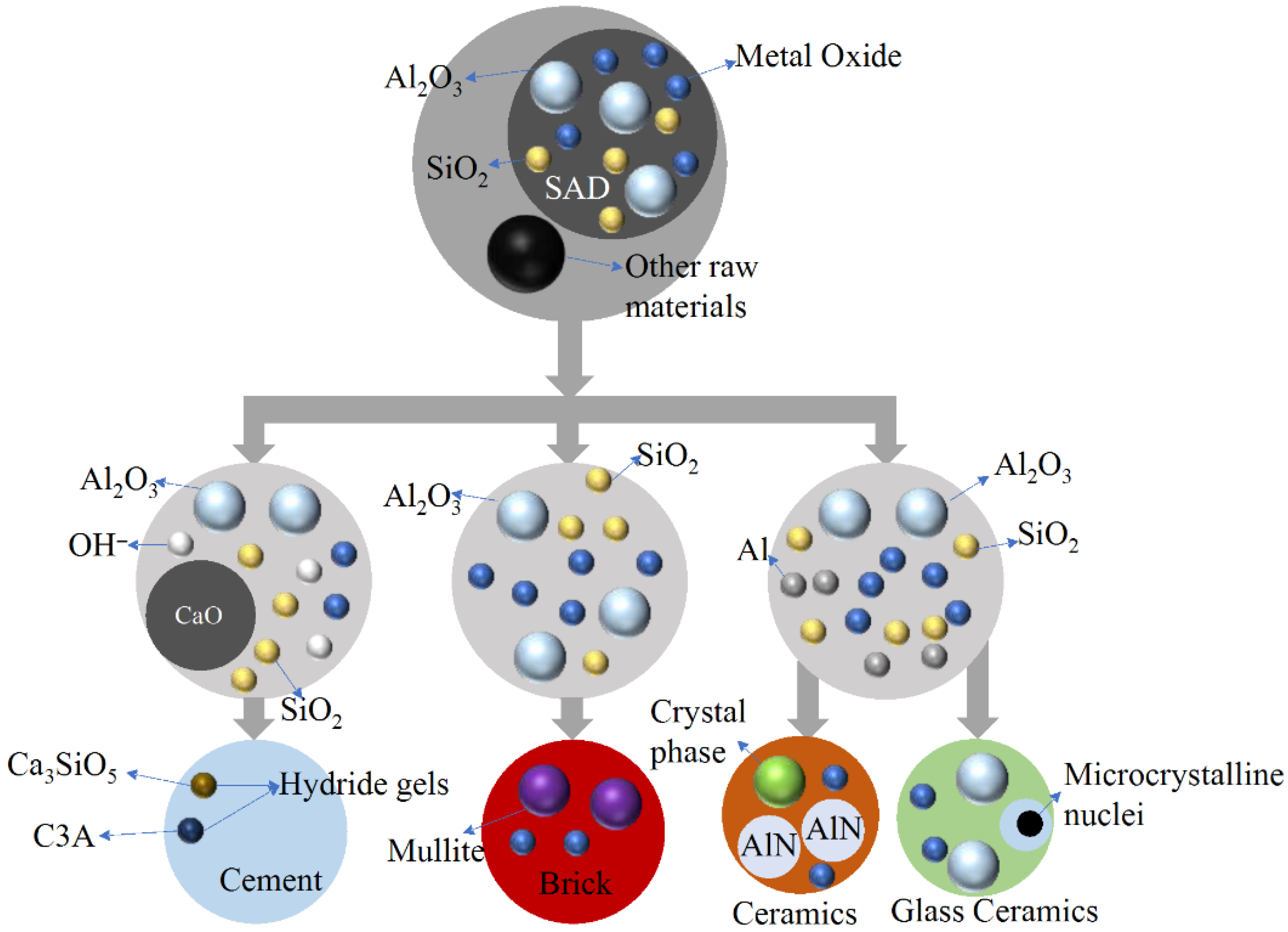
SAD has been widely investigated as a raw material for the production of construction and insulation materials, including cement, bricks, and porous ceramics and glass ceramics (Figure 7) [21]. Owing to its high Al2O3 content and mineralogical compatibility with silicate-based systems, SAD represents a promising alternative feedstock for large-scale construction-material applications. Yildiz [67] reported that SAD addition shortened both the initial and final setting times of cement; however, compressive strength decreased with increasing SAD content. Cui et al. [68] investigated the partial replacement of light-burned magnesia with sintered SAD in magnesium oxychloride cement (MOC) and found significantly improved flowability of MOC-based materials when the SAD content was below 10 wt.%, with negligible reduction in mechanical strength. Yao et al. [69] achieved a compressive strength of 78.9 MPa for porous concrete by sintering a mixture of red mud, SAD, flue-gas desulfurization gypsum, and carbide slag at 1250 °C. Reactive phases, such as AlN and Al4C3, present in SAD can hydrolyze to release NH3 and CH4, which may induce internal defects, expansion, and long-term durability deterioration in cement-based materials. Therefore, pretreatment processes aimed at eliminating AlN and Al4C3 are essential prior to incorporating SAD into cementitious matrices.
The Al2O3 in SAD readily reacts with SiO2 to form silicoaluminate phases, thus enhancing the strength, refractoriness, and thermal-shock resistance of bricks. The presence of porous alumina can also improve air permeability and thermal insulation performance. Zhang et al. [70] reported that sintered bricks using SAD, engineering sand, and fly ash exhibited a flexural strength of 3.42 MPa under optimized conditions (10 MPa, 8 °C min−1, 800 °C, and 60 min). Subsequently, Zhang et al. [71] produced microporous bricks that achieved a flexural strength of 4.14 MPa by employing SAD as the primary raw material, Fe2O3 as a reinforcing agent, MgO as a sintering aid, carbon powder as a pore-forming agent, and paraffin as a binder.
SAD contains essential ceramic-forming components, including Al2O3, CaO, MgO, and SiO2, making it a viable raw material for ceramic fabrication (Table 7). Zhu et al. [72] utilized untreated SAD at 1450 °C with a Si/Al ratio of 2.5 to produce ceramics dominated by β-Sialon and AlN polycrystalline phases, which acted as toughening components and improved tribological performance. To mitigate the adverse effects of impurities in SAD, Feng et al. [34] applied grinding, alkali leaching, and CO2-assisted in situ precipitation to remove detrimental phases, with the resulting alumina ceramics sintered between 1350 and 1500 °C meeting the standard requirements for 90 wt.% Al2O3 ceramics.
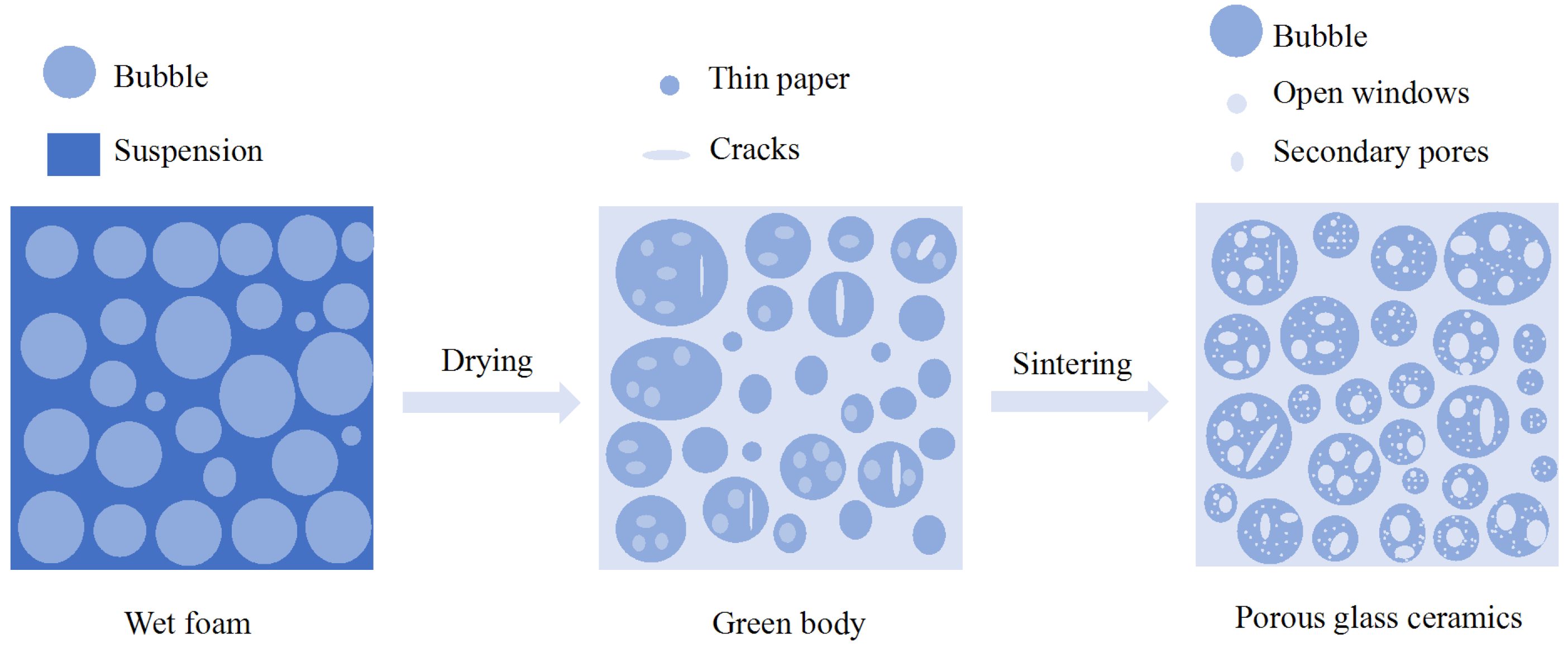
Porous glass ceramics derived from SAD represent multifunctional materials, comprising glassy matrices, crystalline phases, and interconnected pores. Al2O3 in SAD functions as a network-forming oxide, while AlN can release N2 during oxidation, providing an intrinsic foaming mechanism. Consequently, SAD has been widely explored for the preparation of porous glass ceramics (Figure 8) [75]. Shen et al. [76] demonstrated that AlN and salts in SAD transform into alumina and glass phases at elevated temperatures, while iron oxides act as nucleating agents, yielding sodium–calcium aluminosilicate (SLAS) glass ceramics containing more than 30 wt.% Al2O3. Liu et al. [75] produced porous microcrystalline glass by calcining SAD, followed by ball milling with waste glass and subsequent sintering, obtaining materials suitable for building insulation. Hassan et al. [77] prepared self-foaming microcrystalline glass from Na–Ca glass waste and SAD; the addition of 2.5 wt.% SAD at 850 °C resulted in low-density, highly porous glass ceramics with moderate compressive strength. Despite these advances, impurities in SAD (e.g., AlN, fluorides, and heavy metals) remain a critical bottleneck affecting ceramic performance and industrial scalability. These impurities can induce defects, such as excessive porosity, cracking, strength degradation, and reduced chemical stability. Therefore, effective pretreatment of SAD and rigorous control of sintering and foaming parameters are indispensable for the production of high-performance construction and insulation materials.
The incorporation of SAD into construction materials represents one of the most economically viable valorization pathways due to the large market size and relatively relaxed purity requirements compared to high-value chemical products. However, several critical challenges must be addressed for widespread industrial adoption. First, the presence of reactive phases (AlN and Al4C3) poses long-term durability concerns through delayed hydrolysis reactions that can occur months or years after material placement, leading to expansion, cracking, and structural failure. This necessitates either complete pretreatment to eliminate these phases or the development of encapsulation strategies that prevent moisture access. Second, the variable composition of SAD complicates quality control and product standardization, potentially limiting applications in high-specification construction projects. Third, regulatory frameworks in many jurisdictions remain unclear regarding the use of hazardous-waste-derived materials in construction, creating market uncertainty. Future research should focus on: (i) developing cost-effective pretreatment protocols that selectively remove reactive phases while retaining beneficial alumina content; (ii) establishing composition-property relationships that enable quality prediction and control despite feedstock variability; (iii) conducting comprehensive long-term performance studies under realistic environmental exposure conditions; and (iv) engaging with regulatory bodies and industry stakeholders to develop evidence-based standards for SAD-derived construction materials that balance safety concerns with circular economy benefits.

4.6.3. Preparation of Calcium Aluminate

The conversion of SAD into CA for use as a refining agent in steelmaking auxiliary materials represents a promising pathway for both cost reduction and hazardous-waste valorization (Figure 9). Compared with conventional routes based on bauxite, SAD-derived CA significantly lowers raw-material costs while simultaneously alleviating the disposal burden associated with SAD [19]. This approach therefore offers a practical and industrially relevant solution to the challenges of SAD treatment and utilization. Gollapalli et al. [78] reported a process in which SAD was first leached with hot water and subsequently sintered with lime powder and steel slag (a typical metallurgical waste) at 1300 °C to produce CA. Hu et al. [20] prepared pre-melted CA by mixing CaO with SAD at a mass ratio of 0.6:1 and calcining the mixture at 1450 °C for 2 h. Zuo et al. [17] employed acid leaching to remove impurities from SAD, followed by sintering of the leached residue with CaO, α-Al2O3, and SiO2 at 1350 °C for 0.5 h, using a Ca/Al ratio of 1.4, with the resulting CA meeting the national standard (GB/T 29341–2022 [79]). Similarly, Zhao et al. [80] produced CA by mixing hydrolyzed SAD with CaO at a Ca/Al ratio of 0.8 and sintering at 1300 °C for 2 h.
The synthesis of CA from SAD offers a compelling example of waste-to-value transformation within the metals industry, effectively creating a closed-loop system. However, several technical and economic barriers currently limit widespread adoption. The primary challenge is the sensitivity of CA phase composition and performance to the presence of impurities, particularly SiO2 and Fe2O3, which are ubiquitous in SAD. These impurities can promote the formation of gehlenite (Ca2Al2SiO7) and calcium ferrite phases, which dilute the desirable calcium aluminate phases (CaAl2O4, CaAl4O7, and Ca3Al2O6) and reduce refining efficiency in steelmaking applications. The high sintering temperatures required also impose substantial energy costs and necessitate specialized refractory-lined furnaces, raising capital and operating expenses. Future research priorities should include: (i) development of selective pretreatment methods that remove Si and Fe while retaining Al and Ca; (ii) investigation of flux additives or alternative sintering atmospheres that suppress undesirable phase formation; (iii) exploration of microwave or plasma-assisted heating to reduce energy consumption and enable more uniform heating; and (iv) comprehensive techno-economic analysis (TEA) comparing SAD-derived CA with conventional bauxite-based production, accounting for regional variations in energy costs, carbon pricing, and waste disposal fees.

4.6.4. Preparation of Magnesia-Alumina Spinel

Magnesium aluminate spinel (MgAl2O4) has attracted considerable attention owing to its superior thermal-shock resistance, mechanical strength, corrosion resistance, and high melting point, thus making it a critical material for refractory and high-temperature applications. The conventional preparation route for MgAl2O4 spinel from SAD typically involves direct solid-state calcination, in which SAD is mixed with MgO powder at a specified ratio and subsequently sintered at elevated temperatures (Figure 10). Shi et al. [81] reported the preparation of spinel refractory materials with a bulk density of 2.92 g cm−3 and a bending strength of 270 MPa when the MgO content was 50 wt.% and the sintering temperature reached 1600 °C.
To address the adverse effect of impurities in SAD on spinel formation, densification behavior, and final material performance, various pretreatment strategies have been developed. For example, Zhang et al. [18] removed impurity elements from SAD leachate under mild alkaline conditions (NaOH concentration of 1.6 mol L−1, L/S = 12, 80 °C, and 30 min), and then sintered to obtain high-performance magnesium aluminate spinel. Benkheliif et al. [82] introduced MgO into the acid leachate of SAD and calcined the resulting precipitate at 1450 °C, promoting the reaction between free alumina and magnesium oxide and yielding a stable MgAl2O4 spinel phase. Zhang et al. [83] demonstrated that, beyond MgO addition, doping with rare-earth oxides could further enhance spinel densification.
Collectively, these studies indicate that wet pretreatment for impurity removal, combined with appropriate dopants, such as rare-earth oxides, can significantly improve the sintering behavior and mechanical performance of SAD-derived magnesium aluminate spinel. Such process optimization promotes densification, reduces residual porosity, strengthens intergranular bonding, and suppresses crack initiation and propagation, thus enhancing the overall toughness of refractory materials. The synthesis of magnesium aluminate spinel from SAD still relies on high sintering temperatures, associated with substantial energy consumption and potential emission risks. There is therefore an urgent need to develop novel sintering aids and pore-forming agents that can lower sintering temperatures, improve densification efficiency, and enable controlled porosity. Addressing these challenges will be essential for the scalable, energy-efficient, and environmentally acceptable production of MgAl2O4 spinel from SAD.
The production of magnesia-alumina spinel from SAD represents a high-value utilization pathway, given that commercial spinel refractories command premium prices in specialized applications (e.g., steel ladles, cement kilns, and glass melting furnaces). At the extremely high sintering temperatures, energy consumption becomes prohibitive, and the risk of heavy metal volatilization from SAD increases significantly, potentially contaminating both the product and the off-gas stream. Moreover, the quality requirements for refractory-grade spinel are stringent, making the process highly sensitive to SAD compositional variability. Several research directions merit priority attention: (i) investigation of liquid-phase sintering additives (e.g., calcium silicates or borates) that can promote densification between 100 and 200 °C lower than current practice; (ii) exploration of reactive sintering approaches where nano-scale MgO and Al2O3 precursors derived from SAD react in situ during heating, potentially reducing activation energy barriers; (iii) systematic study of rare-earth oxide doping mechanisms, particularly how these dopants modify grain boundary chemistry and diffusion kinetics; (iv) development of controlled atmosphere sintering protocols that minimize heavy metal volatilization while maintaining product quality; and (v) TEA to identify the SAD composition ranges and market conditions under which spinel production becomes economically viable relative to conventional synthetic routes.

4.6.5. Other Resource Utilization Technologies

Beyond the utilization pathways discussed above, SAD has also been explored as a functional reductant in pyrometallurgical processes, exploiting the strong reducing capability of AlN contained in SAD. This approach offers an alternative route for simultaneous metal recovery and hazardous-waste valorization. Xu et al. [84] employed steel slag as a raw material and used SAD as a novel reducing agent in a molten reduction process to produce low-phosphorus iron. Similarly, Shen et al. [85] achieved reduction efficiencies of 94%, 88%, and 100% for Fe, Cr, and Ni, respectively, from acid-washed sludge using SAD when the mixture was heated to 1300 °C, followed by further treatment at 1400 °C for 1 h. This application foreshadows a key research priority outlined in Section 7.
The fundamental reduction mechanisms of AlN remain insufficiently understood, particularly with respect to reaction pathways, kinetic control, and phase evolution under high-temperature conditions. Moreover, the fate of nitrogen released from AlN during reduction as N2, NOx, or lattice-incorporated species has not been systematically investigated, raising concerns regarding gas emissions and environmental impacts. Future research should therefore focus on elucidating the thermodynamic and kinetic mechanisms governing AlN-driven reduction reactions, as well as tracking nitrogen migration and transformation during pyrometallurgical processing. Such insights will be essential for optimizing process efficiency, minimizing secondary pollution, and enabling the safe and scalable application of SAD-based reductants in metallurgical waste treatment.

4.7. Mechanistic Role of Additives in Pyrometallurgical Processing

The efficacy of pyrometallurgical SAD processing is critically dependent on the use of additives, which serve multiple functions: disrupting passivating oxide layers, lowering melting points, fixing volatile contaminants, and promoting desired phase formation. Table 8 provides a comparative analysis of the principal additives and their mechanistic roles.
The selection of appropriate additives requires careful consideration of the target product and process economics. For fluoride fixation, CaO is generally preferred due to its low cost and the high stability of the resulting CaF2 [39]. However, the incorporation of CaO can alter the composition of the final product, potentially reducing its value for certain applications (e.g., high-alumina refractories). For AlN oxidation enhancement, Na2CO3 is highly effective but introduces sodium, which may require subsequent leaching [14]. In contrast, SiO2 offers a cost-effective alternative that can be beneficial for glass-ceramic applications but is detrimental when high-purity alumina or spinel is the target [60]. The emerging trend toward additive combinations (e.g., Na2CO3 + CaO) reflects the need to address multiple process objectives simultaneously [59].

4.8. Thermodynamic Analysis of Pyrometallurgical Transformations

The feasibility and driving force for the principal reactions in pyrometallurgical SAD processing can be evaluated through thermodynamic analysis. Figure 11 presents the standard Gibbs free energy change (ΔG°) for key reactions as a function of temperature, calculated from thermodynamic data (FactSage 8.3 databases).
The thermodynamic analysis reveals several critical insights. First, the oxidation of AlN to N2 (Reaction (10)) is overwhelmingly favorable across all relevant temperatures, with a strongly negative ΔG° that increases in magnitude with decreasing temperature. This indicates that while AlN oxidation is thermodynamically spontaneous even at ambient temperatures, kinetic limitations (the passivating Al2O3 film) prevent complete conversion under mild conditions. Second, the formation of NO and NO2 is also thermodynamically favorable, but less so than N2 formation, implying that N2 is the thermodynamically preferred product under equilibrium conditions. The actual NOx yield is therefore kinetically controlled and can be minimized by ensuring excess oxygen and sufficient residence time for complete oxidation.
For fluoride-containing reactions, the data reveal the importance of additive selection. The formation of volatile SiF4 from cryolite (Reaction (14)) is thermodynamically unfavorable at lower temperatures but becomes less unfavorable as temperatures increase. This explains why high-temperature processing without CaO can lead to fluoride volatilization, as observed experimentally [38]. Conversely, the fixation of fluoride as CaF2 (Reaction (18)) is moderately favorable across the entire temperature range, providing a thermodynamic basis for the effectiveness of CaO as a fluoride fixative.
Phase stability diagrams (Figure 12) for the Al–O–N and Ca–F–Si–O systems further illustrate the conditions under which AlN is stable versus oxidized, and under which fluoride species partition between solid and gas phases. Under typical roasting conditions (pO2 > 0.01 atm, T > 800 °C), AlN is thermodynamically unstable with respect to Al2O3, confirming the driving force for oxidative conversion. For fluorides, the stability of CaF2 versus CaO is such that CaF2 remains stable even at high temperatures, whereas Na3AlF6 decomposes in the presence of SiO2 to form volatile SiF4. These thermodynamic constraints provide a rational basis for the selection of processing conditions and additives to achieve targeted product outcomes.

4.9. Gaseous Emissions and Their Fate

The thermal treatment of SAD generates a complex mixture of gaseous species whose fate must be managed to ensure environmental compliance. Understanding the partitioning behavior of these species—between solid, liquid, and gas phases—is essential for the design of effective off-gas treatment systems.

4.9.1. Nitrogen Species

During oxidative roasting, AlN is converted primarily to N2 (Reaction (10)) under well-oxidized conditions. However, under oxygen-limited conditions or in the presence of catalytic surfaces, the formation of NOx (Reactions (11–13)) can occur. The relative yields of N2 versus NOx are governed by temperature, oxygen partial pressure, and residence time. Experimental studies indicate that at temperatures above 900 °C and with excess air, N2 accounts for >95% of the nitrogen released [13,60]. At lower temperatures or under substoichiometric conditions, NOx formation can increase substantially. The released N2 is benign and can be discharged directly, while NOx requires abatement via selective catalytic reduction (SCR) or selective non-catalytic reduction (SNCR) to meet emission standards.

4.9.2. Fluorinated Compounds

The fate of fluorides during pyrometallurgical treatment depends on the presence of CaO or other fixatives. In the absence of adequate CaO, fluorides can react with SiO2 to form volatile SiF4 (Reactions (15) and (18)), which can hydrolyze to HF and SiO2 upon cooling. Both SiF4 and HF are highly corrosive and toxic. With sufficient CaO addition, fluorides are captured as stable CaF2 (Reaction (19)), which remains in the solid residue. Off-gas treatment typically involves dry scrubbing with hydrated lime or wet scrubbing with alkaline solutions to capture any residual HF or SiF4. Reported fluoride capture efficiencies in well-designed off-gas systems exceed 99% [39].

4.9.3. Chlorinated Compounds

Chlorides, predominantly NaCl and KCl, volatilize at above 800 °C. Upon cooling, they condense as fine particulate aerosols, typically in the 0.1–10 µm size range. These chloride-rich particulates can be effectively captured by baghouse filters or electrostatic precipitators. The condensed chloride dust may be recovered as a salt mixture, though its purity is often insufficient for direct reuse. In the presence of organic compounds, chlorides can promote the formation of polychlorinated dibenzo-p-dioxins and dibenzofurans (PCDD/Fs) between 250 and 450 °C; this risk necessitates rapid quenching of off-gases through this temperature window [86].

4.9.4. Heavy Metals

Volatile heavy metals (e.g., Pb, Zn, Cd, As) partition between the solid residue and the gas phase depending on their speciation and the process temperature. Between 1000 and 1200 °C, Pb volatilization can exceed 95%, while Zn volatilization ranges from 30 to 60% [57,87]. These volatilized metals condense as fine particulates, typically in the 0.1–5 µm size range, and are collected alongside chlorides in the off-gas treatment system. The resultant dust may represent a hazardous waste requiring specialized disposal or, in some cases, can be processed for metal recovery.

4.9.5. Integrated Off-Gas Management

A comprehensive off-gas management strategy for pyrometallurgical SAD processing typically comprises: (i) a combustion zone for complete oxidation of organics and CO; (ii) a quench system for rapid cooling to avoid PCDD/F formation; (iii) dry or semi-dry scrubbing with Ca(OH)2 for acid gas (HF, HCl, SO2) removal; (iv) activated carbon injection for mercury and PCDD/F adsorption; and (v) high-efficiency particulate control (baghouse or ESP). The implementation of such systems is critical for ensuring that the environmental burden of SAD processing is not simply transferred from solid waste to air emissions.

5. Toward an Integrated Hydro–Pyro Treatment Nexus

The preceding review reveals a critical impasse: hydrometallurgy offers precision detoxification but generates complex wastewater streams, while pyrometallurgy provides robustness and product stability at the cost of high energy consumption and air emissions. Transcending this fundamental trade-off requires moving beyond the wet-versus-dry dichotomy toward intelligently designed hybrid systems. This section conceptualizes the hydro–pyro nexus, defined as synergistic process integration where hydrometallurgical pretreatment enables bulk contaminant removal under milder conditions, and the purified intermediate is subsequently valorized via optimized thermal treatment for final stabilization and high-value product synthesis.

5.1. Conceptual Frameworks and Process Flows

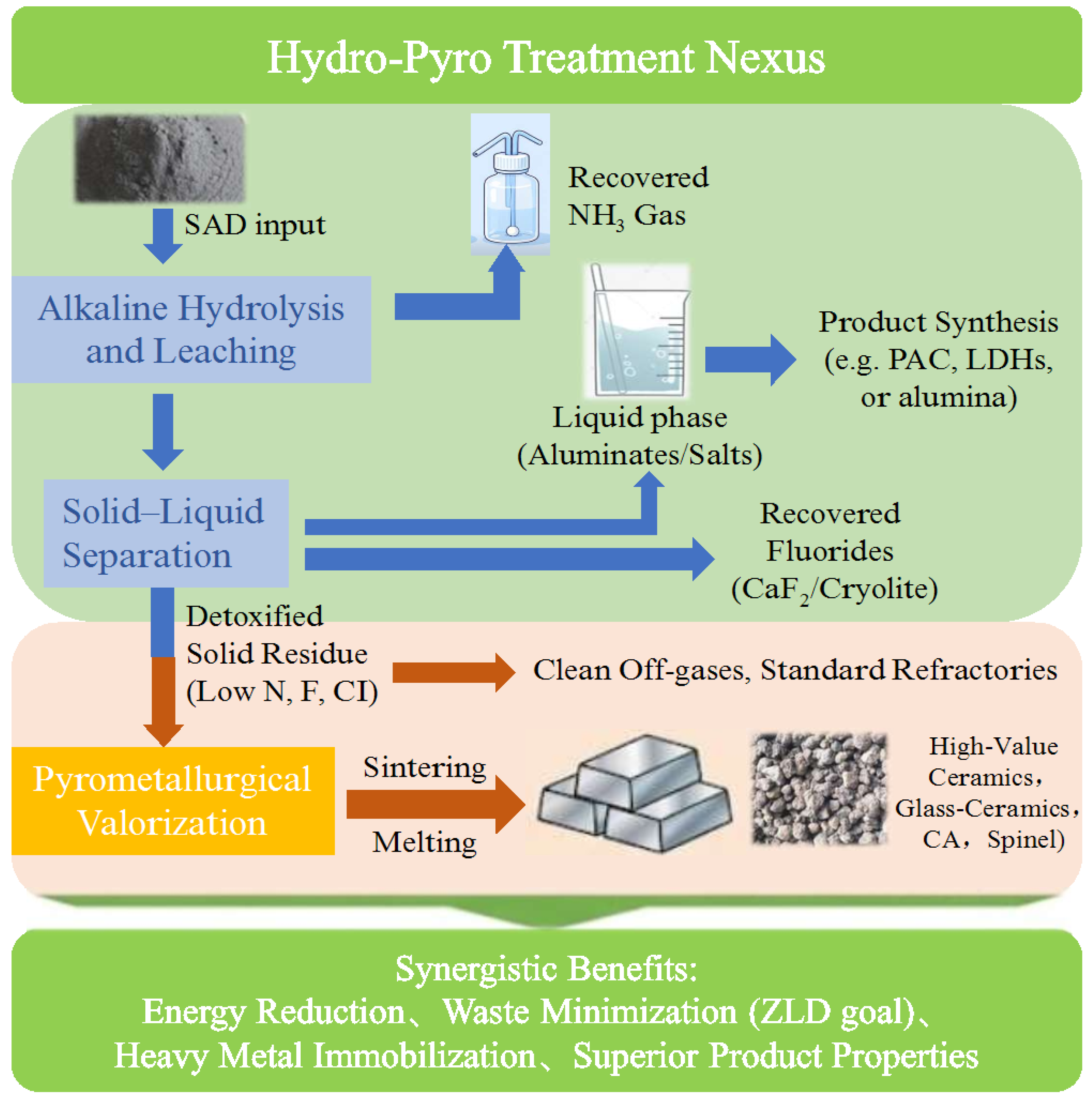
Several hybrid configurations can be envisioned, tailored to SAD composition and target products (Figure 13). A promising generic framework involves:
Alkaline Hydrolysis and Leaching: SAD is subjected to controlled alkaline (NaOH) treatment [35]. This achieves near-complete hydrolysis of AlN (recovering NH3), dissolves soluble salts (NaCl, KCl, and NaF) [88], and mobilizes complex fluorides into the liquid phase [89]. The solid residue is significantly detoxified, with Al and Si primarily in the form of aluminates/silicates.
Solid–Liquid Separation: The leachate, rich in Al, F, and salts, is separated. Fluoride can be precipitated as CaF2 or, ideally, recovered as Na3AlF6 [90]. The aluminate solution can be routed to product synthesis (e.g., PAC, LDHs, or alumina via carbonation) [12,25,54]. The treated solid residue, now low in N, F, and Cl, proceeds to thermal processing.
Pyrometallurgical Valorization: The pretreated solid, with a more consistent and benign composition, undergoes sintering or melting [8]. The absence of volatile N-species minimizes NOx emissions. The lower halide content reduces corrosive gas (HF and HCl) formation and allows for the use of standard refractories. This stage can be optimized to produce ceramics, glass-ceramics, CA, or spinel with improved purity and properties [57,91].

5.2. Synergistic Benefits and Contaminant Fate

This nexus capitalizes on the strengths of each method while mitigating their weaknesses:
Energy and Emission Reduction: Bulk contaminant removal at <100 °C avoids the high energy cost of thermally destroying AlN and volatilizing salts [46]. The subsequent pyro-stage operates at a potentially lower temperature and with cleaner off-gases.
Waste Minimization: The hydro-stage concentrates contaminants into process streams amenable to treatment and resource recovery [3] (e.g., NH3 scrubbing, fluoride recovery), moving closer to ZLD goals.
Product Enhancement: The purified solid feedstock allows for more controlled high-temperature reactions, leading to ceramic/refractory products with fewer defects (e.g., bloating from N2 and corrosion from F/Cl) and superior performance [57,91,92].
Contaminant Partitioning: The nexus strategically partitions contaminants: N and soluble salts report to the aqueous phase [93]; F is either removed in the hydro-stage or fixed as stable CaF2 in the solid before pyrolysis [37]; heavy metals are retained in the solid matrix and ultimately immobilized in the sintered ceramic lattice [94,95].

5.3. Case Examples and Research Needs

The hydro–pyro nexus represents a paradigm shift from sequential to synergistic processing. Its development is essential for achieving the environmentally sound and economically viable industrial-scale valorization of SAD. Emerging studies hint at this potential. Processes that use acid or alkali leaching followed by sintering of the residue to produce ceramics or CA [17,18] are nascent examples of the nexus. However, systematic investigation is lacking. Critical research must focus on:
Optimized Coupling: Determining the exact point of transition (e.g., extent of AlN removal and fluoride level) that maximizes overall efficiency.
System-Wide Analysis: Conducting integrated LCA and TEA comparing standalone routes with hybrid configurations to quantify net benefits in energy, carbon footprint, and cost.
Fate Tracking: Advanced characterization to trace the migration of key impurities (F, Cl, and heavy metals) across the coupled process stages to ensure no pollutant shifting occurs.

5.4. Prioritization of Research and Development Challenges for Industrialization

The preceding analysis identifies multiple technical and economic challenges that must be addressed to enable widespread industrial adoption of integrated SAD valorization. However, not all challenges carry equal weight in terms of their impact on industrial viability. Based on a synthesis of the literature, consultation with industrial practitioners, and techno-economic considerations, the following prioritized ranking is proposed:
Tier 1: Critical barriers that must be addressed for any industrial-scale implementation:
  • Consistent product quality and purity: Feedstock compositional variability remains the single greatest obstacle to industrial adoption. The absence of robust, composition-tolerant processing protocols leads to batch-to-batch product inconsistency, undermining market acceptance and commercial viability. This challenge is ranked highest because it directly impacts revenue generation and customer confidence.
  • Economic viability under variable market conditions: The economic feasibility of SAD processing is highly sensitive to energy prices, reagent costs, and market values for recovered products. While Table 3 demonstrates that net positive margins are achievable under optimal conditions, the margin of safety is narrow. Process designs must incorporate operational flexibility to maintain profitability across fluctuating market conditions.
Tier 2: Major challenges that significantly influence scale-up and long-term sustainability:
3.
Integrated wastewater and off-gas management: Both hydrometallurgical and pyrometallurgical routes generate secondary pollution streams (high-salinity wastewater, NOx, HF, heavy metal-laden dust) that require management. The failure to address these streams simply shifts the environmental burden rather than eliminating it. The development of cost-effective ZLD systems and integrated off-gas treatment trains is essential for regulatory compliance and social license to operate.
4.
Energy efficiency and carbon footprint: The high energy consumption of pyrometallurgical routes and the embodied energy of reagents in hydrometallurgical routes represent both a cost driver and an environmental liability. Optimizing energy efficiency is particularly critical in jurisdictions with carbon pricing or high energy costs.
Tier 3: Important but addressable challenges that can be resolved through continued research and development:
5.
Process integration and control: The development of hybrid hydro–pyro systems requires optimization of the integration point and adaptive process control strategies. While challenging, these are fundamentally engineering problems amenable to systematic optimization.
6.
Byproduct valorization: The management of secondary streams (e.g., chloride salts, ammonia, fluoride precipitates) as valuable products rather than wastes would improve overall economics and sustainability. This represents a significant opportunity but is not a prerequisite for initial deployment.
7.
Long-term material durability: For construction and refractory applications, the long-term performance of SAD-derived materials under environmental exposure conditions requires validation. This is critical for market acceptance but can be addressed through parallel product testing and standardization efforts.
This prioritization framework is intended to guide research funding, process development, and policy decisions. The critical barriers (Tier 1) must be addressed to achieve any meaningful industrial deployment, while Tier 2 challenges will determine the long-term sustainability and competitiveness of chosen technologies. Tier 3 issues, while important, can be progressively resolved as the industry matures.

6. Comparative Analysis of Environmental Impact and Economic Benefits

The valorization of SAD addresses environmental hazards while generating economic value through the recovery of metallic Al and marketable by-products [23,96]. Current recycling pathways target products including alumina, premelted CA, refining fluxes, and PAC. Life cycle assessment (LCA) and life cycle costing (LCC) models reveal a fundamental trade-off between economic and environmental performance across these pathways [28,29] (Table 3). Based on the comprehensive economic and environmental evaluation, Alumina Production Pathway (Pathway I) is clearly the most advantageous recycling pathway, especially for applications where high economic returns and low environmental impact are prioritized. Premelted Calcium Aluminate Pathway (Pathway II), though low in cost, is limited by its higher environmental burden and lower profitability. Polyaluminum Chloride Pathway (Pathway III) ranks in the middle, making it suitable for specific scenarios requiring high-value products like PAC.
The environmental benefit of SAD valorization is stark when contrasted with primary Al production. The primary route is highly energy-intensive, requiring 10–12 GJ/t of thermal energy for the Bayer process and 13,500–15,000 kWh/t of electrical energy for electrolysis [97,98]. Pyrometallurgical recovery of Al from dross consumes only about 5% of this energy [99]. Furthermore, industrial-scale simulations indicate that producing alumina directly from SAD requires approximately 3868 kWh/t [100], reducing environmental impacts by 32.16% and costs to 130.01 USD/t, nearly 50% lower than the conventional bauxite-based route [23]. While pyrometallurgical methods demonstrate over 70% higher eco-efficiency than hydrometallurgical alternatives, their economics are more sensitive to electricity price volatility [30]. In particular, the environmental payoff of using clean energy is far greater for pyrometallurgical recovery. A transition to hydropower achieves a 19.6% mitigation rate, compared to only 5.8% for hydrometallurgical processes. This underscores the critical role of energy-mix optimization in pathway selection. In summary, selecting a SAD valorization strategy involves navigating a critical trade-off between profitability, environmental safety, and energy sensitivity. Strategic optimization of energy sources and process parameters is essential for achieving a synergistic equilibrium that advances both low-carbon goals and high-value resource recovery.

Sensitivity Analysis: Energy Price and Reagent Cost as Critical Determinants of Process Viability

The comparative static rankings in Table 9 and Section 6 are subject to pronounced variability under dynamic market conditions. Two sensitivity factors are paramount. First, pyrometallurgical routes exhibit high exposure to electricity price volatility due to their energy-intensive endothermic reactions (600–2500 kWh/t). A 50% increase in industrial electricity price (from $0.08 to $0.12/kWh) raises operating costs by $30–125/t SAD, potentially eroding the net profit margin of premelted calcium aluminate production (Pathway II) by 30–40%. In contrast, hydrometallurgical routes, with energy consumption of 200–800 kWh/t, show only a 10–15% cost sensitivity under the same price shift. Second, hydrometallurgical viability is highly sensitive to reagent costs, particularly NaOH ($300–600/t) and HCl ($100–200/t). A 50% increase in NaOH price raises alkaline leaching operational costs by $25–50/t SAD, narrowing the profit advantage of the alumina production pathway (Pathway I, net profit $490.71/t). Acidic leaching for PAC production (Pathway III) is even more vulnerable, with HCl constituting 30–45% of direct material costs. Conversely, pyrometallurgical routes are largely reagent-independent (major additives: CaO at $50–100/t, Na2CO3 at $200–300/t), making them more resilient to chemical market fluctuations. These sensitivities imply that no single technology is universally optimal; alkaline hydrometallurgy is favored where low-cost renewable electricity and affordable NaOH are available, while pyrometallurgy is preferable in regions with stable, cheap electricity (e.g., hydropower) and stringent wastewater discharge limits. Hybrid systems, by reducing both energy and reagent demand through synergistic design, offer the most robust performance across a wider range of economic scenarios.

7. Summary and Outlook

This review has critically examined the state-of-the-art hydrometallurgical and pyrometallurgical technologies, revealing a critical impasse: hydrometallurgy offers precision but generates complex waste streams, while pyrometallurgy provides robustness at high energy and emission costs. The analysis of the proposed hydro–pyro nexus in Section 5 provides a pathway to transcend this trade-off. The synthesis of these findings leads to a central conclusion: transcending this trade-off requires moving beyond the wet versus dry dichotomy toward designed hybrid systems. Transforming SAD from a hazardous waste into a secondary resource is therefore not merely a technical challenge, but a systems-integration problem demanding interdisciplinary research. To catalyze this necessary evolution, the following interconnected research priorities must be addressed:
(1)
Comprehensive and broad-spectrum detoxification: Current research is disproportionately focused on AlN and fluorides, whereas other hazardous constituents, such as Al4C3, chlorides, and speciated heavy metals (e.g., Cr(VI) and Cd), remain insufficiently addressed. Future efforts should prioritize integrated detoxification strategies capable of simultaneously mineralizing carbides, stabilizing heavy metals, and eliminating soluble salts, thus ensuring long-term environmental safety rather than short-term risk reduction.
(2)
Mechanistic understanding of AlN-driven reduction processes: The use of AlN in SAD as a metallurgical reductant represents a promising but underdeveloped pathway for metal recovery. Fundamental knowledge gaps remain regarding thermodynamic driving forces, nitrogen evolution pathways, and impurity-phase transformations during reduction. Advanced in situ characterization (e.g., high-temperature spectroscopy) combined with process-based and data-driven modeling is required to optimize process parameters (e.g., temperature, atmosphere, and additives) and expand applications to strategic metals, including rare-earth elements.
(3)
Integration of hydrometallurgical and pyrometallurgical routes (the hydro–pyro nexus): Future technologies must build upon the conceptual framework established in Section 5, focusing on the development of practical hybrid hydro–pyro systems. Systematic investigation of contaminant migration and transformation across coupled stages, optimization of the integration point, and holistic sustainability assessment are critical research needs to demonstrate viability.
(4)
Energy recovery and proactive resource utilization: Beyond material recovery, the latent chemical energy associated with residual metallic Al and AlN in SAD remains largely untapped. The development of advanced reactors that couple controlled hydrolysis with hydrogen or ammonia capture could potentially transform SAD treatment from an energy-intensive liability into a supplementary renewable-energy source, fundamentally reshaping its sustainability profile.
(5)
High-value product functionalization and standardization: Future research should move beyond low-grade fillers and construction additives toward high-value functional materials, such as mesoporous alumina for catalysis, layered double hydroxides for energy storage and adsorption, optical-grade spinels, and tailored glass-ceramics. Importantly, universal, composition-tolerant processing protocols and performance-based product standards must be developed to accommodate variability in SAD feedstocks and enable market acceptance.
(6)
Sustainability assessment and systems integration: LCA and TEA are currently underrepresented in SAD research. Quantitative evaluation of environmental footprint, carbon intensity, and economic viability is essential for guiding technology selection and policy formulation. Integration of SAD valorization into industrial symbiosis networks, such as cement kilns, power plants, and metallurgical complexes, offers further opportunities to enhance system-level sustainability.

Author Contributions

Z.Z.: Methodology, Software, Validation, Formal analysis, Investigation, Data curation, Writing—original draft, Writing—review and editing. S.Y.: Resources, Writing—review and editing, Project administration, Funding acquisition. Y.C.: Resources, Writing—review and editing, Project administration, Funding acquisition. Z.C.: Conceptualization, Methodology, Resources, Writing—review and editing, Project administration. J.H.: Conceptualization, Resources, Formal analysis, Software, Data curation. Y.X.: Conceptualization, Resources, Formal analysis, Software, Data curation. F.E.: Conceptualization, Data curation, Writing—review and editing. W.X.: Resources, Project administration, Formal analysis, Funding acquisition. S.Z.: Methodology, Formal analysis, Software, Data curation. Z.Y.: Formal analysis, Software, Data curation. J.L.: Conceptualization, Methodology, Resources, Writing—review and editing, Funding acquisition. All authors have read and agreed to the published version of the manuscript.

Funding

This work was supported by the Guangdong Provincial Science and Technology Program (2025A0505020091) and Guangdong Basic and Applied Basic Research Foundation (2025A1515011026), and Open foundation of Key Laboratory of Radioactive and Rare Scattered Minerals, Ministry of Natural Resources (2024-RRSM-04).

Data Availability Statement

All data generated or analyzed during this study are included in this published article.

Conflicts of Interest

The authors declare that they have no known competing financial interests or personal relationships that could have appeared to influence the work reported in this paper.

Nomenclature

Symbol/TermDefinition
AlAluminum
Al(OH)3Aluminum hydroxide
Al2O3Alumina (aluminum oxide)
Al4C3Aluminum carbide
AlNAluminum nitride
AlO2Aluminate ion
CaF2Fluorite (calcium fluoride)
CACalcium aluminate
CH4Methane
CO2 eqCarbon dioxide equivalent
CEIComprehensive Evaluation Index
EIEnvironmental Impact Index
FFluoride ion
GWPGlobal warming potential
HFHydrogen fluoride
HW48Chinese hazardous waste code for wastes from non-ferrous metal smelting
L/S ratioLiquid-to-solid ratio
LCALife cycle assessment
LCCLife cycle costing
LDHLayered double hydroxide
MLMachine learning
MOCMagnesium oxychloride cement
Na3AlF6Cryolite (sodium hexafluoroaluminate)
NH3Ammonia
NOxNitrogen oxides (NO, NO2)
PACPolyaluminum chloride
PADPrimary aluminum dross (white dross)
SADSecondary aluminum dross (black dross)
SiF4Silicon tetrafluoride
SMSSilicon manganese slag
TEATechno-economic analysis
ZLDZero liquid discharge

References

  1. Ji, F.; Li, Z.; Xiong, M.; Zhang, H.; Yu, Z.; Gu, Y.; Wang, Y.; Li, F. Market value and carbon reduction potential of secondary aluminum ash resource utilization: A strategic analysis. Chem. Eng. J. 2025, 507, 160446. [Google Scholar] [CrossRef]
  2. Tang, Y.; Yang, W.; Chen, B.; Ma, T.; Qiu, Z.; Lin, Y. Research Progress on Clean Disposal and Recovery Technologies of Typical Hazardous Solid Waste from Aluminum Electrolysis Process. Hydrometall. China 2023, 42, 551–558. [Google Scholar] [CrossRef]
  3. Meshram, A.; Singh, K.K. Recovery of valuable products from hazardous aluminum dross: A review. Resour. Conserv. Recycl. 2018, 130, 95–108. [Google Scholar] [CrossRef]
  4. Srivastava, A.; Meshram, A. Valorization of aluminium dross for the development of al-rich product. Agron. Res. 2024, 22, 1297–1311. [Google Scholar] [CrossRef]
  5. Wang, Y.; Zhao, H.; Wang, X.; Chong, J.; Huo, X.; Guo, M.; Zhang, M. Transformation and Detoxification of Typical Metallurgical Hazardous Waste into a Resource: A Review of the Development of Harmless Treatment and Utilization in China. Materials 2024, 17, 931. [Google Scholar] [CrossRef] [PubMed]
  6. Shen, H.; Liu, B.; Ekberg, C.; Zhang, S. Harmless disposal and resource utilization for secondary aluminum dross: A review. Sci. Total Environ. 2021, 760, 143968. [Google Scholar] [CrossRef] [PubMed]
  7. Shinzato, M.C.; Hypolito, R. Effect of disposal of aluminum recycling waste in soil and water bodies. Environ. Earth Sci. 2016, 75, 628. [Google Scholar] [CrossRef]
  8. Yang, J.; Tian, L.; Meng, L.; Wang, F.; Die, Q.; Yang, Y.; Huang, Q. Thermal utilization techniques and strategies for secondary aluminum dross: A review. J. Environ. Manag. 2024, 351, 119939. [Google Scholar] [CrossRef]
  9. Liu, Y.; Zhang, J.; Shen, H. Research progress of secondary aluminum dross resource utilization. Rare Met. 2024, 48, 277–287. [Google Scholar] [CrossRef]
  10. Mahinroosta, M.; Allahverdi, A. A promising green process for synthesis of high purity activated-alumina nanopowder from secondary aluminum dross. J. Clean. Prod. 2018, 179, 93–102. [Google Scholar] [CrossRef]
  11. Yang, Q.; Li, Q.; Zhang, G.; Shi, Q.; Feng, H. Investigation of leaching kinetics of aluminum extraction from secondary aluminum dross with use of hydrochloric acid. Hydrometallurgy 2019, 187, 158–167. [Google Scholar] [CrossRef]
  12. Li, L.; Song, M.; Jin, Q. Recovery of alumina from secondary aluminum dross by alkali leaching. Inorg. Chem. Ind. 2019, 51, 53–57. [Google Scholar]
  13. Feng, H.; Wang, L.; Li, G.; Jin, Q. Removal of impurities for the synthesis of high-property alumina-spinel ceramic from secondary aluminum dross. Ceram. Int. 2023, 49, 34616–34626. [Google Scholar] [CrossRef]
  14. Lv, H.; Xie, M.; Shi, L.; Zhao, H.; Wu, Z.; Li, L.; Li, R.; Liu, F. A novel green process for the synthesis of high-whiteness and ultrafine aluminum hydroxide powder from secondary aluminum dross. Ceram. Int. 2022, 48, 953–962. [Google Scholar] [CrossRef]
  15. Deng, W.; Xie, Q.; Zhou, R.; Tuo, H.; Liu, X.; Deng, H.; Lin, Z. Mechanism study of synergistic aluminum extraction and purification by ammonium for high-value conversion of secondary aluminum dross. J. Environ. Chem. Eng. 2024, 12, 113298. [Google Scholar] [CrossRef]
  16. Liu, Y.; Shen, H.; Zhang, J.; Li, W.; Liu, J.; Liu, B.; Zhang, S. High strength porous ceramics and its potential in adsorption and building materials: A short process to co-disposal secondary aluminum dross and quicklime. Constr. Build. Mater. 2023, 395, 132292. [Google Scholar] [CrossRef]
  17. Zuo, Z.; Zhao, Y.; Zhang, H.; Li, S.; Li, Z.; Wu, W.; Li, H.; Zhang, J. Preparation of calcium aluminate by passivation-acid modulation coupling control of secondary aluminum dross. Sep. Purif. Technol. 2025, 360, 130830. [Google Scholar] [CrossRef]
  18. Zhang, Y.; Guo, Z.-H.; Han, Z.-Y.; Xiao, X.-Y.; Peng, C. Feasibility of aluminum recovery and MgAl2O4 spinel synthesis from secondary aluminum dross. Int. J. Miner. Metall. Mater. 2019, 26, 309–318. [Google Scholar] [CrossRef]
  19. Shen, H.; Lou, B.; Liu, B.; Zhang, J.; Zhang, X.; Wen, Q.; Liu, J.; Hu, Y.; Zhang, S. Migration of nitrogen in calcium aluminate made from aluminum dross. J. Alloys Compd. 2025, 1022, 179692. [Google Scholar] [CrossRef]
  20. Hu, S.; Wang, D.; Hou, D.; Zhao, W.; Li, X.; Qu, T.; Zhu, Q. Research on the preparation parameters and basic properties of premelted calcium aluminate slag prepared from secondary aluminum dross. Materials 2021, 14, 5855. [Google Scholar] [CrossRef]
  21. Lou, B.; Shen, H.; Liu, B.; Liu, J.; Zhang, S. Recycling secondary aluminum dross to make building materials: A review. Constr. Build. Mater. 2023, 409, 133989. [Google Scholar] [CrossRef]
  22. Liu, J.; Zhang, S.; Shen, H.; Lou, B.; Zhang, B. Recycling of secondary aluminum dross to make alumina by hydrometallurgy: A review. J. Mater. Res. Technol.-JMRT 2024, 32, 4234–4245. [Google Scholar] [CrossRef]
  23. Zhu, X.; Jin, Q.; Ye, Z. Life cycle environmental and economic assessment of alumina recovery from secondary aluminum dross in China. J. Clean. Prod. 2020, 277, 123291. [Google Scholar] [CrossRef]
  24. Du, X.; Zhao, Z.; Lv, G.; Chen, F.; Zhao, X.; Zhang, T. Study on preparation of polyaluminum chloride by nitrogen removal from secondary aluminum ash. Light Met. 2023, 3, 9–14. [Google Scholar] [CrossRef]
  25. Li, L.; Dong, X.; Cheng, Y.; Xue, L.; Yang, J.; Huang, X. Preparation of polymeric aluminum chloride from secondary aluminum dross and its water purification effect. Can. Metall. Q. 2025, 64, 1510–1520. [Google Scholar] [CrossRef]
  26. Zuo, W.; Zhao, R.; Dong, G.; Ma, G.; Zhou, H.; Song, T.; Tu, Y.; Xie, H.; Wang, X. CO2-assisted water-washing process of municipal solid waste incineration fly ash for chloride removal. Energy Fuels 2022, 36, 13732–13742. [Google Scholar] [CrossRef]
  27. Chen, X.; Bi, Y.; Zhang, H.; Wang, J. Chlorides removal and control through water-washing process on MSWI fly ash. Procedia Environ. Sci. 2016, 31, 560–566. [Google Scholar] [CrossRef]
  28. Xiao, L.; Wang, Y.; Zheng, R.; Liu, J.; Zhao, J.; Maraseni, T.; Qian, G. Identification of recycling pathways for secondary aluminum dross with integrated hybrid life cycle assessment. Resour. Conserv. Recycl. 2023, 193, 106987. [Google Scholar] [CrossRef]
  29. Wang, J.; Cui, H.; Guo, Y.; Wang, Z.; Sun, Z.; Liang, J.; Lv, L.; Gao, W. Understanding Environmental-Economic and Risk Feasibilities toward Aluminum Ash Treatment Processes: A Multiobjective Assessment. ACS Sustain. Chem. Eng. 2025, 13, 20349–20362. [Google Scholar] [CrossRef]
  30. Zhu, X.; Jin, Q. Comparison of three emerging dross recovery processes in China’s aluminum industry from the perspective of life cycle assessment. ACS Sustain. Chem. Eng. 2021, 9, 6776–6787. [Google Scholar] [CrossRef]
  31. Tripathy, A.; Mahalik, S.; Sarangi, C.; Tripathy, B.; Sanjay, K.; Bhattacharya, I. A pyro-hydrometallurgical process for the recovery of alumina from waste aluminium dross. Miner. Eng. 2019, 137, 181–186. [Google Scholar] [CrossRef]
  32. Li, Q.; Yang, Q.; Zhang, G.; Shi, Q. Investigations on the hydrolysis behavior of AlN in the leaching process of secondary aluminum dross. Hydrometallurgy 2018, 182, 121–127. [Google Scholar] [CrossRef]
  33. He, Y.; Li, Y.; Ma, B.; Sun, X.; He, X.; Gao, X. Effects of wet process on harmless nitrogen removal from secondary Al ash. Spec. Cast. Nonferrous Alloys 2021, 41, 679–683. [Google Scholar] [CrossRef]
  34. Feng, H.; Liu, Y.; Jin, Q. Effect of in-situ nano-alumina on the properties of alumina ceramics from secondary aluminum dross. Ceram. Int. 2024, 50, 46227–46238. [Google Scholar] [CrossRef]
  35. Guo, Q.; Li, H.; Fu, M.; Li, Y.; Tian, D.; Zhang, L. Enhanced Hydrolysis of Aluminum Nitride from Secondary Aluminum Dross Through Combination of Wet-Stirred Milling and Alkaline Leaching. Waste Biomass Valorization 2023, 14, 4257–4268. [Google Scholar] [CrossRef]
  36. Gao, Q.; Guo, Q.; Li, Y.; Ren, B.; Fu, M.; Li, H.; Tian, D.; Ding, M. Innovative technology for defluorination of secondary aluminum dross by alkali leaching. Miner. Eng. 2021, 172, 107134. [Google Scholar] [CrossRef]
  37. Lin, K.; Su, Z.; Xu, J.; Jiang, T.; Zhang, Y. Calcium-driven hydrolysis mechanisms of secondary aluminum dross (SAD) in the hydrometallurgical process to simultaneous denitrification, desalination, and fluoride fixation. Chem. Eng. J. 2024, 499, 155910. [Google Scholar] [CrossRef]
  38. Xie, H.; Guo, Z.; Xu, R.; Zhang, Y. Particle sorting to improve the removal of fluoride and aluminum nitride from secondary aluminum dross by roasting. Environ. Sci. Pollut. Res. 2023, 30, 54536–54546. [Google Scholar] [CrossRef]
  39. Dong, L.-M.; Jiao, F.; Liu, W.; Huang, Y.-L.; Wei, X.; Qin, W.-Q. Separation of fluorine and aluminum from secondary aluminum dross by calcium-cured alkali roasting-water leaching. Trans. Nonferrous Met. Soc. China 2024, 34, 2007–2019. [Google Scholar] [CrossRef]
  40. Zhang, Y.; Guo, Z.-H.; Han, Z.-Y.; Xiao, X.-Y. Effects of AlN hydrolysis on fractal geometry characteristics of residue from secondary aluminium dross using response surface methodology. Trans. Nonferrous Met. Soc. China 2018, 28, 2574–2581. [Google Scholar] [CrossRef]
  41. Li, G.; Liu, Z.; Yan, H.; Li, M.; Xia, C.; Liu, S. Research on the Reaction Behavior of Aluminum Nitride and Fluoride in Hazardous Waste Aluminum Ash in Different Systems. J. Sustain. Metall. 2025, 11, 2343–2354. [Google Scholar] [CrossRef]
  42. Zhu, B.; Feng, H.; Zhu, X.; Jin, Q. Preparation of adsorbent from secondary aluminum dross by deep hydrolysis of active aluminum components. J. Environ. Chem. Eng. 2024, 12, 112501. [Google Scholar] [CrossRef]
  43. Yang, H.-L.; Li, Z.-S.; Ding, Y.-D.; Ge, Q.-Q.; Jiang, L. Hydrolysis behavior and kinetics of AlN in aluminum dross during the hydrometallurgical process. Materials 2022, 15, 5499. [Google Scholar] [CrossRef] [PubMed]
  44. Zhao, X.; Liu, Y.; Lyu, G.; Zhang, Y.; Zhang, T.-A. Removal of fluorine, chlorine, and nitrogen from aluminum dross by wet process. In Light Metals 2022; Springer: Berlin/Heidelberg, Germany, 2022; pp. 48–55. [Google Scholar] [CrossRef]
  45. Tang, J.; Liu, G.; Qi, T.; Zhou, Q.; Peng, Z.; Li, X.; Wang, Y.; Shen, L.; Zhao, J.; Hao, H. Rich microbubbles modifying the leaching mechanism of aluminum and aluminum nitride of secondary aluminum dross in sodium aluminate solution. Hydrometallurgy 2022, 214, 105962. [Google Scholar] [CrossRef]
  46. Li, Z.; Li, H.; Huang, X.; Wu, W.; Sun, Z.; Wu, X.; Li, S. Removal of nitrides and fluorides from secondary aluminum dross by catalytic hydrolysis and its mechanism. Heliyon 2023, 9, e12893. [Google Scholar] [CrossRef]
  47. Lv, H.; Zhao, H.; Zuo, Z.; Li, R.; Liu, F. A thermodynamic and kinetic study of catalyzed hydrolysis of aluminum nitride in secondary aluminum dross. J. Mater. Res. Technol.-JMRT 2020, 9, 9735–9745. [Google Scholar] [CrossRef]
  48. Wang, C.; Guo, Y.; He, Y.; Li, S.; Liu, J.; Liu, H. Mechanism of the denitrification of secondary aluminum dross (SAD) during water leaching with delayed addition of a low dosage of sodium hydroxide. Hydrometallurgy 2024, 226, 106318. [Google Scholar] [CrossRef]
  49. Huo, Q.; Li, R.; Chen, M.; Zhou, R.; Li, B.; Chen, C.; Liu, X.; Xiao, Z.; Qin, G.; Huang, J. Mechanism for leaching of fluoride ions from carbon dross generated in high-temperature and low-lithium aluminum electrolytic systems. J. Hazard. Mater. 2024, 469, 133838. [Google Scholar] [CrossRef]
  50. Bao, S.; Li, S.; Zhang, C.; Miao, X. Leaching and recycling analysis of fluorine and chlorine in secondary aluminum dross. Chin. Met. 2018, 28, 24–28. [Google Scholar] [CrossRef]
  51. Wu, X.; Zhao, Q.; Yu, X.; Shen, Q.; Lin, Y. Environmental Protection Treatment and Resource Utilization of Aluminum Dross. Metall. Mater. Trans. B 2025, 56, 4218–4229. [Google Scholar] [CrossRef]
  52. Shi, J.; Huang, Z.; Qin, Q.; Yuan, C.; Chen, J.; Zhou, Y. Experiment study on the preparation of polyaluminum chloride with secondary aluminum dross. Met. Mine 2021, 7, 206–210. [Google Scholar] [CrossRef]
  53. Xi, C.; Zhang, T.; Zhang, Y.; Lv, G.; Chen, Y. Study on the preparation of polyaluminum chloride by acid leaching of secondary aluminum dross. Nonferrous Met. Sci. Eng. 2021, 12, 1–9. [Google Scholar] [CrossRef]
  54. Mahinroosta, M.; Allahverdi, A. Conversion of secondary aluminum dross into hierarchical carbonate-intercalated Mg-Al layered double hydroxide for efficient CO2 capture. Process Saf. Environ. Prot. 2024, 188, 617–628. [Google Scholar] [CrossRef]
  55. Mahinroosta, M.; M Moattari, R.; Allahverdi, A.; Ghadir, P. Malachite green dye removal with aluminosilicate nanopowder from aluminum dross and silicomanganese slag. Circ. Econ. 2024, 3, 100100. [Google Scholar] [CrossRef]
  56. Wen, J.; Liu, G.; Qi, T.; Zhou, Q.; Peng, Z.; Shen, L.; Wang, Y.; Shi, Z.; Zhao, J. Safe comprehensive utilization of the hazardous secondary aluminum dross: Mechanism and technology. J. Environ. Chem. Eng. 2025, 13, 115939. [Google Scholar] [CrossRef]
  57. Zhu, X.; Yang, J.; Yang, Y.; Huang, Q.; Liu, T. Pyrometallurgical process and multipollutant co-conversion for secondary aluminum dross: A review. J. Mater. Res. Technol.-JMRT 2022, 21, 1196–1211. [Google Scholar] [CrossRef]
  58. Zhu, C.; Dai, W.; Wang, Y.; Evrendilek, F.; Liang, J.; Zhuang, G.; Liu, J.; Cai, B.; Huang, J.; Xie, Y.; et al. Fluoride leaching and retention dynamics of co-thermal disposal of secondary aluminum dross and fly ash. Process Saf. Environ. Prot. 2024, 188, 982–994. [Google Scholar] [CrossRef]
  59. Ni, H.; Lu, C.; Zhang, Y.; Wang, X.; Zhu, Y.; Lv, S.; Zhang, J. Effects of sodium carbonate and calcium oxide on roasting denitrification of recycled aluminum dross with high nitrogen content. Coatings 2022, 12, 922. [Google Scholar] [CrossRef]
  60. Xie, H.; Guo, Z.; Xu, R.; Zhang, Y.; Xu, Z. Synergistic effect of inorganic salt and AlN removal in the secondary aluminum dross during the roasting process. J. Alloys Compd. 2023, 966, 171518. [Google Scholar] [CrossRef]
  61. Wang, J.-H.; Zhong, Y.-Q.; Tong, Y.; Xu, X.-L.; Lin, G.-Y. Removal of AlN from secondary aluminum dross by pyrometallurgical treatment. J. Cent. South Univ. 2021, 28, 386–397. [Google Scholar] [CrossRef]
  62. Qu, Y.; Luo, H.; Gao, G.; Wang, Y.; Wu, L.; Gao, Y.; Xing, Y. Two-step harmless treatment of secondary aluminum dross (SAD) by vacuum distillation and alkaline roasting. J. Mater. Cycles Waste Manag. 2023, 25, 1130–1141. [Google Scholar] [CrossRef]
  63. Lv, H.; Xie, M.; Wu, Z.; Li, L.; Yang, R.; Han, J.; Liu, F.; Zhao, H. Effective extraction of the Al element from secondary aluminum dross using a combined dry pressing and alkaline roasting process. Materials 2022, 15, 5686. [Google Scholar] [CrossRef] [PubMed]
  64. Lou, B.; Shen, H.; Liu, B.; Zhang, J.; Zhang, X.; Liu, J.; Zhang, S. In-situ preparation of porous metal-ceramic composite from secondary aluminum dross and red mud for adsorption of organic pollutant. J. Alloys Compd. 2024, 986, 174135. [Google Scholar] [CrossRef]
  65. Yuan, H.; Luo, T.; Zhang, D.; Wang, Q. Harmless treatment and recycling of secondary aluminum dross: A review. J. Sustain. Cem.-Based Mater. 2023, 12, 1460–1473. [Google Scholar] [CrossRef]
  66. Chen, F.; Liu, F.; Zhang, T.; Liao, C.; Wang, J.; Zhang, J.; Wang, H. Selective separation and recovery aluminum oxide from secondary aluminum dross by ammonium sulfate roasting transformation followed by cooling crystallization. Miner. Eng. 2024, 216, 108866. [Google Scholar] [CrossRef]
  67. Cil, G.; Yildiz, K. Evaluation of secondary aluminium dross in calcium aluminate cement. Mater. Tehnol. 2022, 56, 541–546. [Google Scholar] [CrossRef]
  68. Cui, J.; Ma, H.; Ma, Z.; Wang, S.; Ji, L.; Ba, M. Effects of sintered secondary aluminum ash grinding fine power on the properties of modified magnesium oxysulfate cement-based materials. Constr. Build. Mater. 2025, 468, 140428. [Google Scholar] [CrossRef]
  69. Yao, X.; Wang, W.; Liu, M.; Yao, Y.; Wu, S. Synergistic use of industrial solid waste mixtures to prepare ready-to-use lightweight porous concrete. J. Clean. Prod. 2019, 211, 1034–1043. [Google Scholar] [CrossRef]
  70. Zhang, Y.; Ni, H.; Lv, S.; Wang, X.; Li, S.; Zhang, J. Preparation of sintered brick with aluminum dross and optimization of process parameters. Coatings 2021, 11, 1039. [Google Scholar] [CrossRef]
  71. Zhang, Z.J.; Li, S.Z.; Wang, L.L.; Li, M.K.; Huang, K.P.; Wu, W.; Liu, J.; Yi, X.M. Preparation of aluminum dross microporous bricks and the pore formation mechanisms. JOM 2023, 75, 4701–4713. [Google Scholar] [CrossRef]
  72. Zhu, W.; Wu, K.; Zhang, S.; Liu, J.; Yi, X.; Zhang, L. Zero-waste progress for the synthesis of high-purity β-sialon ceramics from secondary aluminum dross. Adv. Eng. Mater. 2021, 23, 202001298. [Google Scholar] [CrossRef]
  73. Qi, T.; Liu, X.; Man, S.; Liu, J.; Bao, W. Study on the preparation of secondary aluminium ash based porous mullite ceramics. Non-Met. Mines 2024, 47, 18–21. [Google Scholar] [CrossRef]
  74. Zan, W.; Ma, B.; Chen, G.; Cao, C.; Li, M. Preparation of porous mullite ceramic-based aggregates from low-voltage electroceramic wastes and secondary aluminum dross. Refractories 2024, 58, 302. [Google Scholar] [CrossRef]
  75. Liu, Y.; Yang, J.; Shen, H.; Zhang, J.; Li, W.; Zhang, X.; Liu, J.; Liu, B.; Zhang, S. Synthesis of porous glass ceramics with hierarchical and interconnected pores from secondary aluminum dross and waste glass. Ceram. Int. 2022, 48, 34364–34373. [Google Scholar] [CrossRef]
  76. Shen, H.; Liu, B.; Zhao, S.; Zhang, J.; Yuan, J.; Zhang, Y.; Zhang, S. Iron oxide and jadeite nucleation in high alumina glass-ceramics prepared from secondary aluminum dross. Ceram. Int. 2021, 47, 21744–21750. [Google Scholar] [CrossRef]
  77. Hassan, A.M.; Bunnori, N.M.; Ramesh, S.; Tan, C.Y.; Mo, K.H. Alkali activation of waste glass and aluminium dross for self-foaming glass ceramics production. Ceram. Int. 2025, 51, 6365–6378. [Google Scholar] [CrossRef]
  78. Gollapalli, V.; Jana, P.; Önal, M.A.R.; Borra, C.R.; Babu, N.K. Valorization of Aluminium Dross and Ladle Furnace Slag for Sustainable Production of Calcium Aluminate for Steel Refining. J. Sustain. Metall. 2025, 11, 2780–2793. [Google Scholar] [CrossRef]
  79. GB/T 29341-2022; Calcium Aluminate for Water Treatment Chemicals. State Administration for Market Regulation, National Standardization Administration: Beijing, China, 2022.
  80. Zhao, Y.; Zuo, Z.; Li, Z.; Zhang, J.; Wu, W.F.; Ma, W.P.; Zhu, G.; Li, S.; Wang, F. Preparation of calcium aluminate and spinel by hydrolysis and calcination from secondary aluminum dross. Asia-Pac. J. Chem. Eng. 2024, 19, e3117. [Google Scholar] [CrossRef]
  81. Shi, M.; Li, Y.; Shi, J. Fabrication of periclase and magnesium aluminate spinel refractory from washed residue of secondary aluminum dross. Ceram. Int. 2022, 48, 7668–7676. [Google Scholar] [CrossRef]
  82. Benkhelif, A.; Kolli, M. Synthesis of pure magnesium aluminate spinel (MgAl2O4) from waste aluminum dross. Waste Biomass Valorization 2022, 13, 2637–2649. [Google Scholar] [CrossRef]
  83. Zhang, Y.; Guo, Z.; Han, Z.; Xiao, X. Effect of rare earth oxides doping on MgAl2O4 spinel obtained by sintering of secondary aluminium dross. J. Alloys Compd. 2018, 735, 2597–2603. [Google Scholar] [CrossRef]
  84. Xu, L.; Li, X.; Liu, Y.; Chen, M.; Wang, N. Recovery of low phosphorus iron from steel slag using secondary aluminum dross as the reductant. J. Environ. Chem. Eng. 2023, 11, 110973. [Google Scholar] [CrossRef]
  85. Shen, H.; Liu, B.; Liu, Y.; Zhang, J.; Liu, J.; Zhang, S. Recovery of Fe, Cr and Ni in pickling sludge with aluminum nitride in secondary aluminum dross. Miner. Eng. 2022, 184, 107659. [Google Scholar] [CrossRef]
  86. McKay, G. Dioxin characterisation, formation and minimisation during municipal solid waste (MSW) incineration. Chem. Eng. J. 2002, 86, 343–368. [Google Scholar] [CrossRef]
  87. Xiao, Y.; Huang, Y.; Cheng, H.; Zhu, Z.; Yu, M.; Xu, W.; Li, Z.; Zuo, W.; Zhou, H.; Jin, B. Advances and outlook of heavy metal treatment technology from municipal solid waste incineration fly ash: A review. Energy Fuels 2023, 38, 895–918. [Google Scholar] [CrossRef]
  88. Reynolds, J.G. Salt solubilities in aqueous solutions of NaNO3, NaNO2, NaCl, and NaOH: A Hofmeister-like series for understanding alkaline nuclear waste. ACS Omega 2018, 3, 15149–15157. [Google Scholar] [CrossRef]
  89. Jiang, K.; Zeng, X. Desorption and recovery of fluoride adsorbed by the aluminum-loaded chelating resin. Desalination Water Treat. 2021, 224, 178–186. [Google Scholar] [CrossRef]
  90. Wan, B.; Li, W.; Sun, W.; Liu, F.; Chen, B.; Xu, S.; Chen, W.; Yi, A. Synthesis of cryolite (Na3AlF6) from secondary aluminum dross generated in the aluminum recycling process. Materials 2020, 13, 3871. [Google Scholar] [CrossRef]
  91. Wang, C.; Wang, R.; Yang, T.; Xin, Y.; Yao, Z.; Li, P.; Wang, F.; Huang, Y.; Qi, X.; Zhao, J. The Application of Secondary Aluminum Dross in Refractories: A Review. J. Sustain. Metall. 2025, 12, 64–81. [Google Scholar] [CrossRef]
  92. Li, A.; Zhang, H.; Yang, H. Evaluation of aluminum dross as raw material for high-alumina refractory. Ceram. Int. 2014, 40, 12585–12590. [Google Scholar] [CrossRef]
  93. Tang, Y.; Ma, L.; Qiu, Z.; Yang, W.; Chen, B.; Lin, Y. Sustainable approaches for multidimensional disposal and applications of aluminum dross: A review. Miner. Eng. 2025, 225, 109194. [Google Scholar] [CrossRef]
  94. Li, C.; Song, B.; Chen, Z.; Liu, Z.; Yu, L.; Zhi, Z.; Zhao, Y.; Wei, H.; Song, M. Immobilization of heavy metals in ceramsite prepared using contaminated soils: Effectiveness and potential mechanisms. Chemosphere 2023, 310, 136846. [Google Scholar] [CrossRef] [PubMed]
  95. Zhao, S.; Wen, Q.; Zhang, X.; Liu, B.; Zhang, S. Migration, transformation and solidification/stabilization mechanisms of heavy metals in glass-ceramics made from MSWI fly ash and pickling sludge. Ceram. Int. 2021, 47, 21599–21609. [Google Scholar] [CrossRef]
  96. Huang, K.; Yi, X. Resource Utilization and High-Value Targeted Conversion for Secondary Aluminum Dross: A Review. JOM 2023, 75, 279–290. [Google Scholar] [CrossRef]
  97. Farjana, S.H.; Huda, N.; Mahmud, M.P. Impacts of aluminum production: A cradle to gate investigation using life-cycle assessment. Sci. Total Environ. 2019, 663, 958–970. [Google Scholar] [CrossRef]
  98. Liu, G.; Müller, D.B. Addressing sustainability in the aluminum industry: A critical review of life cycle assessments. J. Clean. Prod. 2012, 35, 108–117. [Google Scholar] [CrossRef]
  99. Zhang, Y.; Cai, Y.; Liu, S.; Su, Z.; Jiang, T. Life cycle assessment of aluminum-silicon alloy production from secondary aluminum in China. J. Clean. Prod. 2023, 392, 136214. [Google Scholar] [CrossRef]
  100. Yeoh, Y.X.; Muhammad, N.I.S.; Kittappa, S.; Ramalingam, M.; Mansor, M.J.A.; Zainal Abidin, S. Quantitative Technoeconomic Assessment of Alumina Extraction from Aluminum Dross: Process Efficiency and Cost-Benefit Analysis. Process Integr. Optim. Sustain. 2025, 1–25. [Google Scholar] [CrossRef]
  101. Zhang, G.; Wang, Y.; Meng, X.; Zhang, D.; Ding, N.; Ren, Z.; Gao, W.; Sun, Z. Life cycle assessment on the vanadium production process: A multi-objective assessment under environmental and economic perspectives. Resour. Conserv. Recycl. 2023, 192, 106926. [Google Scholar] [CrossRef]
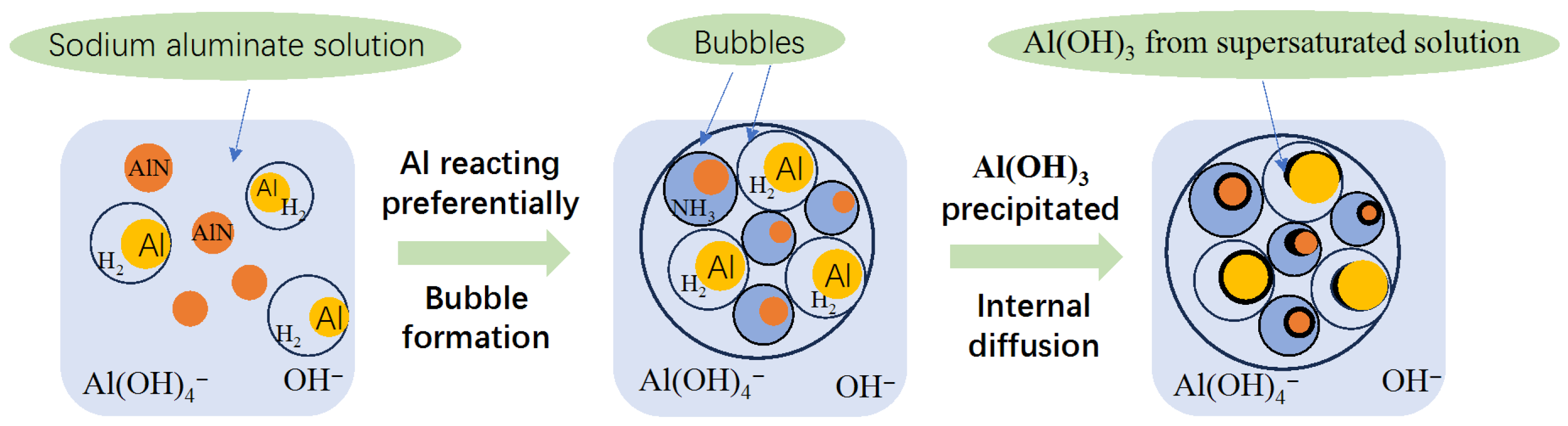
Figure 1. Conceptual schematic of passivating Al(OH)3 thin film formation on Al/AlN particle surface during SAD hydrolysis.
Processes 14 01212 g001
Figure 2. Enhanced AlN hydrolysis in SAD upon NaOH addition, showing film dissolution and continued reaction.
Processes 14 01212 g002
Figure 3. Fluoride removal from SAD in alkaline media, showing pore formation and ion exchange.
Processes 14 01212 g003
Figure 4. Process flow for polyaluminum chloride (PAC) production from SAD.
Processes 14 01212 g004
Figure 5. Mechanism of AlN oxidation, showing the passivating α-Al2O3 layer hindering further reaction.
Processes 14 01212 g005
Figure 6. Mechanistic diagram of calcined alkali roasting−water leaching.
Processes 14 01212 g006
Figure 7. Mechanisms of SAD utilization in structural building materials, showing phase transformations and pore formation.
Processes 14 01212 g007
Figure 8. Formation mechanism of porous glass ceramics derived from SAD.
Processes 14 01212 g008
Figure 9. Process flow diagram for the preparation of calcium aluminate (CA) from SAD.
Processes 14 01212 g009
Figure 10. Process flow diagram for the preparation of magnesium–alumina spinel from SAD.
Processes 14 01212 g010
Figure 11. Thermodynamic parameters for key pyrometallurgical reactions.
Processes 14 01212 g011
Figure 12. Phase stability diagrams: (a) Al–O–N ternary phase diagram; (b) Ca–F–Si–O isothermal line diagram.
Processes 14 01212 g012
Figure 13. Conceptual framework and process flow of the integrated hydro–pyrometallurgical nexus for secondary aluminum dross (SAD) treatment.
Processes 14 01212 g013
Table 1. Typical compositional ranges and associated hazards of primary (PAD) and secondary (SAD) aluminum dross.
ComponentPAD (wt.%) [5,6]SAD (wt.%) [5,6,7]Hazard/Risk
Metallic Al50–853–15Explosion risk; energy resource.
AlN1–105–35Hydrolysis → NH3 (toxic, malodorous).
Al4C3<0.50.5–3Hydrolysis → CH4 (GHG, explosion risk).
NaCl/KCl5–1510–40Soil/water salinization, corrosion.
Fluorides (F)0.5–21–10Toxicity, leachability (e.g., NaF, Na3AlF6).
Al2O3/oxides10–3020–50Inert; resource for Alumina, ceramics.
Heavy Metals<0.10.01–2Ecotoxicity (e.g., Pb, Cr, Zn).
Table 2. Influence of SAD compositional variability on technology selection.
SAD
Characteristic
Favorable
Technology
Rationale
High metallic Al (>15 wt.%)Pyrometallurgical with prior metal recoveryRecovery of metallic Al prior to detoxification improves overall economics; metallic Al can reduce energy consumption in pyrometallurgical processes.
High salt content (>25 wt.%)Hydrometallurgical (water washing)Water washing effectively removes soluble salts, preventing corrosion and fouling in downstream thermal units.
High AlN (>25 wt.%)Alkaline hydrometallurgical or hybridAlkaline conditions maximize AlN hydrolysis efficiency; if energy prices are low, thermal oxidation is feasible.
High fluoride (>5 wt.%)Pyrometallurgical with CaO addition or hybridCaO effectively fixes fluoride as stable CaF2 during thermal treatment; hydrometallurgical leaching requires complex wastewater treatment for F.
High heavy metals (e.g., Pb, Zn)Pyrometallurgical with vitrificationHigh-temperature sintering can incorporate heavy metals into a stable glass-ceramic matrix; hydrometallurgical leaching may require selective separation steps.
Variable, heterogeneous compositionPyrometallurgical or hybrid with robust pretreatmentPyrometallurgical processes exhibit greater tolerance to feedstock variability; coupling with a homogenizing pretreatment step enhances process stability.
Table 3. Comparative analysis of hydrometallurgical, pyrometallurgical, and hybrid processes for SAD treatment.
ProcessAdvantageDisadvantageTypical Energy
Consumption
(kWh/t SAD)
Typical Resource Recovery Product
HydrometallurgicalHigh AlN/fluoride removal efficiency; lower energy consumption; versatile product portfolio.High-salinity/ammonia wastewater treatment; process complexity; product purity sensitive to feed variability.Acidic Leaching: 200–400 [10,11]
Alkaline Leaching: 400–800 [12]
(Heating, mixing, and solids handling)
Alumina, Polyaluminum chloride (PAC), layered double hydroxides (LDH).
PyrometallurgicalSimple flow, suitable for scale-up; effective detoxification; high product stability.High energy demand; emissions of NOx, fluorides, particulates; risk of heavy metal volatilization.Oxidative Roasting: 600–1200 [13,14]
Sintering/Ceramic Formation: 1200–2500 [15,16]
(Heating to 800–1450 °C)
Refractories, ceramics, glass-ceramics, calcium aluminate, spinel.
Hybrid (Hydro–Pyro)Maximizes detoxification prior to thermal treatment; reduces harmful gas generation; enhances metal recovery.Increased process complexity and capital cost; requires optimized integration.300–800 (combined)
(Hydro-stage: 50–100; Pyro-stage: 250–700) [17,18]
High-purity alumina, advanced ceramics, alloy precursors.
Table 4. Technology readiness level (TRL) and industrial implementation status of SAD processing technologies.
Technology CategoryRepresentative ProcessTRLScale of DemonstrationKey Industrial Examples/
References
PyrometallurgicalRotary kiln sintering for CA/spinel8–9Industrial (10,000–100,000 t/year)Commercial operation [19,20]
Cement kiln co-processing8–9Industrial (50,000+ t/year)On the verge of industrialization [21]
Oxidative roasting for detoxification7–8Pilot–Industrial (1000–10,000 t/year)Multiple facilities in China [13,14]
HydrometallurgicalAlkaline leaching for alumina5–7Pilot (1000–5000 t/year)Based on the Bayer process, it is relatively mature [22,23].
Acidic leaching for PAC5–6Pilot (100–1000 t/year)Pilot studies [24,25]
Water washing for salt removal7–8Industrial (5000–20,000 t/year)Pretreatment units integrated with pyro-processes [26,27]
Hybrid (Hydro–Pyro)Alkaline leach + sintering for CA3–4Laboratory (1–10 kg/batch)Zuo et al. [17]
Acid leach + sintering for spinel3–4Laboratory (1–10 kg/batch)Zhang et al. [18]
Hydrothermal pretreatment + ceramic synthesis3–4LaboratoryShen et al. [19]
Table 5. Quantitative comparison of SAD processing routes: key performance indicators.
ParameterHydrometallurgicalPyrometallurgicalHybrid
(Hydro–Pyro)
Al recovery efficiency (%)75–98 [10,11,12]70–92 [13,15,31]88–96 [17,18]
AlN removal efficiency (%)80–100 [32,33,34]90–99 [13,14]>99 [35]
F removal/fixation efficiency (%)80–99 [36,37]90–99 [13,38,39]>95 [17]
Energy consumption (kWh/t SAD)200–800 [10,11,12,22]600–2500 [13,14,15,16]300–800 [17,18]
CO2 emissions (kg CO2 eq/t SAD)−1200 to −1600 [23,29]+150 to +800 [28,30]−200 to +200 [28]
Water consumption (m3/t SAD)5–20 [11,22]1–3 [13]3–8 [17]
Operational cost (USD/t SAD)100–200 [23,29]80–200 [28]90–160 [28]
Net profit (USD/t SAD)300–500 [23,29]250–450 [28]380–480 [28]
Table 6. Influence of key operational parameters on hydrometallurgical SAD processing.
ParameterRangeEffect on AlN
Hydrolysis
Effect on
Fluoride
Removal
Effect on Salt
Dissolution
Optimization
Considerations
pHAcidic (0–4)High H+ concentration accelerates Reaction (3); risk of Al3+ complexation with F [32,50].High F solubility; risk of HF volatilization requiring off-gas treatment [50].Promotes dissolution; corrosion concerns for equipment.Acidic conditions favor F removal but may require HF capture.
Neutral (5–8)Slow kinetics; passivating Al(OH)3 film formation limits conversion [45].Moderate F solubility; complex fluorides (Na3AlF6) poorly soluble [41].High solubility for NaCl/KCl.Not optimal for complete detoxification.
Alkaline (9–14)OH dissolves Al(OH)3 film; achieves near-complete conversion (Reactions (4), (6) and (7)) [33,46,48].OH displaces F from Na3AlF6 and CaF2 (Reactions (8) and (9)); high removal efficiency [36].High solubility; may form aluminate scales.Preferred for simultaneous AlN and F removal.
Temperature20–50 °CLimited kinetics; <40% conversion without additives [44].Low F dissolution; HF volatilization negligible.Moderate salt dissolution.Energy-efficient but incomplete detoxification.
60–100 °CSubstantially enhanced kinetics; 70–99% conversion achievable [41,48].Enhanced F solubility; HF volatilization may occur under acidic conditions [50].Near-complete salt dissolution [26].Optimal balance for most processes.
>100 °C (autoclave)Rapid, near-complete conversion; potential for NH3 recovery under pressure [47].High F mobilization; may require specialized equipment.Complete salt removal.High efficiency but increased capital cost.
L/S Ratio (mL/g)2–5Limited by mass transfer; risk of supersaturation and scaling.Moderate removal; potential for incomplete dissolution.Partial salt removal.Low water consumption; may require post-treatment.
6–15Enhanced mass transfer; 70–95% conversion typical [44,48].High removal efficiency; 80–95% F removal reported [36,37].Complete salt removal [26].Optimal range for most processes.
>15Diminishing returns; increased wastewater volume.Maximized removal but diluted F concentration for recovery.Complete removal.High water consumption; ZLD challenges.
Reagent ConcentrationNaOH (0.5–3 M)Directly accelerates AlN hydrolysis; optimal range 1–2.5 M [33,48].Enhances F displacement from complex fluorides; optimum 1.5–2.5 M [36].Increases ionic strength; may inhibit Al(OH)3 passivation [32].Balance between efficiency and reagent cost.
HCl (2–6 M)Rapid AlN conversion under strong acidic conditions [32].High F solubility; HF volatilization at >2 M [50].Complete dissolution.Corrosion concerns; neutralization required.
Ca2+ Additives (CaCl2, CaO)Minimal direct effect.Immobilizes F as CaF2; >99% fixation at 5–10 wt.% CaCl2 [37].May increase scaling.Effective for post-leaching F fixation.
Table 7. Selected process parameters for ceramic preparation from SAD.
No.Raw MaterialMolar/Mass RatioCalcination Temperature (°C)Calcination Time (h)ProductReference
1SAD, SiO21.81200 4Porous mullite ceramics[73]
2SAD, low-voltage electrical porcelain waste0.2510001Porous aggregate based on mullite ceramics[74]
3SAD, quicklime0.651400–15002Porous ceramics[16]
Table 8. Mechanistic roles and comparative assessment of additives in pyrometallurgical SAD processing.
AdditivePrimary FunctionMechanismOptimal
Conditions
Limitations
Na2CO3AlN oxidation promoter; aluminate formationDecomposes to Na2O; reacts with Al2O3 to form NaAlO2; disrupts dense Al2O3 passivation layer; enhances oxygen diffusion [31,59].800–1000 °C; 5–15 wt.% additionCan form soluble aluminate phases; may require subsequent water leaching for product purification.
CaOFluoride fixative; fluxing agentReacts with fluorides to form stable CaF2 (Reaction (18)); lowers melt viscosity; promotes sintering; forms calcium aluminates (CaO·Al2O3, CaO·2Al2O3) [39,59].900–1000 °C; CaO:F molar ratio 1.5–2.5:1High CaO dosages generate voluminous residues; may dilute product purity.
MgOSpinel formation; sintering aidReacts with Al2O3 to form MgAl2O4 spinel; promotes densification; inhibits grain growth [81,83].1400–1600 °C; MgO:Al2O3 molar ratio 0.8–1.2:1High temperature requirement; energy intensive.
SiO2Vitrification agent; film disruptorForms low-melting silicates; disrupts Al2O3 passivation film on AlN; promotes glass phase formation [60,70].800–1200 °C; 5–20 wt.% additionMay promote undesirable silicate phases; dilutes alumina content.
NH4HSO4/
(NH4)2SO4
Sulfation agentConverts Al phases to soluble Al2(SO4)3; enables subsequent water leaching for high-purity alumina recovery [15,66].400–600 °C (roasting); 1:1 to 2:1 (salt:Al)Generates SO2 and NH3 off-gases; requires off-gas treatment.
Table 9. Comparative analysis of economic and environmental performance across various SAD recycling pathways [28,29] *.
CategoryPathway I: Alumina
Production
Pathway II: Premelted CAPathway III: PAC
Economic performance
Net profit (USD/t SAD)490.71 (Highest)431.03 (Lowest)435.82 (Medium)
Primary cost driversMaterials and Energy (High-Temperature Sintering)Simple Process, Low Energy ConsumptionHigh HCl Consumption, High Labor Cost
Cost ratio0.360.24 (Lowest)0.47 (Highest)
Environmental impact
Total Environmental Impact Index (EI)2.46 × 10⁻⁵ (Lowest)2.76 × 10⁻¹ (Highest)4.05 × 10⁻⁵ (Medium)
Carbon footprint (kg
CO2 eq/t)
−1443.89About +200+347.36
Primary Environmental Impact SourcesParticulate and NOx emissions from high-temperature calcinationIron powder release, exhaust gas emissionsHeavy metal risk from filter residue and spray waste liquid
Comprehensive Evaluation Index (CEI) 5.04 (Best)1.17 (Worst)4.72 (Medium)
* LCA outcomes are model-dependent, with the values presented here, derived from studies [28,29,101], based on specific Chinese industrial scenarios and system boundaries. The relative rankings of pathways are more robust than the absolute values, which may vary with local energy and transport infrastructure and methodological choices.
Disclaimer/Publisher’s Note: The statements, opinions and data contained in all publications are solely those of the individual author(s) and contributor(s) and not of MDPI and/or the editor(s). MDPI and/or the editor(s) disclaim responsibility for any injury to people or property resulting from any ideas, methods, instructions or products referred to in the content.