Article

Effects of Dimethylamino Functional Group Substitution on the Physical, Structural and Radiolytic Properties of Pyridinium Ionic Liquids


1
Chemistry Division, Brookhaven National Laboratory, Upton, NY 11973, USA
2
Department of Chemistry, Queensborough Community College, City University of New York, Bayside, NY 11364, USA
3
Department of Chemistry and Biochemistry, Queens College, City University of New York, Flushing, NY 11367, USA
4
Fukushima Research and Engineering Institute (FREI), Japan Atomic Energy Agency (JAEA), Tokai-Mura 319-1195, Ibaraki, Japan
5
Department of Chemistry and Chemical Biology, Rutgers, The State University of New Jersey, 610 Taylor Road, Piscataway, NJ 08854, USA
6
Department of Chemistry, The University of Iowa, Iowa City, IA 52242, USA
*
Authors to whom correspondence should be addressed.
Processes 2026, 14(8), 1208; https://doi.org/10.3390/pr14081208
Submission received: 16 January 2026 / Revised: 11 March 2026 / Accepted: 17 March 2026 / Published: 9 April 2026

Abstract

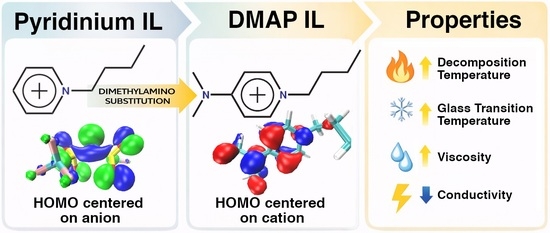
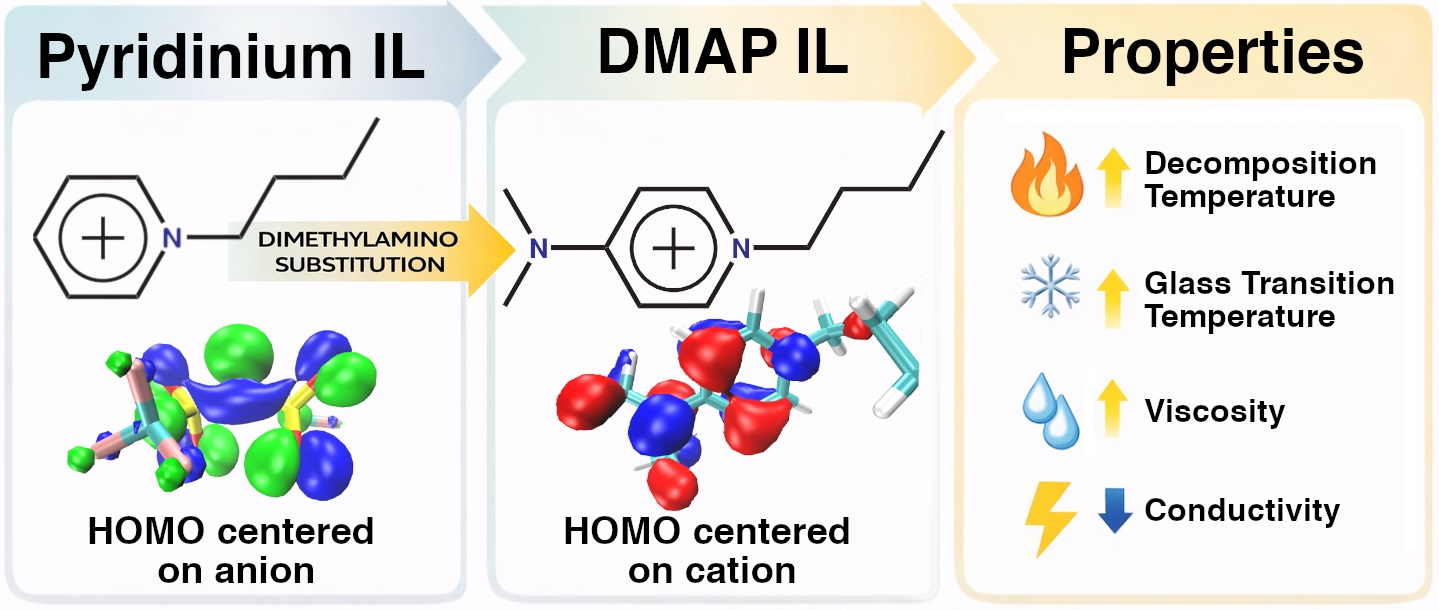
A diverse range of 4-dimethylaminopyridinium (DMAP) bis(trifluoromethylsulfonyl)-amide ionic liquids with specific functionalities (alkyl, alkoxy, hydroxyalkyl and benzyl) were designed, characterized and compared with their pyridinium analogs in terms of their physical and radiolytic properties. The influence of the dimethylamino group on ionic liquid structure was investigated by X-ray diffraction and molecular dynamics simulations. The influence of the electron-donating ability of the dimethylamino-substituted cation is evident in the differences in the electronic density of states between the DMAP and pyridinium ILs. This leads to substantial changes in the radical transients observed in pulse radiolysis of the neat ILs. It was found that the DMAP salts were higher melting, more viscous and less conducting than their pyridinium analogs. However, the DMAP salts exhibited higher thermal stabilities and could therefore be useful for high-temperature applications.

Graphical Abstract

1. Introduction

Ionic liquids have become central to several modern sustainability challenges [1,2,3]. Their negligible vapor pressure and tunable redox windows make them uniquely suited to processes that seek to close materials cycles, whether through selective recovery of critical metals from electronic waste [4,5], or electrochemical conversion of captured CO2 [3,6]. These desirable properties also make them potentially very useful as alternative media in separation processes for the recycling of spent nuclear fuel and exposure to electrochemical extremes in batteries and supercapacitors [7,8,9,10].
High-value metal recycling, for example, demands solvents that can withstand strong oxidants while offering task-specific coordination environments [4,5], whereas CO2 electroreduction electrolytes require wide potential windows and tailored solvation shells to stabilize key intermediates [11,12]. In nuclear technology, the same attributes enable efficient partitioning of actinides and fission product lanthanides under intense radiation and elevated temperatures, thereby supporting safer, more resource-efficient fuel cycles [13,14]. Harnessing the compositional flexibility of ILs to meet these varied yet interconnected needs underscores their importance to a circular, low-carbon energy and materials landscape [2,3,15].
In such applications, ILs will be exposed to ionizing radiation, and it is important to understand the factors that control their radiation stability. Previous work has shown that the capture of electrons by imidazolium cations leads to unstable intermediates that could result in permanent fixation of radiation damage, which would be detrimental to spent nuclear fuel reprocessing systems [16,17,18]. On the other hand, Neta and coworkers have shown that the reduction products of pyridinium cations can be reversibly reoxidized in ILs [19,20], pointing to potential ways to limit radiation damage accumulation and control metal ion redox speciation.
Although pyridinium salts figured prominently in early investigations of ionic liquids [21], they are not as frequently studied today compared to the imidazolium, ammonium/pyrrolidinium, and phosphonium IL families. Whereas pyridinium ILs have been investigated [22], for various applications, the analogous family of ILs based on 4-dimethylaminopyridine (4-DMAP) has been investigated less, although they have recently gained increasing attention. Foundational studies of 4-DMAP bis(trifluoromethylsulfonyl)amide (NTf2) salts by Brenneke et al. [23] date back to 2005, wherein they reported some of the highest thermal-decomposition onsets known at the time for ILs, and more recent work [24,25] has expanded on this for other DMAP ILs. However, to our knowledge, a comprehensive comparison of 4-DMAP NTf2 ILs with their pyridinium analogs remains missing, a void the present study aims to fill. Overall, it was found that DMAP NTf2 salts decompose tens of degrees higher than their pyridinium analogs, widening the operational window for high-temperature catalysis and electrochemistry [23]. Brenneke [23] explicitly highlights DMAP NTf2 having exceptional stability to the dimethylamino substituent in the para position of the pyridine ring, a result that agrees with our current findings. Pernak et al. also reported similar trends in decomposition temperatures, but additionally measured melting points of 4-DMAP and 3-DMAP salts [26]. Additionally, while Merck disclosed initial heat capacities for several DMAP NTf2 salts [27], follow-up studies by Lall-Ramnarine et al. expanded available data to include glass transition temperatures, viscosities, densities, and conductivities for similar 4-DMAP ILs [18,19].
Building on these physical property insights, we next examined the electronic consequences of dimethylamino substitution. Our study of electron transfer reactions involving DMAP-based cations as electron donors [28] prompted us to further explore the DMAP cation family, since important differences exist in the electronic structure of the cations when the dimethylamino group is incorporated. Compared with unsubstituted pyridinium cations, 4-dimethylaminopyridinium (DMAP) cations expose a strongly electron-donating NMe2 group that increases ring basicity/nucleophilicity and accelerates acylation, esterification, and cyclic carbonate syntheses [29,30]. These differences affect the electronic properties of the condensed phase liquid as a whole since the nature of the HOMO level is involved (vide infra).
It has also been demonstrated that the electronic enrichment provided by the NMe2 substituent can also confer additional functional attributes to DMAP-based ionic liquids. Tunable substitution on the DMAP framework enables task-specific, sometimes bifunctional, IL catalysts, while simple quaternization routes keep syntheses economical [26,29,30]. The Pernak research group showed that 3-DMAP chlorides with alkoxymethyl substituents possess strong antielectrostatic and antimicrobial activity [31], with related pyridinium/DMAP-family ILs displaying similar antimicrobial potency [32,33] along with distinctive physical properties. For example, Andreev et al. employed 4-DMAP azide salts in protic ILs as safe HN3 surrogates for multigram azidation chemistry [34]. Beyond neutral or weakly basic salts, 4-DMAP chlorosulfonate behaves as a monoprotic Brønsted acid IL without acting as a sulfonating agent, altering thermal and physical behavior relative to neutral DMAP counterparts [25]. Separately, tailoring the benzylic hydrogen acidity in DMAP-based cations can dramatically boost catalytic efficiency for the atmospheric-pressure cycloaddition of CO2 to epoxides, achieving near-quantitative yields of cyclic carbonates under mild conditions [30]. Finally, while pyridinium-based ILs have been more generally investigated as corrosion inhibitors, specific DMAP-cation corrosion protectants are beginning to be noticed for the same application [35,36]. These advantages motivate a detailed comparison of functionalized 4-DMAP ILs vs. their pyridinium analogs in the present study.
To address this gap, we integrate thermophysical measurements, X-ray scattering, molecular dynamics simulation, and pulse radiolysis spectroscopy into a systematic structure–property study. Specifically, we compare four 4-DMAP bis(trifluoromethylsulfonyl)amide salts—bearing butyl, ethoxyethyl, hydroxypropyl, and benzyl groups—with their unsubstituted pyridinium congeners to disentangle electronic effects of the NMe2 substituent from steric contributions of the side chains, emphasized below in Figure 1. The results that follow quantify how dimethylamino substitution modulates liquid structure, transport, and radiation chemistry, and they highlight design principles for task-specific IL development.

2. Materials and Methods

2.1. Materials and Synthesis

All chemicals used for the syntheses were reagent grade and used without further purification. All organic reagents were purchased from Sigma-Aldrich (St. Louis, MO, USA). Lithium bis(trifluoromethylsulfonyl)amide (LiNTf2) was purchased from IoLiTec Ionic Liquids Technologies GmbH (Heilbronn, Germany), and deionized water was produced by a Millipore (Burlington, MA, USA) Milli-Q deionizing system. 1-Benzyl-2-picolinium NTf2, 1-benzyl-3-picolinium NTf2 and 1-benzyl-4-picolinium NTf2 for the DSC studies were kindly provided by Dr. Huimin Luo of Oak Ridge National Laboratory [37]. Full details of the reagents for synthesizing ionic liquids used in this study and synthetic procedures for all ionic liquids are provided in Section S1 of the Supplementary Materials.

2.2. Characterization Experiments

The structures of all products and intermediates were confirmed using 1H and 13C nuclear magnetic resonance (NMR) spectroscopy. Spectra were obtained using a Bruker (Billerica, MA, USA) 400 MHz NMR spectrometer. Deuterated dimethylsulfoxide (DMSO-d6) or deuterium oxide (D2O) was used as the NMR solvent.
The water content of the samples was determined using a Mettler Toledo (Greifensee, Switzerland) DL39 coulometric Karl Fischer titrator connected to an analytical balance. Densities for room-temperature ionic liquids were measured gravimetrically using a 1 mL volumetric flask. The density of BzDMAP NTf2 was measured gravimetrically at 70 °C using a 100 µL pipette in triplicate. Viscosities were measured with a Cambridge Applied Systems (Medford, MA, USA) ViscoLab 4100 electromagnetic reciprocating piston viscometer that was temperature-regulated by a Lauda (Lauda-Königshofen, Germany) RM-6 circulating bath filled with a 70/30 v/v propylene glycol/water mixture. The viscometer was calibrated with a S600S viscosity reference standard from Koehler Instrument Company (Bohemia, NY, USA). Two instruments were used to measure conductivities over the course of this work. Conductivity measurements on 3-MeBzPy NTf2 and 3-MeBzDMAP NTf2 were performed with a YSI model 3200 Conductivity Instrument fitted with a YSI model 3253 probe, inserted into a temperature-controlled jacket attached to the same circulating bath as the viscometer. The probe was calibrated using an aqueous 0.053% KCl calibration solution, YSI 3167, 1000 ± 10 μS cm−1 at 25 °C, from Yellow Springs Instruments (Yellow Springs, OH, USA). All other conductivities were measured at 25 °C by complex impedance measurements using a computer-controlled Hewlett-Packard (Palo Alto, CA, USA) 4129A impedance analyzer in the frequency range from 5 Hz to 10 MHz. The samples were placed into a homemade cell consisting of a scintillation vial with electrodes inserted through the cap. The cell constant was determined using the KCl calibration solution described above.
A TA Instruments (New Castle, DE, USA) Q100 differential scanning calorimeter (DSC) was used to determine melting points and glass transition temperatures (Tg), and a TA Instruments Q500 thermogravimetric analyzer (TGA) was used for the determination of thermal decomposition profiles. Scan rates were 5 °C/min for DSC and 10 °C/min for TGA. For the TGA measurements, the temperature was first ramped from ambient to 100 °C and equilibrated there for one hour to drive off any trace of water before the scan was resumed. The obtained DSC and TGA data were analyzed using Universal Analysis 2000 software provided by TA.

2.3. Pulse Radiolysis Experiments

Pulse radiolysis experiments on the ionic liquids were performed at the BNL Laser-Electron Accelerator Facility (LEAF) [38]. Samples of pyridinium and DMAP ILs, either neat or dissolved (20–100 mM) in C4mPyrr NTf2, were placed in 1 cm path length Suprasil self-masking semi-micro spectrometer cells that were capped with silicone septa. Each sample was deoxygenated by argon bubbling for at least 20 min. In the case of viscous ionic liquids, the cuvettes were warmed to 40–50 °C to reduce their viscosity while bubbling, except for neat BzDMAP NTf2, which was bubbled at 70 °C. Pulse radiolysis measurements were carried out as described previously [39,40,41,42,43]. These measurements were performed at 22 °C, except for neat BzDMAP NTf2, which was measured at 70 °C. Tetrahydrofuran (THF) and dichloroethane (DCE) were used as additives. Diluted solutions of 10 mM C4Py NTf2 in DCE and 10 mM C4DMAP NTf2 in both THF and DCE separately were prepared gravimetrically using 1 mL volumetric flasks with transfers occurring via micropipette aliquots. These were then transferred into an Argon glovebox, where they were diluted to 1 mL with either DCE or THF. The THF was triple distilled under liquid NaK to ensure high purity. Wavelengths for optical detection were selected using 10, 25 or 40 nm band-pass interference filters. Experimental data were collected using a system based on LabVIEW software, National Instruments, Inc. (Austin, TX, USA), and analyzed with routines written within the framework of Igor Pro software version 9 from Wavemetrics, Inc. (Portland, OR, USA). Second-order rate coefficients for solvated electron capture by the DMAP and pyridinium cations dissolved (20–100 mM) in C4mPyrr NTf2 were obtained by fitting pseudo-first-order electron decay rate coefficients measured at 900 nm as functions of R-DMAP NTf2 or R-Py NTf2 concentration. Pre-solvated electron capture efficiency coefficients (Q37) for each cation were obtained from the electron decay transient absorption data at 900 nm as described by Shkrob [44] et al. G-epsilon scaling was performed via atomic number/atomic mass (Z/A) ratio and mass density scaling with dosimetry measured using an aqueous 10 mM KSCN dosimetry solution (G100 ns = 6.95 per 100 eV, ε472 = 7600 M−1 cm−1) [45].

2.4. X-Ray Scattering Experiments

The ionic liquid samples were dried on a Schlenk vacuum line at a pressure of 10−2 mbar at 318 K for 48 h. The samples were then back-filled with argon and transferred to an argon glove box, where they were transferred to an X-ray quartz capillary (2.0 mm outer diameter, Hampton Research (Aliso Viejo, CA, USA) HR6-150, and sealed with Hampton Research HR4-328 capillary wax. The sample height in the capillary was about 25 mm. The quartz capillary was then cooled down in a copper holder immersed in liquid nitrogen. After waiting 10 min for the sample to cool down, the top of the quartz capillary was flame sealed.
X-ray diffraction experiments were performed at beamline 11-ID-C of the Advanced Photon Source (APS) at Argonne National Laboratory (ANL). The experimental methods have been described previously [46,47,48]. The X-ray beam energy was 114.99 keV (wavelength 0.108040 Å) with a beam size of 0.2 × 0.2 mm2. A Perkin Elmer amorphous silicon 1621 CN3-EHS detector was used to collect the diffraction patterns. The sample-to-detector distance (766.5 mm), beam center and the detector tilt were calibrated using the data collected from a cerium oxide standard. X-ray diffraction data were collected with 10 min exposure time (6 s/frame, 20 frames/file and 5 files/data set). An Oxford Cryosystems (Long Hanborough, Oxfordshire, UK) Cryostream open-flow cooling system was used for sample temperature control. All the experiments were performed at 295 K. The diffraction data, I(q), were collected within a q range of 0.2~15 Å−1, where q = (4π sinѲ)/λ, Ѳ is the diffraction angle, and λ is the X-ray beam wavelength (0.108040 Å). Fit2D software [49] version 12.007 was applied to integrate the experimental data and convert them to I(q). PDFgetX2 program version 1.0 written by Qiu et al. [50] was then applied to obtain the structure factor S(q).

2.5. Molecular Dynamics Simulations

2.5.1. Algorithmic Details

To investigate the structure of C2OC2DMAP NTf2, C4Py NTf2, C4DMAP NTf2, C8DMAP NTf2 and C10DMAP NTf2, we generated boxes containing 1000 ion pairs. All systems were initially energy-minimized using the steepest descent algorithm as coded in GROMACS software version 4.5.5 [51,52]. Subsequently, systems were equilibrated at 298 K and 1 bar by slowly increasing charges from 0% to 100% of their nominal value in 2.65 ns; this portion of the equilibration was done using the V-rescale thermostat [53] and the Berendsen barostat [54], as coded in GROMACS. The next equilibration step was simulated annealing, where the temperature was gradually increased to 500 K and slowly decreased back to 298 K in 6 ns. Finally, production runs were 6 ns in duration at 298 K and 1 bar using the Nose–Hoover thermostat [55,56,57] and the Parrinello–Rahman barostat [58], as coded in GROMACS. The last 1 ns in the production run was used to compute the total and partial subcomponents of S(q). For all MD runs, equations of motion were integrated using the leap-frog algorithm [59] with a time step of 1 fs as coded in GROMACS. The Particle Mesh Ewald algorithm [60,61] with an interpolation order of 6 and Fourier grid spacing of 0.08 nm was used to handle coulombic interactions under periodic boundary conditions. The cutoff for LJ and real space part of the Coulomb interactions was set to 1.5 nm. Procedural details for the calculation of S(q) and its subcomponents have been given in various prior articles from our groups [46,48,62,63,64,65,66,67,68,69,70,71,72].
In order to obtain electronic structure information in the condensed phase for our five systems, classical MD simulations of smaller boxes (each containing 8 ion pairs) were conducted using an identical procedure to that described above. However, in this case, production runs were 15 ns in duration, and 10 snapshots were saved for further analysis from the final 10 ns of each run. To adjust bond lengths and angles to conform with the DFT potential energy surface, each of these liquid snapshots was subjected to an ab initio conjugate gradient energy optimization. One of these snapshots was used to compute the projected density of states; the overall HOMO-LUMO gaps reported in Table S9 of the Supplementary Materials were averaged over all 10 minimized liquid snapshots. Our liquid-phase ab initio calculations were carried out using the SIESTA software [73,74,75] version 4.0 using the Perdew, Burke, and Ernzerhof (PBE) [76] flavor of the generalized gradient approximation (GGA) and norm-conserving pseudopotentials. These non-relativistic Troullier–Martins pseudopotentials [77] were generated and tested in our prior studies of ionic liquids [71,78]. A split double zeta plus polarization basis set (PAO) with a 0.025 eV energy shift and 100 K electronic temperature was used. Our mesh cutoff was 250 Ry, corresponding to a real space resolution of about 0.1 Å. We conducted Brillouin sampling on the Γ point only.

2.5.2. Classical Force Field Details

Our liquid-phase simulations used the Canongia-Lopes and Padua force field [79] for the NTf2 anion (see Figure S2 in the Supplementary Materials for representative equilibrated simulation boxes). For simulations of C4Py NTf2, we used the Acevedo [80] parameters specific for the C4Py cation, except that three dihedral types were altered to better reproduce planarity and corresponding ab initio energies (see Scheme S1, Table S1 and Figure S3 in the Supplementary Materials).
Parameters for the CnDMAP family of ions were not readily available in the literature, so we adapted or modified those provided by Acevedo [80] for CnPy as a starting point. All parameters, which are not from reference [80], are explicitly listed with their corresponding sources in the Supplementary Materials (see Schemes S2 and S3, Tables S2–S6 as well as Figure S4 in the Supplementary Materials). Based on geometries derived from the crystal structure of several DMAP-based materials [81,82,83,84,85,86,87,88] and our NBO analysis for C10DMAP (see Table S7 in the Supplementary Materials), we found that the nitrogen atom in the dimethylamino group is in a planar sp2 configuration. This required the dihedral parameters for CM-NM-CR-CW (see Scheme S2 in the Supplementary Materials) to be fitted. We did this for C10DMAP (see Figure S4 in the Supplementary Materials) and used the same parameters for all other cations in the DMAP family. Charges for all atoms across the family of DMAP cations were fitted using the CHELPG [89] algorithm at the MP2/cc-PVTZ level of theory after a gas-phase optimization at the HF/6-31G(d) level of theory using the Gaussian [90] program. Except for the cation with the ethoxyethyl tail, for which all charges were taken directly from this calculation, for all other members of the DMAP family, the charges of alkyl tail groups further than two methylene groups away from the ring were taken from the Acevedo force field to be overall neutral [80]. The small residual difference in charge between force field neutral tails and ab initio CHELPG tails was distributed equally among all other atoms in the cation (all cationic charges used in this work are provided in Table S5 in the Supplementary Materials). Other ether tail-related parameters are based on OPLS-AA as described in our prior article [66], but the NA-CA-CS1-O dihedral parameter (see Scheme S3) was obtained from the Canongia-Lopes and Padua force field [91].

3. Results and Discussion

3.1. Physical Properties of the ILs

3.1.1. Thermal Properties

Table 1 reports the thermal properties and densities of the DMAP and pyridinium salts. (Some of the physical properties were reported in earlier publications [92,93]). The data show that the dimethylamino group substitution on the pyridine ring has a significant effect on the glass transition temperatures, except for the decyl derivatives. Compared to the unsubstituted pyridinium ILs, the glass transition temperatures of the DMAP ILs are raised by 11 (butyl), 8 (octyl), 1 (decyl), 13 (ethoxyethyl), 18 (hydroxypropyl), 21 (benzyl) and 26 °C (3-methylbenzyl). Since the glass transition is related to the onset of translational mobility, the increase in going from pyridinium to DMAP suggests that there are generally stronger interionic interactions in the DMAP ILs. The benzyl-substituted ILs had the highest glass transition temperatures, implying a contribution from interactions between the benzyl and cationic aromatic functionalities.
The effect of the dimethylamino substitution on melting points is difficult to judge, since the number of instances to compare is limited because some of the ILs did not readily crystallize under the operative DSC conditions. The melting points of C4DMAP NTf2 and C4Py NTf2 are very similar, and C10DMAP NTf2 melts 8 °C lower than C10Py NTf2. The most significant effect is observed with the benzyl group functionalization. BzDMAP NTf2 has a much higher melting point (62 °C) than BzPy NTf2 (9 °C). Interestingly, that 62 °C melting point was only observed on fresh BzDMAP NTf2 crystals. Once BzDMAP NTf2 was melted in the DSC, subsequent DSC cycles showed a cold crystallization with an onset temperature of 4 °C and a melting point of 57 °C (onset). Examples of IL cold crystallization into a metastable crystalline phase are well known. The most notable case is that of 1-butyl-1-methylpyrrolidinium NTf2 (C4mPyrr NTf2), which was believed to melt at −18 °C until Henderson and Passerini showed that a more stable crystalline phase that melts at −3 °C could be obtained by annealing [97].
The high melting point of BzDMAP NTf2 made it difficult to study the liquid properties of that salt. We attempted to make a derivative of the BzDMAP cation that would form a room-temperature IL by disrupting the symmetry of the cation with a methyl group in the meta position of the benzyl ring, and we made the pyridine analog for comparison. This seemed to be a good strategy since asymmetric methyl substitution on the pyridine ring in BzPy NTf2 is effective in this respect. DSC scans of symmetric 1-benzyl-4-methylpyridinium NTf2 (1-Bz-4-MePy NTf2) show that after cold crystallization, it melts at 13 °C, while scans of asymmetric 1-benzyl-2-methylpyridinium NTf2 (1-Bz-2-MePy NTf2) and 1-benzyl-3-methylpyridinium NTf2 (1-Bz-3-MePy NTf2) show no evidence of crystallization down to their glass transitions (see Table 1). (Note that this does not imply that their melting points are lower than Tg; it simply means that a crystalline phase was not observed under scanning DSC conditions.) The analogous ring-methylated 2-MeDMAP and 3-MeDMAP starting materials are known compounds, but they are not readily available at a reasonable price, so 3-methylbenzyl chloride was allowed to react with DMAP to make the asymmetric cation 1-(3-methylbenzyl)-DMAP NTf2 (3-MeBzDMAP NTf2). Surprisingly, 3-MeBzDMAP NTf2 melts five degrees higher than BzDMAP NTf2. Even more dramatically, the analogous pyridine IL 3-MeBzPy NTf2 melts at 38 °C, 29 degrees higher than BzPy NTf2. This last fact was not discovered until several months after we began working with this IL; it is slow to spontaneously crystallize at room temperature unless mechanical friction is applied.
Comparison of the TGA results in Figure S1 in the Supplementary Materials indicates that the DMAP salts in this study show higher apparent thermal stability compared to their pyridinium analogs, which is in agreement with earlier findings by Crosthwaite et al. for C6Py NTf2, C6DMAP NTf2, and related derivatives [23]. The most dramatic difference is observed in the benzyl-substituted ILs, where the difference in nominal decomposition onset temperatures between DMAP+ and Py+ derivatives is 89–103 °C. In general, a decrease of 75 °C in nominal decomposition temperature is observed in the pyridinium series in going from the butyl (388 °C) to the benzyl (313 °C) derivative. In the DMAP series, while there is also a decrease in the nominal decomposition temperatures, the difference between the butyl (444 °C) and benzyl (416 °C) derivatives is only 28 °C. The conscientious use of the term “nominal” to describe the reported decomposition temperatures is to recognize the possibility that some of the observed mass losses are due to evaporation of the ILs instead of their decomposition [98,99]. The enthalpies of vaporization of several alkylpyridinium NTf2 ILs, including C4Py NTf2, have been measured [99,100], indicating that their volatility should be considered. We are not aware of any comparable data for DMAP ILs, and we do not possess the necessary equipment to determine quantitatively whether the mass losses are due to evaporation, decomposition, or a combination of both mechanisms (particularly as the TGA scan temperature increases); however, the dimethylamino modification has a significant practical effect in any case. If evaporation is the dominant mechanism, the dimethylamino group may be responsible for increased intermolecular interactions that increase the enthalpies of vaporization of the ILs. If decomposition is the main mechanism, the electron-donating properties of the dimethylamino group could be expected to increase the activation barrier for dealkylation at the pyridine ring nitrogen center.
We note that the ether derivatives C2OC2Py NTf2 and C2OC2DMAP NTf2 have lower nominal decomposition temperatures and earlier and more gradual onsets of mass loss than the corresponding alkyl derivatives C4Py NTf2 and C4DMAP NTf2, which may indicate higher volatilities for the ethers. In the case of 1-R-3-methylimidazolium NTf2 ILs, where R = alkyl or oligoether, the vaporization enthalpies of the ether analogs were consistently 10 kJ/mol lower than those of the alkyl ones with the same chain lengths [101].
Decomposition is apparently the major mass loss mechanism for the benzyl-functionalized ILs on the basis of the shapes of their TGA curves. The curves for BzPy NTf2 and 3-MeBzPy NTf2 show sharp reductions in the rate of mass loss at around 350 °C that cannot be explained by an evaporation mechanism. The benzyl derivatives are unique among the ILs investigated in this study because heterolytic Nring–Calpha bond cleavage produces a benzyl cation that is stabilized by aromatic charge delocalization, providing an energetically facile pathway for decomposition. For example, a TGA curve that is remarkably similar to that of BzPy NTf2 was reported for N-benzyl-N,N,N-triethylammonium tetrafluoroborate, with simultaneous mass spectroscopic detection of the benzyl cation at m/z = 65 during the first major mass loss event [102]. Electron donation from the dimethylamino group appears to significantly stabilize the Nring–Calpha bond and produce a greater increase in stability for the benzyl ILs than for the alkyl-derivatized ILs. Working in the opposite direction, methylation of the benzyl group stabilizes the benzyl cation product and lowers the nominal decomposition temperatures of 3-MeBzDMAP NTf2 and 3-MeBzPy NTf2 by 5 and 9 °C, respectively.

3.1.2. Viscosity and Conductivity

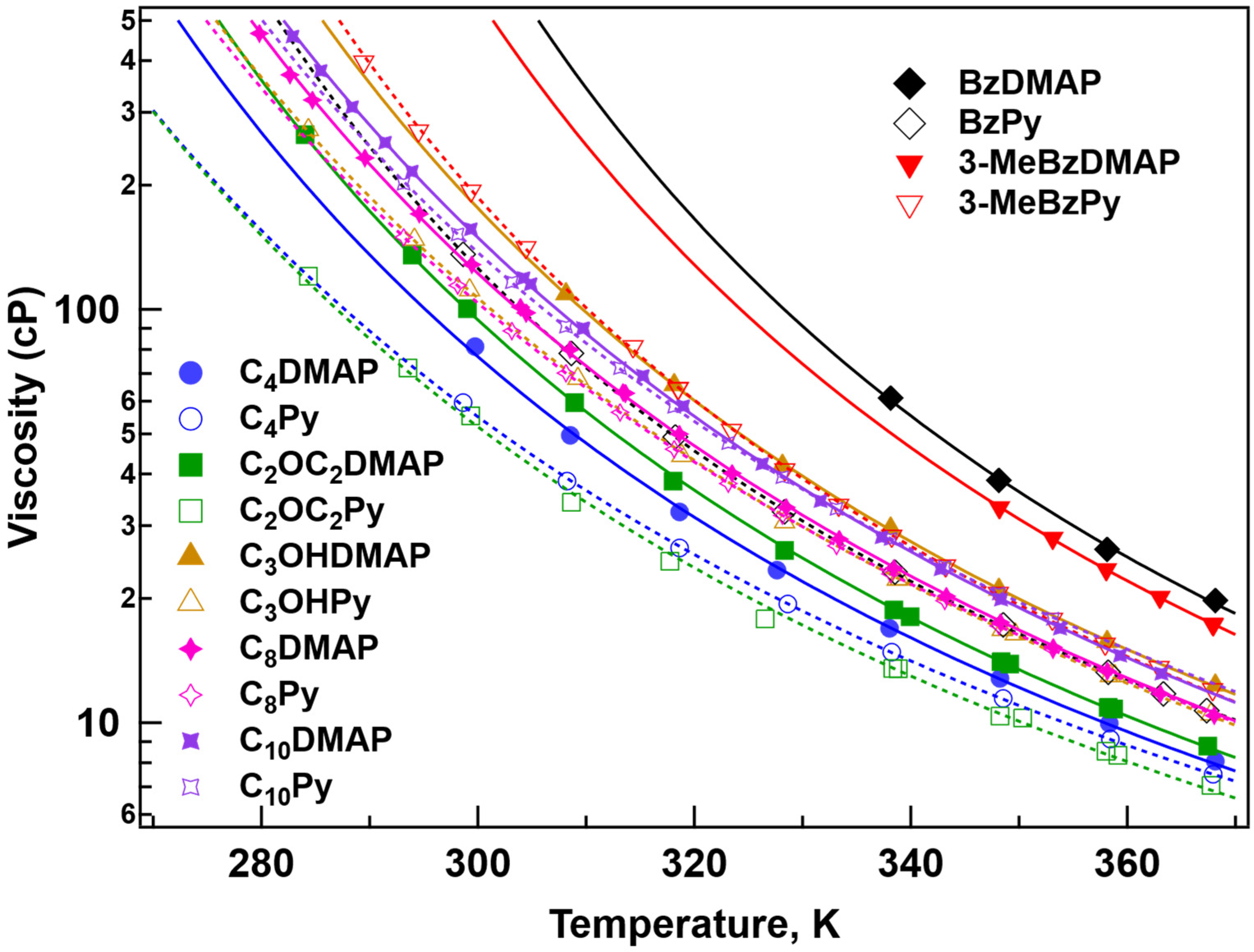
Figure 2 shows a semi-logarithmic plot of viscosities vs. temperature for the ILs considered here, and the viscosities at 25 °C are listed in Table 2. The viscosities of each of the DMAP salts are higher than their pyridinium congeners, to varying degrees, depending on the functionality. The butyl, octyl, and decyl DMAP ILs are only slightly more viscous than the corresponding pyridinium IL, while the ILs with the other three DMAP derivatives are significantly more viscous than their pyridinium counterparts.
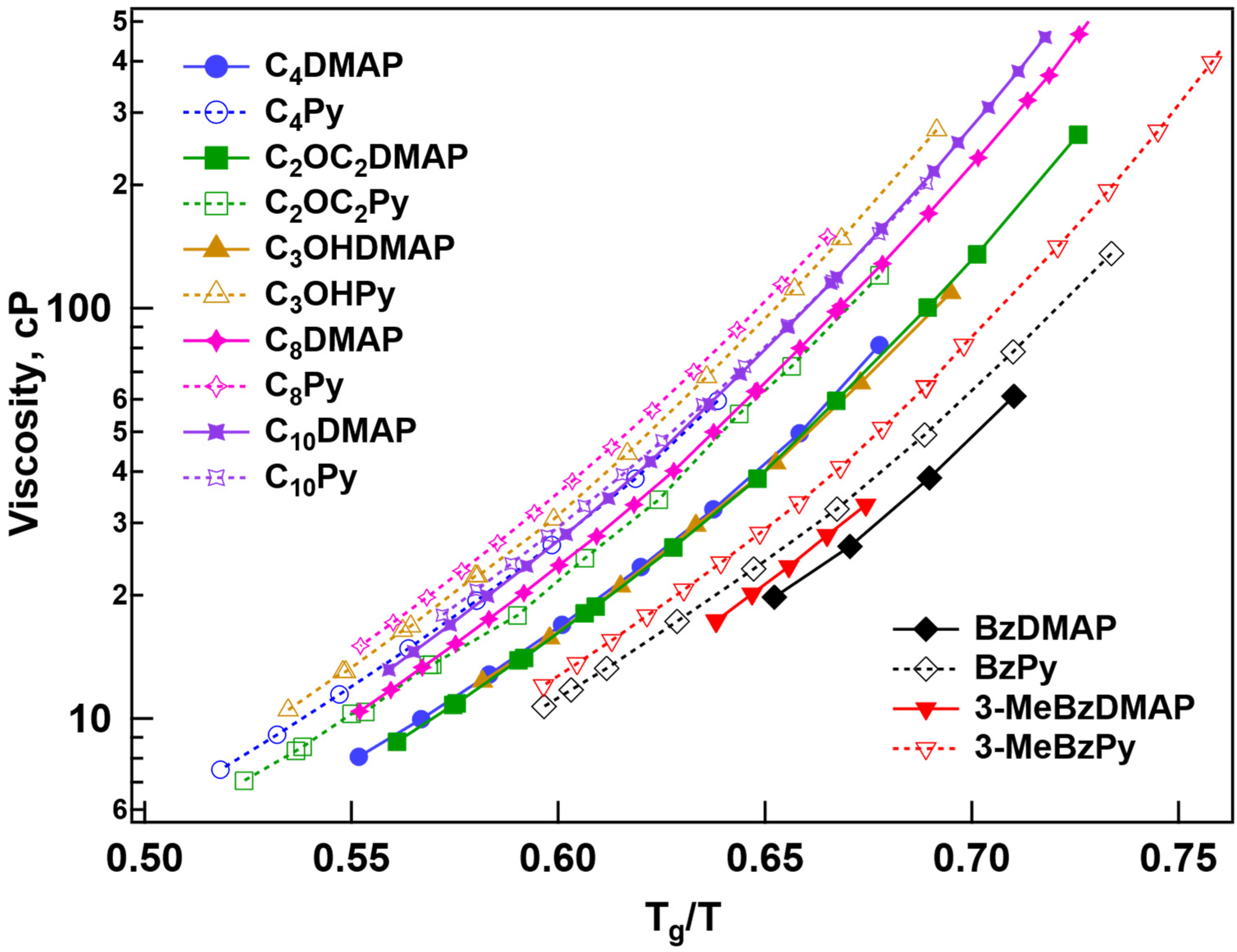
If plotted against the inverse of temperature (see Figure 3 for an approximation), one would observe that the viscosities show non-Arrhenius behavior (i.e., departure from a linear relationship between logarithmic η(T) and 1/T), as is typical for ionic liquids. In such cases, the temperature dependence is characterized using the Vogel–Tammann–Fulcher (VTF) equation, given by:
η ( T ) = η 0 e x p ( D T 0 ( T   T 0 ) )
where T is the temperature, η0 is the limiting viscosity at high temperature, D is the fragility parameter, and T0 is the singularity temperature at which the viscosity diverges. (In some treatments, the product of D and T0 is replaced by the parameter B). To obtain consistent VTF parameters from the temperature-dependent viscosity data obtained over limited temperature ranges, the VTF fits have been made by including viscosity values of 1013 cP at the respective glass transition temperatures, as proposed by Angell and co-workers [103]. Fitting is best done using the logarithmic form of Equation (1) in order to handle the deviations across several orders of magnitude in η properly. The resulting fit parameters are given in Table 2, where the systematizing effect of fixing points at the glass transitions is evident. All the ILs have essentially the same limiting viscosities η0 except for the benzyl derivatives, which are slightly higher.
Examination of the VTF parameters in Table 2 shows two clear differences between the DMAP and pyridinium ILs. First, the pattern of differences in the singularity temperatures T0 is consistent with that observed for the glass transition temperatures Tg. Compared to the unsubstituted pyridinium ILs, the singularity temperatures of the DMAP ILs are raised by 13 (butyl), 14 (ethoxyethyl), 21 (hydroxypropyl), 10 (octyl), 0 (decyl), and 20 °C (benzyl). This is not surprising since the quantities are related; however, all other things being equal, higher T0 values for the DMAP ILs would make their viscosities higher than the pyridinium ones at any particular temperature, and the differences would be larger when the temperatures are lower, particularly as shown in Table 2 for the benzyl derivatives since T0 for BzDMAP NTf2 is 219 K.
However, if the differences were due only to T0, they would be larger than observed for the butyl, octyl, ethoxyethyl and hydroxypropyl derivatives. The fragility parameter D, which is related to the rate of the drop in the viscosity as the temperature increases from Tg, has a partially compensating effect. Counter-intuitively but consistent with the definition in Equation (1), the smaller the value of D, the more fragile the liquid is and the more it departs from Arrhenius behavior as portrayed in Figure 3.
Figure 3 plots the viscosities against Tg-normalized inverse temperature to depict more clearly the relative curvatures of the Arrhenius plots for the different ILs, following the practice of Angell [103]. Ideal Arrhenius behavior would be represented by a diagonal line off-scale to the upper left of Figure 3 (see Figure 6 of ref. [103]) and increasing fragility induces curvature down and to the right.
Although the exact location of each ionic liquid’s viscosity data in Figure 3 also depends on η0 and T0, the figure and the D values in Table 2 clearly show that the butyl, ether and hydroxypropyl DMAP NTf2 ILs are more fragile than the corresponding pyridinium salts, thus keeping the observed viscosities of the DMAP salts closer to the pyridinium ones than implied by the differences in T0. Curiously, the fragilities, T0 values, and viscosities of the decyl DMAP and pyridinium ILs are very close, as observed in Figure 3. Factors that control ionic liquid fragility are not well understood at this point, but it is interesting to note the effect of a simple dimethylamino group on the fragilities of derivatized alkylpyridinium NTf2 ILs, perhaps involving the redistribution of charge in the pyridinium ring.
Notably, Figure 3 also shows that the addition of a benzyl group increases the fragility of these ionic liquids more than the addition of a dimethylamino group. Comparisons show that the difference is most dramatic for the pyridinium case (BzPy); however, the addition of the dimethylamino group further increases the fragility. The BzDMAP NTf2, 3-MeBzDMAP NTf2 and BzPy NTf2 ILs are the most fragile of the 198 ionic liquids for which we have cataloged VTF parameters to date, a list that includes all typical anions and cations and some uncommon ones, including siloxy-functionalized cations [104]. Other ILs we have worked with that are almost as fragile include cycloalkyl phenylphosphonium salts (1-butyl-1-phenylphosphinanium NTf2, D = 3.27, ln η0 = −1.61, T0 = 218 K, and 1-butyl-1-phenylphospholanium NTf2, D = 3.36, ln η0 = −1.43, T0 = 200 K) [105] and 1-benzyl-3-methylimidazolium NTf2 (D = 3.62, ln η0 = −1.68, T0 = 193 K) [106], which is comparable in fragility to 3-MeBzPy NTf2. It is interesting to note that these examples also contain aryl functionalities.
As could be anticipated from the trend in viscosities, the conductivities of the non-benzyl-substituted DMAP derivatives at 25 °C in Table 3 are lower than the corresponding pyridinium derivatives with the same functional group. The Walden product, which is the product of the viscosity and the molar conductivity, allows assessment of the downward deviation of an IL’s conductivity from the “ideal” value (Walden product = 1.0 P S cm2/mol) due to correlations and anticorrelations of the translational motions of like- and unlike-charged ions [66]. The Walden products of the ILs studied here fall within the range of 0.41 to 0.68 P S cm2/mol. The differences in Walden products between the DMAP and pyridinium congeners are generally small, with a slight trend for the Walden products of the alkylpyridinium ILs to be slightly higher than those of the alkylDMAP ILs.
To summarize the effects of dimethylamino substitution on the physical properties of pyridinium NTf2 ionic liquids, the (CH3)2N- group significantly increases glass transition temperatures but also increases fragilities, resulting in only somewhat higher viscosities for the DMAP ILs at room temperature. The effects of dimethylamino substitution are essentially additive with respect to the interactions introduced by the functionalizations of the pendant groups on the pyridinium ring: polar interactions (ethoxyethyl), hydrogen bonds (hydroxypropyl) or π-donor–acceptor interactions (benzyl). In future work, the optical Kerr effect (OKE) [104,106,109] or terahertz spectroscopies may shed light on these effects by measuring how interionic vibrational spectra (below 150 cm−1) change with dimethylamino-group functionalization. Among the two cation classes studied, each functional group has a strong and relatively consistent influence on viscosity.

3.2. Structural Analysis

In this section, we report on results from molecular dynamics (MD) simulations and X-ray scattering experiments for members in the 4-DMAP NTf2 family of liquids, as well as C4Py NTf2. In addition, Table S8 in the Supplementary Materials shows experimental and computationally derived densities for the different systems. For cations with tail lengths of comparable size, we will show that liquid structure is quite similar across systems, but preferred intramolecular tail conformations can be quite different.
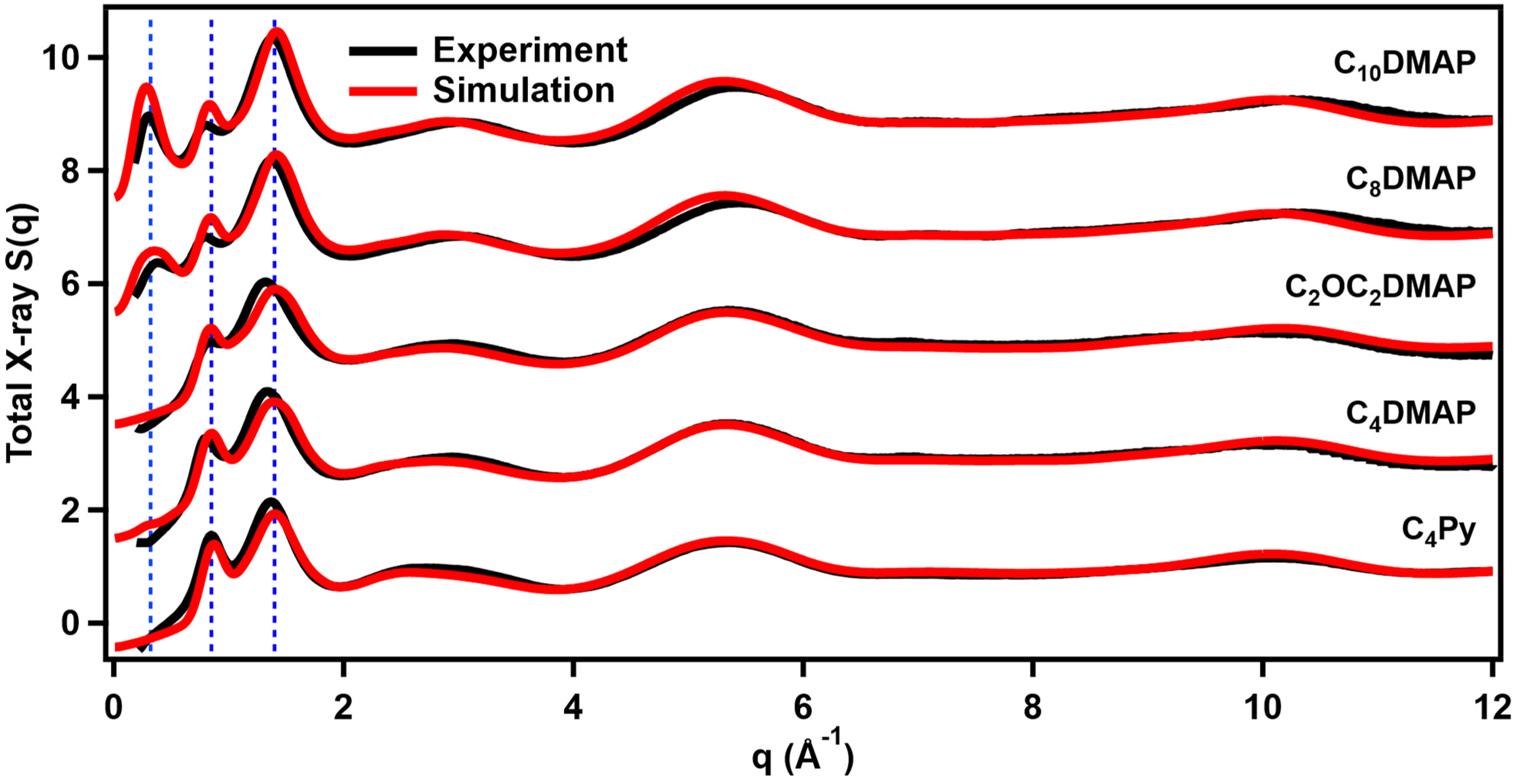
Figure 4 shows a comparison between experimental and computationally derived structure functions (S(q)) for a series of substituted DMAP-based ILs coupled with the NTf2 anion; in the same plot, we also present data for C4Py NTf2. The close agreement between computational and experimental results allows us to confidently describe liquid structural details from simulation impossible to derive from experiments alone. Previous work from our groups [46,48,62,63,64,65,66,67,68,69,70,71,72] has demonstrated that three distinct peaks may be present in the intermolecular range of the structure function S(q) for q ≤ 2Å−1.
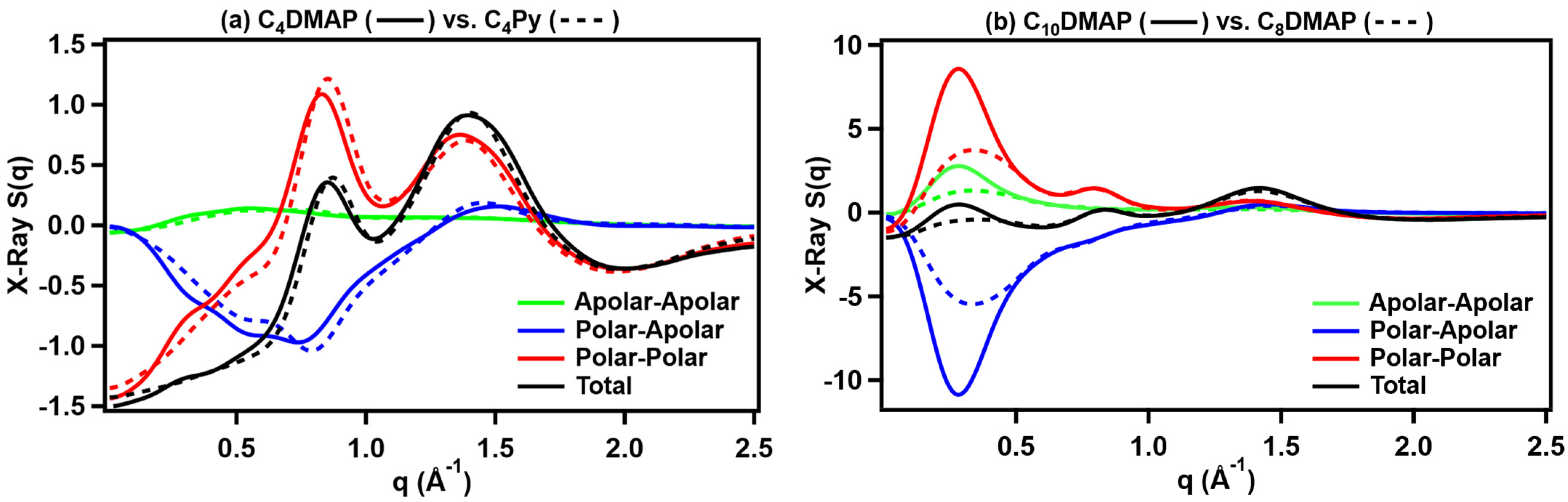
The peak in the range from 1.3 to 1.9 Å−1 results from the adjacency of nearest neighbor cation–anion pairs, as well as a myriad of different intramolecular and short-range intermolecular contributions. The so-called charge alternation peak, found within q = 0.75–1.0 Å−1, results from cation–cation and anion–anion correlations when intercalated with species of opposite charge. When tails are sufficiently long, intermediate range order can be detected as a peak with a q value between 0.25 and 0.5 Å−1, which is commonly called a “pre-peak” or “first sharp diffraction peak” (FSDP) [46,48,63,64,65,66,67,68,69,70,71,72]. In Figure 4, all five liquids display the adjacency and charge alternation peaks, but only C8DMAP NTf2 and C10DMAP NTf2 display pre-peaks at lower q values, indicating that these liquids have significant intermediate range order.
As we have done in prior publications [46,48,63,64,65,66,67,68,69,70,71,72], S(q) was dissected into contributions from polar and apolar subcomponents as well as positive and negative sub-ionic components to better understand the detailed alternations occurring in the liquid phase. In this study, the apolar subcomponent is defined as the cationic alkyl tail excluding the two CH2 groups closest to the ring; all other atoms are considered in the polar subcomponent. The positive subcomponent is defined as the atoms in the cation belonging to the polar subcomponent. All atoms in the anion belong to the negative subcomponent as well as to the polar subcomponent.
Figure 5a shows a comparison of the structure function and its subcomponents for C4Py NTf2 and C4DMAP NTf2. It is clear from the solid and dashed black lines (the total S(q)) that both liquids share most of the same structural features. When using the polar–apolar partitioning of S(q) as in Figure 5a, it makes sense to focus on the behavior of subcomponents at low q around or slightly below 0.5 Å−1. The total S(q) does not display a pre-peak, yet the polar subcomponent of S(q) shows either an incipient peak or a shoulder in this low q region around 0.5 Å−1; the polar–apolar subcomponent shows what we have commonly described as an anti-peak at the exact same q value. These features are indicative of emerging intermediate-range order. This should be contrasted with what one obtains for C10DMAP NTf2 in Figure 5b, where two prominent peaks (green and red lines at about 0.3 Å−1) and an anti-peak (blue line) are the salient features emphasizing significant intermediate range order.
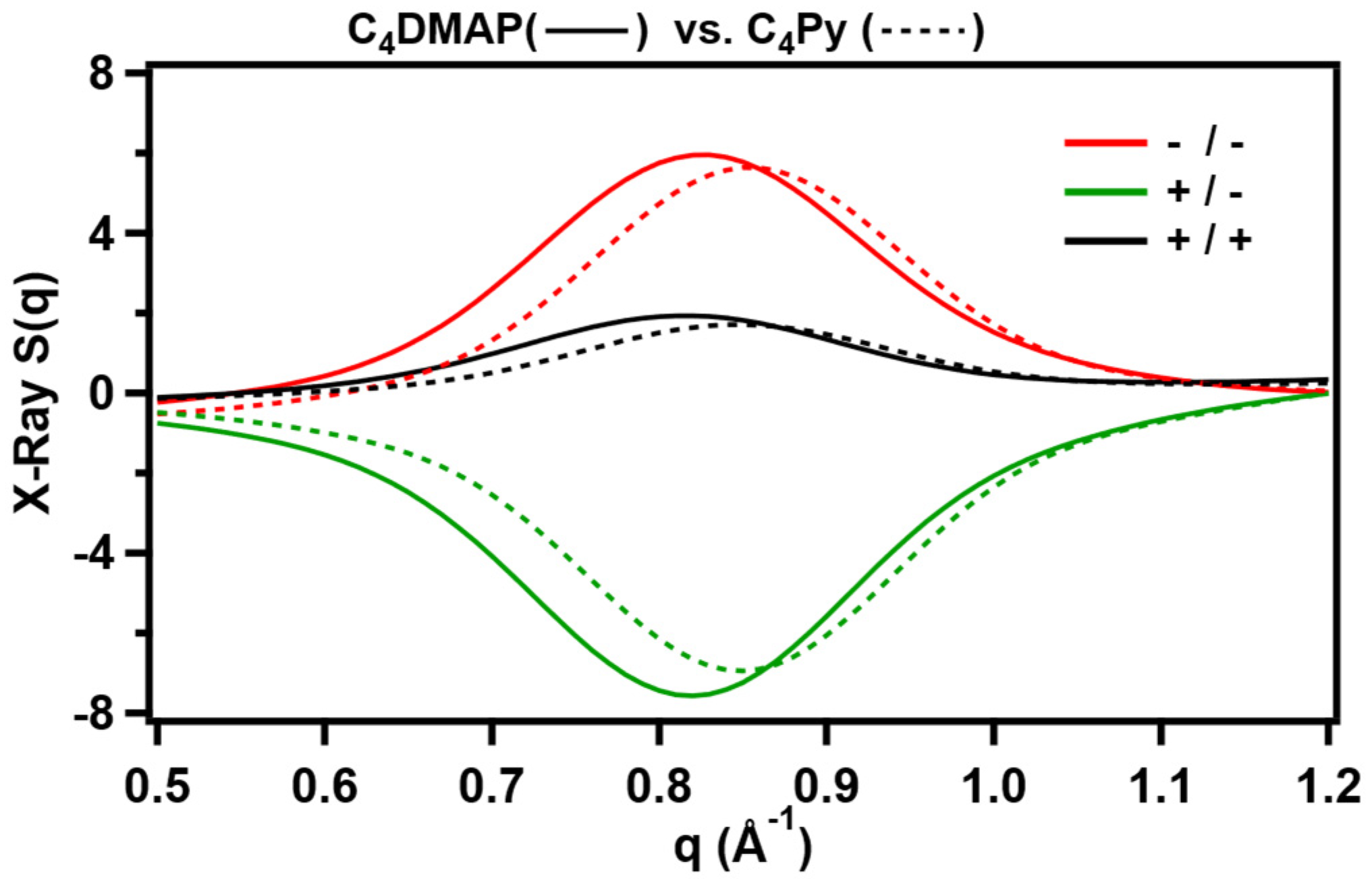
For C4Py NTf2 and C4DMAP NTf2, Figure 6 shows positive–positive, negative–negative, and positive–negative subcomponents of S(q). Two peaks for same-type interactions and an anti-peak for opposite-type interactions are the unequivocal signature of charge alternation in this q-region. Seen as a whole, Figure 6 and Figure 7 appear to indicate that the dimethylamino group affects only modest changes to the overall liquid structure.
Whereas the overall intermolecular liquid structure as described by S(q) appears to be quite similar when comparing C4Py NTf2 and C4DMAP NTf2, significant intramolecular differences exist between these two, as well as with other members of the DMAP family.
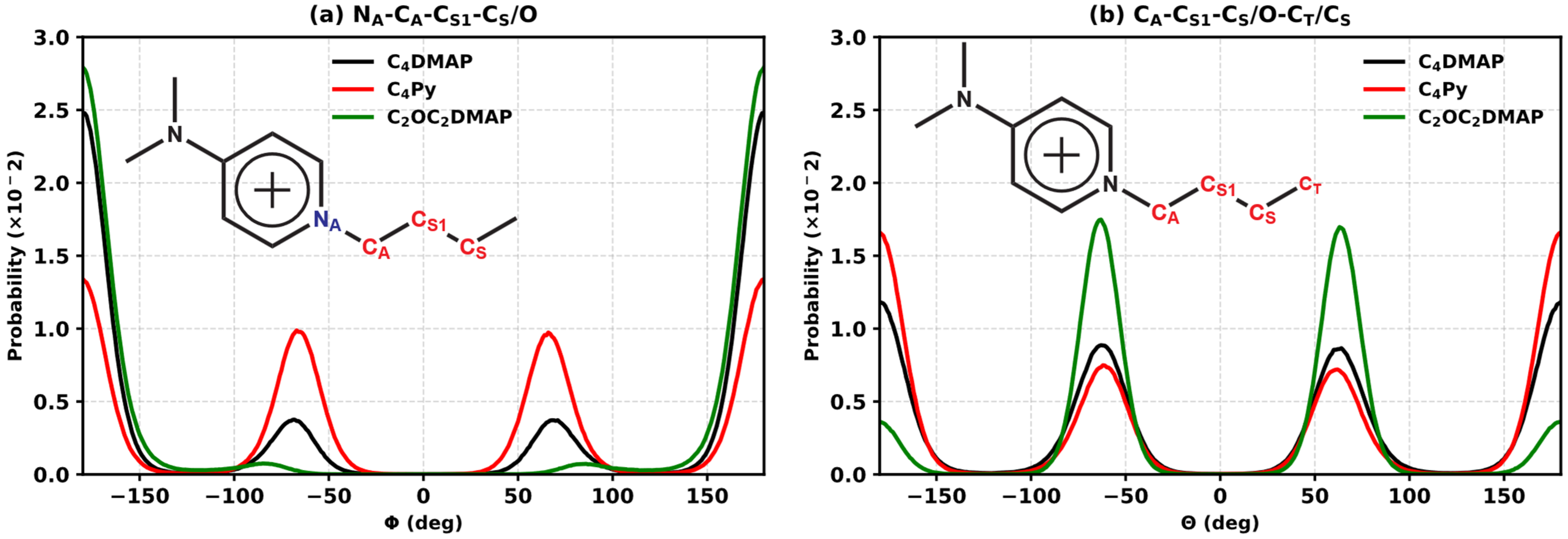
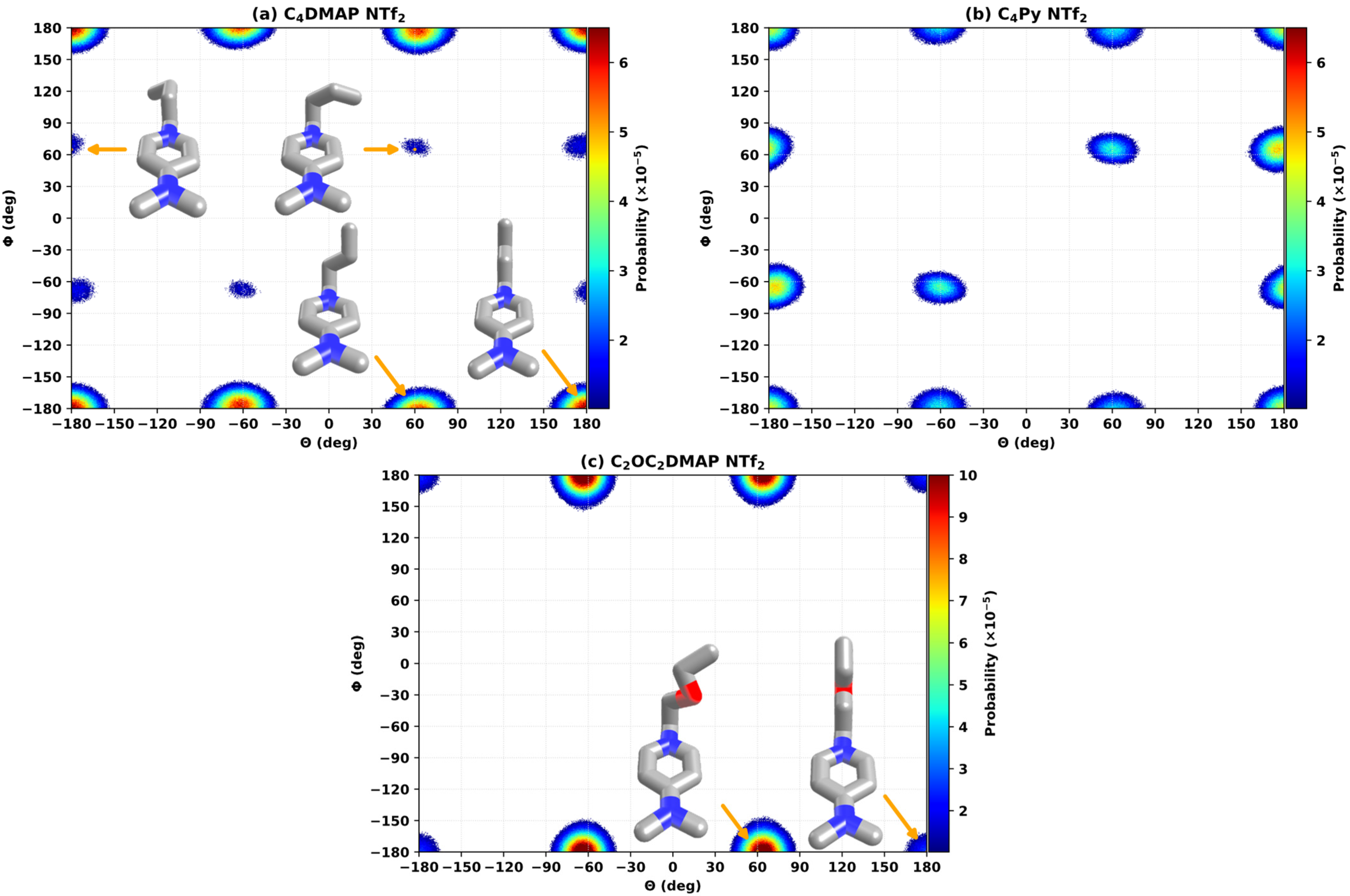
Figure 7 shows dihedral angles in the tail for cations C4Py, C4DMAP and its ethoxyethyl analog. It is clear that for the tails, dihedral preferences are quite different across the species, the largest differences being for ether-containing tails. Figure 7 is somewhat deceiving in that the two dihedral angles are strongly coupled and not all combinations of likely values for Θ are compatible with those of Φ. Figure 8 shows Ramachandran plots of these two dihedral angles from which the populations of the conformers can be derived. In the same figure, we provide illustrations of selected key conformers (conformers connected by symmetry are not included) associated with the different Θ and Φ values. We see from the top panel in Figure 8 that all conformations available to C4Py are also available to C4DMAP. Whereas in the case of C4Py, the probabilities of all populated conformers are similar; those with Φ in the range 30–90° or (−30–−90°) are significantly diminished in the case of C4DMAP. Since the dimethylamino group is at the opposite end of the ring, these differences in alkyl tail conformational probability cannot be ascribed to new steric hindrances, but instead to genuine electronic structure differences. For the case of cations containing the ethoxyethyl tail functionality, differences are even more pronounced, and the comparison is complicated by the fact that the tail length is longer. In this case, the conformers with Φ in the 30–90° or (−30–−90°) range are suppressed, and those with Θ close to 180° (−180°) are significantly diminished.

3.3. Liquid-Phase Electronic Structure

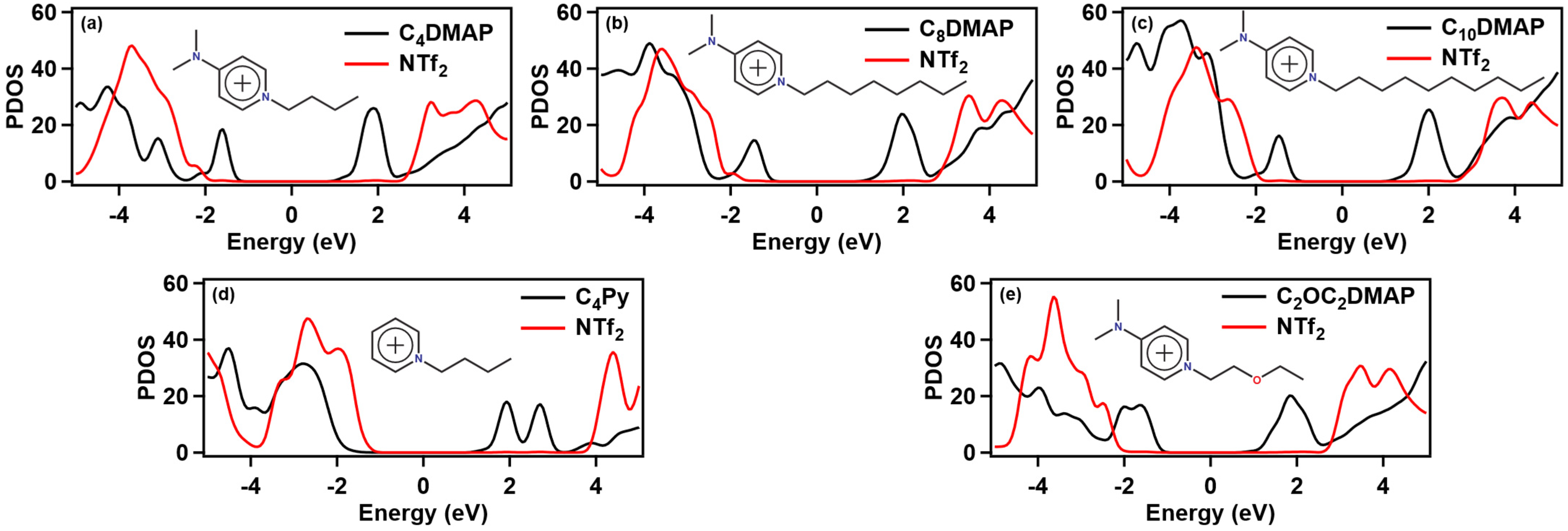
Ionic liquids are multicomponent systems, and to a first-level approximation, it is reasonable to think of independent HOMO and LUMO states for cationic and anionic species. The relative alignment of these states defines the overall HOMO and LUMO states and the corresponding band gap for the material. Figure 9 shows projected densities of states for different ILs in the DMAP NTf2 family, contrasted against that for C4Py NTf2. Here, we do not focus on the actual gap between HOMO and LUMO states (which PBE underestimates by about 0.8 eV, see Table S9 in the Supplementary Materials) but instead on the cationic or anionic nature of these states. It is clear from Figure 9 that for all liquids in which the cation contains the dimethylamino functionality, both HOMO and LUMO states are mostly cationic. What this means is that if the liquid were to donate an electron from its HOMO band, this would come mostly from cationic species, and if it were to accept an excess electron into the LUMO band, it would also be associated with cations. In contrast, from Figure 9d, we see that the HOMO band for C4Py NTf2 is mostly anionic and oxidation of the liquid would result in the anion losing an electron.
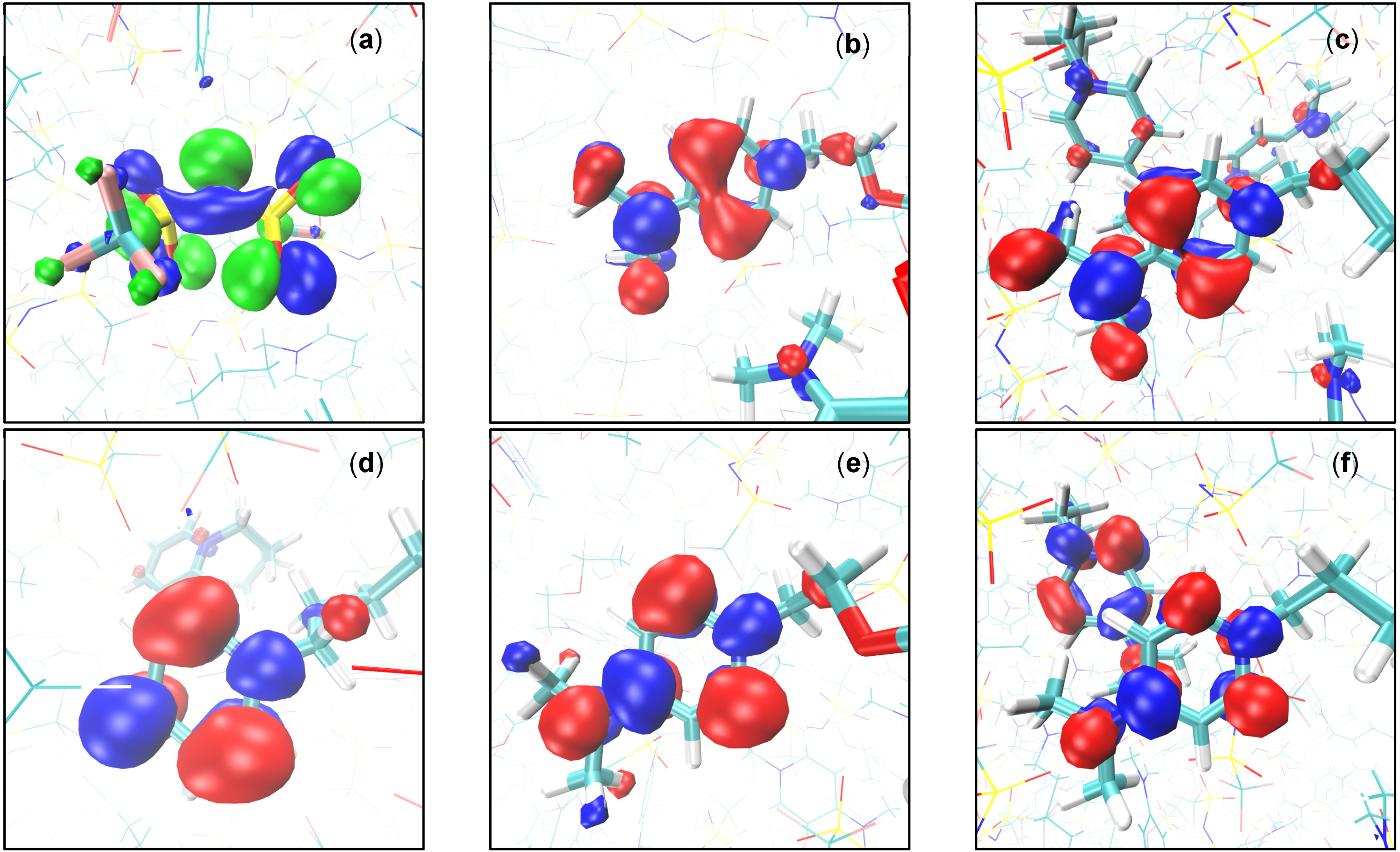
Figure 10 shows a comparison of HOMO and LUMO orbitals for C4Py NTf2, C2OC2DMAP NTf2 and C4DMAP NTf2 (data for other members of the DMAP NTf2 family are quite similar, as can be appreciated from Figure S5 in the Supplementary Materials). Consistent with the HOMO band in Figure 9d being mostly anionic in the case of C4Py NTf2, Figure 10a shows the liquid HOMO localized mostly on NTf2. Instead, the HOMO state for the DMAP NTf2 family of ILs is localized both on cationic rings as well as on the dimethylamino groups. LUMO states for C4Py NTf2 and corresponding DMAP NTf2 analogs, shown in Figure 10, have similar patterns of cationic localization.
From the analysis in the last two subsections, we see that whereas liquid structural features across systems are similar, both the intramolecular structure of cations and the overall electronic structure of the liquid can be quite different, particularly when comparing C4Py with the DMAP family. This difference in electronic structure results in the CnDMAP+ cation being the electron-donating component of the IL, which is not the case for the C4Py+ cation. The consequences of this difference are observed in the transient spectra obtained during the pulse radiolysis experiments described in the following section.

3.4. Radiolytic Behavior

Pyridinium ionic liquids (ILs) are notable from a radiation chemistry standpoint because, unlike imidazolium ILs [16,17,18], their electron adducts are relatively stable and exhibit reversible redox behavior rather than undergoing bond-forming or bond-cleavage reactions. This stability is reminiscent of natural and synthetic electron-shuttle systems, such as NAD+/NADH and methyl viologen. Neta and coworkers studied the radiolytic reduction of 1-butylpyridinium cations and the subsequent oxidation reactions of the resulting 1-butylpyridinyl radicals with electron acceptors in neat C4Py BF4 and 1-butyl-4-methylpyridinium PF6 and in solutions of those pyridinium salts in water, alcohols and other ionic liquids [19,20]. The butylpyridinyl radicals were stable on the order of hundreds of microseconds and reversibly accepted excess electrons generated by the radiolysis event and then transferred them to stronger electron acceptors such as methylviologen and duroquinone.
In contrast, 1-alkyl-4-dimethylaminopyridinium (DMAP) cations behave differently: they can act as both electron donors and acceptors, consistent with their cation-centered highest occupied molecular orbital (HOMO) as revealed by the projected densities of states in Figure 9. This duality was also observed previously in photoinduced electron-transfer studies in imidazolium media, where DMAP derivatives served as efficient electron donors [28].
To assess the relative electron-accepting properties of the various derivatives of the pyridinium and DMAP families, we measured solvated-electron capture rate constants for each derivative (except for octyl and decyl) in 1-butyl-1-methylpyrrolidinium NTf2 (C4mPyrr NTf2) as reported in Table 3. A slight trend of slower rate constants k e s o l v is observed for the more electron-rich DMAP cations compared to their pyridinium counterparts.
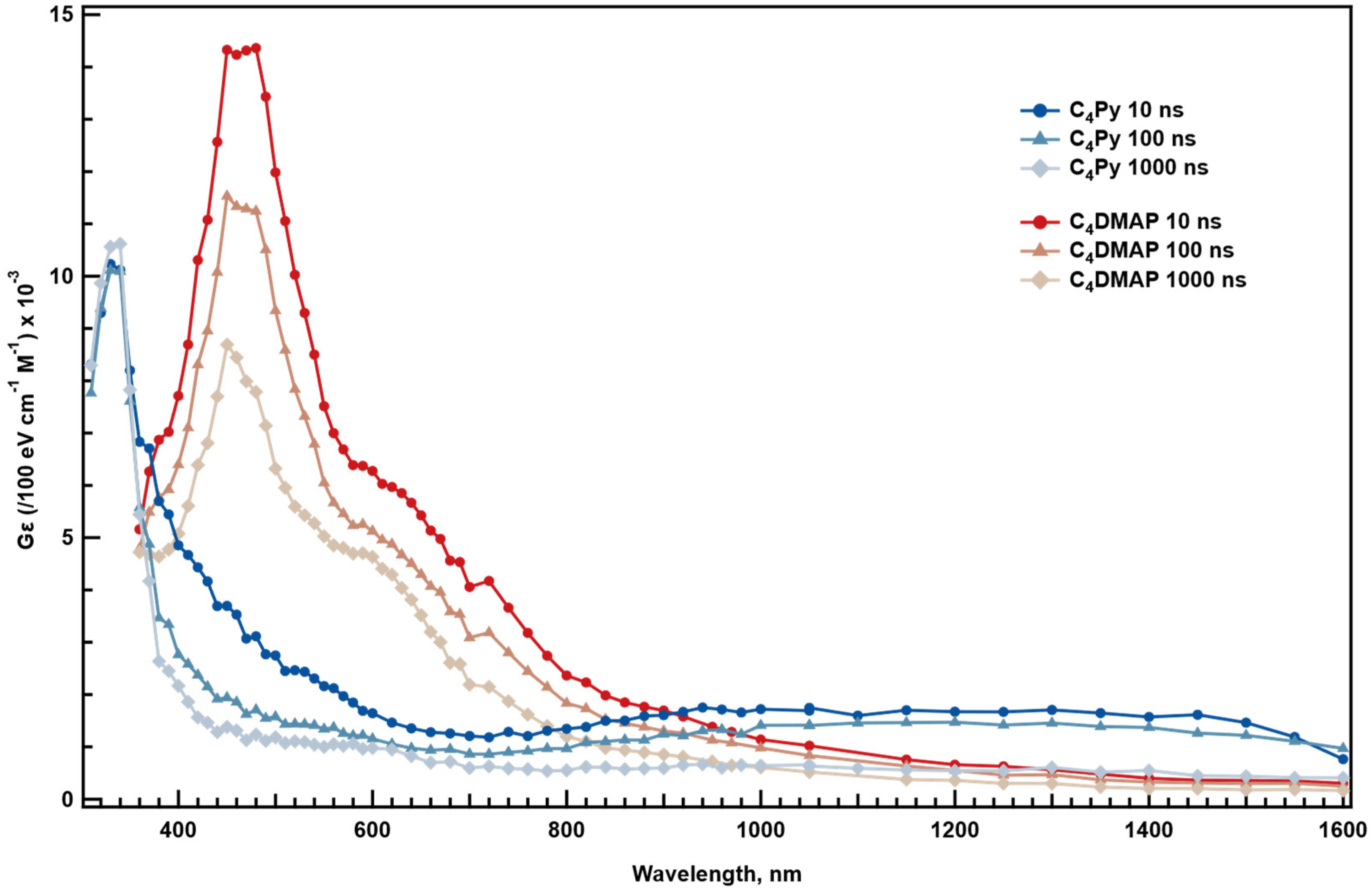
Dose-normalized pulse radiolysis spectra for neat C4DMAP NTf2 and C4Py NTf2 (Figure 11) further emphasize this difference. For C4Py NTf2, there is a characteristic absorption near 340 nm indicative of an electron adduct and a broad near-infrared band that may be due to a charge-resonance center consisting of an excess electron and two pyridinium cations in a sandwich-like configuration, analogous to other aromatic charge-resonance dimers. In contrast, the C4DMAP NTf2 transient spectra differ markedly, with distinct bands near 470 nm and a shoulder around 600 nm.
To assign the bands we observed in neat C4DMAP NTf2 to products of either hole or electron capture, we prepared dilute (10 mM) solutions of C4DMAP NTf2 in 1,2-dichloroethane (DCE), which forms oxidizing hole species under radiolysis while converting excess electrons to chloride ions, and in tetrahydrofuran (THF), which produces excess electrons while converting the holes to protons. The features seen in neat C4DMAP NTf2 were also seen in DCE solution (Figure S6a in the Supplementary Materials), albeit with smaller signals, but not in THF (Figure S6b in the Supplementary Materials), which showed a broad and relatively featureless absorption around 400–600 nm that did not change much during the first microsecond after the electron irradiation pulse. These spectral transients observed for C4DMAP NTf2 oxidized in DCE are absent in dilute C4Py NTf2 under identical conditions, as shown in Figure S6c in the Supplementary Materials. Additional measurements could be performed in a future γ radiolysis study using electrospray mass spectrometry to identify what these transient products are, but for the purpose of this discussion, the similarity of the spectra obtained in neat and diluted C4DMAP NTf2 is strong evidence that the observed transients around 470 nm are related to hole-derived species as opposed to electron-derived species, consistent with cationic HOMO localization of C4DMAP NTf2 in Figure 9.
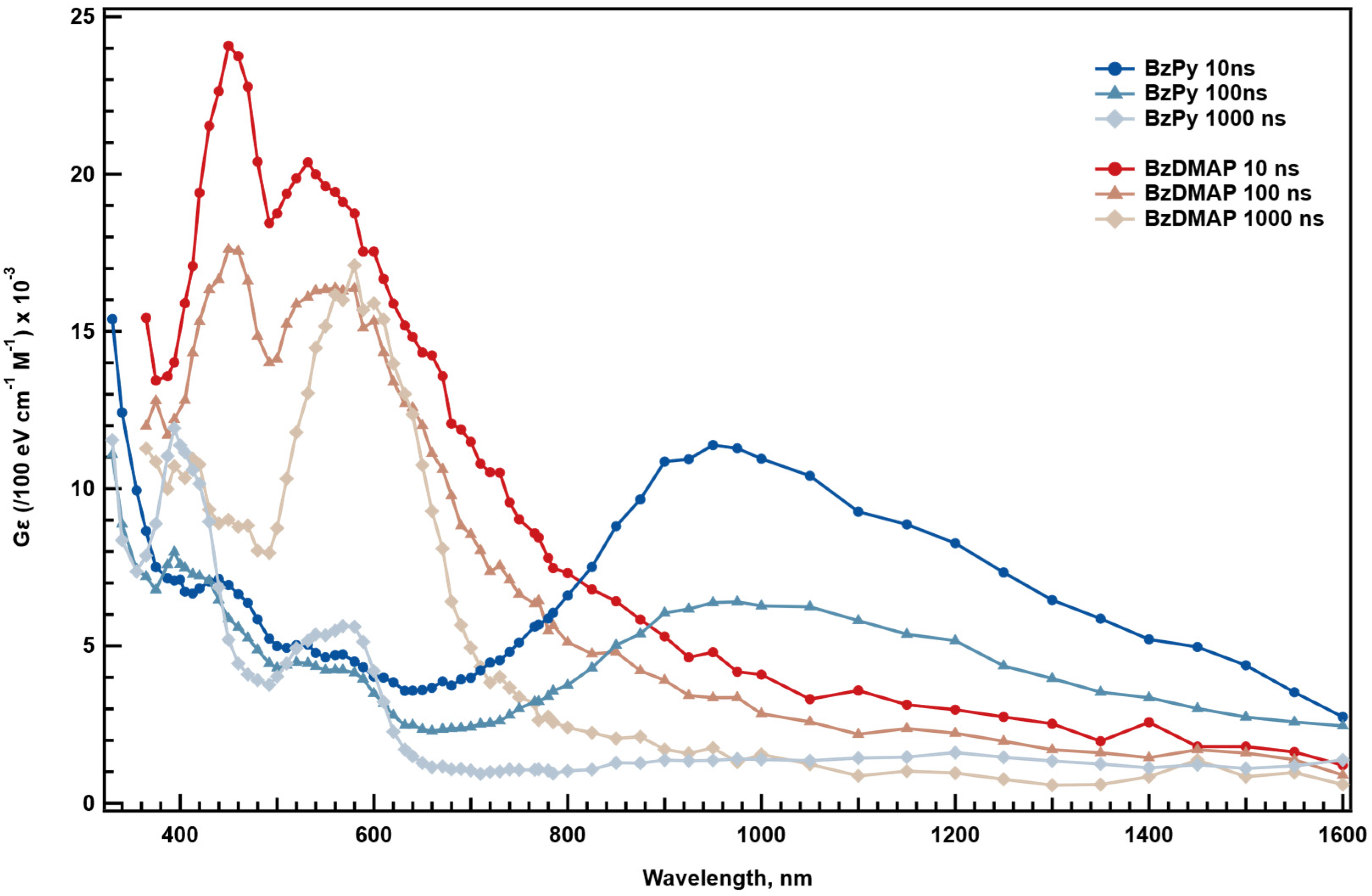
We now turn our attention to the radiation chemistry of the benzyl derivatives of DMAP and pyridine. Time-slice spectra at 10, 100 and 1000 ns obtained in neat BzPy NTf2 and BzDMAP NTf2 are shown in Figure 12. Neat BzPy NTf2 exhibits both the UV band of the pyridinium electron adduct and a strong near-infrared feature that is characteristic of a charge-resonance dimer cation involving benzyl groups, as we observed in an earlier publication [43]. Subsequent to that publication, Dhungana, Wu, and Margulis published ab initio molecular dynamics simulations of excess electrons and holes in BzPy NTf2 and BzPy N(CN)2 [78]. Their detailed analysis of the electronic structure, density of states and optical spectra supported the spectral assignments in our earlier paper [43].
In BzDMAP NTf2, however, the transient spectra do not show a charge resonance band in the near-infrared as observed for BzPy NTf2, but they do contain a peak around 440 nm as observed in C4DMAP NTf2. This suggests that the hole is localized primarily on the DMAP moiety rather than forming a charge-resonance dimer between benzyl substituents. Notably, a second strong absorption band (at about 520 nm with a long tail to the red) is observed during the first 100 ns in irradiated BzDMAP NTf2. It is possible that this transition is due to a charge-resonance interaction between a benzyl group and the radical dication formed when the BzDMAP+ cation captures a hole. Over the course of a microsecond, the absorption bands at 440 and 520 nm in BzDMAP NTf2 decay and another strong band at 590 nm grows in, presumably through evolution of the BzDMAP2+• cation/charge resonance complex into a secondary product. Interestingly, this behavior is also seen when C4DMAP NTf2 is diluted to 10 mM in DCE (Figure S6a in the Supplementary Materials), where a peak grows in around 580 nm on the 1-microsecond timescale. The commonality reinforces the interpretation that the spectral features observed for neat BzDMAP NTf2 in Figure 12 must be related to hole-derived species.
It is worthwhile to note that distinct bands in the 400 to 600 nm region appear in the pulse radiolysis of BzPy NTf2, but not in the pulse radiolysis of C4Py NTf2. The bands seen in BzPy NTf2 appear in the same locations as in BzDMAP NTf2, and they include late-appearing bands around 400 nm and 560 nm, but they are weaker than in BzDMAP NTf2. It is possible that the benzyl groups increase the stability of holes residing on the pyridinium cations that give rise to the bands between 400 and 600 nm, but they would remain a minority species compared to the benzyl-based dimer cation absorbing in the NIR, underscoring again the effect of the electron-donating dimethylamino group in changing the electronic density of states, and thereby controlling radiation-and redox-induced reaction pathways. When the spectra of BzPy NTf2 at 70 °C are compared with room temperature spectra (see Figure S7 in the Supplementary Materials), the absorption in the near-infrared that is associated with the benzyl dimer charge resonance is weaker at high temperature, due to a greater degree of thermal fluctuation destabilizing the charge-resonance dimer, with a concurrent increase in the absorptions at 400 nm and 560 nm.

4. Conclusions

Substituting a dimethylamino group at the 4-position of the pyridinium ring produces profound electronic but modest structural and thermophysical changes. Across the examined NTf2 ionic liquids, DMAP substitution raises glass-transition temperatures by approximately 10–25 °C and shifts decomposition onsets upward by 30–100 °C relative to their pyridinium analogs, indicating enhanced thermal stability. DMAP ILs are more viscous at 25 °C; VTF fits show higher T0 but lower D, indicating increased fragility.
X-ray scattering and molecular dynamics simulations show that overall liquid organization remains similar between pyridinium and DMAP ILs, but the dimethylamino group significantly alters intramolecular conformations and the electronic landscape. In DMAP systems, both the HOMO and LUMO are primarily cationic, in contrast to pyridinium ILs, where the HOMO is anionic. This electronic inversion shifts the locus of radiolytic and photoinduced charge capture to the cation, explaining the distinct transient absorption spectra and hole-derived species observed by pulse radiolysis.
Taken together, the thermophysical measurements, structural analysis, electronic-structure calculations, and pulse radiolysis experiments present a consistent picture of how 4-dimethylamino substitution modifies pyridinium NTf2 ionic liquids. Dimethylamino substitution strengthens interionic interactions without drastically altering mesoscopic organization, while fundamentally reshaping cation conformations and frontier orbitals. In particular, the shift to cation-centered HOMO levels redirects radiolytic and redox processes from the anion to the cation, enabling hole-derived transients that differ qualitatively from those of pyridinium analogs. These trends hold across the butyl, ether, hydroxypropyl, and benzyl-substituted series, illustrating the additive interplay of side-chain functionality and ring substitution. Overall, DMAP functionalization enhances ionic-liquid robustness under thermal and radiolytic stress while enabling distinct redox behavior, providing clear structure–property design principles for task-specific ionic liquids in high-temperature catalysis, electrochemical energy systems, and radiation-resistant separations media.

Supplementary Materials

The following supporting information can be downloaded at: https://www.mdpi.com/article/10.3390/pr14081208/s1, Figure S1: Thermogravimetric analysis curves for DMAP ILs (solid lines) and their pyridinium analogs (dashed lines), normalized to 100 percent of the original sample mass. The scan rates were 10 °C/min; Figure S2: Snapshot of equilibrated simulation boxes for C4Py NTf2 (top) and C2OC2Py NTf2 (bottom). Single-ion pairs are shown above or below the simulation boxes to indicate the color schemes. NTf2 anions are depicted in green in all the panels. On the left side of the figure, the entire cations are shown in solid blue, while on the right side, the alkyl or ether tails are differentiated in white; Figure S3: Torsional energy for CW-CY-NA-CA (left), CW-CY-NA-CY (right) and HY-CY-NA-CA (bottom); Figure S4: Comparison of MP2 energies with our parameterization of the CM-NM-CR-CW torsional angle of C10DMAP. Blue lines are to guide the eye; Figure S5: (Top) HOMO of C8DMAP NTf2 (left) and C10DMAP NTf2 (right). (Bottom) LUMO of C8DMAP NTf2 (left) and C10DMAP NTf2 (right); Figure S6: Electron pulse radiolysis transient absorption spectra of (a) 10 mM C4DMAP NTf2 in THF, (b) 10 mM C4DMAP NTf2 in DCE, and (c) 10mM C4Py NTf2 in DCE; Figure S7: Electron pulse radiolysis transient absorption spectra of neat Ar-saturated BzPy NTf2 as a function of temperature at 23 °C and 70 °C; Table S1: Selected intra-ring torsional parameters; Table S2: Bond distances; Table S3: Bond angles; Table S4: Torsional parameters (units of kJ∙mol−1); Table S5: Charges (from this work, except those in bold font); Table S6: Lennard–Jones parameters; Table S7: NBO analysis for the C10DMAP cation; Schemes S1–S3: Molecular dynamics simulation atomic naming conventions for C4Py+, C4DMAP+, and C2OC2DMAP+, respectively. NBO analysis for the C10DMAP cation; Table S8: Computational and experimental liquid densities; Table S9: Average and standard deviation of the HOMO-LUMO gap over 10 independent frames. Scheme S1: Atom naming convention for C4Py cation. Scheme S2: Atom naming convention for alkylated CnDMAP cations. Scheme S3: Atom naming convention for C2OC2DMAP cation. References supporting the supplementary synthesis description are cited in Ref. [110]; references supporting the supplementary force-field parameterization, bonded and torsional terms, systematic all-atom force-field methodology, and NBO analysis are cited in Refs. [111,112,113,114,115]; and references supporting the electrochemical-window interpretation of Table S9 and the comparison to DFT orbital gaps are cited in Refs. [116,117,118,119].

Author Contributions

Conceptualization, J.F.W., S.I.L.-R., C.J.M., E.W.C.J. and R.R.E.; methodology, J.F.W., S.I.L.-R., B.W., F.W., M.S.E., C.J.M. and E.W.C.J.; software, M.S.E. and F.W.; validation, S.I.L.-R., J.F.W., M.S.E., M.G., F.W., B.W. and E.W.C.J.; formal analysis, J.F.W., M.S.E., S.I.L.-R., M.G., B.W., F.W., C.J.M. and E.W.C.J.; investigation, M.S.E., F.W., J.L.H.-L., M.F.T., M.G., B.W., M.L., S.R., C.J.M. and J.F.W.; resources, J.F.W., E.W.C.J., C.J.M., R.R.E. and S.I.L.-R.; data curation, J.F.W., M.S.E., B.W. and F.W.; writing—original draft preparation, J.F.W., M.S.E., F.W., C.J.M., E.W.C.J. and S.I.L.-R.; writing—review and editing, all authors; visualization, M.S.E., B.W., F.W., C.J.M., E.W.C.J. and J.F.W.; supervision, J.F.W., S.I.L.-R., C.J.M., E.W.C.J. and R.R.E.; project administration, J.F.W., S.I.L.-R., C.J.M., E.W.C.J. and R.R.E.; funding acquisition, J.F.W., S.I.L.-R., C.J.M. and E.W.C.J. All authors have read and agreed to the published version of the manuscript.

Funding

The work at BNL and use of the LEAF of the BNL Accelerator Center for Energy Research were supported by the U.S. Department of Energy, Office of Basic Energy Sciences, Division of Chemical Sciences, Geosciences, and Biosciences under contracts # DE-AC02-98CH10886 and # DE-SC0012704. The work at Rutgers, the State University of New Jersey and the University of Iowa was supported by the U.S. Department of Energy, Office of Basic Energy Sciences, Division of Chemical Sciences, Geosciences, and Biosciences under SISGR Grant # DE-FG02-09ER16118 and # DE-SC0001780, respectively. This research used resources of the Advanced Photon Source, a U.S. Department of Energy (DOE) Office of Science User Facility operated for the DOE Office of Science by Argonne National Laboratory under Contract No. DE-AC02-06CH11357.

Data Availability Statement

Data sets for this article are made available within 30 days of the official acceptance date of this article by the journal in the Zenodo repository under the Digital Object Identifier (DOI): 10.5281/zenodo.17966997.

Acknowledgments

The work at BNL and use of the LEAF of the BNL Accelerator Center for Energy Research were supported by the US Department of Energy, Office of Basic Energy Sciences, Division of Chemical Sciences, Geosciences, and Biosciences under contracts # DE-AC02-98CH10886 and # DE-SC0012704. The work at Rutgers, the State University of New Jersey and the University of Iowa was supported by the U.S. Department of Energy, Office of Basic Energy Sciences, Division of Chemical Sciences, Geosciences, and Biosciences under SISGR Grant # DE-FG02-09ER16118 and # DE-SC0001780, respectively. This research used resources of the Advanced Photon Source, a U.S. Department of Energy (DOE) Office of Science User Facility operated for the DOE Office of Science by Argonne National Laboratory under Contract No. DE-AC02-06CH11357. We gratefully thank Yang Ren, beamline 11-ID-C scientist, for help with data acquisition. Additionally, we thank the BNL Office of Educational Programs for internship and faculty support through the Department of Energy’s Community College Internship, Summer Undergraduate Laboratory Internship and Faculty and Student Team programs, the BNL Diversity Office and the NSF Louis Stokes Alliance for Minority Participation (LSAMP) program, for internship and research assistant support, respectively. We thank Nicole Zmich for preparing and characterizing samples of C8DMAP NTf2, C10DMAP NTf2, and 3-MeBzPy NTf2. We thank Koji Osawa for providing a sample of BzPy NTf2 for pulse radiolysis measurements. We thank Huimin Luo of Oak Ridge National Laboratory for providing samples of 1-Bz-2-MePy NTf2, 1-Bz-3-MePy NTf2, and 1-Bz-4-MePy NTf2 for physical characterization.

Conflicts of Interest

The authors declare no conflicts of interest. The funders had no role in the design of the study; in the collection, analyses, or interpretation of data; in the writing of the manuscript; or in the decision to publish the results.

References

  1. Sun, X.; Luo, H.; Dai, S. Ionic Liquids-Based Extraction: A Promising Strategy for the Advanced Nuclear Fuel Cycle. Chem. Rev. 2012, 112, 2100–2128. [Google Scholar] [CrossRef] [PubMed]
  2. Inman, G.; Nlebedim, I.C.; Prodius, D. Application of Ionic Liquids for the Recycling and Recovery of Technologically Critical and Valuable Metals. Energies 2022, 15, 628. [Google Scholar] [CrossRef]
  3. Dongare, S.; Zeeshan, M.; Aydogdu, A.S.; Dikki, R.; Kurtoğlu-Öztulum, S.F.; Coskun, O.K.; Muñoz, M.; Banerjee, A.; Gautam, M.; Ross, R.D.; et al. Reactive capture and electrochemical conversion of CO2 with ionic liquids and deep eutectic solvents. Chem. Soc. Rev. 2024, 53, 8563–8631. [Google Scholar] [CrossRef] [PubMed]
  4. Mušović, J.; Tekić, D.; Jocić, A.; Marić, S.; Dimitrijević, A. Efficient Ionic Liquid-Based Leaching and Extraction of Metals from NMC Cathodes. Processes 2025, 13, 1755. [Google Scholar] [CrossRef]
  5. Łukomska, A.; Wiśniewska, A.; Dąbrowski, Z.; Lach, J.; Wróbel, K.; Kolasa, D.; Domańska, U. Recovery of Metals from Electronic Waste-Printed Circuit Boards by Ionic Liquids, DESs and Organophosphorous-Based Acid Extraction. Molecules 2022, 27, 4984. [Google Scholar] [CrossRef]
  6. Tan, X.; Sun, X.; Han, B. Ionic liquid-based electrolytes for CO2 electroreduction and CO2 electroorganic transformation. Natl. Sci. Rev. 2022, 9, nwab022. [Google Scholar] [CrossRef]
  7. Wishart, J.F. Energy Applications of Ionic Liquids. Energy Environ. Sci. 2009, 2, 956–961. [Google Scholar] [CrossRef]
  8. Pei, Y.; Zhang, Y.; Ma, J.; Fan, M.; Zhang, S.; Wang, J. Ionic liquids for advanced materials. Mater. Today Nano 2022, 17, 100159. [Google Scholar] [CrossRef]
  9. Kaur, G.; Kumar, H.; Singla, M. Diverse applications of ionic liquids: A comprehensive review. J. Mol. Liq. 2022, 351, 118556. [Google Scholar] [CrossRef]
  10. Greer, A.J.; Jacquemin, J.; Hardacre, C. Industrial Applications of Ionic Liquids. Molecules 2020, 25, 5207. [Google Scholar] [CrossRef]
  11. Liu, B.; Guo, W.; Gebbie, M.A. Tuning Ionic Screening to Accelerate Electrochemical CO2 Reduction in Ionic Liquid Electrolytes. ACS Catal. 2022, 12, 9706–9716. [Google Scholar] [CrossRef]
  12. Fortunati, A.; Risplendi, F.; Re Fiorentin, M.; Cicero, G.; Parisi, E.; Castellino, M.; Simone, E.; Iliev, B.; Schubert, T.J.S.; Russo, N.; et al. Understanding the Role of Imidazolium-Based Ionic Liquids in the Electrochemical CO2 Reduction Reaction. Commun. Chem. 2023, 6, 84. [Google Scholar] [CrossRef] [PubMed]
  13. Verma, P.K.; Mahanty, B.; Sengupta, A.; Mohapatra, P.K.; Kumar, R.; Bhattacharyya, D.; Jha, S.N.; Ali, S.M. Simple, Fast, and Selective Dissolution of Eu2O3 in an Ionic Liquid as a Sustainable Paradigm for Lanthanide–Actinide Separations in Radioactive Waste Remediation. Inorg. Chem. 2023, 62, 87–97. [Google Scholar] [CrossRef] [PubMed]
  14. Kenneth, L.N. Selective Separation of Trivalent Actinides from Lanthanides by Aqueous Processing with Introduction of Soft Donor Atoms; Technical Report; U.S. Department of Energy: Washington, DC, USA, 2009. [Google Scholar] [CrossRef]
  15. Xue, Z.; Qin, L.; Jiang, J.; Mu, T.; Gao, G. Thermal, electrochemical and radiolytic stabilities of ionic liquids. Phys. Chem. Chem. Phys. 2018, 20, 8382–8402. [Google Scholar] [CrossRef]
  16. Shkrob, I.A.; Wishart, J.F. Charge Trapping in Imidazolium Ionic Liquids. J. Phys. Chem. B 2009, 113, 5582–5592. [Google Scholar] [CrossRef]
  17. Shkrob, I.A. Deprotonation and Oligomerization in Photo-, Radiolytically, and Electrochemically Induced Redox Reactions in Hydrophobic Alkylalkylimidazolium Ionic Liquids. J. Phys. Chem. B 2010, 114, 368–375. [Google Scholar] [CrossRef]
  18. Shkrob, I.A.; Marin, T.W.; Chemerisov, S.D.; Hatcher, J.L.; Wishart, J.F. Radiation Induced Redox Reactions and Fragmentation of Constituent Ions in Ionic Liquids. 2. Imidazolium Cations. J. Phys. Chem. B 2011, 115, 3889–3902. [Google Scholar] [CrossRef]
  19. Behar, D.; Neta, P.; Schultheisz, C. Reaction Kinetics in Ionic Liquids as Studied by Pulse Radiolysis: Redox Reactions in the Solvents Methyltributylammonium Bis(Trifluoromethylsulfonyl)Imide and N-Butylpyridinium Tetrafluoroborate. J. Phys. Chem. A 2002, 106, 3139–3147. [Google Scholar] [CrossRef]
  20. Skrzypczak, A.; Neta, P. Diffusion-Controlled Electron-Transfer Reactions in Ionic Liquids. J. Phys. Chem. A 2003, 107, 7800–7803. [Google Scholar] [CrossRef]
  21. Wilkes, J.S. A Short History of Ionic Liquids—From Molten Salts to Neoteric Solvents. Green Chem. 2002, 4, 73–80. [Google Scholar] [CrossRef]
  22. Tokuda, H.; Ishii, K.; Susan, M.; Tsuzuki, S.; Hayamizu, K.; Watanabe, M. Physicochemical Properties and Structures of Room-Temperature Ionic Liquids. 3. Variation of Cationic Structures. J. Phys. Chem. B 2006, 110, 2833–2839. [Google Scholar] [CrossRef] [PubMed]
  23. Crosthwaite, J.M.; Muldoon, M.J.; Dixon, J.K.; Anderson, J.L.; Brennecke, J.F. Phase Transition and Decomposition Temperatures, Heat Capacities and Viscosities of Pyridinium Ionic Liquids. J. Chem. Thermodyn. 2005, 37, 559–568. [Google Scholar] [CrossRef]
  24. Cai, D.; Saengprachum, N.; Lin, Z.; Qiu, T. Thermophysical Properties of 4-Dimethylaminopyridine Based Ionic Liquids. J. Mol. Liq. 2020, 297, 111875. [Google Scholar] [CrossRef]
  25. Zaharani, L.; Rafie Johan, M.; Titinchi, S.; Ghaffari Khaligh, N. 4-(Dimethylamino)pyridinium Chlorosulfonate: A New Ionic Liquid Exhibiting Chlorosulfonic Acid Action as Monoprotic Brönsted Acid and no Sulfonating Reagent. J. Mol. Liq. 2022, 345, 118261. [Google Scholar] [CrossRef]
  26. Pernak, J.; Feder-Kubis, J. Chiral Pyridinium-Based Ionic Liquids Containing the (1R,2S,5R)-(-)-Menthyl Group. Tetrahedron Asymmetry 2006, 17, 1728–1737. [Google Scholar] [CrossRef]
  27. Diedrichs, A.; Gmehling, J. Measurement of Heat Capacities of Ionic Liquids by Differential Scanning Calorimetry. Fluid Phase Equilibria 2006, 244, 68–77. [Google Scholar] [CrossRef]
  28. Wu, B.; Liang, M.; Zmich, N.; Hatcher, J.; Lall-Ramnarine, S.I.; Wishart, J.F.; Maroncelli, M.; Castner, E.W., Jr. Photoinduced Bimolecular Electron Transfer in Ionic Liquids: Cationic Electron Donors. J. Phys. Chem. B 2018, 122, 2379–2388. [Google Scholar] [CrossRef]
  29. Ghumro, S.A.; Saleem, S.; Al-Rashida, M.; Iqbal, N.; Alharthy, R.D.; Ahmed, S.; Moin, S.T.; Hameed, A. N,N-Dimethylpyridin-4-amine (DMAP) based ionic liquids: Evaluation of physical properties via molecular dynamics simulations and application as a catalyst for Fisher indole and 1H-tetrazole synthesis. RSC Adv. 2017, 7, 34197–34207. [Google Scholar] [CrossRef]
  30. Zhang, Z.; Li, J.; Yu, G.; Zeng, C.; Wang, M.; Huang, S.; Wang, L.; Zhang, J. Efficient Synthesis of Cyclic Carbonates Under Atmospheric CO2 by DMAP-Based Ionic Liquids: The Difference of Inert Hydrogen Atom and Active Hydrogen Atom in Cation. Green Chem. Eng. 2023, 4, 285–293. [Google Scholar] [CrossRef]
  31. Pernak, J.; Branicka, M. The Properties of 1-Alkoxymethyl-3-Hydroxypyridinium and 1-Alkoxymethyl-3-Dimethylaminopyridinium Chlorides. J. Surfactants Deterg. 2003, 6, 119–123. [Google Scholar] [CrossRef]
  32. Pernak, J.; Skrzypczak, A.; Lota, G.; Frackowiak, E. Synthesis and Properties of Trigeminal Tricationic Ionic Liquids. Chem.-Eur. J. 2007, 13, 3106–3112. [Google Scholar] [CrossRef]
  33. Messali, M. Eco-Friendly Synthesis of a New Class of Pyridinium-Based Ionic Liquids with Attractive Antimicrobial Activity. Molecules 2015, 20, 14936–14949. [Google Scholar] [CrossRef] [PubMed]
  34. Andreev, I.A.; Boichenko, M.A.; Ratmanova, N.K.; Ivanova, O.A.; Levina, I.I.; Khrustalev, V.N.; Sedov, I.A.; Trushkov, I.V. 4-(Dimethylamino)Pyridinium Azide in Protic Ionic Liquid Media as a Stable Equivalent of Hydrazoic Acid. Adv. Synth. Amp; Catal. 2022, 364, 2403–2415. [Google Scholar] [CrossRef]
  35. Messali, M.; Lgaz, H.; Almutairi, S.M.; Salghi, R. Towards a Deeper Understanding of the Coordination Chemistry in Pyridinium-Based Ionic Liquids-Iron Systems: Insights from Quantum Chemical and Semi-Empirical Investigations. Inorg. Chem. Commun. 2024, 159, 111762. [Google Scholar] [CrossRef]
  36. Lgaz, H.; Benali, O.; Salghi, R.; Jodeh, S.; Larouj, M.; Hamed, O.; Messali, M.; Samhan, S.; Zougagh, M.; Oudda, H. Pyridinium Derivatives as Corrosion Inhibitors for Mild Steel in 1M HCl: Electrochemical, Surface and Quantum Chemical Studies. Der Pharma Chem. 2016, 8, 172–190. [Google Scholar]
  37. Mahurin, S.M.; Dai, T.; Yeary, J.S.; Luo, H.M.; Dai, S. Benzyl-Functionalized Room Temperature Ionic Liquids for CO2/N2 Separation. Ind. Eng. Chem. Res. 2011, 50, 14061–14069. [Google Scholar] [CrossRef]
  38. Wishart, J.F.; Cook, A.R.; Miller, J.R. The LEAF Picosecond Pulse Radiolysis Facility at Brookhaven National Laboratory. Rev. Sci. Instrum. 2004, 75, 4359–4366. [Google Scholar] [CrossRef]
  39. Wishart, J.F.; Neta, P. Spectrum and Reactivity of the Solvated Electron in the Ionic Liquid Methyltributylammonium Bis(Trifluoromethylsulfonyl)Imide. J. Phys. Chem. B 2003, 107, 7261–7267. [Google Scholar] [CrossRef]
  40. Grodkowski, J.; Neta, P.; Wishart, J.F. Pulse Radiolysis Study of The Reactions of Hydrogen Atoms in the Ionic Liquid Methyltributylammonium Bis[(trifluoromethyl)sulfonyl]imide. J. Phys. Chem. A 2003, 107, 9794–9799. [Google Scholar] [CrossRef]
  41. Wishart, J.F.; Lall-Ramnarine, S.I.; Raju, R.; Scumpia, A.; Bellevue, S.; Ragbir, R.; Engel, R. Effects of Functional Group Substitution on Electron Spectra and Solvation Dynamics in a Family of Ionic Liquids. Radiat. Phys. Chem. 2005, 72, 99–104. [Google Scholar] [CrossRef]
  42. Lall-Ramnarine, S.I.; Castano, A.; Subramaniam, G.; Thomas, M.F.; Wishart, J.F. Synthesis, Characterization and Radiolytic Properties of Bis(oxalato)borate Containing Ionic Liquids. Radiat. Phys. Chem. 2009, 78, 1120–1125. [Google Scholar] [CrossRef]
  43. Shkrob, I.A.; Marin, T.W.; Hatcher, J.L.; Cook, A.R.; Szreder, T.; Wishart, J.F. Radiation Stability of Cations in Ionic Liquids. 2. Improved Radiation Resistance through Charge Delocalization in 1-Benzylpyridinium. J. Phys. Chem. B 2013, 117, 14385–14399. [Google Scholar] [CrossRef] [PubMed]
  44. Shkrob, I.A.; Marin, T.W.; Bell, J.R.; Luo, H.; Dai, S.; Hatcher, J.L.; Rimmer, R.D.; Wishart, J.F. Radiation-Induced Fragmentation of Diamide Extraction Agents in Ionic Liquid Diluents. J. Phys. Chem. B 2012, 116, 2234–2243. [Google Scholar] [CrossRef] [PubMed]
  45. Hug, G.L.; United States National Bureau of Standards. Optical Spectra of Nonmetallic Inorganic Transient Species in Aqueous Solution; U.S. Department of Commerce, National Bureau of Standards: Washington, DC, USA, 1981. [Google Scholar] [CrossRef]
  46. Santos, C.S.; Annapureddy, H.V.R.; Murthy, N.S.; Kashyap, H.K.; Castner, E.W., Jr.; Margulis, C.J. Temperature-Dependent Structure of Methyltributylammonium Bis(trifluoromethylsulfonyl)amide: X Ray Scattering and Simulations. J. Chem. Phys. 2011, 134, 064501. [Google Scholar] [CrossRef] [PubMed]
  47. Santos, C.S.; Murthy, N.S.; Baker, G.A.; Castner, E.W., Jr. Communication: X-ray Scattering from Ionic Liquids with Pyrrolidinium Cations. J. Chem. Phys. 2011, 134, 121101. [Google Scholar] [CrossRef]
  48. Kashyap, H.K.; Santos, C.S.; Annapureddy, H.V.R.; Murthy, N.S.; Margulis, C.J.; Castner, E.W., Jr. Temperature-Dependent Structure of Ionic Liquids: X-ray Scattering and Simulations. Faraday Discuss. 2012, 154, 133–143. [Google Scholar] [CrossRef]
  49. Hammersley, A.P.; Svensson, S.O.; Hanfland, M.; Fitch, A.N.; Hausermann, D. Two-Dimensional Detector Software: From Real Detector to Idealised Image or Two-Theta Scan. High Press. Res. 1996, 14, 235–248. [Google Scholar] [CrossRef]
  50. Qiu, X.; Thompson, J.W.; Billinge, S.J.L. PDFgetX2: A GUI-driven Program to Obtain the Pair Distribution Function from X-Ray Powder Diffraction Data. J. Appl. Cryst. 2004, 37, 678. [Google Scholar] [CrossRef]
  51. Hess, B.; Kutzner, C.; van der Spoel, D.; Lindahl, E. GROMACS 4: Algorithms for Highly Efficient, Load-Balanced, and Scalable Molecular Simulation. J. Chem. Theory Comput. 2008, 4, 435–447. [Google Scholar] [CrossRef]
  52. Van der Spoel, D.; Lindahl, E.; Hess, B.; Groenhof, G.; Mark, A.E.; Berendsen, H.J.C. GROMACS: Fast, Flexible, and Free. J. Comput. Chem. 2005, 26, 1701–1718. [Google Scholar] [CrossRef]
  53. Bussi, G.; Donadio, D.; Parrinello, M. Canonical Sampling through Velocity Rescaling. J. Chem. Phys. 2007, 126, 014101. [Google Scholar] [CrossRef]
  54. Berendsen, H.J.C.; Postma, J.P.M.; Vangunsteren, W.F.; Dinola, A.; Haak, J.R. Molecular-Dynamics with Coupling to an External Bath. J. Chem. Phys. 1984, 81, 3684–3690. [Google Scholar] [CrossRef]
  55. Nose, S. A Unified Formulation of the Constant Temperature Molecular-Dynamics Methods. J. Chem. Phys. 1984, 81, 511–519. [Google Scholar] [CrossRef]
  56. Nose, S. A Molecular-Dynamics Method for Simulations in the Canonical Ensemble. Mol. Phys. 1984, 52, 255–268. [Google Scholar] [CrossRef]
  57. Hoover, W.G. Canonical Dynamics-Equilibrium Phase-Space Distributions. Phys. Rev. A 1985, 31, 1695–1697. [Google Scholar] [CrossRef]
  58. Parrinello, M.; Rahman, A. Polymorphic Transitions in Single-Crystals—A New Molecular-Dynamics Method. J. Appl. Phys. 1981, 52, 7182–7190. [Google Scholar] [CrossRef]
  59. Van Gunsteren, W.F.; Berendsen, H.J.C. A Leap-Frog Algorithm for Stochastic Dynamics. Mol. Simul. 1988, 1, 173–185. [Google Scholar] [CrossRef]
  60. York, D.M.; Darden, T.A.; Pedersen, L.G. The Effect of Long-Range Electrostatic Interactions in Simulations of Macromolecular Crystals: A Comparison of The Ewald and Truncated List Methods. J. Chem. Phys. 1993, 99, 8345–8348. [Google Scholar] [CrossRef]
  61. Essmann, U.; Perera, L.; Berkowitz, M.L.; Darden, T.; Lee, H.; Pedersen, L.G. A Smooth Particle Mesh Ewald Method. J. Chem. Phys. 1995, 103, 8577–8593. [Google Scholar] [CrossRef]
  62. Emerson, M.S.; Ogbodo, R.; Margulis, C.J. Spiers Memorial Lecture: From Cold to Hot, the Structure and Structural Dynamics of Dense Ionic Fluids. Faraday Discuss. 2024, 253, 11–25. [Google Scholar] [CrossRef]
  63. Kashyap, H.K.; Hettige, J.J.; Annapureddy, H.V.R.; Margulis, C.J. SAXS Anti-Peaks Reveal the Length-Scales of Dual Positive-Negative and Polar-Apolar Ordering in Room-Temperature Ionic Liquids. Chem. Commun. 2012, 48, 5103–5105. [Google Scholar] [CrossRef]
  64. Kashyap, H.K.; Margulis, C.J. Theoretical Deconstruction of the X-ray Structure Function Exposes Polarity Alternations in Room Temperature Ionic Liquids. ECS Trans. 2012, 50, 301–307. [Google Scholar] [CrossRef]
  65. Hettige, J.J.; Kashyap, H.K.; Annapureddy, H.V.R.; Margulis, C.J. Anions, the Reporters of Structure in Ionic Liquids. J. Phys. Chem. Lett. 2013, 4, 105–110. [Google Scholar] [CrossRef] [PubMed]
  66. Kashyap, H.K.; Santos, C.S.; Daly, R.P.; Hettige, J.J.; Murthy, N.S.; Shirota, H.; Castner, E.W., Jr.; Margulis, C.J. How does the ionic liquid organizational landscape change when nonpolar cationic alkyl groups are replaced by polar isoelectronic diethers? J. Phys. Chem. B 2013, 117, 1130–1135. [Google Scholar] [CrossRef] [PubMed]
  67. Kashyap, H.K.; Santos, C.S.; Murthy, N.S.; Hettige, J.J.; Kerr, K.; Ramati, S.; Gwon, J.; Gohdo, M.; Lall-Ramnarine, S.I.; Wishart, J.F.; et al. Structure of 1-Alkyl-1-methylpyrrolidinium Bis(trifluoromethylsulfonyl)amide Ionic Liquids with Linear, Branched, and Cyclic Alkyl Groups. J. Phys. Chem. B 2013, 117, 15328–15337. [Google Scholar] [CrossRef] [PubMed]
  68. Hettige, J.J.; Araque, J.C.; Margulis, C.J. Bicontinuity and Multiple Length Scale Ordering in Triphilic Hydrogen-Bonding Ionic Liquids. J. Phys. Chem. B 2014, 118, 12706–12716. [Google Scholar] [CrossRef]
  69. Araque, J.C.; Hettige, J.J.; Margulis, C.J. Modern Room Temperature Ionic Liquids, a Simple Guide to Understanding Their Structure and How It May Relate to Dynamics. J. Phys. Chem. B 2015, 119, 12727–12740. [Google Scholar] [CrossRef]
  70. Araque, J.C.; Hettige, J.J.; Margulis, C.J. Ionic liquids-Conventional Solvent Mixtures, Structurally Different but Dynamically Similar. J. Chem. Phys. 2015, 143, 134505. [Google Scholar] [CrossRef]
  71. Dhungana, K.B.; Faria, L.F.; Wu, B.; Liang, M.; Ribeiro, M.C.; Margulis, C.J.; Castner, E.W., Jr. Structure of Cyano-Anion Ionic Liquids: X-Ray Scattering and Simulations. J. Chem. Phys. 2016, 145, 024503. [Google Scholar] [CrossRef]
  72. Hettige, J.J.; Araque, J.C.; Kashyap, H.K.; Margulis, C.J. Communication: Nanoscale Structure of Tetradecyltrihexylphosphonium Based Ionic Liquids. J. Chem. Phys. 2016, 144, 121102. [Google Scholar] [CrossRef]
  73. Artacho, E.; Anglada, E.; Dieguez, O.; Gale, J.D.; Garcia, A.; Junquera, J.; Martin, R.M.; Ordejon, P.; Pruneda, J.M.; Sanchez-Portal, D.; et al. The SIESTA Method; Developments and Applicability. J. Phys.-Condens. Matter 2008, 20, 064208. [Google Scholar] [CrossRef]
  74. Soler, J.M.; Artacho, E.; Gale, J.D.; Garcia, A.; Junquera, J.; Ordejon, P.; Sanchez-Portal, D. The SIESTA Method for Ab Initio Order-N Materials Simulation. J. Phys.-Condens. Matter 2002, 14, 2745–2779. [Google Scholar] [CrossRef]
  75. Sanchez-Portal, D.; Ordejon, P.; Artacho, E.; Soler, J.M. Density-Functional Method for very Large Systems with LCAO Basis Sets. Int. J. Quantum Chem. 1997, 65, 453–461. [Google Scholar] [CrossRef]
  76. Perdew, J.P.; Burke, K.; Ernzerhof, M. Generalized Gradient Approximation Made Simple. Phys. Rev. Lett. 1996, 77, 3865–3868. [Google Scholar] [CrossRef] [PubMed]
  77. Troullier, N.; Martins, J.L. Efficient Pseudopotentials for Plane-Wave Calculations. Phys. Rev. B 1991, 43, 1993–2006. [Google Scholar] [CrossRef] [PubMed]
  78. Dhungana, K.B.; Wu, F.; Margulis, C.J. Excess Electron and Hole in 1-Benzylpyridinium-Based Ionic Liquids. J. Phys. Chem. B 2017, 121, 8809–8816. [Google Scholar] [CrossRef]
  79. Canongia Lopes, J.N.; Padua, A.A.H. Molecular Force Field for Ionic Liquids Composed of Triflate or Bistriflylimide Anions. J. Phys. Chem. B 2004, 108, 16893–16898. [Google Scholar] [CrossRef]
  80. Sambasivarao, S.V.; Acevedo, O. Development of OPLS-AA Force Field Parameters for 68 Unique Ionic Liquids. J. Chem. Theory Comput. 2009, 5, 1038–1050. [Google Scholar] [CrossRef]
  81. Malfant, I.; Andreu, R.; Lacroix, P.G.; Faulmann, C.; Cassoux, P. Synthesis, Structure, and Physical Properties of Nickel Bis(dithiolene) Metal Complexes, [Ni(dmit)2], with Highly Polar Cyanine Dyes. Inorg. Chem. 1998, 37, 3361–3370. [Google Scholar] [CrossRef]
  82. Anwar, N.; Kosuge, H.; Okada, S.; Oikawa, H.; Nakanishi, H. 4-(Dimethylamino)-1-ethylpyridinium Iodide: A New Colorless Organic Ionic Crystal for Second-Order Nonlinear Optics. Jpn. J. Appl. Phys. 2001, 40, 4213–4216. [Google Scholar] [CrossRef]
  83. Glavcheva, Z.; Nakanishi, H.; Okada, S.; Umezawa, H. CCDC 219757: Experimental Crystal Structure Determination; Cambridge Crystallographic Data Centre: Cambridge, UK, 2005. [Google Scholar] [CrossRef]
  84. Gooseman, N.E.J.; O’Hagan, D.; Peach, M.J.G.; Slawin, A.M.Z.; Tozer, D.J.; Young, R.J. An Electrostatic Gauche Effect in β-fluoro- and β-hydroxy-N-ethylpyridinium Cations. Angew. Chem. Int. Ed. 2007, 46, 5904–5908. [Google Scholar] [CrossRef]
  85. Yu, S.-S.; Zhou, H.; Ren, X.-M. CCDC 877048: Experimental Crystal Structure Determination; Crystallographic Data Centre: Cambridge, UK, 2012. [Google Scholar] [CrossRef]
  86. Pardo, E.; Train, C.; Liu, H.; Chamoreau, L.M.; Dkhil, B.; Boubekeur, K.; Lloret, F.; Nakatani, K.; Tokoro, H.; Ohkoshi, S.; et al. CCDC 863641: Experimental Crystal Structure Determination; Crystallographic Data Centre: Cambridge, UK, 2013. [Google Scholar] [CrossRef]
  87. Jones, P.G.; Dix, I. CCDC 242265: Experimental Crystal Structure Determination; Crystallographic Data Centre: Cambridge, UK, 2014. [Google Scholar] [CrossRef]
  88. Thalangamaarachchige, V.D.; Unruh, D.K.; Krempner, C. CCDC 1049554: Experimental Crystal Structure Determination; Crystallographic Data Centre: Cambridge, UK, 2015. [Google Scholar] [CrossRef]
  89. Breneman, C.M.; Wiberg, K.B. Determining Atom-Centered Monopoles from Molecular Electrostatic Potentials—The Need for High Sampling Density in Formamide Conformational-Analysis. J. Comput. Chem. 1990, 11, 361–373. [Google Scholar] [CrossRef]
  90. Frisch, M.; Trucks, G.; Schlegel, H.; Scuseria, G.; Robb, M.; Cheeseman, J.; Scalmani, G.; Barone, V.; Mennucci, B.; Petersson, G. Gaussian 09, Rev. C. 01; Gaussian Inc.: Wallingford, CT, USA, 2009. [Google Scholar]
  91. Shimizu, K.; Almantariotis, D.; Gomes, M.F.C.; Padua, A.A.H.; Lopes, J.N.C. Molecular Force Field for Ionic Liquids V: Hydroxyethylimidazolium, Dimethoxy-2-Methylimidazolium, and Fluoroalkylimidazolium Cations and Bis(Fluorosulfonyl)Amide, Perfluoroalkanesulfonylamide, and Fluoroalkylfluorophosphate Anions. J. Phys. Chem. B 2010, 114, 3592–3600. [Google Scholar] [CrossRef] [PubMed]
  92. Lall-Ramnarine, S.I.; Hatcher, J.L.; Castano, A.; Thomas, M.F.; Wishart, J.F. Exploring the Effect of Structural Modification on the Physical Properties of Various Ionic Liquids. ECS Trans. 2010, 33, 659–665. [Google Scholar] [CrossRef]
  93. Lall-Ramnarine, S.; Suarez, S.; Zmich, N.; Ewko, D.; Ramati, S.; Cuffari, D.; Sahin, M.; Adam, Y.; Rosario, E.; Paterno, D.; et al. Binary Ionic Liquid Mixtures for Supercapacitor Applications. ECS Trans. 2014, 64, 57–69. [Google Scholar] [CrossRef]
  94. Papaiconomou, N.; Salminen, J.; Lee, J.M.; Prausnitz, J.M. Physicochemical Properties of Hydrophobic Ionic Liquids Containing 1-octylpyridinium, 1-octyl-2-methylpyridinium, or 1-octyl-4-methylpyridinium Cations. J. Chem. Eng. Data 2007, 52, 833–840. [Google Scholar] [CrossRef]
  95. Yunus, N.M.; Mutalib, M.I.A.; Man, Z.; Bustam, M.A.; Murugesan, T. Thermophysical Properties of 1-alkylpyridinum bis(trifluoromethylsulfonyl)imide Ionic Liquids. J. Chem. Thermodyn. 2010, 42, 491–495. [Google Scholar] [CrossRef]
  96. Zeng, S.J.; Wang, J.; Bai, L.; Wang, B.Q.; Gao, H.S.; Shang, D.W.; Zhang, X.P.; Zhang, S.J. Highly Selective Capture of CO2 by Ether-Functionalized Pyridinium Ionic Liquids with Low Viscosity. Energy Fuels 2015, 29, 6039–6048. [Google Scholar] [CrossRef]
  97. Henderson, W.A.; Passerini, S. Phase Behavior of Ionic Liquid-LiX Mixtures: Pyrrolidinium Cations and TFSI-Anions. Chem. Mater. 2004, 16, 2881–2885. [Google Scholar] [CrossRef]
  98. Heym, F.; Etzold, B.J.M.; Kern, C.; Jess, A. Analysis of Evaporation and Thermal Decomposition of Ionic Liquids by Thermogravimetrical Analysis at Ambient Pressure and High Vacuum. Green Chem. 2011, 13, 1453–1466. [Google Scholar] [CrossRef]
  99. Zaitsau, D.H.; Yermalayeu, A.V.; Emel’yanenko, V.N.; Verevkin, S.P.; Welz-Biermann, U.; Schubert, T. Structure-Property Relationships in ILs: A Study of the Alkyl Chain Length Dependence in Vaporisation Enthalpies of Pyridinium Based Ionic Liquids. Sci. China-Chem. 2012, 55, 1525–1531. [Google Scholar] [CrossRef]
  100. Lovelock, K.R.J. Quantifying Intermolecular Interactions of Ionic Liquids using Cohesive Energy Densities. R. Soc. Open Sci. 2017, 4, 171223. [Google Scholar] [CrossRef] [PubMed]
  101. Zaitsau, D.H.; Yermalayeu, A.V.; Verevkin, S.P.; Bara, J.E.; Stanton, A.D. Structure-Property Relationships in Ionic Liquids: A Study of the Influence of N(1) Ether and C(2) Methyl Substituents on the Vaporization Enthalpies of lmidazolium-Based Ionic Liquids. Ind. Eng. Chem. Res. 2013, 52, 16615–16621. [Google Scholar] [CrossRef]
  102. Prasad, M.R.R.; Sudhakarbabu, K.; Sreedhar, B.; Devi, D.K. A Simultaneous TG-DTG-DSC-Quadrupole Mass Spectrometric Study. J. Therm. Anal. Calorim. 2014, 116, 1027–1031. [Google Scholar] [CrossRef]
  103. Xu, W.; Cooper, E.I.; Angell, C.A. Ionic Liquids: Ion Mobilities, Glass Temperatures, and Fragilities. J. Phys. Chem. B 2003, 107, 6170–6178. [Google Scholar] [CrossRef]
  104. Shirota, H.; Wishart, J.F.; Castner, E.W., Jr. Intermolecular Interactions and Dynamics of Room Temperature Ionic Liquids that Have Silyl- and Siloxy-Substituted Imidazolium Cations. J. Phys. Chem. B 2007, 111, 4819–4829. [Google Scholar] [CrossRef]
  105. Lall-Ramnarine, S.I.; Mukhlall, J.A.; Wishart, J.F.; Engel, R.R.; Romeo, A.R.; Gohdo, M.; Ramati, S.; Berman, M.; Suarez, S.N. Cyclic Phosphonium Ionic Liquids. Beilstein J. Org. Chem. 2014, 10, 271–275. [Google Scholar] [CrossRef]
  106. Shirota, H.; Matsuzaki, H.; Ramati, S.; Wishart, J.F. Effects of Aromaticity in Cations and Their Functional Groups on the Low-Frequency Spectra and Physical Properties of Ionic Liquids. J. Phys. Chem. B 2015, 119, 9173–9187. [Google Scholar] [CrossRef]
  107. Tokuda, H.; Tsuzuki, S.; Susan, M.A.B.H.; Hayamizu, K.; Watanabe, M. How Ionic Are Room-Temperature Ionic Liquids? An Indicator of the Physicochemical Properties. J. Phys. Chem. B 2006, 110, 19593–19600. [Google Scholar] [CrossRef]
  108. Shirota, H.; Kakinuma, S.; Takahashi, K.; Tago, A.; Jeong, H.; Fujisawa, T. Ultrafast Dynamics in Aromatic Cation Based Ionic Liquids: A Femtosecond Raman-Induced Kerr Effect Spectroscopic Study. Bull. Chem. Soc. Jpn. 2016, 89, 1106–1128. [Google Scholar] [CrossRef]
  109. Kakinuma, S.; Ramati, S.; Wishart, J.F.; Shirota, H. Effects of Aromaticity in Cations and their Functional Groups on the Temperature Dependence of Low-Frequency Spectrum. J. Chem. Phys. 2018, 148, 193805. [Google Scholar] [CrossRef]
  110. Thomas, M.; Rothman, L.; Hatcher, J.; Agarkar, P.; Ramkirath, R.; Lall-Ramnarine, S.; Engel, R. Synthesis and Thermochemical Properties of Stereoisomeric Dihydroxy- and Tetrahydroxyalkylammonium Salts. Synthesis 2009, 9, 1437–1444. [Google Scholar] [CrossRef]
  111. Cornell, W.D.; Cieplak, P.; Bayly, C.I.; Gould, I.R.; Merz, K.M.; Ferguson, D.M.; Spellmeyer, D.C.; Fox, T.; Caldwell, J.W.; Kollman, P.A. A Second Generation Force Field for the Simulation of Proteins, Nucleic Acids, and Organic Molecules. J. Am. Chem. Soc. 1995, 117, 5179, Correction in J. Am. Chem. Soc. 1996, 118, 2309. https://doi.org/10.1021/ja955032e. [Google Scholar] [CrossRef]
  112. Canongia Lopes, J.N.; Padua, A. Molecular Force Field for Ionic Liquids III: Imidazolium, Pyridinium, and Phosphonium Cations; Chloride, Bromide, and Dicyanamide Anions. J. Phys. Chem. B 2006, 110, 19586–19592. [Google Scholar] [CrossRef] [PubMed]
  113. Wang, J.; Wolf, R.M.; Caldwell, J.W.; Kollman, P.A.; Case, D.A. Development and Testing of a General Amber Force Field. J. Comput. Chem. 2004, 25, 1157–1174. [Google Scholar] [CrossRef]
  114. Canongia Lopes, J.N.; Deschamps, J.; Padua, A.A.H. Modeling Ionic Liquids Using a Systematic All-Atom Force Field. J. Phys. Chem. B 2004, 108, 2038–2047. [Google Scholar] [CrossRef]
  115. Glendening, E.; Reed, A.; Carpenter, J.; Weinhold, F. NBO, Version 3.1; Theoretical Chemistry Institute, University of Wisconsin: Madison, WI, USA, 1996.
  116. Li, Q.; Jiang, J.; Li, G.; Zhao, W.; Zhao, X.; Mu, T. The Electrochemical Stability of Ionic Liquids and Deep Eutectic Solvents. Sci. China Chem. 2016, 59, 571–577. [Google Scholar] [CrossRef]
  117. Zhang, Y.; Shi, C.J.; Brennecke, J.F.; Maginn, E.J. Refined Method for Predicting Electrochemical Windows of Ionic Liquids and Experimental Validation Studies. J. Phys. Chem. B 2014, 118, 6250–6255. [Google Scholar] [CrossRef]
  118. Ong, S.P.; Andreussi, O.; Wu, Y.B.; Marzari, N.; Ceder, G. Electrochemical Windows of Room-Temperature Ionic Liquids from Molecular Dynamics and Density Functional Theory Calculations. Chem. Mater. 2011, 23, 2979–2986. [Google Scholar] [CrossRef]
  119. Zhang, G.; Musgrave, C.B. Comparison of DFT Methods for Molecular Orbital Eigenvalue Calculations. J. Phys. Chem. A 2007, 111, 1554–1561. [Google Scholar] [CrossRef]
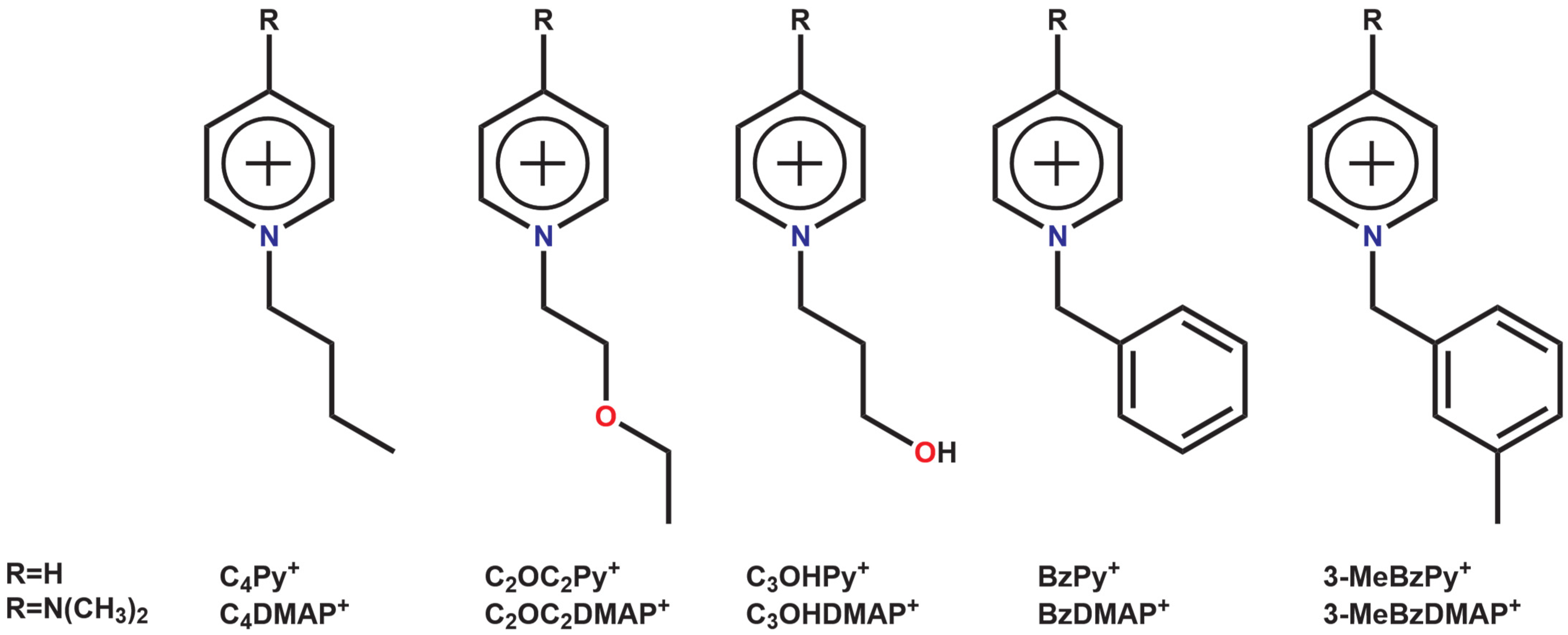
Figure 1. Structures of the cations used in this study.
Processes 14 01208 g001
Figure 2. Semi-logarithmic plot of the measured viscosities of the reported ILs along with curves calculated from the VTF parameters in Table 2. The defined data points of 1 × 10¹³ cP at the respective glass transition onset temperatures are off scale. Dotted curves correspond to the pyridinium cations and solid curves to the DMAP cations.
Processes 14 01208 g002
Figure 3. Semi-log plot of viscosities versus inverse temperature normalized to the glass transition temperature (Tg) for each IL. The lines between points are to guide the eye and are not fitted.
Processes 14 01208 g003
Figure 4. For the family of substituted DMAP NTf2 ILs and for C4Py NTf2 (vertical offset of +2), a comparison between experimental and computationally derived structure functions highlighting with dashed vertical lines from higher to lower q values: adjacency, charge alternation, and, when present, polar–apolar alternation peaks.
Processes 14 01208 g004
Figure 5. Comparison between computationally derived S(q) and its polar, apolar and polar–apolar subcomponents for (a) C4Py NTf2 (dashed lines) and C4DMAP NTf2 (solid lines), (b) C10DMAP NTf2 (solid lines) and C8DMAP NTf2 (dashed lines).
Processes 14 01208 g005
Figure 6. Comparison between computationally derived positive (black), negative (red) and positive–negative (green) subcomponents of S(q) for C4Py NTf2 (dashed lines) and C4DMAP NTf2 (solid lines).
Processes 14 01208 g006
Figure 7. Dihedral angle distributions for (a) Φ (NA-CA-CS1-CS/O) and (b) Θ (CA-CS1-CS/O-CT/CS). Atom type nomenclature as defined in Schemes S1–S3 in the Supplementary Materials.
Processes 14 01208 g007
Figure 8. Ramachandran plots in the liquid phase for cationic dihedral angles Θ (NA-CA-CS1-CS/O) and Φ (CA-CS1-CS/O-CT/CS) of (a) C4DMAP NTf2, (b) C4Py NTf2 and (c) C2OC2DMAP NTf2. Inset molecular shapes are included for selected configurations of (Θ, Φ) and indicated by orange arrows.
Processes 14 01208 g008
Figure 9. Projected densities of states for (a) C4DMAP NTf2, (b) C8DMAP NTf2, (c) C10DMAP NTf2, (d) C4Py NTf2 and (e) C2OC2DMAP NTf2.
Processes 14 01208 g009
Figure 10. On the top row, the HOMO of (a) C4Py NTf2, (b) C2OC2DMAP NTf2 and (c) C4DMAP NTf2. On the bottom row, the LUMO of (d) C4Py NTf2, (e) C2OC2DMAP NTf2 and (f) C4DMAP NTf2. We use the blue–red color scheme when localization is mostly on cationic species and the blue–green color scheme when localization is mostly on NTf2.
Processes 14 01208 g010
Figure 11. Spectra of transient species in argon-purged C4Py NTf2 and C4DMAP NTf2 at 10, 100 and 1000 nanoseconds after the electron pulse. Circles, triangles, and diamonds correspond to 10, 100, and 1000 ns time points, respectively. Data for C4Py were re-analyzed from prior study [43].
Processes 14 01208 g011
Figure 12. Spectra of transient species in argon-purged BzPy NTf2 and BzDMAP NTf2 at several time intervals after the electron pulse. Circles, triangles, and diamonds correspond to 10, 100, and 1000 ns time points, respectively. Data for BzPy NTf2 were re-analyzed from a prior study [43].
Processes 14 01208 g012
Table 1. Thermal properties and densities of DMAP and pyridinium NTf2 salts.
CationGlass Transition Point Tg [a], °CMelting Point
Tm [a], °C
Decomposition
Temperature [a], °C
Density @20 °C,
ρ [a], g/cm3
C4DMAP−70 [92]27 [92]444 [92]1.39
C4Py−81 [92]26 [92]388 [92]1.44
C2OC2DMAP−67 [92,93][b]422 [92,93]1.41 [93]
C2OC2Py−80 [92]−18 [92]380 [92]1.47
C3OHDMAP−59 [92][b]441 [92]1.47
C3OHPy−77 [92][b]355 [92]1.53
C8DMAP−70 [93][b]430 [93]1.29 [93]
C8Py−78−12 [94]1.33 [95]
C10DMAP−70−74171.25
C10Py−711 [96]1.28 [95]
BzDMAP−3362 [92]3971.47 [c,d]
BzPy−549 [92]313 [92]1.49
3-MeBzDMAP−3867392[c]
3-MeBzPy−54383041.46 [e]
1-Bz-2-MePy [f]−56[b]1.41 [37]
1-Bz-3-MePy [f]−57[b]1.44 [37]
1-Bz-4-MePy [f]−54131.42 [37]
[a] All values are onset temperatures, ±1 °C. Densities ±1% error. [b] No solid phase observed. [c] Solid at room temperature. [d] Measured at 70 °C. [e] Supercooled liquid. [f] DSC results on samples provided by Dr. Huimin Luo, see Acknowledgments [37].
Table 2. Viscosity profiles of the DMAP NTf2 and pyridinium NTf2 ILs.
CationViscosity [a] @25 °C
cP
ln (η0/cP)DT0 [b]
K
H2O Content
ppm
C4DMAP85 [92]−1.94 ± 0.074.23 ± 0.0817970
C4Py60 [92]−1.86 ± 0.034.63 ± 0.0416890
C2OC2DMAP105 [92]−2.00 ± 0.02 [93]4.25 ± 0.02 [93]182 [93]91
C2OC2Py57 [92]−2.02 ± 0.074.69 ± 0.0916862
C3OHDMAP198 [92]−1.80 ± 0.034.03 ± 0.03190146
C3OHPy117 [92]−2.18 ± 0.035.33 ± 0.03169135
C8DMAP136−2.09 ± 0.024.82 ± 0.0217747
C8Py [c]114−2.14 ± 0.015.41 ± 0.01167146 [c]
C10DMAP165−2.21 ± 0.025.15 ± 0.0217531
C10Py [c]152−1.88 ± 0.014.84 ± 0.02175319 [c]
BzDMAP1034 [d]−1.55 ± 0.163.08 ± 0.12219[e]
BzPy141 [92]−1.30 ± 0.023.10 ± 0.01199120
3-MeBzDMAP674 [d]−1.63 ± 0.043.26 ± 0.03213[e]
3-MeBzPy212−1.73 ± 0.013.65 ± 0.01197[e]
[a] Calculated from VTF fitting parameters. [b] Error: ±1 K. [c] Viscosity at 25 °C calculated from experimental viscosities reported in Ref. [95] and accompanying water content. [d] Hypothetical values if these ILs were liquid at 25 °C. The viscosities of BzDMAP NTf2 and 3-MeBzDMAP NTf2 at 75 °C are 39 and 33 cP, respectively. [e] Water content of room-temperature solids not measured.
Table 3. Conductivity properties and electron capture parameters of DMAP and pyridinium NTf2 ILs.
CationConductivity @ 25 °C mS/cmWalden Product @25 °C
P S cm2/mol
k(esolv)/108
M−1 s−1 [a]
Q37
M−1 [a]
C4DMAP2.20.625.3 ± 0.217.6 ± 0.3
C4Py4.0 [107] [b]0.686.2 ± 0.320.1 ± 0.6
C2OC2DMAP1.80.654.8 ± 0.210.6 ± 0.4
C2OC2Py2.5 0.416.0 ± 0.310.1 ± 0.5
C3OHDMAP0.800.505.5 ± 0.111.7 ± 0.2
C3OHPy1.60.505.9 ± 0.113.9 ± 0.3
C8DMAP0.77 [c]0.42 [c]
C8Py1.07 [108]0.43
C10DMAP0.570.41
C10Py0.78 [108]0.46
BzDMAP2.1 [d]0.47 [e]4.5 ± 0.114.0 ± 0.4
BzPy1.50.665.3 ± 0.112.4 ± 0.4
3-MeBzDMAP1.4 [f]4.5 ± 0.19.6 ± 0.2
3-MeBzPy0.720.5110.8 ± 0.217.4 ± 0.4
[a] Second-order rate coefficient for electron capture and pre-solvated electron capture efficiency coefficient (Q37), measured using C4mPyrr NTf2 as the solvent. See Section 3.4 [b] at 20 °C. [c] Reported by us as 2.8 mS/cm and 1.50 P S cm2/mol in ref. [93], which we now believe to be incorrect based on new measurements [d] at 63 °C. [e] Computed using viscosity and conductivity at 63 °C and density at 70 °C and [f] at 70 °C.
Disclaimer/Publisher’s Note: The statements, opinions and data contained in all publications are solely those of the individual author(s) and contributor(s) and not of MDPI and/or the editor(s). MDPI and/or the editor(s) disclaim responsibility for any injury to people or property resulting from any ideas, methods, instructions or products referred to in the content.