Experimental Study on Permeability Variations in Fractured Coal Under Stress Changes in the Mining Area of the Ordos Basin, North China



Abstract
1. Introduction
2. Experimental Equipment and Methods
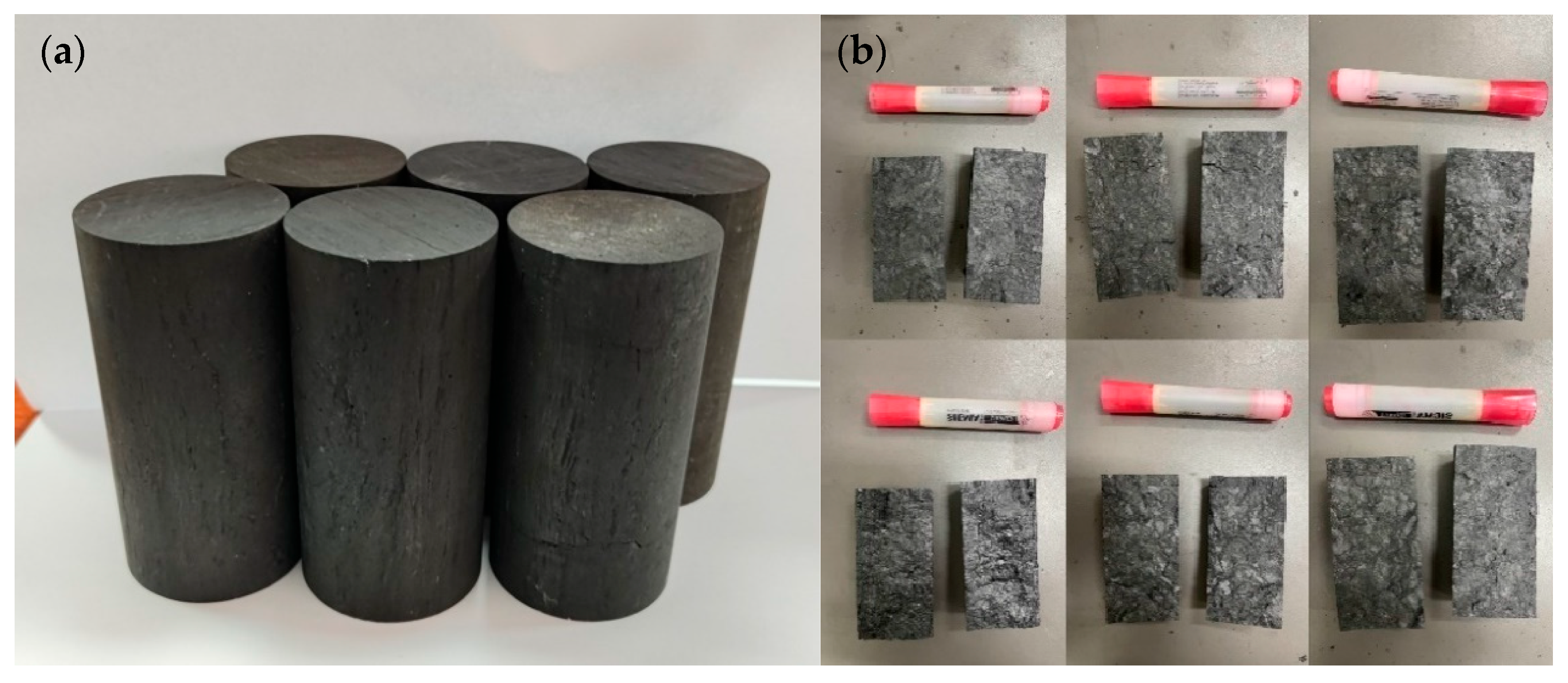
2.1. Experimental Samples
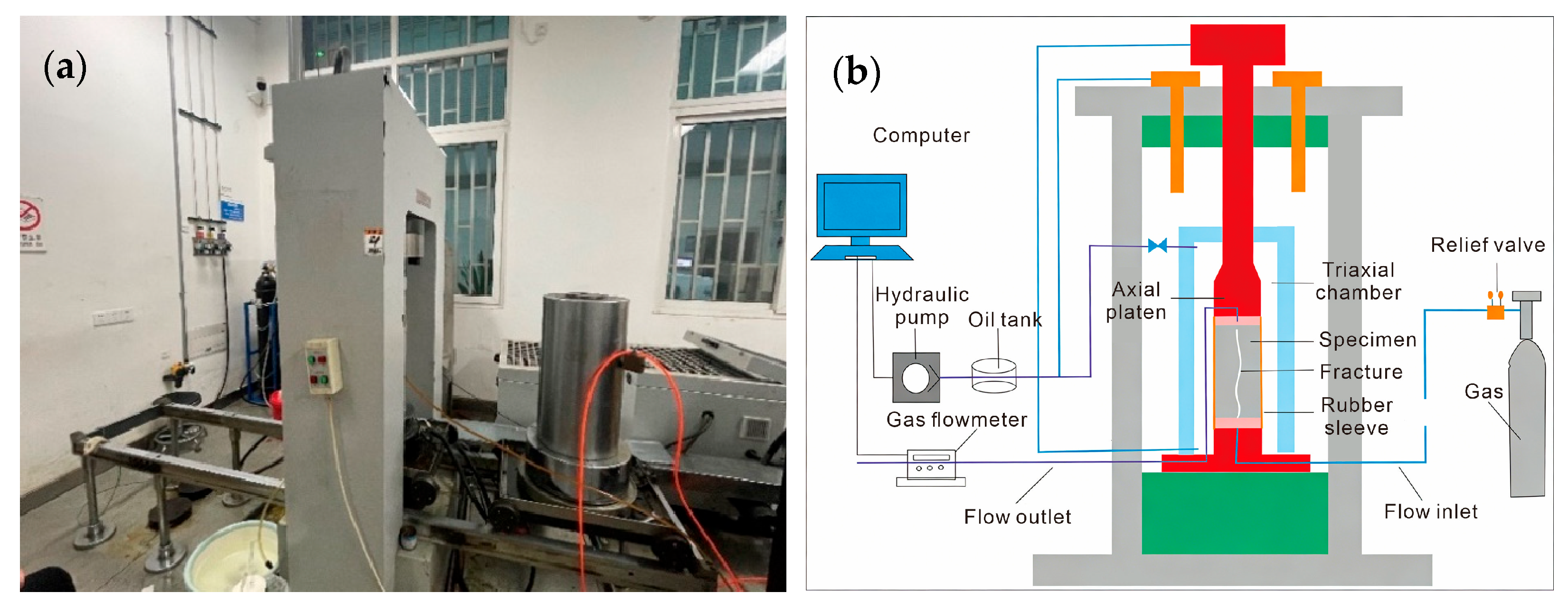
2.2. Experimental Equipment
2.3. Experimental Procedures
- (1)
- Sample Installation. Place metal gaskets on the top and bottom ends of the dried specimen. Secure the specimen inside the instrument chamber, cover it completely with a heat-shrink tube, and heat it using a heat gun. Fasten the specimen with metal retaining rings at positions approximately 1 cm from both end faces. Install the prepared specimen onto the bottom platen of the triaxial chamber and connect the axial extensometer and radial sensors. Attach the oil and gas inlet pipelines to the instrument. Check the airtightness of the equipment and evacuate gases from the specimen using a vacuum pump.
- (2)
- Loading Process. Using the computer control program, apply axial pressure to the set value at a rate of 0.01 MPa/s and in increments of 0.5 MPa. Then, fill the chamber with oil and apply confining pressure to the set value at the same rate and increments. Next, open the gas inlet valve, close the gas outlet valve, and set the inlet pressure to allow the working gas to fully adsorb into the coal sample. After the adsorption equilibrium is reached, open the gas outlet valve. Maintain a stable flow rate and measure it with a gas flow meter. The adsorption capacity of coal for CH4 is significantly higher than that for N2. Therefore, N2 was selected as the experimental gas in this study to minimize the influence of coal rock adsorption deformation on its permeability to the greatest extent.
- (3)
- Unloading Process. Unload the confining pressure of the coal sample using the computer control program. Set the unloading rate of the confining pressure to 0.01 MPa/s, and unload it in increments of 0.5 MPa until the predetermined target value is reached. During this process, measure the flow rate using a gas flow meter.
- (4)
- Experiment Termination. After stopping the gas supply, disconnect the gas inlet pipeline from the equipment. First, unload the confining pressure to 0 MPa, and then unload the axial pressure to 0 MPa. Open the oil return system and allow it to operate for 1 h before disconnecting the oil inlet pipeline from the equipment. Remove the specimen from the triaxial chamber, detach the sensors from the specimen, and clean the equipment. Export the data from the computer for subsequent analysis. Based on the stress conditions in the study area and the parameter conditions of the experimental equipment, the initial confining, axial, and gas pressure parameters for different samples were set, as shown in Table 3.
3. Results and Discussion
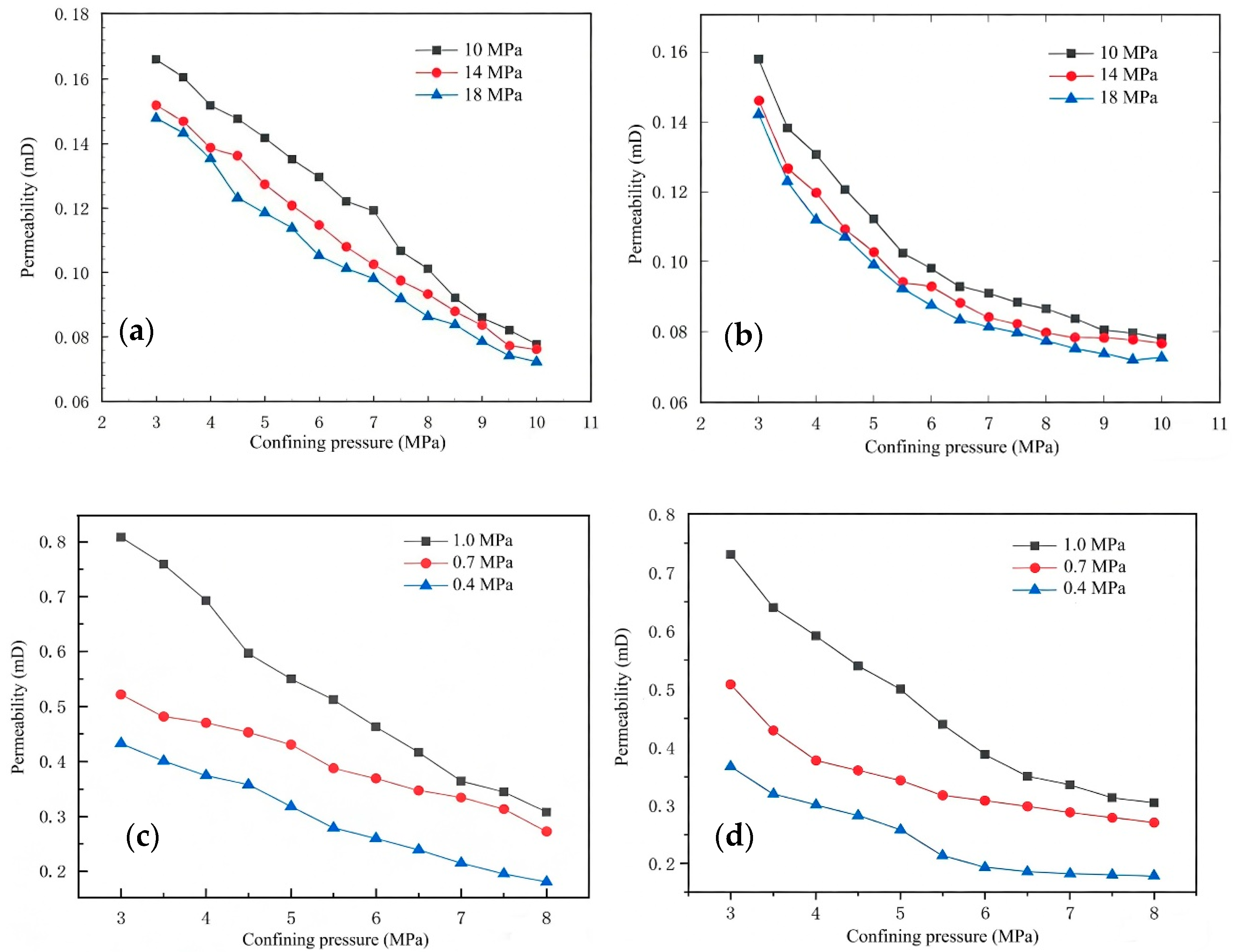
3.1. Influence of Axial and Gas Pressures on Permeability Variation
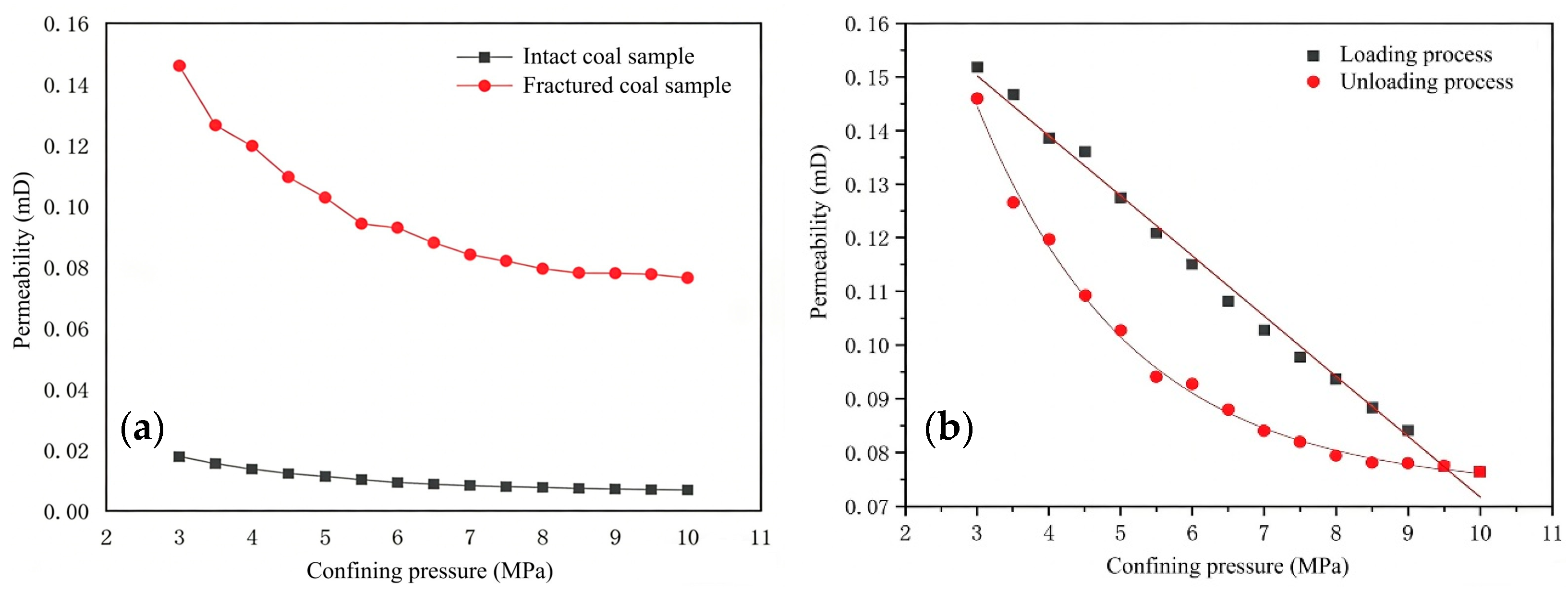
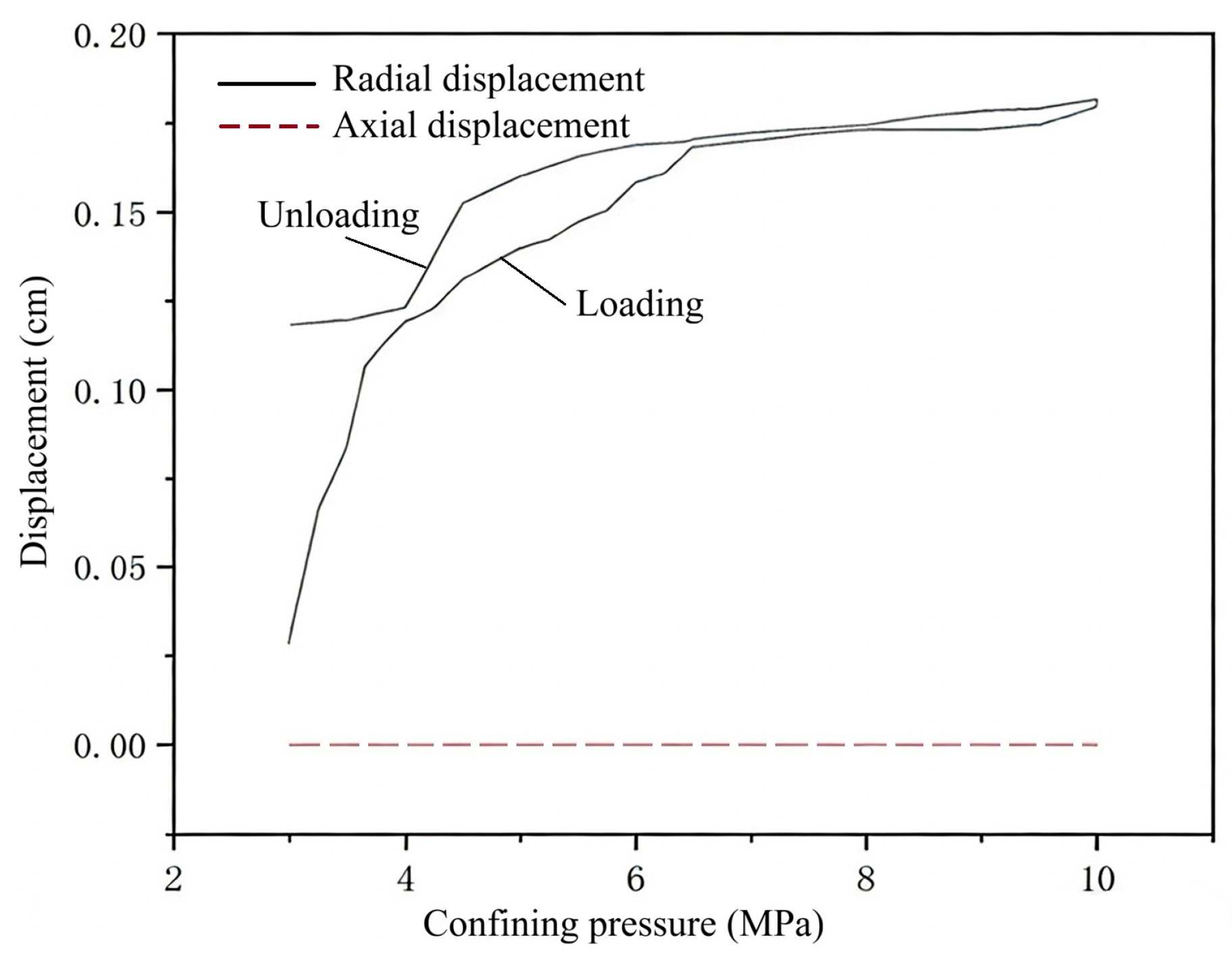
3.2. Permeability Recovery and Stress Sensitivity of Coal Rock During Unloading Process
3.3. Implications of Permeability Variation for Permeability Enhancement Through Hydraulic Slotting in Deep Coal Seams
4. Conclusions
- (1)
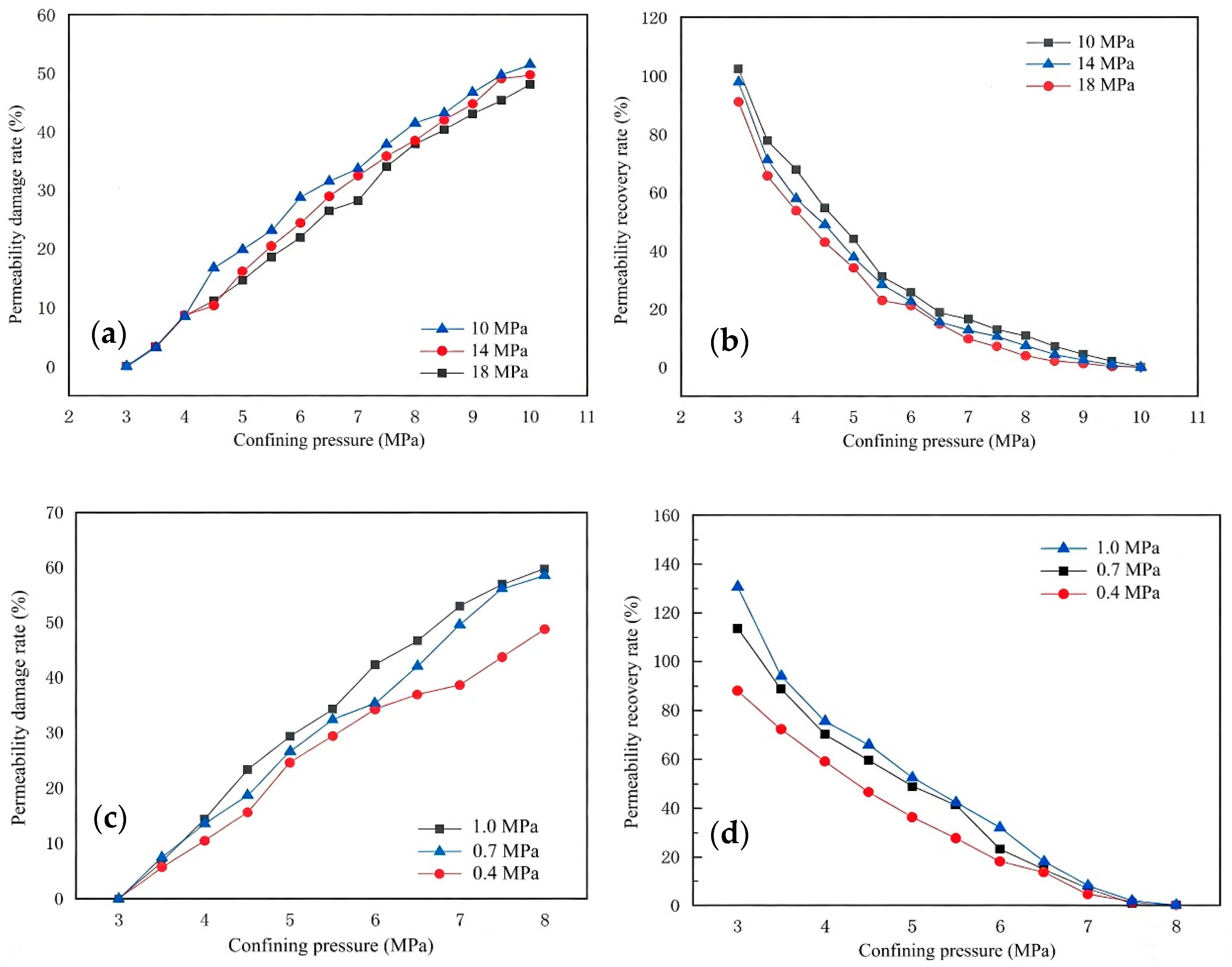
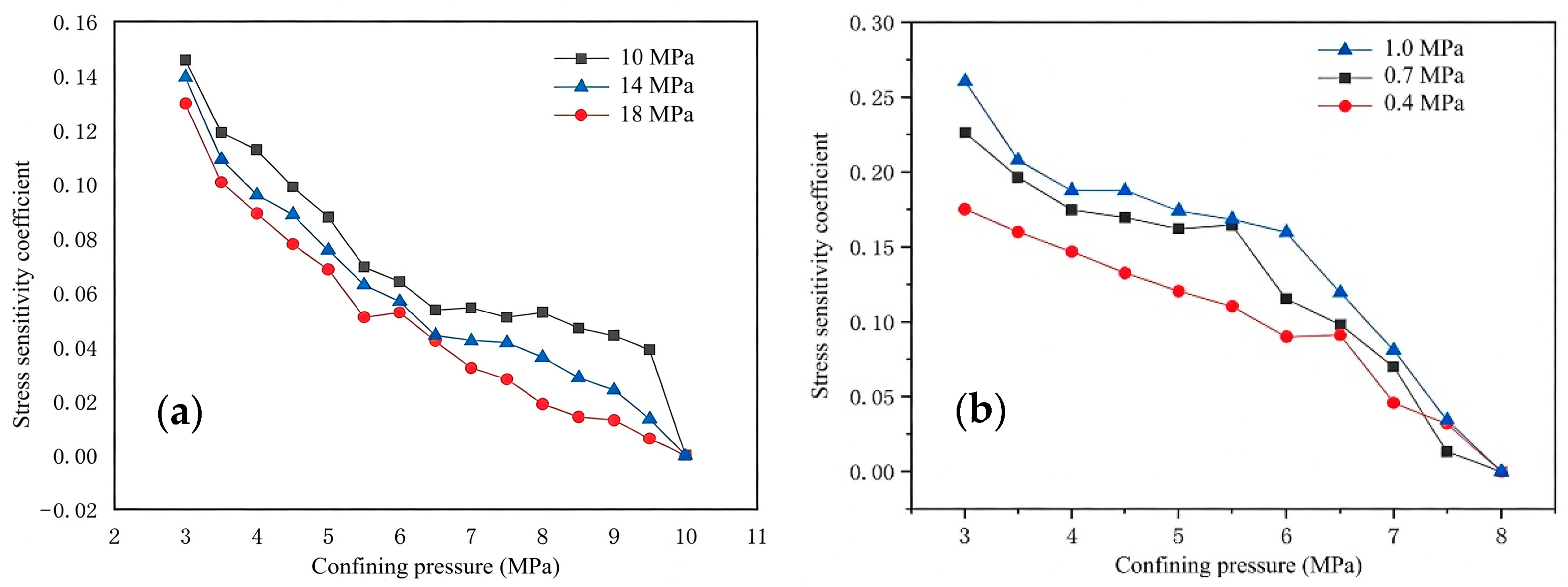
- During the loading process, coal rock compression leads to the closure of pores and fractures, resulting in a decrease in permeability with increasing confining pressure. During unloading, coal rock undergoes expansion and deformation, and its permeability increases with decreasing confining pressure. The change in permeability transitions from slow to rapid, and the stress sensitivity coefficient of coal rock increases, indicating enhanced stress sensitivity.
- (2)
- The permeability enhancement law of fractured coal rock under different axial pressure conditions reveals that, regardless of the loading or unloading process, lower axial pressure results in higher permeability, greater permeability recovery and damage rates, a larger stress sensitivity coefficient, and stronger stress sensitivity of the coal rock.
- (3)
- The permeability enhancement law of fractured coal rock under different injected gas pressure conditions indicates that higher gas pressure leads to greater permeability, higher permeability recovery and damage rates, a larger stress sensitivity coefficient, and stronger stress sensitivity of the coal rock.
Author Contributions
Funding
Data Availability Statement
Acknowledgments
Conflicts of Interest
References
- Karacan, C.Ö.; Goodman, G.V.R. Analyses of Geological and Hydrodynamic Controls on Methane Emissions Experienced in a Lower Kittanning Coal Mine. Int. J. Coal Geol. 2012, 98, 110–127. [Google Scholar] [CrossRef]
- Zhu, Q.; Du, X.; Zhang, T.; Yu, H.; Liu, X. Investigation into the variation characteristics and influencing factors of coalbed methane gas content in deep coal seams. Sci. Rep. 2024, 14, 18813. [Google Scholar] [CrossRef] [PubMed]
- Kędzior, S.; Teper, L. Coal Properties and Coalbed Methane Potential in the Southern Part of the Upper Silesian Coal Basin, Poland. Energies 2023, 16, 3219. [Google Scholar] [CrossRef]
- Peng, G. Fracture Propagation Laws of Staged Hydraulic Fracture in Fractured Geothermal Reservoir Based on Phase Field Model. Int. J. Coal Sci. Technol. 2023, 10, 52. [Google Scholar] [CrossRef]
- Li, S.; Qin, Y.; Tang, D.; Shen, J.; Wang, J.; Chen, S. A comprehensive review of deep coalbed methane and recent developments in China. Int. J. Coal Geol. 2023, 279, 104369. [Google Scholar] [CrossRef]
- Li, R.; Zhang, L.; Xie, J.; Chen, Z.; Yang, B.; Xiang, W.; Zhai, X. A Study on the Controlling Effect of Geological Structures on Coalbed Methane Occurrence in the Northeast Margin of Qinshui Basin, North China. Energies 2025, 18, 647. [Google Scholar] [CrossRef]
- Adib, A.; Afzal, P.; Ilani, S.M.; Aliyari, F. Determination of the Relationship between Major Fault and Zinc Mineralization Using Fractal Modeling in the Behabad Fault Zone, Central Iran. J. Afr. Earth Sci. 2017, 134, 308–319. [Google Scholar] [CrossRef]
- Salmachi, A.; Rajabi, M.; Wainman, C.; Mackie, S.; McCabe, P.; Camac, B.; Clarkson, C. History, Geology, In Situ Stress Pattern, Gas Content and Permeability of Coal Seam Gas Basins in Australia: A Review. Energies 2021, 14, 2651. [Google Scholar] [CrossRef]
- Uliasz-Misiak, B.; Misiak, J.; Lewandowska-Śmierzchalska, J.; Matuła, R. Environmental Risk Related to the Exploration and Exploitation of Coalbed Methane. Energies 2020, 13, 6537. [Google Scholar] [CrossRef]
- Guo, X.; Li, Y.; Pan, Y.; Wang, A.; Huang, B. Numerical Simulation of the Rock-Breaking Mechanism for Heterogeneous Rock with High-Voltage Electrical Pulse. Rock Mech. Rock Eng. 2025, 58, 9193–9211. [Google Scholar] [CrossRef]
- Gray, I. Reservoir engineering in coal seams: Part 1—The physical process of gas storage and movement in coal seams. SPE Reserv. Eng. 1987, 2, 28–34. [Google Scholar] [CrossRef]
- Palmer, I.; Mansoori, J. How permeability depends on stress and pore pressure in coalbeds: A new model. SPE Reserv. Eval. Eng. 1998, 1, 539–544. [Google Scholar] [CrossRef]
- Shi, J.Q.; Durucan, S. Drawdown induced changes in permeability of coalbeds: A new interpretation of the reservoir response to primary recovery. Transp. Porous Media 2004, 56, 1–16. [Google Scholar] [CrossRef]
- Harpalani, S.; Chen, G. Influence of gas production induced volumetric strain on permeability of coal. Geotech. Geol. Eng. 1997, 15, 303–325. [Google Scholar] [CrossRef]
- Robertson, E.P.; Christiansen, R.L. A permeability model for coal and other fractured, sorptive-elastic media. SPE J. 2007, 12, 314–324. [Google Scholar] [CrossRef]
- Chen, D.; Pan, Z.; Liu, J.; Connell, L.D. An improved relative permeability model for coal reservoirs. Int. J. Coal Geol. 2013, 109, 45–57. [Google Scholar] [CrossRef]
- Wang, S.; Elsworth, D.; Liu, J. Permeability evolution during progressive deformation of intact coal and implications for instability in underground coal seams. Int. J. Rock Mech. Min. Sci. 2014, 68, 34–45. [Google Scholar] [CrossRef]
- Porfido, C.; Rizzo, R.E.; Healy, D.; Spagnuolo, M.; Terzano, R.; Allegretta, I. Investigating the evolution of fractures in clay-based ceramics during repeated freeze-thawing cycles using X-ray micro-computed tomography and image analysis. Mater. Charact. 2021, 177, 111185. [Google Scholar] [CrossRef]
- Chen, Y.; Hu, S.; Wei, K.; Hu, R.; Zhou, C.; Jing, L. Experimental characterization and micromechanical modeling of damage-induced permeability variation in Beishan granite. Int. J. Rock Mech. Min. Sci. 2014, 71, 64–76. [Google Scholar] [CrossRef]
- Zhao, Z.; Liu, P.; Li, Q.; Nie, B.; Song, J.; Bao, J.; He, H.; Liu, W.; Sun, L. Enhancing coalbed methane recovery using high power ultrasonic excitation: A nano-micro -to-engineering scale study. Energy 2025, 320, 135274. [Google Scholar] [CrossRef]
- Cao, W.; Lei, Q.; Cai, W. Stress-Dependent Deformation and Permeability of a Fractured Coal Subject to Excavation-Related Loading Paths. Rock Mech. Riock. Eng. 2021, 54, 4299–4320. [Google Scholar] [CrossRef]
- Wang, D.; Zeng, F.; Wei, J.; Zhang, H.; Wu, Y.; Wei, Q. Quantitative analysis of fracture dynamic evolution in coal subjected to uniaxial and triaxial compression loads based on industrial CT and fractal theory. J. Petro. Sci. Eng. 2021, 196, 108051. [Google Scholar] [CrossRef]
- Li, J.; Li, B.; Wang, Z.; Ren, C.; Yang, K.; Gao, Z. A permeability model for anisotropic coal masses under different stress conditions. J. Petro. Sci. Eng. 2021, 198, 108197. [Google Scholar] [CrossRef]
- Zhou, H.; Zhang, L.; Wang, X.; Rong, T.; Wang, L. Effects of matrix-fracture interaction and creep deformation on permeability evolution of deep coal. Int. J. Rock Mech. Min. Sci. 2020, 127, 104236. [Google Scholar] [CrossRef]
- Sudakov, O.; Burnaev, E.; Koroteev, D. Driving digital rock towards machine learning: Predicting permeability with gradient boosting and deep neural networks. Comput. Geosci. 2019, 127, 91–98. [Google Scholar] [CrossRef]
- Zhang, H.; Zhang, J.; Du, S.; Ren, J.; Zhao, H.; Li, W.; Ding, M.; Wang, T. Permeability Characteristics of Filled Fractured Coal-Rock Mass Under Stress–Seepage Coupling. Rock Mech. Rock Eng. 2025, 58, 11899–11920. [Google Scholar] [CrossRef]
- Yang, F.; Li, B.; Wang, K.; Wen, H.; Yang, R.; Huang, Z. Extreme massive hydraulic fracturing in deep coalbed methane horizontal wells: A case study of the Linxing Block, eastern Ordos Basin, NW China. Pet. Explor. Dev. 2024, 51, 440–452. [Google Scholar] [CrossRef]
- Zhang, K.; Li, S.; Zhong, G.; Feng, P.; Chang, C.; Li, H. Characteristics of in-situ stress field of coalbed methane reservoir in the eastern margin of Ordos basin. Int. J. Coal Geol. 2025, 301, 104715. [Google Scholar] [CrossRef]
- Li, R.; Lu, Y.; Xia, B.; Chen, W.; Sun, H. Characteristics of in situ stress and reservoir pressure in deep coal seams and their influences on reservoir depletion: A field case study. Geofluids 2023, 2023, 1622612. [Google Scholar] [CrossRef]
- Chen, Y.; Tang, D.; Xu, H.; Li, Y.; Meng, Y. Structural controls on coalbed methane accumulation and high production models in the eastern margin of Ordos Basin, China. J. Nat. Gas Sci. Eng. 2015, 23, 524–537. [Google Scholar] [CrossRef]
- Liu, C.; Liu, Q.; Lv, B.; Han, P.; Wang, L.; Cheng, Y. Impact of Stress on Adsorption–Desorption Hysteresis in Coal: Effect of Desorption Driving Force on Flowable CH4. Energy Fuels 2025, 39, 18476–18490. [Google Scholar] [CrossRef]
- Ge, Z.; Zhong, J.; Lu, Y.; Cheng, L.; Zheng, J.; Zhou, Z.; Cheng, Y. Directional distance prediction model of slotting–directional hydraulic fracturing (SDHF) for coalbed methane (CBM) extraction. J. Pet. Sci. Eng. 2019, 183, 106429. [Google Scholar] [CrossRef]
- Wang, K.; Zhang, G.; Du, F.; Wang, Y.; Yi, L.; Zhang, J. Simulation of directional propagation of hydraulic fractures induced by slotting based on discrete element method. Petroleum 2023, 9, 592–606. [Google Scholar] [CrossRef]
- Mi, L.; Zhu, G. Geological characteristics and exploration breakthrough in Linxing-Shenfu tight gas field, northeastern Ordos Basin. China Pet. Explor. 2021, 26, 53–67. (In Chinese) [Google Scholar] [CrossRef]
- Liu, J.; Zhu, G.; Liu, Y.; Chao, W.; Du, J.; Yang, Q.; Mi, H.; Zhang, S. Breakthrough, future challenges and countermeasures of deep coalbed methane in the eastern margin of Ordos Basin: A case study of Linxing-Shenfu block. Acta Pet. Sin. 2023, 44, 1827–1839. (In Chinese) [Google Scholar] [CrossRef]
- Xiao, K.; Zhang, Z.; Zhang, R.; Gao, M.; Xie, J.; Zhang, A.; Liu, Y. Anisotropy of the effective porosity and stress sensitivity of coal permeability considering natural fractures. Energy Rep. 2021, 7, 3898–3910. [Google Scholar] [CrossRef]
- Li, R.; Li, G. Coalbed methane industry development framework and its limiting factors in China. Geofluids 2022, 2022, 8336315. [Google Scholar] [CrossRef]



| Quartz/% | Kaolinite/% | Calcite/% | Dolomite/% | Others/% |
|---|---|---|---|---|
| 22.40 | 18.00 | 42.40 | 17.20 | 0 |
| Moisture/% | Ash/% | Volatiles/% | Fixed Carbo/% |
|---|---|---|---|
| 13.53 | 9.32 | 33.80 | 43.34 |
| Sample Number | Initial Confining Pressure (MPa) | Axial Pressure (MPa) | Gas Pressure (MPa) |
|---|---|---|---|
| 1 | 10 | 10 | 1 |
| 2 | 10 | 14 | 1 |
| 3 | 10 | 18 | 1 |
| 4 | 10 | 14 | 1 |
| 5 | 10 | 14 | 0.7 |
| 6 | 10 | 14 | 0.4 |
Disclaimer/Publisher’s Note: The statements, opinions and data contained in all publications are solely those of the individual author(s) and contributor(s) and not of MDPI and/or the editor(s). MDPI and/or the editor(s) disclaim responsibility for any injury to people or property resulting from any ideas, methods, instructions or products referred to in the content. |
© 2026 by the authors. Licensee MDPI, Basel, Switzerland. This article is an open access article distributed under the terms and conditions of the Creative Commons Attribution (CC BY) license.
Share and Cite
Huo, J.; Jin, L.; Li, R.; Yang, B.; Zhang, L. Experimental Study on Permeability Variations in Fractured Coal Under Stress Changes in the Mining Area of the Ordos Basin, North China. Processes 2026, 14, 1190. https://doi.org/10.3390/pr14081190
Huo J, Jin L, Li R, Yang B, Zhang L. Experimental Study on Permeability Variations in Fractured Coal Under Stress Changes in the Mining Area of the Ordos Basin, North China. Processes. 2026; 14(8):1190. https://doi.org/10.3390/pr14081190
Chicago/Turabian StyleHuo, Jingjing, Lihong Jin, Rui Li, Baoke Yang, and Le Zhang. 2026. "Experimental Study on Permeability Variations in Fractured Coal Under Stress Changes in the Mining Area of the Ordos Basin, North China" Processes 14, no. 8: 1190. https://doi.org/10.3390/pr14081190
APA StyleHuo, J., Jin, L., Li, R., Yang, B., & Zhang, L. (2026). Experimental Study on Permeability Variations in Fractured Coal Under Stress Changes in the Mining Area of the Ordos Basin, North China. Processes, 14(8), 1190. https://doi.org/10.3390/pr14081190