Article

Laser-Synthesized Vanadium-Based Nanoparticles on TiO2 Nanotubes for Photocatalytic Degradation of Acid Yellow 23


by
Miloš Tošić
1,
Marina Radenković
1,
Rafaela Radičić
2,
Stevan Stojadinović
3,
Sanja Živković
1,
Nikša Krstulović
2 and
Miloš Momčilović
1,*
1
Vinča Institute of Nuclear Sciences-National Institute of the Republic of Serbia, University of Belgrade, Mike Petrovića Alasa 12-14, 11351 Belgrade, Serbia
2
Centre for Advanced Laser Techniques, Institute of Physics, Bijenička Cesta 46, 10000 Zagreb, Croatia
3
Faculty of Physics, University of Belgrade, Studentski trg 12-16, 11000 Belgrade, Serbia
*
Author to whom correspondence should be addressed.
Processes 2026, 14(8), 1188; https://doi.org/10.3390/pr14081188
Submission received: 25 February 2026 / Revised: 26 March 2026 / Accepted: 5 April 2026 / Published: 8 April 2026
(This article belongs to the Special Issue Metal Oxides and Their Composites for Photocatalytic Degradation)

Abstract

Various metal-modified titanium dioxide (TiO2) nanotubes have been widely investigated for water purification due to their large surface area, stability, and photocatalytic activity. In this context, this study investigates the deposition of vanadium-based nanoparticles (V NPs) on TiO2 nanotubes via immersion in aqueous dispersions of V NPs synthesized by picosecond and nanosecond pulsed laser ablation in liquid at four different output energies (picosecond: 15 and 30 mJ; nanosecond: 120 and 250 mJ), with the aim of improving their photocatalytic performance. By optimizing the concentration of V NPs in the dispersions and the immersion time, the degradation efficiency of Acid Yellow 23 under photocatalytic conditions was enhanced for TiO2 modified with V NPs synthesized at output energies of 30 and 250 mJ, whereas no improvement was observed for TiO2 modified with V NPs synthesized at 15 and 120 mJ. A series of V-TiO2 photocatalysts was fabricated by depositing laser-synthesized V NPs of various sizes on TiO2 nanotubes prepared by electrochemical anodization of a titanium mesh.

1. Introduction

The continuous discharge of synthetic dyes into aquatic environments represents a serious environmental concern due to their high chemical stability, toxicity, and persistence in natural water systems [1]. Many commercial dyes exhibit low biodegradability and strong resistance to conventional wastewater treatment processes, which leads to their long-term accumulation in surface and groundwater [2]. Among different dye classes, azo dyes are the most widely used in textile, leather, paper, and food industries. Their molecular structure, characterized by azo (–N=N–) bonds linking aromatic rings, provides intense coloration but also contributes to their environmental persistence [3]. Acid Yellow 23 is a typical anionic azo dye commonly detected in industrial effluents, and it is frequently used as a model compound to evaluate the efficiency and degradation mechanisms of advanced oxidation and photocatalytic treatment processes [4,5].
Among various advanced oxidation technologies, heterogeneous photocatalysis has attracted considerable attention as an environmentally friendly and versatile approach for water purification [6,7]. This process is based on photoexcitation of semiconductor materials, generating electron-hole (e/h+) pairs that initiate redox reactions and produce reactive oxygen species such as hydroxyl (•OH) and superoxide (•O2) radicals. Compared with conventional treatment methods, photocatalysis operates under mild conditions and allows the use of solar energy as a renewable irradiation source [8,9].
In recent years, research on photocatalysis has moved beyond only achieving high degradation efficiency. Greater attention is now given to practical factors such as catalyst stability, resistance to photocorrosion, reusability over multiple cycles, and suitability for large-scale applications [10]. Therefore, the development of photocatalysts that combine high activity with long-term durability and easy recovery remains an important challenge in environmental photocatalysis.
Titanium dioxide (TiO2) is one of the most widely studied photocatalysts because of its chemical stability, low toxicity, low cost, and strong oxidative ability. However, its practical application is limited by fast e/h+ recombination and weak absorption in the visible region of the solar spectrum. For this reason, numerous modification strategies have been proposed to overcome these limitations. Among the various strategies to improve TiO2 photocatalysts, surface modification with metal species has proven particularly effective for enhancing charge separation and light absorption. Vanadium has received increasing attention in this context because it can exist in several oxidation states and interacts strongly with the TiO2 electronic structure. Previous studies have shown that vanadium-modified TiO2 exhibits better visible-light response and higher photocatalytic activity than pristine TiO2 [11,12].
The improvement is mainly due to changes in the electronic structure of TiO2, including band-gap narrowing, the formation of localized energy states, and more efficient charge carrier separation. The coexistence of different oxidation states may further promote interfacial charge transfer and prolong charge carrier lifetime [12]. Owing to these effects, vanadium-modified TiO2 materials have demonstrated improved performance toward various pollutants [13]. Despite these benefits, controlling vanadium modification remains a critical issue. When vanadium loading is too high, recombination centers may form and active TiO2 surface sites can be partially blocked, leading to a decrease in photocatalytic efficiency [14,15]. In contrast, very low vanadium content often results in only minor performance improvement. For this reason, careful control of vanadium amount, dispersion, and surface distribution is essential to achieve optimal photocatalytic activity. In this respect, TiO2 nanotube structures are particularly suitable supports for vanadium modification. Their ordered geometry, large surface area, and direct charge transport pathways enable uniform nanoparticle anchoring and strong interfacial contact. This structural advantage allows effective use of vanadium’s electronic properties while preserving the inherent benefits of the TiO2 nanotube framework.
Pulsed laser ablation in liquids (PLAL) is a flexible technique for nanoparticle synthesis that does not require chemical precursors or stabilizing agents [16,17]. Because no chemical additives are involved, the resulting nanoparticles exhibit high purity and clean surfaces, which is particularly important for catalytic and photocatalytic applications. Nanoparticle properties can be tuned by adjusting laser parameters, such as pulse duration, fluence, wavelength, and repetition rate, which influence nucleation and growth and, consequently, determine particle size, morphology, and surface features. This level of control makes PLAL a useful tool for producing nanoparticles with tailored physicochemical characteristics for specific applications [18].
Laser pulse duration plays a key role in determining the dominant ablation mechanisms during PLAL [19]. In the ultrashort regime (femtosecond to picosecond), energy is deposited on timescales shorter than lattice heating, favoring non-thermal processes such as electron excitation and bond breaking. In contrast, nanosecond laser pulses involve significant heat diffusion into the target material, leading to melt-driven ablation dominated by thermal mechanisms [20]. This thermal regime is commonly associated with the formation of larger nanoparticles with broader size distributions [21]. From a process engineering perspective, PLAL offers several important advantages, including good reproducibility, flexible control of synthesis parameters, and promising scalability through continuous-flow and high-repetition-rate configuration [22]. Laser-synthesized nanoparticles are particularly attractive for photocatalytic applications because of their clean surfaces, relatively high defect density, and strong interfacial activity [23,24]. When combined with structured supports such as TiO2 nanotubes, these nanoparticles form well-defined hybrid systems with efficient charge-transfer pathways.
Vanadium-modified TiO2 systems have attracted considerable attention due to their enhanced photocatalytic performance compared to pure TiO2. The incorporation of vanadium can introduce new electronic states, improve visible light absorption, and influence charge carrier separation efficiency. Various synthesis approaches have been reported. However, controlling the oxidation state and dispersion of vanadium species remains a significant challenge. In this context, the present study investigates the synthesis of vanadium-based nanoparticles using different laser regimes, with a particular focus on the influence of laser parameters on nanoparticle properties and photocatalytic performance. Unlike conventional chemical synthesis methods, PLAL enables the production of nanoparticles without additional chemical precursors, offering a cleaner and more controllable approach. The novelty of this work lies in correlating laser synthesis conditions with photocatalytic activity and exploring the role of laser-induced structural and surface modifications [25,26,27,28].
Titanium dioxide (TiO2) photocatalysts and laser-synthesized nanoparticles have both been widely studied, but their combination in the form of vanadium-based nanoparticles produced with picosecond and nanosecond laser pulses integrated into ordered TiO2 nanotube structures has received little attention. In this work, we investigate the relationship between laser synthesis conditions, vanadium-based nanoparticle characteristics, and their impact on the photocatalytic degradation of Acid Yellow 23. The combination of chemically clean laser ablation and a simple TiO2 nanotube modification strategy allows reliable control over nanoparticle-support interactions. This may enable a clearer understanding of charge-transfer processes and reactive species generation at the vanadium-based nanoparticle-TiO2 interface. Beyond demonstrating improved photocatalytic performance, the present study introduces a practical and transferable design concept for TiO2-based hybrid photocatalysts. To the best of our knowledge, this study provides one of the first systematic comparisons of picosecond and nanosecond laser-synthesized vanadium-based nanoparticles deposited on TiO2 nanotubes.

2. Materials and Methods

2.1. Reagents and Chemicals

Acid Yellow 23 >98 wt% (C16H9N4Na3O9S2) was derived from Tokyo Chemical Industry (Tokyo, Japan). Titanium mesh (Ti) and vanadium foil 99.8% (V) were from Goodfellow (Wrexham, UK), ethylene glycol 99.5 wt% (C2H6O2) from Carl Roth (Karlsruhe, Germany), and nitric acid 65 wt% (HNO3) and acetic acid 99.5 wt% (CH3COOH) from Zorka Pharma (Šabac, Serbia). Hydrofluoric acid 50 wt% (HF) was from Alkaloid Skopje (Skopje, North Macedonia), sulfuric acid 98 wt% (H2SO4) from AnalaR Normapur (VWR Chemicals, Oslo, Norway), and ammonium fluoride—pro analysis 95 wt% (NH4F) was obtained from Merck (Rahway, NJ, USA).

2.2. Synthesis Processes

2.2.1. Synthesis of V Nanoparticles

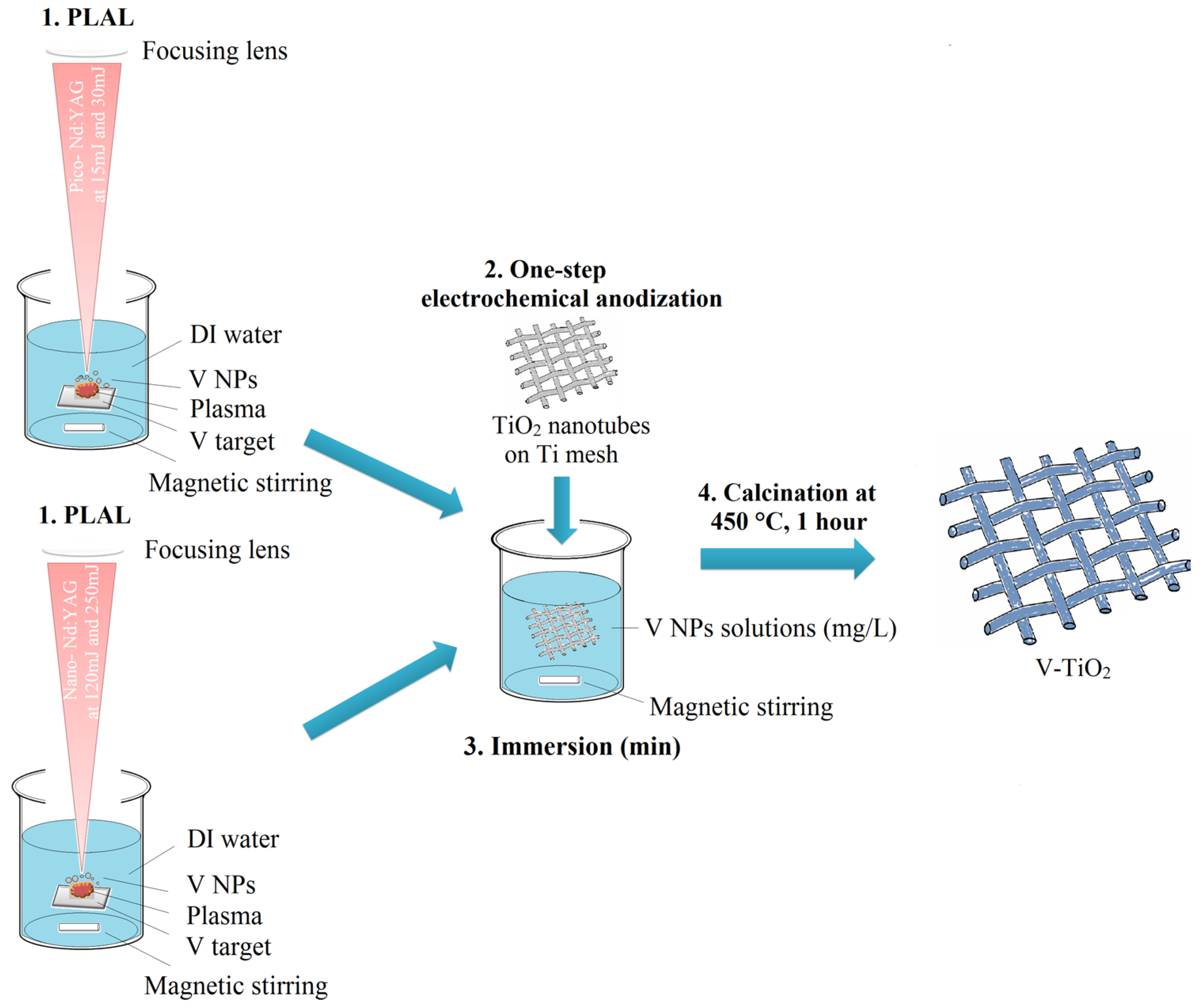
Vanadium-based nanoparticles (V NPs) were synthesized by PLAL of a vanadium metal target in deionized water (18 MΩ) at room temperature. Two different laser systems were employed: a picosecond Nd:YAG laser (EKSPLA SL 212/SH/FH, EKSPLA, Vilnius, Lithuania, 1064 nm, 150 ps pulse duration) and a nanosecond Nd:YAG laser (Quantel, Brilliant, Les Ulis, France, 1064 nm, 5 ns pulse duration, 5 Hz repetition rate). Picosecond ablation was performed at output energies of 15 and 30 mJ, corresponding to estimated fluences of ~21 and ~42 J/cm2, respectively. Nanosecond ablation was carried out at 120 and 250 mJ, with estimated fluences of ~170 and ~350 J/cm2, respectively, to investigate the effects of pulse duration and energy on nanoparticle formation. Ablation was conducted in deionized water without any additives under continuous stirring. After synthesis, the V NPs suspensions were collected and stored in the refrigerator. Prior to further use, all samples were sonicated in an ultrasonic bath for 20 min to ensure homogeneous dispersion. Four distinct V NPs samples were obtained: V NPs at 15 mJ and 30 mJ (picosecond), and V NPs at 120 mJ and 250 mJ (nanosecond).

2.2.2. Synthesis of TiO2 Nanotubes

A modified synthesis procedure based on our previously reported method was used [28]. Ti meshes were ultrasonically cleaned for 20 min in acetone, ethanol, and deionized water, followed by electrochemical polishing at 0.35 A/cm2 in a HF (50 wt%), H2SO4 (98 wt%), and CH3COOH (99.5 wt%) mixture (6.25:3.75:15, v/v), and chemical polishing in HNO3 (65 wt%) and HF (50 wt%) (3:1, v/v). After rinsing and drying, TiO2 nanotubes were synthesized by anodization in a two-electrode cell using a Ti mesh (1 × 2.5 cm) and a Pt mesh counter electrode (2 × 2 cm). Anodization was performed at room temperature in ethylene glycol containing 0.3 wt% NH4F and 2 vol% H2O at 50 V for 40 min under magnetic stirring (Peak Tech® 6227, Chippenham, UK).

2.2.3. Synthesis of V-TiO2 Samples

TiO2 nanotubes synthesized on Ti mesh (1 × 1 cm) were immersed, using a rigid holder, in separate 5 mL aqueous solutions of V NPs synthesized at different picosecond and nanosecond laser output energies. The immersion process was systematically carried out under continuous magnetic stirring by varying both the V NP concentration in the colloidal solutions and the immersion time of the TiO2 nanotube arrays. Finally, TiO2 and V-TiO2 samples were placed in ceramic crucibles and annealed in air for 1 h at a heating rate of 5 °C/min at 450 °C. Figure 1 illustrates all the steps of the synthesis process.

2.3. Characterization of Prepared V Nanoparticles

The size distribution and zeta potential of V NPs were analyzed using Zetasizer Ultra (Malvern Panalytical, Malvern, Worcestershire, UK). Quantitative elemental analysis of the V NPs, prepared in the form of aqueous solutions, was performed using a Thermo Scientific iCAP 7400 duo analyzer (Thermo Fisher Scientific, Waltham, MA, USA), an instrument with inductively coupled plasma optical emission spectrometry (ICP-OES). The UV–Vis spectra were recorded using LLG-uniSPEC 2 (Lab Logistics Group GmbH (LLG), Meckenheim, Germany).

2.4. Characterization of Prepared V-TiO2 Samples

X-ray diffraction (XRD) of prepared samples was measured using Rigaku Ultima IV (Rigaku, Tokyo, Japan) with CuKα radiation (λ = 1.54178 Å, 40 kV, 40 mA) in the 2θ range from 20° to 80° diffraction angle at a scanning rate of 2° min−1 and with a step of 0.05°. To determine the morphology of the synthesized TiO2 and V-TiO2 samples, a field emission scanning electron microscope (FESEM) on a Scios 2 DualBeam (Thermo Fisher Scientific, Waltham, MA, USA) was used. This device incorporates an energy dispersive X-ray spectroscopy (EDS).

2.5. Photocatalytic Degradation of Acid Yellow 23

The synthesized photocatalysts were tested in a 20 ml solution containing Acid Yellow 23 (AY23) at a concentration of 2 mg/L. Photocatalytic degradation was performed under simulated sunlight irradiation using a 300 W Osram Ultra-vitalux lamp (Osram, Munich, Germany). The lamp’s light intensity was set to 700 W/m2. A glass reactor equipped with a double-layer water jacket was used to maintain room temperature. In the photocatalytic degradation process, samples with a modifying/working surface of 1 × 1 cm were immersed in AY23 solution and continuously stirred at 300 rpm. Thereafter, the samples were exposed to simulated sunlight irradiation. Every 30 min, 3 mL of the AY23 solution was extracted for analysis using UV–Vis spectroscopy (LLG-uniSPEC 2) to determine the concentration. The extracted solutions were returned to the photocatalytic reactor after each measurement. For each sample at a specific wavelength, the AY23 concentration was quantified. The photocatalytic degradation efficiency (η) was determined using Equation (1):
η ( % ) = C 0 C t C 0 × 100
where C0—initial concentration, Ct—concentration at time t during the photocatalytic degradation process.
Kinetic constants were calculated following the formula (Equation (2)) for pseudo-first-order kinetics:
ln C t C 0 = k t
where k is the pseudo-first-order rate constant, and C0 and Ct are the concentrations at time t = 0 min and t = t min, respectively. Each photocatalytic degradation experiment was performed under strictly controlled conditions using immobilized TiO2 nanotube photocatalysts. Multiple sampling points during the reaction were collected to ensure internal consistency of the degradation profile. It should be noted that, although the initial AY23 concentration of 2.0 mg/L is relatively low, it is suitable for the TiO2 nanotube fixed surface system used here. In contrast to suspension photocatalysis, the immobilized configuration provides a limited active surface area and is subject to mass transfer limitations, which inherently reduce the apparent degradation rate. Therefore, the results should be interpreted in the context of a surface-bound photocatalytic system, rather than a suspension-based system [29,30].

3. Results and Discussion

3.1. Characterization of V Nanoparticles

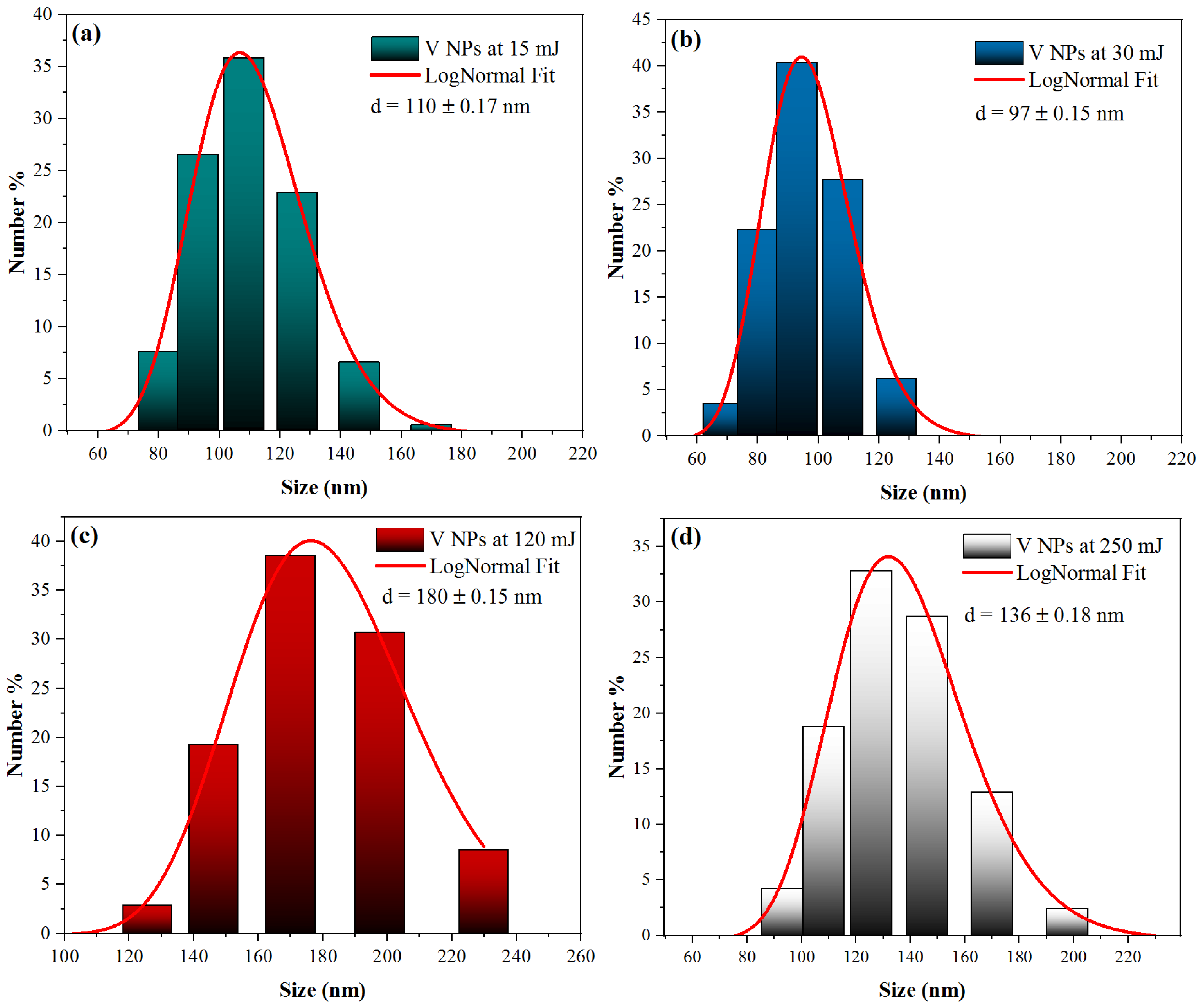
Figure 2a–d shows the results obtained by DLS analysis, which summarizes the sizes of V NPs obtained by picosecond and nanosecond laser ablation in water at different output energies. The reported particle sizes correspond to hydrodynamic diameters obtained by DLS measurements and therefore may include contributions from nanoparticle agglomeration in the colloidal suspension, i.e., often appear larger due to aggregation of nanoparticles in aqueous dispersions [31].
The size distributions reveal clear differences between laser pulse duration and energy. Picosecond ablation at 15 mJ and 30 mJ produced smaller V NPs (around 90–110 nm, Figure 2a,b) with narrow size distributions, consistent with a photomechanical ablation mechanism. In this regime, increasing the pulse energy from 15 to 30 mJ resulted in smaller particles, likely due to enhanced nucleation from more intense energy deposition, leading to a higher number of nuclei and limiting particle growth. The very short pulse duration minimizes thermal diffusion and aggregation, resulting in more uniform nanoparticles. In contrast, nanosecond ablation at 120 mJ and 250 mJ yielded significantly broader size distributions, with particles reaching up to ~230 nm (Figure 2c,d). These broader distributions suggest strong thermal effects such as melting, aggregation, and possible resolidification of ablated material. However, even in this thermally dominated regime, higher laser energy (250 mJ) produced slightly smaller particles than 120 mJ. This may be attributed to more intense material ejection and rapid plume expansion, which reduces residence time in the hot zone and thus limits particle coalescence. Overall, these trends are in line with previous studies showing that ultrashort pulses tend to produce more uniform nanoparticles due to limited heat effects, whereas longer pulses typically lead to larger, more varied particles as a result of heat-driven processes [32,33]. These differences in nanoparticle size and dispersion are expected to directly affect colloidal stability, surface charge, and ultimately the efficiency of nanoparticle immobilization onto TiO2 nanotubes during the immersion step [34,35].
The zeta potential distribution of V NPs exhibits at approximately −26.5, −33, −27, and −25.4 mV at 15, 30, 120, and 250 mJ, respectively, indicating moderate electrostatic stability in aqueous suspension. All suspensions exhibited negative zeta potential values within the range typically associated with moderately stable colloidal systems, suggesting sufficient electrostatic repulsion to prevent rapid aggregation and maintain stable dispersions during subsequent processing. Such stability is particularly important for achieving uniform nanoparticle distribution and reproducible surface loading on TiO2 nanotubes during the immersion step [36].
According to the ICP-OES analysis, the concentrations of V NPs in the obtained colloidal suspensions were 13.8, 17.6, 3.5, and 4 mg/L for laser output energies of 15, 30, 120, and 250 mJ, respectively. This difference can be attributed to variations in ablation efficiency and plasma–liquid interaction mechanisms associated with different pulse durations and energies, which are known to strongly affect nanoparticle generation in PLAL processes [16]. These values reflect the amount of vanadium available in the suspensions used for subsequent immersion-based loading onto TiO2 nanotubes and therefore provide an estimate of the potential surface coverage and density of active sites in the resulting photocatalysts.
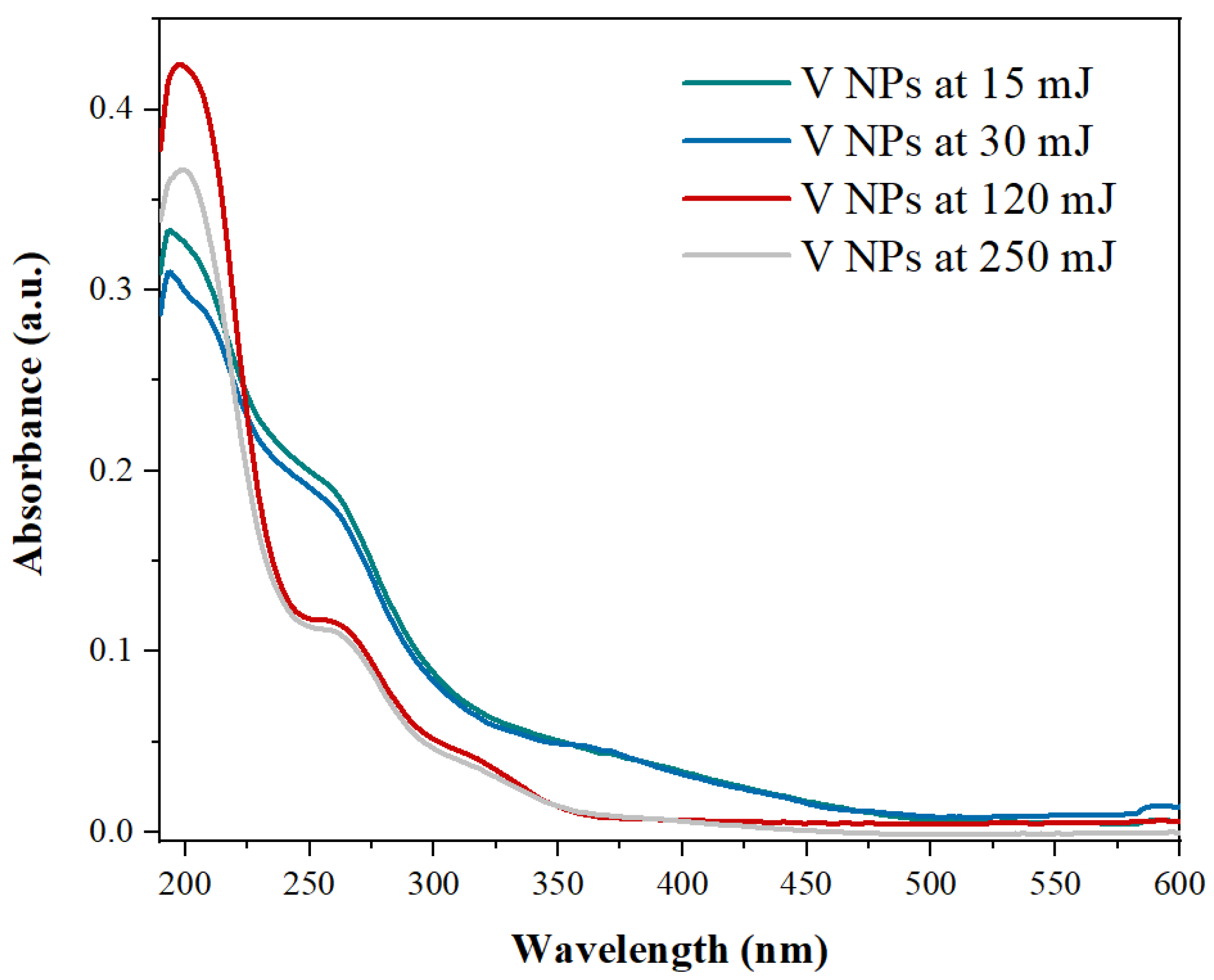
UV–Vis spectroscopy was employed to evaluate the optical properties of the synthesized V NPs, as shown in Figure 3, using dispersions with an identical concentration of 2.5 mg/L. The UV–Vis spectra of the obtained V NPs colloids exhibit strong absorption in the deep UV region (<250 nm), characteristic of vanadium-based nanoparticles and their oxide species [37]. A noticeable shoulder in the 250–280 nm region is observed in all samples, indicating overlapping electronic transitions that may be associated with mixed vanadium oxidation states or partially oxidized surface species formed during laser ablation in water. The shoulder is slightly more pronounced for nanoparticles synthesized using the picosecond laser, suggesting subtle differences in electronic structure, size distribution, or surface oxidation compared to nanosecond ablation. A weak and broad feature extending toward 300–350 nm is also visible and may be associated with charge-transfer transitions involving oxidized vanadium surface states [38]. Although all samples exhibit similar spectral profiles, differences in absorption intensity reflect variations in nanoparticle concentration and dispersion depending on laser pulse duration and output energy. These results confirm the successful formation of stable V NPs suspensions and show that laser parameters influence not only nanoparticle size and concentration but also their optical response, which may affect subsequent photocatalyst preparation. The observed UV–Vis spectral features may indicate the presence of vanadium species with different oxidation states formed during laser ablation in water. However, definitive identification requires surface-sensitive techniques such as XPS, which will be addressed in a future study.

3.2. Examination of V-TiO2 Synthesis Parameters

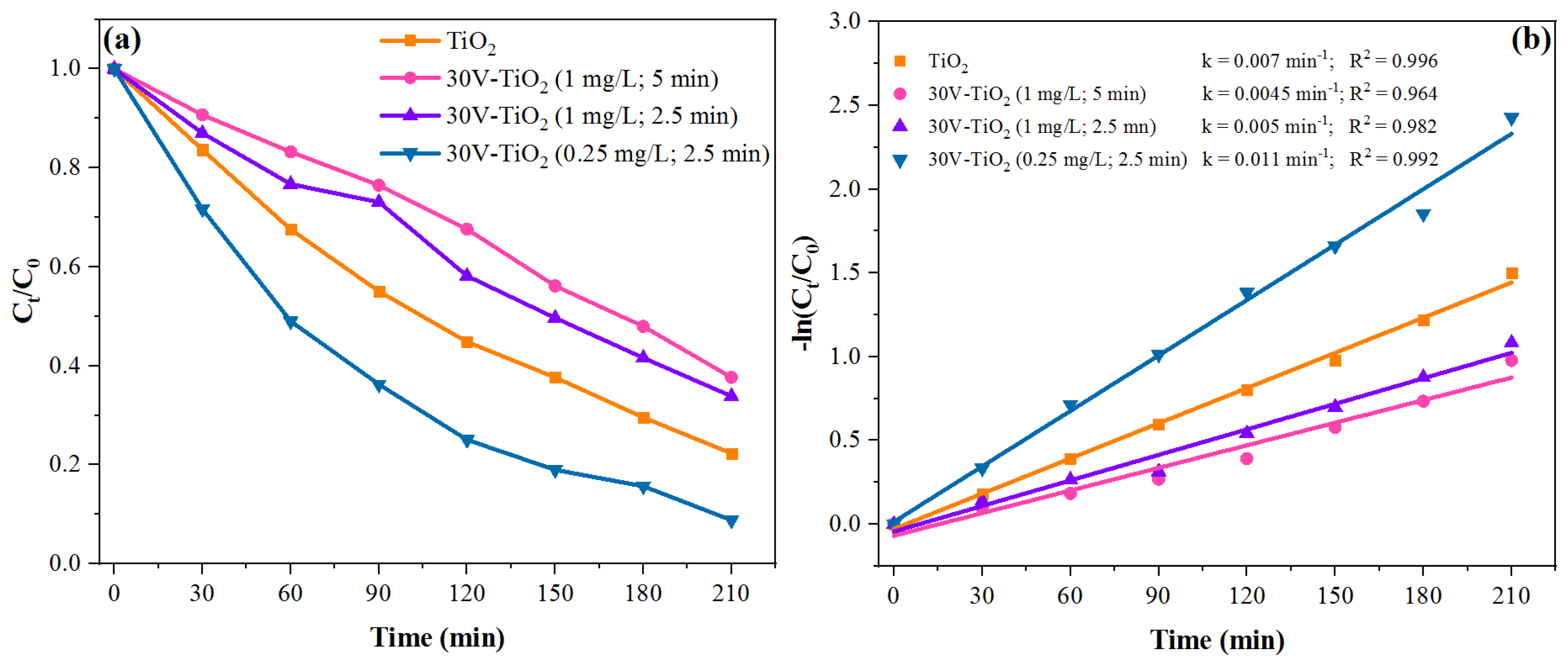
This study primarily focused on examining the influence of synthesis parameters, such as immersion time and the concentration of V NPs solutions, on photocatalytic activity. As a representative example, V NPs synthesized at an output energy of 30 mJ were selected. The initial synthesis conditions involved a V NPs concentration of 1 mg/L and immersion times of 5 and 2.5 min. As shown in Figure 4a,b, the immersion time significantly affects the photocatalytic and kinetic performance of the 30 V-TiO2 samples, with a twofold reduction in immersion time resulting in improved photocatalytic efficiency.
Despite this improvement, the photocatalytic efficiency of the synthesized samples remained lower than that of pure TiO2. However, when the V NPs concentration was reduced to 0.25 mg/L and the immersion time was maintained at 2.5 min, the resulting sample exhibited higher photocatalytic efficiency than pure TiO2. The results clearly demonstrate that the investigated synthesis parameters strongly influence the photocatalytic properties. The observed trend can be attributed to the fact that synthesis at concentrations above a certain threshold and longer immersion times leads to excessive V NPs deposition, which partially blocks the active TiO2 surface [39]. Accordingly, a V NPs concentration of 0.25 mg/L and an immersion time of 2.5 min were identified as the optimal conditions and were employed for the synthesis of the remaining photocatalysts.
The EDS analysis shown in Table 1 confirms the presence of vanadium and indicates increased surface loading with higher nanoparticle concentration, leading to a decrease in photocatalytic efficiency.
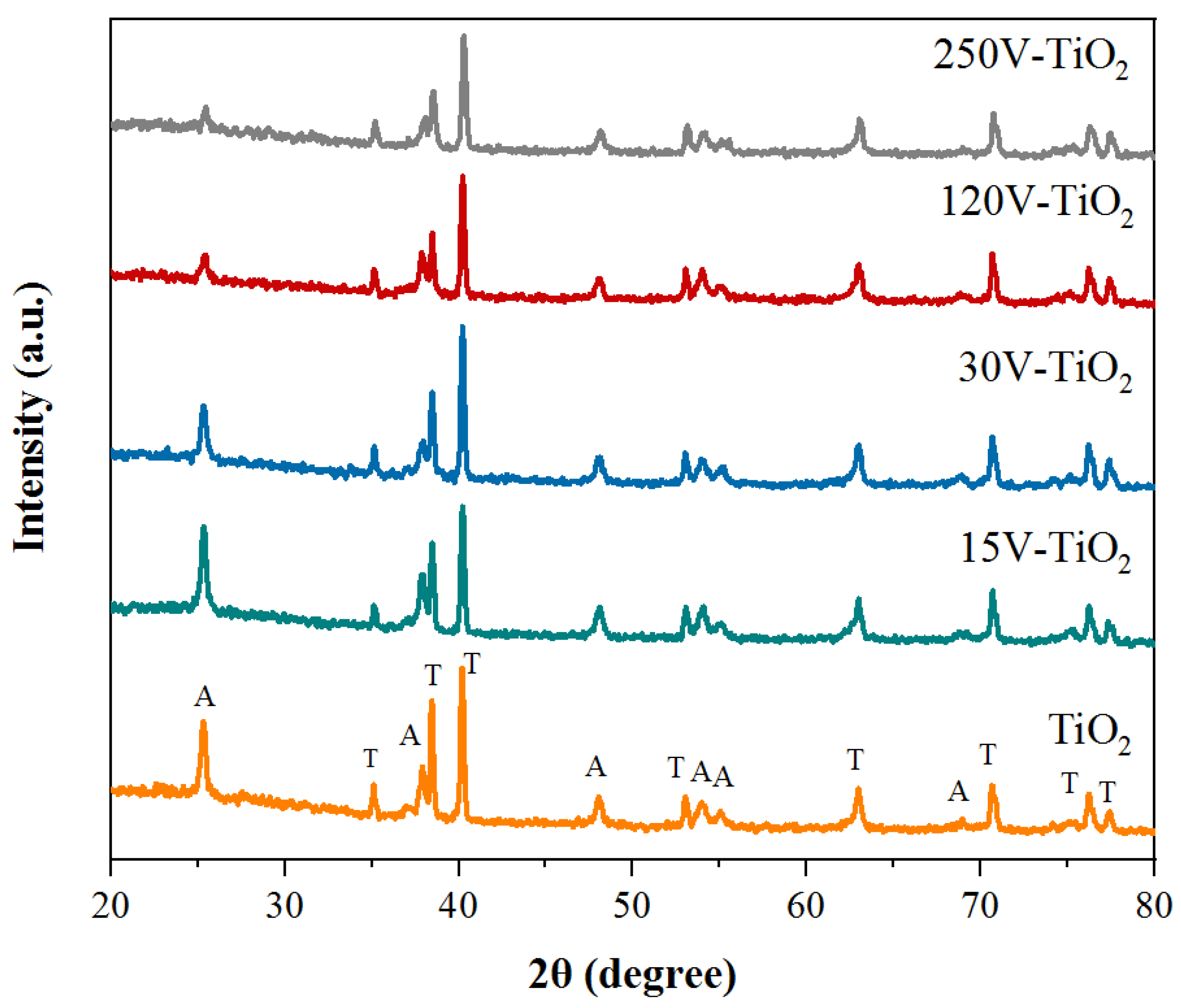
Prior to evaluating photocatalytic performance, XRD analysis was performed to confirm the crystalline phase of the synthesized photocatalysts. The crystal structure is revealed by X-ray diffraction (XRD), as shown in Figure 5. The diffraction peaks at 2θ = 25.2°, 37.9°, 48.1°, 53.9°, 55.0°, and 69.1° are corresponding to the (101), (004), (200), (105), (211), and (116) reflections of the anatase TiO2 (Rigaku PDXL DB No: 5000223) phase, respectively, due to the calcination process at 450 °C [28,40]. The diffraction peaks at 2θ = 35.1° (100), 38.5° (002), 40.2° (101), 53.0° (102), 62.9° (110), 70.6° (103), 76.2° (112), and 77.3° (201) (Rigaku PDXL DB No: 9008517) belong to Ti. Apart from the anatase (A) and Ti peaks (T), no additional peaks are observed in the synthesized samples, indicating that vanadium oxides do not alter the material’s crystallinity, likely because their amount is below the threshold. It can be concluded that the XRD patterns of all samples show reflections corresponding to the anatase phase of TiO2. Furthermore, the diffraction peaks of anatase TiO2 decrease in intensity with increasing laser ablation energy, attributed to the higher surface loading and density of the V NPs. Higher ablation energies yield larger V NPs, which are then deposited onto the nanotube arrays. These surface species act as a partially attenuating layer, absorbing a portion of the incident and diffracted X-rays, thereby reducing the detected intensity below the TiO2 substrate. The stability of the peak positions suggests that the anatase phase’s crystallinity remains intact [41].
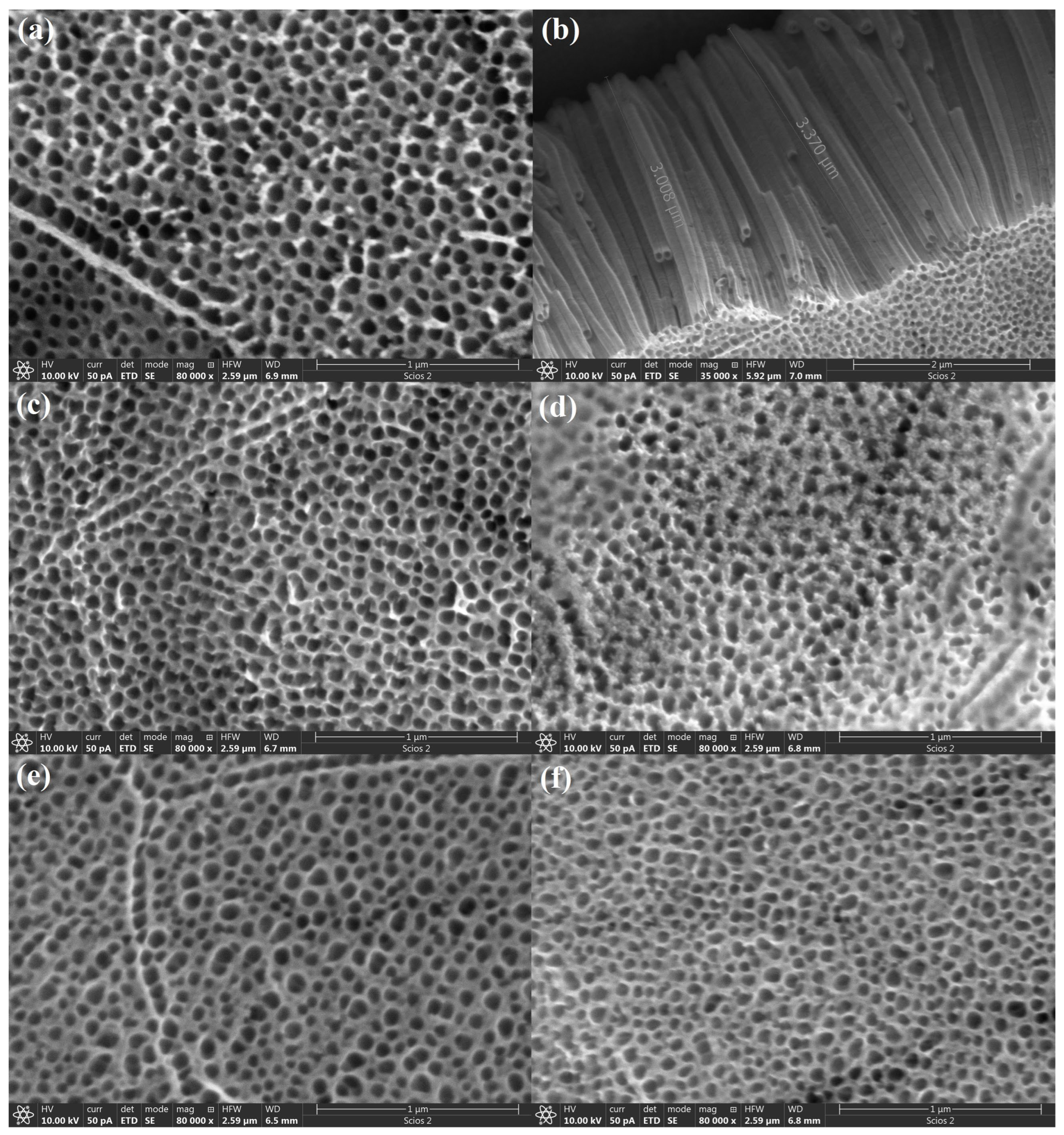
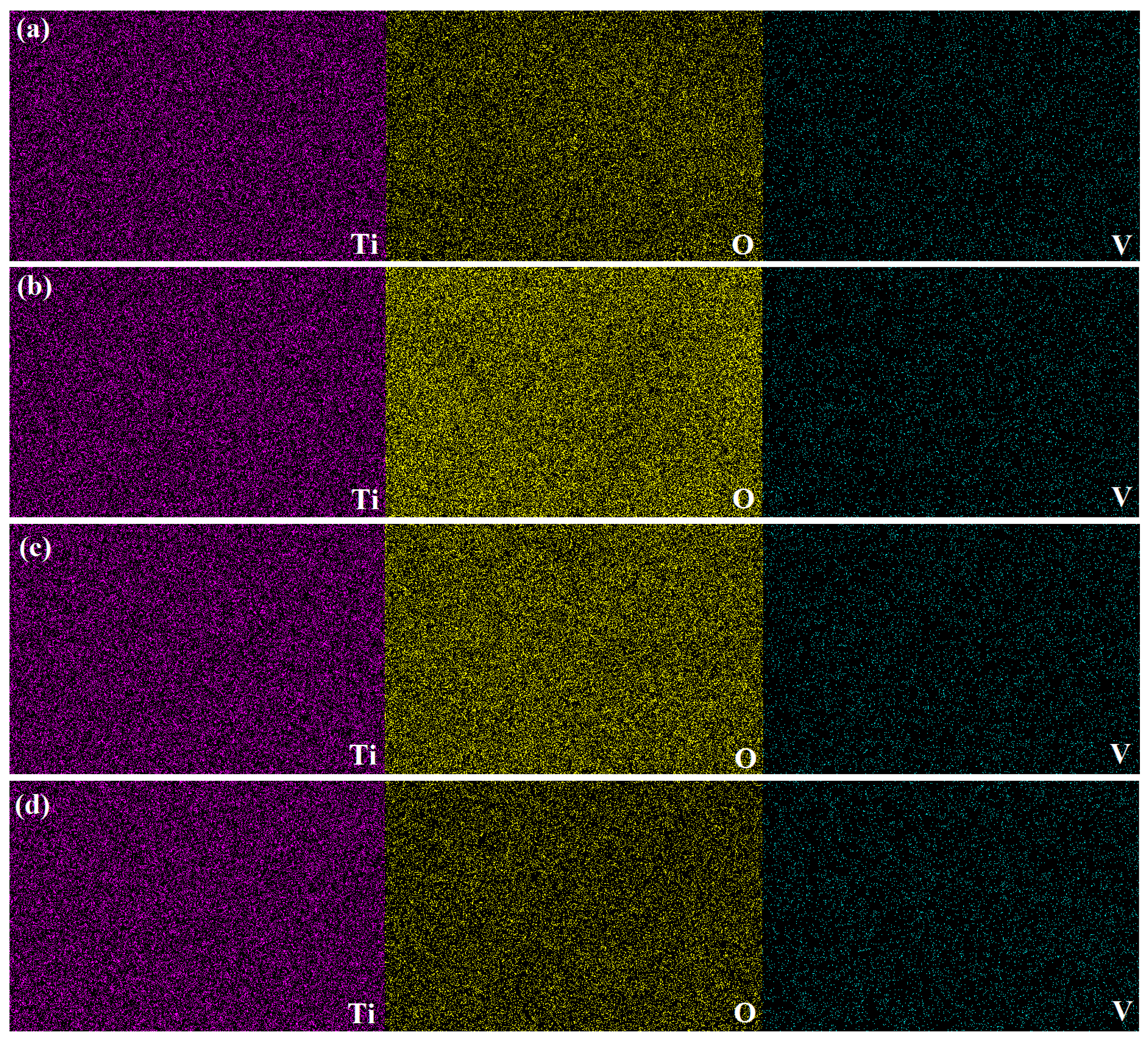
FESEM/EDS analysis was performed to confirm the formation of TiO2 nanotubes and determine the surface composition of the synthesized samples. FESEM observations did not reveal any significant morphological changes in the TiO2 nanotube structure after the deposition of V NPs. Representative images are shown in Figure 6a–f, while a similar morphology was observed for all other samples. The deposited V NPs are not clearly distinguishable in the micrographs due to their small size and non-uniform distribution on the TiO2 nanotube surface. It should be noted that nanoparticles deposited on TiO2 nanotube arrays do not necessarily penetrate inside the nanotube cavities, but can preferentially deposit on the outer surface or at the nanotube junctions, depending on the deposition method and particle size [42,43]. From the top and cross-section images (Figure 6a,b), the geometric parameters could be determined, including an average nanotube length of 3 μm and an inner diameter of approximately 70 nm across all samples. The EDS analysis (Table 2) confirms the elemental composition of the synthesized V-TiO2 samples prepared under vanadium solution concentrations of 0.25 mg/L and an immersion time of 2.5 min. Pristine TiO2 nanotubes exhibit only Ti and O, whereas V is detected in all V-TiO2 samples. The V atomic percentage increases from 0.126 at.% in 15 V-TiO2 to 0.816 at.% in 250 V-TiO2, indicating progressive surface incorporation with higher laser output. Minor variations in Ti and O contents reflect the partial surface coverage by V NPs. As also shown in Figure 7a–d, the EDS mapping analysis indicated the presence of Ti, O, and V in V-TiO2 samples, further demonstrating the successful deposition of V on TiO2 nanotubes in the following synthesized samples.
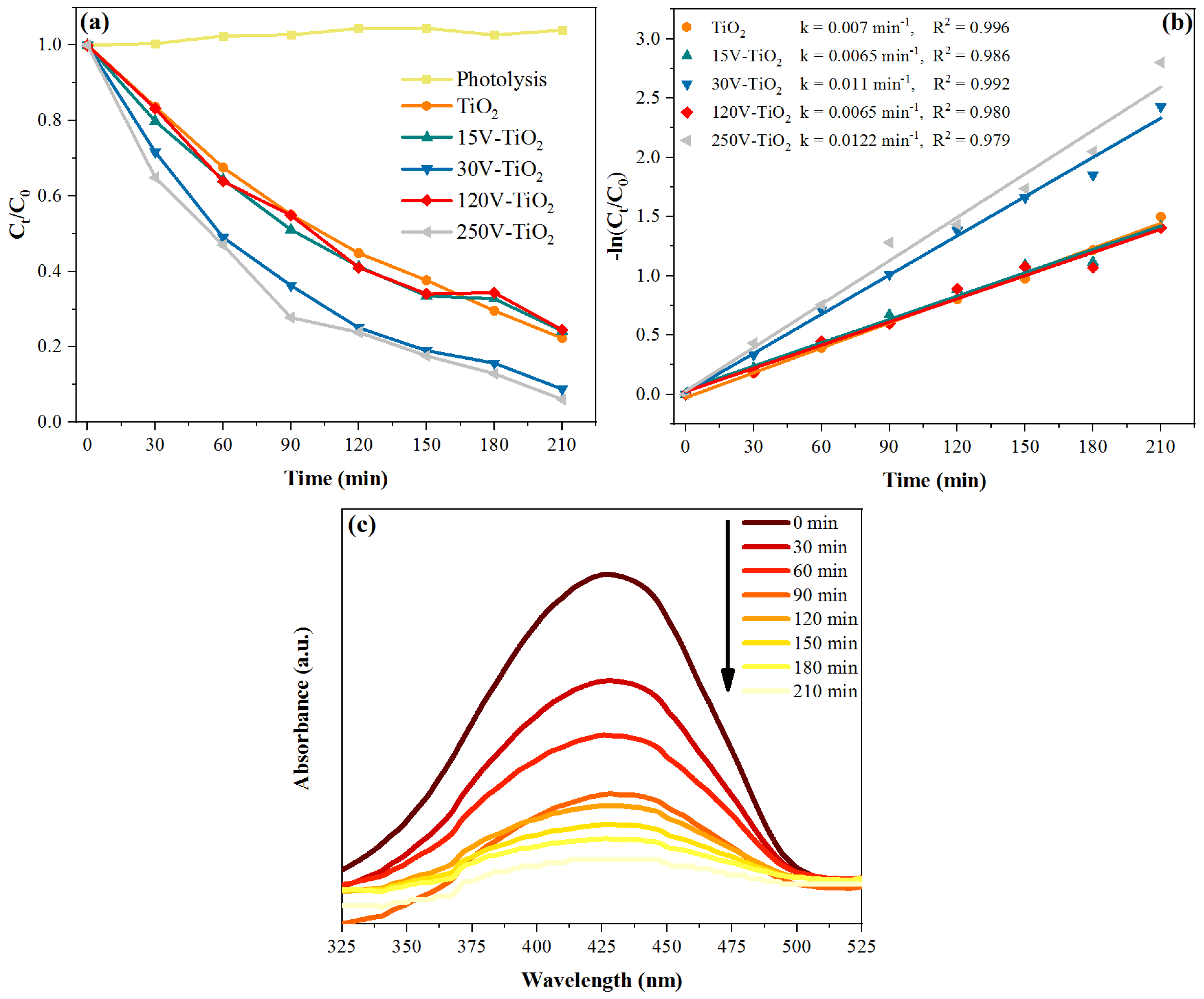
The photocatalytic activity of TiO2 and V-TiO2 samples was evaluated through the degradation of an aqueous AY23 solution with an initial concentration of 2 mg/L (Figure 8a). The photocatalytic degradation process was monitored by UV–Vis spectroscopy, recording absorption spectra in the range of 200–600 nm. In the absence of a catalyst, it was observed that AY23 was not degraded during the photolysis process. In total, 250 V-TiO2 and 30 V-TiO2 exhibited the highest degradation efficiencies, reaching 93.9% and 91.2%, respectively. In contrast, 120 V-TiO2 (75.5%) and 15 V-TiO2 (75.8%) showed photocatalytic performances comparable to that of pure TiO2 (77.6%) after 210 min of the photocatalytic process. The reaction kinetics of AY23 degradation were analyzed using a pseudo-first-order model (Figure 8b). As evidenced by the kinetic plots, 250 V-TiO2 exhibits the highest degradation rate constant among all the tested samples. Figure 8c presents the time-dependent UV–Vis absorption spectra of AY23 in the presence of 250 V-TiO2, characterized by a characteristic absorption peak at 427 nm.
The lack of a clear degradation trend can be attributed to the change in the overall absorption spectrum during the measurement. During degradation, intermediates are formed that absorb light at wavelengths similar to those of the parent compound, leading to a higher apparent concentration or stagnation. Depending on the modification of the TiO2 photocatalyst, the generation of reactive oxygen species can vary, which affects the products formed during photocatalytic degradation and makes it difficult to monitor the degradation rate [44].
Since the amount of deposited V in the 30 V-TiO2 and 120 V-TiO2 samples is almost identical (0.724 and 0.794 wt%, respectively), the observed differences in photocatalytic activity cannot be attributed solely to the amount of deposited vanadium. This suggests that using a picosecond laser at higher energies may promote the formation of vanadium in more catalytically active oxidation states, potentially including V4+ species, compared to nanosecond synthesis at 120 mJ. Such oxidation states are known to facilitate charge separation and enhance interfacial electron transfer, thereby improving photocatalytic performance [26,45]. A similar conclusion can be drawn for V NPs synthesized at a nanosecond laser output energy of 250 mJ.
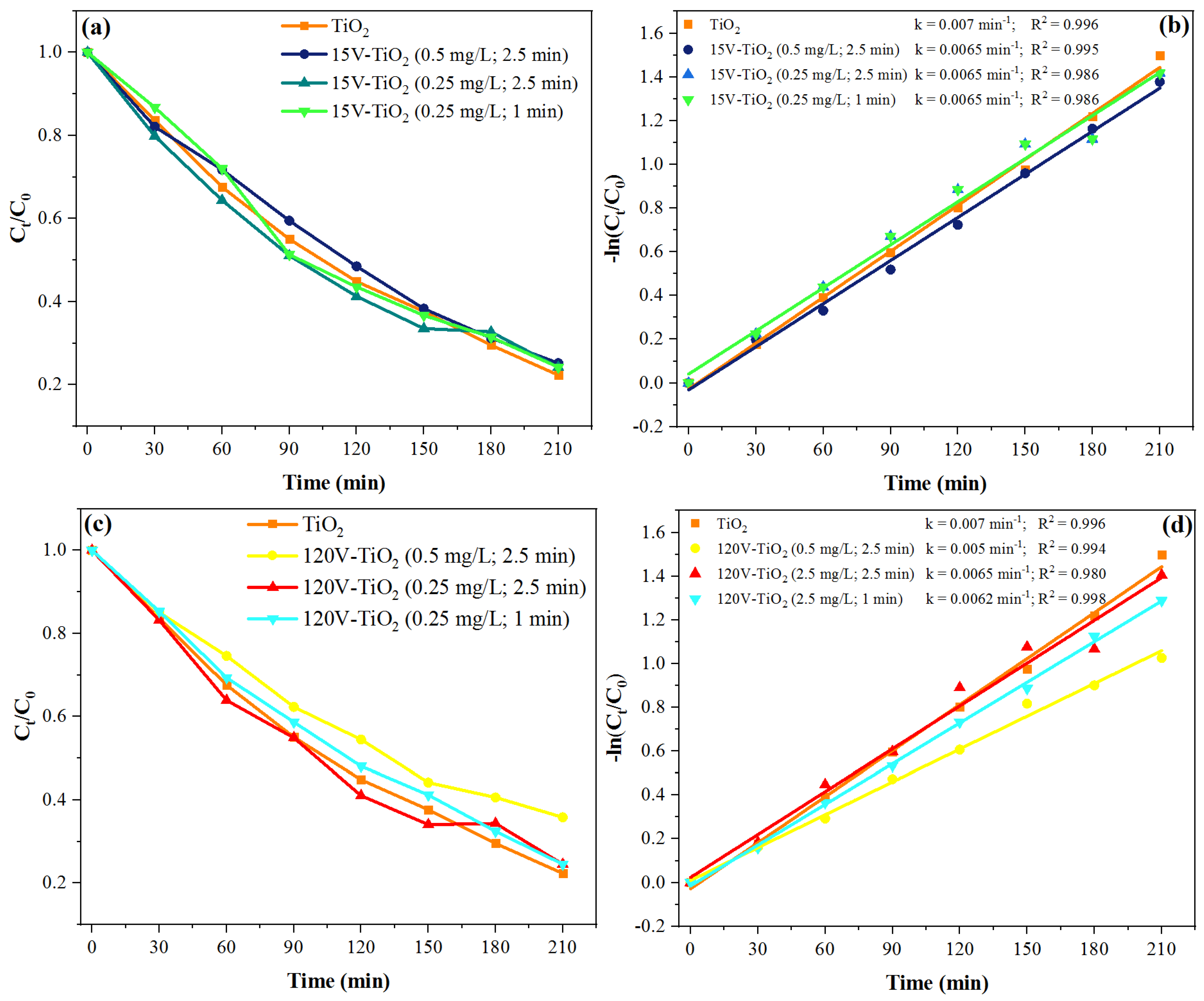
Since no further improvement in photocatalytic activity was observed under optimal synthesis conditions for 15 V-TiO2 and 120 V-TiO2, it can be assumed that the optimal surface loading of V species strongly depends on the properties of the nanoparticles synthesized at different laser energies. However, further modifications of the immersion time and the V NPs concentration were investigated for the 15 V-TiO2 and 120 V-TiO2 samples, to improve their photocatalytic performance. This approach aimed to demonstrate that synthesis outcomes are influenced not only by V-TiO2 synthesis parameters but also by the inherent properties of the synthesized V NPs. The following parameter values were chosen to improve photocatalysis somewhat, i.e., to avoid excessive surface coverage and possible charge recombination.
Despite the changed parameters, the photocatalytic efficiency of the 15 V-TiO2 sample (Figure 9a,b) remained the same as that of pure TiO2. It is evident that reducing the immersion time to 1 min did not lead to any improvement, most likely due to the TiO2 photocatalyst being exposed to the V NPs for too short a time. Similar behavior was observed for the 120 V-TiO2 sample (Figure 9c,d). In contrast, increasing the V NPs concentration to 0.5 mg/L led to a significant decrease in photocatalytic efficiency.
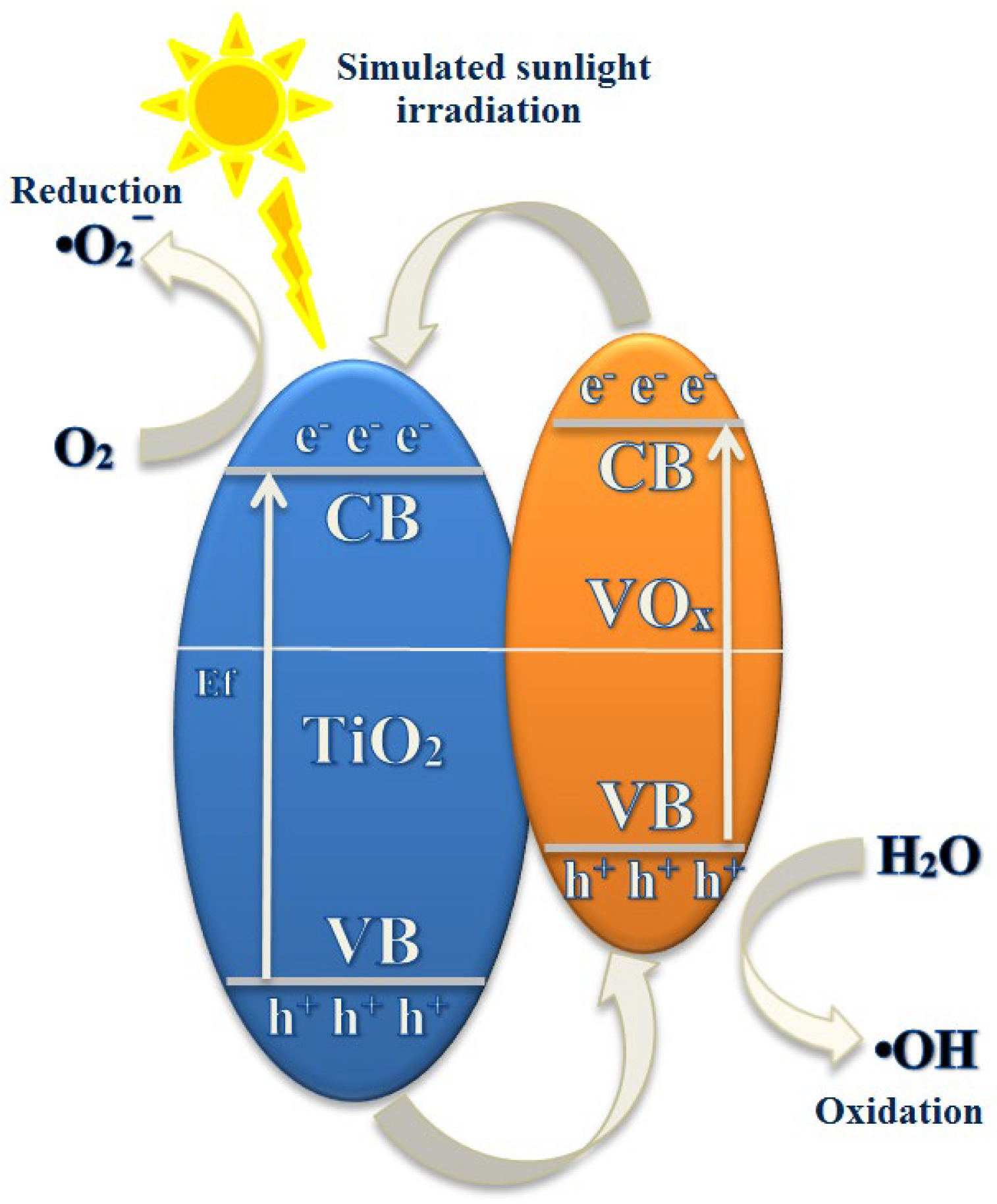
Based on the EDS analysis in Table 3, the concentration of deposited V NPs on TiO2 nanotubes increased. However, this did not improve the photocatalytic efficiency of 15 V-TiO2. On the contrary, it decreased efficiency, as observed with 120 V-TiO2. The limited photocatalytic activity of the 15 V-TiO2 and 120 V-TiO2 samples, even after further optimization of the synthesis parameters, indicates that the presence of V NPs is insufficient to improve photocatalytic performance. This behavior can be attributed to excessive or non-optimal surface loading, as well as to the likely dominance of V5+-related species, which do not promote efficient charge separation at the V-TiO2 interface, i.e., may be detrimental to photocatalysis [26,46]. Furthermore, the deposited V species may act as inactive surface modifiers or even as recombination centers, resulting in photocatalytic efficiencies comparable to or lower than those of pure TiO2 [47]. On the other hand, the improved photocatalytic activity for the 30 V-TiO2 and 250 V-TiO2 samples can be attributed to the synergistic effects of optimized nanoparticle size, favorable surface dispersion, and, more importantly, efficient electronic interactions at the V-TiO2 interface. Under these laser synthesis conditions, the formation of V NPs and possibly mixed-valence VOₓ species may facilitate charge carrier separation and suppress recombination [28,48]. Combined with the optimal surface loading achieved by controlled immersion, these factors result in significantly improved photocatalytic performance compared to pure TiO2 and other V-modified TiO2 samples. Figure 10 illustrates a schematic diagram of a possible photocatalytic mechanism in the V-TiO2 system under simulated sunlight irradiation. Upon illumination, TiO2 and VOₓ generate photogenerated e/h+. Based on literature reports, a heterojunction may form between TiO2 and VOₓ, facilitating charge separation. The photogenerated e react with dissolved oxygen to form •O2 radicals, while h+ oxidize water or hydroxide ions to generate •OH radicals, contributing to pollutant degradation. The enhanced photocatalytic activity is attributed to improved charge separation and electron trapping [45,49].
Enhanced photocatalytic performance is likely governed not only by the amount of deposited vanadium but also by differences in nanoparticle physicochemical properties induced by laser synthesis conditions. Variations in defect density, surface states, and electronic interactions with TiO2 may significantly influence charge separation and transfer processes. Although the oxidation states of vanadium were not directly determined in this study, the observed photocatalytic trends indicate that laser processing parameters play a key role in defining the functional properties of the obtained composites.
Table 4 shows the findings of studies comparing different V-TiO2 modifications. It shows that the optimum V content improves photocatalytic capabilities compared to non-modified TiO2. This comparison table was adapted from our previously published work and expanded with additional recent studies [28].

4. Conclusions

The results show that the optimal immersion parameters cannot be universally applied across different laser synthesis conditions, highlighting the importance of tailoring surface modification processes to the specific characteristics of laser-generated nanoparticles. This study suggests that the laser pulse duration is a critical parameter not only for controlling nanoparticle size but also for tailoring their oxidation state and, consequently, their photocatalytic performance. It can be concluded that the photocatalytic performance of the V-TiO2 samples is governed by a narrow optimal process space, indicating that precise control of the immersion synthesis and deposition parameters of the nanoparticles is required to achieve improved activity. Future studies will focus on more detailed analyses of the effects of different types of pulsed lasers on the formation of vanadium-based nanoparticles and their oxidation states. Additionally, detailed surface and high-resolution structural analyses will be conducted to better understand the mechanisms underlying the observed photocatalytic performance.

Author Contributions

Conceptualization, M.T. and M.M.; methodology, M.T. and M.R.; formal analysis, M.T., M.R., R.R., and S.Ž.; investigation, M.R., R.R., and S.S.; resources, S.Ž.; data curation, M.T.; writing—original draft preparation, M.T. and M.M.; writing—review and editing, R.R., S.Ž., N.K., and M.M.; supervision, N.K. and M.M.; project administration, S.Ž. and M.M.; funding acquisition, M.M. All authors have read and agreed to the published version of the manuscript.

Funding

The authors would like to thank the Ministry of Science, Technological Development and Innovation of the Republic of Serbia for the financial support to the research through institutional funding (contract number: 451-03-33/2026-03/200017) and the project Centre for Advanced Laser Techniques (CALT), co-funded by the European Union through the European Regional Development Fund under the Competitiveness and Cohesion Operational Programme (grant No. KK.01.1.1.05.0001).

Data Availability Statement

The original contributions presented in this study are included in the article. Further inquiries can be directed to the corresponding author.

Conflicts of Interest

The authors declare no conflicts of interest.

References

  1. Tkaczyk, A.; Mitrowska, K.; Posyniak, A. Synthetic Organic Dyes as Contaminants of the Aquatic Environment and Their Implications for Ecosystems: A Review. Sci. Total Environ. 2020, 717, 137222. [Google Scholar] [CrossRef] [PubMed]
  2. Islam, M.M.; Aidid, A.R.; Mohshin, J.N.; Mondal, H.; Ganguli, S.; Chakraborty, A.K. A Critical Review on Textile Dye-Containing Wastewater: Ecotoxicity, Health Risks, and Remediation Strategies for Environmental Safety. Clean. Chem. Eng. 2025, 11, 100165. [Google Scholar] [CrossRef]
  3. Benkhaya, S.; M’rabet, S.; El Harfi, A. Classifications, Properties, Recent Synthesis and Applications of Azo Dyes. Heliyon 2020, 6, e03271. [Google Scholar] [CrossRef]
  4. Behnajady, M.A.; Modirshahla, N.; Hamzavi, R. Kinetic Study on Photocatalytic Degradation of C.I. Acid Yellow 23 by ZnO Photocatalyst. J. Hazard. Mater. 2006, 133, 226–232. [Google Scholar] [CrossRef] [PubMed]
  5. Jeon, S.; Ko, J.; Ko, W. Synthesis of Gd2O3 Nanoparticles and Their Photocatalytic Activity for Degradation of Azo Dyes. Catalysts 2021, 11, 742. [Google Scholar] [CrossRef]
  6. Navidpour, A.H.; Abbasi, S.; Li, D.; Mojiri, A.; Zhou, J.L. Investigation of Advanced Oxidation Process in the Presence of TiO2 Semiconductor as Photocatalyst: Property, Principle, Kinetic Analysis, and Photocatalytic Activity. Catalysts 2023, 13, 232. [Google Scholar] [CrossRef]
  7. Fujishima, A.; Zhang, X.; Tryk, D.A. TiO2 Photocatalysis and Related Surface Phenomena. Surf. Sci. Rep. 2008, 63, 515–582. [Google Scholar] [CrossRef]
  8. Hoffmann, M.R.; Martin, S.T.; Choi, W.; Bahnemann, D.W. Environmental Applications of Semiconductor Photocatalysis. Chem. Rev. 1995, 95, 69–96. [Google Scholar] [CrossRef]
  9. Moreno-Vargas, J.M.; Echeverry-Cardona, L.M.; Torres-Ceron, D.A.; Amaya-Roncancio, S.; Restrepo-Parra, E.; Castillo-Delgado, K.J. Photocatalysis as an Alternative for the Remediation of Wastewater: A Scientometric Review. ChemEngineering 2024, 8, 95. [Google Scholar] [CrossRef]
  10. Chalatsi-Diamanti, P.; Isari, E.A.; Grilla, E.; Kokkinos, P.; Kalavrouziotis, I.K. Recent Prospects, Challenges and Advancements of Photocatalysis as a Wastewater Treatment Method. Water Emerg. Contam. Nanoplastics 2025, 4, 12. [Google Scholar] [CrossRef]
  11. Liu, H.; Wu, Y.; Zhang, J. A New Approach toward Carbon-Modified Vanadium-Doped Titanium Dioxide Photocatalysts. ACS Appl. Mater. Interfaces 2011, 3, 1757–1764. [Google Scholar] [CrossRef]
  12. Wang, B.; Zhang, G.; Leng, X.; Sun, Z.; Zheng, S. Characterization and Improved Solar Light Activity of Vanadium Doped TiO2/Diatomite Hybrid Catalysts. J. Hazard. Mater. 2015, 285, 212–220. [Google Scholar] [CrossRef]
  13. Nguyen, T.T.; Nghiem, T.T.; Hoang, H.H.; Cao, H.H.; Nguyen, V.A. Vanadium-Doped TiO2 Adsorbent-Photocatalyst for Organic Dye Treatment. Vietnam J. Catal. Adsorpt. 2024, 12, 13–18. [Google Scholar] [CrossRef]
  14. Christoforidis, K.C.; Fernández-García, M. Photoactivity and Charge Trapping Sites in Copper and Vanadium Doped Anatase TiO2 Nano-Materials. Catal. Sci. Technol. 2016, 6, 1094–1105. [Google Scholar] [CrossRef]
  15. Šuligoj, A.; Povirk, N.; Maver, K.; Mavrič, A.; Lavrenčič Štangar, U.; Surca, A.K. Transparent Vanadium Doped Titania-Silica Films: Structural Characterization and Self-Cleaning Properties. J. Environ. Chem. Eng. 2024, 12, 113904. [Google Scholar] [CrossRef]
  16. Zhang, D.; Gökce, B.; Barcikowski, S. Laser Synthesis and Processing of Colloids: Fundamentals and Applications. Chem. Rev. 2017, 117, 3990–4103. [Google Scholar] [CrossRef] [PubMed]
  17. Yan, Z.; Chrisey, D.B. Pulsed Laser Ablation in Liquid for Micro-/Nanostructure Generation. J. Photochem. Photobiol. C Photochem. Rev. 2012, 13, 204–223. [Google Scholar] [CrossRef]
  18. Krstulović, N.; Salamon, K.; Budimlija, O.; Kovač, J.; Dasović, J.; Umek, P.; Capan, I. Parameters Optimization for Synthesis of Al-Doped ZnO Nanoparticles by Laser Ablation in Water. Appl. Surf. Sci. 2018, 440, 916–925. [Google Scholar] [CrossRef]
  19. Gurbandurdyyev, B.; Annamuradov, B.; Er, S.B.; Gross, B.; Er, A.O. Advances in Pulsed Liquid-Based Nanoparticles: From Synthesis Mechanism to Application and Machine Learning Integration. Quantum Beam Sci. 2025, 9, 32. [Google Scholar] [CrossRef]
  20. Niu, S.; Wang, W.; Liu, P.; Zhang, Y.; Zhao, X.; Li, J.; Xiao, M.; Wang, Y.; Li, J.; Shao, X. Recent Advances in Applications of Ultrafast Lasers. Photonics 2024, 11, 857. [Google Scholar] [CrossRef]
  21. Nyabadza, A.; Vazquez, M.; Brabazon, D. A Review of Bimetallic and Monometallic Nanoparticle Synthesis via Laser Ablation in Liquid. Crystals 2023, 13, 253. [Google Scholar] [CrossRef]
  22. Balachandran, A.; Sreenilayam, S.P.; Madanan, K.; Thomas, S.; Brabazon, D. Nanoparticle Production via Laser Ablation Synthesis in Solution Method and Printed Electronic Application—A Brief Review. Results Eng. 2022, 16, 100646. [Google Scholar] [CrossRef]
  23. Blažeka, D.; Radičić, R.; Maletić, D.; Živković, S.; Momčilović, M.; Krstulović, N. Enhancement of Methylene Blue Photodegradation Rate Using Laser Synthesized Ag-Doped ZnO Nanoparticles. Nanomaterials 2022, 12, 2677. [Google Scholar] [CrossRef] [PubMed]
  24. Radičić, R.; Jurov, A.; Zavašnik, J.; Kovač, J.; Brusar, V.; Vdović, S.; Novko, D.; Krstulović, N. UV and Solar-Driven Photocatalysis of Organic Dyes Using ZnO-Ag Heterojunction Nanoparticles Synthesized by One-Step Laser Synthesis in Water. Appl. Surf. Sci. 2024, 669, 160498. [Google Scholar] [CrossRef]
  25. Sacco, O.; Sannino, D.; Matarangolo, M.; Vaiano, V. Room Temperature Synthesis of V-Doped TiO2 and Its Photocatalytic Activity in the Removal of Caffeine under UV Irradiation. Materials 2019, 12, 911. [Google Scholar] [CrossRef]
  26. Iketani, K.; Sun, R.D.; Toki, M.; Hirota, K.; Yamaguchi, O. Sol-Gel-Derived VχTi1-ΧO2 Films and Their Photocatalytic Activities under Visible Light Irradiation. Mater. Sci. Eng. B 2004, 108, 187–193. [Google Scholar] [CrossRef]
  27. Nguyen, D.M.; Ding, S.; Nghiem, T.T.; Nguyen, V.A.; Mejía, E. Visible Light-Driven Degradation of Trichloroethylene in Aqueous Phase with Vanadium-Doped TiO2 Photocatalysts. Sol. RRL 2023, 7, 2200938. [Google Scholar] [CrossRef]
  28. Tošić, M.; Rajić, V.; Pjević, D.; Stojadinović, S.; Perović, I.; Krstulović, N.; Momčilović, M. Vanadium-Modified TiO2 Nanotubes Synthesized Via Electrochemical Anodization and Nanosecond Pulsed Laser Deposition for Improved Photocatalytic Degradation of p-Nitrophenol. J. Clust. Sci. 2026, 37, 1. [Google Scholar] [CrossRef]
  29. Ramos, B.; Ookawara, S.; Matsushita, Y.; Yoshikawa, S. Intensification of Solar Photocatalysis with Immobilised TiO2 by Using Micro-Structured Reaction Spaces. J. Environ. Chem. Eng. 2015, 3, 681–688. [Google Scholar] [CrossRef]
  30. Manassero, A.; Satuf, M.L.; Alfano, O.M. Photocatalytic Reactors with Suspended and Immobilized TiO2: Comparative Efficiency Evaluation. Chem. Eng. J. 2017, 326, 29–36. [Google Scholar] [CrossRef]
  31. Souza, T.G.F.; Ciminelli, V.S.T.; Mohallem, N.D.S. A Comparison of TEM and DLS Methods to Characterize Size Distribution of Ceramic Nanoparticles. J. Phys. Conf. Ser. 2016, 733, 012039. [Google Scholar] [CrossRef]
  32. Zeng, H.; Du, X.W.; Singh, S.C.; Kulinich, S.A.; Yang, S.; He, J.; Cai, W. Nanomaterials via Laser Ablation/Irradiation in Liquid: A Review. Adv. Funct. Mater. 2012, 22, 1333–1353. [Google Scholar] [CrossRef]
  33. Forsythe, R.C.; Cox, C.P.; Wilsey, M.K.; Müller, A.M. Pulsed Laser in Liquids Made Nanomaterials for Catalysis. Chem. Rev. 2021, 121, 7568–7637. [Google Scholar] [CrossRef] [PubMed]
  34. Hotze, E.M.; Phenrat, T.; Lowry, G.V. Nanoparticle Aggregation: Challenges to Understanding Transport and Reactivity in the Environment. J. Environ. Qual. 2010, 39, 1909–1924. [Google Scholar] [CrossRef] [PubMed]
  35. Schneider, J.; Matsuoka, M.; Takeuchi, M.; Zhang, J.; Horiuchi, Y.; Anpo, M.; Bahnemann, D.W. Understanding TiO2 Photocatalysis: Mechanisms and Materials. Chem. Rev. 2014, 114, 9919–9986. [Google Scholar] [CrossRef]
  36. Bhattacharjee, S. DLS and Zeta Potential—What They Are and What They Are Not? J. Control. Release 2016, 235, 337–351. [Google Scholar] [CrossRef]
  37. Bañares, M.A. Operando Spectroscopy: The Knowledge Bridge to Assessing Structure-Performance Relationships in Catalyst Nanoparticles. Adv. Mater. 2011, 23, 5293–5301. [Google Scholar] [CrossRef]
  38. Weckhuysen, B.M.; Keller, D.E. Chemistry, Spectroscopy and the Role of Supported Vanadium Oxides in Heterogeneous Catalysis. Catal. Today 2003, 78, 25–46. [Google Scholar] [CrossRef]
  39. Radko, M.; Kowalczyk, A.; Bidzińska, E.; Witkowski, S.; Górecka, S.; Wierzbicki, D.; Pamin, K.; Chmielarz, L. Titanium Dioxide Doped with Vanadium as Effective Catalyst for Selective Oxidation of Diphenyl Sulfide to Diphenyl Sulfonate. J. Therm. Anal. Calorim. 2018, 132, 1471–1480. [Google Scholar] [CrossRef]
  40. Stojadinović, S.; Radić, N.; Vasilić, R.; Tadić, N.; Tsanev, A. Photocatalytic Degradation of Methyl Orange in the Presence of Transition Metals (Mn, Ni, Co) Modified TiO2 Coatings Formed by Plasma Electrolytic Oxidation. Solid State Sci. 2022, 129, 106896. [Google Scholar] [CrossRef]
  41. Sondezi, N.; Njengele-Tetyana, Z.; Matabola, K.P.; Makhetha, T.A. Sol-Gel-Derived TiO2 and TiO2/Cu Nanoparticles: Synthesis, Characterization, and Antibacterial Efficacy. ACS Omega 2024, 9, 15959–15970. [Google Scholar] [CrossRef]
  42. Li, Z.; Zhang, Y.; Ye, J.; Guo, M.; Chen, J.; Chen, W. Nonenzymatic Glucose Biosensors Based on Silver Nanoparticles Deposited on TiO2 Nanotubes. J. Nanotechnol. 2016, 6, 9454830. [Google Scholar] [CrossRef]
  43. Nguyen, N.T.; Altomare, M.; Yoo, J.E.; Taccardi, N.; Schmuki, P. Noble Metals on Anodic TiO2 Nanotube Mouths: Thermal Dewetting of Minimal Pt Co-Catalyst Loading Leads to Significantly Enhanced Photocatalytic H2 Generation. Adv. Energy Mater. 2016, 6, 1501926. [Google Scholar] [CrossRef]
  44. Rochkind, M.; Pasternak, S.; Paz, Y. Using Dyes for Evaluating Photocatalytic Properties: A Critical Review. Molecules 2015, 20, 88–110. [Google Scholar] [CrossRef]
  45. Pooseekheaw, P.; Thongpan, W.; Panthawan, A.; Kantarak, E.; Sroila, W.; Singjai, P. Porous V2O5/TiO2 nanoheterostructure Films with Enhanced Visible-Light Photocatalytic Performance Prepared by the Sparking Method. Molecules 2020, 25, 3327. [Google Scholar] [CrossRef]
  46. Rossi, L.; Palacio, M.; Villabrille, P.I.; Rosso, J.A. V-Doped TiO2 Photocatalysts and Their Application to Pollutant Degradation. Environ. Sci. Pollut. Res. 2021, 28, 24112–24123. [Google Scholar] [CrossRef]
  47. Tian, B.; Li, C.; Gu, F.; Jiang, H.; Hu, Y.; Zhang, J. Flame Sprayed V-Doped TiO2 Nanoparticles with Enhanced Photocatalytic Activity under Visible Light Irradiation. Chem. Eng. J. 2009, 151, 220–227. [Google Scholar] [CrossRef]
  48. Teghil, R.; D’Alessio, L.; De Bonis, A.; Galasso, A.; Ibris, N.; Salvi, A.M.; Santagata, A.; Villani, P. Nanoparticles and Thin Film Formation in Ultrashort Pulsed Laser Deposition of Vanadium Oxide. J. Phys. Chem. A 2009, 113, 14969–14974. [Google Scholar] [CrossRef]
  49. Syrti, L.; Kumar, E.V.; Arjun, A.; Nagaraju, G.; Priyanka, K.P. Unveiling the Bifunctional Potentiality of TiO2/V2O5 Nanocomposite for Photodegradation of Industrial Dyes and Latent Fingerprint Visualization in Forensic Investigation. Surf. Interfaces 2025, 71, 106840. [Google Scholar] [CrossRef]
  50. Khan, H.; Berk, D. Sol-Gel Synthesized Vanadium Doped TiO2 Photocatalyst: Physicochemical Properties and Visible Light Photocatalytic Studies. J. Sol-Gel Sci. Technol. 2013, 68, 180–192. [Google Scholar] [CrossRef]
  51. Murila, G.I.; Mageto, M.J.; Wafula, H.B.; Gaitho, F.M.; Mutuma, B.K. Tailoring Structural Phases and Photocatalytic Activity of Vanadium-Doped TiO2 Nanoparticles Prepared by Modified Sol–Gel Technique. MRS Adv. 2025. [Google Scholar] [CrossRef]
  52. Chang, P.Y.; Huang, C.H.; Doong, R. an Characterization and Photocatalytic Activity of Vanadium-Doped Titanium Dioxide Nanocatalysts. Water Sci. Technol. 2009, 59, 523–530. [Google Scholar] [CrossRef] [PubMed]
  53. Zhao, G.; Li, H.; Zhang, J.; Chen, Z.; Han, G.; Song, B. Effects of Preparation Parameters on Room Temperature Formation of Vanadium-Doped TiO2 Nanocrystalline Powder. J. Am. Ceram. Soc. 2011, 94, 71–76. [Google Scholar] [CrossRef]
Figure 1. Illustration of synthesis processes: 1. Picosecond and nanosecond pulsed laser ablation in liquid. 2. One-step electrochemical anodization of Ti meshes. 3. Immersion TiO2 nanotubes on Ti meshes. 4. Calcination.
Processes 14 01188 g001
Figure 2. Size distribution of V NPs synthesized by (a,b) picosecond (15 mJ, 30 mJ) and (c,d) nanosecond (120 mJ, 250 mJ) PLAL.
Processes 14 01188 g002
Figure 3. UV–Vis absorption spectra of aqueous V NPs solutions synthesized with different picosecond and nanosecond laser output energies.
Processes 14 01188 g003
Figure 4. (a) Photocatalytic degradation of AY23, and (b) pseudo-first-order kinetics fitting data in the presence of 30 V-TiO2 samples synthesized under different synthesis process parameters.
Processes 14 01188 g004
Figure 5. XRD diffractograms of TiO2 and V-TiO2 samples.
Processes 14 01188 g005
Figure 6. FESEM images of synthesized (a) TiO2, (b) TiO2 cross section, (c) 15 V-TiO2, (d) 30 V-TiO2, (e) 120 V-TiO2, and (f) 250 V-TiO2.
Processes 14 01188 g006
Figure 7. EDS elemental mapping analysis of synthesized (a) 15 V-TiO2, (b) 30 V-TiO2, (c) 120 V-TiO2, and (d) 250 V-TiO2.
Processes 14 01188 g007
Figure 8. (a) Photocatalytic degradation of AY23 and (b) pseudo-first-order kinetics fitting data in the presence of TiO2 and V-TiO2 samples. Synthesis process parameters: 0.25 mg/L, 2.5 min. (c) Time-dependent UV–Vis absorption spectra of AY23 in the presence of 250 V-TiO2.
Processes 14 01188 g008
Figure 9. Photocatalytic degradation of AY23, and pseudo-first-order kinetics fitting data in the presence of (a,b) 15 V-TiO2 samples and (c,d) 120 V-TiO2, synthesized under different synthesis process parameters.
Processes 14 01188 g009
Figure 10. Schematic illustration of the proposed photocatalytic mechanism of V-TiO2.
Processes 14 01188 g010
Table 1. Weight and atomic percentages of the samples as revealed from EDS analysis for 30 V-TiO2 synthesized with different concentrations of V NPs at 30 mJ and time immersions during synthesis.
30 V-TiO2
(1 mg/L; 5 min)
30 V-TiO2
(0.25 mg/L; 2.5 min)
ElementWeight %Atom %Weight %Atom %
O37.08863.85338.69565.410
Ti61.97335.63960.58134.205
V0.9390.5080.7240.384
Table 2. Weight and atomic percentages of the samples as revealed from EDS analysis for TiO2, 15 V-TiO2, 30 V-TiO2, 120 V-TiO2, and 250 V-TiO2 synthesized under identical conditions during synthesis.
TiO215 V-TiO2
(0.25 mg/L; 2.5 min)
30 V-TiO2
(0.25 mg/L; 2.5 min)
120 V-TiO2
(0.25 mg/L; 2.5 min)
250 V-TiO2
(0.25 mg/L; 2.5 min)
ElementWeight %Atom %Weigh %Atom %Weight %Atom %Weight %Atom %Weight %Atom %
O30.56456.85625.93551.18538.69565.41032.71459.23921.03343.388
Ti69.43643.14473.86148.68960.58134.20566.43940.25577.73554.796
V//0.2030.1260.7240.3840.7940.4521.2310.816
Table 3. Weight and atomic percentages of the samples as revealed from EDS analysis for 15 V-TiO2 and 120 V-TiO2 synthesized with different concentrations of V NPs at 15 and 120 mJ during synthesis.
15 V-TiO2
(0.25 mg/L; 2.5 min)
15 V-TiO2
(0.5 mg/L; 2.5 min)
120 V-TiO2
(0.25 mg/L; 2.5 min)
120 V-TiO2
(0.5 mg/L; 2.5 min)
ElementWeight %Atom %Weight %Atom %Weight %Atom %Weight %Atom %
O25.93551.18511.54228.11032.71459.23931.59558.053
Ti73.86148.68987.04170.80666.43940.25567.44641.393
V0.2030.1261.4171.0840.7940.4520.9600.554
Table 4. Comparison with previously reported V-TiO2 systems.
V-TiO2/
Synthesis Method
Catalyst Concentration/AreaPollutant ConcentrationDegradation/Light Source (Spectrum)Ref.
V:Ti = 100:1/Sol–gel, calcined at 300 °C0.01 g in 250 mLMethylene blue 0.026 mM~95%; 6 min/Hg lamp (Vis light)[50]
V:Ti = 600:1/Sol–gel, calcined at 500 °C0.01 g in 250 mLMethylene blue
0.026 mM
~89%; 6 min lamp/Hg lamp (Vis light)
V (5%)/Sol–gel50 mgMethylene blue
5 mg/L
95%; 60 min/(UV)[51]
V (0.084 mol%)/
Hydrothermal
20 mg in 10 mLTrichloroethylene 1000 ppm72%; 210 min/LEDs lamp (UV)[27]
V (0.134 mol%)/
Hydrothermal
40 mg in 20 mLTrichloroethylene 1000 ppm49%; 190 min/Xenon lamp (Visible light)
V (0.036 mol%)/Sol–gel0.3 g in 100 mLCaffeine 25 mg/L96%; 360 min/UV-LED strip[25]
V (1 wt.%)/Sol–gel15 mg in 15 mLMethylene blue
1 mM
69%; 350 min/Sunlight simulation[52]
V (0.15 mol%)/
Cohydrolysis
10 mg in 15 mLMethyl orange
10−4 mol/L
75%; 12 d/Daylight irradiation[53]
V (2.5 wt.%)/Electrochemical anodization, pulsed laser deposition, calcined at 450 °C1 cm2 in 20 mLp-Nitrophenol 2 mg/L87.6%; 300 min/Sunlight simulation[28]
V (0.724 wt.%)/Electrochemical anodization, immersion, calcined at 450 °C1 cm2 in 20 mLAcid Yellow 23 2 mg/L93.9%; 210 min/Sunlight simulationThis study
Disclaimer/Publisher’s Note: The statements, opinions and data contained in all publications are solely those of the individual author(s) and contributor(s) and not of MDPI and/or the editor(s). MDPI and/or the editor(s) disclaim responsibility for any injury to people or property resulting from any ideas, methods, instructions or products referred to in the content.