Article

Threshold-Dependent Synergy and Kinetics in the Co-Pyrolysis of Soma Lignite and Sugar Beet Pulp
by
Kazım Eşber Özbaş
Faculty of Engineering, Industrial Engineering Department, Aksaray University, Aksaray TR-68100, Türkiye
Processes 2026, 14(7), 1184; https://doi.org/10.3390/pr14071184
Submission received: 7 March 2026 / Revised: 1 April 2026 / Accepted: 4 April 2026 / Published: 7 April 2026
(This article belongs to the Section Sustainable Processes)

Abstract

Within a waste biorefinery framework, integrating agro-industrial by-products into the circular economy requires a detailed understanding of the thermochemical conversion behaviour of low-grade carbonaceous materials. This study evaluates the co-pyrolysis characteristics of Soma lignite (SL) and pectin-rich sugar beet pulp (SBP) as a sustainable route for upgrading these resources into clean energy carriers. Interactions between the two feedstocks were analysed by thermogravimetric measurements, triple-region kinetic modelling, and quantitative synergy indices at six mixing ratios, including the pure samples (100:0, 80:20, 60:40, 40:60, 20:80, and 0:100 wt% SL:SBP). The Reactivity Index ( R m ) increased from 0.97 × 10⁻⁴ s−1K−1 for pure SL to 8.65 × 10⁻⁴ s−1K−1 for the 20:80 blend, showing that SBP acts as a highly reactive biomass component that accelerates devolatilisation in the main pyrolysis region. Synergy analysis indicated a shift from inhibitory behaviour in coal-rich blends to slightly positive synergy in SBP-rich mixtures, with the onset of positive Δ T C around 60 wt% SBP under the present single-heating-rate, non-replicated TGA conditions. This tentative threshold-like behaviour suggests that a critical level of literature-supported, hypothesised hydrogen-donating biomass radicals may be required to overcome the structural resistance of the coal matrix. Within these experimental limitations, the apparent macro-kinetic deviations and first-order Arrhenius parameters suggest that SL/SBP co-pyrolysis follows a complex, non-additive pathway that should be further validated by multi-heating-rate and product characterisation studies in future work. The primary contribution of this work lies in proposing this distinct threshold-like biomass fraction at the macro-kinetic level that governs the transition from heat-transfer-limited antagonism to radical-influenced synergy in low-rank coal and pectin-rich biomass blends. Overall, the combined Δ T C , Δ E and R m descriptors provide useful macro-kinetic benchmarks for guiding the optimisation of thermochemical processes for low-grade carbonaceous resources.

1. Introduction

Pyrolysis, the thermal decomposition of materials in an oxygen-free environment, is one of the most versatile thermochemical pathways for recovering energy and chemical products from both fossil fuels and renewable feedstocks [1]. The individual or co-pyrolysis of low-rank coals, such as lignite, and lignocellulosic biomass enables the cleaner and more efficient utilization of domestic coal reserves while simultaneously converting waste biomass into value-added fuels and chemicals [2].
Türkiye possesses vast lignite reserves and a diverse biomass resource base; lignite is the country’s most abundant indigenous fossil fuel, while multiple studies indicate that technically usable biomass resources remain far from fully exploited [3,4]. While the direct combustion of lignite, characterized by its high ash and moisture contents, causes severe air pollution and greenhouse gas emissions, fibrous agro-industrial residues like sugar beet pulp (SBP) exhibit higher thermal reactivity than coal due to their highly volatile matter and oxygen contents. Consequently, co-processing these materials can induce synergistic effects that significantly optimize the pyrolysis product distribution [1,2].
Recent studies have demonstrated that substantial synergies can emerge during the co-pyrolysis of low-heating-value, ash-rich fuels—such as lignite and sewage sludge—with lignocellulosic biomass. These interactions yield positive outcomes, including enhanced volatile release, improved heating values of gas and liquid products, catalytic effects from inorganic ash phases, and the retention of certain nitrogen and sulphur compounds in more stable solid forms [2,5]. Furthermore, the inherent thermal interactions between cellulose, hemicellulose, and lignin critically dictate the final product composition [1]. Comprehensive reviews on the co-pyrolysis of coal and raw/torrefied biomass emphasise that both the degree of synergy and the kinetic response are highly sensitive to blend composition, heating conditions, and ash chemistry [6].
In parallel with these thermochemical interactions, the selection of an appropriate valorization pathway depends strongly on feedstock quality. Recent biorefinery studies show that material-oriented routes are particularly attractive for clean, compositionally homogeneous residues from which structural biopolymers such as cellulose and pectin can be efficiently recovered for high-value applications (e.g., dissolving pulp or textile fibres) [7]. By contrast, thermochemical conversion becomes more advantageous for heterogeneous, structurally degraded, or contaminated biomass streams, or when residues are co-processed with low-grade fuels, as in the case of many lignite–biomass systems [8,9]. Within this circular bioeconomy framework, co-processing such residues with low-grade fuels provides a strategic pathway to overcome inherent fuel limitations. Specifically, valorizing the extensive lignite reserves of the Soma basin via co-pyrolysis with SBP presents a significant opportunity for sustainable energy conversion. This approach not only ensures the cleaner utilization of domestic lignite but also facilitates the integration of agro-industrial waste into the energy sector, aligning with low-carbon transition goals [1,2].
From a thermal conversion perspective, sugar beet pulp has recently been investigated as a thermochemical feedstock, including detailed TG–DTG and kinetic analyses of its slow pyrolysis and co-pyrolysis behaviour in lab-scale systems, confirming its suitability for producing energy-dense char and condensable volatiles [10]. However, although several studies have examined the co-pyrolysis of lignite and sugar beet residues, including work on Yeni Çeltek lignite–SBP blends and fixed-bed pyrolysis of Soma lignite–SBP pellets [11,12], these investigations have generally reported average synergistic effects at one or a few blend ratios or temperatures, without systematically mapping how synergy evolves across a full composition range or identifying a distinct threshold at which the interaction switches from antagonistic to synergistic behaviour [1,5].
In this study, the co-pyrolysis behaviour of Soma lignite and sugar beet pulp at various blending ratios was comprehensively investigated using thermogravimetric analysis (TGA). The primary objective was to evaluate the effects of the blending ratio on the thermal decomposition stages, apparent activation energies, and Arrhenius pre-exponential factors using a non-isothermal first-order reaction mechanism. Building on the existing coal–biomass co-pyrolysis literature, the present work specifically focuses on (i) identifying a threshold biomass fraction at which the interaction between high-ash lignite and pectin-rich SBP transitions from mass-transfer-limited antagonism to positive synergy, and (ii) capturing this transition through a combined set of macro-kinetic descriptors, including total conversion deviation ( Δ T C ), apparent activation energy deviation ( Δ E ), and a DTG-derived Reactivity Index ( R m ), supported by a four-component pseudo-component (IPR) model. Ultimately, this study aims to contribute to: (i) the integrated utilization of fossil and biogenic solid fuels for sustainable energy conversion, (ii) the incorporation of agro-industrial side-streams into the circular bioeconomy, and (iii) the provision of macro-kinetic benchmarks that are useful for designing economically viable, low-carbon-footprint thermochemical processes [1,5].

2. Materials and Methods

2.1. Theoretical Framework and Process Design

The pyrolysis behaviour of lignite and lignocellulosic biomass in this study was modelled based on thermogravimetric analysis (TGA) approaches reported in the literature [1,2,5]. The selected temperature program (up to 900 °C at a heating rate of 10 K min−1) was chosen to encompass the primary decomposition intervals of the main biomass components—pectin, hemicellulose, cellulose, and lignin [2,13]. High-purity nitrogen was used as carrier gas to ensure an oxygen-free atmosphere, preventing secondary oxidative reactions [5]. Samples were ground to a particle size below 150 μm and dried prior to use to minimize heat and mass transfer limitations.

2.2. Materials

The lignite sample (SL) was acquired from the Soma basin (Manisa), Türkiye. Samples were ground to achieve a particle size smaller than 150 μm [14]. Sugar beet pulp (SBP) was supplied by the Ankara Sugar Factory (Türkşeker, Türkiye). SBP was dried at 70 °C for 48 h, then ground and sieved to obtain particles smaller than 150 μm. SL/SBP blends were prepared at weight ratios of 100:0, 80:20, 60:40, 40:60, 20:80, and 0:100 (wt%).

2.3. Proximate and Elemental Analysis

Proximate and elemental analyses of SL were based on previously reported data [14,15]. For SBP, proximate analysis (moisture, volatile matter, ash) followed ASTM standards E1756-01, E872-82, and E1755-01 [16,17,18]. Elemental analysis (C, H, N, S) was performed using a Thermo Flash 2000 CHNS/O analyser (Thermo Fisher Scientific, Waltham, MA, USA) at 950–1000 °C, with oxygen determined by difference.

2.4. Thermogravimetric Analysis (TGA)

Thermal analyses were performed on the thermogravimetric analyser SII EX STAR6000 (TG/DTA 6300, Seiko Instruments Inc., Tokyo, Japan). Samples were pyrolyzed under a nitrogen atmosphere with a 200 cm3/min gas flow rate, between ambient temperature and 900 °C at a constant heating rate of 10 K/min. Sample mass was approximately 10 mg. Before the experiments, the thermal analyser was calibrated for temperature readings using indium as a reference material. The balance was calibrated for buoyancy effect, allowing the quantitative estimation of weight changes. These conditions facilitate the detection of overlapping deconstruction stages, particularly the early pectin–hemicellulose doublet characteristic of SBP [13].
All TGA experiments were conducted on the same instrument following an initial blank calibration. Due to limitations in sample availability and instrument runtime, fully replicate thermograms could not be obtained for all six mixture ratios; however, the sensitivity of the microbalance (0.1–μg) and repeated blank control tests ensured the instrument’s high reproducibility. Thermogravimetric analysis (TGA), as commonly used in pyrolysis studies of biomass and coal-biomass mixtures [5,10], was employed here as a standard tool to obtain mass loss profiles and apparent kinetic parameters for the SL–SBP system. Each mixture was analysed once under the specified non-isothermal program; high microbalance sensitivity (0.1–μg) and repeated baseline checks with empty crucibles ensured the instrument’s reproducibility. Several independent studies have shown that, when standardized protocols are applied, thermogravimetric analysis provides highly repeatable mass-loss profiles and characteristic temperatures with low statistical dispersion, both within and between laboratories [19,20,21]. In this context, and given that our work focuses on composition-dependent trends rather than absolute property certification, the use of single-run TGA measurements for each blend can be considered acceptable for comparative macro-kinetic and synergy analysis. However, the absence of repeated experiments implies that the reported kinetic triplets and synergy indices should be interpreted not as absolute values with fully quantified uncertainty, but as reliable relative indicators of composition-dependent behaviour.

2.5. DTG Pseudo-Component Deconvolution and Independent Parallel Reactions Approach

To obtain a more detailed description of the overlapping decomposition steps in the main pyrolysis region, the DTG curves of selected SL/SBP blends were deconvoluted into pseudo-components using an independent parallel reactions (IPRs) approach, which has been widely applied to lignocellulosic biomass and solid fuels [2,22,23,24]. The DTG signal reported by the instrument is negative (mass loss); therefore, for the purpose of peak fitting, the DTG data were multiplied by −1 so that positive values represent decomposition rates, as commonly adopted in DTG-based kinetic analyses [25,26,27,28,29].
For each sample, the analysis was restricted to the core devolatilisation interval (200–600 °C). The experimental DTG signal in this region, DTG exp ( T ) , was approximated as the sum of four independent pseudo-components, each representing a lumped reaction pathway dominated by pectin, hemicellulose, cellulose, or lignin/low-rank coal, respectively, thereby extending the traditional three-component pseudo-component kinetic models for lignocellulosic biomass to a four-component representation [10,22,23,24]. It is important to emphasise that these four components (P1–P4) do not correspond to pure, isolated chemical species. Instead, they represent lumped kinetic entities associated with macromolecular groups that decompose within characteristic temperature windows.
DTG mod ( T ) = i = 1 4 f i ( T )
where f i ( T ) is the rate contribution of pseudo-component i. Each pseudo-component was described by an asymmetric Gaussian peak, similar to other DTG deconvolution studies using Gaussian-type functions for pseudo-components [23,24]:
f i ( T ) = a i exp 1 2 T T p e a k , i σ i 2 1 + erf k i 2 T T p e a k , i σ i
Here, a i is the amplitude (peak height), T p e a k , i is the peak temperature (°C) corresponding to the maximum contribution of pseudo-component i, σ i is the peak width parameter, k i is the dimensionless skewness (shape) parameter, and erf ( · ) is the Gaussian error function. The first, second, third, and fourth pseudo-components were initially assigned to pectin-rich, hemicellulose-rich, cellulose-dominated, and lignin/coal-dominated devolatilisation, respectively. This assignment is based on typical peak temperature ranges reported for hemicellulose, cellulose, and lignin in biomass pyrolysis studies [1,25,26] and on specific investigations highlighting the earlier thermal degradation of pectin domains [13].
The sixteen parameters { a i , T p e a k , i , σ i , k i } i = 1 4 were obtained by non-linear least-squares fitting of DTG mod ( T ) to the experimental DTG data using Python (Version 3.13.9, Python Software Foundation, Wilmington, DE, USA) SciPy.optimize.curve_fit (Version 1.16.3, SciPy Developers), employing the Trust Region Reflective algorithm, following similar optimization strategies adopted in recent pseudo-component deconvolution and TGA-PKM kinetic works [5,27]. To ensure reproducible and physically meaningful fits across all blend compositions, the convergence criteria and initial parameter bounds were strictly constrained on the peak temperatures and widths to avoid unrealistic solutions; for example, the initial guesses and parameter bounds for the four pseudo-components were centred around 235 °C (pectin), 280 °C (hemicellulose), 340 °C (cellulose), and 450 °C (lignin/low-rank coal), with constrained ranges for σ i and k i . This is consistent with the three-component independent parallel first-order kinetic models commonly used in biomass pyrolysis DTG deconvolution [22]; here, the approach is extended to four pseudo-components to account explicitly for the pectin-rich fraction in SBP.
The quality of the deconvolution was assessed by the coefficient of determination:
R 2 = 1 j DTG exp ( T j ) DTG mod ( T j ) 2 j DTG exp ( T j ) DTG exp ¯ 2
where DTG exp ( T j ) and DTG mod ( T j ) are the experimental and modelled DTG values at temperature point T j , respectively, and DTG exp ¯ is the mean of the experimental DTG values over the fitted range. This pseudo-component deconvolution does not introduce additional Arrhenius parameters beyond the global activation energies reported in Section 3.3; instead, it provides a macro-kinetic, independent-parallel description of how the total decomposition rate in the main pyrolysis zone can be represented as the superposition of four main pseudo-reactions with distinct peak temperatures, widths, and contributions, in agreement with the extended IPR framework.

2.6. Evaluation of Synergistic Effects

Synergy was quantified by the deviation between experimental data and theoretical values calculated via linear superposition [2]. The total conversion difference ( Δ T C ) was calculated as:
Δ T C = T C e x p ( x S L · T C S L + x S B P · T C S B P )
where T C e x p is the experimental conversion of the blend, and x represents the mass fractions. Similarly, kinetic synergy ( Δ E ) was evaluated as:
Δ E = E a , e x p ( x S L · E a , S L + x S B P · E a , S B P )
Positive values for Δ T C and negative values for Δ E indicate favourable synergistic interactions.

2.7. Reactivity Index ( R m )

The Reactivity Index ( R m ) provides a lumped measure of how rapidly, and within how narrow a temperature interval, the sample decomposes [5]. To ensure dimensional consistency and align with comparative macro-kinetic evaluations, R m is calculated from the normalized maximum mass-loss rate and the main decomposition temperature interval as follows:
R m = 1 W 0 d W d t max 1 T f T i
where ( d W / d t ) max is the maximum mass-loss rate (converted to wt. % s−1 for consistency), W 0 is the initial sample mass (wt. %), and T i and T f are the onset and ending temperatures of the main devolatilisation stage, respectively, expressed in Kelvin (K). The parameters T i and T f are systematically determined from the DTG curves using the tangent-intersection method, ensuring consistent and reproducible identification of the reaction interval. The resulting R m values are reported in units of s−1K−1.

2.8. Kinetic Analysis

Kinetic parameters were determined based on the fundamental rate Equation [30]:
d α d t = k ( T ) · ( 1 α ) n
Assuming a non-isothermal first-order reaction mechanism (n = 1), the Arrhenius dependence was linearized as:
log 10 1 w d w d t = log 10 ( A ) E a 2.303 R T
A plot of log 10 ( 1 w d w d t ) versus 1 / T yielded E a from the slope and A from the intercept. It should be noted that while the International Confederation for Thermal Analysis and Calorimetry (ICTAC) recommends isoconversional (model-free) methods at multiple heating rates for determining absolute kinetic triplets ( E a , A , f ( α ) ), the present work strictly employs a single heating rate of 10 K min−1 as a macro-kinetic screening tool [31,32]. In line with the primary objective of assessing composition-dependent trends, this constant heating rate was selected as a standard condition widely adopted in coal–biomass TGA studies for low-heating-rate pyrolysis. To ensure that the analysis reflects the kinetic regime and to minimise heat and mass-transfer artefacts, experiments were deliberately performed with small, finely ground samples under high N2 flow, consistent with thermogravimetric kinetic studies that target low thermal gradients and negligible internal diffusion [33,34]. This experimental design, combined with the 10 K min−1 heating rate, supports the validity of using apparent Arrhenius parameters for the comparative assessment of coal–biomass synergy. Although co-pyrolysis is inherently a multi-step process, the n = 1 assumption follows established practice in zone-based studies, where global devolatilisation is treated as an effective, lumped process to facilitate empirical comparison across the full blending range [30,35]. Therefore, the Arrhenius parameters reported here are used exclusively as apparent, lumped indices for comparative trend analysis across compositions and are not intended as absolute mechanistic kinetic triplets, in line with ICTAC recommendations.

3. Results and Discussion

3.1. Physicochemical Characteristics

The proximate and ultimate analyses of Soma lignite (SL) and sugar beet pulp (SBP) are summarized in Table 1. The physicochemical properties of the SBP sample used in this study are highly comparable to previously reported results for sugar beet residues in the literature [12,36,37,38]. The volatile matter content of SBP (73.20%) was approximately twice that of SL (36.26%), whereas the ash content of SL (39.34%) was nearly eight times higher than that of SBP (5.01%). In addition to its lower volatile matter content, the high ash fraction of SL is expected to exert a strong influence on pore evolution and mass transfer during pyrolysis. For coal and biomass-derived systems, high ash contents and surface ash deposits have been reported to reduce the effective particle surface area and to limit heat and mass transfer, thereby lowering pyrolysis reactivity and altering volatile yields [39]. Recent pore-structure-oriented reviews further indicate that molten inorganic phases and condensed tars can form dense surface char layers and block pore channels in ash-rich carbons, thereby increasing diffusion resistance and suppressing volatile release [40]. According to the ultimate analysis, SBP possesses considerably higher C, H, N, and O contents compared to SL, in agreement with typical lignocellulosic agro-residues reported by Yogalakshmi et al. [1].

3.2. Thermal Decomposition Behaviour

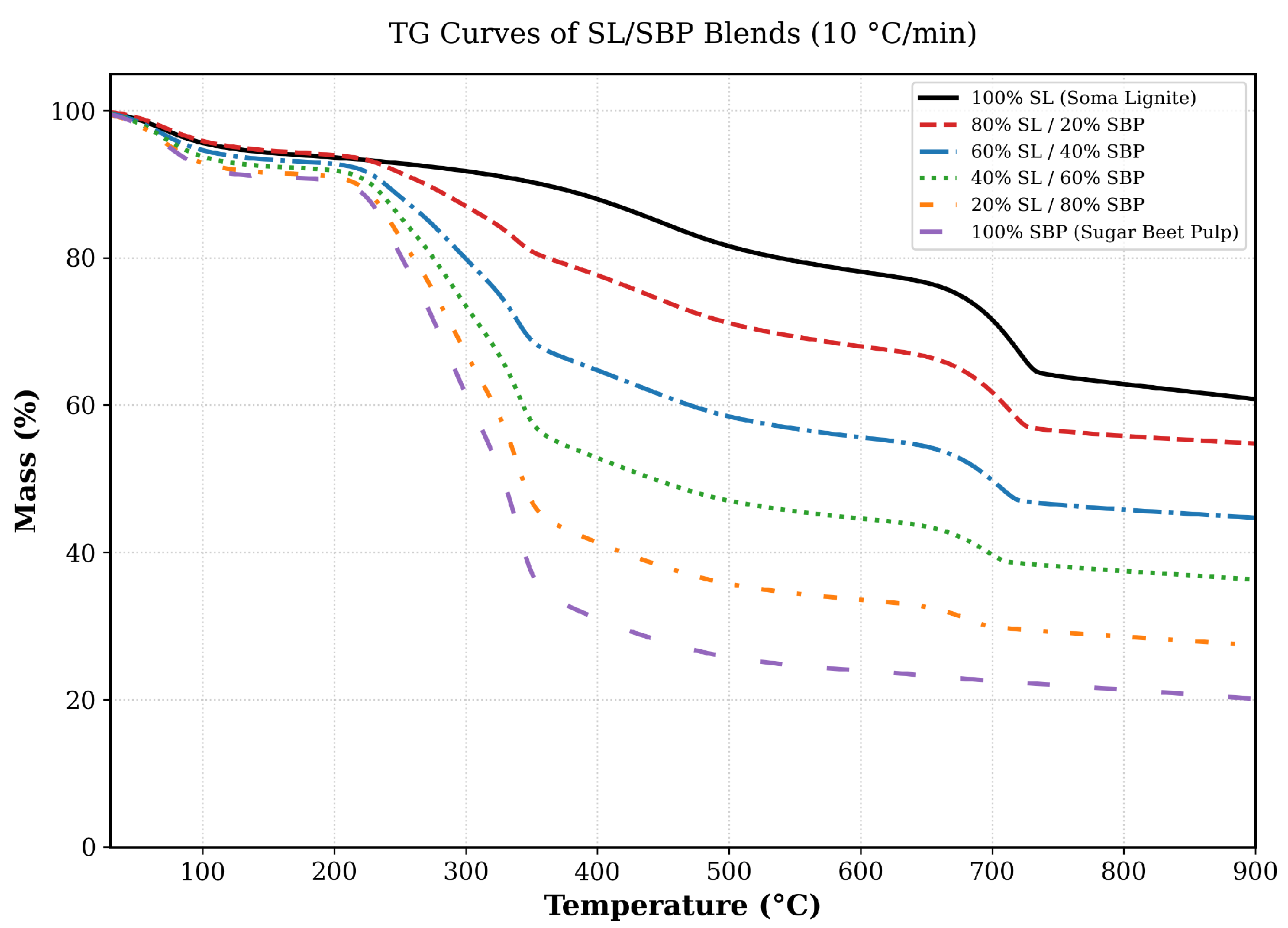
The TG curves obtained from the pyrolysis of pure SL, pure SBP, and the SL/SBP blends are illustrated in Figure 1. The thermograms exhibit distinct mass-loss profiles reflecting the variations in the thermal stability of the specific components and the blending ratios, consistent with other coal–biomass systems [2,12,27,28,29]. The decomposition process can be distinctly divided into three major regions: Region 1 (ambient to 200 °C) involves the evaporation of moisture and light volatiles; Region 2 (200–600 °C) corresponds to the main active pyrolysis stage where severe devolatilisation occurs; and Region 3 (600–900 °C) involves the secondary cracking of carbonaceous residues and the decomposition of inorganic mineral substances [5,25,26,41,42].
As expected, the highest mass losses occurred in Region 2 for all samples. SBP demonstrated a superior total mass loss of 79.92%, driven by its highly volatile organic composition (pectin, hemicellulose, and cellulose), compared to the low-rank SL, which retained a significant solid residue ( T C = 39.23%, R Y = 60.77%) [25,26]. Consequently, increasing the SBP blending ratio systematically increased the total conversion (TC) percentages (Figure 1 and Table 2), in agreement with trends reported for other lignite–biomass blends [29,43].
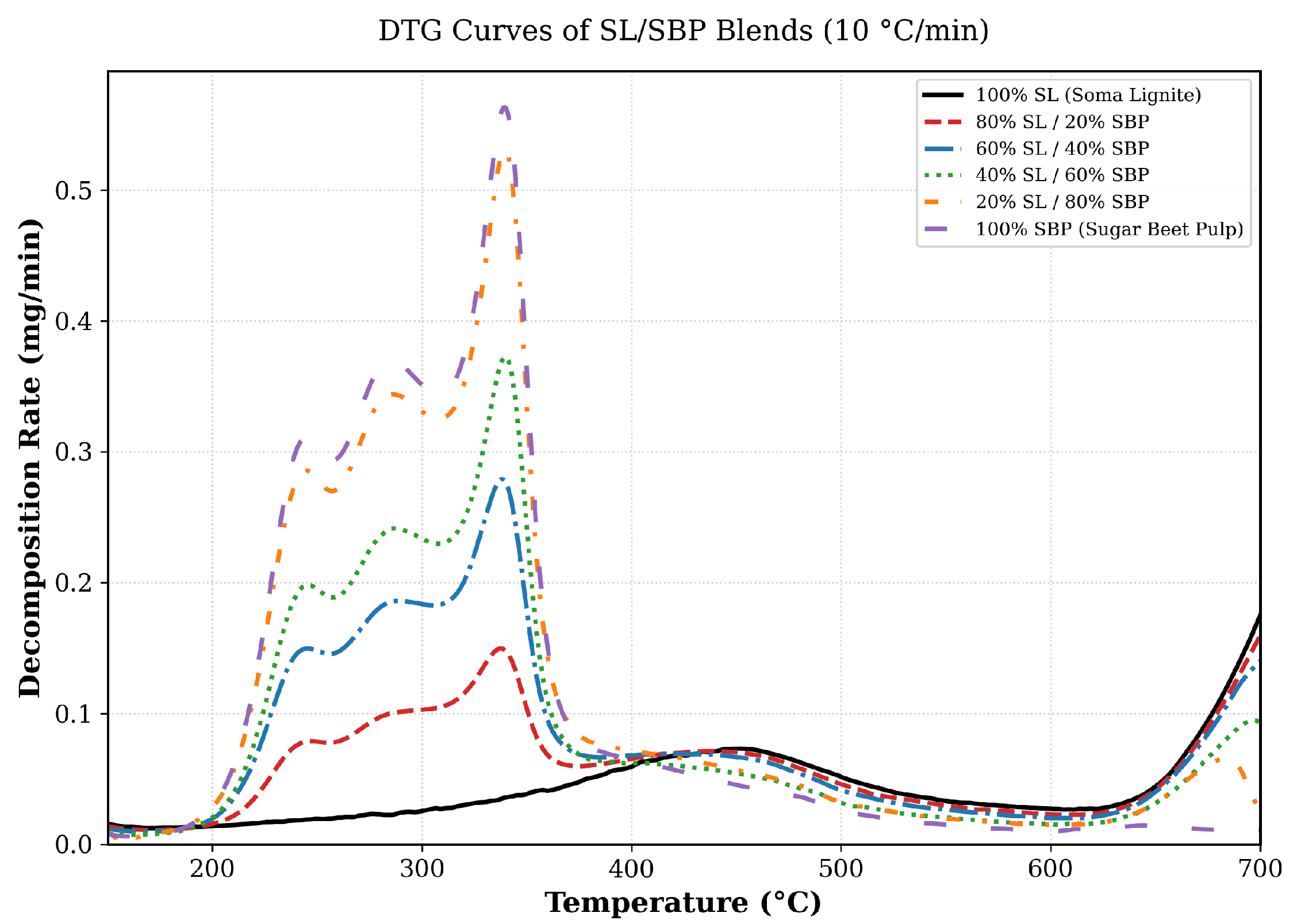
The DTG curves, displaying the maximum decomposition rates (MDR) and peak temperatures ( T max ), are presented in Figure 2. The peak height is directly proportional to the reactivity of the sample, while the peak temperature represents thermal resistance [44]. Pure SL exhibited a broad decomposition peak around 451 °C, whereas pure SBP decomposed sharply at 339 °C, typical of lignocellulosic biomass [25]. In the blends, the DTG peaks shifted, and the decomposition rates increased significantly from −0.07 mg/min (pure SL) to −0.53 mg/min (20/80 SL/SBP blend) in Region 2.
The thermal characteristic parameters in Table 3 clearly demonstrate a pronounced shift in the peak decomposition temperature ( T max ). Pure SL exhibited a T max of 451.47 °C, whereas even a minor addition of 20% SBP shifted the main peak abruptly into the 337–339 °C range, essentially matching the decomposition window of the pure SBP sample. This ∼112 °C reduction indicates that the rapidly decomposing holocellulosic fraction of SBP acts as a thermal trigger, forcing the coal matrix to devolatilize within the biomass-dominated temperature interval. In parallel, the maximum decomposition rate ( R max ) increased from 0.073 mg/min for pure SL to 0.564 mg/min for pure SBP, confirming that SBP incorporation substantially increases reactivity.

3.3. Independent Parallel Pseudo-Component DTG Deconvolution

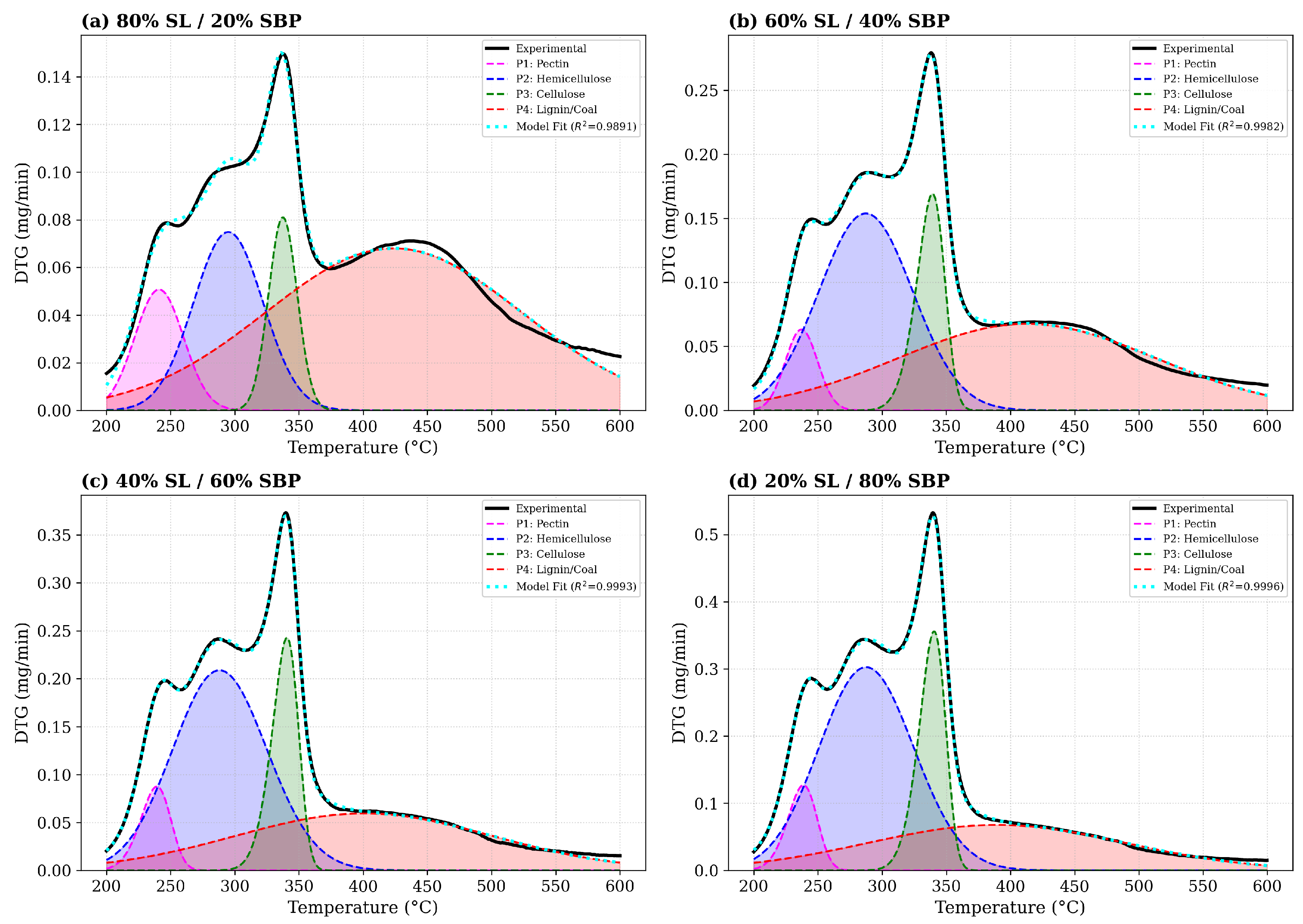
To gain deeper mechanistic insights into the overlapping decomposition steps observed in Figure 2, the DTG curves were deconvoluted into four independent pseudo-components (Figure 3). The derivative thermogravimetric profiles of SBP and its blends exhibit a composite devolatilisation peak where a distinct shoulder precedes the main decomposition stage. This early-stage reactivity, characteristic of pectin-rich agro-residues, aligns with the low-temperature pseudo-component identified in DTG deconvolution studies of sugar beet pulp and related sugar-industry residues [10,13] as well as other pectin-rich feedstocks such as mandarin peel [45]. The expansion of the low-temperature devolatilisation zone (<300 °C) in SBP-rich blends specifically reflects the rapid decomposition of the pectin–hemicellulose complex. This inherent reactivity is consistent with recent findings that targeted processing can markedly modify the degradation kinetics and functional structure of polysaccharide matrices [46], thereby influencing their thermal fingerprint. In the context of co-pyrolysis, such structural modifications are hypothesised to facilitate the early release of oxygenated volatiles, potentially acting as a bio-initiator that destabilises the rigid coal network before its intrinsic degradation temperature.
The four-component independent parallel reactions (IPRs) model reproduced the experimental DTG curves of SL–SBP blends with high accuracy ( R 2 0.989 ), confirming that the selected pseudo-components capture the main devolatilisation events (Table 4). The IPR parameters show that the combined area of the pectin and hemicellulose pseudo-components increases from 43.4% to 55.1% as the SBP fraction rises, while their peak temperatures remain in the low-temperature window (≈ 237–294 °C) with relatively broad widths, indicating an extended early devolatilisation stage. The threshold-dependent synergy observed in this study, particularly above 60 wt% SBP, is consistent with the DTG deconvolution results of Slezak et al. [10], who showed that the pectin–hemicellulose complex in sugar beet pulp dominates the low-temperature devolatilisation window (approximately 210–300 °C) and produces an intense release of oxygenated volatiles. Acting as a “bio-initiator” for subsequent cellulose and rigid coal breakdown, this early devolatilisation zone thoroughly explains the progressive increase in the hemicellulose pseudo-component area (from 37.95% to 48.68%) and the distinct downward shift of the lignin/coal peak temperature observed in the present work. Furthermore, this behaviour aligns with previous reports indicating that biomass-derived radicals and alkali/alkaline-earth metals promote coal devolatilisation and lower effective activation energies in the main pyrolysis zone [5,27,43,47].
In contrast, the lignin/coal pseudo-component (P4) retains a very broad high-temperature peak ( σ i 100 °C) but its relative area decreases markedly from 62.36% to 28.43% and its T p e a k shifts from about 424.1 to 389.1 °C as SBP content increases, quantitatively demonstrating the progressive suppression and downward shift of the heavy coal tail by reactive biomass volatiles. The cellulose peak (P3) remains confined near 348–349 °C with a narrow width ( σ i 16 °C) and a strongly negative asymmetry factor ( k i 2 ), reflecting a persistent low-temperature shoulder imposed by overlapping pectin/hemicellulose reactions and supporting a mechanistic picture in which biomass-derived radicals and hydrogen donors force coal conversion to occur within the biomass-dominated temperature window, in line with co-pyrolysis studies that attribute positive synergy to hydrogen-transfer and radical-quenching interactions between biomass and coal [5,27,43,47].
The robustness of the four-component independent parallel reaction (IPR) fits was validated not only by high coefficients of determination ( R 2 0.99 ) but also by a systematic sensitivity analysis of the optimization routine. Testing the stability of the solution against variations in initial guesses and parameter bounds revealed that within physically meaningful windows, peak areas and maximum degradation temperatures ( T p e a k ) remained consistent. This stability indicates that the deconvoluted peaks are not numerical artefacts of the Python SciPy optimization but are robustly aligned with literature-reported temperature domains for pectin, hemicellulose, cellulose, and lignin/low-rank coal fractions [10,25,26]. Regarding the 80/20 (SL/SBP) blend, a distinct deviation in the pseudo-component distribution was observed, specifically for the hemicellulose-associated peak (P2), which accounted for 19.66% of the area compared to 37.95% in the 60/40 blend. This anomaly, accompanied by the lowest fit quality ( R 2 = 0.9891 ) in the study, may be attributed to a ’thermal shielding’ effect exerted by the dominant lignite matrix (>80 wt%), which potentially hinders the uniform heat transfer to the dispersed biomass particles. Alternatively, this deviation might reflect a numerical limitation of the deconvolution algorithm in reaching a global minimum at this specific high-coal concentration, while this outlier represents a minor departure from the overall biomass-driven reactivity trend, it underscores the inherent sensitivity of mathematical deconvolution when applied to heterogeneous, coal-rich mixtures under non-replicated conditions.

3.4. Evaluation of Kinetic Results

The calculated kinetic parameters ( E a , A , T m ) using the first-order Arrhenius model are summarized in Table 5. In the main decomposition stage (Region 2), the apparent activation energy ( E a ) progressively increased with the addition of SBP, rising from 19.64 kJ/mol for pure SL to 66.87 kJ/mol for pure SBP. This progressive increase reflects the complex thermal breakdown of the distinct polysaccharide networks inherent in lignocellulosic biomass [48]. High coefficients of determination ( R 2 > 0.94 ) verified the excellent fit of the model.
It should be noted that the R 2 values for Region 2 in the intermediate blends (0.896–0.919) are slightly lower than those in Regions 1 and 3. This moderate fit confirms that a single first-order model provides a lumped macro-kinetic approximation, rather than fully capturing the complex, parallel decomposition pathways of lignin and early coal structures operating simultaneously in this window.
The progressive increase in apparent activation energy with increasing SBP content likely reflects the heterogeneous decomposition of distinct polysaccharide networks, combined with the resistance and mass-transfer constraints imposed by the coal pore structure [49]. In addition to these physical barriers, the catalytic role of alkali and alkaline-earth metals (AAEMs) present in the biomass ash may contribute to the observed macro-kinetic shifts, consistent with other lignocellulosic co-pyrolysis systems [5,41]. Within the context of the present screening study, these elevated E a values for SBP-rich blends suggest that the early-stage release of biomass volatiles must overcome the physical tortuosity of the surrounding lignite-rich matrix before significant synergistic acceleration can occur.
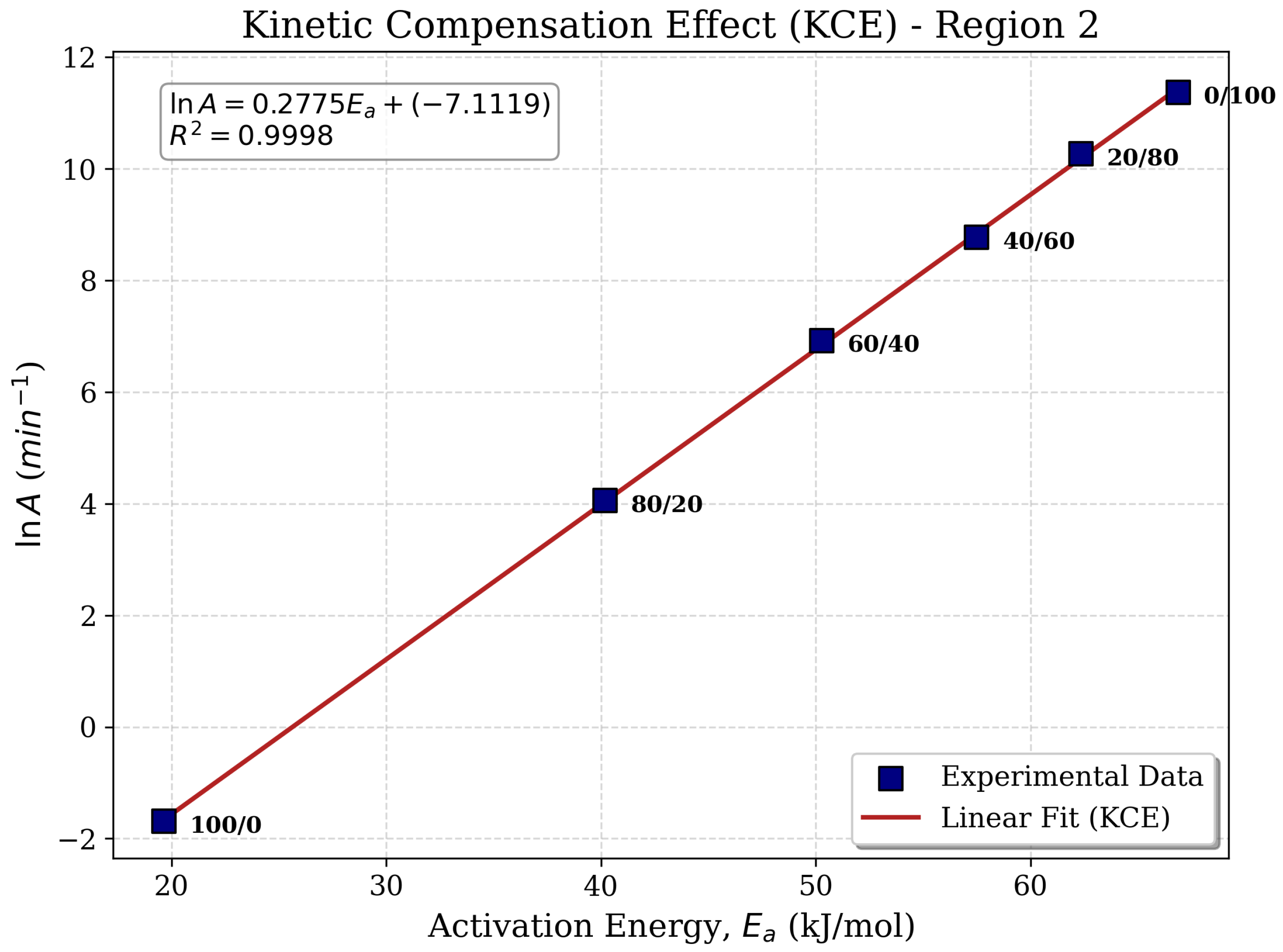
While the Arrhenius approach provides a macro-kinetic average for defined temperature zones, the order of magnitude of our calculated A values is highly consistent with those reported for sewage-sludge and biomass/coal systems [2,27]. This correlation is a well-documented mathematical artefact of single-heating-rate Arrhenius linearisation, known as the kinetic compensation effect (KCE), and does not necessarily imply a causal physical relationship between E a and A [31]. Nevertheless, the consistent trend across blending ratios indicates that the relative ranking of reactivities is preserved. For Region 2, the kinetic compensation plot (Figure 4) yielded the regression equation ln A = 0.2775 E a 7.1119 with an exceptionally high coefficient of determination ( R 2 = 0.9998 ), indicating an almost perfect linear relationship between E a and ln A across the SL/SBP blend series. Rather than describing a precise mechanistic law, these apparent Arrhenius parameters are interpreted as comparative benchmarks that facilitate mapping the synergistic threshold across six mixing ratios. This approach provides a practical basis for initial thermochemical process design by identifying relative shifts in reactivity ( R m ) and synergy ( Δ E ) across the full composition range, even when relying on single-heating-rate linearization for fundamental kinetic descriptions.
Such a near-ideal E a ln A correlation is in line with the kinetic compensation effect (KCE) reported for non-isothermal solid-state systems, but, as discussed in the literature, it may also partly reflect the mathematical structure of the Arrhenius linearisation and the statistical handling of the kinetic data rather than a purely mechanistic phenomenon [50,51]. In agreement with ICTAC guidelines, these single-heating-rate results should be viewed as preliminary kinetic descriptors rather than rigorous, mechanism-independent parameters.

3.5. Synergy and Reactivity Indices

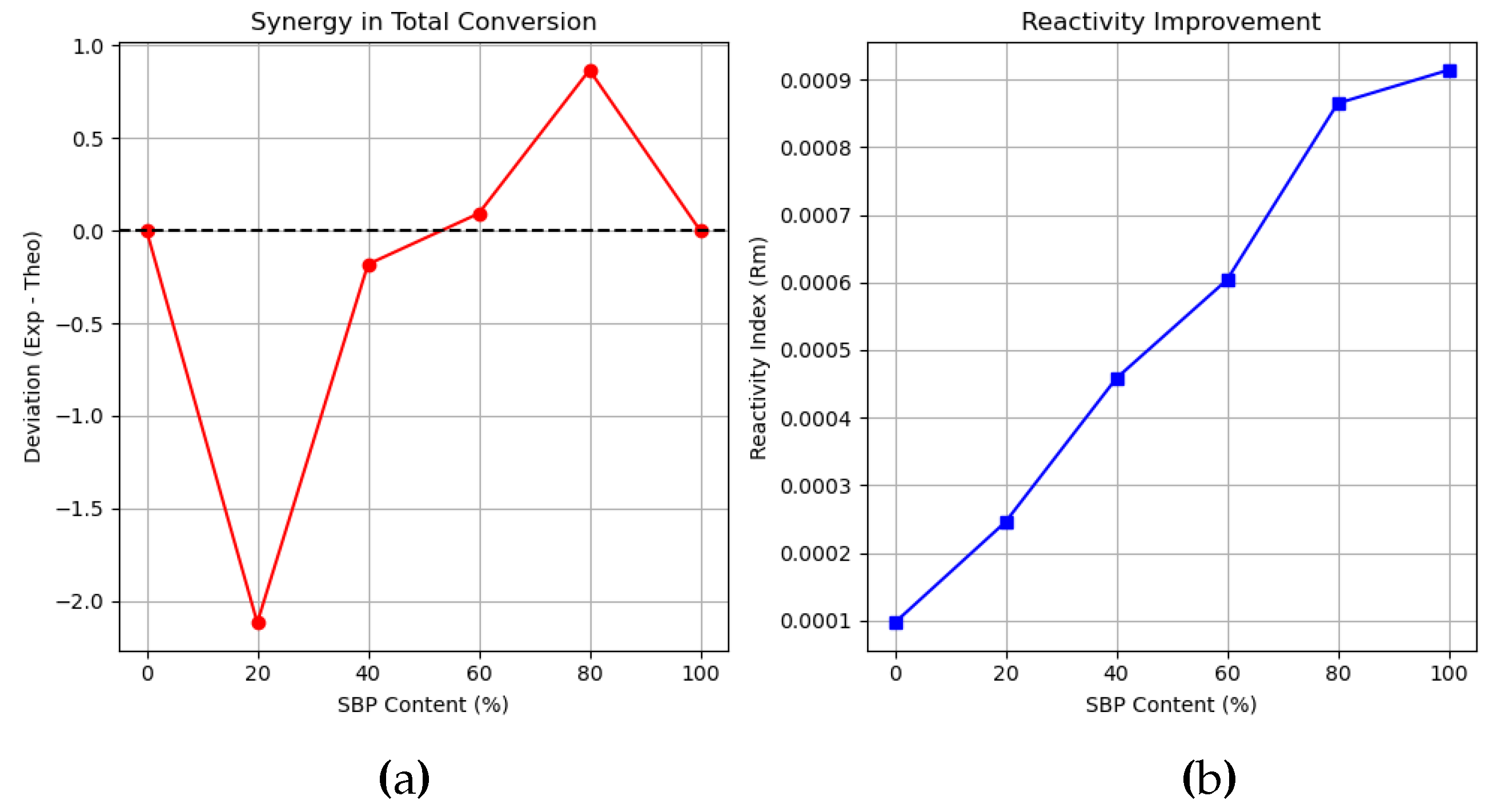
To thoroughly map the non-additive interactions, the synergistic deviations in total conversion ( Δ T C ), apparent activation energy ( Δ E ), and the Reactivity Index ( R m ) were calculated (Table 6). The Reactivity Index ( R m ) exhibited a pronounced 9-fold increase, rising from 0.97 for pure SL to 8.65 for the 20/80 blend. This substantial increase can be attributed to the high volatile content of the biomass and its inherent catalytic inorganic composition, which facilitates the cleavage of the macromolecular coal network at lower temperatures [41].
The magnitude and direction of the mass-loss synergy ( Δ T C ) indicate a tentative threshold-like transition in interaction behaviour, within the limitations of single, non-replicated thermograms (Figure 5). In SL-rich blends (80/20 and 60/40), negative synergy was observed. This inhibitory effect likely stems from the high ash content of SL (39.34%), which acts as a mass-transfer barrier, trapping the initially released biomass volatiles and promoting char deposition within the porous network [28].
A modest shift from slightly negative to slightly positive T C was observed around 60 wt% SBP, which we interpret as indicative—but not definitive—evidence of a synergy onset (+0.09% and +0.87% for 40/60 and 20/80 blends, respectively). Based on analogous coal–biomass co-pyrolysis studies, this transition is tentatively attributed to the increased availability of hypothesised hydrogen-donating species generated during SBP decomposition, which may stabilise coal-derived radicals and promote depolymerisation of the lignite matrix. See [5,27,42] for further discussion.
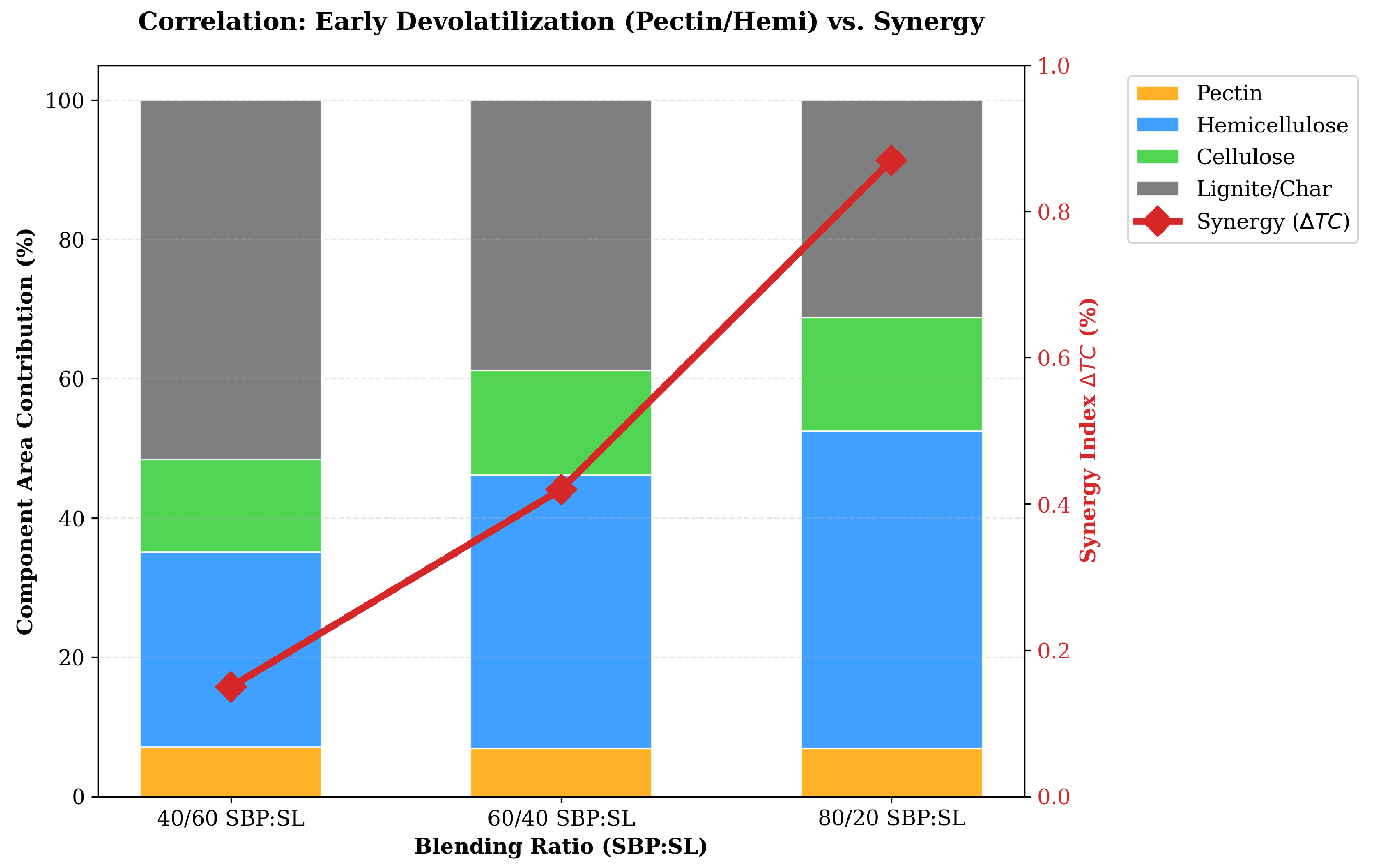
The quantitative distribution of pseudo-components, derived from the deconvolution analysis, provides a macro-kinetic rationale for this tentative threshold (Figure 6), while the relative area contribution of the pectin-rich domain varied between 5.42% and 9.23%, the hemicellulose-associated region showed a marked increase from 19.66% to 48.68% as the SBP content rose. This expansion of the low-temperature devolatilisation zone (<300 °C) correlates with the synergy index ( Δ T C ). Furthermore, the positive deviation in kinetic synergy ( Δ E ), peaking at +11.75 kJ/mol for the 60/40 blend, suggests the presence of potential secondary cross-linking reactions between oxygenated biomass volatiles and evolving coal char, although this interpretation remains hypothetical without direct evolved gas analysis.

3.6. Practical Implications for Co-Pyrolysis Process Design

The identification of a potential synergy transition (around 60 wt% SBP) may have practical implications for industrial-scale waste biorefineries and should be further validated with replicated, multi-rate experiments. While lignite-rich blends suggest heat-transfer limitations and inhibitory ash effects, SBP-rich mixtures may leverage biomass-derived radicals to enhance lignite devolatilisation. Therefore, to potentially maximise resource recovery and reaction efficiency, blending strategies could be guided by this critical biomass fraction while acknowledging the need for more rigorous statistical confirmation in future pilot-scale studies.

4. Conclusions

This study investigated the non-isothermal co-pyrolysis of Soma lignite (SL) and sugar beet pulp (SBP) to elucidate the synergistic interactions and kinetic behaviours of low-rank coal and pectin-rich agro-industrial biomass. The incorporation of SBP substantially altered the thermal decomposition profile of the lignite, shifting the maximum decomposition temperature ( T max ) from 451 °C down to approximately 339 °C and increasing the overall Reactivity Index ( R m ) by nearly nine-fold for the 20/80 (SL/SBP) blend.
A key outcome of this work is the observation of a threshold-like behaviour in the mass-loss synergy ( Δ T C ). Blends with higher coal ratios (≥60% SL) exhibited slight negative synergy, which can be attributed to physical mass-transfer limitations and char-trapping effects imposed by the high ash content of the lignite. In contrast, the onset of slightly positive synergy was detected once the SBP blending ratio approached 60% and above, suggesting that a sufficient concentration of biomass may be required to effectively assist the depolymerisation of the coal matrix under the present single-heating-rate, non-replicated TGA conditions.
The application of a four-component independent parallel reactions (IPRs) deconvolution model provided macro-kinetic insight for this synergistic threshold. The analysis revealed that the early-stage devolatilisation (<300 °C) is governed by a complex of pectin and hemicellulose, while the relative area contribution of the pectin-rich domain varied between 5.42% and 9.23%, the hemicellulose-associated region showed a marked increase (from 19.66% to 48.68%) as SBP content increased. This expansion of the low-temperature devolatilisation zone qualitatively correlated with the positive synergy index. The early release of oxygenated volatile species from this pectin–hemicellulose complex is hypothesised to act as an effective reactive component, which may promote hydrogen-transfer reactions and facilitate the breakdown of the rigid coal network before its intrinsic degradation temperature; however, this mechanistic interpretation remains tentative in the absence of direct product characterisation data (e.g., FTIR, Py-GC/MS).
Kinetic analysis using the first-order Arrhenius model indicated that SBP addition increases the apparent activation energy ( E a ), while the pre-exponential factor (A) rises in parallel. This E a A correlation is recognised as a mathematical artefact of single-heating-rate linearisation (kinetic compensation effect) and should not be interpreted as a causal mechanistic relationship; nonetheless, the consistent trend across blending ratios preserves the relative ranking of reactivities.
Several methodological limitations should be acknowledged regarding the kinetic interpretations. From a strict kinetic theory standpoint, the ICTAC recommends multi-rate isoconversional methods and discourages single-heating-rate model-fitting for extracting absolute kinetic triplets ( E a , A , f ( α ) ) [31,32]. In this study, the single 10 K min−1 program and the first-order reaction assumption were therefore employed intentionally as a pseudo-kinetic, comparative tool to map reactivity and synergy trends across the SL–SBP blends, while this macro-kinetic approach helped to identify a composition range where the synergy appears to change sign, the resulting apparent parameters should be regarded as comparative indices rather than absolute mechanistic constants. Future work should extend this framework with multi-rate analyses (e.g., 5, 10, and 20 K min−1), using FWO or KAS methods to obtain mechanism-independent activation-energy profiles. Additionally, the absence of experimental replicates and the reliance on reference data for SL characterisation should be noted as further constraints on the statistical confidence of the reported absolute values.
In conclusion, sugar beet pulp shows considerable promise not only as a co-fuel, but as a reactive component for upgrading low-rank lignites. Within the limitations discussed above, blending ratios in the range of 40/60 to 20/80 (SL/SBP) enhanced positive synergistic interactions, offering a promising, sustainable pathway for the thermochemical valorization of agricultural residues alongside domestic coal resources. Future studies incorporating multi-heating-rate kinetics, complementary product analysis (FTIR, Py-GC/MS), and pilot-scale validation are warranted to further test and refine the threshold-like behaviour proposed in this work.

Funding

This research received no external funding.

Data Availability Statement

The raw data will be made available by the author on request.

Acknowledgments

During the preparation of this manuscript, the author used Gemini 1.5 Flash for the purposes of language editing, structuring the academic flow and generating the graphical abstract. The author has reviewed and edited the output and take full responsibility for the content of this publication.

Conflicts of Interest

The author declares no conflicts of interest.

References

  1. Yogalakshmi, K.N.; Poornima Devi, T.; Sivashanmugam, P.; Kavitha, S.; Yukesh Kannah, R.; Varjani, S.; Adish Kumar, S.; Kumar, G.; Banu, R. Lignocellulosic biomass-based pyrolysis: A comprehensive review. Chemosphere 2022, 286, 131824. [Google Scholar] [CrossRef] [PubMed]
  2. Lin, Y.; Liao, Y.; Yu, Z.; Fang, S.; Lin, Y.; Fan, Y.; Peng, X.; Ma, X. Co-pyrolysis kinetics of sewage sludge and oil shale thermal decomposition using TGA–FTIR analysis. Energy Convers. Manag. 2016, 118, 345–352. [Google Scholar] [CrossRef]
  3. Melikoglu, M. Vision 2023: Status quo and future of biomass and coal for sustainable energy generation in Turkey. Renew. Sustain. Energy Rev. 2017, 74, 800–808. [Google Scholar] [CrossRef]
  4. Toklu, E. Biomass energy potential and utilization in Turkey. Renew. Energy 2017, 107, 235–244. [Google Scholar] [CrossRef]
  5. Liu, Y.; Song, Y.; Fu, J.; Ao, W.; Siyal, A.A.; Zhou, C.; Liu, C.; Yu, M.; Zhang, Y.; Dai, J.; et al. Co-pyrolysis of sewage sludge and lignocellulosic biomass: Synergistic effects on products characteristics and kinetics. Energy Convers. Manag. 2022, 268, 116061. [Google Scholar] [CrossRef]
  6. Gouws, S.M.; Carrier, M.; Bunt, J.R.; Neomagus, H.W.J.P. Co-pyrolysis of coal and raw/torrefied biomass: A review on chemistry, kinetics and implementation. Renew. Sustain. Energy Rev. 2021, 135, 110189. [Google Scholar] [CrossRef]
  7. Plakantonaki, S.; Zacharopoulos, N.; Christopoulos, M.; Kiskira, K.; Markou, G.; Tsakanika, L.A.; Priniotakis, G. Upcycling industrial peach waste to produce dissolving pulp. Environ. Sci. Pollut. Res. 2025, 32, 4636–4655. [Google Scholar] [CrossRef]
  8. Tursi, A. A review on biomass: Importance, chemistry, classification, and conversion. Biofuel Res. J. 2019, 6, 962–979. [Google Scholar] [CrossRef]
  9. Dahiya, S.; Kumar, A.N.; Shanthi Sravan, J.; Chatterjee, S.; Sarkar, O.; Venkata Mohan, S. Food waste biorefinery: Sustainable strategy for circular bioeconomy. Bioresour. Technol. 2018, 248, 2–12, Bioconversion of Food Wastes. [Google Scholar] [CrossRef]
  10. Slezak, R.; Krzystek, L.; Dziugan, P.; Ledakowicz, S. Co-Pyrolysis of Beet Pulp and Defecation Lime in TG–MS System. Energies 2020, 13, 2304. [Google Scholar] [CrossRef]
  11. Devrim, Y. Pyrolysis Kinetics of Blends of Yeni Çeltek Lignite and Sugar Beet Pulp. Energy Sources Part A Recover. Util. Environ. Eff. 2008, 30, 238–246. [Google Scholar] [CrossRef]
  12. Yılgın, M.; Deveci Duranay, N.; Pehlivan, D. Co-pyrolysis of lignite and sugar beet pulp. Energy Convers. Manag. 2010, 51, 1060–1064. [Google Scholar] [CrossRef]
  13. Aburto, J.; Moran, M.; Galano, A.; Torres-García, E. Non-isothermal pyrolysis of pectin: A thermochemical and kinetic approach. J. Anal. Appl. Pyrolysis 2015, 112, 94–104. [Google Scholar] [CrossRef]
  14. Ozbas, K.E. Combustion Characteristics of Raw and Cleaned Coals by Thermal Methods. Ph.D. Thesis, Middle East Technical University, Department of Mining Engineering, Ankara, Turkey, 2000. [Google Scholar]
  15. Ozbas, K.E.; Kök, M.V.; Hicyilmaz, C. DSC study of the combustion properties of Turkish coals. J. Therm. Anal. Calorim. 2003, 71, 849–856. [Google Scholar] [CrossRef]
  16. ASTM E1756-01; Standard Test Method for Determination of Total Solids in Biomass. ASTM International: West Conshohocken, PA, USA, 2001.
  17. ASTM E872-82; Standard Test Method for Volatile Matter in the Analysis of Particulate Wood Fuels. ASTM International: West Conshohocken, PA, USA, 2006.
  18. ASTM E1755-01; Standard Test Method for Ash in Biomass. ASTM International: West Conshohocken, PA, USA, 2007.
  19. Yap, P.L.; Farivar, F.; Jämting, Å.K.; Coleman, V.A.; Gnaniah, S.; Mansfield, E.; Pu, C.; Landi, S.M.; David, M.V.; Flahaut, E.; et al. International Interlaboratory Comparison of Thermogravimetric Analysis of Graphene-Related Two-Dimensional Materials. Anal. Chem. 2023, 95, 5176–5186. [Google Scholar] [CrossRef]
  20. Losic, D.; Farivar, F.; Yap, P.L. Refining and Validating Thermogravimetric Analysis (TGA) for Robust Characterization and Quality Assurance of Graphene-Related Two-Dimensional Materials. C 2024, 10, 30. [Google Scholar] [CrossRef]
  21. Bensharada, M.; Telford, R.; Stern, B.; Gaffney, V. Loss on ignition versus thermogravimetric analysis: A comparative study to determine organic matter and carbonate content in sediments. J. Paleolimnol. 2022, 67, 191–197. [Google Scholar] [CrossRef]
  22. Wang, X.y.; Wan, X.j.; Chen, M.q.; Wang, J. Kinetic Model of Biomass Pyrolysis Based on Three-component Independent Parallel First-order Reactions. Chin. J. Process Eng. 2012, 12, 1020–1024. [Google Scholar]
  23. Kim, H.; Yu, S.; Kim, M.; Ryu, C. Progressive deconvolution of biomass thermogram to derive lignocellulosic composition and pyrolysis kinetics for parallel reaction model. Energy 2022, 254, 124446. [Google Scholar] [CrossRef]
  24. Díez, D.; Urueña, A.; Piñero, R.; Barrio, A.; Tamminen, T. Determination of Hemicellulose, Cellulose, and Lignin Content in Different Types of Biomasses by Thermogravimetric Analysis and Pseudocomponent Kinetic Model (TGA-PKM Method). Processes 2020, 8, 1048. [Google Scholar] [CrossRef]
  25. Yang, H.; Yan, R.; Chen, H.; Lee, D.H.; Zheng, C. Characteristics of hemicellulose, cellulose and lignin pyrolysis. Fuel 2007, 86, 1781–1788. [Google Scholar] [CrossRef]
  26. Collard, F.X.; Blin, J. A review on pyrolysis of biomass constituents: Mechanisms and composition of the products obtained from the conversion of cellulose, hemicelluloses and lignin. Renew. Sustain. Energy Rev. 2014, 38, 594–608. [Google Scholar] [CrossRef]
  27. Wu, Z.; Zhang, J.; Zhang, B.; Guo, W.; Yang, G.; Yang, B. Synergistic effects from co-pyrolysis of lignocellulosic biomass main component with low-rank coal: Online and offline analysis on products distribution and kinetic characteristics. Appl. Energy 2020, 276, 115461. [Google Scholar] [CrossRef]
  28. Aboyade, A.O.; Görgens, J.F.; Carrier, M.; Meyer, E.L.; Knoetze, J.H. Thermogravimetric study of the pyrolysis characteristics and kinetics of coal blends with corn and sugarcane residues. Fuel Process. Technol. 2013, 106, 310–320. [Google Scholar] [CrossRef]
  29. Guo, F.; Li, X.; Wang, Y.; Liu, Y.; Li, T.; Guo, C. Characterization of Zhundong lignite and biomass co-pyrolysis in a thermogravimetric analyzer and a fixed bed reactor. Energy 2017, 141, 2154–2163. [Google Scholar] [CrossRef]
  30. Ozbas, K.E. Effect of particle size on pyrolysis characteristics of Elbistan lignite. J. Therm. Anal. Calorim. 2008, 93, 641–649. [Google Scholar] [CrossRef]
  31. Vyazovkin, S.; Burnham, A.K.; Criado, J.M.; Pérez-Maqueda, L.A.; Popescu, C.; Sbirrazzuoli, N. ICTAC Kinetics Committee recommendations for performing kinetic computations on thermal analysis data. Thermochim. Acta 2011, 520, 1–19. [Google Scholar] [CrossRef]
  32. Vyazovkin, S. ICTAC Kinetics Committee recommendations for analysis of multi-step kinetics. Thermochim. Acta 2020, 689, 178597. [Google Scholar] [CrossRef]
  33. Mahmood, H.; Shakeel, A.; Abdullah, A.; Khan, M.I.; Moniruzzaman, M. A Comparative Study on Suitability of Model-Free and Model-Fitting Kinetic Methods to Non-Isothermal Degradation of Lignocellulosic Materials. Polymers 2021, 13, 2504. [Google Scholar] [CrossRef]
  34. Richter, F.; Rein, G. The Role of Heat Transfer Limitations in Polymer Pyrolysis at the Microscale. Front. Mech. Eng. 2018, 4, 18. [Google Scholar] [CrossRef]
  35. White, J.E.; Catallo, W.J.; Legendre, B.L. Biomass pyrolysis kinetics: A comparative critical review with relevant agricultural residue case studies. J. Anal. Appl. Pyrolysis 2011, 91, 1–33. [Google Scholar] [CrossRef]
  36. Adiletta, G.; Brachi, P.; Riianova, E.; Crescitelli, S.; Cagnazzo, D.; Rosskopf, E.N.; Barletta, D.; Langella, A.; Poletto, M.; Stoller, M.; et al. A Simplified Biorefinery Concept for the Valorization of Sugar Beet Pulp: Ecofriendly Isolation of Pectin as a Step Preceding Torrefaction. Waste Biomass Valorization 2020, 11, 2721–2733. [Google Scholar] [CrossRef]
  37. Ozbas, K.E.; Ozboy Ozbas, O. Sugar beet pulp as biomass. Sugar Ind./Zuckerind. 2017, 142, 29–32. [Google Scholar] [CrossRef]
  38. Šereš, Z.; Gyura, J.; Filipović, N.; Śoronja-Simović, D. Application of decolorization on sugar beet pulp in bread production. Eur. Food Res. Technol. 2005, 221, 54–60. [Google Scholar] [CrossRef]
  39. Puri, L.; Hu, Y.; Naterer, G. Critical review of the role of ash content and composition in biomass pyrolysis. Front. Fuels 2024, 2, 1378361. [Google Scholar] [CrossRef]
  40. Wu, W.; Wang, Y.; Hu, X. Mass transfer driven pore engineering of activated carbon from the activation of biomass. Green Chem. 2026, 28, 3486–3511. [Google Scholar] [CrossRef]
  41. Wang, C.; Bi, H.; Lin, Q.; Jiang, X.; Jiang, C. Co-pyrolysis of sewage sludge and rice husk by TG–FTIR–MS: Pyrolysis behavior, kinetics, and condensable/non-condensable gases characteristics. Renew. Energy 2020, 160, 1048–1066. [Google Scholar] [CrossRef]
  42. Sun, H.; Bi, H.; Jiang, C.; Ni, Z.; Tian, J.; Zhou, W.; Qiu, Z.; Lin, Q. Experimental study of the co-pyrolysis of sewage sludge and wet waste via TG–FTIR–GC and artificial neural network model: Synergistic effect, pyrolysis kinetics and gas products. Renew. Energy 2022, 184, 1–14. [Google Scholar] [CrossRef]
  43. Wu, Z.; Li, Y.; Xu, D.; Meng, H. Co-pyrolysis of lignocellulosic biomass with low-quality coal: Optimal design and synergistic effect from gaseous products distribution. Fuel 2019, 236, 43–54. [Google Scholar] [CrossRef]
  44. Vamvuka, D.; Kakaras, E.; Kastanaki, E.; Grammelis, P. Pyrolysis characteristics and kinetics of biomass residuals mixtures with lignite. Fuel 2003, 82, 1949–1960. [Google Scholar] [CrossRef]
  45. Kim, Y.M.; Lee, H.W.; Lee, S.H.; Kim, S.S.; Park, S.H.; Jeon, J.K.; Kim, S.; Park, Y.K. Pyrolysis properties and kinetics of mandarin peel. Korean J. Chem. Eng. 2011, 28, 2012–2016. [Google Scholar] [CrossRef]
  46. Fu, J.; Fu, X.; Wang, P.; Fu, Y.; Chen, C. Ultrasonic degradation of Dendrobium officinale polysaccharide: Kinetics, structural modification, and its impact on wheat starch digestibility. Food Res. Int. 2026, 231, 118776. [Google Scholar] [CrossRef]
  47. Ding, X.; Yan, L.; Guo, C.; Jia, D.; Guo, N.; Wang, L. Synergistic Effects between Lignin, Cellulose and Coal in the Co-Pyrolysis Process of Coal and Cotton Stalk. Molecules 2023, 28, 5708. [Google Scholar] [CrossRef]
  48. Ptak, M.; Skowrońska, A.; Pińkowska, H.; Krzywonos, M. Sugar Beet Pulp in the Context of Developing the Concept of Circular Bioeconomy. Energies 2022, 15, 175. [Google Scholar] [CrossRef]
  49. Wu, K.; Li, S.; Zhang, H.; You, B.; Ma, H.; Li, B.; Chen, Y.; Wang, F. Initial Characteristics of Gas Desorption in High-Rank Soft and Hard Coals and the Causes of the Differences. ACS Omega 2025, 10, 33208–33219. [Google Scholar] [CrossRef]
  50. Barrie, P.J. The mathematical origins of the kinetic compensation effect: 1. the effect of random experimental errors. Phys. Chem. Chem. Phys. 2012, 14, 318–326. [Google Scholar] [CrossRef]
  51. Mianowski, A.; Radko, T.; Siudyga, T. Kinetic compensation effect of isoconversional methods. React. Kinet. Mech. Catal. 2021, 132, 37–58. [Google Scholar] [CrossRef]
Figure 1. Thermogravimetric (TG) curves of pure Soma lignite (SL), pure sugar beet pulp (SBP), and their blends at a heating rate of 10 °C/min.
Processes 14 01184 g001
Figure 2. Derivative thermogravimetric (DTG) profiles of SL, SBP, and SL/SBP blends. The curves illustrate the progressive increase in the maximum decomposition rate and the pronounced shift of the main devolatilisation peak towards the lower-temperature biomass regime.
Processes 14 01184 g002
Figure 3. DTG deconvolution of the SL/SBP blends at 80/20 (a), 60/40 (b), 40/60 (c), and 20/80 (d) mass ratios within the 200–600 °C interval. Experimental DTG curves (solid black lines); pectin-, hemicellulose-, cellulose-, and lignin/coal-dominated pseudo-components (coloured dashed lines with shaded areas); and the cumulative fitted curve (dotted cyan line) along with the coefficient of determination R 2 .
Processes 14 01184 g003
Figure 4. Kinetic compensation effect (KCE) plot showing the relationship between activation energy ( E a ) and pre-exponential factor ( ln A ) for the main pyrolysis stage (Region 2) of SL, SBP, and their blends. The near-perfect linear correlation ( R 2 = 0.9998 ) indicates a consistent macro-kinetic behaviour across all blending ratios, following the established KCE relationship: ln A = a E a + b .
Processes 14 01184 g004
Figure 5. Synergistic behaviour and reactivity of SL/SBP blends in Region 2: (a) deviation in total conversion, Δ T C , indicating a tentative change from slightly negative synergy in coal-rich mixtures (80/20 and 60/40) to small positive values at SBP contents ≥ 60%; (b) Reactivity Index, R m , as a function of SBP content, illustrating the nearly monotonic increase in overall pyrolysis reactivity and the maximum at the 20/80 blend.
Processes 14 01184 g005
Figure 6. Evolution of pseudo-component contributions and their mechanistic role in driving co-pyrolysis synergy.
Processes 14 01184 g006
Table 1. Proximate and ultimate analyses of the Soma lignite (SL) and sugar beet pulp (SBP) samples.
Proximate Analysis (%)
(Air Dried Basis)
SL [14]SBP
Moisture4.476.72
Volatile matter36.2673.20
Ash39.345.01
Fixed carbon19.9315.07
Ultimate analysis (%)
(air dried basis)
Carbon32.8040.39
Hydrogen2.205.65
Sulphur0.570.00
Nitrogen0.791.37
Oxygen (by difference)19.8340.86
Table 2. Evolution of the maximum decomposition rate (MDR), total conversion (TC), and solid residue yield (RY) as a function of the SBP blending ratio during non-isothermal co-pyrolysis 1.
Blending Ratio
SL/SBP (%/%)
Region 1 MDR
(mg/min)
Region 2 MDR
(mg/min)
Region 3 MDR
(mg/min)
TC
(%)
RY
(%)
100/0 0.06 0.07 0.24 39.2360.77
80/20 0.06 0.15 0.18 45.4554.55
60/40 0.08 0.28 0.15 55.3344.67
40/60 0.08 0.37 0.09 63.7436.26
20/80 0.10 0.53 0.07 72.6527.35
0/100 0.10 0.56 0.01 79.9220.08
1 SL: Soma lignite, SBP: sugar beet pulp.
Table 3. Peak decomposition temperature T max and maximum decomposition rate R max in the main devolatilisation region (Region 2) for pure SL, pure SBP, and SL/SBP blends, illustrating the pronounced shift of T max towards the SBP-dominated temperature window and the systematic increase in reactivity with increasing SBP content.
Sample Content (SL/SBP, %/%) T max (°C) R max (mg/min)
100/0451.470.073
80/20337.560.150
60/40338.190.279
40/60339.670.373
20/80339.580.532
0/100339.380.564
Table 4. Deconvolution parameters of the DTG curves for the SL/SBP blends based on an asymmetric four-pseudo-component model (pectin, hemicellulose, cellulose, and lignin/coal) within the main co-pyrolysis region (200–600 °C).
Blend (SL/SBP)ComponentArea (%) T peak (°C) σ i (°C)Skewness (k) R 2
80/20P1 (Pectin)9.23241.019.0 0.006 0.9891
P2 (Hemicellulose)19.66294.427.1 0.027
P3 (Cellulose)8.76337.511.1 0.001
P4 (Lignin/Coal)62.36424.199.5 0.003
60/40P1 (Pectin)5.42237.212.60.0020.9982
P2 (Hemicellulose)37.95287.036.50.010
P3 (Cellulose)12.73347.916.4−2.007
P4 (Lignin/Coal)43.91412.8100.00.000
40/60P1 (Pectin)6.16248.416.7−1.6320.9993
P2 (Hemicellulose)45.11272.840.00.574
P3 (Cellulose)15.04348.915.7−2.068
P4 (Lignin/Coal)33.69400.5100.00.000
20/80P1 (Pectin)6.46247.215.8−1.4870.9996
P2 (Hemicellulose)48.68272.640.00.555
P3 (Cellulose)16.43348.815.8−2.071
P4 (Lignin/Coal)28.43389.1100.00.000
Table 5. Calculated kinetic parameters, temperature ( T m ) at the maximum decomposition rate, and linear regression coefficients ( R 2 ) for non-isothermal pyrolysis of SL, SBP, and SL/SBP blends for each region 1.
BlendingRegion 1 (Ambient–200 °C)Region 2 (200–600 °C)Region 3 (600–900 °C)
Ratios
SL/SBP (%/%)
E a
(kJ/mol)
A
(1/min)
T m
(°C)
R 2 E a
(kJ/mol)
A
(1/min)
T m
(°C)
R 2 E a
(kJ/mol)
A
(1/min)
T m
(°C)
R 2
100/032.67 6.70 × 10 2 70.910.979419.64 1.84 × 10 1 451.470.9617175.13 5.13 × 10 7 720.030.9712
80/2036.16 2.14 × 10 3 74.250.970040.19 5.76 × 10 1 337.560.9188175.22 5.67 × 10 7 713.020.9723
60/4033.47 1.19 × 10 3 68.990.975250.28 1.01 × 10 3 338.190.8987173.76 5.41 × 10 7 706.020.9677
40/6035.39 2.36 × 10 3 71.180.981557.49 6.43 × 10 3 339.670.8960188.00 3.15 × 10 8 697.510.9837
20/8035.49 3.20 × 10 3 70.160.979562.34 2.87 × 10 4 339.580.8978174.44 7.07 × 10 7 684.070.9781
0/10038.69 1.57 × 10 2 71.220.981566.87 8.64 × 10 4 339.380.913161.53 1.81 × 10 1 644.080.9534
1 SL: Soma lignite, SBP: sugar beet pulp, A: pre-exponential factor, Ea: apparent activation energy, Tm: absolute temperature, R2: coefficient of determination.
Table 6. Synergy in total conversion ( Δ T C ), kinetic synergy ( Δ E ), and Reactivity Index ( R m ) of SL/SBP blends in Region 2.
Blending Ratio (SL/SBP) TC Reg . 2 (%) Δ TC (%) Δ E (kJ/mol) R m × 10 4 (s−1 K−1)
100/039.230.000.000.97
80/2045.45 1.92 + 11.10 2.46
60/4055.33 0.18 + 11.75 4.58
40/6063.74 + 0.09 + 9.51 6.04
20/8072.65 + 0.87 + 4.92 8.65
0/10079.920.000.009.82
Disclaimer/Publisher’s Note: The statements, opinions and data contained in all publications are solely those of the individual author(s) and contributor(s) and not of MDPI and/or the editor(s). MDPI and/or the editor(s) disclaim responsibility for any injury to people or property resulting from any ideas, methods, instructions or products referred to in the content.