Article

Reliability Research of Natural Gas Pipeline Units Based on Mechanistic Modeling

1
College of Mechanical and Transportation Engineering, China University of Petroleum-Beijing, Beijing 102249, China
2
School of Petroleum Engineering, Chongqing University of Science and Technology, Chongqing 401331, China
3
School of Safety Science and Engineering, Chongqing University of Science and Technology, Chongqing 401331, China
4
PipeChina Oil & Gas Control Center, Dongtucheng Road, Chaoyang District, Beijing 100013, China
*
Authors to whom correspondence should be addressed.
Processes 2026, 14(7), 1183; https://doi.org/10.3390/pr14071183
Submission received: 7 March 2026 / Revised: 31 March 2026 / Accepted: 1 April 2026 / Published: 7 April 2026
(This article belongs to the Section Petroleum and Low-Carbon Energy Process Engineering)

Abstract

Due to long-term burial underground, oil and gas pipelines are susceptible to external surface corrosion influenced by time and soil conditions, which can lead to leakage and burst failures. Pipeline failure not only results in significant economic losses but also has catastrophic impacts on human safety and the environment. Therefore, modeling and analyzing the corrosion failure of these pipelines is of critical practical importance to ensure their safe operation during service. Addressing the insufficient research on correlation effects in current reliability evaluations of corroded pipelines, this paper proposes a calculation method for the failure probability of corroded oil and gas pipelines that considers the influence of two-layer correlations. Taking a specific segment of the Shaanxi–Beijing pipeline as a case study, the Monte Carlo sampling algorithm is employed to calculate the impact of two-layer correlations and the quantity of defect on the pipeline’s failure probability. Furthermore, a sensitivity analysis of the correlation coefficients is conducted. The results indicate that the influence of defect correlation on pipeline failure probability is significantly more pronounced than that of random variable correlation. The probabilities of pinhole leakage and burst failure decrease as the correlation coefficient between defects increases, while they increase with the number of defects. Random variable correlation exhibits no impact on pinhole leakage probability; however, the burst failure probability decreases with an increasing correlation coefficient between wall thickness and pipe diameter, but increases as the correlation between initial defect length and depth grows. Furthermore, the correlation coefficient between axial and radial defect growth rates exerts a bidirectional effect on burst failure probability: during the first 25 years of the prediction period, the failure probability increases with the correlation coefficient, whereas it subsequently decreases after approximately 25 years. These findings are applicable to the reliability evaluation of oil and gas pipelines containing multiple corrosion defects, providing valuable technical references for ensuring safe operation and the steady supply of energy resources.

1. Introduction

With the continuous development of the economy, China’s demand for fossil energy continues to rise. However, due to the limitations of its distribution, the long-distance transportation of fossil energy has become a serious problem. In this context, pipelines have become the primary means of transporting oil and natural gas due to their advantages of large transportation capacity, low cost, and high efficiency [1]. The oil and gas pipeline network is a critical infrastructure for implementing national strategies such as the “Belt and Road Initiative” and the energy revolution, and it constitutes an essential part of China’s modern energy and transportation systems [2]. Like other engineering structures, oil and gas pipelines deteriorate over time. For buried metal pipelines, corrosion is the primary cause of such degradation [3].
To improve the safe operation capacity of pipelines, scholars both domestically and internationally have conducted extensive research on the reliability of corroded pipelines [4,5,6,7]. A structural reliability assessment is an effective method for evaluating the extent of pipeline integrity damage caused by corrosion, incorporating uncertainties involved in production and operation through probabilistic methods. Structural reliability analysis of corroded pipelines is typically based on the limit state functions of pipelines with defects. By establishing growth models for corrosion defect and employing methods such as Monte Carlo simulation, the failure probability of the pipeline is calculated to evaluate its reliability throughout its entire life cycle [8,9,10,11,12,13,14].
Due to factors related to design, manufacturing, and operating conditions, the structural parameters of the pipeline and the dimensional parameters of defect are inter-correlated, and the growth of multiple corrosion defect is interdependent, exhibiting a certain degree of correlation in a statistical sense [15,16,17,18]. Zhang et al. [19] studied the impact of correlation between dimensional parameters of a single defect on the reliability of corroded pipelines but did not consider the correlation in the growth process of multiple corrosion defects. Li [20] investigated the correlation between defect as a probabilistic intersection, and proposed a probability calculation method, yet failed to simulate the physical process of the dependent growth of multiple corrosion defects. Furthermore, failure data directly reflect the degradation of the pipeline structure to critical values and contain valuable information regarding pipeline integrity. To accurately reflect the safety level of corroded pipelines, parameter uncertainties, variable correlations, and failure data involved in reliability assessment should all be taken into account. However, in the reliability evaluation of corroded natural gas pipelines, no existing literature has comprehensively considered the impact of multi-level and multi-type correlations on reliability assessment, nor has the role of failure data in updating reliability evaluation results been recognized.

2. Failure Probability Model for Corroded Pipelines

The evaluation of failure probability for pipeline systems plays a vital role in optimizing their operation. To prevent pipeline failures caused by continuous defect growth, it is essential to consider the actual defect conditions of the pipeline system and assess its reliability over a specific period. This problem can be categorized as a typical prediction task: utilizing limited data collected during specific pipeline operation periods to predict the time required for the system to reach its limit state, and on this basis, evaluate the reliability of the pipeline or individual pipeline units.

2.1. Limit State Equations and Burst Pressure Models

Corresponding to the two failure modes—pinhole leakage and burst—corrosion defects possess two distinct limit states. A pipeline limit state occurs when the defect depth, treated as a stochastic variable, exceeds a predetermined threshold, or when the burst pressure (also a stochastic variable) reaches an unacceptable level. The two limit states for metal-loss corrosion defects are expressed in Equation (1):
Y ( t ) = k w t d ( t ) P b ( t ) P o p
where k is the safety factor, assigned a value of 0.8 according to references [21,22]; w t represents the pipeline wall thickness; t is the time elapsed since the most recent in-line inspection; d ( t ) denotes the maximum depth of the corrosion defect at time t ; P b ( t ) is the burst pressure of the corrosion defect at time t ; and P o p is the operating pressure of the pipeline.
Among the existing calculation criteria for the burst pressure of corroded pipelines, the PRORRC model [23] proposed by Leis and Stephens is adopted. The burst pressure defined in PRORRC at a given time is calculated as follows:
P b ( t ) = χ 2 w t σ u D 1 d ( t ) w t 1 exp 0.157 l ( t ) D ( w t d ( t ) ) 2
where χ is the model error; σ u is the ultimate tensile strength; D is the pipeline diameter; l ( t ) is the length of the corrosion defect at time t .
Therefore, for a given corrosion defect, the limit state equations g 1 ( t ) and g 2 ( t ) corresponding to pinhole leakage failure and burst failure at time t are respectively:
g 1 ( t ) = 0.8 w t d ( t )
g 2 ( t ) = χ 2 w t σ u D 1 d ( t ) w t 1 exp 0.157 l ( t ) D ( w t d ( t ) ) 2 P o p
g 1 ( t ) describes the failure state when a corrosion defect penetrates the pipe wall, whereas g 1 ( t ) 0 represents the occurrence of pinhole leakage. g 2 ( t ) describes the failure state when the pipeline undergoes plastic collapse at the defect site due to internal pressure before the defect penetrates the wall, where g 2 ( t ) 0 represents the occurrence of burst failure. Pinhole leakage and burst failures at a given corrosion defect are considered mutually exclusive events. If a burst occurs first, it implies the defect is sufficiently long to reach the burst limit state before wall penetration. Conversely, if a pinhole leakage occurs first, it can be detected and repaired in time without violating the burst failure criterion [24].

2.2. Corrosion Defect Growth Model

The prediction of corrosion defect growth plays a crucial role in pipeline integrity management. Accurately estimating the corrosion growth rate is key to predicting pipeline failure probability, determining in-line inspection intervals, and making maintenance decisions. On one hand, overestimating the corrosion growth rate leads to unnecessary inspections and maintenance, thereby increasing management costs. On the other hand, underestimating the growth rate may lead to pipeline failure, resulting in severe consequences.
The length and depth of corrosion defect grow over time, and these dimensions depend on the corrosion rate; therefore, the failure probability of a corroded pipeline is time-dependent. Corrosion growth models reported in the literature can be classified into deterministic and probabilistic models, with the latter including random variable models and stochastic process models. Common deterministic models include constant, linear, and non-linear corrosion growth models. Frequently used probabilistic models for describing corrosion growth include Markov models, Gamma process models, and drifted Brownian motion models. This paper adopts a linear model to describe the growth of corrosion defects [25,26]. Thus, the defect depth and length at a given time t are respectively:
d ( t ) = d 0 + t ν d
l ( t ) = l 0 + t v l
where d 0 is the initial maximum defect depth; l 0 is the initial defect length; ν d and v l represent the radial and axial growth rates of the defect, respectively.

2.3. Monte Carlo Sampling and Failure Probability of Corrosion Defect

Monte Carlo sampling [27] is a stochastic simulation method, also known as the random sampling technique or statistical method, whose fundamental ideology is based on the Law of Large Numbers and the Central Limit Theorem. The basic principle is as follows: generate a corresponding set of random numbers according to the distribution form of Xi(i = 1,2,⋯,n) and then substitute them into the limit state function G(X1,X2,⋯,Xn). After cycling M times, when M is sufficiently large, the frequency will approach the probability according to the Law of Large Numbers, thereby obtaining the failure probability.
Assume the probability space for an arbitrary-dimensional unconstrained probability problem is P ( X ) , and construct another statistic f ( X ) such that its mathematical expectation is:
E f ( X ) = f ( X ) d P ( X )
and assume that true value A satisfies:
A = E [ f ( X ) ]
Then, random numbers are generated through a random number generator to perform random sampling on the random variable X. By substituting the sample X i obtained from each sampling into the sample space f ( X i ) , the statistical estimate A after N times of sampling is:
A = i = 1 N f ( X i ) N
The estimated value is the average of the sample space after N times of random sampling. According to the Law of Large Numbers, when N approaches infinity, the result of an unconstrained infinite Monte Carlo simulation will infinitely approach 1, i.e., P lim N A = A = 1 .
Based on the mutually exclusive nature of the limit state equations g 1 ( t ) and g 2 ( t ) , for a single corrosion defect at a given time t , the calculation formulas for the pinhole leakage failure probability P s l ( t ) and burst failure probability P b u ( t ) are as follows:
P s l ( t ) = Prob ( g 1 ( t ) 0 ) ( g 2 ( t ) > 0 )
P b u ( t ) = Prob ( g 1 ( t ) > 0 ) ( g 2 ( t ) 0 )
Here, denotes a joint event; Prob E represents the probability of event E occurring. The parameters involved in the limit state equations are all uncertain and must be modeled using random variables or stochastic processes. Due to the time-dependent nature of defect growth and operating pressure, both limit state equations are time-dependent. For simplification, the time-dependency of the pipeline operating pressure is neglected. In this paper, all parameters in the two limit state functions are treated as random variables, and their probabilistic characteristics are obtained based on online inspection data.
Therefore, the total failure probability P f is the sum of the probabilities of pinhole leakage and rupture failure:
P f ( t ) = P s l ( t ) + P b u ( t )
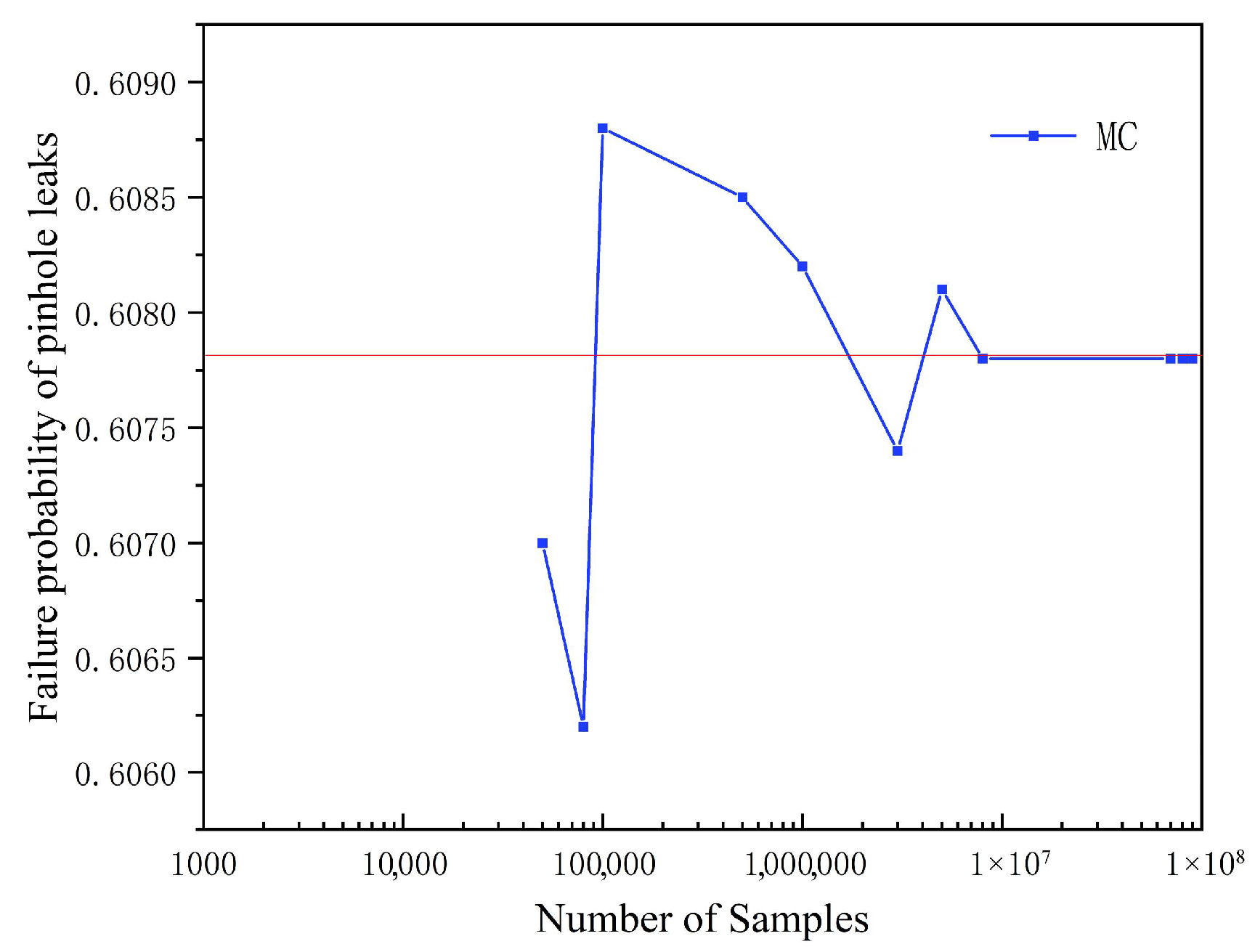
Monte Carlo sampling techniques are employed to conduct reliability assessments on pipeline segments containing n corrosion defects. By generating n-correlated samples of annual defect depth growth through year-by-year simulation, the correlation in the growth process of multiple corrosion defect can be simulated. Figure 1 shows the flowchart for calculating the failure probability of the pipeline segment. The influence of sample scale on simulation precision was evaluated to verify the robustness of the Monte Carlo approach. As demonstrated in Figure 2, the failure probability stabilizes and the relative error diminishes markedly when the sample size reaches 107. Therefore, 108 iterations were employed as the benchmark for final calculations to mitigate stochastic noise and ensure the statistical validity of the findings.
Here, P s l , p i p e , P b u , p i p e , and P f , p i p e represent the pinhole leakage failure probability, rupture failure probability, and total failure probability of the pipeline, respectively.

3. Two-Layer Correlation Model for Corroded Pipelines

The two-layer correlation of corroded pipelines comprehensively considers random variable correlation and corrosion defect correlation at two distinct levels. The first layer involves the sampling of correlated random variables; specifically, Copula functions are utilized to generate random numbers with a specified number of designated correlation coefficients. Subsequently, an inverse transformation is performed to obtain correlated random variable samples, which are then incorporated into the limit state equations to determine the failure probability of an individual corrosion defect. The second layer involves calculating the failure probability of the corroded pipeline as a series system while accounting for defect correlation. The proposed method enables the calculation of failure probability for pipelines containing multiple corrosion defects.

3.1. Random Variable Correlation

The random variables for the basic parameters of an individual corrosion defect may be partially correlated or independent. By introducing Copula functions into random sampling, correlated random variable samples can be generated. A Copula function is a joint distribution function containing n ( n 2 ) standard uniform distribution variables U i ( i = 1 , , n ) :
C ( u 1 , u 2 , , u n ) = P ( U 1 u 1 , U 2 u 2 , , U n u n )
Here, C ( u 1 , u 2 , , u n ) is the Copula function, u i is the value of U i , and the n-dimensional probability distribution function F ( x 1 , x 2 , , x n ) can be expressed using the Copula function as follows:
C ( F 1 ( x 1 ) , F 2 ( x 2 ) , , F n ( x n ) ) = F ( x 1 , x 2 , , x n )
where F i ( x i )   ( i = 1 , , n ) represents the marginal probability distribution functions of F ( x 1 , x 2 , , x n ) , and C ( F 1 ( x 1 ) , F 2 ( x 2 ) , , F n ( x n ) ) is an n-variate distribution function with marginal distribution functions F i ( x i ) . Copula functions encompass various categories with different dependency characteristics. In this paper, the Gaussian Copula function defined in Equation (15) is selected to describe the correlation between the random variables of the basic parameters of corrosion defect.
C ( u 1 , u 2 , u n ) = Φ n ( Φ 1 ( u 1 ) , Φ 1 ( u 2 ) , , Φ 1 ( u n ) ; R )
Φ n ( ; R ) denotes the n-dimensional standard normal distribution function with a correlation coefficient matrix R ( n × n ) , while Φ 1 ( ) is the inverse of the standard normal distribution function. The off-diagonal elements r i j ( i , j = 1 , 2 , , n ,   i j ) of matrix R represent the Pearson linear correlation coefficients between Φ 1 ( u i ) and Φ 1 ( u j ) . Consequently, the Gaussian Copula function is fully defined once the correlation coefficient matrix R is known. Simulating the dependency structure of multivariate random variables using the Gaussian Copula function is highly convenient. For the numerical example in this paper, the specific application procedure is as follows: (1) obtain the probabilistic statistical characteristics of the basic defect parameters through online inspection data, and determine the probability distributions and correlation coefficients of the random variables for these parameters. (2) Generate sample u 1 , u 2 , u n from the Gaussian Copula function C ( u 1 , u 2 , u n ) . (3) Calculate the samples x i = F i 1 ( u i )   i = 1 , 2 , , n for the basic parameters X i of the corrosion defect.

3.2. Correlation of Defect

In engineering practice, a single pipeline or a specific pipeline segment often contains multiple corrosion defects. According to the classical methods of structural reliability theory, representing the system simply as a series system—where the overall system reliability is expressed as the product of the non-failure probabilities of all individual units—makes it impossible to establish a high-reliability corrosion pipeline system. To address this issue, this section considers the impact of correlation between defects on system failure probability. Combining the definitions of small leak and rupture limit states, the failure probability of a pipeline segment with n-correlated corrosion defect can be expressed as:
p s l ( t ) = Prob j = 1 n E s l , j = Prob j = 1 n ( g 1 , j ( t ) 0 ) ( g 2 , j ( t ) > 0 )
p b u ( t ) = Prob j = 1 n E b u , j = Prob j = 1 n ( g 1 , j ( t ) > 0 ) ( g 2 , j ( t ) 0 )
where E s l , j = ( g 1 , j ( t ) 0 ) ( g 2 , j ( t ) > 0 ) and E b u , j = ( g 1 , j ( t ) > 0 ) ( g 2 , j ( t ) 0 ) represent the occurrence of a small leak and a rupture at the j-th corrosion defect, respectively. g 1 , j ( t ) and g 2 , j ( t ) are the limit state functions for small leak and rupture of the j-th corrosion defect, respectively.
For a series system consisting of two corrosion defects i and j, the failure probability is:
P f = Prob ( E i E j ) = Prob ( E i ) + Prob ( E j ) Prob ( E i E j ) = P f i + P f j Prob ( E i | E j ) Prob ( E j ) = P f i + P f j r i j P f j
P f i = Prob ( E i ) and P f j = Prob ( E j ) are the failure probabilities of defect i and j, respectively; r i j = Prob ( E i | E j ) is the correlation degree, which refers to the weighted degree of overlap of the event intersections related to the system failure.
The main difficulty in calculating the failure probability of a piping system lies in determining the degree of correlation. Guo [28] proposed a high-precision approximate calculation method for the correlation r i j . For normally distributed random variables, r i j can be estimated using the following formula:
r i j = Φ ( β i j ) + P f i P f j C i j Φ ( β j i )
β i j = β i ρ i j β j 1 ρ i j 2 , β j i = β j ρ i j β i 1 ρ i j 2 , C i j = 0.5 ( ρ i j 2 + ρ i j 1 ρ i j 2 )
Φ is the standard normal cumulative distribution function; β i and β j are the reliability indices of defects i and j, respectively; ρ i , j is the correlation coefficient between the two events.
For any arbitrary random variables, as long as their marginal distribution functions and correlation coefficients are given, the Nataf transformation can be used to transform these random variables into normally distributed random variables. This establishes the application foundation for the present method, enabling serial systems containing multiple random variables with arbitrary distributions to account for the effects of correlation through this calculation method.
Similarly, the failure probability of a piping subsystem containing three corrosion defects is expressed as:
P f = Prob ( E 1 E 2 E 3 ) = Prob ( E 1 , 2 E 3 ) = Prob ( E 1 , 2 ) + Prob ( E 3 ) r 123 Prob ( E 3 ) = P f 1 ( t ) + ( 1 r 12 ) P f 2 ( t ) + ( 1 r 123 ) P f 3 ( t )
E 1 , 2 = E 1 E 2 ,   Prob ( E 1 , 2 ) = P f 1 ( t ) + ( 1 r 12 ) P f 2 ( t )
r 123 is the correlation between event E 1 , 2 and event E 3 ; for the calculation method, see Equations (19) and (20), where the correlation coefficient is:
ρ 123 = max ρ 1 , 2 , ρ 1 , 3
The primary reason for choosing the maximum value rather than the arithmetic mean or weighted average is based on the principle of engineering conservatism. In reliability analyses of pipeline systems, the maximum correlation often represents the “worst-case scenario” for dependent failure modes; using a mean value might lead to an underestimation of the joint failure probability, thereby yielding non-conservative safety assessments. Further generalizing, for a pipeline segment containing n corrosion defect, its failure probability is:
P f ( t ) = Prob E 1 , 2 , , n = Prob E 1 , 2 , , n 1 , E n = Prob E 1 + ( 1 r 12 ) Prob E 2 + ( 1 r 123 ) Prob E 3 + + ( 1 r 12 n ) Prob E n = P f 1 ( t ) + ( 1 r 12 ) P f 2 ( t ) + ( 1 r 123 ) P f 3 ( t ) + + ( 1 r 12 n ) P f n ( t )
E 1 , 2 , , n 1 = E 1 , 2 , , n 2 E n 1 = E 1 E 2 E n 1 , Prob ( E 1 , 2 , , n ) = P f 1 ( t ) + ( 1 r 12 ) P f 2 ( t ) + ( 1 r 123 ) P f 3 ( t ) + + ( 1 r 12 n 1 ) P f n 1
In which, r 12 n is the correlation between event E 12 n 1 and event E n ; the calculation method also employs Equations (19) and (20), and the correlation coefficient is:
ρ 12 n = max ρ 1 n , ρ 2 n , , ρ n 1 , n
Since the calculation of the aforementioned method does not involve higher-order joint probabilities beyond the second order and employs a step-by-step progressive solution, it requires a small computational load, thereby improving computational efficiency while ensuring accuracy.

4. Numerical Example Analysis

4.1. Case Description

Taking the Shaanxi–Beijing Phase II natural gas corrosion pipeline as an example, the described method was applied to perform a time-dependent pipeline system reliability assessment considering two levels of correlation. The pipeline has a diameter of 1016 mm and a design pressure of 10 MPa. It is made of API 5L standard X70 steel (Baoshan Iron & Steel Co., Ltd., Shanghai, China) with a minimum tensile strength of 570 MPa; specific parameters are detailed in Table 1. The pipeline underwent its last in-line inspection in 2016. Based on the inspection report results, combined with CSA standards and historical literature, the probabilistic characteristics of the basic pipeline parameters are listed in Table 2, and the probabilistic characteristics of the corrosion defect parameters are listed in Table 3. The uncertainties in the initial defect depth and length are intended to reflect the measurement errors of the in-line inspection tools. The pipeline segment selected for this study is 4830.547 m long with a wall thickness of 14.6 mm, containing 12 corrosion defects. The scenario considering two levels of correlation is defined as the base case because it reflects the inherent physical coupling in pipeline systems. Specifically, the growth of corrosion depth and length often originates from the same corrosive environment, and the occurrence of leakage or burst depends on the same limit state exceedance. The proposed method is established upon mechanistic modeling rather than purely data-driven approaches. Since mechanistic models are derived from universal physical principles, they possess intrinsic generalizability across different pipeline segments, thereby significantly reducing the dependency on extensive datasets. To enhance the engineering applicability of the proposed two-layer correlation model, the selection of key parameters is now grounded in empirical data from the existing literature [12,23]. Specifically, for cases where extensive in-line inspection data is unavailable, a simplified approach is provided by adopting recommended values for the distribution and correlation coefficients based on pipe grade and soil characteristics. This modification ensures that the model can be effectively implemented in field operations with standard inspection datasets.

4.2. Influence of Correlation on the Failure Probability of Corroded Pipelines

To study the influence of correlation on the failure probability of corroded pipelines, the simulation calculations of failure probability were conducted for four scenarios based on the levels of correlation considered, with a simulation time step of one year. The four scenarios are: (1) considering two levels of correlation in the system, namely correlation between random variables and correlation between defect; (2) considering only defect correlation, assuming random variables are independent; (3) considering only random variable correlation, assuming defect are independent; and (4) assuming both random variables and defect are independent.
The case considering two levels of correlation serves as the base case for this study, with its correlation coefficients listed in Table 4. It is assumed that the defects are equidistantly distributed and become independent when separated by three or more defects. This criterion is based on the interaction rules stipulated in international pipeline standards, such as ASME B31G [29] and DNV-RP-F101 [30]. These standards indicate that when the spacing exceeds a specific threshold, the stress field interference between adjacent defects becomes negligible. When random variables or defects are independent, the correlation coefficient is 0; when they are perfectly correlated, the correlation coefficient is 1.
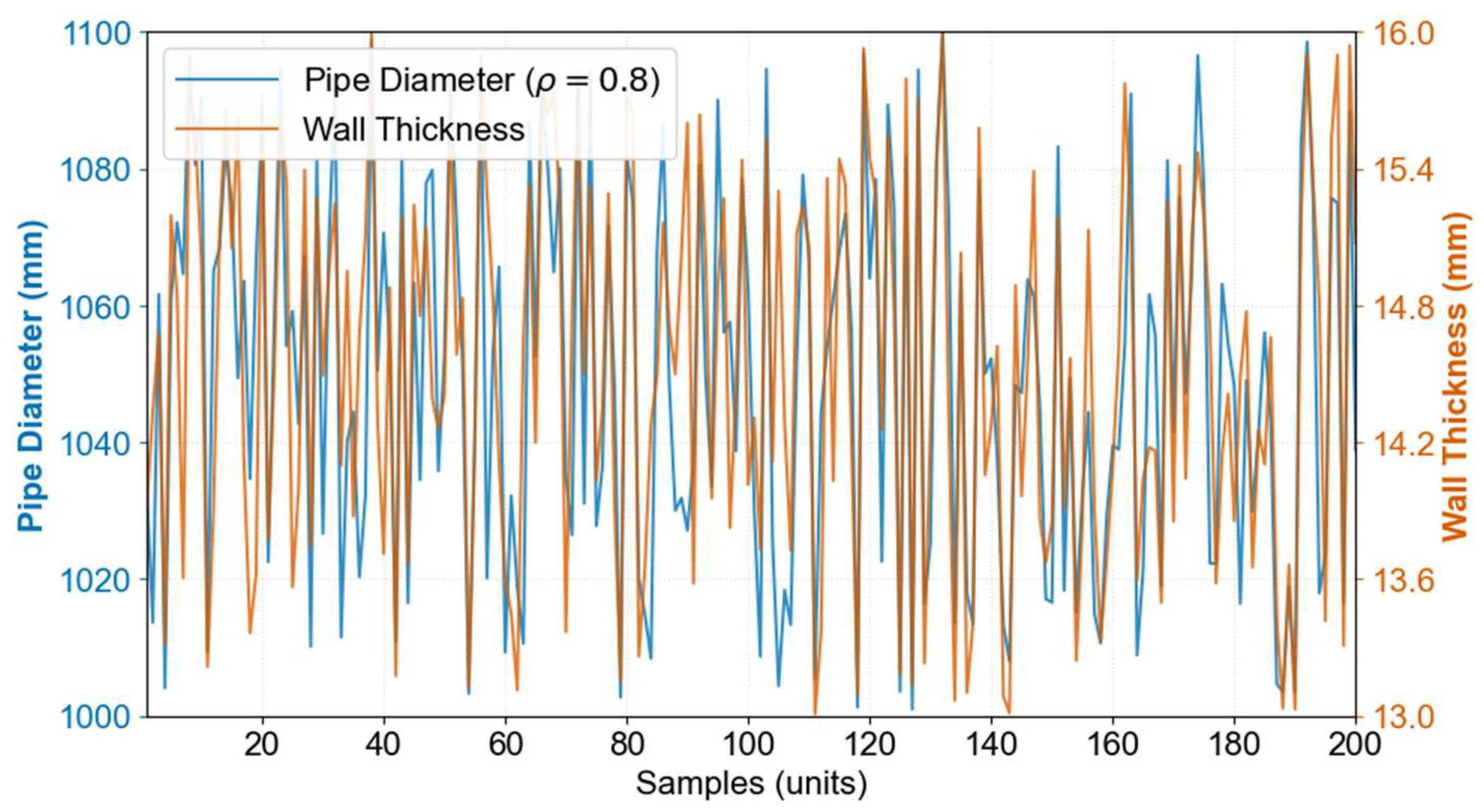
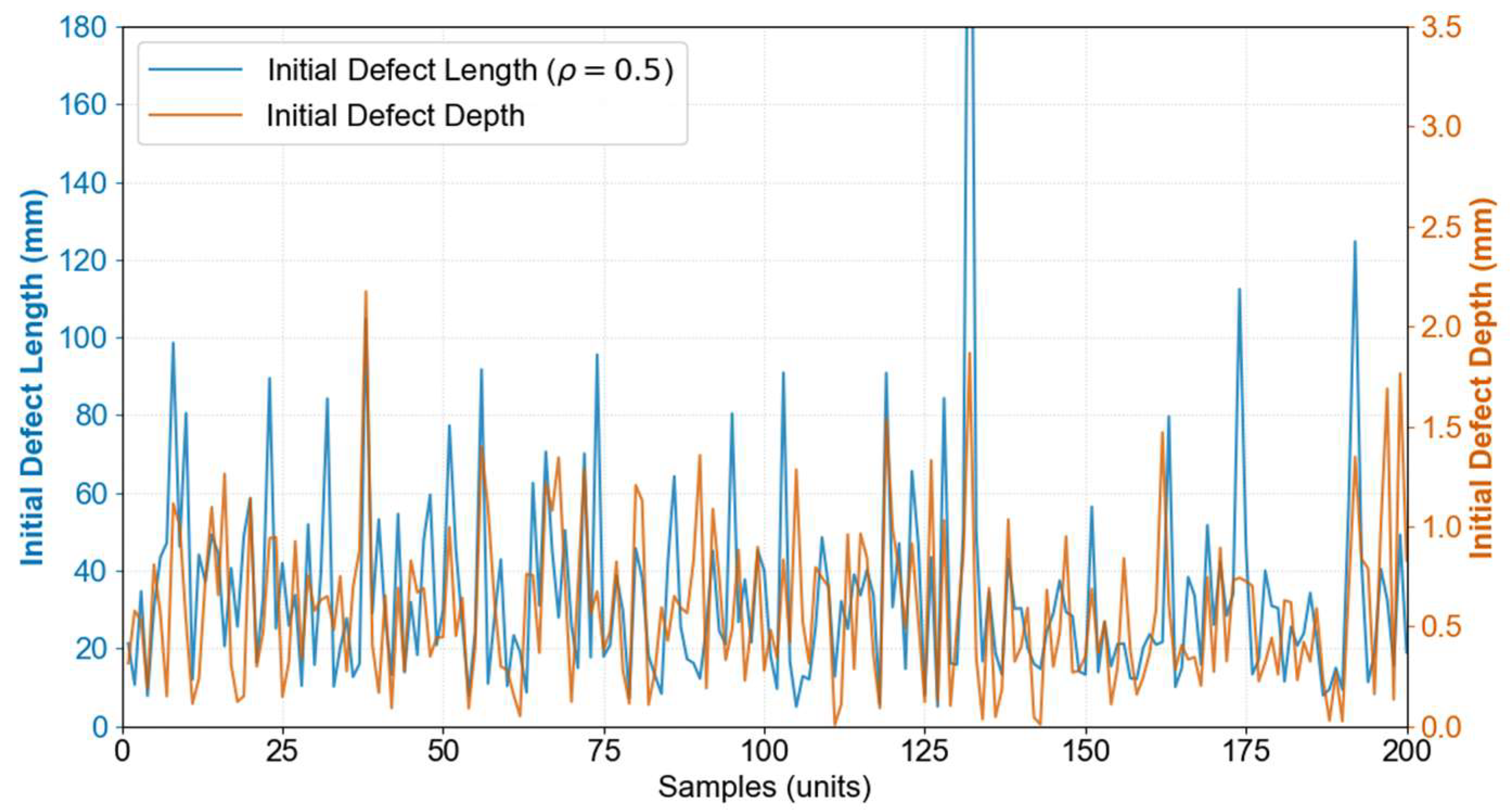
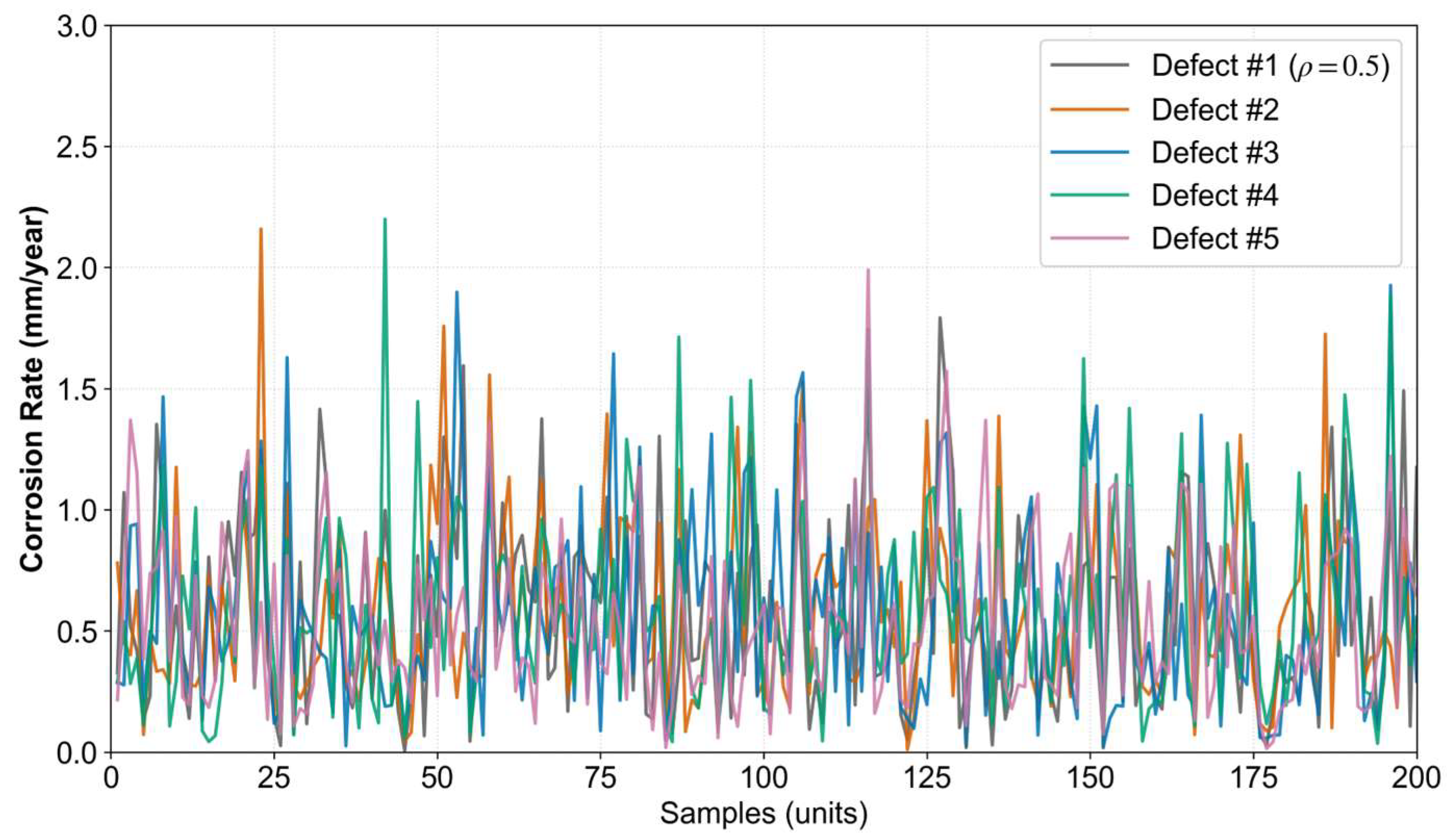
Figure 3, Figure 4 and Figure 5 illustrate the random variable samples generated based on the Copula function. The results indicate that the generated samples indeed possess specific correlations, thereby validating the effectiveness of the Copula function in generating correlated samples.
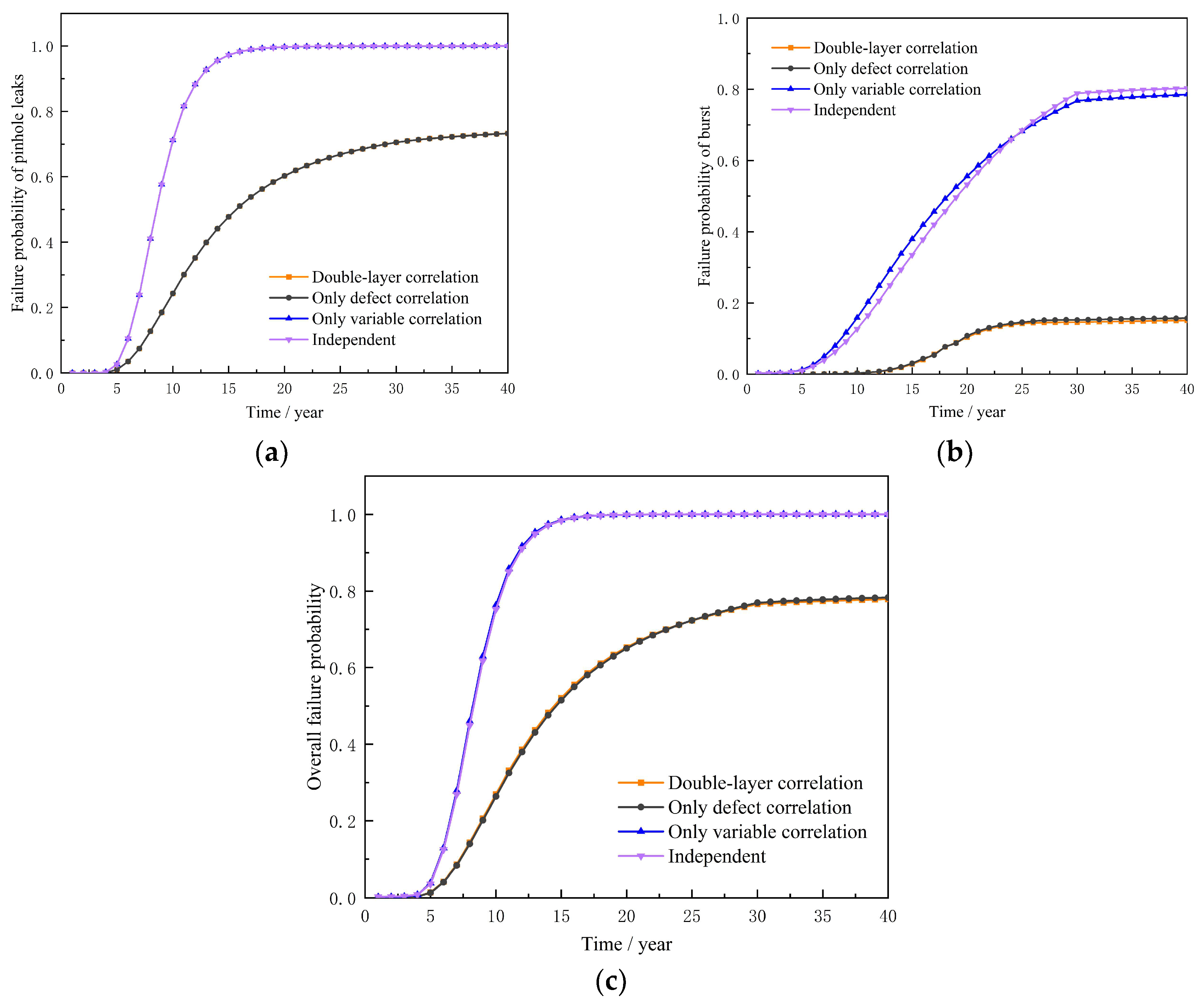
Figure 6a–c illustrate the pinhole leakage, rupture, and total failure probabilities of the pipeline over a 40-year period. A comparison of the failure probabilities across these three figures leads to the conclusion that defect correlation has a far greater impact than random variable correlation. After incorporating defect correlation, the pipeline’s failure probability decreases significantly, whereas random variable correlation has no effect on the pinhole leakage failure probability. However, during the pipeline rupture process, random variable correlation exhibits two distinct trends: it causes the failure probability to rise between years 0 and 25 but leads to a decline between years 25 and 40. The total failure probability follows the same pattern as the pinhole leakage failure probability.
This phenomenon can be attributed to the fact that, in a series system with independent units, the impact of a single unit’s failure probability on the system’s failure probability typically follows a power function, resulting in the most conservative pipeline reliability results (i.e., the maximum failure probability). However, when considering the correlation between defects, intersections occur between the multiple defect failure events involved in system failure, significantly reducing the overall system failure probability. Further analysis indicates that the correlation between defects directly determines the size of the intersection of failure events; therefore, it exerts a decisive influence on the pipeline system’s failure probability.
In contrast, random variable correlation is limited to certain basic parameters of the defect, making its impact on the system’s failure probability far less significant than that of defect correlation. Specifically, for the pinhole leakage failure mode, the key failure factors are determined solely by defect depth and wall thickness. Since no significant correlation usually exists between these two parameters, random variable correlation has almost no effect on the pinhole leakage probability. In many pipeline failure analyses, pinhole leakage is often the primary failure mode. Pipeline corrosion may lead to the formation of small holes or cracks, and these pinhole leakages have a decisive impact on the overall failure of the pipeline in the early stages. The total failure probability is a comprehensive probability of all possible failure modes (pinhole leakage and rupture). However, in certain cases, the pinhole leakage probability has a much greater impact on the total failure probability than other modes, especially when the pipeline contains a large number of minor corrosion defects. Consequently, the total failure probability follows the same pattern as the pinhole leakage probability. The following section will continue to investigate the pinhole leakage, rupture, and total failure probabilities of the pipeline under the influence of both defect correlation and random variable correlation.

4.3. Sensitivity Analysis

4.3.1. Effects of Defect Correlation and Number of Defects

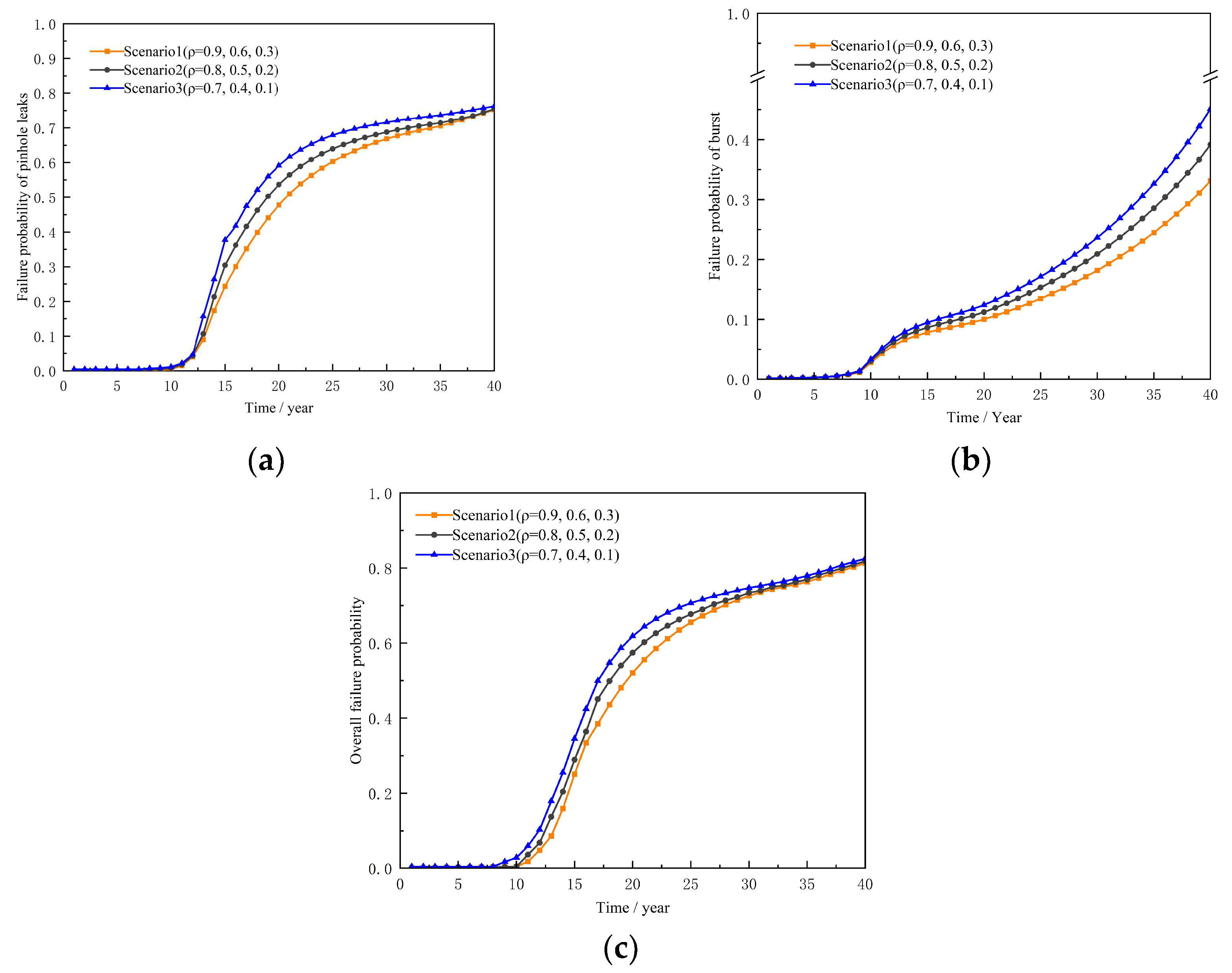
To investigate the influence of defect correlation on pipeline failure probability, this study established three different scenarios for defect correlation coefficients. Scenario 1 serves as the base case; additionally, two sets of different correlation coefficients were assumed, defined as Scenario 2 and Scenario 3, respectively. The defect correlation coefficients for the three scenarios are listed in Table 5. While keeping the correlation coefficients of the random variables constant (as shown in the base case in Table 4), simulations were conducted for each of the three scenarios. The pinhole leakage, rupture failure probability, and total failure probability of the pipeline were calculated and compared over a 40-year prediction period.
Figure 7a–c illustrate the influence of defect correlation on pipeline failure probability over a 40-year prediction period. The results indicate that, as the defect correlation coefficient decreases, the probabilities of pinhole leakage, rupture, and total failure continuously rise.
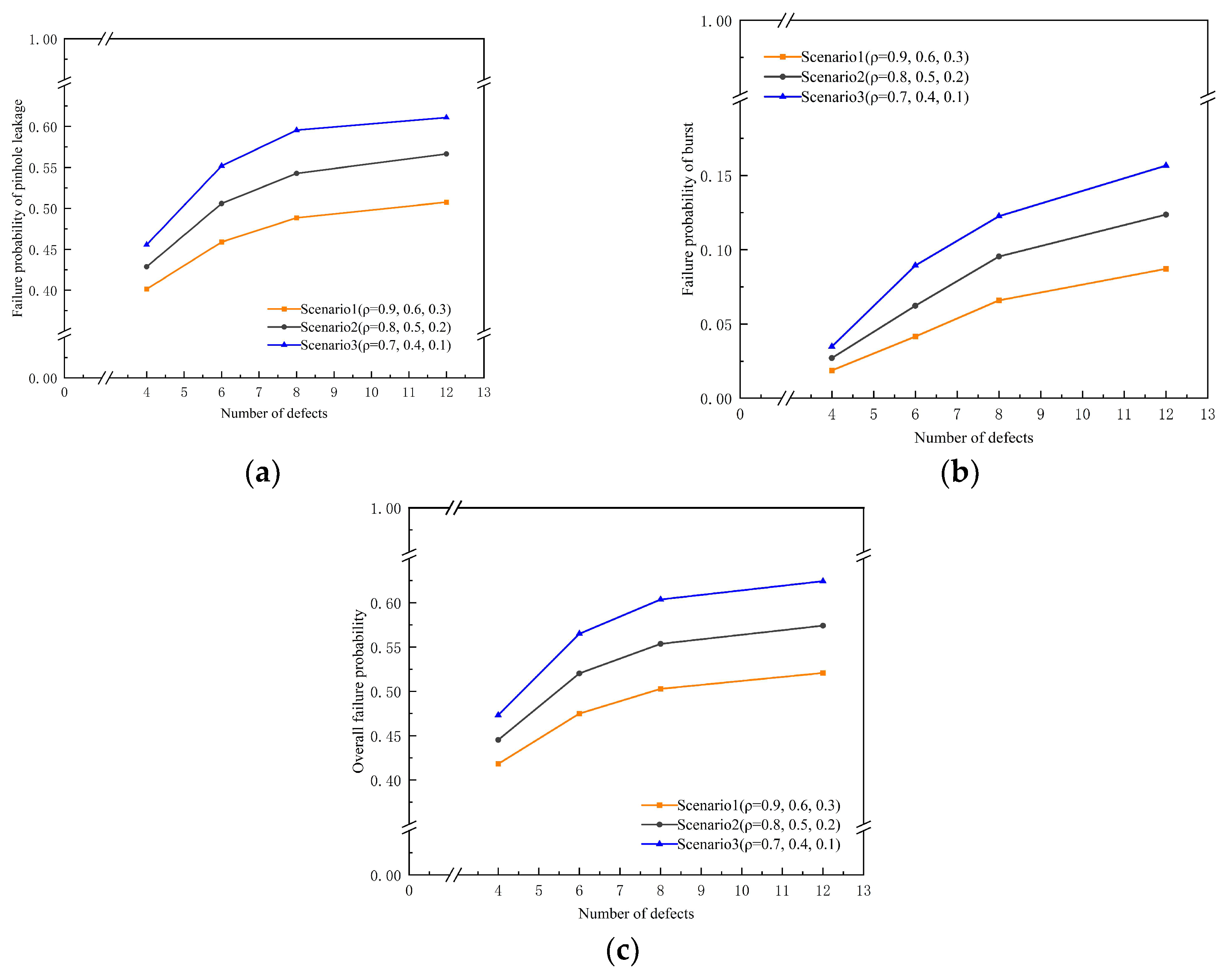
On this basis, the study further investigates the impact of the number of defects on pipeline failure probability by calculating the failure probabilities for cases with 4, 6, 8, and 12 defect, respectively.
Figure 8a–c show the relationship between the number of defect and pipeline failure probability. The results demonstrate that as the number of defects increases, the failure probability continuously rises. When the defect correlation coefficient is smaller, the number of defects has a more significant impact on the pipeline’s failure probability. This occurs because, according to Equations (24) and (25), a greater number of defects results in more cumulative failure terms, thereby increasing the overall failure probability of the system. As the correlation coefficient between defects increases, the degree of correlation between them also rises. At this point, the weight of each individual defect on the system failure probability decreases, leading to an overall reduction in system failure probability. However, this effect is relatively limited compared to the increase in failure probability caused by the rising number of defects. Therefore, although increased defect correlation weakens the influence of the number of defects on system failure probability, the total failure probability of the system still increases with the number of defects.

4.3.2. Influence of Random Variable Correlation

To investigate the influence of random variable correlation on the failure probability of the pipeline, a control variable method was adopted. By keeping the correlation coefficients of all other variables constant except for the specific set of correlated random variables under study, an uncertainty analysis was performed for various correlation coefficients
(1)
Pipe Diameter and Wall Thickness
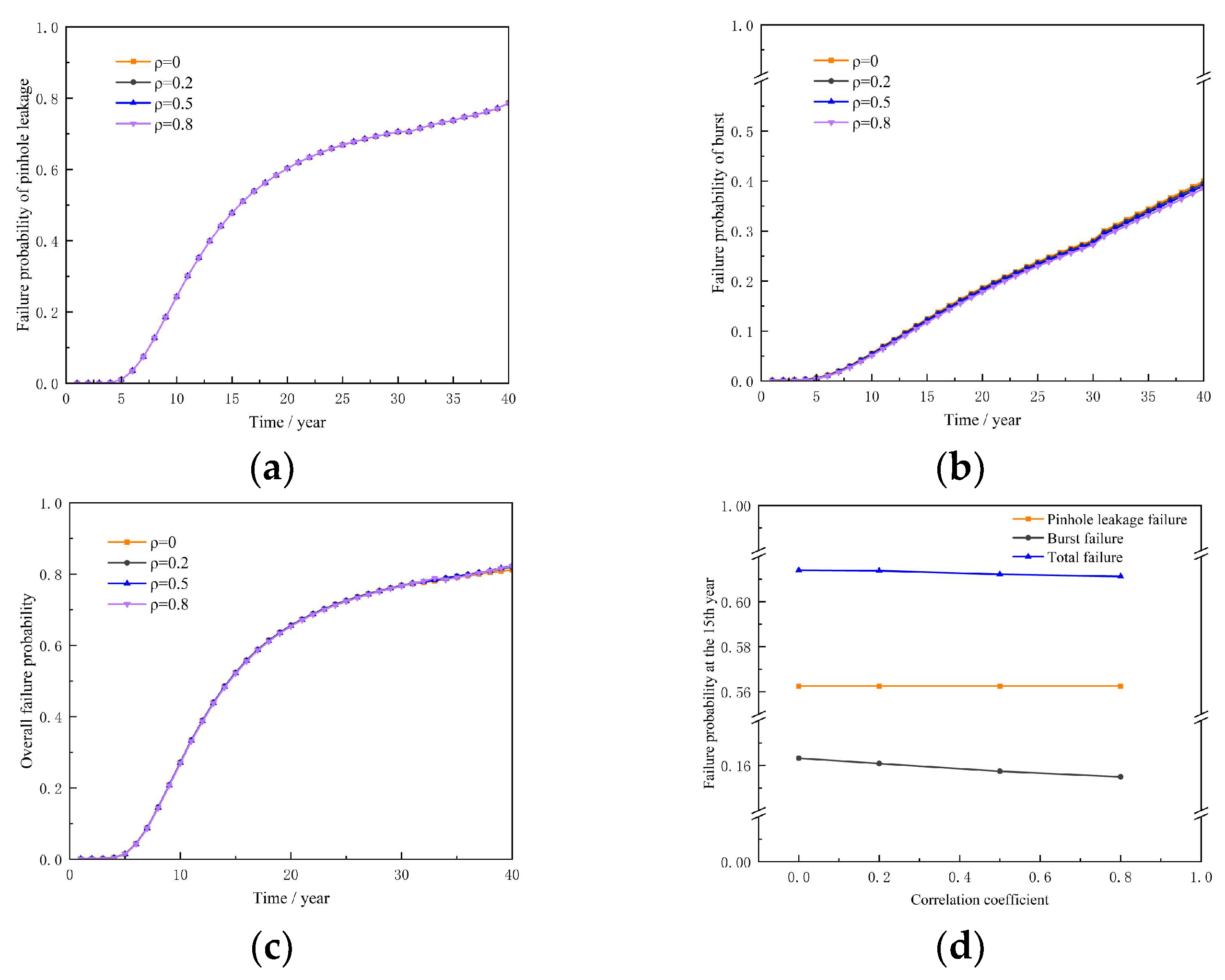
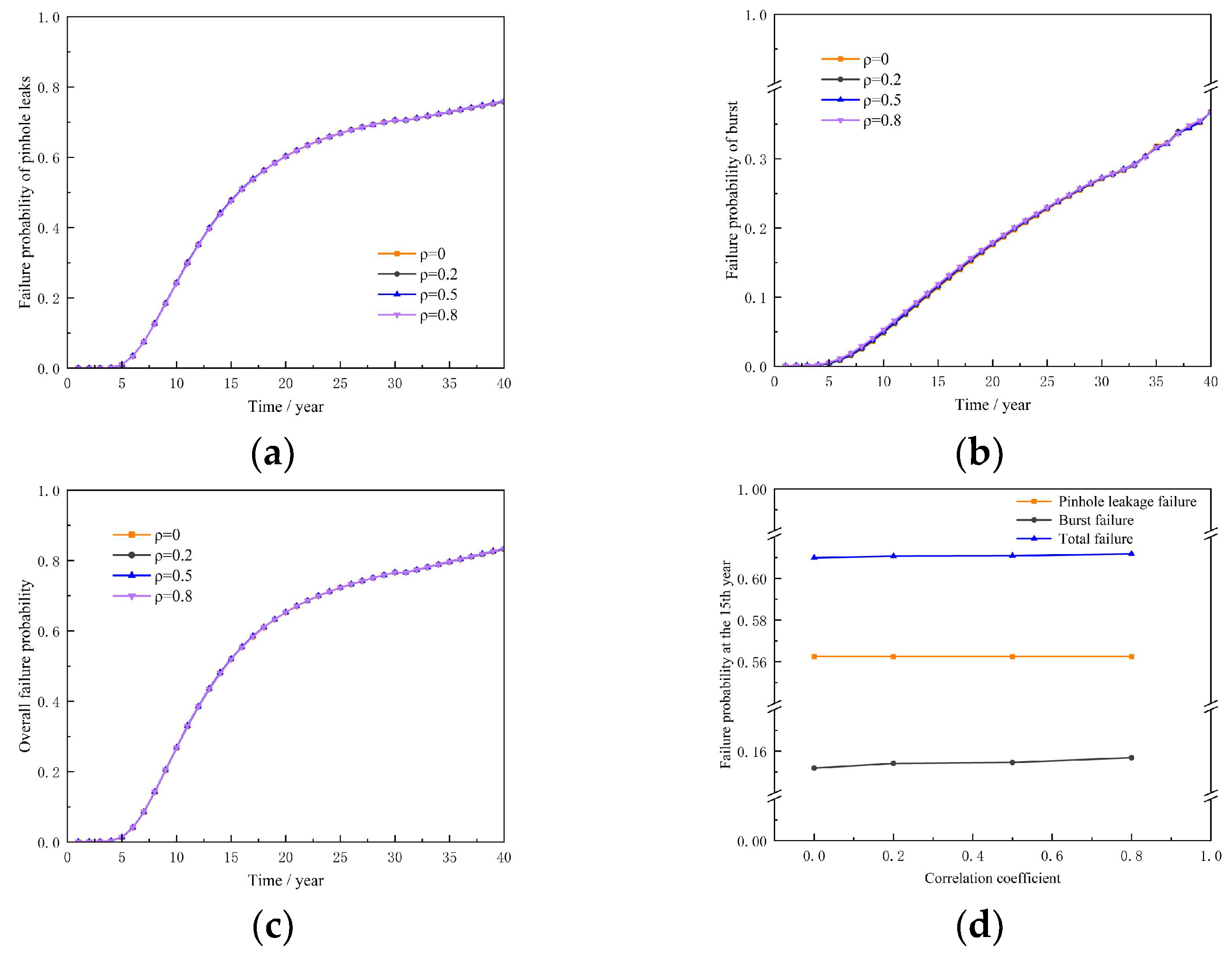
There is a certain correlation between the diameter and the wall thickness of a pipeline. Under the same operating pressure, pipelines with larger diameters typically have thicker walls. To investigate the impact of this correlation on pipeline failure probability, we selected various correlation coefficients between 0 and 1 and simulated the pipeline’s failure probability over a 40-year prediction period. As shown in Figure 9a–c, the influence of the correlation between diameter and wall thickness on failure probability is unidirectional. Figure 9d, which highlights the failure probability in the 15th year, provides a more intuitive representation. The results indicate that, as the correlation coefficient between diameter and wall thickness increases, the probability of pipeline rupture failure gradually decreases, and the total failure probability also declines. In contrast, the failure probability for pinhole leakage remains unchanged, suggesting that pinhole leakage failure probability is independent of the correlation coefficient between diameter and wall thickness.
(2)
Initial Length and Depth of Corrosion Defect
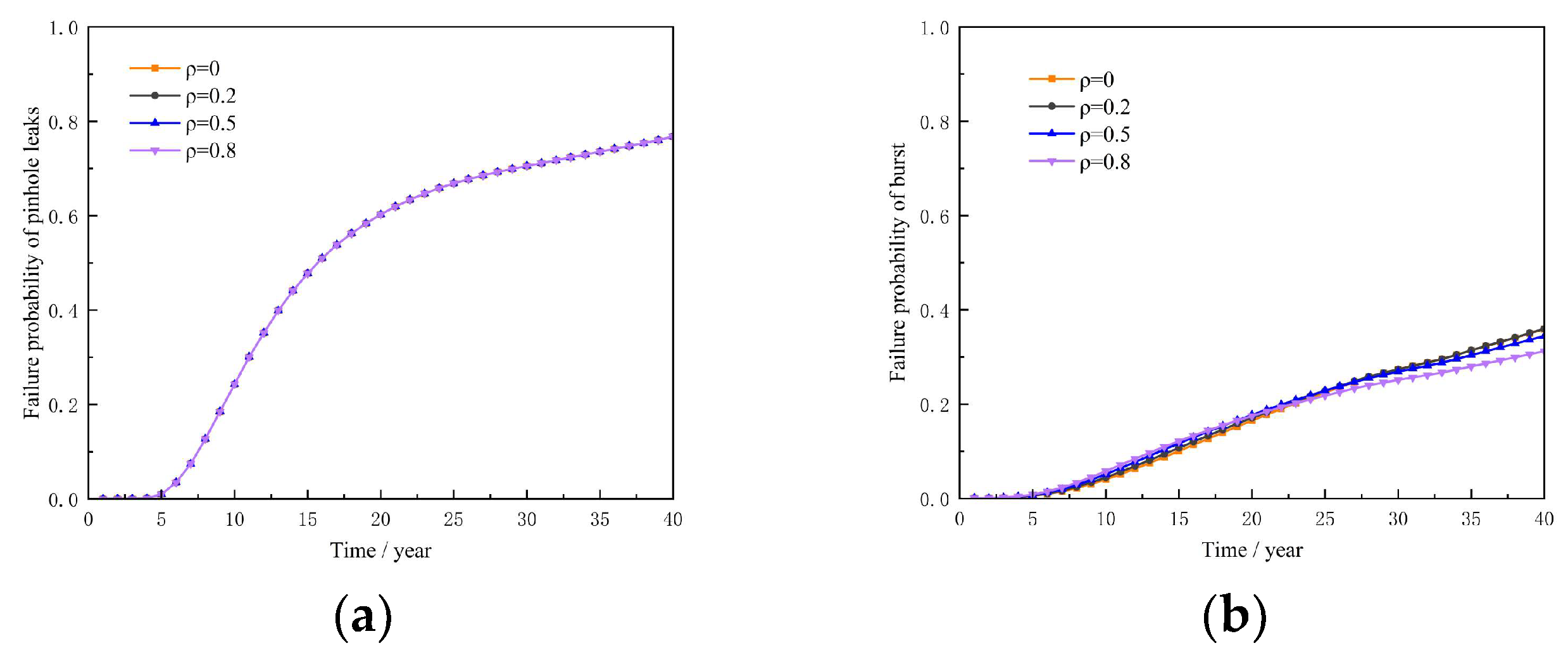
There is typically a certain correlation between the initial length and depth of corrosion defects in specific environments. Generally, as the length of a defect increases, its depth also tends to be deeper. To characterize the correlation between initial length and depth, we selected various correlation coefficients within the range of 0 to 1 and simulated the pipeline failure probability over a 40-year prediction period. As shown in Figure 10a–c, the impact of the correlation between initial defect length and depth on the failure probability is unidirectional. Figure 10d indicates that, as the correlation coefficient between initial defect length and depth increases, the probability of pipeline rupture failure also gradually increases, leading to a corresponding rise in the total failure probability. However, the failure probability for pinhole leakage remains unchanged, further demonstrating that the correlation between initial defect length and depth is independent of the pinhole leakage failure probability.
(3)
Axial and Radial Growth Rates of Corrosion Defect
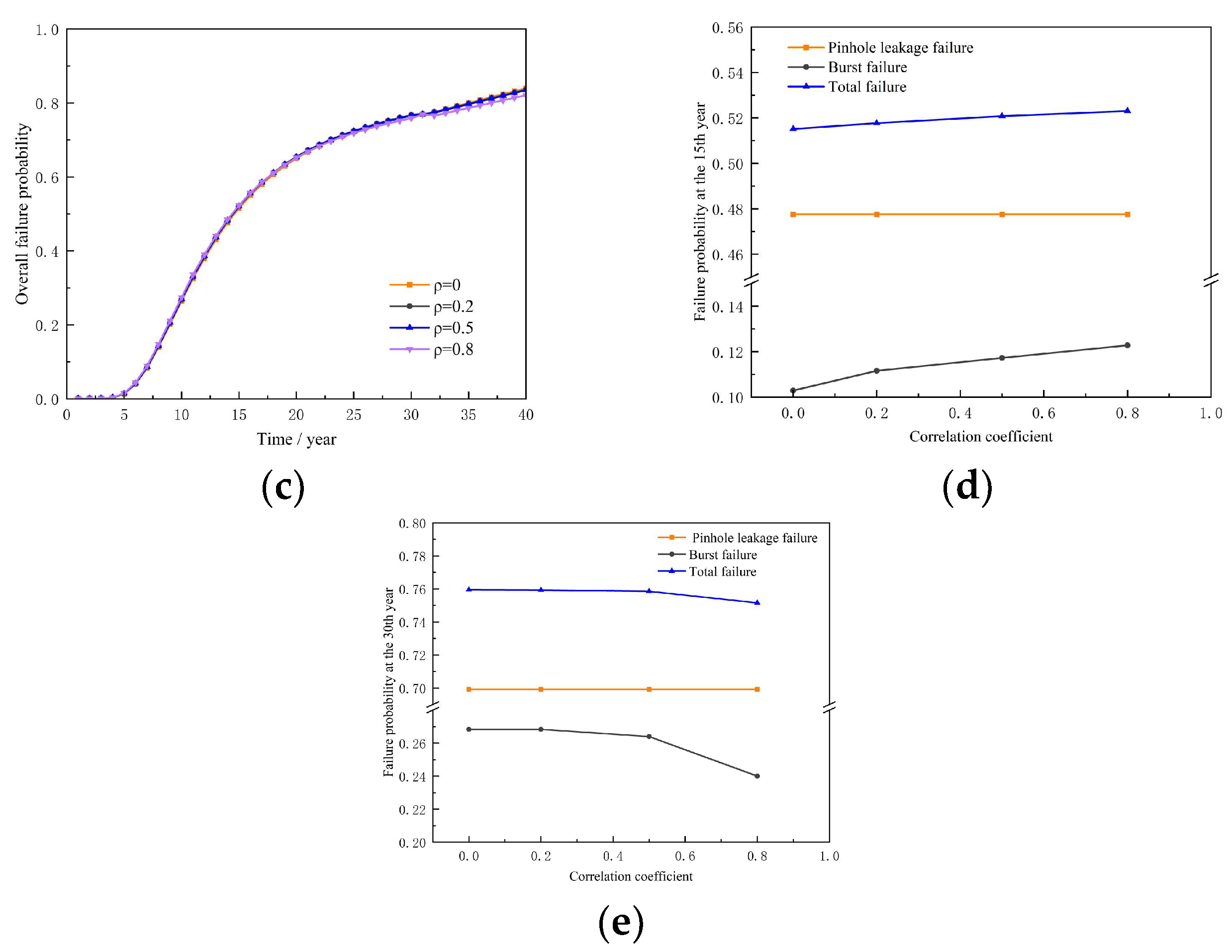
Similar to the correlation between initial corrosion defect length and depth, a certain correlation exists between the axial and radial growth rates of corrosion defect. Typically, a higher axial corrosion rate is accompanied by a correspondingly higher radial corrosion rate. To investigate the impact of the correlation between axial and radial growth rates on rupture failure, simulations were performed using different correlation coefficients ranging from 0 to 1. As shown in Figure 11a–e, the influence of this correlation on the pipeline’s rupture and total failure probabilities is bidirectional. During approximately the first 25 years, the rupture and total failure probabilities increase as the correlation coefficient between the axial and radial growth rates rises. However, after 25 years, these probabilities gradually decrease as the correlation coefficient increases. Meanwhile, the pinhole leakage failure probability remains unchanged. Figure 11d,e depict the impact of this correlation in the 15th and 30th years, respectively, with results consistent with the aforementioned observations.
From the three sets of uncertainty analysis above, it can be concluded that the pinhole leakage failure probability is independent of random variable correlation, supporting the earlier argument. In contrast, the rupture and total failure probabilities exhibit identical trends. Specifically, the correlation between pipe diameter and wall thickness has a unidirectional, positive (risk-reducing) impact on failure probability. The correlation between initial defect length and depth has a unidirectional, negative (risk-increasing) impact. The correlation between axial and radial growth rates has a bidirectional impact, involving both positive and negative effects. In terms of the magnitude of influence, the correlation between axial and radial growth rates exerts the greatest impact on failure probability, followed by the correlation between pipe diameter and wall thickness, while the correlation between initial defect length and depth has the smallest impact. Overall, regarding rupture and total failure probabilities, the failure probability increases with the correlation coefficient in the early stage (approximately the first 25 years) but decreases as the correlation coefficient increases in the later stage (after 25 years).

5. Conclusions

This study proposes a reliability evaluation method for corroded pipelines that accounts for two-layer correlations. Monte Carlo simulation is employed to calculate pipeline failure probabilities and analyze the impacts of different types of correlations and defect quantities on these probabilities. The results indicate that the influence of inter-defect correlation on system failure probability is significantly more pronounced than that of random variable correlation and incorporating defect correlation leads to a substantial reduction in the estimated system failure probability. While random variable correlation exhibits no impact on pinhole leakage, it exerts a bidirectional effect on burst failure: it increases the burst failure probability during the first 25 years of the prediction period but causes a decrease thereafter. Furthermore, both leakage and burst failure probabilities increase markedly with the number of defects.
The impacts of correlations between pipe diameter and wall thickness, and between initial defect length and depth, are unidirectional: the burst failure probability decreases as the diameter–thickness correlation coefficient increases but increases as the initial length–depth correlation coefficient grows. In contrast, the correlation between axial and radial defect growth rates has a time-dependent, bidirectional effect on burst failure; the failure probability increases with the correlation coefficient before year 25 and decreases afterward. Among all factors, defect correlation is the most influential. Within random variables, the growth rate correlation has the greatest impact on failure probability, followed by the diameter–thickness correlation, while the initial length–depth correlation has the least.
The proposed method, considering two-layer correlations, is more rational than conventional approaches based on independence assumptions and provides a valuable reference for pipeline integrity management. A primary challenge of this method lies in obtaining accurate correlation coefficients. Future engineering practices should prioritize data collection and mining to provide robust support for statistical inference, thereby improving the predictive accuracy of corroded pipeline reliability evaluations. It should be noted that the current model assumes constant operating pressure based on steady-state conditions. Future work will incorporate time-varying pressure profiles using stochastic processes to address potential over-optimistic estimations and improve the model’s applicability to complex engineering environments. Additionally, the current study employs a linear corrosion growth model for simplicity. It is acknowledged that environmental factors and operational conditions can lead to non-linear corrosion behavior over long service lives. Future improvements will focus on integrating non-linear models to better reflect field practice and improve the accuracy of long-term integrity assessments.

Author Contributions

Conceptualization, C.W. and J.G.; Methodology, H.H., J.Z., H.L., Q.H., X.L. and J.G.; Software, C.W., Y.T. and W.Y.; Validation, C.W., Y.T. and W.Y.; Writing—original draft, C.W.; Writing—review and editing, H.H., J.Z., H.L., Q.H., X.L. and S.S.; Supervision, X.L.; Project administration, H.H.; Funding acquisition, H.H. All authors have read and agreed to the published version of the manuscript.

Funding

This work is financially supported by the National Natural Science Foundation of China (52302402), (52302422), (52272338); the Science and Technology Research Program of Chongqing Municipal Education Commission (Grant No. KJZD-M202501502); the Natural Science Foundation of Chongqing (CSTB2024NSCQ-MSX1103); the National Major Special Project (2025ZD1406806).

Data Availability Statement

The original contributions presented in this study are included in the article. Further inquiries can be directed to the corresponding authors.

Conflicts of Interest

Author Weichao Yu was employed by the company PipeChina Oil & Gas Control Center. The remaining authors declare that the research was conducted in the absence of any commercial or financial relationships that could be construed as a potential conflict of interest.

References

  1. Li, X.; Zhang, L.; Khan, F.; Han, Z. A data-driven corrosion prediction model to support digitization of subsea operations. Process Saf. Environ. Prot. 2021, 153, 413–421. [Google Scholar] [CrossRef]
  2. Zhang, J. Structural Reliability Evaluation and Maintenance Strategy Optimization of Corroded Pipelines. Ph.D. Thesis, China University of Petroleum, Beijing, China, 2020. [Google Scholar]
  3. Ma, H.; Geng, M.; Wang, F.; Zheng, W.; Ai, Y.; Zhang, W. Data augmentation of a corrosion dataset for defect growth prediction of pipelines using conditional tabular generative adversarial networks. Materials 2024, 17, 1142. [Google Scholar] [CrossRef] [PubMed]
  4. Yu, W.; Zhang, J.; Wen, K.; Huang, W.; Min, Y.; Li, Y.; Yang, X.; Gong, J. A novel methodology to update the reliability of the corroding natural gas pipeline by introducing the effects of failure data and corrective maintenance. Int. J. Press. Vessel. Pip. 2019, 169, 48–56. [Google Scholar] [CrossRef]
  5. Zhang, X.; Shuai, J. Sensitivity analysis of failure probability for corroded pipelines based on FITNET FFS model. J. Saf. Sci. Technol. 2018, 14, 80–85. [Google Scholar]
  6. Lam, C.; Zhou, W. Statistical analyses of incidents on onshore gas transmission pipelines based on PHMSA database. Int. J. Press. Vessel. Pip. 2016, 145, 29–40. [Google Scholar] [CrossRef]
  7. Wei, R.R.; Tang, S.S.; Zheng, H.L.; Hou, L.; Liu, Y.Q.; Zhou, Z.D.; Cheng, Y.T. Hierarchical reliability allocation method for natural gas pipeline network systems with complex structures. Pet. Sci. Bull. 2025, 10, 1374–1388. [Google Scholar]
  8. Tee, K.F.; Pesinis, K. Reliability prediction for corroding natural gas pipelines. Tunn. Undergr. Space Technol. 2017, 65, 91–105. [Google Scholar] [CrossRef]
  9. Yu, W.; Song, S.; Li, Y.; Min, Y.; Huang, W.; Wen, K.; Gong, J. Gas supply reliability assessment of natural gas transmission pipeline systems. Energy 2018, 162, 853–870. [Google Scholar] [CrossRef]
  10. Zhang, P.; Peng, X.; Hu, M. Bayesian evaluation method for corrosion reliability of oil and gas pipelines. China Saf. Sci. J. 2008, 18, 133–139. [Google Scholar]
  11. Xu, T.; Zhang, P.; Guo, P.; Liu, W. Data-driven natural gas pipeline reliability evaluation focusing on the mitigation effectiveness for frost heave in cold regions. Cold Reg. Sci. Technol. 2026, 244, 104826. [Google Scholar] [CrossRef]
  12. Zhou, W. System reliability of corroding pipelines. Int. J. Press. Vessel. Pip. 2010, 87, 587–595. [Google Scholar] [CrossRef]
  13. Liu, D.; Song, S.; Shan, X.; Zhang, X.; Shen, S.; Wei, S.; Shi, B.; Gong, J. Soft Evidence-Enhanced Object-Oriented Bayesian Network for Process Fault Diagnosis: A Case Study in Oilfield Transfer Station System. SPE J. 2025, 30, 6294–6312. [Google Scholar] [CrossRef]
  14. Gong, J.; Song, S.; Wei, S.; Shi, B.; Zhang, Y. Key Role of Pipeline Transportation in Resilience and Security of Energy Supply Chain. Sci. Technol. Foresight 2024, 3, 19–29. [Google Scholar]
  15. Zhang, X.Q. Method for determining target reliability of natural gas pipeline network systems based on pipeline risk acceptance criteria. Oil Gas Storage Transp. 2026, 45, 120. [Google Scholar]
  16. Zhou, W.; Hong, H.P.; Zhang, S. Impact of dependent stochastic defect growth on system reliability of corroding pipelines. Int. J. Press. Vessel. Pip. 2012, 96, 68–77. [Google Scholar] [CrossRef]
  17. Zhang, S.; Zhou, W. System reliability of corroding pipelines considering stochastic process-based models for defect growth and internal pressure. Int. J. Press. Vessel. Pip. 2013, 111, 120–130. [Google Scholar] [CrossRef]
  18. Zeng, H.L.; Wang, Z.L.; Ma, J.S.; Luo, Z.G.; Huang, S.Y.; Duan, J.S. Reliability evaluation of corrosive pipelines considering parameter correlation. Chem. Eng. Mach. 2011, 38, 14–18. [Google Scholar]
  19. Zhang, P.; Peng, Y. Failure probability of corroded pipelines considering correlation of random variables. Acta Pet. Sin. 2016, 37, 1293–1301. [Google Scholar] [CrossRef]
  20. Li, S.X.; Zeng, H.L.; Yu, S.R.; Zhai, X.; Chen, S.P.; Liang, R.; Yu, L. A method of probabilistic analysis for steel pipeline with correlated corrosion defects. Corros. Sci. 2009, 51, 3050–3056. [Google Scholar] [CrossRef]
  21. Gong, C.; Zhou, W. Improvement of equivalent component approach for reliability analyses of series systems. Struct. Saf. 2017, 68, 65–72. [Google Scholar] [CrossRef]
  22. Yu, W.; Huang, W.; Wen, K.; Zhang, J.; Liu, H.; Wang, K.; Gong, J.; Qu, C. Subset simulation-based reliability analysis of the corroding natural gas pipeline. Reliab. Eng. Syst. Saf. 2021, 213, 107661. [Google Scholar] [CrossRef]
  23. Leis, B.N.; Stephens, D.R. An alternative approach to assess the integrity of corroded line pipe-part I: Current status. In Proceedings of the ISOPE International Ocean and Polar Engineering Conference, Honolulu, HI, USA, 25–30 May 1997. [Google Scholar]
  24. Zhou, W. Reliability evaluation of corroding pipelines considering multiple failure modes and time-dependent internal pressure. J. Infrastruct. Syst. 2011, 17, 216–224. [Google Scholar] [CrossRef]
  25. Timashev, S.A.; Bushinskaya, A.V. Practical methodology of predictive maintenance for pipelines. In Proceedings of the International Pipeline Conference, Calgary, AL, Canada, 27 September–1 October 2010; Volume 44205, pp. 329–338. [Google Scholar]
  26. Li, S.X.; Yu, S.R.; Zeng, H.L.; Li, J.H.; Liang, R. Predicting corrosion remaining life of underground pipelines with a mechanically-based probabilistic model. J. Pet. Sci. Eng. 2009, 65, 162–166. [Google Scholar] [CrossRef]
  27. Sun, C.M.; Li, Q.; Huang, Z.Q.; Tang, H.P.; Xiao, X. Reliability analysis of corrosive pipelines based on Monte Carlo method. Oil Gas Storage Transp. 2015, 34, 811–816. [Google Scholar]
  28. Guo, S. A fast and efficient method for calculating failure probability of structural systems. Chin. J. Comput. Mech. 2007, 107–110. [Google Scholar]
  29. ASME B31G; Manual for Determining the Remaining Strength of Corroded Pipelines. The American Society of Mechanical Engineers: New York, NY, USA, 2012.
  30. DNV-RP-F101; Corroded Pipelines. Det Norske Veritas: Høvik, Norway, 2021.
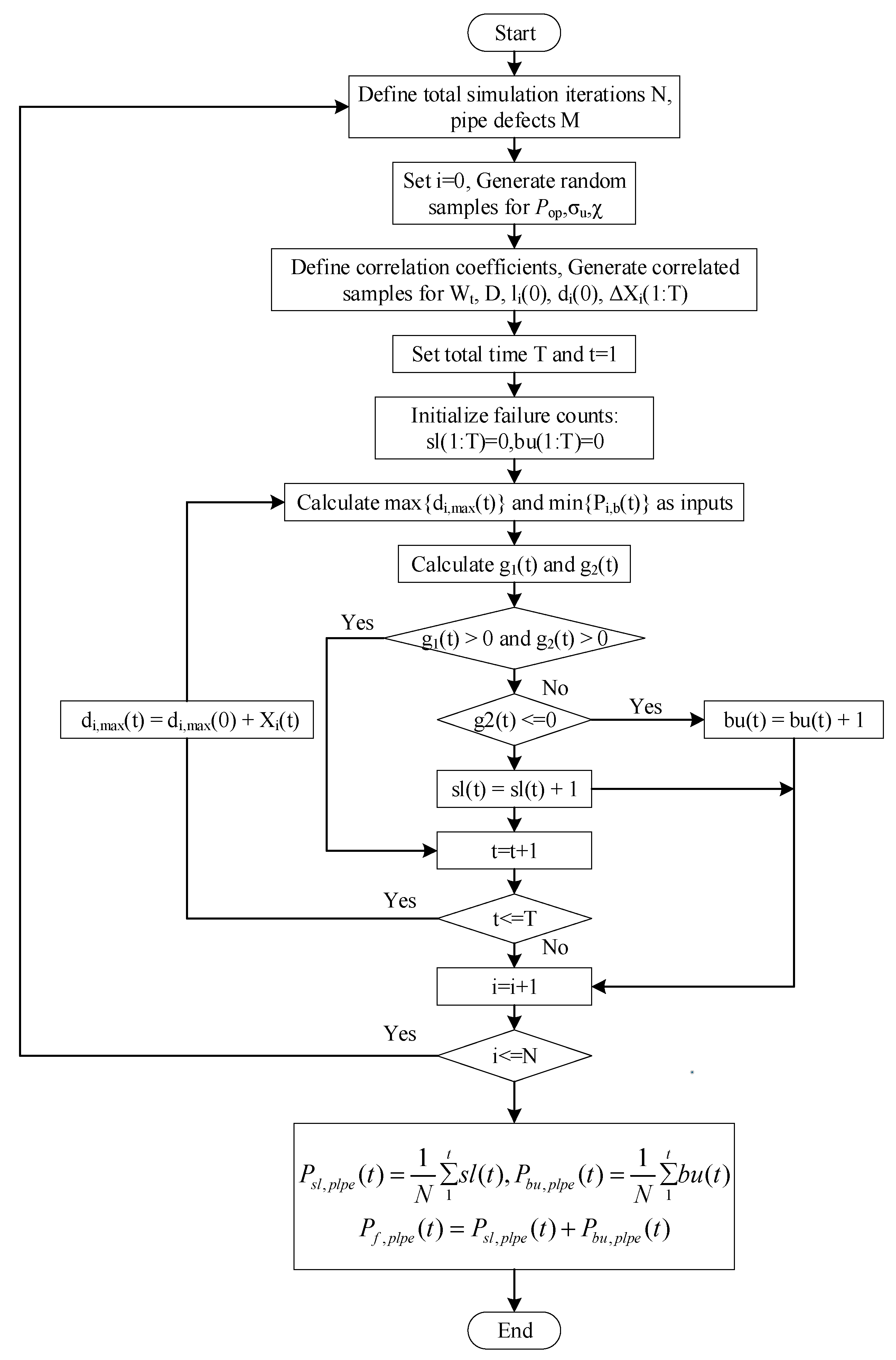
Figure 1. Flowchart for simulating calculation of failure probability of pipe segment.
Processes 14 01183 g001
Figure 2. Convergence plot of Monte Carlo simulation.
Processes 14 01183 g002
Figure 3. Correlated samples of pipe diameter and wall thickness.
Processes 14 01183 g003
Figure 4. Correlated samples of initial defect length and initial depth.
Processes 14 01183 g004
Figure 5. Correlated samples of defect depth growth rate.
Processes 14 01183 g005
Figure 6. The effect of correlation on the failure probabilities of corroded pipeline, (a) failure probability of pinhole leaks, (b) failure probability of burst, (c) overall failure probability.
Processes 14 01183 g006
Figure 7. The effect of defect correlation on the pipeline failure probabilities, (a) failure probability of pinhole leaks, (b) failure probability of burst, (c) overall failure probability.
Processes 14 01183 g007
Figure 8. The effect of the number of defects on the pipeline failure probabilities, (a) failure probability of pinhole leaks, (b) failure probability of burst, (c) overall failure probability.
Processes 14 01183 g008
Figure 9. Effect of correlation between pipeline diameter and wall thickness on the pipeline failure probabilities, (a) failure probability of pinhole leaks, (b) failure probability of burst, (c) overall failure probability, (d) failure probability at the 15th year.
Processes 14 01183 g009
Figure 10. The effect of initial defect length and depth correlation on the pipeline failure probabilities, (a) failure probability of pinhole leaks, (b) failure probability of burst, (c) overall failure probability, (d) failure probability at the 15th year.
Processes 14 01183 g010
Figure 11. Influence of correlation between axial and radial growth rate of defect on the pipeline failure probabilities, (a) failure probability of pinhole leaks, (b) failure probability of burst, (c) overall failure probability, (d) failure probability at the 15th year, (e) failure probability at the 30th year.
Processes 14 01183 g011aProcesses 14 01183 g011b
Table 1. Basic data of the Shaanxi–Beijing Second Pipeline.
No.Parameter NameValueData SourceFitted Distribution
1Pipeline Diameter D/mm1016Shaanxi–Beijing Phase IINormal Distribution
2Wall Thickness t/mm14.6Survey of Shaanxi–Beijing Phase II basic dataNormal Distribution
3Tensile Strength σ u /MPa570Survey of Shaanxi–Beijing Phase II data (X70 pipeline)Weibull Distribution
4Defect Length L/mm150Rational assumption based on Shaanxi–Beijing pipeline engineering practiceNormal Distribution
5Defect Dept d/mm2.5Rational assumption based on Shaanxi–Beijing pipeline engineering practiceNormal Distribution
Table 2. Probability representation of basic pipeline parameters.
ParameterUnitMeanCoefficient of VariationDistribution Type
p o p MPa100.02Gumbel Distribution
D mm10160.02Deterministic Variable
w t mm17.50.033Normal Distribution
σ u MPa5700.035Normal Distribution
χ ---0.970.1082Lognormal Distribution
Note: χ represents the probabilistic characteristics of the model error term [23].
Table 3. Probability characteristics of corrosion defect parameters.
ParameterUnitMeanCoefficient of VariationDistribution Type
d 0 mm0.5820.72Weibull Distribution
l 0 mm35.680.821Lognormal Distribution
v d mm/year0.5760.703Weibull Distribution
v t mm/year3.00.5Lognormal Distribution
Note: v t is the growth rate of corrosion defect [12].
Table 4. Correlation coefficient values.
CategoryDefect CorrelationPipe Diameter & Wall ThicknessInitial Defect Length & DepthDefect Axial & Radial Corrosion Rate
Adjacent1 Spacing2 Spacing
Correlation Coefficient0.90.60.30.80.50.5
Table 5. Defect correlation coefficients for three scenarios.
ScenarioAdjacent Defect1-Spacing Defect2-Spacing Defect
Scenario 10.90.60.3
Scenario 20.80.50.2
Scenario 30.70.40.1
Disclaimer/Publisher’s Note: The statements, opinions and data contained in all publications are solely those of the individual author(s) and contributor(s) and not of MDPI and/or the editor(s). MDPI and/or the editor(s) disclaim responsibility for any injury to people or property resulting from any ideas, methods, instructions or products referred to in the content.