1. Introduction
Pumps serve as core components in the power systems of pumping stations and are extensively utilized in centrifugal and emergency drainage applications [
1,
2,
3]. Pump stations are often required to operate continuously for extended periods to meet the demands of busy irrigation seasons and flood season drainage. Consequently, sudden failures such as power outages, load rejection, and control system malfunctions are difficult to completely avoid during operation. Under such circumstances, the pump may enter a runaway condition: the impeller is driven by reverse water flow from the outlet to the inlet, rotating in the opposite direction and accelerating. This process generates severe pressure pulsations, which can lead to blade fracture or pipeline rupture, ultimately resulting in safety risks at the pumping station [
4,
5]. Therefore, elucidating the pressure pulsation characteristics under runaway conditions has always been the key to ensuring the long-term safe and stable operation of pump stations.
To date, frequency-domain analyses of pressure pulsations have been widely applied in the study of typical pump operating conditions—including conventional operation, cavitation, and stall—providing an important theoretical basis for identifying unstable flow structures and elucidating their underlying mechanisms [
6,
7,
8]. Under conventional operating conditions, Si et al. [
9] and Wang et al. [
10] employed numerical simulations to investigate the effects of rotor–stator interaction and clocking effects between the impeller and guide vanes on the time–frequency characteristics of pressure pulsations, revealing that the dominant frequency within the pump is the blade passing frequency and that an optimal relative angular position between the impeller and guide vanes can effectively suppress the amplitude at this frequency; Ye et al. [
11] and Jia et al. [
12] further demonstrated that appropriately increasing the baffle angle within the volute and expanding the volute cross-sectional area can significantly reduce radial forces, thereby mitigating pressure pulsations induced by impeller–volute interaction. In studies on cavitation, Lu et al. [
13] and Huang et al. [
14] analyzed the evolution of pressure pulsation frequency spectra during cavitation development, showing that at the impeller inlet, the dominant frequencies are the rotational frequency and its harmonics, while the blade passing frequency remains dominant at the impeller–volute interface, and as cavitation intensifies, additional high-amplitude frequency components emerge in the spectra at various monitoring points; Zhang et al. [
15] and Jia et al. [
16] further noted that the root-mean-square value of pressure pulsation amplitude at the impeller inlet is more sensitive to the onset of cavitation than the pump head, and thus can serve as an effective indicator for cavitation detection. Regarding stall conditions, Zhou et al. [
17] confirmed that rotor–stator interaction between the impeller and the baffle is the primary cause of pressure pulsations in centrifugal pumps under stall, and as stall deepens, the dominant frequency shifts from the blade passing frequency to five times the rotational frequency, with the stall vortex generating high-amplitude, low-frequency signals. In summary, the time–frequency characteristics analysis of pressure pulsations has matured into a reliable diagnostic tool for detecting internal flow instabilities in hydraulic machinery.
However, unlike the typical operating conditions discussed above, the runaway condition is typically triggered by sudden power outages or other faults, representing an instantaneous reverse rotation state experienced by the pump unit during transient processes [
18,
19]; consequently, research findings on pressure pulsation characteristics under Quasi-steady state cannot be directly extrapolated to runaway scenarios. With the development of CFD technology [
20,
21], several scholars have employed computational fluid dynamics methods to investigate pressure pulsation characteristics within the internal flow field of pumps under runaway conditions induced by power failure [
22]. Specifically, Pang et al. [
23] and Lu et al. [
24] found that under power-off runaway conditions in centrifugal pumps, separation vortices and cavitation occur in the low-velocity region at the impeller outlet, with the runaway rotational speed reaching approximately 1.2 to 1.5 times the rated speed, accompanied by high-amplitude low-frequency vibrations induced by vortex ropes in the draft tube. Sun et al. [
25] investigated axial-flow pumps and reported that the runaway speed can reach 1.88 times the rated speed, the reverse flow rate attains 1.98 times the rated flow rate, and the frequency spectra similarly exhibit high-amplitude low-frequency signals caused by vortex ropes. Jiao et al. [
26] compared the forward and reverse runaway characteristics of a bidirectional impeller axial-flow pump and observed that while the axial force and runaway speed under forward runaway were 1.25 times and 1.4 times higher than those under reverse runaway, respectively, low-frequency vibrations were more pronounced under reverse runaway conditions. Furthermore, Li et al. [
27] studied pump-turbines and noted that the adjustable guide vane configuration can effectively suppress vibrations under runaway conditions and enhance operational stability through optimized closing strategies. The aforementioned studies indicate that the high-amplitude frequency components within pumps under runaway conditions primarily originate from vortex ropes in the draft tube and are characterized by relatively low frequencies. However, existing research of the pressure pulsation relies predominantly on numerical simulations, which are constrained by computational resources such that the simulated time is typically less than one second [
28,
29,
30], making it difficult to fully capture the continuous evolution of frequency migration during vortex development. Therefore, it is necessary to introduce a joint time–frequency domain analysis method, combined with long-term experimental measurements of dynamic pressure signals, to establish the intrinsic relationship between the dynamic evolution of vortex ropes and the dominant frequency characteristics.
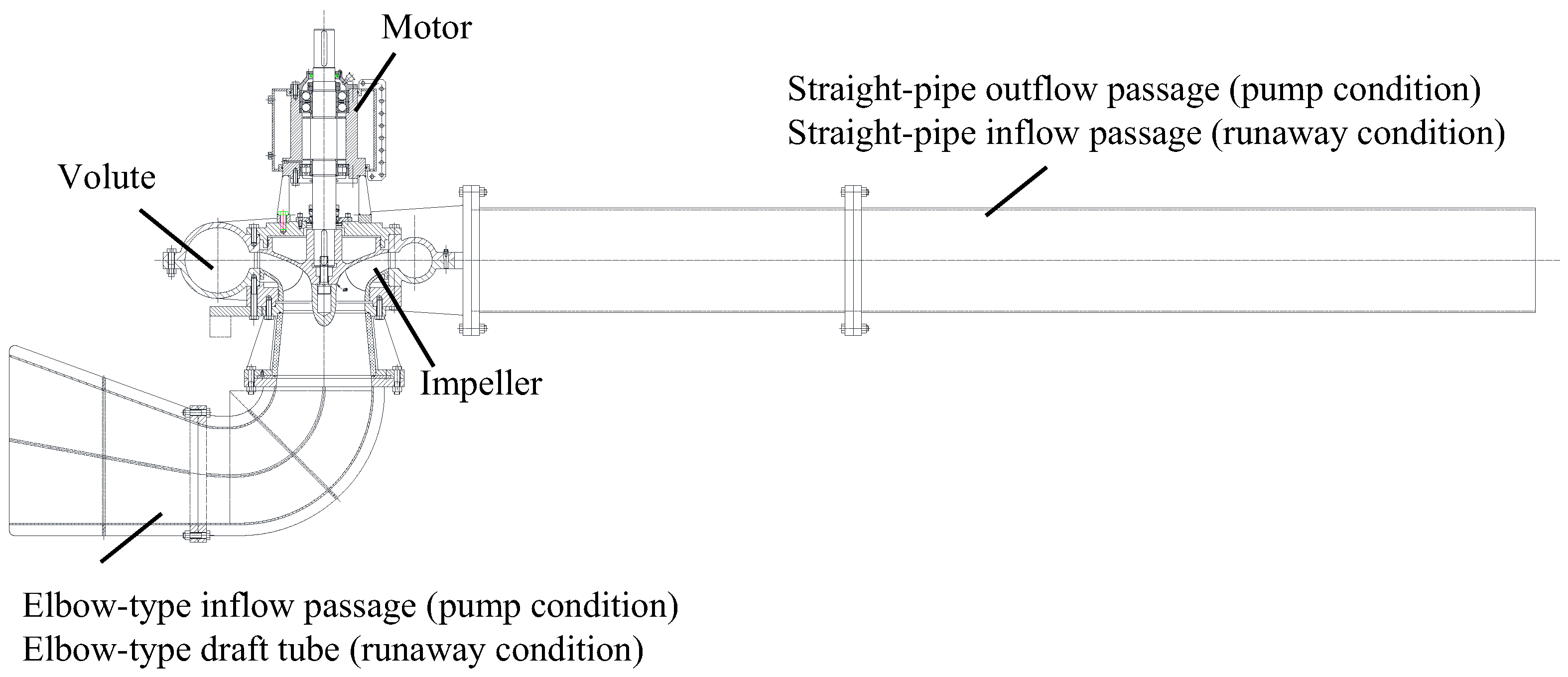
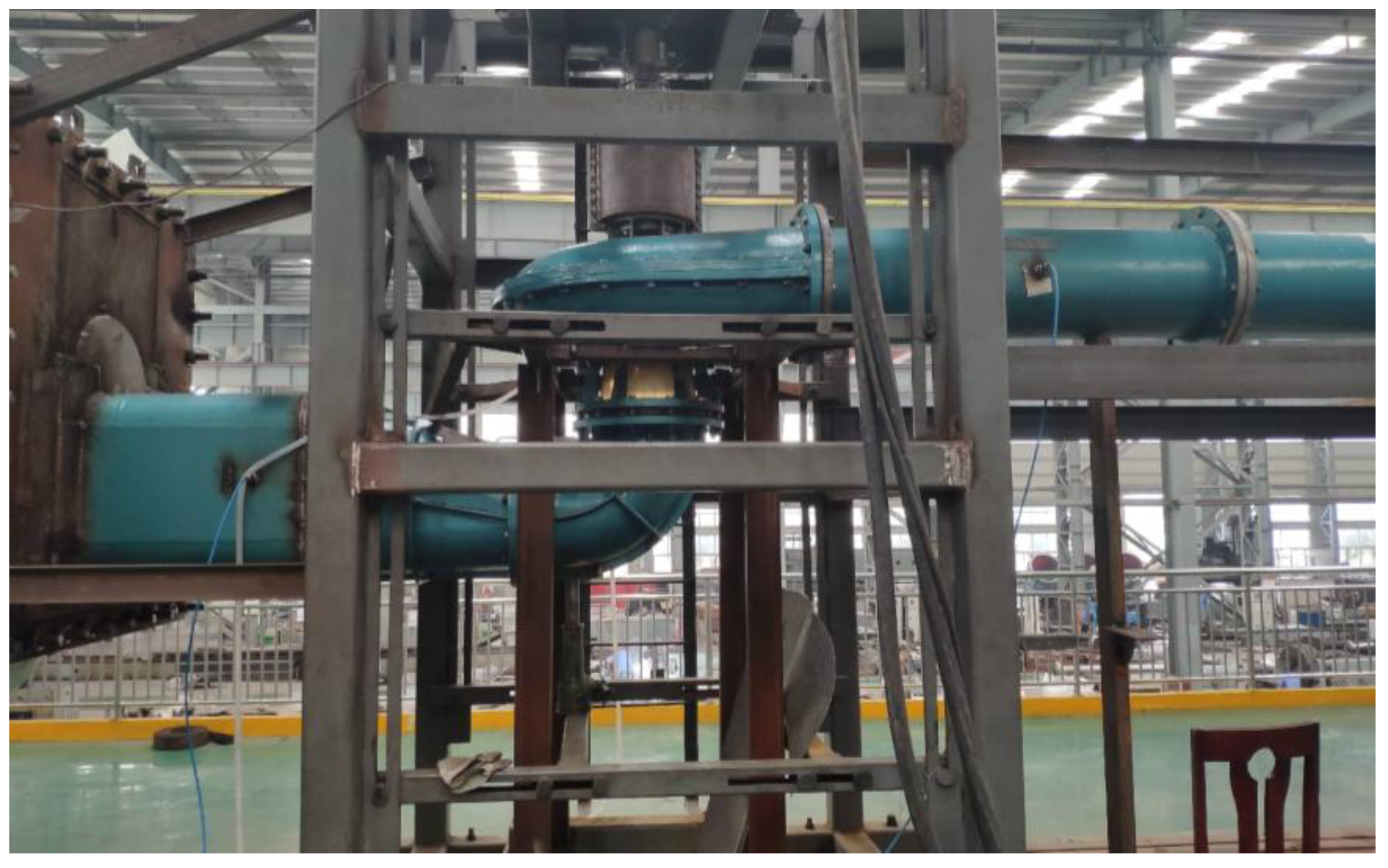
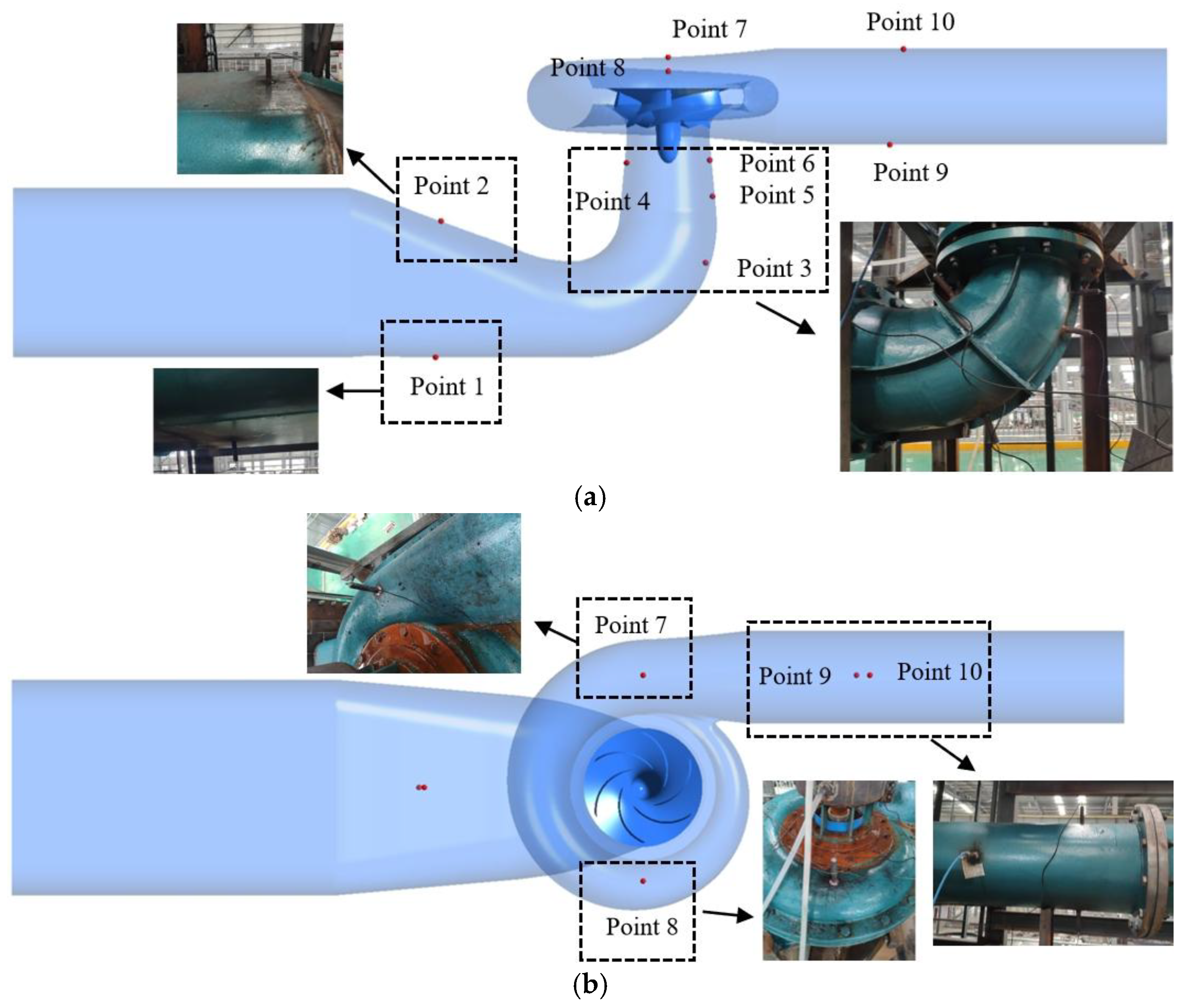
Fast Fourier transform (FFT) is a classic frequency domain analysis method for pressure pulsation, and can be used to obtain time-averaged frequency domain characteristics. Wavelet transform (WT) has excellent time–frequency localization ability and is especially suitable for analyzing the transient frequency domain characteristics of pressure pulsation induced during vortex rope evolution. Therefore, this study built a double-layer closed hydraulic test bench for a centrifugal pump, and installed 10 high-frequency pressure pulsation sensors in the straight-pipe inflow passage, volute, and elbow-type draft tube. Firstly, the characteristic parameters of the runaway condition were obtained by conducting runaway tests. Secondly, based on FFT, the main frequency components and their excitation sources at each measuring point were identified. Finally, WT was used to reveal the time–frequency evolution law of the main frequency signal during the development of the vortex rope in the draft tube. The research results can provide a theoretical basis for the structural design and safety monitoring of centrifugal pumps under transient conditions such as runaway.
3. Results and Discussion
In this chapter, the energy characteristic curve of the centrifugal pump under pump operating condition was obtained. Then, runaway tests were conducted at the selected characteristic heads (11.9 m, 9.6 m and 7.6 m). Finally, frequency domain analysis and joint time–frequency domain analysis of the pressure pulsation signals were performed using FFT and WT, aiming to elucidate the excitation mechanism of the vortex rope in the draft tube on the internal pressure pulsation characteristics under runaway conditions.
3.1. Energy Characteristics Analysis of Pump Conditions
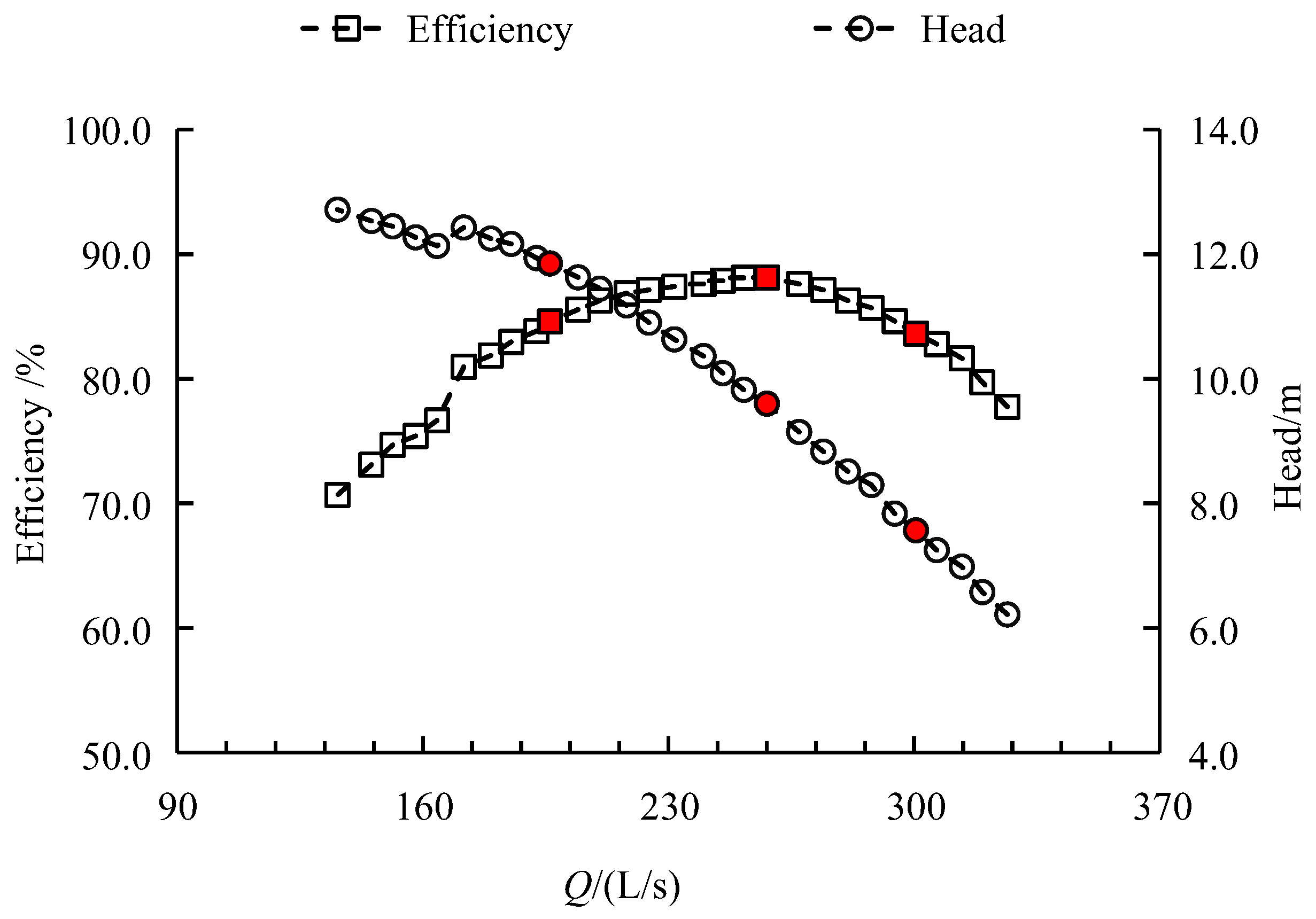
Figure 4 presents the energy characteristic curves of the centrifugal pump under pump operating conditions. As illustrated, the head decreases monotonically with increasing flow rate, while the efficiency first increases and then decreases, reaching its maximum value at a flow rate of 258 L/s. This flow rate, as well as its corresponding efficiency and head, are defined as the design flow rate, design efficiency, and design head, respectively. In accordance with practical engineering requirements arising from seasonal variations, the pump is required to operate within a certain flow range. Accordingly, the representative high and partial flow rates were set at 301 L/s and 196 L/s, respectively.
Table 2 summarizes the efficiency and head values corresponding to these three characteristic flow rates, which are marked in red in
Figure 4.
3.2. Characteristics Analysis of the Runaway Condition
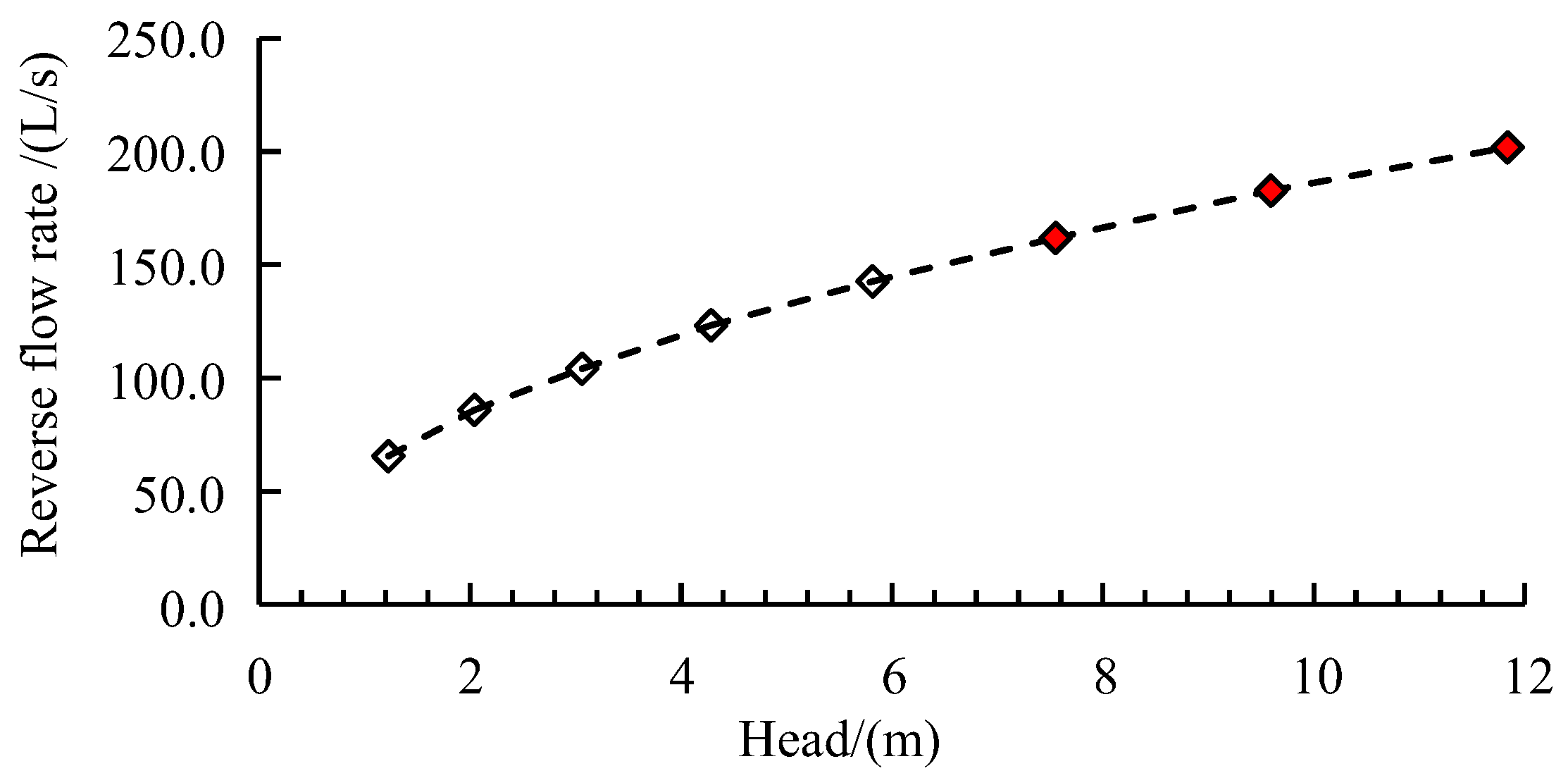
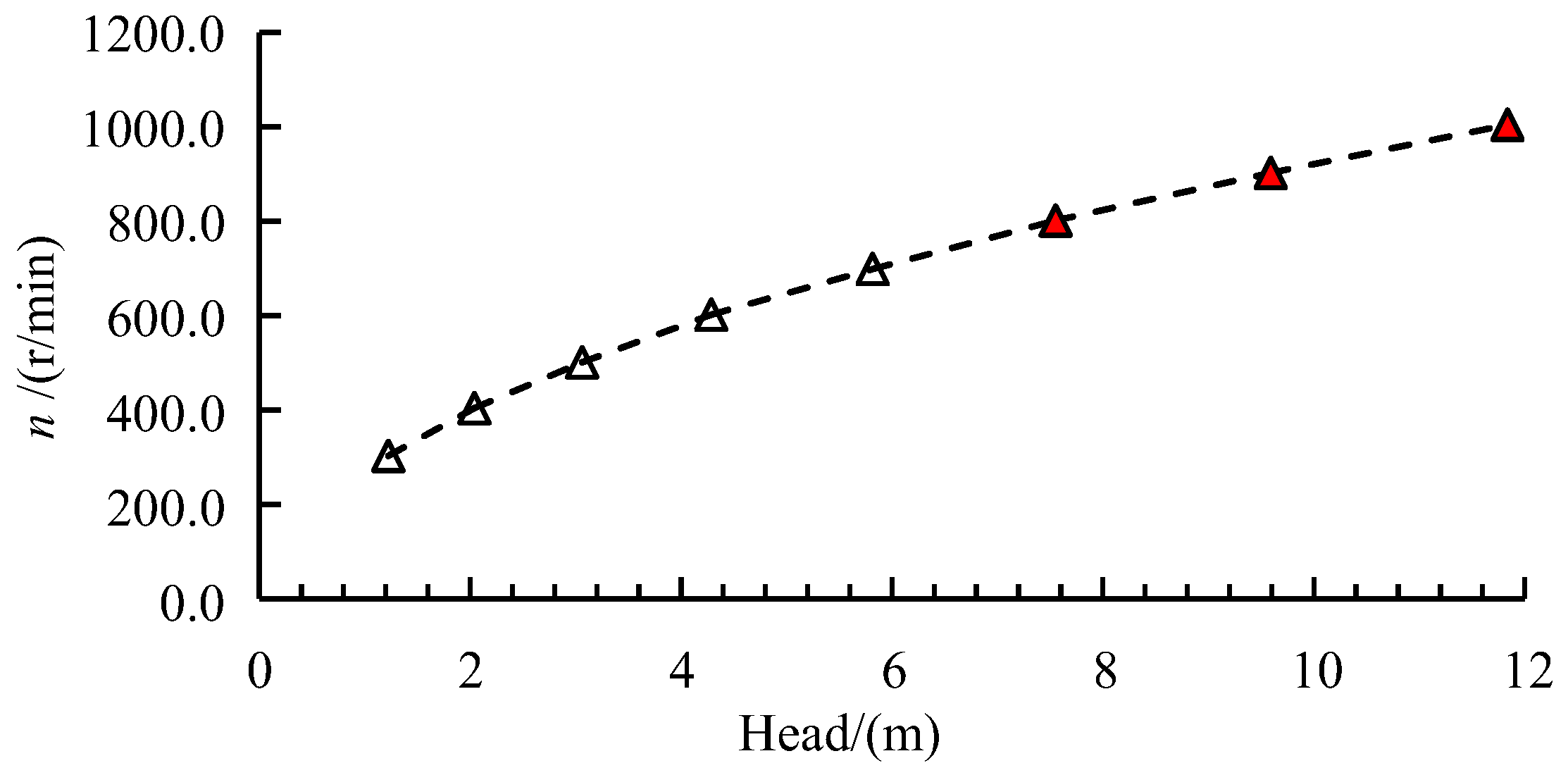
Figure 5 and
Figure 6 illustrate the variations in centrifugal pump rotational speed and reverse flow rate with respect to head under runaway conditions. As the head increases, both the runaway speed and reverse flow rate exhibit a clear upward trend, with the two curves displaying similar slopes. The values corresponding to the characteristic pump operating conditions, which are the critical conditions based on engineering requirements, are highlighted in red in the figures. This behavior indicates that a higher head corresponds to a greater total pressure difference between the pump inlet and outlet, resulting in an increased effective driving head for reverse rotation. Under identical pipeline and impeller geometric conditions, this elevated effective head enables the impeller to extract more driving torque from the reverse flow, thereby leading to a higher runaway speed and a larger reverse flow rate. However, the internal flow field under runaway conditions is highly complex; consequently, the influence of increased runaway speed and reverse flow on vibration characteristics is not a simple linear superposition. A multidimensional analysis of pressure pulsation characteristics is therefore necessary to elucidate the underlying excitation mechanism.
3.3. Time-Domain and Frequency-Domain Analysis of Pressure Pulsation Under Runaway Conditions
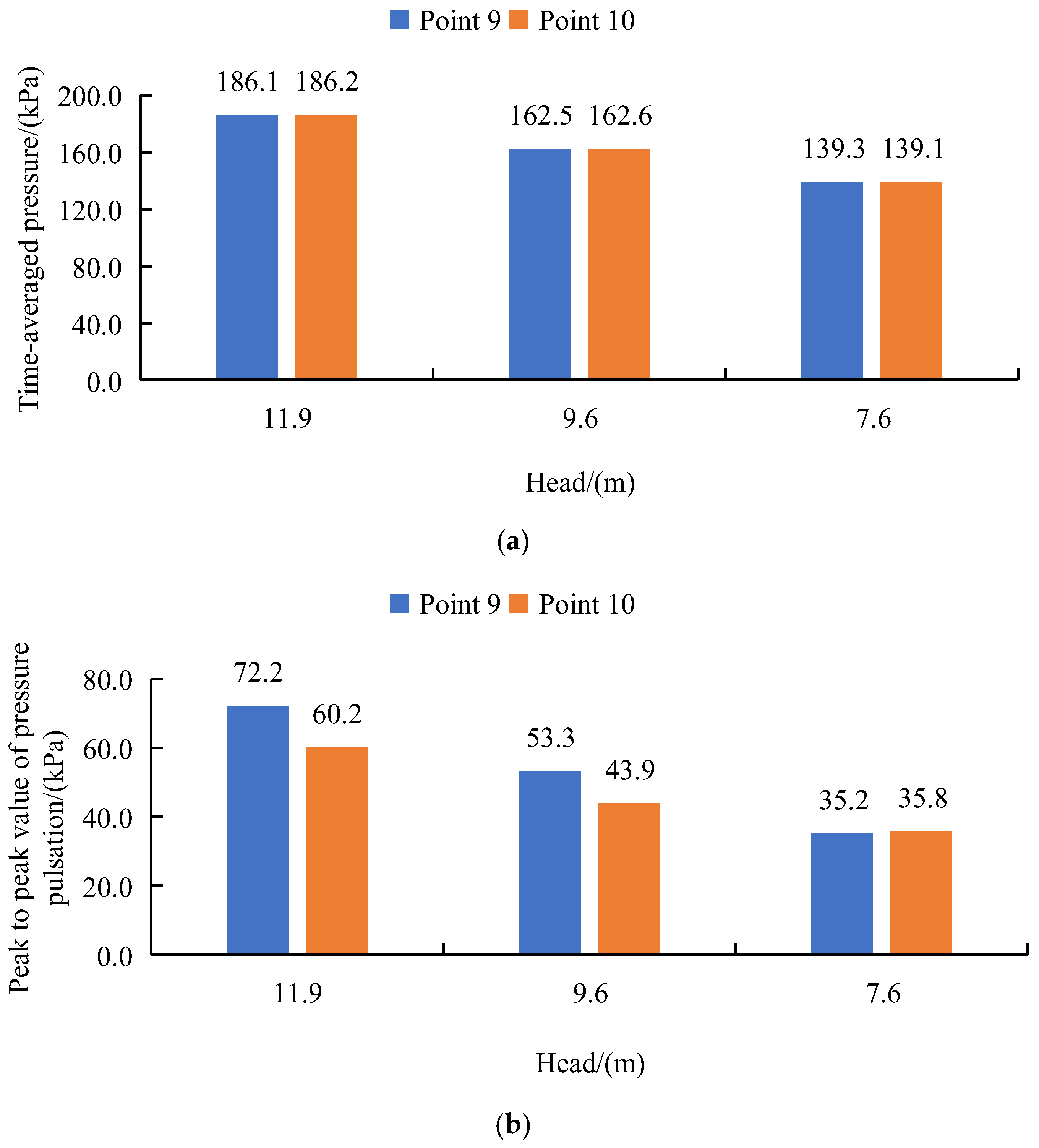
Figure 7 presents the time-averaged pressure and peak-to-peak pressure fluctuations at monitoring points 9 and 10 in the straight-pipe inflow passage over a 10 s period. As illustrated, both parameters at the two monitoring points exhibit an increasing trend with rising head. The dependence of the time-averaged pressure on the vertical positions of the two points—point 9 at the bottom of the inflow passage and point 10 at the top—is negligible. Specifically, as the head increases from 7.6 m to 11.9 m, the time-averaged pressure at both points increases by 33.6%. This suggests that, under these head conditions, the time-averaged pressure is predominantly governed by the overall head rather than by local flow structures. However, as the head rises from 7.6 m to 11.9 m, the peak-to-peak values at Points 9 and 10 increase by 105.1% and 68.2%, respectively. This phenomenon can be attributed to the asymmetric geometry of the volute, which disturbs the upstream flow field as water enters the volute through the inflow passage. This disturbance directly alters the inflow direction, causing the flow to more directly impinge upon the bottom region of the inflow passage (point 9), thereby inducing stronger peak-to-peak pressure fluctuations at that location.
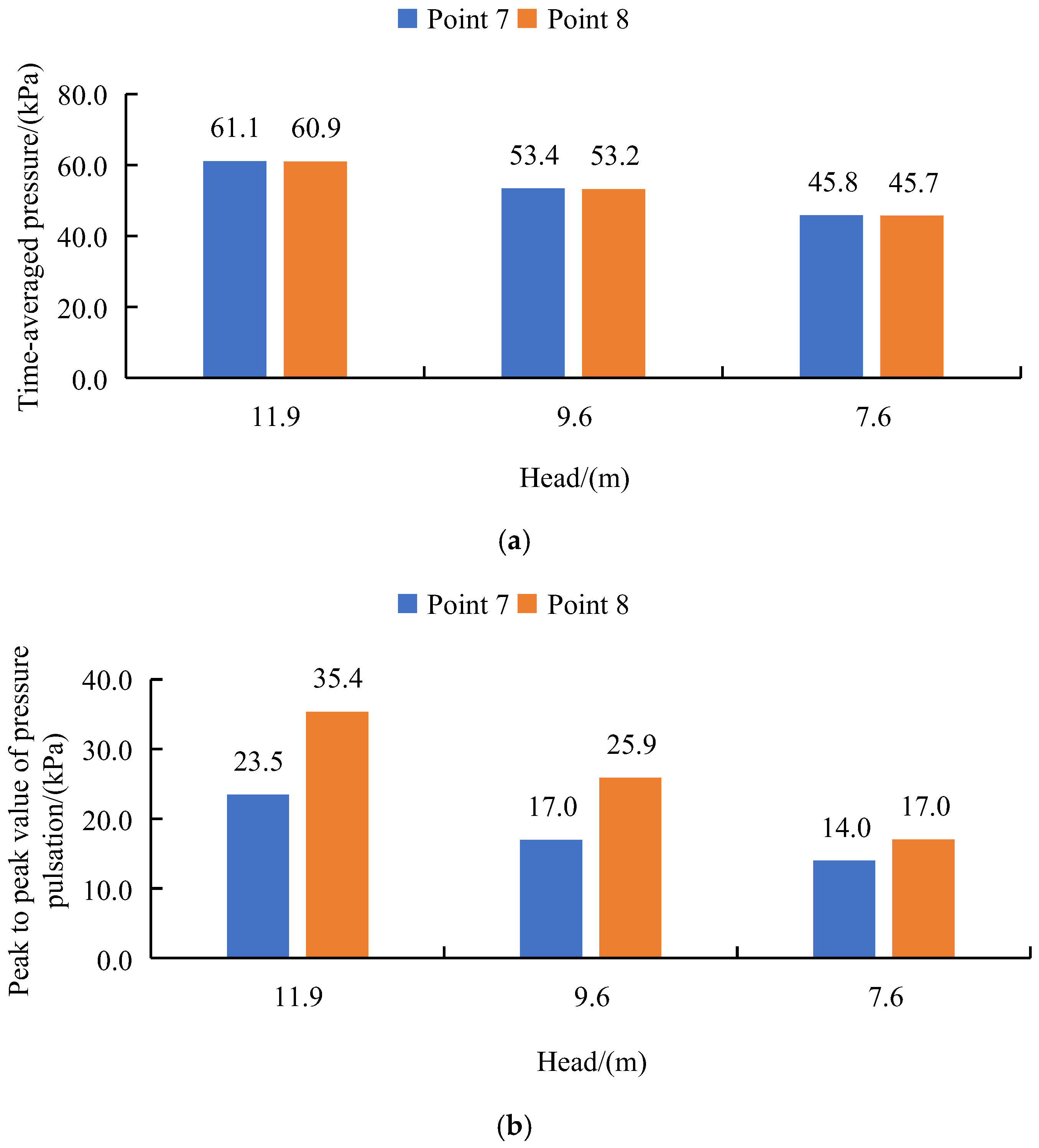
Figure 8 presents the time-averaged pressure and peak-to-peak values at monitoring points 7 and 8 inside the volute. As illustrated, the overall time-domain characteristic values within the volute are considerably lower than those in the inlet channel, indicating that under runaway conditions, the rotor–stator interaction between the impeller and the volute does not serve as the dominant excitation source of pressure pulsations. Similarly to the observations in the inflow passage, both the time-averaged pressure and peak-to-peak values inside the volute exhibit an increasing trend with rising head. The time-averaged pressure shows negligible variation with circumferential position, suggesting that it is primarily governed by the overall head and is less influenced by local flow structures. In contrast, the peak-to-peak values display pronounced circumferential differences. Under all head conditions, the peak-to-peak value at monitoring point 8, which is located farther from the inflow passage, exceeds that at monitoring point 7. This discrepancy reaches its maximum under 11.9 m, where the peak-to-peak value at point 8 is 50.6% higher than that at point 7. Such a difference can be attributed to the asymmetric geometry of the volute, which induces a circumferentially nonuniform pressure distribution.
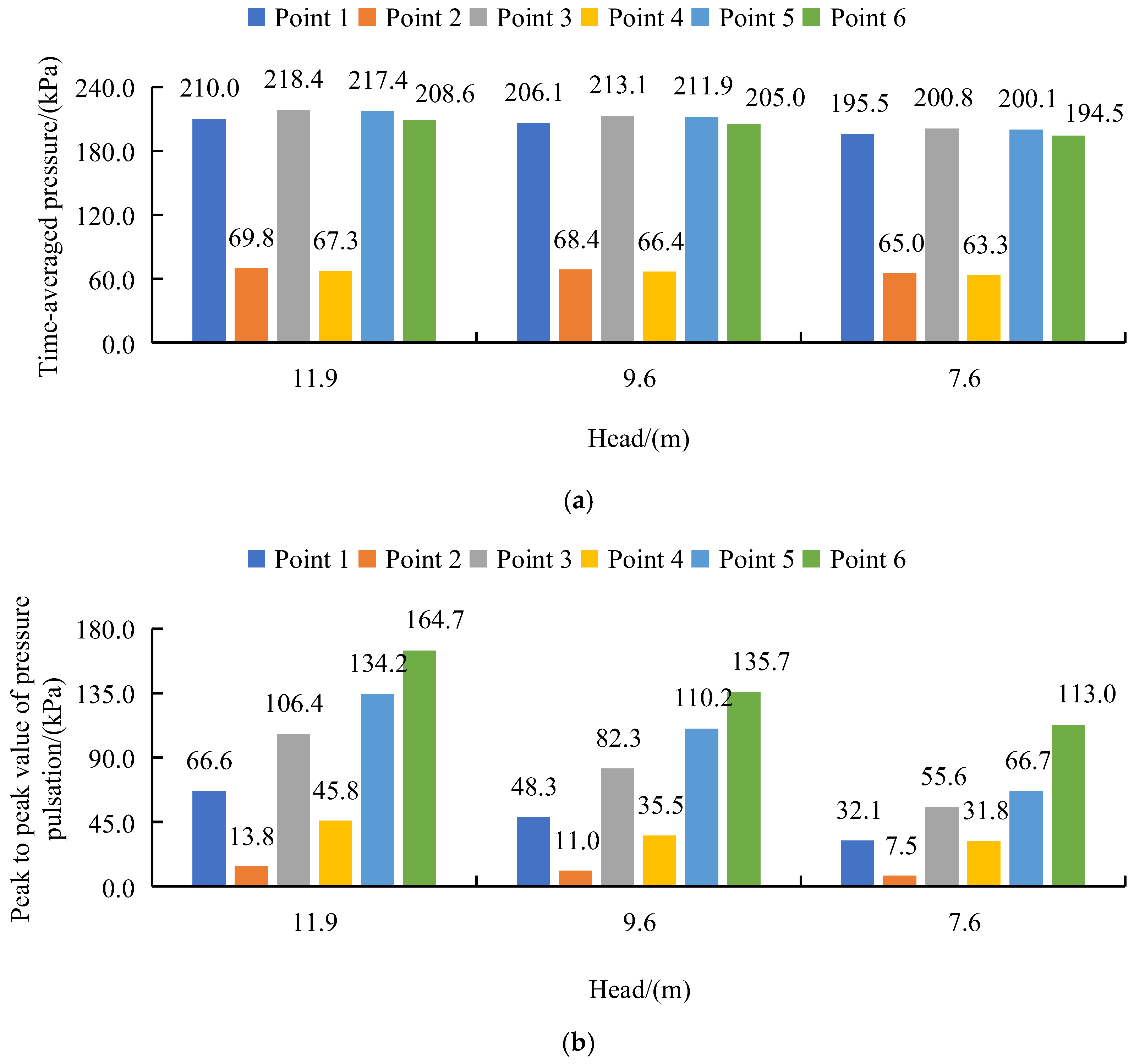
Figure 9 presents the time-averaged pressure and peak-to-peak values at monitoring points 1–6 inside the elbow-type draft tube. As shown, the time-averaged pressure and peak-to-peak values at points 2 and 4—located on the outer side of the elbow section—are substantially lower than those at the other monitoring points, indicating that flow separation induced by the elbow geometry has formed a local low-pressure region in this area. The time-averaged pressures at the remaining four monitoring points exhibit no significant differences; however, their peak-to-peak values display a distinct spatial distribution, decreasing in the order of points 1, 3, 5, and 6. This trend suggests that as the monitor point moves farther from the impeller outlet, the amplitude of pressure fluctuations progressively diminishes. Previous studies have demonstrated that the primary source of pressure pulsations in the draft tube is the unsteady motion of the vortex rope. Therefore, the observed decreasing trend in peak-to-peak values indicates that the vortex rope propagates downstream with the main flow, and its rotational kinetic energy gradually decays, leading to a corresponding reduction in the amplitude of the induced pressure fluctuations.
Based on the comparative analysis of the time-domain characteristic parameters of pressure pulsations at various monitoring points, it is evident that points 1, 3, 5, 6, 9, and 10 exhibit relatively high pressure pulsation amplitudes, and are critical to the operational stability under runaway condition. Therefore, it is necessary to perform a frequency domain analysis on the dynamic pressure signals acquired at these monitor points to identify their primary vibration excitation sources.
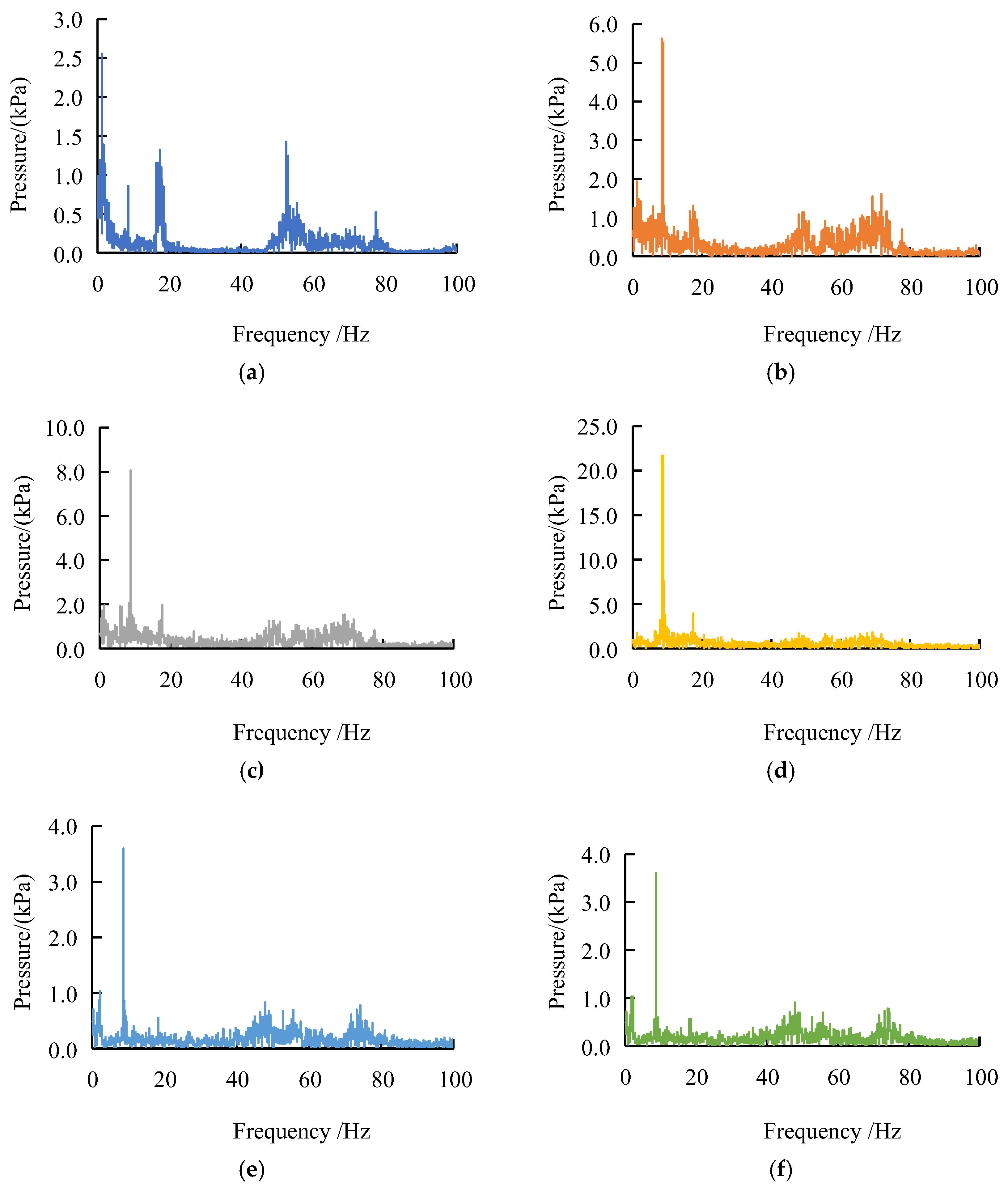
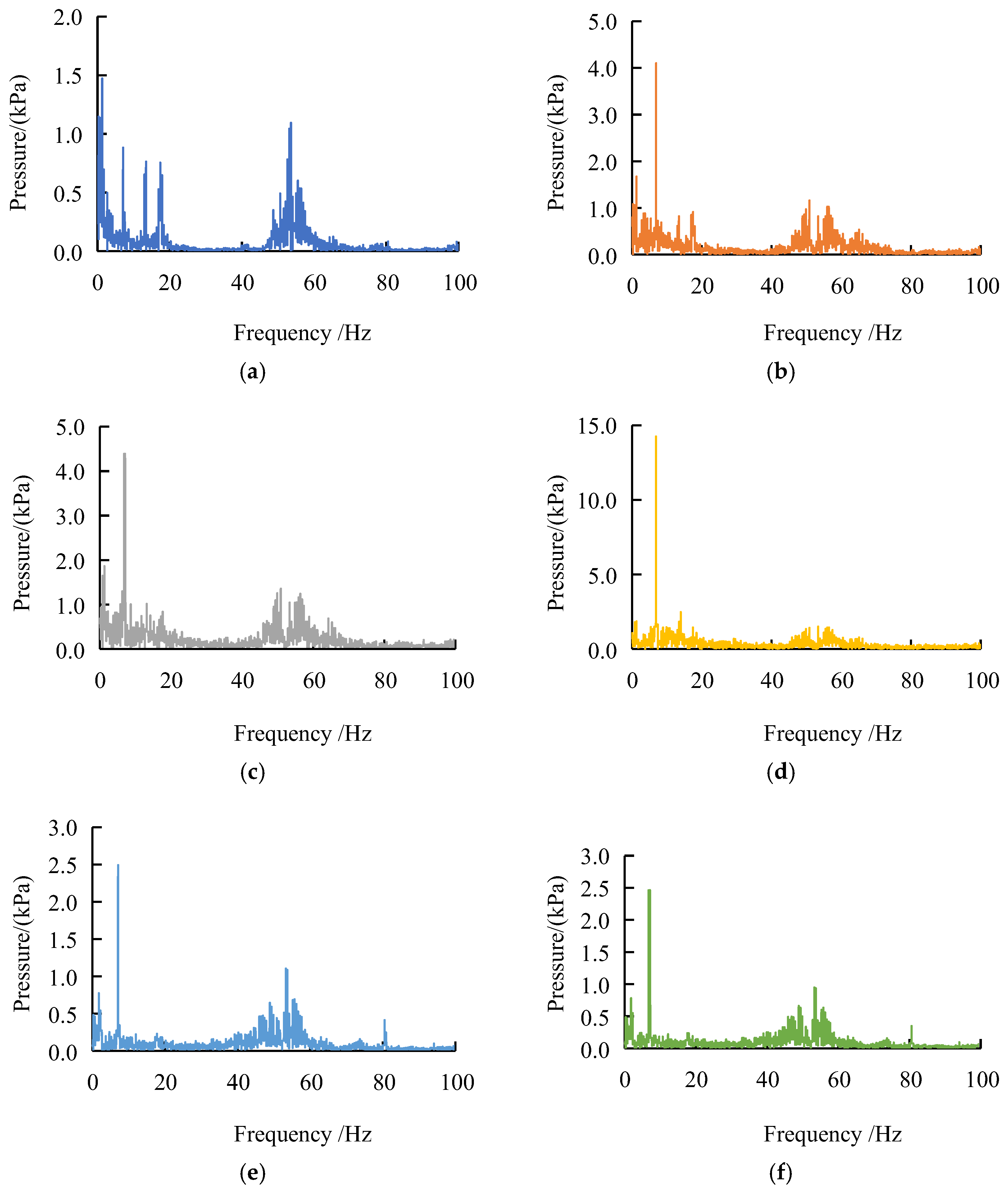
Figure 10 presents the frequency spectra of pressure pulsations at monitoring points 1, 3, 5, 6, 9, and 10 under
H = 7.6 m. As shown in the figure, the dominant frequency at monitoring points 3, 5, and 6—located within the draft tube—is 7.1 Hz, corresponding to 0.53 times the rotational frequency. This value falls within the characteristic frequency range of vortex ropes reported in previous studies, thereby confirming that pressure pulsations upstream of the elbow section in the draft tube are primarily induced by the unsteady motion of the vortex rope. In contrast, the dominant frequency at monitoring point 1, situated downstream of the elbow, is 1.4 Hz; but, frequency components such as 7.1 Hz, 13.5 Hz, and 17.6 Hz also exhibit relatively high amplitudes. This suggests that as the vortex rope passes through the elbow region, it impinges on the wall and disintegrates into multiple smaller-scale vortical structures, resulting in a more dispersed distribution of high-amplitude frequency components in the pressure pulsation spectrum. Furthermore, the dominant frequency amplitudes at points 1, 3, 5, and 6 decrease progressively along the flow direction, reinforcing the observation that vortex rope intensity gradually dissipates as it propagates downstream with the main flow. It is noteworthy that the dominant frequency at monitoring points 9 and 10 in the inflow passage is also 7.1 Hz, indicating that pressure disturbances generated by the vortex rope in the draft tube can propagate upstream, thereby constituting a significant excitation source for pressure pulsations in the straight-pipe inflow passage as well.
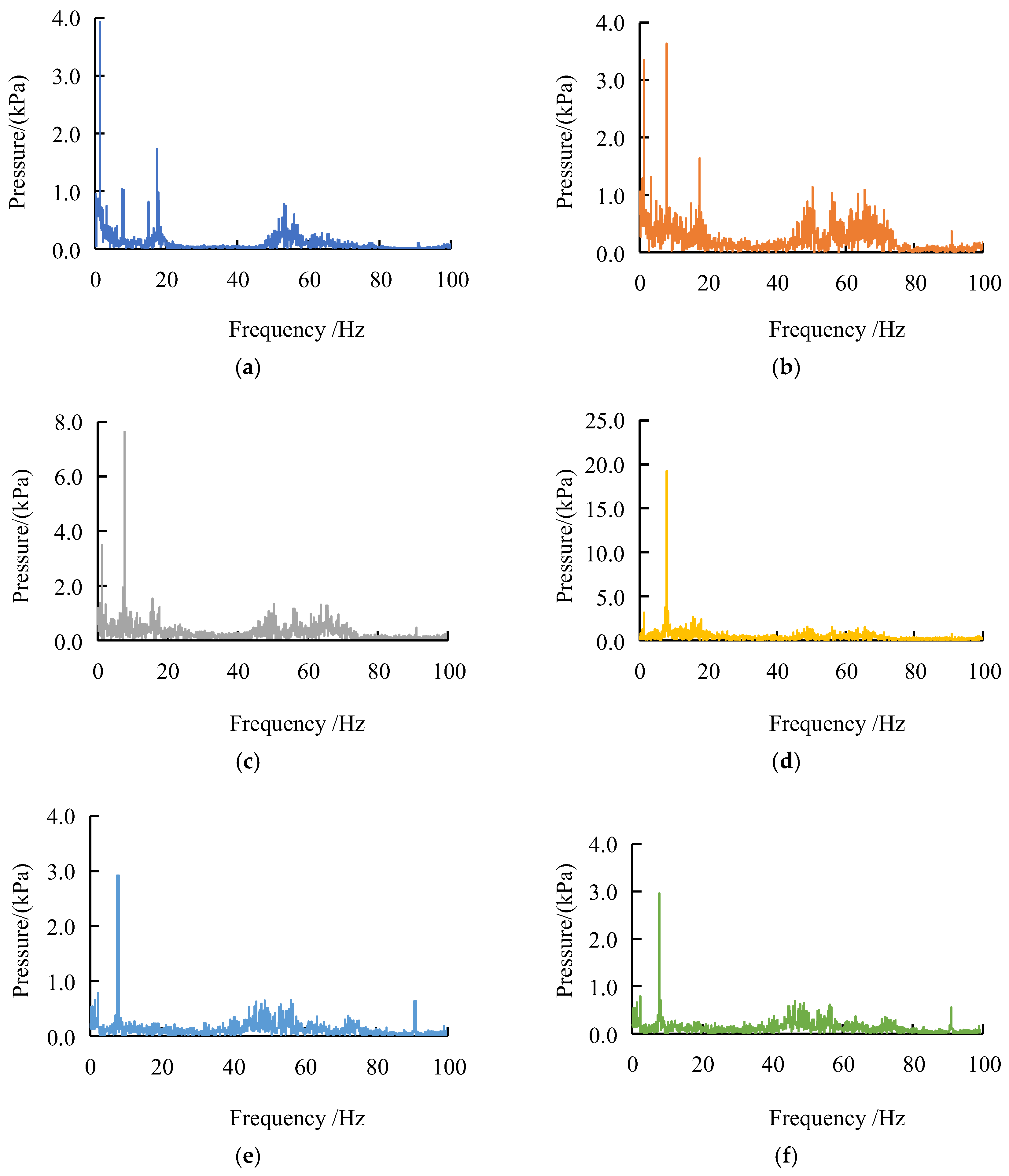
Figure 11 and
Figure 12 present the frequency spectra of pressure pulsations at monitoring points 1, 3, 5, 6, 9, and 10 under
H = 9.6 m and 11.9 m, respectively. The comparative analysis indicates that while the variation in head does not alter the dominant frequency positions at each monitor point, the corresponding amplitudes increase significantly with rising head. For the four monitoring points located in the draft tube, the streamwise distribution of dominant frequency amplitudes remains consistent, increasing in the order of points 1, 3, 5, and 6. This trend further corroborates the finding that vortex intensity progressively dissipates as it propagates downstream with the main flow. The dominant frequency amplitudes at monitoring points 9 and 10 remain comparable across all head conditions, with no notable discrepancy. The disturbance mechanism of the vortex rope on both upstream and downstream flow fields remains unchanged; however, the disturbance intensity intensifies as the head increases. Compared with
H = 7.6 m, the dominant frequency amplitudes at monitoring points 1, 3, 5, 6, 9, and 10 under
H = 11.9 m increase by 70.5%, 38.1%, 77.9%, 53.4%, 46.6%, and 46.5%, respectively.
3.4. Joint Analysis of Pressure Pulsation in the Time–Frequency Domain Under Runaway Conditions
As established in
Section 3.3, the primary excitation source for the monitoring points 1, 3, 5, 6, 9 and 10 is the vortex rope within the draft tube, which evolves periodically with the reverse rotation of the impeller. To investigate the temporal evolution of the dominant frequency of vortex-induced pressure pulsations, a joint time–frequency domain analysis of pressure pulsations at these six monitoring points was performed using WT. The vertical axis represents the Strouhal number (St), obtained by normalizing the frequency with respect to the rotational frequency.
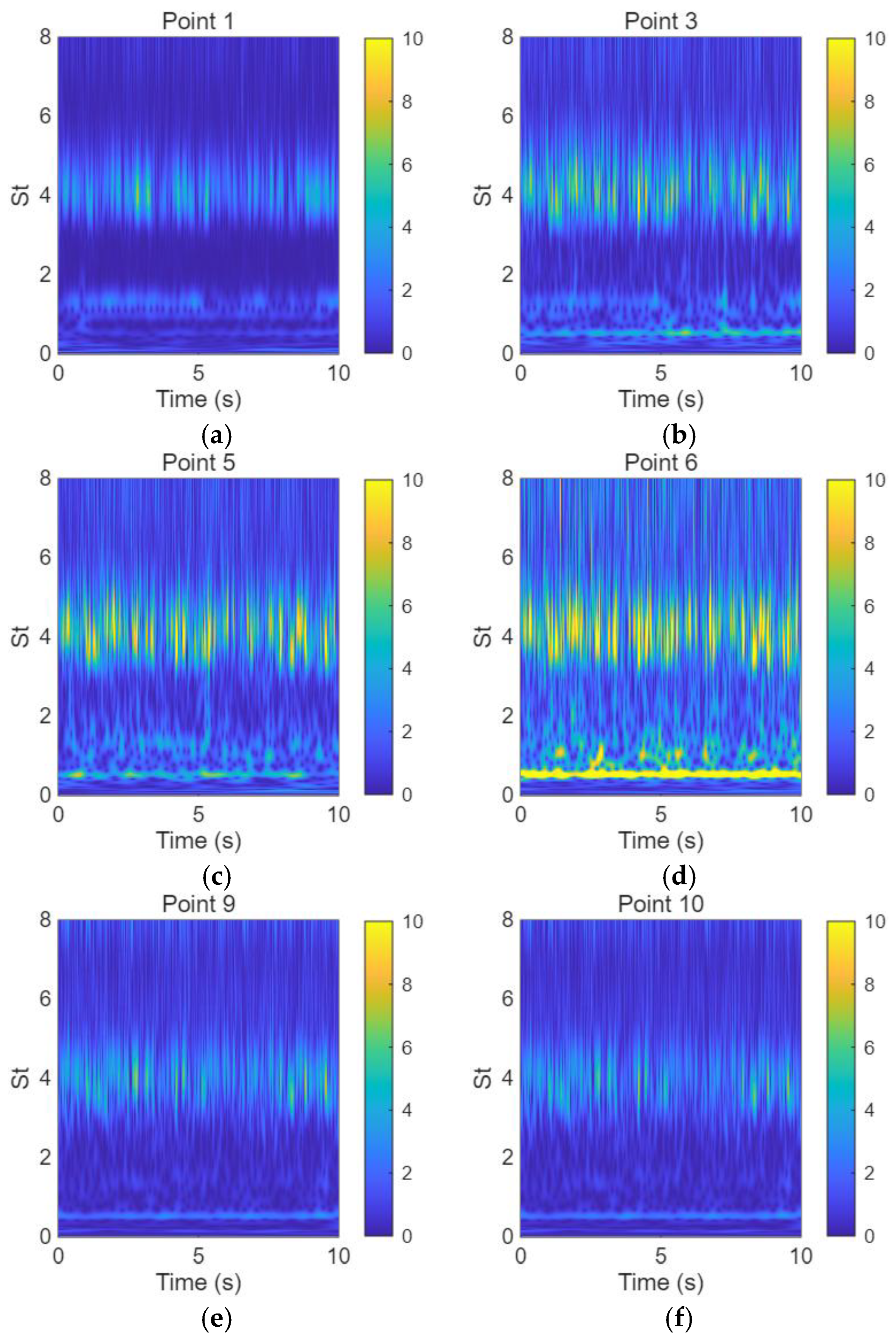
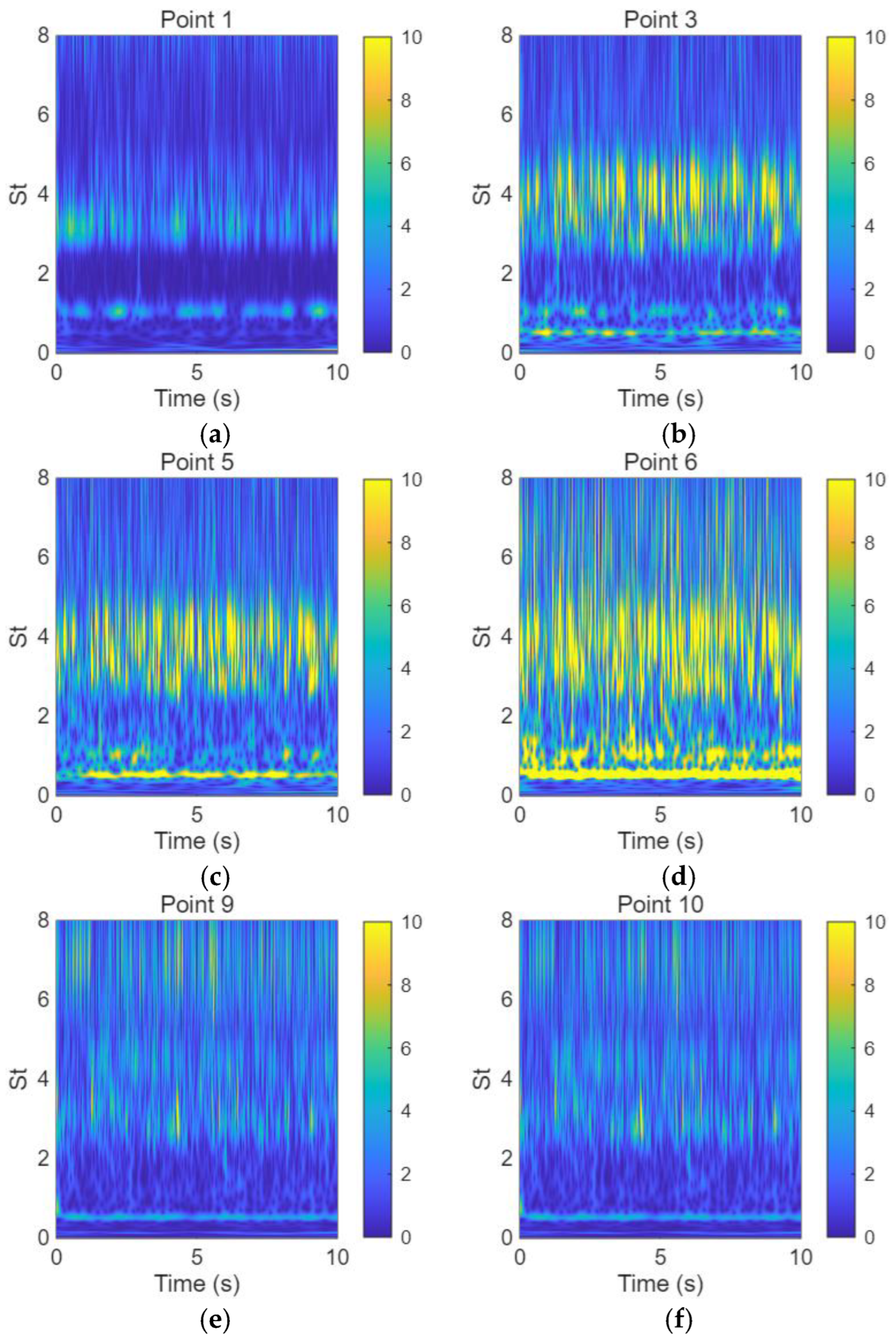
Figure 13 presents a wavelet scalogram of pressure pulsations at monitoring points 1, 3, 5, 6, 9 and 10 under
H = 7.6 m. As can be observed, the dominant frequency at monitoring points 3, 5, 6, 9, and 10 is consistently 0.53 times the rotational frequency (approximately 3.76 Hz), and this component exhibits good continuity over time, indicating that the flow structures in these regions remain relatively stable and that periodic disturbances associated with the vortex rope persist. In contrast, the same frequency component at monitoring point 1 displays markedly poor continuity with intermittent behavior, which is attributed to the impingement and disintegration of the vortex rope as it passes through the elbow section, where it collides with the wall and breaks down into multiple smaller-scale vortical structures, thereby disrupting its periodic disturbance. Within the frequency range of St = 3 to 6, high-amplitude components are observed at all six monitoring points, and the energy in this band oscillates significantly over time, suggesting the presence of flow disturbance components with frequencies higher than that of the vortex rope under runaway conditions; these high-frequency components likely originate from rotor–stator interaction between the impeller and volute as well as from nonlinear frequency superposition arising from coupling with the vortex rope, and their time-varying oscillation characteristics reflect the strong non-stationarity and multi-scale coupling inherent to the internal flow field under runaway conditions.
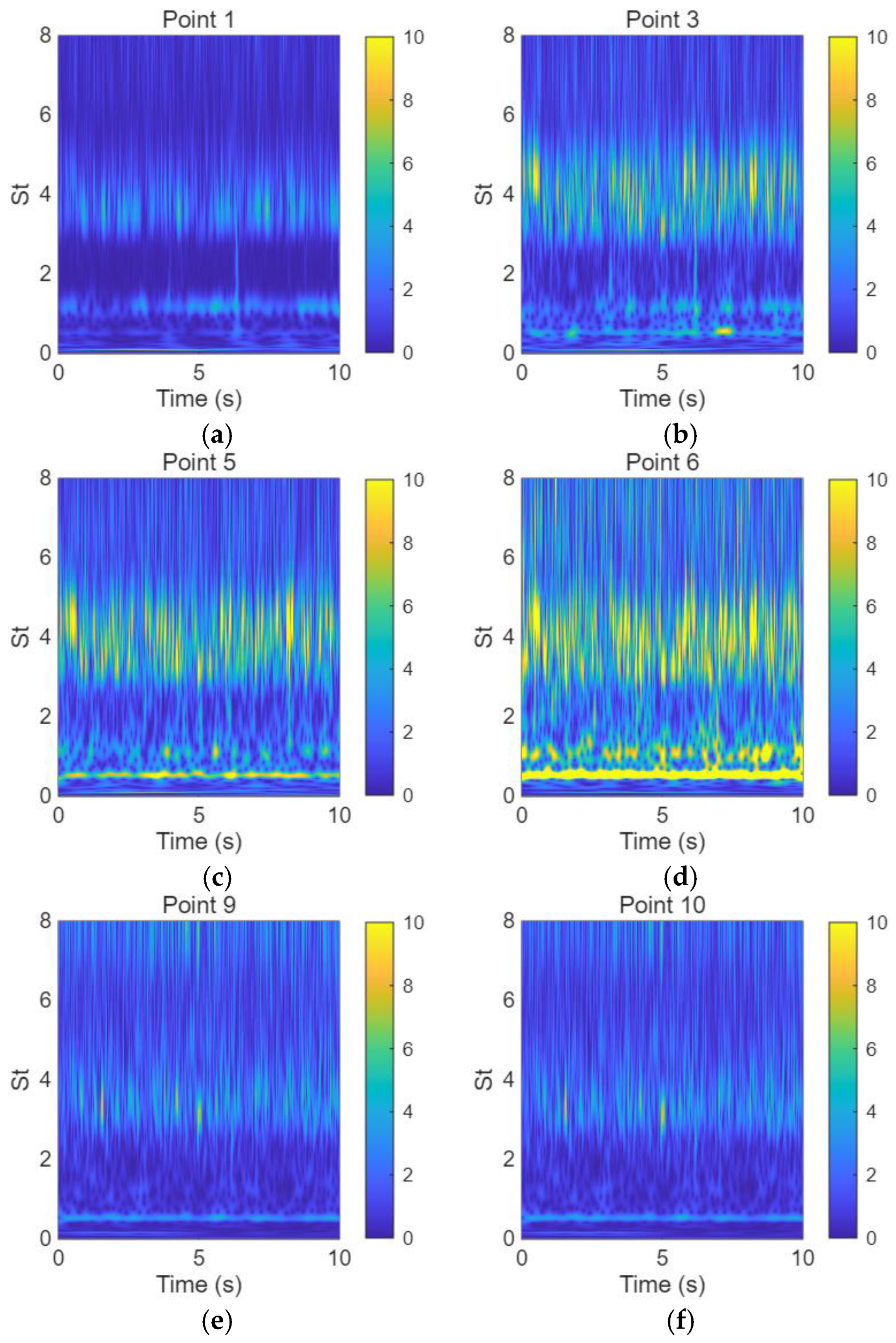
Figure 14 and
Figure 15 present the wavelet scalogram of pressure pulsations at monitoring points 1, 3, 5, 6, 9 and 10 under
H = 9.6 m and 11.9 m, respectively. As illustrated, the increase in head significantly amplifies the dominant frequency magnitude, and exerts no substantial influence on its temporal continuity. This suggests that the periodic motion mechanism of the vortex rope remains fundamentally unchanged across different heads; their energy intensifies with rising head, while the underlying motion patterns persist. Concurrently, high-frequency components arising from the nonlinear coupling between rotor–stator interaction and vortex disturbances continue to manifest, exhibiting sustained strong oscillations within the frequency range of St = 4 to 6. In addition, the elevated head intensifies the rotor–stator interaction in the impeller outlet–volute tongue region, rendering the nonlinear coupling effects more pronounced and thereby further increasing the frequency amplitudes. Notably, under
H = 11.9 m, the frequency range of these pronounced oscillations extends to St = 2–8, indicating that higher-order harmonics induced by the interaction between impeller rotation and the asymmetric volute geometry are excited. The multi-scale vortical structures generated after vortex fragmentation become more abundant, and the combined effect of these two factors leads to the diffusion of high-frequency disturbance energy across a broader frequency band. This behavior underscores the strongly non-stationary and multi-scale coupling characteristics inherent to runaway conditions, which become increasingly pronounced as the head rises.
4. Conclusions
This study constructed a closed double-layer hydraulic test bench for centrifugal pumps, with ten high-frequency dynamic pressure sensors installed on the walls of the inflow passage, volute, and elbow-type draft tube. Runaway characteristic tests were conducted, and pressure pulsation measurements were performed under three different runaway heads (H = 7.6 m, 9.6 m, and 11.9 m). The pressure signals were analyzed in both the time and frequency domains using FFT and WT. The main conclusions are as follows:
- (1)
The runaway speed and reverse flow rate increase with the rising head, indicating that the intensification of internal pressure pulsations under runaway conditions results from the combined effects of increased rotational speed and enhanced reverse flow.
- (2)
Among the ten monitoring points, the pressure pulsation amplitude is most pronounced inside the elbow-typed draft tube. Upstream of the elbow, the dominant frequency is 0.53 times the rotational frequency, confirming that the vortex rope serves as the primary excitation source. Downstream of the elbow, the dominant frequency decreases to 0.1 times the rotational frequency, indicating that the vortex rope disintegrates upon impingement with the elbow wall, thereby generating more complex frequency components. Although pressure disturbances induced by the vortex rope propagate both upstream and downstream, their intensity gradually attenuates along the flow direction.
- (3)
The dominant frequency induced by the vortex rope exhibits strong temporal continuity. In addition, high-amplitude frequency components attributed to rotor–stator interaction between the impeller and volute, as well as coupling with the vortex rope, are observed within the elbow-type draft tube. These frequency components display pronounced time-varying oscillations, and their frequency range expands with increasing head—from 4 to 6 times the rotational frequency under H = 7.6 m conditions to 2–8 times under H = 11.9 m.
This study mainly focuses on the pressure pulsation characteristics near the wall of inflow passage, volute, impeller and elbow-type draft tube of a centrifugal pump. Due to the limitation of current pressure sensor technology, the dynamic pressure in the core vortex rope of elbow-type draft tube cannot be directly monitored. Future work can use high-speed photography and PIV testing technology to obtain transmission characteristics of the vortex rope for wall pressure pulsation under different runaway conditions, which can improve the diagnosis accuracy for runaway conditions.