Article

Development and Valorization of Bioenergy Briquettes Using Agro-Industrial Residues from a Semi-Arid Region


by
Víctor Daniel Núñez-Retana
1,
Mirna Lugo-Rodríguez
2,
Alondra Reyes-Morales
2,
Artemio Carrillo-Parra
1,3,
Heriberto de Jesus Maldonado-Quiñones
2,
Maginot Ngangyo-Heya
4 and
Juan García-Quezada
3,*
1
Instituto de Silvicultura e Industria de la Madera (ISIMA), Universidad Juárez del Estado de Durango (UJED), Durango 34120, Mexico
2
Ingeniería en Tecnología Ambiental, Universidad Tecnológica de Rodeo (UTR), Carretera Federal Panamericana Km. 159.4., Rodeo 35760, Mexico
3
Laboratorio de Investigación en Biomasa y Energía Renovable (LIBER), Universidad Juárez del Estado de Durango, Durango 34120, Mexico
4
Facultad de Agronomía (FA), Universidad Autónoma de Nuevo León (UANL), Escobedo 66050, Mexico
*
Author to whom correspondence should be addressed.
Processes 2026, 14(7), 1138; https://doi.org/10.3390/pr14071138
Submission received: 19 February 2026 / Revised: 28 March 2026 / Accepted: 30 March 2026 / Published: 1 April 2026

Abstract

The valorization of agro-industrial residues for solid biofuel production represents a sustainable strategy to meet energy demand, reduce open-field burning, and mitigate environmental impacts. This study aimed to assess the feasibility of producing high-quality briquettes from agro-industrial residues such as oregano stems, pecan shells, and peanut shells sourced from a semi-arid region of northern Mexico. Raw materials were obtained from local industries, processed, and characterized through proximate analysis and determination of higher heating value (HHV). Briquettes were manufactured under various compaction pressures and temperatures without the use of binders, and their physical and energy properties were evaluated according to international standards. Results indicated that all briquette types met Class A quality standards, with moisture contents between 6 and 9%, ash contents below 6%, and HHVs ranging from 18.9 to 21.0 MJ kg−1. Pecan shell briquettes exhibited the highest particle density (1.18 g cm−3), while peanut shell briquettes demonstrated superior mechanical performance and the highest Impact Resistance Index (97% and 200, respectively). Oregano stem briquettes showed lower densities but maintained satisfactory energy properties (19.5 MJ kg−1). Beyond its energy potential, this valorization approach contributes to local economic development, reduces environmental pollution, and decreases dependence on firewood in rural communities.

1. Introduction

Bioenergy is fundamental to the transition to cleaner and more sustainable energy systems, driven by technological advances and the need to reduce dependence on fossil fuels [1]. By 2050, the global supply of bioenergy could increase sixfold, contributing between 64 and 313 EJ—or about 7.5% to 37% of total energy demand—particularly through circular economy and waste-to-energy strategies [2].
Improper disposal of agro-industrial waste contributes to greenhouse gas emissions, air pollution, and soil degradation [3]. Globally, more than 2 billion tons of agricultural waste accumulate annually [4], representing about 33% of total biofuel consumption [5]. However, these residues, which are often discarded after processing, can be used as feedstock for solid biofuels [6]. Converting them into briquettes improves storage, transport, and combustion efficiency, while also promoting waste reduction [7], thus positioning agro-industrial by-products as a strategic resource for renewable energy and environmental sustainability [8].
In Mexico, solid biofuels are the most widely used renewable energy source, and it is estimated that a biomass potential of 1030 PJ per year from forestry and agricultural waste could be harnessed for energy production without impacting natural ecosystems [9]. In this context, Mexico ranks 13th worldwide in food production, cultivating around 818 agricultural products, and leading global production in 71 of them [10]. This high agricultural production generates large volumes of non-commercial agro-industrial waste, which has potential as renewable energy alternatives; however only 10% of this waste is currently used for energy generation [9,11]. Despite its widespread availability, the energy potential of these by-products remains insufficiently quantified and characterized; therefore, identifying local biomass sources aligned with the principles of circular economy becomes increasingly relevant.
Oregano (Lippia graveolens) is widely used as a culinary spice in traditional dishes and in the Mexican food industry [12]. In addition to its culinary value, it serves as a raw material to produce essential oil, used in pharmaceutical, food, and cosmetic sectors [13]. Nationally, it is a highly valuable non-timber forest product, with over 6500 tons of dried leaves harvested annually and generating more than US $8.9 million, 90% of which is exported [14]. Furthermore, steam distillation generates large amounts of de-oiled leaves, known as bagasse, which can reach up to 90% of their original dry weight [15]. These residues are often underutilized, being used minimally for composting or fermentation [16] and are frequently burned or discarded, causing environmental pollution and disposal costs [17].
The pecan (Carya illinoinensis) industry in Mexico, the world’s second-largest producer after the United States [18], generates substantial by-products. During shelling, nutshells represent around 50% of the nut’s weight [19]. While the pecan is valued for direct consumption and oil production [20], the shells remain largely unused despite their high availability.
Regarding peanut (Arachis hypogaea), Mexico produces approximately 84,000 tons annually, ranking 35th worldwide [21]. Peanuts are primarily cultivated for human consumption due to their nutritional value [22] and are also used as livestock feed and green manure [23]. Shells, which represent between 25 and 30% of the harvest, have been investigated for bioenergy applications [24], activated carbon [25,26], and as concrete additives, highlighting their potential as a valuable resource.
The unsustainable exploitation of forest resources and growing concern about deforestation have driven the search for environmentally friendly and sustainable alternatives to traditional use of wood [27]. In this context, agro-industrial residues emerge as a promising option, since agricultural production inevitably generates by-products that, if unmanaged, can contribute to environmental degradation [28]. This issue becomes particularly relevant in the semi-arid and arid regions of Mexico, which together cover over 50% of the national territory and where timber resources are scarce [12]. In these areas, local communities often depend economically on non-timber forest products, and valorizing readily available agro-industrial residues into solid biofuels represents a practical and sustainable alternative [29]. By transforming these underutilized by-products into fuel briquettes, environmental impacts can be reduced, pressure on forests alleviated, local energy deficits addressed, and micro-enterprises supported [30]. With improved biomass stoves, briquettes could replace about 30% of firewood and fossil fuels, making them a viable small-scale solution for supplying energy to rural households [31].
The densification of agro-industrial residues into briquettes offers several advantages, including improved handling and storage, reduced transportation costs, and increased combustion efficiency due to their higher bulk density and uniform shape [32]. The quality and performance of these briquettes are strongly influenced by key process parameters such as compaction pressure, densification temperature, moisture content, and particle size distribution [33]. Optimizing these variables is essential for producing briquettes with high mechanical durability, lower ash content, and higher calorific value, thus contributing to more efficient and sustainable bioenergy production [34].
Several studies have highlighted the valorization of agro-industrial residues for briquette production, underscoring their role in sustainable energy systems. For oregano residues, Guerrero-Martin et al. [17] evaluated briquettes made from stems, reporting favorable calorific values, acceptable emission levels, and high compressive strength; in particular, sensory tests showed that beef cooked with these briquettes was highly preferred, demonstrating added value beyond combustion. Research on pecan shells has also shown promising results: Ngangyo-Heya et al. [35] analyzed the impact of particle size on fuel quality and energy content, while Bautista-Hernández et al. [36] found that compaction temperature significantly affected briquette properties. Similarly, peanut shells have been explored for bioenergy applications, as Gong et al. [37] demonstrated that incorporating peanut shells into corn stover briquettes improved density and reduced production energy consumption, while Patil [38] reported that densification increased the calorific value of peanut shells, reinforcing their suitability as an efficient resource for biofuels.
Despite these advances, few studies have specifically examined the briquetting of oregano stems, pecan shells, and peanut shells within the Mexican context, particularly in semi-arid regions where these residues remain abundant but largely underutilized. Furthermore, while traditional densification research often relies on energy-intensive pre-treatments, this study introduces a novel minimal-processing approach by eliminating the milling stage for oregano and peanut residues. This makes the process more accessible and economically viable for small-scale rural producers. Addressing this research gap could enhance the utilisation of local agro-industrial by-products, mitigate the environmental impacts of open burning and improper disposal, and support rural economic development through the production of renewable solid biofuels. Therefore, this study aims to evaluate the physical and energy properties of these residues when densified into binderless briquettes, to assess their potential as a sustainable source of bioenergy. Additionally, this study aims to provide a scientific basis for selecting agro-industrial residues tailored to specific thermal applications.

2. Materials and Methods

2.1. Raw Biomass Sources and Sampling Location

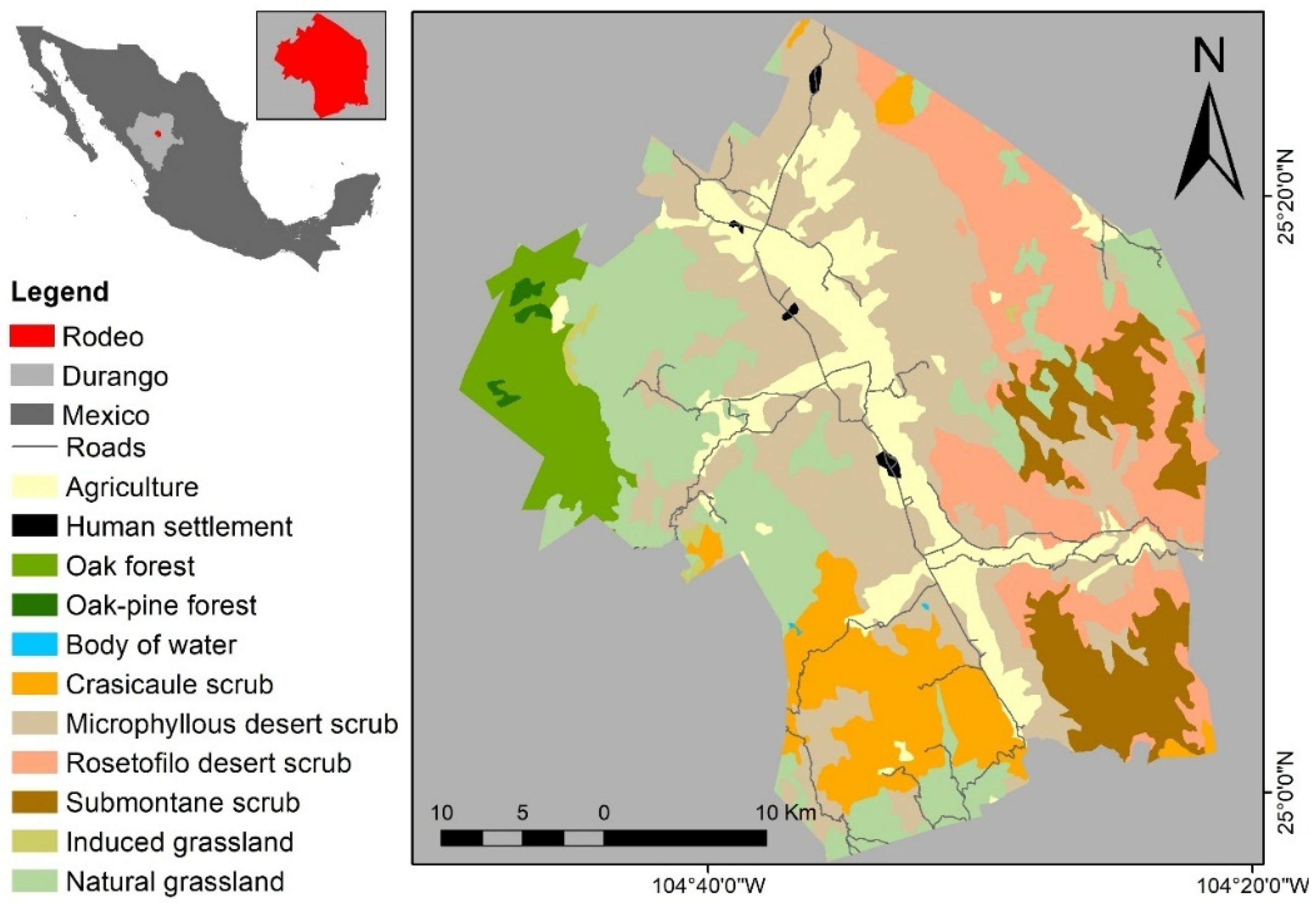
Agro-industrial residues of oregano (Lippia graveolens), pecan (Carya illinoinensis), and peanut (Arachis hypogaea) were collected from various local industries in the municipality of Rodeo, Durango, Mexico (Figure 1). The collection was carried out manually, directly in the processing areas (drying, shelling, or cleaning), selecting representative residues from each crop. Clean polypropylene sacks were used as containers, thus preventing cross-contamination between materials. For each type of residue, approximately 25 kg were collected and transported to the Biomass and Renewable Energy Research Laboratory (LIBER) at the Universidad Juárez del Estado de Durango.

2.2. Processing and Conditioning of Agro-Industrial Residues

Once the residues arrived at the laboratory, they were inspected and manually cleaned to remove foreign materials such as stones, dust, or remnants of the original harvest, including fruit fragments adhering to the pecan and peanut shells. Then, the materials were conditioned to room temperature, ground using a Retsch SM 300 (North Rhine-Westphalia, Germany) grain mill, and sieved through No. 20 mesh (0.85 mm) for subsequent proximate analysis. The material was stored in plastic bags to prevent moisture absorption from the environment.

2.3. Proximate Analysis of the Raw Material

The moisture content of the agro-industrial residues was determined according to the UNE-EN ISO 18134-3 [39]. Samples were weighed using a precision balance (0.1 mg accuracy) before and after being dried in a convection oven at 105 ± 2 °C for four hours.
The volatile matter content was determined according to the UNE-EN ISO 18123 standard [40] by heating the samples at 900 ± 10 °C for seven minutes.
The ash content was determined according to the UNE-EN ISO 18122 standard [41]. The samples were initially weighed and placed in a muffle furnace at 250 °C for one hour to release the volatile compounds. The temperature was then increased to 550 °C and maintained for two hours. After cooling the samples in a desiccator, the final weight was recorded.
The fixed carbon content was calculated by subtracting the sum of moisture, volatile matter, and ash content from 100%, as there is no specific standard for its direct determination in biomass [42]. All proximate analysis tests were performed in triplicate.

2.4. Higher Heating Value (HHV) of the Raw Material

The higher heating value of the samples was determined using a semi-automatic isoperibolic calorimeter (LECO model AC600; Joseph, MI, USA) in TruSpeed™ mode, according to UNE-EN ISO 18125 [43]. The analysis was conducted on an anhydrous basis by burning the samples at high oxygen pressure in a calorimetric bomb under controlled conditions. All measurements were performed in triplicate to ensure accuracy and reproducibility.

2.5. Briquette Manufacturing Process

Preliminary tests were conducted on the materials to establish a basis for the briquetting process under different conditions. Initially, briquettes were produced using the residues in their original state, that is, without prior grinding. At this stage, it was observed that the briquette made from pecan shells did not have adequate physical integrity, as it exhibited cracks when removed from the briquetting machine. These defects were attributed to the size and hardness of the material, as well as its nearly zero moisture content. Therefore, it was decided that the particle size of the pecan shell should be ≤4.75 mm.
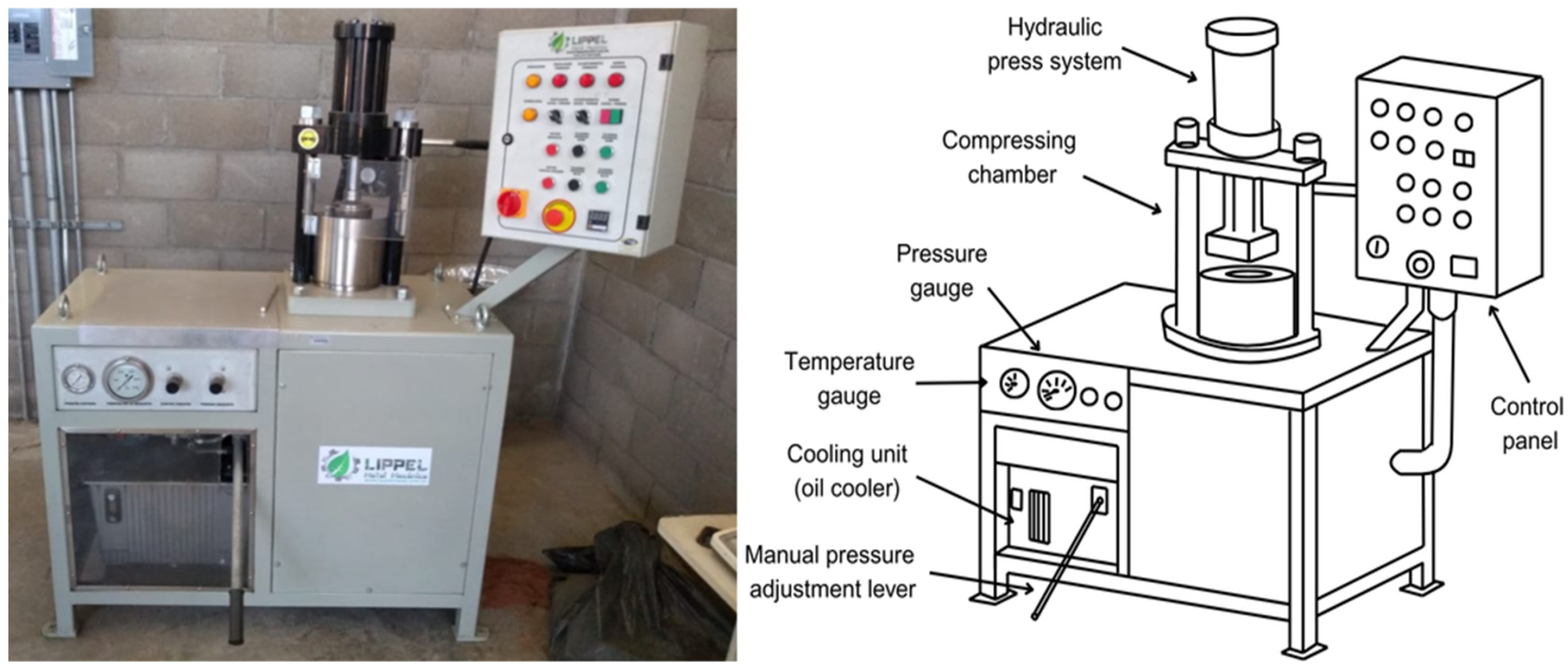
In contrast, the peanut shell residues and oregano stems did not require additional grinding; however, they were conditioned to reach an approximate moisture content of 10% through using a bioclimatic chamber SHELLAB SHC28 (Cornelius, OR, USA) set at 10% relative humidity and a temperature of 25 °C. It is important to note that no binders were used in any of the processes. The briquettes were manufactured using a Lippel LB-32 briquetting machine (Agrolândia, Santa Catarina, Brazil) (Figure 2).
The briquetting machine features a 32 mm diameter die for briquette production, with dimensions of 35 × 45 × 280 mm. The cylinder can exert a maximum force of 10,000 kg, and operates hydraulically, with either electrical or manual control. The die is heated by an electric resistance, reaching temperatures up to 300 °C. The machine is equipped with a 3 HP (3 CV) hydraulic motor and a protective panel to ensure safe operation.
Each biomass type was subjected to six different briquetting conditions, varying the temperature and pressure compaction (Table 1). The treatment combinations were as follows:
The briquetting treatments applied to pecan shells were adjusted to higher temperature ranges (90–110 °C) compared to those used for oregano stems and peanut shells (60–80 °C), due to the distinct physicochemical properties and structural composition of this biomass. Pecan shells are notably denser, harder, and more lignified, which affects their compressibility and binding behavior during briquette formation.
Higher temperatures are known to enhance the plasticization of lignin, a natural binder in lignocellulosic materials, thereby improving interparticle bonding and mechanical integrity of briquettes made from harder biomass. Therefore, higher compaction temperatures were required to ensure sufficient softening of lignin and proper cohesion in pecan shell briquettes, which preliminary tests showed were physically fragile when compressed at lower temperature.

2.6. Proximate Analysis and Energy Characterization of the Briquettes

The proximate analysis and energy characterization of the briquettes were carried out following the same procedures established for the raw biomass. This included determining moisture content, volatile matter, ash content, fixed carbon (by difference), and higher heating value (HHV), using the corresponding standards and conditions described previously.

2.7. Physical Properties of the Briquettes

The physical properties of the briquettes were determined after seven days of conditioning at room temperature. The briquette particle density was calculated from the mass and volume measurements of ten briquettes per treatment.
Although not standardized, a drop test was performed [44,45,46], to evaluate the hardness of the briquettes, as it provides a practical indication of their resistance to transport, storage and compression. Each briquette was dropped four times from a height of 2 m onto a hard surface, and the largest piece was weighed again. Five repetitions were carried out per treatment, and the percentage of material retained without significant breakage or disintegration was recorded as a hardness indicator. The hardness was calculated according to Equation (1):
H a r d n e s s = 100 − ( W i − W f W i ) × 100
where W i is the initial weight of the briquette sample, and W f is the final weight of the piece that remained larger.
The Impact Resistance Index ( I R I ) was calculated following the method proposed by Richards [47] according to Equation (2):
I R I = ( 100 × N ) / n
where N represents the number of drops applied to the sample, and n denotes the total number of resulting fragments after those drops.
This test simulates the mechanical stresses experienced by densified products during unloading from trucks to the ground or when falling from chutes into storage bins. The maximum IRI value is 200. Fragments weighing less than 5% of the total briquette weight were excluded from the count.

2.8. Statistical Analysis

A completely randomized design was used, and the normality of the data for all variables was evaluated using the Shapiro–Wilk test. If the normality assumption was not met, the non-parametric Kruskal–Wallis test was applied, followed by Dunn’s multiple comparisons test, with a significance level of 95% using RStudio software, version 4.5.1.

3. Results

3.1. Proximate Analysis of the Raw Material

Table 2 presents the proximate properties of the evaluated residues. The moisture content ranged from 7.55% in pecan shells to 8.76% in peanut shells. Oregano stems showed the highest volatile matter content (75.76%), while pecan shells had the highest fixed carbon content (23.72%). The ash content was slightly higher in peanut shells (5.00%), and the calorific value ranged from 17.78 MJ kg−1 to 19.63 MJ kg−1.

3.2. Proximate Analysis of the Briquettes

Table 3 showed that the composite variables of proximal analysis and HHV did not show normality according to the Shapiro–Wilk test (p < 0.05) and showed significant statistical differences in the Kruskal–Wallis test (p < 0.05).
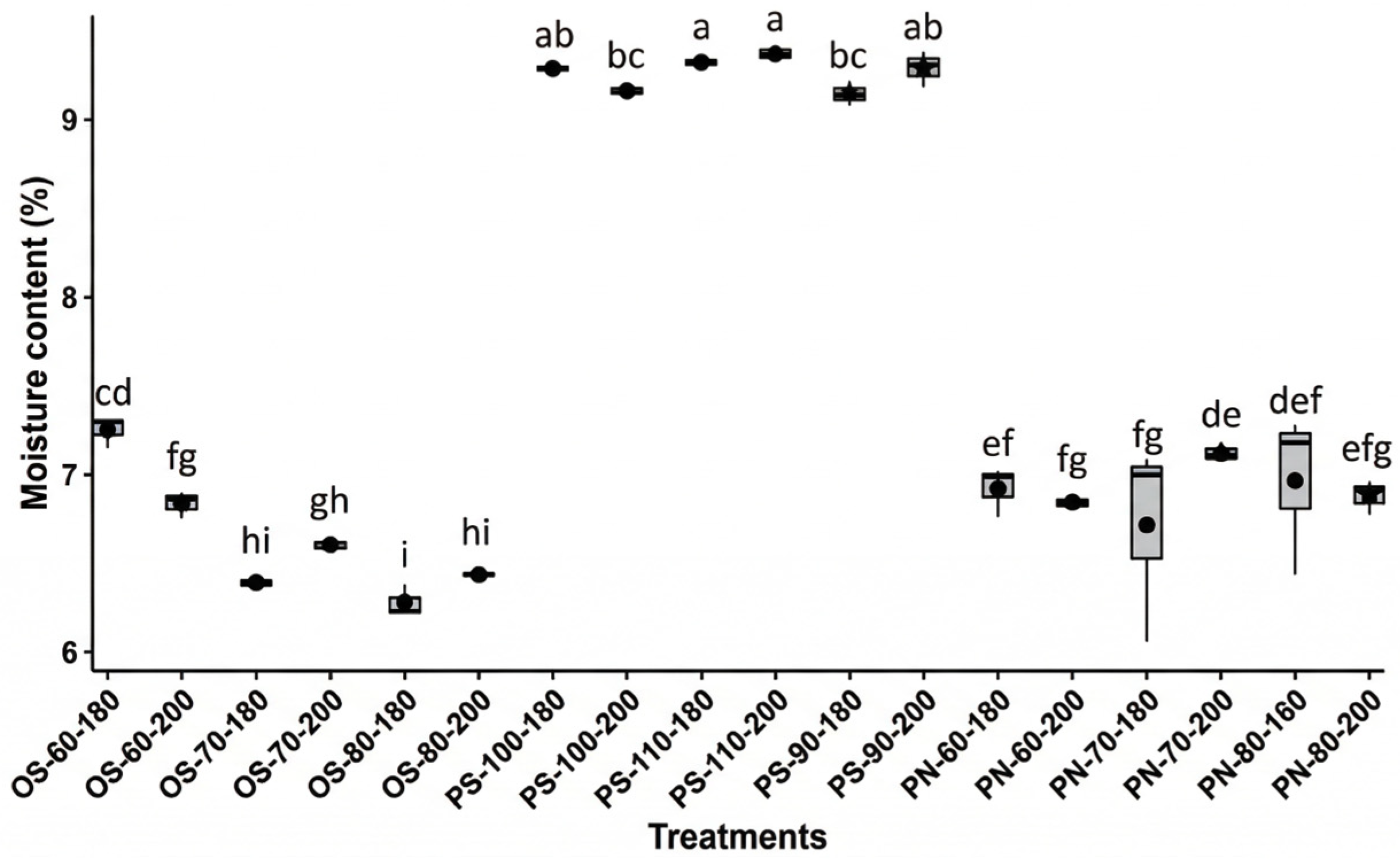
The moisture content test revealed statistically significant differences among treatments (p < 0.05) (Table 3). According to the international standard UNE-EN ISO 17225-7 [48], all evaluated treatments fall within Class A, as their moisture content was ≤12%. Pecan shell treatments exhibited the highest values, particularly PS-110-180 and PS-110-200, with 9.32% and 9.37%, respectively. Peanut shell treatments presented intermediate values, ranging from 6.72% to 7.12%. In contrast, oregano stem treatments showed the lowest moisture content, with the OS-80-180 treatment recording a value of 6.28%.
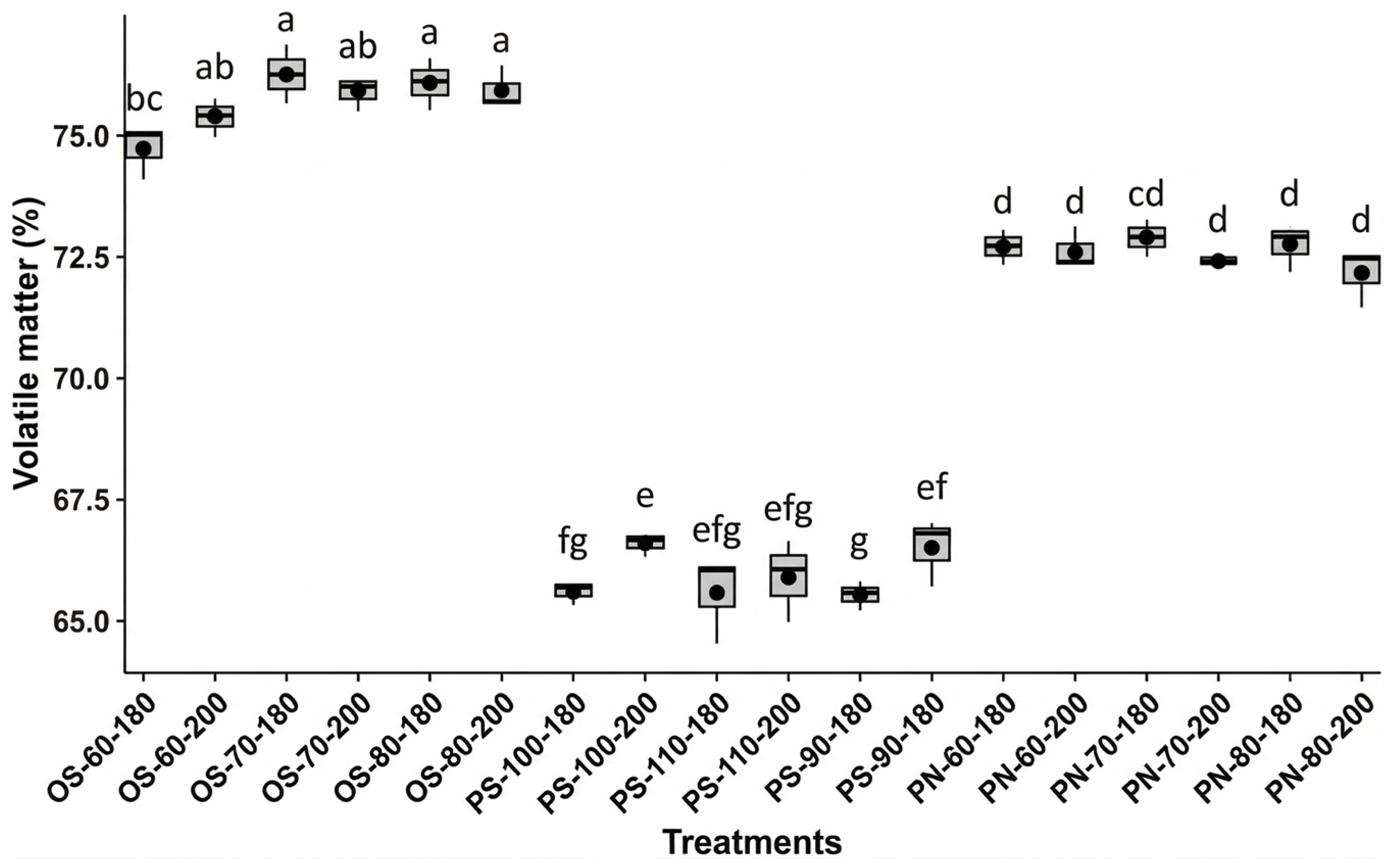
Furthermore, the volatile matter test revealed statistically significant differences among treatments (p < 0.05) (Table 3). Oregano stem treatments showed the highest values, particularly OS-70-180, OS-80-180, and OS-80-200, with 76.27%, 76.08%, and 75.95%, respectively. Peanut shell treatments presented intermediate values, ranging from 72.17% to 72.90%. In contrast, Pecan shell treatments showed the lowest values, with PS-90-180 recording 65.54%.
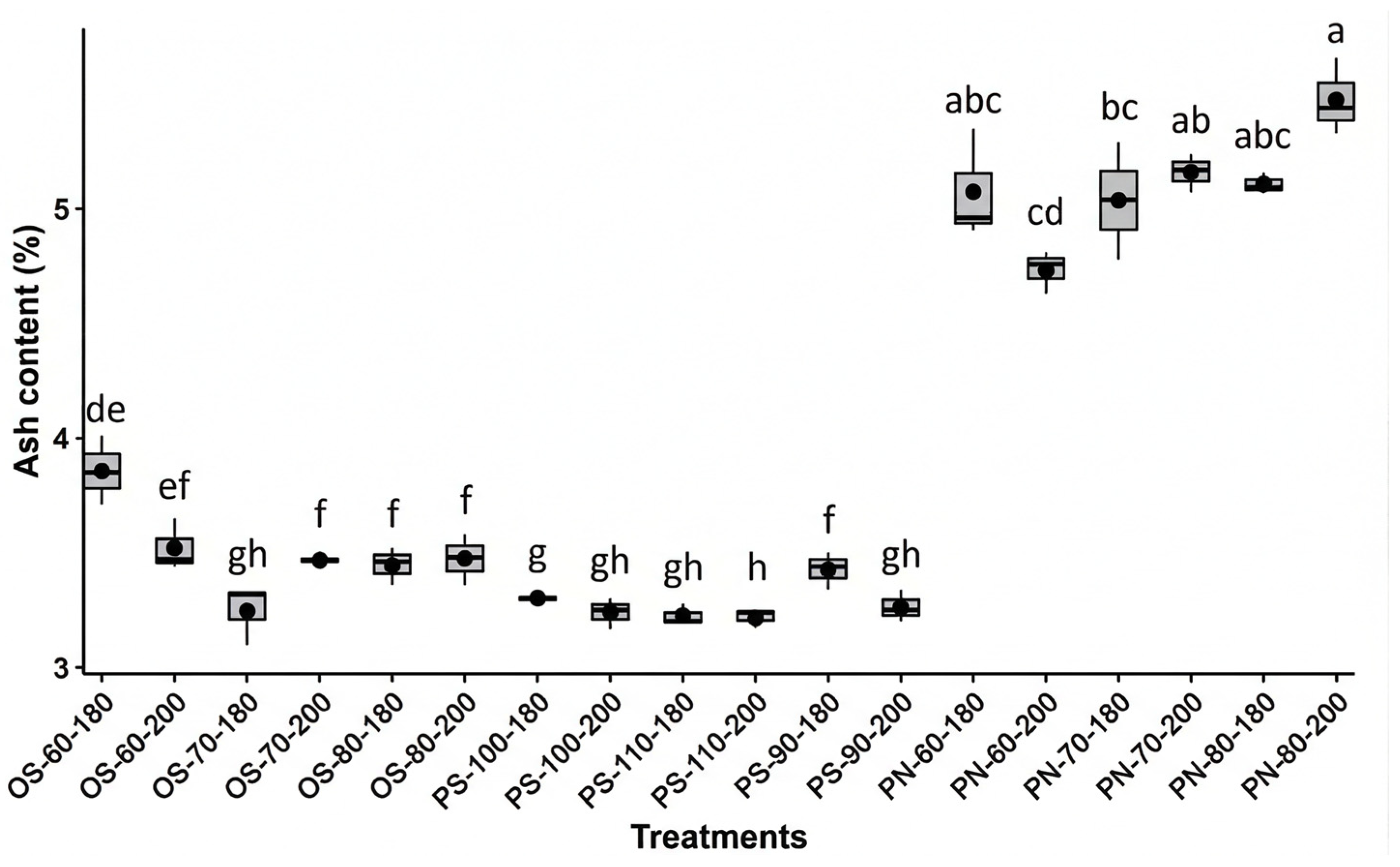
Ash content test showed statistically significant differences among treatments (p < 0.05) (Table 3). All treatments complied with the UNE-EN-ISO 17225-7 standard [48], presenting ash content values below 6%, which classifies them as Class A. Peanut shell treatments exhibited the highest ash content, particularly PN-80-200, with 5.48%. In contrast, oregano stem and pecan shell treatments recorded lower values, ranging from 3.24% to 3.86%.
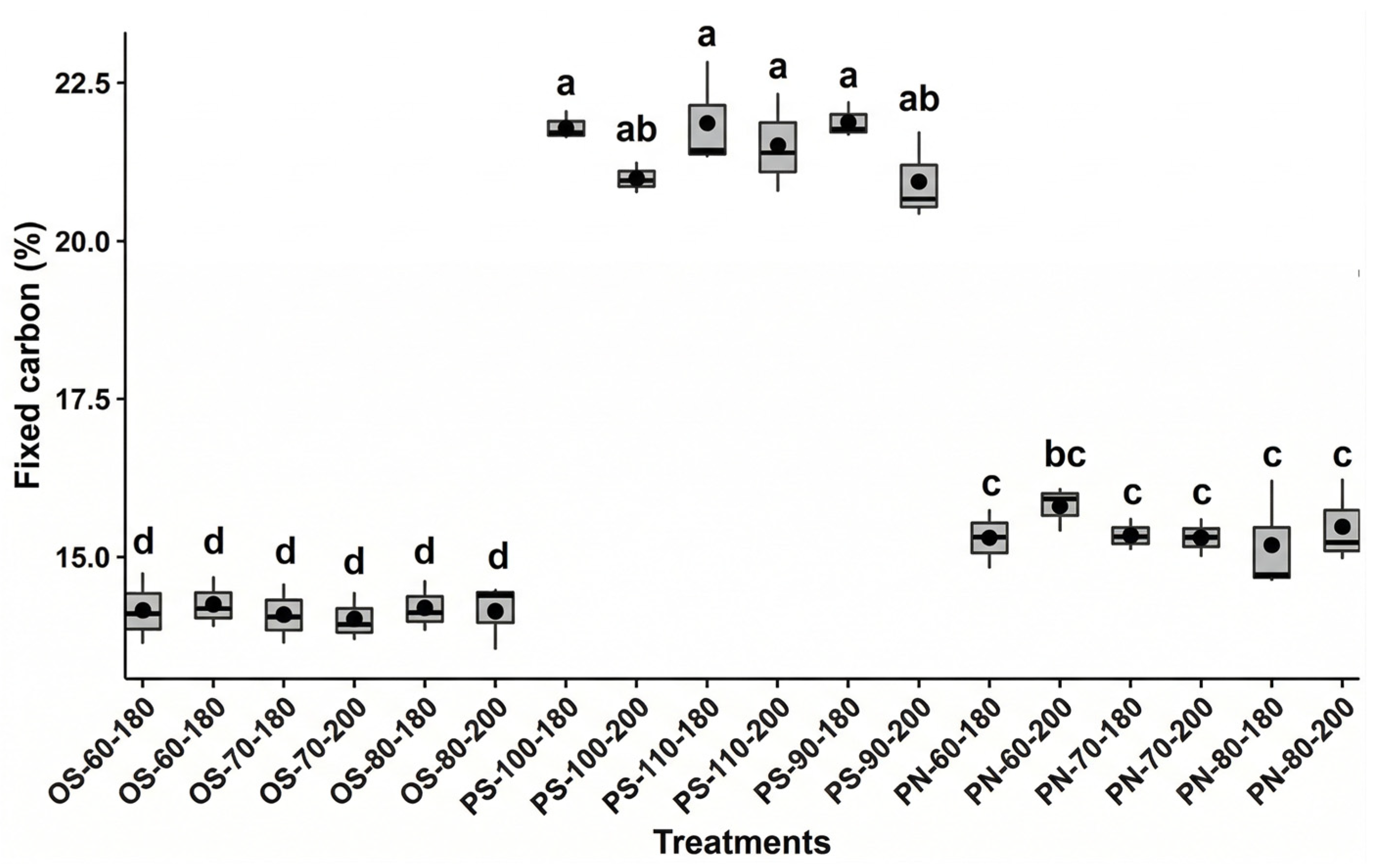
Fixed carbon content showed statistically significant differences among treatments (p < 0.05) (Table 3). Pecan shells recorded the highest values, particularly PS-100-180, PS-110-180, PS-110-200, and PS-90-180, with 21.80%, 21.86%, 21.50%, and 21.88%, respectively. Peanut shell treatments presented intermediate values, ranging from 15.19% to 15.80%. In contrast, oregano stem treatments showed the lowest values, ranging from 14.02% to 14.26%.

3.3. Higher Heating Value (HHV) of the Briquettes

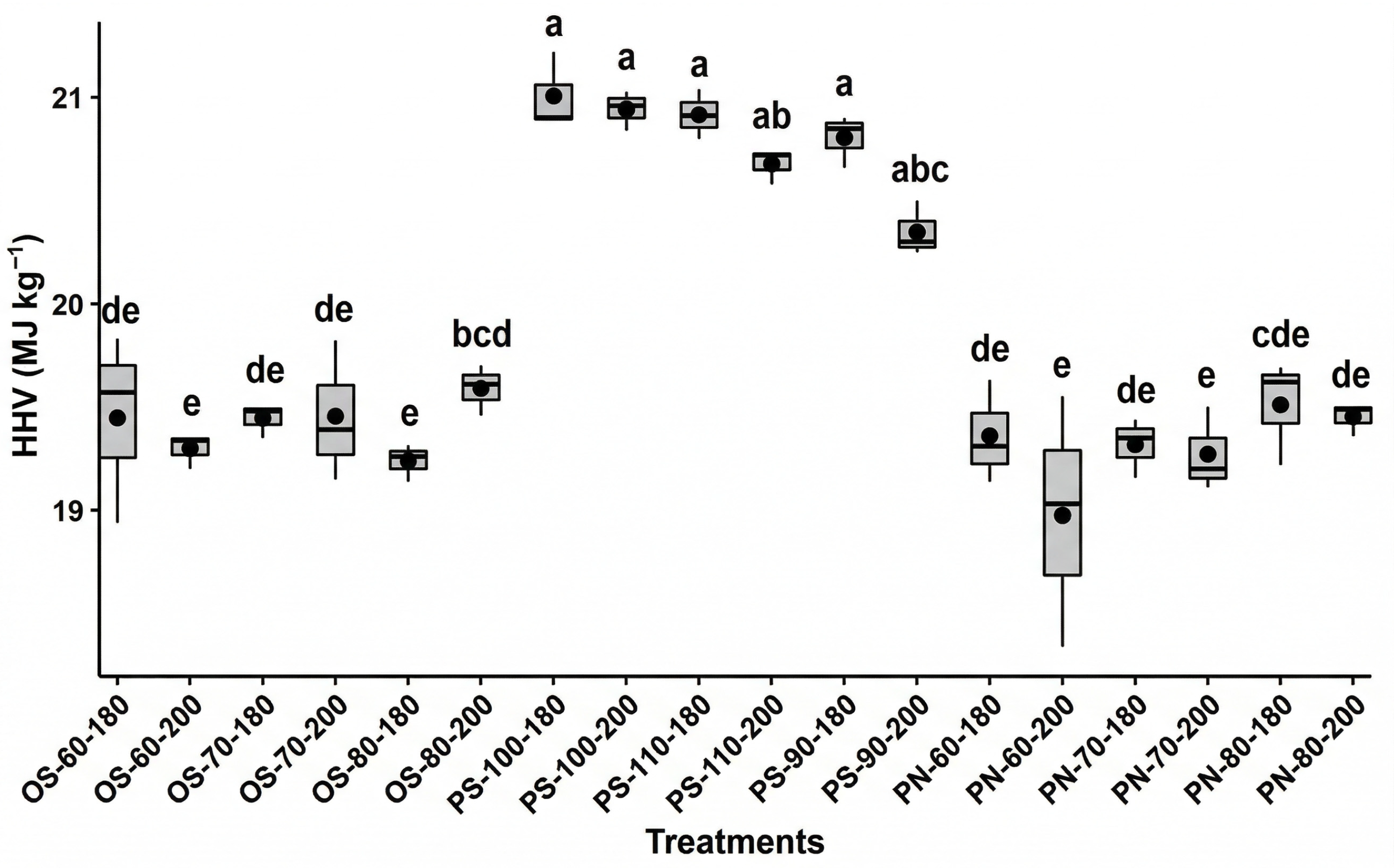
The higher heating value showed significant differences among treatments (p < 0.05) (Table 3). Pecan shell treatments exhibited the highest HHV, particularly PS-100-180, PS-100-200, PS-110-180, and PS-90-180, with values of 21.01, 20.94, 20.92, and 20.80 MJ kg-1, respectively. In contrast, oregano stem and peanut shell treatments showed lower HHVs, ranging from 18.97 to 19.59 MJ kg-1. Nevertheless, all treatments complied with the international standard UNE-EN-ISO 17225-7 [48], presenting energy values above 14.5 MJ kg−1, which classifies them as Class A.

3.4. Physical Properties of the Briquettes

Since the physical property data did not strictly conform to normality assumptions (Table 4), non-parametric analyses were chosen to evaluate the treatments.
Particle density of briquettes showed significant differences among treatments (p < 0.05) (Table 5). Pecan shell treatments, particularly PS-110-180 and PS-110-200, exhibited the highest densities (1.18 g cm−3), followed by PS-100-180 and PS-100-200 (1.16–1.17 g cm−3), indicating that these conditions produce denser particles. Oregano stems showed lower densities, especially OS-70-180, OS-70-200, OS-80-180, and OS-80-200 (0.89 g cm−3), while OS-60-180 and OS-60-200 had intermediate values (0.91–0.92 g cm−3). Peanut shell treatments displayed intermediate and relatively uniform densities (1.03–1.05 g cm−3), which, although lower than PS, are higher than most OS treatments. All briquettes were classified as Class A (particle density ≥ 0.9 g cm−3) according to the UNE-EN ISO 17225-7 standard [48], except for treatments OS-70-180, OS-70-200, OS-80-180, and OS-80-200, which were classified as Class B (<0.9 g cm−3 particle density ≥ 0.6 g cm−3) since their values were slightly below the threshold for Class A.
On the other hand, the hardness of the briquettes showed significant differences among treatments (p < 0.05) (Table 5). Peanut shell treatments exhibited the highest values, reaching up to 97.14%, indicating that these particles are considerably harder than the others. Oregano stems showed intermediate hardness, ranging from 35.38% to 48.65%, while pecan shells presented the lowest values, particularly PS-90-180 and PS-90-200 (7.54–8.39%), although some treatments, such as PS-110-180 and PS-110-200, reached 44.18–47.72%.
The impact resistance index (IRI) showed significant differences among treatments (p < 0.05) (Table 5). Peanut shell treatments exhibited the highest values, reaching up to 200, indicating that these briquettes are the most impact resistant. Oregano stems presented intermediate values, ranging from 53 to 60. In some pecan shell treatments (PS-90-180 and PS-90-200), no values were recorded because the briquettes broke into many small pieces, preventing an accurate calculation of the index. Other PS treatments showed low values, between 12 and 39, indicating lower impact resistance.

4. Discussion

The proximate analysis of the raw residues provides useful insights on their potential for briquette production. The obtained values are consistent with those reported in the literature for these types of raw materials [24,49,50]. The calorific value of pecan shells is comparable to that of woody biomass [51], while the values obtained for oregano stem and peanut shell agro-industrial residues are consistent with those reported in the literature [24,52] confirming the suitability of these residues as feedstocks for solid biofuel production.

4.1. Proximate Analysis

The proximate analysis of briquettes produced from pecan shells, peanut shells, and oregano stems revealed physicochemical properties that meet international standards for solid biofuels, classified as Class A [48]. The final moisture content of the briquettes ranged from 6 to 9% (Figure 3), ensuring both storage stability and efficient combustion [53]. These values are within the recommended ranges for densified biomass products [45,54] and are consistent with previous reports on compacted agricultural residues, which indicate optimum moisture contents between 5 and 10% [35,55].
The observed differences in volatile matter content highlight the influence of biomass type on briquette combustion behavior. Oregano stems exhibited the highest volatile fraction, followed by peanut shells and pecan shells (Figure 4). This trend aligns with previous findings indicating that herbaceous residues, with higher volatile contents, ignite rapidly but burn for shorter durations [56,57]. These results suggest that the selection of briquette feedstock can be tailored to specific applications: peanut shells briquettes promote more stable and sustained combustion, oregano-based briquettes could effectively serve as ignition material, while pecan shell briquettes are better suitable for applications requiring prolonged heat. This differentiated behavior underscores the importance of considering biomass composition when designing briquettes for specific energy applications.
The ash content values obtained in this study are competitive with those reported for other agricultural biomass, which generally range from 2 to 10% (Figure 5) [58,59]. A low ash fraction is particularly advantageous, as it reduces the risk of fouling and slagging during combustion and contributes to lower particulate emissions [60]. In this context, the briquettes evaluated here demonstrate favorable ash characteristics that enhance their suitability as solid biofuels. Furthermore, the relatively low ash levels observed imply a reduced need for maintenance and cleaning in small-scale stoves, which is especially relevant in rural applications where technical support and resources are limited [61].
Regarding fixed carbon content, pecan shells exhibited higher values than those obtained from peanut shells and oregano stems (Figure 6). This trend is consistent with previous studies on hard shells and lignified materials, which typically present a higher proportion of fixed carbon and, consequently, a higher calorific potential [62].
For the higher heating value (HHV), the results obtained in this study fall within the range reported in the literature for pecan shells and agricultural residues (18–22 MJ·kg−1) (Figure 7), confirming the energy viability of the studied materials [35,38,63]. The fact that pecan shells, peanut shells, and oregano stems exhibit HHVs comparable to those reported for certain woody biomass underscores their potential to diversify the feedstock base for bioenergy, thereby reducing dependence on traditional forest resources. Such results reinforce the suitability of these residues as competitive solid biofuels, capable of meeting energy demand while valorizing locally available resources.
A key feature of the present study was the decision not to grind oregano and peanut residues before briquetting, as their particle size and structure were already suitable for densification. In addition, no additives or binders were used during the process. This strategy provides important economic, energy, and environmental advantages. On the one hand, biomass grinding is among the most energy-intensive steps in solid biofuel production. Previous studies indicate that hammer milling may consume between 24 kWh·t−1 for herbaceous biomass and more than 141 kWh·t−1 for woody materials; while the briquetting process itself requires between 128 and 182 kWh·t−1 [64]. Therefore, eliminating the milling stage represents substantial energy savings and directly increases the profitability of small-scale production systems [65]. On the other hand, the absence of additives reduces production costs, simplifies the process, and prevents emissions associated with chemical binders, resulting in briquettes that are cleaner and more environmentally sustainable [33]. Therefore, solid biofuels derived from oregano steams, pecans shells and peanuts shells are a scalable resource for polygeneration systems, which combine bioenergy with carbon capture and storage. This mitigates environmental impact by avoiding open burning.

4.2. Effect of Raw Material and Compaction Temperature-Pressure on Physical Properties

The results show that particle density is strongly affected by both the type of raw material and the compaction conditions (Table 5). Pecan shell briquettes reached the highest densities, particularly at 110 °C and high pressure, which can be explained by their high lignin content and low porosity that promote strong particle bonding during densification [66,67]. Peanut shells achieved intermediate and relatively stable densities, showing little sensitivity to changes in temperature and pressure [68]. This behavior suggests that their balanced lignin–cellulose composition favors consistent compaction [24], but limits maximum densification compared to pecan shells. In contrast, oregano stems yielded the lowest densities, especially at higher temperatures, likely due to their porous structure and lower lignin content, which hinder particle cohesion [52].
These findings align with previous studies showing that woody or hard-shell residues generally achieve higher densities than agricultural stems [69,70]. From a practical standpoint, the fact that most treatments met the requirements for Class A, according to UNE-EN ISO 17225-7 [48], underscores their suitability for high-quality briquette production. In contrast, oregano stems under certain conditions only reached Class B, which may restrict their direct application; in such cases, blending these residues with denser biomass materials, incorporating binders, or applying pre-treatments may improve their quality [32,71]. Overall, the results highlight the crucial role of both raw material selection and process conditions in optimizing briquette density and ensuring compliance with international fuel standards.
Hardness results revealed marked differences among raw materials and compaction conditions (Table 5). Peanut shell briquettes exhibited the highest hardness, reaching values close to 97%, which confirms their great potential for industrial applications where handling, transport, and storage stability are essential. Oregano stems showed intermediate hardness, reflecting moderate resistance that may be acceptable in less demanding uses but could restrict their applicability under more rigorous conditions.
Interestingly, pecan shell briquettes, despite achieving the highest particle densities, displayed the lowest hardness under certain conditions, demonstrating that density does not necessarily correlate with hardness [72]. This occurs because density is mainly associated with lower porosity, while hardness is more closely related to the quality of internal particle bonding, such as lignin plasticization and cohesion [73]. Notably, the hardness of pecan shell briquettes increased substantially at 110 °C, reaching 44–48%, highlighting the role of temperature in enhancing particle bonding. At lower temperatures, the reduced hardness of pecan shells suggests insufficient lignin softening to effectively bind the particles [71].
These findings are consistent with previous reports, showing that agricultural residues like peanut shells produce highly resistant briquettes, while hard shells require more precise compaction parameters such as specific particle size to achieve comparable performance [35]. From a practical perspective, peanut shells emerge as a reliable feedstock for durable briquette production, whereas pecan shells demand optimized processing to overcome their relatively low hardness.
The impact resistance index (IRI) results reveal substantial differences among raw materials (Table 5). Peanut shell briquettes showed outstanding performance, with IRI values reaching 200, well above the minimum threshold of 50 proposed by Richards [47], confirming their excellent durability and suitability for both industrial and domestic applications. Oregano stems obtained intermediate values which, although lower, exceed the minimum requirement. This suggests that they can endure handling and storage, but with less robustness than peanut shells.
In contrast, the very low impact resistance observed in pecan shell briquettes, despite their high particle density, can be attributed to several factors: (i) a lignin-rich matrix that, under suboptimal moisture and temperature conditions, remains in a glassy state, providing stiffness but limited ability to absorb energy due to incomplete or heterogeneous plasticization [74,75]; (ii) surface densification accompanied by a less cohesive core (“skin–core” effect) caused by temperature and moisture gradients [76]; (iii) unfavorable particle morphology and size distribution that generate preferential fracture planes [77]; (iv) rapid cooling and residual stresses that promote microcrack formation [76]; and (v) the presence of extractives that reduce interparticle wetting and weaken Van der Waals interactions, while acting as stress concentrators [78].
Overall, the results emphasize the importance of selecting raw materials with both favorable chemical composition and appropriate compaction conditions to ensure briquette durability.

5. Conclusions

Agro-industrial residues from oregano, pecan and peanut are promising raw materials for high-quality briquette production. All briquettes, produced without binders, met the UNE-EN ISO 17225-7 standard for non-woody solid biofuels, confirming their potential as sustainable alternatives to conventional fuels.
The physical properties of the briquettes are closely related to the inherent composition of the biomass and the parameters of the densification process. Pecan shell briquettes reached the highest densities, peanut shells showed stable intermediate values, and oregano stem briquettes the lowest. Peanut shell briquettes also exhibited superior hardness and durability, making them suitable for both industrial and household applications, while pecan and oregano briquettes are more appropriate for less demanding uses. These results highlight the influence of biomass type on briquette performance and identify peanut shells as a versatile and reliable feedstock for solid biofuels.
A key outcome of this study is the identification of specific thermal applications according to biomass type. Peanut shell briquettes exhibited stable and sustained combustion along with high mechanical durability. Oregano-based briquettes, owing to their high volatile matter content, showed potential as ignition materials. Pecan shell briquettes, by contrast, are suitable for applications requiring prolonged heat release due to their higher fixed carbon content and greater energy density.
This study demonstrates the technical feasibility of producing high-quality solid biofuels from agro-industrial residues. Nevertheless, several challenges remain for industrial implementation. A milling-free approach for oregano and peanut residues offers advantages for scalability by significantly reducing entry barriers for small-scale plants in the Rodeo region. These findings provide a basis for the design of decentralised bioenergy systems that utilise the high local availability of underutilised residues. Future research should include comprehensive process evaluation, covering economic viability, life cycle assessment, and combustion performance, in order to validate efficiency, emissions, and overall suitability as a clean and scalable energy source.

Author Contributions

Conceptualization, V.D.N.-R. and J.G.-Q.; methodology, M.L.-R., A.R.-M. and A.C.-P.; software, V.D.N.-R., J.G.-Q. and A.C.-P.; validation, A.C.-P.; formal analysis, V.D.N.-R., J.G.-Q. and A.C.-P.; investigation, M.L.-R. and A.R.-M.; resources, A.C.-P.; data curation, V.D.N.-R.; writing—original draft preparation, V.D.N.-R., J.G.-Q. and A.C.-P.; writing—review and editing, V.D.N.-R., J.G.-Q., A.C.-P., M.N.-H. and H.d.J.M.-Q.; visualization, A.C.-P. and M.N.-H.; supervision, A.C.-P. and V.D.N.-R.; project administration, A.C.-P.; funding acquisition, A.C.-P. All authors have read and agreed to the published version of the manuscript.

Funding

This research received no external funding.

Data Availability Statement

The original contributions presented in this study are included in the article. Further inquiries can be directed to the corresponding author.

Acknowledgments

We thank the Laboratorio Nacional CONAHCYT de Biocombustibles Sólidos (BIOENER) (ApoyoLNC-2023-40).

Conflicts of Interest

The authors declare no conflicts of interest.

References

  1. Mignogna, D.; Szabó, M.; Ceci, P.; Avino, P. Biomass Energy and Biofuels: Perspective, Potentials, and Challenges in the Energy Transition. Sustainability 2024, 16, 7036. [Google Scholar] [CrossRef] [Scilit]
  2. Errera, M.R.; Dias, T.A.d.C.; Maya, D.M.Y.; Lora, E.E.S. Global Bioenergy Potentials Projections for 2050. Biomass Bioenergy 2023, 170, 106721. [Google Scholar] [CrossRef] [Scilit]
  3. Nair, L.G.; Agrawal, K.; Verma, P. An Overview of Sustainable Approaches for Bioenergy Production from Agro-Industrial Wastes. Energy Nexus 2022, 6, 100086. [Google Scholar] [CrossRef] [Scilit]
  4. Singh, R.; Das, R.; Sangwan, S.; Rohatgi, B.; Khanam, R.; Peera, S.K.P.G.; Das, S.; Lyngdoh, Y.A.; Langyan, S.; Shukla, A.; et al. Utilisation of Agro-Industrial Waste for Sustainable Green Production: A Review. Environ. Sustain. 2021, 4, 619–636. [Google Scholar] [CrossRef] [Scilit]
  5. Yevich, R.; Logan, J.A. An Assessment of Biofuel Use and Burning of Agricultural Waste in the Developing World. Glob. Biogeochem. Cycles 2003, 17, 1095. [Google Scholar] [CrossRef] [Scilit]
  6. Mendoza-Martinez, C. Assessment of Agro-Forest and Industrial Residues Potential as an Alternative Energy Source; Lappeenranta-Lahti University of Technology LUT: Lappeenranta, Finland, 2021; ISBN 978-952-335-658-0. [Google Scholar]
  7. Mamudu, N.; Mohammed, I.; Aliyu, M.; Ozunde, Z.; Akande, T.; Abubakar, A. Bio-Briquettes Production from Agricultural Residues A Review of Binders, Methods and Characterization. Proc. Niger. Agric. Eng. 2023, 510–525. Available online: http://irepo.futminna.edu.ng:8080/jspui/handle/123456789/27724 (accessed on 18 February 2026).
  8. Singh, N.; Gautam, S.B.; Sawood, G.M.; Yadav, V.L.; Mishra, G.; Dixit, S.; Gupta, S.K. Bioenergy from Agro-Waste: A Sustainable Solution for Energy Needs. In Sustainable Clean Energy Production Using Waste Biomass; Clean Energy Production Technologies Series; Springer: Singapore, 2024; pp. 207–249. [Google Scholar] [CrossRef] [Scilit]
  9. Masera, O.; Rivero, J.C.S. Promoting a Sustainable Energy Transition in Mexico: The Role of Solid Biofuels. Bioenergy Res. 2022, 15, 1691–1693. [Google Scholar] [CrossRef] [Scilit]
  10. Carrillo-Nieves, D.; Rostro Alanís, M.J.; de la Cruz Quiroz, R.; Ruiz, H.A.; Iqbal, H.M.N.; Parra-Saldívar, R. Current Status and Future Trends of Bioethanol Production from Agro-Industrial Wastes in Mexico. Renew. Sustain. Energy Rev. 2019, 102, 63–74. [Google Scholar] [CrossRef] [Scilit]
  11. Mejías-Brizuela, N.; Orozco-Guillen, E.; Galáan-Hernández, N. Aprovechamiento de Los Residuos Agroindustriales y Su Contribución al Desarrollo Sostenible de México. Rev. Cienc. Ambient. Recur. Nat. 2016, 2, 27–41. Available online: https://www.ecorfan.org/spain/researchjournals/Ciencias_Ambientales_y_Recursos_Naturales/vol2num6/Revista_de_Ciencias_Ambientales_y_Recursos_Naturales_V2_N6_4.pdf (accessed on 18 February 2026).
  12. Martínez-Sifuentes, A.R.; Macías-Rodríguez, H.; Muñoz-Villalobos, J.A.; Urrieta-Velázquez, J.A.; Cerano-Paredes, J. Impacto Del Cambio Climático En La Idoneidad de Hábitat de Orégano (Lippia graveolens Kunth) En México. J. Environ. Agroecol. Sci. 2022, 4, 42–50. Available online: https://dialnet.unirioja.es/servlet/articulo?codigo=8708266 (accessed on 18 February 2026).
  13. Cortés-Chitala, M.d.C.; Flores-Martínez, H.; Orozco-Ávila, I.; León-Campos, C.; Suárez-Jacobo, Á.; Estarrón-Espinosa, M.; López-Muraira, I. Identification and Quantification of Phenolic Compounds from Mexican Oregano (Lippia graveolens HBK) Hydroethanolic Extracts and Evaluation of Its Antioxidant Capacity. Molecules 2021, 26, 702. [Google Scholar] [CrossRef] [Scilit] [PubMed]
  14. Villavicencio Gutiérrez, E.E.; Hernández Ramos, A.; García Cuevas, X. Estimación de La Biomasa Foliar Seca de Lippia graveolens Kunth Del Sureste de Coahuila. Rev. Mex. Cienc. For. 2018, 9, 187–207. [Google Scholar] [CrossRef] [Scilit]
  15. Martínez-Natarén, D.A.; Parra-Tabla, V.; Ferrer-Ortega, M.M.; Calvo-Irabién, L.M. Genetic diversity and genetic structure in wild populations of Mexican oregano (Lippia graveolens H.B.K.) and its relationship with the chemical composition of the essential oil. Plant Syst. Evol. 2014, 300, 535–547. [Google Scholar] [CrossRef] [Scilit]
  16. Frías-Zepeda, M.E.; Rosales-Castro, M. Efecto de Las Condiciones de Extracción Sobre La Concentración de Compuestos Fenólicos En Residuos de Orégano Mexicano (Lippia graveolens Kunth). Rev. Chapingo Ser. Cienc. For. Ambiente 2021, 27, 367–381. [Google Scholar] [CrossRef] [Scilit]
  17. Guerrero-Martin, C.A.; Silva-Marrufo, O.; Ortega-Ramírez, A.T.; Marín-Tinoco, R.I.; Salinas-Silva, R.; Camacho-Galindo, S. Development of a Biodegradable Material with Oregano Stick as a Prototype of Substitute for Wooden Agglomerate Material. Sustainability 2023, 15, 14465. [Google Scholar] [CrossRef] [Scilit]
  18. Cardona Jimenez, M.E.; Gabilondo, J.; Bodoira, R.M.; Agudelo Laverde, L.M.; Santagapita, P.R. Extraction of Bioactive Compounds from Pecan Nutshell: An Added-Value and Low-Cost Alternative for an Industrial Waste. Food Chem. 2024, 453, 139596. [Google Scholar] [CrossRef] [Scilit]
  19. Parodi Miranda, D. Material Compuesto a Partir Del Residuo Cáscara de Nuez Juglans Regia. RChD Creación Pensam. 2018, 3, 1–13. [Google Scholar] [CrossRef] [Scilit]
  20. Polmann, G.; Rossi, G.B.; Teixeira, G.L.; Maciel, L.G.; de Francisco, A.; Arisi, A.C.M.; Block, J.M.; Feltes, M.M.C. High-Added Value Co-Products Obtained from Pecan Nut (Carya illinoinensis) Using a Green Extraction Technology. J. Food Sci. Technol. 2022, 59, 2284–2294. [Google Scholar] [CrossRef] [Scilit]
  21. Servicio de Información Agroalimentaria y Pesquera (SIAP). Anuario Estadístico de La Producción Agrícola. Available online: https://nube.agricultura.gob.mx/cierre_agricola/ (accessed on 15 February 2026).
  22. Timbabadiya, P.N.; Bheda, S.B.; Gajera, H.P.; Patatel, S.V. Application of Peanut Butter to Improve the Nutritional Quality of Cookies. Curr. Res. Nutr. Food Sci. J. 2017, 5, 398–405. [Google Scholar] [CrossRef] [Scilit]
  23. Montero-Torres, J. Nutritional and Economic Importance of Peanuts (Arachis hypogaea L.). Rev. Investig. Innov. Agropecu. Recur. Nat. 2020, 2, 112–125. Available online: https://portal.amelica.org/ameli/journal/425/4251836018/html/ (accessed on 18 February 2026).
  24. Perea-Moreno, A.J.; Perea-Moreno, M.Á.; Dorado, M.P.; Manzano-Agugliaro, F. Mango Stone Properties as Biofuel and Its Potential for Reducing CO2 Emissions. J. Clean. Prod. 2018, 190, 53–62. [Google Scholar] [CrossRef] [Scilit]
  25. Toledo-Jaldin, H.P.; Blanco-Flores, A.; Ávila-Márquez, D.M. Cáscara de Cacahuate Como Material Adsorbente Para La Remoción de Iones de Cobre y Fluoruros. Rev. Int. Contam. Ambient. 2023, 39, 449–460. [Google Scholar] [CrossRef] [Scilit]
  26. Yang, Z.; Wang, Y.G.; Jing, Y.J.; Wei, Q.W.; Leng, F.F.; Ma, H.; Wang, Y.L.; Chen, J.X. Preparation and Modification of Peanut Shells and Their Application for Heavy Metals Adsorption. Bulg. Chem. Commun. 2016, 48, 535–542. Available online: https://bcc.bas.bg/BCC_Volumes/Volume_48_Number_3_2016/Paykani-2-peanutshel-BCC-48-3-2016-535-542.pdf (accessed on 18 February 2026).
  27. Orozco-Ramírez, Q.; Cohen-Salgado, D.; Arias-Chalico, T.; García, C.A.; Martínez-Bravo, R.; Masera, O. Barreras Para La Producción y El Mercado de Biocombustibles Sólidos Forestales En México Desde La Perspectiva de Las Empresas. Madera Bosques 2022, 28, e2812404. [Google Scholar] [CrossRef] [Scilit]
  28. Yaashikaa, P.R.; Senthil Kumar, P.; Varjani, S. Valorization of Agro-Industrial Wastes for Biorefinery Process and Circular Bioeconomy: A Critical Review. Bioresour. Technol. 2022, 343, 126126. [Google Scholar] [CrossRef] [Scilit]
  29. Carlos-Hernández, S.; Carrillo-Parra, A.; Díaz-Jiménez, L.; Salas-Cruz, L.R.; Rosales-Serna, R.; Ngangyo-Heya, M. Transformation Processes for Energy Production Alternatives from Different Biomass Sources in the Highlands and Semi-Desert Areas of Mexico. Resources 2023, 12, 103. [Google Scholar] [CrossRef] [Scilit]
  30. Yunusa, S.U.; Mensah, E.; Preko, K.; Narra, S.; Saleh, A.; Dalha, I.B.; Abdulsalam, M. Optimizing Selected Quality Metrics of Rice Husk Briquettes: A Response Surface Methodology Approach. Biomass Convers. Biorefinery 2025, 15, 10809–10827. [Google Scholar] [CrossRef] [Scilit]
  31. Rodríguez Romero, T.E.; Cabello Eras, J.J.; Sagastume Gutierrez, A.; Mendoza Fandiño, J.M.; Rueda Bayona, J.G. The Energy Potential of Agricultural Biomass Residues for Household Use in Rural Areas in the Department La Guajira (Colombia). Sustainability 2025, 17, 974. [Google Scholar] [CrossRef] [Scilit]
  32. Kpalo, S.Y.; Zainuddin, M.F.; Manaf, L.A.; Roslan, A.M. A Review of Technical and Economic Aspects of Biomass Briquetting. Sustainability 2020, 12, 4609. [Google Scholar] [CrossRef] [Scilit]
  33. Obi, O.F.; Pecenka, R.; Clifford, M.J. A Review of Biomass Briquette Binders and Quality Parameters. Energies 2022, 15, 2426. [Google Scholar] [CrossRef] [Scilit]
  34. Sanchez, P.D.; Aspe, M.M.; Sindol, K.N. An Overview on the Production of Bio-Briquettes from Agricultural Wastes: Methods, Processes, and Quality. J. Agric. Food Eng. 2022, 3, 1–17. [Google Scholar] [CrossRef] [Scilit]
  35. Ngangyo Heya, M.; Romo Hernández, A.L.; Foroughbakhch Pournavab, R.; Ibarra Pintor, L.F.; Díaz-Jiménez, L.; Heya, M.S.; Salas Cruz, L.R.; Carrillo Parra, A. Physicochemical Characteristics of Biofuel Briquettes Made from Pecan (Carya illinoensis) Pericarp Wastes of Different Particle Sizes. Molecules 2022, 27, 1035. [Google Scholar] [CrossRef] [Scilit]
  36. Bautista-Hernández, I.; Aguilar, C.N.; Martínez-Ávila, G.C.G.; Torres-León, C.; Ilina, A.; Flores-Gallegos, A.C.; Kumar Verma, D.; Chávez-González, M.L. Mexican Oregano (Lippia graveolens Kunth) as Source of Bioactive Compounds: A Review. Molecules 2021, 26, 5156. [Google Scholar] [CrossRef] [Scilit] [PubMed]
  37. Gong, C.; Lu, D.; Wang, G.; Tabil, L.; Wang, D. Compression Characteristics and Energy Requirement of Briquettes Made from a Mixture of Corn Stover and Peanut Shells. Bioresources 2015, 10, 5515–5531. [Google Scholar] [CrossRef] [Scilit]
  38. Patil, G. The possibility study of briquetting agricultural wastes for alternative energy. Indones. J. For. Res. 2019, 6, 133–139. [Google Scholar] [CrossRef] [Scilit]
  39. ISO 18134-3:2023; Biocombustibles Sólidos. Determinación Del Contenido de Humedad. Parte 3: Humedad de La Muestra Para Análisis General. ISO: Geneva, Switzerland, 2023.
  40. ISO 18123:2023; Biocombustibles Sólidos. Determinación de Materia Volátil. ISO: Geneva, Switzerland, 2023.
  41. ISO 18122:2022; Biocombustibles Sólidos. Determinación Del Contenido de Ceniza. ISO: Geneva, Switzerland, 2023.
  42. Artemio, C.P.; Maginot, N.H.; Serafín, C.-U.; Rahim, F.P.; José Guadalupe, R.Q.; Fermín, C.-M. Physical, Mechanical and Energy Characterization of Wood Pellets Obtained from Three Common Tropical Species. PeerJ 2018, 6, e5504. [Google Scholar] [CrossRef] [Scilit]
  43. ISO 18125:2018; Biocombustibles Sólidos. Determinación Del Poder Calorífico. ISO: Geneva, Switzerland, 2018.
  44. Shrivastava, M.; Shrivastava, P.; Khankari, K.K. Densification Characteristics of Rice Husk under Cold and Hot Compression. In Agricultural Engineering: Proceedings of the 11th International Congress on Agricultural Engineering; CRC Press: Boca Raton, FL, USA, 1989. [Google Scholar]
  45. Kaliyan, N.; Vance Morey, R. Factors Affecting Strength and Durability of Densified Biomass Products. Biomass Bioenergy 2009, 33, 337–359. [Google Scholar] [CrossRef] [Scilit]
  46. Al-Widyan, M.; Al-Jalil, H. Stress-Density Relationship and Energy Requirement of Compressed Olive Cake. Appl. Eng. Agric. 2001, 17, 749–753. Available online: https://elibrary.asabe.org/abstract.asp?aid=6833 (accessed on 18 February 2026).
  47. Richards, S.R. Physical Testing of Fuel Briquettes. Fuel Process. Technol. 1990, 25, 89–100. [Google Scholar] [CrossRef] [Scilit]
  48. ISO 17225-7; Solid Biofuels—Fuel Specifications and Classes—Part 7: Graded Non-Woody Briquettes. ISO: Geneva, Switzerland, 2022.
  49. Maginot, H.; Foroughbakhch, P.; Carrillo, A.; Colin, S.; Heya, M.N. Bioenergy Potential of Shrub from Native Species of Northeastern Mexico. Int. J. Agric. Policy Res. 2014, 2, 475–483. [Google Scholar] [CrossRef]
  50. ÖzyuǧUran, A.; Yaman, S. Prediction of Calorific Value of Biomass from Proximate Analysis. Energy Procedia 2017, 107, 130–136. [Google Scholar] [CrossRef] [Scilit]
  51. Orémusová, E.; Tereňová, L.; Réh, R. Evaluation of the Gross and Net Calorific Value of the Selected Wood Species. Adv. Mat. Res. 2014, 1001, 292–299. [Google Scholar] [CrossRef] [Scilit]
  52. García-Mateos, R.; Cuéllar-Borrego, S.; Sandía-Manchado, J.A.; Parralejo-Alcobendas, A.I. Pyrolysis and Combustion of Lemon Verbena and Oregano Biomass: Characterization and Thermodynamic Analyses. In International Conference on Water Energy Food and Sustainability; Springer: Cham, Switzerland, 2024; pp. 271–280. [Google Scholar]
  53. Racero-Galaraga, D.; Rhenals-Julio, J.D.; Sofan-German, S.; Mendoza, J.M.; Bula-Silvera, A. Proximate Analysis in Biomass: Standards, Applications and Key Characteristics. Results Chem. 2024, 12, 101886. [Google Scholar] [CrossRef] [Scilit]
  54. Sotannde, O.A.; Oluyege, A.O.; Abah, G.B. Physical and Combustion Properties of Briquettes from Sawdust of Azadirachta Indica. J. For. Res. 2010, 21, 63–67. [Google Scholar] [CrossRef] [Scilit]
  55. Stolarski, M.J.; Krzyżaniak, M.; Waliszewska, B.; Szczukowski, S.; Tworkowski, J.; Zborowska, M. Lignocellulosic Biomass Derived from Agricultural Land as Industrial and Energy Feedstock. Wood. Res. Pap. Rep. Announc. 2013, 56, 5–23. [Google Scholar] [CrossRef] [Scilit]
  56. Demirbas, A. Combustion Characteristics of Different Biomass Fuels. Prog. Energy Combust. Sci. 2004, 30, 219–230. [Google Scholar] [CrossRef] [Scilit]
  57. Vassilev, S.V.; Baxter, D.; Andersen, L.K.; Vassileva, C.G. An Overview of the Chemical Composition of Biomass. Fuel 2010, 89, 913–933. [Google Scholar] [CrossRef] [Scilit]
  58. de Paula Protásio, T.; Fernando Trugilho, P.; da Silva César, A.A.; Napoli, A.; Alves de Melo, I.C.N.; Gomes da Silva, M. Babassu Nut Residues: Potential for Bioenergy Use in the North and Northeast of Brazil. Springerplus 2014, 3, 124. [Google Scholar] [CrossRef] [Scilit]
  59. Thek, G.; Obernberger, I. The Pellet Handbook; Routledge: London, UK, 2012; ISBN 9781136539923. [Google Scholar]
  60. Holubcik, M.; Jandacka, J.; Durcansky, P. Energy Properties of Wood Pellets Made from the Unusual Woody Plants. In AIP Conference Proceedings; AIP Publishing LLC: Melville, NY, USA, 2016; p. 020013. [Google Scholar]
  61. Puzzolo, E.; Zerriffi, H.; Carter, E.; Clemens, H.; Stokes, H.; Jagger, P.; Rosenthal, J.; Petach, H. Supply Considerations for Scaling Up Clean Cooking Fuels for Household Energy in Low- and Middle-Income Countries. Geohealth 2019, 3, 370–390. [Google Scholar] [CrossRef] [Scilit] [PubMed]
  62. García-Maraver, A.; Popov, V.; Zamorano, M. A Review of European Standards for Pellet Quality. Renew. Energy 2011, 36, 3537–3540. [Google Scholar] [CrossRef] [Scilit]
  63. Awulu, J.O.; Omale, P.A.; Ameh, J.A. Comparative Analysis of Calorific Values of Selected Agricultural Wastes. Niger. J. Technol. 2018, 37, 1141. [Google Scholar] [CrossRef] [Scilit]
  64. Niedziółka, I.; Szpryngiel, M. Assessment of energy consumption of pellets and briquettes production in compressing devices. Agric. Eng. 2014, 18, 145–154. Available online: https://ir.ptir.org/artykuly/en/150/IR(150)_3568_en.pdf (accessed on 18 February 2026). [CrossRef] [Scilit]
  65. Warguła, Ł.; Kukla, M.; Wieczorek, B.; Krawiec, P. Energy Consumption of the Wood Size Reduction Processes with Employment of a Low-Power Machines with Various Cutting Mechanisms. Renew. Energy 2022, 181, 630–639. [Google Scholar] [CrossRef] [Scilit]
  66. Ibitoye, S.E.; Jen, T.-C.; Mahamood, R.M.; Akinlabi, E.T. Densification of Agro-Residues for Sustainable Energy Generation: An Overview. Bioresour. Bioprocess. 2021, 8, 75. [Google Scholar] [CrossRef] [Scilit] [PubMed]
  67. Agustin-Salazar, S.; Cerruti, P.; Medina-Juárez, L.Á.; Scarinzi, G.; Malinconico, M.; Soto-Valdez, H.; Gamez-Meza, N. Lignin and Holocellulose from Pecan Nutshell as Reinforcing Fillers in Poly (Lactic Acid) Biocomposites. Int. J. Biol. Macromol. 2018, 115, 727–736. [Google Scholar] [CrossRef] [Scilit]
  68. Liu, R.; Liu, G.; Yousaf, B.; Abbas, Q. Operating Conditions-Induced Changes in Product Yield and Characteristics during Thermal-Conversion of Peanut Shell to Biochar in Relation to Economic Analysis. J. Clean. Prod. 2018, 193, 479–490. [Google Scholar] [CrossRef] [Scilit]
  69. Azargohar, R.; Nanda, S.; Dalai, A.K. Densification of Agricultural Wastes and Forest Residues: A Review on Influential Parameters and Treatments. In Recent Advancements in Biofuels and Bioenergy Utilization; Springer: Singapore, 2018; pp. 27–51. [Google Scholar]
  70. Chen, H.; Forbes, E.G.A.; Archer, J.; De Priall, O.; Allen, M.; Johnston, C.; Rooney, D. Production and Characterization of Granules from Agricultural Wastes and Comparison of Combustion and Emission Results with Wood Based Fuels. Fuel 2019, 256, 115897. [Google Scholar] [CrossRef] [Scilit]
  71. Marreiro, H.M.P.; Peruchi, R.S.; Lopes, R.M.B.P.; Andersen, S.L.F.; Eliziário, S.A.; Rotella Junior, P. Empirical Studies on Biomass Briquette Production: A Literature Review. Energies 2021, 14, 8320. [Google Scholar] [CrossRef] [Scilit]
  72. Temmerman, M.; Rabier, F.; Jensen, P.D.; Hartmann, H.; Böhm, T. Comparative Study of Durability Test Methods for Pellets and Briquettes. Biomass Bioenergy 2006, 30, 964–972. [Google Scholar] [CrossRef] [Scilit]
  73. Zhang, P.; Li, S.X.; Zhang, Z.F. General Relationship between Strength and Hardness. Mater. Sci. Eng. 2011, 529, 62–73. [Google Scholar] [CrossRef] [Scilit]
  74. Vasile, C.; Baican, M. Lignins as Promising Renewable Biopolymers and Bioactive Compounds for High-Performance Materials. Polymers 2023, 15, 3177. [Google Scholar] [CrossRef] [Scilit] [PubMed]
  75. Hardianto, T.; Pambudi, F.F.; Irhamna, A.R. A Study on Lignin Characteristic as Internal Binder in Hot Briquetting Process of Organic Municipal Solid Waste. In Proceedings of the International Conference on Thermal Science and Technology (ICTST); AIP Publishing LLC: Melville, NY, USA, 2018; p. 030013. [Google Scholar]
  76. Shyamalee, D.; Amarasinghe, A.D.U.S.; Senanayaka, N.S. Evaluation of Different Binding Materials in Forming Biomass Briquettes with Saw Dust. Int. J. Sci. Res. Publ. 2015, 5, 1–8. Available online: https://www.ijsrp.org/research-paper-0315/ijsrp-p3903.pdf (accessed on 18 February 2026).
  77. Pang, S. Advances in Thermochemical Conversion of Woody Biomass to Energy, Fuels and Chemicals. Biotechnol. Adv. 2019, 37, 589–597. [Google Scholar] [CrossRef] [Scilit] [PubMed]
  78. Jankowska, A.; Drożdżek, M.; Sarnowski, P.; Horodeński, J. Effect of Extractives on the Equilibrium Moisture Content and Shrinkage of Selected Tropical Wood Species. BioResources 2017, 12, 597–607. [Google Scholar] [CrossRef] [Scilit]
Figure 1. Collection site of biomass for agro-industrial briquette production.
Processes 14 01138 g001
Figure 2. Photograph and schematic diagram of the briquetting machine.
Processes 14 01138 g002
Figure 3. Moisture content of agro-industrial briquettes under different treatments. Boxes with different letters correspond to statistically different moisture content among treatments by Kruskal–Wallis test (p < 0.05).
Processes 14 01138 g003
Figure 4. Volatile matter content of agro-industrial briquettes under different treatments. Boxes with different letters correspond to statistically different volatile matter content among treatments by Kruskal–Wallis test (p < 0.05).
Processes 14 01138 g004
Figure 5. Ash content of agro-industrial briquettes under different treatments. Boxes with different letters correspond to statistically different ash content among treatments by Kruskal–Wallis test (p < 0.05).
Processes 14 01138 g005
Figure 6. Fixed carbon content of agro-industrial briquettes under different treatments. Boxes with different letters correspond to statistically different fixed carbon content among treatments by Kruskal–Wallis test (p < 0.05).
Processes 14 01138 g006
Figure 7. Higher heating value of agro-industrial briquettes under different treatments. Boxes with different letters correspond to statistically different higher heating value among treatments by Kruskal–Wallis test (p < 0.05).
Processes 14 01138 g007
Table 1. Briquetting temperature and pressure treatments applied to each type of agro-industrial residue.
ResidueTreatmentCompaction Temperature (°C)Compaction Pressure
(kg cm−2)
Oregano stemsOS-60-18060180
OS-60-200200
OS-70-18070180
OS-70-200200
OS-80-18080180
OS-80-200200
Pecan shellsPS-90-18090180
PS-90-200200
PS-100-180100180
PS-100-200200
PS-110-180110180
PS-110-200200
Peanut shellsPN-60-18060180
PN-60-200200
PN-70-18070180
PN-70-200200
PN-80-18080180
PN-80-200200
Table 2. Proximate analysis and calorific value of agro-industrial residues.
ResidueMC (%)VM (%)FC (%)AC (%)HHV (MJ kg−1)
Oregano stems7.8675.7611.824.5518.94
Pecan shells7.5564.9223.723.7919.63
Peanut shells8.7672.0511.535.0017.78
MC: Moisture content, VM: Volatile matter, FC: Fixed carbon, AC: Ash content, HHV: Higher heating value.
Table 3. Normality tests and non-parametric analysis of proximate analysis.
VariableShapiro–Wilk TestKruskal–Wallis Test
Statisticp-ValueChi-Squaredp-Value
Moisture content0.78591.90 × 10−748.507.18 × 10−5
Volatile matter0.85361.01 × 10−549.534.99 × 10−5
Ash content0.78682.00 × 10−749.864.43 × 10−5
Fixed carbon0.78581.90 × 10−748.048.46 × 10−5
HHV0.88066.51 × 10−541.507.89 × 10−4
Table 4. Normality tests and non-parametric analysis of particle density, hardness, and Impact Resistance Index.
VariableShapiro–Wilk TestKruskal–Wallis Test
Statisticp-ValueChi-Squaredp-Value
Particle density0.88722.05 × 10−10167.502.20 × 10−16
Hardness0.88951.41 × 10−682.231.53 × 10−10
IRI0.80751.74 × 10−984.246.59 × 10−11
Table 5. Average values of the physical properties of briquettes produced from agro-industrial residues.
ResidueTreatmentParticle Density
(g cm−3)
Hardness
(%)
Impact Resistance Index
Oregano stemsOS-60-1800.92 (0.01) d44.44 (6.06) cd60 (9.12) b
OS-60-2000.91 (0.02) de42.24 (6.49) cd57 (9.12) b
OS-70-1800.89 (0.01) e35.38 (7.51) de53 (7.45) bc
OS-70-2000.89 (0.01) e48.65 (7.10) c57 (9.12) b
OS-80-1800.89 (0.01) e35.68 (5.91) de53 (7.45) bc
OS-80-2000.89 (0.01) e36.95 (5.76) de57 (9.12) b
Pecan shellsPS-90-1801.15 (0.01) b7.54 (0.37) f-
PS-90-2001.15 (0.01) b8.39 (0.24) f-
PS-100-1801.16 (0.003) ab20.95 (0.65) ef12 (0.65) de
PS-100-2001.17 (0.02) ab23.89 (1.16) ef15 (1.84) de
PS-110-1801.18 (0.01) a44.18 (2.42) cd35 (8.84) d
PS-110-2001.18 (0.02) a47.72 (1.25) bc39 (6.83) cd
Peanut shellsPN-60-1801.03 (0.02) c91.98 (7.15) a160 (54.77) a
PN-60-2001.05 (0.01) c95.45 (3.21) a200 (0) a
PN-70-1801.04 (0.01) c92.58 (6.78) a160 (57.77) a
PN-70-2001.04 (0.01) c86.55 (10.42) ab140 (54.77) a
PN-80-1801.04 (0.01) c91.12 (8.94) a160 (54.77) a
PN-80-2001.03 (0.01) c97.14 (1.20) a200 (0) a
Values in parenthesis are standard deviation. Different lowercase letters in each variable indicate statistically significant difference among agro-industrial residues by Kruskal–Wallis test (p < 0.05).
Disclaimer/Publisher’s Note: The statements, opinions and data contained in all publications are solely those of the individual author(s) and contributor(s) and not of MDPI and/or the editor(s). MDPI and/or the editor(s) disclaim responsibility for any injury to people or property resulting from any ideas, methods, instructions or products referred to in the content.