Article

Evaluation of Polymeric Silico-Aluminum-Ferric Coagulant (PSAC) Derived from Volcanic Rock in Removal of Algae and Phosphorus from Water

1
China Railways Urban Construction Group, Changsha 410000, China
2
China Railways Urban Construction Group No. 1 Engineering Co., Ltd., Taiyuan 030024, China
3
College of Civil Engineering, Hunan University of Science and Technology, Xiangtan 411201, China
4
Hunan Jingyi Xiangtai Environmental High-Tech Development Co., Ltd., Xiangtan 411201, China
5
Sanya Institute of Hunan University of Science and Technology, Sanya 572024, China
*
Authors to whom correspondence should be addressed.
Processes 2026, 14(7), 1121; https://doi.org/10.3390/pr14071121
Submission received: 6 February 2026 / Revised: 26 March 2026 / Accepted: 27 March 2026 / Published: 30 March 2026

Abstract

Coagulation is a core technology for treating micro-polluted water containing algae and phosphorus. The development of a new coagulant is crucial for reducing operational costs in water treatment plants and similar enterprises. However, compared with traditional chemical coagulants, mineral-based materials have received relatively less attention in the development of high-efficiency coagulants, and their application potential remains to be fully explored, while traditional coagulants such as polyaluminum chloride (PAC) still dominate the market. This study investigated the effectiveness of a polysilicate aluminum ferric coagulant (PSAC) derived from volcanic rock. The influence of various parameters during synthesis and application on PSAC performance was examined, including NaOH dosage, polymerization temperature, silicic acid content, aging time, water environment pH, water quality type, and coagulant dosage. Performance was evaluated based on the removal efficiency of turbidity, UV254, algae density, and total phosphorus. The results showed that the optimal preparation conditions for PSAC are: NaOH dosage of 8 mL, polymerization temperature of 60 °C, inclusion of silicic acid, aging for 72 h, and a pH range of 7–8. Under these conditions, the coagulant demonstrated high removal efficiency for the targeted pollutants. At a PSAC dosage of 80 mg/L, the removal rates for UV254, algae, and total phosphorus were 90.2%, 99.2%, and 96.4%, respectively, with stable coagulation performance observed across different water qualities. Overall, PSAC exhibits good removal efficiency for UV254, total phosphorus, and algae, indicating its great potential as a coagulant for water and wastewater treatment.

1. Introduction

With the intensification of human economic activities, industrial development, and socioeconomic growth, large amounts of energy are consumed while vast quantities of industrial wastewater and domestic sewage are discharged into water bodies, leading to increasingly prominent eutrophication issues [1,2]. Eutrophication refers to the enrichment of nutrients such as nitrogen and phosphorus in water bodies, which exceeds the carrying capacity of aquatic ecosystems and results in excessive proliferation of algae and phytoplankton [3]. Algal blooms not only deplete dissolved oxygen in water, causing aquatic organism mortality but also release harmful algal toxins, polluting water and posing risks to plants, animals, and humans [4]. Meanwhile, residual phosphorus (especially total phosphorus) in water bodies is difficult to remove completely through conventional treatment technologies, becoming a key bottleneck in water quality improvement. Against this backdrop, research and development of cost-effective phosphorus and algae removal technologies has become a focal point and hotspot in the field of eutrophication control and management [5].
Coagulation is a simple and economical water treatment method widely used both domestically and internationally, with coagulants being the core of this technology [6]. This method can eliminate algae and other suspended substances in water, purify raw water, and reduce turbidity and is characterized by short reaction time, rapid results, and low operational costs [7]. However, the amount and type of coagulant determine water treatment efficiency and operational costs [8,9]. Traditional coagulants, represented by polyaluminum chloride (PAC), can achieve some removal of turbidity, algae, and partial phosphorus but exhibit significant limitations. PAC, as a widely used traditional coagulant, has achieved certain results in turbidity, algae and partial phosphorus removal. However, it still has some limitations: its effective dosage range is relatively narrow (too low a dosage leads to incomplete removal, while too high a dosage can cause secondary pollution and increased treatment costs [10], and its coagulation performance is easily affected by water quality factors such as pH and temperature, making it difficult to maintain stable treatment effects under complex water conditions. Enterprises are also seeking lower-cost coagulants to reduce expenses. Consequently, researchers worldwide are increasingly focused on developing a new type of water treatment coagulant that is safe, efficient, economical, and stable [11]. Notably, coagulants prepared from mineral materials leverage the unique properties of natural minerals and offer an effective solution to the application bottlenecks of PAC, especially when used in combination with it, demonstrating significant synergistic effects. For example, Liu et al. [12] prepared a polyaluminum ferric coagulant using bauxite tailings, a solid waste generated during aluminum ore beneficiation, and achieved a turbidity removal rate of 90.46% in industrial wastewater treatment. Ding et al. [13] found that montmorillonite, a natural clay mineral, exhibited enhanced adsorption capacity for heavy metals and suspended solids after modification. In river sewage treatment, the turbidity removal rate reached 92.8%, and the phosphorus removal rate reached 85.7%. Other minerals such as vermiculite and coal gangue have also been investigated for the preparation of coagulants, showing competitive performance in pollutant removal [14,15].
Volcanic rock, as a widely distributed natural mineral, boasts significant advantages such as abundant sources and low cost. Its composition is highly complex, containing dozens of trace elements such as silicon, iron, aluminum, calcium, and magnesium [16]. These elements are precisely the core components of efficient flocculants, providing a natural raw material foundation for the preparation of composite flocculants. However, existing studies on volcanic-rock-based coagulants are limited to simple acid leaching and direct application, lacking systematic optimization of synthesis conditions (e.g., silicic acid regulation and aging time control) and in-depth analysis of pollutant removal mechanisms, especially for algae and phosphorus removal. Therefore, this study synthesized a new type of polymeric aluminum silicate flocculant (PSAC), which was demonstrated to be effective for turbidity removal in our previous study [17].
This study explored the influencing factors on the removal of major pollutants such as algae and phosphorus, including the effects of composition and environmental factors such as alkali dosage, polymerization temperature, silicic acid content, aging time, water pH, water quality type, and coagulant dosage. The flocculation characteristics of the PSAC were investigated using X-ray Photoelectron Spectroscopy (XPS, ESCALAB Xi+, Thermo Fisher Scientific Inc, Waltham, MA, USA). Finally, the performance of PSAC was compared with that of the traditional PAC flocculant under the same experimental conditions to identify its potential advantages.

2. Experimental Section

2.1. Materials

In this study, PSAC was self-prepared. Other analytical reagents used included: ethylenediaminetetraacetic acid disodium salt (Xilong Chemical Co., Ltd., Shantou, Guangdong, China), acetic acid (Xilong Scientific Co., Ltd., Shantou, Guangdong, China), sodium acetate trihydrate (Sinopharm Chemical Reagent Co., Ltd., Shanghai, China), thymol blue (Shanghai SSS Reagent Co., Ltd., Shanghai, China), ammonia solution (Xilong Scientific Co., Ltd., Shantou, Guangdong, China), xylenol orange (Tianjin Damao Chemical Reagent Factory, Tianjin, China), zinc chloride (Yida Technology (Quanzhou) Co., Ltd., Quanzhou, Fujian, China), antimony potassium tartrate (Tianjin Fengchuan Chemical Reagent Technology Co., Ltd., Tianjin, China), and sulfuric acid (Sinopharm Chemical Reagent Co., Ltd., Shanghai, China).
The main instruments used were: electronic balance (JJ224BC, Changshu Shuangjie Testing Instrument Factory, Changshu, Jiangsu, China), electromagnetic heating stirrer (DF-101S, Bangxi Instrument Technology Co., Ltd., Shanghai, China), water purifier (YK-RO-B-30L, Shuhuoquan Intelligent Technology Co., Ltd., Beijing, China), pH meter (ST2100, OHAUS International Trading Co., Ltd., Parsippany, NJ, USA), dual-beam UV spectrophotometer (TU-1901, Puxi General Instrument Co., Ltd., Beijing, China), six-jar coagulation test stirrer (MY3000-6, Wuhan Meiyu Instrument Co., Ltd., Wuhan, Hubei, China), turbidimeter (HACH2100Q, Hach Company, Loveland, CO, USA), high-temperature sterilizer (YXQ-LS-75511, Shanghai Boxun Industrial Co., Ltd. Medical Equipment Factory, Shanghai, China), and heating mantle (Tianjin Industrial Laboratory Instrument Co., Ltd., Tianjin, China).

2.2. Synthesis of PSAC

Twenty grams of volcanic rock was weighed into a ceramic boat and placed in a muffle furnace for calcination. After calcination, the sample was cooled to room temperature and ground into powder for subsequent use. Next, 50 mL of hydrochloric acid was diluted with 150 mL of pure water in a beaker. The mixture was heated to 50 °C using a magnetic heating stirrer, followed by the addition of the volcanic rock powder. The suspension was stirred and heated to 90 °C, and this temperature was maintained for 2 h with continuous stirring. The beaker was then removed and allowed to stand overnight. After filtration, the obtained yellow liquid was the volcanic rock acid leachate. Ten milliliters of the acid leachate was transferred into a beaker and placed on a magnetic heating stirrer. Subsequently, 12 mL of 2 mol/L sodium hydroxide solution was slowly added dropwise. Polymerization was carried out at 60 °C with stirring for 10 min. After standing and aging at room temperature for 24 h, an oily yellow liquid was obtained as PSAC.

2.3. Coagulation Test

Water samples were collected from Yuehu Lake at the Hunan University of Science and Technology, located in Xiangtan City, Hunan Province, China. The water had a pH of approximately 7, turbidity of about 10 NTU, total phosphorus of around 0.5 mg/L, and an algal optical density of about 0.05 cm−1. Coagulation was performed using a six-jar stirrer, with rapid mixing at 300 r/min for 1 min, followed by slow mixing at 70 r/min for 15 min. After coagulation, the mixture was allowed to settle for 30 min. Supernatant samples were taken from approximately 3–4 cm below the surface to measure residual turbidity, algal optical density, total phosphorus, and UV254 (the absorbance of the sample at 254 nm, used as a surrogate parameter for organic matter in water [18]).

2.4. Analytical Methods

The optical density of algae, total phosphorus, and UV254 were measured using ultraviolet spectrophotometry. The absorbance of samples at a wavelength of 680 nm was used as an indicator of algal density in water [19]. Total phosphorus testing followed the Chinese national standard (GB 11893-89) [20]. The coagulant dosage was calculated based on the effective Al2O3 content, measured following the procedure used by Wang [21]. The turbidity of water samples was tested using a HACH portable turbidimeter (HACH2100Q, HACH Company, USA).
XPS was employed to characterize the elemental composition and chemical states of PSAC. Prior to analysis, the PSAC sample was placed in a vacuum drying oven and dried under vacuum at 60 °C for 2 h. Subsequently, the dried sample was ground into a uniform powder using an agate mortar for later use. XPS analysis was performed using Al Kα radiation (hν = 1486.6 eV) under an operating pressure of 1 × 10⁻⁹ mbar. Survey spectra were collected over a binding energy range of 0–1400 eV with a step size of 1 eV. High-resolution spectra were acquired for Si 2p, Al 2p, Fe 2p, O 1s, and P 2p with a step size of 0.05 eV. All binding energies were calibrated using the C 1s peak at 284.8 eV as a reference.

3. Results and Discussion

3.1. Application of PSAC in Micro-Polluted Source Water Treatment

3.1.1. Effect of Alkali Dosage

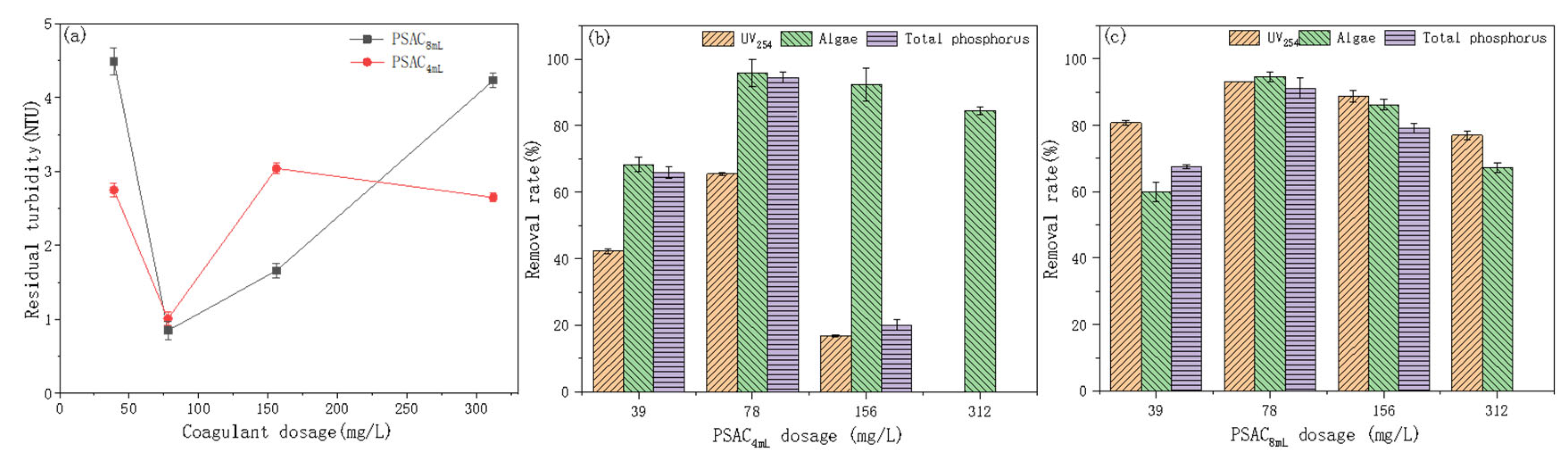
The effect of alkali dosage (added during coagulant preparation) on the removal of algae and phosphorus was studied. PSAC samples were denoted as PSAC8mL and PSAC4mL, corresponding to NaOH addition amounts of 8 mL and 4 mL, respectively. The initial water sample parameters were: pH 7.16, turbidity 15.76 NTU, UV254 0.209 cm−1, algal count 0.047, and total phosphorus 0.457 mg/L. PSAC dosage ranged from 39 mg/L to 312 mg/L. The experimental results are shown in Figure 1.
Figure 1 shows the effects of PSAC8mL and PSAC4mL on algae and phosphorus removal, along with the removal of related pollutants. Figure 1a displays turbidity removal results, while Figure 1b,c present removal results for other pollutants. The results indicate that, as the coagulant dosage increases from 39 to 312 mg/L, the residual turbidity for both PSAC8mL and PSAC4mL first decreases and then increases. Similar trends are observed for UV254, algae, and total phosphorus removal, with removal rates initially rising and then declining. PSAC8mL maintains relatively stable removal efficiency without significant fluctuations as dosage increases.
Both coagulants achieved optimal removal efficiency at a dosage of 78 mg/L. Using PSAC8mL, the removal rates for residual turbidity, UV254, algae, and total phosphorus were 0.85 NTU, 93.1%, 94.7%, and 91.2%, respectively. With PSAC4mL, the corresponding values were 1.01 NTU, 65.5%, 95.8%, and 93.4%. PSAC4mL showed a significant decline in removal rates for UV254 and total phosphorus beyond the optimal dosage, with only a slight decrease in algae removal. At a dosage of 312 mg/L, both exhibited no removal efficiency for total phosphorus. It can be concluded that, at the optimal dosage, PSAC8mL demonstrated significantly better pollutant removal performance than PSAC4mL.

3.1.2. Effect of Polymerization Temperature

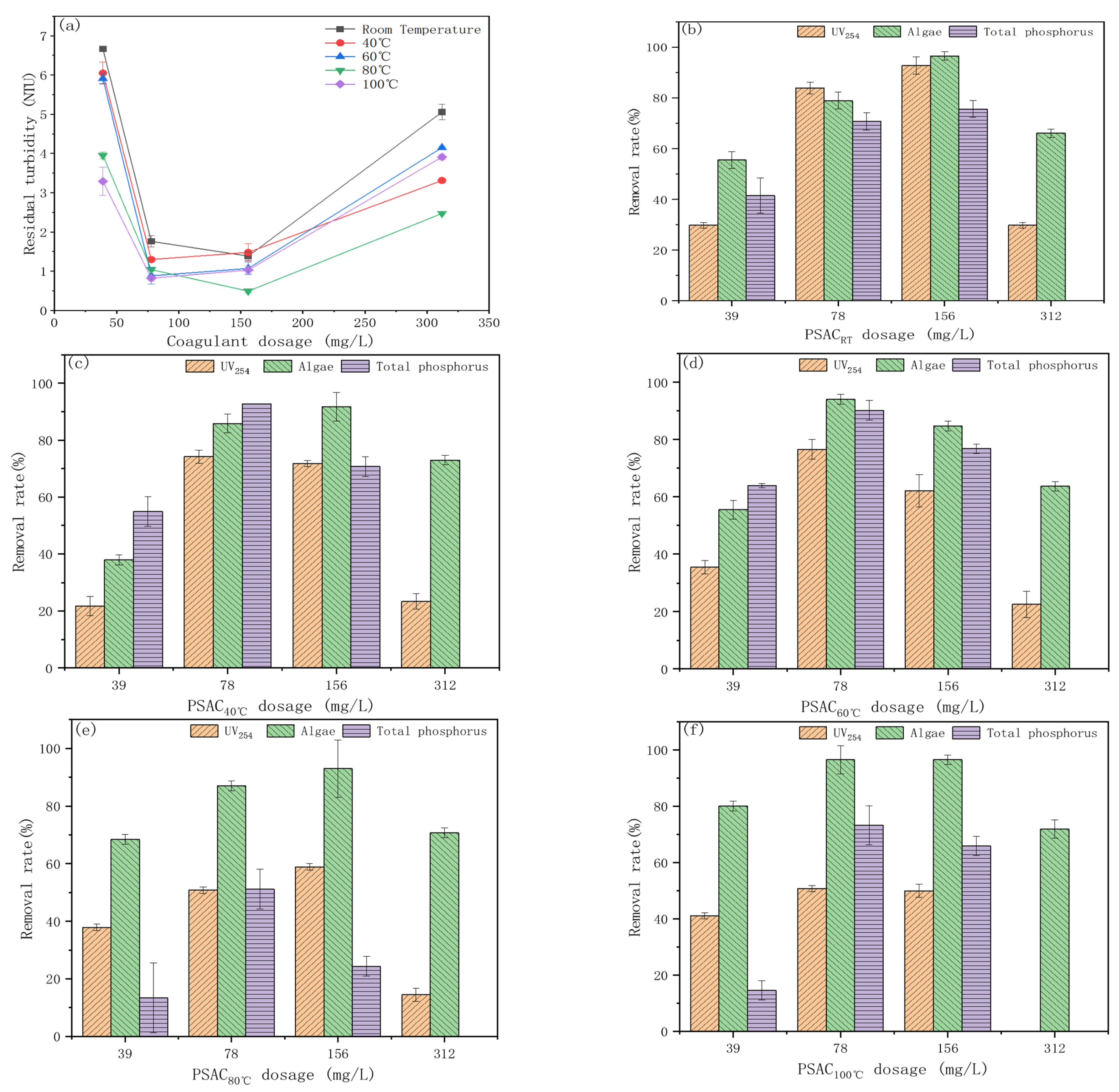
This study investigated the impact of PSAC polymerized at different temperatures (PSACRT [room temperature], PSAC40 °C, PSAC60 °C, PSAC80 °C, PSAC100 °C) on algae and phosphorus removal. The initial water sample parameters were: pH 7.93, turbidity 16.13 NTU, UV254 0.062 cm−1, algal count 0.043, and total phosphorus 0.41 mg/L. PSAC dosage ranged from 39 mg/L to 312 mg/L. The experimental results are shown in Figure 2.
Figure 2 shows the removal efficiency of pollutants in water under different dosage conditions. Figure 2a presents turbidity removal efficiency. Figure 2b–f demonstrate removal effects for other pollutants influenced by polymerization temperature and coagulant dosage.
Figure 2a,b show that, as the dosage of PSACRT increases from 39 to 312 mg/L, residual turbidity first decreases and then increases. PSACRT exhibits a similar trend for UV254, algae, and total phosphorus removal. Optimal removal efficiency for all pollutants is achieved at 156 mg/L, with residual turbidity, UV254, algae, and total phosphorus removal rates of 1.38 NTU, 92.7%, 96.5%, and 75.6%, respectively. At 312 mg/L, PSACRT shows reduced effectiveness, with no removal of total phosphorus. Figure 2a,c show that, as the dosage of PSAC40 °C increases from 39 to 312 mg/L, residual turbidity first decreases and then rises, while removal rates for UV254 and total phosphorus gradually improve. At 78 mg/L, PSAC40 °C achieves optimal turbidity reduction, as well as UV254 and total phosphorus removal, with rates of 1.29 NTU, 74.2%, and 92.7%, respectively. A further dosage increase leads to a decline in removal efficiency. The optimal dosage for algae removal differs, with the highest rate of 91.8% achieved at 156 mg/L. Figure 2a,d show that, as the dosage of PSAC60 °C increases from 39 to 312 mg/L, turbidity removal first improves and then destabilizes. Removal trends for UV254, algae, and total phosphorus are similar, showing initial steady improvement. At 78 mg/L, optimal removal is achieved: residual turbidity 0.88 NTU, and removal rates for UV254, algae, and total phosphorus of 76.6%, 94.1%, and 90.2%, respectively. A further dosage increase leads to declines in UV254 and algae removal, though efficiency remains relatively good, while total phosphorus removal drops to zero at 312 mg/L. Figure 2a,e show that, as PSAC80 °C dosage increases from 39 to 312 mg/L, residual turbidity first decreases and then increases, while UV254 and algae removal trends are similar, steadily improving with dosage. At 156 mg/L, optimal turbidity, UV254, and algae removal rates are achieved: 0.49 NTU, 58.9%, and 93.0%, respectively. Total phosphorus removal differs, with an optimal rate of 51.2% at 78 mg/L. A further dosage increase gradually reduces phosphorus removal, reaching zero at 312 mg/L. Figure 2a,f show that, as PSAC100 °C dosage increases from 39 to 312 mg/L, turbidity removal first improves and then declines. The UV254, algae, and total phosphorus removal trends are similar, increasing with dosage. At 78 mg/L, optimal removal rates are achieved: 0.82 NTU, 50.8%, 96.5%, and 73.2% for turbidity, UV254, algae, and total phosphorus, respectively. Algae removal only slightly declines with further dosage increase, but UV254 and total phosphorus removal drop to zero at 312 mg/L.
Overall, the polymerization temperature of PSAC significantly impacts the removal of turbidity, UV254, algae, and total phosphorus. Within a certain range, increasing polymerization temperature enhances flocculation performance, while temperatures that are too high or too low weaken it. This phenomenon is primarily attributable to the influence of temperature on the polymerization degree of PSAC. Low temperatures lead to insufficient polymerization, resulting in a higher proportion of low-polymerized aluminum species (Ala) and consequently weaker adsorption efficiency. In contrast, high temperatures induce excessive polymerization, favoring the formation of highly polymerized species (Alc), which reduces the abundance of active components and diminishes coagulation performance.

3.1.3. Silicate Influence

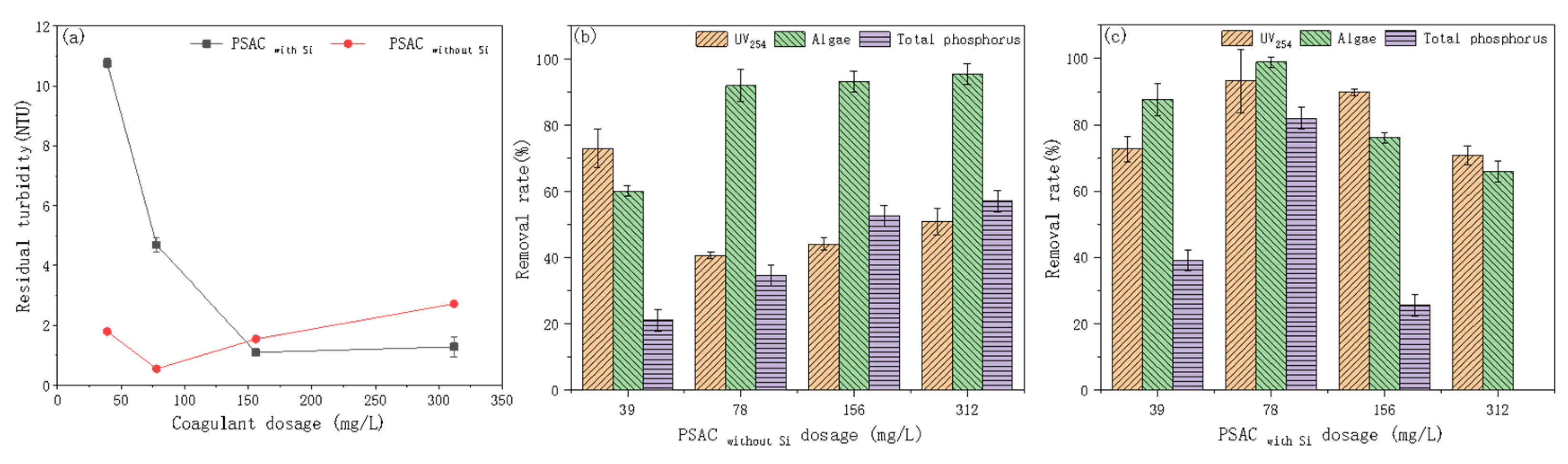
This study primarily explores the impact of polysilicic acid (PSAC with Si and PSAC without Si) on PSAC flocculation efficiency. The initial water sample parameters were: pH 7.15, turbidity 16.53 NTU, UV254 0.073 cm−1, algal count 0.044, and total phosphorus 0.443 mg/L. The dosages of PSAC with Si and without Si ranged from 39 to 312 mg/L. The experimental results are shown in Figure 3.
As shown in Figure 3a, PSAC with Si and PSAC without Si exhibit significant differences in turbidity removal. As dosage increases from 39 to 312 mg/L, the turbidity removal efficiency of PSAC with Si first improves and then declines, whereas that of PSAC without Si gradually improves until stabilizing. Overall, PSAC with Si demonstrates superior turbidity removal. The optimal dosages also differ: PSAC with Si achieves the best turbidity removal at 78 mg/L (residual turbidity 0.55 NTU), while PSAC without Si reaches optimal performance at 156 mg/L (residual turbidity 1.1 NTU). Figure 3b shows that PSAC without Si performs better in algae removal but is less effective for UV254 and total phosphorus. As dosage increases from 39 to 312 mg/L, coagulation efficiency first improves and then stabilizes. At 312 mg/L, pollutant removal peaks, with rates of 50.9% for UV254, 95.5% for algae, and 57.1% for total phosphorus. As shown in Figure 3c, during flocculation, PSAC with Si exhibited similar removal trends for UV254, algae, and total phosphorus. Removal efficiency initially increased and then weakened with increasing dosage. Only total phosphorus removal showed significant variation. At 78 mg/L, optimal pollutant removal was achieved: residual UV254 0.003 cm−1, algal count 0.004, residual total phosphorus 0.083 mg/L, with removal rates of 93.2%, 98.9%, and 82% for UV254, algae, and total phosphorus, respectively.
Overall, the experimental results indicate that the presence of silicic acid affects PSAC flocculation performance. Combined with SEM characterization and aluminum speciation analysis [17], the promoting effect of silicic acid on PSAC performance is primarily reflected in three aspects: (1) silicic acid forms Si–O–Al and Si–O–Fe bonds with aluminum and iron ions, thereby increasing the polymerization degree of PSAC; (2) silicic acid facilitates the conversion of Ala to Alc, enhancing the adsorption bridging capacity; and (3) the introduction of silicic acid increases the specific surface area and pore volume of PSAC. This enhanced porosity provides additional adsorption sites for algae cells and phosphate ions: algae cells (5–10 μm in size) are captured by macropores through sweep flocculation, whereas phosphate ions (approximately 0.2 nm in size) are adsorbed into mesopores via chemical bonding with Al3+ and Fe3+ [22]. Collectively, these mechanisms contribute to the improved removal efficiency of UV254, algae, and total phosphorus.

3.1.4. Aging Time Effect

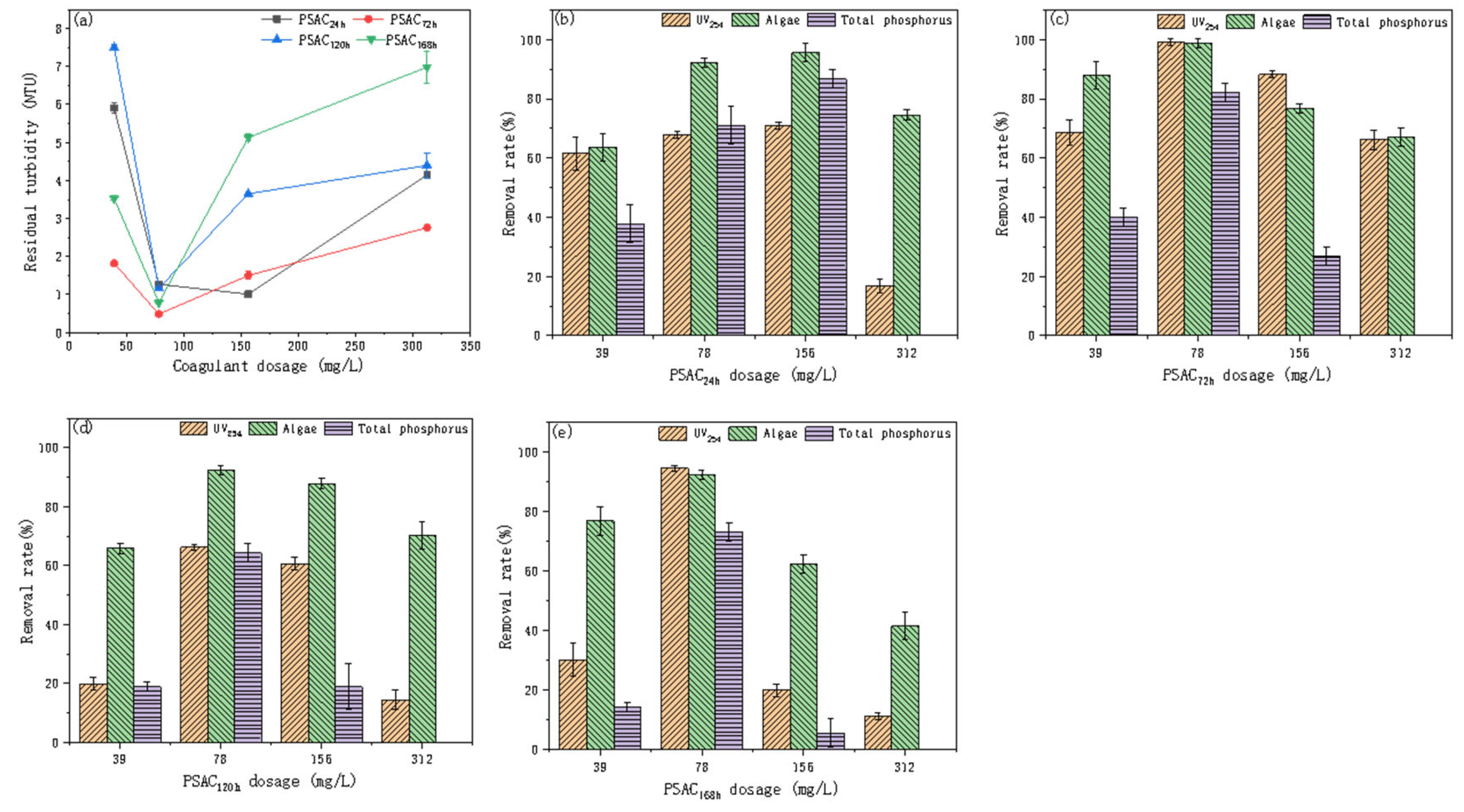
This study investigated the impact of PSAC prepared with different aging times (PSAC24h, PSAC72h, PSAC120h, PSAC168h) on algae and phosphorus removal, providing insight into PSAC stability. Initial water sample parameters were: pH 7.64, turbidity 16.4 NTU, UV254 0.064 cm−1, algal count 0.045, and total phosphorus 0.45 mg/L. The PSAC dosage ranged from 39 to 312 mg/L. The experimental results are shown in Figure 4.
Figure 4 shows the removal efficiency of PSAC24h, PSAC72h, PSAC120h, and PSAC168h for pollutants under different dosages. As seen in Figure 4a,b, as dosage increased from 39 to 312 mg/L, PSAC24h exhibited an initial increase followed by a decrease in removal efficiency for turbidity, UV254, algae, and total phosphorus. Optimal removal was achieved at 156 mg/L, with turbidity removal of 93.9% and other pollutant removal rates of 70.9%, 95.6%, and 86.7%, respectively.
As shown in Figure 4c, PSAC72h demonstrates significantly better turbidity removal than other flocculants. When destabilization occurs, residual turbidity shows only minor fluctuations, indicating stable performance. The optimal dosage is 78 mg/L, reducing residual turbidity to 0.483 NTU (97% removal). From Figure 4c, PSAC72h effectively removes pollutants across various dosages, with stable removal of UV254 and algae. However, total phosphorus removal fluctuates significantly with dosage. At 78 mg/L, optimal removal is achieved: residual UV254 0.001 cm−1, residual algae 0.001, residual total phosphorus 0.08 mg/L, corresponding to removal rates of 99.2%, 98.9%, and 82.2%, respectively. A further dosage increase reduces pollutant removal, particularly for total phosphorus, dropping to zero at 312 mg/L.
As shown in Figure 4d,e, the turbidity removal efficiency of PSAC120h and PSAC168h weakens, showing significant fluctuations with increasing dosage. Longer aging times lead to more-pronounced fluctuations. Both achieve the best turbidity removal at 78 mg/L, reducing residual turbidity to 1.167 NTU and 1.170 NTU (removal rates 92.9% and 92.8%), suggesting aging time has little influence on turbidity removal. PSAC120h and PSAC168h exhibit similar trends for UV254, algae, and total phosphorus removal. As the dosage increases from 39 to 312 mg/L, the removal efficiency first improves and then weakens, achieving optimal pollutant removal at 78 mg/L.
The above experiments indicate that PSAC flocculation efficiency varies with aging time. PSAC72h achieves high removal rates for turbidity, UV254, algae, and total phosphorus. Even with shorter or longer aging times, PSAC still performs well at the optimal dosage, overcoming the tendency of single polysilicic acid flocculants to polymerize and deactivate.

3.1.5. Effect of pH

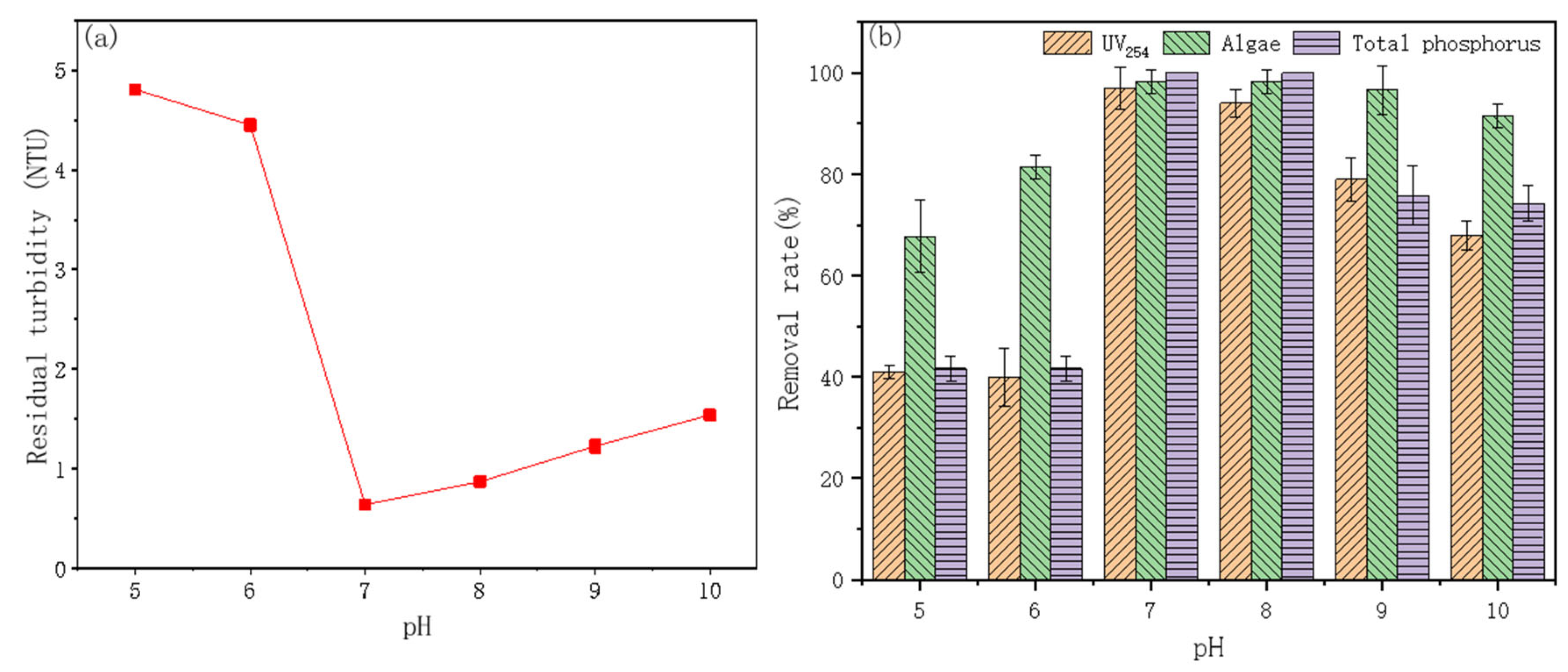
The effect of pH on pollutant removal with PSAC was investigated. The initial water sample parameters were: pH 7.52, turbidity 17.5 NTU, UV254 0.05 cm−1, algal count 0.03, and total phosphorus 0.3 mg/L. The PSAC dosage was set at 78 mg/L. The pH of raw water was adjusted from 5 to 10. The experimental results are shown in Figure 5.
Figure 5 illustrates PSAC removal efficiency under different pH conditions. As shown in Figure 5a, the residual turbidity initially decreases and then gradually increases with rising pH. At pH 5–6, turbidity removal is unsatisfactory, with residual turbidity values of 4.80 NTU and 4.45 NTU. At pH 7–8, PSAC demonstrates better turbidity removal, with residual turbidity dropping significantly to 0.64 NTU and 0.87 NTU (removal rates 96.3% and 95%). As the pH continues to increase, turbidity removal weakens. Thus, PSAC performs better in neutral and alkaline water for turbidity removal.
As shown in Figure 5b, PSAC removal trends for UV254, algae, and total phosphorus are similar, with removal rates first increasing and then decreasing with pH. Optimal removal is achieved at pH 7–8, with removal rates of 97%, 96.6%, and 100% (pH 7) and 94.7%, 98.3%, and 100% (pH 8). The corresponding residuals are: UV254 0.002 cm−1, algae 0.001, total phosphorus 0 mg/L (pH 7); UV254 0.003 cm−1, algae 0.001, total phosphorus 0 mg/L (pH 8). A further pH increase leads to a rebound in removal, though the performance remains superior to that at pH 5–6 conditions.
Overall, PSAC performs better in neutral and alkaline environments, with superior pollutant removal. Optimal removal for UV254, algae, and total phosphorus is achieved at pH 7–8.

3.1.6. Analysis of Different Water Qualities

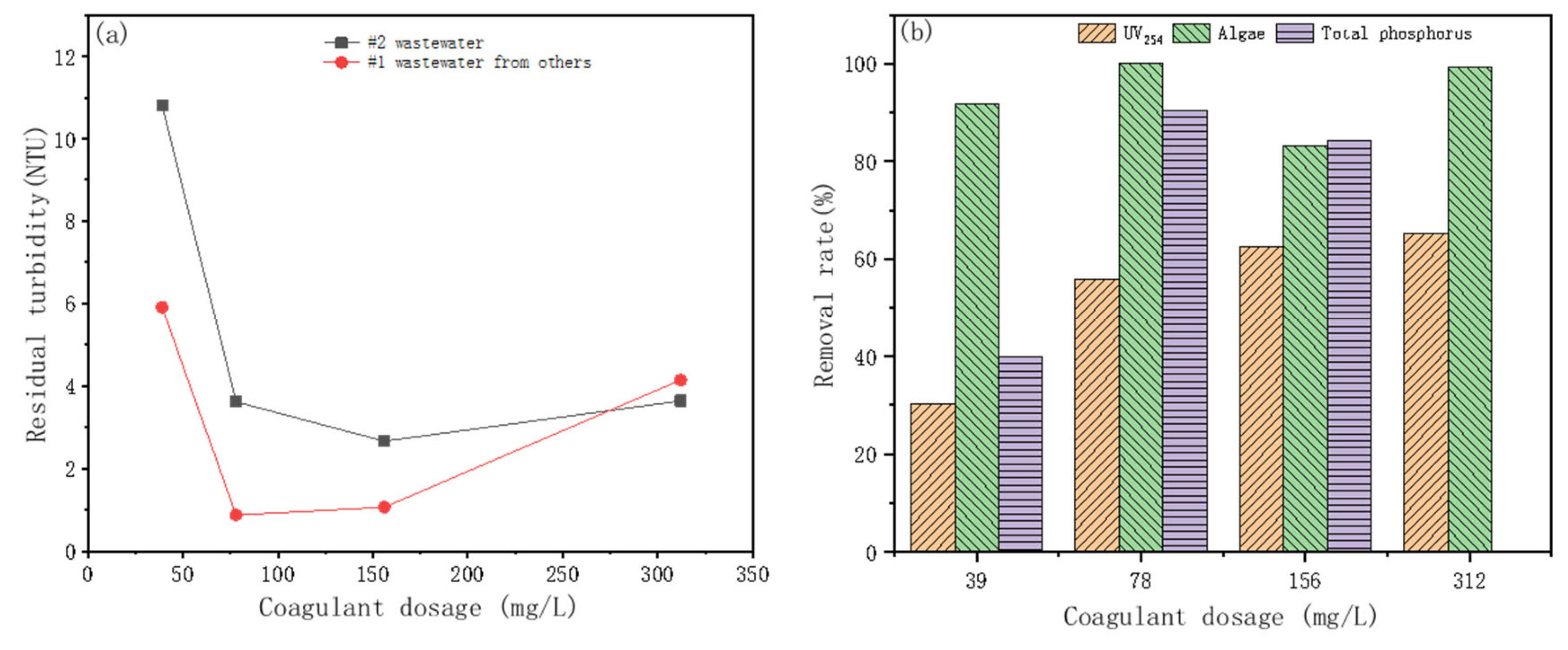
This study explores the effect of the PSAC on pollutant removal in different waters. The contaminated water samples used were actual wastewater from a specific location (denoted as #1) and wastewater from a sewage treatment plant (denoted as #2). Initial parameters for #1 were: pH 7.93, turbidity 16.13 NTU, UV254 0.066 cm−1, total phosphorus 0.42 mg/L and for #2: pH 6.93, turbidity 44.76 NTU, UV254 0.179 cm−1, total phosphorus 0.95 mg/L. The PSAC dosage ranged from 39 to 312 mg/L. The experimental results are shown in Figure 6.
Figure 6 illustrates PSAC effectiveness in treating the two wastewaters. As shown in Figure 6a, as the dosage increased from 39 to 312 mg/L, the residual turbidity first decreased and then increased. The best turbidity removal was achieved at 78 mg/L and 156 mg/L for #2, reducing residual turbidity to 0.88 NTU and 1.07 NTU (removal rates 94.5% and 93.4%). For #1, at 156 mg/L, turbidity removal was better, reducing residual turbidity to 2.67 NTU (94% removal). These results showed PSAC was effective for treating UV254, algae, and phosphorus.
As shown in Figure 6b, removal trends for UV254 and total phosphorus by PSAC were inconsistent. As dosage increased from 39 to 312 mg/L, UV254 removal gradually strengthened, while total phosphorus removal first improved and then weakened. At 78 mg/L, removal of UV254 and total phosphorus was relatively optimal, with rates of 55.9% and 90.5%, respectively, and residuals of UV254 0.079 cm−1 and total phosphorus 0.09 mg/L.
PSAC flocculation performance varies with water quality conditions but demonstrates good pollutant removal efficiency in both wastewaters, indicating stable and effective flocculation properties capable of meeting basic treatment requirements in practical applications.

3.2. XPS Characterization

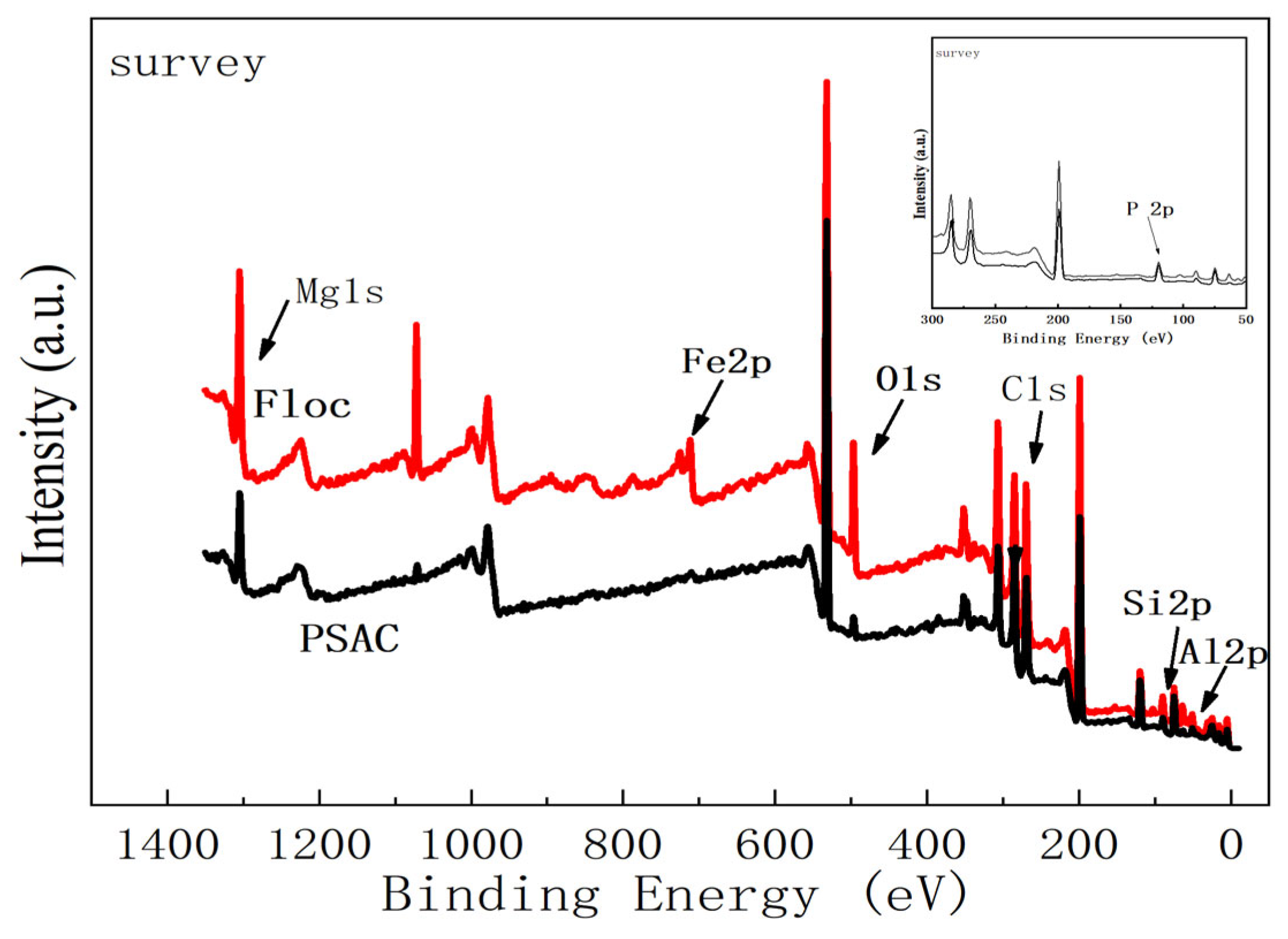
XPS was used to analyze the surface elemental composition and chemical states of PSAC. Figure 7 shows the XPS survey spectra before and after flocculation, indicating the presence of Fe, P, Mg, Si, Al, O, and C elements in PSAC and the flocs. It also confirms that PSAC and flocs contain P, O, Si, Al, and Fe.
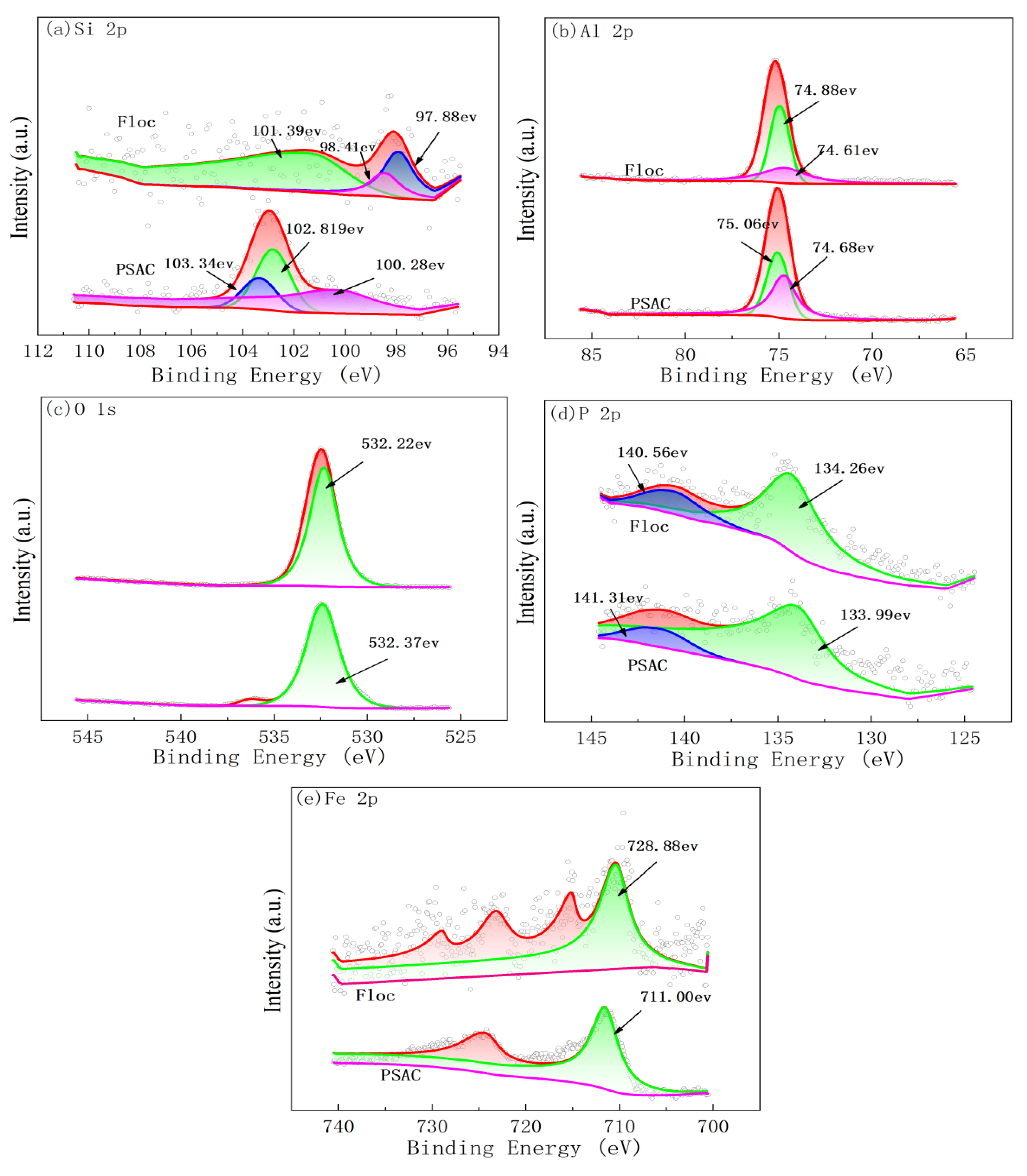
Figure 8a displays the Si 2p spectra of PSAC and flocs. In PSAC, the Si 2p spectrum exhibits three peaks at binding energies of 103.34 eV, 102.819 eV, and 100.28 eV, corresponding to Si-O-C bonds, Si-OH bonds, and Si-O-Si bonds, respectively [23]. In flocs, these peaks shift to 97.88 eV, 101.39 eV, and 98.41 eV, suggesting reaction with environmental pollutants. During flocculation, the Si–OH groups on the surface of PSAC react with the hydroxyl groups of algae and phosphate to form Si–O–P and Si–O–C bonds. This chemical interaction alters the electron cloud density around the silicon atoms, resulting in a significant shift in binding energy. Figure 8b shows the Al 2p spectra. In PSAC, peaks at 75.06 eV and 74.68 eV correspond to Al-OH [24] and Al-O bonds [25]. In flocs, the peaks shift to 74.88 eV and 74.61 eV, indicating changes in aluminum during flocculation. Figure 8c displays the O 1s spectra. In PSAC, a peak at 532.37 eV corresponds to surface hydroxyl groups. In flocs, it shifts to 532.22 eV. Figure 8d presents the P 2p spectra. The PSAC spectrum shows two peaks; the peak at 14.131 eV may be attributed to Zn 3s from volcanic rock impurities [26]. The phosphorus peak appears at 133.99 eV, consistent with phosphorus from volcanic rock. In flocs, it shifts to 134.26 eV, both corresponding to P-O bonds [27]. Figure 8e shows the Fe 2p spectra. In PSAC, a peak at 711 eV indicates iron (III) primarily in an oxidized state [28]. In flocs, it shifts to 728.88 eV with an increased peak area.

3.3. Comparison of Flocculation Performance Between PSAC and Other Coagulants

To further demonstrate the advantages of PSAC derived from volcanic rock, its flocculation performance was compared with that of PAC and other coagulants. The evaluation focused on key practical parameters: optimal dosage, applicable pH range, algae removal efficiency, and total phosphorus removal efficiency. These indicators are critical for assessing the applicability of coagulants in water and wastewater treatment. The detailed comparative results are shown in Table 1.
As shown in Table 1, PSAC exhibits significant advantages over other flocculants, including PAC and polysilicate Fe–Zr chloride. It achieves the highest algae removal rate of 99.2%, surpassing PAC (94.7%) and ST-CTA (95.6%). Its total phosphorus removal rate reaches 96.4%, outperforming PAC (90.3%) and PAC-PDMDAAC (95%). With an optimal pH range of 7–8 that aligns with natural water conditions, PSAC requires no additional pH adjustment, thereby simplifying operation and reducing treatment costs. Its removal efficiencies for UV254 (90.2%) and turbidity (95%) are both favorable and well balanced. Although its optimal dosage (60–100 mg/L) is relatively higher, its overall comprehensive performance renders it cost-competitive. PSAC is highly efficient, convenient to use, and particularly suitable for eutrophic water treatment, demonstrating great potential for practical application.

3.4. Discussion on the Flocculation Mechanism of PSAC

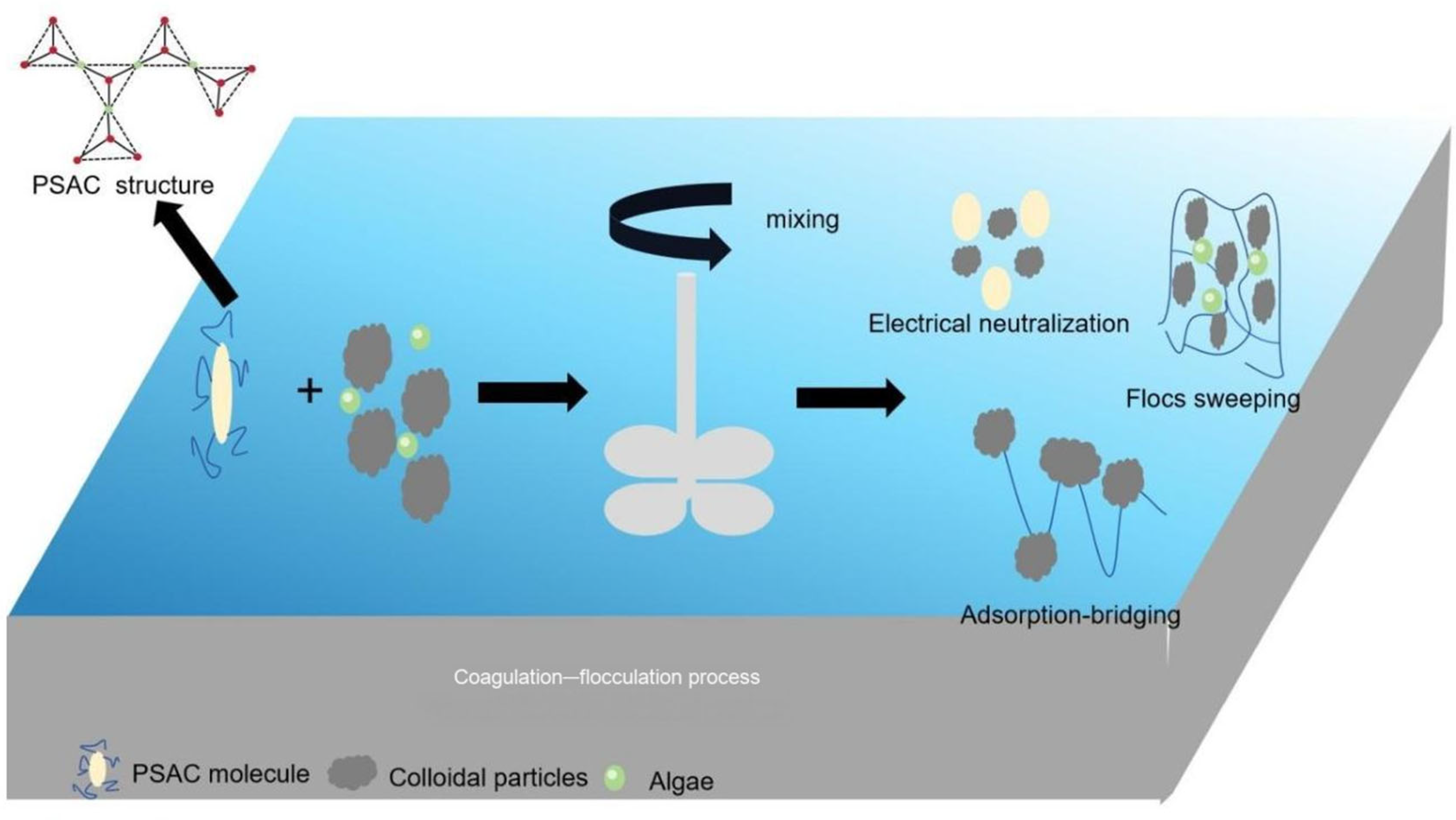
PSAC is a complex composite composed of silicon, aluminum, oxygen, iron, and other elements. Based on the characterization results and its performance in actual wastewater treatment, the main flocculation mechanisms of PSAC can be inferred as charge neutralization, adsorption bridging, and sweep flocculation [17]. The corresponding mechanism diagram is shown in Figure 9.
PSAC contains abundant metal cations. The addition of an alkalizing agent during preparation inhibits the rapid polymerization of polysilicic acid, indicating that interactions between metal cations and polysilicic acid suppress self-polymerization. During flocculation, Al3+, Fe3+, and their mononuclear hydroxyl complexes hydrolyze to form positively charged hydroxyl complex ions. These ions attract negatively charged colloidal particles, reducing surface charge and inducing coagulation and sedimentation. Silicic acid increases the molecular weight and polymerization degree of PSAC, enhancing molecular extensibility. PSAC then aggregates destabilized colloids via van der Waals forces to form larger flocs, demonstrating strong adsorption bridging ability. This adsorption bridging ability arises from two factors. First, during polymerization, the original structure of volcanic rock breaks and reorganizes into long-chain Al–Fe–Si structures (e.g., Al–O–Si and Fe–O–Si bonds), which capture destabilized colloids. Second, PSAC contains Alb (medium-polymerized aluminum), which hydrolyzes to form polynuclear hydroxyl complexes (e.g., Al2(OH)42+, Fe2(OH)24+). These ions reduce colloidal surface charge and act as adsorption bridges to aggregate colloids into flocs. Additionally, PSAC contains Alc (high-polymerized aluminum), which settles naturally and entraps colloidal particles via sweep flocculation, achieving pollutant removal.

4. Conclusions

In this study, volcanic rock was employed as the raw material to synthesize a novel polyaluminum ferric silicate coagulant (PSAC), aiming to address the limitations of traditional coagulants in algae and phosphorus removal. The optimal preparation conditions of PSAC were determined with 90 °C of acid leaching temperature, 8 mL of 2 mol/L NaOH, 60 °C of polymerization temperature, 0.5 h of polymerization duration, and 72 h of aging time. Notably, silicic acid significantly enhanced PSAC’s performance by forming Si–O–Al/Fe bonds, promoting Ala-to-Alc conversion and increasing specific surface area, thus strengthening its adsorption-bridging and sweep-flocculation capacities. PSAC achieved optimal flocculation efficiency at pH 7–8; at the optimal dosage of 80 mg/L, its removal efficiencies of turbidity, UV254, algae and total phosphorus reached 95.0%, 90.2%, 99.2% and 96.4%, respectively, outperforming traditional polyaluminum chloride. Moreover, PSAC exhibited stable performance with minor pollutant removal fluctuations across different water matrices. As volcanic rock is abundant and low-cost in southern China, the PSAC synthesis requires no expensive reagents and has low energy consumption; this coagulant boasts prominent economic advantages and great application potential for algae- and phosphorus-contaminated water remediation in practical engineering [33].

Author Contributions

G.Z. and F.X.: Supervision; Y.W., X.Y. and X.W.: Funding; Y.P. and Z.Y.: Writing and Editing. All authors have read and agreed to the published version of the manuscript.

Funding

This work was financially supported by the Foundation of China Railway Urban Construction Group No. 1 Engineering Co., Ltd. (No. D123ED).

Data Availability Statement

The original contributions presented in this study are included in the article. Further inquiries can be directed to the corresponding author(s).

Conflicts of Interest

Authors Yunbo Wang, Xiaoben Yang and Xuewen Wu, were employed by the China Railways Urban Construction Group and China Railways Urban Construction Group No. 1 Engineering Co., Ltd. Author Fubing Xie was employed by the Hunan Jingyi Xiangtai Environmental High-Tech Development Co., Ltd. The remaining authors declare that the research was conducted in the absence of any commercial or financial relationships that could be construed as a potential conflict of interest.

References

  1. Du Plessis, A. Global water quality challenges. In Freshwater Challenges of South Africa and Its Upper Vaal River: Current State and Outlook; Springer International Publishing: Cham, Switzerland, 2017; pp. 13–44. [Google Scholar]
  2. Kirschke, S.; Avellán, T.; Bärlund, I.; Bogardi, J.J.; Carvalho, L.; Chapman, D.; Dickens, C.W.S.; Irvine, K.; Lee, S.; Mehner, T.; et al. Capacity challenges in water quality monitoring: Understanding the role of human development. Environ. Monit. Assess. 2020, 192, 298. [Google Scholar] [CrossRef]
  3. Jarvie, H.P.; Smith, D.R.; Norton, L.R.; Edwards, F.K.; Bowes, M.J.; King, S.M.; Scarlett, P.; Davies, S.; Dils, R.M.; Bachiller-Jareno, N. Phosphorus and nitrogen limitation and impairment of headwater streams relative to rivers in Great Britain: A national perspective on eutrophication. Sci. Total Environ. 2018, 621, 849–862. [Google Scholar] [CrossRef]
  4. Chen, H.; Zhou, Q.; Tong, G. Progress of Research on Eutrophication Response Law and Early Warning Method of Water Bloom in Water Bodies. China Rural. Water Hydropower 2024, 7, 117–125+34. [Google Scholar]
  5. Dejun, P. Study on Flocculation Species and Application of the Polymer Ferric Flocculant; Chongqing University: Chongqing, China, 2007. [Google Scholar]
  6. Wang, C.; Zhang, M.; Zhang, J. Flocculation and sedimentation pretreatment for water reuse in production. Ceramics 2019, 10, 31–33. [Google Scholar]
  7. Li, L. Application of Flocculation Settling Process in Water Quality Purification of Urban Inland River. China Environ. Prot. Ind. 2014, 6, 26–29. [Google Scholar]
  8. Zhu, G.; Zheng, H.; Chen, W.; Fan, W.; Zhang, P.; Tshukudu, T. Preparation of a composite coagulant: Polymeric aluminum ferric sulfate (PAFS) for wastewater treatment. Desalination 2012, 285, 315–323. [Google Scholar] [CrossRef]
  9. Yang, R.; Li, H.; Huang, M.; Yang, H.; Li, A. A review on chitosan-based flocculants and their applications in water treatment. Water Res. 2016, 95, 59–89. [Google Scholar] [CrossRef]
  10. Hu, F.; Li, L.; Xu, Y.H. Progress on Removal of Organic Matter in Micro Polluted Source Water by Enhanced Coagualtion; College of Enviroment Nan Jing University of Technology: Nanjing, China, 2008; pp. 119–123. [Google Scholar]
  11. Arruebo, M.; Galán, M.; Navascués, N.; Téllez, C.; Marquina, C.; Ibarra, M.R.; Santamaría, J. Development of magnetic nanostructured silica-based materials as potential vectors for drug-delivery applications. Chem. Mater. 2006, 18, 1911–1919. [Google Scholar] [CrossRef]
  12. Liu, S.J.; Liu, Y.; Li, X.Y.; Shi, W.G.; Zhu, W.X.; Rui, Y.Z.; Xiong, C.; Wu, Z.C.; He, X.L.; Jiang, Z.W. Preparation of Polyaluminum Chloride Using Bauxite Tailings and Its Application in Wastewater Treatment. Hydrometall. China 2020, 39, 539–542. [Google Scholar]
  13. Ding, S.W.; Duan, S.N.; Shi, Q.; Jiang, X.Y.; Hao, L.L.; Wang, C. Study on Application of Montmorillonite Flocculant in River Drainage. Technol. Water Treat. 2021, 47, 82–86. [Google Scholar]
  14. Wang, C.; Yu, J.H.; Wang, Y.C.; Zeng, M.; Li, L. Comparison of Phosphorus Removal Effect of Modified Vermiculite Flocculant and PFS. J. Tianjin Univ. Sci. Technol. 2019, 34, 35–39. [Google Scholar]
  15. Chi, S.; Shang, B.Y.; Zhang, Y.H.; Zhao, X.S. Preparation of poly aluminum ferric silicate flocculant flocculant from coal gangue for treatment of fluorine chemical wastewater. Environ. Prot. Chem. Ind. 2023, 43, 506–513. [Google Scholar]
  16. Hu, J. Preparation and Catalytic Oxidation of Iron-Bearing Manganese Oxide Catalysts Supported on Volcanic Rock; Hebei University: Baoding, China, 2018. [Google Scholar]
  17. Yang, Z. Preparation and Flocculation Effect of Composite Flocculants Based on Volcanic Minerals; Hunan University of Science and Technology: Xiangtan, China, 2024. [Google Scholar] [CrossRef]
  18. Jin, W.; Fan, J.C. Studies on the UV254 absorbance as a surrogate parameter of organic matter. Ind. Water Treat. 1997, 17, 32–34+4. [Google Scholar]
  19. Liang, F.; Ya, Q.; Du, W.C.; Wen, X.B.; Geng, Y.H.; Li, Y.G. The relationships between optical density, cell number, and biomass of four microalgae. Acta Ecol. Sin. 2014, 34, 6156–6163. [Google Scholar]
  20. GB 11893-89; Water Quality-Determination of Total Phosphorus-Ammonium Molybdate Spectrophotometric Method. Ministry of Ecology and Environment of the People’s Republic of China: Beijing, China, 1990.
  21. Wang, Z.; Huang, W.; Wang, C.; Li, X.; He, Z. Variation of Al species during water treatment: Correlation with treatment efficiency under varied hydraulic conditions. AQUA—Water Infrastruct. Ecosyst. Soc. 2021, 70, 891–900. [Google Scholar] [CrossRef]
  22. Dentel, S.K. Application of the precipitation-charge neutralization model of coagulation. Environ. Sci. Technol. 1988, 22, 825–832. [Google Scholar] [CrossRef]
  23. Xie, H.; Zhang, J.; Wang, D.; Liu, J.; Wang, L.; Xiao, H. Construction of three-dimensional g-C3N4/attapulgite hybrids for Cd (II) adsorption and the reutilization of waste adsorbent. Appl. Surf. Sci. 2020, 504, 144456. [Google Scholar] [CrossRef]
  24. Zhong, S.; Yin, G.; Peng, H.; Xiang, J.; Lin, Q.; He, H.; Chen, Z. Preparation, characterization and sludge conditioning performance of modified coal fly ash. J. Taiwan Inst. Chem. Eng. 2017, 78, 447–454. [Google Scholar] [CrossRef]
  25. Wang, Y.; Wang, C.; Chen, M.; Tang, Z.; Yang, Z.; Hu, J.; Zhang, H. Hydrogen production from steam reforming ethanol over Ni/attapulgite catalysts-Part I: Effect of nickel content. Fuel Process. Technol. 2019, 192, 227–238. [Google Scholar] [CrossRef]
  26. Chastain, J.; King, R.C., Jr. Handbook of X-ray photoelectron spectroscopy. Perkin-Elmer Corp. 1992, 40, 25. [Google Scholar]
  27. Shi, W.; Fu, Y.; Jiang, W.; Ye, Y.; Kang, J.; Liu, D.; Ren, Y.; Li, D.; Luo, C.; Xu, Z. Enhanced phosphate removal by zeolite loaded with Mg–Al–La ternary (hydr) oxides from aqueous solutions: Performance and mechanism. Chem. Eng. J. 2019, 357, 33–44. [Google Scholar] [CrossRef]
  28. Ilves, V.; Balezin, M.; Sokovnin, S.Y.; Gerasimov, A.; Kalinina, E.; Rusakova, D.; Korusenko, P.; Zuev, M.; Uimin, M. Radiation-chemical synthesis and characterization of ferrihydrite from iron (III) nitrate. Radiat. Phys. Chem. 2024, 218, 111612. [Google Scholar] [CrossRef]
  29. Ai, S.; Huang, X.; Wu, X.; Wang, Y. Study on Preparation of Polysilicate Ferric Zirconium Chloride Coagulant and Its Properties. Technol. Water Treat. 2024, 50, 48–52. [Google Scholar]
  30. Zhang, H.; Zheng, H.; Long, T. Phosphorus Removal of PAC-PDMDAAC Inorganic/Organic Composite Flocculant. Technol. Water Treat. 2005, 3, 69–71. [Google Scholar] [CrossRef]
  31. Lu, F.; Chai, R.; Yang, T.; Bai, W.; Zhang, K.; Pan, W.; Zhao, J.; Cai, D.; Zhang, X.; Bian, B.; et al. Cationic starch-based flocculation and dewatering for algae-rich water treatment. Chin. J. Environ. Eng. 2025, 1–12. [Google Scholar]
  32. Wei, Y.; Li, C.; Zhang, W.; Chen, Y. Study on the Flocculation Performance of Poly Silicate Titanium-Carboxylated Chitosan Composite Flocculant on Oscillatoria. Technol. Water Treat. 2024, 50, 75–79+90. [Google Scholar]
  33. China Mineral Resources. Ministry of Natural Resources of the People’s Republic of China. 2023. Available online: http://chinageology.cgs.cn/fileZGDZYW/attachments/pdf/74238829-1ff5-44a6-9d1f-65025b387c6a.pdf (accessed on 26 January 2026).
Figure 1. Effects of alkali dosage on PSAC flocculation performance: (a) turbidity removal, and (b,c) removal of other pollutants as affected by alkali dosage with different coagulant dosages.
Processes 14 01121 g001
Figure 2. Effects of polymerization temperature on PSAC flocculation performance: (a) turbidity removal and (bf) removal of other pollutants as affected by polymerization temperature with different coagulant dosages.
Processes 14 01121 g002
Figure 3. Effects of silicic acid on PSAC flocculation performance: (a) turbidity removal and (b,c) removal of other pollutants as affected by silicic acid.
Processes 14 01121 g003
Figure 4. Effects of aging time on PSAC flocculation performance: (a) turbidity removal and (be) removal of other pollutants as affected by aging time and coagulant dosages.
Processes 14 01121 g004
Figure 5. Effect of pH on PSAC flocculation performance: (a) turbidity removal and (b) removal of other pollutants as affected by pH.
Processes 14 01121 g005
Figure 6. PSAC flocculation performance under different water quality conditions: (a) turbidity removal and (b) removal of other pollutants.
Processes 14 01121 g006
Figure 7. XPS survey spectra of PSAC and flocs.
Processes 14 01121 g007
Figure 8. XPS spectra of silicon, aluminum, iron, oxygen, and phosphorus in PSAC and flocs.
Processes 14 01121 g008
Figure 9. Diagram of the flocculation mechanism of PSAC.
Processes 14 01121 g009
Table 1. Comparison of flocculation performance between PSAC and other coagulants.
Coagulant TypeOptimal Dosage RangepH RangeAlgae Removal RateTP Removal RateTurbidity Removal RateUV254 Removal RateReference
PSAC60–100 mg/L7–899.2%96.4%95%90.2%This study
PAC20–60 mg/L6–794.7%90.3%97.7%100%[17]
Polysilicate Fe–Zr chloride2.5 mL/L7–8--98.81%83.58%[29]
PAC-PDMDAAC0.8–1.2 mL7.45-95%94.5%-[30]
ST-CTA100 mg/L-95.6%-81.2%62.7%[31]
PTSIS30 mg/L5–7--90.51%79.1%[32]
Disclaimer/Publisher’s Note: The statements, opinions and data contained in all publications are solely those of the individual author(s) and contributor(s) and not of MDPI and/or the editor(s). MDPI and/or the editor(s) disclaim responsibility for any injury to people or property resulting from any ideas, methods, instructions or products referred to in the content.