Field Implementation of an Expert System for Energy Efficiency Improvement in Industrial Aluminum Electrolysis: A Rule-Based Explainable AI Approach

Abstract
1. Introduction
- Industrial XAI Implementation: We demonstrate a practical deployment of rule-based XAI in a high-temperature, high-risk industrial environment, providing full audibility of diagnostic decisions for regulatory compliance and safety certification.
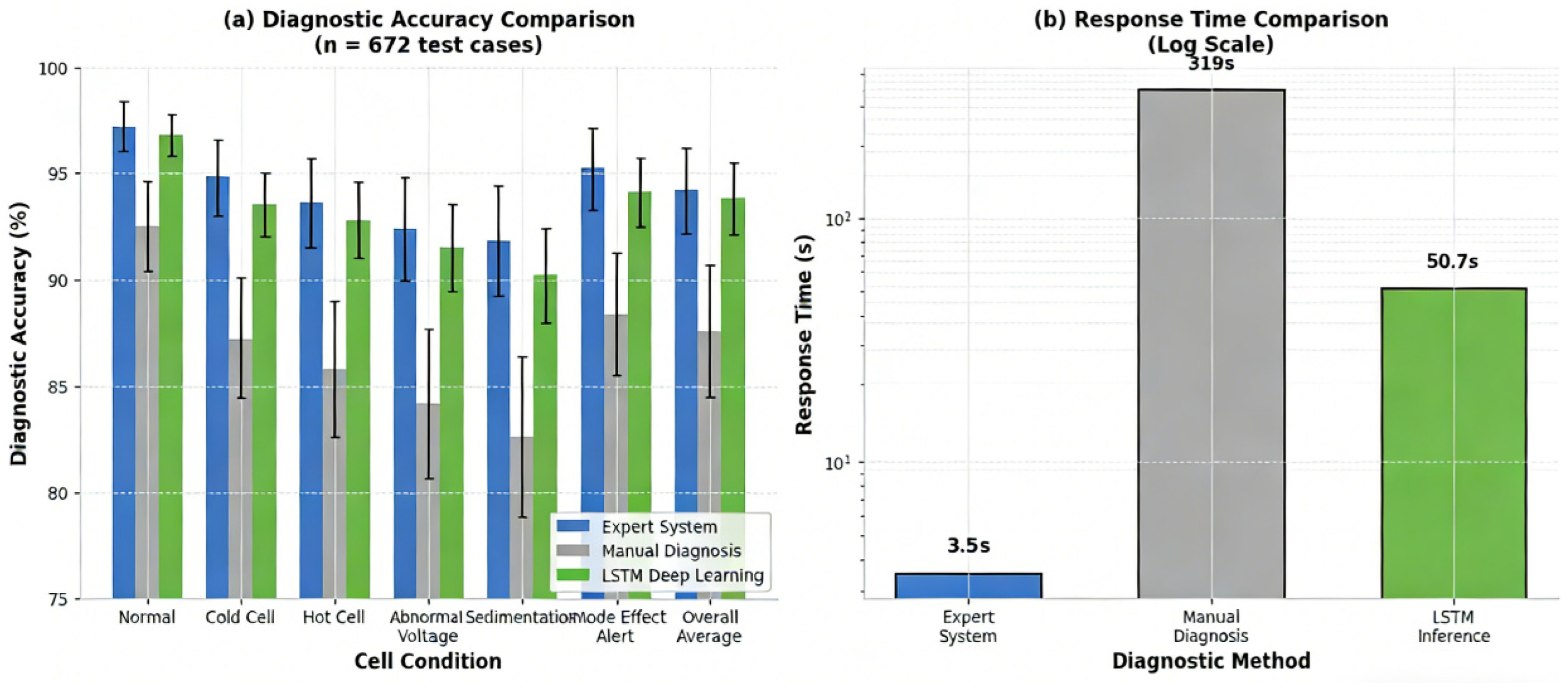
- Comparative Performance Analysis: Through rigorous comparison with both manual diagnosis and deep learning approaches (LSTM), we demonstrate that the rule-based system achieves comparable accuracy (94.2% vs. 93.8%) with 15× faster inference speed and complete interpretability, addressing the accuracy–interpretability trade-off in industrial AI.
- Field-Validated Energy Optimization: The system achieved sustained energy savings of 137 kWh/t-Al (1.0% reduction) over six months of continuous operation, with detailed ROI analysis demonstrating a payback period of 2.5 months.
2. Methodology
2.1. Knowledge Representation Methods
2.1.1. Production Rules
- (1)
- Cell Condition Evaluation Rules: These rules assessed the overall operational status of the electrolysis cell based on key process parameters. Three evaluation standards were established: “Excellent” (optimal operating conditions), “Good” (acceptable performance with minor deviations), and “Poor” (abnormal conditions requiring intervention).
- (2)
- Fault Identification Rules: A comprehensive set of 16 fault diagnosis rules was developed to identify specific abnormal conditions, including anode effects, electrolyte contamination, thermal imbalance, and current distribution anomalies. Each rule correlates specific parameter patterns with corresponding fault types.
- (3)
- Remedial Action Rules: These rules recommend appropriate operational measures based on identified faults, specifying adjustment parameters for process control.
2.1.2. Frame-Based Representation
- {
- Slot_1: Value_1 (Default: Default_1, Constraint: Constraint_1),
- Slot_2: Value_2 (Default: Default_2, Constraint: Constraint_2),
- …
- Slot_n: Value_n (Default: Default_n, Constraint: Constraint_n),
- Methods: {Method_1, Method_2, …, Method_m},
- Relations: {Relation_1, Relation_2, …, Relation_k}
- }
2.1.3. Behavioral Functions and Uncertainty Handling
- (1)
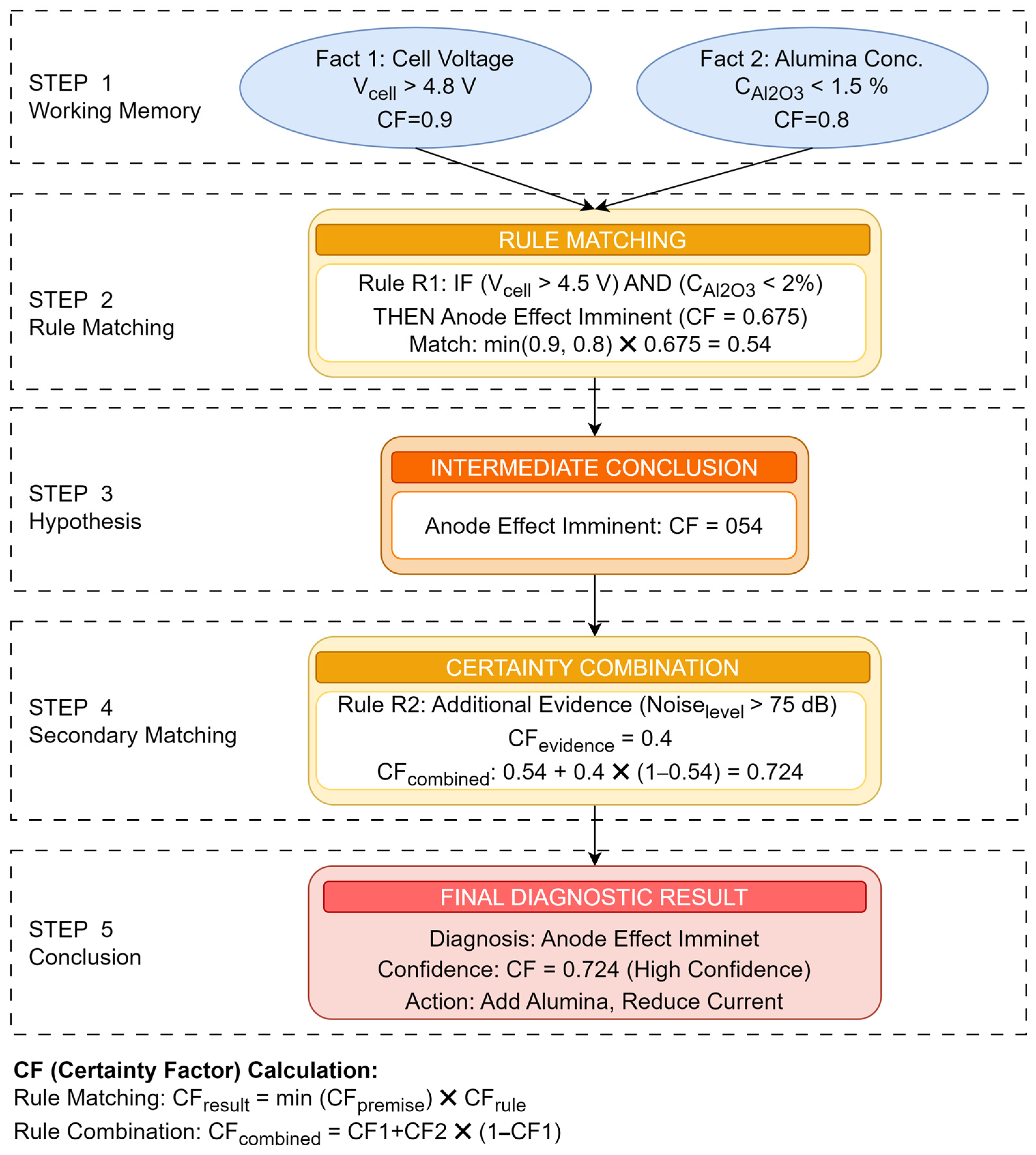
- CONCLUDE Function: This function performs certainty-weighted inference and is formally defined as , where = Context identifier, = Parameter name, = Concluded value, = Accumulated certainty variable, and = Certainty factor. The accumulated certainty is computed using:
- (2)
- CONLIST Function: This function manages conjunctive condition evaluation, aggregating multiple premise conditions through logical AND operations.
- (3)
- TRANLIST Function: This function handles transitive inference chains, enabling multi-step reasoning across interconnected rules.
- E1: Alumina concentration trend decreasing rapidly (CF = 0.8)
- E2: Cell voltage noise pattern anomaly (CF = 0.6)
2.2. Knowledge Base Construction Process
2.2.1. Knowledge Acquisition Methodology
- (1)
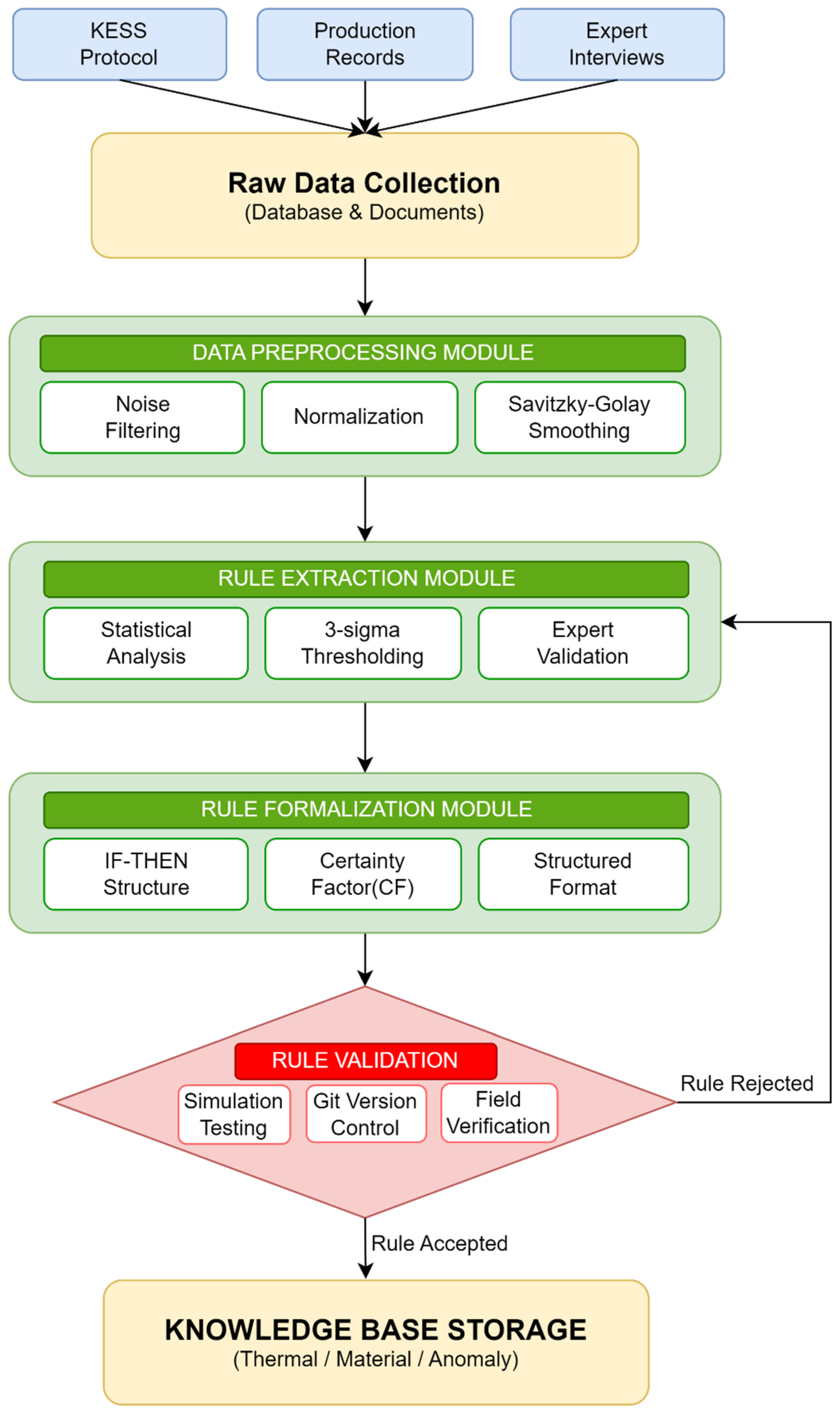
- Expert Knowledge Elicitation: Structured interviews and protocol analysis were conducted with experienced aluminum smelting engineers (average experience > 15 years) to capture heuristic diagnostic knowledge. The acquired knowledge includes qualitative relationships between process parameters and cell conditions, threshold values for abnormal condition detection, prioritized fault diagnosis procedures, and remedial action strategies under various scenarios. The elicitation process followed the KESS (Knowledge Elicitation for Safety-critical Systems) protocol, involving three domain experts independently and resolving conflicts through consensus meetings.
- (2)
- Historical Data Analysis: Operational data from 230 kA electrolysis cells covering 24 months of operation were analyzed using statistical and machine learning techniques to identify patterns and correlations. The data mining process involves parameter correlation analysis (Pearson correlation coefficients), anomaly detection using control chart methods, association rule mining (Apriori algorithm) for fault–parameter relationships, and temporal pattern analysis for fault progression modeling.
2.2.2. Rule Extraction and Formalization
2.2.3. Knowledge Verification and Optimization
- (1)
- Consistency Checking: Logical contradictions between rules are identified using pairwise comparison matrices and resolved through conflict resolution strategies (priority-based: specific rules override general rules).
- (2)
- Completeness Assessment: Coverage analysis ensures that all significant fault scenarios (defined in the IEEE 1232 standard for AI-based diagnostics) are addressed by the rule set.
- (3)
- Version Control: The knowledge base is maintained using Git version control, enabling rollback to previous versions if rule updates degrade performance, and tracking of rule modification history for audit compliance.
2.3. Inference Engine Mechanism
2.3.1. Forward Chaining and Backward Chaining
2.3.2. Uncertainty Handling with Certainty Factors
2.3.3. Inference Strategy Selection
2.4. System Architecture Design
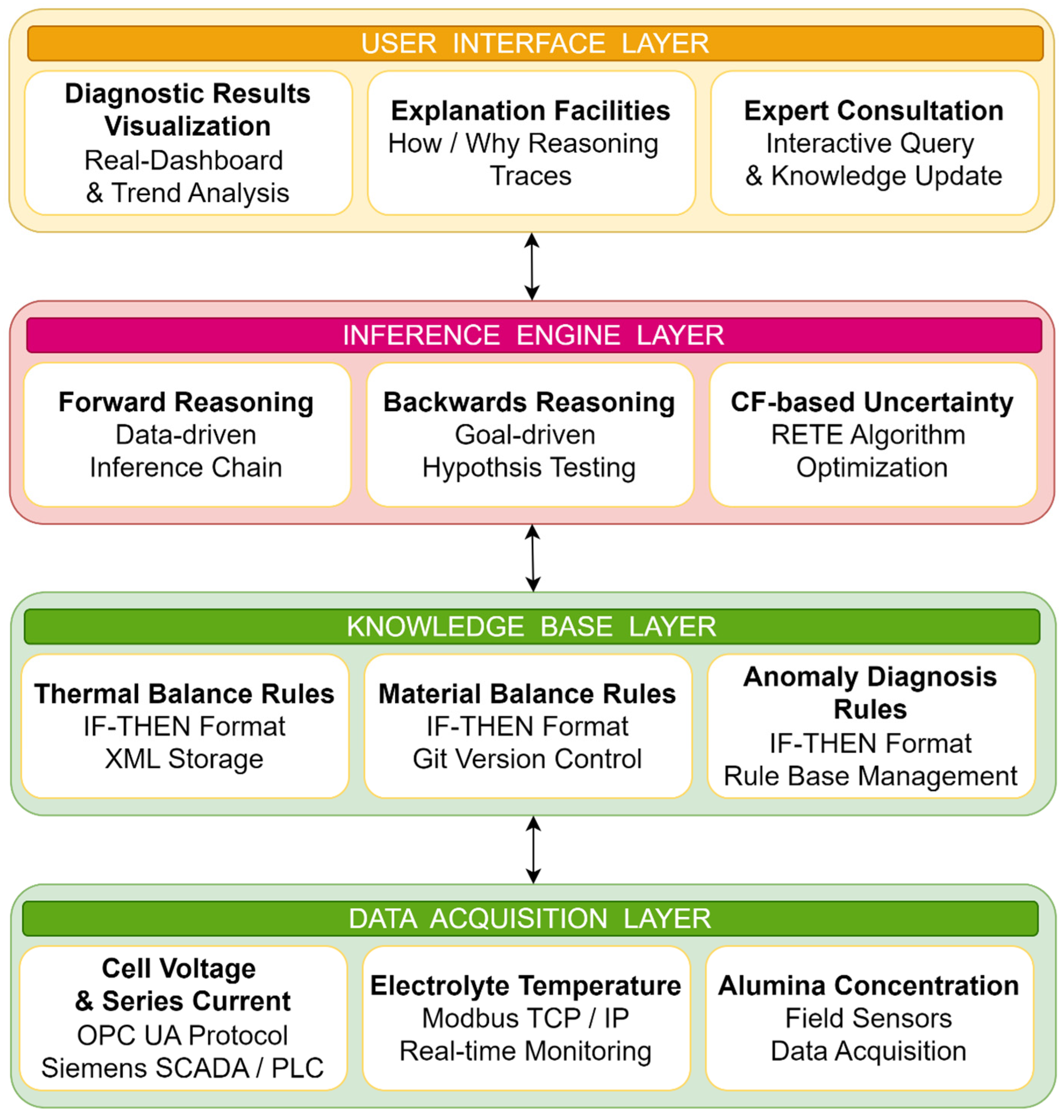
2.4.1. Data Layer
- (1)
- Process Parameter Tables:
- Series current (kA) with 1 s sampling via Hall sensors.
- Cell voltage (mV) real-time monitoring with 0.1 mV resolution.
- Current efficiency (%) calculated from metal production data.
- Electrolyte temperature (°C) from K-type thermocouple measurements (interpolated for missing values).
- Shell temperature (°C) from infrared thermal imaging (FLIR A315; FLIR Systems, Inc., Wilsonville, OR, USA).
- Electrolyte composition including molecular ratio (CR), alumina concentration (XRF analysis every 2 h, interpolated), and additive levels.
- (2)
- Data Acquisition Interface:
- The OPC UA (Unified Architecture) protocol for seamless integration with the Siemens WinCC SCADA system.
- Modbus TCP/IP for direct PLC communication (Siemens S7-400) as backup.
- Real-time data buffer (circular buffer, 72 h retention) for trend analysis.
- Data preprocessing: Outlier detection using Hampel identifier, missing value imputation via linear interpolation (for gaps <5 min), and Kalman filtering for sensor noise reduction.
2.4.2. Knowledge Layer
- (1)
- Rule Base: 16 fault diagnosis rules with associated certainty factors, 3 cell condition evaluation standards, and remedial action recommendation rules. Rules are stored in XML format with metadata (author, date, validation status).
- (2)
- Frame Repository: Cell configuration frames (anode, cathode, busbar specifications), process model frames (thermal, electrical, chemical relationships), and operational state frames (normal, abnormal, critical conditions).
- (3)
- Knowledge Management Functions: Rule indexing using RETE algorithm for efficient retrieval (O(1) complexity for known patterns), frame inheritance mechanisms, and knowledge consistency maintenance.
2.4.3. Inference Layer
- (1)
- Inference Engine Core: Rule matching and firing mechanisms, forward and backward chaining controllers, and uncertainty propagation algorithms.
- (2)
- Explanation Subsystem: Rule tracing for conclusion justification, “How” explanations (reasoning chain display showing which rules fired and their CF contributions), and “Why” explanations (rule rationale presentation linking to operational manuals).
- (3)
- Conflict Resolution: Priority-based rule selection (safety-critical rules > efficiency rules), certainty-based conclusion ranking, and default reasoning strategies.
2.4.4. Interface Layer
- (1)
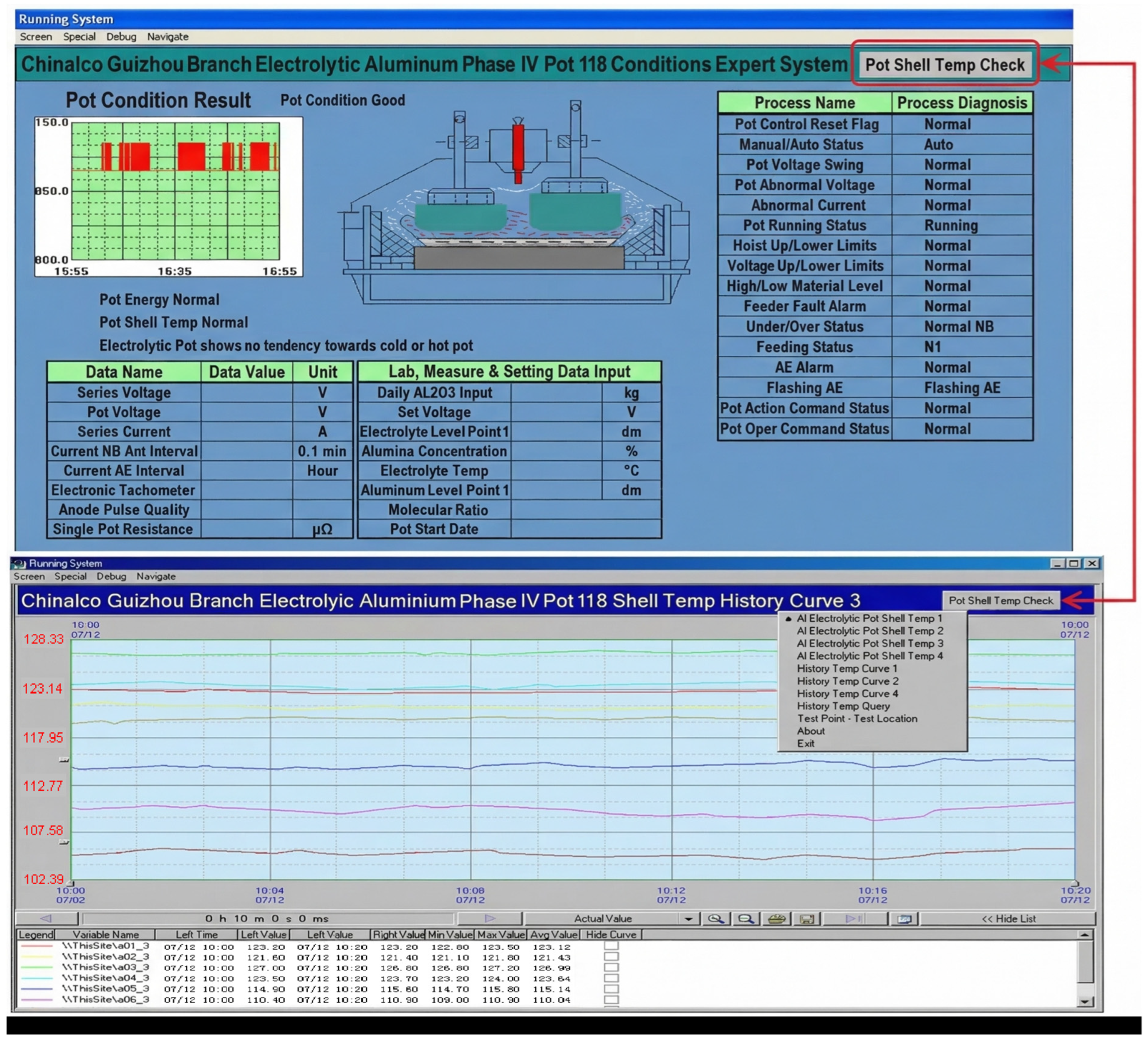
- Diagnostic Consultation Interface: Interactive fault diagnosis sessions with drill-down capability (clicking on a diagnosis shows the full reasoning chain), parameter input and validation, and conclusion presentation with certainty levels and confidence intervals.
- (2)
- Knowledge Acquisition Interface: Rule editing and validation tools with syntax checking, frame definition and modification functions, and knowledge base version control (Git integration).
- (3)
- Monitoring Dashboard: Real-time process parameter visualization with trend charts, alarm and notification systems (SMS/email for critical faults), and diagnostic report generation (PDF export for shift handover).
3. Results and Discussion
3.1. Diagnostic Performance Evaluation
3.2. Response Time and Computational Efficiency
3.3. Uncertainty Reasoning Effectiveness
3.4. Comparative Analysis: XAI vs. Black-Box Deep Learning
3.4.1. Interpretability and Auditability
3.4.2. Robustness and Maintenance
3.4.3. Knowledge Update Efficiency
3.5. Industrial Deployment and Engineering Value
3.5.1. System Integration and Operator Acceptance
- Shadow Mode (Months 1–2): The system ran in parallel with manual operations, displaying recommendations without requiring any operator action. Operators could compare system suggestions with their own judgments to validate the system’s reliability.
- Assisted Mode (Months 3–4): The system provided active recommendations, but operators could query the reasoning behind each diagnosis via a “Why” explanation button before taking action. The explanation interface presented rule logic in natural language (e.g., “Diagnosis: Cold Cell. Reason: Voltage is high (4.42 V) AND temperature is low (931 °C), suggesting excessive heat loss through thick side ledge (CF = 0.82)”).
- Full Operation (Months 5–6): Operators trusted the system for routine diagnostic decisions and relied on it for complex fault scenarios, with the system serving as a decision support tool to augment operator expertise.
3.5.2. Anode Effect Reduction
3.5.3. Energy Consumption Optimization and Economic Analysis
- Current efficiency: Increased from 92.8% to 93.5% (+0.7%).
- DC power consumption: Decreased from 13,715 to 13,578 kW·h/t (−137 kW·h/t, −1.0%).
- Aluminum production: Increased by 406 kg/cell/day. Periodic purity measurements (Tables S3–S5) demonstrate aluminum content improvement from 99.75% to 99.88% (Line A) over the trial period. Anode effect frequency: Reduced by 32.5%.
- Energy Savings: 137 kWh/t × 2.2 t Al/day × 330 days × 0.4 CNY/kWh = 39,864 CNY.
- Production Increase: 406 kg/day × 330 days × 1.5 CNY/kg (profit margin) = 200,970 CNY.
- Anode Effect Reduction: 5.9 AE/day reduction × 100 kWh/AE × 0.4 CNY/kWh × 330 days = 77,880 CNY.
- Maintenance Reduction: Reduced emergency interventions = 15,000 CNY (estimated).
- Software licensing and hardware: 45,000 CNY.
- System integration and commissioning: 20,000 CNY.
- Operator training (initial): 5000 CNY.
- Maintenance labor (0.1 FTE): 8000 CNY.
- Server operation and software updates: 4000 CNY.
- If energy prices decrease by 20%: Payback period increases to 3.1 months.
- If current efficiency improvement is only 0.5% (instead of 0.7%): Payback period increases to 3.8 months.
- Worst-case scenario (50% of expected benefits): Payback period remains under 6 months.
- If considering entire potline (200 cells) with shared infrastructure costs: Average payback period extends to 4.2 months due to centralized server and networking investments.
3.5.4. Robustness and Fault Tolerance
- Range validation: All sensor inputs are checked against physically plausible ranges (e.g., bath temperature 800–1000 °C).
- Rate-of-change limits: Sudden anomalous changes (>3 standard deviations) trigger sensor fault flags.
- Cross-sensor validation: Correlated parameters are cross-checked (e.g., bath temperature vs. calculated temperature from voltage).
- Temporal consistency: Short-duration anomalies (<10 s) are filtered as noise.
- Graceful degradation: When sensor faults are detected, the system reduces CF of affected rules and activates alternative inference paths;
- Operator override: Critical diagnoses require operator confirmation when sensor fault flags are active.
- 12 instances of temporary communication loss (<30 s): The system held the last valid diagnosis with decaying certainty (CF reduced by 10% per minute) until communication was restored.
- 3 thermocouple failures: The system maintained 89.4% diagnostic accuracy using voltage-based temperature estimation (vs. 94.2% with full sensors).
- 1 complete SCADA server restart: The system automatically reconnected and resumed full operation within 90 s, with no loss of critical diagnostic functionality.
4. Conclusions
- A hybrid knowledge representation framework was developed, integrating production rules (16 fault diagnosis rules with certainty factors), frame-based structures, and behavioral functions to capture the complex diagnostic expertise required for aluminum electrolysis cell monitoring. This framework enables transparent and explainable diagnostic reasoning that satisfies industrial safety standards (IEC 61508/61511) and quality management requirements (ISO 9001), with frame-based representation reducing knowledge redundancy and enhancing system maintainability.
- A robust hybrid inference engine was implemented with both forward and backward chaining capabilities, incorporating certainty factor-based uncertainty handling to address the inherent ambiguity and sensor noise in industrial process diagnosis. The four-phase inference strategy (initial assessment, fault identification, remedial action selection, operation mode determination) ensures systematic and comprehensive diagnostic coverage with explicit quantification of diagnostic confidence, reducing misdiagnosis rates by 2.6% compared to precise threshold-based reasoning.
- Comprehensive comparative analysis with LSTM-based deep learning demonstrates that the rule-based expert system achieves comparable diagnostic accuracy (94.2% vs. 93.8%) with 15× faster inference speed (3.5 s vs. 52 s) and complete interpretability. The system outperforms manual diagnosis by 6.6% in accuracy and 91× in response speed, addressing the key accuracy–interpretability trade-off in industrial AI and supporting the XAI paradigm for safety-critical industrial processes.
- A four-layer industrial-grade system architecture was designed with OPC UA/Modbus TCP integration, enabling seamless integration with existing SCADA infrastructure at a Chinese aluminum smelter with 99.7% system availability. The modular architecture ensures clear separation of concerns, with Docker containerization enabling consistent deployment across development and production environments, and fault-tolerant mechanisms ensuring reliable operation under sensor failure and communication loss.
Supplementary Materials
Author Contributions
Funding
Data Availability Statement
Acknowledgments
Conflicts of Interest
References
- IEA. Aluminium; International Energy Agency: Paris, France, 2025; Available online: https://www.iea.org/reports/aluminium (accessed on 12 February 2026).
- Zhang, X.; Hu, X.; Zhao, J. The study of thermal-electrical coupling numerical simulation of aluminum electrolytic cell anode assembly and parameter optimization of steel claws. Results Eng. 2025, 26, 104738. [Google Scholar] [CrossRef]
- Liu, W.; Zhou, D.; Zhao, Z. Progress in Application of Energy-Saving Measures in Aluminum Reduction Cells. JOM 2019, 71, 2420–2429. [Google Scholar] [CrossRef]
- Zhang, Y.; Chen, K.; Wang, H. Development and Application of Aluminium Electrolysis Energy Saving Series Technology Based on Steady Metal Flow and Heat Preservation. In ICSOBA 2024 Short Papers; ICSOBA: Saint Colomban, QC, Canada, 2024; p. AL023. [Google Scholar] [CrossRef]
- Machlev, R.; Heistrene, L.; Perl, M. Explainable Artificial Intelligence (XAI) Techniques for Energy and Power Systems: Review, Challenges and Opportunities. Energy AI 2022, 9, 100169. [Google Scholar] [CrossRef]
- Arkhipov, G. Mathematical Modeling of Aluminum Electrolysis Cells. JOM 2006, 58, 54–56. [Google Scholar] [CrossRef]
- Li, H. Upgrade Practice on 330 kA Aluminum Reduction Cell Line. Prime Sci. Eng. 2025, 6, 195. [Google Scholar] [CrossRef]
- Li, J.; Gao, T.; Ji, X. Multi-Model and Multi-Level Aluminum Electrolytic Fault Diagnosis Method. Trans. Inst. Meas. Control 2019, 41, 4409–4423. [Google Scholar] [CrossRef]
- Wang, J.; Xie, Y.; Xie, S. Development of Data-Knowledge-Driven Predictive Model and Multi-Objective Optimization for Intelligent Optimal Control of Aluminum Electrolysis Process. Eng. Appl. Artif. Intell. 2024, 134, 108664. [Google Scholar] [CrossRef]
- Yin, G.; Zhu, M.; Quan, P. Research on CNN-LSTM-Attention Aluminum Electrolyzer Electrolysis Temperature Prediction Method Based on PID Search Optimization. Chin. J. Sci. Instrum. 2025, 46, 324–337. [Google Scholar] [CrossRef]
- Yue, W.; Gui, W.; Xie, Y. Experiential knowledge representation and reasoning based on linguistic petri nets with application to aluminum electrolysis cell condition identification. Inf. Sci. 2020, 529, 141–165. [Google Scholar] [CrossRef]
- Lei, Y.; Karimi, H.R.; Chen, X. A Novel Self-Supervised Deep LSTM Network for Industrial Temperature Prediction in Aluminum Processes Application. Neurocomputing 2022, 529, 177–185. [Google Scholar] [CrossRef]
- Cui, J.; Li, Z.; Li, X.; Liu, B.; Li, Q.; Yan, Q.; Huang, R.; Lu, H.; Cao, B. A Novel Method of Local Anode Effect Prediction for Large Aluminum Reduction Cell. Appl. Sci. 2022, 12, 12403. [Google Scholar] [CrossRef]
- Xu, C.; Zhang, W.; Liu, D. Multi-Objective Optimization of Cell Voltage Based on a Comprehensive Index Evaluation Model in the Aluminum Electrolysis Process. Mathematics 2024, 12, 1174. [Google Scholar] [CrossRef]
- Sun, Y.; Gui, G.; Chen, X. A Large-Scale Graph Clustering Method for Cell Conditions Spatio-Temporal Localization in Aluminum Electrolysis. Inf. Sci. 2024, 671, 120651. [Google Scholar] [CrossRef]
- Rai, A. Explainable AI: From Black Box to Glass Box. J. Acad. Mark. Sci. 2020, 48, 137–141. [Google Scholar] [CrossRef]
- Cação, J.; Santos, J.; Antunes, M. Explainable AI for Industrial Fault Diagnosis: A Systematic Review. J. Ind. Inf. Integr. 2025, 47, 100905. [Google Scholar] [CrossRef]
- Mann, V.; Lu, J.; Venkatasubramanian, V. A Perspective on Artificial Intelligence for Process Manufacturing. Engineering 2025, 52, 60–67. [Google Scholar] [CrossRef]
- Basingab, M.S. AI-Based Data-Driven Framework Optimizing Smart Manufacturing in Industrial Systems. J. Ind. Inf. Integr. 2025, 48, 100996. [Google Scholar] [CrossRef]
- Moosavi, S.; Razavi-Far, R.; Palade, V.; Saif, M. Explainable Artificial Intelligence Approach for Diagnosing Faults in an Induction Furnace. Electronics 2024, 13, 1721. [Google Scholar] [CrossRef]
- Saranya, A.; Subhashini, R. A Systematic Review of Explainable Artificial Intelligence Models and Applications: Recent Developments and Future Trends. Decis. Anal. J. 2023, 7, 100230. [Google Scholar] [CrossRef]
- Huang, K.; Wu, Y.; Yang, C. Structure Dictionary Learning-Based Multimode Process Monitoring and Its Application to Aluminum Electrolysis Process. IEEE Trans. Autom. Sci. Eng. 2020, 17, 1989–2003. [Google Scholar] [CrossRef]
- Zhu, J.; Li, J. Diagnosis Method for the Heat Balance State of an Aluminum Reduction Cell Based on Bayesian Network. Metals 2020, 10, 604. [Google Scholar] [CrossRef]
- Lin, J.; Liu, A.; Wang, Z.; Shi, Z.; Liu, F. Bath Temperature Prediction of Aluminum Reduction Cell Based on Machine Learning Algorithm. J. Sustain. Metall. 2025, 11, 1419–1430. [Google Scholar] [CrossRef]
- Barredo Arrieta, A.; Díaz-Rodríguez, N.; Del Ser, J. Explainable Artificial Intelligence (XAI): Concepts, Taxonomies, Opportunities and Challenges toward Responsible AI. Inf. Fusion 2020, 58, 82–115. [Google Scholar] [CrossRef]
- Gunning, D.; Aha, D.W. DARPA’s Explainable Artificial Intelligence Program. AI Mag. 2019, 40, 44–58. [Google Scholar] [CrossRef]
- ISO 9001:2015; Quality Management Systems—Requirements. ISO: Geneva, Switzerland, 2015.
- Singh, S.; Singh, D.P.; Chandra, K. Enhancing Transparency and Interpretability in Deep Learning Models: A Comprehensive Study on Explainable AI Techniques. Int. J. Sci. Res. Eng. Manag. 2024, 8, 1–6. [Google Scholar] [CrossRef]
- IEC 62541; OPC Unified Architecture—Part 1: Overview and Concepts. International Electrotechnical Commission: Geneva, Switzerland, 2010.
- International Aluminium Institute. Aluminium Sector Greenhouse Gas Protocol; International Aluminium Institute: London, UK, 2022; Available online: https://international-aluminium.org/statistics/greenhouse-gas-emissions-aluminium-sector/ (accessed on 12 February 2026).
- IPCC. 2019 Refinement to the 2006 IPCC Guidelines for National Greenhouse Gas Inventories, Volume 3: Industrial Processes and Product Use; IPCC: Geneva, Switzerland, 2019; Available online: https://www.ipcc-nggip.iges.or.jp/public/2019rf/pdf/3_Volume3/19R_V3_Cover.pdf (accessed on 12 February 2026).
- Wang, J.; Li, M.; Cheng, B.; Li, H. Modelling the Formation and Dissolution Behavior of Alumina Agglomerate in the Cryolite. Particuology 2024, 86, 211–222. [Google Scholar] [CrossRef]
- Li, X.; Liu, Y.; Zhang, T. A Comprehensive Review of Aluminium Electrolysis and the Waste Generated by It. Waste Manag. Res. 2023, 41, 1498–1511. [Google Scholar] [CrossRef]
- Haupin, W. Interpreting the Components of Cell Voltage. In Essential Readings in Light Metals; Bearne, G., Dupuis, M., Tarcy, G., Eds.; Springer International Publishing: Cham, Switzerland, 2016; pp. 153–159. ISBN 978-3-319-48156-2. [Google Scholar]



| Component | Latency Range | Description |
|---|---|---|
| Sensor data acquisition (Hall sensors/thermocouples) | 1.0 s | Real-time sampling of key process parameters |
| OPC UA transmission (Siemens WinCC) | 50–100 ms | Data transfer between SCADA and expert system |
| Data preprocessing (filtering + anomaly detection) | 200 ms | Noise reduction and outlier identification |
| Inference engine (RETE algorithm matching) | 2.5 s | Rule matching and certainty factor calculation |
| Interface rendering (Dashboard update) | 500 ms | Visualization of diagnostic results and recommendations |
| Total | 3.5 ± 0.5 s | Worst-case latency: 5.2 s |
| Cell Condition | Expert System Accuracy (%) | Manual Accuracy (%) | LSTM Model (%) | Sample Size | Improvement vs. Manual |
|---|---|---|---|---|---|
| Normal | 97.2 ± 1.2 | 92.5 ± 2.1 | 96.8 ± 1.4 | 245 | +4.7% |
| Cold Cell | 94.8 ± 1.8 | 87.3 ± 2.8 | 94.1 ± 2.0 | 128 | +7.5% |
| Hot Cell | 93.6 ± 2.1 | 85.8 ± 3.2 | 93.2 ± 2.3 | 96 | +7.8% |
| Abnormal Voltage | 92.4 ± 2.4 | 84.2 ± 3.5 | 91.8 ± 2.6 | 87 | +8.2% |
| Sedimentation | 91.8 ± 2.6 | 82.6 ± 3.8 | 91.5 ± 2.8 | 64 | +9.2% |
| Anode Effect Alert | 95.2 ± 1.9 | 88.4 ± 2.9 | 94.9 ± 2.1 | 52 | +6.8% |
| Overall Average | 94.2 ± 2.0 | 87.6 ± 3.1 | 93.8 ± 1.5 | 672 | +6.6% * |
| Diagnostic Task | Expert System | Manual Diagnosis | LSTM Model | Speedup vs. Manual | Speedup vs. LSTM |
|---|---|---|---|---|---|
| Normal Detection | 3.2 ± 0.4 | 295 ± 45 | 48 ± 5 | 92.2× | 15.0× |
| Cold Cell | 3.5 ± 0.5 | 320 ± 52 | 51 ± 6 | 91.4× | 14.6× |
| Hot Cell | 3.6 ± 0.6 | 340 ± 58 | 53 ± 7 | 94.4× | 14.7× |
| Abnormal Voltage | 3.4 ± 0.5 | 305 ± 48 | 49 ± 5 | 89.7× | 14.4× |
| Sedimentation | 3.8 ± 0.7 | 365 ± 62 | 56 ± 8 | 96.1× | 14.7× |
| Anode Effect | 3.3 ± 0.4 | 290 ± 44 | 47 ± 5 | 87.9× | 14.2× |
| Overall Average | 3.5 ± 0.5 | 319 ± 51.7 | 50.7 ± 6.0 | 91.1× | 14.5× |
| Cell Condition | Fuzzy Reasoning (%) | Precise Reasoning (%) | Difference | p-Value | False Positive Reduction | False Negative Reduction |
|---|---|---|---|---|---|---|
| Normal | 2.8 ± 0.9 | 4.2 ± 1.2 | −1.4% | <0.05 | −1.1% | −0.3% |
| Cold Cell | 5.2 ± 1.4 | 7.8 ± 1.9 | −2.6% | <0.01 | −1.8% | −0.8% |
| Hot Cell | 6.4 ± 1.7 | 9.3 ± 2.3 | −2.9% | <0.01 | −2.1% | −0.8% |
| Abnormal Voltage | 7.6 ± 2.0 | 10.5 ± 2.6 | −2.9% | <0.01 | −2.0% | −0.9% |
| Sedimentation | 8.2 ± 2.2 | 11.8 ± 3.0 | −3.6% | <0.001 | −2.4% | −1.2% |
| Anode Effect Alert | 4.8 ± 1.3 | 6.9 ± 1.8 | −2.1% | <0.01 | −1.5% | −0.6% |
| Overall Average | 5.8 ± 1.6 | 8.4 ± 2.1 | −2.6% | <0.001 | −1.8% | −0.8% |
Disclaimer/Publisher’s Note: The statements, opinions and data contained in all publications are solely those of the individual author(s) and contributor(s) and not of MDPI and/or the editor(s). MDPI and/or the editor(s) disclaim responsibility for any injury to people or property resulting from any ideas, methods, instructions or products referred to in the content. |
© 2026 by the authors. Licensee MDPI, Basel, Switzerland. This article is an open access article distributed under the terms and conditions of the Creative Commons Attribution (CC BY) license.
Share and Cite
Zhang, H.; Deng, S.; Liang, B.; Li, G.; Cui, M. Field Implementation of an Expert System for Energy Efficiency Improvement in Industrial Aluminum Electrolysis: A Rule-Based Explainable AI Approach. Processes 2026, 14, 1113. https://doi.org/10.3390/pr14071113
Zhang H, Deng S, Liang B, Li G, Cui M. Field Implementation of an Expert System for Energy Efficiency Improvement in Industrial Aluminum Electrolysis: A Rule-Based Explainable AI Approach. Processes. 2026; 14(7):1113. https://doi.org/10.3390/pr14071113
Chicago/Turabian StyleZhang, Hang, Shengxiang Deng, Bo Liang, Guangji Li, and Meili Cui. 2026. "Field Implementation of an Expert System for Energy Efficiency Improvement in Industrial Aluminum Electrolysis: A Rule-Based Explainable AI Approach" Processes 14, no. 7: 1113. https://doi.org/10.3390/pr14071113
APA StyleZhang, H., Deng, S., Liang, B., Li, G., & Cui, M. (2026). Field Implementation of an Expert System for Energy Efficiency Improvement in Industrial Aluminum Electrolysis: A Rule-Based Explainable AI Approach. Processes, 14(7), 1113. https://doi.org/10.3390/pr14071113