Article

Physics-Guided Heterogeneous Dual-Path Adaptive Weighting Network: An Adaptive Framework for Fault Diagnosis of Air Conditioning Systems

1
School of Thermal Engineering, Shandong Jianzhu University, Jinan 250101, China
2
Jinan Energy Engineering Group Co., Ltd., Jinan 250000, China
3
Shandong Provincial Institute of Housing and Urban-Rural Development Research, Jinan 250004, China
*
Author to whom correspondence should be addressed.
Processes 2026, 14(7), 1101; https://doi.org/10.3390/pr14071101
Submission received: 24 February 2026 / Revised: 26 March 2026 / Accepted: 26 March 2026 / Published: 29 March 2026
(This article belongs to the Section Process Control, Modeling and Optimization)

Abstract

Aiming to address the complex coupling of transient impulses and steady-state components in vibration signals of scroll compressors in air conditioning systems, this study proposes a physically driven heterogeneous dual-path adaptive weighting network (PDW-Net). The approach constructs a physics-inspired weighting module based on kurtosis and energy criteria, enabling adaptive reconstruction of transient impulses and steady-state vibration components. Feature extraction and decision-level fusion are achieved through a heterogeneous dual-branch network comprising a Fast Fourier Transform (FFT)-based one-dimensional convolutional neural network (1D-CNN) and a Short-Time Fourier Transform (STFT)-based two-dimensional convolutional neural network (2D-CNN). In experimental validation covering four typical fault conditions—condenser failure, refrigerant deficiency, refrigerant overcharge, and main shaft wear—the PDW-Net achieved an average diagnostic accuracy of 97.87% (standard deviation: 2.60%), with 100% accuracy in identifying refrigerant deficiency and normal operating states, demonstrating significant superiority over existing mainstream methods. Ablation studies reveal that the adaptive weighting mechanism contributes most substantially to performance, as its removal results in a 34.24 percentage point drop in accuracy. Replacing the heterogeneous dual-branch structure with a homogeneous counterpart reduces accuracy by 16.18 percentage points, robustly validating the efficacy of the physics-guided and heterogeneous fusion design.

1. Introduction

As the core component of air conditioning systems, the compressor plays a pivotal role in determining the overall operational stability and system reliability [1]. Scroll compressors involve various forms of physical interactions during actual operation, including heat and mass transfer processes as well as thermodynamic energy conversion [2]. These complex and coupled interactions collectively subject the mechanical structure to harsh working conditions over the long term [3], rendering the air conditioning system highly susceptible to a spectrum of fault modes, including compressor spindle wear [4], refrigerant leakage [5], and condenser degradation [6]. Consequently, the development of robust and reliable fault diagnosis methodologies for air conditioning systems is of paramount importance for enhancing operational efficiency and mitigating energy dissipation losses [7].
Vibration signal analysis serves as a pivotal technique for monitoring the health of such rotating machinery [8]. From a physical perspective, the vibration response of a malfunctioning scroll compressor is inherently heterogeneous, comprising two distinct dynamic components: transient impulse components and steady-state vibration components [9]. The former typically originates from localized structural defects, such as bearing pitting and blade collision, manifesting as short-duration pulses with significant kurtosis characteristics [10]. The latter corresponds to continuous systemic anomalies, such as abnormal refrigerant flow, rotor imbalance, and fan failure, which manifest as continuous oscillations at specific frequencies with distinct energy distribution profiles [11,12]. Therefore, the effective disentanglement and synergistic utilization of these physically distinct components are critical for achieving precise and interpretable fault diagnosis.
To extract diagnostic information from coupled vibration signals, researchers have been devoted to signal-processing techniques, spanning time-domain analysis [13] and frequency-domain analysis [14], time–frequency representations [15], and signal demodulation methods [16]. Zhao et al. [17] employed time–frequency demodulation to characterize spectral variations in pressure pulsation signals under diverse voltage conditions. Despite their effectiveness in specific scenarios, single-domain methods are inherently limited in their capacity to comprehensively characterize complex fault states. Consequently, multi-feature fusion strategies have gained traction. Ye and Yu [18] developed a multi-level feature fusion network utilizing multi-scale convolution kernels. Jiang et al. [19] proposed a joint adaptive transfer learning framework based on multilinear mapping to mitigate performance degradation under varying working conditions. However, most existing fusion architecture remains structurally homogeneous, applying uniform processing mechanisms to physically heterogeneous features [20,21]. This inherent limitation fundamentally constrains their ability to adaptively optimize the extraction of transient and steady-state information.
The core idea underlying these fusion strategies is to extract informative features from raw signals and establish reliable mappings between features and fault states. This feature-driven modeling paradigm has also been successfully applied in related domains, such as quantifying the flexibility of residential air conditioning systems under varying control strategies, where regression models built upon carefully selected features achieve high predictive accuracy [22]. Such successes underscore the importance of effective feature extraction and modeling in understanding complex system behavior.
Deep learning (DL) has dominated the field of fault diagnosis due to its end-to-end feature extraction capabilities. Various architectures, including Recurrent Neural Networks (RNN) [23], hybrid wavelet transform-generative adversarial network-convolutional neural network (Wavelet-GAN-CNN) models [24], and Bayesian-optimized convolutional neural network-long short-term memory (CNN-LSTM) networks [25], have been developed to handle complex vibration data. Recent studies have also explored the potential of attention mechanisms for fault diagnosis in heat pump systems, demonstrating significant improvements in diagnostic accuracy through adaptive feature focusing [26]. Despite their high accuracy, these “black box” models often lack transparency and physical interpretability, posing challenges for trust in industrial deployment. Recent studies in compressor performance modeling suggest that integrating physical constraints into simplified models can enhance generalization while maintaining accuracy [27]. This insight highlights the potential of integrating physical prior knowledge with deep learning to address the interpretability and adaptability challenges in fault diagnosis.
To address the inherent limitations of structural homogeneity and insufficient physical interpretability in existing methods, the Physics-guided Heterogeneous Dual-path Adaptive Weighting Network (PDW-Net) was proposed in this paper. The key innovation resides in the systematic integration of physical priors into a heterogeneous deep learning architecture, wherein kurtosis and energy are specifically employed as quantitative proxies for transient impulse characteristics and steady-state vibration components, respectively.
The main contributions of this paper are summarized as follows:
  • A physics-prior-driven feature guidance mechanism is proposed, wherein Variational Mode Decomposition (VMD) is integrated with a learnable weighting module to adaptively reconstruct signal components based on kurtosis and energy criteria, achieving targeted enhancement of fault impulses and steady-state vibrations prior to network input;
  • A heterogeneous dual-path feature extraction architecture is constructed, comprising a frequency-domain path (FFT-1D-CNN) for impulse characterization and a time–frequency domain path (STFT-2D-CNN) for steady-state pattern recognition, ensuring that heterogeneous fault features are learned within their respective optimal feature spaces;
  • A collaborative optimization framework integrating physical and data-driven intelligence is established, wherein decision-level fusion of physically guided features effectively resolves the feature confusion inherent in single-branch models while substantially enhancing diagnostic interpretability.
The remainder of this paper is organized as follows. Section 2 details the PDW-Net framework, including PSO-VMD signal demodulation, physical feature extraction, and the dual-path network architecture, followed by the experimental setup. Section 3 presents the experimental results, including VMD signal analysis, reconstructed signal analysis, model comparison results, and ablation study results. Section 4 discusses the findings in depth. Finally, the conclusions are presented in Section 5.

2. Materials and Methods

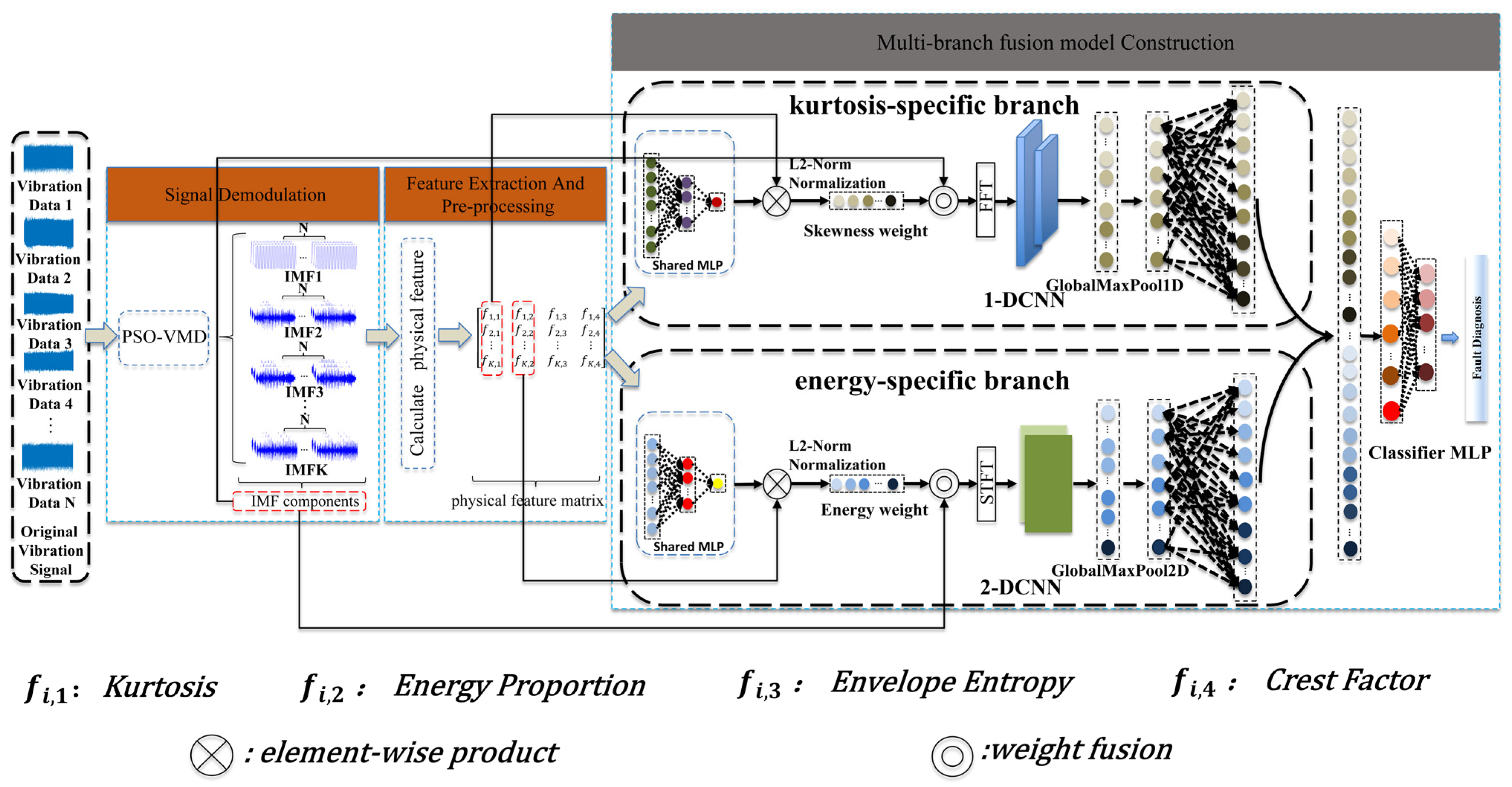
The proposed method employs Variational Mode Decomposition (VMD) for adaptive decomposition of raw vibration signals, from which physical features of the extracted Intrinsic Mode Functions (IMFs) are derived to construct informative prior representations. These physically grounded priors are subsequently combined with frequency-domain and time–frequency domain multi-modal signal features to drive a heterogeneous dual-branch weighted fusion network for fault classification. As illustrated in Figure 1, the overall pipeline encompasses three tightly coupled core stages: signal demodulation and physical feature extraction, feature preprocessing, and multi-branch fusion model construction.

2.1. Signal Demodulation

Signal demodulation is the foundation for effective representation of fault information. To ensure a unified feature dimension for subsequent machine learning models and to guarantee the completeness of decomposition, a two-stage parameter determination strategy is adopted. In the first stage, the Particle Swarm Optimization (PSO) algorithm is employed to simultaneously optimize the mode number K and the penalty factor α for each fault type, with the minimum envelope entropy as the objective function, ensuring that the decomposition results optimally represent the signal characteristics of different fault types. In the second stage, the maximum optimal K value among all faults is selected as the fixed mode number, i.e., K fixed = max K i , to unify the input dimension and avoid under-decomposition. With K fixed, PSO is applied again to optimize α individually for each fault type, yielding the final penalty factors. In online deployment, for each unknown sample, PSO is applied with K fixed to dynamically obtain the sample-specific α that minimizes envelope entropy, ensuring adaptive decomposition without prior knowledge of the fault type.
The raw vibration signal is decomposed into a set of Intrinsic Mode Functions (IMFs) with specific sparsity by means of Variational Mode Decomposition (VMD), as formally expressed in Equation (1).
min { c k } , { w k } K k = 1 t ( δ ( t ) + j π t ) c k ( t ) e j w k t 2 2 s . t . K k = 1 c k ( t ) = x ( t )
In the formula, { c k } is the set of IMF components to be solved, { w k } is the set of center frequencies corresponding to each IMF component, δ ( t ) is the Dirac function, represents the convolution operation, and x ( t ) is the original vibration signal. The above optimization problem can be solved by the Alternating Direction Method of Multipliers (ADMM) to obtain stable IMF decomposition results. Based on the optimized parameters, the original vibration signal x R L of length L is decomposed into K narrowband IMF components { c 1 , c 2 , , c K } , as shown in Equation (2).
{ c 1 , c 2 , , c K } = VMD ( x )
Each IMF component corresponds to vibration components of different frequency scales in the signal, which can effectively separate different types of feature information such as fault impulses and steady-state vibrations.

2.2. Physical Feature Extraction

To quantify the fault representation capability of each IMF component, based on the fault physical mechanism of the scroll compressor, a 4-dimensional physical feature vector f i is calculated for each IMF component to construct a physical feature matrix F R K × 4 , i.e.,
F = f 1 T f 2 T f K T = f 1 , 1 f 1 , 2 f 1 , 3 f 1 , 4 f 2 , 1 f 2 , 2 f 2 , 3 f 2 , 4 f K , 1 f K , 2 f K , 3 f K , 4
where f i = [ f i , 1 , f i , 2 , f i , 3 , f i , 4 ] T corresponds to kurtosis, energy proportion, envelope entropy, and crest factor, respectively. The specific calculation methods of each feature are as follows:
(1) Kurtosis: Used to characterize the steepness of a signal distribution and is sensitive to transient impact components. The calculation formula is
f i , 1 = E [ ( c i μ i ) 4 ] σ i 4
where μ i and σ i are the mean and standard deviation of the i th IMF component, respectively; i.e., μ i = E [ c i ] , σ i = E [ ( c i μ i ) 2 ] , and E [ ] represent the mathematical expectation. This feature is highly sensitive to transient impact components caused by faults such as bearing pitting.
(2) Energy Proportion: Used to characterize the proportion of the energy of a single IMF component in the total energy, reflecting the intensity distribution of steady-state vibration components. The calculation formula is
f i , 2 = c i 2 2 K j = 1 c j 2 2
where c i 2 2 = L t = 1 c i ( t ) 2 is the energy of the i th IMF component. This feature can effectively characterize the intensity distribution of steady-state vibration components caused by insufficient or excessive refrigerant by or fan failure.
(3) Envelope Entropy: Reflects the non-stationarity of fault characteristics through the irregularity of the signal envelope. The calculation formula is
f i , 3 = L t = 1 p t log p t
where pt is the probability of the normalized envelope signal, i.e.,
p t = | H { c i ( t ) } | L t = 1 | H { c i ( t ) } |
where H { } is the Hilbert transform, used to obtain the analytic signal of the IMF component and extract the envelope feature. Envelope entropy can reflect the irregularity of the signal envelope and is sensitive to non-stationary fault characteristics.
(4) Crest Factor: Describes the ratio between the peak value and the RMS value of a signal, aiding in the identification of impact-like faults. The calculation formula is
f i , 4 = max ( | c i | ) E [ c i 2 ]
Based on the fault sensitivity differences in the aforementioned physical features, kurtosis and energy proportion are used as the core physical priors in the subsequent model design to guide the model to achieve targeted enhancement and effective separation of impact components and steady-state vibration components.
The original feature data has problems such as inconsistent dimensions and large distribution differences, which will affect the training efficiency and diagnostic accuracy of the neural network. Therefore, standardization preprocessing is required. The core goal of standardization is to convert the feature data into a distribution with a mean of 0 and a variance of 1, eliminating the influence of dimensions. The calculation formula is
x scaled = x μ σ
where μ and σ are the mean and standard deviation of the training set features, respectively, i.e., μ = 1 N N i = 1 x i , σ = 1 N N i = 1 ( x i μ ) 2 , and N is the number of feature samples in the training set.

2.3. Multi-Branch Fusion Model Construction

2.3.1. Physical Prior-Guided Weight Generation

For the two types of features input to the model (denoted as Feature A and Feature B, where Feature B is the 4-dimensional physical feature matrix mentioned above), adaptive preprocessing workflows are designed, respectively. For Feature B, let the training set feature matrix be t r a i n B R n train × K × 4 , where n train is the number of training set samples and K is the number of IMF components. First, we reshape it into a 2-dimensional matrix:
t r a i n B r e s h a p e = r e s h a p e ( t r a i n B , ( n train × K , 4 ) )
Normalize t r a i n B reshape using the StandardScaler method to obtain t r a i n B reshape ,   scaled , then reshape it back to the original 3-dimensional structure:
t r a i n B s c a l e d = r e s h a p e ( t r a i n B reshape ,   scaled , ( n train , K , 4 ) )
Based on the normalization parameters ( μ train a n d σ train ) of the training set, perform synchronous transformation on the validation set val B R n val × K × 4 and the test set test B R n test × K × 4 :
val B scaled = val B μ train σ train
test B scaled = test B μ train σ train
This ensures the consistency of data distribution. For Feature A, its dimension is R n × K × D (where D is the dimension of Feature A), and its preprocessing workflow is consistent with that of Feature B, except that the reshape dimension needs to be adjusted:
t r a i n A r e s h a p e = r e s h a p e ( t r a i n A , ( n t r a i n × K , D ) )
t r a i n A s c a l e d = r e s h a p e ( t r a i n A r e s h a p e , s c a l e d , ( n t r a i n , K , D ) )
Finally, output the normalized training set, validation set, and test set of Feature A to provide high-quality input for subsequent model training.
To fully exploit the fault characterization capability of multi-modal features and achieve targeted feature enhancement by combining physical prior knowledge, a dual-branch weighted fusion neural network integrating physical prior knowledge is designed. The overall architecture of the model takes Feature A and Feature B as dual inputs, and it realizes fault classification through multi-branch feature extraction and fusion. Among them, Feature A is the original signal feature of IMF components, and Feature B is the preprocessed 4-dimensional physical feature matrix. The two cooperate to provide the model with rich fault information and physical prior guidance. The core design of the model lies in the two independent fully connected (FC) branches of Feature B, which are used to construct a physical prior-guided weight generation mechanism. First, perform batch normalization on the input Feature B. The calculation formula of batch normalization is
y = γ x μ batch σ batch 2 + ϵ + β
where μ batch and δ batch 2 are the mean and variance of features within the batch, respectively; γ and β are learnable scaling and shifting coefficients; ϵ is a small value to prevent the denominator from being zero. Standardizing the feature distribution through batch normalization can improve the stability and convergence speed of model training.
Subsequently, based on the differences in physical prior knowledge between kurtosis and energy ratio, two independent fully connected branches are designed: a kurtosis-specific branch and an energy-specific branch. The feature mapping relationship of the fully connected layer is
h = ReLU ( W x + b )
where W is the weight matrix, b is the bias vector, and ReLU ( ) = max ( 0 , ) is the activation function. The kurtosis-specific branch consists of three fully connected layers, and its feature mapping process can be expressed as
h skew , 1 = ReLU ( W skew , 1 B norm + b skew , 1 )
h skew , 2 = ReLU ( W skew , 2 h skew , 1 + b skew , 2 )
h skew , 3 = W skew , 3 h skew , 2 + b skew , 3
where B norm is Feature B after batch normalization; W skew , i and b skew , i (i = 1,2,3) are the weight matrix and bias vector of the i th fully connected layer in the kurtosis-specific branch, respectively, with output dimensions of 64, 32, and 1 in sequence. Reshape h skew , 3 to obtain the kurtosis weight feature matching the number of IMF components:
w s k e w , f e a t = r e s h a p e ( h s k e w , 3 , ( n , K ) )
where n is the number of samples and K is the number of IMF components. The parameters of this branch are independent, and it is only used to learn the mapping relationship between kurtosis prior knowledge and fault impact features.
The energy-specific branch adopts the same network structure as the kurtosis-specific branch but with non-shared parameters. Its feature mapping process is
h energy , 1 = ReLU ( W energy , 1 B norm + b energy , 1 )
h energy , 2 = ReLU ( W energy , 2 h energy , 1 + b energy , 2 )
h energy , 3 = W energy , 3 h energy , 2 + b energy , 3
w energy ,   feat = r e s h a p e ( h energy , 3 , ( n , K ) )
By independently learning physical features to generate energy weight features, accurate matching between energy prior knowledge and steady-state vibration features is achieved.

2.3.2. Element-Wise Product and Weight Normalization

To strengthen the guiding role of physical prior knowledge, multiply the extracted original kurtosis feature s R n × K and energy feature e R n × K with the weight features output by the corresponding branches. This operation, denoted as element-wise product (⊙), multiplies the corresponding elements of the feature vector and the weight vector, enabling a point-by-point physical guidance:
w s k e w , r a w = w s k e w , f e a t s
w energy , raw = w energy , feat e
Subsequently, obtain the standardized kurtosis weight w e i g h t skew and energy weight w e i g h t energy through L2 normalization:
w e i g h t skew = W skew , raw w skew , raw 2 + ϵ
w e i g h t energy = W energy , raw w energy , raw 2 + ϵ
This ensures the effectiveness and comparability of the weights.

2.3.3. Weighted Fusion via Einstein Summation

Based on the generated dual weights, a dual-branch feature extraction structure for Feature A is designed to realize targeted learning of impact features and steady-state vibration features, respectively. Let Feature A be A R n × K × D , where D is the dimension of Feature A.
Before feeding A into the convolutional networks, a weighted fusion operation is performed to adaptively integrate the IMF components according to the physical weights. This operation, denoted by the symbol ⊕, performs a weighted summation along the IMF dimension using the Einstein summation convention. For the kurtosis branch, the fused feature A skew is obtained as follows:
A skew = A w e i g h t skew = einsum ( n k d , n k n d , A , w e i g h t skew )
where einsum reduces the IMF dimension by summing the weighted contributions. This yields a compact representation A skew R n × D that preserves diagnostically relevant components.
Similarly, for the energy branch,
A energy = A w e i g h t energy = einsum ( n k d , n k n d , A , w e i g h t energy )
After obtaining the fused representations A skew and A energy , the network proceeds to extract discriminative features through two heterogeneous branches, as detailed in the following subsection.

2.3.4. Heterogeneous Dual-Branch Feature Extraction

The first branch is the “kurtosis weight-FFT-1D-CNN” branch. Subsequently, perform Fast Fourier Transform (FFT) on A skew to convert the time-domain signal into frequency-domain features. The calculation formula of Discrete Fourier Transform is
X ( k ) = N 1 n = 0 x ( n ) e j 2 π k n / N , k = 0 , 1 , , N 1
where x ( n ) is the time-domain signal, N is the signal length, and X ( k ) is the frequency-domain signal. Use the tf.cond function to realize adaptive cropping or padding of the frequency-domain length to ensure the consistency of feature dimensions and obtain the frequency-domain feature A skew , fft R n × M × 1 (where M is the target frequency-domain dimension). Adopt 1D Convolutional Layer (Conv1D) to extract local frequency-domain features. The calculation method of 1D convolution is:
y ( i ) = K 1 k = 0 w ( k ) x ( i + k ) + b
where w ( k ) is the convolution kernel weight, K is the convolution kernel size, and b is the bias. The feature extraction process of the two 1D convolutional layers is:
h cnn 1 d , 1 = ReLU ( Conv 1 D ( A skew , fft , W cnn 1 d , 1 , k size = 3 ) + b cnn 1 d , 1 )
h cnn 1 d , 2 = ReLU ( Conv 1 D ( h cnn 1 d , 1 , W cnn 1 d , 2 , k size = 3 ) + b cnn 1 d , 2 )
where W cnn 1 d , i and b cnn 1 d , i are the weight and bias of the i t h 1D convolutional layer, respectively, with a convolution kernel size of 3 and a padding mode of same. To suppress overfitting, add a Dropout layer after each convolutional layer:
h cnn 1 d ,   drop 1 = Dropout ( h cnn 1 d , 1 , p = 0.1 )
h cnn 1 d ,   drop 2 = Dropout ( h cnn 1 d , 2 , p = 0.1 )
where p = 0.1 is the Dropout probability. Perform dimensionality reduction through Global Max Pooling (GlobalMaxPool1D):
h pool 1 d = GlobalMaxPool 1 D ( h cnn 1 d , drop 2 )
Map to a 128-dimensional impact feature vector through a fully connected layer:
f e a t skew = ReLU ( W fc 1 d h pool 1 d + b fc 1 d )
The second branch is the “energy weight-STFT-2D-CNN” branch. Using the fused representation A energy obtained from Equation (39), convert the time-domain signal into a 2-dimensional time–frequency matrix through Short-Time Fourier Transform (STFT). The definition of STFT is
X ( m , k ) = N 1 n = 0 x ( n + m H ) w ( n ) e j 2 π k n / N
where w(n) is the window function, H is the frame shift, m is the frame index, and K is the frequency index. Similarly, use the tf.cond function to realize adaptive adjustment of the time–frequency dimension, and obtain the time–frequency feature A energy , stft R n × L × H × 1 (where L is the number of time-domain frames and H is the number of frequency points).
Use two 2D Convolutional Layers (Conv2D) to extract time–frequency texture features. The calculation method of 2D convolution is
y ( i , j ) = K 1 k = 0 L 1 l = 0 w ( k , l ) x ( i + k , j + l ) + b
The feature extraction process is
h c n n 2 d , 1 = Re L U ( C o n v 2 D ( A e n e r g y , s t f t , W c n n 2 d , 1 , k s i z e = ( 3 , 3 ) ) + b c n n 2 d , 1 )
h c n n 2 d , 2 = Re L U ( C o n v 2 D ( h c n n 2 d , 1 , W c n n 2 d , 2 , k s i z e = ( 3 , 3 ) ) + b c n n 2 d , 2 )
Add a Dropout layer after each convolutional layer to suppress overfitting. After dimensionality reduction through global max pooling, map to a 128-dimensional steady-state vibration feature vector through a fully connected layer:
f e a t e n e r g y = Re L U ( W f c 2 d × h p o o l 2 d + b f c 2 d )

2.3.5. Feature Fusion and Classification

After extracting the impact feature vector f e a t skew and the steady-state vibration feature vector f e a t energy from the two heterogeneous branches, the network proceeds to fuse these complementary representations for final classification. To realize the complementary fusion of the two types of features, concatenate f e a t skew R n × 128 and f e a t energy R n × 128 to obtain a 256-dimensional fused feature vector:
f e a t concat = Concatenate ( f e a t skew , f e a t energy ) R n × 256
Further suppress overfitting through a Dropout layer:
f e a t drop = Dropout ( f e a t concat , p = 0.1 )
Perform high-level feature fusion and dimensionality reduction through two fully connected layers, and introduce L2 regularization to suppress overfitting at the same time. The loss function of the fully connected layer with L2 regularization is
L fc = L MSE + λ i , j W i , j 2
where L MSE is the Mean Squared Error loss, λ = 10 4 is the L2 regularization coefficient, and i , j W i , j 2 is the L2 norm of the weight matrix. The high-level feature fusion process is
h final 1 = ReLU ( W final 1 f e a t drop + b final 1 )
h final 2 = ReLU ( W final 2 h final 1 + b final 2 )
where h final 1 R n × 64 and h final 2 R n × 32 Finally, output the probability distribution of each fault category through the softmax activation function:
y ^ c = e z c C c = 1 e z c , c = 1 , 2 , , C
where z c = W o u t × h f i n a l 2 + b o u t is the linear output of the output layer, C is the number of fault categories, and y ^ c is the probability that the sample belongs to the c-th fault category. The model training uses the cross-entropy loss function to optimize the parameters. The cross-entropy loss function is
L = 1 n n i = 1 C c = 1 y i , c log y ^ i , c
where y i , c is the true label of sample i (one-hot encoding), and y ^ i , c is the predicted probability that sample i belongs to the c-th category. By minimizing the cross-entropy loss, the model learns the mapping relationship between fault features and categories, and it realizes accurate fault classification.

2.4. Experiments

2.4.1. Testing Platform

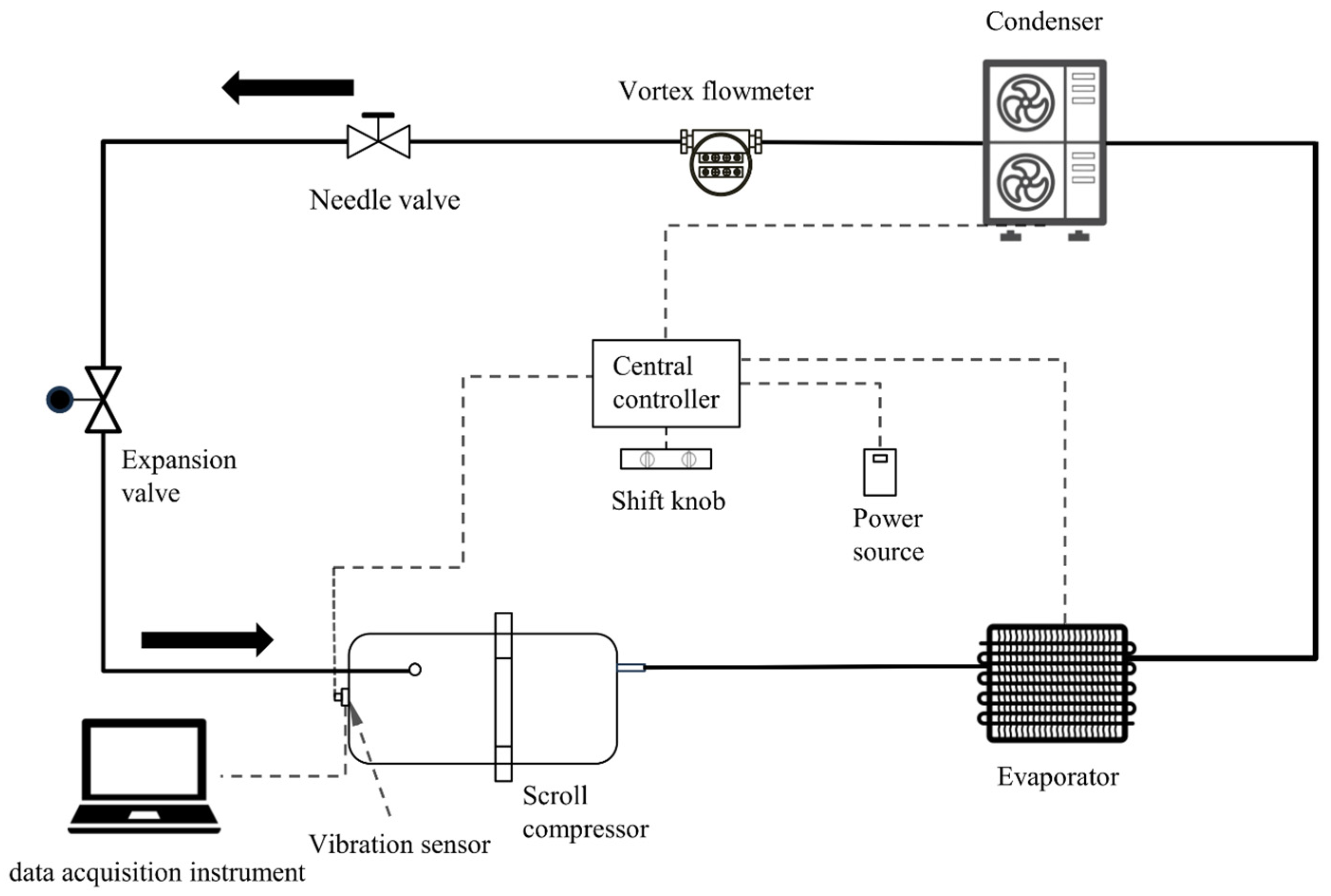
The experimental platform comprises three main subsystems—the air conditioning system, control system, and data acquisition system—as shown in Figure 2. The air conditioning system comprises a scroll compressor, needle valve, condenser, expansion valve, and evaporator. The control system consists of a central controller and a speed regulation switch. The central controller manages the transition between cooling and heating modes, while the speed selector switch regulates the operational speed of the condenser and evaporator cooling fans. The data acquisition system is equipped with vibration sensor (PCB Piezotronics, Inc., Depew, NY, USA), laptop computer (ASUSTeK Computer Inc., Taipei, China), and data acquisition unit (ECON 16-channel system, Hangzhou Yiheng Technology Co., Ltd., Hangzhou, China).
In the experimental study, five distinct operational states were simulated, comprising four representative fault conditions (condenser fan failure, refrigerant leakage, refrigerant overcharge, and compressor main shaft wear) and one normal operating condition. The scroll compressor is a horizontal DC inverter scroll compressor, with its detailed performance parameters listed in Table 1. Vibration acceleration signals of the scroll compressor were acquired under each of the five operational states using piezoelectric vibration acceleration sensors. Specifically, PCB piezoelectric accelerometers were deployed in the axial direction on the compressor housing, with a sensitivity of 10.38 mV/(m/s2). Data acquisition was performed using an ECON 16-channel data acquisition system at a sampling rate of 5120 Hz.
For each of the five operational states, a 30 s continuous vibration acceleration signal was acquired at a sampling rate of 5120 Hz, with a single-state experiment duration of 30 s per fault type, yielding a total of 150 s of raw data across all states. To construct the dataset while ensuring temporal independence and avoiding information leakage, three non-overlapping segments were extracted from distinct time windows within each 30 s recording: an 18 s segment for training, a 6 s segment for validation, and another 6 s segment for testing.
A sliding window technique was then applied to each segment, with a window length of 2560 points (0.5 s) and a 30% overlap (step size of 1792 points). This process generated 51 training samples, 16 validation samples, and 16 test samples per operational state. Consequently, the complete dataset comprised 255 training samples, 80 validation samples, and 80 test samples across all five operational states.
All algorithms and data processing were implemented in Python 3.9.25 (Python Software Foundation, Wilmington, DE, USA) using the vmdpy library, NumPy 1.26.4, SciPy 1.13.1, scikit-learn 1.6.1, and PyTorch 2.8.0 (PyTorch Foundation, San Francisco, CA, USA), while the deep learning model was built with TensorFlow 2.15.0 (Google, Mountain View, CA, USA) and the Keras API.

2.4.2. Experimental Setup

In this study, five distinct operational states were established, encompassing one normal operating condition and four representative fault conditions. The specific simulation procedures for each condition are described as follows.
(1)
Normal Operating Condition (Normal):
The air conditioning system was operated strictly in accordance with its rated design parameters without any artificial intervention, serving as the baseline reference state for fault diagnosis.
(2)
Condenser Fan Fault Condition (Fault a):
The condenser fan fault was deliberately induced by periodically controlling the activation and deactivation of the fan motor to simulate intermittent fan failure.
(3)
Refrigerant insufficiency Fault Condition (Fault b):
The air conditioning system was charged with 400 g of R134a refrigerant, below the rated charge of 600 g, to simulate the undercharged operating state resulting from refrigerant leakage.
(4)
Refrigerant overcharge Fault Condition (Fault c):
The air conditioning system was charged with 800 g of R134a refrigerant, exceeding the rated charge of 600 g, to simulate compressor operation under liquid slugging conditions.
(5)
Compressor Spindle Wear Fault Condition (Fault d):
The surface of the compressor spindle was subjected to controlled abrasion using sandpaper to simulate the spindle wear phenomenon arising from prolonged operation under insufficient lubrication or cyclic fatigue loading conditions.

3. Results

3.1. VMD Signal Analysis

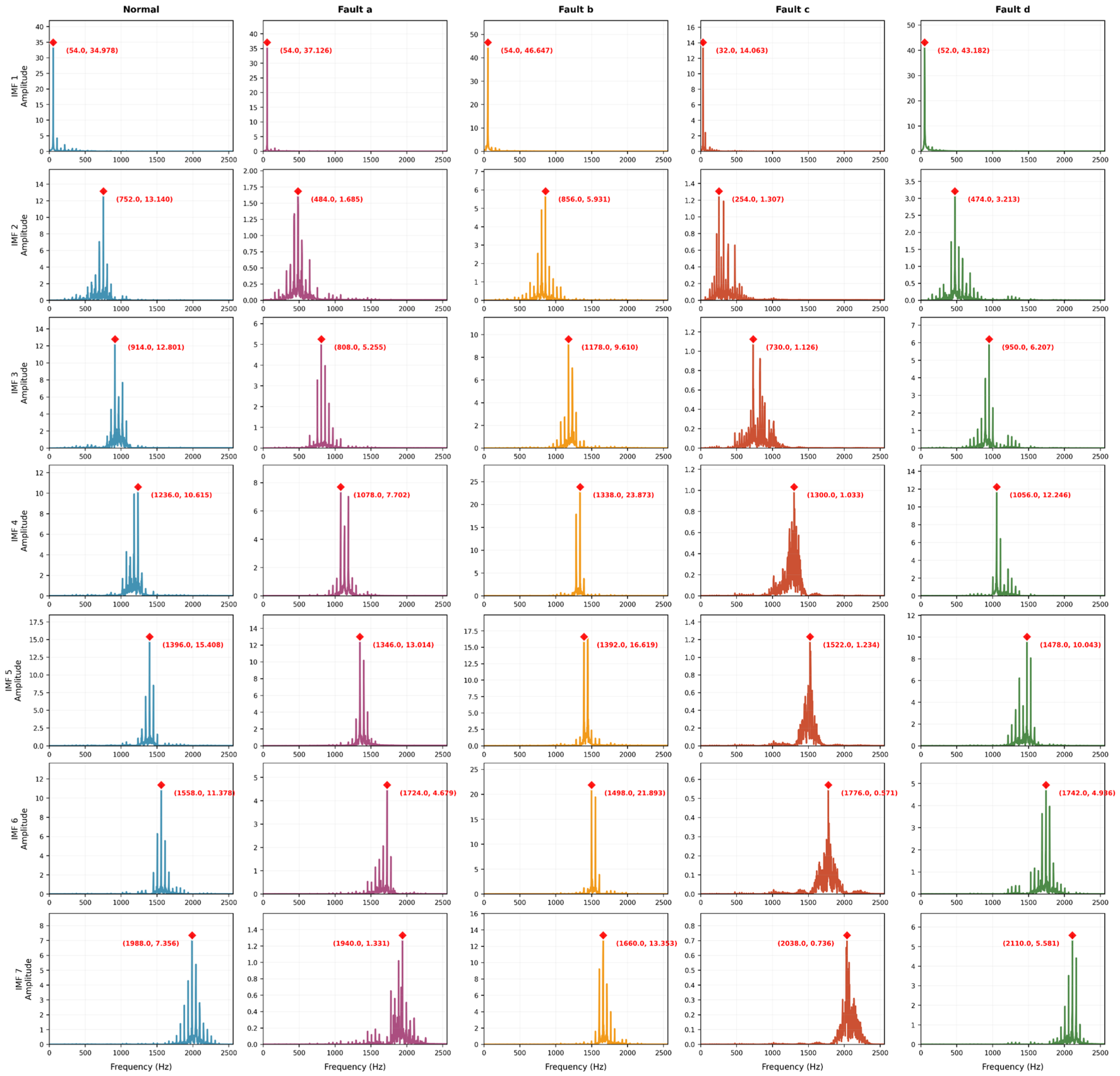
In this section, a two-stage parameter optimization strategy is employed to determine the VMD parameters. In the first stage, Particle Swarm Optimization (PSO) is applied to simultaneously optimize the mode number K and the penalty factor α for each fault type, with the minimum envelope entropy as the objective function. The results are presented in Table 2, where the optimal K values vary across fault types, reflecting the inherent complexity of their frequency structures. To unify the feature input dimensionality for subsequent models and to avoid under-decomposition under varying conditions, the maximum optimal K value among all faults, which is 7, is selected as the fixed mode number. In the second stage, with K = 7 fixed, PSO is reapplied to optimize α individually for each fault type, yielding the optimal α values for each fault type, which are presented in Table 3 as illustrative examples of the online optimization results. In online deployment, for each unknown sample, PSO is applied with K = 7 fixed to dynamically obtain the sample-specific α that minimizes envelope entropy. Using these optimized parameters, VMD is applied to decompose the vibration signals acquired under all five operational states, with the decomposition results presented in Figure 3. By analyzing the dominant frequency and amplitude of each IMF component, the decomposition quality and feature extraction capability of VMD under different fault conditions are systematically evaluated.
Under normal operating conditions, the Variational Mode Decomposition (VMD) method demonstrates superior modal separation characteristics. The dominant frequencies of the seven Intrinsic Mode Functions (IMFs) exhibit a monotonically increasing, stepwise distribution: 54 Hz, 752 Hz, 914 Hz, 1236 Hz, 1396 Hz, 1558 Hz, and 1988 Hz. The minimum frequency interval between adjacent IMFs is 160 Hz (observed between IMF4 and IMF5). The amplitudes of the respective IMFs attenuate steadily from 34.98 to 7.36, which satisfies the fundamental requirement of quasi-orthogonal decomposition. These results indicate that VMD effectively isolates distinct frequency components within the signal under standard operating conditions.
Under the condenser fan fault condition (Fault a), the pressure pulsation caused by the periodic start and stop of the condenser fan leads to significant changes in the frequency distribution. The main frequency of IMF2 drops from 752 Hz to 484 Hz, while that of IMF6 rises from 1558 Hz to 1724 Hz. The frequency interval between IMF2 and IMF3 expands from 162 Hz to 324 Hz, and the interval between IMF5 and IMF6 increased from 162 Hz to approximately 378 Hz. These changes break the monotonically increasing pattern under normal conditions, reflecting the load fluctuations caused by the fan’s start and stop. Notably, the main frequency of IMF1 remains stable at 54 Hz, with the amplitude increasing by only 6.2%, indicating that the basic vibration structure of the system is still retained under the fault condition.
The refrigerant leakage fault (Fault b) causes changes in the system’s dynamic characteristics, and the frequency distribution shows a significant reconstruction. The main frequency of IMF3 rises from 914 Hz to 1178 Hz, and that of IMF4 increases from 1236 Hz to 1338 Hz. The interval between the two shrinks from 322 Hz to 160 Hz, indicating a concentration of high-frequency energy. The amplitude of IMF3 decreases by 24.9%, whereas that of IMF4 increases by 124.9%, reflecting a pronounced reorganization of high-frequency components. Meanwhile, the main frequency of IMF2 rises from 752 Hz to 856 Hz, that of IMF6 drops from 1558 Hz to 1498 Hz, and that of IMF7 decreases from 1988 Hz to 1660 Hz. The overall frequency distribution shows a non-uniform feature with a dense mid-to-high frequency range and sparse ends. It is important to note that although the frequency distribution pattern changes significantly, each IMF still maintains a clear single-peak main frequency without severe modal aliasing. Therefore, the fault-related characteristic components can still be effectively extracted, laying a foundation for subsequent physically guided feature extraction.
Under the fault of excessive refrigerant (Fault c), the main frequency of IMF1 drops from 54 Hz to 32 Hz, a reduction of 40.7%. This phenomenon is related to the decrease in shaft speed and is also affected by the change in flow field caused by excessive refrigerant and possible structural resonance shift. It is the result of the combined effect of pressure pulsation–structure coupling and the decrease in speed. The amplitudes of each IMF generally decrease by 60% to 95%, and the energy distribution is extremely dispersed. Among them, the amplitudes of IMF2 to IMF4 decrease by more than 90%. In terms of frequency distribution, the main frequencies of IMF5 to IMF7 increase by 9.0%, 14.0%, and 2.5%, respectively. Although the amplitudes are low, they jointly form the response characteristics of frequency shift to the high-frequency band and energy attenuation. The intervals between adjacent IMFs generally increase. For example, the interval between IMF4 and IMF5 expands from 160 Hz to about 222 Hz, and the interval between IMF6 and IMF7 increases to about 262 Hz, indicating that the high-frequency components tend to separate under overload conditions.
As a typical mechanical impact fault, the wear of the main shaft (Fault d) has a relatively stable decomposition quality, and the changes in the main frequencies and amplitudes of each IMF are limited. The main frequency of IMF2 drops from 752 Hz to 474 Hz (a decrease of 37.0%), while that of IMF7 rises from 1988 Hz to 2110 Hz (an increase of 6.1%), showing a characteristic of reverse shift at both ends of the spectrum, which reflects the systematic influence of wear on the overall frequency structure of the system. The amplitude of IMF1 increases by 23.5%, while that of IMF2 decreases by 75.6%, forming a sharp contrast, indicating that the impact of wear on the low-frequency fundamental frequency and mid-frequency components is significantly different. The amplitudes of IMF4 and IMF6 increase by 15.1% and 59.2%, respectively, further confirming the complex modulation characteristics introduced by mechanical wear.
It is worth noting that insufficient and excessive refrigerants are thermodynamic faults. Specifically, insufficient refrigerant leads to a decrease in suction pressure, changes in compressor load, and alters the pressure pulsation spectrum, which, through pressure pulsation-structure coupling, excites the shell to produce vibration in specific frequency bands. Excessive refrigerant, on the other hand, increases the compressor load, potentially causing nonlinear vibration, making the energy distribution more dispersed, and changing the pressure pulsation characteristics, resulting in a decline in low-frequency energy and a relative increase in high-frequency components. These thermodynamic changes are transmitted to the mechanical structure through pressure pulsation–structure coupling, ultimately transforming into measurable vibration features. VMD can decompose the vibration signal into different frequency-band IMFs, and physical features such as kurtosis and energy are, respectively, sensitive to impact components and steady-state components, thereby establishing an effective mapping between thermodynamic faults and vibration features. The phenomenon shown in Figure 3, where the amplitude of IMF4 significantly increases while IMF3 decreases when the refrigerant is insufficient and the amplitudes of IMF2 to IMF4 greatly decrease when the refrigerant is excessive, is precisely the specific manifestation of the above-mentioned transmission mechanism in the frequency domain.
In summary, VMD demonstrated excellent decomposition quality in all five operating conditions. The modal separation was the clearest and the frequency structure was the most regular under normal operation and main shaft wear conditions. Although the frequency distribution pattern was significantly altered under the insufficient refrigerant condition, no modal aliasing occurred, and the characteristic components could still be extracted. The variation patterns of the main frequencies and amplitudes of the IMFs under each fault condition were consistent with the corresponding physical mechanisms of the faults, verifying the effectiveness and applicability of VMD in extracting fault features of scroll compressors. The above results provide a good signal basis for the adaptive weighted reconstruction in the PDW-Net framework.

3.2. Reconstructed Signal Analysis

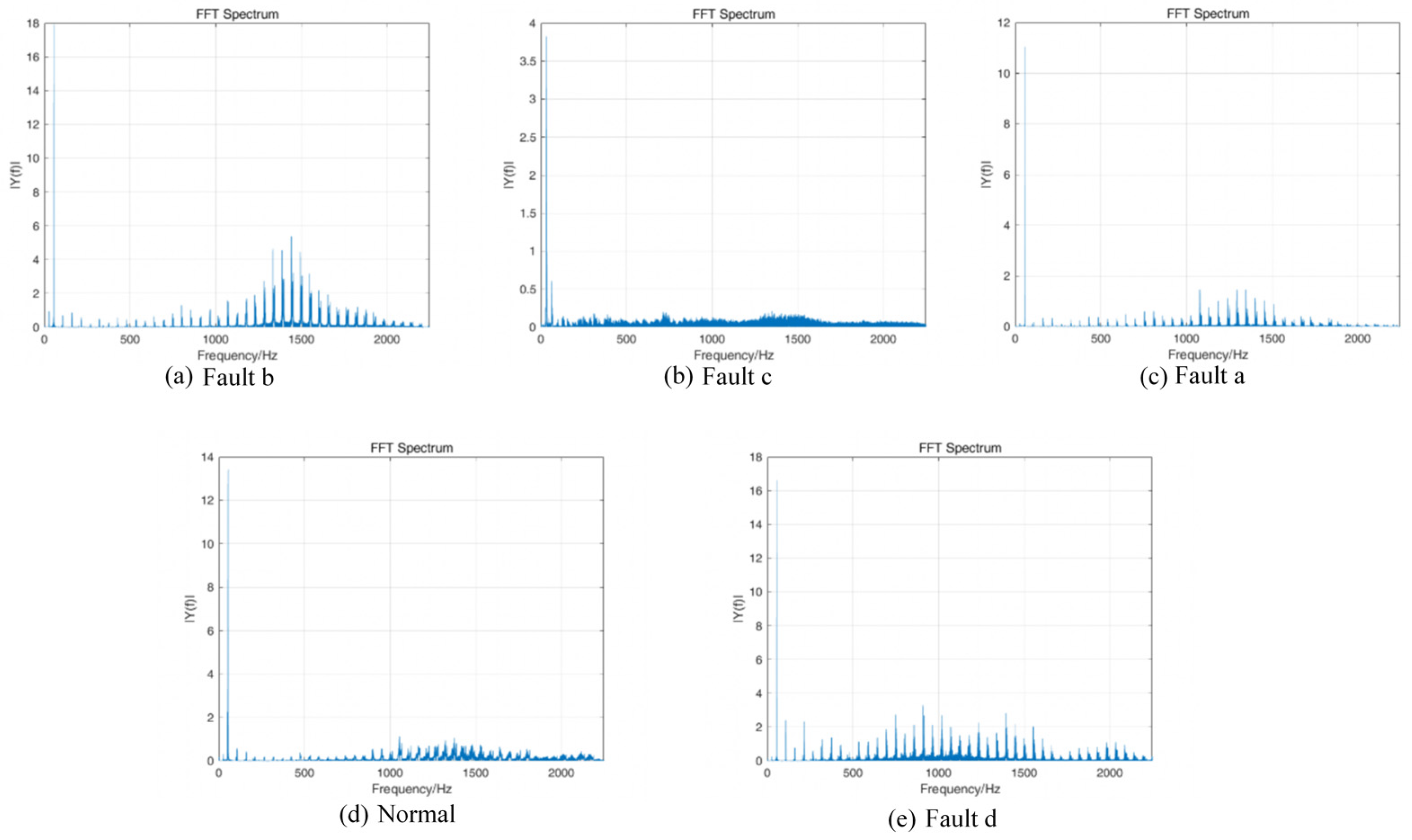
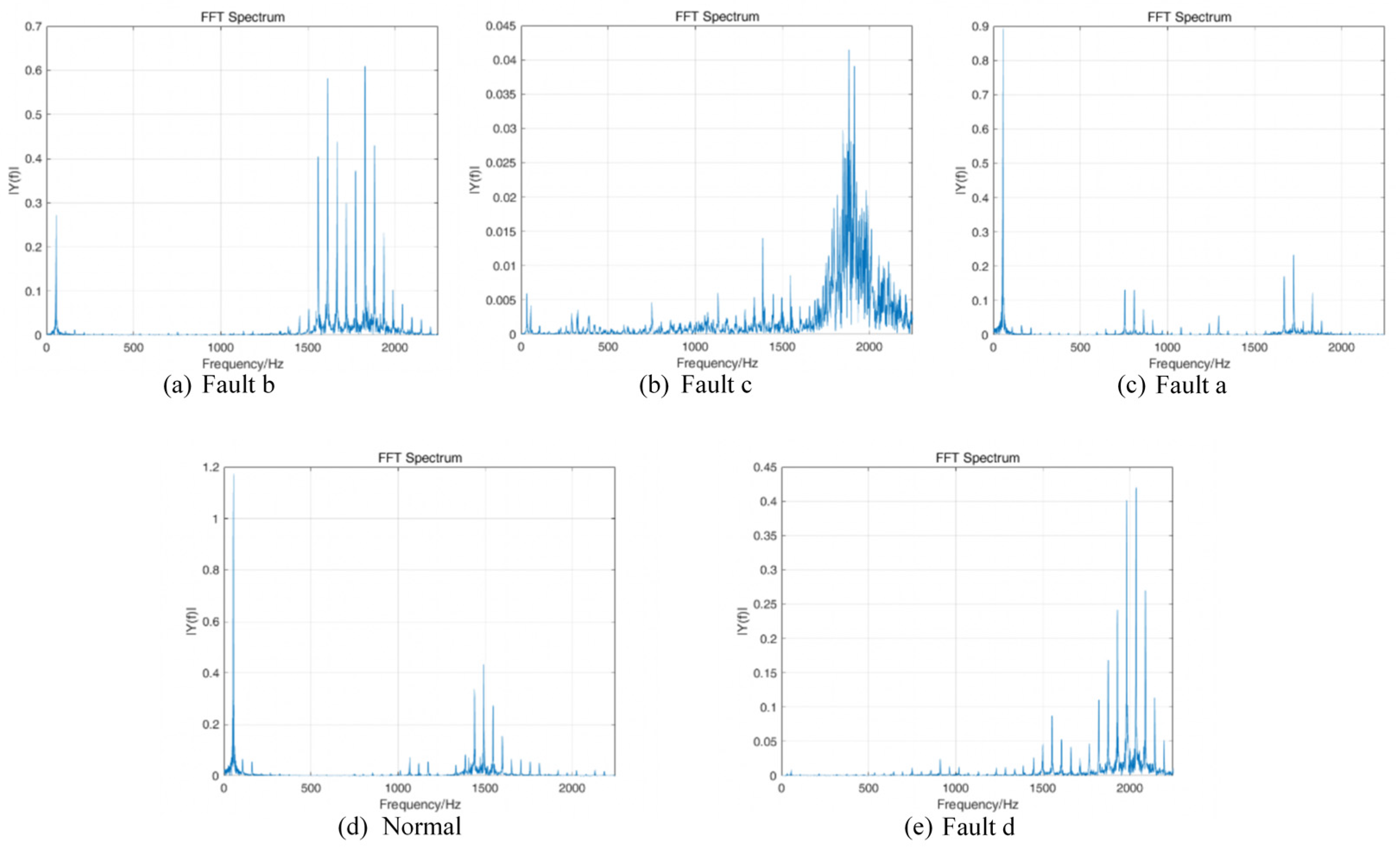
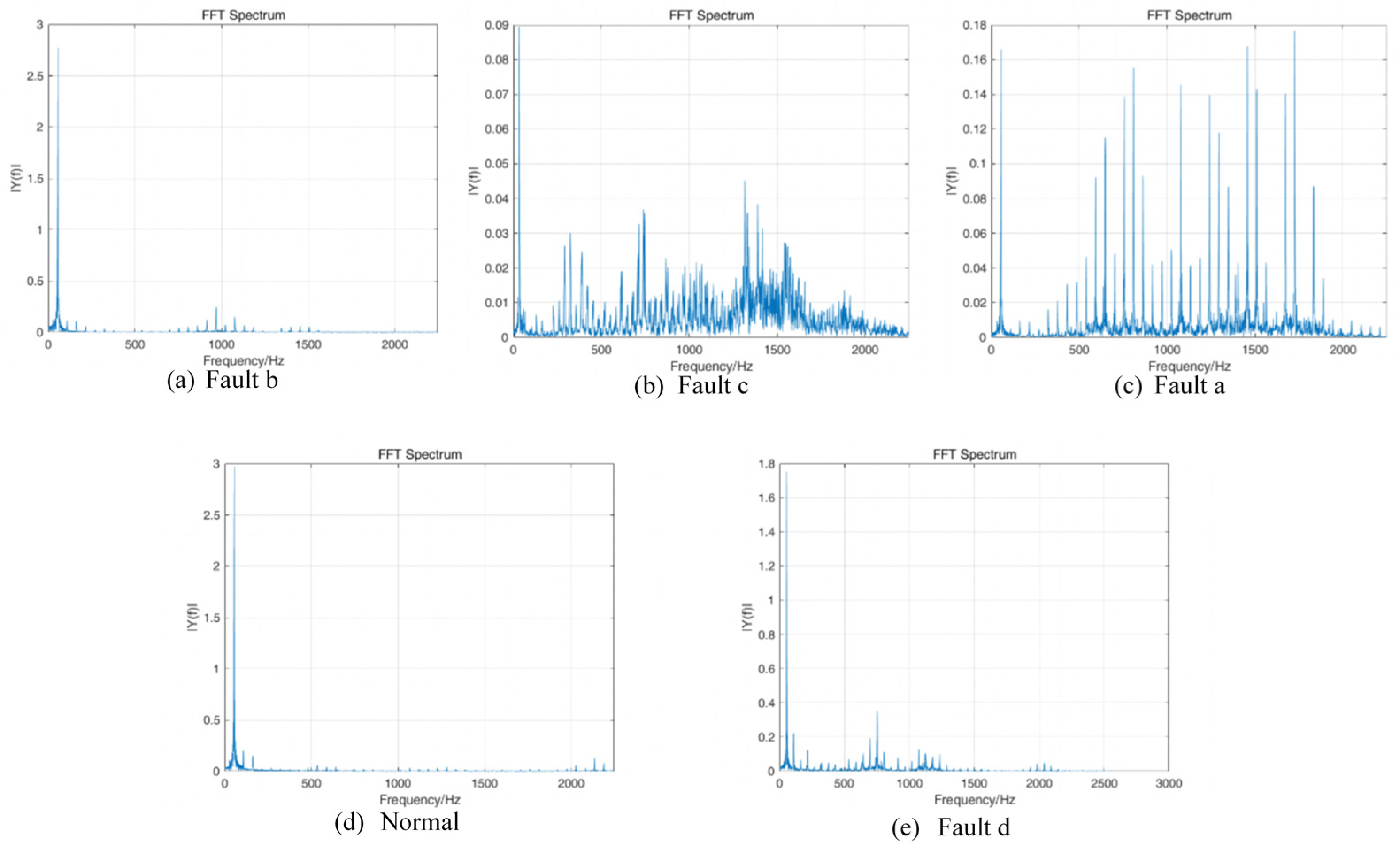
Based on the physical mechanisms underlying scroll compressor faults, a dual-path signal processing strategy is devised in this study, comprising kurtosis-based reconstruction and energy-based reconstruction, with the objective of extracting distinct characteristic components from fault signals. Kurtosis reconstruction performs a kurtosis-weighted fusion of VMD-derived IMF components to enhance transient impulse signatures associated with mechanical wear or abrupt pressure variations, while energy reconstruction applies an energy-weighted fusion to amplify steady-state vibration features and highlight frequency-band energy variations induced by load fluctuations or periodic pressure pulsations. The resulting frequency-domain spectra presented in Figure 4 and Figure 5, and Figure 6, respectively.
Under normal operating conditions, the original signal spectrum (Figure 4d) exhibits a typical spectral structure of rotating machinery, wherein the fundamental frequency component dominates the spectrum with substantially higher amplitude than other components, while low-order harmonics remain relatively weak and a continuous background distribution persists across the high-frequency band. Following energy reconstruction (Figure 6d), the fundamental frequency component is further enhanced, high-frequency background components and low-order harmonics are relatively suppressed, and the periodic characteristics of the spectrum become more prominent. The kurtosis-reconstructed spectrum (Figure 5d) exhibits relative attenuation of the fundamental frequency component, with several discrete spectral peaks emerging in the mid-to-high frequency bands.
The physical mechanism underlying the condenser fan fault (Fault a) involves fan shutdown-induced elevation of condensing pressure, which consequently intensifies compressor discharge pressure pulsations. The original signal spectrum (Figure 4c) shows an increase in fundamental frequency amplitude relative to the normal state. Following energy reconstruction (Figure 6c), discrete spectral peaks with substantially amplified amplitudes emerge in the high-frequency region distal to the fundamental frequency, with some high-frequency components reaching amplitudes comparable to the fundamental. The kurtosis-reconstructed spectrum (Figure 5c) is characterized by anomalous enhancement of the fundamental frequency component, with the remaining spectral components exhibiting comparatively low amplitudes.
The refrigerant leakage fault (Fault b) deteriorates system lubrication conditions and intensifies mechanical friction. The original signal spectrum (Figure 4a) reveals prominent fundamental frequency and harmonic components, accompanied by a cluster of spectral peaks with relatively high amplitudes distributed across the mid-to-high broadband frequency domain, attributable to stochastic frictional impacts. Energy reconstruction (Figure 6a) induces a pronounced redistribution of spectral energy, concentrating it in the low-frequency band around the fundamental frequency to form a single dominant sharp peak, while extensively suppressing mid-to-high frequency components. In sharp contrast, the kurtosis-reconstructed spectrum (Figure 5a) presents nearly the opposite spectral morphology: the fundamental and low-frequency components are substantially attenuated, while a series of discrete high-amplitude spectral peaks emerge across the mid-to-high frequency bands, clearly delineating the dry-friction impact signatures.
The refrigerant overcharge fault (Fault c) increases compressor load, accompanied by a reduction in rotational speed and intensification of system nonlinear vibration. The original signal spectrum (Figure 4b) is characterized by overall low amplitudes, diffuse frequency band distribution, and an absence of prominent characteristic peaks. The energy-reconstructed spectrum (Figure 6b) reflects this complexity, exhibiting multiple spectral bulges of comparable amplitude in the mid-low to mid-frequency range without forming a well-defined dominant peak, indicative of degraded steady-state periodicity under this fault condition. The kurtosis-reconstructed spectrum (Figure 5b) presents a broad and gentle spectral envelope with energy predominantly distributed across the mid-to-high frequency bands.
As a typical mechanical impact-type fault, the compressor main shaft wear fault (Fault d) yields the most distinctive spectral characteristics. The original signal spectrum (Figure 4e) clearly reveals the fundamental frequency, harmonic structure, and additional high-frequency impact components. Energy reconstruction (Figure 6e) substantially reinforces the steady-state vibration characteristics, producing a well-structured spectrum with relatively prominent fundamental frequency and low-order harmonic amplitudes. The kurtosis-reconstructed spectrum (Figure 5e) almost completely suppresses the low-frequency rotational components, with spectral energy highly concentrated in the high-frequency band, manifesting as one or more extremely high-amplitude sharp spectral peaks that vividly capture the mechanical impact signatures.
Based on the systematic comparative analysis of the frequency-domain spectra of the original, kurtosis-reconstructed, and energy-reconstructed signals (Figure 4, Figure 5 and Figure 6), the following conclusions are drawn. Energy reconstruction primarily enhances and purifies the steady-state periodic components of the system: under normal conditions, the spindle wear fault, and the refrigerant leakage fault, spectral energy is significantly concentrated toward the fundamental frequency; under the refrigerant overcharge fault, the multi-peak and diffuse spectral morphology indicates substantial disruption of steady-state system dynamics. Kurtosis reconstruction, in contrast, focuses on extracting transient and anomalous fault-related components: it reveals otherwise weak high-frequency transients under normal conditions, extracts discrete high-frequency spectral lines representing dry-friction impacts under the refrigerant leakage fault, and significantly highlights high-amplitude sharp spectral peaks indicative of mechanical impacts under the spindle wear fault. Collectively, while the original signal spectrum reflects the overall vibration state of the system, energy reconstruction and kurtosis reconstruction provide complementary and physically interpretable enhancements of steady-state periodic features and transient anomalous features, respectively. The distinct characteristic combinations exhibited by different fault types in these two reconstructed spectra establish a well-differentiated and separable feature basis for subsequent multi-dimensional feature fusion and fault classification.

3.3. Model Comparison Results

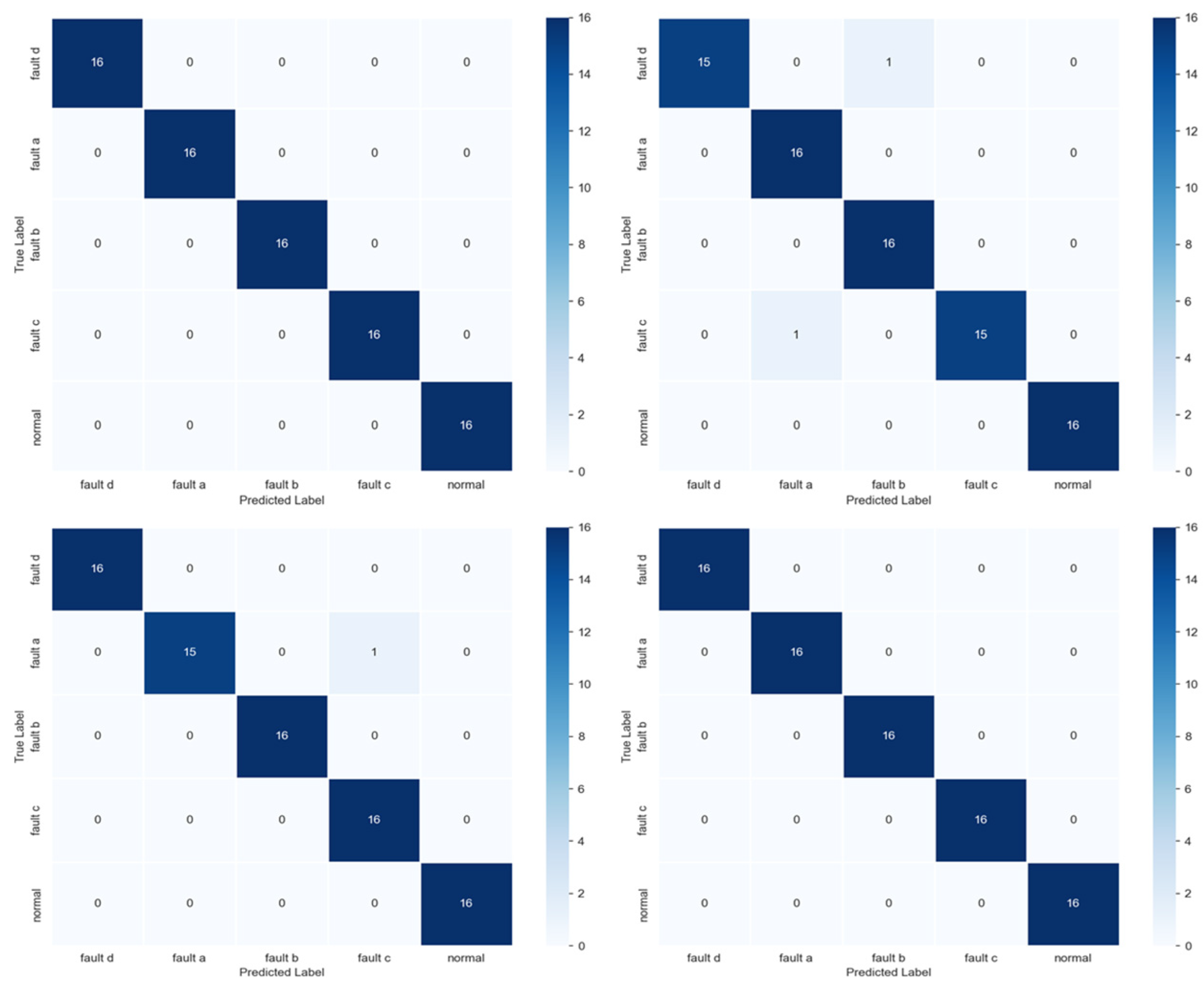
Table 4 presents the performance comparison of different methods across 20 runs (Table 4). PDW-Net achieves an average accuracy of 97.87%, outperforming all baseline methods. The confusion matrix in Figure 7 shows the detailed classification results, with 78 out of 80 test samples correctly identified (Table 5).

3.4. Ablation Study Results

Table 6 presents the ablation study results for five variant models. The full model achieves 97.87%, while M0 (equal weights) drops to 63.63%, M1 (MLP weights) to 88.37%, M2 (kurtosis-only) to 66.75%, M3 (energy-only) to 85.25%, and M4 (homogeneous dual-branch) to 81.69%.

4. Discussion

4.1. Analysis of Model Comparison

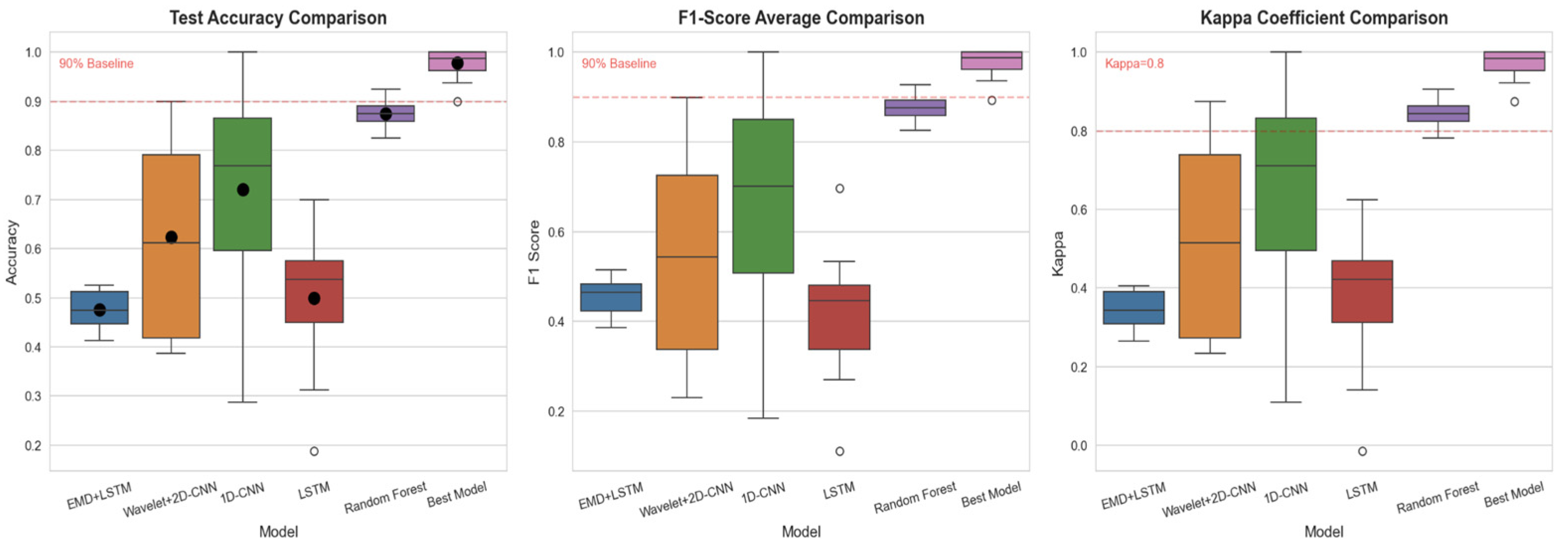
To comprehensively evaluate the advancement of PDW-Net, five representative fault diagnosis methods were selected for systematic comparison, namely Random Forest (a traditional machine learning method), 1D-CNN (an end-to-end deep learning method), WT+2D-CNN (a fusion method of time–frequency analysis and deep learning), LSTM (a temporal sequence modeling method), and EMD+LSTM (a combination method of adaptive decomposition and deep learning). The experimental results are presented in Table 4 and Figure 8.
Random Forest achieves an average accuracy of 87.44%. Its performance is primarily constrained by the representational capability of features. Although time-domain statistical features can reflect fault characteristics to a certain extent, the relationship between these features and the physical mechanisms of faults is mostly an indirect statistical correlation. In contrast, PDW-Net realizes end-to-end features learning from raw signals to fault categories through physically guided deep learning while retaining physical interpretability. The resultant performance gain of 10.43 percentage points over the Random Forest baseline not only demonstrates the representational advantages of deep learning but also verifies the effectiveness of integrating physical understanding into the feature learning process.
The pronounced instability of 1D-CNN exposes a fundamental limitation of purely data-driven approaches in small-sample industrial fault diagnosis scenarios. With merely 255 training samples available, learning discriminative fault representations directly from 25,600-dimensional raw signals necessitates navigating an intractably large hypothesis space, rendering the optimization process highly susceptible to convergence toward suboptimal local minima or overfitting to individual sample characteristics. PDW-Net addresses this challenge by imposing multi-level physical constraints that progressively narrow the effective learning space: VMD reduces signal dimensionality from 25,600 points to 7 × 2560 points; physics-based feature extraction achieves statistical-level abstraction of fault-relevant information; adaptive frequency-band weighting selectively emphasizes diagnostically critical spectral regions; and the heterogeneous network architecture employs modality-specific processing tailored to distinct feature types. This physically guided hierarchical abstraction strategy not only enhances overall diagnostic performance, but more critically, stabilizes the learning dynamics, as evidenced by a reduction in standard deviation to 2.60%.
PDW-Net surpasses EMD+LSTM and WT+2D-CNN by margins of 50.31 and 35.50 percentage points, respectively, a performance disparity that underscores the critical role of signal decomposition strategy in rotating machinery fault diagnosis. The inherent mode mixing problem in empirical mode decomposition (EMD) introduces spurious cross-component interference between impact and modulation constituents during decomposition, fundamentally compromising the fidelity of subsequent feature extraction. Similarly, the fixed wavelet basis functions employed in WT+2D-CNN lack the adaptive flexibility required to match the scale-varying characteristics of heterogeneous fault types. VMD, by contrast, exploits its variational optimization framework in conjunction with narrowband spectral constraints to achieve physically meaningful separation of signal constituents into spectrally distinct Intrinsic Mode Functions, thereby providing a clean and well-structured input representation for subsequent targeted diagnostic processing.
The diagnostic performance of PDW-Net for different fault types on the independent test set is summarized in Table 5. The specific diagnostic results are illustrated by the confusion matrix shown in Figure 7, which presents the diagnostic details from five representative experiments. Overall, 78 out of 80 test samples were correctly identified, yielding an overall accuracy of 97.5%. This result is consistent with the average accuracy of 97.87% obtained from 20 repeated experiments, verifying the model’s stable diagnostic capability.
It is worth noting that the two misclassifications in Table 5 (main shaft wear being misjudged as insufficient refrigerant and excessive refrigerant being misjudged as condenser failure) can be physically explained from the perspective of spectral characteristics. As shown in Figure 3, both main shaft wear and insufficient refrigerant have dense modulation components in the medium- and high-frequency bands (the intervals of IMF3 and IMF4 are 160 Hz and 160 Hz, respectively), and their amplitude variation trends are similar, resulting in partial overlap in the feature space. Similarly, excessive refrigerant and condenser failure both exhibit wideband modulation characteristics and energy dispersion features, which can easily lead to confusion. This observation indicates that although PDW-Net has achieved an average accuracy of 97.87%, for fault pairs with similar spectral structures, the separability of features still needs to be further enhanced, which also points out the direction for subsequent improvements.

4.2. Analysis of Ablation Study

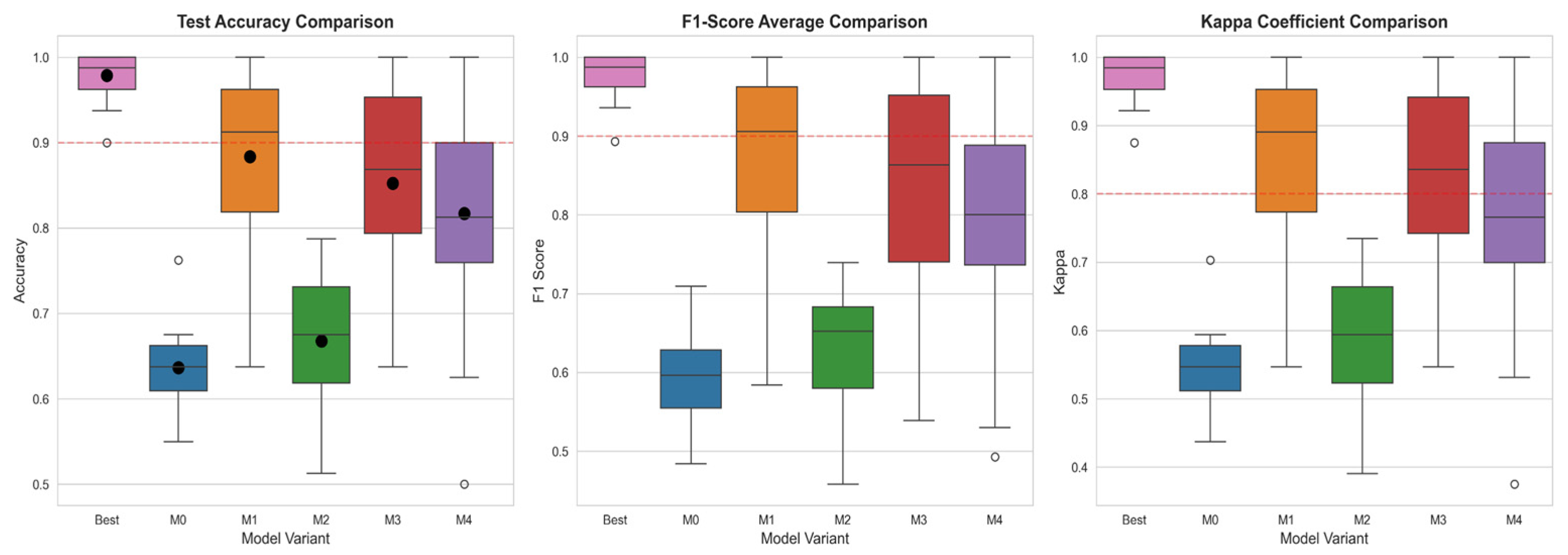
To objectively assess the individual contributions of the key architectural components within the proposed Physically Guided Dual-path Adaptive Weighted Diagnostic Network (PDW-Net), a systematic ablation study was conducted. As summarized in Table 6 and illustrated in Figure 9, five variant models were constructed by selectively removing or replacing critical design elements of PDW-Net, thereby enabling a controlled investigation into their respective impacts on overall diagnostic performance.
The M0 variant employs an equal-weight strategy, assigning identical weights to all seven IMF components obtained from VMD. This variant’s accuracy significantly drops to 63.63%, representing a 34.24 percentage point decrease relative to the full model. This substantial performance loss indicates that assuming all IMF components have equal importance in fault diagnosis contradicts actual physical principles. Equal-weight processing ignores this physically based feature distribution difference, preventing the network from focusing on frequency-band information most relevant to specific faults. The adaptive weighting mechanism learns the importance weights of each IMF through a data-driven approach, essentially achieving intelligent recognition and resource allocation for fault physical patterns.
In the M1 variant, the multilayer perceptron (MLP) output is directly employed as the reconstruction weight without being scaled by the kurtosis or energy of the corresponding branch. The accuracy of this variant decreased by 9.5% compared to the full model, indicating that the transient pulse components and steady-state vibration components in the vibration signal can effectively characterize the signal’s feature characteristics through their corresponding kurtosis and energy.
The M2 and M3 variants retain only the kurtosis and energy branches, respectively, with M3 achieving 85.25% accuracy compared to M2’s 66.75%. The synergistic effect produced by dual-branch fusion is reflected in the 12.62 percentage point performance improvement of the full model compared to the best single branch. This improvement stems from the physical orthogonality between kurtosis and energy features: kurtosis features reflect transient impact intensity, while energy features reflect steady-state distribution patterns. Dual-branch architecture achieves more robust fault identification by simultaneously utilizing these two orthogonal feature types.
The M4 variant substitutes the heterogeneous dual-branch architecture with two homogeneous FFT-1D-CNN branches, yielding an accuracy reduction to 81.69%. It demonstrates the significant value of employing specialized network architectures for different types of fault features. Impact features manifest as discrete spectral peaks in the frequency domain, lending themselves naturally to localized feature extraction via 1D-CNN. Modulation features, by contrast, exhibit continuous band-structured patterns in the time–frequency domain, making them inherently amenable to spatial feature learning via 2D- CNN. Heterogeneous design achieves optimal matching between physical features and processing methods, while homogeneous design fails to fully exploit the analytical potential of different features.

4.3. Engineering Applicability and Deployment Considerations of Methodology

This section conducts a comprehensive analysis of the parameter robustness, computational cost, deployment complexity and statistical significance of the proposed PDW-Net method from the perspective of engineering application.
In terms of parameter robustness, during the actual operation of the refrigeration system, environmental conditions such as pressure, temperature, and load are constantly changing. The compressor used in this study is a horizontal DC inverter compressor. The impact of these environmental condition changes on the vibration signal is multi-faceted: on the one hand, load changes directly cause the adjustment of the compressor’s rotational speed, resulting in all speed-related characteristic frequencies (including shaft frequency, harmonics, and fault characteristic frequencies, etc.) being proportionally scaled; on the other hand, changes in temperature and pressure may introduce additional frequency components or alter the amplitude distribution of existing components by modifying the flow field, excitation force, or structural resonance characteristics. Therefore, the influence of environmental changes on the signal cannot be simply attributed to a single factor.
However, no matter how complex the influence mechanism is, the number of independent narrowband frequency components that need to be separated by VMD is mainly determined by the physical mechanism of the fault and the inherent structure of the compressor. These inherent attributes (such as the number of motor poles, the number of stator slots, structural resonance modes, etc.) do not change with environmental conditions. In other words, changes in environmental conditions may alter the values or amplitudes of certain frequency components, but they will not essentially increase or decrease the number of independent components that need to be separated. Therefore, the minimum number of modes K required for VMD is stable.
Based on the above understanding, in the second stage of this paper, the maximum optimal K value among all faults (i.e., K = 7) is taken as the fixed number of modes. This is an over-complete decomposition strategy, ensuring that K is never less than the actual required number of modes under any operating conditions, thereby avoiding under-decomposition due to insufficient modes. Regarding the penalty factor α, the complete reconstruction property of VMD guarantees that the sum of all IMFs can precisely reconstruct the original signal regardless of parameter selection, which is a necessary condition for information integrity. However, complete reconstruction does not directly ensure that fault features are effectively separated in individual IMFs. This is precisely the purpose of designing the kurtosis weighting and energy weighting mechanisms in this paper: by leveraging the sensitivity of kurtosis to impulse components and energy to steady-state components, it adaptively screens and enhances IMFs containing the main fault information, while suppressing the interference that may be introduced by redundant modes. Therefore, by fixing K = 7 and combining the physically guided weighting strategy, effective extraction of fault features can be achieved while ensuring information integrity.
In terms of computational cost and deployment complexity, the computational cost of this method mainly lies in the offline optimization and online diagnosis stages. In the offline stage, a two-stage PSO is conducted for each fault type, requiring multiple VMDs. This process is performed only once during initial system modeling and does not affect real-time diagnosis. In the online diagnosis stage, only one VMD (K = 7) and neural network forward calculation are required. On an industrial control computer equipped with an AMD 12-core CPU, the average inference time for a single sample is 94.17 ± 4.29 ms (only model forward calculation), and approximately 10.6 samples can be processed per second. The total number of model parameters is 40,567, with 40,559 trainable parameters, which is a lightweight structure and convenient for embedded or edge deployment. In the training stage, based on 255 training samples, 50 rounds of iterations are completed in about 25 s on the same hardware, demonstrating rapid re-training capability.
To verify the statistical significance of the performance differences among the various methods, the Friedman test was conducted on the accuracy rates of 20 experiments. The results indicated that there were significant differences in diagnostic performance among the different methods (χ2 = 69.04, p < 0.001). Subsequently, the Nemenyi post hoc test was used for pairwise comparisons. The results showed that PDW-Net was significantly superior to EMD+LSTM, WT+2D-CNN, 1D-CNN, and LSTM at the 95% confidence level (p < 0.001), but there was no significant difference compared to Random Forest (p = 0.2591). Random Forest was significantly better than EMD+LSTM, WT+2D-CNN, and LSTM (p < 0.05), but there was no significant difference compared to 1D-CNN (p = 0.4275). 1D-CNN was significantly better than EMD+LSTM (p = 0.0414). These results confirmed the superiority and statistical robustness of PDW-Net.
The Friedman test results of the ablation experiments (χ2 = 64.64, p < 0.001) indicated that there were significant differences in the diagnostic performance among different variant models. The Nemenyi post hoc test showed that the complete model was significantly better than the equal-weight variant (M0), the only kurtosis branch variant (M2), and the homogeneous dual-branch variant (M4) at the 95% confidence level (p < 0.05), but there was no significant difference compared with the MLP direct weight variant (M1) and the only energy branch variant (M3) (p > 0.05). Further analysis revealed that M1 and M3 had relatively high performance fluctuations (CV values of 0.117 and 0.133, respectively), which were much higher than that of the complete model (0.027), indicating that their diagnostic results were more affected by random factors. From an engineering application perspective, the advantages of the complete model in terms of average accuracy and stability were clear, which verified the effectiveness of the proposed physics-guided dual-path architecture.
It should be noted that the current study focuses on discrete, single-fault scenarios, which serves as a foundation for establishing the diagnostic framework. In real-world industrial applications, faults typically develop gradually and may occur in combination—scenarios that are not addressed in this work. Nevertheless, the proposed framework offers a reasonable starting point for such extensions: the physical features (kurtosis and energy) are inherently continuous, VMD decomposes the signal into distinct frequency bands, and the heterogeneous dual-branch architecture is designed to process physically distinct signal components. Building upon these foundations, our future work will focus specifically on two extensions: continuous fault severity estimation to capture gradual degradation, and multi-label combined fault diagnosis to handle simultaneous faults. These directions will be pursued in subsequent studies to enhance the framework’s applicability in real-world industrial settings.
In summary, PDW-Net demonstrates parameter robustness under different operating conditions, while featuring controllable computational costs, low deployment complexity, and statistically validated performance improvements. The current work establishes a fundamental diagnostic framework for discrete single-fault scenarios. Future work will build upon this foundation to address issues such as continuous severity assessment and combined fault diagnosis.


5. Conclusions

  • This study introduces a physics-guided dual-path adaptive weighting network (PDW-Net). The proposed method integrates Variational Mode Decomposition (VMD) with a learnable weighting module based on kurtosis and energy features, enabling adaptive reconstruction and enhancement of transient impulse components and steady-state vibration components directly from raw vibration signals. Its heterogeneous dual-branch architecture comprises an FFT-1D-CNN branch for transient impulse feature extraction and an STFT-2D-CNN branch for steady-state vibration feature extraction, ensuring that each type of fault characteristic is effectively captured within its optimal feature space.
  • By synergistically combining physical priors with data-driven learning, the proposed framework effectively resolves feature confusion and enhances model interpretability. The integration of kurtosis-guided transient impulse enhancement and energy-guided steady-state vibration amplification allows the network to focus on physically meaningful components, which not only improves diagnostic accuracy but also provides transparency into the decision-making process. This overcomes the inherent lack of interpretability in conventional deep learning methods and establishes a more reliable foundation for industrial fault diagnosis.
  • The superiority of the proposed method is validated on a self-built scroll compressor dataset. PDW-Net achieves an average diagnostic accuracy of 97.87%, significantly outperforming Random Forest (87.44%), 1D-CNN (72.13%), WT+2D-CNN (62.37%), LSTM (50.00%), and EMD+LSTM (47.56%). Ablation studies further quantify the contributions of each core component: the physics-prior guided adaptive weighting mechanism contributes most significantly, with its absence causing a sharp decline of 34.24 percentage points in accuracy; the heterogeneous dual-branch design is also crucial, as replacing it with a homogeneous branch reduces performance by 16.18 percentage points. Moreover, using either the kurtosis-only or energy-only branch alone cannot achieve the performance level of the complete model, confirming the necessity of the dual-path synergy and the physics-guided fusion design. The method also demonstrates controllable computational cost and low deployment complexity, supporting its feasibility for industrial applications.

Author Contributions

Conceptualization, Z.Z., C.W. and Y.Z.; methodology, Z.Z. and X.J.; software, Z.Z., C.W. and Y.S.; validation, Z.Z., Y.Z. and Y.S.; formal analysis, Z.Z. and Y.Z.; investigation, Y.Z. and X.J.; resources, Y.S. and C.W.; data curation, Y.S. and X.J.; writing—original draft preparation, Z.Z.; writing—review and editing, Y.S. and Y.Z.; visualization, Z.Z.; supervision, Y.S.; project administration, Y.S.; funding acquisition, Y.S. All authors have read and agreed to the published version of the manuscript.

Funding

This research received no external funding.

Data Availability Statement

The data that support the findings of this study are available from the corresponding author upon reasonable request.

Conflicts of Interest

Author Caixia Wang was employed by Jinan Energy Engineering Group Co., Ltd. The remaining authors declare that the research was conducted in the absence of any commercial or financial relationships that could be construed as a potential conflict of interest.

Abbreviations

The following abbreviations are used in this manuscript:
ADMM Alternating Direction Method of Multipliers
BN Batch Normalization
CNNConvolutional Neural Network
DLDeep Learning
EMDEmpirical Mode Decomposition
FCFully Connected
FFTFast Fourier Transform
IMFIntrinsic Mode Function
LSTMLong Short-Term Memory
MLPMultilayer Perceptron
PCAPrincipal Component Analysis
PDW-Net Physics-guided Heterogeneous Dual-path Adaptive Weighting Network
PSOParticle Swarm Optimization
RNNRecurrent Neural Network
STFTShort-Time Fourier Transform
VMDVariational Mode Decomposition
WTWavelet Transform

References

  1. Guo, F.; Chen, Z.; Xiao, F. Fault Detection and Diagnosis of Electric Bus Air Conditioning Systems Incorporating Domain Knowledge and Probabilistic Artificial Intelligence. Energy AI 2024, 16, 100364. [Google Scholar] [CrossRef]
  2. Wang, B.; Qiu, W.; Hu, X.; Wang, W. A Rolling Bearing Fault Diagnosis Technique Based on Recurrence Quantification Analysis and Bayesian Optimization SVM. Appl. Soft Comput. 2024, 156, 111506. [Google Scholar] [CrossRef]
  3. Karali, N.; Shah, N.; Park, W.Y.; Khanna, N.; Ding, C.; Lin, J.; Zhou, N. Improving the Energy Efficiency of Room Air Conditioners in China: Costs and Benefits. Appl. Energy 2020, 258, 114023. [Google Scholar] [CrossRef]
  4. Chen, J.; Zhang, L.; Li, Y.; Shi, Y.; Gao, X.; Hu, Y. A Review of Computing-Based Automated Fault Detection and Diagnosis of Heating, Ventilation and Air Conditioning Systems. Renew. Sustain. Energy Rev. 2022, 161, 112395. [Google Scholar] [CrossRef]
  5. Yang, X.-L.; Peng, B.; Che, M.-L.; Shi, J.-F.; Liao, Z.-X.; Zhang, Y.-B. Nonlinear Dynamics and Vibration Mechanisms in Air Scroll Compressors: A Study on Orbiting and Fixed Scroll Pair. Int. J. Refrig. 2025, 177, 456–465. [Google Scholar] [CrossRef]
  6. Llopis-Mengual, B.; Yuill, D.P.; Navarro-Peris, E. Fault Detection and Diagnosis Algorithm for Multiple Simultaneous Faults in Residential Air-Conditioning Systems: Development, Validation Study and Critical Analysis. Appl. Therm. Eng. 2025, 269, 125975. [Google Scholar] [CrossRef]
  7. Guo, F.; Chen, Z.; Xiao, F.; Li, A.; Shi, J. Real-Time Energy Performance Benchmarking of Electric Vehicle Air Conditioning Systems Using Adaptive Neural Network and Gaussian Process Regression. Appl. Therm. Eng. 2023, 222, 119931. [Google Scholar] [CrossRef]
  8. Hongwei, F.; Ceyi, X.; Jiateng, M.; Xiangang, C.; Xuhui, Z. A Novel Intelligent Diagnosis Method of Rolling Bearing and Rotor Composite Faults Based on Vibration Signal-to-Image Mapping and CNN-SVM. Meas. Sci. Technol. 2023, 34, 044008. [Google Scholar] [CrossRef]
  9. Ma, Q.; Yue, C.; Yu, M.; Song, Y.; Cui, P.; Yu, Y. Research on Fault Diagnosis Strategy of Air-Conditioning System Based on Signal Demodulation and BPNN-PCA. Int. J. Refrig. 2024, 158, 124–134. [Google Scholar] [CrossRef]
  10. Tian, J.; Ai, X.; Zhang, F.; Wang, Z.; Wang, C.; Chen, Y. Dynamic Modeling and Simulation Analysis of Inter-Shaft Bearings with Local Defects Considering Elasto-Hydrodynamic Lubrication. Coatings 2022, 12, 1735. [Google Scholar] [CrossRef]
  11. Cheng, Y.; Wang, S.; Chen, B.; Mei, G.; Zhang, W.; Peng, H.; Tian, G. An Improved Envelope Spectrum via Candidate Fault Frequency Optimization-Gram for Bearing Fault Diagnosis. J. Sound Vib. 2022, 523, 116746. [Google Scholar] [CrossRef]
  12. He, D.; Liu, C.; Jin, Z.; Ma, R.; Chen, Y.; Shan, S. Fault Diagnosis of Flywheel Bearing Based on Parameter Optimization Variational Mode Decomposition Energy Entropy and Deep Learning. Energy 2022, 239, 122108. [Google Scholar] [CrossRef]
  13. Shakya, P.; Sunny, M.R.; Maiti, D.K. Nonlinear Flutter Analysis of a Bend-Twist Coupled Composite Wind Turbine Blade in Time Domain. Compos. Struct. 2022, 284, 115216. [Google Scholar] [CrossRef]
  14. Zhao, D.; Wang, J.; Chen, G.; Wang, J.; Guo, S. Clutter Cancellation Based on Frequency Domain Analysis in Passive Bistatic Radar. IEEE Access 2020, 8, 43956–43964. [Google Scholar] [CrossRef]
  15. Zhao, P.; Zhang, W.; Cao, X.; Li, X. Denoising Diffusion Probabilistic Model-Enabled Data Augmentation Method for Intelligent Machine Fault Diagnosis. Eng. Appl. Artif. Intell. 2025, 139, 109520. [Google Scholar] [CrossRef]
  16. Bai, Y.; Cheng, W.; Wen, W.; Liu, Y. Application of Time-Frequency Analysis in Rotating Machinery Fault Diagnosis. Shock Vib. 2023, 2023, 9878228. [Google Scholar] [CrossRef]
  17. Zhao, Y.; Zhang, T.; Song, Y.; Liu, Q.; Liu, L.; Yu, M.; Ge, Y. Characteristic Analysis and Diagnosis Method Optimization of Scroll Compressor Pressure Pulsation Signal under Voltage Fluctuation. Int. J. Refrig. 2025, 169, 89–100. [Google Scholar] [CrossRef]
  18. Ye, Z.; Yu, J. Multi-Level Features Fusion Network-Based Feature Learning for Machinery Fault Diagnosis. Appl. Soft Comput. 2022, 122, 108900. [Google Scholar] [CrossRef]
  19. Jiang, Y.; Xia, T.; Wang, D.; Zhang, K.; Xi, L. Joint Adaptive Transfer Learning Network for Cross-Domain Fault Diagnosis Based on Multi-Layer Feature Fusion. Neurocomputing 2022, 487, 228–242. [Google Scholar] [CrossRef]
  20. Hao, Y.; Zhu, L.; Yan, B.; Qin, S.; Cui, D.; Lu, H. Milling Chatter Detection with WPD and Power Entropy for Ti-6Al-4V Thin-Walled Parts Based on Multi-Source Signals Fusion. Mech. Syst. Signal Process. 2022, 177, 109225. [Google Scholar] [CrossRef]
  21. Huang, A.; Mao, Z.; Liu, F.; Kong, X.; Chen, S.; Zhang, J.; Jiang, Z. S-WhiteSVDD: A Feature Fusion Approach for Diesel Engine Performance Degradation Assessment Using Multi-Source Impulse Signals. Mech. Syst. Signal Process. 2025, 230, 112589. [Google Scholar] [CrossRef]
  22. Li, W.; Sui, W.; Cheng, L.; Ji, Y.; Guo, Y.; Zhu, J. Quantifying Seasonal Demand-Side Flexibility in Residential Air Conditioning under Diverse Control Strategies. Energy Build. 2026, 352, 116764. [Google Scholar] [CrossRef]
  23. An, Z.; Li, S.; Wang, J.; Jiang, X. A Novel Bearing Intelligent Fault Diagnosis Framework under Time-Varying Working Conditions Using Recurrent Neural Network. ISA Trans. 2020, 100, 155–170. [Google Scholar] [CrossRef]
  24. Liang, P.; Deng, C.; Wu, J.; Yang, Z. Intelligent Fault Diagnosis of Rotating Machinery via Wavelet Transform, Generative Adversarial Nets and Convolutional Neural Network. Measurement 2020, 159, 107768. [Google Scholar] [CrossRef]
  25. Dao, F.; Zeng, Y.; Qian, J. Fault Diagnosis of Hydro-Turbine via the Incorporation of Bayesian Algorithm Optimized CNN-LSTM Neural Network. Energy 2024, 290, 130326. [Google Scholar] [CrossRef]
  26. Guo, Y.; Du, C.; Liu, X.; Zhang, X.; Jin, Z. Research on Attention-Based Fault Diagnosis and Multi-Parameter Joint Optimization of CO2 Heat Pump System. Appl. Therm. Eng. 2026, 289, 129942. [Google Scholar] [CrossRef]
  27. Marchante-Avellaneda, J.; Corberan, J.M.; Navarro-Peris, E.; Shrestha, S.S. A Critical Analysis of the AHRI Polynomials for Scroll Compressor Characterization. Appl. Therm. Eng. 2023, 219, 119432. [Google Scholar] [CrossRef]
Figure 1. The overall structure of the Physics-guided Heterogeneous Dual-path Adaptive Weighting Network (PDW-Net).
Processes 14 01101 g001
Figure 2. Experimental Platform.
Processes 14 01101 g002
Figure 3. Intrinsic Mode Function (IMF) decomposition quality chart.
Processes 14 01101 g003
Figure 4. Original signal time–frequency plot.
Processes 14 01101 g004
Figure 5. Kurtosis-reconstructed signal time–frequency plot.
Processes 14 01101 g005
Figure 6. Energy-reconstructed signal time–frequency plot.
Processes 14 01101 g006
Figure 7. Confusion matrix.
Processes 14 01101 g007
Figure 8. Boxplots of performance metrics across 20 runs: Accuracy, F1-Score, and Kappa Coefficient. (The black dot indicates the mean value.)
Processes 14 01101 g008
Figure 9. Boxplots of performance metrics across 20 ablation runs: Accuracy, F1-Score, and Kappa Coefficient. (The black dot indicates the mean value.)
Processes 14 01101 g009
Table 1. Performance parameters of the scroll compressor.
ParameterValueUnit
Shaft frequency54Hz
Displacement27cc/r
Rated speed3240r/min
Rated power800W
Rated voltage60V
Number of motor poles8——
Number of stator slots12——
Table 2. The optimization results of the first stage of PSO.
Fault TypeOptimal KOptimal αMinimum Envelope Entropy
Spindle Wear Fault6996.8710.816
Condenser Fault51358.3011.046
Refrigerant Lack61878.7010.831
Refrigerant Excess7753.9311.074
Normal State7951.0810.920
Table 3. The optimization results of the second stage of PSO (Fixed K = 7).
Fault TypeFixed KOptimal αMinimum Envelope Entropy
Spindle Wear Fault7925.4310.820
Condenser Fault71229.9511.042
Refrigerant Lack71652.4510.864
Refrigerant Excess7775.2311.074
Normal State7991.4310.921
Table 4. Performance comparison of different diagnostic methods (average of 20 experiments).
MethodsAvg. Acc (%)Std (%)F1-Score (%)Kappa (%)
PDW-Net97.872.6097.8397.34
Random Forest87.442.8987.5184.30
1D-CNN72.1320.4965.6465.16
WT+2D-CNN62.3718.0754.5052.97
LSTM50.0011.5441.5637.50
EMD+LSTM47.563.5745.6634.45
Note: 1D-CNN, one-dimensional convolutional neural network; WT, wavelet transform; 2D-CNN, two-dimensional convolutional neural network; LSTM, long short-term memory; EMD, empirical mode decomposition.
Table 5. Detailed diagnostic performance for each fault category.
Fault CategorySamplesAccuracyMain Misclassification
Spindle Wear Fault1696.9%Refrigerant Lack (1 case)
Condenser Fault1696.9%Refrigerant Excess (1 case)
Refrigerant Lack16100%None
Refrigerant Excess1696.9%Condenser Fault (1 case)
Normal State16100%None
Statistical significance analysis of these results is provided in Section 4.1.
Table 6. Ablation experiment results and component contribution analysis (average of 20 experiments).
MethodAvg. Acc (%)Std (%)F1-Score (%)Kappa (%)
Full Model (PDW-Net)97.872.6097.8397.34
M0 (Equal Weights)63.634.3579.6778.12
M1 (MLP Weights)88.3710.0782.9682.97
M2 (Kurtosis-only)66.757.8787.1185.16
M3 (Energy-only)85.2511.0262.0660.94
M4 (Homogeneous Dual-Branch)81.6912.6459.2156.25
Note: MLP, multilayer perceptron. Statistical significance analysis of these results is provided in Section 4.1.
Disclaimer/Publisher’s Note: The statements, opinions and data contained in all publications are solely those of the individual author(s) and contributor(s) and not of MDPI and/or the editor(s). MDPI and/or the editor(s) disclaim responsibility for any injury to people or property resulting from any ideas, methods, instructions or products referred to in the content.