Article

Multi-Objective Mix Proportion Optimization of Basalt Fiber-Reinforced Concrete Considering Cost and Carbon Emission Constraints


1
Guangxi Key Laboratory of Green Building Materials and Construction Industrialization, Guilin University of Technology, Guilin 541004, China
2
College of Civil Engineering and Geomatics, Guilin University of Technology at Nanning, Nanning 530001, China
*
Author to whom correspondence should be addressed.
Processes 2026, 14(7), 1033; https://doi.org/10.3390/pr14071033
Submission received: 18 February 2026 / Revised: 10 March 2026 / Accepted: 19 March 2026 / Published: 24 March 2026
(This article belongs to the Section Materials Processes)

Abstract

Basalt fiber-reinforced concrete (BFRC) exhibits superior mechanical performance, durability, and environmental benefits, making it a promising material for promoting green and low-carbon construction. This study develops a novel multi-objective mix design optimization method for BFRC under cost and carbon emission constraints, presents a framework that considers tensile strength (ft) as a core design objective, and establishes high-precision strength prediction models via gene expression programming (GEP). Material cost and carbon emission functions were formulated based on market data, while compressive strength (fc) and tensile strength (ft) prediction models were established using using GEP implemented in MATLAB 2018b with seven mix design variables, including cement dosage, aggregate parameters, and basalt fiber (BF) characteristics (diameter, length, and dosage). Multiple constraints covering material quantities, mix ratios, workability, and density were incorporated into the optimization model, which was solved via the non-dominated sorting genetic algorithm II (NSGA-II). The method identifies the optimal cement dosage, aggregate proportions, and BF dosage to maximize tensile strength (ft) while minimizing cost and carbon emissions. Computational results suggest that within the target strength range of 30–60 MPa, the proposed design yields reductions of 10–20% in carbon emissions and 12–18% in costs compared to conventional methods, offering potential advantages for sustainable construction. Unlike existing multi-objective studies, which focus on compressive strength, this work addresses critical factors of tensile strength (ft) and prediction inaccuracy, proposing a systematic low-carbon design framework for potential BFRC applications.

1. Introduction

Basalt fiber-reinforced concrete (BFRC) is produced by incorporating specific amounts of basalt fiber (BF) into ordinary concrete. The synergistic interaction between BF and the cement matrix enhances the mechanical properties of the concrete, including its tensile strength (ft), flexural strength, crack resistance, impact resistance, ductility, and toughness [1,2,3]. Basalt fiber (BF) is a continuous fiber produced from natural basalt. It exhibits beneficial characteristics, such as high strength, good thermal insulation, high- and low-temperature resistance, and corrosion resistance. Moreover, it is an environmentally friendly, low-carbon green material [4]. Accordingly, applications of BFRC have become a research focus in infrastructure and civil engineering [5,6,7,8].
Traditional concrete mix design methods primarily emphasize strength and workability while neglecting economic and environmental aspects, such as cost and carbon emissions. As a result, their application often leads to high expenses and large carbon footprints [5,9]. In recent years, various optimization-based mix design strategies have been developed to balance performance, economy, and sustainability. Celik et al. [10] designed self-compacting concrete using a ternary binder system of cement, fly ash, and limestone powder, adjusting replacement ratios and aggregate gradations under a fixed water-to-binder ratio. However, their method did not consider cost and carbon emissions, resulting in costly and carbon-intensive mixtures. Zhang et al. [11] proposed a comprehensive multi-objective optimization framework integrating machine learning models (ANN, Random Forest, and XGBoost) with metaheuristic algorithms (MOALO, MOPSO, and NSGA-II) to simultaneously optimize concrete mixture proportions for cost, CO2 emissions, and compressive strength. Their results demonstrated that the MOALO-XGBoost hybrid model achieved superior optimization performance with a lower computational cost compared to conventional methods. Dabbaghi et al. [12] developed a life cycle assessment multi-objective optimization framework for sustainable lightweight aggregate concrete, combining deep belief networks with evolutionary algorithms to effectively balance cost, CO2 emissions, energy consumption, and compressive strength. Campos et al. [13] applied regression analysis and ANOVA to identify key strength-related factors and determined optimal proportions using response surface methodology. They later proposed a sustainable high-strength concrete mix design based on particle packing optimization, which reduced cement use and CO2 emissions while maintaining performance [14]. Rath et al. [15] employed the packing density method, incorporating fly ash and pond ash as partial replacements for cement and sand, thereby improving packing density and reducing material consumption, cost, and emissions. Marani et al. [16] developed a tabular generative adversarial network (TGAN) for predicting the compressive strength of ultra-high-performance concrete, demonstrating the potential of advanced machine learning techniques in concrete mix optimization. Building upon these advances, Kaveh and Sabzi [17] employed a water cycle algorithm, imperialist competitive algorithm, and teaching-learning-based optimization for sustainable fly ash concrete, achieving optimal trade-offs between cost, CO2 emissions, and compressive strength. Nunez et al. [18] developed a hybrid machine learning model combining artificial neural networks with genetic algorithms for recycled aggregate concrete mixture optimization, achieving effective material consumption and carbon footprint reductions while maintaining mechanical performance.
Nevertheless, when applied to BFRC, existing approaches face two major limitations: (1) tensile strength has not yet been incorporated as a design objective, and (2) there is a lack of accurate predictive models for compressive and tensile strengths. Existing models, which are often based on least squares regression, capture only partial linear or low-order nonlinear relationships between strength and influencing factors. As a result, these models cannot fully describe the complex, high-order nonlinear mechanical behavior of fiber-reinforced concrete, resulting in limited accuracy, with maximum relative errors reaching around 30% [19,20,21]. Recent studies have made significant progress in machine learning-based strength prediction for fiber-reinforced concrete. Zheng et al. [22] developed a novel hybrid machine learning model combining XGBoost with Bayesian optimization for BFRC compressive strength prediction, achieving substantially higher accuracy than traditional regression methods. However, their study primarily focused on compressive strength (fc) prediction alone, without integrating tensile strength (ft) as a design objective or incorporating cost and carbon emission constraints into a unified optimization framework.
To address these issues, we propose a multi-objective optimization approach for BFRC mix design. The proposed method integrates compressive strength (fc), tensile strength (ft), cost, carbon emissions, and workability as performance objectives, establishes a total-cost function that accounts for both material costs and carbon taxes, and incorporates accurate strength prediction models developed via GEP. The genetic algorithm is then applied to optimize key variables, including cement dosage, aggregate proportions, and fiber characteristics, thereby constructing a systematic low-carbon design framework. Results suggest that the proposed method can be used to improve mechanical performance and reduce cost and carbon emissions, establishing a theoretical basis for sustainable BFRC design.

2. Optimization of Concrete Mix Proportion

2.1. Objective Function

According to GB/T 51366-2019 “Standard for Building Carbon Emission Calculation” [19], the carbon emissions of building materials are determined as the sum of emissions resulting from production and transportation. The carbon emissions during the production stage are calculated as follows [23]:
C J C = i = 1 n M i F i
where CJC denotes carbon emissions resulting from the production of building materials (kg CO2e), Mi represents the consumption of the i-th primary building material, and Fi refers to its corresponding carbon emission factor, defined as the amount of CO2 equivalent emitted per unit of the material (kg CO2e/unit).
The carbon emissions arising from the transportation of building materials are determined as follows [19]:
C y s = i = 1 n M i D i T i
where Cys denotes the carbon emissions resulting from the production of building materials (kg CO2e), Di denotes the transportation distance of the i-th primary building material (km), and Ti denotes the carbon emission factor per unit weight and transportation distance under the transportation mode of the i-th building material (kg CO2e/(t·km)).
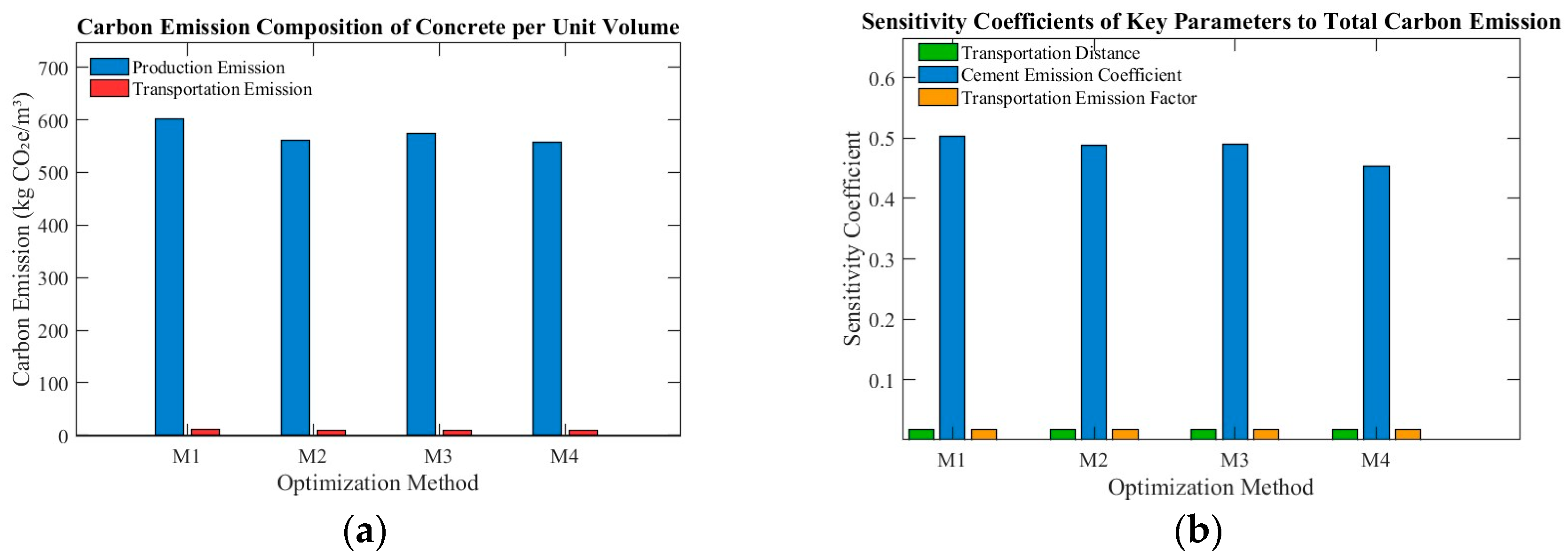
Equation (2) indicates that carbon emissions during the transportation stage are primarily determined by the transportation distance and mode of transport. The carbon emission factor for transportation (0.104 kg CO2e/(t·km) for 18-ton trucks) is much smaller than that for production (735 kg CO2e/t for ordinary cement) [19]. Since this study primarily focuses on the optimization of concrete mix proportions, only the carbon emissions from the production stage are considered, which are further converted into monetary costs. Quantitative justification based on [23] shows that transportation emissions account for less than 0.02% of total carbon emissions and have no significant impact on the results, justifying this simplification in the context of mix proportion optimization. Nevertheless, it is acknowledged that excluding transportation emissions is a model limitation, as actual construction may involve variable transport distances and modes. Construction-phase and end-of-life emissions are also excluded as they are determined by construction practices and demolition strategies rather than mix proportions. Accordingly, the cost function for BFRC mix proportion optimization is defined as the sum of material and carbon emission costs, expressed as
C T = i = 1 5 c i P i + P C O 2 C O 2 i
where CT denotes the total cost of preparing concrete (¥); ci denotes the dosage of the i-th concrete component (kg); Pi denotes the unit price of the i-th concrete component (¥· kg−1), in which i = 1, 2, 3, 4, and 5 corresponds to cement, coarse aggregate, fine aggregate, mixing water, and BF, respectively; PCO2 denotes the unit price of carbon dioxide equivalent (¥· kg CO2-eq−1); and CO2i denotes the carbon emission factor of the i-th concrete component (kg CO2-eq·kg−1).
It should be noted that fc is treated as a constraint targeting specific performance classes, such as C30 and C40, rather than an objective to be maximized, ensuring that the optimization results satisfy engineering grade requirements without over-design.

2.2. Constraint Conditions

In the multi-objective mix proportion optimization design of BFRC based on cost and carbon emission constraints, in addition to meeting requirements for strength, cost, carbon emissions, etc., it is also necessary to comply with constraints on material dosage, key proportion parameters, workability, and volume, among others. The strength of BFRC can be controlled according to the concrete’s 28-day compressive strength and tensile strength. The workability of concrete is adjusted by controlling the optimal paste–aggregate volume ratio [24,25]. Constraints on the range of material dosage can be adhered to by controlling the dosages of concrete components such as cement, coarse aggregate, fine aggregate, water, and BF within the ranges specified in the specifications. Volume constraints mainly refer to the absolute volume method constraint, which means that the sum of the volumes of the components of the fiber-reinforced concrete per cubic meter and the air volume should equal one cubic meter. Accordingly, the constraint conditions for the multi-objective mix proportion optimization of the concrete are summarized as follows [9,26,27]:
s t f c l f c f c u ; f t l f t f t u ; c i l c i c i u ; R j l R j R j u ; i = 1 5 c i ρ i + V a = 1
where Rj represents the j-th proportion parameter, in which j = 1, 2 … 7 correspond to the water–binder ratio, sand ratio, volume ratio of coarse aggregate to paste, paste–aggregate volume ratio, and volume ratio of BF dosage, respectively; fcl and ftl represent the 28-day compressive strength and tensile strength of concrete, respectively; cil and ciu represent the lower and upper limits of the dosage of the i-th concrete component, respectively; Rjl and Rju represent the lower and upper limits of the j-th proportion parameter, respectively; ρi is the density of the i-th concrete component; and Va represents the air volume in concrete.

2.3. GA Optimization

Multi-objective optimization is solved using the NSGA-II with real-valued encoding. Following De Jong’s systematic GA study [28] and standard NSGA-II implementation [29], the parameters are set as follows: population size, 100; generations, 500; crossover probability, 0.9; mutation probability, 0.1; distribution indices, ηc = ηm = 20. Tournament selection, simulated binary crossover, and polynomial mutation are employed. The algorithm runs 10 times with random seeds 1--10 to ensure robustness. The NSGA-II algorithm generates a Pareto front of non-dominated solutions, enabling explicit trade-off analysis among competing objectives without prior weighting [29]. The NSGA-II algorithm has been successfully applied in various concrete optimization studies. Zhang et al. [11] demonstrated its effectiveness in the multi-objective optimization of concrete mixture proportions, achieving simultaneous optimization of cost, CO2 emissions, and compressive strength through hybridization with machine learning models. Their comparative analysis showed that the NSGA-II provides competitive performance with better convergence characteristics compared to other multi-objective evolutionary algorithms such as MOPSO and MOALO.

3. Prediction Models for Compressive and Tensile Strengths of BFRC

3.1. Gene Expression Programming

Gene Expression Programming is employed to establish strength prediction models. Unlike artificial neural networks, random forests, and gradient boosting, which function as black-box models without explicit mathematical expressions, GEP generates transparent algebraic equations that can be integrated directly into multi-objective optimization frameworks. Although a direct benchmark on the current dataset is not provided, Akin et al. [30] demonstrated that GEP achieves accuracy comparable to that of ANNs, with superior interpretability for concrete strength modeling. The formulation of the objective function plays a pivotal role in the process of optimizing the BFRC mix design. Optimization is conventionally realized by constructing predictive models for compressive and tensile strengths, thereby enabling a quantitative characterization of the relationship between mixture constituents and the resulting mechanical performance. Akin et al. [30] identified a significant nonlinear relationship between the mechanical properties of concrete and its components. Moreover, it is difficult to establish a high-precision prediction model when using the traditional least squares method for multiple regression analysis. To this end, this study adopts the GEP method to establish a model for predicting the strength of BFRC. Ferreira proposed the GEP in 2001. This evolutionary algorithm efficiently generates mathematical models by integrating the chromosomal structure of genetic algorithms and the tree-like expression ability of genetic programming while simulating the evolutionary process of biological genes. The GEP method was fully validated by some scholars [30], published in Advances in Civil Engineering, for its high prediction accuracy and reliability, and has been successfully applied to concrete compressive strength modeling, laying a solid foundation for this study.
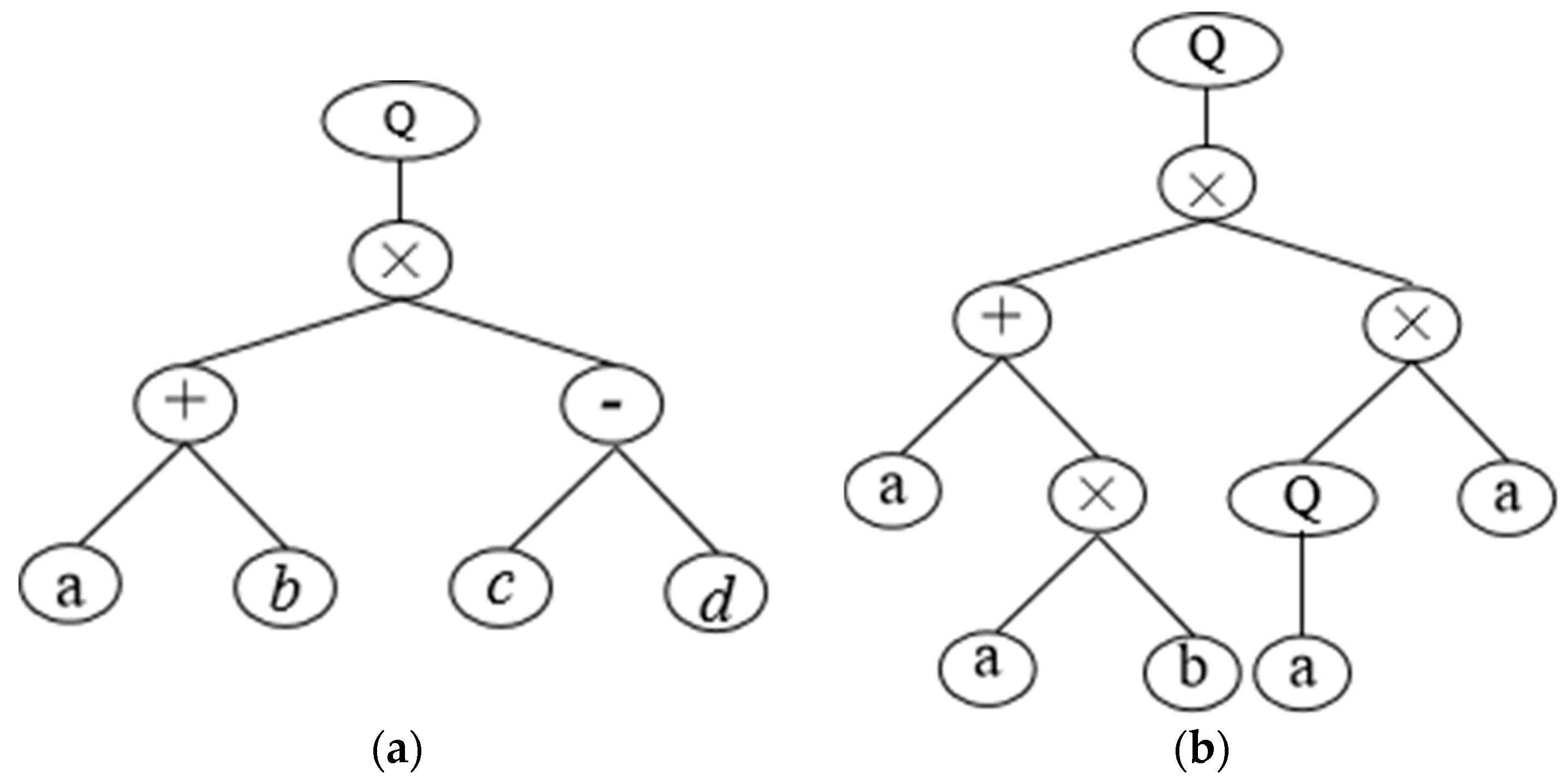
The core premise of the GEP is to represent candidate prediction models (mathematical expressions) as expression trees (ETs). For example, the expression tree of the mathematical expression ( a + b ) × ( c d ) is shown in Figure 1a, where “Q” represents the square root function.
As shown in Figure 1a, the expression tree depicts the phenotype of an individual in the GEP. Reading the tree sequentially from left to right and from top to bottom facilitates the deduction of its chromosomal genes, which can then be represented as follows:
0 1 2 3 4 5 6 7 Q × + a b c d
Subsequently, the gene chromosome shown in Equation (5) is transformed into a new gene chromosome through genetic operations such as selection, crossover, and mutation, and its form is assumed to be
0 1 2 3 4 5 6 7 8 9 0 Q × + × a × Q a a b a
The expression tree corresponding to Equation (6) is shown in Figure 1b. The corresponding mathematical expression is ( a + a × b ) × ( a × a ) . Subsequently, the coefficient of determination (R2), mean squared error (MSE), and root mean squared error (RMSE) are used to evaluate the fitting performance of this expression. If the result is unsatisfactory, new gene chromosomes will be generated through genetic operations such as selection, crossover, and mutation, and iterative optimization will be performed continuously until a mathematical expression with better performance is obtained.
In Akin et al.’s study [30], cement, metakaolin, coarse and fine aggregates, and water were selected as input parameters, while the 28-day compressive strength served as the output variable. A highly accurate predictive model for concrete compressive strength was established by employing GEP. The results indicated that this model surpassed conventional regression methods in predictive performance, effectively characterizing the nonlinear interactions between input and output variables and demonstrating the superior capability of GEP in concrete performance prediction.

3.2. Prediction Models for Compressive and Tensile Strengths

3.2.1. Data Collection

In this study, experimental data on the mechanical behavior of BFRC were collected from publicly accessible domestic and international sources to construct predictive models for compressive and tensile strengths. Data were screened from peer-reviewed studies based on complete mix parameters and standardized curing conditions. Outliers were removed using Grubbs’ test at a 0.05 significance level, and inconsistent records were excluded by cross-checking specimen dimensions to ensure reliability. Notably, part of the dataset has been published in reputable SCI journals [22]. The resulting dataset includes 314 compressive and 293 tensile records involving seven input parameters and two output variables. A statistical summary of the dataset is provided in Table 1.
Wang M [35] initially collected 346 compressive test results and 289 splitting tensile test results. After reviewing the sources of these data and removing those with incorrect sources, the author finally retained 281 compressive test results and 260 splitting tensile test results.
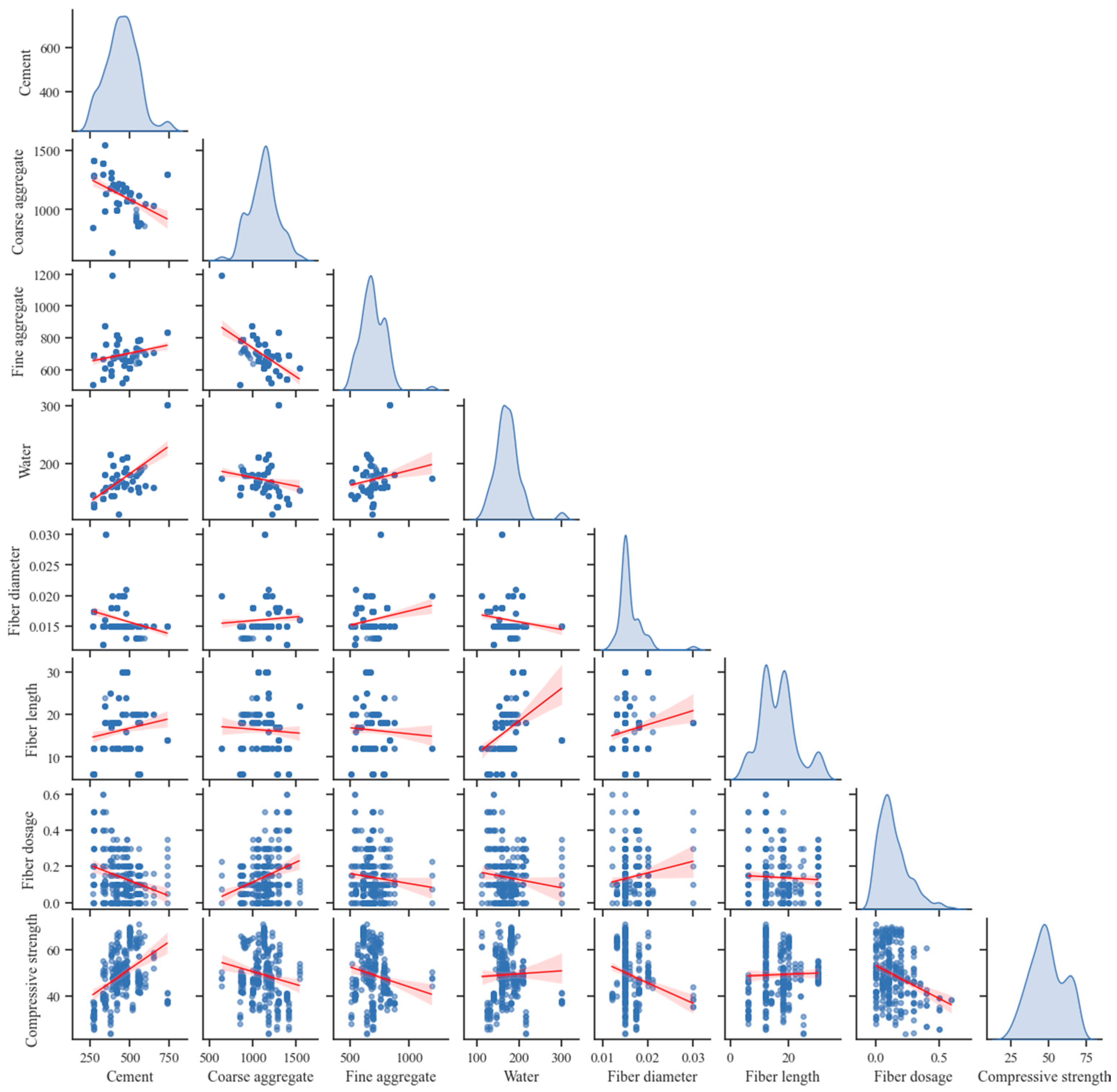
To better understand the relationships among variables and their influence on performance indicators, the BFRC compressive strength dataset was analyzed. Figure 2 presents a scatterplot matrix illustrating the relationships between input features and the response variable and the pairwise relationships among the input features. This visualization reveals correlations and potential distribution patterns.

3.2.2. Prediction Model

The collected dataset was partitioned into training and external test sets at a ratio of 8:2. Five-fold cross-validation was employed during GEP training to prevent overfitting, with model selection based on the lowest average validation RMSE. Additionally, to ensure model generalizability, we evaluated the final selected models on a reserved 20% external validation set consisting of 63 compressive and 59 tensile records that were entirely excluded from the training process. The GEP models achieved R2 = 0.93 and RMSE = 2.41 MPa on this independent test data, confirming robust predictive performance beyond the training domain. The GEP modeling was implemented using code written by the authors in Matlab 2018b, which has been thoroughly validated using concrete strength prediction examples [30]. Model performance was evaluated using the RMSE, MAE, R2, and relative error percentage, with a ±20% error band adopted as the practical applicability criterion. This section describes the use of GEP to develop models for predicting the compressive and tensile strengths of BFRC. Based on the component parameters of BFRC defined in Table 2 (denoted as input variables x1, x2, x3, x4, x5, x6, x7), and with the compressive strength fc as the output response variable, a model for the nonlinear mapping relationship between the component parameters and the compressive strength was established. Its implicit function form can be written as
f c ( x ) = f ( x 1 , x 2 , x 3 x 7 )
Table 2 presents the optimal coefficients evolved by the GEP modeling, where positive values (e.g., G1C1 = 7.088) enhance strength while negative values (e.g., G2C5 = −7.574) reflect inhibitory effects, such as excessive water dosages. These dimensionless scaling factors were substituted into Equations (8) and (13) to establish the explicit prediction models.
The key parameters of the GEP algorithm selected in this study are shown in Table 3, including the number of generations and the number of chromosomes. The accuracy of the prediction model was improved by introducing trigonometric and exponential functions.
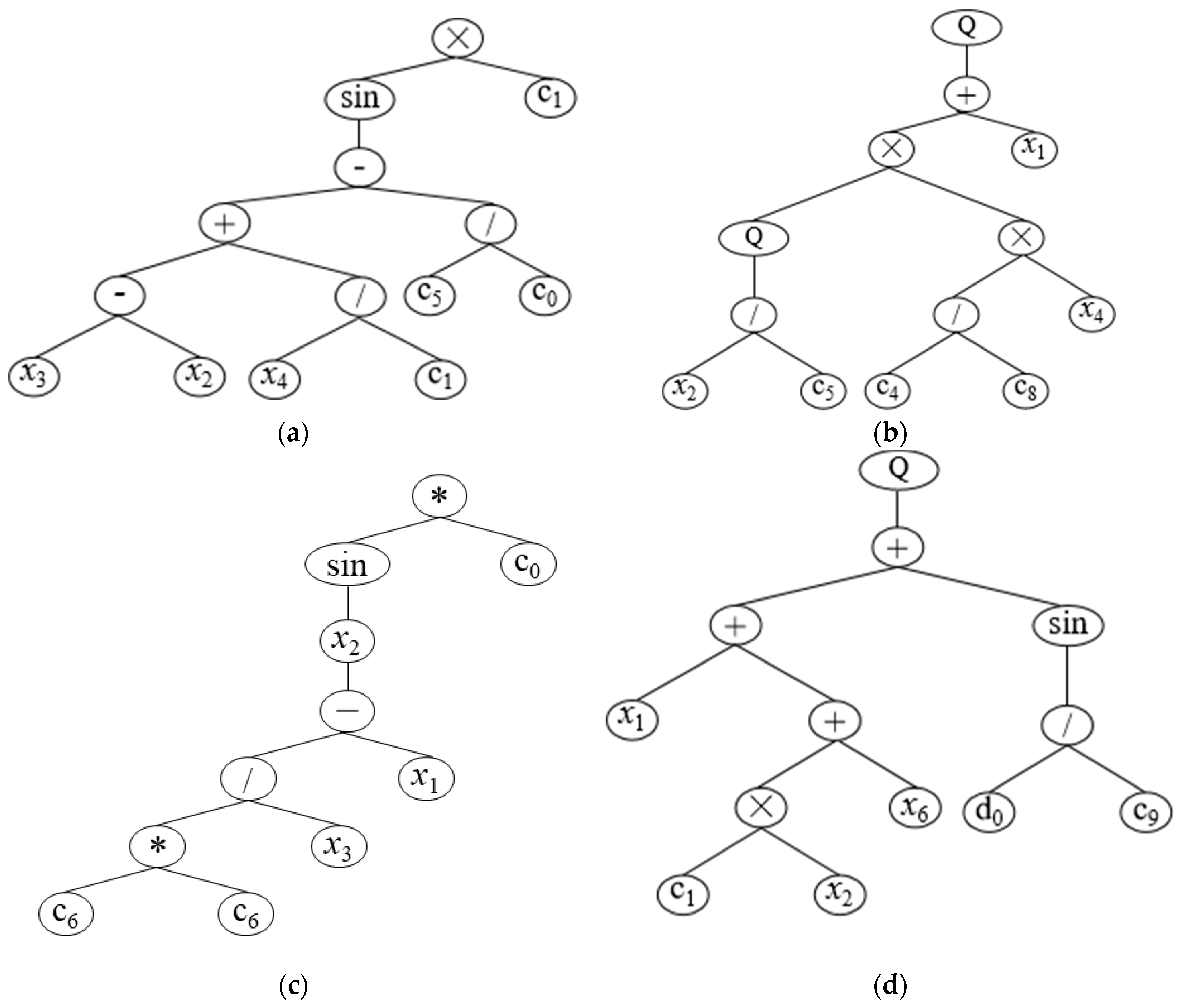
The GEP parameters were selected based on established guidelines [30], balancing model complexity with generalization. Convergence was monitored via fitness stabilization, typically achieved within 50,000–80,000 generations. The gene expression tree structure of the model for predicting the compressive strength (fc) of BFRC, established using the GEP method, is shown in Figure 3. The undetermined parameters in Figure 3 are listed in Table 2, and the corresponding explicit mathematical expression is
f c = f c 1 + f c 2 + f c 3 + f c 4
f c 1 = 7.088 sin ( x 3 x 2 + 0.141 x 4 1.560 )
f c 2 = 1.797 x 4 cos ( 0.132 x 2 ) + x 1
f c 3 = 6.896 sin ( 0.397 x 3 x 1 ) 2
f c 4 = x 1 + 0.306 x 2 + x 6 + sin ( 0.357 x 1 )
Similarly, the model for predicting the tensile strength ft of BFRC, developed using the GEP modeling, produces the following explicit mathematical expression:
f t = f t 1 + f t 2 + f t 3 + f t 4 + f t 5
f t 1 = cos tan cos ( 2.376 x 1 + x 4 x 3 x 4 8.666 )
f t 2 = ln tan ( 6.245 x 2 ) 6.924 x 2 x 7 + x 4
f t 3 = 1 x 6 / x 5 2 x 2 e tan ( x 6 ) + 14.987
f t 4 = 1 x 6 tan tan cos x 5 + 4.8069 tan ( x 5 )
f t 5 = 1 0.348 0.563 / x 6 x 5 + cos ( x 1 ) 2.963
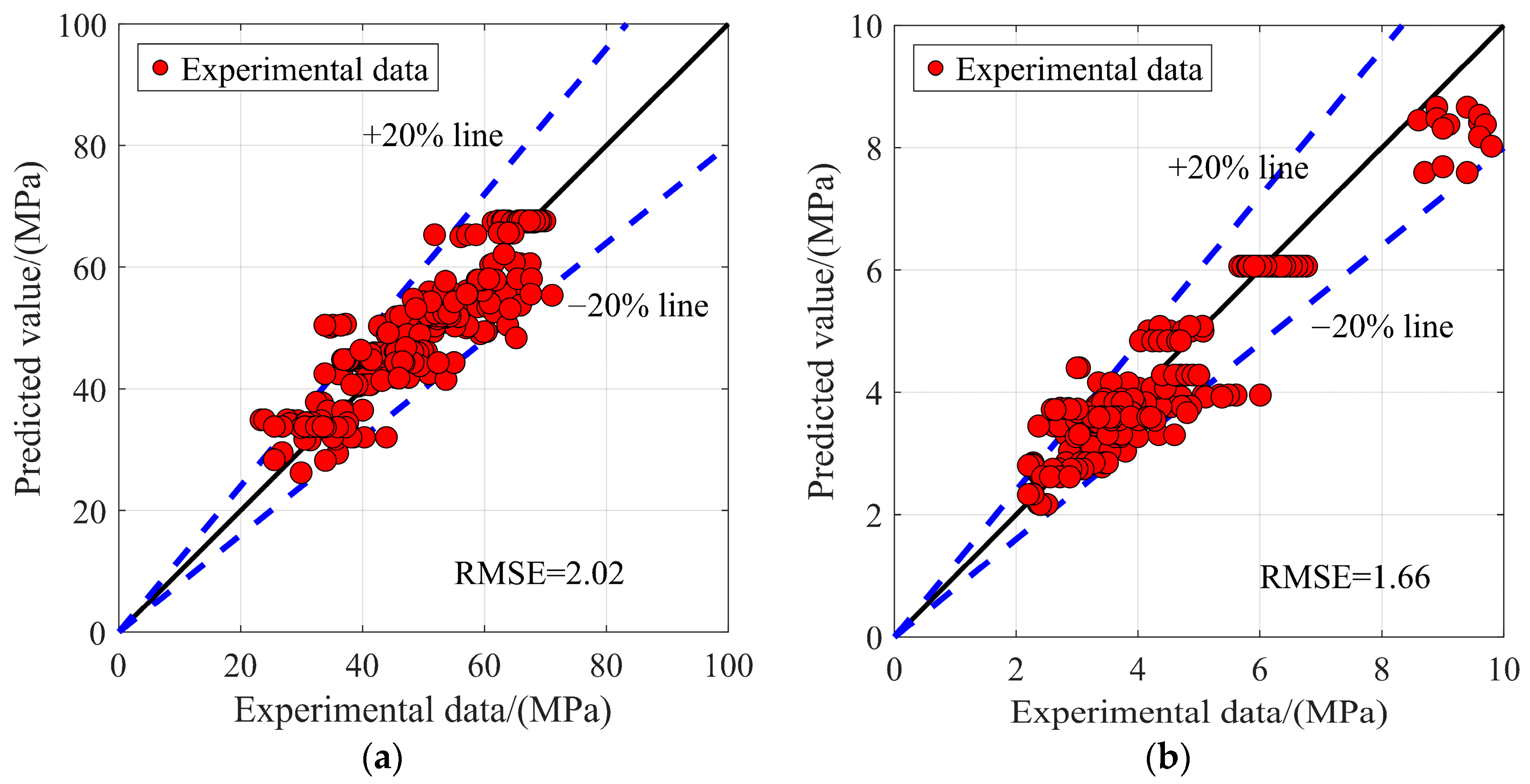
Figure 4 presents the scatter distribution of predicted versus experimental values for the 28-day compressive strength (fc) of BFRC, along with a comparison between predicted and experimental data for tensile strength (ft) Figure 4a indicates that the fc model achieves high accuracy (RMSE = 2.02), with all data points falling within a ±20% error band, and relative errors ranging between 10% and 16%. Figure 4b shows that the tensile strength model exhibits minor absolute errors (RMSE = 1.66), with most data points falling within the ±20% error band and relative errors controlled within 20%. The MAE and R2 are also reported to ensure comprehensive validation beyond the RMSE.
The combined fc and ft validation results demonstrate that the model results have minor prediction errors and a high level of agreement with the experimental data. The model effectively captures the fiber’s strengthening effect and exhibits overall excellent performance. It also exhibits reliable predictive accuracy and good engineering applicability, meeting the requirements for BFRC strength prediction.

4. Performance Comparison and Analysis of BFRC Mix Proportion Schemes

Taking a specific project as an example, and based on this project’s design requirements, including bearing capacity, it is necessary to prepare BFRC with design strengths of 30 MPa, 40 MPa, 50 MPa, and 60 MPa. For each target grade, optimization maximizes ft while minimizing cost and carbon emissions, achieving the specified strength without over-design. The concrete slump at approximately 200 mm can be controlled by adjusting the paste–aggregate volume ratio (the ratio of paste volume to aggregate volume) within a range of 33:67 to 35:65 [36]. The unit price of carbon dioxide tax is set at 0.07 ¥·kg−1 [37]; the air volume is taken as 1% [9]. The dose ranges of the concrete components were determined according to JGJ 55—2011Specification for Mix Proportion Design of Ordinary Concrete” [9], GB/T 50476-2019 “Standard for Durability Design of Concrete Structures” [26], and GJ/T 221-2010Technical Specification for Application of Fiber-Reinforced Concrete” [27]. These components include cement (c1), coarse aggregate (c2), fine aggregate (c3), water (c4), and basalt fiber (BF, c5). In addition, the ranges for key mix proportion parameters were defined, including the water–binder ratio (R1), sand ratio (R2), coarse aggregate-to-paste volume ratio (R3), paste-to-aggregate volume ratio (R4), and fiber volume fraction (R5). The specific values of these parameters are summarized in Table 4.
Based on the material information, dosage ranges, and mix proportion parameter constraints shown in Table 4, and combined with Equations (1)–(18), a multi-objective mix proportion optimization model for BFRC considering cost and carbon emission constraints was established. The optimization model was solved using a genetic algorithm (GA), and the mix design results are presented in Table 5.
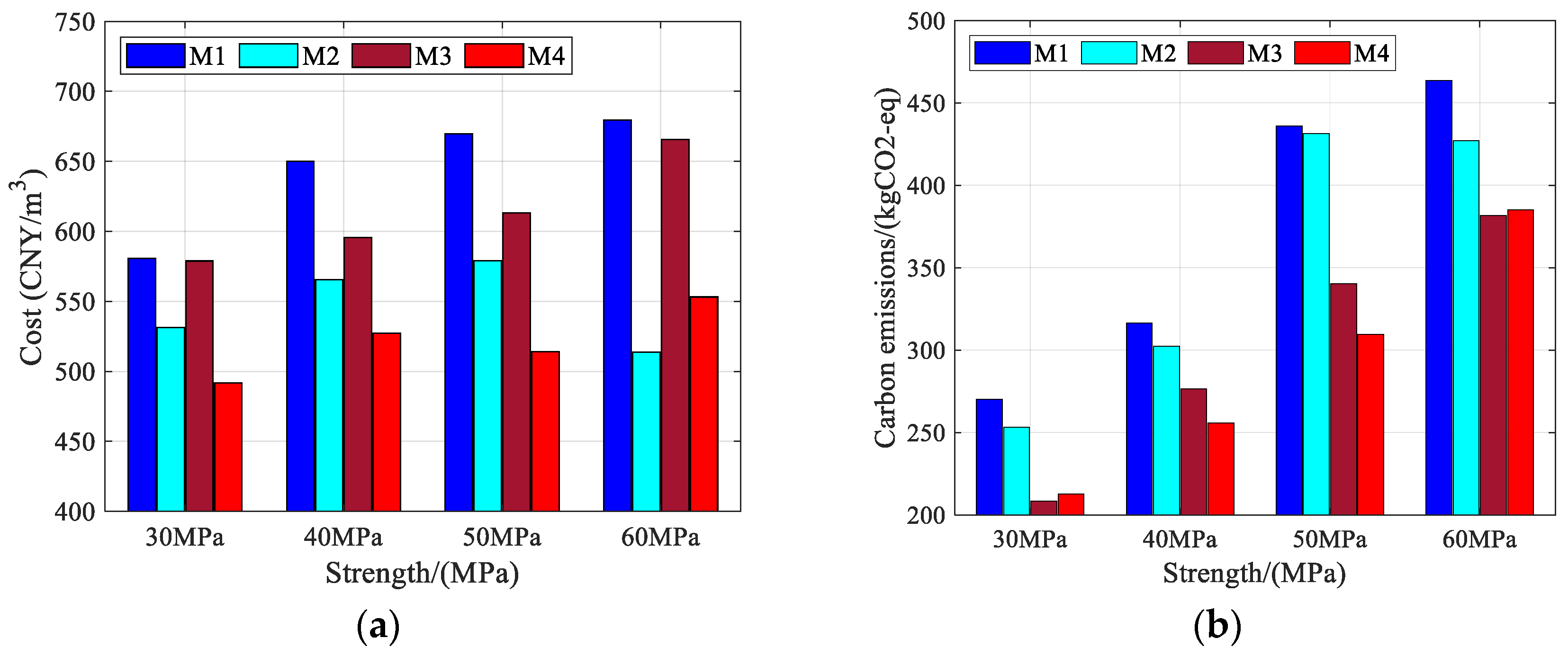
Four concrete mix proportion design methods were selected for comparative analysis. Method M1 prioritizes fc; Method M2 represents a traditional design approach, considering both fc and ft [9]; Method M3 employs a multi-objective optimization strategy, taking into account fc, ft and cost; Method M4 is based on a multi-objective optimization model with cost and carbon emission constraints, simultaneously balancing fc, ft, cost, and carbon emissions. These methods are formally defined in Table 6. The mix proportion results obtained using the four methods are presented in Table 5, and comparisons of total cost and carbon emissions are shown in Figure 5. The ranges used are specified in Table 4.
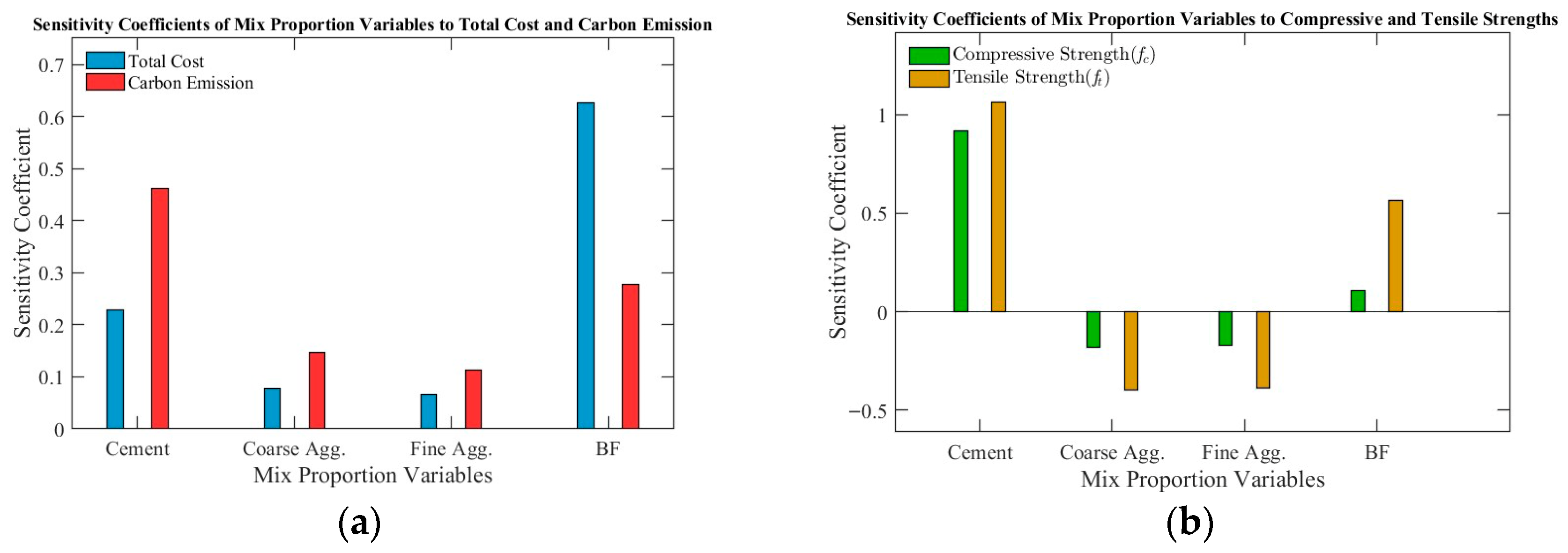
To quantify the trade-offs between strength, cost, and carbon emissions, a sensitivity analysis was conducted on key mix proportion variables (cement, coarse aggregate, fine aggregate, and BF), as illustrated in Figure 6. As shown in Figure 6a, cement dosage exhibits the highest sensitivity coefficients for both total cost and carbon emissions, indicating that it is the dominant factor controlling the cost–emissions trade-off. Moderate sensitivity was found for the BF dosage, while aggregate dosages have negligible effects. In contrast, Figure 6b reveals that the effect of cement dosage dominates fc, and the effect of BF dosage dominates ft, which is consistent with the mechanistic behavior of BFRC. These results confirm that optimizing the balance between cement and BF dosages is the core strategy to achieve synergistic improvements in fc, ft, cost, and carbon emissions.
To further verify the rationality of simplifying transportation emissions in the carbon emission model, carbon emission composition and sensitivity analyses were carried out for the four mix proportion schemes, as illustrated in Figure 7. The results confirm that transportation emissions account for less than 0.02% of the total carbon emissions and have negligible effects on the optimization results, justifying the simplification of transportation emissions in the carbon emission model.
Figure 6 reveals that cement dosage has the strongest effect on cost and carbon emissions, with a sensitivity exceeding 0.8, while basalt fiber preferentially affects tensile strength at 0.65 compared to 0.21 for compressive strength. This validates the decision to reduce cement to decrease emissions while employing fiber bridging to improve tensile performance.
It can be seen from Table 5 and Figure 6 that with the increase in concrete strength, the cement dosage, total cost, and carbon emissions determined by the four methods increase accordingly, which is consistent with existing research results [11,12]. On this basis, this study further analyzes the correlation characteristics among the cost, carbon emissions, and mechanical properties of BFRC.
(1)
Correlation between Strength and Carbon Emissions: As the target fc increases from 30 MPa to 60 MPa, the carbon emissions associated with various mix design methods generally increase. For instance, the carbon emissions of Scheme M1 increase from 238.47 kg CO2-eq to 463.65 kg CO2-eq, suggesting that high-strength concrete largely comprises materials with high carbon footprints, such as cement.
After incorporating carbon emission constraints and optimizing the mix design, Scheme M4 indicates lower carbon emissions across all strength grades compared to Schemes M1, M2, and M3. For instance, at a target strength of 60 MPa, the carbon emissions of M4 are 385.20 kg CO2-eq, representing a notable reduction of approximately 16.9% relative to M1.
Within the strength range of 30 to 60 MPa, M4 consistently demonstrates the optimal carbon emission reduction effect. With the premise of ensuring the mechanical properties of concrete, carbon emissions are reduced by 11% to 30%. These carbon emission reductions align with the optimization potential reported by Dabbaghi et al. [12] for lightweight aggregate concrete at 15–25% and Zhang et al. [11] for conventional concrete at 10–20%, demonstrating consistent efficacy across different concrete systems.
The analysis results show that by incorporating carbon emission targets into optimization constraints, the BF dosage and aggregate gradation can be effectively regulated, the use of high-carbon materials can be reduced, and a low-carbon concrete design path balancing the trade-off between performance and environmental impact can be realized.
(2)
Correlation between Compressive Strength and Cost: As the target fc increases, the unit cost of concrete per cubic meter exhibits an overall upward trend. For example, using the M1 method, the unit cost rises from 553.87 ¥/m3 for C30 concrete to 679.49 ¥/m3 for C60 concrete.
Although the cost increases associated with M3 and M4 reduce significantly in the high-strength range of 50 Mpa and above, these methods still demonstrate superior economic performance. Within the strength grade range of 30 to 60 MPa, cost comparison results indicate that M4 consistently achieves the lowest cost. Compared with M1, M2, and M3, M4 reduces costs by 11% to 19%. These cost reductions are comparable to the 15% reduction achieved by Kaveh and Sabzi [17] for fly ash concrete using metaheuristic algorithms, supporting the generalizability of multi-objective optimization strategies for sustainable concrete design.
Further analysis indicates that the cost advantage of M4 is primarily attributed to its multi-objective optimization strategy, which effectively coordinates the relationships among material components. In addition to satisfying structural strength requirements, M4 optimizes the proportioning of fiber and aggregate systems, thereby reducing reliance on high-cost materials and achieving a balanced trade-off between mechanical performance and economic efficiency.
(3)
Evaluation of the Universality of the M4 Method: The results indicate that BFRC demonstrates excellent mechanical performance and strong potential for the synergistic optimization of low carbon emissions and cost-effectiveness. These computational results align with those of Marani et al. [16] regarding ML-driven optimization for high-performance concrete while suggesting the theoretical potential of extending such frameworks to tensile-strength-centered BFRC design—a dimension not explored in existing multi-objective studies [11,12,17]. To further enhance its generalizability, future research should focus on evaluating the durability of the M4 mix design under complex environmental conditions, thereby supporting its broader application in developing green, high-performance concrete.

5. Conclusions

This study presents a comprehensive multi-objective optimization framework for basalt fiber-reinforced concrete (BFRC) mix design, which integrates tensile strength (ft) as a key design objective alongside compressive strength (fc), economic cost, and carbon emissions. To address the limitations of conventional mix design methods, gene expression programming (GEP) was employed to develop high-precision predictive models for fc and ft, and the non-dominated sorting genetic algorithm II (NSGA-II) was applied to solve the multi-objective optimization problem, aiming to ensure the rationality and feasibility of the optimized mix proportions. The main findings are summarized as follows:
(1)
The GEP-based prediction models for fc and ft exhibit satisfactory prediction accuracy, with root mean square error (RMSE) values of 2.02 MPa and 1.66 MPa, respectively, and relative errors controlled within ±20%. These models not only avoid the limitations of traditional empirical formulas but also provide a reliable and efficient theoretical foundation for the subsequent BFRC mix design optimization, providing a theoretical basis for future application of the proposed optimization framework.
(2)
The proposed method identifies trade-offs among mechanical performance, cost, and carbon emissions. Within the investigated strength range (30–60 MPa), model predictions suggest potential cost reductions of 11–19% and carbon emission reductions of 11–30% compared to conventional methods, pending experimental confirmation.
(3)
The optimization results further reveal that cement dosage is the dominant factor influencing both the cost and carbon emissions of BFRC, as cement production accounts for the majority of carbon emissions and material costs in concrete preparation. In contrast, basalt fiber dosage significantly affects the tensile strength of BFRC, which is consistent with the core design objective of this study. The M4 method thus offers a systematic and scientific approach for balancing these competing objectives in BFRC mix design, providing a reference for potential applications.
(4)
This study develops a methodological framework for multi-objective BFRC optimization that addresses the limitations of existing black-box approaches. The GEP-based explicit modeling strategy enables transparent trade-off analysis among competing objectives, offering a reproducible methodology for optimizing fiber-reinforced cementitious composites. Unlike previous applications that treat optimization as a post-prediction step [11,12], this study presents a methodological advance by seamlessly integrating transparent GEP-based predictive equations into the NSGA-II optimization loop, enabling direct gradient-informed Pareto exploration for BFRC—an approach not realizable with black-box alternatives. Experimental validation is currently underway to confirm the practical applicability of the proposed method.

Author Contributions

Y.F.: Conceptualization, Methodology, Software, Validation, Formal analysis, Writing—Original Draft. C.Y.: Investigation, Formal analysis, Writing—Original Draft. J.W.: Conceptualization, Supervision, Resources. D.B.: Conceptualization, Validation, Formal analysis, Writing—Review & Editing, Funding acquisition. All authors have read and agreed to the published version of the manuscript.

Funding

This research was funded by the Guilin University of Technology 2024 Professional Classification Construction Project (Course: "Fundamentals of Steel Structures", Grant No. 002013012), the Guangxi Science and Technology Program (Grant No. AD25069101), and the Chongzuo City Science and Technology Plan (Grant No. 2024ZC018473). The APC was funded by the above mentioned projects.

Data Availability Statement

The data supporting the findings of this study are available from the authors upon reasonable request.

Conflicts of Interest

The authors declare that they have no known competing financial interests or personal relationships that could have appeared to influence the work reported in this paper.

References

  1. Almohammed, F.; Thakur, M.S.; Lee, D.; Kumar, R.; Singh, T. Flexural and split tensile strength of concrete with basalt fiber: An experimental and computational analysis. Constr. Build. Mater. 2024, 414, 134936. [Google Scholar] [CrossRef]
  2. Ozcan, O.; Binici, B.; Ozcebe, G. Improving seismic performance of deficient reinforced concrete columns using carbon fiber-reinforced polymers. Eng. Struct. 2008, 30, 1632–1646. [Google Scholar] [CrossRef]
  3. Branston, J.; Das, S.; Kenno, S.Y.; Taylor, C. Mechanical behaviour of basalt fiber reinforced concrete. Constr. Build. Mater. 2016, 124, 878–886. [Google Scholar] [CrossRef]
  4. Vatin, N.I.; Hematibahar, M.; Gebre, T.H. Impact of basalt fiber reinforced concrete in protected buildings: A review. Front. Built Environ. 2024, 10, 1407327. [Google Scholar] [CrossRef]
  5. Al-Rousan, E.T.; Khalid, H.R.; Rahman, M.K. Fresh, mechanical, and durability properties of basalt fiber-reinforced concrete (BFRC): A review. Dev. Built Environ. 2023, 14, 100155. [Google Scholar] [CrossRef]
  6. Li, B.; Chen, Z.; Wang, S.; Xu, L. A review on the damage behavior and constitutive model of fiber reinforced concrete at ambient temperature. Constr. Build. Mater. 2024, 412, 134919. [Google Scholar] [CrossRef]
  7. Abid, M.; Hou, X.; Zheng, W.; Hussain, R.R. Effect of fibers on high-temperature mechanical behavior and microstructure of reactive powder concrete. Materials 2019, 12, 329. [Google Scholar] [CrossRef]
  8. Guo, Z.; Zhuang, C.; Li, Z.; Chen, Y. Mechanical properties of carbon fiber reinforced concrete (CFRC) after exposure to high temperatures. Compos. Struct. 2021, 256, 113072. [Google Scholar] [CrossRef]
  9. JGJ 55-2011; Specification for Mix Proportion Design of Ordinary Concrete. Ministry of Housing and Urban-Rural Development of the People’s Republic of China: Beijing, China, 2011.
  10. Celik, K.; Meral, C.; Gursel, A.P.; Mehta, P.K.; Horvath, A.; Monteiro, P.J. Mechanical Properties, Durability, and Life-Cycle Analysis of Self-Consolidating Concrete Mixtures Made with Blended Portland Cements Containing Fly Ash and Limestone Powder. Cem. Concr. Compos. 2015, 56, 59–72. [Google Scholar] [CrossRef]
  11. Zhang, J.; Huang, Y.; Wang, Y.; Ma, G. Multi-objective optimization of concrete mixture proportions using machine learning and metaheuristic algorithms. Constr. Build. Mater. 2020, 253, 119208. [Google Scholar] [CrossRef]
  12. Dabbaghi, F.; Tanhadoust, A.; Nehdi, M.L.; Nasrollahpour, S.; Dehestani, M.; Yousefpour, H. Life cycle assessment multi-objective optimization and deep belief network model for sustainable lightweight aggregate concrete. J. Clean. Prod. 2021, 318, 128554. [Google Scholar] [CrossRef]
  13. Campos, H.F.; Klein, N.S.; Marques Filho, J. Proposed mix design method for sustainable high-strength concrete using particle packing optimization. J. Clean. Prod. 2020, 265, 121907. [Google Scholar] [CrossRef]
  14. Rath, B.; Deo, S.; Ramtekkar, G. A Proposed Mix Design of Concrete with Supplementary Cementitious Materials by Packing Density Method. Iran. J. Sci. Technol. Trans. Civ. Eng. 2020, 44, 615–629. [Google Scholar] [CrossRef]
  15. Young, B.A.; Hall, A.; Pilon, L.; Gupta, P.; Sant, G. Can the compressive strength of concrete be estimated from knowledge of the mixture proportions: New insights from statistical analysis and machine learning methods. Cem. Concr. Res. 2019, 115, 379–388. [Google Scholar] [CrossRef]
  16. Marani, A.; Jamali, A.; Nehdi, M.L. Predicting ultra-high-performance concrete compressive strength using tabular generative adversarial networks. Materials 2020, 13, 4757. [Google Scholar] [CrossRef]
  17. Onyelowe, K.C.; Kontoni, D.P.N.; Ebid, A.M.; Dabbaghi, F.; Soleymani, A.; Jahangir, H.; Nehdi, M.L. Multi-objective optimization of sustainable concrete containing fly ash based on environmental and mechanical considerations. Buildings 2022, 12, 948. [Google Scholar] [CrossRef]
  18. Nunez, I.; Marani, A.; Nehdi, M.L. Mixture optimization of recycled aggregate concrete using hybrid machine learning model. Materials 2020, 13, 4331. [Google Scholar] [CrossRef]
  19. Kang, M.-C.; Yoo, D.-Y.; Gupta, R. Machine learning-based prediction for compressive and flexural strengths of steel fiber-reinforced concrete. Constr. Build. Mater. 2021, 266, 121117. [Google Scholar] [CrossRef]
  20. Pakzad, S.S.; Roshan, N.; Ghalehnovi, M. Comparison of various machine learning algorithms used for compressive strength prediction of steel fiber-reinforced concrete. Sci. Rep. 2023, 13, 3646. [Google Scholar] [CrossRef] [PubMed]
  21. Duan, S. Compressive strength prediction of fiber-reinforced recycled aggregate concrete based on optimization algorithms. Front. Built Environ. 2024, 10, 1509714. [Google Scholar] [CrossRef]
  22. Zheng, J.; Yao, T.; Yue, J.; Wang, M.; Xia, S. Compressive Strength Prediction of BFRC Based on a Novel Hybrid Machine Learning Model. Buildings 2023, 13, 1934. [Google Scholar] [CrossRef]
  23. GB/T 51366-2019; Standard for Calculation of Building Carbon Emissions. Ministry of Housing and Urban-Rural Development of the People’s Republic of China: Beijing, China, 2019.
  24. Wang, X.; Taylor, P.; Wang, K.; Morcous, G. Effects of Paste-To-Voids Volume Ratio on Performance of Self-Consolidating Concrete Mixtures. Mag. Concr. Res. 2015, 67, 771–785. [Google Scholar] [CrossRef]
  25. Laskar, A.I. Mix design of high-performance concrete. Mater. Res. 2011, 14, 429–433. [Google Scholar] [CrossRef]
  26. GB/T 50476-2019; Code for Durability Design of Concrete Structures. Ministry of Housing and Urban-Rural Development of the People’s Republic of China: Beijing, China, 2019.
  27. JGJ/T 221-2010; Technical Specification for Application of Fiber Reinforced Concrete. Ministry of Housing and Urban-Rural Development of the People’s Republic of China: Beijing, China, 2010.
  28. De Jong, K.A. An Analysis of the Behavior of a Class of Genetic Adaptive Systems. Ph.D. Thesis, University of Michigan, Ann Arbor, MI, USA, 1975. [Google Scholar]
  29. Deb, K.; Pratap, A.; Agarwal, S.; Meyarivan, T. A fast and elitist multiobjective genetic algorithm: NSGA-II. IEEE Trans. Evol. Comput. 2002, 6, 182–197. [Google Scholar] [CrossRef]
  30. Akin, O.O.; Ocholi, A.; Abejide, O.S.; Obari, J.A. Prediction of the Compressive Strength of Concrete Admixed with Metakaolin Using Gene Expression Programming. Hindawi Adv. Civ. Eng. 2020, 2020, 8883412. [Google Scholar] [CrossRef]
  31. Sun, X.; Gao, Z.; Cao, P.; Zhou, C. Mechanical properties tests and multiscale numerical simulations for basalt fiber reinforced concrete. Constr. Build. Mater. 2019, 202, 58–72. [Google Scholar] [CrossRef]
  32. Wang, K.; Wang, W.; Guo, Y.; Liu, Y.; Duan, P.; Shi, W.; Liu, Y. Grey modeling study on mechanical properties and pore structure of concrete with different basalt fiber contents based on NMR. J. Build. Eng. 2024, 89, 109287. [Google Scholar] [CrossRef]
  33. Zhou, H.; Jia, B.; Huang, H.; Mou, Y. Experimental Study on Basic Mechanical Properties of Basalt Fiber Reinforced Concrete. Materials 2020, 13, 1362. [Google Scholar] [CrossRef] [PubMed]
  34. Bai, D.; Chen, J.; Wang, J.; Liu, C. Mechanical performance prediction of basalt fiber reinforced concrete based on random forest and hyperparameter optimization. Mater. Res. Express 2025, 12, 065702. [Google Scholar] [CrossRef]
  35. Wang, M. Mechanical Properties Dataset of BFRC for strength prediction with machine learning. Mendeley Data 2022, 1, 8. [Google Scholar] [CrossRef]
  36. Mehta, P.K.; Aïtcin, P.C. Principles underlying production of high-performance concrete. Cem. Concr. Aggreg. 1990, 12, 70–78. [Google Scholar] [CrossRef]
  37. Xu, X.; Chase, N.; Peng, T. Economic structural change and freight transport demand in China. Energy Policy 2021, 158, 112567. [Google Scholar] [CrossRef]
Figure 1. The expression tree (ET). (a) ( a + b ) × ( c d ) , (b) ( a + a × b ) × ( a × a ) .
Processes 14 01033 g001
Figure 2. Paired diagrams showing related variable magnitude variations.
Processes 14 01033 g002
Figure 3. The gene expression tree of the model: (a) Sub-ET 1; (b) Sub-ET 2; (c) Sub-ET 3; (d) Sub-ET 4.
Processes 14 01033 g003
Figure 4. Comparison of predicted results and experimental data: (a) fc; (b) ft.
Processes 14 01033 g004
Figure 5. The comparison of total cost and carbon emissions for different methods: (a) bar chart of total cost; (b) bar chart of carbon emissions.
Processes 14 01033 g005
Figure 6. Sensitivity analysis of mix proportion variables on performance trade-offs in BFRC: (a) sensitivity coefficients of mix proportion variables for total cost and carbon emissions; (b) sensitivity coefficients of mix proportion variables for fc and ft.
Processes 14 01033 g006
Figure 7. Carbon emission analysis and sensitivity check for BFRC mix design: (a) carbon emission composition; (b) parameter sensitivity coefficients.
Processes 14 01033 g007
Table 1. Collected dataset for compressive and splitting tensile tests.
AuthorsCement/
(kg/m3)
Coarse Aggregate/(kg/m3)Fine Aggregate/(kg/m3)Water/(kg/m3)Fiber Diameter
/(mm)
Fiber Length
/(mm)
Fiber Dosage
/(%)
Compressive TestSplitting Tensile Test
fc/(MPa)Numberft/(MPa)Number
Sun X [31]271141669413017.46, 120–0.525.5–37.2112.2–2.5111
Wang K [32]3921211672–68219615180–0.3539.71–48.7582.59–3.018
Zhou H [33]3301389.6540.513912120–0.639.1–41.2373.36–4.217
Chen W [34]480106965621015300–0.3545.4–55.074.0–5.07
Wang M [35]264–740642–1540507–1194112–30113–306–300–0.623.33–71.12812.2–9.8260
Total 314 293
Table 2. Design variables for the concrete mix.
Parameters NotationParametersConstant
Notations
Constant Values
x1CementG1C17.088
x2Coarse aggregate G1C58.305
x3Fine aggregateG1C05.322
x4WaterG2C5−7.574
x5Fiber diameterG2C49.311
x6Fiber lengthG2C8−5.181
x7Fiber dosageG3C0−6.896
fc28-day compressive strengthG3C6−0.630
ft28-day tensile strengthG4C9−2.799
--G4C1−0.306
Table 3. GEP algorithm parameters.
Parameter
Definition
Compressive Strength
Values/Designations
Tensile Strength Values
/Designations
Number of generations100,000~800,000100,000~800,000
Number of chromosomes8080
Function set+, −, ×, /, x2, sin, cos+, −, ×, /, x2, tan, sin, cos, e, ln
Number of genes45
Head size1212
Linking function++
Mutation rate0.001380.00138
Table 4. Materials, dosage ranges, and scale constraints for concrete per unit volume.
ComponentDensity/
(kg·m−3)
Price/
(¥·kg−1)
Carbon Emission Factor/(kg CO2e·kg−1)Lower Limit/
(kg)
Upper Limit/(kg)Proportion ParameterLower LimitUpper Limit
Cement c131500.30.735100500R10.260.55
Coarse Aggregate c225000.32.18 × 10−37001810R20.290.61
Fine Aggregate c326500.142.51 × 10−35001260R31.554.92
Water c410000.0061.68 × 10−4100260R40.490.54
Fiber c52700302.215R50.050.3
Note: ¥ denotes Chinese Yuan (CNY).
Table 5. Comparative analysis of mix proportion per unit volume of concrete for different methods.
StrengthMethodc1
/(kg)
c2
/(kg)
c3
/(kg)
c4
/(kg)
BF Diameter
/(mm)
BF Length
/(mm)
BF Dosage
/(Mass Fraction, %)
Total Cost
/(¥)
Carbon Emission Cost/(¥)ft
/(MPa)
fc
/(MPa)
30 MPaM1362.2941.2630.2189.100.016150.1553.87238.475.7036.98
M2339.4692.3868.7176.60.016120.1578.84208.455.9737.61
M3278.1658.2854.5155.30.016150.2531.21253.105.2637.61
M4284.7706.5693.1157.60.016190.1491.63212.785.3235.60
40 MPaM1425.0781.0730.8167.30.016240.2650.06316.385.8544.76
M2406.5875.7551.0171.70.016200.1565.39302.327.1647.72
M3371.3672.6708.7174.20.016150.2595.60276.628.1645.64
M4343.2784.8633.3151.10.01690.1527.27255.806.1044.08
50 MPaM1588.7752.8521.1185.20.013190.2669.84436.118.5157.94
M2582.7735.7502.6242.70.013150.1578.94431.419.7457.92
M3458.5384.9590.1148.00.013160.2613.15340.447.9257.72
M4416.4605.4740.7135.80.013220.1514.12309.487.6357.86
60 MPaM1626.0695.0621.6151.30.013170.2679.49463.659.4364.62
M2576.6511.9664.6232.80.013180.2613.69427.069.1464.94
M3513.61025.0679.6111.70.013120.1665.51381.688.8465.94
M4519.5639.2686.8168.40.013180.1553.14385.209.9465.97
Note: ¥ denotes Chinese Yuan (CNY).
Table 6. Objective functions and constraints for different mix design methods.
MethodObjective FunctionOptimization Strategy
M1Achieve fc = ftargetSingle-objective (empirical)
M2Achieve fcftarget, maximize ft (empirical)Trial and error
M3Maximize ft, minimize CTMulti-objective: strength + cost
M4Maximize ft, minimize CT and CJCMulti-objective: strength + cost + carbon
Note: ftarget denotes the target compressive strength, ranging from 30 to 60 MPa. CT and CJC represent the total cost and carbon emissions, as defined in Equations (3) and (1), respectively. All methods satisfy fcftarget and practical constraints, including workability and dosage.
Disclaimer/Publisher’s Note: The statements, opinions and data contained in all publications are solely those of the individual author(s) and contributor(s) and not of MDPI and/or the editor(s). MDPI and/or the editor(s) disclaim responsibility for any injury to people or property resulting from any ideas, methods, instructions or products referred to in the content.