Article

Enhancing the Quality and Stability of Fresh Cheese with Sage Through Antioxidant and Sensory Improvements


Faculty of Technology Novi Sad, University of Novi Sad, Bulevar cara Lazara 1, 2100 Novi Sad, Serbia
*
Author to whom correspondence should be addressed.
Processes 2026, 14(6), 961; https://doi.org/10.3390/pr14060961
Submission received: 21 January 2026 / Revised: 9 March 2026 / Accepted: 14 March 2026 / Published: 17 March 2026
(This article belongs to the Special Issue Processing and Analysis of Dairy Products)

Abstract

The objective of this study was to evaluate the influence of sage (Salvia officinalis L.) in various forms on the quality and shelf life of fresh cheese. We hypothesized that incorporating ground sage, its essential oil (EO), and supercritical fluid extract (SFE) would significantly enhance the antioxidant potential and oxidative stability of the product without compromising its fundamental physicochemical profile. Results showed that, although fresh cheese is a complex, heterogeneous matrix, the dry matter remained stable, fluctuating between 32.86% and 39.13% over 30 days. The addition of sage significantly increased the total phenolic content (TPC), reaching 14.28 mg GAE/g in SFE-fortified samples, which directly correlated with a high DPPH radical scavenging activity. The addition of ground sage (XFC-G) reduced lightness (L*) and resulted in less negative greenness values (a* from −2.50 to −1.97) compared to other treatments. Conversely, XFC-C maintained higher lightness but exhibited a progressive increase in total color difference (ΔE). Sensory evaluation confirmed that sage-fortified cheeses, particularly those with ground sage, received high scores for herbal aroma and overall acceptability (4.8/5.0) after the production, but after the 10 days of storage all samples showed the same overall sensory evaluation. These findings suggest that the added forms of sage, especially ground, serve as potent natural preservatives that maintain the functional integrity and sensory appeal of fresh cheese.

1. Introduction

Fresh cheese is a widely used dairy product characterized by its high moisture content, soft texture, and mild taste. Its physicochemical characteristics, including pH, moisture, fat and protein content, total solids, and starter culture, directly influence texture, stability, and shelf life [1,2]. Total phenolic content and antioxidant activity are increasingly studied parameters, as they contribute to the nutritional and functional properties of fresh cheese [3]. Phenolic compounds naturally present in milk or added via plant extracts increase the antioxidant capacity and protect the product against lipid oxidation, spoilage, and nutrient degradation [4]. The sensory properties—like taste, aroma, texture, and appearance—are crucial for consumer acceptance and are related to the biochemical properties and processing conditions of fresh cheese [5].
Herbs and spices are used in many foods to enhance their taste, color, and preservative effects. Their bioactive components (phenols, terpenoids, alkaloids, and sulfur-containing compounds) exhibit antioxidant and antimicrobial activities that can improve the organoleptic quality, shelf life, and nutritional value of dairy products [6,7,8]. For example, fresh cheese fortified with Hypericum perforatum extract showed increased antioxidants and total phenols [9].
The application of circular economy principles in food production aims to reduce waste and improve sustainability [10]. In addition to the direct use of herbs and spices, the valorization of plant-derived by-products in food systems offers a sustainable approach aligned with circular economy principles. Residual plant powders produced after the primary processing of medicinal and aromatic plants remain rich in bioactive compounds and can serve as valuable raw materials for recovering functional constituents. These materials contain significant amounts of polyphenols, flavonoids, and volatile compounds with proven antioxidant and antimicrobial activity. Their extraction and subsequent incorporation into fresh cheese formulations enable the development of naturally preserved products with enhanced technological and nutritional quality, while extending shelf life without the use of synthetic additives [11,12,13].
Among medicinal and aromatic plants, sage (Salvia officinalis L.), a perennial herb of the Lamiaceae family, is highly valued in culinary and medicinal contexts, particularly in Mediterranean cuisine. Its essential oils, phenolic acids, flavonoids, and diterpenes contribute to its distinctive flavor and biological activities [14,15].
Bioactive compounds, such as α-thujone, camphor, 1,8-cineole, rosmarinic acid, and carnosic acid, have a strong antioxidant and antimicrobial effect and protect food from microbial spoilage and oxidative degradation [16,17]. Vukić et al. (2023) [18] confirmed that the implementation of sage significantly increased the antimicrobial activity of the fresh cheese. Supercritical fluid extraction (SFE) with CO2 effectively isolates thermolabile, volatile lipophilic compounds from sage and enables their functional use in foods, such as fresh cheese, to improve shelf life, sensory properties, and nutritional value [18,19,20].
In this study, the effects of three sage-derived (as a by-product of the filter tea industry) additives, herbal dust (ground sage), essential oil, and supercritical fluid extract, on the physicochemical properties, antioxidant activity, color parameters, and sensory quality of fresh cheese during a 30-day storage period are investigated.

2. Materials and Methods

2.1. Plant Material and Extraction Methods

The sage (S. officinalis L.) used in this study was obtained from Fructus d.o.o. (Bačka Palanka, Serbia), a local producer of filter tea. The plant material originated from Montenegro and consisted of the fine dust fraction, typically discarded during tea processing due to its particle size of less than 0.315 mm. Instead of treating it as waste, this material was used as a starting material for subsequent extraction experiments and was also used directly in powder form (G).

2.1.1. Hydrodistillation

The essential oil (EO) was isolated from the sage herb dust using a conventional hydrodistillation procedure based on the guidelines of the European Pharmacopeia [21]. For each extraction cycle, 20.0 g of the dried material was mixed with 400 mL of distilled water and distilled for 2 h in a standard Clevenger-type apparatus. The resulting oil was carefully collected and stored at 4 °C until further analysis. Each procedure was carried out in triplicate to ensure reproducibility. The hydrodistillation yield was 1.51% (v/w).

2.1.2. Extraction with Supercritical Fluid

The supercritical extraction process (SFE) was performed in a laboratory-scale unit designed for high-pressure applications (HPEP, NOVA, Effretikon, Switzerland). The equipment included essential components, such as a CO2 gas supply system, a high-pressure extractor (200 mL capacity, up to 700 bar), and a separator (200 mL capacity, up to 250 bar), both equipped with heating jackets, and an integrated pressure control system. To improve both the yield and the recovery of bioactive compounds, especially terpenoids, the extraction conditions were selected based on previous optimization studies: 298 bar pressure, 44 °C temperature, and a carbon dioxide flow rate of 0.4 kg/h [22].

2.2. Fresh Cheese Production and Storage

Fresh cheese samples were produced from pasteurized cow’s milk (75 °C for 30 s) with 2.8% fat (Dairy Mlekoprodukt AD, Zrenjanin, Serbia) according to a standardized protocol for acid-coagulated cheese production, as described in our previous studies [23]. The chemical composition of used milk is presented in Table 1.
The milk was inoculated with a conventional starter culture, FD-DVS XPL-1 (Lactococcus lactis subsp. cremoris, L. lactis subsp. lactis, L. lactis subsp. lactis biovar diacetylactis, Leuconostoc sp., Streptococcus thermophilus; Chr. Hansen A/S, Hoersholm, Denmark), at 0.02 g/L and incubated at 35 °C until a pH of 4.5 was reached. The coagulant CHY-MAX® Powder Extra NB (Chr. Hansen A/S, Hoersholm, Denmark) was added at 5 mL/L. After coagulation, the curd was cut, gently stirred at 60 °C for 5 min, rapidly cooled to 25 °C, and drained.
In the next step, after the drainage, three different forms of sage preparations (S. officinalis L.) were added (spread and then thoroughly mixed) to the cheese: essential oil (EO), supercritical fluid extract (SFE), and ground sage (G). Each preparation was added individually to separate cheese batches after production. To ensure microbiological stability, the ground sage was pre-treated in a sealed glass container at 60 °C for 15 min in a water bath before being added to the cheese. The EO and SFE were applied at a concentration of 8 µL per 100 g of cheese, while the ground sage was added at a concentration of 0.417 g per 100 g of cheese. Previous studies by Pavlić et al. (2017) [24] and Zeković et al. (2017) [25] investigated various extraction techniques for sage (Salvia officinalis L.) herbal dust, a by-product of the filter tea industry. Pavlić et al. (2017) [24] showed that spray-dried extracts obtained using both conventional and novel techniques have exceptionally high total phenolic content (TPC), ranging from 90.20 to 290.28 mg GAE/g. Similarly, Zeković et al. (2027) [25] found that TPC yields in optimized UAE and MAE extracts varied significantly (up to 8.5 g GAE/100 g DW), depending on extraction temperature and solvent composition. Recent research by Tuğlu et al. (2025) [26] further confirmed high phenolic concentrations in different sage genotypes, reporting values between 117 and 219 mg/g for diploid and autotetraploid varieties. As expected, these concentrated extracts show significantly higher phenolic content than the fresh cheese samples produced in this study. The lower TPC values observed in our cheese samples can be attributed to the food matrix effect and the use of sage as whole plant material rather than as a concentrated, purified extract.
The control sample of fresh cheese without added sage forms was labeled as XFC-C, while samples with added sage forms were labeled according to the added form: XFC-EO, XFC-S, and XFC-G.
After production, the cheeses were packed in sterile plastic cups with lids and stored in the dark in a refrigerator at 4 ± 1 °C for up to 30 days.

2.3. Physicochemical Analyses

Analyses were carried out on storage days 0 and 30. The dry matter content was determined by oven drying the samples at 105 °C to constant weight [27]. The water content was calculated based on the dry matter results. The milk fat content was measured using the Gerber method for milk [28] and the Van Gulik method for fresh cheese [29]. The fat content in the dry matter, the non-fat dry matter, and the water content in the non-fat dry matter were calculated accordingly. The total protein content was determined using the Kjeldahl method [30]. Approximately 1 g of cheese was digested with concentrated H2SO4 in the presence of a catalyst, neutralized with NaOH, and distilled using a Kjeltec™ 8400 Analyzer (FOSS, Hillerød, Denmark). The released ammonia was collected in boric acid and titrated with standard HCl. Crude protein was calculated by multiplying the nitrogen content by a factor of 6.38. The ash content was determined by combustion at 550 °C [31]. Casein content was quantified by precipitating casein with acetic acid and sodium acetate solutions, followed by measurement of non-casein nitrogen using the Kjeldahl method and calculation according to Carić et al. (2000) [30,32]. The whey protein content was determined after removal of non-protein nitrogen by 24% trichloroacetic acid precipitation and subsequent Kjeldahl nitrogen analysis and method according to Carić et al. (2000) [30,32]. The pH was measured using a calibrated pH meter (pH Spear, Eutech Instruments, UK) [32,33]. The water activity (aw) was determined using a LabSwift-aw instrument (Novasina AG, Switzerland) [34].

2.4. Preparation of Extracts for Antioxidant Assays

Approximately 2 g of each cheese sample was homogenized with 8 mL of 70% ethanol (w/v ratio of 1:4) to extract the phenolic compounds. The mixture was vortexed for 1 min and then ultrasonicated at 30 °C in an ultrasonic bath (EUP540A, Euinstruments, France). This extraction process was repeated three times. The resulting extracts were centrifuged for 10 min at 3000 rpm (approximately 1100 g). The supernatants were filtered through 0.45 μm syringe filters to ensure a clear extract and remove any remaining microparticles before analysis.

2.4.1. Determination of Total Phenolic Content

The total phenolic content of the cheese extracts was quantified using the Folin–Ciocalteu colorimetric method [35]. Absorbance was measured at 750 nm using a UV-VIS spectrophotometer (Model 6300, Jenway, UK). Gallic acid was used as a standard for calibration and results were expressed as milligrams of gallic acid equivalents per gram of cheese (mg GAE/g).

2.4.2. Antioxidant Activity Assays

Ferric Reducing Antioxidant Power (FRAP)
The FRAP assay was performed to evaluate the reducing power of the cheese extracts [36]. The FRAP reagent was prepared by mixing 300 mM of acetate buffer (pH 3.6) and 10 mM of TPTZ solution in 40 mM of HCl and 20 mM of FeCl3·6H2O in a ratio of 10:1:1. A 0.1 mL sample of the extract was added to 2.9 mL of the FRAP reagent and the mixture was incubated at 37 °C for 10 min. The absorbance was measured at 593 nm, and the results were expressed as micromoles of Fe2+ equivalents per gram of cheese (μM Fe2+/g).
DPPH Radical Scavenging Activity
The DPPH assay was used to evaluate the DPPH free radical scavenging activity of the cheese extracts, with a modified method by Brand-Williams et al. (1995) [37]. A 0.1 mL aliquot of each extract was mixed with 2.9 mL of a 0.1 mM methanolic DPPH solution. The mixture was incubated for 60 min in the dark at room temperature and the absorbance was recorded at 517 nm. Trolox was used as the reference standard and results were expressed in micromoles of Trolox equivalents per gram of cheese (μM TE/g).
ABTS Radical Cation Decolorization Assay
The ABTS assay [38] was used to determine the ABTS free radical scavenging capacity of the cheese extracts. The ABTS+ radical cation was generated by reacting 7 mM of ABTS solution with 2.45 mM of potassium persulfate and allowing the mixture to stand in the dark at room temperature for 16 h. The ABTS+ solution was then diluted with 300 mM of acetate buffer (pH 3.6) to an absorbance of 0.70 ± 0.02 at 734 nm. A 0.1 mL aliquot of the extract was mixed with 2.9 mL of the ABTS+ solution, incubated at room temperature for 5 h in the dark, and the absorbance was measured at 734 nm. Trolox was used for calibration, and the results were expressed in μM TE/g.

2.5. Instrumental Determination of Color

The color of milk and fresh cheese samples was determined using a photoelectric tristimulus colorimeter, CHROMAMETER CR-400 (Konica Minolta, Tokyo, Japan), with a special attachment CR-A33F to determine the color parameters, in three different positions. The principle is based on the measurement of the reflected color and the difference in color values on different surfaces of the cheese (L*—lightness, a* (ratio of (+) red and (−) green color), b* (ratio of (+) yellow and (−) blue color), psychrometric brightness (Y), and dominant wavelength—λ). All measurements were performed three times. Before each measurement, the tristimulus colorimeter was calibrated with a white and black ceramic tile [39]. The results were processed with the Spectromagic NXPROQC version 2.0 software.
The total color change is based on the measurements of the parameters of the cheese samples after production and the cheese samples after the storage period and is calculated using the following formula:
Δ E   =   { ( L 0 * L * ) 2 + ( a 0 * a * ) 2 +   ( b 0 * b * ) 2 }   1 / 2
where:
  • L0*, a0*, b0*—color component values for fresh cheese after production,
  • L*, a*, b*—color component values for the measured sample after a storage period (10th, 20th, and 30th days).

2.6. Sensory Evaluation

Sensory analysis of fresh cheese samples was performed on days 0 and 10 of refrigerated storage, following the standards ISO 22935-1:2023 (IDF 99-1), ISO 22935-2:2023 (IDF 99-2), and ISO 22935-3:2023 (IDF 99-3) [40,41,42]. The evaluation was conducted by a panel of 10 trained assessors (6 females and 4 males; aged 26–60) selected from the university staff.
The recruitment and training of the panel were strictly governed by the criteria for expert milk and milk product assessors. Candidates were pre-selected based on their sensory acuity, general interest in dairy products, and the ability to accurately perceive and describe sensory attributes. The screening process involved three 45-min sessions, during which potential assessors were tested using flavored water solutions and dairy reference products to evaluate their ability to recognize specific tastes and aromas at varying intensities within complex dairy matrices.
Following successful recruitment and monitoring, the sensory analysis was performed in a dedicated, standardized testing room. Samples (200 g) were stored at 4 °C and tempered to 14 °C ± 2 °C before being unsealed, coded for anonymity, and presented in uniform portions. Individual assessors evaluated the samples independently, without intercommunication, focusing on five key attributes: flavor, color, consistency, appearance, and taste. Ratings were recorded on a 5-point hedonic scale, ranging from 1 (“dislike extremely”) to 5 (“like extremely”). Final sensory scores were expressed as mean values calculated to one decimal place.

2.7. Statistical Analysis

Each fresh cheese sample was analyzed in triplicate, and the results are expressed as the mean ± standard deviation. To evaluate the significance of the observed changes, a two-way ANOVA was performed. The model included the effects of sample type (three different forms of sage addition), storage time, and their interaction (sample type × storage time). Data were analyzed using Statistica version 13.5.0.17 (TIBCO Software, Palo Alto, CA, USA) without prior data modification. To determine statistically significant differences between the parameters tested, the Duncan test was applied to several areas, with significance set at p < 0.05. Furthermore, correlation analyses were performed using the Pearson correlation coefficient (r), taking into account the same effects to assess the interdependence of the measured parameters. Correlations were considered significant at p < 0.05. Microsoft Excel 2016 (Microsoft Office 2016, Redmond, WA, USA) was used to create graphical summaries of the data.

3. Results

3.1. Physicochemical Characteristics

The XFC-C sample contained 37.40 ± 1.60% dry matter (62.60 ± 1.60% water), 13.23 ± 0.04% total proteins (11.55 ± 0.18% casein and 1.68 ± 0.02% whey proteins), 19.00% fat (50.80 ± 1.60% fat in dry matter), 18.40 ± 1.60% non-fat dry matter, 77.28 ± 1.60% water in non-fat dry matter, and 0.88 ± 0.01% ash. The remaining 4.29% is attributed to lactose and other carbohydrates, completing the proximate chemical profile of the sample. The pH value was 4.42.
The chemical composition of the fresh cheese samples with added sage is shown in Table 2. At the beginning of storage (Day 0), the control sample (XFC-C) had a significantly higher dry matter content (37.40 ± 1.60) compared to XFC-EO and XFC-S (p < 0.05). During storage, a significant increase in dry matter was observed in XFC-EO and XFC-S, reaching its maximum at Day 30 (36.13 ± 0.70% and 39.13 ± 0.76%), while XFC-G showed a significant decrease to 32.86 ± 0.27%. The initial protein content ranged from 12.66 ± 0.25% (XFC-C) to 13.35 ± 0.27% (XFC-EO). After 30 days, protein values varied between 13.11 ± 0.33% (XFC-EO) and 13.59 ± 1.07% (XFC-C), with no significant changes during the storage time. The initial ash content was relatively stable, with the highest value in the control (0.88 ± 0.01%), but it changed significantly during storage, showing a characteristic drop on Day 20 across all treatments (p < 0.05). Water activity (aw) remained stable throughout the study, ranging from 0.97 to 0.98, with no statistically significant differences between treatments or storage days.
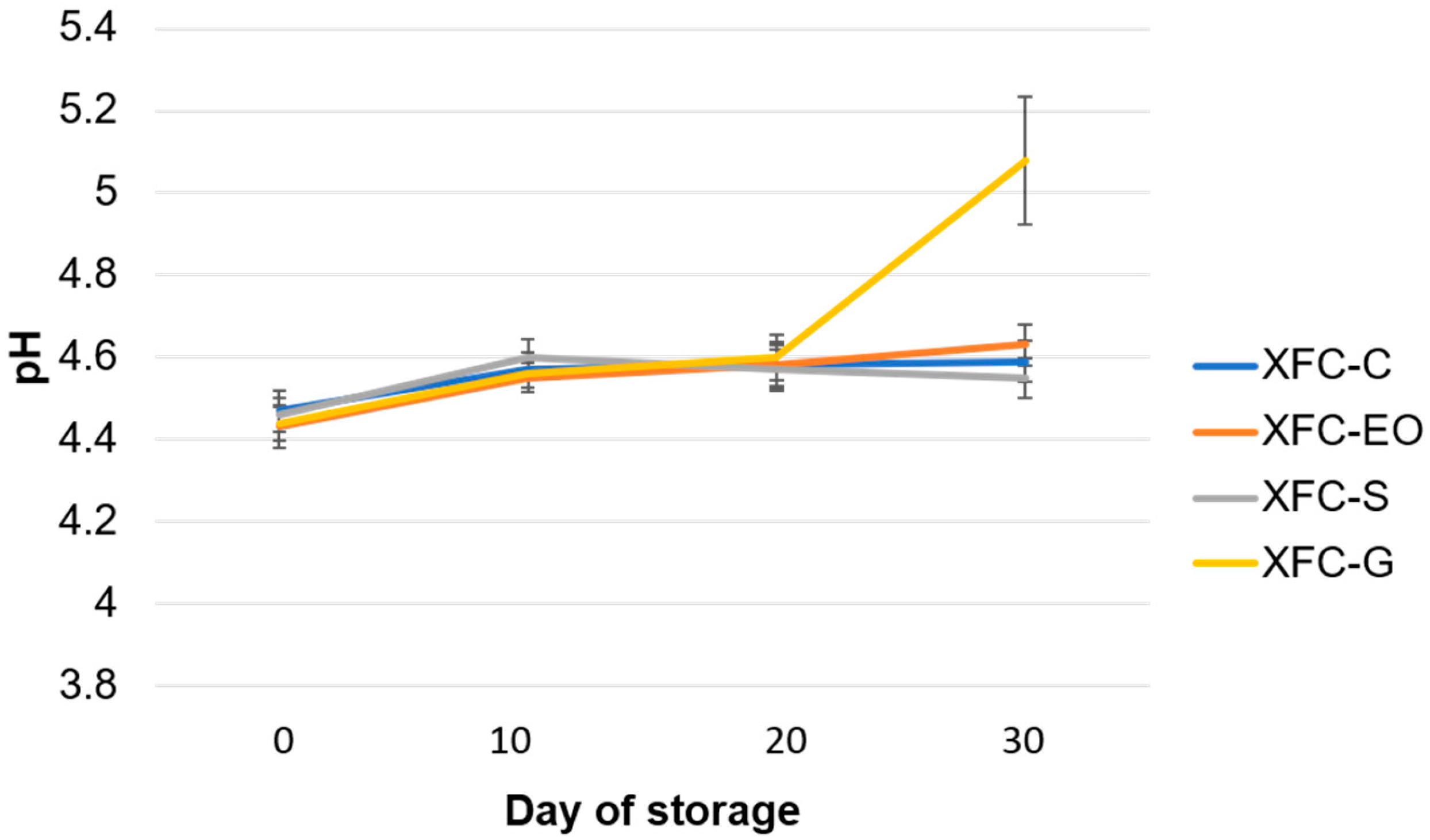
The diagram in Figure 1 illustrates the pH changes in fresh cheese samples produced with a commercial starter culture and enriched with different forms of sage: ground sage (XFC-G), essential oil (XFC-EO), supercritical fluid extract (XFC-S), and a control sample (XFC-C). After the production, the pH values of the samples were uniform and ranged from 4.42 for the sample with essential oil (XFC-EO) to 4.60 for the control sample (XFC-C), which corresponds to the typical pH values for fresh cheese.

3.2. Antioxidant Activity

The results of total phenolic content and antioxidant activity of milk and fresh cheese were published by Bjekić et al. (2021) [23]. Authors found that the total phenolic content decreased slightly from 1.20 mg GAE/g in milk to 0.98 mg GAE/g in fresh cheese (XFC-C), while the overall antioxidant activity, measured by FRAP, DPPH, and ABTS tests, increased significantly in cheese with sage addition (Table 3). FRAP values increased from 0.03 μM Fe2+/g (in milk) to 1.24 μM Fe2+/g (in fresh cheese), DPPH scavenging activity from 0.0014 μM TE/g (in milk) to 0.93 μM TE/g (in fresh cheese), and ABTS activity from 0.03 μM TE/g (in milk) to 2.01 μM TE/g (in fresh cheese).
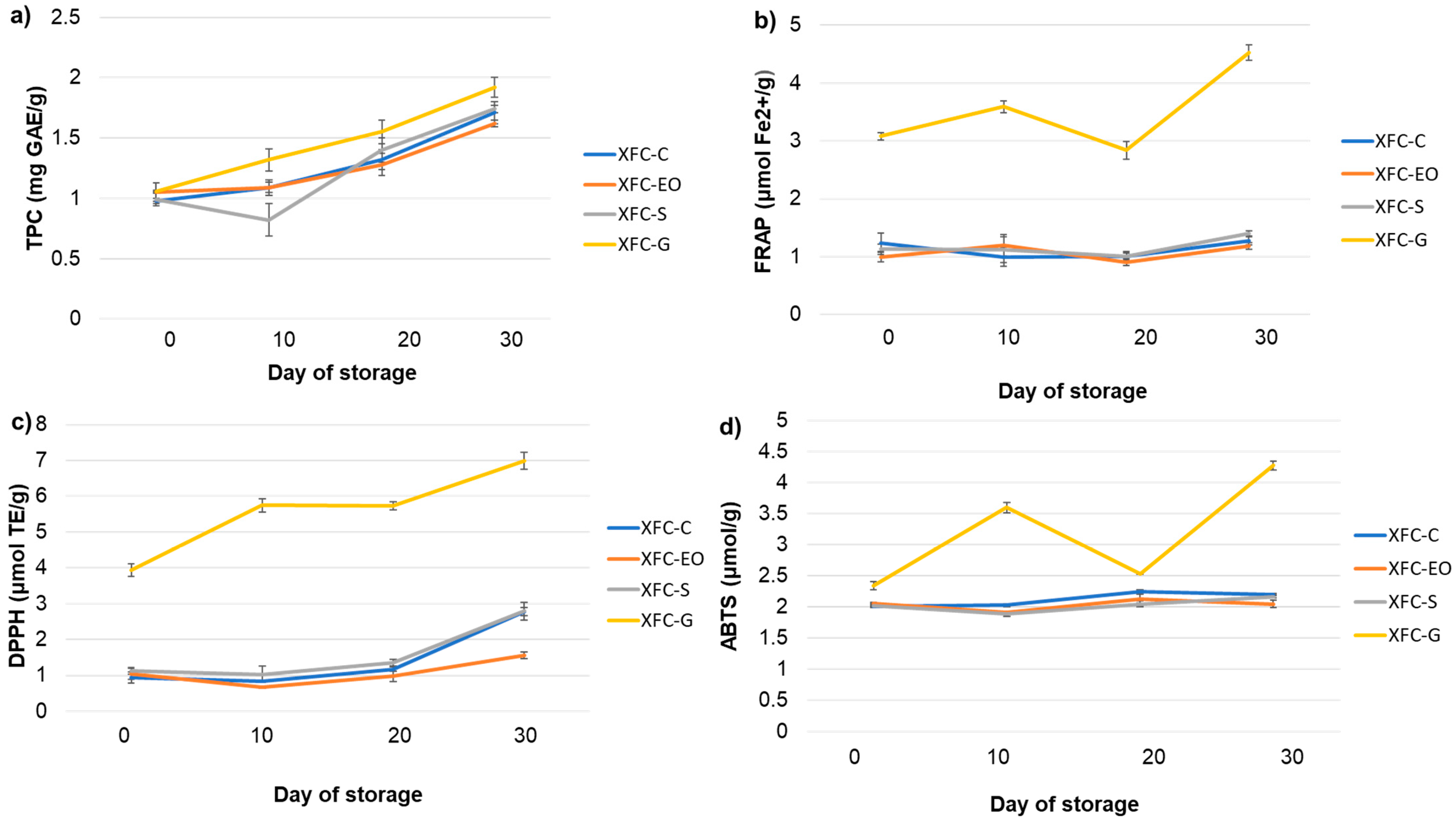
The presented diagrams (Figure 2a) show that the addition of sage, especially in the ground form (XFC-G), significantly increased the total phenolic content (TPC) of fresh cheese during a 30-day storage period. Among the tested samples, XFC-G consistently exhibited the highest TPC values, which increased from about 1.06 mg GAE/g after production to about 2.0 mg GAE/g at Day 30.
A similar trend was observed in FRAP, where XFC-G values reached 4.52 μM Fe2+/g after 30 days, indicating a strong reduction capacity (Figure 2b).
DPPH activity also increased significantly in the same sample, reaching about 7 μM TE/g, indicating an improved radical scavenging capacity (Figure 2c).
ABTS values were relatively similar among the samples at the beginning of storage, but on Day 30, XFC-G reached the highest value (4.28 ± 0.10 μM TE/g), significantly outperforming the other formulations (Figure 2d).
Two-way ANOVA of total phenolic content (TPC) revealed that both sample type and storage time had significant effects on TPC values (p = 0.035 and p < 0.001, respectively). At the same time, their interaction was not significant (p = 0.571), suggesting that the effect of storage was the same for all sample types.
The two-way ANOVA also showed that sample type, day of storage, and their interaction significantly affected the FRAP values (p < 0.05), with the sample factor having the strongest impact (F = 192.2). Storage time (F = 10.4) and interaction (F = 3.6, p = 0.013) also influenced antioxidant activity, indicating variability between samples over time.
DPPH antioxidant activity was significantly affected by sample type (p < 0.001), storage duration (p < 0.001), and their interaction (p = 0.016), as revealed by two-way ANOVA.
Subsequently, two-way ANOVA showed that sample type, day of storage, and their interaction had statistically significant effects on ABTS radical scavenging activity (p < 0.001 for all samples), with sample type having the strongest effect (F = 322.2), followed by storage time (F = 59.8) and their interaction (F = 54.1).

3.3. Color Analysis

Instrumental color analysis using the CIE Lab* system revealed statistically significant differences (p < 0.05) in the color of fresh cheese samples enriched with different forms of sage (S. officinalis L.) and prepared with a commercial starter culture. The results of the color parameters are shown in Table 4.
The L* values ranged from 85.54 ± 2.57 for the ground sage sample (XFC-G) to 92.66 ± 1.34 for the control sample immediately after production.
The a* values were negative for all samples, indicating a dominant green hue. After preparation, the values ranged from −3.37 ± 0.08 (XFC-S) to −2.50 ± 0.15 (XFC-G).
Immediately after preparation (Day 0), all samples exhibited positive b* values, ranging from 14.27 ± 0.82 (XFC-G) to 15.61 ± 0.50 (XFC-EO). These initial values, which indicate a yellow hue, remained largely stable throughout the 30-day storage period.
The dominant wavelength (λ) values for the samples after production ranged from 572.56 ± 0.11 nm (XFC-S) to 573.30 ± 0.16 nm (XFC-G), which falls in the yellow region of the visible spectrum (570–590 nm).
Psychometric lightness (Y%) followed a similar trend to L*. After production, the values ranged from 67.17 ± 5.08 (XFC-G) to 82.23 ± 3.03 (XFC-C).
All samples showed noticeable changes in ΔE values over the 30-day storage period. XFC-C values increased from 0.55 ± 0.18 on Day 10 to 4.06 ± 0.41 on Day 30. XFC-S exhibited the highest final value, reaching 5.24 ± 0.70 by the end of the study. Similarly, XFC-EO and XFC-G increased from initial values of 1.34 ± 0.19 and 1.18 ± 0.18 to final values of 2.61 ± 0.71 and 3.89 ± 0.41, respectively. The most substantial changes for all samples occurred between the 20th and 30th days.

3.4. Sensory Analysis

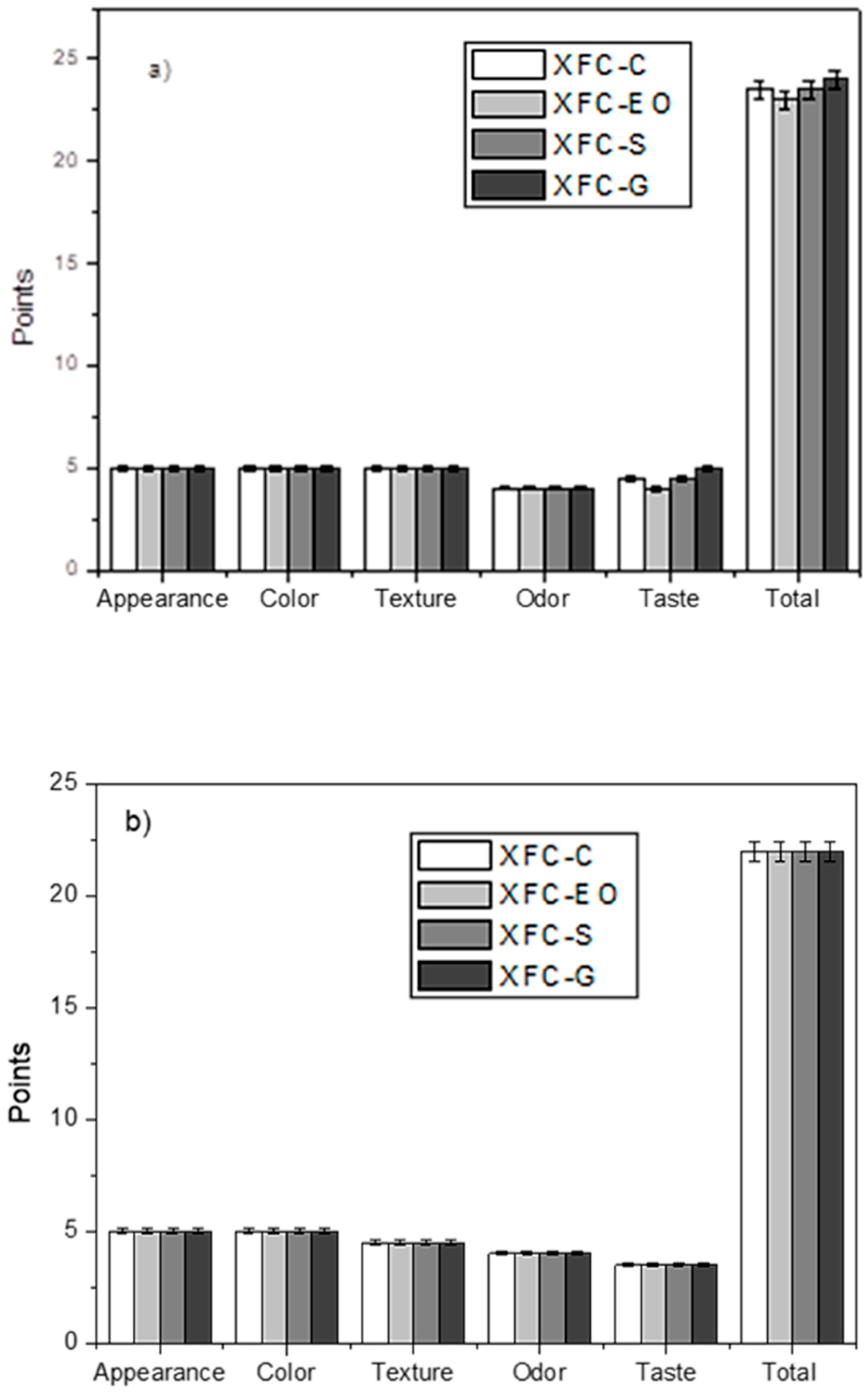
The radar chart of sensory properties (Figure 3a) after production showed that all fresh cheese samples, including the control (XFC-C) and the samples with ground sage (XFC-G), essential oil (XFC-EO), and supercritical fluid extract (XFC-S), scored similarly high for appearance, color, texture, taste, and odor.
After 10 days of storage (Figure 3b), in all examined samples sensory scores decreased slightly but remained balanced, with appearance and color scoring 5, texture 4.5, odor 4, and taste 3.5 (22 points total).

4. Discussion

4.1. Physicochemical Characteristics

The chemical composition of the XFC-C fresh cheese sample is presented in the Results Section and reflects the characteristic distribution of moisture, proteins, fat, and mineral components obtained after the cheese-making process.
The changes in dry matter content of fresh cheese with the addition of sage during 30 days of storage were statistically significant (p < 0.05) and are comparable to the results of Degenek et al. (2024) [43] and Vukić et al. (2023) [18], who observed similar trends in kombucha cheese fortified with wild thyme and sage, respectively.
The variations in total protein content are consistent with the results of Degenek et al. (2023) [44], who reported that plant additives affect protein content depending on their form. Similarly, Tavares et al. (2011) [45] demonstrated that using cardoon extract for the hydrolysis of whey proteins significantly enhances antioxidant and ACE-inhibitory activities. This further supports the premise that both plant-derived additives and alternative processing methods can significantly impact the functional and bioactive properties of dairy-based systems.
The changes in the ash content showed values also found by Degenek et al. (2024) [43] for thyme-enriched kombucha cheese.
The results related to the water activity of the examined samples are consistent with the results of Degenek et al. (2023) [44].
The pH value of fresh cheese samples with the addition of sage ranged from 4.42 to 5.1 during 30 days of storage. The pH value of the cheese sample with starter culture XPL-1 and the addition of sage preparation increased slightly over the 30-day storage period. This may be related to the activity of bioactive compounds derived from sage preparations. The slightly higher pH values observed in fresh cheese samples supplemented with sage were mainly due to the antimicrobial activity of bioactive compounds in the additives, which partially inhibited lactic acid bacteria metabolism and reduced lactic acid production. In particular, volatile monoterpenes, such as 1,8-cineole, α- and β-thujone, camphor, and borneol, in the essential oil, as well as phenolic acids like rosmarinic acid in the supercritical extract and ground sage, contributed to this effect. Additionally, the mineral and protein content of the sage powder provided a mild buffering effect, further stabilizing the pH. These results are consistent with previous research [19,46,47].
The pH value of the XFC-G sample followed the same trend as the other samples up to Day 20 of storage; however, by Day 30, a more pronounced increase was observed, reaching a value of 5.1. The more pronounced pH increase observed in the XFC-G sample at Day 30 may be linked to the gradual influence of bioactive compounds from the sage plant material. Unlike samples containing essential oil or supercritical extract, which are rich in concentrated antimicrobial compounds, the plant matrix likely had a more moderate effect on microbial activity. Additionally, plant-derived components may have interacted with proteolytic processes and the buffering capacity of the cheese, contributing to the accumulation of alkaline compounds and the observed pH rise during storage [48].

4.2. Antioxidant Activity

The antioxidant activity of the control sample XFC-C remained stable throughout the 30-day storage period, indicating the persistence of natural antioxidant components within the dairy matrix. Bjekić et al. (2021) [23] reported that the protein profile and gradual proteolysis of casein during storage directly determine this antioxidant potential. Although the sample does not contain plant extracts rich in phenolics [35], the maintenance of ABTS values depends on the functionality of fermented dairy products and the interaction between the protein matrix and fermentation products [49]. The release of bioactive peptides, which become active free radical scavengers only after enzymatic cleavage of parent milk proteins, plays a key role in this process [50]. Specific amino acids within these peptides, such as tyrosine and tryptophan, act as efficient electron donors, ensuring a stable basal capacity of the sample even in the absence of external additives [51]. This stability in ABTS values over time is consistent with the findings of Tavares et al. (2011) [45], who confirmed that peptides derived from the hydrolysis of milk proteins retain their biological activity and antioxidant power throughout the storage period.
The sustained increase in values obtained by the Folin–Ciocalteu assay indicates a gradual release and stabilization of reducing substances during storage. This trend likely reflects the liberation of phenolic compounds from the sage additives, which the protein-rich cheese matrix could protect and stabilize through hydrogen bonding and hydrophobic interactions [52]. However, it is important to note that the Folin–Ciocalteu reagent is also sensitive to non-phenolic reducing compounds, such as certain amino acids and peptides. Thus, the observed kinetics are likely further influenced by progressive proteolysis, which gradually releases bioactive peptides and amino acids with reducing capacity, contributing to the overall values and antioxidant activity observed [53].
The observed increase in TPC and antioxidant activity (Figure 2) during storage, most prominent in the XFC-G formulation, can be attributed to the progressive increase in dry matter content caused by syneresis. As the cheese loses moisture, the concentration of bioactive compounds naturally rises. Additionally, enzymatic activity during the 30-day period may have promoted the release of bioactive metabolites from the cheese matrix or the added plant material. These factors, together with the inherent stability of the sage-derived antioxidants, contribute to the enhanced functional profile of the samples by the end of the storage period. These findings align well with established literature. Vukić et al. (2022) [19] demonstrated that fresh kombucha cheese enriched with ground sage exhibited significantly higher ABTS and FRAP values than the control sample over a 10-day storage period. Plant species from the Lamiaceae family, particularly sage, rosemary, and oregano, are recognized for their high concentrations of rosmarinic, caffeic, and carnosic acids, which primarily account for their pronounced antioxidant in vitro activities, especially in ABTS and FRAP assays [54,55]. The high intrinsic potency of sage extract alone, with FRAP values of approximately 180 μmol Fe2+/g and ABTS values around 301 μmol TE/g, is the primary driver of the superior antioxidant performance observed in our study. These results (Figure 2b) show that while control samples (XFC-C, -EO, and -S) remained relatively low (~1.0–1.5 μmol Fe2+/g), the XFC-G sample reached approximately 4.5 μmol Fe2+/g by Day 30. This significant increase is explained by the functional synergy between dairy-derived bioactive peptides, released during fermentation, and sage phenols, such as rosmarinic acid. According to Shah (2007) [56], such antioxidant-enriched combinations significantly enhance biological potential and may mitigate oxidative stress associated with aging and chronic diseases.
The total phenolic content (TPC) showed weak to moderate positive correlations with DPPH (r = 0.585), ABTS (r = 0.521), and FRAP (r = 0.422), indicating that phenolics may partially contribute to antioxidant activity, although other components could also be involved.
The progressive increase in antioxidant activity in the XFC-G sample suggests a time-dependent extraction of bioactive compounds from the plant matrix. According to Abedelmaksoud et al. (2025) [57], the efficiency of extracting and identifying these compounds is highly dependent on environmental conditions. In this study, the acidic environment and the 30-day storage period likely facilitated the gradual release and activation of bound polyphenols, leading to the observed upward trend.
Very strong correlations were observed among the antioxidant assays themselves—DPPH–FRAP (r = 0.935), ABTS–FRAP (r = 0.899), and DPPH–ABTS (r = 0.868)—indicating consistency and reliability among methods. In addition to phenolics, antioxidant activity can also be attributed to bioactive peptides [58], organic acids like lactic and citric [59], carotenoids and chlorophyll derivatives [60], and flavonoids and tannins [61], which exert their effects through radical scavenging, metal chelation, and inhibition of lipid oxidation.
Analyzing the ANOVA results, the Duncan post hoc test also showed that the TPC value increased significantly over time, with the highest value observed in the XFC-G sample at Day 30 (1.92 mg GAE/g), which belonged to a distinct homogeneous group and was significantly higher than all other combinations. In contrast, the lowest TPC value was observed in the XFC-S sample at Day 10 (0.82 mg GAE/g), which belonged to a group with other early stored samples. These results confirm that TPC was affected independently of formulation and storage time, with phenolic content generally increasing during storage, especially in plant-enriched formulations.
The Duncan post hoc test confirmed that the highest FRAP value occurred in sample XFC-G on Day 30, while the lowest value was recorded in XFC-EO on Day 10. Overall, the antioxidant capacity generally increased during storage, especially for plant-enriched samples such as XFC-G.
According to two-way ANOVA, both formulation and storage affected antioxidant behavior, with changes over time varying between samples. The Duncan post hoc test confirmed these differences, with the lowest DPPH levels observed in the early-stage samples such as XFC-S (day 0) and XFC-EO (Day 10), while moderate activity was observed in XFC-S and XFC-EO at Day 20 and in XFC-C at Day 30. The highest antioxidant activity was observed in sample XFC-G at Day 30 (6.99 μM TE/g), forming a distinct group that was different from all others. Overall, the antioxidant capacity increased during storage, particularly in plant-enriched formulations such as XFC-G.
The Duncan post hoc test also revealed that antioxidant capacity varied significantly among samples and changed over time, with the pattern of ABTS activity during storage differing by sample. These findings confirm that both sample composition and storage duration influence antioxidant behavior.

4.3. Color Analysis

During the 30-day storage period, a general decrease in L* values was observed in all samples, indicating progressive darkening. This decrease is attributed to increased protein hydration leading to reduced moisture and light scattering, as well as possible oxidative reactions, proteolysis, and salt effects that reduce overall luminosity due to the formation of brown pigments [62,63,64]. Samples containing ground sage consistently showed lower L* values, which can be attributed to the content of dark pigments in the plant material.
The storage time had a remarkable influence on the a* values. For example, for sample XFC-G, a* increased from 2.50 ± 0.15 to 1.97 ± 0.12 within 30 days, indicating a reduction in green intensity and a shift toward neutral tones. Overall, the highest a* values were found in the XFC-G sample, confirming that the form and concentration of sage significantly influence this parameter.
The predominance of the yellow (b*) component over the green (a*) confirms the characteristic whitish-yellow color of fresh cheese, which is consistent with the results of Miloradović et al. (2018) [63].
The most noticeable change in the dominant wavelength (λ) during storage was observed in XFC-S, with a shift from 572.56 ± 0.11 nm to 575.33 ± 0.26 nm, indicating a significant change in hue over time, possibly due to degradation of the pigments or chemical interactions between the sage components and the cheese matrix.
The largest decrease in psychometric lightness (Y%) during storage was observed in the control sample XFC-C, which dropped to 73.54 ± 6.85 by Day 30. These changes confirm the visual darkening of the cheese, which is probably caused by oxidative and physicochemical modifications.
The control (XFC-C) showed a progressive increase in ΔE, reaching 4.06 ± 0.41 at Day 30, indicating a noticeable visual change during storage. XFC-EO exhibited the lowest ΔE values (1.34 ± 0.19–2.61 ± 0.71), suggesting improved color stability. This effect may be related to the presence of sage essential oil, which could help preserve the optical properties of the cheese matrix by interacting with its components or mitigating certain degradative changes. According to Cruz-Romero et al. (2007) [65], ΔE values between 3.0 and 6.0 represent a “very significant difference.” Thus, all samples, especially XFC-C and XFC-S, showed visually significant color changes by Day 30, highlighting the effectiveness of the essential oil in minimizing discoloration during storage. The color change (ΔE) observed in XFC-S samples can be attributed to the nature of the supercritical fluid extract. Unlike essential oil, the SFE process extracts a wider range of lipophilic compounds, including chlorophylls and carotenoids, which are highly susceptible to chemical interactions within the high-moisture cheese matrix. Regarding texture, the slight decrease in sensory scores for samples with ground sage (XFC-G) is likely due to the rehydration of plant particles. As the dry botanical material absorbs moisture from the cheese curd, it alters the perceived smoothness and creates a grainier mouthfeel. In contrast, SFE and EO integrate more uniformly into the lipid phase, preserving the characteristic creaminess of the fresh cheese, which is consistent with findings for cheeses functionalized with plant extracts [66].

4.4. Sensory Analysis

The samples had a mild, typical odor and taste, a white-yellowish color, and a creamy texture, with a slightly pronounced but not dominant sage aroma and taste. On the day of production, the ground sage sample (XFC-G) obtained the highest total score (24 points), followed by the control and supercritical extract samples (23.5 points). In comparison, the essential oil sample obtained the lowest score (23 points). All samples received the maximum score (5 points) for appearance, color, and texture and 4 points for odor. The biggest differences were in taste: XFC-G scored 5 points, the control and extract samples 4.5 points, and the essential oil 4 points, suggesting that ground sage enhances taste without affecting other properties.
After 10 days, samples with sage extracts (XFC-S and XFC-EO) retained odor and taste better than the control, probably due to the antimicrobial and antioxidant effects of sage [67,68]. Although ground sage initially had the highest acceptability, its sensory quality decreased more than that of the extract forms during storage. Overall, sage, especially in the form of extracts, is a promising natural preservative to maintain the sensory quality of fresh cheese and extend the shelf life. Decreases of total points after 10 days of storage can be connected with the results of the color of samples. It was found that sample XFC-S had the highest changes of ΔE (5.24 ± 0.70). These results are in accordance with literature data [19], who found that sensory characteristics of fresh cheese kombucha with sage reduced during storage. Also, all samples of fresh cheese kombucha with sage had an untypical, irregular, grainy structure.

5. Conclusions

Enrichment of fresh cheese with different sage preparations (Salvia officinalis L.), such as essential oil, supercritical fluid extract, and ground, showed positive effects on the antioxidant capacity, physicochemical properties, and sensory quality of the product during storage. Ground sage had the most notable impact on increasing antioxidant activity, while the essential oil contributed to improving color stability. All fortified samples were initially well accepted, with the extract-based variants showing better retention of sensory properties during refrigerated storage. These results suggest that sage-based by-products, especially those resulting from the production of filter tea, can be effectively used as natural functional additives in fresh cheese formulation. Their use not only improves product quality but also supports the principles of clean label formulation and the circular economy by valorizing plant waste. Although the results are promising, further studies under industrial processing conditions and wider consumer testing are recommended to confirm their practical applicability. Overall, the use of these value-added by-products demonstrates the potential for clean and sustainable dairy production while enhancing cheese quality.

Author Contributions

Conceptualization, D.V. and V.V.; methodology, D.V., J.D., M.B., B.P., and V.V.; formal analysis, D.V., J.D., M.B., and B.P.; investigation, D.V., M.I., J.D., and M.B.; resources, K.K.; data curation, J.D.; writing—original draft preparation, D.V. and J.D.; writing—review and editing, M.I., K.K., Z.Z., B.P., and V.V.; supervision, M.I., K.K., Z.Z., and V.V.; project administration, V.V.; funding acquisition, V.V. All authors have read and agreed to the published version of the manuscript.

Funding

This research was funded by the Ministry of Science, Technological Development, and Innovation of the Republic of Serbia, grant numbers 451-03-136/2025-03/200134 and 451-03-137/2025-03/200134, and by the Science Fund of the Republic of Serbia, project “Novel extracts and bioactive compounds from under-utilized resources for high-value applications—BioUtilize” (No. 7750168). The article processing charge was funded by the Ministry of Science, Technological Development, and Innovation of the Republic of Serbia.

Data Availability Statement

The data presented in this study are not publicly available, as they contain raw experimental data intended for future publication. However, the data are available from the corresponding author upon reasonable request.

Acknowledgments

The authors express their sincere gratitude to the Faculty of Technology, University of Novi Sad, for providing access to laboratory facilities and equipment essential for this research.

Conflicts of Interest

The authors declare no conflicts of interest. The authors have no relevant financial or non-financial interests to disclose.

Abbreviations

The following abbreviations are used in this manuscript:
EOEssential oil of Salvia officinalis L.
SFESupercritical fluid extract of Salvia officinalis L.
GGround sage (Salvia officinalis L.)
XFC-CControl fresh cheese sample without added sage
XFC-EOFresh cheese sample with added sage essential oil
XFC-SFresh cheese sample with added sage supercritical fluid extract
XFC-GFresh cheese sample with added ground sage

References

  1. Fox, P.F.; McSweeney, P.L.H.; Cogan, T.M.; Guinee, T.P. Fundamentals of Cheese Science; Springer: New York, NY, USA, 2017. [Google Scholar]
  2. Gaggia, F.; Di Gioia, D.; Baffoni, L.; Biavati, B. The role of protective and probiotic cultures in food and feed and their impact in food safety. Trends Food Sci. Technol. 2011, 22, S58–S66. [Google Scholar] [CrossRef]
  3. Masmoudi, M.; Ammar, I.; Ghribi, H.; Attia, H. Physicochemical, radical scavenging activity and sensory properties of a soft cheese fortified with Arbutus unedo L. extract. Food Biosci. 2020, 35, 100579. [Google Scholar] [CrossRef]
  4. Stobiecka, M.; Król, J.; Brodziak, A. Antioxidant activity of milk and dairy products. Animals 2022, 12, 245. [Google Scholar] [CrossRef] [PubMed]
  5. Zheng, X.; Shi, X.; Wang, B. A review on the general cheese processing technology, flavor biochemical pathways and the influence of yeasts in cheese. Front. Microbiol. 2021, 12, 703284. [Google Scholar] [CrossRef] [PubMed]
  6. Charles, D.J. Antioxidant Properties of Spices, Herbs and Other Sources; Springer Science & Business Media: New York, NY, USA, 2013. [Google Scholar]
  7. Witkowska, A.M.; Hickey, D.K.; Alonso-Gomez, M.; Wilkinson, M. Evaluation of antimicrobial activities of commercial herb and spice extracts against selected food-borne bacteria. J. Food Res. 2013, 2, 37–54. [Google Scholar] [CrossRef]
  8. Sulejmani, E.; Sahingil, D.; Hayaloglu, A.A. A comparative study of compositional, antioxidant capacity, ACE-inhibition activity, RP-HPLC peptide profile and volatile compounds of herbal artisanal cheeses. Int. Dairy J. 2020, 111, 104837. [Google Scholar] [CrossRef]
  9. Kandyliari, A.; Potsaki, P.; Bousdouni, P.; Kaloteraki, C.; Christofilea, M.; Almpounioti, K.; Moutsou, A.; Fasoulis, C.K.; Polychronis, L.V.; Gkalpinos, V.K.; et al. Development of dairy products fortified with plant extracts: Antioxidant and phenolic content characterization. Antioxidants 2023, 12, 500. [Google Scholar] [CrossRef]
  10. Geissdoerfer, M.; Savaget, P.; Bocken, N.M.P.; Hultink, E.J. The circular economy—A new sustainability paradigm? J. Clean. Prod. 2017, 143, 757–768. [Google Scholar] [CrossRef]
  11. Difonzo, G.; Antonino, C.; Squeo, G.; Caponio, F.; Faccia, M. Application of agri-food by-products in cheesemaking. Antioxidants 2023, 12, 660. [Google Scholar] [CrossRef]
  12. Teshome, E.; Forsido, S.F.; Rupasinghe, H.P.V.; Keyata, E.O. Potentials of natural preservatives to enhance food safety and shelf life: A review. Sci. World J. 2022, 2022, 9901018. [Google Scholar] [CrossRef]
  13. Maddaloni, L.; Gobbi, L.; Vinci, G.; Prencipe, S.A. Natural compounds from food by-products in preservation processes: An overview. Processes 2025, 13, 93. [Google Scholar] [CrossRef]
  14. Abd El-Hack, M.E.; Rudayni, H.A.; Aldhalmi, A.K.; Youssef, I.M.; Arif, M.; Alawam, A.S.; Allam, A.A.; Khafaga, A.F.; Ashour, E.A.; Khan, M.M.H. Beyond traditional uses: Unveiling the epigenetic, microbiome-modulating, metabolic, and nutraceutical benefits of Salvia officinalis in human and livestock nutrition. J. Funct. Foods 2025, 128, 106843. [Google Scholar] [CrossRef]
  15. Anjali, D.G.; Pragi, V.K.; Dimple, M. A review of therapeutic properties and uses of Salvia officinalis. J. Pharm. Insights Res. 2024, 2, 146–154. [Google Scholar] [CrossRef]
  16. Berdahl, D.R.; McKeague, J. Rosemary and sage extracts as antioxidants for food preservation. In Handbook of Antioxidants for Food Preservation; Shahidi, F., Ed.; Woodhead Publishing: Cambridge, UK, 2015; pp. 177–217. [Google Scholar] [CrossRef]
  17. Mei, J.; Ma, X.; Xie, J. Review on natural preservatives for extending fish shelf life. Foods 2019, 8, 490. [Google Scholar] [CrossRef] [PubMed]
  18. Vukić, V.; Vukić, D.; Pavlić, B.; Iličić, M.; Kocić-Tanackov, S.; Kanurić, K.; Bjekić, M.; Zeković, Z. Antimicrobial potential of kombucha fresh cheese with addition of sage (Salvia officinalis L.) and its preparations. Food Funct. 2023, 14, 3348–3356. [Google Scholar] [CrossRef]
  19. Vukić, D.; Pavlić, B.; Vukić, V.; Iličić, M.; Kanurić, K.; Bjekić, M.; Zeković, Z. Antioxidative capacity of fresh kombucha cheese fortified with sage herbal dust and its preparations. J. Food Sci. Technol. 2022, 59, 2274–2283. [Google Scholar] [CrossRef]
  20. Herzyk, F.; Piłakowska-Pietras, D.; Korzeniowska, M. Supercritical extraction techniques for obtaining biologically active substances from a variety of plant byproducts. Foods 2024, 13, 1713. [Google Scholar] [CrossRef]
  21. European Directorate for the Quality of Medicines & HealthCare. European Pharmacopoeia, 8th ed.; Council of Europe: Strasbourg, France, 2014; Volume 1. [Google Scholar]
  22. Pavlić, B.; Bera, O.; Teslić, N.; Vidović, S.; Parpinello, G.; Zeković, Z. Chemical profile and antioxidant activity of sage herbal dust extracts obtained by supercritical fluid extraction. Ind. Crops Prod. 2018, 120, 305–312. [Google Scholar] [CrossRef]
  23. Bjekić, M.; Iličić, M.; Vukić, V.; Vukić, D.; Kanurić, K.; Pavlić, B.; Zeković, Z.; Popović, L.; Torbica, A.; Tomić, J.; et al. Protein characterisation and antioxidant potential of fresh cheese obtained by kombucha inoculum. Mljekarstvo 2021, 71, 215–225. [Google Scholar] [CrossRef]
  24. Pavlić, B.; Teslić, N.; Vidaković, A.; Vidović, S.; Velićanski, A.; Versari, A.; Radosavljević, R.; Zeković, Z. Sage processing from by-product to high quality powder: I. Bioactive potential. Ind. Crops Prod. 2017, 107, 81–89. [Google Scholar] [CrossRef]
  25. Zeković, Z.; Pintać, D.; Majkić, T.; Vidović, S.; Mimica-Dukić, N.; Teslić, N.; Versari, A.; Pavlić, B. Utilization of sage by-products as raw material for antioxidants recovery—Ultrasound versus microwave-assisted extraction. Ind. Crops Prod. 2017, 99, 49–59. [Google Scholar] [CrossRef]
  26. Tuğlu, Ü.; Cessur, A.; Baydar, N.G.; Baydar, H. Comparison of phenolic composition, antiradical and antioxidant activities of diploid and autotetraploid genotypes of Salvia officinalis L. S. Afr. J. Bot. 2025, 180, 160–170. [Google Scholar] [CrossRef]
  27. ISO 5534:2004; Cheese and Processed Cheese—Determination of the Total Solid Content (Reference Method). International Organization for Standardization: Geneva, Switzerland, 2004.
  28. ISO 2446:2008; Milk and Milk Products—Determination of Fat Content—Gerber Butyrometers. International Organization for Standardization: Geneva, Switzerland, 2008.
  29. ISO 3343:2008; Milk—Determination of Fat Content—Van Gulik Method. International Organization for Standardization: Geneva, Switzerland, 2008.
  30. ISO 8968-1:2014; Milk and Milk Products—Determination of Nitrogen Content—Part 1: Kjeldahl Principle and Crude Protein Calculation. International Organization for Standardization: Geneva, Switzerland, 2014.
  31. ISO 5545:2008; Rennet Caseins and Caseinates—Determination of Ash (Reference Method). International Organization for Standardization: Geneva, Switzerland, 2008.
  32. Carić, M.; Milanović, S.; Vucelja, D. Standardne Metode Analize Mleka i Mlečnih Proizvoda; Standard Methods of Analysis of Milk and Dairy Products; Prometej: Novi Sad, Serbia, 2000. [Google Scholar]
  33. ISO 7238:2004; International Organization for Standardization. Butter—Determination of pH of the Serum—Potentiometric Method. International Organization for Standardization: Geneva, Switzerland, 2004.
  34. ISO 18787:2017; Foodstuffs—Determination of Water Activity. International Organization for Standardization: Geneva, Switzerland, 2017.
  35. Singleton, V.L.; Rossi, J.A. Colorimetry of total phenolics with phosphomolybdic–phosphotungstic acid reagents. Am. J. Enol. Vitic. 1965, 16, 144–158. [Google Scholar] [CrossRef]
  36. Benzie, I.F.F.; Strain, J.J. The ferric reducing ability of plasma (FRAP) as a measure of “antioxidant power”: The FRAP assay. Anal. Biochem. 1996, 239, 70–76. [Google Scholar] [CrossRef]
  37. Brand-Williams, W.; Cuvelier, M.E.; Berset, C. Use of a free radical method to evaluate antioxidant activity. LWT–Food Sci. Technol. 1995, 28, 25–30. [Google Scholar] [CrossRef]
  38. Re, R.; Pellegrini, N.; Proteggente, A.; Pannala, A.; Yang, M.; Rice-Evans, C. Antioxidant activity applying an improved ABTS radical cation decolorization assay. Free Radic. Biol. Med. 1999, 26, 1231–1237. [Google Scholar] [CrossRef] [PubMed]
  39. Milani, A.; Jouki, M.; Rabbani, M. Production and characterization of freeze-dried banana slices pretreated with ascorbic acid and quince seed mucilage: Physical and functional properties. Food Sci. Nutr. 2020, 8, 3768–3776. [Google Scholar] [CrossRef]
  40. ISO 22935-1:2023 (IDF 99-1); Milk and Milk Products—Sensory Analysis—Part 1: Recruitment, Selection, Training and Monitoring of Assessors. International Organization for Standardization: Geneva, Switzerland, 2023.
  41. ISO 22935-2:2023 (IDF 99-2); Milk and Milk Products—Sensory Analysis—Part 2: Methods for Sensory Evaluation. International Organization for Standardization: Geneva, Switzerland, 2023.
  42. ISO 22935-3:2023 (IDF 99-3); Milk and Milk Products—Sensory Analysis—Part 3: Method for Evaluation of Compliance with Product Specifications for Sensory Properties by Scoring. International Organization for Standardization: Geneva, Switzerland, 2023.
  43. Degenek, J.; Kanurić, K.; Iličić, M.; Vukić, D.; Mrkonjić, Ž.; Pavlić, B.; Zeković, Z.; Kocić-Tanackov, S.; Bulut, S. Changes in textural parameters and microstructure of kombucha fresh cheese initiated by the addition of wild thyme. Mljekarstvo 2024, 75, 28–40. [Google Scholar] [CrossRef]
  44. Degenek, J.; Kanurić, K.; Iličić, M.; Vukić, D.; Mrkonjić, Ž.; Pavlić, B.; Zeković, Z.; Vukić, V. Fortification of fresh kombucha cheese with wild thyme (Thymus serpyllum L.) herbal dust and its influence on antioxidant activity. Food Biosci. 2023, 56, 103161. [Google Scholar] [CrossRef]
  45. Tavares, T.; Contreras, M.M.; Amorim, M.; Martin-Alvarez, P.J.; Pintado, M.E.; Recio, I.; Malcata, F.X. Optimisation, by response surface methodology, of degree of hydrolysis and antioxidant and ACE-inhibitory activities of whey protein hydrolysates obtained with cardoon extract. Int. Dairy J. 2011, 21, 926–933. [Google Scholar] [CrossRef]
  46. Ribas, J.C.R.; Matumoto-Pintro, P.T.; Vital, A.C.P.; Saraiva, B.R.; Anjo, F.A.; Alves, R.L.B.; Santos, N.W.; Machado, E.; Agustinho, B.C.; Zeoula, L.M.S. Influence of basil (Ocimum basilicum Lamiaceae) addition on functional, technological and sensorial characteristics of fresh cheeses made with organic buffalo milk. J. Food Sci. Technol. 2019, 56, 5214–5224. [Google Scholar] [CrossRef]
  47. Ziarno, M.; Kozłowska, M.; Ścibisz, I.; Kowalczyk, M.; Pawelec, S.; Stochmal, A.; Szleszyński, B. The Effect of Selected Herbal Extracts on Lactic Acid Bacteria Activity. Appl. Sci. 2021, 11, 3898. [Google Scholar] [CrossRef]
  48. Silva, B.N.; Coelho-Fernandes, S.; Teixeira, J.A.; Cadavez, V.; Gonzales-Barron, U. Dynamic Modelling to Describe the Effect of Plant Extracts and Customised Starter Culture on Staphylococcus aureus Survival in Goat’s Raw Milk Soft Cheese. Foods 2023, 12, 2683. [Google Scholar] [CrossRef]
  49. Milanović, S.; Hrnjez, D.; Iličić, M.; Kanurić, K.; Vukić, V. Novel fermented dairy products. In Novel Food Fermentation Technologies; Ojha, K.S., Tiwari, B.K., Eds.; Springer International Publishing: Cham, Switzerland, 2016; pp. 165–201. [Google Scholar]
  50. Korhonen, H.; Pihlanto, A. Bioactive peptides: Production and functionality. Int. Dairy J. 2006, 16, 945–960. [Google Scholar] [CrossRef]
  51. Pihlanto, A. Antioxidative peptides derived from milk proteins. Int. Dairy J. 2006, 16, 1306–1314. [Google Scholar] [CrossRef]
  52. Jakobek, L. Interactions of polyphenols with carbohydrates, lipids and proteins. Food Chem. 2015, 175, 556–567. [Google Scholar] [CrossRef]
  53. Öztürk, H.İ.; Oraç, A.; Akın, N. Characterization of bioactive peptides derived from goatskin Tulum cheese of the Ereğli region at different stages of ripening. Food Res. Int. 2022, 162, 112124. [Google Scholar] [CrossRef] [PubMed]
  54. Ulewicz-Magulska, B.; Wesolowski, M. Total phenolic contents and antioxidant potential of herbs used for medical and culinary purposes. Plant Foods Hum. Nutr. 2019, 74, 61–67. [Google Scholar] [CrossRef]
  55. Bianchin, M.; Pereira, D.; Almeida, J.F.; Moura, C.; Pinheiro, R.S.; Heldt, L.F.S.; Haminiuk, C.W.I.; Carpes, S.T. Antioxidant properties of lyophilized rosemary and sage extracts and their effect to prevent lipid oxidation in poultry pâté. Molecules 2020, 25, 5160. [Google Scholar] [CrossRef] [PubMed]
  56. Shah, N.P. Functional cultures and health benefits. Int. Dairy J. 2007, 17, 1262–1277. [Google Scholar] [CrossRef]
  57. Abedelmaksoud, T.G.; Younis, M.I.; Altemimi, A.B.; Tlay, R.H.; Ali Hassan, N. Bioactive Compounds of Plant-Based Food: Extraction, Isolation, Identification, Characteristics, and Emerging Applications. Food Sci. Nutr. 2025, 13, e70351. [Google Scholar] [CrossRef] [PubMed]
  58. Erdmann, K.; Cheung, B.W.Y.; Schröder, H. The possible roles of food-derived bioactive peptides in reducing the risk of cardiovascular disease. J. Nutr. Biochem. 2008, 19, 643–654. [Google Scholar] [CrossRef]
  59. Fguiri, I.; Ziadi, M.; Abassi, M.; Arroum, S.; Khorchani, T. Suitability of camel milk to transformation in Leben by lactic starter. Afr. J. Microbiol. Res. 2012, 6, 7185–7192. [Google Scholar] [CrossRef]
  60. Delgado-Vargas, F.; Jiménez, A.R.; Paredes-López, O. Natural pigments: Carotenoids, anthocyanins, and betalains—Characteristics, biosynthesis, processing, and stability. Crit. Rev. Food Sci. Nutr. 2000, 40, 173–289. [Google Scholar] [CrossRef] [PubMed]
  61. Pereira, D.M.; Valentão, P.; Pereira, J.A.; Andrade, P.B. Phenolics: From chemistry to biology. Molecules 2009, 14, 2202–2211. [Google Scholar] [CrossRef]
  62. Dantas, A.B.; Jesus, V.F.; Silva, R.; Almada, C.N.; Esmerino, E.A.; Cappato, L.P. Manufacture of probiotic Minas frescal cheese with Lactobacillus casei Zhang. J. Dairy Sci. 2016, 99, 18–30. [Google Scholar] [CrossRef]
  63. Miloradović, Z.; Miočinović, J.; Kljajević, N.; Tomašević, I.; Puđa, P. The influence of milk heat treatment on composition, texture, colour and sensory characteristics of cows’ and goats’ Quark-type cheeses. Small Rumin. Res. 2018, 169, 154–159. [Google Scholar] [CrossRef]
  64. Lucas, A.; Rock, E.; Agabriel, C.; Chilliard, Y.; Coulon, J.B. Relationships between animal species (cow versus goat) and some nutritional constituents in raw milk farmhouse cheeses. Small Rumin. Res. 2008, 74, 243–248. [Google Scholar] [CrossRef]
  65. Cruz-Romero, M.; Kelly, A.L.; Kerry, J.P. Effects of high-pressure and heat treatments on physical and biochemical characteristics of oysters (Crassostrea gigas). Innov. Food Sci. Emerg. Technol. 2007, 8, 30–38. [Google Scholar] [CrossRef]
  66. Caleja, C.; Ribeiro, A.; Barros, L.; Barreira, J.C.; Antonio, A.L.; Oliveira, M.B.P.; Barreiro, M.F.; Ferreira, I.C. Cottage cheeses functionalized with fennel and chamomile extracts: Comparative performance between free and microencapsulated forms. Food Chem. 2016, 199, 720–726. [Google Scholar] [CrossRef]
  67. Bektas Tepe, A.; Donmez, E.; Unlu, M.; Sokmen, A.; Gulluce, M.; Sahin, F.; Sokmen, A.; Adiguzel, A. Antimicrobial and antioxidative activities of the essential oils and methanol extracts of Salvia cryptantha (Montbret et Aucher ex Benth.) and Salvia multicaulis (Vahl). Food Chem. 2004, 84, 519–525. [Google Scholar] [CrossRef]
  68. Bozin, B.; Mimica-Dukic, N.; Samojlik, I.; Jovin, E. Antimicrobial and antioxidant properties of rosemary and sage (Rosmarinus officinalis L. and Salvia officinalis L., Lamiaceae) essential oils. J. Agric. Food Chem. 2007, 55, 7879–7885. [Google Scholar] [CrossRef]
Figure 1. Changes in pH of fresh cheese with the addition of sage during 30 days of storage.
Processes 14 00961 g001
Figure 2. Changes in total phenolic content and antioxidant activity of fresh cheese with the addition of sage during 30 days of storage: (a) total phenolic content (TPC); (b) ferric reducing antioxidant power (FRAP); (c) DPPH radical scavenging activity; and (d) ABTS radical scavenging activity.
Processes 14 00961 g002
Figure 3. Sensory evaluation of fresh cheese with the addition of sage, (a) after production and (b) after 10 days of storage.
Processes 14 00961 g003
Table 1. Chemical composition of used milk and produced fresh cheese.
ComponentsMilk
Dry matter (%)12.21 ± 0.71
NFDM (%)9.40 ± 1.58
Water (%)87.79 ± 0.71
Total proteins (%)3.01 ± 0.02
Casein (%)2.1 ± 0.02
Whey proteins (%)0.60 ± 0.02
Fat (%)2.80 ± 0.50
Ash (%)0.70 ± 0.00
Table 2. Changes in physicochemical characteristics of fresh cheese with the addition of sage during 30 days of storage.
Dry matter (%)
Sample0102030
XFC-C37.40 ± 1.60 abA37.67 ± 0.06 aA34.14 ± 0.22 bA38.16 ± 0.23 aA
XFC-EO33.79 ± 0.68 bB36.13 ± 0.70 abA34.58 ± 0.54 abA35.94 ± 0.45 aB
XFC-S34.62 ± 0.70 bB38.30 ± 0.80 aA35.76 ± 0.03 bA39.13 ± 0.54 aA
XFC-G36.11 ± 0.72 aA36.75 ± 0.73 aA35.61 ± 0.57 aA32.86 ± 0.19 bC
Total proteins (%)
Sample0102030
XFC-C13.23 ± 0.04 bA14.58 ± 0.23 aA13.78 ± 0.30 abA13.59 ± 0.76 bA
XFC-EO13.35 ± 0.27 aA13.91 ± 0.28 aB13.01 ± 0.26 aA13.11 ± 0.23 aA
XFC-S12.79 ± 0.25 bA15.08 ± 0.30 aA13.65 ± 0.20 bA13.46 ± 0.27 bA
XFC-G12.66 ± 0.25 bA14.04 ± 0.28 aB12.60 ± 0.20 bA13.38 ± 0.23 abA
Ash (%)
Sample0102030
XFC-C0.88 ± 0.01 aA0.86 ± 0.05 aA0.70 ± 0.01 bB1.01 ± 0.06 aA
XFC-EO0.87 ± 0.02 aA0.78 ± 0.01 bB0.73 ± 0.01 bB0.89 ± 0.02 aB
XFC-S0.83 ± 0.02 bA0.85 ± 0.01 bA0.67 ± 0.01 cC0.96 ± 0.02 aAB
XFC-G0.83 ± 0.02 bA0.82 ± 0.02 bA0.77 ± 0.01 cA0.93 ± 0.02 aAB
aw
Sample0102030
XFC-C0.97 ± 0.00 aA0.98 ± 0.00 aA0.97 ± 0.01 aA0.97 ± 0.00 aA
XFC-EO0.97 ± 0.02 aA0.98 ± 0.01 aA0.98 ± 0.01 aA0.97 ± 0.02 aA
XFC-S0.98 ± 0.02 aA0.97 ± 0.02 aA0.98 ± 0.02 aA0.97 ± 0.02 aA
XFC-G0.97 ± 0.02 aA0.97 ± 0.02 aA0.98 ± 0.02 aA0.97 ± 0.02 aA
* XFC-C—control sample of fresh cheese; XFC-EO—fresh cheese with sage essential oil; XFC-S—fresh cheese with supercritical sage extract; XFC-G—fresh cheese with ground sage. Different lowercase letters (a, b, c) in the same row indicate a statistically significant difference between storage days for the same treatment (p < 0.05). Different uppercase letters (A, B, C) in the same column indicate a statistically significant difference between different treatments on the same storage day (p < 0.05).
Table 3. Total phenolic content and antioxidant activity of milk and fresh cheese [23].
SamplesTPC
(mg GAE/g)
Antioxidant Activity
FRAP
(μM Fe2+/g)
DPPH
(μM TE/g)
ABTS
(μM TE/g)
Milk1.20 ± 0.010.03 ± 0.000.0014 ± 0.000.03 ± 0.00
XFC-C0.98 ± 0.031.24 ± 0.230.93 ± 0.222.01 ± 0.02
* XFC-C—control sample of fresh cheese. Data obtained from Bjekić et al. (2021) [23] are included for comparative purposes.
Table 4. Changes of color parameters in fresh cheese with the addition of sage during 30 days of storage.
SamplesDay of StorageColor Parameters
L*a*b*Y (%)λ (nm)ΔE
XFC-C092.66 ± 1.34 a−3.02 ± 0.12 ab15.52 ± 0.47 abc82.23 ± 3.03 a572.96 ± 0.05 abc-
1092.25 ± 0.51 ab−3.18 ± 0.05 ab15.19 ± 0.20 ab81.26 ± 1.14 a572.71 ± 0.04 abd0.55 ± 0.18 a
2090.94 ± 1.20 ab−3.34 ± 0.09 ac16.51 ± 0.78 abc78.38 ± 2.63 ab572.80 ± 0.19 abd2.01 ± 0.70 abc
3088.62 ± 3.36 abc−3.03 ± 0.04 ab16.07 ± 0.23 abc73.54 ± 6.85 abc573.04 ± 0.05 bc4.06 ± 0.41 de
XFC-EO091.00 ± 2.64 ab−3.21 ± 0.05 ab15.61 ± 0.50 abc78.61 ± 5.72 ab572.77 ± 0.07 abd-
1092.34 ± 1.58 ab−3.25 ± 0.06 abc15.76 ± 0.44 abc81.52 ± 3.50 a572.76 ± 0.05 abd1.34 ± 0.19 ab
2089.78 ± 2.65 abc−3.61 ± 0.12 cd17.90 ± 1.25 c75.95 ± 5.58 abc572.79 ± 0.16 abd2.61 ± 0.71 b
3088.86 ± 1.60 abc−3.21 ± 0.13 ab16.42 ± 0.95 abc73.91 ± 3.40 abc572.92 ± 0.14 abc2.29 ± 0.40 b
XFC-S090.86 ± 1.42 ab−3.37 ± 0.08 ac15.44 ± 0.30 abc78.21 ± 3.11 ab572.56 ± 0.11 ad-
1089.76 ± 1.61 abc−3.24 ± 0.12 abc15.96 ± 0.31 abc75.83 ± 3.46 abc572.81 ± 0.08 abd1.23 ± 0.17 ab
2085.77 ± 3.33 abc−3.80 ± 0.19 d16.63 ± 0.55 abc67.71 ± 6.44 abc572.34 ± 0.18 d5.24 ± 0.70 e
3087.97 ± 2.70 abc−2.88 ± 0.11 b16.91 ± 1.04 bc72.09 ± 5.36 abc575.33 ± 0.26 e3.27 ± 0.40 cdf
XFC-G085.54 ± 2.57 abc−2.50 ± 0.15 e14.27 ± 0.82 a67.17 ± 5.08 abc573.30 ± 0.16 cf-
1084.79 ± 1.51 bc−2.28 ± 0.19 ef15.15 ± 1.02 ab65.63 ± 2.97 bc573.70 ± 0.17 fg1.18 ± 0.18 ab
2083.08 ± 2.46 c−2.25 ± 0.11 ef16.16 ± 0.54 abc62.42 ± 4.60 c573.86 ± 0.15 gh3.11 ± 0.70 cdf
3082.34 ± 2.26 c−1.97 ± 0.12 f16.43 ± 0.85 abc61.01 ± 4.21 c574.19 ± 0.13 h3.89 ± 0.41 def
* XFC-C—control sample of fresh cheese; XFC-EO—fresh cheese with the essential oil of sage; XFC-S—fresh cheese with the supercritical fluid extract of sage; XFC-G—fresh cheese with the addition of ground sage. Different letters (a, b, c, d, e, f, g, h) in the same column indicate a statistically significant difference at the level of significance, p < 0.05.
Disclaimer/Publisher’s Note: The statements, opinions and data contained in all publications are solely those of the individual author(s) and contributor(s) and not of MDPI and/or the editor(s). MDPI and/or the editor(s) disclaim responsibility for any injury to people or property resulting from any ideas, methods, instructions or products referred to in the content.