Article

Influence of Drying on the Total Phenolic Compounds of Juçara Pulp (Euterpe edulis)

by
Hans C. R. Ramires
1,2,
Gustavo M. Platt
2,*,
Matheus H. O. de Sousa
1 and
Neusa F. de Moura
1,2
1
Natural Products Research Group, School of Chemistry and Food, Federal University of Rio Grande, Santo Antônio da Patrulha 95500-000, RS, Brazil
2
Graduate Program in Agroindustrial Systems and Processes, School of Chemistry and Food, Federal University of Rio Grande, Santo Antônio da Patrulha 95500-000, RS, Brazil
*
Author to whom correspondence should be addressed.
Processes 2026, 14(6), 937; https://doi.org/10.3390/pr14060937
Submission received: 6 February 2026 / Revised: 5 March 2026 / Accepted: 7 March 2026 / Published: 16 March 2026

Abstract

Euterpe edulis, commonly known as juçara, is a palm tree native to the Brazilian Atlantic Forest whose purple fruits are rich in phenolic compounds associated with high antioxidant activity. Juçara pulp is traditionally produced under predominantly artisanal conditions, which limits its shelf life and commercial stability, making drying a relevant preservation strategy. This study investigated the drying of juçara pulp in a forced-air circulation oven at 45, 65, and 85 °C under different drying times. Classical drying models were fitted to the experimental moisture data. Higher temperatures accelerated moisture removal, with the sample dried at 85 °C reaching a powdered state within 60 min at approximately 10% moisture. Drying at 65 °C for 100 min reduced moisture to 5.30%, while drying at 45 °C for 180 min resulted in a moisture content of 6.62%. Total phenolic content decreased as a function of temperature and drying time. Among the evaluated conditions, drying at 65 °C for 100 min provided a favorable balance between efficient dehydration and phenolic retention, maintaining 12.38 mg gallic acid equivalents g−1 (dry basis), corresponding to approximately 55% of the initial content.

1. Introduction

Fruits are essential components of the human diet due to their high contents of vitamins, minerals, and bioactive compounds [1]. Brazil ranks as the third-largest fruit producer worldwide, with approximately 43 million tons produced in 2023 [2]; however, several native species remain underexploited because of limited technological and industrial development.
In this context, the genus Euterpe (Arecaceae) is of ecological and socioeconomic relevance in tropical America. While Euterpe oleracea (açaí) has a well-established production chain, Euterpe edulis (juçara), native to the Brazilian Atlantic Forest, has historically been subjected to predatory palm heart extraction, placing the species at risk of extinction [3,4,5,6,7]. The sustainable use of its fruits has emerged as a promising conservation strategy, enabling income generation without tree removal [3].
Juçara fruits are small, purple, and non-climacteric, with seeds representing approximately 85% of the fruit mass [8,9]. The pulp is rich in lipids, proteins, and dietary fiber and is particularly notable for its phenolic compounds, especially anthocyanins, as well as carotenoids, which are associated with antioxidant and other bioactive properties [10,11,12]. Moreover, the fixed oil of E. edulis is characterized by a high oleic acid content, reinforcing its nutraceutical potential [8,13].
Despite its considerable functional potential, the commercial viability of juçara fruits is limited by their high perishability. The elevated moisture content and rich nutrient composition favor enzymatic reactions and microbial growth, leading to rapid deterioration. The challenge is compounded by estimated annual losses of 30% along the fruit and vegetable supply chain, resulting from deficiencies in post-harvest handling, transportation, and storage, as well as the pronounced seasonality of juçara harvest, which is largely restricted to the period between March and June [8,13,14]. Consequently, immediate processing of the pulp is essential not only to reduce post-harvest losses but also to mitigate seasonality and ensure year-round market availability. In addition, juçara may present emerging commercial and export potential, similar to that observed for Amazonian açaí [15]. Although this potential has not yet been fully established, the expansion of international markets for related species highlights the importance of investigating its processing behavior and technological characteristics. Therefore, the present study may contribute to the international debate on the sustainable valorization of underexplored tropical fruit species.
Among the strategies employed to extend the shelf-life of perishable products, pulp drying represents an effective approach to reduce moisture content, inhibit microbial and enzymatic activity, and add commercial value, while also lowering logistics and transportation costs [16]. Although several advanced drying technologies have been developed, such as freeze drying, vacuum drying, microwave drying, osmotic drying, spray drying, and fluidized bed-drying, convective drying in air-circulating ovens remains widely used due to its operational simplicity and relatively low cost [17]. However, inappropriate combinations of drying time and temperature may lead to undesirable losses in nutritional, sensory, or biological activity properties [18,19,20].
In this context, the study of drying kinetics combined with mathematical modeling constitutes an essential approach for predicting moisture removal behavior and evaluating the thermal degradation of bioactive compounds. Such tools enable process optimization and have been successfully applied to several fruit pulps [18,21,22,23,24]. However, investigations addressing the drying kinetics and phenolic compound retention in E. edulis pulp remain limited. Among the variables governing oven-drying processes, temperature and drying time—considered jointly as a time/temperature binomial—are the most critical parameters for achieving the target final moisture content while minimizing losses of bioactive constituents. Accordingly, different studies have sought to establish optimal operating conditions. For instance, the drying of Brazilian pequi pulp (Caryocar brasiliense Camb.) in forced-air ovens [23] was evaluated at 40 and 55 °C, with analyses of carotenoids, total phenolics, phenolic acids, and flavonoids. The condition of 55 °C for 6 h resulted in the highest carotenoid retention. Likewise, studies on oven-dried cupuaçu and bacuri pulps [22] demonstrated that the time/temperature combination is decisive for process optimization, particularly in maximizing phenolic compound retention.
In powdered form, the dehydrated juçara pulp exhibits versatile application potential. In the food industry, it can be used as a natural colorant and flavoring agent, for instance in dairy beverages [25]. In addition to imparting distinctive sensory characteristics, it enhances the nutritional value of formulations due to its high content of anthocyanins, phenolic compounds, dietary fiber, and unsaturated fatty acids [9,26]. Juçara extract has also been used as a natural antioxidant for broiler meat [27].
Therefore, the aim of this study was to investigate the behavior of phenolic compounds in E. edulis pulp during convective drying in an air-circulating oven and to apply mathematical models to describe the drying kinetics under different time and temperature conditions. The ultimate goal was to identify optimal drying parameters that enable efficient moisture reduction while preserving the bioactive constituents of juçara pulp.

2. Materials and Methods

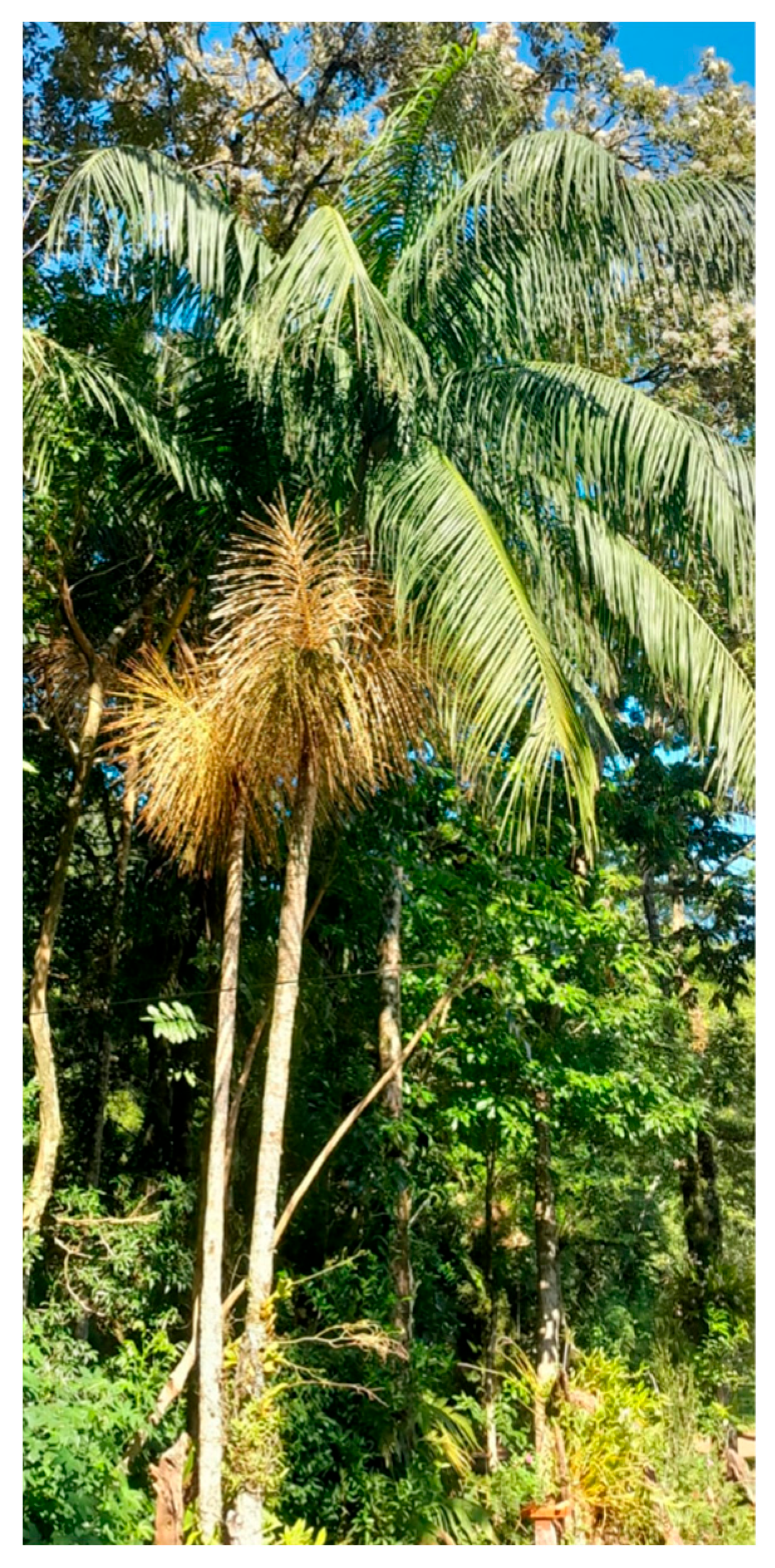
Figure 1 presents the juçara palm (Euterpe edulis) in its natural habitat in the Brazilian Atlantic Forest.

2.1. Preparation and Drying of the Pulp

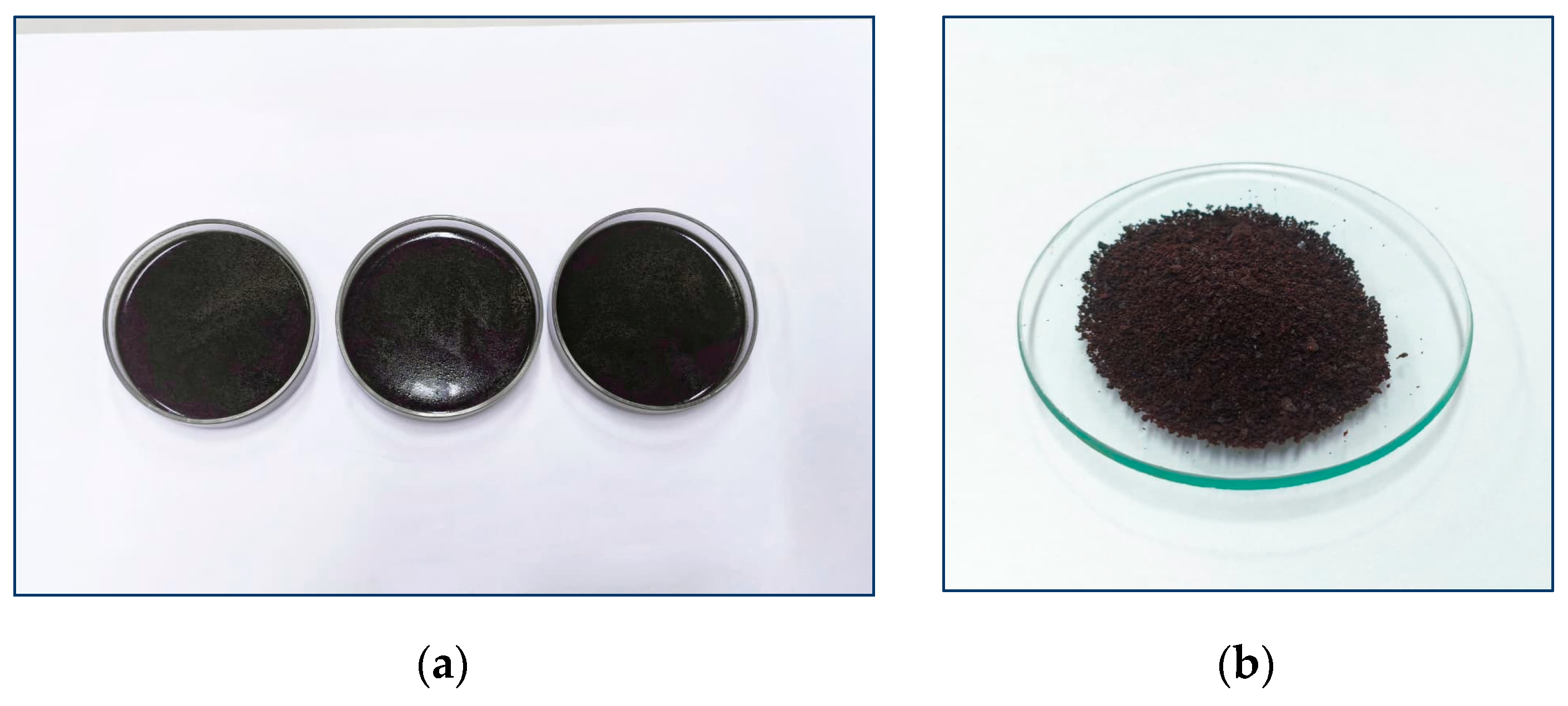
E. edulis pulp was commercially obtained in frozen form from Açaí dos Sinos, located in the municipality of Caraá, Rio Grande do Sul, Brazil. Upon receipt, the material was stored at −18 °C until the drying experiments and subsequent analyses were performed. Prior to drying, the pulp was thawed at 4 °C for 24 h and then allowed to equilibrate to room temperature. Homogenization was performed manually using a spatula and circular movements until a uniform, lump-free consistency was achieved. The endpoint of homogenization was defined by the observation of a homogeneous paste without phase separation or agglomerates. To ensure consistency among samples, all portions were processed using the same procedure, operator, and an approximate time of 3–5 min per portion. After homogenization, the pulp was divided into 15 g portions using an analytical balance and spread evenly in Petri dishes to form a uniform layer prior to the drying process. Drying was carried out in a forced-air circulation oven (Quimis model RT, Brazil) at three different temperatures (45, 65, and 85 °C), with a constant air velocity of 1.0 m/s. Samples were removed at predetermined time intervals of 10, 30, 40, 60, 70, 80, 100, 120, 140, 180, 240 and 300 min. The dried material was removed from the Petri dishes using spatulas, manually ground to obtain a powder, and stored in glass containers in a refrigerator for subsequent moisture and total phenolic content determination. Figure 2 shows the pulp before (Figure 2a) and after drying (Figure 2b).

2.2. Characterization of the Dried Pulp

2.2.1. Moisture Content

Moisture content was determined by the oven-drying method. Approximately 0.5 g of previously dried pulp was weighed into porcelain evaporation capsules previously dried and tared using an analytical balance. The samples were dried in an oven at 105 °C for 1 h, cooled to room temperature in a desiccator, and weighed. The drying, cooling, and weighing cycle was repeated until constant mass was achieved. Moisture content was expressed as a percentage (%) and subsequently converted to a dry basis. All analytical determinations were performed in triplicate, with results expressed as the mean ± standard deviation.

2.2.2. Determination of Total Phenolic Content

Total Phenolic Content was determined according to AOAC Method 9110 [28], with minor modifications. Two different sample masses were used depending on the moisture level of the pulp: (a) 1.2 g for samples with higher moisture content (above 60%) and (b) 0.025 g for samples with lower moisture content (below 60%). Each sample was extracted with 15 mL of a hydroalcoholic solution composed of 70% methanol (Êxodo Científica, Brazil) and 30% distilled water (v/v), followed by homogenization in an ultrasonic bath (Eco-sonics, Brazil) for 5 min. After extraction, 10 mL aliquots were transferred to Falcon tubes and centrifuged (FANEM, Excelsa II, Brazil) at 5000 rpm for 10 min. A total of 50 µL was removed from this solution and placed in a 5 mL flask, to which 250 µL of Folin–Denis reagent, 500 µL of sodium carbonate (Êxodo Científica, Brazil) solution (10%) were added and completed with distilled water. The samples were vortexed and kept at rest, protected from light for 30 min. The absorbance of the samples was read using a spectrophotometer (Dinâmica, Brazil) at a wavelength of 760 nm. Total phenolic content was quantified using a gallic acid calibration curve, and the results were expressed as mg gallic acid equivalents (GAE)/g of sample. All analytical determinations were performed in triplicate, with results expressed as mean ± standard deviation.

2.3. Mathematical Modeling and Statistical Analysis

With regard to mathematical modeling, parameter estimation was performed using the experimental data for drying models and for a first-order kinetic model representing total phenolic degradation.
From the perspective of drying models, it is common to express moisture in the form of a moisture ratio, defined as follows [18]:
M R = M t M e M 0 M e ,
where Mt is the moisture (dry basis) at instant t, M0 is the initial moisture and Me is the moisture at equilibrium. Since the value of Me is small, the above expression can be approximated as MR   Mt/M0.
In this context, several drying models commonly found in the literature were evaluated for fitting the experimental data, according to Table 1.
The following statistical indicators were used to evaluate the models [17,35]:
R 2 = 1 i = 1 N ( M R exp , i M R c a l c , i ) 2 i = 1 N ( M R exp , i M R ¯ ) 2 ,
χ 2 = i = 1 N ( M R exp , i M R c a l c , i ) 2 N z ,
and
R M S E = 1 N i = 1 N M R c a l c , i M R exp , i 2 1 2 .
In these expressions, R2 is the coefficient of determination, χ 2 is the reduced chi-squared statistic and RMSE stands for the root mean square error, and furthermore, the subscripts “calc” and “exp” refer, respectively, to the calculated and experimental information, N is the number of experimental points, z is the number of parameters of the model, and M R ¯ is the mean value of the moisture ratios.
With regard to the degradation kinetics of phenolic compounds, a first-order reaction is considered; therefore, the concentration Ci of phenolics at a given instant t is given by:
C i =   C i , 0 exp ( k t ) .
where C i , 0 is the initial phenolic concentration and k is the kinetic constant. Thus, C i , 0 and k can be estimated using experimental data.
Following an Arrhenius-type expression, the value of k can be expressed by:
k = k 0 exp E a R T .
where Ea is the activation energy for the total phenolic degradation, R is the universal gas constant, k0 is called the “frequency factor”, and T is the absolute temperature (Kelvin). This expression can be linearized, as follows:
l n ( k ) = l n ( k 0 ) E a R T .
Thus, the values of k0 and activation energy can be obtained by linear regression from a set of k values for different temperatures.
Parameter estimation and statistical analyses were conducted using R (version 4.1.2) in conjunction with RStudio (version 2026.01.0), as well as Scilab (version 2026.0.0). In the R environment, nonlinear least-squares regression was performed using the nlsLM function, which implements the Levenberg–Marquardt algorithm for parameter optimization. In Scilab, parameter estimation was carried out using the leastsq function, which employs a quasi-Newton optimization approach.

3. Results

3.1. Moisture Content Analysis

The experiments were conducted at three different temperatures (45, 65, and 85 °C), with a temperature variation of ±1.5 °C. The experimental results exhibited textures ranging from a viscous liquid to a completely dried layer with a dark purple coloration.
Table 2 presents the moisture content (% ±SD) results on a wet basis, experimentally obtained at different temperatures and drying times. The initial moisture content (wet basis) of the juçara pulp was 97.3%, which is considered high, although it is commonly observed in commercial pulps. Similar moisture values for Euterpe edulis pulp have been reported by other authors [36,37]. As reported in previous studies [38], moisture contents exceeding 92% (wet basis) in evaluated pulps suggest excessive water addition during the pulping process. This variability in moisture content hampers direct comparisons among different studies.
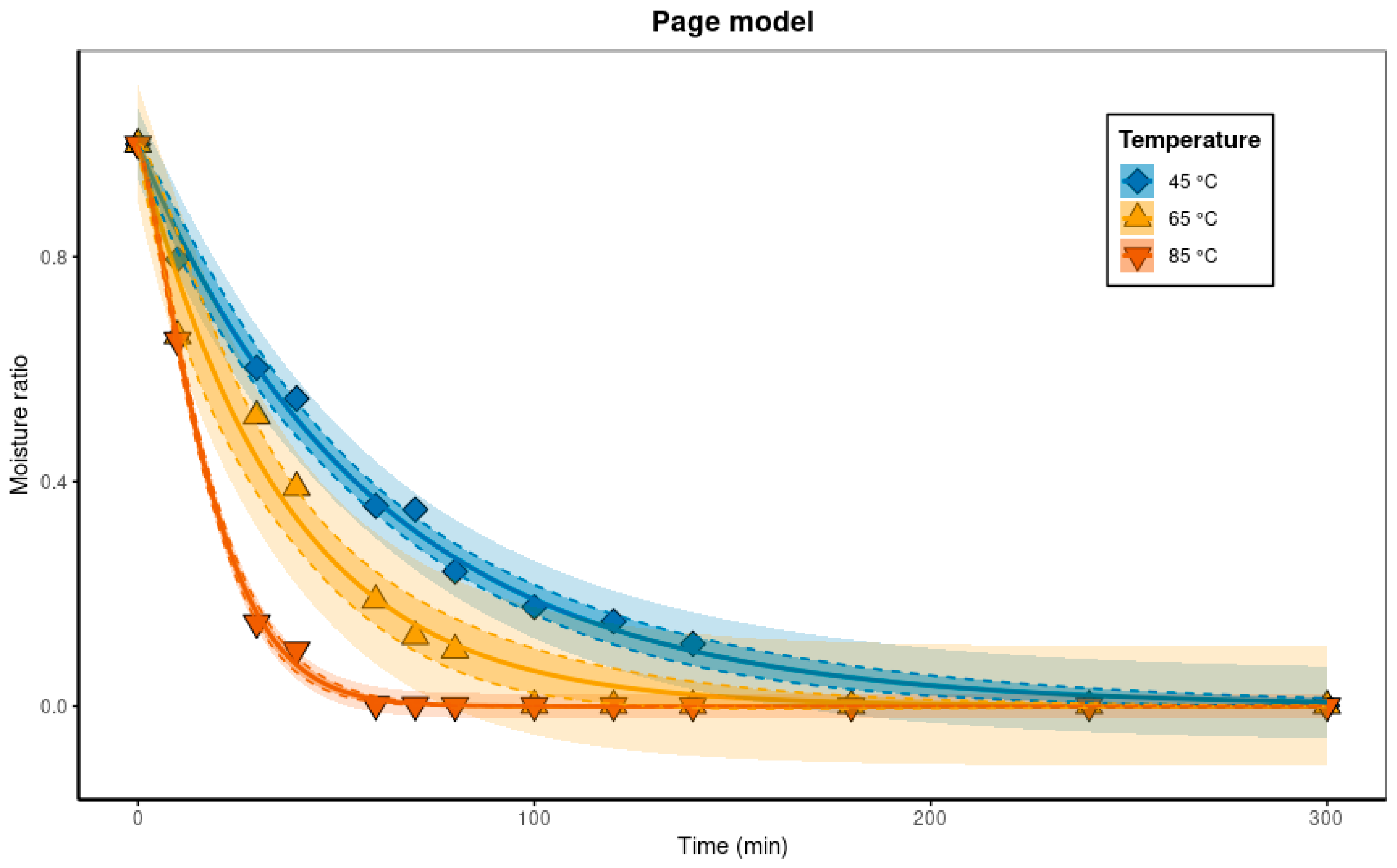
The data in Table 2 are used to adjust the different drying models presented in Table 1, using the moisture ratio as MR   Mt/M0. The statistical performance indices (coefficient of determination, R2; reduced chi-square, χ2; and root mean square error, RMSE) obtained from fitting the moisture ratio data to the Newton, Henderson and Pabis, Page, Logistic, Midilli et al., and Two-term models are presented in Table 3, using the leastsq function of Scilab. Overall, all models provided a satisfactory description of the experimental drying data, as evidenced by high R2 values and low χ2 and RMSE values, particularly at 85 °C.
Regarding the coefficient of determination (R2), the Two-term model consistently exhibited slightly better statistical performance compared with the other models across all temperatures, while also demonstrating excellent agreement based on the chi-square and RMSE criteria. In contrast, notable difficulties were encountered in the parameter estimation of the Two-term model. The results reported for this model in Table 3 are obtained in the Scilab environment using the following initial parameter estimates: [a, k0, b, k1] = [1.5, 0.8, 1, 1]. When alternative initial estimates were employed—for instance, [a, k0, b, k1] = [1.1, 0.01, −0.15, 0.006]—the optimization procedure converged to substantially different parameter values while yielding similar goodness-of-fit indicators, including the coefficient of determination R2, chi-square, and root mean square error (RMSE). Moreover, in the R environment, the application of the nlsLM function resulted in convergence failures for the Two-term model, even when multiple sets of initial parameter values were tested. This situation suggests the presence of non-identifiability, a well-known issue in models involving sums of exponential terms, wherein distinct parameter combinations can produce nearly indistinguishable model responses [39,40,41]. Given the limitations identified for the Two-term model, subsequent analyses focus on the Midilli et al. and Page models, which are commonly employed in drying kinetics.
Table 4 reports the estimated parameters of the Midilli et al. model for drying temperatures of 45, 65, and 85 °C. It is noteworthy that the parameter b assumes a very small magnitude for all temperatures, indicating a limited contribution of the linear term to the overall drying behavior.
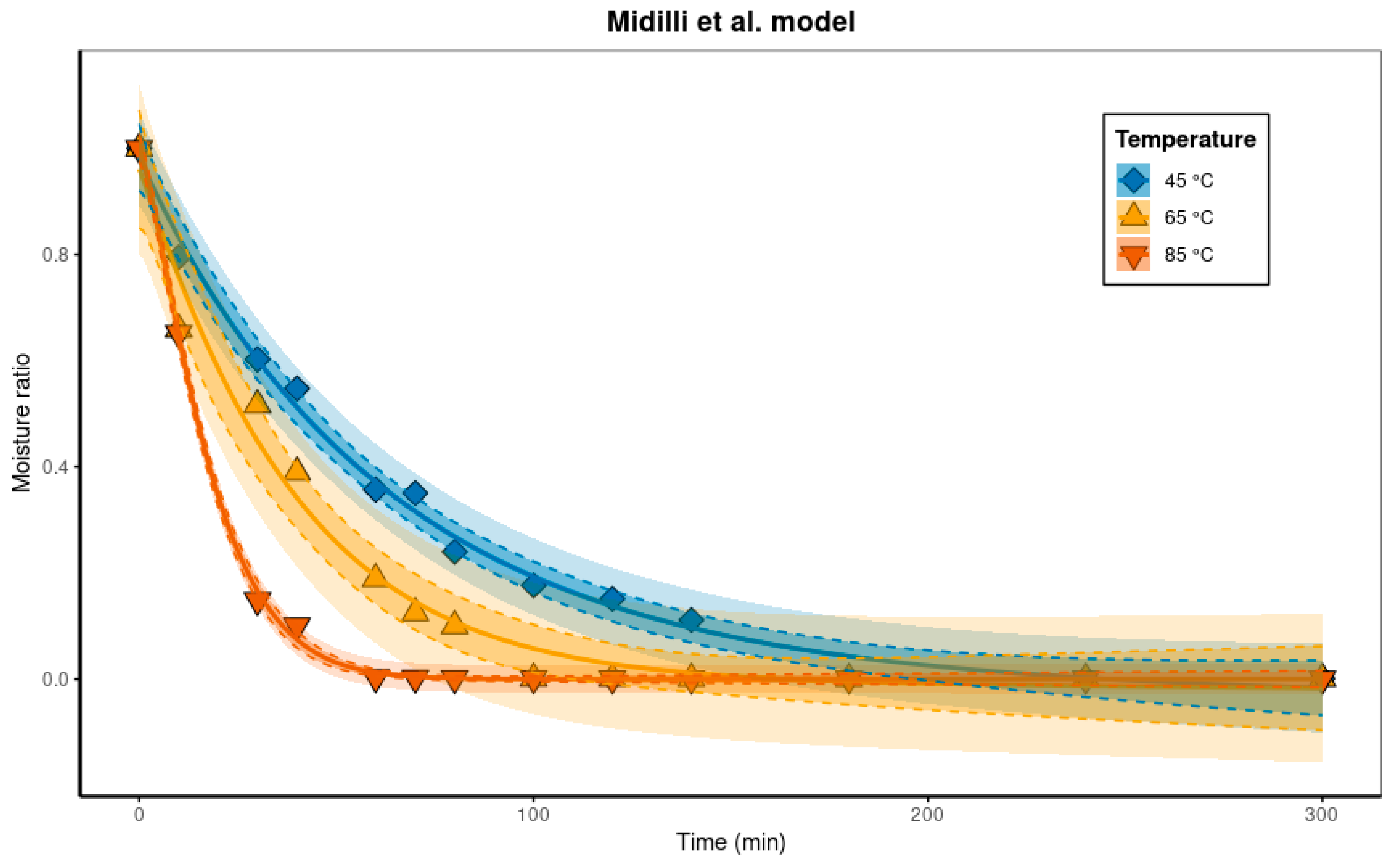
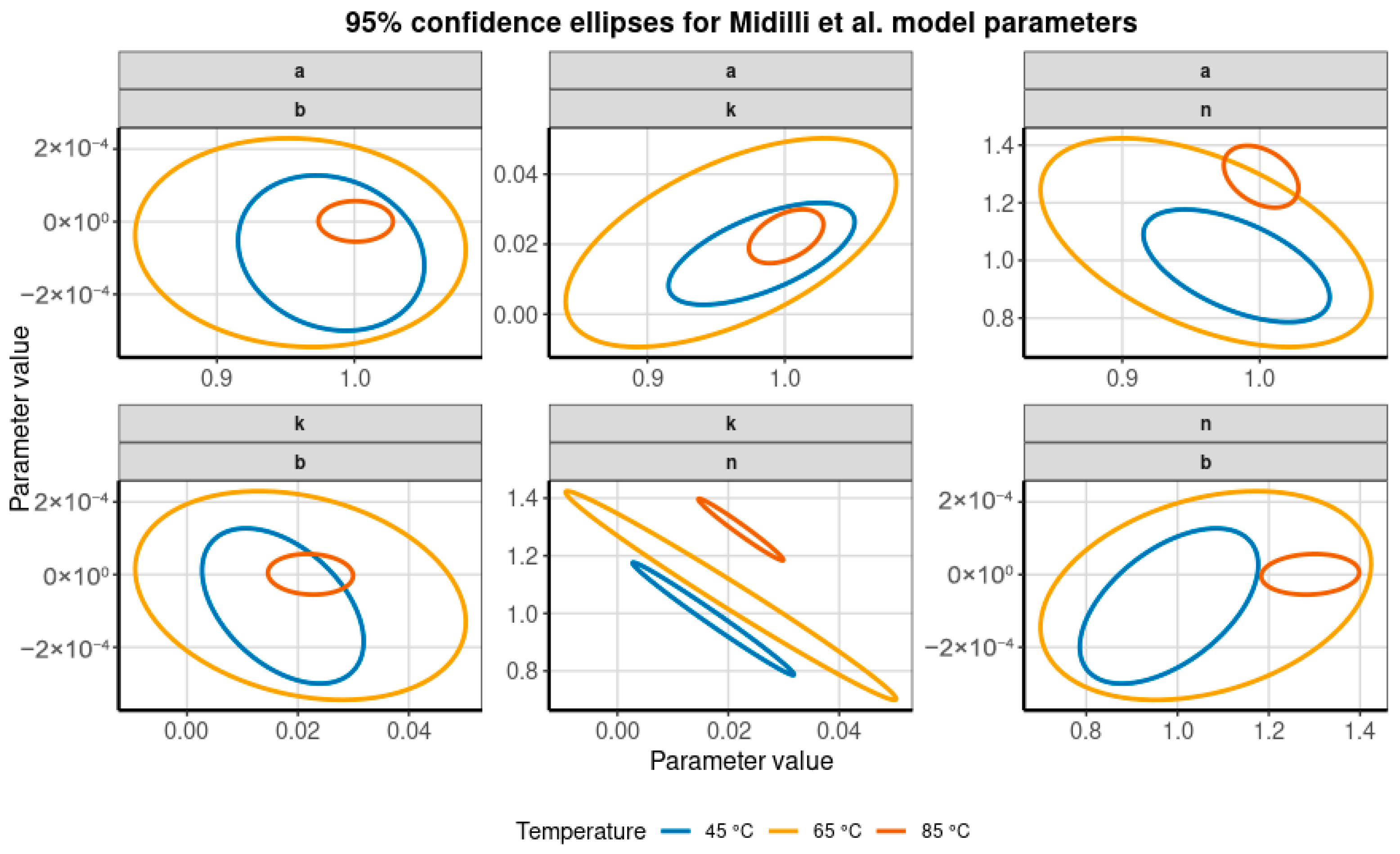
Figure 3 shows the Midilli et al. model results and experimental data with confidence (95%) and prediction bands (95%), represented as shaded regions. The inner (dashed) bands represent the 95% confidence bands, and the outer bands correspond to the 95% prediction bands. The confidence ellipses for the parameter pairs of the Midilli et al. model are presented in Figure 4. The marked elongation of the ellipses associated with the parameters k and n reveals a strong correlation between them.
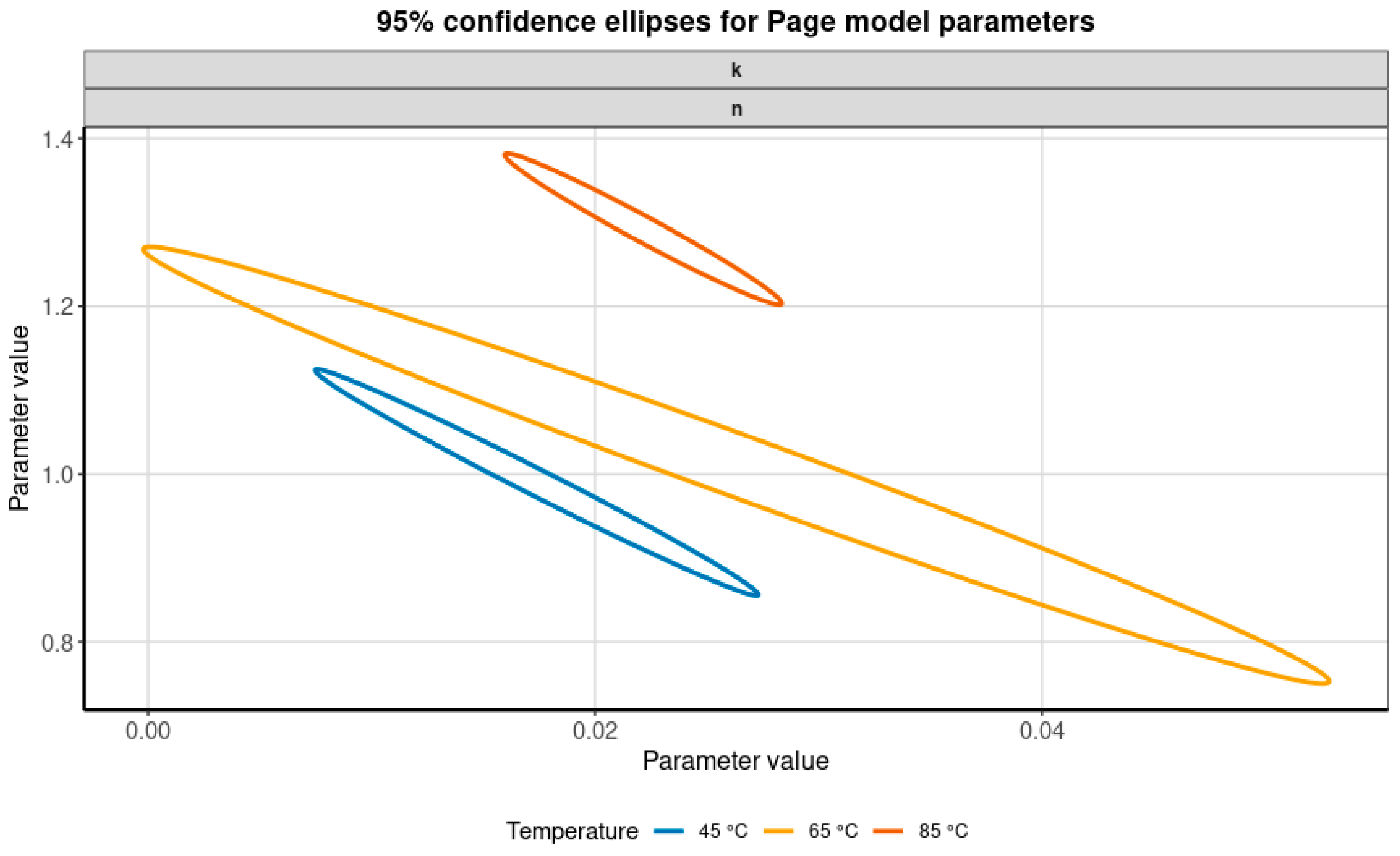
The estimated parameters for the Page model are presented in Table 5. The moisture profiles (with confidence and prediction bands) for the Page model and the confidence ellipses for the different temperatures are shown in Figure 5 and Figure 6, respectively. As with the model by Midilli et al., the Page model also shows a strong correlation between the parameters k and n.

3.2. Total Phenolic (TP) Content Analysis

Euterpe edulis pulp exhibits a high content of phenolic compounds, which are responsible for its characteristic coloration and several activities associated with the fruit [8].
Given the importance of these metabolites to the functional value of the pulp, understanding their behavior during drying is essential, as their stability and preservation directly affect the potential applications of the final product. Table 6 presents the total phenolic content determined throughout the drying process at different times and at three distinct temperatures, allowing evaluation of the impact of processing conditions on phenolic compound retention.
Fresh pulp exhibited a total phenolic content of 22.53 mg GAE/g (dry basis), which was used as a reference to assess the effects of the different drying conditions.
The total phenolic concentration data were fitted to a first-order kinetic degradation model, as described by Equation (5). Two fitting strategies can be adopted: estimating both Ci,0 and k, or fixing Ci,0 and estimating only the parameter k.
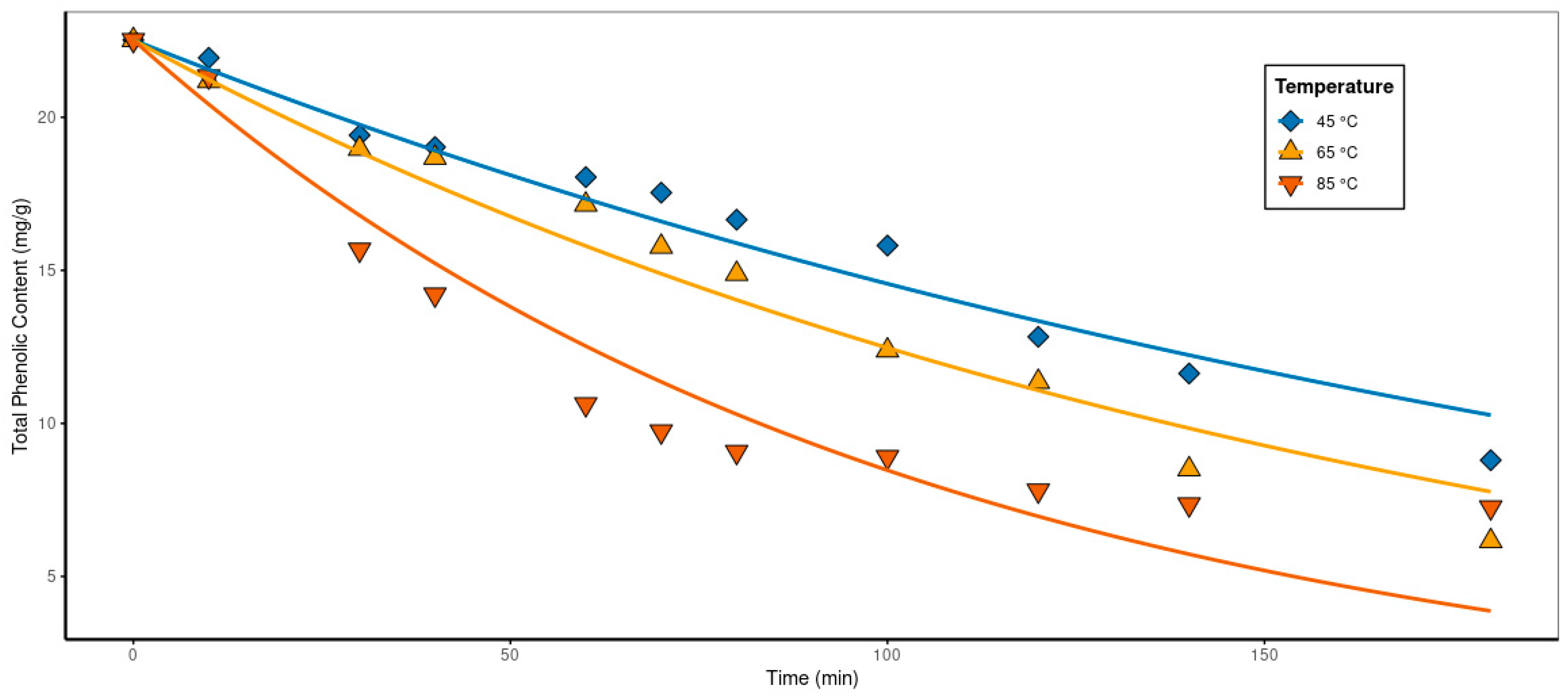
Assuming that Ci,0 is known, the coefficients of determination obtained for the datasets at 45, 65, and 85 °C were 0.9695, 0.9754 and 0.9309, respectively. The lower fitting quality observed at 85 °C is consistent with the phenolic concentration measured at 140 and 180 min (values very close to those observed at 65 °C). The estimated values of k are 0.0043615 ± 0.0002029 min−1 (45 °C), 0.0059130 ± 0.0002766 min−1 (65 °C) and 0.0097803 ± 0.0007132 min−1 (85 °C). Using the estimated values of k and Equation (7), the Arrhenius parameters were determined as k0 = 5.500125 min−1 and Ea = 19,010.72 J mol−1, with R2 = 0.9696. Figure 7 shows the total phenolic content profiles predicted by the first-order model.
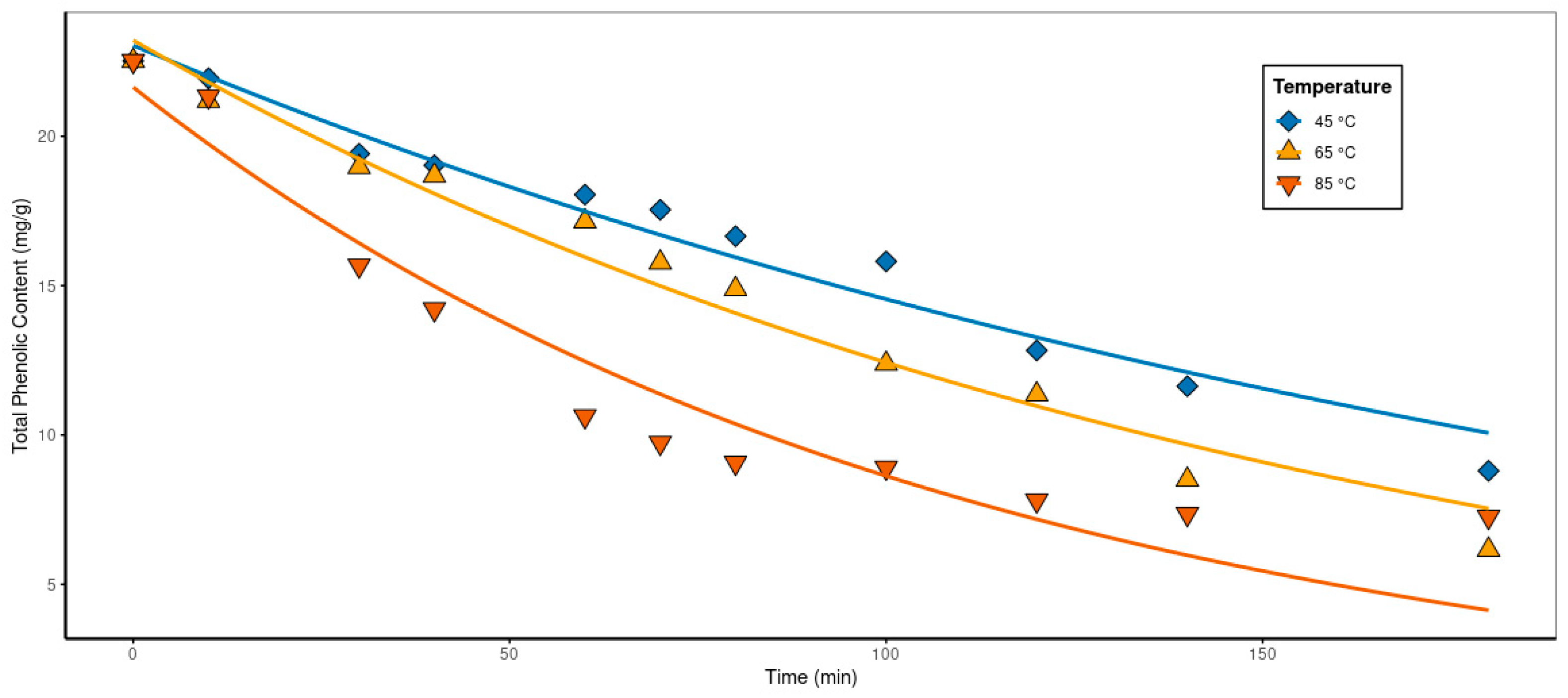
Figure 8 presents the total phenolic concentration profiles obtained by fitting the model while also estimating Ci,0. As a result, the predicted curves originate from different initial concentration values, reflecting the effect of treating Ci,0 as an adjustable parameter. The estimated values of Ci,0 and k are summarized in Table 7. Based on the k values reported in Table 7, the Arrhenius parameters were determined as k0 = 2.186438 min−1 and Ea = 16,354.52 J mol−1, with R2 = 0.9899.

4. Discussion

In Brazil, there is no specific legislation regulating pulps derived from E. edulis. However, the Brazilian Health Regulatory Agency (ANVISA) recommends applying the legislation established for açaí pulp (Euterpe oleracea Mart.), according to Normative Instruction No. 01 of 7 January 2000, issued by the Brazilian Ministry of Agriculture, Livestock and Food Supply (MAPA), which defines the characteristics and quality parameters for fruit pulps. According to this regulation, thin or popular açaí pulp (Type C) is obtained by water addition followed by filtration and must present a total solids content between 8% and 11%, resulting in a product of lower density. Based on these parameters, the samples evaluated in this study exhibited moisture contents above the recommended limits, indicating possible dilution beyond acceptable levels. Therefore, the results should be interpreted in light of the relatively high water content of the samples, which may have influenced the measured properties.
Regarding the drying process, only a slight moisture loss was observed during the first 10 min for all temperatures evaluated, with a reduction below 1.4% and no significant differences among treatments. However, after 30 min, drying at 85 °C resulted in a pronounced moisture reduction, reaching 12.8%. For drying at 65 °C, a comparable reduction (~10%) was observed only after 60 min, whereas at 45 °C, this reduction occurred only after approximately 100 min.
These results indicate that higher temperatures promote faster moisture removal. After 100 min, the two highest temperatures (85 and 65 °C) resulted in moisture reductions exceeding 90% of the initial content, while at 45 °C the reduction over the same period was only 10.6%. Drying at 45 °C achieved a moisture reduction greater than 90% only after approximately 180 min.
Mass transfer during drying is influenced by the physical properties of the material, temperature, and initial moisture content. Heat transfer, in turn, is determined by air temperature, moisture, airflow rate and direction, as well as the exposed surface area of the solid [42]. In this study, the controlled variables were drying air temperature and exposure time.
Thus, it is confirmed that higher drying temperatures allow moisture content to be reached in shorter times. Consequently, the drying curves become steeper: at 85 °C, 60 min were required for the sample to reach a moisture content close to 10%, whereas at 65 °C this value was achieved after approximately 100 min, and at 45 °C only after 180 min.
With regard to the drying models, it was found that the two-term model generally presented higher R2 values and lower chi-square and RMSE values compared with the other models evaluated (although, in general, the adjustments for all models were very good), as already mentioned. Considering the issues of non-identifiability of the two-term model and the numerical problems in the estimation process, other models should be considered as alternatives for the present problem—especially if we consider that all models showed excellent fits to the experimental data. In this sense, both the Midilli et al. and Page models yielded similar values for the statistical performance indicators. Nevertheless, the Midilli et al. model employs four adjustable parameters, in contrast to the two parameters of the Page model. For both formulations, a strong correlation between the parameters k and n was observed, highlighting limitations in the independent interpretation of these parameters. Finally, it should be noted that parameter b in the Midilli et al. model presented extremely low values, pointing to the insignificance of the term bt in the model (obviously, for the problem in question).
During the first 10 min of drying, a relatively small reduction in total phenolics (TP), below 6%, was observed regardless of the temperature applied. This behavior suggests that, during the initial drying stage, when moisture removal was similar across the three thermal conditions, the TP values remained comparable. This result contrasts with the findings of other studies (on other fruit pulps) [18], which reported greater initial TP losses at higher drying temperatures.
After 30 min, drying at 85 °C resulted in significantly higher losses (~30%) compared with the other temperatures, which remained below 16%. This pronounced reduction may be attributed to increased thermal stress imposed on more thermolabile phenolic compounds. For drying at 45 and 65 °C, similar losses (~30%) were observed only at later times, after 100 and 80 min, respectively, indicating greater stability of these compounds under less severe thermal conditions.
From 100 min onward, drying at 65 and 85 °C exhibited very similar losses, around 60%, which persisted up to 180 min. This convergence suggests that, after a certain degree of moisture reduction, TP degradation occurs in a similar manner, regardless of the thermal intensity applied. This behavior coincides with the point at which drying at 65 °C exhibited a sharp decrease in moisture content, reinforcing the relationship between water removal and phenolic degradation.
In contrast, drying at 45 °C resulted in TP losses exceeding 50% only after 180 min, which coincided with a marked reduction in moisture content. This finding indicates that moisture reduction exerts a more decisive influence on TP concentration than total drying time, particularly under milder temperature conditions.
Overall, these results indicate that degradation of phenolic compounds during drying is associated not only with direct thermal effects but also with structural transformations of the food matrix. During drying, four main factors contribute to the degradation of organic compounds: (i) high temperature and prolonged heat exposure accelerate degradation reactions [43]; (ii) exposure to oxygen during drying and the high reducibility of these bioactive compounds promote oxidative degradation [44]; (iii) removal of hydration water, which normally protects reactive molecular sites; and (iv) structural changes in the pulp that increase the exposure of reactive sites [45]. The combined effect of these factors favors oxidative and degradation reactions, intensifying phenolic losses throughout the drying process. Studies have demonstrated that phenolic compounds are highly sensitive to thermal processing, particularly under prolonged heat exposure, which can lead to structural degradation, oxidation, and polymerization [46,47,48]. The observed reduction in phenolic content during drying may also be attributed to interactions between polyphenols and other macromolecules, as well as to chemical modifications that alter their extractability and hinder their accurate quantification by conventional analytical methods. Moreover, the rate and conditions of dehydration play a critical role in determining the extent of these changes, as faster or milder drying may better preserve phenolic stability.
In general, the results of this study indicates that TP degradation is more closely related to physical and structural changes induced by moisture removal than to heat exposure time alone. Therefore, dehydration kinetics play a central role in determining the stability of phenolic compounds during the drying process.
Considering the two approaches adopted for estimating the activation energy, the values obtained were Ea = 19.01 and Ea = 16.35 kJ mol−1. These values are of the same order of magnitude as those reported in the literature for the thermal degradation of phenolic compounds and anthocyanins in fruit pulps. In particular, an activation energy of 24.16 kJ mol−1 has been reported for anthocyanin inactivation in açaí berry pulp [49].
An important point to consider in this study is the correlation between moisture, expressed as moisture ratio, and total phenolic content, as discussed in the literature [50].
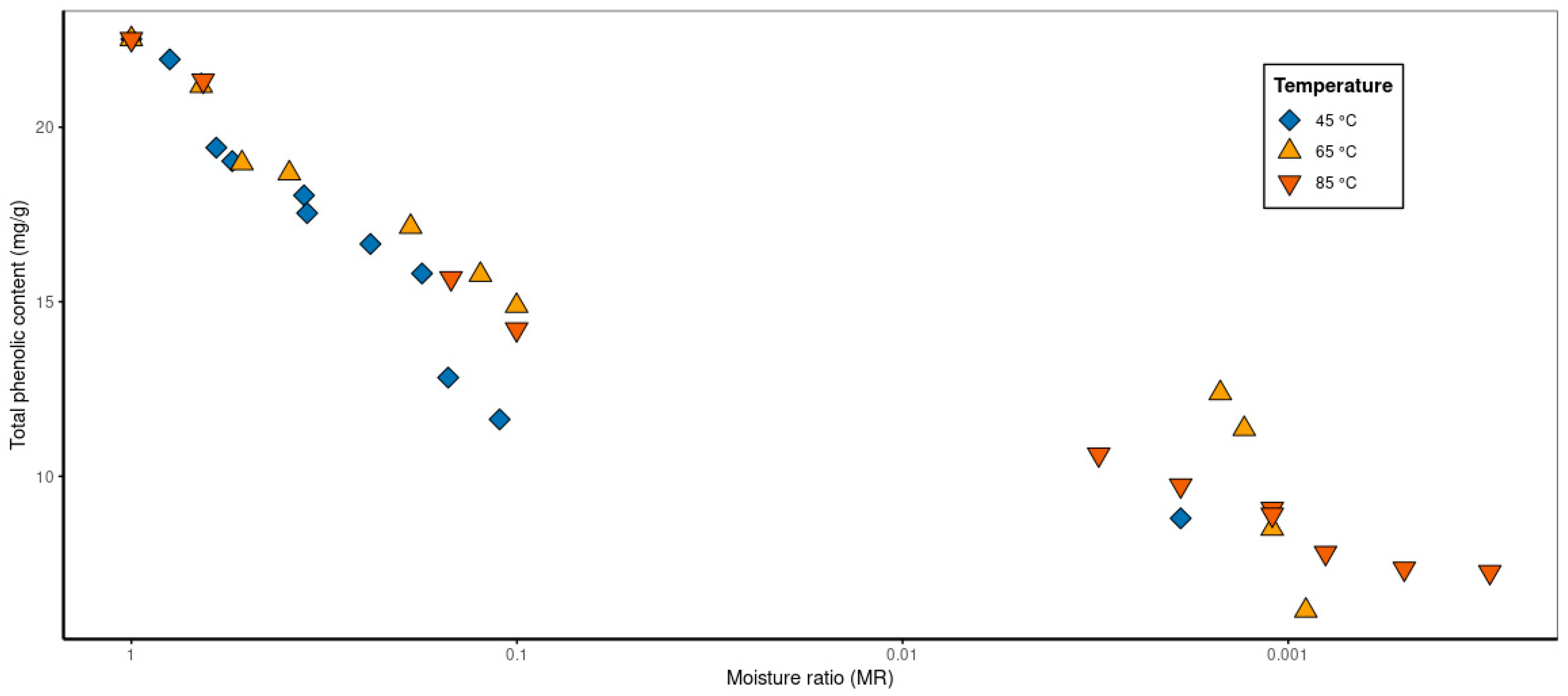
Figure 9 shows the correlations between moisture ratio values and total phenolic content for temperatures of 45, 65, and 85 °C. It should be clear that these results must be analyzed carefully—and should not be extrapolated to other experimental conditions—since moisture (represented by the moisture ratio) and total phenolic content vary over time and depend on other factors. On the other hand, they can provide useful insights into the conditions of the experiment. In this sense, the data presented for each temperature in Figure 9 should be understood as a “Pareto curve” (used here in a descriptive, not optimization-based, sense) or a multi-criteria compromise region, where there are two conflicting objectives—reducing moisture and maintaining phenolic content. It is clear (especially from the data at 65 °C) that at the end of the process there is an abrupt decrease in phenolic content with virtually constant moisture values. This situation can be explained by the fact that the drying process has already reached equilibrium moisture content (and is essentially complete), while the degradation of phenolics is still occurring. The results in Figure 9 indicate that it is possible to obtain, for example, a dry pulp with MR values close to 10−3 while maintaining the phenolic content at around 10–12 mg/g at 65 °C. Drying values at 45 °C and 85 °C, for the same MR value, generate lower phenolic contents. Multi-objective approaches, including Pareto curves and surfaces, have been applied to drying problems [51].
A direct comparison with results obtained using other drying techniques is challenging due to the variability in fresh pulp characteristics and the broad range of operating conditions reported in the literature. Nevertheless, some contextual considerations can be drawn. For example, a recent study [52] reported total phenolic retention above 80% when drum drying was applied (residence time of 20 s at 135 °C) for the production of juçara flakes. In another study [53], the production of “pure” juçara powder (without carrier agents) using a laboratory-scale spray dryer resulted in approximately 90% retention of total phenolic compounds, with inlet and outlet air temperatures of 160 °C and 86 °C, respectively.
In the present study, considering the experiments conducted at 65 °C, approximately 50% of the total phenolics were preserved, with a final moisture content on the order of 10−3. Although this retention is lower than the values reported for drum and spray drying, it should be interpreted in light of the distinct raw material characteristics and processing conditions. Another relevant aspect concerns process yield. Oven drying may provide higher powder yields than spray drying, particularly at laboratory-scale. For instance, in chamomile drying [54], powder yields of around 90% were reported for oven drying, whereas spray drying under comparable laboratory conditions resulted in yields below 30%. Specifically for juçara, spray drying applied to microencapsulation of the pulp has been reported to produce yields ranging from 21.5% to 53.1% [55], depending on formulation and operating parameters.
It is also important to note that commercial (frozen) pulp was used in the present study. There is evidence that freezing time may reduce total phenolic content by approximately 30% [56]. Moreover, the initial moisture content of the pulp suggests that water may have been added prior to processing, which could further dilute phenolic concentrations and help explain the lower total phenolic values observed here compared with those reported in other studies [53].
One limitation of the present study is the absence of an evaluation of the long-term storage stability of dried juçara pulp powder. Bioactive compounds such as anthocyanins and other phenolic constituents are known to be susceptible to degradation during storage, particularly as a function of temperature, oxygen availability, light exposure, and residual moisture content [57]. In this sense, future research will include storing the dried pulp for a period of 12 months (under different conditions) to assess the maintenance of phenolic compounds and physical properties. In addition, investigations into the application of dry pulp in different food matrices, such as fortification of juices, yogurts, and baked goods, may provide information on interactions with other ingredients and retention of bioactive compounds during processing. Further investigations should evaluate different drying techniques (such as fluidized bed drying, spray drying, or vacuum drying) and pre-treatments to preserve phenolic compounds, with a special focus on anthocyanins and color stability.
It is also important to emphasize that phenolic compounds, sugars, and other constituents of juçara pulp do not exist as isolated entities, but rather as components of a complex and interactive food matrix. Chemical and physical interactions among these constituents may influence the stability and degradation behavior of bioactive compounds during the dehydration process. Considering that the present study exclusively evaluated phenolic compounds, the absence of an integrated matrix-based approach represents a limitation. Therefore, future, more comprehensive investigations may contribute to a better understanding of the interactions among pulp constituents and their effects on the stability of phenolic compounds during dehydration.


5. Conclusions

The drying of Euterpe edulis pulp in an air-circulating oven, as an alternative to extending the shelf life of the fruit, proved to be effective in reducing moisture content while preserving phenolic compounds. An increase in temperature significantly accelerated the drying kinetics, resulting in shorter processing times. Among the evaluated conditions, drying at 65 °C for 100 min was the most balanced, as it enabled the production of dry pulp in powder form with suitable moisture content and satisfactory retention of phenolic compounds, with no significant differences compared to drying at 85 °C. Although drying at 85 °C for 60 min promoted faster moisture removal, higher temperatures tended to intensify the degradation of phenolic compounds over time. Therefore, the results indicate that drying at 65 °C represents, an appropriate condition, for instance, for process optimization, providing a balance between operational efficiency and the preservation of bioactive compounds and contributing to the technological and commercial valorization of Euterpe edulis fruit.

Author Contributions

Conceptualization, H.C.R.R., G.M.P. and N.F.d.M.; methodology, H.C.R.R., G.M.P., M.H.O.d.S. and N.F.d.M.; software, H.C.R.R. and G.M.P.; validation, H.C.R.R., G.M.P., M.H.O.d.S. and N.F.d.M.; formal analysis, H.C.R.R., G.M.P., M.H.O.d.S. and N.F.d.M.; investigation, H.C.R.R., G.M.P., M.H.O.d.S. and N.F.d.M.; resources, H.C.R.R., G.M.P., M.H.O.d.S. and N.F.d.M.; data curation, H.C.R.R. and N.F.d.M.; writing—original draft preparation, H.C.R.R., G.M.P., M.H.O.d.S. and N.F.d.M.; writing—review and editing, H.C.R.R., G.M.P., M.H.O.d.S. and N.F.d.M.; visualization, H.C.R.R., G.M.P., M.H.O.d.S. and N.F.d.M.; supervision, G.M.P. and N.F.d.M.; project administration, N.F.d.M.; funding acquisition, N.F.d.M. All authors have read and agreed to the published version of the manuscript.

Funding

This research was financed by the Coordenação de Aperfeiçoamento de Pessoal de Nível Superior (CAPES), Brazil (Finance Code 001) (Hans R. Ramires and Matheus H. O. de Sousa), and by the Conselho Nacional de Desenvolvimento Científico e Tecnológico (CNPq), Brazil (Gustavo M. Platt, process number 309386/2025-0).

Data Availability Statement

The data supporting the findings of this study are fully contained within the article.

Acknowledgments

The authors acknowledge the Coordenação de Aperfeiçoamento de Pessoal de Nível Superior (CAPES), Brazil (Finance Code 001), for the scholarships granted to Hans R. Ramires and Matheus H. O. de Sousa. Gustavo Mendes Platt acknowledges the Conselho Nacional de Desenvolvimento Científico e Tecnológico (CNPq), Brazil, for the Research Productivity Fellowship (PQ, Level C), process number 309386/2025-0.

Conflicts of Interest

The authors declare no conflicts of interest.

References

  1. Cosme, F.; Pinto, T.; Aires, A.; Morais, M.C.; Bacelar, E.; Anjos, R.; Ferreira-Cardoso, J.; Oliveira, I.; Vilela, A.; Gonçalves, B. Red Fruits Composition and Their Health Benefits—A Review. Foods 2022, 11, 644. [Google Scholar] [CrossRef]
  2. Petry, H.B.; Baratti, A.C.C.; Brighenti, A.F.; Gonzatto, M.P.; Citadin, I.; Souza, A.L.L. Brazilian Fruit Agribusiness. Fruit. Crop. Sci. J. 2025, 1, e-001. [Google Scholar] [CrossRef]
  3. Laurindo, L.F.; Barbalho, S.M.; Araújo, A.C.; Guiguer, E.L.; Mondal, A.; Bachtel, G.; Bishayee, A. Açaí (Euterpe Oleracea Mart.) in Health and Disease: A Critical Review. Nutrients 2023, 15, 989. [Google Scholar] [CrossRef] [PubMed]
  4. De Oliveira, E.P.; Ximenes, L.C.; Gama, J.R.V.; Vieira, T.A. Non-Wood Forest Product Extractivism: A Case Study of Euterpe Oleracea Martius in the Brazilian Amazon. Sustainability 2025, 17, 464. [Google Scholar] [CrossRef]
  5. Pizo, M.A.; Vieira, E.M. Palm Harvesting Affects Seed Predation of Euterpe edulis, a Threatened Palm of the Brazilian Atlantic Forest. Braz. J. Biol. 2004, 64, 669–676. [Google Scholar] [CrossRef] [PubMed]
  6. Mendes, E.; Galdino, F.; Portela, R.D.C.Q. Predicting the Impacts of Palm Heart and Fruit Harvesting Using Integral Projection Models. Front. For. Glob. Change 2022, 5, 932454. [Google Scholar] [CrossRef]
  7. Mendes, E.T.B.; Portela, R.C.Q. Balancing Harvesting and Conservation: Demographic Responses of a Threatened Palm to Anthropogenic Disturbance. Ecol. Evol. 2026, 16, e72882. [Google Scholar] [CrossRef]
  8. Pereira, D.C.d.S.; Dos Santos Gomes, F.; Valeriano Tonon, R.; Beres, C.; Maria Corrêa Cabral, L. Towards Chemical Characterization and Possible Applications of Juçara Fruit: An Approach to Remove Euterpe edulis Martius from the Extinction List. J. Food Sci. Technol. 2023, 60, 429–440. [Google Scholar] [CrossRef]
  9. Bicudo, M.O.P.; Ribani, R.H.; Beta, T. Anthocyanins, Phenolic Acids and Antioxidant Properties of Juçara Fruits (Euterpe edulis M.) Along the On-Tree Ripening Process. Plant Foods Hum. Nutr. 2014, 69, 142–147. [Google Scholar] [CrossRef]
  10. Cardoso, P.M.M.; Mazuco, R.A.; Macedo, L.S.D.; Polese, A.A.V.; Barroso, M.E.D.S.; Baratella, W.G.; Andrade, T.U.D.; Lenz, D.; Pereira, T.D.M.C.; Endringer, D.C. Nephroprotective Activity of the Enriched Polyphenol Extract of Euterpe edulis Martius. Braz. J. Pharm. Sci. 2020, 56, e18051. [Google Scholar] [CrossRef]
  11. Silva, I.C.F.D.; Costa, S.C.D.; Madrona, G.S.; Bergamasco, R.D.C. Microencapsulation by Spray Drying of Bioactive Compounds: A Comparison Between Pulp or Acidified Extract of Jussara Fruit (Euterpe edulis Martius). Plants 2025, 14, 1295. [Google Scholar] [CrossRef] [PubMed]
  12. Vannuchi, N.; Jamar, G.; Pisani, L.; Braga, A.R.C.; De Rosso, V.V. Chemical Composition, Bioactive Compounds Extraction, and Observed Biological Activities from Jussara (Euterpe edulis): The Exotic and Endangered Brazilian Superfruit. Comp. Rev. Food Sci. Food Safe 2021, 20, 3192–3224. [Google Scholar] [CrossRef]
  13. Dos Santos, M.F.; De Freitas, B.P.; De Freitas, J.S.; Lage, L.S.S.; Novo, A.A.; Kunigami, C.N.; Jung, E.P.; Ribeiro, L.O. Tropical Fruit Wastes: Physicochemical Characterization, Fatty Acid Profile and Antioxidant Capacity. Resources 2025, 14, 83. [Google Scholar] [CrossRef]
  14. Lorenzi, H. Brazilian Flora: Arecaceae (Palms), 1st ed.; Instituto Plantarum de Estudos da Flora: Nova Odessa, Brazil, 2010; Volume 1, ISBN 85-86714-36-8. [Google Scholar]
  15. Silveira, J.T.; Rosa, A.P.C.; Morais, M.G.; Victoria, F.N.; Costa, J.A.V. An integrative review of Açaí (Euterpe oleracea and Euterpe precatoria): Traditional uses, phytochemical composition, market trends, and emerging applications. Food Res. Int. 2023, 173, 113304. [Google Scholar] [CrossRef] [PubMed]
  16. Calín-Sánchez, Á.; Lipan, L.; Cano-Lamadrid, M.; Kharaghani, A.; Masztalerz, K.; Carbonell-Barrachina, Á.A.; Figiel, A. Comparison of Traditional and Novel Drying Techniques and Its Effect on Quality of Fruits, Vegetables and Aromatic Herbs. Foods 2020, 9, 1261. [Google Scholar] [CrossRef]
  17. Wray, D.; Ramaswamy, H.S. Novel Concepts in Microwave Drying of Foods. Dry. Technol. 2015, 33, 769–783. [Google Scholar] [CrossRef]
  18. Bellaver, M.; Santos, C.R.G.; Santos Diniz Freitas, M.; Platt, G.M.; Moura, N.F. Effect of Drying on Bioactive Compounds in Eugenia uniflora Fruit Pulp. J. Food Process Eng. 2024, 47, e14744. [Google Scholar] [CrossRef]
  19. Vargas, V.; Saldarriaga, S.; Sánchez, F.S.; Cuellar, L.N.; Paladines, G.M. Effects of the Spray-Drying Process Using Maltodextrin on Bioactive Compounds and Antioxidant Activity of the Pulp of the Tropical Fruit Açai (Euterpe oleracea Mart.). Heliyon 2024, 10, e33544. [Google Scholar] [CrossRef]
  20. Belkhir, S.; Abdessemed, D.; Refas, I. Impact of Drying Methods on Physicochemical Properties, Bioactive Content, and Antioxidant Activity of Opuntia Ficus-Indica Fruits. J. Food Qual. Hazards Control. 2025, 12, 46–60. [Google Scholar] [CrossRef]
  21. Onwude, D.I.; Iranshahi, K.; Rubinetti, D.; Schudel, S.; Schemminger, J.; Martynenko, A.; Defraeye, T. How Much Do Process Parameters Affect the Residual Quality Attributes of Dried Fruits and Vegetables for Convective Drying? Food Bioprod. Process. 2022, 131, 176–190. [Google Scholar] [CrossRef]
  22. Barbosa-Carvalho, A.P.P.; Da Silva Pena, R.; Chisté, R.C. Oven-Dried Cupuaçu and Bacuri Fruit Pulps as Amazonian Food Resources. Resources 2024, 13, 153. [Google Scholar] [CrossRef]
  23. Delalibera, P.; Queiroz, B.B.T.; Souza, R.L.F.M.; Araújo, R.L.; Assis, R.Q.; Abud, C.O.G.; Rios, A.O.; Pertuzatti, P.B. Unlocking the Potential of Pequi (Caryocar brasiliense Camb.): Stability of Phenolic Compounds, Carotenoid Profile and Vitamin A after Drying. Food Res. Int. 2024, 197, 115196. [Google Scholar] [CrossRef]
  24. Hadibi, T.; Mennouche, D.; Boubekri, A.; Arıcı, M.; Wang, Y.; Li, M.; Emam Hassanien, R.H.; Shirkole, S.S. Experimental Investigation, Performance Analysis, and Optimization of Hot Air Convective Drying of Date Fruits via Response Surface Methodology. Renew. Energy 2024, 226, 120404. [Google Scholar] [CrossRef]
  25. Lima, E.M.F.; Madalão, M.C.M.; dos Santos, W.C., Jr.; Bernardes, P.C.; Saraiva, S.H.; Silva, P.I. Spray-dried microcapsules of anthocyanin-rich extracts from Euterpe edulis M. as an alternative for maintaining color and bioactive compounds in dairy beverages. J. Food Sci. Technol. 2019, 56, 4147–4157. [Google Scholar] [CrossRef]
  26. Rufino, M.S.M.; Alves, R.E.; Brito, E.S.; Pérez-Jiménez, J.; Saura-Calixto, F.; Mancini-Filho, J. Bioactive compounds and antioxidant capacities of 18 non-traditional tropical fruits from Brazil. Food Chem. 2010, 121, 996–1002. [Google Scholar] [CrossRef]
  27. Frasão, B.S.; Rosario, A.I.L.d.S.; Rodrigues, B.L.; Bitti, H.A.; Baltar, J.D.; Nogueira, R.I.; Costa, M.P.d.; Conte-Junior, C.A. Impact of juçara (Euterpe edulis) fruit waste extracts on the quality of conventional and antibiotic-free broiler meat. Poult. Sci. 2021, 100, 101232. [Google Scholar] [CrossRef] [PubMed]
  28. Association of Official Analytical Chemists Official Methods of Analysis, 13th ed.; AOAC: Washington, DC, USA, 1980.
  29. Lewis, W.K. The Rate of Drying of Solid Materials. J. Ind. Eng. Chem. 1921, 13, 427–432. [Google Scholar] [CrossRef]
  30. Parti, M. Selection of Mathematical Models for Drying Grain in Thin-Layers. J. Agric. Eng. Res. 1993, 54, 339–352. [Google Scholar] [CrossRef]
  31. Simpson, R.; Ramírez, C.; Nuñez, H.; Jaques, A.; Almonacid, S. Understanding the Success of Page’s Model and Related Empirical Equations in Fitting Experimental Data of Diffusion Phenomena in Food Matrices. Trends Food Sci. Technol. 2017, 62, 194–201. [Google Scholar] [CrossRef]
  32. Biernacka, B.; Dziki, D.; Rudy, S.; Krzykowski, A.; Polak, R.; Dziki, L. Influence of Pretreatments and Freeze-Drying Conditions of Strawberries on Drying Kinetics and Physicochemical Properties. Processes 2022, 10, 1588. [Google Scholar] [CrossRef]
  33. Midilli, A.; Kucuk, H.; Yapar, Z. A new model for single-layer drying. Dry. Technol. 2002, 20, 1503–1513. [Google Scholar] [CrossRef]
  34. Henderson, S.M. Progress in Developing the Thin Layer Drying Equation. Trans. ASAE 1974, 17, 1167–1168. [Google Scholar] [CrossRef]
  35. Fufa, D.D.; Bekele, T.; Tamene, A.; Bultosa, G. Drying Kinetic Models, Thermodynamics, Physicochemical Qualities, and Bioactive Compounds of Avocado (Persea Americana Mill. Hass Variety) Seeds Dried Using Various Drying Methods. Heliyon 2025, 11, e41058. [Google Scholar] [CrossRef]
  36. Garbin, V.P.; Helm, C.V.; Pimentel, I.C.; Dalzoto, P.R. Determinação da Composição Nutricional e Sais Minerais de Frutos de Juçara (Euterpe edulis) Coletados na Região de Curitiba, PR.; Embrapa Florestas: Colombo, PR, USA, 2015. (In Portuguese) [Google Scholar]
  37. Pereira, D.C.S.; Campos, A.N.R.; Martins, E.M.F.; Martins, M.L. Utilização dos frutos da palmeira-juçara (Euterpe edulis Martius) como estratégia para conservação da espécie e alternativa de renda para o município de Rio Pomba, Minas Gerais. In Ciência e Tecnologia no Campus Rio Pomba do IF Sudeste MG: Contribuições para a Zona da Mata Mineira; IF Sudeste MG: Rio Pomba, Brazil, 2016; Volume 1, pp. 6–25. (In Portuguese) [Google Scholar]
  38. Miró, F.L.; Chiquetto, N.C. Avaliação Físico-Química Da Polpa Da Juçara, Como Ferramenta No Processo de Conservação Da Palmeira Juçara (Euterpe edulis). In Anais da 14° CONEX—Conversando sobre Extensão; Universidade Estadual de Ponta Grossa: Ponta Grossa, PR, Brazil, 2016; Available online: https://sites.uepg.br/conex/anais/anais_2016/anais2016/1282-4991-1-PB-mod.pdf (accessed on 6 March 2026). (In Portuguese)
  39. Endrenyi, L. Kinetic models: Uncertain identification but some robust parameters. In Mathematical and Computational Methods in Physiology; Elsevier: Amsterdam, The Netherlands, 1981; pp. 205–213. ISBN 978-0-08-027356-3. [Google Scholar]
  40. De Groen, P.; De Moor, B. The Fit of a Sum of Exponentials to Noisy Data. J. Comput. Appl. Math. 1987, 20, 175–187. [Google Scholar] [CrossRef]
  41. Chis, O.-T.; Villaverde, A.F.; Banga, J.R.; Balsa-Canto, E. On the Relationship between Sloppiness and Identifiability. Math. Biosci. 2016, 282, 147–161. [Google Scholar] [CrossRef] [PubMed]
  42. Baidhe, E.; Clementson, C.L.; Hellevang, K.; Zhulu, L. Comprehensive Analysis of Drying Kinetics, Heat and Mass Transfer, and Thermodynamic Properties in High-Temperature Drying of High-Moisture Corn. J. Food Process Eng. 2025, 48, e70159. [Google Scholar] [CrossRef]
  43. Dadhaneeya, H.; Kesavan, R.K.; Inbaraj, B.S.; Sharma, M.; Kamma, S.; Nayak, P.K.; Sridhar, K. Impact of Different Drying Methods on the Phenolic Composition, In Vitro Antioxidant Activity, and Quality Attributes of Dragon Fruit Slices and Pulp. Foods 2023, 12, 1387. [Google Scholar] [CrossRef]
  44. ElGamal, R.; Song, C.; Rayan, A.M.; Liu, C.; Al-Rejaie, S.; ElMasry, G. Thermal Degradation of Bioactive Compounds during Drying Process of Horticultural and Agronomic Products: A Comprehensive Overview. Agronomy 2023, 13, 1580. [Google Scholar] [CrossRef]
  45. Li, Q.; Chai, J.; Deng, S.; Xu, J.; Feng, Y.; Yang, R.; Li, W. The Comparison of the Profile of Phenolic Compounds in Noni (Morinda Citrifolia L.) Fruit by Different Drying Methods. Foods 2025, 14, 1398. [Google Scholar] [CrossRef]
  46. Snoussi, A.; Essaidi, I.; Ben Haj Koubaier, H.; Zrelli, H.; Alsafari, I.; Živoslav, T.; Mihailovic, J.; Khan, M.; El Omri, A.; Ćirković Veličković, T.; et al. Drying methodology effect on the phenolic content, antioxidant activity of Myrtus communis L. leaves ethanol extracts and soybean oil oxidative stability. BMC Chem. 2021, 15, 31. [Google Scholar] [CrossRef] [PubMed]
  47. Gąsecka, M.; Siwulski, M.; Magdziak, Z.; Budzyńska, S.; Stuper-Szablewska, K.; Niedzielski, P.; Mleczek, M. The effect of drying temperature on bioactive compounds and antioxidant activity of Leccinum scabrum (Bull.) Gray and Hericium erinaceus (Bull.) Pers. J. Food Sci. Technol. 2020, 57, 513–525. [Google Scholar] [CrossRef]
  48. Gül Dikme, T. Preservation of bioactive compounds in mulberry species (Morus spp.) under different drying conditions. Sci. Rep. 2025, 15, 31398. [Google Scholar] [CrossRef]
  49. Costa, H.C.B.; Silva, D.O.; Vieira, L.G.M. Physical Properties of Açai-Berry Pulp and Kinetics Study of Its Anthocyanin Thermal Degradation. J. Food Eng. 2018, 239, 104–113. [Google Scholar] [CrossRef]
  50. Zhou, L.; Cao, Z.; Bi, J.; Yi, J.; Chen, Q.; Wu, X.; Zhou, M. Degradation Kinetics of Total Phenolic Compounds, Capsaicinoids and Antioxidant Activity in Red Pepper during Hot Air and Infrared Drying Process. Int. J. Food Sci. Technol. 2016, 51, 842–853. [Google Scholar] [CrossRef]
  51. Winiczenko, R.; Górnicki, K.; Kaleta, A.; Janaszek-Mańkowska, M.; Choińska, A.; Trajer, J. Apple Cubes Drying and Rehydration. Multiobjective Optimization of the Processes. Sustainability 2018, 10, 4126. [Google Scholar] [CrossRef]
  52. Castelan, F.P.; Jacomino, A.P.; Soares, J.C.; Oliveira, T.J.M.; Purgatto, E.; Germer, S.P.M. Juçara (Euterpe edulis Martius) pulp drum drying: An alternative technology for premium fruit ingredients. Braz. J. Food Technol. 2025, 28, e2024123. [Google Scholar] [CrossRef]
  53. Pereira, D.C.S.; Beres, C.; Gomes, F.S.; Tonon, R.V.; Cabral, L.M.C. Spray drying of juçara pulp aiming to obtain a “pure” powdered pulp without using carrier agents. Dry. Technol. 2020, 38, 1175–1185. [Google Scholar] [CrossRef]
  54. Lee, S.Y.; Ferdinand, V.; Siow, L.F. Effect of drying methods on yield, physicochemical properties, and total polyphenol content of chamomile extract powder. Front. Pharmacol. 2022, 13, 1003209. [Google Scholar] [CrossRef]
  55. Lacerda, E.C.Q.; Calado, V.M.A.; Monteiro, M.; Finotelli, P.V.; Torres, A.G.; Perrone, D. Starch, inulin and maltodextrin as encapsulating agents affect the quality and stability of jussara pulp microparticles. Carbohydr. Polym. 2016, 151, 500–510. [Google Scholar] [CrossRef]
  56. Henz, K.; Fraga, S.; Dobler, G.H.; Silva, R.G.; Platt, G.M.; Moura, N.F. Influência dos pré-tratamentos do fruto da juçara (Euterpe edulis Martius) na avaliação dos compostos bioativos. Rev. Univ. Val. Rio Verde 2022, 21, 1–11. (In Portuguese) [Google Scholar]
  57. Tonon, R.V.; Brabet, C.; Hubinger, M.D. Anthocyanin stability and antioxidant activity of spray-dried açai (Euterpe oleracea Mart.) juice produced with different carrier agents. Food Res. Int. 2010, 43, 907–914. [Google Scholar] [CrossRef]
Figure 1. Juçara palm (Brazilian Atlantic Forest).
Processes 14 00937 g001
Figure 2. E. edulis pulp: (a) Wet pulp; (b) Dry pulp (powder).
Processes 14 00937 g002
Figure 3. Moisture profiles of Euterpe edulis (juçara) pulp during drying at 45, 65, and 85 °C, with 95% confidence (dashed) and prediction bands (Midilli et al. model).
Processes 14 00937 g003
Figure 4. Confidence ellipses for the Midilli et al. model parameters obtained from the drying of Euterpe edulis (juçara) pulp at 45, 65, and 85 °C.
Processes 14 00937 g004
Figure 5. Moisture profiles of Euterpe edulis (juçara) pulp during drying at 45, 65, and 85 °C, with 95% confidence (dashed) and prediction bands (Page model).
Processes 14 00937 g005
Figure 6. Confidence ellipses for the Page model parameters obtained from the drying of Euterpe edulis (juçara) pulp at 45, 65, and 85 °C.
Processes 14 00937 g006
Figure 7. Total phenolic content profiles of Euterpe edulis (juçara) pulp during drying at 45, 65, and 85 °C, fitted with a first-order kinetic model (continuous lines) using fixed Ci,0.
Processes 14 00937 g007
Figure 8. Total phenolic content profiles of Euterpe edulis (juçara) pulp during drying at 45, 65, and 85 °C, fitted with a first-order kinetic model (continuous lines) with estimated Ci,0.
Processes 14 00937 g008
Figure 9. Correlation between moisture ratio and total phenolic content of Euterpe edulis (juçara) pulp during drying at 45, 65, and 85 °C.
Processes 14 00937 g009
Table 1. Drying models.
ModelExpression
Newton [29] M R = exp ( k t )
Henderson & Pabis [30] M R = a exp ( k t )
Page [31] M R = exp k t n
Logistic [32] M R = b ( 1 + a   exp ( k t ) )
Midilli et al. [33] M R = a exp k t n + b t
Two-term [34] M R = a exp k 0 t + b exp k 1 t
Table 2. Mean moisture content (wet basis) of Euterpe edulis (juçara) pulp during convective drying at 45, 65, and 85 °C.
Time (min)45 °C65 °C85 °C
097.32 ± 0.46Aa97.32 ± 0.46Aa97.32 ± 0.46Aa
1096.66 ± 0.47Aba95.98 ± 0.70Ba95.95 ± 0.63Ba
3095.68 ± 0.42Bca95.00 ± 0.44Ba84.56 ± 0.43Cb
4095.27 ± 0.41Ca93.51 ± 0.08Cb78.76 ± 0.13Dc
6092.95 ± 0.21Da87.47 ± 0.23Db10.43 ± 0.09Ec
7092.83 ± 0.20Da82.15 ± 0.14Eb6.70 ± 0.23Fc
8089.86 ± 0.44Ea78.76 ± 0.13Fb3.99 ± 0.13Gc
10086.70 ± 0.15Fa5.30 ± 0.27Gb3.82 ± 0.13Gc
12084.79 ± 0.46Ga4.48 ± 0.39GHb2.73 ± 0.29Hc
14080.40 ± 0.15Ha3.70 ± 0.68HIb1.80 ± 0.37Ic
1806.62 ± 0.32Ia3.27 ± 0.35Ib1.17 ± 0.24Ic
2403.98 ± 0.25Ja3.19 ± 0.14Ib1.13 ± 0.07Ic
3004.00 ± 0.06Ja3.21 ± 0.09Ib1.11 ± 0.09Ic
Results are expressed as mean ± standard deviation. Different uppercase letters within the same column indicate significant differences among samples (p ≤ 0.05) based on Tukey’s multiple-comparison test, whereas identical uppercase letters indicate no significant difference. Different lowercase letters (a–c) within the same row indicate significant differences among samples (p ≤ 0.05), while identical lowercase letters indicate no significant difference.
Table 3. Results of the statistical tests for the drying of Euterpe edulis (juçara) pulp at 45, 65, and 85 °C.
R2 χ 2 RMSE
45 °C65 °C85 °C45 °C65 °C85 °C45 °C65 °C85 °C
Newton [29]0.99280.98020.99350.00080.00210.00080.02660.04440.0266
Henderson & Pabis [30]0.99320.98090.99330.00080.00230.00080.02600.04370.0254
Page [31]0.99280.98020.99910.00080.00230.00010.02660.04440.0093
Logistic model [32]0.99340.98180.99870.00080.00240.00020.02550.04290.0116
Midilli et al. [33]0.99360.98110.99910.00090.00260.00010.02450.04240.0093
Two-term [34]0.99390.98290.99920.00090.00250.00010.02500.04190.0084
Table 4. Estimated parameters of the Midilli et al. model applied to juçara pulp drying at 45, 65, and 85 °C.
45 °C65 °C85 °C
a0.98310.96081.0010
k0.01730.02050.0223
n0.98121.06181.2906
b−9 × 10⁻⁵−6 × 10−58 × 10−7
Table 5. Estimated parameters of the Page model for the drying of Euterpe edulis (juçara) pulp at 45, 65, and 85 °C.
45 °C65 °C85 °C
k0.01740.02630.0222
n0.99011.01061.2918
Table 6. Mean total phenolic content (mg gallic acid equivalents g−1, dry basis) of Euterpe edulis (juçara) pulp after drying at 45, 65, and 85 °C.
Time (min)45 °C65 °C85 °C
022.52 ± 2.46Aa22.52 ± 2.46Aa22.52 ± 2.46Aa
1021.94 ± 0.40Aa21.18 ± 0.42ABa21.34 ± 0.93Aa
3019.41 ± 1.47ABa18.97 ± 0.38BCa15.67 ± 0.54Bb
4019.03 ± 0.60ABa18.68 ± 1.07BCa14.21 ± 1.86Bb
6018.05 ± 1.74Ba17.15 ± 0.68CDa10.63 ± 0.20Cb
7017.54 ± 0.50Ba15.77 ± 0.66Db9.74 ± 0.46CDc
8016.66 ± 0.54Ba14.88 ± 0.38DEb9.07 ± 0.67CDc
10015.81 ± 1.66BCa12.38 ± 0.06EFb8.90 ± 0.56CDc
12012.83 ± 0.58CDa11.36 ± 0.55Fa7.81 ± 0.65CDb
14011.63 ± 0.85DEa8.50 ± 0.29Gb7.35 ± 0.05Db
1808.80 ± 1.03Ea6.15 ± 0.26Gab7.26 ± 1.04Db
Results are expressed as mean ± standard deviation. Different uppercase letters within the same column indicate significant differences among samples (p ≤ 0.05), according to Tukey’s multiple-comparison test, whereas identical uppercase letter indicate no significant difference. Different lowercase letters (a–c) within the same row indicate significant differences among samples (p ≤ 0.05), whereas identical lowercase letters indicate no significant difference.
Table 7. Estimated values of Ci,0 and k for the first-order kinetic model applied to the drying of Euterpe edulis (juçara) pulp at 45, 65, and 85 °C.
45 °C65 °C85 °C
Ci,023.0420 ± 0.493323.2128 ± 0.580621.6407 ± 1.1250
k0.004600 ± 0.0003070.006249 ± 0.0003980.009198 ± 0.000994
Disclaimer/Publisher’s Note: The statements, opinions and data contained in all publications are solely those of the individual author(s) and contributor(s) and not of MDPI and/or the editor(s). MDPI and/or the editor(s) disclaim responsibility for any injury to people or property resulting from any ideas, methods, instructions or products referred to in the content.