Research on MPC-Based Power Allocation Strategy and Dynamic Value Evaluation of Wind–Hydrogen Coupled Systems


Abstract
1. Introduction
- A novel intelligent power allocation strategy based on model predictive control (MPC) and electrolyzer State-of-Health (SOH) prediction is proposed. This strategy integrates data-driven SOH prediction within the rolling optimization framework of MPC, quantifying electrolyzer lifetime degradation as real-time operational costs. This approach enables simultaneous optimization of short-term economic efficiency and long-term reliability.
- Develop a comprehensive evaluation model incorporating dynamic hydrogen value and flexibility value. This model dynamically links hydrogen pricing to energy markets and environmental value while quantifying the system’s flexibility service capacity, providing a lifecycle economic assessment for different strategies that more closely reflects real market conditions.
2. Modeling and Analysis of Wind–Hydrogen Coupling Systems
2.1. System Architecture
2.2. Wind Power Generation Model
2.3. Alkaline Electrolyzer Model
2.3.1. Hydrogen Production Efficiency Model
2.3.2. Degradation Models and SOH Prediction
- (1)
- Start–Stop Cycle Damage Model
- (2)
- Power Fluctuation Damage Model
- (3)
- Low-Load Operation Damage Model
2.4. Hydrogen Storage Tank Model
3. Intelligent Power Allocation Strategy Based on MPC and SOH Prediction
3.1. MPC Rolling Optimization Framework
- (1)
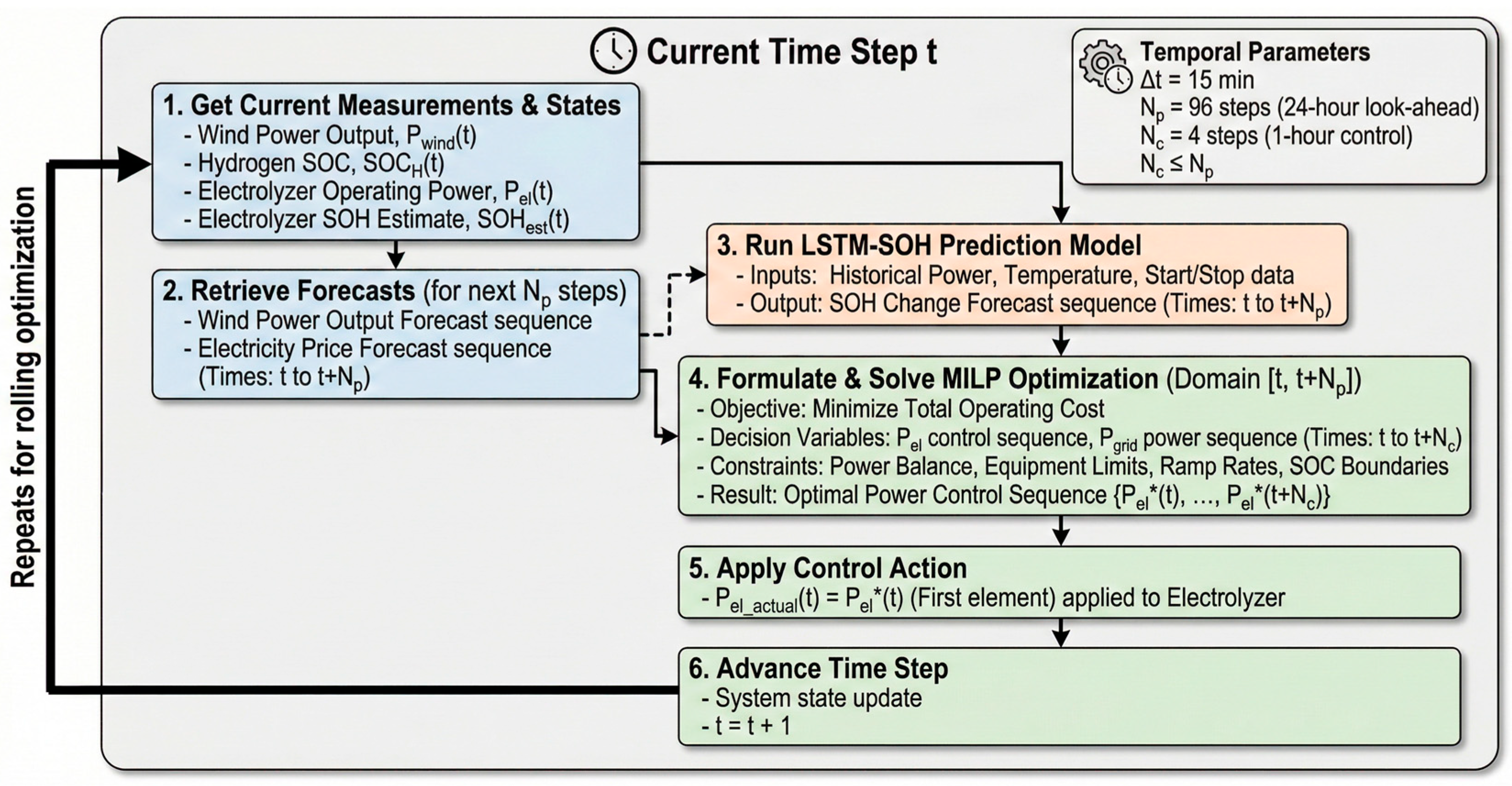
- At the current time, obtain the system’s measured status, including wind power output, , electrolyzer operating power, and estimated values.
- (2)
- Based on weather forecasts and market information, obtain the wind power output prediction sequence and electricity price prediction sequence for the next time steps.
- (3)
- Using historical power sequences, temperature sequences, and start/stop records from the electrolytic cell as input, invoke the trained LSTM-SOH prediction model to obtain the forecast of SOH changes for the next steps.
- (4)
- Solve an optimization problem within the prediction time domain , with the objective being the system’s total operating cost. The decision variables are the power commands for electrolytic cells and the grid’s power purchase/sale commands in the future time domain. Constraints include power balance constraints, equipment operating limits, ramp rate constraints, and hydrogen storage SOC boundary constraints. Thus, the optimal power control sequence can be obtained, where represents the control time domain, and typically .
- (5)
- Use the first element of the optimal control sequence as the actual power command applied to the electrolytic cell at the current time.
- (6)
- The system state is updated to time , and the above process is repeated to achieve rolling optimization.
3.2. Objective Function Design
3.3. Constraints
4. Dynamic Integrated Value Assessment Model for Wind–Hydrogen Coupling Systems
4.1. Dynamic Hydrogen Value Model
4.2. Flexibility Value Model
4.3. Lifecycle Cost Analysis Metrics
5. Case Simulation and Results Analysis
5.1. Simulation Settings
- (1)
- Hard ramp rate limit: The electrolyzer power change between consecutive time steps is strictly limited to , corresponding to 60% of the MPC ramp constraint adopted in Strategies B–D. This reflects a conservative engineering specification commonly applied in industrial electrolyzer protection systems.
- (2)
- Cold start frequency limit: The number of cold starts per day is capped at 2. If the predicted low-power period is shorter than 30 min based on the current wind power measurement, the electrolyzer remains on standby rather than shutting down, avoiding unnecessary cold restart damage.
- (3)
- Moving average power smoothing: A 5-step moving average filter (window length = 75 min) is applied to the wind power input signal before dispatching power commands to the electrolyzer, suppressing short-term fluctuations that would otherwise induce rapid ramping damage.
5.2. Analysis of Results
5.2.1. Operational Performance Analysis
5.2.2. Equipment Lifespan and Economic Analysis
5.2.3. Robustness Analysis Under Forecast Uncertainty
5.2.4. Sensitivity Analysis on Ancillary Service Market Prices
5.2.5. Comparative Analysis of MPC Against Alternative Uncertainty Handling Frameworks
6. Conclusions and Outlook
- (1)
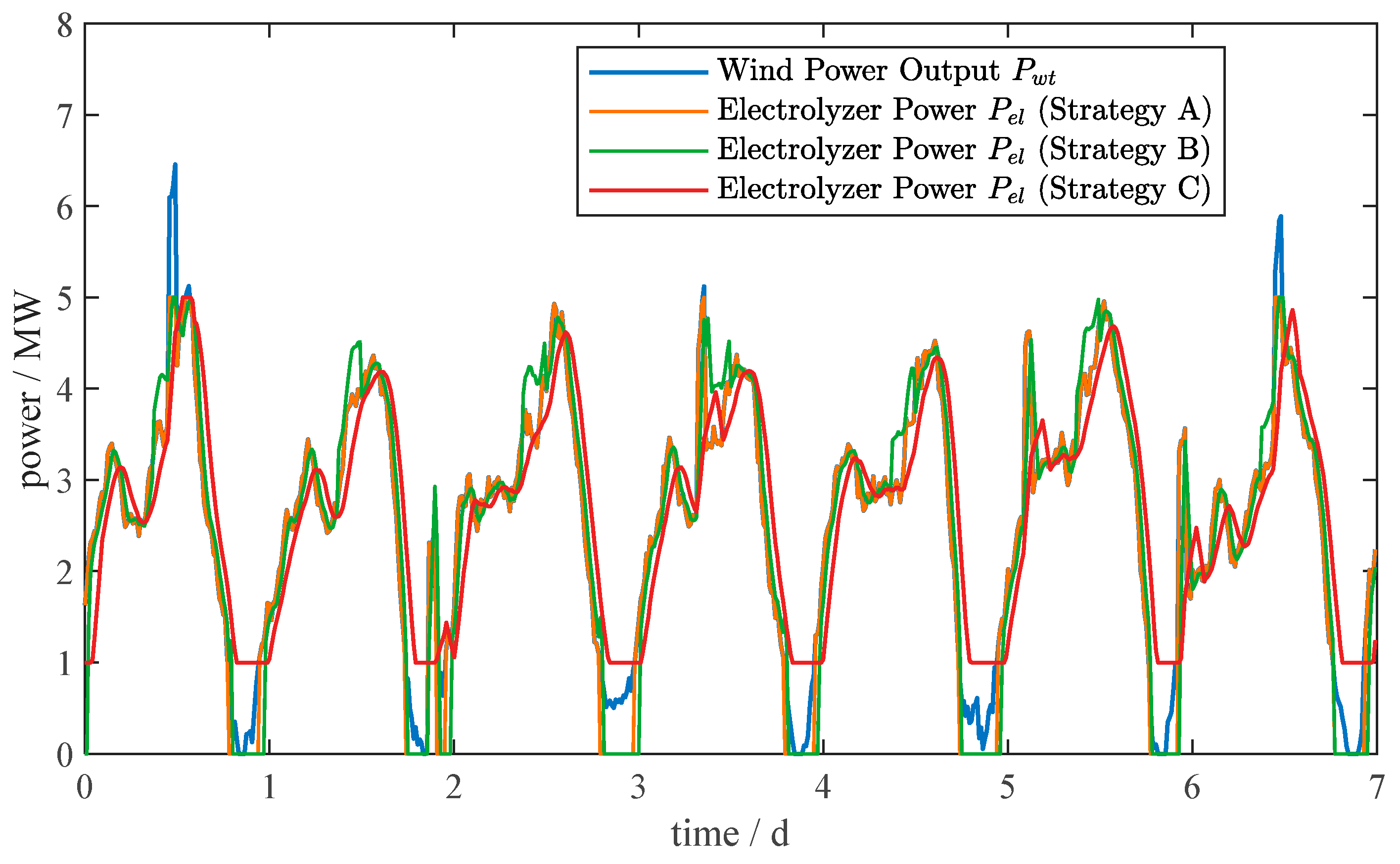
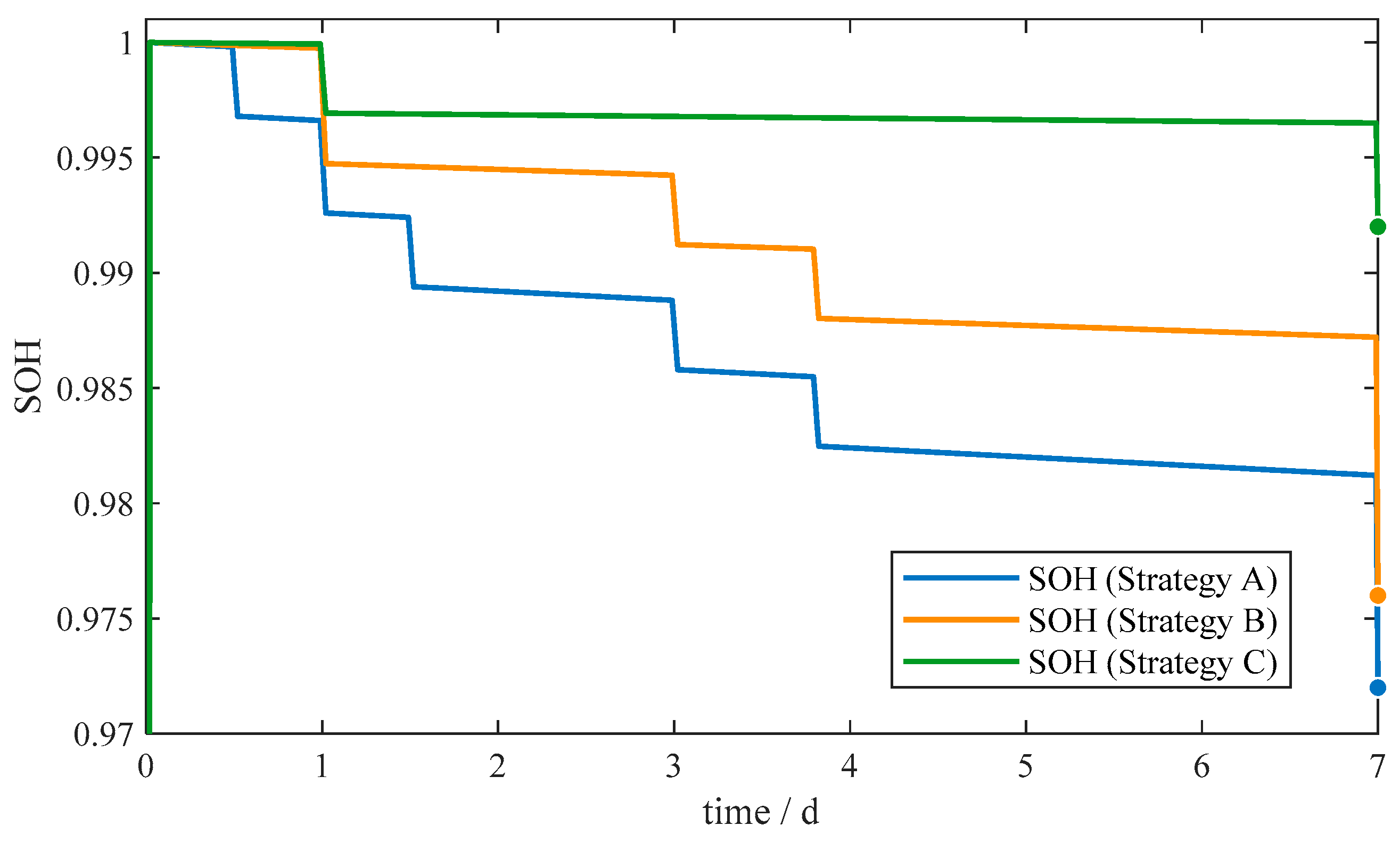
- The intelligent power allocation strategy combining MPC and SOH prediction balances short-term efficiency and long-term equipment reliability, converts SOH degradation into real-time costs for MPC optimization, avoids detrimental conditions and extends electrolytic cell lifespan. Simulation results over a 20-year lifecycle demonstrate the quantitative superiority of the proposed Strategy C. Compared to the baseline Strategy A, Strategy C reduces the number of electrolyzer replacements from three to one, raises the average State of Health from 0.72 to 0.85, and achieves a lifecycle Net Present Value (NPV) improvement of 12.7%, corresponding to an absolute gain of approximately 1.27 million yuan under the simulated system configuration. Furthermore, the weekly SOH degradation rate is reduced to only 28% of that observed under Strategy A (from 2.81% to 0.80% per week), confirming that active degradation management through SOH-embedded MPC optimization delivers substantial and compounding long-term economic benefits without sacrificing hydrogen production capacity.
- (2)
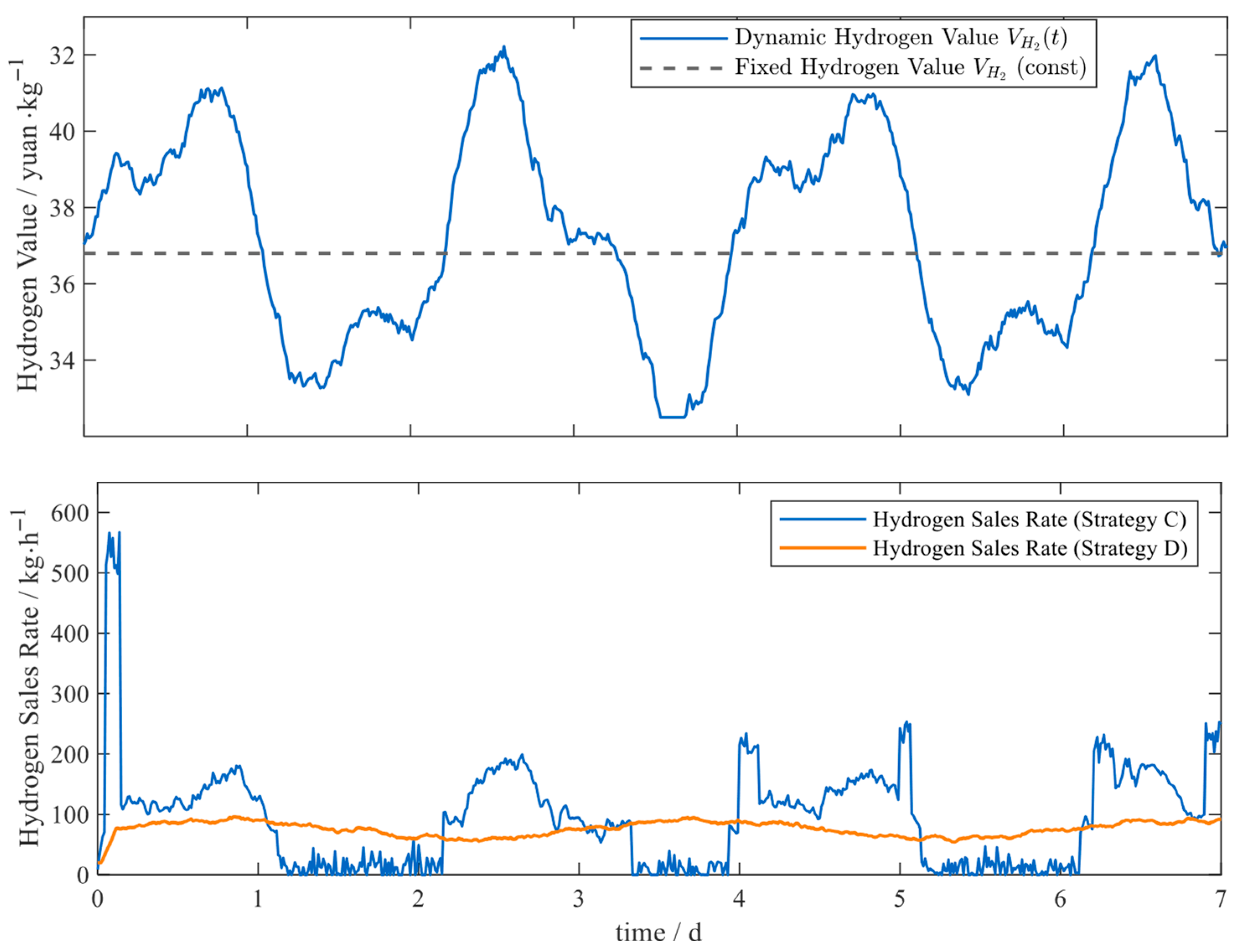
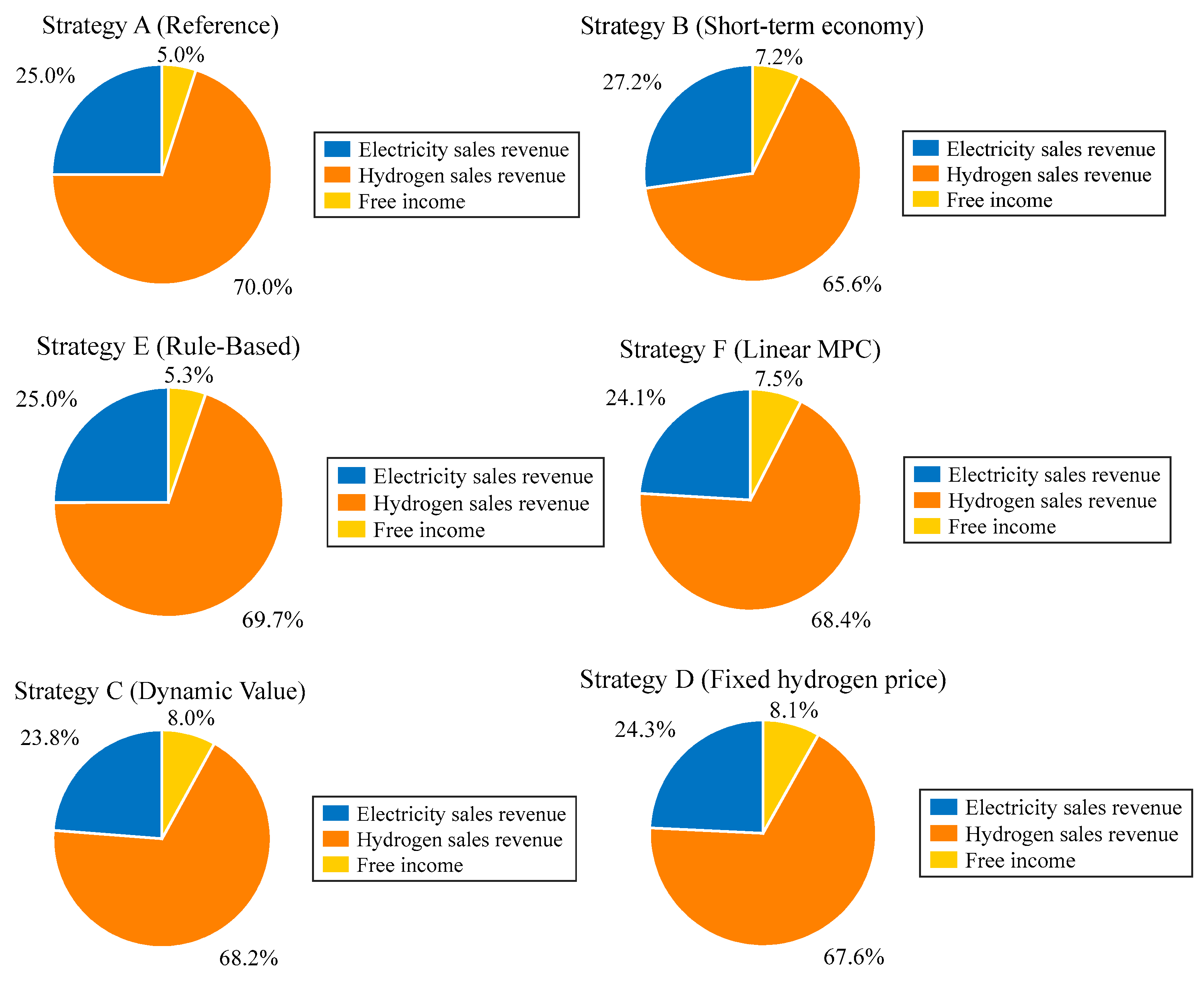
- The integrated assessment model developed, encompassing both dynamic hydrogen value and flexibility value, enables a more comprehensive and accurate reflection of the full lifecycle economic value of wind–hydrogen systems. This is crucial for accurately evaluating the system’s profitability.
- (3)
- Future research efforts may focus on the following areas: First, developing more precise models for the multi-stress coupling degradation mechanisms in electrolytic cells. Second, integrating uncertainty optimization theories (such as stochastic programming and Robust Optimization) into the MPC framework to better handle wind power and price forecasting errors. Third, the 20-year lifecycle evaluation in this study is based on a representative annual scenario scaled repeatedly, which does not fully capture inter-annual wind resource variability. A sensitivity analysis presented in Table 6 confirms that the relative economic advantage of Strategy C remains stable across ±10% capacity factor variations; however, future work employing multi-year measured datasets or climate-model-generated stochastic annual profiles would further strengthen the lifecycle assessment.
- (4)
- Regarding practical implementation, the proposed framework is well-suited for deployment in real-world wind–hydrogen demonstration projects. The MPC controller can be embedded within industrial programmable logic controllers (PLCs) or distributed control systems (DCS), with the prediction horizon supplied by SCADA-integrated wind power forecasting modules that provide rolling updates at each 15 min control interval. The LSTM-SOH prediction model can be pre-trained offline and updated periodically using on-site operational data to maintain prediction accuracy as the electrolyzer ages. For commercial-scale wind–hydrogen facilities, the flexibility service module should be adapted to local electricity market regulations, as ancillary service types, response time requirements, and capacity pricing mechanisms vary across provincial markets in China. Future pilot deployments in resource-rich regions such as Xinjiang or Inner Mongolia, where both wind resources and hydrogen demand are substantial, are recommended as the primary candidates for validating the framework at scale.Furthermore, a sensitivity analysis on ancillary service market prices (Section 5.2.4) confirms that Strategy C maintains at least a 9.6% NPV improvement over the baseline even when flexibility revenue is completely eliminated, demonstrating that the proposed framework’s economic advantage is primarily grounded in degradation cost reduction and dynamic hydrogen value optimization rather than dependence on ancillary service market conditions.
- (5)
- A comparative analysis against Stochastic Optimization (SO) and Robust Optimization (RO) frameworks (Section 5.2.5) confirms that MPC provides the most favorable balance among lifecycle NPV, computational feasibility, and robustness for real-time wind–hydrogen system dispatch. While SO marginally outperforms MPC in expected NPV (+12.0% vs. +10.6%), its fourfold computational overhead renders it infeasible for real-time deployment within the 15 min control interval. RO provides superior worst-case guarantees but is overly conservative under realistic forecast uncertainty levels. These findings validate MPC as the appropriate framework for the operational context of this study, while identifying a hierarchical SO-MPC architecture as a promising direction for future research.
Author Contributions
Funding
Data Availability Statement
Conflicts of Interest
References
- Widera, B. Renewable hydrogen implementations for combined energy storage, transportation and stationary applications. Therm. Sci. Eng. Prog. 2020, 16, 100460. [Google Scholar] [CrossRef]
- dos Santos Ramos, J.; Bastos, I.T.C.; de Almeida, J.O.; Shadman, M.; da Silva Dias, R.F.; de Miranda, P.E.V.; Estefen, S.F. Isolated offshore wind-powered hydrogen production: A time-domain coupled power control and PEM electrolysis model for transient behavior and LCOH analysis. Int. J. Hydrogen Energy 2025, 191, 152284. [Google Scholar] [CrossRef]
- Felseghi, R.-A.; Carcadea, E.; Raboaca, M.S.; Trufin, C.N.; Filote, C. Hydrogen fuel cell technology for the sustainable future of stationary applications. Energies 2019, 12, 4593. [Google Scholar] [CrossRef]
- Kang, J.; Wan, J.; Han, X.; Li, Y.; Yan, H.G. Optimal Capacity Allocation Method of Grid-Connected Wind and Solar Hydrogen Storage System Considering Stepped Carbon Emissions and Time-of-Use Electricity Price. In Proceedings of the 2023 IEEE International Conference on Power Science and Technology (ICPST), Kunming, China, 5–7 May 2023; IEEE: Piscataway, NJ, USA, 2023; pp. 729–734. [Google Scholar] [CrossRef]
- Meng, Z.; He, Q.; Shi, X.; Cao, D.; Du, D. Research on energy utilization of wind-hydrogen coupled energy storage power generation system. Sep. Purif. Technol. 2023, 313, 123439. [Google Scholar] [CrossRef]
- Armghan, H.; Yang, M.; Ali, N.; Armghan, A.; Alanazi, A. Quick reaching law based global terminal sliding mode control for wind/hydrogen/battery DC microgrid. Appl. Energy 2022, 316, 119050. [Google Scholar] [CrossRef]
- Zhang, Q.; Chen, K.; Lai, X.; Yu, J. Construction of hydrogenation station based on electrolytic water hydrogen production technology and design specification of hydrogen-electricity complementary smart energy system. In Proceedings of the 7th International Symposium on Advances in Electrical, Electronics, and Computer Engineering, Xishuangbanna, China, 18–20 March 2022; SPIE: Bellingham, VA, USA, 2022; Volume 12294, pp. 202–206. [Google Scholar] [CrossRef]
- Mukherjee, U.; Elsholkami, M.; Walker, S.; Fowler, M.; Elkamel, A.; Hajimiragha, A. Optimal sizing of an electrolytic hydrogen production system using an existing natural gas infrastructure. Int. J. Hydrogen Energy 2015, 40, 9760–9772. [Google Scholar] [CrossRef]
- Li, Y.; Shi, X.; Phoumin, H. A strategic roadmap for large-scale green hydrogen demonstration and commercialisation in China: A review and survey analysis. Int. J. Hydrogen Energy 2022, 47, 24592–24609. [Google Scholar] [CrossRef]
- Faisal, M.; Hannan, M.A.; Ker, P.J.; Hussain, A.; Mansor, M.B.; Blaabjerg, F. Review of energy storage system technologies in microgrid applications: Issues and challenges. IEEE Access 2018, 6, 35143–35164. [Google Scholar] [CrossRef]
- Pradhan, A.; Marence, M.; Franca, M.J. The adoption of Seawater Pump Storage Hydropower Systems increases the share of renewable energy production in Small Island Developing States. Renew. Energy 2021, 177, 448–460. [Google Scholar] [CrossRef]
- Fang, R.; Liang, Y. Control strategy of electrolyzer in a wind-hydrogen system considering the constraints of switching times. Int. J. Hydrogen Energy 2019, 44, 25104–25111. [Google Scholar] [CrossRef]
- Tebibel, H. Battery energy storage system for enhancing the electrolyzer capacity factor in small-scale Wind-H2 system with a smoothing control strategy: Constrained multi-objective Pareto optimization and case study in Algeria. J. Energy Storage 2022, 52, 105017. [Google Scholar] [CrossRef]
- Huang, Y.; Li, S.; Zhang, P.; Wang, D.; Lan, J.; Lee, K.Y.; Zhang, Q. Parameter adaptive stochastic model predictive control for wind–solar–hydrogen coupled power system. Renew. Energy 2024, 237, 121355. [Google Scholar] [CrossRef]
- Zhang, Z.; Yin, G.; Sun, X.; Gao, Y.; Huang, F. MPC-Based Coordinated Control Strategy for Wind–Photovoltaic–Hydrogen–Storage Coupled Systems. Strateg. Plan. Energy Environ. 2026, 45, 139–178. [Google Scholar] [CrossRef]
- Gonzalez, A.A.; Bottarini, M.; Vechiu, I.; Gautier, L.; Ollivier, L.; Larre, L. Model predictive control for the energy management of a hybrid PV/battery/fuel cell power plant. In Proceedings of the 2019 International Conference on Smart Energy Systems and Technologies (SEST), Porto, Portugal, 9–11 September 2019. [Google Scholar] [CrossRef]
- Valverde, L.; Bordons, C.; Rosa, F. Integration of fuel cell technologies in renewable energy-based microgrids optimizing operational costs and durability. IEEE Trans. Ind. Electron. 2015, 63, 167–177. [Google Scholar] [CrossRef]
- Abdelghany, M.B.; Shehzad, M.F.; Mariani, V.; Liuzza, D.; Glielmo, L. Two-stage model predictive control for a hydrogen-based storage system paired to a wind farm towards green hydrogen production for fuel cell electric vehicles. Int. J. Hydrogen Energy 2022, 47, 32202–32222. [Google Scholar] [CrossRef]
- Zhai, D.; Yao, L.; Liao, S.; Xu, J.; Mao, B.; Xie, B. A Coordinated Control Strategy of Wind Power/Hydrogen Integrated System. In Proceedings of the 2022 7th International Conference on Power and Renewable Energy (ICPRE), Shanghai, China, 23–26 September 2022; IEEE: Piscataway, NJ, USA, 2022; pp. 838–843. [Google Scholar] [CrossRef]
- Mingxuan, C.; Bin, H.; Baoping, Z.; Yongfeng, R.; Yu, P.; Pingping, Y.; Yue, M. Intraday energy management strategy for wind-hydrogen coupled systems based on hybrid electrolysers. Int. J. Sustain. Energy 2024, 43, 2403494. [Google Scholar] [CrossRef]
- Yang, J.; Zhao, J.; Hu, Z.; Wang, J.; Huang, X.; Ji, X.; He, G. Adaptive Deep Learning Modeling of Green Ammonia Production Process Based on Two-Layer Attention Mechanism LSTM. Processes 2025, 13, 1480. [Google Scholar] [CrossRef]
- Lin, M.; Wu, J.; Wu, W.J. State of health estimation with attentional long short-term memory network for lithium-ion batteries. Energy 2023, 268, 126706. [Google Scholar] [CrossRef]
- Lee, H.; Gu, J.; Lee, B.; Cho, H.-S.; Lim, H. Prognostics and health management of alkaline water electrolyzer: Techno-economic analysis considering replacement moment. Energy AI 2023, 13, 100251. [Google Scholar] [CrossRef]
- Sohoni, V.; Gupta, S.C.; Nema, R.K. A critical review on wind turbine power curve modelling techniques and their applications in wind based energy systems. J. Energy 2016, 2016, 8519785. [Google Scholar] [CrossRef]
- Castillo, O.C.; Andrade, V.R.; Rivas, J.J.R.; González, R.O. Comparison of power coefficients in wind turbines considering the tip speed ratio and blade pitch angle. Energies 2023, 16, 2774. [Google Scholar] [CrossRef]
- Prasath, C.A. Green Hydrogen Production via Offshore Wind Electrolysis: Techno-Economic Perspectives. Natl. J. Renew. Energy Syst. Innov. 2025, 1, 8–17. [Google Scholar] [CrossRef]
- Zhou, T.; Francois, B.; Lebbal, M.e.H.; Lecoeuche, S. Real-time emulation of a hydrogen-production process for assessment of an active wind-energy conversion system. IEEE Trans. Ind. Electron. 2008, 56, 737–746. [Google Scholar] [CrossRef]
- Ma, B.; Zheng, J.; Xian, Z.; Wang, B.; Ma, H. Optimal operation strategy for wind–photovoltaic power-based hydrogen production systems considering electrolyzer start-up characteristics. Processes 2024, 12, 1756. [Google Scholar] [CrossRef]
- Zhou, Y.; Shao, Z.; Li, H.; Chen, J.; Sun, H.; Wang, Y.; Wang, N.; Pei, L.; Wang, Z.; Zhang, H.; et al. A novel back propagation neural network based on the Harris Hawks optimization algorithm for the remaining useful life prediction of lithium-ion batteries. Energies 2025, 18, 3842. [Google Scholar] [CrossRef]
- Minnah, P. Degradation Modelling and Performance Prediction of Proton Exchange Membrane Electrolyzers for Wind-To-Hydrogen Systems. Master’s Thesis, Memorial University of Newfoundland, St. John’s, NL, Canada, 2026. [Google Scholar] [CrossRef]
- Cao, Y.; Yang, Y.; Zhao, X.; Li, Q. A review of seasonal hydrogen storage multi-energy systems based on temporal and spatial characteristics. J. Renew. Mater. 2021, 9, 1823–1842. [Google Scholar] [CrossRef]
- Liu, X.; Guo, S.; Ma, L.; Kong, X.; Lee, K.Y. Stable stochastic MPC for uncertain wind energy conversion system over whole operating regions. IEEE Trans. Energy Convers. 2024, 40, 515–528. [Google Scholar] [CrossRef]



| Reference | Control Strategy | SOH/Degradation Considered | Hydrogen Pricing | Flexibility Value |
|---|---|---|---|---|
| Zhang et al. [15] | MPC | ✗ | Fixed | ✗ |
| Gonzalez et al. [16] | MPC | ✗ | Fixed | ✗ |
| Abdelghany et al. [18] | Two-layer MPC | ✗ | Fixed | ✗ |
| Zhai et al. [19] | Rule-based | ✗ | Fixed | ✗ |
| Mingxuan et al. [20] | Rule-based | ✗ | Fixed | ✗ |
| Yang et al. [21] | LSTM-SOH prediction | ✓ (estimation only) | N/A | ✗ |
| Lee et al. [23] | PHM framework | ✓ (degradation model) | Fixed | ✗ |
| This study | MPC + LSTM-SOH | ✓ (embedded in MPC cost) | Dynamic | ✓ |
| Indicator | AWE | PEME | SOE |
|---|---|---|---|
| Technology Maturity | Commercial scale | Demonstration stage | Laboratory/hundred-kW scale |
| Catalyst Material | Non-precious metals (Ni-based) | Precious metals (Pt, Ir) | Ni-based ceramic |
| Operating Temperature | 60–90 °C | 50–80 °C | 700–900 °C |
| Dynamic Response | Moderate | Fast | Slow |
| Equipment Cost | Low | High | High |
| Dynamic Condition Adaptability | Limited (sensitive to start–stop and load fluctuations) | Good | Poor |
| Typical Lifespan | 80,000–100,000 h | 60,000–90,000 h | <20,000 h (lab scale) |
| Current Domestic Demonstration Scale | MW–GW | MW | Hundred-kW |
| Selected in This Study | Preferred for large-scale commercial deployment | — | — |
| Scenario | Annual Capacity Factor | NPV Improvement (Strategy C vs. A) |
|---|---|---|
| Low-wind year | +11.3% | |
| Baseline year | +12.7% | |
| High-wind year | +13.5% |
| Category | Parameter | Symbol | Value | Unit | Reference/Basis |
|---|---|---|---|---|---|
| System Configuration | Wind farm rated capacity | 10 | MW | Case design | |
| Electrolyzer rated capacity | 5 | MW | Case design | ||
| Electrolyzer minimum power | 1 | MW | 20% of rated | ||
| Hydrogen storage tank capacity | 2000 | kg | Case design | ||
| SOC upper limit | 0.95 | — | Operational safety | ||
| SOC lower limit | 0.05 | — | Operational safety | ||
| Degradation Model | Cold start damage coefficient | 2.0 × 10⁻³ | /event | [14] (0.2% MEA fatigue/cycle) | |
| Warm start damage coefficient | 5.0 × 10⁻⁴ | /event | [23] | ||
| Shutdown damage coefficient | 3.0 × 10⁻⁴ | /event | [23] | ||
| Ramp damage coefficient | 8.0 × 10⁻⁴ | — | Calibrated from [23] | ||
| Low-load damage coefficient | 6.0 × 10⁻⁴ | — | Calibrated from [23] | ||
| Low-load threshold ratio | 0.20 | — | 20% of rated power | ||
| Safe ramp threshold | 0.5 | MW | Operational specification | ||
| EOL damage threshold | 1.0 | — | Normalized | ||
| Economic Parameters | Electrolyzer replacement cost | 300 | Ten thousand yuan/MW | Industry estimate | |
| O&M cost coefficient | 0.02 | Ten thousand yuan (MW·h) | Industry estimate | ||
| Discount rate | 8 | % | China energy project standard | ||
| MPC objective weight (grid) | 0.5 | — | Sensitivity-tuned | ||
| MPC objective weight (degradation) | 0.35 | — | Sensitivity-tuned | ||
| MPC objective weight (O&M) | 0.15 | — | Sensitivity-tuned | ||
| MPC Framework | Time step | 15 | min | — | |
| Prediction horizon | 96 | steps (24 h) | — | ||
| Control horizon | 4 | steps (1 h) | — | ||
| Wind forecast noise level | 0.05 | relative std | — | ||
| Price forecast noise level | 0.03 | relative std | — | ||
| Strategy E (Rule-Based) | Hard ramp rate limit | MW/step | — | ||
| Max cold starts per day | 2 | /day | — | ||
| Moving average window | 5 steps (75 min) | — | — | ||
| Minimum standby duration | 30 | min | — | ||
| Strategy F (Linear Degradation MPC) | Linear degradation intercept | /step | — | ||
| Linear degradation slope | /step | — | |||
| Fitting method | — | Least-squares | — | — |
| Strategy | Condition | Electrolyzer Replacements | Average SOH | Lifecycle NPV (10,000 Yuan) | NPV vs. Strategy A |
|---|---|---|---|---|---|
| Strategy A | Without constraints | 3 | 0.72 | 10,000 | Benchmark |
| Strategy A | With constraints | 3 | 0.72 | 9980 | Benchmark |
| Strategy B | Without constraints | 2 | 0.78 | 10,850 | +8.5% |
| Strategy B | With constraints | 2 | 0.78 | 10,180 | +2.0% |
| Strategy C | Without constraints | 1 | 0.85 | 11,270 | +12.7% |
| Strategy C | With constraints | 1 | 0.85 | 11,040 | +10.6% |
| Strategy D | Without constraints | 1 | 0.84 | 11,100 | +10.0% |
| Strategy D | With constraints | 1 | 0.84 | 10,890 | +9.1% |
| Evaluation Indicators | Strategy A (Baseline) | Strategy B (Short-Term Economic) | Strategy E (Rule-Based) | Strategy F (Linear MPC) | Strategy C (Dynamic Value) | Strategy D (Fixed Value) |
|---|---|---|---|---|---|---|
| Number of Electrolyzer Replacements | 3 | 2 | 2 | 1 | 1 | 1 |
| Average SOH (20 years) | 0.72 | 0.78 | 0.81 | 0.82 | 0.85 | 0.84 |
| Total Hydrogen Production (tons) | 15,200 | 14,850 | 14,900 | 14,950 | 14,980 | 14,980 |
| Total Electricity Sales Revenue (Unit: 10,000 yuan) | 15,000 | 17,000 | 15,200 | 15,300 | 15,500 | 15,500 |
| Total Hydrogen Sales Revenue (Unit: 10,000 yuan) | 42,000 | 41,000 | 42,300 | 43,500 | 44,500 | 43,200 |
| Total Flexibility Revenue (Unit: 10,000 yuan) | 3000 | 4500 | 3200 | 4800 | 5200 | 5200 |
| Lifecycle Net Present Value (Unit: 10,000 yuan) | 2400 | 1600 | 1600 | 800 | 800 | 800 |
| Lifecycle NPV (Unit: 10,000 yuan) | 9980 | 10,180 | 10,690 | 10,840 | 11,040 | 10,890 |
| Relative NPV Improvement Rate (Relative to Strategy A) | Benchmark | +2.0% | +7.1% | +8.6% | +10.6% | +9.1% |
| Metric | Strategy F (Linear MPC) | Strategy C (LSTM-MPC) | Difference |
|---|---|---|---|
| Average computation time per step | ~5 s | ~11 s | +6 s (+120%) |
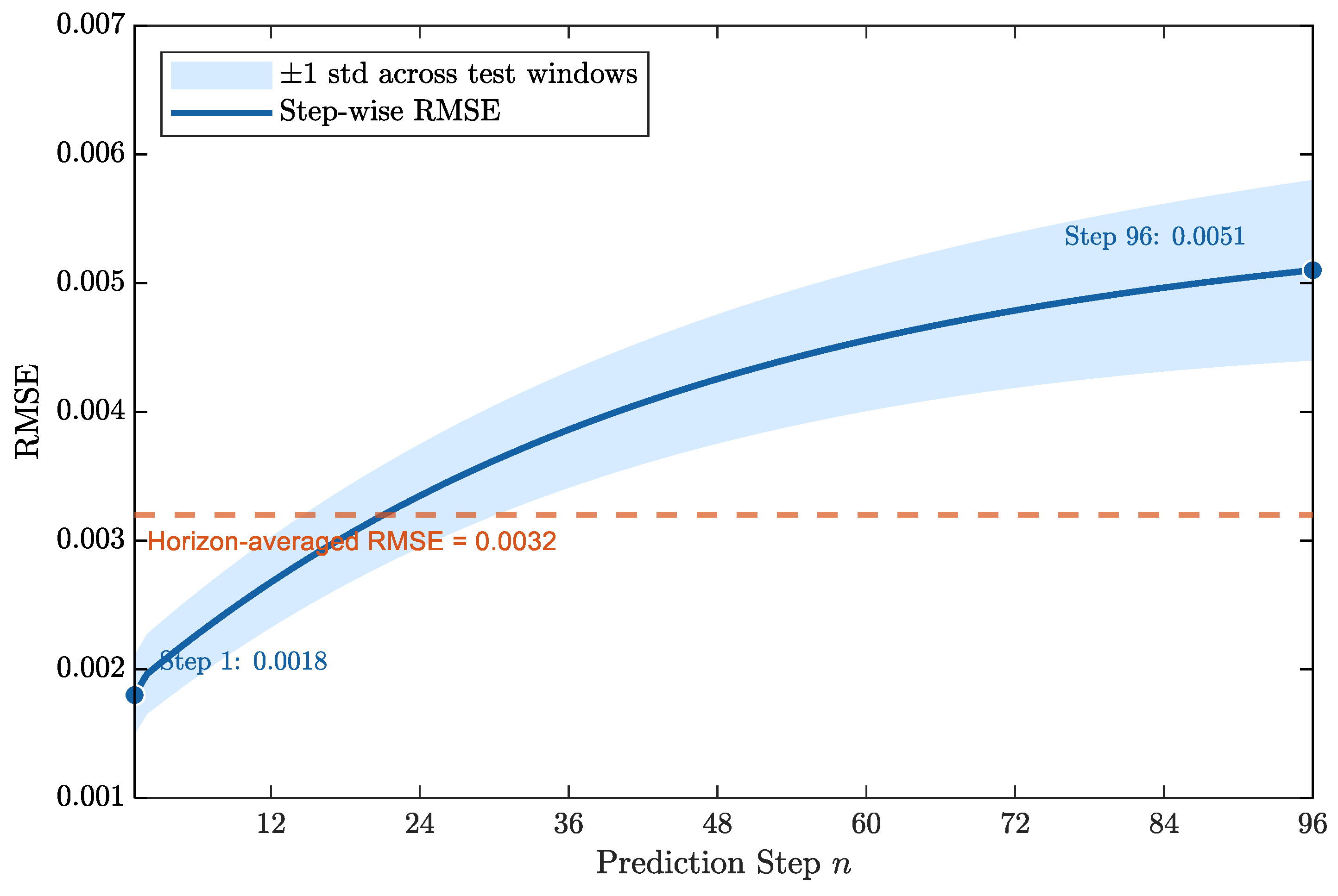
| RMSE of degradation rate prediction | 0.0089 | 0.0032 | −64% |
| Average SOH (20 years) | 0.82 | 0.85 | +0.03 |
| Electrolyzer replacements | 1 | 1 | — |
| Lifecycle NPV (10,000 yuan) | 10,840 | 11,040 | +200 |
| NPV improvement vs. Strategy A | +8.6% | +10.6% | +2.0 pp |
| Forecast Noise Level | Mean NPV Improvement vs. Strategy A | Std. Dev. | Mean Electrolyzer Replacements |
|---|---|---|---|
| 5% (baseline) | +11.4% | ±0.8% | 1.0 |
| 10% (medium) | +10.2% | ±1.3% | 1.1 |
| 20% (high) | +8.7% | ±2.1% | 1.3 |
| Metric | Scenario I (Baseline) | Scenario II (50% Reduction) | Scenario III (No Market) |
|---|---|---|---|
| Strategy C Total Flexibility Revenue (10,000 yuan) | 5200 | 2600 | 0 |
| Strategy A Total Flexibility Revenue (10,000 yuan) | 3000 | 1500 | 0 |
| Strategy C Lifecycle NPV (10,000 yuan) | 11,040 | 10,420 | 9870 |
| Strategy A Lifecycle NPV (10,000 yuan) | 9980 | 9470 | 9010 |
| NPV Improvement: C vs. A | +10.6% | +10.0% | +9.6% |
| NPV Improvement: B vs. A | +2.0% | +1.8% | +1.5% |
| NPV Improvement: E vs. A | +7.1% | +6.8% | +6.4% |
| NPV Improvement: F vs. A | +8.6% | +8.1% | +7.7% |
| NPV Improvement: D vs. A | +9.1% | +8.5% | +7.9% |
| Performance Indicator | MPC (Strategy C) | SO (Scenario Tree) | RO (Box Uncertainty) |
|---|---|---|---|
| Average solve time per step | ~11 s | ~42 s | ~18 s |
| Real-time feasibility (15 min interval) | ✓ | ✗ | ✓ (marginal) |
| Lifecycle NPV (10,000 yuan)—baseline (5% noise) | 11,040 | 11,180 | 10,290 |
| NPV improvement vs. Strategy A—baseline | +10.6% | +12.0% | +3.1% |
| Lifecycle NPV—high uncertainty (20% noise) | 10,290 | 10,350 | 10,080 |
| NPV improvement vs. Strategy A—high uncertainty | +8.7% | +9.2% | +7.2% |
| NPV degradation from 5% to 20% noise | −6.8% | −7.4% | −2.1% |
| Worst-case NPV (extreme forecast error ±30%) | 9510 | 9480 | 9820 |
Disclaimer/Publisher’s Note: The statements, opinions and data contained in all publications are solely those of the individual author(s) and contributor(s) and not of MDPI and/or the editor(s). MDPI and/or the editor(s) disclaim responsibility for any injury to people or property resulting from any ideas, methods, instructions or products referred to in the content. |
© 2026 by the authors. Licensee MDPI, Basel, Switzerland. This article is an open access article distributed under the terms and conditions of the Creative Commons Attribution (CC BY) license.
Share and Cite
Li, J.; Ye, C.; Huang, H.; Cheng, Z.; Peng, Y.; Wang, K. Research on MPC-Based Power Allocation Strategy and Dynamic Value Evaluation of Wind–Hydrogen Coupled Systems. Processes 2026, 14, 924. https://doi.org/10.3390/pr14060924
Li J, Ye C, Huang H, Cheng Z, Peng Y, Wang K. Research on MPC-Based Power Allocation Strategy and Dynamic Value Evaluation of Wind–Hydrogen Coupled Systems. Processes. 2026; 14(6):924. https://doi.org/10.3390/pr14060924
Chicago/Turabian StyleLi, Jiyong, Chen Ye, Hao Huang, Zhiliang Cheng, Yide Peng, and Kaiyue Wang. 2026. "Research on MPC-Based Power Allocation Strategy and Dynamic Value Evaluation of Wind–Hydrogen Coupled Systems" Processes 14, no. 6: 924. https://doi.org/10.3390/pr14060924
APA StyleLi, J., Ye, C., Huang, H., Cheng, Z., Peng, Y., & Wang, K. (2026). Research on MPC-Based Power Allocation Strategy and Dynamic Value Evaluation of Wind–Hydrogen Coupled Systems. Processes, 14(6), 924. https://doi.org/10.3390/pr14060924