Article

A Closed-Loop PX–ISO Framework for Staged Day-Ahead Energy and Ancillary Clearing in Power Markets

1
School of Electronic and Electrical Engineering, Minnan University of Science and Technology, Quanzhou 362700, China
2
Key Laboratory of Industrial Automation Control Technology and Application of Fujian Higher Education, Quanzhou 362700, China
*
Authors to whom correspondence should be addressed.
Processes 2026, 14(6), 1027; https://doi.org/10.3390/pr14061027
Submission received: 27 February 2026 / Revised: 15 March 2026 / Accepted: 19 March 2026 / Published: 23 March 2026
(This article belongs to the Section Energy Systems)

Abstract

As modern power markets integrate more renewable generation, day-ahead energy clearing remains the central procurement step, while flexibility products are procured to ensure that the cleared energy schedule can be operated securely. This paper proposes a closed-loop framework linking the Power Exchange (PX) and the Independent System Operator (ISO) to bridge energy-market settlement and network-feasible operation. The PX performs staged day-ahead clearing with energy settled first, followed by aAutomatic generation control (AGC) and spinning reserve (SR) procured from the residual headroom of committed (energy-awarded) units. The ISO then validates the cleared schedule using an equivalent current injection (ECI)-based screening. This paper uses a single-period (single-hour) IEEE 30-bus case setting; multi-period scheduling and intertemporal constraints are not modeled. When congestion is detected, power-flow tracing identifies the main contributors and guides a minimal-change redispatch. The ISO-feasible dispatch is then sent back to the PX for re-clearing, aligning prices and welfare with an executable operating point. The resulting nonconvex clearing problems with valve-point effects and prohibited operating zones are solved by Artificial Protozoa Optimizer with Social Learning (APO–SL) and evaluated against representative metaheuristic baselines. IEEE 30-bus studies show that off-peak and average-load cases pass ISO screening directly, whereas the peak case tightens reserve headroom (SR capped at 39.08 MW) and triggers congestion. After ISO feedback and energy re-clearing, line loadings return within limits. The ISO-feasible dispatch changes the marginal accepted offer and lifts the MCP (3.73 → 4.38 $/MWh). The welfare value reported here follows the paper’s settlement-based definition (purchase total minus accepted offer cost), and it increases accordingly (113.77 → 190.17 $/h).

1. Introduction

Power systems are increasingly operated through market-based schedules as variable renewables grow. In day-ahead markets, bids and offers translate into hourly awards and prices. The challenge is the next step: turning an economically cleared schedule into a secure, executable operating point once network constraints are enforced [1,2]. How often corrections are needed—and how transparent they are to participants—depends strongly on market design, particularly bidding-zone definitions and congestion-management rules [3]. Once the cleared schedule is mapped onto the physical network, redispatch, curtailment, and reserve activation may be required. These actions often determine the realized dispatch, losses, and renewable accommodation—not only the day-ahead awards.
Once ancillary services are included, day-ahead clearing is no longer only about price formation; it also becomes a question of whether sufficient flexibility can be procured and delivered. AGC and spinning reserve (SR) support balancing and contingency coverage. Prior studies examine flexibility incentives and compensation mechanisms [4]. They also study energy–reserve co-optimization under uncertainty [5,6] and participant-side strategies for aggregators and microgrids in coupled energy and ancillary-service markets [7,8]. Most existing formulations either co-optimize energy and reserves in a single integrated problem or focus on participant-side strategies. In contrast, the rule-driven coupling created by sequential clearing (energy → AGC → SR)—and its feasibility implications—has received less explicit modeling attention. Under peak demand, sequential procurement can make deliverability binding. A reserve target may not be met not because the requirement is excessive, but because energy awards have already consumed the headroom needed for AGC and spinning reserve. This “flexibility squeeze” increases the likelihood that corrective actions are required to restore deliverability.
A second operational friction is transmission congestion. Welfare-based clearing without explicit network constraints can overload lines or create localized congestion, especially under high-load conditions or corridor-dominated transfers. Prior work shows that post-clearing, market-based redispatch can introduce inefficiencies and welfare losses, which indicates that congestion management is part of the market–operation contract rather than a purely ex post technical step [9]. Related studies have incorporated redispatch potential into flow-based market coupling, but the discussion often stays at a macro-efficiency level. They do not fully address how to implement a traceable, rule-consistent loop that market participants can interpret and respond to after security corrections [10]. In renewable-rich systems, participants react to prices and awards, yet the realized dispatch may be reshaped by security-driven adjustments. If this correction process is opaque, flexibility incentives become ambiguous, and confidence in market outcomes can be weakened.
A workable PX–ISO loop, therefore, requires an ISO-side workflow that is both lightweight and explainable. Contribution and flow-tracing methods provide a natural way to identify “who drives congestion.” Distributed contribution models quantify injection impacts [11]. Flow-tracing links injections, loads (DisCos), and line flows with clear physical meaning [12,13]. Market-facing designs further embed traceability into segmentation and allocation rules [14]. Congestion-aware trading network models further emphasize that feasible trades are bounded by grid constraints and that these bounds should be visible at the market interface [15]. For repeated feasibility screening, equivalent current injection (ECI)-based fast-decoupled load-flow formulations are attractive in iterative settings because they enable repeated checks with manageable computational burden [16]. What is still missing is an end-to-end PX–ISO loop that performs fast feasibility screening, attributes congestion transparently, and then returns a minimal-change redispatch and re-clearing signal under staged product coupling.
Reliability-oriented studies also clarify why reserve adequacy and security margins must be treated explicitly: spinning reserve allocation under multiple uncertainties and feasibility evaluation under N − 1 contingencies both indicate that operational constraints can dominate day-ahead executability under stressed conditions [17,18]. In parallel, security-constrained OPF formulations for renewable integration show that calibrated security constraints and disciplined dispatch adjustments are prerequisites for implementable operation in wind-integrated systems [19]. These insights motivate treating staged flexibility procurement (energy/AGC/SR) and network-feasibility validation as coupled components of renewable-rich market operation, rather than as separate “market” and “grid” tasks.
From the computational side, the PX–ISO loop repeatedly solves constrained optimization problems—staged market clearing with product coupling and security-constrained corrective redispatch. Overviews of power-system optimization note that, alongside mathematical programming, population-based metaheuristics remain widely used when models are nonlinear, hybrid, or repeatedly solved across scenarios [20]. Metaheuristic optimization is commonly adopted in hybrid power-system operational studies when model fidelity must be balanced against computational tractability, particularly under stochastic renewables and additional grid-control components (e.g., FACTS) [21]. The Artificial Protozoa Optimizer (APO) provides a recent bio-inspired baseline with strong general-purpose search capability for engineering optimization [22]. To improve robustness in repeated solves, memory-based PSO variants have been reported to mitigate premature convergence and enhance solution stability [23,24]. Moreover, multi-strategy APO extensions have been developed to better handle real-world problem structures, which motivates adopting an APO-based solver design in this work [25].
To summarize the above literature and make the design choices explicit, Table 1 contrasts integrated co-optimization, sequential clearing, and the proposed PX–ISO closed-loop framework.
Table 1 separates two issues that are often discussed together in the day-ahead market literature. First, sequential procurement can create a deliverability bottleneck because headroom is consumed by energy awards before AGC/SR are procured. Second, when congestion is corrected outside the market layer, the correction can become opaque at the market interface and weaken incentives. The proposed PX–ISO loop keeps the staged rules but makes feasibility screening and correction traceable, and it updates settlement metrics through re-clearing so that reported outcomes correspond to an executable operating point. Co-optimization internalizes the energy–reserve tradeoff within a single problem, whereas the staged design retains rule transparency but may require a feasibility-feedback loop when residual headroom becomes binding.
Based on these considerations, this paper develops a PX–ISO closed-loop staged day-ahead, single-period clearing framework. The PX clears energy first, followed by AGC and SR in sequence under eligibility and residual-capacity rules. The ISO validates the cleared outcome using an ECI-based load-flow check. If congestion is detected, a flow-tracing contribution analysis quantifies each GenCo’s active-power contribution to the congested element and guides a minimal-change OPF redispatch with limited deviation from the market outcome. The secure dispatch recommendation is returned to the PX for re-bidding and re-clearing, preserving interpretability while enforcing network feasibility. Case studies on the IEEE 30-bus system under off-peak, average, and peak loading quantify how staged coupling, congestion correction, and re-clearing reshape prices, social welfare, and network feasibility, thereby providing an operationally grounded market–grid interface for renewable-rich power markets. Although the IEEE 30-bus case study is a benchmark setting, the proposed PX–ISO loop is presented as a mechanism-oriented market-design archetype. The goal is to capture how staged procurement interacts with security correction under a transparent PX–ISO interface. It is not intended to reproduce jurisdiction-specific implementations, such as Locational Marginal Pricing (LMP)-based Security-Constrained Unit Commitment (SCUC)/Security-Constrained Economic Dispatch (SCED) or flow-based market coupling.
APO–SL is used as the numerical solver for the nonconvex clearing problems with valve-point effects and prohibited operating zones. The core contribution is the PX–ISO closed-loop workflow, which integrates staged market clearing with ECI screening, tracing-based congestion attribution, and a minimal-change redispatch with re-clearing. This is a single-period case study. It is meant to validate the mechanism and the pricing/feasibility logic, not to represent a full multi-period day-ahead market implementation.
This study focuses on the market–grid operational loop: clearing, validation, correction, and re-clearing. It does not model carbon prices or emissions. The link to low-carbon transitions is indirect. A more executable and transparent loop is useful in renewable-rich operation because it reduces ad hoc operator interventions that can blur flexibility incentives.

2. Market Framework and PX–ISO Operation

2.1. Market Architecture and Entities

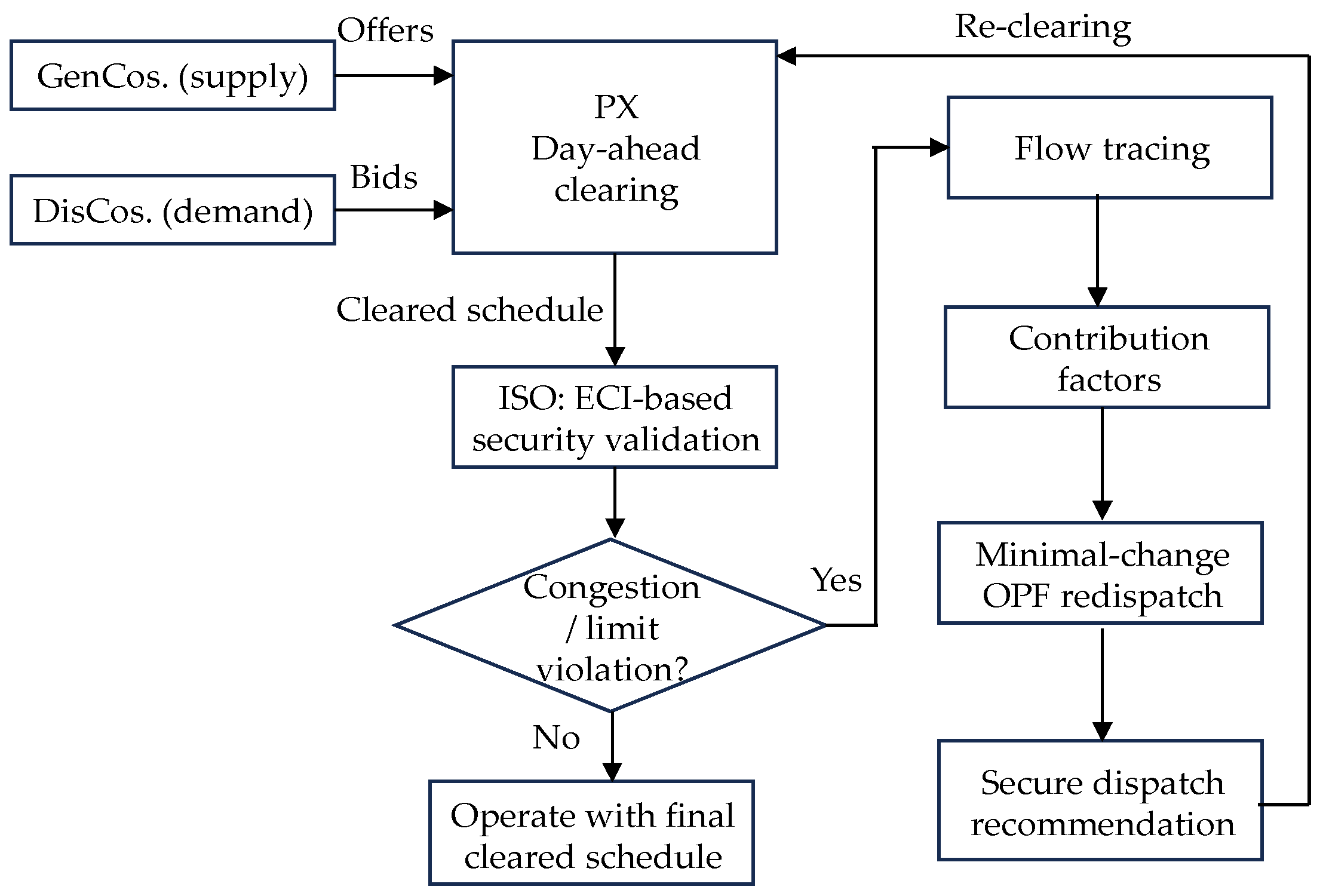
Figure 1 outlines the architecture of the day-ahead power market considered in this paper and the division of responsibilities between the Power Exchange (PX) and the Independent System Operator (ISO). The PX performs market clearing based on submitted bids/offers, whereas the ISO validates whether the cleared schedules remain feasible when mapped onto the physical network and its security limits [1,2]. This separation matters in practical grid operation: a schedule that maximizes social welfare at the clearing stage can still become infeasible once it is translated into transmission-network power flows.
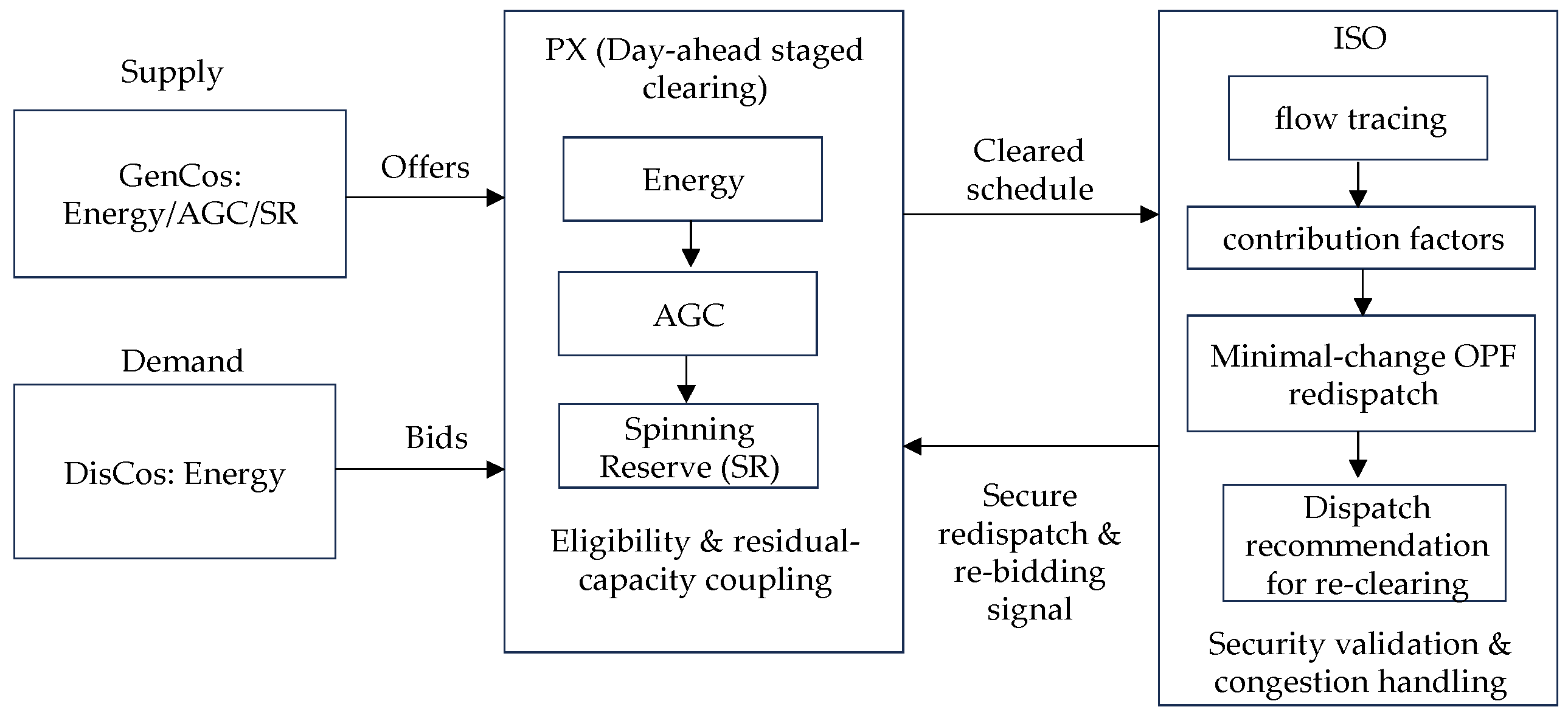
The market model includes four entities—generation companies (GenCos), distribution companies (DisCos), the Power Exchange (PX), and the Independent System Operator (ISO). GenCos submit energy offers and capacity-based ancillary-service offers, including automatic generation control (AGC) and spinning reserve (SR), while DisCos submit energy bids consistent with their load obligations. The PX clears the day-ahead market in stages: energy is cleared first, followed by sequential procurement of AGC and SR. After each stage, unit eligibility and remaining headroom are updated to enforce residual-capacity coupling across products explicitly.
Once clearing is completed, the PX forwards the awarded schedule to the ISO for security validation using an ECI-based load-flow check. When congestion or operating-limit violations arise, the ISO applies flow tracing to identify dominant contributors and then computes a secure corrective dispatch via a minimal-change OPF redispatch. The ISO then sends a re-clearing signal back to the PX, keeping settlement market-based while ensuring that the final schedule is executable under network constraints.
The PX–ISO split in Figure 1 is used as a stylized two-layer market architecture. It represents day-ahead designs in which a market operator (PX/Nominated Electricity Market Operator (NEMO)-like entity) clears awards and uniform settlement prices at the market layer, and a system operator (ISO/Transmission System Operator (TSO)) subsequently performs security screening and issues corrective redispatch when the cleared schedule is not network-feasible. In jurisdictions where an ISO internalizes clearing and security (e.g., SCUC/SCED/Security-Constrained Optimal Power Flow (SCOPF)), the same logic can be viewed as an internal decomposition rather than an organizational split. The purpose here is not to replicate any single jurisdiction’s settlement rulebook, but to make the staged product coupling and the feasibility-correction feedback explicit and traceable for renewable-rich operating conditions.

2.2. Products and Staged Clearing Logic

The day-ahead market considered here clears three products: energy, automatic generation control (AGC) capacity, and spinning reserve (SR) capacity. Generation companies (GenCos) submit energy offers and ancillary-service capacity offers, while distribution companies (DisCos) submit hourly energy bids. Clearing is performed hourly, and the Power Exchange (PX) procures the three products sequentially to follow the rule-driven practice studied in this paper. Each clearing run is a single hour and is solved independently. No intertemporal coupling (e.g., ramping or multi-period reserve) is included. After the energy stage, the PX updates unit eligibility and available headroom. These headroom limits then cap subsequent AGC and SR awards, so the residual-capacity coupling across products is enforced explicitly within the clearing sequence. In this paper, a unit is considered online/eligible for AGC and SR only if it receives a nonzero energy award in Stage 1; otherwise, its AGC/SR award is set to zero.
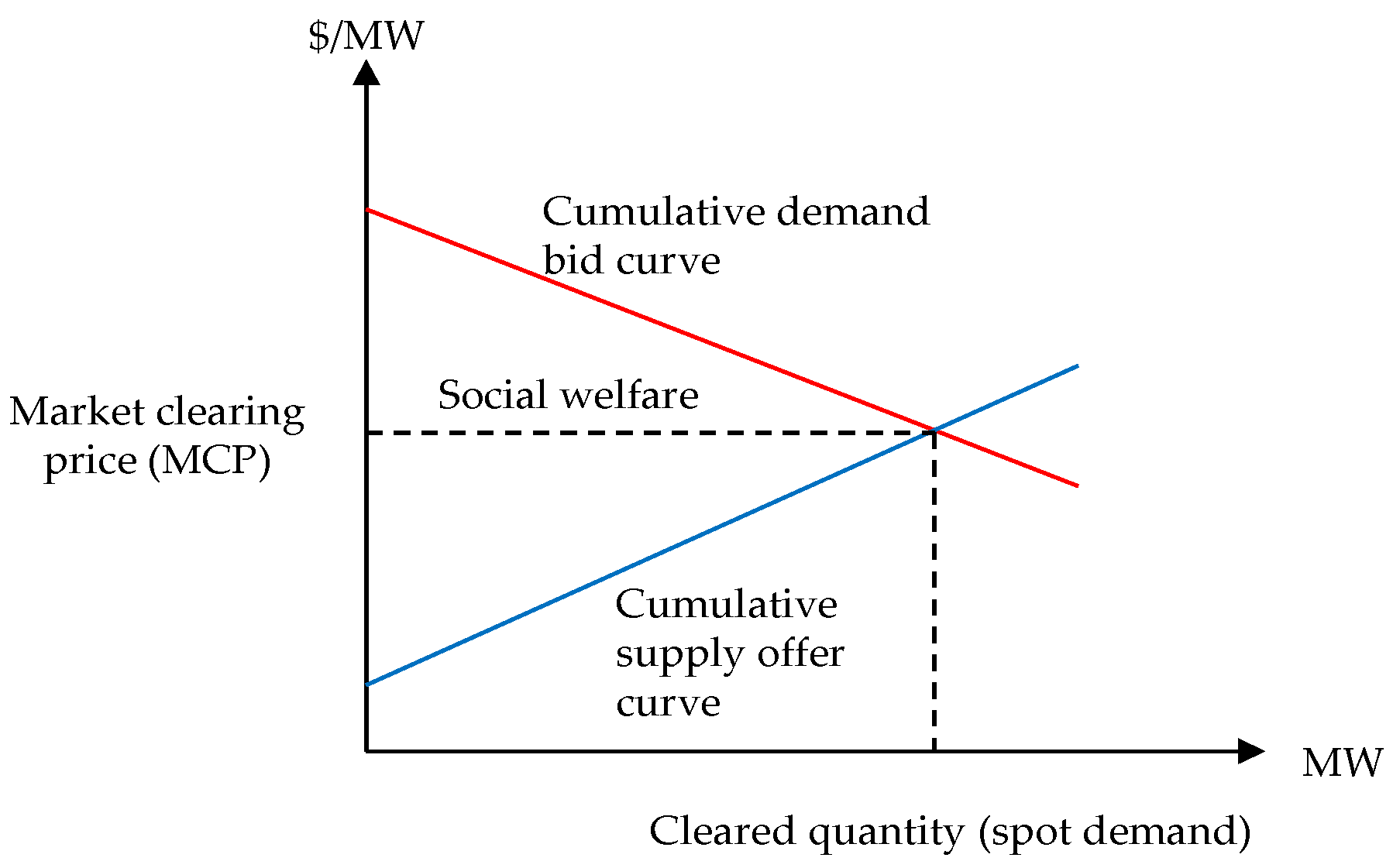
In the energy stage, the PX maximizes social welfare subject to the submitted bids/offers and the related constraints, which yields both the cleared quantity and the market clearing price (MCP). Figure 2 illustrates the clearing logic: the accepted supply and demand determine the cleared quantity, and MCP is applied as a uniform settlement price for accepted energy transactions. Energy is settled at a uniform MCP. Accepted MWh are paid at MCP. AGC and SR are settled as pay-as-bid capacity payments. Awarded MWs are paid at the submitted capacity offer price. The “Avg. price” reported in the tables is computed as total capacity payment divided by procured MW. Throughout the paper, energy prices are in $/MWh, AGC/SR capacity prices are in $/MW, and all totals are reported in $/h for a 1 h interval. Social welfare is computed from the accepted bids and offers (i.e., the surplus over the cleared quantity) and is used later to compare outcomes across loading conditions in the case studies.
Ancillary services are cleared after the energy award because AGC and SR are procured from the residual capacity of generators. Specifically, once a unit is awarded energy, its remaining headroom limits how much AGC and SR it can provide. This creates a cross-product coupling that the PX must respect through eligibility and residual-capacity constraints, and it becomes binding at peak load when energy awards leave insufficient headroom to meet reserve targets.
Accordingly, the PX clears the day-ahead market in three stages: (i) energy clearing determines the scheduled active power; (ii) AGC clearing allocates AGC capacity subject to remaining headroom after energy awards; and (iii) SR clearing allocates spinning reserve capacity based on the remaining capacity after both energy and AGC allocations. The resulting multi-product schedule is then forwarded to the ISO for network security validation and congestion assessment, as detailed in Section 2.3.

2.3. PX–ISO Closed-Loop Operation

Figure 3 illustrates the PX–ISO closed-loop workflow adopted in this paper to couple staged market clearing with network feasibility. The PX first collects energy bids from DisCos and energy/AGC/SR offers from GenCos, and performs the staged day-ahead clearing described in Section 2.2. The cleared schedule is then submitted to the ISO for feasibility screening, because welfare-maximizing schedules may become infeasible once transmission limits and operational constraints are enforced [1,2].
On the ISO side, this paper employs an equivalent current injection (ECI)-based power-flow screening to check line limits and detect congestion efficiently in an iterative re-clearing setting [16]. If no congestion or limit violation is identified, the cleared schedule is accepted as the final schedule for next-day operation. If violations are detected, the ISO activates a traceable correction path. First, flow tracing is performed to attribute the loading of the congested element to individual GenCo injections, producing contribution factors [12,13]. These factors are then used to guide a minimal-change OPF redispatch, whose goal is to relieve congestion while keeping deviations from the PX-cleared schedule as small as possible under security constraints [19]. The resulting secure dispatch recommendation is sent back to the PX as a re-clearing signal, so that the final outcome remains market-based and interpretable to participants rather than being solely an operator-side override.
When the ISO accepts the PX-cleared schedule, settlement follows the original PX clearing. When the ISO triggers a corrective redispatch, we do not introduce a separate ISO-side payment rule. Instead, the ISO-feasible dispatch is fed back to the PX, and the PX re-clears by treating those dispatch levels as binding energy awards while keeping bids/offers unchanged. The uniform MCP and the associated energy payments are then recalculated at this feasible operating point, so the final settlement is consistent with an executable schedule. Market-specific uplift/make-whole compensation is not represented here and can be added in future extensions.

3. Problem Formulation and Security Evaluation Modules

3.1. PX Staged Market-Clearing Models

Consider a day-ahead power market settled hourly. In this paper, the formulation is single-period. The index t denotes one representative hour. Let t T denote the market interval, G (GenCos), and D the set of demands (DisCos). The PX clears three products sequentially: energy, AGC capacity, and spinning reserve (SR) capacity. The sequential design is enforced through eligibility and residual-capacity coupling, i.e., only the remaining headroom after earlier awards can be used for later products. In this formulation, the submitted energy bids of DisCos are represented by the benefit functions Ud(⋅), while the GenCos’ energy offers are embedded in Cg(⋅) (and their marginal costs). Hence, the day-ahead energy bidding stage is implemented through the welfare maximization in (1). These inputs define the welfare model in (1), while Stages 2–3 use submitted capacity offer prices for AGC/SR.
An integrated co-optimization would co-decide energy and reserve awards in a single clearing problem under the same capacity limits. The staged formulation fixes the energy awards first; therefore, it can differ from co-optimization whenever reserve deliverability is binding, while the two coincide when residual headroom is sufficient. A simple construction illustrating why staged clearing can differ from integrated co-optimization under binding reserve deliverability is provided in Appendix A.
(a)
Stage 1: Energy clearing (social welfare maximization)
The PX clears energy by maximizing social welfare, defined as the aggregate demand benefit minus the aggregate generation cost:
max { P g , t E ,   P d , t E }   S W t = d D U d ( P d , t E ) g G C g ( P g , t E )
where P g , t E (MW) is the energy award (dispatch quantity) of GenCo g at hour t, and P d , t E (MW) is the cleared demand served for DisCo d at hour t. Ud(⋅) denotes the demand-side benefit (utility) function of DisCo d, and Cg(⋅) denotes the production cost function of GenCo g. SWt represents the (hourly) social welfare, defined as the aggregate demand benefit minus the aggregate generation cost. DisCo energy bids are captured by the benefit functions Ud(⋅). GenCo energy offers are captured by the cost functions Cg(⋅) and operating limits. The energy settlement price is a uniform MCP implied by the market-balance constraint. In this paper, the energy MCP is the uniform settlement price from the market-balance constraint, while AGC/SR “cleared prices” are the submitted capacity offer prices of the awarded units (pay-as-bid).
Energy balance is enforced at the market level (network constraints are validated by the ISO after clearing):
d D P d , t E = g G P g , t E
where the equality enforces market-level energy balance at hour t (single-zone clearing without net interchange). If imports/exports are modeled, this balance can be extended by adding the corresponding net interchange term.
This single-zone, uniform-price balance is adopted to isolate the staged-clearing and closed-loop validation mechanism; nodal pricing and security-constrained clearing are outside the present scope and would require embedding network constraints directly into the market-clearing layer. The proposed loop can be viewed as complementary to LMP-based SCOPF: SCOPF internalizes network constraints inside clearing, whereas our focus is on a transparent market–operation interface when clearing and security validation are separated.
Bid/offer acceptance is bounded by submitted limits:
P g m i n P g , t E P g m a x ,         g G ,         P d m i n P d , t E P d m a x ,         d D
where P g m i n and P g m a x (MW) are the minimum and maximum operating limits of GenCo g, and   P d m i n and P d m a x (MW) define the admissible served-demand range for DisCo d in the day-ahead clearing.
To reflect practical nonconvexities in offer curves, the generator cost can be modeled with a quadratic term plus valve-point loading:
C g ( P ) = a g + b g P + c g P 2 + | e g s i n ( f g ( P g m i n P ) ) |
where ag, bg, and cg are the quadratic cost coefficients of GenCo. The term | e g s i n ( f g ( P g m i n P ) ) | models valve-point loading ripples, where eg and fg are the amplitude and frequency parameters, respectively, and P (MW) is the operating point at which the cost is evaluated.
For demand benefits, a standard quadratic utility is used to produce a downward-sloping demand curve and a well-defined marginal willingness to pay:
U d ( P ) = α d P β d P 2 ,     α d > 0 ,     β d > 0
where U d ( P ) is chosen as a quadratic benefit function that yields a downward-sloping marginal willingness-to-pay curve. To ensure diminishing marginal benefit, we set
λ d ( P ) = U d ( P ) P = α d 2 β d P   ( $ / M W h )
where αd and βd are demand-curve shaping parameters for DisCo d.
(b)
Stage 2: AGC capacity clearing (procurement under headroom coupling)
After energy is awarded, AGC is cleared using the remaining headroom. Let R g , t A G C be the awarded AGC capacity for generator g . With the AGC requirement R r e q , t A G C , the PX procurement can be written as follows:
min { R g , t AGC } g G π g , t A G C R g , t A G C
s.t.
g G R g , t A G C R r e q , t A G C
0 R g , t A G C P g m a x P g , t E ,   g G
here, R g , t A G C (MW) is the awarded AGC capacity for GenCo g at hour t, π g , t A G C ($/MW) is the submitted AGC capacity offer price, and R r e q , t A G C (MW) is the system AGC requirement at hour t. Constraint (9) enforces the headroom coupling between energy and AGC, i.e., once P g , t E is awarded in Stage 1, the feasible AGC capacity is bounded by the remaining margin P g m a x P g , t E .
(c)
Stage 3: SR capacity clearing (further residual coupling)
Similarly, SR is cleared last. Let R g , t S R be the award and R r e q , t S R be the system SR requirement:
min { R g , t SR } g G π g , t S R R g , t S R + η S R s t S R
g G R g , t S R + s t S R R r e q , t S R ,         s t S R 0
0 R g , t S R P g m a x P g , t E R g , t A G C ,   g G
where R g , t S R (MW) denotes the awarded spinning reserve (SR) capacity for GenCo g at hour t, π g , t S R ($/MW) is the submitted SR capacity offer price, and R r e q , t S R (MW) is the system SR capacity requirement. ηSR is the shortfall penalty coefficient (in $/MW). The SR requirement is modeled as a target with a shortfall variable s t S R ≥ 0. We penalize any unmet reserve by adding ηSR to the SR clearing objective, so SR shortfall occurs only when residual headroom makes the requirement unattainable. The feasible SR capacity is further restricted by the residual capacity after both energy and AGC awards, i.e., P g m a x P g , t E R g , t A G C .
To avoid making ηSR a tuning knob, it is chosen to dominate the SR offer price range in the case study. Specifically, ηSR is set higher than the maximum submitted SR offer price so that the SR stage procures all deliverable reserves before leaving any shortfall. Under this dominance setting, any remaining shortfall reflects insufficient residual headroom rather than a penalty-driven artifact.
Under staged clearing, the deliverable reserve is limited by the residual headroom left after the earlier awards. For hour ttt, define the SR-deliverable headroom as
H t S R = g G m a x ( 0 , P g m a x P g , t E R g , t A G C )
A necessary and sufficient condition for meeting the SR target without shortage is H t S R R r e q , t S R . When H t S R R r e q , t S R , a flexibility squeeze occurs, and the minimum unavoidable shortfall is bounded by
s t S R R r e q , t S R H t S R
For reporting purposes, we use the normalized squeeze index ϕ t S R = min ( 0 , R r e q , t S R H t S R R r e q , t S R ) , where ϕ t S R = 0 indicates that the SR target is fully deliverable under staged coupling.
Constraints (9) and (14) enforce the staged rule, energy → AGC → SR, as a hard feasibility coupling. Under peak loading, the energy stage may admit feasible awards, while the residual headroom can become insufficient to satisfy ancillary-service requirements, making the subsequent stages infeasible. This risk is further amplified by practical thermal-unit characteristics such as prohibited operating zones (POZs), which fragment the admissible generation range into disjoint intervals. In this paper, POZ feasibility is enforced in the proposed optimizer via a repair operator (Section 4), without altering the analytical clearing models and security-validation modules in Section 3.

3.2. ISO Security Validation Using ECI-Based Power-Flow Check

After the PX completes the day-ahead staged clearing in Section 3.1, the ISO performs a feasibility screening to ensure that the market-cleared schedule remains executable once mapped onto the physical network. This security validation is executed repeatedly whenever the PX–ISO loop triggers re-clearing; therefore, the load-flow engine must be numerically robust while keeping the per-iteration cost low. To this end, we adopt an equivalent current injection (ECI) formulation in rectangular coordinates, which preserves the linear network structure and reduces repeated Jacobian refactorization for PQ buses compared with a conventional full Newton–Raphson implementation [16,19].
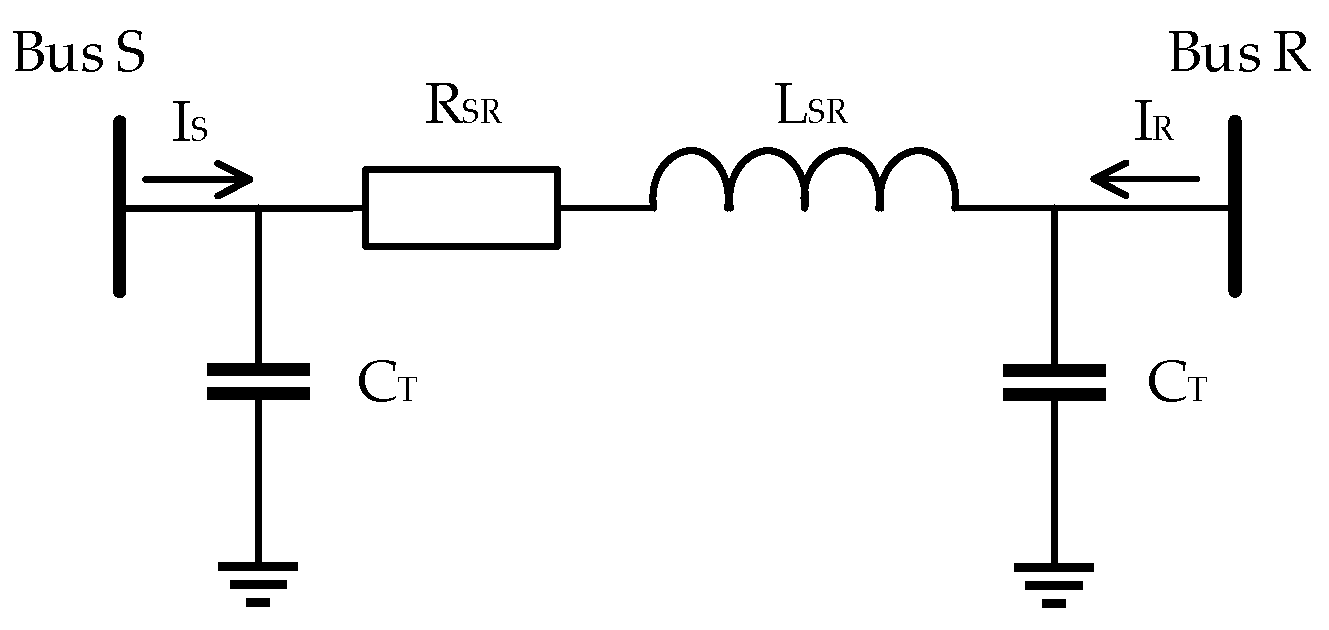
The transmission line connecting a sending bus S and a receiving bus R is represented by the π-equivalent model shown in Figure 4. The series branch is characterized by ySR = GSR + jBSR, and the shunt charging is represented by a susceptance jBC (split to the two terminals in the standard π model). Under the ECI viewpoint, the nonlinear constant-power injection at bus S in iteration k is converted into an equivalent injected current through
I S ( k ) = S S * ( U S ( k ) ) * = P S j Q S ( U S ( k ) ) * I S , r ( k ) + j I S , i ( k )
where S = PS + jQS denotes the net complex power injection at bus S implied by the PX-cleared schedule (generation minus demand and losses allocation as adopted), and U S ( k ) is the corresponding complex bus voltage. The superscript (k) indicates the iteration index, and (⋅) denotes the complex conjugate.
Writing voltages in rectangular form US = US,r + jUS,i and UR = UR,r + jUR,i, the injected currents implied by the π model can be expressed as linear functions of voltage components. For the two-terminal line, the current injection at the sending end can be written as
I S ( k ) = [ G S R ( U S , r ( k ) U R , r ( k ) ) B S R ( U S , i ( k ) U R , i ( k ) ) B C U S , i ( k ) ] + j [ G S R ( U S , i ( k ) U R , i ( k ) ) B S R ( U S , r ( k ) U R , r ( k ) ) + B C U S , r ( k ) ]
and the receiving-end injection IR is obtained analogously as
I R ( k ) = [ G S R ( U R , r ( k ) U S , r ( k ) ) B S R ( U R , i ( k ) U S , i ( k ) ) B C U R , i ( k ) ] + j [ G S R ( U R , i ( k ) U S , i ( k ) ) B S R ( U R , r ( k ) U S , r ( k ) ) + B C U R , r ( k ) ]
Based on (15)–(17), the ISO forms current mismatches by comparing the equivalent injected currents (from scheduled P/Q) with the network currents implied by the present voltage estimate. Linearizing the mismatch in rectangular coordinates yields the following standard ECI Newton step:
I r ( k ) = J 11 U r ( k ) + J 12 U i ( k ) ,   I i ( k ) = J 21 U r ( k ) + J 22 U i ( k )
where U r ( k ) and U i ( k ) collect the voltage updates of all buses in real and imaginary parts, respectively. For PQ buses, the resulting Jacobian blocks are directly determined by the real and imaginary parts of the bus-admittance matrix and therefore remain constant during iterations. For the two-bus line segment in Figure 4, the organized error equation can be written in the following compact form:
[ I S , r I R , r I S , i I R , i ] = J S R [ U S , r U R , r U S , i U R , i ]
and more generally for an M-bus system, the ECI update for PQ buses can be expressed as
[ I r I i ] = [ G B B G ] [ U r U i ]
where G and B are the conductance and susceptance matrices derived from Y = G + jB. This structure is particularly suitable for the PX–ISO re-clearing loop, since repeated security checks do not require rebuilding the full Jacobian for PQ buses at every iteration [19].
Voltage-controlled (PV) buses are incorporated by replacing the reactive-power mismatch with the active-power constraint and the voltage-magnitude constraint. Using a first-order expansion, the real-power mismatch at PV bus S is
P S = U r · I S , r ( k ) + U i · I S , i ( k ) + U r · I S , r ( k ) + U i · I S , i ( k )
where the current increments I S , r ( k ) , I S , i ( k ) are obtained from the ECI linearization of the network equations (with B S R = B S R + B C ). Substituting the ECI relation yields an affine form in voltage increments:
P S = ( U S , r G S R + U S , i B S R + I S , r ) U S , r + ( U S , r B S R + U S , i G S R + I S , i ) U S , i   + ( U S , r G S R U S , i B S R ) U R , r + ( U S , r B S R U S , i G S R ) U R , i
The voltage-magnitude constraint is linearized as
| U S | 2 = 2 U S , r U S , r + 2 U S , i U S , i
Collecting (22) and (23) gives the PV-bus correction equation, which is embedded into the global mismatch system:
F = [ J ] U
In contrast to a conventional Newton–Raphson implementation that updates a large portion of J each iteration, the ECI formulation only modifies the small subset of Jacobian entries associated with PV-bus constraints, while the PQ-related blocks remain constant. This design choice is the key reason why the ISO security validation can be executed efficiently inside the iterative PX–ISO loop considered in this paper [16,19]. Once bus voltages are obtained, the ISO computes branch flows and verifies network operating limits, including bus-voltage bounds and line loading constraints. If the cleared schedule violates thermal limits, the ISO flags the schedule as infeasible. The overloaded elements (with the corresponding operating point) are passed to the congestion-handling module, which computes a security-feasible redispatch recommendation for PX re-clearing. Because the ECI check already delivers the converged rectangular-coordinate state ( U ~ , I ~ i n j ), the subsequent AC flow-tracing module in Section 3.3 is executed directly on the same state without an additional power-flow solve. The ECI iterations stop when the mismatch norm falls below a tolerance εECI or when the maximum iteration count KECI is reached (Table A1).

3.3. AC Power-Flow Tracing and Contribution Matrices

At each hour t, we map the cleared energy awards { P g , t E } g G and { P d , t E } d D into the AC injections (PG, QG, PD, QD); the time index t is omitted in Section 3.2, Section 3.3 and Section 3.4 for notational brevity.
After the ISO security validation in Section 3.2 yields the converged bus-voltage solution, the next step is to attribute congested-element loadings to individual market participants in a manner that remains consistent with the AC network solution. This design reuses the ECI rectangular-coordinate representation, allowing the flow-tracing module to operate directly on the converged AC state (U, I) without additional variable transformations, thereby keeping the PX–ISO re-clearing loop computationally lightweight and audit-friendly. The flow tracing analysis is performed on the converged AC operating point obtained from the ECI-based screening; hence, contribution attribution is consistent with the same network state used for feasibility validation. The resulting forward and backward contribution matrices provide an explicit, audit-friendly mapping from bus injections to line loadings, which is crucial for closed-loop PX–ISO re-clearing. Consider an N-bus, M-branch transmission network. Let the rectangular-coordinate voltage vector be stacked as
U ~ = [ U r U i ] R 2 N ,       I ~ i n j = [ I r i n j I i i n j ] R 2 N
where U r , U i are the real and imaginary parts of bus voltages, and I r i n j , I i i n j j are the real and imaginary parts of the net injected currents at buses (positive for injections and negative for withdrawals).
For a branch K connecting sending bus S(k) to receiving bus R(k), the π-model current from S to R is
I k = y k ( U S ( k ) U R ( k ) ) + j b c , k U S ( k )
where yk = gk + jbk is the series admittance and jbc,k denotes the shunt susceptance at the sending end for the π-equivalent.
Stacking all branch currents in rectangular form gives
I ~ l = [ I r l I i l ] = C U ~
where I ~ l R M collects real/imaginary components of directed branch currents, and C R 2 M × 2 N is the line–voltage mapping matrix assembled from {gk, bk, bc,k} and the branch incidence structure.
The complex power flow on branch K (sending-end convention) is computed by S K = U S · I K * and the corresponding rectangular form can be written compactly as
f = [ P Q ] = T ( U ~ ) I ~ l
where P and Q R M are active/reactive branch-flow vectors and T ( U ~ ) is a block-diagonal operator built from the real and imaginary parts of the sending-end voltages { U S ( k ) , r , U R ( k ) , i } on each directed branch, so that f = [P; Q] is obtained from I ~ l via S k = U S ( k ) · I k * . U S ( k ) , r and U R ( k ) , i denote the real and imaginary parts of the sending-end voltage on branch k.
Next, define the stacked bus-injection vector consistent with the market-layer quantities in Section 3.1 as
x = [ P i n j Q i n j ] R 2 N
where P i n j and Q i n j are the net active/reactive injections at the buses. In a day-ahead schedule, x is naturally decomposed into generator injections and demand withdrawals:
x G = [ P G Q G ] [ P D Q D ]
where PG and QG are injections at GenCo buses; PD, QD are demand withdrawals at DisCo/load buses (all nonnegative in magnitude).
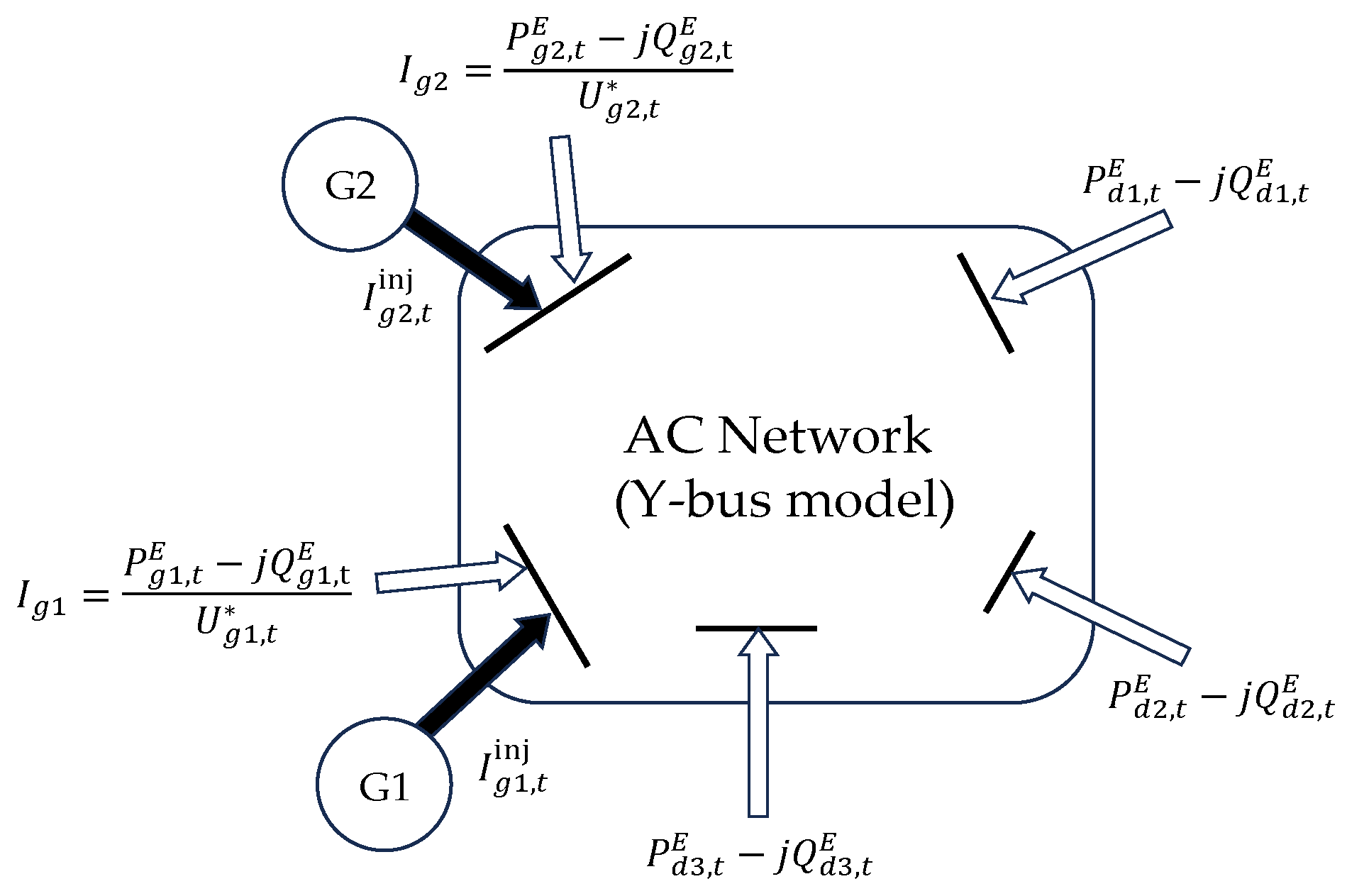
Figure 5 illustrates how the PX-cleared bus injections are mapped to equivalent current injections at the converged AC operating point. For a generator bus g, the complex injected current is computed from the scheduled complex injection ( P g E ,  Q g E ) and the solved bus voltage Ug as I g = ( P g E j Q g E ) / U g * . For a demand bus d, the cleared quantities ( P d E ,  Q d E ) represent withdrawals and are therefore treated as negative injections under the convention in (27) and (28), i.e., I d = ( P d E j Q d E ) / U d * . This ECI mapping is consistent with the stacked bus-injection vector and is used to construct the branch-current and contribution mappings in (29)–(35).
Following the AC flow-tracing logic (with proportional sharing) in a rectangular-coordinate ECI setting, the generator-to-line contribution in the forward (sending-end) direction is represented by the following contribution matrix:
[ P g , f Q g , f ] = D g , f [ P G Q G ] ,     D g , f R 2 M × 2 N
and similarly, the reverse-direction contribution matrix D g , b R 2 M × 2 N provides
[ P g , b Q g , b ] = D g , b [ P G Q G ]
where superscripts g, f and g, b denote generator-originated contributions in forward and backward directions, respectively; 2M corresponds to the stacked P/Q flows on M-directed branches; 2N corresponds to stacked P/Q injections at N buses.
To make the coupling between P and Q explicit (which is important under AC feasibility), (28) can be written in block form as
[ P g , f Q g , f ] = [ D P P g , f D P Q g , f D Q P g , f D Q Q g , f ] [ P G Q G ]
where DPP maps PGP, DPQ maps QGP maps PGQ, and DQQ maps QGQ.
Accordingly, the contribution of a specific generator bus g to a specific branch K is
P K g g , f = [ D P P g , f ] K , g P g G + [ D P Q g , f ] K , g Q g G
Q K g g , f = [ D Q P g , f ] K , g P g G + [ D Q Q g , f ] K , g Q g G
where [⋅]k,i entry of the corresponding submatrix; P g G and Q g G are the scheduled injections at generator bus g.
Summing across all generator buses recovers the total branch flow:
P K = S g P K g g , f ,   Q K = S g Q K g g , f
Finally, the contribution factors used for congestion attribution are defined by normalizing the generator contributions on a congested branch ℓ:
α l , g = P K l g , f S g P K l g , f
and S g α l , g = 1 by construction.
  • where α l , i quantifies the share of branch ’s active loading attributable to generator i under the solved AC operating point; the same normalization can be applied to reactive contributions if required.
This ECI-consistent tracing layer is particularly suitable for the iterative PX–ISO loop because the ISO already computes U ~ through the ECI correction system; the additional matrices C, T( U ~ ), and D g are assembled at the operating point and provide an explainable bridge from market-cleared injections to network element loadings, consistent with classical flow-tracing ideas [11,12] while remaining aligned with the ECI rectangular-coordinate formulation [19].

3.4. Contribution-Guided Minimal-Change OPF Redispatch for Congestion Relief

If the ISO security validation flags thermal overloads or congestion on a set of branches L c , a corrective redispatch is computed such that (i) the final schedule is AC-feasible and (ii) deviations from the market-cleared schedule remain as small as possible. In particular, “minimal change” is enforced by minimizing the squared deviations (ΔPg, ΔQg) from the PX-cleared injections while satisfying AC feasibility and line-flow limits. Let P g E , Q g E denote the market-cleared injections (after PX staged clearing), and let ΔPg, ΔQg denote ISO redispatch adjustments. The redispatch problem is formulated as a minimal-change OPF:
min { P g , Q g , } g G ( P g ) 2 + λ g G ( Q g ) 2
In the case studies, the corrective redispatch is limited to active-power adjustments. Reactive power is kept unchanged, and λ is set to 0; accordingly, the redispatch minimizes changes in active power.
  • Subject to generator operating limits,
P g m i n P g E + P g P g m a x ,         Q g m i n Q g E + Q g Q g m a x
bus-voltage limits,
U n m i n | U n | U n m a x
and AC network constraints (power-flow balance and branch flow limits),
g ( U ,   θ ,   P * + P , Q * + Q ) = 0
| S l ( U ) | S l m a x
where g(⋅) denotes the AC power-flow equality constraints; S l ( U ) is the complex apparent flow on branch evaluated at the solved voltages; S l m a x is the thermal rating.
The interface innovation between the tracing module and the redispatch module is that only generators with non-negligible responsibility on the congested elements are selected as redispatch participants. Specifically, using the contribution factors α l , i from (37), the participating set is defined as
G c = { g G | max l L c   α l , g τ }
and redispatch is applied only to participating generators G p a r t G , while other units are fixed, i.e., ΔPg = ΔQg = 0 for all g G \ G p a r t . The threshold is set to τ = 0.005 (0.5%).
This contribution-guided participation rule keeps congestion relief market-traceable and explainable. Overloaded elements are first attributed via AC-consistent tracing [11,13], and only the responsible injections are allowed to move in the minimal-change OPF. The resulting secure redispatch (ΔP, ΔQ) is then returned to the PX as a re-clearing signal in the closed-loop PX–ISO operation described in Section 2.3.

4. APO–SL Solution Method for Nonconvex Staged Clearing with POZ Feasibility

4.1. Unified Optimization Formulation and POZ Feasibility Handling

The staged PX clearing in Section 3.1 solves three coupled optimization tasks sequentially—energy, AGC capacity, and SR capacity—where the feasibility of later stages is restricted by the residual headroom left by earlier awards. We keep the market and ISO models in Section 3 intact. To solve the resulting nonconvex clearing problems robustly, we use APO–SL as a unified constrained optimizer. Candidate solutions are evaluated with a penalty-augmented fitness, together with a lightweight feasibility-repair step.
Let s ∈{E, A, R} denote the clearing stage (energy, AGC, SR) at hour t. The corresponding decision vectors are defined as
{ x t ( E ) = [ { P g , t E } g G   ,     { P d , t E } d D ] x t ( A ) = [ { R g , t A G C } g G ] x t ( R ) = [ { P g , t S R } g G ]
For a unified minimization interface inside the metaheuristic, the stage objective is written as
J t ( s ) = { S W t ( x ) ,       s = E C t A G C ( x ) ,       s = A C t S R ( x ) ,       s = R
where SWt is the social welfare defined in (1), and C t A G C , C t S R follow the procurement models in the AGC and SR stages in Section 3.1. The energy stage inherits the practical valve-point nonconvexity already modeled in (4).
All analytical constraints remain exactly as defined in Section 3.1 and are mapped into an equality–inequality form for the optimizer:
g t ( s ) ( x ) = 0 ,   h t ( s ) ( x ) 0
Here, g t ( s ) collects the balance/requirement equalities (e.g., market-level balance in (2) for energy and the system requirement constraints for ancillary services), while h t ( s ) collects bound and coupling inequalities, including bid/offer limits in (3) and the staged headroom coupling that enforces “Energy → AGC → SR” feasibility.
To drive APO-SL with a scalar fitness while preserving reproducibility, we convert the constrained problem into an unconstrained evaluation via a quadratic penalty:
F t ( s ) ( x ) = J t ( s ) ( x ) + ρ e q g t ( s ) ( x ) 2 2 + ρ i n m a x ( 0 , h t ( s ) ( x ) ) 2 2
where ∥⋅∥2 denotes the Euclidean norm, and max (0, h) is applied elementwise, so only violated inequalities contribute to the penalty. In implementation, F t ( s ) is the sole scalar score used for selection and learning in APO-SL; thus, ρeq > 0 and ρin > 0 are penalty parameters associated with equality and inequality constraints, respectively.
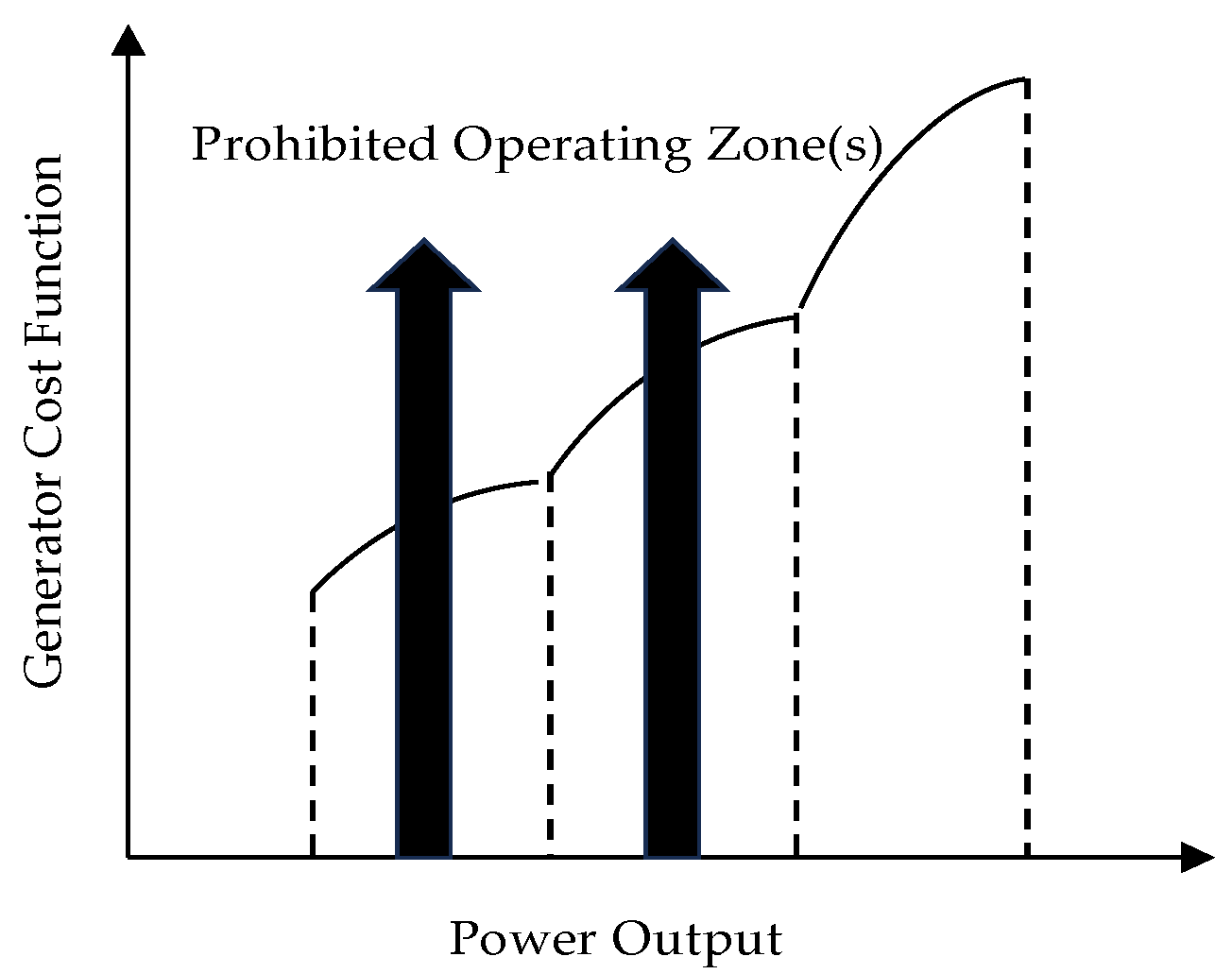
In practical thermal units, long-term aging and auxiliary equipment constraints may create prohibited operating zones, resulting in disjoint feasible generation ranges and infeasible candidates if a continuous solver is used directly. We do not modify the analytical market-clearing modules in Section 3. Prohibited operating zones are handled inside the optimizer through a feasibility-repair operator. If an energy-stage candidate P g , t E falls into a prohibited interval, it is projected to the nearest admissible boundary of that unit’s feasible segment (Figure 6).
This repair is applied before evaluating F t ( E ) , ensuring that the staged feasibility mechanism in Section 3 is respected while still allowing APO-SL to explore nonconvex offer landscapes.

4.2. APO–SL

This paper builds on the Artificial Protozoa Optimizer (APO) and introduces a PSO-style social-learning term to intensify exploitation near high-quality solutions. APO evolves a population { X i t } i = 1 N under four biological behaviors: autotroph foraging, heterotroph foraging, dormancy, and reproduction.
a.
Initialization is as follows.
X i 0 = X m i n + r a n d ( X m a x X m i n )
followed by bound projection and (for the energy stage) POZ/balance repair.
b.
Autotroph foraging is as follows.
APO updates an individual using the current best X b e s t t and a random peer X r t :
X i t + 1 = X i t + ( X b e s t t X i t ) f + ( X i t X r t ) ( 1 f )
where f = 1 + c o s ( π t / T m ) 2 gradually shifts the search from exploration to exploitation.
c.
Heterotroph foraging is as follows.
APO also provides a local adjustment using near/far neighbors:
X i t + 1 = X i t + ω h ( X n e a r t X i t ) + ( 1 ω h ) ( X f a r t X i t )
where ω h depends on the relative fitness between X n e a r t and X i t .
d.
Dormancy (diversification) is as follows.
A subset of agents is reinitialized to escape stagnation:
X i t + 1 = X m i n + r a n d ( X m a x X m i n )
This is applied according to APO’s dormancy probability mechanism.
e.
Reproduction is as follows.
Selected agents are perturbed along a randomly masked direction:
X i t + 1 = X t + t ( M r ) ,           t = 2 · r a n d ( 1 t / T m )
where Mr is a binary mapping vector controlling which dimensions are perturbed.
f.
Proposed social-learning exploitation is as follows.
To strengthen exploitation, we embed a PSO-inspired social pull toward the global best into APO’s exploitation steps (heterotroph and reproduction). After generating X i t + 1 by APO, we apply
X i t + 1 X i t + 1 + c s ( t ) r a n d ( X g b e s t t X i t + 1 )
where X g b e s t t is the best solution found so far, t denotes the current iteration index, T m is the maximum number of iterations, and c s ( t ) is a decreasing learning gain, e.g.,
c s ( t ) = c s 0 ( 1 t T m )
This term plays the role of social learning in PSO: it accelerates convergence when the search is already near a good basin, while the APO exploration operators still maintain diversity early in the run.
After the APO–SL update, we apply (i) bound projection, (ii) POZ repair (energy stage), and (iii) balance restoration, then re-evaluate fitness.

4.3. APO–SL Solution Procedure for Social Welfare Maximization Under Nonconvex Thermal-Unit Constraints

Section 4.2 defined the APO–SL update rule by augmenting APO’s population dynamics with a PSO-style social-learning pull to strengthen exploitation near promising regions. In this work, APO–SL is used as the unified numerical engine to solve the staged PX clearing models in Section 3 (energy → AGC → SR) under practical thermal-unit characteristics. In particular, valve-point effects introduce nonsmoothed ripples in the bid-based cost curves, and prohibited operating zones (POZs) yield disjoint feasible generation ranges, which jointly make the feasible set nonconvex. The analytical formulation in Section 3 is kept unchanged. Every awarded schedule must still be implementable. APO–SL therefore uses a discrete–continuous sequence: it selects feasible POZ segments first, then optimizes the continuous dispatch within the selected segments under staged coupling and system limits. The solution steps are as follows:
Step 1:
Notation of a candidate
For each hour t, a candidate solution is represented by x t = [ P t E , R t A G C ,   R t S R   ] . When POZs are modeled, each unit additionally has a segment index zg,t∈{1,…, Kg} that selects one admissible interval [ P g , k m i n ,   P g , k m a x   ] .
Step 2:
Discrete segment identification for POZ feasibility
For each POZ-constrained unit g, enumerate its admissible operating intervals { [ P g , k m i n ,   P g , k m a x   ] } k = 1 K g . APO–SL performs a discrete search over zt = [z1,t,…,zG,t] by mapping each particle’s discrete gene to a segment index. This step fixes the “active” feasible region of each unit, converting the original disjoint domain into a set of continuous box constraints: P g , t E [ P g , z g , t m i n ,   P g , z g , t m a x   ] . Infeasible segment combinations (e.g., those that cannot satisfy demand balance even with all headroom) are discarded early by a cheap feasibility screen based on aggregate bounds.
Step 3:
Stage 1: Energy clearing on the selected segments
Given zt, APO–SL optimizes P t E by maximizing the social welfare objective defined in Section 3.1, under (i) demand balance, (ii) unit segment bounds, and (iii) all energy-stage constraints. To ensure strict feasibility, any candidate violating hard bounds is repaired immediately (projection onto the selected segment), while equality/inequality constraints are handled through a penalty-augmented fitness as Equation (47).
Step 4:
Stage 2: AGC clearing with residual-capacity coupling
After an energy award is obtained, the feasible AGC headroom is updated unit-wise using the staged rule in Equations (11) and (14). i.e., AGC can only be allocated from residual capacity after energy is committed. APO–SL then optimizes R t A G C using the corresponding AGC-stage objective J t A G C and constraints, evaluated with the same penalty-and-repair framework.
Step 5:
Stage 3: Spinning reserve clearing with residual-capacity coupling
With P t E and R t A G C fixed, the SR stage allocates R t S R under the residual-capacity rule:
0   R g , t S R   R ¯ g , t S R (   P g , t E ,   R g , t A G C )
Again, APO–SL optimizes the SR-stage fitness   F t S R and terminates when the SR requirement and all constraints are satisfied within tolerance.
Step 6:
Feasibility repair operators used in all stages
To avoid returning infeasible awards (a common failure mode under POZ disjointness), two lightweight repair operators are used:
1.
Segment projection (hard-bound repair): If a candidate violates the active segment bounds, set
  P g , t E [ P g , z g , t m i n ,   P g , z g , t m a x   ] (   P g , t E )
and similarly project   R g , t A G C ,   R g , t S R onto their residual-capacity bounds.
2.
Balance repair (soft equality tightening): If the power balance mismatch is P t = P g , t E P d , t E , distribute the correction over participating units proportional to available headroom inside their active segments, then re-project to maintain segment feasibility. This keeps the search near the feasible manifold rather than relying purely on penalties.
Step 7:
Termination and reproducible settings
The run terminates when the equality residual (measured by g ) and the maximum inequality violation m a x ( h ) meets the tolerances ε e q and ε i n , respectively, and when the best objective improvement stays below εobj for Kstall consecutive iterations. If these conditions are not met, the run stops after Imax iterations. All settings required to reproduce the results (N, Imax, ρeq, ρin, εeq, εin, cs0, and the random seed) are provided in Appendix B.
For clarity and ease of reproduction, the complete solution pseudocode is provided in Algorithm 1.
Algorithm 1. Pseudocode of the APO–SL algorithm
Input: Stage objective J t ( s ) in (43); constraint functions g t ( s ) ( x ) ,   h t ( s ) ( x ) in (46); penalty fitness F t ( s ) ( x ) in (47).
Output: Optimal dispatch x t * .
1:  Initialize population { X i 0 } i = 1 N by (48)
2:  Apply bound projection and POZ projection for Energy stage
3:  Evaluate fitness F t ( s ) ( X i 0 ) using (47)
4:  Set current best X g b e s t 0 = arg m i n i   F t ( s ) ( X i 0 )
5:  Initialize k = 0
6:  for t = 0 to Tm − 1 do
7:     for each individual i = 1, …, N do
8:      Generate candidate by APO foraging operator using (49) and (50)
9:    if dormancy condition is triggered then
10:        Update X i t + 1 using reinitialization rule (51)
11:     else
12:        Update X i t + 1 using reproduction rule (52)
13:     end if
14:      Apply PSO-style social learning using (53)
15:      Update learning gain c s ( t ) according to (54)
16:      Apply bound projection on X i t + 1
17:      Apply POZ projection for Energy variables
18:      Enforce staged coupling (Energy → AGC → SR) feasibility
19:      Evaluate fitness F t ( s ) ( X i t + 1 ) using (47)
20:     if F t ( s ) ( X i t + 1 ) < F t ( s ) ( X i t ) then
21:         X i t  ←  X i t + 1
22:     end if
23:     end for
24:     Update global best
25:      X g b e s t t + 1 = arg m i n i   F t ( s ) ( X i t )
26: //Stall-based termination
27:  if |Fgbest(t) − Fgbest (t − 1)| ≤ εobj then
28:    k = k + 1
29:  else
30:    k = 0
31:  end if
32:   //Stop only when feasibility is reached AND improvement stalls
33:   if ( g ε e q and m a x ( h ) ε i n ) AND (kKstall) then
34:    break
35:  end if

5. Simulation and Case Studies

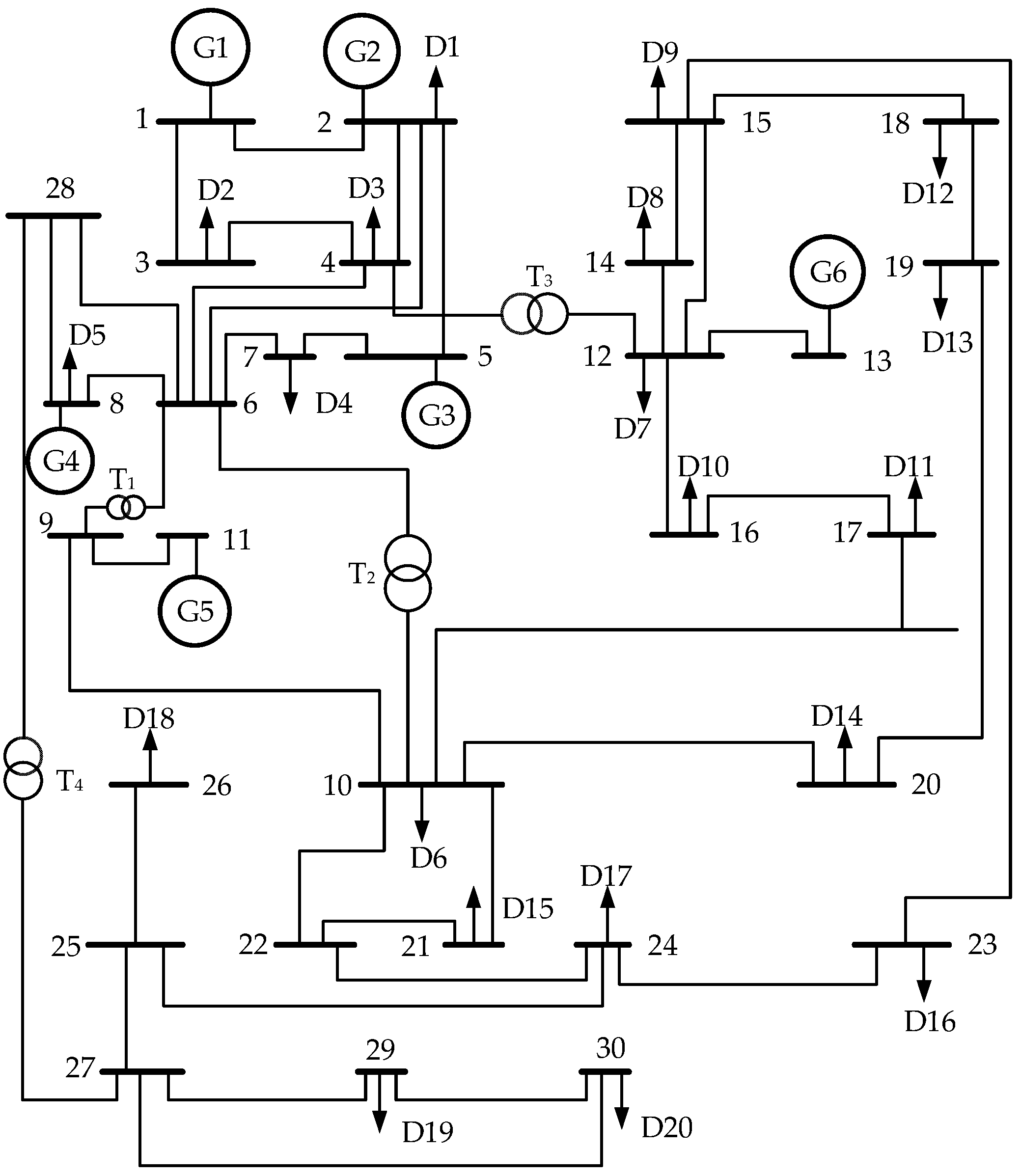
The proposed PX–ISO framework is evaluated on the IEEE 30-bus test system in Figure 7, which contains six generating units and a meshed transmission network. System data (generator limits, bus-voltage bounds, and line-flow limits) follow the benchmark settings in [19]. The day-ahead power market is settled hourly, where the PX clears three products sequentially (energy → AGC → SR) to explicitly capture residual-capacity coupling across stages.
To reflect practical thermal-unit bidding characteristics, nonconvexities induced by valve-point effects and prohibited operating zones (POZs) are considered, and inter-temporal feasibility is further constrained by ramp-rate limits. These features lead to a disconnected feasible region and motivate the use of the proposed APO–SL solver (Section 4). All generator parameters and modeling options are summarized in Table 2 [26].

5.1. Algorithm Comparison

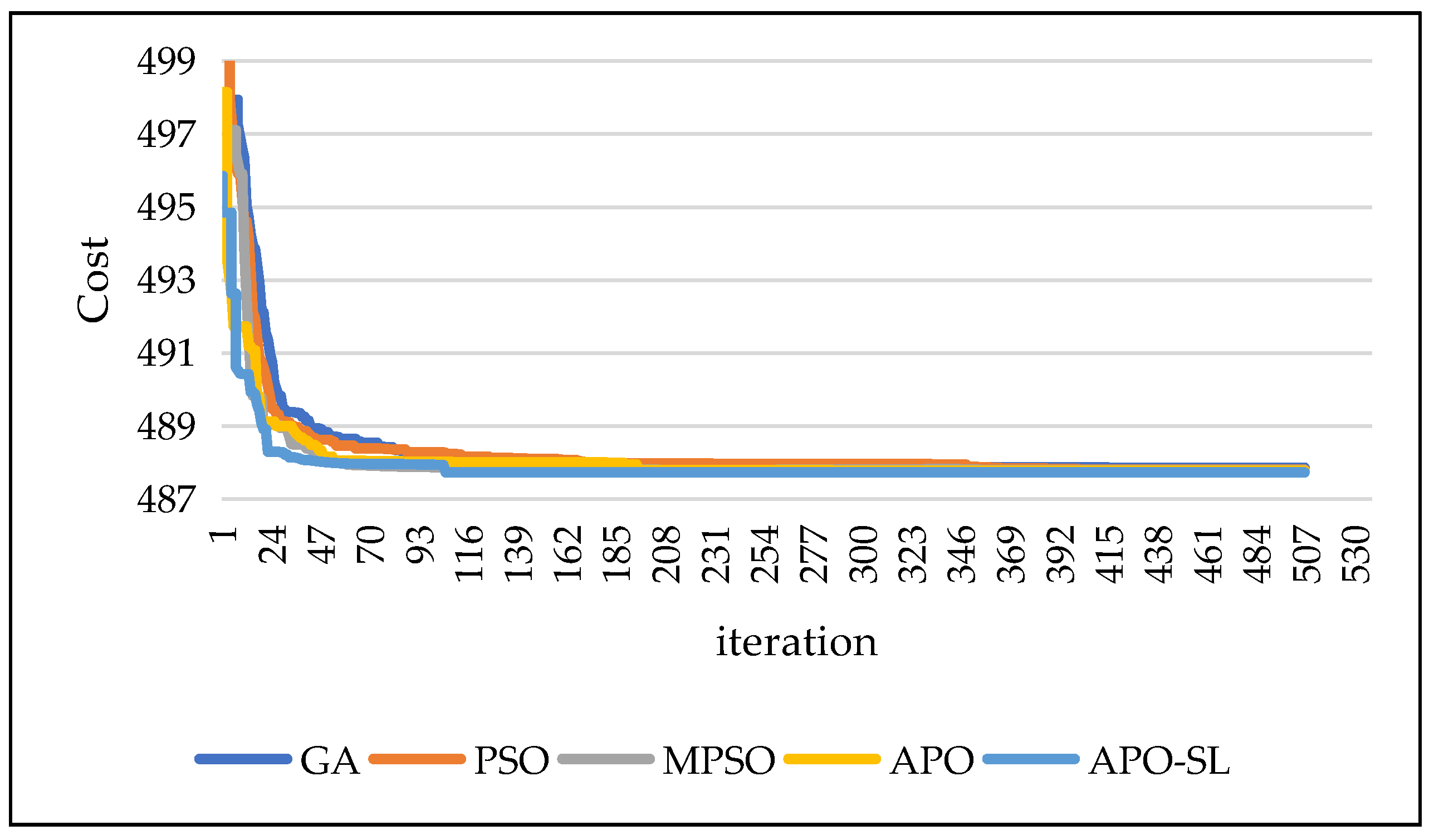
Figure 8 shows the convergence profiles of Genetic Algorithm (GA) [27], PSO [23], modified particle swarm optimization (MPSO) [28], APO [22], and the proposed APO–SL under the same population size (30). APO–SL is used here as a numerical solver. The algorithm itself is not the main contribution of this paper. The contribution is the PX–ISO closed loop and the staged energy → AGC → SR mechanism. For a fair comparison, all algorithms use the same objective function, the same constraint-handling strategy, and the same termination rule: feasibility is satisfied within εeq, εin, and the best objective stalls within εobj for Kstall iterations. The algorithm comparison is included to check solver robustness on the nonconvex clearing instances. The mechanism-level conclusions in Scenarios A–D do not depend on the choice of solver.
Because termination is tolerance-based, Figure 8 exhibits a common pattern: a rapid early decrease followed by a plateau once feasibility and stagnation criteria are met. APO–SL reaches the low-cost region sooner and remains marginally below the others near termination. PSO improves quickly at the beginning but slows later, whereas MPSO follows a smoother trajectory and settles at a lower final level. GA decreases more gradually and generally requires more evaluations before approaching the plateau.
Table 3 summarizes the numerical comparison. APO and APO–SL attain the best objective value (487.73 $/h), and APO–SL also reports the lowest mean cost among the tested methods. GA and PSO are standard baselines. MPSO represents a stability-enhanced PSO variant. APO is a newer bio-inspired baseline. This set covers classical and recent population-based solvers under the same stopping rule. In terms of mean CPU time, APO–SL and APO are the fastest (≈30 s), while GA is the slowest (65.3 s). As runs stop only when g εeq and max(h) ≤ εin, and the objective improvement remains below εobj for Kstall consecutive iterations (Appendix B), the time differences largely reflect how quickly each method meets the stopping criteria rather than a fixed iteration count. Each method was executed 100 times with different random seeds, and CPU time was measured on the same workstation using the same timing procedure.

5.2. Scenario A: Off-Peak

In the off-peak case, the staged day-ahead settlement (energy → AGC → SR) serves as the baseline for the later scenarios. Table 4 shows that the energy market clears 119.34 MW with an MCP of 3.33 $/MWh, corresponding to a purchase total of 397.47 $/h, a sales total of 316.11 $/h, and a social welfare of 81.36 $/h. The unit-level rows in Table 4 further show how the cleared energy is allocated across the GenCos.
The ancillary outcomes reflect the staged procurement rule. Because AGC and SR are procured after the energy schedule is fixed, their awards are bound by the residual headroom of committed units. The cleared AGC is 4.77 MW (Table 3). SR is evaluated under two requirement settings (80 MW and 23.87 MW). Aggregated ancillary payments are reported in Table 4 (AGC 2.05 $/h; SR 15.34/3.58 $/h), and Table 5 lists the corresponding bids and awarded units under each SR requirement.
ISO validation is non-binding in this case. The ECI-based screening detects no line-limit violations under off-peak loading, so the ISO accepts the PX-cleared dispatch without redispatch or penalties. Under non-binding network conditions, the staged coupling does not introduce feasibility issues, and ISO screening acts as a feasibility check.

5.3. Scenario B: Average

Under average load, the staged coupling becomes more binding, yet sequential clearing still yields a feasible outcome. Table 6 shows that the energy market clears 169.26 MW with an MCP of 3.42 $/MWh, corresponding to a purchase total of 578.87 $/h, a sales total of 491.90 $/h, and a social welfare of 86.97 $/h. Relative to Scenario A, both cleared energy and ancillary requirements increase; however, under the tested settings, AGC is fully procured (8.46 MW), and SR is also fully procured (80.00/33.85 MW).
The award pattern in Table 7 reflects the residual-headroom rule. Ancillary awards concentrate on units that retain headroom after the energy stage, rather than being distributed as if AGC and SR were independent products. This ties ancillary procurement to the capacity margin left by the cleared energy schedule and reduces the risk of awards that are cleared on paper but not deliverable in operation.
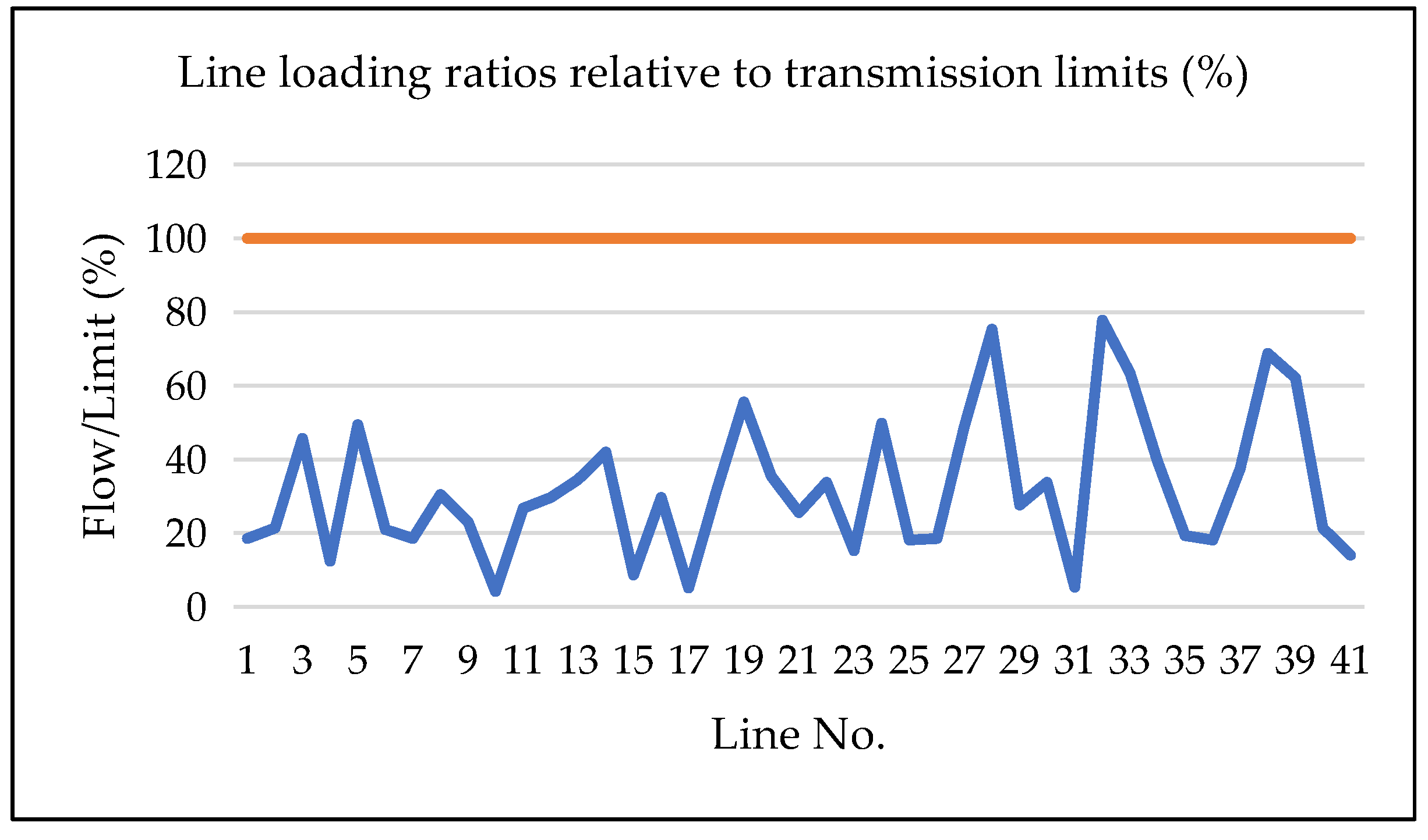
ISO screening in Figure 9 finds no network violations in this case. All 41 line loading ratios remain below the 100% limit, and the PX-cleared schedule is accepted without corrective actions. No redispatch is required in Scenario B, and the intended energy–ancillary coupling is enforced through the residual-headroom rule.

5.4. Scenario C: Peak + Congestion

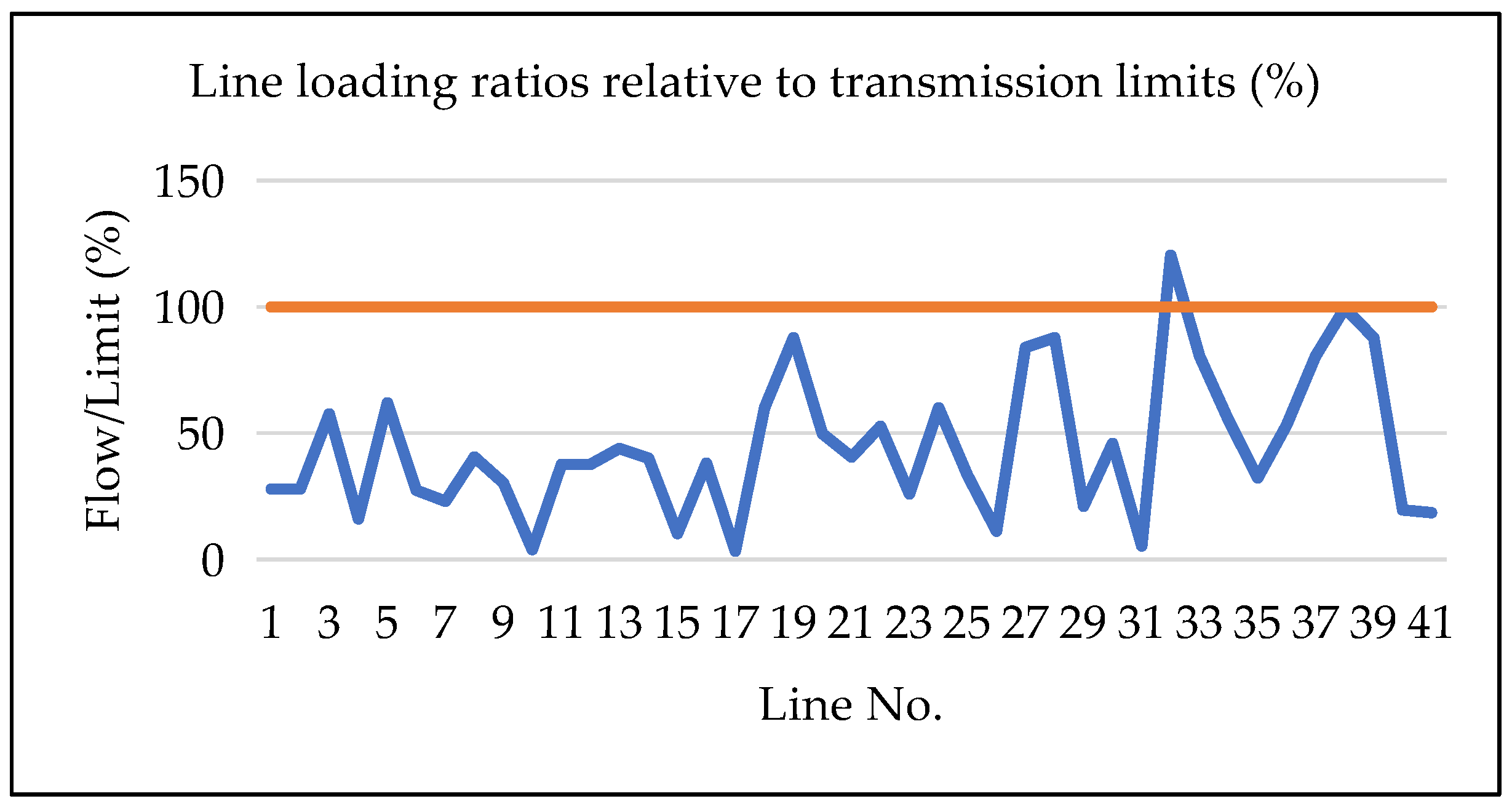
At peak load, the PX-cleared schedule fails ISO feasibility, and the PX–ISO loop becomes necessary. Table 8 shows that reserve procurement is headroom-limited: once energy and AGC are fixed, SR is capped at 39.08 MW, leading to shortfalls under both requirement settings (40.92 MW shortfall for an 80 MW target; 12.49 MW for a 51.57 MW target). Under the squeeze index definition in Section 3.1, the SR deliverability shortfall represents 51.1% of the 80 MW target and 24.2% of the 51.57 MW target, matching the shortfalls in Table 8. This follows from the staged rule—energy awards consume headroom, and the remaining headroom sets the upper bound on procurable AGC/SR.
ISO screening also flags a transmission-limit violation in the PX-cleared dispatch. Figure 10 shows a line loading ratio above 100% (congestion on Line 32). Table 8 reports the tracing-based attribution, indicating that the loading on Line 32 is dominated by GenCo4. This attribution provides a clear basis for corrective action instead of an opaque redispatch. The ISO then applies a minimal-change adjustment (reported in Table 9), primarily reducing the dominant contributor and reallocating generation to relieve the constraint while keeping the overall dispatch close to the market outcome. By linking congestion to participant-level contributions before redispatch, the corrective action becomes explainable and auditable, rather than an opaque ISO adjustment detached from market outcomes. Together, Figure 10 and Table 10 show that the ISO loop is not a black-box intervention: congestion is detected, attributed, and then relieved through a minimal-change redispatch with limited deviation from the market outcome.

5.5. Scenario D: Re-Clearing

After ISO provides a network-feasible recommendation, the PX performs re-clearing so that settlement is consistent with a feasible operating point rather than with the infeasible preliminary dispatch. In Scenario D, the ISO-feasible energy dispatch is treated as fixed energy awards for the re-clearing step. Bids/offers are kept unchanged, and no re-bidding is performed. The PX then recomputes MCP and welfare for this fixed energy dispatch, and re-runs Stages 2–3 to re-allocate AGC and SR based on the residual headroom implied by the fixed energy awards. Table 11 reports how feasibility feedback alters the market outcome. The cleared quantity remains 257.87 MW, but fixing the energy awards to the ISO-feasible redispatch shifts the marginal accepted offer and raises the MCP from 3.73 to 4.38 $/MWh. The welfare in Table 11 is defined as the purchase total minus the accepted offer cost. It increases because the purchase total rises by 167.61 $/h (961.82 → 1129.43), while the accepted offer cost rises by 91.21 $/h (848.05 → 939.26). Once the ISO recommendation is returned to the PX, the feasibility correction is reflected in settlement through re-clearing rather than being handled solely as an ISO-side adjustment.
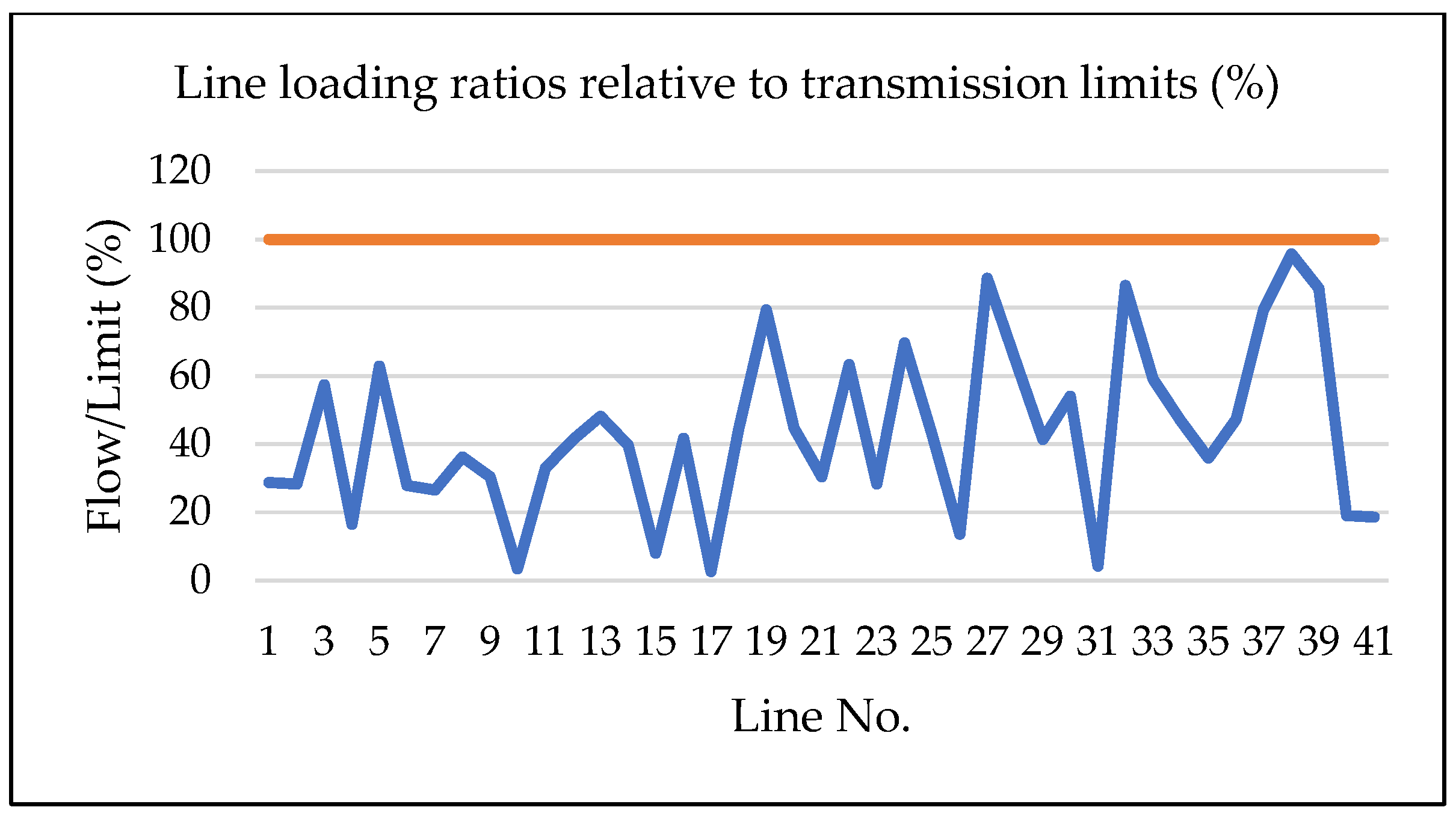
After re-clearing, all line loading ratios fall below the 100% limit (Figure 11). This confirms that the final settled schedule is network-feasible under the ISO setpoints. With energy fixed, AGC and SR are re-allocated using the residual headroom, and MCP/welfare are recomputed under the same settlement definition.

6. Conclusions

A day-ahead schedule can clear economically at the market layer and still fail ISO feasibility once transmission limits and ancillary deliverability are enforced. This paper proposes a closed-loop PX–ISO workflow that keeps market settlement tied to an executable operating point. The PX clears energy → AGC → SR sequentially under eligibility and residual-headroom coupling. The ISO then screens feasibility using an ECI-based load-flow check. When violations occur, flow tracing attributes the loading of the congested element to individual generators, and a minimal-change redispatch restores feasibility. The ISO-feasible dispatch is fed back to the PX for re-clearing, so that MCP and welfare are evaluated at a feasible operating point. The nonconvex clearing problems are solved with APO–SL, and Section 5.1 reports a benchmark against GA, PSO, MPSO, and APO.
The IEEE 30-bus case studies highlight when the loop is “silent” and when it becomes necessary. Under off-peak and average-load conditions, the staged outcomes pass ISO screening directly, so no corrective action is triggered. Under peak load, deliverability becomes difficult, and SR procurement is capped at 39.08 MW. At the same time, congestion emerges on Line 32. The ISO screening flags the violation, tracing identifies the dominant contributors, and the redispatch shifts output away from the main contributor (GenCo4 decreases from 35 MW to 23 MW) while compensating elsewhere (GenCo3 increases from 30 MW to 40 MW). Re-clearing is then performed under unchanged bids/offers, with energy awards fixed to the ISO-feasible setpoints. As a result, the MCP increases from 3.73 to 4.38 $/MWh because the marginal accepted offer changes. Under the paper’s settlement-based welfare definition (purchase total minus accepted offer cost), welfare increases from 113.77 to 190.17 $/h because settlement is recomputed at the feasible dispatch envelope.
Overall, the results support the engineering value of the proposed PX–ISO interaction: (i) executability, because cleared schedules are screened and corrected under network constraints; (ii) transparency, because congestion responsibility is quantified through tracing; and (iii) limited disruption, because the redispatch is formulated as a minimal-change adjustment rather than a full redesign of the market outcome. The choice of solver mainly affects computational efficiency; the core contribution is the closed-loop market–operation logic.
The current evaluation is mechanism-oriented and limited to a single-period IEEE 30-bus benchmark with price-taking bids. Multi-period scheduling, unit-commitment decisions, and inter-temporal reserve/ramping constraints are not modeled. The energy market is represented as single-zone uniform pricing; LMP-based security-constrained clearing is outside the present scope. Uplift or other side-payment rules are also not modeled, since settlement is updated through re-clearing. Finally, we did not run a full sensitivity sweep on ηSR; in our setting, it is chosen above the SR offer price range, so shortages appear only when residual headroom is insufficient rather than because the penalty is too small. Future work will extend the framework to multi-period market clearing with uncertainty and alternative settlement rules, and will test scalability on larger systems.

Author Contributions

Conceptualization, H.Z. and K.-H.L.; methodology, L.Y., L.A., H.Z. and K.-H.L.; software and data curation, L.Y. and L.A.; validation and formal analysis, L.Y. and X.L.; writing—original draft preparation, K.-H.L.; writing—review and editing, L.Y., L.A., X.L. and H.Z.; supervision, H.Z. and K.-H.L.; funding acquisition, H.Z. and K.-H.L. All authors have read and agreed to the published version of the manuscript.

Funding

This work was supported by the Fujian Provincial Education Research Projects for Young and Middle-Aged Teachers (No. JAT241182), the Technology Innovation Team of Minnan University of Science and Technology (Nos. 23XTD112, 24XTD158, 2024XTD156), and the Science and Technology Department of Jilin Province (No. YDZJ202401296ZYTYS).

Data Availability Statement

Data are contained within this article.

Conflicts of Interest

The authors declare no conflicts of interest.

Nomenclature

PXPower exchange
ISOIndependent system operator
AGCAutomatic generation control
SRSpinning reserve
ECIEquivalent current injection
MCPMarket clearing price (uniform energy price)
POZ(s)Prohibited operating zone(s)
VPEsValve-point effects
OPFOptimal power flow
LMPLocational marginal pricing
SCOPFSecurity-constrained optimal power flow
Ud(⋅)DisCo benefit/utility function (bid representation) ($)
Cg(⋅)GenCo production cost function (offer representation; may include VPE/POZ) ($)
SWtSocial welfare objective at t (benefit minus cost) ($/h)
P g , t E Cleared energy award of GenCo g at t
P d , t E Cleared energy consumption of DisCo d at t
P g m i n , P g m a x Min/max generation limits (MW)
P d m i n , P d m a x Min/max demand limits (MW)
U d Quadratic benefit function
R g , t A G C AGC capacity for GenCo g at hour t (MW)
π g , t A G C AGC capacity offer price ($/MW)
R r e q , t A G C AGC requirement at hour t (MW)
R g , t S R SR capacity for GenCo g at hour t (MW)
π g , t S R SR capacity offer price ($/MW)
R r e q , t S R SR capacity requirement (MW)
ηSRSR shortfall penalty coefficient ($/MW)
s t S R Shortfall variable
ϕ t S R Normalized squeeze index
H t S R SR-deliverable headroom
U r , U i Real and imaginary parts of bus voltages
I r i n j , I i i n j jReal and imaginary parts of the net injected currents
α l , g Generator contributions
C t A G C , C t S R Procurement models in the AGC and SR stages
ρeq, ρinPenalty parameters with equality/inequality constraints
MrBinary mapping vector
c s ( t ) Learning gain
J t A G C AGC-stage objective
ε e q ,   ε i n Feasibility tolerances (equality/inequality)
εobjObjective-improvement tolerance (stall)
KstallStall window for termination

Appendix A. Toy Construction Showing That Staged Clearing Can Differ from Co-Optimization

Consider a single hour t with fixed demand Dt = 100 MW and an SR target R r e q , t S R = 20 MW. Two generators participate: g = 1, 2. Their capacity limits are P 1 m a x = 100 and P 2 m a x = 30 MW. The energy offer costs are linear for illustration: c1 = 10 $/MWh and c2 = 12 $/MWh. For simplicity, AGC is not procured in this example, i.e., R g , t A G C = 0.
Co-optimization (integrated energy–reserve clearing): Energy and SR are co-decided in one problem with the deliverability (headroom) coupling:
0 R g , t S R P g m a x P g , t E
To meet R r e q , t S R = 20 MW, at least 20 MW headroom must remain after energy awards. A least-cost feasible allocation is P 1 , t E = 80 MW, P 2 , t E = 20 MW, and R 1 , t S R = 20 MW (with R 2 , t S R = 0), which satisfies both demand balance and reserve deliverability.
Staged clearing (sequential energy → SR): In staged clearing, the energy stage is settled first. With c1 < c2, the energy stage awards P 1 , t E = 100 MW and P 2 , t E = 0 MW. GenCo1 has zero residual headroom ( P 1 m a x P 1 , t E = 0 ). GenCo2 would have headroom (   P 2 m a x P 2 , t E = 30 ), but under the staged eligibility rule used in this paper (only energy-awarded units are eligible), P 2 , t E = 0 makes GenCo2 ineligible for SR. Therefore, the SR target cannot be met without corrective action. Restoring deliverability requires an ex post redispatch that shifts 20 MW of energy from GenCo1 to GenCo2 (e.g., P 1 , t E = 80 MW, P 2 , t E = 20 ), thereby recreating 20 MW headroom and enabling R 1 , t S R = 20 MW.
This construction shows that staged clearing can yield a different initial energy award from integrated co-optimization when reserve deliverability is binding; the two coincide only when sufficient residual headroom remains after the energy stage. This is precisely the motivation for the PX–ISO feasibility screening and correction loop studied in this paper.

Appendix B

Table A1. Simulation environment and key hyperparameters used in this study.
CategoryParameter (Symbol)ValueNote
Simulation environmentSoftwareMATLAB R2016b
CPUIntel i5, 2.9 GHz
RAM16 GB
APO–SL (all stages)Population size (N)30
Max iterations (Tm)500
Max iteration budget (Imax)500Imax = Tm.
Social learningInitial learning gain (cs0)2Used in (52).
Constraint handlingEquality penalty (ρeq) 1.0 × 10 4
Inequality penalty (ρin) 1.0 × 10 4
Feasibility tolerancesEquality tolerance (εeq) 1.0 × 10 4 Terminate if g ε e q .
Inequality tolerance (εin) 1.0 × 10 4 Terminate if m a x ( h ) ε i n .
Stalling terminationObjective-improvement tolerance (εobj) 1.0 × 10 3 Stop if |Fgbest(t) − Fgbest (t − 1)| ≤ εobj.
Stall window (Kstall)20Applied for (Kstall) consecutive iterations.
SR shortfall penalty (ηSR)10 ($/MW)Set above the maximum SR offer price in this study to prevent an artificial shortfall.
RepeatabilityRandom seed2026Fixed seed for the representative run.
Independent runs100Different seeds for statistics.
ISO screening (ECI)Mismatch tolerance (εECI) 1.0 × 10 6
Max ECI iterations (KECI)20
Tracing participation threshold (τ)0.005

References

  1. Honkapuro, S.; Jaanto, J.; Annala, S. A Systematic Review of European Electricity Market Design Options. Energies 2023, 16, 3704. [Google Scholar] [CrossRef]
  2. ENTSO-E. ENTSO-E Market Report 2025; ENTSO-E: Brussels, Belgium, 2025. [Google Scholar]
  3. Moretto, M.; Pollitt, M.G. How Many Zones Should an Electricity Market Have? A Cross-Country Perspective on Bidding Zone Design. Energy Policy 2026, 210, 115030. [Google Scholar] [CrossRef]
  4. Wang, Y.; Wang, Y.; Liu, C.; Fang, Y.; Cai, G.; Ge, W. Auxiliary Service Dynamic Compensation Mechanism Design for Incentivizing Market Participants to Provide Flexibility in China. Prot. Control Mod. Power Syst. 2024, 9, 112–128. [Google Scholar] [CrossRef]
  5. Silva-Rodriguez, L.; Sanjab, A.; Fumagalli, E.; Gibescu, M. Light Robust Co-Optimization of Energy and Reserves in the Day-Ahead Electricity Market. Appl. Energy 2024, 353, 121982. [Google Scholar] [CrossRef]
  6. Shi, J.; Guo, Y.; Wu, W.; Sun, H. Scenario-Oriented Multi-Area Joint Market Clearing of Energy and Reserve for Variable Renewable Energy Integration. Appl. Energy 2024, 361, 122873. [Google Scholar] [CrossRef]
  7. Wang, J.; Xie, N.; Huang, C.; Wang, Y. Two-Stage Stochastic-Robust Model for the Self-Scheduling Problem of an Aggregator Participating in Energy and Reserve Markets. Prot. Control Mod. Power Syst. 2023, 8, 45. [Google Scholar] [CrossRef]
  8. Nikpour, A.; Nateghi, A.; Shafie-Khah, M. Stochastic-Risk Based Approach for Microgrid Participation in Joint Active, Reactive, and Ancillary Services Markets Considering Demand Response. IEEE Open Access J. Power Energy 2022, 10, 2–13. [Google Scholar] [CrossRef]
  9. Grimm, V.; Martin, A.; Sölch, C.; Weibelzahl, M.; Zöttl, G. Market-Based Redispatch May Result in Inefficient Dispatch. Energy J. 2022, 43, 205–230. [Google Scholar] [CrossRef]
  10. Bucksteeg, M.; Voswinkel, S.; Blumberg, G. Improving Flow-Based Market Coupling by Integrating Redispatch Potential—Evidence from a Large-Scale Model. Energy Policy 2024, 188, 114093. [Google Scholar] [CrossRef]
  11. Lin, W.-M.; Zhan, T.-S. A New Model to Calculate Contributions of the Distributed Power. Appl. Sci. 2023, 13, 4524. [Google Scholar] [CrossRef]
  12. Bialek, J. Tracing the Flow of Electricity. IEE Proc.—Gener. Transm. Distrib. 1996, 143, 313–320. [Google Scholar] [CrossRef]
  13. Kirschen, D.; Allan, R.; Strbac, G. Contributions of Individual Generators to Loads and Flows. IEEE Trans. Power Syst. 1997, 12, 52–60. [Google Scholar] [CrossRef]
  14. Lou, C.; Yang, J.; Vega Fuentes, E.; Zhou, Y.; Min, L.; Yu, J.; Meena, N.K. Power Flow Traceable P2P Electricity Market Segmentation and Cost Allocation. Energy 2024, 290, 130120. [Google Scholar] [CrossRef]
  15. Cui, H.; Huang, G.; Zhou, J.; Hu, C.; Zhang, S.; Zhang, S.; Zhou, B. Research on the Construction Method of Inter-Provincial Spot Trading Network Model Considering Power Grid Congestion. Energies 2025, 18, 1747. [Google Scholar] [CrossRef]
  16. Lin, W.-M.; Teng, J.-H. Three-phase distribution network fast-decoupled power flow solutions. Int. J. Electr. Power Energy Syst. 2000, 22, 375–380. [Google Scholar] [CrossRef]
  17. Sun, B.; Dai, W.; Zhang, D.; Goh, H.H.; Zhao, J.; Shi, B.; Wu, T. An Effective Spinning Reserve Allocation Method Considering Operational Reliability With Multi-Uncertainties. IEEE Trans. Power Syst. 2024, 39, 1568–1581. [Google Scholar] [CrossRef]
  18. Jain, S.; Kanwar, N. Evaluation of System Performance for Load Dispatch Feasibility Under N-1 Generator Contingencies in Day-Ahead Unit Commitment. IEEE Access 2025, 13, 181180–181199. [Google Scholar] [CrossRef]
  19. Lu, K.-H.; Qian, W.; Jiang, Y.; Zhong, Y.-S. The Calibrated Safety Constraints Optimal Power Flow for the Operation of Wind-Integrated Power Systems. Processes 2024, 12, 2272. [Google Scholar] [CrossRef]
  20. Kaya, A.; Conejo, A.J.; Rebennack, S. Fifty Years of Power Systems Optimization. Eur. J. Oper. Res. 2026, 329, 1–23. [Google Scholar] [CrossRef]
  21. Premkumar, M.; Hashim, T.J.T.; Ravichandran, S.; Tan, C.S.; Chandran, R.; Alsoud, A.R.; Jangir, P. Optimal Operation and Control of Hybrid Power Systems with Stochastic Renewables and FACTS Devices: An Intelligent Multi-Objective Optimization Approach. Alex. Eng. J. 2024, 93, 90–113. [Google Scholar] [CrossRef]
  22. Wang, X.; Snášel, V.; Mirjalili, S.; Pan, J.S.; Kong, L.; Shehadeh, H.A. Artificial Protozoa Optimizer (APO): A Novel Bio-Inspired Metaheuristic Algorithm for Engineering Optimization. Knowl.-Based Syst. 2024, 295, 111737. [Google Scholar] [CrossRef]
  23. Chaitanya, K.; Somayajulu, D.V.L.N.; Radha Krishna, P. Memory-Based Approaches for Eliminating Premature Convergence in Particle Swarm Optimization. Appl. Intell. 2021, 51, 4575–4608. [Google Scholar] [CrossRef]
  24. Sun, Y.; Guo, J.; Yan, K.; Di, Y.; Pan, C.; Shi, B.; Sato, Y. A Deep Memory Bare-Bones Particle Swarm Optimization Algorithm for Single-Objective Optimization Problems. PLoS ONE 2023, 18, e0284170. [Google Scholar] [CrossRef]
  25. Bo, H.; Wu, J.; Hu, G. MSAPO: A Multi-Strategy Fusion Artificial Protozoa Optimizer for Solving Real-World Problems. Mathematics 2025, 13, 2888. [Google Scholar] [CrossRef]
  26. AlRashidi, M.R.; El-Hawary, M.E. Hybrid Particle Swarm Optimization Approach for Solving the Discrete OPF Problem Considering the Valve Loading Effects. IEEE Trans. Power Syst. 2007, 22, 2030–2038. [Google Scholar] [CrossRef]
  27. Patel, A.K.; Mathew, L. Optimal Procurement of Energy Using Combined GA-OPF Technique in Deregulated Power Sector. In Proceedings of the 2022 IEEE 10th Power India International Conference (PIICON 2022), New Delhi, India, 25–27 November 2022; pp. 518–523. [Google Scholar]
  28. Singh, N.; Chakrabarti, T.; Chakrabarti, P.; Margala, M.; Gupta, A.; Praveen, S.P.; Krishnan, S.B.; Unhelkar, B. Novel Heuristic Optimization Technique to Solve Economic Load Dispatch and Economic Emission Load Dispatch Problems. Electronics 2023, 12, 2921. [Google Scholar] [CrossRef]
Figure 1. Schematic of the PX–ISO day-ahead workflow and the information exchanged.
Processes 14 01027 g001
Figure 2. Supply–demand curves, market clearing price (MCP), and social welfare in day-ahead energy clearing.
Processes 14 01027 g002
Figure 3. PX–ISO closed-loop workflow for security validation and congestion correction.
Processes 14 01027 g003
Figure 4. π-equivalent line model used in the ECI-based security check.
Processes 14 01027 g004
Figure 5. Equivalent current injection representation at generator and demand buses for ECI-based AC power-flow tracing.
Processes 14 01027 g005
Figure 6. Cost function graph including POZ.
Processes 14 01027 g006
Figure 7. IEEE 30-bus test system.
Processes 14 01027 g007
Figure 8. Convergence profiles of GA, PSO, MPSO, APO, and APO–SL (population size = 30; tolerance-based termination).
Processes 14 01027 g008
Figure 9. Line loading ratios (% of limit) in Scenario B (average load).
Processes 14 01027 g009
Figure 10. Line loading ratios (% of limit) in Scenario C (peak + congestion).
Processes 14 01027 g010
Figure 11. Line loading ratios (% of limit) in Scenario D (re-clearing).
Processes 14 01027 g011
Table 1. Analytical comparison of day-ahead clearing designs and the proposed PX–ISO loop.
FeatureEnergy–Reserve Co-OptimizationSequential (Staged) ClearingProposed PX–ISO Closed Loop (This Work)
Core design choiceEnergy and reserves are optimized in one integrated problem (often efficiency-oriented) [5,6].Products are cleared in stages; later products depend on earlier awards [7,8].Staged PX clearing is retained, while feasibility is enforced through an ISO validation/correction loop.
Deliverability couplingCoupling is internalized by construction, but the model is heavier under uncertainty/nonconvexities [6,20]. Headroom can become binding after energy awards (“flexibility squeeze”) under stress [4,17].The framework links reserve procurement to residual headroom after energy awards and reports reserve shortfall when headroom is insufficient.
Network feasibilityMay embed security constraints directly (stronger feasibility, higher complexity) [19]. Often cleared at the market layer, with feasibility handled by ex post adjustments [9].ISO performs feasibility screening inside the loop using ECI-based checks [16].
Congestion handlingAddressed inside the integrated formulation/pricing design [10].Addressed ex post; corrections may be hard for participants to interpret [9,15].Tracing-based attribution identifies dominant contributors and defines the redispatch participant set [12].
Settlement after correctionNaturally consistent within the integrated formulation [5].May require out-of-market adjustments depending on market design [2,3].Re-clearing updates settlement metrics under an ISO-feasible dispatch envelope so reported MCP and welfare correspond to an executable operating point.
What the paper addsWell studied; not the focus here.Rules are realistic, but feasibility/traceability gaps remain [9,15].An end-to-end PX–ISO workflow that connects staged clearing, feasibility screening, traceable correction, and settlement-consistent re-clearing.
Table 2. Generator cost coefficients and operating constraints for the IEEE 30-bus case (valve-point coefficients, prohibited operating zones, and ramp limits).
GenCoagbgcgegfg P g m i n (MW) P g m a x (MW)Cost ModelKgSegment Breakpoints (MW)POZ 1 (MW)POZ 2 (MW)Ramp (MW/5 min)
10.0220500.55080Valve-point550, 56.28, 62.57, 68.85, 75.13, 8032
20.01751.7502000.222080Valve-point520, 34.28, 48.56, 62.84, 77.12, 8028
30.062510001550POZ325–3040–452
40.008343.250001035POZ312–1723–280.7
50.0253000530Quadratic15.4
60.0253000540Quadratic18
Table 3. Performance comparison of GA, PSO, MPSO, APO, and APO–SL (population size = 30; tolerance-based termination).
AlgorithmGAPSOMPSOAPOAPO–SL
Population size3030303030
Best cost ($/h)487.77487.77487.78487.73487.73
Avg. cost ($/h)487.86487.81487.80487.78487.73
Worst cost ($/h)491.94501.79497.11498.15495.85
CPU avg. time (s)65.346.241.630.830.1
Table 4. Off-peak case: market clearing outcomes by stage and ISO screening results.
Metric/ParticipantEnergyAGCSR (80 MW)SR (23.87 MW)
Cleared quantity (MW)119.344.7780.0023.87
Settlement priceMCP = 3.33 ($/MWh)0.43 ($/MW) 0.19 ($/MW) 0.15 ($/MW)
Total payment ($/h)397.47 (purchase total)2.0515.343.58
Total revenue ($/h)316.11 (sales total)
Social welfare ($/h)81.36
ISO validationPass (accepted as cleared; no redispatch)
GenCo1 awarded (MW)31.42000
GenCo2 awarded (MW)42.842.0700
GenCo3 awarded (MW)19.18030.8223.87
GenCo4 awarded (MW)10.002.0023.000
GenCo5 awarded (MW)7.950.7021.350
GenCo6 awarded (MW)7.9504.830
Note: Purchase total = MCP × cleared quantity ($/h). Sales total = aggregate accepted supply-side offer cost ($/h). Social welfare = purchase total—sales total.
Table 5. Off-peak case: AGC and SR bids and awarded capacities.
ServiceGenCoBid Price ($/MW)Bid Qty (MW)Cleared Price ($/MW)Awarded Qty (MW)
AGCGenCo10.7132.00n/a0
GenCo20.6528.000.652.07
GenCo30.482.000.480
GenCo40.070.700.072.00
GenCo50.805.400.800.70
GenCo60.838.00n/a0
SR (80 MW)GenCo10.3448.58n/a0
GenCo20.3035.09n/a0
GenCo30.1530.820.1530.82
GenCo40.1723.000.1723.00
GenCo50.2621.350.2621.35
GenCo60.2932.050.294.83
SR (23.87 MW)GenCo10.3448.58n/a0
GenCo20.3035.09n/a0
GenCo30.1530.820.1523.87
GenCo40.1723.00n/a0
GenCo50.2621.35n/a0
GenCo60.2932.05n/a0
Table 6. Average-load case: market clearing outcomes by stage and ISO screening results.
Metric/ParticipantEnergyAGCSR (80 MW)SR (33.85 MW)
Cleared/procured (MW)169.268.4680.0033.85
Settlement priceMCP = 3.42 ($/MWh)0.63 ($/MW)0.32 ($/MW)0.22 ($/MW)
Total payment ($/h)578.87 (purchase total)5.3325.437.50
Total revenue ($/h)491.90 (sales total)
Social welfare ($/h)86.97
ISO validationPass (accepted as cleared; no redispatch)
GenCo1 awarded (MW)47.120.000.000.00
GenCo2 awarded (MW)57.125.7617.120.00
GenCo3 awarded (MW)20.742.0027.2627.26
GenCo4 awarded (MW)20.560.7013.746.59
GenCo5 awarded (MW)11.860.0018.140.00
GenCo6 awarded (MW)11.860.003.740.00
Table 7. Average-load ancillary clearing details (AGC bids + SR bids and awards).
ServiceGenCoBid Price ($/MW)Bid (MW)Cleared Price ($/MW)Awarded (MW)Awarded 80 MW (MW)Awarded 33.85 MW (MW)
AGCGenCo10.9132.00n/a0.00
GenCo20.8328.000.835.76
GenCo30.582.000.582.00
GenCo40.790.700.790.70
GenCo50.925.40n/a0.00
GenCo60.968.00n/a0.00
SRGenCo10.4732.88n/a/n/a0.000.00
GenCo20.4117.120.41/n/a17.120.00
GenCo30.2127.260.21/0.2127.2627.26
GenCo40.2713.740.27/0.2713.746.59
GenCo50.4018.140.40/n/a18.140.00
GenCo60.4628.140.46/n/a3.740.00
Table 8. Peak-load clearing case: market clearing outcomes by stage and ISO screening results.
Metric/ParticipantEnergyAGCSR (80 MW)SR (51.57 MW)
Requirement (MW)18.0580.0051.57
Procured (MW)257.8718.0539.0839.08
Shortfall (MW)0.0040.9212.49
Settlement priceMCP = 3.73 ($/MWh)0.995 ($/MW) 0.506 ($/MW) 0.506 ($/MW)
Total payment ($/h)961.82 (purchase total)17.9519.7719.77
Total revenue ($/h)848.05 (sales total)
Social welfare ($/h)113.77
ISO validationFail (Line 32 congestion → corrective loop triggered)
GenCo1 awarded (MW)62.837.459.729.72
GenCo2 awarded (MW)71.408.600.000.00
GenCo3 awarded (MW)30.002.0018.0018.00
GenCo4 awarded (MW)35.000.000.000.00
GenCo5 awarded (MW)29.320.000.680.68
GenCo6 awarded (MW)29.320.0010.6810.68
Table 9. Contribution to the congested line (Line 32).
ItemGenCo1GenCo2GenCo3GenCo4GenCo5GenCo6Total
Injection to Line 32 (MW)0.130.140.8415.671.224.1222.12
Share (%)0.59%0.63%3.80%70.85%5.52%18.62%100%
Table 10. ISO minimal-change redispatch (before vs. after).
Metric/ParticipantPeak Clearing (Before ISO)ISO Redispatch (After Minimal-Change OPF)Change
GenCo1 energy (MW)62.8364.98+2.15
GenCo2 energy (MW)71.4071.33−0.07
GenCo3 energy (MW)30.0040.00+10.00
GenCo4 energy (MW)35.0023.00−12.00
GenCo5 energy (MW)29.3229.29−0.03
GenCo6 energy (MW)29.3229.27−0.05
Table 11. Re-clearing results: MCP and welfare before and after ISO feedback.
ItemFirst Clearing (Before ISO Feedback)Re-Clearing (After ISO Feedback)
Cleared energy (MW)257.87257.87
MCP ($/MWh)3.734.38
Purchase total ($/h)961.821129.43
Sales total ($/h)848.05939.26
Social welfare ($/h)113.77190.17
GenCo energy awards (MW)
GenCo162.8364.98
GenCo271.4071.33
GenCo330.0040.00
GenCo435.0023.00
GenCo529.3229.29
GenCo629.3229.27
Note: In Scenario D, GenCo energy awards are fixed to the ISO-feasible redispatch setpoints, and bids/offers remain unchanged. The purchase total is computed at the uniform MCP, the sales total is the aggregate accepted offer cost, and welfare equals their difference.
Disclaimer/Publisher’s Note: The statements, opinions and data contained in all publications are solely those of the individual author(s) and contributor(s) and not of MDPI and/or the editor(s). MDPI and/or the editor(s) disclaim responsibility for any injury to people or property resulting from any ideas, methods, instructions or products referred to in the content.