Article

Numerical Analysis of Composite Wind Turbine Blade Dynamics Under Shutdown Fault Scenarios

1
Ocean College, Zhejiang University, Zhoushan 316021, China
2
Hainan Institute, Zhejiang University, Sanya 572025, China
3
Collage of Automobile and Traffic Engineering, Nanjing Forestry University, Nanjing 210037, China
*
Authors to whom correspondence should be addressed.
Processes 2026, 14(6), 1021; https://doi.org/10.3390/pr14061021
Submission received: 13 February 2026 / Revised: 13 March 2026 / Accepted: 17 March 2026 / Published: 23 March 2026
(This article belongs to the Special Issue Fiber-Reinforced Composites: Latest Advances and Interesting Research)

Abstract

To ensure the safety and structural integrity of composite flexible blades under strong winds, this study investigates the extreme aeroelastic responses of the IEA 15 MW wind turbine blade during an emergency shutdown with pitch system faults. Existing studies often rely on simplified models or one-way coupling; we adopt a bidirectional computational fluid dynamics–finite element method (CFD–FEM) fluid–structure interaction (FSI) framework to examine how wind speed and pitch system faults affect aerodynamic loads, displacement responses, and structural stresses when the blade is shut down in a parked-upwind condition. The results reveal that, under the no-pitch condition, the blade experiences extreme loading, with thrust being approximately 15 times higher and the peak stress being 8.6 times that of the pitch condition. Furthermore, a high frequency of 1.969 Hz emerges, significantly increasing the risk of aeroelastic instability as the wind speed increases or under the no-pitch condition. A stress analysis identified that high stress is mainly located in the main spar region, with the peak stress location shifting closer to the blade root under the no-pitch condition. This study highlights the potential risks of composite flexible blades during shutdowns and provides a reference for structural safety design and targeted monitoring.

1. Introduction

With the accelerating global energy transition, wind energy, which is one of the most scalable and commercially viable forms of renewable energy, has attracted considerable international attention [1]. Compared with onshore wind resources, offshore wind offers several distinct advantages, including higher wind speeds, lower turbulence intensity, a broader exploitable area, and less impact on terrestrial environments [2]. As a result, offshore wind has become a key focus for the future development of wind power. In this context, wind turbines are rapidly evolving towards larger capacity and greater flexibility. The blade, as the primary aerodynamic component responsible for capturing wind energy, has now exceeded 100 m in length. For example, the International Energy Agency (IEA) defines a 15 MW-class wind turbine blade as approaching 120 m in length [3]. Under strong wind conditions, however, composite flexible blades exhibit significant aeroelastic effects. These involve complex interactions among unsteady aerodynamic forces, structural inertial forces, and elastic restoring forces. Such coupling can lead to aeroelastic instabilities and, in extreme cases, structural failure [4]. Therefore, understanding the aeroelastic coupling mechanisms in long, flexible composite blades is of both theoretical importance and practical engineering relevance in ensuring the safe operation of wind turbines.
In the numerical simulation of aerodynamic loads, three principal approaches are commonly adopted in both engineering practice and academic research: blade element momentum (BEM) theory [5], the actuator line method (ALM) [6], and computational fluid dynamics (CFD) methods [7]. Owing to its high computational efficiency and simple parameterisation, BEM is widely used for preliminary assessments and the engineering design of wind turbine aerodynamic performance. However, as BEM relies on a two-dimensional blade element assumption and neglects three-dimensional flow effects and aerodynamic interactions between blades, it presents inherent limitations when dealing with unsteady phenomena such as large-scale flow separation, dynamic stall, and strong turbulence [8]. Serving as a compromise between BEM and CFD, ALM represents the blade as a series of actuator points distributed along the span. It solves the Navier–Stokes equations to capture wake structures and dynamic inflow effects, without requiring complex geometric modelling. Nevertheless, ALM is unable to provide detailed surface pressure distributions or information on local stress concentrations on the blade, thereby limiting its use in high-fidelity aeroelastic analyses [9]. In contrast, CFD approaches based on three-dimensional unsteady Reynolds-averaged Navier–Stokes (URANS) or large-eddy simulation (LES) can accurately resolve complex flow structures around the blade, including boundary layer development, flow separation, and tip vortex evolution [10]. These methods offer high-fidelity flow-field data and aerodynamic load inputs, which are essential for advanced aeroelastic analyses.
For structural modelling, the most widely used models include one-dimensional beam models [11], geometrically exact beam models [12], and three-dimensional finite element models [13]. A 1D beam model simplifies the blade into beam elements aligned along an elastic axis. While it is computationally efficient and suitable for whole-turbine dynamic analysis in early design stages, it falls short in accurately capturing stress concentrations at complex structural regions such as the main spar and shear webs, and in representing the anisotropic behaviour of composite materials [11]. Geometrically exact beam models incorporate geometric nonlinearities arising from large deformations while maintaining computational efficiency. This makes them suitable for aeroelastic coupling analyses of moderate complexity [12]. Three-dimensional finite element models, by offering detailed geometric representation, can preserve critical structural features of the blade, such as the main spar and internal webs [13]. They also enable the precise simulation of composite layup orientations and stacking sequences, thereby providing comprehensive stress and strain data for evaluating structural strength and optimising layup design.
It is worth noting that, when the length of a wind turbine blade exceeds 100 m, its structural flexibility increases significantly, leading to large-scale deformations under aerodynamic loading. These deformations can markedly alter the blade’s original aerodynamic shape, which in turn affects the surrounding flow field. This interaction results in a strong bidirectional coupling between the aerodynamic forces and structural response. Previous studies have shown that, when nonlinear aeroelastic coupling is taken into account, the predicted aerodynamic performance of the blade may differ by more than 30% compared with numerical results based on the assumption of a rigid blade [14]. This highlights the essential role of aeroelastic coupling analysis in the design of long, flexible blades.
Previous studies have explored the aeroelastic coupling of long, flexible blades to a certain extent. Arvind et al. [15] applied machine learning techniques to support the aeroelastic analysis of a 15 MW-class blade. However, the natural frequencies predicted by their finite element model differed from those of the benchmark model published by the IEA, and their study considered only one-way coupling, whereby aerodynamic loads induce structural deformation without accounting for the feedback of structural motion on the flow field. Zhang et al. [16] examined the influence of floating platform motion on the dynamic response of the blade under rated operating conditions. Nevertheless, their model also omitted the real-time feedback of structural deformation to the flow field. Chuang et al. [17] introduced the flexible braking actuator line method (BALM) to investigate the aeroelastic behaviour of a 15 MW wind turbine blade under operational conditions and were able to capture preliminary interactions between the aerodynamic and structural fields. Despite this, their method exhibits inherent limitations, as the blade was simplified into a one-dimensional beam model, which restricts the accurate resolution of critical features such as stress concentrations and stress distributions in complex cross-sectional regions. Strictly speaking, their model remains a simplified coupling approach and does not realise high-fidelity, two-way CFD–FEM (finite element method) fluid–structure interaction (FSI) modelling.
From this discussion, it is evident that most existing research focuses on normal operating conditions and tends to rely on simplified beam models or one-way aero-structural coupling. However, when wind speed exceeds the turbine’s cut-out threshold, an emergency shutdown must be initiated, and the blades must be pitched to the feathered position to ensure operational safety. A systematic understanding remains elusive regarding the two-way coupled aeroelastic response of multi-megawatt blades under shutdown parked-up conditions with pitch system faults. Although the nominal pitching sequence from 0° to 90° typically completes within 10–15 s under normal operation, practical fault scenarios—including pitch motor failures, hydraulic system malfunctions, or grid loss events—can arrest the blade at arbitrary intermediate angles or leave it fully unfeathered at 0°. Such fault conditions expose the blade to extreme aerodynamic loading for extended durations, yet the literature lacks high-fidelity investigations of the resulting fluid–structure interactions.
Recognizing that intermediate pitch angles produce aerodynamic loads bounded by the fully feathered and fully unfeathered extremes, this study strategically focuses on these two bounding static conditions to establish worst-case load envelopes that govern structural design. The 90° feathered configuration represents the successful shutdown state with minimal loading, while the 0° no-pitch configuration constitutes the most severe fault scenario with thrust forces reaching 35 times the feathered magnitude. These static bounding cases correspond directly to the extreme load cases mandated by international design standards for wind turbine safety certification. Transient pitching dynamics, though relevant for control system optimization, are deliberately excluded from the present scope to prioritize computational resources toward high-fidelity resolution of the critical fault states; such transient analyses are reserved for future investigation incorporating validated pitch controller models and time-varying actuator dynamics.
The present study makes four distinctive contributions that advance beyond existing research on pitch-fault and extreme-wind scenarios. First, while recent investigations focus on operational pitch faults with rotating blades, where centrifugal stiffening and aerodynamic damping dominate the structural response, this work examines the parked-upwind static condition (0 rpm) that creates fundamentally different aeroelastic physics: directional wind loading perpendicular to the span generates pure bending without Coriolis effects, and the absence of both centrifugal stiffening and rotational aerodynamic damping results in larger deformations and persistent vibrations. The 35-fold thrust magnification observed [18] in this static regime substantially exceeds the 5–8 times amplification typically reported for operating fault scenarios, establishing a critical worst-case design condition not previously analysed with high-fidelity two-way FSI. Second, this study implements and validates an explicit two-way CFD–FEM coupling strategy that achieves thirty percent computational efficiency gain over implicit schemes, enable practical parametric analysis of extreme load cases that would otherwise be prohibitively expensive. Third, the structural model incorporates six distinct composite materials with ply-resolved layup sequences across fifty spanwise segments, revealing stress migration patterns—specifically the shift of peak stress from twenty-seven percent to fifteen percent span under no-pitch conditions—that are inaccessible to simplified beam theories and provide actionable guidance for inspection protocol design. Fourth, the analysis discovers second edgewise mode dominance at 1.969 Hz as a novel high-frequency instability indicator under no-pitch conditions. This is a phenomenon distinct from operational vibrations and not captured by reduced-order models. These combined contributions establish the first comprehensive high-fidelity FSI framework for parked-upwind shutdown safety assessment of multi-megawatt composite blades. This pitching process is not instantaneous, and malfunctions in the pitch system can occur, leading to pitch failure.
Therefore, conducting an aeroelastic coupling study under this hazardous parked-up shutdown scenario using a two-way CFD–FEM FSI framework addresses an important gap in the literature. The primary objective of this work is to systematically investigate the extreme aeroelastic responses of a 15 MW composite wind turbine blade during an emergency shutdown with pitch system faults, building upon the four distinctive contributions outlined above. The high-fidelity finite element model developed in this study provides a robust structural mechanics foundation for accurately predicting the dynamic behaviour of composite blades, offering significant theoretical and practical value for advancing wind turbine safety design and improving operational control strategies. Notably, the choice of polymer fibre-reinforced composites as the primary blade material is driven by their exceptional specific strength and stiffness, superior fatigue resistance under cyclic loading, and design tailorability through anisotropic layup configurations. These properties make composites uniquely suited for ultra-long blades that must withstand extreme aerodynamic loads while minimizing self-weight. Furthermore, the IEA 15 MW reference blade was selected for this investigation because it represents the current industry frontier in offshore wind technology, with publicly available geometric and material data that enable rigorous model validation.

2. Methods and Theories

2.1. CFD Method

The normal operating environment of modern wind turbines typically corresponds to low-wind-speed conditions, where the inflow Mach number generally does not exceed 0.3. Under this condition, the airflow can be regarded as incompressible, and the air density may be treated as constant. Moreover, in wind turbine aerodynamic analyses, temperature variations induced by mechanical rotation are usually negligible. Accordingly, the three-dimensional incompressible Navier–Stokes equations governing fluid motion can be written in vector form as [19]:
ρ t + ρ v = 0
ρ v t + ρ v v = σ + f b
where v is the velocity vector, ρ is the air density, denotes the Kronecker operator, fb is the body force, and σ is the stress tensor; σ represents the sum of normal and shear stresses.
Although the above governing equations can accurately describe the flow, directly solving transient turbulent flows is computationally expensive. In engineering practice, the Reynolds-averaged approach (RANS) is widely adopted. Within the RANS framework, turbulence is treated as the superposition of a time-averaged flow and a fluctuating component. A variety of turbulence models have been developed for different applications. In this study, the widely used k-ω SST turbulence model for wind turbine aerodynamic simulations is introduced. This model computes the turbulent eddy viscosity based on the turbulent kinetic energy k and the specific dissipation rate ω, and its governing equations can be written as:
μ i = ρ k T
where T is the turbulence time scale. In the standard k-ω model, T = α*/ω, where α* is a model constant.
Standard turbulence models are sensitive to inlet boundary conditions, which can readily affect computational accuracy. Although Wilcox [20] improved numerical stability, the applicability of his modified model remains limited. To address this issue, Menter [21] introduced a non-conservative cross-diffusion term to effectively combine the far-field efficiency of the k–ε model with the near-wall accuracy of the original k–ω model, thereby proposing the shear stress transport (SST) model. The SST model is also well suited for the aerodynamic analysis of wind turbine blades. Accordingly, the SST model is adopted in the present CFD simulations, and its governing equations are given as follows [19]:
ρ k t + x i ρ k u i = x j Γ k k x j + G k Y k + S k
ρ w t + x i ρ w u i = x j Γ w w x j + G w Y w + D w + S w
where Γk and Γω are the effective diffusivity terms for k and ω, respectively; Sk and Sω are user-defined source terms for k and ω; Gk and Gω denote the production terms associated with velocity gradients in the i and j directions; Yk and Yω are the dissipation terms for k and ω; k is the turbulent kinetic energy, ω is the specific dissipation rate, and Dω is the cross-diffusion (transverse dissipation) term.

2.2. FEM Modal Analysis Method

Modal analysis provides more accurate natural frequencies and mode shapes of the blade. This not only serves to validate the accuracy of the finite element model but also offers a basis for subsequent structural dynamics analysis. Therefore, it is necessary to perform modal analysis in advance. For a wind turbine blade, the global dynamic equilibrium equation of the structure after finite element discretization can be expressed as [16]:
M u ¨ + C u ˙ + K u = 0
When computing the natural characteristics of the blade, the effect of damping is usually neglected, it should be emphasized that this undamped assumption is adopted strictly for modal validation purposes to verify the stiffness and mass distribution against the IEA benchmark. Structural material damping is neglected in the subsequent transient analyses, meaning the predicted vibration amplitudes represent theoretical upper bounds and the equation reduces to:
M u ¨ + K u = 0
For a linear system, the solution of the above equation can be written as:
u = φ i c o s ω i t Φ
where {φ}i is the modal shape eigenvector corresponding to the i-th mode, and ωi is the natural frequency of the i-th mode.
K ω i 2 φ i = 0
where {φ}i denotes the mode shape eigenvector of the i-th mode; ωi is the natural frequency of the i-th mode; and [K] is the structural stiffness matrix, which depends on the structural configuration and material properties. It should be emphasized that this undamped assumption is adopted strictly for modal validation purposes. Damping has a negligible effect on natural frequency extraction [22], and this approach allows verification of the stiffness and mass distribution against the IEA benchmark without the obscuring effects of damping matrix calibration.

2.3. Fluid–Structure Interaction Method

In numerical simulations of fluid–structure interaction, solution strategies are mainly classified into two categories: monolithic coupling and partitioned coupling. Among them, partitioned coupling is widely used due to its higher computational efficiency and practical applicability in engineering. In this approach, the governing equations of the fluid and solid systems are solved independently, and the two systems exchange data only through a shared coupling interface. To ensure physical consistency, the coupling interface must satisfy displacement compatibility and force equilibrium conditions. The corresponding interface governing equations can be expressed as [23]:
τ f n f = τ s n s d f = d s
where τ is the stress, d is the displacement, and n denotes the direction cosine; the subscript f refers to the fluid domain and s to the solid domain. It should be noted that under the low-Mach-number, incompressible flow assumption adopted in this study, thermal effects are negligible. Consequently, the coupling interface is governed solely by mechanical equilibrium (traction and displacement continuity), and the thermal boundary conditions (heat flux and temperature equality) are omitted.
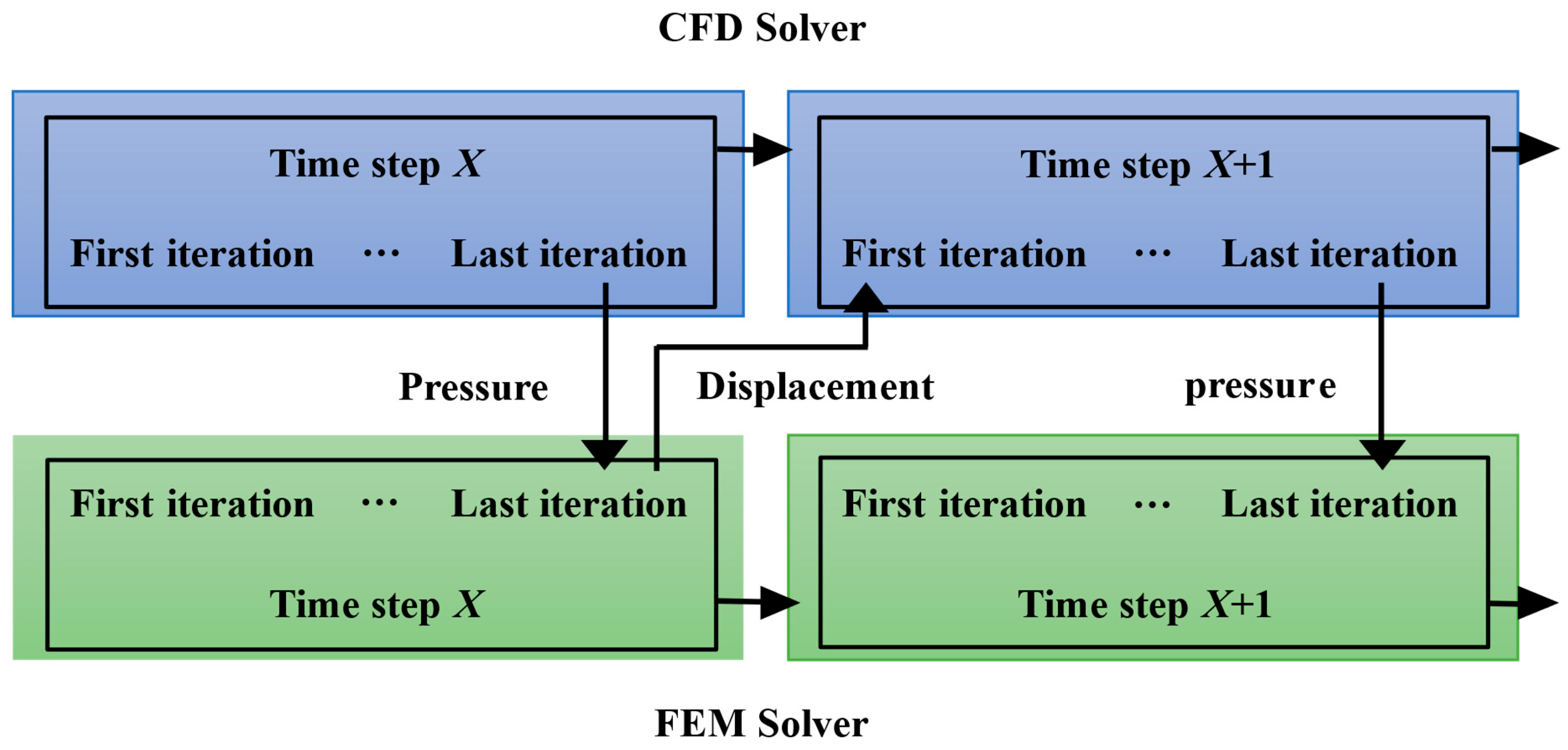
Fluid–structure interaction can be classified into two modes based on the direction of data transfer across the coupling interface: one-way and two-way coupling. One-way coupling involves a unidirectional transfer of information from the fluid domain to the solid domain. In contrast, two-way coupling entails a bidirectional, iterative exchange of data between the fluid and solid domains. In the case of wind turbine blades, structural deformation caused by aerodynamic loads can substantially alter the surrounding flow field, which in turn affects the aerodynamic loads themselves. This forms a closed-loop aeroelastic interaction that cannot be captured by one-way coupling. For this reason, a two-way coupling approach is adopted in the present study. Two-way coupling can be further divided into implicit and explicit schemes, depending on the frequency of data exchange. The implicit scheme performs multiple exchanges within a single time step and is appropriate for problems involving strong nonlinearity and rapid transients. By contrast, the explicit scheme carries out a single data exchange at the end of each time step, making it more suitable for problems characterised by relatively weak coupling or small incremental deformations. Given that the aeroelastic response of wind turbine blades typically involves gradual and coherent deformation behaviour, this study employs the more computationally efficient explicit coupling strategy. The detailed procedure is illustrated in Figure 1.

3. Modelling and Validation

3.1. CFD Modelling and Validation

The numerical study focuses on the IEA-15MW horizontal-axis offshore wind turbine blade. The blade length is 117 m, and the rotor diameter D is approximately 240 m. The rated wind speed is 10.59 m·s−1, the cut-in wind speed is 3 m·s−1, and the cut-out wind speed is 25 m·s−1. The sectional airfoils adopt the FFA-W3 airfoil series [3]. Detailed blade parameters are listed in Table 1.
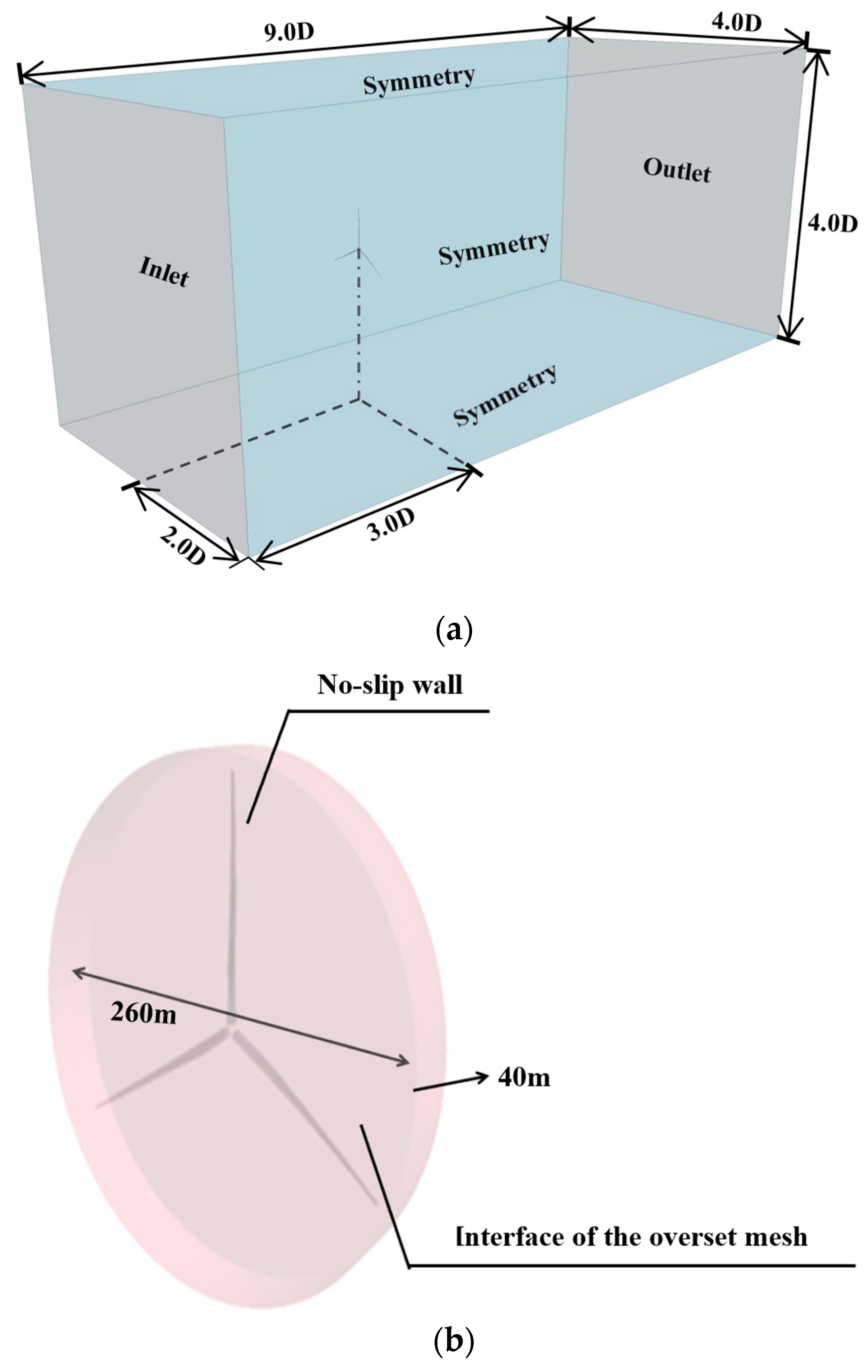
Figure 2a illustrates the computational domain for the wind turbine blade. To reduce the influence of domain boundaries on the numerical simulation and to mitigate blockage effects, the overall domain size is set to 9D × 4D × 4D. The inlet boundary is located 3D upstream of the rotor, and the outlet boundary is located 6D downstream. The lateral boundaries are placed at a distance of 2D from the rotor-root centre. The inlet is specified as a velocity-inlet boundary, with the lateral and spanwise velocity components set to 0; the outlet adopts a pressure-outlet boundary condition. The side, top, and bottom boundaries are treated as symmetry boundaries, and the blade surface is defined as a no-slip wall. A rotating region with a radius of 130 m and an axial thickness of 40 m is established around the blade, as shown in Figure 2b. This region is treated as an overset (overlapping) mesh zone for flow-field data exchange. The outer surface of the rotor region is defined as the overset interface, while the remaining part is considered the stationary background domain.
It is crucial to clarify the blade configuration modelled in this study. While the rotor diameter D is referenced to define the computational domain size, the present analysis focuses on an isolated single blade. The terms “rotating region” and “overset mesh” in the following description refer to the mesh motion strategy employed to accommodate potential deformation and to maintain mesh quality around the blade; they do not imply actual rotor rotation, as the blade is stationary in this parked-upwind scenario. The choice of an isolated blade model is physically justified by the specific operating condition under investigation. In the parked-upwind state (0 rpm, pitch angles of 0° or 90°), the three blades of the turbine are spatially fixed at 120° intervals. For the IEA 15 MW blade with a length of 117 m, the minimum distance between adjacent blades is on the order of ~176 m at the mid-span region. Under high wind speeds (25–30 m·s−1), the characteristic width of the separated wake behind a stationary blade is typically less than 20 m. Therefore, the aerodynamic interference between blades is negligible. Furthermore, as there is no rotational motion, a given blade never traverses the wake of another, eliminating the primary mechanism for blade-to-blade aerodynamic interaction in operating turbines. This modelling approach is consistent with recent high-fidelity aeroelastic studies [24,25], which have demonstrated that, for non-rotating, extreme-load conditions, an isolated blade model with properly defined boundary conditions can capture the dominant aerodynamic loads with errors of less than 2% compared to full-rotor simulations. This simplification is essential for making the computationally expensive two-way FSI parametric study (involving different wind speeds and pitch angles) feasible.
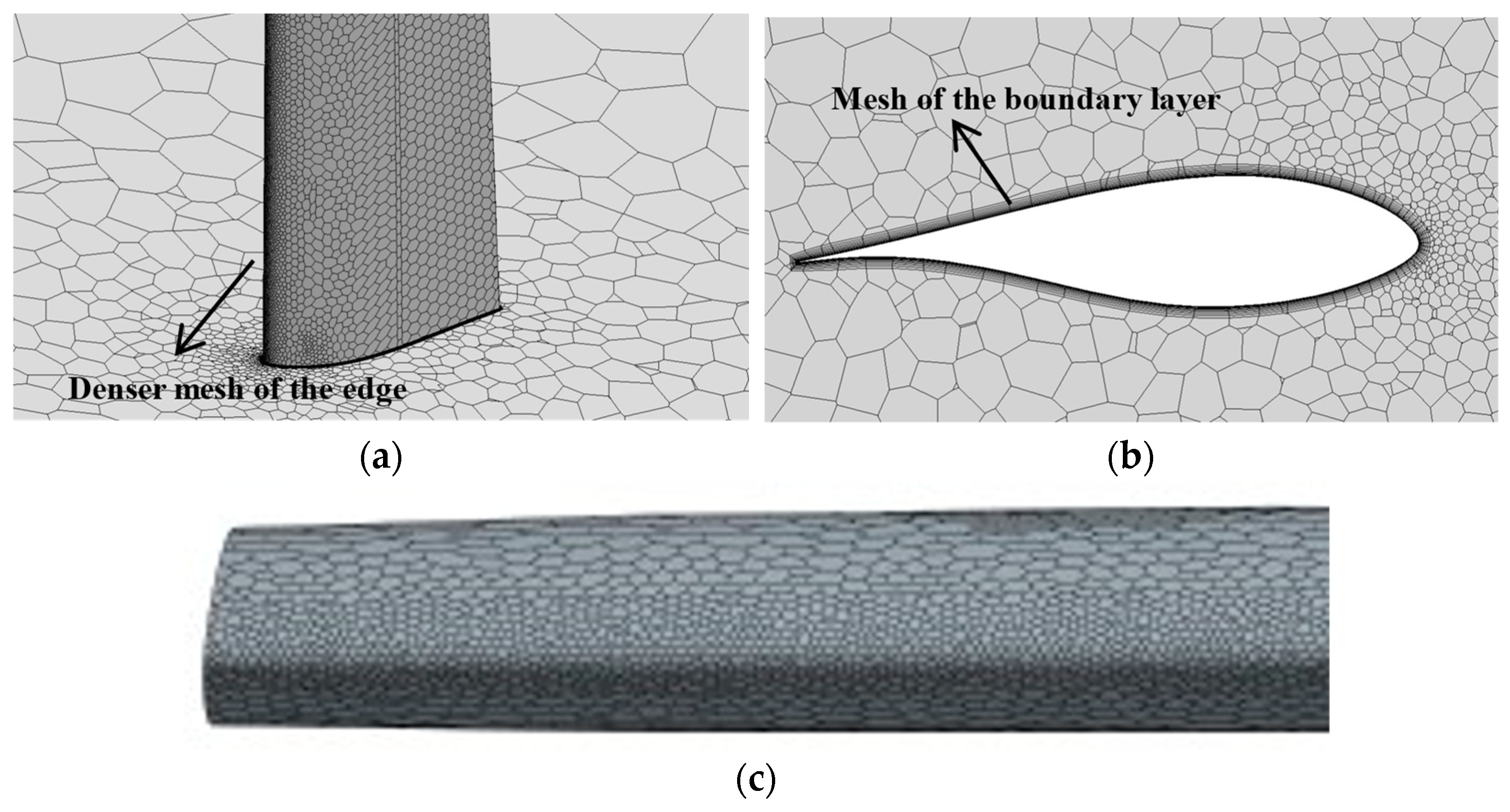
Figure 3 shows the mesh layout of the CFD model. The entire computational domain is discretized using polyhedral cells, which offer clear advantages in handling mesh deformation and related issues [26]. The baseline surface mesh size on the wind turbine blade is set to 0.15 m, with a minimum surface mesh size of 0.015 m. To accurately capture near-wall flow features, prism-layer boundary meshes satisfying 30 < y+ < 300 are generated on the blade surface [27], and an all-y+ wall treatment suitable for boundary layer simulation is employed to improve prediction accuracy for flow separation, attachment, and turbulent characteristics. The boundary layer mesh consists of 10 prism layers with a growth rate of 1.2 and a total thickness of approximately 0.04 m; the first layer’s thickness is about 0.001 m. The total mesh count is approximately 16.77 million cells. The choice of polyhedral cells for the core volume, combined with prismatic layers near the blade surface, was motivated by their superior performance in two-way FSI simulations. Polyhedral cells offer lower numerical diffusion, faster convergence, and more robust handling of mesh deformation compared to tetrahedral meshes, while the prismatic layers ensure accurate resolution of the near-wall boundary layer (y+ ≈ 30) required for the SST turbulence model.
To ensure the reliability of the CFD results, a grid-independence study is carried out, focusing on the influence of mesh resolution on the blade surface and in the near-field region [28]. While keeping the far-field domain mesh fixed, the near-field mesh density is varied by adjusting the baseline mesh size on the blade surface (from 0.2 m to 0.1 m) and the maximum cell size within the rotating region (from 2.5 m to 1.5 m), resulting in three different mesh configurations, as presented in Table 2. Under rated operating conditions, rotor thrust is selected as the evaluation metric.
As shown in Table 3, the calculated thrust becomes progressively stable with mesh refinement. The relative error in thrust between coarse case and medium case is 0.56%, which further reduces to 0.34% between medium case and fine case. This indicates a good level of mesh convergence. Taking into account both numerical accuracy and computational cost, the mesh configuration used in medium case is adopted for the subsequent simulations.
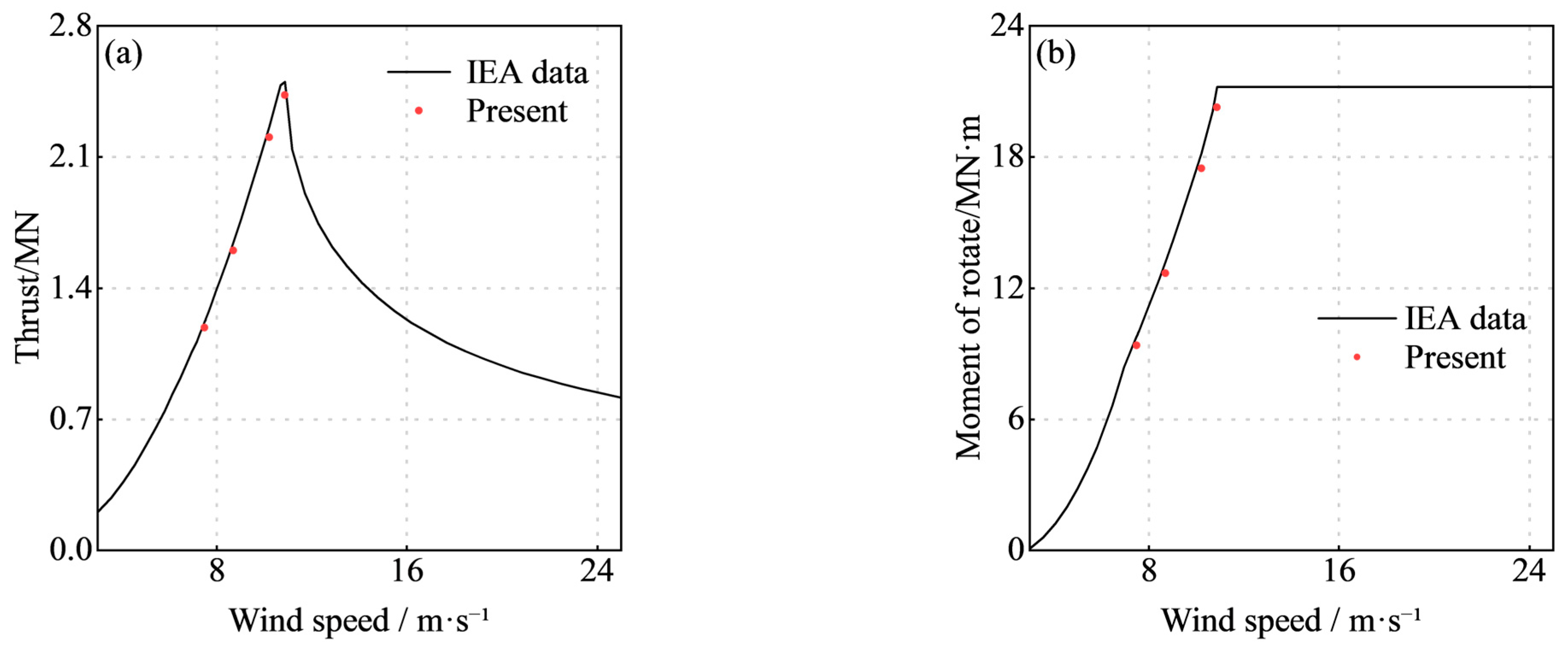
To further validate the rationality and reliability of the model, the thrust and twist moment were calculated at wind speeds of 7.50, 8.70, and 10.20 m·s−1, in addition to the rated wind speed. The results are summarised in Table 4. The maximum relative deviation in thrust between the present CFD predictions and the theoretical values provided by the IEA is 2.90% (at 8.70 m·s−1), while the deviations under the other conditions are 2.84%, 2.60%, and 2.82%, respectively. These results indicate a high level of accuracy in the thrust predictions. For the twist moment, the maximum relative deviation is 4.50% (at 7.50 m·s−1), with the remaining deviations being 4.19%, 3.82%, and 4.43%. All values fall within an acceptable range, demonstrating that the model can effectively capture the blade’s aerodynamic characteristics. Figure 4 further illustrates the variation trends of thrust and twist moment with wind speed. As shown in Figure 4a, the simulated thrust shows strong agreement with the IEA reference curve, particularly across the range from low wind speeds to the rated condition, where both the trend and magnitude align well. The slight deviation observed under the rated condition may be attributed to minor discrepancies in the turbulence model or boundary condition settings. Figure 4b shows that the simulated twist moment also matches the reference curve closely.
In summary, both the quantitative error analysis and the qualitative comparison of trendlines confirm that the CFD model developed in this study is robust and reliable in terms of geometric representation, mesh discretisation, turbulence modelling, and boundary condition specification. It is therefore suitable for engineering applications.
While the validation under rated and near-rated conditions (attached flow, low angles of attack) demonstrates the reliability of the CFD model for operational regimes, it is acknowledged that this does not automatically guarantee identical predictive accuracy for the parked-upwind conditions (25–30 m·s−1, pitch angles of 0° and 90°) investigated in this study. Under these extreme scenarios, the flow is characterized by massive separation and high angles of attack. However, the chosen SST k-ω turbulence model is specifically calibrated to handle adverse pressure gradients and separated flows [21,27], and our mesh resolution (y+ ≈ 30) is adequate for the all-y+ wall treatment in such regimes. Furthermore, the qualitative wake features observed in the no-pitch cases are physically consistent with expected bluff-body aerodynamics [28]. Nevertheless, this inherent limitation should be considered when interpreting the results, and future validation against high-fidelity scale-resolving simulations (e.g., detached eddy simulation (DES)/ large eddy simulation (LES)) or dedicated experimental data for parked conditions is recommended.
Furthermore, regarding the turbulence modelling approach, it is important to clarify why the URANS framework with the SST model is considered sufficient for the primary objectives of this study, despite the availability of more advanced methods such as DES or LES. The “high-frequency” response highlighted in our findings (e.g., the 1.969 Hz edgewise mode) refers to a structural eigenfrequency, not high-frequency turbulent content. This frequency is well within the resolvable range of our URANS temporal resolution (time step of 5 × 10⁻³ s, sampling rate 200 Hz). The dominant unsteady aerodynamic phenomena observed, such as the large-scale vortex shedding in the no-pitch cases, are characterized by low-frequency, coherent structures that URANS-SST is specifically calibrated to capture [21,28]. While DES/LES would undoubtedly provide richer detail of fine-scale turbulence, their computational cost makes parametric studies of multiple fault scenarios (as presented in this paper) currently infeasible. Therefore, URANS-SST represents a pragmatic and widely accepted compromise in wind energy engineering for assessing extreme loads and global aeroelastic responses [23,25]. Nevertheless, this limitation is acknowledged, and future investigations employing scale-resolving methods are recommended to further validate and refine the findings related to small-scale turbulent interactions.

3.2. FEM Modelling and Validation

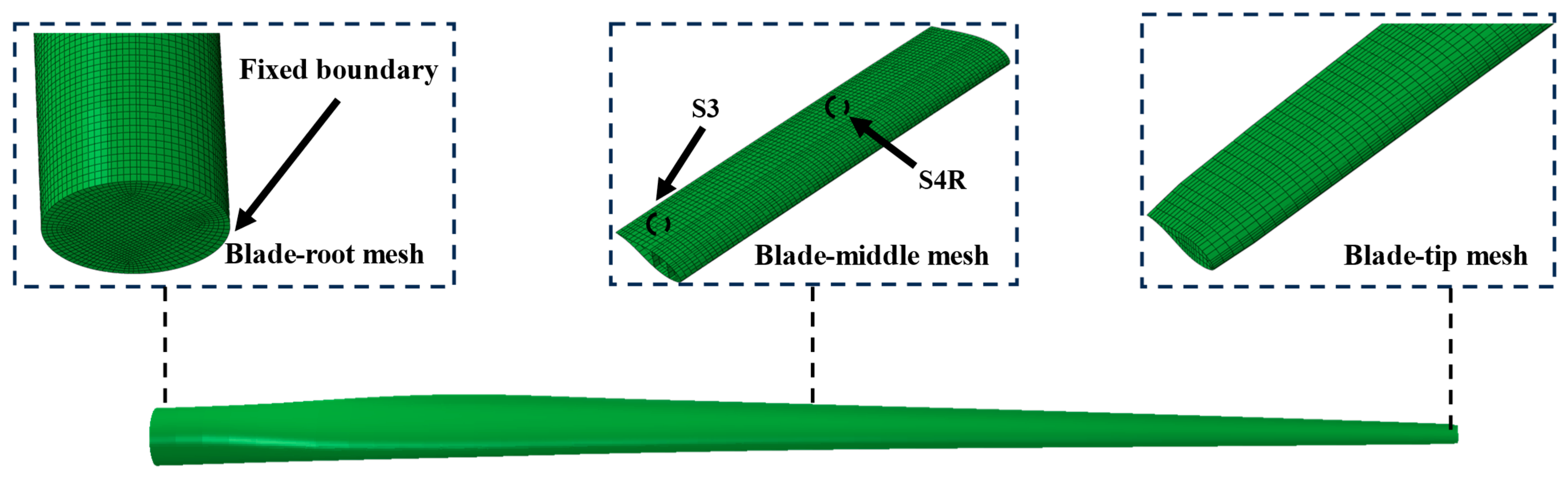
To support the subsequent structural analyses, a three-dimensional finite element model of the wind turbine blade was constructed using the Abaqus platform (see Figure 5). The blade surface was discretised with a combination of quadrilateral shell elements (S4R) and triangular shell elements (S3). A fully clamped boundary condition was applied at the root to simulate the fixed connection to the hub. The composite layup scheme adopted in this study follows an established design framework [21], incorporating six types of materials: gelcoat, foam, carbonUD, and three forms of glass-fibre-reinforced composites—glass uni, biaxial, and triaxial. The mechanical properties associated with these materials are summarised in Table 5.
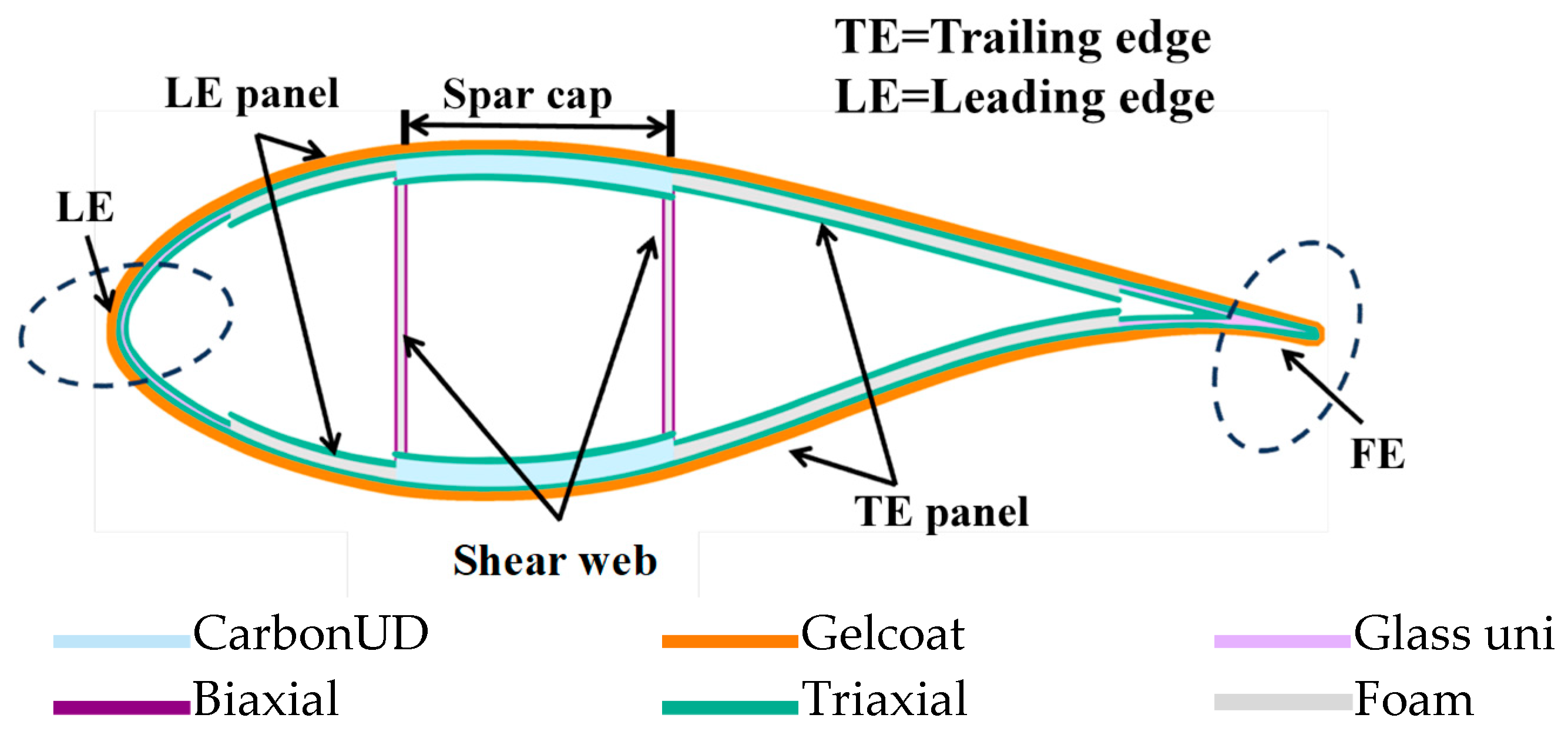
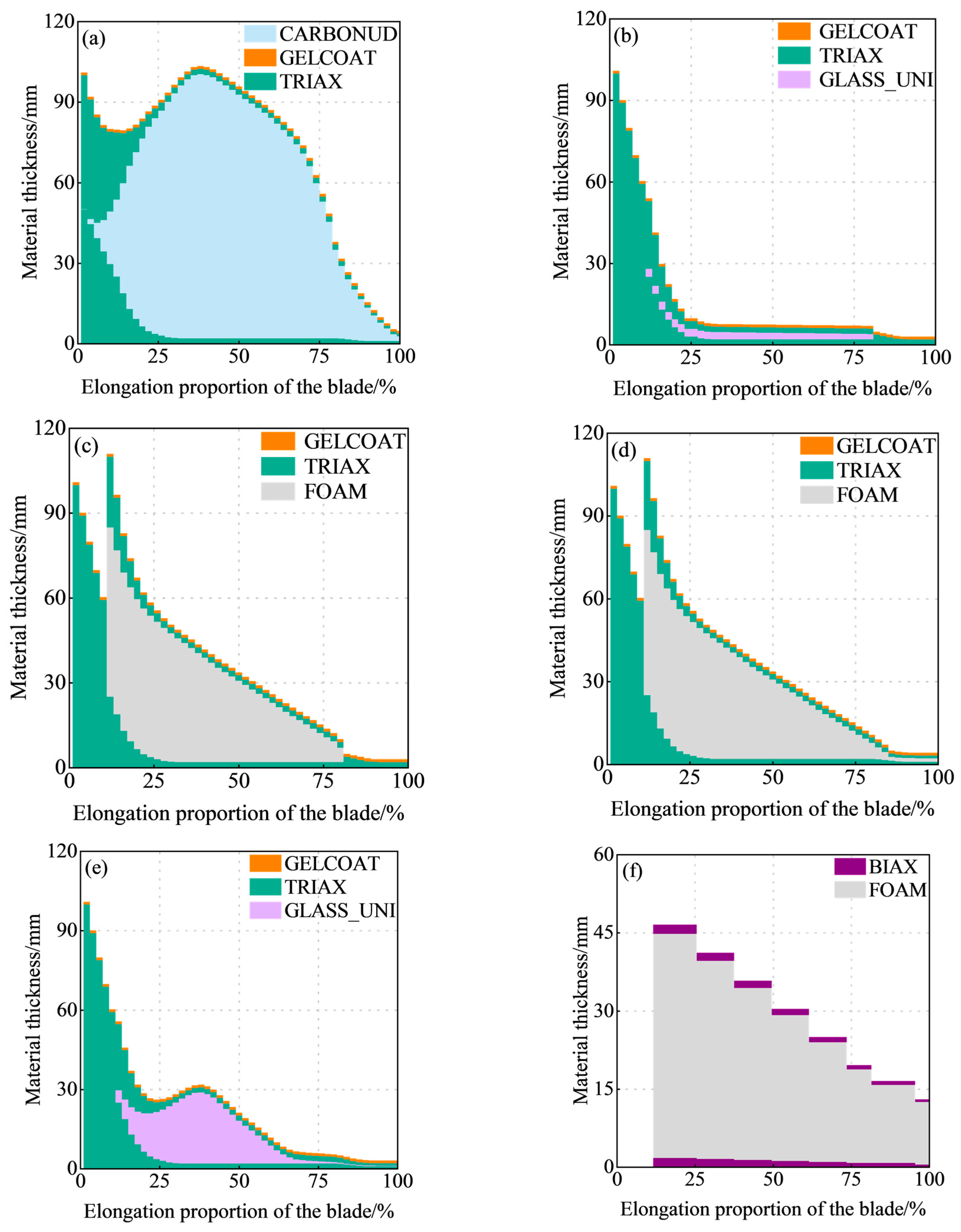
To accurately capture the structural characteristics and performance of the blade, a detailed partitioning strategy was implemented. In the cross-sectional direction, the blade was divided into six functionally distinct components: the leading edge, the leading edge panel, the main spar, the trailing edge panel, the trailing edge, and the shear web (see Figure 6). Material assignment across these components was guided by their respective functional requirements. CarbonUD was used as the core material for the main spar, while the panel regions employed foam cores. The edge regions were constructed with glass uni as the core material. Both the internal and external surfaces of the blade were reinforced with triaxial glass fibre. The shear webs adopted a sandwich structure, consisting of a foam core and biaxial glass fibre skins. In the spanwise direction, the blade surface was divided into 50 graded segments, each representing approximately 2% of the total blade length, enabling gradual variation of layup properties along the span. The shear webs were discretised into eight segments to allow for refined modelling of internal load transfer. The detailed layup thickness distribution is illustrated in Figure 7.
To assess the accuracy of the finite element model, a mesh independence study was first carried out. Three levels of mesh density—coarse (22,514 elements), medium (44,559 elements), and fine (83,867 elements)—were employed to compute the first eight natural frequencies of the blade. The results indicate that the maximum relative error between the coarse and medium meshes is 0.38%, while that between the medium and fine meshes is only 0.05%. This demonstrates that the computed modal frequencies converge with mesh refinement and display low sensitivity to mesh density. Accordingly, the medium-density mesh is selected for all subsequent analyses, as it offers a favourable balance between computational cost and numerical accuracy.
To further verify the model’s validity, the simulated natural frequencies were compared with benchmark data provided by the IEA and results published in previous studies (see Table 6 and Table 7). The comparisons reveal good overall agreement across all vibration modes. In particular, the first and second natural frequencies are predicted as 0.538 Hz and 0.641 Hz, respectively, corresponding to relative errors of 3.11% and 0.18% when compared with the IEA reference values—both well within acceptable engineering limits. These findings confirm the reliability and applicability of the finite element model developed in this study for structural dynamic analysis. While the natural frequency validation provides confidence in the global stiffness and mass distribution, quantitative mode shapes was not performed due to the lack of publicly available benchmark mode shape data for the IEA 15 MW blade. This will be addressed in future work when such data become available, further enhancing the fidelity of the structural model for aeroelastic simulations.
In summary, the finite element analysis was performed using Abaqus with an implicit dynamic solver. The blade was discretized using 44,559 shell elements, with a fully clamped boundary condition applied at the root to simulate the hub connection (Figure 5). The loads, consisting of transient aerodynamic pressure distributions, were not applied as static values but were mapped from the CFD solution onto the entire external blade surface at each coupling time step within the two-way FSI framework. The composite material specification was achieved by first defining the orthotropic properties of the six constituent materials (Table 5). These materials were then assembled into ply-resolved layups for six distinct cross-sectional regions (Figure 6). To capture the blade’s structural grading, the model was divided into 50 spanwise segments, with the ply thickness and stacking sequence varying gradually along the length, as illustrated in Figure 7. This detailed modelling approach enables the accurate prediction of stress concentrations and structural dynamics under complex aeroelastic loading.

3.3. FSI Case Setup

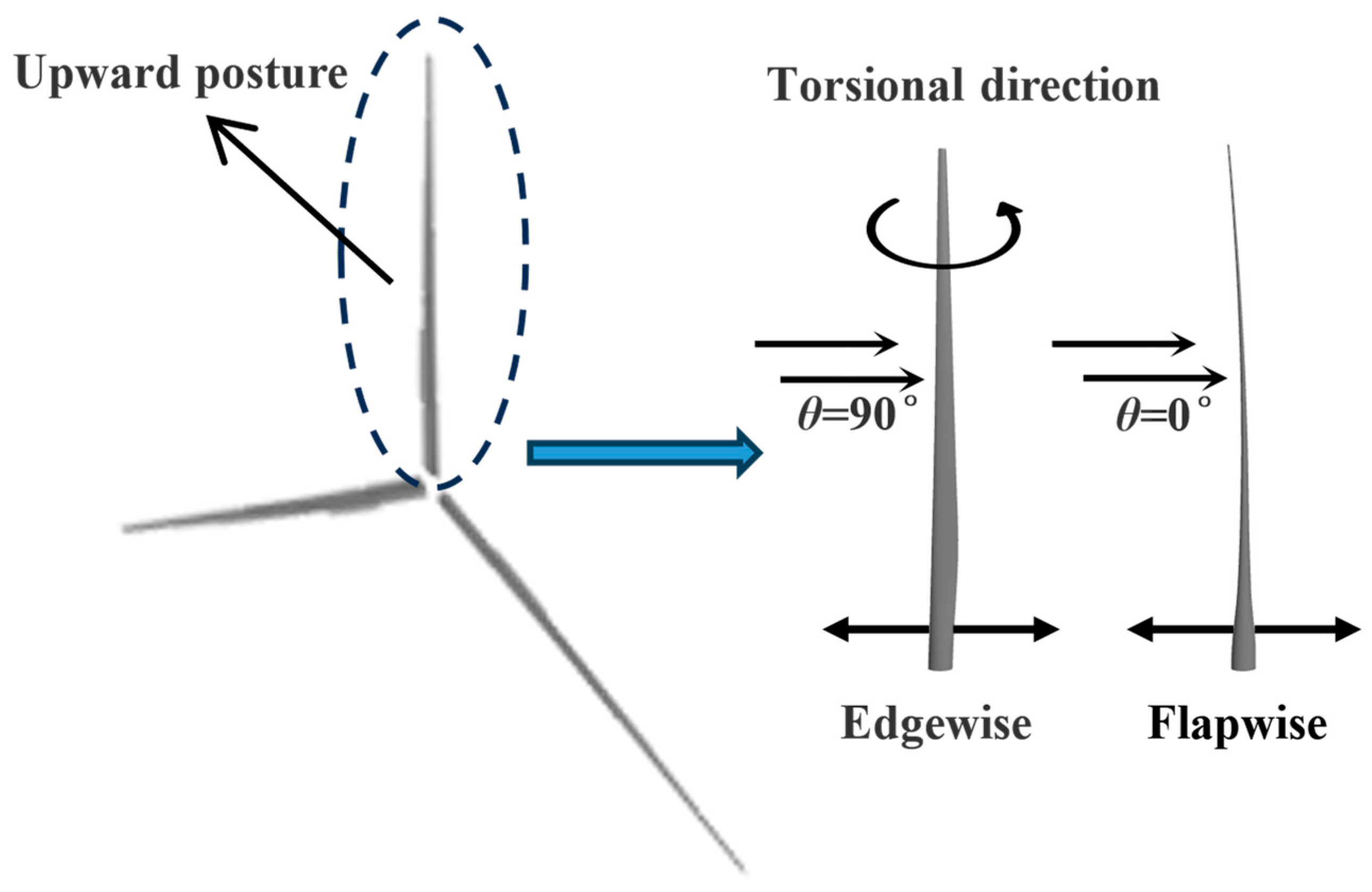
This study investigates the loading characteristics and structural responses of a wind turbine blade during the initial and final stages of pitching under a parked-up (up-tilted) attitude. The objective is to reveal the mechanical behaviour and potential failure mechanisms of large-megawatt, long, and flexible blades. As shown in Figure 8, the parked-up orientation, upwind operating condition, pitch angle, and moment directions are defined for reference. To reduce computational cost and enhance both efficiency and numerical stability, the total simulation time is set to 20 s, with a data-exchange time step of 5 × 10⁻³ s. This time step is smaller than the commonly adopted interval corresponding to one degree of rotor rotation, thereby helping to limit excessive deformation within a single step and ensuring robust iterative convergence [29].
The total simulation time of 20 s was selected to balance computational cost and numerical stability. Given that the first natural frequency of the blade is approximately 0.538 Hz (period ~1.86 s), this duration covers approximately 10.8 full oscillation cycles. To assess whether this is sufficient to achieve quasi-steady conditions, the moving averages of aerodynamic loads (thrust, root bending moments) and structural responses (tip displacement) were monitored throughout the simulation. For all four cases, the coefficient of variation of these quantities over the final 5 s (15–20 s) was below 5%, and the relative difference between the mean values of the last two structural cycles was less than 3%. These indicators suggest that the primary response metrics have reached acceptable convergence for the purposes of this study, which focuses on extreme load identification and comparative analysis between fault scenarios.
To explore the loads and structural responses under parked-up conditions, four simulation cases are designed, encompassing both the no-pitch and normal-pitch scenarios. Two wind speeds are considered for comparative analysis: the cut-out wind speed (25 m·s−1) and a higher wind speed (30 m·s−1). These cases enable the evaluation of potential failure causes and their likelihood. The detailed case configurations are summarised in Table 8.
Notably, in the present two-way coupling framework, aerodynamic damping is inherently generated through the phase lag between blade motion and the surrounding flow field. However, structural damping mechanisms—including composite material hysteresis, inter-laminar friction, and root joint dissipation—are explicitly neglected. Consequently, all displacement and stress fluctuations reported in Section 3 should be interpreted as conservative maximum values (worst-case scenarios). In physical reality, intrinsic material damping (typically 0.5–2% of critical damping for glass/carbon fibre composites) would attenuate the resonant peak amplitudes.

4. Results and Discussion

4.1. Flow-Field Analysis

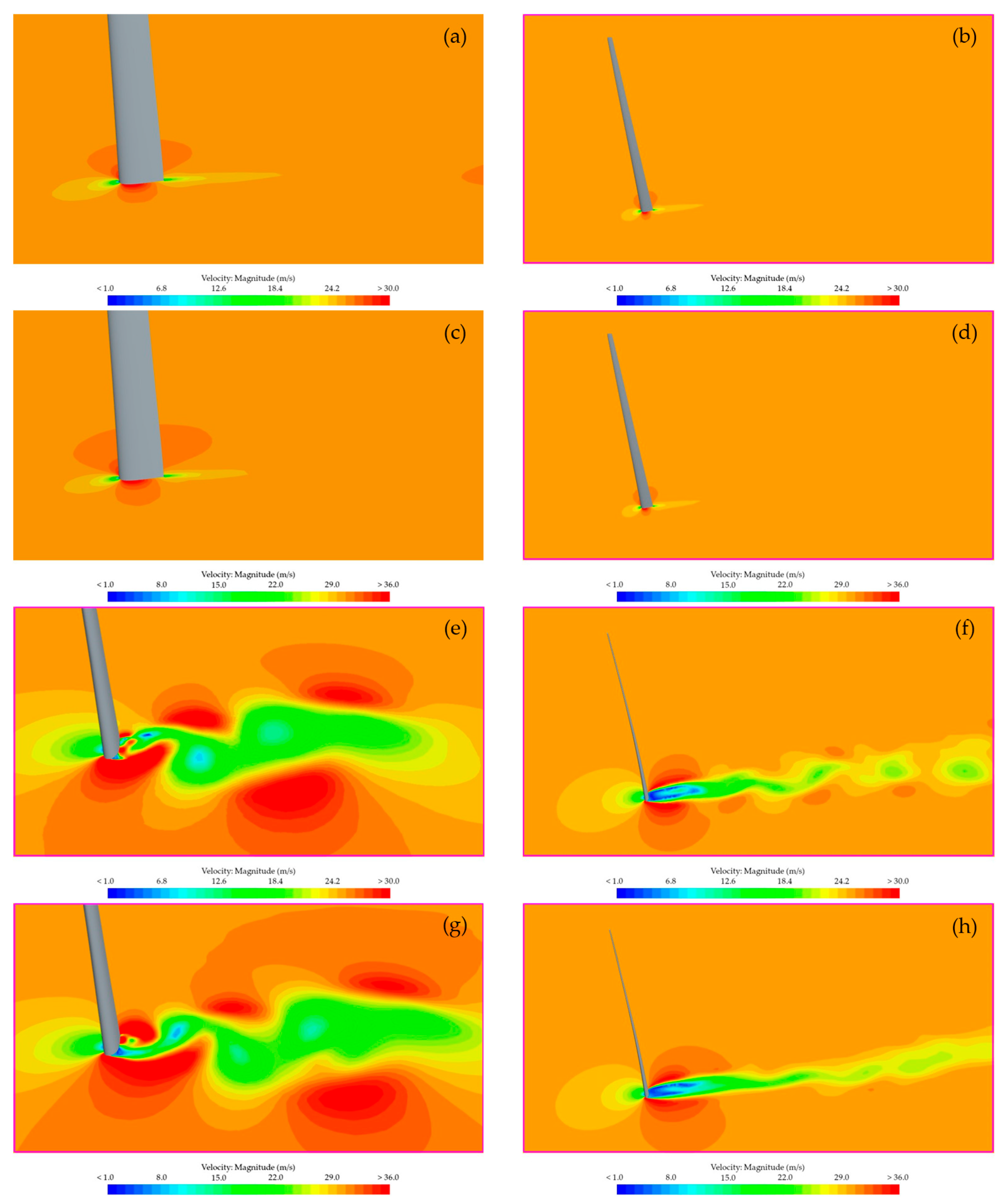
Prior to presenting the detailed results, it is noted that the simulations reached a quasi-steady state within approximately 15 s for all cases, as indicated by the stabilization of moving averages of key aerodynamic and structural quantities. The results presented in the following sections are primarily based on the quasi-steady portion of the simulations (15–20 s), unless otherwise specified. Additionally, these velocity fields were obtained from the unsteady CFD simulations, using a time step of 5 × 10⁻³ s and the k-ω SST turbulence model. The primary input parameters governing these results are the freestream wind speed (25 m/s for X1, X3; 30 m/s for X2, X4) and the blade pitch angle (90° for X1, X2; 0° for X3, X4). The dependence of the velocity field on these parameters is mathematically governed by the incompressible Navier–Stokes equations (Equations (1) and (2)). The wind speed enters as the velocity inlet boundary condition, establishing the convective momentum, while the pitch angle determines the blade’s orientation relative to the flow, which dictates the surface pressure gradient and, consequently, the location and intensity of flow separation.
Figure 9 presents the cross-sectional velocity contours at the 25% span location at T = 1 s and T = 20 s. By comparing the wake structures under different simulation cases, it can be observed that, under the normal-pitch condition, the flow fields at the two time instants remain largely similar. The wake is weak, and no pronounced vortex shedding is evident, suggesting that the flow field rapidly stabilises and produces relatively steady aerodynamic loads. In contrast, under the no-pitch condition, the wake region downstream of the blade is noticeably broader, with a more pronounced velocity deficit characterised by an extensive low-velocity zone. As the flow develops further downstream, the velocity gradually recovers through mixing with the surrounding freestream. During this process, vortex shedding becomes clearly identifiable. These vortical structures continuously evolve through merging and expansion, giving rise to significant unsteadiness in the aerodynamic loads and, as a result, inducing more complex aerodynamic responses and structural deformations in the blade [30].
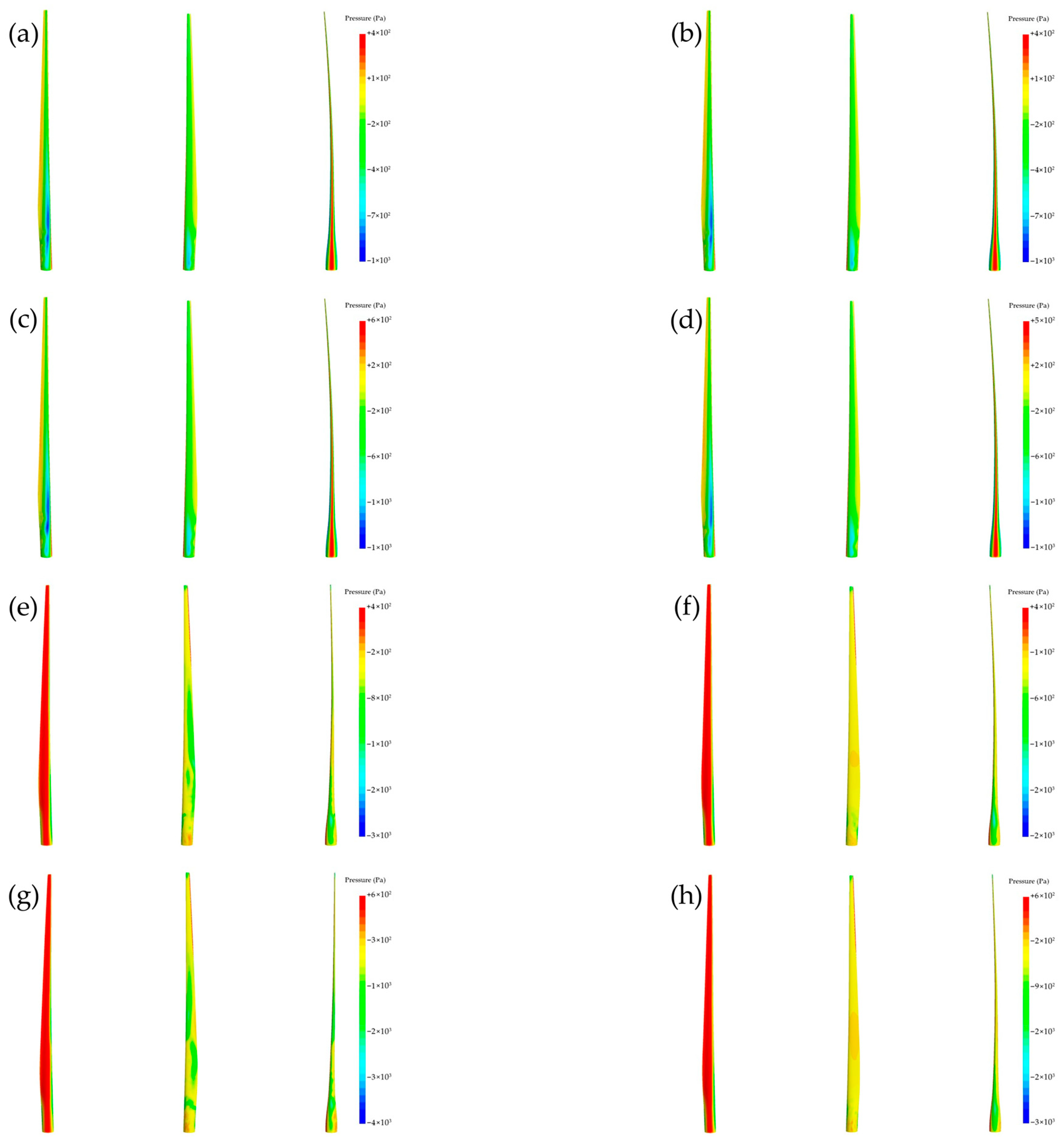
Figure 10 compares the surface pressure distributions on the blade at T = 1 s and T = 20 s under different pitch conditions. Under the normal-pitch condition, a prominent region of positive pressure is observed near the leading edge. In contrast, under the no-pitch condition, the windward side of the blade is dominated by positive pressure, while the leeward side is primarily under negative pressure, with the negative pressure concentrated near the leading edge.
Table 9 summarises the key surface pressure metrics. At T = 1 s, the minimum negative pressure ranges from −982 Pa to −3699 Pa, the maximum positive pressure ranges from 384 Pa to 583 Pa, and the maximum pressure difference lies between 1399 Pa and 4283 Pa. At T = 20 s, these values change to −961 Pa to −3137 Pa, 381 Pa to 550 Pa, and 1342 Pa to 3687 Pa, respectively. The corresponding temporal variation amplitudes are calculated as 2.14–18.40% for minimum negative pressure, 0.78–6.73% for maximum positive pressure, and 4.07–16.82% for pressure difference. At the same wind speed, both the magnitude of the pressures and their temporal variations are significantly greater for the no-pitch blade compared with the normally pitched blade. As the wind speed increases, the temporal variation in surface pressure decreases for the no-pitch condition, while it shows a slight increase for the normally pitched case. This trend suggests that at higher wind speeds, the large pressure differences on the no-pitch blade are sustained over longer durations. Such prolonged high-pressure differentials imply that the aerodynamic loads remain elevated for extended periods, which may not only intensify dynamic structural responses but also affect aeroelastic stability and the long-term operational reliability of the blade.

4.2. Load Analysis

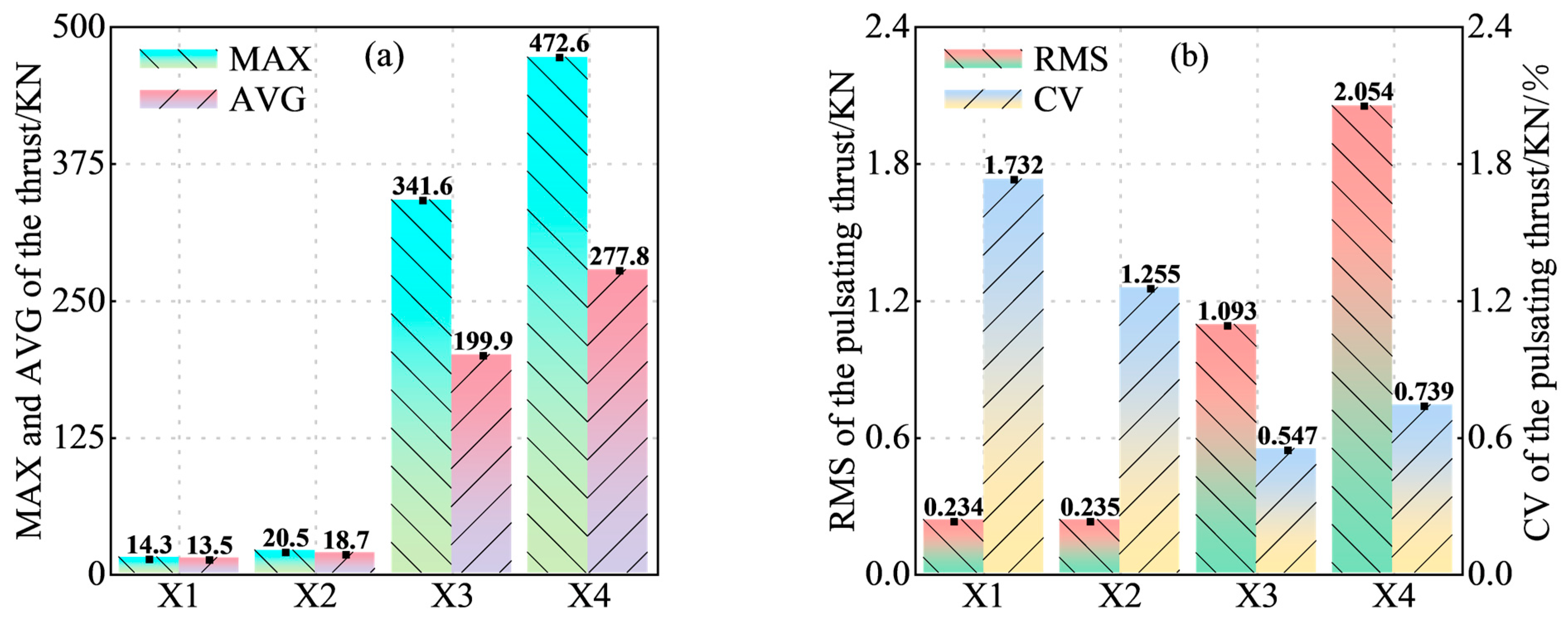
Figure 11a presents a comparison of the peak (MAX) and the quasi-steady mean (AVG) values of thrust for the four simulation cases (X1–X4). The peak thrust values are 14.29, 20.54, 341.64, and 472.59 KN, respectively, with corresponding mean values of 13.51, 18.70, 199.91, and 277.79 KN. Relative to the peak values, the mean thrust is reduced by 5 to 42%, with particularly pronounced reductions in cases X3 and X4 (approximately 41%). This indicates that pitching significantly reduces thrust fluctuation amplitude. Further comparison of the mean values shows that case X2 exhibits a 38.4% increase over X1, while X4 increases by 39.0% relative to X3. In addition, the mean thrust in X3 is approximately 14.8 times greater than that in X1, and in X4 it is about 14.9 times greater than in X2. These results suggest that, although the increase in wind speed leads to comparable rates of thrust growth in both pitched and unpitched conditions, the absolute thrust levels are substantially higher in the no-pitch scenarios. Comparing cases at the same wind speed (X1 vs. X3 and X2 vs. X4), it is evident that normal pitching reduces the mean thrust by a factor of approximately 15, highlighting a strong load-alleviation effect.
Figure 11b further examines the fluctuation characteristics of thrust. During the quasi-steady interval, the root mean square (RMS) values of thrust fluctuations are 234.07 N and 234.78 N for X1 and X2, respectively. The coefficient of variation (CV)—defined as the ratio of RMS fluctuating thrust to the mean thrust—decreases from 1.73% to 1.26%. In contrast, for X3 and X4, the RMS values are 1.09 KN and 2.05 KN, with corresponding CVs increasing from 0.55% to 0.74%. These findings confirm that thrust fluctuations are significantly more intense in the no-pitch cases compared with the pitched cases under the same wind speed. Moreover, with increasing wind speed, the RMS values rise in all cases. Notably, the upward trend in CV for the no-pitch scenarios suggests that the rate of increase in fluctuations exceeds that of the mean thrust. This implies a growing imbalance that could exacerbate structural fatigue and reduce the operational lifespan of the blade.
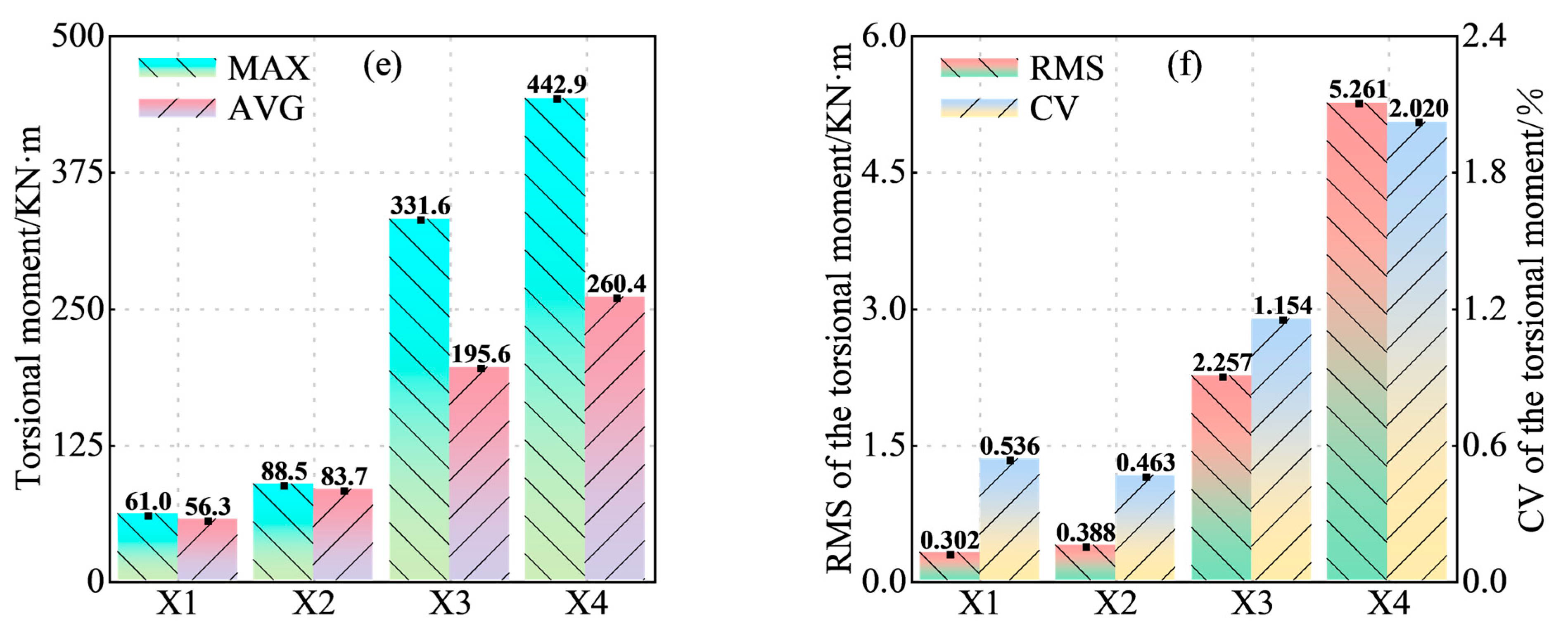
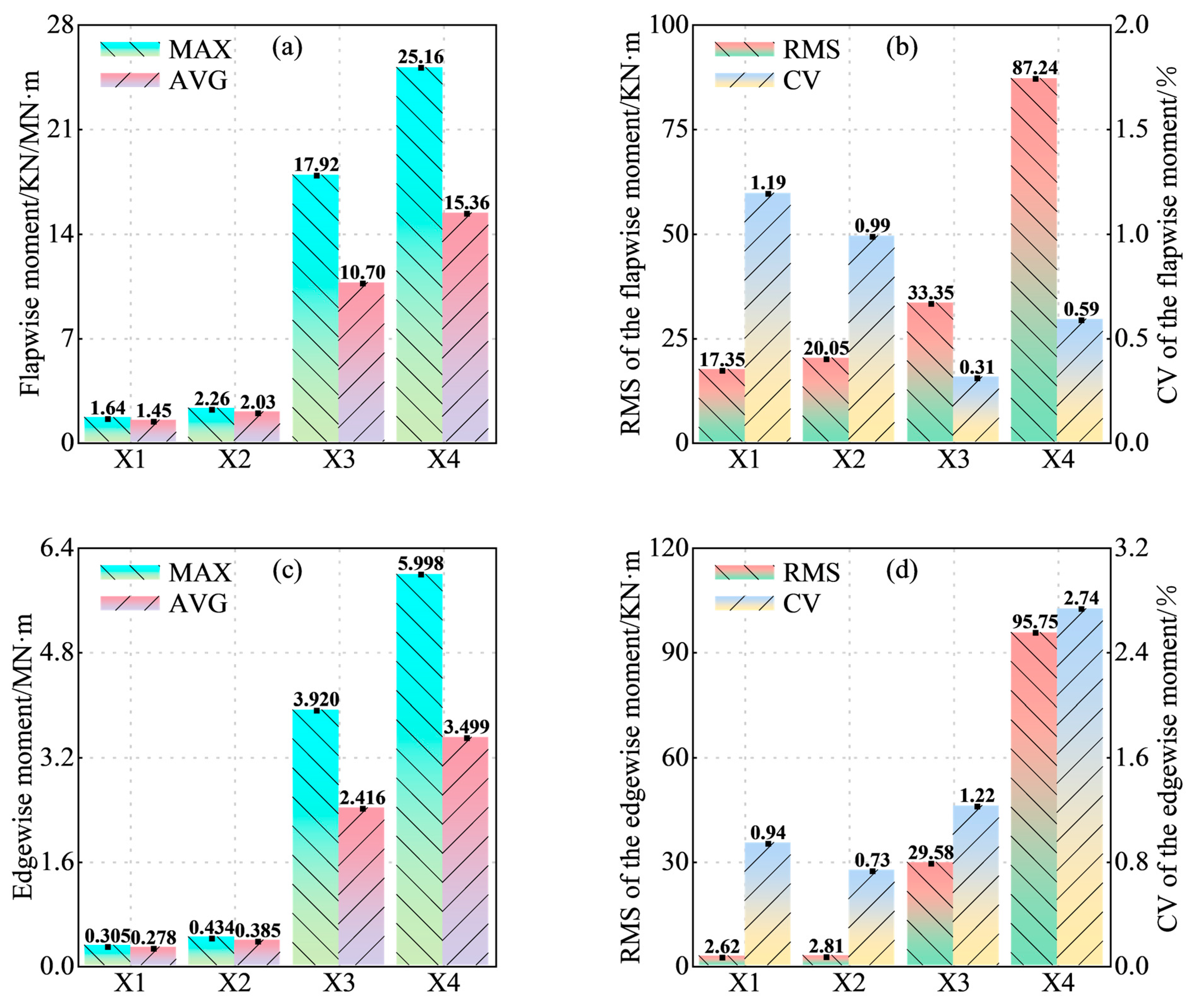
Figure 12a,c,e present statistical analyses of the peak and quasi-steady mean values of the flapwise, edgewise, and torsional moments under each case. In the flapwise direction, the peak moments for cases X1 to X4 are 1.63, 2.26, 17.92, and 25.16 MN·m, respectively, while the corresponding mean values are 1.45, 2.03, 10.70, and 15.36 MN·m. These represent reductions of 10 to 40% relative to the peak values. In the edgewise direction, the peak moments are 0.30, 0.43, 3.92, and 6.00 MN·m, with mean values of 0.28, 0.38, 2.42, and 3.50 MN·m, corresponding to decreases of 8.9 to 41.7%. In the torsional direction, the peak twist moments are 60.96, 88.51, 331.58, and 442.88 KN·m, and the mean values are 56.32, 83.72, 195.63, and 260.40 KN·m, representing reductions of 5 to 41%. These comparisons reveal that pitching can significantly reduce moment loads in all directions. At the same wind speed, the mean values under the no-pitch conditions (X3 and X4) are approximately 7 to 9 times greater than those under the pitched conditions (X1 and X2) in the flapwise and edgewise directions, and more than three times greater in the torsional direction. Among them, the edgewise moment shows the most substantial reduction due to pitching.
Figure 12b,d,f further investigate the fluctuation characteristics of the moments. As wind speed increases, the root mean square (RMS) values of the moment fluctuations increase across all directions. Notably, under the high-wind-speed–no-pitch condition (X4), the RMS of the edgewise moment increases sharply to 95.75 KN·m, exceeding the RMS of the flapwise moment (87.24 KN·m) under the same case. The corresponding coefficient of variation (CV) for the edgewise moment reaches 2.74%, which is significantly higher than those in the flapwise (0.59%) and torsional directions (2.02%). These findings suggest that, as wind speed increases, the no-pitch blade experiences a pronounced aeroelastic coupling effect in the edgewise direction, where the intensity of moment fluctuations grows substantially faster than the increase in the mean value.

4.3. Displacement Analysis

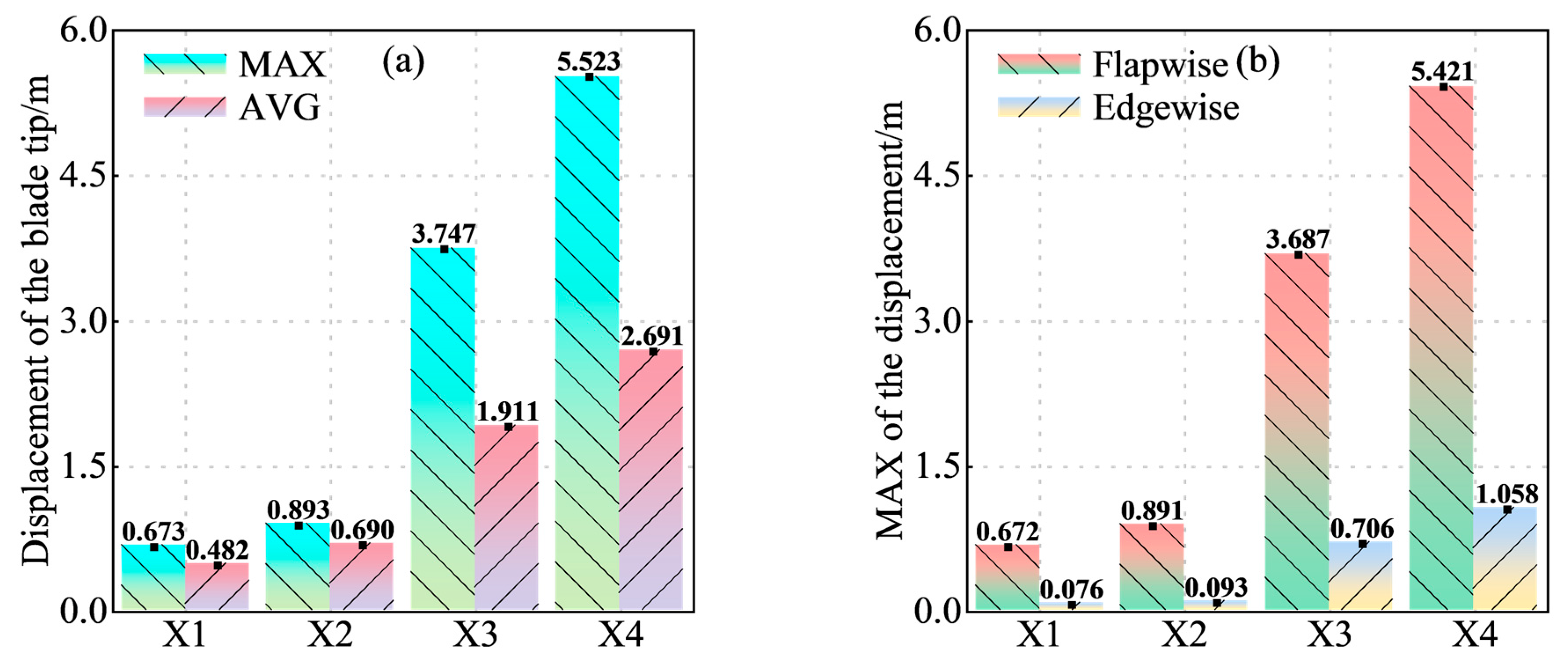
Figure 13a presents the peak (MAX) and quasi-steady mean (AVG) values of the total tip displacement under different cases (X1–X4). The MAX values are 0.67, 0.89, 3.75, and 5.52 m, with corresponding AVG values of 0.48, 0.69, 1.91, and 2.69 m, respectively. The reductions in AVG relative to MAX are 28.32%, 22.68%, 48.99%, and 51.27%, indicating that pitching can significantly suppress displacement amplitude. At the same wind speed, the tip displacement of the no-pitch blade is clearly larger than that of the pitched blade. Among all conditions, the maximum tip displacement is observed in Case X4, reaching 5.52 m.
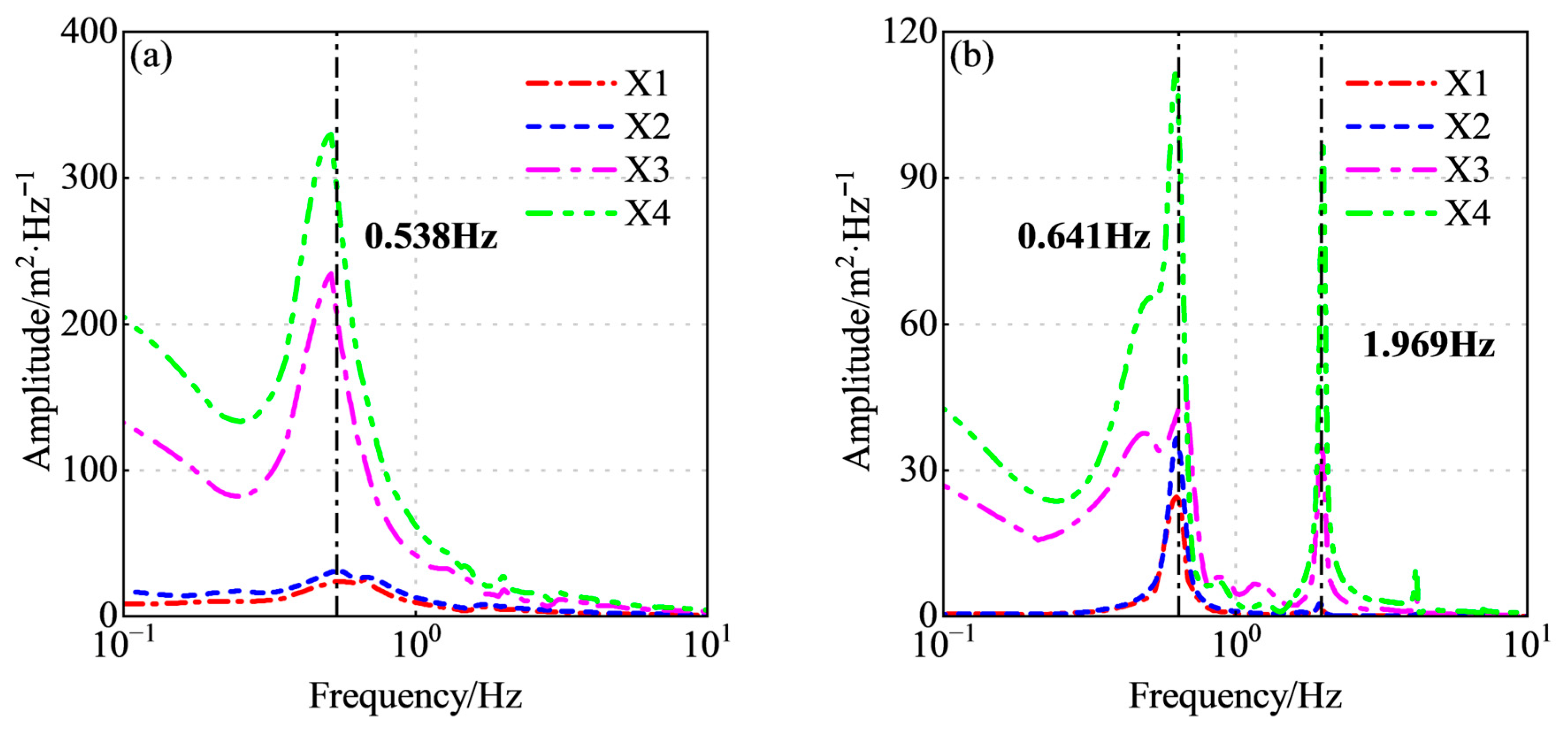
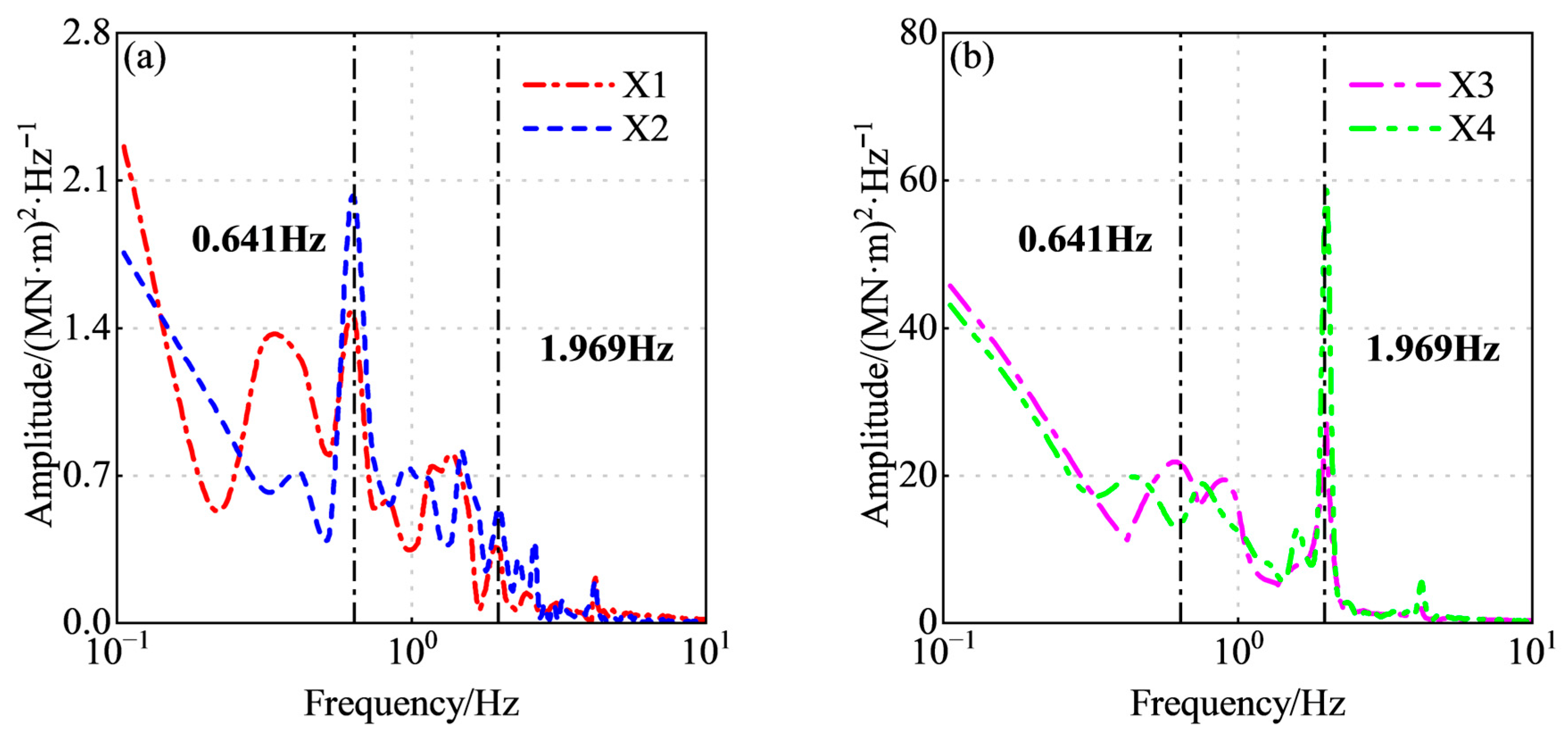
Figure 13b provides the peak displacements of the blade tip in the flapwise and edgewise directions. The peak flapwise displacements for cases X1 to X4 are 0.67, 0.89, 3.69, and 5.42 m, respectively, whereas the corresponding peak edgewise displacements are 0.08, 0.09, 0.70, and 1.06 m. Limitations of amplitude realism: the vibration amplitudes presented above (e.g., the 5.52 m maximum tip displacement in Case X4) represent theoretical maximum values in the absence of structural material damping. While the identification of the second edgewise mode and the relative comparison between pitched and no-pitch conditions remain physically valid, the absolute magnitudes would be reduced in actual operating conditions where composite material damping provides additional energy dissipation. These results indicate that flapwise displacement is dominant. Further spectral analysis (Figure 14) shows that vibration in the flapwise direction is consistently governed by the first flapwise natural frequency (Hf = 0.538 Hz). In the edgewise direction, the response is dominated by the first edgewise natural frequency (Hf = 0.641 Hz) under the pitched cases; however, under the no-pitch cases, high-frequency vibration becomes significant, with the second edgewise natural frequency (Hf = 1.969 Hz) becoming dominant. Moreover, as wind speed increases from 25 to 30 m·s−1, the amplitude at this frequency rises sharply, suggesting that the high-frequency response is significantly intensified and may trigger aeroelastic instability, as shown in Figure 15.
To further investigate this phenomenon, spectral analysis is performed on the edgewise moment in the second half of the time series. As shown in Figure 15, under fluid–structure interaction (FSI), the dominant frequency of the edgewise moment for X1 and X2 corresponds to the first edgewise natural frequency (Hf = 0.641 Hz). In X3, both the first and second edgewise natural frequencies are present with comparable amplitudes, while in X4, the response is clearly dominated by the second edgewise natural frequency (Hf = 1.969 Hz). Since the vibration characteristics in the edgewise direction are jointly influenced by aerodynamic loading and structural feedback, the high-frequency vibration excited in this process can induce substantial load oscillations, which may adversely affect the fatigue life of the blade. Therefore, under no-pitch conditions, direct exposure to strong winds should be avoided as far as possible.

4.4. Stress Analysis

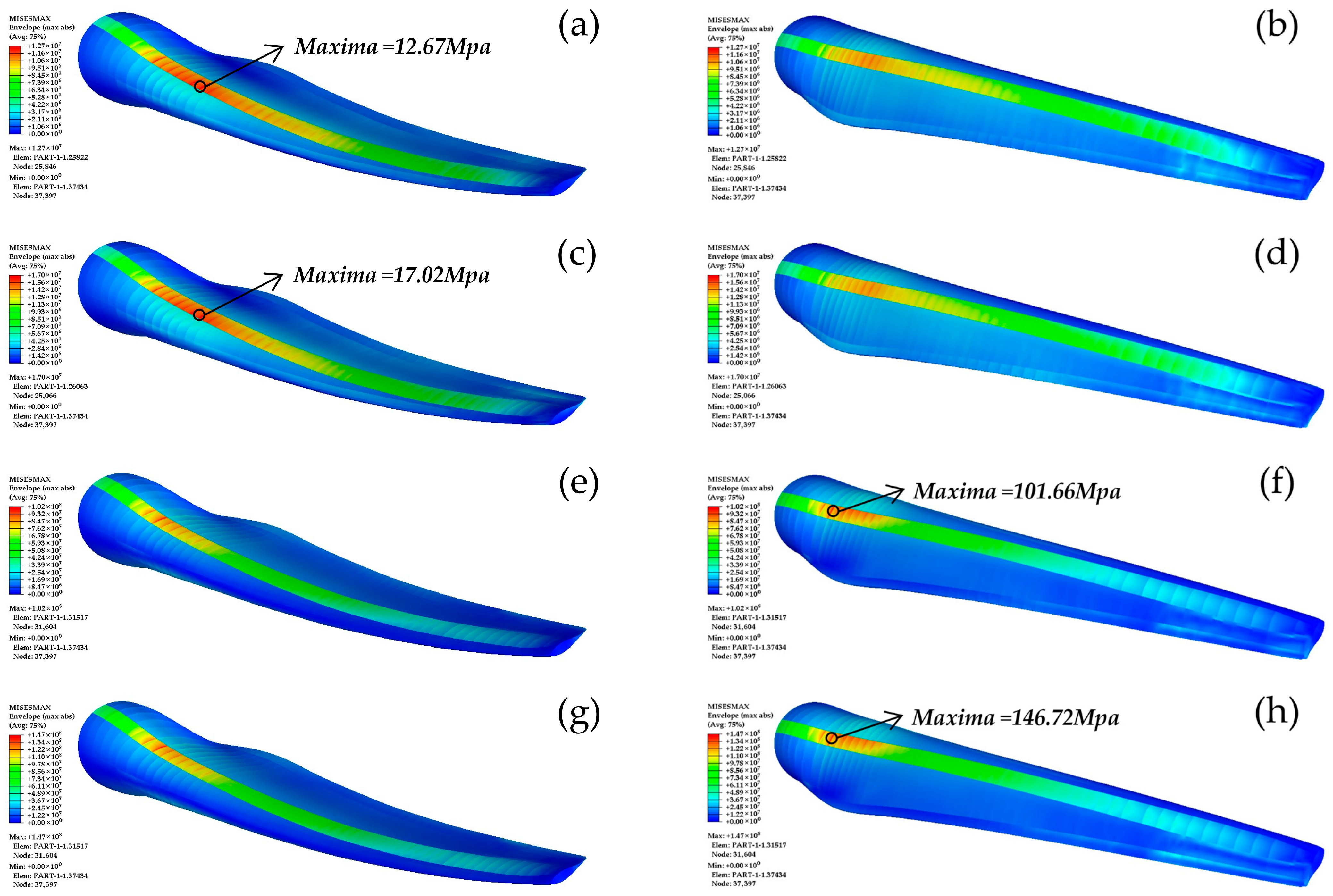
To assess the overall stress distribution and identify critical regions under multi-axial loading, the von Mises equivalent stress is employed. Figure 16 presents the spatial contours of the maximum von Mises stress on the blade surface under the four simulation cases. The stress distribution is notably non-uniform: a distinct high-stress band is observed within the main spar region, where stress levels are significantly higher than those at the leading edge, trailing edge, and blade tip. From a spanwise perspective, the high-stress region is concentrated in the lower-to-mid span of the blade, corresponding to the transitional zone between the aerodynamic load centre and the root constraint. This region is subjected to pronounced combined compressive–shear loading and coincides with failure-prone zones frequently observed in practice. The stress within the main spar gradually decreases from the mid-span towards the tip, exhibiting typical cantilever-beam behaviour. The maximum surface stress obtained in this study is 146.72 MPa, located in the carbonUD main spar region. Although this value is well below the ultimate strength of the material and is therefore unlikely to induce static failure, the possibility of fatigue damage in this region under high wind conditions warrants attention.
Additionally, the location of the peak stress varies among the different cases. Under the pitched condition, the stress peak occurs on the pressure surface at approximately 27% span from the blade root. As wind speed increases, the peak stress rises from 12.67 to 17.02 MPa, corresponding to an increase of approximately 34.3%. Under the no-pitch condition, the stress peak is located on the suction surface, around 15% span from the root—that is, shifted further inboard along the span. Here, the peak stress increases from 101.67 to 146.72 MPa, representing a 44.3% rise. Furthermore, at a wind speed of 25 m·s−1, the peak stress of the no-pitch blade is approximately eight times higher than that of the pitched blade. At 30 m·s−1, this ratio increases to about 8.6, indicating that the stress-reduction effect of pitching becomes even more pronounced at higher wind speeds. These results demonstrate that the no-pitch blade exhibits greater sensitivity to aerodynamic loading, with the peak stress increasing more significantly as wind speed rises.
It should be noted that, while the CFD and FEM components have been independently validated, the fully coupled FSI framework itself has not been directly validated against benchmark aeroelastic data. This represents a limitation of the current study, as the coupled aeroelastic responses (such as blade tip displacement or root bending moment under FSI conditions) could not be compared with established reference solutions. Furthermore, the finite element model employed in this study assumes ideal, homogeneous composite layers with perfect manufacturing quality. In practice, large fibre-reinforced plastic structures inherently contain manufacturing defects such as micro-voids, porosity, and resin-rich areas, which act as stress concentrators and can significantly influence the actual fatigue life. While the present study identifies high-frequency vibrations and stress concentrations as potential risk factors for fatigue damage, no actual fatigue life calculations or damage evolution models were applied. These issues that have been brought to light are all important and need further study.


5. Conclusions and Outlooks

This study presented a high-fidelity, two-way CFD–FEM fluid–structure interaction analysis of a 15 MW composite wind turbine blade under parked-upwind shutdown conditions with pitch system faults. The investigation compared normal-pitch (90°) and no-pitch fault (0°) scenarios at wind speeds of 25 m/s and 30 m/s. The following key conclusions are drawn:
(1)
Under the no-pitch condition, the aerodynamic loads acting on the blade are substantially greater than those under normal pitching. The thrust is approximately 15 times higher, and the peak stress reaches up to 8.6 times that of the pitched condition. Therefore, in high-wind scenarios exceeding the cut-out threshold, particular attention must be paid to the loading conditions and the associated risk of fatigue damage in the event of delayed or failed pitching.
(2)
In the no-pitch condition, high-frequency vibration dominated by the second edgewise natural frequency (Hf = 1.969 Hz) emerges in the edgewise direction, with its amplitude increasing significantly with wind speed. This behaviour poses a risk of aeroelastic instability and differs markedly from the vibration characteristics observed under normal pitching.
(3)
Stress analysis indicates that the main spar region experiences significantly higher stress than other areas of the blade. Spanwise, the lower-to-mid span section is identified as the primary region of stress concentration. This area should be closely monitored for material strength and fatigue resistance. Furthermore, under the no-pitch condition, the location of maximum stress shifts downward along the span compared with the pitched case.
However, despite critical simulation analyses having been conducted, many issues still require further investigation. For example, while the CFD and FEM components have been validated independently against benchmark data, the fully coupled two-way FSI framework itself has not been validated directly against experimental measurements or established aeroelastic benchmarks for the IEA 15 MW blade in a parked-upwind conditions. Consequently, future research could focus on validating the fully coupled FSI framework, considering the mechanical processing of composite structures such as drilling [31], introducing the multiscale analysis of composites [32], carrying out the deep learning-based structural optimization [33], testing the structural damping [34], performing the modal analysis [35], coupling the damage behaviour [36], and so on. This will further advance the implementation of related research, particularly with regard to engineering applications.

Author Contributions

Conceptualization, T.W.; methodology, T.W.; validation, T.W. and Z.C.; investigation, T.W. and J.Z.; resources and funding acquisition, T.W. and Z.C.; data curation, T.W. and Z.C.; writing—original draft preparation, T.W.; writing—review and editing, Z.C. and J.Z.; visualization, T.W. and J.Z. supervision, T.W. All authors have read and agreed to the published version of the manuscript.

Funding

This research received no external funding.

Data Availability Statement

The data that support the findings of this study are available from the corresponding author upon reasonable request.

Conflicts of Interest

The authors declare no conflicts of interest.

References

  1. GWEC. Global Wind Report 2024; Global Wind Energy Council: Lisbon, Portugal, 2024. [Google Scholar]
  2. Cheng, J.; Xie, S.; Cao, Y.; Wang, Y.; Yang, Y.; Yang, X. The current status and strategy suggestions for offshore wind power development in China. Sci. Technol. Rev. 2025, 43, 115–128. [Google Scholar]
  3. Gaertner, E.; Rinker, J.; Sethuraman, L.; Zahle, F.; Anderson, B.; Barter, G.; Abbas, N.; Meng, F.; Bortolotti, P.; Skrzypinski, W. Definition of the IEA 15-Megawatt Offshore Reference Wind Turbine; National Renewable Energy Laboratory (NREL): Golden, CO, USA, 2020.
  4. Yu, H.J.; Li, C.L.; Xue, J.Q.; Liang, L. A Review of the Flutter of Offshore Wind Turbine Blades. Mech. Res. Appl. 2025, 38, 181–186. [Google Scholar]
  5. Zhang, Z.; Zhang, C.; Qiao, Y.; Zhou, Y.; Wang, S. Design and Mass Optimization of Numerical Models for Composite Wind Turbine Blades. J. Mar. Sci. Eng. 2023, 11, 75. [Google Scholar] [CrossRef]
  6. Alonso, C.G.; Ferrer, E.; López, M.B. Wind turbine power extraction under partial wake operations, a CFD study using ALM. J. Phys. Conf. Ser. 2024, 2767, 092097. [Google Scholar] [CrossRef]
  7. Tang, R.D.; Cao, R.J. Numerical Analysis of Wake Characteristics for Floating Offshore Wind Turbine Under Pitch Motion. Adv. New Renew. Energy 2023, 11, 93–99. [Google Scholar]
  8. Hu, J.; Yang, H.; Yuan, J. Unsteady Aerodynamic Errors in BEM Predictions Under Yawed Flow: CFD-Based Insights into Flow Structures for the NREL Phase VI Rotor. Energies 2025, 18, 5027. [Google Scholar] [CrossRef]
  9. Wang, K.; Zhao, W.W.; Wan, D.C. Study on the impact of platform forced motions on aeroelasticity of a 15 MW wind turbine. Ocean Eng. 2024, 42, 21–35. [Google Scholar]
  10. Yang, S.; Zhang, M.; Feng, Y.; Jia, H.; Zhao, N.; Chen, Q. Research on the Improvement of BEM Method for Ultra-Large Wind Turbine Blades Based on CFD and Artificial Intelligence Technologies. Fluids 2025, 10, 112. [Google Scholar] [CrossRef]
  11. Huang, Y.; Zhao, W.W.; Wan, D.C. Numerical simulation of coupled aero-hydro-elastic performance of floating offshore wind turbine. Ocean Eng. 2022, 40, 88–101. [Google Scholar]
  12. Wang, F.; Yang, Y.; Zeng, J.; Yang, Y. Research on dynamics of icing wind turbine blade based on geometrically exact beam theory. J. Sound Vib. 2025, 601, 118927. [Google Scholar] [CrossRef]
  13. Zhao, M.; Yu, W.-L.; Wang, P.-G.; Qu, Y.; Du, X.-L. Numerical Study on the Aerodynamic and Fluid–Structure Interaction of An NREL-5MW Wind Turbine. China Ocean Eng. 2024, 38, 363–378. [Google Scholar] [CrossRef]
  14. Qian, X.H.; Gao, Z.T.; Wang, T.G.; Wang, L.; Ke, S. Nonlinear aeroelastic response analysis of 100-meter-scale flexible wind turbine blades. Acta Aerodyn. Sin. 2022, 40, 220–230. [Google Scholar]
  15. Keprate, A.; Bagalkot, N.; Siddiqui, M.S.; Sen, S. Reliability analysis of 15MW horizontal axis wind turbine rotor blades using fluid-structure interaction simulation and adaptive kriging model. Ocean Eng. 2023, 288, 116138. [Google Scholar] [CrossRef]
  16. Zhang, Y.; Song, Y.; Shen, C.; Chen, N.-Z. Aerodynamic and structural analysis for blades of a 15MW floating offshore wind turbine. Ocean Eng. 2023, 287, 115785. [Google Scholar] [CrossRef]
  17. Chuang, Z.; Xia, L.; Qu, Y.; Li, W.; Li, J. Investigation of Structural Nonlinearity Effects on the Aeroelastic and Wake Characteristics of a 15 MW Wind Turbine. J. Mar. Sci. Eng. 2025, 13, 116. [Google Scholar] [CrossRef]
  18. Liao, W.; Wang, Q.; Xu, F.; Zhang, M.; Yang, J.; Fan, Y. Investigation on the aeroelastic characteristics of ultra-long flexible blades for an offshore wind turbine in extreme environments. J. Mar. Sci. Eng. 2025, 13, 2076. [Google Scholar] [CrossRef]
  19. Zhou, Z.-T.; Zhao, C.-F.; Lu, C.-Y.; Le, G.-G. Numerical studies on four-engine rocket exhaust plume impinging on flame deflectors with afterburning. Def. Technol. 2021, 17, 1207–1216. [Google Scholar] [CrossRef]
  20. Wilcox, D.C. Formulation of the k-w turbulence model revisited. AIAA J. 2008, 46, 2823–2838. [Google Scholar] [CrossRef]
  21. Menter, F.R. Two-equation eddy-viscosity turbulence models for engineering applications. AIAA J. 1994, 32, 1598–1605. [Google Scholar] [CrossRef]
  22. Wu, H.; Ke, S.; Lu, M.; Gao, M.; Tian, W.; Liu, D.; Li, Y.; Wang, T. Research on vibration suppression effect and energy dissipation mechanism of wind turbine piezoelectric blade. J. Fluids Struct. 2023, 117, 103814. [Google Scholar] [CrossRef]
  23. Shahril, K.; Akmal, K.; Nizam, S.; Najib, M.; Azid, I. Methods and Applications in Fluid Structure Interaction (FSI). In IT Solutions for Sustainable Living; Abu Bakar, M.H., Abdul Razak, T.A., Öchsner, A., Eds.; SpringerBriefs in Applied Sciences and Technology; Springer: Cham, Switzerland, 2024. [Google Scholar] [CrossRef]
  24. Guma, G.; Bucher, P.; Letzgus, P.; Lutz, T.; Wüchner, R. High-fidelity aeroelastic analyses of wind turbines in complex terrain: Fluid-structure interaction and aerodynamic modeling. Wind Energ. Sci. 2022, 7, 1421–1439. [Google Scholar] [CrossRef]
  25. Sayed, M.; Lutz, T.; Krämer, E.; Shayegan, S.; Ghantasala, A.; Wüchner, R.; Bletzinger, K.U. High fidelity CFD-CSD aeroelastic analysis of slender bladed horizontal-axis wind turbine. J. Phys. Conf. Ser. 2016, 753, 042009. [Google Scholar] [CrossRef]
  26. Wang, Y.B.; Li, G.; Li, C.; Liu, Q. Study on two-way strong fluid-structure coupling of wind turbine blade with pitch fault. J. Chin. Soc. Power Eng. 2022, 42, 326–333, 358. [Google Scholar]
  27. Peng, H.; Lin, Q.; Liu, H. Effects of aeroelasticity and wind direction on the aerodynamic characteristics and structural responses of blades for horizontal-axis wind turbines under typhoons. J. Wind Eng. Ind. Aerodyn. 2025, 263, 106125. [Google Scholar] [CrossRef]
  28. Yao, Y.; Huang, S.; Wang, K.; Zhao, M.; Liu, H. Study on the aeroelastic response of wind turbine blades with pitch system failure and strategies for typhoon resistance. Ocean Eng. 2025, 324, 120734. [Google Scholar] [CrossRef]
  29. Zheng, X.; Yao, Y.; Hu, Z.; Yu, Z.; Hu, S. Influence of Turbulence Intensity on the Aerodynamic Performance of Wind Turbines Based on the Fluid-Structure Coupling Method. Appl. Sci. 2022, 13, 250. [Google Scholar] [CrossRef]
  30. Pirrung, G.R.; Grinderslev, C.; Sørensen, N.N.; Riva, R. Vortex-induced vibrations of wind turbines: From single blade to full rotor simulations. Renew. Energy 2024, 226, 120381. [Google Scholar] [CrossRef]
  31. Hsu, M.C.; Bazilevs, Y. Fluid-structure interaction modeling of wind turbines: Simulating the full machine. Comput. Mech. 2012, 50, 821–833. [Google Scholar] [CrossRef]
  32. Arora, G.; Sharma, H.; Bhowmik, P.; Singh, M.K.; Ayyappan, V.; Rangappa, S.M.; Siengchin, S. Recent Studies on Multiscale Modeling of Natural Fiber-Reinforced Composites. Arch Comput. Methods Eng. 2025. [Google Scholar] [CrossRef]
  33. Sharma, H.; Arora, G.; Bhowmik, P.; Singh, M.K.; Ayyappan, V.; Sehgal, A.K.; Rangappa, S.M.; Siengchin, S. Predictive modeling of thermoplastic nanocomposites using machine learning algorithms. Discov. Mech. Eng. 2025, 4, 66. [Google Scholar] [CrossRef]
  34. Zhang, M.; Yu, Y.; Li, L.; Zhou, H.; Gong, L.; Zhou, H. A molecular dynamics assisted insight on damping enhancement in carbon fiber reinforced polymer composites with oriented multilayer graphene oxide coatings. Microstructures 2024, 4, 2024051. [Google Scholar] [CrossRef]
  35. Jadhav, G.D.; Babar, S.D.; Mahalle, P.N. Ensemble-Based Multimodal Analysis for Depression Detection. Eng. Sci. 2025, 35, 1604. [Google Scholar] [CrossRef]
  36. Fedorenko, A.; Zhao, C.; Liu, H.; Fedulov, B.; Lomakin, E.; Liu, C. Damage-rate-dependent model for impact crushing of thin-ply CFRP tubes. Int. J. Mech. Sci. 2026, 313, 111268. [Google Scholar] [CrossRef]
Figure 1. Explicit two-way coupling procedure.
Processes 14 01021 g001
Figure 2. Computational domain model of CFD: (a) overall computational domain; (b) rotating domain.
Processes 14 01021 g002
Figure 3. Mesh model of CFD: (a) mesh near the blade surface; (b) boundary layer mesh; (c) blade tip mesh.
Processes 14 01021 g003
Figure 4. CFD numerical validation: (a) CFD validation of thrust; (b) CFD validation of twist moment.
Processes 14 01021 g004
Figure 5. FEM mesh discretisation mode.
Processes 14 01021 g005
Figure 6. Cross-sectional layup region division in the FEM model.
Processes 14 01021 g006
Figure 7. Layup scheme in the FEM model: (a) spar cap; (b) leading edge; (c) leading-edge panel; (d) trailing-edge panel; (e) trailing edge; (f) shear web.
Processes 14 01021 g007
Figure 8. Definition of blade-related directions.
Processes 14 01021 g008
Figure 9. Velocity field distribution: (a) X1 (T = 1 s); (b) X1 (T = 20 s); (c) X2 (T = 1 s); (d) X2 (T = 20 s); (e) X3 (T = 1 s); (f) X3 (T = 20 s); (g) X4 (T = 1 s); (h) X4 (T = 20 s).
Processes 14 01021 g009
Figure 10. Pressure distribution on the blade surface: (a) X1 (T = 1 s); (b) X1 (T = 20 s); (c) X2 (T = 1 s); (d) X2 (T = 20 s); (e) X3 (T = 1 s); (f) X3 (T = 20 s); (g) X4 (T = 1 s); (h) X4 (T = 20 s).
Processes 14 01021 g010
Figure 11. Statistical analysis of blade thrust: (a) maximum and average blade thrust; (b) RMS and coefficient of variation of fluctuating blade thrust.
Processes 14 01021 g011
Figure 12. Statistical analysis of root load metrics: (a) maximum and average flapwise moment at blade root; (b) RMS and CV of fluctuating flapwise moment at blade root; (c) maximum and average edgewise moment at blade root; (d) RMS and CV of fluctuating edgewise moment at blade root; (e) maximum and average torsional moment at blade root; (f) RMS and CV of fluctuating torsional moment at blade root.
Processes 14 01021 g012aProcesses 14 01021 g012b
Figure 13. Statistical analysis of blade tip displacement: (a) maximum and average total tip displacement; (b) maximum flapwise and edgewise tip displacements.
Processes 14 01021 g013
Figure 14. Spectral analysis of blade tip displacement: (a) frequency spectrum of flapwise displacement; (b) frequency spectrum of edgewise displacement.
Processes 14 01021 g014
Figure 15. Spectral analysis of edgewise moment at blade root: (a) frequency spectrum of edgewise moment for cases X1 and X2; (b) frequency spectrum of edgewise moment for cases X3 and X4.
Processes 14 01021 g015
Figure 16. Distribution of maximum von Mises stress on the blade surface. If there are multiple panels, they should be listed as: (a) suction surface of the blade in case X1; (b) pressure surface of the blade in case X1; (c) suction surface of the blade in case X2; (d) pressure surface of the blade in case X2; (e) suction surface of the blade in case X3; (f) pressure surface of the blade in case X3; (g) suction surface of the blade in case X4; (h) pressure surface of the blade in case X4.
Processes 14 01021 g016
Table 1. Key parameters of the wind turbine blade.
ParameterValueUnit
Rated power15MW
Rated wind speed10.59m·s−1
Rated tip-speed ratio9/
Blade pre-bend−4°
Rotor diameter, blade length240, 117m
Table 2. Mesh configurations.
Mesh QualityBaseline Surface Size/mMinimum Surface Size/mMaximum Cell Size in Rotating Domain/m
Coarse0.20.022.5
Medium0.150.0151.5
Fine0.10.011.5
Table 3. Thrust convergence analysis.
Mesh QualityThrust/MNTheoretical Value [3]/MNAbsolute ErrorRelative Error
Coarse2.4163.36%//
Medium2.430/2.82%0.56%
Fine2.438/2.50%0.34%
Table 4. Model reliability analysis.
Wind Speed/m·s−1Thrust/MNTheoretical Value [3]/MNThrust Error
7.501.1871.2222.84%
8.701.6011.6492.90%
10.202.2052.2642.60%
10.872.4302.5002.82%
Twist Moment/MN·mTheoretical Value [3]/MN·mTwist Moment Error
7.509.3709.8124.50%
8.7012.66313.2174.19%
10.2017.48418.1783.82%
10.8720.25821.1974.43%
Table 5. Material properties of the blade.
MaterialE1/MPaE2/MPaG12/MPaG23/MPaν12ρ/g·cm−3
Gelcoat3.440 × 1033.440 × 1031.323 × 1031.323 × 1030.3001.235
Foam1.292 × 1021.292 × 1024.895 × 1014.895 × 1010.3201.300
CarbonUD1.145 × 1058.390 × 1035.990 × 1035.990 × 1030.2701.220
Glass uni4.460 × 1041.700 × 1043.270 × 1033.270 × 1030.2621.940
Biaxial1.110 × 1041.110 × 1041.353 × 1043.490 × 1040.5001.940
Triaxial2.870 × 1041.660 × 1048.400 × 1033.490 × 1040.5001.940
Table 6. Mesh independence verification of the FEM model.
Elements Number1st2nd3rd4th5th6th7th8th
22,5140.537350.640191.61091.96053.09254.10044.19785.0091
44,5590.537750.640831.61481.96883.10014.09734.21365.0170
83,8670.537790.641041.61421.96823.09914.09734.21215.0144
Table 7. Validation of FEM model accuracy.
Mode NumberNatural Frequency of the Blade/Hz
Medium MeshIEA [3]H2-FPM [16]ElastoDyn [16]Lu [22]
10.537750.5550.5210.5450.559
20.640830.6420.6190.6310.703
31.6148/1.5591.6181.679
41.96881.9331.9811.985
53.10013.0783.239/
Table 8. Simulation case settings.
CaseWind Speed/m·s−1Pitch Angle/°
X12590
X23090
X3250
X4300
Table 9. Statistical summary of surface pressure on the blade.
CaseMinimum Negative Pressure/PaMaximum Positive Pressure/PaMaximum Pressure Difference/Pa
T = 1 sT = 20 sVariationT = 1 sT = 20 sVariationT = 1 sT = 20 sVariation
X1−982−9612.14%3843810.78%139913424.07%
X2−1402−122112.91%5505421.45%195217639.68%
X3−2571−209818.40%4013746.73%2972247216.82%
X4−3699−313715.19%5835505.66%4283368713.92%
Disclaimer/Publisher’s Note: The statements, opinions and data contained in all publications are solely those of the individual author(s) and contributor(s) and not of MDPI and/or the editor(s). MDPI and/or the editor(s) disclaim responsibility for any injury to people or property resulting from any ideas, methods, instructions or products referred to in the content.