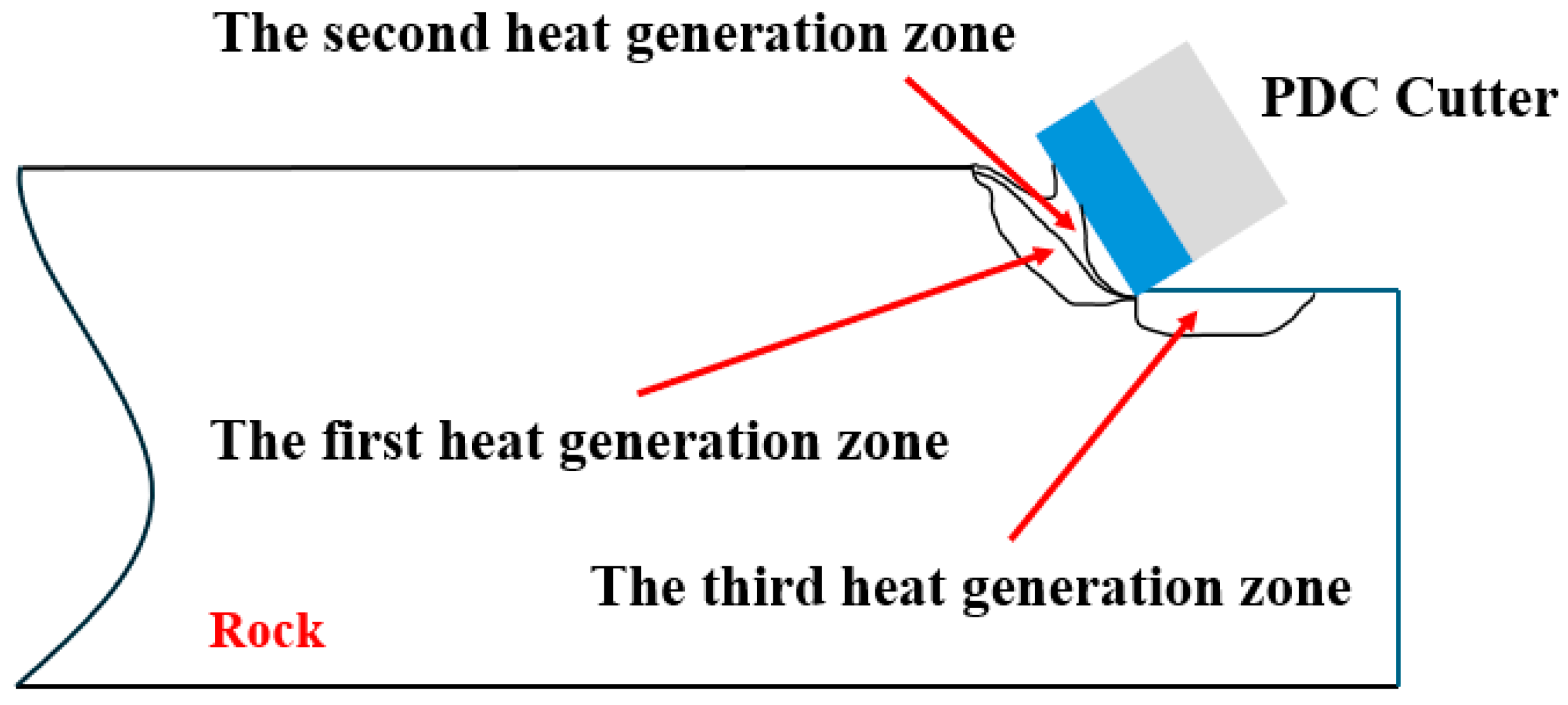
Figure 1.
The main heat source distribution of PDC cutting teeth during the rock drilling process.
Figure 1.
The main heat source distribution of PDC cutting teeth during the rock drilling process.
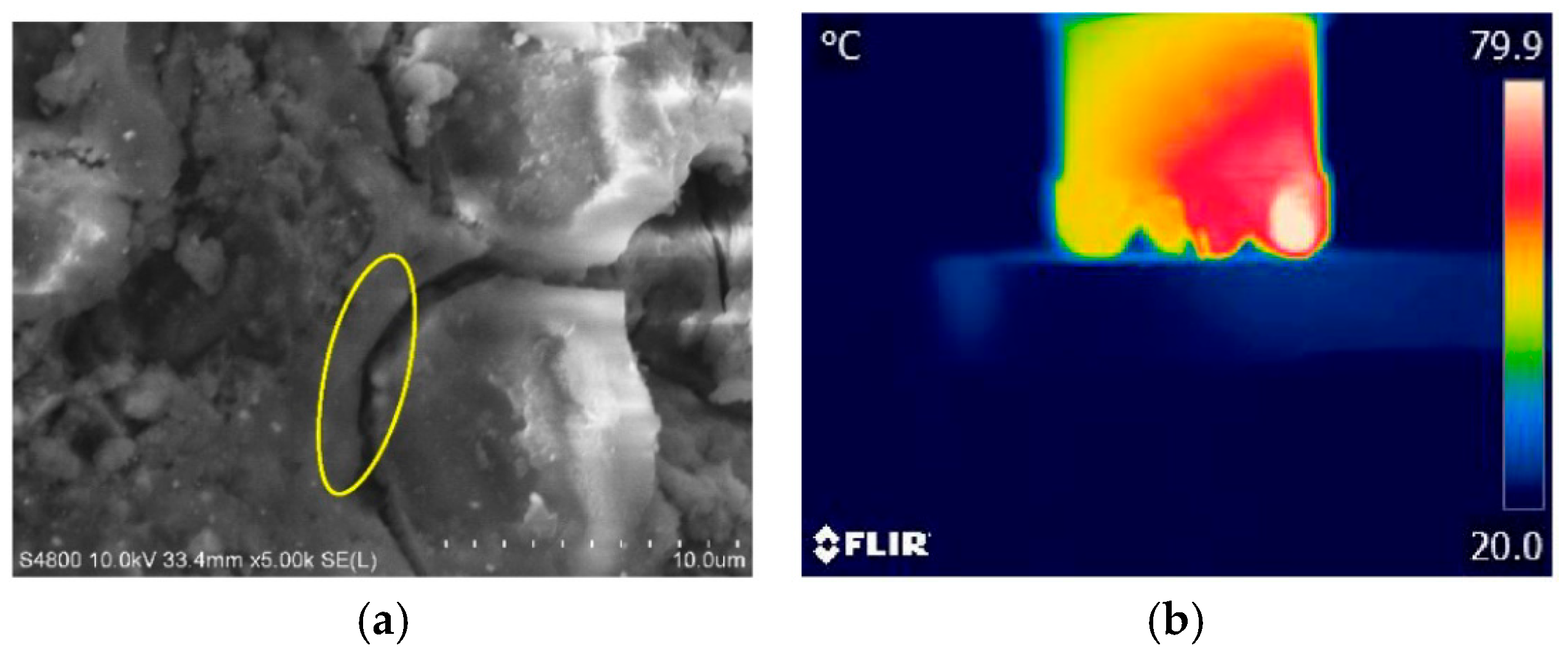
Figure 2.
High-temperature test of PDC cutting tooth surface: (a) Thermal wear on the surface of PDC cutting teeth at high temperatures.The yellow circle highlights a microcrack formed during the high-temperature process.; (b) Infrared temperature image of PDC cutting teeth.
Figure 2.
High-temperature test of PDC cutting tooth surface: (a) Thermal wear on the surface of PDC cutting teeth at high temperatures.The yellow circle highlights a microcrack formed during the high-temperature process.; (b) Infrared temperature image of PDC cutting teeth.
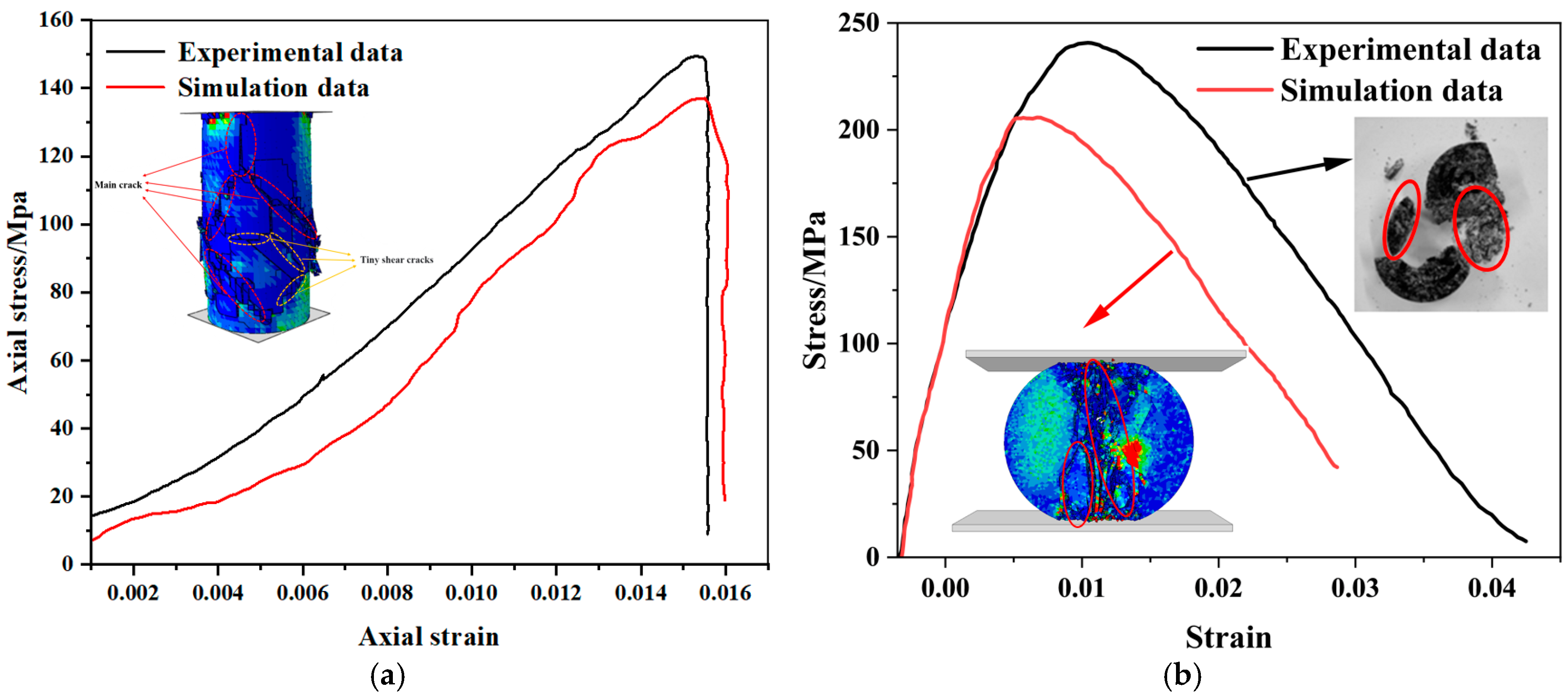
Figure 3.
Rock model validation: (a) Uniaxial compression; (b) Brazilian splitting. Red circles highlight the corresponding rock cuttings and rock block features in the experimental and simulated regions, respectively.
Figure 3.
Rock model validation: (a) Uniaxial compression; (b) Brazilian splitting. Red circles highlight the corresponding rock cuttings and rock block features in the experimental and simulated regions, respectively.
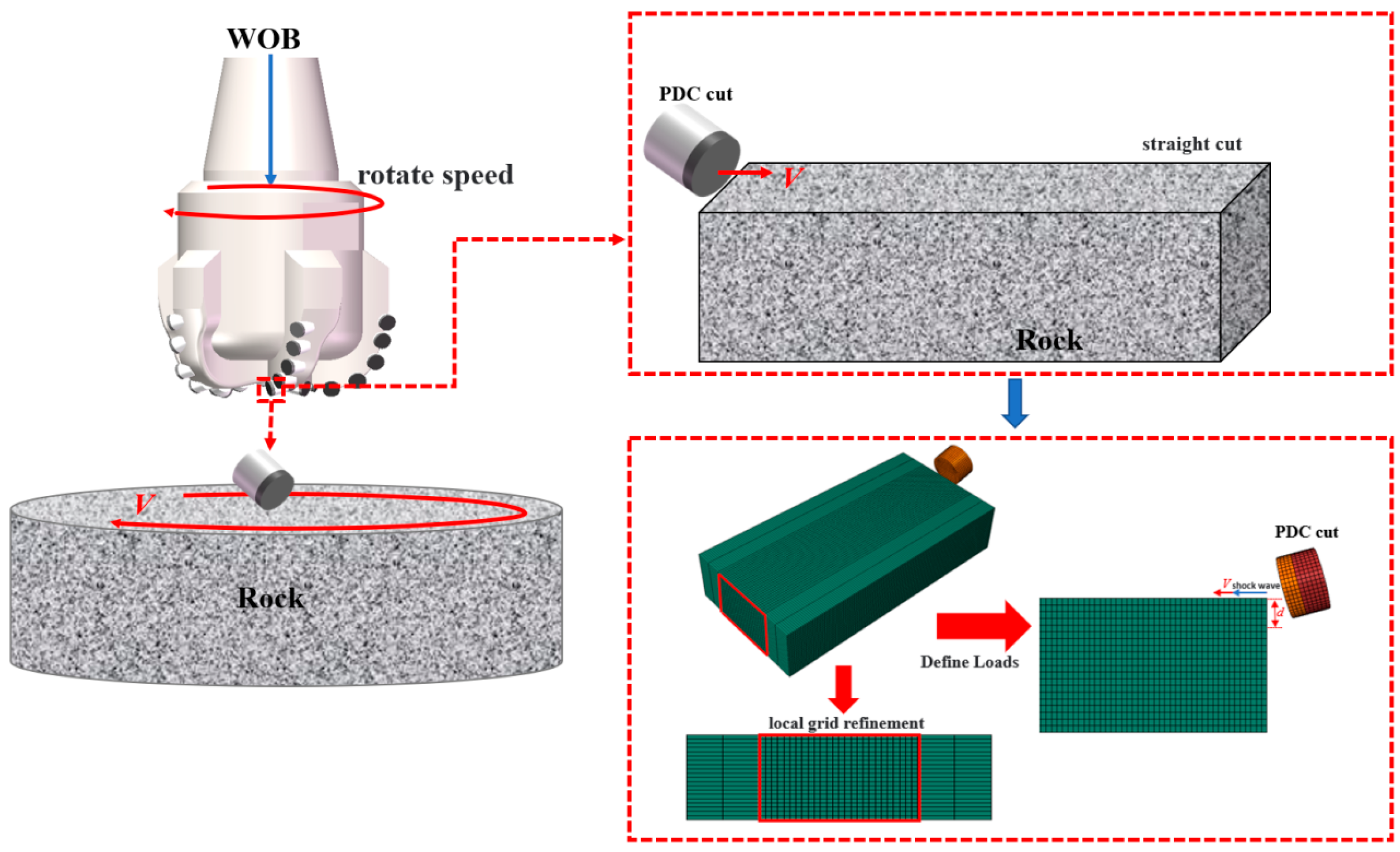
Figure 4.
Three-dimensional model of rock interaction.
Figure 4.
Three-dimensional model of rock interaction.
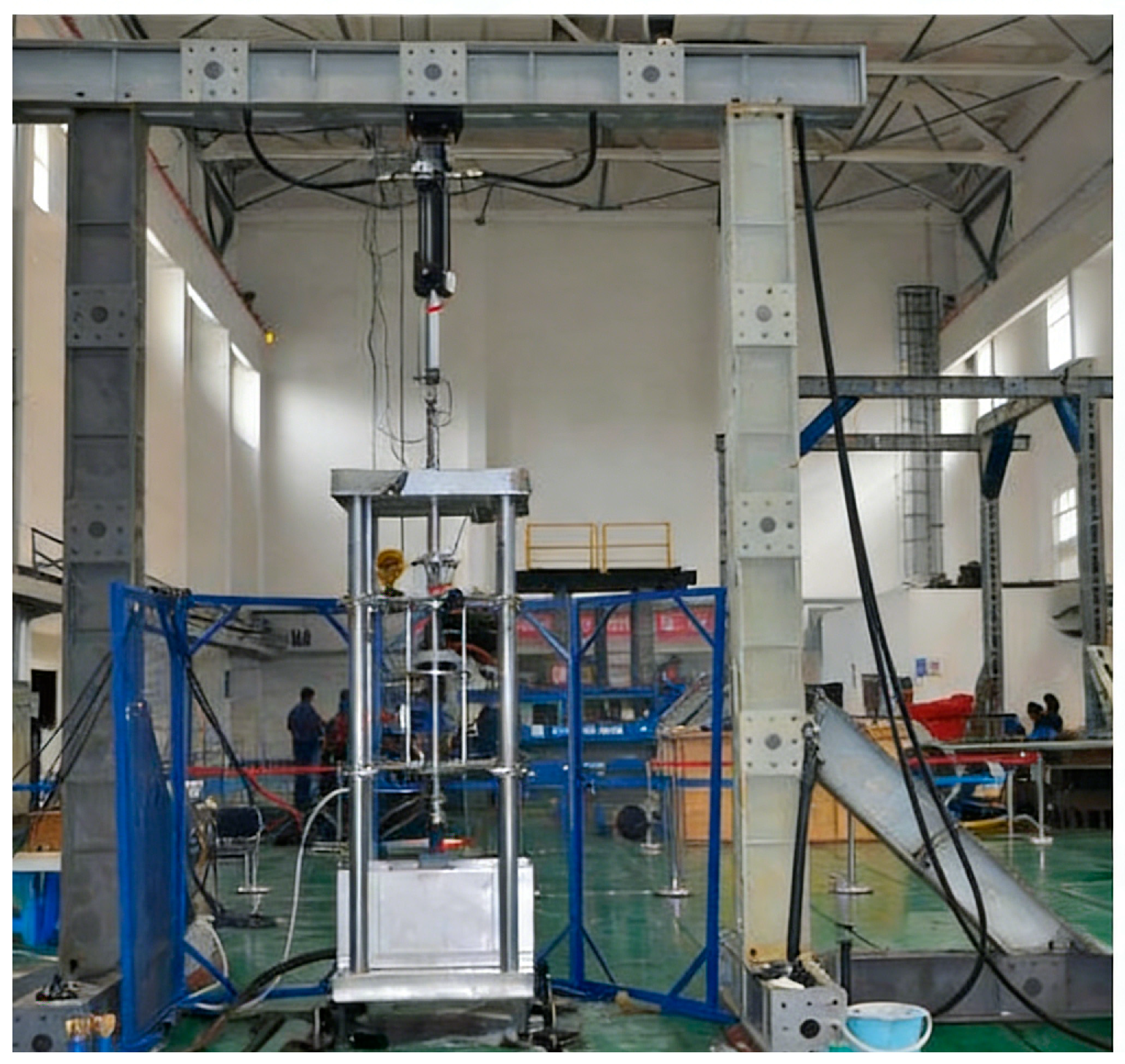
Figure 5.
Physical diagram of the experimental system.
Figure 5.
Physical diagram of the experimental system.
Figure 7.
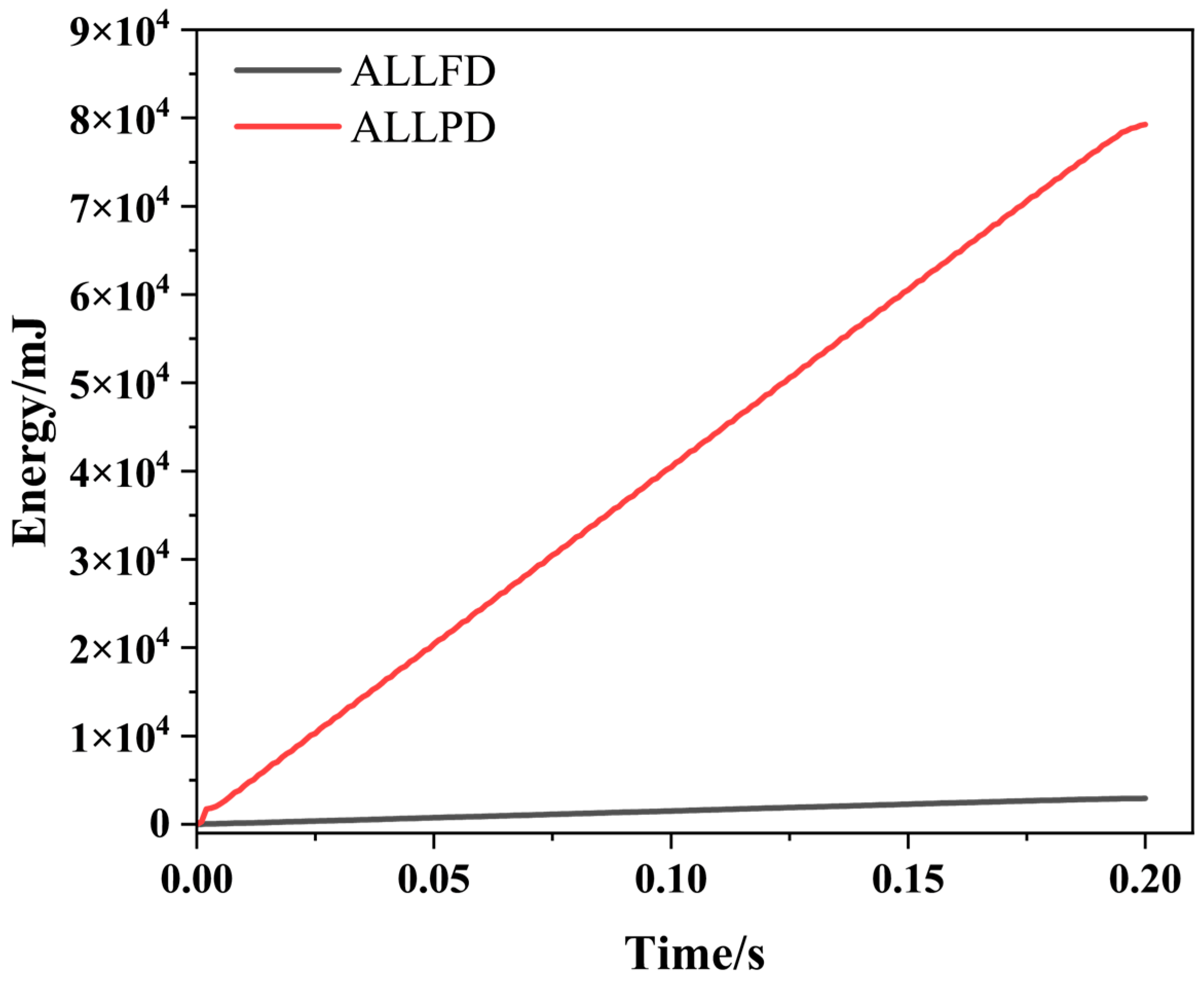
Plastic heat loss and frictional heat loss.
Figure 7.
Plastic heat loss and frictional heat loss.
Figure 8.
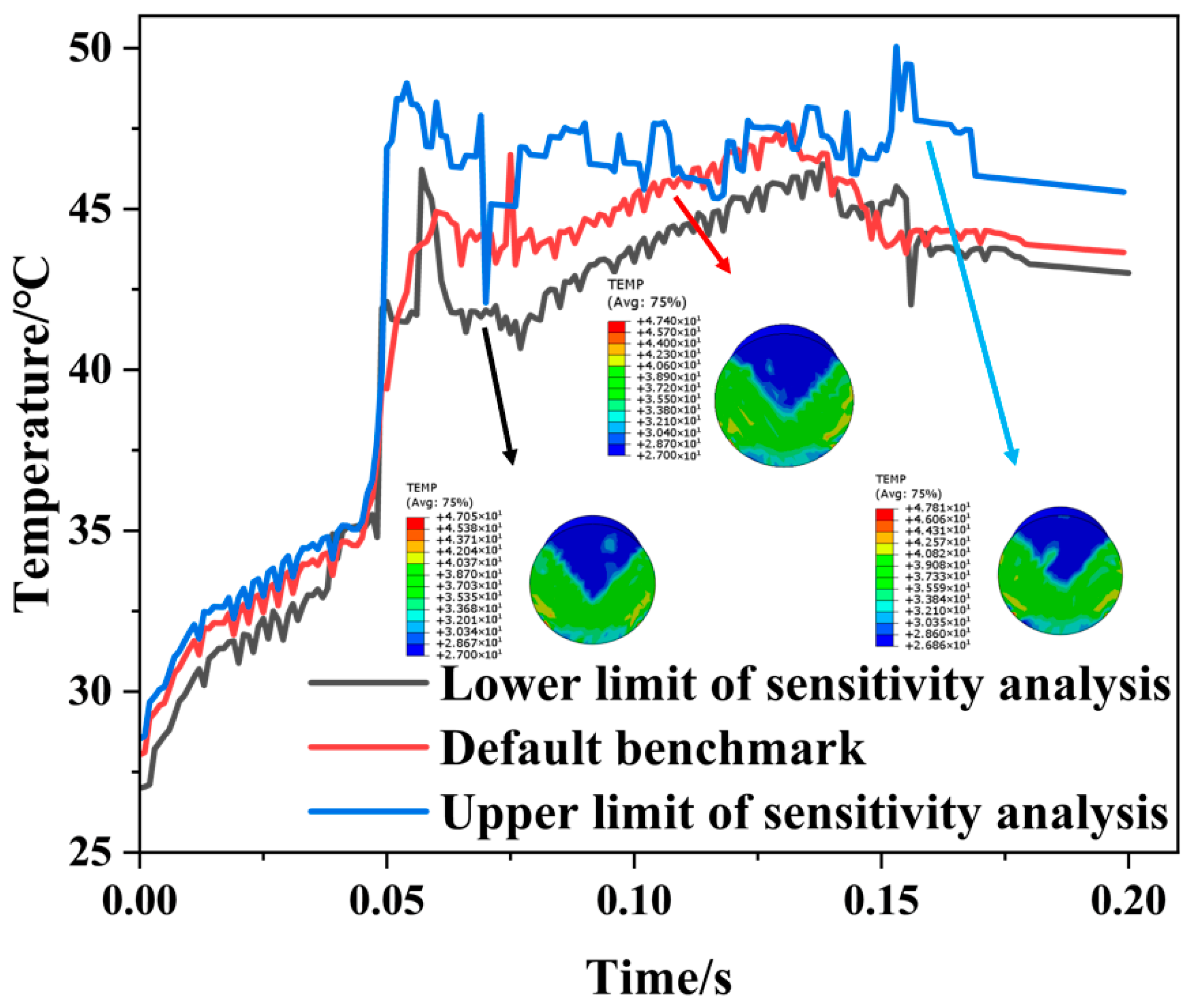
Sensitivity analysis under different frictional heat coefficients.
Figure 8.
Sensitivity analysis under different frictional heat coefficients.
Figure 9.
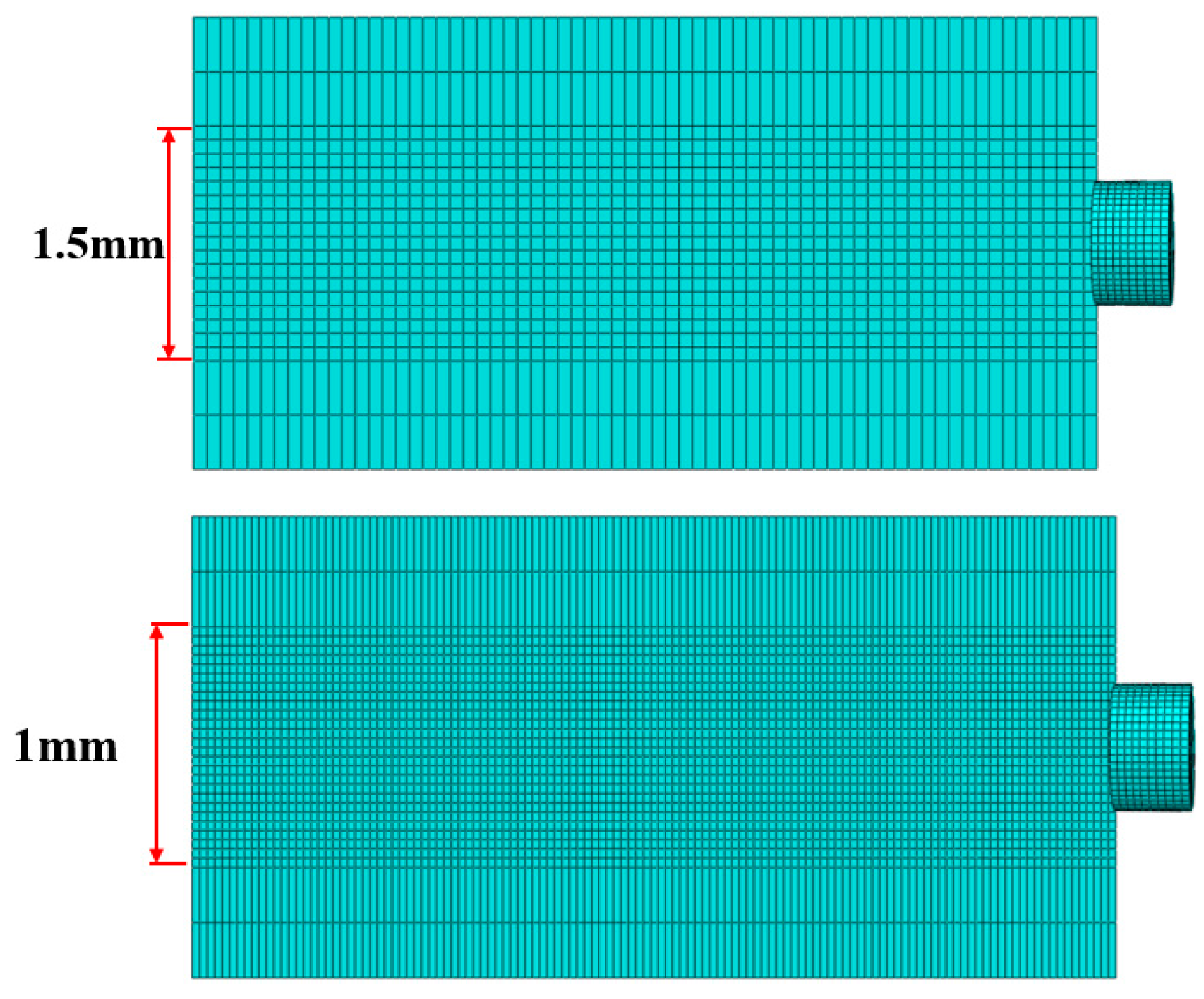
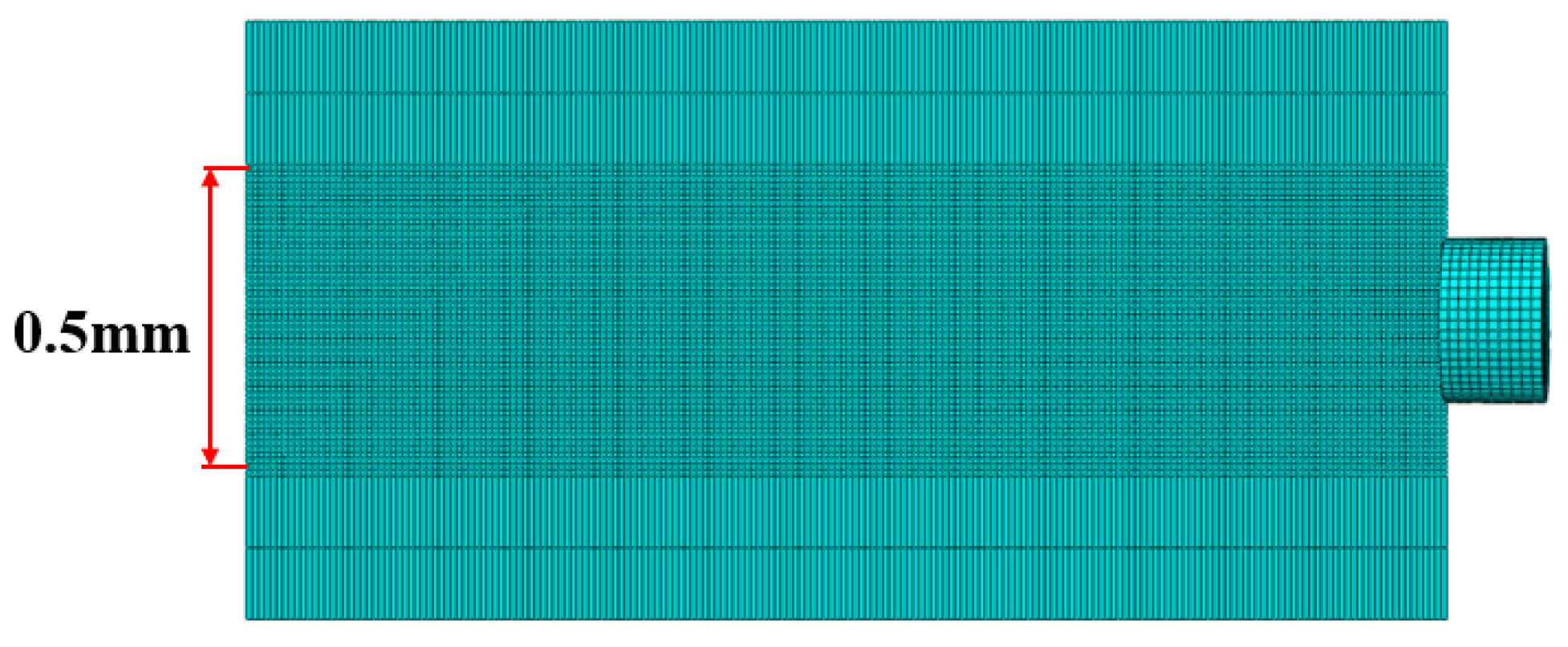
Different grid densities.
Figure 9.
Different grid densities.
Figure 10.
The temperature distribution of the PDC layer and the carbide layer under different parameters: (a) Standard; (b) Low limit; (c) Upper limit.
Figure 10.
The temperature distribution of the PDC layer and the carbide layer under different parameters: (a) Standard; (b) Low limit; (c) Upper limit.
Figure 11.
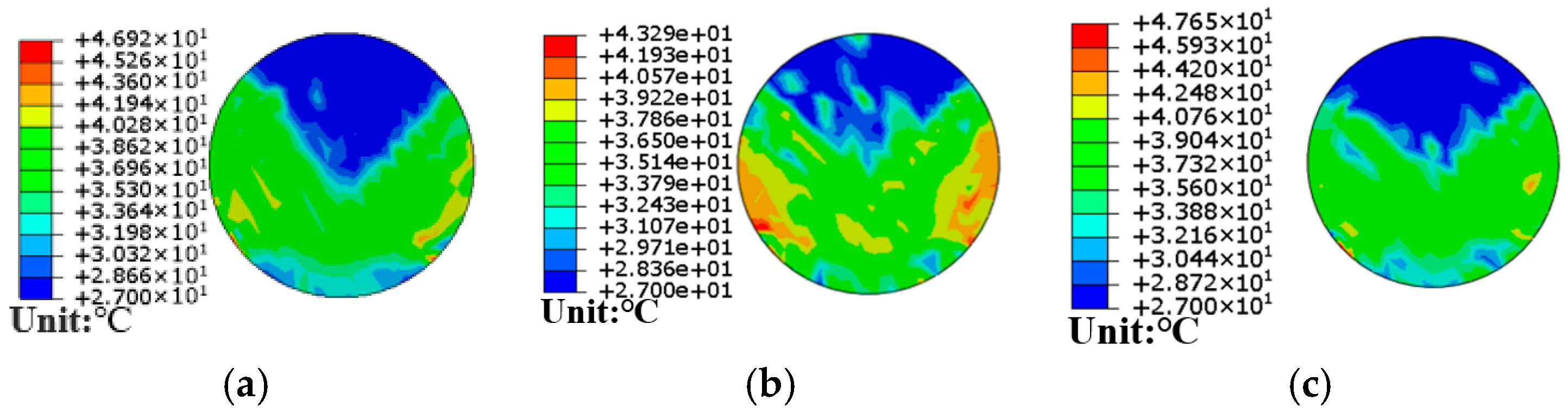
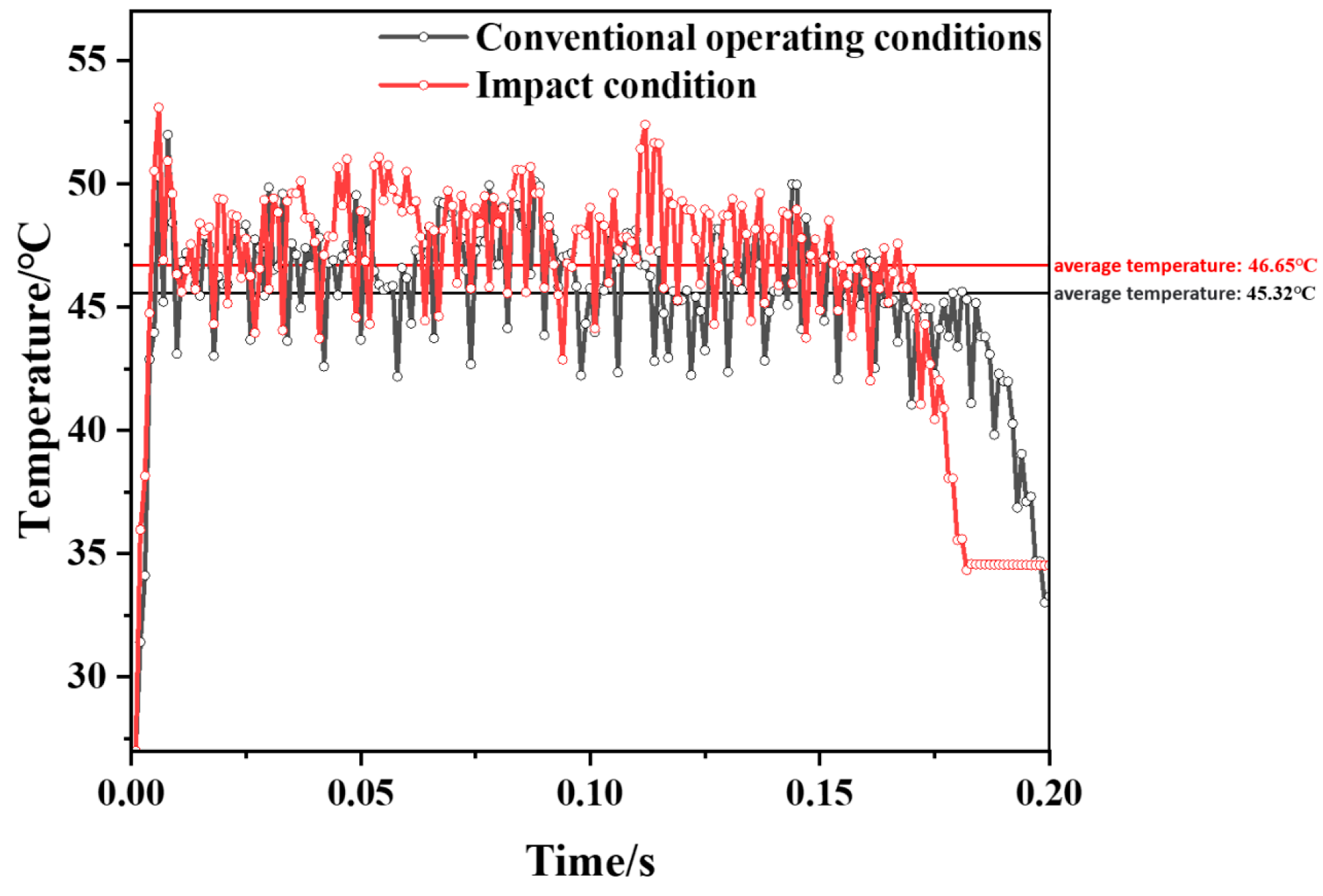
Temperature contours of PDC cutting teeth under two working conditions.
Figure 11.
Temperature contours of PDC cutting teeth under two working conditions.
Figure 12.
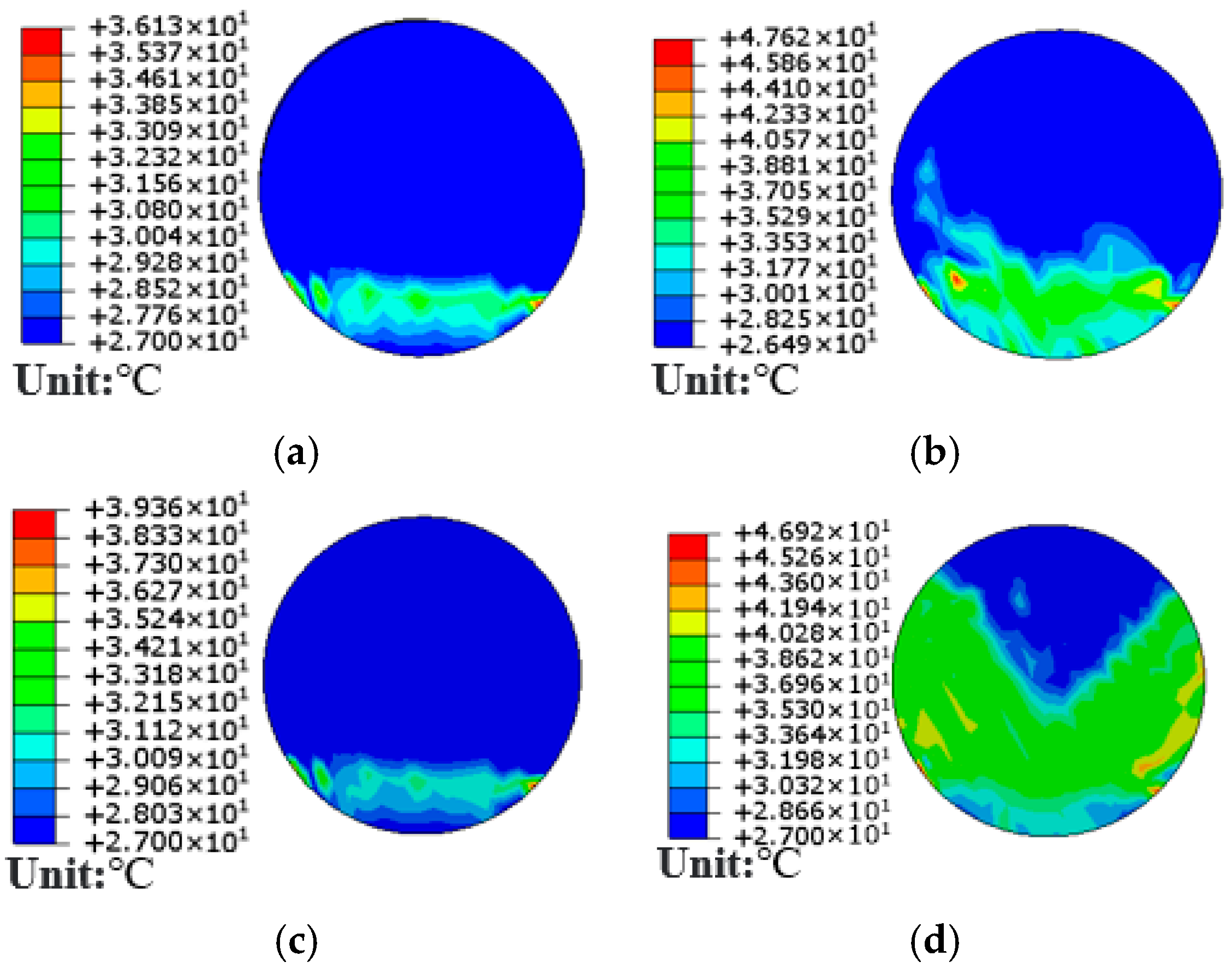
Temperature contours at the start and end times of the two operating conditions: (a) The start time of normal operating conditions; (b) The end time of normal operating conditions; (c) The start time of the impact condition; (d) The end time of the impact condition.
Figure 12.
Temperature contours at the start and end times of the two operating conditions: (a) The start time of normal operating conditions; (b) The end time of normal operating conditions; (c) The start time of the impact condition; (d) The end time of the impact condition.
Figure 13.
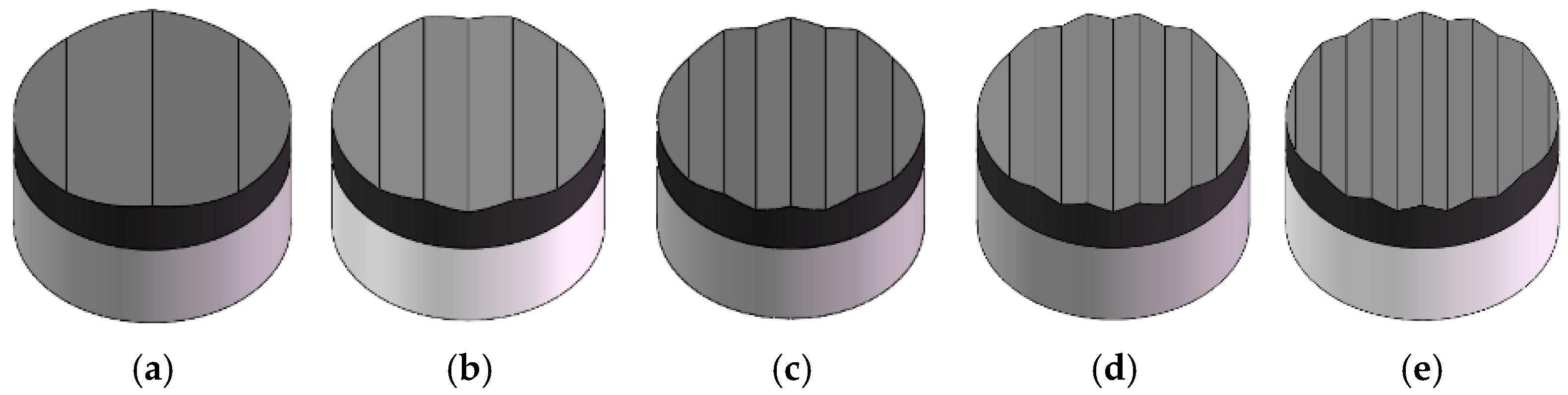
PDC cutting teeth of different shapes: (a) Scheme 1; (b) Scheme 2; (c) Scheme 3; (d) Scheme 4; (e) Scheme 5.
Figure 13.
PDC cutting teeth of different shapes: (a) Scheme 1; (b) Scheme 2; (c) Scheme 3; (d) Scheme 4; (e) Scheme 5.
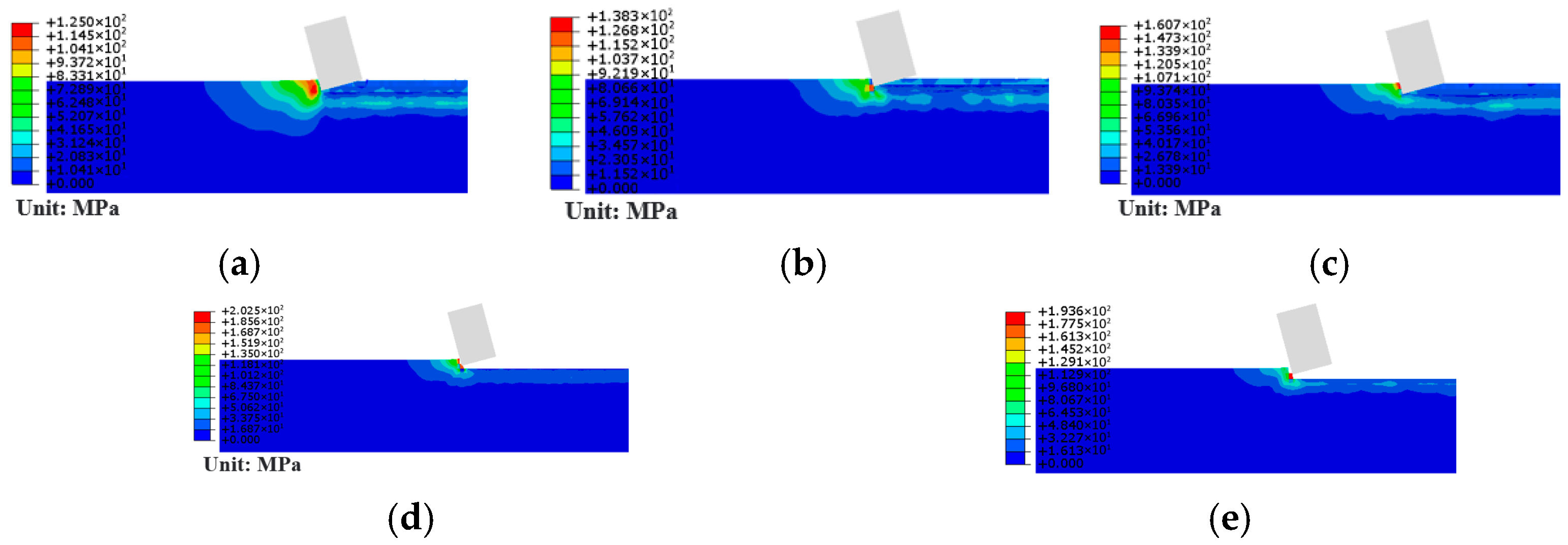
Figure 14.
Stress contours of the cross-section during the rock breaking process with PDC cutting teeth: (a) Scheme 1; (b) Scheme 2; (c) Scheme 3; (d) Scheme 4; (e) Scheme 5.
Figure 14.
Stress contours of the cross-section during the rock breaking process with PDC cutting teeth: (a) Scheme 1; (b) Scheme 2; (c) Scheme 3; (d) Scheme 4; (e) Scheme 5.
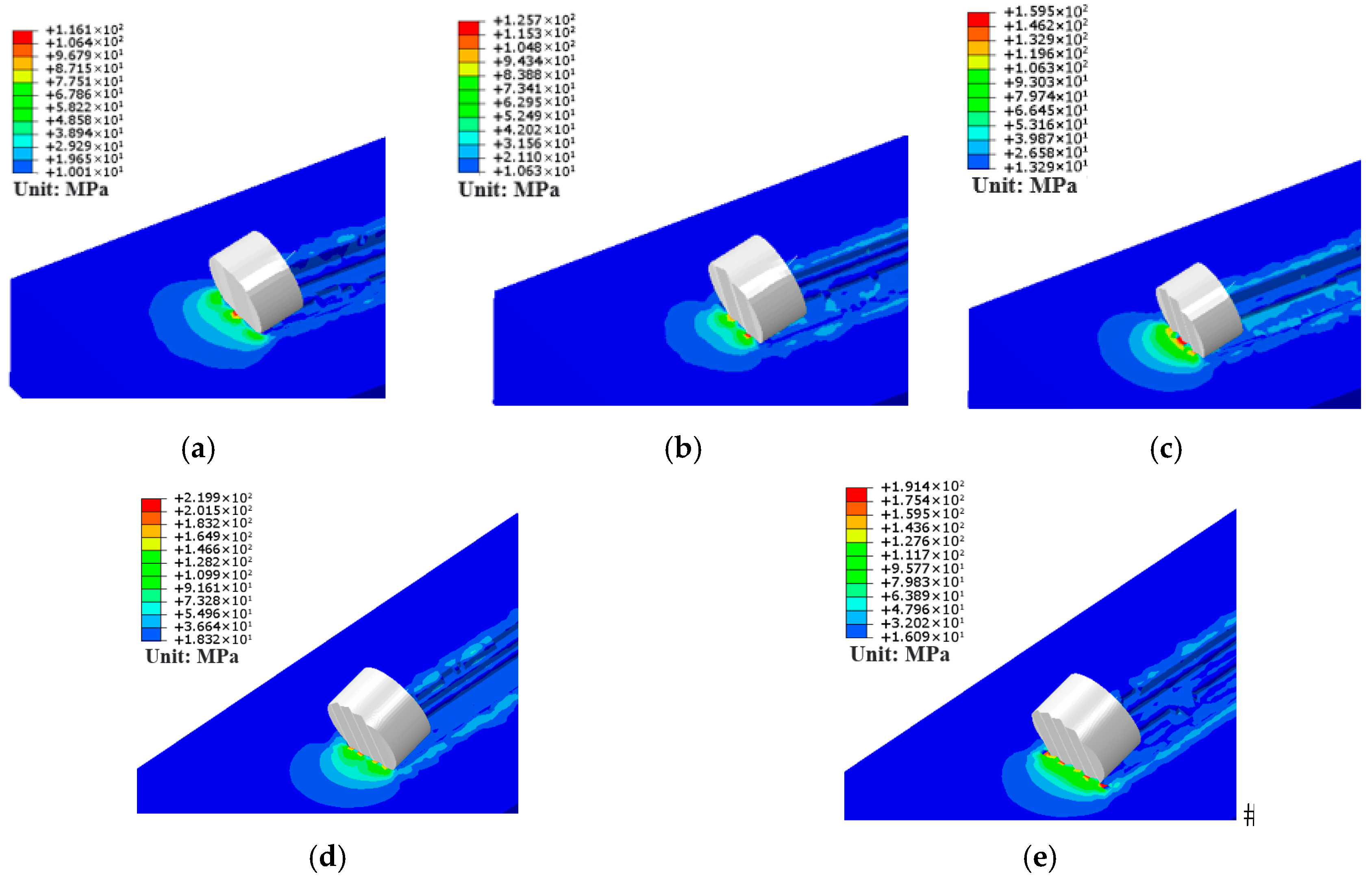
Figure 15.
Three-dimensional stress contours of the rock-breaking process of PDC cutting teeth: (a) Scheme 1; (b) Scheme 2; (c) Scheme 3; (d) Scheme 4; (e) Scheme 5.
Figure 15.
Three-dimensional stress contours of the rock-breaking process of PDC cutting teeth: (a) Scheme 1; (b) Scheme 2; (c) Scheme 3; (d) Scheme 4; (e) Scheme 5.
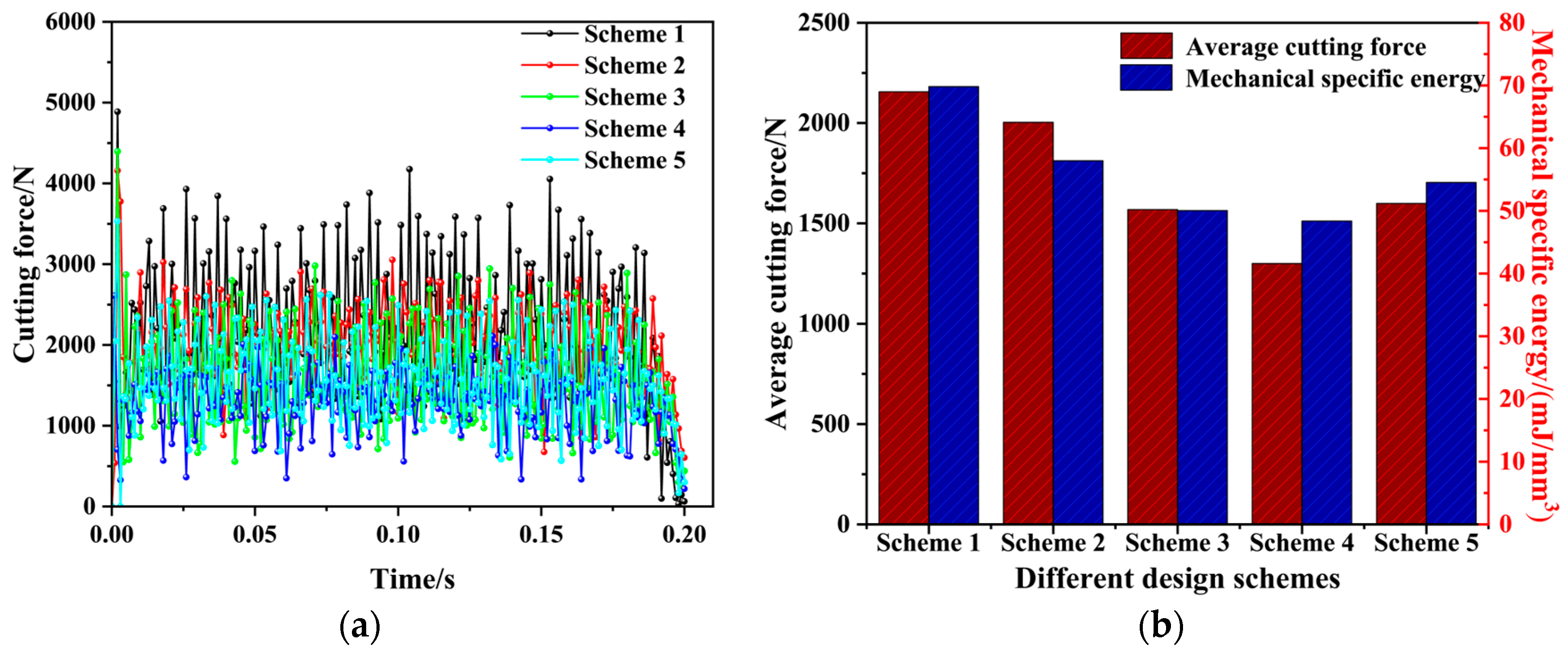
Figure 16.
Cutting force and specific mechanical energy under different design schemes: (a) Cutting force variation curve; (b) The average value of cutting force and mechanical specific energy.
Figure 16.
Cutting force and specific mechanical energy under different design schemes: (a) Cutting force variation curve; (b) The average value of cutting force and mechanical specific energy.
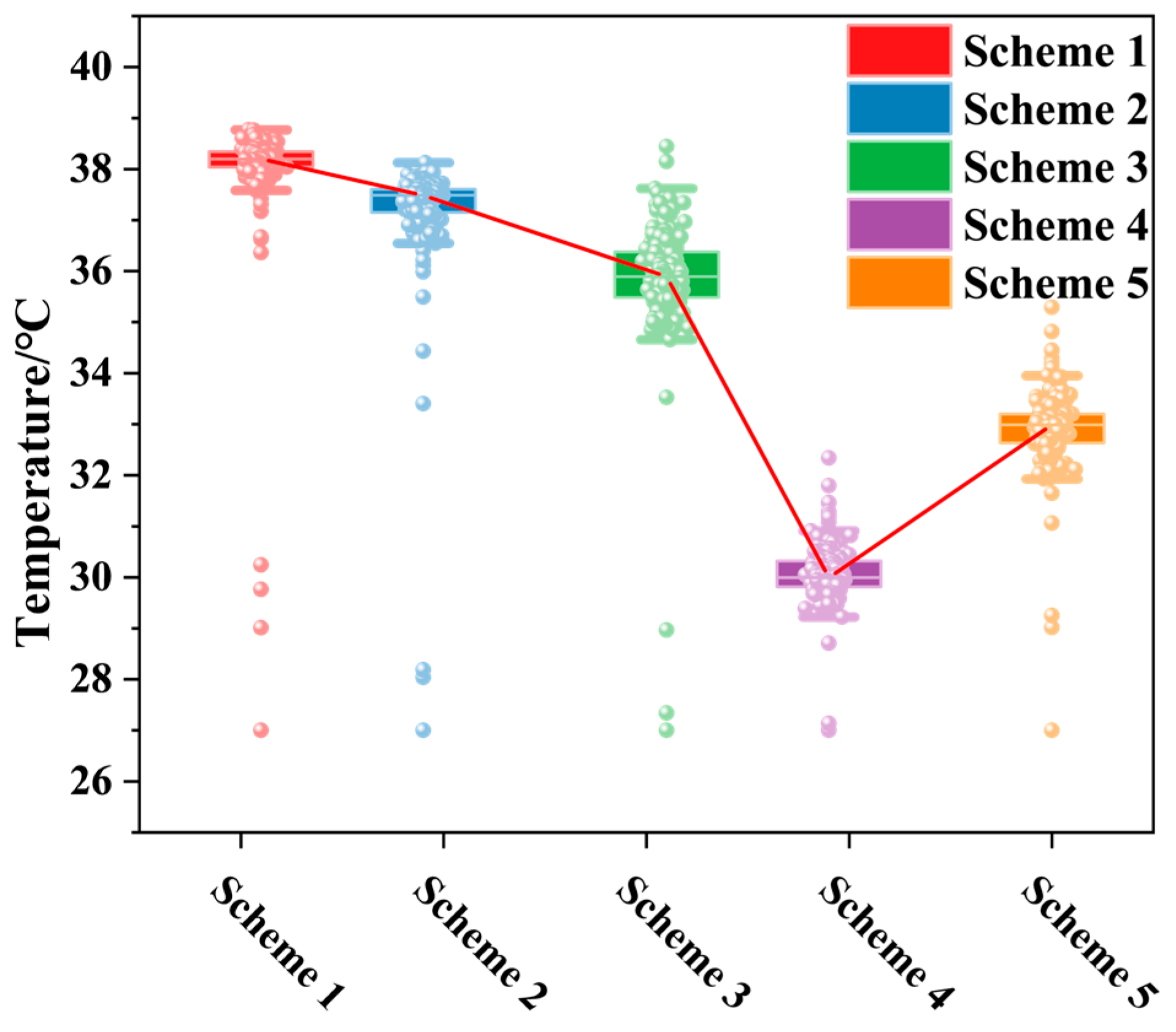
Figure 17.
Analysis of temperature curves under different scheme designs.
Figure 17.
Analysis of temperature curves under different scheme designs.
Figure 18.
Temperature contours of PDC cutting teeth under different scheme designs: (a) Scheme 1; (b) Scheme 2; (c) Scheme 3; (d) Scheme 4; (e) Scheme 5.
Figure 18.
Temperature contours of PDC cutting teeth under different scheme designs: (a) Scheme 1; (b) Scheme 2; (c) Scheme 3; (d) Scheme 4; (e) Scheme 5.
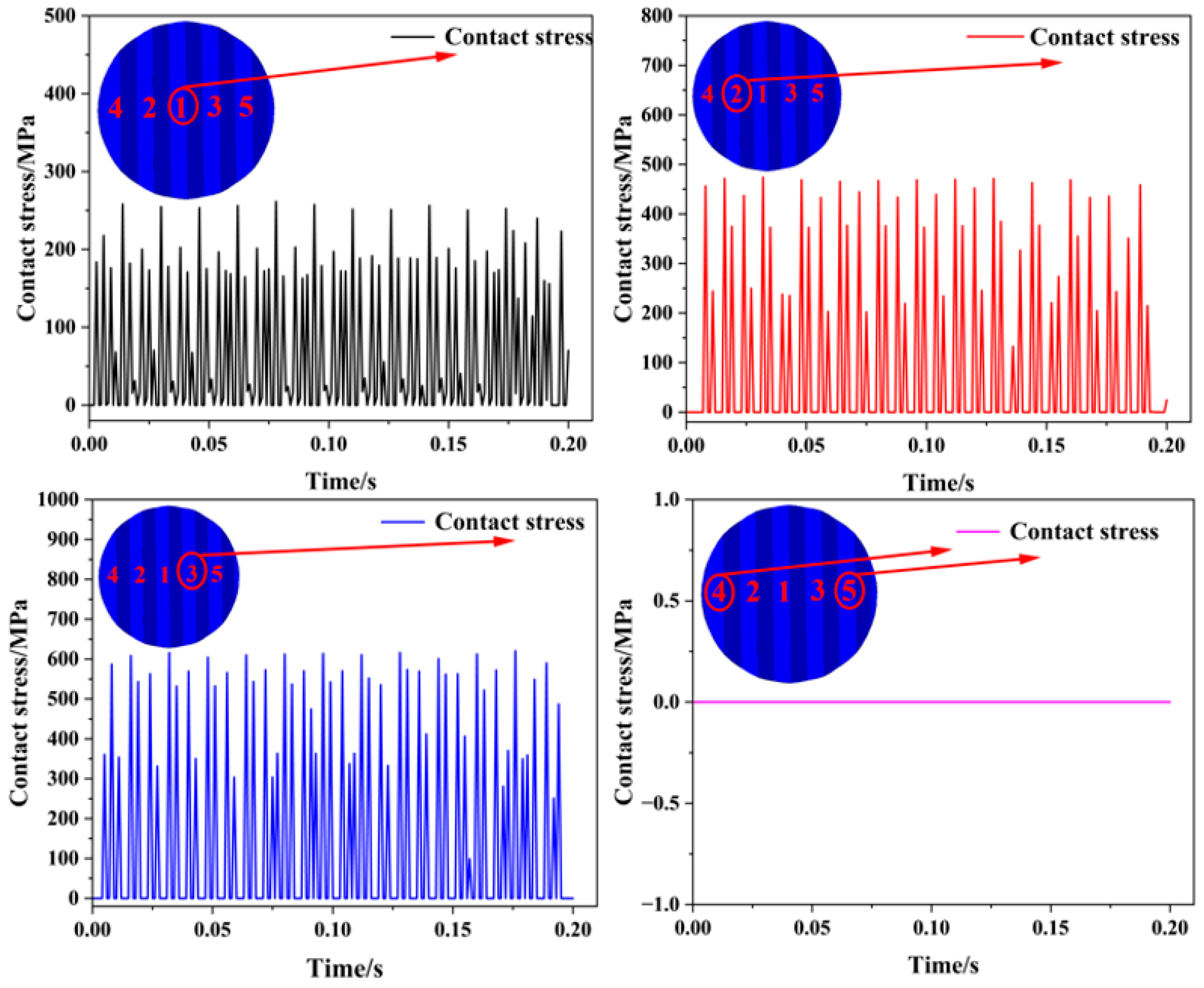
Figure 19.
Contact stress of different tooth edges. Numerals 1–5 denote the 1st to 5th cutting edges, respectively; The red arrow indicates the contact force acting on the cutting edge.
Figure 19.
Contact stress of different tooth edges. Numerals 1–5 denote the 1st to 5th cutting edges, respectively; The red arrow indicates the contact force acting on the cutting edge.
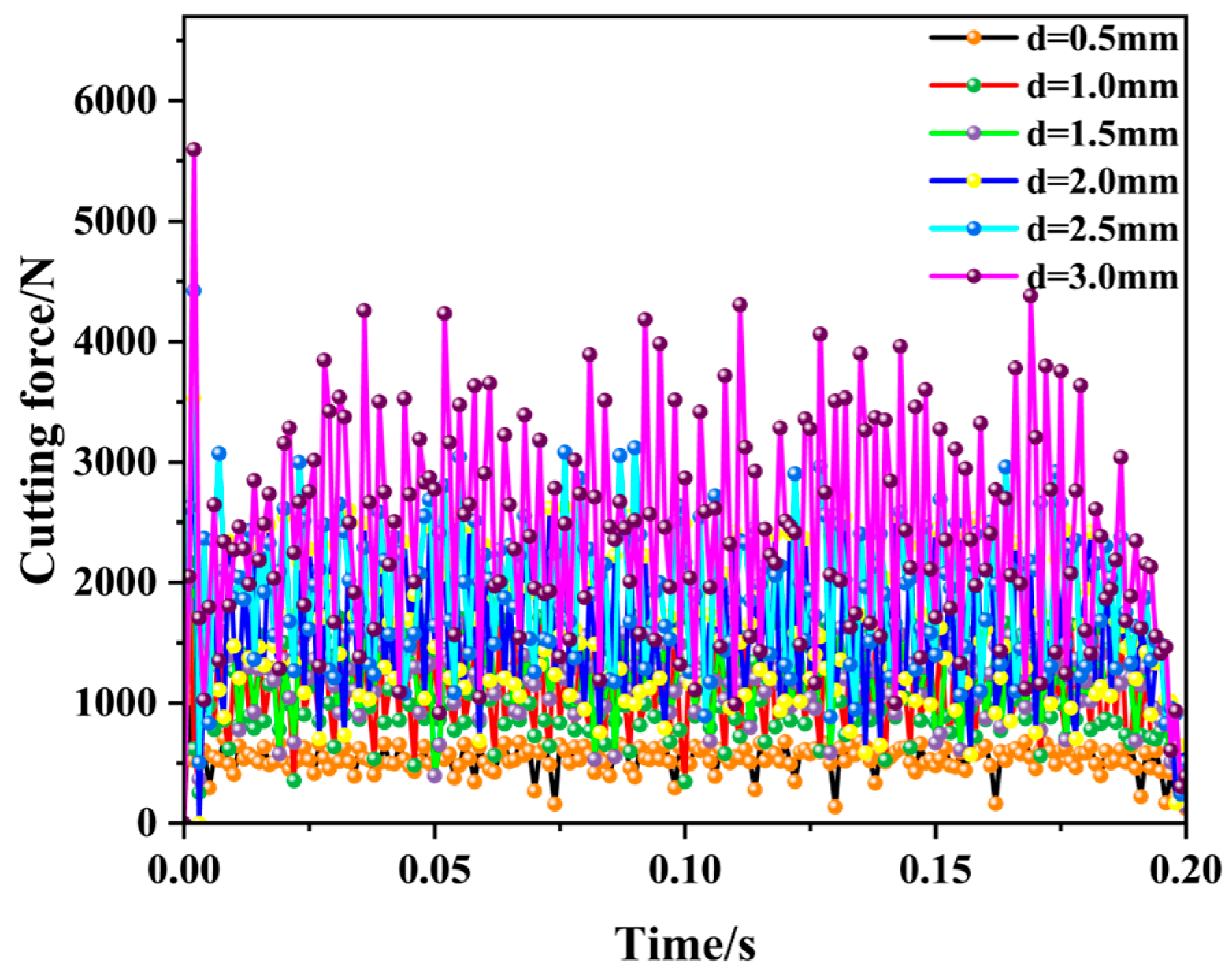
Figure 20.
Cutting forces at different cutting depths.
Figure 20.
Cutting forces at different cutting depths.
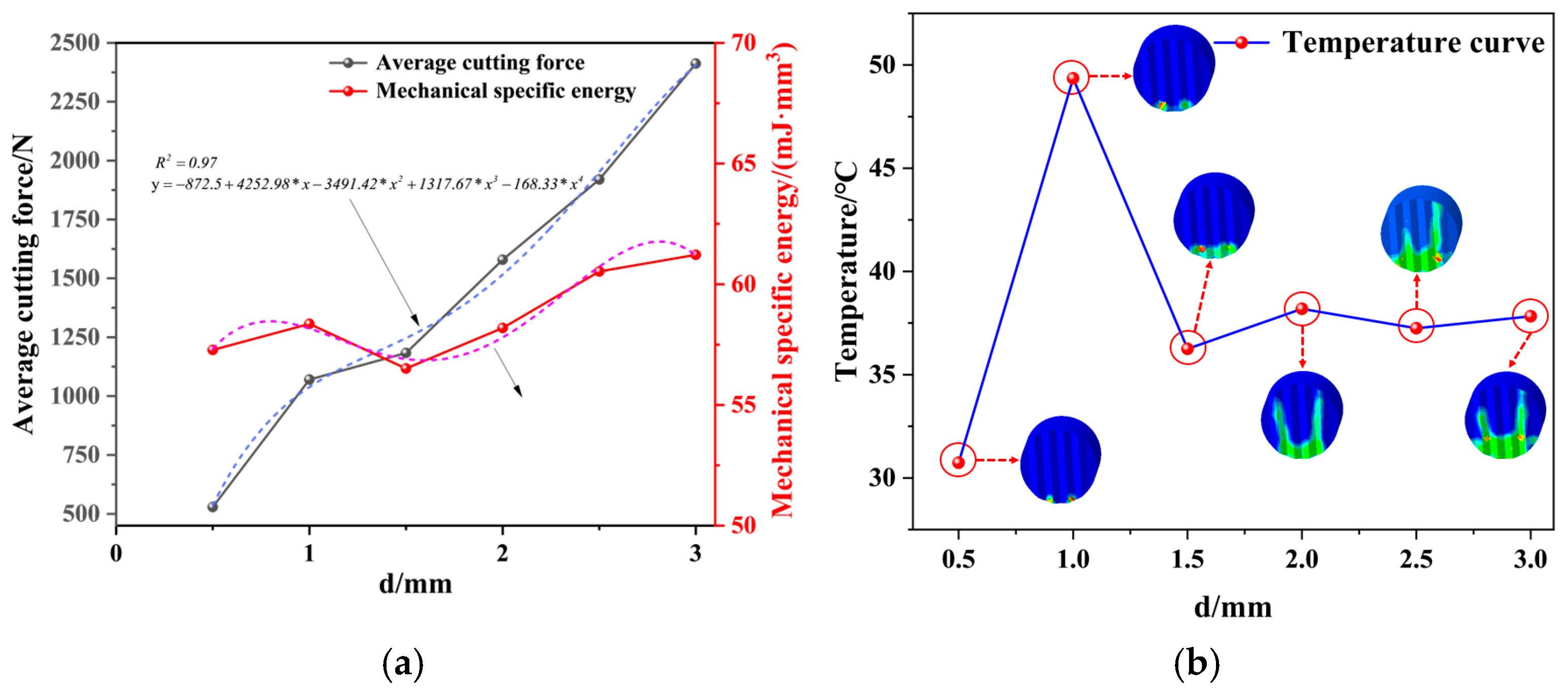
Figure 21.
Data analysis of rock breaking at different cutting depths: (a) The average cutting force and mechanical specific energy; (b) Cutting depth and peak temperature.
Figure 21.
Data analysis of rock breaking at different cutting depths: (a) The average cutting force and mechanical specific energy; (b) Cutting depth and peak temperature.
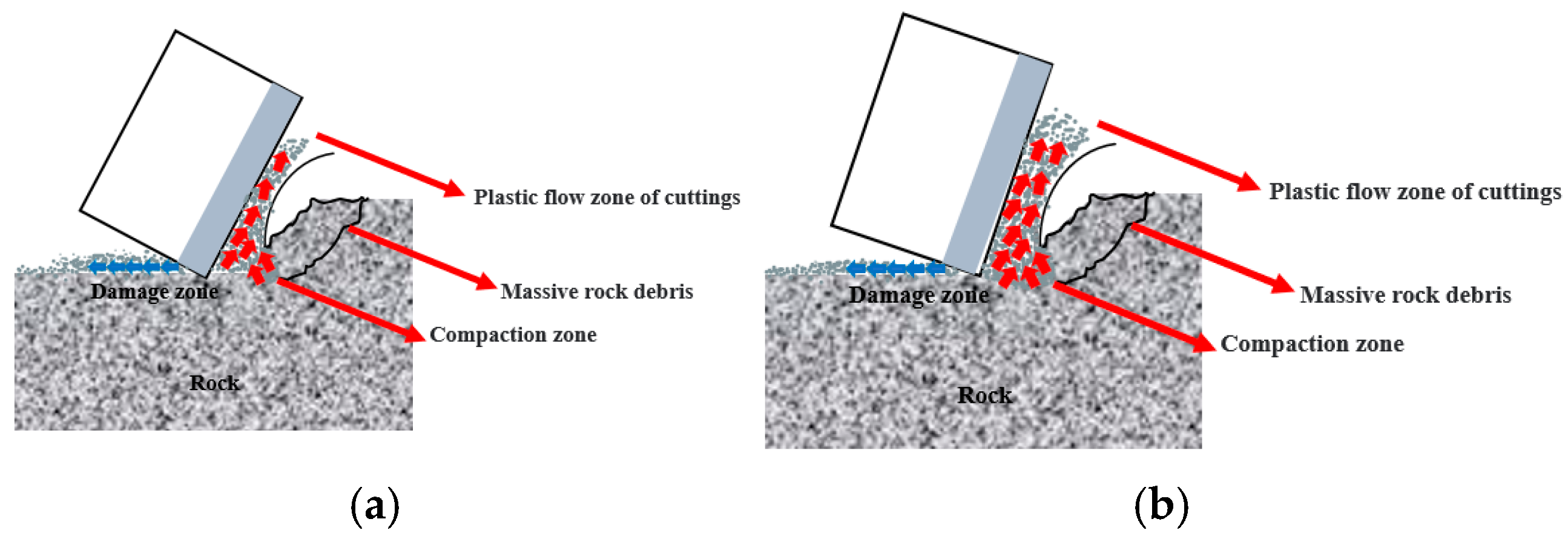
Figure 22.
Schematic diagram of rock breaking by cutting teeth under different back rake angles, red arrows represent the flow direction of cuttings in front of the cutter wing, while blue arrows indicate that behind the cutter wing.: (a) Large back rake angle; (b) Small back rake angle.
Figure 22.
Schematic diagram of rock breaking by cutting teeth under different back rake angles, red arrows represent the flow direction of cuttings in front of the cutter wing, while blue arrows indicate that behind the cutter wing.: (a) Large back rake angle; (b) Small back rake angle.
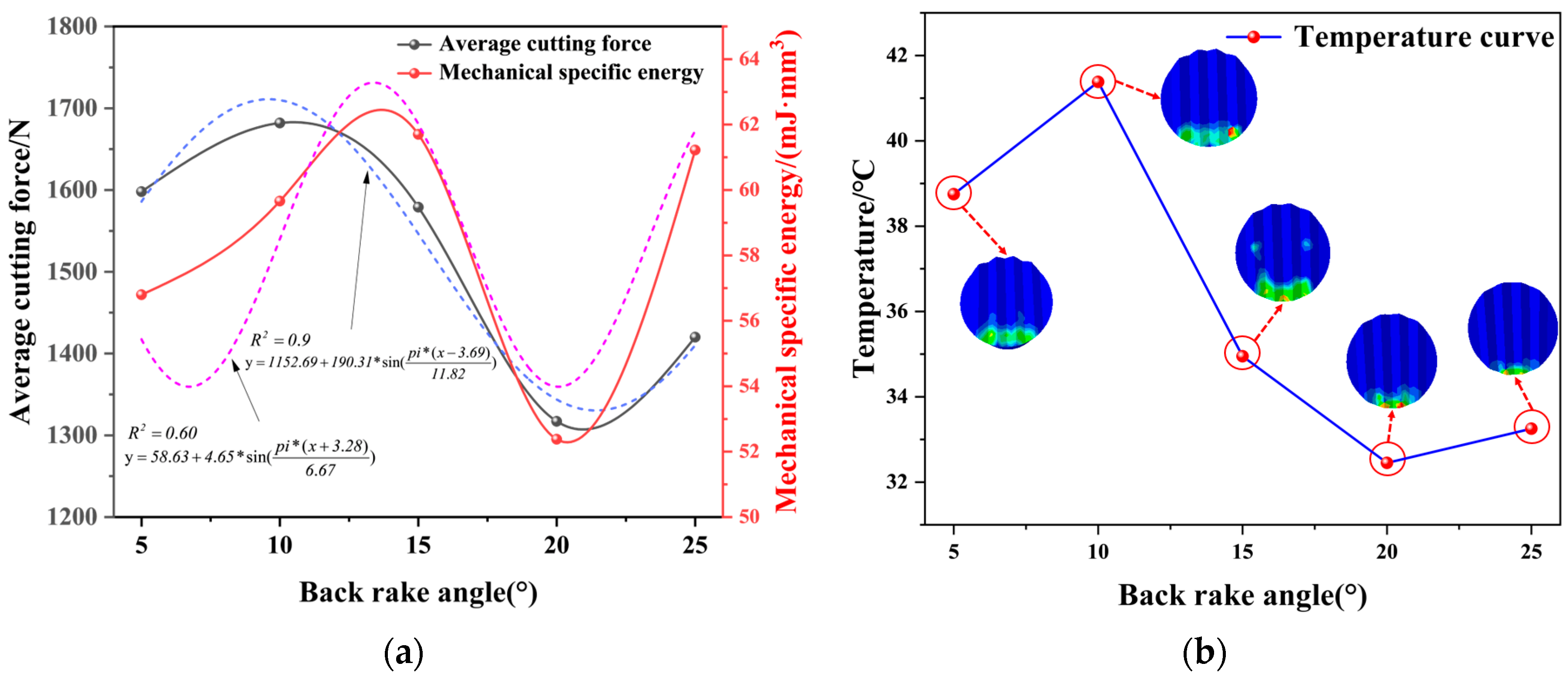
Figure 23.
Analysis of rock-breaking data with different cut angles: (a) The average cutting force and mechanical specific energy under different back rake angles; (b) Peak temperatures at different back rake angles.
Figure 23.
Analysis of rock-breaking data with different cut angles: (a) The average cutting force and mechanical specific energy under different back rake angles; (b) Peak temperatures at different back rake angles.
Figure 24.
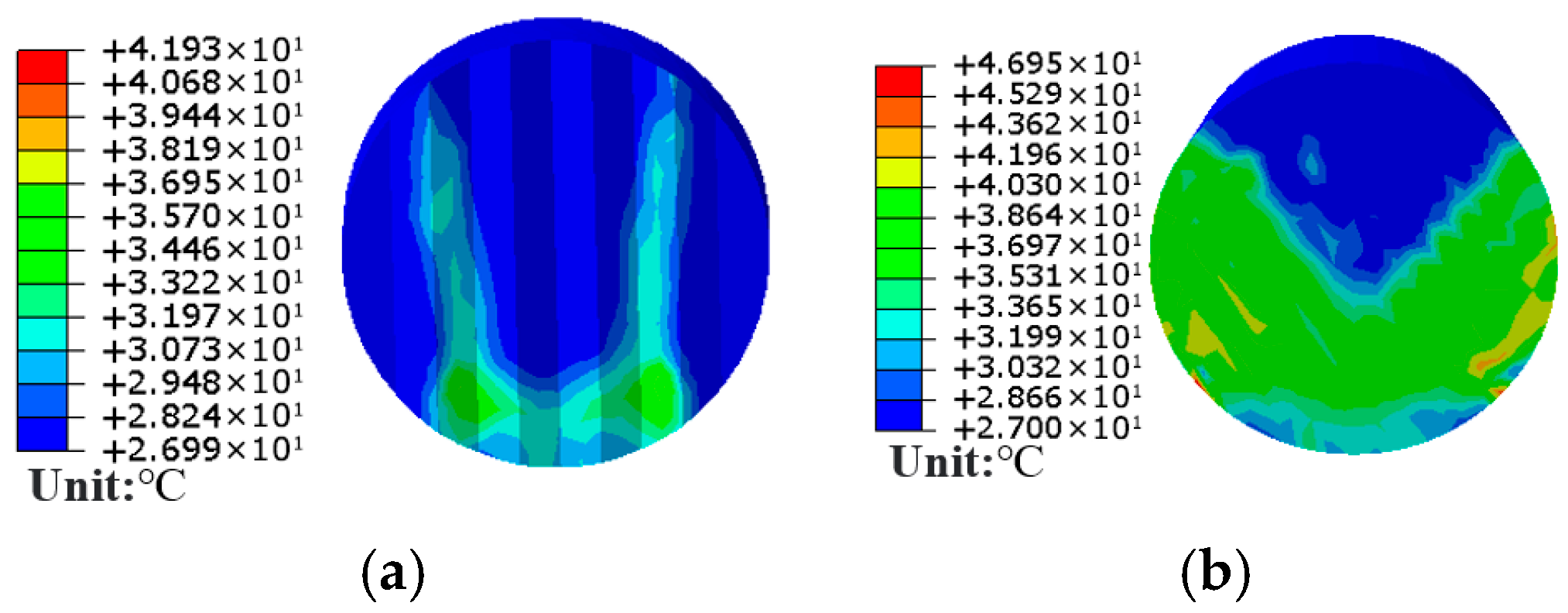
Temperature contours under two types of tooth profile impact conditions: (a) Temperature distribution of four saw-type tooth; (b) Temperature distribution of a common PDC cutting tooth.
Figure 24.
Temperature contours under two types of tooth profile impact conditions: (a) Temperature distribution of four saw-type tooth; (b) Temperature distribution of a common PDC cutting tooth.
Figure 25.
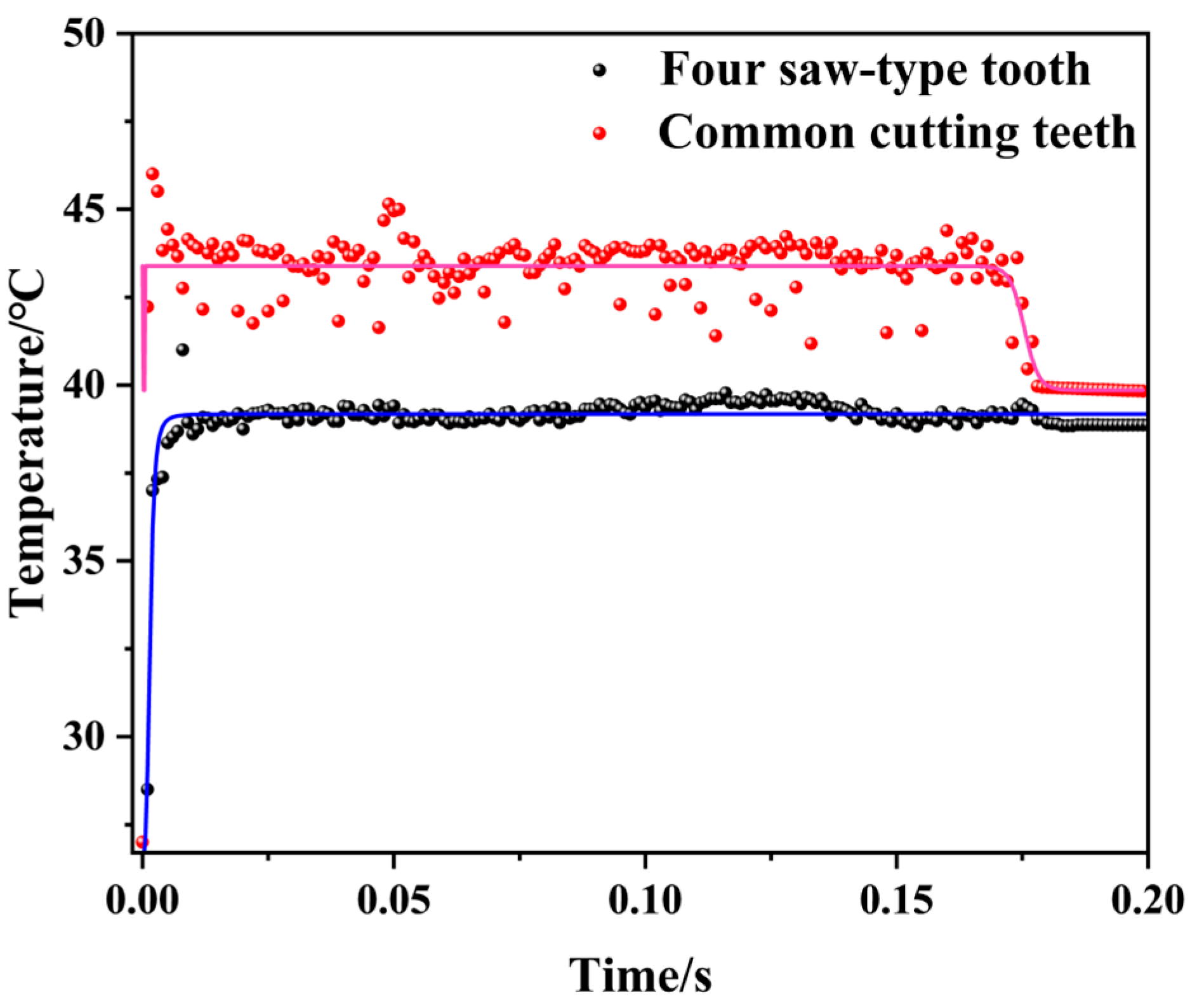
Temperature curve graphs under two types of tooth profile impact conditions.
Figure 25.
Temperature curve graphs under two types of tooth profile impact conditions.
Figure 26.
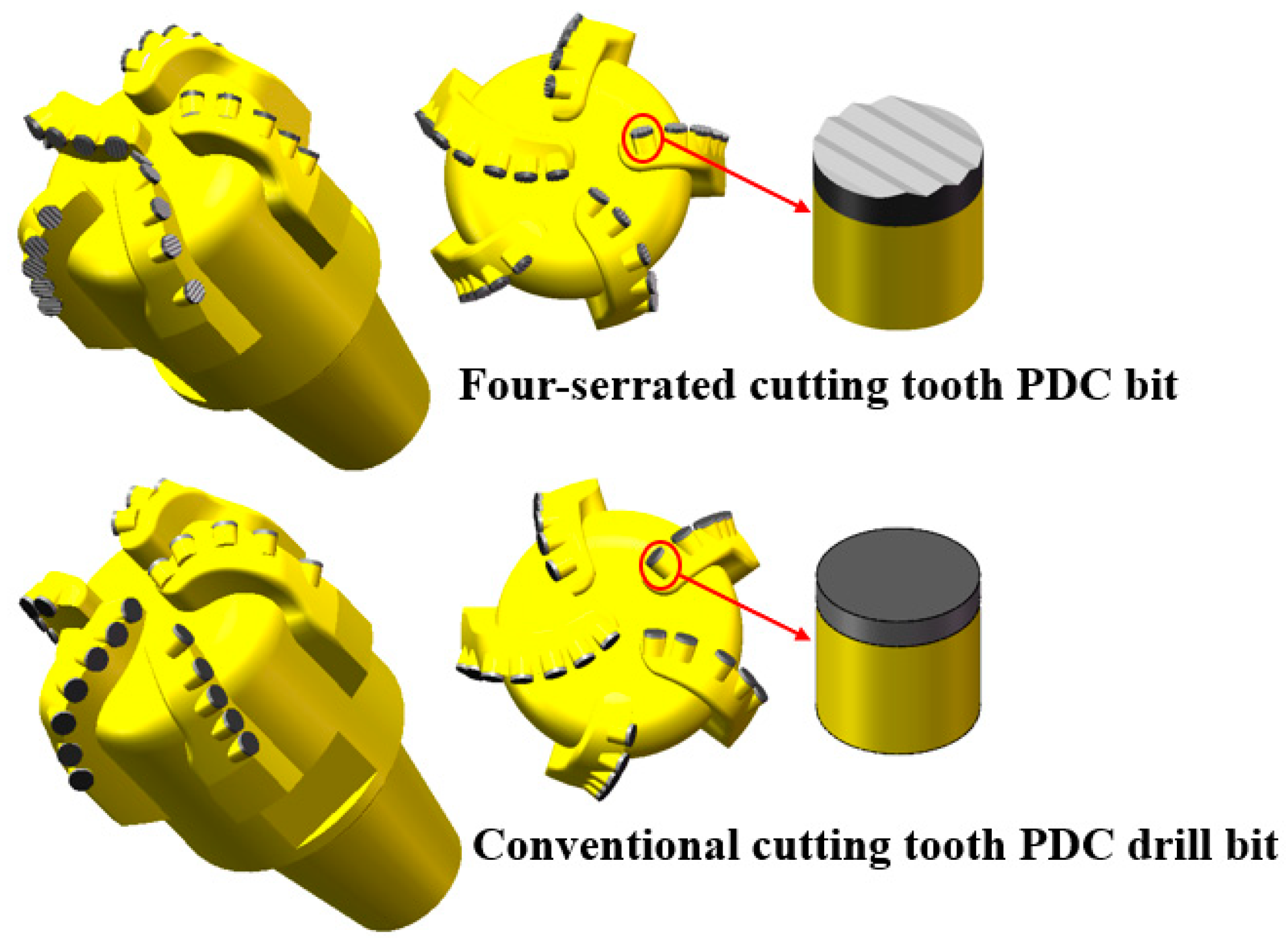
Three-dimensional model of PDC bit.
Figure 26.
Three-dimensional model of PDC bit.
Figure 27.
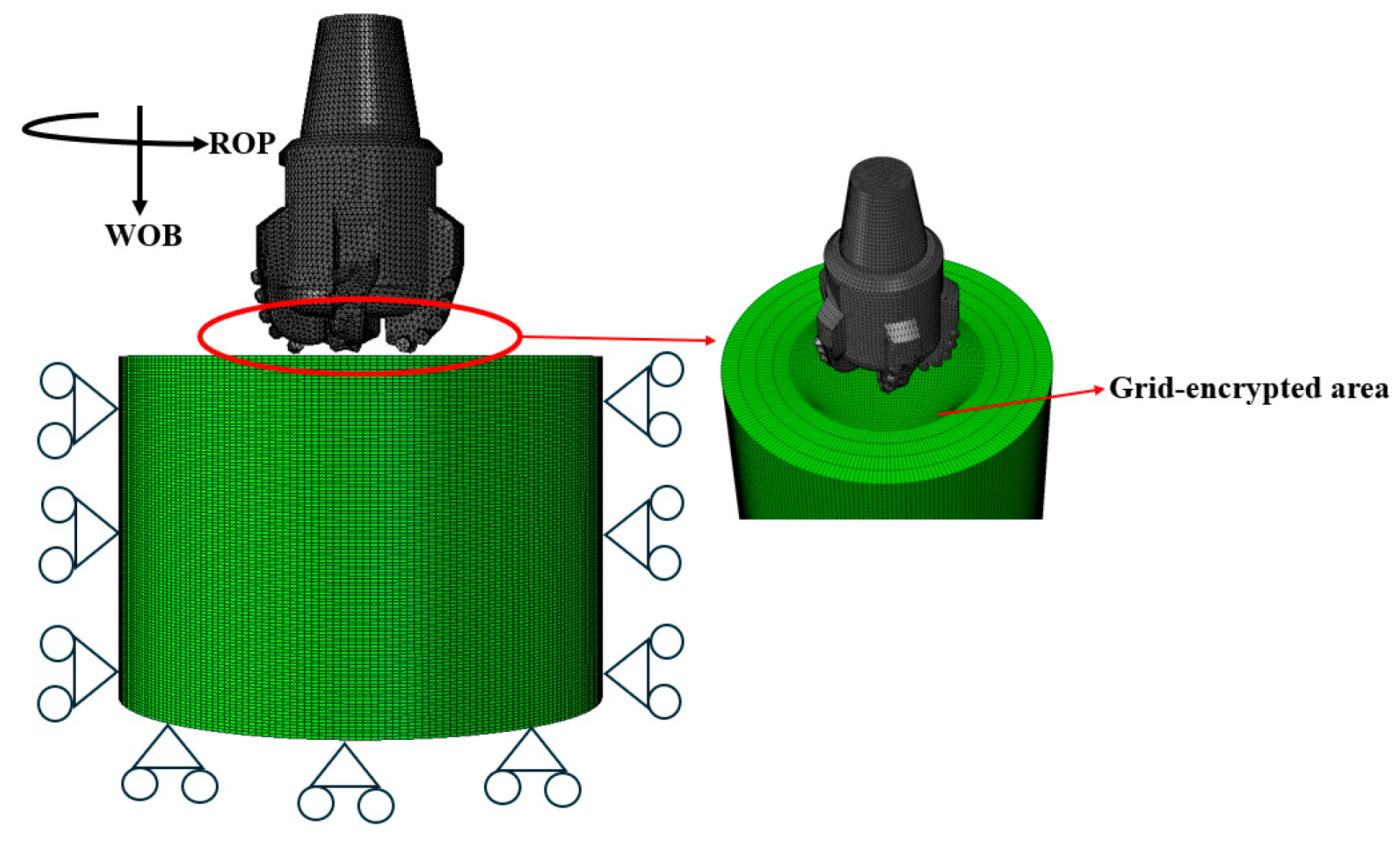
Model of the interaction between drill bit and rock.
Figure 27.
Model of the interaction between drill bit and rock.
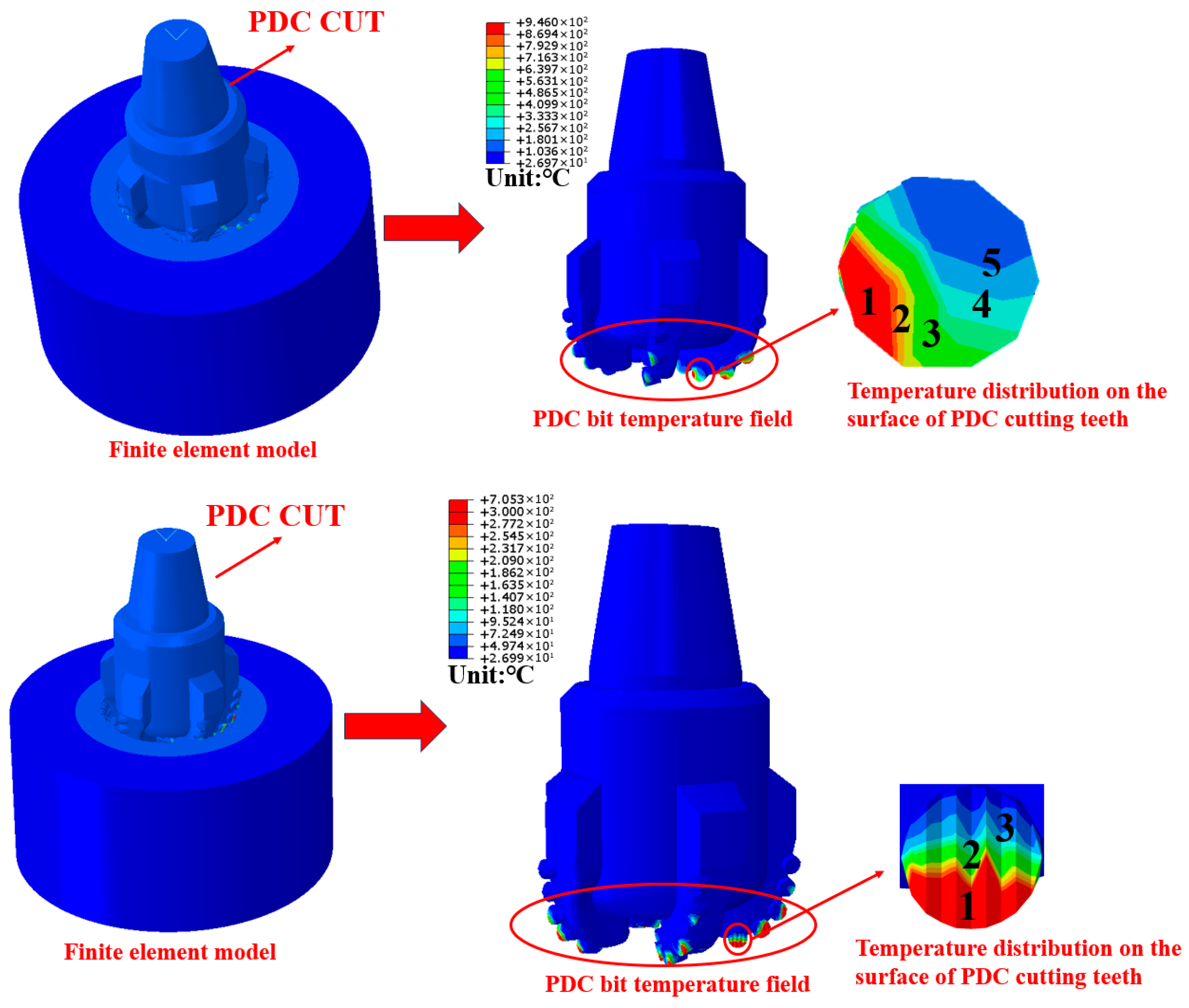
Figure 28.
Analysis of the temperature field of PDC bits. The different numbers in the figure represent different temperature zones.
Figure 28.
Analysis of the temperature field of PDC bits. The different numbers in the figure represent different temperature zones.
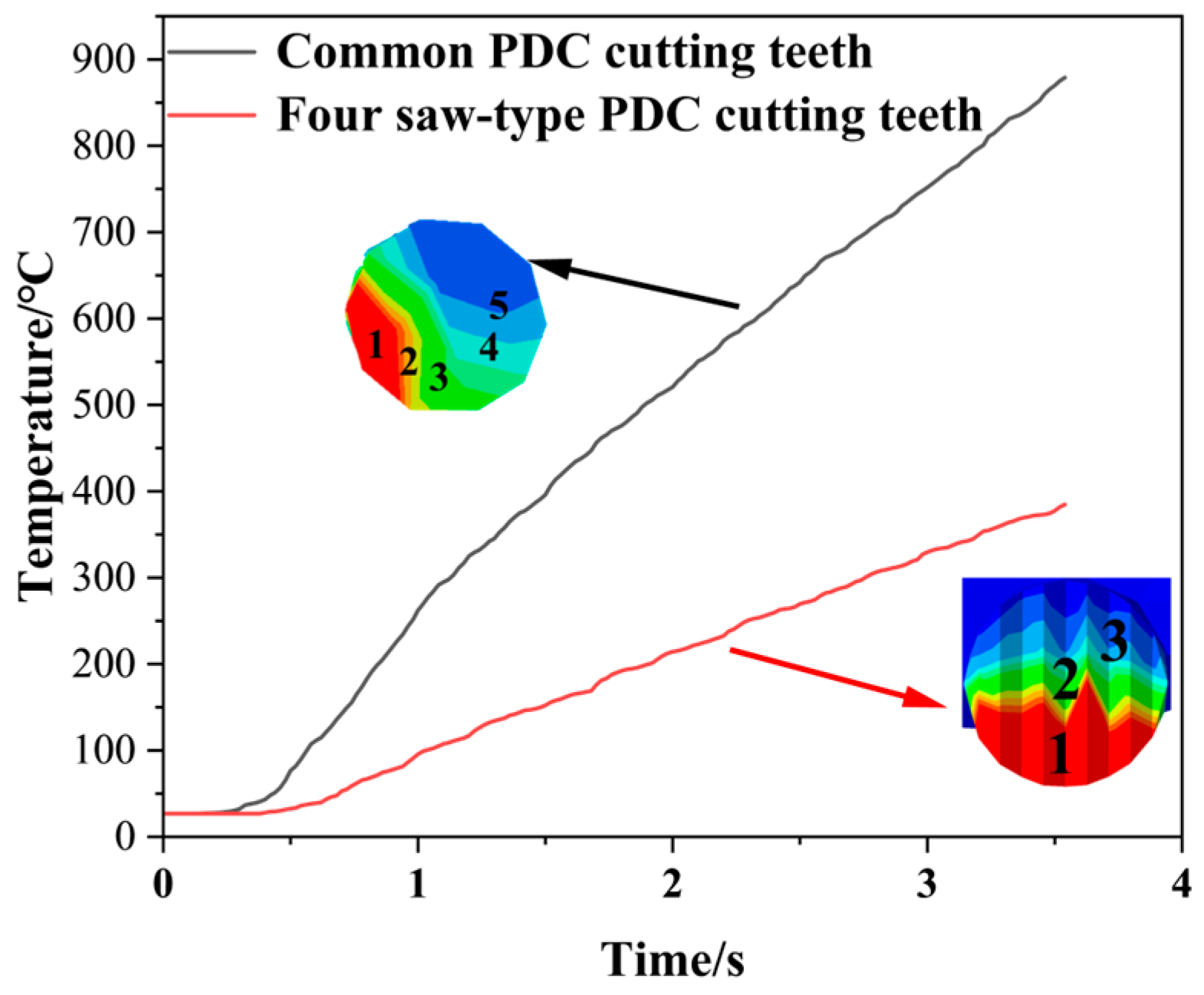
Figure 29.
Temperature curve. The different numbers in the figure represent different temperature zones.
Figure 29.
Temperature curve. The different numbers in the figure represent different temperature zones.
Figure 30.
Bottom of the well fragmented contours: (a) Conventional tooth drill bit; (b) Four saw-type tooth drill bit.
Figure 30.
Bottom of the well fragmented contours: (a) Conventional tooth drill bit; (b) Four saw-type tooth drill bit.
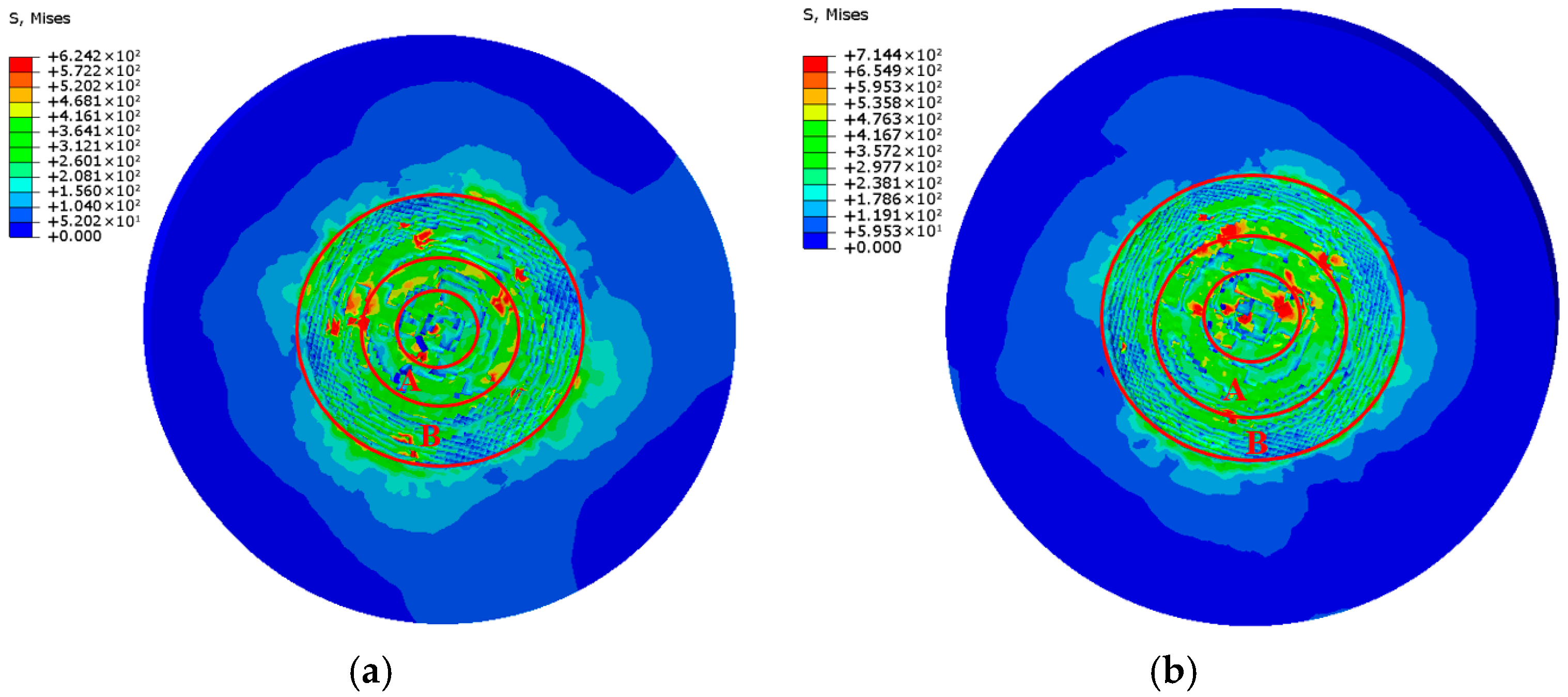
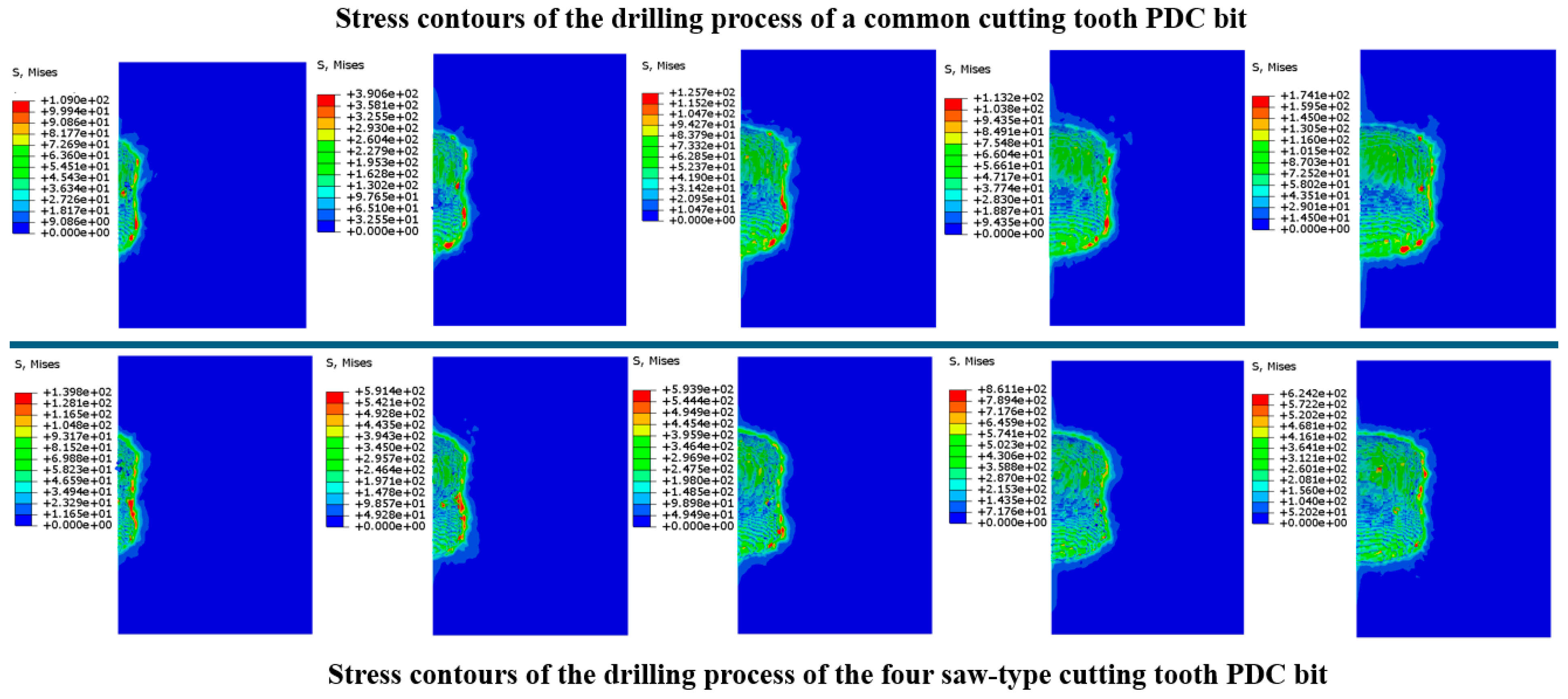
Figure 31.
Stress contours of a rock broken by a bit.
Figure 31.
Stress contours of a rock broken by a bit.
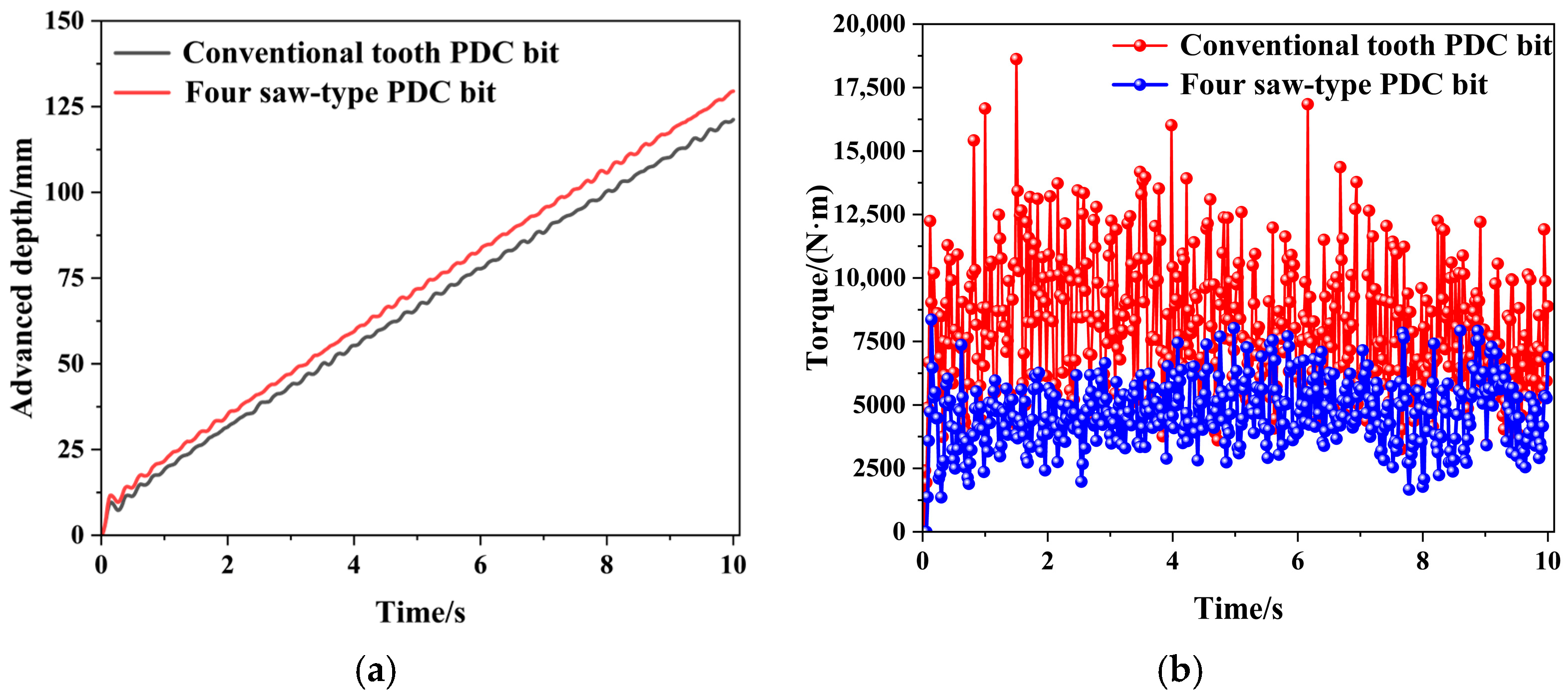
Figure 32.
Displacement and torque comparison: (a) Displacement; (b) Torque.
Figure 32.
Displacement and torque comparison: (a) Displacement; (b) Torque.
Table 1.
Material parameter.
Table 1.
Material parameter.
| Name | Elastic Modulus/GPa | Density/(kg·m−3) | Thermal Conductivity/(W·m−1 °C) | Specific Heat/(J·kg−1 °C−1) | Coefficient of Thermal Expansion/°C−1 |
Poisson’s Ratio |
|---|
| PDC | 890 | 3500 | 543.0 | 790 | 2.5 × 10⁻⁶ | 0.07 |
| Hard alloy layer | 579 | 15,000 | 100.0 | 230 | 5.2 × 10⁻⁶ | 0.22 |
| Granite | 40 | 2650 | 3.5 | 800 | 52.0 × 10⁻⁶ | 0.25 |
Table 2.
Verification of conservation of energy.
Table 2.
Verification of conservation of energy.
| Energy | Numerical Value (mJ) | Proportion (%) | Illustrate |
|---|
| Input the total mechanical energy | 42,030 | 100% | _ |
| Plastic dissipation energy (ALLPD) | 40,452 | 96.3% | Stabilize the cumulative value of the cutting section |
| Frictional dissipation energy (ALLFD) | 1505 | 3.6% | Stabilize the cumulative value of the cutting section |
| Other energy | 73 | 0.1% | Residual term (Input-plasticity-friction) |
| Energy closure error | 0.2% | _ | It indicates that the conservation of energy is good |
Table 3.
Convergence test under different grid sizes.
Table 3.
Convergence test under different grid sizes.
| Size of Mesh Opening (mm) | Peak Temperature (°C) | Rate of Temperature Change (%) | Peak Cutting Force (N) | Rate of Change in Cutting Force (%) |
|---|
| 1.5 | 55.60 | — | 4432 | — |
| 1.0 | 53.40 | −3.96% | 4322 | −2.48% |
| 0.5 | 56.27 | +5.38% | 4557 | +5.44% |
Table 4.
Stable time increment step test data.
Table 4.
Stable time increment step test data.
| Working Condition | Quality Scaling Coefficient | Stable Time Step Increment (s) | Peak Cutting Force (N) | Rate of Change in Temperature (%) | Peak Temperature (°C) | Rate of Change in Cutting Force (%) |
|---|
| 1 | 0 | 1.48304 × 10⁻⁷ | 4159 | — | 51.57 | — |
| 2 | 100 | 1.48384 × 10⁻⁶ | 4322 | +3.92 | 52.39 | +1.59 |
| 3 | 1000 | 4.33697 × 10⁻⁶ | 4940 | +18.8 | 54.26 | +5.22 |
Table 5.
Parameter settings for PDC layer and cemented carbide layer.
Table 5.
Parameter settings for PDC layer and cemented carbide layer.
| Working Condition | The Thermal Conductivity of the PDC Layer (W/(m·K)) | The Specific Heat Capacity of the PDC Layer (J/(kg·K)) | The Thermal Conductivity of Cemented Carbide (W/(m·K)) | Specific Heat Capacity of Cemented Carbide (J/(kg·K)) |
|---|
| Standard | 543 | 790 | 100 | 230 |
| Lower limit | 443 | 710 | 50 | 170 |
| Upper limit | 643 | 870 | 150 | 280 |
Table 6.
Data of the PDC layer and the cemented carbide layer.
Table 6.
Data of the PDC layer and the cemented carbide layer.
| Working Condition | Maximum Temperature of the Cutting Tool (°C) | Rate of Change (%) | Temperature Field Morphology |
|---|
| Standard | 52.39 | — | Standard |
| Lower limit | 51.88 | −0.97% | Basically consistent |
| Upper limit | 53.97 | +3.02% | Basically consistent |
Table 7.
Drilling data.
| Type | Drilling Depth/mm | Cumulative Time/s | ROP/(mm·s−1) |
|---|
| Conventional PDC bit | 120.209 | 10 | 12.02 |
| Saw-tooth PDC bit | 129.515 | 10 | 12.95 |