


Artificial Intelligence for Sustainable Industrial Design: A Systematic Literature Review Based on a Technology–System–Institution Framework



Abstract
1. Introduction
1.1. Background
1.2. Research Gaps and Research Questions
2. Materials and Methods
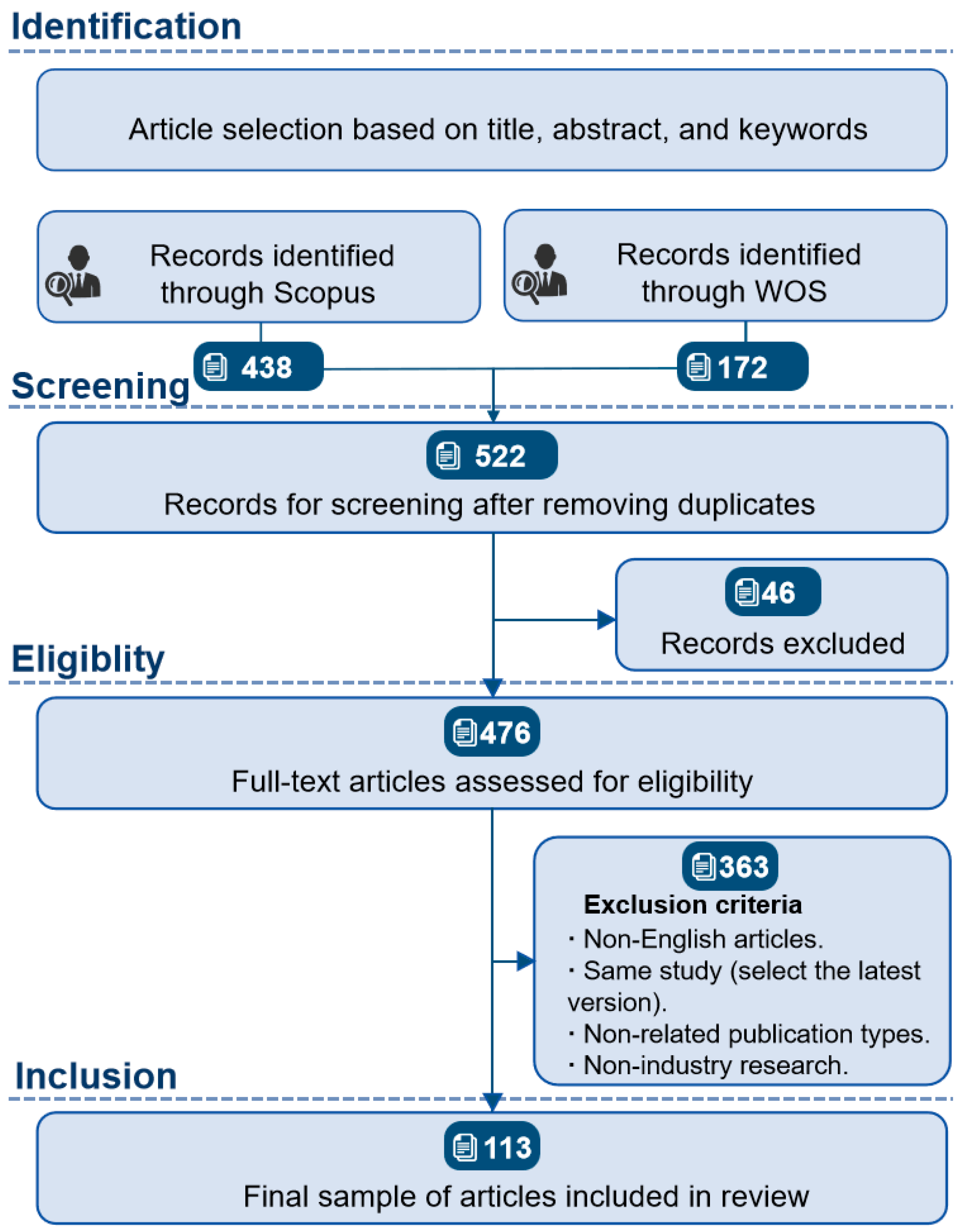
2.1. Search Strategy
2.2. Data Analysis
3. Descriptive Analysis of Included Studies
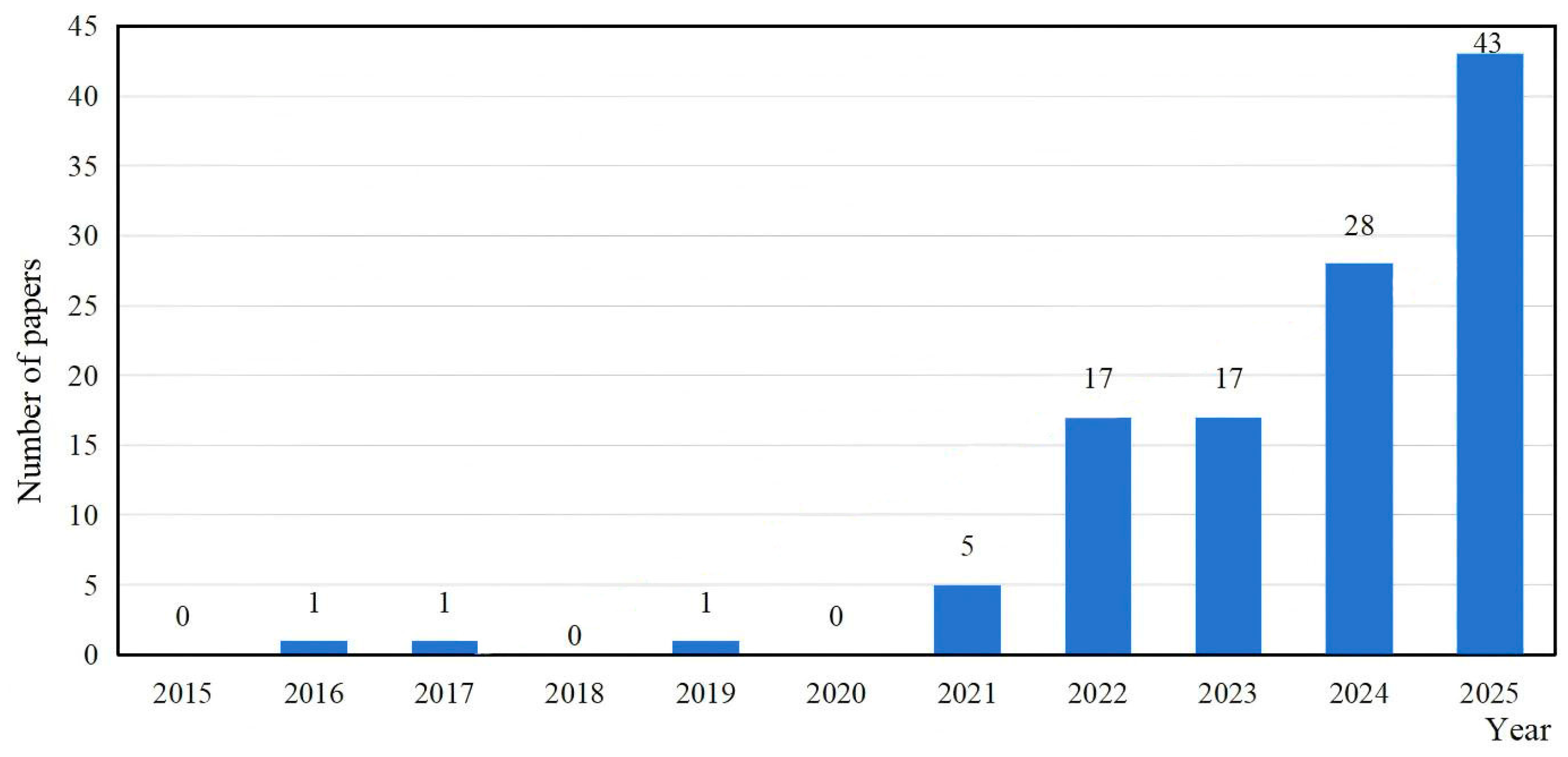
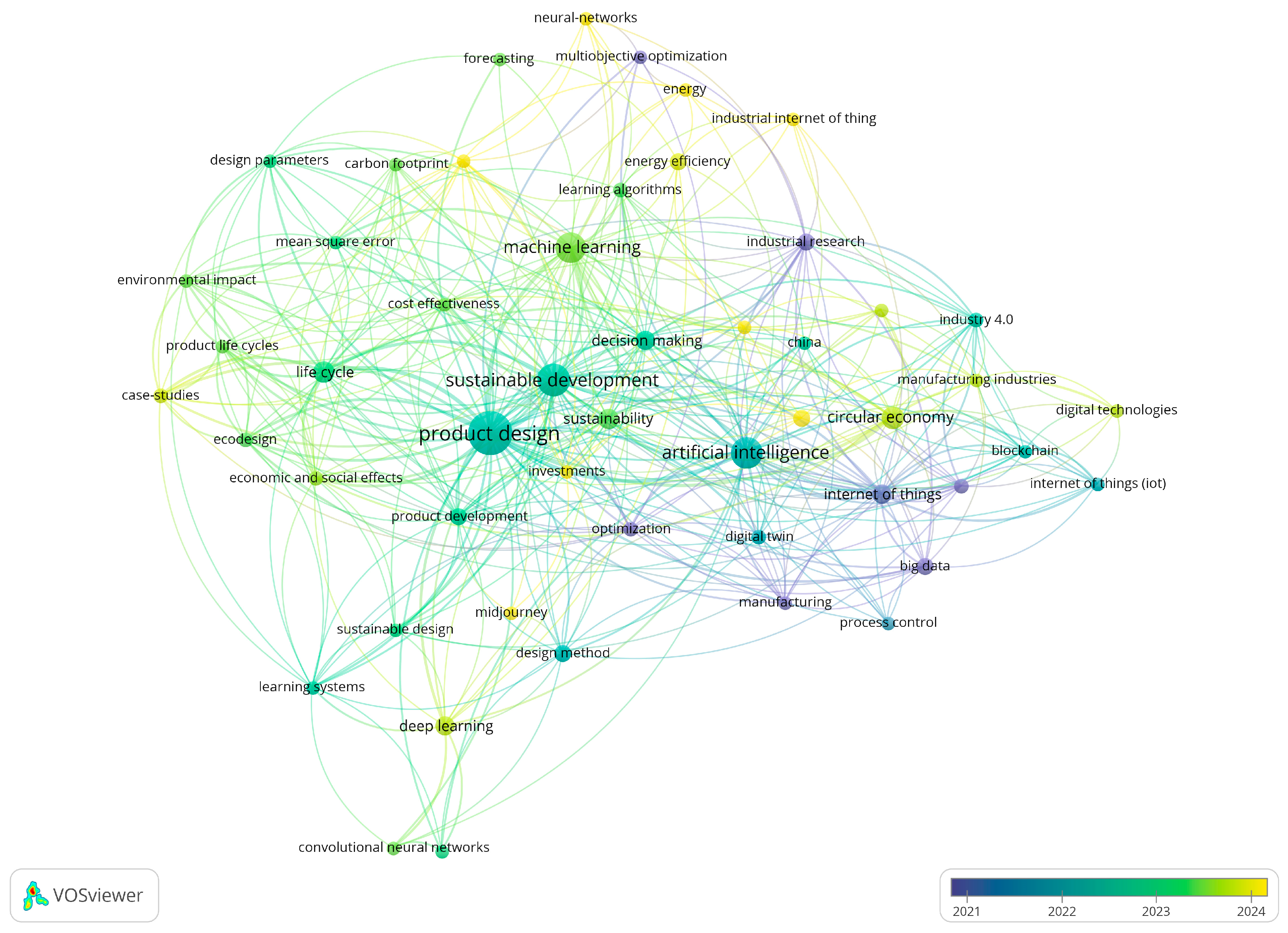
3.1. Research Trends
3.2. Source Journals
3.3. Most Cited Publications
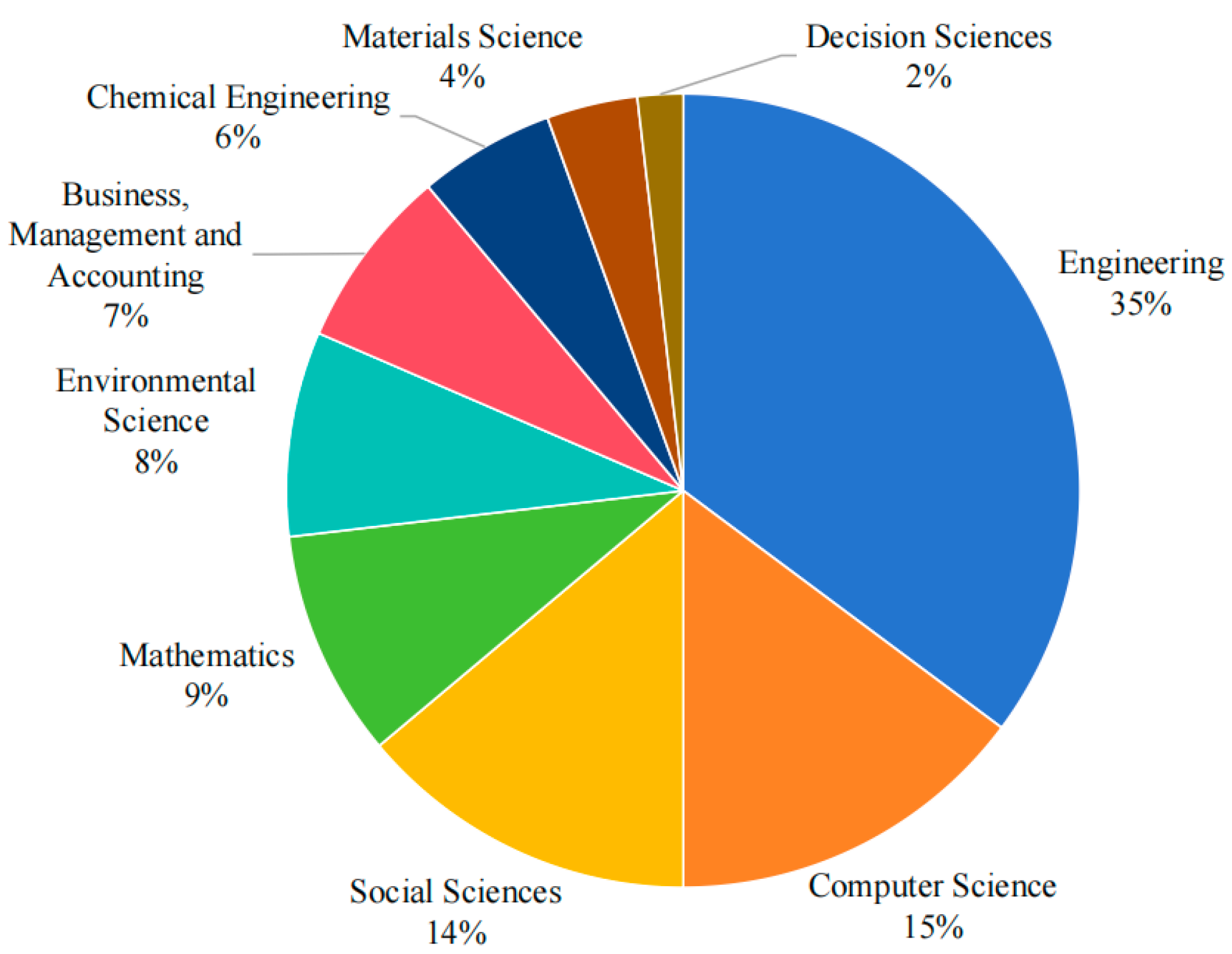
3.4. Top Subject Areas
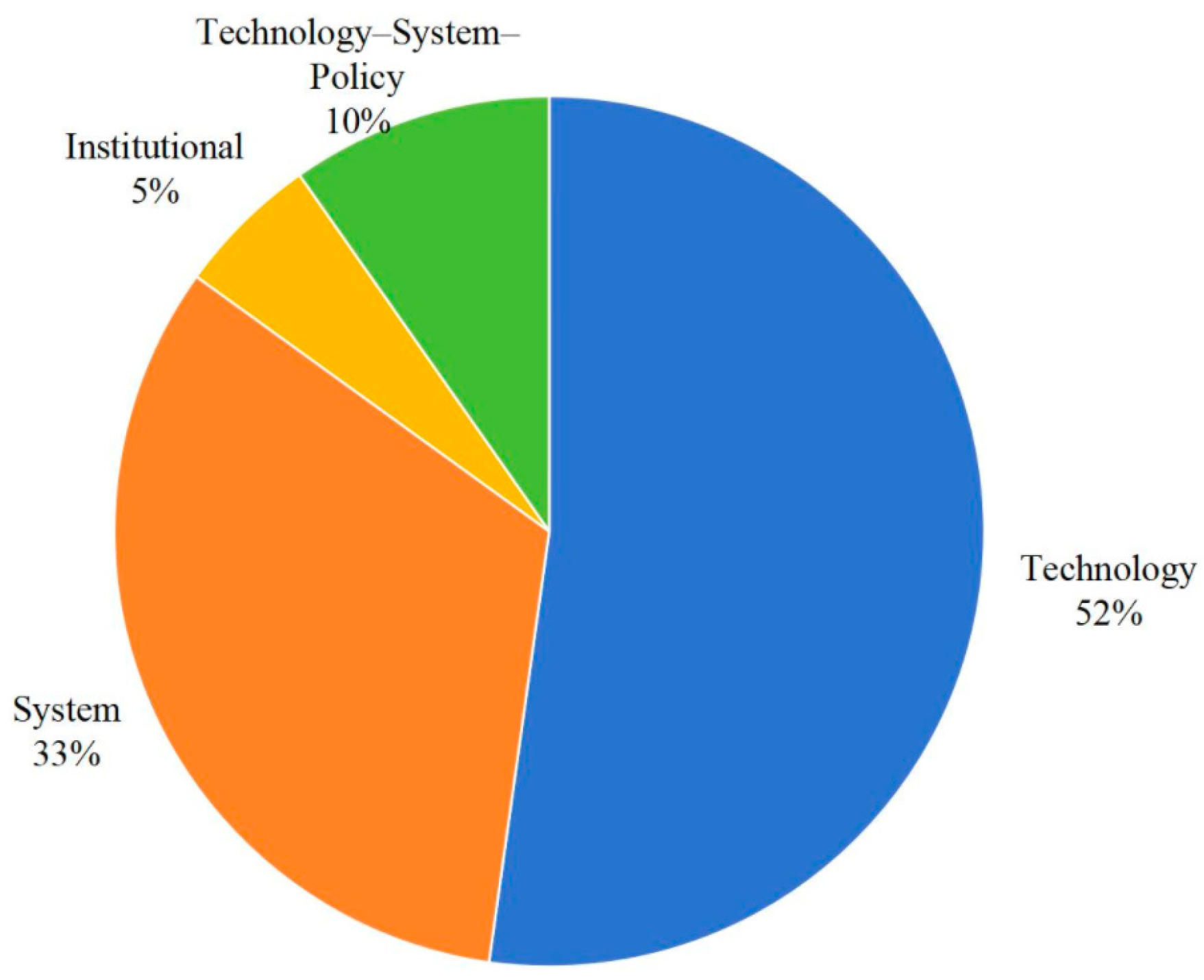
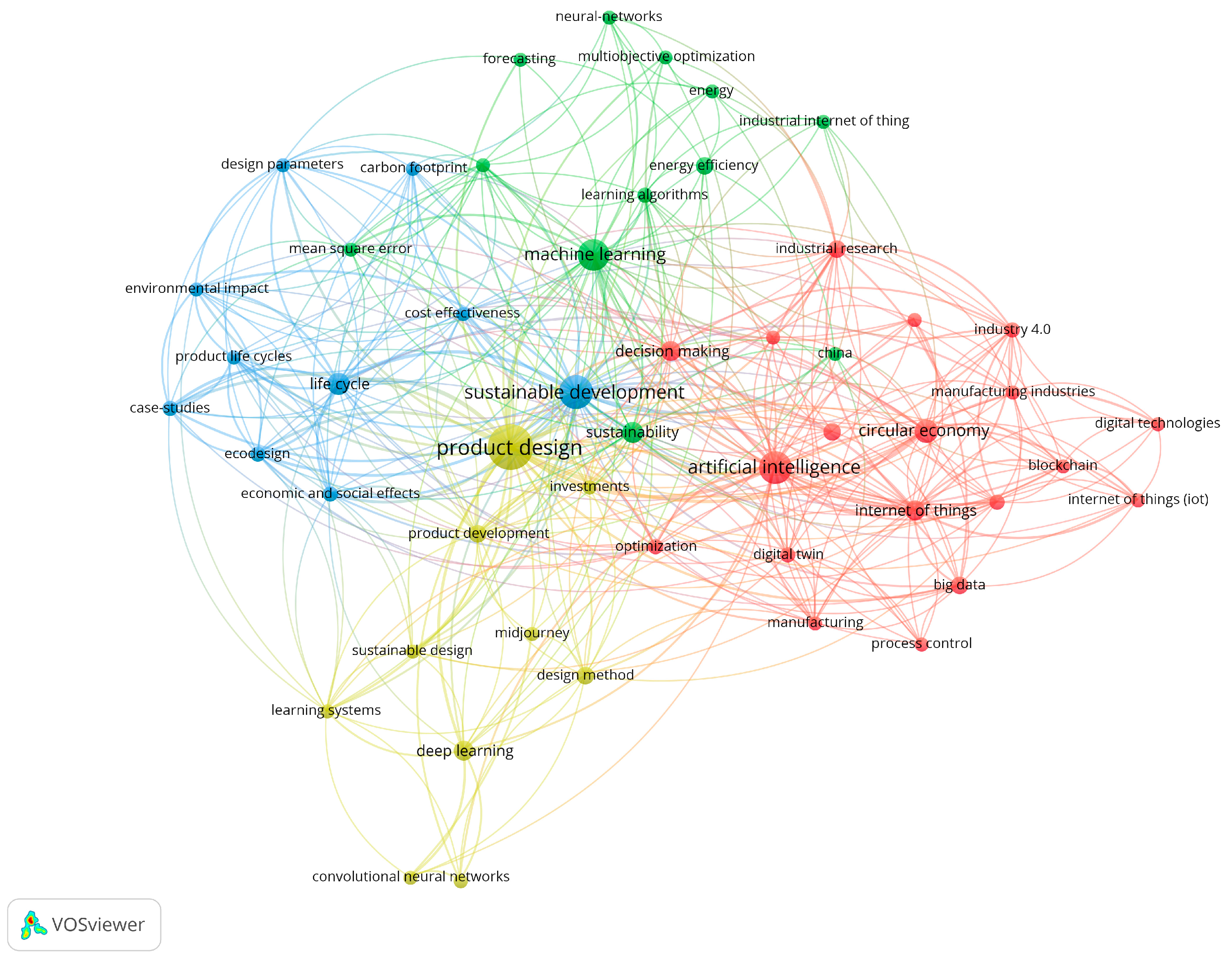
3.5. Current Research Concerns
4. Fundamental Issues
4.1. Technology Level: The Fusion of AI and Industrial Design
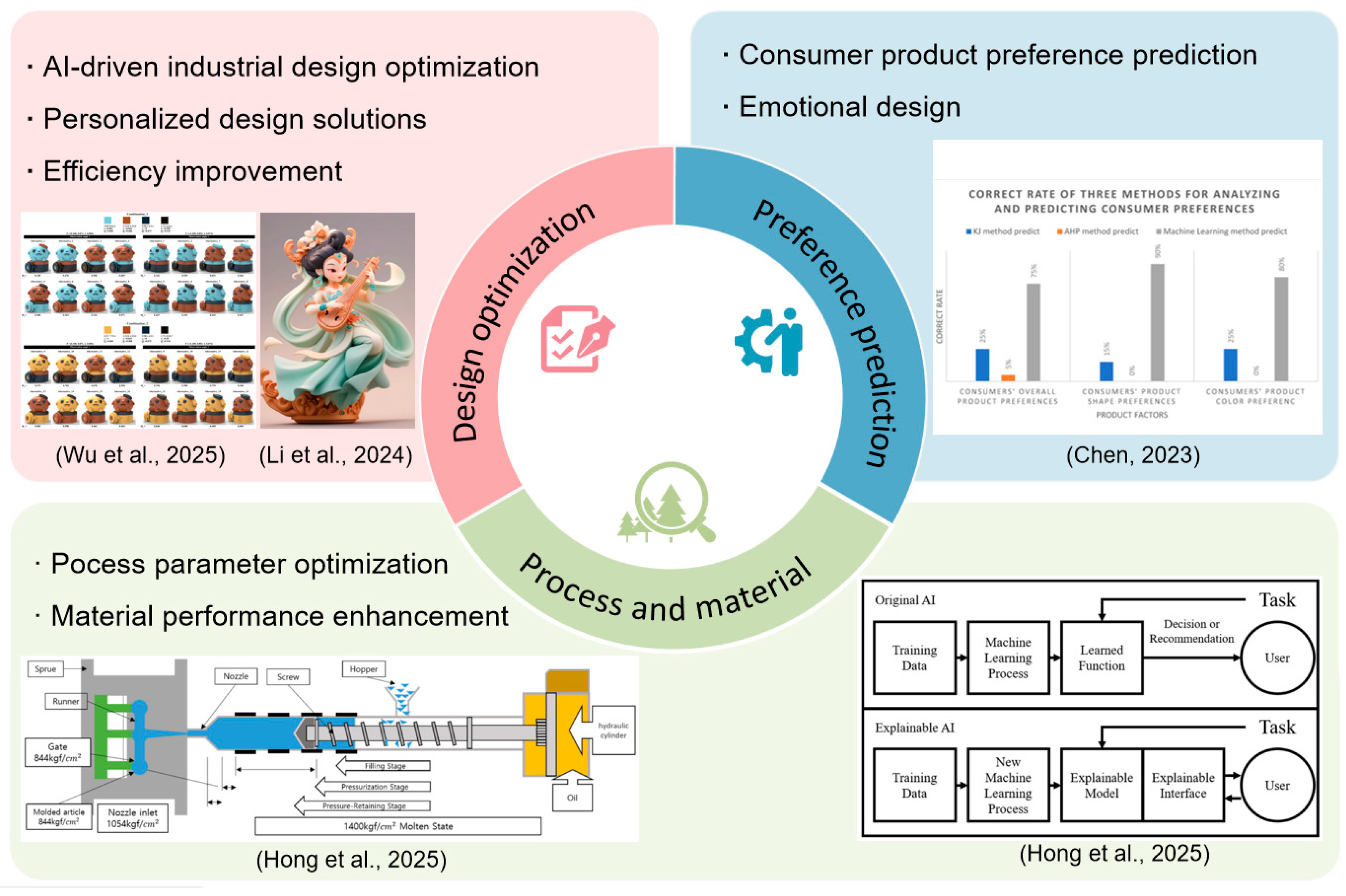
4.1.1. Industrial Design Optimization
4.1.2. Product Preference Prediction
4.1.3. Process and Material Performance
4.2. System Level: AI-Driven Design Process and Production Optimization
4.2.1. Process Systematization
4.2.2. Intelligent Production Systems
4.2.3. Circular Economic System
4.2.4. Supply Chain Management
4.3. Institutional Level: Policy Guidance and Regulatory Roles
4.3.1. Environmental Policy
4.3.2. Ethical Norms
4.3.3. Policy Guidance
5. Discussion, Challenges, and Future Research Directions
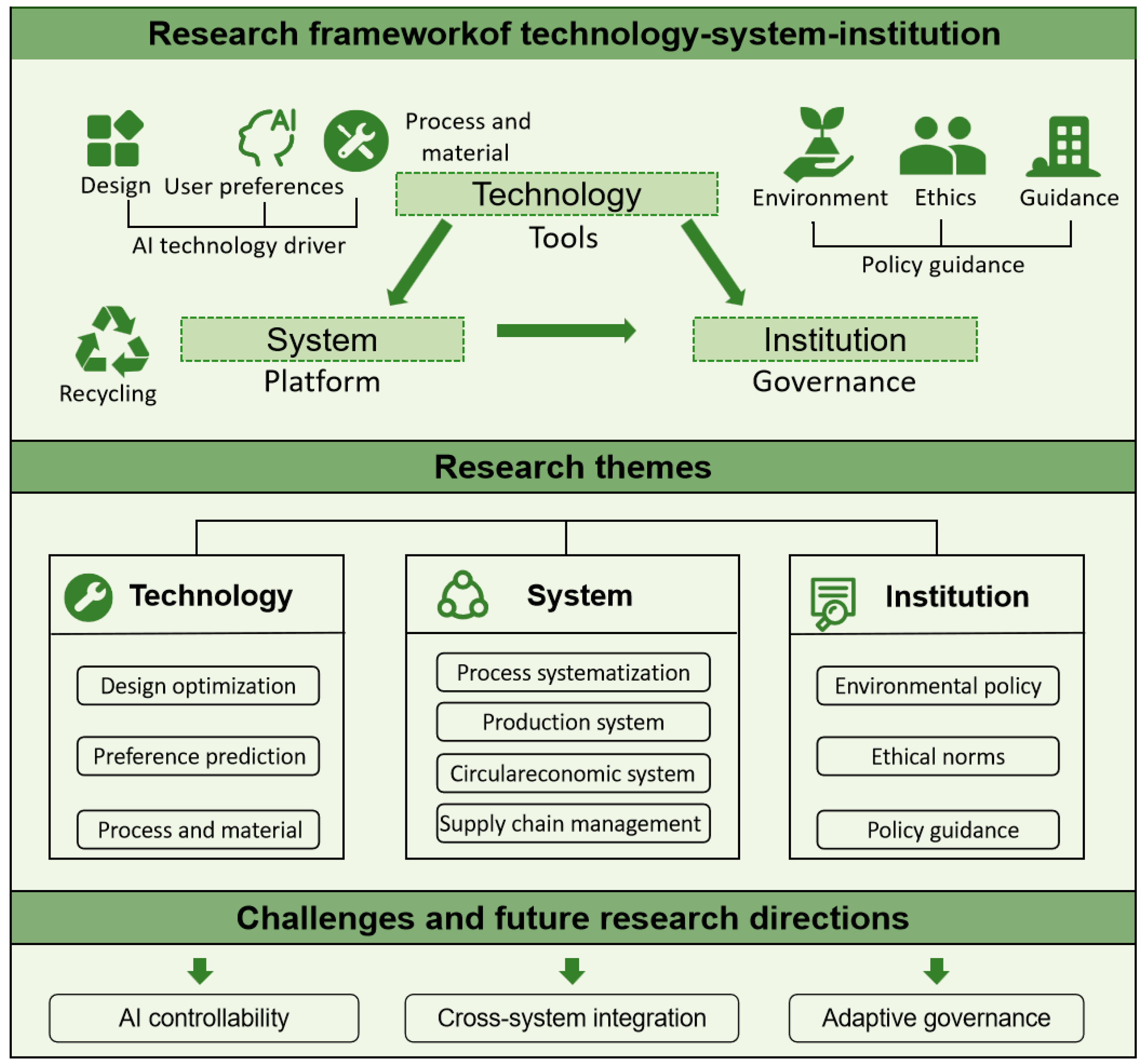
5.1. Discussion
5.2. Challenges
5.3. Future Research Directions
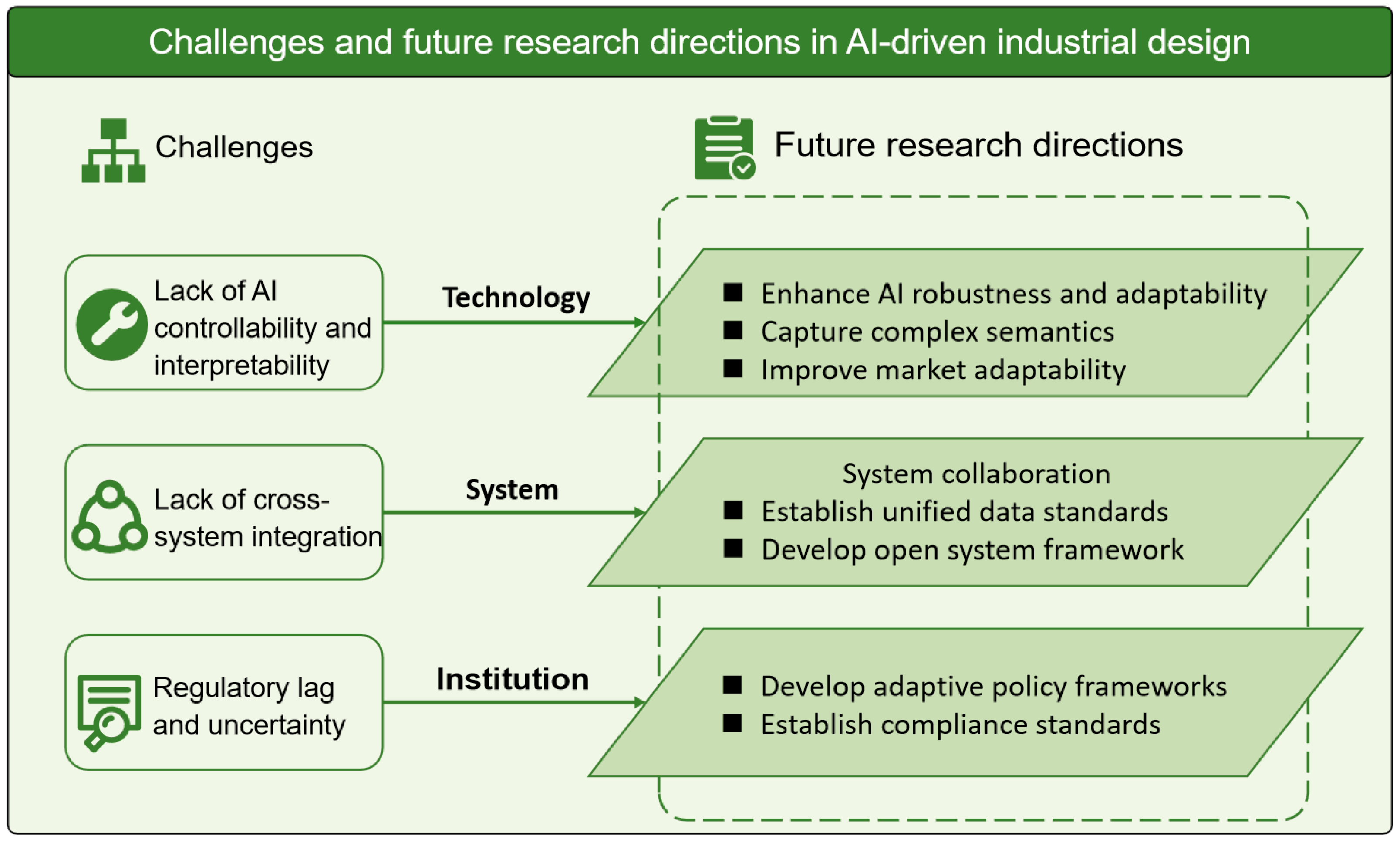
- Technological aspects: Future research should focus on enhancing the controllability and interpretability of AI models, particularly in capturing complex semantics such as culture and art, to improve the reliability and market adaptability of generative design.
- Systemic aspects: Future research should strengthen data flow and collaboration mechanisms across systems, particularly by promoting the unification of cross-domain data standards. Additionally, an open system architecture should be established to facilitate collaborative work across various stages.
- Institutional aspects: Future research should focus on developing policy frameworks that align with the rapid development of AI, bridging the gap between policy and technology. Furthermore, it should address compliance issues related to data privacy, algorithm transparency, and other key areas.
- Integrative aspects: Future research should move beyond single-dimension analyses and explicitly examine the co-evolution and feedback mechanisms among technological innovation, system integration, and institutional governance in order to better support the large-scale and sustainable adoption of AI in industrial design.
6. Conclusions
Supplementary Materials
Author Contributions
Funding
Data Availability Statement
Conflicts of Interest
References
- Kar, A.K.; Varsha, P.; Rajan, S. Unravelling the Impact of Generative Artificial Intelligence (GAI) in Industrial Applications: A Review of Scientific and Grey Literature. Glob. J. Flex. Syst. Manag. 2023, 24, 659–689. [Google Scholar] [CrossRef]
- Rane, N. ChatGPT and Similar Generative Artificial Intelligence (AI) for Smart Industry: Role, Challenges and Opportunities for Industry 4.0, Industry 5.0 and Society 5.0. Innov. Bus. Strateg. Manag. 2024, 2, 10–17. [Google Scholar] [CrossRef]
- Quan, H.; Li, S.; Zeng, C.; Wei, H.; Hu, J. Big Data and AI-Driven Product Design: A Survey. Appl. Sci. 2023, 13, 9433. [Google Scholar] [CrossRef]
- Kwong, C.K.; Jiang, H.; Luo, X. AI-Based Methodology of Integrating Affective Design, Engineering, and Marketing for Defining Design Specifications of New Products. Eng. Appl. Artif. Intell. 2016, 47, 49–60. [Google Scholar] [CrossRef]
- Ribeiro, J.; Lima, R.; Eckhardt, T.; Paiva, S. Robotic Process Automation and Artificial Intelligence in Industry 4.0—A Literature Review. Procedia Comput. Sci. 2021, 181, 51–58. [Google Scholar] [CrossRef]
- Elahi, M.; Afolaranmi, S.O.; Martinez Lastra, J.L.; Perez Garcia, J.A. A Comprehensive Literature Review of the Applications of AI Techniques through the Lifecycle of Industrial Equipment. Discov. Artif. Intell. 2023, 3, 43. [Google Scholar] [CrossRef]
- Rahman, H.; D’Cruze, R.S.; Ahmed, M.U.; Sohlberg, R.; Sakao, T.; Funk, P. Artificial Intelligence-Based Life Cycle Engineering in Industrial Production: A Systematic Literature Review. IEEE Access 2022, 10, 133001–133015. [Google Scholar] [CrossRef]
- Soori, M.; Jough, F.K.G.; Dastres, R.; Arezoo, B. AI-Based Decision Support Systems in Industry 4.0, A Review. J. Econ. Technol. 2024, 4, 206–225. [Google Scholar] [CrossRef]
- Li, B.; Hou, B.; Yu, W.; Lu, X.; Yang, C. Applications of Artificial Intelligence in Intelligent Manufacturing: A Review. Front. Inf. Technol. Electron. Eng. 2017, 18, 86–96. [Google Scholar] [CrossRef]
- Borboni, A.; Reddy, K.V.V.; Elamvazuthi, I.; AL-Quraishi, M.S.; Natarajan, E.; Azhar Ali, S.S. The Expanding Role of Artificial Intelligence in Collaborative Robots for Industrial Applications: A Systematic Review of Recent Works. Machines 2023, 11, 111. [Google Scholar] [CrossRef]
- Jamwal, A.; Agrawal, R.; Sharma, M.; Giallanza, A. Industry 4.0 Technologies for Manufacturing Sustainability: A Systematic Review and Future Research Directions. Appl. Sci. 2021, 11, 5725. [Google Scholar] [CrossRef]
- Cheah, C.G.; Chia, W.Y.; Lai, S.F.; Chew, K.W.; Chia, S.R.; Show, P.L. Innovation Designs of Industry 4.0 Based Solid Waste Management: Machinery and Digital Circular Economy. Environ. Res. 2022, 213, 113619. [Google Scholar] [CrossRef] [PubMed]
- Carpanzano, E.; Knüttel, D. Advances in Artificial Intelligence Methods Applications in Industrial Control Systems: Towards Cognitive Self-Optimizing Manufacturing Systems. Appl. Sci. 2022, 12, 10962. [Google Scholar] [CrossRef]
- Lee, K. A Systematic Review on Social Sustainability of Artificial Intelligence in Product Design. Sustainability 2021, 13, 2668. [Google Scholar] [CrossRef]
- Li, F.; Ruijs, N.; Lu, Y. Ethics & AI: A Systematic Review on Ethical Concerns and Related Strategies for Designing with AI in Healthcare. AI 2022, 4, 28–53. [Google Scholar] [CrossRef]
- Bansal, C. AI Ethics and Sustainability: Accelerating Paradigm Shifts toward Sustainable Development. J. Strategy Innov. 2025, 36, 200537. [Google Scholar] [CrossRef]
- Sharma, M.; Vadalkar, S.; Singh, A.; Tsagarakis, K.P. Navigating Smart Practices through Dynamic Capabilities for Sustainable Performance: A Mixed-Method Approach. Comput. Ind. Eng. 2025, 206, 111215. [Google Scholar] [CrossRef]
- Ahmed, I.; Jeon, G.; Piccialli, F. From Artificial Intelligence to Explainable Artificial Intelligence in Industry 4.0: A Survey on What, How, and Where. IEEE Trans. Ind. Inform. 2022, 18, 5031–5042. [Google Scholar] [CrossRef]
- Malik, S.; Muhammad, K.; Waheed, Y. Artificial Intelligence and Industrial Applications—A Revolution in Modern Industries. Ain Shams Eng. J. 2024, 15, 102886. [Google Scholar] [CrossRef]
- Gerber, L.; Fazlollahi, S.; Maréchal, F. A Systematic Methodology for the Environomic Design and Synthesis of Energy Systems Combining Process Integration, Life Cycle Assessment and Industrial Ecology. Comput. Chem. Eng. 2013, 59, 2–16. [Google Scholar] [CrossRef]
- Peres, R.S.; Jia, X.; Lee, J.; Sun, K.; Colombo, A.W.; Barata, J. Industrial Artificial Intelligence in Industry 4.0-Systematic Review, Challenges and Outlook. IEEE Access 2020, 8, 220121–220139. [Google Scholar] [CrossRef]
- Wu, Y.; Fang, J.; Wu, C.; Li, C.; Sun, G.; Li, Q. Additively Manufactured Materials and Structures: A State-of-the-Art Review on Their Mechanical Characteristics and Energy Absorption. Int. J. Mech. Sci. 2023, 246, 108102. [Google Scholar] [CrossRef]
- Liu, L.; Song, W.; Liu, Y. Leveraging Digital Capabilities toward a Circular Economy: Reinforcing Sustainable Supply Chain Management with Industry 4.0 Technologies. Comput. Ind. Eng. 2023, 178, 109113. [Google Scholar] [CrossRef]
- Gebhardt, M.; Kopyto, M.; Birkel, H.; Hartmann, E. Industry 4.0 Technologies as Enablers of Collaboration in Circular Supply Chains: A Systematic Literature Review. Int. J. Prod. Res. 2022, 60, 6967–6995. [Google Scholar] [CrossRef]
- Frank, B. Artificial Intelligence-Enabled Environmental Sustainability of Products: Marketing Benefits and Their Variation by Consumer, Location, and Product Types. J. Clean. Prod. 2021, 285, 125242. [Google Scholar] [CrossRef]
- Zhu, X.; He, M.; Sun, Y.; Xu, Z.; Wan, Z.; Hou, D.; Alessi, D.S.; Tsang, D.C. Insights into the Adsorption of Pharmaceuticals and Personal Care Products (PPCPs) on Biochar and Activated Carbon with the Aid of Machine Learning. J. Hazard. Mater. 2022, 423, 127060. [Google Scholar] [CrossRef] [PubMed]
- Zhang, S.; Lee, C.K.M.; Wu, K.; Choy, K.L. Multi-Objective Optimization for Sustainable Supply Chain Network Design Considering Multiple Distribution Channels. Expert Syst. Appl. 2016, 65, 87–99. [Google Scholar] [CrossRef]
- Abd Aziz, N.; Adnan, N.A.A.; Abd Wahab, D.; Azman, A.H. Component Design Optimisation Based on Artificial Intelligence in Support of Additive Manufacturing Repair and Restoration: Current Status and Future Outlook for Remanufacturing. J. Clean. Prod. 2021, 296, 126401. [Google Scholar] [CrossRef]
- Bag, S.; Sahu, A.K.; Kilbourn, P.; Pisa, N.; Dhamija, P.; Sahu, A.K. Modeling Barriers of Digital Manufacturing in a Circular Economy for Enhancing Sustainability. Int. J. Product. Perform. Manag. 2022, 71, 833–869. [Google Scholar] [CrossRef]
- Tsang, Y.P.; Lee, C.K.M. Artificial Intelligence in Industrial Design: A Semi-Automated Literature Survey. Eng. Appl. Artif. Intell. 2022, 112, 10488. [Google Scholar] [CrossRef]
- Elghaish, F.; Matarneh, S.T.; Edwards, D.J.; Rahimian, F.P.; El-Gohary, H.; Ejohwomu, O. Applications of Industry 4.0 Digital Technologies towards a Construction Circular Economy: Gap Analysis and Conceptual Framework. Constr. Innov. 2022, 22, 647–670. [Google Scholar] [CrossRef]
- Wang, C.; Zhang, J.; Liu, D.; Cai, Y.; Gu, Q. An AI-Powered Product Identity Form Design Method Based on Shape Grammar and Kansei Engineering: Integrating Midjourney and Grey-AHP-QFD. Appl. Sci. 2024, 14, 7444. [Google Scholar] [CrossRef]
- Du, Y.; Liu, X.; Cai, M.; Park, K. A Product’s Kansei Appearance Design Method Based on Conditional-Controlled AI Image Generation. Sustainability 2024, 16, 8837. [Google Scholar] [CrossRef]
- Li, H.; Zhu, Y.; Guo, Q.; Wang, J.; Shi, M.; Liu, W. Unveiling Consumer Satisfaction with AI-Generated Museum Cultural and Creative Products Design: Using Importance–Performance Analysis. Sustainability 2024, 16, 8203. [Google Scholar] [CrossRef]
- Wu, F.; Lu, P.; Hsiao, S.-W. Generative Large Model-Driven Methodology for Color Matching and Shape Design in IP Products. Entropy 2025, 27, 319. [Google Scholar] [CrossRef] [PubMed]
- Wu, F.; Hsiao, S.-W.; Lu, P. An AIGC-Empowered Methodology to Product Color Matching Design. Displays 2024, 81, 102623. [Google Scholar] [CrossRef]
- Lu, P.; Hsiao, S.-W.; Tang, J.; Wu, F. A Generative-AI-Based Design Methodology for Car Frontal Forms Design. Adv. Eng. Inform. 2024, 62, 102835. [Google Scholar] [CrossRef]
- Lo, C.-H.; Ko, Y.-C.; Hsiao, S.-W. A Study That Applies Aesthetic Theory and Genetic Algorithms to Product Form Optimization. Adv. Eng. Inform. 2015, 29, 662–679. [Google Scholar] [CrossRef]
- Wang, Z.; Tao, X.; Zeng, X.; Xing, Y.; Xu, Z.; Bruniaux, P. Design of Customized Garments towards Sustainable Fashion Using 3D Digital Simulation and Machine Learning-Supported Human–Product Interactions. Int. J. Comput. Intell. Syst. 2023, 16, 16. [Google Scholar] [CrossRef]
- Dostatni, E.; Mikołajewski, D.; Dorożyński, J.; Rojek, I. Ecological Design with the Use of Selected Inventive Methods Including AI-Based. Appl. Sci. 2022, 12, 9577. [Google Scholar] [CrossRef]
- Chen, C.-W. A Feasibility Discussion: Is ML Suitable for Predicting Sustainable Patterns in Consumer Product Preferences? Sustainability 2023, 15, 3983. [Google Scholar] [CrossRef]
- Wang, Z.; Pan, H.; Li, J.; Niu, S. Exploring Product Rendering Generation Design Catering to Multi-Emotional Needs through the Superiority Chart-Entropy Weight Method and Stable Diffusion Model. Adv. Eng. Inform. 2024, 62, 102809. [Google Scholar] [CrossRef]
- Liu, J.; Gao, H.; Yezhova, O. Generative Design of Bamboo Furniture Combining Game Theory and AI-Generated Content. BioResources 2025, 20, 4. [Google Scholar] [CrossRef]
- Shu, L.H.; Duflou, J.; Herrmann, C.; Sakao, T.; Shimomura, Y.; De Bock, Y.; Srivastava, J. Design for Reduced Resource Consumption during the Use Phase of Products. CIRP Ann. 2017, 66, 635–658. [Google Scholar] [CrossRef]
- Manuguerra, L.; Cappelletti, F.; Rossi, M.; Germani, M. Eco-Design Tool to Support the Design of Industrial Electric Vehicles. The Case Studies of an Electric Shuttle and an Autonomous Mobile Robot. J. Ind. Inf. Integr. 2024, 39, 100605. [Google Scholar] [CrossRef]
- Singh, P.K.; Sarkar, P. An Artificial Neural Network Tool to Support the Decision Making of Designers for Environmentally Conscious Product Development. Expert Syst. Appl. 2023, 212, 118679. [Google Scholar] [CrossRef]
- Zhao, X.; Su, Y.; Su, H.; Li, W. Evaluating the Sustainability of Recycled Plastic Furniture Design Using the Analytic Hierarchy Process-Fuzzy Comprehensive Evaluation and Machine Learning Models Integrated Evaluation Method. J. Clean. Prod. 2025, 518, 145782. [Google Scholar] [CrossRef]
- Liu, Z.; Liang, X.; Li, L.; Li, X.; Ou, W. Research on Sustainable Design of Smart Charging Pile Based on Machine Learning. Symmetry 2024, 16, 1582. [Google Scholar] [CrossRef]
- Zhang, H.; Zeng, L.; Song, J. Applying the Deep Learning Model into the Furniture Product Design for the Elderly. J. Mech. Med. Biol. 2025, 25, 2540030. [Google Scholar] [CrossRef]
- Aghamohammadi, A.; Beheshti Shirazi, S.A.; Banihashem, S.Y.; Shishechi, S.; Ranjbarzadeh, R.; Jafarzadeh Ghoushchi, S.; Bendechache, M. A Deep Learning Model for Ergonomics Risk Assessment and Sports and Health Monitoring in Self-Occluded Images. Signal Image Video Process. 2024, 18, 1161–1173. [Google Scholar] [CrossRef]
- Mogale, R.; Schutte-Smith, M.; Erasmus, E.; De Wet, K.; Visser, H.G. Toward Sustainable Menstrual Health Management: Focus on Super Absorbent Polymers. J. Mater. Sci. 2024, 59, 6138–6168. [Google Scholar] [CrossRef]
- Hong, J.; Hong, Y.; Baek, J.-W.; Kang, S.-W. Enhancing the Product Quality of the Injection Process Using eXplainable Artificial Intelligence. Processes 2025, 13, 912. [Google Scholar] [CrossRef]
- Eldokaishi, A.; Abdelsalam, M.; Kamal, M.; Abotaleb, H. Modeling of Water-PCM Solar Thermal Storage System for Domestic Hot Water Application Using Artificial Neural Networks. Appl. Therm. Eng. 2022, 204, 118009. [Google Scholar] [CrossRef]
- Vaferi, K.; Nekahi, S.; Nekahi, S.; Ghaebi, H. Charging/Discharging Performance Examination in a Finned-Tube Heat Storage Tank: Based on Artificial Neural Network, Pareto Optimization, and Numerical Simulation. Case Stud. Therm. Eng. 2025, 72, 106388. [Google Scholar] [CrossRef]
- Dulal, M.; Afroj, S.; Ahn, J.; Cho, Y.; Carr, C.; Kim, I.-D.; Karim, N. Toward Sustainable Wearable Electronic Textiles. ACS Nano 2022, 16, 19755–19788. [Google Scholar] [CrossRef]
- Al-Jarrah, R.; AL-Oqla, F.M. Artificial Intelligence Schemes to Predict the Mechanical Performance of Lignocellulosic Fibers with Unseen Data to Enhance the Reliability of Biocomposites. Eng. Comput. 2024, 41, 922–946. [Google Scholar] [CrossRef]
- Cazzagon, V.; Vanhauten, R.; Delpivo, C.; Boyles, M.; Braakhuis, H.; Jiménez, A.S.; Cross, R.K.; Morel, E.; Rodriguez-Llopis, I.; Hanlon, J.; et al. The SAbyNA Platform: A Guidance Tool to Support Industry in the Implementation of Safe-and Sustainable-by-Design Concepts for Nanomaterials, Processes and Nano-Enabled Products. Environ. Sci. Nano 2025, 12, 4008–4025. [Google Scholar] [CrossRef]
- Wang, X.; Zhong, Y.; Zhu, F.; Huang, J. Digital Industrial Design Method in Architectural Design by Machine Learning Optimization: Towards Sustainable Construction Practices of Geopolymer Concrete. Buildings 2024, 14, 3998. [Google Scholar] [CrossRef]
- Abdulrahman, S.; Bashir, A.; Farouk, A.; Haruna, S.I.; Haruna, A.; Abba, S.I. Hybrid-Optimized Ensemble Learning Models and GUI for Predicting Compressive Strength of Fly Ash and Slag Concrete. Mater. Today Commun. 2025, 49, 113762. [Google Scholar] [CrossRef]
- Turkes, S.; Güney, H.; Mezarciöz, S.; Sari, B.; Tetik, S.S. Textile Wastewater: COD Removal via Box–Behnken Design, Fenton Method, and Machine Learning Integration for Sustainability. Int. J. Cloth. Sci. Technol. 2025, 37, 642–662. [Google Scholar] [CrossRef]
- Wang, Z.; Zheng, P.; Li, X.; Chen, C.-H. Implications of Data-Driven Product Design: From Information Age towards Intelligence Age. Adv. Eng. Inform. 2022, 54, 101793. [Google Scholar] [CrossRef]
- Akhtar, P.; Ghouri, A.M.; Ashraf, A.; Lim, J.J.; Khan, N.R.; Ma, S. Smart Product Platforming Powered by AI and Generative AI: Personalization for the Circular Economy. Int. J. Prod. Econ. 2024, 273, 109283. [Google Scholar] [CrossRef]
- Balloni, E.; Pietrini, R.; Sasso, M.; Frontoni, E.; Paolanti, M. Made-in: An Immersive Human-in-the-Loop Analytics Platform for Enhancing Creative Processes in Fashion. Comput. Vis. Image Underst. 2025, 260, 104454. [Google Scholar] [CrossRef]
- Lee, Y.K. Transformation of the Innovative and Sustainable Supply Chain with Upcoming Real-Time Fashion Systems. Sustainability 2021, 13, 1081. [Google Scholar] [CrossRef]
- Mann, V.; Lu, J.; Venkatasubramanian, V.; Gani, R. A Perspective on Artificial Intelligence for Process Manufacturing. Engineering 2025, 52, 60–67. [Google Scholar] [CrossRef]
- Alfaro-Viquez, D.; Zamora-Hernandez, M.; Fernandez-Vega, M.; Garcia-Rodriguez, J.; Azorin-Lopez, J. A Comprehensive Review of AI-Based Digital Twin Applications in Manufacturing: Integration Across Operator, Product, and Process Dimensions. Electronics 2025, 14, 646. [Google Scholar] [CrossRef]
- Rahee, S.P.; Sarker, M.R. Circular Product Design Strategies in the Apparel Industry: Toward the Circular Economy. Discov. Sustain. 2024, 5, 437. [Google Scholar] [CrossRef]
- Ertz, M.; Sun, S.; Boily, E.; Kubiat, P.; Quenum, G.G.Y. How Transitioning to Industry 4.0 Promotes Circular Product Lifetimes. Ind. Mark. Manag. 2022, 101, 125–140. [Google Scholar] [CrossRef]
- Tirkolaee, E.B.; Aydin, N.S. Integrated Design of Sustainable Supply Chain and Transportation Network Using a Fuzzy Bi-Level Decision Support System for Perishable Products. Expert Syst. Appl. 2022, 195, 116628. [Google Scholar] [CrossRef]
- Qian, F.; Tang, Y.; Yu, X. The Future of Process Industry: A Cyber–Physical–Social System Perspective. IEEE Trans. Cybern. 2023, 54, 3878–3889. [Google Scholar] [CrossRef]
- Roberts, H.; Zhang, J.; Bariach, B.; Cowls, J.; Gilburt, B.; Juneja, P.; Tsamados, A.; Ziosi, M.; Taddeo, M.; Floridi, L. Artificial Intelligence in Support of the Circular Economy: Ethical Considerations and a Path Forward. AI Soc. 2024, 39, 1451–1464. [Google Scholar] [CrossRef]
- Shahin, M.; Hosseinzadeh, A.; Chen, F.F. Generative Artificial Intelligence in Manufacturing: Applications, Case Studies, and Future Directions for next-Generation Intelligent Production Systems. Int. J. Adv. Manuf. Technol. 2025, 141, 1159–1265. [Google Scholar] [CrossRef]
- Ahsan, M.N.; Islam, M.S.; Bappy, M.M. Generative Modeling in Smart Manufacturing: Applications, Challenges, and Future Directions. Manuf. Lett. 2025, 44, 1285–1295. [Google Scholar] [CrossRef]
- Benila, S.; Devi, K. Federated Synergy: Hierarchical Multi-Agent Learning for Sustainable Edge Computing in IIoT. IEEE Access 2025, 13, 68311–68322. [Google Scholar] [CrossRef]
- Ye, Z. Precision Manufacturing Based on Thermal Environment Sensors, Artificial Intelligence Production, Computer-Aided Product Design. Therm. Sci. Eng. Prog. 2025, 57, 103155. [Google Scholar] [CrossRef]
- Nguyen, T.P.; Nguyen, H.; Ngo, H.Q.T. Toward a Sustainable Transition in Automated Production: Enabling the Vision-Based Approach and Synchronous Control for Textile Surface Inspection Systems. Text. Res. J. 2023, 93, 5391–5415. [Google Scholar] [CrossRef]
- Alzahrani, A.; Aldhyani, T.H. Design of Efficient Based Artificial Intelligence Approaches for Sustainable of Cyber Security in Smart Industrial Control System. Sustainability 2023, 15, 8076. [Google Scholar] [CrossRef]
- Oyekan, J.; Turner, C.; Bax, M.; Graf, E. From Ontologies to Knowledge Augmented Large Language Models for Automation: A Decision-Making Guidance for Achieving Human–Robot Collaboration in Industry 5.0. Comput. Ind. 2025, 171, 104329. [Google Scholar] [CrossRef]
- Kong, L.; Wang, L.; Li, F.; Guo, J. Toward Product Green Design of Modeling, Assessment, Optimization, and Tools: A Comprehensive Review. Int. J. Adv. Manuf. Technol. 2022, 122, 2217–2234. [Google Scholar] [CrossRef]
- Xue, F.; Xue, F. A Lifecycle-Aware Optimization Framework for Low-Carbon Material Selection in Engineering Product Design. Eng. Rep. 2025, 7, e70481. [Google Scholar] [CrossRef]
- Munonye, W.C.; Ajonye, G.O.; Ahonsi, S.O.; Munonye, D.I.; Chigozie, I.O.; Akinloye, O.A. Advancing Circularity in Battery Systems for Renewable Energy: Technologies, Barriers, and Future Directions. Adv. Energy Sustain. Res. 2025, 7, e202500255. [Google Scholar] [CrossRef]
- Chenlei, Z. Thermal Energy Cycle and Product Appearance Design in Precision Engineering Manufacturing Process Based on Artificial Intelligence. Therm. Sci. Eng. Prog. 2025, 57, 103161. [Google Scholar] [CrossRef]
- Mangers, J.; Elahi, M.A.; Plapper, P. Digital Twin of End-of-Life Process-Chains for a Circular Economy Adapted Product Design–A Case Study on PET Bottles. J. Clean. Prod. 2023, 382, 135287. [Google Scholar] [CrossRef]
- Binder, C.; Neureiter, C.; Lüder, A. Towards a Domain-Specific Information Architecture Enabling the Investigation and Optimization of Flexible Production Systems by Utilizing Artificial Intelligence. Int. J. Adv. Manuf. Technol. 2022, 123, 49–81. [Google Scholar] [CrossRef]
- Niu, S.; Zhuo, H.; Xue, K. DfRem-Driven Closed-Loop Supply Chain Decision-Making: A Systematic Framework for Modeling Research. Sustainability 2019, 11, 3299. [Google Scholar] [CrossRef]
- Niranjan, S.; Garg, V.; Gligor, D.M.; Hawkins, T.G. Enhancing Supply Chain Sustainability Performance: The Pivotal Role of Emerging Technologies. J. Bus. Ind. Mark. 2025, 40, 374–390. [Google Scholar] [CrossRef]
- Bashynska, I. Ethical Aspects of AI Use in the Circular Economy. AI Soc. 2025, 41, 573–593. [Google Scholar] [CrossRef]
- Zhang, X.; Liu, P.; Zhu, H. The Impact of Industrial Intelligence on Energy Intensity: Evidence from China. Sustainability 2022, 14, 7219. [Google Scholar] [CrossRef]
- Ragab, A.; Osama, A.; Ramzy, A. Simulation of the Environmental Impact of Industries in Smart Cities. Ain Shams Eng. J. 2023, 14, 102103. [Google Scholar] [CrossRef]
- Spreafico, C.; Sutrisno, A. Artificial Intelligence Assisted Social Failure Mode and Effect Analysis (FMEA) for Sustainable Product Design. Sustainability 2023, 15, 8678. [Google Scholar] [CrossRef]
- Tao, F.; Cheng, J.; Qi, Q.; Zhang, M.; Zhang, H.; Sui, F. Digital Twin-Driven Product Design, Manufacturing and Service with Big Data. Int. J. Adv. Manuf. Technol. 2018, 94, 3563–3576. [Google Scholar] [CrossRef]
- Alenizi, F.A.; Abbasi, S.; Mohammed, A.H.; Rahmani, A.M. The artificial intelligence technologies in Industry 4.0: A taxonomy, approaches, and future directions. Comput. Ind. Eng. 2023, 185, 109662. [Google Scholar] [CrossRef]
- Javaid, M.; Haleem, A.; Singh, R.P.; Suman, R. Artificial Intelligence Applications for Industry 4.0: A Literature-Based Study. J. Ind. Integr. Manag. 2022, 7, 83–111. [Google Scholar] [CrossRef]
- Rosário, A.T.; Raimundo, R.J.G. AI, Optimization, and Human Values: Mapping the Intellectual Landscape of Industry 4.0 to 5.0. Appl. Sci. 2025, 15, 7264. [Google Scholar] [CrossRef]
- Shekhar, A.R.; Moar, R.R.; Singh, S. A Hybrid Mechanistic Machine Learning Approach to Model Industrial Network Dynamics for Sustainable Design of Emerging Carbon Capture and Utilization Technologies. Sustain. Energy Fuels 2023, 7, 5129–5146. [Google Scholar] [CrossRef]
- Boskabadi, M.R.; Cao, Y.; Khadem, B.; Clements, W.; Gerek, Z.N.; Reuthe, E.; Sivaram, A.; Savoie, C.J.; Mansouri, S.S. Industrial Agentic AI and Generative Modeling in Complex Systems. Curr. Opin. Chem. Eng. 2025, 48, 101150. [Google Scholar] [CrossRef]
- Mata, O.; Ponce, P.; Perez, C.; Ramirez, M.; Anthony, B.; Russel, B.; Apte, P.; MacCleery, B.; Molina, A. Digital Twin Designs with Generative AI: Crafting a Comprehensive Framework for Manufacturing Systems. J. Intell. Manuf. 2025, 1–24. [Google Scholar] [CrossRef]
- Page, M.J.; McKenzie, J.E.; Bossuyt, P.M.; Boutron, I.; Hoffmann, T.C.; Mulrow, C.D.; Shamseer, L.; Tetzlaff, J.M.; Akl, E.A.; Brennan, S.E.; et al. The PRISMA 2020 statement: An updated guideline for reporting systematic reviews. BMJ 2021, 372, n71. [Google Scholar] [CrossRef]

| Criteria | Principles |
|---|---|
| Inclusion criteria | Studies published between 2015 and 2025 that are accessible online. |
| Articles discussing AI application to the sustainability of industrial design. | |
| The article discusses at least one AI technology. | |
| Exclusion criteria | Non-English-language articles. |
| Duplicate or extended papers of the same study (only the most recent version was selected). | |
| Surveys, interviews, position papers, and comment papers were excluded. | |
| Articles in a field other than industry, such as medicine or physics. |
| Journal Title | Publisher Name | Total Publications | WoS Impact Factor | Scopus CiteScore |
|---|---|---|---|---|
| Advanced Engineering Informatics | Elsevier | 8 | 9.9 | 13.1 |
| Sustainability | MDPI | 6 | 3.3 | 7.7 |
| Journal of Cleaner Production | Elsevier | 5 | 10 | 20.7 |
| Applied Sciences | MDPI | 4 | 2.5 | 5.5 |
| Expert Systems with Applications | Elsevier | 3 | 7.5 | 15.0 |
| International Journal of Advanced Manufacturing Technology | Springer | 3 | 3.1 | 5.9 |
| Journal of Intelligent Manufacturing | Springer | 3 | 7.4 | 16.5 |
| Thermal Science and Engineering Progress | Elsevier | 3 | 5.4 | 7.3 |
| AI and Society | Springer | 2 | 4.7 | 9.8 |
| Ain Shams Engineering Journal | Elsevier | 2 | 5.9 | 12.2 |
| Title | TC | Publication Year | Source |
|---|---|---|---|
| Additively manufactured materials and structures: A state-of-the-art review on their mechanical characteristics and energy absorption | 354 | 2023 | Wu et al. [22] |
| Leveraging digital capabilities toward a circular economy: Reinforcing sustainable supply chain management with Industry 4.0 technologies | 316 | 2023 | Liu et al. [23] |
| Industry 4.0 technologies as enablers of collaboration in circular supply chains: a systematic literature review | 224 | 2022 | Gebhardt et al. [24] |
| Artificial intelligence-enabled environmental sustainability of products: Marketing benefits and their variation by consumer, location, and product types | 209 | 2021 | Frank [25] |
| Insights into the adsorption of pharmaceuticals and personal care products (PPCPs) on biochar and activated carbon with the aid of machine learning | 179 | 2022 | Zhu et al. [26] |
| Multi-objective optimization for sustainable supply chain network design considering multiple distribution channels | 150 | 2016 | Zhang et al. [27] |
| Component design optimization based on artificial intelligence in support of additive manufacturing repair and restoration: Current status and future outlook for remanufacturing | 144 | 2021 | Abd Aziz et al. [28] |
| Modeling barriers of digital manufacturing in a circular economy for enhancing sustainability | 133 | 2022 | Bag et al. [29] |
| Artificial intelligence in industrial design: A semi-automated literature survey | 124 | 2022 | Tsang and Lee [30] |
| Applications of Industry 4.0 digital technologies towards a construction circular economy: gap analysis and conceptual framework | 122 | 2022 | Elghaish et al. [31] |
| Type | Technologies | Application | Reference |
|---|---|---|---|
| Intelligent design system | Radial basis function artificial neural network (RBF ANN), genetic algorithms (GAs), probabilistic neural network (PNN), and support vector regression (SVR) | Sustainable and personalized clothing production | [39] |
| Intelligent production system | Digital twin, industrial Internet of Things (IIoT), big data analytics, machine learning | Optimization of manufacturing processes in the automotive industry | [84] |
| Intelligent Circular Systems | Machine Learning (ML), Multi-objective Optimization Algorithms, decision support system (DSS), generative design, and Data Mining Technologies | Optimization of product design, recycling, and remanufacturing decisions within closed-loop supply chains | [85] |
| Decision-support system of supply chain | Fuzzy weighted goal programming (FWGP), possibilistic linear programming | Sustainable supply chain and transportation network configuration, particularly for perishable product distribution optimization | [69] |
| Type | Policy | Application | Challenges | Reference |
|---|---|---|---|---|
| Environmental Policy | EU’s “Green Deal” | Promoting sustainable materials, product innovation, and lifecycle assessment | Need to ensure alignment between policy execution and business practices | [57] |
| Ethical Norm | Social Failure Mode and Effects Analysis (SFMEA) | AI was used to identify social risks (such as health and safety) in product design, and social responsibility dimensions were integrated into the design process | Over-reliance on technology (e.g., ChatGPT) that lacks ethical reasoning ability | [90] |
| Policy Guidance | Adaptive Governance Framework | Promoting energy conservation, emission reduction, and industrial green transformation | Small and medium-sized enterprises face blind spots in energy efficiency improvement and limited technology adoption | [91] |
Disclaimer/Publisher’s Note: The statements, opinions and data contained in all publications are solely those of the individual author(s) and contributor(s) and not of MDPI and/or the editor(s). MDPI and/or the editor(s) disclaim responsibility for any injury to people or property resulting from any ideas, methods, instructions or products referred to in the content. |
© 2026 by the authors. Licensee MDPI, Basel, Switzerland. This article is an open access article distributed under the terms and conditions of the Creative Commons Attribution (CC BY) license.
Share and Cite
Li, X.; Zhang, Y.; Liu, C.; Zhao, J.; Li, K. Artificial Intelligence for Sustainable Industrial Design: A Systematic Literature Review Based on a Technology–System–Institution Framework. Processes 2026, 14, 779. https://doi.org/10.3390/pr14050779
Li X, Zhang Y, Liu C, Zhao J, Li K. Artificial Intelligence for Sustainable Industrial Design: A Systematic Literature Review Based on a Technology–System–Institution Framework. Processes. 2026; 14(5):779. https://doi.org/10.3390/pr14050779
Chicago/Turabian StyleLi, Xinyu, Yingyan Zhang, Conghu Liu, Junyi Zhao, and Kai Li. 2026. "Artificial Intelligence for Sustainable Industrial Design: A Systematic Literature Review Based on a Technology–System–Institution Framework" Processes 14, no. 5: 779. https://doi.org/10.3390/pr14050779
APA StyleLi, X., Zhang, Y., Liu, C., Zhao, J., & Li, K. (2026). Artificial Intelligence for Sustainable Industrial Design: A Systematic Literature Review Based on a Technology–System–Institution Framework. Processes, 14(5), 779. https://doi.org/10.3390/pr14050779

