Article

The Sedimentary Environment and Organic Matter Enrichment of the Second Member of the Funing Formation in the Gaoyou Sag, Subei Basin

1
National Key Laboratory of Petroleum Resources and Engineering, China University of Petroleum (Beijing), Beijing 102249, China
2
College of Geosciences, China University of Petroleum (Beijing), Beijing 102249, China
3
SINOPEC Jiangsu Oilfield Company, Yangzhou 225009, China
4
Petroleum Exploration and Production Research Institute, SINOPEC, Beijing 102206, China
5
PetroChina Zhejiang Oilfield Company, Hangzhou 311100, China
6
Research Institute of Petroleum Exploration and Development, PetroChina Huabei Oilfield Company, Renqiu 062552, China
*
Author to whom correspondence should be addressed.
Processes 2026, 14(5), 761; https://doi.org/10.3390/pr14050761
Submission received: 22 January 2026 / Revised: 13 February 2026 / Accepted: 24 February 2026 / Published: 26 February 2026

Abstract

The second member of the Paleogene Funing Formation (E1f2) in the Gaoyou Sag, Subei Basin, is a promising shale oil target, yet its organic matter (OM) enrichment mechanisms remain poorly understood. This study integrates petrological and multi-proxy geochemical analyses to investigate lithofacies, paleoenvironmental evolution, and OM enrichment of the E1f2 shale. Seven lithofacies types transition upward from laminated (submembers III to V) to blocky structures (submembers I to II). TOC and hydrocarbon potential increase stepwise from bottom to top, with Type II OM dominant. The paleoenvironment evolved from arid, saline, and semideep lacustrine with strong terrigenous input (V); through semiarid to arid, brackish to saline, and semideep to deep lacustrine with peak productivity (III to IV); to humid to semiarid, fresh to brackish, and deep lacustrine with minimal terrigenous input (I to II). Anoxia persisted throughout. OM enrichment is jointly controlled by paleoclimate, water depth, paleosalinity, and terrigenous input, with paleoproductivity subordinate and redox conditions insignificant. Critically, terrigenous input exerts a non-linear dual control, defining an optimal window where nutrient supply, dilution, and oxidation are balanced. The highest OM enrichment in submembers I to II results precisely from terrigenous input falling within this window. This challenges productivity/preservation-dominant paradigms and provides a new framework for shale oil sweet-spot prediction in saline lacustrine basins.

1. Introduction

Sedimentary environment is the fundamental factor controlling organic matter (OM) enrichment in lacustrine shales [1,2]. By regulating multiple parameters such as palaeoclimate, palaeosalinity, redox conditions, palaeoproductivity, and terrigenous input, it directly determines the production, preservation, and dilution of OM [3,4]. Organic matter enrichment directly determines the hydrocarbon generation potential and exploration prospects of shale oil and gas resources, as fine-grained sedimentary rocks serve as both source and reservoir in unconventional petroleum systems [5,6,7,8,9]. To date, research on OM enrichment has predominantly focused on marine systems, owing to their global significance in petroleum systems [10]. However, lacustrine systems also merit considerable attention, particularly in countries such as China, Indonesia, and Brazil, where hydrocarbon resources are heavily reliant on lacustrine basins [10,11]. Lacustrine systems host substantial unconventional hydrocarbon resources [12,13,14]. In recent years, China has achieved significant breakthroughs in lacustrine shale plays, including the Paleogene Shahejie Formation in the Bohai Bay Basin [15], the Cretaceous Qingshankou Formation in the Songliao Basin [16], the Paleogene Qianjiang Formation in the Jianghan Basin [17], and the Paleogene Funing Formation in the Subei Basin [18]. Critically, lacustrine systems respond to climatic fluctuations far more sensitively than marine systems, leading to rapid and frequent changes in sedimentary environments [10,19]. This high-frequency environmental variability renders OM enrichment mechanisms in lacustrine settings inherently more complex, as it amplifies the non-linear interactions between OM production, degradation, and dilution [20]. Therefore, deciphering the mechanisms of OM enrichment in lacustrine basins represents a key scientific challenge [21].
The Gaoyou Sag is a saline lake faulted basin with substantial hydrocarbon potential in the Subei Basin [22,23]. In recent years, the second member of the Funing Formation (E1f2) has become a focal point for shale oil exploration in the Subei Basin as the primary source rock target. Since 2021, eight horizontal wells (e.g., HY1, H2C, HY7) have achieved daily industrial oil flows of 29.7 tons to 62.7 tons, demonstrating substantial exploration potential [24,25]. Despite these breakthroughs, systematic investigations into the lithofacies, geochemical characteristics, and organic matter (OM) enrichment mechanisms of the E1f2 remain scarce [26,27]. It remains critically unclear whether OM enrichment in this saline lacustrine basin is predominantly controlled by primary productivity, anoxic preservation, terrigenous dilution, or other factors.
To address this knowledge gap, this study presents an integrated petrological and geochemical investigation of the E1f2 shale in the Gaoyou Sag. Our objectives were to accomplish the following: (1) elucidate the lithofacies and geochemical features in the E1f2; (2) systematically reconstruct the palaeoenvironmental evolution, including palaeoclimate, palaeowater depth, palaeosalinity, palaeoredox conditions, palaeoproductivity, and terrigenous input; and (3) reveal the mechanism of OM enrichment in the E1f2. Ultimately, we establish a new organic matter enrichment model that reveals the non-linear dual control of terrigenous input. This model challenges the conventional productivity-dominant and preservation-dominant paradigms and provides a robust scientific basis for shale oil sweet-spot prediction in the Subei Basin and other saline lacustrine basins worldwide.

2. Geological Background

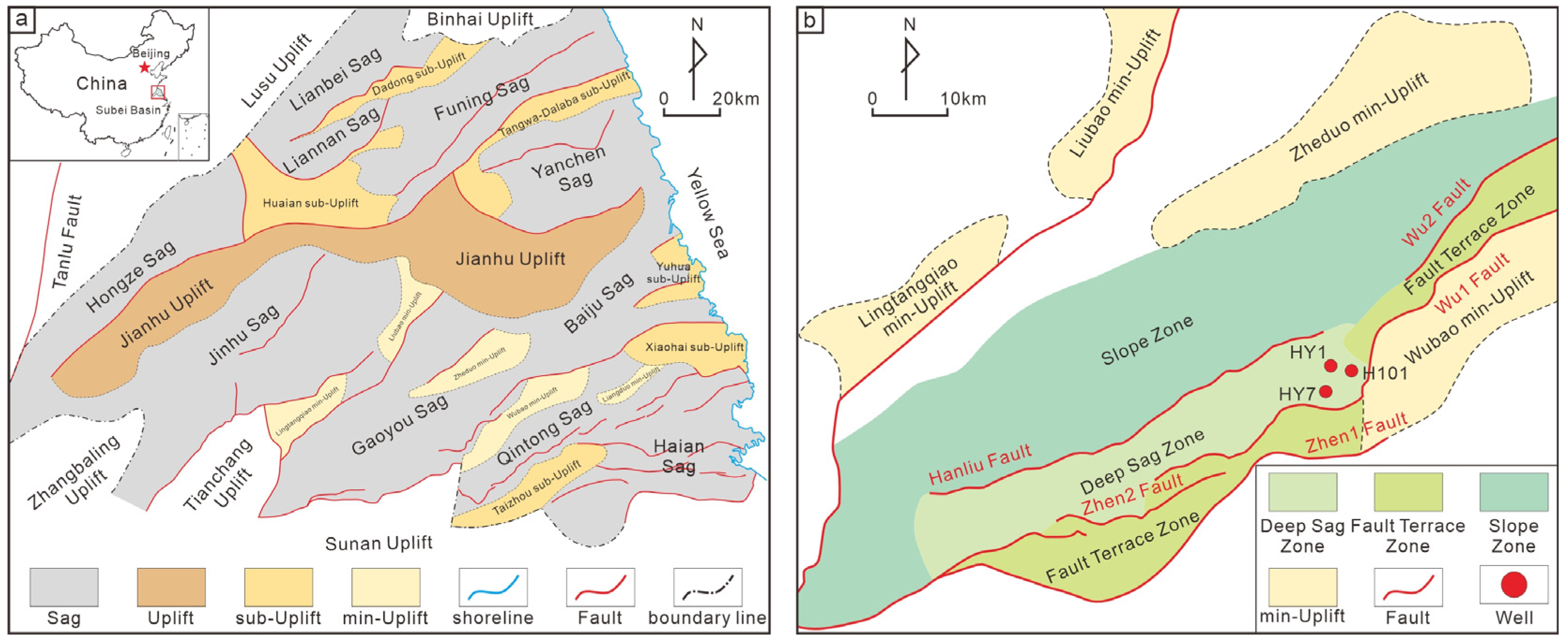
The Subei Basin is a continental rift basin that originated in the Late Cretaceous, with an area of 35,000 square kilometers [28]. This basin is situated in a complicated structural region [29], bordered to the east by the South Yellow Sea, extending westward to the Tanlu fault and Lusu uplift, and surrounded to the south and north by the Jiangsu and Binhai uplifts, respectively (Figure 1a) [27]. From the perspective of tectonic evolution, the Subei Basin has experienced two tectonic events related to rifting (Wubao and Sanduo), followed by a phase of postrift subsidence [18,23]. These two rift phases and one postrift subsidence phase led to the establishment and evolution of the “two depressions and one uplift” tectonic framework in the Subei Basin [30]. This tectonic framework is delineated by the Jianhu Uplift, with the Dongtai Depression to the south and the Yanfu Depression to the north [31].
The Gaoyou Sag, situated in the central part of the Dongtai Depression, is a dustpan-shaped sag with an area of 2670 square kilometers [33]. The southern part of this sag is characterized by active normal faults, whereas the northern part has stratigraphically overlapping structures [34]. This sag is divided into three tectonic units by five major faults [22], namely, the Zhen1, Zhen2, Wu1, Wu2, and Hanliu faults, which are sequentially present in the fault terrace zone, the deep-sag zone, and the slope zone from south to north (Figure 1b) [35].
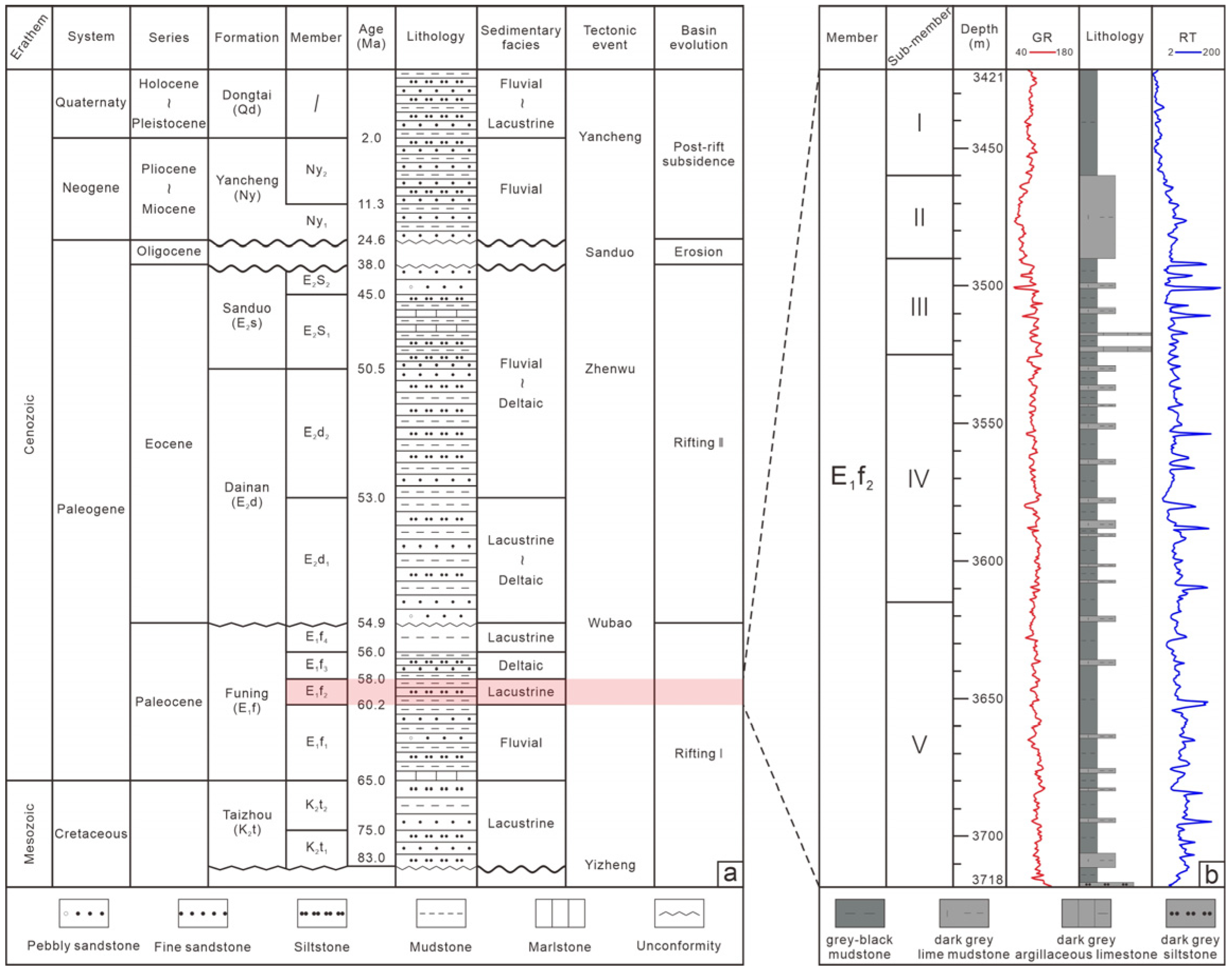
In terms of stratigraphy, the Mesozoic–Cenozoic stratigraphic deposition in the Gaoyou Sag commenced with the Cretaceous Taizhou Formation (K2t) and concluded with the Neogene Yancheng Formation (Ny) (Figure 2a) [36]. The Funing Formation is an important oil-generating and oil-producing layer, including considerable oil and gas reserves, categorized into four members: E1f1, E1f2, E1f3, and E1f4 [37]. The primary source rock layers, E1f2 and E1f4, originated in semideep- to deep-lacustrine environments [22]. The E1f2 has a thickness ranging from 250 m to 350 m and may be categorized into five submembers (Figure 2b), mostly consisting of gray-black mudstone, dark gray calcareous mudstone, and gray muddy limestone [38].

3. Samples and Methods

Core samples from three wells (HY1, HY7, and H101) were subjected to macroscopic and thin-section microscopic examination. A total of 211 samples were systematically collected from the HY1 well for subsequent analyses, including X-ray diffraction (XRD), total organic carbon (TOC), rock pyrolysis, and major and trace element determinations.

3.1. Observation of Core Samples and Thin Sections

Macroscopic examination of the core was completed in the core library of Jiangsu oilfield, and the examination primarily involved descriptions of lithology and bedding characteristics. Microscopic observation of thin sections prepared by cutting perpendicular to the core bedding was performed under a polarizing microscope (Leica DM4500P, Leica Microsystems, Wetzlar, Germany).

3.2. X-Ray Diffraction

X-ray diffraction determined the type of mineral and the mineral content by measuring the crystal structure and strength of the diffraction peaks. In this X-ray diffraction experiment, samples were processed into powder and then tested with a Rigaku Ultima IV X-ray diffractometer to determine the content of various minerals. The operating parameters of the X-ray diffractometer are set as follows: (a) Cu Kα radiation; (b) the angle between the transmitting slit and the scattering slit is 1°, and the receiving slit is 0.3 mm; (c) the scanning speed is 2°/min (2θ); (d) the sampling step width is 0.02° (2θ); (e) the scanning range (2θ) spanned from 5° to 45°. During the X-ray diffraction test, the ambient temperature was 27 °C and the humidity was 45%. The X-ray diffraction results were recorded at an ambient temperature of 27 °C and a humidity of 50%.

3.3. Total Organic Carbon

Prior to conducting the total organic carbon test on samples, the samples were first pulverized into a powder and sieved through a mesh with an aperture of less than 0.2 mm. A dilute solution of hydrochloric acid is introduced to the sifted samples to eliminate inorganic carbon. The samples, from which inorganic carbon was eliminated, were put in a constant-temperature oven and dried at 80 °C for 12 h. Finally, the LECO CS-230 (LECO Corporation, St. Joseph, MI, USA) carbon and sulfur analyzer was used to burn and oxidize the dried samples at high temperature (>800 °C), and the volume of organic carbon converted into CO2 gas was measured by a thermal conductivity meter and then converted to total organic carbon (TOC) content. The TOC testing process was strictly carried out in accordance with the standard of Determination of Total Organic Carbon in Sedimentary Rocks (GB/T 19145-2003) [39]. The TOC test results were recorded under the conditions of an ambient temperature of 24 °C and a humidity of 50%, with a result precision of 0.5%.

3.4. Rock Pyrolysis Analysis

Rock pyrolysis analysis of samples was carried out with a Rock-EVAL VI pyrolyzer (Vinci Technologies, Rueil-Malmaison, France). Before the test, the samples were crushed into a powder with diameters between 0.07 mm and 0.15 mm, and then the sample was cracked in an oxygen-free environment protected by nitrogen. During the pyrolysis of the carrier air, the hydrocarbon content of the rock sample was determined using a hydrogen flame ionization detector. An infrared detector was employed to identify carbon monoxide and carbon dioxide produced by the pyrolysis of OM, as well as carbon dioxide produced by the heating and oxidation of remaining OM after pyrolysis. The rock pyrolysis analysis experiment was conducted in accordance with the Chinese national standard GB/T 18602-2012 [40]. The test results of the rock pyrolysis analysis were recorded under the conditions of an ambient temperature of 18 °C and a humidity of 60%. In the rock pyrolysis analysis, S1 represents the content of free hydrocarbons or residual hydrocarbons in the rock before 300 °C, indicating the existing hydrocarbon content in the source rock, while S2 reflects the content of hydrocarbons produced by the pyrolysis of OM above 300 °C, suggesting the residual hydrocarbon potential of kerogen. Usually, S1 + S2 is adopted to indicate the hydrocarbon generation potential of source rocks.

3.5. Major Element

Major element analysis of samples was carried out by an Axios mAX (Panalytical, Almelo, The Netherlands) X-ray fluorescence spectrometer. During this experiment, the Axios mAX X-ray fluorescence spectrometer emits incoming X-rays to the sample through an X-ray tube. In this case, different elements of the sample are excited and emit secondary X-rays with specific energy properties or wavelength properties when receiving incident X-rays. These secondary X-ray properties are measured by the detection system, which then transforms them into element types and contents. According to the analytical method for metal elements in rock by ICP-AES and ICP-MS (SY/T 6404-2018) [41], the major element test was carried out under the conditions of an ambient temperature of 24 °C and a humidity of 45%, and the precision of the test results was better than 5%.

3.6. Trace Element

Trace element analysis of samples was conducted by using an ICAP-RQ (Thermo Fisher Scientific, Waltham, MA, USA) inductively coupled plasma–mass spectrometer. All samples must be processed into a powder and sifted using a 200-mesh screen. The sieved sample is initially dried in a 105 °C drying oven for 2 to 3 h, after which it is removed and allowed to cool to room temperature for subsequent use. Then, 0.1 g of the sample, 6 mL of HNO3, and 2 mL of HF and HCl were weighed, placed in a microwave digestion tank, heated to 185 °C, and then allowed to digest for 45 min. Following digestion, we transferred the product to the acid catcher and let it sit at 160 °C for 90 min. Next, we measured 50 mL of the acid-driven product and let it rest overnight in a plastic dosing tube. Afterwards, we extracted the supernatant from the resting solution for testing. The results were measured directly via the internal standard method, and the element content was calculated by standard curve correction. According to the analytical method for metal elements in rock by ICP-AES and ICP-MS (SY/T 6404-2018) [41], the trace element test was carried out under the conditions of an ambient temperature of 24 °C and a humidity of 40%, and the precision of the test results was better than 5%.

4. Results

4.1. Lithofacies Characteristics

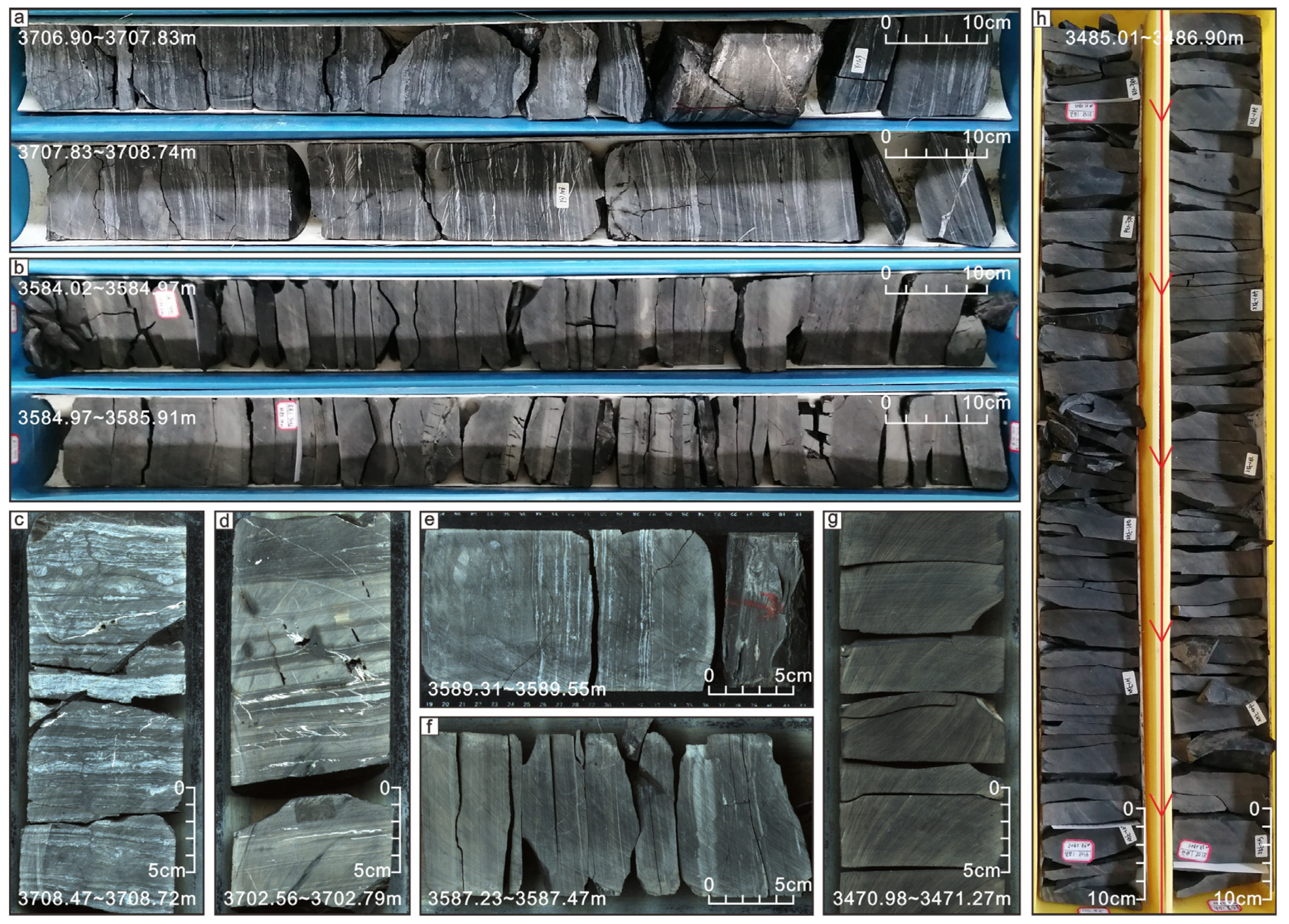
Macroscopic core observations reveal periodic changes in sedimentary structure within the E1f2. From the bottom up, laminated structures in submembers III to V (Figure 3a,b) grade into uniform, blocky structures in submembers I to II (Figure 3g,h). The laminated structure consists of alternating dark-clay layers and light felsic or carbonate layers. The felsic layer displays wavy contacts with the clay layer (Figure 3c), whereas the carbonate layer exhibits horizontal contacts (Figure 3d). In submember V, dark and light layers are thicker and show sharper boundaries; in submembers III to IV, layers are thinner, and boundaries are less distinct (Figure 3e,f).
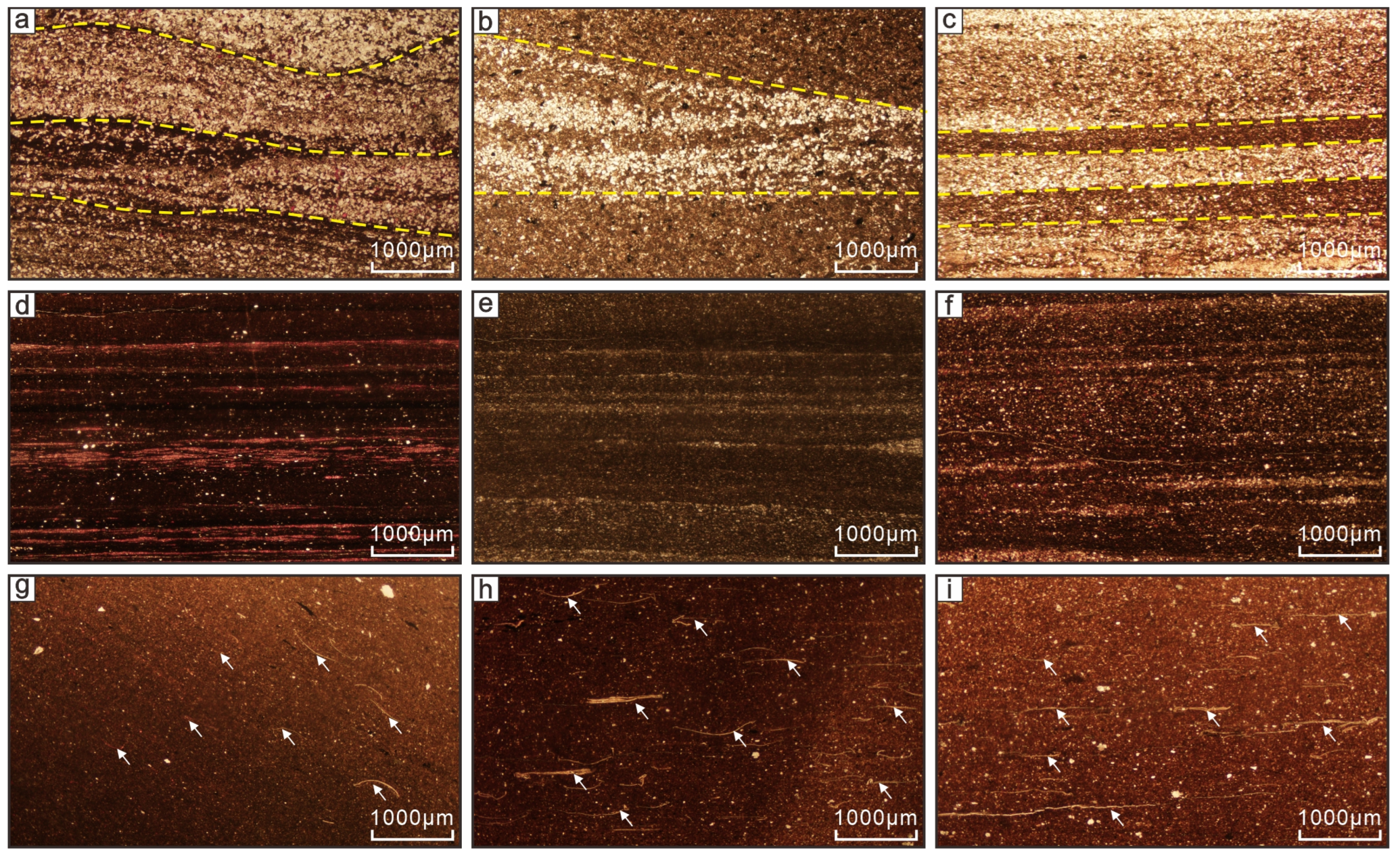
Thin-section microscopy shows that laminar contacts in submember V include horizontal, wavy, and wedge types (Figure 4a–c). Horizontal laminar contacts dominate in submembers III and IV (Figure 4d–f). Submembers I to II are characterized by a uniform, blocky structure with directionally oriented ostracod fragments (Figure 4g–i).
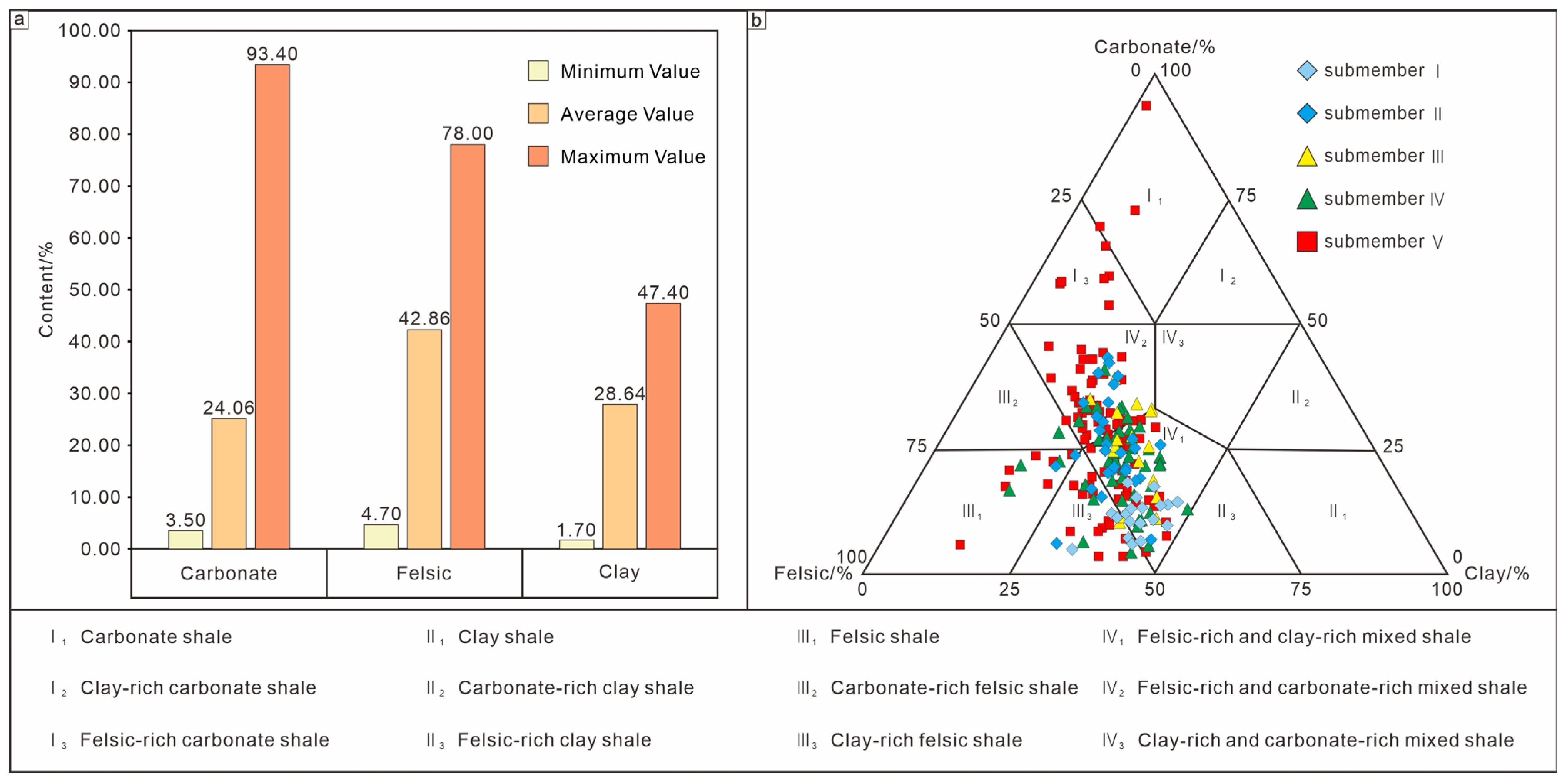
X-ray diffraction analysis yields an average felsic mineral content of 42.86%, clay mineral content of 28.64% (<50% in all samples), and a carbonate mineral content of 24.06% (range: 3.50–93.40%) (Figure 5a). Analysis of 19 samples shows that the clay mineral assemblage comprises illite (averaging 41.4%), illite–smectite mixed layers (averaging 41.3%), chlorite (averaging 11.0%), and kaolinite (averaging 6.3%) (Table 1). Based on X-ray diffraction results, the shale of E1f2 is classified using felsic, clay, and carbonate as the three fundamental end members, with mineral contents of 25% and 50% serving as the boundaries for lithofacies classification. The lithofacies classification reveals seven distinct lithofacies types in the E1f2, with the felsic-rich and clay-rich mixed shale and the felsic-rich and carbonate-rich mixed shale being the most prominent (Figure 5b).

4.2. Organic Geochemical Characteristics

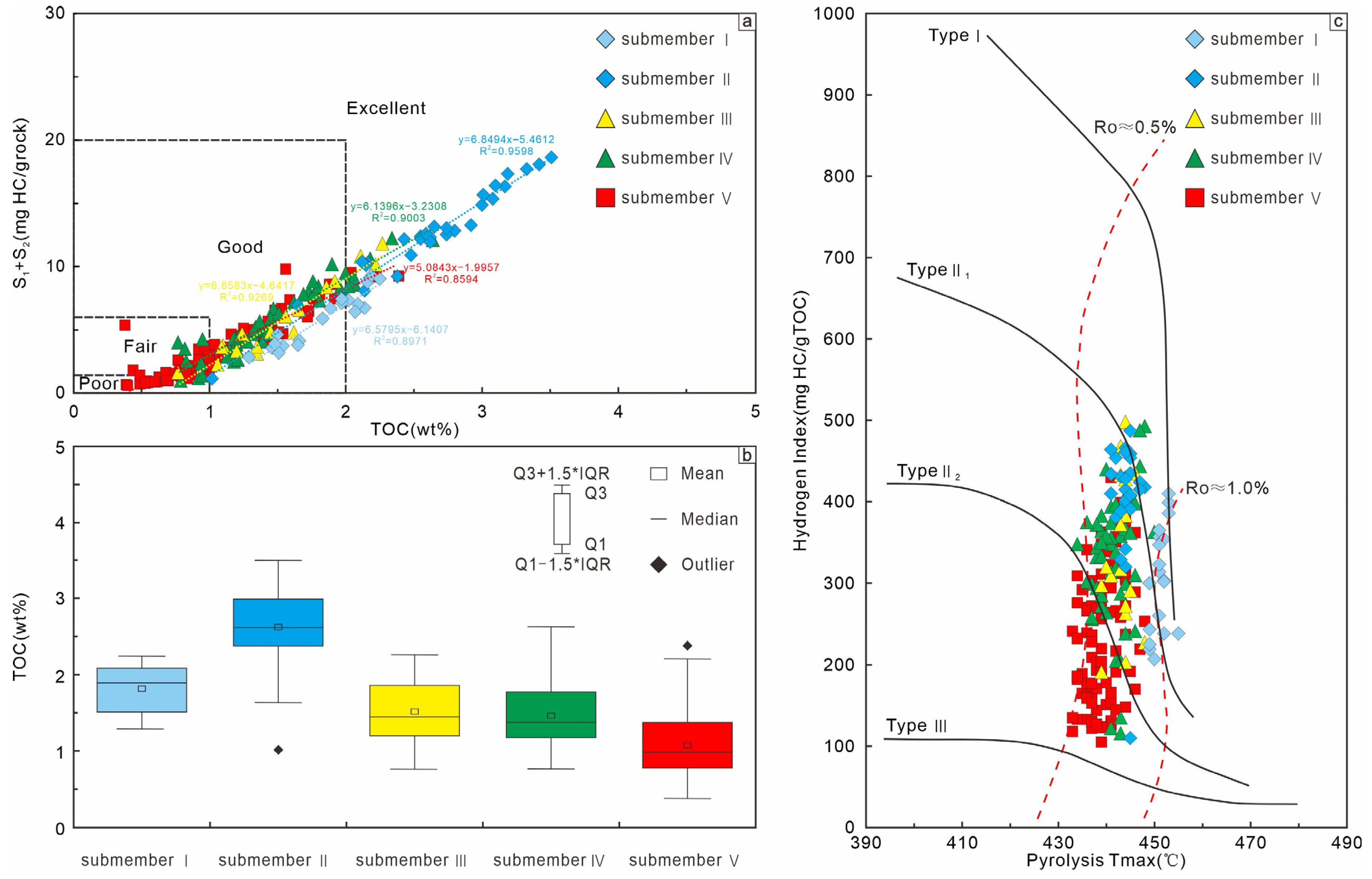
Among 211 samples from the HY1 well, TOC contents of the E1f2 range from 0.38% to 3.51% (averaging 1.48%). Hydrocarbon generation potential (S1 + S2) ranges from 0.59 mg/g to 18.62 mg/g (averaging 5.66 mg/g). The TOC content has a strong positive correlation with the hydrocarbon generation potential (S1 + S2) in different maturity ranges (Figure 6a).
Based on TOC content, the E1f2 is divided into three intervals: a low-organic-carbon stage (TOC < 1%), a moderate-organic-carbon stage (1% ≤ TOC ≤ 2%), and a high-organic-carbon stage (TOC > 2%). Submember V falls into the low-organic-carbon stage, with TOC contents of 0.38% to 2.39% (averaging 1.08%) and S1 + S2 values of 0.59 mg/g to 9.80 mg/g (averaging 3.48 mg/g). Submembers III and IV belong to the moderate-organic-carbon stage, with TOC ranges of 0.77% to 2.27% (averaging 1.52%) and 0.77% to 2.64% (averaging 1.47%), and S1 + S2 ranges of 1.62 mg/g to 11.80 mg/g (averaging 5.78 mg/g) and 0.97 mg/g to 12.25 mg/g (averaging 5.79 mg/g), respectively. Submembers I and II correspond to the high-organic-carbon stage, with TOC ranges of 1.29% to 2.25% (averaging 1.82%) and 1.02% to 3.51% (averaging 2.63%), and S1 + S2 ranges of 2.84 mg/g to 9.29 mg/g (averaging 5.87 mg/g) and 1.13 mg/g to 18.62 mg/g (averaging 12.52 mg/g), respectively (Figure 6a,b).
Hydrogen index (HI) values range from 105 mg/g to 498 mg/g, and Tmax values range from 433 °C to 455 °C. On the HI versus Tmax diagram, most samples plot in the Type II kerogen field (Figure 6c). Vertically, HI values show an overall increasing trend from the bottom to the top: submember V has an HI of 105 mg/g to 430 mg/g (averaging 240 mg/g); submember IV has an HI of 116 mg/g to 493 mg/g (averaging 326 mg/g); submember III has an HI of 191 mg/g to 498 mg/g (averaging 336 mg/g); submember II has the highest HI values of 110 mg/g to 487 mg/g (averaging 406 mg/g); and submember I has an HI of 207 mg/g to 410 mg/g (averaging 305 mg/g).

4.3. Element Characteristics

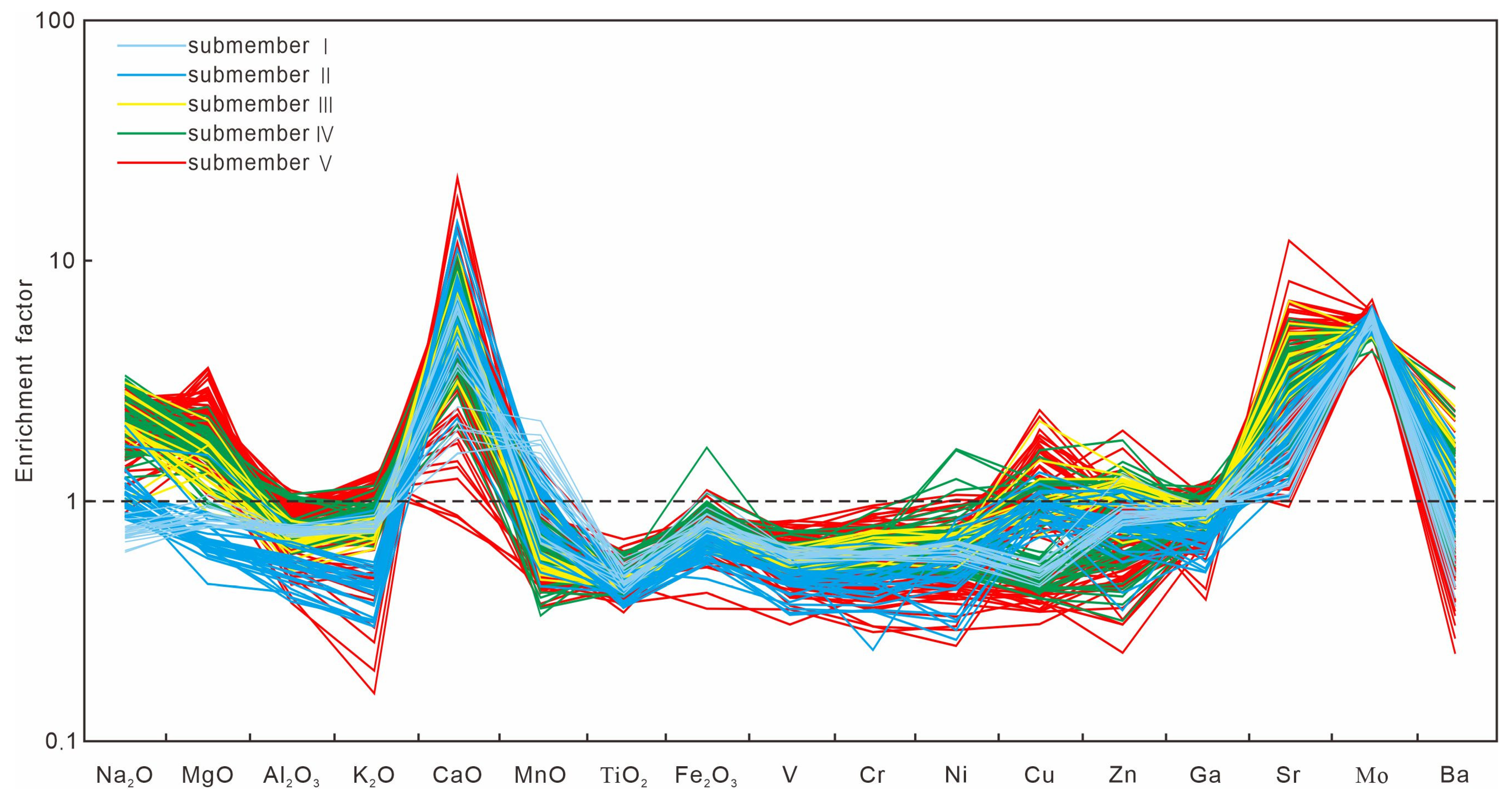
This study examined the major elements Na2O, MgO, Al2O3, K2O, CaO, MnO, TiO2, and Fe2O3, as well as the trace elements V, Cr, Ni, Cu, Zn, Ga, Sr, Mo, and Ba. In contrast to Post-Archaean Australian Shale (PAAS) [42,43], the E1f2 exhibits substantial enrichment in CaO Sr, and Mo; slight enrichment in Na2O, MgO, and Ba; and slight depletion in MnO, TiO2, Al2O3, K2O, Fe2O3, V, Cr, Ni, Cu, Zn, and Ga (Figure 7).

5. Discussion

5.1. Palaeoenvironmental Reconstruction

5.1.1. Palaeoclimate Conditions

The Sr/Cu ratio serves as an effective palaeoclimate proxy: Sr/Cu < 5, 5–10, and >10 correspond to humid, semiarid, and arid climates, respectively [44,45,46]. Generally, a high Mg/Ca ratio indicates an arid climate, while a low ratio indicates a humid climate [47]. Moreover, carbonate content also tends to increase under arid conditions [48].
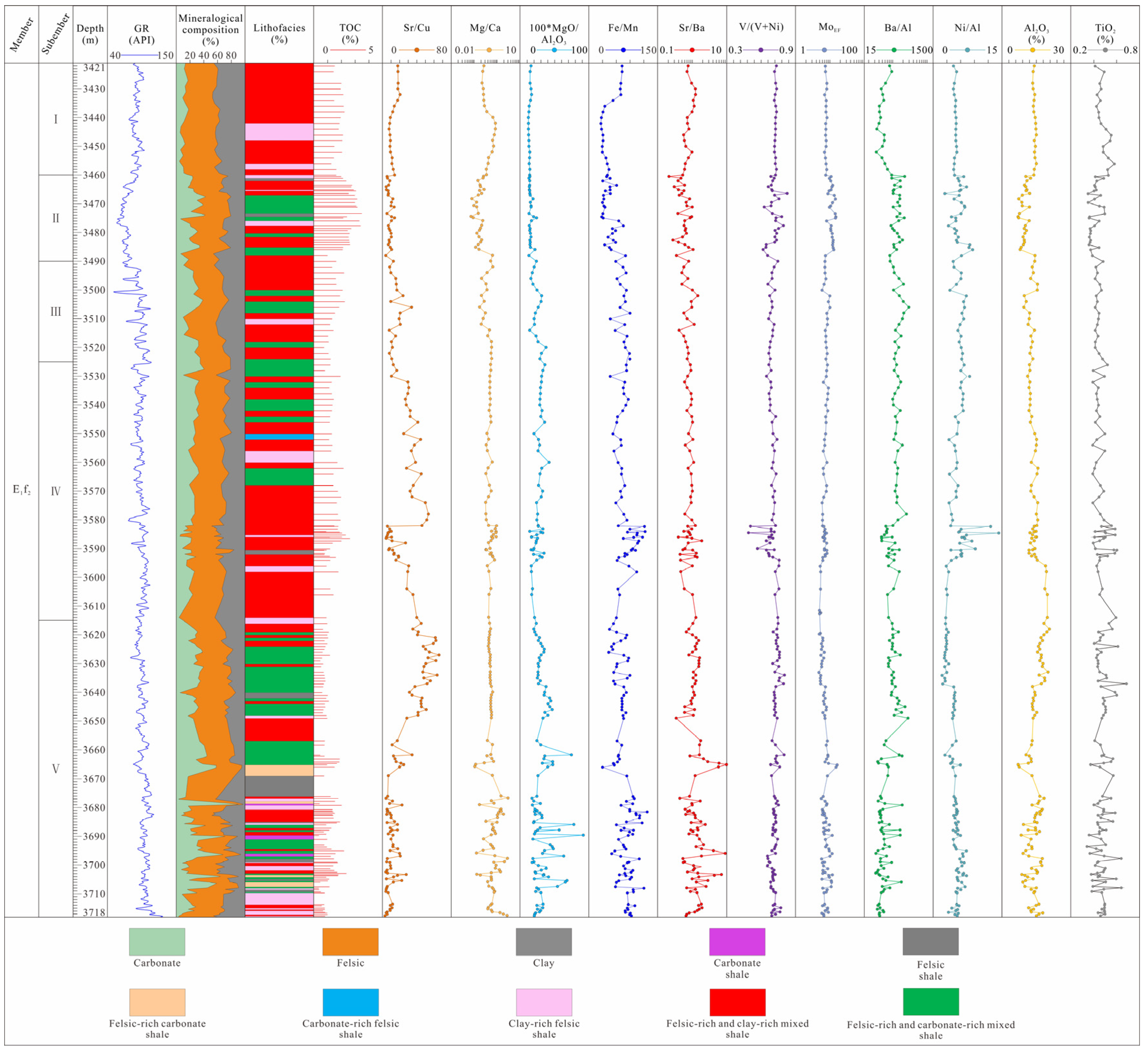
Submember V exhibits the highest values of Sr/Cu (averaging 22.62), Mg/Ca (averaging 0.73), and carbonate content (averaging 27.54%), indicating an arid climate; submembers III to IV show decreased values of these proxies (averaging 22.07, 0.49, and 21.95%, respectively), indicating a semiarid to arid climate; and submembers I to II display the lowest values (averaging 9.96, 0.30, and 19.92%, respectively), indicating a humid to semiarid climate (Figure 8).

5.1.2. Palaeowater Depth

The 100 × MgO/Al2O3 and Fe/Mn ratios serve as effective palaeowater depth proxies: both ratios decrease with increasing water depth [49,50,51,52,53]. Additionally, lamina types provide direct sedimentological evidence for hydrodynamic conditions.
Submember V exhibits the highest values of 100 × MgO/Al2O3 (averaging 32.45) and Fe/Mn (averaging 78.54), together with wavy and wedge laminae, indicating a semideep lacustrine environment; submembers III to IV show decreased values of these proxies (averaging 25.42 and 79.51, respectively) and dominant horizontal laminae, indicating a semideep- to deep-lacustrine environment; and submembers I to II display the lowest values (averaging 14.60 and 45.42, respectively) and massive structures, indicating a deep-lacustrine environment (Figure 8).

5.1.3. Palaeosalinity Conditions

Sr/Ba ratios serve as a tool for reconstructing palaeosalinity [54,55,56]. Sr/Ba ratios classify the palaeosalinity as either fresh water (<0.5), brackish water (0.5–1), or saltwater (>1) [57].
Submember V exhibits the highest Sr/Ba ratio (averaging 1.61), indicating saline water; submembers III to IV show a decreased Sr/Ba ratio (averaging 0.84), indicating brackish to saline water; and submembers I to II display the lowest Sr/Ba ratio (averaging 0.68), indicating fresh to brackish water (Figure 8).

5.1.4. Palaeoredox Conditions

Due to the different redox sensitivities of vanadium and nickel in water [58,59,60], the V/(V + Ni) ratio can be used to classify depositional environments into oxic (<0.46), dysoxic (0.46–0.60), anoxic (0.60–0.84), and euxinic (0.84–1.00) [17,61,62]. Submember V exhibits an average V/(V + Ni) ratio of 0.72, which decreases slightly to 0.69 in submembers III to IV and increases back to 0.72 in submembers I to II (Figure 8). All these values are consistently greater than 0.46, indicating that the water remained persistently anoxic during the E1f2.
Molybdenum will accumulate under reducing conditions [63,64,65], and the degree of accumulation is usually represented by the enrichment factor (EF) [66,67]. MoEF in the study area is relatively high, ranging from 4.77 to 16.23 (averaging 7.93) (Figure 8), which further indicates that the water was in an anoxic state during the E1f2.

5.1.5. Palaeoproductivity Conditions

Ba/Al and Ni/Al ratios are widely used as palaeoproductivity proxies in lacustrine systems, as they minimize the dilution effect of terrigenous input [59,68,69,70].
The E1f2 shales exhibit relatively high Ba/Al ratios (averaging 98.74) compared to PAAS (averaging 68.78) and North American Shales (averaging 75.32) [43,71,72,73]. Submember V exhibits the lowest values of Ba/Al (averaging 79.95) and Ni/Al (averaging 4.65), indicating low productivity; submembers III to IV show the highest values of these proxies (averaging 122.60 and 5.80, respectively), indicating peak productivity; and submembers I to II display intermediate values (averaging 103.87 and 5.36, respectively), indicating moderate productivity (Figure 8).

5.1.6. Terrigenous Input

The Al2O3 and TiO2 contents serve as effective terrigenous input proxies: higher values indicate stronger terrigenous input [18,69,74,75].
Compared with the Al2O3 content of PAAS (averaging 18.90%), the terrigenous input of the E1f2 was relatively low [43]. Submember V exhibits the highest Al2O3 content (averaging 14.42%) and the highest TiO2 content (averaging 0.48%), indicating strong terrigenous input; submembers III to IV show decreased Al2O3 content (averaging 13.76%) and decreased TiO2 content (averaging 0.46%), indicating moderately strong terrigenous input; and submembers I to II display the lowest Al2O3 content (averaging 11.68%) and the lowest TiO2 content (averaging 0.44%), indicating weak terrigenous input (Figure 8).

5.2. Controlling Organic Matter Enrichment by Sedimentary Environment

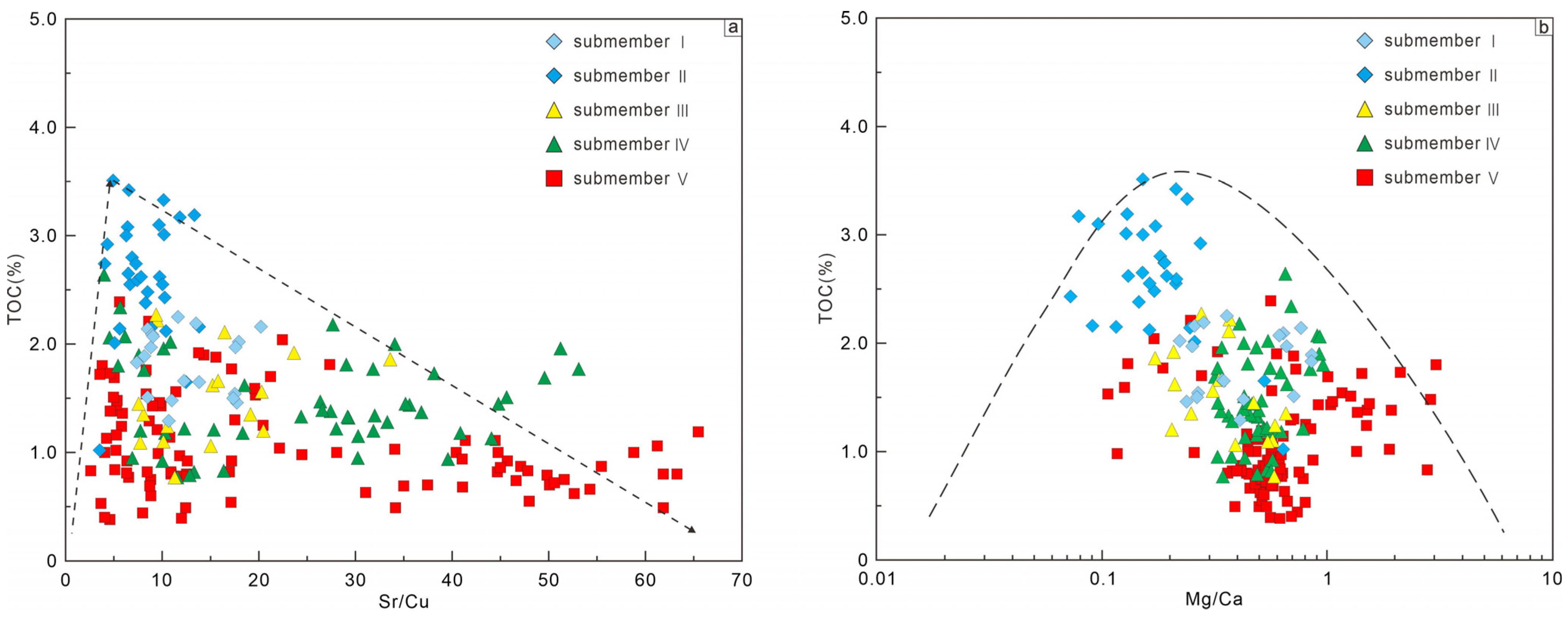
Palaeoclimate indirectly regulates organic matter enrichment by modulating catchment weathering, lake hydrology, and salinity [76,77,78]. TOC exhibits an initial positive correlation with Sr/Cu ratios, which transitions to a negative correlation after an inflection point at Sr/Cu ≈ 5 (Figure 9a). This pattern differs from the conventional view that humid climates are most favorable for organic matter enrichment in lacustrine shales in China [53,79,80,81], suggesting that moderate aridity enhances nutrient availability and boosts productivity, thereby promoting organic matter accumulation [82,83,84]. The consistent relationship between Mg/Ca and TOC further corroborates this interpretation (Figure 9b).
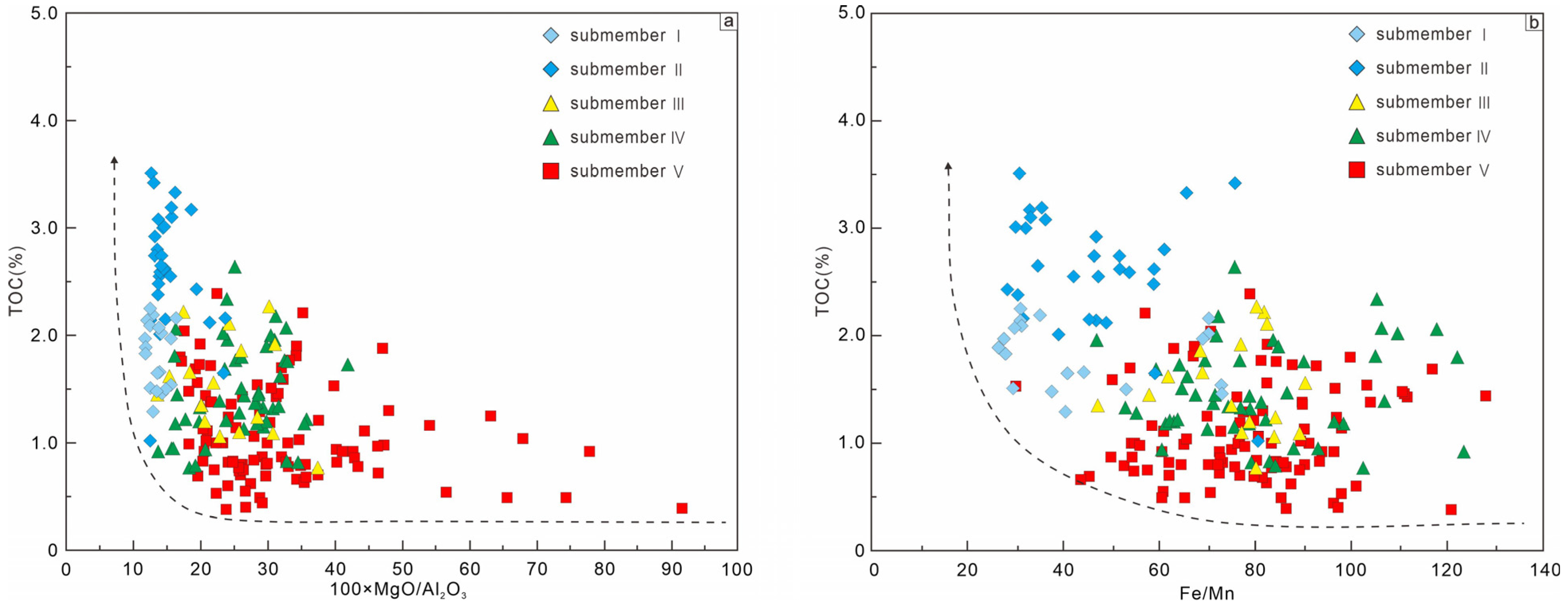
TOC exhibits negative correlations with both 100 × MgO/Al2O3 and Fe/Mn ratios in the E1f2 (Figure 10a,b), indicating that increased water depth promotes organic matter enrichment. This pattern is consistent with observations from other lacustrine shales in China [51,52,53]. However, previous studies have predominantly attributed the positive effect of water depth to enhanced bottom-water anoxia and improved preservation conditions [85,86]. In contrast, this study demonstrates that water depth also facilitates OM enrichment by reducing sedimentation rates [77], thereby weakening terrigenous dilution.
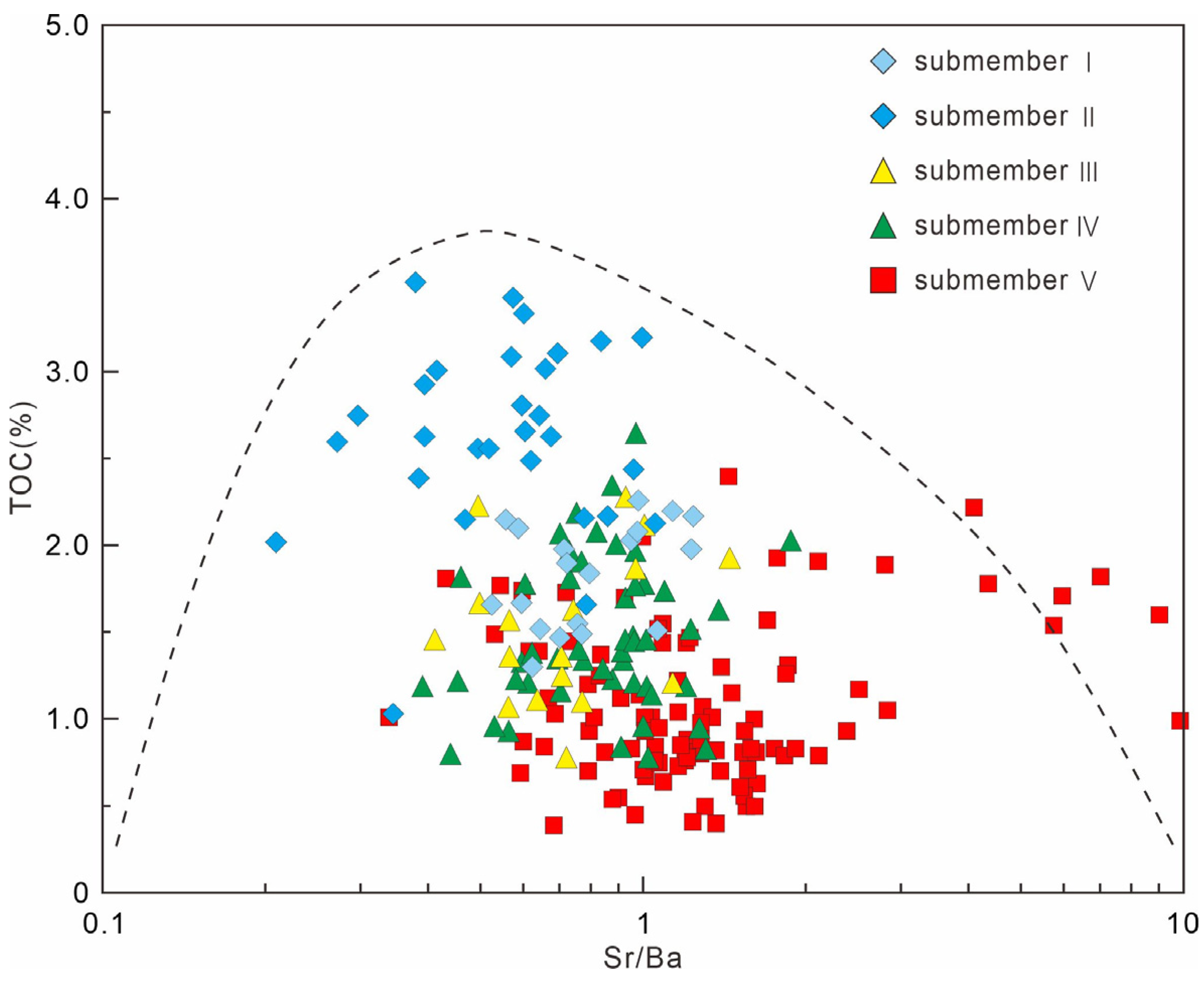
Palaeosalinity exerts a threshold control on OM enrichment [87,88,89], with TOC increasing under moderate salinity but decreasing when salinity exceeds biological tolerance (Figure 11). This salinity suppression phenomenon has been widely observed in Chinese basins such as the Bohai Bay and Qaidam basins [90,91]. However, the critical salinity threshold varies among basins due to differences in biological assemblages [55]. In the E1f2, the optimal Sr/Ba ratio for OM enrichment is approximately 0.5.
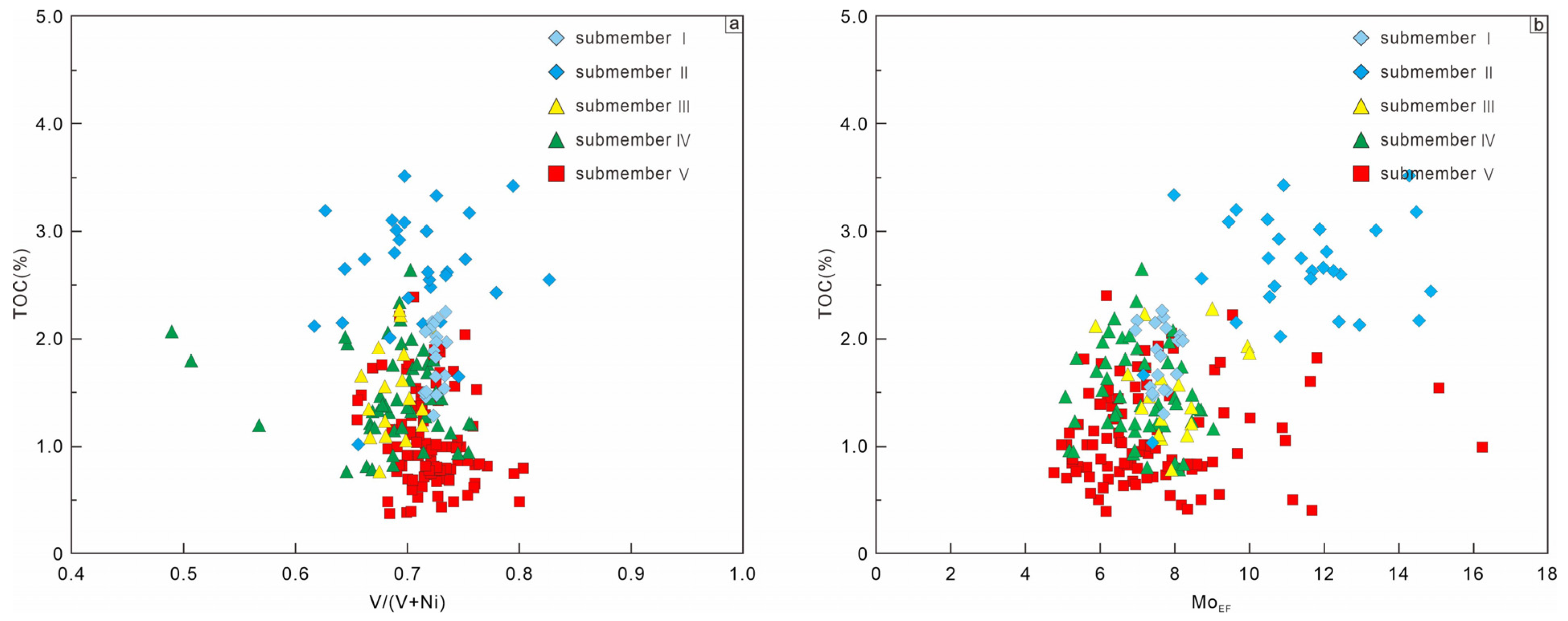
Palaeoredox conditions exert no direct control on OM enrichment in the E1f2, as evidenced by the lack of correlation between TOC and both V/(V + Ni) and MoEF (Figure 12a,b). This phenomenon does not negate the importance of anoxic preservation [19,92,93,94,95]; rather, it reflects that when anoxia is a background condition rather than a limiting factor, its control on OM enrichment becomes secondary [53,96]. Once a threshold level of anoxia is exceeded, further increases in reducing intensity do not translate into proportional gains in OM preservation [97]. In such settings, the primary control shifts to OM production and terrigenous dilution.
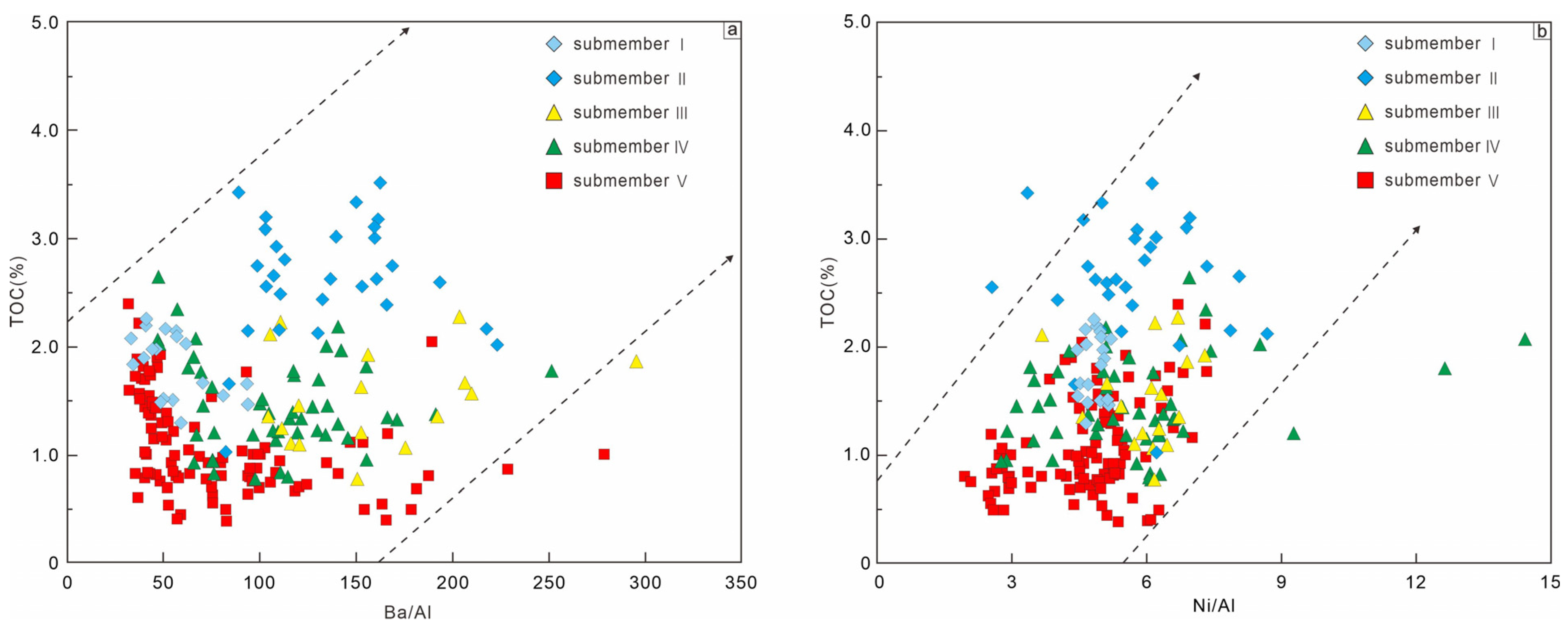
The high productivity of lakes serves as a crucial foundation for the enrichment of OM [79,98]. The TOC content in E1f2 was weakly positively correlated with the Ba/Al and Ni/Al ratios (Figure 13a,b). Meanwhile, the maximum value of the palaeoproductivity index did not correspond to the maximum value of TOC. This evidence indicates that palaeoproductivity has a controlling effect on the OM enrichment in E1f2, but the controlling effect is relatively weak. This understanding is different from that of most lacustrine basins in China, especially those freshwater-lake basins dominated by palaeoproductivity forces [21,35,53,79].
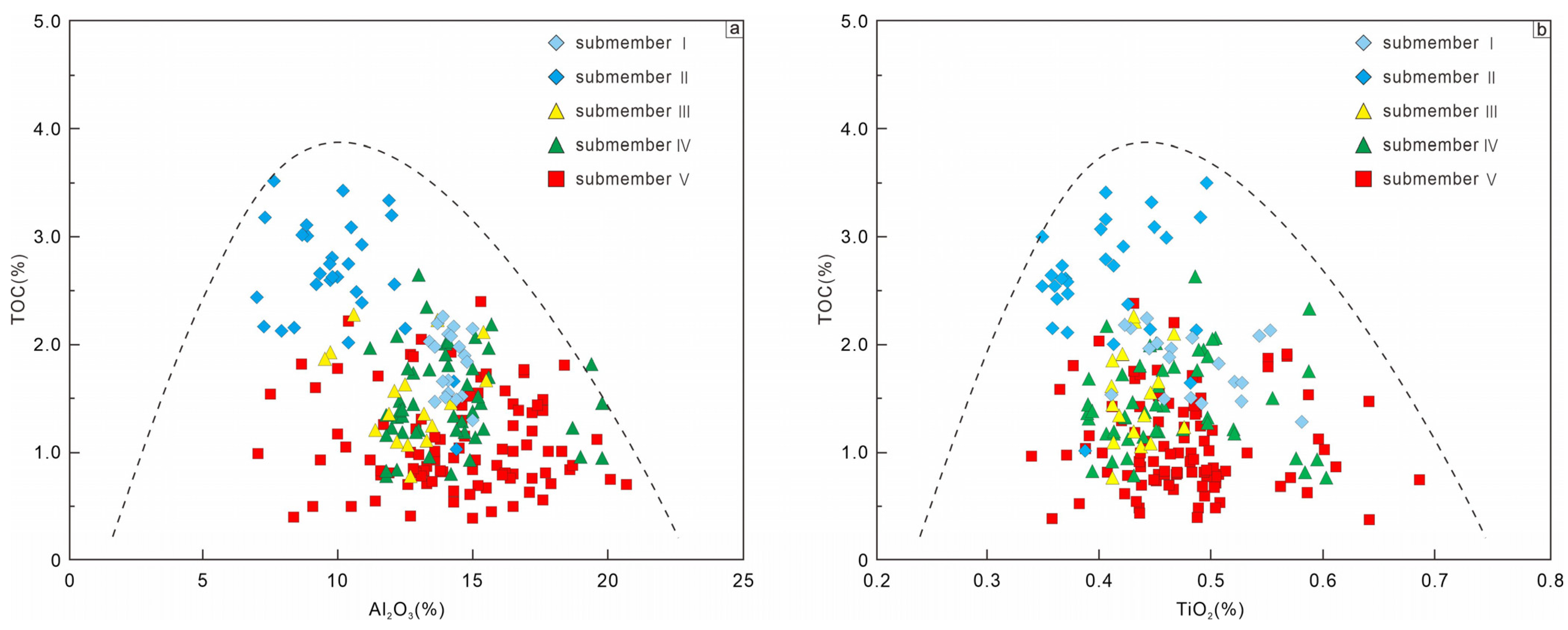
Terrigenous input dilutes OM concentration to a certain extent, decreasing the OM content per unit of sediment, and therefore has a substantial impact on OM enrichment [99]. Too little terrigenous input increases the time available for OM degradation during its settling in the lake basin, whereas too much terrigenous input decreases the content of OM per unit of sediment, both of which are unfavorable for OM enrichment [100]. In the E1f2, as the Al2O3 and TiO2 content rises, the TOC content first rises before falling, indicating that an appropriate terrigenous input is beneficial for OM enrichment (Figure 14a,b). Appropriate terrigenous inputs can introduce exogenous nutrients to lacustrine systems, thereby increasing their productivity [93]. Concurrently, this process prevents excessive oxidation and dilution of OM during sedimentation within the lacustrine environment [97], facilitating the enrichment of OM.
This mechanism is further supported by petrological evidence. As documented in Section 4.1, the lamina types, thicknesses, and contact relationships across different submembers record a systematic evolution of terrigenous input intensity. Submember V exhibits the highest terrigenous input intensity (Al2O3 averaging 14.42%; TiO2 averaging 0.48%), corresponding to thick, sharply bounded laminated fabrics with wavy, wedge, and horizontal lamina contacts (Figure 4a–c). The wavy and wedge laminae indicate high-frequency episodic input events under relatively strong hydrodynamic conditions. Each light lamina represents a terrigenous input that not only strongly dilutes organic matter but also introduces intermittent oxygen disturbance at the sediment–water interface. Consequently, this submember records the lowest TOC content in the entire succession (averaging 1.08%). Submembers III to IV show reduced terrigenous input intensity (Al2O3 averaging 13.76%; TiO2 averaging 0.46%), with corresponding modifications in lamina architecture: laminae become significantly thinner, their boundaries become more diffuse, and horizontal laminae dominate (Figure 4d–f). This transition records two sedimentological signals: a decrease in the frequency or intensity of episodic input events, and prolonged inter-event intervals under more quiescent hydrodynamic conditions. Although dilution effects remain significant, their intensity has moderated compared to submember V. Accordingly, these submembers yield moderate TOC contents (averaging 1.48%). Submembers I to II record the lowest terrigenous input intensity (Al2O3 averaging 11.68%; TiO2 averaging 0.44%), with a complete lithofacies shift from laminated to uniform, blocky fabrics. No event laminae are preserved, and ostracod fragments exhibit random orientations (Figure 4g–i). This assemblage indicates continuous suspension settling under low-energy conditions, with episodic dilution events virtually absent. Therefore, these submembers attain the highest TOC contents in the E1f2 (averaging 2.31%). In summary, the upward lithofacies evolution from thick, sharp lamina structures in submember V, through thin, diffuse lamina structures in submembers III to IV, to uniform, blocky structures in submembers I to II is tightly coupled with the systematic decline in terrigenous input recorded by Al2O3 and TiO2, and with the stepwise increase in TOC contents from 1.08% to 1.48% to 2.31%. This directly documents the complete evolutionary trajectory of the weakening dilution effect of terrigenous input on organic matter abundance.
Based on the influence of terrestrial input on the enrichment of organic matter in this study, future research is necessary to further explore how different terrestrial input conditions affect the enrichment of organic matter.

5.3. Model of Organic Matter Enrichment

Overall, there are three phases that the E1f2 sedimentary environment went through during its history: the low-organic-carbon stage (submember V), the moderate-organic-carbon stage (submembers III to IV), and the high-organic-carbon stage (submembers I to II). Therefore, different models have been established to clarify the mechanism of OM enrichment at different stages in the E1f2.
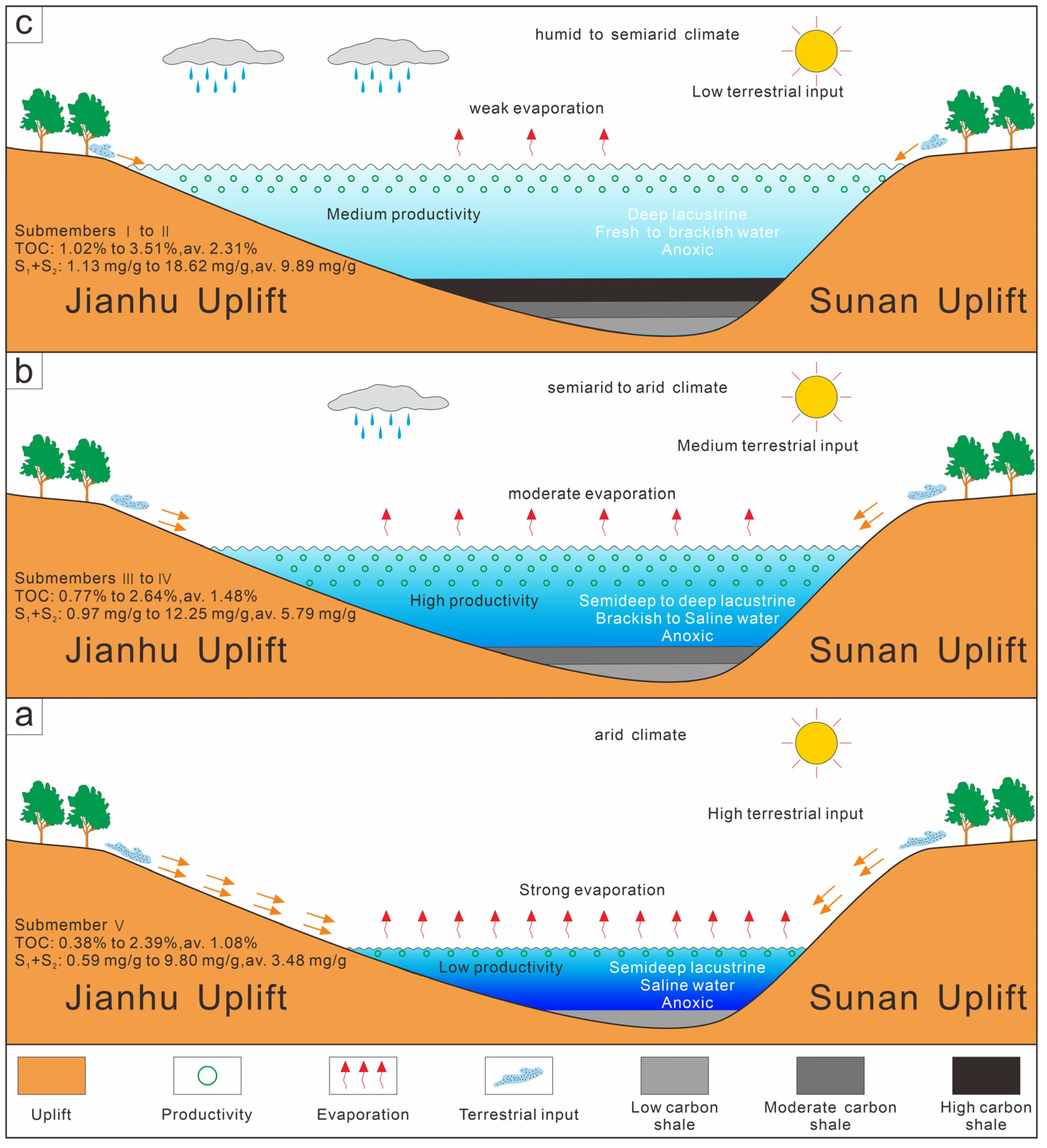
The depositional period of submember V was characterized by a semideep-lake sedimentary environment. The palaeoclimate during this period was predominantly arid, leading to intense evaporation that resulted in a saltwater environment. The high salinity of the lake caused stratification of the water, creating an anoxic condition that was favorable for the preservation of OM. However, the excessive salinity at this time limited the large-scale development of aquatic organisms, fundamentally limiting the level of palaeoproductivity. Additionally, the larger terrigenous input diluted the OM concentration, resulting in a relatively low abundance of OM throughout this stage, therefore categorizing it as a low-organic-carbon stage with a low hydrocarbon generation potential (Figure 15a).
The depositional period of submembers III and IV was characterized by a sedimentary environment that transitioned from semideep- to deep-lake conditions. Compared with submember V, the palaeoclimate during this period was less arid, leading to a reduction in lacustrine salinity and the establishment of a brackish-water to saltwater environment. Despite the reduction in palaeosalinity diminishing water stratification, the environment continued to be anoxic. More significantly, the decrease in palaeosalinity allowed for the gradual growth and reproduction of aquatic organisms, resulting in relatively high palaeoproductivity. However, the diluting effect of terrigenous input on OM remained high during this stage, leading to a moderate level of OM abundance, classifying it as a moderate-organic-carbon stage with a moderate hydrocarbon generation potential (Figure 15b).
The depositional period of submembers I to II was characterized by a deep-lake sedimentary environment. The palaeoclimate, ranging from humid to semiarid conditions, caused the water salinity to decrease to its lowest level. The increased water depth prevented light from reaching deeper water, reducing the amount of oxygen produced by photosynthesis and limiting the vertical exchange of oxygen in the water, which in turn created a more anoxic environment again. Compared with that of submembers III and IV, the palaeoproductivity during this stage slightly decreased. However, the relatively deep water depth limited terrigenous input, greatly reducing the dilution of OM. Consequently, the organic carbon abundance in this stage was relatively high, classifying it as a high-organic-carbon stage with a high hydrocarbon generation potential (Figure 15c).

6. Conclusions

(1)
The E1f2 shale exhibits seven lithofacies types, transitioning upward from laminated (submembers III to V) to uniform, blocky structures (submembers I and II). Vertically, TOC content and hydrocarbon generation potential increase stepwise from low (submember V), through moderate (submembers III and IV), to high values (submembers I and II). Organic matter is predominantly Type II. This lithofacies–geochemistry coupling documents a systematic weakening of terrigenous dilution and forms the material basis for OM enrichment.
(2)
The paleoenvironment of the E1f2 evolved through three coupled stages. An arid climate, saline water, a semideep-lacustrine environment, and strong terrigenous input characterized submember V. Submembers III and IV featured a semiarid to arid climate, brackish to saline water, a semideep- to deep-lacustrine environment, and peak paleoproductivity. Submembers I and II were characterized by a humid to semiarid climate, fresh to brackish water, a deep-lacustrine setting, and substantially reduced terrigenous input. Anoxic conditions persisted throughout, while paleoproductivity first increased, then decreased, and terrigenous input declined continuously. Organic matter enrichment in the E1f2 is jointly controlled by paleoclimate, paleowater depth, paleosalinity, and terrigenous input, with paleoproductivity playing a subordinate role and redox conditions exerting no direct influence.
(3)
The core innovation of this study lies in revealing the non-linear dual control mechanism of terrigenous input on organic matter enrichment and, for the first time, systematically characterizing the complete lithofacies evolutionary pathway, recording the weakening of terrigenous dilution through integrated petrological–geochemical analysis. This finding breaks through the long-standing “productivity-dominant” or “preservation-dominant” single-factor enrichment models in lacustrine-organic-matter research and establishes that, under persistently anoxic saline lacustrine conditions, terrigenous input can rise to become the first-order controlling factor for organic matter enrichment. Based on these insights, future research should focus on the differential regulatory mechanisms of various terrigenous input conditions (insufficient, optimal, and excessive) on organic matter enrichment and their corresponding petrological response characteristics, thereby advancing sweet-spot prediction in continental shale oil exploration.

Author Contributions

Conceptualization, Y.S. (Yan Song) and X.G.; methodology, Y.S. (Yan Song); software, Y.S. (Yaxiong Sun); validation, H.D., Y.W. and X.G.; formal analysis, X.G.; investigation, Y.S. (Yan Song); resources, H.D. and Y.S. (Yaxiong Sun); data curation, Y.T. and K.X.; writing—original draft preparation, Y.S. (Yan Song); writing—review and editing, X.G.; visualization, Y.S. (Yan Song); supervision, X.G.; project administration, Y.W., Y.T. and K.X.; funding acquisition, H.D. and Y.S. (Yaxiong Sun). All authors have read and agreed to the published version of the manuscript.

Funding

This research was funded by the Sinopec Science and Technology Development Department (No. P23189 and P24207), Sinopec Jiangsu Oilfield Company (No. JS24038), and Jiangsu Excellent Postdoctoral Program (No. 2022ZB897).

Data Availability Statement

The data presented in this study are available on request from the corresponding author.

Conflicts of Interest

Authors Hongliang Duan and Yaxiong Sun were employed by the SINOPEC Jiangsu Oilfield Company. Author Yonghui Wang was employed by the Petroleum Exploration and Production Research Institute, SINOPEC. Author Yuantao Tang was employed by the PetroChina Zhejiang Oilfield Company. Author Kai Xue was employed by the Research Institute of Petroleum Exploration and Development, PetroChina Huabei Oilfield Company. The remaining authors declare that the research was conducted in the absence of any commercial or financial relationships that could be construed as a potential conflict of interest. The SINOPEC Jiangsu Oilfield Company, SINOPEC, PetroChina Zhejiang Oilfield Company and PetroChina Huabei Oilfield Company had no role in the design of the study; in the collection, analyses, or interpretation of data; in the writing of the manuscript, or in the decision to publish the results.

Abbreviations

The following abbreviations are used in this manuscript:
E1f2The second member of the Funing Formation
OMOrganic matter
XRDX-ray diffraction
TOCTotal organic carbon
PAASPost-Archaean Australian shale
S1Content of free hydrocarbons or residual hydrocarbons in the rock before 300 °C
S2Content of hydrocarbons produced by the pyrolysis of OM above 300 °C
S1 + S2Hydrocarbon generation potential

References

  1. Xin, B.; Hao, F.; Han, W.; Xu, Q.; Zhang, B.; Tian, J. Paleoenvironment Evolution of the Lacustrine Organic-Rich Shales in the Second Member of Kongdian Formation of Cangdong Sag, Bohai Bay Basin, China: Implications for Organic Matter Accumulation. Mar. Pet. Geol. 2021, 133, 105244. [Google Scholar] [CrossRef]
  2. Yan, C.; Jin, Z.; Zhao, J.; Du, W.; Liu, Q. Influence of Sedimentary Environment on Organic Matter Enrichment in Shale: A Case Study of the Wufeng and Longmaxi Formations of the Sichuan Basin, China. Mar. Pet. Geol. 2018, 92, 880–894. [Google Scholar] [CrossRef]
  3. Ngia, N.R.; Menkem, E.F.; Fuanya, C.; Agyingi, C.M. Multiproxy Analysis of Paleoredox Conditions, Paleoproductivity and Organic Matter Enrichment in Cretaceous Mudrocks of Bombe-Ediki and Environs in the Douala Sub-Basin. Solid Earth Sci. 2025, 10, 100210. [Google Scholar] [CrossRef]
  4. Wu, Y.; Jiang, F.; Xu, Y.; Guo, J.; Xu, T.; Hu, T.; Shen, W.; Zheng, X.; Chen, D.; Jiang, Q.; et al. Middle Eocene Climatic Optimum Drove Palaeoenvironmental Fluctuations and Organic Matter Enrichment in Lacustrine Facies of the Bohai Bay Basin, China. Palaeogeogr. Palaeoclimatol. Palaeoecol. 2025, 659, 112665. [Google Scholar] [CrossRef]
  5. Lei, W.; Chen, D.; Liu, Z.; Cheng, M. Paleoenvironment-Driven Organic Matter Accumulation in Lacustrine Shale Mixed with Shell Bioclasts: A Case Study from the Jurassic Da’anzhai Member, Sichuan Basin (China). J. Pet. Sci. Eng. 2023, 220, 111178. [Google Scholar] [CrossRef]
  6. Fang, R.; Jiang, Y.; Sun, S.; Luo, Y.; Qi, L.; Dong, D.; Lai, Q.; Luo, Y.; Jiang, Z. Controlling Factors of Organic Matter Accumulation and Lacustrine Shale Distribution in Lianggaoshan Formation, Sichuan Basin, SW China. Front. Earth Sci. 2023, 11, 1218215. [Google Scholar] [CrossRef]
  7. Ross, D.J.K.; Marc Bustin, R. The Importance of Shale Composition and Pore Structure upon Gas Storage Potential of Shale Gas Reservoirs. Mar. Pet. Geol. 2009, 26, 916–927. [Google Scholar] [CrossRef]
  8. Qiu, Z.; Zou, C. Controlling Factors on the Formation and Distribution of “Sweet-Spot Areas” of Marine Gas Shales in South China and a Preliminary Discussion on Unconventional Petroleum Sedimentology. J. Asian Earth Sci. 2020, 194, 103989. [Google Scholar] [CrossRef]
  9. Nicot, J.-P.; Scanlon, B.R. Water Use for Shale-Gas Production in Texas, US. Environ. Sci. Technol. 2012, 46, 3580–3586. [Google Scholar] [CrossRef]
  10. Katz, B.; Lin, F. Lacustrine Basin Unconventional Resource Plays: Key Differences. Mar. Pet. Geol. 2014, 56, 255–265. [Google Scholar] [CrossRef]
  11. Katz, B.J. Controls on Distribution of Lacustrine Source Rocks through Time and Space. In Lacustrine Basin Exploration; American Association of Petroleum Geologists: Tulsa, OK, USA, 1990; pp. 61–76. ISBN 978-0-89181-328-6. [Google Scholar]
  12. Fouch, T.D.; Dean, W.E. Lacustrine and Associated Clastic Depositional Environments. In Sandstone Depositional Environments; American Association of Petroleum Geologists: Tulsa, OK, USA, 1982; pp. 87–101. ISBN 978-1-62981-168-0. [Google Scholar]
  13. Gong, L.; Gao, X.; Qu, F.; Zhang, Y.; Zhang, G.; Zhu, J. Reservoir Quality and Controlling Mechanism of the Upper Paleogene Fine-Grained Sandstones in Lacustrine Basin in the Hinterlands of Northern Qaidam Basin, NW China. J. Earth Sci. 2023, 34, 806–823. [Google Scholar] [CrossRef]
  14. Katz, B.J.; Liu, X. Summary of the AAPG Research Symposium on Lacustrine Basin Exploration in China and Southeast Asia. AAPG Bull. 1998, 82, 1300–1307. [Google Scholar] [CrossRef]
  15. Wang, S.; Mansour, A.; Li, C.; Su, P.; Meng, L.; Ahmed, M.S. Source Rock Assessment and Organic Matter Characterization of the Oligocene Upper Shahejie and Dongying Formations in the Nanpu Depression of the Saline Lacustrine Bohai Bay Basin, China: Geochemical, Palynological, and Mineralogical Perspectives. Mar. Pet. Geol. 2024, 165, 106902. [Google Scholar] [CrossRef]
  16. Ji, W.; Hao, F.; Gong, F.; Zhang, J.; Bai, Y.; Liang, C.; Tian, J. Petroleum Migration and Accumulation in a Shale Oil System of the Upper Cretaceous Qingshankou Formation in the Songliao Basin, Northeastern China. AAPG Bull. 2024, 108, 1611–1648. [Google Scholar] [CrossRef]
  17. Ge, T.; Jiang, Z.; Kong, X.; Bao, H.; Chen, F.; Wu, S.; Guo, L.; Yang, Y.; Liu, T.; Zhang, J. Salt Rhythmite Formation and Organic Matter Enrichment in the Qianjiang Formation, Jianghan Basin, China: Constraints from Alternating Dry and Wet Climates. Mar. Pet. Geol. 2023, 148, 106067. [Google Scholar] [CrossRef]
  18. Fan, X.; Lu, Y.; Liu, Z.; Lu, Y.; Zhang, J.; Deng, K.; Zhou, T.; Tai, H.; Li, L. Lacustrine Shale Lithofacies and Depositional Environment in the Paleocene Second Member of the Funing Formation, Subei Basin, China: Insights into Shale Oil Development Prospects. Mar. Pet. Geol. 2024, 164, 106849. [Google Scholar] [CrossRef]
  19. Tan, J.; Ma, X.; Hua, S.; Ma, X.; Wang, B.; Zhang, B.; Tian, W.; Jiang, S.; Hu, R. Influence of Sedimentary Environments on Organic Matter Enrichment in Marine-Continental Transitional Shale: A Case Study of the Upper Permian Longtan Formation in the Central Hunan Depression, China. Energy Fuels 2024, 38, 14262–14277. [Google Scholar] [CrossRef]
  20. Passey, Q.R.; Bohacs, K.M.; Esch, W.L.; Klimentidis, R.; Sinha, S. From Oil-Prone Source Rock to Gas-Producing Shale Reservoir—Geologic and Petrophysical Characterization of Unconventional Shale-Gas Reservoirs. In Proceedings of the International Oil and Gas Conference and Exhibition in China; SPE: Beijing, China, 2010; p. SPE-131350-MS. [Google Scholar]
  21. Lu, M.; Duan, G.; Zhang, T.; Liu, N.; Song, Y.; Zhang, Z.; Qiao, J.; Wang, Z.; Fang, Z.; Luo, Q. Influences of Paleoclimatic Changes on Organic Matter Enrichment Mechanisms in Freshwater and Saline Lacustrine Oil Shales in China: A Machine Learning Approach. Earth-Sci. Rev. 2025, 262, 105061. [Google Scholar] [CrossRef]
  22. Gao, G.; Yang, S.; Zhang, W.; Wang, Y.; Gang, W.; Lou, G. Organic Geochemistry of the Lacustrine Shales from the Cretaceous Taizhou Formation in the Gaoyou Sag, Northern Jiangsu Basin. Mar. Pet. Geol. 2018, 89, 594–603. [Google Scholar] [CrossRef]
  23. Liu, Y.; Chen, Q.; Wang, X.; Hu, K.; Cao, S.; Wu, L.; Gao, F. Influence of Normal Fault Growth and Linkage on the Evolution of a Rift Basin: A Case from the Gaoyou Depression of the Subei Basin, Eastern China. AAPG Bull. 2017, 101, 265–288. [Google Scholar] [CrossRef]
  24. Duan, H.; Sun, Y.; Yang, B. Main controlling factors of shale oil enrichment in second member of Paleogene Funing Formation in Gaoyou Sag of Subei Basin. Pet. Geol. Exp. 2024, 46, 441–450. [Google Scholar]
  25. Zhu, X.; Duan, H.; Sun, Y. Breakthrough and Significance of Paleogene Continental Shale Oil Exploration in Gaoyou Sag, Subei Basin. Acta Pet. Sin. 2023, 44, 1206–1221, 1257. [Google Scholar] [CrossRef]
  26. Li, P.; Liu, Z.; Duan, H.; Ge, X.; Nie, H. Controlling Factors of Shale Oil Enrichment in the Paleogene Funing Formation, Gaoyou Sag, Subei Basin, China. Energy Fuels 2024, 38, 18521–18532. [Google Scholar] [CrossRef]
  27. Wang, Z.; Zhu, Y.; Jiang, Z.; Gong, H.; Yang, Y.; Wang, B.; Wang, X. A Study on the Pore Structure and NMR Fractal Characteristics of Continental Shale in the Funing Formation of the Gaoyou Sag, Subei Basin. Appl. Sci.-Basel 2023, 13, 12484. [Google Scholar] [CrossRef]
  28. Su, A.; Chen, H.; Feng, Y.; Zhao, J.; Liu, Q. Igneous Intrusion Drives In-Reservoir Oil Thermal Cracking: A Case from the Subei Basin, Eastern China. AAPG Bull. 2024, 108, 2045–2072. [Google Scholar] [CrossRef]
  29. Qi, K.; Zhao, X.-M.; Liu, L.; Su, Y.-Q.; Wang, H.; Tan, C.-P.; Sun, Y.-T. Hierarchy and Subsurface Correlation of Muddy Baffles in Lacustrine Delta Fronts: A Case Study in the X Oilfield, Subei Basin, China. Pet. Sci. 2018, 15, 451–467. [Google Scholar] [CrossRef]
  30. Fu, Q.; Hu, Z.; Qiu, X.; Zhao, S.; Teng, J.; Duan, H.; Qin, T.; Yang, B. Development Characteristics of Organic-Inorganic Pores in the Mixed Laminated Shale of the Saline Fault Lake Basin. Arab. J. Geosci. 2022, 15, 76. [Google Scholar] [CrossRef]
  31. Liu, J.; Yue, W.; Chen, J.; Yue, X.; Zhang, L.; Li, Y.; Liu, X. Provenance of Plio-Pleistocene Sediments of the Subei Basin, East China with Implication for Proto-Yangtze Channelization. J. Asian Earth Sci. 2025, 280, 106466. [Google Scholar] [CrossRef]
  32. Liu, X.; Lai, J.; Fan, X.; Shu, H.; Wang, G.; Ma, X.; Liu, M.; Guan, M.; Luo, Y. Insights in the Pore Structure, Fluid Mobility and Oiliness in Oil Shales of Paleogene Funing Formation in Subei Basin, China. Mar. Pet. Geol. 2020, 114, 104228. [Google Scholar] [CrossRef]
  33. Liu, C.; Jiang, Z.; Zhou, X.; Duan, Y.; Lei, H.; Wang, X.; Atuquaye Quaye, J. Paleocene Storm-Related Event Beds in the Gaoyou Sag of the Subei Basin, Eastern China: A New Interpretation for These Deep Lacustrine Sandstones. Mar. Pet. Geol. 2021, 124, 104850. [Google Scholar] [CrossRef]
  34. Tang, X.; Yu, Y.; Yu, W.; Tang, H.; Wang, X. Characteristics of Fault System and Its Influence on Hydrocarbon Accumulation in Gaoyou Sag, Subei Basin. Geoscience 2023, 37, 316–327. [Google Scholar]
  35. Li, P.; Gong, H.; Jiang, Z.; Zhang, F.; Liang, Z.; Wang, Z.; Wu, Y.; Shao, X. Characteristics and Influencing Factors of Multi-Scale Pore Structure Heterogeneity of Lacustrine Shale in the Gaoyou Sag, Eastern China. Minerals 2023, 13, 359. [Google Scholar] [CrossRef]
  36. Yang, Z.; Dong, G.; Zeng, L.; Bi, T.; Qiu, Y.; Li, H.; Yang, X.; Qian, W.; Ostadhassan, M. Re-Understanding Sedimentary Characteristics of Shallow-Water Delta in Funing Formation, Gaoyou Sag, Subei Basin, Eastern China. Appl. Geophys. 2025. [Google Scholar] [CrossRef]
  37. Guan, M.; Liu, X.; Jin, Z.; Zhao, W.; Liu, W.; Bian, L.; Dong, J.; Zeng, X.; Zeng, B.; Sun, B.; et al. The Formation of the Paleocene Lacustrine Organic-Rich Shale in the Subei Basin, East China Associated with the Early Late Paleocene Event and Marine Incursions. Mar. Pet. Geol. 2024, 162, 106730. [Google Scholar] [CrossRef]
  38. Zhu, Z.; Fu, Q.; Hu, Z.; Duan, H.; Yang, B.; Xing, L.; Chen, G. Pore Structure and Heterogeneity in the Lacustrine Shale of the Second Member of the Paleogene Funing Formation, Subei Basin, China. Minerals 2024, 14, 1248. [Google Scholar] [CrossRef]
  39. GB/T 19145-2003; Determination of Total Organic Carbon in Sedimentary Rock. Standards Press of China: Beijing, China, 2003.
  40. GB/T 18602-2012; Rock Pyrolysis Analysis. Standards Press of China: Beijing, China, 2012.
  41. SY/T 6404-2018; Method for Analysis of Metal Elements in Rock by Inductively Coupled Plasma Optical Emission Spectrometry and Mass Spectrometry. National Energy Administration: Beijing, China, 2018.
  42. Nurbekova, R.; Shi, X.; Hazlett, R.; Misch, D.; Fustic, M.; Sachsenhofer, R.F. Geomechanical Characterization and Mineralogical Correlation of Compositionally Diverse World-Class Kazakhstani Source Rocks: Insights from Nanoindentation Testing. Int. J. Coal Geol. 2024, 289, 104545. [Google Scholar] [CrossRef]
  43. Taylor, S.R.; McLennan, S.M. The Continental Crust: Its Composition and Evolution; Blackwell Scientific Publications: Oxford, UK, 1985; ISBN 0-632-01148-3. [Google Scholar]
  44. Xu, C.; Shan, X.; He, W.; Zhang, K.; Rexiti, Y.; Su, S.; Liang, C.; Zou, X. The Influence of Paleoclimate and a Marine Transgression Event on Organic Matter Accumulation in Lacustrine Black Shales from the Late Cretaceous, Southern Songliao Basin, Northeast China. Int. J. Coal Geol. 2021, 246, 103842. [Google Scholar] [CrossRef]
  45. Lerman, A. Lakes: Chemistry, Geology, Physics; Springer: New York, NY, USA, 1978; ISBN 978-1-4757-1154-7. [Google Scholar]
  46. Kara Gülbay, R.; Özyurt, M.; Korkmaz, S. Sedimentary Factors Controlling the Organic Matter Enrichment in Oil Shale, Seyitömer Lacustrine Basin, Western Anatolia: New Implications from Organic and Inorganic Geochemistry. Depos. Rec. 2025, 11, 444–466. [Google Scholar] [CrossRef]
  47. Wang, Z.; Zhang, Y.; Yu, X.; Li, Y.; Hou, Y.; Sun, L.; Yang, L.; Xu, J. Paleoenvironmental Controls on Organic Matter Enrichment in Member 4 of the Yingcheng Formation Source Rocks, Xujiaweizi Fault Depression. Appl. Sci. 2025, 15, 3321. [Google Scholar] [CrossRef]
  48. Fu, J.; Li, S.; Xu, L.; Niu, X. Paleo-Sedimentary Environmental Restoration and Its Significance of Chang 7 Member of Triassic Yanchang Formation in Ordos Basin, NW China. Pet. Explor. Dev. 2018, 45, 998–1008. [Google Scholar] [CrossRef]
  49. Deng, Y.; Ren, J.; Guo, Q.; Cao, J.; Wang, H.; Liu, C. Rare Earth Element Geochemistry Characteristics of Seawater and Porewater from Deep Sea in Western Pacific. Sci. Rep. 2017, 7, 16539. [Google Scholar] [CrossRef]
  50. Zhang, S. Changes of Mg/Al Content Ratio in Surface Sediments from Central Pacific. J. Oceanogr. Taiwan Strait 1990, 9, 244–250. [Google Scholar]
  51. Wang, X.; Zhu, X.; Lai, J.; Lin, X.; Wang, X.; Du, Y.; Huang, C.; Zhu, Y. Paleoenvironmental Reconstruction and Organic Matter Accumulation of the Paleogene Shahejie Oil Shale in the Zhanhua Sag, Bohai Bay Basin, Eastern China. Pet. Sci. 2024, 21, 1552–1568. [Google Scholar] [CrossRef]
  52. Wu, Y.; Liu, C.; Liu, Y.; Gong, H.; Awan, R.S.; Li, G.; Zang, Q. Geochemical Characteristics and the Organic Matter Enrichment of the Upper Ordovician Tanjianshan Group, Qaidam Basin, China. J. Pet. Sci. Eng. 2022, 208, 109383. [Google Scholar] [CrossRef]
  53. Zhao, N.; Ye, J.; Yang, B.; Zhang, F.; Yu, H.; Xu, C.; Xu, S.; Xu, J.; Shu, Y. Depositional Palaeoenvironment and Models of the Eocene Lacustrine Source Rocks in the Northern South China Sea. Mar. Pet. Geol. 2021, 128, 105015. [Google Scholar] [CrossRef]
  54. Chivas, A.R.; De Deckker, P.; Shelley, J.M.G. Strontium Content of Ostracods Indicates Lacustrine Palaeosalinity. Nature 1985, 316, 251–253. [Google Scholar] [CrossRef]
  55. Hu, T.; Pang, X.; Jiang, F.; Wang, Q.; Xu, T.; Wu, G.; Cai, Z.; Yu, J. Factors Controlling Differential Enrichment of Organic Matter in Saline Lacustrine Rift Basin: A case study of third member Shahejie Fm in Dongpu Depression. Acta Sedimentol. Sin. 2021, 39, 140–152. [Google Scholar]
  56. Wei, W.; Lu, Y.; Ma, Y.; Zhang, J.; Song, H.; Chen, L.; Liu, H.; Zhang, S. Nitrogen Isotopes as Paleoenvironmental Proxies in Marginal-Marine Shales, Bohai Bay Basin, NE China. Sediment. Geol. 2021, 421, 105963. [Google Scholar] [CrossRef]
  57. Xu, C.; Hu, F.; Meng, Q.; Liu, Z.; Shan, X.; Zeng, W.; Zhang, K.; He, W. Organic Matter Accumulation in the Youganwo Formation (Middle Eocene), Maoming Basin, South China: Constraints from Multiple Geochemical Proxies and Organic Petrology. ACS Earth Space Chem. 2022, 6, 714–732. [Google Scholar] [CrossRef]
  58. Algeo, T.J.; Maynard, J.B. Trace-Element Behavior and Redox Facies in Core Shales of Upper Pennsylvanian Kansas-Type Cyclothems. Chem. Geol. 2004, 206, 289–318. [Google Scholar] [CrossRef]
  59. Tribovillard, N.; Algeo, T.J.; Lyons, T.; Riboulleau, A. Trace Metals as Paleoredox and Paleoproductivity Proxies: An Update. Chem. Geol. 2006, 232, 12–32. [Google Scholar] [CrossRef]
  60. Robbins, L.J.; Lalonde, S.V.; Planaysky, N.J.; Partin, C.A.; Reinhard, C.T.; Kendall, B.; Scott, C.; Hardisty, D.S.; Gill, B.C.; Alessi, D.S.; et al. Trace Elements at the Intersection of Marine Biological and Geochemical Evolution. Earth-Sci. Rev. 2016, 163, 323–348. [Google Scholar] [CrossRef]
  61. Algeo, T.J.; Li, C. Redox Classification and Calibration of Redox Thresholds in Sedimentary Systems. Geochim. Cosmochim. Acta 2020, 287, 8–26. [Google Scholar] [CrossRef]
  62. Hatch, J.R.; Leventhal, J.S. Relationship between Inferred Redox Potential of the Depositional Environment and Geochemistry of the Upper Pennsylvanian (Missourian) Stark Shale Member of the Dennis Limestone, Wabaunsee County, Kansas, U.S.A. Chem. Geol. 1992, 99, 65–82. [Google Scholar] [CrossRef]
  63. Bennett, W.W.; Canfield, D.E. Redox-Sensitive Trace Metals as Paleoredox Proxies: A Review and Analysis of Data from Modern Sediments. Earth-Sci. Rev. 2020, 204, 103175. [Google Scholar] [CrossRef]
  64. Scott, C.; Lyons, T.W. Contrasting Molybdenum Cycling and Isotopic Properties in Euxinic versus Non-Euxinic Sediments and Sedimentary Rocks: Refining the Paleoproxies. Chem. Geol. 2012, 324–325, 19–27. [Google Scholar] [CrossRef]
  65. Zhou, H.; Torres, M.A.; Harris, N.B.; Costin, G.; Terlier, T. Apportioning the Molybdenum Budget in Shales to Improve Paleoenvironmental Interpretations. Geochim. et Cosmochim. Acta 2024, 369, 71–82. [Google Scholar] [CrossRef]
  66. Liang, F.; Zhao, Q.; Zhang, Q.; Wang, Y.; Zhou, S.; Qiu, Z.; Liu, W.; Ran, B.; Sun, T. Controls of Paleogeomorphology on Organic Matter Accumulation as Recorded in Ordovician–Silurian Marine Black Shales in the Western South China Block. Mar. Pet. Geol. 2025, 172, 107206. [Google Scholar] [CrossRef]
  67. Algeo, T.J.; Liu, J. A Re-Assessment of Elemental Proxies for Paleoredox Analysis. Chem. Geol. 2020, 540, 119549. [Google Scholar] [CrossRef]
  68. Schoepfer, S.D.; Shen, J.; Wei, H.; Tyson, R.V.; Ingall, E.; Algeo, T.J. Total Organic Carbon, Organic Phosphorus, and Biogenic Barium Fluxes as Proxies for Paleomarine Productivity. Earth-Sci. Rev. 2015, 149, 23–52. [Google Scholar] [CrossRef]
  69. Xu, L.; Huang, S.; Wang, Y.; Zhou, X.; Liu, Z.; Wen, Y.; Zhang, Y.; Sun, M. Palaeoenvironment Evolution and Organic Matter Enrichment Mechanisms of the Wufeng-Longmaxi Shales of Yuan?An Block in Western Hubei, Middle Yangtze: Implications for Shale Gas Accumulation Potential. Mar. Pet. Geol. 2023, 152, 106242. [Google Scholar] [CrossRef]
  70. Piper, D.Z.; Perkins, R.B. A Modern vs. Permian Black Shale—The Hydrography, Primary Productivity, and Water-Column Chemistry of Deposition. Chem. Geol. 2004, 206, 177–197. [Google Scholar] [CrossRef]
  71. McLennan, S.M. Relationships between the Trace Element Composition of Sedimentary Rocks and Upper Continental Crust. Geochem. Geophys. Geosyst. 2001, 2, 2000GC000109. [Google Scholar] [CrossRef]
  72. Haskin, M.A.; Haskin, L.A. Rare Earths in European Shales: A Redetermination. Science 1966, 154, 507–509. [Google Scholar] [CrossRef]
  73. Ray, E.; Paul, D. Major and Trace Element Characteristics of the Average Indian Post-Archean Shale: Implications for Provenance, Weathering, and Depositional Environment. ACS Earth Space Chem. 2021, 5, 1114–1129. [Google Scholar] [CrossRef]
  74. Yeasmin, R.; Chen, D.; Fu, Y.; Wang, J.; Guo, Z.; Guo, C. Climatic-Oceanic Forcing on the Organic Accumulation across the Shelf during the Early Cambrian (Age 2 through 3) in the Mid-Upper Yangtze Block, NE Guizhou, South China. J. Asian Earth Sci. 2017, 134, 365–386. [Google Scholar] [CrossRef]
  75. Wang, X.; Algeo, T.J.; Liu, W.; Xu, Z. Effects of Weathering and Fluvial Transport on Detrital Trace Metals. Earth-Sci. Rev. 2023, 241, 104420. [Google Scholar] [CrossRef]
  76. Sun, L.; Wu, S.; Yue, D.; Jiang, S.; Xiao, K.; Li, X.; Huang, Q.; Xu, Z.; Xiong, Q. Mineralogical and Geochemical Characteristics of Mudstones from the Lower Cretaceous Prosopis Formation in the Bongor Basin, Chad: Implications for Provenance, Paleoenvironment and Organic Matter Enrichment. Mar. Pet. Geol. 2024, 168, 107031. [Google Scholar] [CrossRef]
  77. Yang, R.; Li, Y.; He, F.; Wu, X. Analysing of Palaeoenvironment and Organic Matter Enrichment: A Case Study from the Triassic Yanchang Formation in the Southern Ordos Basin, China. Geol. J. 2024, 59, 732–745. [Google Scholar] [CrossRef]
  78. Ozyurt, M.; Kirmaci, M.Z. Microfacies and Geochemistry of Kimmeridgian Limestone Strata in the Eastern Pontides (North-East Turkey): Palaeoclimate and Palaeoenvironmental Influence on Organic Matter Enrichment. Depos. Rec. 2025, 11, 4–21. [Google Scholar] [CrossRef]
  79. Zheng, R.; Zeng, W.; Li, Z.; Chen, X.; Man, K.; Zhang, Z.; Wang, G.; Shi, S. Differential Enrichment Mechanisms of Organic Matter in the Chang 7 Member Mudstone and Shale in Ordos Basin, China: Constraints from Organic Geochemistry and Element Geochemistry. Paleogeogr. Paleoclimatol. Paleoecol. 2022, 601, 111126. [Google Scholar] [CrossRef]
  80. Li, C.; Chen, S.-J.; Liao, J.-B.; Hou, Y.-T.; Yu, J.; Liu, G.-L.; Xu, K.; Wu, X.-T. Geochemical Characteristics of the Chang 7 Member in the Southwestern Ordos Basin, China: The Influence of Sedimentary Environment on the Organic Matter Enrichment. Palaeoworld 2023, 32, 429–441. [Google Scholar] [CrossRef]
  81. Xu, Z.; Wang, Y.; Jiang, S.; Fang, C.; Liu, L.; Wu, K.; Luo, Q.; Li, X.; Chen, Y. Impact of Input, Preservation and Dilution on Organic Matter Enrichment in Lacustrine Rift Basin: A Case Study of Lacustrine Shale in Dehui Depression of Songliao Basin, NE China. Mar. Pet. Geol. 2022, 135, 105386. [Google Scholar] [CrossRef]
  82. Liang, C.; Yang, B.; Cao, Y.; Liu, K.; Wu, J.; Hao, F.; Han, Y.; Han, W. Salinization Mechanism of Lakes and Controls on Organic Matter Enrichment: From Present to Deep-Time Records. Earth-Sci. Rev. 2024, 251, 104720. [Google Scholar] [CrossRef]
  83. Wang, Y.; Xu, S.; Hao, F.; Poulton, S.W.; Zhang, Y.; Guo, T.; Lu, Y.; Bai, N. Arid Climate Disturbance and the Development of Salinized Lacustrine Oil Shale in the Middle Jurassic Dameigou Formation, Qaidam Basin, Northwestern China. Paleogeogr. Paleoclimatol. Paleoecol. 2021, 577, 110533. [Google Scholar] [CrossRef]
  84. Xu, S.; Wang, Y.; Bai, N.; Wu, S.; Liu, B. Organic Matter Enrichment Mechanism in Saline Lacustrine Basins: A Review. Geol. J. 2024, 59, 155–168. [Google Scholar] [CrossRef]
  85. Erbacher, J.; Huber, B.T.; Norris, R.D.; Markey, M. Increased Thermohaline Stratification as a Possible Cause for an Ocean Anoxic Event in the Cretaceous Period. Nature 2001, 409, 325–327. [Google Scholar] [CrossRef]
  86. Einsele, G.; Yan, J.P.; Hinderer, M. Atmospheric Carbon Burial in Modern Lake Basins and Its Significance for the Global Carbon Budget. Glob. Planet. Change 2001, 30, 167–195. [Google Scholar] [CrossRef]
  87. Li, Q.; Xu, S.; Hao, F.; Shu, Z.; Chen, F.; Lu, Y.; Wu, S.; Zhang, L. Geochemical Characteristics and Organic Matter Accumulation of Argillaceous Dolomite in a Saline Lacustrine Basin: A Case Study from the Paleogene Xingouzui Formation, Jianghan Basin, China. Mar. Pet. Geol. 2021, 128, 105041. [Google Scholar] [CrossRef]
  88. Whitfield, A.K.; Elliott, M.; Basset, A.; Blaber, S.J.M.; West, R.J. Paradigms in Estuarine Ecology—A Review of the Remane Diagram with a Suggested Revised Model for Estuaries. Estuar. Coast. Shelf Sci. 2012, 97, 78–90. [Google Scholar] [CrossRef]
  89. Warren, J.K. Hydrocarbons and Evaporites. In Evaporites; Springer International Publishing: Cham, Switzerland, 2016; pp. 959–1079. ISBN 978-3-319-13511-3. [Google Scholar]
  90. Wang, Q.; Jiang, F.; Ji, H.; Jiang, S.; Liu, X.; Zhao, Z.; Wu, Y.; Xiong, H.; Li, Y.; Wang, Z. Effects of Paleosedimentary Environment on Organic Matter Enrichment in a Saline Lacustrine Rift Basin—A Case Study of Paleogene Source Rock in the Dongpu Depression, Bohai Bay Basin. J. Pet. Sci. Eng. 2020, 195, 107658. [Google Scholar] [CrossRef]
  91. Liu, C.; Li, H.; Zhang, X.; Zheng, S.; Zhang, L.; Guo, Z.; Liu, J.; Tian, J.; Zhang, Y.; Zeng, X. Geochemical Characteristics of the Paleogene and Neogene Saline Lacustrine Source Rocks in the Western Qaidam Basin, Northwestern China. Energy Fuels 2016, 30, 4537–4549. [Google Scholar] [CrossRef]
  92. Wu, Z.-C.; Shi, J.-Y.; Fan, T.-L.; Jiang, M. Sedimentary Paleoenvironment and Its Control on Organic Matter Enrichment in the Mesoproterozoic Hydrocarbon Source Rocks in the Ordos Basin, Southern Margin of the North China Craton. Pet. Sci. 2024, 21, 2257–2272. [Google Scholar] [CrossRef]
  93. Zhang, L.; Xiao, D.; Lu, S.; Jiang, S.; Lu, S. Effect of Sedimentary Environment on the Formation of Organic-Rich Marine Shale: Insights from Major/Trace Elements and Shale Composition. Int. J. Coal Geol. 2019, 204, 34–50. [Google Scholar] [CrossRef]
  94. Katz, B.J. Factors Controlling the Development of Lacustrine Petroleum Source Rocks—An Update. In Paleogeography, Paleoclimate, and Source Rocks; American Association of Petroleum Geologists: Tulsa, OK, USA, 1995; ISBN 978-1-62981-087-4. [Google Scholar]
  95. Yin, J.; Wang, Q.; Hao, F.; Guo, L.; Zou, H. Palaeoenvironmental Reconstruction of Lacustrine Source Rocks in the Lower 1st Member of the Shahejie Formation in the Raoyang Sag and the Baxian Sag, Bohai Bay Basin, Eastern China. Paleogeogr. Paleoclimatol. Paleoecol. 2018, 495, 87–104. [Google Scholar] [CrossRef]
  96. Liang, H.; Xu, G.; Xu, F.; Yu, Q.; Liang, J.; Wang, D. Paleoenvironmental Evolution and Organic Matter Accumulation in an Oxygen-Enriched Lacustrine Basin: A Case Study from the Laizhou Bay Sag, Southern Bohai Sea (China). Int. J. Coal Geol. 2020, 217, 103318. [Google Scholar] [CrossRef]
  97. Gu, T.; Chen, S.; Chen, X.; Sun, H.; Mou, F.; Lu, J.; Yin, X.; Yuan, L. Sedimentary Environment of the Permian Marine Shale in the Kaijiang-Liangping Trough, Sichuan Basin, China: Implications for Organic Matter (OM) Accumulation. Geol. J. 2024, 59, 3310–3334. [Google Scholar] [CrossRef]
  98. Liu, W.; Gao, P.; Xiao, X.; Zhao, Y.; Xing, Y.; Li, J. Variable Depositional Environments and Organic Matter Enrichment of Early Cambrian Shales in the Middle Yangtze Region, South China. J. Asian Earth Sci. 2024, 259, 105874. [Google Scholar] [CrossRef]
  99. Harris, N.B. (Ed.) Deposition of Organic-Carbon-Rich Sediments: Models; Society for Sedimentary Geology: Claremore, OK, USA, 2005; ISBN 978-1-56576-110-0. [Google Scholar]
  100. Müller, P.J.; Suess, E. Productivity, Sedimentation Rate, and Sedimentary Organic Matter in the Oceans—I. Organic Carbon Preservation. Deep Sea Res. Part A. Oceanogr. Res. Pap. 1979, 26, 1347–1362. [Google Scholar] [CrossRef]
Figure 1. (a) Location and tectonic units of the Subei Basin [23,28,32]; (b) tectonic units of the Gaoyou Sag [33,34].
Processes 14 00761 g001
Figure 2. (a) General stratigraphic column for the Gaoyou Sag in the Subei Basin [36,37]; (b) stratigraphic column of the second member of the Funing Formation in the HY1 well in the Gaoyou Sag [22,26].
Processes 14 00761 g002
Figure 3. Lithofacies characteristics in the HY1 well core. (a) Core photo of submember V; (b) core photo of submember IV; (c) contact relationship between felsic lamination and clay lamination in submember V; (d) contact relationship between carbonate laminae and clay laminae in submember V; (e) contact relationship between felsic lamination and clay lamination in submember IV; (f) contact relationship between carbonate laminae and clay laminae in submember IV; (g) uniform, blocky structure in submember II; (h) core photo of submember II.
Processes 14 00761 g003
Figure 4. Microscopic characteristics of shale in the second member of the Funing Formation in the HY7 well. (a) 4157.48 m (submember V), wavy bedding; (b) 4230.64 m (submember V), wedge bedding; (c) 4248.60 m (submember V), horizontal bedding; (d) 4044.43 m (submember III), horizontal bedding; (e) 4078.60 m (submember IV), horizontal bedding; (f) 4133.25 m (submember IV), horizontal bedding; (g) 4006.60 m (submember I), uniform blocky structure (white arrows are ostracoid fragments); (h) 4011.68 m (submember II), uniform blocky structure (white arrows are ostracoid fragments); (i) 4014.47 m (submember II), uniform blocky structure (white arrows are ostracoid fragments).
Processes 14 00761 g004
Figure 5. (a) Mineral content characteristics of the second member of the Funing Formation in the HY1 well; (b) ternary lithofacies classification map of the second member of the Funing Formation in the HY1 well.
Processes 14 00761 g005
Figure 6. (a) Relationship between TOC and production yield (S1 + S2) of the second member of the Funing Formation in the HY1 well; (b) organic matter abundance of different submembers of the second member of the Funing Formation in the HY1 well; (c) organic matter types of the second member of the Funing Formation in the HY1 well, derived from Rock-eval parameters.
Processes 14 00761 g006
Figure 7. The shale element enrichment factors of the second member of the Funing Formation in the HY1 well are relative to post-Archaean Australian shale (PAAS).
Processes 14 00761 g007
Figure 8. Longitudinal variation in element geochemistry, TOC, and mineral content in the second member of the Funing Formation in the HY1 well.
Processes 14 00761 g008
Figure 9. Relationship between TOC and palaeoclimate indices in the second member of the Funing Formation in HY1 Well. (a) Relationship between Sr/Cu and TOC; (b) relationship between Mg/Ca and TOC.
Processes 14 00761 g009
Figure 10. Relationship between TOC and palaeowater depth indices in the second member of the Funing Formation in HY1 Well. (a) Relationship between 100 × MgO/Al2O3 and TOC; (b) relationship between Fe/Mn and TOC.
Processes 14 00761 g010
Figure 11. Relationship between TOC and palaeosalinity indices in the second member of the Funing Formation in HY1 Well.
Processes 14 00761 g011
Figure 12. Relationship between TOC and palaeoredox conditions indices in the second member of the Funing Formation in HY1 Well. (a) Relationship between V/(V + Ni) and TOC; (b) relationship between MoEF and TOC.
Processes 14 00761 g012
Figure 13. Relationship between TOC and palaeoproductivity indices in the second member of the Funing Formation in HY1 Well. (a) Relationship between Ba/Al and TOC; (b) relationship between Ni/Al and TOC.
Processes 14 00761 g013
Figure 14. Relationship between TOC and terrigenous input indices in the second member of the Funing Formation in HY1 Well. (a) Relationship between Al2O3 and TOC; (b) relationship between TiO2 and TOC.
Processes 14 00761 g014
Figure 15. Organic matter enrichment model of the second member of the Funing Formation in Gaoyou Sag. (a) Organic matter enrichment model of submember V; (b) organic matter enrichment model of submembers III and IV; (c) organic matter enrichment model of submembers I and II.
Processes 14 00761 g015
Table 1. Characteristics of clay mineral content in the second member of the Funing Formation.
Clay MineralsContent Range (%)Average (%)
Illite36.0~46.041.4
Illite–smectite mixed layers34.0~53.041.3
Chlorite6.0~20.011.0
Kaolinite2.0~11.06.3
Disclaimer/Publisher’s Note: The statements, opinions and data contained in all publications are solely those of the individual author(s) and contributor(s) and not of MDPI and/or the editor(s). MDPI and/or the editor(s) disclaim responsibility for any injury to people or property resulting from any ideas, methods, instructions or products referred to in the content.