Modelling and Optimization of Petrochemical Hybrid Renewable Energy Systems Considering Energy Interchangeability, Uncertainty and Storage for Coupling Energy Supply and Utilization Sides

 ,
,  ,
, 
Abstract
1. Introduction
2. Literature Review
- (a)
- Uncertainty mitigation via stochastic programming to handle RE intermittency;
- (b)
- Operational flexibility via energy storage systems to balance temporal supply–demand mismatches;
- (c)
- Demand-side flexibility through mechanisms like energy interchangeability to relax rigid utility requirements.
- (1)
- Addressing the common segmented treatment of uncertainty, flexibility, and storage in prior studies, a novel threefold investigation is proposed where the energy uncertainty in the supply side, the energy interchangeability in the utilization side, and energy storage systems are simultaneously integrated for the optimal design of PHRESs.
- (2)
- In contrast to models that apply stochastic programming only to rigid systems or optimize flexibility under deterministic conditions, a novel two-stage stochastic MIP (TSSMIP) optimization framework is formulated. This framework explicitly couples the wait-and-see operational decisions under uncertainty with the here-and-now design of both supply-storage assets and demand-side flexibility mechanisms.
- (3)
- Moving beyond single-objective or decoupled economic-environmental assessments, both economic performance and carbon emissions are integrated into a single objective within the TSSMIP framework via a carbon tax, providing a policy-relevant cost-optimal solution.
- (4)
- To demonstrate the practical superiority of this integrated approach over isolated strategies, the TSSMIP framework is applied to a large-scale industrial refinery through five comparative case studies.
- (5)
- The results quantitatively verify that the proposed method can significantly reduce the TAC and show considerable carbon mitigation potential, thereby validating the value of the proposed integrated framework.
3. Problem Statement
4. Mathematical Model
4.1. Modeling for the Energy Supply Side
4.1.1. Photovoltaic/Thermal Modules
4.1.2. Wind Turbine Modules
4.1.3. Gas Turbine Systems
4.1.4. Fuel Boilers
4.1.5. Steam Turbines
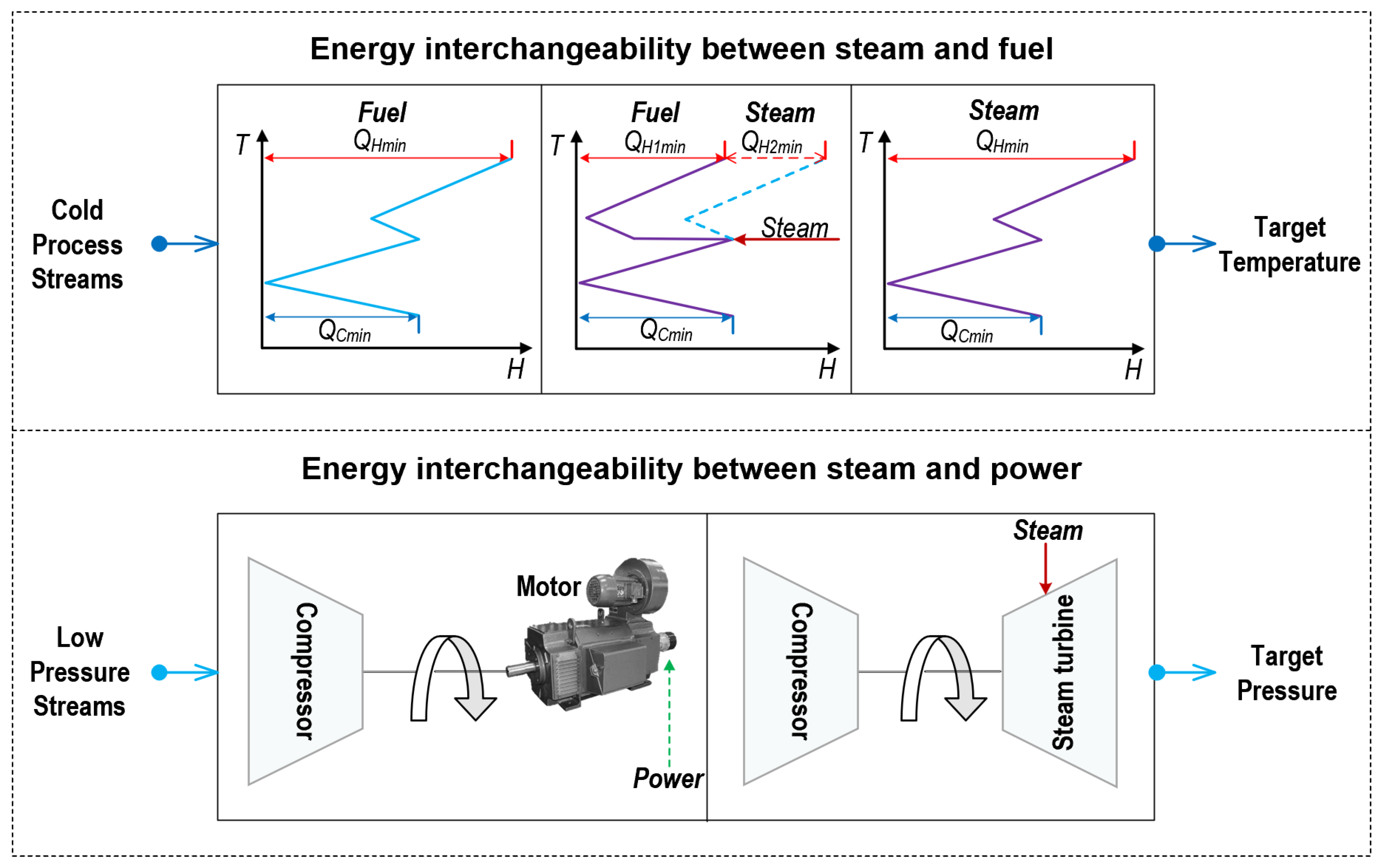
4.2. Modeling for the Energy Utilization Side
4.3. Modeling for Energy Storage Systems
4.3.1. Battery Energy Storage
4.3.2. Thermal Energy Storage
4.4. Balances and Constraints
4.4.1. Balances in a Total Site
4.4.2. Capacity Boundary Constraints of Devices
5. Optimization Framework
5.1. Objective Function
5.2. Mathematical Framework
6. Case Study
6.1. Case Background and Data
- Four crude distillation units (CDU1–4);
- Two fluid catalytic cracking units (FCCU1–2);
- One hydrocracking unit (HCU);
- Two diesel hydrotreating units (DHU1–2);
- One residual hydrotreating unit (RHU);
- One gasoline hydrotreating unit (GHU);
- One kerosene hydrotreating unit (KHU);
- One sewage stripping unit (SSU).
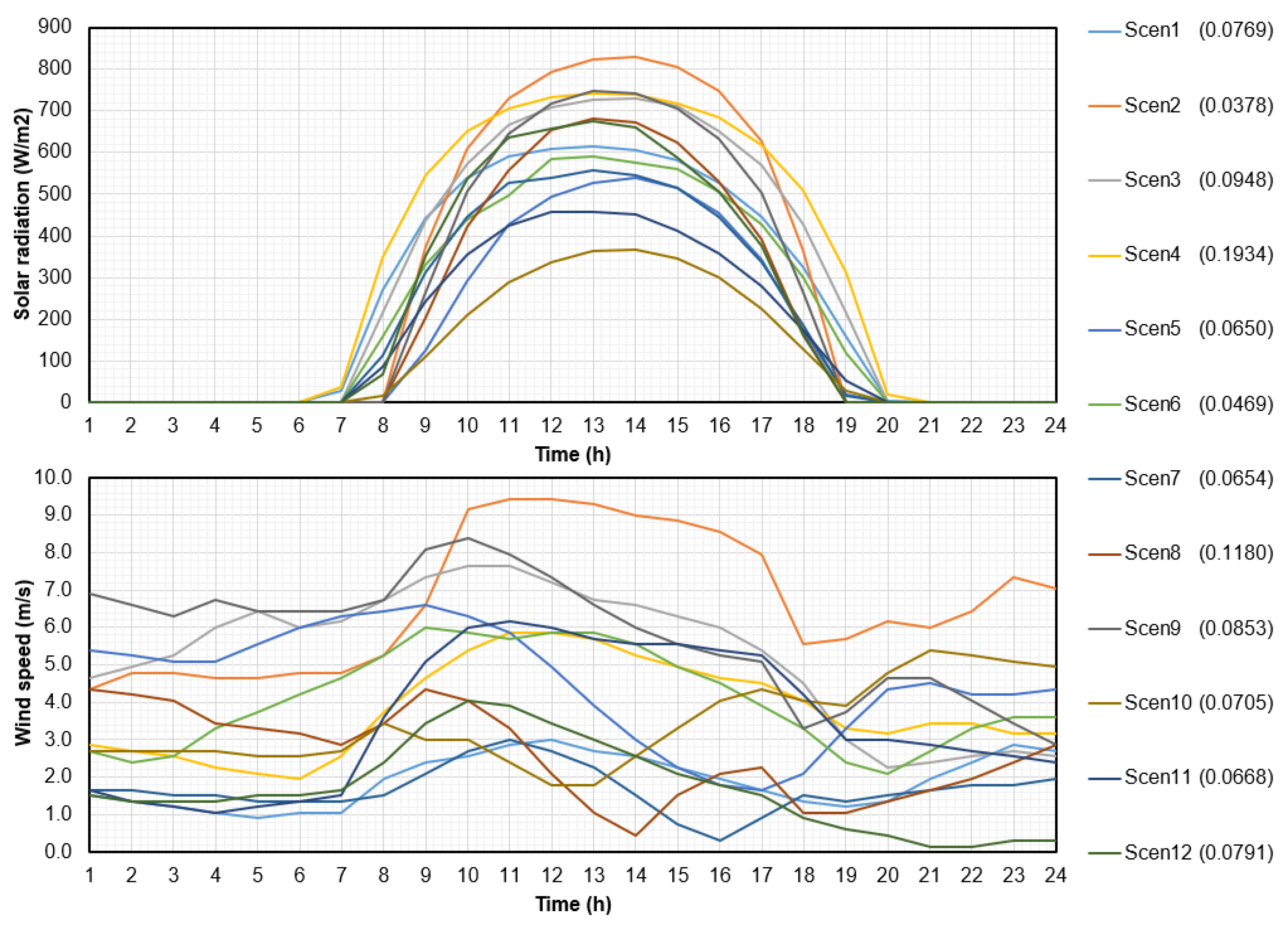
6.2. Scenarios Generation
6.3. Case Description
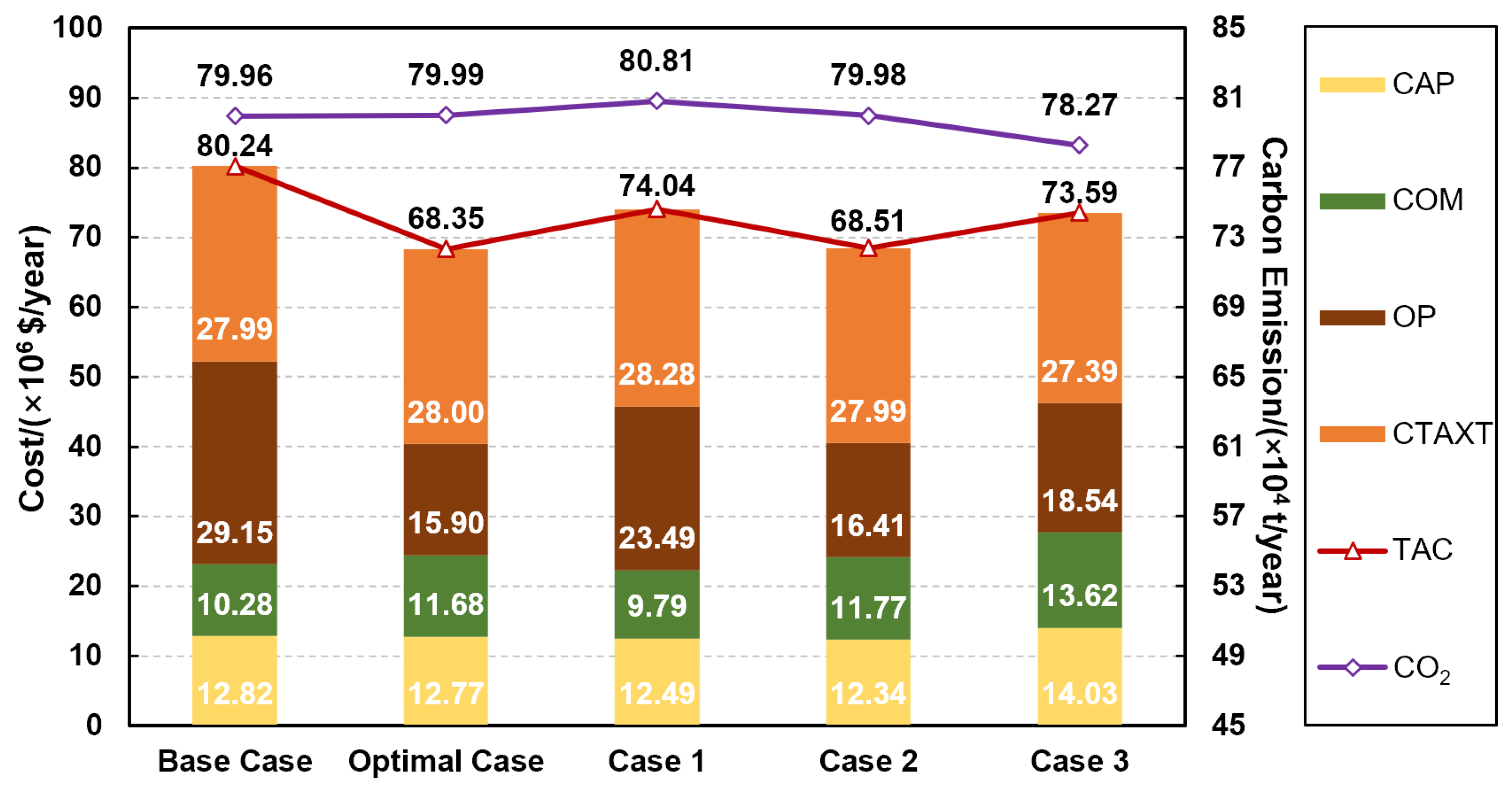
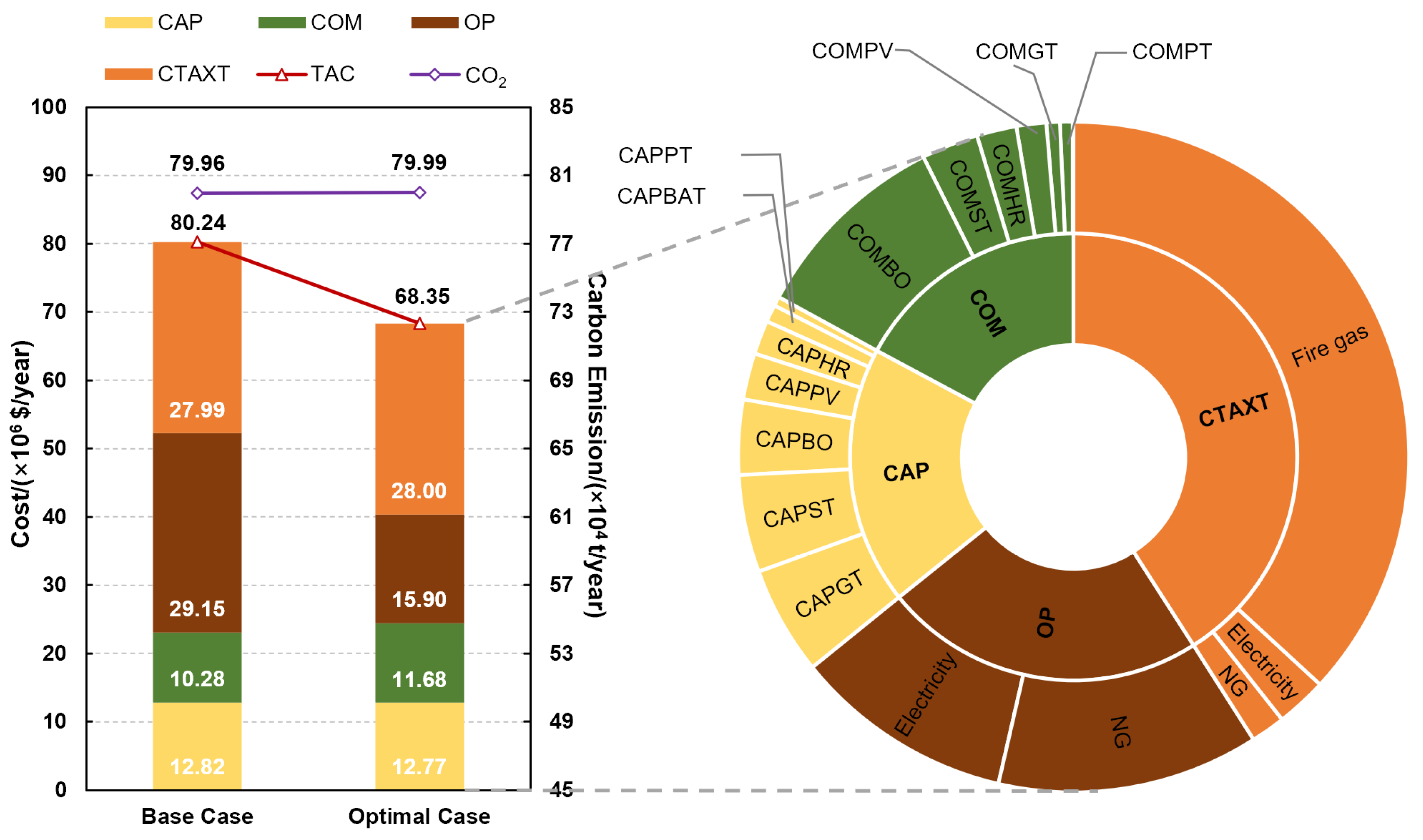
6.4. Comprehensive Performance Comparative Analysis
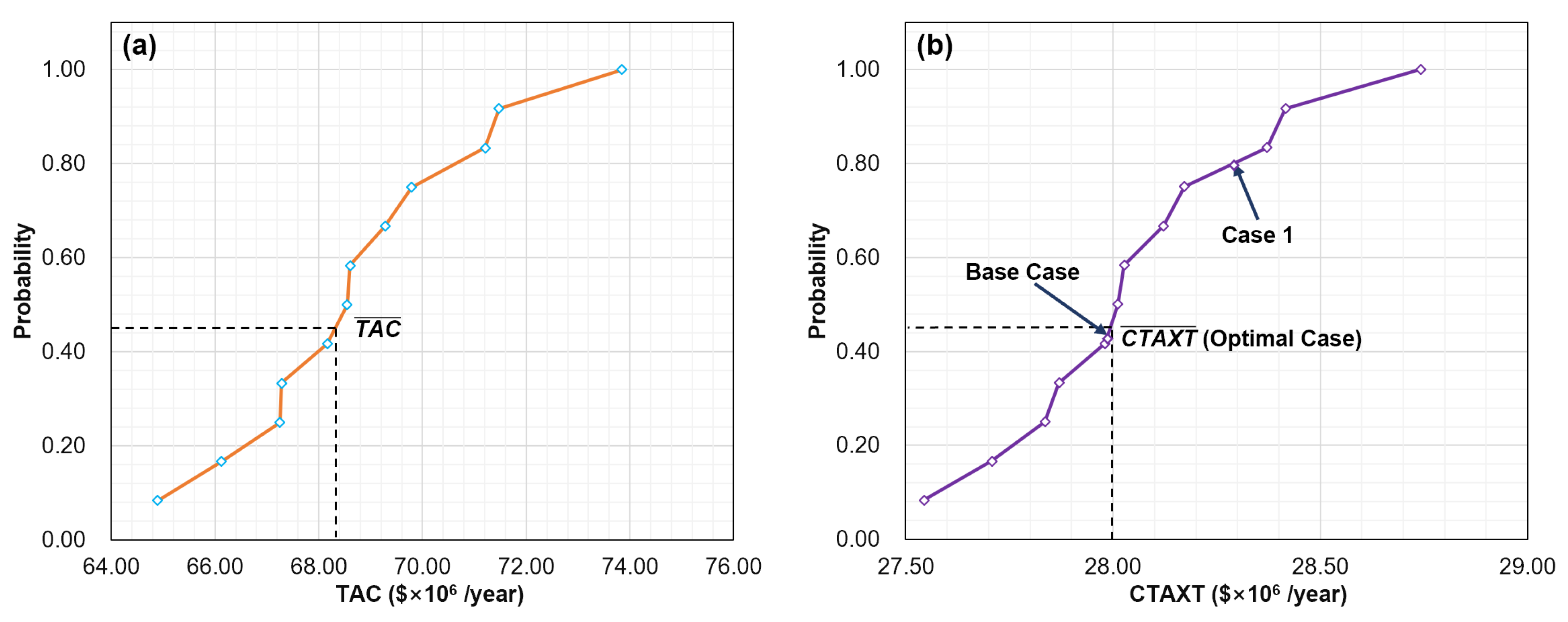
6.5. Results Analysis and Discussion
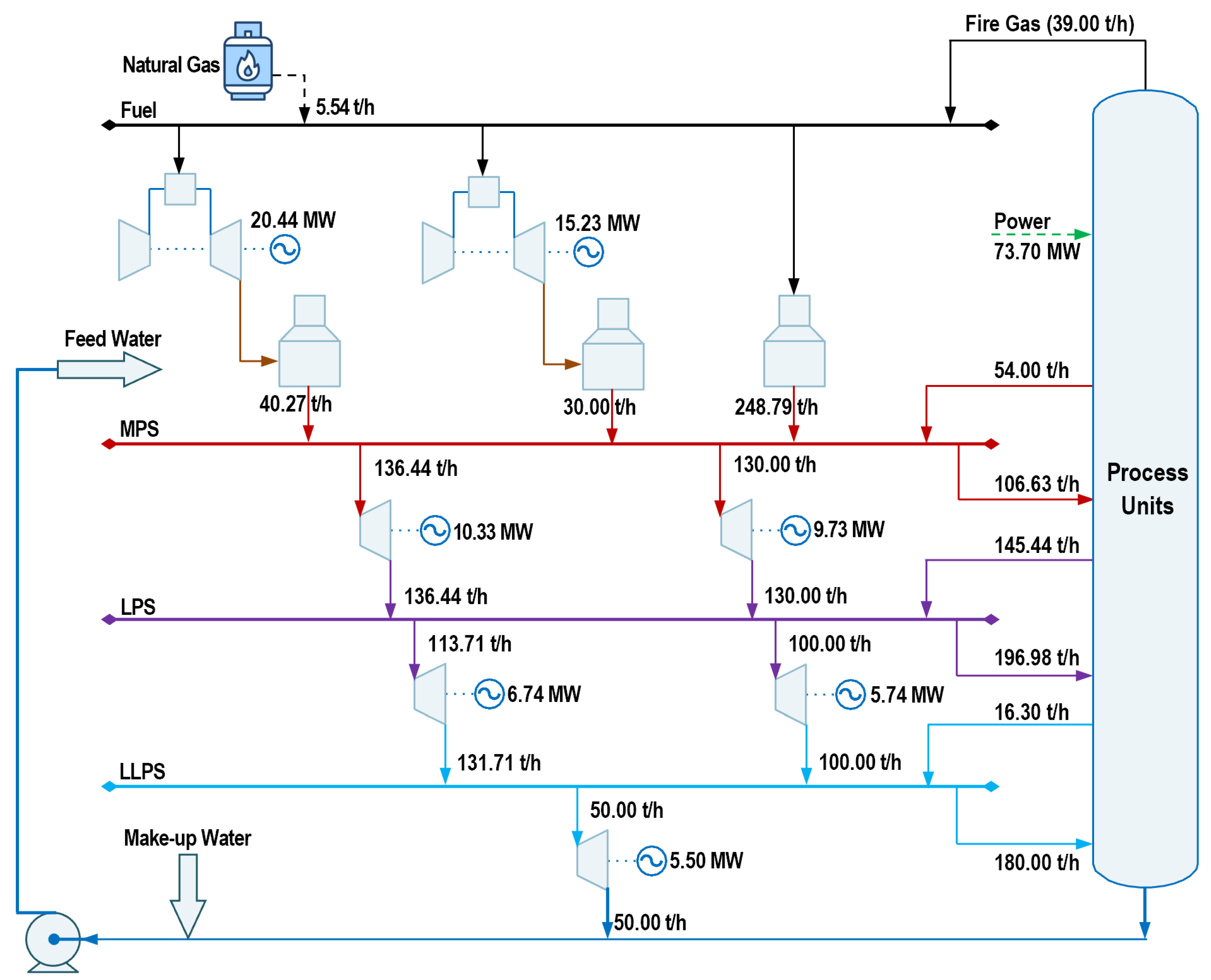
6.5.1. Results Analysis and Discussion of Base Case
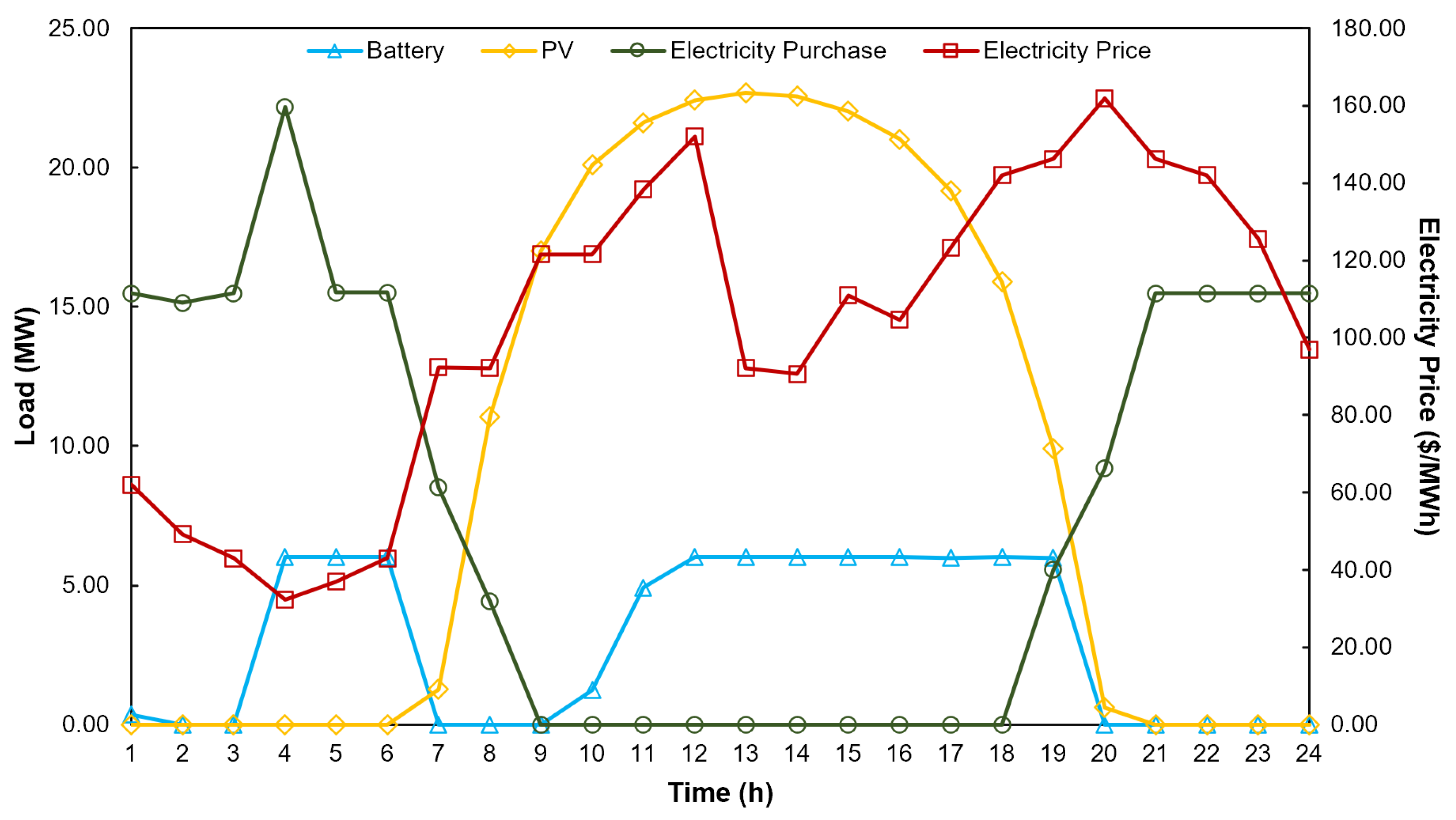
6.5.2. Results Analysis and Discussion of Optimal Case
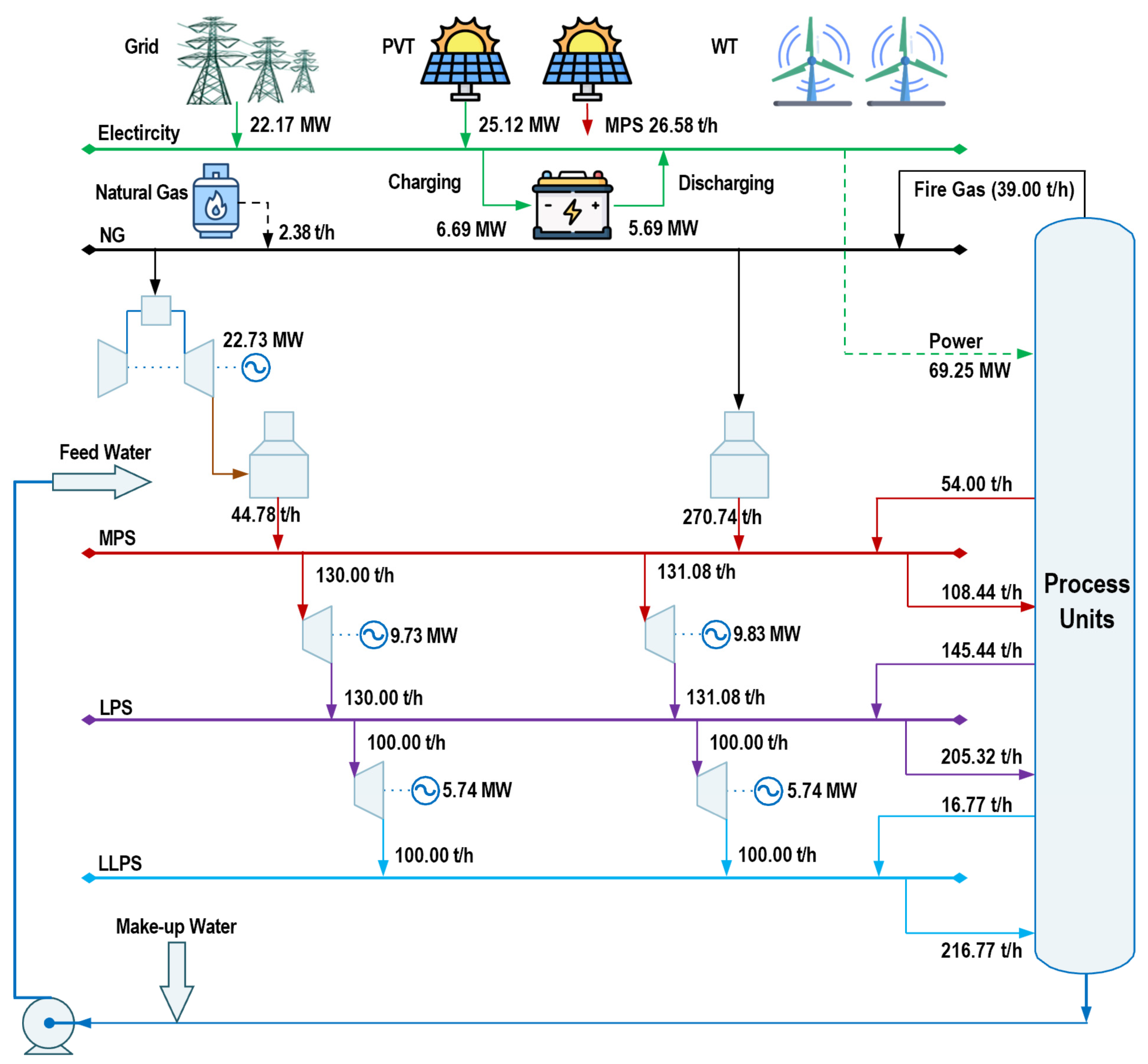
6.5.3. Analysis and Discussion of Energy Interchanges in the Optimal Case
7. Conclusions
- (1)
- A deeper investigation into the mechanistic impact of system parameters like carbon tax, cost-effectiveness threshold of wind speed, energy storage capacity, charge–discharge efficiencies of energy storage, and so on is warranted.
- (2)
- The optimal design of a hybrid renewable energy system that integrates multiple types of renewable energy and various energy storage technologies.
- (3)
- Building upon the validated deterministic MIP model core, employ methods such as the ε-constraint technique to perform multi-objective optimization, mapping the Pareto frontiers among total cost, carbon emissions, and system reliability.
- (4)
- Apply the framework to other energy-intensive sectors (e.g., chemicals, steelmaking) and explore its integration with real-time operational strategies to verify its broader applicability.
- (5)
- Integrate life cycle assessment (LCA) or a multi-criteria sustainability framework to incorporate a more comprehensive set of environmental and social indicators alongside economic objectives, supporting holistic decision-making for industrial energy transition.
Supplementary Materials
Author Contributions
Funding
Data Availability Statement
Acknowledgments
Conflicts of Interest
Nomenclature
| Sets and indices | |
| D/d | Set of devices indexed by d |
| E/e | Set of energy mediums indexed by e |
| G/g | Set of gas turbine systems indexed by g |
| H/h | Set of time periods indexed by h |
| I/i | Set of steam levels indexed by i |
| J/j | Set of boilers indexed by j |
| P/p | Set of process units indexed by p |
| R/r | Set of steam turbines indexed by r |
| SCEN/scen | Set of scenarios indexed by scen |
| Subsets | |
| HBS/hbs | Set of steam level generated in boilers indexed by hbs |
| SHR/shr | Set of steam level generated in HRSG indexed by shr |
| TES/tes | Set of steam level storage/generated in HRSG indexed by shr |
| TO/to | Set of steam level entering steam turbines indexed by to |
| TS/ts | Set of steam level exiting steam turbines indexed by ts |
| Superscripts | |
| max | Maximum |
| min | Minimum |
| Subscripts | |
| ci | Cut-in |
| co | Cut-off |
| rate | Rated |
| Parameters | |
| ABAT | Hourly self-discharge efficiency of battery [dimensionless] |
| ASC | Model parameter of solar collector [dimensionless] |
| ATES | Hourly self-loss efficiency of thermal heat storage [dimensionless] |
| BBAT | Charging efficiency [dimensionless] |
| BLD | Blowdown rate of boiler [dimensionless] |
| BSC | Model parameter of solar collector [dimensionless] |
| BTES | Energy storage efficiency of thermal heat storage [dimensionless] |
| CAPC | Capital cost of device [$] |
| CBAT | Discharging efficiency [dimensionless] |
| CO2TAX | Unitary carbon tax [$/tCO2] |
| CO2X1 | Carbon emission factor of fuel oil [tCO2//MJ] |
| CO2X2 | Carbon emission factor of natural gas [tCO2//MJ] |
| CO2X3 | Carbon emission factor of electricity from grid [tCO2/MW] |
| COMD | O&M cost of device [$] |
| CRF | Capital recovery factor of device [dimensionless] |
| CTES | Energy releasing efficiency of thermal heat storage [dimensionless] |
| DLH | Specific isentropic enthalpy changes of steam [MJ/t] |
| EEP | Saturated temperature of water corresponding to steam level [°C] |
| EFN | Nominal efficiency [dimensionless] |
| EGT | Efficiency of power output of gas turbine [dimensionless] |
| EHR | Heat recovery efficiency of HRSG [dimensionless] |
| EP | Temperature of overcooled water corresponding to steam level [°C] |
| EPT | Heat efficiency for steam generation of photothermal modules |
| HQF | Low calorific value of fire gas [MJ/t] |
| HQL | Low calorific value of natural gas [MJ/t] |
| IC | Current of cell [A] |
| IR | Interest rate [dimensionless] |
| ISC | Short circuit current [A] |
| KC | Current temperature coefficient [A/°C] |
| KV | Voltage temperature coefficient [V/°C] |
| LGT | Coefficient of heat loss of gas turbine [dimensionless] |
| LH | Specific latent heat of steam [MJ/t/°C] |
| LS | Vapor specific heat of steam [MJ/t/°C] |
| LT | Lifetime of device [year] |
| LW | Liquid specific heat of steam [MJ/t/°C] |
| NOTC | Nominal operating temperature of cell [°C] |
| OPT | Annual operating time [day] |
| PBA, PBB | Parameters of boiler model [dimensionless] |
| PE | Price of electricity from market [$/MWh] |
| PF | Price of natural gas [$/t] |
| PNOM | Nominal power of PV [MW] |
| PPV | Power output of the PV module [MW] |
| PROB | Probability of scenario [dimensionless] |
| PSR | Steam required by other processes or auxiliary facilities [t/h] |
| PTA, PTB | Parameters of steam turbine model [dimensionless] |
| PWT | Power generation of wind turbine [MW] |
| PWTR | Nominal power generation of wind turbine [MW] |
| PXR | Power required by other processes or auxiliary facilities [MW] |
| SI | Solar irradiation intensity [W/m2] |
| SP | Saturated temperature of steam [°C] |
| SSP | Temperature of overheated steam [°C] |
| TA | Ambient temperature [°C] |
| TC | Cell temperature in PV module [°C] |
| TFG | Total mass flowrate of fire gas [t/h] |
| THS | Hour to second conversion [s/h] |
| TIN | Inlet temperature of fluid entering the panel [°C] |
| TMW | Converting into million [dimensionless] |
| TWPT | Temperature of water entering photothermal module [°C] |
| VC | Voltage of cell [V] |
| VCI | Cut-in wind speed [m/s] |
| VCO | Cut-out wind speed [m/s] |
| VOC | Open circuit voltage [V] |
| VR | Rated wind speed [m/s] |
| Variables | |
| APT | Area of solar collect panel [m2] |
| CAP | Total capital cost of the PHRES [$] |
| CAPA | Design capacity of devices |
| CEPM | Cost for power purchase in a scenario [$] |
| CFUEL | Cost for natural gas purchase in a scenario [$] |
| COM | Total operating & maintenance cost of the PHRES [$] |
| COMC | Operating & maintenance cost of a device [$] |
| CTAX | Carbon tax cost in a scenario [$] |
| CTAXT | Carbon tax cost in a scenario [$] |
| EBAT | Electric energy load in battery [MW] |
| EBATC | Power charging by battery [MW] |
| EBATD | Power discharging by battery [MW] |
| EPM | Electricity purchased from market [MW] |
| FBF | Mass flowrate of fire gas entering boiler [t/h] |
| FBL | Mass flowrate of natural gas entering boiler [t/h] |
| FGTF | Mass flowrate of fire gas entering gas turbine [t/h] |
| FGTL | Mass flowrate of natural gas entering gas turbine [t/h] |
| FHS | Mass flowrate of steam generated by HRSG [t/h] |
| FPT | Mass flowrate of steam generated in photothermal module [t/h] |
| FST | Mass flowrate of steam entering turbine [t/h] |
| FTESC | Mass flowrate of steam storage in thermal heat storage system [t/h] |
| FTESD | Mass flowrate of steam releasing from thermal heat storage system [t/h] |
| OP | Operating cost in a scenario [$] |
| PET | Power production of turbine [MW] |
| PGT | Power generated by gas turbine [MW] |
| PPV | Total output power of the PV modules [MW] |
| QGT | Heat of fuel entering gas turbine [MJ] |
| QGTH | Heat of smoke gas exiting gas turbine [MJ] |
| QPT | Heat generation of photo thermal module [MW] |
| QTB | Heat of fuels entering boiler [MJ] |
| QTES | Thermal energy load in thermal heat storage system [MW] |
| QTESC | Energy storage load of thermal heat storage system [MW] |
| QTESD | Energy releasing load of thermal heat storage system [MW] |
| TAC | Total annual cost of the PHRES [$] |
| TPWT | The total power generation by wind turbines [MW] |
| NPV | Integer variable denoting the number of photovoltaic module [dimensionless] |
| NWT | Integer variable denoting the number of wind turbine [dimensionless] |
| Bj | Binary variable denoting the design boundary of boiler [dimensionless] |
| PTscen,h,i | Binary variable denoting the steam level generated in photo-thermal module [dimensionless] |
| Yg | Binary variable denoting the design boundary of gas turbine system [dimensionless] |
| Zr | Binary variable denoting the design boundary of steam turbine [dimensionless] |
References
- Rockstrom, J.; Gaffney, O.; Rogelj, J.; Meinshausen, M.; Nakicenovic, N.; Schellnhuber, H.J. A roadmap for rapid decarbonization. Science 2017, 355, 1269–1271. [Google Scholar] [CrossRef]
- Tang, Q.Q.; Zhang, W.W.; Hu, J.Q.; He, C.; Chen, Q.L.; Zhang, B.J. Design optimization of industrial energy systems with energy consumption relaxation models for coupling process units and utility streams. J. Clean. Prod. 2022, 344, 131072. [Google Scholar] [CrossRef]
- Wang, J.; Kang, L.X.; Huang, X.K.; Liu, Y.Z. An analysis framework for quantitative evaluation of parametric uncertainty in a cooperated energy storage system with multiple energy carriers. Energy 2021, 226, 120395. [Google Scholar] [CrossRef]
- Zhao, L.; Ning, C.; You, F.Q. Operational optimization of industrial steam systems under uncertainty using data-Driven adaptive robust optimization. AIChE J. 2019, 65, e16500. [Google Scholar] [CrossRef]
- Ge, C.Q.; Zhang, L.F.; Yuan, Z.H. Distributionally robust optimization for the closed-loop supply chain design under uncertainty. AIChE J. 2022, 68, e17909. [Google Scholar] [CrossRef]
- Xu, Y.; Li, Y.; Zhang, L.; Yuan, Z. Multi-Stage Stochastic Programming Under Endogenous Uncertainty of Integrated Sustainable Chemical Process Design and Expansion Planning. ACS Sustain. Chem. Eng. 2024, 12, 17190–17209. [Google Scholar] [CrossRef]
- Zhang, L.F.; Torres, A.I.; Chen, B.Z.; Yuan, Z.H.; Grossmann, I.E. Optimal retrofitting of conventional oil refinery into sustainable bio-refinery under uncertainty. AIChE J. 2024, 70, e18371. [Google Scholar] [CrossRef]
- Wang, Q.P.; Han, X.; Zhao, L.; Ye, Z.C. Sustainable Retrofit of Industrial Utility System Using Life Cycle Assessment and Two-Stage Stochastic Programming. ACS Sustain. Chem. Eng. 2022, 10, 13887–13900. [Google Scholar] [CrossRef]
- Qian, Q.; Liu, H.; He, C.; Shu, Y.; Chen, Q.L.; Zhang, B.J. Sustainable retrofit of petrochemical energy systems under multiple uncertainties using the stochastic optimization method. Comput. Chem. Eng. 2021, 151, 107374. [Google Scholar] [CrossRef]
- Xu, T.T.; Long, J.; Zhao, L.; Du, W.L. Material and energy coupling systems optimization for large-scale industrial refinery with sustainable energy penetration under multiple uncertainties using two-stage stochastic programming. Appl. Energy 2024, 371, 123525. [Google Scholar] [CrossRef]
- Yang, K.Y.; Wang, Q.P.; Zhao, L. Two-stage stochastic programming for multi-objective optimization of sustainable utility systems integrating with combined heat and power units. J. Clean. Prod. 2024, 451, 142143. [Google Scholar] [CrossRef]
- Tang, Q.Q.; Hu, J.Q.; Zhao, K.; He, C.; Chen, Q.L.; Zhang, B.J. Reliable design optimization for industrial hybrid energy systems with uncertain sustainable energy. Energy Convers. Manag. 2023, 284, 116963. [Google Scholar] [CrossRef]
- Chen, Z.; Ghosh, A. Techno-financial analysis of 100% renewable electricity for the south west region of the UK by 2050. Renew. Energy 2024, 237, 121674. [Google Scholar] [CrossRef]
- Zheng, N.; Wang, Q.S.; Ding, X.Q.; Wang, X.M.; Zhang, H.F.; Duan, L.Q.; Desideri, U. Proactive energy storage operation strategy and optimization of a solar polystorage and polygeneration system based on day-ahead load forecasting. Appl. Energy 2025, 381, 125088. [Google Scholar] [CrossRef]
- Gasanzade, F.; Bauer, S. Approximating coupled power plant and geostorage simulations for compressed air energy storage in porous media. Appl. Energy 2025, 380, 125070. [Google Scholar] [CrossRef]
- Gilmore, N.; Britz, T.; Maartensson, E.; Orbegoso-Jordan, C.; Schroder, S.; Malerba, M. Continental-scale assessment of micro-pumped hydro energy storage using agricultural reservoirs. Appl. Energy 2023, 349, 121715. [Google Scholar] [CrossRef]
- Olabi, A.G.; Onumaegbu, C.; Wilberforce, T.; Ramadan, M.; Abdelkareem, M.A.; Al-Alami, A.H. Critical review of energy storage systems. Energy 2021, 214, 118987. [Google Scholar] [CrossRef]
- Wu, Q.; Ren, H.B.; Gao, W.J.; Ren, J.X. Multi-objective optimization of a distributed energy network integrated with heating interchange. Energy 2016, 109, 353–364. [Google Scholar] [CrossRef]
- Zhang, G.Q.; Wang, J.J.; Ren, F.K.; Liu, Y.; Dong, F.X. Collaborative optimization for multiple energy stations in distributed energy network based on electricity and heat interchanges. Energy 2021, 222, 119987. [Google Scholar] [CrossRef]
- Kim, J.-K. Studies on the conceptual design of energy recovery and utility systems for electrified chemical processes. Renew. Sustain. Energy Rev. 2022, 167, 112718. [Google Scholar] [CrossRef]
- Tan, R.R.; Migo-Sumagang, M.V.; Aviso, K.B. Recent trends in optimization models for industrial decarbonization. Curr. Opin. Chem. Eng. 2025, 48, 101118. [Google Scholar] [CrossRef]
- Pistikopoulos, E.N.; Barbosa-Povoa, A.; Lee, J.H.; Misener, R.; Mitsos, A.; Reklaitis, G.V.; Venkatasubramanian, V.; You, F.; Gani, R. Process systems engineering—The generation next? Comput. Chem. Eng. 2021, 147, 107252. [Google Scholar] [CrossRef]
- Zhao, K.; Zhao, L.; Lu, W.; Tang, Q.Q.; He, C.; Chen, Q.L.; Zhang, B.J. Multi-objective optimization design of heat exchanger networks with simultaneous evaluation of economic performance and complexity via a novel two-step optimization approach. Comput. Chem. Eng. 2025, 200, 109212. [Google Scholar] [CrossRef]
- Chamandoust, H.; Derakhshan, G.; Hakimi, S.M.; Bahramara, S. Tri-objective optimal scheduling of smart energy hub system with schedulable loads. J. Clean. Prod. 2019, 236, 117584. [Google Scholar] [CrossRef]
- Li, H.; Zhao, L. Life cycle assessment and multi-objective optimization for industrial utility systems. Energy 2023, 280, 128213. [Google Scholar] [CrossRef]
- Jia, J.; Li, H.; Wu, D.; Guo, J.; Jiang, L.; Fan, Z. Multi-objective optimization study of regional integrated energy systems coupled with renewable energy, energy storage, and inter-station energy sharing. Renew. Energy 2024, 225, 120328. [Google Scholar] [CrossRef]
- Liu, P.; Pistikopoulos, E.N.; Li, Z. Decomposition Based Stochastic Programming Approach for Polygeneration Energy Systems Design under Uncertainty. Ind. Eng. Chem. Res. 2010, 49, 3295–3305. [Google Scholar] [CrossRef]
- Liu, Z.M.; Lim, M.Q.; Kraft, M.; Wang, X.N. Simultaneous design and operation optimization of renewable combined cooling heating and power systems. AIChE J. 2020, 66, e17039. [Google Scholar] [CrossRef]
- Shen, F.; Zhao, L.; Du, W.; Zhong, W.; Peng, X.; Qian, F. Data-Driven Stochastic Robust Optimization for Industrial Energy System Considering Renewable Energy Penetration. ACS Sustain. Chem. Eng. 2022, 10, 3690–3703. [Google Scholar] [CrossRef]
- Mahmoudi, S.M.; Maleki, A.; Ochbelagh, D.R. Investigating the role of the carbon tax and loss of power supply probability in sizing a hybrid energy system, economically and environmentally. Energy Convers. Manag. 2023, 280, 116793. [Google Scholar] [CrossRef]
- Di Somma, M.; Yan, B.; Bianco, N.; Graditi, G.; Luh, P.B.; Mongibello, L.; Naso, V. Operation optimization of a distributed energy system considering energy costs and exergy efficiency. Energy Convers. Manag. 2015, 103, 739–751. [Google Scholar] [CrossRef]
- Shang, Z.; Kokossis, A. A transhipment model for the optimisation of steam levels of total site utility system for multiperiod operation. Comput. Chem. Eng. 2004, 28, 1673–1688. [Google Scholar] [CrossRef]
- Mavromatis, S.P.; Kokossis, A.C. Conceptual optimisation of utility networks for operational variations—I. targets and level optimisation. Chem. Eng. Sci. 1998, 53, 1585–1608. [Google Scholar] [CrossRef]
- Guo, L.; Liu, W.; Cai, J.; Hong, B.; Wang, C. A two-stage optimal planning and design method for combined cooling, heat and power microgrid system. Energy Convers. Manag. 2013, 74, 433–445. [Google Scholar] [CrossRef]
- Pang, K.Y.; Liew, P.Y.; Woon, K.S.; Ho, W.S.; Wan Alwi, S.R.; Klemeš, J.J. Multi-period multi-objective optimisation model for multi-energy urban-industrial symbiosis with heat, cooling, power and hydrogen demands. Energy 2023, 262, 125201. [Google Scholar] [CrossRef]
- Zhang, B.J.; Liu, K.; Luo, X.L.; Chen, Q.L.; Li, W.K. A multi-period mathematical model for simultaneous optimization of materials and energy on the refining site scale. Appl. Energy 2015, 143, 238–250. [Google Scholar] [CrossRef]
- Ji, W.; Guo, S.; Sun, H.; Liu, D. Optimal dispatching of multi-community electric-thermal integrated energy systems considering wind and solar uncertainties based on hydraulic stability and energy sharing. Energy Convers. Manag. 2024, 308, 118335. [Google Scholar] [CrossRef]
- Zhao, L.; Zhao, K.; Tang, Q.Q.; Chen, Q.L.; He, C.; Zhang, B.J. Multi-scale modelling and optimization design of zeolite/NH3 working pairs, processes and networks for an integrated waste heat recovery and adsorption refrigeration system. Appl. Energy 2024, 376, 124349. [Google Scholar] [CrossRef]
- Jing, R.; Zhu, X.Y.; Zhu, Z.Y.; Wang, W.; Meng, C.; Shah, N.; Li, N.; Zhao, Y.R. A multi-objective optimization and multi-criteria evaluation integrated framework for distributed energy system optimal planning. Energy Convers. Manag. 2018, 166, 445–462. [Google Scholar] [CrossRef]
- Kim, J.K.; Son, H.; Yun, S. Heat integration of power-to-heat technologies: Case studies on heat recovery systems subject to electrified heating. J. Clean. Prod. 2022, 331, 130002. [Google Scholar] [CrossRef]
- Lameh, M.; Linke, P.; Al-Mohannadi, D.M. Carbon neutral energy systems: Optimal integration of energy systems with CO2 abatement pathways. AIChE J. 2024, 70, e18568. [Google Scholar] [CrossRef]
- National Solar Radiation Database. Available online: https://nsrdb.nrel.gov/ (accessed on 27 April 2023).
- Heitsch, H.; Römisch, W. Scenario reduction algorithms in stochastic programming. Comput. Optim. Appl. 2003, 24, 187–206. [Google Scholar] [CrossRef]
- Yu, X.F.; Zhang, S.; Liu, L.L.; Du, J. Optimal design and scheduling of carbon capture power plant based on uncertainty decision-making methods. J. Clean. Prod. 2022, 380, 134852. [Google Scholar] [CrossRef]
- Brooke, A.; Kendrick, D.; Meeraus, A. GAMS-A User’s Guide, Release 2.25; The Scientific Press: San Francisco, CA, USA, 1992. [Google Scholar]






| Reference | Energy Uncertainty Considered | Energy Demand Expression | Energy Storage System Considered | Type of Model Framework | Objective | Solution Methodology |
|---|---|---|---|---|---|---|
| Tang et al. [2] | - | PA-based relaxation models considering energy interchangeability | - | MINLP | TAC | GAMS software |
| Wang et al. [8] | Solar irradiation, wind speed | Linear model | TES | MINLP | TAC, global warming potential | TSSP in Python |
| Qian et al. [9] | Solar irradiation, wind speed | Fixed values | TES | MINLP | TAC, carbon emission | TSSP and ε-constraint method in GAMS software |
| Xu et al. [10] | Solar irradiation, wind speed | Coefficient model | - | MINLP | Operating cost (with carbon tax) | TSSP in GAMS software |
| Yang et al. [11] | Solar irradiation, wind speed | Linear model | - | MINLP | Annual total cost (with carbon tax), renewable energy penetration rate, grid net interaction level | TSSP and ε-constraint method in Python |
| Tang et al. [12] | Solar irradiation, wind speed | Fixed values | - | MINLP | TAC, reliability | TSSP and ε-constraint method in GAMS software |
| Wu et al. [18] | - | Hourly energy demand considering energy interchange | TES | MIP | Overall annual cost, CO2 emissions | Integration in single objective function |
| Zhang et al. [19] | - | Predicted load | - | - | Primary energy saving ratio, annual total cost saving rate, carbon dioxide emission reduction ratio | Designer’s Simulation Toolkit |
| Chamandoust et al. [24] | Solar irradiation, wind speed | EMG, TMG | - | MINLP | Operation cost, emission pollution, deviation of the electrical load profile from its desired value | Augmented ε-constraint method and fuzzy approach in GAMS software |
| Li et al. [25] | - | Fixed values | - | MINLP | Operating cost, environmental impact | Integration in single objective function using weighted technique in GAMS software |
| This work | Solar irradiation, wind speed | PA-based relaxation models considering energy interchangeability | BES, TES | MIP | TAC (with carbon tax) | TSSP in GAMS software |
| Components | Lower Bound | Upper Bound | CAP ($/kW) | O&M ($/kW/yr) | Lifetime (yr) |
|---|---|---|---|---|---|
| PV | 0 MW | 3.0 MW | 750 | 16 | 20 |
| PT a,b | 0 MW | 280 t/h | 78 | 19.8 | 20 |
| WT | 0 MW | 2.0 MW | 1200 | 55 | 20 |
| GT | 0 MW | 30 MW | 1210 | 20 | 10 |
| HRSG | 30 t/h | 120 t/h | 132 | 20 | 10 |
| Boiler | 180 t/h | 280 t/h | 75 | 26 | 10 |
| ST c | 130/100/50 t/h | 150/130/80 t/h | 800 | 60 | 10 |
| Battery | 0 MW | 100 MW | 414 | 6.2 | 5 |
| TES | 0 MW | 100 MW | 25 | 0 | 20 |
| Case | With ECRMs | With RE | With ESS | Deterministic Optimization | Stochastic Optimization |
|---|---|---|---|---|---|
| Base Case | × | × | × | ○ | - |
| Optimal Case | √ | √ | √ | - | ○ |
| Case 1 | √ | × | × | ○ | - |
| Case 2 | √ | √ | × | - | ○ |
| Case 3 | × | √ | √ | - | ○ |
| Case | Energy Generated (MW) | Energy Generated Ratio (%) | Carbon Emissions (t/h) | ||||
|---|---|---|---|---|---|---|---|
| NG | Fire Gas | Renewable Energy | NG | Fire Gas | Grid Electricity | ||
| Base Case | 341.42 | 17.47 | 82.53 | / | 12.46 | 78.82 | 0 |
| Optimal Case | 325.27 | 5.42 | 90.22 | 4.35 | 3.69 | 82.81 | 5.42 |
| Case 1 | 334.00 | 14.05 | 85.95 | / | 10.04 | 82.21 | 0 |
| Case 2 | 325.90 | 5.72 | 89.91 | 4.38 | 3.90 | 82.21 | 5.19 |
| Case 3 | 332.77 | 7.49 | 86.55 | 5.96 | 5.10 | 78.82 | 5.43 |
Disclaimer/Publisher’s Note: The statements, opinions and data contained in all publications are solely those of the individual author(s) and contributor(s) and not of MDPI and/or the editor(s). MDPI and/or the editor(s) disclaim responsibility for any injury to people or property resulting from any ideas, methods, instructions or products referred to in the content. |
© 2026 by the authors. Licensee MDPI, Basel, Switzerland. This article is an open access article distributed under the terms and conditions of the Creative Commons Attribution (CC BY) license.
Share and Cite
Tang, Q.; Qu, Y.; Qiu, F.; Pan, Y.; Tan, J.; Lei, Y.; Chen, Y.; He, C.; Chen, Q.; Zhang, B. Modelling and Optimization of Petrochemical Hybrid Renewable Energy Systems Considering Energy Interchangeability, Uncertainty and Storage for Coupling Energy Supply and Utilization Sides. Processes 2026, 14, 703. https://doi.org/10.3390/pr14040703
Tang Q, Qu Y, Qiu F, Pan Y, Tan J, Lei Y, Chen Y, He C, Chen Q, Zhang B. Modelling and Optimization of Petrochemical Hybrid Renewable Energy Systems Considering Energy Interchangeability, Uncertainty and Storage for Coupling Energy Supply and Utilization Sides. Processes. 2026; 14(4):703. https://doi.org/10.3390/pr14040703
Chicago/Turabian StyleTang, Qiaoqiao, Yuehao Qu, Fengrong Qiu, Yong Pan, Junjun Tan, Yang Lei, Yuqiu Chen, Chang He, Qinglin Chen, and Bingjian Zhang. 2026. "Modelling and Optimization of Petrochemical Hybrid Renewable Energy Systems Considering Energy Interchangeability, Uncertainty and Storage for Coupling Energy Supply and Utilization Sides" Processes 14, no. 4: 703. https://doi.org/10.3390/pr14040703
APA StyleTang, Q., Qu, Y., Qiu, F., Pan, Y., Tan, J., Lei, Y., Chen, Y., He, C., Chen, Q., & Zhang, B. (2026). Modelling and Optimization of Petrochemical Hybrid Renewable Energy Systems Considering Energy Interchangeability, Uncertainty and Storage for Coupling Energy Supply and Utilization Sides. Processes, 14(4), 703. https://doi.org/10.3390/pr14040703