Article

Valve Plate Geometry Optimization for Torque Reduction in Continuous-Wave Mud Pulsers: A CFD Study

1
Sinopec Key Laboratory of Ultra-Deep Well Drilling Engineering Technology, Beijing 102206, China
2
Sinopec Research Institute of Petroleum Engineering, Beijing 100083, China
3
School of Petroleum Engineering, Yangtze University, Wuhan 430100, China
4
Hubei Key Laboratory of Oil and Gas Drilling and Production Engineering, Yangtze University, Wuhan 430100, China
*
Authors to whom correspondence should be addressed.
Processes 2026, 14(4), 668; https://doi.org/10.3390/pr14040668
Submission received: 23 January 2026 / Revised: 10 February 2026 / Accepted: 12 February 2026 / Published: 14 February 2026

Abstract

Continuous-wave mud pulsers enable real-time downhole communication during drilling; however, high actuation torque markedly increases energy consumption and limits deployment depth. In this study, we investigate valve plate geometry optimization for torque reduction through systematic CFD simulations using the SST k–ω turbulence model and analyzed the coupled effects of opening angle (20–30°) and chamfer height (4.0–6.0 mm) on hydraulic performance. The results reveal a previously uncharacterized torque-reversal phenomenon: introducing a chamfer shifts the torque zero-crossing point forward by up to 10°, fundamentally altering the torque–angle relationship. The main contribution is the establishment of quantitative correlations between geometric parameters and the torque–pressure decoupling mechanism, achieving a 45–60% reduction in peak torque while maintaining differential pressure within acceptable ranges for signal generation. Detailed flow-field analyses show that chamfers modify local velocity gradients and pressure distributions on valve surfaces, reducing flow resistance through improved momentum exchange. Dimensionless correlations between geometric parameters and performance metrics are developed, providing quantitative design guidelines for energy-efficient valve plates. Validation against baseline designs confirms that optimized geometries substantially reduce actuator power requirements without compromising signal quality. These findings provide practical design strategies for next-generation mud pulsers for deep well and extended-reach drilling, where energy efficiency is critical. The proposed optimization framework, based on the identified torque–pressure decoupling principle, is also applicable to other rotary valve systems requiring simultaneous optimization of actuation energy and functional performance.

1. Introduction

The global transition toward sustainable energy systems necessitates efficient extraction of geothermal resources and secure CO2 sequestration in deep geological formations, both of which require advanced drilling technologies capable of reaching depths exceeding 4000 m [1,2]. Deep drilling operations for renewable energy and carbon capture, utilization, and storage (CCUS) applications face unprecedented technical challenges, including formation temperatures above 200 °C, pressure differentials exceeding 50 MPa, and complex wellbore trajectories with horizontal sections extending beyond 2000 m. Under these extreme conditions, measurement-while-drilling (MWD) systems—particularly their mud pulse telemetry components—are critical for ensuring operational safety and drilling efficiency, while minimizing environmental impact by reducing drilling time and energy consumption [3,4].
Current MWD systems in deep geothermal and CCUS wells consume approximately 15–20% of total drilling energy, with mud pulse telemetry alone accounting for 200–300 kWh per day [5,6]. Given that typical deep wells require 60–90 days to complete, cumulative energy consumption reaches 18–27 MWh, equivalent to 7–10 tonnes of CO2 emissions. Consequently, improving mud pulser efficiency directly contributes to reducing the carbon footprint of sustainable energy infrastructure development, aligning telemetry technology advancement with broader decarbonization objectives.
The core functional component of continuous-wave mud pulsers is the rotating valve plate assembly, which operates via a throttling mechanism. Drilling fluid flows through the pulser at a controlled rate, while periodic rotation of the valve plate (rotor) relative to the stator induces cyclic variations in effective flow area, generating throttling-induced pressure fluctuations along the flow path [7,8]. These pressure pulses propagate upward through the drilling fluid column to surface receivers, where they are decoded to reconstruct downhole data. The hydraulic performance of the valve plate assembly therefore governs two critical system metrics: (i) signal strength, characterized by differential pressure amplitude (ΔP, which determines transmission distance and noise immunity; and (ii) actuation torque, characterized by fluid-induced torque (T) on the rotor, which dictates motor power requirements, energy efficiency, and operational reliability [9].
A fundamental engineering trade-off exists between these metrics. Pursuing high differential pressure typically increases torque demand, raising motor load and energy consumption, whereas torque reduction often compromises pressure amplitude and weakens signal integrity. Traditional designs rely heavily on empirical approaches and iterative prototyping, with limited quantitative understanding of how geometric parameters govern hydraulic response [10,11]. In pursuit of adequate signal strength, torque can become excessive, imposing substantial reliability risks and maintenance costs in downhole environments. More critically, under certain operating conditions, the fluid action on the rotor can transition from resistive (negative torque) to assistive (positive torque), creating a driving load that may induce runaway rotation, oscillation, or system failure if control systems respond inadequately. Therefore, minimizing actuation torque while maintaining sufficient signal strength across the full operating envelope has emerged as the central challenge in valve plate design for continuous-wave mud pulsers.
Over the past two decades, substantial research has examined flow characteristics in hydraulic valves and rotary throttling devices. For hydraulic valve flow fields, Amirante et al. [12] systematically demonstrated how spool–orifice geometry governs hydrodynamic forces and proposed optimization criteria to reduce steady-state hydraulic loads. These investigations confirmed that minor geometric modifications at valve orifices can induce significant restructuring of the flow field, fundamentally altering performance. For rotary valve systems, Tan et al. [13] used computational fluid dynamics (CFD) to investigate the flow rate characteristics of digital hydraulic rotary valves by analyzing pressure distributions and velocity fields at different opening positions, while Pan et al. [14] conducted systematic experimental studies on rotary disk valves and established empirical correlations among leakage flow rate, differential pressure, and rotational speed.
In the specific domain of continuous-wave mud pulsers, several exploratory studies have been reported. Based on linear acoustic perturbation theory, Chin et al. [15] developed a six-section downhole acoustic waveguide model to analyze how boundary reflection conditions affect source amplitude and transmission attenuation. Focusing on rotary-valve pulser design theory, Jia et al. [16,17,18] proposed design criteria for maximum and minimum openings, optimized rotor-orifice shape parameters, and introduced curved-orifice designs that yield approximately sinusoidal waveforms. Yan et al. [7,19] optimized arc-triangular orifice geometries; CFD simulations and laboratory hydraulic tests produced pressure-wave signals closely approximating sinusoidal characteristics, effectively suppressing harmonic content. Han et al. [20,21] established pipeline-integrated numerical platforms for coupled generation and transmission of continuous-wave signals and investigated coupling mechanisms among pressure, flow, and density waves. Building on Bamisebi’s work [22], multi-frequency mud siren technology has been experimentally validated to amplify signals and increase data transmission rates, providing a practical solution to transmission limitations in conventional mud pulse telemetry systems used in deep drilling operations. Chen et al. [23,24] developed comprehensive optimization models for MWD mud pulse telemetry systems that simultaneously address signal attenuation and wellbore-cleaning challenges in complex drilling environments; these approaches were validated through field tests and shown to enhance signal transmission stability while maintaining wellbore integrity in extended-reach and ultra-deep well applications.
Despite these advances, critical knowledge gaps remain. First, systematic understanding of how key geometric parameters—particularly valve plate opening angle and chamfer geometry—govern coupled torque–pressure performance is still limited [25,26]. Second, most studies emphasize single performance metrics (e.g., flow rate or pressure drop) and give insufficient attention to actuation torque, despite its direct impact on drive system selection, energy efficiency, and reliability [27,28,29]. Third, full-stroke performance characterization across complete rotation cycles is scarce, hindering the identification of operating condition-specific anomalies such as torque-reversal phenomena. Finally, explicit multi-objective optimization frameworks and quantitative design guidelines are lacking, leaving product development dependent on empirical iteration and trial-and-error approaches [30,31,32].
Motivated by these gaps, this study systematically investigates the hydraulic performance of rotating valve plates in continuous-wave mud pulsers through high-fidelity CFD simulations, focusing on two key geometric parameters: valve plate opening angle and inlet chamfer height. The objectives are as follows: (1) to establish and validate a three-dimensional computational model of the rotating valve plate assembly through grid independence verification, turbulence model comparison (including the SST k–ω formulation), and experimental benchmarking; to (2) perform full-stroke simulations (0–26.5° rotation) for baseline and geometrically modified configurations to generate complete torque–pressure characteristic curves; to (3) conduct detailed flow-field analyses to elucidate the physical mechanisms governing torque and pressure drop evolution induced by geometric variations; and (4) to evaluate the overall performance of the optimization schemes and establish quantitative design criteria for valve plate geometry.
This investigation delivers four primary contributions. First, systematization: We provide full-stroke, multi-geometry performance mapping that establishes complete response surfaces relating torque and differential pressure to opening angle and geometric configuration. Second, discovery: Building on prior observations of positive (driving) torque at large openings, we quantitatively characterize how geometric parameters control torque sign reversal, peak torque magnitude, and pressure drop characteristics, revealing a previously uncharacterized decoupling mechanism. Third, mechanistic insight: Flow-field visualization and analysis elucidate the fluid-dynamic mechanisms linking geometry to torque–pressure behavior, identifying separation-induced flow instabilities in the large-opening regime that fundamentally alter valve performance. Fourth, validation rigor: A three-tier validation framework—encompassing mesh convergence analysis, turbulence model selection, and experimental benchmarking—ensures computational credibility and provides a reliable foundation for parameter optimization and engineering application. The findings offer direct guidance for energy-efficient valve plate design in continuous-wave mud pulsers and establish a methodological framework applicable to performance analysis and structural optimization of rotary throttling devices across industrial applications.

2. Physical Model and Numerical Methods

2.1. Geometric Model

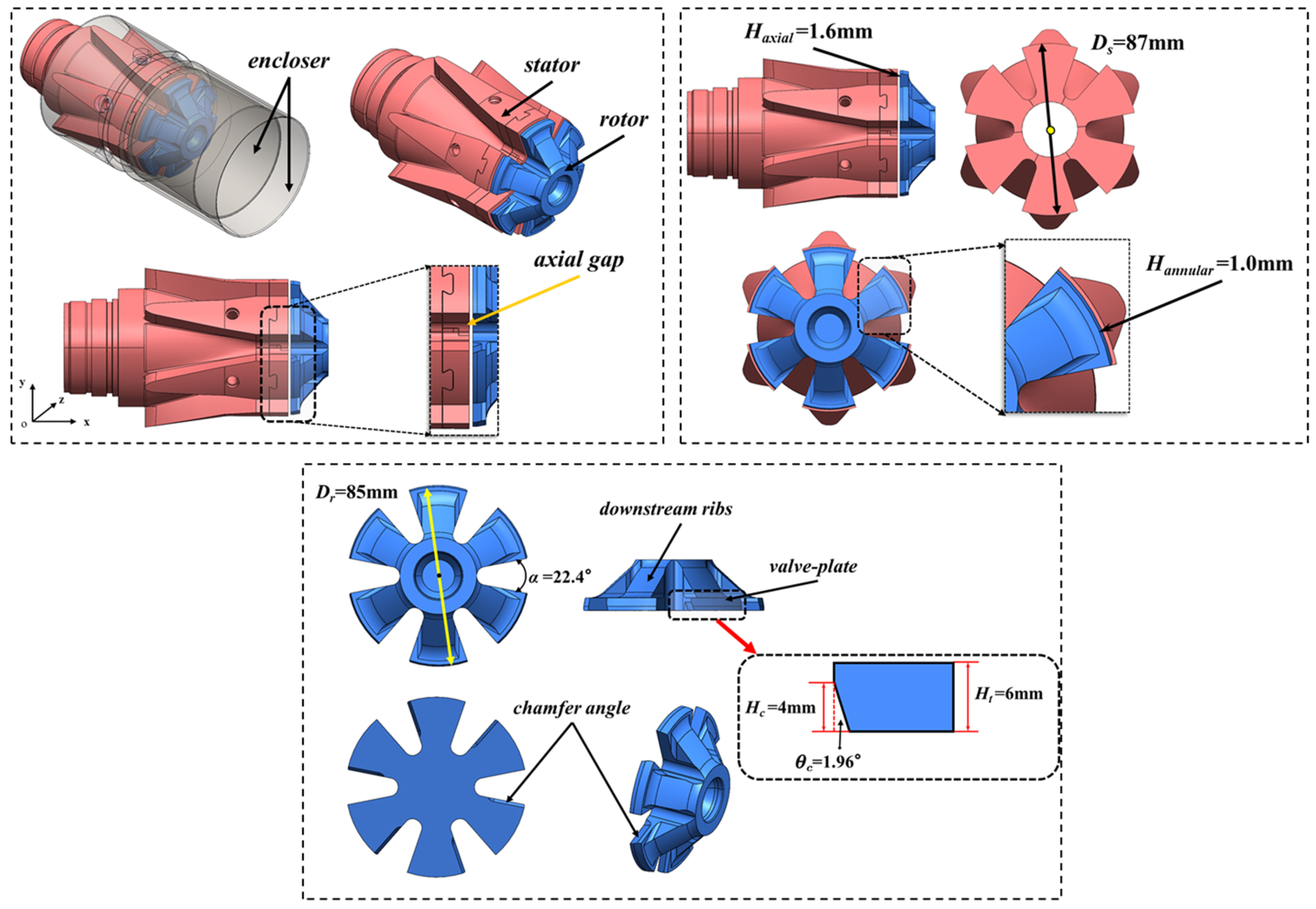
The rotating valve plate assembly of the continuous-wave mud pulser investigated in this study consists of a six-lobe, concentric cylindrical rotor–stator pair. Six sector-shaped throttling ports are uniformly distributed around the stator circumference, and matching ports of identical geometry are machined at corresponding locations on the rotor outer surface. Small radial and axial clearances are maintained between the rotor and stator to promote sealing while allowing relative rotation. As the drive motor rotates the rotor, the overlap area between the stator and rotor ports varies periodically, thereby modulating the effective flow area and generating pressure pulses.
The baseline geometry is as follows: stator diameter D s is 87 mm; rotor diameter D r is 85 mm; axial gap H a x i a l is 1.6 mm; annular gap H a n n u l a r is about 1 mm. The rotor comprises a valve plate section and downstream ribs. The total valve plate thickness H t is 6 mm. Each lobe is generally sector-shaped, but one base-side edge incorporates a chamfer: the chamfer angle θ c is 1.96°, the chamfer height H c is 4 mm, and the remaining square-edge (right-angle) step height H s is 2 mm. The baseline valve plate opening angle α for both stator and rotor orifices is 22.4°. In the parametric study, the opening angle varies from 20.0° to 26.0°.
The baseline geometric parameters of the rotor–stator assembly are summarized in Table 1. The rotor comprises a valve plate section and downstream ribs. Each lobe is generally sector-shaped, but one base-side edge incorporates a chamfer that provides an oblique transition forming a gradually contracting passage for the inflow, whereas the right-angle segment forms the final throttling gap. In the parametric study, the opening angle varies from 20.0° to 26.0°.
Figure 1 illustrates the 3D assembly and key geometric parameters. The end face of each rotor valve plate consists of an inlet chamfer segment followed by a right-angle edge segment. The chamfer provides an oblique transition that forms a gradually contracting passage for the inflow, whereas the right-angle segment is a plane normal to the local flow direction that forms the final throttling gap. The rotation angle θ is defined as relative to the initial fully open position of the rotor port. At 0°, the rotor and stator ports are fully aligned, the effective flow area is maximal, and throttling is minimal. As the angle increases, the two ports gradually misalign, the effective flow area decreases, and throttling strengthens. As the angle approaches a critical value, the two ports become nearly fully misaligned, and throttling is strongest. Considering practical operating conditions and numerical convergence, the simulated angle range was 0–30°.

2.2. Parametric Study Design

This study adopted a three-stage optimization strategy to progressively determine the optimal geometric configuration.
Stage I optimizes the valve plate opening angle, with the objective of identifying the angle α that yields the maximum throttling-induced pressure drop. Four opening-angle schemes were compared: α − 1 (α = 20.0°), α − 2 (α = 22.4°, baseline), α − 3 (α = 24.0°), and α − 4 (α = 26.0°). The evaluation metric is the throttling pressure drop at various target maximum closing angles.
Stage II optimizes the rotor valve plate chamfer height, aiming to assess how reducing the chamfer height (thinning) affects the torque–pressure drop characteristics based on the optimal α. With α fixed at 22.4°, five chamfer-thinning schemes were compared: h−0 (no thinning; chamfer height, 4.0 mm), h−1 (thinning, 0.1 mm; chamfer height, 3.9 mm), h−2 (thinning, 0.3 mm; chamfer height, 3.7 mm), h−3 (thinning, 0.6 mm; chamfer height, 3.4 mm), and h−4 (thinning, 1.2 mm; chamfer height, 2.8 mm). The evaluation metrics are the torque and pressure drop curves over the full operating stroke (0–26.5°).
Stage III determines the maximum operating angle by jointly considering pressure drop, torque, and control stability to identify the optimal upper limit of the rotation angle. The goal is to analyze torque sign reversal and balance signal strength against control risk.

2.3. Computational Domain and Mesh Generation

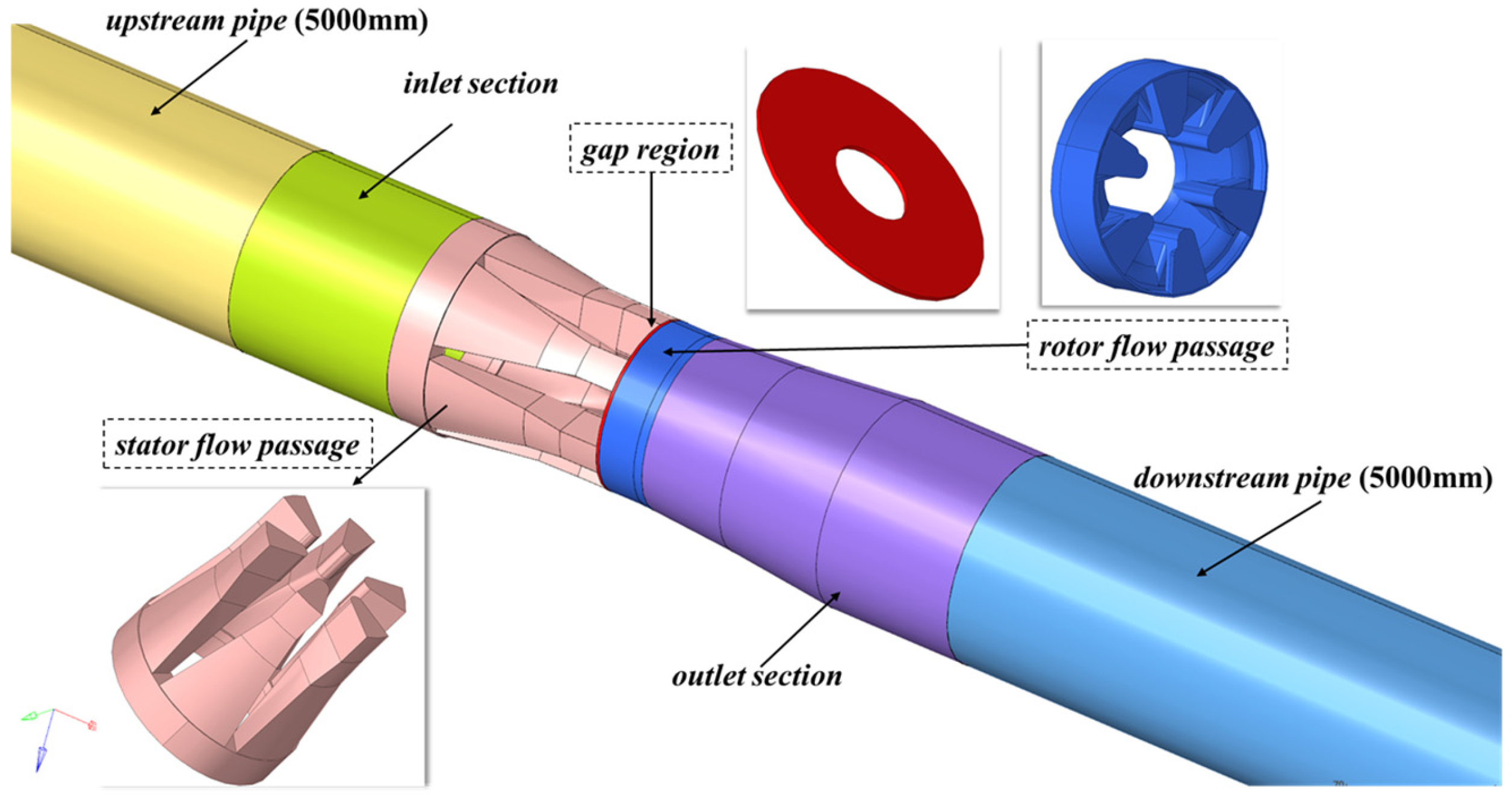
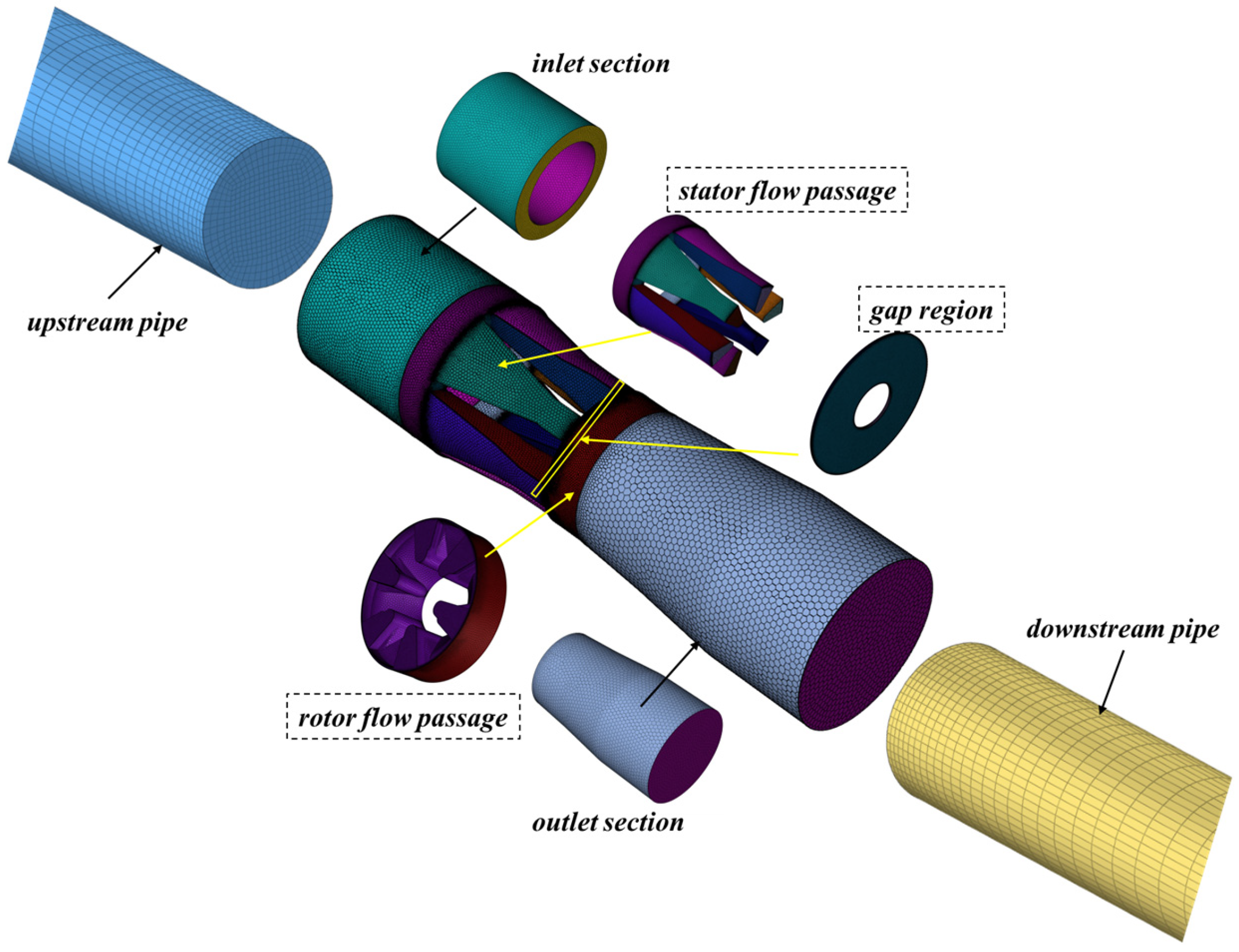
As shown in Figure 2, the complete computational domain comprises an upstream straight pipe section (length: 5000 mm), the near-inlet section, the stator flow-passage region, the rotor channel region, the gap region, the near-outlet section, and a downstream straight pipe section (length: 5000 mm). The upstream pipe ensures a fully developed inflow, whereas the downstream pipe minimizes outlet boundary feedback into the throttling region.
The domain is partitioned into a stationary region (stator plus upstream/downstream pipes) and a rotating region (rotor passages). The two regions are connected via a non-conformal interface, and relative motion is treated using a sliding-mesh approach. Boundary conditions are specified as follows: the inlet is a mass-flow inlet with a mass flow rate of 36 kg/s (corresponding to a volumetric flow rate Q of 30 L/s, representative of typical drilling conditions), turbulence intensity of 5%, and hydraulic diameter of 102.5 mm; the outlet is a pressure outlet at 0 Pa gauge (atmospheric) with backflow turbulence intensity of 5%. All solid boundaries use no-slip wall conditions; stator walls are stationary and rotor walls rotate. Quasi-static operating angles are obtained using frozen-rotor positions: the rotor is incrementally rotated to the target θ, and a steady (or pseudo-steady) solution is computed. The interface uses General Connection with conservative flux transfer.
Drilling fluid properties were set to a density of 1200 kg/m3 and dynamic viscosity of 0.005 Pa·s. Although drilling fluids are inherently non-Newtonian, at high shear rates the apparent viscosity tends to stabilize; therefore, a Newtonian fluid assumption is adopted for simplification.
A hybrid meshing strategy was employed using CFD software. As shown in Figure 3, hexahedral structured grids were generated for the upstream and downstream pipes, and hex-core meshes were used in complex transition regions, with polyhedral transitions where appropriate. The throttling gap region was locally refined in 3D, with element sizes of 0.15–0.20 mm, and additional local refinement was applied at chamfers and sharp square-edge corners to capture potential flow separation accurately. The overall mesh contains approximately 5.0 million cells; the minimum orthogonal quality exceeds 0.35 and the average exceeds 0.85, meeting solver recommendations for accuracy and stability.
To verify grid independence, the case at θ = 22.4° was selected, and five meshes of progressively increasing density were compared. Grid independence was assessed by comparing the throttling-induced pressure drop and the fluid torque, with variations within predefined tolerances (≤2%) taken as evidence of mesh independence. The results are summarized in Table 2.
As shown in Table 2, both torque and pressure drop exhibit monotonic convergence with increasing mesh density. From Mesh A to Mesh C, the torque deviation decreases from 5.76% to the reference value, while from Mesh C to Mesh E the deviation is only 1.20% for torque and 0.51% for pressure drop. The differences between Mesh D and Mesh E are less than 0.3% for both metrics, confirming that the solution has reached asymptotic convergence. Considering the trade-off between computational cost and accuracy, Mesh C (5.0 million cells) was adopted for all subsequent simulations.

2.4. Governing Equations and Solver Settings

2.4.1. Governing Equations and Fluid Properties

Assuming steady, incompressible flow with constant density, the governing equations comprise the continuity and momentum equations. The continuity equation is
· ( ρ v ) = 0 ,
The momentum equations are written in Reynolds-averaged Navier–Stokes (RANS) form.
· ρ v v = p + · τ τ t ,
where the total stress is decomposed into the viscous stress τ and the modeled Reynolds stress τ t ; the latter requires turbulence model closure.
This study employs the SST k–ω turbulence model. Through blending functions, the model behaves as k–ω in the near-wall region to resolve boundary-layer behavior and gradually transitions to k–ε in the free stream, with the cross-diffusion term enhancing numerical robustness. The SST formulation is well suited to flows with adverse pressure gradients, separation, and strong shear, and it has been extensively validated in hydraulic valve applications.
The fluid properties used in all simulations are listed in Table 3. Although drilling fluids are inherently non-Newtonian, at the high shear rates encountered in the throttling region, the apparent viscosity tends to stabilize toward a constant value. Therefore, a Newtonian fluid assumption is adopted for simplification, which is a common practice in comparative parametric studies of hydraulic valve performance. This simplification is acknowledged as a limitation in the Conclusions section.

2.4.2. Solver Settings

CFD software is employed with a steady, pressure-based solver. Pressure–velocity coupling uses the SIMPLE algorithm, and spatial discretization applies second-order schemes for pressure and momentum (second-order upwind for momentum). For robustness, the turbulent kinetic energy and specific dissipation rate are discretized with first-order upwind. The first-order upwind scheme for turbulence quantities (k and ω) was selected to ensure numerical stability during the initial iterations, particularly near the torque zero-crossing point where the flow exhibits strong unsteadiness. Sensitivity analysis confirmed that switching to second-order schemes after initial convergence changed results by <0.5%, validating this approach.
The convergence criterion is 1.0 × 10⁻⁵ for scaled residuals, combined with monitoring integral quantities (torque and pressure drop) to <0.1% variation over 50 iterations. Convergence is deemed achieved when the scaled residuals of the continuity, momentum, and turbulence equations fall below 1.0 × 10⁻⁵, and the monitored pressure drop and torque vary by no more than 0.1% over 50 consecutive iterations. All simulations are executed on an HPC cluster using 32 CPU cores with MPI domain decomposition; each case requires approximately 4–6 h of wall-clock time.

2.5. Performance Parameter Definitions

The driving torque T is obtained by integrating pressure and viscous stresses over the rotor surface. In Fluent, the torque about the z-axis is computed as follows:
T = S r × F p F v · e z d S ,
where r is the position vector from the rotation axis to the face centroid, F p is the pressure force, F v is the viscous (shear) force, e z is the axial unit vector, and S denotes the rotor surface. The sign convention is as follows: negative T indicates resistive torque (the fluid opposes rotation and external power is required), while positive T indicates driving torque (the fluid assists rotation and does work on the rotor).
The throttling pressure drop ΔP is defined as the difference between the area-averaged inlet total pressure and the area-averaged outlet total pressure. Specifically,
Δ P = P s ,   i n ¯ P s ,   o u t ¯ ,
where P s ¯ is the static pressure, and the overbar denotes area averaged over the corresponding boundary. The static pressure drop quantifies the static pressure loss and serves as a key metric of throttling effectiveness. For a continuous-wave mud pulser, a larger ΔP amplitude corresponds to a stronger pulse signal and a longer transmission distance.
The peak torque T p e a k is defined as the maximum absolute value of T over the operating stroke, θ ∈ [0°, 26.5°] and is used to evaluate the maximum load requirement of the drive motor.

3. Numerical Simulations Variation

To ensure the reliability of the numerical results, we conducted systematic validation comprising turbulence model comparison and experimental benchmarking.

3.1. Turbulence Model Comparison

To rationalize the choice of turbulence closure, three commonly used models were compared for the rotating valve plate flow: the standard k–ε model, the RNG k–ε model, and the SST k–ω model. Using the baseline geometry (opening angle α = 22.4°, baseline chamfer height), comparative simulations were performed at three representative rotation angles (θ = 10°, 18°, and 24°). The evaluation metrics were the predicted torque and pressure drop.
Table 4 summarizes the results. The three models yield broadly consistent trends for ΔP, whereas notable differences arise in torque. The standard k–ε model tends to overpredict the torque magnitude; at θ = 24°, it gives −6.82 N·m, which is 48% larger in magnitude than that predicted by the SST model. This behavior is attributable to the standard k-ε model’s inadequate near-wall treatment, which overpredicts wall shear stress. The RNG k-ε model, which incorporates corrections for rotation and streamline curvature, produces torque predictions between those of the standard k-ε and SST models but still deviates appreciably at large rotation angles.
The SST k-ω model employs the k-ω formulation in the near-wall region to resolve the viscous sublayer and blends toward k-ε in the free stream to enhance robustness. It also applies an eddy viscosity limiter to suppress excessive turbulent viscosity, making it well suited to flows with adverse pressure gradients and separation. For the rotating valve plate investigated here, the salient features, including high-speed jets, strong shear layers, recirculation under adverse pressure gradients, and boundary-layer transition, align with the strengths of the SST model.
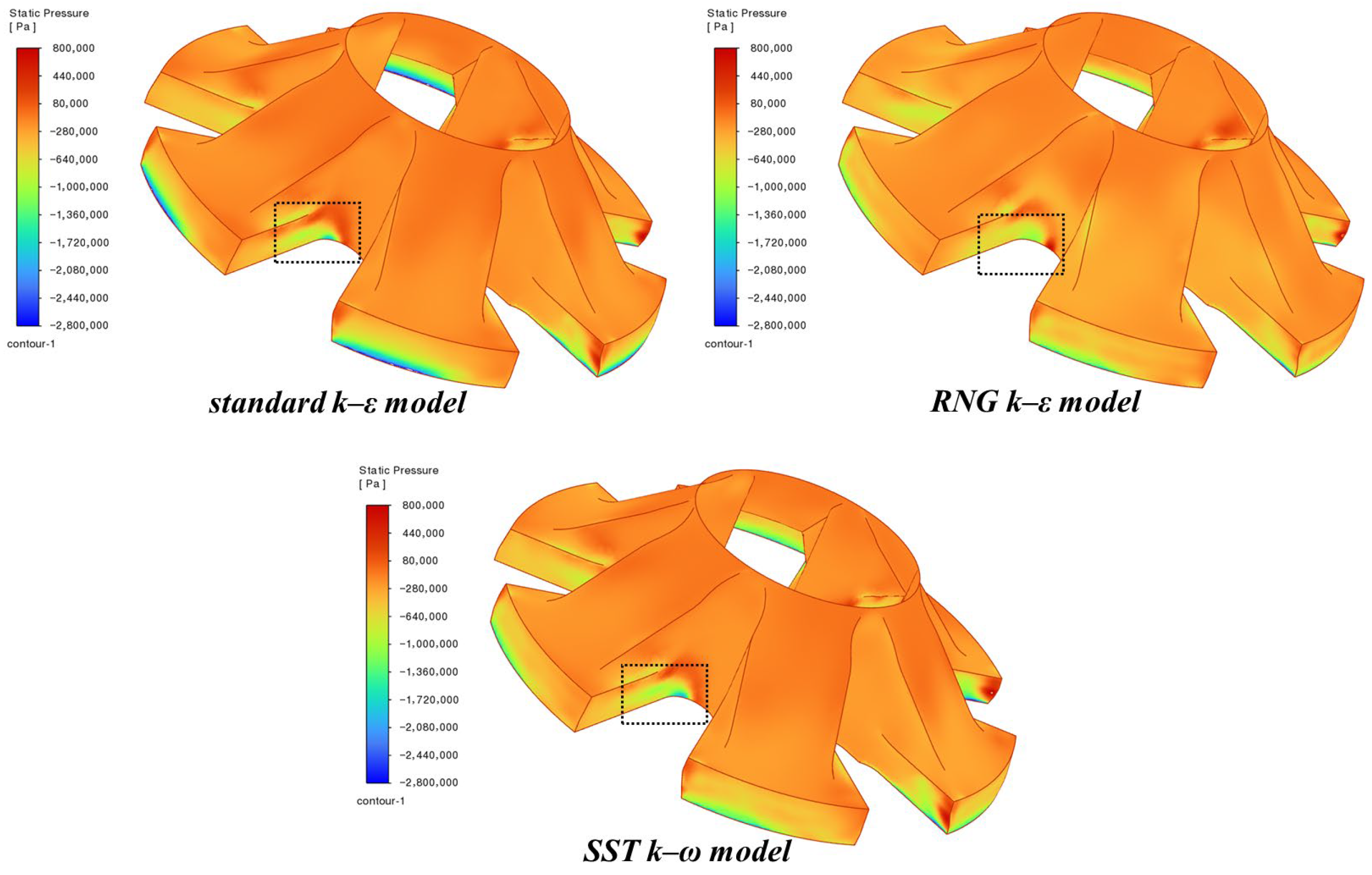
Figure 4 compares the rotor surface pressure distributions at θ = 24° predicted by the three models. The standard k-ε and RNG k-ε models predict higher pressures in the recirculation zone downstream of the square (right-angle) edge, leading to an overestimation of pressure difference-induced torque. The SST model predicts lower pressure in the separated region, which is more consistent with the expected flow physics. Balancing accuracy and robustness, the SST k-ω model is adopted for all subsequent computations.

3.2. Experimental Validation

To assess the reliability of the simulations, we compared the results with laboratory measurements obtained on a mud-pulser performance rig at an oilfield technology research institute. The setup includes a centrifugal pump (0–50 L/s, up to 3 MPa), an electromagnetic flowmeter (±0.5%), high-frequency pressure transducers (1 kHz, ±0.1%), a torque sensor (±50 N·m range, ±0.2%), a servo motor drive, and a data-acquisition system. The working fluid was a surrogate drilling mud with density 1200 kg/m3 and viscosity 5 mPa·s. Tests were performed at 30 L/s. The rotor was driven quasi-statically from θ = 0° to 26°, dwelling every 2° for 10 s to record time-averaged torque and pressure drop.
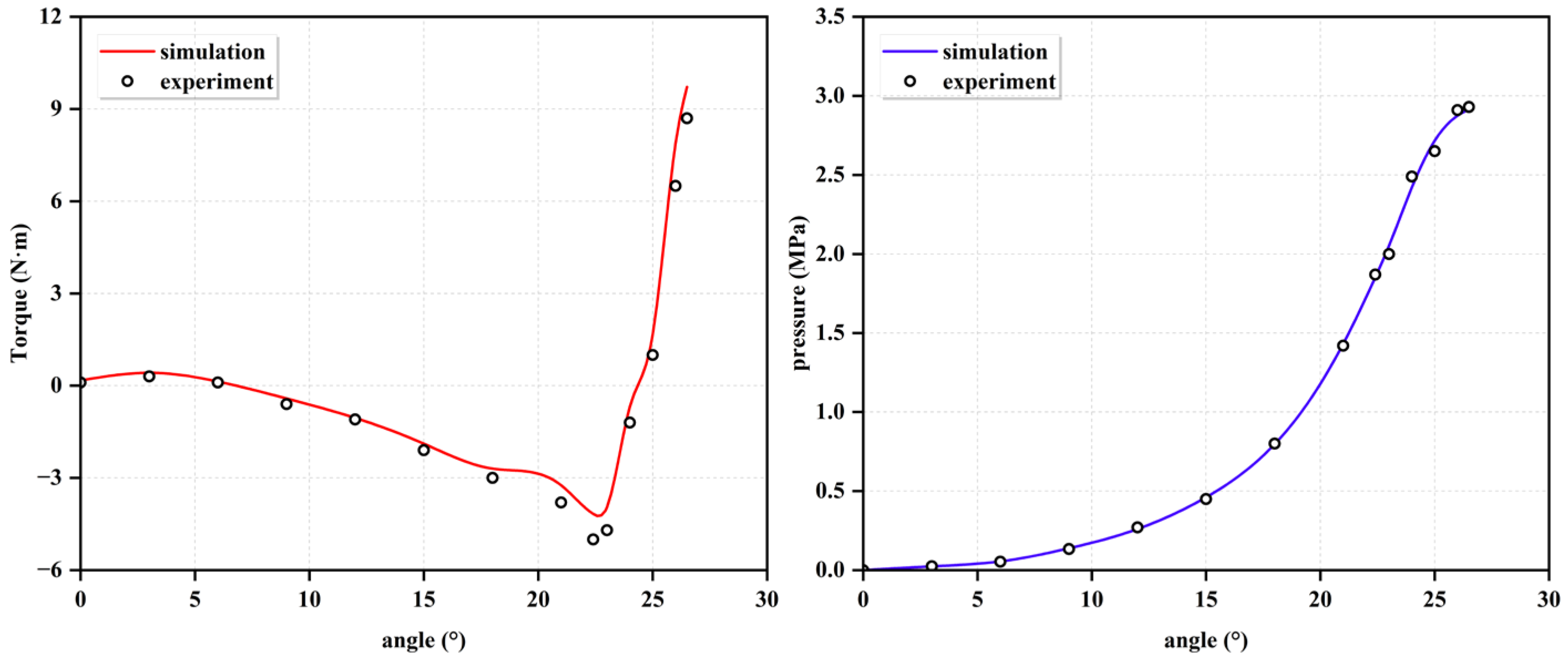
Figure 5 compares the simulated and measured torque and pressure drop curves over the full angular range. For torque [Figure 5 (left)], agreement is generally good, and the overall trend is reproduced: the relative deviation is within 5% for θ < 15°, within 8% for 16° ≤ θ ≤ 22°, and increases to a maximum of about 12% at θ = 24°, where torque approaches zero. For pressure drop [Figure 5 (right)], the predicted ΔP matches measurements closely with an all-conditions mean deviation of 4.2%. At θ = 0°, the passage is fully open, and ΔP is near zero in both datasets; near θ = 26°, the simulation gives 2.87 MPa versus a measured 2.91 MPa (1.4% deviation). The pressure drop predictions outperform those of torque because ΔP is governed primarily by passage geometry and mass conservation and is less sensitive to turbulence model details.
Table 5 summarizes the quantitative comparison at key operating points. The mean relative error is 7.0% for torque and 2.8% for pressure drop, both within engineering tolerances. The remaining discrepancies primarily stem from the Newtonian fluid assumption, the steady-state treatment, and the absence of mechanical friction in the CFD model.
Additional sensitivity checks were conducted to further ensure numerical reliability. An unsteady RANS calculation at θ = 24° (Δt = 1 × 10⁻⁴ s, 1 s physical time) confirmed that time-averaged torque and pressure drop deviate by less than 3% from the steady-state solutions, validating the quasi-static assumption. Variations in inlet turbulence intensity (1%, 5%, 10%) produced negligible effects on performance metrics (ΔP deviation < 1%, torque deviation < 2%), attributable to the long upstream pipe (5000 mm ≈ 55D) that allows for flow development. Domain-length sensitivity tests (1000, 5000, and 10,000 mm extensions) confirmed that the adopted 5000 mm length is sufficient to eliminate boundary-condition artifacts.

4. Results and Discussion

4.1. Optimization of Valve Plate Opening Angle

4.1.1. Pressure Drop Characteristics

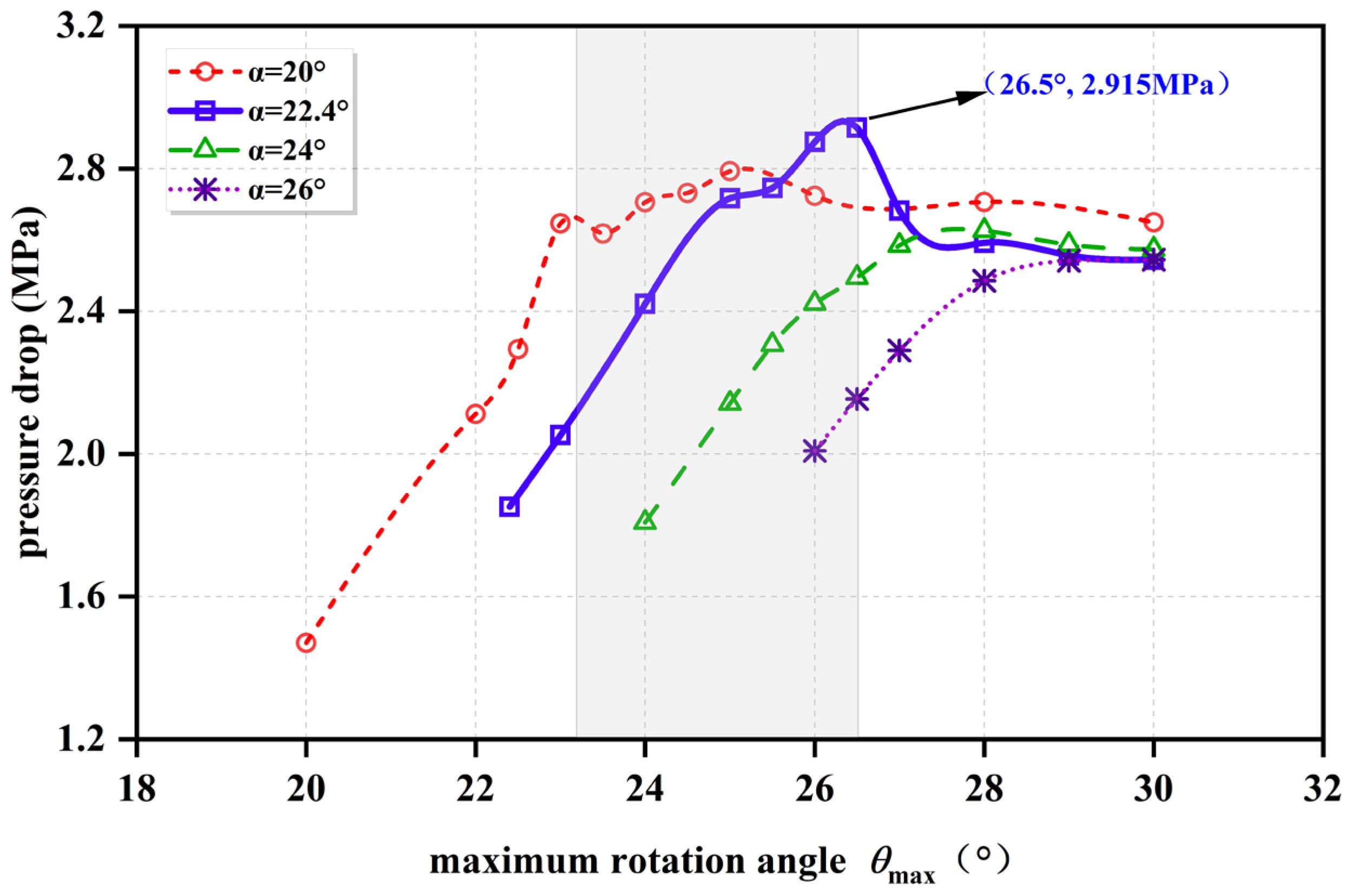
The valve plate opening angle α is a key geometric parameter that sets the throttling-window area and directly influences the passage capacity and resulting pressure drop. For a given α, the sweep of the maximum closing angle begins at θ = α and continues beyond it; this extended range is referred to as over-travel closing. As shown in Figure 6, for all configurations, the pressure drop peak occurs within the over-travel closing regime, and its evolution with the maximum closing angle θmax is distinctly nonlinear: as the over-travel angle increases, ΔP initially increases rapidly, and then its growth rate slows, and after reaching a peak, it decreases and tends toward a plateau.
This nonlinearity originates from the geometric evolution of the effective flow area. When the closing angle first reaches the valve port angle (θ = α), the effective area is not yet minimal because one edge is chamfered and an axial clearance exists. As θ increases further, the effective area shrinks rapidly and throttling intensifies, driving ΔP upward. Beyond the peak, continued rotation promotes clearance leakage paths, the effective area begins to increase, and throttling weakens, causing ΔP to decline and then level off.
Table 6 provides, for each configuration, the optimal closing angle, the peak pressure drop, and its relative increase over the baseline (α = 22.4°). Among the four configurations, the optimal pairing of valve port angle and maximum closing angle is Scheme 2 (22.4°, 26.5°), yielding a peak pressure drop of 2.915 MPa—about 60% higher than the original configuration (22.4°, 22.4°), which produces 1.852 MPa. This outcome further confirms the effectiveness of over-travel closing. The peak pressure drops of the remaining configurations are lower than those of Scheme 2 by 6.1%, 11.7%, and 14.5%, respectively. Therefore, from the standpoint of maximizing signal strength, there exists an optimal pairing of valve port angle and maximum closing angle: (22.4°, 26.5°) for the present geometry.

4.1.2. Comparison of Torque Characteristics

Pressure and velocity contour maps at the maximum closing angles for the four opening-angle schemes were examined; however, the visual differences among schemes are subtle under these conditions, and the quantitative curves in Figure 7 provides more discriminating performance comparisons.
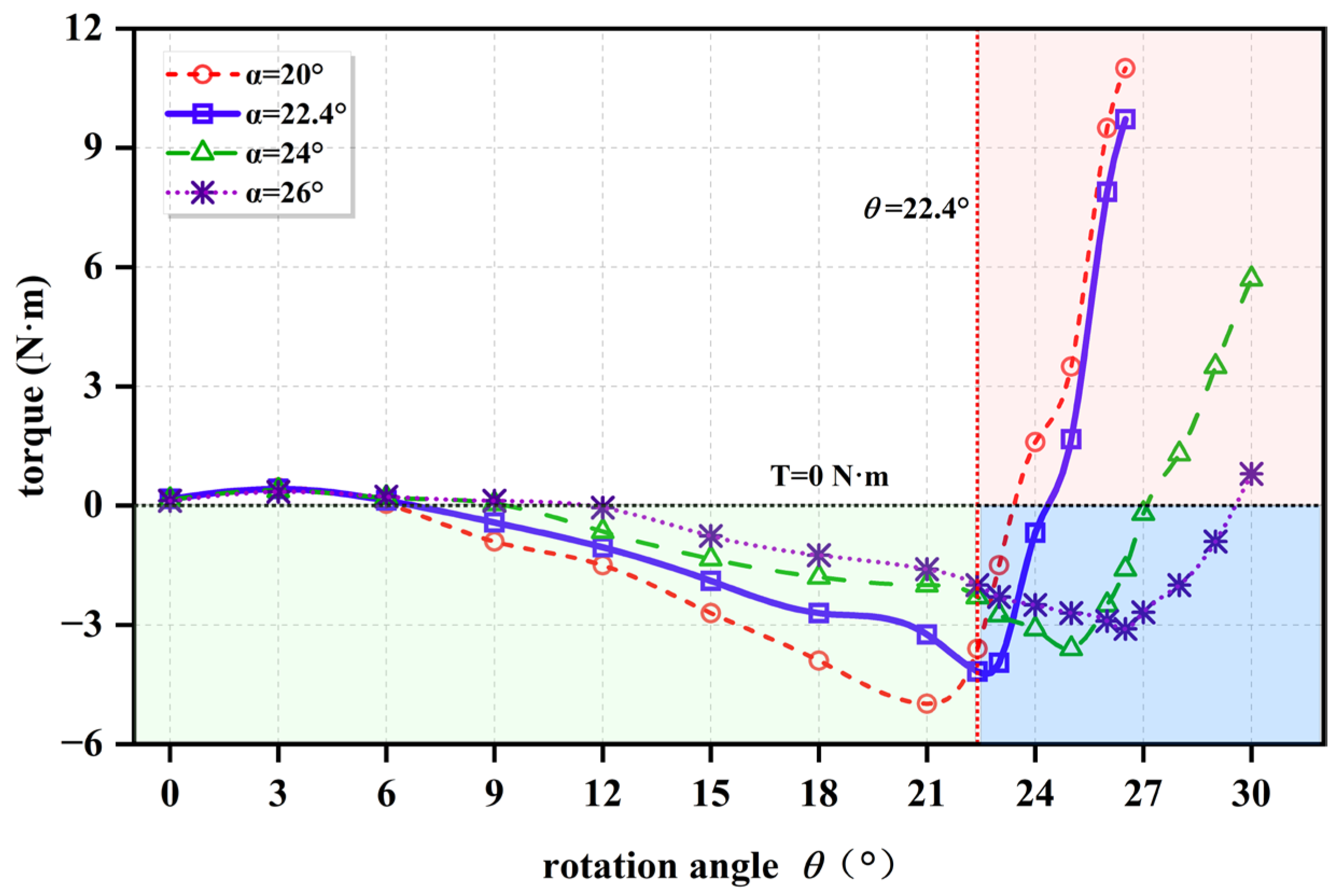
Driving torque is a key metric for assessing the pulser’s mechanical performance, directly informing motor selection and energy consumption. Figure 7 shows the torque–angle curves under typical operating conditions for the four valve plate opening angles.
All configurations exhibit similar trends. In the initial stage (θ < 9°), the torque is positive and small. As θ increases (9° < θ < 20°), the torque drops into the negative range, its absolute magnitude grows rapidly, and a peak negative torque appears at a characteristic angle. With further rotation, the negative torque magnitude decreases, followed by a sign reversal in which the torque crosses from negative to positive.
Table 7 lists the peak torque and its corresponding rotation angle for each configuration. Scheme 1 reaches −4.98 N·m at θ = 21.0°; Scheme 2 (baseline) reaches −4.17 N·m at θ = 22.4°; Scheme 3 reaches −3.60 N·m at θ = 25.0°; and Scheme 4 reaches −3.15 N·m at θ = 26.5°. A smaller valve plate angle produces a larger peak torque magnitude and an earlier peak. Physically, for the same rotation angle, a smaller opening angle yields a narrower throttling clearance, which increases the pressure differential and shear force and thus the peak torque. Conversely, a larger opening angle affords a smoother passage and a smaller peak torque. This reflects the typical coupling between pressure drop and torque characteristics: ΔP-high torque versus ΔP-low torque.
Regarding motor load, Scheme 4 yields the smallest peak torque and thus the lowest mechanical power demand; however, this benefit comes with a pronounced reduction in pressure drop and, consequently, weaker signal strength. Although Scheme 1 delivers the largest pressure drop, its peak torque is nearly 20% higher than the baseline (Scheme 2), tightening motor and drivetrain requirements, and its earlier peak further narrows the controllable operating window.

4.1.3. Torque Sign Reversal Phenomenon

A notable feature in Figure 8 is the torque sign reversal. Using Scheme 2 (α = 22.4°) as an example, the torque is −4.17 N·m at θ = 22.4°, decreases in magnitude to −0.68 N·m at θ = 24°, becomes positive at θ = 25° (+1.67 N·m), and reaches a peak positive value of +9.72 N·m at θ = 26.5°.
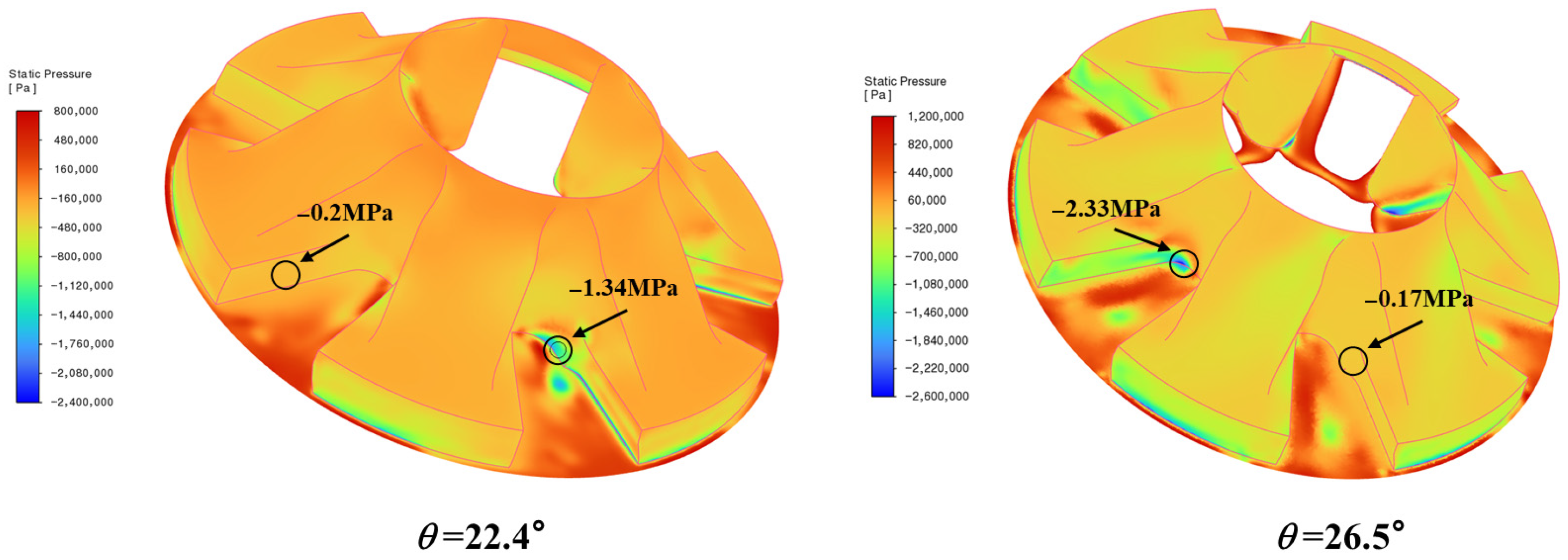
The underlying mechanism is as follows: During closing, at small-to-moderate rotation angles, the leading edge of the rotor window experiences relatively high pressure, whereas the trailing edge lies within a lower pressure separation wake. The resulting pressure differential produces a closing-aiding (negative) torque. As θ increases and the throttling clearance becomes extremely narrow, the jet momentum rises, and a complex recirculation with secondary flows develops near the trailing edge. When the rotor and stator windows are nearly fully misaligned (θ > α), jet impingement elevates the pressure on the trailing edge, and vortices induced by entrainment form a local high-pressure region there. This reverses the pressure-induced moment, yielding a positive torque that resists further closing.
Figure 8 presents rotor surface pressure contours for Scheme 2 at θ = 22.4° (peak negative torque) and θ = 26.5° (positive torque). At θ = 22.4°, the pressure on the right-angle side of the rotor is about −0.2 MPa, whereas the chamfered side is around −1.34 MPa, producing a strong pressure differential that drives negative torque. At θ = 26.5°, the pressure on the chamfered side rises to approximately −0.17 MPa, while that on the right-angle side drops to about −2.33 MPa. The pressure difference reverses direction, resulting in positive torque. (Pressures are reported relative to the chosen reference.)
The torque-reversal phenomenon poses challenges for pulser control. In the positive torque region, fluid action impedes rotor motion during closing but assists it during opening; if the control algorithm is poorly tuned, the rotor’s angular velocity may become unstable, potentially causing mechanical impacts. Therefore, field operation should avoid prolonged residence in the positive torque region, or an active braking control strategy should be employed.

4.1.4. Interim Conclusions

When balancing pressure drop and torque performance, the valve plate opening angle must also balance out signal strength with mechanical load. The baseline Scheme 2 (α = 22.4°) offers a favorable compromise: at θ = 22.4°, the pressure drop is 1.852 MPa with a peak negative torque of −4.17 N·m; at θ = 24°, ΔP rises to 2.421 MPa, while the torque diminishes to −0.68 N·m. The torque-reversal angle is approximately 24°, providing a reasonable window for stable control. Accordingly, the subsequent optimization of rotor valve plate chamfer height is conducted with α = 22.4° and a maximum closing angle θmax = 26.5°.

4.2. Rotor Valve Disk Chamfer Height Optimization

4.2.1. Torque Curve Evolution

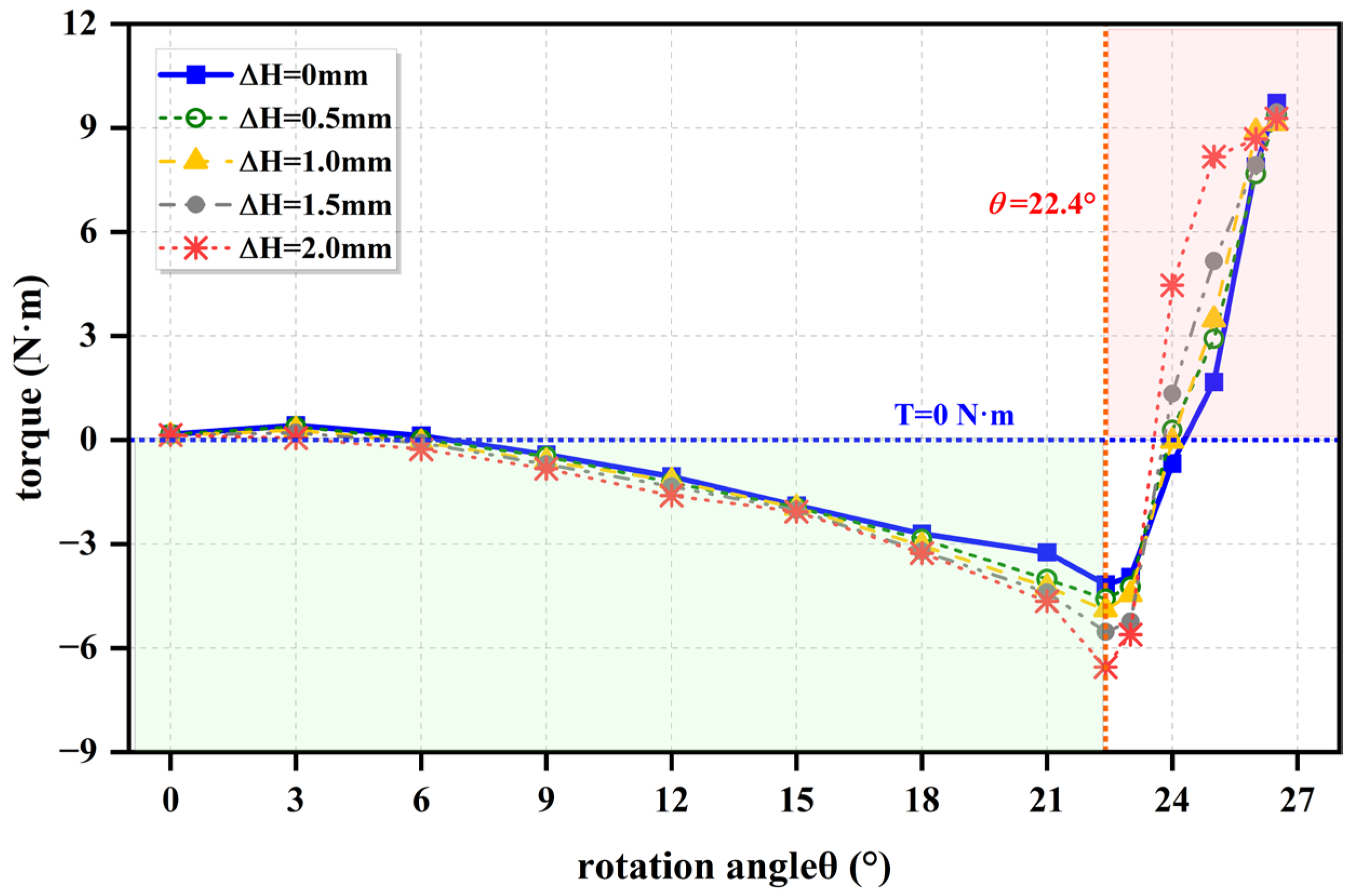
Building on the optimal opening angle (α = 22.4°), we modify the passage geometry by thinning the rotor valve plate chamfer to explore approaches for improving torque characteristics. Chamfer thinning reduces only the chamfered portion’s height, keeping the right-angle edge height unchanged. For example, if the original total valve plate thickness is 6.0 mm (4.0 mm chamfer + 2.0 mm right-angle edge), thinning the chamfer by 1.2 mm reduces the total thickness to 4.8 mm (2.8 mm chamfer + 2.0 mm right-angle edge). Figure 9 compares the torque curves with the full operating stroke (θ = 0–26.5°) for five chamfer-thinning schemes (0, 0.5, 1.0, 1.5, and 2.0 mm).
From Figure 9, the following patterns are observed:
(1) Increased peak negative torque. As chamfer thinning increases, the peak negative torque magnitude grows. The baseline (no thinning) yields −4.17 N·m at θ = 22.4°; Scheme 1 (0.5 mm) reaches −4.58 N·m (+9.8%); Scheme 2 (1.0 mm) −4.89 N·m (+17.3%); Scheme 3 (1.5 mm) −5.53 N·m (+32.6%); and Scheme 4 (2.0 mm) −6.55 N·m (+57.1%). Despite reducing the overall valve plate thickness, thinning alters the fluid–rotor interaction and, counterintuitively, increases the resisting fluid torque.
(2) Pronounced differences in the mid-angle region. At θ = 18°, the baseline torque is −2.70 N·m, whereas Scheme 4 is −3.26 N·m (20.7% difference). At θ = 22.4°, the difference expands to 57.1%. Thus, thinning most strongly affects the peak torque region, with relatively modest impact at smaller angles.
(3) Complex behavior in the positive torque region. At θ = 24°, the baseline is −0.68 N·m; Scheme 2 is −0.03 N·m; Scheme 3 crosses positive to +1.34 N·m; Scheme 4 rises to +4.46 N·m. Thinning therefore advances the torque-reversal angle—that is, the transition from impeding to driving torque occurs earlier. At θ = 26.5°, the baseline positive torque is +9.72 N·m; Scheme 2 drops to +9.13 N·m (−6.1%), while Schemes 3 and 4 rebound slightly to +9.45 N·m and +9.27 N·m, reflecting nonlinear large-angle flow behavior.
(4) Consistent trends at small angles. For θ < 15°, the trends are consistent across schemes, but the increments are smaller in absolute terms. For example, at θ = 12°, the baseline is −1.05 N·m and Scheme 4 is −1.60 N·m (+52%). This is an absolute difference of only 0.55 N·m, which is much smaller than the 2.38 N·m difference near the peak.
The mechanism by which chamfer thinning increases the peak negative torque can be interpreted from four complementary perspectives:
Geometric effect. Thinning reduces the chamfer height while keeping the right-angle step at 2.0 mm, lowering the chamfer-to-step ratio (e.g., from 4:2 to 2.8:2 in Scheme 4). This effectively steepens the chamfer, forcing more abrupt flow turning within the chamfered region.
Flow characteristics. A steeper chamfer increases the entrance turning angle and streamline curvature into the throttling zone, intensifying centrifugal effects and steepening the adverse pressure gradient. This raises impingement loads on the rotor, especially near the chamfer-step junction, producing pronounced local pressure peaks.
Pressure distribution. Although thinning reduces wetted area, the altered flow elevates the average pressure on the right-angle side and deepens the low-pressure zone over the chamfered side due to stronger separation. The simultaneous increase on one side and decrease on the other amplifies the pressure-induced torque.
Jet momentum effect. Thinning strengthens contraction (vena contracta), increasing jet velocity and momentum. The resulting reaction force upon impingement grows, most prominently near the peak torque angle.
Table 8 lists key torque parameters for all schemes. Based on peak torque magnitude alone, Scheme 2 is optimal (smallest |Tpeak|); however, a comprehensive assessment must also weigh pressure drop performance and the risk associated with positive torque (earlier torque reversal).

4.2.2. Evolution of Pressure Drop Characteristics

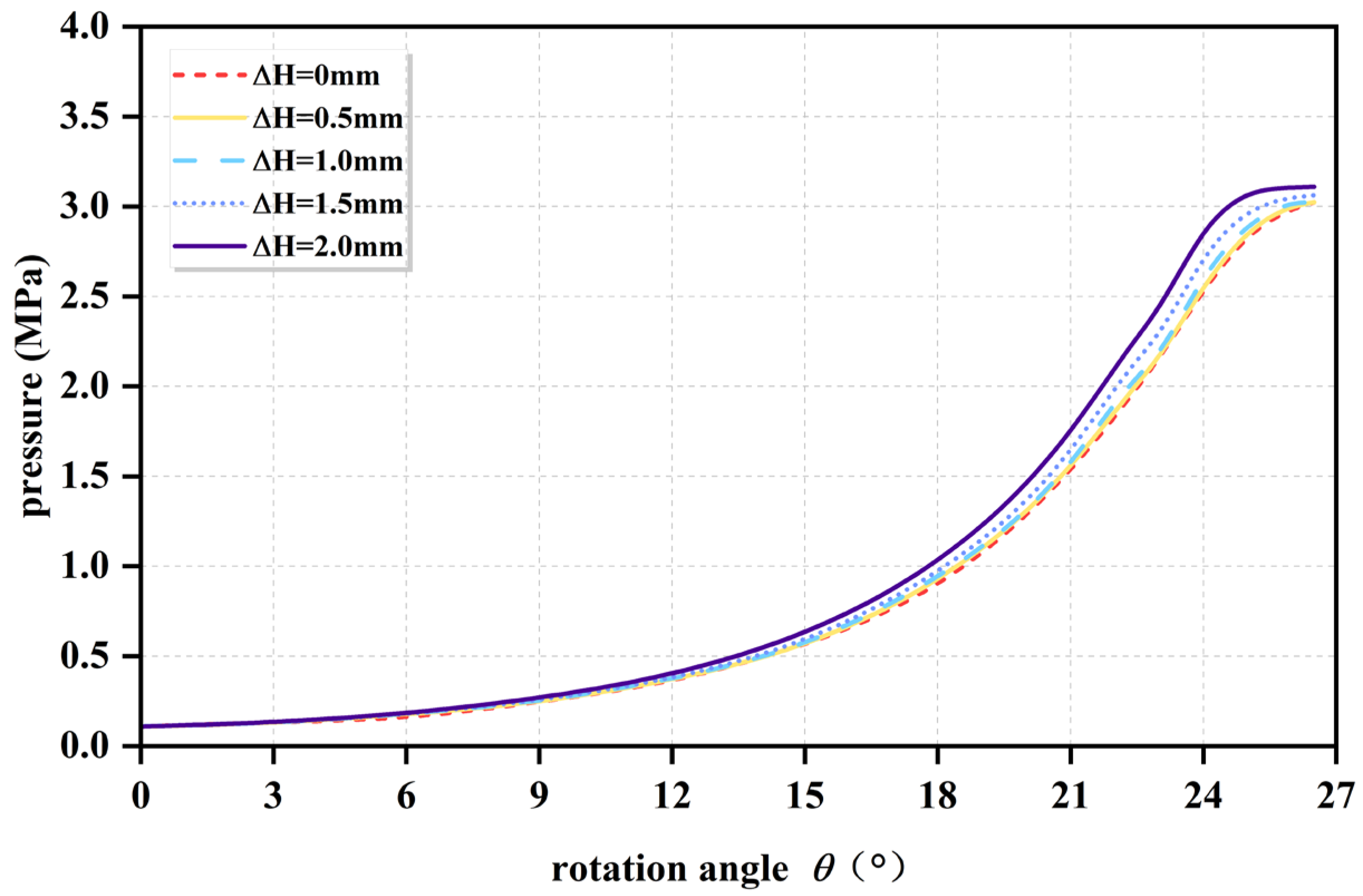
Figure 10 shows the pressure drop versus rotation angle curves for the chamfer-thinning schemes. In contrast to torque, ΔP is relatively insensitive to thinning and increases monotonically. For small-to-moderate angles (θ < 22.4°), all curves nearly coincide, with differences under 3%. In this regime, the passage is not fully closed, and the flow is governed mainly by the bulk throughflow area; local changes to the rotor chamfer have limited impact on ΔP.
At larger angles (θ > 23°), thinning effects become noticeable. At θ = 26.5°, the baseline ΔP is 3.023 MPa; Scheme 1: 3.024 MPa (+0.03%); Scheme 2: 3.026 MPa (+0.1%); Scheme 3: 3.063 MPa (+1.3%); Scheme 4: 3.109 MPa (+2.8%). Nonetheless, absolute differences remain small because the passage is nearly closed and ΔP is dominated by the extremely narrow residual clearance, diminishing the relative influence of chamfer geometry.
The mechanisms by which chamfer thinning increases the pressure drop are as follows:
Enhanced contraction of the passage. Although the total valve plate thickness decreases, the chamfer becomes steeper. At the same rotation angle, a steeper chamfer produces stronger contraction between the rotor and stator windows. As the fluid traverses the throttling region, the contraction ratio (Aout/Ain) decreases; by continuity, velocity increases and, invoking Bernoulli with minor loss terms, the pressure drop rises.
Increased inlet loss. A steeper chamfer raises the entrance turning angle and streamline curvature into the throttling zone. The abrupt turn introduces additional local (minor) losses, analogous to a sudden contraction in piping, and these losses increase with chamfer slope.
Jet-induced throttling. Thinning accentuates jet behavior in the narrow slit. The high-speed jet experiences stronger viscous and turbulent dissipation, increasing ΔP; downstream sudden expansion losses also intensify.
Importantly, while reducing the total valve plate height would, in principle, lower wetted area and bulk friction, the flow effects induced by the steeper chamfer dominate in practice, leading to a net increase in pressure drop. This highlights that in throttle valve design, local geometric features (e.g., chamfer angle) can outweigh overall dimensions (e.g., total thickness) in controlling the flow.
Table 9 compares pressure drops under typical operating conditions. The enhancement due to chamfer thinning is persistent, but the marginal gains show a non-uniform pattern: from the baseline to Scheme 2, the pressure drop at θ = 22.4° increases by 3.2%, whereas from Scheme 2 to Scheme 4, it increases by 10.7%, indicating an accelerating rate of increase.

4.2.3. Integrated Torque–Pressure Drop Performance

To intuitively assess the integrated performance of the schemes, we introduce a torque–pressure drop efficiency metric η, defined as the throttling pressure drop per unit peak torque:
η = Δ P m a x T p e a k ,
A larger η indicates a higher pressure drop for the same mechanical load, i.e., better energy-conversion efficiency. However, because chamfer thinning increases the peak torque magnitude, the interpretation of η must be reconsidered. Table 10 reports the integrated performance for each scheme at θ = 22.4° (the peak torque position).
From Table 10, although chamfer thinning increases the pressure drop, the larger increase in peak torque causes the torque–pressure drop efficiency to decline. For example, at θ = 22.4°, the efficiency of Scheme 4 is 27.2% lower than that of the baseline, implying that for the same pressure drop requirement, a larger peak torque must be tolerated. Conversely, under the same peak torque constraint, the attainable pressure drop gain is limited. From the standpoint of energy efficiency at the peak operating condition, chamfer thinning is therefore unfavorable.
A comprehensive evaluation should not rely solely on the peak point but also consider the actual operating angle. The pulser switches rapidly among angles rather than dwelling at the peak torque point; thus, performance over the full operating stroke is relevant.
At θ = 24°, we recompute the specific torque for each scheme as
τ s p = T Δ P a m p ,
where τsp denotes the torque per unit pressure difference amplitude, reflecting energy-conversion efficiency. A smaller τsp indicates better efficiency.
Here, T denotes the torque at the actual operating angle (rather than the peak torque), which more accurately characterizes energy efficiency at that operating point. A smaller τsp indicates a lower drive load for the same signal strength, i.e., higher energy utilization efficiency.
In Table 11, at θ = 24°, the performance profile differs markedly from that at the peak condition. Scheme 2 exhibits an extremely low specific torque (0.012 N·m/MPa) because the torque is near the zero-crossing (reversal point); thus, the drive load is minimal while the pressure drop remains high (2.597 MPa). Scheme 1 also performs well, with a specific torque of 0.114 N·m/MPa—a 57.6% reduction relative to the baseline. By contrast, excessive chamfer thinning in Schemes 3 and 4 shifts the operating point into the positive torque region; the specific torque rises rapidly, and control becomes more challenging due to higher actuation demand.
This comparison underscores an important design principle: the advantage of chamfer thinning does not lie in the peak condition but in improving performance near the torque zero crossing. With moderate thinning, the load around the zero crossing can be reduced to a very low level while maintaining or improving the pressure drop, thereby substantially enhancing energy efficiency at that operating point.
Balancing peak torque, pressure drop, and performance across operating angles, Scheme 1 (0.5 mm chamfer thinning) offers a superior compromise. At θ = 22.4°, the increase in peak torque is moderate (+9.8%) and remains within an acceptable range, while the pressure drop rises slightly (+1.1%), preserving strong throttling performance. At θ = 24°, the torque is close to the zero crossing (+0.29 N·m), closer to zero than the baseline (−0.68 N·m), with the pressure drop maintained (2.547 MPa). The specific torque is only 0.114 N·m/MPa, 57.6% lower than the baseline, providing a substantial reduction in drive load. Moreover, the operating point does not enter the high positive torque region, supporting good control stability.
Scheme 2 (0.3 mm chamfer thinning) performs best near θ = 24° (nearly zero torque; ΔP ≈ 2.597 MPa) but entails a larger increase in peak torque (+17.3%). If the system can tolerate a higher peak load and the operating strategy concentrates near θ ≈ 24°, Scheme 2 is also preferred.
Therefore, the physical effects of chamfer thinning reveal a key principle for throttle valve design: local geometric optimization can redistribute performance across operating points. Although chamfer thinning increases peak torque, shifting the zero-crossing angle can deliver excellent performance at targeted operating points (e.g., θ = 24°). This “trading peak for operating point” strategy is particularly valuable when the operating angle is well defined.
For the continuous-wave mud pulser studied here, the operating angle can be precisely set by the control system. Accepting a moderate increase in peak torque (about 10%) in exchange for a substantial reduction in torque at the operating angle (from 0.68 N·m to 0.29 N·m or lower) is justified, as it reduces average actuation power during operation and extends battery life.

4.3. Determination of the Optimal Operating Angle

4.3.1. Performance Evaluation Metrics

The operating performance of the continuous-wave mud pulser is assessed using three key metrics:
(1) Pressure drop amplitude, ΔPamp: The magnitude of the pressure change produced by a single pulse, defined as the difference between the maximum pressure drop and the initial pressure drop.
Δ P a m p = Δ P m a x Δ P 0
where ΔP0 is the baseline pressure drop at the fully open rotor position (θ = 0°), and ΔPmax is the maximum pressure drop when the rotor is rotated to the target angle θ. At a valve plate angle of 22.4°, the fully open pressure drop is 0.108 MPa; thus, ΔP0 ≈ 0.1 MPa can be used as an approximation. A larger ΔPamp implies stronger signal strength and longer transmission distance. In practice, ΔPamp should exceed downhole noise (typically 0.05–0.10 MPa) by a factor of 10–20 to ensure reliable signal reception.
(2) Peak torque, Tpeak: The maximum load torque during rotor rotation, which directly determines the required motor power and associated energy consumption. The peak typically occurs near θ ≈ 22.4°. A smaller peak torque indicates higher system efficiency and longer equipment life. Motor power is P = T · ω, where ω is the angular velocity; reducing peak torque directly lowers power and energy use.
(3) Specific torque, τsp: The torque per unit pressure-difference amplitude, reflecting energy-conversion efficiency. A smaller τsp indicates a lower drive load for the same signal strength, i.e., higher energy utilization efficiency at the operating angle.
For the pulser, the ideal operating point combines a high pressure-difference amplitude with a low specific torque, i.e., high signal and low load.

4.3.2. Performance Comparison at Different Operating Angles

Based on the optimized structural parameters (valve plate angle α = 22.4° and 0.5 mm chamfer thinning), a set of candidate maximum operating angles is evaluated. Table 10 reports performance data under typical conditions.
The following can be observed from Table 12:
(1) Pressure drop amplitude increases monotonically with operating angle, i.e., from 0.823 MPa at 18° to 2.916 MPa at 26.5°, which is a 254% increase. As the operating angle increases, the window overlap area shrinks and throttling strengthens. The increase is fastest in the moderate angle range (18–24°) and tends to saturate at larger angles (24–26.5°).
(2) Torque exhibits a V-shaped evolution:
Negative torque increasing region (θ < 22.4°): Torque becomes more negative from −2.86 N·m to a peak of −4.58 N·m, indicating progressively stronger hydrodynamic resistance on the rotor.
Negative torque decreasing region (22.4° < θ < 24°): Torque rises rapidly toward zero from −4.58 N·m to −0.29 N·m (a 94% reduction) as the pressure difference between the leading and trailing edges diminishes.
Torque zero crossing (θ ≈ 24°): Torque is near zero (+0.29 N·m), with essentially balanced leading- and trailing-edge pressures and minimal drive load.
Positive torque increasing region (θ > 24°): Torque becomes positive and increases quickly from +0.29 N·m to +9.37 N·m, indicating the dominance of trailing-edge jet impingement.
(3) The specific torque attains its optimum near θ = 24° at 0.12 N·m/MPa, which is 95.1% lower than at θ = 22.4° (2.43 N·m/MPa) and 96.5% lower than at θ = 18° (3.44 N·m/MPa). This indicates extremely high energy-conversion efficiency at θ = 24°, yielding maximum signal intensity per unit drive load.
(4) In the positive torque region (θ > 24°), the specific torque rebounds rapidly, reaching 1.06 N·m/MPa at θ = 25° and 3.20 N·m/MPa at θ = 26.5°, which is slightly higher than in the peak negative torque zone. Although the fluid assists rotor rotation in this region, active braking torque is required from the controller, so actual energy consumption may be higher. Moreover, system stability tends to degrade under positive torque, increasing the risk of loss of control.
(5) Integrated pressure drop–torque performance: The θ = 24° condition provides the best balance. The pressure drop amplitude reaches 2.439 MPa (1.30 times that at θ = 22.4°) while the torque is only 0.29 N·m (6.3% of that at θ = 22.4°). This high-signal/low-load characteristic defines an ideal operating point.

4.3.3. Selection of the Optimal Operating Angle

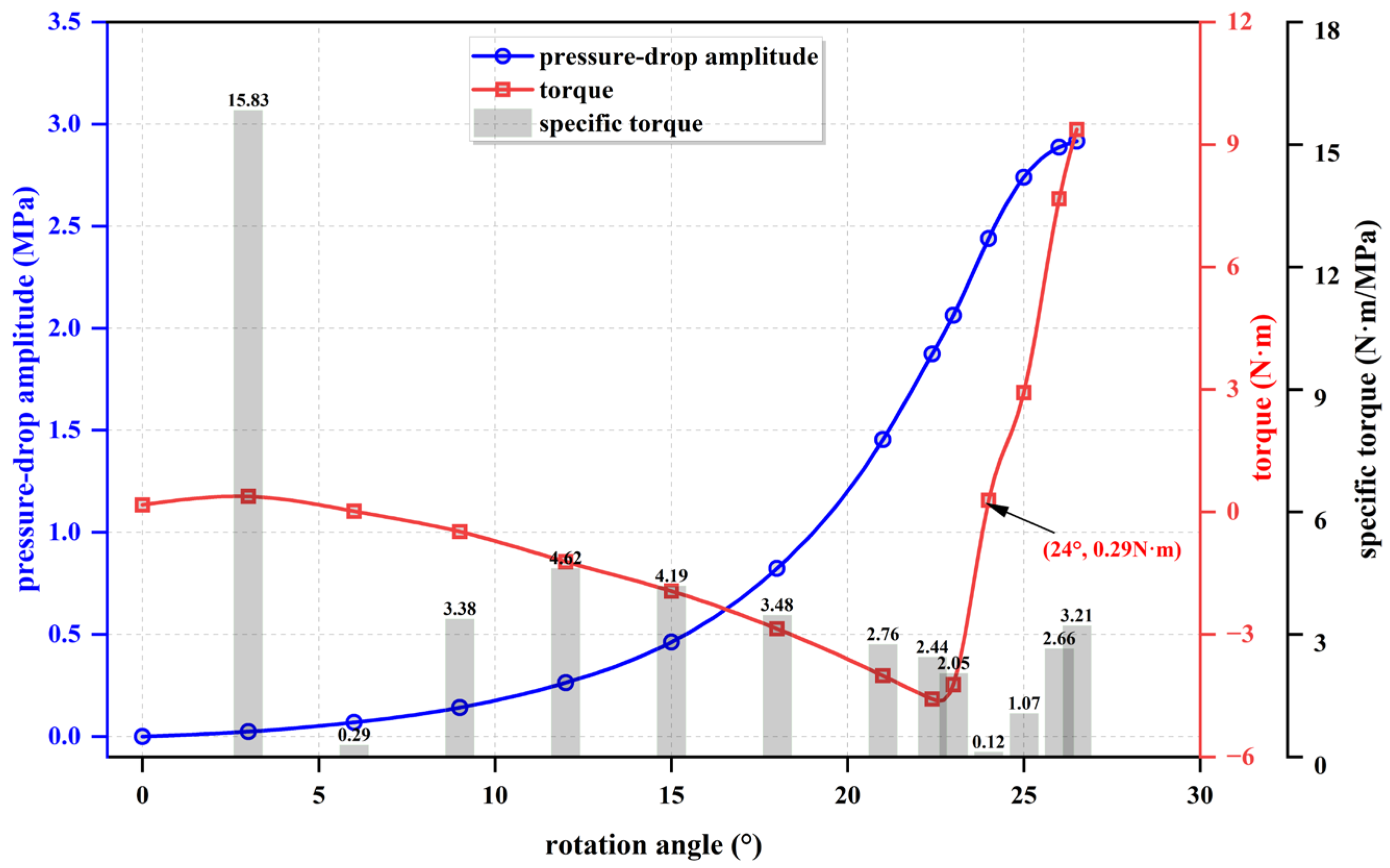
Figure 11 plots the relationship between pressure drop amplitude and peak torque, with specific torque values annotated at each operating point.
As shown in Figure 11, the trajectory is hook-like, with an upturned V-tail. On the left branch (θ < 24°), as the pressure drop increases, torque first becomes more negative and then returns toward zero; the curve initially moves up-right (negative torque increasing region) and then bends sharply down-left (negative torque decreasing region). At the trough (θ ≈ 24°), torque approaches zero, the curve reaches its lowest point, and the specific torque is optimal. On the right branch (θ > 24°), the pressure drop continues to rise and the positive torque grows rapidly, causing the curve to climb steeply up-right. The optimal operating point should lie near the trough to balance pressure drop and torque most effectively.
Considering signal strength, energy consumption, control stability, and engineering feasibility, θmax = 24.0–24.5° is identified as the optimal operating angle range for the following reasons:
(1) Adequate signal strength.
At θ = 24.0°, the pressure drop amplitude ΔPamp = 2.447 MPa. Assuming a typical downhole noise level of 0.08 MPa, the SNR (dB) = 20 log10(2.447/0.08) ≈ 29.7 dB, which exceeds the 20 dB threshold for reliable communication and supports stable transmission at depths > 3000 m. Relative to θ = 22.4° (ΔPamp = 1.882 MPa), signal strength increases by 30%, and the transmission range can increase by about 40%.
(2) Extremely low drive load.
At θ = 24.0°, |T| = 0.29 N·m, only 6.3% of the peak torque (4.58 N·m). Compared with θ = 22.4°, the drive load drops by 93.7%, and motor power consumption decreases by more than 90%. Even accounting for braking torque in the positive torque region, total power remains far below that at the peak torque condition, because |T| is small while ΔP has already reached the target level. The very low actuation load can markedly extend battery life (estimated 3–5×) and motor life (estimated 5–10×).
(3) Excellent specific torque.
The specific torque τsp = 0.12 N·m/MPa is the best among all tested conditions; relative to θ = 22.4° (2.43 N·m/MPa), it is lower by 95.1%, indicating roughly a 20-fold improvement in energy-conversion efficiency. Compared with the original design (estimated specific torque ~3–4 N·m/MPa), the efficiency improvement is about 25–33×.
(4) Good control stability. Although the operating point enters the positive torque region (torque +0.29 N·m), the magnitude is very small. Stable operation can be achieved with simple proportional braking control, without high algorithmic complexity. Compared with large positive torque conditions above θ = 26° (7–9 N·m), control difficulty and risk of instability are greatly reduced. The torque zero crossing lies around θ = 23.8–24.2°, and the operating point (θ = 24.0–24.5°) remains near the zero crossing, yielding favorable dynamic behavior.
(5) High engineering feasibility. Robustness to angle deviations: Within θ = 23.5–24.5°, torque remains within 1 N·m, and the pressure drop stays between 2.3 and 2.6 MPa. Even with limited control accuracy (±0.5°), performance variations are acceptable. Simple braking strategy: Stable control can be realized with a constant small braking torque (~0.5–1.0 N·m). The approach is compatible with existing mud-pulser control systems without major hardware or software modifications.
(6) Comprehensive balance. This operating condition offers the best combination of signal strength, actuation load, and control stability. It suits most drilling scenarios (well depth: 2000–5000 m; mud density: 1.1–1.5 g/cm3). Relative to the peak torque point (θ = 22.4°), the pressure drop increases by 30% while torque decreases by 94%, providing a pronounced advantage in integrated performance. Relative to the maximum pressure drop point (θ = 26.5°), the pressure drop is only 16% lower, but torque is 97% lower, avoiding the control risks associated with large positive torque.
The recommended operating parameters are the following:
Nominal operating angle: θopt = 24.0–24.5°.
Angle control accuracy: ±0.3°.
Braking torque: Tbrake = 0.5–1.0 N·m (constant or proportional control).
Rotational speed: ω = 30–60 rpm (pulse frequency 0.5–1.0 Hz).

4.3.4. Performance Comparison with the Original Design

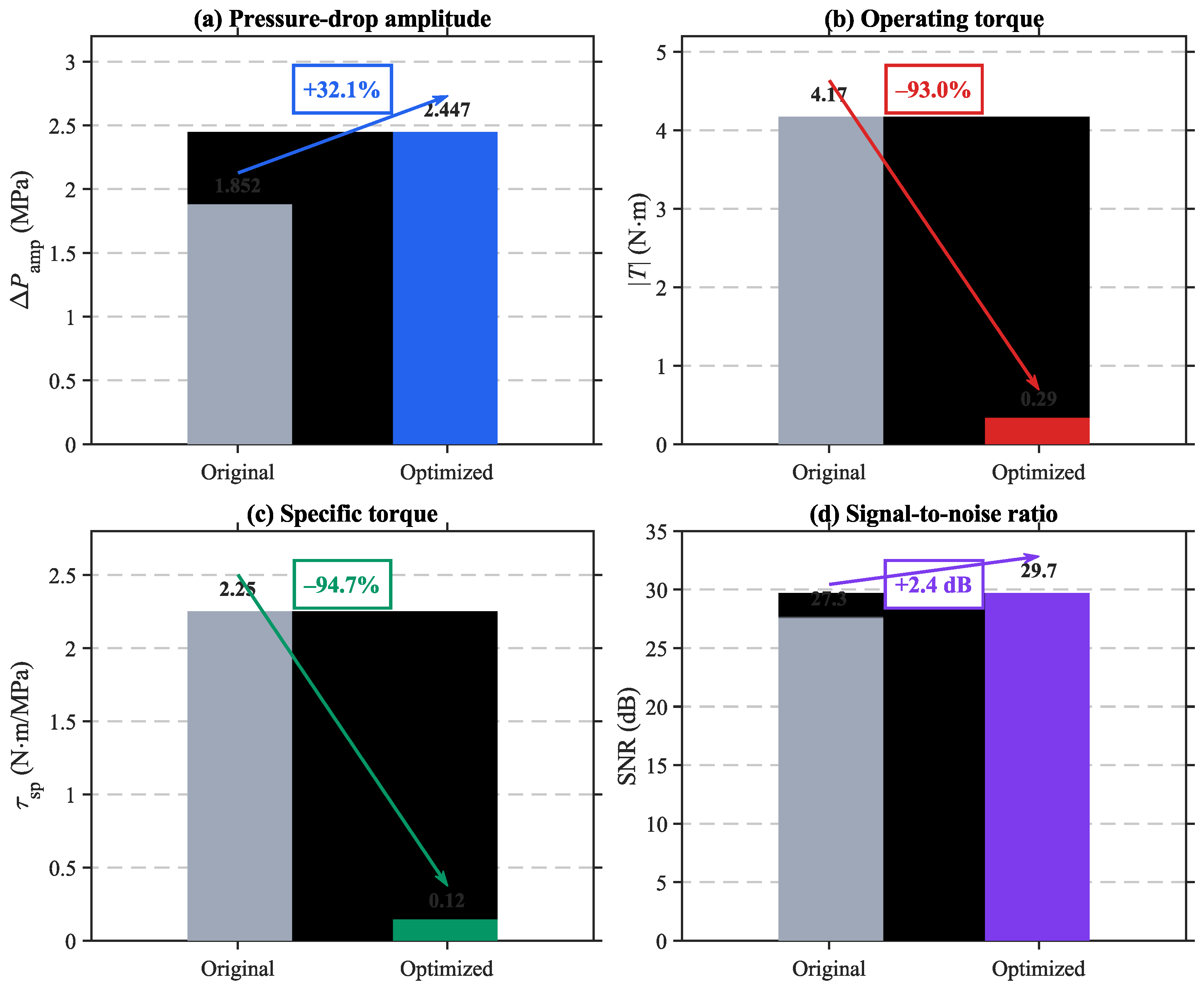
Figure 12 compares the performance of the optimized scheme (α = 22.4°, 0.5 mm chamfer thinning, θ = 24.0°) with the original design (α = 22.4°, no chamfer thinning, θ = 22.4°). The original design yields a pressure drop amplitude ΔPamp ≈ 1.852 MPa and a torque of −4.17 N·m, giving a specific torque of 2.25 N·m/MPa. The optimized scheme yields ΔPamp ≈ 2.447 MPa and a torque of +0.29 N·m, with a specific torque of only 0.12 N·m/MPa.
As shown in Figure 12, the optimized scheme delivers substantial improvements over the original design across all metrics. The pressure drop amplitude increases by 32.1% (from 1.852 MPa to 2.447 MPa), corresponding to a 2.4 dB gain in signal-to-noise ratio (from 27.3 dB to 29.7 dB, assuming a downhole noise level of 0.08 MPa). The operating torque decreases by 93.0% (from 4.17 N·m to 0.29 N·m), and the motor power requirement is reduced proportionally. The specific torque drops from 2.25 N·m/MPa to 0.12 N·m/MPa (a 94.7% reduction), yielding an 18.8-fold improvement in energy efficiency. With a standard lithium battery pack (500 Wh capacity), the estimated battery life increases from approximately 10 h to over 140 h, satisfying the operational requirement of completing a full well interval without battery replacement.
In summary, by optimizing the valve plate angle, applying chamfer thinning to the rotor valve plate, and judiciously selecting the operating angle, the proposed design substantially reduces system energy consumption and enhances energy-conversion efficiency while maintaining signal quality.

5. Conclusions and Outlook

This study presents a systematic CFD-based investigation of valve plate geometry optimization for torque reduction in continuous-wave mud pulsers. Through comprehensive parametric analysis of the valve plate opening angle (20.0–26.0°) and rotor chamfer height (2.8–4.0 mm), the following key conclusions are obtained.
First, the optimal geometric configuration was identified as a valve plate opening angle α = 22.4° combined with a chamfer thinning of 0.5 mm (reducing the chamfer height from 4.0 mm to 3.5 mm). The opening angle of 22.4° provides the best balance between signal strength and actuation load, as quantified by the specific torque metric. The 0.5 mm chamfer thinning advances the torque zero-crossing point from θ ≈ 25° to θ ≈ 24°, enabling near-zero torque operation (0.29 N·m) while maintaining a high pressure drop (2.547 MPa) at the optimal operating angle of θ = 24.0–24.5°. This operating angle delivers a signal-to-noise ratio of approximately 29.7 dB, which is sufficient for reliable telemetry at depths exceeding 4000 m.
Second, compared with the original design (α = 22.4°, no chamfer thinning, θ = 22.4°), the optimized configuration achieves a 32.1% increase in pressure drop amplitude (from 1.852 MPa to 2.447 MPa), a 93.0% reduction in operating torque (from 4.17 N·m to 0.29 N·m), and an 18.8-fold improvement in energy efficiency (specific torque reduced from 2.25 N·m/MPa to 0.12 N·m/MPa). These improvements directly address critical energy efficiency requirements in deep geothermal and CCUS drilling applications.
Several limitations should be acknowledged, including the Newtonian fluid assumption, the neglect of thermal effects at high temperatures (>150 °C), and the absence of particle erosion modeling. Future work will introduce non-Newtonian rheological models, conduct multi-physics analyses with fluid–structure interaction and thermal coupling, and validate fabricated prototypes in the laboratory and field to refine design parameters for deployment in complex drilling environments.


Author Contributions

Conceptualization, J.Z. (Junhua Zheng) and W.N.; methodology, J.Z. (Junhua Zheng); software, S.Y. and J.Z. (Jinhui Zuo); validation, S.Y. and J.Z. (Jinhui Zuo); formal analysis, J.Z. (Junhua Zheng); investigation, H.H.; resources, W.N.; data curation, H.H.; writing—original draft preparation, J.Z. (Junhua Zheng); writing—review and editing, H.H.; visualization, S.Y.; supervision, W.N.; project administration, H.H.; funding acquisition, W.N. All authors have read and agreed to the published version of the manuscript.

Funding

This research was funded by the Sinopec science and technology research project: “Development of pulse generator mechanical module and high power alternator”, grant number P22238.

Data Availability Statement

The data presented in this study are available on request from the corresponding author. (The data are not publicly available due to privacy.)

Conflicts of Interest

Authors Junhua Zheng, Weining Ni, Shubo Yang and Jinhui Zuo were employed by the company Sinopec, the remaining author declares that the research was conducted in the absence of any commercial or financial relationships that could be construed as a potential conflict of interest. This study received funding from Sinopec. The funder was not involved in the study design, collection, analysis, interpretation of data, the writing of this article or the decision to submit it for publication.

References

  1. Song, X.; Li, G.; Huang, Z.; Shi, Y.; Wang, G.; Song, G.; Xu, F. Review of high-temperature geothermal drilling and exploitation technologies. Gondwana Res. 2022, 122, 315–330. [Google Scholar] [CrossRef]
  2. Wu, Y.; Li, P. The potential of coupled carbon storage and geothermal extraction in a CO2-enhanced geothermal system: A review. Geotherm. Energy 2020, 8, 19. [Google Scholar] [CrossRef]
  3. Li, C.; Xu, Z. A Review of Communication Technologies in Mud Pulse Telemetry Systems. Electronics 2023, 12, 3930. [Google Scholar] [CrossRef]
  4. Mwachaka, S.M.; Wu, A.; Fu, Q. A review of mud pulse telemetry signal impairments modeling and suppression methods. J. Pet. Explor. Prod. Technol. 2018, 9, 779–792. [Google Scholar] [CrossRef]
  5. Adams, B.M.; Vogler, D.; Kuehn, T.H.; Bielicki, J.M.; Garapati, N.; Saar, M.O. Heat depletion in sedimentary basins and its effect on the design and electric power output of CO2 Plume Geothermal (CPG) systems. Renew. Energy 2021, 172, 1393–1403. [Google Scholar] [CrossRef]
  6. Chupin, E.; Frolov, K.; Korzhavin, M.; Zhdaneev, O. Energy storage systems for drilling rigs. J. Pet. Explor. Prod. Technol. 2021, 12, 341–350. [Google Scholar] [CrossRef]
  7. Yan, Z.; Geng, Y.; Wei, C.; Wang, T.; Gao, T.; Shao, J.; Hu, X.; Yuan, M. Design of a continuous wave mud pulse generator for data transmission by fluid pressure fluctuation. Flow Meas. Instrum. 2018, 59, 28–36. [Google Scholar] [CrossRef]
  8. Ye, Q.; Wang, C.; Sun, H.; Li, Y.; Yuan, P. CFD Simulation and Optimal Design of a New Parabolic–Shaped Guided Valve Tray. Separations 2023, 10, 267. [Google Scholar] [CrossRef]
  9. Yuan, F.; Gong, X.F. Researches on Modeling and Simulation of Continuous Wave Mud Pulser. Appl. Mech. Mater. 2011, 88–89, 230–235. [Google Scholar] [CrossRef]
  10. Cooper, P.; Santos, L.S. New Mud-Pulse Telemetry System Delivers Improved Drilling Dynamics and Formation Evaluation Data. In Proceedings of the SPE Russian Petroleum Technology Conference, Moscow, Russia, 26–28 October 2015. [Google Scholar]
  11. Emmerich, W.; Brahim, I.B.; Akimov, O.; Greten, A. Improved High-Speed Mud Pulse Telemetry Performance Under Harsh Conditions. In Proceedings of the Offshore Technology Conference Asia, Kuala Lumpur, Malaysia, 22–25 March 2016. [Google Scholar]
  12. Amirante, R.; Moscatelli, P.G.; Catalano, L.A. Evaluation of the flow forces on a direct (single stage) proportional valve by means of a computational fluid dynamic analysis. Energy Convers. Manag. 2007, 48, 942–953. [Google Scholar] [CrossRef]
  13. Tan, C.; Ren, H.; Li, B.; Lu, J.; Li, D.; Tao, W. Design and analysis of a novel cascade control algorithm for braking-by-wire system based on electromagnetic direct-drive valves. J. Frankl. Inst. 2022, 359, 8497–8521. [Google Scholar] [CrossRef]
  14. Pan, M.; Plummer, A.; Agha, A.E. Theoretical and Experimental Studies of a Switched Inertance Hydraulic System in a Four-Port High-Speed Switching Valve Configuration. Energies 2017, 10, 780. [Google Scholar] [CrossRef]
  15. Chin, W.C. Transient Variable Area Downhole Inverse Models. In Measurement While Drilling (MWD) Signal Analysis, Optimization, and Design; Scrivener Publishing LLC: Beverly, MA, USA, 2018. [Google Scholar]
  16. Jia, P.; Fang, J.; Li, L. Optimization design of rotaer valve of continuous wave generator based on correlation coefficient. Oil Field Equip. 2012, 41, 37–42. [Google Scholar]
  17. Jia, P.; Fang, J.; Li, L. Design of the rotary valve of the drilling fluid continuous wave generator and analysis of the signal characteristic. China Pet. Mach. 2010, 38, 9–12. [Google Scholar]
  18. Jia, P.; Fang, J.; Su, Y.N.; Li, L. Analysis on rotary valve hydraulic torque of drilling fluidcontinuous wave signal generator. J. China Univ. Pet. 2010, 34, 99–104. [Google Scholar]
  19. Yan, Z.; Wang, Z.; Yang, N.; Pan, W.; Gao, T. Investigation on the novel unsteady-liquid thin-walled cutting-edge throttling mechanism incorporated in the rotary valve design for a continuous wave pulse generator. Geoenergy Sci. Eng. 2024, 235, 212680. [Google Scholar] [CrossRef]
  20. Han, H.; Xue, L.; Fan, H.; Liu, X.; Liu, M.; Wang, Z. Analysis of pressure wave signal generation in MPT: An integrated model and numerical simulation approach. J. Pet. Sci. Eng. 2022, 209, 109871. [Google Scholar] [CrossRef]
  21. Han, H.; Xue, L.; Sun, L.; Sheng, W.; Shi, X. Study on the continuous wave bit reflection mechanism in mud pulse telemetry. Geoenergy Sci. Eng. 2024, 241, 213139. [Google Scholar] [CrossRef]
  22. Bamisebi, A.J.; Reich, M. Multi-frequency mud siren simulation and experiment for increasing data transmission rate in mud pulse telemetry. Discov. Appl. Sci. 2025, 7, 600. [Google Scholar] [CrossRef]
  23. Chen, W.; Wang, C.; Li, J.; Li, J.; Liu, G.; Zheng, S. Research on optimization of drilling fluid continuous wave signal for measurement-while-drilling in deepwater extended reach wells. Ocean Eng. 2025, 340, 122342. [Google Scholar] [CrossRef]
  24. Chen, W.; Wang, C.; Zheng, F.; Li, J.; Liu, G.; Zheng, S. Factors affecting the attenuation of mud positive pulse signals in measurement while drilling and optimization strategies. Geoenergy Sci. Eng. 2025, 247, 213726. [Google Scholar] [CrossRef]
  25. Muthukumaran, V.; Balaji, S.; Senthilkumar, K.M.; Navaneethan, M.; Mano, D.D.J. Study on Influence of Core Structure on Catalytic Converter Performance Using CFD. Appl. Mech. Mater. 2024, 920, 95–102. [Google Scholar] [CrossRef]
  26. Yang, X.; Li, S.; Yang, B.; Feng, Y. Influence of Valve Core and Seat Structure of Overflow Valve on Flow Field Performance and Optimization Design. IOP Conf. Ser. Earth Environ. Sci. 2018, 170, 022112. [Google Scholar] [CrossRef]
  27. Wu, J.; Zhang, F.; Li, H.; Fang, B.; Xu, X. Preparation and reaction mechanism of red mud based ceramic simple bricks. J. Wuhan Univ. Technol.-Mater. Sci. Ed. 2010, 25, 1001–1005. [Google Scholar] [CrossRef]
  28. Wu, J.; Zhou, B.; Han, N.; Jiang, J.; Zhao, S.; Qin, D. Modeling and Analysis of the Load Torque Acting on the Drilling Fluid Continuous Wave Generator. IEEE Access 2020, 8, 66846–66855. [Google Scholar] [CrossRef]
  29. Yang, N.; Yan, Z.; Yin, X.; Jia, M.; Geng, Y. Mathematical modeling and experimental investigation of a rotary valve generating sinusoidal pressure signals based on fan-arc-straight orifice. J. Pet. Sci. Eng. 2022, 209, 109807. [Google Scholar] [CrossRef]
  30. Cicconi, P.; Germani, M.; Bondi, S.; Zuliani, A.; Cagnacci, E. A Design Methodology to Support the Optimization of Steel Structures. Procedia CIRP 2016, 50, 58–64. [Google Scholar] [CrossRef]
  31. Zhong, Q.; Wang, J.; Xu, E.; Yu, C.; Li, Y. Multi-objective optimization of a high speed on/off valve for dynamic performance improvement and volume minimization. Chin. J. Aeronaut. 2024, 37, 435–444. [Google Scholar] [CrossRef]
  32. Xue, L.; Han, H.; Shen, Y.; Sun, L.; Fan, H. The theoretical model and sinusoidal optimization strategy for oscillating shear valve type continuous waves generator. Heliyon 2023, 9, e16198. [Google Scholar] [CrossRef]
Figure 1. Three-dimensional schematic of the rotating valve plate assembly and sectional view with annotated geometric parameters.
Processes 14 00668 g001
Figure 2. Schematic of the computational domain and domain decomposition.
Processes 14 00668 g002
Figure 3. Local mesh details.
Processes 14 00668 g003
Figure 4. Comparison of rotor surface pressure distribution contours for different turbulence models (θ = 24°).
Processes 14 00668 g004
Figure 5. Comparison between CFD simulation and experiment for the baseline case (θ = 0–26.5°): (left) torque; (right) pressure drop.
Processes 14 00668 g005
Figure 6. Pressure drop versus maximum rotation angle for different valve plate angles.
Processes 14 00668 g006
Figure 7. Torque-rotation angle curves for different valve plate angles (θmax = 24.5°).
Processes 14 00668 g007
Figure 8. Pressure distribution on the rotor surface for Scheme 1 at θ = 22.4° and θ = 26.5°.
Processes 14 00668 g008
Figure 9. Torque-rotation angle curves for different chamfer-thinning schemes (full stroke).
Processes 14 00668 g009
Figure 10. Pressure drop–rotation angle curves for different chamfer-thinning schemes (full stroke).
Processes 14 00668 g010
Figure 11. Pressure difference–peak torque relationship curve (specific torque annotated).
Processes 14 00668 g011
Figure 12. Performance comparison between the original design and the optimized scheme.
Processes 14 00668 g012
Table 1. Key geometric parameters of the baseline rotor–stator assembly.
ParameterSymbolValueParameterSymbolValueParameterSymbolValue
Stator inner diameter D s 87 mmAnnular (radial) gap H a n n u l a r 1.0 mmRight-angle step height H s 2.0 mm
Rotor outer diameter D r 85 mmTotal valve plate thickness H t 6.0 mmChamfer angle θ c 1.96°
Axial gap H a x i a l 1.6 mmChamfer height H c 4.0 mmBaseline opening angleα22.4°
Table 2. Grid independence verification results (θ = 22.4°; relative deviation with respect to the medium mesh).
Mesh SchemeCells (Million)Torque
(N·m)
Relative Deviation (%)Pressure Drop (MPa)Relative Deviation (%)
Mesh A2.0−3.93−5.761.91−2.55
Mesh B3.2−4.05−2.881.94−1.02
Mesh C5.0−4.17-1.96-
Mesh D7.2−4.21+0.961.97+0.51
Mesh E9.5−4.22+1.201.97+0.51
Table 3. Physical properties of the working fluid.
PropertyValueUnit
Density1200kg/m3
Dynamic viscosity0.005Pa·s
Displacement30L/s
Fluid modelNewtonian-
TemperatureAmbient (25 °C)°C
CompressibilityIncompressible-
Table 4. Comparison of turbulence model predictions.
Rotation Angle θTurbulence ModelTorque T (N·m)Pressure Drop ΔP (MPa)
10°Standard k-ε−1.850.68
RNG k-ε−1.620.67
SST k-ω−1.480.66
18°Standard k-ε−4.561.52
RNG k-ε−4.121.50
SST k-ω−3.871.48
24°Standard k-ε−6.822.35
RNG k-ε−5.292.31
SST k-ω−4.612.28
Table 5. Comparison between simulation and experiment at key operating conditions.
θT (N·m)
Simulation
T (N·m)
Experiment
Relative Error (%)ΔP (MPa)
Simulation
ΔP (MPa)
Experiment
Relative Error (%)
12°−1.05−1.08−3.300.260.27−2.90
18°−2.70−2.86−6.100.780.80−2.60
24°−0.68−0.76−11.502.422.49−3.00
average--7.00--2.80
Table 6. Comparison of pressure drops for different valve plate angles.
Schemeα θ m a x ΔP (MPa)Growth Rate (%)
120.0°25.0°2.793−6.1
222.4°26.5°2.915-
324.0°28.0°2.626−11.7
426.0°30.0°2.545−14.5
Table 7. Comparison of peak torque for different valve plate angle schemes.
SchemeValve Plate Angle αPeak Torque Tpeak (N·m)Peak Position θpeak (°)Change Relative to Baseline (%)
120.0°−4.9821.0+19.5
222.4°−4.1722.4-
324.0°−3.6025.0−13.6
426.0°−3.1526.5−24.4
Table 8. Comparison of torque characteristics for different chamfer-thinning schemes.
SchemeChamfer-Thinning Amount (mm)Peak Negative Torque (N·m)Peak Position (°)Torque at θ = 24° (N·m)Torque at θ = 26.5° (N·m)
00−4.1722.4−0.68+9.72
10.5−4.5822.4+0.29+9.37
21.0−4.8922.4−0.03+9.13
31.5−5.5322.4+1.34+9.45
42.0−6.5522.4+4.46+9.27
Table 9. Comparison of pressure drops for different chamfer-thinning schemes.
SchemeChamfer Height (mm)θ = 18° θ = 22.4° θ = 24° θ = 26.5°
04.00.9051.9602.5293.023
13.50.9311.9822.5473.024
23.00.9452.0222.5973.026
32.50.9752.1142.7033.063
42.01.0362.2382.8493.109
Table 10. Integrated performance of different chamfer-thinning schemes (θ = 22.4°).
SchemeChamfer Height (mm) T p e a k (N·m)ΔP (MPa)η (MPa/(N·m))Change vs. Baseline (%)
04.04.171.9600.470-
13.54.581.9820.433−7.9
23.04.892.0220.413−12.1
32.55.532.1140.382−18.7
42.06.552.2380.342−27.2
Table 11. Integrated performance at θ = 24°.
SchemeChamfer Height (mm)Torque at θ = 24° (N·m)Pressure Drop at θ = 24° (MPa)Specific Torque τsp (N·m/MPa)
04.00.682.5290.269
13.50.292.5470.114
23.00.032.5970.012
32.51.342.7030.496
42.04.462.8491.565
Table 12. Comparison of performance metrics at different maximum operating angles (Scheme 1: α = 22.4°; chamfer thinning, 0.5 mm).
θmaxΔPmax (MPa)ΔPamp (MPa)|T| (N·m)τsp (N·m/MPa)Remarks
18.0°0.9310.8312.863.44Weak signal
20.0°1.2121.1123.773.39Negative torque growth region
22.4°1.9821.8824.582.43Peak torque point
23.0°2.1712.0714.232.04Post-peak
24.0°2.5472.4470.290.12Near zero torque
25.0°2.8472.7472.921.06Positive torque region
26.0°2.9952.8957.672.65Increasing positive torque
26.5°3.0242.9249.373.20Positive torque peak
Disclaimer/Publisher’s Note: The statements, opinions and data contained in all publications are solely those of the individual author(s) and contributor(s) and not of MDPI and/or the editor(s). MDPI and/or the editor(s) disclaim responsibility for any injury to people or property resulting from any ideas, methods, instructions or products referred to in the content.