Article

Construction and Reasoning Method of Knowledge Graph for Aircraft Skin Spraying Process

1
College of Mechanical and Electrical Engineering, Changchun University of Science and Technology, Changchun 130022, China
2
College of Artificial Intelligence, Changchun University of Science and Technology, Changchun 130022, China
3
Jilin Provincial Collaborative Innovation Center for Intelligent Robots, Changchun University of Science and Technology, Changchun 130022, China
4
Jilin Provincial University-Enterprise Joint Technological Innovation Laboratory for Intelligent Hybrid Robots, Changchun University of Science and Technology, Changchun 130022, China
5
College of Computer Science and Technology, Changchun University of Science and Technology, Changchun 130022, China
*
Author to whom correspondence should be addressed.
Processes 2026, 14(4), 581; https://doi.org/10.3390/pr14040581
Submission received: 19 January 2026 / Revised: 2 February 2026 / Accepted: 5 February 2026 / Published: 7 February 2026
(This article belongs to the Section AI-Enabled Process Engineering)

Abstract

To address the heavy reliance on experiential knowledge, fragmented multi-source information, and limited intelligence in decision-making for aircraft skin spraying processes, this paper proposes a knowledge reasoning method based on a knowledge graph. The authors construct a knowledge graph that integrates multi-structure ontology and physical rule constraints. This graph systematically organizes and manages multi-dimensional knowledge, including painting object attributes, paint performance indicators, and spraying parameters. On this basis, a three-stage reasoning mechanism with multi-granularity semantic understanding, knowledge enhancement, feature fusion, and multi-constraint intelligent matching (MKM) is designed. The model can perform semantic analysis of the user’s fuzzy query, implicit knowledge completion, and dynamic subgraph matching, so as to give the aircraft skin spraying process plan that meets the constraints of safety, compatibility, and feasibility. The experimental results show that the proposed method is superior to the traditional case-based reasoning method, graph convolutional network method, and knowledge graph embedding method in the key evaluation indices of Hit@1, Hit@3, and MRR in the knowledge reasoning task of aircraft skin spraying process. It also has good robustness and promotion value when data are scarce and parameters are uncertain. This study provides a feasible method of intelligent management and dynamic decision-making in terms of aircraft skin spraying process knowledge, and may be applied to other manufacturing fields.

1. Introduction

The aircraft skin is a dimensional part wrapped outside the aircraft frame structure and fixed with adhesives or rivets to form and maintain the aerodynamic shape of the aircraft [1]. The skin materials of the main aerodynamic components, such as fuselage, wings, and tail wings, mostly use high-strength aluminum alloys or composite materials, and are directly exposed to factors such as atmospheric corrosion, ultraviolet aging, and mechanical damage. Therefore, for aircraft skins, it is necessary to have sufficient strength and good ductility, as well as strong resistance to corrosion. At present, metal coating, special surface treatment process, and cathodic protection technology are all technical measures that can be used, but they are generally cumbersome and complicated to operate. Spraying a uniform protective coating on the aircraft skin is a simple and effective anti-corrosion measure [2]. Based on this, this paper focuses on the construction of a knowledge graph and reasoning methods for the aircraft skin spraying process.
At present, the level of automation of aircraft skin spraying is low, and the spraying quality is highly dependent on operator experience. Therefore, the following problems exist: First, the consistency of coating quality cannot be guaranteed. Second, knowledge of the spraying process is difficult to integrate and apply. The third problem is the poor response ability of the production process, which greatly shortens the life of the aircraft skin.
Knowledge graphs (KGs), by virtue of their powerful capabilities in semantic expression and associative reasoning, provide a new pathway for the structured modeling and intelligent application of process knowledge [3]. Research on the spraying process based on KG has been focused on fault diagnosis, process recommendation, and quality prediction, but there are still some problems, such as poor dynamic adaptability, insufficient fusion of multiple knowledge sources, and slow real-time reasoning speed.
(1)
The research status of process knowledge reasoning
In current knowledge-driven design optimization research, numerous scholars have proposed different methodological frameworks, yet certain limitations persist. Zheng, et al. [4] proposed a knowledge-based low-carbon product design framework, using ontology to do semantic function modeling, and using multi-objective particle swarm optimization to do low-carbon improvement. This method failed to establish a good internal relationship between knowledge entities, limiting the depth of reasoning. Peng, et al. [5] proposed a hypernetwork framework based on product, knowledge, and problem networks, which explicitly models the relationship between knowledge elements from multiple sources and uses Bayesian methods for collaborative reasoning. Although their model can identify topological attributes and capture complex associations, the formal representation of knowledge and the efficiency and universal applicability of the reasoning process need to be further improved. In the area of case-based reasoning (CBR), Long, et al. [6] integrated the expert decision-making mechanism into the case-based reasoning (CBR) framework. In this study, the feature-weighted case matching strategy was adopted, and the weighted support vector machine (WSVM) and dynamic particle swarm optimization (DPSO) algorithm were combined to try to find out the hidden relationship between functions and parameters. This method is deficient in the modeling of functional and structural knowledge, so the reasoning results are not complete enough. Additionally, Long, et al. [7] proposed a knowledge-based product intelligent design system, which uses the general feature design process framework to represent the knowledge transfer process from conceptual design to CAD model generation, and uses case-based reasoning technology to realize the reuse of design features. This system has a strong dependence on expert decision-making, resulting in two problems: on the one hand, it greatly increases the cost of research and development; on the other hand, it makes the design process extremely complicated.
(2)
Application progress of knowledge graphs in the field of intelligent manufacturing processes
Knowledge graph has great potential in the field of intelligent manufacturing technology with its powerful knowledge expression and associative reasoning ability. The research on it mainly focuses on how to better acquire, represent, reason, and apply knowledge.
In knowledge construction and updating, Zhigang, et al. [8] proposed a personalized disassembly process, knowledge extraction, and graph construction method based on a dynamic data stream to achieve efficient update and reuse of knowledge. JIANG and WANG [9] focused on the integrity constraint problem in the knowledge graph of complex equipment, trying to optimize the knowledge construction process of complex equipment and reduce labor costs. In process expression and optimization, Sun, et al. [10] use knowledge graph technology to improve the expression of the assembly process, solve the problems of poor readability and weak correlation of traditional documents, and support dynamic adjustment based on reasoning. In the field of fault diagnosis and maintenance, Jing, et al. [11] innovatively employed meta-learning techniques to construct an equipment fault knowledge graph and achieve intelligent reasoning. This approach effectively overcame the limitation of the low structuredness of fault information in traditional methods, leading to a significant improvement in reasoning accuracy. In process design and reuse, Jianxun, et al. [12] combined knowledge graph with deep learning, so as to achieve the learning and reuse of machining process knowledge at different granularity levels, and the generated process contains complete situational content. Guo, et al. [13] gave a framework for automatically forming a process knowledge base based on KG, which solved the problem that the traditional method is not automated, time-consuming, and only uses one representation form, and achieved process reasoning at the feature level and part level.
In addition, relevant research has also made significant progress in some aspects, such as strengthening specific process reasoning, organizing and managing knowledge, integrating data and integrating systems, improving recommendation systems, predicting quality, and combining knowledge in multiple ways. The accuracy of process reasoning is improved by a graph neural network [14,15,16]; the organization and sharing of process knowledge are improved by creating domain knowledge graphs [17,18]; KG is used to optimize manufacturing system integration and multi-source information recommendation [19,20]; and multi-modal learning is used to fuse different types of data to optimize the speed of process design and the prediction ability of product quality [21,22].
At the technical methodology level: Schlichtkrull, et al. [23] introduced Relational Graph Convolutional Networks (R-GCNs) for link prediction (recovery of missing triples) and entity classification (recovery of missing entity attributes). R-GCNs are specifically designed for multi-relational data and appear alongside recent work on graph neural networks. Dettmers, et al. [24] proposed a multi-layer convolutional network model, ConvE, which achieved comparable performance to DistMult and R-GCN on link prediction tasks, but the parameters were reduced by 8 times and 17 times, respectively. Wang, et al. [25] proposed a deep knowledge perception network based on collaborative learning, which combines the feature learning of the knowledge graph with the objective function of the recommendation algorithm. Using the end-to-end joint learning method, the embedded vector of knowledge perception is obtained by the TransD method, and then the recommendation result is generated by the attention model. Lin, et al. [26] used the knowledge graph embedding method TransR to extract the future project structure. At the same time, the automatic encoder is used to extract the text vector and visual vector of the project, and the three vectors are fused to construct the potential vector of the project. Fan, et al. [27] proposed a new graph neural network framework, GraphRec, which uses the advantages of heterogeneous graph modeling to improve the accuracy of recommendations.
In the study of spraying process optimization, the understanding of the complex coupling relationship between parameters and the explicit modeling of physical constraints are receiving increasing attention. Knowledge reasoning method has been used to solve the problem of data heterogeneity in manufacturing. Steenwinckel, et al. [28] combined OWLReady and Pellet inference engine to realize automatic reasoning of automobile spraying quality knowledge. At the level of process mechanism, Chen, et al. [29] determined the influence of process parameters on quality characteristics by response surface method and multi-objective optimization, and emphasized the interaction between parameters. Zhang, et al. [30] further verified that this interaction is often more significant than the single parameter effect, highlighting the complex coupling of the parameter system. This complexity is also prominent at the material level. For example, Zhang, et al. [31] pointed out in the review that there is a complex multivariable nonlinear relationship between the microstructure of the thermally sprayed iron-based amorphous coating and its process parameters. Therefore, any intelligent decision-making system must explicitly embed physical rules and engineering constraints to ensure the feasibility and safety of the scheme. In fact, the realization of spraying quality is highly dependent on the precise control of process parameters, which often must meet strict physical boundaries. For example, in the robot spraying scene, Xu, et al. [32] proposed a multi-objective trajectory optimization method with integrated process constraints for rigid-flexible coupling robots. The coating thickness constraint is explicitly modeled as a function of the robot speed, so as to optimize the efficiency while ensuring the coating quality. These studies have shown that spraying process optimization is essentially a complex system problem with strong constraints and multi-coupling. It is urgent to develop intelligent decision-making methods that can deeply integrate physical rules and engineering constraints.
In summary, although the existing research has achieved remarkable results in process knowledge reasoning and knowledge graph application, there are still the following problems: (1) Knowledge representation is rigid, and it is difficult to achieve the combination of logical rigor and complex association flexibility; (2) Insufficient consideration of implicit features and multiple physical constraints in the reasoning process leads to doubts about the feasibility and security of the scheme in real scenarios. (3) In the face of industrial scenarios with sparse data or uncertain parameters, the adaptability and robustness of the model are poor. Therefore, this paper proposes a spraying process knowledge graph that integrates multi-structure ontology and dynamic correlation, and designs a multi-granularity semantic understanding–knowledge enhancement feature fusion–multi-constraint intelligent matching (MKM) reasoning model, aiming to systematically solve the above problems.

2. Materials and Methods

2.1. Construction of the Spraying Process Knowledge Graph

Knowledge graphs, with their structured form of “entity-relation-entity” or “entity-attribute-value”, provide an ideal framework for organizing and managing the complex knowledge of aircraft skin spraying processes. This chapter will systematically elaborate on the construction process of the knowledge graph in this field. Firstly, a systematic classification and representational definition of process knowledge is conducted. Secondly, a multi-structural ontology architecture integrating tree-like hierarchies, graph association networks, and physical rule constraints is designed to serve as the semantic skeleton of the graph. Furthermore, specific methods for extracting, aligning, and integrating knowledge from multi-source heterogeneous data are detailed. Finally, a complete and standardized set of knowledge graph construction processes and guidelines is established.

2.1.1. Spraying Process Knowledge System and Representation

The primary task in building a knowledge graph is the systematic classification and formal definition of domain knowledge. Based on the core elements of spraying process decision-making, the knowledge system is divided into three dimensions, as shown in Table 1.
Based on the aforementioned classification, three core sub-graphs are constructed, all represented in triple form:
Spraying Object Knowledge Graph: The triple structure is <Object_Head, Relation, Object_Tail>, describing workpiece materials, regions, and their corresponding attributes. For example: (Wing Skin, hasProperty, Ra0.8).
Spraying paint Knowledge Graph: The triple structure is <Paint_Head, Relation, Paint_Tail>, describing paint characteristics and mixing ratio parameters. For example: (Epoxy Primer, hasViscosity, 21 s).
Process Parameter Knowledge Graph: The triple structure is <Param_Head, Relation, Param_Tail>, used to describe the control parameters of the spraying process and their effects. For example: (Atomization Pressure, affects, Paint Uniformity).

2.1.2. Multi-Structural Dynamic Ontology Architecture Design

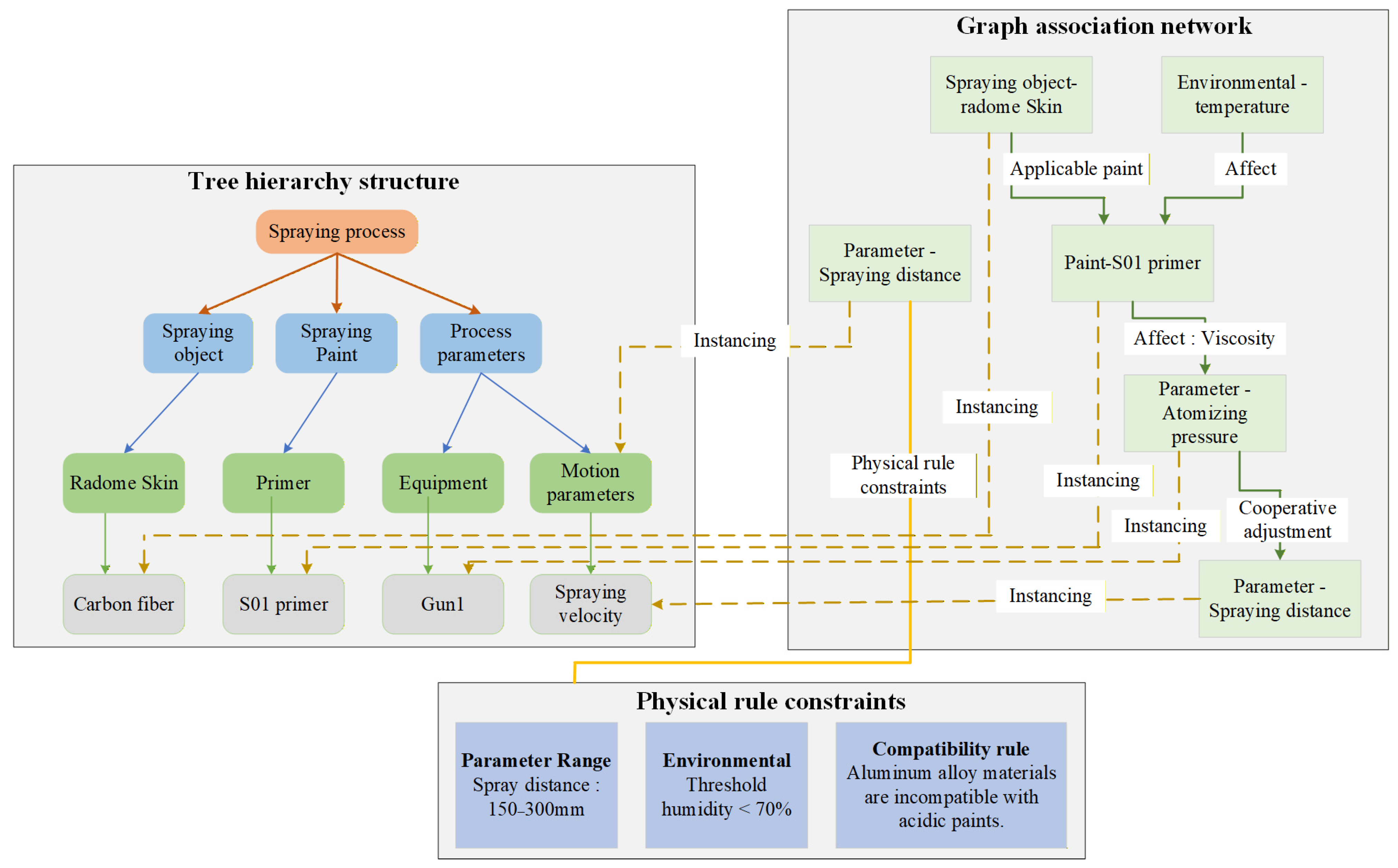
In order to realize the rigorous and flexible knowledge organization and ensure the safety and feasibility of the process scheme, this paper proposes a “multi-structure dynamic ontology architecture”. The framework integrates three mutually reinforcing structural forms: a tree-like hierarchical structure for systematic classification and inheritance of knowledge; a graph association network to express cross-category and multi-dimensional complex process relationships; and embedded physical rule constraints set security boundaries for all inference activities. This architecture first constructs a tree-like hierarchical structure, with “Spraying process” as the root node. It progressively derives first-level classifications such as “Spraying object”, “Spraying paint”, and “Process parameters”. Each first-level classification is further refined into second-level classifications (e.g., “spraying object → carbon fiber, aluminum alloy”), as shown in Figure 1. This structure ensures the logical rigor of the knowledge system through “one-to-many” hierarchical relationships, where each child node has one and only one direct parent node. This facilitates systematic knowledge management, rapid retrieval, and attribute inheritance.
On the tree structure, a dynamic graph association network is constructed to express cross-category and multi-dimensional complex process relationships. Cross-category Connections, directly link entities under different subtrees, such as connecting a coating node (S01 primer) directly to an equipment node (gun1); the multi-dimensional relationship supports the establishment of multivariate associations among “material-parameter-environment”, forming a complex causal relationship network; dynamic weights and physical constraints: the initial weights of edges are assigned based on domain expert experience and are continuously optimized through an online learning mechanism. More importantly, physical rule constraints (e.g., spraying distance ∈ [150 mm, 300 mm], ambient temperature < 30 °C). These constraints act as hard conditions in the process of knowledge reasoning, automatically intercepting all parameter combinations that violate physical rules, and fundamentally ensuring the security of the recommendation scheme.
The advantages of this multi-structural ontology architecture are as follows: the tree-like hierarchy ensures the systematic organization and inheritability of knowledge, laying the foundation for rapid retrieval; the graph association network breaks through hierarchical limitations, enabling flexible representation of complex cross-domain process logic; and the embedded physical rule constraints set safety boundaries for all reasoning activities, fundamentally preventing the generation of unreasonable or hazardous process solutions, thereby effectively enhancing the system’s reliability and practicality.

2.1.3. Multi-Source Knowledge Acquisition and Processing

Aircraft skin spraying knowledge originates from data in various forms, requiring different measurement methods for processing. From the perspective of data forms and characteristics, it mainly includes two categories: one is semi-structured data, such as equipment manuals and technical reports. Although there is no strict database model, its inherent label, list or hierarchical format facilitates the automatic or semi-automatic extraction of information; second, unstructured data, such as operating procedures and maintenance logs, are mainly in the form of free text, which contains a large number of process know-how and causality, and must rely on natural language processing technology for deep semantic mining to achieve knowledge extraction.
Aiming at the knowledge extraction from unstructured data, this paper adopts a pipeline based on deep learning to realize automatic processing. Its core is a text coding model with domain adaptive pre-training and task-specific fine-tuning, which is called SprayBERT (Spray-specific BERT), which is based on the BERT architecture, enhances its understanding of domain terms and context semantics by continuing pre-training on a large number of spray process domain texts (such as equipment manuals, process procedures), so as to be specifically used for entity recognition and relationship extraction tasks of spray process texts. The training of this model is divided into two stages: Firstly, domain adaptive continued pre-training is carried out. In order to make the basic language model better understand the professional terms and semantic context in the field of spraying, the BERT-base-Chinese model is continuously pre-trained on a large number of domain texts (including equipment manuals, process procedures, and technical literature), aiming at obtaining general domain language knowledge. Then, the knowledge extraction task is fine-tuned. Based on the obtained domain adaptive SprayBERT model, the process sentences (in the format of “sentence, (entity1, relation, entity2)”) accurately labeled by experts are used for supervised fine-tuning to optimize its performance in entity recognition and relationship classification tasks.
After completing the aforementioned two-stage training, the SprayBERT model is deployed in the knowledge extraction pipeline, with key steps including:
Entity recognition: The domain-optimized SprayBERT model is employed to identify process element entities in the text, such as “S01 primer” and “atomization pressure”. The SprayBERT model used in this study is obtained through continued pre-training of the BERT-base-Chinese model on a specialized corpus of spraying process texts constructed from domain manuals, process specifications, and other documents. This approach aims to enhance the model’s understanding of professional terminology in the spraying domain (such as “atomization pressure” and “leveling”) and their contextual semantics, thereby improving the accuracy of entity recognition and relation extraction.
Relation extraction: Building on entity recognition, a relation classification model is used to determine the relationships between the identified entities. For example, from the sentence “The recommended viscosity for S01 primer is 21 s”, the triple (S01 primer, hasViscosity, 21 s) is extracted.
Attribute extraction and standardization: Identify and standardize the attribute values of entities, normalizing them into a standard format. For example, convert “approximately 200 mm” to “200 mm”.

2.1.4. Knowledge Fusion and Dynamic Updating

The knowledge extracted from multi-source heterogeneous data often contains redundancy, conflicts, and heterogeneity. It must be integrated and aligned through the system to form a unified, consistent, and high-quality knowledge base. Firstly, in the process of entity alignment and conflict resolution, this paper uses the GAT-A (Graph Attention Network for Alignment and Augmentation) algorithm, which is an entity alignment and feature enhancement method based on a graph attention network. By calculating the attribute similarity between entities and the proximity in the graph structure at the same time, it can accurately determine whether entities from different data sources point to the same object, and provide interpretable correlation weights for subsequent knowledge fusion and reasoning. If the similarity exceeds a threshold (e.g., 0.9), it is determined to be the same entity and merged (e.g., aligning “S01-primer” with “epoxy primer”). Conflict resolution is the key to ensuring the quality of knowledge. It mainly deals with the following conflicts:
  • Numerical conflicts: When the numerical difference for the same parameter exceeds the tolerance threshold (e.g., ±10%), an expert review mechanism is triggered.
  • Logical conflicts: When a knowledge fragment is detected to violate the physical rule constraints defined in Section 2.1.2 (e.g., a recommended spraying distance greater than 300 mm), the system automatically marks this knowledge as “non-compliant” and isolates it, preventing its integration into the main knowledge graph. This ensures knowledge safety at the source.
Secondly, in the multi-structural knowledge injection and fusion stage, the aligned and digested knowledge is injected into the aforementioned ontology architecture: the entities are accurately classified into the predefined tree classification path through the tree-level positioning, and a clear knowledge skeleton is constructed; by using the attention weight generated by GAT-A algorithm, the semantic correlation edges across subgraphs are dynamically established to form a graph correlation network. At the same time, physical constraints (such as the effective value range of parameters) are directly embedded into the graph as attributes of entities or relationships, making them explicit knowledge that can be invoked by the inference engine. Finally, in order to realize the continuous evolution and optimization of the knowledge graph, this paper designs a dynamic incremental update mechanism, which adopts two ways: event-driven and rule-triggered: event-triggered is activated when the sensor detects process abnormalities or generates new experimental data; rule triggering is initiated when a logical contradiction or numerical conflict between the new knowledge and the original knowledge is detected. All the knowledge that triggers the update needs to be verified by physical rules. Only the valid new knowledge that passes the verification will be integrated into the main graph, so as to ensure the continuous and reliable update of the knowledge base.

2.1.5. Knowledge Graph Construction Process and Guidelines

Integrating the preceding sections, the construction of the aircraft skin spraying process knowledge graph must adhere to the following guidelines and processes that align with the architectural design.
  • Construction guidelines
The core construction criteria mainly include: first, adhere to the hierarchical ontology-driven, strictly follow the tree-level classification system, and ensure the logical rigor and system manageability of the knowledge skeleton; secondly, multi-instance expression is supported, allowing the same concept to form multiple independent instances due to differences in specific attributes or application scenarios, so as to achieve accurate distinction and characterization of process requirements. In addition, the dynamic association expansion is emphasized. Based on the graph association network, the instance nodes are allowed to establish rich semantic associations across different sub-graphs, so as to accurately capture and quantify the complex interaction between process elements. Finally, the physical rule embedding is realized, and the hard constraints, such as the safe value range of parameters and the process compatibility rules, are explicitly embedded into the attribute layer of the graph to ensure that all subsequent knowledge reasoning and scheme generation activities are carried out within the preset safe and feasible boundaries.
2.
Construction process
On the basis of clarifying the above criteria, this paper proposes a systematic construction process, which can be divided into four orderly stages: The first stage is ontology layer modeling, which aims to define the core knowledge classification system (forming a tree hierarchical structure), predefined association rules template (defining the relationship types in the graph network), and formally declare various physical rule constraints that need to be embedded (such as parameter effective range, environmental condition threshold, etc.). The second stage is multi-source knowledge extraction and alignment. Knowledge fragments represented by triples are automatically or semi-automatically extracted from heterogeneous data sources. Entity alignment is performed using algorithms such as GAT-A, and the identified numerical conflicts and logical conflicts (i.e., violations of physical rules) are resolved to ensure the accuracy and consistency of knowledge. The third stage is multi-structural knowledge fusion, which injects the aligned and cleaned knowledge into the defined ontology framework, completes the precise positioning and classification of entities through the tree hierarchy, constructs a cross-domain graph association network, and finally forms a unified and integrated process knowledge base. The fourth stage is dynamic incremental update, which continuously responds to new process data input or internal conflict detection through event-triggered and rule-triggered mechanisms. After being verified by physical rules, effective and compliant new knowledge is continuously integrated into the main graph to achieve continuous evolution and self-optimization of the knowledge base.

2.2. Aircraft Skin Spraying Process Knowledge Reasoning Model

Based on the aforementioned constructed spraying process knowledge graph that integrates multi-structural ontologies and dynamic associations, this chapter proposes a knowledge reasoning model for aircraft skin spraying. It aims to address issues such as knowledge fragmentation and weak relevance in traditional keyword-based retrieval systems. The model adopts a three-stage progressive reasoning architecture: multi-granularity semantic understanding (M stage)–knowledge enhanced feature fusion (K stage)–multi-constrained intelligent matching (M stage) (referred to as MKM model). The three stages are logically closely linked: the M stage is responsible for transforming user fuzzy queries into structured semantic representations. In the K stage, this representation is deeply fused with the graph structure. In the M stage, the scheme matching and verification are carried out under the constraint conditions. The whole reasoning process forms a closed loop from “semantic parsing” to “structure matching”, aiming to overcome the problem of knowledge fragmentation and weak relevance of traditional retrieval methods. The following will detail the specific design and implementation of each stage.

2.2.1. Multi-Granularity Semantic Understanding (M-Stage)

Multi-granularity semantic understanding (M-stage) is the first stage of this reasoning model. Its core function is to perform deep semantic analysis and knowledge completion on fuzzy and incomplete queries input by users, and generate comprehensive semantic features that can be understood by the knowledge graph. This stage aims to solve the problem of knowledge fragmentation caused by traditional keyword search. Through in-depth analysis and semantic completion of user queries, it is converted into a comprehensive feature representation that can be explained by the knowledge graph.
Local feature extraction focuses on explicit process elements in user queries, such as substrate type, paint name, environmental conditions, target thickness, etc. The specific process includes: first, input analysis: user queries (e.g., “aluminum workpiece, epoxy primer, high-temperature environment”) undergo word segmentation and entity annotation based on SprayBERT to extract a set of keywords K = k 1 , k 2 , , k n , and then semantic encoding: The domain-optimized SprayBERT model (based on the BERT architecture and fine-tuned for spraying process terminology) is employed to map each keyword k i to a high-dimensional semantic vector e i ; finally, all word vectors are aggregated into a unified local feature representation h l through Global Average Pooling (GAP).
h l = G A P e 1 , e 2 , , e n
The global feature completion compensates for the implicit information missing from user input. This module performs feature completion by querying the knowledge graph. The module uses the local feature h l as query conditions, the knowledge graph is searched for associated entities and relationships to complete the implicit process feature h g (e.g., “aluminum alloy” is associated with “recommended spraying distance = 200 mm”; inputting “high temperature” can be associated with “viscosity adjustment factor”). If multiple data source conflicts are encountered, the system uses “latest-first” or expert rules to ensure knowledge consistency.
In the feature enhancement and output stage, the local features and the completed global features are concatenated, and then processed through a fully connected layer for nonlinear transformation and dimensionality regularization, ultimately forming the final multi-granularity fused semantic feature vector h f u s e d .
h f u s e d = ReLU ( W m [ h l h g ] + b m )
where, W m and b m bm are trainable parameters, and denotes the vector concatenation operation. This vector h f u s e d serves as the input for the next stage, integrating the user’s explicit intent with the implicit knowledge provided by the knowledge graph.
In summary, the M-stage performs deep semantic parsing and knowledge completion on the user query, resulting in a multi-granularity fused semantic feature vector h f u s e d that integrates both explicit intent and implicit knowledge. This vector will serve as the input for the K-stage, enabling deep integration with the structured information from the knowledge graph.

2.2.2. Knowledge-Enhanced Feature Fusion (K-Stage)

Knowledge-enhanced feature fusion (K-stage) is the second stage of this reasoning model. Its core function is to deeply fuse the semantic features output by the M stage with the structured information of the knowledge graph to generate an enhanced node representation that contains both semantic associations and topological structures. In order to generate node representations rich in structural and semantic information, the author introduces the graph attention enhancement network.
1.
Graph attention-enhanced mechanism
This mechanism is central to the K-stage, quantifying the importance of associations between nodes during information propagation in the knowledge graph while ensuring adherence to domain constraints. Firstly, the spraying process knowledge graph is modeled as a directed graph G   =   V ,   E , where V is the set of entity nodes and E is the set of relation edges. Each node v i V takes the embedding vector of its name and attributes as its initial feature h i .
In the calculation of attention weight, the improved GAT-A is employed to compute the association strength between nodes. The attention coefficient α i j of node v i to its first-order neighbor node v j is calculated as follows:
α i j = exp ( LeakyReLU ( a T [ W h i W h j ] ) ) C o n s t r a int e i j k N ( i ) exp ( LeakyReLU ( a T [ W h i W h k ] ) ) C o n s t r a int e i k + ε
where, W is a trainable weight matrix used for linear transformation of node features; α is a trainable attention vector; N i is the set of neighboring nodes of node v i ; ε is a minimal positive number (e.g., 1 × 10 8 ), which is used to prevent the denominator from being zero when all neighbors violate the constraint, ensuring numerical stability. C o n s t r a i n t e i j is the core of this method—a constraint function that dynamically adjusts the calculation of attention weights based on the physical rules or process compatibility carried by edge e i j . It is defined as follows:
C o n s t r a int e i j = I I R u l e s _ S a t i s f i e d ( e i j ) 1 + γ β i j
where, I I ( ) is an indicator function. When the entity combination associated with edge e i j satisfies all physical rules and compatibility constraints, its value is 1; otherwise, it is 0. This mechanism ensures that any relationship violating hard constraints is completely masked (attention coefficient becomes zero) during information aggregation, fundamentally guaranteeing the safety of the reasoning process. β i j is the confidence level of this piece of knowledge, derived from expert assignments or historical data statistics, normalized to the interval [0, 1]. γ is a hyperparameter used to control the adjustment strength of the confidence level on the attention weight. For relationships that satisfy the constraints, their initial attention weights are further enhanced based on the knowledge confidence level β i j .
In the feature aggregation stage, after obtaining the normalized attention weights, the features of the neighbor nodes are weighted and summed, and the nonlinear activation function is applied to obtain the feature representation after the node is updated:
h i = σ j N ( i ) α i j W h j
where, σ represents the LeakyReLU activation function. By stacking multiple layers of GAT-A, nodes can capture semantic information from their multi-hop neighbors.
2.
Multi-structural feature fusion
After completing the feature aggregation of the graph attention mechanism, in order to make full use of the multi-structure ontology architecture (tree level and graph association network) proposed in this paper, the feature fusion stage fuses the graph attention features with the features extracted from the tree level structure to form the final node representation rich in structural and semantic information. Firstly, the tree hierarchy feature fusion is performed to extract the classification path features from the pre-set ontology tree structure (e.g., the path for the entity “fairing skin” can be represented as “spraying process → spraying object → fairing skin”). This path is mapped to a fixed-dimensional vector h t r e e through an embedding layer, which encodes the categorical logic and hierarchical position information of the entity within the knowledge system. Secondly, the graph network feature fusion is carried out, the hierarchical feature h t r e e and the graph attention feature h i are concatenated, and then mapped back to the original feature dimension d through a projection matrix W P d × 2 d , thereby forming the final node representation h n o d e that integrates both structural and semantic information:
h node = W p [ h i h tree ]
This operation ensures that the node representation not only contains interaction information with its neighbors but also encapsulates its position within the overall knowledge classification, thereby enhancing the discriminative power and semantic richness of the node representation.
In the K-stage, through the Graph Attention Enhanced Network and multi-structural feature fusion, the query semantic vector h f u s e d output from the M-stage is projected into the graph space, generating an enhanced node representation h n o d e that is isomorphic to the knowledge graph nodes and rich in structural and semantic information. This representation lays a solid foundation for precise intelligent matching in the graph during the next stage.

2.2.3. Multi-Constraint Intelligent Matching (M-Stage)

Multi-constraint intelligent matching (M-stage) is the third stage of this reasoning model. Its core function is to dynamically search and verify feasible process schemes that meet multi-constraint conditions in the knowledge graph, and output safe, feasible and optimal Top-K recommendation results. At this stage, Input Enhanced semantic vector h f u s e d and the spraying process knowledge graph G ; the output is a number of top-ranked process plans, each of which contains a complete process parameter chain, a list of recommended equipment, and an interpretable reasoning path.
The core idea of the Dynamic Subgraph Matching (DSM) algorithm is to map the query to the graph space and dynamically search for connected subgraphs that best match it while satisfying all constraints. The pseudocode of the algorithm flow is shown in Algorithm 1:
Algorithm 1. Dynamic subgraph matching algorithm
Input :   h f u s e d , G , K
Output :   R (Top-K Solutions)
1 :   q W q h f u s e d ▷ Project the query vector into the graph embedding space.
2 :   V c a n d
3 :   for   each   v i V do ▷ Traverse all nodes in the graph.
4 :   if   c o s i n e s i m ( q , h n o d e i ) > θ s i m then▷ Calculate the cosine similarity.
5 :   V c a n d V c a n d v i ▷ Collect candidate nodes.
6: end if
7: end for
8 :   G s u b
9 :   for   each   v c V c a n d do
10: ▷   Taking   v c   as   the   core ,   perform   a   breadth - first   search   along   edges   with   attention   weights   a i j > θ w e i g h t to expand the candidate subgraph.
11:   if   D y n a m i c _ C o n s t r a int _ C h e c k ( G s u b ) = = True then
▷ Perform dynamic constraint verification
12 :   G s u b G s u b G s u b
13: end if
14: end for
15 : for   each   G s u b G s u b do
16 : S G s u b v i G s u b s i m q , h n o d e i + λ v i , v j G s u b α i j Constraint e i j
                                                  ▷ Calculate comprehensive score.
17: end for
18 : R Top K G s u b , S ▷ Return the top-K subgraphs sorted by score as recommended solutions.
19 : return   R
The key step D y n a m i c _ C o n s t r a i n t _ C h e c k G s u b   in the aforementioned algorithm is implemented as follows: This function iterates through all edges e i j and nodes v i in the candidate subgraph G s u b , verifying whether it satisfies the preset physical rules and process compatibility constraints one by one. These constraints, embedded as attributes in the graph during the knowledge graph construction phase, are formally expressed as a series of Boolean conditions. For example, the physical rule constraint is reflected as “spraying distance [150 mm, 300 mm]” and “ambient temperature < 30 °C”, and the process compatibility constraint may prohibit the combination of “aluminum alloy” substrate and “acidic paint”. This validation function is defined as:
D y n a m i c _ C o n s t r a i n t _ C h e c k G s u b   =   e i j     E s u b ,   v i     V s u b :   C p h y s i c s e i j     C c o m p a t i b i l i t y e i j
Only when the candidate subgraph G s u b passes all constraint checks, meaning the function returns True, will it be retained and participate in the subsequent scoring and ranking.
For all candidate subgraphs that pass the constraint check, the algorithm will calculate a comprehensive score based on the semantic similarity between the node and the query, the relationship strength of the edge, and its constraint satisfaction. Finally, the system returns Top-K subgraphs in descending order of score as the recommendation scheme. Simultaneously, the system visualizes the reasoning path (i.e., the matched subgraph) for each solution, providing users with a clear decision-making basis and high interpretability.
In summary, the MKM reasoning model proposed in this paper, by integrating semantic understanding with the associative reasoning of the knowledge graph and introducing dynamic constraint validation, overcomes the limitations of knowledge fragmentation and weak adaptability in traditional methods. It achieves intelligent decision-making for the spraying process that combines precision, robustness, and interpretability.

3. Results

3.1. Knowledge Graph Construction Example and Component Performance Verification

To validate the feasibility and effectiveness of the proposed method, this chapter demonstrates the entire process of knowledge graph-based spray process knowledge reasoning through a concrete case study. The case verification comprises two core components: (1) constructing a spray process knowledge graph based on multi-source data; and (2) applying the MKM reasoning model to process user queries, while demonstrating the intermediate stages of semantic understanding, feature fusion, intelligent matching, and the final output.

3.1.1. Key Component Performance Verification

  • Knowledge extraction model performance evaluation
The construction of the knowledge graph in this study relies on the accuracy of triple extraction from unstructured text. Therefore, the performance of the deep learning-based knowledge extraction is evaluated first.
  • Experimental setup: The dataset used for fine-tuning the SprayBERT model consists of 300 process-related sentences sourced from professional documents such as equipment manuals and process specifications. These sentences were annotated by domain experts in the form of (Entity1, Relation, Entity2) triples. The dataset was split into training, validation, and test sets in an 8:1:1 ratio.
  • Model fine-tuning: The SprayBERT model used in this study is based on the BERT-base-Chinese model and was obtained through continued pre-training on a specialized corpus of spraying process texts constructed from domain manuals, process specifications, and other relevant documents. The corpus used for continued pre-training contains approximately 500,000 characters of professional text. During the fine-tuning phase, the AdamW optimizer was employed with a learning rate of 2 × 10⁻⁵, a batch size of 32, and a maximum sequence length of 256.
  • Evaluation metrics: Precision, Recall, and F1-Score were used as evaluation metrics.
  • Results and analysis: The performance of the SprayBERT model on the test set, as shown in Table 2, indicates that the model achieves high accuracy in entity and relation extraction tasks within the spraying process domain, thereby providing reliable assurance for the construction of a high-quality knowledge graph.
2.
Validation of entity alignment algorithm effectiveness
Entity alignment (GAT-A) is a critical step in resolving multi-source knowledge conflicts and redundancy, ensuring the consistency of the knowledge graph. To quantitatively evaluate its performance, the authors designed the following validation experiment. Firstly, in terms of data set construction, 300 candidate entity pairs were randomly sampled from different data sources within the constructed aircraft skin spraying process knowledge graph. The data set consists of 150 pairs of positive samples (referring to the same entity, such as (S01 primer, epoxy primer), whose attributes (such as viscosity, ratio) are highly similar) and 150 pairs of negative samples (referring to different entities, such as (epoxy primer, polyurethane topcoat), whose core attributes (such as paint type) are fundamentally different), forming a standard test set to avoid distortion of the evaluation results due to sample category bias.
On the experimental method and evaluation index, the GAT-A algorithm was executed on the aforementioned standardized test set. This algorithm calculates a similarity score between 0 and 1 for each candidate pair. A similarity threshold is set; if the score of a candidate pair exceeds this threshold, it is determined as “aligned” (synonymous entities), otherwise it is judged as “not aligned”. The algorithm’s determination results are compared with the annotated ground truth. Accuracy is adopted as the core evaluation metric, and its calculation formula is as follows:
A c c u r a c y = N a l i g n e d + N n o n a l i g n e d N t o t a l
where, N a l i g n e d is the number of correctly aligned pairs, N n o n a l i g n e d is the number of correctly non-aligned pairs, N t o t a l is the total number of candidate pairs.
The experimental results show that under the condition that the similarity threshold is 0.9, the GAT-A algorithm achieved an entity alignment accuracy of 94.1% on the test set. This result fully demonstrates the algorithm’s effectiveness in identifying equivalent entities across multi-source data, providing reliable technical support for constructing a high-quality, non-redundant spraying process knowledge graph.

3.1.2. Aircraft Skin Spraying Process Knowledge Graph Construction Example

This section follows the construction process described in Section 2, utilizing the research group’s accumulated spraying process data, equipment manuals, and expert experience as data sources to instantiate the construction of an aircraft skin spraying process knowledge graph.
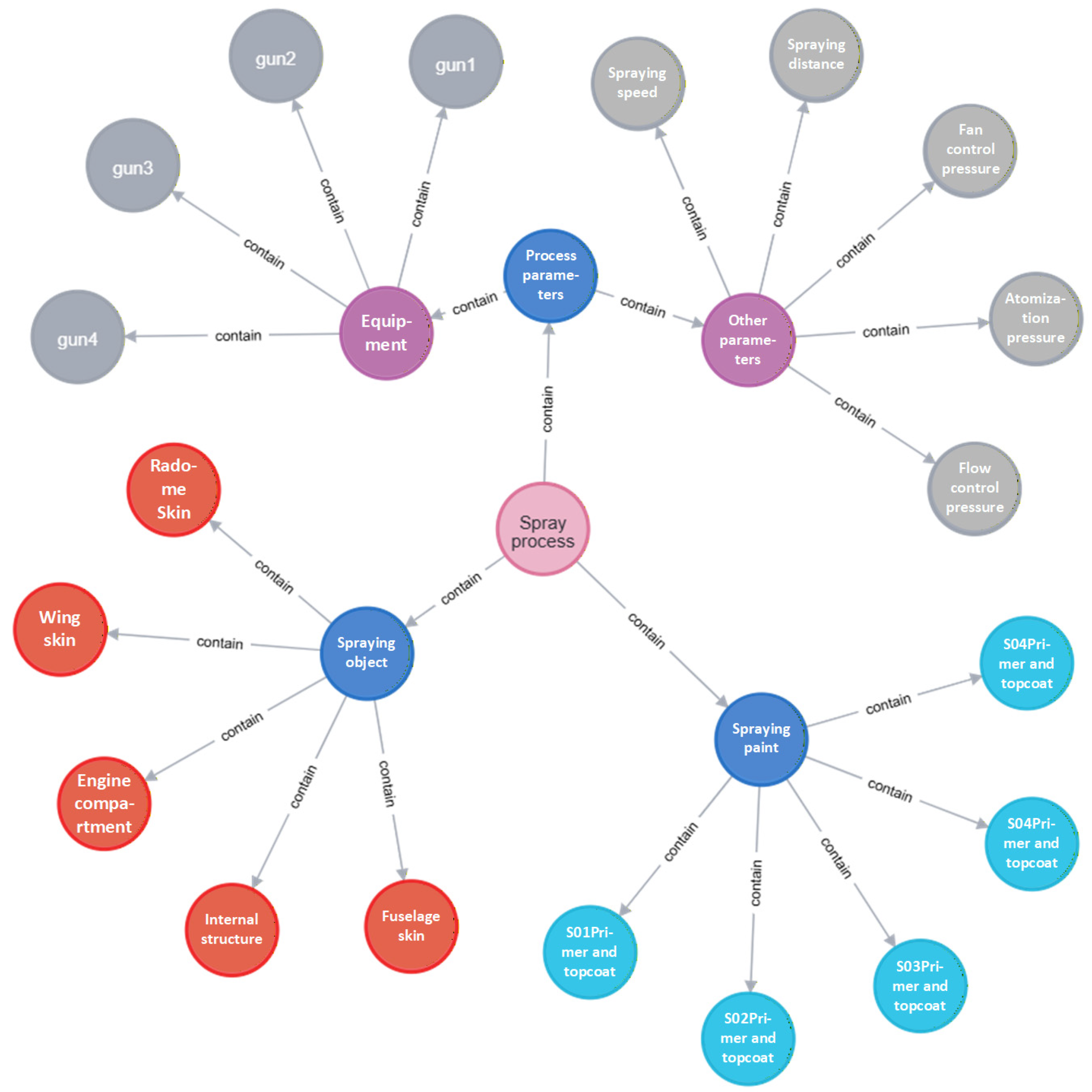
The raw data underwent preprocessing steps including multi-source knowledge extraction, entity alignment (using the GAT-A algorithm), and conflict resolution as outlined in Section 2.1.3 and Section 2.1.4. The final constructed graph contains 57 entities, 238 relationships, 40 constraint rules, 132 process solutions, and 5 knowledge documents. Its topological structure, shown in Figure 2, clearly illustrates the complex network relationships among core entities such as spraying objects, paints, and process parameters, validating the practicality of the multi-structural ontology architecture proposed in Section 2. Key examples of data preprocessing are presented in Table 3.

3.2. Demonstration of the MKM Reasoning Model’s Inference Process

This section comprehensively demonstrates the workflow, internal mechanisms, and final outcomes of the three-stage MKM reasoning model proposed in Section 3 through a typical user query case study.

3.2.1. Query Parsing and Feature Completion (M-Stage Application)

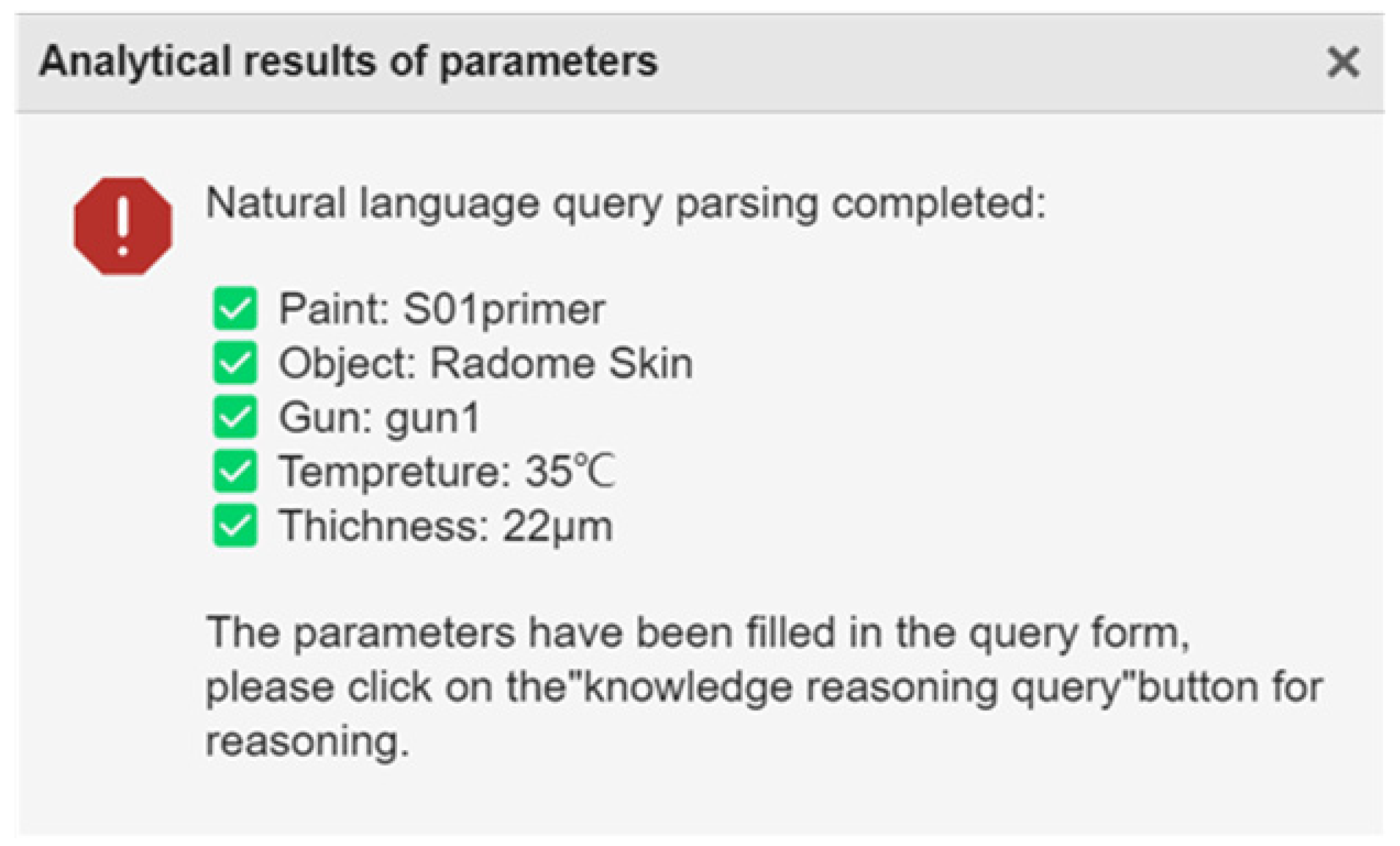
When the user enters the query in the system: “Optimal process parameters for S01 primer on radome skin under high temperature environment”, the system first utilizes the fine-tuned SprayBERT model to perform word segmentation and named entity recognition on the query. It extracts a set of keywords {“radome skin”, “high temperature”, “S01 primer”} and maps them to high-dimensional semantic vectors. The parsing results are shown in Figure 3. Subsequently, the system uses the parsed entities and local features as query conditions to search the already constructed knowledge graph, automatically completing implicit features that are closely related but not explicitly mentioned by the user. For example, based on the strong association between “radome skin” and “S01primer”, it completes the “recommended viscosity” as 18 s. Based on the “high temperature” node, it is associated with implicit parameters like the “viscosity adjustment factor” and infers that appropriately reducing the paint viscosity might be necessary to ensure spraying quality.
Finally, the system fuses the local analytical features with the global complementary features to form an enhanced semantic feature vector h f u s e d , which can fully encode the user’s explicit intention and the implicit knowledge of the graph, as the input of the next stage. This process effectively solves the problem of information fragmentation caused by traditional keyword search, and realizes the deep semantic understanding and knowledge expansion of users’ fuzzy and incomplete queries.

3.2.2. Feature Fusion and Graph Attention Computation (K-Stage Application)

During the knowledge-enhanced feature fusion stage, the system deeply integrates the query features h f u s e d output from the previous stage with the topology of the knowledge graph of the spraying process. Firstly, the graph attention calculation is carried out: the system uses GAT-A to dynamically quantify the correlation strength between process element nodes in the knowledge graph. For example, the calculated attention weight between “radome skin” and “S01primer” is α = 0.93, indicating that their combination is a common and recommended process practice; the weight between “high temperature” and “viscosity adjustment” is α = 0.86, confirming the significant influence of ambient temperature on paint viscosity parameters. These weight values are dynamically generated through the attention mechanism, which accurately captures the degree of influence between entities and provides a quantitative basis for subsequent matching and reasoning. Subsequently, multi-structural feature fusion is performed: the model further splices and projects the classification path features extracted from the tree hierarchy (such as “spraying process → spraying object → fairing skin”) with the graph attention features obtained by GAT-A aggregation to form an enhanced node representation h i f i n a l that finally fuses hierarchical semantics and network association information. This representation not only encodes the local interaction context of nodes in the graph, but also contains their category attribution and logical position in the overall knowledge system, which significantly improves the discriminative ability and semantic richness of node features, and lays a solid foundation for the final multi-constraint intelligent matching.

3.2.3. Multi-Constraint Matching and Solution Generation (M-Stage Application)

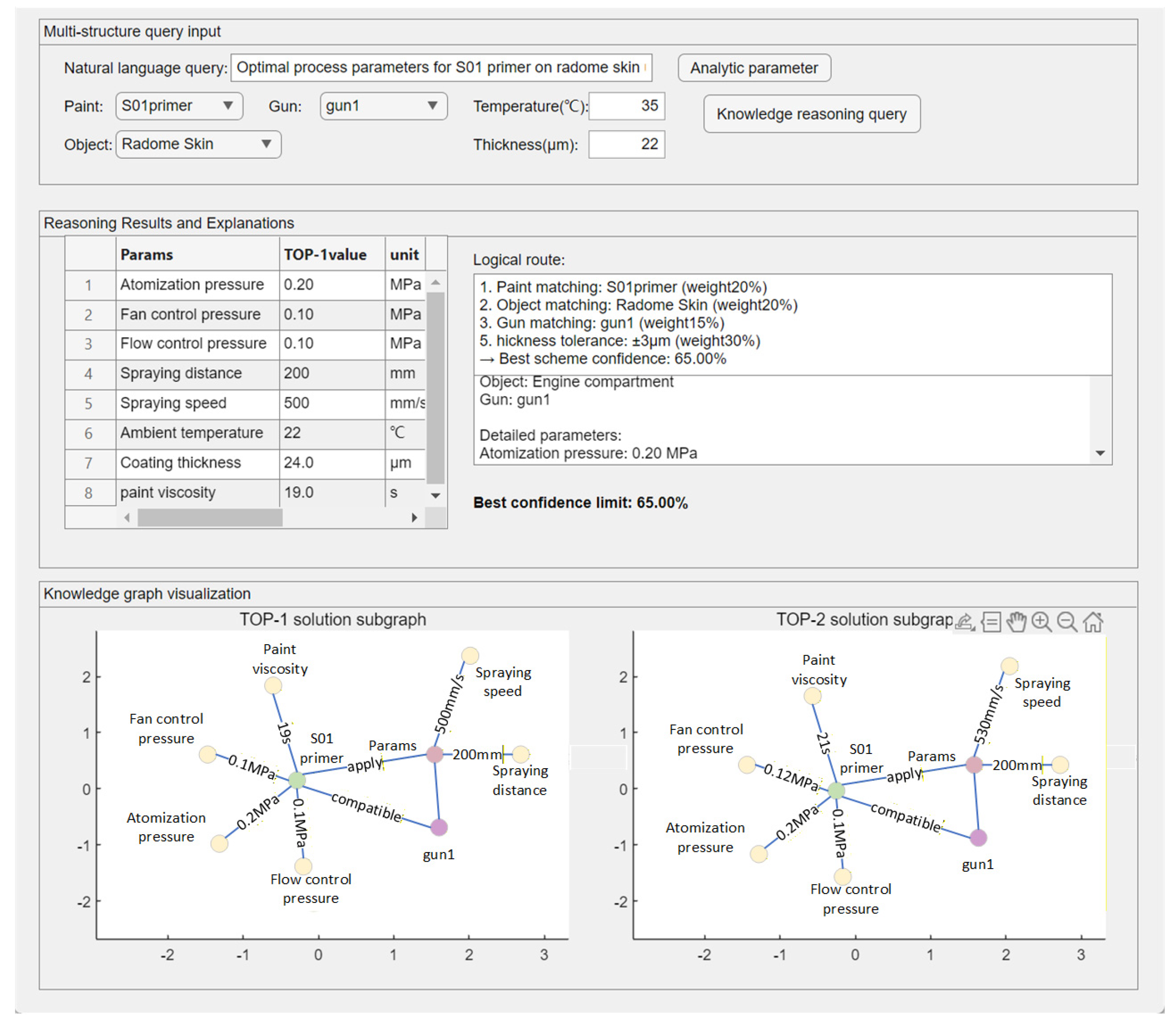
In the multi-constraint intelligent matching stage, the system employs the DSM algorithm for final solution retrieval and generation. Firstly, candidate generation and scoring: The fused query vector is projected into the graph embedding space. The most relevant candidate node sets are retrieved from the knowledge graph G using cosine similarity. These nodes serve as cores to expand and generate candidate subgraphs G s u b along high-weight edges ( α i j > 0.8). Following the calculation formula in Step 16 of Algorithm 1, the DSM algorithm computes a comprehensive score S ( G s u b ) for each candidate subgraph by integrating node similarity and relational strength of edges (including constraint validation factors). At the same time, the system performs strict dynamic constraint verification: by calling the D y n a m i c _ C o n s t r a i n t _ C h e c k function, function, all preset physical rules (e.g., spraying distance ≤ 300 mm) and process compatibility rules (e.g., prohibiting conflicting combinations) are loaded and verified one by one, and all candidate schemes that violate the constraints are automatically intercepted and eliminated to ensure the security of the recommended results. In this case, all the candidates that scored into Top-K successfully passed all the constraint verifications, and none of them were intercepted due to violations, reflecting the inherent reliability of the recommendation system. Finally, the system outputs the Top-K compliance process plans with the highest comprehensive score, and provides a visual reasoning path display. For this query, the Top-2 recommendation scheme and its key parameters generated by the system are shown in Table 4. The user can clearly view the complete parameter chain and decision-making basis of each scheme through the system interface (Figure 4), so as to obtain process decision support with accuracy, safety, and interpretability.
As demonstrated by the above case study, the knowledge graph constructed in this work can effectively organize and manage complex spraying process knowledge and its multi-dimensional constraints. The MKM reasoning model successfully transforms users’ natural language queries into semantic operations understandable by the graph through the chain of “semantic parsing → knowledge completion → feature fusion → constraint matching.” Ultimately, it outputs optimized process solutions that combine accuracy (based on graph similarity matching), safety (verified through physical rules), and interpretability (by providing visual paths).

3.3. Performance Comparative Analysis of Spraying Process Knowledge Reasoning

To comprehensively evaluate the performance of the proposed MKM reasoning model, the authors designed systematic comparative experiments on a self-constructed aircraft skin spraying process knowledge graph.
  • Dataset and Experimental Design: From the constructed knowledge graph, it selected 90 complete process chains as experimental samples. Each process chain contains a complete decision path from “spraying object” to “spraying paint” and then to “process parameters”, forming a complete case suitable for evaluating reasoning capabilities. The samples were randomly split into training, validation, and test sets in a 7:2:1 ratio to ensure impartial model evaluation.
  • Baseline Models: To thoroughly validate the superiority of the MKM reasoning model, the following four representative categories of baseline methods for comparison: (1) Traditional Case-Based Reasoning (CBR); (2) Graph Convolutional Network (GCN); (3) Knowledge Graph Embedding methods (TransE, RotatE); and (4) Relational Graph Neural Network (CompGCN). All baseline models used the same training/test set split and were trained and tested under identical computational environments to ensure fairness.
  • Evaluation Metrics: We adopted Hit@1, Hit@3, Mean Reciprocal Rank (MRR), and average response time to measure industrial applicability, which are widely used in knowledge reasoning and recommendation systems. The results are shown in Table 5.

4. Discussion

This chapter combines the experimental results from Section 3 to conduct an in-depth analysis and discussion of the effectiveness, advantages, and limitations of the proposed MKM reasoning model and the multi-structure knowledge graph construction method presented in this paper.

4.1. Analysis of Methodological Advantages and Innovation

The experimental results show that the MKM model proposed in this paper significantly outperforms the baseline methods such as traditional case-based reasoning (CBR), graph convolutional networks (GCN), and knowledge graph embeddings (KGE) in the core task of reasoning about spray process knowledge, as indicated by the Hit@1, Hit@3, and MRR metrics (see Table 5). This performance advantage mainly stems from the following three innovative designs:
  • Multi-structural knowledge representation enhances the integration of semantics and logic: unlike baseline methods relying solely on flattened graph structures or vector embeddings, the knowledge graph constructed herein fuses tree hierarchies with graph association networks while embedding physical rule constraints. This multi-structural ontology architecture not only ensures the systematicity and manageability of the knowledge system (via tree hierarchies) but also flexibly represents complex cross-domain process logic (via graph networks), while establishing safety boundaries for the reasoning process (via physical constraints). During multi-structural feature fusion at the K-stage, the introduction of tree-hierarchy path features effectively enhances the semantic richness and discriminative power of node representations—capabilities absent in single-graph neural network models such as CompGCN.
  • The three-stage reasoning mechanism achieves precise alignment from “semantics” to “structure”: the MKM model systematically resolves issues of understanding ambiguous user queries, completing implicit knowledge, and achieving precise matching with structured graph knowledge through a progressive process of “multi-granularity semantic understanding (M)–knowledge-enhanced feature fusion (K)–multi-constraint intelligent matching (M)”. Notably, the graph attention augmentation mechanism (GAT-A) introduced in the K stage incorporates constraint functions. This actively filters out associations violating physical laws or process compatibility during information propagation, ensuring the safety of recommended solutions at the algorithmic level. This addresses a critical industrial requirement often overlooked by traditional graph learning approaches.
  • A favorable balance has been achieved between efficiency and accuracy: whilst embedding methods such as TransE offer faster inference speeds, their precision falls short of meeting the demands of complex process decision-making; conversely, CBR approaches are constrained by the coverage and retrieval efficiency of their case repositories. The MKM model employs a Dynamic Subgraph Matching (DSM) algorithm to focus the search scope on highly relevant subregions of the graph. This approach maintains high accuracy while controlling the average response time within a practical range of 350 milliseconds, demonstrating its feasibility for deployment in real-world interactive systems.

4.2. Generalization Capability and Robustness Analysis

In addressing the two common industrial challenges of data sparsity and parameter uncertainty, the MKM model demonstrates excellent adaptability and robustness.

4.2.1. Generalization Ability Testing for Data-Sparse Scenarios

In practical industrial applications, the “cold start” problem caused by insufficient data for new materials or processes is common. To validate the practicality of the MKM reasoning model in such scenarios, the authors designed data sparsity experiments:
  • Partial sparsity: All process-related edges for the “carbon fiber” substrate were temporarily removed from the knowledge graph (only taxonomic relations retained), simulating a “category exists but no instances” scenario.
  • Complete cold start (Zero-shot): A new entity “magnesium metal” was created in the graph without connecting it to any existing coating or parameter nodes, simulating a “completely unknown” scenario.
The queries “Recommend spraying process parameters for carbon fiber workpieces” and “Spraying process for magnesium alloy” were entered into the system, and the results were compared with the CBR method. Evaluation criteria included: whether a solution was output, the confidence level of the recommended solution, and independent technical rationality assessments by two senior spraying process engineers. The results are shown in Table 6.
Result analysis: For the “carbon fiber” query, CBR failed due to the absence of directly matching cases in its case library. In contrast, the MKM reasoning model leveraged its graph structure awareness to identify “carbon fiber” as a subclass of “composite material” and activated potential associations with adjacent nodes (such as “S1 paint”) through its graph attention mechanism, thereby inferring a reasonable set of generic process parameters. Experts deemed this solution safe and feasible as an initial debugging baseline. This demonstrates MKM’s capability to address data sparsity through semantic transfer.
For the entirely new “magnesium alloy” query, the MKM reasoning model could not generate recommendations, as no compatibility relationships related to it were established in the knowledge graph. This highlights the current method’s limitation in handling “completely unknown” knowledge. Future improvements would require incorporating external knowledge or zero-shot learning mechanisms.

4.2.2. Validation of the Effectiveness of Parameter Uncertainty Handling Methods

On-site spraying of environmental parameters (such as temperature and humidity) often exhibits fluctuations. To validate the robustness of the MLP feature enhancement method against parameter uncertainty, the authors designed a comparative experiment.
Experimental setup: All process data with a historical standard deviation of “ambient temperature” greater than 5 °C were selected to form a query subset containing highly uncertain parameters.
Evaluation Method: The baseline method (using original semantic features) was compared with our proposed method (using MLP-enhanced features incorporating historical mean and variance).
The experimental results in Table 7 show that both Precision@1 and the average confidence of our method are significantly higher than those of the baseline. This proves that the feature representation incorporating historical statistical information (mean and variance) can effectively enhance the model’s perception of parameter fluctuations, making its recommendation results more stable and reliable when facing uncertainty. This mechanism significantly improves the practical value of the knowledge reasoning system in real industrial environments.
However, although the multi-structured knowledge graph proposed in this paper has certain dynamic correlation expansion ability, its expansion effect is still limited by the coverage and quality of the knowledge graph. In the architecture of this paper, dynamic expansion is mainly realized through event-triggered and rule-triggered mechanisms. When new knowledge is input or logical conflicts are detected, the system will try to integrate it into the graph. However, the depth and breadth of the extension depend on the strength of the existing semantic association and the integrity of the constraint rules. In the future, the dynamic expansion strategy based on semantic similarity and graph structure enhancement can be further explored to improve the adaptability of the system in an open environment.

5. Conclusions

This research addresses issues in the aircraft skin spraying process decision-making process, such as strong reliance on experiential knowledge, fragmented knowledge organization, and insufficient dynamic adaptability, by proposing a knowledge graph-based reasoning method for spraying process knowledge. By constructing a multi-structural ontology architecture that integrates tree-like hierarchies, graph association networks, and physical rule constraints, a rigorous yet flexible organizational form is provided for complex process knowledge. On this basis, a three-stage reasoning model—Multi-Granularity Semantic Understanding, Knowledge-Enhanced Feature Fusion, and Multi-Constraint Intelligent Matching (MKM) is designed and implemented, achieving a transition from “static knowledge representation” to “dynamic associative reasoning”. Integrating the theoretical construction, case demonstrations, and experimental validation in this paper, the following conclusions can be drawn:
  • In terms of core performance, the MKM reasoning model significantly outperforms baseline methods such as traditional case-based reasoning, graph convolutional networks, and knowledge graph embedding across all evaluation metrics (including Hit@1, Hit@3, and MRR) in spraying process knowledge reasoning tasks. At the same time, its response efficiency meets the requirements of industrial applications, demonstrating its effectiveness and feasibility in real-world smart manufacturing environments.
  • In terms of architecture design, the multi-structure ontology proposed in this paper, together with the accompanying MKM reasoning model, forms a complete solution. This solution ensures the systematicity and manageability of the knowledge system through a tree-like hierarchical structure, endows the model with the flexibility to capture complex process correlations through a graph association network, and sets safety boundaries for all reasoning activities through embedded physical rule constraints. This design not only enhances the performance of this task but also demonstrates the potential for migration to other manufacturing fields through its general framework.
  • In terms of practicality and robustness, the model can still maintain stable reasoning performance even in scenarios with sparse data and parameter uncertainties. Through semantic transfer and feature enhancement mechanisms, MKM can effectively address practical industrial challenges such as “cold start” and parameter fluctuations, compensating for the shortcomings of traditional methods in dynamic adaptability and significantly enhancing the engineering practical value of the knowledge reasoning system.
Although the method proposed in this paper shows superiority in multiple dimensions, its dynamic adaptability is still limited by the coverage and quality of the knowledge graph. Especially in the face of completely unknown entities or relationships, the system can only issue “insufficient knowledge” warnings and cannot automatically generate effective solutions. Future work will focus on the following aspects: first, introducing external knowledge bases and online learning mechanisms to enhance the system’s continuous evolution and self-adaptive capability in open environments; second, exploring deep integration with large language models, leveraging their powerful natural language understanding and generation capabilities to further optimize the interactive acquisition and dynamic updating mechanisms of process knowledge, thereby comprehensively improving the system’s intelligence level and engineering practical value.

Author Contributions

Conceptualization, C.S. and D.Y.; methodology, C.S., D.Y. and H.B.; software, D.Y. and W.S.; validation, D.Y., W.S. and H.T.; formal analysis, D.Y.; investigation, D.Y.; resources, C.S.; data curation, D.Y., Y.Y. and H.T.; writing—original draft preparation, D.Y. and H.T.; writing—review and editing, D.Y.; visualization, C.S.; supervision, C.S. and H.B.; project administration, C.S.; funding acquisition, C.S. All authors have read and agreed to the published version of the manuscript.

Funding

This research was funded by the Jilin Science and Technology Development Program Fund, grant number YDZJ202503CGZH002, and the Changchun Science and Technology Development Program Funded Projects, grant number 24GXYSZZ14.

Data Availability Statement

The raw data supporting the conclusions of this article will be made available by the authors on request.

Conflicts of Interest

The authors declare no conflicts of interest.

References

  1. Kang, X.; Xiang, B.; Li, Y.; Hao, X.; Zhang, Y. Adaptive machining technology of large aircraft skin based on rapid scanning. Aeronaut. Manuf. Technol. 2019, 62, 85–90. [Google Scholar] [CrossRef]
  2. Zhou, R. Surface treatment and coating process of aircraft skin. Coat. Prot. 2018, 39, 51–54+62. [Google Scholar]
  3. Yang, W.; Wang, Y.; Ji, Z. Knowledge Graph-based Process Knowledge Reasoning Method for Intelligent Production System. J. Syst. Simul. 2023, 35, 773–785. [Google Scholar] [CrossRef]
  4. Zheng, H.; Yang, S.; Lou, S.; Gao, Y.; Feng, Y. Knowledge-based integrated product design framework towards sustainable low-carbon manufacturing. Adv. Eng. Inform. 2021, 48, 101258. [Google Scholar] [CrossRef]
  5. Peng, G.; Wang, H.; Zhang, H.; Huang, K. A hypernetwork-based approach to collaborative retrieval and reasoning of engineering design knowledge. Adv. Eng. Inform. 2019, 42, 100956. [Google Scholar] [CrossRef]
  6. Long, X.; Li, H.; Ren, W.; Du, Y.; Mao, E.; Ding, N. A parameter-extended case-based reasoning method based on a functional basis for automated experiential reasoning in mechanical product designs. Adv. Eng. Inform. 2021, 50, 101409. [Google Scholar] [CrossRef]
  7. Long, X.; Li, H.; Du, Y.; Mao, E.; Tai, J. A knowledge-based automated design system for mechanical products based on a general knowledge framework. Expert Syst. Appl. 2021, 178, 114960. [Google Scholar] [CrossRef]
  8. Zhigang, J.; Bin, X.; Shuo, Z.; Hua, Z.; Wei, Y.; Mingren, D. Dynamic data flow-driven knowledge graph construction method for remanufacturing disassembly process. Comput. Integr. Manuf. Syst. 2024, 30, 879–892. [Google Scholar] [CrossRef]
  9. Jiang, J.; Wang, S. Semi-automatic construction technology of complex equipment knowledge graph constraints. Comput. Integr. Manuf. Syst. 2025, 31, 1383. [Google Scholar] [CrossRef]
  10. Sun, X.; Liu, S.; Shen, X.; Huang, D.; Bao, J. Digital twin-driven intelligent assembly method for high precision products. Comput. Integr. Manuf. Syst. 2022, 28, 1704–1716. [Google Scholar] [CrossRef]
  11. Liu, J.; Tang, Z.; Wang, X.; Dou, R.; Ji, H. Equipment fault knowledge graph and inference method based on meta-learning. Comput. Integr. Manuf. Syst. 2023, 29, 3600–3613. [Google Scholar] [CrossRef]
  12. Li, J.; Qu, Y.; Qiu, H.; Liu, B.; Li, L.; Zhang, J.; Wei, L. Effective machining process planning method based on knowledge graph and deep learning. Comput. Integr. Manuf. Syst. 2024, 30, 3850–3864. [Google Scholar] [CrossRef]
  13. Guo, L.; Yan, F.; Li, T.; Yang, T.; Lu, Y. An automatic method for constructing machining process knowledge base from knowledge graph. Robot. Comput.-Integr. Manuf. 2022, 73, 102222. [Google Scholar] [CrossRef]
  14. Xiong, C.; Xiao, J.; Li, Z.; Zhao, G.; Xiao, W. Knowledge graph network-driven process reasoning for laser metal additive manufacturing based on relation mining. Appl. Intell. 2024, 54, 11472–11483. [Google Scholar] [CrossRef]
  15. Guo, L.; Yan, F.; Li, T.; Zheng, J.; Xiong, J. Machining process reasoning system based on knowledge graph. Mod. Manuf. Eng. 2021, 10, 1–10. [Google Scholar] [CrossRef]
  16. Pasquadibisceglie, V.; Scaringi, R.; Appice, A.; Castellano, G.; Malerba, D. PROPHET: Explainable predictive process monitoring with heterogeneous graph neural networks. IEEE Trans. Serv. Comput. 2024, 17, 4111–4124. [Google Scholar] [CrossRef]
  17. Zhang, S.; Kong, S.; Kong, X.; Zhao, M. Construction Method of Typical Parts Process Knowledge Based on Knowledge Graph. Autom. Appl. 2023, 64, 53–57. [Google Scholar]
  18. Ding, C.; Qiao, F.; Liu, J.; Wang, D. Knowledge graph modeling method for product manufacturing process based on human–cyber–physical fusion. Adv. Eng. Inform. 2023, 58, 102183. [Google Scholar] [CrossRef]
  19. Liu, M.; Li, X.; Li, J.; Liu, Y.; Zhou, B.; Bao, J. A knowledge graph-based data representation approach for IIoT-enabled cognitive manufacturing. Adv. Eng. Inform. 2022, 51, 101515. [Google Scholar] [CrossRef]
  20. Li, Q.; Jiang, P.; Wang, J.; Yang, M.; Yang, Y. A kind of intelligent dynamic industrial event knowledge graph and its application in process stability evaluation. J. Intell. Manuf. 2025, 36, 1801–1818. [Google Scholar] [CrossRef]
  21. Wang, B.; Xu, H.; Li, C.; Li, Y.; Wang, M. TKGAT: Graph attention network for knowledge-enhanced tag-aware recommendation system. Knowl.-Based Syst. 2022, 257, 109903. [Google Scholar] [CrossRef]
  22. Hu, Z.; Liu, M.; Li, Q.; Li, X.; Bao, J. Modeling A Multi-Modal Knowledge Graph for Assembly Process of Wind Turbines with Multi-Source Heterogeneous Data. J. Shanghai Jiaotong Univ. 2024, 58, 1249–1263. [Google Scholar] [CrossRef]
  23. Schlichtkrull, M.; Kipf, T.N.; Bloem, P.; Van Den Berg, R.; Titov, I.; Welling, M. Modeling relational data with graph convolutional networks. In European Semantic Web Conference; Springer: Berlin/Heidelberg, Germany, 2018; pp. 593–607. [Google Scholar] [CrossRef]
  24. Dettmers, T.; Minervini, P.; Stenetorp, P.; Riedel, S. Convolutional 2d knowledge graph embeddings. In Proceedings of the AAAI Conference on Artificial Intelligence, New Orleans, LA, USA, 2–7 February 2018; pp. 1811–1818. [Google Scholar] [CrossRef]
  25. Wang, H.; Zhang, F.; Xie, X.; Guo, M. DKN: Deep knowledge-aware network for news recommendation. In Proceedings of the 2018 World Wide Web Conference, Lyon, France, 23–27 April 2018; pp. 1835–1844. [Google Scholar] [CrossRef]
  26. Lin, Y.; Liu, Z.; Sun, M.; Liu, Y.; Zhu, X. Learning entity and relation embeddings for knowledge graph completion. In Proceedings of the AAAI Conference on Artificial Intelligence, Austin, TX, USA, 25–30 January 2015; pp. 2181–2187. [Google Scholar] [CrossRef]
  27. Fan, W.; Ma, Y.; Li, Q.; He, Y.; Zhao, E.; Tang, J.; Yin, D. Graph neural networks for social recommendation. In Proceedings of the World Wide Web Conference, San Francisco, CA, USA, 13–17 May 2019; pp. 417–426. [Google Scholar] [CrossRef]
  28. Steenwinckel, B.; Soete, C.; Moens, P.; Mussche, J.; Hoecke, S.V.; Ongenae, F. Quality in color: Using knowledge graphs for enhanced quality control in an automotive paintshop. In International Semantic Web Conference; Springer: Cham, Switzerland, 2024; pp. 236–252. [Google Scholar] [CrossRef]
  29. Chen, T.; Song, Y.; Wu, W.; Deng, Z.; Shen, X.; Shen, Z.; Chen, Y.; Ma, C. Multi-Objective Process Optimization and Properties of Ti (C, N) Ceramic Coatings Prepared By Laser Cladding. J. Therm. Spray Technol. 2025, 34, 2501–2520. [Google Scholar] [CrossRef]
  30. Zhang, Y.; Zhan, H.; Wan, Q.; Wang, R.; Zhang, X.; Wang, W. Multi-objective optimization of process parameters for rectangular laser cladding of Fe-based alloy wear-resistant coatings. Surf. Coat. Technol. 2025, 503, 131990. [Google Scholar] [CrossRef]
  31. Zhang, E.; Zhang, Z.; Jing, Z.; Yuan, J.; Ma, C.; Yan, S.; Zhang, S.; Liang, X. Research Progress on Process Optimization of Thermal-Sprayed Iron-Based Amorphous Coatings. Integr. Mater. Manuf. Innov. 2025, 14, 247–275. [Google Scholar] [CrossRef]
  32. Xu, F.; Zi, B.; Wang, J.; Yu, Z. Multi-Objective Trajectory Optimization for Rigid-Flexible Coupling Spray-Painting Robot Integrated with Coating Process Constraints. Chin. J. Mech. Eng. 2024, 37, 152. [Google Scholar] [CrossRef]
Figure 1. Schematic diagram of multi-structural ontology architecture integrating physical rule constraints.
Processes 14 00581 g001
Figure 2. Schematic diagram of knowledge graph topology structure.
Processes 14 00581 g002
Figure 3. Natural language parsing result.
Processes 14 00581 g003
Figure 4. Spraying process knowledge reasoning system visualization interface.
Processes 14 00581 g004
Table 1. Core Elements of Aircraft Skin Spraying Process.
Spraying
Object Knowledge
Spraying Paint KnowledgeSpraying Process Parameter KnowledgeSpraying
Object Knowledge
Spraying Paint Knowledge
Spraying
Equipment
Environmental ParametersProcess
Parameters
Material
Spraying Area
Coating Area
Paint Name
Color
Mixing Ratio
Viscosity
Spray Gun ModelTemperature
Humidity
Wind Speed
Spraying Distance
Spray Gun Traverse Speed
Atomization Pressure
Fan Pattern Control Pressure
Fluid Flow Control Pressure
Table 2. Test Performance.
TaskPrecision (P)Recall (R)F1-Score
Entity Recognition93.5%91.8%92.6%
Relation Classification91.2%90.5%90.8%
Overall Triple92.3%91.1%91.7%
Table 3. Data Preprocessing Examples.
Preprocessing StepOriginal TextResult
Structured ExtractionThe recommended viscosity for epoxy primer is 21 s, with a mixing ratio of 5:3:2; the recommended spraying distance is 200 mm.<Epoxy primer, hasViscosity, 21s>
<Epoxy primer, hasMixRatio, 5:3:2>
<Epoxy primer, optimalFor, 200 mm>
Semantic AlignmentSource 1: The paint name in the equipment manual is “S01Primer”;
Source 2: It is referred to as “Epoxy Primer” in experimental records.
(1) Calculate attribute similarity (e.g., viscosity, mixing ratio consistency) using the GAT-A algorithm;
(2) If the similarity exceeds the threshold (e.g., 0.9), merge into the unified entity “Epoxy Primer”.
(3) Update the graph relationship: <S01primer, synonym, Epoxy primer>
Conflict ResolutionSource a: <Epoxy primer, hasMixRatio, 5:3:2>;
Source b: <Epoxy primer, hasMixRatio, 4:2:1>.
Resolution Strategy: The numerical difference exceeds the threshold (±10%), triggering expert review. The ratio 5:3:2 is ultimately confirmed for adoption.
Table 4. Top-2 solutions.
ParameterSolution 1Solution 2
Atomization Pressure0.20.23
Fan Control Pressure0.10.21
Flow Control Pressure0.10.17
Spraying Speed200230
Spraying Distance500500
Ambient Temperature2225
Paint Viscosity18 s22 s
Table 5. Model Performance Results.
ModelHit@1Hit@3MRRAverage Response Time (ms)
CBR0.710.850.78850
GCN0.780.890.83600
TransE0.650.800.72150
RotatE0.680.830.75180
CompGCN0.820.920.87550
MKM (Ours)0.910.970.94350
Table 6. Generalization performance test results in data-sparse scenarios.
Input QueryModelSolution
Output
Solution
Summary
Expert Evaluation (Technical Rationality)
Recommend spraying process parameters for carbon fiber workpiecesCBRNoNo similar cases found, matching failedNot Applicable
MKM (Ours)YesLocated in “Composite Material” parent class via tree hierarchy, activated its generic process neighborhoodReasonable and Feasible
Spraying process for magnesium alloyCBRNoNo similar cases found, matching failedNot Applicable
MKM (Ours)NoNo associations found in the graph, triggered “Insufficient Knowledge” warningSystem suggests incorporating external knowledge
Table 7. Performance comparison of different methods on the uncertain query subset.
MethodPrecision@1Average Confidence
Baseline method0.760.79
Our method0.890.92
Disclaimer/Publisher’s Note: The statements, opinions and data contained in all publications are solely those of the individual author(s) and contributor(s) and not of MDPI and/or the editor(s). MDPI and/or the editor(s) disclaim responsibility for any injury to people or property resulting from any ideas, methods, instructions or products referred to in the content.