Review

Critical Review of CFD and Key Hydrodynamic Aspects in Three-Phase Mechanically Agitated Reactors: Challenges and Future Directions

Department of Chemical Engineering, Toronto Metropolitan University, 350 Victoria Street, Toronto, ON M5B 2K3, Canada
*
Author to whom correspondence should be addressed.
Processes 2026, 14(3), 523; https://doi.org/10.3390/pr14030523
Submission received: 17 December 2025 / Revised: 22 January 2026 / Accepted: 27 January 2026 / Published: 2 February 2026
(This article belongs to the Section Particle Processes)

Abstract

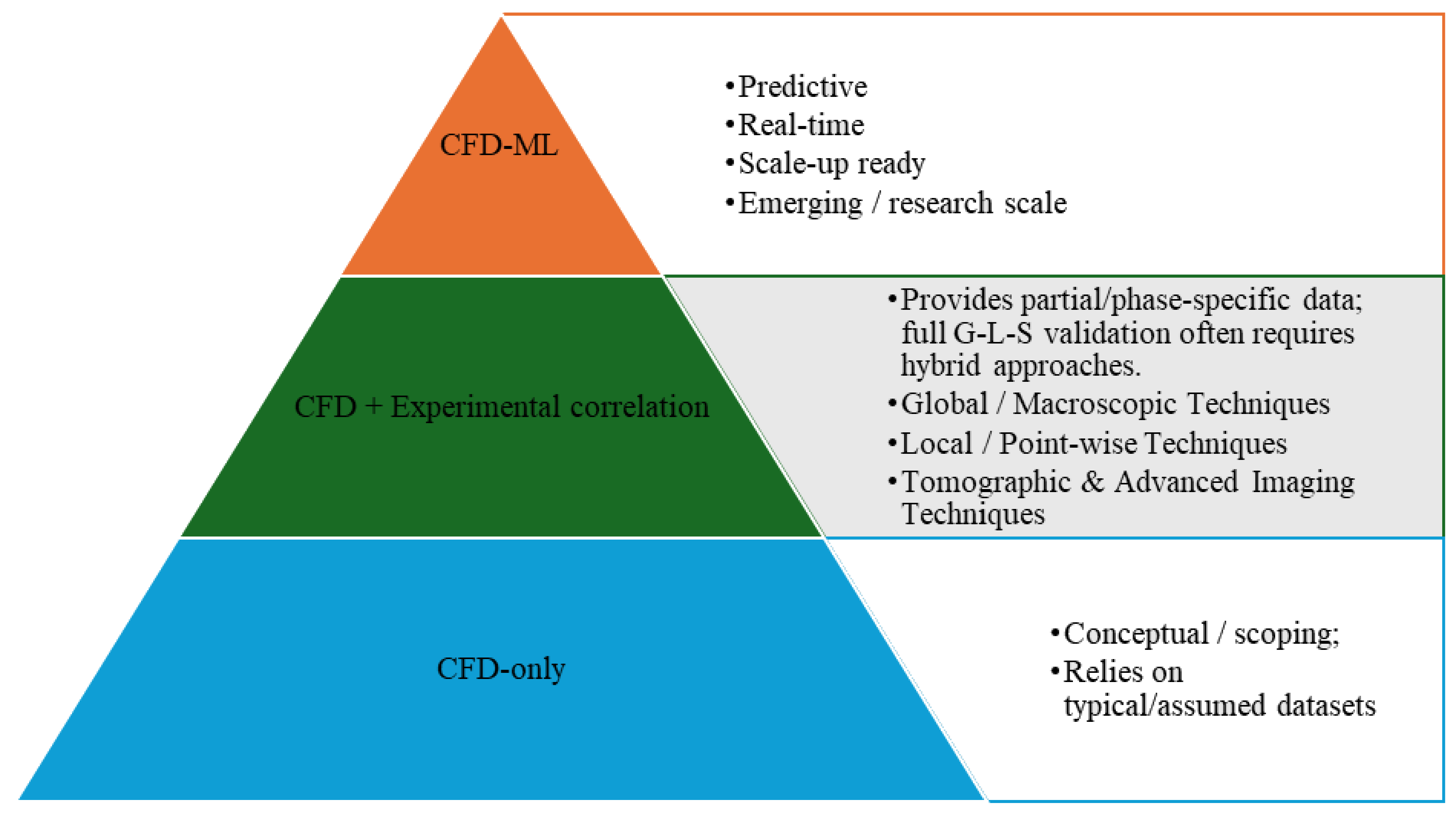
Gas–liquid–solid (G-L-S) mechanically agitated reactors are commonly used in chemical, pharmaceutical and bioprocessing applications due to their low operating costs and controlled and effective mixing. Computational Fluid Dynamics (CFD) is a powerful tool that enhances the understanding of flow dynamics, phase interactions and reactor performance. However, the CFD modeling of G-L-S mechanically agitated reactors is not extensively studied in the literature due to complex multiphase interactions, along with reactor design variations. This paper provides a critical synthesis of the literature, offering an overview not only of G-L-S stirred tank CFD modeling approaches but also of practical guidance on their selection and validation. Emerging high-resolution experimental techniques such as Electrical Resistance Tomography (ERT) coupled with pressure transducers, and Machine Learning (ML) models combined with experimental data, look promising to overcome current three-phase validation limitations. Future work to enhance predictive capabilities and reactor design and operation includes developing real-time digital twins, physics-based ML models and/or hybrid CFD-ML models.

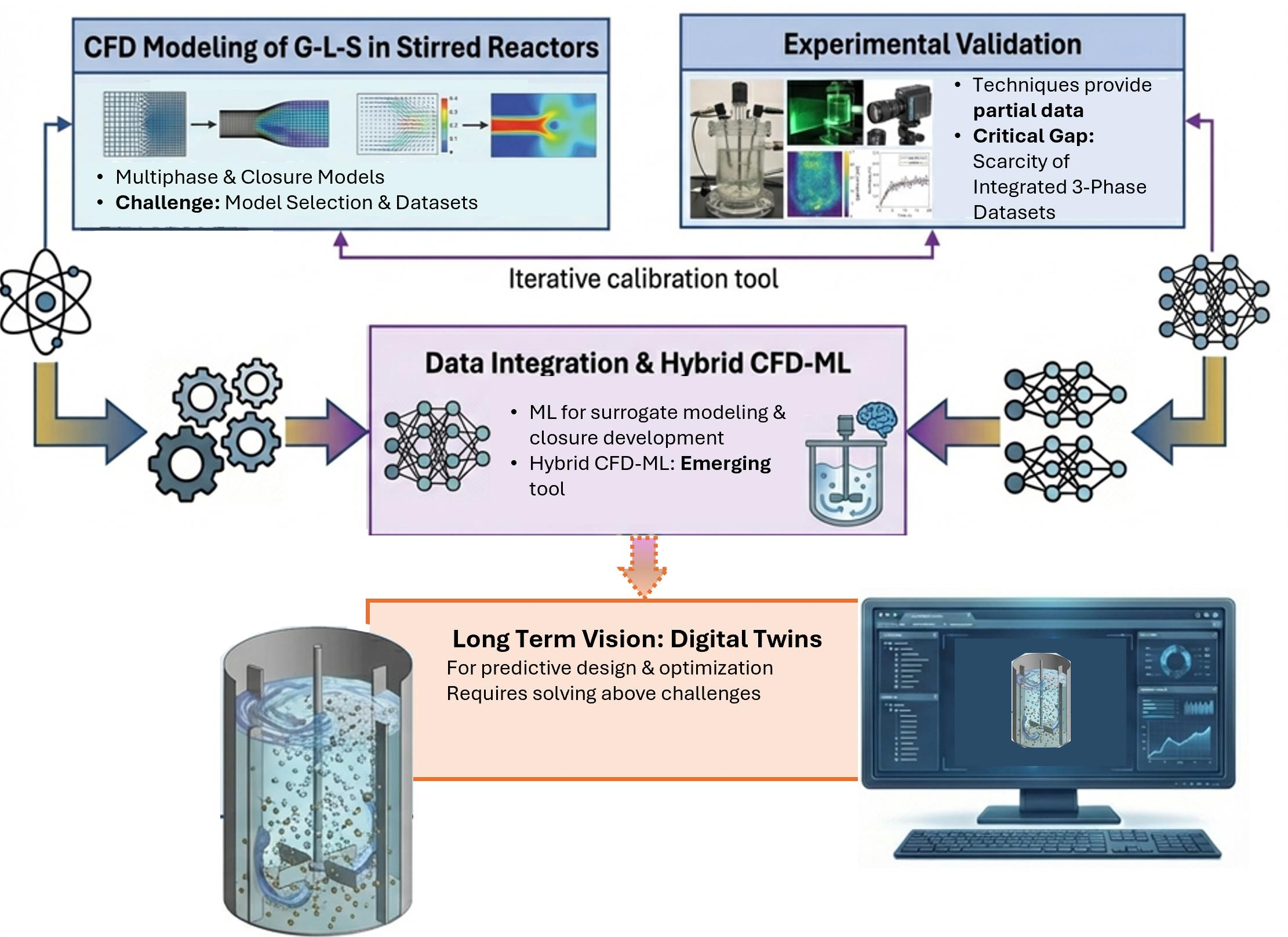
Graphical Abstract

1. Introduction

Three-phase reactors carrying out gas–liquid–solid (G-L-S) reactions are widely used in the chemical, petrochemical, biochemical and environmental processing industries, including wastewater treatment, biofuel production and pharmaceutical manufacturing, due to their ability to facilitate mass and heat transfer between the three phases. Nevertheless, the presence of three phases poses a challenge to reactor design, particularly in terms of hydrodynamic behavior and achieving the desirable transfer rates and reaction kinetics of the process. Compared to single- or two-phase systems, three-phase systems are more complex because of the simultaneous interactions among gas, liquid, and solid phases, which involve additional interfacial forces, particle–bubble–liquid interactions, and phase distribution complexities. These complexities directly affect key operational challenges such as achieving uniform solid suspension, enhancing gas–liquid mass transfer (e.g., oxygen transfer in bioreactors) and ensuring reliable scale-up from laboratory to industrial scale.
Computational Fluid Dynamics (CFD) is a powerful numerical analysis tool used for studying flow dynamics, phase interactions and reactor performance, thereby improving reactor design, identifying operational inefficiencies and scale-up strategies, while reducing the number of experiments required [1]. Several commercial and open-source software, such as ANSYS Fluent and OpenFOAM, are available for obtaining solutions, mostly in terms of hydrodynamics, heat and mass transfer, which are validated analytically or experimentally. CFD models offer accurate and detailed descriptions of critical engineering data such as flow field, phase hold-up or concentration profiles, underscoring their growing importance in industrial applications [2,3].
Despite these advantages, selecting appropriate multiphase, turbulence and interfacial models that can accurately represent a three-phase system within computational cost constraints is a challenge. Limited studies on CFD of three-phase systems are available to date, as most of the literature focuses on single- and two-phase flow. A recent review [2] has emphasized this research gap, noting that three-phase modeling remains significantly less explored compared to the extensive body of work on single- and two-phase systems. This paper aims to provide a critical review of CFD modeling in G-L-S mechanically agitated reactors. It evaluates the applicability, limitations and computational cost of key modeling approaches, hydrodynamics, validation techniques, challenges and recommendations for future work. Where possible, practical guidance is provided to support model selection for specific modeling objectives, such as gas hold-up prediction, solid suspension, or mass transfer estimation. Remaining uncertainties and unresolved challenges in three-phase CFD are explicitly highlighted. The recommended modeling approaches summarized herein should be interpreted as literature-informed guidance rather than universal prescriptions, as their applicability depends on reactor scale, operating regime, and validation objective.

2. Overview of G-L-S Reactors

G-L-S reactors are commonly used as catalytic reactors and bioreactors. These reactors can be classified as fixed beds or suspended beds depending on whether the solid catalyst is kept stationary or suspended within the reactor, respectively [2]. The selection of a fixed or moving catalyst is determined by the inherent kinetics, transport rates, phase dispersion and operational constraints of the process [4]. When a reaction is intrinsically fast, suspended fine catalyst particles can improve mass and heat transfer efficiency with a low pressure drop. Conversely, high catalyst loading is required for intrinsically slow reactions, which can be achieved in a fixed-bed reactor. Table 1 lists the typical G-L-S catalytic reactors used in laboratories and industries. For more information on other types of G-L-S reactors, the reader is referred to references [5,6]. Table 2 and Table 3 are additional comparative Tables, provided to further clarify the distinctions among reactor types.
Each reactor type has distinct CFD modeling approaches and limitations due to differences in phase distribution, dominant interfacial mechanisms, and turbulence characteristics. A CFD modeling approach is determined by factors such as reactor type, phase distribution, mass transfer, hydrodynamics, computational viability and prediction accuracy. In fixed-bed reactors, as the gas–liquid flow depends on the bed’s porosity and wetting efficiency, CFD models must account for appropriate porous media and surface wetting models to capture the effect of the catalyst on the multiphase interactions, but accurate predictions of wetting efficiency require extensive challenging experimental validation. Suspended bed reactors such as bubble columns and fluidized beds require advanced multiphase and turbulence models to represent the dynamic phase separation, bubble interactions and solid particle suspension in the G-L-S system; however, limitations exist in evaluating and predicting accurate interphase forces. These limitations directly affect the predictive accuracy of CFD models and necessitate careful selection and validation of closure models depending on reactor type and operating regime.

Mechanically Agitated Reactors

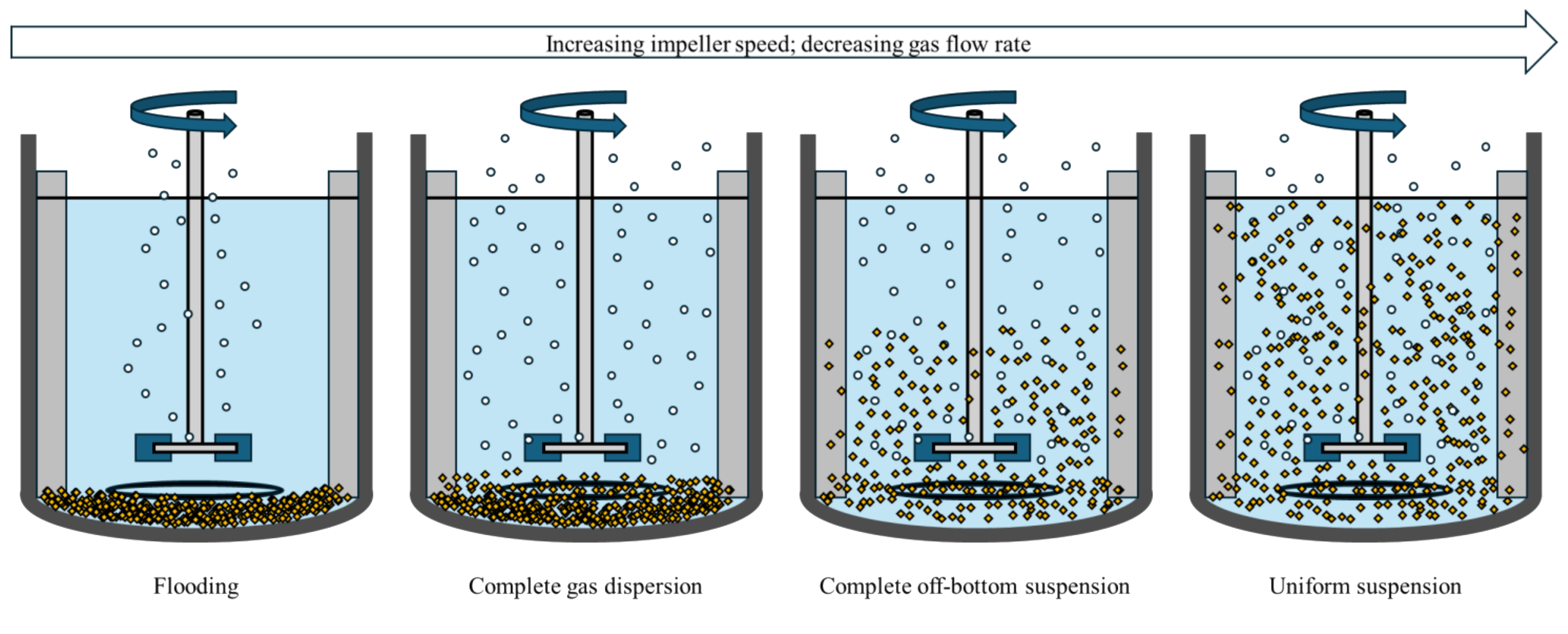
Among the suspended bed reactors, mechanically agitated or stirred tank reactors add another level of complexity due to their impeller-induced highly turbulent and agitated environment. In these reactors, rotating impellers suspend solids in the liquid while gas is sparged in, creating regions of high shear and localized turbulence with spatially non-uniform phase distributions, which significantly complicate CFD modeling compared to non-agitated G-L-S reactors. The entire surface area of the catalyst is available in such reactors for mass transport and reaction kinetics due to its ability to suspend solid particles [4]. Widely used in chemical, pharmaceutical and bioprocessing applications due to their low operating costs, controlled and effective mixing and enhanced mass transfer efficiency, the flow produced by the impeller in an agitated vessel is affected by impeller type, size, quantity, geometry, location, clearance and rotational speed, as well as solid properties and sparger design [7]. Some configurations use baffles along the reactor wall to improve gas dispersion and control vortex formation during mixing operations. Table 4 presents some common impeller types and their characteristics.
The key hydrodynamic parameters typically used to assess reactor performance and model fidelity in mechanically agitated vessels handling the G-L-S system are the following:
  • Gas hold-up;
  • Bubble dynamics including bubble formation, distribution, coalescence and breakup;
  • Liquid rheology and dispersion;
  • Solid content/volume fraction;
  • Shear stress;
  • Interfacial mass transfer (area and mass transfer coefficient);
    Gas–liquid interfacial mass transfer;
    Liquid–solid interfacial mass transfer;
  • Pressure drop and associated frictional losses—more relevant to continuous systems and are not considered in this review;
  • Heat transfer and reaction kinetics, including catalyst efficiency—reactor- and process-specific (e.g., exothermic systems) and are not considered in this review.

Experimental techniques, including but not limited to Electrical Resistance Tomography (ERT) [8,9,10,11,12,13], Particle Image Velocimetry (PIV) [14] and conductivity probes [15,16], are often used to analyze these hydrodynamic interactions; however, experiments do not provide a comprehensive analysis of reactor performance [17]. Additionally, each technique provides partial or phase-biased information and is subject to inherent limitations in three-phase environments. As an alternative, CFD modeling can be employed to provide a detailed performance analysis in terms of mixing efficiency, power consumption, flow pattern and behavior, while also evaluating small-to-large-scale performance. However, CFD modeling of mechanically agitated reactors is challenging because it must account for multiple interacting mechanisms. These include particle–particle, particle–bubble and liquid–particle interactions, the motion of the rotating impeller, the presence of baffles and the strong turbulence generated in the vessel. As a result, simulating mechanically agitated reactors is significantly more complex than modeling other types of G-L-S reactors [7,17]. The fluid dynamics in mechanically agitated vessels are complex and unsteady, even in the single-phase systems [18]. Additionally, models must be carefully selected and validated to ensure accurate representation and prediction of reactor performance. Accurate validation requires matching the measurement technique to the modeling objective. An objective-driven validation framework is discussed in Section 5.
Given the unique challenges of CFD modeling of mechanically agitated reactors, the subsequent sections of this paper discuss the specific applications of CFD in three-phase mechanically agitated reactors, their limitations, and identify future research areas that can enhance the use of CFD in this field. While G-L-S reactors across industries may handle both Newtonian and non-Newtonian liquids, the CFD studies reviewed in this paper focus on mechanically agitated reactors, predominantly investigating Newtonian liquids, unless otherwise stated.
Table 1. Typical G-L-S catalytic reactors.
ClassificationReactor TypeTypical ApplicationAdvantagesDisadvantagesUsageRef
Fixed bedTrickle bedHydrogenation, hydroprocessing
  • Low maintenance costs;
  • High conversion;
  • Large capacity;
  • High interfacial area;
  • Ability to operate under extreme conditions.
  • Poor liquid distribution at low flow rates;
  • Poor performance in viscous and foaming systems.
Commercial[19]
Fixed bedPacked bubble bedWacker process
  • High gas–liquid interfacial areas;
  • High heat transfer;
  • Superior catalyst wetting efficiency.
  • High pressure drop;
  • Liquid back mixing.
Commercial[2,20]
Suspended bedSlurry bubble columnFischer–Tropsch synthesis, liquid methanol synthesis,
fermentation
  • Low maintenance and low operating costs;
  • High heat and mass transfer coefficients;
  • No moving parts;
  • High durability of catalyst;
  • Plug-free operation.
  • Catalyst attrition;
  • Back mixing.
Commercial and lab[21,22]
Suspended bedFluidized bedCatalytic cracking, biomass pyrolysis/gasification
  • High heat and mass transfer;
  • Uniform temperature profile with no hot spots;
  • Low pressure drop;
  • No size limitations, can be scaled to large diameters;
  • Deactivated catalyst can be removed or replaced easily.
  • Low conversion and selectivity;
  • Chances of fine catalyst particle catalyst entrainment;
  • Catalyst attrition;
  • Erosion of reactor internals due to movement of particles;
  • Difficult to predict hydrodynamic performance;
  • Uneven residence times due to regular catalyst replacement.
Commercial and lab[23,24]
Suspended bedMechanically agitated reactor/stirred tankHydrogenation,
fermentation, waste water treatments
  • Low operating cost;
  • High mass transfer;
  • Uniform mixing;
  • Easy scale-up.
  • High energy consumption;
  • Significant catalyst attrition;
  • Risk of leaks due to moving parts.
Commercial and lab[2,4,25]
Suspended bedLoop reactorHydrogenation,
biochemical processes
  • Low capital and operating costs;
  • High heat and mass transfer;
  • Simple operation and scale-up;
  • Uniform concentration and temperature profile;
  • Low catalyst settling.
  • High maintenance cost;
  • May not be suitable for highly viscous fluids.
Commercial and lab[6]
Table 2. Comparison of fixed bed vs. suspended bed reactors.
ParameterFixed Bed Reactors Suspended Bed Reactors
Catalyst motionStationary (packed)Suspended/dispersed in fluid
Mass and heat transferDetermined by catalyst wetting efficiency [26]Enhanced mass and heat transfer due to suspension [2]
Operating conditionsHigh pressure and temperature capability [2]Low pressure drop; more sensitive to hydrodynamics and flow regime [2]
Scale-up easeCan be complex due to maldistribution and channeling [26]Relatively easier, but hydrodynamic instabilities may complicate it
MaintenanceLow maintenance costs [2]High maintenance costs [6]; potential issues with catalyst attrition and particle entrainment [23,24]
Table 3. Key industrial applications of G-L-S reactors.
IndustryProcessReactor TypeTypical ScaleProduct/Output
PetrochemicalHydroprocessing, hydrogenationTrickle bedCommercialFuels, lubricants
PetrochemicalHydrogenationStirred tank, loop reactorCommercial/labSpecialty chemicals
ChemicalWacker processPacked bubble bedCommercialAcetaldehyde
EnergyFischer–Tropsch synthesisSlurry bubble columnCommercial/labSynthetic fuel, methanol
EnergyBiomass pyrolysis, gasificationFluidized bedCommercial/labBiofuels, biogas
BiochemicalFermentationStirred tankCommercial/labAntibiotics, ethanol
EnvironmentalWastewater treatmentStirred tankCommercial/labTreated effluents
RefiningCatalytic crackingFluidized bedCommercialGasoline, olefins
Table 4. Examples of impeller types and their characteristics.
Impeller TypeFlow PatternSuitable ApplicationsAdvantagesLimitations
Rushton turbineRadialGas–liquid dispersion; aerobic bioreactors
  • High interfacial area for mass transfer [27].
  • High power consumption;
  • Poor axial pumping can lead to dead zones [28].
Pitched Blade Turbine (PBT)Axial/radialSolid–liquid mixing [29]
  • Versatile; easy to setup and install;
  • Energy-efficient [29].
  • Moderate shear;
  • Less effective for gas dispersion [29]
Hydrofoil impeller (e.g., A310)AxialModerately viscous fluids;
low solid loading [29]
  • Low shear;
  • Low power number [29];
  • Easy to install [27,30].
  • Less effective for gas dispersion [29]
Helical ribbon impeller/screw (close clearance)Axial/circumferentialHighly viscous fluids
  • Effective for high-viscosity and laminar/transition flows [31].
  • Structurally difficult to manufacture; high torque demand [32].
Maxblend
(close clearance)
Axial/radialViscous multiphase systems
  • Uniform and efficient mixing in viscous slurries; low power consumption; simple geometry [33,34].
  • Suboptimal performance at low Reynolds number [34].

3. CFD Approaches in G-L-S Mechanically Agitated Reactors

CFD modeling for multiphase mechanically agitated reactors includes solving the governing equations of fluid dynamics that describe the conservation of mass, momentum, and energy while considering multiphase interactions, interphase forces, turbulence and impeller rotation. This section reviews the key CFD simulation approaches for G-L-S mechanically agitated reactors, including their applicability, limitations and influence on key hydrodynamic outputs.

3.1. Multiphase Modeling

Multiphase models establish how gas, liquid and solid phases interact in a reactor. A key challenge in CFD modeling is the selection of an appropriate multiphase model that accurately represents the system. Eulerian–Eulerian and Eulerian–Lagrangian frameworks are the two primary approaches in multiphase modeling, with the former being more commonly used due to its lower computational costs. The choice between these frameworks has implications for accuracy, scalability and the ability to solve phase interactions in highly turbulent mechanically agitated reactors.

3.1.1. Eulerian–Eulerian Multifluid Model

The Eulerian–Eulerian multifluid model treats each phase in the multiphase flow as a discrete continuum and interpenetrating medium, with its own physical properties. The total volume fraction of all phases sums to one, and the volume fraction of each phase defines the portion of the flow domain occupied by each phase. This framework solves separate sets of mass and momentum equations for each phase, coupled through interphase transport models. Due to its greater computational efficiency, the Eulerian–Eulerian model is suitable for simulating dispersed multiphase systems with a volume fraction of dispersed phase > 10% [35], where continuum assumptions remain reasonable.
In gas–liquid reactors, the Eulerian–Eulerian model treats gas bubbles and liquid as interpenetrating continua. Interphase momentum transfer is described using closure laws such as drag, lift and virtual mass. Bubble behavior in terms of breakup, coalescence and distribution strongly influences prediction accuracy. A common limitation in many gas–liquid studies is the assumption of a fixed bubble size, which neglects bubble dynamics due to turbulence-induced variation. This simplification can lead to under- or over-prediction of gas hold-up and interfacial mass transfer, especially near the highly turbulent impeller zone.
In solid–liquid reactors, the Eulerian–Eulerian model similarly solves separate equations for solid particles and liquid. However, additional closures are needed to represent solid-phase stresses and rheology, typically modeled using the Kinetic Theory of Granular Flow (KTGF) for solid pressure and the Constant Viscosity Model (CVM) for solid viscosity. Solid–liquid modeling establishes key concepts such as particle suspension, cloud height and distribution, which form the basis for understanding three-phase slurry behavior when gas is introduced. The accuracy of these predictions is sensitive to the selected closure model, particularly in high shear or solid loading.
Building on these two-phase principles, the Eulerian–Eulerian approach can be extended to full three-phase G-L-S systems via either a two-fluid or a three-fluid framework. In the two-fluid model, the solid and liquid phases are assumed to form a pseudo-homogeneous slurry phase, implying perfect mixing. This simplifies a three-phase system to a two-phase system, lowering the computational cost, particularly for gas–liquid dominant systems with low solid loading. This approach may fail to capture slip velocities and local solid hold-up. Conversely, in the three-fluid model, each of the three phases is solved independently, making it suitable for high solid loading systems, where solids cannot be assumed to move with the liquid phase. This approach requires additional interphase closure models to capture the interactions between phases, including drag, lift and granular stress models like KTGF and CVM [36]. It provides improved physical fidelity but at the expense of more computational resources.
The general governing equations for the Eulerian–Eulerian multifluid model are as follows:
Continuity equation:
t ( α i ρ i ) +   · ( α i ρ i v i ) = S i
where the subscript i stands for the phase (gas, liquid or solid), α is the volume fraction, ρ is the density, v is the phase velocity, and S is the external source term, which could be utilized either for reaction or mass transfer. If there are no external forces, this term can be equated to zero. The t represents the transient accumulation of mass.
The volume fraction must satisfy Equation (2).
i α i = 1
Momentum equation:
t ( α i ρ i v i ) +   · ( α i ρ i v i v i ) = α i P + · τ i + F i n t e r p h a s e
where P is the pressure, τ is the stress tensor and F represents the interphase forces.
A handful of studies on G-L-S mechanically agitated tanks have used the Eulerian–Eulerian multifluid approach. Murthy et al. [37] and Panneerselvam et al. [38] used this model to determine the effect of impeller design and speed, particle size and gas flow rate on the critical impeller speed (NJSG) for solid suspension in G-L-S stirred tanks. Both studies were based on the standard deviation approach, but the latter also used the cloud height criterion approach; simulations in [37] were validated against a wide range of literature data, while the model in [38] was validated using authors’ own experimental data for NJSG. In another study, Zheng et al. [15] conducted an experimental and CFD modeling study on a G-L-S stirred bioreactor. They applied the Eulerian–Eulerian multifluid model, along with drag and turbulence models, and obtained good agreement with their experimental results for just suspension speed, gas hold-up and power consumption across different solid loadings and aeration rates. They also generated operational maps using modeling data that could be utilized for reactor optimization. Y. Chen [16] performed an experimental and CFD investigation of a gold bioleaching G-L-S stirred bioreactor and found good agreement for power number, gas hold-up, bubble diameter and mass transfer coefficient (kLa) using Eulerian–Eulerian with turbulence closure and interphase forces models [16]. The study also compared two simple empirical bubble diameter models and found the Davoody model [39] provided more accurate predictions for bubble diameter. Moreover, the author reported a highly uneven distribution of gas hold-up in the lower zone beneath the impeller, highlighting the role of impeller clearance, and found that high gas flow rate can lead to uneven distribution of kLa around the lower and impeller zones, which may be attributed to localized turbulence and bubble accumulation. Additionally, at high solid concentrations, the author noted a more uniform distribution of kLa around the upper region of the bioreactor, which may imply that the coupled effects of gas sparging and solid suspension dampen the flow variability in that region.
Other studies have also utilized the Eulerian–Eulerian model for investigating the hydrodynamics of G-L-S stirred tanks. Li and Xu [40] studied flow field characteristics, including velocity distribution, gas hold-up and solid suspension, but the study relied on verification with literature data. Yang et al. [41] used the Eulerian–Eulerian approach to determine the gas and solid hold-ups by employing a modified drag force correlation with a bubble size estimation model, and the model was validated against the authors’ own experimental data for local gas and solid hold-up, supplemented by verification of model components using literature data for two-phase flows. Collectively, these studies demonstrate that the Eulerian–Eulerian model provides reasonable predictions, but its reliability depends on the selected closure models and validation strategies. Some drawbacks of this approach include the necessity of constitutive relations for the solid phase and the requirement for numerous empirical closure models for phase interactions [36]. As a result, model performance may vary significantly across operating conditions, and predictive accuracy often deteriorates when extrapolated beyond the validated range. These aspects will be discussed in detail in Section 3.2.
Despite its computational efficiency, the Eulerian–Eulerian model cannot explicitly resolve individual bubble or particle trajectories, particularly in near-impeller regions where turbulence is highly anisotropic and coherent flow structures dominate. As a result, turbulence-phase coupling in these regions is often under-resolved, leading to under- or over-prediction of gas dispersion patterns and solid suspension height. A further limitation of the conventional Eulerian–Eulerian framework is its inability to intrinsically predict bubble breakup and coalescence, as it does not resolve the evolving bubble size distribution. Consequently, several studies have assumed a fixed mean bubble diameter [15,37,38,40].
However, this assumption may misrepresent gas–liquid interactions in mechanically agitated tanks, where forced mixing induces frequent bubble breakup and coalescence, producing a broad bubble size distribution that varies spatially with turbulence intensity and impeller speed. Predictions of gas hold-up and bubble residence time are therefore highly sensitive to the assumed bubble diameter and associated drag closures, particularly in the impeller discharge and sparger regions. In contrast, solid suspension predictions are comparatively less sensitive to bubble size assumptions but depend strongly on solid–liquid drag models and granular stress closures. These limitations have motivated the integration of Population Balance Models (PBMs) with Eulerian–Eulerian frameworks to explicitly account for bubble size evolution in G-L-S stirred tanks.
Population Balance Model (PBM) Integration
To overcome these limitations, the Eulerian–Eulerian model can be coupled with a Population Balance Model (PBM). This mathematical framework uses empirical kernels to estimate bubble size distribution, breakage and coalescence. Most foundational PBM formulations and kernels were derived from gas–liquid experiments, under the assumption that bubble interactions are dominated by turbulent collision frequencies and surface tension-controlled coalescence efficiency, and only later extended to G-L-S systems. In this paper, the PBM framework is considered in the context of gas bubble population dynamics exclusively, rather than solid particle aggregation or breakage. PBM formulations for solid particle aggregation or breakage are conceptually different and are rarely applied in stirred tanks due to the dominance of mechanical suspension over particle agglomeration. The general form of the Population Balance Equation (PBE) is given by Equation (4), which accounts for the birth and death rates of bubbles due to coalescence and breakup processes [42].
t [ n ( V , t ) ] + · [ v   n ( V , t ) ] = B a g D a g + B b r D b r
where n ( V , t ) is the number density function (number of bubbles per unit volume of size V at time t ), B a g is the birth rate of bubbles due to aggregation or coalescence, D a g is the death rate of bubbles due to aggregation or coalescence, and B b r and D b r are the corresponding birth and death rates of bubbles due to breakup.
The birth and death rates due to bubble coalescence are presented in Equations (5) and (6) [42].
B a g = 1 2 0 V a   ( V V ) n ( V V ) n ( V ) d V
D a g = 0 a   ( V , V ) n ( V ) n ( V ) d V
The birth and death rates due to bubble breakup are presented in Equations (7) and (8) [42].
B b r ( v ; X , t ) = V V m a x p β ( v v ) g ( v ) n ( v ; X , t ) d v
D b r = g ( v ) · n ( v ; X , t )
where X , β and g are a set of coordinates (x, y, z) comprising the phase space R, the probability distribution function and breakage frequency, respectively [42].
The PBE can be solved either via discrete methods or methods of moments. Using the discrete method, the PBE can be integrated into Eulerian–Eulerian CFD models using empirical kernels derived from experimental data without excessive computing costs. In this approach, the continuous bubble size distribution is approximated by dividing it into a series of discrete size classes or bins. The main advantage lies in its numerical robustness and the ability to directly compute the particle size distribution (PSD). However, its limitation is the need for a large number of classes to achieve sufficient resolution [43]. On the other hand, the method of moments employs high-fidelity techniques (e.g., Monte Carlo simulations) that require significant computing power and do not depend on empirical tuning. Table 5 summarizes the strengths and limitations of the PBE solution methods.
Overall, the choice of PBE solution method represents a trade-off between computational feasibility and physical fidelity, with industrial-scale stirred tank simulations typically favoring discrete methods for practical implementation, despite their reliance on empirically fitted kernels.
The PBEs are combined with the Eulerian–Eulerian gas phase continuity equation, as shown in Equation (9), to solve for bubble size distribution while running the CFD simulations.
t ( α g ρ g ) + · ( α g ρ g v g ) = i B i D i
However, this coupling does not inherently account for the effects of solids on bubble breakup or coalescence unless additional closure modifications are introduced.
Li et al. [42] employed this approach to determine the bubble size distribution, location distribution and gas hold-up at different impeller speeds in a G-L-S stirred tank. They demonstrated how to effectively capture bubble dynamics using the Luo and Lehr population kernels [44,45]. Notably, they incorporated non-drag forces within their model, namely lift force, virtual mass and turbulent dispersion, which are often overlooked during interphase momentum exchange modeling, to refine gas-phase momentum estimation further. However, the study provided minimal analysis of solid-phase hydrodynamics, and while it demonstrated qualitative predictive capability for bubble dynamics, it lacked experimental validation. Azargoshasb et al. [43,46] demonstrated the application of a CFD-PBM framework for complex G-L-S stirred bioreactors, including a sparged high-cell-density system [43] and an anaerobic digester with in situ biogas production [46]. Their models, which used a standard drag model without other interphase forces, were validated against kLa and gas hold-up [43] and volatile fatty acid (VFA) concentrations [46]. However, the anaerobic digestion model revealed a significant limitation, as its accuracy reduced at high substrate loads due to unmodeled inhibition effects [46], highlighting a challenge in coupling CFD with complex biological kinetics. Furthermore, both of their studies relied on empirical coalescence and breakage kernels within the discrete method. While this approach is computationally manageable, it introduces uncertainty and requires case-specific tuning, underscoring a fundamental constraint of the PBM approach. These studies illustrate that CFD-PBM frameworks can improve the prediction of gas-phase hydrodynamics in mechanically agitated reactors, but their performance in G-L-S systems remains limited by empirical kernel selection and incomplete representation of solid phase effects. In mechanically agitated tanks, local turbulence anisotropy, impeller-induced shear and bubble–solid interactions violate key PBM assumptions such as homogeneous turbulence and constant collision efficiency. Consequently, PBM predictions of bubble size distribution and kLa are often reliable only within calibrated operating ranges, limiting extrapolation across impeller types or solid loadings.
Alternatively, some studies forego the full PBM in favor of simplified empirical models for bubble size. Yang et al. [41] adopted a simplified bubble size estimation model, considering the effect of turbulence dissipation rate, to predict bubble size distribution. Their results showed that smaller bubbles grouped near the impeller region, while the bubble size increased away from the impeller, closer to the free surface. Similarly, Y. Chen [16] compared two simple empirical bubble diameter models and found that the Davoody model [39] provided more accurate predictions for bubble size. While computationally efficient, this approach still does not capture the dynamic processes of bubble breakup and coalescence, providing no detailed understanding of particle trajectories, especially near the turbulent impeller region. Consequently, simplified bubble diameter models are best suited for qualitative trend analysis or preliminary design studies rather than detailed local hydrodynamic predictions. The population balance kernels and empirical bubble diameter models used in G-L-S stirred tank simulations for bubble dynamics are listed in Table 6 and Table 7, respectively.
Volume of Fluid (VOF) Method
In cases where a distinctive interface exists between two immiscible phases, like free surface flows, the Eulerian–Eulerian model could be combined with the Volume of Fluid (VOF) method. For instance, the VOF method can be employed to illustrate the bubble hydrodynamics by directly capturing the gas–liquid interface as it moves [49,50,51]. The model has limited application in dispersed phase flow and is generally combined with other Lagrangian framework models, such as the Discrete Phase Model (DPM) or Discrete Element Method (DEM) for particle tracking in G-L-S systems, which are further discussed in the following section.
The VOF method is not usually used for CFD modeling of stirred tanks because these systems typically operate in a fully enclosed configuration (closed walls and baffles) with minimal free-surface deformation. More importantly, the dominant hydrodynamic phenomena governing reactor performance, namely bubble breakup, coalescence, gas hold-up and phase interactions in highly turbulent regions near the impeller, cannot be efficiently captured by VOF without excessive mesh refinement.

3.1.2. Eulerian-Lagrangian Model

An alternative to the Eulerian–Eulerian multifluid model is the Eulerian–Lagrangian framework, which models the continuous phase by the time-averaged Navier–Stokes equation using the conventional Eulerian framework while tracking the dispersed or discrete phase per the Lagrangian approach. This model provides a better understanding of the dispersed phase in terms of bubble dynamics, particle trajectories and phase interactions at high computational costs [52,53]. Consequently, this approach is typically applied only to multiphase systems with a solid volume fraction of less than 5% [35]. While the Eulerian–Lagrangian framework offers superior resolution of individual bubble or particle trajectories, its application to industrial-scale G-L-S stirred tanks remains limited due to computational expense and constraints on dispersed phase concentration.
The Eulerian–Lagrangian model was mainly tested on two-phase flows to validate particle and bubble trajectory predictions [53], thereby forming the basis for its extension to three-phase G-L-S reactors. Within the Eulerian–Lagrangian framework, two commonly employed approaches are the Discrete Phase Model (DPM) for dilute dispersed phases and the Discrete Element Model (DEM) for dense particle systems, which are further discussed in the subsequent subsections.
Discrete Phase Model (DPM)
DPM is used for simulating the dispersed gas phase or solid particles in a multiphase system. It can predict particle trajectories, especially when dealing with a group of particles that are all the same size [54]. Kou et al. [14] employed the Eulerian–Eulerian–DPM method to simulate G-L-S mixing and examine solid suspension, critical suspension speed, solid hold-up uniformity, gas hold-up and bubble residence time in a pressurized autoclave used for metal leaching applications. In their model, the liquid and solid phases were treated as interpenetrating continua using the Eulerian framework, while the gas phase was tracked as a discrete phase using DPM. In terms of interphase forces, drag was considered for solid–liquid interactions while lift and pressure gradient forces were applied to the bubbles. Their results showed good agreement with PIV data, validating the flow field. The study demonstrates that using DPM for the gas phase can provide valuable insights into mass transfer processes by resolving discrete bubble paths. However, a known limitation of this approach is that the Eulerian treatment of the solid phase does not resolve particle–particle collisions, making it an appropriate choice for systems where such dynamics are not the dominant factor.
Discrete Element Model (DEM)
In contrast to DPM, DEM provides comprehensive predictions for high-solid concentration systems. CFD-DEM has been adopted in two-phase systems to resolve fluid–particle interactions [53,55,56], and as such, this capability can be extended to three-phase reactors. DEM is coupled with CFD to track solid particles in three-phase reactors such as slurry bubble columns and fluidized beds to simulate particle interactions, aggregation and collisions, as well as the movement behavior of a single particle [54]. Ge et al. [57] adopted the CFD-DEM coupled approach in a three-phase stirred tank to analyze phase interactions, including individual particle trajectories, highlighting the effects of rotational speed, impeller design and particle behavior. The study used DEM for the solid phase, the Eulerian framework for gas and liquid phases and also incorporated interphase forces such as lift, drag and pressure gradient to accurately represent particle–fluid interactions. Their model provided insights into velocity and pressure profiles; however, mixing metrics like phase hold-up and bubble dynamics in terms of coalescence or breakup were not assessed in their study. Moreover, no experimental validation was performed to confirm the model’s predictions.
A major downside of the CFD-DEM approach is the increased computational time and cost, which increases significantly not only with the number of particles but also with the size distribution because smaller particles require more elements per collision and more frequent contact computations. This makes CFD-DEM unsuitable for industrial-scale simulations, where Eulerian–Eulerian modeling is more commonly adopted.

3.1.3. Hybrid Models

Lately, some researchers have employed hybrid models such as CFD-VOF-DPM or CFD-DEM-VOF approaches for three-phase systems where free surface dynamics is important. In this approach, the VOF method is combined with the CFD-DPM or CFD-DEM model to study the gas–liquid interface while computing the particle interactions. These hybrid models have been utilized in G-L-S fluidized beds to investigate bubble dynamics and phase characterization [58,59]. The free surface effects are not typically found in stirred tanks, which limits the application of these hybrid models in stirred tanks.
Although not entirely representative of G-L-S systems, a recent study by Pukkella et al. [60] on a solid–liquid stirred tank with a free liquid surface used the CFD-VOF-DPM approach to investigate baffle configurations, which are generally overlooked in favor of impeller optimization [60]. VOF was used to model the liquid–gas (water–air) interface, while DPM was used to track solid particles. The researchers implemented an ‘interface baffle’ at the gas–liquid boundary to improve particle circulation by redirecting flow centrally, reducing power demands; however, their study did not include gas spargers or drag models. Their results showed homogenous mixing, which was validated with experimental particle size distribution samples collected from different positions on the tank, providing valuable insights for G-L-S stirred tanks where particle suspension, recirculation and surface vortexing are vital.
In another study, to reduce DEM computational costs, Washino et al. [61] developed a large-scale CFD-DEM-VOF framework for G-L-S flows with scaled-up particles. They applied general scaling criteria based on continuum assumptions to the interphase interactions, coupled a color function-based VOF interphase capturing with DEM for enhanced resolution of gas–liquid and particle–fluid interactions and employed a diffusion-based coarse-graining method for adequate spatial resolution of large particles in the CFD domain. They found that the model predicts overall reasonably well, which was validated with several case studies. However, their model did not account for some non-drag forces, which are increasingly employed in CFD-DEM studies, and did not fully resolve bubble–particle dynamics. The performance of the CFD-DEM-VOF framework in a mechanically agitated system remains largely unexplored, except for a few emerging examples such as the study by Kang et al. [62]. Kang et al. [62] applied the CFD-DEM-VOF method to study the drawdown mechanisms of floating particles at the free surface in a stirred tank. Their results showed good agreement with experimental data for vortex shape, power consumption and local solid hold-up; however, their model did not incorporate bubble dynamics, restricting its full application in a G-L-S stirred tank.
In a G-L-S stirred tank study by Zhang et al. [63], although the CFD simulations were performed on gas–liquid phases only, it presents a hybrid experimental–numerical strategy applied to G-L-S stirred tanks. The Eulerian–Eulerian–PBM model with the Standard k-ε turbulence model was used to predict fluid flow fields and analyze mass transfer performance between different impellers in gas–liquid systems. Although simulations were performed without solids, their comparative experimental analysis between up-pumping and down-pumping impellers in G-L-S systems provided useful insights into cavity size behind blades and the relationship of the cavity with the flow field [63]. These findings emphasize the importance of incorporating drag forces induced by solids and bubble–particle interactions in G-L-S CFD modeling.
Overall, hybrid CFD frameworks represent a promising direction for resolving multi-scale interactions in G-L-S systems. However, their application to mechanically agitated reactors remains limited. Further development is required before these methods can be reliably applied to stirred tank design and scale-up.

3.1.4. Model Selection Guidance

A high-level model selection guidance of the aforementioned multiphase modeling techniques used in CFD simulations of G-L-S stirred tanks is presented in Table 8.

3.2. Closure Models

While multiphase modeling frameworks define how phases are represented and coupled, closure models govern the accuracy with which interphase interactions, momentum exchange and phase-specific stresses are resolved. Closure models close the equations of conservation while providing the essential relationships between phase interactions, flow variables and phase-specific properties. The key closure models relevant to G-L-S systems are discussed below.

3.2.1. Solid Phase Closure Models

These models describe the behavior of dispersed solids. The particle–particle interactions result in a solid phase pressure gradient, which is a critical factor when the solid volume fraction reaches the maximum packing [17]. One of the closure models applied is the CVM, where the dynamic shear viscosity of the solid phase is assumed to be constant, and the solid pressure is obtained using empirical correlations as a function of local solid porosity [17]. Its simple correlation makes the model computationally efficient; however, its application is limited to dilute flows, as it lacks consideration for granular temperature. Conversely, the KTGF closure model incorporates the granular temperature deriving from particle–particle interaction and is employed in highly suspended systems where the collisions between particles affect the reactor performance, for example, fluidized beds.
The investigators of [64] observed that for dense solid–liquid suspensions in two-phase agitated tanks, the KTGF provided more precise predictions of the distribution of the solid phase and sedimentation height than the CVM. In contrast, the researchers of [38] applied the CVM in their study of solid suspension of a G-L-S stirred tank and found good agreement with experimental results at a dense solid loading of 30%. This suggests that turbulence generated by both the sparged gas and the rotating impeller in G-L-S systems may reduce the necessity of granular stress modeling, thereby making the CVM a suitable and computationally efficient closure model for suspensions driven by impeller turbulence.
The choice between CVM and KTGF primarily affects predictions of solid distribution and cloud height, with minimal impact on global parameters like power consumption. While KTGF offers improved accuracy for dense high-shear systems where particle-particle collisions are frequent (e.g., high solid loading near the impeller), its advantages diminish in highly turbulent, gas-sparged stirred tanks where impeller-induced mixing dominates over particle-collision dynamics, rendering the simpler CVM sufficiently accurate and computationally preferable.

3.2.2. Interphase Forces (Interphase Momentum Exchange)

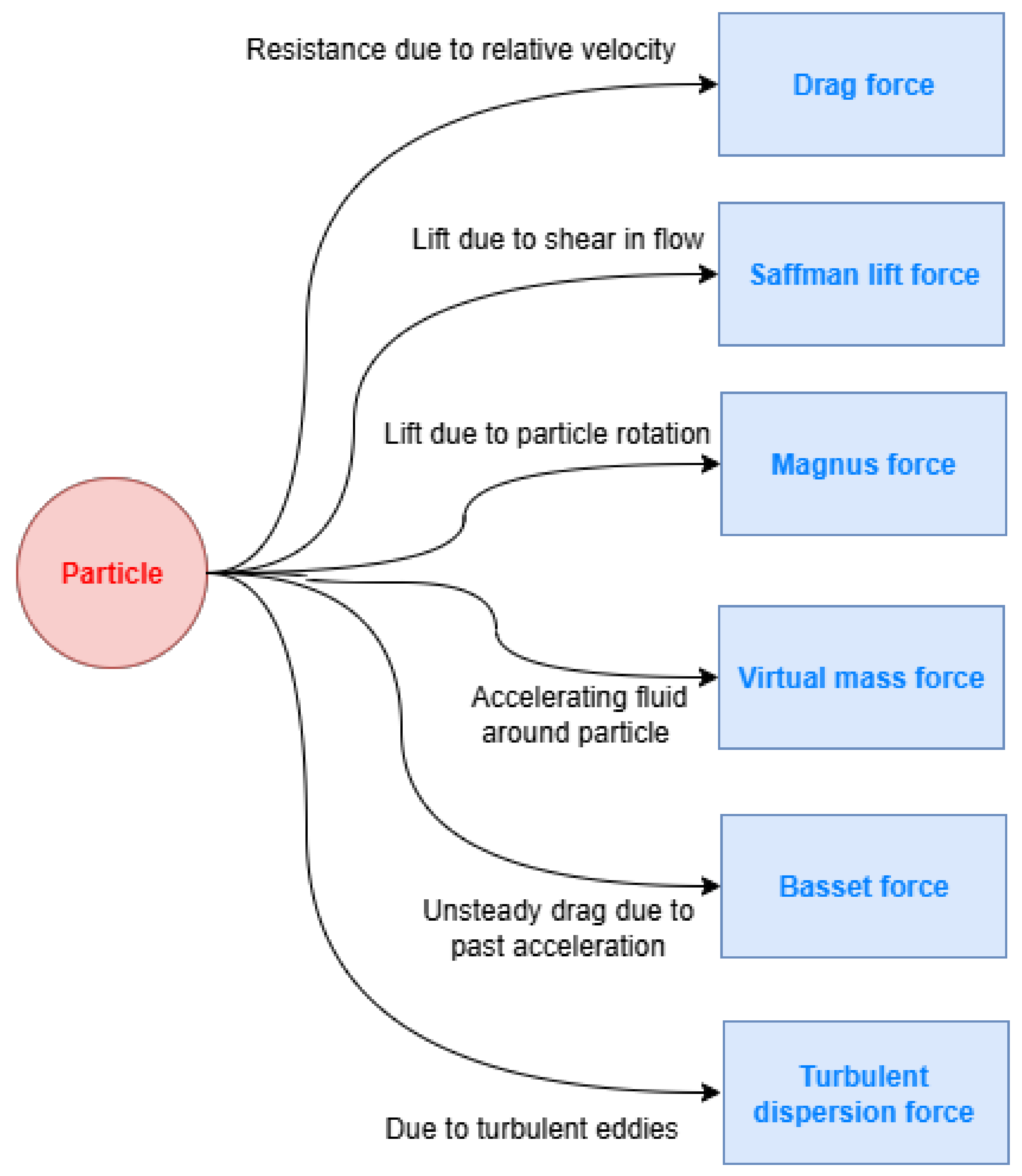
These models describe the interaction of particle–fluid behavior in the form of interphase momentum exchange between dispersed and continuous phases, which is calculated by solving the respective momentum equations of the phases. Figure 1 shows the typical interphase forces acting on a particle. Interphase momentum exchange is typically represented as the sum of drag and non-drag forces acting on dispersed phases, with drag generally dominating under time-averaged conditions. The general equation of interphase forces is as follows [65]:
F I n t e r p h a s e = F D r a g +   F S a f f m a n   L i f t + F V i r t u a l   M a s s +   F T u r b u l e n c e   D i s p e r s i o n +   F M a g n u s +   F O t h e r
Among interphase forces, drag predominantly controls gas hold-up, solid suspension height and power consumption, while non-drag forces mainly influence phase distribution and local hydrodynamics near impellers and baffles.
Accurate modeling of interphase forces is critical for solving hydrodynamics and evaluating mixing performance in G-L-S stirred tanks. The following subsections provide an overview of the typical interphase models used in three-phase stirred tanks.
Drag Models
Drag correlations for G-L-S systems are largely adapted from gas–liquid and solid–liquid models, which were extensively validated for predicting phase interactions, turbulence and mass transfer in two-phase systems. Drag force is caused by slips between phases and is the dominant interphase force that governs phase interactions in G-L-S mechanically agitated tanks, influencing solid suspension height and distribution, bubble dynamics in terms of velocity, and hold-up and mass transfer. Moreover, the cumulative drag force from the two dispersed phases affects turbulence in the continuous phase, which could subsequently impact the mass transfer and mixing efficiency. As such, careful selection of drag models is essential. However, no numerical studies on three-phase drag are available in the literature; the G-L-S modeling relies on solving individual gas–liquid, solid–liquid and solid–gas drag models.
Drag force applied by the dispersed phase on the continuous phase is determined as follows:
F d r a g ,   L G = 3 4 C D , G L d B ρ L ε g | u G u L | 2
F d r a g ,   L S = 3 4 C D , S L d p ρ L ε s | u s u L | 2
where C D , G L and C D , S L are the drag coefficient for gas–liquid and solid–liquid interactions, respectively.
Conventionally, the simple Schiller–Naumann model [66] is commonly used in CFD modeling of gas–liquid interactions, assuming spherical bubbles with no deformation. The researchers of [40] and [43] applied the Schiller–Naumann model for both gas–liquid and solid–liquid phase interactions in a G-L-S stirred tank. They assumed that the dominant interphase force was the drag force and that the effects of non-drag forces like lift force, virtual mass and turbulence dispersion could be neglected. The Schiller–Naumann model is suitable for low Reynold number systems, typically corresponding to small bubbles or particles, as it does not account for drag changes due to turbulence. However, strong turbulence effects are present in stirred tanks, making Schiller–Naumann inappropriate for most stirred tank simulations. Additionally, the investigators of [67] proved that this model under-predicts gas hold-up considerably and does not capture the dispersion of bubbles in a mechanically agitated tank. Although this simplified approach of neglecting non-drag forces reduces computational costs, it may not produce accurate results in areas of high local turbulence, such as the impeller zone and near walls.
Consequently, advanced drag models that consider turbulence effects should be explored. Reference [37] defined the gas–liquid and solid–liquid interactions using the modified Brucato drag model [68] and Pinelli et al. model [69], respectively. Their results demonstrated comparable CFD predictions of solid distribution to experimental data, suggesting that the selected drag models were effective in the G-L-S stirred tank under investigation. Similarly, the researchers of [38] used the Brucato drag model [70] (for solid–liquid) and the modified Brucato drag model [68] (for gas–liquid) and found adequate agreement between the experimental data and CFD predictions for the critical impeller speed for solid suspension. Although the modified Brucato drag model considers turbulence effects, it could overestimate drag, causing excessive gas dispersion as reported by the authors of [67], who examined gas dispersion in a gas–liquid stirred tank using the same model. In another study, the authors of [41] extended both the Brucato drag model [70] (for solid–liquid) and the modified Brucato drag model [68] (for gas–liquid) with empirical corrections to account for the influence of the second dispersed phase (solid particles) on drag force, as the effective drag force acting on bubbles and particles is altered in a three-phase system. They found good agreement between the experimental data and CFD predictions for gas hold-up and mass transfer.
On the other hand, the authors of [71] used the Tomiyama et al. drag correlation [72] and Wen and Yu drag model [73] for solving the gas–liquid and solid–liquid interactions in their study of two- and three-phase stirred-tank reactors. The Tomiyama et al. model covers bubble shape-dependent drag correlations, making it suitable for cases with large bubbles or high turbulence, while the Wen and Yu model accounts for moderate to high solid concentrations where particle shielding lowers effective drag. Their results for gas–liquid simulations showed good agreement with experimental data for gas hold-up. In their G-L-S stirred tank, solids were found to have accumulated at the bottom, implying a possible overestimation of drag forces. This highlights that selecting an appropriate solid–liquid drag model in a G-L-S system that is both computationally efficient and accurate in estimating solid suspension behavior remains a key challenge in CFD simulation. Future studies on three-phase drag models and comparing the performance of various drag models in three-phase stirred tanks should be carried out to identify effective model combinations.
The interaction between dispersed phases, i.e., gas and solid, in a G-L-S stirred tank is not well-documented in the literature. The drag force acting between the dispersed phases is also significant, as solid particles near bubbles tend to follow their movement. For this reason, Panneerselvam et al. [17] modeled the drag force between solid particles and gas bubbles in a G-L-S fluidized bed by following the same drag modeling approach between continuous and dispersed phases.
The representative equations for the aforementioned drag models are listed in Table 9.
Other popular drag models commonly used in two-phase systems, such as the Gidaspow [74] and the Syamlal and O’Brien [75] models, are not discussed in this paper, as they have not been employed in G-L-S stirred tanks.
Non-Drag Models
The main non-drag forces and their relevance when adapted to three-phase stirred tanks are outlined in this section. Most non-drag models were developed and validated in two-phase systems such as gas–liquid or solid–liquid flows [48,56,76,77,78]. Their extension to G-L-S systems follows the same underlying principles, although the presence of a second dispersed phase can modify local flow structures that influence lift, virtual mass and turbulent dispersion. Lift force, virtual mass, Basset force and turbulent dispersion are the major non-drag forces affecting the behavior of dispersed phases in multiphase flows, particularly in unsteady conditions. Their inclusion in CFD simulations is dependent on their impact relative to dominant interphase forces, such as the drag force.
Lift forces result from shear stress or rotating effects on dispersed gas bubbles or solid particles within the continuous liquid phase. These forces lead to the radial and axial distribution of bubbles and particles and, as such, affect the hydrodynamics in stirred tanks in terms of phase distribution, particle trajectory and suspension. Lift forces can be specifically significant in regions with high-velocity gradients, for example, near baffles and impellers. There are two main types of lift forces:
  • The classical lift force is the shear-induced Saffman Force [79], which occurs when velocity gradients within the continuous phase generate an uplifting effect on the dispersed phase.
  • The rotational lift force, Magnus force, experienced by the rotating solid particles or gas bubbles due to the rotational motion in a stirred tank, leading to a transverse lift force perpendicular to their velocity. Such a type of force is pertinent in systems with non-spherical solid particles (for example, irregular catalyst particles) or in systems with turbulence-induced rotating gas bubbles.
Virtual mass force, also referred to as apparent mass force, occurs due to inertial force, i.e., particle or bubble acceleration within a fluid, which in turn necessitates additional energy to accelerate the displaced fluid. In stirred tanks, the influence of virtual mass force is significant near the impeller region and peaks in the sparger region during gas dispersion; nevertheless, it remains lower in magnitude than the drag force [48].
Basset force accounts for viscous effects and describes the impact of velocity changes (fluid acceleration) on a particle’s motion due to its past velocity history, under unsteady conditions. It involves evaluating time-consuming history integral that is often too small compared to the drag force [77]. While it plays a significant role in oscillatory flows involving extremely small bubbles or solid particles, it is typically ignored in CFD simulations of stirred tanks owing to its computational complexity.
Turbulent dispersion force accounts for the turbulent effect on the dispersed phase. It arises due to random turbulent fluctuations of the continuous phase (liquid), which subsequently leads to the random motion of the dispersed phase (bubbles or particles). It is relevant in turbulent systems, such as solid suspension in stirred tanks, especially when the size of turbulent eddies exceeds that of particles [77]. Additionally, it also plays a role in the accurate prediction of cloud height, which is defined as the location of the interface between the clear liquid and solid region in a stirred tank [78].
The decision to include non-drag models in CFD modeling is driven by the study’s objectives while balancing the need for accurate results with computational costs. Some CFD studies of three-phase stirred tanks conducted using the Eulerian–Eulerian multifluid model exclude transient forces (i.e., lift, virtual mass and Basset forces), as drag and turbulent dispersion forces are regarded as the dominant interphase forces at the averaged scale, thus making it computationally efficient and a preferred approach for industrial-scale use. Khopkar et al. [80] and Khopkar et al. [81] studied the impact of interphase forces in agitated reactors and concluded that the Basset force was significantly smaller than interphase drag, the virtual mass force had a nominal influence in the bulk region, and the turbulent dispersion force effects were mainly noticeable in the impeller discharge stream. Also, Ljungqvist and Rasmuson [82] noted that the simulated solid hold-up profiles were only marginally impacted by the virtual mass and lift forces. In contrast, in the CFD-DEM modeling approach, transient models are considered as individual particle interactions with the surrounding fluid and are resolved at a more detailed level than the Eulerian–Eulerian multifluid model. This makes CFD-DEM a high-fidelity tool for high-resolution analysis of G-L-S interactions. For instance, as previously discussed, Ge et al. [57] included interphase forces such as lift, drag and pressure gradient for a more realistic prediction of particle–fluid interactions. However, this approach requires significant computational resources.
The representative equations for the aforementioned non-drag forces are listed in Table 10.

3.2.3. Turbulence Closure Models

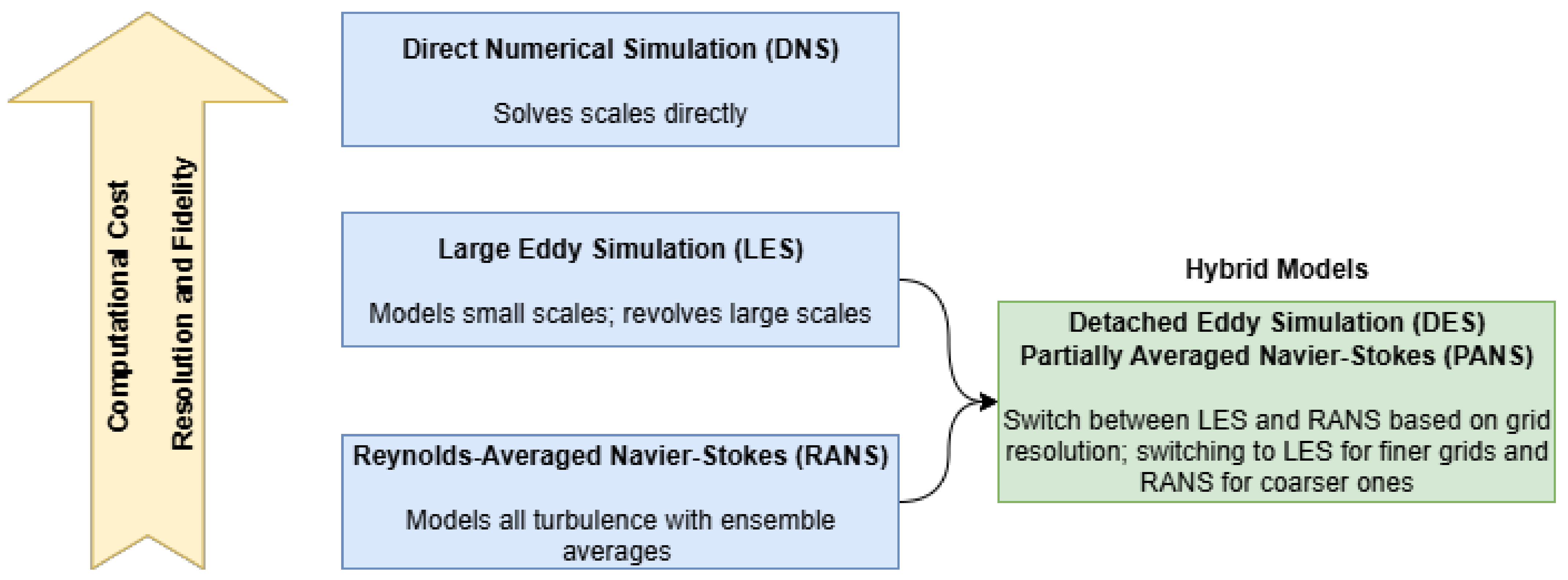
The three main turbulence closure modeling approaches in stirred tank operation are as follows: Direct Numerical Simulation (DNS), Large Eddies Simulation (LES) and Reynolds Averaged Navier–Stokes (RANS). These approaches represent different trade-offs between predictive accuracy and computational cost, and their suitability strongly depends on the modeling objectives (e.g., global gas hold-up, local turbulence anisotropy, bubble breakup near the impeller) and operating conditions. The DNS method is the most accurate one, providing a detailed analysis by addressing all spatial and temporal scales of motion with no modeling assumptions, though it is computationally expensive, making its industrial application unfeasible and limiting its use to simple geometries and low Reynolds numbers [7]. On the contrary, the LES method resolves the large turbulent structures while modeling the small-scale eddies [1], enabling improved prediction of near-impeller turbulence structures and phase dispersion, albeit at significantly higher computational cost than RANS. For example, Hu et al. [71] used LES in their study for turbulence modeling in a G-L-S stirred tank. In contrast, the RANS model is most widely used in CFD studies of stirred tanks due to its simplicity, robustness and low computational costs while providing acceptable predictions of time-averaged quantities such as global gas hold-up, solid suspension height, or power consumption. Figure 2 illustrates a hierarchy of turbulence modeling approaches, highlighting the trade-off between model reliability and computational cost.
However, turbulence modeling of three-phase flow is complex and computationally intensive because of the impact of dispersed phases on the turbulence of the continuous phase [37]. To address this, the authors of [15,16,37,38,40] assumed that turbulence is limited to the continuous phase during the modeling of multiphase stirred tanks and applied the Standard k–ε turbulence model, a single-phase turbulence model, to the liquid phase. In another approach, Yang et al. [41] used a mixture-based k–ε model, where the multiphase system is treated as a homogenized continuum. The common assumption that turbulence exists only in the continuous liquid phase, while computationally expedient, introduces systematic limitations in regions where strong phase–turbulence coupling occurs, such as near the impeller discharge, sparger vicinity and zones of high solid loading. Neglecting turbulence modulation by gas bubbles and solid particles can lead to misprediction of turbulence kinetic energy dissipation rates, which directly impacts bubble breakup, gas–liquid interfacial area, and solid suspension thresholds. This assumption is therefore most defensible when the modeling objective is limited to bulk-averaged quantities and moderate phase loadings but becomes increasingly questionable under high gas flow rates, high solid concentrations, or when local turbulence anisotropy is critical.
The Standard k–ε turbulence model solves turbulent kinetic energy (k) and its dissipation rate (ε), assuming turbulent viscosity, also known as eddy viscosity (µt), and isotropic turbulence. Its main equations are as follows:
( ρ k ) t + ( ρ k u j ) x j = x j [ ( μ + μ t σ k ) k x j ] + G k ρ ε
( ρ ε ) t + ( ρ ε u j ) x j = x j [ ( μ + μ t σ ε ) ε x j ] + C 1 ε ε k   G k C 2 ε ρ ε 2 k
μ t = ρ C μ k 2 ε  
The typical constants are Cµ = 0.09, C = 1.44, C = 1.92, σk = 1.0 and σε = 1.3. This model generally provides reasonably accurate results in the bulk region; however, it does not perform well in highly anisotropic areas, i.e., near the impeller region, where the swirling motion is strong. Moreover, it does not account for the effects of streamline curvature and other body forces [1]. As a result, it often underpredicts local turbulence intensity and energy dissipation, which can propagate errors into drag-force estimation, bubble breakup rates and gas hold-up predictions in aerated systems.
Consequently, some researchers have employed enhanced versions of the standard model, such as the RNG k–ε model that considers small-scale eddies and streamline curvature and provides improved prediction in near-wall flows, or the realizable k–ε model that improves physical consistency in complex flows by applying certain constraints on Reynolds stresses [42,43,57].
To further overcome the limitations of anisotropy and curvature effects, the Reynolds Stress Model (RSM) is proposed. This model can predict each Reynold stress more accurately; however, it requires parameter calibration for various flow types and often struggles to produce converged solutions for extended systems, thus increasing its computational costs [1]. To the best of the authors’ knowledge, systematic applications of RSM to fully coupled G-L-S stirred tanks remain extremely limited, likely due to convergence difficulties, parameter calibration requirements and the substantial increase in computational cost relative to RANS-based models.
A summary of the aforementioned literature review is listed in Table 11.
Other modeling approaches, such as Detached Eddy Simulation (DES) and Partially Averaged Navier–Stokes (PANS), aim to balance the computational efficiency of RANS with the LES accuracy. Although DES and PANS have demonstrated promising results in single-phase stirred tanks [86,87,88], their absence in G-L-S stirred tanks represents a clear research gap, particularly for intermediate-fidelity modeling where LES accuracy is desired but computational resources are limited. A comparison of the advantages and disadvantages of these hybrid turbulence models is provided in Table 12.
The choice of turbulence closure is dictated by the modeling objective and available computational resources. For practical engineering design focusing on global, time-averaged quantities (e.g., global gas hold-up, power number, bulk solid suspension height), RANS models (standard or RNG k-ε) remain the default and most cost-effective choice, accepting their known inaccuracies in highly anisotropic impeller regions. If the study aims to resolve transient, large-scale flow structures or requires high-fidelity data on turbulence modulation by bubbles/particles, LES is necessary but at a computational cost often prohibitive for routine use. The complete absence of RSM and hybrid models (DES, PANS) in the G-L-S stirred tank literature, despite their potential to offer a middle ground in fidelity, highlights a critical research gap. Future work should prioritize validating these hybrid models for capturing impeller-zone anisotropy without the full expense of LES.

3.3. Impeller Rotation Modeling

The next essential requirement for CFD modeling of stirred tanks is simulating the impeller rotation relative to the stationary tank and baffles. Accurate representation of impeller motion is critical not only in three-phase systems but also in single- and two-phase CFD simulations, as it not only affects the CFD predictions of flow behavior and phase distribution but also influences the generated turbulence and dissipated energy. The turbulence generated by the impeller impacts the solid suspension, gas dispersion, phase hold-up and bubble dynamics. Therefore, it is crucial to capture the interactions of impeller-driven flow with appropriate closure models for accurate simulations.
The two common approaches for impeller motion modeling in G-L-S systems are Multiple Reference Frame (MRF) and sliding mesh (SM). The MRF technique assumes a steady state of impeller motion by solving flow equations in the impeller zone (impeller and shaft), the moving reference frame, while the tank walls, baffles and bulk fluid are set as a stationary frame [7]. This simplified approach is computationally efficient and is commonly used in the simulation of G-L-S stirred tanks. For example, the authors of [15,16,37,38,40,41,43,57,71] employed the MRF method in their CFD modeling of G-L-S stirred tanks. However, this method fails to solve for transient flow features such as impeller–baffle interactions, which are particularly relevant in three-phase stirred tanks. Consequently, complex unsteady flow features such as vortex shedding and recirculation zones may be underpredicted. On the other hand, the SM technique solves for unsteady, transient flow equations [89], implying the impeller could physically rotate within the computational domain in a time-dependent manner. This approach is suitable for multiphase systems as it accurately captures dynamic unsteady interactions; however, it requires long simulation times and ultimately leads to higher computational costs [7], which limits its large-scale use in G-L-S modeling. Only a few studies, like [42] have utilized this technique to capture the transient impeller motion in a G-L-S stirred tank. The choice of technique depends on the objectives of the study and the required level of detail [89]. For more information on different types of impeller rotation models, the reader is referred to [1].
In practice, MRF-based simulations are generally sufficient for predicting time-averaged quantities such as mean gas hold-up, solid suspension height, and power consumption, whereas sliding mesh approaches become necessary when resolving transient impeller–baffle interactions, unsteady gas cavity formation, or phase segregation dynamics.

3.4. CFD Implementation: Mesh and Solver

The selection of effective implementation strategies, in terms of mesh quality and solver setup (e.g., boundary conditions, convergence criteria, steady state vs. transient), is key for accurate CFD modeling. These implementation choices are critical across both single- and multiphase systems. The following subsections outline the typical strategies utilized in CFD modeling.

3.4.1. Mesh Generation and Grid Independence

Mesh generation not only affects the accuracy but it also impacts the convergence and overall required computational resources. In stirred tanks, capturing areas with high-velocity gradients and turbulence, along with tank internals like gas spargers, baffles and rotating impellers, requires high-resolution meshing for resolving phase interactions, phase hold-ups, and particle and bubble trajectories. While both structured and unstructured meshes are employed, unstructured meshes offer better results when simulating mixing due to mechanical agitation [90]. Moreover, mesh quality also influences solution convergence [91]. To prevent divergence, it is essential to use a high-quality mesh by maintaining mesh skewness (e.g., <0.7) and aspect ratio within the recommended limits of the selected solver [92]. Furthermore, the optimal grid size should be selected, especially for finer meshes, as it affects the convergence rate and computational time; less computational time is required to run the model for a coarser grid size [93]. Finally, grid independence studies, also referred to as mesh sensitivity analysis, are carried out for model robustness. These studies comprise simulations with progressively finer meshes until a negligible change occurs in the predicted results.
Insufficient mesh resolution in the impeller discharge and sparger regions has been shown to cause significant underprediction of turbulence dissipation and phase slip velocities, thereby degrading predictions of bubble breakup, gas hold-up and solid suspension.

3.4.2. Solver Selection and Boundary Conditions

Selecting an appropriate solver is also critical for accurate numerical resolution and meeting the modeling objectives. In stirred tank simulations, steady-state solvers utilize the MRF approach to predict flow characteristics such as phase hold-ups, whereas transient solvers are paired with the SM technique or CFD-DEM coupling to resolve the changing motion of particles or bubbles over time. The choice of solver is also dependent on the available computational resources; for instance, transient simulations require significant computational time for accurate predictions of unsteady flow conditions [89]. Moreover, solver settings such as pressure–velocity coupling and convergence criteria should be chosen and adjusted as needed to ensure simulation stability and result accuracy [92].
Similarly, boundary conditions must be defined for simulation convergence. Typically, no-slip boundary conditions are applied to all non-moving parts of a stirred tank, like the gas sparger, tank and baffles, while a moving wall boundary is set for the impeller and shaft. Additionally, in Eulerian–Eulerian multifluid modeling, inlets and outlets are usually defined as velocity inlets and pressure outlets. For the Eulerian–Lagrangian framework, e.g., CFD-DPM or CFD-DEM models, additional discrete phase boundaries need to be defined, such as particle reflection or escape.

3.5. Summary of G-L-S Mechanically Agitated Reactors CFD Modeling Studies

Table 13 presents a summary of the above-discussed three-phase mechanically agigated reactors CFD modeling studies.

4. Hydrodynamic and Transport Parameters in G-L-S Mechanically Agitated Reactors

This section discusses the key hydrodynamic and transport parameters that influence the performance and process outcomes of G-L-S mechanically agitated reactors.

4.1. Gas Hold-Up

Gas hold-up, the volume fraction of the gas phase in a stirred tank, is a fundamental parameter influencing the hydrodynamics of stirred tanks. It affects not only the overall performance of the reactor but also serves as a critical indicator of interfacial area available for gas–liquid mass transfer (kLa) and gas dispersion efficiency. While gas hold-up has been extensively studied in two-phase gas–liquid stirred tanks [9,10,110,111,112,113,114,115], its extension to G-L-S systems must account for the influence of solid particles on turbulence, bubble dynamics and phase distribution.
Apart from the overall gas hold-up, its spatial distribution in axial and radial directions also affects mixing performance and solid suspension quality in a stirred tank. Various factors like impeller type and configuration, rotational speed, solid concentration, sparger design, gas flow rate and particle properties influence gas hold-up. For instance, in G-L-S systems, gas dispersion can either be enhanced or impeded by the presence of solids due to changes in effective viscosity and interfacial drag as solids interact with the gas and liquid phases, thereby making the estimation of gas hold-up complex. Moreover, radial flow impellers are generally stable for widespread gas flow rates, whereas axial flow impellers are more prone to instability at higher gas flow rates but offer better solid suspension at low gas flow rates [116]. Furthermore, combinations of multiple up-pumping radial and axial flow impellers are reported to enhance gas–liquid circulation and reduce the formation of cavities behind impeller blades in G-L-S systems; as such, they most likely contribute to a higher gas dispersion and thus higher gas hold-up [63]. Additionally, impeller clearance, the distance between the impeller and the tank bottom, also affects gas hold-up and dispersion. A large impeller clearance combined with a large impeller diameter may cause reversal of the liquid flow at the bottom of the tank, affecting solid suspension, whereas unstable power behavior has been reported in small impeller clearance and diameter, susceptible to gassing rates [117]. For efficient gas dispersion and solid suspension, it is recommended that impeller clearance be set at T/4 (where T is the tank diameter) [117]. Similarly, the type and placement of gas spargers impact hydrodynamics and solid suspension efficiency in three-phase systems [117]. A ring sparger with a diameter greater than the impeller diameter (1.5 to 2 times larger), placed beneath the impeller, is expected to give good results in three-phase systems (i.e., higher gas hold-up, lower NJSG and thus lower power consumption) [117].
CFD simulations of G-L-S stirred tanks can provide insights into local gas hold-up and phase segregation, which are difficult to capture via experiments. However, most CFD studies on G-L-S stirred tanks have assumed a fixed bubble size and did not account for the impact of the second dispersed phase (solids) on gas–liquid drag, limiting prediction accuracy. In a rare study, Yang et al. [41] used the Eulerian–Eulerian multifluid approach to determine the gas and solid hold-ups by employing a modified drag force correlation with a turbulence-based bubble size estimation model instead of assuming a fixed bubble size. They predicted local gas hold-up and demonstrated radial gas segregation with smaller bubbles accumulating near the impellers and larger bubbles moving towards the upper free surface. They also showed that an increased solid concentration leads to a reduced gas hold-up. Other experimental studies have demonstrated similar behavior. Bao et al. [118] experimentally observed that increasing buoyant particles in a G-L-S stirred tank led to a steady decrease in gas hold-up (1.5% to 15% v/v), suggesting that gas bubble dispersion may be hindered by particle buoyancy and hydrophobicity.
The predominant use of fixed bubble size models in G-L-S CFD studies represents a major simplification that conflates the effects of drag and interfacial area. While this may yield acceptable global gas hold-up if calibrated, it decouples the prediction of hold-up from the mechanisms that govern it (breakup/coalescence), undermining predictive capability for kLa and extrapolation to new operating conditions. Advanced models like CFD-PBM have been recently used to estimate gas hold-up and bubble size distribution, offering higher accuracy results, but are limited by their reliance on empirical kernels tuned for two-phase flows and a critical scarcity of three-phase validation data. As such, accurate CFD modeling of global and local gas hold-up in three-phase systems remains challenging, particularly under varying solid loadings and fluid rheology, highlighting the need for targeted experimental studies to provide validation for dynamic bubble population models.

4.2. Volumetric Gas–Liquid Mass Transfer Coefficient (kLa)

The volumetric gas–liquid mass transfer coefficient, kLa, is a critical parameter that describes gas–liquid mass transfer efficiency in stirred tanks such as bioreactors, where gas, like oxygen, is central for cell growth. While kLa has been extensively studied in two-phase gas–liquid reactors [119,120,121,122,123,124,125], its extension to three-phase G-L-S systems must account for additional complexities introduced by solid particles, which can modify turbulence, bubble dynamics, and effective interfacial area. It measures the gas dissolution rate in liquid over the interface area available for mass transfer per unit liquid volume and is used for reactor design, optimization and scale-up. As summarized in Table 14, in G-L-S stirred tanks, kLa is influenced by multiple factors like impeller type, rotational speed, gas flow rate, solid concentration and liquid properties.
Mass transfer is principally governed by bubble dynamics, which define the available interfacial area of mass transfer between gas and liquid phases. Smaller bubbles enhance the mass transfer rates by providing a higher interfacial area for mass exchange. However, in stirred tanks, the bubble diameter is not constant. Bubbles continually undergo coalescence and breakage due to the forced turbulence caused by impeller motion. This leads to a dynamic bubble size distribution, impacting the effective gas–liquid interfacial area of mass transfer.
Special consideration must also be given to fluid rheology. Non-Newtonian fluids, like shear-thinning or yield-stress fluids, alter turbulence, bubble size distribution, gas hold-up and solid suspension in stirred tanks, thereby affecting the gas–liquid interfacial area of mass transfer and eventually kLa. For example, at low rotational speeds, higher apparent viscosities in shear-thinning or yield-pseudoplastic fluids promote bubble coalescence, increasing gas hold-up but lowering effective interfacial area for mass transfer. Conversely, at high rotational speeds, bubble breakup enhances kLa, though gas hold-up declines due to premature disengagement [9]. Ali et al. [126] investigated how geometric parameters influence kLa in gas–liquid (two-phase) stirred tanks containing non-Newtonian fluids. They found significantly lower kLa in viscous shear-thinning fluids, possibly attributed to the hindered turbulence and gas dispersion. They also highlighted that tank geometry, operating conditions and fluid rheology influence kLa. These findings provide a basis for understanding kLa behavior in G-L-S systems.
The presence of solids introduces further complexity. Solid particles can modify turbulence, impacting bubble dynamics and thus affecting the kLa. For instance, in low to moderate solid loading systems, particle suspension promotes bubble breakage and enhances turbulence and gas dispersion, hence increasing the available mass transfer area and the overall kLa [127]. In contrast, at high solid concentrations, increased viscosity of the medium can dampen turbulence eddies, promoting bubble coalescence and reducing gas hold-up and ultimately lowering kLa [128]. In an experimental study on the impact of low-density solids on gas–liquid mass transfer in G-L-S stirred reactors, it was noted that in Newtonian fluids, solids led to reduced kLa, possibly due to increased slurry viscosity lowering the interfacial area and improving bubble accumulation [129]. In another study of five different combinations of triple impellers in a G-L-S stirred tank, researchers reported that at high gas flow rates, kLa was significantly reduced in the presence of solids (12 vol%), attributed to decreased gas hold-up, increased apparent mixture viscosity and increased power consumption for solid suspension (i.e., reduced power consumption for gas dispersion) [63]. On the contrary, higher solids loading in non-Newtonian carboxymethyl cellulose (CMC) solutions resulted in increased kLa, attributed to increased bubble breakage and interfacial area renewal [129].
Impeller type also influences the kLa. An experimental study on G-L-S stirred tank demonstrated that radial flow impellers like Rushton and Smith turbines generate high shear zones, favoring bubble breakup and thus longer bubble residence time and higher gas hold-up [130]. A higher gas hold-up leads to a higher kLa. Conversely, axial flow impellers, like A 315, do not generate similar high shear but promote better bulk circulation and have been reported to have a short average gas bubble residence time in the G-L-S stirred tank studied experimentally [130].
Gas dispersion in aerated stirred tanks can be categorized into distinct regimes that influence bubble dynamics, mass transfer area and kLa, namely flooding, loading and complete dispersion. In the flooding regime, the sparged gas accumulates near the impeller because of insufficient impeller power, leading to poor bubble dispersion and large coalesced bubbles. As the impeller speed increases, gas is dispersed partially away from the impeller vicinity, and the system transitions into the loading regime. Finally, under adequate impeller power, the gas is uniformly distributed and recirculated as the system reaches complete dispersion [131,132]. In G-L-S stirred tanks, the transition between these regimes depends on gas flow rates, impeller type, power input, solid concentration and physical properties of solid and liquid [133,134]. These flow regimes also influence the onset of solid suspension, as discussed in Section 4.4. The positioning of gas spargers relative to the impeller also affects kLa. As discussed in Section 4.1, gas spargers placed close to the impeller maximize gas hold-up and mass transfer, while poorly positioned spargers can cause flooding and sedimentation of solid particles [117].
kLa can also be computed numerically using CFD using the different approaches, which vary in complexity and accuracy, described below:
  • Direct species transport approach: This involves explicitly solving the transport equation for the dissolved gas concentration, such as Danckwerts’ surface renewal model [135,136].
  • Penetration theory-based estimation: This involves evaluating the mass transfer coefficient using correlations, such as those derived from Higbie’s penetration theory [98],
    k L = 2 D L π ( ρ L ε μ L ) 0.25
    while the interfacial area (a) is obtained from CFD predictions of volume fraction of the gas phase (εg) and Sauter mean diameter of the gas bubbles (d32):
    a = 6 ε g d 32
  • CFD-PBM coupling: A more advanced method combines CFD with a PBM to account for bubble breakage and coalescence.
The CFD-PBM coupled model can be applied to G-L-S stirred tanks to predict and investigate such complex dynamics. This model aids in improving the prediction of kLa in G-L-S systems by tracking bubble dynamics, in terms of population and size distribution. For instance, a study carried out using this model showed that small bubbles are predominantly found near the impeller region, which is an area of high fluid velocity, while larger bubbles accumulate in areas of low turbulence or the upper region, an area of low hydrostatic pressure [42]. Moreover, the study also showed that with an increased impeller rotation speed (i.e., higher power input), the number of smaller bubbles generated increases [42]. This could be attributed to the change in turbulence levels, which ultimately affects the kLa.
In another combined experimental and CFD study of the G-L-S stirred tank [16], researchers found that a high gas flow rate can lead to uneven distribution of kLa around the lower and impeller zones. This may be attributed to localized turbulence and bubble accumulation due to a high gas hold-up. Interestingly, they also found that at high solid concentrations, a more uniform distribution of kLa occurs around the upper region of the reactor. This may imply that the coupled effects of gas sparging and solid suspension reduce the variability of flow in that region, further highlighting the complex interplay of various factors on kLa.
The dynamic behavior of kLa during transitions between flow regimes (e.g., flooding to complete dispersion) and non-Newtonian, highly loaded systems is rarely captured in three-phase CFD studies. As previously stated, limited studies using CFD-PBM models employed in three-phase stirred tanks are currently available.
The prediction of kLa in CFD models is a high-fidelity task that depends hierarchically on accurate solutions for the flow field, local gas hold-up, and bubble size distribution. The central challenge is that validating each hierarchical step in three-phase systems requires a combination of techniques (e.g., PIV, tomography, probes), none of which provide a complete picture on its own. Future validation campaigns must be explicitly designed to provide this multifaceted data.

4.3. Effect of Fluid Rheology

As discussed above, liquid rheology significantly impacts the kLa. However, it also influences mixing, gas dispersion, solid suspension and energy dissipation in mechanically agitated tanks. Non-Newtonian fluids, in particular, present unique challenges compared to Newtonian fluids, due to their complex flow behavior. As the viscosity changes with shear rate for non-Newtonian fluids, it can lead to the formation of gas slugs or well-mixed regions, known as caverns, which affect the mixing time and gas dispersion. In an experimental study on G-L-S stirred tanks with non-Newtonian fluids [134], researchers found that shear-thinning fluids reduce apparent viscosity in the impeller zone due to high shear rate and create caverns for improved flow and solid suspension in that area, despite overall high viscosity.
CFD can provide insights about complex hydrodynamics in such flows; however, there is a need for advanced modeling techniques to estimate and optimize large-scale applications related to non-Newtonian fluids [132]. Non-Newtonian fluids introduce further complexity in predicting the flow dynamics of G-L-S systems. Incorporating appropriate constitutive equations, like the power-law or Herschel–Bulkley model, is needed for estimating apparent viscosity and thus accurate CFD modeling. There is extensive research scope for CFD studies investigating the interplay of shear-dependent viscosity, gas dispersion and solid loading in G-L-S stirred tanks.

4.4. Solid Suspension

Effective solid suspension has been widely studied in solid–liquid systems, where the critical impeller speed for just-suspended solids (NJS) and its dependence on factors such as particle properties, liquid rheology, impeller type, power input and tank geometry have been extensively researched [11,12,13,29,137,138,139,140]. These studies establish the basis of hydrodynamics for particle entrainment, cloud height formation and homogeneous suspension. In gas–liquid systems, gas sparging modifies turbulence, circulation and power draw, all of which affect particle suspension when solids are later introduced. As such, effective solid suspension in G-L-S reactors becomes more complex because gas alters the density, turbulence distribution and impeller pumping efficiency.
In G-L-S mechanically agitated reactors, effective solid suspension is crucial for catalyst effectiveness, reaction uniformity and maximum interfacial contact. Insufficient solid suspension can lead to localized areas of concentration and channeling, resulting in under-utilization of the solids. Solid suspension is impacted by parameters such as impeller type, rotational speed, tank geometry, gas flow rate, solid concentration and physical properties of the slurry.
The critical impeller speed for solid suspension in the presence of gas (NJSG) is a key parameter for studying hydrodynamics in G-L-S stirred tanks. It is the minimum impeller speed required to suspend all solid particles in an aerated system. NJSG is typically higher than the critical speed of solid suspension in ungassed systems (NJS), and it increases with increasing gas flow rate [141]. This may be attributed to altered turbulence and flow patterns by gas sparging. The presence of gas affects the impeller’s pumping efficiency, effective density and flow paths, leading to a higher critical speed required for solid suspension. Moreover, the effect of particle–liquid parameters on solid suspension speed in an aerated system is similar to, but weaker than, that in an ungassed one [141]. Under-predicting NJSG could lead to poor solid suspension and reduced yield, whereas over-predicting it could result in significantly higher energy costs [116].
Jafari et al. [116] describe the progression of flow regimes in G-L-S stirred tanks as impeller speed increases. Initially, at low speeds, gas bubbles pass through the impeller region with minimal dispersion, with liquid largely undisturbed, resembling a flooded condition. As speed increases, bubbles interact with vortices formed behind the impeller blades, forming large gas cavities indicative of the loading regime; here, some radial flow develops and partial solid suspension begins, typically too small to affect the overall gas–liquid hydrodynamics. With a further increase in speed, gas cavities evolve into vortex structures, enhancing gas dispersion and producing small liquid recirculation loops. The impeller speed at which gas first becomes uniformly dispersed is called the critical dispersion speed (NCD). NCD is independent of particle properties, as shown by Nienow [142], and often occurs at speeds lower than for full solid suspension (NJSG). Complete solid suspension under aerated conditions is achieved at NJSG, i.e., once the impeller speed is sufficient to lift all particles from the tank bottom, defined by the Zwietering [143] or Hicks [144] criterion. At even higher speeds, the suspension becomes more homogeneous and a secondary gas circulation loop often forms above the impeller, indicating a fully developed multiphase dispersion regime. NUSG is the minimum impeller speed for an ultimately homogeneous solid suspension under aerated conditions [145]. The sequence of these events is depicted in Figure 3 [117,146]. The definitions and key factors influencing the threshold impeller speeds corresponding to distinct flow regimes are presented in Table 15. It is important to distinguish between gas dispersion thresholds (NCD), onset of complete solid suspension under aerated conditions (NJSG), and ultimately homogeneous suspension (NUSG), as these parameters are often conflated in CFD validation studies despite representing distinct physical phenomena.
Jafri et al. [116] provide a literature review of NJSG in G-L-S stirred tanks, highlighting that design and operating parameters, along with physical properties, impact it. For effective mixing in G-L-S systems, impellers must be efficient in suspending solids while simultaneously dispersing gas to avoid flooding, which could hinder solid suspension [149]. For instance, close bottom-clearance impellers improve momentum transfer to solids, reducing NJSG and potentially cloud height as well, while increasing inhomogeneity [116]. Moreover, radial flow impellers are stable for widespread gas flow rates, whereas axial flow impellers are more prone to instability at higher gas flow rates but offer better solid suspension at low gas flow rates [116]. Conversely, larger impellers are less sensitive to gas flow rates and are therefore better at handling solid suspensions in aerated systems [39]. Furthermore, torque fluctuations on the shaft should also be considered; impellers with the lowest induced torque fluctuations are preferred [116]. Additionally, industrial stirred tanks have aspect ratios greater than 1 (i.e., tank height (H): tank diameter (T) >1) and are usually equipped with multiple impellers to maintain gas dispersion and solid suspension [117,133].
The sparger type and its placement also affect solid suspension. See et al. [148] studied the role of ring sparger placement in a G-L-S stirred tank equipped with triple impellers and found that placing the sparger below the middle impeller resulted in the highest gas hold-up and lower NJSG with the same power consumption as placing it below the lowest and top impellers.
CFD has been employed to predict NJSG in G-L-S stirred tanks [15,37,38]. These CFD models typically rely on the following validation methods:
  • Standard deviation: A quantitative measure to quantify uniformity of solid suspension in tanks and analyze fluctuations in concentration over time and space;
  • Cloud height: A visual representation of solid suspension quality within a tank; it is the vertical extent of the solid suspension zone and is used to assess the effectiveness of mixing in suspending solids. Higher cloud heights indicate better solid distribution.
However, the validation method for NJSG across different CFD studies has been inconsistent due to limited real-time data on particle distribution. In addition, most CFD studies fail to clearly distinguish between NCD, NJSG and NUSG.
In principle, Eulerian–Lagrangian models can predict cloud height by tracking the vertical migration of solids over time, and simulations can be validated using probes and visual cloud tracking. However, CFD studies using this approach for predicting cloud height in three-phase stirred tanks are scarce.

4.5. Turbulence and Energy Dissipation

In multiphase agitated tanks, turbulence plays a pivotal role in establishing mass transfer rates, mixing efficiency and phase interactions. It is usually described by the turbulence kinetic energy (TKE, denoted as k), the intensity of turbulence and the energy dissipation rate (ε), which quantify the conversion rate of turbulent energy to thermal energy due to viscous forces. ε is high in areas with high velocity gradients, such as baffles and impeller blades, affecting bubble dynamics, solid suspension and the development of turbulence-induced flow structures. The distribution of turbulence and energy dissipation has been extensively studied in two-phase systems, and these concepts form a baseline for more complex three-phase systems.
CFD has been employed for mapping the spatial distribution of turbulence in stirred tanks. The different turbulence models employed during CFD simulations of G-L-S stirred tanks are discussed in Section 3.2. However, in most G-L-S stirred tank CFD studies, turbulence modeling has been carried out on a single phase. Studies have shown that impeller design impacts the characteristics of turbulence; for example, in radial flow impellers, ε is highly localized in the center zone of the impeller zone, exhibiting the highest energy density along the axial direction [16]. By employing CFD, areas of high and low shear can be identified, which can be used for reactor design and optimization (e.g., impeller–baffle configurations, impeller type, etc.). However, the effects of ε on shear-sensitive G-L-S systems are yet to be thoroughly investigated.

4.6. Power Consumption

Power consumption (P) is a critical parameter in the mechanically agitated reactors, which affects mass transfer rates and mixing efficiency. Power consumption is obtained from net torque (N) and impeller rotational speed (M) using the equation below:
P = 2 π N M
Since impeller speeds are not constant under just suspended conditions, the power number (Np) can be used to evaluate P [16]. Np could be calculated from P as follows:
N p = P ρ m N 3 D 5
where D is impeller diameter, ρm = ρl(1 − ϕs) + ρsϕs is slurry density and ϕi is the volume fraction of the phase [16].
In G-L-S systems, power input is governed by multiple design and operating parameters, like impeller type, tank and impeller dimensions, impeller rotational speed, gas flow rate, solid concentration and fluid rheology. For example, studies have revealed that multiple impellers in three-phase systems can improve mixing and mass transfer, but at a higher power demand [133]. However, in a different research work, it was found that larger impellers are more energy-efficient in G-L-S stirred tanks when compared to triple impellers [145]. Similarly, for mixing highly viscous Newtonian and non-Newtonian fluids, coaxial mixers are reported to be the most efficient option as they consist of a combination of central and close-clearance impellers that can rotate independently on different shafts [150,151]. High solid concentrations can require higher power input for adequate mixing. In an experimental study on multiple impeller combinations in a baffled G-L-S stirred tank, the bottom impeller was reported to dominate absolute power consumption [63]. Notably, a higher power input could lead to smaller bubbles and enhance kLa, though the increasing tendency becomes weaker at high gas flow rates [16,63].
CFD models can be extended to determine power consumption and energy dissipation patterns for various design and operating parameters. Power consumption is usually estimated by the torque exerted on the shaft, whereby shear stresses are integrated over the impeller surface, serving as a direct measure of the energy required for mixing. This is useful in identifying impeller types and tank and impeller configurations having low power demand [152]. In addition, using CFD, local ε can be visualized, identifying regions of extremely high turbulence and shear. The prediction of ε-field can help optimize reactor design by identifying dead zones, ideal impeller configurations and baffle placements; overall, it reduces energy consumption and improves mixing efficiency [153]. Nevertheless, power consumption studies on the interplay of impeller–baffle–sparger design are limited.

4.7. Mixing Time

Mixing time is a critical performance metric used for evaluating the mixing efficiency of stirred tank reactors. It is defined as the time required for the injected tracer to reach a certain degree of uniform or homogenous concentration in a stirred tank. Electrolyte, thermal or chemical species can act as a tracer [154]. A reduced mixing time denotes a faster batch turnover and subsequently results in increased mixing efficiency, increased production throughput and quality, and cost savings [153].
Factors such as impeller type, tank and impeller geometry, impeller rotational speed, gas flow rate, solid concentration and fluid rheology influence the mixing time in a G-L-S stirred reactor. For example, higher rotational speed usually cuts down mixing time due to enhanced turbulence, although this could increase power demand and shear.
CFD is a promising tool that can predict mixing times in stirred tanks. Appropriate turbulence models must be selected to accurately predict mixing times whilst ensuring homogenous distribution of phases. As discussed in the above sections, future studies should focus on aerated non-Newtonian fluids with high solid loadings.

4.8. Summary

The hydrodynamic parameters, their modeling approaches, and associated experimental validation methods discussed in Section 4.1, Section 4.2, Section 4.3, Section 4.4, Section 4.5, Section 4.6 and Section 4.7 are summarized in Table 16, Table 17 and Table 18.

5. Validation Techniques

CFD models must be validated for model reliability and confidence in the predicted results. Boyera et al. [155] present an overview of invasive and non-invasive techniques used across spatial and temporal scales for analyzing multiphase flows in two- or three-phase reactors. They highlight that various experimental validation techniques can be applied simultaneously to obtain complementary data for multiphase systems. However, acquiring reliable experimental data remains challenging because of the inherent complexity of three-phase interactions and the opaque nature of mechanically agitated reactors. Table 19 provides a list of experimental and advanced measurement techniques that can be used for CFD validation of G-L-S stirred tanks. A rigorous, objective-driven framework is required, where the choice of validation technique is dictated by the specific modeling target (e.g., kLa, NJSG), acknowledging each technique’s inherent limitations and the expected uncertainty in the measurement.
A literature review of G-L-S stirred tank CFD simulations reveals that experimental validation is often limited in scope and sophistication. Note that studies on G-L-S stirred tanks where CFD models were validated solely using previously published literature data, without new experimental measurements, were excluded to focus on directly applied validation techniques. In most cases, validation is limited to single-phase measurements. Generally, NJSG is validated by visual observation through cameras, mostly based on the 2 s criterion proposed by [143], which classifies solids as ‘just suspended’ if they remain suspended and do not settle on the tank bottom for a minimum of 2 s, i.e., no particles stay at the bottom of the tank for more than 2 s [15,16,38,41]. From practical perspectives, the small number of particles that may settle in stagnant regions (e.g., corners of the tank or around the baffles) is insignificant [96]. This is a simple and cost-effective technique that offers energy savings in terms of the power input required for complete suspension conditions [96]. However, it is subjective to the observer’s judgment with ±5% uncertainty for a single study [96,144]. Additionally, it is unreliable for higher solid loadings where interphase dynamics are more complex, along with poor optical visibility. Some studies supplement this method with torque measurements for power consumption and thus more objectively identify NJSG [15,16,38].
Limited studies attempted to estimate phase hold-ups for CFD model validation. Simple methods like measuring the change in liquid height are commonly used to measure global gas hold-up [15,16,41,43]. This is also a subjective measurement method, providing a quick estimate of total gas fraction assuming uniform gas dispersion. Two studies used dual four-channel conductivity BVW probes to calculate bubble diameter distribution histogram, average bubble diameter and local gas hold-up [15,16]. Careful probe calibration is required in this technique [155]. In another research, the sample withdrawal technique was used to determine both local solid and gas phase hold-up, where slurry samples were collected from specific radial and axial points for local phase hold-up estimation, while global solid hold-up was found using the pycnometric method, proposed by [156], based on the physical properties of liquids and solids [41]. Although the sample withdrawal technique is easy to implement, it can change the hydrodynamics of the system [157].
A few other research works have used less commonly used validation techniques for G-L-S stirred tanks. One study used high-resolution imaging technique, PIV, to derive streamlines and liquid velocity profiles for comparison with CFD predictions [14]. The primary limitation is the accurate identification and tracking of tracer particles across successive image frames [155]. In a rare study, the dynamic gassing-in method [158] was conducted for kLa estimation [43]. This method is widely used to measure oxygen transfer rates in bioreactors; however, it must be employed under steady-state hydrodynamics, i.e., constant average liquid velocity, stable gas hold-up and uniform bubble size distribution [159].
A major gap in the currently employed validation techniques of G-L-S stirred tank CFD models is the lack of simultaneous validation of three-phase behavior. As such, there is a need for integrated and high-resolution validation methods to develop multiphase datasets for robust validation of hydrodynamics and transport parameters. Electrical Resistance Tomography (ERT) is an emerging non-intrusive imaging technique for obtaining real-time cross-sectional images of phase concentrations to validate CFD simulations in G-L-S stirred tanks. It has also been successfully applied for validating two-phase hydrodynamics [9,10,11,12,13,110,111,112,113,114,115,137,138,139,140]. Abdullah et al. [160] applied ERT to a gas-inducing stirred reactor to measure the total hold-up of the non-conductive phases, i.e., dispersed phases (gas and solids). The conductive phase hold-up, i.e., liquid phase hold-up, was obtained as a difference in the measured non-conductive phase volume fraction from the total volume. As both gas and solid phases have similar electrical properties relative to the liquid phase, ERT measured the total volume fraction of non-conductive phases. Notwithstanding this limitation, ERT provided crucial spatial information by resolving radial distributions of the dispersed phases that can be used for classification of hydrodynamic regimes based on Reynolds number [160].
To overcome the inherent limitations of ERT in G-L-S systems, ERT coupled with pressure transducers can be employed to obtain separate estimates for gas and solid hold-ups. Recent works have demonstrated that G-L-S stirred tank validation is feasible using this technique [8]. Moreover, studies like [161,162,163] have applied this approach in three-phase reactors to measure the total non-conductive phase hold-up, while pressure transducers measure differential pressure across the reactor that is influenced by the static head of the liquid and solid phases. By applying the Maxwell equation to the obtained data from ERT and combining it with the differential pressure measurements, the discrete gas and solid hold-ups can be determined, thus aiding in accurate validation datasets for CFD models.
Beyond ERT, other emerging advanced non-intrusive experimental techniques providing datasets for CFD simulation validations include Magnetic Resonance Imaging (MRI), X-ray Computed Tomography (XCT) and Ultrasonic PIV. MRI and XCT offer quantifiable non-intrusive flow images in multiphase flows [164,165]; however, their application is limited due to their low versatility, scalability issues, high costs and radiological threat [166]. Ultrasonic PIV is a promising alternative to PIV tracking particle displacements between successive ultrasonic pulses, resolving flow fields of opaque fluids [167]; however, its application in three-phase flow remains limited, possibly due to the complex experimental setup.
Notably, Machine Learning (ML) frameworks are gaining traction for integrating experimental datasets with CFD modeling results, thereby improving the model and quantifying uncertainty. ML-based approaches in G-L-S stirred tank research can be broadly categorized into (i) data-driven surrogate modeling, (ii) hybrid CFD-ML frameworks for uncertainty reduction and (iii) physics-informed ML approaches, each at different levels of maturity. Barros et al. [119] developed a stacking-ensemble Artificial Neural Network (ANN) to predict kLa, based on experimental datasets in aerated non-Newtonian fluids inside a bioreactor equipped with coaxial mixers, obtaining a correlation coefficient of 0.998. Though this research was limited to gas–liquid systems, it portrays significant potential for applying data-driven models in complex three-phase interactions and non-Newtonian rheology. In another recent study, passive acoustic emissions were combined with ML models to classify gas–liquid flow regimes in stirred tanks, achieving classification accuracies above 90% [168]. Such a methodology could offer promising non-intrusive tools that can be extended to G-L-S systems for real-time monitoring. Similarly, Li et al. [169] developed an ML framework to predict turbulent single-phase and multicomponent particle–liquid flow in a stirred tank. Positron Emission Particle Tracking (PEPT) was used to obtain three-dimensional short-term Lagrangian trajectories, which were processed within a Lagrangian dynamic analysis framework, where a K-Nearest Neighbors (KNN) regressor estimated mean velocities in conjunction with Gaussian noise modeling for turbulent fluctuations. Long-term flow behaviors were predicted, which corroborated extensive empirical data from PEPT. This hybrid approach provided a cost-effective and computationally efficient alternative to traditional CFD modeling and resource-intensive experimental validation. In a different study on bubbly flows, the researchers developed a Bayesian ML approach to effectively quantify and reduce uncertainties in two-phase CFD simulations [170]. By combining high-resolution experimental data, such as void fraction and phase velocities obtained using double sensor conductivity probes, high-speed imaging and PIV, the ML framework adjusted CFD model parameters to align predictions more closely with observed physical behaviors [170]. At present, ML approaches should be viewed as complementary tools for uncertainty reduction, surrogate modeling, or data integration, rather than standalone replacements for physics-based CFD in G-L-S stirred tanks. To clarify the current state of the field, ML applications in G-L-S stirred tanks can be categorized by their maturity level, as summarized in Table 20.
Validation strategies must be selected based on the intended CFD modeling objective rather than applied generically, and their sufficiency depends on the target output and its associated uncertainties. For example, global gas hold-up and power consumption predictions can be sufficiently validated using bulk measurements such as liquid height change and torque data, whereas predicting local phenomena such as local gas hold-up distributions and bubble-scale dynamics requires spatially resolved techniques like ERT or conductivity probes. Prediction of kLa requires concurrent validation of both gas hold-up and bubble size distribution to avoid compensating errors between interfacial area and mass transfer coefficients. Similarly, validation of solid suspension thresholds (NJSG) based solely on visual criteria is insufficient for high solid loadings, where quantitative measures such as torque fluctuations or concentration variance are required. This objective-driven perspective, which matches validation rigor to the sensitivity and application of the predicted parameter, is essential for assessing model credibility and uncertainty. Accordingly, the credibility of a CFD model in G–L–S stirred tanks must be assessed relative to its specific prediction target, rather than inferred from agreement with a limited set of global measurements.
The discussed approaches for validating CFD models in G-L-S stirred tanks can be broadly classified into three categories, namely CFD-only, experimentally validated, and hybrid CFD-ML frameworks, as summarized in Table 21.
A recurring limitation in the literature is the reliance on single-parameter agreement (e.g., matching global gas hold-up or kLa) as evidence of model validity. Such an agreement may arise from compensating errors between turbulence, drag, and interfacial area models. Furthermore, many validation datasets lack uncertainty quantification, making it difficult to assess predictive robustness. These limitations underscore the need for multi-metric validation and uncertainty-aware modeling frameworks, particularly for scale-up applications.

6. Challenges and Future Opportunities

6.1. Challenges

Due to the inherent multiscale and multiphase nature of the G-L-S systems, CFD modeling of these systems is challenging, despite advancements in CFD and validation techniques. For instance, gas bubbles, solid particles and reactor vessels each operate at different spatial and temporal scales [171]. Moreover, accurate closure laws are required to solve for detailed phase interactions across these scales [171].
Furthermore, mechanical agitation introduces further complexity to multiphase systems due to impeller-induced turbulence. Though widely used in multiphase modeling, the RANS turbulence model fails to accurately capture the transient and anisotropic nature of turbulence in G-L-S systems. On the contrary, high-fidelity turbulence models like LES and DNS offer better accuracy whilst requiring extensive computational resources, which limits their application for industrial use. Approaches like DES may offer a compromise but need to be investigated in G-L-S systems.
Advancements have been made in multiphase modeling approaches to provide a more detailed representation of three-phase interactions. However, these come with a trade-off between simple, computationally efficient models relying on assumptions and reduced model accuracy, like Eulerian–Eulerian vs. advanced, computationally expensive models like Eulerian–Lagrangian, offering improved model accuracy, though not practical for large-scale use.
Additionally, the CFD modeling of fluids exhibiting non-Newtonian rheology presents a challenge, as the combination of shear-dependent viscosity, turbulence and multiphase interactions in G-L-S mechanically agitated reactors further complicates an already complex system. Development of refined multiphase, turbulent and rheology interaction modeling techniques is still required.
In parallel, the emergence of more energy-efficient impeller configurations, such as coaxial mixers combining counter-rotating impellers, offers potential for process intensification in multiphase systems [137]. However, these configurations introduce additional challenges for CFD modeling due to the strong impeller and phase interactions that produce turbulence and multiple circulation zones [137]. Accurate prediction of these features requires suitable and/or closure models depending on fluid type and mixing operating parameters, which remains unexplored [172].
Beyond the CFD modeling challenges, reliable and high-quality experimental data for G-L-S systems are limited. CFD validation is generally restricted to single-phase experimental data, as the techniques lack simultaneous validation across all three phases. Integrated and high-resolution measurements combining multiple experimental techniques, including data-driven methods such as ML, are needed for robust model validation.
Lastly, experimental and CFD studies of G-L-S stirred tanks are mostly based on small-scale or laboratory-scale reactors. Scaling up to industrial sizes requires updated models due to the introduced non-linear changes in hydrodynamic and transport parameters, which further necessitate large-scale experimental validation as well. Notably, the multiphase interactions and closure laws for industrially relevant regimes are still largely unknown [171]. The key challenges and limitations constraining accurate CFD modeling of G-L-S stirred tanks are summarized in Table 22, along with their underlying causes, the affected modeling approaches and potential solutions. Many of these challenges stem from the sensitivity of predicted hydrodynamic outputs (gas hold-up, kLa, NJSG) to turbulence closures, drag models and PBM assumptions, reinforcing the need for an objective-driven modeling philosophy where closure-model selection is dictated by the specific parameter of interest (e.g., global power vs. local kLa) and the available validation data, rather than computational convenience.

6.2. Future Opportunities

There are significant opportunities for future research and advancements in the field of three-phase mechanically agitated reactor CFD modeling.
First, integrated, cost-effective, high-resolution experimental measurement methods must be developed for G-L-S stirred tanks, particularly in the context of complex non-Newtonian fluids. Combining complementary techniques will enable simultaneous measurements essential for phase distribution and understanding turbulence. Extensive experimental datasets are vital to validate multiphase CFD models rigorously.
Secondly, ML offers a transformative opportunity to enhance the predictive capabilities of multiphase CFD modeling. It is crucial to distinguish between demonstrated applications, primarily as data-driven surrogates for parameters like kLa in two-phase systems or for flow regime classification and speculative or emerging research, which includes physics-informed closure modeling for three-phase flows and real-time hybrid CFD-ML digital twins for G-L-S reactors. ML frameworks, in particular Physics-Informed Neural Networks (PINNs), not only complement conventional CFD by accelerating closure law development but also aid image reconstruction, flow regime identification and kinetic modeling, which are crucial for reactor design, optimization and scale-up [173]. Physics-based ML models coupled with CFD can significantly benefit turbulence modeling and multiscale problems by improving simulations and ensuring predictions respect governing fluid dynamic laws [174]. Recently, successful efforts have also been made on a hybrid approach of CFD modeling combined with ML results for the classification of rotation modes and prediction of torque in an aerated coaxial mixer system handling non-Newtonian fluids [175]. Although most of the CFD-ML-related studies have been carried out on single or two-phase systems, the implemented methodologies are highly relevant to complex G-L-S systems. Future studies are to focus on using experimentally validated CFD data to train ML models capable of predicting multiphase hydrodynamics and transport parameters and/or using experimentally validated ML predictions to enhance multiphase CFD modeling, thus enabling scale-up with reduced computational costs and reduced reliance on large-scale validation experiments. The studies should incorporate non-Newtonian and multiphase reaction environments. Moreover, the validated CFD-ML models should be used for process intensification strategies to optimize G-L-S stirred tank reactor design, including the application of coaxial mixers for enhanced energy efficiency and scale-up performance. Developing CFD-ML frameworks tailored to these configurations can improve predictive accuracy and identify design parameters that maximize mass transfer efficiency while minimizing energy input [119].
Thirdly, turbulence modeling approaches like DES and PANS should be explored for three-phase stirred tanks and based on the results extended to non-Newtonian rheology. These advanced modeling approaches offer a compromise between computational cost and resolution.
Fourthly, research should be conducted on scale-up modeling and associated validation strategies of G-L-S stirred tanks by developing dimensionless groups, which account for multiphase interactions, fluid rheology and turbulence effects, and extending beyond geometric similarity rules. This scope of work is essential to transfer laboratory-scale results to industrial practice.
Lastly, develop real-time digital twins for G-L-S stirred tank reactors as a virtual replica of the physical system by utilizing high-fidelity, data-driven CFD models with real-time multiphase experimental data across multiple design and operating conditions to enhance predictions and enable live optimization, operational control and scale-up evaluation.
To consolidate the discussed future directions, Table 23 summarizes the key research areas and emerging technologies that hold promise for advancing CFD modeling of G-L-S stirred tanks. It highlights their intended applications, current progress and the main challenges that need to be addressed to achieve reliable and scalable implementation. Building on these research directions, the hierarchy of CFD validation approaches for G-L-S stirred tanks can be conceptualized as shown in Figure 4. This schematic illustrates how modeling maturity progresses from simplified CFD analyses toward integrated, data-driven frameworks that couple experimental validation with predictive machine learning capabilities.
Figure 5 presents a keyword co-occurrence network, filtered to show links with a minimum strength of two. Despite the map’s conceptual density, the main research clusters identified are ‘computational fluid dynamics’, ‘fluid rheology’ and ‘performance and optimization’.

7. Conclusions

This paper reviews the CFD modeling techniques, key hydrodynamic and transport parameters, validation techniques, challenges and future research opportunities for G-L-S stirred tanks, which are widely used in chemical, petrochemical and biochemical processing industries. It consolidates the scattered information in the literature and provides an integrated overview of G-L-S stirred tanks CFD modeling approaches and limitations, hydrodynamic behavior, validation challenges and research opportunities.
CFD modeling in multiphase mechanically agitated reactors is complex, and as such, careful selection of multiphase, closure and impeller rotation models is required, along with appropriate selection of meshing and solver techniques. Advancements have been made in multiphase modeling approaches to provide a more detailed representation of complex multiphase interactions, with a trade-off between computationally efficient models relying on assumptions and reduced model accuracy vs. advanced, computationally expensive models having limited large-scale use possibilities. Crucially, this review provides synthesized guidance for this selection, linking modeling objectives to recommended frameworks and closure models and explicitly evaluating their failure modes and sensitivities. Challenges persist in terms of accurate closure laws, turbulence modeling and scale-up potential. Moreover, CFD modeling of industrial non-Newtonian fluids in G-L-S stirred tanks demands further research.
The reviewed key hydrodynamic and transport parameters of G-L-S systems are interlinked with reactor design and operating conditions; careful selection of the design and operating conditions is required to offer a commercially viable reactor setup. CFD simulations can offer a detailed temporal and spatial resolution of these parameters, which cannot be achieved through traditional experimental approaches. Nevertheless, CFD model validation remains a challenge, as experimental techniques are currently limited to single-phase measurements while multiphase experimental validation for stirred tanks is scarce. To address this critical gap, this paper establishes an objective-driven validation framework, prescribing the sufficiency and uncertainty of different techniques.
Emerging experimental validation techniques and data-driven models offer promising solutions. Integrated high-resolution experimental techniques like ERT coupled with pressure transducers, or ML framework coupled with experimental data, can provide improved data for CFD validation and thus model robustness. Additionally, the use of hybrid CFD-ML models or physics-based ML models coupled with CFD can accelerate CFD simulations and improve predictions, thereby reducing computing time and reliance on costly, extensive experiments. This review assesses the maturity of these ML applications, clarifying that while valuable for subsystems, they are not yet standalone predictive tools for full three-phase hydrodynamics.
Multiple future research directions are identified to address the highlighted challenges, including the use of real-time digital twins, developing integrated multiphase validation techniques and ML tools. Advancements in these capabilities will enhance G-L-S stirred tank reactors’ CFD simulations, design, optimization and operational control and ultimately lead to efficient and sustainable industrial processes. By synthesizing current knowledge into clear frameworks, this work provides a practical guide for model selection to bridge advanced CFD capabilities with reliable industrial applications for G-L-S stirred tanks. The recommended approaches should be interpreted as literature-informed guidance rather than universal prescriptions, as their applicability depends on the reactor scale, operating regime and specific validation objectives.

Author Contributions

Conceptualization, R.A., A.K., F.E.-M. and A.L.; methodology, R.A.; formal analysis, R.A.; investigation, R.A.; resources, F.E.-M. and A.L.; data curation, R.A.; writing—original draft preparation, R.A.; writing—review and editing, A.K., F.E.-M. and A.L.; supervision, A.K., F.E.-M. and A.L.; project administration, F.E.-M. and A.L.; funding acquisition, F.E.-M. and A.L. All authors have read and agreed to the published version of the manuscript.

Funding

This research was funded by the Natural Sciences and Engineering Research Council of Canada (NSERC), grant number RGPIN-2019-04644 and RGPIN-2019-05644.

Data Availability Statement

Not applicable.

Conflicts of Interest

The authors declare no conflicts of interest.

Abbreviations

The following abbreviations are used in this manuscript:
ANNArtificial Neural Networks
BSDBubble Size Distribution
CFDComputational Fluid Dynamics
CMCCarboxymethyl Cellulose
CVMConstant Viscosity Model
DEMDiscrete Element Method
DESDetached Eddy Simulation
DNSDirect Numerical Simulation
DPMDiscrete Phase Model
ERTElectrical Resistance Tomography
G-L-SGas–Liquid–Solid
KNNK-Nearest Neighbors
KTGFKinetic Theory of Granular Flow
LDALaser Doppler Anemometer
LESLarge Eddy Simulation
MLMachine Learning
MRFMultiple Reference Frame
MRIMagnetic Resonance Imaging
PANSPartially Averaged Navier–Stokes
PBEPopulation Balance Equation
PBMPopulation Balance Model
PEPTPositron Emission Particle Tracking
PINNPhysics-Informed Neural Networks
PIVParticle Image Velocimetry
PSDParticle Size Distribution
RANSReynolds Averaged Naiver-Stokes
RSMReynolds Stress Model
SMSliding Mesh
TKETurbulence Kinetic Energy
VFAVolatile Fatty Acid
VOFVolume of Fluid
XCTX-ray Computed Tomography
Nomenclature
C D , G L Drag coefficient for gas–liquid interactions-
C D , S L Drag coefficient for solid–liquid interactions-
C M Magnus lift coefficient-
C s Saffman lift coefficient-
C T D Turbulent dispersion force coefficient-
C V M Virtual mass force coefficient-
DImpeller diameterm
HTank height m
kTurbulence kinetic energym2/s2
kLaVolumetric gas–liquid mass transfer coefficient1/s
MImpeller rotational speedrpm
NNet torqueN·m
NpPower number-
NCDCritical dispersion speed rpm
NJSCritical impeller speed for just solid suspension (ungassed)rpm
NJSGCritical impeller speed for just solid suspension (gassed)rpm
NUSGHomogeneous suspension speed rpm
PPower consumptionW
ReReynolds number-
TTank diameterm
Greek Symbols
α i Phase volume fraction-
ρ i Phase densitykg/m3
v i Phase velocitym/s
v p Velocity of particlem/s
τ i Phase tensorPa
εEnergy dissipation ratem2/s3
μDynamic viscosityPa·s
ω Vorticity of liquids−1
ω p Angular velocity of particles−1
S External source term-
P PressurePa

References

  1. Joshi, J.B.; Nere, N.K.; Rane, C.V.; Murthy, B.N.; Mathpati, C.S.; Patwardhan, A.W.; Ranade, V.V. CFD simulation of stirred tanks: Comparison of turbulence models (Part I: Radial flow impellers). Can. J. Chem. Eng. 2011, 89, 23–82. [Google Scholar] [CrossRef]
  2. Manjrekar, O.N.; Sun, Y.; Mills, P.L. Three or more phase reactors. In Multiphase Flows for Process Industries; Ranade, V.V., Utikar, R.P., Eds.; Wiley-VCH: Weinheim, Germany, 2022; Volume 2, pp. 477–532. [Google Scholar] [CrossRef]
  3. Anil, M.; Agarwal, V.K.; Alam, M.S.; Wasewar, K.L. CFD modeling of three-phase bubble column: 1. Study of flow pattern. Chem. Biochem. Eng. Q. 2007, 21, 197–205. [Google Scholar]
  4. Buwa, V.V.; Roy, S.; Ranade, V.V. Three-phase slurry reactors. In Multiphase Catalytic Reactors; Önsan, Z.I., Avci, A.K., Eds.; John Wiley & Sons: Hoboken, NJ, USA, 2016; pp. 132–155. [Google Scholar] [CrossRef]
  5. Shah, Y.T.; Sharma, M.M. Gas–liquid–solid reactors. In Chemical Reaction and Reactor Engineering, 1st ed.; Carberry, J.J., Ed.; CRC Press: Boca Raton, FL, USA, 1986; pp. 667–734. [Google Scholar] [CrossRef]
  6. Chaudhari, R.V.; Shah, Y.T.; Foster, N.R. Novel gas–liquid–solid reactors. Catal. Rev. Sci. Eng. 1984, 28, 431–518. [Google Scholar] [CrossRef]
  7. Jaszczur, M.; Młynarczykowska, A. A general review of the current development of mechanically agitated vessels. Processes 2020, 8, 982. [Google Scholar] [CrossRef]
  8. Abyaneh, E.Z.; Ein-Mozaffari, F.; Lohi, A. Investigating gas dispersion and solid suspension in a coaxial stirred tank containing non-Newtonian fluids using coupled tomography and pressure measurements. Powder Technol. 2026, 467, 121606. [Google Scholar] [CrossRef]
  9. Barros, P.L.; Ein-Mozaffari, F.; Lohi, A. Effect of agitation and aeration on gas dispersion efficiency in coaxial mixers containing yield-pseudoplastic fluids: Experimental and numerical analysis. Can. J. Chem. Eng. 2023, 102, 911–924. [Google Scholar] [CrossRef]
  10. Sharifi, F.; Behzadfar, E.; Ein-Mozaffari, F. Comprehensive investigation of gas hold-up in a double coaxial mixer with shear-thinning fluids exhibiting yield stress: Experimental, numerical, and artificial neural network approaches. Chem. Eng. Process. 2024, 206, 110049. [Google Scholar] [CrossRef]
  11. Mishra, P.; Ein-Mozaffari, F. Using tomography to examine the distribution of poly-disperse solid particles in Newtonian and non-Newtonian fluids with the coaxial impellers. Chem. Eng. Res. Des. 2022, 178, 38–49. [Google Scholar] [CrossRef]
  12. Mishra, P.; Ein-Mozaffari, F. Using tomograms to assess the local solid concentrations in a slurry reactor equipped with a Maxblend impeller. Powder Technol. 2016, 301, 701–712. [Google Scholar] [CrossRef]
  13. Kazemzadeh, A.; Ein-Mozaffari, F.; Lohi, A. Mixing of highly concentrated slurries of large particles: Applications of electrical resistance tomography (ERT) and response surface methodology (RSM). Chem. Eng. Res. Des. 2019, 143, 226–240. [Google Scholar] [CrossRef]
  14. Kou, B.; Hou, Y.; Fu, W.; Yang, N.; Liu, J.; Xie, G. Simulation of multi-phase flow in autoclaves using a coupled CFD–DPM approach. Processes 2023, 11, 890. [Google Scholar] [CrossRef]
  15. Zheng, C.; Guo, J.; Wang, C.; Chen, Y.; Zheng, H.; Yan, Z.; Chen, Q. Experimental study and simulation of a three-phase flow stirred bioreactor. Chin. J. Chem. Eng. 2019, 27, 649–659. [Google Scholar] [CrossRef]
  16. Chen, Y. Simulation and experimental investigation of power consumption, gas dispersion and mass transfer coefficient in a multi-phase stirred bioreactor. Braz. J. Chem. Eng. 2019, 36, 1439–1451. [Google Scholar] [CrossRef]
  17. Panneerselvam, R.; Savithri, S.; Surender, G.D. CFD simulation of hydrodynamics of gas–liquid–solid fluidised bed reactor. Chem. Eng. Sci. 2009, 64, 1119–1135. [Google Scholar] [CrossRef]
  18. Sommerfeld, M.; Decker, S. State of the art and future trends in CFD simulation of stirred vessel hydrodynamics. Chem. Eng. Technol. 2004, 27, 215–224. [Google Scholar] [CrossRef]
  19. Saroha, A.K.; Nigam, K.D.P. Trickle bed reactors. Rev. Chem. Eng. 1996, 12, 207–347. [Google Scholar] [CrossRef]
  20. Gopal, J.S.; Sharma, M. Hydrodynamic and mass transfer characteristics of bubble and packed bubble columns with downcomer. Can. J. Chem. Eng. 1982, 60, 353–362. [Google Scholar] [CrossRef]
  21. Kantarci, N.; Borak, F.; Ulgen, K.O. Bubble column reactors. Process Biochem. 2005, 40, 2263–2283. [Google Scholar] [CrossRef]
  22. Pangarkar, V.G. Two- and three-phase chemical reactors. In Kirk–Othmer Encyclopedia of Chemical Technology; John Wiley & Sons: Hoboken, NJ, USA, 2018; pp. 1–31. [Google Scholar] [CrossRef]
  23. Grace, J.R. Fluidized-bed catalytic reactors. In Multiphase Catalytic Reactors; Önsan, Z.I., Avci, A.K., Eds.; John Wiley & Sons: Hoboken, NJ, USA, 2016; pp. 80–94. [Google Scholar] [CrossRef]
  24. Hamidipour, M.; Chen, J.; Larachi, F. CFD study on hydrodynamics in three-phase fluidized beds: Application of turbulence models and experimental validation. Chem. Eng. Sci. 2012, 78, 167–180. [Google Scholar] [CrossRef]
  25. Kohler, M.A. Comparison of mechanically agitated and bubble column reactors. Appl. Catal. 1986, 22, 21–53. [Google Scholar] [CrossRef]
  26. Iliuta, I.; Larachi, F. Three-phase catalytic reactors. In Multiphase Catalytic Reactors; Önsan, Z.I., Avci, A.K., Eds.; John Wiley & Sons: Hoboken, NJ, USA, 2016; pp. 95–131. [Google Scholar] [CrossRef]
  27. Grenville, R.K.; Giacomelli, J.J.; Padron, G.; Brown, D.A.R. Mixing: Impeller performance in stirred tanks. Chem. Eng. 2017, 124, 8. [Google Scholar]
  28. Qiu, N.; Wang, P.; Si, Q.; Pettang, W.E.K.; Yuan, S. Scale process effect on the power consumption characteristics of a novel curved Rushton turbine within a reactor vessel. Chem. Eng. Res. Des. 2021, 166, 109–120. [Google Scholar] [CrossRef]
  29. Kazemzadeh, A.; Ein-Mozaffari, F.; Lohi, A. Effect of impeller type on mixing of highly concentrated slurries of large particles. Particuology 2019, 50, 88–99. [Google Scholar] [CrossRef]
  30. SV Industries. Hydrofoil Impeller. 2025. Available online: https://sv-industries.com/hydrofoil-impeller (accessed on 21 September 2025).
  31. Ameur, H.; Kamla, Y.; Sahel, D. Performance of helical ribbon and screw impellers for mixing viscous fluids in cylindrical reactors. ChemEngineering 2018, 2, 26. [Google Scholar] [CrossRef]
  32. Kuncewicz, C.; Stelmach, J. Optimization of geometric parameters of a ribbon impeller. Chem. Process Eng. 2017, 38, 491–502. [Google Scholar] [CrossRef]
  33. Devals, C.; Heniche, M.; Takenaka, K.; Tanguy, P.A. CFD analysis of several design parameters affecting the performance of the Maxblend impeller. Comput. Chem. Eng. 2008, 32, 1831–1841. [Google Scholar] [CrossRef]
  34. Yao, W.; Mishima, M.; Takahashi, K. Numerical investigation on dispersive mixing characteristics of Maxblend and double helical ribbons. Chem. Eng. J. 2001, 84, 565–571. [Google Scholar] [CrossRef]
  35. Ranganathan, P.; Savithri, S. Computational flow modeling of mechanically agitated reactors. In Computational Fluid Dynamics; Oh, H.W., Ed.; InTech: Rijeka, Croatia, 2010; pp. 307–334. [Google Scholar] [CrossRef]
  36. Pan, H.; Chen, X.-Z.; Liang, X.-F.; Zhu, L.-T.; Luo, Z.-H. CFD simulations of gas–liquid–solid flow in fluidized bed reactors: A review. Powder Technol. 2016, 301, 235–258. [Google Scholar] [CrossRef]
  37. Murthy, B.N.; Ghadge, R.S.; Joshi, J.B. CFD simulations of gas–liquid–solid stirred reactor: Prediction of critical impeller speed for solid suspension. Chem. Eng. Sci. 2007, 62, 7184–7195. [Google Scholar] [CrossRef]
  38. Panneerselvam, R.; Savithri, S.; Surender, G.D. Computational fluid dynamics simulation of solid suspension in a gas–liquid–solid mechanically agitated contactor. Ind. Eng. Chem. Res. 2009, 48, 1608–1620. [Google Scholar] [CrossRef]
  39. Davoody, M.; Abdul Raman, A.A.B.; Parthasarathy, R. Maximizing gas–liquid interfacial area in a three-phase stirred vessel operating at high solids concentrations. Chem. Eng. Process. 2016, 104, 133–147. [Google Scholar] [CrossRef]
  40. Li, L.; Xu, B. Numerical simulation of flow field characteristics in a gas–liquid–solid agitated tank. Korean J. Chem. Eng. 2016, 33, 2007–2017. [Google Scholar] [CrossRef]
  41. Yang, S.; Li, X.; Yang, C.; Ma, B.; Mao, Z.S. Computational fluid dynamics simulation and experimental measurement of gas and solid holdup distributions in a gas–liquid–solid stirred tank. Ind. Eng. Chem. Res. 2016, 55, 3276–3286. [Google Scholar] [CrossRef]
  42. Li, S.; Yang, R.; Wang, C.; Han, H.; Shen, S.; Wang, H. CFD–PBM simulation on bubble size distribution in a gas–liquid–solid three-phase stirred tank. ACS Omega 2022, 7, 1934–1942. [Google Scholar] [CrossRef]
  43. Azargoshasb, H.; Mousavi, S.M.; Jamialahmadi, O.; Shojaosadati, S.A.; Mousavi, S.B. Experiments and a three-phase computational fluid dynamics simulation coupled with population balance equations of a stirred tank bioreactor for high cell density cultivation. Can. J. Chem. Eng. 2016, 94, 20–32. [Google Scholar] [CrossRef]
  44. Luo, H.; Svendsen, H.F. Theoretical model for drop and bubble breakup in turbulent dispersions. AIChE J. 1996, 42, 1225–1233. [Google Scholar] [CrossRef]
  45. Lehr, F.; Millies, M.; Mewes, D. Bubble-size distributions and flow fields in bubble columns. AIChE J. 2002, 48, 2426–2443. [Google Scholar] [CrossRef]
  46. Azargoshasb, H.; Mousavi, S.M.; Amani, T.; Jafari, A.; Nosrati, M. Three-phase CFD simulation coupled with population balance equations of anaerobic syntrophic acidogenesis and methanogenesis reactions in a continuous stirred bioreactor. J. Ind. Eng. Chem. 2015, 27, 207–217. [Google Scholar] [CrossRef]
  47. Hinze, J.O. Fundamentals of the hydrodynamic mechanism of splitting in dispersion processes. AIChE J. 1955, 1, 289–295. [Google Scholar] [CrossRef]
  48. Zhang, Y.; Bai, Y.; Wang, H. CFD analysis of inter-phase forces in a bubble stirred vessel. Chem. Eng. Res. Des. 2013, 91, 29–35. [Google Scholar] [CrossRef]
  49. Van Sint Annaland, M.; Deen, N.G.; Kuipers, J.A.M. Numerical simulation of gas bubbles behaviour using a three-dimensional volume of fluid method. Chem. Eng. Sci. 2005, 60, 2999–3011. [Google Scholar] [CrossRef]
  50. Zhang, Y.; Li, M.; Xu, Y.; Tan, C. Three-dimensional volume of fluid simulations on bubble formation and dynamics in bubble columns. Chem. Eng. Sci. 2012, 73, 55–78. [Google Scholar] [CrossRef]
  51. Li, X.; Hao, Y.; Zhao, P.; Fan, M.; Song, S. Simulation study on the phase holdup characteristics of gas–liquid–solid mini-fluidized beds with bubbling flow. Chem. Eng. J. 2022, 427, 131488. [Google Scholar] [CrossRef]
  52. Li, L.; Wang, K.; Zhao, Q.; Gao, Q.; Zhou, H.; Jiang, J.; Mei, W. A critical review of experimental and CFD techniques to characterize the mixing performance of anaerobic digesters for biogas production. Rev. Environ. Sci. Biotechnol. 2022, 21, 665–689. [Google Scholar] [CrossRef]
  53. Ranjbari, P.; Ebrahimi, M.; Ein-Mozaffari, F.; Upreti, S.; Lohi, A. A critical review of the coupled CFD–DEM method for the simulation of two-phase liquid–solid systems. Powder Technol. 2025, 454, 120677. [Google Scholar] [CrossRef]
  54. Leonzio, G. Studies of mixing systems in anaerobic digesters using CFD and the future applications of nanotechnologies. Waste Biomass Valoriz. 2020, 11, 5925–5955. [Google Scholar] [CrossRef]
  55. Zbib, H.; Ebrahimi, M.; Ein-Mozaffari, F.; Lohi, A. Hydrodynamic behavior of a 3D liquid–solid fluidized bed operating in the intermediate flow regime: Application of stability analysis, coupled CFD–DEM, and tomography. Ind. Eng. Chem. Res. 2018, 57, 16944–16957. [Google Scholar] [CrossRef]
  56. Zbib, H.; Ebrahimi, M.; Ein-Mozaffari, F.; Lohi, A. Comprehensive analysis of fluid–particle and particle–particle interactions in a liquid–solid fluidized bed via CFD–DEM coupling and tomography. Powder Technol. 2018, 340, 116–130. [Google Scholar] [CrossRef]
  57. Ge, M.; Chen, J.; Zhao, L.; Zheng, G. Mixing transport mechanism of three-phase particle flow based on CFD–DEM coupling. Processes 2023, 11, 1619. [Google Scholar] [CrossRef]
  58. Li, Y.; Zhang, J.; Fan, L.-S. Numerical simulation of gas–liquid–solid fluidization systems using a combined CFD–VOF–DPM method: Bubble wake behavior. Chem. Eng. Sci. 1999, 54, 5101–5107. [Google Scholar] [CrossRef]
  59. Tang, X.; Wang, S.; Shen, Y. Super-quadric CFD–DEM–VOF modelling of gas–solid–liquid systems. Adv. Powder Technol. 2024, 35, 104282. [Google Scholar] [CrossRef]
  60. Pukkella, A.K.; Vysyaraju, R.; Tammishetti, V.; Rai, B.; Subramanian, S. Improved mixing of solid suspensions in stirred tanks with interface baffles: CFD simulation and experimental validation. Chem. Eng. J. 2019, 358, 621–633. [Google Scholar] [CrossRef]
  61. Washino, K.; Chan, E.L.; Kaji, T.; Matsuno, Y.; Tanaka, T. On large-scale CFD–DEM simulation for gas–liquid–solid three-phase flows. Particuology 2021, 59, 2–15. [Google Scholar] [CrossRef]
  62. Kang, Q.; Feng, X.; Yang, C.; Wang, J. DEM–VOF simulations on the drawdown mechanisms of floating particles at the free surface in turbulent stirred tanks. Chem. Eng. J. 2022, 431, 133275. [Google Scholar] [CrossRef]
  63. Zhang, J.; Gao, Z.; Cai, Y.; Cao, H.; Cai, Z.; Bao, Y. Power consumption and mass transfer in a gas–liquid–solid stirred tank reactor with various triple-impeller combinations. Chem. Eng. Sci. 2017, 170, 464–475. [Google Scholar] [CrossRef]
  64. Xie, L.; Luo, Z.-H. Modeling and simulation of the influences of particle–particle interactions on dense solid–liquid suspensions in stirred vessels. Chem. Eng. Sci. 2018, 176, 439–453. [Google Scholar] [CrossRef]
  65. Khan, I.; Wang, M.; Zhang, Y.; Tian, W.; Su, G.; Qiu, S. Two-phase bubbly flow simulation using CFD method: A review of models for interfacial forces. Prog. Nucl. Energy 2020, 125, 103360. [Google Scholar] [CrossRef]
  66. Schiller, L.; Naumann, A. A drag coefficient correlation. Z. Ver. Dtsch. Ing. 1935, 77, 318–320. [Google Scholar]
  67. Guan, X.; Li, X.; Yang, N.; Liu, M. CFD simulation of gas–liquid flow in stirred tanks: Effect of drag models. Chem. Eng. J. 2020, 386, 121554. [Google Scholar] [CrossRef]
  68. Khopkar, A.R.; Kasat, G.R.; Pandit, A.B.; Ranade, V.V. CFD simulation of mixing in tall gas–liquid stirred vessels: Role of local flow patterns. Chem. Eng. Sci. 2006, 61, 2921–2929. [Google Scholar] [CrossRef]
  69. Pinelli, D.; Nocentini, M.; Magelli, F. Solids distribution in stirred slurry reactors: Influence of some mixer configurations and limits to the applicability of a simple model for predictions. Chem. Eng. Commun. 2001, 188, 91–107. [Google Scholar] [CrossRef]
  70. Brucato, A.; Grisafi, F.; Montante, G. Particle drag coefficients in turbulent fluids. Chem. Eng. Sci. 1998, 53, 3295–3314. [Google Scholar] [CrossRef]
  71. Hu, X.; Ilgun, A.D.; Passalacqua, A.; Fox, R.O.; Bertola, F.; Milosevic, M.; Visscher, F. CFD simulations of stirred-tank reactors for gas–liquid and gas–liquid–solid systems using OpenFOAM®. Int. J. Chem. React. Eng. 2021, 19, 193–207. [Google Scholar] [CrossRef]
  72. Tomiyama, A.; Kataoka, I.; Zun, I.; Sakaguchi, T. Drag coefficients of single bubbles under normal and microgravity conditions. JSME Int. J. Ser. B 1998, 41, 472–479. [Google Scholar] [CrossRef]
  73. Wen, C.Y.; Hu, Y.H. Mechanics of fluidization. Chem. Eng. Prog. Symp. Ser. 1966, 62, 100–111. [Google Scholar]
  74. Gidaspow, D. Multiphase Flow and Fluidization: Continuum and Kinetic Theory Descriptions; Academic Press: New York, NY, USA, 1994. [Google Scholar]
  75. Syamlal, M.; O’Brien, T.J. Computer simulation of bubbles in fluidized beds. AIChE Symp. Ser. 1989, 85, 22–31. [Google Scholar]
  76. Zhang, L.; Cai, K.; Qu, Y.; Shen, Y. Effect of interphase lift force on fluid flow in an air-stirred cylindrical vessel. Ironmak. Steelmak. 2000, 27, 138–143. [Google Scholar] [CrossRef]
  77. Kasat, G.R.; Khopkar, A.R.; Ranade, V.V.; Pandit, A.B. CFD simulation of liquid-phase mixing in solid–liquid stirred reactors. Chem. Eng. Sci. 2008, 63, 3877–3885. [Google Scholar] [CrossRef]
  78. Gohel, S.; Joshi, S.; Azhar, M.; Horner, M.; Padron, G. CFD modeling of solid suspension in a stirred tank: Effect of drag models and turbulent dispersion on cloud height. Int. J. Chem. Eng. 2012, 2012, 956975. [Google Scholar] [CrossRef]
  79. Saffman, P.G. The lift on a small sphere in a slow shear flow. J. Fluid Mech. 1965, 22, 385–400. [Google Scholar] [CrossRef]
  80. Khopkar, A.R.; Aubin, J.; Xuereb, C.; Le Sauze, N.; Bertrand, J.; Ranade, V.V. Gas–liquid flow generated by a pitched-blade turbine: Particle image velocimetry measurements and computational fluid dynamics simulations. Ind. Eng. Chem. Res. 2003, 42, 5318–5332. [Google Scholar] [CrossRef]
  81. Khopkar, A.R.; Rammohan, A.R.; Ranade, V.V.; Dudukovic, M.P. Gas–liquid flow generated by a Rushton turbine in a stirred vessel: CARPT/CT measurements and CFD simulations. Chem. Eng. Sci. 2005, 60, 2215–2229. [Google Scholar] [CrossRef]
  82. Ljungqvist, M.; Rasmuson, A. Numerical simulation of the two-phase flow in an axially stirred vessel. Chem. Eng. Res. Des. 2001, 79, 533–546. [Google Scholar] [CrossRef]
  83. Derksen, J.J. Numerical simulation of solid suspension in a stirred tank. AIChE J. 2003, 49, 2700–2714. [Google Scholar] [CrossRef]
  84. Stokes, G. On the composition and resolution of streams of polarized light from different sources. In Mathematical and Physical Papers; Stokes, G., Ed.; Cambridge University Press: Cambridge, UK, 1851; Volume 3, pp. 233–258. [Google Scholar]
  85. Basset, A. On the motion of a sphere in a viscous liquid. Philos. Trans. R. Soc. Lond. 1888, 179, 43–63. [Google Scholar] [CrossRef]
  86. Gimbun, J.; Rielly, C.D.; Nagy, Z.K.; Derksen, J.J. Detached eddy simulation of turbulent flow in a stirred tank. AIChE J. 2012, 58, 3224–3241. [Google Scholar] [CrossRef]
  87. Devi, T.T.; Kumar, B.; Patel, A.K. Detached eddy simulation of turbulent flow in a stirred tank reactor. Procedia Eng. 2015, 127, 87–94. [Google Scholar] [CrossRef]
  88. Maji, S.; Sahu, A.K. Stirred tank simulation using partially averaged Navier–Stokes k–ε turbulence model. SN Appl. Sci. 2021, 3, 521. [Google Scholar] [CrossRef]
  89. Caillet, H.; Bastide, A.; Adelard, L. Advances in computational fluid dynamics modeling of anaerobic digestion processes for renewable energy production: A review. Clean. Waste Syst. 2023, 6, 100124. [Google Scholar] [CrossRef]
  90. Basara, B.; Alajbegovic, A.; Beader, D. Simulation of single- and two-phase flows on sliding unstructured meshes using the finite volume method. Int. J. Numer. Methods Fluids 2004, 45, 1137–1159. [Google Scholar] [CrossRef]
  91. Batdorf, M.; Freitag, L.A.; Ollivier-Gooch, C. Computational study of the effect of unstructured mesh quality on solution efficiency. In Proceedings of the 13th Computational Fluid Dynamics Conference, Snowmass Village, CO, USA, 29 June–2 July 1997. [Google Scholar] [CrossRef][Green Version]
  92. Jasak, H.; Uroić, T. Practical computational fluid dynamics with the finite volume method. In Modeling in Engineering Using Innovative Numerical Methods for Solids and Fluids; De Lorenzis, L., Düster, A., Eds.; Springer: Cham, Switzerland, 2020; Volume 599. [Google Scholar] [CrossRef]
  93. Abouelatta, M.A.; Omar, A.M.; Ward, S. Optimal grid size for precipitators using a finite difference method based on a full multigrid approach. Electr. Power Syst. Res. 2020, 189, 106575. [Google Scholar] [CrossRef]
  94. Chapman, C.M.; Nienow, A.W.; Cooke, M.; Middleton, J.C. Particle–gas–liquid mixing in stirred vessels. Part III: Three-phase mixing. Chem. Eng. Res. Des. 1983, 61, 167–181. [Google Scholar]
  95. Rewatkar, V.B.; Rao, K.S.M.S.R.; Joshi, J.B. Critical impeller speed for solid suspension in mechanically agitated three-phase reactors. Part I: Experimental. Ind. Eng. Chem. Res. 1991, 30, 1770–1784. [Google Scholar] [CrossRef]
  96. Zhu, Y.; Wu, J. Critical impeller speed for suspending solids in aerated agitation tanks. Can. J. Chem. Eng. 2002, 80, 1–6. [Google Scholar] [CrossRef]
  97. Lopez de Bertodano, M. Turbulent Bubbly Two-Phase Flow in a Triangular Duct. Ph.D. Thesis, City University of New York, New York, NY, USA, 1992. [Google Scholar]
  98. Higbie, R. The rate of absorption of a pure gas into a still liquid during short periods of exposure. Trans. AIChE 1935, 31, 365–389. [Google Scholar]
  99. Chandrasekharan, K.; Calderbank, P.H. Further observations on the scale-up of aerated mixing vessels. Chem. Eng. Sci. 1981, 36, 818–823. [Google Scholar] [CrossRef]
  100. Wadnerkar, D.; Utikar, R.P.; Tade, M.O.; Pareek, V.K. CFD simulation of solid–liquid stirred tanks. Adv. Powder Technol. 2012, 23, 445–453. [Google Scholar] [CrossRef]
  101. Qi, N.N.; Zhang, H.; Zhang, K.; Xu, G.; Yang, Y.P. CFD simulation of particle suspension in a stirred tank. Particuology 2013, 11, 317–326. [Google Scholar] [CrossRef]
  102. Qi, N.N.; Wu, G.Y.; Wang, H.; Zhang, K.; Zhang, H. CFD simulation of mixing characteristics in a stirred tank with a Smith turbine. CIESC J. 2010, 61, 2579–2585. [Google Scholar]
  103. Li, Z. Experimental Investigation and Numerical Simulation of Flow Characteristics in Vessels Stirred by Disc Turbines; Beijing University of Chemical Technology: Beijing, China, 2007. [Google Scholar]
  104. Micheletti, M.; Nikiforaki, L.; Lee, K.C.; Yianneskis, M. Particle concentration and mixing characteristics of moderate-to-dense solid–liquid suspensions. Ind. Eng. Chem. Res. 2003, 42, 6236–6249. [Google Scholar] [CrossRef]
  105. Deen, N.G.; Solberg, T.; Hjertager, B.H. Flow generated by an aerated Rushton impeller: Two-phase PIV experiments and numerical simulations. Can. J. Chem. Eng. 2002, 80, 638–652. [Google Scholar] [CrossRef]
  106. Barigou, M.; Greaves, M. Bubble-size distributions in a mechanically agitated gas–liquid contactor. Chem. Eng. Sci. 1992, 47, 2009–2025. [Google Scholar] [CrossRef]
  107. Amani, T.; Nosrati, M.; Mousavi, S.M. Using enriched cultures to enhance anaerobic syntrophic interactions between acetogens and methanogens in a high-load continuous digester. Bioresour. Technol. 2011, 102, 3716–3723. [Google Scholar] [CrossRef] [PubMed]
  108. Ford, J.J.; Heindel, T.J.; Jensen, T.C.; Drake, J.B. X-ray computed tomography of a gas-sparged stirred-tank reactor. Chem. Eng. Sci. 2008, 63, 2075–2085. [Google Scholar] [CrossRef]
  109. Shewale, S.D.; Pandit, A.B. Studies in multiple-impeller agitated gas–liquid contactors. Chem. Eng. Sci. 2005, 61, 489–504. [Google Scholar] [CrossRef]
  110. Hashemi, N.; Ein-Mozaffari, F.; Upreti, S.R.; Hwang, D.K. Analysis of mixing in an aerated reactor equipped with a coaxial mixer using electrical resistance tomography and response surface methodology. Chem. Eng. Res. Des. 2016, 109, 734–752. [Google Scholar] [CrossRef]
  111. Hashemi, N.; Ein-Mozaffari, F.; Upreti, S.R.; Hwang, D.K. Experimental investigation of bubble behavior in an aerated coaxial mixing vessel using electrical resistance tomography (ERT). Chem. Eng. J. 2016, 289, 402–412. [Google Scholar] [CrossRef]
  112. Kazemzadeh, A.; Ein-Mozaffari, F.; Lohi, A.; Pakzad, L. Effect of rheological properties on the mixing of Herschel–Bulkley fluids with coaxial mixers: Applications of tomography, CFD, and response surface methodology. Can. J. Chem. Eng. 2016, 94, 2394–2406. [Google Scholar] [CrossRef]
  113. Khalili, F.; Nasr, M.J.; Kazemzadeh, A.; Ein-Mozaffari, F. Analysis of gas holdup and bubble behavior in a biopolymer solution inside a bioreactor using tomography and dynamic gas disengagement techniques. J. Chem. Technol. Biotechnol. 2018, 93, 340–349. [Google Scholar] [CrossRef]
  114. Jamshidzadeh, M.; Kazemzadeh, A.; Ein-Mozaffari, F.; Lohi, A. Intensification of gas dispersion in pseudoplastic fluids with coaxial mixers. Chem. Eng. Process.-Process Intensif. 2020, 155, 108058. [Google Scholar] [CrossRef]
  115. Khalili, F.; Nasr, M.R.J.; Kazemzadeh, A.; Ein-Mozaffari, F. Hydrodynamic performance of the ASI impeller in an aerated bioreactor containing a biopolymer solution studied using tomography and CFD. Chem. Eng. Res. Des. 2017, 125, 190–203. [Google Scholar] [CrossRef]
  116. Jafari, R.; Chaouki, J.; Tanguy, P.A. A comprehensive review of just-suspended speed in liquid–solid and gas–liquid–solid stirred tank reactors. Int. J. Chem. React. Eng. 2012, 10, R1. [Google Scholar] [CrossRef]
  117. Kasat, G.R.; Pandit, A.B. Review on mixing characteristics in solid–liquid and solid–liquid–gas reactor vessels. Can. J. Chem. Eng. 2005, 83, 618–643. [Google Scholar] [CrossRef]
  118. Bao, Y.; Hao, Z.; Gao, Z.; Shi, L.; Smith, J.M. Suspension of buoyant particles in a three-phase stirred tank. Chem. Eng. Sci. 2005, 60, 2283–2292. [Google Scholar] [CrossRef]
  119. Barros, P.L.; Ein-Mozaffari, F.; Lohi, A.; Upreti, S. Predicting mass transfer performance in aerated coaxial mixers containing biopolymer solutions using empirical correlations and neural networks. Can. J. Chem. Eng. 2025, 103, 1258–1275. [Google Scholar] [CrossRef]
  120. Rahimzadeh, A.; Ein-Mozaffari, F.; Lohi, A. Analyzing of hydrodynamic stress and mass transfer requirements in fermentation processes using a coaxial bioreactor: A scale-up study. Bioprocess. Biosyst. Eng. 2024, 47, 633–649. [Google Scholar] [CrossRef]
  121. Jamshidzadeh, M.; Ein-Mozaffari, F.; Lohi, A. Experimental analysis of the mass transfer coefficient and interfacial area in an aerated coaxial mixing system containing a non-Newtonian solution. Ind. Eng. Chem. Res. 2020, 59, 21530–21547. [Google Scholar] [CrossRef]
  122. Kazemzadeh, A.; Elias, C.; Tamer, M.; Lohi, A.; Ein-Mozaffari, F. Mass transfer in a single-use angled-shaft aerated stirred bioreactor for animal cell culture. Chem. Eng. Sci. 2020, 219, 115606. [Google Scholar] [CrossRef]
  123. Rahimzadeh, A.; Ein-Mozaffari, F.; Lohi, A. Gas dispersion and mass transfer in shear-thinning fluids inside an aerated coaxial mixer: Hydrodynamics and shear environment analysis. Ind. Eng. Chem. Res. 2022, 61, 3713–3728. [Google Scholar] [CrossRef]
  124. Jamshidzadeh, M.; Ein-Mozaffari, F.; Lohi, A. Local distribution of oxygen mass transfer coefficient in CMC solutions in bioreactors equipped with different coaxial mixers. Chem. Eng. Res. Des. 2021, 174, 213–224. [Google Scholar] [CrossRef]
  125. Barros, P.L.; Ein-Mozaffari, F.; Lohi, A. Scale-up analysis and characterization of volumetric mass transfer coefficients for gas dispersion in yield-pseudoplastic fluids using a coaxial mixer. Ind. Eng. Chem. Res. 2024, 63, 11157–11170. [Google Scholar] [CrossRef]
  126. Ali, H.; Zhu, S.; Solsvik, J. Effects of geometric parameters on volumetric mass transfer coefficients in stirred tanks containing non-Newtonian fluids. Int. J. Chem. React. Eng. 2022, 20, 697–711. [Google Scholar] [CrossRef]
  127. Kiełbus-Rąpała, A.; Karcz, J. Mass transfer in multiphase mechanically agitated systems. In Mass Transfer in Multiphase Systems and Its Applications; El-Amin, M., Ed.; IntechOpen: Rijeka, Croatia, 2011. [Google Scholar] [CrossRef]
  128. Cooke, M.; Heggs, P.J.; Rodgers, T.L. Effect of solids on dense-phase gas fraction and gas–liquid mass transfer near the heterogeneous regime in mechanically agitated vessels. Chem. Eng. Res. Des. 2008, 86, 869–882. [Google Scholar] [CrossRef]
  129. Kawase, Y.; Araki, T.; Shimizu, K.; Miura, H. Gas–liquid mass transfer in three-phase stirred tank reactors with Newtonian and non-Newtonian fluids. Can. J. Chem. Eng. 1997, 75, 1159–1164. [Google Scholar] [CrossRef]
  130. Kielbus-Rapala, A.; Karcz, J. Solid suspension and gas dispersion in gas–solid–liquid agitated systems. Chem. Pap. 2010, 64, 154–162. [Google Scholar] [CrossRef]
  131. Paul, E.; Atiemo-Obeng, V.; Kresta, S. (Eds.) Handbook of Industrial Mixing: Science and Practice; John Wiley & Sons: Hoboken, NJ, USA, 2004. [Google Scholar] [CrossRef]
  132. Barros, P.L.; Ein-Mozaffari, F.; Lohi, A. Gas dispersion in non-Newtonian fluids in mechanically agitated systems: A review. Processes 2022, 10, 275. [Google Scholar] [CrossRef]
  133. Bao, Y.; Hao, Z.; Gao, Z.; Shi, L.; Smith, J.M.; Thorpe, R.B. Gas dispersion and solid suspension in a three-phase stirred tank with multiple impellers. Chem. Eng. Commun. 2006, 193, 801–825. [Google Scholar] [CrossRef]
  134. Kawase, Y.; Shimizu, K.; Araki, T.; Shimodaira, T. Hydrodynamics in three-phase stirred tank reactors containing non-Newtonian fluids. Ind. Eng. Chem. Res. 1997, 36, 270–276. [Google Scholar] [CrossRef]
  135. Danckwerts, P.V. Significance of liquid-film coefficients in gas absorption. Ind. Eng. Chem. 1951, 43, 1460–1467. [Google Scholar] [CrossRef]
  136. Santos-Moreau, V.; Lopes, J.C.B.; Fonte, C.P. Estimation of kLa values in bench-scale stirred tank reactors with self-inducing impellers using multiphase CFD simulations. Chem. Eng. Technol. 2019, 42, 1545–1554. [Google Scholar] [CrossRef]
  137. Mishra, P.; Ein-Mozaffari, F. Intensification of solid suspension in non-Newtonian fluids using coaxial mixers. Chem. Eng. Process.-Process Intensif. 2021, 168, 108553. [Google Scholar] [CrossRef]
  138. Hosseini, S.; Patel, D.; Ein-Mozaffari, F.; Mehrvar, M. Study of solid–liquid mixing in agitated tanks using electrical resistance tomography. Chem. Eng. Sci. 2010, 65, 1374–1384. [Google Scholar] [CrossRef]
  139. Kazemzadeh, A.; Ein-Mozaffari, F.; Lohi, A. Hydrodynamics of solid and liquid phases in a mixing tank containing high-solid-loading slurry of large particles studied via tomography and CFD. Powder Technol. 2020, 360, 635–648. [Google Scholar] [CrossRef]
  140. Kazemzadeh, A.; Ein-Mozaffari, F.; Lohi, A.; Bank, A. Effect of surfactants on mixing of highly concentrated fine-particle slurries studied using SEM, RSM, and CFD. Chem. Eng. Res. Des. 2024, 203, 178–196. [Google Scholar] [CrossRef]
  141. Dutta, N.N.; Pangarkar, V.G. Critical impeller speed for solid suspension in multi-impeller three-phase agitated contactors. Can. J. Chem. Eng. 1995, 73, 273–283. [Google Scholar] [CrossRef]
  142. Nienow, A.W. Suspension of solid particles in turbine-agitated baffled vessels. Chem. Eng. Sci. 1968, 23, 1453–1459. [Google Scholar] [CrossRef]
  143. Zwietering, T.N. Suspending of solid particles in liquid by agitators. Chem. Eng. Sci. 1958, 8, 244–253. [Google Scholar] [CrossRef]
  144. Hicks, M.; Myers, K.; Bakker, A. Cloud height in solids suspension agitation. Chem. Eng. Commun. 1997, 160, 137–155. [Google Scholar] [CrossRef]
  145. Dohi, N.; Takahashi, T.; Minekawa, K.; Kawase, Y. Power consumption and solid suspension performance of large-scale impellers in gas–liquid–solid stirred tank reactors. Chem. Eng. J. 2004, 97, 103–114. [Google Scholar] [CrossRef]
  146. Pantula, P.R.K.; Ahmed, N. Impeller speed required for complete solids suspension in aerated vessels: A simple correlation? Récents Progrès Génie Chim. (Mix. IX) 1991, 11, 11–18. [Google Scholar]
  147. Yawalkar, A.A.; Pangarkar, V.G.; Beenackers, A.A.C.M. Gas hold-up in stirred tank reactors. Can. J. Chem. Eng. 2002, 80, 158–166. [Google Scholar] [CrossRef]
  148. See, T.Y.; Abdul Raman, A.A.; Shah, R.S.S.R.E.; Ibrahim, S.; Nor, M.I.M. Effect of sparger location on solid suspension in a triple-impeller stirred vessel. Asia-Pac. J. Chem. Eng. 2015, 11, 229–236. [Google Scholar] [CrossRef]
  149. Nienow, A.W.; Bujalski, W. Recent studies on agitated three-phase (gas–solid–liquid) systems in the turbulent regime. Chem. Eng. Res. Des. 2002, 80, 832–838. [Google Scholar] [CrossRef]
  150. Jain, M.; Shinkai, T.; Anzai, K.; Misumi, R. CFD analysis of power dissipation and shear-rate distribution for highly viscous and shear-thinning fluids in stirred tanks. Chem. Eng. Res. Des. 2025, 216, 59–72. [Google Scholar] [CrossRef]
  151. Kazemzadeh, A.; Ein-Mozaffari, F.; Lohi, A.; Pakzad, L. Intensification of mixing of yield-stress shear-thinning fluids using coaxial mixers with dual central impellers and an anchor. Chem. Eng. Process.-Process Intensif. 2017, 111, 101–114. [Google Scholar] [CrossRef]
  152. Houcine, I.; Plasari, E.; David, R. Effects of stirred-tank design on power consumption and mixing time in the liquid phase. Chem. Eng. Technol. 2000, 23, 605–613. [Google Scholar] [CrossRef]
  153. Salho, A.K.; Hamzah, D.A. Review of stirred tank dynamics: Power consumption, mixing time, and impeller geometry. Int. J. Heat Technol. 2024, 42, 1081–1092. [Google Scholar] [CrossRef]
  154. Pakzad, L.; Ein-Mozaffari, F.; Chan, P. Measuring mixing time in non-Newtonian fluid agitation using electrical resistance tomography. Chem. Eng. Technol. 2008, 31, 1838–1845. [Google Scholar] [CrossRef]
  155. Boyer, C.; Duquenne, A.M.; Wild, G. Measurement techniques in gas–liquid and gas–liquid–solid reactors. Chem. Eng. Sci. 2002, 57, 3185–3215. [Google Scholar] [CrossRef]
  156. Gandhi, B.; Prakash, A.; Bergougnou, M.A. Hydrodynamic behavior of slurry bubble columns at high solids concentrations. Powder Technol. 1999, 103, 80–94. [Google Scholar] [CrossRef]
  157. Abid, K.H.; Mendil, J.; Al-Dahhan, M.H. Online expanded laser-beam technique for measuring dispersed-phase holdup in an agitated liquid–liquid mixer. Chem. Eng. Sci. 2022, 251, 117430. [Google Scholar] [CrossRef]
  158. Chang, H.N.; Halard, B.; Young, M.M. Measurement of kLa using a gassing-in method with oxygen-enriched air. Biotechnol. Bioeng. 1989, 34, 1147–1157. [Google Scholar] [CrossRef] [PubMed]
  159. Pinelli, D.; Liu, Z.; Magelli, F. Analysis of kLa measurement methods in stirred vessels: Role of experimental techniques and fluid-dynamic models. Int. J. Chem. React. Eng. 2010, 8, A1. [Google Scholar] [CrossRef]
  160. Abdullah, B.; Dave, C.; Nguyen, T.H.; Cooper, C.; Adesina, A. Electrical resistance tomography-assisted analysis of dispersed-phase holdup in a gas-inducing mechanically stirred vessel. Chem. Eng. Sci. 2011, 66, 5648–5662. [Google Scholar] [CrossRef]
  161. Razzak, S.A.; Barghi, S.; Zhu, J.-X. Electrical resistance tomography for flow characterization of a gas–liquid–solid circulating fluidized bed. Chem. Eng. Sci. 2007, 62, 7253–7263. [Google Scholar] [CrossRef]
  162. Jin, H.; Han, Y.; Yang, S.; He, G. Electrical resistance tomography coupled with differential pressure measurements for determining phase holdup in a gas–liquid–solid outer-loop bubble column. Flow Meas. Instrum. 2010, 21, 228–232. [Google Scholar] [CrossRef]
  163. Vadlakonda, B.; Mangadoddy, N. Hydrodynamic study of three-phase flow in column flotation using electrical resistance tomography and pressure transducers. Sep. Purif. Technol. 2018, 203, 274–288. [Google Scholar] [CrossRef]
  164. Legrand, C.; Cheeks, M.; Sellick, C.; Mantle, M. MRI-based hydrodynamic characterization of an ambr15® bioreactor. Biochem. Eng. J. 2022, 179, 108319. [Google Scholar] [CrossRef]
  165. Heindel, T.J. X-ray flow visualization: Techniques and applications. J. Fluids Eng. 2024, 146, 010801. [Google Scholar] [CrossRef]
  166. Wang, S.; Hu, D.; Zhang, M.; Lin, J.Q.; Chen, W.; Giorgio-Serchi, F.; Peng, L.; Li, Y.; Yang, Y. Digital twin of electrical tomography for quantitative multiphase flow imaging. Commun. Eng. 2022, 1, 31. [Google Scholar] [CrossRef]
  167. Neuner, T.; Meister, M.; Pillei, M.; Koch, M.; Rauch, W. Numerical and experimental flow investigation using ultrasonic PIV for optimization of lab-scale mechanically agitated anaerobic digesters. Chem. Eng. Sci. 2022, 264, 118129. [Google Scholar] [CrossRef]
  168. Forte, G.; Antonelli, M.; Brunazzi, E.; Simmons, M.J.H.; Stitt, H.; Alberini, F. Flow regime identification in aerated stirred vessels using passive acoustic emission and machine learning. Can. J. Chem. Eng. 2023, 101, 5670–5682. [Google Scholar] [CrossRef]
  169. Li, K.; Savari, C.; Barigou, M. Predicting complex multicomponent particle–liquid flow in mechanically agitated vessels using machine learning. Phys. Fluids 2023, 35, 53301. [Google Scholar] [CrossRef]
  170. Liu, Y.; Wang, D.; Sun, X.; Liu, Y.; Dinh, N.; Hu, R. Uncertainty quantification for multiphase CFD simulations of bubbly flows using a machine-learning-based Bayesian approach. Reliab. Eng. Syst. Saf. 2021, 212, 107610. [Google Scholar] [CrossRef]
  171. Buist, K.A.; Baltussen, M.W.; Peters, E.A.J.F.; Kuipers, J.A.M. Multiscale modeling of multiphase flows. In Multiphase Flows for Process Industries; Ranade, V., Utikar, R., Eds.; Wiley-VCH: Weinheim, Germany, 2022; Volume 1, pp. 95–202. [Google Scholar] [CrossRef]
  172. Barros, P.L. Characterization and Scale-Up of Aerated Coaxial Mixers Containing Yield-Pseudoplastic Biopolymers. Ph.D. Dissertation, Toronto Metropolitan University, Toronto, ON, Canada, 2025. [Google Scholar]
  173. Zhu, L.-T.; Chen, X.-Z.; Ouyang, B.; Yan, W.-C.; Lei, H.; Chen, Z.; Luo, Z.-H. Machine learning for hydrodynamics, transport, and reactions in multiphase flows and reactors: A review. Ind. Eng. Chem. Res. 2022, 61, 9901–9949. [Google Scholar] [CrossRef]
  174. Rahman, M.S.; Hazra, S.; Chowdhury, I.A. Advancing computational fluid dynamics through machine learning: Data-driven innovations and applications. J. Fluid Mech. Mech. Des. 2024, 6, 42–51. [Google Scholar] [CrossRef]
  175. Rahimzadeh, A.; Ranjbarrad, S.; Ein-Mozaffari, F.; Lohi, A. Application of machine learning models in coaxial bioreactors: Classification and torque prediction. ChemEngineering 2024, 8, 42. [Google Scholar] [CrossRef]
Figure 1. Interphase forces acting on particle.
Processes 14 00523 g001
Figure 2. Hierarchy of turbulence models based on model reliability and computational cost.
Processes 14 00523 g002
Figure 3. Sequential flow regime transitions in G-L-S stirred tanks. As impeller speed increases, the system progresses from gas flooding through loading and critical dispersion (NCD) to complete solid suspension (NJSG) and ultimately homogeneous suspension (NUSG).
Processes 14 00523 g003
Figure 4. Conceptual hierarchy of CFD validation approaches for G-L-S stirred tanks, illustrating increasing modeling sophistication from CFD-only analyses toward integrated CFD-ML frameworks. The schematic emphasizes that higher-level approaches remain constrained by data availability, uncertainty quantification, and experimental feasibility and should not be interpreted as fully mature or universally applicable. Note: Integrated CFD-ML frameworks remain largely aspirational for full G-L-S systems.
Processes 14 00523 g004
Figure 5. Bibliometric keyword map of publications related to G-L-S stirred tank CFD modeling, based on Scopus-indexed literature using VOSviewer version 1.6.20.
Processes 14 00523 g005
Table 5. Solution methods for the Population Balance Equation (PBE). The discrete method offers practical integration with CFD but relies on empirical kernels, while the method of moments is more fundamental but computationally prohibitive for industrial simulations.
MethodStrengthsLimitations
Discrete Method
  • Can be integrated into Eulerian–Eulerian CFD using empirical kernels fitted to experiments
  • Low computational cost
  • Relies heavily on empirical correlations
  • Limited accuracy outside the tuned range
Method of Moments
  • High-fidelity technique
  • Can resolve bubble size distributions without empirical tuning
  • Very computationally intensive
  • Requires advanced numerical schemes
Table 6. Bubble population kernels used in G-L-S stirred tank simulations.
KernelEquationsApplication CasesPhysical BasisApplicability
Luo aggregation kernel [44] Ω a g ( V i , V j ) = ω a g ( V i , V j ) P a g ( V i , V j )
where   ω a g is the collision frequency, defined as
ω a g ( V i , V j ) = π 4 ( L i + L j ) 2 n i n j v i j
[42,43]Turbulence-driven bubble collision with constant coalescence efficiency.Applicable to turbulent bubbly flows with moderate gas hold-up; assumes deformable bubbles.
Luo & Lehr breakage kernel [44,45] Ω b r ( V i , V j ) = K ξ m i n 1 ( 1 + ξ ) ξ n exp ( b ξ m ) d ξ
where parameters K, n, b and m are as follows:
Luo :   K   =   0.9238 ε 1 3 d 2 3 α ,   n   = 11 3 , b =   12 ( f 2 3 + ( 1 f ) 2 3 1 ) σ ρ 1 ε 2 / 3 d 5 / 3 , m = 11 3
Lehr :   K   =   1.19 ε 1 3 d 7 3 σ ρ 1 f 1 / 3   n   = 13 3 , b =   2 σ ρ 1 ε 2 / 3 d 5 / 3 f 1 / 3 , m = 2 3
[42]Breakage due to turbulent eddy–bubble collisions. Breakage occurs when the inertial force of an eddy exceeds the bubble’s capillary restoring force and viscous damping is overcome.Applicable to turbulent dispersions where breakage is governed by inertial stresses (eddies smaller than or comparable to bubble size).
Table 7. Empirical bubble diameter models used in G-L-S stirred tank simulations.
ModelEquationApplication CasesPhysical BasisApplicability
Davoody model [39] d b , 32 = 1.98 φ g 0.5 ρ 0.6 ε 0.4 σ 0.6 + 0.0015
where   φ g   is   gas   hold - up ,   ρ = φ g ρ g + φ l ρ l + φ s ρ s   is   slurry   density ,   ε   is   energy   dissipation   and   σ is surface tension
[16]Balance of turbulent disruptive force and surface tension, with gas hold-up correction.Slurry systems with moderate solid loading; turbulent regime.
Modified Hinze et al. model [47] (also known as Zhang model [48]) d b , m a x = 0.725 σ 0.6 ρ 0.6 ε 0.4 [15,16,41]Maximum stable bubble diameter is determined by the critical Weber number, where turbulent inertial stresses balance surface tension stresses.Turbulent liquid–gas or gas–liquid–solid dispersions where breakage dominates; suitable for low to moderate viscosity fluids in fully developed turbulence. Assumes isotropic turbulence and neglects coalescence.
Yang model [41] d b = 0.68 d b , m a x [15,16,41]Empirical scaling of mean diameter to maximum stable diameter, reflecting the typical size distribution in a turbulent dispersion, where most bubbles are smaller than
db,max.
Used when a representative mean diameter (rather than maximum) is needed for mass transfer or population balance computations in stirred tanks.
Table 8. Comparative guide for selecting multiphase modeling frameworks in G-L-S stirred tanks. The Eulerian–Eulerian framework offers the most practical balance of fidelity and cost for industrial-scale simulation of global hydrodynamics, while Lagrangian and hybrid methods remain confined to research-scale investigations of discrete-phase mechanics.
ModelRecommended Operating ConditionsMain Modeling ObjectivesKey StrengthsKnown Failure ModesComputational Cost and Practical ScopeRepresentative Studies
Eulerian–EulerianModerate solid loading (~ up to 30%)Global hydrodynamic metrics such as gas hold-up, power consumption, or critical suspension speedComputationally efficient; scalable to industrial geometriesPoor resolution of near-impeller anisotropy; sensitive to drag and bubble size assumptions; requires additional modelsLow to moderate; suitable for industrial-scale reactors[15,16,37,38,40,41]
Eulerian–Eulerian–PBMTurbulent, breakup-dominated bubbly flow; low- moderate solid loadingBubble size distribution, gas hold-up, kLaCaptures bubble dynamics; improves mass transfer predictionStrong dependence on empirical kernels; limited extrapolation beyond calibrated conditionsModerate; lab-pilot scale[42,43,46]
CFD-DPMDilute dispersed phase (<5%)Bubble residence time, particle trajectory analysis, qualitative mass transferResolves discrete bubble/particle motion; improved local dynamicsNeglects particle–particle interactions; not suitable for dense systemsModerate; limited to small systems[14]
CFD-DEMHigh solid concentration; particle-level analysisParticle collisions, segregation, micro-scale hydrodynamicsExplicit resolution of particle interactionsHigh computational cost; limited reactor size and time scalesHigh; research-scale only[57]
Hybrid
(e.g., CFD-VOF-DPM or CFD-DEM-VOF)
Free-surface-dominated systems; special configurationsFree-surface dynamics, phase characterizationCaptures interface dynamics and particle motionNot mature for G–L–S stirred; no case studies in G-L-S stirred tank availableVery high; exploratory studies onlyNot applied in G-L-S stirred tank
The selection of a multiphase framework for G-L-S stirred tanks is fundamentally a trade-off between computational feasibility and the required physical fidelity for the targeted outputs. The Eulerian–Eulerian multifluid model remains the most practical and scalable framework for industrial G-L-S stirred tanks when the objective is predicting global hydrodynamic metrics such as gas hold-up, power consumption, or critical suspension speed, particularly at moderate solid loadings. However, they rely heavily on closure assumptions and struggle to resolve near-impeller anisotropy and local bubble–particle interactions. PBM-enhanced approaches should be selectively applied when bubble size distribution and mass transfer are primary targets, improving predictions of gas hold-up and kLa at the cost of increased complexity, provided kernel calibration data are available. Eulerian–Lagrangian (CFD-DPM, CFD-DEM) and hybrid models offer higher physical fidelity but are currently restricted to mechanistic or laboratory-scale investigations due to excessive computational cost and limited validation in G-L-S stirred tanks.
Table 9. Summary of drag force models applied to G-L-S stirred tanks, including recommended scenarios and limitations. Drag model selection is the most critical closure choice required for accurate gas hold-up and solid suspension predictions in impeller-driven turbulent flows.
Phase InteractionsDrag ModelDrag Coefficient EquationRecommended ScenarioKnown Failure ModeSensitivity to Output IndicatorsRepresentative Studies
Gas–liquidSchiller-Naumann [66] C D 0 = { 24 R e b ( 1 + 0.15 R e b 0.687 ) R e 1000 0.44 R e > 1000 Low Reynolds number; small bubblesUnderpredicts gas hold-up in stirred tanks; ignores turbulent dispersion and bubble deformationHigh sensitivity to gas hold-up and distribution[40,43]
Modified Brucato drag model [68] C D , L G C D 0 C D 0 = 6.5 × 10 6 ( d p λ ) 3   High turbulence intensity near the impellerMay overestimate drag, causing excessive gas dispersionStrong effect on gas dispersion patterns[37,38,41]
Tomiyama et al. [72] K g l = 3 4 C D α g ρ l d B | u g u l |
C D 0 = m a x { 24 R e ( 1 + 0.15 R e b 0.687 ) } , 8 3   E O E O + 4
Deformable bubbles; moderate-high turbulenceRequires accurate bubble size inputModerate-high effect on gas hold-up Sensitive to bubble size[15,71]
Solid–liquidSchiller-Naumann [66] C D 0 = { 24 R e b ( 1 + 0.15 R e b 0.687 ) R e 1000 0.44 R e > 1000 Dilute solid loading; small particlesUnderpredicts drag in dense suspensions with particle interactionsModerate effect on solid distribution[14,15,40,43]
Brucato drag model [70] C D , L S C D 0 C D 0 = 8.67 × 10 4 ( d p λ ) 3 Turbulent slurry flowsMay overpredict drag in dense suspensionsHigh sensitivity to suspension height[15,38,41]
Pinelli et al. model [69] C D 0 C D , L S = [ 0.4 tanh ( 16 λ d p 1 ) + 0.6 ] 2 Impeller-dominated turbulenceRequires turbulence resolution accuracyModerate effect on solid dispersion[37]
Wen and Yu drag model [73] K s l = 3 4 C D α s α l ρ l d s | u s u l | α 2.65 C D 0 = { 24 R e b ( 1 + 0.15 R e b 0.687 ) R e 1000 0.44 R e > 1000 Moderate–high solid loadingLimited validity for non-uniform suspensionsModerate effect on solid distribution[71]
Drag model selection strongly governs predicted gas hold-up and solid suspension in G-L-S stirred tanks; turbulence-modified drag models are generally required near impeller regions, while simpler correlations risk significant underprediction of dispersion.
Table 10. Summary of non-drag interphase force models. including recommended scenarios and limitations. While drag force dominates, the inclusion of turbulent dispersion and lift forces is essential for capturing correct phase distribution and local suspension behavior near impellers and baffles in stirred tanks.
Force TypeEquationRecommended ScenarioKnown Failure ModeSensitivity to Output IndicatorsReferences
Saffman lift force F S a f f m a n = π 4 d p 3 ρ l 2 C s ( ( u v p ) × ω ) High shear near impeller and bafflesDirectional uncertainty in anisotropic turbulenceModerate effect on phase distribution[83]
Magnus force F M a g n u s = π 4 d p 2 ρ l 2 C M | u v p | ( ω 2 ω p ) × ( u v p ) | ω 2 ω p | Non-spherical particles; rotating bubblesPoorly characterized for bubblesLow-moderate effect on particle trajectory[83]
Virtual mass force F g l V M = C V M α g ρ l ( D U g D t D U l D t ) Near the impeller and sparger zonesNegligible in bulk regionsLow effect on global metrics[71]
Basset force F B a = 3 2 d b 2 π ρ f μ f t 0 t d ( u v ) d t t t d t Oscillatory microflows; very small particlesComputationally prohibitive; negligible magnitudeVery low[84,85]
Turbulent dispersion force F g l T D = C T D α g ρ l k l α g Fully turbulent stirred tanksRequires accurate turbulence modelingHigh effect on cloud height, phase hold-up[71]
While drag dominates momentum exchange in G-L-S stirred tanks, turbulent dispersion and lift forces are essential for capturing phase distribution and suspension behavior, particularly near impellers; other transient forces generally have a secondary influence at the reactor scale.
Table 11. Turbulence closure models for multiphase simulations in G-L-S stirred tanks. RANS models are the practical standard but cannot resolve the anisotropic turbulence near the impeller, limiting predictions of local bubble dynamics and phase segregation.
ModelComplexitySuitability for Agitated ReactorsApplication CasesRecommended ObjectiveLimitations
Standard k–εLowWidely used in G-L-S stirred tanks; good for bulk regions[15,16,37,38,40,41]Global metrics like phase hold-up, power consumption and mean flow patternsPoor near-impeller anisotropy; overpredicts turbulence in stagnation zones
RNG k–εLow–mediumImproved predictions in near-wall and swirling regions; considers small eddies and curvature[43]Simulations with strong streamline curvature (e.g., around baffles/impeller) require better accuracy than Standard k–εMore computationally intensive than Standard k–ε; still isotropic
Realizable k–εLow–mediumImproves physical consistency by constraining Reynolds stresses[42,57]Cases requiring an accurate prediction of shear layers and separating flows within the tankSimilar to Standard k–ε in predicting swirling flows, not truly anisotropic
Reynolds Stress Model (RSM)HighCaptures anisotropy, swirling and curvature effects; more accurate near impellersNo reported G-L-S stirred tank casesFundamental research or highly accurate engineering studies of anisotropic turbulence and its effect on phase distributionHigh computational cost; complex setup and convergence; limited validation for multiphase flows in stirred tanks
LESVery highResolves large turbulent structures while modeling for small eddies[71]Detailed investigation of transient mixing phenomena, coherent structures and large-scale flow unsteadinessExtremely high computational cost; requires a fine mesh and small time steps; sensitive to subgrid-scale model
DNSExtremely highFull resolution of all scales; only feasible for low Reynolds and simple geometriesNo reported G-L-S stirred tank casesFundamental research and generation of benchmark data for specific, simplified flow conditions (e.g., at low Re)Prohibitively expensive for industrial-scale simulations; restricted to low Reynolds numbers and simple geometries
Table 12. Hybrid turbulence models used in stirred tanks. DES and PANS offer a promising compromise between RANS efficiency and LES accuracy but remain entirely unexplored for G-L-S stirred tanks, representing a significant research gap.
ModelAdvantagesDisadvantagesApplication Cases
DESBalances RANS (near walls) and LES (in bulk); reduces computational cost compared to full LES [86]Still costly; sensitive to grid resolution; no application in multiphase stirred tank CFD (literature available for single-phase stirred tanks)[86,87]
PANSAdjustable between RANS and DNS/LES via resolution control; more flexible and less costly than LES [88]Requires careful parameter tuning; no application in multiphase stirred tank CFD (literature available for single-phase stirred tanks)[88]
Table 13. Summary of G-L-S CFD modeling studies found in the literature. The majority of studies employ the Eulerian–Eulerian approach with RANS turbulence models, validating primarily against global parameters, highlighting a gap in local, three-phase validation.
StudyImpeller TypeSparger DesignCFD ApproachParameters InvestigatedValidation MethodKey Findings
Murthy et al. [37]Rushton turbine (RT), pitched blade down (PBTD) and upflow turbines (PBTU) (PBT45)Pipe and ring
  • Eulerian–Eulerian multifluid model;
  • Standard k–ε turbulence model (liquid phase);
  • Drag models: Modified Brucato drag model [68] (gas–liquid); Pinelli et al. model [69] (solid–liquid)
  • Constant bubble (3 mm) and particle diameters;
  • MRF
Prediction of NJSG by investigating the effect of design (i.e., tank diameter, impeller diameter, impeller design (RT, PBTD, PBTU), impeller location), particle size (120–1000 μm), solid loading (0.34–15 wt%), and superficial gas velocity (0–10 mm/s).Comparison of predicted NJSG with experimental data from Chapman et al. [94], Rewatkar et al. [95] and Zhu & Wu [96].
  • Established a standard deviation criterion (σ = 0.75) for NJSG.
  • PBTD impeller was most efficient, followed by RT and PBTU.
  • NJSG increases with gas velocity and particle size; the effect is less severe for PBTD.
Panneerselvam et al. [38]Disk turbine (DT) and PBTDPipe
  • Eulerian–Eulerian multifluid model;
  • Standard k–ε turbulence model;
  • Drag models: Modified Brucato drag model [68] (gas–liquid); Brucato drag model [70] (solid–liquid);
  • Turbulent dispersion model: Lopez de Bertodano [97]
  • Constant viscosity model: Gidaspow [74]
  • Constant bubble diameter (4 mm)
  • MRF
Prediction of NJSG by investigating the effect of impeller type, speed, particle size (125–230 μm), solid loading (10–30 wt%) for high-density solids, gas flow rate (0–1.0 vvm).Comparison of predicted NJSG with the authors’ own experimental data.
Experimental methods included visual observations and power consumption measurements.
  • A dual-criteria approach (standard deviation and cloud height) was used; the cloud height criterion was found to be more robust.
  • PBTD was more efficient than DT.
Zheng et al. [15]Half elliptical blades disk turbine (HEDT)Pipe and ring
  • Eulerian–Eulerian multifluid model;
  • Standard k–ε turbulence model;
  • Drag models: Tomiyama et al. [72] (gas–liquid); Brucato drag model [70] with Schiller–Naumann [66], solid–liquid
  • Constant bubble diameter (3 mm)
  • MRF
Prediction of NJSG, gas hold-up and power consumption by investigating the effect of solid concentration (5–20 wt%), aeration rate (0–12 L/min).Comparison of predicted data with authors’ own experimental data for the following:
  • NJSG (visual observations);
  • Bubble diameter and local gas hold-up (conductivity probes);
  • Power consumption (torque measurements).
  • NJSG and power consumption increase with increasing solid concentration.
  • Gas hold-up did not vary at different solid concentrations, but it showed a significant increase with increasing aeration rate.
Y. Chen [16]HEDTRing
  • Eulerian–Eulerian multifluid model;
  • Standard k–ε turbulence model;
  • Drag models: Modified Schiller–Naumann [66] for both gas–liquid and solid–liquid;
  • Non-drag models: Turbulent dispersion, lift, solid pressure forces
  • Bubble size: compared two empirical models (Yang model [41] vs. Davoody model [39])
  • Mass transfer coefficient kLa: Higbie’s Penetration Theory [98]
  • MRF
Prediction of NJSG, gas hold-up power consumption, Sauter mean bubble diameter, mass transfer coefficient (kLa) by investigating the effect of solid concentration (5, 10, 15, 20 wt%) and aeration rate (4, 8, 12 L/min).Comparison of predicted data with authors’ own experimental data for the following:
  • NJSG (visual observations);
  • Bubble diameter and local gas hold-up (conductivity probes);
  • Power consumption (torque measurements).

Comparison of kLa with empirical correlation (Chandrasekharan & Calderbank [99].
  • CFD results showed good agreement with experiments (errors <15% for power and bubble diameter, <30% for kLa).
  • The Davoody model was found to be better at predicting bubble diameter than the Yang model.
  • Gas hold-up and kLa were very unevenly distributed, especially in the lower zone (below impeller).
  • Power number was not significantly affected by aeration rate or solid concentration at NJSG.
  • A higher solid concentration improved the uniformity of kLa distribution.
L. Li & B. Xu [40]CD-6Gas distributor
  • Eulerian–Eulerian multifluid model;
  • Standard k–ε turbulence model;
  • Drag models: Modified Schiller–Naumann [66] for both gas–liquid and solid–liquid;
  • Constant bubble (3.5 mm) and particle (0.1 mm) diameters
  • MRF
Investigated flow field characteristics, gas hold-up and solid hold-up distributions using varying gas inlet velocity (5–20 m/s) and solid loading (2.5–10 vol%).Comparison of predicted flow pattern with experimental results of Wadnerkar et al. [100] and Qi et al. [101];
Comparison of simulated power number (unaerated, no solids) with literature data [102,103].
  • Increasing gas flow rate resulted in poor liquid circulation, gas dispersion and cloud height.
  • High solid loading reduced liquid velocity near the surface, gas dispersion and solid suspension (more particles were found settled at the bottom).
  • Gas cavities formed behind impeller blades.
Yang et al. [41]PBTDRing
  • Eulerian–Eulerian multifluid model;
  • Standard k–ε turbulence model;
  • Drag models: Modified Brucato drag model [68] for both gas–liquid and solid–liquid;
  • Bubble size: Empirical models namely Modified Hinze et al. model [47] (also known as Zhang model [48]) and Yang model [41]
  • MRF
Investigated local gas and solid hold-ups, bubble size distribution, and flow patterns at solid loading of 4 vol%, different gas velocity, impeller speed.Comparison of predicted data with authors’ own experimental results from an improved sample withdrawal technique for local gas and solid hold-up.
Supplementary validation: Prior to the three-phase simulation, model components were tested against literature data for two-phase systems (solid–liquid [104] and gas–liquid [105,106]).
  • Measured local gas and solid hold-up simultaneously.
  • Modified drag models with bubble size model showed better agreement with experimental data than standard models.
  • Recorded varying bubble size: smaller in impeller region (∼6 mm), larger near surface (∼15 mm).
  • Showed via CFD simulation that double impellers provided better G-L-S mixing with uniform phase distribution and smaller bubble sizes than a single impeller.
Li et al. [42]Not reportedN/A—two streams for air inlet
  • Eulerian–Eulerian coupled with PBM (discrete method) and Luo and Lehr population kernels [44,45];
  • Realiazble k–ε turbulence model;
  • Non-drag models: Turbulent dispersion, lift, virtual mass;
  • Sliding mesh
Investigated the influence of impeller rotational speed on bubble size distribution (BSD), gas hold-up and the relationship between bubble size and local flow characteristics.No explicit experimental validation reported.
A qualitative comparison of simulated flow patterns and BSD trends with expected physical behavior.
  • The CFD-PBM model can simulate the complex interrelationship between bubble size and fluid dynamics in a three-phase system.
  • Rotational speed significantly shifts the BSD toward smaller diameters due to enhanced bubble breakup. Increasing speed generates small bubbles (<~2 mm).
  • Small bubbles accumulate in high-shear regions, while large bubbles remain in low-shear zones.
Azargoshasb et al. [43]Rushton, Scaba, PaddleRing
  • Eulerian–Eulerian coupled with PBM (discrete method);
  • RNG k–ε turbulence model;
  • Schiller–Naumann [66] for gas–liquid;
  • Mass transfer coefficient kLa: Higbie’s Penetration Theory [98]
  • Reaction for biomass production
  • MRF
Investigated the effect of impeller type and speed, aeration rate, and broth viscosity on hydrodynamics, gas hold-up, kLa and biomass production for E. coli High Cell Density Cultivation (HCDC).Comparison of predicted results with authors’ own experimental data:
  • Gas hold-up: Measured visually from the dispersed height.
  • kLa: Determined via the dynamic gassing-out method.
  • Biomass growth kinetics: Obtained from HCDC experiments to parameterize the reaction model.
  • Scaba impeller resulted in the highest kLa and gas hold-up, followed by Rushton and Paddle.
  • Identified substrate depletion near the impeller, recommending it as the optimal feed point to avoid gradients in HCDC.
  • Increasing broth viscosity negatively affects kLa and bubble breakup.
Azargoshasb et al. [46]RushtonNot sparged.
Biogas (H2, CH4, CO2) is generated in situ by biological reactions. The gas phase exists as dispersed bubbles formed from the reaction processes
  • Eulerian–Eulerian coupled with PBM (discrete method);
  • RNG k–ε turbulence model; Drag model: Schiller–Naumann [66] for gas–liquid;
  • Solid -phase closure: KTFG
  • Reactions for anaerobic digestion;
  • MRF
Investigated the effect of impeller speed, VFA concentrations (acetate, propionate, butyrate); Hydraulic Retention Time (HRT) on hydrodynamics, VFA concentration profiles and biogas production in a continuous anaerobic stirred bioreactor.Comparison of predicted effluent VFA concentrations with authors’ own previous experimental data [107].
  • Demonstrated integration of reaction kinetics with CFD-PBM in a G-L-S stirred tank.
  • Model accuracy was limited at high VFA concentration.
  • Key hydrodynamic patterns noted were sludge settling at the bottom and bubble size distribution correlated with the shear profile (i.e., smaller bubbles were found near the impeller).
Kou et al. [14]Pitched blade turbineRing
  • Eulerian–Eulerian coupled with DPM
  • RANS turbulence model;
  • Drag model: Schiller–Naumann [66] for solid–liquid;
  • Non-drag models: Saffman Force [79]; pressure gradient force for bubbles;
  • MRF
Investigated solid suspension (hold-up, uniformity), gas hold-up and bubble residence time in a pressurized autoclave.Validation using authors’ own PIV results for liquid velocity flow fields
  • Identified an optimal impeller speed for uniform solid suspension; higher speeds caused detrimental solid buildup.
  • Calculated a critical suspension speed that showed good agreement with empirical correlations.
  • Successfully used a DPM approach to track bubble trajectories and residence time.
  • Showed the gas phase is concentrated in vortex regions above the impeller.
Ge et al. [57]Double-layer impeller (upper and lower)Pipe
  • Eulerian–Eulerian coupled with DEM;
  • Realizable k–ε turbulence model;
  • Interphase forces: Comprehensive model including drag, pressure gradient, Saffman lift, and Magnus forces
  • Particle Contact: Soft sphere model
  • MRF
Investigated the effect of impeller geometry and speed, aeration rate on particle settling and suspension dynamics.Not reported
  • Demonstrated a comprehensive CFD-DEM model to resolve particle-scale dynamics in G-L-S stirred tank.
  • Under aeration and impeller disturbance, particles at the bottom have a stagnation time of ~2 s before being suspended.
  • Particle settling restricts movement and reduces mixing efficiency near the walls and the bottom, creating dead zones.
  • Lower, larger impeller consumes more power due to particle settling.
Hu et al. [71]
  • Reactor 1: Rushton Turbine (RT).
  • Reactor 2: RT (bottom) and Pitched-Blade Downflow Turbines (PBTD, middle and top)
Ring for both reactors
  • Eulerian–Eulerian multifluid model;
  • LES turbulence model;
  • Drag models: Tomiyama et al. [72] (gas–liquid); Wen and Yu drag model [73] (solid–liquid);
  • Non-drag models: turbulent dispersion and virtual mass—both for gas–liquid;
  • MRF
Investigate flow patterns, gas hold-up and power consumption across different reactor configurations.
  • Reactor 1: Impeller speed, bubble diameter (0.5, 1.5, 2.5 mm).
  • Reactor 2: Impeller speed (gas–liquid), effect of adding solids (G-L-S).
  • Reactor 1: Quantitative comparison with X-Ray Computed Tomography data for gas hold-up by Ford et al. [108]
  • Reactor 2 (gas–liquid): Qualitative comparison of flow patterns using experimental results of Shewale and Pandit [109].
  • Reactor 2 (G-L-S): No validation was reported.
  • Reactor 2 showed the affects on hydrodynamics by adding solids; the bottom Rushton turbine floods, and the upper PBTDs shift from down-pumping to a radial-pumping pattern.
  • The G-L-S simulation provides a case study on the limitations of extending two-phase flow understanding to G-L-S systems.
Table 14. Influence of operating parameters on kLa in G-L-S stirred tanks.
ParameterEffect on kLaExplanation
Increasing gas flow rate ↑ kLa (in loaded regime);
↓ kLa (in flooded regime)
Interaction with impeller speed is critical. In the loaded regime, a higher gas flow rate increases gas hold-up and thus interfacial area. In the flooded regime, the impeller cannot disperse the gas, leading to bubble coalescence and reduced gas hold-up
Increasing solid loading↓ kLa (at high loading)Increased apparent viscosity, bubble coalescence, and reduced gas hold-up
Increasing liquid viscosity↓ kLaPromotes larger bubbles and affects bubble breakup and gas dispersion; reduces interfacial area and turbulence
Using a ring (multi-hole) sparger placed close to the impeller ↑ kLaGenerates smaller initial bubble size, leading to a higher total interfacial area for mass transfer. Placement close to the impeller boosts bubble breakup
Changing impeller typeVarying; in lightly viscous systems, radial-flow impellers typically provide higher kLa than axial flow at the same powerRadial impellers (e.g., Rushton turbine) create a high-shear region that promotes bubble breakup, whereas axial impellers promote bulk circulation
Increasing impeller speed↑ kLaIncreases power input, which enhances turbulence and shear, leading to high bubble breakup
Increasing impeller clearanceSlight ↓ kLa at higher clearance (from tank bottom)Poor mixing and weaker circulation near the tank bottom
Upward arrow represents increase, while downward arrow represents decrease.
Table 15. Characteristic impeller speeds in G-L-S systems and their influencing factors.
ParameterDefinitionInfluencing Factors
NCDMinimum impeller speed at which uniform dispersion of gas occurs in a liquid volumeImpeller type [147]; gas sparger design [147]; gas flow rate [117]
NJSGMinimum impeller speed required to suspend all solid particles in an aerated systemImpeller type [39,117,145]; impeller geometry [117]; gas sparger design and placement [117,148]; gas flow rate [15,39,117,148]; solid concentration [15,39]; tank design [39]
NUSGMinimum impeller speed for ultimately homogeneous solid suspension under aerated conditionsImpeller type [39,145]; tank design and geometry [39,145]; gas flow rate [39,145]
Table 16. Key hydrodynamic and transport parameters in G-L-S stirred tanks. These parameters are highly interdependent, and optimizing one (e.g., kLa) often requires trade-offs with others (e.g., power consumption).
ParameterDefinitionInfluencing FactorsPrimary Scaling Consideration
Gas hold-upVolume fraction of gas phase; an indicator of gas dispersion efficiency and kLaImpeller type and configuration, rotational speed, solid concentration, sparger design, gas flow rate and particle properties Highly sensitive to impeller type (radial > axial) and gas flow regime (flooding/loading). Scaling requires maintaining a similar dispersion regime.
kLaVolumetric gas–liquid mass transfer coefficient; measures the gas dissolution rate in liquid over the interface area available for mass transfer per unit liquid volumeImpeller type, rotational speed, gas flow rate, solid concentration and liquid propertiesGoverned by bubble size distribution and local turbulence. Scaling via constant power/volume or constant impeller speed is common but non-linear.
Fluid rheology Influence of fluid rheology on flow and transportFluid type (non-Newtonian), solid concentrationShear-thinning behavior creates viscosity gradients, affecting cavern formation and mixing. Scaling requires matching shear profiles.
Solid suspensionUniform distribution of solid particles Impeller type, rotational speed, tank geometry, gas flow rate, solid concentration and solid properties NJSG scales with impeller type (axial > radial) and increases with gas flow. The ratio NJSG/NJS is a critical scaling factor.
Turbulence and εDescribed by the turbulence kinetic energy (TKE, denoted as k), the intensity of turbulence and the energy dissipation rate (ε), which quantify the conversion rate of turbulent energy to thermal energy due to viscous forcesTank and impeller design, rotational speedEnergy dissipation (ε) is highly localized near the impeller. Scaling turbulence is a major challenge as it impacts bubble breakup and particle drag.
Power consumptionFunction of torque and impeller rotational speed; required power input for mixingImpeller type, tank and impeller dimensions, rotational speed, gas flow rate, solid concentration and fluid rheologySensitive to aeration (power drop) and solid loading. Gassed-to-ungassed power ratio is a key scaling factor.
Mixing timeTime required for the injected tracer to reach homogeneity; performance metric used for evaluating the mixing efficiency Impeller type, tank and impeller dimensions, impeller rotational speed, gas flow rate, solid concentration and fluid rheologyDepends on bulk circulation. Scaling via constant impeller tip speed or Reynolds number is typical.
Table 17. Impeller types and their effects on hydrodynamics and mass transfer in G-L-S stirred tanks. Impeller selection involves a fundamental trade-off between gas dispersion (favored by radial impellers) and solid suspension efficiency (favored by axial impellers); hybrid systems offer a balanced compromise at increased complexity.
Impeller TypeFlow CharacteristicsEffect on Gas Hold-UpEffect on Solid SuspensionImpact on kLaPrimary Design ObjectiveKey Trade-OffKey Ref.
Radial flow (e.g., Rushton, Smith turbine)High shear near the impeller regionStable over a wide gas flow range; promotes bubble breakup and higher gas hold-upLess effective at suspending solids at high loadingsHigh shear zones lead to increased bubble breakup and higher gas hold-up and kLa near the impellerMaximize gas dispersion and interfacial area (kLa)High power consumption; poor solid suspension capability at high loadings[116,130]
Axial flow (e.g., A315, PBT)Strong bulk circulationProne to instability at high gas flow; less bubble breakup, lower average gas hold-upMore effective at suspending solids at low gas flow ratesModerate kLa with shorter bubble residence timeEfficient solid suspension and bulk blendingLower shear limits bubble breakup and gas handling capacity; prone to flooding at high gas rates[116,130]
Hybrid/Multiple impellers (e.g., Rushton + axial, triple impellers)Combination of radial shear + axial circulationImproved gas–liquid circulation reduces cavities and enhances gas hold-upGood solid suspension; lower NJSG when sparger is optimally placedHigher overall kLa; balance between bubble breakup and circulationBalanced three-phase performance (dispersion and suspension)Increased design complexity and capital cost[63,133,148]
Table 18. Framework for validating key parameters in G-L-S stirred tanks, linking objectives, methods, sufficiency and uncertainty.
ParameterCFD Modeling ApproachPrimary Validation MethodValidation SufficiencyExpected Measurement UncertaintyComputational Cost
Gas hold-upEulerian–Eulerian multifluid modelGlobal: cloud height; local: tomography or conductivity probeAgreement on global and local measurements.Global: ±10%. Local: ±15–25%Low-medium
Solid suspensionEulerian–Eulerian multifluid model with CVM/KTGF;
Eulerian–Lagrangian model for dilute suspensions
Visual observationNJSG within ±10% of the visual criterion.NJSG: ±5–10% (visual).Medium-high
kLaCFD-PBM;
Penetration theory-based estimation
Direct species transport approach
Dynamic gassing-in/out with oxygen probekLa within ±20%, provided the gas hold-up trend is also correct.±20% (highly sensitive to bubble size error).High
Bubble size CFD-PBMHigh-speed imaging; conductivity probesd32 within ±15% of measurement. Full BSD validation is often intractable.d32: ±15%High
Mixing timeScalar transport equationTracer experimentsMixing time within ±20% of the experiment.±20%Low-medium
Power consumptionMRF (steady); sliding mesh (transient)Torque measurementsPower within ±5–10% of experiments.±5–10%Low (MRF)/Medium-high (sliding mesh)
Table 19. Experimental and advanced measurement techniques for CFD validation in G-L-S stirred tanks. No single technique provides a complete three-phase validation; a strategic combination of global, local and tomographic methods is required to address different modeling objectives.
ParameterMeasurement TechniqueSpatial/Temporal ResolutionPhase MeasuredCostAdvantagesLimitationsTypical Use in CFD Validation
Global/Macroscopic Techniques
PowerTorque measurementGlobal, high temporalLiquid/solidsLow-moderateDirect mechanical power measurementNo spatial detailneglects losses or friction effectsBenchmark CFD power draw
Mixing timeTracer responseGlobal, transientLiquidLowPractical, simple setupAssumes well-mixed condition; cannot resolve local heterogeneitiesValidate CFD scalar mixing models
Global gas hold-upLiquid height change (cloud height)Global estimate, low resolutionGasVery lowNon-intrusive, easy to implementAssumes uniform dispersion; insensitive to local variationsValidate global gas hold-up trends
kLaDynamic gassing-in/out with oxygen probeGlobal, transientGas–liquidModerateDirect, simpleUniform dispersion assumptionValidate CFD-based kLa predictions
Local/Point-wise Techniques
Local velocityLDAPoint-wise, high temporalLiquidHighNon-intrusive, good temporal resolutionOnly point-wise, limited spatial coverage, and alignment difficulties in multiphase flowsBenchmark CFD turbulence near the impeller
Velocity fieldPIVHigh spatial, moderate temporalLiquidHighHigh-resolution 2D/3D velocity mapsOptical access required; challenging in opaque or multiphase systemsValidate CFD velocity fields
Velocity in opaque fluidsUltrasonic PIVModerate spatial, high temporalLiquidModerate-highWorks in opaque mediaLimited to three-phase flowsValidate CFD velocity in opaque reactors
Bubble sizeConductivity probes/high-speed imagingPoint-wise, high temporalGasModerate-highDirect bubble diameter measurementProbe intrusion may disturb flow, calibration errors, and limited spatial coverageValidate CFD-PBM bubble predictions
Interfacial area (a)Optical probe/high-speed imagingLocal, high temporalGas–liquidModerateDetailed bubble dataIntrusive or optical limitsValidate CFD-based kLa predictions
Gas/solid hold-upSample withdrawal + pycnometryPoint-wise (radial/axial), low temporalSolids, gasLowDirect quantificationIntrusive; disturbs flow; slowValidate the global phase hold-up
Minimum solid suspension speed (NJSG)Visual observation (2 s criterion)Low spatial and temporal (qualitative)SolidsVery lowSimple, fast screening methodSubjective (±5%); poor accuracy at high solid loadingsBenchmark CFD-predicted NJSG
Tomographic and Advanced Imaging Techniques
Phase concentrationTomography (ERT, ECT, X-ray CT)Cross-sectional, moderate temporalGas, solidsModerateNon-intrusive, visualizes phase distributionLower temporal resolution, calibration needed, limited to certain fluids or conductivitiesValidate gas/solid distribution, i.e., hold-up and dispersion
Phase separation (gas vs. solids)ERT + pressure transducersCross-sectional, real-timeGas + solidsModerate-highDistinguishes phases when coupledComplex setup, calibration requiredValidate local phase hold-up separation
Flow visualization (all phases)MRI/XCTHigh spatial, 3DAll phasesVery highNon-invasive, detailed imagingCostly; small scale; radiation safety issuesAdvanced CFD validation and model development
Solid particle motionPEPTHigh temporal, 3D trajectoriesSolidsVery highFull 3D trajectoriesRequires radioisotopes; specialized setupValidate CFD particle-tracking models
Table 20. Maturity assessment of Machine Learning (ML) applications in G-L-S stirred tank modeling. ML serves as a valuable complementary tool for specific subsystem analysis, but it has not yet matured into a validated, predictive methodology for G-L-S mechanically agitated reactors.
Maturity LevelApplication Area and Current StatusKey Limitations for G-L-S Systems
Demonstrated Surrogate modeling, flow regime classification
Proven in single- or two-phase subsystems. Effective for bounded tasks: surrogate modeling of parameters like kLa (ANN, R2 ~0.998) and flow regime classification from signals (>90% accuracy).
Capabilities are not demonstrated for fully G-L-S hydrodynamics. Models are subsystem-specific and lack validation for three-phase coupling.
Emerging ResearchHybrid CFD-ML frameworks for uncertainty quantification and experimental data integration (e.g., with PEPT). Prototyped in research for multiphase challenges.Lacks validation and application to the simultaneous three-phase interactions in G-L-S stirred tanks.
Speculative/Forward Looking Integrated CFD-ML digital twins and Physics-Informed Neural Networks (PINNs) for reactor design. Conceptual or at an early proof-of-concept stage.Long-term research goals. Their feasibility for complex, industrial-scale G-L-S reactors remains speculative and largely untested.
Table 21. Comparison of CFD validation approaches for G-L-S stirred tanks, illustrating trade-offs between credibility, cost and scalability. Hybrid CFD-ML approaches offer emerging pathways to balance accuracy and practicality once high-quality datasets are available.
ApproachAdvantagesLimitations
CFD-only Fast, inexpensive, useful for scoping studies; no experimental setup requiredNo direct confirmation of three-phase interactions; limited credibility for industrial application
Experimentally validated Provides the most reliable validation; captures multiphase interactions; widely accepted in the literatureExpensive, time-consuming and technically challenging in opaque systems
CFD-ML Integrates experimental datasets with CFD predictions; reduces uncertainty in predictions while adjusting in real-time. The approach is cost-effective once the model is trainedRequires high-quality datasets; limitations in generalizing; still emerging for G-L-S
From an industrial perspective, hybrid CFD-ML approaches offer a favorable compromise between predictive accuracy and computational cost once trained, whereas high-fidelity CFD and advanced experimental techniques remain primarily research tools due to cost and scalability constraints.
Table 22. Summary of current limitations in CFD modeling of G-L-S stirred tanks, linking underlying physical causes to affected modeling frameworks and highlighting feasible mitigation strategies.
ChallengeRoot CauseAffected ModelsPotential Solutions
Inadequate turbulence predictionRANS isotropy assumption for three-phaseRANS, two-equation modelsExplore hybrid turbulence models (DES/PANS); develop turbulence closures specific to impeller-induced multiphase flows
Interphase momentum transfer inaccuraciesSimplified drag and non-drag modelsEulerian–Eulerian, Eulerian–LagrangianUse experimentally validated, phase-specific correlations; apply ML-based closure development
Non-Newtonian fluid behaviorTurbulence-rheology coupling was not captured for the three-phaseAllImplement non-Newtonian multiphase, turbulence–rheology interaction models
Complex coaxial impeller flowsMultiple interacting vortices; unsteady flowAllExplore hybrid turbulence models or hybrid CFD-ML models; conduct detailed experimental validation
Limited validation dataScarcity of simultaneous three-phase measurementsAllDevelop synchronized experimental techniques, including data-driven methods such as ML
Scale-up uncertaintyNon-linear scaling of hydrodynamics and transportAllInvestigate scale-up using dimensionless groups, including multiphase effects, and validated CFD-ML models
Table 23. Key research directions and enabling technologies for future G-L-S stirred tank CFD modeling, indicating current maturity levels and critical barriers to industrial deployment. Bridging the gap between promising research concepts (e.g., digital twins) and industrial applications requires fundamental progress in data acquisition, model integration, and validation for fully coupled three-phase systems.
Research DirectionTarget OutcomeCurrent ProgressKey Limitations
Integrated measurement methodsSimultaneous phase characterizationEarly stage High cost; synchronization issues
ML for closure and data integrationData-driven closure, enhanced validation datasetsEmerging/Research-scale—Demonstrated for subsystems (2-phase)Lack of validated three-phase datasets; risk of overfitting; physical interpretability challenges
Hybrid CFD-MLImproved predictive capability with uncertainty quantificationEmerging/Research-scale—Prototyped in controlled studiesNot a mature methodology. Limited by data scarcity and the computational overhead of the joint framework
DES / PANS modelsEnhanced turbulence modelingEarly stage—No reported applications in G-L-S stirred tanksHigh computational cost; no validation for multiphase flows in agitated systems
Coaxial impellersProcess intensificationDevelopingComplex unsteady flow; lack of general design and scale-up rules validated for G-L-S
Digital twinsReal-time optimization and scale-upSpeculative—No operational example for G-L-S stirred tanks existsExtremely high barrier. Requires solved multiscale modeling, real-time data assimilation, and validation—all currently immature for G-L-S systems
Disclaimer/Publisher’s Note: The statements, opinions and data contained in all publications are solely those of the individual author(s) and contributor(s) and not of MDPI and/or the editor(s). MDPI and/or the editor(s) disclaim responsibility for any injury to people or property resulting from any ideas, methods, instructions or products referred to in the content.