Author Contributions
Conceptualization, F.Y., X.L. (Xuan Liu) and A.X.; Methodology, F.Y., X.L. (Xuan Liu) and A.X.; Software, F.Y., X.L. (Xuan Liu) and X.L. (Xueying Li); Validation, F.Y., X.L. (Xuan Liu) and A.X.; Resources, A.X.; Data curation, X.L. (Xuan Liu) and X.L. (Xueying Li); Writing—original draft, F.Y. and X.L. (Xuan Liu); Writing—review and editing, A.X.; Supervision, A.X.; Funding acquisition, F.Y. and A.X. All authors have read and agreed to the published version of the manuscript.
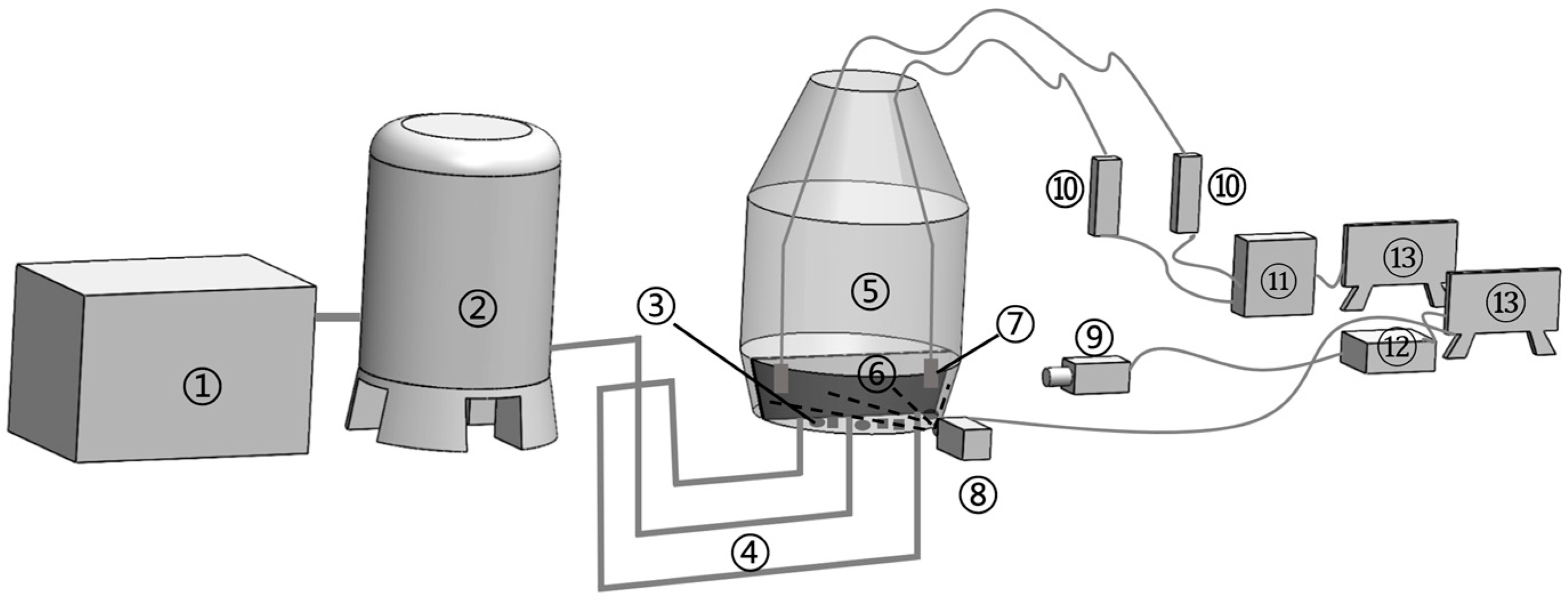
Figure 1.
The schematic diagram of the physical model experimental setup.
Figure 1.
The schematic diagram of the physical model experimental setup.
Figure 2.
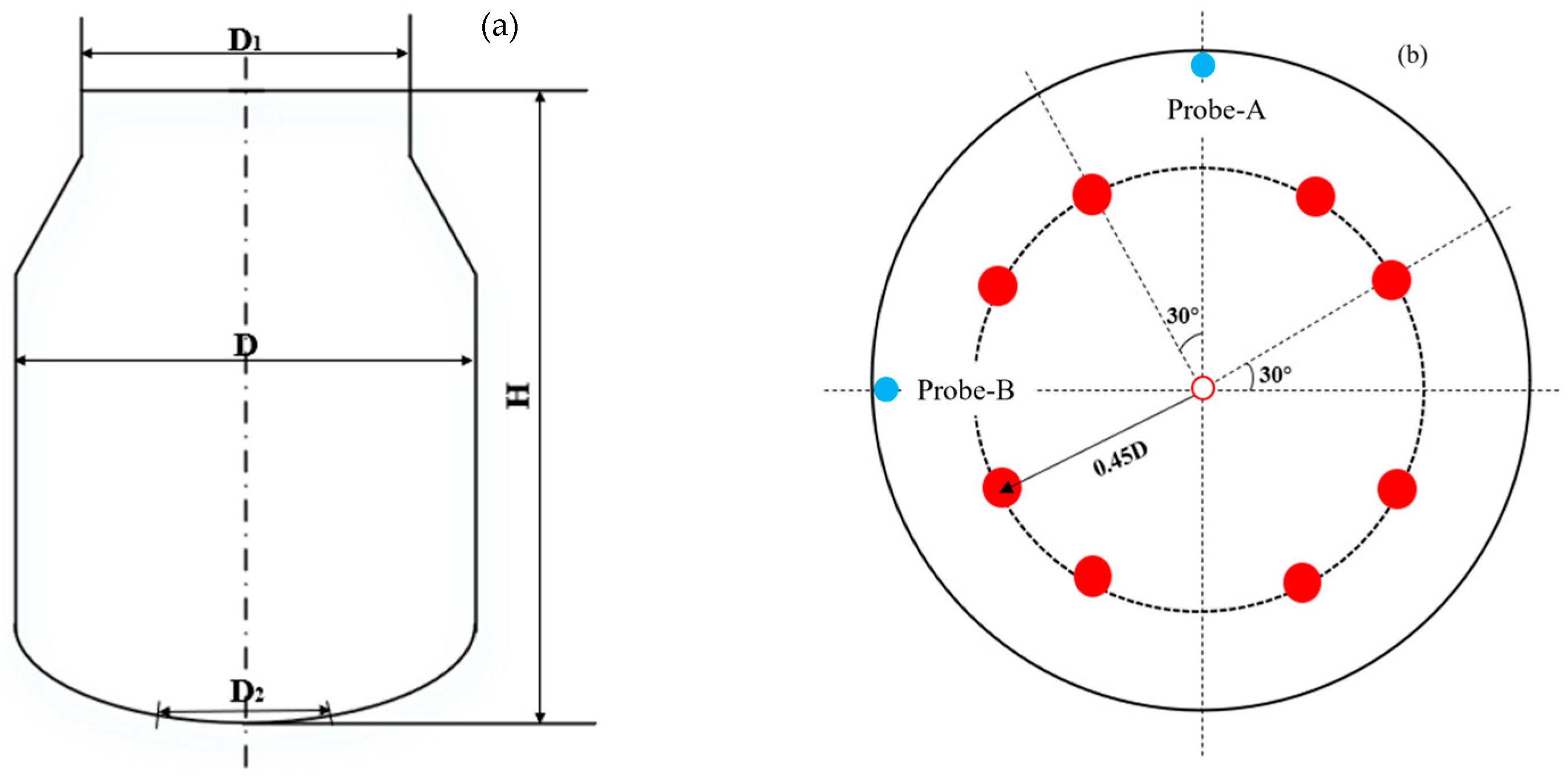
The schematic diagram of the converter and arrangement of the bottom-blowing nozzle: (a) converter model; (b) layout schemes for eight bottom-blowing nozzles.
Figure 2.
The schematic diagram of the converter and arrangement of the bottom-blowing nozzle: (a) converter model; (b) layout schemes for eight bottom-blowing nozzles.
Figure 3.
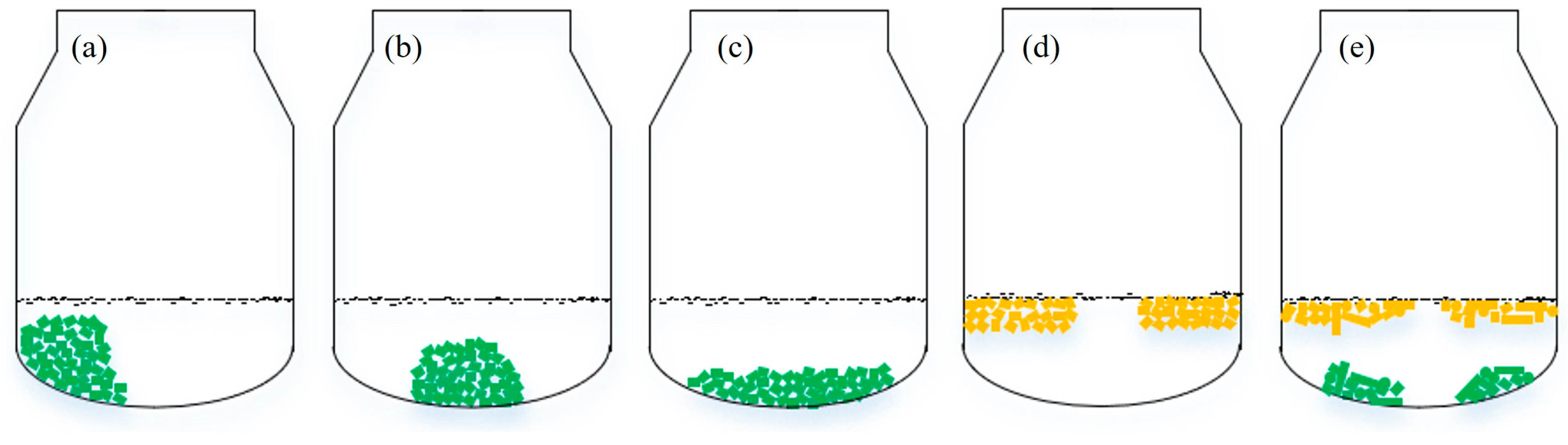
The various states of scrap steel within the converter: (a) inclined, (b) concentrated, (c) uniform, (d) hovering, (e) hovering and settling.
Figure 3.
The various states of scrap steel within the converter: (a) inclined, (b) concentrated, (c) uniform, (d) hovering, (e) hovering and settling.
Figure 5.
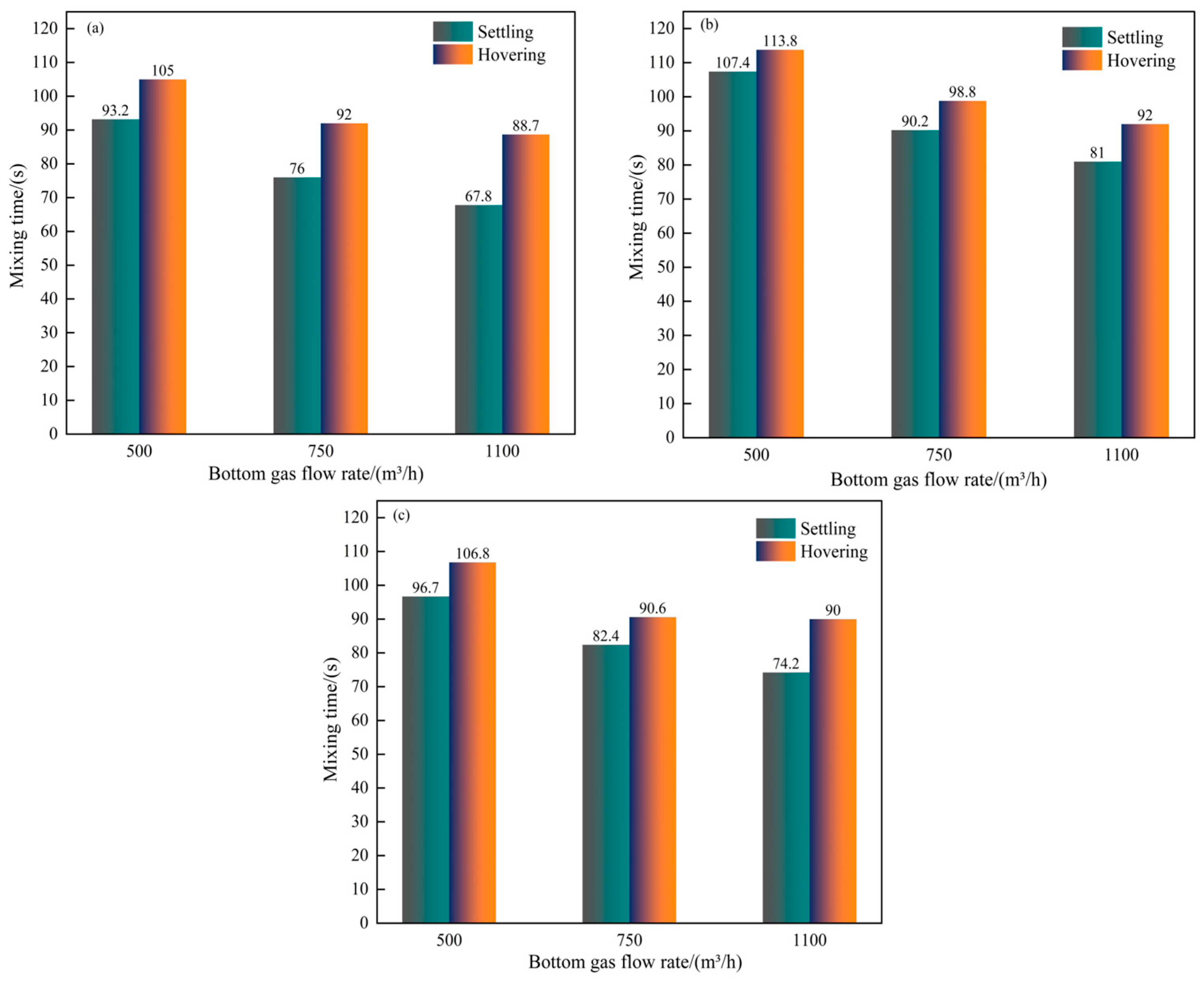
The relationship between the mixing time of the melt pool and scrap steel state: (a) cuboid; (b) cylindrical; (c) thin plate.
Figure 5.
The relationship between the mixing time of the melt pool and scrap steel state: (a) cuboid; (b) cylindrical; (c) thin plate.
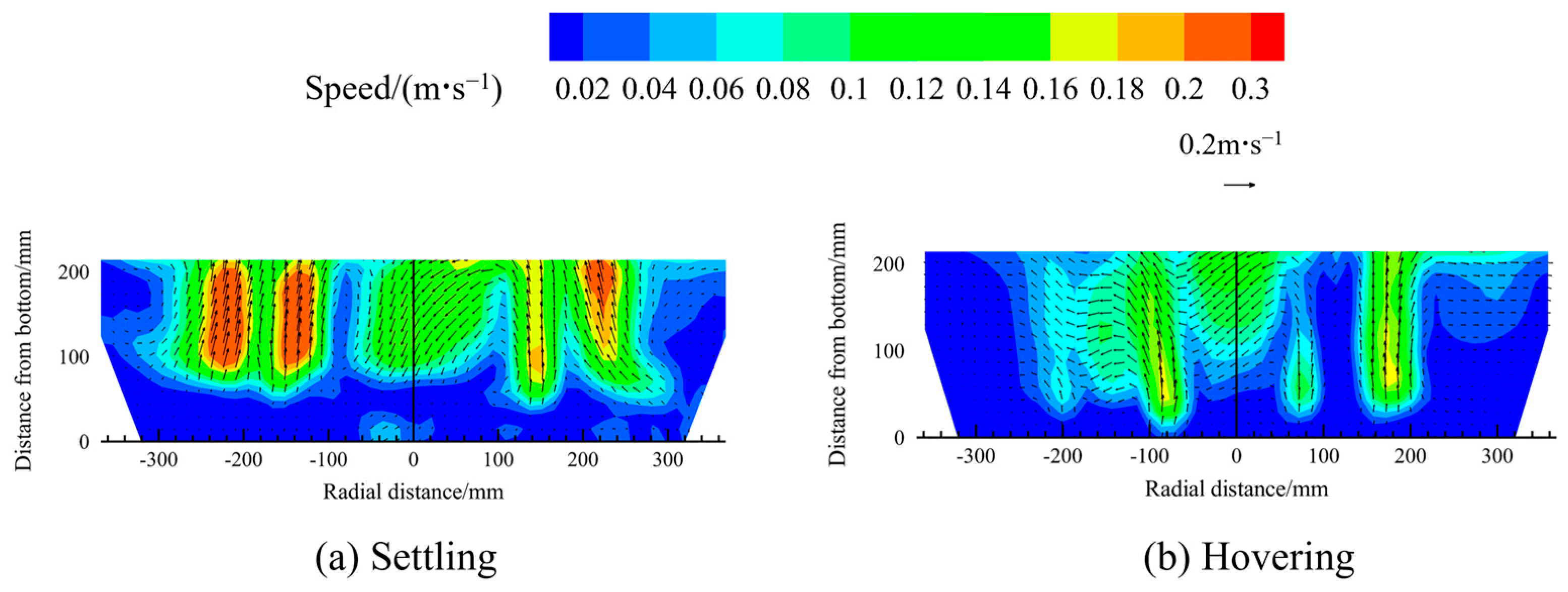
Figure 6.
The contour maps of the velocity distribution for different scrap steel states.
Figure 6.
The contour maps of the velocity distribution for different scrap steel states.
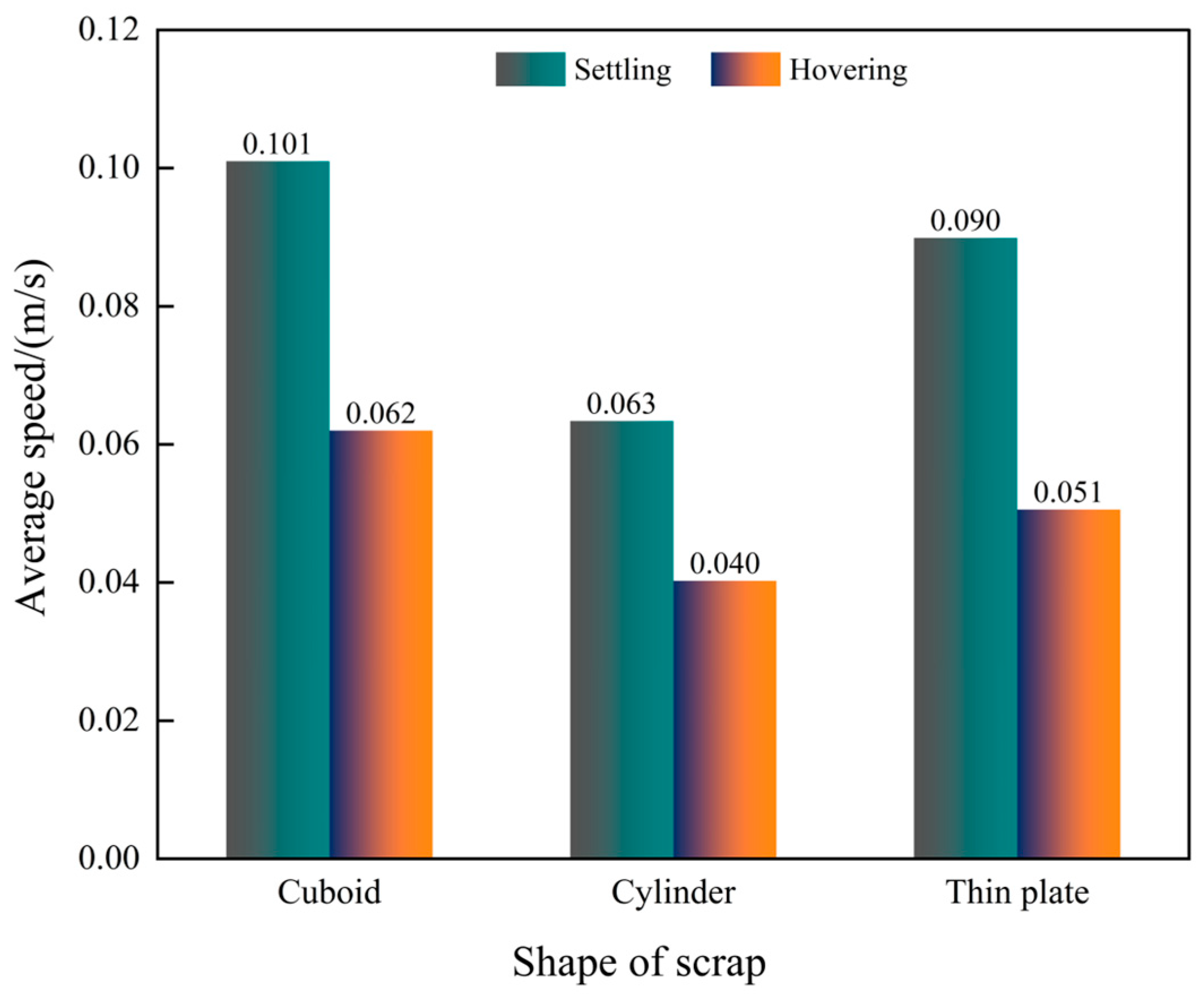
Figure 7.
The average velocity of the melt pool for different scrap steel states.
Figure 7.
The average velocity of the melt pool for different scrap steel states.
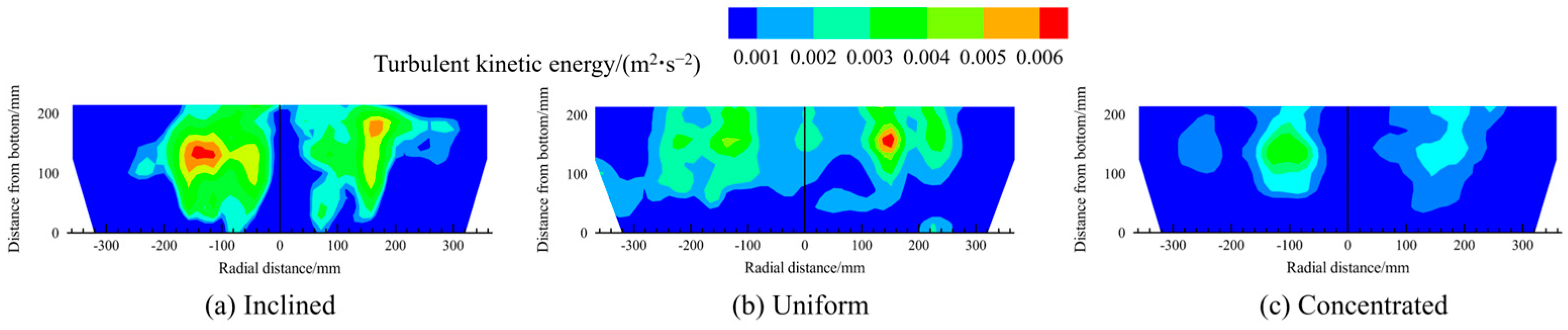
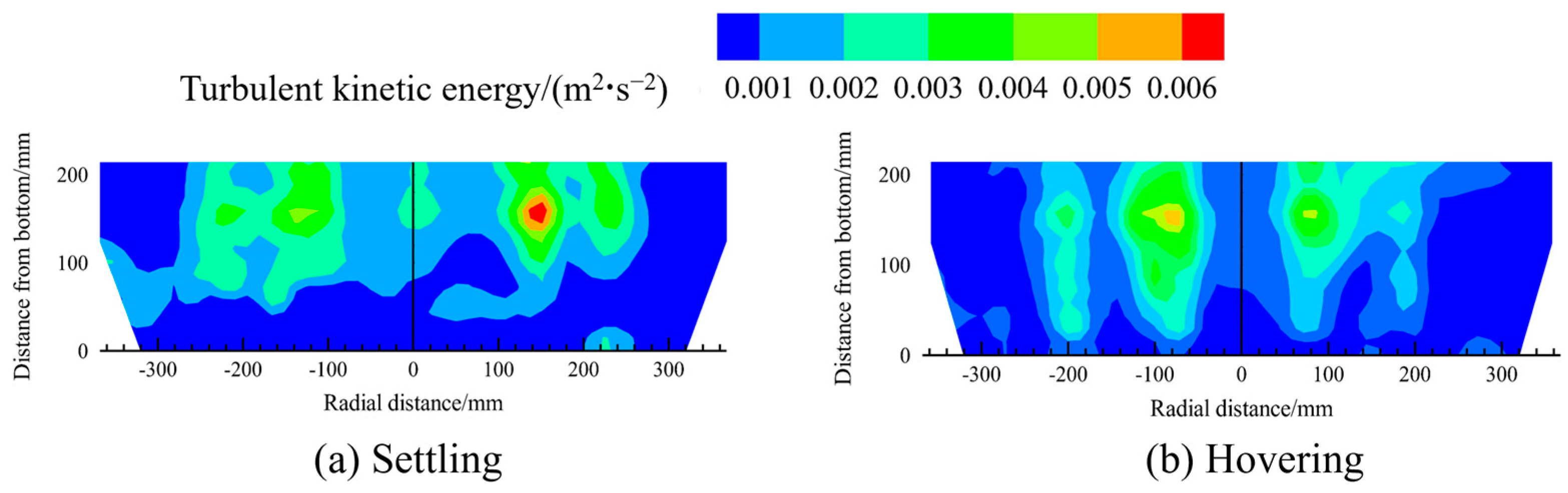
Figure 8.
The contour maps of the distribution of the turbulent kinetic energy in the melt pool for different scrap steel states.
Figure 8.
The contour maps of the distribution of the turbulent kinetic energy in the melt pool for different scrap steel states.
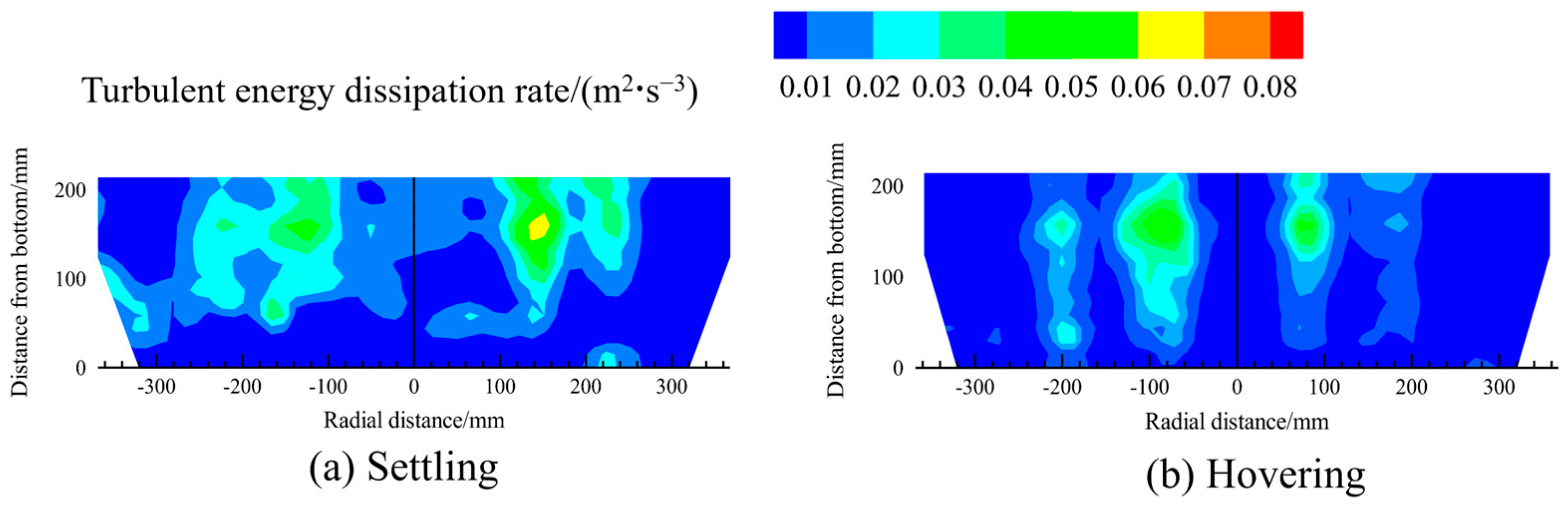
Figure 9.
The contour maps of the distribution of the turbulent energy dissipation rate in the melt pool for different scrap steel states.
Figure 9.
The contour maps of the distribution of the turbulent energy dissipation rate in the melt pool for different scrap steel states.
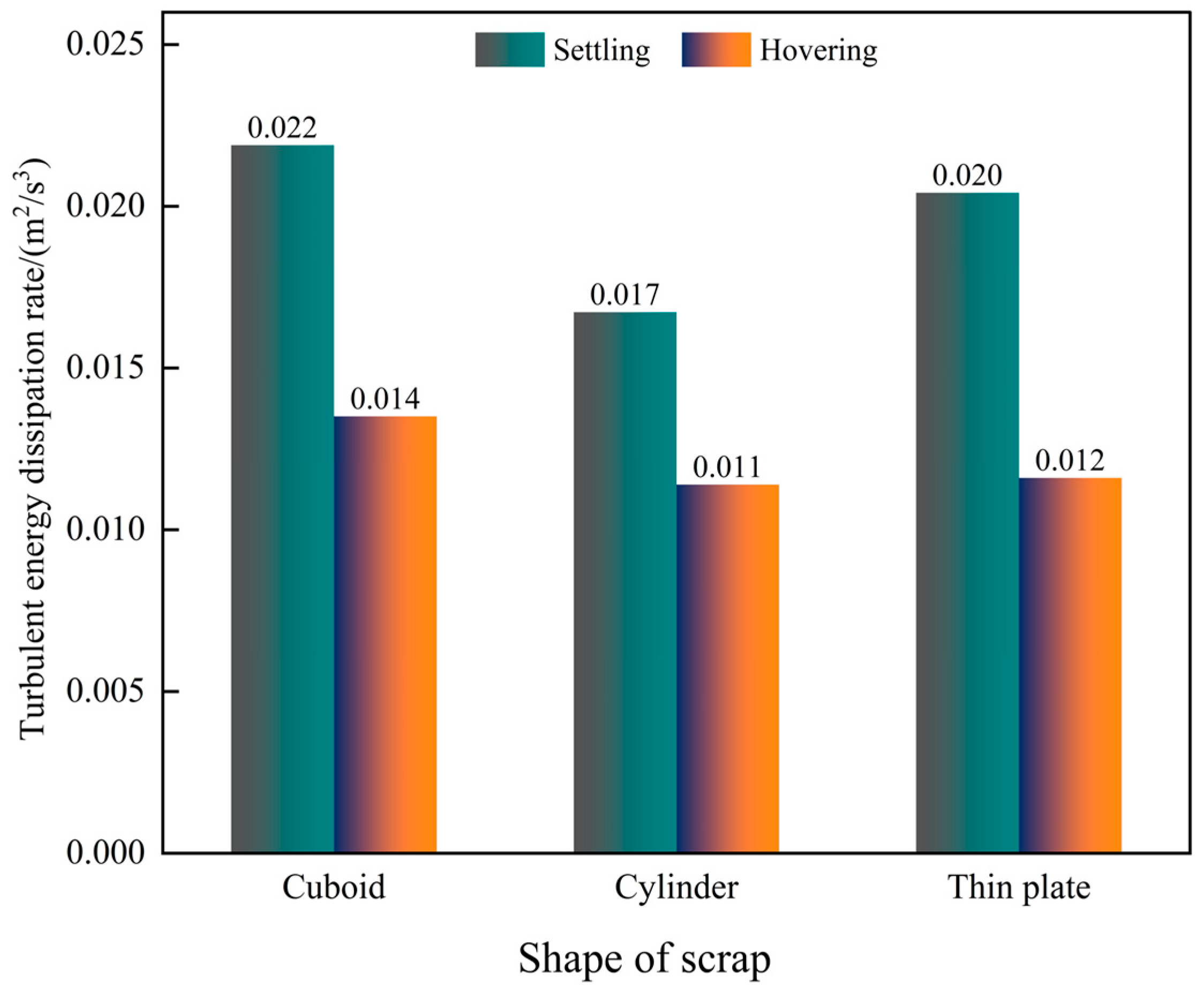
Figure 10.
The average turbulent energy dissipation rate of the melt pool for different scrap steel states.
Figure 10.
The average turbulent energy dissipation rate of the melt pool for different scrap steel states.
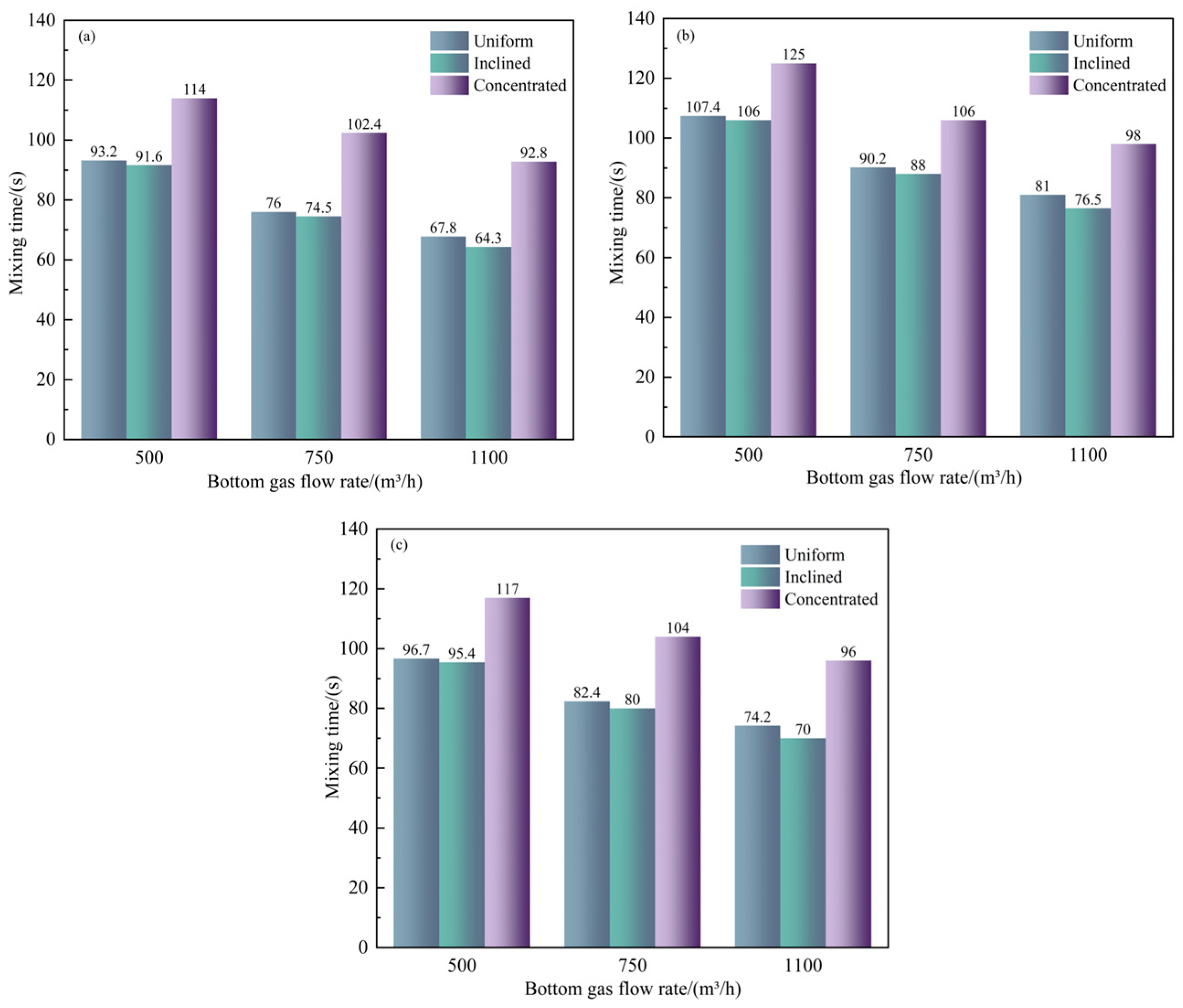
Figure 11.
The relationship between melt pool mixing time and the scrap steel distribution pattern: (a) cuboid; (b) cylinder; (c) thin plate.
Figure 11.
The relationship between melt pool mixing time and the scrap steel distribution pattern: (a) cuboid; (b) cylinder; (c) thin plate.
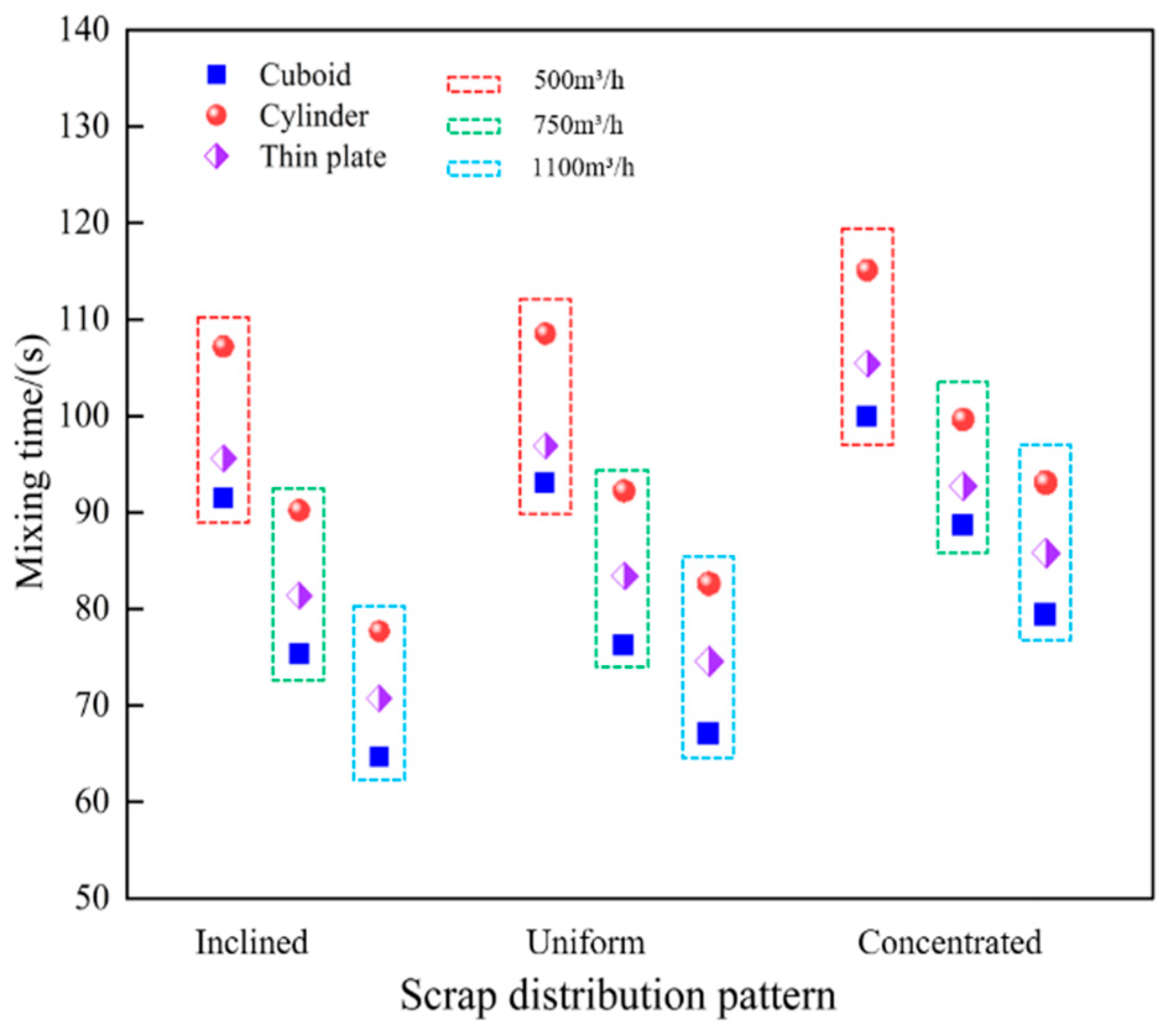
Figure 12.
The relationship between melt pool mixing time and scrap shape and distribution pattern.
Figure 12.
The relationship between melt pool mixing time and scrap shape and distribution pattern.
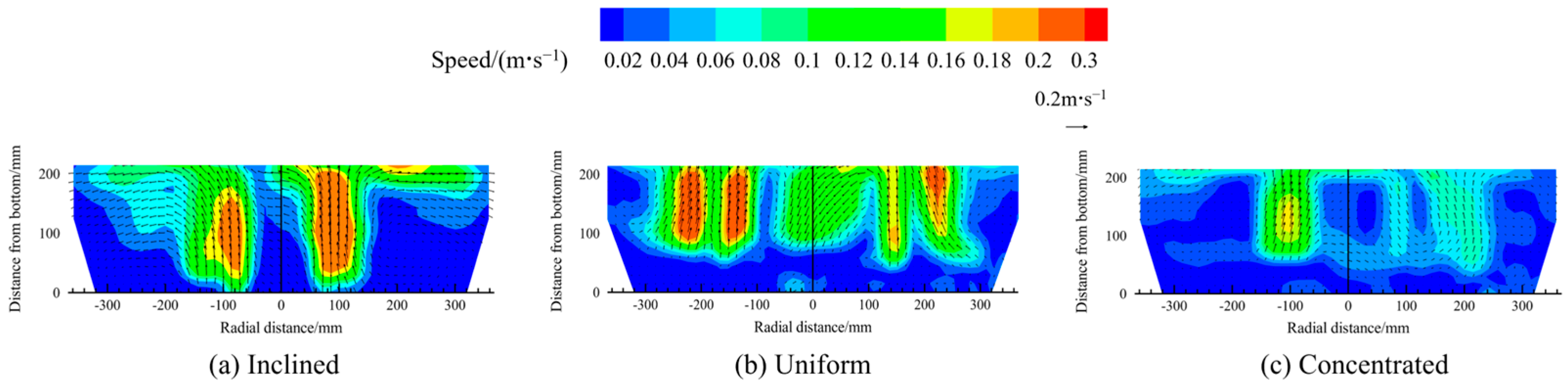
Figure 13.
The contour maps of the velocity distribution in the melt pool for different scrap steel distribution pattern.
Figure 13.
The contour maps of the velocity distribution in the melt pool for different scrap steel distribution pattern.
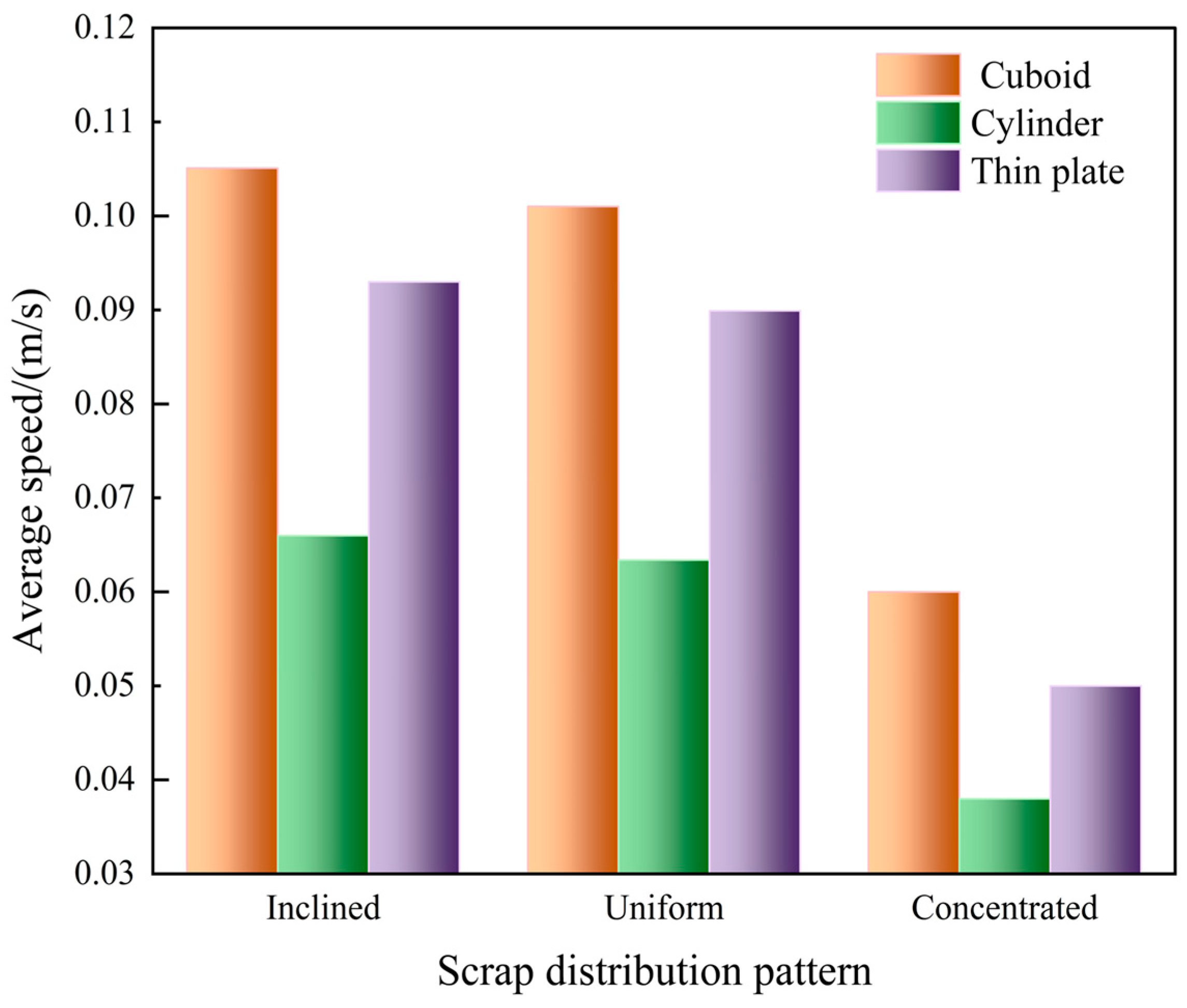
Figure 14.
The average velocity of the melt pool for different scrap steel distribution patterns.
Figure 14.
The average velocity of the melt pool for different scrap steel distribution patterns.
Figure 15.
The contour maps of the distribution of the turbulent kinetic energy in the melt pool for different scrap steel distribution patterns.
Figure 15.
The contour maps of the distribution of the turbulent kinetic energy in the melt pool for different scrap steel distribution patterns.
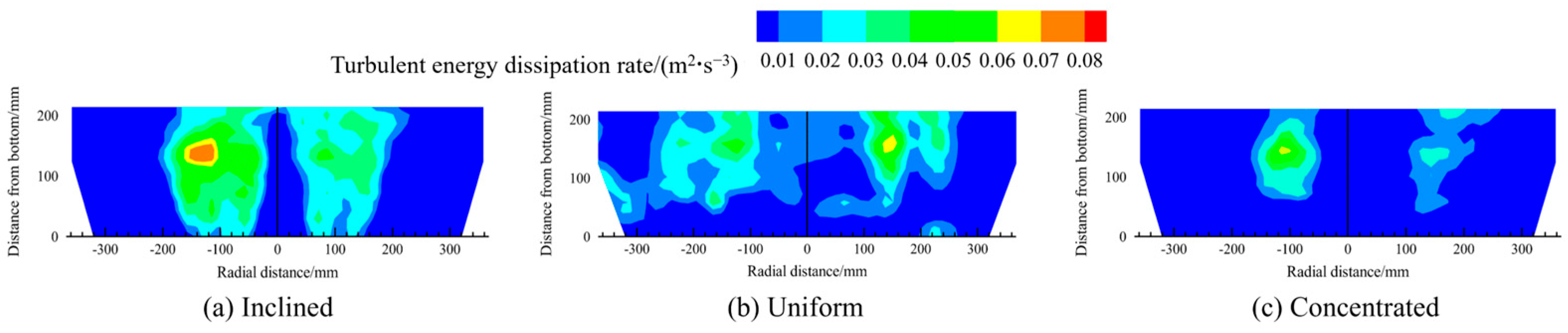
Figure 16.
The contour maps of the distribution of the turbulent energy dissipation rate in the melt pool for different scrap steel distribution patterns.
Figure 16.
The contour maps of the distribution of the turbulent energy dissipation rate in the melt pool for different scrap steel distribution patterns.
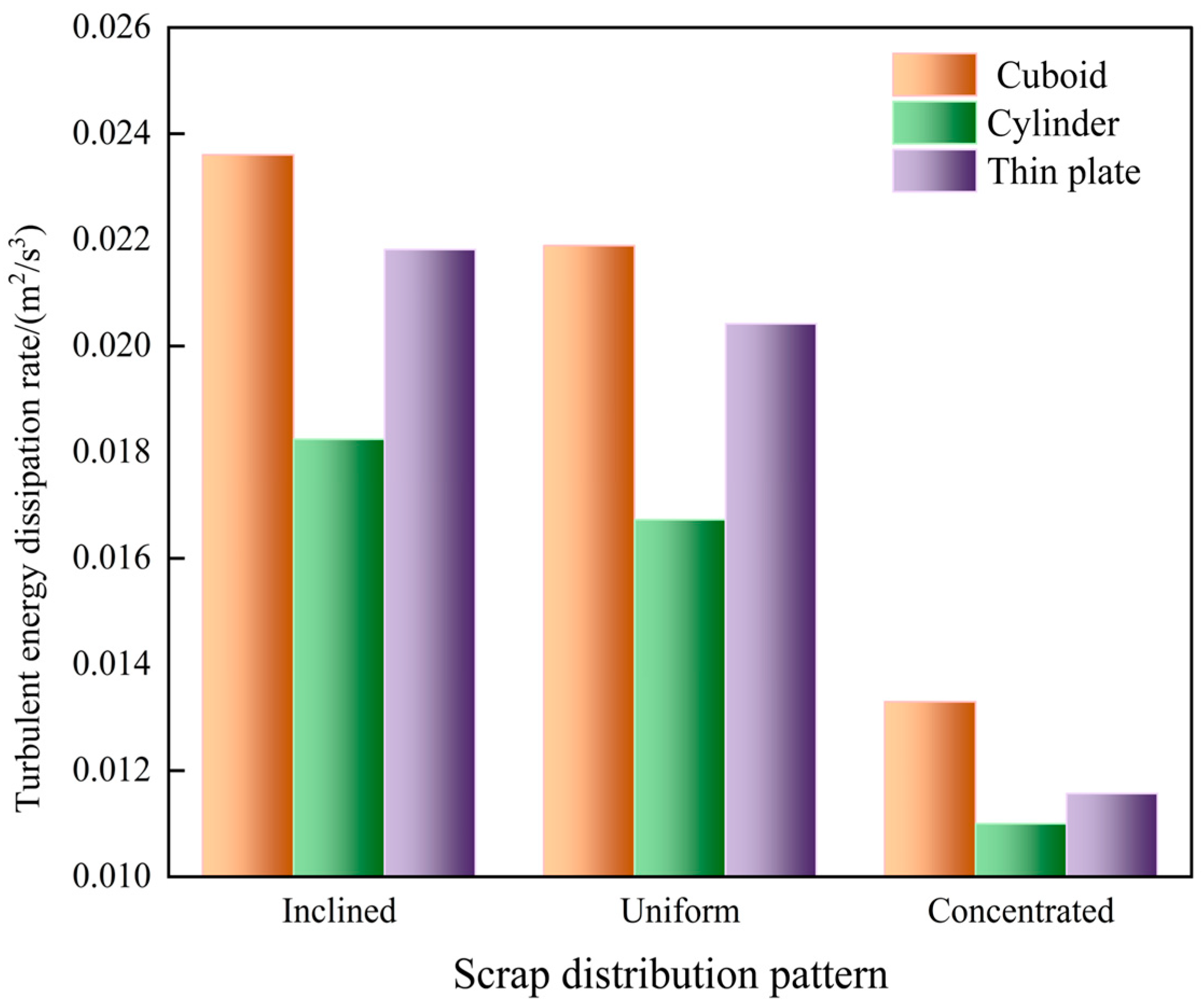
Figure 17.
The average turbulent energy dissipation rates of the melt pool for different scrap steel distribution patterns.
Figure 17.
The average turbulent energy dissipation rates of the melt pool for different scrap steel distribution patterns.
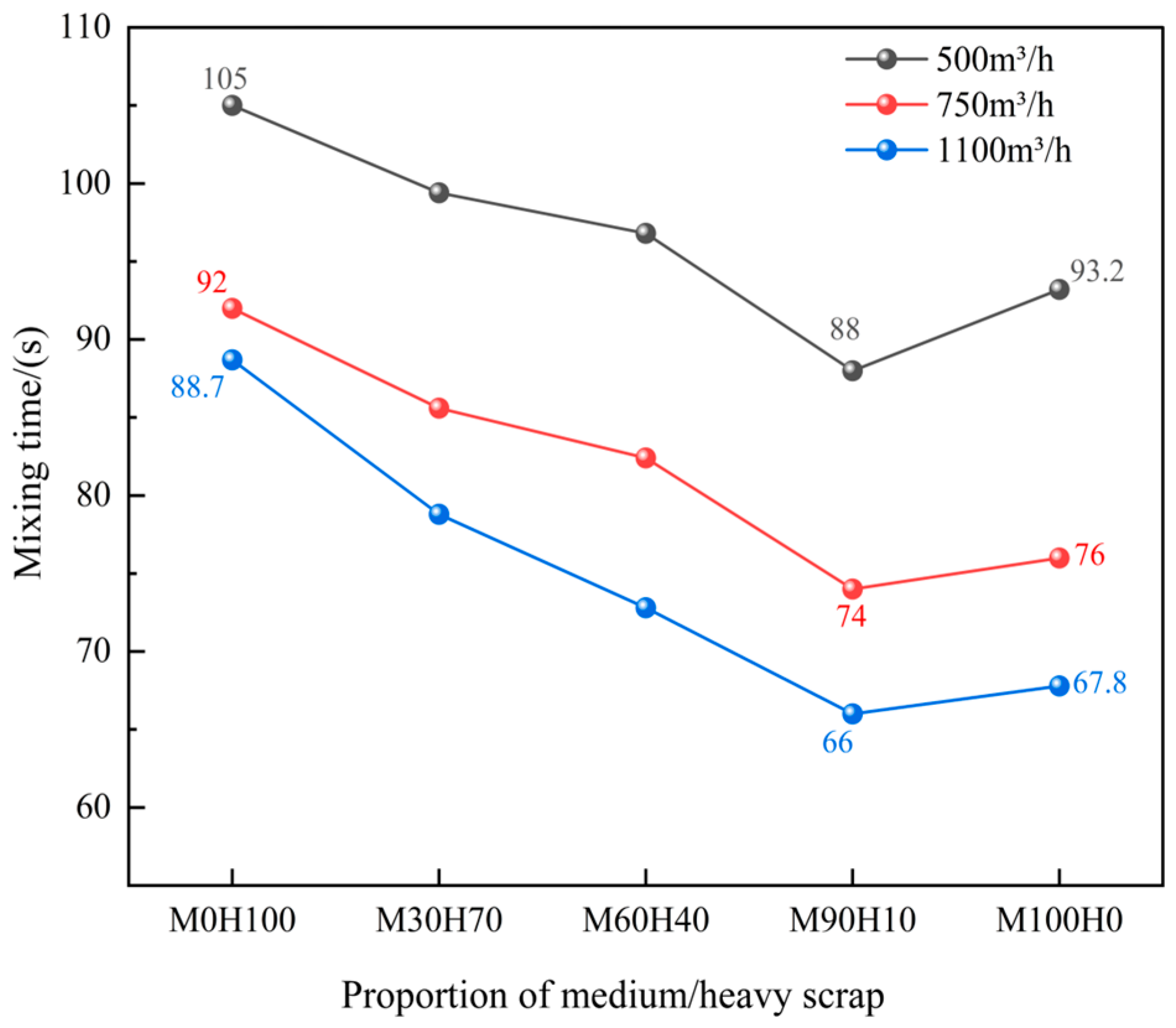
Figure 18.
The relationship between melt pool mixing time and the proportion of medium and heavy scrap steel.
Figure 18.
The relationship between melt pool mixing time and the proportion of medium and heavy scrap steel.
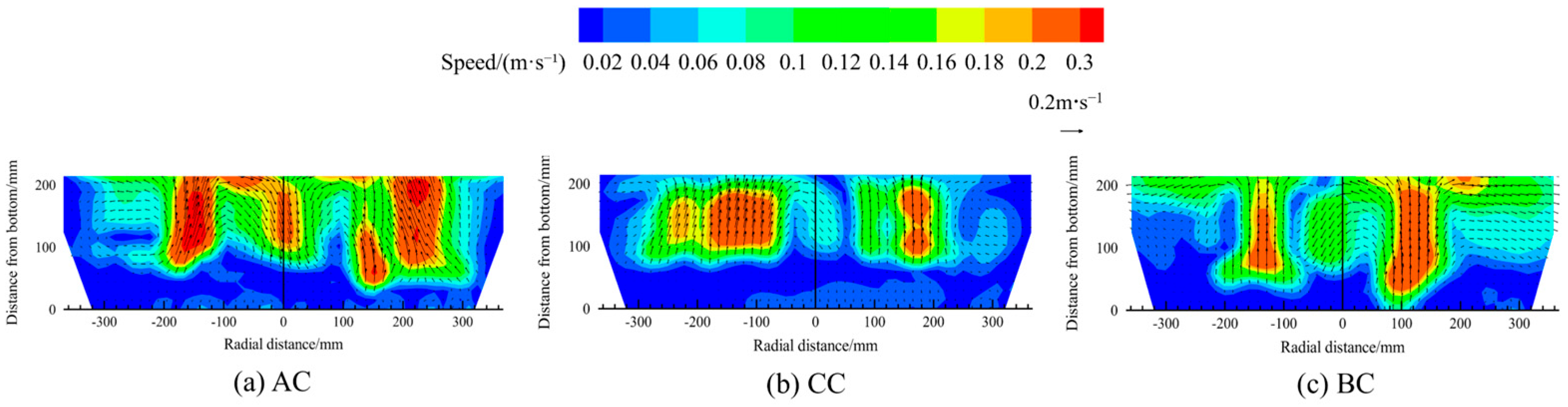
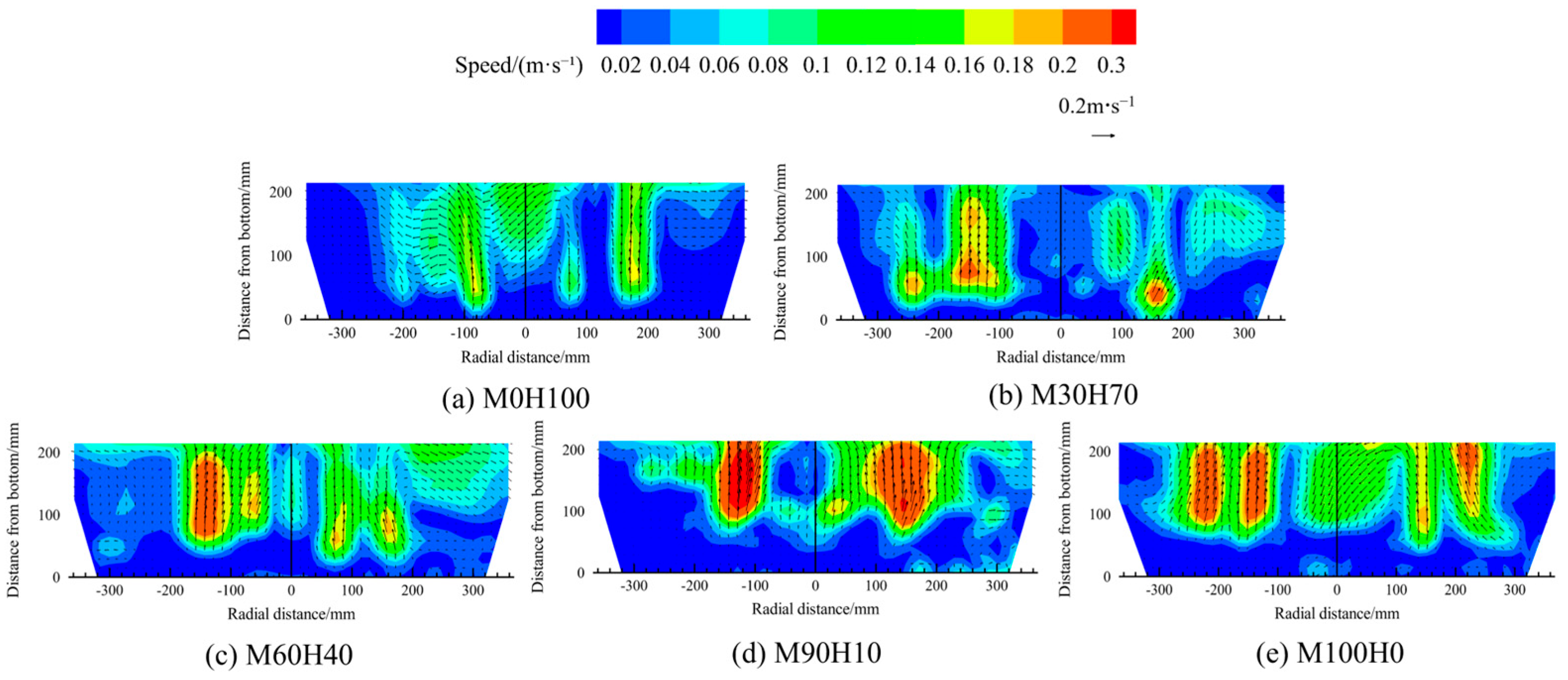
Figure 19.
The contour maps of the velocity distribution in the melt pool for different medium-to-heavy scrap ratios.
Figure 19.
The contour maps of the velocity distribution in the melt pool for different medium-to-heavy scrap ratios.
Figure 20.
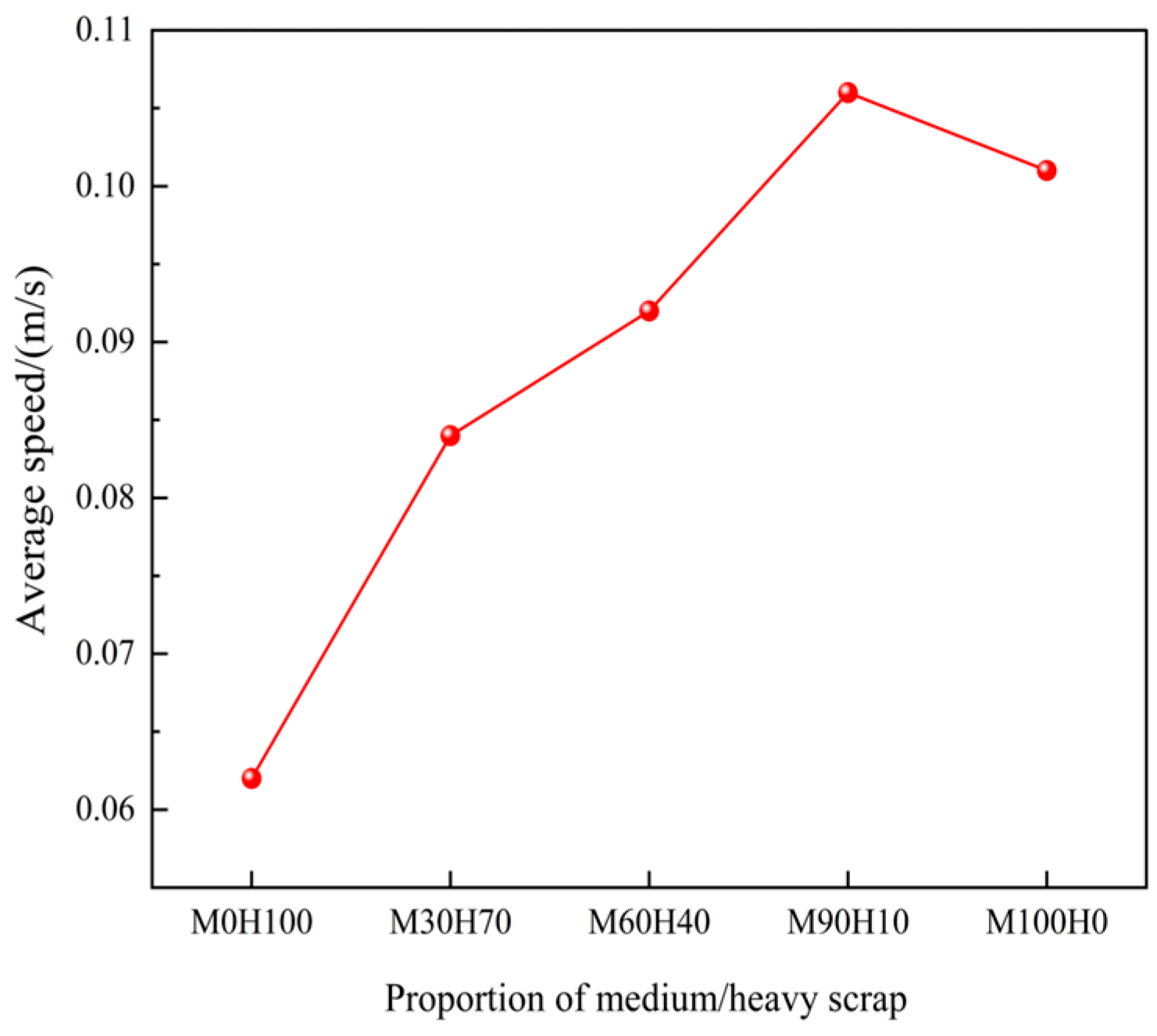
The average velocity of the melt pool for different medium-to-heavy scrap ratios.
Figure 20.
The average velocity of the melt pool for different medium-to-heavy scrap ratios.
Figure 21.
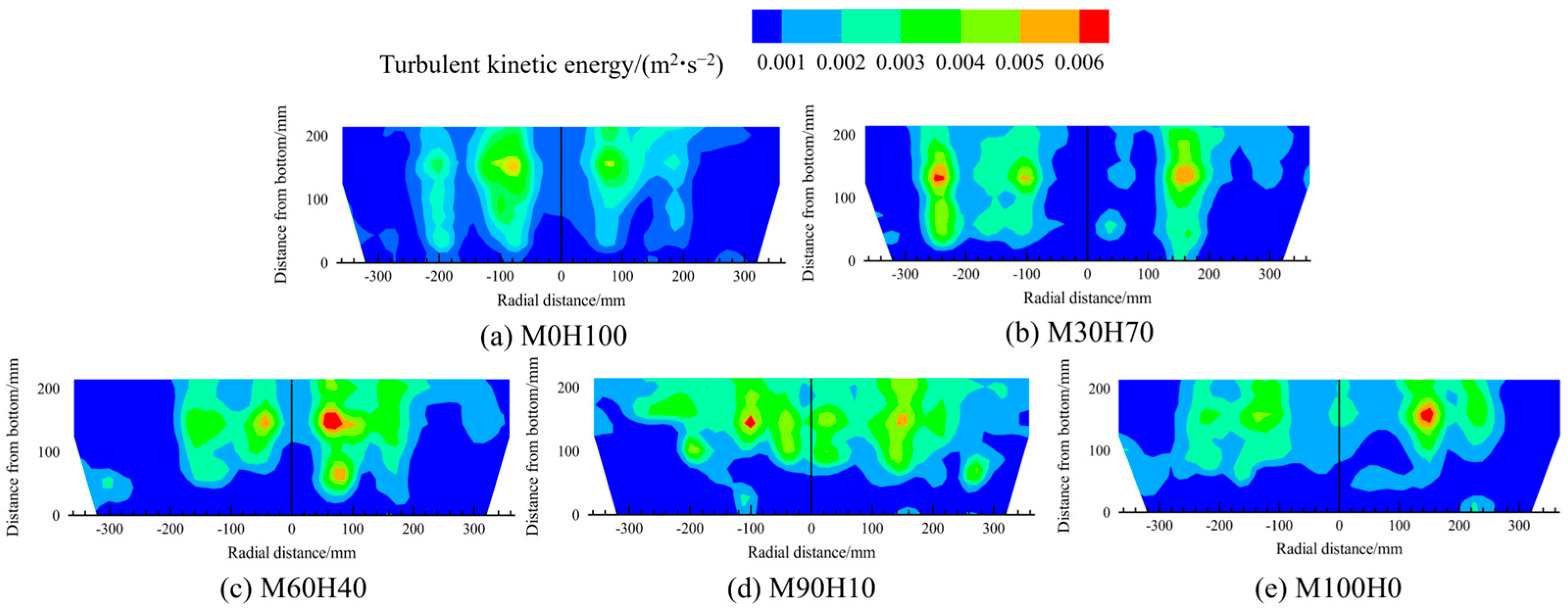
The contour maps of the distribution of the turbulent kinetic energy in the melt pool for different medium-to-heavy scrap ratios.
Figure 21.
The contour maps of the distribution of the turbulent kinetic energy in the melt pool for different medium-to-heavy scrap ratios.
Figure 22.
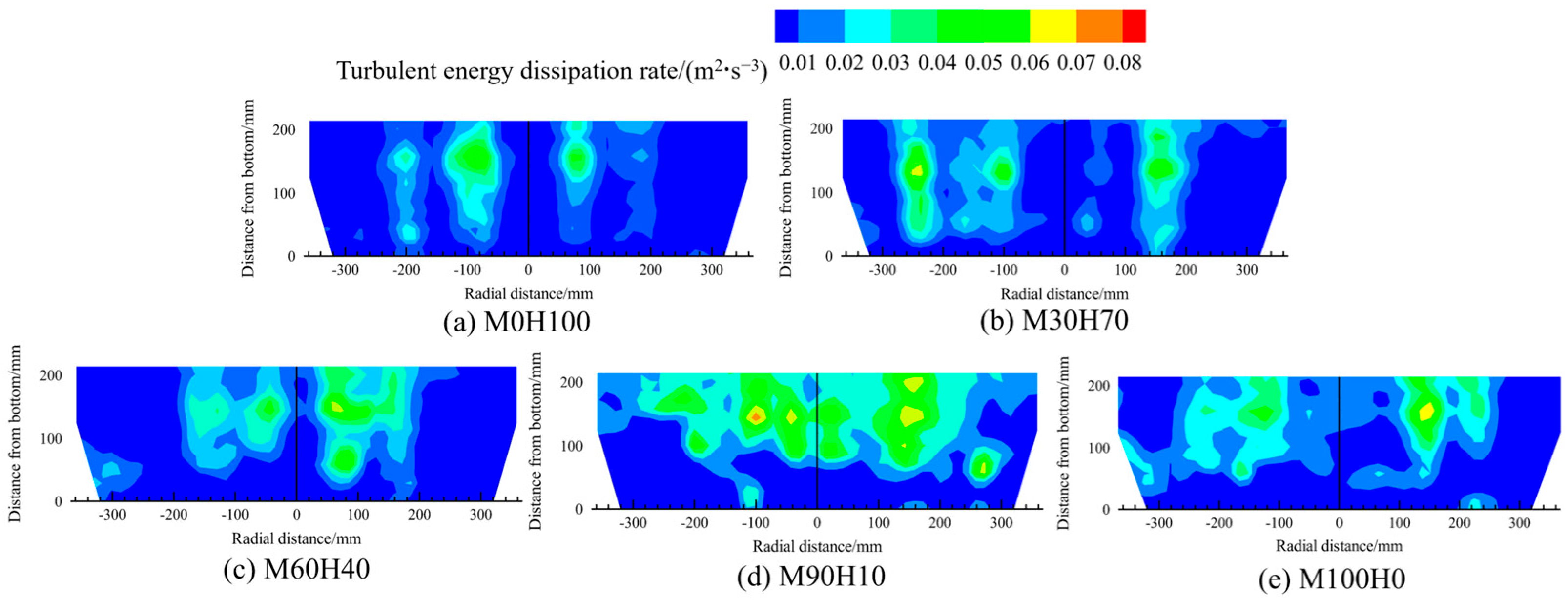
The contour maps of the distribution of the turbulent energy dissipation rate in the melt pool for different medium-to-heavy scrap ratios.
Figure 22.
The contour maps of the distribution of the turbulent energy dissipation rate in the melt pool for different medium-to-heavy scrap ratios.
Figure 23.
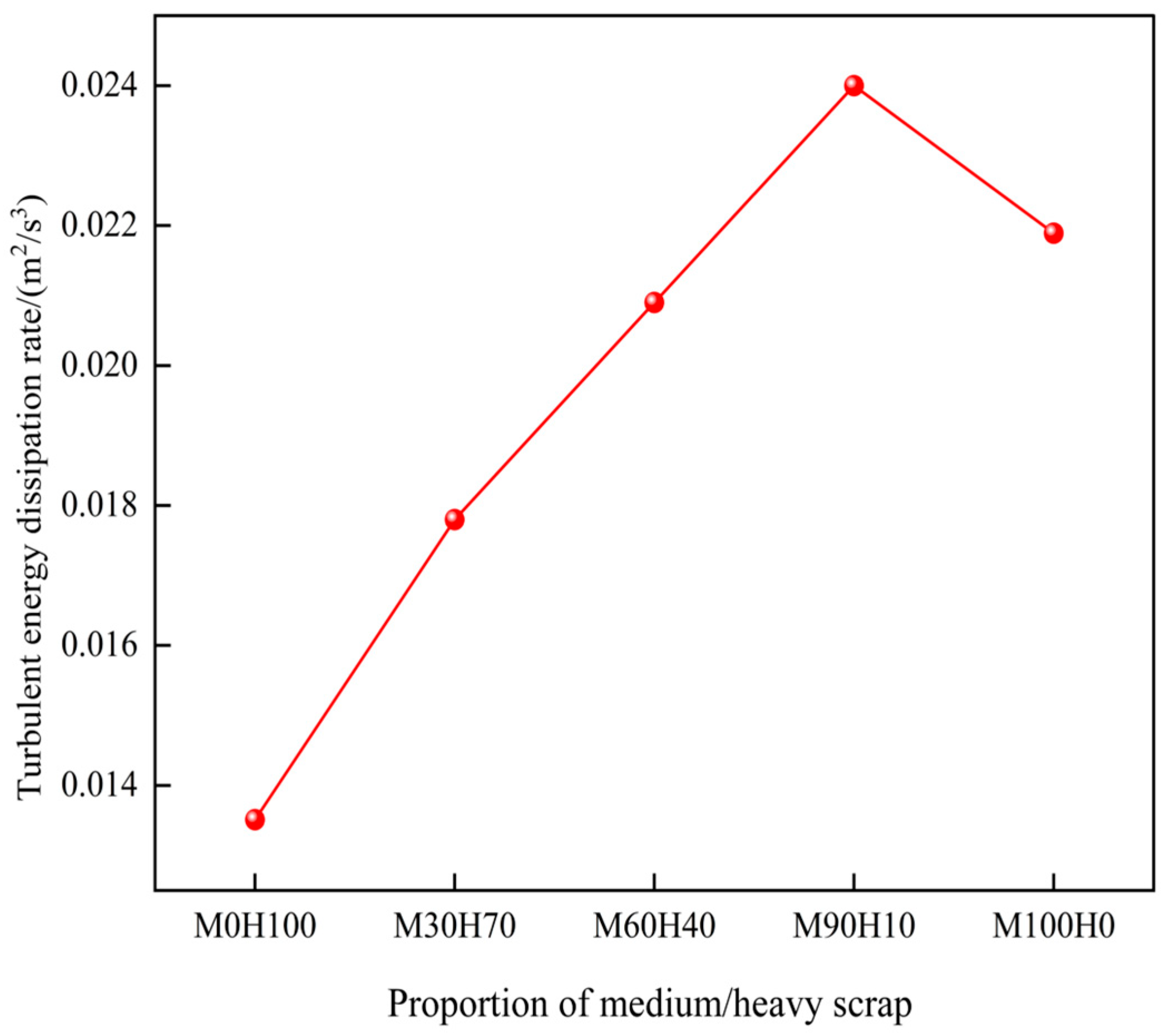
The average turbulent energy dissipation rate of the melt pool for different medium-to-heavy scrap ratios.
Figure 23.
The average turbulent energy dissipation rate of the melt pool for different medium-to-heavy scrap ratios.
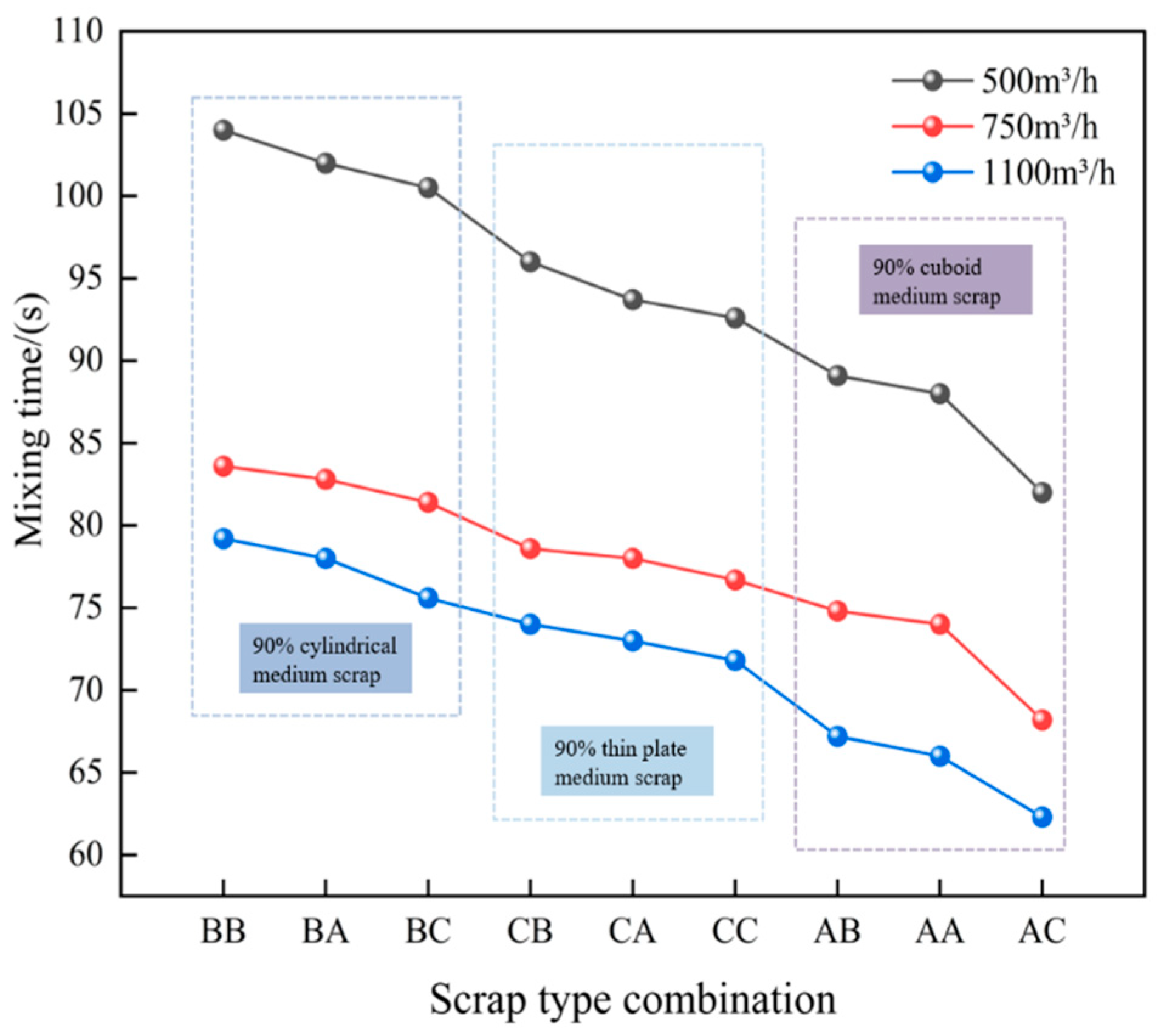
Figure 24.
The relationship between melt pool mixing time and scrap steel types.
Figure 24.
The relationship between melt pool mixing time and scrap steel types.
Figure 25.
The contour maps of the velocity distribution in the melt pool for different scrap steel types.
Figure 25.
The contour maps of the velocity distribution in the melt pool for different scrap steel types.
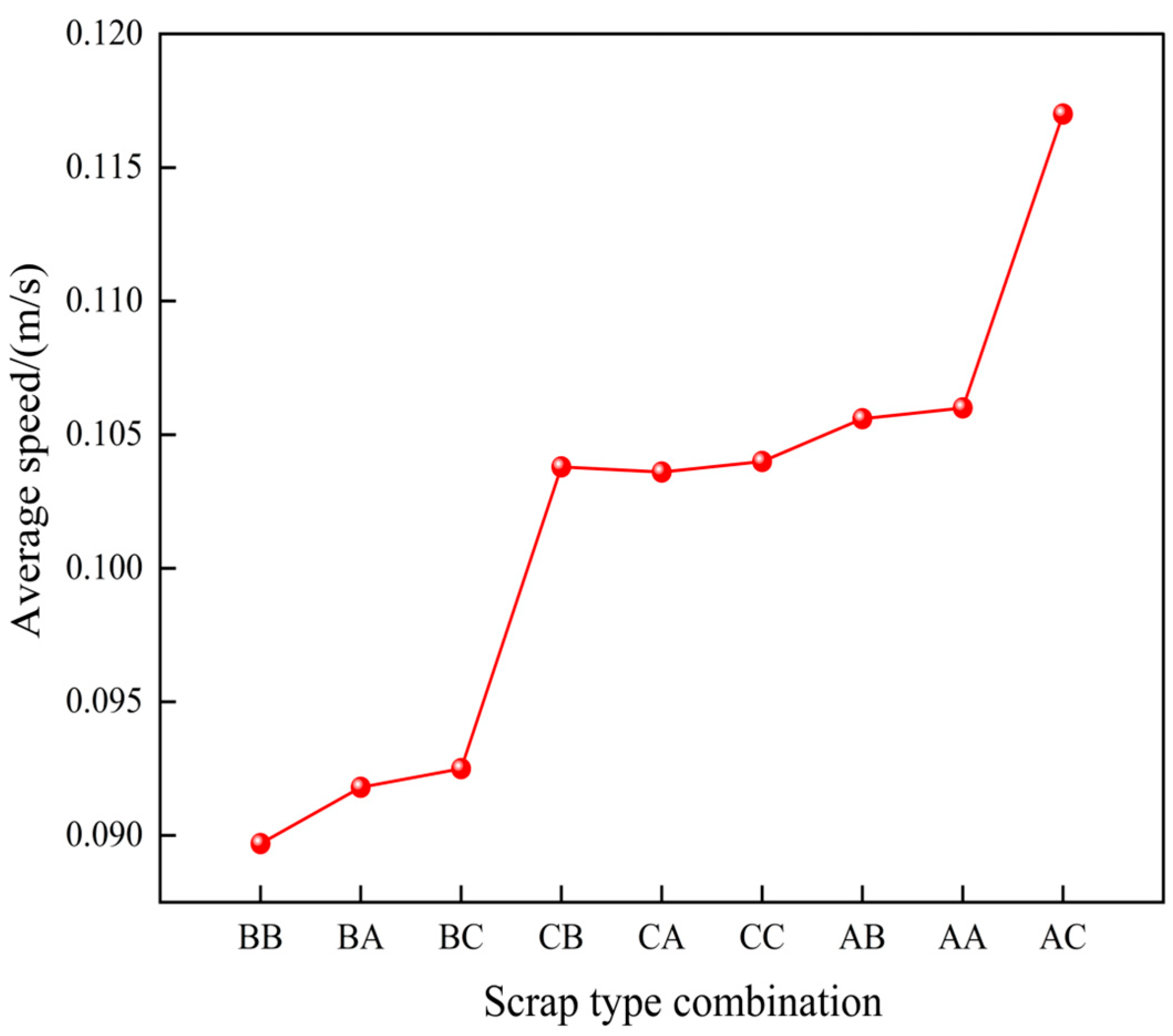
Figure 26.
The average velocity of the melt pool for different scrap steel types.
Figure 26.
The average velocity of the melt pool for different scrap steel types.
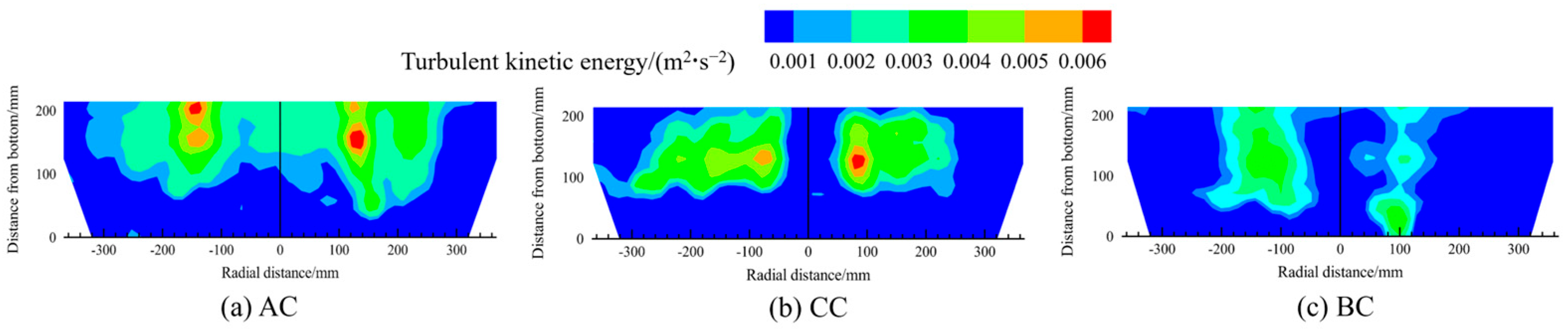
Figure 27.
The contour maps of the distribution of the turbulent kinetic energy in the melt pool for different scrap steel types.
Figure 27.
The contour maps of the distribution of the turbulent kinetic energy in the melt pool for different scrap steel types.
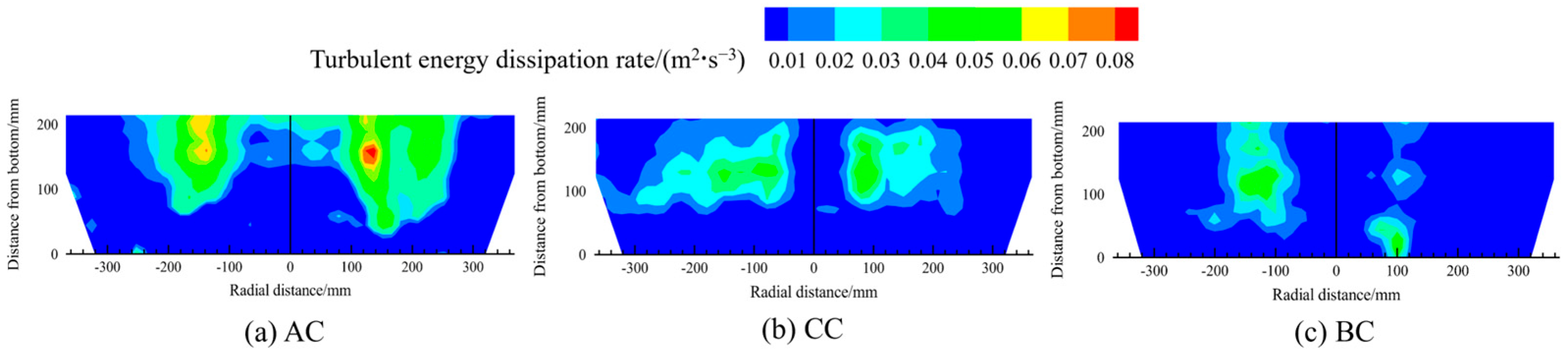
Figure 28.
The contour maps of the distribution of the turbulent energy dissipation rate in the melt pool for different scrap steel types.
Figure 28.
The contour maps of the distribution of the turbulent energy dissipation rate in the melt pool for different scrap steel types.
Figure 29.
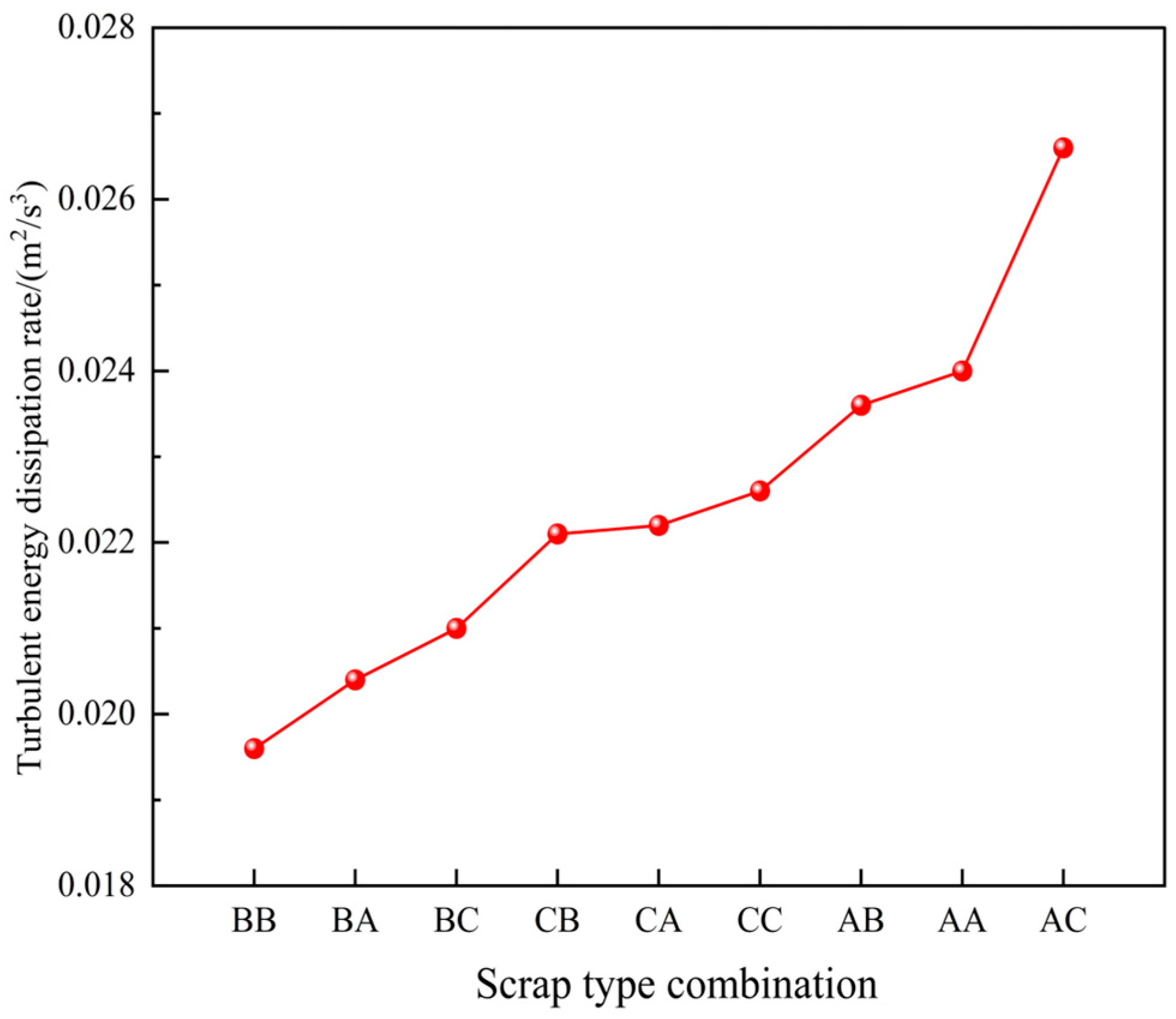
The average turbulent energy dissipation rate of the melt pool for different scrap steel types.
Figure 29.
The average turbulent energy dissipation rate of the melt pool for different scrap steel types.
Table 1.
The physical properties of fluid [
10,
11,
28].
Table 1.
The physical properties of fluid [
10,
11,
28].
| Physical Parameters | Prototype | Model |
|---|
| Steel | Argon | Water | Air |
|---|
| Density, kg/m3 | 7000.00 | 1.63 | 1000.00 | 1.29 |
| Viscosity, kg/(m·s) | 6.400 × 10⁻³ | 2.125 × 10⁻⁵ | 0.001 | 1.789 × 10⁻⁵ |
| Surface tension, N/m | 1.500 | / | 0.071 | / |
| Thermal conductivity, W/(m·K) | 15.0000 | 0.0158 | 0.6000 | 0.0242 |
| Specific heat, J/kg·K | 670.00 | 520.64 | 4182.00 | 1006.43 |
| Temperature, K | 1873 | 300 | 300 | 300 |
Table 2.
The bottom gas flow rates of the prototype and model.
Table 2.
The bottom gas flow rates of the prototype and model.
| Scheme | Prototype/(Nm3/h) | Model/(Nm3/h) |
|---|
| 1 | 500 | 0.9 |
| 2 | 750 | 1.4 |
| 3 | 1100 | 2.0 |
Table 3.
The classification stages of the bottom-blowing gas flow rate.
Table 3.
The classification stages of the bottom-blowing gas flow rate.
| Stage | The Variation Range of the Bottom-Blowing Gas Flow Rate/(m3/h) |
|---|
| 1 | 500–750 |
| 2 | 750–1100 |
Table 4.
Scrap parameters.
Table 4.
Scrap parameters.
| Scheme | Prototype | Scrap Material Type | Model |
|---|
| Types of Scrap | Density/kg/m3 | Polyurethane | Density/kg/m3 |
|---|
| 1 | 1# | 7500 | MS | 1# | 1250 |
| 2 | 2# | 5800 | HS | 2# | 970 |
Table 5.
The principal geometric parameters of prototype and model.
Table 5.
The principal geometric parameters of prototype and model.
| Parameter | Converter |
|---|
| Prototype | Model |
|---|
| Converter capacity/tons | 300 | / |
| D1(Furnace mouth diameter)/mm | 3600.0 | 409.1 |
| D2(Nozzle location diameter)/mm | 2912.4 | 331.0 |
| H(Bath height)/mm | 11,500.0 | 1306.8 |
| D(Bath diameter)/mm | 6472.0 | 735.5 |
| Molten bath depth/mm | 1865 | 212 |
Table 6.
Experimental scheme.
Table 6.
Experimental scheme.
| Number | Scheme |
|---|
| 1 | State | Settling |
| Hovering |
| 2 | Distribution pattern | Uniform |
| Inclined |
| Concentrated |
| 3 | Medium scrap and heavy scrap ratio | M0H100 |
| M30H70 |
| M60H40 |
| M90H10 |
| M100H0 |
| 4 | Shape | Cuboid |
| Cylinder |
| Thin plate |
Table 7.
The decrease in mixing time based on the proportion of medium and heavy scrap steel.
Table 7.
The decrease in mixing time based on the proportion of medium and heavy scrap steel.
Gas Flow Rate
Change Stage | Decrease in Mixing Time Per 100 m3/h/% |
|---|
| M30H70 | M60H40 | M90H10 | M100H0 |
|---|
| 1 | 5.6 | 6.0 | 6.4 | 7.4 |
| 2 | 2.3 | 3.3 | 3.1 | 3.1 |
Table 8.
The decreases in mixing time for the different scrap steel types.
Table 8.
The decreases in mixing time for the different scrap steel types.
| Gas Flow Rate Change Stage | Percentage Reduction in Mixing Time Per 100 m3/h/% |
|---|
| BA | BC | CB | CA | CC | AB | AA | AC |
|---|
| 5 | 7.5 | 7.6 | 7.3 | 6.7 | 6.9 | 6.4 | 6.4 | 6.7 |
| 4 | 1.7 | 2.0 | 1.7 | 1.8 | 1.8 | 2.9 | 3.1 | 2.5 |