Article

Integrated Furnace-to-SCR CFD Modeling of a Large Coal-Fired Boiler: Combustion Characteristics and Flow Optimization over a Wide Load Range

1
Zhejiang Energy Group R&D Co., Ltd., Hangzhou 311121, China
2
Zhejiang Provincial Key Laboratory of High Efficiency Energy Conservation and Pollutant Control Technology for Thermal Power Generation, Hangzhou 311121, China
3
Zhejiang Provincial Key Laboratory for Research on Industrial Carbon Metrology Technology, Hangzhou 310018, China
4
College of Energy Environment and Safety Engineering, China Jiliang University, Hangzhou 310018, China
*
Author to whom correspondence should be addressed.
Processes 2026, 14(3), 485; https://doi.org/10.3390/pr14030485
Submission received: 11 January 2026 / Revised: 24 January 2026 / Accepted: 27 January 2026 / Published: 30 January 2026
(This article belongs to the Special Issue Advances in Combustion Processes: Fundamentals and Applications)

Abstract

Growing renewable penetration increases deep peak-shaving demands, making stable wide-load operation of coal-fired boilers essential. A full-process CFD model of a 660 MW ultra-supercritical boiler was established, covering the furnace, heat-transfer surfaces, rear-pass duct, and selective catalytic reduction (SCR) system. Simulations at 25–100% boiler maximum continuous rating (BMCR) quantified load effects on combustion and emissions. Predicted furnace outlet temperature and major flue-gas species matched field data with deviations within ±6%. Lowering the load from 100% to 25% BMCR contracted the high-temperature core in the furnace and reduced mean temperature and mixing. Furnace nitrogen oxides (NOx) formation decreased as the load decreased. However, NOx at 25% BMCR increased because separated over-fire air (SOFA) was not applied. Reduced combustion intensity increased the level of unburned carbon in fly ash, which rose by approximately 3.5% at 25% BMCR, relative to the rated condition. Pronounced flow maldistribution also appeared at 25% BMCR. The SCR-inlet flow analysis indicated that the original guide vane design was not suitable for wide-load operation and that inlet-velocity uniformity deteriorated, especially at low loads. An optimized guide vane scheme is proposed, improving SCR-inlet uniformity over the full load range while mitigating ash deposition and erosion risks.

1. Introduction

As China advances toward carbon peaking and carbon neutrality, the energy mix is rapidly evolving [1,2]. Accordingly, the power system is transitioning from fossil-fuel-dominated steady output to renewable-dominated, flexible operation. The rapid deployment of wind and photovoltaic generation has increased the stochastic and intermittent nature of power output. Meanwhile, a widening intraday peak-to-valley demand gap and increasing seasonal variability further elevate grid demands for fast regulation and deep load following [3]. As one of the largest and most controllable conventional resources, coal-fired units are expected to remain essential for load regulation, peak adequacy, and emergency backup in the foreseeable future. This trend requires large coal-fired boilers to maintain stable operation and respond rapidly over a wide load range [4,5].
Consequently, coal-fired units are shifting from continuous baseload operation to flexible operation characterized by frequent start-ups and shutdowns, rapid ramping, and deep peak shaving. Under wide load operation, combustion organization, air distribution, and the furnace temperature field change substantially. These changes induce complex variations in ignition and burnout, NOx formation, slagging, ash deposition, and overall combustion efficiency [6,7]. Therefore, systematically characterizing combustion behavior across a wide-load range and optimizing flue-gas flow organization are of great engineering significance and practical urgency.
Compared to field tests limited to discrete measurement locations, CFD (Computational Fluid Dynamics) can provide full-field information on flow, temperature, species, and particle transport in boilers under controlled boundary conditions. It enables detailed insights into ignition and burnout processes, air distribution patterns, and NOx formation [8,9,10]. As a result, combustion behavior and overall operating characteristics can be characterized more systematically across different loads.
CFD has been extensively used to evaluate complex thermal-hydraulic processes in large-scale boilers. Askarova et al. [11] developed a multi-dimensional model that coupled heat transfer with reaction kinetics to support furnace design. Madejski [12] mapped 3D flow and temperature fields to assess unburned carbon in fly ash and erosion risks. Belošević et al. [13] highlighted that coal fineness affects flame position and furnace-exit temperatures. Also, Ciukaj et al. [14] demonstrated that optimizing the fuel distributor upstream of the burners can reduce NOx while maintaining combustion efficiency.
The impacts of operating parameters on pollutant formation and heat transfer remain a key research focus. Yuan et al. [15] used numerical simulation to identify an optimal excess air range that minimized slagging. Based on the large-eddy simulation (LES) model, Adamczyk et al. [16] showed that air-staging retrofits for NOx control can markedly reshape the heat-flux distribution, thereby influencing overall heat-transfer performance. Recent studies have increasingly examined boiler performance across a wide load range. Wang et al. [17] investigated wall-fired boilers under low load conditions and reported that specialized burner designs can sustain flame stability despite the decrease in mean furnace temperature. Chang et al. [18] examined trade-offs between flame stability and emissions in tangentially fired boilers at low load, emphasizing the influence of burner arrangement. Furthermore, Laubscher et al. [19] analyzed thermal and flow maldistribution in the rear pass duct from 99% to 60% load. For ultra-low load operations, Zhang et al. [20] demonstrated that self-preheating burners can maintain stable combustion at approximately 15% load.
Although substantial progress has been made in boiler combustion simulation and flow-field optimization, research tailored to the deep peak-shaving requirements of coal-fired units still has notable gaps. First, most previous studies focus on high or full load operation, with limited attention to ultra-low-load conditions, especially below 30% maximum continuous rating (BMCR). Consequently, combustion behavior and flame stability under deeper peak-shaving conditions remain poorly characterized. Second, most guide vane systems are designed for rated operation. Under ultra-low-load operation, flue-gas velocity decreases sharply, and key parameters deviate substantially from their design values. The effects on flow uniformity, ash deposition, and erosion remain insufficiently understood. Finally, many simulation studies treat furnace combustion and the downstream flue pass as separate processes, ignoring the continuous influence of the furnace-exit flow and temperature fields on the downstream components. This simplification limits the mechanistic understanding of how overall boiler behavior evolves across a wide load range.
To address these limitations, this study develops a fully coupled furnace-to-SCR (Selective Catalytic Reduction) CFD model that integrates the entire process from furnace combustion to the SCR system. The model resolves combustion and flow features from the burner zone to the SCR outlet. Simulations were performed from 25% to 100% BMCR, covering deep peak-shaving conditions. The effects of wide-load operation on the ash deposition and erosion on the guide vanes in the SCR inlet duct were examined, and then an optimized guide vane design was proposed. These results provide a scientific basis and practical guidance for safe and economical operation of large coal-fired power units under ultra-low-load conditions.

2. Boiler Description and Numerical Methodology

2.1. Boiler Description

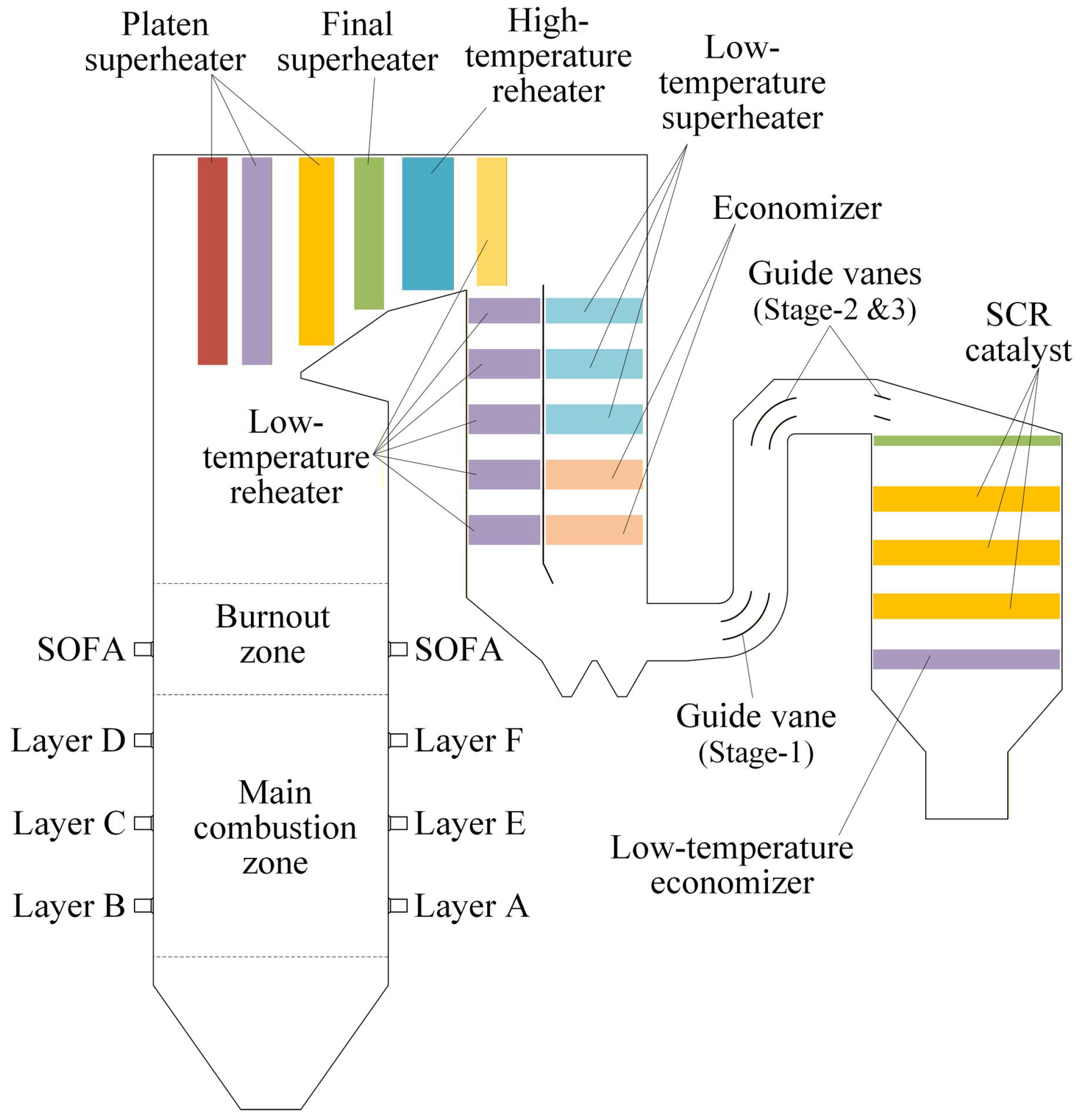
The unit investigated is a 660 MW ultra-supercritical spiral-wound universal pressure (SWUP) boiler manufactured by Beijing Babcock and Wilcox (B&W, Beijing, China). It features a spiral-wound furnace and a single reheat configuration. At rated conditions, the main steam mass flow rate, pressure, and temperature are 1994 t/h, 29.3 MPa, and 605 °C, respectively. The reheat-steam mass flow rate, pressure, and temperature are 1671 t/h, 5.66 MPa, and 623 °C, respectively. The furnace is 15.567 m deep, 23.193 m wide, and 64.50 m high. A divided rear pass is arranged at the back end, and flue-gas temperature control dampers are used to regulate the reheat outlet steam temperature. An SCR system is installed to reduce NOx emissions. The boiler layout is shown in Figure 1, and the main parameters are summarized in Table 1.
The unit adopts a positive-pressure, cold primary air, direct-firing system with six medium-speed coal mills. Each mill supplies one burner layer, labeled from A to F. A total of 36 burners are installed at three elevations on the front and rear walls. Of these, six DRB-4Z burners are installed in layer A, and 30 Airejet burners are arranged in layers B to F.
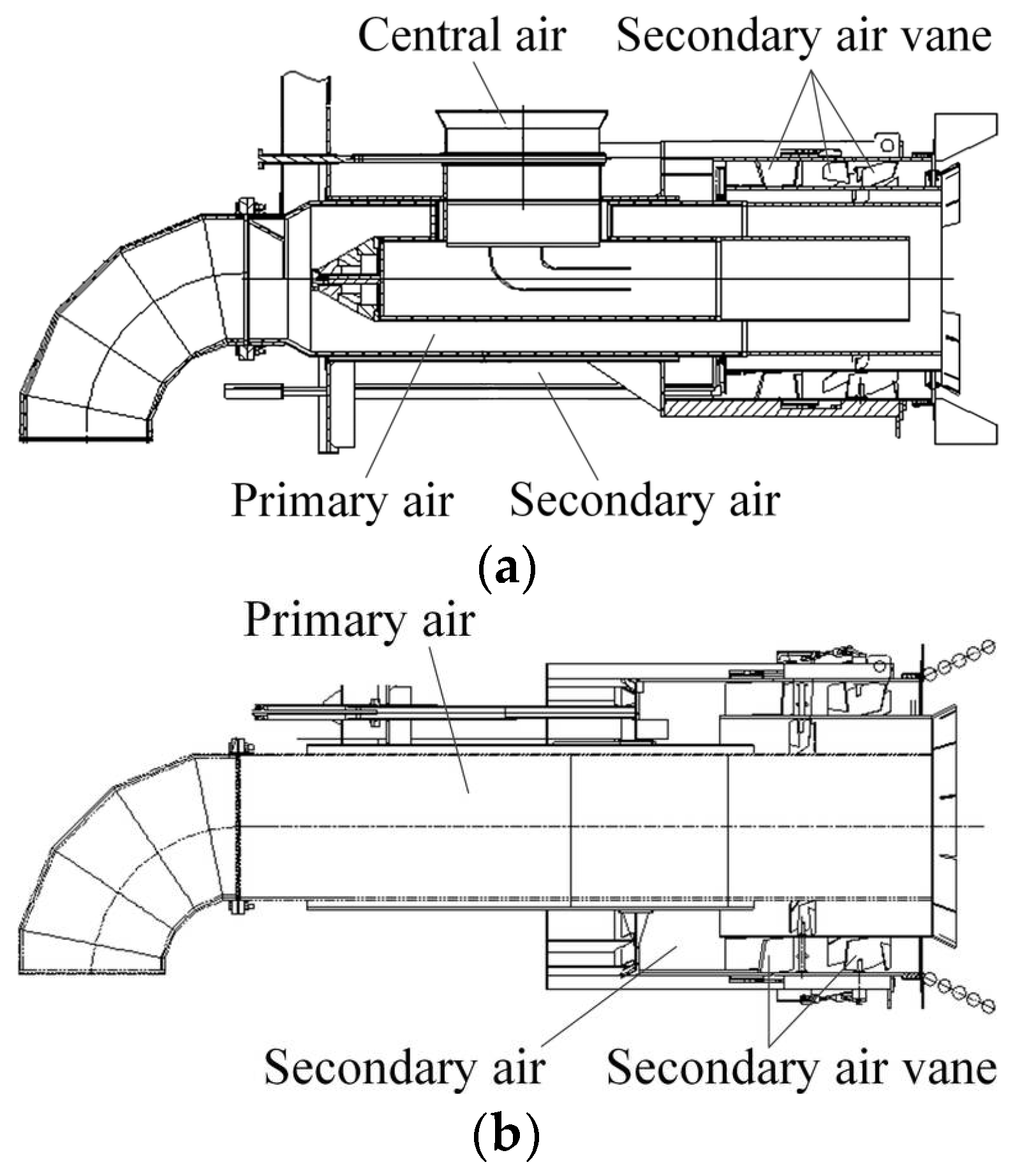
The Airejet is a low-NOx burner that features a central core air jet, as presented in Figure 2a. The intermediate annulus delivers the coal with the primary air, whereas the outermost passage introduces swirling secondary air. This configuration reduces CO and unburned carbon in fly ash under low excess-air conditions, while enhancing NOx suppression. Figure 2b showed that the DRB-4Z is also a low-NOx burner. Its secondary air is divided into inner and outer annuli, whose flow rates can be adjusted independently. A constrained recirculation zone forms between the fuel-rich flame core and the secondary air streams. This recirculation transports combustion products back to oxygen-lean regions, thereby reducing NOx formation.
To further reduce NOx emissions, separated over-fire air (SOFA) nozzles are installed above the main combustion zone. The outer annulus of each nozzle includes adjustable swirl vanes to enhance mixing between the injected air and flue gas. Eight SOFA nozzles are installed on the front wall and eight on the rear wall.
Pulverized-coal fineness at the mill outlet was controlled to an R90 (residue on a 90 μm sieve) of ~20% to ensure stable ignition and adequate burnout. The boiler was designed for Jinbei bituminous coal. The properties of the designed coal and the as-fired coals, including proximate and ultimate analyses, and the as-received lower heating value, are listed in Table 2. The two coals have comparable combustible fractions and heating values. However, the as-fired coal contains higher moisture and volatile matter with a lower ash content. To accurately represent in-furnace combustion under actual operating conditions, the as-fired coal was used as the input fuel.

2.2. Computational Domain and Mesh

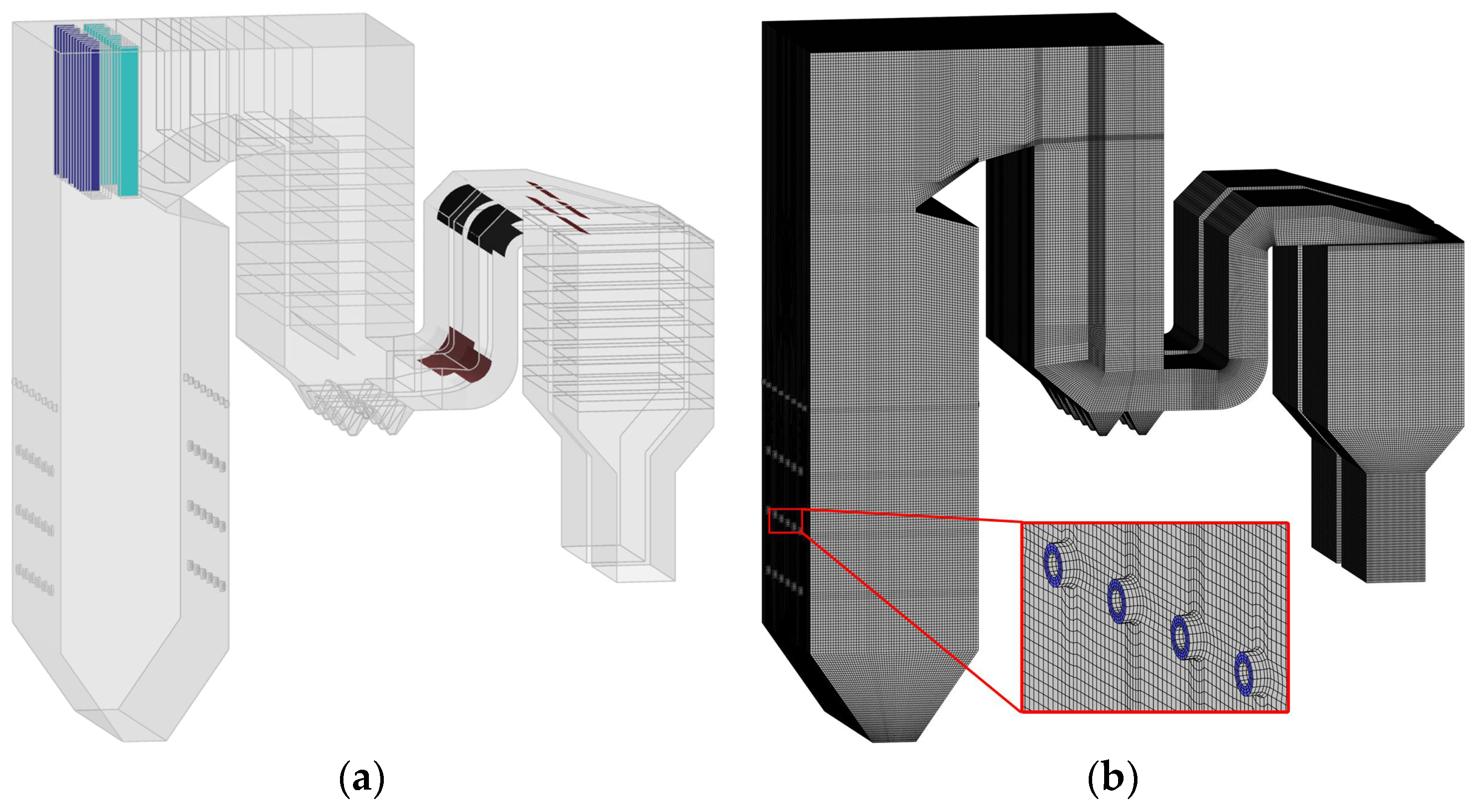
To enable a full simulation of the furnace combustion process, including heat transfer and flue-gas flow, a computational domain covering the entire zone from the furnace to the SCR outlet was established. This domain encompasses all burners, heat-exchange surfaces, including superheaters, reheaters, and an economizer. It also includes key downstream components, such as guide vanes in the SCR inlet duct and the SCR catalyst, as illustrated in Figure 3a.
The computational domain was discretized using a high-quality and all-hexahedral mesh. Compared with tetrahedral or hybrid meshes, hexahedral meshes typically exhibit lower numerical diffusion, improved orthogonality, and more accurate gradient reconstruction in large-scale complex-flow simulations [21]. Therefore, they better resolve velocity gradients, recirculation structures, temperature, and species fields. In addition, hexahedral meshes often improve convergence robustness and accuracy, making them well-suited for full-process CFD simulations with strong coupling among turbulence, particle transport, combustion, and radiation. The boiler is shown in Figure 3b. To ensure mesh-independent results, a total of 4.887 million cells were used in the simulations. The related results are presented in Section 3.1 below.

2.3. Computational Models

2.3.1. Governing Equations and Turbulence Model

The flue-gas flow in the boiler is modeled as a three-dimensional incompressible flow. The governing equations comprise conservation of mass, momentum, and energy. The gas-phase continuity equation is given [22]:
ρ t + · ρ u = s m
Here, ρ is the fluid density, t is time, v is the velocity vector, and Sm is the gas-phase mass source term contributed by the particle phase.
The momentum conservation equation is given as follows [22]:
t ρ v + · ρ v v = p + · τ ̿ + ρ g + F
Here, p is the pressure, τ is the stress tensor, g is the gravitational acceleration, and F is the body force.
The energy conservation equation is given as follows [22]:
t ρ E + · v ρ E + p = j h j J j + S h
Here, E is the internal energy of the fluid, and hj and Jj are the sensible enthalpy and diffusive flux of species j, respectively. Sh is the energy source term.
In addition, the Renormalization Group (RNG) k-ε two-equation model is adopted, and the equations are given as follows [23]:
t ρ k + x i ρ k u i = x j α k μ e f f k x j + G k + G b ρ ε Y m + S k
t ρ ε + x i ρ ε u i = x j α k μ e f f ε x j + G 1 ε ε k G k + G 3 ε G b G 2 ε ρ ε 2 k R ε + S ε
Here, k and ε are the turbulent kinetic energy and its dissipation rate, respectively. μt is the turbulent viscosity. Gk and Gb denote the production of turbulent kinetic energy due to velocity gradients and buoyancy, respectively. YM represents the contribution of the fluctuating dilatation in compressible turbulence to the overall dissipation rate. C, C, and C are model constants, and σk and σε are the turbulent Prandtl numbers for k and ε, respectively. μeff represents the effective viscosity of the fluid. αk and αε are the inverse effective Prandtl numbers for k and ε, respectively. Sk and Sε are user-defined source terms.

2.3.2. Lagrangian Coal-Particle Tracking Model

Since the volume fraction of pulverized-coal and fly ash particles in the flue gas is well below 10%, particle volume effects and inter-particle interaction forces are neglected. Particle motion is therefore simulated using the discrete phase model (DPM). In this approach, the particle force balance is integrated in a Lagrangian framework to obtain particle trajectories, as expressed in Equation (6) [24]:
d u p d t = u u p τ r + g ρ p ρ ρ p + F m p
Here, up is the particle velocity, mp is the particle mass, ρp is the particle density, τr is the particle relaxation time, and F represents external forces other than gravity and drag.
Two-way coupling between the particle and the gas phases is considered. The gas phase drives particle motion through drag, buoyancy, and turbulent-induced dispersion. The evolution of particle temperature is governed by convective heat transfer with the surrounding gas and the gas-phase radiation field. This thermal history affects the release of volatile, ignition, and char burnout. Concurrently, particle devolatilization and combustion release volatiles and oxidation products into the gas phase, while providing energy to the gas through sensible and reaction heat. These processes modify the local temperature, density, and thermophysical properties [25].

2.3.3. Combustion and Radiation Models

Pulverized-coal combustion in the furnace involves moisture evaporation, devolatilization, volatile combustion, and char combustion. Devolatilization is described using a two-competing-rate kinetic model. Char combustion is modeled as a surface reaction jointly controlled by diffusion and kinetics. Gas-phase volatile combustion is simulated using a non-premixed combustion model. All species are assumed to share the same diffusivity, allowing the species transport equations to be reduced to a mixture-fraction equation. Because elemental mass is conserved during chemical reactions, the source terms in the species transport equations cancel, and the mixture fraction becomes a conserved scalar. The governing equation for the mixture fraction is given by [26]:
t ρ f ¯ + ρ v f ¯ = k C p + μ t σ t f ¯ + S m
Here, f is the mixture fraction, k is the thermal conductivity, cp is the specific heat capacity, and Sm is the source term. The transport equation for the mean mixture-fraction variance, f 2 ¯ , is given as follows:
t ρ f 2 ¯ + ρ v f 2 ¯ = k C p + μ t σ t f 2 ¯ + C g μ t f ¯ 2 C d ρ ε k f 2 ¯
Here, δt, Cg, and Cd are constants.
NOx formation was modeled by considering both thermal NOx and fuel NOx. Thermal NOx was evaluated using the extended Zeldovich mechanism based on the local temperature and oxidizer composition. Fuel NOx was computed using global kinetics for the conversion of fuel-bound nitrogen released during devolatilization and char oxidation.
Because furnace temperature can reach 1400–1500 °C, radiative heat transfer is a dominant mode in the furnace and for platen-type heating surfaces. Therefore, the simulations include a radiation model. In this study, the discrete ordinates (DO) radiation model was adopted. For brevity, the detailed equations are available in the literature [27,28]. Particle emission and scattering effects are accounted for in the radiation calculation.
For platen-type heating surfaces, such as superheaters, the wall temperatures were prescribed according to the boiler thermal design data for each specific load. For the remaining convective heating surfaces consisting of tube bundles, a porous-media approach was employed, where the corresponding heat sink was assigned.
In addition, the unburned carbon in fly ash was calculated by relating the residual char mass (based on predicted conversion rates) to the ash content of the as-fired coal.

2.3.4. Erosion and Ash-Deposition Models

The transport of fly ash within the rear-pass duct was simulated using the Lagrangian Discrete Phase Model. To maintain consistency within the full-process numerical framework, particle injection properties, including mass flow rate, size distribution, and temperature, were derived from upstream furnace combustion simulations and subsequent heat transfer calculations. Two-way coupling between the discrete and continuous phases was implemented to resolve interphase momentum and energy exchange. Turbulent dispersion was accounted for using the Discrete Random Walk (DRW) model, with particle motion governed by drag and gravitational forces. Particle trajectories were integrated based on the continuous-phase flow field.
To simulate erosion and deposition of fly ash on the guide vanes in the SCR inlet duct, the Oka model was adopted. This model was proposed by Prof. Oka at Hiroshima University in 2005 and has been validated against experimental data. In this model, the erosion rate E under different particle impact angles α is calculated as follows [29]:
E α = g α K H v k 1 v v k 2 D D k 3
Here, k1, k2, and k3 are constants, taken as −0.12, 2.35, and 0.19, respectively. K is a factor related to particle properties and is set to 65 in the present study. Hv is the Vickers hardness of the tube material and is taken as 1.3. v and D are the particle impact velocity and particle diameter, respectively. v′ and D′ are the reference impact velocity and reference diameter, taken as 104 m/s and 326 μm [30], respectively. The function g(α) represents the erosion mechanism at different impact angles, accounting for repeated plastic deformation and cutting action, and is given by the following expression [29]:
g α = s i n α n 1 1 + H v 1 s i n α n 2
Here, n1 and n2 are coefficients related to particle properties and material hardness, and are taken as 0.77 and 1.36, respectively.
Upon impact, the sticking probability of a particle is governed by its normal impact velocity. Particles exceeding the critical velocity threshold are trapped, while the remainder are reflected. The deposition rate is subsequently derived from the cumulative mass flux of trapped particles on each wall face. A total of 5 × 10⁵ parcels were released for each case to ensure statistical convergence of wall-interaction metrics, such as impingement, trapping, and the resulting erosion/deposition patterns.

2.4. Simulation Conditions

The operating conditions for the simulations are summarized in Table 3. Four representative cases were considered at 100%, 75%, 50%, and 25% load. The corresponding coal feed rates were 255.0, 197.2, 130.5, and 74.1 t/h, respectively. As the load decreases, the primary-air temperature drops from 77 °C to 58 °C, and the secondary-air temperature reduces from 332 °C to 298 °C. Meanwhile, the excess-air ratio increases from 1.15 to 1.25 to reflect the actual air supply performance at low load. The number of in-service burner layers is reduced accordingly. This setup ensures that the combustion organization and boundary conditions for each load case are consistent with actual operation.
The simulations were performed using ANSYS Fluent (version 2019 R3, Ansys Inc., Canonsburg, PA, USA). A pressure-based solver was employed with pressure-velocity coupling achieved by the SIMPLE algorithm. Convection terms were discretized using a second-order upwind scheme, and under-relaxation was applied to improve numerical stability. Iterations continued until the residuals of the energy and radiation equations fell below 10−6, whereas those of all other equations were below 10−3.

3. Results and Discussion

3.1. Mesh Independence Analysis and Model Validation

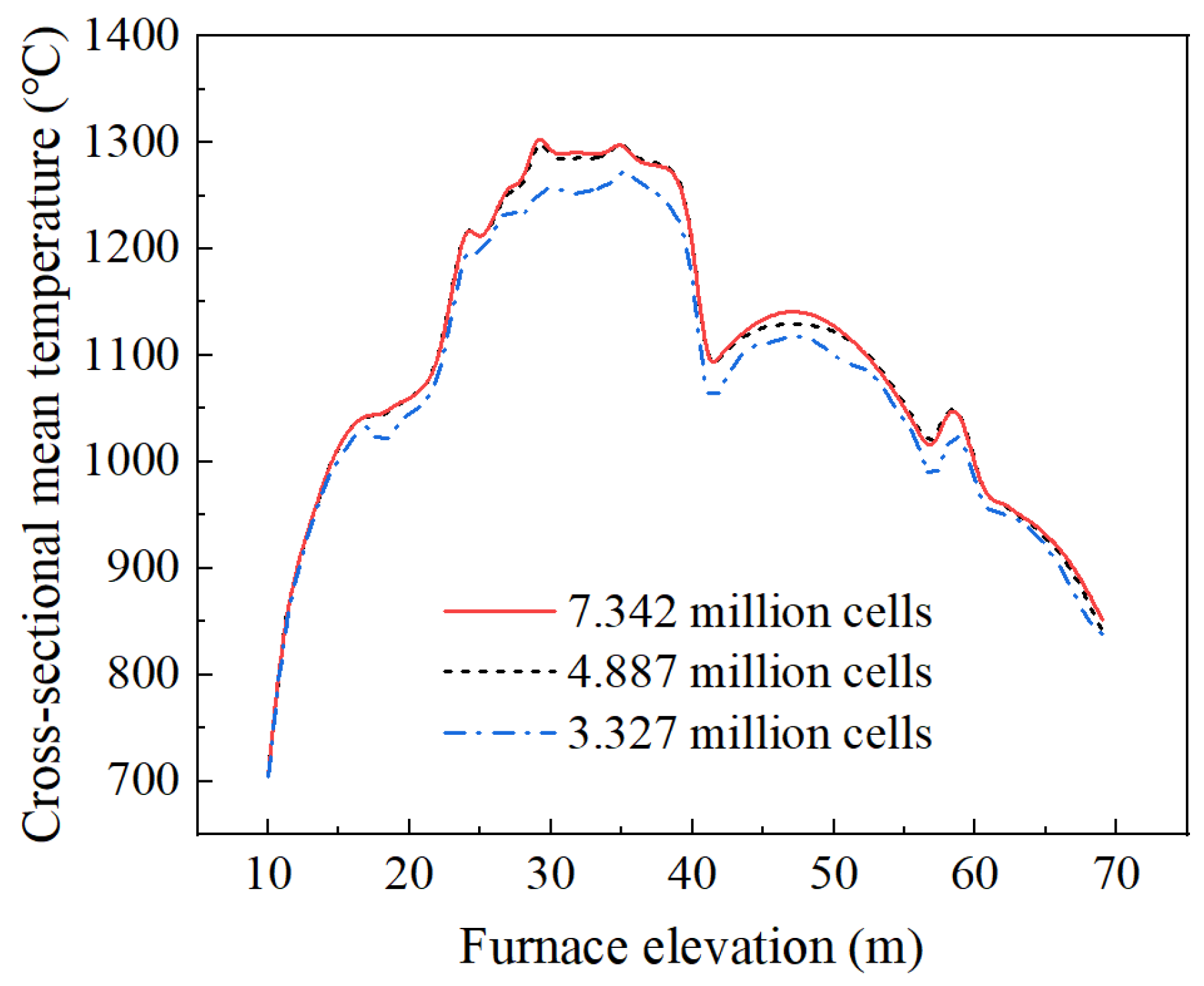
A mesh-independence analysis was conducted to evaluate the sensitivity of the numerical results to mesh resolution. The 100% load case was selected as the representative condition. With the computational domain, physical models, boundary conditions, and solver settings unchanged, three all-hexahedral meshes were generated with 3.327, 4.887, and 7.342 million cells, respectively. The mesh was refined stepwise with an approximate refinement ratio of 1.5. The evaluation metric was the cross-section-averaged flue-gas temperature profile along the furnace height, which reflects the combined effects of heat release in the main combustion zone, burnout of pulverized coal, and heat transfer to the water walls.
As shown in Figure 4, all three meshes capture the same overall trend in cross-section-averaged temperature along the furnace height. The temperature rises rapidly in the lower furnace and reaches a high-temperature plateau in the main combustion zone. It then decreases gradually in the upper furnace and burnout zone because of mixing and heat transfer. Relative to the coarse mesh (3.327 million cells), the medium mesh (4.887 million cells) produces noticeable changes in the main combustion zone and parts of the upper furnace. The resulting temperature profile nearly overlaps with that obtained using (7.342 million cells). The maximum difference in peak temperature is around 10 °C, and the relative deviation is typically <1%. By contrast, the coarse mesh deviates more from the medium mesh, with the peak temperature differences of ~20–30 °C and relative deviations generally <3%. Considering the trade-off between accuracy and computational cost, the mesh with 4.887 million cells was adopted for subsequent simulations.
To validate the numerical model, simulation results at 100% load were compared with field-measurements, as listed in Table 4. Taking the furnace exit gas temperature, the relative deviation between the prediction and measurement was −3.8%, indicating that the model can accurately reproduce the overall combustion, heat release, and heat transfer in the furnace. In addition, the deviations of key indicators (O2, NOx, and unburned carbon in fly ash) were all within ±6%, further supporting the predictive capability of the present modeling approach.

3.2. Combustion Characteristics over a Wide Load Range

3.2.1. Temperature Distributions at Different Boiler Loads

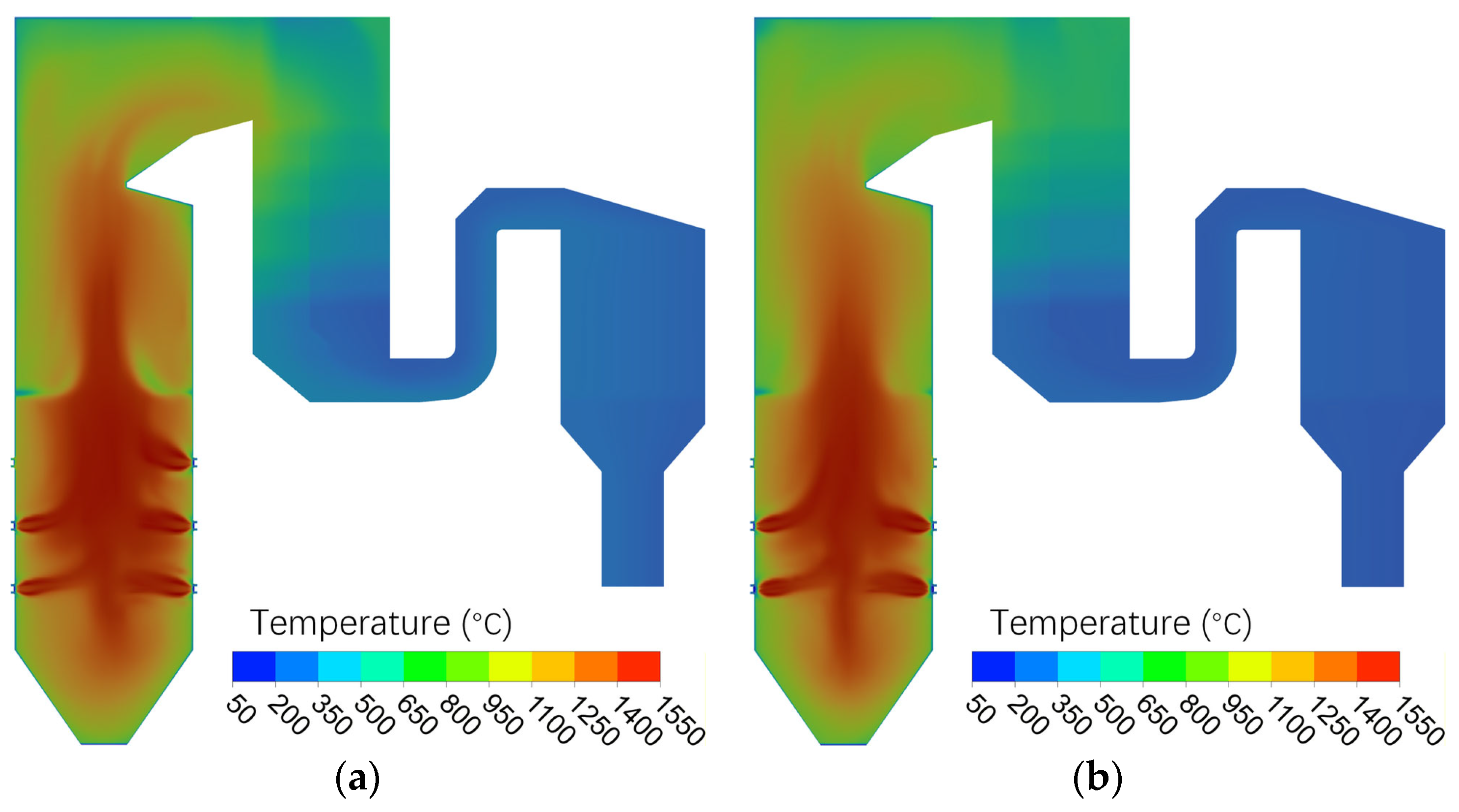
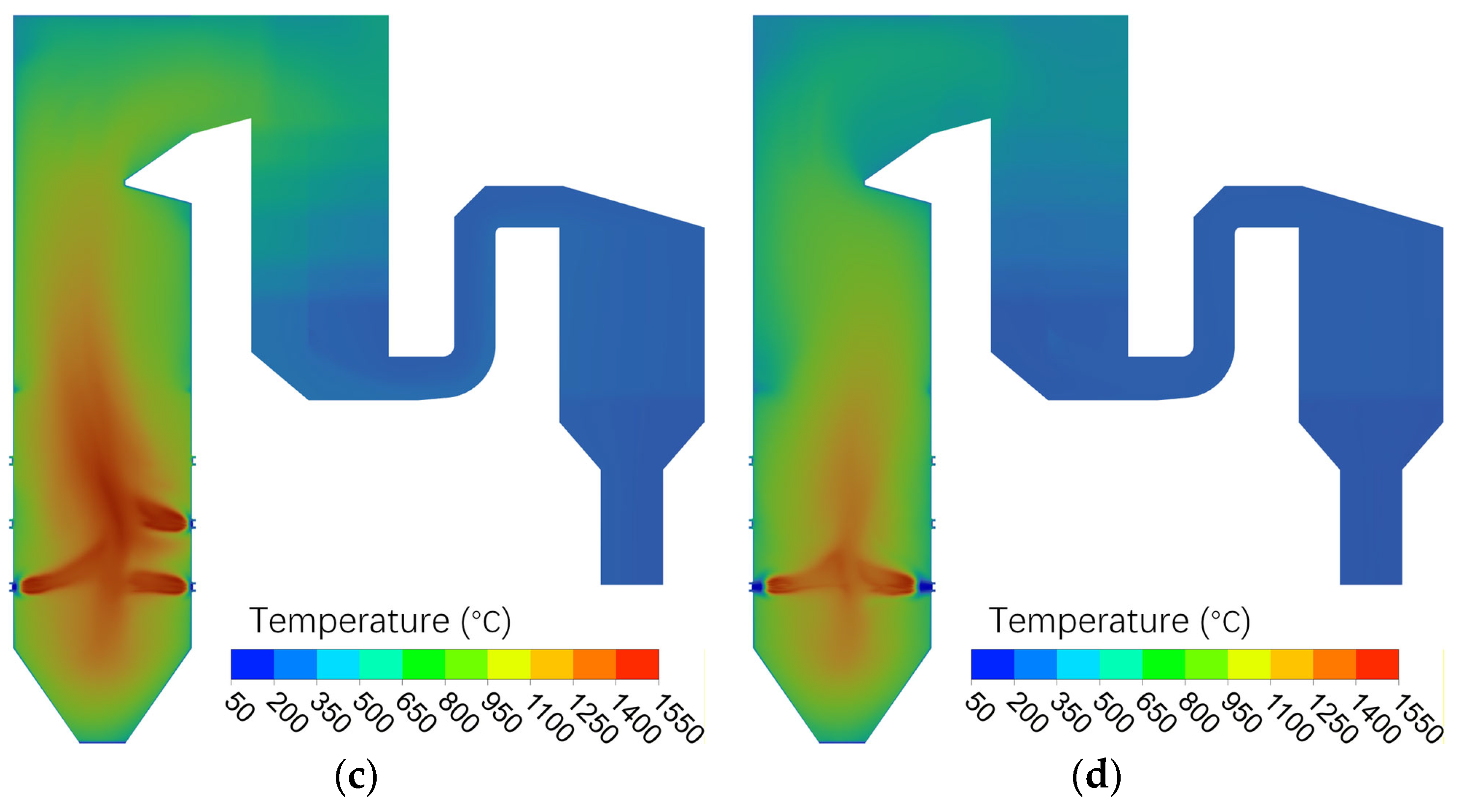
Temperature distributions of a vertical furnace cross-section at different boiler loads are shown in Figure 5. In general, a larger load corresponds to a stronger heat release, and the high-temperature regions occupy a larger fraction of the main combustion zone. As the load increases from 75% to 100%, the high-temperature core rises along the furnace centerline and expands outward, forming a relatively continuous high-temperature region. This trend indicates strong combustion intensity and sufficient gas–solid mixing, resulting in a more stable flame structure. In contrast, at 50% and 25% load, the high-temperature region shrinks markedly, and the temperature in the middle and upper decrease. This reflects reduced heat release and weakened turbulent mixing under low-load operation. At low loads, the decreased concentrations of coal and fly ash particles within the furnace attenuate the particle-phase radiative heat transfer. This weakening of radiative effects leads to a contraction of the high-temperature zone and exacerbates the thermal non-uniformity within the combustion region.
Because SOFA is in service at high-load conditions, a temperature rise is observed above the main combustion zone. This feature reflects re-mixing and secondary burnout of unburned species upon SOFA introduction, which increases flame height and shifts the main heat-release region upward. Additionally, under low-load operation, the combustion intensity is inherently weaker. Meanwhile, the SOFA shutdown reduces oxygen replenishment and secondary burnout in the upper furnace. Consequently, the flame center and the primary heat-release region shift downward. This behavior should be considered in practical operations. A lower flame height may lead to an excessively low furnace exit gas temperature, thereby decreasing heat absorption by convective heating surfaces and causing insufficient main steam temperature. These effects may degrade thermal efficiency and compromise stable unit operation.
In addition, the results indicate that low-load cases exhibit flame eccentricity and thermal asymmetry. At 25% load in particular, the high-temperature region becomes more asymmetric, leading to a less uniform temperature field. Such maldistribution can amplify the non-uniformity of wall heat flux and slagging risk. It may also adversely affect the downstream flow and temperature distributions in the rear pass and the inlet conditions for the SCR system.
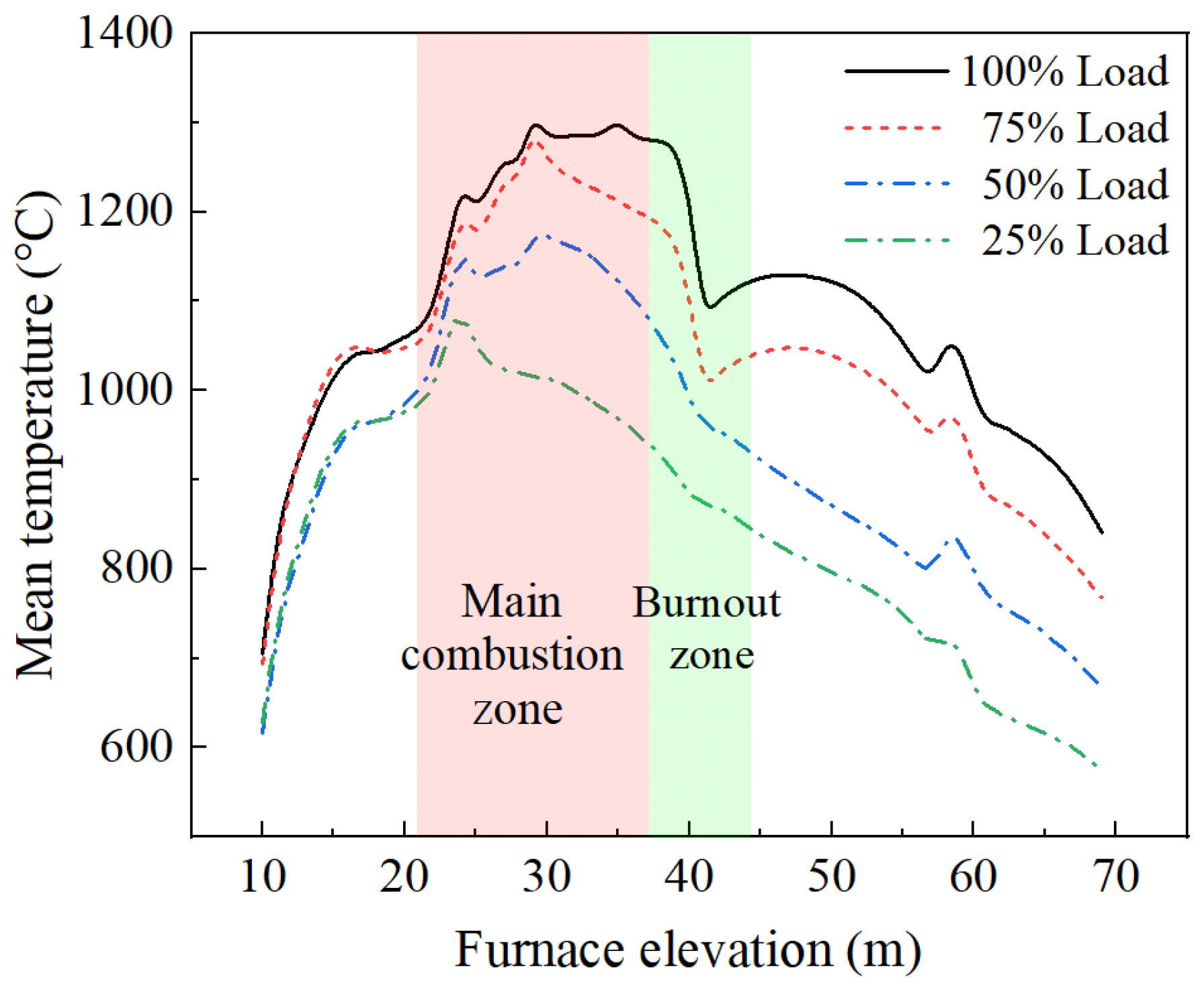
Mean cross-section furnace temperature profiles along the furnace height under different boiler loads are shown in Figure 6. For all cases, the axial temperature varies in a similar pattern. The profile features a rapid rise in the lower furnace, a high-temperature plateau in the main combustion zone, and a gradual decline in the burnout zone. As the load decreases, the temperature profile shifts downward, and both the peak and plateau temperatures in the main combustion zone (~20–35 m) decline significantly. This trend indicates weaker combustion intensity at low load and faster temperature decay in the upper furnace. A small local temperature rise is also observed at around 60 m for all cases. This rise corresponds to the furnace nose, where geometric contraction enhances mixing and homogenization of flue gas with unburned species, leading to a local temperature increase.
The temperature of the main combustion zone is relatively low at 25% load. Consequently, fluctuations in coal quality, such as higher moisture and lower volatile content, may further reduce the furnace temperature and jeopardize combustion stability. This can result in delayed ignition, weakened combustion intensity, and even an increased risk of flameout. Therefore, low-load operation requires rigorous monitoring of fuel quality and boiler air distribution.

3.2.2. Species Distributions and Emission Characteristics at Different Boiler Loads

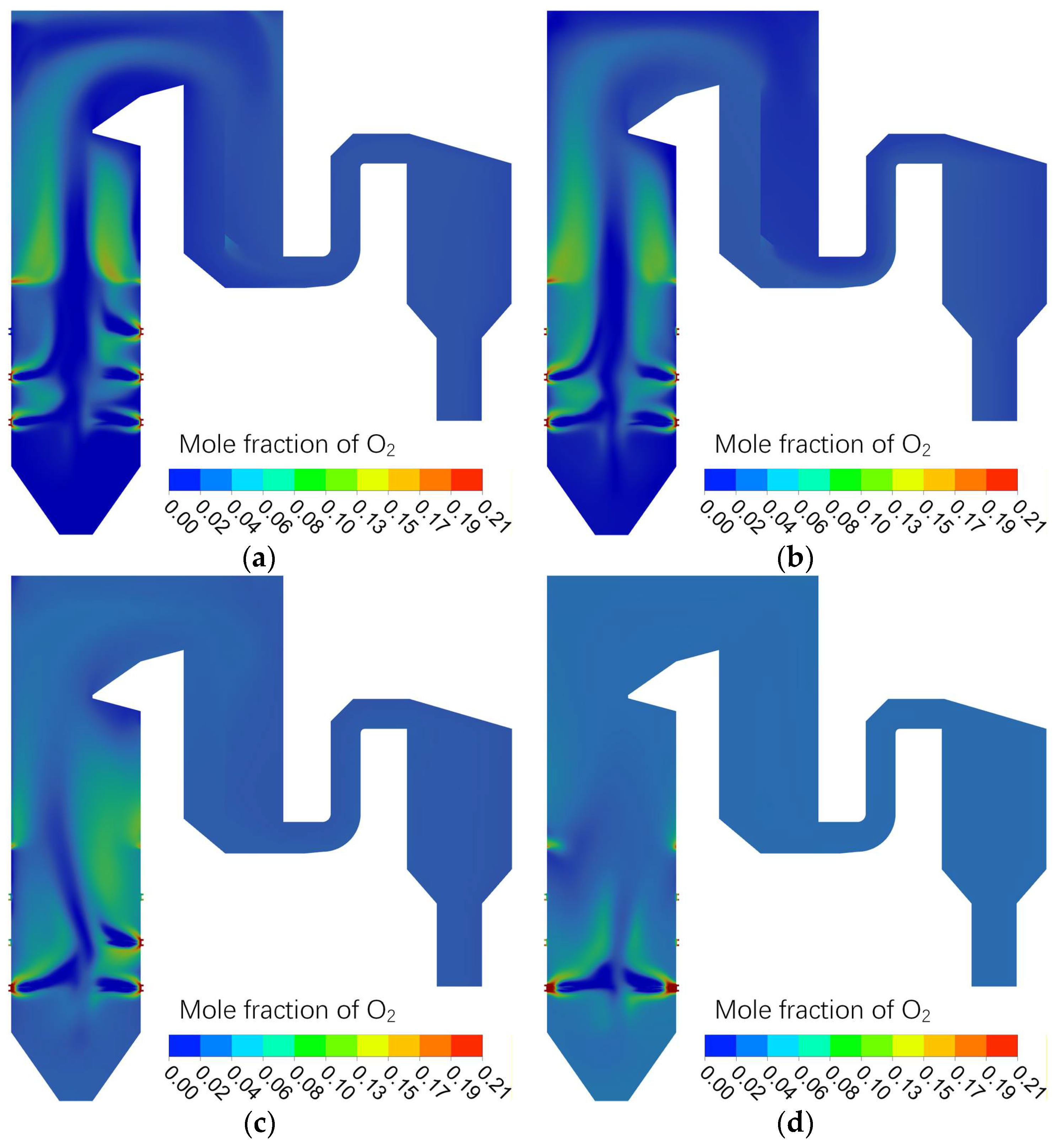
Mean cross-section-averaged O2 mole fraction fields on a vertical furnace plane at different loads are shown in Figure 7. In general, the O2 mole fraction is low in the lower furnace and main combustion zone, increases with height, and becomes relatively uniform in the upper furnace. Near the burners and within the main combustion zone, oxygen is rapidly consumed, forming a broad oxygen-lean region and even near-zero O2 zones. With increasing height, enhanced mixing and progressive oxygen replenishment lead to O2 recovery.
High- and low-load cases correspond to two distinct combustion organization modes. At high loads (100% and 75%), air staging is more pronounced, and concentrated heat release results in rapid oxygen depletion. Consequently, the O2 mole fraction in the main combustion zone approaches zero over a large zone, indicating typical oxygen-lean combustion. In contrast, at low loads (50% and 25%), SOFA is turned off, and the excess-air ratio is increased to maintain stable combustion and sufficient burnout. As a result, overall oxygen availability is higher. This alleviates oxygen-lean conditions in the main combustion zone, shrinking the low-O2 region and producing a more uniform O2 distribution. This shift is expected to further affect the balance between NOx formation and the coal burnout.
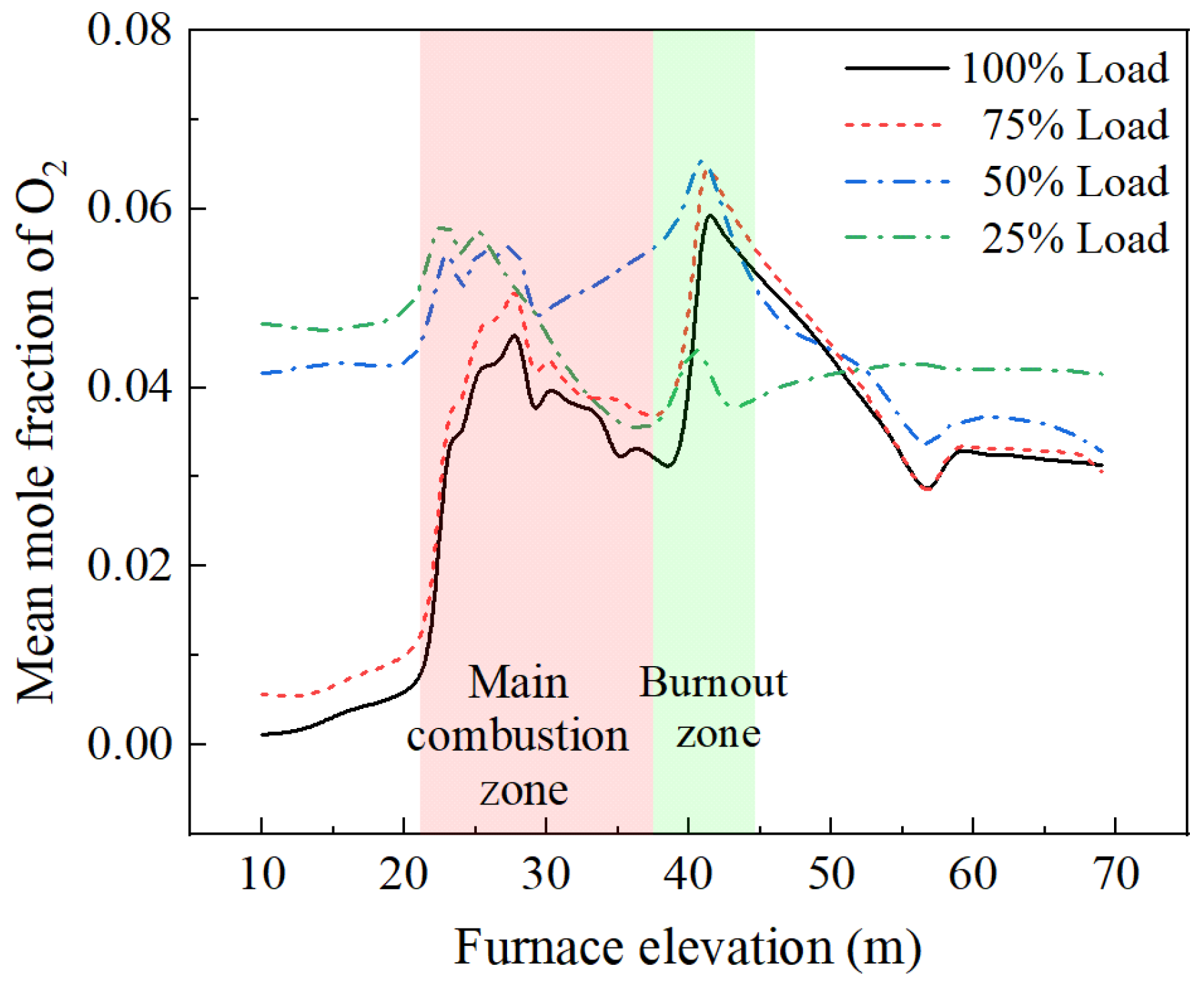
Figure 8 shows the variation in the mean cross-section O2 mole fraction along the furnace height under different boiler loads. In most cases, O2 is rapidly consumed in the main combustion zone, recovers in the burnout zone, and then approaches a stable level in the upper furnace. However, the curve shapes differ markedly among load cases because air-staging strategies vary with load.
At high loads (100% and 75%), O2 is almost completely consumed in the early part of the main combustion zone, approaching zero at low heights. This indicates a strong oxygen-lean, reducing atmosphere in the lower main combustion zone, which suppresses NOx formation and promotes partial reduction reactions. Further upward in the furnace, O2 rises rapidly, indicating enhanced mixing and oxygen replenishment. A peak appears in the burnout zone, mainly due to oxygen addition and intensified mixing when SOFA is in service. The O2 level then decreases and gradually approaches a stable value. At low loads (50% and 25%), the profile shifts upward. Residual O2 in the main combustion zone is higher, and oxygen-lean conditions are substantially alleviated. Meanwhile, the sharp peak in the burnout zone weakens or disappears. This behavior is consistent with low-load operation, where SOFA is turned off, and the excess-air ratio is increased.
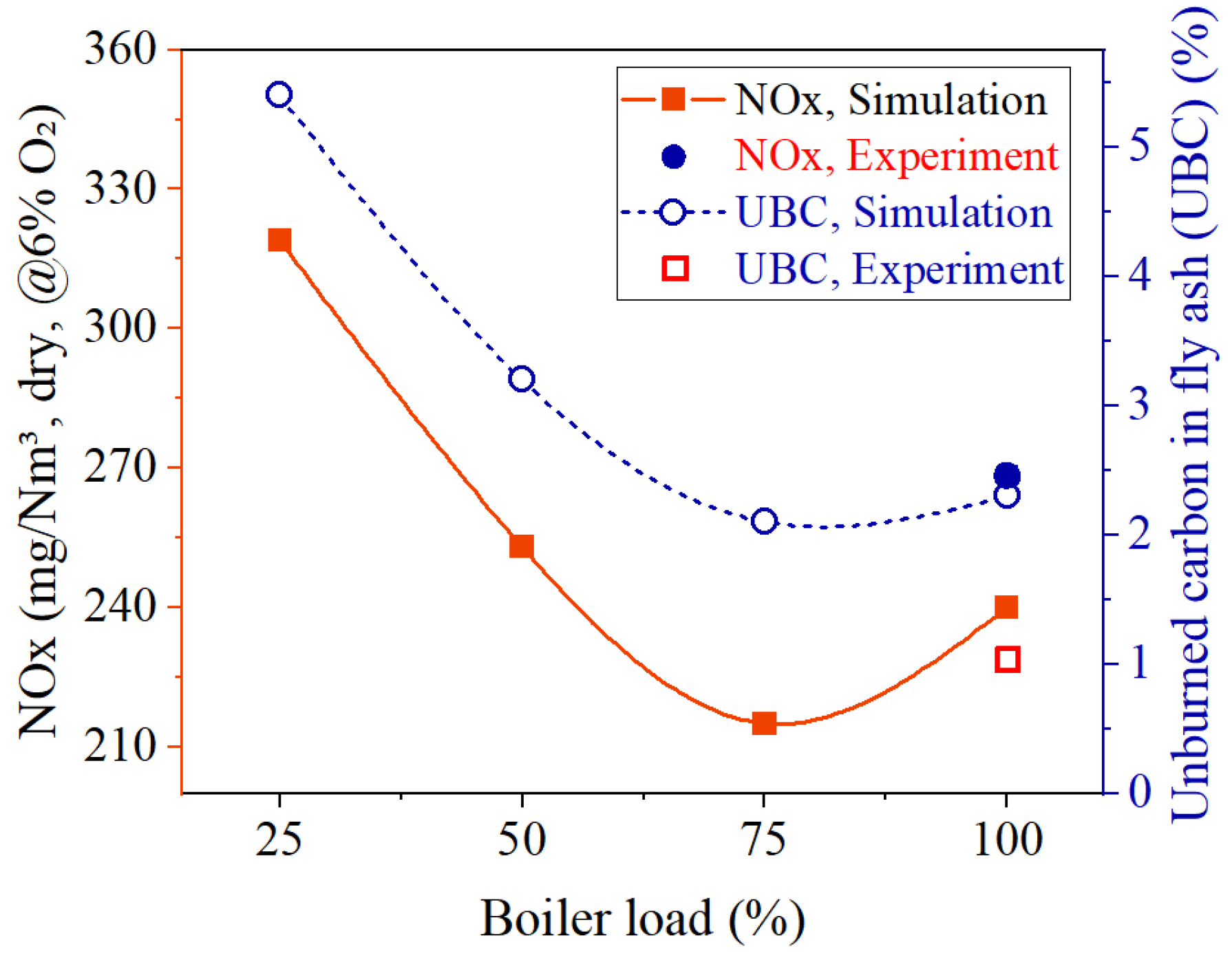
As shown in Figure 9, NOx emissions decrease initially and then increase as load decreases, reaching a minimum at 75% load. This trend is governed primarily by the combined effects of temperature level and air distribution. At 75% load, the furnace temperature is relatively lower, and deep air staging is maintained, which suppresses NOx formation. At 100% load, higher furnace temperature and more pronounced local high-temperature regions favor NOx formation. Accordingly, the contribution of temperature-sensitive thermal NOx increases. When the load is further reduced to 50% and 25%, combustion temperature decreases, but a higher excess-air ratio is required to sustain stable combustion. Effective air staging and a reducing atmosphere are also more difficult to maintain due to operational constraints. As a result, nitrogen-containing intermediates are more readily oxidized to NOx in an oxygen-rich environment, leading to a higher NOx emission at low load, where NOx fuel dominates. Meanwhile, at low-load operation, the lower furnace temperature impairs the effectiveness of air-staged combustion, as the temperature in the reduction zone may be insufficient to trigger rapid NOx reduction reactions. Consequently, the NOx precursors are not effectively converted to N2, resulting in higher exit concentrations.
Unburned carbon in fly ash shows a similar increasing trend at the low-load range. As the load decreases, incomplete burnout becomes more likely. However, the unburned carbon levels at 75% and 100% loads are similar, indicating that combustion organization and temperature level at medium-to-high loads still ensure good burnout. Although the residence time increases at low load, the temperature of the main combustion zone drops markedly. In addition, reduced burner-jet momentum weakens mixing and turbulence enhancement. Both char reaction kinetics and mass transfer are constrained, leading to more unburned carbon in fly ash. Nevertheless, even at low load, the increase in unburned carbon remains below 4%. An estimate suggests that the associated reduction in combustion efficiency does not exceed 0.7%.

3.2.3. Flow Field Characteristics at Different Boiler Loads

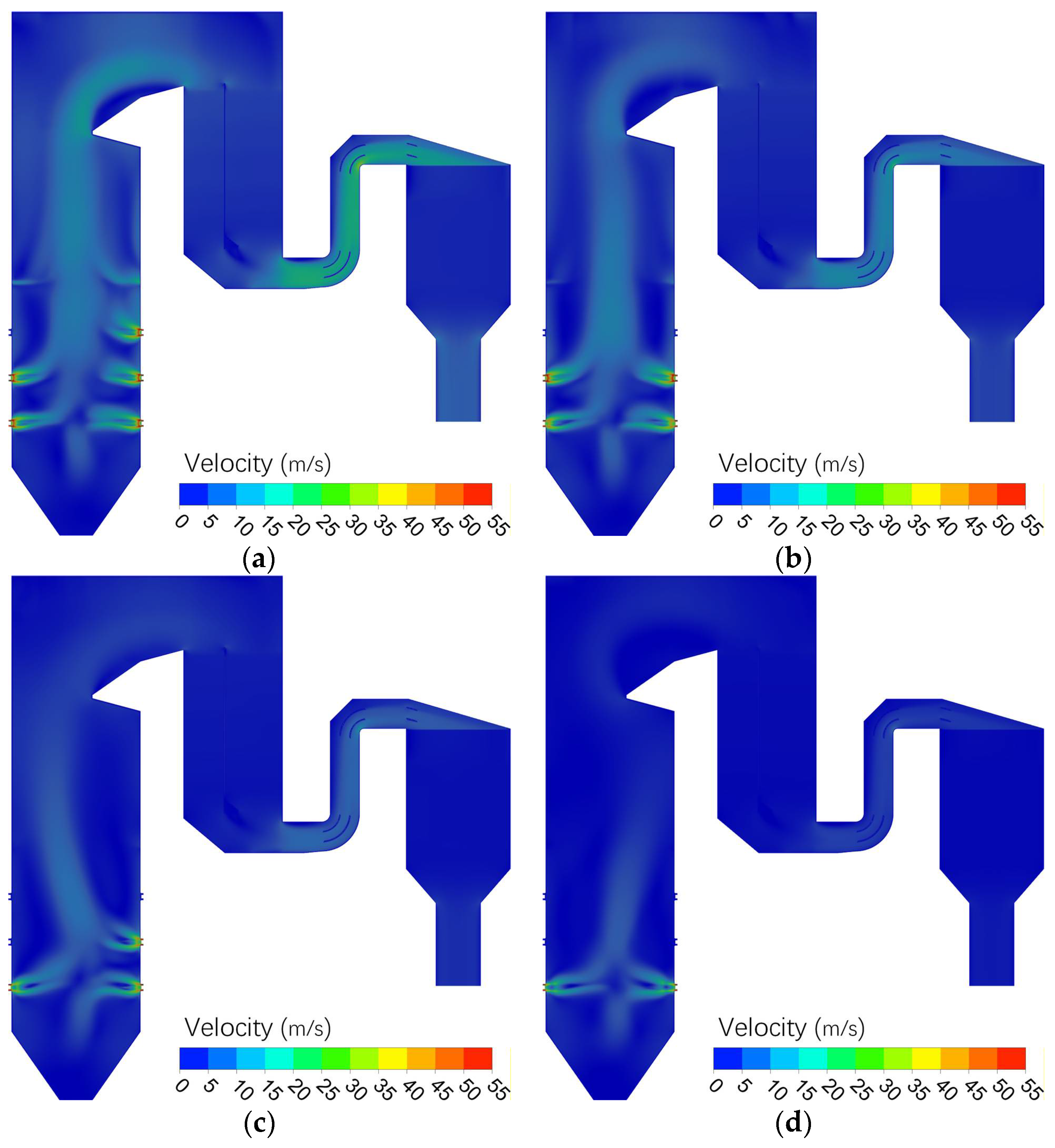
Velocity fields on a vertical furnace cross-section at different boiler loads are shown in Figure 10. Overall, the momentum level decreases as the load reduces. At 100% and 75% loads, burner jets in the main combustion zone are strong, and the velocity gradients are large, promoting entrainment and mixing. Under low-load operation, jet momentum and turbulence intensity decrease markedly, leading to increased non-uniformity and local flow bias in the main combustion zone. At 25% load in particular, small perturbations can be amplified through positive feedback in high-shear and recirculation regions, resulting in symmetry breaking and an asymmetric flow field.
In addition, the velocity non-uniform distribution of the SCR inlet duct is notable, indicating that the existing guide vanes provide limited flow straightening and redistribution. This non-uniformity can directly degrade velocity uniformity at the SCR inlet and thus the denitrification performance. Therefore, guide vane optimization for the SCR inlet duct is carried out in the following sections.

3.3. Flow Field Optimization for the SCR System

3.3.1. Optimization Design of the Guide Vanes

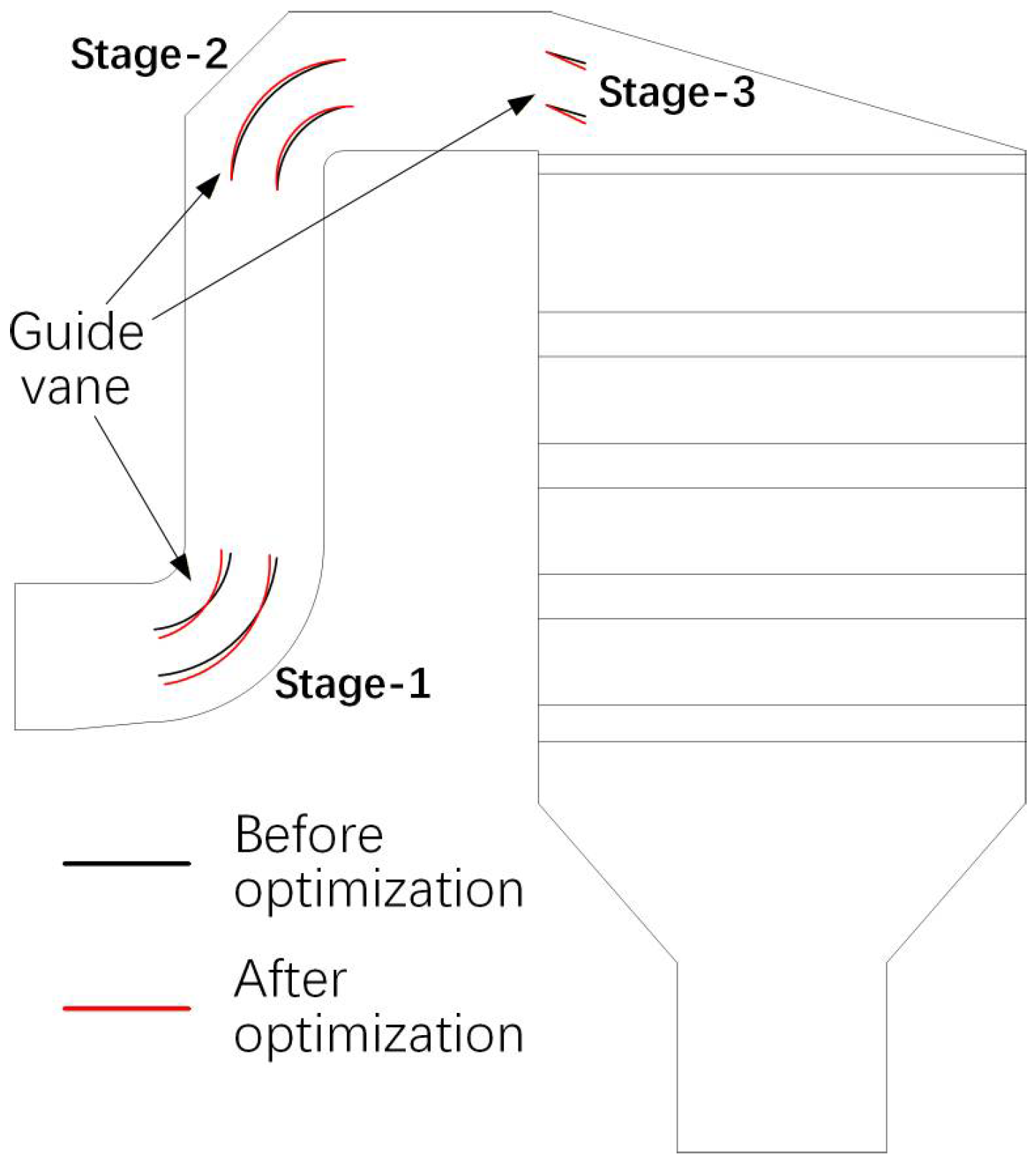
The full-process simulations reveal pronounced flow non-uniformity in the SCR inlet duct (Figure 10). The flow features a biased mainstream, with coexisting local high-velocity regions and low-velocity recirculation zones. This indicates that the original flow-guiding configuration has limited capability for flow redistribution, motivating improvements to the guide vane arrangement. Accordingly, the guide vanes were optimized, as illustrated in Figure 11. The original and optimized configurations are denoted in black and red, respectively. The optimization aims to guide the main flow smoothly along the wall, suppress separation and secondary-flow development in the bend, and redistribute high-momentum gas from locally concentrated regions over a larger cross-sectional area. In this way, flow bias in the turning section is mitigated, and the velocity uniformity upstream of the SCR reactor is improved.

3.3.2. Flow Characteristics Before and After Optimization

The simulation before and after the guide vane optimization was conducted using the same boundary conditions and the same numerical settings. The inlet boundary conditions were taken from the previous furnace combustion calculation results. It should be noted that the SCR system is considered only from the perspective of flow-field optimization. The analysis focuses on enhancing the velocity distribution and flow uniformity upstream of the catalyst layers. Therefore, NH3 injections, reaction kinetics, and NOx conversion are not included in the present study.
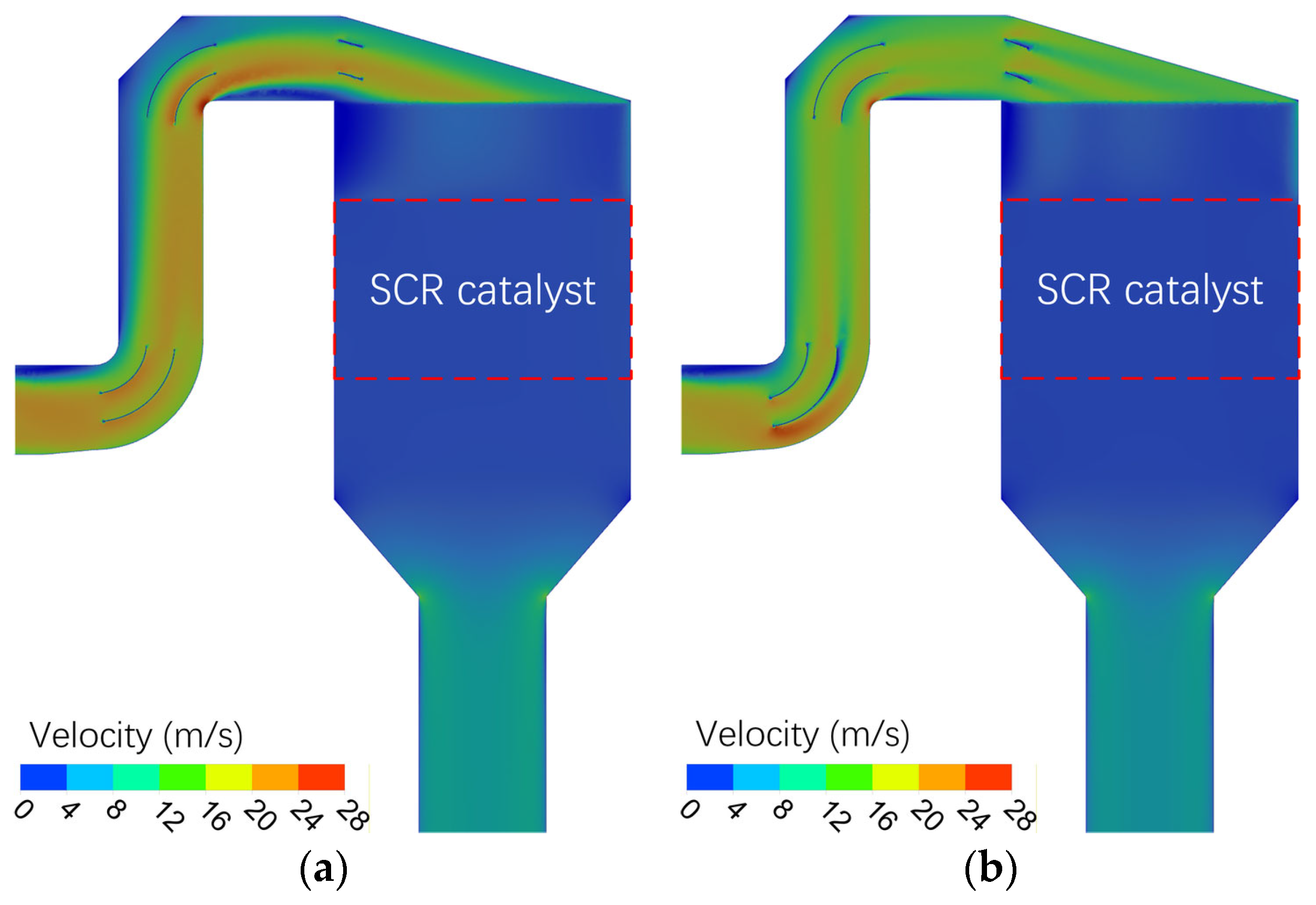
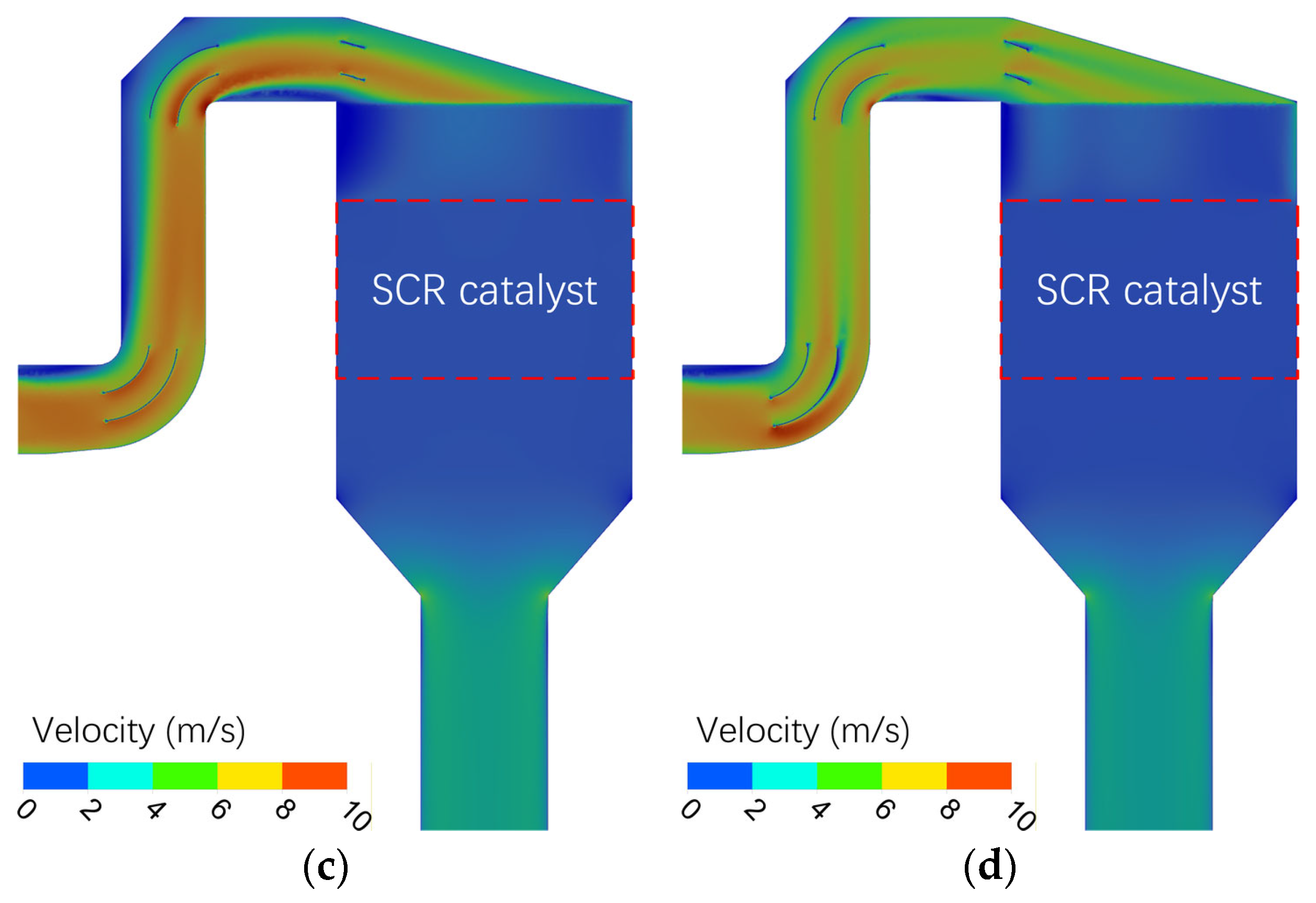
Figure 12 compares velocity contours on a vertical cross-section of the SCR system before and after guide vane optimization at 100% and 25% boiler loads. In both cases, the original configuration exhibits pronounced velocity maldistribution in the first upward duct. Velocities are significantly higher in the region adjacent to the SCR reactor. After optimization, the velocity distribution in this region becomes more uniform. Moreover, the flow homogeneity improves markedly in the duct segments containing the second and third stage guide vanes. As a result, a more uniform velocity distribution is achieved at the SCR catalyst inlet.
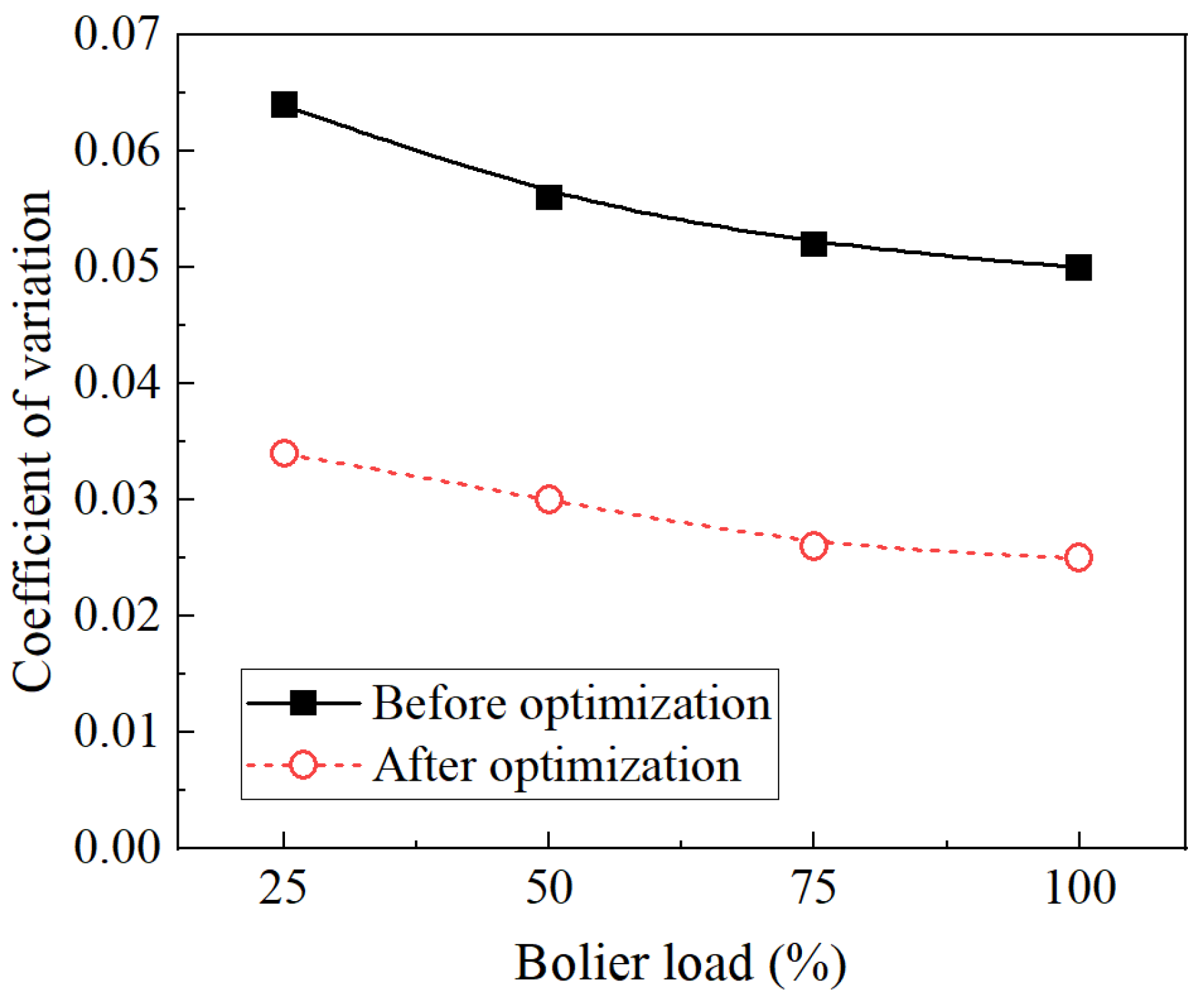
To further quantify the velocity uniformity of flue gas entering the SCR catalyst inlet, the coefficient of variation (CoV) is introduced [31]. A smaller CoV indicates a lower velocity dispersion and thus a more uniform velocity distribution. CoV is defined as the ratio of the standard deviation of velocity over the cross-section to the cross-sectional mean velocity:
CoV = σ u u ¯
where u ¯ and σ u are defined as follows:
u ¯ = 1 N i = 1 N u i
σ u = 1 N i = 1 N ( u i u ¯ ) 2
In the equation, u is the velocity magnitude, ū is the cross-sectional mean velocity, i is the sampling-point index, and N is the number of sampling points on the cross-section.
Figure 13 further presents the CoV of the flue-gas velocity at the SCR catalyst inlet as a function of boiler load. Before optimization, CoV values remain high at all loads (>0.05) and increase further at low loads. For example, at 25% load, CoV rises to 0.064. This indicates that the low-load operation makes the SCR inlet duct more prone to flow bias and localized high-velocity streaks, degrading velocity uniformity at the SCR inlet. The underlying reason is that the flow-conditioning effectiveness of the guide vanes decreases markedly at low loads. As flue-gas velocity decreases, dynamic pressure decreases approximately with the square of velocity, weakening the inertial constraint and forced redistribution imposed by the guide vanes. Meanwhile, disturbances induced by gravity and thermal buoyancy become more influential. In addition, the resistance-based flow-balancing effect of the guide vanes diminishes at low velocity, making it difficult to redistribute flow among regions. Therefore, flow maldistribution becomes more severe than that under the design condition (100% load).
After applying the improved guide vane configuration (Figure 11), CoV is significantly reduced across the full load range. At 25% load, CoV decreases from 6.4% to 3.4%, and at 100% load, it drops from 5.0% to 2.5%, representing a substantial reduction of approximately 50% across both conditions. These results indicate that the optimized guide vanes can effectively improve the SCR inlet velocity uniformity over a wide load range, with a more pronounced benefit at low loads. This provides more favorable inlet conditions for enhancing denitrification.

3.3.3. Erosion and Ash Deposition on the Guide Vanes Before and After Optimization

The dominant risks to the guide vanes differ between high- and low-load operation. At high load, the bulk velocity in the SCR inlet duct is higher. Particle inertia and impact of kinetic energy increase accordingly, making intense erosion more likely in the turning section and on the windward surfaces of the guide vanes. Therefore, erosion is the primary concern under high-load conditions. At low load, both flue-gas velocity and particle speed decrease, and erosion is substantially reduced. However, gravitational settling and near-wall residence become more prominent. Coarse fly ash tends to deposit and accumulate in the low-velocity recirculation zones and on the leeward sides of the guide vanes, potentially causing ash buildup and blockage. Accordingly, this study focuses on ash-induced erosion at high-load conditions and ash deposition under low-load conditions.
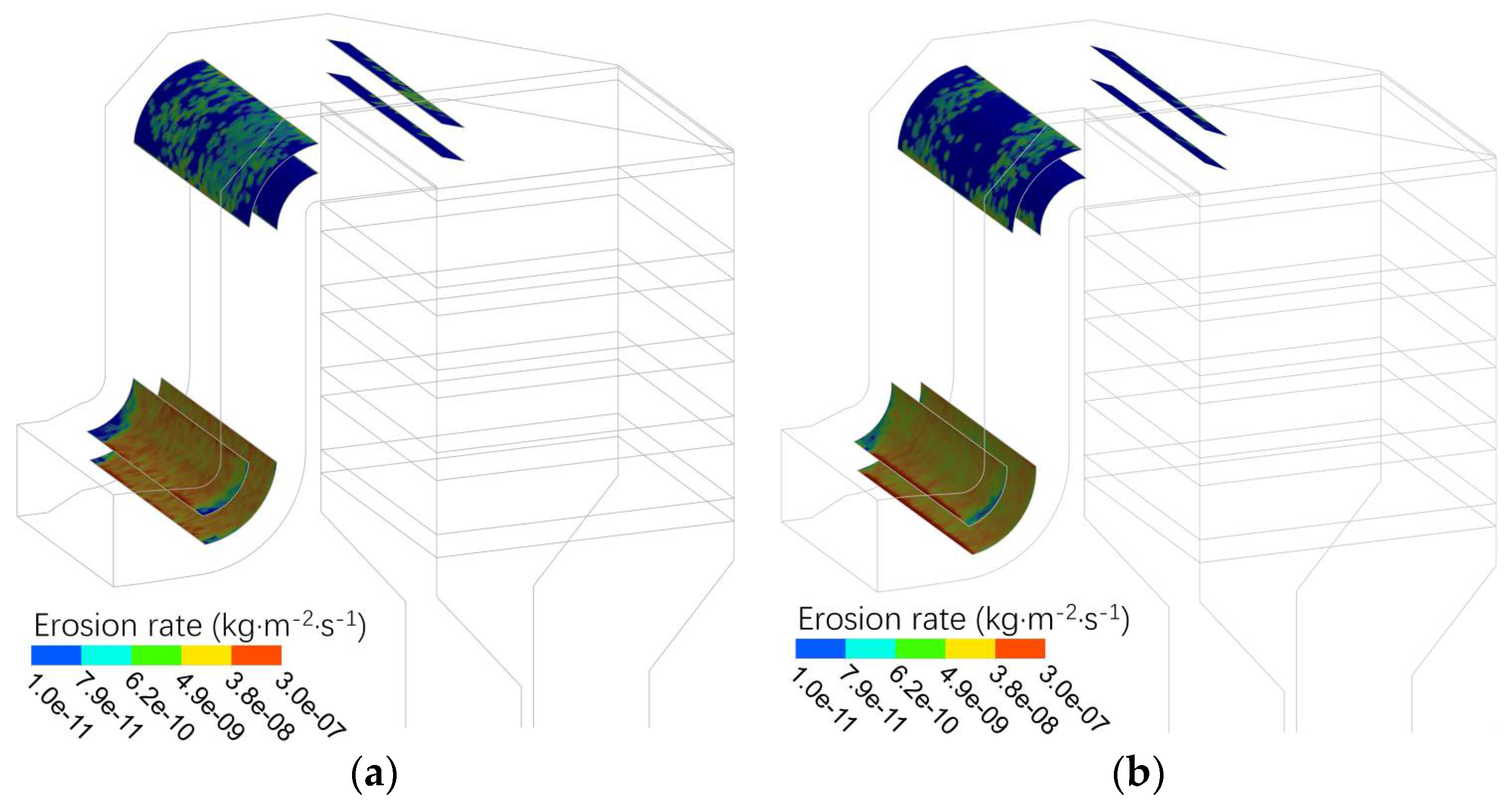
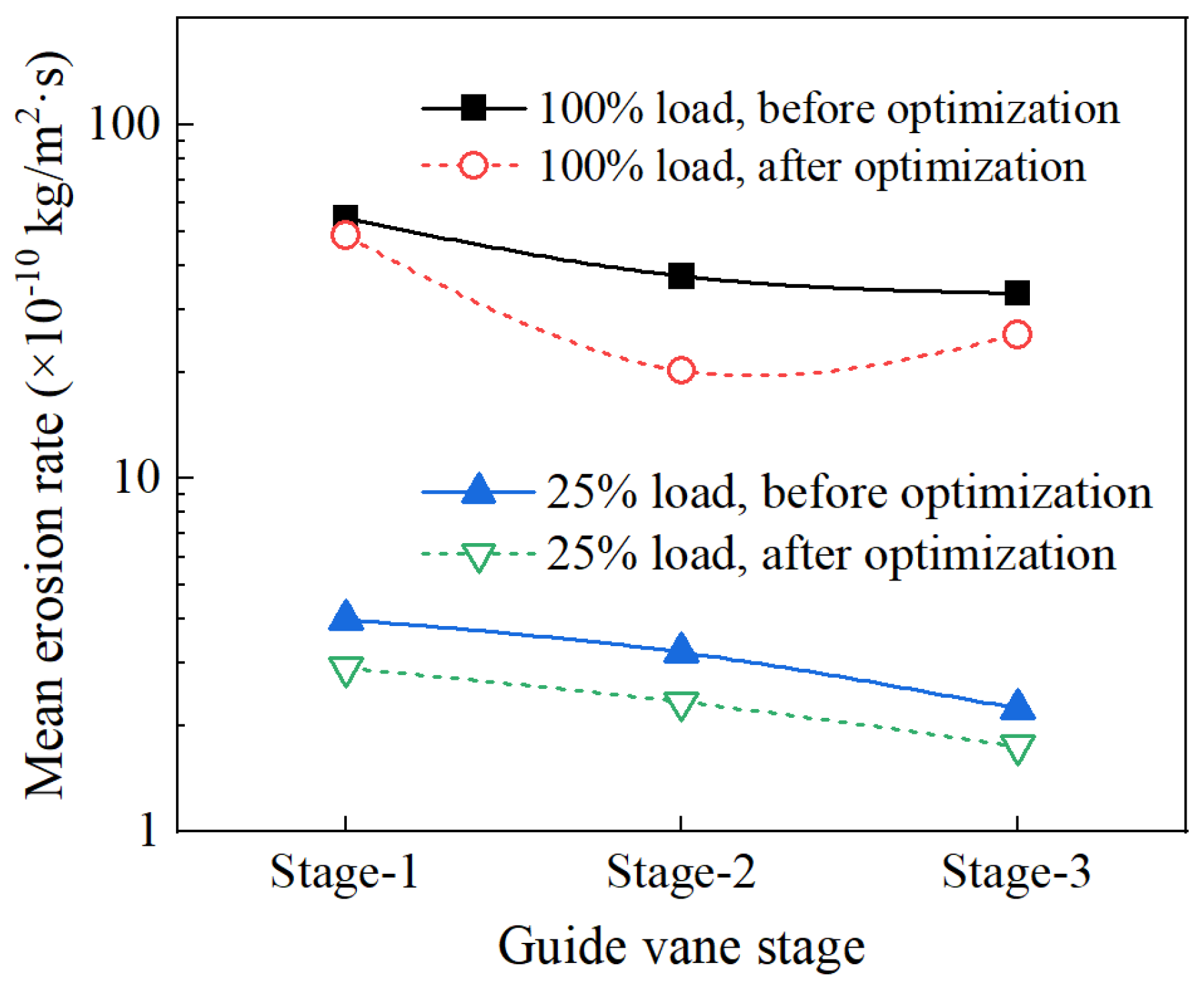
As shown in Figure 14, at 100% load, ash erosion is primarily localized within two distinct regions: the outer extrados of the bend and the leading edges of the guide vaness. This is attributed to the fact that fly ash particles cannot fully follow the rapidly changing streamlines during a sharp turn. Owing to inertia, particle trajectories diverge from the gas streamlines and directly impinge on the windward surfaces. Before optimization, a large high-erosion region appears on the stage-1 guide vane, with a peak erosion rate reaching the order of 10−7 kg·m−2·s−1. After optimization, the high-erosion area decreases substantially. This indicates that geometric modification improves flow organization, thereby minimizing particle impingement and mitigating erosion risk for the guide vanes.
Figure 15 shows the mean erosion rates of the guide vanes under different boiler loads. Erosion rates at 100% load are substantially higher than those at 25% load, by roughly one order of magnitude. The stage-1 guide vanes exhibit the highest erosion rates, indicating that the first guide vane downstream of the bend is most exposed to strong particle scouring and direct impingement on the windward surface. After optimization, the erosion of the guide vanes is reduced markedly, especially for the stage-2 guide vanes. This improvement is closely related to the optimized stage-1 guide vanes, which enhance the flow uniformity in the first upward duct, as shown in Figure 12a,b.
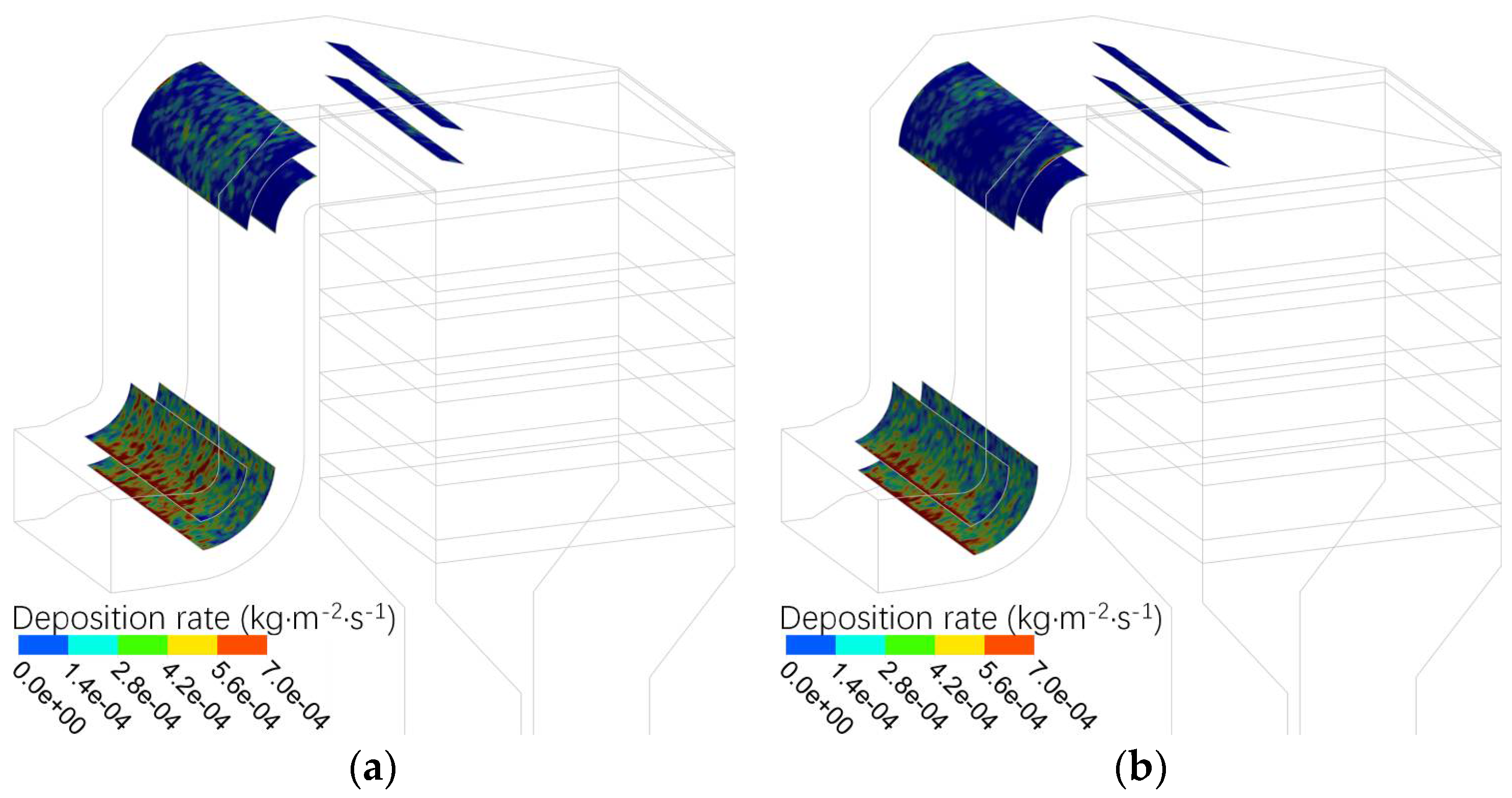
At 25% load, the flue-gas velocity is low, which increases particle residence time near the bend and the guide vanes. Under such conditions, gravitational settling and inertial deposition become more dominant. The distribution of ash deposition rate is shown on Figure 16. Before optimization, deposition is mainly concentrated on the windward surface of the stage-1 guide vane and in the bend region, as well as on the stage-3 guide vane, with deposition rates reaching the order of 10−4 kg·m−2·s−1. After optimization, the deposition on the surfaces of all guide vanes is significantly reduced.
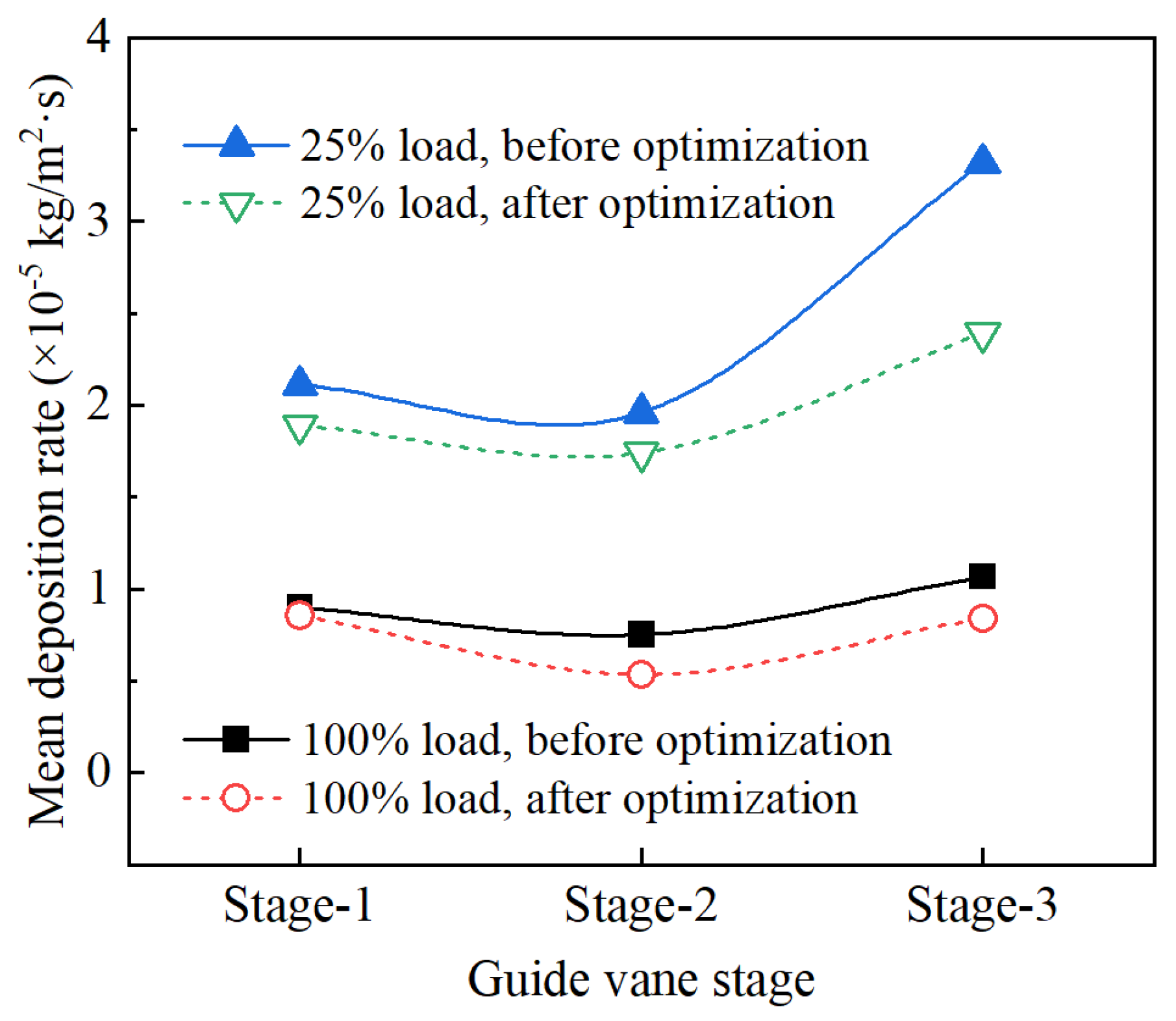
Figure 17 illustrates the average ash deposition rates on the guide vanes as a function of boiler load and the optimized configuration. At high loads, deposition rates are very low because particles are readily carried away by the main flow. The optimized configuration results in even lower deposition. At 25% load, deposition is mainly induced by local flow separation and stagnation. Mean deposition rates on the stage-1 and stage-2 guide vanes are on the order of 2.0 × 10⁻⁵ kg·m−2·s−1, whereas the rate on the stage-3 guide vanes increases further. This behavior is associated with the lower local velocity in this region and the guide vane inclination being closer to horizontal.

4. Conclusions

This study developed a full-process numerical model spanning from the furnace to the SCR outlet to investigate the operating characteristics of a 660 MW coal-fired boiler over a 25–100% BMCR range. The results demonstrate that full process coupled modeling more accurately captures the complex combustion and flow behaviors inside the boiler than conventional decoupled simulations. Model validation shows good agreement with field measurements, thereby supporting the reliability of the proposed approach for ultra-supercritical boilers operating at varying loads. The main conclusions are summarized as follows:
In terms of furnace combustion behavior, reducing the boiler load results in a general decrease in combustion intensity and turbulent mixing, accompanied by a reduction in size of the high-temperature core. At low loads, a higher excess air ratio increases the overall oxygen level in the furnace and alters the local oxygen concentration, thereby affecting the balance between NOx formation and reduction. Simulations indicate that NOx emissions decline as the load decreases from 100% to 75%. This is due to thermal NOx being suppressed by lower furnace temperatures, combined with the sustained NOx reduction within local reducing zones. However, when the load is reduced to 25–50%, air staging becomes less effective and NOx emissions increase. Meanwhile, the weakened high-temperature region in the main combustion zone limits burnout, resulting in higher levels of unburned carbon in the fly ash. In addition, operating at low-load increases the risk of flow maldistribution in the furnace.
Regarding the SCR flow optimization, it was found that the original guide vane configuration provided inadequate flow redistribution. This results in pronounced maldistribution at the inlet of the SCR catalyst, which worsens as the load decreases. Reconstructing the guide vane arrangement and angles significantly improves velocity uniformity in the SCR inlet duct and at the SCR inlet plane over the full load range and reduces the CoV by about 50%. Furthermore, the results show that both guide vane erosion at high load and ash deposition at low load are markedly mitigated after optimization.

Author Contributions

Conceptualization, G.Z.; methodology, X.F.; investigation, Z.C.; Visualization, Writing—review and editing, J.X.; Writing—original draft, G.Z. All authors have read and agreed to the published version of the manuscript.

Funding

This research received no external funding.

Data Availability Statement

The original contributions presented in this study are included in the article. Further inquiries can be directed to the corresponding author.

Acknowledgments

The authors gratefully acknowledge Yufan Chen and Haibin Yang for providing boiler technical data for the numerical simulations and for sharing experimental measurements used to validate the CFD model.

Conflicts of Interest

Authors Xiangdong Feng, Jin Xiang and Zhen Chen were employed by the company Zhejiang Energy Group R&D Co., Ltd. The remaining authors declare that the research was conducted in the absence of any commercial or financial relationships that could be construed as a potential conflict of interest.

Abbreviations

The following abbreviations are used in this manuscript:
SCRSelective Catalytic Reduction
CFDComputational Fluid Dynamics
BMCRBoiler Maximum Continuous Rating
NOxNitrogen Oxides
SOFASeparated Over-Fire Air
DPMDiscrete Phase Model
DODiscrete Ordinates
CoVCoefficient of Variation
DRWDiscrete Random Walk

References

  1. Du, X. Thoughts on strategies and paths to achieve carbon peaking and carbon neutrality in China. Front. Energy 2023, 17, 324–331. [Google Scholar] [CrossRef]
  2. Li, M.; Li, F.; Qiu, J.; Zhou, H.; Wang, H.; Lu, H.; Zhang, N.; Song, Z. Multi-objective optimization of non-fossil energy structure in China towards the carbon peaking and carbon neutrality goals. Energy 2024, 312, 133643. [Google Scholar] [CrossRef]
  3. Li, J.; Mi, Z.; Yu, Y. Research on the classification and evaluation of large-scale user load patterns for grid supply–demand balance regulation demands. Appl. Energy 2025, 397, 126301. [Google Scholar] [CrossRef]
  4. Taler, J.; Trojan, M.; Dzierwa, P.; Kaczmarski, K.; Węglowski, B.; Taler, D.; Zima, W.; Grądziel, S.; Ocłoń, P.; Sobota, T.; et al. The flexible boiler operation in a wide range of load changes with considering the strength and environmental restrictions. Energy 2023, 263, 125745. [Google Scholar] [CrossRef]
  5. Chen, G.; Li, Z.; Zhang, H.; Huang, L.; Liu, Z.; Fan, W. Influences of ultra-low load operation strategies on performance of a 300 MW subcritical bituminous coal boiler. Appl. Therm. Eng. 2024, 256, 124037. [Google Scholar] [CrossRef]
  6. Jiang, Y.; Lee, B.-H.; Oh, D.-H.; Jeon, C.-H. Influence of various air-staging on combustion and NOX emission characteristics in a tangentially fired boiler under the 50% load condition. Energy 2022, 244, 123167. [Google Scholar] [CrossRef]
  7. Li, X.; Zeng, L.; Zhang, N.; Chen, Z.; Li, Z.; Qin, Y. Effects of the air-staging degree on performances of a supercritical down-fired boiler at low loads: Air/particle flow, combustion, water wall temperature, energy conversion and NOX emissions. Fuel 2022, 308, 121896. [Google Scholar] [CrossRef]
  8. Rossiello, G.; Uzair, M.A.; Ahmadpanah, S.B.; Rogora, M.; Saponaro, A.; Torresi, M. Integrated use of CFD and field data for accurate thermal analyses of oil/gas boilers. Fuel 2023, 335, 126931. [Google Scholar] [CrossRef]
  9. Li, X.; Lin, H.; Wang, G.; Dai, G.; Chen, Y.Q.; Luo, Y.; Zhang, Y.; Zhang, J.; Tan, H.; Axelbaum, R.L.; et al. A full-scale staged, pressurized oxy-biomass combustion towards BECCS: Performance assessment via CFD approach. Energy 2025, 326, 136262. [Google Scholar] [CrossRef]
  10. Zeng, Y.; Kim, G.-M.; Kim, K.-M.; Kim, S.-M.; Jeon, C.-H.; Yu, H.J. Carbon-free power generation strategy in South Korea: CFD simulation for optimization of ammonia injection and blending ratio in tangentially fired boiler. Appl. Therm. Eng. 2025, 279, 127563. [Google Scholar] [CrossRef]
  11. Askarova, A.; Bolegenova, S.; Maximov, V.; Beketayeva, M.; Safarik, P. Numerical modeling of pulverized coal combustion at thermal power plant boilers. J. Therm. Sci. 2015, 24, 275–282. [Google Scholar] [CrossRef]
  12. Madejski, P. Numerical study of a large-scale pulverized coal-fired boiler operation using CFD modeling based on the probability density function method. Appl. Therm. Eng. 2018, 145, 352–363. [Google Scholar] [CrossRef]
  13. Belošević, S.; Tomanović, I.; Crnomarković, N.; Milićević, A. Full-scale CFD investigation of gas-particle flow, interactions and combustion in tangentially fired pulverized coal furnace. Energy 2019, 179, 1036–1053. [Google Scholar] [CrossRef]
  14. Ciukaj, S.; Hernik, B. Field and CFD Study of Fuel Distribution in Pulverized Fuel (PF) Boilers. J. Therm. Sci. 2020, 29, 535–545. [Google Scholar] [CrossRef]
  15. Yuan, Z.; Chen, Z.; Zhang, B.; Gao, X.; Li, J.; Qiao, Y.; Li, Z. Study on the slagging trends of the pre-combustion chamber in industrial pulverized coal boiler under different excess air coefficients by CFD numerical simulation. Energy 2023, 264, 126184. [Google Scholar] [CrossRef]
  16. Adamczyk, W.P.; Isaac, B.; Parra-Alvarez, J.; Smith, S.T.; Harris, D.; Thornock, J.N.; Zhou, M.; Smith, P.J.; Żmuda, R. Application of LES-CFD for predicting pulverized-coal working conditions after installation of NOX control system. Energy 2018, 160, 693–709. [Google Scholar] [CrossRef]
  17. Wang, H.; Jin, H.; Yang, Z.; Deng, S.; Wu, X.; An, J.; Sheng, R.; Ti, S. CFD modeling of flow, combustion and NOX emission in a wall-fired boiler at different low-load operating conditions. Appl. Therm. Eng. 2024, 236, 121824. [Google Scholar] [CrossRef]
  18. Chang, J.; Wang, X.; Zhou, Z.; Chen, H.; Niu, Y. CFD modeling of hydrodynamics, combustion and NOX emission in a tangentially fired pulverized-coal boiler at low load operating conditions. Adv. Powder Technol. 2021, 32, 290–303. [Google Scholar] [CrossRef]
  19. Laubscher, R.; Rousseau, P. CFD study of pulverized coal-fired boiler evaporator and radiant superheaters at varying loads. Appl. Therm. Eng. 2019, 160, 114057. [Google Scholar] [CrossRef]
  20. Zhang, H.; Lin, H.; Zhou, X.; Wang, X.; Zheng, H.; Liu, Y.; Tan, H. CFD modeling and industry application of a self-preheating pulverized coal burner of high coal concentration and enhanced combustion stability under ultra-low load. Appl. Therm. Eng. 2024, 253, 123831. [Google Scholar] [CrossRef]
  21. Sun, Z.; Zhang, T.; Liu, W. Development of a scripting tool for the fast and batch generation of orthogonal hexahedral mesh for CFD analysis in built environments. Build. Environ. 2025, 281, 113102. [Google Scholar] [CrossRef]
  22. Li, M.-J.; Tang, S.-Z.; Wang, F.-l.; Zhao, Q.-X.; Tao, W.-Q. Gas-side fouling, erosion and corrosion of heat exchangers for middle/low temperature waste heat utilization: A review on simulation and experiment. Appl. Therm. Eng. 2017, 126, 737–761. [Google Scholar] [CrossRef]
  23. Anindito, B.; Nurtono, T.; Winardi, S. Using computational fluid dynamics to predict the erosion rates on the cyclones wall for coal boiler plant. J. Mech. Eng. Sci. 2020, 14, 7498–7506. [Google Scholar] [CrossRef]
  24. Zhou, H.; Hu, S. Numerical simulation of ash deposition behavior with a novel erosion model using dynamic mesh. Fuel 2021, 286, 119482. [Google Scholar] [CrossRef]
  25. Kim, J.; Lee, S.; Tahmasebi, A.; Jeon, C.-H.; Yu, J. A Review of the Numerical Modeling of Pulverized Coal Combustion for High-Efficiency, Low-Emissions (HELE) Power Generation. Energy Fuels 2021, 35, 7434–7466. [Google Scholar] [CrossRef]
  26. Zhou, H.; Meng, S. Numerical prediction of swirl burner geometry effects on NOx emission and combustion instability in heavy oil-fired boiler. Appl. Therm. Eng. 2019, 159, 113843. [Google Scholar] [CrossRef]
  27. Laubscher, R.; Rousseau, P. Numerical investigation on the impact of variable particle radiation properties on the heat transfer in high ash pulverized coal boiler through co-simulation. Energy 2020, 195, 117006. [Google Scholar] [CrossRef]
  28. Chen, T.; Zhang, Y.-J.; Liao, M.-R.; Wang, W.-Z. Coupled modeling of combustion and hydrodynamics for a coal-fired supercritical boiler. Fuel 2019, 240, 49–56. [Google Scholar] [CrossRef]
  29. Oka, Y.; Yoshida, T. Practical estimation of erosion damage caused by solid particle impact: Part 2: Mechanical properties of materials directly associated with erosion damage. Wear 2005, 259, 102–109. [Google Scholar] [CrossRef]
  30. Oka, Y.I.; Okamura, K.; Yoshida, T. Practical estimation of erosion damage caused by solid particle impact: Part 1: Effects of impact parameters on a predictive equation. Wear 2005, 259, 95–101. [Google Scholar] [CrossRef]
  31. Wu, G.; Chen, H.; Li, Y.; Gao, H.; Sun, F.; Du, J.; Li, Y. Experimental investigation of NOX emissions and SCR optimization in hydrogen internal combustion engines under full-range operating conditions. J. Energy Inst. 2025, 123, 102232. [Google Scholar] [CrossRef]
Figure 1. Schematic layout of the boiler.
Processes 14 00485 g001
Figure 2. Schematic cross-section of the burners. (a) Type Airejet. (b) Type DRB-4Z.
Processes 14 00485 g002
Figure 3. Computational domain and mesh for the boiler. (a) Computational domain. (b) Mesh.
Processes 14 00485 g003
Figure 4. Cross-section mean temperature along the furnace elevation at different cell counts.
Processes 14 00485 g004
Figure 5. Temperature distributions on the vertical cross-section of the boiler. (a) 100% load. (b) 75% load. (c) 50% load. (d) 25% load.
Processes 14 00485 g005aProcesses 14 00485 g005b
Figure 6. Cross-section mean temperature along the furnace elevation at different boiler loads.
Processes 14 00485 g006
Figure 7. Oxygen mole fraction distributions on the vertical cross-section of the boiler. (a) 100% load. (b) 75% load. (c) 50% load. (d) 25% load.
Processes 14 00485 g007
Figure 8. Cross-section mean oxygen mole fraction at different boiler loads.
Processes 14 00485 g008
Figure 9. NOx emissions and unburned carbon in fly ash (UBC) at different boiler loads.
Processes 14 00485 g009
Figure 10. Velocity magnitude contours on the vertical cross-section of the boiler. (a) 100% load. (b) 75% load. (c) 50% load. (d) 25% load.
Processes 14 00485 g010
Figure 11. Comparison of the guide vane configurations before and after optimization.
Processes 14 00485 g011
Figure 12. Velocity distribution on the vertical cross-section of the SCR system. (a) 100% load, before optimization. (b) 100% load, after optimization. (c) 25% load, before optimization. (d) 25% load, after optimization.
Processes 14 00485 g012aProcesses 14 00485 g012b
Figure 13. Coefficient of variation of flue-gas velocity at the inlet of the SCR catalyst.
Processes 14 00485 g013
Figure 14. Erosion rate distribution on the guide vanes at 100% boiler load. (a) Before optimization. (b) After optimization.
Processes 14 00485 g014
Figure 15. Mean erosion rate of the guide vanes at 100% boiler load.
Processes 14 00485 g015
Figure 16. Ash deposition rate distribution on the guide vanes at 25% boiler load. (a) Before optimization. (b) After optimization.
Processes 14 00485 g016
Figure 17. Mean ash deposition rate on the guide vanes at 25% boiler load.
Processes 14 00485 g017
Table 1. Main parameters of the boiler at BMCR.
ItemUnitValue
Main steam flow ratet/h1994
Main steam pressureMPa29.3
Main steam temperature°C605
Feedwater temperature°C304
Reheat steam flow ratet/h1671
Reheat steam pressureMPa5.66
Reheat steam temperature°C623
Table 2. Proximate and ultimate analyses of coal.
Coal TypeCar/%Har/%Oar/%Nar/%Sar/%Aar/%Var/%Mt/%Qnet,ar/(MJ/kg)
Design coal57.223.567.940.930.8519.4026.610.122.0
As-fired coal56.823.558.820.820.4813.3932.316.1021.4
Table 3. Operating conditions for the numerical simulations.
CaseBoiler Load (%)Coal Feed Rate (t/h)Primary Air Temperature (°C)Secondary Air Temperature (°C)Excess Air RatioBurners in Operation
1100255.0773321.15A B C E F
275197.2703181.15A B C E
350130.5663101.20A B E
42574.1582981.25A B
Table 4. Comparison of predicted and measured values at 100% boiler load.
ItemUnitPredicted ValueMeasured ValueRelative Deviation (%)
Furnace-exit gas temperature°C10511093−3.8%
Furnace-exit O2 concentrationvol%3.022.856.0%
NOx concentration 1mg/Nm32412295.2%
Unburned carbon in fly ashwt%2.302.45−6.1%
1 On a dry basis and corrected to 6% O2.
Disclaimer/Publisher’s Note: The statements, opinions and data contained in all publications are solely those of the individual author(s) and contributor(s) and not of MDPI and/or the editor(s). MDPI and/or the editor(s) disclaim responsibility for any injury to people or property resulting from any ideas, methods, instructions or products referred to in the content.